UNIVERSITY OF OREGON
FALL/WI NTER 2026 -27
JORDAN SCHNITZER MUSEUM OF ART
You’re Invited
Jeffrey Gibson (American, b. 1972). Mx Oops and Xavier (The Anthropophagic Effect), edition 1/3, 2019. Digital print. 30 1/4 x 44 7/8 x 1 3/4 inches frame. Collection of the Jordan Schnitzer Family Foundation. © Jeffrey Gibson. Courtesy the artist and Hauser & Wirth
Patron Circle Reception Friday, October 9, 2026 6 – 8:30 p.m. jsma.uoregon.edu/patron-circle-rsvp 2
Curators’ Tour
with Ryan Hardesty and Danielle Knapp Sunday, October 11, 2026 2 p.m.
Members’ Reception Sunday, October 11, 2026 3 – 4:30 p.m. jsma.uoregon.edu/members-only-events
DIRECTOR’S REPORT FALL|WINTER 2026-27 As I write this, I’m wrapping up my first academic year as director and taking stock of everything I’ve experienced and learned—it’s been a wonderfully inspiring whirlwind! The variety of exhibitions and programs—from James Lavadour: Land of Origin and Gateway to Himalayan Art, to talks with artist and collector, Christopher Rauschenberg and vanessa german’s moving performance—made it truly an amazing year. Once again, we broke our attendance record for college student visits! This academic year, 13,000 students from more than 350 classes visited the museum for a curator or educator-led experience. We are thrilled to share that the JSMA was awarded another transformative gift from the Tykeson Family Foundation to help propel Art Heals to its next level. For fifteen years, Lisa Abia-Smith and her talented team have grown Art Heals by building partnerships with medical professionals, scholars, and museum peers and measuring the effects of arts experiences on well-being. With the Tykesons’ continued support, the JSMA will launch its new Train the Trainer initiative, which will ensure broader implementation of the Art Heals methods across the nation while allowing us to continue this important work at the local level.
Kyung Gregor and Jai Un Chai enjoy the opening weekend of Gateway to Himalayan Art.
Artist vanessa german leads a moving and powerful artist talk.
This will be another exciting year of exhibitions as we open Jeffrey Gibson: They Teach Love, From the Collections of Jordan D. Schnitzer and His Family Foundation, as well as Leading the Camino: Latinx Art by Juan de Dios Mora and Consuelo Jimenez Underwood in September. These thought-provoking shows offer myriad curricular connections, and I can’t wait to see how classes interact with the works. Throughout the magazine we will highlight additional exhibitions and research projects, including a significant forthcoming publication about the JSMA’s esteemed collection of Chinese textiles.
Peggy Whalen, Peg Brand Weiser, Olivia Miller, and Cathryn Stephens at the launch event for She Champions Oregon.
3
Behind the scenes, our collections staff is hard at work transitioning the JSMA to a new collections management system (CMS), or database. Apart from helping us keep track of the storage locations of the 20,000 objects in our collection, a state-of-the-art CMS is essential for maintaining all records and documentation about artwork, a key component of collections stewardship. The new CMS will interface more seamlessly with our website, providing the public with greater access to our collection. I thank Paul Peppis as he completes his tenure as Leadership Council President. Apart from being a long-time dedicated supporter of the JSMA, he was also a former UO English professor and director of the Oregon Humanities Center. He possesses a wealth of knowledge that was especially important for my onboarding as a new director, and I appreciate his steady hand during this leadership transition. I look forward to continuing to work with Doug Blandy as he transitions from Vice President to President. Doug is no stranger to the JSMA. As a Professor Emeritus and former Senior Vice Provost for Academic Affairs, among many other academic and leadership roles he’s held at UO, he’s also a passionate arts educator who has worked with the JSMA over many years, including chairing the LC Education Committee. We’re excited to have Peg Brand Weiser serve as our new Vice President. Peg also brings a huge set of skills to this role as an Emerita Professor with expertise on Aesthetics, Philosophy of Sport, Feminist Philosophy, and Philosophy in Literature. She also happens to be a former first lady of UO!
Outgoing Leadership Council President Paul Peppis gives remarks at a Patron Circle reception.
As a final note, you may have noticed you’re receiving this JSMA Magazine edition later than usual. Our semiannual magazine will now feature Fall/Winter and Spring/Summer editions to better align with the university’s academic calendar. Thank you for your continuing support of the JSMA. I’ve enjoyed getting to know this community and am thankful to everyone who has shared feedback, institutional history, and their hopes for JSMA’s future. I hope to see you at the museum! Olivia Miller Executive Director
JSMA staff co-curates Border Biennial/Bienal Fronteriza The 8th edition of the Border Biennial/Bienal Fronteriza at the U.S. – Mexico border is cocurated by Adriana Miramontes Olivas, Ph.D., JSMA Curator of Academic Programs, Latin American & Caribbean Art and Alejandro “Luperca” Morales. Hosted by the El Paso Museum of Art, in Texas, and the Museo de Arte de Ciudad Juárez, in Chihuahua, Imagining the Border, asks what it means to imagine a space that is embedded in us and paradoxically shaped by our presence and absence. Bringing together approximately 100 artworks, by over thirty artists and two collectives, the biennial refuses familiar clichés so often imposed from outside the region to ponder the border not as a distant image or a metaphor to be summoned at will, but a daily condition, one that organizes labor, movement, language, and the body. Through a collaborative discursive model of curating that involved cross-border dialogue, the multi-institutional and transnational team reviewed approximately 200 applications submitted through an Open Call. The selected artists live and work within 300 miles of the region and invite viewers to question not only how the border is defined but to think, envision, or dream it as a living territory.
More information about the biennial and a full list of selected artists can be found at the El Paso Museum of Art’s website: https://epma.art/art/border-biennial
4
Academic Art Visits Soar in the 2025-26 Academic Year! As the JSMA heads into the next academic calendar year, we reflect on the engagement the museum has with classes and departments across the University of Oregon. From tours to object viewings and class projects to one-on-one interviews, JSMA staff impacted almost 13,000 students from 372 classes representing 58 departments during the last academic year. Although several JSMA staff members engage with students throughout the year, our curatorial team regularly handles the myriad of classes, tours and art viewings visiting the museum. In 2025-26,
curators and curatorial fellows managed 165 class visits while 137 classes experienced self-guided or instructor led curriculum. Academic visits take place throughout the museum from galleries to Ford Lecture Hall to the collection lab. In the past year, the JSMA pulled 731 objects for art viewings, providing students with special access to interact with art that is from the vault and not installed in the galleries upstairs. A five-year comparison of academic visits shows the JSMA’s increasing impact on the University of Oregon.
2021-22
2022-23
2023-24
2024-25
2025-26
Number of students
8221
10194
11202
11603
12998
Number of classes
327
373
458
426
372
Curator interactions
60
132
167
193
165
Instructor or self-guided interactions
55
51
52
116
137
1136
858
1318
550
731
Objects pulled for art viewings
5
Jeffrey
Gibson They Teach Love
From the Collections of Jordan D. Schnitzer and His Family Foundation
“I consider myself a collage artist no matter what medium I am working in and feel that this way of working best reflects the way that I see the world. Collage allows me to place things side by side that might not otherwise come together. This mirrors the way my life has unfolded and enables me to remain playful and inventive in the process of making an artwork.” —Jeffrey Gibson (Artist Statement, More Colors Than the Eye Can See, 2026)
Barker Gallery | September 12, 2026 – March 7, 2027 Jeffrey Gibson: They Teach Love presents a survey of 20 artworks by Jeffrey Gibson (American, b. 1972), one of today’s foremost contemporary artists, curated exclusively from the collections of Jordan D. Schnitzer and His Family Foundation. Gibson, who is of Mississippi Choctaw and Cherokee heritage, combines aspects of Indigenous art and culture with modernist traditions, navigating and disrupting the expectations placed upon Native artists working within the contemporary art world. By uniting sculpture, paintings, prints, and video with elk hides, tipi poles, wool blankets, beadwork, and fringe, Gibson celebrates Indigenous vitality. He adorns and converts utilitarian items (including punching bags, flags, banners, and illuminated signs) to art objects that vibrate with spiritual power, carrying his belief that objects, and people alike, have the potential for radical transformation.
They Teach Love offers an exuberant viewing experience. Across his large body of work, Gibson uplifts Indigenous collectivity, queer joy, and belonging. Gibson’s choices in materials and subject matter reflect his personal history: as a child, he lived in the United States, Germany and Korea, circumstances that informed his selfidentity and understanding of local and global communities. Gibson often incorporates texts ranging from historical quotes and political documents to contemporary song lyrics and pop culture references. His kaleidoscopic palette stirs individuals’ emotions and provokes a wide range of responses. Gibson is especially well-known for his beaded and embellished punching bags, such as ALL I EVER WANTED ALL I EVER NEEDED, which turn traditional symbols of masculinity and physical aggression into objects of beauty.
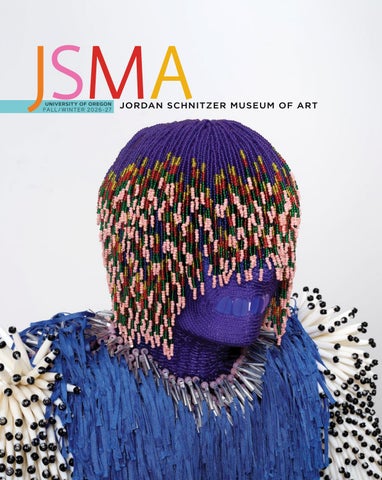
Jeffrey Gibson (American, b. 1972). Untitled Figure 1, 2022. Plastic bone pipe beads, fringe, glass beads, artificial sinew, tin cones, sea glass, acrylic felt, steel armature and powder coat varnish. 71 1/2 x 39 x 26 inches overall. Collection of the Jordan Schnitzer Family Foundation. © Jeffrey Gibson. Courtesy the artist and Hauser & Wirth
7
The exhibition’s centerpiece is an expansive and immersive work titled To Name An Other (2019) comprised of 51 screen printed elk hide drums and 50 wearable garments. Originally commissioned as a performance by the Smithsonian’s National Portrait Gallery, To Name An Other marks a turning point in the artist’s career whereby Gibson has increasingly sought out collective-based projects and performances to activate the communities within which he works. Collaboration is at the heart of his recent social practice. Working and learning together may aid in decolonizing minds and institutions, revealing a future we wish to inhabit. In 2024, Gibson was selected as the first Indigenous artist to represent the U.S. Pavilion with a solo presentation at the Venice Biennale, further demonstrating how his vibrant and powerful voice continues to broaden the view of American art history, contemporary times, and our future. In spring 2026, Gibson and a team of collaborators launched More Colors Than the Eye Can See, a years-long partnership between the Smithsonian’s National Museum of the American Indian (NMAI), Portland Art Museum (PAM), SITE Santa Fe, and ten educators in The Jeffrey Gibson Venice Biennale Educator Cohort (including UO Alum Mvhayv [Talon Micco Claybrook], MFA in Art and Ethnic Studies, 2019). This special initiative produced 14 free, cross-disciplinary lessons about Indigenous art in national and global contexts. Jeffrey Gibson: They Teach Love – From the Collections of Jordan D. Schnitzer and His Family Foundation is curated by Ryan Hardesty, Executive Director and Curator of Exhibitions and Collections, Jordan Schnitzer Museum of Art, Washington State University, for its originating institution in 2023. Its presentation for the University of Oregon’s Jordan Schnitzer Museum of Art was organized by Danielle Knapp, McCosh Curator of American and Regional Art.
Left: Jeffrey Gibson (American, b. 1972). ALL I EVER WANTED ALL I EVER NEEDED, 2019. Found canvas punching bag, glass beads, plastic beads, artificial sinew, steel studs, acrylic paint, steel chain, 85 x 20 x 20 inches overall. Collection of the Jordan Schnitzer Family Foundation. © Jeffrey Gibson. Courtesy the artist and Hauser & Wirth Right: Jeffrey Gibson (American, b. 1972). STAND YOUR GROUND, 2019. Cotton and linen, digitally printed fabric, polyester thread, cotton batting, 87 3/4 x 67 1/2 inches overall. Collection of the Jordan Schnitzer Family Foundation. © Jeffrey Gibson. Courtesy the artist and Hauser & Wirth
SAVE THE DATE
Virtual Artist talk: Jeffrey Gibson Thursday, January 21, 4 p.m. Register here https://bit.ly/4xHo5ii
8
9
10
Cara Romero (Chemehuevi, b. 1977). 3 Sisters, 2022. Inkjet print on Legacy Platine paper. 13 x 18 inches. Gift of Bill Avery
Collecting America: Recent Acquisitions Harold and Arlene Schnitzer Gallery | June 13 - December 6, 2026 For nearly a century, the Jordan Schnitzer Museum of Art has provided students, faculty, and the broader community opportunities to connect with works of art across time periods and cultures. Initially founded in 1933 as an Asian art museum with the generous donation of Gertrude Bass Warner’s collection of over 3,700 works of art, the museum’s collecting interests have since broadened to artworks from around the world that provide even more opportunities for crosscultural and curricular connections. JSMA began collecting American and regional art in the 1960s and now stewards work by artists from the United States, Mesoamerica, contemporary Mexico, Cuba, Puerto Rico, and other areas of the Caribbean and across the Americas. With our recent acquisitions, the museum aims to reflect the voices and experiences of diverse audiences and the new and evolving ideas, insights, and conversations presented by artists in work that both shapes and responds to culture.
Collecting America: Recent Acquisitions presents a selection of artworks from the museum’s permanent collection that demonstrate our commitment to understandings of American art informed by perspectives from local, national, and internationally recognized artists. Through various materials and practices, the featured artists demonstrate the great diversity of art made in or in response to the United States of America. These works invite viewers to participate in conversations on identity, place, politics, and other issues facing our world today. This exhibition is organized by JSMA executive director Olivia Miller and curators Katie Loney, Danielle Knapp, and Thom Sempere with graduate student interns Aidyn Dervaes, (MA candidate, History of Art and Architecture), Parisa Garazhian (MFA candidate, Studio Art), and Lorna Isaacson (MA candidate, History of Art and Architecture).
Lorraine Schneider (American, 1925-72 ). War is Not Healthy for Children and Other Living Things, 1967 or later. Lithograph. 21 1/8 x 17 15/16 inches. Gift of Kenneth Helphand
11
Juan de Dios Mora (b. 1984 Yahualica, Jalisco, Mexico). Leading the Camino (Leading the Road), 2011. Linocut, 22 x 30 inches. Museum purchase with funds provided by Isaac & Eleanor Ayala, Elizabeth D. Moyer, Ph.D. and Michael C. Powanda, Ph.D., 2017:16.2
Leading the Camino: Latinx Art by Juan de Dios Mora and Consuelo Jimenez Underwood APS Gallery | On view through April 11, 2027 The exhibition Leading the Camino: Latinx Art by Juan de Dios Mora and Consuelo Jimenez Underwood, features prints and textiles by Mora and Jimenez Underwood to question borders and embrace living in the “borderlands.” Mora adopts figuration and humor to resist homogenization and contest political rhetoric that criminalizes immigrants. He employs Spanglish and popular motifs such as piñatas, luchadores masks, and Mesoamerican iconography to reflect his lived experiences and connect cultures across time and space. In his print Leading the camino, Maya and Aztec symbols are juxtaposed with tacos and technology, exemplifying Gloria Anzaldúa’s notion of the
12
borderlands or sites where a variety of traditions, languages and ways of being come into contact, overlapping and interacting, to nourish and inform each other. Jimenez Underwood embraces textiles to similarly cross borders and honor her hybrid identity as Chicana, Mexicana, Americana, Indigenous, woman, and artist. Her artworks bridge art and craft to examine geo-political barriers and weave together bodies and traditions from past and present. The exhibition is curated by Dr. Adriana Miramontes Olivas, Curator of Academic Programs and Latin American and Caribbean Art.
Divine Matter/ Earthly Matters: The Material Dimensions of Christian Devotional Images McKenzie Gallery | May 16, 2026 – May 21, 2028 The study of Christian icons has long focused on questions of representation. “Icon,” after all, derives from the Greek word eikṓn, meaning “image,” “likeness,” or “portrait.” Since the religion’s founding, however, Christians have also attended to their material dimensions. They recorded accounts of miraculous images, including divine imprints, where the likeness of holy figures transferred from one material to another without human intervention. Meanwhile, image makers used materials ranging from wood and natural pigments to metals, precious stones, and mosaics in the creation of sacred images. Theologians and clergy also contended with the material nature of images as they debated whether icons should be used in Christian devotional practices. Iconoclasm, or the destruction of images, peaked in the 7th and 8th centuries. At the Council of Hieria (754 C.E.), bishops declared that icons were “lifeless pictures with material colors which are of no value.” This view was grounded in theological and political concerns, as clergy feared images would lead worshippers into idolatry, defying the Ten Commandments and echoing Pagan and Roman Imperial practices. Others, however, advocated for icons as both didactic tools and sacred images that act as thresholds between earthly and heavenly realms. Making arguments for images, some theologians, like John of Damascus (c. 647-749 C.E.), highlighted the inconsistencies regarding images in the Old Testament, while also reasoning that visual representations of holy figures could be made because God became visible and corporeal in Jesus. Divine Matter/Earthly Matters returns to these questions about the materiality of Christian devotional images, not to assess their theological validity but to explore their earthly entanglements. It brings together icons, hand crosses, and retablos from different religious traditions and places including Ethiopia, Mexico, Russia, and Syria, inviting visitors to consider materials, techniques, and the role images play in liturgy and personal devotion. This exhibition was curated by Katie Loney, Ph.D., Post-Graduate Fellow in European and American Art.
Nuestra Señora de Refugio de Pecadores, (Our Lady Refuge of Sinners). n.d. Oil paint on tin. 14 x 10 inches. Mexico. Gift of Dr. Don E. and Carol Steichen Dumond Wood Carved and Cloisonné Cross. 17th-18th Century. Brass, fruitwood, semi-precious stones, (modern) acrylic base. 7 x 3 inches (Cross). Russian. Gift of Mr. and Mrs. Jacob B. Kolliner
13
REN Ming 任敏 (Chinese-born American, born 1956), Rosy Clouds-1, 2020, Ink and color on xuan paper mounted on canvas, 90 ½ x 19 1/3 inches. Gift of the Artist Manchu Woman’s Formal Court Vest and Collar, Chinese; Qing dynasty, 18th century. Dark blue silk satin embroidered with silk floss and couched with gold-wrapped thread and silk plied cord, 56 1/8 x 48 1/16 inches. Murray Warner Collection
Question the Harmonious: Chinese Art and Design from Antiquity to the Present Soreng Gallery | July 7, 2026 – September 19, 2027
Laozi quote on the west wall of the JSMA
“To know the harmonious is called the eternal. To know the eternal is called enlightenment.” The inscription attributed to the ancient Chinese philosopher Laozi on the left side of the JSMA entrance has greeted museum visitors since the 1930s. Yet what is the harmonious when we look at art? Does harmony represent an inherent aesthetic quality or is it a constructed social code imposed by politics?
Inspired by JSMA’s own connection with China, this exhibition proposes to look at harmony not as a fixed norm, but as a shifting and contested concept. It explores how harmony has been conceptualized, visualized, and politicized in Chinese art and design. Drawing from the museum’s rich collection, this exhibition shows art and design from different historical periods and in diverse media, such as prints, textiles, and contemporary paintings. It invites the viewers to question the complex relationship between harmony and dissonance. This exhibition is organized by JSMA Curator of Contemporary and Traditional Chinese art Yan Geng in collaboration with Professor Ina Asim (Department of History, University of Oregon) and Professor Charlene Liu (Department of Art, University of Oregon).
14
AY-O 靉嘔 (IIJIMA Takao 飯島隆雄, born 1931). Japanese; Shōwa period, 1984. Sumo Wrestling. Screen print; ink and color on paper, 27 x 35 ¼ inches. Loan from The Lavenberg Collection of Japanese Prints
High Drama: Japanese Prints of Theater, Heroes and History Preble/Murphy Galleries | August 22, 2026 – October 10, 2027 This thematic exhibition incorporates student research from History of Art and Architecture Professor Akiko Walley’s Spring 2026 Japanese print course that focused on “the dramatic,” including dynamic prints of Kabuki theaters and actors, changing expressions of human bodies, and dramatizations of historical events and legends. Featuring recent gifts by Lee & Mary Jean Michels and Irwin Lavenberg, the undergraduate and graduate students in the course examined woodblock prints of the 18th-20th centuries that showcased action and powerful emotion with compelling graphic design. The exhibition is complemented by a selection of Japanese modern and contemporary prints, paintings, textiles, and decorative arts addressing the theme of “drama,” and includes a number of recent acquisitions. As a final project, students in Professor Walley’s course conducted original research and composed label texts for select prints from the Michels and Lavenberg collections included in this exhibition. The wall text reflects five notable topics the graduate students in the course selected to capture the theme of “drama” in Japanese commercial woodblock prints of the early modern and modern periods. This exhibition was co-organized by Chief Curator Anne Rose Kitagawa.
UTAGAWA Kuniyoshi 歌川國芳 (1797-1861). Japanese; Edo period, 1847-1848. Boatman Zhang Heng, from the series One Hundred and Eight Heroes of the Popular Water Margin. Ukiyo-e woodblock print in vertical chūban format; ink and color on paper, 9 ¾ x 7 ¼ inches. Gift of the Lee & Mary Jean Michels Collection
15
Samantha Yun Wall (American, 1977). Wild Seeds No. 4, 2024. Ink and conté crayon on Claybord, 36 x 36 x 2 1/4 inches. Farwest Steel Korean Art Endowment Fund Purchase
Samantha Yun Wall: The Space to Grow
Focus Gallery West | February 20 - August 29, 2027 The JSMA presents Portland-based artist Samantha Yun Wall's first solo museum exhibition in Oregon with The Space to Grow. This body of work explores the significance of serpent women in folklore and world literature, specifically the Korean goddess Eopsin who takes the form of a black snake and protects the home, and Anyanwu, the shape-shifting healer in Octavia E. Butler’s acclaimed science fiction novel Wild Seed (1980). Wall draws connections between the Korean and African-American women in her own ancestry and global themes of protection, identity formation, and divine female power. In a 2023 artist statement, Wall explained, “My [recent] drawing practice is informed by my experiences as a Black-Korean immigrant. A longing to rediscover lost cultural histories, revealing narratives that have shaped me, forms the backbone of my research […] Ultimately, my drawings are a reflection of my experiences as a woman navigating a world that often marginalizes and exoticizes those who are perceived as Other.” In 2024, she began using her Korean middle name Yun professionally to reinforce the significance of her Korean heritage. Her work has been widely recognized for its powerful exploration of biracial identity and experiences, with recent inclusion in The Outwin 2025: American Portraiture Today at The Smithsonian’s National Portrait Gallery and Wall’s selection as the Seattle Art Museum’s Betty Bowen Award winner in 2024.
16
The exhibition includes Wall’s Wild Seeds series along with her standalone piece The Space to Grow and a related four-part drawing on Dura-Lar, Becoming. Several of these works debuted in Wall’s first solo museum exhibition, Boren Banner Series: Samantha Wall, at the Frye Museum in 2024. The JSMA is grateful to the artist and special lenders for their loans to the exhibition and to the museum’s Farwest Korean Art Endowment that made possible the acquisition of Wild Seeds No. 4 for JSMA’s permanent collection. Samantha Yun Wall: The Space to Grow was curated by Danielle Knapp, McCosh Curator of American and Regional Art, with an Exhibition and Documentation Support Grant from the Ford Family Foundation.
Artist talk: Samantha Yun Wall Thursday, February 25, 4 p.m. Lawrence Hall, Room 115 This Visiting Artist Lecture Series program is presented by the UO Department of Art and the Center for Art Research and co-sponsored by the JSMA.
Gordon W. Gilkey (American, 1912-2000). Steel Construction for Trylon and Perisphere, 1939. Watercolor on paper. The Vivian and Gordon Gilkey Graphic Arts Collection, Portland Art Museum, 83.57.571
Gordon W. Gilkey (American, 1912-2000). Construction Detail – An Entrance to a Food Building, 1939. Watercolor on paper. The Vivian and Gordon Gilkey Graphic Arts Collection, Portland Art Museum, 84.25.448
Building the World of Tomorrow: Gordon Gilkey’s 1939 New York World’s Fair Graves Gallery | August 8, 2026 - December 13, 2026 In 1939, Oregon printmaker Gordon Gilkey created the book Officially Approved Etchings: New York World’s Fair: “Building the World of Tomorrow.” Created after he completed his MFA at the University of Oregon with a visual study of the UO library and its construction, Gilkey’s new project was an artistic record of the 1939 New York World’s Fair and its temporary buildings, including its pavilions dedicated to industries such as maritime transportation, natural gas, glass, and fashion. Running from April 1939 to October 1940, the Fair brought more than 45 million visitors to its spectacular, futuristic pavilions and displays, which depended on modern design theories rooted in abstraction. Nearly 60 countries, 33 states and US territories, and numerous American businesses and industries participated, creating exhibits on art, culture, and industrial manufacturing that aligned with its theme, “Building the World of Tomorrow.” In the context of the Great Depression, the Fair envisioned a new modern world where a romanticized form of corporate capitalism would create not only
economic stability but prosperity. Responding to rising fascism and the looming threat of war, the Fair also embraced themes of peace and international cooperation, arguing that peace was essential to progress. Gilkey’s etchings not only record this idealized capitalist future through further abstraction of its architecture but also record the labor by which it was built. “Building the World of Tomorrow:” Gordon Gilkey’s 1939 New York World’s Fair brings together a selection of Gilkey’s etchings from the JSMA’s collection, in the form of fine art prints Gilkey made from the series as gifts for prominent individuals and collecting institutions, alongside preliminary watercolors on loan from the Portland Art Museum. Thus, the exhibition invites visitors to consider both the Fair’s vision of an unrealized future and Gilkey’s early work and process, especially as they relate to architectural drawing, printmaking, and abstraction. This exhibition was curated by Katie Loney, Ph.D., Post-Graduate Fellow in European and American Art.
17
18
Frying Pans and Metal Chains: Rethinking the Body in Contemporary Art Harold and Arlene Schnitzer Gallery January 9 – April 25, 2027 Spanning six decades, from 1964 to 2024, the exhibition Frying Pans and Metal Chains: Rethinking the Body in Contemporary Art traces the rich and varied ways in which artists engage with the body. Elevating commercial products to the status of art and adopting objects best suited for wardrobes, kitchens or stores—such as candies, fans, pantyhose, cooking pans, and gold chains, the artists in the exhibition reveal a shared interest in ordinary materials and motifs to celebrate and represent the female body, the black body and the laboring body. Artworks by Senga Nengudi and David Hammons are informed by resistance movements and Black liberation activism, while Félix González-Torres mourns his beloved partner Ross Laycock lost to the AIDS epidemic. Narsiso Martínez focuses on belonging and rootedness and renders farmworkers and immigrant bodies visible, while Simone Leigh and Liliana Porter turn to the femme form to embody presence and self-assertion. As artists contest stereotypes and misrepresentation of bodies, they evoke intimacy and advocate for collective memory. In their materiality, scale, or attention to human form, the artworks in the exhibition call upon viewers to envision new possibilities for relating to one another. At a time when Artificial Intelligence is being tested to communicate with humans, treat the U.S. loneliness crisis, and as we continue to grapple with its role in education or the workforce, the exhibition redirects attention to the body and its role in society. The exhibition includes artworks by John Ahearn, Belkis Ayon, Rick Bartow, Frank Blazquez, T.C. Cannon, Alfred Conteh, Dr. Lakra, Félix González-Torres, David Hammons, Simone Leigh, Narsiso Martínez, Cirenaica Moreira, Senga Nengudi, Lilliam Nieves, Ritsuko Ozeki, Liliana Porter, Fritz Scholder, and Kay Walkingstick. The exhibition is curated by Adriana Miramontes Olivas, Ph.D., Curator of Academic Programs and Latin American and Caribbean Art, and it is organized in partnership with Art Bridges Foundation.
Simone Leigh (b. 1967 Chicago, IL). Las Meninas II, 2019. Terracotta, steel, raffia, and porcelain, 71 ½ x 77 ½ x 62 inches. Art Bridges. David Hammons (b. 1943 Springfield, IL). Untitled, 1988. Rubber tube, frying pans, and metal chains, 48 x 18 x 7 inches. Art Bridges. Félix Gonzalez-Torres (b. 1957 Guámairo, Cuba – 1996). Untitled (L.A.) 1991. Green candies in clear wrappers. Overall dimensions vary with installation, original dimensions: approximately 192 x 14 x 1 ½ inches, original weight: 50 lbs. Jointly owned by Art Bridges and Crystal Bridges Museum of American Art, L2026:38.1 Kay Walkingstick (Cherokee b. 1935). Peonies, 1969. Acrylic on canvas, 56 x 48 inches. Art Bridges.
Shared Visions
Frank Frazetta | Man Ape “I love the Old Masters. But they were reserved, restrained by their time. I’m an artist of my time. Why paint barns? Barns already exist. They don’t need me to create them. What I do create doesn’t exist—and to me that’s a helluva lot more exciting!” —Frank Frazetta, 1976 On view through December 10, 2026 Frank Frazetta (1928-2010) was one of the most admired commercial artists of the 20th century, renowned for painting scenes of pulp-inspired mayhem with the technique of an Old Master. A child prodigy, Frazetta enrolled in the Brooklyn Academy of Fine Arts—a modest, one-room school run by the Italian-born painter, Michele Falanga—in 1936 at age eight. By sixteen, he was freelancing in comics, and by 1954 he was ghosting for Al Capp on the popular newspaper strip L’il Abner. But after falling out with the notoriously irascible cartoonist in 1961, Frazetta left comics behind and began painting covers for massmarket science fiction and fantasy paperbacks. Frazetta produced eight Conan paintings for the Lancer publishing house between 1966 and 1971. It proved a pivotal series for both the artist and his barbarous subject. Man Ape (1968) served as the cover for the fifth Lancer paperback, titled simply Conan. The scene is one of furious conflict, but close examination reveals a structurally rigorous composition. For example, if we were to trace diagonal lines from corner to corner, we would see that the action is organized along the opposed axes of the resulting X, with the two lines converging just below the Man Ape’s chin. The diagonal from lower left to upper right would run through the painting’s dominant visual element: a billowing mass of scarlet cloth enveloping the beast. This sweep of vivid red also divides the image into zones of dark and light. At upper left, the background is so murky that we can barely discern the archway behind Conan’s arm; at lower right, an offstage light source reveals the cracked stones floor. Faint grid-like shadows on the cloth at lower left suggest illumination filtered through a barred window—evidence of the larger space Frazetta imagined but did not depict. The action draws directly on Robert E. Howard short story “Rogues in the House,” in which Conan battles an unnaturally intelligent ape-creature named Thak, the rebellious familiar of a corrupt pagan priest. Before their
encounter, we learn that Thak has taken to wearing his former master’s red robes. The key sentences read as follows: … the barbarian had locked his legs about the ape-man’s torso and was striving to maintain his position on the monster’s back while he butchered it with his poniard. Thak, on the other hand, was striving to dislodge his clinging foe, to drag him around within reach of the giant fangs that gaped for his flesh. In a whirlwind of blows and scarlet tatters they rolled along the corridor … But as Frazetta remarked in several interviews, he didn’t read the tales that he so effectively popularized. Instead, his friend and fellow fantasy artist Roy Krenkel reviewed the manuscripts and suggested scenes. Krenkel clearly briefed the artist well on this occasion. Frazetta’s relative unfamiliarity with Howard’s prose may explain one key departure from the author’s descriptions. Howard repeatedly writes of Conan’s “square cut” hairstyle, suggesting something like the pageboy fringe of Hal Foster’s Prince Valiant. By contrast, Frazetta’s Conan’s is coifed like a late-60s rock god, a fearsome Jim Morrison on steroids. In other paintings, Frazetta gives his hero even more frightening features—consider, for example, the mask-like death’s head visage of “The Berserker,” the cover of Conan the Conqueror (1967)—but those dark, flowing locks remain constant. Prior to the Lancer series, knowledge of the Conan canon was largely confined to collectors of Weird Tales magazine, where Howard’s stories appeared between 1929 and 1936. Frazetta’s work was therefore instrumental in transforming a relatively obscure pulp hero into the cornerstone of a global entertainment franchise spanning books, comics, magazines, animation, video games, and film. To this day, his paintings remain among the most frequently reproduced renditions of the character. His vision of Conan—aggressively hyper-masculine, romantically leonine, and near naked—was instantly definitive.
Ben Saunders is a Professor of English and founder of the UO Minor in Comics Studies. He has published on a wide diversity of subjects, and has also curated several comics-themed exhibitions, including Marvel: Universe of Superheroes, an international multi-media touring show that attracted more than three million visitors between 2018 and 2026.
20
Frank Frazetta (American, 1928-2010) Man-Ape, 1967. Oil on board, 16 x 20 inches. Collection of Anthony Wood
21
Facilities & Collections
FOCUS WEST
Moving on Up! The APS Gallery moves to the second floor Beginning in summer 2026, the JSMA began work to relocate and improve the Artist Project Space (APS). Created in 2011 with generous support from The Ford Family Foundation, the APS was a small gallery located on the north side of the museum
ARTIST PROJECT SPACE (APS)
lobby. Originally conceived as a dedicated space
17' x 22'
Over the years, the gallery has evolved to support a
for contemporary artists’ media works, the gallery was designed to accommodate digital projections, sound installations, and other time-based media presentations. broader range of exhibitions, including traditional framed artworks and sculpture in addition to digital and media-based works. Relocating the APS Gallery to the second floor, adjacent to the museum’s primary exhibition galleries, will allow the museum to create a more flexible and fully supported space
FOCUS EAST
for changing artist projects. The new APS Gallery will be purpose-built to support a wide variety of artistic media. It will feature adaptable “black box” capabilities—including a darkened environment, sound isolation, and projection infrastructure—while also providing the environmental controls and security necessary to accommodate object-based exhibitions and other traditional gallery displays. Construction is anticipated to be completed in time for the start of the 2026–27 academic year.
22
Publishing Chinese Textiles: JSMA Joins Global Scholarly Initiative JSMA received a volume from the book series as a gift from Chinese Professor Zhao Feng and researcher Aixi Zhao.
In fall 2025, the JSMA welcomed Professor Zhao Feng, a distinguished scholar of Chinese silk art from the School of Art and Archaeology at Zhejiang University in China. Professor Zhao also serves as Vice President of International Alliance of Museums of the Silk Road (IAMS) and as a member on the Executive Board of the International Council of Museums (ICOM).
institutions. Established in 1933, the JSMA is among the earliest academic art museums in the United States to focus on Asian art. The museum holds an exceptional collection of Chinese textiles and maintains a strong commitment to research, publication, and crosscultural dialogue. As a leading art institution on the West Coast, the JSMA continues to foster international exchange through the publication of its Chinese silk art. Participants in the meeting with Professor Zhao included the Executive Director Olivia Miller, Chief Curator of Collections and Asian Art Anne Rose Kitagawa, Curator of Contemporary and Traditional Chinese Art Yan Geng, Collections Manager Chris White, Communications Manager Debbie Williamson Smith, Assistant Collections Manager Elizabeth Larew, Preparator and Conservator Beth Robinson, Collections Photographer and Database Coordinator Jonathan Smith, and Executive Assistant Lesley Williams.
Executive Director Olivia Miller and Professor Zhao Feng discuss the book series and the publication of the JSMA collection.
A book launch event for the publication of the JSMA collection is planned for Wednesday, November 18, 2026. Please check our website for details.
During Zhao's visit, JSMA executive director Olivia Miller signed a cooperation agreement with Professor Zhao for the publication of the museum’s collection of Chinese textiles as part of the series A Comprehensive Collection of Chinese Silk Art. This book project aims to advance the global scholarship of Chinese textile heritage through systematic documentation, research, and publication. The series will comprise one hundred volumes, drawing on major museum collections all over the world, such as the Palace Museum in Beijing, the British Museum in London, and The Metropolitan Museum of art in New York. JSMA’s participation in this series indicates not only an international recognition of the significance of its textile collection, but also a meaningful cooperation between Chinese and American academic
JSMA Executive Director Olivia Miller and Professor Zhao Feng examine Chinese textiles in the collections lab.
23
Member Spotlight:
Development News
Riki Saltzman always found that folklore is always about the artist and the community first, and I believe that there is a great partnership that can be found between the JSMA and the Oregon Folklife Network. There is a nice dovetailing of the basic interests in both organizations.
How did you first get involved at the JSMA? I got to campus in 2012 to be the Executive Director of the Oregon Folklife Network. My family and I have always been involved in art museums wherever we live and the JSMA offers the North American Reciprocal Museum Association membership, which is an amazing deal. I like to support the art museums where I am and it was right next door to the Oregon Folklife Network housed in the Knight Library, so it was easy to get there. What does being a JSMA member mean to you? It is a great museum. I’ve always been involved in the arts. You never feel exhausted after looking through all the JSMA has to offer. I can always come back another time too. It’s really nice to know that I can pop in for half an hour, 15 minutes, or you can spend a couple of hours. What is your favorite part of being involved in the North American Reciprocal Museum Association? I can go to just about any other art museum. If they are a part of NARM, I can go to them for free all over the country, which is great. I have family in Florida, and we were able to attend museums, like the Ringling Museum, for free because we’ve already paid for it with our membership. It also covers museums that aren’t art museums as well, so that’s a nice side benefit. Sometimes there is also a traveling exhibit that I will get to see multiple times and that is very cool. How can Folklore and the JSMA be connected? Well for one, two former folklore grad students currently work at the JSMA. Over the years, there have been some exhibits where I walk and interpret art in a different way and look at things with a lot more of a heritage background. I have
24
What has been your favorite JSMA exhibition? From the Heart: The Photographs of Brian Lanker. I really like photography so that was cool. It looked at people from different backgrounds, different disciplines, and the photographer had to know about these people to get the kind of portraits he got. The James Lavadour exhibit was also an incredible exhibition. I also enjoy the silverware. The workmanship and quality over different eras are incredible. Looking at it from a folklorist’s perspective, you can see the current trends of when the pieces were made. You discover a lot about how people drank, ate, and served and prepared food. I am attracted to the fact that these were living things used by real people. I am also always interested in the East Asian collection. The detail and craftsmanship on the Jade Pagoda are just breathtaking. How has art impacted your life? How has it not impacted my life? Growing up, my mom was a musician, and my dad was a millwright and carpenter. I grew up going to museums and taking art classes. I’m interested in artists’ stories and why they do what they do. To understand how an artist does whatever they do, I take classes to understand the art being done. I took a bead working workshop with Roberta Kirk, who is on the Oregon Folklife Network’s Culture Keepers Roster. I didn’t finish much over the course of four hours, but she would have gotten it done in 10 minutes. Getting one’s hands dirty, so to speak, makes a difference in understanding the tactile effort it takes to make art. I can’t imagine life without art. What books are you reading? I read a lot of detective novels because they’re solutions. I like to read stuff by Charlie Holmberg. It’s fun reading and nothing too deep. I am also eagerly awaiting the next novel by Louise Penny. Louise Penny also collaborated on a political thriller with Hillary Clinton, State of Terror, which was a lot of fun too. Any fun upcoming plans? I will be going to London in a few weeks, so we will certainly be visiting many museums while we are there. I lived in London while I worked on my dissertation, so it is not a foreign place to me.
45° Celebración Anual del Día de los Muertos 45th Day of the Dead Annual Celebration 1ero y 2ndo de noviembre del 2026 November 1 and 2, 2026
Jordan Schnitzer Museum of Art receives Tykeson Family Foundation Grant: The JSMA is excited to announce a three-year grant award for $400,000 from the Tykeson Family Foundation to support the national expansion of our Art Heals program. Previous support from the Tykeson Family Foundation enabled JSMA to expand Art Heals and to reach more than 16,000 participants, including patients, medical care providers, university students, and museum visitors, positioning JSMA as a national leader in museumbased well-being. This new grant, which will begin in 2027, will provide program stability, enhance evaluation, and enable national facilitator training through the Harnessing the Power of Museums book and the ARCC Framework (Attention, Reflection, Creation, Connection). Lisa Abia-Smith, Director of Education states: "Aligned with the UO’s Oregon Rising priorities, Art Heals demonstrates how art fosters human flourishing through creativity, reflection, and connection. This next phase emphasizes training, research, and replication, ensuring that the program’s benefits extend well beyond JSMA’s walls. These funds will provide program stability, enhance evaluation, and enable national facilitator training through the Harnessing the Power of Museums book and the ARCC Framework (Attention, Reflection, Creation, Connection)." The Tykeson Family Foundation’s visionary support has transformed Art Heals from a local pilot into a national model for museum-based health and well-being andwill serve as a catalyst, inspiring and encouraging future supporters to invest in the program’s long-term success.
Reserva la fecha! Celebra el día de los muertos en el JSMA y disfruta de una noche de arte, manualidades, danza, y música con la presentación especial del grupo Ensamble de Cuerdas.
Save the Date Celebrate the Day of the Dead at the JSMA and enjoy an evening of art and crafts, music, and dance featuring performances from the musical group Ensamble de Cuerdas. 25
Education
Art Heals: Empowering Practitioners to Lead Dr. Elizabeth Lahti and Lisa Abia-Smith outside the New Brunswick Performing Arts Center.
The JSMA’s Art Heals initiative was invited to the Zimmerli Art Museum at Rutgers University and the New Brunswick Performing Arts Center to serve as keynote presenters and facilitators for “Art Heals: Empowering Practitioners to Lead” symposium, an exploration of how the arts can support aging populations, including those living with memory loss and their caregivers.
Staff from the Zimmerli Art Museum at Rutgers University, the Jordan Schnitzer Museum of Art at the University of Oregon, and Middlesex County Culture.
Presented in partnership with the Arts Institute of Middlesex County, the Zimmerli Art Museum (ZAM) at Rutgers University, the Jordan Schnitzer Museum of Art at the University of Oregon, Rutgers University’s Mason Gross School of the Arts, the New Jersey State Council on the Arts, and the Museum of Modern Art (MoMA NYC), the symposium
26
highlighted a growing national movement at the intersection of arts, health, aging, and museum practice. The collaboration emerged through the BIG 10 Museum Educators Group, where in May 2025, the JSMA’s Art Heals initiative was invited to present its nationally recognized work in museum-based wellbeing and arts engagement. Lisa Abia-Smith, Chief Curator of Education; Rosemarie Oakman, Museum Program Manager for Well-being and Community Engagement; Dr. Elizabeth Lahti, Director of Narrative Medicine at Oregon Health & Science University; and Sophie Raiskin-Wood, Art Heals Program Assistant, led a keynote address and a series of immersive training sessions centering sensory-stimulating gallery tours and artmaking workshops inspired by artworks on display at the Zimmerli Art Museum. Their work placed strong emphasis on teaching organizations and practitioners to effectively use the Art Heals ARCC Framework, Attention, Reflection, Creation, and Connection, as a foundation for engaging older adults and individuals living with memory loss. Through guided facilitation, real-time practice, and collaborative discussion, the JSMA team demonstrated how the Art Heals program can be implemented in museum and community settings to foster meaningful participation and create supportive, person-centered experiences. The presence of leaders from MoMa underscored the importance of this work. Their pioneering efforts in arts access for people living with memory
loss through their internationally recognized program Meet Me at MoMA, along with accompanying training resources and research, have helped shape the field, reinforcing the need for continued professional development and cross-institutional learning to best serve the memory loss community through meaningful cultural programming.
For the Zimmerli Art Museum, the symposium offered both inspiration and a roadmap for future impact. Maura Reilly, the Museum’s Director, shared, “I’m incredibly inspired by what I’ve learned; it’s helping me to conceptualize how we can do the kind of work here at the Zimmerli Art Museum… The symposium is giving me ideas for how we can bridge that gap between the museum and those who have Alzheimer’s Disease and others dealing with memory loss.” By centering training and skill-building, the symposium reinforced that creative aging initiatives are most effective when practitioners and teaching artists are equipped with frameworks and practical tools. The Art Heals team’s leadership in teaching the ARCC framework demonstrated how institutions can move beyond one-time programs toward sustained engagement, ensuring that older adults and individuals living with memory loss are not only included but meaningfully connected to their communities through the arts. The symposium not only shared strategies but also catalyzed new partnerships and possibilities, demonstrating how museums and cultural organizations can lead in advancing creative aging initiatives, strengthening cross-sector collaborations, and reimagining what it means to create communities of care through the arts. What began as a conversation within the Big Ten Museum Educators network has now evolved into an expanding national collaboration, positioning the JSMA and its Art Heals initiative as leaders in the growing field of museum-based wellbeing and interdisciplinary arts and health practice.
Artwork created by Jill Decker during the Art Heals Symposium.
A central theme of the symposium was the power of convening diverse sectors, including arts, healthcare, education, and social services, to build more responsive and inclusive programming for aging populations. Dana Daddio, Program Manager for the Division of Visual and Performing Arts with the Arts Institute of Middlesex County, reflected, “Our goal at the Arts Institute of Middlesex County, partnering with the Zimmerli to help bring Art Heals here, was really to bring so many different groups and organizations together… and just how art can heal through so many different levels of work and learning with the community.” For Middlesex County, this work aligns closely with its mission to foster collaboration. Manda Gorsegner, Division Head, Visual & Performing Arts at the Arts Institute of Middlesex County, noted, “I think we have a unique role at the Arts Institute of Middlesex County… to be working on these types of arts and health events that really connect and convene all these different types of entities and people and teaching artists, all in one space. This is really the pinnacle of the work we do.”
Dr. Elizabeth Lahti, Lisa Abia-Smith, Rosemarie Oakman, and Sophie Raiskin-Wood outside the Zimmerli Art Museum.
27
Art Heals in Venice: International Collaboration at the Peggy Guggenheim Collection Lisa Abia-Smith and teaching artist Valeria Bottalico during a Double Meaning tactile tour at the Peggy Guggenheim Collection.
This spring, the Jordan Schnitzer Museum of Art’s internationally recognized Art Heals initiative traveled to Venice, Italy for a series of transformative workshops centered on art, well-being, and human connection. Hosted at the iconic Peggy Guggenheim Collection, the gathering included museum educators, healthcare professionals, art historians, art faculty, artists, scholars, and community practitioners and reflected the growing international reach of the JSMA’s Art Heals program and the ARCC Framework, Attention, Reflection, Creation, and Connection. The Venice workshops were co-led by Lisa Abia-Smith, JSMA Chief Curator of Education; Rosemarie Oakman, Museum Education Program Manager for Well-Being and Community Engagement; and Dr. Vincenza Ferrara of Sapienza University of Rome and VTS Italia, a leading scholar in medical humanities and museum education. Participants included faculty from the Leo Marchutz School of Drawing and Painting, partners from VTS Italia, healthcare educators and researchers from Italy, social prescription link workers from Milan and Genoa, museum educators from the Peggy Guggenheim Collection, and arts and health practitioners from across Europe and the United States.
28
One highlight of the week was participation in the Peggy Guggenheim Collection’s Double Meaning program, an innovative multisensory tour designed for both visually impaired and sighted visitors. The experience demonstrated how museums can create deeper accessibility and engagement through careful attention to sound, language, movement, and sensory interpretation, values closely aligned with the JSMA and Art Heals philosophy. The JSMA-led Art Heals workshop at the Guggenheim welcomed 16 participants into a shared space of slow looking, dialogue, reflective writing, and creative exploration inspired by works in the museum’s collection. Participants engaged with paintings by Pablo Picasso, René Magritte, and Max Ernst through Visual Thinking Strategies (VTS), mindfulness-based observation, and artmaking practices intended to reduce cognitive overload while fostering empathy and connection. Among the participants was Dr. Elisa Corso, Research Facilitator in Digital Humanities and NeuroHumanities at Ca’ Foscari University of Venice. Reflecting on the workshop experience, Corso shared: “Deep gratitude to the facilitators Lisa Abia-Smith, Rosemarie Oakman, and Vincenza Ferrara for creating the conditions for this important shared exploration and for giving neurohumanities a socially acceptable excuse to slow down and look at paintings!”
She continued: “Through slow looking, we engage attentional networks that help reduce cognitive overload and support focus, emotional regulation, and meaning-making. Attention is never neutral. How we design museum experiences shapes not only what we see, but how we think, feel, and relate.” The Venice gathering also served as an international “train-thetrainer” exchange, where facilitators and educators explored how the Art Heals program and ARCC Framework can be adapted across museums, healthcare environments, and community spaces. Among the participants was Tiffany Miller, a Missoula-based K–12 art teacher who had previously participated in an Art Heals workshop led by Abia-Smith and Oakman in Montana. While on sabbatical in Florence studying painting, art history, and Italian language and culture, Miller traveled to Venice to join the Guggenheim workshop, reflecting the continuing relationships and professional pathways emerging through Art Heals programming. Miller described how her international travels and experiences studying art abroad had deepened her interest in the role of art as “a healing tool and universal language.” Her participation in Venice highlighted the growing network of educators engaging with Art Heals beyond traditional classroom settings and into museums, healthcare, and communitybased well-being initiatives.
Over the past two years, JSMA and collaborators in Italy have worked together in various ways to explore how museums can function as spaces of care, dialogue, inclusion, and well-being. The collaborators will convene again this September in Boston for Bridging Visual Arts & Healthcare: Impact, Innovation, Research, an international symposium organized through partnerships with Harvard Medical School, Brigham and Women’s Hospital, Dana-Farber Cancer Institute, and Mass General Brigham Continuing Professional Development, alongside museum partners including the Museum of Fine Arts, Boston, the Isabella Stewart Gardner Museum and the Harvard Art Museums, bringing together museum educators, healthcare practitioners, and researchers from around the world. Equally meaningful was the opportunity to exchange ideas, educational approaches, and accessibility practices with the education staff at the Peggy Guggenheim Collection. Conversations surrounding multisensory engagement, museum accessibility, Visual Thinking Strategies, and well-being-centered programming highlighted the value of international collaboration and the ways museums across the world are reimagining their role as spaces of care, connection, and belonging.
For Dr. Ferrara, the collaboration represents a meaningful intersection of research, education, healthcare, and human connection. Reflecting on the partnership, she shared: “My aim is to share my research with others and to learn more from the JSMA how to improve the experience of art, especially Visual Thinking Strategies, in the health sector and in others for building community, social inclusion and personal well-being.” She added: “I hope to promote a project of Sapienza Museums to design a common project with Jordan Schnitzer Museum of Art next Spring.” The workshops also highlighted the growing relationship between Art Heals and international social prescribing initiatives. Alexandra Morgan, an Italy-based social prescribing link worker and educator who participated in the Venice gathering, reflected on the impact of the experience: “Your workshop was wonderful! It was inspiring in many ways for me and I had a tremendously good time; your program inspired meaningful conversations with everyone.” Morgan, who works at the intersection of education, healing, and community well-being, described the Art Heals experience as deeply aligned with emerging efforts in Europe to integrate artsbased approaches into healthcare and social support systems. Her participation represented one of several conversations exploring future collaborations around narrative medicine, social prescribing, and museum-based well-being initiatives in Italy.
Art Heals workshop participants in the courtyard of the Peggy Guggenheim Collection in Venice, Italy.
As the Art Heals initiative expands globally, the Venice gathering offered a powerful reminder of the essential role museums and the arts can play in fostering human connection in an increasingly fragmented world. Bringing together participants across disciplines, cultures, languages, and countries, the workshops created space for people to slow down, look closely, reflect deeply, and engage with one another in meaningful ways. Through shared experiences with art, participants discovered moments of connection, belonging, curiosity, and care, demonstrating how museums can serve not only as places of learning, but also as spaces for restoration, dialogue, and community.
29
Prescribing Connection: How the JSMA is Teaching Students to Slow Down Through Art, Nature, and Community Students in the University of Oregon’s Social Prescribing course.
This winter, the Jordan Schnitzer Museum of Art became more than a classroom. It became a space for University of Oregon students to slow down, reflect, create, and reconnect through the power of art, nature, music, and human connection. In the UO’s first course dedicated entirely to social prescribing, students explored how museums, arts experiences, creative practice, and community engagement can support mental health, belonging, and well-being in an increasingly fast-paced and fragmented world. Designed and taught by Lisa Abia-Smith, JSMA Chief Curator of Education and Teaching Professor in the School of Planning, Public Policy, and Management, the course examined the growing international movement of social prescribing, an approach that connects individuals to meaningful activities such as museum visits, nature walks, creative workshops, music, movement, and community programs to improve overall health and well-being. Rather than learning solely through lectures and readings, students experienced the course inside the museum itself. Galleries became spaces for reflection, dialogue, mindfulness, and creative exploration. Students were encouraged to slow down and engage deeply with works of art while considering larger questions surrounding stress, loneliness, burnout, community care, and the role of museums in public wellbeing. “The course was really about helping students rediscover attention and connection,” Abia-Smith shared. “We live in a culture of constant stimulation, speed, and distraction. The museum offers something different. It gives students permission to pause, observe, reflect, and simply be present.”
30
Throughout the term, students participated in weekly “prescriptions” designed to help them personally experience practices connected to decompression and well-being. Assignments included spending uninterrupted time looking closely at a single artwork, sketching in the galleries, engaging in reflective artmaking, listening to music while responding creatively to works of art, and taking mindful walks through nature. Many students also explored the relationship between visual art, sound, movement, and the natural environment discovering how creative experiences across disciplines can support emotional regulation, focus, imagination, and restoration. For some students, these assignments became an antidote to the pressure and pace of university life. “Students often spoke about how unusual it felt to simply sit quietly with a work of art for twenty minutes,” Abia-Smith explained. “At first it felt uncomfortable for many of them. But over time they began noticing how slowing down changed the way they thought, felt, observed, and connected with one another.” A highlight of the course was the extraordinary lineup of international guest speakers who introduced students to innovative approaches connecting healthcare, arts engagement, and community wellness around the world. Students met with Julia Hotz, journalist and author of The Connection Cure, whose work has brought international attention to the role of social prescribing in addressing loneliness and disconnection. The course also welcomed Jenny Kirschner, founder of PALS (Pharmacists and Social Prescribing Australia), who discussed how healthcare systems in Australia are integrating arts and community-based
programming into patient care. Ariel Leissman introduced students to local efforts connecting individuals with outdoor wellness and naturebased experiences through Eugene Parks Rx. Students engaged with Adam Hoverman, a Canadian physician exploring intersections between healthcare, narrative medicine, and social connection, and Chris Appleton, CEO of Social Rx (formerly Art Pharmacy), one of the leading organizations in the United States advancing arts prescribing partnerships between healthcare providers and cultural institutions. Together, these conversations helped students understand that museums and arts organizations are increasingly being recognized internationally as important contributors to public health and community well-being. The course also drew deeply from the JSMA’s nationally recognized Art Heals initiative which has guided museumbased wellness programming developed at the museum over the past decade. By situating the course inside the museum, students experienced firsthand how museums can function not only as educational spaces, but also as places that foster belonging, curiosity, reflection, empathy, and restoration. Students from across disciplines, including public policy, art history, architecture, education, and health-related fields participated in the course, many expressing surprise at the growing body of research connecting arts engagement with reduced stress, increased resilience, improved mental health, and stronger social connection. For the JSMA, the course represents an important evolution in how museums engage university students and contribute to campus well-being. As conversations surrounding loneliness, mental health, and burnout continue to grow nationally, the museum is helping students explore a different model of learning and one grounded not only in information and achievement, but also in presence, creativity, reflection, and human connection. Museums can become Bus spaces where students feel restored, inspired, and connected. This course helped students understand that art is not separate from well-being. Art, nature, music, creativity, and community are all deeply connected to how we care for ourselves and one another.
Dr. Elizabeth Lahti, Lisa Abia-Smith, and Rosemarie Oakman at the National Organization for Arts in Health’s Cam Busch Award ceremony.
Jordan Schnitzer Museum of Art Receives National Recognition for Art Heals The JSMA’s Art Heals team received an honorable mention by the National Organization for Arts in Health’s (NOAH), Cam Busch Arts Building Resilience Award, recognizing the museum’s groundbreaking contributions at the intersection of the arts, healthcare, and community wellness. Lisa AbiaSmith, Chief Curator of Education, Rosemarie Oakman, Museum Program Manager for Well-being and Community Engagement, and Dr. Elizabeth Lahti of Oregon Health & Science University were celebrated for their innovative, research-informed approach to supporting the wellbeing of patients, caregivers, medical professionals, and community members. Through creative art walks, mixed-media workshops, narrative medicine practices, and engagement looking at works of art, the Art Heals program offers accessible, failure-free experiences that foster reflection, connection, and healing. “Receiving national recognition from NOAH affirms that what we do here at the JSMA truly matters,” said Abia-Smith. “Art has the power to create flourishing, restore attention, deepen reflection, inspire creativity, and build connection are four core principles that guide our work.”
Students create self-portraits exploring identity in the JSMA studio.
The JSMA Art Heals program has grown substantially in recent years, now serving diverse participants including adults with cancer, Latina mothers experiencing postpartum depression, University of Oregon students seeking stress relief, and healthcare workers navigating burnout. It represents a model of interdisciplinary collaboration between academic museums, medical institutions, and community partners, and is rooted in JSMA’s longstanding commitment to inclusive, human-centered arts education.
31
Staff Updates
Student Staff Thrive at the JSMA The JSMA strives to create new museum professionals, and we do this is by introducing the breadth of careers available in the museum field to university students. Student workers can learn many skills including, but not limited to, art research, inventory, volunteer management, curatorial collaboration, fundraising, event planning, marketing, and customer service. Through student employment, internships, and externships, the JSMA helps young professionals explore new interests and grow confidence in the skills they developed in the classroom. Story by Alex Gillette. Photos by Josie Brown.
Feather Miller (Education) Feather Miller is a senior at UO majoring in sociology and pursuing a minor in planning, public policy, and management. As studio assistant for the education program, Feather works to create a space for wellness for visitors at the JSMA. She wants to help build more opportunities for people to experience art. Some of her favorite memories come from working the museum’s summer camps. These moments inspired her to want to find ways to develop similar programs at her own reservation of Warm Springs in Central Oregon.
Bee Bredbenner (Visitor Services) Growing up in Eugene, Bee Bredbenner remembers walking the halls of the JSMA as soon as they learned to walk. A recent UO graduate, Bee is grateful to have worked at the JSMA all four years of college. Through their work in visitor services, they have been able to help build community and inspire connection through art. They even got to create a watercolor piece of the JSMA’s courtyard that can now be found on coasters and magnets in the gift shop. Bee wants to continue creating after college, whether that be producing children’s media or working with children in art therapy.
Aaralyn Reed (Security) As lead gallery monitor, Aaralyn Reed has become a familiar face for a lot of JSMA visitors. A recent graduate, Aaralyn studied theater arts, art history, and linguistics and is grateful that the JSMA has allowed them to explore their passions for storytelling in such a unique setting. They always enjoyed listening in on the class tours and curator talks and started to find a new interest in art and museums. Their favorite class they took at UO was titled “museology” and focused on the history and role of museums in society. Aaralyn wants to continue working in a museum after graduation and create welcoming spaces for all.
32
Justin Dufault (Collections/Academic Programs) As a senior art history major, Justin Dufault has been able to take what he has learned in the classroom and apply it to his work at the JSMA. In his role as a collections and academic programs assistant, Justin is responsible for assisting academic art viewings and student engagement. He also supports organizing and cataloging works in the museum’s own collection. Justin wants to continue working in art after graduation and has discovered an interest in art advisory and building connections with donors.
Faye Cohen (Collections/Academic Programs) Faye Cohen felt she became even more excited to attend her art history classes after she began working at the JSMA. Faye is a senior studying anthropology, classics, and art history, and she has loved getting the chance to combine all her passions as a collections and academic programs assistant at the museum. Her anthropology classes focus often on categorization, and so she finds it interesting helping categorize and working inventory for the museum’s collection. Faye’s favorite project she worked on was photographing microscopic images of Chinese textiles because she appreciates all the tiny details that go into these art works. She has loved discovering all the unique roles that help make a museum what it is.
Josie Brown (Collections) As the JSMA’s collections photography assistant, Josie Brown has photographed everything from art objects to installations and events. Josie is a recent graduate in journalism with minors in science communication and legal studies. As a local to Eugene, she grew up visiting the museum. Josie has enjoyed learning various photography skills and contributing to the accessibility of the art at the JSMA. Her favorite projects include photographing James Lavadour: Land of Origin installation. While she splits her time across multiple photography roles at UO, she loves the calm and encouraging atmosphere at the JSMA. She plans to continue to pursue photography using the techniques she has learned at the JSMA.
Alex Gillette (Communications) Alex Gillette, the communications assistant at the JSMA, has loved bringing her passion for storytelling to the art world. From curating social media to newsletters, Alex has enjoyed sharing the stories behind the art works. She has always loved to write, and the JSMA gave her many opportunities to write about different artists and events. She especially loved writing about the James Lavadour: Land of Origin and Gathering: A Photographer’s Collection exhibitions. She graduated from UO in December with a double major in journalism and public relations and a minor in sports business. She is now very excited to take what she has learned from the JSMA to New York City, as she begins her new role at a public relations firm.
33
Art Seen
Opening Weekend for Love, Desire, and Sorrow featuring vanessa german
We celebrated the opening of Love, Desire, and Sorrow: Artworks from the Collections of Jordan D. Schnitzer and His Family Foundation at a reception with Jordan Schnitzer, artist vanessa german, UO President Karl Scholz, Provost Chris Long, and JSMA staff including exhibition curator Adriana Miramontes Olivas. The following day featured an extremely moving artist talk with poet, performance artist, and sculptor vanessa german. Watch here: https://www.youtube.com/watch?v=1_jjr77op3Y
34
Dark Laughter Revisited: Exploring the Life and Legacy of Ollie Harrington
Dr. Walter Evans, whose collection of Harrington originals was featured in the Dark Laughter Revisited exhibition, and Jenny Robb, co-curator of the exhibition, gave a presentation and conversation about Harrington’s life and career in cartooning, which intersected with the Harlem Renaissance, the Civil Rights Movement, the Cold War and Red Scare, the post-WWII Black émigré community in Paris, and communist East Germany.
Latinx Studies Night at the Museum
The JSMA and the Latinx Studies Program at the UO collaborate annually for a Night at the Museum! Students enjoyed talking about art with and UO faculty Michael Rey, explored Love, Desire, and Sorrow: Artworks from the Collections of Jordan D. Schnitzer and His Family Foundation, and learned about the Latinx Studies minor while meeting other students, alumni, faculty, staff, and allies.
35
Opening Weekend: Gateway to Himalayan Art
In February, the JSMA opened Gateway to Himalayan Art, a special exhibition that introduced the main forms, concepts, meanings, and living traditions of Himalayan art. The exhibition featured sublime religious art created from the 13th through the 21st centuries in Tibet, Nepal, China, and Mongolia, drawn from the permanent collection of the Rubin Museum of Himalayan Art, which organized the exhibition. Our Patron Circle members enjoyed an evening reception and tour with our special guests from the Rubin. The following day JSMA members experienced a tour from Elena Pakhoutova, Senior Curator of Himalayan Art, and a talk from Karl Debreczeny, Senior Curator, Collections and Research, before enjoying an afternoon reception.
36
Korean Curator’s Talk
Navigating Through Centuries centers the complex history of Korean art, shaped by socio-political and cultural upheavals from the fifth century to the present. Exhibition curators Soojin Jeong (Post-Graduate Fellow) and Heejung Chang (Korea Foundation Intern) led a talk discussing the exhibition’s six chronological thematic sections, each highlighting aesthetic practices that respond to the evolving ideologies, key events, and critical issues of its time. This talk offered an academic overview of the exhibition’s historical and cultural contexts, inviting students, faculty, and visitors from diverse interdisciplinary backgrounds.
Members Tour: Vibrant Embellishments in Stone, Shell & Enamel
JSMA Members were there first to see the exhibition, Vibrant Embellishments in Stone, Shell & Enamel in April. Guest curator, Kendra Roberts led a guided tour of the show, sharing insights into the works with her perspective as a lapidary and master metalsmith. Later that month, Roberts gave a virtual talk which is now available on our YouTube channel! Watch here: https://www.youtube.com/watch?v=BGweM5WtYcA
37
Community Connections
Community Connections is our monthly intergenerational creative arts program designed for older adults, individuals in the early stages of memory loss, and their care partners. Each two-hour workshop includes artmaking in the studio and light refreshments. This program offers a positive, engaging, creative aging experience while fostering meaningful social connections.
Madres Club
Our free monthly workshops are held in Spanish and specially designed for Spanish-speaking mothers. Facilitated by Jessica Zapata, Madres Club participants create and freely explore their creativity through various projects, while enjoying the company of and interacting with other Spanish-speaking mothers and their children.
38
Mindful Looking
Our March Mindful Looking Workshop was a reflective gallery experience in Gateway to Himalayan Art, inspired by art and traditions that emphasize spirituality, ritual, and interconnectedness. Guided by museum educators, this hour-long program invited participants to explore the intersections of art, contemplation, and community through close engagement with selected works from the exhibition. This session encouraged participants to slow down, be present, and experience art as a pathway to mindfulness, reflection, and shared understanding.
Arts Access Program
Our monthly studio art workshop for children with disabilities is led by artists and teachers in a creative and caring atmosphere with activities designed for accessibility and inclusion. The JSMA is honored to be an Access/VSA International Network Jean Kennedy Smith Arts and Disability Program Site for 2026.
39
Nonprofit Organization U.S. Postage PAID Eugene, OR Permit No. 63
Jordan Schnitzer Museum of Art 1223 University of Oregon Eugene, OR 97403–1223
The Jordan Schnitzer Museum of Art gratefully acknowledges the sponsor of our Members Magazine.
Mailing address: 1223 University of Oregon Eugene, OR 97403–1223
Street address: 1430 Johnson Lane Eugene, OR 97403
In the heart of the University of Oregon campus Phone: 541-346-3027 Fax: 541-346-0976 Website: http://jsma.uoregon.edu
Hours Wednesday: 11 a.m. - 8 p.m. Thursday - Sunday: 11 a.m. - 5 p.m. Academic visits by appointment
Along with the exhibition,
Cover Image: Jeffrey Gibson (American, b. 1972). Untitled Figure 1 (detail), 2022. Plastic bone pipe beads, fringe, glass beads, artificial sinew, tin cones, sea glass, acrylic felt, steel armature and powder coat varnish. 71 1/2 x 39 x 26 inches overall. Collection of the Jordan Schnitzer Family Foundation. © Jeffrey Gibson. Courtesy the artist and Hauser & Wirth
Jeffrey Gibson They Teach Love,
From the Collections of Jordan D. Schnitzer and His Family Foundation
we have new books and merchandise in our store. As always, members get a discount.
An equal-opportunity, affirmative-action institution committed to cultural diversity and compliance with the Americans with Disabilities Act. This publication will be made available in accessible formats upon request. Accommodations for people with disabilities will be provided if requested in advance by calling 541-346-3213.