
This is an interactive guide.
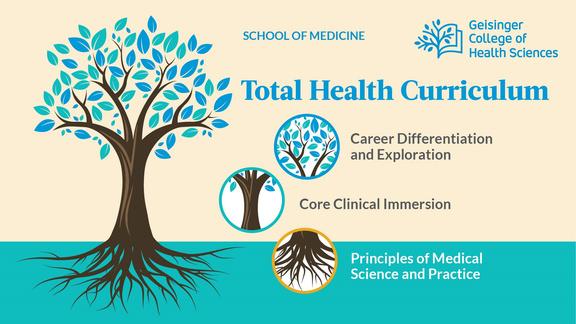
When you come across these images in the guide, simply click on either one to access the module related to that topic.

Click to return to the table of contents.

Click to visit the Faculty Development SharePoint site for more information.

If you’re like most residents, your days are already full.
You’re managing patients, writing notes, answering pages, coordinating care, and trying to keep up with everything you’re expected to learn. In the middle of all that, someone reminds you that you’re also supposed to teach.
It can feel like just one more thing.
But here’s the truth: whether you realize it or not, you’re already one of the most important teachers in medicine.
Medical students and junior residents learn an enormous amount from the people they work closest with, and that’s usually you. Studies show that residents provide a large portion of the teaching that happens in clinical training, and learners often credit residents with a significant part of what they learn during their rotations.
Why? Because you sit in a unique spot in the learning environment.
You’re close enough to remember what it feels like to be new, but experienced enough to guide someone through the next step. That “near-peer” connection turns out to be incredibly powerful. In fact, research has shown that in some settings residents teach just as effectively (if not more) as faculty.
But teaching isn’t only about helping the people around you. It’s also one of the fastest ways to grow as a physician.
When you explain something to a learner, why you chose a test, how you’re thinking about a differential, what matters in a physical exam, you clarify your own thinking. Teaching pushes you to organize knowledge, fill in gaps, and turn information into understanding. Many residents say it actually improves their clinical reasoning and helps them learn more deeply.
And teaching has always been part of what it means to be a physician. From the earliest days of apprenticeship in medicine to modern residency training, passing knowledge forward has been part of the job. Today, training programs and accreditation bodies explicitly recognize teaching as a core responsibility of residents.
The strange thing is that while residents do so much teaching, very few of us were ever actually shown how to teach.
That’s what this guide is for.
This quick start manual isn’t about turning you into a professional educator. It’s about giving you a few practical tools so teaching becomes easier, and fits naturally into the work you’re already doing.

Inside you’ll find high yield videos, infographics, and even some deeper dives. It’s designed to be a quick reference, there when you need it, but also a learning tool if you want to go deeper.
Good teaching usually isn’t a long lecture. Most of the time it’s a quick question during rounds, a short explanation after a patient encounter, or a two-minute conversation in the hallway.
Those small moments matter.
The way you explain a concept might stick with a learner for years. The way you model clinical reasoning might shape how someone approaches patient care. And the way you treat learners, whether they feel safe asking questions and thinking out loud, can shape how they see themselves in medicine.
Years from now, many of those learners won’t remember the exact patient or the exact diagnosis.
But they’ll remember who helped them lear
More often than not, that person is a reside
Thanks for taking on that role.
Click the headings to navigate through sections. ↘
THEORY YOU CAN USE | TOOLS YOU CAN USE TODAY | FINISH WITH FEEDBACK

Practical tools help you teach effectively in real clinical time, where minutes are scarce and decisions are constant. By using simple structures and prompts, you can surface a learner’s thinking, give targeted guidance, and reinforce progress without disrupting workflow. Small moves, such as asking for a commitment or using a brief debrief, create high-impact learning moments that accumulate across a shift and build clinical reasoning over time.
Cognitive Load Theory explains how learners process new information through two memory systems, working memory and long term memory. Working memory can only hold a small amount of new information for about 20 seconds When information is rehearsed, it transfers to long term memory, which has no limits on capacity or duration As learners encounter new material, their long term memory develops schemas, which are the mental frameworks that help organize and understand information New tasks require more focus because they have not yet been repeated and stored in long term memory, which is why learners benefit from periods of rest between learning sessions.
Working memory can only process a few pieces of new information at once and retains them briefly. Long term memory stores information indefinitely and supports schema development. Familiar tasks rely on established schemas and feel easier, while new tasks require greater concentration and effort.
Learners need pauses between learning episodes to allow new information to consolidate.
1. Intrinsic Load
The inherent difficulty of the subject matter. Complex tasks demand more working memory resources than simple ones
2. Germane Load
The mental work of creating or modifying schemas as new information connects to what is already known.
3. Extraneous Load
Additional information that distracts from learning and competes for working memory resources.
How to Help Learners:
Break information into smaller, manageable chunks. Present content in a logical sequence
How to Help Learners:
Provide explanations and worked solutions for learners who are new to the material. Use interleaving, which involves alternating between related concepts during practice.
How to Help Learners:
Avoid redundant materials or situations that split the learner's attention.
Keep instructional materials simple, for example do not provide a worksheet at the same time as a slide presentation if both contain similar information.
Key Concepts
he Zone of Proximal Development, or ZPD, is a theory created by Lev ygotsky. It describes three points in the learning process: what a learner annot do, what a learner can do with help, and what a learner can do dependently Educators support learners as they move from needing sistance to achieving a skill on their own This process is known as affolding
“The teacher must adopt the role of facilitator not content provider.”
- Lev S. Vygotsky
Vygotsky believed that learning occurs through social interaction with more knowledgeable others, often called MKOs. These individuals provide guidance that helps learners reach beyond their current abilities. As learners practice and gain confidence, the support provided by teachers or peers can be gradually reduced. Skills that were once difficult become attainable, allowing the learner to progress to more advanced levels.
Whatthelearnercandounaided
What the learner cannot do
What the learner can do with educator or peer assistance
What the learner can do unaided
Serve as a facilitator and provide scaffolding that helps learners bridge the gap between their current ability and a new skill
Offer learning opportunities that challenge students just beyond their present level
Adjust the amount of support as learners grow, eventually decreasing assistance as they master the task
Whatthelearnercandowith educatororpeerassistance
Whatthelearnercannotdoyet
Highlights the importance of social interaction and guidance from more knowledgeable others
Helps educators match instruction to the learner’s stage of development
Encourages gradual independence through practice, feedback, and decreasing support
Having learners pull information from memory.
Strengthens memory each time information is recalled
Improves long-term retention
Provide a blank sheet and ask learners to write or diagram everything they remember about a condition, then prompt with categories like presentation, pathophysiology, mangagement, et
Revisiting learning at increasing intervals over time
Interrupts forgetting
Builds durable, long-term memory
At the start of each session, ask 2-3 questions about material from prior days or weeks before introducing new content.
Mixing related topics or skills during practice
Strengthens discrimination and decision-making
Prevents “illusion of mastery”
Instead of assigning 10 cases with the same diagnosis, mix differ but related cases (e.g., asthma, COPD, pneumonia) so learners m first determine the diagnosis before choosing management.
Connecting new information to prior knowledge through explanation and questioning.
Builds deeper understanding Strengthens mental connections
After a learner identifies heart failure as the likely diagnosis, the educator asks, “What findings support that diagnosis, and what pathophysiology can explain this patient’s symptoms, findings, and lab results?”
Combining words and visuals to support learning
Engages verbal & visual processing
Improves recall & understanding
When teaching heart sounds, play an audio clip while showing a waveform diagram and ask learners to match what they hear to what they see.
Using specific, real-world examples to explain abstract ideas
Makes concepts meaningful & relatable
Supports transfer to practice
To explain acid-base balance, compare to a seesaw- adding acids tips it one way, adding bases tips it the other- then ask learners to apply to a patient case
Click the headings to navigate through sections. ↘
THEORY YOU CAN USE | TOOLS YOU CAN USE TODAY | FINISH WITH FEEDBACK

Educational theory offers a map for making sense of how learners think and grow in complex environments. Grounding your teaching in concepts such as cognitive load, ZPD, and cognitive apprenticeship helps you match the right strategy to the learner’s level, the task, and the moment. With a clear framework, you can design learning that is efficient, equitable, and more likely to stick, turning everyday clinical work into deliberate practice
Click to navigate to desired topic. ↓
RIME Model for Diagnosing Your Learner
The 5-Step Microskill Model for Clinical Teaching “Aunt Minnie” Conditions (Pattern Recognition)
SPIT Tool to Help Learners Create a DDx
Questions as a Teaching Tool
Cognitive Apprenticeship Briefing, Intraoperative Teaching, Debriefing Model
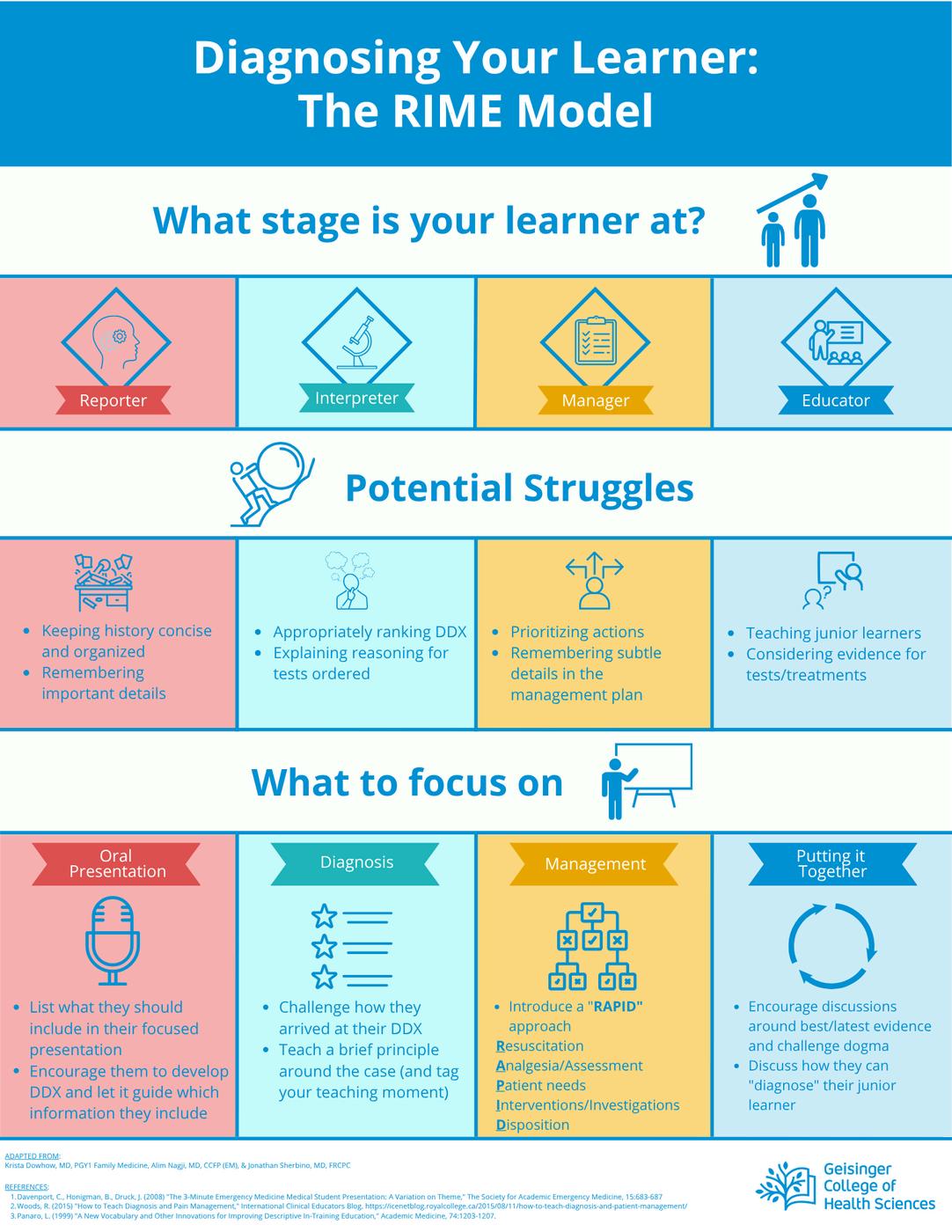
he RIME model is a framework that helps educators understand a arner’s developmental stage during clinical training. RIME stands for eporter, Interpreter, Manager, and Educator. Each stage reflects increasing ompetence and independence By identifying where a learner is nctioning, educators can tailor expectations, provide appropriate support, nd guide learners toward progressively more advanced skills
Learners can accurately gather and communicate clinical information. They can report histories, physical findings, and relevant patient details in a clear and organized way.
Learners can move beyond reporting and begin to analyze what the information means They can generate differential diagnoses and make sense of clinical data.
Learners can create and carry out plans for patient care. They can propose treatments, justify their decisions, and adjust management as needed.
Learners can teach others, including peers and patients. They demonstrate deeper understanding by explaining concepts, sharing reasoning, and contributing to the learning environment.
How to Help Learners:
Reinforce structured reporting
Provide opportunities to practice presenting patients
Offer guidance about what information is most relevant
How to Help Learners:
Ask questions that encourage reasoning
Provide feedback on clinical thinking
Support the development of problem identification and prioritization
How to Help Learners:
Encourage ownership of patient care tasks
Provide supervision that allows safe autonomy
Teach learners how to balance multiple management priorities
How to Help Learners:
Offer opportunities to teach in clinical settings
Provide feedback on communication and clarity
Encourage reflective practice and continued knowledge growth
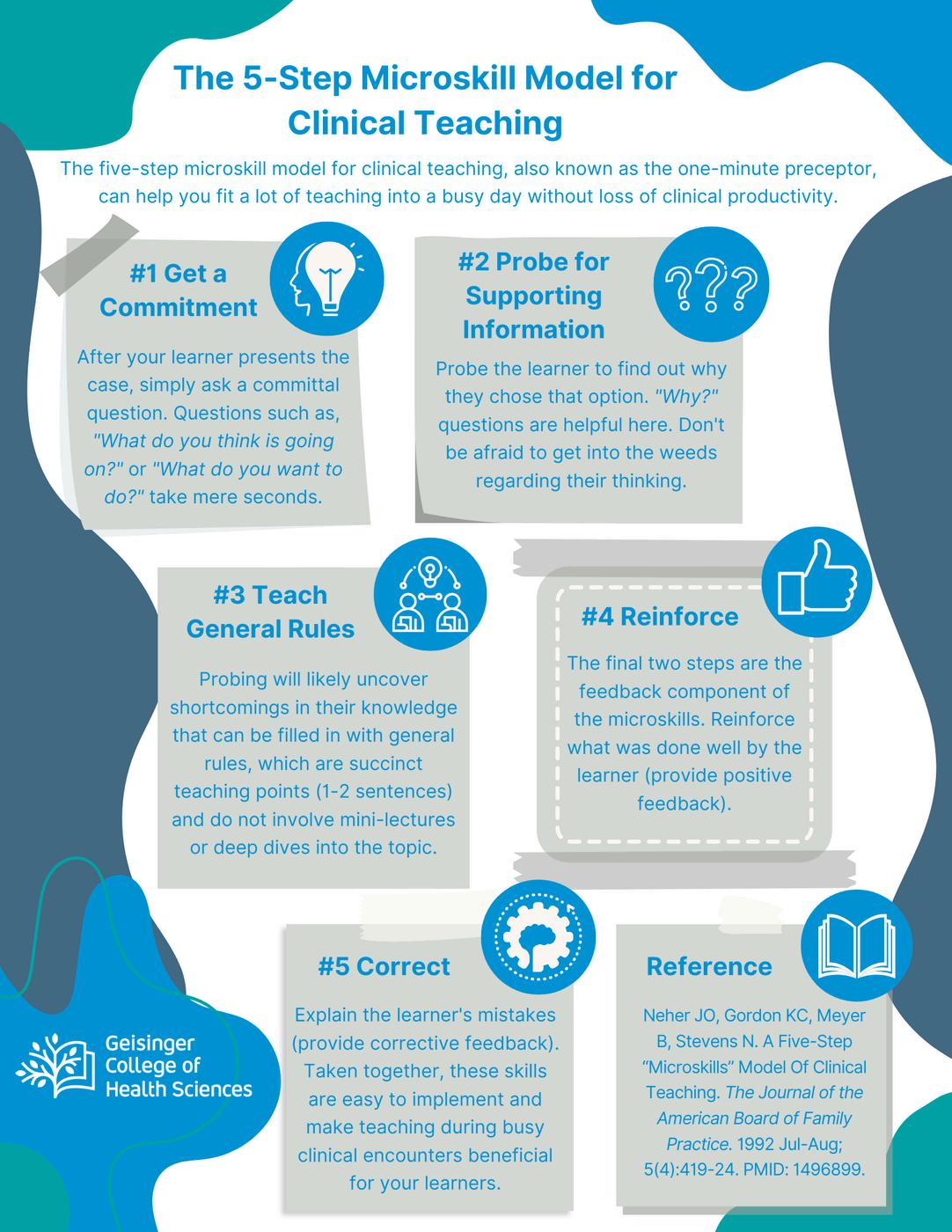
inicians often struggle to balance teaching with the demands of a busy actice. Productivity pressures can make it feel like teaching must be econdary, yet effective teaching can fit naturally into clinical routines. The ve microskills model, also known as the one minute preceptor, is a actical approach that allows educators to teach efficiently during real inical encounters These small steps require little time but can gnificantly enhance learning
Get a Commitment - After a learner presents a case, ask a direct question that requires them to take a position. Questions such as “What do you think is going on?” or “What do you want to do?” help reveal their initial clinical thinking and take only seconds to ask.
Probe for Supporting Evidence - Encourage the learner to explain why they chose a particular diagnosis or plan. Asking “Why?” helps uncover gaps in knowledge and reveals how the learner is reasoning through the case.
Teach a General Rule - Provide a concise teaching point based on the learner’s needs. General rules are brief, often no more than a sentence or two, and avoid lengthy lectures or deep dives into the topic.
Reinforce What Was Done Well - Offer positive feedback that highlights what the learner did effectively This helps build confidence and encourages continued growth
Correct Mistakes - Provide clear corrective feedback to address errors or misconceptions This closing step supports improvement and strengthens future performance.
These microskills are easy to incorporate into busy clinical encounters and help educators remain intentional about teaching. They promote active learning, allow rapid assessment of a learner’s thinking, and create opportunities to provide targeted feedback. Although brief, they can have a meaningful impact on the learner’s development. Give it a try during your next clinical shift.
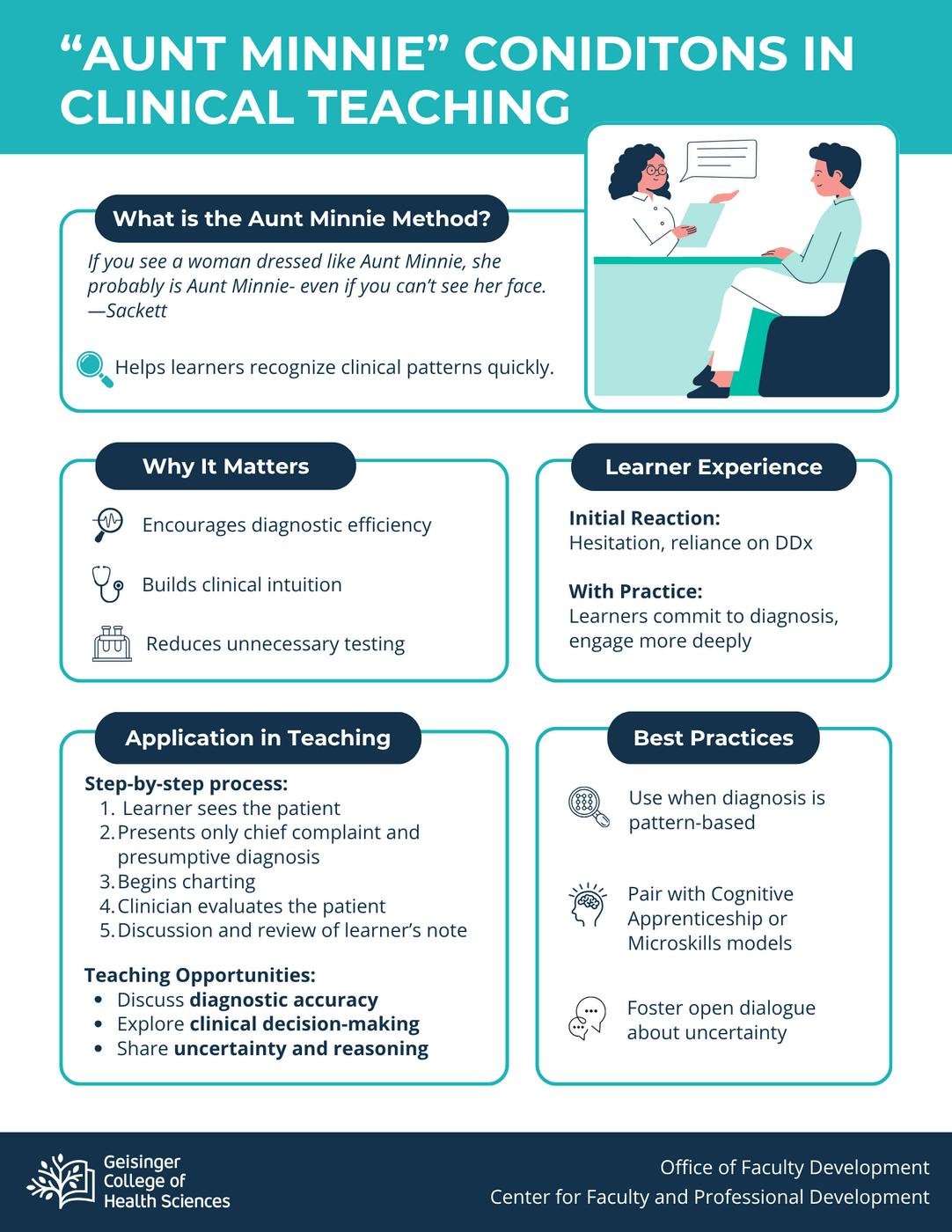
he Aunt Minnie method of clinical teaching is based on pattern cognition. Sackett described it with a simple idea: if someone looks like our Aunt Minnie, walks like your Aunt Minnie, and presents in a familiar ay, the person is probably your Aunt Minnie even before you see the face clinical practice, every specialty has its own recognizable “Aunt Minnie” onditions that experienced clinicians can identify quickly This method fers a practical way to teach learners how to recognize common patterns nd commit to a presumptive diagnosis.
Have learners see the patient, then present only the chief complaint and their presumptive diagnosis. This brief initial presentation encourages them to focus on recognizing classic patterns. While the learner begins charting, you can evaluate the patient yourself. Afterward, you discuss the case together and review the learner’s note.
Learners may initially hesitate to make a diagnosis and instead run through a full differential. With repeated exposure, they become more comfortable committing to a diagnosis based on the presenting pattern. During your evaluation, you determine whether the learner is correct or needs guidance in understanding the true diagnosis.
By focusing on pattern recognition, the method can help curb unnecessary routine testing It also creates opportunities to discuss decision making and the subtleties of clinical judgment If you feel uncertain about a diagnosis, honest discussion allows learners to see how you think through ambiguity
The Aunt Minnie approach aligns well with other clinical teaching strategies, such as the microskills model or cognitive apprenticeship. These approaches complement each other by encouraging concise reasoning, commitment, and reflective discussion of clinical patterns.
Key Concepts
Using SPIT to Build a Differential
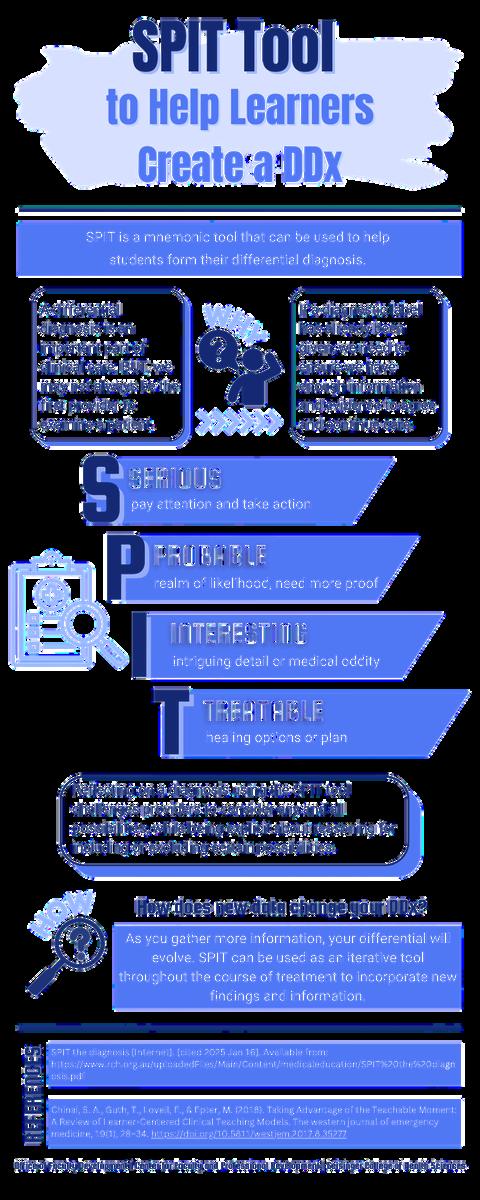
earners often struggle to apply their first two years of training to real atients, especially when forming a differential diagnosis. The SPIT tool is a mple mnemonic that h l t d t t t th i thi ki h pproaching a presenti eaningful differential arning during and aft
Provide each learner with a small card and have them write out the SPIT mnemonic before reviewing the case. Each letter guides them toward a specific type of diagnosis to include.
Serious
The condition that is most likely to cause mortality
Probable
The diagnosis they believe is the leading or most likely cause
Interesting
A rare diagnosis or zebra that is worth considering
Treatable
A diagnosis that may not be the most likely, but is important because it can be managed effectively if identified
Supporting Ongoing Learning
The SPIT card can be revisited later in the day as the case evolves. It can also be used after rounds or at the end of a shift to guide further reading, reflection, or discussion. This simple structure helps learners connect basic science knowledge with clinical reasoning in a practical, accessible way.
Key Concepts
Bloom’s Taxonomy of Thinking Skills
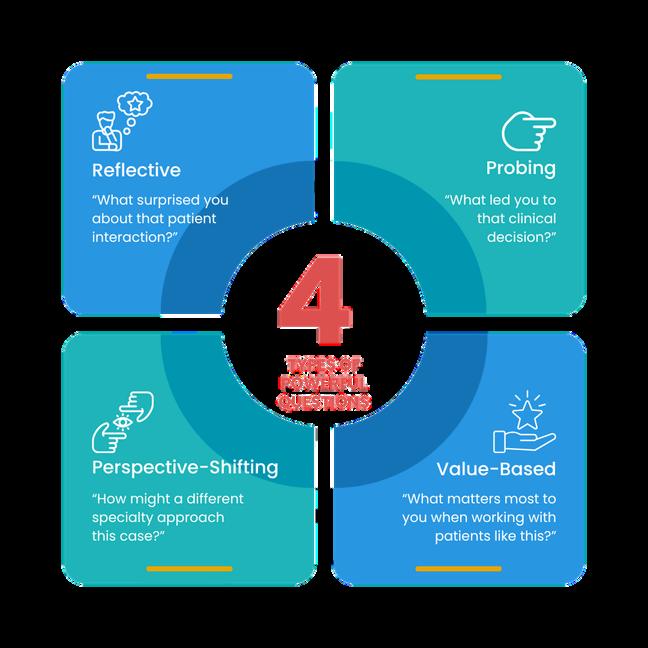
sking effective questions is a valuable skill for any educator. Questions are sed in nearly every clinical teaching encounter, and when used well, they an stimulate curiosity, reinforce key points, clarify difficult topics, and omote higher level thinking In practice, however, questions are often ked poorly Research has shown that only a small fraction of speaking me is devoted to questions, and most questions asked focus on low level call By being intentional about the types of questions used, educators an help learners engage more deeply with clinical material.
Reviewing the levels of thinking outlined in Bloom’s taxonomy can help educators create more effective questions. Bloom describes six levels of cognitive processing:
1.Knowledge: recall and repeat information
2.Comprehension: explain content, review items, discuss topics
3.Application: use previously learned knowledge in new situations
4.Analysis: break material into parts and use a systematic process to reach a logical conclusion
5.Synthesis: predict, hypothesize, and form generalizations based on available information
6.Evaluation: defend positions, judge information, and assess situations
Types of Questions
Questions fall along a spectrum that overlaps with Bloom’s Taxonomy:
Factual Questions: prompt recall of information
Investigative Questions: ask learners to comprehend, apply, analyze, or synthesize
Hypothetical Questions: prompt the learner to consider “What if” possibilities
Evaluative Questions: ask students to appraise or justify decisions
As learners gain expertise, they can move from knowledge-level questions to higher level, evaluative questions.

Knowledge: What is the most common cause of pneumonia in a patient with HIV?
Comprehension: What anticoagulant would you order to treat a pulmonary embolism in a patient with cancer?
Application: A patient presents with DKA. Based on these labs, what type of fluid would you use to resuscitate?
Analysis: A patient with multiple comorbidities presents with hypotension and tachycardia What are some possible causes?
Synthesis: During an IJ central line placement, you feel a rush of air How would you proceed?
Evaluation: Based on the history, did you complete an appropriate work ?
Negative body language, frowns, or dismissive reactions
Sarcasm or belittling comments
Yes or no questions and trick questions
Cueing that gives away the answer
Calling on individuals instead of asking the group first
Directing questions downward, which may embarrass junior learners
Ignoring quieter learners
Asking questions that are too difficult or too easy for the learner’s leve
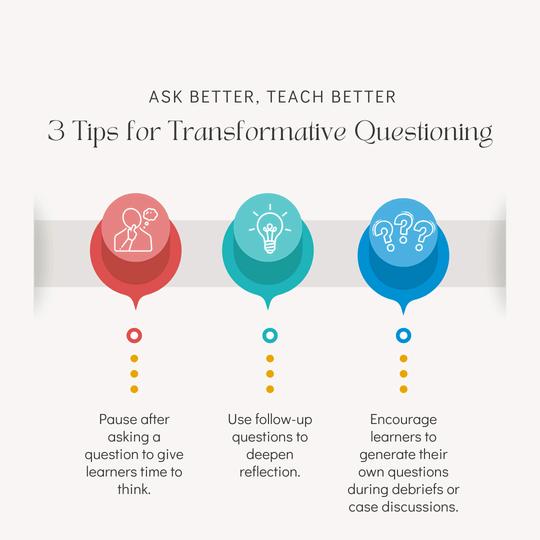
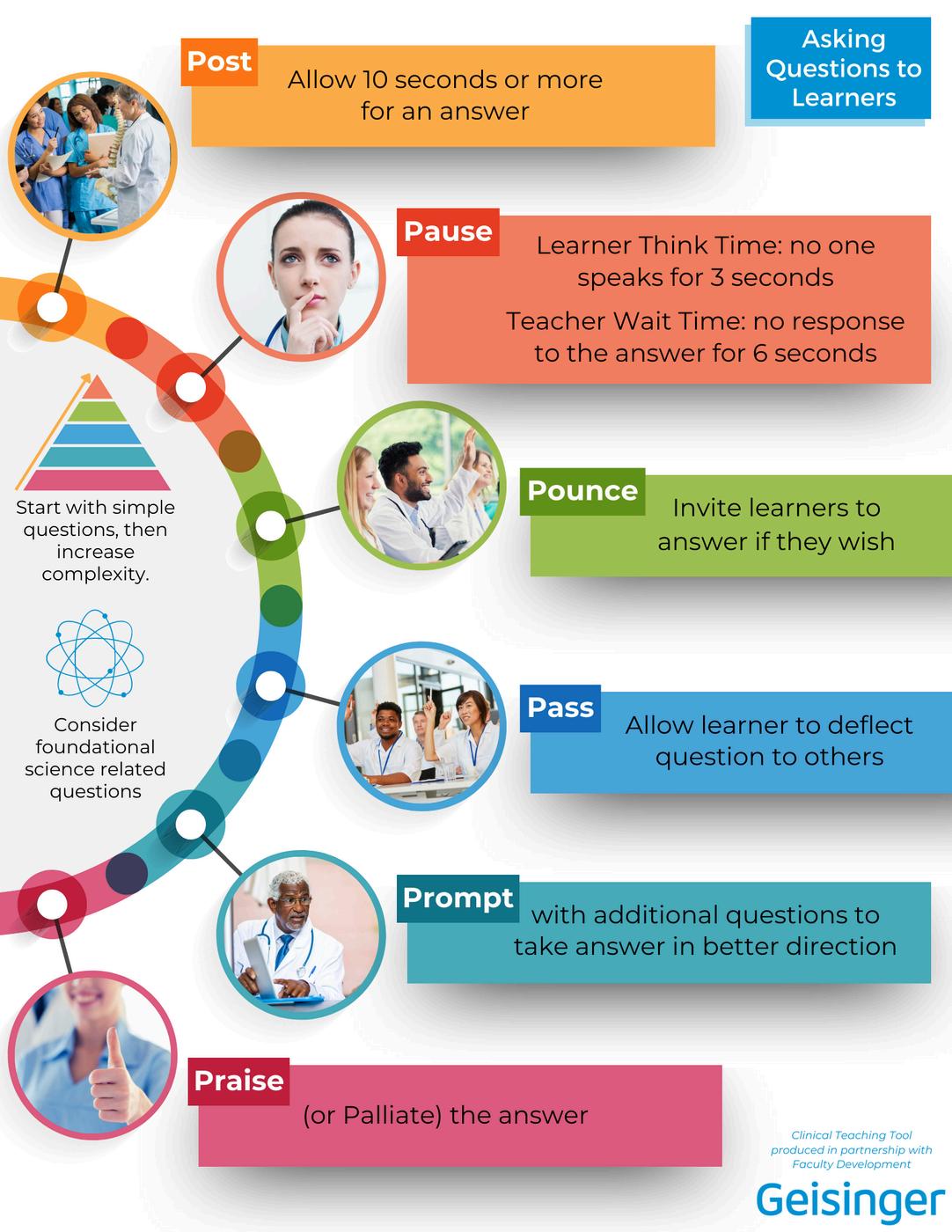
Allow time for thinking.
Educators often wait only one second after asking a question Increasing wait time to three to five seconds improves learner reasoning, increases correct responses, and encourages learners to ask more questions
ognitive apprenticeship, or CA, is a learning theory and teaching method at focuses on making the expert’s thinking process visible to the learner. While physical skills such as examinations, procedures, or documentation e easily observed, teaching learners how to think is much more hallenging CA supports this process by pairing thinking skills with ituated learning,” meaning learning that takes place in the environment here the knowledge will ultimately be used, such as a clinic or operating om. CA incorporates five key methods: Modeling, Coaching, Articulation, eflection, and Exploration.
Modeling - Educators must be intentional about the traits, behaviors, and thought processes they demonstrate. Expectations should be clearly stated, and attention drawn to how the educator is demonstrating specific behaviors. Without these cues, learners may form incorrect assumptions. Educators can model clinical reasoning by performing tasks while learners observe or by explaining the heuristics used in decision making.
Coaching - Coaching is familiar to most clinician educators. Within CA, coaching includes stating expectations clearly, adjusting instruction to the workplace setting, providing appropriate supervision, and giving feedback in real time. Coaching also includes offering hints, scaffolding, and reminders to support the learner’s progress.
Articulation - Articulation is central to cognitive apprenticeship. As educators become more experienced, many of their thought processes become automatic CA encourages a “think out loud” approach to make these internal processes visible By verbalizing both the “what” and the “why,” educators help learners articulate their own reasoning and ensure that understanding is complete
Reflection - Reflection in CA focuses on reviewing experiences after the clinical encounter. Educators should encourage learners to explain what they learned, what they might do differently next time, and how they can apply new knowledge to future problems.
Exploration - Exploration encourages learners to work at the edge of their comfort zone. Educators can help students identify goals that target areas for improvement and build on strengths. These goals should be reviewed regularly to track progress and ensure that learners have opportunities that match their developmental needs.
Many educators already use components of CA in their teaching. Articulation, however, is often the part used least frequently. Taking time to pause and share your thinking process helps learners understand how clinical decisions are made and supports their development as independent, competent clinicians.
eaching procedures has long been a core part of medical education. While e phrase “See one, do one, teach one” is familiar, modern ompetency-based training requires a more deliberate approach. The riefing, Intraoperative Teaching, Debriefing Model provides a structured ethod for teaching procedures that supports learner development, aligns ith shared goals, and promotes reflective practice Each phase helps nsure that learners gain both technical skills and clinical reasoning related procedural care.
Briefing - The briefing is a short interaction between educator and learner before the procedure begins. The purpose is to identify the learner’s needs and to establish shared learning goals. This conversation helps both participants enter the procedure with a clear understanding of expectations and priorities.
Intraoperative Teaching - During the procedure, teaching is guided by the goals established in the briefing. Coaching and guidance remain central, and teaching should be adapted to the learner’s needs in real time. Dialogue between educator and learner should reflect their shared objectives. Faculty can enhance this phase by incorporating illness scripts that help learners understand patterns and decision making during the procedure.
Debriefing - After the procedure, the learner and educator review the experience together. The debrief begins with the learner’s self-reflection on performance The educator then teaches general rules, reinforces what was done well, and addresses mistakes This structure closely aligns with the microskills model and helps learners consolidate their understanding while identifying areas for improvement
By using a structured approach before, during, and after a procedure, educators can support both skill acquisition and clinical reasoning. The model promotes shared expectations, responsive teaching, and reflective practice, which together contribute to the development of procedural competency.
Click the headings to navigate through sections. ↘
THEORY YOU CAN USE | TOOLS YOU CAN USE TODAY | FINISH WITH FEEDBACK

Theory & Feedback
Feedback closes the loop on learning and turns experience into improvement. When feedback is timely, specific, and collaborative, learners understand what worked, what to adjust, and how their actions influenced patient care and the team. This shared reflection strengthens trust, promotes accountability, and helps learners carry forward clear next steps that translate into better performance on the very next encounter.
elf-Determination Theory, or SDT, emphasizes the importance of otivation in learning. According to SDT, intrinsic motivation develops hen three basic needs are met: relatedness, competence, and autonomy. traditional feedback settings, these needs are often unmet, which can eaken how feedback is received and decrease a learner’s motivation to mprove The article “Why receiving feedback collides with elf-determination” by Olle Th J ten Cate explores why feedback can clash ith SDT and how feedback practices might be improved to better support arner motivation.
Relatedness - Feedback occurs within a social interaction. The setting, tone, and relationship with the evaluator all influence how the learner receives the message. If relatedness is weak, learners may feel disconnected or defensive, which reduces the impact of feedback.
Competence - Although feedback often begins with a learner’s strengths, this alone does not create intrinsic motivation. Learners must have confidence in their ability to improve and must be able to understand and accept corrective input. When competence needs are unmet, learners may overlook suggested improvements.
Autonomy - Learners rarely choose when or how they receive feedback. The evaluator typically controls the timing and format, which can limit the learner’s sense of ownership. Without autonomy, learners may not seek feedback, may be unaware of weaknesses, and may miss opportunities to assess themselves.
Because typical feedback sessions do not fully support relatedness, competence, or autonomy, learners may rely on extrinsic motivation rather than internal drive When SDT needs are not met, learners may also avoid feedback or struggle to apply it
The article highlights approaches that better align feedback practices with SDT. In two cited studies, students used video recordings to evaluate themselves or others performing tasks. The evaluator did not interpret or judge performance but instead acted as a coach after the learners reviewed the recordings. This structure supports: Relatedness, as the interaction becomes collaborative
Autonomy, because learners guide their own assessment
Competence, by helping students compare performance to a standard and identify areas for improvement When feedback is supported by information sources that avoid value judgments from authority figures, the learner’s autonomy is strengthened, making intrinsic motivation more likely.
Benefits of Giving Feedback Well
Builds trust and psychological safety
Whether you are guiding students, mentoring colleagues, or leading teams, giving feedback is one of the most powerful tools in your educator toolkit. Effective feedback supports growth, helps learners refine their skills, and promotes a healthy learning environment By grounding feedback in clarity, partnership, and supportive communication, educators can make conversations about performance more meaningful and more impactful
Learners feel supported when they know you are invested in their growth.
Promotes continuous improvement
A well-timed suggestion can help someone adjust a teaching strategy or clinical approach.
Strengthens team culture
Encourages openness, shared learning, and collaborative improvement
Fosters connection, not just correction
High-quality feedback deepens relationships and reinforces mutual respect
Key Principles for Effective Feedback
Create a supportive environment
Frameworks for Effective Feedback in Health Professions Education (AM Last Page)
How to Give Feedback: 7 Feedback Strategies to Help Your Team Grow
Begin by understanding the learner’s goals and readiness to receive feedback. A brief check-in helps establish shared expectations.
Ground feedback in observable behaviors
Use specific, behavior-based language such as “I saw,” “I heard,” or “I noticed.” This keeps feedback clear and reduces ambiguity.
Use a collaborative approach
Invite the learner to reflect first. Build on their self-assessment to identify strengths and areas for growth. This promotes ownership and reduces defensiveness
Attend to tone and nonverbal communication
Eye contact, posture, and pacing influence how feedback is received A calm, open, and sincere approach supports psychological safety
Adjust for time-sensitive situations
When full discussion is not possible, provide brief guidance in the moment and schedule a later debrief to explore the situation in more depth.
ESTABLISHTHEPURPOSE
Collaborate to show support "I'm here to provide support as we work together. Are you open to some feedback?"
Asktheperson'sgoals
"What are your goals for this experience? How can I help you reach those?"
INFORMATION-GATHERING/OBSERVING
Direct observation
(if possible) This helps you provide effective feedback.
Note words and behaviors
Practice
"I saw . . . " "I heard . . . " "I noticed . . . " (AACH)
Avoid being defensive and accusatory "You were . . . "
ASK - "What would you like to continue doing?
Listen closely to your colleague's answer
RESPOND: Gently redirect from self-critique for now; agree or reflect your colleague's self-assessment
TELL: provide your assessment
Repeat ART cycle as needed
ASK: "What would you like to stop doing?" (or do less of)
Listen closely to your colleague's answers
RESPOND: agree or reflect on your colleague's self-assessment
TELL: provide your assessment
Repeat ART cycle as needed
For challenging situations: ASK about intention, RESPOND with empathy, TELL your perceptions about how intention and impact differ
ASK - "What would you like to start doing?"
Listen closely to your colleague's answers
RESPOND: agree or reflect self-assessment
TELL: provide your assessment
Repeat ART cycle as needed
For high-stakes situations: Agree on an action plan and the consequences if your colleague does not achieve the goals outlined by a certain date
Ask
Assesscolleague'sreadinesstoreceive feedback
Askforself-assessmentongoals colleaguesharedearlier
Respond
Reflectorparaphrasetheresponses anduseonetotwoPEARLS
Tell
Provideyourassessment,groundin behaviorallyspecificlanguage
Partnership: "I'd like to work with you on this"
Empathy: "Sounds frustrating not to get the result you want"
Acknowledgement: "That was a difficult situation to be in"
Respect: "I can see how much you tried to connect"
Legitimation: "Most people find similar situations challenging"
Support: "I am committed to helping you achieve your goal"
Situation: "When Jim told you that he was having trouble finishing the project..."
Behavior: I noticed that you had your back to him, kept looking at the computer screen, and said nothing."
Impact: "He reiterated his challenges twice before you turned your eyes to look at him. Do you remember that interaction?"
Coaching: How do you think he felt? How else might you have responded?"
If you want to deliver time-sensitive feedback when situations prevent an ARTful conversation in the moment:
Create a supportive environment and elicit goals
Consider having the colleague talk through his/her/their approach to the situation before it happens
Set up a time for debriefing
"Let's step outside the room," or "I'm going to start facilitating the meeting now."
Defer ARTful Feedback until the agreed-upon debriefing time.
Eye contact Face congruent with affective feeling
Adequate spacing
Below or at eye level
Lean forward
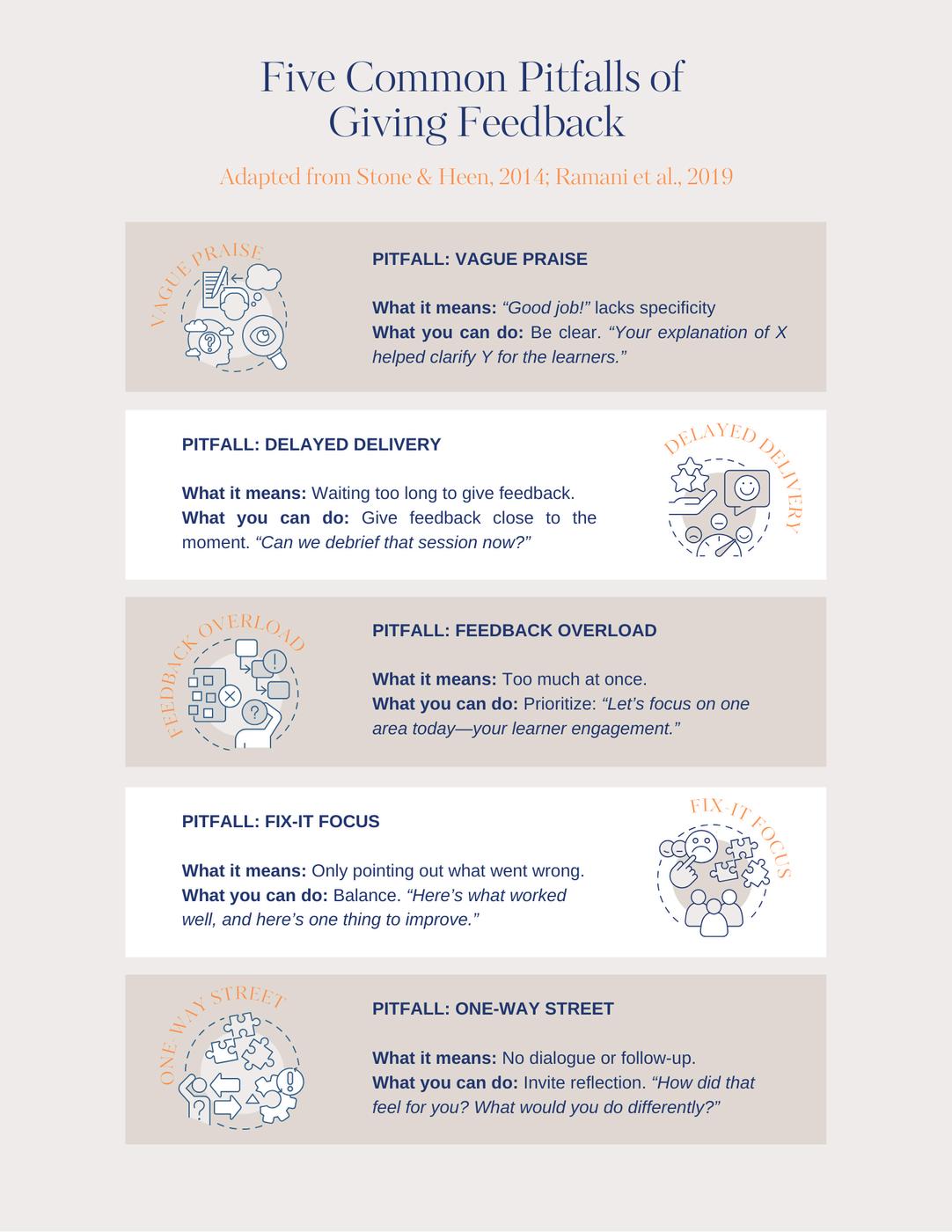
eedback conversations can be challenging, even when the educator tends to be supportive. Certain patterns can make feedback confusing, verwhelming, or discouraging for learners. By understanding these ommon pitfalls, educators can create clearer, more productive onversations that support learning, growth, and psychological safety
Feedback can fail when it is unclear or nonspecific
General comments or vague praise leave learners unsure about what to continue or improve. Clarity helps learners identify the behaviors that matter.
Timing matters
Delaying feedback too long makes the information harder to apply. Delivering feedback closer to the moment improves understanding and promotes timely adjustment.
Too much feedback at once leads to overload
Large amounts of information can be difficult to process and may lower confidence. Prioritizing one or two key points supports better retention and performance.
Focusing only on problems reduces motivation
When feedback only highlights what went wrong, learners may disengage or become defensive Balancing strengths with opportunities for growth helps maintain confidence
Feedback is most effective when it is a dialogue
One-way conversations limit reflection and reduce autonomy Inviting learners to share their perspective increases clarity and strengthens the educator-learner relationship.
Emotional reactions can disrupt the conversation
Strong or unexpected emotions may interrupt comprehension or shut down learning. Pausing, acknowledging emotion, and checking whether it is okay to continue helps repair the interaction.
Repetition without change signals a deeper issue
When the same feedback is given repeatedly, there may be barriers the learner has not expressed. Exploring underlying reasons can reveal mismatches in teaching, expectations, or support.
Tone and language influence how feedback is received
Using collective language such as “we all know” or phrasing that implies shame can harm trust. Using “I” statements and describing observable behavior promotes respect and understanding.
Click the headings to navigate through sections. ↘
THEORY YOU CAN USE | TOOLS YOU CAN USE TODAY | FINISH WITH FEEDBACK
Geisinger Faculty Development SharePoint Site
Microlearning Monday Archive Infographics
Subscribe to Microlearning Monday Faculty First Resource and Publication
Ethos Login
Access courses and resources for CE credit.
GCSOM Faculty Resources
This site serves as a centralized location for residents engaged in teaching and supporting medical students at all stages of their undergraduate education. Here, you will find a curated collection of educational tools, program documents, and instructional materials designed to enhance your teaching effectiveness and support student learning.
(check your app store)
The JiTT podcast and app deliver short, clinically focused teaching pearls designed for rapid use at the point of care or just before teaching rounds JiTT supports efficient preparation for bedside or small-group teaching, modeling evidence-based microteaching strategies while reinforcing high-yield clinical reasoning and teaching scripts
The Curbsiders Teach podcast focuses on practical education skills such as clinical teaching strategies, feedback, assessment, and curriculum design through engaging, case-based conversations with expert clinician educators. These podcasts are especially useful for providing relatable frameworks and actionable tips to be immediately applied to teaching on rounds, in clinic, or with medical students and interns.
The AMA Ed Hub’s Residents and Clinicians as Teachers modules offer structured, evidence-based training on core teaching skills such as bedside teaching, feedback, assessment, and learner engagement These self-paced modules are highly relevant for residents in clinician-educator roles, providing practical frameworks and CME-eligible content that support deliberate skill-building and professional development as medical teachers.
This ACGME Learn module focuses on strengthening clinical assessment through direct observation, offering practical strategies, tools, and examples aligned with milestone-based evaluation. It is highly relevant for help in developing skills in observing learners, providing meaningful feedback, and contributing to fair, defensible assessments in daily clinical settings. THEORY YOU CAN USE | TOOLS YOU CAN USE TODAY | FINISH WITH FEEDBACK