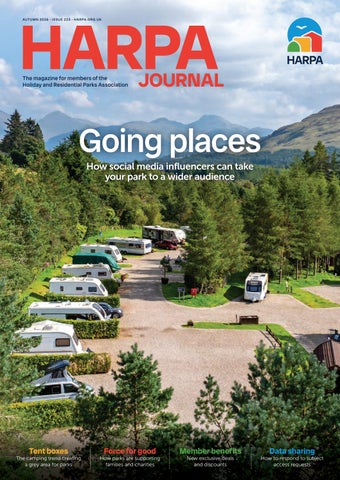
HARPA AUTUMN 2026 • ISSUE 223 • HARPA .ORG .UK
The magazine for members of the Holiday and Residential Parks Association
JOURNAL
Going places How social media influencers can take your park to a wider audience
Tent boxes
The camping trend creating a grey area for parks
Force for good
How parks are supporting families and charities
Member benefits New exclusive deals and discounts
Data sharing
How to respond to subject access requests
D I R E C T O R G E N E R A L’ S F O R E W O R D
For the latest industry updates, visit harpa.org.uk/news
Reflections on a remarkable season
W
hat an incredible summer! I choose my words carefully, as the extended hot season brought challenging conditions for many. I hope your parks, teams and customers weathered this period safely and enjoyed an uptick in business. Welcoming Saeker to HARPA Health and safety is paramount for our sector. I want to thank outgoing Health and Safety consultant Silviu Popescu for his support in recent years and wish him well in his new venture. I am delighted to welcome our new advisers, Saeker, to HARPA membership. John Biles, MD of Saeker, provides an introduction to the company and the expertise it offers on page 13. Influence and impact We are on the cusp of political party conference season. In the Policy Team update on page 19, Katherine Squires writes about the growing impact that our lobbying, relationship-building and communications with policymakers is having. As always, we will be attending the main party conferences and lobbying hard on your behalf. Having an influence on policy decisions is what HARPA is here for, and in our recent all-members survey, you told us that our lobbying work is among the most highly valued benefits. In a feature on page 20 we look at another sphere of influence – that of social media influencers with hundreds of thousands of followers – and how a carefully curated visit to a UK park significantly increased bookings. Supporting your business One of the trends developing on holiday parks and campsites is the use of rooftop accommodation, or tent boxes, by visitors. We explore how park operators can navigate this growing interest when regulations are not keeping pace with practical trends. Alongside this, we’ve commissioned expert articles, including calculating holiday pay for seasonal workers, completing subject access requests and checking out-of-season insurance cover.
Debbie with Kerry McMahon-White, Managing Director of BSpoke Lifestyle
Leadership insights I was delighted to spend time with Kerry McMahon-White, managing director of BSpoke Lifestyle, parent company of Compass Insurance, for my latest feature interview with industry leaders. I hope you enjoy reading her insights on page 24. I’m sure you’ll also join with me in wishing Compass all the best in this, their 50th anniversary year. Join us at Conference Finally, now’s the time to book your place at our upcoming Conferences: our Scottish Conference is in Dunblane in November and our National Conference is in Brighton in January. For all the details, turn to page 11. The more we get together, share ideas, offer support and grow as an Association, the better we can protect the interests of holiday and residential parks. See you there!
Debbie Walker Director General
AU T U M N 2 0 2 6 I SS U E 2 2 3 | H A R PA . O R G .U K |
3
Holiday and Residential Parks Association
Chichester House, 6 Pullman Court, Great Western Road, Gloucester GL1 3ND
20
T (01452) 526911 | E enquiries@harpa.org.uk harpa.org.uk Consumers’ websites: ukparks.com | parkhome.org.uk Director General: Debbie Walker National Chair: Claire Flower Vice-Chair: Keith Campbell Cover image: Courtesy of Highland Holidays The Editor and Publisher exercise every care to ensure that the information in the Journal and HARPA publications (in print or online) is accurate, but neither the Editor nor the Publisher can accept any responsibility in respect of any error, mis-statement or alteration which may occur, however caused. Advertisements are accepted on the strict understanding that the Advertiser warrants that an advertisement conforms to the law and complies with the code of the Advertising Standards Authority. While every precaution is taken to ensure the accuracy of the information, the reference material published should be used as a guide and not as definite instruction. HARPA members are particularly advised to note the date of the advice. With developments in case law and amendments to regulations, guidance can very quickly become out of date. It should also be noted that advice published often relates to the specific situation of an individual member and therefore cannot necessarily be applied universally. It is always prudent therefore to seek upto-date, individual advice, tailored to your own circumstances. Only Acts of Parliament and Statutory Instruments have the force of law and only the courts or tribunals can authoritatively interpret the law. The Association, its advisers and contributors to all HARPA publications accept no responsibility for any effect arising from actions taken based on guidance.
6
24
HARPA members should be aware that the telephone system at central office records all incoming and outgoing telephone calls. This helps to ensure that HARPA maintains the highest quality standards in member service. HARPA’s Privacy Notice explaining how the Association processes data is available at harpa.org.uk/privacy-policy. Please contact enquiries@harpa.org.uk if you have any concerns. © Holiday and Residential Parks Association Ltd, 2026. All rights reserved. Published by: James Pembroke Media, Ground Floor Riverside North, Walcot Yard, Bath BA1 5BG. 01225 337777
63 4
| H A R PA . O R G .U K | AU T U M N 2 0 2 6 I SS U E 2 2 3
AUTUMN 2026
ISSUE 223 CONTENTS
Follow us on social media
COVER STORY 44 LEGAL: BREACHES OF AGREEMENT Taking steps to avoid escalation when a breach of agreement occurs
EVERY ISSUE 06 PEOPLE AND PLACES The latest news from HARPA members around the UK 13 NEED TO KNOW Regulatory updates and guidance 19 POLICY DESK How the HARPA team is working with Government on your behalf 72 NEXT GENERATION NETWORK A new course on using data, and how to find your local NGN contact 74 SCOTLAND AND NI Members’ success at the Scottish Hospitality Awards, and the latest on the visitor levy 76 BRANCH NEWS Updates from HARPA branches around the country 81 TRIBUTES Remembering much-missed members of our community 82 BUSINESS BULLETIN Welcoming new Associate Members and details of the latest park sales
F E AT U R E S 11
CONFERENCE Don’t miss our special booking rates for the next HARPA Conferences
36
50 LEGAL: SUBJECT ACCESS REQUESTS Protecting data and responding to requests
20 INFLUENCERS Forming successful partnerships with social media influencers and using this to promote your park
54 LEGAL: UNFAIR DISMISSAL How recent changes to employment laws affect park businesses
24 IN CONVERSATION WITH... Debbie Walker interviews Kerry McMahon-White, Managing Director of Bspoke Lifestyle
58 HEALTH AND SAFETY: HIGH WINDS Protecting your property, people and business
28 UK TOURISM TRENDS The latest industry trends and what they could mean for park businesses
63 INSURANCE: OFF SEASON Making sure your insurance holds up when the season ends
32 PARKS MAKE PLACES How parks reach different community groups to offer support
66 PLANNING: A SHAKE UP Planning reforms in England that could affect your park
86 PARTNER BENEFITS Suppliers offer new deals for HARPA members
70 TAX: HOLIDAY PAY Complex calculations for employers of seasonal workers
KNOWLEDGE 36 LEGAL: ABANDONED CARAVANS Following due process when a caravan is abandoned 40 LEGAL: ROOFTOP TENTS A legal grey area presented by the increasingly popular rooftop tents
40 S P R I N G 2 0 2 6 I SS U E 2 2 1 | H A R PA . O R G .U K |
5
People and places
Harness the marketing power of social media influencers PAGE 20 >
The latest news from HARPA members 06 Willerby says ‘thank you’ 06 Debbie Walker joins tourism advisory council 06 Compass celebrates 50th anniversary 07 Parks praise colleagues for long service 08 Commitment to green holidays 08 ‘Selling caravans is all I’ve ever wanted to do’ 08 Visitor levy puts park in the spotlight 09 Parks celebrate major milestones 09 What you said about HARPA 09 Pride is a success for New Forest park 09 Land Leisure and Tourism Show 2026
Willerby says ‘thank you’ to more than 200 loyal staff HOLIDAY CARAVAN manufacturer Willerby presented long-service awards to 203 employees at a celebration event held this summer. Glenn Rollinson, who joined Willerby as a labourer in the metal shop when he was just 15 and is now a production manager, received a 35-year long-service award. ‘The people and the friendships are what makes Willerby such a great place to work,’ he said. ‘It’s a really welcoming and inclusive culture, and everybody respects each other. The firm is also really good at investing in its people and helping them grow.’ Glenn’s son, Ben, joined the business at the age of 16 as a plumbing apprentice and, over the past 15 years, has worked
Debbie Walker joins tourism advisory council WE’RE PROUD that HARPA Director General, Debbie Walker, has been elected to the advisory council of the Tourism Alliance (TA), ensuring that the voice of the UK parks industry is heard at the top of a strategic, combined trade association which works closely with the UK Government. The TA has over 70 members, representing businesses and organisations in every part of the visitor economy, and runs a range of internal policy working groups on important live and strategic policies.
6
| H A R PA . O R G .U K | AU T U M N 2 0 2 6 I SS U E 2 2 3
his way up to become a chargehand in the plumbing team. ‘One of the things I enjoy most about my job is helping to train new starters,’ he said. ‘So many people helped me when I first joined the business, so it’s really rewarding to be able to do the same for others.’ Peter Munk, Willerby CEO, thanked all the recipients and said he was proud of the exceptional service they had given to the company. ‘The celebration of our team is extra special this year as we mark our 80th anniversary,’ he said. ‘We’re committed to investing in our people and supporting them to grow in their careers, so it’s been fantastic to celebrate the contribution these colleagues have made.’
Happy 50th Anniversary to Compass!
Colleagues from Compass and the Bspoke Group celebrated the insurance firm’s 50th anniversary at The Gate in Gloucester in July. Read more from Bspoke MD, Kerry McMahon-White, on page 24.
People and places
Meet John Biles, MD of Saeker, our new Health and Safety adviser < PAGE 13
The Raylands park team
Toby Phillips Photography
Parks praise colleagues for long service and dedication FIVE COLLEAGUES at Thornley Leisure Parks have been recognised after clocking up 115 years of service between them. Chris has been with the company for 25 years. ‘I started with collecting glasses and was then on the grounds team before progressing to gas engineer and now general manager.’ His colleague Stuart said the park had nurtured his career: ‘The park has put me through all my qualifications. It’s like being part of a big family.’ MD David Thornley said: ‘To have colleagues who have dedicated more than two decades of their careers to our business
is an incredible achievement and a reflection of their loyalty, professionalism and passion.’ Meanwhile, a fourth-generation family business has celebrated three staff members who between them have clocked up 100 years of service. Dave Stilwell, Steve Holloway and Ben Gumbrell work at Roundstone Caravan Depot, which owns Roundstone Park and Raylands Country Park in Southwater and was founded by the great-grandfather of the current MD, Rosie Kent. ‘Dave, Steve and Ben are a huge part of why our parks have earned such a strong reputation over the years,’ she said.
Thornley Leisure Parks’ long-serving team (above); Chris (left), has been there for 25 years
AU T U M N 2 0 2 6 I SS U E 2 2 3 | H A R PA . O R G .U K |
7
People and places Daniel Holder (centre) said all The Quiet Site team had contributed to the park’s success
George Harris (right) and Mark Bebb of Salop Leisure
‘Selling caravans is all I’ve ever wanted to do’ AFTER 40 YEARS working in the industry, George Harris has been recognised for his commitment with a Service Recognition Award from the National Caravan Council (NCC). George, who has been part of the team at Salop Leisure since 2007, has won many awards throughout his career and has now been recognised for his ‘influence, integrity and commitment to excellence’. ‘It’s wonderful to work in this industry,’ said George. ‘Selling caravans is all I’ve ever wanted to do.’ Mark Bebb, Joint Managing Director at Salop Leisure, said: ‘George’s knowledge is exceptional and his commitment to customers is second to none. We are proud to have him as part of the Salop Leisure family.’
Commitment to green holidays THE QUIET SITE on Ullswater has been named the UK’s Sustainable Family Business of the Year 2026 in a ceremony at London’s National Geographic Society. The park, which has been owned by Daniel and Anne Holder and their son, George, for 20 years, is now carbon neutral and generates 80% of its energy needs from renewable sources on-site. ‘Families taking holidays in Cumbria are vital to our rural economy and support thousands of local jobs and training opportunities,’ said Daniel. ‘Our visitor sector is perfectly sustainable if we all play a part in minimising our impact on the
The Quiet Site offers green holidays in tranquil Lakeland countryside
environment. We have invested heavily in sustainable technologies, including solar panels, heat pumps and biomass heating – and also operate a ‘zero waste’ food shop for local people and guests.’
Launch of visitor levy in Edinburgh puts holiday park in the spotlight LINWATER CARAVAN Park on the outskirts of Edinburgh has featured on both Channel 5 News and BBC Scotland, alongside coverage on the main BBC News website, in coverage about the proposed visitor levy. ‘Holiday parks have often been treated as an afterthought in discussions around the visitor levy,’ said Sarah Allanson, HARPA Director for Scotland and Northern Ireland. ‘It is a positive step to see greater recognition among the media that the levy affects all forms of paid overnight accommodation.’ For the latest updates on the visitor levy in Scotland, turn to page 74.
8
| H A R PA . O R G .U K | AU T U M N 2 0 2 6 I SS U E 2 2 3
People and places
Michael Holgate now works with his sons, Thomas (left) and James
Parks celebrate major milestones FRIENDS, COLLEAGUES, customers and staff got together at Silverdale in the Lake District this summer to celebrate Holgates’ 70th anniversary. MD Michael Holgate thanked staff for their role in the firm’s success. Holgates was started by Michael’s grandfather and now has nine parks. ‘The determination, foresight and hard work of my grandparents, and later my mum and dad, created the foundations that we continue to build on today,’ he said. Meanwhile, Andrewshayes Holiday Park in East Devon hosted a special event to
Pride is a success for New Forest park celebrate 90 years since getting its first camping licence. Guests enjoyed a barbecue, cream teas, live music and entertainment. The park is now run by the fourth generation of the family, Josh and Grace Lawrence. ‘To think families have been coming here for 90 years is incredibly special,’ said Josh.
DORSET’S Back of Beyond camping and glamping park was so delighted at the success of its first ever Pride Weekend, which attracted over 200 guests, that it has scheduled a return for June 2027. ‘This year, encouraged by a couple of members of our staff, we decided to hold a celebration of the LGBTQ+ community, and as always to make it a free event for all our park guests. ‘We laid on three days of fabulous entertainment, social get-togethers and music which brought in both local people and guests from hundreds of miles away. ‘It was a great opportunity to celebrate inclusivity, and to underline our commitment to making everyone feel welcome while staying at Back of Beyond,’ said park owners Victoria and Martin Bowrey.
What you said about HARPA IN JUNE we asked all members to give us your views on your Association. The responses from park-owning members show strong overall satisfaction, with almost 90% of respondents satisfied or very satisfied with membership. HARPA’s lobbying, representation, specialist guidance, model documents and practical advice are the most highly valued benefits, reinforcing the importance of our core role as the industry’s representative and trusted source of support. Communications are also a strength. Rising business costs, regulation and political uncertainty are the dominant external concerns.
Associate members also indicate high satisfaction, with almost 89% satisfied or very satisfied. They value HARPA’s industry representation, networking opportunities, specialist knowledge and access to events, and there is strong support for lobbying and for opportunities to contribute to the Association’s priorities. Overall, the survey demonstrates strong confidence in HARPA and its core role, while highlighting opportunities to strengthen perceived value for smaller operators, improve the effectiveness of consumer promotion, increase accessibility and relevance of branch and training activity, and communicate our impact more visibly.
Land Leisure and Tourism Show 2026 JOIN US at the annual Land Leisure and Tourism Show, taking place on 4-5 November. Come and see us – and many of the industry’s expert advisers – and network with fellow sector business owners. Get your free pass by visiting: agrc.im/uo42b
AU T U M N 2 0 2 6 I SS U E 2 2 3 | H A R PA . O R G .U K |
9
F E AT U R E • H A R PA C O N F E R E N C E S
HARPA Conference 2027
Scottish Conference 2026 This year’s Scottish Conference takes place on Wednesday 12 November 2026 at the Dunblane Hydro hotel
Book your place in Brighton! BOOK YOUR PLACE AT THE HARPA CONFERENCE 2027
• Wednesday 27 – Thursday 28 January 2027 • DoubleTree by Hilton Brighton Metropole, Brighton SPECIAL RATES
You can now book Conference and social event tickets, hotel accommodation and parking with a special members’ rate. Scan the QR code for a direct link to the Hilton Brighton Metropole’s discounted Conference rates Rooms are limited; early booking is recommended!
PRE-CONFERENCE EVENT
Conference kicks off with a complimentary Welcome Drinks Reception on Tuesday 26 January from 5pm in the exhibition hall. Open to all delegates, it’s the perfect opportunity to catch up with colleagues, meet exhibitors and start Conference with an evening of informal networking. SOCIAL PROGRAMME
The social programme continues on Wednesday with the Compass Party – A Royal Affair at Brighton’s historic Corn Exchange and concludes with our HARPA Gala Dinner at the DoubleTree Brighton Metropole on Thursday evening. Expect great food, entertainment and celebration. NEW! JOINT SOCIAL TICKET
New for 2027, delegates can purchase a joint social ticket, offering entry to both evening events at a reduced rate. We recommend booking early to secure your place and preferred hotel accommodation. For full Conference details, ticket information and booking links, visit harpa.org.uk
Meet industry leaders Attended by National Chair Claire Flower, Vice-Chair Keith Campbell, Director General Debbie Walker and Director for Scotland and Northern Ireland Sarah Allanson, Conference is a great opportunity to meet industry leaders, suppliers and colleagues. Valued suppliers Our Associate Members’ continued support helps make Conference possible – come and discover their valued products and services, and to discuss the latest developments within the industry. A beautiful setting Set in the heart of one of Scotland’s most historic and picturesque towns, Dunblane provides an excellent location for what promises to be another informative and engaging event for members. Book your accommodation! Join us at the end of the day for an evening dinner and, if you’re staying over, we’ve secured a favourable accommodation rate for park owners at the Hydro – just scan the QR code here. For more information, contact s.allanson@harpa.org.uk
See you in November!
AU T U M N 2 0 2 6 I SS U E 2 2 3 | H A R PA . O R G .U K |
11
Need to know REGULATORY UPDATES AND LATEST GUIDANCE 01 Help prospective homeowners make an informed choice 02 Meet our new health and safety advisers 03 Royal Mail second class deliveries 04 Detecting fake banknotes 05 Capital Goods Scheme threshold increase 06 Tightening the law on hospitality tipping
Help prospective homeowners make an informed choice
Download the PDF from the HARPA members’ website, or request free printed copies by contacting HARPA central office. The guide is also available online for consumers at parkhome.org.uk
Meet our new health and safety advisers
09 UKCCA Park operator survey – last call!
HARPA has appointed health and safety experts Saeker to provide comprehensive specialist advice and support to members. Managing Director John Biles established the firm in 2007 to provide health and safety, food safety, fire safety (including fire risk assessment) and incident management support services to leisure, hospitality and visitor economy businesses.
02
Royal Mail second class deliveries By the end of the year, Second Class mail will no longer be delivered every weekday. Instead, deliveries will be on alternate weekdays, with no Saturday deliveries. Parcel and First Class services have not changed. Important documents such as invoices, pitch fee notices and customer correspondence sent by Second Class post could
03
g
WE HAVE refreshed our free guide for prospective customers who are considering buying residential park homes. Park home living: Your questions answered is designed to help people understand residential park home living and the buying process before they commit to a purchase. Please share the guide with prospective customers as part of your sales process, to help answer common questions on topics including Written Statements, site licences, park rules and buying from a park or a private seller.
08 Digital proof of age for alcohol sales
11 Are consumers ready to spend?
me livin
01
07 The Future of the Rural Economy
10 Prepare for autumn flood risk
Park ho
Your qu estions answer ed
Saeker’s central support team is based in Worcestershire, while its technical consultants and auditors are home based throughout the country. The services currently provided to all sizes of parks and groups include risk management advice and guidance, intuitive and time-saving compliance software and a range of sector-specific face-to-face, online and blended training opportunities. ‘I am delighted that Saeker has been appointed to support HARPA’s mission by bringing a dedicated team of sector safety specialists to offer support to members and central operations,’ said John.
For more on the specialist services Saeker provides, visit: saeker.co.uk
take longer to arrive. It may also affect the timing of printed newsletters and marketing mail. If you rely on postal communications, it is worth reviewing your processes now, perhaps encouraging customers to receive communications by email wherever possible. Further information: royalmail.com/receiving/the-future-ofletter-deliveries?utm_source
AU T U M N 2 0 2 6 I SS U E 2 2 3 | H A R PA . O R G .U K |
13
Need to know
Detecting fake banknotes If your park accepts cash payments, the Bank of England’s free Banknote Checking Scheme can help protect your business from counterfeit notes. The scheme provides free training materials, guidance on identifying genuine banknotes, updates on counterfeit trends and advice on what to do if you receive a suspected counterfeit note. It is particularly useful for reception, shop, bar and restaurant staff who regularly handle cash.
04
For more information, visit: bankofengland.co.uk/ banknotes/banknote-checking-scheme
Tightening the law on hospitality tipping The Government has published its response to the consultation on strengthening the law on tipping (also known as gratuities), confirming further changes to the Employment (Allocation of Tips) Act 2023. Subject to parliamentary approval, the changes are expected to come into force in October 2026.
06
views raised before deciding on your final policy.
What does this mean in practice? If your business operates restaurants, bars, cafés or other hospitality facilities where tips are received, review your current arrangements before October. • Consult workers before introducing or significantly changing a written tipping policy. • Prepare an anonymised What hasn’t changed? written summary of the Employers must ensure consultation and make that 100% of qualifying it available to workers at tips, gratuities and service that place of business. charges are allocated • Review your written fairly and transparently tipping policy at least to workers, without once every three years, deductions other than those carrying out a further required by law. consultation each time. • Ensure that qualifying The key new change: tips are distributed fairly There is a new duty for in accordance with the employers to consult Employment (Allocation workers (or their of Tips) Act 2023 and representatives) when the Statutory Code of introducing or making Practice. significant changes to a Ensuring consultation written tipping policy, before the policy is finalised. processes are documented and policies are reviewed While you are not required regularly will help to reach agreement demonstrate compliance if with workers, you must you are challenged. genuinely consider any
14
| H A R PA . O R G .U K | AU T U M N 2 0 2 6 I SS U E 2 2 3
Capital Goods Scheme threshold increase Since 29 July 2026, the Government has increased the Capital Goods Scheme (CGS) threshold for land, buildings and civil engineering works from £250,000 to £600,000. Computers have also been removed from the scheme. The Capital Goods Scheme applies to certain high-value capital assets (usually land and buildings) and requires businesses to monitor how those assets are used over a 10-year period. If the use of an asset changes during that time (for example, between taxable and exempt activities) it may be necessary to adjust the amount of VAT originally reclaimed. The new £600,000 threshold applies only to new projects where no capital expenditure
05
was incurred before 29 July 2026. Projects where costs had already been incurred before 29 July 2026 will continue to be subject to the existing £250,000 threshold. This means some park businesses may need to keep track of two different CGS thresholds depending on when a project started. If you are planning significant investment in new buildings, infrastructure or major site works, discuss the VAT implications with your accountant or VAT adviser to ensure the correct rules are applied. For more information, visit: legislation.gov.uk/ uksi/2026/765/memorandum/ contents
The future of the rural economy A new report from the Labour Rural Research Group (LRRG) calls for rural communities to play a central role in the Government’s plans for economic growth. It highlights the need for better infrastructure, planning reform, support for rural businesses and greater recognition of tourism and housing in rural policy. We contributed evidence to the report, highlighting the vital role that holiday parks play in supporting local jobs, visitor spending and rural
07
economies, raising concerns about the negative impact that visitor levies could have; and the contribution of residential parks in providing high-quality, affordable housing for older people and helping to meet local housing needs. The report reflects many of these themes, reinforcing the important role that both holiday and residential parks play in supporting thriving rural communities and the need for Government policies that help, rather than hinder, rural tourism and housing.
Need to know
Digital proof of age for alcohol sales The Government has announced plans to allow approved digital proof of age to be used when buying alcohol in England and Wales, while maintaining the existing safeguards for age-restricted sales. Current rules only allow customers to prove their age using physical documents, such as a passport or driving licence. If approved by Parliament, businesses will be able to decide whether they wish to accept digital proof of age, and customers will still be able to use existing physical forms of ID. Operators with licensed premises who wish to accept digital proof of age will be able to do so, provided it is supplied through an approved Digital Verification Service that meets the Government’s required standards. A photograph or scanned image of a passport or driving licence shown on a mobile phone will not be accepted. The regulations are expected to come into force later this year, subject to Parliamentary approval.
08
UKCCA Park operator survey – last call! Please encourage your guests and visitors to complete the UK Caravan and Camping Alliance (UKCCA) survey, which is open until the end of October. Its findings underpin the industry data the Association uses when making representations to Government, including the £12.2 billion in visitor spend and £7.2 billion GVA figures. Respondents could win a four-night stay at Braithwaite Village or a three-night stay in their choice of Experience Freedom glamping accommodation.
09
SURVEY LINK: surveymonkey. com/r/HARPA Operator26
Are consumers ready to spend?
RSM’s latest Consumer Outlook report tracks how consumer sentiment shifted during the Middle East crisis, based on monthly surveys conducted between February and May 2026.
11
The report says a cautious recovery has followed a sharp fall in confidence. Disposable income is tight and expectations for future finances continue to weaken, even as current comfort has improved. ‘It is encouraging to see that short-stay holidays had returned to February levels by May, suggesting weekend breaks remain a priority for many consumers despite ongoing pressures on spending,’ said Mary MacLachlan, Associate Director at RSM. Until disposable income starts to recover, businesses should expect demand to remain uneven, value-conscious and sensitive to changes in the wider economic outlook. Read the full report at rsmuk.com/ insights/consumer-outlook
Prepare for autumn flood risk Despite widespread heatwave and drought conditions throughout the UK over the summer, the Environment Agency has issued flood warnings and alerts for several areas at the start of autumn. Even parks that don’t usually flood may experience problems from flash floods, due to the dry, hard ground left by this summer’s drought. If your park is in an area prone to flooding, it is essential to establish its flood risk and: • sign up to get flood warnings: - gov.uk/get-flood-warnings (England) - sepa.scot/flooding (Scotland) - sign-up.flood.naturalresources. wales (available in English and Welsh) (Wales) • prepare a flood evacuation plan – the Environment Agency provides guidance on its website • ensure all staff are aware of the park’s flood evacuation plan • have flood insurance in place • put flood monitoring and warning systems in place • put up flood warning and information signs • ensure the plan includes a strategy for business continuation.
10
Read ‘Minimising flood risk’, published in Journal Issue 214 or on our online Knowledge Base at harpa.org.uk AU T U M N 2 0 2 6 I SS U E 2 2 3 | H A R PA . O R G .U K |
15
% CPI CHANGE OVER THE PREVIOUS YEAR
October November December
377.8 377.3 379
6.1 5.3 5.2
132 131.7 132.2
4.6 3.9 4
2024
January February March April May June July August September October November December
378 381 383 385 386.4 387.3 387.5 389.9 388.6 390.7 390.9 392.1
4.9 4.5 4.3 3.3 3 2.9 3.6 3.5 2.7 3.4 3.6 3.5
131.5 132.3 133 133.5 133.9 134.1 133.8 134.3 134.2 135 135.1 135.6
4 3.4 3.2 2.3 2 2 2.2 2.2 1.7 2.3 2.6 2.5
2025
January February March April May June July August September October November December
391.7 394 395.3 402.2 402.9 404.5 406.2 407.7 406.1 407.4 405.6 408.5
3.6 3.4 3.2 4.5 4.3 4.4 4.8 4.6 4.5 4.3 3.8 4.2
135.4 136 136.5 138.2 138.4 138.9 139 138.9 139.3 139.8 139.5 140.1
3.0 2.8 2.6 3.5 3.4 3.6 3.8 3.8 3.8 3.6 3.2 3.4
January February March April May June July
406.4 408.2 411.0 414.4 415.3 416.5 419.1
3.8 3.6 4.1 3.0 3.1 3.0 3.2
139.5 140.1 141.0 142.1 142.4 142.5 142.9
3.0 3.0 3.3 2.8 2.8 2.6 2.9
MINUS
Accommodation and Utilities payments
+
PLUS
Accommodation Offset
÷
THEN DIVIDED BY
Hours worked
NMW RATE FROM 1 APRIL 2026 (HOURLY)
Workers aged 21 and over (NLW)
£12.71
Workers aged 18 to 20
£10.85
Workers aged 16 to 17
£8.00
Apprentices aged under 19 or in the first year of an apprenticeship
£8.00 RATE FROM 1 APRIL 2026 (DAILY)
Accommodation Offset
£11.10
Further information gov.uk/government/publications/minimumwage-rates-for-2026
2026
RPI/CPI FIGURE FOR: August 2026 September 2026 October 2026 November 2026
16
| H A R PA . O R G .U K | AU T U M N 2 0 2 6 I SS U E 2 2 3
CPI
2023
PAY –
RPI
CONSUMER PRICES INDEX (CPI)
Source: Office for National Statistics, Inflation and price indices: ons.gov.uk/economy/ inflationandpriceindices #timeseries
% RPI CHANGE OVER THE PREVIOUS YEAR
The National Minimum Wage (NMW) and National Living Wage (NLW) rates increased on 1 April 2026. The NLW applies to those aged 21 and 22. These rates are a legal right that apply to almost all workers. The regulations are complex and the penalties for getting it wrong severe. HMRC is known to audit NMW and Accommodation Offset payments, so you should retain all documents relating to these. The Accommodation Offset is sometimes misunderstood. The regulations’ objective is to prevent employers underpaying employees and workers through accommodation and utilities charges, which is why the Accommodation Offset is at a level which is much lower than market rents. Given this, it is essential to double-check NMW calculations where an employee or worker is also a tenant, or pays for accommodation or utilities.
RPI/CPI figures by month
RETAIL PRICES INDEX (RPI)
National Minimum/ Living Wage
RELEASED ON: 16 September 2026 21 October 2026 18 November 2026 16 December 2026
AU T U M N 2 0 2 6 I SS U E 2 2 3 | H A R PA . O R G .U K |
87
Policy desk REPRESENTING YOUR INTERESTS TO GOVERNMENT
The Policy and Public Affairs team monitors a range of issues that impact the UK parks sector. The scope of our work includes responding to consultations on Government policy, engaging with groups and organisations to deliver change, and representing your businesses in a challenging economic climate.
Katherine Squires HARPA Director of Policy and Public Affairs
Political party conferences The team will once again be attending the main political party conferences this autumn, ensuring the industry’s priorities remain firmly on the political agenda and continuing to build the relationships that help shape the future of our sector.
Building relationships that deliver results A KEY FUNCTION of the Policy and Public Affairs team is meeting the people who shape Government policy and ensuring they understand the residential and holiday park sector first-hand. While responding to consultations and influencing policy remain central to our work, strong relationships with Ministers, MPs, civil servants and key stakeholders give us the opportunity to explain the realities of operating holiday and residential parks, share members’ experiences and influence thinking before decisions are made. You, our members, see the benefit of this relationship-building in HARPA leadership visits to Westminster and the devolved parliaments to lobby on key strategic issues; and in the high numbers of MPs, MSPs, Members of the Senedd and peers who attended our Conference earlier this year.
Meeting with Lord Attlee (second left) at the Westminster Conference
Hosting policymakers on your parks A recent example was a visit with the Head of Domestic Tourism at the Department for Culture, Media and Sport (DCMS). We arranged visits to two very different member parks in Somerset – a large Haven park and a small owner-operated business. Seeing the diversity of our sector and hearing directly from operators about the opportunities and challenges they face provided invaluable insight that simply cannot be replicated in a meeting room. Similarly, the team also recently welcomed representatives from the Chartered Trading Standards Institute (CTSI) to two member parks in East Sussex. The visit is helping to inform CTSI’s consumer education campaign. We have been working closely with the organisation to ensure the information provided to consumers is fair, balanced and accurately reflects the high standards upheld by the vast majority of responsible park operators.
Getting your voice heard Alongside these visits, the team maintains an ongoing programme of engagement with Government departments, MPs, Ministers and influential stakeholders. We also continue to work closely with partner organisations, ensuring the sector has a strong and consistent voice. Our international work also continues through EFCO, the European Federation of Campsite Operators, where HARPA holds the Secretariat. This provides valuable opportunities to share best practice and monitor policy developments across Europe that could influence the UK. AU T U M N 2 0 2 6 I SS U E 2 2 3 | H A R PA . O R G .U K |
19
F E AT U R E • I N F LU E N C E R S
How to be a good influence Find out how working with the right social media influencers can raise your park’s profile, reach new audiences and turn views into bookings
Y
ou may have become familiar with TikTok’s viral crazes from a distance, but did you know that it can also be an incredibly impactful way to promote your business? Charles Lloyd-Jones, Sales and Marketing Director at Hillandale Caravan Parks, found out just how far TikTok can reach when a short reel by influencers Camping Bible, filmed during their stay, resulted in hundreds of additional bookings at Hillandale’s Morfa Bychan Holiday Park, Wales. ‘It’s less than 15 seconds long but really captured
20
| H A R PA . O R G .U K | AU T U M N 2 0 2 6 I SS U E 2 2 3
Morfa Bychan Holiday Park’s sunset views were captured in a TikTok video by Camping Bible (below)
the natural beauty of the park,’ says Charles, a thirdgeneration member of the Hillandale team and member of the Next Generation Network committee. ‘We were amazed by the numbers. Typically an organic social media post would maybe get 15,000 views but this was getting millions. It cemented that TikTok is the major platform for holiday and travel inspiration now – it’s not just teenage dance videos, it’s moved on and is important for any holiday park’s marketing success.’ The combined reach of the posts by Camping Bible following their visit to Morfa stands at around 8.8 million views – 4.1 million on TikTok alone – and the impact was immediate. ‘Within days of their visit there was a huge spike in bookings,’ says Charles. Bookings at the Morfa site shot up 49% year on year, with an additional 300 stays booked. The 2026 season has been busier still;
F E AT U R E • I N F LU E N C E R S
The best content looks the least like advertising although the park has also increased its number of pitches, Charles believes the videos continue to be ‘an important piece of the jigsaw’. What is influencer marketing? Charles and the team at Hillandale are among a growing number of park owners beginning to understand the power of influencer marketing: that is, working with social media influencers to create content about your park and its surrounding area, and either paying the influencer or offering payment in kind (such as free stays) in exchange for that content. ‘It’s quite a traditional industry, so sometimes it is difficult to move into modern types of advertising,’ says Jasmine Precious from Cherry Marketing, a HARPA Associate Member company which specialises in helping parks use digital marketing, including photo and video shoots and social media. ‘Using influencers shows you have a fresh approach and if you’re trying to portray a lifestyle, it’s good to have someone with a following to show that.’ The power of this type of marketing to showcase everything a park has to offer, and its ability to reach beyond the established customer base, makes it especially helpful for one of the key aims of this year’s Parks Make Places campaign, which is highlighting to a wider audience what our parks give back to their communities. ‘This industry can get negative press,’ says Jasmine, ‘so bringing in people who have an authoritative voice to spread positivity really helps.’ There are no guarantees that a given piece of marketing content will resonate with audiences, but as Charles and many other park owners have found, influencer marketing can make a substantial and measurable difference to your business. Instant impact Although it may seem expensive, influencer marketing offers measurable results through views, engagement statistics, bookings spikes and bespoke discount codes used in the content. More importantly, say park owners, it tends to offer great return on investment. John Marshall, Operations Director at Wenningdale
Influencer marketing: quick tips Find the right influencer Don’t just go for the biggest numbers – look for people with a good following (in the thousands) whose content and tone matches your park’s ethos. Be clear that it’s advertising If you enter a paid partnership, the influencer will need to make this clear in their content to be in line with ASA guidelines. Set expectations Before the influencer visits, if the partnership is paid, set out the amount of content you expect to get out of it and draw up an agreement about reusing footage and images if they’re open to this. Measure results Keep track of bookings and viewing figures so that you know which influencers and content types work best. Mix it up Influencer marketing is useful but it is just one part of your marketing toolkit. If in doubt, bring in an agency with experience to draw up a full marketing plan for you.
Above left: Morfa Bychan Holiday Park’s sunsets helped propel the site to millions of TikTok views. Above right: Wenningdale Escapes harnessed the popularity of their golf course, Bentham, using the influencer Golf Mates
Escapes, first began working with influencers in 2020. His family owns and operates two sites and Bentham Golf Course. John had seen that an influencer called Golf Mates had visited another course locally and decided to invite them to Bentham. ‘We got one massive booking off the back of that which paid for him to come the next couple of times,’ says John. As Charles and John found, influencers can have a reach far beyond the park’s own social media channels and – critically – this extends to thousands of new potential customers and a wider demographic than your own marketing typically does. ‘Before, we mostly had people in the 40s to mid-60s age bracket, but now more people in their late 20s and 30s are visiting too,’ says Charles. Getting started If you are unfamiliar with social media platforms like Instagram and TikTok, the idea of approaching an influencer may feel uncomfortable – particularly if you’re looking at channels with hundreds of thousands of followers. However, says Jasmine, you don’t need to find the biggest names to create content with impact. AU T U M N 2 0 2 6 I SS U E 2 2 3 | H A R PA J O U R N A L |
21
F E AT U R E • I N F L U E N C E R S
Meet the influencer: Camping Bible (@campingbibleuk) Shane Williams and Sarah Camden started their channel, Camping Bible, two years ago when a video they posted on a whim gained millions of views. As of August 2026, they have 235,000 followers on Facebook, 148,000 on Instagram and 132,000 on TikTok. What do you look for in a site? We love a place with stunning views, where campfires are allowed and they have clean toilet/shower facilities. It’s nice to have a little extra on site like a bar or food vendors. What makes for a positive collaboration with a park? Having a positive meeting with the owners and staff and enjoying our time there. Even though it’s work in some way or another, we feel our content works well because it’s true to our own experience. How does it feel to have a positive effect like you did at Hillandale? That’s the best part about it! We received a fantastic message from a campsite the other day after a stay we did that really helped boost their engagement online. Can you tell when something is going to work for your audience? Social media is unpredictable. Sometimes the videos we put the most effort into receive little engagement and others we’ve put together quickly do really well. What three tips would you give to park operators about working with influencers? One: Do your research. Figure out whether an influencer’s content resonates with you and how impactful them posting about your campsite would be. Two: Be generous, as much as you can. You want to promote your site and you have a few days to do it, so offer food, drinks, firewood. It will all be documented and shown off to thousands of people. Three: Make sure you know what is on offer. How many videos will be posted and where?
22
| H A R PA . O R G .U K | AU T U M N 2 0 2 6 I SS U E 2 2 3
F E AT U R E • I N F LU E N C E R S
Left: influencers are great at capturing the full experience of staying with you, not just images of your site. Below: use influencers to promote your USPs, like sport facilities
posts, or reels, and whether you’re getting photos and videos from them afterwards,’ says John. It can be helpful to set out a rough itinerary for their visit – sharing your local knowledge will give them the best chance to showcase the attractions. If you have connections with other local businesses, whether it’s good cafes, pubs, or places to visit, put them in touch. Don’t try to control the message too much, though. ‘Authenticity really matters on social media,’ says Charles. ‘The best content looks the least like advertising.’ John agrees: ‘We tell them any themes we want them to push but if you try and control them too much it loses a lot of the integrity, the honesty of the message. They know what works for their audience.’ Influencers are used to taking good quality footage and videos, and many now have drones so they can shoot your park from the air. The value of their work with you can be extended by reusing, with agreement, the posts, pictures and videos they shoot. ‘Often you get more than what you agreed,’ says John. ‘If they say they’re going to do six posts, but they get here and there’s an amazing walk down the road or there’s an amazing café or something, they need content as much as you do so they’ll tend to do a bit extra.’
She suggests beginning by searching Instagram using hashtags for your local area or attractions and building a list of potential partners. ‘Get a pool of people to talk to and just have a chat. You might talk to ten people and find that only three are relevant, but then you can build an event or campaign with those three.’ Finding the right collaborators, staying on top of communications and tracking results can be time consuming if you have a small team, so some parks, including Wenningdale, use an agency to handle their influencer marketing.
Showcasing your community ‘People don’t come to your park just to stay on the park, they come to explore the local area, so that’s something we really highlight,’ says John. ‘In terms of Parks Make Places it’s also highlighting to the local people what our holidaymakers bring.’ When influencers come to cover a specific event – say, a community fun day – be sure to give them all the details: timings, activities and any special guests, along with any hashtags you’d like them to use (including #ParksMakePlaces). When you’re planning an event, play to your park’s strengths. Wenningdale’s golf course is a key feature, so John’s team staged a Yorkshire Three Peaks golf tournament (working alongside two other local courses) and used influencers to help promote the event, which John says brought in around £40,000 to the area. If you’re still unsure about influencer marketing, consider that you may already be benefiting from it without realising. ‘There are probably influencers who’ve come to you already,’ says John, pointing to the example of Camping Bible’s visit to Hillandale’s site. Reach out to those influencers, and you could be a few emails away from sharing your park with thousands of new visitors and helping to highlight the industry’s huge contribution to communities around Britain.
Making the most of it Outline your expectations ahead of an influencer’s visit to avoid disappointment. ‘Make sure you’ve agreed everything up front: the number of videos,
If you missed our webinar on influencer marketing, log in and catch up now at www.harpa.org.uk/webinars
When you’re planning an event, play to your park’s strengths
AU T U M N 2 0 2 6 I SS U E 2 2 3 | H A R PA . O R G .U K |
23
F E AT U R E • I N C O N V E R S AT I O N W I T H …
The parks industry is made up of people who have achieved great things. Whether growing up in the business or stepping in from another sector, experience, knowledge and surprising stories run through our Association. HARPA Director General, Debbie Walker, is a former journalist. For our feature series, ‘In conversation with’, Debbie interviews a business leader about their story, their values and ambitions for the industry. Here, she talks to Kerry McMahonWhite of Bspoke Lifestyle.
In conversation with…
Kerry McMahon-White
K
erry McMahon-White is Managing Director of Bspoke Lifestyle, which includes Compass Insurance in its portfolio. Debbie and Kerry met in London for this interview, where they discussed forecasts on insurance and risk, what Kerry strives for as a business leader, and what the future direction of Compass looks like. Debbie Walker: How did you come to be Managing Director of Compass? Kerry McMahon-White: Eighteen months ago, Compass suffered the very sad loss of its long-serving Managing Director, Karen Stacey. Karen was hugely respected across the industry and built a business founded on strong relationships, customer focus and genuine care for its customers. That legacy remains at the heart of Compass today.
24
| H A R PA . O R G .U K | AU T U M N 2 0 2 6 I SS U E 2 2 3
Since then, the business has gone through a period of change and transition. Having joined as Managing Director in September 2025, my focus has been on listening to our customers, strengthening our team and ensuring we have the right foundations in place for the future. DW: Tell us a bit about your career background before you came to Bspoke? KM-W: I’ve spent most of my career in leadership roles within customer-focused businesses. What has always motivated me is understanding what customers really need and then helping businesses evolve to deliver better outcomes for them. The part of my career I’ve enjoyed most has been working alongside talented people, helping them develop and succeed, while ensuring we continue to improve the products and services we offer. For me, success is about
F E AT U R E • I N C O N V E R S AT I O N W I T H …
One of the things I enjoy most about my role is that no two weeks are ever the same
creating value for customers, supporting colleagues to reach their potential, and building businesses that are set up for long-term growth. DW: What are the biggest insurance risks facing holiday parks today and in the future? KM-W: There are two significant themes impacting insurance and risk that I’d highlight here: climate change and regulation. As we have seen this summer, climate change continues to be one of the most significant longterm risks facing the parks sector. How the UK responds to these challenges will play a major role in the long-term availability and affordability of insurance cover. Regulation is another area that continues to evolve and influence how parks operate. Recent legislative reviews and changes, including around asbestos, terrorism, food information and gas safety, impact park owners’ responsibilities. When we look at these risks together, it highlights the need for operators and insurers to work closely, stay ahead of emerging trends and ensure that insurance solutions evolve in line with the realities of running a modern park. DW: What’s a typical week like in your role – how do you connect and engage with other industry leaders? KM-W: One of the things I enjoy most about my role is that no two weeks are ever the same. I work across a portfolio of businesses, all with a shared purpose: understanding what our customers need today and anticipating what they’ll need tomorrow. A key part of that is staying connected to the wider industry. I regularly engage with insurers, partners and fellow business leaders and those conversations provide valuable insights into emerging trends, changing customer expectations and the opportunities shaping the future of our sector. Equally important, the teams closest to our customers often have the clearest view of what’s working, what could be better and where we can innovate. Creating an environment where those ideas can flourish is something I care deeply about.
Above left: Kerry presenting an award at the Police Federation of England and Wales Bravery Awards, through her work with Police Mutual. Above: Kerry with Debbie Walker (centre) and Tracey O’Shea (right), Operations Director for Compass
DW: How has the risk landscape changed since the pandemic? KM-W: The pace of change has been faster than many expected. Post-pandemic, a surge in demand for domestic holiday accommodation drove up prices, and when supply eventually caught up, the market corrected sharply. The pandemic also led to tighter insurance wordings around infectious disease, with pandemic cover now universally excluded due to pressures in the reinsurance market. Recently, extreme weather events have become more frequent and more severe, including wildfires. Climate change remains the biggest long-term concern. We’ve also become far more aware of how interconnected the global economy is. The war in Ukraine and conflict in the Middle East have all contributed to inflationary pressure. Labour, materials and replacement costs have risen sharply, and insurance needs to reflect that reality. All of this means we must think differently and evolve our practice accordingly. Above all, we must work closely with park operators to anticipate emerging risks and build resilience into every part of the customer journey. DW: What should park operators consider when designing insurance cover for owners and guests? KM-W: Park operators have deep knowledge of their parks and the units on them. The starting point is choosing a AU T U M N 2 0 2 6 I SS U E 2 2 3 | H A R PA . O R G .U K |
25
F E AT U R E • I N C O N V E R S AT I O N W I T H …
I’ve learned that the best results come from bringing people together, listening to different perspectives and creating a culture where everyone feels valued and able to contribute reputable insurer with genuine sector expertise. Insurance only proves its value when a claim happens, so having the right partner is essential. Understanding and owning the risks that affect your park is equally important: most claims relate to flood, storm and cold weather. Planning, maintenance and mitigation of risk is vital, as fewer claims help keep insurance costs down, improve customer experience, reduce business interruption and protect the park’s reputation. Thoughtful risk management, combined with specialist insurance support, creates a safer, more resilient environment for owners, guests and operators alike. DW: How can insurers and associations work together to support park businesses? KM-W:That’s an interesting question: it comes down to communication. Working together, insurers and associations can help park businesses build resilience, ensure best practice, improve safety and strengthen the long-term sustainability of the sector. Insurers gain valuable insight through claims, cover queries and the day-to-day challenges customers face. Associations, such as HARPA, hear directly from their members about the issues affecting them and the solutions that work best in practice. And an industry that actively manages and reduces its risks is one that will be viewed positively by regulators and authorities. DW: What or who has influenced your business style, beliefs and ambitions? KM-W: I’ve worked with some incredible people who have shaped the way I lead today. They weren’t necessarily the loudest voices in the room, but they led with integrity, treated people with respect and created environments where others could succeed. I’ve learned that the best results come from bringing people together, listening to different perspectives and
26
| H A R PA . O R G .U K | AU T U M N 2 0 2 6 I SS U E 2 2 3
creating a culture where everyone feels valued and able to contribute. I’ve also learned a great deal during periods of change and challenge. In many ways, they’ve been the moments that have shaped me the most. Today, what motivates me – and what I’m really proud of – isn’t just business performance, it is seeing people grow in confidence, develop their careers and achieve things they didn’t think were possible. DW: What does the future look like for Compass? KM-W: We want Compass to be a true one-stop-shop for our customers, providing the products, services and support they need to grow their businesses. A key appointment has been Tracey O’Shea as Operations Director. Tracey previously worked within Compass and brings a wealth of knowledge and experience, leading the day-to-day operation and helping us continue to deliver the service our customers expect. Our role now is to build on the strong foundations already in place while continuing to evolve with our customers’ needs. Customer feedback remains invaluable to us because it helps shape our decisions and ensures we continue to earn the trust our customers place in Compass every day.
Climate change continues to be one of the most significant long-term risks facing the parks sector. How the UK responds to these challenges will play a major role in the long-term availability and affordability of insurance cover.
2
| H A R PA . O R G .U K | AU T U M N 2 0 2 6 I SS U E 2 2 3
F E AT U R E • U K T O U R I S M T R E N D S
UK tourism trends Research insights into tourism, accommodation, leisure and events
A
report released by Savills in May 2026 offers some useful insights on the UK tourism sector during 2025. Despite operators facing rising costs and tighter regulations, the report found that most leisure markets experienced a slow but steady recovery. Emerging trends also offer longterm opportunities and operators that innovate and respond proactively should be well placed for longterm success. There has been an increase in demand for highquality, personalised and memorable experiences in the visitor accommodation market. Continued interest in authentic experiences, wellness and sustainability is creating areas for growth, particularly for rural operators, where natural landscapes, heritage and slower-paced environments offer an advantage. A growing demand for nature-based experiences, such as wildlife watching, outdoor adventure and conservation-led activities also represent a significant opportunity for rural landowners. Although consumer demand is generally stable across all sectors, the report found that many operators are increasingly concerned about the viability of their tourism, leisure and event businesses. Costs are the biggest challenge for operators. Increases in business rates, the national minimum wage and employers’ National Insurance have had a significant impact, particularly on businesses that rely on large numbers of staff to deliver their service. Furthermore, attracting and retaining good permanent and seasonal staff in the leisure and hospitality sectors is a major challenge. Against this backdrop, new legislation and regulations are also seen as a hindrance, with shortterm let licensing and visitor levies either in place or looming for many businesses in the sector.
56% of travellers prioritise rest and recharging 47% of families took a threegeneration trip last year 72% of farms in England diversified activities in 2024/25 Sources: Hilton, PartyHouses and Defra
28
| H A R PA . O R G .U K | AU T U M N 2 0 2 6 I SS U E 2 2 3
F E AT U R E • U K TO U R I S M T R E N D S
Material in this article originates from a report, Spotlight: Tourism, Leisure and Events, researched and published by Savills in May 2026, which reviewed the visitor attraction and holiday accommodation markets in the UK.
Rising demand for silence, calm, privacy and restorative environments TRENDS AND INSIGHTS N A T U R E A N D W I L D L I F E tourism are fast-
growing areas, driven by sustainability, wellbeing and experience, as well as niche trends such as ‘hushpitality’ and ‘noc-tourism’. Grand View Research reports the UK wildlife tourism market generated approximately £4.1 billion in 2025 and is forecast to reach £7.4 billion by 2033. Hushpitality Rising demand for silence, calm, privacy and restorative environments. Hilton’s 2026 report shows 56% of travellers prioritise rest and recharging. Opportunity: Quiet luxury stays, silent retreats, forest bathing, low-light paths. Noc-tourism The Great British Holiday Audit 2026 highlights ‘dark sky tourism’ as one of the most distinctive trends of the year. Opportunity: Stargazing pods, astronomy lodges, nocturnal safaris, moonlit yoga, night tours. Celebreaktions and multigenerational travel Celebration-led and multigenerational trips are increasing. Forty-seven per cent of families took a three-generation trip last year (source: PartyHouses). Opportunity: Celebration venues, large houses, multi-unit stays, private dining packages. Salvaged stays Interest is rising in sustainable, heritage‑led accommodation that offers guests a sense of story and place. Opportunity: Restored industrial, agricultural or historic buildings, story-led design and marketing. Set-jetting Travellers visiting film and TV locations remains strong. VisitScotland identifies set-jetting as an enduring trend for 2026. Opportunity: Film location guided walks, behind-the-scenes storytelling.
AU T U M N 2 0 2 6 I SS U E 2 2 3 | H A R PA . O R G .U K |
29
Holiday accommodation across the UK, according to VisitBritain and VisitScotland research H O L I D AY AC C O M M O DAT I O N T H E S A V I L L S R E P O R T found that the UK holiday accommodation sector remains resilient, despite operational pressures, regulatory changes and shifting consumer behaviours. Demand remains broadly stable, but guests are becoming more selective. Later bookings, shorter stays, and a strong emphasis on quality now characterise the market. Despite the macroeconomic backdrop, consumer expectations continue to rise. Guests are increasingly shortening their stays rather than compromising on standards. This aligns with broader sector commentary showing that quality has become a clearer driver of decision-making, helping high-standard operators maintain occupancy. Regulation is becoming more significant, with changes to rules on non-domestic rates, short-term let licensing, and potential levies in certain regions. Demand segmentation highlights several strongperforming groups. DINKYs (dual-income, no kids yet) remain a key driver of year-round short breaks, favouring high-amenity accommodation and curated, experience-led stays. Couples are seeking more personalised experiences; operators who can deliver personalised packages (wellness elements, dining experiences, stargazing, immersive activities) are capturing valuable midweek and off-peak demand. Simultaneously, the multigenerational travel trend continues to grow. Families increasingly seek space, privacy and onsite experiences that cater to all ages, making well-located group accommodation a consistent outperformer. Another defining theme is dog inclusivity. Looking ahead, operators that combine high-quality accommodation with memorable, experience-led offers, while staying agile amid regulatory and cost pressures, will be well positioned to succeed in 2026 and beyond.
1 2 3
Sykes, December 2025, Holiday Letting Pulse Report VisitBritain, UK short-term rentals VisitScotland, Domestic Overnight Tourism report
30
| H A R PA . O R G .U K | AU T U M N 2 0 2 6 I SS U E 2 2 3
2025 IN NUMBERS Short term rental supply up Short-term rental supply rose by 4% in December 2025 compared to December 2024, reaching 441,193 properties. The average length of stay fell to 7.4 nights in December 2025, down from 7.8 a year earlier.2
British resident overnight trips down VisitBritain reported that British residents took fewer overnight trips in 2025, with 27 million in England, down 2% on 2024. Despite this decline, the total spend increased by 11% due to higher spending per trip.2
Couples lead booking groups During 2025, 42% of bookings were made up of couples, followed by adult groups at 28%, reinforcing strong demand beyond traditional family travel.1
England The North East, East Midlands and West Midlands have the fewest short-term rental properties available and, subsequently, the lowest number of nights reserved.2 The spread of nights reserved across the UK follows a similar trend to that of supply, with the most nights being reserved in London, the South West and the South East in December 2025.2 Scotland Average occupancy for self-catering properties in Scotland fell slightly from 41.6% in 2024 to 41% in 2025; however, this remains the highest rate across the UK. Scotland saw notable growth (7%) in supply in December 2025 compared to the same month in 2024.2 The average duration of trips in Scotland during the third quarter of 2025 was 3.1 nights, with an average spend per night of £124 and average spend per trip of £384.3 Wales Wales has experienced the steepest decline in its occupancy rate since 2019 (-8%), and recorded the lowest occupancy rate across the UK in December 2025 (37%).2
F E AT U R E • U K TO U R I S M T R E N D S
V I S I T O R AT T R AC T I O N S D E S P I T E C H A L L E N G I N G economic conditions and
significant increases in employment costs, Savills found that visitor numbers grew modestly across most UK attractions, particularly in the rural sector, compared with 2024. According to VisitBritain, farms and visitor or heritage centres saw the largest year-on-year increase in visits. Visitors are increasingly drawn to nature-based experiences, such as walking or wildlife trails, which help people reconnect with nature and gain physical and mental health benefits. The report highlighted continued growth in visitor numbers to outdoor play attractions, with many great examples in the grounds and estates of historic houses and palaces. These diversifications help attract a wider, more diverse audience to attractions. Events are an important way to increase visitor footfall and encourage repeat visits. These are often outside the traditional peak season, with Christmas light trails and Hallowe’en events often attracting more visitors than summer bank holiday weekends.
Visitors are increasingly drawn to nature-based experiences Across the UK Visitor attractions Admissions among Association of Leading Visitor Attractions (ALVA) members in the UK increased by 2.2% during 2025. This compares to 3.4% in 2024.4 Scotland’s attractions Scotland recorded a 5% increase in visits to attractions in December 2025 compared with December 2024, contributing to a 1.2% increase in visits across 2025.6 Cost barriers In January 2026, 18% of UK adults reported that the cost of visitor attractions was a barrier to taking UK holidays and short breaks in the next six months, with 10% suggesting they would visit fewer visitor attractions as a result. This is unchanged from January 2025.5
Performance by attraction type Top categories In Scotland, several attraction categories showed year-on-year growth in 2025, including historic houses and palaces (3%), wildlife/animal attractions (5.9%), and nature attractions (8.8%).6 Indoor and outdoor ALVA data indicates that attractions combining both indoor and outdoor elements saw the strongest growth among attraction types, with a 2.6% increase in visitor numbers.4 Focus on history Historic Houses members welcomed over 21.3 million visitors in 2025, an increase of 14% on 2024.7
ALVA state of the nation Domestic Sentiment Tracker: January 2026 ASVA Monthly visitor attraction report December 2025 7 Historic Houses 4
5 6
AU T U M N 2 0 2 6 I SS U E 2 2 3 | H A R PA . O R G .U K |
31
F E AT U R E • PA R KS M A K E P L AC E S
Supporting charities with #ParksMakePlaces From fundraising to fun days, parks continue to share stories of how they contribute to their local communities
T
his summer has seen a range of park events and initiatives that chime with our campaign to show how parks champion their local areas, fellow businesses and communities. From charity fundraising to inclusive activities, our members celebrate family and community. For more stories about parks who, as long-term employers, benefit the local economy – as well as residents and visitors – see People and places on page 6. Branch Chair leads connection with cancer charity This year, Chris Locker, Chair of Clwyd Branch, established the branch’s first Chairman’s Charity connection. Something To Look Forward to provides donated experiences for families with a loved-one who has cancer, something Chris, owner of Woodlands Caravan Park, has experienced first-hand. ‘Last June, I received a diagnosis of testicular cancer,’ he explains. ‘Since then, I’ve undergone surgery and forty rounds of chemotherapy. I haven’t yet been given the ‘all clear’, but my tumour has shrunk significantly, and I’m hopeful that those reassuring words are not too far away. ‘While I was undergoing treatment, my wife found a charity called Something to Look Forward to. They offer
32
| H A R PA . O R G .U K | AU T U M N 2 0 2 6 I SS U E 2 2 3
Below left: Chris Locker (centre, with his sons) set up the Clwyd Branch’s first Chairman’s Charity connection. Below right: Presenting Donna’s donation cheque (from left) Chris Taylor, event organiser and fundraiser; Phil Tabiner from Kendal Caravans; Andrew and Vanda Richardson from AR Golf Events; Allan Stephens from Kendal Caravans, and Sarah Taylor, event organiser and fundraiser
free gifts and experiences – holidays, meals out, spa days, event tickets – to people and families affected by cancer. ‘Because of my diagnosis, I was able to apply for a gift which provided a much-needed break from the routine of hospital visits and treatment. ‘As holiday providers, we are in a perfect position to support this charity. So far, parks in North Wales have donated £700 and over 50 nights of accommodation, plus additional gifts such as rounds of golf. ‘I’m truly moved by the generosity shown by colleagues in our industry. It would be fantastic to see this support grow beyond North Wales.’ Find out more about the charity at somethingtolookforwardto.org.uk. Golfers raise thousands for children’s holidays Kendal Caravans has sponsored a local golfing event which raised thousands for a Blackpool-based charity providing free holidays for unwell children. Teams raised £3,175 for Donna’s Dream House, which will put the donation towards providing Blackpool holiday stays for children and their families. Mark Molyneaux, Managing Director of Kendal Caravans, thanked everyone who had contributed to making the
F E AT U R E • PA R KS M A K E P L AC E S
Left: A team from Thornley Leisure Parks raised vital funds through the annual dragon boat race event put on by St David’s Hospice Care
Parks that care
Many parks, including Holme Valley Camping and Caravan Park, are supporting The Caring Kind Project, donating holidays to provide respite to carers. Three in five people in the UK become unpaid carers at some point in their lives, making this an issue that touches almost every community. Parks taking part in the project have spoken about the positive impact, not only for carers but for their own teams and communities. ‘It’s been a real pleasure welcoming carers and helping them make the most of their stay,’ said Naomi Humphreys, of Holme Valley Camping and Caravan Park. ‘Meeting such inspiring people and knowing their break has made a difference is incredibly rewarding for all of us.’ Your park can support the project by:
event an outstanding success, including the 40-plus players who took part, and supporting businesses. Welsh dragons win charity boat race In June, staff from Thornley Leisure Parks raised £1,275 for St David’s Hospice Care, a charity in North Wales which delivers specialist care to adult patients with a life-limiting illness, or those in need of end-of-life care, and their families. St David’s, which runs the annual event, is integral to the local community. The winning team was another HARPA member, Lyons Pendyffryn Hall Holiday Park. This year, teams collectively raised £20,000. A spokesperson for Lyons Pendyffryn said: ‘A huge thank you to everyone who took part, supported the teams and helped raise money for St David’s Hospice. Our favourite part of the Dragon Boat Race weekend was seeing owners, friends and families come together once again for a fantastic cause.’ Rosneath Castle Park’s family fun day Rosneath’s annual family day is one of their biggest community events, open to the public, local holidaymakers and customers. It aims to provide an affordable and fun-filled day that brings together local families, day visitors and local businesses. By offering free entry for adults and for children under two, the park made the event as accessible as possible, giving families an affordable day out while encouraging new visitors to discover both the park and the wider Rosneath Peninsula. The event attracted visitors from the local area and further afield, alongside emergency services and
1.
D onating a break at your park or holiday accommodation, at a time that suits you
2.
Funding a break to help cover costs such as travel or meals
3.
Spreading the word to others who may wish to get involved
Find out more at: harpa.org.uk/news/caring-kindproject-parks-helping-unpaid-carers-take-break
Rosneath Castle Park’s annual family fun day offers brilliant, affordable family entertainment and benefits local businesses
community groups who spent the day engaging with visitors and showcasing the valuable work they do within the community. One of the event’s stallholders also raised money for veterinary charity, the PDSA. Family activities included water sports, inflatables, crazy golf and fairground games, and there were local traders’ and food vendors’ stalls. More than just a family day out, the event helped showcase the Rosneath Peninsula, encouraged visitors to explore the local area and supported the local economy.
I SS U E 2 2 3 AU T U M N 2 0 2 6 | H A R PA . O R G .U K |
33
Legal
KNOWLEDGE
63
Expert advice to help you run your business
Contents 36 Legal: Abandoned caravans 40 Legal: Tent boxes on parks 44 Legal: Responding to breaches of agreement 50 Legal: Subject access requests 54 Legal: Unfair dismissal
40 66
58 Health and safety: High winds 63 Insurance: Off-season and unoccupied parks 66 Planning: Planning shake-up: what it means for your park 70 Tax: Holiday pay
Keep learning HARPA members can access the full archive of technical articles in our online Knowledge Base at kb.harpa.org.uk
AU T U M N 2 0 2 6 I SS U E 2 2 3 | H A R PA . O R G .U K |
35
KNOWLEDGE
Legal
IVAN MARSHALL | TOZERS
Abandoned caravans How to establish ownership of a holiday caravan or park home and whether or not it has been abandoned A common issue is when a holiday caravan or residential park home appears to have been abandoned by the owner. Practical issues for the park can include non-payment of pitch fees and other service charges, lack of maintenance, deterioration in the condition of the caravan, and failure to maintain the pitch. Caravans may be abandoned for a variety of reasons. A common factor is the death of the owner, particularly where there are no immediate beneficiaries to the estate, the owner died intestate, or potential beneficiaries are unaware of the position or unwilling to come forward and deal with the estate. Unless you are sure that the owner has died, the first step will be to take reasonable steps to track them down. You can also search the Probate Register to see whether a Grant has been issued. A Grant confirms that the owner has died and will also show who is dealing with the estate. Tracing the owner We recommend writing to the owner at the last recorded address. Use recorded delivery, as this may indicate whether someone is still resident at the address. Also try any email address and telephone number for the owner in your records. A letter from a solicitor reminding the owner that the obligations under the holiday licence agreement or residential Written Statement continue, and outlining possible consequences of not engaging with the park, can sometimes elicit a response. If there is no known address, or no response, you should consider instructing a tracing agent to try to locate the owner or any other party who may have an interest in the caravan. The key point is that the park must be able to demonstrate that reasonable attempts have been made
36
| H A R PA . O R G .U K | AU T U M N 2 0 2 6 I SS U E 2 2 3
to locate and contact the owner or any interested party before any steps are taken to remove the caravan from the pitch or to dispose of it. After tracing If the tracing agent can locate the owner or any other interested party, write to each person, explain the position and remind them of any obligations, including any accrued sums due. If the tracing agent fails to identify any interested party, you should still send a notice setting out the position. Deliver the notice to the caravan and, in the case of holiday caravans, to the address recorded on the agreement as the main residence or to any alternative address which the owner has provided since. In each case, retain copies of any correspondence sent and keep a record of when and how it was sent/delivered together with any proof of delivery. Action available to holiday parks Abandoned caravans do not become the property of the park. Take great care in the removal and disposal of such caravans to avoid causing any damage.
KNOWLEDGE
Legal
The park must be able to demonstrate that reasonable steps have been taken to locate and contact the owner The options available to the park will usually be contained in the holiday licence agreement. Model HARPA agreements contain clauses allowing for disconnection and removal from the pitch after the agreement ends. Once you have located the owner, you may serve the relevant notices to end the agreement as necessary. The grounds for the notices may include arrears, the condition of the caravan or any other relevant breach of the agreement. If the owner cannot be located, we recommend taking legal advice before proceeding further.
Although the model agreements contain clauses allowing for sale or disposal of the caravan if the owner or other interested parties, such as the executors of the estate, do not arrange removal or disposal, serving a Torts notice under the Torts (Interference with Goods) Act 1977 and following the procedural steps required by the Act offers additional protection to the park. If the owner contests the termination or the Torts notice, the park will have to consider commencing possession proceedings to remove the caravan. Action available to residential parks Where you have made reasonable efforts to locate the owner, the owner cannot be found and no beneficiaries can be identified, you may apply to the court for permission to terminate the Written Statement on the ground that the mobile home is not being occupied as an only or main residence. You should make adequate enquiries to ensure there are no easily traceable beneficiaries or successors to the agreement. This may involve waiting for a Grant from the Probate Registry or allowing sufficient time for a Grant to have been issued, had one been applied for. AU T U M N 2 0 2 6 I SS U E 2 2 3 | H A R PA . O R G .U K |
37
KNOWLEDGE
Legal
Evidence of the legitimacy of any deductions should be retained for future reference
however, you wish to recover costs such as sale costs, storage costs, arrears or other sums due, the period of notice must be at least three months. • Not the park’s property: The caravan and any other property do not become the property of the park at any time. You should take care to record the condition of the caravan and property before any attempt is made to remove or dispose of them. Comprehensive photographs and video should be taken and retained, with particular attention to any existing damage. This is to help protect the park against any later claim by the owner.
Following termination of the agreement, we again recommend that the park uses the Torts procedure outlined below to dispose of the home. In the unusual circumstance that an owner terminates their Written Statement and then fails to remove the caravan, the park may rely on any express terms requiring the owner to remove the caravan. If the Written Statement does not contain such terms, the caravan will still be on the park without permission. In either case, the recommended approach is to use the Torts procedure to ensure that lawful steps are taken. Action available where the owner has died If the owner has died and there is a Grant, you can liaise with those dealing with the estate. If there is no Grant, you should try to identify potential beneficiaries and also take legal advice. The potential for agreement Sometimes, the formal legal processes may be shortened by negotiating an agreement with the owner or with those dealing with the estate. For example, if the arrears are significant, the parties could agree to transfer ownership of the caravan to the park and terminate the holiday licence agreement or Written Statement in return for the pitch fee arrears being written off. Your park will need to consider the commercial benefits of settling the matter on agreed terms against the potential cost of proceeding in another way. Torts procedure The Torts procedure was created by the Torts (Interference with Goods) Act 1977.1 The first step is to serve a Torts notice by recorded delivery. The notice must be in a form specified in the Act. This is available from Tozers on referral from HARPA central office. • Is there a finance company involved? If a caravan has outstanding finance on it, you must also serve notice on the finance company. Copies of the notice should also be attached to the caravan. • Notice periods: The notice must allow a reasonable period for collection of the abandoned goods, namely the caravan and any additional property. What is reasonable will depend on the circumstances, but 30 days is commonly treated as a practical minimum. If,
38
| H A R PA . O R G .U K | AU T U M N 2 0 2 6 I SS U E 2 2 3
• When disposing of the caravan: Once the notice has expired, the park may take steps to dispose of or sell the caravan. Before doing so, the park should obtain evidence of its value. We recommend obtaining three quotes from experienced dealers or surveyors. This applies even where the value is very low or nil. This is to protect the park against any later claim that the caravan was disposed of or sold at less than its true value. Any residual sums after recovery of the costs notified in the Torts notice should be paid to the owner and/ or finance company, as appropriate. Evidence of the legitimacy of any deductions should be retained for future reference. Again, this is to protect the park against later claims. Finance agreements and obligations If the caravan is subject to a finance agreement with a provider introduced by the park, then the park must check the terms in place between the park and the finance company and liaise with that company as appropriate. Usually the finance company will be the legal owner of the caravan. If the finance company ends the agreement with the owner, then it is common for the agreement with the park to require the park to purchase the caravan from the finance company.
1 The Torts (Interference with Goods) Act is not applicable in Scotland. Members with parks in Scotland should seek advice from a specialist in Scottish law.
KNOWLEDGE
Legal
H E L E N C H A R L E S W O R T H | H A R P A ; S I LV I U P O P E S C U | C H I LT E R N C O N S U LT I N G H A N N A V I R TA | T O Z E R S
Tent boxes on parks How to manage the rise in the use of rooftop tents Vehicle-mounted sleeping accommodation is becoming increasingly popular across the UK. Marketed as a flexible and adventurous alternative to caravans and campervans, rooftop tents, or ‘tent boxes’, are especially popular among younger campers and outdoor enthusiasts, and the trend has featured prominently on social media. HARPA members have also reported an increase in people sleeping in cars and unconverted vans. It is important to share your park’s safety and insurance policies and terms at the time of booking to help ensure the safe accommodation of all your visitors. A grey area for legislation UK campsite and caravan legislation does not clearly explain how vehicle-mounted sleeping accommodation should be classified or regulated. Existing legislation (the Public Health Act 1936, the Caravan Sites and Control of Development Act 1960, and the Caravan Sites Act 1968)
40
| H A R PA . O R G .U K | AU T U M N 2 0 2 6 I SS U E 2 2 3
was drafted before this form of sleeping accommodation emerged. Sleeping in cars and unconverted vans occupies a similar legal grey area. Both trends create uncertainty around planning, licensing, safety, park rules and the applicability of existing caravan legislation.
KNOWLEDGE
Legal
UK campsite and caravan legislation does not clearly explain how vehiclemounted sleeping accommodation should be classified or regulated Detached versus integrated Traditional ‘detached’ tents are regulated differently from caravans and are excluded from the legal definition of a caravan under the Caravan Sites and Control of Development Act 1960 (the 1960 Act). By contrast, vehicles with integrated pop-up sleeping systems, such as campervans, are more likely to be considered caravans because they are designed for human habitation. Sleeping in cars and unconverted vans This uncertainty also affects people sleeping inside cars or unconverted vans. Planning permissions and caravan site licences generally regulate the stationing and use of caravans rather than overnight parking in vehicles (not designed or adapted for human habitation). This means some forms of vehicle sleeping may technically fall outside existing permissions and licences. The safety implications may also differ from those associated with traditional caravans or tents, particularly in relation to emergency escape, ventilation, fire detection, and carbon monoxide risks. This creates uncertainty for touring park operators as planning permissions, site licences, insurance arrangements, and fire safety obligations may all depend upon how a particular form of accommodation is legally classified. Currently, there is no clear guidance addressing rooftop tents or overnight sleeping in ordinary vehicles. Tents and the existing statutory framework ‘Detached’ tents are regulated under the Public Health Act 1936 rather than caravan legislation. They are excluded from the definition of a ‘caravan’ under the 1960 Act. This distinction is significant because caravan parks operate under a separate planning and licensing framework. A traditional campsite accommodating traditional or ‘detached’ tents therefore occupies a
different regulatory category from a caravan park accommodating touring caravans or holiday caravans. Historically, the distinction between tents and caravans presented relatively few difficulties because the different forms of accommodation were clearly separable. The emergence of vehicle-mounted tents has blurred this boundary considerably. Vehicles with pop-up roofs or sections Some vehicles have tents that are built in, using pop-up roofs or fold-out sections – often seen in campervans. These are sometimes called ‘vehicle plus integrated tent’ systems, or V+ITs. Legally, these systems are likely to count as caravans as the law defines a caravan broadly, including motor vehicles that are designed or adapted for human habitation. If the sleeping area is built into the vehicle and is part of how it is designed or adapted for human habitation, it is more likely to be treated as a caravan or motor caravan. In practice, these types of vehicles fit reasonably well within the existing caravan legislation as well as planning and licensing rules. Rooftop tents and the legal uncertainties A more difficult category arises with rooftop tents attached to vehicles using roof racks, rails, clamps, or similar fittings. These ‘vehicle plus rooftop tent’ arrangements (V+RTs), more commonly referred to as tent boxes, are commonly accessed via a ladder and currently do not fit neatly within existing statutory definitions. Unlike integrated pop-up systems, rooftop tents are generally manufactured independently of the vehicle and attached after purchase. Although section 13 of the Caravan Sites Act 1968 allows for structures composed of separately constructed sections, rooftop tents are not typically designed or constructed as integrated sections of the vehicle itself. It is therefore less likely that a V+RT arrangement constitutes a caravan in law, however, the legal position remains uncertain and highly fact sensitive. Relevant considerations may include: • the permanence of attachment • the degree of integration with the vehicle • the structural characteristics of the tent • whether the vehicle has been designed or adapted specifically for habitation. At the time of writing (August 2026) there appears to be no reported case directly determining whether rooftop tents constitute caravans for the purposes of caravan legislation. Sleeping in vehicles and site licence compliance The issue becomes more complex where individuals sleep inside ordinary cars or vans. Caravan site planning permissions and site licences regulate the stationing and use of caravans on land. They do not necessarily authorise overnight occupation of ordinary motor vehicles, therefore permitting guests to sleep in ordinary AU T U M N 2 0 2 6 I SS U E 2 2 3 | H A R PA . O R G .U K |
41
42
| H A R PA . O R G .U K | AU T U M N 2 0 2 6 I SS U E 2 2 3
KNOWLEDGE
Legal
cars/vans may arguably fall outside the authorised use of the park. This could create potential regulatory risk for park operators were the local authority to adopt a strict interpretation of planning or licensing conditions. Where does the park operator stand? Despite the legislative uncertainty, parks owners retain considerable practical control through contractual arrangements. From a risk management perspective, clearly drafted booking terms may provide the most effective mechanism for regulating emerging forms of accommodation. Such terms are likely to be enforceable, particularly when supported by legitimate health and safety concerns which may include: • fire separation distances • emergency vehicle access • evacuation procedures • electrical safety • overcrowding • insurance limitations • lithium-ion battery charging and storage arrangements. The key implication is that rooftop tents and vehicle sleeping should be incorporated into suitable and sufficient health and safety and fire risk assessments regardless of their precise legal classification. This should include consideration of fire risk, emergency access
arrangements, and appropriate separation distances where relevant. Accommodating tent box customers safely on your park The rise of vehicle-mounted sleeping accommodation and sleeping in vehicles has exposed gaps in the current legislative framework governing holiday caravan and touring parks. Existing regulations were not designed to address modern hybrid forms of accommodation. Parks should adopt clear written policies as well as ensuring that insurance arrangements and health and safety assessments adequately address these new types of accommodation. This should include consideration of emerging risks associated with lithium-ion batteries, portable power units and battery-charging equipment.
Help with emerging trends The issue of hybrid sleeping accommodation illustrates the broader challenge of trying to apply existing legislation to modern and emerging trends like this. If you have further questions on how to adapt your park’s policies to ensure safe practice on your park, contact us on enquiries@harpa.org.uk. AU T U M N 2 0 2 6 I SS U E 2 2 3 | H A R PA . O R G .U K |
43
KNOWLEDGE
Legal
GEORGINA MOORE AND ANOUSKA MUSSON | TOZERS
Responding to breaches of agreement A case study exploring breaches of holiday and residential park agreements The following case studies are based on the experiences of many parks. The term ‘owner’ is used to refer to the owner of either a holiday caravan/ lodge or a residential park home. The park owner is generally referred to as ‘the park’. • Mr Bloggs owns a holiday caravan at a holiday park in Exeter • Mrs Smith owns a park home at a residential park in Newton Abbot • Both hypothetical parks are owned by the same family business Mr Bloggs and Mrs Smith have both failed to maintain their unit and pitch on their respective parks. The exterior of the unit has accumulated black mould and algae. The gutters are blocked by vegetation. They have both also allowed the surrounding grass and brambles on their pitch to overgrow, which appears to be attracting pests at the park. How to respond to breaches of the agreement STEP 1: CHECK TERMS AND AGREEMENTS Check there is an enforceable agreement in place and that a breach has occurred. It is not enough that an owner may have behaved badly or is in dispute with the park. If there is no formal agreement in place, take advice to ensure the park is able to act, should a problem arise.
This guidance is relevant to both holiday and residential parks who are concerned about an agreement breach, using case studies that set out steps to take in certain scenarios. In most cases, breaches are remediable. This means they can be put right. Steps 1-4 set out the processes to follow. However, a few breaches are irremediable (for example, because a serious criminal offence has been committed). We outline what this means at the end of the article.
44
| H A R PA . O R G .U K | AU T U M N 2 0 2 6 I SS U E 2 2 3
Mr Bloggs – the holiday Licence Agreement This agreement contains the following clauses: Part 2 Clause 2.5: Keep your Holiday Caravan in good repair and condition. This includes maintaining all installations and appliances and arranging appropriate periodic safety checks. The park rules include the following: Your pitch: 10. You are responsible for keeping the area around the Caravan clean and tidy. Mrs Smith – the residential Written Statement under the Mobile Homes Act 1983 (as amended) (‘the Act’) Certain terms are implied into the Written Statement by the Act. This means that they will apply to all agreements made under the Act, regardless of the date when the agreement started. The implied terms have changed since the original Act was passed. Generally, the current Implied Terms will apply even to older Written Statements. The current Implied Terms include the following: 21. The occupier shall – (c) keep the mobile home in a sound state of repair; (d) maintain – (i) the outside of the mobile home; and (ii) the pitch, including all fences and outbuildings belonging to, or enjoyed with, it and the mobile home, in a clean and tidy condition. STEP 2: PROVIDE EVIDENCE OF THE BREACH Now consider whether the park can prove that the breach has taken place and whether the park is aware of all the circumstances. For the breaches in question, the park may have
KNOWLEDGE
Legal
photographs of the pitch or may have been told about the issue by other owners. On a residential park, the park owner cannot access the pitch to take photographs without following the process set out in the Written Statement. It may, however, be possible to take photographs from the communal areas. The park should be careful about how any photographs are taken and used, to avoid any data protection complaints. They should not include any individual or the interior of the unit. If comments have been made by other employees or owners, the park should ask for a written record of what they saw and when. It is a good idea to collect and document evidence quickly whilst recollections are fresh.
All relevant facts should be checked before taking any further action. It is important that the park is consistent, so that when action is taken the owner cannot say that they are being singled out. In all but the clearest cases, the park should consider giving the owner an opportunity to explain their side and to produce any evidence which they wish the park to review before taking action. This ensures fairness to the owner and, if the owner has a good explanation, also protects the park from the risks, including potential legal costs, of starting unjustified breach procedures. Mr Bloggs is a longstanding holiday caravan owner. However, the park has not seen Mr Bloggs attend the park and is not aware of any reasons as to why this is the case. AU T U M N 2 0 2 6 I SS U E 2 2 3 | H A R PA . O R G .U K |
45
KNOWLEDGE
Legal
It would therefore be reasonable for the park to write to him first, explaining the situation and asking for a response. If Mr Bloggs was regularly on the park and he stopped maintaining the caravan and pitch, the park may start by having a conversation with him to try to understand what has been happening. The park should also follow up with a letter, so that there is a record of the steps that have been taken. In contrast, Mrs Smith is a new residential home owner but, as far as the park is aware, has not carried out any maintenance to the park home or pitch since moving in. The park is not aware of any reason why the home cannot be maintained. However, the park does not know Mrs Smith well. Again, it is advisable to write to the owner first to understand if there is any reason why the maintenance may not be happening. Both letters should give a timescale for a response so the park can make a note to consider the next steps after this time has passed. STEP 3: CONSIDER RESPONSES AND DECIDE ON FURTHER ACTION The third step is to consider any response received and whether formal action is required.
Holiday park Mr Bloggs has responded explaining that he has recently undergone an operation, meaning he has not visited the park for some time and was unaware of the situation. He provides details of his condition and explains that he will be unable to travel to his holiday caravan for some time. He therefore intends to ask a family member to come and attend to these issues. He asks that you give him a month to rectify the issue. The park accepts that Mr Bloggs has provided an appropriate explanation and made a reasonable suggestion to put things right. The park writes to him saying that it is sorry to learn that he has been unwell and allowing him the time which he has requested. However, if no action is taken by Mr Bloggs or his family in this time, the park may then consider taking further steps. Before doing so the park should check why Mr Bloggs has not met his commitment and particularly whether Mr Bloggs has any form of medical condition which has lasted, or is likely to last, for more than one year. If that is the case, then the park must consider whether Mr Bloggs has a disability protected by the Equality Act 2010. The park would then be under a duty to consider reasonable adjustments to help Mr Bloggs meet his obligations. This breach, like most, is remediable. This means it can be put right. As a result, subject to considering any Equality Act obligations, the park may serve a written notice on the owner in accordance with part 2 clause 5.2 of the model Licence Agreement or the particular agreement in place between them (also known as a
46
| H A R PA . O R G .U K | AU T U M N 2 0 2 6 I SS U E 2 2 3
The third step is to consider any response received and whether formal action is required
notice of breach) specifying the breach and the action that is required. The Notice of breach must be drafted with care. We highlight the key points of a Notice of breach below.
Residential park Mrs Smith did not formally respond to the previous communication from the park but did come to reception and state that she did not intend to do any works as it was her home and she could leave it in any condition she wished. Again, the breach is remediable. Therefore, as a next step, the park may serve a written notice on the owner. As Mrs Smith is a residential owner, the requirements for the notice are set out in the Implied Terms of the Mobile Homes Act 1983.1 The notice of breach Notices must contain certain information to be valid: 1. Identify the breach and ask that it is remedied. 2. State the time allowed. You must do this in holiday cases using the model Licence Agreement. It is also good practice in residential cases. 3. Be served on the correct parties. Are you sure who they are? Who is named on the agreement? Have there been any changes? Check this before you prepare the letter. 4. Give the owner sufficient time to put the situation right. The exact period will depend on the nature of the breach and the circumstances of the owner. We recommend at least 28 days for more straightforward breaches unless there are exceptional circumstances. Occasionally, a longer period may be required. For example, if a pitch requires extensive maintenance, if the owner has been using the holiday caravan as their main or sole residence (ie living in the caravan rather than using it for recreational purposes) or has been unwell. Consider also whether there are any
1
Or the corresponding laws in Wales and Northern Ireland.
Your HARPA membership benefits Join our networks
Suppliers at your fingertips
Connect with your area Branch for informative and social events – and join our fast-growing Next Generation Network to help shape your career and develop your team
Over 200 approved companies are listed on our website and in our published annual Directory – suppliers and services who understand your business’ needs
Train your people
Make your voice heard
Engage with our in-person and online courses, expertly tailored to the sector to ensure compliance and efficiency, from site safety to using AI
Our experienced team lobbies Government and policymakers on your behalf, on issues and challenges at the forefront of our sector
Access guidance and resources
We’ve captured special deals on fuel, services and products, exclusively for members. Visit our website for the latest offers
Visit the Knowledge Base on our website for model contracts, expert advisory articles, industry news and more
Stay informed You receive our fortnightly e-newsletter direct to your inbox and the Journal through your letterbox four times a year, plus regular invitations to national events, conferences, industry tours, webinars and more
Make the most of your membership today!
harpa.org.uk
Enjoy special deals
We’re here to help Call us if you have a query about your business that you can’t resolve. We’ll listen, help you find key information or direct you to further support
KNOWLEDGE
Legal
5.
6.
consequences of a disability that may require an extended period. Any time given must be reasonable. specify what the owner is being asked to do to put the situation right. Give a clear description of what is required so that there is no confusion about the expectations. be served in accordance with any terms of the agreement. Check whether the agreement specifies how a notice should be served. It is usual to serve notices on holiday owners at their last known residential address. Letters to residential owners should be served at the pitch.
STEP 4: NON-COMPLIANCE WITH NOTICE OF BREACH The next step is to consider whether further formal action is required. This may arise if the owner does not comply with the notice of breach within the specified period.
Holiday park Failure to comply Assuming Mr Bloggs fails to comply with a notice of breach, it may be appropriate to terminate the Licence Agreement. The model Licence Agreement says that the park may do so where the breach was serious or there have been persistent breaches which, taken individually, would be minor, but which, taken together, cause a breakdown in the relationship between the park and the owner. Whether Mr Bloggs’ breach has been serious must be considered in all the circumstances, including for example the general maintenance and condition of the park and other holiday caravans in his vicinity. However, this seems likely. Persistent breaches Breaches are persistent if they have continued for a long time, especially if there have been previous requests to put matters right. As the agreement refers to persistent breaches, a single breach would never be enough. Due to the generally poor condition of the holiday caravan and the pitch, there has been more than one breach in this case, and they are likely to have arisen over some time. Mr Bloggs’ breaches are therefore also likely to be persistent. Reasonable notice In these circumstances, the park may consider writing to the owner giving reasonable notice to end the Licence Agreement. Any warning or notice period will depend on the relevant circumstances, including the nature of the breach. The notice should include the information required by the Licence Agreement. The park must also be satisfied that this decision is reasonable in all the circumstances. If this is the first breach, then it may not be reasonable to terminate yet. However, if new or continuing breaches occur, the park may be able to terminate the Licence Agreement.
48
| H A R PA . O R G .U K | AU T U M N 2 0 2 6 I SS U E 2 2 3
The next step is to consider whether further formal action is required. This may arise if the owner does not comply with the notice of breach within the specified period.
Reasonable time If the park has not terminated the agreement because of the current breaches but then wishes to do so following a further breach by relying upon the current notice rather than serving a new one, then the park must be satisfied that the new breach is similar in nature and that no more than a ‘reasonable time’ has elapsed since the notice of breach. The new breach must also be either serious or part of a pattern of persistent breaches. What is a reasonable time will depend on the circumstances. A Supreme Court decision described a gap of three years as ‘very long’ but accepted that a gap of a few weeks or even months might be permissible. In other cases, and if in doubt, a further notice of breach may be necessary before the agreement can be terminated. Residential misuse and possession orders The model Licence Agreement requires the park to allow the owner one month to remove their caravan after the notice ending the Licence Agreement has expired. If the owner does not do so, then the agreement gives the park the right to remove it. If the breach is residential misuse, or there are any concerns that an owner may be living in their holiday caravan, this must not be done. We then advise obtaining a possession order from the court. We also recommend that a park takes legal advice if there are any concerns about residential use.
Residential park Residential agreements may only be ended with the owner’s agreement or by a court order. Tribunals and courts If the owner does not comply with a notice of breach, the park may ask a tribunal to make a declaration of
KNOWLEDGE
Legal
breach and require the owner to take steps to remedy the position. For example, the tribunal has powers to require a homeowner to maintain their home or to pay arrears of pitch fees. Alternatively, and if the breach is persistent or serious, the park could ask a court to give permission for the agreement to be terminated. The court must consider that it is reasonable to do so. Permission to terminate is not likely to be given for minor breaches. Again, the park should consider the time that has elapsed since the notice of breach and what has happened. A further notice may be required in some cases before further action is taken. Irremediable breaches The process may differ if the breach was irremediable. This means it is not capable of being remedied. Such breaches are very rare and are likely to be serious criminal offences, such as a serious assault. For holiday parks, the model Licence Agreement says that a park may terminate without prior notice to
remedy by giving such notice as is reasonable in the circumstances. The notice period will depend on all the circumstances including the severity of the breach. A park should take advice about a suitable period if it is unsure. Residential parks which are considering termination following an irremediable breach should take legal advice before serving a notice. However, once the notice is served the park may be able to apply to court immediately for permission to terminate the Written Statement. Terminating an agreement has serious consequences for the owner and the decision to do so should be considered carefully. In the case of a holiday caravan owner, the park may face a claim for breach of contract if it has not followed the procedures in the Licence Agreement or if there has been a termination without reasonable grounds. For residential homeowners, the park cannot terminate without the court’s permission, and this will only be given if a breach is serious enough that it is reasonable to do so. AU T U M N 2 0 2 6 I SS U E 2 2 3 | H A R PA . O R G .U K |
49
KNOWLEDGE
Legal
J E S S I C A W H I T T I C K | T O Z E R S ; G R A H A M M I L L A R | G I L S O N G R AY
Subject access requests Data protection and SAR handling for park operators The principles set out below provide the foundation for how park owners and operators should approach subject access requests (SARs) and personal data in day-to-day operations. This article complements a series of new practical online tools designed to support you in achieving proportionate, effective data protection compliance. Data protection doesn’t need to be complex. Proactive compliance will save you time and costs in the long run. We advocate the ‘collect less, protect more’ approach: • collecting only the personal data necessary to deliver services, and • providing clear, tailored privacy information to customers and website users. The volume of litigation-adjacent SARs and disputes about the alleged misuse of personal data has increased materially across the holiday parks sector, driven in part by the no-win no-fee model.
• what are your compliance obligations?; and • how do you ensure you do not give them any more data than they are entitled to?
What are SARs and how are they used? The right of access under Article 15 of the UK GDPR (2018) was conceived as a transparency mechanism. In practice, it is increasingly deployed as a pre-litigation tool – a means of compelling disclosure from you as a prospective defendant before proceedings are issued. The pattern will be familiar. A consumer, often advised by a claims management company or a law firm, submits a broad SAR with, or without, a letter before action. Sometimes the request comes from the law firm itself. Where the SAR response identifies ‘damaging’ material, it may strengthen the customer’s negotiating position considerably. Where it does not, they have lost only time. Whilst SARs are a legal right (and you can seldom charge for the response), the relevant questions are:
Top tips to handle SARs • Preliminary due diligence: do you hold the personal data? Does the customer’s full name match up with your records? You must be satisfied of their identity and can pause the request deadline until you verify their ID. If the SAR has been sent on behalf of an individual, you need to carefully check their authority to act. An email or letter from the person acting on their behalf is not enough. • Diarise the deadline: you must respond within one month but in certain circumstances this can be extended (see below). • The scope of your search: the legal test is not to search for personal data leaving no stone unturned. Instead, you must perform a ‘reasonable’ and ‘proportionate’ search* for personal data and this will *bit.ly/4iLNB1C
50
| H A R PA . O R G .U K | AU T U M N 2 0 2 6 I SS U E 2 2 3
KNOWLEDGE
Legal
vary between organisations. Where you deem a SAR to involve unreasonable and disproportionate effort, you should confirm this in the response letter and provide a detailed record on your system. • Clarify the request: think about the request and whether it is clear what the individual is asking. Can you work with the individual to narrow the scope/clarify your understanding of what they are looking for? • Confidential business information is not disclosable: a SAR is for ‘personal data’ only. Where confidential information is mixed with personal data, you should seek expert advice without delay. • Third-party data: personal data can relate to more than one person. You should not provide personal data about another person unless: • that other person has consented to disclosure, or • it is reasonable to disclose the data without the third party’s consent (because, when asked, the third party did not consent or because, for example,
there is a justifiable reason to not seek consent). Seeking consent from a third party does not entitle you to ‘pause’ the deadline for a response, but there may be
SUPPLYING PERSONAL DATA ABOUT A THIRD PARTY An employee is dismissed following a disciplinary process. A colleague had submitted evidence about the employee’s conduct which was taken into account during the investigation. The employee later makes a SAR for copies of that evidence. The colleague objects to disclosure. Despite this objection, it may still be reasonable to disclose the information if the employee already knows the substance of the allegations, the information primarily relates to the employee and their conduct, and the evidence was relied upon when making decisions that significantly affected them. In these circumstances, the employee’s right of access may outweigh the colleague’s objection, although the organisation should still consider whether any information identifying the colleague can be redacted.
AU T U M N 2 0 2 6 I SS U E 2 2 3 | H A R PA . O R G .U K |
51
*ico.
KNOWLEDGE
Legal
circumstances where you determine that the request is ‘complex’ and extend the SAR response deadline. • Review other exemptions: you should familiarise yourself with these and seek advice if in doubt. 2. You might withhold a document from disclosure or redact it depending on the information contained within it and the exemptions relied upon. For example, where it contains third-party data (see above). What other steps might we take if we receive a SAR? As the request implies that the customer may be considering a legal claim, you are entitled to speak to the customer to see if there is an issue which can be resolved more easily and may also wish to consider taking legal advice. Common pitfalls in dealing with SARs We regularly see the same issues leading to complaints and/or threats of litigation. They are avoidable and summarised below: • Failure to identify the SAR early: this can put you on the back foot as you then feel rushed with the search for data. • Poor system design: an organisation cannot claim a search is disproportionate simply because it is struggling to find the required data. You are expected to design and operate your systems to enable efficient searches for SAR purposes. • Classifying the request as ‘complex’: whilst you can do this in certain situations, we see this often being used to extend the deadline without good reason. As this decision is open to challenge, it is often the focus of a data protection complaint to the Information Commissioner’s Office (ICO). • Information not provided clearly: we see data protection complaints focused around the response letter being unclear and/or information contained in your privacy notice not being provided. The clarity and robustness with which you write can play a significant role in mitigating the risk of a complaint. • ‘Over-disclosing’: there are serious risks in either providing information you are unsure about, or providing information that is not personal data but you provide it anyway out of ‘goodwill’. The risks could be severe, including allegations of a data breach by third parties and potential implications for future civil litigation. • Poor record-keeping: as there are exemptions you can rely upon to redact/refuse to provide data, these must be recorded so that, if challenged, you could respond swiftly. Core principles of compliance Data protection compliance is underpinned by key principles which park operators must embed in day-to-day operations. 1. Lawfulness, fairness and transparency require that personal data is processed on a valid legal basis and
52
| H A R PA . O R G .U K | AU T U M N 2 0 2 6 I SS U E 2 2 3
3.
4.
5.
6.
7.
in a way individuals would reasonably expect. For most parks, this will be a contractual necessity when managing relationships with park users, alongside clear, accessible privacy information. Purpose limitation means personal data must only be collected for specific, legitimate reasons. Data minimisation means only data that is adequate, relevant and genuinely necessary should be requested, avoiding any ‘just in case’ collection. Regular reviews of forms and onboarding processes can help achieve this. Accuracy requires that data is kept up to date, supported by processes allowing individuals to review and amend their information. Storage limitation means data should not be retained longer than necessary. In many cases, retention aligned to contractual limitation periods may be appropriate, subject to context. Security (integrity and confidentiality) requires appropriate safeguards, both physical and technical, with access restricted to those who need it. Accountability requires organisations to demonstrate compliance, typically through clear internal ownership and tools such as a Record of Processing Activities (RoPA).
Building operational compliance Effective compliance requires embedding data protection into everyday processes and all members of the park are responsible for acting within the law. This includes ensuring that safeguards are considered at the outset of any new process or system. More individual rights The right to be informed requires park operators to be transparent, typically through privacy notices and contractual documentation. Individuals also have other rights, such as the right to erasure (deletion of personal data in certain circumstances) and the right to rectification (correcting inaccurate personal data held) which should be clearly covered in your privacy notices. Failure to signpost these could result in ICO enforcement action and data protection litigation. Further information and training The volume of litigation-adjacent SARs and disputes about the alleged misuse of personal data has increased materially across the holiday parks sector, driven in part by the no-win no-fee model. For more information and detailed support to handle SARs, visit bit.ly/harpa-data-protection-toolkit
KNOWLEDGE
Legal
JOANNA PARRY | TOZERS
Unfair dismissal What changes to employment laws mean for park operators and how to prepare and protect your business The Employment Rights Act 2025 (the ERA) received Royal Assent on 18 December 2025 and has been hailed as the most significant change to UK workers’ rights in a generation. The ERA sets out major changes to UK employment law which will be rolled out in a phased approach across 2026 and 2027. One of the biggest changes introduced by the ERA is the reduction in the qualifying period required for employees to bring a claim of unfair dismissal – from two years’ continuous employment down to six months. This change comes into force on 1 January 2027. Understanding unfair dismissal – and the law around probationary periods, continuous employment and fixed term contracts – will help employers adjust to the coming changes. What is unfair dismissal? Essentially, the employer needs to have a ‘fair reason’ (as set out in the Employment Rights Act 1996 – the ERA 1996) and follow a fair process prior to dismissing an employee. The ERA 1996 lists five potentially fair reasons for dismissal; the key reasons most relied upon by employers are capability, conduct and redundancy. If an employer is unable to show that it had a fair reason for dismissal or that it failed to follow a fair procedure prior to dismissal – and the employee has the necessary qualifying period of employment – the employee will be able to bring a claim of unfair dismissal against their employer in an Employment Tribunal. What is happening to compensation? Compensation for unfair dismissal claims can be costly. It generally consists of a basic award (a statutory
54
| H A R PA . O R G .U K | AU T U M N 2 0 2 6 I SS U E 2 2 3
calculation based on age, length of service and weekly pay) and a compensatory award (for actual financial losses). For ordinary unfair dismissal, there is a cap on the compensatory award – the lower of either £123,543 or 52 weeks’ gross pay. However, from 1 January 2027 this cap is being removed, which means that there will be no limit on the amount of compensation awarded in an ordinary unfair dismissal claim. When does this change take effect? The reduced qualifying period for unfair dismissal claims will take effect retrospectively from 1 January 2027. This means that any employee who has accrued six months’ continuous employment on 1 January will be able to claim unfair dismissal. Essentially, any employee you take on now will have the benefit of the reduced qualifying period from 1 January 2027. What is continuous employment? The rules around continuity of employment are complex.
KNOWLEDGE
Legal
Compensation for unfair dismissal claims can be costly Essentially, ‘continuity of employment’ is a term used to describe the length of unbroken time that an employee has worked for a particular employer. The period of continuous employment generally commences when an employee’s contract starts and ends when it terminates, as long as it has not been broken. However, there are some key concepts to note: • Where an employee has changed jobs with the same employer, even if this is the result of a formal recruitment exercise, the start of their continuous employment will usually be the date on which their first employment contract started (assuming the period of employment is unbroken). • In some cases, where an employee stops working for one employer and is immediately employed by an associated employer, continuity of service is preserved. Both periods of employment will count towards the employee’s continuous employment period. This could happen if, for example, a person were employed at different parks owned by one company.
• Where an employee claims unfair dismissal, the period of employment terminates on the effective date of termination (EDT). This is normally the last day of employment. However, if an employer has not served the employee with the correct minimum period of statutory notice, the EDT is postponed until the date on which the appropriate statutory minimum notice period would have ended. This includes where an employer has terminated the employment with immediate effect and made a Payment in Lieu of Notice (PILON). • When working out the length of an employee’s continuous employment, both the first day and the last day of the period in question are counted in the calculation. So, an employee who starts employment on 1 July 2026 will have six months’ continuous employment on 31 December 2026 (not on 1 January 2027). • If the employer serves notice on the employee to end employment, the notice generally runs from the day after the notice is given and the day notice is given does not normally count towards the notice period (unless the employment contract specifies otherwise). Does this apply to fixed-term employees? Yes. The expiry of a fixed-term contract without renewal constitutes a ‘dismissal’ for the purposes of an unfair dismissal claim. In such cases, the employer must be able to show that it had a fair reason for not renewing the fixed-term contract and followed a fair procedure to avoid an unfair dismissal claim. This will have a significant impact on park owners who use seasonal fixed term contracts of six months or more to cover the summer season. If you currently use fixed term contracts of six months or more, you will now need to have a fair reason and follow a fair process prior to the end of the fixed term contract or risk a claim of unfair dismissal. Probation periods The purpose of a probation period is to provide employers with a suitable amount of time at the start of employment to assess the employee’s performance before confirming whether the appointment will be made permanent. Probation periods are key to assessing the performance of new employees at an early stage of their employment. The length of a probation period is likely to depend on the nature of the job and how long it will take you to assess the employee’s performance. Given the reduced qualifying period for unfair dismissal claims, you should ensure that the probation period ends in good time before the employee accrues six months’ continuous AU T U M N 2 0 2 6 I SS U E 2 2 3 | H A R PA . O R G .U K |
55
KNOWLEDGE
Legal
• Clearly state that you are not required to wait until the end of the probation period to decide whether the employee has passed or failed their probation, and that you can end the employment earlier if the employment relationship is not working. • Set dates for probation review meetings at regular stages throughout the probation period and ensure that you keep a record of feedback that is given to the employee, the outcome of the meetings and any steps required of the employee going forward. • Ensure that the end of an employee’s probation period is flagged in good time to the person making the decision about continued employment. If the end of the probation period comes and goes without being addressed, you run the risk that the employee will be considered to have successfully completed their probation ‘by default’.
Probation periods are key to assessing the performance of new employees at an early stage of their employment service, while still giving you enough time to fairly review their performance – typically this is likely to be between three and five months. Having a clear probation procedure will help you and your managers to make the best use of probation periods. A good probation procedure should: • Make the employee aware from the outset of the approach that you will follow and, if applicable, whether there are any specific goals or targets they are expected to achieve (such as successfully completing specific training). • Gather and consider feedback on the employee’s performance in good time. You should not wait until the end of the probation period to identify or address underperformance.
id
e
56
| H A R PA . O R G .U K | AU T U M N 2 0 2 6 I SS U E 2 2 3
How can I protect my business from the changes? The reduced qualifying period for unfair dismissal claims will take effect retrospectively from 1 January 2027 so there are a number of steps you can take now to ensure that you are ready for the change: • Check that your employment contracts clearly state that the role is subject to a probation period and specify how long this will be. • Review your probation procedure (or implement a procedure if you do not currently have one) and ensure that this is fit for purpose. • Avoid leaving a probation review until the last minute – timely and regular reviews will help you and managers to focus on assessing performance at an early stage. • Ensure that probation review meetings are carried out at an early stage of employment and that managers are providing you with effective feedback on performance. • Implement probation review forms which are genuinely helpful and encourage you and your managers to actively reflect and report on the employee’s performance. This should be adapted for each specific role. • Be clear who will be responsible for diarising probation review meetings and when these should take place. • If you employ seasonal employees on a fixed-term contract, consider the length of the contract and where possible ensure this is for a fixed period of less than six months (bearing in mind the rules around continuity of employment). • Be mindful that there may be situations where you will need to extend an employee’s probation period such as for ill-health, sickness absence or maternity leave.
KNOWLEDGE
Health and safety S I LV I U P O P E S C U | C H I LT E R N C O N S U LT I N G
High winds Adopting a proactive safety system to manage high winds on parks
High winds can quickly place routine park activities into immediate risk: falling trees and branches, airborne debris, damaged roofs and awnings, blocked routes, power disruption, and unsafe conditions for guests, staff and contractors. While severe weather is often colloquially termed an ‘act of God’, UK health and safety duties still apply. If severe weather is forecast, it is foreseeable and should trigger planned controls. We can’t control the weather, but we can control exposure: reduce the chance of harm, stop work that becomes unsafe, restrict access where needed, communicate clearly, and only reopen areas after checks confirm it is safe to do so.
58
| H A R PA . O R G .U K | AU T U M N 2 0 2 6 I SS U E 2 2 3
Wind incidents can lead to guest injury claims, staff injuries, property damage, business interruption and reputational harm. They also raise questions about planning and decision-making: what was foreseeable, what controls were in place, and what happened when warnings were issued? Duties and requirements Holiday and residential parks are workplaces and publicfacing premises. The legal framework is long-established, and the practical expectations are consistent: Health and Safety at Work etc. Act 1974 You must protect employees and people not in your employment (including guests, visitors and contractors) from risks arising from the undertaking. Management of Health and Safety at Work Regulations 1999 Ensure you have suitable and sufficient risk assessment and effective arrangements for planning, organisation, control, monitoring and review. You also need procedures for serious and imminent danger. Coordination is essential where contractors and multiple employers operate on site.
KNOWLEDGE
Health and safety
Wind incidents can lead to guest injury claims, staff injuries, property damage, business interruption and reputational harm Work at Height Regulations 2005 Work at height must be planned, appropriately supervised, carried out by competent people, and carried out only when weather conditions do not jeopardise health or safety. Provision of Work Equipment Regulations PUWER 1998 (and related equipment duties) Work equipment used during preparation and response must be suitable, maintained and used by trained people under appropriate supervision. Corporate Manslaughter and Corporate Homicide Act 2007 A gross breach of the duty of care, including a systemic failure to plan for foreseeable risks such as severe weather that leads to a fatality, can result in an organisational conviction and an unlimited fine. Dynamic risk assessment during storms Creating a static document is not enough on its own; your response to the situation will likely need to change as conditions change, which you must record. This log provides evidence of dynamic risk assessment in practice and is critical for post-incident review and demonstrating compliance. A practical approach is trigger-led management 1. Define internal trigger levels based on forecast gusts, wind direction and local exposure (coastal edges, ridgelines, shelter belts, saturated ground). 2. Link each trigger level to clear operational actions (for example: stop ladder work, pause all non-essential work at height, restrict woodland routes, secure loose items, pause moving/siting activity, activate shelter arrangements).
3. Keep the triggers simple enough for real-time use by duty staff, including out of hours. Effective dynamic risk assessment relies on competence. The people making stop-work, closure and evacuation/shelter decisions must understand the site’s topography and risk profile: where wind funnels, which boundaries are exposed, where trees overhang pitches and routes, and what activities become unsafe first. Trees and branches: routine management plus storm triage The highest-consequence wind hazard on many parks is tree and branch failure, especially where pitches, main routes, play areas and amenity buildings sit close to trees or shelter belts. A key principle in HSE guidance on falling trees and branches is proportionality: parks are not expected to inspect every tree constantly. What is expected is a system that focuses effort where exposure is highest, detects obvious warning signs, and ensures action is taken when concerns are identified. Routine system (business as usual) Zoning by exposure – divide the site into: 1. higher use zones, which are pitches, main routes, reception approaches, amenity buildings, play areas, car parks, popular footpaths, roadsides, and key outdoor designated areas 2. lower use zones, which are areas with limited access or infrequent use. Periodic checks in higher use zones These can be straightforward visual checks for obvious signs of instability, but they must be carried out by a competent person. For routine visual tree inspection, competence is defined as having successfully completed formal training (for example, Lantra Awards Tree Inspection or equivalent) and possessing site-specific knowledge. Records of training and competence must be maintained. The checks should be supported by a clear escalation route when defects exceed the checker’s competence. Specialist surveys and tree surgeon input Where trees in higher use zones show structural concerns, complex defects, or repeated warning signs, timely assessment by a competent arboriculturist/ tree surgeon is essential, followed by prompt remedial action. AU T U M N 2 0 2 6 I SS U E 2 2 3 | H A R PA . O R G .U K |
59
KNOWLEDGE
Health and safety Storm triage When warnings are issued or conditions worsen, focus on a routine tree system with no storm-specific targeting. Pre-identify priority risk trees and areas such as: • trees close to pitches, main routes, amenity buildings and play areas • shelter belts and boundary lines exposed to prevailing wind • any trees with known minor defects under monitoring.
and recorded. Back it up with staff training, clear stop authority, and consistent supervision.
When conditions escalate, checks focus on these priorities first. Be aware of the combined effect of high winds following prolonged rain. Saturated ground can significantly reduce roothold and make even healthylooking trees more susceptible to windthrow at lower speeds than might normally be expected.
Practical expectations include: • selecting competent contractors (including relevant training, equipment suitability, and experience in occupied/public environments) • ensuring their risk assessment and method statement reflects wind and weather escalation and includes stop-work criteria • clear arrangements for exclusion zones, traffic/ pedestrian control, and protection of guests • coordination so that emergency routes, gates and access points are not compromised. Where the works are ‘construction work’ (for example roof repairs, structural works, refurbishments, new builds), client duties under CDM 2015 may apply. In those cases, parks should ensure suitable project arrangements are in place, relevant site information is provided, and the parties coordinate effectively throughout the works.
Record keeping (evidence of management) Keep records short but meaningful. A practical ‘tree safety management file’ may include: • zoning maps or marked plans identifying higher use zones and key tree belts • schedules and findings of periodic checks (including actions taken) • arboriculture consultant/tree surgeon reports • records of remedial works (pruning, removal, barriers, access restrictions) • records of storm-triggered checks and any closures/ reopenings. Working in high winds: what becomes unsafe first The first ‘stop’ category is usually work at height and ladder work, followed closely by any activity where control is compromised by gusting conditions. Common park activities affected include: • roof inspections and minor repairs • cleaning gutters and clearing debris from roofs • work on lighting columns, signage, CCTV, aerials, or external fixtures • any use of ladders, stepladders, podium steps, towers or mobile elevated working platforms • moving and siting of caravans • outdoor areas and fittings, including outdoor furniture, patios and decking areas, parasols, play areas, bin stores, and designated smoking or barbecue areas. Ladders In gusty conditions, ladders can shift or twist, putting the user in danger. Wind also increases the likelihood of dropped objects and how far those objects can travel. Postpone use of ladders if windy conditions are forecast. Formal control Some parks adopt a simple wind stop-work procedure (and in higher-risk settings, a permit-to-work approach for work at height) so the decision to stop is clear, consistent
60
| H A R PA . O R G .U K | AU T U M N 2 0 2 6 I SS U E 2 2 3
Contractor management and coordination It is vital to coordinate and communicate with your contractors during wind events. If the park has moved into storm mode, contractors and third-party walkers must align with that control approach and stop work deemed dangerous if necessary.
Emergency arrangements: evacuation and shelter-in-place High winds can create blocked routes and dangers caused by objects and falling debris, making evacuation more dangerous than staying put. Emergency procedures should explicitly consider high-wind scenarios under the site’s ‘serious and imminent danger’ arrangements, including: • decision-making authority (who can close areas, stop work, activate evacuation or shelter arrangements) • resilient communication methods, as power disruption is likely • procedures for accounting for people, including vulnerable guests, young children, and anyone requiring assistance • practical instructions that are calm, short and repeatable. Parks should plan for two options and apply the safer one for the circumstances: • evacuation: When a specific area becomes unsafe (tree failure risk, structural damage, blocked access, flooding). • shelter-in-place: When movement is more dangerous than remaining indoors for a period. This needs clear criteria, clear communications, ongoing monitoring, and targeted relocation away from known high-risk areas where feasible and necessary. Practise and review your plans regularly, particularly before peak storm seasons, so staff can implement them under pressure. Outcomes and learnings should be
KNOWLEDGE
Health and safety
recorded in the emergency plan review. Step-by-step approach If a tree or large branch impacts a caravan or park home, priorities should be as follows. • Life safety first: call emergency services where required, provide first aid, account for occupants, and keep people away from the affected area. • Treat as a combined hazard: consider electricity, LPG/ gas, structural instability and falling-object risk; isolate services where safe and practicable. • Establish a cordon and restrict access to nearby pitches, footpaths and vehicle routes until the area is confirmed safe. • Provide immediate welfare and arrange safe temporary relocation where a unit is damaged or at risk. • Record what happened and what actions were taken, then arrange competent arboricultural input to assess adjacent trees and any ongoing risk before reopening. A proactive safety framework Wind incidents can lead to injuries to guests and staff, property damage and business interruption. Moving from a reactive ‘emergency’ footing to a proactive ‘foreseeable condition’ model protects people and strengthens resilience. For owners, directors and managers, the predictability of seasonal storms is not just an operational challenge, it is a core governance test. Approving the plan, ensuring it is resourced, and reviewing its effectiveness
demonstrates active oversight of foreseeable risk. The practical question is: if a severe weather incident occurs tomorrow, can you evidence that you did everything reasonably practicable to prevent harm?
POST-INCIDENT AND NEAR-MISS PROTOCOL After any wind-related incident or near-miss, follow a formal process to ensure organisational learning and demonstrate review of control arrangements. 1. Secure and assess: Make safe, isolate hazards, and complete initial checks prioritising higher use zones. 2. Report and record: Complete an incident/nearmiss report. Encourage reporting of ‘near misses’ such as where branches fell, items shifted, routes blocked, or trigger points were reached. 3. Investigate: Identify contributing factors and root causes. Examples include: a zone incorrectly classified, a trigger level missed, storage standards not applied, or contractor controls not aligned. 4. Act and update: Update the wind risk arrangements – zoning maps, tree priorities, pruning plans, trigger levels, training, stopwork procedures, storage controls, contractor requirements, and communication methods. 5. I mplement improvements: Share relevant lessons with staff and contractors so the next response is faster and more consistent.
AU T U M N 2 0 2 6 I SS U E 2 2 3 | H A R PA . O R G .U K |
61
KNOWLEDGE
Insurance
KEVIN MINNEAR | COMPASS INSURANCE
Off-season and unoccupied parks How to ensure you’re still insured when the season ends
The last guests of the season have gone. The gates are locked, the café is shuttered and, after months of full occupancy, the park finally falls quiet. For many seasonal park owners, that moment is a relief, representing the end of a busy season and the start of a well-earned break. What very few do in that moment is call their insurer. That oversight matters more than most park owners realise. Standard policies for seasonal parks often contain unoccupancy conditions that can quietly and significantly change what you’re covered for once a site closes at the end of the season.
Returning to the park and finding that there have been issues which have escalated, sometimes resulting in significant loss, is, unfortunately, not that unusual. Assuming a policy that was written for an operating park works the same way for a closed one is a costly mistake that many park owners make. How unoccupancy conditions work, and when they kick in Some policies include a clause that modifies cover once a property has been unoccupied beyond a set period. The threshold is typically somewhere between 30 AU T U M N 2 0 2 6 I SS U E 2 2 3 | H A R PA . O R G .U K |
63
KNOWLEDGE
Insurance
and 60 days, though the exact figure varies by insurer and depends on policy wording. Once that point is passed, certain perils may be excluded, excesses may increase, and the policyholder may acquire new obligations, including inspection regimes and notification requirements, that, if not met, give the insurer grounds to decline a claim. The critical point is this: the condition triggers automatically, based on the policy’s definition of ‘unoccupied’, whether or not you’ve read it, understood it, or told your insurer the park was closing. Ignorance of the condition offers no protection when a claim is disputed. Frozen and burst pipes: the most common winter claim Water damage from frozen or burst pipes is one of the most frequent and costly claims in unoccupied property, and one of the most declined when unoccupancy conditions apply. Holiday parks are highly susceptible to this problem: a large number of individual units across a site, which lack the insulation of bricks and mortar buildings, all sitting unheated through a UK winter. Some insurers require evidence of specific precautions, such as draining down water systems, maintaining a minimum temperature throughout the
64
| H A R PA . O R G .U K | AU T U M N 2 0 2 6 I SS U E 2 2 3
The closed season is a period of heightened exposure to damage closed season, or both, as a condition of covering escape-of-water claims during the unoccupied period. These requirements need to be understood and acted on before closure, not identified after a freeze. If the policy requires a minimum temperature and the heating fails undetected for several weeks, the claim may be void regardless of what caused the system to fail. Storm damage: the discovery problem Storm damage to an occupied property is usually found quickly. On an unoccupied park, a roof damaged by a falling tree branch during a November storm may not be spotted until a March inspection, by which point weeks of water ingress have caused significantly more damage than the original event.
KNOWLEDGE
Insurance
Most policies require prompt notification of a loss. Some include specific wording that limits or excludes claims where the delay in discovery is attributable to inadequate monitoring of the property. Without a structured inspection regime, the gap between damage occurring and being reported is a gap that the insurer may decline to cover.
WHAT TO CHECK BEFORE YOU CLOSE • Review policy wording for unoccupancy thresholds and conditions. • Notify your insurer or broker in writing of the closure date and expected reopening. • Obtain written confirmation of your cover position during the closed period. • Drain down water systems or arrange maintained heating, as required by the policy. • Schedule regular inspections and keep written records of each visit. • Review site security, including perimeter, lighting, CCTV, and access points. • Confirm gas and electrical isolation procedures are in place and documented.
Vandalism and arson: the unoccupied site as a target Empty parks attract unwanted attention. Vandalism is a persistent off-season problem, but arson is the more serious concern. A fire set deliberately in unoccupied accommodation can cause losses far exceeding anything a single incident on a busy park would produce. Some insurers apply specific exclusions or sublimits for malicious damage and arson in unoccupied properties, particularly where site security is inadequate. CCTV, perimeter fencing, and visible deterrents are not just sensible precautions; in some policy wordings, their absence during the unoccupied period can be used to challenge a claim. It is worth confirming with your insurer exactly what security standards the policy requires, not assuming your existing arrangements are sufficient.
Liability doesn’t stop at the gate A common assumption among seasonal park operators is that public liability exposure ends when guests leave. It doesn’t. Under the Occupiers’ Liability Act 1984, a duty of care can extend to trespassers in certain circumstances, particularly where a risk is foreseeable and no reasonable steps were taken to address it. Unfenced drop hazards, unsecured machinery, or unsecured accommodation units can all create potential exposure even when the park is closed to the public. Some liability policies also carry unoccupancy conditions. Assuming the liability section of a combined policy remains fully intact while the property section has been modified is an easy mistake – and one worth checking explicitly with your insurer before closure.
Park unoccupied? Notify your insurer! Many policies include a condition requiring the policyholder to notify the insurer when a property becomes unoccupied beyond the threshold period. Where that condition exists, failure to notify can itself create grounds for a coverage dispute, not because the claim is excluded on its merits, but because the policyholder breached a condition precedent to cover. Park owners who assume their insurer handles this automatically, or already know the site is seasonal, are taking an avoidable risk. A straightforward letter or email to your insurer at the point of closure, confirming the date the park will be unoccupied and asking for written confirmation of the cover position, takes minutes and creates a clear audit trail. It is one of the simplest things a park owner can do, and one of the least commonly done.
Arranging the right cover for the closed season The good news is that cover through a winter closure is available, but it usually needs to be arranged rather than assumed. Options include a formal unoccupancy endorsement extending standard cover subject to agreed conditions, a seasonal parks policy designed for this operating model, or explicit written confirmation from your insurer that the standard policy applies without modification. The conditions attached to these arrangements vary. Some require monthly site inspections with written logs. Some specify minimum security measures. Some retain exclusions regardless. The details matter far more than the broad assurance that you’re ‘covered through winter’. Don’t mistake quiet for safe The closed season feels like a pause for park owners. But in insurance terms, it’s often the opposite – a period of heightened exposure. The parks that come back in spring without a winter story to tell aren’t lucky. They treated closure as deliberately as they treated the season itself: with a plan, with documentation, and with a conversation with their insurer before the gates closed at the end of the season. AU T U M N 2 0 2 6 I SS U E 2 2 3 | H A R PA . O R G .U K |
65
KNOWLEDGE
Planning
K AT YA S A M O K H VA L O VA | AV I S O N YO U N G
Planning shake-up: what it means for your park
heading of first column has been lengthened, can you fit it in please? (extend table down if you need to, I can cut body text bit)
A wave of planning reforms is set to reshape how development is delivered across England
While not exhaustive, the changes outlined below represent some of the most relevant and immediate updates for park operators. Understanding them early will be critical to unlocking opportunities, avoiding delays, and securing successful outcomes.
66
| H A R PA . O R G .U K | AU T U M N 2 0 2 6 I SS U E 2 2 3
1. THE NEW NATIONAL SCHEME OF DELEGATION The Government’s National Scheme of Delegation is a reform that aims to improve efficiency, consistency, and transparency in decision-making particularly relevant for the parks sector.
KNOWLEDGE
Planning
While not exhaustive, the changes outlined below represent some of the most relevant and immediate updates for park operators. Understanding them early will be critical to unlocking opportunities, avoiding delays, and securing successful outcomes. 1. THE NEW NATIONAL SCHEME OF DELEGATION The Government’s National Scheme of Delegation is a reform that aims to improve efficiency, consistency, and transparency in decision-making particularly relevant for the parks sector. What is a scheme of delegation? A scheme of delegation defines whether planning application decisions are made by professional planning officers or by elected councillors through planning committees. Currently, each local authority in England operates its own scheme, leading to wide variation in the criteria and/or thresholds for ‘call-in’ to planning committees. This inconsistency can create uncertainty for park operators, as similar developments may be treated differently depending on location, resulting in unnecessary refusals, appeals, delays, and increased costs. However, a benefit of the current system is that where officers don’t support a proposal, applicants can seek to have the application determined by a Planning Committee. This provides an opportunity to make the case directly to elected members, who may choose to overturn the officer’s recommendation and grant planning permission. In practice, however, this is relatively uncommon. What is changing? The Government is introducing a more standardised, officerled system through the National Scheme of Delegation, effective from 31 October 2026. The reform seeks to ensure that planning committees focus primarily on complex or contentious proposals, while most applications are determined by planning professionals. The scheme divides applications into two main categories: Schedule 1 and Schedule 2 (see Table 1, above, for the key differences). Key implications for park owners and operators For park operators, the implications of the National Scheme of Delegation are largely positive as most applications such as smaller-scale developments and site upgrades are likely to be determined by planning officers rather than committees. This should lead to quicker, more streamlined decision-making, with greater predictability and reduced risk of delay or unexpected outcomes. In turn, this should help lower costs and allow you to have more confidence when planning investment or improvements to your sites. However, larger or more sensitive proposals including significant site expansions or developments in environmentally sensitive or contentious locations may still be referred to planning committee where justified. Importantly, unless an application clearly falls within Schedule 1 (and is therefore automatically delegated to the
Table 1 Category of application
Schedule 1
Schedule 2
Type of applications
Routine, straightforward, or policy-compliant proposals.
Larger, more complex, or more sensitive proposals.
Examples
Minor commercial developments, discharge of conditions, nonmaterial amendments, certificates of lawfulness.
Major planning applications (eg sites over one hectare), listed building consents, and certain legal amendments.
Committee referral
N/A – officer determination is mandatory.
Officer determination remains the default position. May be referred if both the Head of Planning and Planning Committee Chair agree there are significant local economic, social, environmental, or planning issues. Even major applications are unlikely to go to committee if they comply with the adopted Local Plan and technical issues have been resolved. Cases are unlikely to justify committee referral if they broadly comply with an adopted local plan and technical concerns have been resolved.
case officer for determination), it may not be evident at the outset whether it will ultimately be determined by officers or committee. In many cases, this may only become clear later in the determination process, once statutory consultees and other stakeholders have provided their views. As a result, early and proactive engagement with planning officers will be critical. Working collaboratively with the local authority to address technical matters and resolve concerns can significantly reduce the likelihood of a scheme being escalated to committee. This is where experienced planning consultants can add real value – helping to ensure that proposals are robust, policycompliant, and clearly demonstrate that they do not raise: • a significant planning issue in relation to the development plan or other material considerations; or • a significant economic, social, or environmental issue for the local area. Ultimately, the key to navigating the new system successfully will be preparation, strong technical evidence, and effective engagement with officers. By doing so, you can maximise the chances of benefiting from faster, officer-led decisions under the new regime. 2. IS YOUR COUNCIL SOON TO BE ABOLISHED? The Government is progressing a comprehensive programme of local government reform across England, focused on replacing the existing two-tier system AU T U M N 2 0 2 6 I SS U E 2 2 3 | H A R PA . O R G .U K |
67
KNOWLEDGE
Planning
Under the new system, councils are required to follow a more structured and standardised process (of county and district councils) with larger, single-tier unitary authorities. This reform is being implemented alongside the expansion of strategic (combined) authorities, often led by directly elected mayors, to strengthen governance at a sub-regional level. The main aims of the reforms are to enhance economic growth, simplify decision-making, improve democratic accountability, and increase the efficiency of local government. Under the current system, responsibilities are split between district councils (including planning, housing, and waste collection) and county councils (including transport, education, and social care). The creation of unitary authorities will consolidate these functions, reduce duplication and enable more
68
| H A R PA . O R G .U K | AU T U M N 2 0 2 6 I SS U E 2 2 3
coordinated service delivery and strategic planning. All councils in two-tier areas were invited in February 2025 to develop proposals for reorganisation, and by March 2025, all 21 invited areas had submitted initial plans. The reforms will reorganise 188 existing local authorities into 57 unitary authorities across the affected areas. The most advanced is Surrey where the existing 12 district councils are being merged into two unitary authorities – West Surrey and East Surrey – with these new unitary councils officially taking effect on 1 April 2027. For the planning system, these changes will have significant implications. There will be fewer Local Planning Authorities (LPAs), and the new larger authorities will be responsible for plan-making, spatial strategy, and development management across wider geographic areas. Following reorganisation, each new unitary authority is expected to prepare a new Local Plan covering its entire area, but until then existing adopted Local Plans will stand. In the short term, the transition process may create some uncertainty, including potential delays to the new local plan preparation, and the determination of some (larger-scale) planning applications as new governance structures are established. 3. THE NEW LOCAL PLAN SYSTEM The Government is changing how Local Plans are prepared across England. These plans identify the needs and
KNOWLEDGE
Planning
opportunities of an area and guide future development and land use over the period of the plan. The aim is to make the system faster, clearer and more consistent. Under the new system, councils are required to follow a more structured and standardised process. Plans will use clearer templates, improved data and digital tools, with more prescriptive national guidance. Councils must also set and regularly update timetables, making plan preparation more transparent and easier for stakeholders to track. The expected timeframe for plan preparation has been shortened to around 30 months, compared to the previous average of around seven years. The new system came into force in March 2026, and most local planning authorities are still at a relatively early stage. Many are preparing to commence their new plans later in 2026, meaning that the critical early phases of plan-making will take place across 2026 and 2027 for many authorities. This is particularly important, as the revised system is designed to front-load engagement, with key decisions on strategy and site selection being made earlier than under the previous Regulation 18 and 19 stages. What are the key implications for you? The shift to a faster, more structured system fundamentally changes how and when developers should engage: 1. The emphasis on early-stage engagement means that promoters can no longer rely on influencing plans later in the process. Key spatial and policy decisions will increasingly be fixed at the outset, making it critical to input at the point where the overall development strategy is being defined. 2. The requirement for stronger evidence and earlier testing places greater importance on the quality of submissions. Sites are more likely to be progressed where they can clearly demonstrate deliverability, appropriate infrastructure provision, environmental consideration and alignment with policy priorities. 3. The compressed timetable means there is less flexibility for delays. Opportunities to promote sites or challenge emerging policies may be more limited in duration, reinforcing the need for close monitoring and timely action. 4. The transition period itself may offer alternative routes to securing consent. In areas where plans are absent or out of date, there may be scope for well-prepared applications to come forward outside the plan-led system, including through appeals where justified. Overall, the new system is likely to reward those who are proactive, well-prepared and engaged at the right stages. The next two years will be a critical window for holiday and residential park site promoters. Early engagement, clear site promotion and schemes that align with wider planning priorities will be key to securing success. This is particularly important given the direction of the new National Planning Policy Framework (NPPF), published on 17 August 2026, which is more supportive of allocating land for tourism and leisure uses, creating new opportunities for well-located and sustainable holiday park developments.
Overall, the new system is likely to reward those who are proactive, wellprepared and engaged at the right stages 4. BIODIVERSITY NET GAIN CHANGES ARE COMING Biodiversity Net Gain (BNG) is a planning requirement in England under the Environment Act 2021 that ensures development leaves biodiversity in a better state than before the works, delivering at least a 10% measurable increase (a statutory must). Wales and Scotland do not have a mandatory BNG percentage, but their planning systems require developments to protect, enhance, and deliver positive outcomes for biodiversity. In England, new changes to BNG put in place a more proportionate, flexible system, particularly for smaller developments. While the core principle remains that development should deliver biodiversity gains, the Government has recognised that existing requirements have created disproportionate costs and delays for minor schemes. The revised approach aims to retain benefits while making it easier to carry out small developments. A key change that came into force on 6 August 2026 is an exemption for sites of 0.2 hectares or less, where no priority habitats (those that are highly threatened, irreplaceable, or ecologically valuable) are affected. This removes the need for biodiversity gain plans, extensive ecological surveys, and off-site biodiversity units. For park operators, this should reduce costs and simplify planning for small extensions, additional pitches, and associated works. For minor developments that remain within the BNG regime, greater flexibility has been introduced, and off-site biodiversity delivery now carries equal weight to on-site provision. This is especially beneficial for parks, where site constraints sometimes limit on-site habitat creation, allowing operators to secure biodiversity units elsewhere. Additional exemptions are in place for temporary developments of up to five years, as well as certain recreational and biodiversity-led schemes. These changes could benefit short-term camping proposals by providing greater flexibility and making it easier to secure planning consent for temporary uses. These changes reflect a more practical approach where long-term biodiversity gains may not be necessary. Taken together, these reforms are intended to create a planning system that is more consistent, transparent and efficient, with faster decision-making. While there will inevitably be a period of transition as the changes take effect, keeping abreast of developments and engaging with the planning process early can help parks see the benefits of the new approach. AU T U M N 2 0 2 6 I SS U E 2 2 3 | H A R PA . O R G .U K |
69
KNOWLEDGE
Tax
CHRIS ROBSON | RSM
Holiday pay compliance New legislation means park operators that rely on a seasonal workforce may need to review their processes Many holiday park businesses rely on seasonal workforces, using variable hours, overtime, bonuses and allowances to meet fluctuating demand. These arrangements can make it harder for employers to calculate holiday pay, and that complexity is about to become far more important. Enforcement by the Fair Work Agency The Government has been consulting on proposals that would see the newly established Fair Work Agency (FWA) actively enforcing holiday pay and holiday entitlement rights. The results are expected towards the end of 2026. Historically, holiday pay has largely been enforced through claims from individual employees rather than investigations by Government agencies, which means many employers have never had their approach formally scrutinised, despite operating in an area of employment law that is considerably more technical than many realise. We anticipate that the enforcement regime will closely mirror the approach already used for compliance with the National Minimum Wage (NMW), which has included financial penalties and public naming. Employers that already have compliant arrangements are unlikely to see any significant change, but businesses with complex workforce models may wish to review their position as the legislative landscape develops. Understanding holiday entitlement The current holiday entitlement framework was originally introduced in 1998, with further amendments made in 2024 following the UK’s departure from the European Union. The underlying principle remains straightforward: workers should not be discouraged from taking annual leave because they would be financially worse off by doing so. All workers in the UK are entitled to a minimum of 5.6 weeks of statutory annual leave. This entitlement is made up of two separate categories: • 4 weeks of Regulation 13 leave (often referred to as ‘EU leave’) • 1.6 weeks of Regulation 13A leave (UK leave – our bank holidays)
70
| H A R PA . O R G .U K | AU T U M N 2 0 2 6 I SS U E 2 2 3
While this may seem simple, calculating entitlement can be complicated for businesses that hire seasonal workers, casual workers or employees whose hours fluctuate throughout the year. In these situations, alternative methods of calculating entitlement may be available, but only where specific legislative conditions are met. Many holiday parks regularly use flexible staffing models, so correctly determining entitlement is often the first compliance challenge. Why holiday pay is complicated Calculating holiday pay is usually far more difficult than calculating holiday entitlement. Where an employee works fixed contractual hours but receives variable earnings, such as overtime payments, shift premiums, allowances or commission, employers generally calculate holiday pay using an averaging methodology for the first four weeks of annual leave. The position becomes even more complicated because different rules can potentially apply to the additional 1.6 weeks of statutory leave. In some cases, a separate holiday pay calculation may be required, depending on the nature of the payments received by the worker. For holiday park operators employing staff across catering, entertainment, maintenance, housekeeping and leisure facilities, where additional payments and variable hours are commonplace, these distinctions can materially affect payroll calculations and compliance risk. Seasonal workers and rolled-up holiday pay The 2024 reforms introduced greater flexibility for certain irregular-hours and part-year workers. Where the legislative conditions are met, employers may choose to use rolled-up holiday pay, rather than performing traditional holiday pay averaging calculations. This can be particularly relevant in industries such as holiday parks, where seasonal working arrangements are common. However, the rules remain technical, and employers should be aware that the simplified approaches available for holiday entitlement and holiday pay do not necessarily operate together. In other words, applying
KNOWLEDGE
Tax
Calculating holiday pay is usually far more difficult than calculating holiday entitlement Compliance therefore remains the responsibility of the employer, not the software provider.
one simplification does not automatically mean another simplification is available. Challenges of averaging calculations One of the biggest compliance issues arises from the way holiday pay legislation is written. The statutory averaging rules are based on weeks, whereas many payroll systems and payroll processes operate on monthly pay cycles. In practice, this creates significant operational challenges. Employers may need to identify up to 52 weeks of genuine working time within a 104-week reference period, excluding weeks affected by certain absences such as sickness. While this sounds straightforward in theory, many organisations struggle to extract and process the data required to perform the calculation accurately. For businesses with large seasonal workforces and variable working patterns, ensuring payroll data is sufficiently detailed can be a significant undertaking. Payroll system challenges A common misconception is that purchasing a payroll or HR system guarantees compliance. In reality, most systems provide a baseline calculation based on the information they receive. They are rarely capable of assessing whether a particular employer’s circumstances require a different calculation methodology or more detailed analysis. For example, if payroll data is only captured monthly, rather than weekly, or if certain earnings elements are not categorised correctly, the resulting holiday pay calculation may not fully comply with legislative requirements.
Lessons from NMW enforcement When HMRC increased NMW enforcement in 2017, many employers believed they were compliant because they followed accepted market practice, relied on payroll software or had never previously received a challenge. However, enforcement revealed widespread misunderstandings of the legislation across numerous sectors, resulting in substantial arrears, financial penalties and reputational damage through public naming. Many employers are concerned that holiday pay enforcement may follow a very similar path. Preparing for 2027 The Government regards NMW enforcement as a successful model and is expected to apply a comparable approach to holiday pay compliance. The FWA will be responsible for enforcement and is expected to begin investigating holiday pay practices during the first half of 2027. The period between now and then provides an important opportunity to review current arrangements. Businesses should seek to: • u nderstand the holiday entitlement and holiday pay rules that apply to your workforce • i dentify whether seasonal, irregular-hours or part-year workers are being treated correctly • r eview payroll and HR system calculations • a ssess whether variable pay elements are being incorporated appropriately • i dentify and rectify any historic underpayments before they become the subject of enforcement action. The cost of reviewing holiday pay compliance is likely to be significantly lower than dealing with arrears, penalties and reputational consequences. As enforcement approaches, holiday pay should be viewed not just as a payroll issue, but as a key employment compliance risk that deserves board-level attention. If anything seems unclear or you would like a second opinion then we recommend you speak to an adviser. AU T U M N 2 0 2 6 I SS U E 2 2 3 | H A R PA . O R G .U K |
71
Next Generation Network Supporting the next generation of leaders
Looking forward How was your summer? It’s been a hot one, I hope your business has done well. As the busy season moves on, it’s a great time to think about your own professional development. In one of our upcoming events, we’ve built on feedback from and the success of our Bangor University course last year. The new short course from Bangor, From data to decisions, is coming up – could you and your business benefit? Whether you’re looking to learn something new, grow your network or get advice from one of our experienced mentors, I hope there’s something here for you.
Sarah Kemp Chair, Next Generation Network sarahe.kemp@wcrlaw.co.uk
Catch-up with our webinars • Getting recruitment right in the parks sector A focused look at attracting and retaining the right people in today’s competitive recruitment landscape. • Influencer marketing for parks How could you get 8.8 million views of your park? Find out in this webinar that features NGN Committee member Charles Lloyd-Jones of Hillandale. Visit harpa.org.uk/webinars for all our webinar content.
72
| H A R PA . O R G .U K | AU T U M N 2 0 2 6 I SS U E 2 2 3
Making your park’s data work for you One of the highlights this autumn is From data to decisions, a new short course delivered in partnership with tourism industry experts at Bangor University. Whether you’re managing occupancy, sales performance, maintenance, customer enquiries or financial information, you’ll leave with practical skills you can apply straight away. This 1.5-day residential course will help you to use your own park data to analyse trends, create visualisations and uncover insights that support both your operational and strategic decisionmaking. Lunch on both days, a networking evening meal, hotel accommodation and all classroom sessions are included in the cost. What: How to make better use of business data, using Microsoft Power BI to improve decision-making, increase efficiency and identify opportunities for growth. Hands-on training will help you understand how to turn everyday business information into clear, meaningful reports and dashboards. When: 11–12 November 2026 Where: Wrexham Who: For park managers, operations managers, office managers, finance teams, sales and marketing professionals, customer services teams, business analysts and those involved in reporting or business planning. No previous experience is required, making it ideal for anyone To book your place, looking to build scan the QR code confidence in using data more effectively.
Next Generation Network • Supporting the next generation of leaders
Looking forward
Join our park tours for learning and networking Thursday 8 Oct • Park tour Ulwell Holiday Park in Swanage, Dorset, is an independent, family-run site with a mix of static and touring pitches, glamping and camping areas. The park is hosting this tour for members to gain insight into operating a mixed site. Lunch included.
Wednesday 4 Nov • Networking drop-in lunch If you’re attending the Land Leisure & Tourism Show in Birmingham, drop in and join fellow NGN members for an informal networking lunch, kindly sponsored by Travel Chapter. This is a great opportunity to meet new contacts, other NGN members and expand your network.
The NGN continues to thrive thanks to the enthusiasm and commitment of its members, and the generous sponsorship and support of Association members. If you’d like to get involved, share your ideas for future webinars or learn more about becoming a Branch Champion, email sarahe. kemp@ wcrlaw.co.uk or enquiries@ harpa.org.uk
Local NGN Branch Champions Check in with your local Branch Champion if you have questions about the network Branch Name
Branch Chair
NGN Branch Champion
Park or business
Email address
Cornwall (CO)
Patrick Langmaid
Sophie Hayward
Ayr Holiday Park
sophieayrholidaypark@gmail.com
Devon North (DN)
James Hosegood
Charlotte Harper
Smytham Holiday Park
charlotte@smytham.co.uk
Devon South (DS)
Nicola Furneaux
Charlotte Harper
Smytham Holiday Park
charlotte@smytham.co.uk
Scotland Central (SCC/SCST /SCFC)
John Kirkaldy
Richard Quibell
Rosneath Castle Caravan Park
richard.quibell@rosneathcastle.co.uk
Scotland Northern (SCN/SCTG /SCHI)
Jill Scougall
Richard Quibell
Rosneath Castle Caravan Park
richard.quibell@rosneathcastle.co.uk
South East (SE)
Julie Kenward
Julie Kenward
Crowhurst Park
julie@crowhurstpark.co.uk
Southern Counties (S)
James Cox
Ben Bracey
Wareham Forest Touring Park
ben@warehamforest.co.uk
Yorkshire Coast (YC)
Sarah Kemp
Sarah Kemp
Wilkin Chapman Rollits
sarahe.kemp@wcrlaw.co.uk
Yorkshire Inland (YI)
Christopher Brown
Ben Humphreys
Holmes Valley Camping
ben@holmevalleycamping.com
Heart of England (WM / SV)
Kevin Surridge
Charles Lloyd-Jones
Hillandale Caravan Parks
charles@hillandale.co.uk
North West (NW / C)
John Kirkham
Alex Ward
Resi Parks
alex@resiparks.co.uk
East Anglia (EA)
Joanna Symonds
Eleanor Searle
Searles Leisure Resort
esearle@searles.co.uk
Clwyd (CL)
Chris Locker
Ellen Jones
Caeran Caravan Park
ellenspjones@outlook.com
Somerset (SO)
Sarah Miles
Scott Miles
Retreat Caravan Park
scott@retreatcaravanpark.co.uk
Help us grow!
The NGN is open to all HARPA members with fewer than 10 years’ industry experience. Could your team members benefit from joining? New NGN members instantly get the monthly NGN e-news, access to the WhatsApp group and invitations to NGN events and webinars. To join the NGN, visit bit.ly/4wMqRSM
AU T U M N 2 0 2 6 I SS U E 2 2 3 | H A R PA . O R G .U K |
73
Scotland and Northern Ireland Latest news and policy updates
HARPA Scottish members win awards
Sarah Allanson, HARPA Director for Scotland and Northern Ireland This issue, Sarah writes about the Scottish Hospitality Awards and visitor levy updates.
WE CONGRATULATE the many HARPA members who were recognised at this year’s Scottish Hospitality Awards. Rosneath Castle Caravan Park was named Best Caravan Park in Scotland, with Invercoe Caravan and Motorhome Park recognised for outstanding achievement and Linwater Caravan Park recognised for excellence in the same category. In the Camping Site of the Year category, Drummohr Camping and Glamping Site won for the second year running. Fellow HARPA member Witches Craig was also recognised for outstanding achievement. HARPA members were again strongly
represented in the Holiday Park of the Year category. Crossburn Holiday Park was named the overall winner, with Callander Woods Holiday Park and Trossachs Holiday Park both recognised with outstanding achievement and excellence awards respectively. Campsites.co.uk has also released its annual 150 Outstanding Sites for 2026, which features six Scottish HARPA members: • Blair Drummond Caravan Park • Bonnie Park • Foresterseat Caravan Park • Glen Nevis Caravan and Camping Park • Linwater Caravan Park • Machrihanish Holiday Park
The Rosneath team
Scotland and Northern Ireland Conference 2026 JOIN US for the Scotland and Northern Ireland conference in Dunblane on 12 November. You’ll meet senior HARPA figures as well as a great range of industry suppliers, plus keynote speaker Colin MacLachlan, SAS soldier, author and television personality who is best known for featuring in Channel 4’s SAS: Who Dares Wins. Do join us at the end of the day for an evening dinner. Park owning members can book accommodation at a special rate at the Dunblane Hydro hotel. For further information, contact: Scan here to s.allanson@harpa.org.uk. book now
74
| H A R PA . O R G .U K | AU T U M N 2 0 2 6 I SS U E 2 2 3
Drummohr at the awards
Daniel Johnson MSP visits Mortonhall DANIEL JOHNSON MSP, Scottish Labour politician and Shadow Cabinet Secretary for Economy, Energy, Tourism and Transport, visited Mortonhall Caravan and Camping Park on the outskirts of Edinburgh to hear more about the opportunities and challenges facing tourism and holiday park businesses in Scotland. The visit provided a useful opportunity to highlight the realworld impact of policy decisions on tourism operators, many of whom continue to manage rising costs, workforce pressures and changing visitor behaviour. Discussion also focused on the importance of maintaining affordable tourism options and ensuring that future decisions recognise the contribution that holiday and touring parks make
to Scotland’s domestic visitor economy.
Daniel Johnson MSP (centre) with the team at Mortonhall
News • Scotland and Northern Ireland
Scottish visitor levy latest SINCE THE VISITOR Levy (Amendment) (Scotland) Act received Royal Assent on 21 May 2026, a number of local authorities have continued progressing their plans for the introduction of visitor levies, while others are reconsidering their position. HARPA has remained heavily involved throughout the development of visitor levy guidance. The recently published local authority guidance is a particularly useful resource to help members understand how levies are expected to operate in practice and it includes a range of practical examples and case studies, several of which are relevant to the holiday park sector. One notable outcome of HARPA’s engagement was securing recognition that opt-in hook-up services should be treated as optional extras rather than part of the accommodation charge. The guidance now makes clear that where these services are purchased separately and at the guest’s discretion, they fall outside the scope of the visitor levy. We were disappointed to see fixedrate charges of up to £5 per night being proposed. We have consistently argued against a fixed rate as it is neither proportionate nor fair and risks discouraging affordable family holidays and domestic tourism. We encourage members to respond to local consultations, engage with councillors and attend public consultations wherever possible, as local evidence will play an important role in shaping the final schemes.
Tourism NI Conference THE TOURISM NI Conference takes place on Friday 25 September 2026, from 9.30am to 1.30pm, at Titanic Belfast. Bringing together Tourism NI stakeholders and tourism businesses from across Northern Ireland, the event will provide delegates with an opportunity to explore the latest industry developments, hear about emerging
Local authority
Current stage*
Aberdeen City
Scheme approved (due to launch April 2027) – 7%
Aberdeenshire
Early engagement survey completed. Formal consultation TBC
Angus
Exploratory stages
Argyll & Bute
Paused as of September 2025
City of Edinburgh
Scheme approved (applies to stays from July 2026 – pre bookings from October 25) – 5%
Clackmannanshire
No scheme proceeding at this stage
Na h-Eileanan Siar
No scheme proceeding at this stage
Dumfries and Galloway
Full council voted against a visitor levy – June 2026
Dundee
Early engagement conducted Autumn 2025 – formal consultation expected late 2026 with a start date of summer 2028
East Ayrshire
Paused work on levy until at least August 2027
East Dunbartonshire
Exploratory stages
East Lothian
Draft scheme developed – proposes 5% levy – consultation closed 18 September
East Renfrewshire
No scheme proceeding at this stage
Falkirk
Early engagement conducted March 2026 – next steps not announced
Fife
Early engagement conducted winter 2025 – next steps not announced.
Glasgow City
Scheme approved (applies to stays from January 2027 – pre bookings from April 26) – 5%
Highland
Highland Council agreed a formal 3-month consultation period on 25 August. Dates TBC
Inverclyde
Monitoring other local authorities
Midlothian
Monitoring other local authorities
Moray
Early engagement survey Feb 2026. A formal scheme is being developed. This will go out to consultation and a scheme will not start before August 2027
North Ayrshire
Monitoring other local authorities
North Lanarkshire
Monitoring other local authorities
Orkney Islands
No scheme proceeding at this stage
Perth & Kinross
Formal consultation reopened to consider £4 flat rate model
Renfrewshire
No scheme proceeding at this stage
Scottish Borders
No scheme proceeding at this stage
Shetland
No scheme proceeding at this stage
South Ayrshire
Paused work on levy until at least August 2027
South Lanarkshire
Exploratory stages
Stirling
Scheme approved (due to launch June 2027) – 3%
West Dunbartonshire
Scheme approved (due to launch July 2027) – 5%
West Lothian
Expecting an update autumn 2026
*as at August 2026
Local authorities are moving at different speeds and you should monitor local authority updates for the latest information.
Should you have any questions regarding visitor levies, consultations or proposals in your area, email s.allanson@harpa.org.uk
research and understand the strategic interventions helping to shape the future of tourism across Northern Ireland. For HARPA members operating in Northern Ireland, the conference offers a useful opportunity to hear from industry leaders, understand current priorities and consider how future tourism strategy may affect the holiday and residential parks sector. Registration is available at
tourismni.com/events/tourism-niconference-2026. Please email Sarah at s.allanson@ harpa.org.uk if you plan to attend.
AU T U M N 2 0 2 6 I SS U E 2 2 3 | H A R PA . O R G .U K |
75
Branch news Updates from your local area
YO R K S H I R E I N L A N D
Summer events YORKSHIRE INLAND BRANCH enjoyed a busy and well-attended programme of events over recent months, combining valuable industry insight with opportunities for members to network. At the May meeting, members were welcomed by Chair Chris Brown and hosted by Sally Rushworth at St Helena’s Caravan Park, which offers a mixture of residential, holiday and glamping accommodation. Sally provided an engaging overview of the park’s development over the years, including the role of the next generation in the business, while offering members
an interesting insight into the day-to-day management of a residential park. The June meeting featured presentations from Shirley Herbert and James Fischer of Miriad Quest Leisure, together with Andrew Cameron of Blacks Solicitors. The discussion focused on risk assessments and health and safety procedures, highlighting the importance of identifying hazards, implementing suitable control measures, and maintaining a safe working environment. They also reinforced the need for regular risk assessments and ensuring all staff understand and follow health and safety policies.
Yorkshire Inland branch members met at St Helena’s Caravan Park in May
July saw the branch’s annual social evening at Ripon Races, once again proving to be a highlight of the calendar. Members were welcomed with a glass of bubbly, generously provided by Richard Moss and the team at Colliers, before enjoying an afternoon of racing. Blessed with good weather, the day was filled with the usual mix of disappointment and jubilation as the races unfolded. Alongside the excitement on the track, there was plenty of good-humoured banter and a wonderful opportunity for members to catch up with friends and colleagues in a relaxed and sociable atmosphere.
NORTH WEST
From manufacturing to a round of golf IN MAY, North West branch members visited Hackings Caravan Park before touring the Your Retreats manufacturing facility, where they gained an insight into the production
76
| H A R PA . O R G .U K | AU T U M N 2 0 2 6 I SS U E 2 2 3
of luxury holiday homes. The day concluded with an evening of karting, providing an enjoyable opportunity to network in a more informal setting. The branch’s annual Golf Day
followed in July at Bentham Golf Course, bringing together golfers and non-golfers alike for a day of friendly competition, networking and a prize presentation.
Branch news • Updates from your area
GWYNEDD
Industry showcase MEMBERS of the Gwynedd & Anglesey Branch met at the Portmeirion Hotel for their 2026 AGM, combining the branch’s formal business with a programme of industry presentations and networking over lunch. The branch extends its thanks to the guest speakers and sponsors who supported the event, including representatives from North Wales Tourism, HARPA, Compass Insurance, Savills, Major Owen, the Development Bank of Wales, CamGas and Sure Business Systems, whose contributions helped make the day a success.
SOUTHERN COUNTIES
Holiday park tour SOUTHERN COUNTIES BRANCH members met at Freshwater Beach Holiday Park, where they enjoyed a tour of Durdle Door Holiday Park before networking over lunch. Afternoon presentations from Hoseasons and Booking Expert provided useful updates and practical insights, followed by an open discussion session, giving members the opportunity to share experiences and More than 70 members from the Southern Counties and Devon South branches discuss current industry topics. enjoyed a tour of the Pathfinder factory The branch then joined Devon South Branch for a joint meeting hosted by Pathfinder and Finlake Holiday Park. More than 70 members attended the day, which began with a guided tour of the Pathfinder factory, offering an insight into the lodge manufacturing process and the opportunity to view a range of completed lodges. Members then travelled to Finlake Holiday Park for lunch, followed by a tour of the park.
CORNWALL
Business updates CORNWALL BRANCH met at Lusty Glaze Beach for its AGM and branch meeting, where members received updates from the branch committee and HARPA, alongside the opportunity to discuss current business and industry developments. Following the meeting, attendees enjoyed pizza in the beach marquee, providing a relaxed setting to network and catch up with fellow members.
AU T U M N 2 0 2 6 I SS U E 2 2 3 | H A R PA . O R G .U K |
77
Branch news • Updates from your area
CUMBRIA
Industry update CUMBRIA BRANCH members met at the Crooklands Hotel, where they received a central office update covering key industry issues, including the Parks Make Places campaign, tourism levy lobbying, sustainability initiatives and the growth of HARPA’s Next Generation Network. Members also heard from a range of guest speakers, who shared insights on selling versus leasing caravan parks, improving digital marketing and website performance, and the growing importance of high-quality Wi-Fi and connectivity in enhancing the guest experience and supporting park businesses.
From left to right Katherine Wigham (GSC Grays), Michael Paul (Michael B. Paul), Charlotte Morris (GSC Grays and Avon Wood Holiday Home Park) and her father Andrew Morris (Avon Wood Holiday Home Park)
SOMERSET (JOINT MEETING WITH DEVON NORTH)
Summer social THE SOMERSET AND NORTH DEVON branches met for a joint summer social event at Lynmouth Holiday Retreat, hosted by Ian and Francesca James. Members were invited to meet colleagues from both branches, explore the holiday park and enjoy a professionally catered barbecue by Exmoor BBQ in an informal setting. The event aimed to provide an opportunity for members to strengthen connections across the two branches while enjoying the North Devon surroundings.
78
| H A R PA . O R G .U K | AU T U M N 2 0 2 6 I SS U E 2 2 3
EAST ANGLIA
Focus on sustainability THE EAST ANGLIA Branch met at Kelling Heath Holiday Park in Norfolk. Members were invited to attend a morning branch meeting, including a presentation by Sue Penlington, Sustainability Manager for the Holkham Estate. The programme also included lunch and a tour of the holiday park,
providing members with an opportunity to meet, share updates and explore the venue. The event was intended to combine branch business with professional insight and informal networking in a well-known holiday park setting.
Branch news • Updates from your area
C LW Y D
Park tour and golf day CLWYD BRANCH members met at Wayfind, Pennant Park in June for a tour of the holiday park, followed by the branch meeting and golf day. Members heard presentations from Gareth Littler of Carlsberg Britvic and Nick Dyson of Blacks Solicitors before enjoying lunch and an afternoon of golf, generously sponsored by CamGas. Congratulations to Thomas McArther of Countryside Caravan Parks, who won the tournament. The meeting also launched the Clwyd Branch Chairman’s Charity initiative, which will support a different charity each year, chosen by branch members. The inaugural charity is Something to Look Forward to, which provides gifts and experiences for people and families affected by cancer, including donated holidays. Read more on page 32.
HEART OF ENGLAND
Campaign success IN JULY, MEMBERS of the Heart of England Branch enjoyed a tour of Bank Farm Holiday Park by Angie Davies-Bloomfield. They saw the recent additions of a playpark and glamping lodge, constructed and finished with in-house timber, sawn on-site. Plus, an overview of how the park combines holiday and equestrian breaks. Debbie Walker, HARPA Director General, updated members on how the Association is representing the industry in a challenging environment, ranging from tax and legislation to ethical sales training and the use of influencers. The results of the Parks Make Places campaign were of particular interest, showing a 13.4% increase in MPs holding a positive view of the industry (see page 32 for the latest on the campaign). Members and associates then had a chance to share ideas and network over an excellent lunch at Ye Olde New Inn, just a mile up the road.
AU T U M N 2 0 2 6 I SS U E 2 2 3 | H A R PA . O R G .U K |
79
80
| H A R PA . O R G .U K | AU T U M N 2 0 2 6 I SS U E 2 2 3
Tributes
Parks industry figures remembered
Gerald and Irene Williamson Well-known and cherished members of their Devon community
Gerald and Irene Williamson quietly transformed 12 acres of rough pasture into Harford Bridge Park, a beloved, award-winning Devon holiday destination. After careers in the motor trade and passenger transport, they took on the site in 1985 and, with energy, vision and little capital, turned an underdeveloped campsite into a tranquil, conservation-minded park. Gerald grew up in Hackney in a chauffeured-car business founded by his father in 1925. After National Service in the Life Guards
The couple created a tranquil, naturefocused park
and reservist duty with the Inns of Court Regiment, he met Irene on a 1951 Butlins holiday; they married in 1954. The family moved to Abingdon-on-Thames in 1957 to run an Esso service station, and in 1973 the couple bought Abingdon Coaches. They ran coach and taxi businesses while raising five children – Paul, Caroline, Lydia, Nigel and Rachel – and were active in Round Table, Ladies Circle and the Chamber of Commerce. Seeking a quieter life, they brought practical optimism to Harford Bridge. Lydia joined full-time, later joined by Nigel, Rachel and Paul, and together the family nurtured wildlife and community. Early adopters of the David Bellamy Award and active in the BH&HPA, they developed the park with a focus on sustainability,
Above: Gerald regularly offered lifts in his collection of horse-drawn carriages
natural beauty and tranquil guest experiences. Gerald’s passions gave the park extra character. A lifelong enthusiast for MG cars, which were then built near his home in Abingdon, he was a familiar figure in the MG Owners Club. At Harford he developed a remarkable collection of 14 horsedrawn carriages and enjoyed driving them around the Devon lanes as well as brides to the Church, and Olympic athletes around town – showmanship and pride in equal measure. Irene’s steady partnership was central to everything they achieved. She died in 2016; Gerald mourned her deeply but remained socially active until 2020. He died in January this year. Both are buried at St Peter’s, Peter Tavy. Gerald and Irene’s legacy lives on in the family business they built.
AU T U M N 2 0 2 6 I SS U E 2 2 3 | H A R PA . O R G .U K |
81
Business Bulletin
Meet some of the latest Associate Member companies to join HARPA
A&M Architectural Partnership
With over 40 years’ experience, A&M Architectural Partnership LLP delivers architecture, planning, technical design and project management for UK holiday, leisure and residential park operators. We partner with our clients to deliver a wide range of commercially successful developments that enhance guest experience, strengthen park performance and maximise return on investment. T: 01424 200222 E: admin@a-and-m.co.uk amarchitectural.co.uk
Herd Energy
Herd Energy provides specialist solar PV design, proposals, and installation services for parks. We also provide battery storage systems and EV charging point design and installation, helping parks meet growing visitor demand, save energy and create new revenue streams. We combine technical expertise with clear, data-led financial modelling to help members reduce energy costs, improve sustainability, and futureproof sites. T: 01165 046588 E: info@herdenergy.co.uk herdenergy.co.uk
Miele
At Miele Professional, our mission is to provide reliable, efficient and guestfriendly laundry machines that enhance your visitors’ experience while reducing operational costs. Miele Little Giants offer your guests short programme times and a range of user-friendly options. For larger operations, our on-site central laundry solutions provide fast turnaround and exceptional cleaning results for towels, bed linen and more. T: 0330 160 6693 E: professional.sales@miele. co.uk miele.co.uk
82
Design and manufacture of a large range of play and agility items in timber and recycled plastic as well as all varieties of safety surfacing. We offer a bespoke service to each customer in line with their specific needs, from site visits, design, manufacture and installation to followup services to ensure safe operation. T: 01745 561 117 E: sales@playquest.co.uk playquestadventureplay. co.uk
Price Bailey
Dragon WiFi
Dragon WiFi helps holiday parks deliver dependable park-wide connectivity for guests, staff and business systems. We design, install and support Wi-Fi, broadband, CCTV, telephone systems, smart sensors and wider IT solutions across Wales and the South West. Using fibre, mobile and satellite technology, our tailored support packages keep parks connected, secure and running smoothly, even in challenging locations. T: 01437 763333 E: thedragons@dragonwifi. co.uk dragonwifi.co.uk
PlayQuest Adventure Play
Park Home Care Jellyfish Broadband
A North of England family business with 20+ years’ telecommunications industry experience, incorporating extensive business operations knowledge and top customer care. We design, build and maintain high-speed wireless and fibre broadband networks across parks so that customers receive quality service and experience. We deliver a reliable service to guests and provide an infrastructure service for park owners. T: 0800 8620308 E: hello@jellyfishbroadband. com jellyfishbroadband.com
| H A R PA . O R G .U K | AU T U M N 2 0 2 6 I SS U E 2 2 3
Filling the gap in preventative maintenance support for park home owners. Park Home Care offers strategic maintenance services to park operators’ customers – park home owners – combining comprehensive experience and expertise across maintenance support, to help expand the lifespan of park homes. We achieve this through clear inspections, planned maintenance, realistic recommendations, and high professional standards. T: 01823 740052 E: info@parkhomecare.co.uk parkhomecare.co.uk
Specialist tax and business advisers to the parks and leisure industry. Whether you are acquiring a park, securing finance, planning for growth, or preparing for a future sale, our specialist team provides practical, commercial advice. We can prepare business plans and financial forecasts to support funding applications, as well as deliver statutory accounts, tax compliance and strategic tax planning. T: 01223 941326 E: trevor.smith@pricebailey. co.uk pricebailey.co.uk
These suppliers undergo a thorough vetting process after application to ensure our park owners and operators can call on them to deliver an excellent service. Our Associate Member Directory – available in print and on our website – includes the full complement of approved service providers.
WOW Sleep
Proudly made in the UK, every mattress and sleep solution we create is built to the highest standards, ensuring full compliance for commercial environments, a sustainable approach, robust, top quality materials and customisable solutions. We’re trusted by large and small operators in the UK leisure sector to deliver products that combine performance, value, and genuine craftsmanship. T: 0345 257 1590 E: info@wowsleep.co.uk wowsleep.co.uk
Advertise in the
HARPA Journal Contact Neil Clark on 01452 508517 or email n.clark@harpa.org.uk
AU T U M N 2 0 2 6 I SS U E 2 2 3 | H A R PA . O R G .U K |
83
Business Bulletin Under new management
1
Sold by Fox Leisure CEREDIGION 1. Maesbangor Caravan Park, Aberystwyth A 3.41-acre park licensed for 47 static caravans and three bungalows rented out on AST agreements. Guide price £1.575 million. CHESHIRE 2. Riverside Park, Winsford A 2.22-acre park with planning permission for 27 residential park homes, 24 privately owned and 3 vacant serviced bases. Riverside location. Guide price £1.25 million. 3. Ridgeway Country Holiday Park, Frodsham A 2.6-acre park with 38 static caravans and lodges and a four-bedroom owner’s house plus outbuildings. Guide price £1.75 million.
2
DERBYSHIRE 4. Punchbowl Park, Buxton A residential mobile home park of approx nine acres with 54 pitches, 51 privately owned and three vacant pitches. Guide price £1.85 million. DEVON 5. Leadstone Holiday Park, Dawlish A 7.5-acre park licensed for 137 caravans/ tents/motorhomes. CLUD for proposed all-year-round use; 15 seasonal pitches/ winter storage. Guide price £2.5 million.
3
DORSET 6. Shrubbery Touring Park, Rousdon A 27.4-acre park licensed on 11 acres for 120 touring caravans/motorhomes/ tents. Reception/shop and owner’s static caravan for year-round use. Caravan storage area for 50 units and agricultural land of some 10.56 acres. Guide price £1.85 million. LANCASHIRE 7. Skerryvore Mobile Home Park, Blackpool A 0.89-acre park home estate developed for 20 residential mobile homes. Three privately-owned and 16 park-owned rental units. One vacant pitch and two self-contained flats, plus an office.
84
| H A R PA . O R G .U K | AU T U M N 2 0 2 6 I SS U E 2 2 3
5
4
Business Bulletin • Under new management
6 9
7
POWYS 8. Goetre Retreat, Montgomery A 2.65-acre site developed for 26 holiday static pitches and one residential twin unit. Ideal starter park with 23 privately owned statics, two empty statics and one rental stock unit plus one owner’s twin unit. Guide price £595,000.
8
Sold by Sanderson Weatherall ISLE OF WIGHT 9. Adgestone Touring Park, Sandown A park of approx 16 acres with consent for 282 pitches. Reception/shop/catering building, outdoor heated swimming pool with detached changing rooms and fishing pond. Guide Price £1.1 million.
10
KENT 10. Jesson Court Park, Romney Marsh A static holiday park of approx 1.95 acres developed with 32 pitches and one manager’s pitch and with 29 private owner pitches and two semi-detached, two-bedroom rental properties. Guide price £1.95 million. Sold by Colliers
11
CENTRAL SCOTLAND 11. Clyde Valley Caravan Park, Lanark An established park extending close to the popular tourist destination, with licence for 65 residential units, 50 static holiday caravans and 75 tourers. Circa 12.8 acres. Guide price £1.95 million. AU T U M N 2 0 2 6 I SS U E 2 2 3 | H A R PA . O R G .U K |
85
Business Bulletin • New deals
New deals for members HARPA is working with a range of UK businesses to offer our members special rates and discounts on services and products
W
e’ve added this new feature to your membership and we’re expanding the range all the time. There’s no limit on how many deals and discounts you can use and, as all these companies are relevant to the UK parks sector, we’re sure you’ll find a deal that supports your business – or your family and leisure time.
Current offers include: UK Fuels Fuel cards for UK Fuels, Shell, Esso, BP and Texaco and major supermarkets, offering guaranteed discounts to help you better manage your fuel spend. Find out more at ukfuels.co.uk/harpa
istoric Houses H Explore Britain’s most beautiful houses, castles and gardens and save 10% on your first year of membership.
MPLC Get 20% off a MPLC (Motion Picture Licensing Corporation) licence – essential for holiday caravan parks to legally show films and TV content in communal guest areas.
Brego – offer ending soon! Brego provides trusted market valuations and data to value, buy, and sell vehicles with confidence. HARPA members can get 25% off a monthly Brego subscription for six months, before 1 October 2026.
Many more offers online Current offers also include deals and discounts from Clear Sky Group, DELL Technologies, Enexus Energy, Modern World Business Solutions, My Compliance Consultant, GemaPark, The HLF Group, MetPow, Playquests Adventure Play, RotoSpa, TCD Energy and Wow Sleep. New deals are added regularly, and some offers may be available for a limited time only.
You can find details on how to access each benefit at harpa.org.uk/member-offers. If you’re interested in offering a discount or deal to members, contact a.parmar@harpa.org.uk
86
| H A R PA . O R G .U K | AU T U M N 2 0 2 6 I SS U E 2 2 3
Advertisers’ Index Autumn 2026 Issue 223
Blacks Solicitors
87
Jem Marketing
34
CampManager
53
Metpow
12
Capisce Finance
83
Morris Lane
87
Christie & Co
57
Netguides
42
Colliers International
17
Pemberton Park and Leisure Homes
42
Dekboard
80
Premium Credit
42
Energy Controls
62
Sanderson Weatherall
18
Fox Leisure
2
Savills
10
Howsons
80
Tozers
39
ICRTouch
27
Travel Chapter
88
AU T U M N 2 0 2 6 I SS U E 2 2 3 | H A R PA . O R G .U K |
87