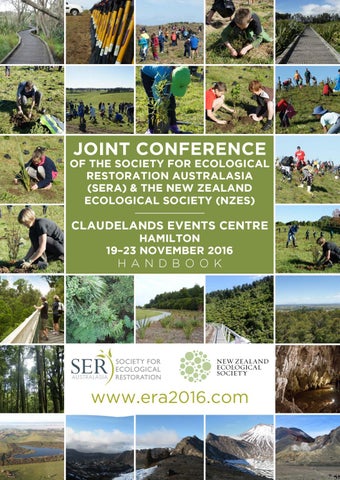
JOINT CONFERENCE
OF THE SOCIETY FOR ECOLOGICAL RESTORATION AUSTRALASIA (SERA) & THE NEW ZEALAND ECOLOGICAL SOCIETY (NZES)
CLAUDELANDS EVENTS CENTRE HAMILTON 19–23 NOVEMBER 2016
H A N D B O O K
www.era2016.com
SPONSORS & EXHIBITORS Thank you to all our sponsors and supporters. This conference is made possible only through the commitment of many individuals and groups.
PLATINUM SPONSOR
GOLD SPONSORS
SILVER SPONORS
BRONZE SPONSORS
SUPPORTERS
3
CONTENTS SPONSORS & EXHIBITORS 3 WELCOME 5 ORGANISING COMMITTEE 7 CONFERENCE VENUE MAP 9 CONFERENCE FLOOR PLAN 10 GENERAL INFORMATION 14 ART EXHIBITION – TE PAPANUI EXHIBITION 15 BOOKS FOR SALE 16 GETTING AROUND 18 HAMILTON INFORMATION 20 SOCIAL FUNCTIONS & MEETINGS 22 KEYNOTE SPEAKERS 23 SCIENCE OPEN DAY 30 SYMPOSIUM SESSIONS 31 CONFERENCE FIELD TRIPS: WEDNESDAY 23 NOVEMBER 34
4
WELCOME
Welcome from the Chair of the Society for Ecological Restoration Australasia On behalf of our global membership it gives me great pleasure to welcome you to this joint conference of the Ecological Society of New Zealand and SERA. Such a joint venture is a new initiative of both our organisations and provides the all-important cross-fertilisation of disciplines that is so needed in this time of great global change, and I look forward to vibrant and productive discussions over the next few days. Of note from SERA’s point of view are some key activities that I know will be of great interest. The most significant is the production of the first global standards for any country the will guide the principles and standards for ecological restoration in Australia. Though a nationally focused document, we believe this document is a useful template for other countries to consider adopting – including our host country New Zealand. Indeed, the success of the document has resulted in the parent organisation of SERA, the international Society for Ecological Restoration, to embark on creating the first ever global standards in restoration. This document, to be presented to the Convention of the Parties of the CBD later this year provides a road map for ensuring that restoration and rehabilitation of degraded and altered lands follows internationally accepted and scientifically based standards. With such documents I believe we are now at a cross-roads in ecological restoration where regulators, community, industry and government now speak the same language rather than what has often happened, at loggerheads. Overall the rich and diverse conference programme including an exceptional student presence ensures this conference is off to a flying start. Finally, this conference will be presenting the inaugural awards for restoration excellence in Australasia – I encourage you all to come along to the awards ceremony at the conference dinner and celebrate truly inspiring individuals and organisations who have contributed so admirably to our future planet.
Kingsley Dixon Chair of SERA
5
WELCOME 2
Welcome from the Chair of the Society for Ecological Restoration Australasia On behalf of our global membership it gives me great pleasure to welcome you to this joint conference of the Ecological Society of New Zealand and SERA. Such a joint venture is a new initiative of both our organisations and provides the all-important cross-fertilisation of disciplines that is so needed in this time of great global change, and I look forward to vibrant and productive discussions over the next few days. Of note from SERA’s point of view are some key activities that I know will be of great interest. The most significant is the production of the first global standards for any country the will guide the principles and standards for ecological restoration in Australia. Though a nationally focused document, we believe this document is a useful template for other countries to consider adopting – including our host country New Zealand. Indeed, the success of the document has resulted in the parent organisation of SERA, the international Society for Ecological Restoration, to embark on creating the first ever global standards in restoration. This document, to be presented to the Convention of the Parties of the CBD later this year provides a road map for ensuring that restoration and rehabilitation of degraded and altered lands follows internationally accepted and scientifically based standards. With such documents I believe we are now at a crossroads in ecological restoration where regulators, community, industry and government now speak the same language rather than what has often happened, at loggerheads. Overall the rich and diverse conference programme including an exceptional student presence ensures this conference is off to a flying start. Finally, this conference will be presenting the inaugural awards for restoration excellence in Australasia – I encourage you all to come along to the awards ceremony at the conference dinner and celebrate truly inspiring individuals and organisations who have contributed so admirably to our future planet.
BRUCE Chair of SERA
6
ORGANISING COMMITTEE
Bruce Clarkson (Chair) University of Waikato
Catherine Kirby
University of Waikato
Anna Cox
Waikato Environment Centre
Shona Myers Myers Ecology
Chris Bycroft
Kevin Collins
Collins Consulting
Kiri Wallace
University of WEC
Wildlands
Kevin Collier
University of Waikato
Monica Peters People+Science
Toni Cornes
University of Waikato
John Quinn NIWA
Lea Boodee
On-Cue Conferences
7
CONFERENCE VENUE MAP
2
1C
1B
1
S
8
CONFERENCE VENUE MAP
3
4
5
S
9
CONFERENCE FLOOR PLAN - GROUND
10
CONFERENCE FLOOR PLAN - GROUND
11
CONFERENCE FLOOR PLAN - LEVEL 1
12
CONFERENCE FLOOR PLAN - LEVEL 1
13
GENERAL INFORMATION Registration desk If you require any assistance throughout the conference please see the conference organisers at the Registration Desk on the Ground Floor. A Conference Notice Board will be placed at the Registration Desk and will be used to display conference information, programme changes, announcements and messages. Please check the board regularly.
Name badges Delegates are requested to wear their name badges to all sessions and social functions. Committee members will be wearing yellow lanyards, delegates green lanyards. Student helpers will be wearing red University of Waikato T-shirts, please ask them for directions and local knowledge.
Cell phones Please ensure that cell phones and/or pagers are turned off, or silent, during all presentations.
Parking Car parking is available on site for visitors in the Heaphy Terrace Car Park via Gates 1 or 1b, and on the surrounding streets.
Internet Wireless internet broadband is complimentary, please ask the conference organisers for access details.
No smoking There is no smoking allowed inside the venue.
Meals Morning and afternoon teas will be served outside the Heaphy Conference Rooms in the pre-function area. Lunches will be served on level 1 in the Arena Upper Concourse. If you have advised us of your special dietary requirements, these have been forwarded to the caterers at Claudelands and will be available on a separate table individually marked. At the Conference Dinner, please make yourself known to the waiting staff and they will make the necessary arrangements for your special meal. If you have any dietary requirements that we are not aware of, please see the Conference Organisers at the Registration Desk on arrival at the conference.
14
On Wednesday 23 November, lunch packs will be provided for the field trips. These will be placed on the coaches ready for departure. If you have informed us of your special dietary requirements, your lunch pack will be labelled for you.
Loading talks Please load your presentation in the speaker prep room “Board Room� located next to the Registration Desk on the Ground Floor. This room is also available as a speaker prep room.
Poster presenters The Poster boards are located on level 1 in the Arena Upper Concourse. Please put your poster on the board allocated (see author index of the handbook for your poster number). Posters must be displayed before midday on Sunday 20 November. Velcro dots will be provided.
Session chairs Please can all session chairs be in their room at least 10 minutes prior to the start of the session. Please ensure that you are familiar with the microphones and the lectern equipment so that you can advise your presenters. It is very important that talks are only allowed their allotted time so that talks start and finish on time and so delegates can move between sessions to hear different talks.
Contact numbers For assistance please call Lea from On-Cue Conferences on
021 1170916
ART EXHIBITION – TE PAPANUI EXHIBITION Artnexus, a Waikato-based artists’ group, will provide an exhibition of ERA2016-theme related works in the upstairs foyer/lunch space at Claudelands Events Centre. Attendees will be able to purchase the art via the Artnexus website (a special “Environmental Exhibition” folder will be created on the Artnexus site) or direct contact using details with the displayed works.
15
BOOKS FOR SALE The following books are on sale during the conference, until Tuesday 22 November 5pm. They are located on the book table next to the Registration Desk. Cash only.
Botany of the Waikato Published by the Waikato Botanical Society, this informative and in-depth account of the history and plants of the Waikato landscape includes over 150 colour photographs in 15 chapters and 136 pages. A “must have� for anyone wishing to familiarise themselves with the natural history of the Waikato Region.
Cost $15
Botany of Rotorua
Compiled by Bruce Clarkson, Mark Smale, Chris Ecroyd This 132 page book published in 1991 with many beautiful colour photos covers all aspects of the flora of the Rotorua District. Sections cover history of the vegetation, native forest, exotic forest, pasture, naturalised vegetation, aquatic vegetation, lake shore vegetation, mires, thermal areas, m8icro-algae, Mt Tarawera, threatened plants, coastal plants inland, mosses and liverworts, fungi, and traditional uses.
$10 per copy
($5 for members of Rotorua Botanical Society) Or $5 each for 10 copies or more Email contact: rotoruabotanicalsociety@gmail.com or Rotorua Botanical Society, c/- National Forestry Herbarium, Scion, Private Bag 3020, Rotorua.
16
BOOKS FOR SALE
The Drama of Conservation: The History of Pureora Forest, New Zealand This book offers a sweeping history of Pureora Forest Park, one of the most significant sites of natural and cultural history interest in New Zealand. In sum, the book demonstrates how ecological study, combined with a respect for people and for nature plus a flexible, interdisciplinary approach to both local history and current scientific priorities, can be welded into a consistently effective strategy for addressing the pressing forest-ecology questions of our time.
Cost $20
17
GETTING AROUND Getting to Claudelands Claudelands is a 10–15-minute walk from the CBD, with pedestrian access via the Arena Plaza on Heaphy Terrace. Bicycle racks are also available on site. Taxi stands are located on Heaphy Terrace. Bus stops are situated on Brooklyn Road and Heaphy Terrace. For details please see below or go to www.busit.co.nz
Bus route
18
GETTING AROUND Bus timetable
Times in BOLD are scheduled, all other times are approximate. 5 Chartwell and 14 Claudelands are a through-route. This means the 5 Chartwell bus will become the 14 Claudelands bus at Westfield Chartwell, allowing for new journey options. For example, you can travel from Fairview Downs to Waikato Diocesan without having to change buses. The Wairere Drive extension part of the new ring road is now open (through to Fifth Ave). There are no effects to the 14 Claudelands route. The route heading from the Transport Centre is unchanged.
When heading into the Transport Centre the bus will travel down Powells Road, turn left onto Tramway Road, then go around the new roundabout and back onto Fifth Ave.
Accessible buses Buses on this service are wheelchair friendly. Wheelchairs must be under 250kg in weight and 80cm in width to travel on the bus. The operator always aims to operate accessible buses; however, there may be times when this is not possible due to operational reasons.
Taxis When booking a taxi to pick you up from Claudelands, please advise the taxi company that the collection point is Entrance 1 on Heaphy Terrace. Hamilton Taxis Phone: 07 8-477-477 or Freephone 0800 477 477 Website: www.hamiltontaxis.co.nz Super Shuttle Phone: +64 9 522 5100 The Hamilton Airport is approx. 20– 30 minutes’ drive from Claudelands Events Centre; the cost is approx. $50–$60 NZD.
19
HAMILTON INFORMATION
Medical
Waikato Hospital Pembroke Street, Hamilton West Phone: 07 839 8899 www.waikatodhb.govt.nz
After Hours Medical Centre Anglesea St and Thackeray St, Hamilton 3420. (angleseamedical.co.nz, Phone: 07 858 0800)
Life Pharmacy 501 Victoria Street, Hamilton 3204
20
HAMILTON INFORMATION
Restaurants Top 5 TripAdvisor Hamilton Restaurants
Palate Restaurant Type: European, New Zealand 20 Alma Street, Hamilton, Phone: 07 834 2921
Victoria Street Bistro Restaurant Type: European, New Zealand, Contemporary, Gluten Free Options 153 Victoria Street, Hamilton, Phone: 07 839 4444
Madam Woo Restaurant Type: Asian, Malaysian, Vegetarian Friendly 6 Sapper Moore-Jones Place, Level 1, Hamilton, Phone: 07 839 5605
Gothenburg Restaurant Type: European, Spanish, Fusion, New Zealand, Vegetarian Friendly 21 Grantham Street, Hamilton Phone: 07 834 3562
Good George Brewery and Dining Hall Restaurant Type: Bar, New Zealand, Pub 32A Somerset Street, Frankton, Hamilton Phone: 07 847 3223
Mexico Food and Liquor Restaurant Type: Mexican, Gluten Free Options 254 Victoria Street, Hamilton Phone: 09 280 1487 Caffe Centrale Restaurant Type: Italian 10 Alma Street, Hamilton Phone: (07) 838 1013
21
SOCIAL FUNCTIONS & MEETINGS
Conference Opening/Welcome/Mihi Whakatau followed by a Welcome Function An invitation is extended to all delegates to attend the Conference Opening and Welcome Function. Renew old friendships and make new acquaintances as we welcome you to Hamilton. This function is included in the registration fee (excluding day registrations), additional tickets may be purchased for guests. Date: Saturday 19 November 2016 Time: 7.00pm – 9.00pm Venue: Claudelands – Heaphy Pre-Function Area Additional Tickets: $35.00 Dress: Casual
Conference Opening/Pōwhiri The following is an outline of the format that the opening of the conference will take. This is offered so that you may enhance your experience of the welcome and opening as the guests of the ERA 2016 Conference.
As the manuhiri (visiting group) you will gather together and prepare to be welcomed into the facility and the conference. This will be a time when the waiata (song) that will be sung by your group can be practised. The words of the waiata will be available at that time and you will be guided through both the waiata and the format of the whakatau. Those of you who are our NZES & SERA elders will be encouraged to sit in the front rows of seats as an expression of the respect and esteem that you are held in by the association and as acknowledgment of your tuakana (elder) status. In this format of welcome, men will sit in the front rows and women will sit in the seats behind them. Within a traditional frame this symbolises the essential need for the protection of women as both the bearers of the next generation and the holders of knowledge. Waiata: TBC
The conference will be opened with a mihi whakatau. This is a Māori form of welcome that follows principles and values (tikanga) that have been adhered to in this land over many centuries:
Conference Dinner
• to mihi is to greet, • whakatau is to settle.
The ERA2016 Conference Dinner will be the premier event of the conference and is not to be missed by delegates and guests. The Conference Dinner is included in the registration fee (excluding day registrations); additional tickets may be purchased for guests.
The mihi whakatau process has as its intention the coming together of two groups to unite as one. In a traditional Māori sense the visitor’s status as tapu (sacred) is transformed to a state of noa (common, free from tapu) through the various processes undertaken including the karakia and hongi. The conference committee have worked closely with members of xxx and have chosen this form of welcome as an expression of great respect and as a reflection of our commitment to honouring the indigenous culture of Aotearoa New Zealand. The Organising Committee and an iwi representative will meet and run through the process with everyone before we start. What will happen This opening and welcome will take place in the Heaphy Pre-Function Area and will begin at 7.00pm. Please gather outside of the entrance by 6.45pm.
22
Date: Tuesday 22 November 2016 Time: 6.30pm – midnight Venue: Claudelands Events Centre – Heaphy Rooms Transport: Buses will depart at 10.00pm, 11.00pm and midnight; they will drop off at the Novotel Tainui and University of Waikato Tickets: $120.00 for additional tickets and day delegates, $65.00 for student delegates Includes: three-course meal, beverages and entertainment Dress: Semi-formal
KEYNOTE SPEAKERS
Sir Rob Fenwick
Talk time: Tuesday 22 November, 8.10am Topic: A predator-free future for New Zealand? A former journalist and public relations consultant, Rob co-founded Living Earth Ltd, the country’s largest municipal composting business. Much of the focus of his career has been to encourage other business people to place environmental responsibility at the centre of their decision-making process. Once described as the busiest man in New Zealand, Rob chairs the Predator Free New Zealand Trust and Kiwis for Kiwi, which aims to reverse the decline in kiwi numbers. He also chairs the Sustainable Seas National Science Challenge and the Fred Hollows Foundation, and was founding chairman of Ngāti Whātua’s radio station, Mai FM. Rob spearheaded the campaign to save the Antarctic huts built by Ernest Shackleton and Robert Scott, chaired Antarctica New Zealand and established the New Zealand Antarctic Research Institute, which funds scientists to gain a greater understanding of climate change.
Wendy Henwood
Talk time: Sunday 20 November, 1.20pm Topic: TBC Ko Te Rarawa te iwi, ko Ngāi Tūpoto te hapū, ko Ngāi Tūpoto ki Motukaraka te Marae. Wendy lives in Hokianga and works with the Whāriki research group (Massey University). She has been actively involved in community environmental restoration in a number of rural Far North communities for many years.
23
KEYNOTE SPEAKERS
Margaret D. Lowman Citizens and communities, canopies and conservation – Innovation required for Mother Nature!
Talk time: Sunday 20 November, 9.50am Topic: Citizens and communities, canopies and conservation – Innovation required for Mother Nature! Nicknamed the “real-life Lorax” by National Geographic and “Einstein of the treetops” by The Wall Street Journal, Meg Lowman pioneered the science of canopy ecology. Meg is affectionately called the mother of canopy research as one of the first scientists to explore this eighth continent. Her international network and passion for science have led her into leadership roles where she seeks best practices to solve environmental challenges and serves as a role model to women and minorities in science. At the California Academy of Sciences, Lowman has played a leadership role to integrate the priorities of sustainability and science communication into the existing research programmes of the Institute of Biodiversity Science and Sustainability. Formerly a professor at North Carolina State University and the founding director of North Carolina’s innovative Nature Research Center (NRC), Lowman has served as a mentor to women and minorities in the workplace throughout her career. She has authored more than 125 peer-reviewed scientific publications, and her first book about her (mis)adventures as a woman in science, Life in the Treetops, received a cover review in The New York Times Sunday Book Review. Working tirelessly on sustainability initiatives at home and abroad, “CanopyMeg” was a Fulbright Senior Specialist Scholar to both India and Ethiopia, mentoring women as part of her global outreach.
24
Despite enormous pending global environmental challenges, the next generation has a wealth of technology and expertise available to inspire solutions. Using a combination of new virtual technologies with conventional natural history observations, the integration of real and virtual nature offers innovative approaches to restoration ecology, conservation biology and community-based actions. How can citizens deploy this innovative new toolkit at the community level for ecosystem conservation and restoration? And can new technologies, such as crowd-sourcing and citizen science, achieve the rigour required to be included in the toolkit for scientific problem-solving and for education outreach? Through my lens of forest canopy research, I share some examples of success in engaging citizens and communities to inspire ecosystem restoration and conservation solutions. A new mobile app, called iNaturalist, has deployed a new generation of student field biology “detectives” to document natural history at a global scale. The simple distribution of Google Earth imagery has transformed the Ethiopian Coptic church priests into conservation leaders, saving the forests of an entire country. The application of drones has provided citizens and communities with visual images not only to inspire kids about STEM education, but also to police illegal logging, avert toxic waste activities in remote tropical forests, and protect boundaries for indigenous peoples. Through Earthwatch and Eco-Teach, teams of citizen scientists have collectively mapped rain forest canopy biodiversity and monitored endangered species. Conservation and restoration of the world’s forests (and other essential ecosystems) require action at both local and global scales using innovative new toolkits based on both virtual and real nature.
KEYNOTE SPEAKERS
Alan Watson Featherstone
cluding the Spirit of Scotland Environment Award in 2012 and the RSPB Nature of Scotland Outstanding Contribution Award in 2013, whilst Trees for Life was recognised as the UK Conservation Project of the Year in 1991, and received the Millennium Marque Award in 2000, for demonstrating environmental excellence for the 21st century.
Restoring the Caledonian Forest in Scotland
Talk time: Monday 21 November, 8.10am Topic: Restoring the Caledonian Forest in Scotland Alan Watson Featherstone is the Founder and Visionary of Trees for Life, a conservation charity working to restore the Caledonian Forest in the Highlands of Scotland. Since 1989, Trees for Life has planted over a million trees and has involved thousands of volunteers in its work. The charity has a 250-year vision for the restoration of the Caledonian Forest to a significant part of its former range, complete with the reintroduction of the ecosystem’s missing apex predators, such as the Eurasian lynx and the wolf. Alan regularly contributes articles to various professional and popular publications, and his photographs have appeared in publications such as Time magazine and the Encyclopædia Britannica. He has given lectures at events and conferences in more than 20 countries, and was a plenary speaker at the SER 2015 conference in Manchester, England. Through his work with Trees for Life, Alan has helped provide the inspiration for other ecological restoration projects in the Scottish Borders, on Dartmoor in England and for the creation of the Yendegaia National Park in Tierra del Fuego, Chile. He also founded the Restoring the Earth project, to promote the restoration of the planet’s degraded ecosystems as the most important task for humanity in the 21st century. Alan has received a number of awards for his work, in-
At its maximum extent, the Caledonian Forest covered a large part of the Highlands of Scotland, but by the 20th century it had been reduced to scattered remnants consisting solely of old trees nearing the end of their lives, and covering a tiny fraction of the forest’s former range. Overgrazing by deer and sheep had prevented the growth of any new trees for about 200 years, leaving the ecosystem as fragments of “geriatric woodland”, missing many of its species and with key ecological processes no longer functional. This presentation will focus on work that has taken place in the past 3 decades to address this problem, and to assist the ecological recovery of the forest and its associated species. Drawing on examples from the work of Trees for Life and other projects, it will elucidate three key elements involved in the rewilding of the Caledonian Forest and 13 principles used to guide the ecological restoration process. Accompanied by high quality photographs, the presentation will feature dramatic “before and after” images that demonstrate the results that have been achieved, and which illustrate the positive trophic cascades that develop spontaneously as the forest ecosystem recovers. It will also highlight the importance and necessity of other steps in the restoration process that have yet to be implemented, including the reinstatement of apex predators such as the Eurasian lynx and the wolf, and the re-establishment of critical ecological processes such as disturbance and natural succession. The presentation will include a discussion of the key role that volunteers can play in the work of ecological restoration, and the wider societal benefits that can bring, which in Scotland includes contributing to the momentum for greater political self-determination. It will conclude with a brief summary of the relevance of the work for the restoration of degraded forest ecosystems elsewhere in the world, including New Zealand.
25
KEYNOTE SPEAKERS
Myla Aronson
the Long Island Native Plant Initiative, and the Fire Island National Seashore Science Advisory Team. In addition to her applied restoration work, she has taught at the undergraduate and graduate levels at Rutgers University, Luther College, and Hofstra University. Website: https:// mylaaronson.wordpress.com/
Biodiversity in the concrete jungle: Understanding nature in cities for a resilient future
Talk time: Tuesday 22 November, 8.50am Topic: Biodiversity in the concrete jungle: Understanding nature in cities for a resilient future Myla F.J. Aronson is a plant ecologist whose interests focus on the conservation, restoration, and maintenance of biodiversity in human-dominated landscapes. She received her B.S. in Natural Resources from Cornell University and her M.S. and Ph.D. in Ecology and Evolution from Rutgers, The State University of New Jersey. She is currently the Associate Editor-in-Chief of the journal Ecological Restoration and a Research Scientist in the Department of Ecology, Evolution and Natural Resources at Rutgers University. She also co-directs, with Charles Nilon at the University of Missouri-Columbia, UrBioNet: A Global Network for Urban Biodiversity Research and Practice (http://urbionet.weebly.com/). Dr Aronson’s research focuses on the patterns and drivers of biodiversity in urban landscapes, in particular to understand community assembly and biotic homogenisation in cities at local, regional, and global scales. She also focuses on dynamics of species invasions and the ecological function of restored communities. Finally, she studies long-term change in intact and restored vegetation communities in urban and agricultural landscapes in order to better understand and manage plant community dynamics over time. Dr Aronson has used the results from her research to direct decisions regarding the restoration and management of degraded habitats, such as wetlands and woodlands in New York, New Jersey, Minnesota, and Iowa. She is currently the chair of the Urban Ecosystem Ecology section of the Ecological Society of America and has served on the board of directors of the Friends of Hempstead Plains, the board of directors of
26
The majority of humanity now lives in urban areas, with this proportion expected to continue increasing for the foreseeable future. Because the majority of the world’s cities and towns are in areas of high biodiversity, the rapid urbanisation of the world has a profound effect on global biodiversity. Although ecologists have made great strides in recent decades at documenting ecological relationships in urban areas, much remains unknown, and we still need to identify the major ecological factors, aside from habitat loss, behind the persistence or extinction of species and guilds of species in cities. Given this paucity of knowledge, there is an immediate need to facilitate collaborative, interdisciplinary research on the patterns and drivers of biodiversity in cities at multiple spatial scales. Here I take an interdisciplinary approach to discuss: 1) the status of biodiversity in the world’s cities and towns; 2) drivers of biodiversity in cities; and 3) city planning for biodiversity. While the world’s cities and towns are certainly hotspots of species loss, they are also surprisingly biodiverse, supporting native plant communities as well as threatened and endangered plant species. I introduce a conceptual framework for understanding the filtering processes that mould diversity of urban floras and faunas. Understanding the relative roles of abiotic, biotic, and anthropogenic filters that shape local communities will provide a deeper understanding of community assembly theory and lead to practices that ensure the future of sustainable and biodiverse cities. Finally, the ability of cities to preserve, conserve, and restore biodiversity relies on how cities plan for and manage ecological communities. While cities are centres of consumption and land use change, they represent a considerable opportunity for forwarding global sustainability and environmental goals. Understanding ecological processes in cities and towns is increasingly important and offers unique insights into the science of ecology. Furthermore, an understanding of the factors affecting biodiversity in cities is necessary to inform scientists, city planners, and managers to best conserve and restore urban biota.
KEYNOTE SPEAKERS
Saul Cunningham
welfare and natural systems is seen as a way to better motivate society to make better decisions, but the debate around crop pollination has been surprisingly contentious. There have been confusing messages, disagreements on the facts, an unfortunate focus on dire projections for the future and a lesser focus on solutions. Most of these problems arise not from poor science, but instead from poor communication of complex ideas, and differences in perspective, such as the deep disciplinary gap between agricultural scientists and ecologists. By understanding these problems we can improve the way we do our science and communicate our ideas. I argue that ecologists should continue to communicate the principle that human welfare depends on the function of natural systems, and discuss how we can do so in a way that is more genuinely connected to society’s needs, such as growing food. If we succeed, we will be changing an intellectually interesting conversation into a dialogue that influences how society interacts with nature.
Talk time: Monday 21 November, 4.10pm Topic: Ecologists know that human welfare depends on nature, but what do the humans think?
Kingsley Dixon
Saul Cunningham’s research has covered many themes, including pollination biology and restoration ecology. Recently he has focused on the challenge of maintaining biodiversity in production landscapes. An Australian by birth, he did his PhD in the US but returned home and worked for CSIRO in Canberra for 17 years. He recently moved to the Australian National University to work in the Fenner School of Environment and Society. In 2015 he received the “Australian Ecological Research Award” from the Ecological Society of Australia.
Ecologists know that human welfare depends on nature, but what do the humans think? Human welfare depends on the function of natural systems. This idea is paradigmatic to ecologists, and has been the focus of a growing branch of applied ecology. I examine the narrative of human dependence on nature by considering the literature on crop pollination by animals and its importance for feeding people. Making the connections between human
Talk time: Monday 21 November, 8.50am Topic: Beyond flag waving – Raising the standard in ecological restoration
27
KEYNOTE SPEAKERS
Ross Thompson
Talk time: Tuesday 22 November, 2.10pm Topic: Building a better mousetrap: Restoration, remediation and re-engineering natural systems for resilience Professor Ross Thompson is Director and Chair of Water Science and an ARC Future Fellow in the Institute for Applied Ecology at the University of Canberra. Ross is a freshwater ecologist with interests in the study of biodiversity and the restoration of landscapes. His fundamental research is in food web ecology, seeking the rules that determine how natural communities assemble and persist. His applied research addresses the ways in which food webs can be influenced by anthropogenic factors including urbanisation, land clearance, pharmaceutical contamination, river flow diversion and restoration, and invasion. He has an active research programme on aquatic biodiversity and ecosystem function in urban and rural landscapes. Ross has published more than 80 papers, 10 book chapters and more than 200 scientific reports. He sits on the Australian Research Council College of Experts and has recently stepped down from the New Zealand Marsden Panel. His work has strong links to government and industry, and Ross sits on a number of senior technical advisory panels for local, state and federal research programmes.
Building a better mousetrap: Restoration, remediation and reengineering natural systems for resilience The majority of the world’s ecosystems have been profoundly altered by human activities in ways that are essentially irreversible. Global population growth will place ever greater demands on ecosystems and the services that they provide. Using examples from waterway management in Australia, I will discuss the issue of how we manage ecosystems within the bounds of what society demands from them, and in the context of regional factors such as climate change, habitat fragmentation and species invasions. I will argue that restoration is most often an unrealistic goal, and that rebuilding and managing ecosystems for a range of values is the challenge that ecologists truly face. Using data from major environmental management interventions, including landscape-scale revegetation, invasive animal control and environmental flow provision, I will describe the challenges in restoring, remediating and re-engineering natural ecosystems.
Jacqueline Beggs
Talk time: Tuesday 22 November, 2.50pm Topic: TBC
28
KEYNOTE SPEAKERS
Bethanie Walder
NZES AWARD WINNING TALKS
Laura Molles Talk time: TBC Topic: Tūī and tea parties: Adventures in community-based conservation
Talk time: Monday 21 November, 4.50pm Topic: TBC Bethanie Walder joined the Society for Ecological Restoration as Executive Director in September 2015 and has more than 20 years’ experience in environmental conservation, restoration and education. Prior to joining the SER, Bethanie served as the Executive Director of Wildlands CPR, where she oversaw several highly successful conservation and restoration campaigns, including a programme that has secured more than $400 million in U.S. Congressional appropriations for watershed restoration on national forest lands. Bethanie also worked as an organisational development, strategic planning and natural resources management consultant. She has led workshops and given lectures and presentations on ecological restoration and conservation at conferences, seminars and universities across the United States and in Canada, Ireland and Brazil. She was a founding member of several coalitions and non-governmental organisations including Women’s Voices for the Earth and the Washington Watershed Restoration Initiative. Bethanie also served on numerous boards of directors and steering committees, including her current positions on the boards of the Missoula Community Foundation and Writing Coaches of Missoula. Bethanie has an undergraduate degree in Political Science and International Studies from Duke University and a Master of Science in Environmental Studies from the University of Montana. She lives, works and plays in Missoula, Montana.
My research combines basic-science and conservation-oriented work, and many of the projects I’ve worked on have involved collaboration with community-based groups. My deepest involvement in community-based conservation is as the science adviser for the Tūī Restoration Group, within the Banks Peninsula Conservation Trust. This project was initiated by the community with the aim of restoring a breeding population of tūī on Banks Peninsula after a few decades’ absence. Tūī were reintroduced in 2009 and 2010, and the project continues to be run by a dedicated team of volunteers. Community-based restoration and monitoring programmes like the tūī project engage people in projects that are local, meaningful and inherently built around social interaction and mutual support. As numerous studies on citizen science have shown, volunteers often benefit personally from participating in such projects, and may also increase their general scientific literacy while making substantial contributions to science and conservation. From a scientist’s perspective, working with a community-based group also has many potential rewards. It’s fun and energising to work with enthusiastic volunteers, and it’s great to feel that your expertise is useful. Professionally, there’s a fantastic opportunity to collect so much more data than you could on your own. But like all relationships, this kind of partnership requires a lot of compromise and communication. Developing realistic methods for the collection, management and sharing of data, for example, can involve some trial-and-error. Finding the time and funding to play the role of supporting scientist, particularly for a longterm project, is also difficult. My journey with the tūī project has taught me a lot about being a real-world scientist; I’ll talk about the challenges and rewards of this experience.
29
SCIENCE OPEN DAY
Scientists and communities putting ecology into action Sunday 20 November marks the launch of the ERA2016 Conference. This special Science Open Day is designed for scientists, students, educators, notfor-profits, community environmental groups and members of the wider community who are engaged in, or wish to learn more about, cutting-edge restoration science. An introduction to the Waikato region
intertwining landscape change, ecology and indigenous culture will start the day. Special keynote speakers include Margaret D. Lowman, who integrates restoration ecology, conservation biology and community-based actions through canopy investigations internationally, and Wendy Henwood, who will offer perspectives and experiences of working on environmental restoration projects with rural communities in New Zealand’s Far North. Throughout the day, there will be a diverse range of presentations, delivered by both professional scientists, citizen scientists, community members and others. Interactive sessions such as panels, networking sessions, workshops and a Bat Symposium will also feature.
30
Who is the day for? Scientists, students, educators, not-for-profits and community environmental groups, as well as members of the wider community. Participants from all localities and countries are encouraged to attend.
What is the purpose of the day? Provide a space for exchange of ideas between professional ecologists and the everyday layperson who is involved in ecological efforts. Showcase diverse restoration projects and/or ecological research highlighting the social and/or cultural context their work takes place within. Enable networks to grow between people who may not normally have the opportunity to connect. Spark a wide range of discussions about science in society, citizen science and community ecological monitoring, designing and delivering collaborative research and more…
SYMPOSIUM SESSIONS
Bat symposium Date: Sunday 20 November Time: Room: Organisers: Project Echo The symposium will take place on the first day of the conference as part of the Science Open Day, providing an opportunity for scientists and community to engage on this topic. Symposium speakers include Debs Martin from Forest and Bird and the infamous NZ Batman, Ben Paris. Hamilton-born bat advocacy group Project Echo will also be contributing to the programme to highlight their community engagement activities. Project Echo and Waikato Tree Trust’s Gerard Kelly have been recognised as inspiring many young people to delve into the wonders of Hamilton’s gullies and get to know our bat friends. Meanwhile, Salina Ghazally will accompany Waikato Museum’s “Peka the Bat” as the bat mascot makes a conference debut this year. Dave Bell may also share details of surveying for bats in Taradise (aka Taranaki) over the last four seasons with some pleasing results. A number of bat field trips are on offer, including an overnight stay to Pureora Forest, an evening at Pukemokemoke Reserve and one to the city’s Hammond Bush. There are limited spots available, so don’t forget to register for these field trips. You can do so by clicking here. Professor Warwick Silvester, who heads the Pukemokemoke restoration project, writes that there have been recent reports by OPUS of some very high numbers of bats in the reserve – now that’s exciting!
Ecological halos – A new future for New Zealand’s biodiversity Date: Time: Room: Organisers: Dave Butler, Charles Daugherty and Simon Collins (Rotokare Scenic Reserve Trust) Emerging landscape-scale initiatives are laying the foundation for the return of indigenous biodiversity across mainland New Zealand. This symposium explores these initiatives, which often arise from community-based programmes supported by local and national governments. As fenced sanctuaries have created small but safe nurseries for previously extinct or declining species on the mainland, “halos” of native bird populations have spread beyond the fences into areas surrounding the sanctuaries. A national vision for a predator-free New Zealand, barely imagined even a decade ago, is rapidly developing. The symposium takes stock of the present situation and considers challenges in the path to a predator-free New Zealand and the return of abundant indigenous biodiversity to all New Zealand. The symposium organisers are David Butler and Charles Daugherty, and the keynote speaker will be Sir Rob Fenwick CNZM, KSTJ. His working title is: A Predator-Free Future for New Zealand?
31
SYMPOSIUM SESSIONS
Freshwater restoration in the Waikato Date: Time: Room: Organiser: John Quinn (NIWA) The Waikato River catchment is a focus of current freshwater restoration activity, spurred by the Treaty of Waitangi settlement on the river, which legislated the Vision and Strategy for a healthy and well river and established the Waikato River Cleanup Trust to support restoration action, and the current Healthy Rivers Waiora Plan Change that will set out a supporting policy platform. This symposium discusses some of the science tools that are supporting these processes, research findings on methods to manage land use and within waterbody pressures, and proposed new integrative approaches to restoring the many highly degraded lowland Waikato lakes.
Developing restoration standards at national and international levels Date: Time: Room: Organisers: Kingsley Dixon and Tein McDonald (Society for Ecological Restoration Australasia) In April 2016 a partnership of Australian restoration groups launched the National Standards for the Practice of Ecological Restoration in Australia, which then led to SER developing standards at an international level. This symposium brings together speakers from three Australasian nations and representatives of the regional and international bodies of the Society for Ecological Restoration to review the content and the value of standards and current progress with SER’s international standards. While each nation has differ-
32
ent needs and contexts, a common ground appears to be the recognition that ecological restoration and rehabilitation (or restorative management) are aligned along a spectrum of recovery that includes both full recovery (the most desirable aim wherever it is possible) and partial recovery (the most desirable fall-back position where restoration is not possible). Is this common understanding sufficient to provide a cogent framework upon which to progress the mission of substantially recovering ecosystems across our region and elsewhere?
Community and comanagement Date: Time: Room: Organiser: Monica Peters The symposium is an opportunity to showcase novel research from New Zealand and internationally. The citizen science symposium will be designed to: provide an overview of state of ecological/environmental citizen science in New Zealand showcase a cross-section of initiatives taking place in other countries investigate the challenges associated with setting up citizen science programmes and using community-generated data foster discussion on how data validity issues can be addressed and overcome highlight the role of technology in redefining how data are captured, used and shared highlight considerations such as data ownership.
SYMPOSIUM SESSIONS
Urban symposium Date: Time: Room: Organiser: Bruce Clarkson
Advancing seagrass restoration – Sharing successes Date: Time: Room: Organiser: Marnie Campbell (University of Waikato)
Innovations for mine site restoration Date: Time: Room: Organiser: Paul G. Nevill Restoration of post-mining environments is critical for Australia’s ability to sustainably and responsibly exploit its vast mineral wealth. However, the lack of cost-effective restoration solutions at the scale required is currently a major impediment for regulatory and social compliance. Government approval for mining programmes is conditional on achieving targets in the ecological restoration of impacted habitats. These targets can include 70% of the original flora species diversity, yet current best-practice restoration in arid Australia achieves <15% of the pre-mined biodiversity. This demands scientific knowledge for innovative solutions. Our symposium brings together speakers on diverse topics and seeks to present updates on the latest approaches to mine site restoration.
33
CONFERENCE FIELD TRIPS: WEDNESDAY 23 NOVEMBER
All field trips depart and return to Claudelands Events Centre If you have not booked a field trip and would like to, please enquire with the Conference Organisers at the Registration Desk before 1.00pm on Monday 21 November.
Maungatautari, kindly sponsored by Waipā District Council Sanctuary Mountain Maungatautari is a unique mainland island in the central North Island. The 3,400 hectare forested ancient volcano stretches from the rolling Waikato lowlands into the clouds above. The mountain is protected by a 47km pest-proof fence which keeps the forest free from mammalian predators, allowing it to regenerate and providing a flourishing pre-human habitat for New Zealand wildlife, including many endangered species. The field trip will be led by experienced guides who can explain the ecology of Maungatautari and point out unique flora and fauna that flourish there in the absence of pests.
Tuatara wetlands – Explore the wetland and learn how 80% of wetlands in the Waikato were drained for agricultural use. Go into the Tuatarium to learn about the history, life cycle and physical characteristics of the tuatara and their journey to Maungatautari. If they are not breeding, a pair of takahē may be visible; once thought to be extinct, these rare birds were rediscovered in 1948. Viewing tower – Climb up into the canopy and get a view of the forest from a unique perspective. The tower is located in the Southern Enclosure, where most rare bird species have been released. Botany – For those with a particular interest in plants, special botany tours can be arranged. Departure time: 8.00am Return time: 2.30pm Price: $60.00 per person (Includes: transport and lunch at Out in the Styx Guesthouse)
Depending on numbers and visitors’ interests, tours may include: Maungatautari peak – See the succession of vegetation from lowland forest to high on the mountain. You may see early blooming Tawari (Ixerba brexioides), an angiosperm tree that until 2009 was the single member of New Zealand’s only endemic vascular plant family of Ixerbaceae. It is only found in a limited area of the North Island.
34
Photo by: Catherine Kirby
CONFERENCE FIELD TRIPS: WEDNESDAY 23 NOVEMBER
Urban Restoration This one-day field trip will focus on recent efforts to bring nature back into Hamilton City. A sequence of sites will be visited encompassing indigenous forest remnants and a range of restoration plantings from 2–40+ years, mainly in gully settings. Gullies are a prominent and unique feature of the city and have been a focus of restoration projects since about 2000. Sites visited will include private gully restorations, school- and community-led restorations and city council restoration projects. Significant time will also be spend at the 60ha Waiwhakareke Natural Heritage Park, where a re-construction or restoration of the full range of local indigenous ecosystems – from lake edge wetlands to ridgetop forest – is being undertaken. The ecosystem types include: • Kahikatea-pukatea (semi-swamp) forest • Harakeke-sedge (lake margin/swamp)
• Kauri/kānuka (ridge crest) forest • Tawa/rimu (hillslope) forest • Restiad bog and lake margin wetlands • Lake/aquatic habitat Sites to be visited: 1. Mangaiti Gully 2. Hukanui School Gully 3. Seeleys Gully 4. Private Gully TBC 5. St James subdivision constructed wetland 6. Hammond Bush restoration 7. Jubilee Bush (Claudelands) 8. Waiwhakareke Natural Heritage Park Departure time: 8.30am Return time: 5.30pm Price: $55.00 per person (Includes: transport and packed lunch)
Photo by: Catherine Kirby
35
CONFERENCE FIELD TRIPS: WEDNESDAY 23 NOVEMBER
Pūkorokoro Miranda This one-day field trip will visit one of New Zealand’s major shorebird sites. The Firth of Thames hosts internationally important numbers of trans-equatorial migratory shorebirds such as bar-tailed godwit and red knot. In 2007 a female godwit fitted with a satellite transmitter at Pūkorokoro Miranda Shorebird Centre was tracked through her entire migration. This included an 11,680km non-stop flight between Alaska and the Firth of Thames. At this time of year almost all adult birds will have returned from their breeding grounds on the Arctic tundra. There will also be juvenile birds present. Come and see juvenile godwits that – while they are still only 4–5 months old – have already flown the length of the Pacific in one non-stop flight. There are also likely to be other Arctic-breeding species present including ruddy turnstone, Pacific golden plover, sharp-tailed sandpiper and red-necked stint.
Photo by: Dick Bos
36
The firth also supports 40% of the endemic wrybill population: the laterally curved bill of this species is unique among birds. New Zealand dotterel also breed at Pūkorokoro Miranda. As well there are usually large flocks of pied oystercatcher and pied stilt. There will be interpretative talk at Pūkorokoro Miranda Shorebird Centre before going to see the bird flocks on the high tide. The centre has a bookshop with possibly the widest selection of natural history titles anywhere in the country. Departs from and returns to: Claudelands Events Centre Departure time: 10.30am Return time: 4.30pm Price: $60.00 (Includes: transport and packed lunch) What to bring: Binoculars
CONFERENCE FIELD TRIPS: WEDNESDAY 23 NOVEMBER
Waitomo Caves Waitomo is world‐renowned for its karst landscape and network of limestone caves studded with glow‐worms and stalactite formations. On this trip you will learn about the history of this unique environment, catchment management initiatives to maintain water quality, cave management and monitoring, and local flora and fauna. The morning will include a bush walk and trip to Aranui Cave, steeped in Māori history, and in the afternoon the group will have the option of visiting the stunning Spellbound Caves or go on the legendary Black Labyrinth blackwater rafting trip (may involve non‐conference participants)
Price for Waitomo Cave trip and Black Labyrinth Rafting Trip: $197.00 (Includes: transport, packed lunch, Aranui Cave) What to bring: Sturdy shoes, sun hat and togs & towel if blackwater rafting
Departure time: 8.30am, Return time: 5.30pm Price for Waitomo Cave trip and Spellbound Glow-worm and Cave Photo by: Catherine Kirby Tour: $121.00 per person
Whatawhata Sustainable Hill Land Management Visit the site of a long-term catchment scale experiment in sustainable hill farm land management
where a plan to improve the economic and environmental performance was planned by a collaborative group and implemented in 2001. Learn about the responses of the farm system economic performance, carbon sequestration, biodiversity and stream hydrology, water quality and ecology that have been monitored continuously since 1995. Enjoy a short hike into the podocarp-hardwood forest catchment in the adjacent reference catchment to contrast the near natural state of the land and streams with that of pastoral streams with and without native forest riparian restoration planting. Departure time: 9.00am Return time: 3.00pm Price: $55 per person (Includes: transport, packed lunch) What to bring: Sturdy walking boots and raincoats
37
CONFERENCE FIELD TRIPS: WEDNESDAY 23 NOVEMBER
Hobbiton Tour Discover the real Middle-earth with a fascinating two-hour guided tour of the Hobbiton Movie Set, as seen in The Lord of the Rings and The Hobbit trilogies. Situated on picturesque private farmland, your tour guide will escort you around the 12-acre set sharing the story of Hobbiton – how it was built and a few tricks of the trade from the film industry. Throughout the set there are 44 complete Hobbit Holes, the mill, double arch stoned bridge and The Green Dragon Inn kept as they were during filming. The tour then cumulates at the Green Dragon Inn, our fully themed venue where you will be treated to an exclusive Southfarthing ale, cider or ginger beer.
Ice Age Peat Lake, kindly sponsored by Waipā District Council
Departs from and returns to: Claudelands Events Centre Price: $95.00 per person (Includes transport, Hobbiton Tour and morning tea)
Photo Supplied by: Hobbiton Visit one of the Waikato’s finest peat lakes, dating from the end of the last ice age, and an associated kahikatea forest. Site of the proposed National Wetland Centre and a major community-led ecological restoration project, including pest exclusion. Test a newly developed self-guided discovery trail, view a rare restiad (giant cane rush and wire rush) peatland community, find “Fred the Thread” (host-specific endemic moth), practise some ecosystem monitoring techniques, and learn of the National Wetland Trust’s plans for a wetland centre. Departure time: 8.30am Return time: 1.30pm Price: $50.00 per person (Includes: transport, packed lunch) What to bring: Sunhat, sunscreen, sturdy footwear, musical instruments, no mice…
38
CONFERENCE FIELD TRIPS: WEDNESDAY 23 NOVEMBER
Torehape Restiad Bog Restoration
Torehape restiad bog, on the Hauraki Plains, north Waikato, is currently being mined for horticultural peat. Once the permitted depth of peat has been removed, the mining company is required to restore the bare surface to original bog vegetation. Restoration research over more than a decade has resulted in best practice for restoring the plant and invertebrate communities. The field trip will cover the different ages and stages of bog recovery at Torehape. In the afternoon we will visit Kopuatai Bog, a Ramsar site and New Zealand’s best example of the target Sporadanthus ferrugineus restiad bog type. Departure time: 8.30am, Return time: 4.30pm Price: $60.00 per person What to bring: Raincoat; gumboots or good walking boots; sunhat
Waikato Expressway, Huntly Section
Price: $65.00 per person What to bring: Water and packed lunch; sturdy walking shoes/boots; long sleeve and long pants
Visit the largest ecological component being undertaken by the New Zealand Transport Agency in the upper North Island as part of the 15.2km Huntly Section of the Waikato Expressway. Learn about the habitat rehabilitation and restoration works; lizard, fish and bat management; freshwater and flood plain restoration works; and wetland creation as part of the construction of the Expressway. Departure time: 8.50am Return time: Approx 11.30am Depart for Hamilton via the Graham’s Farm private access road
39
40