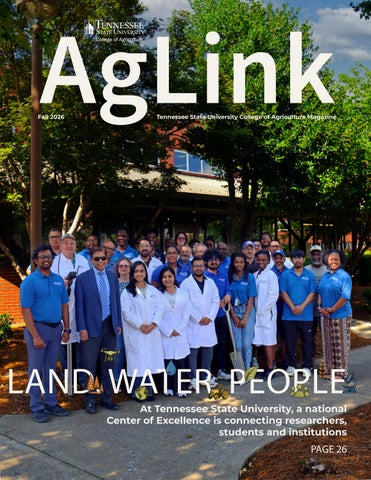
AgLink
Fall 2026
Tennessee State University College of Agriculture Magazine
LAND. WATER. PEOPLE
At Tennessee State University, a national Center of Excellence is connecting researchers, students and institutions
PAGE 26 _
College of Agriculture administrators, faculty and university leaders celebrate the ribbon-cutting ceremony marking the opening of the newly renovated Department of Agricultural Business and Education.
40
table of contents: Vol. 14 | Issue 1 | Fall 2026
4
Message from the Dean
6
Around Campus
8
Student Life
10 Growing Leaders, Earning National Recogniton Dean Dr. Chandra Reddy
Director of Marketing and Communications
14 Our Future, Our Earth 17 The Stories Forgotten Beneath the Hill 20 ‘Laissez Les Bons Temps Rouler’ ARD
“Coach” Rod Reed
24 Planes, Trains and Automobiles
Editor
26 COVER STORY: Land, Water, People
Charlie Morrison
Graphic Designer Christina Jacob
Contributing Writers
32 Leveling the Field 34 New Faculty Spotlights 38 Lessons in a Different Landscape
Charlie Morrison
40 A Week in Bloom
ZeKeya Harrison
44 The Power of the Pitch
Contributing Editors
46 The Local Lobby
Dr. De’Etra Young ZeKeya Harrison
48 Growing the Conversation
Photography
50 A Class Above the Rest
Aaron Grayson
Stay Connected! @tsucollegeofagriculture @tsucollegeofag @tsucollegeofagriculture TSU College of Agriculture TSU College of Agriculture
10
38
Tennessee State University College of Agriculture (615) 963-7561 www.tnstate.edu/agriculture
Questions/Concerns Email Associate Director of Communications Charlie Morrison at: cmorri43@tnstate.edu
50 Summer 2026 | AgLINK 3
message from the dean: dr. chandra reddy
Greetings friends, supporters and stakeholders, As the Fall begins, I am pleased to share this issue of AgLink and reflect on the outstanding year we’ve had thusfar at the Tennessee State University College of Agriculture. Our cover story introduces the people behind the Center of Excellence for Land, Water and Resources Management. The Center’s research, education and global partnerships are extensive, but its greatest strength is its people. Faculty, staff, students and collaborators have come together around a shared mission to address important water soil, forest health, agricultural productivity and resiliancy challenges while creating opportunities for the next generation. Their work represents the teamwork and commitment that define our College. That same spirit was evident in the remarkable achievements of our students this spring. Our chapter of MANRRS was named National Chapter of the Year, becoming the first HBCU chapter to earn this distinction in history. We are incredibly proud of our students and grateful to the faculty and staff members who support their leadership, service and professional development. TSU was also strongly represented at the Association of 1890 Research Directors Biennial Research Symposium in New Orleans. Approximately 70 students, faculty and staff members participated, presenting research, earning awards and building relationships across the 1890 land-grant community. Their success demonstrated the quality and growing impact of the research taking place throughout the College. The semester also included the graduation of 81 undergraduate students, continued progress on our new Food and Animal Sciences and Environmental Sciences facility and meaningful engagement with producers, communities and young people across Tennessee. I hope you enjoy reading these stories and learning more about the people who make this work possible. Thank you to our alumni, partners and friends for your continued support. On behalf of the College of Agriculture, I
Chandra Reddy Dean and Director of Research Administrator of Extension
Around Campus
Topping Out Ceremony Marks Milestone for New Facility The College of Agriculture marked a major milestone on May 8 as faculty, staff, students and construction partners gathered for the Topping Out Ceremony of the new Food and Animal Sciences and Environmental Sciences building. The ceremony celebrated visible progress on the 110,000 square-foot, $95 million facility, which is scheduled to open in the fall 2027 and will expand the college’s capacity for research, teaching and hands-on student training. Once complete, the building will bring together two key academic and research areas in a modern space designed to support innovation across food systems, animal science, environmental research and workforce development. The event also offered a moment of fellowship, with hot dogs and hamburgers being served at the informal gathering, giving the campus community a chance to pause and recognize how far the project has come since its June 2025 groundbreaking. Representatives from constuction firm Barton Malow joined TSUAg leadership for the celebration, underscoring the partnership behind one of the college’s most significant facility investments in recent memory.
Advisory Board Meeting Connects Campus Progress with Industry Insight The College of Agriculture welcomed members of its Advisory Board to campus earlier this semester for a spring meeting focused on the College’s continued growth, academic programs and expanding partnerships across agriculture, research and extension. Held primarily in the Farrell-Westbrook Complex, the meeting included updates from TSUAg leadership, discussions on curriculum and workforce needs and feedback on preparing students for careers in agriculture. Student presentations from seniors Omari Mason and Olivia Whitmore highlighted the talent and leadership within the college, while TSU President Dwayne Tucker’s participation underscored the university-wide importance of TSUAg’s work. Board members also toured the construction site of the new Food and Animal Sciences and Environmental Sciences building, connecting the day’s conversations with one of the clearest signs of TSUAg’s future. During the meeting, Bayer’s Alan Coskrey was named the new Board Chair.
6 AgLINK | Summer 2026
Around Campus
A New Home for Agribusiness
AgWeek 2026 brought a major milestone to Humphries Hall as TSUAg officially unveiled its new Agribusiness wing with a ribbon-cutting ceremony that filled the third floor with students, faculty, university leaders and agricultural partners on a sunny Friday this spring. The ceremony featured a full slate of speakers celebrating the growth of agribusiness at TSU and the importance of giving students a space that reflects the strength of the program. Led by Dr. Prabodh Illukpitiya and the faculty of the Department of Agricultural Business and Education, the new wing gives students a home for learning, collaboration and career-focused programming in agricultural management, marketing, finance and entrepreneurship. The space also includes a striking new mural by College of Agriculture graphic designer Christina Jacob, adding a bold visual identity to the wing and giving students an immediate sense of place and pride. More than a renovated hallway or classroom space, the Agribusiness wing now stands as a visible reminder of TSUAg’s investment in students preparing to lead the business side of agriculture.
Young Learners Fill Campus for Celebration of Young Children For TSUAg, the morning served as a reminder that land-grant service begins long before students reach college. Through curiosity, community and hands-on learning, the College of Agriculture welcomed 145 children ages 3 to 5 to TSU this spring for the Celebration of Young Children event. Held at TSU’s indoor practice field, the event introduced young learners to science, movement, plants, insects, nutrition and early childhood learning through interactive activities led by partners across the university and community, including Physical Therapy, Speech, Child Development and Family Studies, Nashville State Community College, TECTA, EFNEP and several agriculture programs. Organized with leadership from Dr. Margaret Machara and Dr. Beatrice Harris, the event highlighted the impact of Human Sciences and TSU Extension while connecting faculty, students and community partners with some of Nashville’s youngest learners.
Summer 2026 | AgLINK 7
student life
Farm Credit Visit Builds Career Pathways TSUAg students traveled to Louisville, Kentucky, this spring for Farm Credit Mid-America’s Pathways to Professional Success program, a career-focused experience designed to connect student leaders with industry professionals. The visit gave students a closer look at agricultural lending, rural finance and cooperative service while also offering workshops on communication, career readiness, financial skills, professional etiquette and networking. The trip also reflected the growing partnership between TSUAg and Farm Credit Mid-America. For participating students, the experience offered a meaningful look at the professional pathways available in agriculture, finance and community impact.
Tiger Bay Opens a Living Classroom on Campus The College of Agriculture welcomed students from PearlCohn Entertainment Magnet High School and partners from the Cumberland River Compact to the Tiger Bay Wetland this semester, turning one of TSUAg’s on-campus natural spaces into a living classroom. The visit connected students with faculty member Dr. Tom Byl, student members of the Environmental Science Club and community partners working to better understand water quality, stormwater runoff and wetland health in Nashville. Through guided activities and discussion, students explored how conditions upstream can influence the water and ecology of the wetland, including the impact of green infrastructure work taking place at Pearl-Cohn. The partnership is part of a broader effort linking community-based environmental education with active research at TSU. At Tiger Bay, students were able to see how monitoring, restoration and hands-on observation can help tell a larger story about urban water systems and their connection to neighborhoods, schools and natural spaces.
8 AgLINK | Summer 2026
student life
MLK Day of Service Takes Root at TSUAg What began as an MLK Day of Service initiative grew into a meaningful display of student leadership this spring as TSUAg graduate student Kaylin Hughes helped bring a community tree planting project to life on campus. Hughes, a master’s student in the Food and Animal Sciences Department, spent months working to make the project happen, coordinating with university leaders, promoting the event, rallying volunteers and helping connect TSUAg with the Nashville Tree Foundation. Originally rescheduled because of winter weather, the project brought students and volunteers together to plant trees and strengthen Nashville’s urban canopy while honoring the legacy of Dr. Martin Luther King, Jr. The effort reflected the hands-on spirit of student life at the College of Agriculture, where learning often extends beyond classrooms and labs into service, stewardship and community engagement. Through the planting, students connected environmental care with civic responsibility, adding new growth to campus while participating in a larger citywide effort to support a healthier urban environment.
Commodity Trading Club Puts First Cohort on Display TSUAg’s first-of-its-kind Commodity Trading Club had a productive first year in existance. The group’s faculty advisor, Dr. Armine Poghoysian, brought the group into being in the fall semester and the students responded with energy. This spring, they gave students and guests a closer look at their activities during a “Lunch and Learn” event held in Lawson Hall. The gathering offered a chance to showcase the group, whose focus is learning about markets, agricultural business and the real-world forces that shape decisionmaking across the industry. The event highlighted the club’s role in helping students build practical knowledge beyond the classroom. Through the Commodity Trading Club, students are able to explore topics tied to commodities, finance, risk management and market trends while developing the confidence to discuss agriculture through an economic lens. The Lunch and Learn also reflected the growing energy around student-led professional development in the College of Agriculture. For students interested in agribusiness and related fields, the club offers a hands-on way to connect classroom concepts with industry conversations and career possibilities.
Summer 2026 | AgLINK 9
growing leaders, earning national recognition TSUAg MANRRS makes history at MANRRS 40, becoming the first HBCU chapter named National Chapter of the Year. | By Charlie Morrison
NATIONAL CHAPTER OF THE YEAR | 2026
78 COMPETING CHAPTERS
FIRST HBCU CHAPTER IN MODERN HISTORY TO RECIEVE THE HONOR 10 AgLINK | Summer 2026
M
ost of the time in life, work has to be its own reward. That is not cynicism. It is professionalism. It is maturity. It is the lesson taught in classrooms, labs, chapter meetings and quiet conversations across the Tennessee State University College of Agriculture (TSUAg): do the work because the work matters. Show up because people are counting on you. Lead because leadership is needed. Serve because service is right. Recognition may come, or it may not. Either way, the standard remains the same. That is how TSUAg’s MANRRS chapter entered MANRRS 40 in Dallas. Not as a group expecting applause, but as students who had spent years building something worthy of it. Semester after semester, they held meetings, organized social gatherings, hosted speakers, completed professional development, performed community service and pushed one another toward bigger goals. They worked to become better students, stronger professionals and more capable leaders. They worked to lift each other. Even the trip itself seemed determined to test that mindset. Airplane trouble complicated the journey before the conference had truly begun. Some students missed scheduled events. Others arrived just in time. A few had traveled early as part of the chapter’s scholarship group, already carrying TSUAg’s presence into the national space before the full delegation arrived. It was an inauspicious start but a strong finish.
MANRRS members Todd Stansberry, Bruce Joy and Asali Tewogbola.
Then came the crescendo. When Tennessee State University was announced as National Chapter of the Year, the moment landed with the force of history. TSUAg had not simply earned a place among the nation’s top MANRRS chapters, having finished first among 78 competing chapters, ahead of larger institutions with deeper benches and longer shadows, TSUAg’s MANRRS Chapter had become the first HBCU in modern history to win the award. to win the award. They’d transcended history. For a small but relentless TSUAg MANRRS program that had spent years putting its nose to the grindstone, the recognition felt less like surprise than justice.
The victory followed back-to-back third-place finishes in recent years, making the moment feel less like a surprise and more like the culmination of a climb. Under the leadership of chapter President Omari Mason and Jhanya Chenault, both of whom graduated from TSU this spring, the organization built a reputation for consistency, service, member engagement and national competitiveness. For Chenault, the award represented more than a trophy. It reflected years of relationship building, chapter meetings, volunteer work, competition preparation, conference travel and the kind of student leadership that often happens quietly before it is recognized publicly. “Honestly, it would have been the same if we hadn’t won, because we would have been incredibly proud — and we should have been incredibly proud — and it’s been a great group for years with great camaraderie and all the things. But winning this award really does feel like… It feels like someone finally sees us.” “Just seeing us on a national stage, it was just surreal,” she continued. “And I always knew our potential, but I just wanted everybody else to see it. I wanted them to see TSU and the talent we have here at TSUAg. And now that they can see it. It’s stamped now.” The Dallas conference carried the theme “Leadership to Legacy,” a fitting frame for a TSUAg delegation that was doing both. MANRRS 40 brought together students, professionals, industry
STUDENT SPOTLIGHT TSUAg MANNRS Vice-President Jhanya Chenault. A leader who represents the heart of TSUAg MANRRS.
Summer 2026 | AgLINK 11
READY TO REPRESENT TSUAg MANRRS President Omari Mason assists TeMarcus Harris with his tie in preparation for the awards ceremony at MANRRS 40 in Dallas, TX.
talent and drive of the students who carried the chapter to the national stage, as well as the foundation laid by the leaders who came before them.
partners, government agencies and academic institutions from across the country for workshops, leadership sessions, networking, competitions and a major Career Expo. For TSUAg students, the experience offered direct access to the people, organizations and opportunities shaping agriculture, food, natural resources and related sciences. The path to Dallas, however, was not smooth for everyone. Travel disruptions on the way to the conference created a scramble for several students. Some missed scheduled events. Others arrived with little time to spare before stepping into conference programming or competition spaces. Several students had traveled earlier as part of a MANRRS scholarship group, which allowed them to take part in added professional development opportunities before the full delegation arrived. “On our way to the very first day of the conference, our plane was canceled. Luckily, they had one seat left on a 12 o’clock flight,” says senior MANRRS member Kaya Mitchell. “I just got off the plane and I had to present. I felt bad, because, you know, there were other people who had to present too, but I guess it was worth it because I did end up winning.” Those complications became part of the story. Students adjusted, encouraged one another and kept showing up. By the time TSUAg’s name was called, the moment carried the weight of everything the chapter had navigated together: the planning, the travel, the missed sleep, the long days and the belief that they belonged among the best chapters in the nation. Dr. De’Etra Young, TSUAg Associate Dean and MANRRS advisor, said the achievement reflected the discipline,
12 AgLINK | Summer 2026
“This award reflects the discipline, talent and heart of our students,” Young said. “They have represented Tennessee State University and the College of Agriculture with excellence in every space they have entered. They have prepared, served, led and supported one another at a level that deserves national recognition. To see their work honored in this way is a tremendous point of pride for all of us who have watched them grow.” For Young, the award was not only a celebration of the students who traveled to Dallas. It was also a recognition of the chapter culture that had been built across several years. “But this moment also belongs to more than the students who were in Dallas,” Young said. “It was built on the work of past chapter leaders who helped create the culture these students carried forward. Every meeting they planned, every member they encouraged, every professional development opportunity they helped make possible became part of this foundation.” “That is what makes this award so meaningful. It recognizes this year’s chapter, but it also honors the legacy of the students who helped build TSUAg MANRRS into what it is today.”
For her part, Chenault agreed that this win was built on a legacy. “It was seeing all the hard work, and not just this year’s hard work,” Chenault said. “I think about Dacia Ringo from years ago. We took a picture with her because it was her award as much as it was ours. She put so much into this chapter.” Chenault said students such as Emory Minor, Rodney Donald and others helped move the chapter forward before she and Mason stepped into their leadership roles. Their work created the culture that newer members inherited, learned from and eventually carried to a national championship. “There were so many people before me being vice president, and before Omari and me being president
and vice president, who helped that momentum start,” Chenault said. “When I first got here, I didn’t know what MANRRS was. I didn’t even really know what agriculture was before I got here, and that’s not unusual. A lot of students come in, they get on board, they figure it out, and then they get a feeling for what this organization can be.”
“I think less people realize that there’s more than just what they think agriculture is,” continued Chenault. “I think MANRRS is the perfect avenue to open people’s minds to agriculture. They always think it’s just farming and animals, and no, there’s like lab jobs, there’s a lot of communication, and all that stuff.”
TSUAg’s success did not stop with Chapter of the Year. The chapter also received a Chapter Enrichment Grant, strengthening its ability to support future programming, outreach and student development. In addition, seven students received MANRRS scholarships that supported travel and registration: Jhanya Chenault, Karmen Bowen, TeMarcus Harris, Kaylin Hughes, Jeffrey Jackson, Jayla Silver and Todd Stansberry.
The achievement added another defining moment to a year already filled with student success for TSUAg. For Chenault, Mason and the chapter members who helped lift TSUAg to first place, the award is both a celebration and a charge. It confirms that the chapter’s work has national impact while setting a new standard for the students who will follow.
The trip was also made possible in part through the continued support of Farm Credit Mid-America, which has invested in TSUAg MANRRS and helped expand access to leadership and career-building experiences for students. That support mattered in a year when more than 20 TSU undergraduate and graduate students were able to attend the national conference, represent the College and bring national recognition back to Nashville. For many students, the conference experience extended far beyond the awards ceremony. They built professional connections, explored career pathways, strengthened presentation and networking skills and saw themselves reflected in a national community of emerging leaders.
“This win gives our students a new understanding of what is possible,” Young said. “The next generation of TSUAg MANRRS members will inherit a chapter that has proven it can stand at the very top nationally. That is powerful, but it also comes with responsibility. Legacy is not just about the award you win. It is about the standard you leave behind and the students who are inspired to carry it forward.” In Dallas, TSUAg did not simply attend MANRRS 40. It helped define it. And for a chapter that has spent years turning leadership into action, National Chapter of the Year was not the end of the story. It was the continuation of a legacy. AL
A LEGACY OF LEADERSHIP From left, CheKenna Fletcher, Sarah Tyler, Brian Kibirige, Mary Nyumbura and Jeffrey Jackson pose for a photo during the MANRRS National Conference.
Winter 2025-26 | AgLINK 13
messaging, and tested assumptions. There was no time for overthinking, only time for action. Across the College’s five buildings, teams met and worked on their presentations with gusto. Dr. Sarah Neumann, who spearheaded the initiative at TSU, applauded the energy, focus, and passion students brought to the day. “The event went really well. The students showed up early, focused on the task at hand from the get go, they formed teams, worked through lunch and they all really delivered,” said Neumann. “I was extremely proud of all the teams, each of whom delivered coherent, actionable plans to address the issues they were assigned. They did great.”
Future Earth Challenge sees TSU host four colleges | By Charlie Morrison
O
n a bright, sunny Saturday morning in early February, nearly three dozen undergraduate students from Middle Tennessee colleges and universities walked into the Farrell-Westbrook Auditorium at the Tennessee State University College of Agriculture (TSUAg). They gave up their Saturday to take part in a case competition, a first-of-its-kind event for TSUAg. They arrived as blank slates. Four hours later, they walked out having designed conservation apps, flood mitigation strategies, and farmland preservation models grounded in real data and real budgets. The inaugural Future Earth Challenge, held February 7, was not a lecture, a panel, or a research symposium. It was a fast-moving competition built around one idea: put students in the role of decision-makers and see what they can do with one of three open-ended, high-stakes topics. The event was designed to be regionally inclusive. Students from Fisk University, Vanderbilt University, Belmont University, Nashville State Community College, and TSU formed interdisciplinary teams. Some studied economics. Others brought backgrounds in computer science, fashion, environmental science, or business. That mix was intentional.
The event was supported by The Nature Conservancy (TNC), which provided $15,000 in funding, including $8,500 in direct student prize money, plus judges and post-competition mentoring for winning teams. Four TNC professionals served on the 12-member judging panel, alongside U.S. Geological Survey scientists and TSU and regional faculty. From TNC’s perspective, the day was bigger than a competition. “If we are serious about the future of conservation, we have to invest in the future conservation workforce,” said James Page, The Nature Conservancy’s Global Head of Culture and Engagement, who opened the competition with words of encouragement. “The Future Earth Challenge offered a powerful look at the innovation and urgency students are bringing to environmental solutions. What stood out most was the collaboration across disciplines and institutions,” he continued. “It reinforced that conservation’s biggest breakthroughs will come from cross-disciplinary thinking.” “Investing in the future conservation workforce is vital,” said the Conservancy’s Brianna Farry, who helped to
When prompts were released that morning, teams chose among three pressing Tennessee challenges: protecting disappearing farmland, expanding through natural climate solutions, or reducing flood risk while strengthening community resilience. They were asked to propose not just ideas, but viable models. That meant costs, risks, timelines, youth engagement, and a clear focus on communities that are disproportionately impacted. By noon, whiteboards were full and laptops were open. Teams debated tradeoffs, calculated budgets, refined 14 AgLINK | Summer 2026
James Page, The Nature Conservancy’s Global Head of Culture and Engagement, gave the participants a spirited welcome address and motivational peptalk.
“
I was extremely proud of all the teams, each of whom delivered coherent, actionable plans to address the issues they were assigned. They did great.” - Dr. Sarah Neumann
coordinate and conduct the event. “The Future Earth Challenge case competition engaged students from across middle Tennessee, challenging them to address some of the region’s toughest environmental challenges that affect the very communities they call home.” “The next generation of conservation leaders must be innovative, courageous and collaborative. This competition gave them a platform to see themselves as part of the solutions we need,” she continued. Chi Boulé of Sigma Pi Phi also played a key partnership role. Known for its focus on professional networking, education, and community service, Chi Boulé helped
connect TSU and TNC around a shared commitment to leadership and impact. Through the leadership of member Eston Williams, a conservationist and TSU alumnus, the partnership aligned naturally with both organizations’ missions. By midafternoon, the room shifted from strategy sessions to formal presentations. Teams stepped forward, some visibly nervous, others composed and steady. Slides clicked into place. Judges leaned in. The first-place team from Fisk University, Orobooghene Oboh, Anjolaoluwa Odomo, and Omotolani Makinde, stood out for blending research and technology into a functional app designed to gamify conservation behavior. Their proposal paired practical incentives with community engagement, turning everyday sustainable actions into measurable impact. Neumann said the team “exemplified the spirit of the Challenge, blending research and technology to develop a functional app that gamifies conservation behavior. It was both visionary and practical, and a strong signal of what this next generation is capable of delivering.” Second place went to the Vanderbilt University team of Johnny Bednarz, Feyi Adeaga and Henrik Shragge. Third place honors were awarded to Belmont University’s Lili Wrenne, Lindsey Powell and Lucas Daggs. TSU students competed with equal intensity throughout the day. Omari Mason, Gianna Pearson, Blake Crawford,
The first-place team from Fisk University, Orobooghene Oboh, Anjolaoluwa Odomo, and Omotolani Makinde, stood out for blending research and technology into a functional app designed to gamify conservation behavior.
Summer 2026 | AgLINK 15
Thirty-three participants took part in the Future Earth Challenge case competition at TSU back in February.
Asiah Sims, Kaya Mitchell, Alyx Cotten, Brighton Gillum, Jacarys Braxton, and George Ibezim represented the university across teams, including cross-institutional groups that required quick trust-building and collaboration under pressure. One TSU participant reflected afterward: “It was an amazing learning experience. This was my first case competition. My personal lesson is that preparation is great, but practicing your execution under pressure is what it’s all about,” said senior Omari Mason, who was teamed up with Gianna Stephens and Blake Crawford. “You also learn about people, people’s strengths and how to use those best in a small group setting,” he continued. “We did our best... we did ourselves proud. The competition was there.” Behind the scenes, the event required months of coordination. Neumann worked alongside faculty leaders including Drs. Theresia Mbogori and Sean Posey, plus others who helped manage logistics, recruitment and academic alignment. Dr. De’Etra Young, TSUAg Associate Dean for Academics, emphasized that the impact extended beyond a single Saturday. “Experiential learning opportunities like this are vital to student success,” Young said in a message to partners and colleagues. “They allow students to apply classroom knowledge to real-world challenges, strengthen critical
16 AgLINK | Summer 2026
thinking and teamwork skills and engage directly with professionals working in their fields of interest.” With 11 teams representing five institutions across Middle Tennessee, the Challenge did more than distribute prize money. It positioned TSU as a regional convener around resource management and community-based innovation. It also reinforced the university’s land-grant mission by connecting academic training to tangible community needs. What made the day compelling was not only the polished presentations, but the shift that happened in the room. Students stopped thinking like students. They began thinking like founders, policy advisors, nonprofit directors, and analysts responsible for outcomes. In four hours, they built budgets, defended assumptions, and answered hard questions about feasibility and equity. They learned that good ideas are not enough. Implementation matters. Community trust matters. Financial sustainability matters. As awards were announced and students gathered for photos, the energy in the room was less about who won and more about what had been proven. Given a real problem and a short clock, they rose to meet it. For TSU and its partners, the message was clear. The future conservation workforce is not a distant concept. It is already here, thinking boldly, working collaboratively, and ready to lead. AL
Science, History and the Search for Truth at Fort Negley | By Charlie Morrison
O
n a winter afternoon just south of downtown Nashville, Tennessee State University College of Agriculture (TSUAg) students stood atop Fort Negley, a site that today serves as a public park but once represented labor, suffering and war during the Civil War. Now, more than 160 years later, a team of scientists, historians and students is returning to Fort Negley with a new question: what really happened here, and why did so many people die? “The people who were getting sick and dying didn’t have power or status,” explains Dr. Thomas Byl, a hydrogeologist at TSUAg. “That meant no one really asked why it was happening. The story just faded.” Today, Metro Nashville Parks and historians are working to change that. And to do so, they’ve turned to science. An Interdisciplinary Investigation The Fort Negley Project brings together researchers from TSU, Vanderbilt University, retired scientists from the United States Geological Survey and Metro Parks staff to investigate whether contaminated drinking water contributed to deadly disease outbreaks at the fort. The working hypothesis centers on groundwater. Fort Negley sits atop a hill underlain by fractured limestone. During the Civil War, waste disposal areas such as latrines and cisterns were likely placed uphill,
TSU’s research team included (from left) Kaya Mitchell, Alyx Cotten, Dr. Tom Byl, Asiah Sims, Nekesha Dix and Autumn Joyner.
while drinking water came from natural springs at the base of the hill. In the mid-19th century, it was common for sewage to leach into groundwater, especially in limestone terrain where water moves easily through cracks and fractures. “If contaminated water traveled from the top of the hill to the springs quickly enough, it could have carried disease-causing bacteria with it,” Byl says. “That’s what we’re trying to determine.” Reading the Ground Understanding that process requires a close reading of the site’s geology. Retired USGS geologist Mike Bradley has already prepared a detailed geological assessment of the site, identifying multiple limestone formations beneath Fort Negley. Some of these layers, such as the LeipersCatheys and Bigby-Cannon formations, are known to be “leaky,” allowing water to move downward through small fractures. A deeper formation, the Hermitage Limestone, acts as a barrier, forcing groundwater to move sideways and emerge as springs along the hillside. Complicating matters further is a geologic fault near Interstate 65 that may have created additional pathways for groundwater flow. “From a geological standpoint, it’s absolutely plausible that contaminated water could move downhill,” Byl says. “What we don’t yet know is how fast it moved, or exactly where it traveled.”
Summer 2026 | AgLINK 17
Science in the Field That’s where TSU students come in. During initial site visits, students joined faculty and project partners for presentations, walking tours and scouting efforts focused on identifying groundwater recharge points and future monitoring locations. Using GPS tools on their phones, they identified potential groundwater recharge areas, groundwater discharge points such as springs and locations for future testing. Later phases of the project will involve dye-tracing studies using non-toxic tracers to calculate groundwater travel times and determine whether bacteria like typhoid could have survived the journey through the limestone geology. Students will also assist Dr. Felix Ogunmokun, a soil scientist at TSU, who uses geophysical resistivity tools to “see” underground without digging. By sending electrical signals through the ground and measuring how they move, Ogunmokun can map subsurface features such as bedrock depth and fracture zones. “It’s labor-intensive, hands-on work,” Byl says. “And that’s exactly why students are involved.”
TSUAgenvironmentalscienceprofessor Dr. Tom Byl (center) Pictured with senior Alyx Cotten and retired USGS geologist Mike Bradley. ent stud yed ster’s who enjo g ma rt r, TSUA n Joyne eld at Fo tone fi m es Autu e in the g the lim im in t in her y exam Negle tions. a form
Learning Beyond the Classroom For TSU students, the project offers firsthand experience in collaboration, fieldwork and scientific discovery. “This was a really important study for me to participate in because it shows me that we’re all culturally connected to the things that happened in our collective history,” said senior environmental science student Alyx Cotten. “I didn’t realize how significant this place actually was and it’s enlightening and empowering to be where I am to take part in this project and share this experience.” Students are learning how to interpret geological reports and collaborate across disciplines. “There’s so much that a lot of people in the field might not get to experience. That’s why it’s so important to have scientific outreach and communication to get that to people,” says master’s student Autumn Joyner. “There were probably so many people from older generations who could contribute to this to help put the pieces of history together.” “This isn’t just about rocks and water,” Byl tells his students. “It’s about people. And about stories that were never told.” Time spent preparing for the fieldwork and assisting with data collection counts toward research training hours. As the project expands, master’s student Nekesha
18 AgLINK | Summer 2026
Dix is expected to develop the Fort Negley study into her graduate thesis research. Restoring a Silenced History The project has also drawn support from Dr. Learotha Williams Jr., professor of African American and public history at Tennessee State University and Davidson County’s newly appointed historian, whose scholarship has focused on Fort Negley and the laborers who built it. Williams has also offered guidance and historical resources to aforementioned master’s student Dix as she develops her graduate research connected to the project. The Fort Negley Project also extends beyond the fort itself. Bradley’s geological report references the historic Bass Street community, a nearby neighborhood that may have faced similar exposure to contaminated groundwater before modern water and sewage systems were installed. “That opens up a much larger conversation,” Byl says. “About communities whose experiences were never fully documented and histories that deserve closer examination.”
similar water-related health concerns before modern infrastructure reached the area. The interdisciplinary team has submitted a formal application to Metro Parks seeking permission to conduct non-invasive groundwater tracer studies and monitoring activities at the site. Looking Forward The work at Fort Negley is still in its early stages. Dyetracing studies, geological analysis and additional field investigations will continue in the months ahead as researchers work to better understand how groundwater may have moved through the landscape during the Civil War.
TSU A coll g sen io e exp ct field rs Kay erie a nce data d Mitch e u at F ort ring a ll (left) Neg h a ley. ands-o nd Aly n le x Co t arn ing ten
“
For TSU students, the project represents an opportunity to contribute to research that reaches far beyond the classroom. As planning continues for the future Fort Negley museum space, the team hopes its findings can contribute to a fuller understanding of the people who lived, worked and suffered there. “We’re using modern tools to answer old questions,” Byl says. “And in doing so, we’re giving voice to people whose suffering was ignored.” Standing atop the hill today, it is easy to overlook what lies beneath the grass and stone. But beneath Fort Negley’s surface, the ground still holds its memory, and science is helping bring more of that story to light. AL
This isn’t just about rocks and water. It’s about people. And about stories that were never told.” - Dr. Tom Byl
By combining science with public history, the team hopes to provide Metro Parks with evidence-based findings that can inform how Fort Negley is interpreted for visitors and how the experiences of its laborers are remembered. Those efforts come as Metro Nashville moves forward with plans to transform Fort Negley into an open-air museum honoring the Black laborers who built the fort during the Civil War. The restoration project is expected to place greater emphasis on the lived experiences of the formerly enslaved workers whose labor and suffering helped shape the site’s history.
Master’s stu dent her cellphone Nekesha Dix tracks her location using -based GPS.
Researchers also believe the project could eventually shed light on nearby historic Black communities such as Bass Street, where residents may have faced Summer 2026 | AgLINK 19
Gradute Student Sudip B.K. presented his research at the ARD
‘Laissez les Bons Temps Rouler’ ARD! College of Agriculture delegation highlights breadth of research, ‘lets the good times roll’ at 22nd ARD Research Symposium in New Orleans | By Charlie Morrison
T
ennessee State University’s College of Agriculture (TSUAg) opened the spring research season with one of the seminal events of the 1890 land-grand university calendar, the 22nd Association of 1890 Research Directors Biennial Research Symposium, held March 28 through April 1 at the Hyatt Regency New Orleans. The four-day event was again this year chock-full of student competitions, faculty sessions, thematic workshops, plenary discussions and awards programs. The semi-annual event again in 2026 brought the entirety of the 1890 system together, and TSUAg, for one, showed out. The 2026 meeting carried the theme, “Innovations in Food, Health & Agriculture: Technological Advancements, Ecological Resilience, & Economic Sustainability,” and marked 50 years since the first ARD symposium in 1976. More than 1,600 participants attended, with more than 500 research papers and posters presented across six research areas, including plant health and production, animal health and production, food safety and nutrition, natural resources, agricultural systems and community development. For TSUAg, the trip was also a return to a familiar stage. Two years earlier, the College hosted the 21st ARD Biennial Research Symposium at the Gaylord Opryland Convention Center in Nashville, drawing a record audience from across the 1890 land-grant system. This year, the college traveled to New Orleans with a strong, 70-member delegation led
by Dean Chandra Reddy, Associate Dean for Research Dr. Fulya Baysal-Gurel and Associate Dean for Academics Dr. De’Etra Young. “Tennessee State University has earned its place as one of the nation’s premier land-grant universities, and the event in New Orleans allowed us to put that excellence on display,” says Reddy. “The ARD Symposium gave us a national platform to show the depth, quality and impact of our work.” “I was extremely proud of the way our faculty, students and researchers represented TSU.” TSUAg Associate Dean of Research Fulya Baysal-Gurel echoed those sentiments. “The College put its best foot forward at the ARD by bringing such strong group of students, graduate students and faculty researchers. We matched the spirit of the symposium by showcasing the breadth of the research that takes place at TSU,” said Baysal-Gurel. “I’m thrilled with our performance.” The TSUAg slate included scores of undergraduate student, graduate student, faculty and postdoctoral researcher oral and poster presentations. Faculty, students and postdoctoral researchers represented five departments and presented work tied to plant health, water management, environmental systems, agricultural production, education
Summer 2026 | AgLINK 21
award winners
Graduate student Pratima Subedi took home a pair of second place honors at the 22nd ARD, in both the poster and oral competitions.
Senior Elana Bodude won third place in Plant Health and Production and Plant Products for the undergraduate student poster presentation.
and community impact. Across the program, the TSUAg delegation moved between ballrooms, poster aisles and session rooms with a schedule that reflected the pace of a large research meeting. Graduate students checked poster times and oral presentation slots. Faculty members stepped from panels into student sessions. Department leaders balanced presentations, networking and support for students competing in front of judges. The result was a TSUAg presence that was not tied to a single event or award, but visible throughout the symposium schedule, from the first research sessions through the final awards program in New Orleans. TSU Blue was everywhere. The opening session brought U.S. Rep. Troy Carter of Louisiana’s 2nd Congressional District, New Orleans Mayor Helena Moreno, Jaye Hamby of USDA’s National Institute of Food and Agriculture, 1890 Universities Foundation President and CEO Felecia M. Nave and West Virginia State University President Ericke S. Cage before the 1890 research community. A Tuesday plenary session focused on opportunities at the intersection of agriculture, food, nutrition and health, with leaders from TMCF, APLU, Lewis-Burke Associates, the University of Georgia, Southern University, ARD and Langston University. TSUAg faculty helped lead conversations beyond their own research presentations. Dr. Matthew Blair and Dr. Prabodh Illukpitiya served as panel speakers for “Navigating the Landscape of NIFA Funding Opportunities,” sharing lessons from successful AFRI proposals with colleagues from other 1890 institutions. Dr. Kaushalya Amarasekare spoke during the special session “IPM Innovations in Food, Health & Agriculture: Technological Advancements, Ecological Resilience & Economic Sustainability,” presenting on the use of insectary plants in conservation biological control. And there were countless others.
Senior Kaya Mitchell, flanked by Associate Dean of Academics Dr. De’Etra Young and TSUAg Dean Dr. Chandra Reddy, won third place.
22 AgLINK | Summer 2026
The college’s largest program role came through the thematic workshop, “Advancing Land, Water, and Resource Management in Agriculture: Research, Collaboration, and Innovation from the 1890 Center of Excellence.” Led by TSUAg Dean Reddy, the session highlighted the Center of Excellence for Land, Water, and Resource Management, a USDA-NIFA-supported center led by Tennessee State University in collaboration with partner 1890 land-grant universities. Along with Dr. Reddy, De’Etra Young, William Sutton and Janith Chandrasoma of Tennessee State University took leadership roles in the workshop. The Center of Excellence is a multi-institutional network focused on sustainable agriculture, forestry and natural resource management across the 1890 system. The workshop featured projects on soil health, water quality, precision agriculture, artificial intelligence, forest and
Dr. Reginald Archer speaks to conference attendees during a featured session.
A more than 70-member contingent of faculty, staff and students from TSUAg descended upon New Orleans from March 28 – April 1 for the 22nd Association of 1890 Research Directors Biennial Research Symposium.
watershed restoration and adaptation for extreme weather events. It also covered tools such as drone-based monitoring, autonomous sampling and AI-driven analytics for precision land and water management. “TSUAg takes great pride in leading the 1890 Center of Excellence for Land, Water, and Resource Management,” says Chandrasoma. “The discussions held during this special session reflected the intentional work we are doing to elevate the center, strengthen collaboration across partner institutions and showcase research that can make a real difference in agriculture and natural resource management.” The symposium also became a student success story for TSUAg. Students presented before judges and peers from across the 1890 system, and three TSUAg students earned competitive honors in areas that connected closely to the college’s research identity. Elana Bodude won third place in Plant Health and Production and Plant Products for undergraduate student competitive poster
TSUAg faculty and staff during the 22nd Association of 1890 Research Directors Biennial Research Symposium, joining colleagues for collaborative discussions and professional development.
presentation. Pratima Subedi earned second place in the same category for graduate student competitive poster presentation and second place for graduate student competitive oral presentation. Kaya Mitchell earned third place in Bioenergy, Natural Resources, Environment for undergraduate student competitive oral presentation with her work on microplastics. “I enjoyed it, I was nervous, but I enjoyed presenting my research because it’s important and people need to know about it and know about microplastics,” says Mitchell. “I was pleased that my presentation was so well received, but this was just the beginning. It’s one thing to speak about my research with my faculty advisor, but I grew so much presenting it to other people, I grew in confidence.” The awards fit the student-centered focus of the symposium. The student awards luncheon carried the message “Student Research: An Indispensable Investment,” and Dr. Fulya BaysalGurel took a leadership role in the ceremony, handing out awards to each winner. For TSUAg, the honors also reflected the mentorship happening
in labs, classrooms and field settings across the college, where students are learning to explain their work in rooms filled with peers, judges and future collaborators. In New Orleans, TSUAg’s presence stretched from poster aisles to national conversations about research priorities, federal funding and 1890 collaboration. Two years after hosting the ARD community in Nashville, the college returned as an active participant and award-winning research program, with students and faculty showing how Tennessee State University is contributing to the next chapter of 1890 research. AL
“
The ARD Symposium gave us a national platform to show the depth, quality and impact of our work.” - Dr. Chandra Reddy
Summer 2026 | AgLINK 23
Dr. Dilip Nandwani took students to the Argentina’s National Institute of Agricultural Technology, where they examined how research institutions support farmers and cooperatives.
Top Right: Seniors Elana Bodude and Arion Jones seeing crop rotation being used to improve soil health and support livestock.
Planes, Trains & Automobiles Nandwani leads seniors Jones, Bodude on impactful, whirwind water research trip to Argentina | By Charlie Morrison
F
rom last Dec. 11–19 Tennessee State University plant and organics professor Dr. Dilip Nandwani led students Arion Jones and Elana Bodude on a study abroad program in Argentina that focused on sustainable agriculture systems. The trip was immersive, important and impactful, but for the students and Nandwani himself, it did feel a bit like planes, trains and automobiles. The trip was funded by a National Science Foundation grant awarded to Nandwani and carried out in partnership with the University of Tennessee. It is the latest in a series of international research and study trips he has led under the same NSF grant, which supports his work on foodenergy-water “nexus” solutions designed to strengthen small-scale farming operations. The goal: give students
24 AgLINK | Summer 2026
firsthand exposure to how integrated agricultural systems function in different environmental, economic, and cultural contexts. The journey itself required flexibility from the start. After departing Nashville on Dec. 11, the group faced cascading delays. Their connecting flight from Atlanta to Buenos Aires was postponed overnight. They were provided a hotel, delayed again the next morning, rerouted through Dallas, and stayed another night before finally departing on the third day for the 13-hour flight to Argentina. Even after losing nearly two days to travel disruptions, the group completed almost all scheduled programming once they arrived.
They began in Buenos Aires, spending two days in the capital to orient themselves culturally before heading into agricultural regions. The city stop was intentional. Nandwani said understanding local culture is essential to understanding agricultural systems. “Part of the study abroad experience is to expose students to the local culture, the region, the language and the food,” he said. “We immersed ourselves during the trip.” The students explored the city on foot, visited major landmarks including the Colón Theatre and the Japanese Gardens, and observed the architecture and public art that give Buenos Aires its distinct character. They also visited the coast and saw sea lions, a sharp contrast to the urban setting. For Jones, a senior animal science major from Baton Rouge, Louisiana, the visual differences stood out immediately. “I knew I was in a foreign country when I noticed the art on all of the buildings,” she said. “The scenery was so different. It was cool.” For Bodude, a senior biotechnology major from Peoria, Arizona, the constant presence of Spanish made the experience feel real. Hearing the language spoken everywhere reinforced that she was navigating a new environment. From Buenos Aires, the group traveled to Tigre by train, nearly missing their departure and running to make it. After the hour-long ride, they hurried to catch a boat through the region’s river delta. They missed the first boat and boarded the next. The experience offered a lesson in how geography shapes daily life. “To me it was cool to experience how they used the rivers as transportation systems,” Bodude said. “I had never been somewhere surrounded by water like that, where people use the rivers to get groceries and get around. It was amazing.” Jones said the waterways reminded her of Louisiana’s bayous. “It got your adrenaline running,” she said with a laugh, recalling the rush to make each connection. The travel continued by bus to Balcarce and then to Mar del Plata, where the landscape shifted again. Along the coast, the group saw large colonies of sea lions, a memorable visual that contrasted with both the capital city and the river delta. But the primary purpose of the trip centered on agriculture. In Lobería, they visited the 600-hectare family farm of Sara Mulville, who helped coordinate aspects of the program. There, the group held a seminar and engaged with local
producers. They also participated in a seminar at a nearby university, connecting field observations to research and education systems. Staying on the farm gave the students a close look at integrated crop and livestock operations. They observed how cattle production and crop rotation worked together as part of a unified strategy rather than separate enterprises. “They were very friendly,” Bodude said. “Since they had so much cattle, a lot of the crops they were growing were repurposed for cattle feed.” Seeing crop rotation used to both improve soil health and support livestock feeding systems left a strong impression. “Seeing the interconnectedness of a cattle farm that uses crop rotation in feeding their herd was really impactful,” she said. “You just can’t learn that from a book.” The group also visited Argentina’s National Institute of Agricultural Technology (INTA), where they examined how research institutions support farmers and cooperatives. At a pecan plantation, they learned about 12 to 15 different pecan varieties and how diversification strengthens resilience in changing climates and markets. The visit aligned directly with the objectives of Nandwani’s NSF-funded project, which emphasizes systems thinking and resource efficiency across water, energy, and food production. By the end of the trip, both students described growth that extended beyond technical knowledge. Jones said the experience shifted her perspective and helped her slow down. “It was a grounding experience for sure,” she said. “Being in a new environment and seeing different ways of living was amazing. I was able to appreciate what we have that much more. It also taught me to relax, slow down, and stay present in the moment. I really didn’t want to leave.” Bodude emphasized the sense of encouragement she felt from the farmers and researchers they met. “Overall, it was a great educational and cultural experience,” she said. “Everyone was so welcoming and willing to teach us what they know. It made me feel like I was in the right place. It makes you want to explore more.” As the latest installment in Nandwani’s NSF-supported international programming, the Argentina trip advanced both research and student learning. It combined cultural immersion with field-based education and reinforced a central message of the grant: sustainable agriculture depends on understanding how interconnected systems function in real communities. AL
Summer 2026 | AgLINK 25
land. water. people. At Tennessee State University, a national Center of Excellence is connecting researchers, students and institutions to protect the natural systems on which agriculture and communities depend. | By Charlie Morrison
26 AgLINK | Summer 2026
T
his issues cover story tells the story of the team behind Tennessee State University’s Center of Excellence for Land, Water and Resource Management, and what a team it is.
The team’s focus is soil beneath our feet, the vegetation surrounding us and an entire system of water, wildlife and human activity extending beyond what you can see in our cover photo. Those resources support farms, forests, communities and livelihoods. But they do not explain the entire picture. The Center does not fit neatly inside one laboratory, one academic department or even one university. Its work stretches across disciplines and state lines, connecting faculty, students, administrators and institutions throughout the 1890 land-grant university system. Its researchers study forests, farms, wetlands, watersheds, crops, livestock, soil, sensors and artificial intelligence. Its educational mission reaches from high school students entering a research laboratory for the first time to faculty members developing international partnerships. Connecting all of that work requires another kind of infrastructure. It requires people. Researchers must be connected with collaborators. Students must be placed with mentors. Budgets, agreements and reports must move among institutions. Programs must be organized, communicated and evaluated. Ideas that begin in separate laboratories must be shaped into a shared mission. That is the work behind the work and the human story at the heart of the Center of Excellence. “People may first notice the research projects, the technology or the environmental challenges we are addressing,” said Dr. Chandra Reddy, dean of the TSU College of Agriculture and principal investigator for the Center. “But the Center’s real strength is the network of people making those efforts work together. Our people turn scientific expertise, facilities and partnerships into results.”
BUILT TO LEAD The Center was launched at TSU in 2022 through the USDA National Institute of Food and Agriculture’s Centers of Excellence at 1890 Institutions Program.
Summer 2026 | AgLINK 27
TSU serves as the lead institution for a network that includes Alabama A&M University, Florida A&M University, Fort Valley State University, Langston University, Lincoln University, Prairie View A&M University, Southern University and the University of Maryland Eastern Shore. Hosting the Center means considerably more than placing its name at TSU. The College coordinates federal funding, institutional agreements, reporting requirements, research activities, student opportunities, faculty development and communication across a scientifically diverse, geographically dispersed partnership. “TSU was selected to lead because we had the capacity to do more than conduct our own research,” Reddy said. “We were prepared to bring institutions together, manage a national program and create opportunities that would strengthen the broader 1890 system.” The College entered the project with established research in environmental science, natural resource management, forestry, water quality, soil science, crop production, animal science and agricultural technology. The Center connects that expertise with the strengths of partner universities working in different regions and environmental conditions. “The challenges facing agriculture do not remain inside state lines or academic departments,” Reddy said. “Land affects water. Water affects ecosystems. Environmental conditions influence crops, livestock and communities. The Center gives us a way to approach those relationships as one connected system.”
THE PEOPLE BEHIND THE WORK The Center is co-directed by Drs. De’Etra Young and William Sutton, who provide strategic and programmatic leadership. At the center of the Center’s daily operation is Dr. Janith Chandrasoma, project manager for the initiative. Chandrasoma helps translate its broad mission into the timelines, partnerships and deliverables that allow a large program to function. His responsibilities include coordinating with participating institutions, supporting faculty-led projects, organizing meetings and programs, monitoring progress and preparing reports. “A Center like this is ultimately built through relationships,” Chandrasoma said. “Every university brings its own people, expertise and priorities.
28 2026 28 AgLINK AgLINK || Summer Winter 2025-26
My role is to help those pieces connect so we are not simply supporting separate projects. We are building one collaborative program with a shared purpose.” The administrative work is detailed, but its impact is visible in the opportunities created for researchers and students. “When a student receives an assistantship, when researchers at different universities begin working together or when faculty members gain an international development opportunity, those outcomes did not happen in isolation,” Chandrasoma said. “They came from a structure that allowed the opportunity to exist.” That structure has been strengthened by Tevis N. Haynie, project coordinator for the Center. Haynie brings a background in organizational leadership, education, student success and community engagement. Her work supports the Center’s research training, experiential learning and workforce development activities. “The science may be highly specialized, but a successful program still depends on people knowing where they fit, what is expected and how their work connects to the larger goal,” Haynie said. “My responsibility is to help create that clarity and make sure participants receive the support they need.”
FOUR AREAS, ONE MISSION The Center organizes its work around four multidisciplinary areas: natural resource management, conservation and forest health; precision agriculture and artificial intelligence; ecosystem health and water quality; and workforce training and development. Together, they reflect a central understanding: land, water, agriculture, technology and human health are not separate concerns. Dr. William Sutton of TSU and Dr. Yong Wang of Alabama A&M University coordinate work in natural resource management, conservation and forest health. Projects examine forest structure, wildlife response, plant diversity, soil interactions, carbon storage and the effects of management practices on forest ecosystems. “A forest is not only a collection of trees,” Sutton said. “It is a living system shaped by its soil, water, wildlife, climate and management history. Understanding that system requires people with different forms of expertise working together.” The precision agriculture and artificial intelligence area connects established agricultural science with tools such as robotics, machine learning, sensors, drones and data-driven decision systems.
agricultural fields at universities in several states. Students collect data under different mentors. Faculty members communicate through virtual meetings, reports and collaborative projects. The Center’s administrative team works continuously to keep those activities moving toward a common purpose. In March 2026, the people behind the partnership occupied the same space.
Dr. William Sutton serves as the codirector of TSUAg’s Center of Excellence
Its researchers are exploring applications involving crops, livestock, aquaculture, crop nutrition, animal genomics and agricultural machinery. The objective is not to pursue technology simply because it is new, but to make it useful. For producers, that could mean detecting a problem earlier, applying an input more precisely, conserving water or responding to environmental stress before it causes a major loss. “Technology becomes valuable when it helps someone make a better decision,” Reddy said. “Our researchers are examining how advanced tools can be applied to practical agricultural and environmental problems.” Dr. De’Etra Young of TSU and Dr. Zhu Ning of Southern University coordinate the ecosystem health and water quality area. Research includes soil health, carbon sequestration, soil and water dynamics, harmful algal blooms, contamination, air quality, urban forests and bioremediation. The work reflects the Center’s One Health approach, which recognizes connections among environmental conditions, animal health, human well-being and the integrity of natural systems. “We are not conducting this work simply to generate information,” Young said. “We want the knowledge produced through the Center to prepare students, strengthen communities and help people make better decisions about the resources around them.”
THE NETWORK COMES TOGETHER For much of the year, the Center operates across distance. Researchers work in laboratories, forests, wetlands and
The Association of 1890 Research Directors Biennial Research Symposium in New Orleans offered one of the clearest demonstrations yet of the Center’s reach. On March 31, the Center hosted a dedicated special session featuring 26 oral presentations and 18 poster presentations from faculty members, graduate students and undergraduate researchers across the 1890 land-grant network. The subjects reflected the full breadth of the Center’s work: forest health, natural resource management, water quality, soil systems, ecosystem resilience, crops, livestock, precision agriculture and artificial intelligence. “The symposium allowed us to see the Center as a complete network rather than as a collection of separate projects,” Chandrasoma said. “Researchers and students who normally work hundreds of miles apart were able to share their findings, discuss common challenges and recognize connections that could lead to future collaboration.” The setting mattered. Faculty members who had known one another through online meetings or written reports could speak directly about their work. Students presented before scientists from other universities and disciplines. Conversations begun during formal sessions continued beside posters and outside presentation rooms. For TSU and its partners, the session was not only a showcase. It was a working meeting of minds. “You could see ideas developing while people talked,” Chandrasoma said. “A presentation would lead to a question from someone working in another field. That question could reveal a new method, another application or a potential partnership.” The session also demonstrated why the Center was organized around broad, interconnected research areas rather than one scientific specialty. Forest-management research raised questions about soil health, carbon storage, wildlife habitat and water movement. Precision-agriculture projects showed how sensors and data analysis could help researchers
Summer 2026 | AgLINK 29
monitor crops, animals and environmental conditions. Water-quality studies carried implications for farms, municipalities and public health. “The environmental issues we face cannot be separated neatly,” Reddy said. “A change in one part of the system can affect many others. The Center was created to help scientists recognize those relationships and combine their expertise.”
“Behind every strong student presentation are faculty members, research teams and institutions that provided access to meaningful work,” Young said. “The student earns the achievement, but that achievement also shows what a strong mentoring structure can produce.”
Students were not observers at the symposium. They were researchers, presenters and active participants in the scientific conversation.
The Center does not exist in one building. Its identity is distributed across universities, research farms, laboratories, forests, watersheds and classrooms. Much of the coordination holding it together happens quietly.
The New Orleans session made visible work that can otherwise be difficult to capture.
Undergraduate and graduate students stood beside posters, explained their methods, answered questions and discussed their conclusions. Others delivered oral presentations before audiences of faculty members, fellow students and agricultural researchers.
At ARD, the network could be seen in rooms filled with researchers listening to one another, students presenting their first national research projects and faculty members identifying shared interests.
“Students develop a different level of ownership when they must explain their work publicly,” Young said. “They are no longer simply completing an assignment or assisting in a laboratory. They are contributing knowledge and becoming part of a professional community.”
“The final session may have appeared seamless, but reaching that point required continuous communication and preparation,” Chandrasoma said. “Collaboration does not happen automatically. A structure has to be created that allows people to work together.”
TSU undergraduate Kaya Mitchell, mentored by Dr. Tom Byl, earned third place in the Bioenergy, Natural Resources and Environment category of the undergraduate oral presentation competition. Students mentored by Center collaborator Dr. Kamal Ghosh of Langston University claimed the top two positions in the same category.
By the end of the session, the Center had produced more than a collection of presentations and posters.
The awards recognized individual students, but they also reflected the mentoring and institutional support surrounding them.
It had created a moment of shared identity. For one day in New Orleans, its people had stood together.
TAKING THE WORK FARTHER Faculty members from TSU and four partner universities were selected to participate in a 2026 Overseas Faculty
Attendees participate in a discussion during a session at the Annual ARD Research Symposium.
30 AgLINK | Summer 2026
need access to laboratories, field experiences and mentors who can show them that there is a place for them in agriculture and environmental science.” Dr. Chandra Reddy discusses the impact of the University’s India Faculty Development Seminar.
“A student may enter RANGE with a general interest in science but leave knowing that water quality, forestry or precision agriculture could become a career,” Haynie said. “Our job is to help that interest become direction.” Undergraduate researchers may continue into graduate programs. Graduate students may become university scientists, agency professionals, technology developers, educators or leaders in agricultural and natural-resource organizations. “We are addressing immediate scientific needs, but we are also preparing the people who will continue the work long after the current projects are complete,” Reddy said.
Development Seminar titled “India: Traditions and Innovations in Agriculture and Forestry.” International collaboration on natural resource management, precision agriculture and artificial intelligence, is built in to the Center of Excellence program. “The purpose is not simply to travel and observe,” Reddy said. “Faculty members return with new ideas, professional relationships and experiences they can bring into their teaching, research and Extension work.” The University is helping create opportunities that may begin with a small group of faculty members but produce wider effects through new curricula, research partnerships and shared knowledge.
THE PEOPLE ARE THE INFRASTRUCTURE The Center is continuing to grow. New collaborations are forming. Research projects are producing results. Students are entering laboratories and field sites. Faculty members are presenting together, developing international relationships and finding new ways for their expertise to intersect. Yet one of the Center’s most important accomplishments is the structure taking shape beneath those visible activities.
PREPARING THE PEOPLE WHO COME NEXT
TSU is demonstrating its ability to lead a large, scientifically diverse and geographically dispersed partnership. It is creating opportunities that extend beyond one institution and build capacity across the 1890 landgrant system.
They include the students being prepared to carry its work forward, as well.
The Center’s essential infrastructure is human.
Participating students contribute to laboratory research, fieldwork, data collection, presentations and outreach connected to the Center’s projects. RANGE is a four-week residential summer research program for high school students interested in agriculture, environmental science, natural resource management and related STEM careers. Approximately 24 participants joined the 2026 cohort at TSU. They lived on campus and worked alongside faculty members, graduate students and postdoctoral researchers while exploring soil health, water-quality monitoring, forests, wetlands, precision agriculture, drones and sensor technology. “For many young people, the first important step is being able to see themselves in the work,” Young said. “They
It is the faculty member willing to collaborate beyond a familiar discipline. It is the project manager keeping institutions connected. It is the coordinator ensuring that participants have the support they need. It is the mentor guiding a student through a first research presentation. The people involved are not simply beneficiaries of the Center. They are the method through which its work becomes possible. “Land and water are resources we have a responsibility to understand and protect,” Reddy said. “But people are the reason we do this work and people are the ones who will carry it forward.” The landscape is the subject. The people are the story.
AL
Summer 2026 | AgLINK 31
Leveling the Field
New TSUAg AgriProspects project to help producers use AI and IoT tools to reach new markets, leveling the playing field with bigger suppliers | By Charlie Morrison
S
ometimes a chat can change everything. A chance conversation at the Nashville Farmers Market helped spark a new national workforce development project at the Tennessee State University College of Agriculture (TSUAg). While sharing TSUAg tomato research with the public, Katrina Seaman, a TSUAg research assistant and project manager, met James Valencia, owner of Nashville-based Radical Shoots and CEO of Possum Technologies. They quickly realized their goals overlapped: using accessible technology to help farmers solve problems, strengthen local food systems and prepare for agriculture’s future. “At the farmers market, we were there to share our research, but the conversation quickly grew into something bigger,” Seaman said. “James and I realized we were both thinking about the same question: how do we make these tools useful for farmers who do not have huge budgets or technology teams behind them?” That conversation grew into a project selected for funding through the AgriProspects Workforce Development Network, a national Extension Foundation program. TSU’s project, Training Ag Extension and Farmer Users for AI and IoT, led by Dr. Suping Zhou, professor of plant biotechnology, was one of five proposals selected in the second round of AgriProspects grants, part of a $1 million national funding round focused on artificial intelligence, credentialing and Extension workforce development. The round drew 74 applications nationwide. Selected projects represent Tennessee State University, the University of Florida, Penn State, Virginia Tech and Oregon State University. For TSU, the award builds on priorities already shaping the College of Agriculture:
32 AgLINK | Summer 2026
Radical Shoots CEO James Valencia shows of some of the new affordable sensor technology that may help level the playing field for small-scale producers.
smart agriculture, workforce readiness, Cooperative Extension, farmer training and practical technology in food production. “This project is about making advanced technology practical for the farmers and Extension professionals who need it most,” Zhou said. “Artificial intelligence, data analytics and IoT systems are becoming very important in agriculture, but small and mid-sized farms need affordable tools, clear training and trusted support. That is where TSU can make a difference.” Technology Designed for Farmers The project will help small and mid-sized farms use affordable artificial intelligence and Internet of Things tools for food safety, traceability, cold-chain monitoring and market participation. That means helping farmers collect better data, monitor growing and storage conditions in real time, document supply chains and meet the expectations of restaurants, institutions, healthcare partners and other buyers. Many small producers lack the expensive technology systems used by larger operations or training in AI, data analytics and sensor-based tools. TSU’s project aims to close that gap through practical, affordable Extension programming, including train-the-trainer programs, hands-on farmer workshops, digital modules connected to TSU’s New Farmer Academy and micro-credentials in AI literacy, data analytics and IoT deployment. Pilot work will begin in Middle Tennessee, with Radical Shoots serving as a Nashville-based urban food hub and operational testbed. Additional partner sites include Eldridge Farms in Woodlawn and Little Creek Produce
TSUAg’s Dr. Suping Zhou and research assistant Katrina Seamen are heading up the new Training Ag Extension and Farmer Users for AI and IoT project after winning a grant from the USDA.
in Cookeville, where TSU and its partners will explore how sensors, dashboards and digital-twin technology can monitor temperature, humidity, product movement and other supply-chain factors. “The exciting part is that this is not technology in theory,” Seaman said. “We will be working directly with farmers, installing sensors, looking at real data and helping people understand how to use that information in their daily operations. It is hands-on, and that is what makes it powerful.” A Network Built for Impact Possum Technologies will provide the technical foundation, including open-source IoT infrastructure and digital-twin tools that help farmers capture, view and use data. The partner network also includes Delta Labs, AgLaunch and Vilicus Federated, which offers a pathway for national scaling.
The project kicked off with a chance meeting between Seaman and Valencia at the Nashville Farmer’s Market, a hotbed of agriculture innovation.
and Extension educators. Participants will learn to deploy sensors, interpret data, use AI-powered dashboards and apply those tools to farm and supply-chain challenges. The project also aims to produce toolkits, curricula and opensource documentation for other land-grant universities and Extension networks.
“
Seaman said the project came together through opportunity, collaboration and encouragement. After learning about the grant through Extension Foundation webinars shared by Dr. Lana Petrie, she worked with Valencia to shape the proposal around TSU’s agricultural training strengths and Possum Technologies’ capabilities. With support from Dr. De’Etra Young, Dean Dr. Chandra Reddy and Zhou, the team submitted the proposal in what Seaman described as a “lightning-fast push to complete.” Training for the Next Generation of Agriculture Over two years, TSU and its partners plan to train and credential more than 300 farmers, beginning producers
“For Extension, this project strengthens our ability to bring new knowledge into the community in a way people can actually use,” Zhou said. “When farmers and educators gain these digital skills, they are better prepared to improve efficiency, reduce losses and meet the changing demands of the food system.”
This is not technology in theory, it is hands-on, and that is what makes it powerful.” - Katrina Seaman
For small and mid-sized farmers, the potential impact is significant. Better cold-chain monitoring can reduce product loss, improved traceability can help meet food-safety and buyer requirements, and stronger data systems can open pathways into institutional, healthcare and food-asmedicine markets. At TSU, the project builds on growing investments in sensor-based research, smart agriculture workshops and Extension training by putting emerging tools directly into the hands of those who can use them. What began as a farmers market conversation is becoming a model for how an 1890 land-grant university can help farmers, educators and communities prepare for the next generation of agriculture. AL
Summer 2026 | AgLINK 33
new faculty
human sciences Community nutrition, dietetics & outreach with a global lens
| Dr. Teresia Mbogori
Dr. Teresia Mbogori brings a strong background in nutrition education, dietetics and community health to TSUAg as an associate professor in the Department of Family and Consumer Sciences. A registered dietitian, Mbogori’s work connects classroom teaching with community-based nutrition outreach, including projects focused on childhood obesity, food access, maternal and child nutrition and disease prevention. At TSU, she conducts nutrition outreach projects across Tennessee and coordinates the undergraduate program in dietetics. Her academic training includes a Ph.D. in Nutritional Sciences from Texas Tech University, where her dissertation focused on a nutrition education intervention among the Turkana people in Kenya.
food & animal sciences Poultry nutrition expertise with an international research record Dr. Ala Abudabos brings decades of experience in poultry nutrition and animal management to TSUAg’s Department of Food and Animal Sciences. His academic training includes a B.S. in Animal Production from Jordan University of Science and Technology, an M.S. in Animal Science from the University of Nebraska-Lincoln and a Ph.D. in Nutrition from Clemson University. Before joining TSU, Abudabos held faculty roles at Alcorn State University, King Saud University and Mu’tah University. His research record is extensive, with work centered on poultry nutrition, feed formulation, gut health, immune response, antioxidants and animal production.
| Dr. Ala Abudabos
precision agriculture Precision agriculture, automation and the future of specialty crop production
| Dr. Chenchen Kang
34 AgLINK | Summer 2026
Dr. Chenchen Kang joins TSUAg as an assistant professor of precision agriculture in the Department of Agricultural Science and Engineering, based at the Otis L. Floyd Nursery Research Center in McMinnville. His work sits at the intersection of engineering and agriculture, with research interests in autonomous agricultural machinery, computer vision, field robotics, AI and modeling systems that can make production more efficient and responsive. Before coming to TSU, Kang served as a postdoctoral scholar at Penn State after earning his Ph.D. in Biological and Agricultural Engineering from Washington State University. His background gives TSUAg another foothold in the rapidly growing space of smart agriculture and automation for specialty crops.
new faculty
plant science TSU-trained plant scientist focused on nutrient management and specialty crops New Extension Assistant Professor Dr. Steven Kennedy is one of our own, having earned both his master’s degree and his doctoral status at TSUAg, where he completed his doctoral research on blueberry production. The TSU-trained plant scientist’s work has focused on nutrient management, plant physiology and specialty crop production. His 2024 dissertation examined nutrient requirements in cherry tomato, blueberry, kaffir lime and raspberry, with attention to how macro and micronutrients affect plant growth, yield and crop quality. Steven brings a deep understanding of our mission and a proven commitment to excellence. We look forward to the impact his expertise will have on our extension programs. Dr. Steven Kennedy |
food science Meat science, food safety and consumer-driven innovation Dr. Siyuan Sheng joins TSUAg as an assistant professor of meat science, bringing together academic research, industry experience and a strong focus on food quality and safety. His research interests include chemical food safety, fresh and processed meat quality, consumer sensory acceptance, meat by-product development and the use of automation and artificial intelligence in meat production. Sheng earned his Ph.D. in Meat Science from the University of Wisconsin-Madison, where his work used consumer sensory research and analytical chemistry tools to evaluate product quality and consumer acceptance. He also brings food safety and quality assurance experience from Tyson Foods, including work with beef, pork and poultry processing systems.
| Dr. Siyuan Sheng
ag communications Agricultural communication, Extension storytelling and new tools for community impact
| Dr. Gabriel Spandau
Dr. Gabriel Spandau joins TSUAg as an assistant professor of agricultural communications in the Department of Agricultural Business and Education, where his work connects teaching, Extension and emerging communication technologies. His research focuses on communication technologies, while his recent Extension trainings have helped agents use storytelling, podcasting, AI tools, video and digital media to communicate science in practical, community-centered ways. With a background in agricultural education and communication from the University of Florida and the University of Maryland, Spandau brings a modern communications lens to TSUAg’s land-grant mission.
Summer 2026 | AgLINK 35
TSU COLLEGE OF AGRICULTURE OFFERS ACCESS TO OUR SUITE OF FACILITIES
34 AgLINK | Winter 2025-26
37
STATE-OF-THE-ART RESEARCH LABORATORIES
NEW LABS 1. FOREST ECOLOGY LABORATORY 2. URBAN FOREST ECOSYSTEMS 3. LEGUME MOLECULAR GENETICS
4 ON-CAMPUS AND OFF-CAMPUS RESEARCH FARMS
1. AGRIBUSINESS
10 DEDICATED RESEARCH FOCUS GROUPS:
2. AGRICULTURAL LEADERSHIP, EDUCATION & COMMUNICATION 3. ANIMAL SCIENCE 4. CHILDREN, YOUTH & FAMILIES 5. FASHION MERCHANDISING & PRODUCT DEVELOPMENT 6. FOOD & NUTRITIONAL SCIENCES 7. FOOD SCIENCE 8. NATURAL RESOURCES 9. PLANT SCIENCE 10.WELL-BEING & HEALTH
Lessons in a Different TSUAg students explored agriculture, leadership and sustainability across Southern Utah and Nevada through the Exposure 2 Expansion Leadership Academy | By Charlie Morrison
F
or students in the Tennessee State University College of Agriculture, leadership does not always begin in a classroom. Sometimes, it begins on a farm in the desert, on a trail in a national park or inside a stadium designed to conserve water in one of the driest regions of the country.
The 2026 trip took students through a region where agriculture looks very different from the fields, farms and green spaces they know in Tennessee. In Southern Utah, they saw how producers, community organizations and public land managers adapt to limited water, extreme heat and fragile landscapes.
That was the purpose behind TSUAg’s spring break Exposure 2 Expansion Leadership Academy (E2ELA) trip, a USDA NextGen-supported experience that took TSUAg students west for an immersive look at agriculture, sustainability, service and leadership in Southern Utah and Nevada.
For Carrie Caudle, the trip offered a broader understanding of the West and the people who live and work there.
Led in 2026 by Dr. Gabe Spandau, Assistant Professor of Agricultural Communications in the Department of Agricultural Business and Education, the trip continued a student development experience previously led in past years by Dr. Brione Lockett, Assistant Professor in the Department of Human Sciences.
36 AgLINK | Summer 2026
“The St. George, Utah, trip under Dr. Spandau and Dr. Lockett was not only a leadership trip,” Caudle said. “It was an opportunity to learn more about agriculture, environmental problems and cultures. We learned and participated to understand more about the struggles in farming and life in the West.” Students visited community-focused agricultural sites, including Switchpoint, where they saw how farming can connect directly to food access, service and community
support. They also visited a local winery, giving them a firsthand look at how specialty crops and agricultural businesses operate in an arid environment.
Students tour Allegiant Stadium to learn how large-scale venues manage sustainability and environmental impact.
The trip also brought students into some of the region’s most iconic public lands. At Snow Canyon State Park and Zion National Park, students participated in service projects with park rangers, including litter cleanup and discussions about biodegradation, visitor impact and responsible public land use. Those experiences connected environmental stewardship with the College’s broader land-grant mission, showing students that agriculture, conservation and community responsibility are deeply linked. For Sarah Tyler, the value of the experience came from seeing how agriculture adjusts to place.
TSUAg students join National Park rangers for a service-learning hike through Zion National Park’s Narrows, collecting trash along the trail.
“The Exposure 2 Expansion Leadership Academy trip was nothing short of spectacular,” Tyler said. “Seeing the way agriculture is done out West, specifically in Southern Utah, gave me a great appreciation for the resilience and adaptability required for different environments. I especially appreciated learning about sustainability practices in climates unlike my own, as it expanded my understanding of how agriculture thrives under diverse conditions.” Students also stayed at a 4-H camp in the Alamo desert, where they worked with University of Nevada, Reno Extension agent Reshard Wilson on team-building and leadership exercises. Through personality assessments, a ropes course and rock climbing activities, students were challenged to communicate, trust one another and step outside their comfort zones. The academy’s design reflected the kind of leadership TSUAg aims to build: confident, collaborative and informed by real-world experiences. Students were asked to participate, reflect and connect what they saw back to their own academic and career goals.
Students learn how Switchpoint combines hydroponic farming, business and community service during a tour in St. George, Utah.
The trip concluded with a sustainability-focused tour of Allegiant Stadium in Las Vegas, where students learned about water recycling, solar energy and the behind-thescenes systems required to manage a major venue in a resource-limited region. For TSUAg, the Exposure 2 Expansion Leadership Academy fits squarely within the College’s mission to prepare students for a changing agricultural world. Through NextGen support and faculty leadership, the program gives students access to places, industries and challenges that expand their understanding beyond campus. AL
Summer 2026 | AgLINK 39
College of Agriculture administrators, faculty and university leaders celebrate the ribbon-cutting ceremony marking the opening of the newly renovated Department of Agricultural Business and Education.
38 AgLINK | Winter 2025
A Week in Bloom Ag Week 2026 celebrated the many sides of TSUAg, from student life and departmental pride to academic excellence and a major new milestone in Humphries Hall. | By Charlie Morrison
E
ach and every spring at the Tennessee State University College of Agriculture (TSUAg), the faculty, staff and student body collectively turn inwards for a week of reflection and celebration we call Ag Week. The week-long program of events highlights each of the College’s five departments, and the rhythm of it has become more than a campus tradition. This year’s celebration carried an added sense of momentum. Across five days, the College highlighted its academic departments through showcases, demonstrations, discussions, tours and recognitions, while also marking a major new chapter with the dedication of the new Agribusiness wing in Humphries Hall. “Ag Week is one of the best expressions of who we are as a College,” said Dean Chandra Reddy. “It brings together our students, faculty, staff, alumni and partners around the full land-grant mission. We are preparing students, advancing research and serving communities, and during Ag Week, all of that work is on display.” Departments on Display Ag Week opened Monday with the Department of Agricultural Business and Education, setting an early tone of ambition, achievement and community.
The day invited students, faculty and guests to explore the many directions the department can take them, from agribusiness and agricultural communications to agricultural leadership and research. In the Barn Auditorium, a podcast station and an Agribusiness and Ag Communication booth featuring VR and headset technology introduced students to tools for storytelling, engagement and career preparation. A research showcase and a presentation on soybean farming efficiency by Macarius Jones and Dr. Prabodh Illukpitiya emphasized the department’s academic depth and its connection to real-world agricultural challenges. The morning also included a student award ceremony, welcome remarks from College leadership and guest speakers Mariel Liggin of the Tennessee Technology Advancement Consortium and Alancia Wicks of TSU’s Office of Tech Transfer and Innovation. Award presentations led by Dr. Gabriel Spandau recognized outstanding undergraduate and graduate students along with spring graduates. Human Sciences brought a more personal rhythm to the week. A popcorn social and class registration mixer gave students room to gather, talk and plan ahead. Later
Summer 2026 | AgLINK 41
“
What stood out most during Ag Week was our students’ energy. Leading organizations, conducting research, supporting one another, and creating lasting TSU memories. - Dr. De’Etra Young, Associate Dean of Academics
Dr. Armine Poghosyan (second from left) joins TSUAg Trading Club members Omari Mason, Natalie Walsh and Blake Crawford during an Ag Week event.
Dr. Matthew Blair and Dr. Yujuan Chen During Agweek.
Colleagues smile for a photo during an Ag Week event hosted by the College of Agriculture.
discussions focused on mental health on campus, underscoring that student success is shaped not only by classes and credentials, but also by support, belonging and well-being.
agronomy and horticulture were all part of the department’s featured programming, which invited students to move between interactive exhibits, discussions and tours set up in and around the Barn.
For Dr. De’Etra Young, Associate Dean of Academics and Land-Grant Programs, that student-centered focus helped define the week.
Environmental Sciences rounded out the departmental celebrations with a blend of stewardship, research and public engagement. Its day opened with welcome remarks from department chair Dr. Bharat Pokharel and moved from sessions on battery recycling and tree identification into a research showcase, instrumentation demonstrations, student recognitions and an update from the Environmental Sciences Club.
“What stood out most during Ag Week was the energy of our students,” Young said. “They are leading organizations, conducting research, supporting one another and creating the kind of lasting memories that define the TSU experience. This is a remarkable group of students, and they are building a legacy that will continue to shape the College long after they graduate.” Food and Animal Sciences paired hands-on activity with academic substance. Students and guests moved through demonstrations that included a Food and Animal Science quiz, healthy and detox juice preparation, ice cream making and a smell challenge, while animal displays outside the Barn Auditorium added another layer of engagement. A lunch and award ceremony followed, along with a guest speaker session on food and human health led by Drs. Sanjoy Saha and Hongwei Si. Agricultural Science and Engineering carried the week forward with a showcase centered on the future of agriculture. Precision agriculture, biotechnology, 42 AgLINK | Summer 2026
The department also welcomed Heather Slayton, Tennessee’s State Forester and Assistant Commissioner for the Division of Forestry, for a talk on the issues, challenges and opportunities shaping forestry across the state. A New Home in Humphries Hall Friday gave Ag Week 2026 its clearest symbol of progress. On the third floor of Humphries Hall, TSU leaders, College administrators, students and guests gathered for the ribbon-cutting ceremony marking the new home of the Department of Agricultural Business and Education. The ceremony featured remarks from Young, Illukpitiya, Reddy, Interim Provost Dr. Erik Schmeller, TSU President Dwayne Tucker and Tennessee Department of Agriculture Deputy
Commissioner Ryan King before the official ribbon cutting and facility tour. The space is more than a renovated suite. With dedicated faculty offices, collaborative student areas and a mural created by TSUAg graphic designer Christina Jacob, the new wing gives the department a stronger academic identity and a more visible home for student engagement, advising and collaboration. Honoring Excellence From there, the celebration moved into the 2026 TSUAg Awards Luncheon, the culminating event of the week. The banquet program recognized student achievement, research, Extension, teaching and staff service following greetings from Reddy and Tucker. The highest student honors went to Jhanya Chenault, Undergraduate Student of the Year; Shubh Pravat Singh Yadav, Master’s Student Award recipient and Matthew Manu, Doctoral Student of the Year. Chenault was celebrated for her leadership in MANRRS and commitment to veterinary medicine, Yadav for his work in plant genetics and crop improvement and Manu for interdisciplinary research connecting soil science, urban ecology and climate resilience. The afternoon also honored excellence across the wider College community. Dr. Resham Thapa received the Early Career Scientist Award, Dr. Cansu Oksel was recognized as Postdoctoral Researcher and Mr. Nadeer Youssef was honored for Technical Support. Dr. Emmanuel Omondi and Jessica Young were recognized for Extension excellence, Dr. Sonali Roy received the teaching award and Ms. Christina Jacob was named Outstanding Staff Member.
From left, Dr. Korsi Dumenyo, Dr. Abdelaziz Lawani and Interim Provost and Vice President for Academic Affairs Erik Schmeller, tour the newly renovated Department of Agricultural Business and Education during ribbon-cutting ceremony.
Senior Jhanya Chenault wins award for the 2026 College of Agriculture Outstanding Undergraduate Student of the year Award.
Dr. Chandra Reddy gives his remarks at the ribbon-cutting ceremony for the new home of the Department of Agricultural Business and Education.
TSUAg walked away from the 2026 Ag Week celebrations renewed, energized and motivated as campus pushed through the rest of the semester to graduation. AL
Winter 2025 | AgLINK 41
Graduate and faculty-led research culture at TSU’s 48th University-wide Research Symposium. | By Charlie Morrison
pitch
I
n the world of hard science in 2026, conducting research is only the beginning. For research to make an impact, it must be pitched, defended, explained and communicated to the public. The Tennessee State University College of Agriculture (TSUAg) made a strong showing at the 48th Annual UniversityWide Research Symposium, highlighting the College’s growing reputation as a hub of student-centered, faculty-mentored research. Held across multiple days on TSU’s campus, the symposium brought together scholars from across the university to present original research, strengthen communication skills and engage with peers, faculty and administrators. For TSUAg, the event showcased the College’s teaching, research and Extension mission through presentations focused on agriculture, environmental science, food systems, technology, sustainability and community impact. The symposium followed the 22nd Association of Research Directors Symposium, held just a week earlier, giving research students an opportunity to refine their presentations. College of Agriculture students were highly visible throughout the event. Monday featured student oral presentations, while Thursday included another full day of oral and poster presentations where students answered questions and demonstrated the confidence gained through hands-on discovery. The College’s oral presentations highlighted the range of research taking place across TSUAg. Graduate students presented work on topics including virtual reality in agricultural education, plant disease management, organic vegetable production, local food consumption, swine immunogenetics, soil health and precision agriculture. Undergraduate researchers shared projects focused on mung
44 AgLINK | Summer 2026
bean genetics, CRISPR-based plant research, urban stormwater management, agricultural ambassador engagement, resilient tomato production and tomato nutrient profiles. For Dr. Fulya Baysal-Gurel, Associate Dean of Research, the symposium represents an important part of preparing students to become effective researchers and communicators.“Participation in the TSU Research Symposium is an important part of how we prepare our students to enter the larger research community,” Baysal-Gurel said. “It is not enough to conduct meaningful research. Students must also learn how to present their work clearly, respond to questions and explain the value of their findings. We want our students to be strong researchers and strong communicators, because that is what the research world requires.” Research has become a defining part of the TSUAg experience, with undergraduate, master’s and doctoral students working alongside faculty mentors on projects addressing challenges in soil health, crop production, environmental resilience, food and animal sciences, biotechnology, agricultural economics and community well-being. Faculty guidance helps students transform research questions into presentations that communicate complex findings across disciplines. For Dean Chandra Reddy, the experience helps students develop the confidence and professionalism needed beyond graduation.“When our students stand before an audience and deliver their research, they are doing much more than completing an academic exercise,” Reddy said. “They are building the confidence, professionalism and communication skills that employers and graduate programs are looking for. This kind of experience makes them more workforce ready, because they learn how to take complex ideas and share them with the world.” The week concluded with Friday’s awards ceremony, where TSU leaders and research administrators recognized outstanding presenters from across the university. Dignitaries included Dr. Quincy Quick, Mr. Reginald Cannon, Dr. Marquita Qualls and Dr. Kimberly Cooney.
“
The TSU Research Symposium prepares our students to conduct meaningful research and communicate its value with clarity and confidence.”
- Dr. Fulya Baysal-Gurel, Associate Dean of Research
Need Cutline
TSUAg students earned several top honors. In undergraduate oral presentations, Gianna Stephens earned first place for her work on a communication platform promoting resilient tomato production through university and small-farm collaboration. Todd Stansberry earned second place for research on urban soil management practices and tree growth, while Satoria North earned third place for research on leadership and professional growth through TSU’s Agricultural Ambassador Program. In graduate oral presentations, Jiuyi Li earned first place for research examining interferon gene repertoires across swine breeds and domesticationdriven immunogenetic diversity. Santosh Kafle earned second place for work connecting ecological citizenship, planned behavior and local food consumption in Tennessee. Leah Reeves earned third place for research integrating precision agriculture and biostimulants through sensor-triggered applications in kale. Graduate poster awards also reflected the strength of College of Agriculture research, with Shubh Yadav earning first place, Manju Yogi earning second place and Hyndavi Yammanuru earning third place. These honors added to a successful spring semester for TSUAg students, who continue to distinguish themselves through research presentations, leadership, academic achievement and national recognition. The presentations, posters and awards told a clear story: College of Agriculture students are not waiting until after graduation to make an impact. They are already contributing to the research enterprise of Tennessee State University, carrying forward the land-grant mission and preparing to lead in the fields, laboratories, classrooms and communities of tomorrow. AL
Summer 2026 | AgLINK 45
The
Local Lobby
TSUAg has productive semester at the State Capitol | By Charlie Morrison
T
his spring, the Tennessee State University College of Agriculture (TSUAg) tried its hand at collectively lobbying, venturing further downtown from campus to the Tennessee State Capitol, where on three occasions this spring the College puts its good foot forward with lawmakers. From HBCU advocacy to university-wide engagement to Tennessee’s signature agriculture celebration, the college spent the 2026 legislative session showing lawmakers the technology, the research and the people of TSUAg students, the faculty, staff and student body who carry its land-grant mission across the state. The first of those visits came during the 7th Annual HBCU Day on the Hill held on February 5, hosted by the Tennessee Higher Education Commission. The event brought together leadership, students and state lawmakers to highlight the role Tennessee’s HBCUs play in innovation and workforce development. Representing TSU at the request of President Dwayne Tucker, the College of Agriculture helped tell a broader university story rooted in opportunity, student success and statewide service. Three weeks later, TSUAg returned to the Capitol for TSU Day at the Capitol on February 25, joining students, faculty, staff and alumni from across the university. For the College of Agriculture, that meant spotlighting how TSU develops talent, strengthens communities and supports Tennessee industries through both classroom learning and hands-on outreach.
FEB. 5 HBCU Day on the Hill
FEB. 25 TSU Day at the Capital Dr. De’Etra Young led a contingent to the statehouse for TSU Day on the Hill
MAR. 17 Ag Day on the Hill
President Dwayne Tucker and TSU Dean Chandra Reddy flank Rep. TSU alumni Harold Love, Jr. at the Capitol
46 AgLINK | Summer 2026
Conversations with leaders including Rep. Harold Love Jr. reinforced a point TSU has long understood: policy conversations are strongest when lawmakers can meet the people doing the work. Then came the biggest and longest-running of the three appearances, Tennessee Ag Day on the Hill on March 17. The annual Capitol event is organized as a statewide celebration of agriculture and is designed to recognize the contributions of farmers and forestland owners while giving Tennesseans a taste of farm life in downtown Nashville. That mission gave TSUAg an ideal platform. The college arrived with five exhibit tables and a broad cross-section of its community, bringing together Extension, the Otis L. Floyd Nursery Research Center and academic and research programs for one highly visible showing in the heart of state government. Despite bitter cold, TSUAg’s presence was warm, energetic and hard to miss. Visitors stopped to see agricultural technologies, speak with faculty and staff and meet the students helping shape the future of the industry. Live poultry exhibits featuring baby chicks and chickens added a hands-on element that drew interest throughout the morning. TSUAg leadership, including Dean Dr. Chandra Reddy and the college’s associate deans, were also present and
attended the House Agriculture & Natural Resources Committee meeting, underscoring that the day was about both visibility and engagement. The college also had opportunities to connect with Tennessee agriculture leaders, including Commissioner of Agriculture Andy Holt. For Dean Reddy, the events over the semester were a great opportunity for TSUAg to show off our people to some of the legislators who we partner with in delivering it. “Every time we go to the Capitol, we are proud to showcase our most important strength, our students. Their talent, their growth, and the knowledge they gain at TSUAg speak to what is possible when dedicated young people are supported by committed faculty and staff in an environment built to help them succeed,” says Dr. Reddy. “We are deeply grateful for the support of our state legislators, whose investment helps make that success possible. What our students become as professionals, leaders, and servants of Tennessee is a result of that partnership, and we appreciate the continued belief in the mission of TSUAg and in the people we are preparing for the future.” AL
“
Every time we go to the Capitol, we are proud to showcase our most important strength, our students.” - Dr. Chandra Reddy, Dean
Ag Day UAg booths at S T ve fi f o e n O March. the Hill in late
on
Summer 2026 | AgLINK 47
Growing the Conversation
A busy spring at the Otis L. Floyd Nursery Research Center strengthened the connection between TSU leadership and Tennessee’s nursery growing community. | By ZeKeya Harrison
I
n McMinnville, some of Tennessee State University’s most important agricultural conversations begin in the field.
They happen among rows of nursery crops, inside research laboratories, beside irrigation systems and during demonstrations where growers can ask questions directly of the scientists working to solve their most pressing challenges. This spring, those conversations also included university leadership, College of Agriculture faculty, students, staff and industry partners, all gathered around one mission: keeping Tennessee’s nursery industry strong through research, education and outreach. Located in the heart of one of the country’s most significant nursery production regions, the McMinnville-based center connects university research with real-world industry needs. May was particularly active at the center. First, the NRC welcomed growers, researchers, educators and industry partners for its annual Field Day. Just two weeks later, university leadership, including Tennessee State University President Dwayne Tucker and College of Agriculture Dean Chandra Reddy, visited the facility to see firsthand the research, innovation and partnerships shaping the future of nursery production.
48 AgLINK | Summer 2026
Field Day Connects Research with Grower Needs The annual Field Day brought together nursery professionals from across Tennessee for a day of learning focused on practical solutions to industry challenges. Presentations and demonstrations covered emerging pest threats, disease management, preemergent herbicides, irrigation design and robotic spraying technology for specialty crops. Dr. Anthony Witcher, associate professor in TSU’s Department of Agricultural Sciences and Engineering, shared research focused on maximizing weed control while helping growers reduce costs. “The research that we’re doing is really for them,” Witcher said of the growers attending the event. “We’re trying to do things that are practical and applicable to them. It gives them a chance to come in, talk to us and really get an idea about the work we’ve been doing recently and how it affects them.” That connection between research and application is central to the NRC’s mission. Field Day allows researchers to share findings while creating opportunities for growers to provide feedback and discuss challenges directly with the scientists working to solve them.
TSU President Dwayne Tucker speaks to growers, researchers and support staff.
Dr. Fulya Baysal-Gurel guides Dr. Natasha Johnson through the Otis L. Floyd Nursery Research Center.
Tennessee’s nursery industry includes nearly 700 growers and generates approximately $285 million in annual cash receipts, making it one of the state’s strongest agricultural sectors. University Leaders See NRC’s Impact Firsthand Just weeks after Field Day, President Tucker, Dean Reddy and other university leaders traveled to McMinnville for a closer look at the facility’s impact. Leadership toured the recently renovated facility while learning about projects designed to address some of the nursery industry’s most pressing challenges. “TSU’s Otis L. Floyd Nursery Research Center plays a critical role in supporting the nursery production industry,” Reddy said. “Through research, education and outreach, the facility provides growers with solutions for insect, disease and weed management while also introducing new technologies and automation to help advance the future of nursery production. “The work being done here not only strengthens the local economy but also helps landscape communities across the country.”
NEARLY
700
GROWERS
TENNESSEE’S NURSERY INDUSTRY INCLUDES NEARLY 700 GROWERS PRODUCING NURSERY STOCK ACROSS THE STATE.
The annual NRC Field Day brought growers, researchers and support staff together.
The visit also extended beyond the research center itself. Led by NRC Director Karla Addesso and Associate Dean of Research Fulya Baysal-Gurel, the group toured Easy Tree Nursery in nearby Rock Island, where owner James Hines showcased the operation’s more than 700 acres of nursery production. “It was a blessing to receive the opportunity to show President Tucker what we’re growing here at Easy Tree Nursery,” Hines said. “The NRC is a strong and consistent partner in many areas here at the farm, and their research and extension teams are excellent to collaborate with when we have problems or questions.” A Working Connection Between Campus and Industry Together, the two spring events offered a reminder of the NRC’s role as a working connection between TSU and Tennessee agriculture. Whether hosting growers seeking practical solutions, training future researchers, advancing new technologies or bringing university leaders into direct conversation with the nursery industry, the center continues to serve as a resource for one of the state’s most important agricultural sectors, strengthening Tennessee agriculture one project, one conversation and one grower at a time. AL
$965m
$285m
WHEN GROWERS AND RETAILERS ARE COMBINED, TENNESSEE’S NURSERY INDUSTRY CONTRIBUTES NEARLY $965 MILLION ANNUALLY TO THE STATE’S ECONOMY.
NURSERY PRODUCTS GENERATE APPROXIMATELY $285 MILLION IN ANNUAL CASH RECEIPTS FOR TENNESSEE.
ECONOMIC IMPACT
ANNUALLY
Summer 2026 | AgLINK 49
A Class Above the Rest
81 Talented TSUAg Graduates Flip Their Tassels as College Celebrates Spring 2026 Commencement | By Charlie Morrison
O
nce again this year, saying goodbye to another wonderful class of undergraduate and graduate students was bittersweet. There were hugs and high-fives, there were moments of reflection, there was unbridled joy and even a few tears... The 2026 spring commencement was one to remember.
For the Tennessee State University College of Agriculture (TSUAg), the close of the spring semester brought more than the turning of a calendar. On May 1, 81 undergraduate students from the College of Agriculture flipped their tassels during TSU’s Spring 2026 Commencement, marking the end of one journey and the beginning of another. The celebration began the day before, on April 30, as students were recognized during the University Honors Convocation. Dr. Nahashon introduced the College’s honor societies, including Alpha Tau Alpha and Kappa Omicron Nu, placing a spotlight on students whose scholarship and service earned distinction among their peers. Graduating Senior Blake Crawford, who represented the University Honors College as Mr. Honors, delivered a rousing address that brought the entirety of the Gentry Center to its feet with a standing ovation. The following day, Olivia Whitmore brought that same spirit to commencement as she delivered the College of Agriculture’s commencement address. Omari Mason, another standout TSUAg student leader, also gave remarks and thanks as a representative of the College. “Spring 2026 was truly an outstanding class, one of the best we have had in the College of Agriculture,” said Dr. De’Etra Young, Associate Dean of Academics. “You can see their excellence in the way they led, served and made this College better.” “This is the class that helped carry TSUAg to a historic MANRRS Chapter of the Year Award. They launched new student organizations, created lasting memories and built a legacy that will continue long after commencement,” Young continued. “At TSU, this class more than most has shown what it means to lead with purpose. I know they will go on to have a tremendous impact in the world.” Together, the two days formed a fitting tribute to the Class of 2026. From honors recognition to commencement celebration, TSUAg students stood as examples of what the College works to build each year: graduates prepared to think deeply, serve boldly and lead in agriculture, science, business, education and community life. AL
50 AgLINK | Summer 2026
#tsu
uagforever
Tennessee State University College of Agriculture 3500 John A. Merritt Blvd. Nashville, TN 37209 Stay Connected! @tsucollegeofagriculture @tsucollegeofag @tsucollegeofagriculture TSU College of Agriculture TSU College of Agriculture Tennessee State University College of Agriculture (615) 963-7561 www.tnstate.edu/agriculture
experience hands-on Learning at tsuag!
Scan the QR code to explore our programs and opportunities. or visit www.tnstate.edu/agriculture Tennessee State University is an EEO employer.