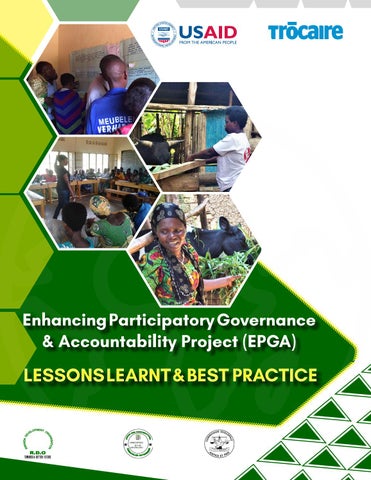
Enhancing Participatory Governance & Accountability Project (EPGA)
LESSONS LEARNT & BEST PRACTICE
Accountable Leaders & Active Citizens
REPORT AUTHOR
Dr. Alice TAYLOR GRAPHICS & DESIGN
Jean Pierre BUCYENSENGE PHOTOS & IMAGES*
Rwanda Development Organization Trócaire Rwanda Dr. Alice Taylor (*Permission was sought and granted for the use of all photograph in this publication.) PRODUCED FOR: RWANDA DEVELOPMENT ORGANIZATION (RDO)
P.O. Box 368 Kicukiro, Kigali - Rwanda KG 500 ST +250788525956 +250788501092 rwandadev@rdorwanda.org.rw
DISCLAIMER: This publication is made possible by the support of Trócaire and the American People through the United States Agency for International Development (USAID). The contents of this publication are the sole responsibility of Trócaire and the Rwanda Development Organization (RDO) and do not necessarily reflect the views of USAID or the United States Government.
Active, effective and meaningful citizen participation and involvement in agricultural decision-making processes guarantees experiential and grounded perspectives on community needs. It provides the Government of Rwandan with useful information that they draw on to inform the development and subsequent implementation of agricultural programmes, making them optimally responsive to citizen’s needs and interests. It is for this reason that the Rwanda Development Organisation (RDO) feels privileged to have partnered with Trócaire, CEJP and UNICOOPAGI in this important programme, entitled Enhancing Participatory Governance and Accountability (EPGA) which took place between 2017-20. All partners worked hard to realise the objectives and outcomes of the programme and succeeded in strengthening civil society for transparent governance, public leaders’ accountability and inclusiveness in agricultural policy development. As the project now draws to a close, it is time for us all to reflect on the lessons learnt and best practice that have emerged, as it is these that will offer crucial guidance on better participation practices in agricultural decision-making processes in the future. The latter particularly with regard to the more effective participation of marginalised groups, including women, youth and the very poor. Our very sincere thanks to everyone who has made this project a success at every level; from the farmers, community volunteers and CSOs, to the dedicated public servants from the Government of Rwanda, local leaders and all others. This appreciation is also extended to everyone involved in this study, who generously availed their time, cooperation, and comprehensive inputs without which this study would not have been so greatly enriched.
LESSONS LEARNT - ENHANCING PARTICIPATORY GOVERNANCE & ACCOUNTABILITY
LESSONS LEARNT - ENHANCING PARTICIPATORY GOVERNANCE & ACCOUNTABILITY
Table of contents
8
14
background
A short
& conceptual
introduction to
framework
epga project
20 methodology
Group work during Exchange meeting on land consolidation program in Rwabicuma sector of Nyanza district
4
24 lessons learnt
58 best practice
62 In the future
Base sector agronomist explaining land use consolidation program in an exchange meeting
5
LESSONS LEARNT - ENHANCING PARTICIPATORY GOVERNANCE & ACCOUNTABILITY
LESSONS LEARNT - ENHANCING PARTICIPATORY GOVERNANCE & ACCOUNTABILITY
Introduction
The overall objective of the EPGA programme was to contribute to the strengthening of civil society for transparent governance, public leaders’ accountability and inclusiveness in public policy development. The project focus was the agricultural sector and was carried out in five Districts of Rwanda namely; Rulindo, Gakenke, Nyanza, Nyamagabe and Nyaruguru. The aim of this report is to inform future project and programme design and management by capturing transferable lessons and best practice on how the EPGA programme operated and what it achieved, bearing in mind that citizen participation in policy development is a slow process and thus that even small wins should be valued. It is difficult to know what timescale should be used to determine whether a programme has been successful, e.g. at the present time, within the project cycle, or at some, as yet undetermined, future date. When determining best practice and lessons learnt, it is, therefore, important to also look at process issues, specifically whether programmes helped establish processes that are likely to increase citizen participation, not just during their lifetime, but also over longer temporal scales, post programme, and in the face of increasing changes in agriculture policy making processes in Rwanda. The lessons learnt and best practice presented here are intended to provide a basis for reflection and consideration by Trócaire, their partners and by development partners. Some of these lessons are more internal to the EPGA programme, but most have broader resonance. The purpose of this report is not to present an end line evaluation, as this is being done separately, but rather to critically reflect on the programme’s approach and to examine the learning it produced during its three years of implementation. We believe that the information contained in this report will assist in drawing up more effective future strategies for engagement, both in policy dialogue and in the way in which they interact and engage with civil society. The report also has a further aim to enable the programme’s partners and its other main actors to consider what they can do differently to improve the beneficial outcomes of policy engagement processes in future. For development partners, the lessons learnt provide an opportunity to reflect on how best to develop support strategies for civil society engagement in policy dialogue in the future. 6
7
LESSONS LEARNT - ENHANCING PARTICIPATORY GOVERNANCE & ACCOUNTABILITY
Background & Conceptual framework The following sections draw on the broader literature and other related research to provide context and an overall framework to this study. The chapter starts with a brief outline of the status of agriculture in Rwanda, followed by a review of literature on good governance and citizen participation; the latter to provide an understanding of the concept of participation and to propose a framework for it for this study. Finally, the chapter outlines the spaces available and the mechanisms used in Rwanda to encourage citizen participation.
Rwanda’s Agricultural Strategy Agriculture is the biggest contributor to Rwanda’s economy and is tasked with leading the country to become a middle-income economy by 2050 (Vision 2050). The agricultural sector is overseen by the Ministry of Agriculture and Animal Resources (MINAGRI), whose role is to develop and increase the potential and productivity of the sector to reduce poverty and ensure food security. Agriculture accounts for just under half of export goods (PSTA 4 20181 ) and provides employment for over two thirds of the working population. In 2017-2018, agricultural production increased by 8% and contributed 2.2% points to the overall GDP growth rate (NISR, 2017). Food crops increased by 8 % and export crops increased by 14 %. (MINECOFIN, 2017). Food security is a key priority (NST 1 20172 ) and is to be achieved by focusing on: increasing agriculture productivity, professionalising the livestock industry, and spurring rural transformation through innovation, skills and technology. Vision 2050 further stresses the importance of agro-processing and technology-intensive agriculture with a commercial focus. It is hoped this industry growth will further
1
8
Strategic Plan for Agricultural Transformation 4
increase household incomes and reduce poverty by up to 50 % in the next two decades.
LESSONS LEARNT - ENHANCING PARTICIPATORY GOVERNANCE & ACCOUNTABILITY
According to PSTA43 (2017) the goal is to move Rwanda from subsistence farming to a strengthened focus on better land management, with a shift towards market orientation and farm profitability, strengthened private sector service delivery and investment. The FAO (2019), however, believes that ‘farmers need to be supported in realising their commercial farming ambitions, especially through more innovative collective action models that effectively and efficiently combine the strengths of the public and private sectors. Others need to be assisted in exiting agriculture into decent employment opportunities or non-farming entrepreneurial ventures, either in the food value chain or beyond. Carefully designed and implemented investments in infrastructure, legal and regulatory systems and education are required. This is especially the case for attracting youth into farming and other agribusiness activities... Above all through the exchange of knowledge and experiences, increased bargaining power, and a stronger voice in national decision-making.’
A study by International Alert (2018) showed, however, that despite the growth in agricultural production, the majority of the population still rely on subsistence agriculture and the poverty rate remains at 39.1%. This means that food and nutrition security remain critical for the country’s development, especially with a stunting rate of 38% and in particular, for households headed by women (UNICEF 2019).
The government of Rwanda also acknowledge farmers’ participation as an essential factor for sustainable agricultural development ‘as a lack of participation in the decision to implement an agricultural policy can lead to failure in agricultural development’ (MINAGRI 2018).
For the agricultural sector to reach its full potential it must be sustainable, but it currently faces a range of challenges in achieving such in Rwanda, including: high levels of population growth, high levels of soil erosion, low levels of soil fertility, low productivity levels for both crops and livestock due to low input use, poor production techniques and inefficient farming practices (due to difficult terrain), limited use of irrigation, water pollution, climate change and the difficulty farmers have with accessing loans from financial institutions.
Participation
2
National Strategy for Transformation 1
Discursive Approaches to Good Governance and Civil Society Citizen participation and good governance are concepts with varying definitions, according to interpretations and the contexts in which they are used. The World Bank (2016), as the chief engineer of the good governance agenda, defines it as the manner in which power is exercised in the management of a country’s economic and social resources for development. Narrowly defined, governance means the exercise of political power to manage the affairs of state.
3
In a broader sense, it can refer to the various processes relating to leadership, such as policy making, transparency, accountability, the protection of human rights and the relationship among the public, private and civil sectors in determining how power is exercised (Mutume 2005). According to the UN (2014), participation is essential for democracy and people’s autonomy, agency and dignity because it is a right of people to participate in matters affecting their future and development. Participation, as opposed to tokenism, is a process by which local community members actively become part of the decision-making and planning processes, as well as part of implementation, evaluation and adaptation phases, of policies, programmes and projects. In addition, participation has been defined as the existence of adequate mechanisms for people to be involved in decision-making (IFE 2013, Global Change Institute 2016). In this sense, participation is most meaningful if applied through processes aimed at empowerment, which refers to developing and obtaining the skills and knowledge that are needed to make informed decisions. Never Again Rwanda (2016) believes that there are five essential components to citizen participation: “(i) putting leaders in offices and holding them accountable, (ii) consultations, (iii) voicing [citizens’] priorities, (iv) taking ownership of government interventions, and (v) implementing government programmes”. The definition of participation for this study is taken from the EPGA documentation (Trócaire 2017) and is very closely aligned with definitions from the literature above: ‘To promote the effective participation of citizens, especially women and youth, and civil society organisations in the development; implementation and monitoring of agriculture policy and budget in five districts in order to ensure that they respond to the priorities of vulnerable people and contribute to a sustainable and inclusive development in Rwanda.
Strategic Plan for Agricultural Transformation 4
9
LESSONS LEARNT - ENHANCING PARTICIPATORY GOVERNANCE & ACCOUNTABILITY
A number of useful typologies, or ‘ladders of participation’ have been produced to assist with measuring its effectiveness. Among others, Arnstein (1969), IIED (1994), Pretty (1995), White (1996), and DFID (2003) have all highlighted multiple, contested meanings and drawn attention to the consequent range of outcomes possible. Of these, the DFID (2003) framework is particularly relevant and applicable
to development-oriented projects such as EPGA. The levels of cooperation and partnership make explicit the need for sharing of decision-making power between government/organisations and communities. This framework clearly conveys the principle of sharing power, and the shift towards considering communities as ‘subjects’ with agency, rather than simply as ‘objects’.
LESSONS LEARNT - ENHANCING PARTICIPATORY GOVERNANCE & ACCOUNTABILITY
open invited space, such as public consultation. Invited space is often described as controlled ‘from above’. Claimed space, on the other hand, refers to space that civil society creates for itself (or ‘from below’), for example through lobbying, campaigning, education, etc. Forms of ‘space’ can be found anywhere in the policy dialogue cycle and are all expected to result in influencing Government so that policies are inclusive and equitable and Governments become more accountable and transparent to their citizens (i.e. for the common good). The desire for citizen participation in Rwanda is expressed in the Vision 2050 as: Participation at grassroots level will continue to be promoted through the decentralisation process, whereby local communities are empowered through their involvement in the decisionmaking process, enabling them to address the issues that considerably affect them. Addressing agriculture specifically, MINALOC (2013) states that: The agricultural farmers and other stakeholders in the community must be able to participate in all aspects of the policy engagement, especially for agriculture and indirectly through elected representatives at the Sector and District level…Fast-tracking and sustaining equitable local economic development as a basis for enhancing local fiscal autonomy can only be achieved once citizens participate in the design, implementation and monitoring of programs and policies
Figure 1 DFID (2003) Framework of Participation
This report utilises this framework as a conceptual tool in order to identify and measure the range and depth of the participatory processes that the project chose to meet when working with communities and CSOs. It assesses the degree of decision-making spaces provided, as well as the degree to which responsibility was shared. The DFID framework (see Figure 1) details five levels (steps on a ladder/stairs) from coercion and compliance, to consultation, co-operation and ultimately to collective action, the highest level. In the lower levels of the ladder, citizens are engaged but decision-making is made by others, while in the higher levels the participants are seen as part and parcel of the decision-making processes. The highest level of the ‘stairs’ is reached 10
when communities have full control over decisions made, and are able to act on their own, with little or no input from external stakeholders (DFID 2003).
Citizen Participation in Rwanda: Invited and Claimed Spaces It is generally accepted that civil society participation in decision-making processes may be in ‘invited’ or ‘claimed’ spaces (Gaventa 2005, Cornwall 2007). Spaces are areas where interaction/engagement, or information exchange and negotiation, take place for both contestation and collaboration (Gaventa 2005). Invited space includes ‘provided space’, such as official parliamentary consultations, as well more
There are many ‘invited spaces’ in Rwanda with the Government endeavouring to engage citizen participation through a myriad of structures and platforms. At the District level, authorities and their lower administrative levels (Sectors, Cells and Villages), are answerable to locally elected councils. Collaborative spaces, that bring together technical and administrative service providers, also exist and
function, for example, forums like the Joint Action Development Forum (JADF) and local committees etc. In addition, the Community Development Policy, first formulated in 2001 and revised in 2008, emphasised a cost-sharing concept of participation, highlighting the discourse of self-reliance and self-development as key drivers of community engagement. Home-grown solutions were established in a bid to encourage implementation of these policies in order that citizens can theoretically hold their local leaders and service providers to account for the services they deliver. The various mechanisms that exist in Rwanda vary from Cell committee meetings, Umuganda4 , Imihigo5 , Umugoroba w’ababyeyi (parents’ evening forums6), as well as Inama Njyanama (elected local councils7). To a much lesser extent, there are also some CSO led initiatives that include research, training and workshops/seminars, creation of umbrella organisations, and ad hoc meetings with decision-makers (NAR 2019). For farmers, there are further opportunities for participation at the local level through the Twigire Muhinzi extension model and agricultural cooperatives. The Twigire Muhinzi extension model utilises farmer field schools (FFS) and farmer promoters (FP) to spur on agricultural innovations and productivity. Agricultural cooperatives are member-controlled groups for the production of goods and services and in which the participating members, individual farmers or households, share the risks and profits of a jointly established and owned economic enterprise. At National level, there are regular meetings with high-level leaders and a yearly high-level consultative meeting (Umushyikirano) whereby citizens can raise issues concerning their lives. Claimed spaces are less numerous but include; public debates, public meetings, campaigns, media, citizen feedback sessions and citizens’ advisory committees.
Where through mandatory participation, aims at improving family relationships and living conditions toward sustainable development
6 4
This is a monthly, mandatory community service and/or meeting
These are mandatory performance-contracts in which development partners engage in delivery of specific objectives
5
Are an indirect citizen participation mechanism. They exist at Cell, Sector, and district levels and play an oversight role over the executive committees at these levels and are designed to represent citizens’ interests.
7
11
LESSONS LEARNT - ENHANCING PARTICIPATORY GOVERNANCE & ACCOUNTABILITY
All of the above should allow leaders to be informed about citizen preferences and complaints, and/or allow citizens to participate directly in planning and implementation of local programmes that increase their ownership and control (RGB 2018). Overall, and to date, there have been an impressive number of benefits derived from these policies and a boost in citizen participation in various government led programmes (Never Again 2018, RGB 2019). Numerous reports and statistics have lauded the success of the government in getting citizens to participate. The Rwandan Governance Scorecard (2019) reported citizen participation and inclusiveness at 73%. Citizen satisfaction with holding leaders to account was 75.8% and participation in decision-making 63.9%. There has, however, also been criticism. For example, USAID’s 2019 Country Roadmap scored civil society capacity in Rwanda at a below average 0.37, and RGB’s Citizen Report Card (2018) scored citizen satisfaction with the agricultural sector at 49.4%.
Feedback meeting organized by UNICOOPAGI in Rugerero village, Kivu sector, Nyaruguru district
LESSONS LEARNT - ENHANCING PARTICIPATORY GOVERNANCE & ACCOUNTABILITY
EPGA beneficiaries in Mubuga Village, Mataba Sector, during
Community committee training in Kagano village, Gatare
an exchange meeting on land consolidation
sector, Nyamagabe district in December 2017
In relation to agriculture, therefore, the degree and nature of participation of farmers is less than ideal. This may be because, although there is an array of mechanisms or spaces for engagement, ‘they have been fostered in a framework of top-down, centrally driven policies and within an arena whose boundaries are defined by the state (Gaynor 2015)’. A study by Transparency International (2018) revealed that performance contracts were hard to implement because individual farmers and farmers’ co-operatives had not been involved in the original formulation process. In response, the Head of Planning at Rwanda Agriculture Board (RAB) stated: ‘It looks like farmers are forced to implement programmes because if participation is at 15% but the implementation is up to 68%, we need to put in more efforts to engage farmers in the entire process’ (The New Times 2018). It was, therefore, timely that Trócaire, with funding from USAID and in partnership with RDO, UNICOOPAGI and CEJP, implemented a project that was designed to contribute to the strengthening of farmer and CSOs participation in agricultural decision making. The specifics of the project will be discussed in the next section, followed by the lessons learnt and best practices that can be derived from the project.
12
Nyagisozi sector agronomist explaining land use consolidation program in an exchange meeting
13
LESSONS LEARNT - ENHANCING PARTICIPATORY GOVERNANCE & ACCOUNTABILITY
LESSONS LEARNT - ENHANCING PARTICIPATORY GOVERNANCE & ACCOUNTABILITY
A short introduction to the EPGA Project The overall objective of the EPGA project was to contribute to the strengthening of Civil Society for transparent governance, public leaders’ accountability and inclusiveness in public policy development. The project focus was the agricultural sector and was carried out in five districts of Rwanda namely; Rulindo, Gakenke, Nyanza, Nyamagabe and Nyaruguru Trócaire implemented the project over three years as the lead organisation in partnership with the Episcopal Justice and Peace Commission (CEJP), the Farmer’s cooperative union; Union des Coopératives Agricoles Intégrées (UNICOOPAGI), and the Rwanda Development Organisation (RDO). All these organisations collaborated with Trócaire in different domains specifically in civic participation and agriculture over the past number of years. The project targeted 3,675 people directly (1,655,751 indirectly) of whom 60% were women, 20% youths, and 20% men. 900 representatives of local authorities and 50 CSOs also directly benefitted from the project activities.
project goal To contribute to transparent governance, EPGA Beneficiaries attend focus group disucssions on lessons learnt and best pratcice
accountability of public authorities and inclusiveness of public policy and budgeting processes.
14
15
LESSONS LEARNT - ENHANCING PARTICIPATORY GOVERNANCE & ACCOUNTABILITY
LESSONS LEARNT - ENHANCING PARTICIPATORY GOVERNANCE & ACCOUNTABILITY
Specific Objective To promote the effective participation of citizens, especially women and youth, and civil society organisations in the development; implementation and monitoring of agriculture policy and budget in five districts in order to ensure that they respond to the priorities of vulnerable people and contribute to a sustainable and inclusive development in Rwanda
OUTCOME1: Empowered citizens particularly women and youths who are able to engage in agricultural policy and budget monitoring in 5 districts and hold public authorities accountable.
Output 1.1.: Increased knowledge of 3675 citizens and 819 village and cell leaders on the role and responsibilities in terms of policy and budget monitoring related to agriculture. Output 1.2: Increased awareness of citizens in the 5 targeted districts on the roles and responsibilities through production and dissemination of information and education materials in terms of policy and budget monitoring with regards to agriculture.
OUTCOME 2: Increased capacity of civil society organisations to engage in policy analysis, budget monitoring and advocacy and ability to use a collective approach to influence decisions related to sustainable agriculture.
Output 2.1: Civil Society Organizations in five Districts have sufficient capacity for policy analysis, budget monitoring and advocacy
OUTCOME 3: Improved capacity of local authorities to engage and respond to priorities expressed by citizens and civil society related to sustainable agriculture in 5 districts.
Output 3.1: Increased knowledge of local authorities on participatory governance and are committed to address citizens’ concerns.
Output 2.2: Increased engagement on participatory governance and agricultural policy
Output 1.3: Increased knowledge and engagement of communities through establishment of committees with formal structures and procedures Output 1.4: Improved mechanism of exchange of information between community committees, partner programme staff and Trócaire. 16
EPGA Beneficiaries attend focus group disucssions on lessons learnt and best pratcice
17
LESSONS LEARNT - ENHANCING PARTICIPATORY GOVERNANCE & ACCOUNTABILITY
LESSONS LEARNT - ENHANCING PARTICIPATORY GOVERNANCE & ACCOUNTABILITY
EPGA Project timeline. year 1
18
year 2
year 3
Trainings of the trainers, women and
Training of women and youth, village
Document and disseminate lessons learnt and
youth, village and cell leaders on policy
and cell leaders on agriculture policy and
best practices in local governance, policy and
and budget monitoring &advocacy
budget monitoring and Ad-vocacy
budget monitoring.
Produce and distribute 14,000 posters
Training of the trainers on policy and
Facilitate 6 experience and knowledge among
on citizens’ rights and responsibilities,
budget monitoring and Advocacy.
stakeholders intervening in agriculture and
5000 copies of booklet on citizen’s role
Produce and distribute 14,000 posters
policy monitoring
&responsibilities in terms of agriculture
on citizens’ rights and responsibilities,
Produce and distribute 14,000 posters on
policy and budget monitoring
5000 copies of booklets on citizen’s role
citizens’ rights and responsibilities, 5000
Develop a training manual on policy
and responsibilities in terms of policy and
copies of booklets on citizen’s role and
and budget monitoring and advocacy.
budget monitoring regards to agriculture
responsibilities in terms of policy and budget
Translate, design & distribute
6 experience sharing and learning events
monitoring regards to agriculture
summarised agricultural policies (5000
Research on the involvement of citizens
Training of civil society organizations on
copies)
and women in local governance, policy
agriculture policy and budget monitoring and
Establish 63 village committees
and budget monitoring
advocacy
for agriculture policy and budget
Organise accountability meetings
Organise accountability meetings with
monitoring and advocacy.
with district-level leaders on the
district-level leaders on the implementation of
6 experience sharing and learning
implementation of recommendations of
recommendations of CSOs on citizens’ needs.
events
CSOs on citizens’ needs.
Conduct 2 policy dialogue meetings and
Develop a manual on participatory
Training of civil society organizations on
advocacy activities at national level and 3 at
governance and training of local &
agriculture policy and budget monitoring
district level on agri-culture planning
community leaders in participatory
and advocacy
12 feedback meetings conducted with
planning & budgeting.
38 radio broadcasts and 1 documentary
community committee members.
Organise accountability meetings
film on citizen participation in agriculture
Six exchange meetings between citizens and
with district-level leaders on the
policy and budget monitoring
local leaders around citizen participation in
implementation of recommendations
12 feedback meetings conducted with
agriculture
of CSOs on citizens’ needs.
community committee members.
38 radio broadcasts and 1 documentary film
Training of civil society organizations
Conduct 2 policy dialogue meetings and
on citizen participation in agriculture policy
in policy and budget monitoring and
advocacy activities at national level and 3
and budget moni-toring
advocacy
at district level on agri-culture planning
Training community committees, and program
Strategy guide on agriculture policy and
Six exchange meetings between citizens
staff on telephone software operations
budget monitoring and advocacy
and local leaders
19
LESSONS LEARNT - ENHANCING PARTICIPATORY GOVERNANCE & ACCOUNTABILITY
Methodology
LESSONS LEARNT - ENHANCING PARTICIPATORY GOVERNANCE & ACCOUNTABILITY
This section provides a brief description of the research approach and introduces the methodology used. The latter can be broadly classified as ‘qualitative’ and consists of information on research sites, and an account of the methods used to generate and analyse data. Comments on the ethical approach are also presented.
Study design & methods The focus of this research was around terms which are often seen as emotive and contested; concepts such as, ‘citizen’, ‘participation’ ‘capacity’ and ‘development’. These concepts are highly nuanced and are defined as different things by different people in different contexts, meaning that the research process adopted here had to be iterative. To ensure that there was a fully nuanced picture of these concepts and that lessons and best practices were identified, this study used qualitative research methods. This was done in order to provide an analysis that was ‘more explicitly interpretive, creative and personal’ (Walker, 1985). Qualitative data collection methods, such as interviews and direct observation of farms, are also better able to catch nuances in collected data than quantitative methods, such as questionnaires, without detracting from the validity of the information gained. The greater the depth of the data expressed, the greater the validity given to the data by the outside observer (Schofield, 1993). Due to financial constraints, data collection was restricted to three of the five districts where the project was carried out: Nyaraguru, Nyanza and Rulindo1 . However, to overcome this limitation primary data from a previous study, conducted by the team for this project, was also used namely: Participation of citizens, particularly women, in local governance, policy and budget monitoring
1
20
Full details in appendix 1
in Rwanda. This included Focus Group Discussion transcripts from all five Districts and Key Informant Interviews with District and National government staff and NGOs2. The research sample was the same as beneficiary ratio of 60% women, 20% youth and 20% men.
Defining ‘Best Practice’ In this study ‘best practices’ will be defined as methods, norms, or intervention that have consistently shown results superior to those achieved with other means. These are practices that are often used as a benchmark for success. ‘Promising practices’ are similar to best practices, save that they have not been scientifically validated. ‘Best practice’ identified here were only identified from the set of interventions undertaken by the EPGA Project itself, although corroboration of the characteristics that led them to be determined as best practice was also sought from expert knowledge and/or literature as evidenced in this and other parts of the world. Best practices were tested against the following four criteria:
Defining ‘Lessons Learnt’ ‘Lessons learnt’ describe what was learned from this project’s work and that can now be used to inform planning of new strategies and actions here or elsewhere. Lessons learnt must be things that can be used to improve information / knowledge for better decision-making and thus contribute to improved programme or project performance, outcomes, or impacts in the future. Lessons learnt can be positive or negative; negative in terms of identifying (an) element(s) that should not be repeated in future planning. They can also include identification of specific issues that need to be taken into account when engaging in planning, including contextual issues, such as economics, policy, socio-cultural aspects, and/or equity.
The documentation exercise was anchored on a qualitative study approach to collect primary and secondary data. Three main sources of primary data and information were examined:
1.
Project-related literature,
2. Interviews (key informant interviews and focus group discussion) &
3.
Direct (field) observation.
Literature review Data collection included project-related data and information (including project proposals, baseline reports, annual progress reports, and mid-term and review reports), as well as broader literature in the area of Rwandan agriculture, citizen participation and good governance.
1. Effectiveness in addressing a common problem
Description of Instruments and
2.
Potential for replication
Techniques of Data Collection
Key informant interviews (KIIs)
3.
Potential for scaling up
The study team sought to provide evidence-based credible and reliable information through use of collaborative and participatory approaches in order to ensure close commitment with RDO and partners, (Trócaire, CEJP and UNICOOPAGI), Government counterparts (especially those at the District and sub District levels), and beneficiary communities.
KIIs were based on in-depth, semi structured format using open-ended questions. Individual interviews were considered the most appropriate method to gain feedback and understanding of responses to the research questions.
4. Identifiable conditions for success.
2
Full details in appendix 1
21
LESSONS LEARNT - ENHANCING PARTICIPATORY GOVERNANCE & ACCOUNTABILITY
KIIs were held with the implementing staff of EPGA (Trócaire: Programme Manager, Business Development and Compliance Manager, Project Manager and MEL advisor, RDO: Executive Secretary and Project Manager, CEJP: Project Officers and Executive Secretary and UNICOOPAGI: Project Officers and Executive Secretary) technical personnel (agronomists), and District officials (Deputy Mayors, Directors of Agriculture, District Agronomist). They were conducted in Kigali and three project locations (Nyaraguru, Nyanza and Rulindo) that were either directly or indirectly engaged in the execution of the EPGA project and/or had in-depth knowledge about the interventions. At the community level, key informants included: Sector Agronomists, SEDOs, Cell Executive Secretaries, Extension workers who facilitated implementation of the interventions, Village leaders and individuals.
Focus group discussions (FGDs) Focus Group Discussions were held with beneficiaries (disaggregated by gender and youth). Graphical representations and schemes, which represented concepts of participation, project activities and decision-making processes, were presented for discussion and were designed to elicit and support insightful expression and elaboration about citizen participation. Interactive techniques were also used during focus groups to stimulate data generation, e.g. participatory research techniques such as flexible brainstorming to enhance group participation. Roundtable discussions were held with CSOs, Village Leaders and Village Agricultural Committees. A further validation workshop was held in Kigali with key programme staff including CEJP, UNICOOPAGI and RDO, USAID’s Project Coordinator, and Trócaire’s Programme Manager, Project Coordinator and MEL Advisor. The purpose of the workshop was to validate the lessons learnt and best practices delineated in the report.
Direct observation of project
LESSONS LEARNT - ENHANCING PARTICIPATORY GOVERNANCE & ACCOUNTABILITY
Direct observation of project results and activities was done at selected field sites in each of the Sectors visited and where interventions had been implemented. Photographs were taken, where feasible, of the specific best practices identified to act as evidence (e.g. the effects of getting fertilizer on time leading to a better crop).
project sites. The GRF was also selected because of its adaptability to projects addressing agricultural or rural-based communities, or those seeking poverty reduction through implementation of sustainable livelihoods. The relevance of its application in this context was premised on its utilisation of community information to analyse matters relating to access and control of resources and the influences on gender roles, which are relevant in the setting of the EPGA Project.
Documentation of impact stories
Data analysis
The study also included the documentation of impact stories from beneficiaries to augment the lessons learnt and best practices identified. These stories elaborated the actual and/or perceived social/economic transformation associated with a best practice approach. The impact story pertained to individuals and groups with the team specifically interested in understanding gains that had accrued to beneficiaries as a result of projects interventions and/or best practice. The team also looked for any measures now being taken that are sustaining the gains so far realised.
The information collected, including documentary evidence, interviews and observations, was compiled and organised according to the questions asked with collation done by District followed by a cross District synthesis and thematic analysis. The interventions implemented, and the implementation/ organisational arrangements for these, were the main themes for the report and it was from these that lessons learnt, and best practices were extracted and explained.
results
Cross- cutting tools: Assessment and documentation of lessons and best practices in gender inclusion and youth engagement The study team took cognisance of the Harvard Analytical Framework, also called the Gender Roles Framework (GRF), as elaborated by UNDP (UNDP, 2016). This was done to understand how the project had addressed disparities between men, women and the youth, as well as how it had improved relationships and participation of and between these gender groups. Most importantly, the study sought to document whether and how measures applied under the project had reduced disparities with regard to control and access to resources at
Ethics3 After consulting with RDO, formal ethical clearance from the Rwanda National Ethics Committee (RNEC) was deemed to be not required. This was because the purpose of the proposed lessons learnt report was to assess activities, with consultation only with direct stakeholders and beneficiaries of the EPGA program
2
Limitations of the report 1. There is a possibility of a positive response bias. In other words, there may have been little incentive for the respondents to speak critically of a programme they may have benefitted from in some capacity or still hope to benefit from in the future. To anticipate this potential threat to validity, the study team stressed to participants that the overall aim of this evaluation was simply to understand the factors that shaped the programme’s effectiveness, with the goal of long-term sustainability. Our study team also stressed the importance of informed consent, and confidentiality. 2. The limited timeframe and budget shaped the fieldwork strategy and limited the ability to capture, analyse and include all relevant information. For example, only three of the five districts were included in the data collection exercise and there were instances when key informants at District level were unavailable during the research team’s scheduled presence. The research was carried out during COVID19 Pandemic resulting in some KIIs at National Level carried out via Skype rather than face-to-face or were not possible for various reasons. 3. It is not possible to generalise and/or extrapolate findings from this qualitative study country wide. By conducting in-depth work in three districts, ánd through the use of previously collected primary data and by using a data collection plan that aimed to arrive at conceptual saturation of key themes, these study findings do, however, provide a good level of insight into the effectiveness of EPGA project and are therefore relevant to projects in other parts of the country.
After consulting with RDO, formal ethical clearance from the Rwanda National Ethics Committee (RNEC) was deemed to be not required.
This was because the purpose of the proposed lessons learnt report was to assess activities, with consultation only with direct stakeholders and beneficiaries of the EPGA program.
22
23
LESSONS LEARNT - ENHANCING PARTICIPATORY GOVERNANCE & ACCOUNTABILITY
Lessons Learnt
LESSONS LEARNT - ENHANCING PARTICIPATORY GOVERNANCE & ACCOUNTABILITY
1.
Increased citizen participation and social accountability promotes increased agricultural productivity
One of the key pieces of learning from the EPGA project was that farmers assess and take into consideration different degrees of risk, like anyone else. This means, for example, that interventions, such as the use of ‘demonstration plots’ to influence farmers behaviour, are perfectly rational but only if farmers can sees their benefit (just as subsistence farming is rational if there is no other access to food or markets). When farmers perceive a risk, however, such as doubting the value of adopting new behaviours, techniques or approaches, they are more likely to stick to the status quo. The EPGA project found that farmers are receptive to ideas and willing to take calculated risks, but only if they have reason to believe that they can achieve a better outcome, for example farmers are reluctant to use the new government hybrid maize seeds, although they are heavily subsidised because they have become used to the far superior imported maize seed both in yield and in taste (FGDs Rulindo, Nyanza) Farmers will change behaviours if what is proposed to them for adoption is appropriate, affordable, manageable, and makes a positive difference.
Exchange meeting on seed availability in Cyungo sector of Rulindo district
24
The EPGA project provided a mix of training, documentation and feedback meetings through which farmers saw for themselves that investing in their farms would improve their income, living conditions, and food security. The training platform was designed primarily to give knowledge to farmers, not only on participation in decision-making, but also in how to develop new knowledge and skills to improve their yields, income, business opportunities, and food security. The curricula and methodology
“
The Government of Rwanda has put efforts in intensifying agriculture. The targets were high and a change was needed in farmer behaviour and mind-set. The EPGA project was necessary to help government understand the views of farmers, and their expectations. This led us to understand farmers- what they need and what they appreciate’
(kii vice mayor /rulindo district)
The project has brought farmers out of isolation, it has made them come together and created relationships between leaders and farmers. Out of this, farmers groups have been formed and savings groups. These groups have allowed for the exchange of ideas and this in turn has increased agricultural production and allowed farmers to feed their families
(kii cell executive secretary)
25
LESSONS LEARNT - ENHANCING PARTICIPATORY GOVERNANCE & ACCOUNTABILITY
brought farmers together, creating interaction to facilitate behaviour change processes. To begin with, quarterly feedback meetings were arranged between project staff and farmers, but they proved so popular, monthly ones were held instead. Project field staff capitalised on the platform to disseminate additional information and to organise speakers such as sector agronomists to inform farmers on pertinent farming policies and inputs. As one Director of Agriculture put it:
1
Tapping into the enabling policy environment. EPGA worked with an enabling policy framework in place and tapped into Rwanda’s decentralisation legislative framework wherein power is devolved to the lowest levels of Government. In order to make optimal use of its strategies, however, citizens still need to be capacitated to exercise their rights to participate, as their effective and active involvement in decision-making processes is still below desired levels.
26
impact story:
Faustin Bizimungu Faustin Bizimungu in his pinneapple farm
It is indeed generally agreed under the ideas of ‘participation’ that approaches can be user (farmer)led and that government professionals are perhaps not the only experts who can guide policy; rural farmers and community members also having much to contribute.
LESSONS LEARNT
The participatory processes adopted by EPGA project staff assisted farmers in shifting their thinking beyond individual poverty and agricultural problems, to how programmes and policies could support, or conversely weaken, agricultural policy. The project proved that increasing farmer participation in agriculture decision making processes increased agricultural productivity, contributing to poverty alleviation in rural areas.
4
Quality inputs are costly but when farmers see that their benefits outweigh costs, they are willing to invest. Through training the EPGA project has helped with convincing farmers that improved input use is worth the price.
LESSONS LEARNT - ENHANCING PARTICIPATORY GOVERNANCE & ACCOUNTABILITY
2
Farmers became empowered to participate and gradually realise rights. The project allowed for growing empowerment levels of farmers (especially women) in the five Districts. Farmers transited from a community of people who were previously reliant on sporadic and erratic local authority servicedelivery messages, to those who now collaborate and participate in local and district level decisions. This is a step forward in making farmers more empowered and self-reliant and hopefully will lead to a scenario where they will initiate dialogue with relevant authority duty-bearers to, for example, claim their rights. At a micro-level, such dialogue has already occurred between community members and village leaders and to some extent between local and district levels, but that there is still a long way to go at national level.
3
It is vital that projects like EPGA can empower farmers to stand on their own, although it also needs to be acknowledged that it sometimes also takes project staff to open doors and get governments to listen to farmers.
Before the project, Faustin had a farm size of 30x30 m. He was growing maize and beans to feed his family. After EPGA agricultural training, he has diversified his crops and now has a field full of pineapples ready to harvest, ‘After attending Joseph’s (EPGA project co-ordinator) training, I started thinking. I realised I was not farming properly. I didn’t know anything about manure, fertiliser or seeds. After I attended, I asked to be involved and became a Community Committee member. After time, I decided to change the way I was farming, I started growing cash crops like Irish potato and bananas. Realising there was money in pineapples, I also started growing them. I take them to the market myself on my bicycle and either sell directly for RWF 500 to customers 1:
or to buyers for RWF 300. I put the profits back into buying more land and today my farm is 80mx80m. Faustin highlighted two things from training and feedback meetings that made a big difference for him: 1. Making his own manure to fertilise his land (he bought two oxen) and 2.
Crop diversification.
Faustin was very pleased when his community picked him to be a Lead Farmer1 for the area and he now helps to train others in his village and has a number of demonstration plots for maize, Irish potato and pineapples. Local farmers come to learn from what he is doing.
His role as a “lead farmer” has changed Faustin’s status in the community, where he now commands respect from his peers. Faustin’s neighbour says that Faustin’s abilities in farming is changing the way people see him and the way they farm: ‘the other farmers respect him because they learn a lot from him. Both men and women come and learn from him. They consider him one of the best farmers here and recognise his hard work.’ “I see a very bright future ahead of me” he said. “This project opened my eyes to see the business opportunities in agriculture, and equipped me with skills to explore them”
Lead farmers demonstrate crops and farming techniques and approaches on their own land to others, allowing them to learn from it.
27
LESSONS LEARNT - ENHANCING PARTICIPATORY GOVERNANCE & ACCOUNTABILITY
impact story:
Seraphine Twibanire Seraphine lives on her own with her two children and is the secretary of a youth group that is in the process of registering as a co-operative. After attending EGPA training and feedback meetings, Seraphine and a few other youths decided to start a trading co-operative. They had heard that farmers were not waiting long enough to sell their crops due to storage problems. Neither Seraphine nor the others have land of their own, but they decided to hire a storeroom, buy produce directly from farmers, store the produce and wait for the prices to increase and then sell. Their initial problem was one of a lack of capital and they addressed this issue by saving RWF 500 a week until they had each reached RWF 50,000 savings each. This took two years, but all 25 members agreed and together they raised RWF1,250,000. Today, they rent the store for RWF 20,000 a month and buy maize and beans during harvest period, store it and then sell it to Musanze or Rubavu Markets when the price is high. For example, last harvest season they bought maize at RWF 200/kg and sold at RWF 350/kg. The profits they make are then borrowed by members who operate their own small businesses. Seraphine trades in fruit at Gasiza market and stays in Gaziza trading centre. Others in the group also trade in the markets. These youths came together to help each other pursue economic prosperity because having no land and little employment opportunities, they had to become entrepreneurs, the knowledge and training they received from the EPGA assisted with this.
“
I never thought a training would change my life forever and for the better”
LESSONS LEARNT - ENHANCING PARTICIPATORY GOVERNANCE & ACCOUNTABILITY
2.
Acknowledge that Citizen Participation is a learning process
The EPGA project sought to ensure that all stakeholders understood what citizen participation was about and what it involved; this was important groundwork conducted at the outset of the project. The approach was designed to create a foundation for the successful implementation of project activities, for all stakeholders to develop a shared understanding, and for the successful formation of relationships leading to greater social cohesion. The results of FGDs with farmers (male, female and youth) and village leaders found that prior to the project, they viewed their participation in agricultural decision-making as making no difference and that they had no real input or power (See DFID ladder of participation in Section 1).
Seraphine Twibanire
“I never thought a training would change my life forever and for the better” said Seraphine “I will continue talking to and training more youth so that they can get a meaning for their lives like I did.” Figure 1 DFID Ladder of participation and where farmers see their level of participation. 1=before the project, 2=after the project and 3=where they aspire to be.
28
29
CSOs, District officials and EPGA implementers viewed farmers’ participation before the project more positively, i.e. as being informed, although acknowledging that others had set the agenda (second step in Figure 1). When reflecting on the nature of their participation after the project, farmers felt that they were now at least being consulted, although, for the most part, decisions were still being made by others. On the other hand, CSOs, District officials and EPGA implementers saw the participation of farmers in agricultural decisionmaking as a partnership with farmers were capable of setting agendas and making their own decisions. When farmers asked where they would like their participation to be, almost all responded stated that they aspired to be in control of decisions with little or no external input. Farmers also faced uncertainty and fear when it came to their participation and decision making, including :
g
concerns as to how they could be meaningfully involved
g
which farmers should be involved
g
who those involved actually represent
g
what their roles were or would be
g
g
g
whether they would have any real power in the process whether the emphasis would be on commenting on government agricultural policy, and/or whether there was real scope for meaningful dialogue and exchanges of ideas to improve service provision (FGDs Rulindo, Nyanza and Nyaraguru).
Sometimes farmers’ understanding of citizen participation changed when they saw a specific activity or process in action. It was noted that the level and extent of participation and the whole meaning of ‘citizen participation’ was not well described in the project documentation and that consequently, different stakeholders had different understandings of its meaning. For example, one definition in the project documentation was to ‘give information, educate farmers, make it known to farmers’ (Trócaire 2017, UNICOOPAGI 2018), whereas farmers themselves expected much more than this simple ‘information giving’. It is, therefore, clear that the concept of participation and its meaning in agricultural decision-making were very different for farmers and their local leaders, compared to people in government, CSOs and EPGA implementers. Citizen participation can only be understood in terms of the complex local processes in which different actors (farmers, CSOs, government official, project staff etc) frame, interpret and negotiate participation.
“
It is true that a first people don’t feel free to talk or that they are listened to, but when they are encouraged and they see others talk and listened to, it encourages them to speak as well
(kii, unicoopagi) ‘Farmers lack skills and expertise, they may confuse things, they may think it is about something it is not. They may transfer the responsibility for their own work onto the government. They need to be taught
(kii, government official)
30
LESSONS LEARNT - ENHANCING PARTICIPATORY GOVERNANCE & ACCOUNTABILITY
LESSONS LEARNT
1
Although through its training, the EPGA programme went a long way towards finding a common understanding of participation, future projects need to recognise that farmers want to be seen as full participants in decisionmaking processes, rather than purely as beneficiaries of government programmes. It must also be acknowledged that a wide range of actors shape agricultural processes and outcomes. For the commercialisation of agriculture in Rwanda to be successful, the focus of much policymaking must shift from the present preoccupation with the design and development of policy products, to the design and facilitation of the processes themselves that will enable farmers to make and shape policy and lead to greater social cohesion.
2
3
Farmer knowledge was central to the projects design and implementation, however, future projects need to make better use of the evidence readily available from farmers on their knowledge and perceptions around agriculture. Tapping into such evidence can help improve the impact of their direct service delivery work. More importantly, recognition and use of such evidence helps increase the legitimacy and effectiveness of project work, thereby making it more influential in policy processes.
S t a k e h o l d e r understanding of citizen participation can change over time based on their experiences, so it is valuable to return to this point occasionally as a group to ensure that there is still a shared understanding.
5
LESSONS LEARNT - ENHANCING PARTICIPATORY GOVERNANCE & ACCOUNTABILITY
Participants in phase II project launch
‘We must go beyond the questions of which actors act on particular policy issues, to ask which actors do not engage in potentially relevant policy processes, and indeed why certain potentially important policies are defined as out of bounds in certain aspects as well. (Foucault, 1982)
31
LESSONS LEARNT - ENHANCING PARTICIPATORY GOVERNANCE & ACCOUNTABILITY
impact story:
Cooperative Icyerekezo Icyerekezo Co-operative was initiated by a group of youths and has 50 members (26 women, 15 youths and 9 men). After training by EPGA on agriculture policy and the role of citizens, the group approached the Sector to see if they could qualify for some land in the marshlands which they heard was being designated to youth and women. The Sector suggested they collaborate with HEWORKS silkworm farming (a company from South Korea and a guaranteed buyer) and consider a project in this area. The sector gave them the land in the marshlands for which as youths they do not have to pay rent until production starts. The group is now operating and producing cocoon silk. Production starts once the planted Mulberry trees are at least six months old, at which point silk cocoons can be attained within 26 days. One hectare of Mulberry trees can yield 750 kg of cocoons worth RWF 1.5 million annually.
Members of Cooperative Icyerekezo in their mulberry plantation farm. One hectare of Mulberry trees can yield 750 kg of cocoons worth RWF 1.5 million annually
32
To begin with it was only the youth that were involved but as the project grew, others joined. Icyerekezo Co-operative is testimony that agriculture is full of opportunities for success for the youth of Rwanda.
LESSONS LEARNT - ENHANCING PARTICIPATORY GOVERNANCE & ACCOUNTABILITY
3.
The important role of Champions/ Instigators of Change
When any new way of working is proposed, it is important that there are ‘champions’ to drive it forward and encourage others to become involved. Such champions, or ‘instigators of change’, are passionate individuals who use their platforms and power to influence and position farmer and citizen participation as a key political priority at national, district and local levels. They contribute to awareness raising and in changing negative attitudes and behaviours related to citizen participation, and they help foster collaboration. One of their key roles is to encourage others to get involved and to ‘buy into’ community participation for agricultural decision making. The results of FGDs and KIIs revealed many examples of individual farmers who became involved in training and exchange meetings, simply because they were asked to do so by an enthusiastic and persuasive ‘champions’. From the outset, EPGA implementers identified ‘project champions’ at all levels of engagements and most especially Vice Mayors responsible for Economic Affairs, District Agronomists, Sector Executive Secretaries and Sector Agronomists, Cell Executive Secretaries and Cell Development Officers. They were trained on participatory planning and budgeting and also given a central role in community dialogue meetings and accountability meetings. One of the most successful project champions came from the creation of Community Committees which enabled farmers to have a voice in agricultural decision-making and service provision. Community Committees, and the members who they were composed of, became EPGA programme ‘champions’ and consequently, also became robust grassroots organisations capable of interacting with key people and institutions, such as the Sector Agronomist, SEDO and local leaders, thereby making them accessible to the farming community.
The EPGA programme achieved this by encouraging sign-up of local volunteers, with a special quota for women, to these Community Committees. The programme then also trained these volunteers, using simple awareness creation and capacity-building techniques. As a result of Community Committees, farmers were brought together and provided with a forum to analyse and discuss issues pertinent to agriculture, external agencies were engaged and challenged where appropriate (particularly Sector Agronomists, SEDOs and local level officials) and, information was collated, translated and disseminated to facilitate knowledge accumulation, create new linkages and networks. FGDs revealed that members felt so empowered by their role, that they renamed the Community CommitteesCommunity Advocacy Committees. The EPGA programme sought out and worked with community champions through an iterative process providing opportunities to mobilise and engage farmers in agricultural planning, where farmer concerns were heard, acknowledged and acted upon. Findings from our research also suggest that such champions were critical for establishing ongoing momentum and creating and maintaining effective partnerships for long-term citizen participation. Our findings also, however, chime with other research on citizen participation, i.e. that participants who ‘self-select’ into these processes are likely to be somewhat privileged. An example of this being that although there was a quota for women members in the Community Committees, most of the Chairs of these committees were wealthier and more educated male farmers. Community champions were also more engaged in agricultural issues compared to other community members and as FGDs results demonstrated, the broader community was not able to bring the same perspectives or
33
LESSONS LEARNT - ENHANCING PARTICIPATORY GOVERNANCE & ACCOUNTABILITY
level of commitment to agricultural planning as were ‘champions’. A further, and somewhat unexpected, outcome of Community Committees, was the role they played in initiating and implementing savings and loans schemes to tackle cash flow problems associated with agriculture. The committees also encouraged kitchen gardens to assist with food security and nutrition within households. These proved to be hugely successful and valued by farming communities. One concern raised was that it was difficult for committee members (champions) to work on a completely voluntary basis and some form of incentives (either in cash or agricultural inputs) would have provided them with more time and commitment for the work. That said, and despite the end of the EPGA programme, Community Committees determined they would continue; they felt they had been
empowered by the programme and the process and didn’t want the learning and capacity building to end abruptly. Our research, therefore, confirms that involving Community Champions in long-term citizen participation for agricultural decision-making processes is extremely valuable. Community Champions can offer insightful suggestions, challenge ‘discourse and expert knowledge’ and preconceived ideas of problems and solutions, and question assumptions and jargon. After participating in training and capacity building, Community Champions also enjoyed the learning aspects of collaborative workshops and became valuable ‘lay experts’ and ‘knowledge brokers’, bridging gaps between local officials and the wider farming communities they served.
LESSONS LEARNT
1
Identify strong champions who can drive the programme and who are willing to stay committed to the process over its lifetime and beyond. Successful and sustainable initiatives require champions who are passionate, willing to promote benefits to others, and to put energy into every stage. Identify government officials at local, sector and districts level to become champions of citizen participation and in holding duty bearers to account.
34
2
Draw on the knowledge and experience of local community members, and community and voluntary organisations, to identify and recruit people to represent local needs and priorities.
4
3
Potential champions must be motivated, and so future projects should consider providing incentives, such as provision of agricultural inputs (seeds/ fertiliser), to assist champions to carry out their role while also continuing their own farming and households.
Future projects could consider providing formal recognition of their (Champions) contribution and other opportunities for development. This could include, for example, accredited training.
4.
LESSONS LEARNT - ENHANCING PARTICIPATORY GOVERNANCE & ACCOUNTABILITY
Strengthen Organisational Capacity Building of Civil Society Organisations (CSOs)
A key objective of the EPGA programme was to strengthen organisational capacity of civil society organisations to engage in policy analysis, budget monitoring and advocacy and to increase and improve ability to use a collective approach to influence decisions related to sustainable agriculture. The activities carried out to meet this objective included training in agricultural policy development, budget monitoring, gender analysis and integration, and advocacy. CSOs also actively participated in dialogue meetings at district and national level and were recipients of relevant research carried out by the programme, the latter including lessons learnt reports and involvement of citizens in policy processes. The programme further provided CSOs with strategy guides on how to develop agricultural policy and how to undertake budget monitoring and advocacy and radio broadcasts were organised for CSOs allowing them to voice their opinions. Civil Society Organisations included local Community Based Organisations (CBOs), different charities affiliated to different religious organisations, agricultural associations, cooperatives and other social groups that regarded themselves as CSOs. CSOs have affirmed to play important roles in advocating for citizen participation; they have facilitated citizens to form communitybased organisations that have acted as channels for participation, as well as in planning, implementation and monitoring of agricultural related programmes. Many CSOs are also involved in service delivery and, as such, support famers with activities like training in savings, access to finance, marketing produce, and capacity building in new and improved agricultural techniques. Farmers credited CSOs
with transforming them into better farmers (Trócaire 2019). For example, CSOs trained members of farmer associations in a range of agricultural techniques, including effective fertiliser use and seed multiplication, whilst other CSOs (for example, Women’s Network Rwanda) also provided training in capacity building and citizen empowerment, especially for women. The role of CSOs was mentioned particularly in relation to budget monitoring, and in holding duty bearers to account, as well as in promoting gender issues. Local CSOs advocated for the voice of the poorest and most vulnerable to be heard. FGDs held with local CSOs, however, highlighted their own limited capacity. Most had no office at the local level, worked on a voluntary basis and had few resources. This made advocacy extremely difficult, as for example, not even travel allowances were available. While all appreciated the training provided by EPGA, they felt it was not adequate enough, as it was only held once a year and the gap between training sessions was too long. FGDs also highlighted that only some of the CSOs, for example only one in seven in Rulindo, were invited to district JADF meetings and none attended the National level dialogue. None of the CSOs received copies or summaries of the research undertaken, only a few owned copies of the strategy documents and although many knew of the existence of such documents, few had actually read them. Very few CSOs took part in, or heard, the radio programmes produced by EPGA, although in a general sense they believed that use of the radio was an excellent advocacy tool. Many CSOs expressed the view that District officials did not see them as a ‘credible voice’ for advocacy due to their lack of capacity in policy engagement. 35
LESSONS LEARNT - ENHANCING PARTICIPATORY GOVERNANCE & ACCOUNTABILITY
LESSONS LEARNT
1
EPGA’s training was a step in the right direction but much more training is needed. Developing community advocacy in agricultural policy is very difficult for CSOs, not least as it is seen as risky, and thus CSOs need more confidence and capacity building to be able to hold local and district duty bearers to account.
2
Training is only one element of capacity development. Training in specific technical or functional issues is important to increase organisational capacity, but these require sustained followup mentoring and support in order to solidify knowledge and ensure application of skills learned. Future projects should consider working through a reflective and needs-based approach with CSOs, rather than simply following a set menu of training, as well as providing and allowing tailored support that is targeted to the context and needs of CSOs.
36
3
Organisational development should be integrated into future project designs. In order to nurture capacity strengthening, adequate time and funding should be allocated during a project to ensure capacity development of CSOs is prioritised as a core component of programming. The EPGA programme provided excellent organisational development for their three partners, but this could have been expanded to include all CSOs in the programme, with them being encouraged to identify, prioritise, articulate, and communicate their needs. Real involvement of CSOs in formulation of District Development Plans and District Imihigos could also have been done in preference to the rather check-box approach taken at the start of the project/season. Greater and more meaningful engagement would instil a greater sense of ownership in the CSOs for their own capacity development.
4
Patience is a virtue, as staff capacity building takes time. The staff of several CSOs expressed the need for EPGA staff to understand that local CSOs have limited technical and financial management capacity, but that as their staff are often from the beneficiary communities, their involvement adds value to the work, for example by developing their grounded understanding of the context and key issues.
5
Build and sustain long-term relationships with partners and CSOs. The EPGA programme built good relations with their three partners but again this needed to be expanded to other CSOs in the project areas. Strengthening CSOs is a process that requires consistent effort. While results may not come immediately, building and maintaining relationships over an extended period enables local CSOs to foster trust and understanding with local partners and for them to seize opportunities for collaboration and partnership when the time is right.
6
7
LESSONS LEARNT - ENHANCING PARTICIPATORY GOVERNANCE & ACCOUNTABILITY
The EPGA project supported positive learning platforms, championing a knowledge sharing platform that was useful in promoting horizontal learning among citizens and institutions. Platforms of exchange are an important part of capacity development of CSOs, they raise the profile of CSOs in front of potential partners, facilitate crosspollination of ideas and create exchanges of best practices, resources and information.
Prioritise mentoring and field visits for partners. The majority of CSO partners noted a close relationship with EPGA field staff, through frequent communication and field visits, and that this was an important factor, facilitated trust and, in turn, resulted in their better development.
“
‘Civil society is very weak, we don’t have the financial muscle. If the government could see our role then we would be able to provide valuable platforms for the voice of farmers as we are the ones working at the grassroots. Most of us are volunteers, we can’t get past a certain level. We need structure and funds to successfully call duty bearers to account. (CSO FGDs Rulindo) ‘We need far more training. The EPGA training was good but we need it monthly not yearly (FGD CSOs)
37
LESSONS LEARNT - ENHANCING PARTICIPATORY GOVERNANCE & ACCOUNTABILITY
5.
Keep it simple
The EPGA project demonstrated that capacitybuilding requires clear and effective outreach materials, and that a key part of the EPGA project was the development, distillation and dissemination of agricultural materials. A large number of documents and materials were developed, and these were instrumental in various project activities. The materials included: 1. A booklet on the role of citizens and their responsibilities in policy and budget monitoring tailored to the agricultural sector. 2. Training manuals for Civil Society Organisations (CSOs) and Local entities in policy and budget monitoring and advocacy related to agriculture.
3. A strategy guide on policy and budget monitoring and advocacy in agriculture.
LESSONS LEARNT - ENHANCING PARTICIPATORY GOVERNANCE & ACCOUNTABILITY
Agricultural posters, on the other hand, were considered more useful. This was because they were simple, visual tools that were effective in communicating project objectives and key concepts to community members, especially to the nonliterate. Female respondents at FGDs said, ‘Cartoons with brief explanations are better for communication.
4. Training modules on participatory governance for the agricultural sector. The results of FDGs and KIIs revealed that District officials and project staff found these materials very beneficial, but that farmers, village leaders and CSOs were either not aware of their existence and that, if they were aware, they had not read the material. Those, such as Community Committee members that had read the materials, found them very ‘text heavy’ and a ‘long read’. The approach of written document production also took no cognisance of the high numbers of farmers with little or no education.
It wasn’t that farmers didn’t see the value of the information provided, indeed farmers recognised that the dissemination of accurate, up-to-date information was critical to improving awareness about agricultural policy. Committee members said they felt that ‘agricultural policies are written in books’ and ‘they must be shared among the public, who cannot follow the changes.’ The issue was more that they found the information provided in clear, visual formats more useful and that these were better appreciated by farming communities.
Figure 1 FGDs with farmers in Nyana, highlighted that translated agricultural policies were the activity that allowed the least engagement in the decision making processes for agricultural policy.
38
We really like the cartoon posters. We always remember one cartoon post where a woman is holding a leader to account’. The number of posters were, however, limited and there were problems with their distribution, with some arriving as the programme ended thereby limiting their impact during the project lifetime.
Future programmes should consider the different capacities that exist amongst the target populations across the areas in which they work, often dependent on the varying levels of education and exposure. A female respondent in an FGD said, ‘Although, I understand all information during meetings, I don’t remember at all after that because I just listen and don’t memorise, and I don’t read any project
documents.’ She added, ‘It’s like coming in from one ear and out from the other side. If there is too much information at one time, we can’t absorb. So, it’s better to only receive key points.’ A male respondent, when discussing the EPGA approach, stated ‘At first, we didn’t understand at all, just listening and taking breaks because such kind communication on our rights and responsibilities is the very first project for our village and we were very foreign to the topic…This time, we noticed that the approach is different and they treated us well, explained very patiently what we don’t understand and it is like opening our closed eyes. By the time activities started, we understood the purposes of the project.’ Such statements confirm that the level of education and literacy, and understanding can be very low in rural areas and that topics need to be presented in a straightforward and uncomplicated manner.
39
LESSONS LEARNT - ENHANCING PARTICIPATORY GOVERNANCE & ACCOUNTABILITY
LESSONS LEARNT
1
There was a tendency in the EPGA programme to try and provide all the information and assistance that farmers could possibly need. This led to complex, costly, training materials and designs. A better approach would be to start by providing limited information, using visual tools and training, to address a core problem, with the intention to upgrade and upscale as and when information was understood and being used.
2
impact story: Elisabeth
RDO conducts a live radio program at Huguka Community radio. Such programs
Nzamwita
always draw huge numbers of listeners
After attending agricultural training provided by EPGA, Elizabeth changed from rearing sheep to keeping a cow. The cow not only gives her valuable manure, that she uses for her crops, but also five litres of milk per day to sell and the ‘evening milk’ to give to her children; on Saturdays and Sundays, she donates ten litres to her neighbours children as she has a strong Christian faith. Since her training, she grows maize and beans and also has bananas whereas beforehand she barely had enough food to feed her family. Now she not only has enough for her own family but also produce to sell too. Attending feedback meetings allowed Elizabeth to realise that she, as well as other farmers, were being overcharged for artificial insemination for cows. The sessions gave her the courage to hold the vets to account and, as a result, the community has enforced that the vets only charge the government set price since.
There was a need for a different approach, flyers/leaflets in Kinyarwanda that gave the main points in a policy would have worked better than the booklets. Training is the best approach and even that needs to be simple- farmers really liked the problem tree we used and this worked well. (KII CEJP)’
After attending agricultural training provided by EPGA, Elizabeth changed from rearing sheep to keeping a cow which gives her manure she uses for her crops
40
Mukamana
As a farmer, Elizabeth is a tireless model of perseverance and service in her community in Rulindo District. She lives by the lesson she learned in her Catholic faith, i.e. that ‘service and dedication to the community and family make life full’. Elizabeth serves as President of the Community Committee. Like many women in Rulindo, Elizabeth works hard to make ends meet. In a rural economy burdened by instability and poor market infrastructure, she struggles to maintain a steady income and worries about how to keep her six children in school especially as her land holding is very small (30m x 30m) making it hard to make money from, unless very productive.
Ongoing learning is important. Knowledge in citizen participation forums is made up of multiple spaces in which a wide range of stakeholders shape the process and outcomes. It is important to provide information that is suitable for different stakeholders, different processes and expected outcomes.
Gakenke District Mayor Deogratias
“
LESSONS LEARNT - ENHANCING PARTICIPATORY GOVERNANCE & ACCOUNTABILITY
As pillars of their families and communities, women like Elizabeth hold the key to breaking the cycle of poverty. Projects like EPGA demonstrate how we can create greater impact by engaging and benefiting both women and men. 41
LESSONS LEARNT - ENHANCING PARTICIPATORY GOVERNANCE & ACCOUNTABILITY
6.
Responsibility, accountability and leverage
One of the main aims of the EPGA project was to encourage government authorities to become more accountable to their citizens. The project considered accountability as a key requirement of good governance, the latter referring to how government actors demonstrate responsibility, as well as their willingness and capacity to answer for their actions and decisions and the impacts these have on their people. A key role of good governance is responsiveness: government institutions must be able to provide solutions to the problems or needs raised by citizens in a timely and appropriate manner. The EPGA 2nd Annual project report (2019) stated that ‘The project has been able to put in place a strong structure in which farmer’s voices, inputs and challenges have a platform at local level to be discussed and solved to enhance participatory governance and accountability’. The programme approach was to train local authorities and community leaders in participatory planning and budgeting, by providing participatory governance modules to local authority officials as well as by organising accountability meetings at local, district and national level, the latter brought together government officials, farmers, local leaders, CSO, and Community Committees. The purpose of exchange and feedback meetings was to collect farmers’ issues and to share these with local, district and national government so that they could take appropriate action. The information/ issues gathered were shared at local level first and actions that couldn’t be resolved there were then shared at district meetings, and so on. Any remaining matters were addressed in one-on-one meetings with relevant national level authorities. Local level exchange meetings were held, either monthly or quarterly (depending on the district), whereas district and national
42
LESSONS LEARNT - ENHANCING PARTICIPATORY GOVERNANCE & ACCOUNTABILITY
meetings were held twice over the three-year project timeline. From its outset, EPGA identified the need for a tool that would assist in the collection and dissemination of farmers issues recognising that such a tool was vital in the advocacy and lobbying process needed to enable farmers to realise their rights. For farmers, such a tool would also provide an opportunity to undertake evidencebased advocacy with the public officials. The project used an innovative digital tool, called Survey CTO, to collect and transmit agricultural issues from farmers to local, district and national level. Survey CTO is one of the most reliable and scalable digital data collection platforms and, in order to facilitate rapid exchange of information and easy reporting, the project installed the application on 63 mobile phones used by Community Committees at village level. These committees identified issues from farmers in the agricultural sector and transmitted them to Trócaire, CEJP and UNICOOPAGI on a monthly basis.
“
The Survey CTO was a powerful tool to hold government people accountable and for farmers to hear about each other’s problems as well. It allowed for all of the issues farmers had to be gathered and presented to the government on an ongoing basis across all the districts and should be expanded across more districts in the future (KII UNICOOPAGI)’ If the decisions were taken at district level, then they could be communicated a lot faster to communities, but now a lot of agricultural decisions are at national level and it can take up to a year to hear of decision
(fgd, village leaders)
Figure 2 Survey CTO data collection and reporting flow
Information collected during FGDs and KIIs revealed that the process (exchange meetings and use of Survey CTO) allowed farmers (rights holders) to take more responsibility for their right to hold government officials (duty bearers) to account, but also that building an effective collaboration between programme and government offices at district and national levels where action was needed, seemed to be a key challenge. For the most part, however, government appeared to be responsive to civil society action in improving agriculture service delivery and, in many cases, actually changed, improved or sorted out issues in response. For example, according to Trócaire (2018) meetings held at both local and district level led to an increase in the number of agrodealers (Gakenke); timely delivery of seeds and fertilisers (Nyamagabe and Nyaruguru); improvement in the system of Smart Nkunganire (Gakenke, Nyamagabe and Nyaruguru); and electrification for Rukozo area to facilitate food processing (Rulindo). There was, however, less evidence to suggest that farmers were able to raise and discuss sensitive and controversial issues such as the desire for farmers to continue
using imported hybrid maize seeds (with the government subsidy) instead of the Rwandan hybrid seeds. Community Committee members who facilitated exchange meetings and managed the Survey CTO at local level and where it was possible to resolve issues, were credited in improving government service delivery; this enhanced their credibility in the eyes of farmers and the community as legitimate groups who were able to represent their needs, influence the government and effect change in the community. While not necessarily evident from the outcomes, this might also indicate that government welcomes suggestions and needs more community input to assist and enhance in selection of priorities and decision-making with regard to agricultural resources. EPGA project staff suggested that future projects consider including local and District officials within the Survey CTO system (to allow for Sector and District officials to receive feedback faster), however there was a concern that Community Committees could lose their anonymity and consequently their voice within decision making processes.
43
LESSONS LEARNT - ENHANCING PARTICIPATORY GOVERNANCE & ACCOUNTABILITY
The results of KIIs with District officials revealed that many of them appreciated and facilitated forums such as Community Committees, with one stating ‘they were pretty open about this cooperation. It's probably the way things were done, it worked pretty well.’ There is a concern, however, that now the EPGA programme has ended, accountability will become a dogma, implemented as a new standard operating procedure rather than opening up farmer participation, just another ‘tick in the box’ scenario where nothing really changes. EPGA programme staff found it difficult to monitor
progress made on ‘accountability’, with the main barrier being its definition. Accountability doesn’t have a specific objective or a precise meaning; it’s a grey area that can be and is interpreted differently by different groups, such as farmers, CSOs and government. During FGDs, farmers mentioned the difficulties they had in identifying their roles and responsibilities in relation to accountability. There is also a need to be careful that mechanisms and tools such as the Survey CTO are not mistaken for a genuinely accountable and participatory approach.
LESSONS LEARNT
1
Consider multiple levels of government. Farmers managed to have influence at many different levels of government, from local to national level and, as each level serves a different purpose each also presents and requires a different way for farmers to have influence and demonstrate how their voices are being heard.
3
Donors need to be willing to continue to invest in programmes such as EPGA: It is important that development partners focus delivery on initiatives such as EPGA that are highly participatory, involve the poorest of the poor and that aim to build the capacity of such groups in order to produce outcomes that are often more sustainable and viable. 44
2
The EPGA programme focused on building people’s collective capacities rather than on service delivery. This approach embodied a commitment to transforming the poor from ‘clients’ to ‘empowered citizens’ who actively organise, in pursuit of their rights, and who are able to hold to account those responsible for upholding these rights. The programme facilitated this by providing information about entitlements and rights, both through training programmes and by empowering farmers through various social mobilisation strategies. The approach taken was in line with a recent World Bank report (2016) which made the point that NGOs, such as Trócaire, play an important role in monitoring and checking governments and that they are likely to be most effective when they do not attempt to combine this watchdog role with participation in Government-funded development and service delivery programmes. Such a view is also substantiated by observations from other studies (Gooding 2017) suggesting that the ability of NGOs to mobilise around rights to basic services and to build a culture of accountability for these services, is often compromised by their own role in service delivery. This is precisely the rationale behind EPGA’s decision from the outset to eschew any form of direct delivery role and to focus on building collective capabilities of those groups who were, hitherto, largely left out of participation in decision making, either intentionally or unintentionally.
LESSONS LEARNT - ENHANCING PARTICIPATORY GOVERNANCE & ACCOUNTABILITY
4
Focusing on mobilising at the cost of capacity development initiatives like training can be a constraint at the microlevel. The EPGA programme relied more on social mobilisation, such as local exchange meetings, as well as district and national level feedback sessions, and less so capacity development initiatives, such as sustained training, as a continuous strategy to achieve citizen participation. Though social mobilisation techniques proved quite successful, the limited focus on training meant that capacities to secure and sustain gains made at the micro-level (at the level of individual farmers) may be lost. For instance, while social mobilisation resulted in many farmers gaining access to inputs, such as seeds or fertiliser, capacity building of large groups of such farmers to make them (more) knowledgeable about their rights to participation, may, however, also mean that such farmers are not better able to use voice to plea for better or more farmer driven agricultural service provision.
5
Increased capacity of local authorities. A very important strategy and resultant outcome of the programme was increased capacity of local authorises (local, sector and district offices). Such capacity building has not only enabled them to start collaborating with farmers and citizens in discharging their obligations as duty-bearers, but has also enabled them to be well-equipped technically on programmatic issues relating to agriculture; the latter through provision of participatory governance modules and budget monitoring booklets.5 Such capacity development provides an opportunity for the related local authorities to gradually use these skills, while implementing interventions or programmes of the same nature, in other parts of the districts and sectors.
5
Trocaire are in the process of further
learning and the development of tools from other countries on Budget tracking and transparency that can be taken
6
Moving beneficiary groups from passive aid recipients to rights holders. The EPGA programme enabled farmers to assert their rights and not just to be mere actors in aid delivery and services processes. EPGA actively advocated rights as a strategy to challenge duty bearers to deliver on their obligations. Such an approach encouraged, for instance, poor women to gain access to enhanced agricultural inputs and delivery through access to information and by using the language of rights and accountability.
7 Monitoring of budgetary allocations made transparent and participatory. The transparency and accountability of the system of budgetary allocation and management is critically important to ensure farmer’s access to public goods and services. While the EPGA programme provided translated budget monitoring documentation and training, the understanding is still very low at the local level. Future projects need to build on gains made in the EPGA project to further realise this objective
forward in future projects.
45
LESSONS LEARNT - ENHANCING PARTICIPATORY GOVERNANCE & ACCOUNTABILITY
7.
Partnership: Differing perspectives and power disparities
Trócaire delivered the EPGA programme in partnership with three local NGOs, namely: RDO, UNICOOPAGI and CEJP. Under this partnership approach, all partners worked as peers, in a spirit of shared responsibility and commitment towards the successful implementation of project activities. The partnership enabled shared learning, joint reflection and collaborative planning. Good communication, combined with mostly positive attitudes among collaborators, helped the partnership to function well. Supervision, monitoring and steering committee meetings became, spaces not only to check on progress, but also to reflect on outcomes, highlight learnings and tackle challenges that lay ahead. A ‘one size fits all’ approach to communication does not, however, always work within a partnership with different collaborators all of whom have different capacity levels and different habits. The results of FGDs and KIIs indicated that information did not flow as easily as it should have, and as was expected, when everyone was busy. At such times, information sharing took on a lower priority and partners were not always aware of what information or approaches the other partners were disseminating or using, resulting in lost learning opportunities. There was also a high turnover of partner staff and a concomitant loss of project knowledge that took time to be regained and relearned by new staff. KIIs with partner staff revealed that each partner was able to provide a specialised, contextualised perspective, if given enough scope and opportunity to offer ideas. Different partners had different understandings of what could be done, and some required more encouragement 46
than others to be forthcoming. Local partners sometimes felt at a disadvantage, compared to the lead partner Trócaire, particularly given that their support systems or institutional capacities were at a more nascent level. It became clear that expectations should be established clearly and early on. For example, some partners had to wait to be asked their opinion, while Trócaire expected them to be forthcoming. The more that trust and interpersonal relationships were built, the greater the synergies identified and built upon. In some cases, the best partnership works only emerged in the last year of the programme. The EPGA programme found that committees were the best way to support clear coordination and decision-making between different partners across different technical areas. EPGA created a steering committee and a communications committee, each of which included a member from each partner organisation, allowing all partners to be involved and to feel consulted in key cross-cutting areas affecting the project. Creation and operation of committees facilitated participatory decision making and consultation and ensured that communication was regular, although they were often also time-consuming, and it could be difficult to agree on meeting times that would ensure full participation. Maintaining flexibility, from both implementers and donors, is crucial to pursuing alternative strategies to achieve project goals. In this instance, the EPGA programme noted that working at the district level yielded much stronger results than attempting to bring change at national level. Partners tended to implement proposed activities to the letter, rather than discussing, with Trócaire and each other, the
LESSONS LEARNT - ENHANCING PARTICIPATORY GOVERNANCE & ACCOUNTABILITY
need to adjust activities in order to achieve the results sought. Overall, the partnership approach adopted by the programme, enabled all partners to build upon each other’s diverse expertise, experience and strengths, but required significant trust and coordination to do so effectively. Field visits, such as the trip organised to Malawi for partners was an effective teambuilding experience that built on and consolidated partnership learning. The partnership enabled joint contribution to learning, reflection, planning and knowledge-sharing needed to develop harmonised approaches to activities, although at times the natural tension between each partner’s own organisational priorities and those of the partnership meant that it was difficult to completely align approaches. On the whole, however, the partnership (through partner field staff) enabled an amplified voice in policy and advocacy discussions, as well as breadth of activities and coverage, and depth of learning that could not have been achieved by Trócaire alone.
“
There was clear involvement from everyone from the start, with no exclusions. Everyone had an equal voice, however joint planning was difficult as the technical staff were not always involved in decision making
LESSONS LEARNT
1
The EPGA project showed that when working with partners, it is important to establish a clear communication protocol and information sharing system from the beginning, and to spend time and effort to ensure that all partners have a shared understanding and appropriate capacity. This approach needs to vary in accordance with the different needs and capacities of different partners.
Continue to use committees to bring partners together and evaluate their usefulness and performance periodically, as well as to make adjustments (e.g. meeting frequencies and timing) as appropriate for the programme’s changing needs.
3
Allocate sufficient resources to the establishment of joint monitoring and evaluation and knowledge management systems.
Clearly document processes to formalise institutional memory as a way of buffering against losses due to staff turnover.
5
2 4
Invest in developing a sense of equal partnership, rather than a donor-recipient relationship. Ensure that the objectives of relationships are clear (e.g. results produce, capacity built, a relationship strengthened). In all cases, clarify expected relationships from the beginning and ensure that the partnership is flexible enough to adjust its approach accordingly in order to play the appropriate role.
(KII CEJP) 47
LESSONS LEARNT - ENHANCING PARTICIPATORY GOVERNANCE & ACCOUNTABILITY
8.
Understanding culture is necessary to incorporate women
Women’s equal participation in agricultural decision making is both a women’s right and important for sustainable and peoplecentred development. Both the Government of Rwanda and Trócaire are committed to women’s empowerment and as such, the project promoted the active and equitable participation of women. Of the 3,675 direct beneficiaries of the project, 60% were women, 20 % youth and 20% men. Particular attention was given to improving the capacity of women to be able to engage in decision-making processes. In working out how best to address women’s poverty and capacity, the programme took explicit account of gender dynamics within the household and at village level. Trócaire and its implementing partners were well aware that integration of a gender sensitive approach was critical to sustaining the outcomes and impact of the project and the project leveraged on existing projects for Women’s Empowerment and Agriculture production, particularly in Rulindo and Gakenke.
norms etc. also influence women’s social and economic capabilities and the opportunities provided to them to engage in participation in agricultural decision-making for example women and girls tend to have lower decisionmaking power, lower educational attainment, lower self-esteem and fear voicing their opinions in public spaces. These socially and culturally ascribed roles are changeable but tend to structure gender relations inside and outside the household. The EPGA programme, aware of these issues, tried to build in approaches that specifically encouraged participation by women and girls. Although, the programme struggled to employ female staff, it did create engagement opportunities that were more accessible to women throughout, including evening meetings, and created interesting strategies to increase women’s involvement in village level activities, such as creating women only groups to better encourage active participation thereby building confidence to be able to participate in mixed groups at a later stage.
The results of FGDs and KIIs revealed that in order to achieve full and proper inclusion of women, it requires cognisance of cultural and religious factors, as well as those specific to districts. Main contributing factors to low participation of women in agricultural decisionmaking are deep-rooted socio-cultural norms and practices that put women and girls in a much lower position relative to men and boys. Dominant gender norms, stereotypes and practices shape gender power relations at household, community, and institutional levels. At FGDs with male farmers, the kind of solutions suggested to help resolve women’s issues, such as fetching water or cooking, always centred around improving mechanisms and approaches, rather than on an equitable sharing of household chores between the sexes. Gender
The results of FGDs with women further revealed that they didn’t feel encouraged to take up leadership roles, but this was addressed through the approach EPGA took of recommending loose “quotas” for women in Community Committees. This proved to be an effective tool in ensuring that sufficient numbers of women were present and thus participated in activities. In addition, the approach that EPGA took, whereby they made women leaders within communities into facilitators, further strengthened women’s participation, although the degree to which women were included in activities was still dependent on them receiving genuine support from the men in their communities, as well as by project and partner staff. Finally, the results of FGDs and KIIs revealed that when male community leaders did actually encourage
48
LESSONS LEARNT - ENHANCING PARTICIPATORY GOVERNANCE & ACCOUNTABILITY
Implementation of the EPGA programme led to some changes that cut across the areas of power, participation and voice for women. For example: ‘A lot of things have changed as a result of this project. Before, women did not approach local authorities with their problems and requests. Now they are actively involved in the social and political life of their community.’ ‘We saw the problems but didn’t know how to solve them. Now we are empowered to speak to Cell and Sector officers as female representatives of the community’
1
Women spoke of appreciating that the ‘(training) brought women together to share different ideas’ with women further acknowledging that they ‘feel really good as a group’. This led to women starting their own savings groups (an unintended impact of the project), as well as to use these for agricultural purposes and to start small businesses. Strengthening their networks led to a strengthened ability to farm more effectively and grow small business, and to becoming more financially secure.
LESSONS LEARNT
Use of women mentors to demystify the link between cultural and social norms and participation in decision-making worked. The development and use of women mentors nurtured other women as potential leaders at local level for decision-making. In order to have continuity and growth, women role models should be developed and promoted by projects to allow for effective participation of other women.
4
‘Now I left the fear to speak behind, the fear of saying what I think. Before, I used to think that only men had this right, but I grew aware that we women also have a right to be heard’ (FGDs with women across Districts).
The project emphasised the role of advocacy by women and women’s organisations. Advocacy can influence gender representation in decisionmaking processes and help challenge and change malecentric attitudes and culture.
2
Building networks is as critical as building skills. Creating informal coalitions that bridge and link female social capital are both a significant benefit of increased participation and a necessary step towards attaining economic and decision-making power. Increased social support and expanded networks lead to improved information-sharing, better access to services and resource-pooling that fosters both collective and individual social and economic empowerment. Participants across the EPGA programme reported satisfaction with their expanded social support networks, and the direct relationship of those expanded networks to an improvement in their access to goods and services and economic opportunity.
3
Increasing selfesteem and resilience. Creation of an expanded network is not only key to improving access to information and material assets, but also to social interactions at the heart of networking. It also helps to determine the level of wellbeing for groups, critically leading to improved mental health outcomes for the involved population. As one participant from Nyaruguru explained ‘[through this project] I grew stronger with my friends, and I started to think outside my own fears’. 49
5
The importance of livelihoods: economic empowerment from household to community. The development of women’s livelihoods activities, through training and savings and loans groups, led to a number of reports of actual and speculated improved ability to meet individual household financial needs, and in some cases, of increased prospects for economic security across the community.
7
Future projects should include increasing selfesteem and selfresilience as activity objectives, not just by-products. Activities focused on increasing the participation of women at all levels must examine and replicate the positive mental health outcomes resulting from building blocks of participation, and not limit their analysis by examining final, quantifiable outcomes.
6
LESSONS LEARNT - ENHANCING PARTICIPATORY GOVERNANCE & ACCOUNTABILITY
Social norm change – enabling participation. The EPGA approach of transforming women as economic providers and community agents also significantly impacted and created shifts in gendered social dynamics, and began to challenge social norms, at the household and community level. Yet, social norm change is not linear. Challenging the discriminatory social norms and stereotypes that influence women’s ability to be autonomous, have access to resources, and to influence, participate and lead decision-making processes that shape their lives, is widely recognised as a key factor in enabling equal and meaningful participation. Discriminatory social norms, including attitudes towards women’s participation in decision-making, act as a fundamental barrier to women’s influence in agricultural decision making. But social norm change should not be conceptualised as a linear process, or as an outcome that naturally and immediately follows increased representation and economic empowerment, nor should it be expected within the timeframe of a project as short as this one.
8
The project made efforts to ensure that women of all ages and backgrounds participated in decisionmaking at the local level. In view of this, future projects should adopt a rigorous approach to engaging adolescent girls and women with disabilities and in ensuring that discriminated against groups are included in all types of activities, as this can trigger a process of normalisation of the ‘other’; a process that is crucial to proper and full inclusion.
impact story:
Marthe Nyirantwari Marthe once struggled to support herself and her four children. Today, she is helping her children achieve the promise of a better future through her successful farm. Marthe, who is aged 40 and has five children, is the proud owner of 0.8 hectares of land, two cows, three goats and one pig. Their income comes exclusively from agriculture and on her farm, she grows maize, Irish potato, beans and sorghum. While beans are for home consumption, Marthe sells approximately 50% of the other crops and uses 50% for home consumption. Marthe’s path to successful farming began when she became a Community Committee member for the EPGA project. I have always managed to provide enough food for my children, but the same cannot be said for me,” Marthe recalls. “Many times, I had to sacrifice so that my children could eat.” Marthe received training in agricultural methods and attended feedback meetings organised through the project with the sector agronomist. These regular consultations allowed her to diversify her crops, manage her land better, use fertiliser more productively, and improved quality of seeds she sowed.
9
The need for long-term approaches. None of the above strategies can be followed in the short-term. Although some additional shifts can be notable as a result of short-term projects, real and lasting change, change that clearly shifts social norms in the direction of enabling greater opportunities and equality for women as participants and as leaders, can only be the result of long-term investment. The respondents themselves were quick to highlight this as a key concern, with results of FGDs observing that ‘when activities come to an end, the women that showed increased levels of selfconfidence could go backwards… we need to continue giving them the confidence to speak up.’
“After being trained, I knew how to make a flow-chart of the crops I grew. Before I didn’t use fertiliser and selected seeds, but now I do. This has increased my yield. Before I could only feed my family, now I can also get money. This means I can help improve my farm, get school fees for my children, buy health insurance and other basic needs”. The EPGA project believed that supporting opportunities for women was critical to poverty alleviation. From the outset, EPGA responded to farmers’ needs and delivered training at times that fitted with women’s busy schedules.
Marthe rears two cows, three goats and one pig and owns land which he farms to feed her family
After a time, Marthe became President of her local Village Agricultural Committee. She expects that even now the project is finished, they will continue. ‘We need to continue to advocate and not go back to where we were before the project began. We have a duty to sensitise other farmers about these processes, to share information to see the community prosper”.
51
LESSONS LEARNT - ENHANCING PARTICIPATORY GOVERNANCE & ACCOUNTABILITY
9.
Increasing profits and decreasing efforts retain youth in agriculture
While the Ministry of Agriculture and Animal Resources (MINAGRI) was awarded the 2019 Edouard Saouma Award1 for outstanding efforts in involving youth in Rwanda’s agriculture transformation, much remains to be done to encourage the participation of Rwandan youths as they often reject what they see as the drudgery, poverty and isolation that previous generations of farmers endured. Perceptions gathered from FGDs were that ‘people farm when they cannot do anything else’ and that the youth see farming as ‘too much effort for too little money’. Rural youth are migrating to cities/ towns with little success of finding remunerative/ gainful and decent employment and are rather adding to the already serious unemployment figures. This has implications on food security, unemployment, and underemployment and undermines the government efforts to drive economic growth through agriculture. It was for these reasons that the EPGA programme had a special focus on engagement of youth in agriculture. The EPGA programme addressed these perceptions early on through its education and training processes and endeavoured to show the benefits and opportunities that existed for the youth if they stay in rural areas. It focussed particularly on the increasing demands for mechanisation, a connection to the outside world, and evidence that agriculture can be
1
52
a profitable — both for young farmers and farm service providers. After attending EPGA training and feedback meetings, a number of youths found ways to make money through agriculture, both within (such as the silk farming) or outside (market sector) of farms. The youth tend to be attracted to cash-based agricultural work, which is an indication that if agriculture can be transformed from its current, largely subsistence, nature to a form where money can be made, the youth would not only be gainfully employed but also cut down on the current levels of underemployment being experienced in the sector. Another positive and unintended consequence of the EPGA programme was that youth were encouraged to become more involved in advocacy, an area in which they have not traditionally been involved. The results of FGDs with CSOs, farmers and village Leaders revealed the very positive work and involvement of the youth, their lack of fear and admirable self confidence in speaking with Sector and District officials and in holding duty bearers to account. While advocacy is often seen as risky (Never Again Rwanda 2019), results of these FGDs highlighted a positive future for advocacy in Rwanda with the youth emerging in the agricultural sector.
LESSONS LEARNT - ENHANCING PARTICIPATORY GOVERNANCE & ACCOUNTABILITY
LESSONS LEARNT
1
For the youth to be gainfully employed in the agriculture sector, they should be targeted depending on their aspirations and resource accessibility. A large number of young people are likely to remain on family land holdings and have access to land but need skills and capital to invest in high-value agricultural enterprises, like silkworm or chilli farming.
2
Promote youth groups/farmer associations for the youth to be able to access agricultural extension and advisory services, as well as financial services and agricultural inputs, such as improved seeds and fertilisers as well as for ease of marketing their produce. These services are aimed at enhancing agricultural productivity, with high productivity associated with improved income; key in attracting and maintaining youth in agriculture.
3
Time and again it was requested in FGDs and KIIs for projects to include financial inputs to help build/support youth entrepreneurs for agribusiness, including financial inputs to develop markets (sale of improved seeds, fertiliser and agricultural chemicals), storage and processing. Assistance in produce marketing can also offer new employment opportunities for the youth. Emphasis should be put into understanding where employment opportunities exist along the different nodes of the agricultural value chain.
4
Agricultural and vocational training were critical in equipping the youth with requisite skills and overall sensitisation on agricultural technologies.
5
Future projects need to find further innovative and effective ways to involve young people in the development of agricultural policy and service provision and a wide variety of other decision-making processes. It is important that projects are open to developing new ideas, using experimental methods and pursuing new and different solutions with young people, as needs arise. The skills necessary to do this could be facilitated using a number of different approaches, for example having some dedicated funding available to support development of ideas and concrete proposals whilst allowing sufficient resources to support an evaluated experiment
a global prize instituted by the Food and Agriculture Organization (FAO)
53
LESSONS LEARNT - ENHANCING PARTICIPATORY GOVERNANCE & ACCOUNTABILITY
6
Effective use of the Med
Consider the creation of more ‘participatory spaces’ as places where young people can come together to explore and develop their own ideas and go on to meet with decisionmakers. These should be spaces for dialogue and reflection and where young people can get to know decision-makers and vice versa; they should be spaces where barriers can be broken down and issues discussed.
ia
The media provides a ready-made advocacy opportunity for citizen participation, in particular electronic media, with a growing audience appetite in Rwanda for radio ‘phone in shows’ and interactive programmes. The EPGA project broadcast 36, (30-minute) radio shows on Radio Huguka. The shows covered interventions in the district in the agricultural domain and the Vice Mayors for Economic Affairs were present to address problems raised by the citizens in the agricultural field. It was hoped that when farmers heard the radio shows, they would serve to further encourage farmer participation in agriculture related discussions. They also hoped to make public officials at the district level more aware of the project activities and outcomes. Results of FGDs revealed that timing of the radio shows needed to be communicated better, as many farmers and local community members missed them, although it was acknowledged by all that the approach and content would have been very useful.
7 Use clear and accessible language that young people can understand and a range of communication methods that young people use and can relate to. Publicise the ways that young people can get engaged, including in places that young people frequent (online and offline).
8
Further encourage support at sector, district and national level for a strategic, evidencebased approach to facilitating youth participation in agriculture whilst sustaining a plurality of approaches to engaging young people in decision making. Offer reassurance and inspire decision-makers to look favourably on a wide variety of different forms of youth participation. One option the youth sector may wish to consider is to propose encourage MINAGRI/MINALOC to foster such an outlook, inviting relevant ministries to establish clear goals and objectives and to favour youth participation practice that works in supporting young people to influence agricultural policy.
54
LESSONS LEARNT - ENHANCING PARTICIPATORY GOVERNANCE & ACCOUNTABILITY
“
‘Everything is still within the powers of the government, but when the youth come to
LESSON LEARNT Creating a media strategy involving radio is an effective means to further citizen participation in agricultural decision making. Future projects should consider broadening the media approach to use other mediums including Facebook/Instagram and a news feed such as Whatsapp.
meetings, they are not afraid to speak up. They are more successful in getting listened to. With the youth, the time will come when the government are challenged (FGDs CSOs)’
55
LESSONS LEARNT - ENHANCING PARTICIPATORY GOVERNANCE & ACCOUNTABILITY
10
Awareness of the need for Sustainability is fundamental
Sustainability can be analysed on two levels: how likely is the process itself to be sustained; and how sustainable are the changes which have been experienced. The EPGA approach to ensuring sustainability was to involve local authorities, local village leaders, and CSOs to strengthen participatory governance and accountability on issues affecting the agriculture sector. More importantly, the targeting of only 63 villages and 14 sectors in 5 districts was to ensure a sufficiently highlevel of focus to stimulate high involvement of target beneficiaries, promote positive behaviour change and ensure sustainability. EPGA programme hoped that by training local leaders and improving their actions in dealing with citizens’ issues around agricultural policies, as well as empowering local organisations and civil society in advocacy issues, that this would ensure that the effects/impacts of the programme would continue to be implemented even after the funding phase. Government officials expressed appreciation for communities’ knowledge and awareness and were open to the participatory approach introduced by EPGA. On the whole, District Mayors and District staff expressed great satisfaction with the project and hoped it could be replicated in other sectors and districts. One Vice Mayor commented ‘these sorts of activities create a favourable environment to ensure public participation in decision-making processes is based on bottom-up approach. The training and documentation that the farmers and districts received contributed towards the better utilisation of land resources based on sustainable pattern of production and consumption’ Similarly, a Director of Agriculture welcomed the project for imparting greater knowledge on rural communities. He said, 56
LESSONS LEARNT - ENHANCING PARTICIPATORY GOVERNANCE & ACCOUNTABILITY
reported that while they now feel more confident in dealing with agricultural issues, they still require additional support and training. Throughout FGDs and interviews, it was noted that communities continue to misunderstand the roles and responsibilities of authorities and have a poor grasp of the agricultural and legal framework in which they operate. Given the ‘top-down’ approach to provision of agricultural services, and the limited confidence of communities to speak
‘we welcomed the EPGA project, because communities became familiar with the laws and policies. Sometimes, we invite communities to come talk to us and previously we found limited knowledge and understanding of the issues at hand. Now, they are better able to discuss with us.’ While the EPGA was only a three-year programme of activities, it appears to have catalysed spillover effects, with communities taking the initiative to engage with authorities for other development needs. For example, villagers in Nyanza District approached local and sector government offices to request support related to power supply, seedlings and road and bridge infrastructure, and other community members also made requests to their Village Agricultural Committee and Sector Agronomist, who in turn appealed to sector and district authorities. The outcomes of FGDs and KIIs also revealed that there is still work that needs to be done to better connect district and national offices to local villages and farmers for knowledge sharing, participatory planning and implementation of agricultural policy, as well as more transparent accountability. District offices remain constrained by being expected to implement plans and targets drawn-up at higher levels, rather than those based on the concerns and needs of those at lower levels. There is, therefore, a disconnect between the rhetoric of citizen participation through a decentralised system, and the reality on the ground that limits sustainability of programmes such as EPGA. The results of FGDs revealed that it is imperative to address the importance and definition of sustainability from the beginning and introduce key concepts early on in order to work on opening mindsets that will allow new skills to be introduced over time. Communities
1
up, community members tended to rely heavily on EPGA field officers and the programme (through exchange meetings and Survey CTO) to resolve their agricultural challenges. The end of programme makes the sustainability of these gains fragile and yet, given the limited space in which civil society has to operate in Rwanda today, it is vital to continue to adopt programming strategies that increases the capacity of farmers to have a voice in agricultural decision-making processes.
LESSONS LEARNT Although the project had a strong focus on sustainability from the start, there was a need to integrate this theme into all other capacity strengthening activities to build skills over time. There remains a need for further training and capacity building to further increase the capacity of civil society to participate in agricultural decision-making processes.
4
The EPGA programme had strong relevance to livelihoods and poverty alleviation and this readily gained the attention of stakeholders and government; it was a good vehicle for transposing knowledge, attitudes and skills intended for sustainability.
5
Capacity building is essential to address continuing gaps in knowledge and institutional coordination, through financial and technical support, best-practice exchanges and research. Stronger communication strategies and training are also needed to empower people in government and civil society to advance the agenda.
From its inception, the EPGA programme involved local persons, particularly technical experts (such as Sector Agronomist), resulting in stronger project outputs that bore meaning and significance to local and national agricultural development, as well as peoples’ way of life. Future project development should also consider extensive use of local personnel.
6
2
The project showed that multi-sector collaboration and coordination is essential for the successful implementation of projects at local, district and national levels, since it allows all sectors of government and civil society to share information and share views.
There is a need to review the design of all existing citizen participation platforms (such as Umuganda, Parents’ evenings) in order to emphasise citizencentred planning and budgeting for local decision-making processes, as well as all activities of such programmes in order to create sustainable participation by farmers.
7
3
Potentiality for replication: Finally, the success of a process can be measured by its potential for replication. In this case, the outcomes achieved have resulted in replication. District and national officials have asked for the scale up of the project to other districts. 57
LESSONS LEARNT - ENHANCING PARTICIPATORY GOVERNANCE & ACCOUNTABILITY
Exchange meeting on availability of seeds in Rukozo sector of Rulindo
Overarching principles of best practice from the EPGA project The EPGA programme demonstrated that effective civil society participation and strengthening programmes can result in important outcomes for citizens, the government and potentially the country as a whole. As is true for all projects, good design and clear management are critical for successful implementation and to ensure the potential for longer-term, more sustainable impacts. The EPGA programme design and management arrangements were good, but here, we set out to determine what it was that distinguished it by way of best practice for future strategies in engagement in agricultural policy and include:
1
E E
Best practice
Ensuring that project implementers, local communities, CSOs and government officials worked together to plan, design, develop, deliver and evaluate EPGA activities. This was achieved by: Using evidence‑based approaches to citizen participation and the specific inclusion of women. Recognising, valuing and sharing knowledge, skills and experiences of all stakeholders, particularly farmers and in particular, women and youth.
E
Demonstrating the importance of high quality, careful engagement that is flexible, iterative and sensitive to context.
E
Creating strong instigators of change, ‘champions’, for the EPGA programme activities, at local through to district level, who drove the programme and who were willing to stay committed to the process over its lifetime and beyond.
E
Being clear about which decisions farmers could influence, and which they couldn’t, and for the former, how this would happen.
E
Focusing on building people’s collective capacities, rather than on service delivery.
2
E E E E
3
E
Recognising that building relationships, trust, commitment, leadership and capacity across local communities and government takes time. This was accomplished by: Careful planning and providing sufficient resources. Starting citizen engagement early enough to shape the proposed initiative/activities. Establishing clear ways of working for all those involved. Evaluating citizen engagement activities early enough to capture all relevant outcomes. Supporting and promoting sustainable citizen engagement by encouraging farmers, local leaders and local CSOs to get involved in all stages of agricultural decision making. This was accomplished by: Providing training that helped stakeholders to identify their role and responsibilities in agricultural participation processes, understand the policy cycle and, apply tools for communication with local and district officials. 59
LESSONS LEARNT - ENHANCING PARTICIPATORY GOVERNANCE & ACCOUNTABILITY
E
Identifying and working with citizen and CSOs, particularly reaching more vulnerable groups (women and very poor farmers).
E
Establishing district and national dialogue platforms for agricultural planning and/or policy review/ formulation.
E
Involving communities in setting priorities, implementation processes and evaluation of agricultural decisionmaking processes.
E
E
Supporting positive learning platforms, and championing knowledge sharing platform, through community exchange meetings, that was useful in promoting horizontal learning among citizens and local government.
Providing feedback of the results of engagement to the local communities, as well as other partners. This was communicated in a range of ways, for example, newsletters, radio etc.
E
Encouraging support at sector, district and national level for a strategic, evidence-based approach to facilitating youth participation.
E
Increasing the capacity of local authorities to collaborate with farmers and citizens in discharging their obligations as duty-bearers, but also enabling them to be well-equipped technically on programmatic issues relating to agriculture.
4
Supporting a partnership approach for delivering project activities in a timely and effective manner. This was accomplished by:
E E E
Setting clear roles and responsibilities.
E
Creating a respectful, trusting, equal relationship with partners acknowledged to have rich understanding and experience.
5
Involving partners in all phases of the project cycle. Open communication with transparent decision-making processes, including on budget and finances.
Promoting an environment that encouraged fruitful discussions between government and civil society: This was accomplished by:
E
Creating a consultative platform for regular and open discussion (e.g. exchange meetings) at the local level.
E
Identifying a tool (SurveyCTO) that allowed for collection, distillation and dissemination of farmers’ concerns and ideas at the local through to national levels. Such a tool was vital in the advocacy and lobbying process of enabling farmers to realise their rights.
60
6
Transforming women as economic providers and community agents significantly impacted and created shifts in gendered social dynamics. This was accomplished by:
E
Creation and use of women mentors to demystify the link between cultural and social.
E
Increasing social support and expanding networks leading to improved information-sharing, better access to services and resource-pooling that fosters both collective and individual social and economic empowerment.
E E E E
Increasing women’s self-esteem and resilience through training and social mobilisation. Emphasising the role of advocacy by women and women’s organisations. Making every effort to ensure that women of all ages and backgrounds participated in the project activities.
EPGA beneficiaries in Gitwa Village, Minazi Sector, during an exchange meeting on land consolidation
LESSONS LEARNT - ENHANCING PARTICIPATORY GOVERNANCE & ACCOUNTABILITY
In the Future This study captured some of the main lessons learnt and best practice of the EPGA project. Previous EPGA project evaluations and research studies, focus group discussions with farmers, CSOs, VACs and village leaders, as well as key informant interviews with government officials at local through to national level, revealed the wealth of enthusiasm there is for this project to continue and expand to other districts within Rwanda. The task that lies ahead is to learn from the lessons and best practices captured here and to use this knowledge and learning in the design, planning and implementation of future projects.
LESSONS LEARNT - ENHANCING PARTICIPATORY GOVERNANCE & ACCOUNTABILITY
R
Working with Civil Society/ Farmers
R
R
62
There is a need to institutionalise participation, i.e. that processes and approaches consult, collaborate and empower stakeholders, and in particular, intended recipients (in this case farmers). Such institutionalisation would serve not only to raise awareness and increase the sense of belonging of these groups but encourage sustainability of such approaches when interventions come to an end. There is a need to make better use of the knowledge and perception of farmers and that is readily available. Tapping into such evidence would improve the impact of direct service delivery work and, more importantly, recognition and use of such evidence would help increase the legitimacy and effectiveness of project work, thereby making it more influential in policy processes.
R
R
Efforts should be made to empower existing community structures and enhance citizen access to information in order to address knowledge gaps in agriculture policies. This requires revisiting some of the modalities, language and platforms currently used to provide training and capacity building to farmers. Advocate for incentive/livelihood activities to be included as part of future projects to improve participation. Recognise the role of livelihood activities and incentives as a critical enabler of participation as access to livelihoods reduces likelihood of household poverty, thereby enabling time and commitment to participatory processes. Assist farmers in ensuring that the monitoring of budgetary allocations is made transparent and participatory. The transparency and accountability of the system of budgetary allocation and management is critically important to ensure farmer’s access to public goods and services. Future projects need to build on gains made in the EPGA project to further realise this objective through training and capacity building.
in front of potential partners, facilitate cross-pollination of ideas and create exchanges of best practices, resources and information.
R
Develop information and communication strategies by which to engage civil society organisations in agricultural policy processes, with specific attention to resource mobilisation opportunities/ sources.
Invest in developing a sense of equal partnership, rather than a donor-recipient relationship. Ensure that the objectives of relationships are clear, e.g. results produced, capacity built, and relationships strengthened. In all cases, clarify expected relationships from the beginning and ensure that partnerships are flexible enough to adjust its approach accordingly in order to play the appropriate role.
R
Build and sustain long-term relationships with CSOs. Strengthening CSOs is a process that requires consistent effort. While results may not come immediately, building and maintaining relationships over an extended period enables local CSOs to foster trust and understanding with local partners and for them to seize opportunities for collaboration and partnership when the time is right.
Establish clear communication protocols and information sharing systems, joint monitoring and evaluation and clearly document processes to formalise institutional memory as a way of buffering against losses due to staff turnover.
Working with Government
Working in Partnerships
R
The overarching lesson from this study is that good governance (active, effective and meaningful participation of citizens in the processes of decision making) needs to be context specific. It is for this reason that no specific template or blueprint exists and nor should it, as this would likely encourage the dogmatic following of such an approach, excluding the wider environment. There are, however, some general points that can be considered, including:
R
Continue to advocate for the participation of women and youth in agricultural decision making, and indeed of all minority and marginalised groups, by focusing on increasing their self-confidence and resilience, building strong networks, use of mentors and livelihood incentives.
R
R
Allow sufficient time for outcomes to emerge. This is especially true for advocacy outcomes because legislative processes take a long-time, and the achievement of major outcomes can take years, depending on the starting point. Influencing government tends to begin with establishing relationships and trust and eliciting expressions of support. Later, this may translate into direct action, and perhaps policy influence.
R
Encourage and lobby government to shift the focus of policymaking from the present preoccupation with the design and development of policy products, to the design and facilitation of the processes that will enable farmers to make and shape policy. This requires a paradigm shift from top down policy-making processes to a more collaborative, participatory approach.
Working with CSOs
R
R
Ensure capacity development of CSOs is prioritised as a core component of programming. CSOs need to be encouraged to identify, prioritise, articulate, and communicate their needs. Greater and more meaningful engagement would instil a greater sense of ownership in CSOs for their own capacity development and for their participation in decisionmaking processes, such as Imihigo setting. Support positive learning platforms, championing a knowledge sharing platform that was useful in promoting horizontal learning among citizens and institutions. Platforms of exchange are an important part of capacity development of CSOs, they raise the profile of CSOs
63
LESSONS LEARNT - ENHANCING PARTICIPATORY GOVERNANCE & ACCOUNTABILITY
R
R
Encourage/Lobby government to further decentralise agricultural decision-making processes. Encourage improvement of the institutional and legal framework of decentralisation and devolution processes. Grassroots organisations, such as NGOs and local government that are more closely correlated with rural farmers, will be able to engage with them more readily, and will then be more able to assist people in affecting policy change more rapidly. Work with government to develop culturally acceptable yet creative solutions for gender equity to further include women, the youth and other disadvantaged groups, in decision-making processes and make their voice heard.
Suggestions for future research The constraints and opportunities of using formal and informal structures to support civil society participation and accountability in local governance processes for the implementation of agricultural policy in Rwanda. The ethical use of digital data, in tools such as SurveyCTO, for governance and accountability. The strengths, weaknesses and applicability of tools, techniques and tracking mechanisms for agriculture budget monitoring in Rwanda
Working with Development Partners development partners to continue R Encourage to invest in programmes such as EPGA. It is important that development partners focus delivery on initiatives that are highly participatory, involve the poorest of the poor and that aim to build the capacity of such groups in order to produce outcomes that are often more sustainable and viable.
R
R
64
Sustainable financing is the single factor most common factor identified as constraint to effective participation of civil society actors in agricultural policy processes. Advocate and lobby for donors to offer enabling grants to promote civil society participation Document analyse and process existing and potential opportunities for internal and external resource mobilisation at local, national, sub-regional and regional levels.
references 1
Ang, M. (2011) Innovations in democratic governance: how does citizen participation contribute to a better democracy? International Review of Administrative Sciences 77:2, pages 275-293.
2
Arnstein (2011). ‘A Ladder of Citizen Participation’, Journal of the Royal Town Planning Institute. April.
3
Care (2015). Care’s experience with community score cards: What works and why?
4
Cooke B., & Kothari, U. (2001). The tyranny of participation. London: Zed Books.
5
Cornwall, A. (2008). Whose voices, whose choices? Reflections on gender and participatory development. World Development Vol 31. No. 8 pp1325-1342
6
DFID (2003) Framework of Participation, DFID UK.
7
Foucault (1982) The subject and Power.
8
Gaynor (2016). Decentralisation, Conflict and Peacebuilding in Rwanda, DCU, Ireland
9
Gaventa, J. (2002). Introduction: exploring citizenship, participation and accountability. IDS Bulletin, 33, 1– 11.
10
International Alert (2018). Towards sustainable agriculture: An analysis of farmers’ participation in agriculture programmes in Rwanda, Kigali Rwanda.
11
Global Change Institute (2016). Global land changes pressures from soil and land use management.
12
Kitzinger, J. (2005). Focus Group Research: Using Group Dynamics to Explore Perceptions, Experiences and Understandings. In: Holloway, I., Ed., Qualitative Research in Health Care, Open University Press, Maidenhead, 56-70.
13
Ministry of Agriculture (2016). Rwanda Crop Competitiveness Assessment report. Kigali, Rwanda
14
Ministry of Agriculture (2018). Strategic Plan for Agriculture Transformation 2018-24. Kigali, Rwanda
15
Ministry of Finance and Economic Planning (MINECOFIN) (2017). Rwanda Annual Economic Report Fiscal Year 2016/2017.
16
Ministry of Finance and Economic Planning (MINECOFIN) (2018). National Strategy for Transformation, A development strategy for 2018-24. Kigali, Rwanda
17
MINALOC (2013a). Local democracy and local governance: Benchmarking Rwanda against the Aberdeen principles, Kigali: Ministry of Local Government; Rwanda Association of Local Government Authorities and Commonwealth Local Government Forum.
18
MINALOC (2013b). Revised Decentralisation Policy, Kigali: Ministry of Local Government.
19
Never Again Rwanda (2018). Local Government Imihigo Process: Understanding the factors contributing to low citizen participation June 2018
Janja Sector agronomist in a community meeting on land consolidation in Rubona Village of Gakindo cell
20
Pretty J. (1995). Participatory learning for sustainable agriculture‖, World Development, 23(8), 1247-1263. Governance Review, Kigali Rwanda
21
RDO (2019). Agricultural issues paper to inform national policy dialogue.
22
Trócaire (2016). Rwanda Country Strategic Plan.
23
Trócaire (2016). Enhancing Participatory Governance and Accountability Project; Project Proposal.
24
Trócaire (2017). Baseline Survey for enhancing participation and governance and accountability project
25
Trócaire (2017). Enhancing Participatory Governance and Accountability Project; Project Implementation Plan.
26
Trócaire (2017). Enhancing Participatory Governance and Accountability Project (EPGA), Annual Report Year 1
27
Trócaire (2018). Enhancing Participatory Governance and Accountability Project (EPGA), Annual Report Year 2
28
appendix 1 - methodology Sample Frame and Size The total number of program beneficiaries was 3,675 citizens across the five districts where 60% were female, 20% male and 20% youth. The research sample for this study was as follows: district
fgd (male)
fgd/female
fgd (village leaders)
rulindo
6
8
5
4
8
6
37
nyaruguru
7
10
6
4
7
6
40
nyanza
6
8
6
3
6
7
36
Trócaire (2019). Enhancing Participatory Governance and Accountability, Mid-Term Evaluation Report, Kigali.
30
Trócaire (2019). Enhancing Participatory Governance and Accountability programme documentation including translated policies and booklets.
31
UNICEF (2019) http://www.uncicef.org/nutrition/files/Unicef_Nutrition_Strategy.pdf
32
World Bank (2016). Rwanda, achieving food security, reducing poverty, moving up the value chain.https://www.worldbank.org/en/results/2016/07/12/rwanda-achieving-food-securityreducing-poverty-moving-up-the-value-chain
fgd/csos
KIIs/District officials & EPGA Project staff
total
Primary Research used from previous research study on the EPGA project:
Trócaire (2019). Mid-term Survey for enhancing participation and governance and accountability project 13
29
fgd (vac)
gakenke
Focus Group Discussions
rulindo
nyanza
nyamagabe
nyaruguru
12
15
15
15
1
5
5
5
5
5
Key Informant Interviews
kiis kigali
total
72 12
37
Consent Forms Facilitator: Dr. Alice Taylor Facilitator/Translator: Mr. John Mugabo Good Morning. I hope you are well today. My name is Alice Taylor and I’m a consultant for Rwanda Development Organisation (RDO) Rwanda. Here, with me is Mr. John Mugabo who will be my co-facilitator and translator. We also have EPGA project staff assisting with note taking and translating. Today we are here to collect data on the EPGA project. As you have been involved in the project, you will be aware that the project’s goal was to contribute to transparent governance, accountability of public authorities and inclusiveness of public policy and budgeting processes. The aim of this report is to inform future project and programme design and management by capturing transferable lessons and best practice on how the EPGA programme operated and what it achieved. The purpose of this report is not to present an end line evaluation, as this is being done separately, but rather to critically reflect on the programme’s approach and to examine the learning it produced during its three years of implementation. The research findings will be presented to Trócaire and their partners, NGOs/CSOs, USAID, government ministries and institutions, citizens, and other relevant stakeholders.
3. We emphasise that the discussion is confidential. It is non-attributable; we will not refer to anyone by name when writing the report. This FGD will take 60–90 minutes. I encourage everyone to participate fully in the discussion but you are not obliged to do so. We would like to check if you will allow us to take photographs, tape recordings and give us your consent. We therefore request your consent in conducting the focus group discussion (FGD)/key informant interview (KII). Has anyone any questions before proceeding?
Research Tools: 1.
P P P P P P P P
Were the project activities adequately defined and allocated (time/human resources/tools) Were deadlines manageable? Were people’s roles clearly articulated, controls and schedules clearly outlined? Was the project relevant and responsive to community needs? Was there enough staff to perform the proposed work? How was the concept of participation conceptualised and changed over time (Community/ CSOs/Officials)?
P
Which of the activities do you feel allowed you to most engage in the decision-making process for agricultural policy? Why
P P
Which of the activities do you feel least allowed you to engage in the decision-making processes for agricultural policy? Why?
P
Which of the activities do you feel least allowed you to engage in the decision-making processes for budget monitoring? Why?
P P
Which of the activities most enabled you to hold duty bearers to account?
Which of the activities do you feel allowed you to most engage in the decision-making process for budget monitoring? Why
Which of the activities least enabled you to hold duty bearers to account? CSOs
P P
Which of the activities do you feel allowed you to most engage in policy analysis, budget monitoring and advocacy for agriculture? Why? Which of the activities do you feel allowed you to least engage in policy analysis, budget monitoring and advocacy for agriculture? Why?
P
Which of the activities most enabled you to use a collective approach to influence decisions related to sustainable agriculture. Why?
P
Which of the activities least enabled you to use a collective approach to influence decisions related to sustainable agriculture. Why? Local Authorities
How much social context was available/collected prior to project starting? 2.
P P P P P
Communities
Project Design
Were the project goals clearly articulated and understood by stakeholders?
Project Activities
Which of the activities do you feel allowed you to most engage engage and respond to priorities expressed by citizens and civil society related to sustainable agriculture? Why
Project Management
Which of the activities do you feel allowed you to least engage engage and respond to priorities expressed by citizens and civil society related to sustainable agriculture? Why?
Were the outcomes achieved within the timeframe and money? Was there sufficient monitoring of progress?
4.
Were the donor requirements excessive/just right or not enough?
Focusing on the most effective activities:
Which of the activities was most/least successful? Why? What project management challenges were there/change over time/approach differently?
Project Impacts
P P P P
To what extent has the project contributed to increased farmer participation in the development implementation and monitoring of agriculture policy and what factors support this?
P
To what extent has the project led to observable changes in government responsiveness? factors are most crucial to success or failure?
To what extent was the project been inclusive of all community groups in particular women and youth To what extent did the project enable the community and CSO to hold duty bearers accountable? To what extent could the beneficiaries have a dissenting voice? What redress did the farmers have? What
5.
P P P P P
Were partner agreements in place prior to implementation? How was the partnership supported? Was there sufficient co-ordination between partners? Were there any private sector partnerships? Were there any issues with incentives? 6.
P P P
Policy Legislation
Is there adequate legislation for citizen participation? Is it relevant and realistic? re there enough/too many platforms for farmer participation? To what extent could farmers hold duty bearers to account? 7.
P P P P
Partnership and Linkages
Sustainability
How could the project be better embedded within the local communities? How did the project approach sustainability?
“
It is true that at first people don’t feel free to talk or that they are listened to, but when they are encouraged and they see others talk and listened to, it encourages them to speak as well (KII, UNICOOPAGI)’
Can the impacts of the project be sustained? What needs to happen for the program interventions to be sustained at Community/District/National level? What were the key implications/replication for policy and practice? Key Informant Interviews themes: 1.
What went well with the EPGA programme?
2.
What didn't go well or had unintended consequences?
3.
If you had it all to do over again, what would you do differently?
4.
What recommendations would you make to others doing similar projects?
5.
Were the project goals attained? If not, what changes need to be made to meet goals in the future?
6.
What surprises did the team have to deal with?
7.
What project circumstances were not anticipated?
8.
Did you develop any useful workarounds or solutions to problems that cropped up during the project?
9. For any problems that went unresolved what preventative measures can you invent now that can help things go more smoothly next time? 10. Are there any new “best practices” you can derive from this project? Note anything that went so well – and now seems to be so thoroughly “road tested” – that you would want to repeat the positive experience next time.
rwanda development organization
March 2020 All rirghs reserved
RWANDA DEVELOPMENT ORGANIZATION (RDO) P.O Box 368 Kigali - Rwanda KG 500 ST +250788525956 +250788501092 rwandadev@rdorwanda.org.rw