(Ebook) 1001 Running Tips: The essential runners' guide by Robbie Britton ISBN 9781839810671, 9781839810664, 1839810661, 183981067X download
https://ebooknice.com/product/1001-running-tips-the-essentialrunners-guide-36678804
Instant digital products (PDF, ePub, MOBI) ready for you Download now and discover formats that fit your needs...
Start reading on any device today!
(Ebook) Biota Grow 2C gather 2C cook by Loucas, Jason; Viles, James ISBN 9781459699816, 9781743365571, 9781925268492, 1459699815, 1743365578, 1925268497
https://ebooknice.com/product/biota-grow-2c-gather-2c-cook-6661374
ebooknice.com
(Ebook) Matematik 5000+ Kurs 2c Lärobok by Lena Alfredsson, Hans Heikne, Sanna Bodemyr ISBN 9789127456600, 9127456609
https://ebooknice.com/product/matematik-5000-kurs-2c-larobok-23848312
ebooknice.com
(Ebook) SAT II Success MATH 1C and 2C 2002 (Peterson's SAT II Success) by Peterson's ISBN 9780768906677, 0768906679
https://ebooknice.com/product/sat-ii-success-math-1c-and-2c-2002-peterson-s-satii-success-1722018
ebooknice.com
(Ebook) Master SAT II Math 1c and 2c 4th ed (Arco Master the SAT Subject Test: Math Levels 1 & 2) by Arco ISBN 9780768923049, 0768923042
https://ebooknice.com/product/master-sat-ii-math-1c-and-2c-4th-ed-arco-masterthe-sat-subject-test-math-levels-1-2-2326094
ebooknice.com


(Ebook) Cambridge IGCSE and O Level History Workbook 2C - Depth Study: the United States, 1919-41 2nd Edition by Benjamin Harrison ISBN 9781398375147, 9781398375048, 1398375144, 1398375047
https://ebooknice.com/product/cambridge-igcse-and-o-level-historyworkbook-2c-depth-study-the-united-states-1919-41-2nd-edition-53538044
ebooknice.com
(Ebook) Runners on Running by Richard Elliott ISBN 9780736095709, 9781450413763, 0736095705, 1450413765
https://ebooknice.com/product/runners-on-running-4731514
ebooknice.com
(Ebook) 1001 Cycling Tips by Hannah Reynolds ISBN 9781839811104, 9781839811098, 1839811102, 1839811099
https://ebooknice.com/product/1001-cycling-tips-36892960
ebooknice.com
(Ebook) Running the Show : The Essential Guide to Being a First Assistant Director by Liz Gill ISBN 9780367187385, 9780367187361, 9780429197956, 0367187388, 0367187361, 0429197950
https://ebooknice.com/product/running-the-show-the-essential-guide-to-being-afirst-assistant-director-43677022
ebooknice.com
(Ebook) The Essential Guide to Training Global Audiences : Your Planning Resource of Useful Tips and Techniques by Renie McClay; LuAnn Irwin ISBN 9780470330357, 047033035X
https://ebooknice.com/product/the-essential-guide-to-training-global-audiencesyour-planning-resource-of-useful-tips-and-techniques-51429656

ebooknice.com
About the Author
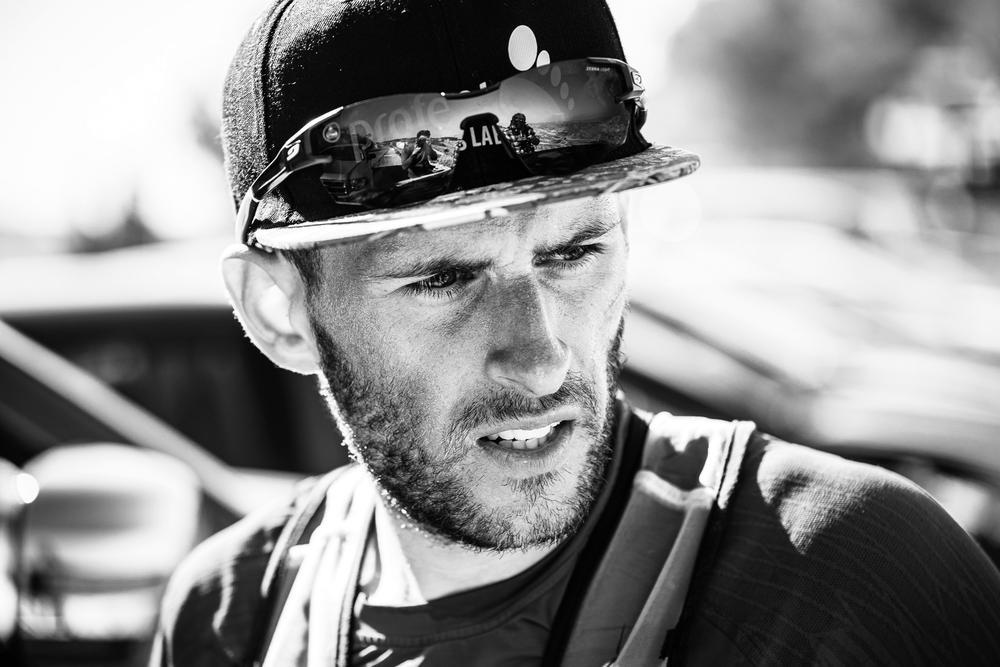
Robbie Britton is a British twenty-four-hour runner and coach who has raced from 3,000 metres up to 261 kilometres in one single day, covered a marathon in 2:29 and raced the UTMB, Spartathlon and a whole host of other road, mountain and ultra-races along the way. He loves to race and to help others enjoy the same experience through his coaching. A popular magazine and website writer, Robbie has written for Runner’sWorld,TrailRunning, Men’s Running and The Guardian, amongst others. www.fastrunning.com
ROBBIE BRITTON
1001 RUNNING TIPS
First published in 2021 by Vertebrate Publishing. This digital edition first published in 2021 by Vertebrate Publishing.
Vertebrate Publishing Omega Court, 352 Cemetery Road, Sheffield S11 8FT, United Kingdom. www.v-publishing.co.uk
Copyright © 2021 Robbie Britton and Vertebrate Publishing Ltd.
Robbie Britton has asserted his rights under the Copyright, Designs and Patents Act 1988 to be identified as author of this work.
A CIP catalogue record for this book is available from the British Library.
ISBN 978–1–83981–066–4 (Paperback)
ISBN 978–1–83981–067–1 (Ebook)
All rights reserved. No part of this work covered by the copyright herein may be reproduced or used in any form or by any means – graphic, electronic, or mechanised, including photocopying, recording, taping, or information storage and retrieval systems – without the written permission of the publisher.
Front cover illustration © Julia Allum represented by www.meiklejohn.co.uk All photography individually credited.
Design by Nathan Ryder, production by Jane Beagley and Cameron Bonser, Vertebrate Publishing.
Every effort has been made to achieve accuracy of the information in this guidebook. The authors, publishers and copyright owners can take no responsibility for: loss or injury (including fatal) to persons; loss or damage to property or equipment; trespass, irresponsible behaviour or any other mishap that may be suffered as a result of following the advice offered in this guidebook.
contents ABOUT THE AUTHOR INTRODUCTION
ACKNOWLEDGEMENTS
FEEDBACK AND UPDATES
1: BASICS [1-72] THE RULES
STARTING OUT WHERE TO RUN?
GOAL SETTING AND RACE CHOICE
FELL, TRAIL AND MOUNTAIN RUNNING
2: TRAINING [73-287]
BASICS
TRAINING PLANS AND DO YOU NEED A COACH?
EFFORT LEVELS
TYPES OF SESSION THE LONG RUN
ULTRA-LONG RUNS THE CHAOS OF PERIODISATION
STAYING MOTIVATED REST DAYS
TAPERING
CROSS-TRAINING
STRENGTH AND CONDITIONING
3: SKILLS AND TECHNIQUES [288-339]
DOWNHILL RUNNING
UPHILL RUNNING OR HIKING
NAVIGATION
4: ENVIRONMENT [340-402]
HOT WEATHER COLD WEATHER RAIN ALTITUDE
5: THE RUNNER’S BODY [403–554] NUTRITION
PRE-RACE FOOD RACE FOOD INJURY FEET
MENSTRUAL CYCLE SLEEP DEPRIVATION
6: RACING [555–719]
THE PRE-RACE TOILET ON THE START LINE THE GUN GOES OFF WHEN THE GOING GETS TOUGH A RACING MIND
MULTI-DAY RACING HOW TO RUN AN ULTRA 24-HOUR RUNNING FKTs
7: KIT AND EQUIPMENT [720–829] CLOTHING
SUSTAINABILITY
TECHNOLOGY
HEAD TORCHES
HIKING POLES
8: TRAVELLING [830–911]
TRAINING CAMPS AND ADVENTURES
RACING OVERSEAS
FASTPACKING
WHAT TO PACK FOR AN ADVENTURE
BIVVYING AND CAMPING
9: STUFF [912–1001]
TRAIL AND TRACK ETIQUETTE
RUNNING WITH YOUR DOG
TOILETS ON THE RUN
MUSIC
SAFETY FIRST BLOGGING
SOCIAL MEDIA
10: READING LIST
introduction
Good advice doesn’t have to be boring. Excellent, but boring advice isn’t any use either, if no one reads it.
That’s the maxim to keep in mind when jotting down the tips you are about to read (or are considering reading, if you’re fortunate enough to be browsing in a wonderful bookshop).
In the hope of preventing this hefty tome from becoming a doorstop or, worse still, a pristine, unopened textbook on your shelf that one hopes to absorb via osmosis, I have jam-packed it full of solid advice and smiles.
If you read, and absorb, all 1,001 tips in this book, then you are guaranteed a new personal best (PB). This could be at any distance or event, but probably not the 800 metres.
A good book is dog-eared and worn. Favourites pages folded down; corners blunted from being carried around in a bag or passed to friends to borrow. My goal is for 1001 RunningTips to become like this too.
The following pages contain a huge number of snippets of advice that come from my own experiences, both good and bad, as well as the experiences of friends, fellow athletes and coaches. Some of them you might already be familiar with, having learned from your own mistakes or having taken advice from mentors, but some will be new and hopefully will help you on your way. To some, 1,001 tips might sound like a lot, but when it comes to a subject that I’m so passionate about and have spent years and years dedicated to, the advice comes swiftly.
Over a decade ago I started out as an ultra-runner, who did a bit of coaching on the side. Now the tables have turned and I’m an endurance coach, who happens to indulge in a bit of running and cycling too. That doesn’t mean I’ve lost my competitive edge, or have become resigned to a gradual decline in sporting performance as I move towards the grave, but I have found that the joy I get from helping others towards their own endurance goals is as great, or greater, than the pleasure I get from working towards my own goals.
Running is a simple sport. We choose to make it complicated, but when broken down into its fundamental parts it’s just one foot in front of the other. Anyone can move from point A to point B. Be it five kilometres or 100 miles – if your life depended on it and time wasn’t an issue, you’d get there.
What I hope these tips will do is make that journey a little bit easier. Good training prepares the body and mind for the challenges ahead; good fuelling makes the miles easier and the right kit can stop your nipples from being chafed into oblivion. So, whether you’re just starting out or an experienced veteran of 100mile racing, there is something in this book for you. I mean, with 1,001 tips, there must be something you’ve not heard before and, if not, I doff my cap. I’ve forgotten at least 200 of these since writing them.
As runners we are enamoured with progression. The real, tangible and often objective improvements that might be hard to find in other walks of life. A time or a PB can be oppressive if you can’t beat it, but when you do beat it you know it’s down to hard work. Or fancy new shoes.
I like to think the reason I was asked to write this book wasn’t because of my outrageous running successes (there are plenty of faster, stronger or better runners than I am), and it probably wasn’t down to my fantastic sense of humour (although it could
be), but down to my willingness to risk failure, chase big dreams and learn from my mistakes.
A textbook might tell you how you are supposed to run, eat or train, but I want you to take the advice in these pages and go and experiment. Try, fail, reflect, learn and try again. Failure is seen as a bad word, but it’s an opportunity to learn and hopefully this spirit is shared in the pages ahead.
Failures, lots of them, brought me to where I am today. Big dreams keep me working hard and doing my best to be a good athlete and coach, but even if I do ultimately fail to achieve all of my big goals in life, having a book published was one of them, so that’s a win. Having raced from 3,000 metres up to 261 kilometres in one single day, across deserts, over mountain passes and through cities, the failures have come thick and fast, but the successes have kept my head above water too. Hopefully this book is one of the victories; it certainly feels like one.
There are way more than 1,001 ways to improve your running, but here are the best bits of advice I’ve been given, or learnt through blood, sweat and tears, in the world of running. Now go out for a run and read this book as a cool down.
acknowledgements
Firstly, I’d like to thank some of the brilliant people who have helped me throughout my life: my mum Sharon, my Nana, my wild Auntie Pauline, my wonderful wife Natalie, my Old Man (whose own history of running grew as my career did) and many more who have kept me on the not-so-straight and narrow over the years.
The ultra-running community has always been a special group of people, and I’ll be forever grateful to be a part of it.
Thanks to my coach and friend, Tom Craggs. The man seems to know everything. Sophie Grant and Sarah Tunstall were also very generous with their time in answering questions for this tome.
Thanks also to Kirsty Reade, who for years has helped find a suitable place for my style of writing and humour, and to all those at Vertebrate Publishing who gave me the chance to fulfil a lifelong ambition of putting words into an actual book.
Lastly, thanks to the people who took the lovely pictures, especially the ones that include me.
feedback and updates
If you have have any feedback or questions regarding this book, or if something has once again shifted with the sands of time, let me know at robert.britton@live.com
Constructive criticism is always welcome too. Our knowledge is always evolving, both as individuals and within our sport as a whole, but hopefully most of these tips will hold their value for a few years.
My website is www.robbiebritton.co.uk
There are plenty of articles and extra advice out there, mainly on www.fastrunning.com
Social media is just @ultrabritton
0001 BASICS [1-72]
‘Think long term, then work backwards from there. If you wanttorunamarathonthenfindinterimgoalsalongtheway that you can work towards – celebrate these goals and signpostyourprogress.’
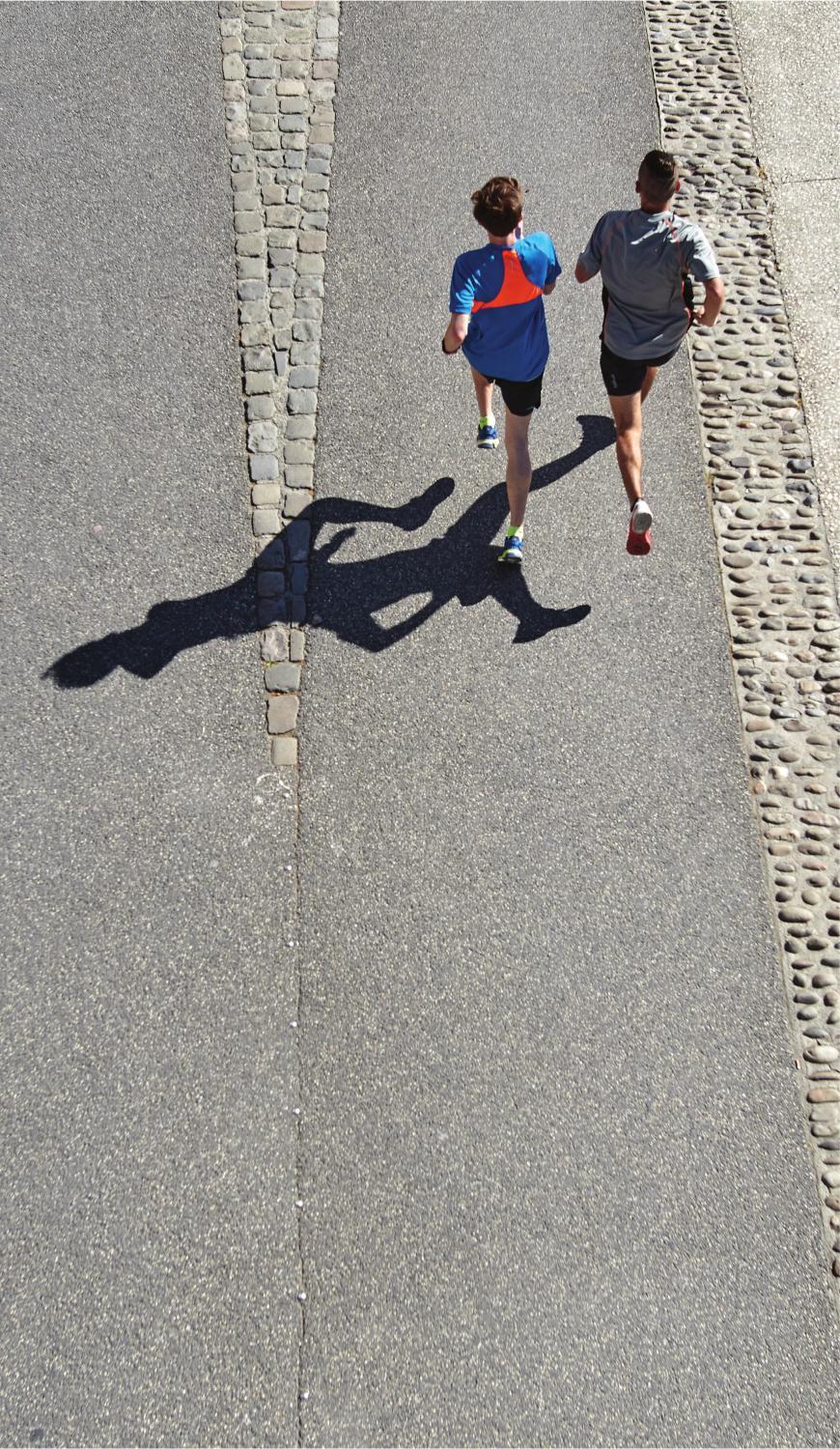
Beware the half-stepper (tip 4), especially if they have a topknot. ©Tim Lloyd
THE RULES [1–11]
1. Whatever pace you run and whatever surface you run on, if you want to call yourself a runner then that’s all that matters. Unless you’re just walking, then you’re a walker and that’s okay too.
2. Training always counts, even if it’s not on Strava. Unless it should be a rest day.
3. Be bold, start cold. You might be a little chilly going out of the door in shorts, but if you wear too much then you’ll be dripping with sweat in no time and looking for somewhere to stash your jacket to collect on the way back.
4. Miles with a friend are always easier miles, no matter how hard you’re working. It’s scientifically correct as well, as our own perception of effort is changed when we run with someone else. Be wary if your training partner is a ‘half-stepper’ and always insists on running half a step in front of you, whatever your pace is.
5. The best kit is the kit that you already own. No amount of compression socks, carbon-plated shoes or designer caps will take the place of good, consistent hard work.
6. ‘Racing is life. Everything before or after is just waiting.’ Steve McQueen said this about motorcycles; it goes against my own ideas around finding fulfilment from your own training and adventures, but it sounds cool. However, if you like racing that much, you’re getting something right.
7. Go to your local parkrun, whatever pace you run or walk. It’s full of great people and, although it’s not a race, you can race. That makes sense, right?
8. Join a club – they are the bedrock of endurance running. You’ll find people to share miles with, learn from, race with and against; you’ll also gain support and feel part of a community.
9. Smile – you’ll run faster. It works for Eliud Kipchoge, but it may not be the only factor in his rather impressive marathon career.
10. Longer isn’t always better. You might get more kudos for finishing a 100-miler, but reaching your true potential over a
shorter distance can be just as satisfying.
11. Running is fun. If it stops being fun for more than one hill session, then step back and think about why. If you’re not enjoying the training, the racing or even the community, then maybe you need to nap more.
STARTING OUT [12–36]
12. Depending on your level of fitness when you begin, the ‘couch to 5K’ programmes available online can be a good place to start. Starting out with a run and walk strategy will allow you to progress over time and then your body might be ready for more advanced plans.
13. When starting out, it’s more about consistently going out for a run than attempting any fancy sessions, plans or gimmicks. Start by trying to get your running up to 30 minutes without stopping.
14. If you can already run for 20 or 30 minutes without stopping then the next step is consistency. Doing this three or four times per week, without negative impact or injury, should be the next simple goal. You could also try to extend the time of a single run per week to up to one hour.
15. At this point there are plenty of usable training plans, from multiple online sources (including Runner’sWorld) or even in more advanced training books, that you can follow; just remember that none are made specifically for you.
16. Even if you do have a ‘personalised training plan’ that someone has made for you, your training and needs are very dynamic. What might be right for you one day can be a bad idea the week after, and you could even be progressing faster than the plan has allowed for.
17. View any training plan with a critical eye and don’t be afraid to change and adapt it. Tired? Then move that interval session.
Feeling good and want to add an extra rep in? Then think about its value and the impact it might have on the following days, but don’t be afraid to experiment.
18. Be wary of how much you increase training at this early stage. The majority of issues for beginners (and experienced runners) come from doing too much too soon. Build up gradually; allow your muscles and tendons to grow stronger and more accustomed to what you’re asking from them.
19. If you do experience an injury early on, then don’t be dismayed. Really, it’s ‘welcome to the club’, as the vast majority of runners experience injury each year. This doesn’t mean we just accept it as a given, but you’re not alone. Don’t give up yet. (See Injury (tips475–506).)
20. The vast majority of your training should be what is referred to as ‘easy running’. It’s at the lower end of your aerobic ability, but is actually really important for your progression. You’re building up your cardiovascular system, muscle capacity and endurance.
21. The biggest mistake a lot of runners make is overcooking the easy running. Professor Stephen Seiler’s research suggests that this is the greatest difference between recreational and sub-elite runners. Easy running should be the bulk of your training. To safely manage more volume and to keep consistent you must make sure that your easy runs and days are actually easy.
22. Each run should have a purpose, but these aren’t written in stone like the Ten Commandments. There might be a physiological reason for each session, but psychological factors matter too and sometimes a run can just be for letting off steam or having some fun. As long as you have a purpose for it, it can be of value to you, but remember that purpose as you’re going along. If it is a
recovery run, then keep that in mind so you ensure you’re getting what you need that day.
23. There are several fancy ways to measure your effort level, from heart rate (HR) to blood lactate measurements, but the most effective tool for any runner is their own perception, otherwise referred to as ‘rate of perceived exertion’.
24. Any magical watch or HR monitor can start registering that your heart is going to explode when you’re simply jogging down to the shops, so it’s important to learn how to gauge your own effort. Technology can be handy for measuring, analysing and interpreting your running, but it shouldn’t dictate what you do.
25. An often-quoted golden rule for a runner wanting to progress is ‘don’t add more than 10 per cent additional volume each week’, but remember we’re all different. If you’re only running for 30 minutes in total each week, then 40 minutes the week after is a 33 per cent increase, but you could just be changing two 15minute runs into two 20-minute runs. This is a sensible progression, despite breaking the ‘golden rule’.
26. When it comes to intensity and volume, try to increase one at a time. If you’re building up your volume, then keep it simple and don’t add additional faster running in too often as well. In simple terms, trying to run faster and longer at the same time can overstress the body.
27. Don’t get carried away with progression either. We all get attached to the feeling of improvement, it’s one of the joys of running regularly, but having down time and rest days, even recovery weeks, is the time you grow stronger and needs your focus too.
28. When starting out, it might be worth working with a two- or three-week cycle of progression, recovery and consolidation. We all think it’s the hard sessions and increased mileage that brings home the bacon (or vegan alternative), but they’re nothing without the sleep, recovery and easy running to allow the adaptations to sink in.
29. Now we’re getting rolling, it’s worth nipping the love of ‘mileage’ in the bud too. It’s much more effective to think of training in terms of time than distance. Firstly, not all miles are created equal, with hills, mud, cobbles, headwinds and rain not only changing how long it takes to run different miles, but also the same mile on a different day.
30. Even running your normal loop in the dark is going to change how long each mile takes, and potentially change the impact that run has on your training.
31. Thinking in terms of distance is one dimensional, especially when we consider it takes many of us a different amount of time to run the same distance. If a beginner takes 30 minutes to run 5K and an experienced runner takes 15 minutes, should they be treating a 5K run in the same way? No, as it’s twice as much training for the less experienced runner to go the same distance. If you think of your weekly training solely in terms of distance you can end up doing more training than is sensible for your level. Think of it in terms of time, still progressing as you improve, then you might make bigger leaps as you get faster, but it’ll also take into account a whole host of other factors too.
32. Think not only of the time you are running, but also the time between those runs as well. Recovery time is important, especially if you start to run with more intensity. If you run one evening and then in the morning the next day, expect to feel the run from the night before and change your run
accordingly. Holding off until the evening will provide 24 hours of recovery instead of 12, for example.
33. In the early stages, make sure you’re enjoying yourself. The rush of endorphins comes quick and easy early doors – that glowing feeling of accomplishment for the first continuous run, a new PB on your home loop or feeling fitter and stronger, but a good, old-fashioned measure of whether you’re pushing too much, too early is a big smile. If you’re dreading the runs, grimacing your way through them and crying into a cup of tea afterwards, maybe ease back a little. Running should be fun, at least most of the time.
34. It’s not just smiling, listen to your body as a whole. I keep harping on about individuality and there are plenty of common mistakes, but you know your body best and if something hurts, then maybe ease back a little. If you need to, get a professional opinion from a physiotherapist or go for a sports massage. Be wary of Dr Google. They’ll suggest your legs are going to fall off.
35. It’s worth taking a sensible progression through the distances and starting with some shorter races. There’s no shame in focusing on 5K to get your PB down before stepping up to 10K. Just because Dave from the office is running 100 miles doesn’t mean you have to go straight up to the marathon to catch up.
36. Progress sensibly with your race distances and you will be around in this sport for a whole while longer. Eliud Kipchoge has made a whole career going from 5,000-metre world champion in 2003 to marathon maestro and world record holder in 2018. He might never step up to 100-mile races, but we can only hope.
WHERE TO RUN? [37–41]
37. Head out of the front door, choose left or right and, if you don’t know the area, use the tried and tested out-and-back. It’s a
fact of quantum physics that, no matter how fast you run the outward leg, you always get home quicker.
38. Before this new-fangled internet we used to use a map and compass to find our way around; maps were also great for planning running routes. Ordnance Survey allow you to order a map centred on your home location, so if you want to explore, that’s a great way to start.
39. If in doubt, then there is often a local parkrun (their website always lists the route they take). If you’re not yet up for going along on a Saturday morning, you could just try the route out on your own.
40. If you don’t feel safe exploring on your own then local clubs will often have a wide range of groups, some for beginners and others for more experienced athletes, and they will take you on magical mystery tours of the local neighbourhood. When I started running with North Norfolk Beach Runners there was this great chap called Malcolm Ball who would lead us around the Cromer roads and trails, knowing every little hill to test us and always with a smile on his face. Malcolm has sadly passed away now, but every club has wonderful people just like him, helping a whole host of runners to discover their local area. Thanks Malcolm.
41. There are some great route-finding apps, my favourite being Komoot. You simply add start and finish points and the app finds you a route that can then be plugged into your watch (or your memory if you’re bold). Using Komoot has often shown me little trails and shortcuts that I’d never have found on my own.
GOAL SETTING AND RACE CHOICE [42–56]
42. One of the great ways to keep momentum with early excitement is to pick a race goal. It doesn’t need to be big and scary, but just popping something in the calendar, maybe even getting a couple of friends to sign up too, can maintain your focus after you begin running. I started by signing up for the Windermere Marathon with my friend Smithy. It was basically to prove I could, but also to stop Smithy having sole bragging rights about doing a marathon, as we’d have never heard the end of it. Whatever the reason, it got me out training, so find your reason to train.
43. Think long term, then work backwards from there. If you want to run a marathon then find interim goals along the way that you can work towards – celebrate these goals and signpost your progress.
44. Don’t worry if some think your goals are unachievable. As long as you’re willing to put in the time and effort to find out, then think big and believe in yourself.
45. Talk to people you trust and respect in your sport. It could be a more experienced runner, a coach or just a friend who knows you well. Wanting to make the Olympic marathon team when you’re still trying to break 30 minutes for the 5K might be a goal so far away that you’ll be better off focusing on some targets a little closer to home first.
46. Running is a journey of discovery and if you’re happy putting all your time and effort into finding out that something is truly unachievable, then there is value in that too. If, say, you want to be a 24-hour running world champion, but if you give it everything and come up short, then you’ll be happy. It’s not giving it your all that leaves you with regret.
47. Write your goals down. In a diary, on a piece of paper on the fridge or, as so many do these days, on social media. It’s not about boasting to others about what you’re going to do (action is more important than words in that regard), it’s about accountability.
48. Tell your friends and family your goals. Stating that ‘I’m going to run the London Marathon’ might seem like a big challenge, but without your family on board it will be harder and just them knowing means you’re less likely to skip that long run for a Netflix marathon instead (definitely not the same type of marathon).
49. Be SMART with your goals. It’s a simple adage, but effective. It stands for Specific, Measurable, Achievable, Relevant and Timebased.
50. Specific goals are ones that are definable and clear so that you know what you are working towards and can focus your efforts on what is important to achieve your goal. ‘I want to run faster’ is different to ‘I want to run fast enough to qualify for the Boston Marathon in 2025’.
51. Measurablegoalsallow you to see progress and actually know when you have achieved your goal. If your goal is simply ‘I want to run better’ then how do you measure this? ‘Faster’, ‘more evenly paced’ or ‘with greater consistency’ can all be measured, but simply ‘better’ cannot.
52. Achievablegoalsare important for motivation. As tip45says, if it’s so far out of reach that you can never get there, or at least you’re struggling to visualise getting there, then something closer to home is needed. It might just be a step on the journey to that further goal, but it needs to be within reach.
53. Relevant goals mean that you’re picking something that is important to you and where you want to be in the long term. Just selecting something achievable that your heart isn’t set on, so that you reach your goals, will affect motivation, and not necessarily have the intrinsic value you need for long-term incentive.
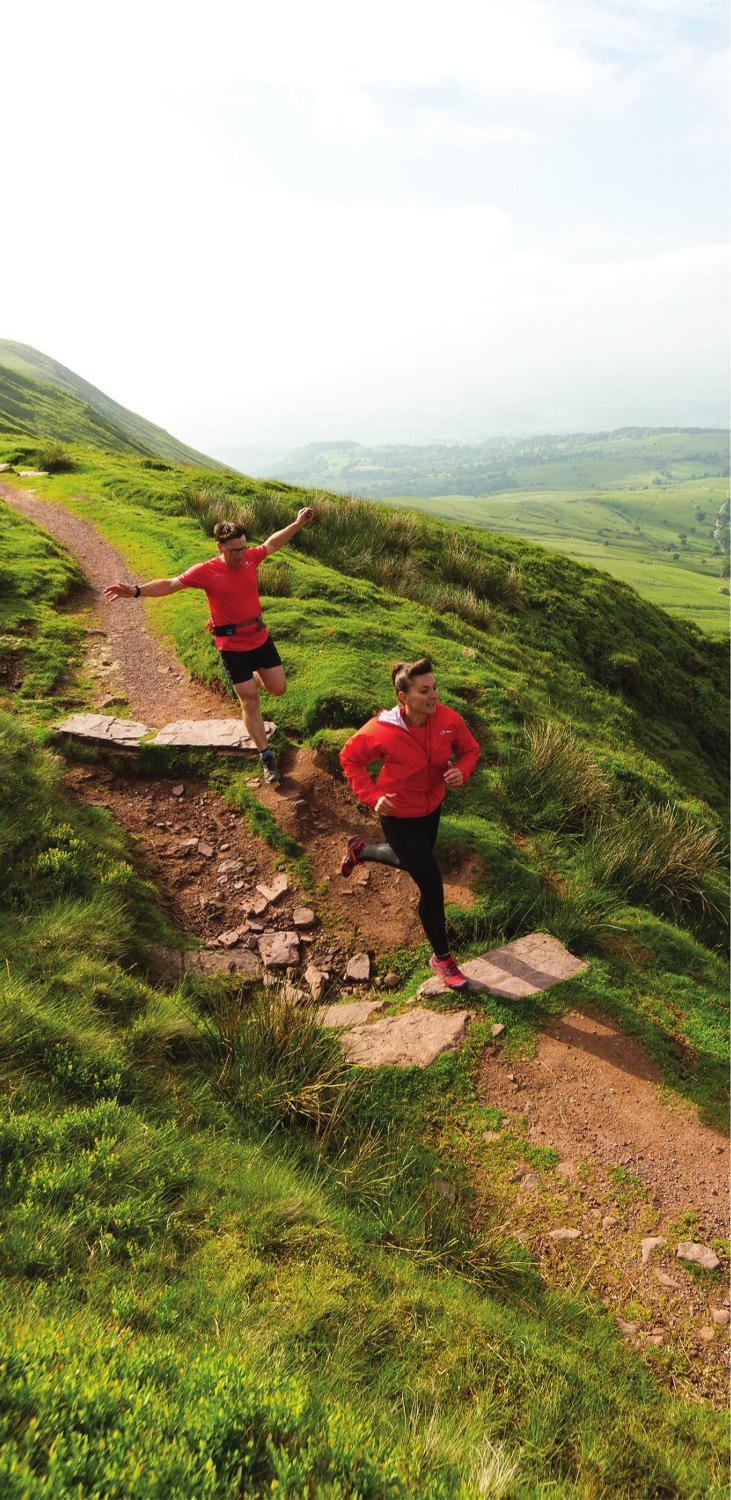
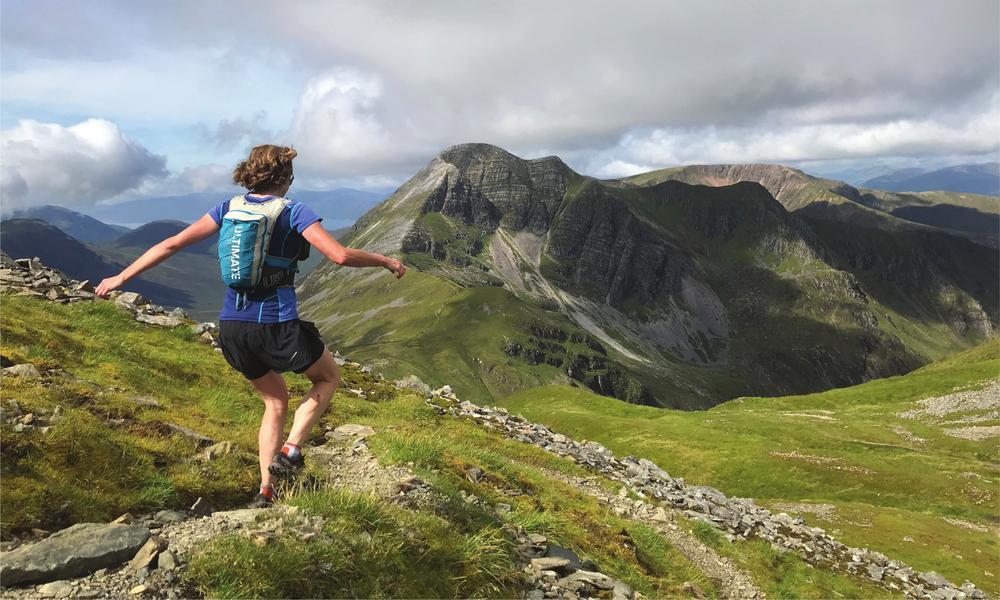
Tracy Purnell and Jon Barton (who is displaying a perfect example of aeroplane arms – see tip 302) drop off Twmpa in Wales. © John Coefield
54. Time-based goals give you a schedule and a deadline to achieve your goal. Without a deadline there’s every chance that you won’t do what is necessary to get where you want to be, and with that the dream slips away. Tomorrow is great, but today is when you need to do the work.
55. Rope others into setting SMART goals too. Sit down (or just WhatsApp) with fellow runners and hold each other to account. You don’t even need to have the same goals or events (or even set goals for the same sport or hobby), but just check in on each other to see how progress is going every week or two. It’s amazing just how much checking in on each other will help.
56. Now sit down and think about what you need to do to achieve your goal. Training (tips 73–84), Strength and conditioning (tips 257–287), Nutrition (tips 403–425), Clothing (tips 720–757) and Staying motivated (tips 198–214) might all play a part, some bigger than others, but make sure that you have a plan.
FELL, TRAIL AND MOUNTAIN RUNNING [57–72]
57. Off-road running has plenty of names and it can get a little confusing, so here’s a few descriptions to start and hopefully you’ll have an idea of what you’re potentially signing up for.
58. Trail running generally follows an actual trail that has been purpose built for hiking, running or biking. These vary from country to country and it’s always worth finding out what constitutes a trail where you’re heading.
59. How to spot a trail runner? They’ll usually have a running vest and a fancy cap, sometimes worn backwards, and funky shades. Expect bright colours too, and calf socks.
60. Fell running is more likely to be on an open hillside. It originated as racing from a pub to the top of a local hill and back
again. The races often don’t have a set route and it is up to the athlete to decide on the best path between controls or checkpoints.
61. How to spot a fell runner? They’ll be in a vest and shorts that were handed down to them by their mother or father, with shoes sporting at least one or two holes, and will shirk at paying more than £3.50 for a race entry, even with a free pie.
62. Hill running is what they call fell running in Scotland and Ireland. I think. How to spot a hill runner? They’ll look like a fell runner, but with a Scottish or Irish accent.
63. Mountain running is the discipline practised by the World Mountain Running Association, who hold annual European and World Championships, which can be ‘uphill only’ or ‘up and down’ and usually take place on trails, but in mountainous environments.
64. How to spot a mountain runner? They’ll often look pretty similar to a track or road runner, but with slightly more impressive calves. Look out for them training on mountain roads, rather than on the trails.
65. The International Sky Running Federation is a race organisation and business but has also come to represent skyrunning – the more extreme end of mountain running, on rockier and more technical trails and even off-trail, but still on set, flagged courses in the mountains. The races are all supposed to be above a certain height and have lots of ascent.
66. How to spot a skyrunner? Their knees will have a few scrapes from falling down on a pile of rocks; they might have some carbon hiking poles and a tiny waist belt that holds a thin jacket for the summit.
67. Orienteering is a combination of running and navigation, often in woodlands and off-trail, but also in urban environments, where the navigation plays a bigger part than in fell running, for example. It’s popular in Scandinavia, but the UK and Ireland have some pretty good orienteers too.
68. How to spot an orienteer? A true orienteer will have a thumb compass on at all times and at the start of any run will look in all directions and could head off anywhere.
69. Snowshoeing is another discipline again, but as they have their own world championships, I guess they can have a tip or two. Using specially made, tennis racket-like contraptions to achieve a greater surface area, the athletes will race on top of a layer of snow.
70. How to spot a snowshoer? They’ll have snowshoes on.
71. If you want to run in snowshoes then get some made for this purpose. The big, hiking ones will prevent you from actually running, but brands like TSL make some good lightweight ones and they can open up some wilder adventures for those who aren’t a fan of skiing in the winter in mountainous areas.
72. Whichever type of running you find yourself doing, and all are great fun in their own right, it’s okay to mix it up too. You might be able to work on strengths and weaknesses in a different format and take something back to your own discipline. Or you might jump ship to another side altogether.