




Photo





Yves Bélanger, Servir
On March 1 5, the padre of the Royal Montreal Regiment (RMR), Captain Rici Be, left Canada on his own accord to go to Romania. His goal was to give a helping hand to Ukrainian families fleeing their country. He spent just over two weeks there volunteering with needy families.
The Cambodian-born CAF member explains that he was very affected by the situation. “The war and/or the genocide in Cambodia are part of my family history. This is why we are never indifferent to war and why any armed conflict affects us deeply. During this war in Ukraine, the situation faced by refugees is serious. The need for assistance is growing and immediate.”
He therefore joined a team from the Canadian Baptist Ministries to go to Romania and join the All4Aid organization which supports Ukrainian refugees. “I stayed there for 17 days.”
GRATEFUL PEOPLE
Padre Be notes that as soon as they arrived at the aid centres, the Ukrainians were very grateful to the volunteer teams. “They had very different needs, but they were very open to the help we could give them. They were showing great humility, but keeping their heads held high.”
One of the biggest obstacles was of course the language. “With the help of an interpreter, it was fine. Fortunately, we also had Google Translate, the

gestures and our imperfect English to finally understand each other!”
VIVID EMOTIONS
Seeing so many destitute people arrive in such a short time brings up a lot of emotions. Padre Be mentions that through the joy, the relief and the feeling of the work accomplished, sadness, helplessness and incomprehension were mixed. “On the one hand, we thought that some had found refuge and that we were continuing. On the other side, it was heartbreaking to think about the consequences Ukrainians are going through and the difficult decisions they have to make.”
The reservist goes on to say that four stories remain particularly etched in his mind. “First there is that of a
couple and their four children who were living temporarily in one of our centres. They were taken to the airport to go to Norway. A week later, the father had to leave them to return to Ukraine and defend his country.”
While visiting the facilities of another organization, Padre Be saw many single mothers surrounded by children. “They were well fed, warm, dry and safe. But you could clearly see their moral suffering on their faces. Their features betrayed the pain and worry they were experiencing.”
The CAF member also remembers a teenager, sitting in a corner, who was crying in silence. “Another teenager came to sit next to her. In complete silence, they exchanged glances. It was
like, telepathically, they were like, 'I know, this is really shitty what's happening to us!' ”
Finally, the journey of a 16-yearold orphan who lost her parents in Ukraine marked the chaplain a lot. “She had just been abandoned by her adoptive mother and ran away. We know that this kind of situation makes these young people perfect victims for slave traffickers. It's not easy to see that. All these stories, mixed with those of other families I saw, became very trying. Our feeling of helplessness and sadness becomes very high in such circumstances.”
HUMAN EXPERIENCE
It was on April 1 that Padre Be returned to Canada. Although his journey has been emotionally difficult at times, he says the experience has been very rewarding. “Among other things, I was able to see that generosity, whether material, emotional or relational, still exists in people.” He also says he learned a lot about Ukrainians, their patriotism, their optimism, their sense of service to others and their fighting spirit.
The chaplain concludes by saying that this war makes him realize that the risk of oppression, injustice and tyranny are still part of our world. “But despite the feeling of helplessness and sadness, we cannot afford to let go. The greater the distress, the greater the help that can be provided, from afar or by loan, is important.”




Caporal Charles Goelen, Public Affairs Representative, 34 Svc Bn
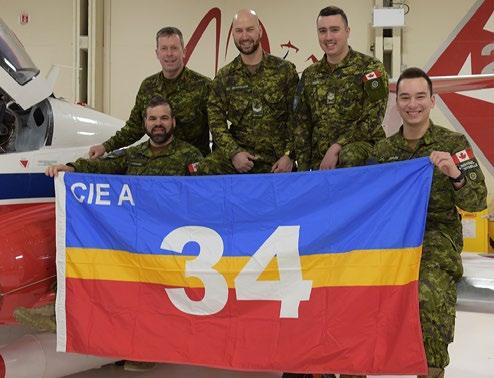
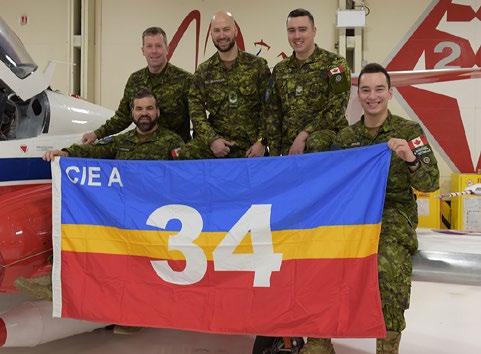
Last March , five members of the 34 Service Battalion (34 Svc Bn), Master Corporal Christopher Nunez and Corporals Nicolas Beauregard, Charles Goelen, Jonathan Laramée and Jean-François Ross, exercised a long-distance road movement by 44-passenger bus in the western provinces departing from SaintHubert.
Exercise Servitium Rocheuses was originally an idea of Corporal Beauregard, instructor and driving evaluator. He wanted to make vehicle qualifications and skills maintenance more interesting.
The chain of command gave its approval, as evidenced by LieutenantColonel Lance-Richard Gosselin, commander of 34 Svc Bn: “The opportunity to offer stimulating training to my members is part of my mandate as commander. Retention is a major issue for the Canadian Armed Forces. In addition, deepening our pool of qualified personnel for our equipment allows us to be more flexible and to offer the required support, whether in domestic operations or in theater.”
A LONG JOURNEY
It all started in the spring of 2021 during a 44-passenger bus course organized by 34 Svc Bn during which members had to locate all the Regular and Reserve Forces military installations in southern Quebec, in addition to responding to qualification standards on the vehicle.
Following the easing of sanitary measures in the winter of 2022, Exercise Servitium Rocheuses got under way in order to offer the instructors of the 44-passenger bus an opportunity to maintain and refine their knowledge
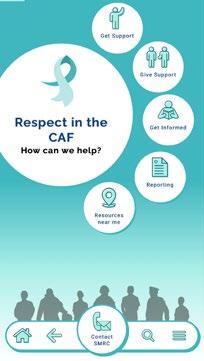
The Respect in the Canadian Armed Forces (CAF) mobile app is filled with useful and important information about sexual misconduct. With a new design and updated terminology, the app is now easier than ever to use.
and skills. While allowing them to accumulate driving mileage, members were able to benefit from an incredible professional development by visiting different military installations on their way. They traveled to the Canadian Rockies by taking the road between the towns of Jasper and Banff, which allowed them to practice their driving skills in mountainous terrain.
The five members were able to visit the following Reserve service battalions: the 33 rd located in Ottawa, North Bay and Sault Ste. Marie; the 38 th in the cities of Thunder Bay, Winnipeg, Saskatoon and Regina; and the 41 st installed in Edmonton and Calgary. They also visited the following Regular Force bases: Petawawa, North Bay, Winnipeg, Wainwright, Edmonton and Moose Jaw.
While at Canadian Forces Base Edmonton, members had the privilege of taking a guided tour of 1 Regular Force Svc Bn and witnessing the scale of the facilities and their operational capabilities.
Members were also treated to a guided tour of 431 Air Demonstration Squadron, the Snowbirds, at Canadian Forces Base Moose Jaw. They had the opportunity to learn more about the professionalism of this pilot team and its support staff.
The twelve-day exercise was a success. The 8,350 km journey went smoothly and the members are all very satisfied with their experience. They enjoyed all of their interactions with the soldiers they met across Canada and throughout their journey.
It contains educational information and useful resources on the prevention and management of sexual misconduct. New downloadable interactive tools, such as an example of bystander interventions, have also been added to help guide and support bystanders.
A person affected by sexual misconduct will find guidance on how to respond to an incident in the form of an interactive incident management decision tree.
The Respect in the CAF Mobile App is a useful mobile toolkit for victims and survivors of sexual misconduct and those who support them.


Yves Bélanger, Servir
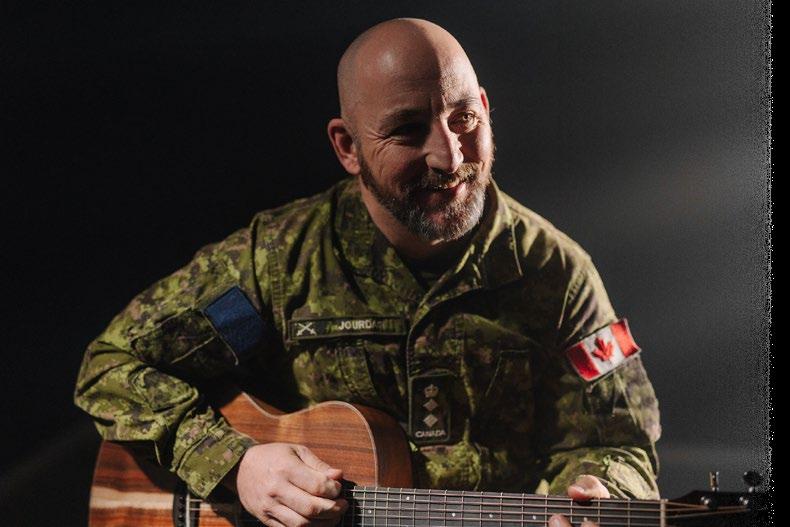
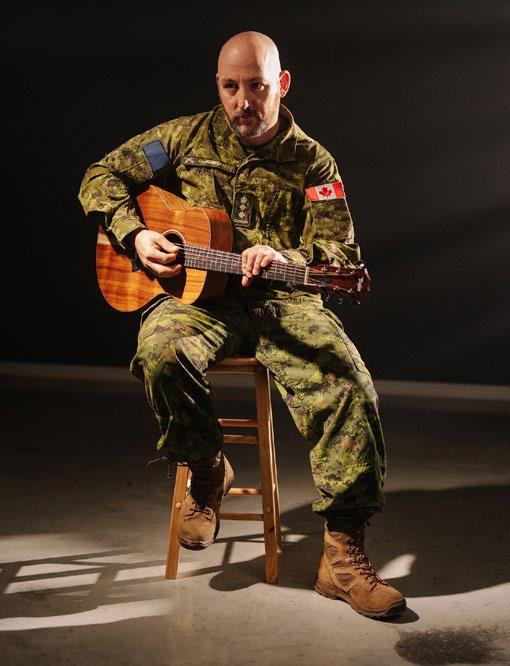
The 2nd Canadian Division (2 Cdn Div) took advantage of Mental Health Week, which is held from May 2 to 8, to officially present the music video for the song Berceuse pour calmer les démons (Lullaby to calm the demons) composed and sung by veteran Steve Jourdain
Retired from the Canadian Armed Forces in February, Colonel Steve Jourdain now works as the Associate Director of General Services of the Canadian Forces Morale and Welfare Services. He says he composed this song in 2015-2016. “Two of my brothers in arms, former members of the Royal 22e Régiment had just committed suicide. I started writing the lyrics and composing the music on the guitar. When finished, I saved it and posted it on Facebook. It only took a few hours to receive lots of great testimonials. It was very touching.”
In January 2016, the song was used as part of Bell Let's Talk Day. “This first version was recorded semi-professionally. It had been broadcast on social networks and had a good reach.”
The veteran says that one day, he even received a very touching testimony. “A man wrote me to tell me that my song had saved his life. My words convinced him to seek help. To me, that meant a lot.”
A little over a year ago, a colleague at work told him that she would like to take the song further. “She wanted us to record it in a professional studio and shoot a video.”
The ex-CAF member happily agreed to participate in the project. However, he decided to rework the lyrics a bit. “The song was mostly about suicide. We wanted it to be more inclusive and to cover all mental health issues.” The cost of the project was covered by the 2 Cdn Div Equity budget.
Steve Jourdain is very happy with the final result. “Music director Philippe Turcotte made an exceptional arrangement of the song. It's incredible.” The song and video recording projects were entrusted to Coolgray Productions. The filming of the video was done over the past few weeks. “The 2nd Canadian Division has invited all CAF members and civilian employees to be extras in the video. It's great, because the ten people who agreed to participate are people who have had to face, one day or another, problems related to mental health.” The video was produced by Olivier Turcotte.

The National Conference on Suicide Prevention will take place from May 11 to 13 in Montreal. Thursday, May 12, the day will be entirely dedicated to the Canadian Armed Forces (CAF). Specialists will take stock of the progress of the suicide prevention strategies and will review the current state of research. They will also highlight innovative prevention, intervention and postvention practises for CAF members and veterans.
Here is the preliminary program:
• Suicide prevention in light of the CAF culture change (in English) by Major-General Marc Bilodeau
• The Canadian Armed Forces Directorate of Mental Health suicide prevention initiatives (in English) by Leila Salem
• Resilience Plus: A program to build resilience, pave the way for success and promote excellence at the Royal Military Colleges of Canada (in French) by Lobna Cherif
• Military and Veteran Family Involvement in Suicide Prevention Efforts in Canada and Abroad: A systematic, qualitative synthesis of research and policy (in English) by Denise Dubois, Fardous Hosseiny and Heidi Cramm.
• Going back to civilian life after serving in the Canadian Armed Forces: the challenges and issues of the military-civilian transition (in French) by Dave Blackburn
• Linking services, the key to suicide prevention. The example of emergency responders (in French) by Geneviève Arguin and Julie Nadeau
All sessions offer simultaneous translation. Veterans benefit from a reduced rate ($30) using the promo code: can2205






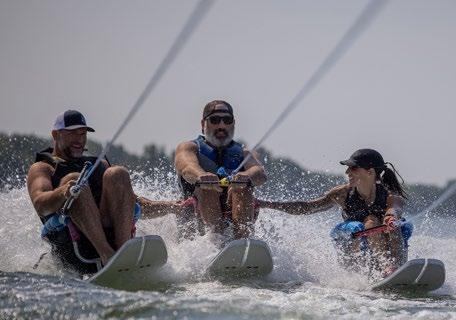
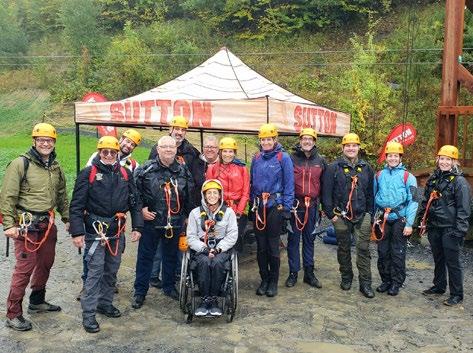
Many are familiar with the Adaptive Sports Foundation (ASF), which aims to make the practice of sport more inclusive for people with disabilities. However, what some do not know is that this non-profit organization has been developing a program specifically dedicated to veterans for several years.
Retired Major Frédéric Jean is in charge of this program. He is well known in the Montreal area since he was working at the Canadian Forces Leadership and Recruit School before retiring. “I retired from military life in 2021. The ASF offered me a part-time job in the veterans program and I accepted with great pleasure. I had already been volunteering for this organization for four years with the water skiing activity.”
NOT LIMITED TO PHYSICAL DISABILITIES
Maj (Ret’d) Jean explains that the program dedicated to veterans is
a separate component from traditional adapted sports. “Essentially, it is funded separately and aims to promote the health among veterans through the practice of outdoor sports. You don't have to be a person living with a disability to take part.”
He adds that the ASF recognizes, as does the Quebec Veterans Foundation, that veterans often have physical, mental or social medical challenges due to the nature of the military service. “The benefits of these free activities are to stimulate veterans to come out of isolation, to have a positive effect on their health, to generate social encounters and to increase selfesteem.”
For Maj (Ret’d) Jean, volunteering with the ASF has been very beneficial. “For a veteran, getting involved with such an organization means taking on a rewarding new mission. This allows us to value ourselves through the happiness
Vol. 28/No 09 May 4, 2022
PRINT : digital edition only
EDITOR : Col Jason Langelier
2 Cdn Div Support Group Commander
MILITARY ADVISORS :
• Capt Steve Comeau
450-358-7099 ext. 6570 steve.comeau@forces.gc.ca
• Capt Frédéric Thouin
514-252-2777 ext. 4530 frederic.thouin717@forces.gc.ca
and health that we provide to people living with a disability.”
As much for the volunteer as for the veteran, it is good to practice sports according to their abilities and to find a friendly brotherhood. “It has both physical and mental health benefits.”
For the warm season, Maj (Ret’d) Jean mentions that the ASF offers veterans the opportunity to practice sports such as water skiing, wakeboarding, paddle boarding and kayaking. “We also offer equestrian activities as well as oneoff activities such as zip lining and rafting.”
During the cold season, alpine skiing, snowboarding and alpine touring are on the program.
Although the ASF is based in Estrie, the organization has several mobile units that can serve throughout Quebec for adapted sports or the program dedicated to veterans. “We also have permanent installa -
Saint-Jean Garrison, office K-125, PO Box 100, Station bureau-chef Richelain QC J0J 1R0 T. 450-358-7099 ext.6346 servir@forces.gc.ca • journalservir.com
• Claude Tourville 514 252-2777 # 4993 claude.tourville@forces.gc.ca
MANAGER : Guylaine Fortin 450-358-7099 ext. 7426 • guylaine.fortin@forces.gc.ca
JOURNALIST : Yves Bélanger 450-358-7099 ext. 7330 • yves.belanger@forces.gc.ca
ADVERTISTING REPRESENTATIVE : François Ménard 450-346-2300 • servir@tictactoecommunication.com
SUBSCRIPTION AND CLASSIFIED : Bélinda Raîche, 450-358-7099 ext. 6346 • belinda.raiche@forces.gc.ca
TRANSLATION : Google
GRAPHIC DESIGNER : Gillian Ottaway
ISSN 0384-0417
tions at Relais and Stoneham. This allows us to reach as many people as possible.”
The ex-CAF member ends by indicating that he is currently working on the organization of a hiking trip to Europe. “This is a getaway to the Alps for six to eight veterans. It would be like a healing session.” If all goes well, the trip could take place at the end of the summer. “I cannot confirm this at this time, as I am still looking for the necessary funding. However, I am hopeful to be able to formalize everything in the coming weeks.”
Those interested in becoming a member of the ASF Veterans Program or to volunteer with the organization can write to Frederic@ sportsadaptes.ca
• Publication requests should be sent in Word format by email. The editor-in-chief reserves the right to reject, modify or publish any editorial or advertising material. Next edition 18/05/2022 Deadline 09/05/2022
• Servir is an authorized unofficial publication, published bimonthly with permission of the 2nd Canadian Division Support Group Commander. The opinions and points of views expressed are not necessarily those of DND, CAF and CFMWS/ NPFs Personnel.

Yves Bélanger, Servir
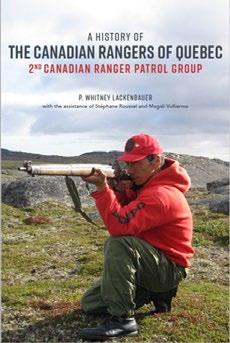
The 2nd Canadian Ranger Patrol Group (2 CRPG) celebrates its 25th anniversary this year. To mark the occasion, on April 3, the reserve unit launched a book entitled The History of the Canadian Rangers of Quebec.
Lieutenant-Colonel Benoit Mainville, Commanding Officer of 2 CRPG mentioned that this commemorative book celebrates 25 years of the contemporary history of the reserve unit as well as the incredible contribution of the Canadian Rangers (CR) for 75 years to the security interior of Canada and their communities, as well as to the development of youth. “With its establishment in 1997, 2 CRPG inherited the illustrious history of CR in Quebec. It is a dynamic story, illuminated by the courage of the Rangers, the commitment of the CAF members of the South, enriched by its various cultures and respectful of the Nations who wrote it.” LCol Mainville hopes that this historical book will reveal the remarkable contribution of the CR as well as of all the CAF members who have worked with them over the past 75 years.
For his part, Brigadier-General Stéphane
Boivin, Commander of the 2nd Canadian Division and Joint Task Force (East), thanked the CR for their inspiring and exemplary contribution. “The Canadian Rangers are a unique capability within their community and represent a critical and strategic resource for the defense of Canada. The 25th anniversary book of the 2nd Canadian Ranger Patrol Group highlights the considerable commitment for more than 75 years of the Rangers in their community.”
The 2 CRPG represents a unique indigenous and non-indigenous cultural diversity bringing together Inuit, Cree, Innu-Aitun, Naskapi, Metis, French-Quebecer, AngloQuebecers and military cultures, which encourages dialogue, respect and sharing. of knowledge.
The 2 CRPG, guarantor of nearly 76% of the surface of Quebec, has 700 Canadian citizens who serve as CR within the CAF. More than 700 young people, aged 12 to 18, participate in the Junior Canadian Rangers Program in remote and isolated regions of Quebec.
2022 marks the 75th anniversary of the creation of the Canadian Ranger Corps. Since their official founding in May 1947, the Canadian Rangers (CR) have made a significant contribution to Canada and to the Canadian Armed Forces (CAF).
From support for ground search and rescue, to domestic operations, to training CAF members, the CR are on the front lines of providing essential support to Canadians when they need it most.
CR are Canadian Army Reservists who provide a military presence in remote and isolated areas of Canada, including in Nord-du-Québec and along the Côte-Nord. Their expertise is also put to good use during emergencies such as plane crashes, forest fires and floods.
CR are also responsible for the Junior Canadian Rangers, a community program for youth ages 12-18.
This historical work was written by three university researchers specializing in the Arctic (P. Whitney Lackenbauer, Magali Vullierme and Stéphane Roussel), in collaboration with 2 CRPG. Written in French and adapted into English, it outlines the history of the CR since their creation in 1947 and that of the 2 CRPG since its inauguration in 1997.
The book is prefaced by Her Excellency the Right Honourable Mary Simon, Governor General. The preface was signed by the Grand Chief of Eeyou Istchee (Cree Nation) Mandy Gull Masty, the President of the Kativik Regional Government, Mrs. Jennifer Munick, and the Warden of the RCM du Golfe-du-St-Laurent and former mayor of Gros-Mécatina, Mr. Randy Jones.




Yves Bélanger, Servir
Located on the site of the Royal Military College Saint-Jean (RMC Saint-Jean), the Fort Saint-Jean Museum will once again open its doors to the public as of May 11.
Marijo Gauthier-Bérubé, archaeologist at the museum, explains that the employees are working on the final preparations to welcome the first visitors. “We are preparing the last showcases by adding the new objects that make up the permanent exhibition.”
Ms. Gauthier-Bérubé recalls that underwater excavations are continuing in the Richelieu River. She explains that as part of August, month of archeology, activities will be set up to follow the progress of research.
“Among other things, there will be a guided tour that will take people near the places where the excavations are made in the bottom of the river.”
The RMC Saint-Jean site witnessed the passage of First Nations warriors, French and English troops, American revolutionaries and several Canadian units. It was declared a National Historic Site because of the three forts that were built there and its importance during the American invasion of 1775 when the fort sustained a 45-day siege led by General

Montgomery. Along with Quebec City, this site is the only place in Canada that has seen continuous military occupation since the French Regime.
The Fort Saint-Jean Museum presents these 350 years of military history through thematic maps, models, uniforms, weapons, artifacts and archival documents. An outdoor guided tour allows you to walk in the footsteps of past and present occupants and discover the remains of the ramparts and original British buildings dating from 1839. The museum will be open Wednesday to Sunday, from 10 a.m. to 5 p.m.

For the third consecutive year, the Navy Bike Ride will take place virtually this summer. Members of Her Majesty's Canadian Ship Donnacona (HMCS Donnacona) and HMCS Radisson invite people to participate in large numbers in this fundraising activity that helps local organizations.
Cyclists who take part in the Navy Bike Ride are invited to raise funds from their loved ones to support them in this initiative. They will be able to accumulate the kilometers at their own pace, between June 12 and August 7.
The money raised will be donated to two organizations dedicated to the well-being of current and former members of the Royal Canadian Navy (RCN) and their families: Support our troops and the Royal Canadian Navy Benevolent Fund. Last year, the activity made it possible to donate more than $102,000 to these two organizations.
Anyone can register, both the general population and members of the military of all ages.
New for 2022, the Admiral's Challenge, a premier event, challenges you to complete one of three distances: 20 km, 80 km or 207 km. Participants will receive an exclusive Navy Bike Ride collector's item. This activity can be taken up any day between July 29 and August 7, 2022.
Yves Bélanger, Servir
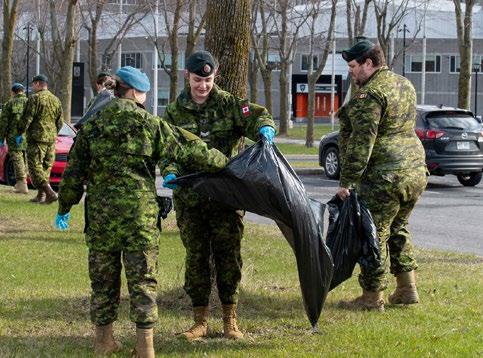
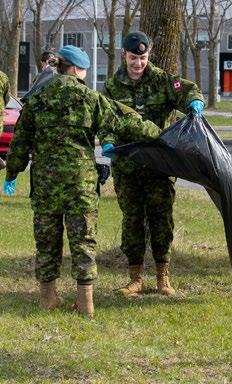
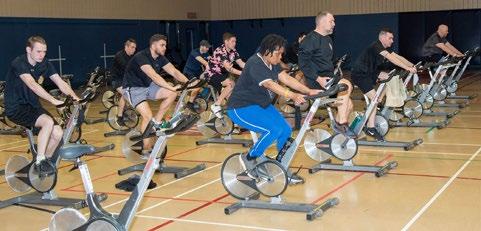
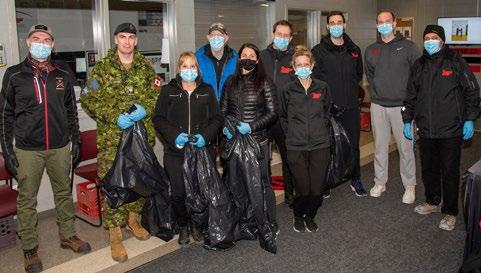
Earth Day was c elebrated at the Saint-Jean and Montreal Garrisons on April 22. In addition to participating in spinning sessions, the participants carried out a waste collection on the outdoor grounds of the two garrisons.
In Montreal, 72 persons accepted the invitation from Personnel Support Programs and participated in one of three spinning sessions held in the gymnasium. “We offered lemon water. However, people had to bring their personal bottle to avoid the use of disposable glass,” says JeanFrançois Bernard, manager of fitness, sports and recreation at the Montreal Garrison.
In the morning, a waste collection chore also took place. Six large trash bags were filled by a team of 12 people. “There were CAF members, civilian employees of the National Defence as well as a member of the Sports and Recreation Plan, Mr. Jim Orell.”
At the Saint-Jean Garrison, each year, the various units take part in Operation MAISON NETTE.
Members of Personnel Services and Corporate Services took advantage of this day to get to work. Thirty CAF members took part in the activity. A lot of debris and several tree branches were picked up.

Yves Bélanger, Servir
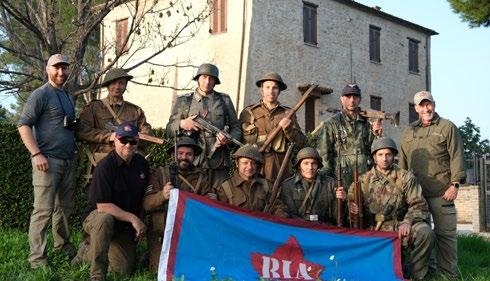
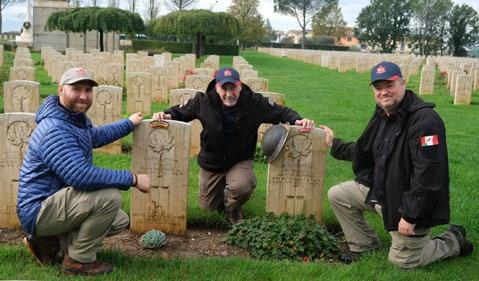
Over the past year, retired Sergeant Roger Chabot has retraced the path of Canadian soldiers who took part in the Italian Campaign during the World War II. His goal: bringing to life these important events in our military history in a documentary that should see the light of day in 2023.
It was in 2019 that the veteran started working on this project. “The pandemic has slowed me down, but it has still been beneficial. I was able to promote the project more and get more funding. This documentary has thus become the most important project of my life,” he says.
He explains that the idea was born in recent years, following a first trip to Italy. “I visited some historic World War II sites there and found that the Italians were very fond of the Canadians and were very grateful.”
The former member of the Royal 22 e Régiment also realized that he did not know his regimental history well. “That's why I had the idea to shoot this documentary which will have 14 episodes lasting 20 minutes each.”
SHOOTING IN NOVEMBER 2021
Initially, the shooting was to be done in two parts. “We had to shoot in the summer to represent the deployment in Sicily and then we had to return during the fall for filming in the rest of the country, especially in the North.” The pandemic forced the team to change their plans. “So we decided to do it all in one trip.”
Mr. Chabot knew how to surround himself with good collaborators to carry out his project. First up is John Serviss, the main cameraman and editor. “He is the son-in-law of an former CAF member who served with me in a first commando.” There
is also retired Sergeant Georges Janes, second cameraman and drone pilot.
“We also had retired LieutenantColonel Chris Comeau, responsible for logistics. He was the one who took care of booking our hotels and making sure that we could eat.” Finally, Steve Gregory, from the Operation Husky Foundation, was also very involved in the project. “He facilitated contacts with resource persons and expert historians in Sicily.”
This 32-day trip was not easy. “We had several shoots to do in a short time. We were constantly on the move. During our stay, we covered no less than 5,300 km.” By 7 a.m., the team was ready to get to work and rarely finished before 8:30 p.m. “When I arrived at the hotel, I made sure that everything we had shot was O.K.”
Roger Chabot is proud to announce that the documentary will be presented in French and English. “Every take I did was shot in French and English. I wanted to avoid dubbing.”
The team had the chance to meet experts in history. “There are a lot of interactions with them throughout the documentary. These people share their knowledge with us. They bring a lot of credibility to our project.”
Some historical reconstructions are also integrated into the video. “We were lucky enough to shoot them on location.” This is among others the case of the battle of Assoro. “We were able to re-enact part of the fight at the top of the mountain.”
RETURN TO ITALY AND LAUNCH
Last month, Roger Chabot returned alone to Sicily to record some new scenes. “Because of the heavy rain, we didn’t have time to film everything. I went back there for five days to complete the project.”
It is in January 2023 that the documentary should be officially launched on YouTube, on the channel Bravery in Arms . “I am happy because Veterans Affairs Canada will broadcast the direct link to access the 14 episodes.”
Until then, people can watch the mini videos of the documentary filming, released once a month.
Roger Chabot joined the Canadian Armed Forces in 1984 as an infantry soldier. During his 32-year career, he served with the Royal 22e Régiment, the Canadian Airborne Regiment and the Princess Patricia Canadian Light Infantry, among others. He has also participated in several international deployments. He then spent a few years as an imaging technician, during which he learned photography and video production.
Passionate about the profession of arms and military history, he began to paint his personal experiences and other historical military events. Self-taught, he developed his talent over several years in painting and photography.
His works are exhibited in various Canadian military installations and museums and can be discovered on chabotwarart.com. Now retired, he realizes his dream by devoting most of his time to the creation of military art, through painting and video production (presented on Bravery In Arms).
Roger Chabot has just completed a magnificent 8 X 24 foot mural commissioned for the Carling Complex at National Defence Headquarters in Ottawa. The work is exhibited in the hall of honor of the building. “I worked 13 months on this project. This is my greatest work so far.”


Estelle Auger
Employment and Education Coordinator, MFRC
Several reaso ns or difficulties may lead you to consult a counselor. Here are some situations where a guidance counselor could guide you in order to facilitate and inform your decision-making.
Many jobs are currently available on the labor market. How to choose among the various opportunities? Also, career management changes. How to find happiness in our job, stay passionate and get the best benefits?
Regardless of your age, level of education or work experience, it is possible to use the guidance service at the beginning, middle or end of your career. A counselor can help you with job retention, problems
adapting to work, preparing for retirement, reorientation, indecision or others.
This service can also be useful to us in a more traditional way to guide us in our career choices, a choice of educational path, obtain information on various specialties, schools and labor market prospects.
WHERE TO GO?
It is possible to consult a counselor in public establishments which often address target clienteles such as students, immigrants, people aged 50 and over, women, etc. Often these services are offered free of charge.
The service is also offered by school boards, colleges, universities, local employment centres and community organizations. Since this service is offered in a professional

manner, it is governed by an order. You can consult the website of the Ordre des conseillers et conseillères d’orientation du Québec (Order of counselors and guidance counselors of Quebec) to learn more.
INFORMATION Estelle Auger 450 358-7099 # 6084 (Saint-Jean) 450 462-8777 # 6827 (Saint-Hubert) estelle.auger@forces.gc.ca
motivation and, of course, our mental health.
As you know, mental health affects everyone. From May 2 to 8, National Mental Health Week invites us to empathize with those around us.
We will all experience difficult times and we all, or almost all, experience a certain level of stress on a daily basis. We operate in a society that values performance, performance, “looking good”, “well-being”, financial and material success. Standards for success are often unrealistic or unachievable, at least over a long period of time. They can greatly undermine our self-esteem, our confidence, our

In order to improve our quality of life, empathy is par ticularly useful for creating and maintaining relationships with others. To have empathy is to be able to understand their emotions and to show kindness and compassion towards the other.
IT CAN BE LEARNED!
Here are two ways to cultivate your empathy:
1. Talk to people and take an interest in them. Be curious and ask them questions about their past experiences, culture, outlook, etc. Learn the basics of active listening to help you!
2. Experiment and learn something new. For example, volunteer for a community organization, try restaurants that offer different cuisine than what you usually eat, try a new sport, go to a museum, or travel.
Would you like to receive support related to this subject or are you going
through a difficult time and would like to have support? Contact the psychosocial reception of the Military Family Resource Centre (MFRC) at 450-462-8777 #6721 or by email at SvcPersCRFMSoutienPsyStJean@ forces.gc.ca
ACTIVE LISTENING IN 6


Peter Mallett Staff Writer, The Lookout Newspaper
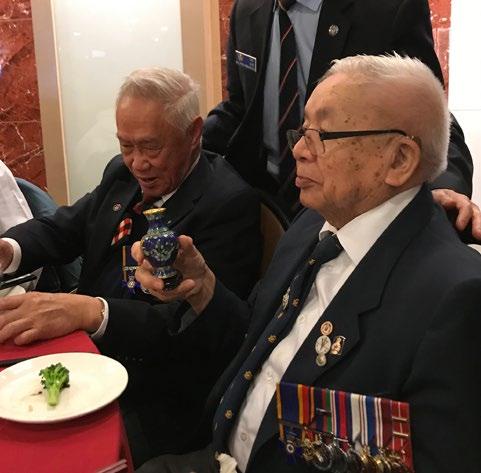
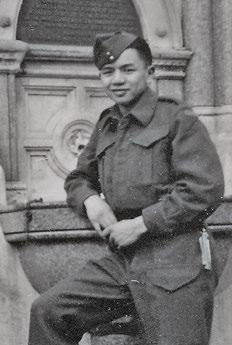
In Canada, May is Asian Heritage Month. For the occasion, here is the story of Mr. Gordon Quan, 96, a veteran of the Second World War who did top secret work in Southeast Asia during the final months of the war.
The Chinese Canadian got his chance to join the fight in 1944 after the Canadian government allowed a select group of 600 Chinese Canadians to enlist.
He underwent Basic Training in Saskatchewan and was then dispatched to England for training by the British Secret Service. Quan and other Chinese Canadians joined Special Force 136, a branch of the British Special Operations Executive.
Chinese Canadians were deemed the perfect recruits to fight against the Japanese because they could blend in with local populations, and understand some Southeast Asia languages, says Quan.
In 1945, with the war in Europe already over, Special Agent Quan worked as a secret agent in Malaya, Burma, and India. His mission was one of sabotage against Japanese imperialist forces using his training in demolition.
“We were trained in small groups of 15 in how to be effective and how to destroy and disrupt supply lines, fuel depots, ammunition dumps, transportation networks, and other Japanese controlled infrastructure.”
His service lasted only a few months before the war with Japan drew to a close following the bombing of Hiroshima and Nagasaki. Quan
believes the use of the H-Bomb was a necessary evil of war.
“When the Americans used this weapon on Japan it gave us the opportunity to survive,” he says. “The world would have been changed completely if the Japanese and Germans maintained their control.”
He has few clear recollections of his experiences as a secret agent, and many more he doesn’t want to remember.
“It really boiled down to a case of kill or be killed, so that’s why remembering or thinking about these moments can often be difficult,” he says.
Quan was discharged from the military in 1946 and returned to Victoria. He underwent vocational training with the help of Veterans Affairs in auto mechanics and heavy-duty mechanics. Later, he landed jobs in private construction and the City of Victoria Public Works Department and says he was the first Chinese Canadian to work there.
He also continued his service in the military for the Army Reserves from 1952, rising to the rank of Sergeant Major before his retirement in 1983.
During this time, he served the 40 th Technical Squadron as a craftsman, the 155 th Royal Canadian Army Service Corp, and later the 39 Service Battalion.
He credits this military experience to much of his success following the war.
“My military involvement gave me a lot of opportunities, and education to learn a trade. If I didn’t have that training, I never would have landed a job with the City of Victoria. I always
believed back then the military turns boys into men.”
His five children, three sons, and two daughters; five grandchildren; and five great-grandchildren who make frequent visits to see him at his Victoria home.
He is a lifetime member of the Royal Canadian Legion, previously serving as Sergeant-at-Arms of the Pacific No. 7, and the Victoria Chinese Canadian Veterans’ Association.
In 2012, Quan was part of a National Film Board of Canada documentary Operation Oblivion that tells the story of 13 Chinese Canadians recruited to Force 136. His story is also featured in an exhibit at Vancouver’s Chinese Canadian Military Museum entitled Rumble in the Jungle: The Story of Force 136

CCMSC
“I filed a harassment complaint and now my commanding officer has encouraged me to go to Alternative Dispute Resolution (ADR). I am concerned the chain of command is not taking my complaint seriously. What will happen to my complaint if I agree?” If you are a member of the Defence team and this scenario is familiar to you, be sure to read on.
The short answer is that your complaint will be placed on hold pending the outcome of the ADR process. This means the administration of the complaint will temporarily stop allowing you the opportunity to try ADR. It is important to note that choosing to try ADR does not change to the commanding officer’s ultimate responsibility to ad-
minister the complaint in accordance with the Harassment Prevention and Resolution Instructions. If ADR does not resolve your concerns, the commanding officer must continue with the complaint where it left off.
Your commanding officer has likely recommended you try ADR as this is often the best way for you to have your complaint addressed on your own terms. ADR is grounded in the belief that the people experiencing the concern are the best people to determine what resolution looks like; this is called the principle of self-determination. The complaint will only be resolved if you agree on the terms. Also, ADR can be used whether the allegations are founded or unfounded.
Members of the Defence team are

invited to have a confidential consultation with the Conflict & complaint management service centre (CCMSC) representatives to determine if ADR makes sense for their situation. In the Montreal and Saint-Jean areas, you can contact them at 514-252-2777.
• Serge Hamel: extension 4353 or 438-337-8819
• Isabelle Bussières: extension 2549 or 514-378-5914
• Capitaine Cindy Lapointe: extension 2894 or 438-334-1254
• Adjudant-maître Dominic Labelle: extension 6365 or 514-229-3543


Servir
The Support Our Troops National Scholarship Program is back. Those interested have until July 21 to register.
Yves Bélanger, Servir
Registration for the Plein soleil day camp and daycare service is now open to Defence civilian employees.
Organized by the Recreation Department of the Personnel Support Programs at Saint-Jean Garrison, the camp will be held June 27 to August 19. It will accommodate children aged 5 to 12 of CAF members and civilian Defence employees (public service and Non-public funds). Its programming is bilingual (French and English).
With the theme A great adventure in the heart of nature , children will have the chance to discover
many ecosystems! Each week, a new theme will be proposed such as the African savannah, the desert or the Amazonian forest and the children will go on an outing.
The camp will be held at Iberville Club (Building B-8), from 8 a.m. to 4 p.m., Monday to Friday. Parents can also register their child for daycare, which will be open from 7 a.m. to 8 a.m. and from 4 p.m. to 5 p.m.
Information: 450 358-7099 # 6105


Due to the unique circumstances associated with military life, obtaining the necessary funds to undertake post-secondary education is often a significant obstacle for many Canadian Armed Forces (CAF) military families. The National Scholarship Program overcomes some of these barriers. In 2021, 85 scholarships worth a total of $180,000 were awarded to military family members.
Eligible persons are the dependents, including the spouse, of an active member or veteran of the CAF. Dependents of deceased CAF members are also eligible.
You must be a Canadian citizen or permanent resident of Canada. You must also be a student enrolled in an undergraduate or college program leading to a degree, diploma or certificate from a recognized Canadian university or college.
Students pursuing graduate studies or enrolled in a career college are also invited to submit an application.
A selection committee will review applications, and Support Our Troops scholarship recipients will be announced by email.

Marie-France Brunelle, Specialist, Health Promotion
Yeah, yeah, I know… Spring is slow to show up! We can't wait for a warmer temperature, now that the snow is melted. The hours of sunshine are increasing, which heralds spring and the return to a more active lifestyle!
Winter often pushes us to slow down or even stop physical activity. So we are in full preparation to start moving again. But beware! It is important to do this gradually and safely to avoid injuries or accidents.
No matter the sport or activity, avoid shocking your body and allow your muscles to adapt. In addition, a good warm-up before and stretching afterwards will be beneficial.
Here are some tips to prepare you to perform again and some personal anecdotes to convince you to apply them.
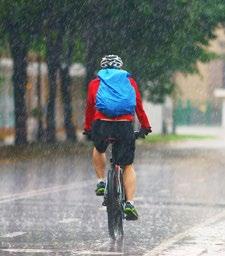
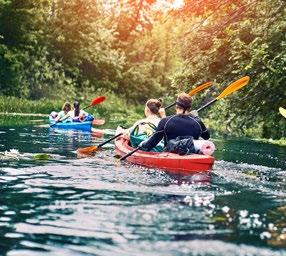
Whether it's running, biking, hiking or water sports like kayaking or canoeing, start with short distances
“A few years ago, on my first bike ride of the season, my husband and I planned our route poorly. We went for a visit to my sister's: 32 km to go and 39 km to return. Besides, we took a wrong turn... It took me a week to recover!”

For golf, racket sports and team sports (soccer, baseball, softball…) practise on your own before you start playing
“Last year, we played our first round of golf in May, with a good friend, a very good golfer. As he had not hit a ball before this game, he played 12 on the first hole (a par 4) and the next hole he played 10 (on a par 3). Now he always practises before!”
Plan for changing weather and dress accordingly
“A bike outing in May with 6th graders was going great until a sudden rain messed up the activity. Nobody was dressed to face this bad weather and fortunately, it was not too cold. However, that did not prevent some young people from suffering from hypothermia!”
In spring, don’t forget sun protection
“During the long weekend in May, we organized a friendly beach volleyball tournament. We had planned everything except sunscreen. The next day was the lobster festival! We all had sunburns.”
Be sure to hydrate well and plan snacks. A healthy and balanced diet will give you energy to practise your activities
“Sometimes when hiking, the estimated time and the reality are two different things, especially at the beginning of the season when the trails are not all open. A jaunt that was supposed to take two hours ended up taking more than four, as we didn't know we would have to take a detour. We quickly had to ration water and no one had a snack, except for a small granola bar found at the bottom of a backpack. That was not much for four hungry adults!”

Get ready, spring is on it's way!

Yves Bélanger, Servir
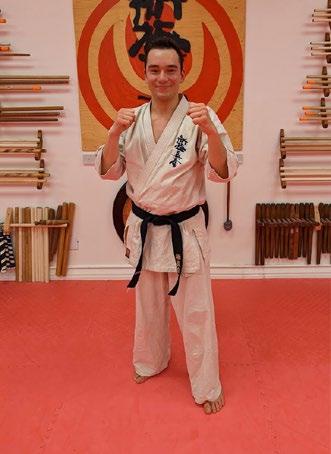
Last December, C orporal Charles Goelen of the 34 Service Battalion earned his black belt in karate. He is now preparing for his first international experience. In September, he will travel to Poland to participate in the World Karate Championship.
It was in 2011, while attending high school, that Cpl Goelen discovered karate. We had just left France to settle in Quebec. “I was looking for a place to practice martial arts and I found a karate school in Longueuil. I started making it and I loved it!”
Although he practices other sports such as badminton and bodybuilding, karate remains his favorite discipline. “It's the one that allows me to surpass myself both in terms of kata and combat.”
Since practicing karate, Cpl Goelen has participated in various local and national competitions. However, this is the first time he has qualified to represent Canada at the interna -
tional level. “I am very proud of this nomination.”
Currently, Cpl Goelen devotes many hours to training. “In general, I take three classes a week. However, since I am preparing for the world championship, I add to that one hour of combat per day.” In addition, he spends between 60 and 90 minutes at the gym to work on his bodybuilding.
He admits that it takes a lot of effort, but he is willing to do what it takes. “I am determined and disciplined.”
The CAF member is aware that participating in an international championship brings its share of stress. Despite everything, he managed to remain quite zen. “I actually focus on my goal. In addition, I tell myself that having qualified to go to Poland is already a great achievement. However, I would like to make a positive impression and make my dojo proud.”
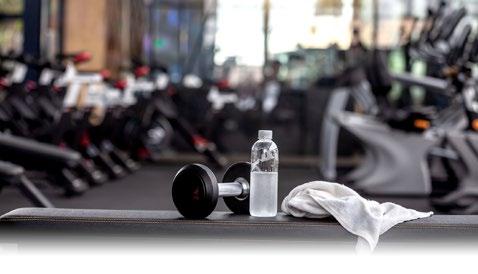
Weight and cardio rooms
Monday to Thursday: 6:30 a.m. to 8 p.m
Friday: 6:30 a.m. to 3 p.m.
Saturday: 8 a.m. to 1 p.m.
Bootcamp class: Monday and Thursday, at noon
Spinning class: Tuesday, at noon
Self-directed ball hockey practice: every day at noon
Self-directed soccer practice: every day at noon
Please note
• Drinking fountains are not accessible.
• Wearing a mask is mandatory when walking in the facilities. It can be removed when using the devices and the distance is respected.
• Participants must bring a towel and their bottle of water.
The least we can say is that Corporal Charles Goelen is a very busy man. In addition to his driver position at the 34 Service Battalion and the hours he devotes to karate, he works as a lawyer in private law firm. “I am also a singer. My first song, Superglue , is available on most music platforms. This is another string to my bow. I would like to have the chance this summer to do a few shows in Montreal.”

Yves Bélanger, Servir
After a two-year hiatus due to the COVID-19 pandemic, many sporting activities are back for the CAF members. This is the case for women's soccer, which resumes training on May 9 at Saint-Jean Garrison.
Sergeant Korina Verreault, an instructor at the Canadian Forces Leadership and Recruit School, is in charge of the Patriotes women's soccer team. The former player of the Lionnes of Valcartier admits to being very eager to return to the field. “It was very difficult to spend so much time not being able to play.”
Currently, 24 CAF members have signed up to be part of the team. “It's excellent. We only hope that they will obtain all the authorizations for release from their chain of command.”
THE IMPORTANCE OF SPORT
Sgt Verreault explains that what she likes above all in this discipline is the team spirit. “I love strategizing with the girls and going all out to win.”
She mentions that within the Canadian Armed Forces (CAF), sport helps develop cohesion and a sense of belonging. “It brings an incredible benefit both for physical health and for confidence and surpassing oneself. This is without counting the good it can do in terms of

mental health. This is why I take this opportunity to thank all those who allow us to practice sports within the CAF.”
Of course, Sgt Verreault intends to do everything so that her team wins the CAF Regional Championship to be held during the month of August at Saint-Jean Garrison. “When I was with the Lionnes, our team was very strong. In 2017, we even won the National Championship,” she says proudly.
This time, she would like to defeat her former team. “I'm going to invite my friends to dinner at home, but on the field, I don't intend to give them a single chance. Seriously, I can't wait to be able to play against them!

Servir
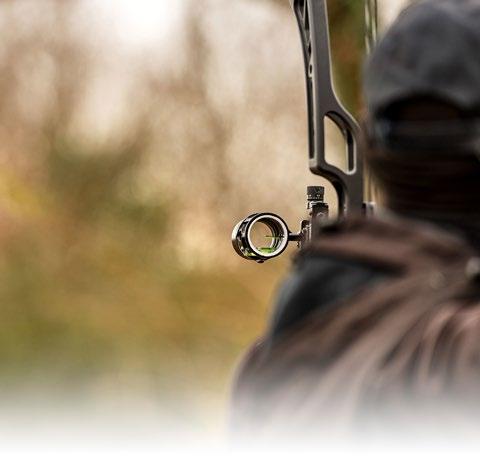
Are you a rifle, b ow and crossbow hunting enthusiast? The Hunting Club of the Montreal region is undoubtedly ideal for you. The organization welcomes the CAF members (active and retired), civilian employees of National Defence (active and retired, public service and Non-Public Funds), as well as the general population.
Being a member of the club allows you to meet other enthusiasts of this sport and to hunt on the National Defence training sites located in Farnham and Saint-Élie-d'Orford. There are big and small game such as waterfowl, wild turkeys and deers. From mid-May to mid-September, members have access to an archery practice trail. It is a 1.5 km shooting course with around 20 threedimensional animal targets. This allows hunters to practice outside of hunting periods. Members can also
practice outdoor shooting on fixed target carriers, from 10 to 45 meters.
The Montreal Region Hunting Club is supported by the Recreation department of the Saint-Jean Garrison. It has about fifty members. Like any other recreational club, it exists thanks to the voluntary participation of its members. In addition to the five members of the executive council, there are five others who take care of the maintenance of the sites.
To be accepted into the club, hunters must be qualified in the handling of their respective weapons. The hunting sectors are assigned during a draw, usually done in the spring. Information: huntingclubfarnham@gmail.com