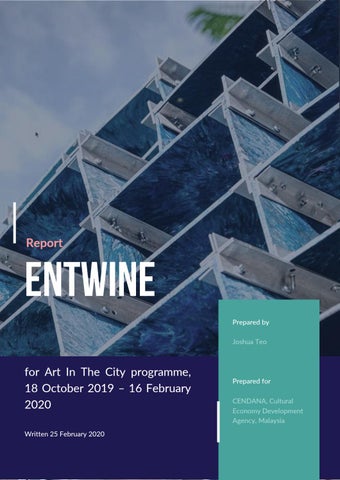
Report
Prepared by Joshua Teo
for Art In The City programme, 18 October 2019 – 16 February 2020 Written 25 February 2020
Prepared for CENDANA, Cultural Economy Development Agency, Malaysia
Report
“The art is made of recycled plastic, drawing attention to our need to be vigilant in our consumption. Good things cycle back…” – Hoffman, 21 Oct 2019
Background Entwine is an installation art project fully funded and commissioned by CENDANA, the Cultural Economy Development Agency under the programme Art In The City 2019. Curated by Snow Ng, the programme also features two other installations along the River of Life, Kuala Lumpur. These installations are Filamen’s Wayang Tube and Pamela Tan’s Dome of Disappearance. In addition to the fabrication of the installation itself, Entwine hosted a workshop for the public and a charrette for designers. Concept Inspired by the confluence of the Klang and Gombak rivers, Entwine is a sculpture of two masses merging into one. Driven by his fascination in algorithmic thinking and all things cutting edge, Teo employs the use of technology fused with his understanding of the built environment to convey his artistic narrative in response to the environmental concerns of our city -- in addressing Kuala Lumpur’s waste management problems. About the Artist
Trained as an interior designer, Joshua Teo (b. 1995, Kuching, Sarawak) also has experience across other disciplines, such as linguistics, architecture, music, and debating. He completed his degree in interior design with a minor in linguistics from Taiwan’s Chung Yuan Christian University in 2018. He has received numerous awards for his work, including the Asia Young Designer Award in 2018 and 2017, the Future is Now Award in 2017, and the Decor House Design Award in 2016.
“The River of Life project aims to cleanse and beautify Klang River and its surroundings.” – Kuala Lumpur City Hall
Overall Objective In conjunction to River of Life’s overall objective, Entwine is an installation made of recycled plastic panels to address the issue of waste management in Kuala Lumpur. Through this artistic approach, Entwine hopes to educate people on waste and help them realise the beauty of recycled plastic. In addition to the fabrication of the installation itself, Entwine hosted a workshop for the public and a charrette for designers.
An open event aiming at design and architecture related practitioners and students who are interested to experience at first hand working plastic, whilst at the same time enhancing their knowledge of waste management through working with experts. Throughout the charrette, designers discussed and did research and development on how we can use plastic as a design material. They then produced physical prototypes on art, construction material, and conceptual designs.
Details: Date: 19, 20 October 2019. Time: 2pm-5pm. Venue: River of Life Guiding Gallery. Participants join workshops on a rolling basis; approx. 45mins per session Participants are encouraged to share their experience on social media
On the first day, participants were taught how to use three of the machines that Sea Monkey provided. Nicholas Ng, an architecture lecturer then led the charrette participants around the old town KL area, which provided meaningful insights and ideas as to how we could produce meaningful designs. On the second day, participants quickly brainstormed ideas with architect Pamela Tan. On the third and fourth days, participants went to Sea Monkey’s studio to work on the products. 6 designers and 3 students attended the workshop, with 4 mentors and facilitators. Altogether there were 5 prototypes produced. 25 attended the final showcase.
Details: Date: 19, 20 October 2019. Time: 2pm-5pm. Venue: River of Life Guiding Gallery.
The Sea Monkey Project and is committed to help solve the plastic pollution issue by facilitating in plastic waste education and upcycling workshops. Throughout the workshops, participants were educated on how to deal with plastic waste – MINIMIZING! Participants learned how to sort out plastic materials, use the plastic injection machines, post production; and left with their own souvenir turtle necklace made from plastic trash collected from oceans, beaches, gardens and intercepted from restaurants, schools etc. More than 70 from the public attended the workshop was therefore upskilled with basic knowledge of plastic reusing, and over 150 people visited the exhibition. Viewership from personal posts reached 4513+, whereas public posts reached the thousands. Overall Statistic of
Charrette and Workshop
Participants join workshops on a rolling basis; approx. 45mins per session Participants are encouraged to share their experience on social media
0
100
200
Workshop Charrette Overall Turnout Viewership Public Viewership
300
400
Exhibition Showcase Personal Posts Public Posts
500
“We really love your proposal and we want to support artists to make different art through plastic” – BOPE, 2019
Overview In general, the creative industry is very generous and keen to collaborate when it comes to helping another artist grow and thrive. With the support of governmental cultural economy organisations such as CENDANA, an artist is seemingly catapulted further with less effort, i.e. there are less obstacles an artist has to endure. Finding groups that have a common goal and developing different networks are also key to a successful art programme.
Workspace ME.REKA is a spacious co-working space that is free of charges. We fully utilised their fabrication studio and their tools fit for construction and pre-fabrication, mostly cutting the plastic tiles to shape. The glass buildings that DBKL offered were also essential as they offered electric source, space for exhibition and workshop, and shade from the sun. Contractors
The concrete base, cross-brackets and steel structure were done by three separate contractors, who delivered on schedule. However, there were some margin of errors due to the time constraint, which further caused delays. Extra professional help was needed for the last three days of production, or Entwine could not have been finished otherwise. For structural security, the installation was modified as a contingency post-AITC. Programme & Material The Sea Monkey Project has had much experience holding public workshops. They were also eager to advise on the construction of the installation, aiding the designers in finishing their prototypes, and troubleshooting technical problems during the charrette. Bope Shop was the designated plastic tile provider from Thailand because their production was quick, high quality, and we could choose from their selection of vibrant colours, which other providers could not have done. Other Southeast Asian plastic by-product studios also provided us with their samples at a low rate. These included Indonesia’s Robries, Myanmar’s Chu-chu, and Cambodia’s Rehash Trash, and they were showcased at the exhibition throughout the campaign period. All the above partners were found on the “preciousplastic.com” website and were keen to collaborate because we all had a common goal, as shown in the Entwine proposal. Opportunities Currently in Sarawak, Teo has been approached by Rainforest Music Festival Fringe and Rainforest In The City Kuching for possible installation art commissions. Within Malaysia, connections gained included The Sea Monkey Project, The Arts Seni, Tetawowe, Filamen, Titikbuta, and Cocoon from the creative industry for future collaborations. Other international parties that have been connected through the project are mainly from the Precious Plastic Project, which include Chu-chu, Rehash Trash, Bope Shop, and Robries. Design Network Architects, Nicolas Wong, Pamela Tan, Jeh Tat Wong, Lee Kian Lek, and Toff are several architects and mentors whom Teo has been in contact with to guide the charrette part of the programme. Over 20 new connections were gained from this programme.
Programme The festival was a one-week programme but it appeared to be a weekend event with many activities happening concurrently, which seems ineffective. It would have helped if artists were briefed on the entire AITC schedule beforehand so outreach programmes could be planned around it. Time The confirmation for the commission was delayed, and one month to create an outdoor installation was a stretch. The time frame for an installation art piece at this scale could be discussed with the project manager for future reference. Production The plastic module lacked structural strength due to its formation. This caused some of the tiles to slant due to the installation’s own weight, which was unintentional. Time and manpower needed for installation was underestimated, which contributed to working overtime. Bad weather also caused much of the delay for the installation. Effective planning and detailing by the designer could’ve resulted in a smoother installation. However, the problem was curtailed by employing more skilled force to help with the last few days for design.
Borneo Art Collective Borneo Art Collective claimed that Entwine was a plagiarism of their work Plastic Fantastic, and prevented the finishing of the art piece. Snow managed to make necessary changes to the artwork’s narrative to avoid such claims. There were no grounds in which BAC’s claim could stand, and judging from their response and reputation, it can be concluded that there shouldn’t be any legal actions from their party.
Publicity A professional photographer was invited to the photos of the artwork during the deinstallation period. This should have happened at an earlier stage of the installation so that stunning pictures of the installation can be used to create traction. There should also be better co-ordination between artist’s programmes and CENDANA as it could affect the outreach. The artist should be more proactive in terms of engaging with what was happening with the programme. Dismantling The installation was expected to be dismantled into 5 smaller parts to avoid damage during transportation. There was not much communication between the artist and the contractors beforehand, which created some confusion on-site. However, the dismantling happened with efficiency and minimal damage to the installation. Charrette A restructuring was necessary for the installation, which then led to the postponement of the charrette. Nine participants attended the charrette, which was well within the intended number, and they produced seamless designs. However, both invited judges cancelled last minute and the turnout was minimal. This could be because of the heavy downpour and that the showcase is well over the campaign period. Also, the results of the showcase were more educational and required more professional knowledge, which was less engaging to the audience. The charrette succeeded in upskilling participants; the showcase less so in reaching a wider audience. DBKL There was an assumption from the artist and project manager on what DBKL could provide (tools, manpower, and structure), which turned out to be quite damaging to the installation process. In general, DBKL was quite reluctant to realise artist’s needs, as were they riddled with bureaucracy. It was then also difficult to collaborate with them, as things needed to happen swiftly onsite, yet they were stuck in uncertainties. The confusion also came from the lack of definition of the relationship between artist and the government agency. This was successfully counteracted by CENDANA’s funding and the contractors’ willingness to work overtime to finish the installation.
All 3 selected submissions artistically and conceptually complimented each other. The art pieces gained so much traction, because they exhibited cutting-edge technology, and was thus appreciated by the public. The process of making the pieces was as interesting to the public as the final product itself. Public artwork, however, should always be designed around “people”, because the sculpture is for the public to view/ touch/ interact and should have been factored into all the parameters that come with public behavior, which was lacking in Entwine.
Snow has been an invaluable addition to AITC. Pre-confirmation of the commission, Snow was very persistent about the concept and philosophy behind the artwork, which was very important and it gave the art much more meaning and value. During the installation process, she also managed to resolve multiple issues such as BAC’s plagiarism claim, managing fabricators, suggesting workshop facilitators, and even managed to pre-empt and solve some of the structural issues for my installation. Her professional experience and connections really showed. Having Ellen onsite throughout the entire installation process was also very helpful as problems got solved quickly. Art In The City 2019 was, by all means, a successful event because it was not conservative in terms of artwork selection. In fact, it displayed a variety of art forms which could then generate public discourse and criticism. AITC created a haven and a platform for artists to thrive and make meaningful connections. Post event: There are several entities interested in engaging further in Entwine. Rainforest Fringe Kuching has shown interest in bringing the artwork to be exhibited in Kuching, and is also hoping to bring the programmes back to Kuching for public awareness on plastic. DBKL on the other hand, is interested in purchasing the installation. The artist hopes the installation to reach as many audiences as possible post-AITC.