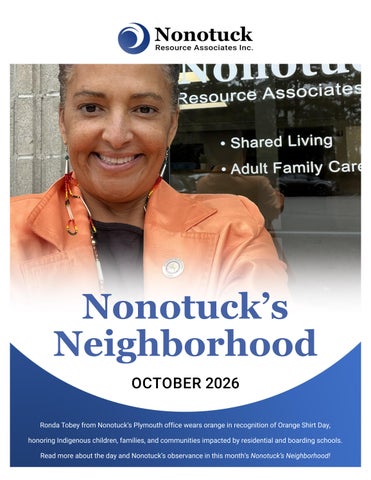
Nonotuck’s Neighborhood OCTOBER 2026 Ronda Tobey from Nonotuck’s Plymouth office wears orange in recognition of Orange Shirt Day, honoring Indigenous children, families, and communities impacted by residential and boarding schools. Read more about the day and Nonotuck’s observance in this month’s Nonotuck’s Neighborhood!
etter ro eischner
eorge
Dear riends, This month, I m pleased to share a new article I ve written, "Has Nonotuck Gotten Too Big?". It s a uestion worth asking, particularly as our organi ation continues to grow, supporting more and more people across assachusetts. I reflect on how we can preserve the personal relationships, local connections, and commitment to each person that have defined Nonotuck for decades. This article is part of a new series of O Perspectives that I m sharing both internally and e ternally. Through these reflections, I hope to encourage thoughtful conversations about our mission, our values, and the responsibilities we share as an organi ation. ou ll also find the third installment of our series on Nonotuck and DDS Licensure, "The People." hile licensure involves important standards and safeguards, this article reminds us that the true measure of our work is the uality of life for the people we support, and ensuring that they live the lives they envision for themselves. Our commitment to community and belonging also e tends beyond the services we provide. In recognition of ispanic atin eritage onth September October , we re highlighting Hispanic- and Latinx-owned businesses throughout Massachusetts. Supporting these businesses is one meaningful way to celebrate the diverse cultures, contributions, and relationships that enrich the communities we call home. inally, we recogni e Orange Shirt Day, an occasion to honor Indigenous children and families affected by residential and boarding school systems by wearing orange. Nonotuck staff rose to the occasion, and are still encouraged to send pictures of themselves wearing orange to oshua urray murray@nonotuck.com . Thank you for being part of the Nonotuck community and for the many ways you help bring our mission to life. I hope you en oy this month s stories and the opportunities they offer for reflection and connection. arm regards, eorge . leischner President O Nonotuck Resource ssociates
ers ecti es s Nonotuck otten oo ig by eorge . leischner, Nonotuck President Someone asked me the other day
O
as Nonotuck gotten too big
I think this is a very good uestion, and it is actually one that we discuss internally uite a bit. s Nonotuck began to grow, one of the uestions we asked ourselves was ow do we grow while staying small Or, perhaps more accurately, how do we carry the best ualities of being a small organi ation into a much larger organi ation or me, that uestion has always been less about numbers and more about relationships. I don’t think si e itself is the danger. The danger would be becoming distant from the people we support, their families and caregivers, becoming bureaucratic, losing our values, or allowing growth to become more important than the uality of someone’s life. That is something I think we must continually guard against. One of the ways we have done that is through the way we’ve intentionally structured Nonotuck. Rather than creating one large, centrali ed organi ation, we built offices across the state that operate with a great deal of local identity and independence. The people working in those offices live in those communities. They know the people we support, their families and caregivers, the local DDS staff, and the communities in which people live. In many ways, each office feels like a small local organi ation that is supported by the resources and infrastructure of a much larger organi ation. In fact, families are sometimes surprised when they learn how large Nonotuck is because their e perience of Nonotuck is primarily through their local office and the people they know there. I think that is a very good thing.
ers ecti es s Nonotuck otten oo ig I have said for years that we grow one person at a time. I mean that uite literally. rowth should never become an abstract organi ational ob ective. very new person we support is a person whose life we need to know, whose relationships matter, whose choices matter, and to whom we are making a commitment. If we ever reach a point where growth interferes with our ability to make and honor that commitment, then I would be concerned that we had become too big. hen I look at our growth today, I don’t see that happening. In , Shared iving had a net increase of people. Spread across the state, that is roughly two additional people per office, and we added the statewide sum of two case managers to support that growth. dult amily are grew by people, and we added two case managers and two nurses. To me, that is moderate, manageable growth. rowth has also helped us do important things for the people who work at Nonotuck. It has been an important part of our ability to provide more than consecutive years of across the board wage increases or bonuses and more than consecutive years of profit sharing. In alone, we had internal promotions. I find that remarkable. rowth creates opportunities for people to build careers here, take on new responsibilities and continue contributing to our mission in new ways. nd perhaps this is a little Nonotuck centric, but I also think we must consider the other side of the uestion. If we were to stop or significantly slow our growth simply because we had reached a certain si e, we would also be saying no to people who could benefit tremendously from what Nonotuck provides. I would have difficulty ustifying that if we still have the capacity to support people well. ut capacity cannot simply mean having enough staff, offices, or financial resources. The more important uestion is whether we still have the capacity to care deeply about each person. That is why our recent R and DDS reviews were so meaningful. oth reviews were incredibly positive. The reviewers appreciated our staff, our structure, and our mission and values. ut what stood out most to me was their recognition of how much we knew of and cared about each person we support.
ers ecti es s Nonotuck otten oo ig That, more than anything, answers the uestion for me. If an organi ation can grow and still know the person, really know the person, then growth and personal relationships do not have to be in conflict. The uestion I want us to keep asking is not simply, ow big is Nonotuck It is Do we still know the people we support re we still close to their families and caregivers re decisions still being made with the uality of people’s lives as our priority Do our local offices still feel local an people reach us when they need us re we still listening re we still willing to look critically at ourselves when something isn’t working nd, most importantly, are we still the organi ation we said we would be Today, I believe the answer to those uestions is yes. That doesn’t mean we should ever become complacent about growth. In fact, I think the larger we become, the more intentional we must be about protecting what made Nonotuck special when we were small. e must continually resist unnecessary bureaucracy. e must keep authority and relationships close to the communities we serve. e must make sure our systems support relationships rather than replace them. nd we must remember that organi ational growth is never the ultimate measure of our success. The life of the person we support is. I don’t believe there is a particular number at which Nonotuck suddenly becomes too big. I think we become too big when our si e begins to interfere with our ability to know people, care about them, honor their lives, maintain and develop authentic relationships, and stand by them for as long as they choose us. That is the line I would never want us to cross.
Nonotuck nd rt he eo
icensure e
In previous installments part and part , we discussed the intensive preparation that goes into assachusetts Department of Developmental Services DDS licensure and how Nonotuck staff come together to carry out the process every two years. It’s that holistic approach encompassing staff across the organi ation and touching virtually every aspect of the Shared iving e perience that allows Nonotuck to continually refine and improve its services. These elements are crucial to understanding licensure at Nonotuck. ut what about the people most directly impacted by it ow does the licensure process affect the lives of the people Nonotuck supports s ice President of uality nhancement, astern Services Doug atts puts it, licensure re uirements establish foundational conditions safe housing, appropriate medication management, financial protections, access to food, protection of rights and other safeguards. Once those are secure, the people Nonotuck supports have a stronger foundation from which to pursue relationships, work, community involvement, valued roles and other things that make their lives meaningful. t Nonotuck, everything’s about uality of life. That’s what we want to work with people to achieve their highest level of uality of life, as dictated by them and supported by us. verything in licensing is sort of the foundation. It’s that beginning level, Doug says. rom there, he e plains, the people Nonotuck supports can pursue the things that make them happy. ou’re working with people on what they want to do with their lives, where they want to go, what they want to be their valued roles in the community, being part of a family, who they want to spend time with. ou can’t have that without those foundational licensing pieces being in place, he says. ut the licensure process doesn’t stop at establishing that foundation. It also looks at whether those safeguards are helping create genuine opportunities for people to direct their own lives.
Nonotuck nd rt he eo
icensure e
They really want to see that people have voice and choice in their life that there is a platform for people to pursue areas of their life that they want to pursue, says ice President of uality nhancement, entral est rayson leischner. icensure also creates opportunities for Nonotuck teams to take a closer look at the everyday details of a person’s support. s documented in part two of this series, the licensure process involves a thorough e amination of records, medication management, financial documentation and home safety. Program Director Dylan ukowski of the uburn office described this process as a chance to reflect not only on what is working, but on what might be improved. In some cases, that closer e amination has uncovered issues that might otherwise have been easy to overlook. icensure keeps us honest in our work, which makes the uality of care even better. It holds us accountable, it holds providers accountable, and it helps make sure everyone is doing their role in supporting the person, he says. If we’re not pointing out our flaws to make things better, then how are we helping that person grow and supporting that person Dylan shares the story of a person supported by the uburn office whose financial records revealed a recurring monthly e pense. fter investigating, the team discovered the e pense could be covered by insurance, freeing up money for something more meaningful to the person in this instance, attending a baseball game. Other discoveries have involved more immediate health and safety concerns. t one home, preparation for licensure revealed that the correct smoke detectors were not in place, while a visit immediately before the audit identified a water temperature problem following work by the landlord. oth issues were corrected. ice President of Residential Services, astern Region aimie Doucette offers another e ample of how the licensure process can provide an outside perspective, challenge previous assumptions and lead to better outcomes for the people Nonotuck supports.
Nonotuck nd rt he eo
icensure e
woman Nonotuck supports had moved to the first floor while recovering from surgery for a broken bone. The team initially viewed the arrangement as temporary because they were concerned she would become isolated from the other people in the home, who typically spent time together upstairs. Their goal was to move her upstairs again as soon as her mobility allowed. During licensure, however, the DDS surveyor challenged that assumption. In practice, the rest of the household had changed its routine. Instead of gathering upstairs, everyone was coming downstairs to spend time with her and aimie says the woman en oyed the company. That prompted the team to reconsider whether returning upstairs was actually the best outcome. Staying downstairs reduced the physical demands on her while preserving the social connection they had been worried about losing. ltimately, she remained where she was most comfortable not isolated from the household, but very much a part of it and surrounded by others. It caused the team to look back and say, ell, this is really a good thing that we’ve set up here.’ It took licensure and the survey to really analy e not ust the health and safety risk, but the benefits of maintaining this temporary solution, maybe permanently, because it turned out to be such a great thing, aimie says. Not every improvement that comes out of licensure is dramatic. Taken together, these e amples demonstrate why licensure matters beyond the regulations themselves. The standards provide the foundation Doug describes, but the process also creates opportunities to ask whether the supports built on that foundation are actually helping people live the lives they choose. icensure is not simply an e amination of whether re uirements have been met. It is an opportunity to look closely, listen, reflect and make life better for those we support. it
hat happens when the DDS licensur process is complete, and what can we learn from heck back in for part of our DDS icensure series.
ho tin usinesses in
is nic ned ss chusetts
ispanic atin eritage onth is a time to celebrate the rich cultures, histories, and contributions of ispanic and atin communities. Observed from September to October , the month offers an opportunity to recogni e these communities and their contributions by supporting ispanic and atin owned businesses throughout assachusetts. hether you’re looking to try a new restaurant, discover a local shop, or support a business in your community, find your new favorite spot on the list below
S
MO
Nonotuck e ebr tes hirt ’
r nge
September marked the National Day for Truth and Reconciliation in anada and Orange Shirt Day, a day of recognition and remembrance of Indigenous children, families, and communities impacted by residential and boarding school systems in anada and the nited States. Nonotuck invited staff to wear orange in recognition of this important day, and theres still time to participate Staff who wore orange or would still like to take a photo wearing orange are encouraged to submit photos for a Nonotuck social media post. nderstanding the History or generations, Indigenous children in both anada and the nited States were separated from their families and communities and sent to residential or boarding schools. These systems sought to assimilate Indigenous children by separating them from their cultures, languages, traditions, and ways of life. In anada, federally run residential schools operated between and . In the nited States, the Department of the Interior has identified federal Indian boarding schools that operated across states or then territories. The .S. investigation found that federal policies deliberately separated Indigenous children from their families and sought to assimilate them, causing lasting and intergenerational harm to merican Indian, laska Native, and Native awaiian communities. any children e perienced abuse and mistreatment, and many never returned home. cknowledging this history and listening to the e periences of Survivors, their families, and their descendants is an important part of remembrance, truth, and healing. bout Orange Shirt Day Orange Shirt Day began in illiams ake, ritish olumbia, in as a grassroots initiative honoring Residential School Survivors, their families, and the children who never returned home. lthough the movement began in anada, wearing orange has also become a way for Native communities and others in the nited States to raise awareness of the history and legacy of Indian boarding schools. The orange shirt symboli es the loss of culture, freedom, and self esteem e perienced by Indigenous children and serves as a reminder that very hild atters.
Nonotuck e ebr tes hirt ’
r nge
Share our Orange Shirt Day Photos earing orange is a simple way to participate in a larger commitment to listening, learning, acknowledgment, remembrance, and respect. Nonotuck sta are encouraged to submit photos o themsel es and their colleagues wearing orange, e en i the photos were taken a ter September . Photos can be sent to oshua social media post.
urray at murray@nonotuck.com for inclusion in an upcoming Nonotuck
Thank you to everyone who participated in Orange Shirt Day and continues to help foster a community rooted in respect, understanding, healing, and belonging.
S
MO
ork
nni ers ries
ear o Ser ice a aya Smith Reid, Direct Support Professional, erry Street, asthampton, Daniel herival, Direct Support Professional, erry Street, asthampton, Imani illiams, Direct Support Professional, rockton, Sharon aflamme, are anager, uburn, ears o Ser ice le andra Str elewic , Registered Nurse, uburn, Olivia oncalves, Direct Support Professional, rockton, ears o Ser ice Susan itkowski, are anager, uburn, hristine inley, Registered Nurse, Plymouth, Natalie Rossoshanskiy, Program dministrative ssistant, erry Street, asthampton, rista Spencer, ccounts Payable ssociate, Prospect Street, Northampton, ngela Todisco, ssistant Program Director, uburn, ears o Ser ice handara hhit, are anager, rockton, ac ueline awes, Direct Support Professional, erry Street, asthampton, eanne c arthy, Registered Nurse, uburn, atharine ones, Registered Nurse, erry Street, asthampton, Tania Roy altha ar, Registered Nurse, rockton, ears o Ser ice Ra uel llah, Program Director, ynn, rendan arlson, are anager, uburn, onstance arris, Direct Support Professional, ee, anikol Ouk, ssistant Program Director of N Services, owell, isa Reno, Program Director, uburn, ears o Ser ice hristopher Sealy, Direct Support Professional, Plymouth, David un, are anager, owell, ears o Ser ice Ryan aw, Director of inance, Prospect Street, Northampton, bou anneh, Direct Support Professional, uburn, ears o Ser ice Tracy runo, are anager, ee, Saoling hhit, P of Northeast Region, owell, essica eeks, sst. RN uality oordinator, rockton, Danielle onroy, Registered Nurse, rockton, Su anne Robichaud, Placement Specialist, uburn, ears o Ser ice essica Schram, Program Director, ee, arie erdieu, Registered Nurse, rockton, ears o Ser ice Serah uiruri, linician, uburn, ears o Ser ice errie Paradis, Program Director Special Pro ects, uburn, ears o Ser ice Sandy Deare Robinson, Director erkshire Day Services, ee,
Nonotuck’s Neighborhood No
iring
PPL TOD
ike E
h t ou re d
Murray@nonotuck.com
FOLLOW US ON: CEBOO
T
R
O T BE
DON T TOD
nonotuck.com
E