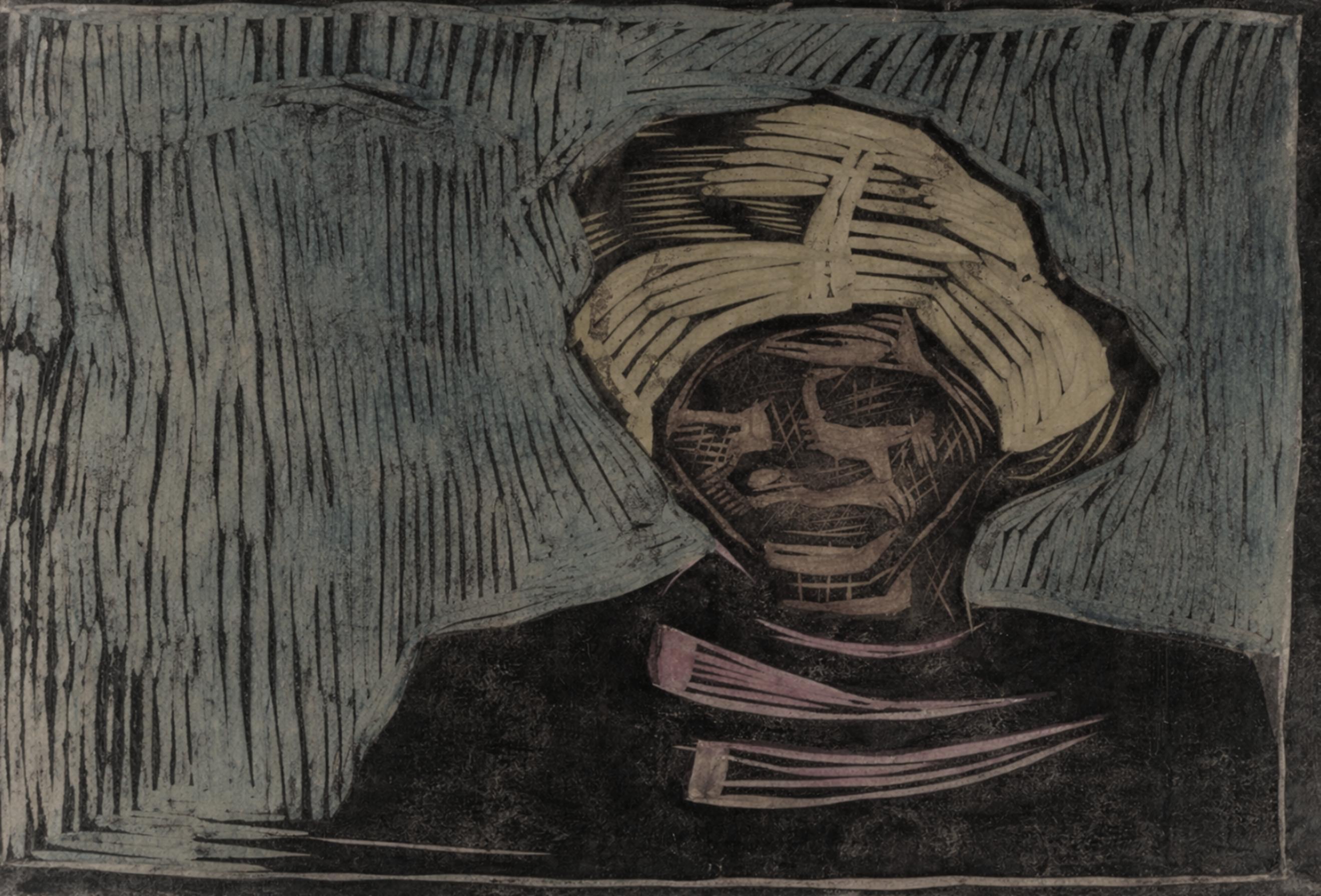

ThisdigitalarchivepresentsacomprehensivesurveyofWilliamH. Johnson’sblockprints,bringingtogetherworksproducedbetweenc. 1932and1944thatarenowdispersedacrossmuseums,public institutions,andprivatecollectionsintheUnitedStatesandScandinavia. DedicatedspecificallytoJohnson’sworkinwoodcutandlinocut,the projectdocumentseachprintwithcloseattentiontoprovenance, exhibitionhistory,andrelevantscholarlyreferences.
ByconcentratingexclusivelyonJohnson’sblockprints,thearchiveoffers amorefocusedunderstandingofhisengagementwithprintmakingas bothatechnicalpracticeandapowerfulmeansofexpression.Hisscreen prints,whichbelongtoadistinctphaseofhisartisticproduction,are thereforenotincludedandwillinsteadformthesubjectofaseparate futurestudy.Thisdistinctionallowsforamorepreciseexaminationof thematerialprocesses,formalexperimentation,andexpressivequalities thatcharacterizeJohnson’sworkinwoodcutandlinocut.
ConceivedasafreelyaccessibledigitalresourcebyØbroKunsthandel, Copenhagen,thearchiveisintendedtoserveresearchers,artists,and scholars.Asanevolvingplatform,itnotonlyconsolidatesexisting knowledgebutalsosupportsongoingresearchandtheidentificationof previouslyundocumentedworks.
Ultimately,thisarchiveisguidedbytheconvictionthatWilliamH. Johnson’sgraphicworkmeritssustainedscholarlyattentionandbroader recognition.Itishopedthatthisresourcewillsupportongoingresearch andencouragefuturegenerationstoengagewithJohnson’sworkin meaningfulandlastingways.
Collectors,institutions,andindividualswithknowledgeoforaccessto blockprintsattributedtoWilliamH.Johnsonarewarmlyinvitedto contributetothisongoingarchive.Suchparticipationisessentialtoits broaderaim:topreserve,document,andpromoteJohnson’slegacyasa printmaker.Contributionsmayincludeinformationonindividualworks, provenancedetails,orimages,allofwhichhelpbuildamorecomplete andaccuraterecord.Allinformationregardingownershipwillbetreated withtheutmostdiscretionandmayremainconfidentialuponrequest.
ThankyouforsupportingthisefforttoensurethatJohnson’swork continuestoberecognized,studied,andappreciatedbyfuture generations.
Sincerely,
JosephineRydeng
ØbroKunsthandel,Copenhagen,Denmark
WhatsApp:+4523234938
Email:rydengjosephine@gmail.com
Instagram:@j.l.rydeng
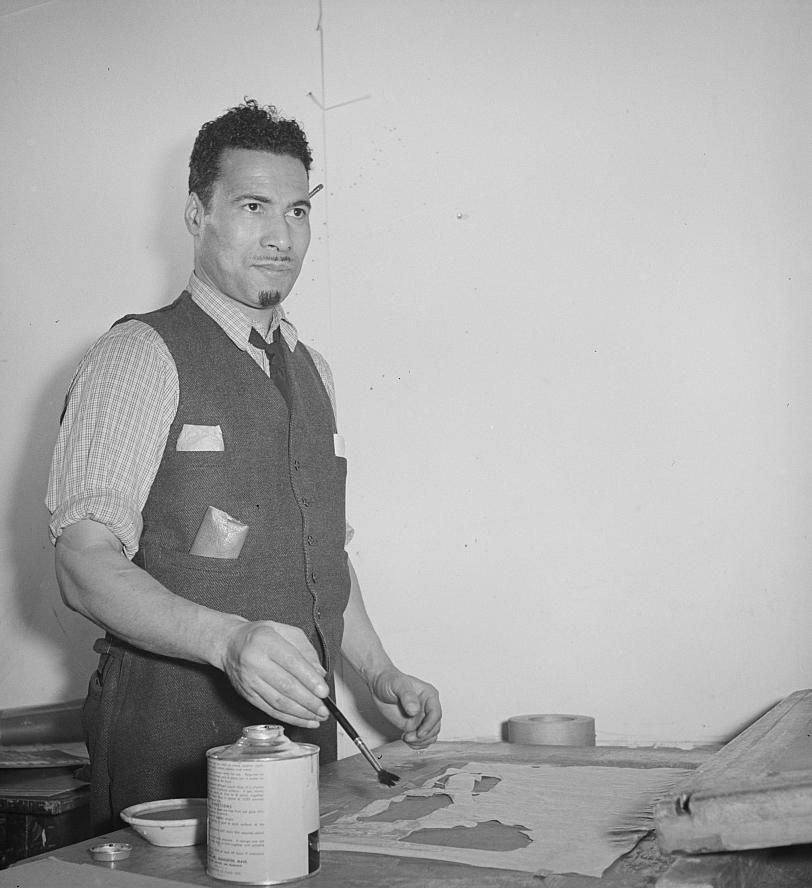
WilliamH.Johnson(1901–1970)wasanAmericanpainterand printmakerwhoseworkisdistinguishedbyvividlandscapes andasustainedengagementwiththelives,struggles,and resilienceofeverydaypeople.BorninFlorence,South Carolina,JohnsonspentformativeyearsinEuropebetween approximately1926and1939,particularlyinScandinavia, wherehisartisticlanguageevolvedtowardamoreexpressive modernistidiom.FollowinghisreturntotheUnitedStatesin 1939,hedevelopedthebold,flattened,andhighly expressive,folk-inspiredstyleforwhichheisbestknown today.In1947,Johnsonsufferedapsychiatricbreakdown causedbysyphiliticparesisandwassubsequently institutionalized,effectivelyendinghisartisticcareer.He spentthefinaltwenty-threeyearsofhislifeatCentralIslip StateHospitalonLongIsland,wherehediedin1970.
AlthoughJohnsonregardedhimselfprimarilyasapainter,hisblockprintsrepresentsomeofhis mostoriginalandinnovativework,despiteremainingcomparativelyunderstudied.Entirelyselftaughtasaprintmakerandworkingwithoutprofessionalequipment,Johnsoncarvedhisblocks oftenfromscrapwoodusingstandardpocketknivesandsimplecarvinggouges.Heregularly inkedtheblocksdirectlywithapaintbrushandprintedimpressionsbyhand,transferringthe imagebyfirmlyburnishingthebackofthepaperusinghispalmorthebackofaspoon.Johnson alsoindividuallyhand-coloredmanyimpressions,applyingcolorbeforeorafterprintingsothat eachpullbecameadistinctvariant.Asaresult,notwoimpressionsareidentical;evenwhen printedfromthesameblock,subtledifferencesinpressure,inking,andcolorapplicationensure thateachworkexistsasauniqueobjectratherthanpartofastandardizededition.
Whilesomeblockprintsappeartotranslatepaintedcompositions,perhapsextendingthereach andaccessibilityofhisimagery,othersseemconceivedspecificallyforthewoodblock,wherethe rawgraphicforceofcarvingenabledeffectsnoteasilyachievedinpaint.Thisdirectengagement withthemediumrevealsJohnson’ssensitivitytomaterialandprocess,aswellashisdeep understandingoftheexpressivepossibilitiesofline,contrast,andsimplifiedform.Together,the printsdemonstratehismasteryofprintmakingasanindependentartisticdisciplineratherthan merelyareproductivetechnique.
Duringthelate1930s,Johnson’sprintmakingenteredanewphaseoftechnicalandformal experimentation,shapedinpartbyhisaccesstoprofessionalfacilitiesattheHarlemCommunity ArtCenter,wherehetaughtbetween1939and1942.Duringthisperiod,hebeganworkingwith linoleumratherthanwood,ashiftthatallowedforfiner,moreintricatelinesinhisblockprints. Healsoadoptedscreen-printingtechniques,includingpochoir,producingimageswithamore painterlyandvariedcharacter.Manyoftheseprintswerefurtherenhancedbyhand,resultingin subtlevariationsthatmakeeachimpressionunique.
Incontrasttohispaintings,whichcanbemorereadilyorganizedaccordingtostylistic development,Johnson’sblockprintsresiststrictchronologicalclassification.Ratherthan followingalinearprogression,theyrevealafluidanditerativeapproachinwhichmotifsand expressivestrategiesarerevisitedandreworkedacrossdifferentmomentsinhiscareer.This flexibilityunderscoreshisexperimentalengagementwiththemediumandhiswillingnessto adaptformandtechniquetoshiftingartisticconcerns,ultimatelyhighlightingacreativeprocess definedbyinnovationratherthanrigidperiodization.
AsJohnsonneverdatedhisworks,establishingaprecisechronologyofhisartisticproduction remainsinherentlychallenging.Withinhisgraphicoeuvre,theearliestidentifiableexampleisa black-and-whiteself-portraitreproducedonthecoverofthecatalogueforhisexhibitionatthe ChristianLarsenArtGalleryinCopenhageninApril1933,confirmingthattheprintwasproduced nolaterthanthatdate.
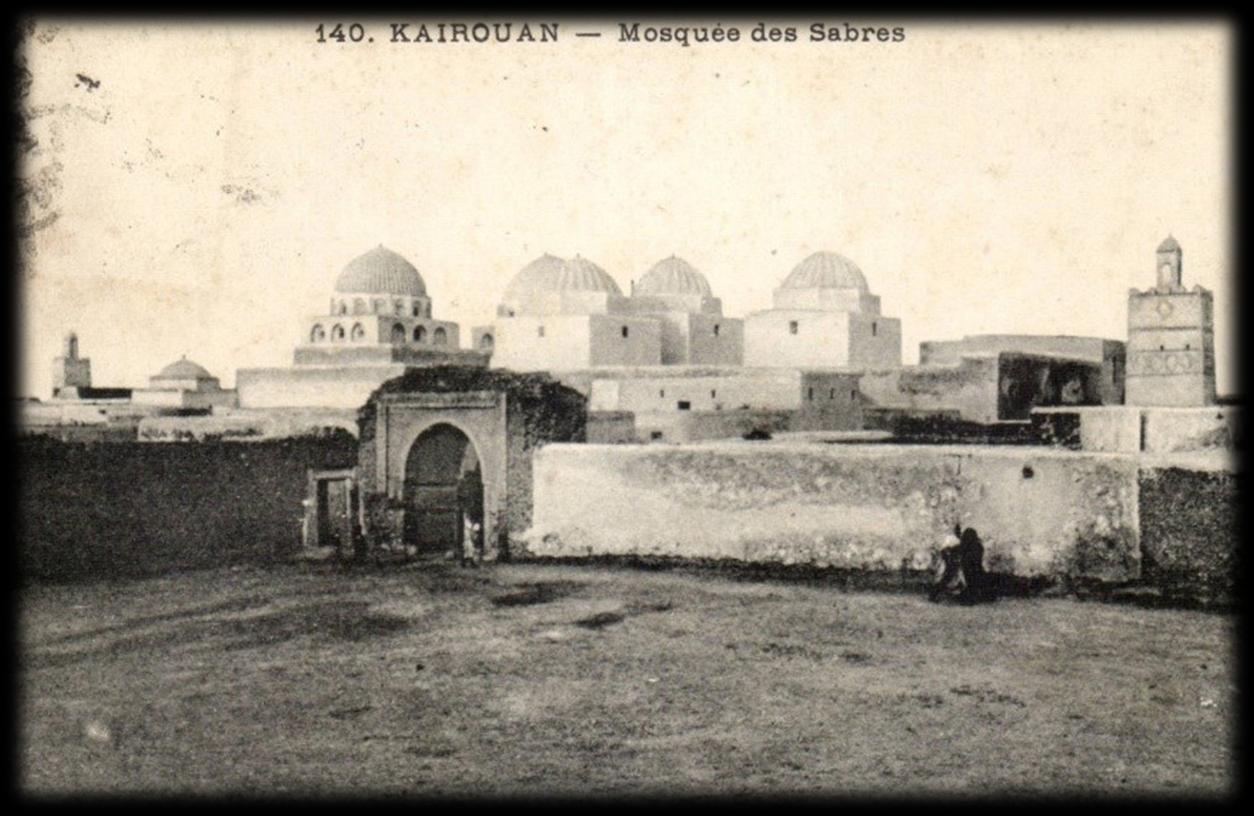
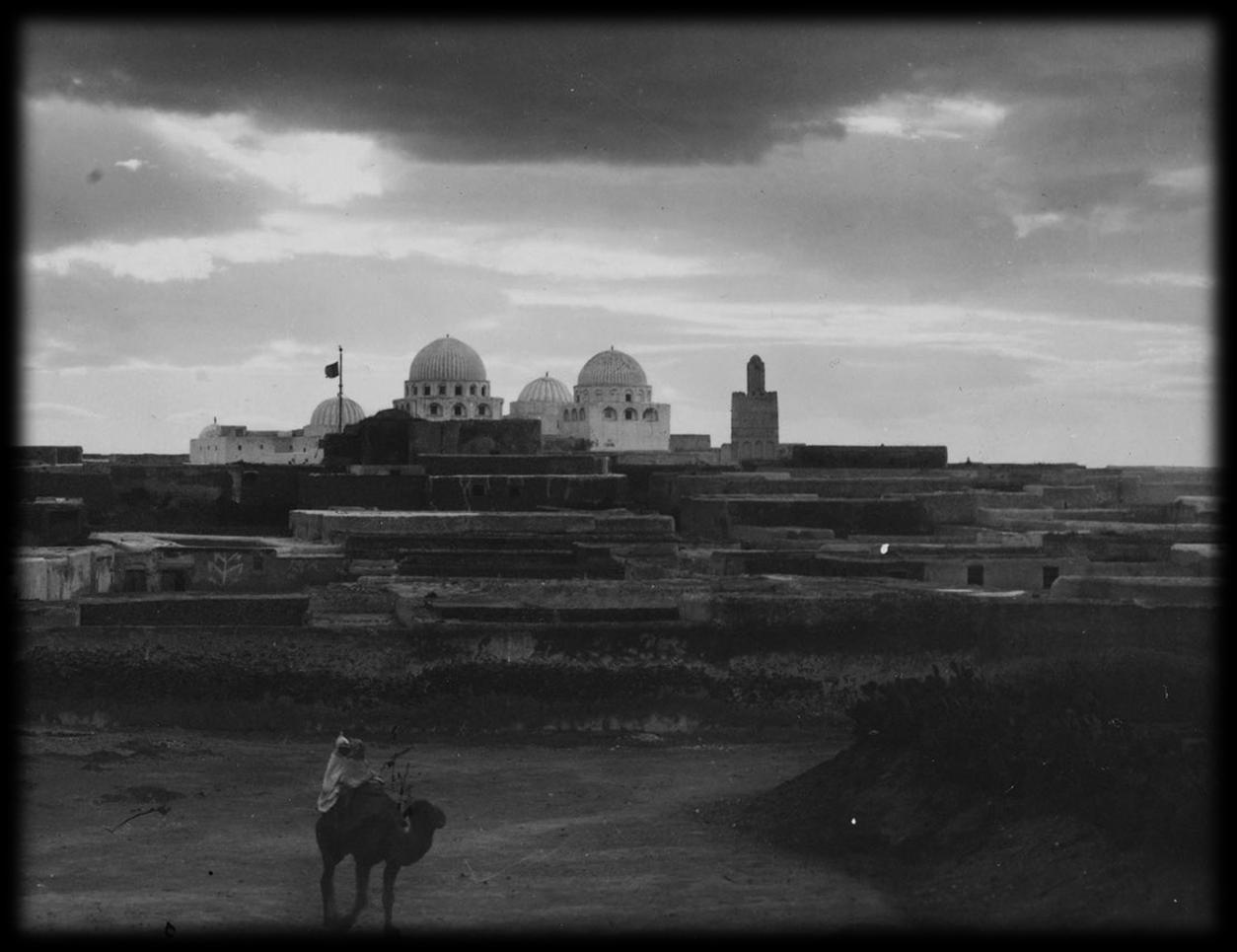
Johnson’sinitialengagementwithblockprintinglikelybeganaround1932,followingathreemonthstayinTunisia,NorthAfrica.Duringthisperiod,heproducedawoodblockprintofthe MosqueoftheSabresbasedonawatercolorexecutedduringhistravels,markingoneofthe earliestknowninstancesinwhichhetranslatedapaintedcompositionintoreliefprint.
Theyear1932alsomarkedthebeginningofJohnson’sexperimentswithceramicsandpottery, worksthatwerefirstexhibitedatthelocallibraryinKertemindeinOctoberofthatyear.Both woodcutandceramicsappealedtoJohnsonthroughtheirdirect,tactile,andmaterially expressivequalities.Afinishedwoodcutoftenpreservestheroughtextureofthewoodgrain, visiblegougemarks,andaccidentalslipsofthecarvingtool,justasahand-builtceramicvessel retainsfingerimpressions,scrapemarks,andunevenglazedrips.Inbothmedia,thephysical processofmakingremainsvisiblyembeddedwithinthefinalobject.
Johnson’ssimultaneousexplorationoftheseraw,hands-onmediumssignificantlyshapedhis artisticdevelopmentduringtheearly1930s,encouraginganincreasinglydirectandmaterial approachtoform,surface,andexpressionthatwouldbecomecentraltothevisuallanguageof hislatergraphicwork.
WilliamH.Johnson’syearsinEuropebetween1926and1938provedformativefor thedevelopmentofthegraphiclanguagethatwouldcometodefinehiswoodcuts. ImmersedintheartisticenvironmentsofFrance,Germany,Denmark,andNorway,he encounteredGermanExpressionismandScandinavianfolktraditions,bothofwhich becamecentraltohisevolvingvisualvocabulary.HisunderstandingofExpressionism waslikelydeepenedthroughhisrelationshipwithhisDanishwife,HolchaKrake,and herbrother-in-law,theGermansculptorandgraphicartistChristophVoll,a prominentfigureintheDresdenavant-gardeassociatedwiththeDresdnerSezession Gruppe1919andtheso-calledsecondgenerationofGermanExpressionists.
ThroughKrake,JohnsonwasintroducedtoNorthernEuropeanfolkartand vernaculartraditions.Herownworkdemonstratedaremarkableabilitytopreserve age-oldcrafttechniqueswhilesimultaneouslyengagingwiththeavant-garde currentsofDresdenandBerlin.Theseclosepersonalandartisticconnectionsbrought JohnsonintocontactwithimportantdevelopmentsinGermanmodernismand encouragedanapproachgroundedinsimplification,expressiveform,andemotional directness.
PriortomeetingKrakeandVollinCagnes-sur-Merin1929,Johnson’sunderstanding ofmodernartappearstohavebeenshapedlargelybyParisianmovements. Followingthisencounter,however,hisartisticoutlookbroadenedtoencompassthe majorcentersofGermanmodernism,Berlin,Dresden,andMunich,aswellasthe workofartistssuchasKarlSchmidt-Rottluff,ErnstLudwigKirchner,OskarKokoschka, andErnstBarlach.Theraw,improvisational,andoftenprimitivizingcharacteroftheir woodcutsfindsparallelsinJohnson’sowngraphicpractice,particularlyinhis expressivecarving,simplifiedforms,andemphasisonemotionalintensity.
JohnsonalsoexpressedadmirationforseveralleadingExpressionistprintmakers.Ina 1934interview,hespokeofhisdesiretovisitEmilNolde,andin1935hemetEdvard MunchinOslo,anencounterthatappearstohaveintensifiedhisengagementwith reliefprintmaking,asevidencedbyamarkedincreaseinhisproductionofblock printsthereafter.
Together,theseexperiencesdemonstratehowJohnson’sprintmakingemerged throughsustainedengagementwithEuropeanExpressionism.Yethisworkultimately resistssimplecategorization,transformingtheseinfluencesintoadistinctlypersonal visuallanguagethatbridgesEuropeanmodernism,Africandiasporicexperience,and thevernaculartraditionsoffolkart.
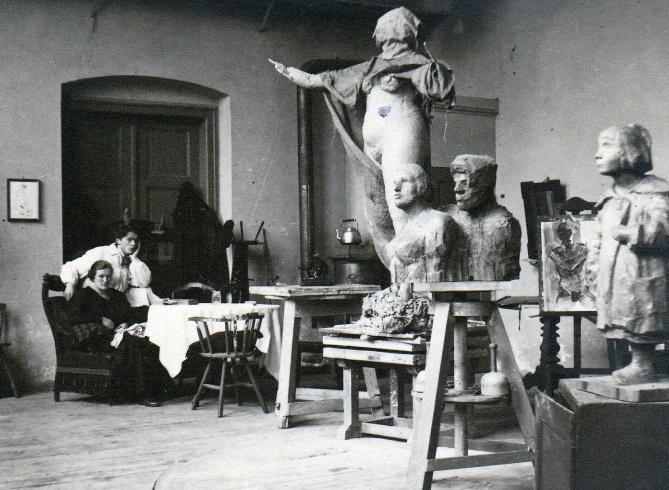
WilliamH.Johnson’smeetingwithEdvardMunchin Osloin1935,facilitatedbytheNorwegiancollector RolfStenersen,markedapivotalmomentinhis artisticdevelopment.AtatimewhenMunchwas notablyreclusive,theencounterwasespecially significant.Johnson’sconnectiontoMunchwaslater emphasizedbyhiswife,HolchaKrake,inpromoting hisworktocollectors,critics,andgalleries.Healso attemptedtoorganizeanexhibitionofMunch’s paintingsandprintsattheNierendorfGalleryin NewYorkin1938.Archivalrecordsfurtherindicate thatfollowingJohnson’shospitalizationin1947,his possessionsincludedacopyofGustavSchiefler’s EdvardMunch’sGraphicWorks(1923)andseveral printsbyMunch,likelyacquiredinconnectionwith their1935meeting,demonstratingthelasting influenceoftheNorwegianmasteronhisartistic development.
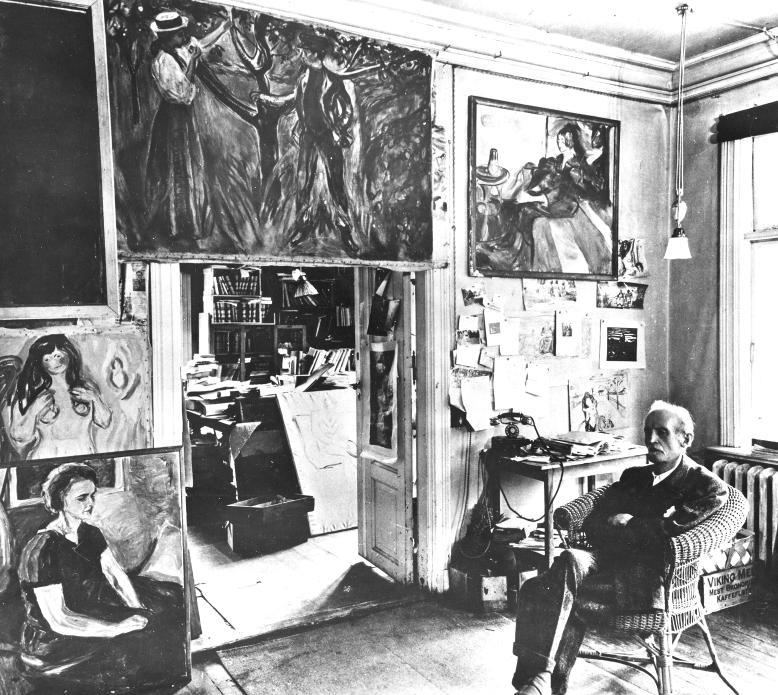
Althoughmostwidelyrecognizedforhisiconicpaintings,EdvardMunchwasalsoamongthemost innovativeprintmakersofthemodernera.Fromhisearliestprints,createdinBerlinin1894,tohisfinal worksproducedinNorwayin1944,printmakingremainedintegraltohisartisticpractice.Munch’sprints exertedaprofoundinfluenceontheemerginggenerationofGermanExpressionistartists.Characterized byroughcutting,boldcontrasts,andpronouncedwoodgraintextures,hiswoodcutsintroducedanew primitivistexpressivenessthatpowerfullyconveyedrawemotionandpsychologicaldepth.
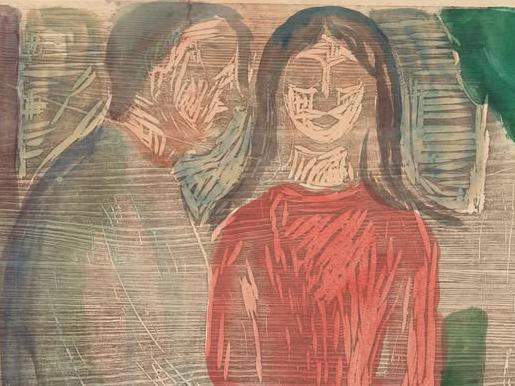
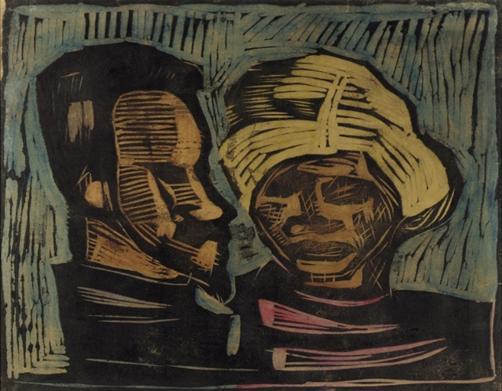
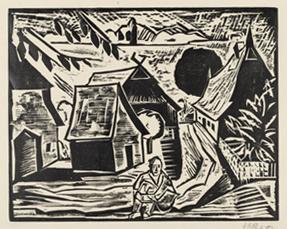
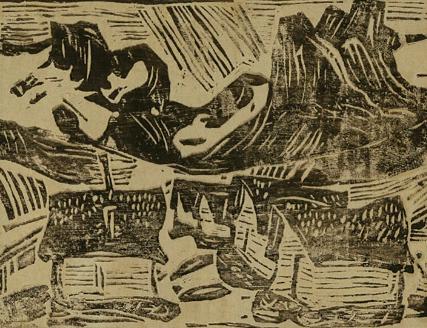
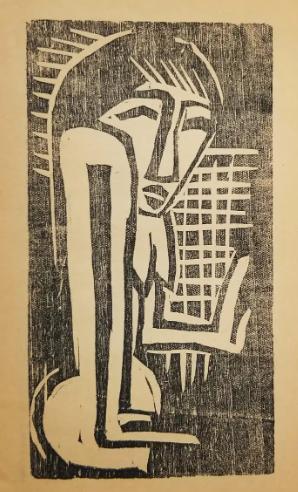
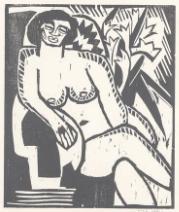
Johnson’sfirstpersonalencounterwithGermanExpressionistwoodcuttraditionslikelyoccurredduring histravelsthroughGermanywithVollandKrakein1930,andlaterduringhisstayinHamburgwith Krakein1932,wherehemayhaveencounteredsuchworksfirsthand.Itwasperhapsthroughthese experiencesthatJohnsonbecamefamiliarwiththeworkofDieBrücke,whoseartistsrevolutionizedthe woodcutbytreatingitasanexperimentalmediumofexpression.FoundedinDresdenin1905byartists suchasErnstLudwigKirchner,MaxPechstein,andKarlSchmidt-Rottluff,thegroupdevelopedagraphic stylemarkedbyjaggedlines,starkcontrasts,andsimplifiedforms,drawinginspirationfromAfricanand OceanicartaswellasearlyGermanprinttraditions.
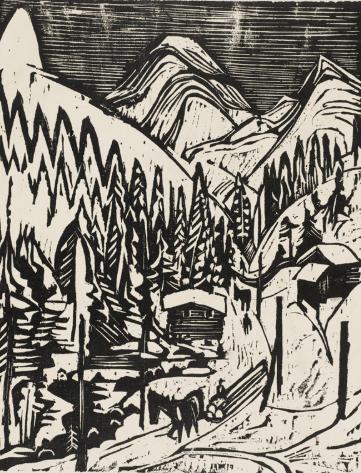
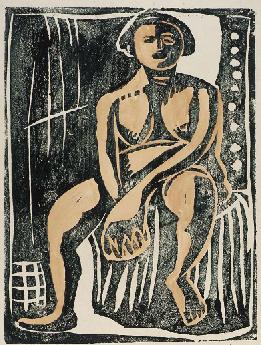
6. Scandinavian Landmarks and Landscapes
Windmill, Denmark. (The Swan Mill) ca. 1932-1935. 86
Windmill, Kerteminde (The Viby Mill, no. 1), ca. 1932–1935. ..........................................................
The Viby Mill, No. 2. ca. 1932–1935. ................................................................................................
Bazaars Behind Church of Our Savior, Oslo. Ca,1935-1937.
Lom Stave Church
Lom Kirke. (Lom Church, Square Format) ca. 1935–1938
Lom Gl. Kirke, Gudbrandsdalen (The Old Church in Gudbrandsdalen. Vertical Format). ca. 1935–1938. ...............................................................................................................................................
Volda Fjord, Norway, ca. 1935–1938 ..............................................................................................
Moon-Rise, Star-Rise, ca. 1935–1938.
Church by Lake II. ( Farmstead by Lake ) ca, 1935–1938.
Chalets by Jostedal Glacier (Grepstadstøylen) ca. 1935-1937.
Church, ca. 1939–1942.
Harlem Street with Church, ca. 1939-1942.
Untitled (Harlem Street with Couple), ca, 1939-1942. ...................................................................
Sleep (Reclining Nude by the Sea), ca. 1939–1942.
Model. ca. 1939-1942.
Nude, ca. 1939-1942.
at Rest, ca. 1939-1942.
Nude Resting. 1939-42.
Nude Recumbent. Ca. 1939-1942...................................................................................................
Lame Man-Full Length, ca. 1939–1942...........................................................................................
Lame Man – Bust, ca. 1939–1942...................................................................................................
1939-44...................................................................................................
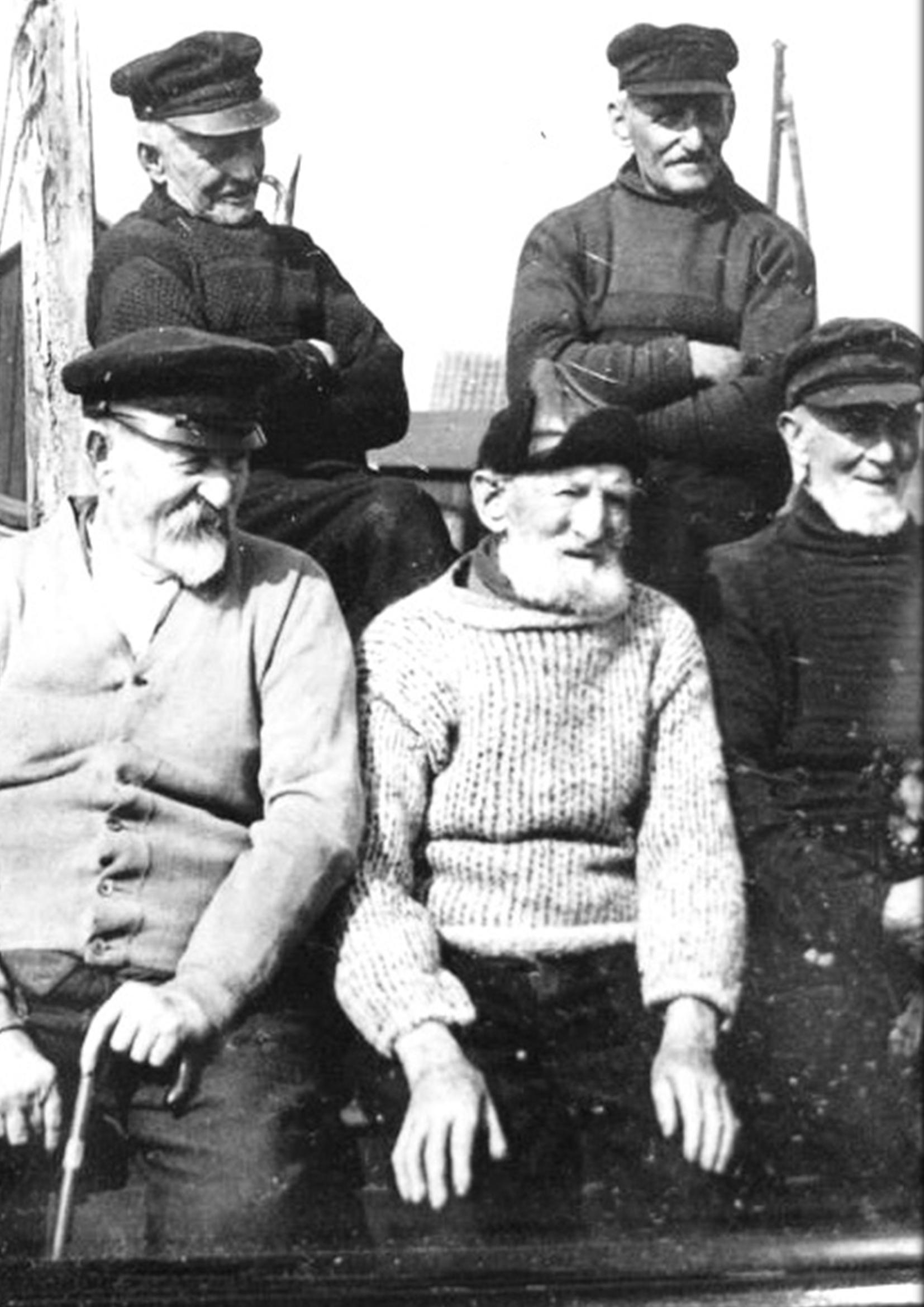
NestledontheeasterncoastofFunen,KertemindeisoneofDenmark’soldestand mostenduringfishingcommunities,longdefinedbyitsintimateconnectiontothe sea.DuringWilliamH.Johnson’sresidencethere(c.1930–1935),thetown,then hometoapproximately3,000inhabitants,wascharacterizedbyatightlyknitsocial structurerootedinmaritimetradition.Johnsonwaswarmlyreceivedbylocal fishermen,whoaffectionatelynicknamedhim“Willie”andwelcomedhimintotheir dailyroutines,allowinghimtoobserveandoccasionallyparticipateintheirwork. Theirdirectness,modesty,anddistinctivelyDanishdryhumorleftalasting impressionontheartist,profoundlyshapinghisunderstandingofcommunityand inspiringhisartisticvision.
Johnsonrendersthesefishermenwithastrongsenseofsocialreality,foregrounding theirresilience,weatheredfeatures,anddeepbondwiththeseaandtheir community.Stylistically,theworksrevealtheinfluenceofGermanExpressionism, evidentinsimplifiedformsandboldlyexaggeratedfeaturesthatprivilegeemotional intensityovernaturalisticrepresentation.
Atthesametime,theyreflecthissustainedinterestinworking-classsubjectsand alignwithhisbroaderengagementwithso-called“primitivism.”Ina1932interview, Johnsondescribedthefishermenas“wonderful,primitivepeople…whohave preservedthatwhichischaracteristicintheirnature;peopleinwhomthereisan elementoftradition.”Helaterrecalledthathehad“neverworkedbetterthanin Kerteminde,”wherehefoundboth“greaterpeace”and“bettermotifs,”notingthat thefishermeninparticularprovided“excellentmodels.”
Johnson’sfishermenseriesconsistsofsixindividualworks.
PortraitFisherman(FishermanJonDueinYellow-BrimmedHat),ca.1932–1935
JonFisherman(A),ca.1932-1935.
JonFisherman(B),ca.1932-1935.
Jon,ca.1932-1934.
Fisherman(No.2)ca1932-1935.
JonFisherman(2),ca.1932-1935.
Portrait Fisherman (Fisherman Jon Due in Yellow-Brimmed Hat), ca. 1932–1935
Oneknownimpression.
Inthishand-coloredwoodcut,Johnsondepictsafishermaninayellow-brimmedhat, whereboldcarvedlinesareenrichedbyexpressivecolorwashes.Thehatservesasa vividfocalpoint,standingoutagainstthedark,texturedbackground.
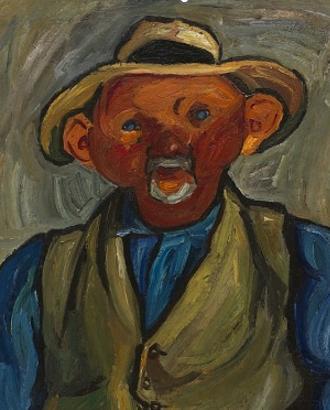
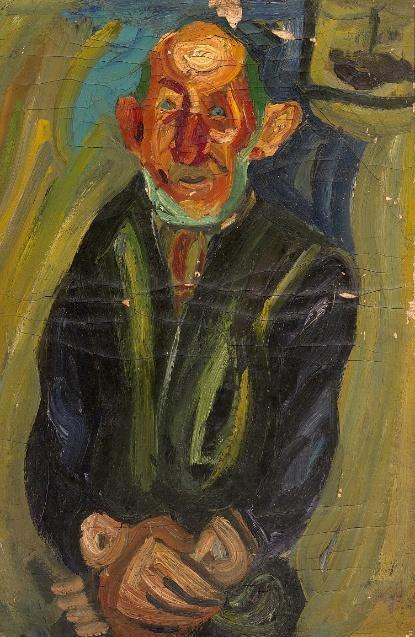
TheprintwaslikelyderivedfromthepaintingDanishSeaman(ca.1935–1938).
Sharedelements,includingtheyellow-brimmedhat,thefrontalorientation,andthe distinctivefacialstructure,suggestthattheprinttranslatesthepaintedcomposition intoamoregraphicandcondensedvisuallanguage.
Ina1945lettertohismother-in-law,Johnsonidentifiedthefishermanwearinga yellow-brimmedhatinMyMemoryfromKerteminde,Funen(c.1945)asFiskerJon Due.(FishermanJonDue).AmongthesixknownprintsinJohnson’sKerteminde Fishermenseries,threearetitledJonFishermanorsimplyJon.Asboththegiven nameJonandthesurnameDuewerecommoninKerteminde,itremainsuncertain whetherallthreeprintsrepresentthesameindividual,namelyJonDue.
JohnsonalsoportrayedtheFishermanJonDue,distinguishedbyhisyellow-brimmed hat,inseveraladditionalpaintingsandwatercolors,includingPortraitII(ca.1930–1932,SmithsonianAmericanArtMuseum,1967.91.2),Fisherman,Kerteminde(ca. 1945,CollectionofSteveTurner),andMemoryPortrait:DanishFisherman(ca.1944–1945,SmithsonianAmericanArtMuseum,1967.59.620).Therecurrenceofthis subjectacrossJohnson’scareersuggestsasustainedpersonalandartistic engagement.JonDueappearstofunctionasmorethanamodel,servinginsteadasa meanstoexplorethemesofmemory,identity,andregionallife.
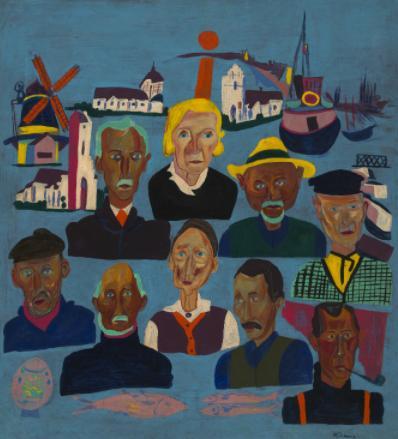
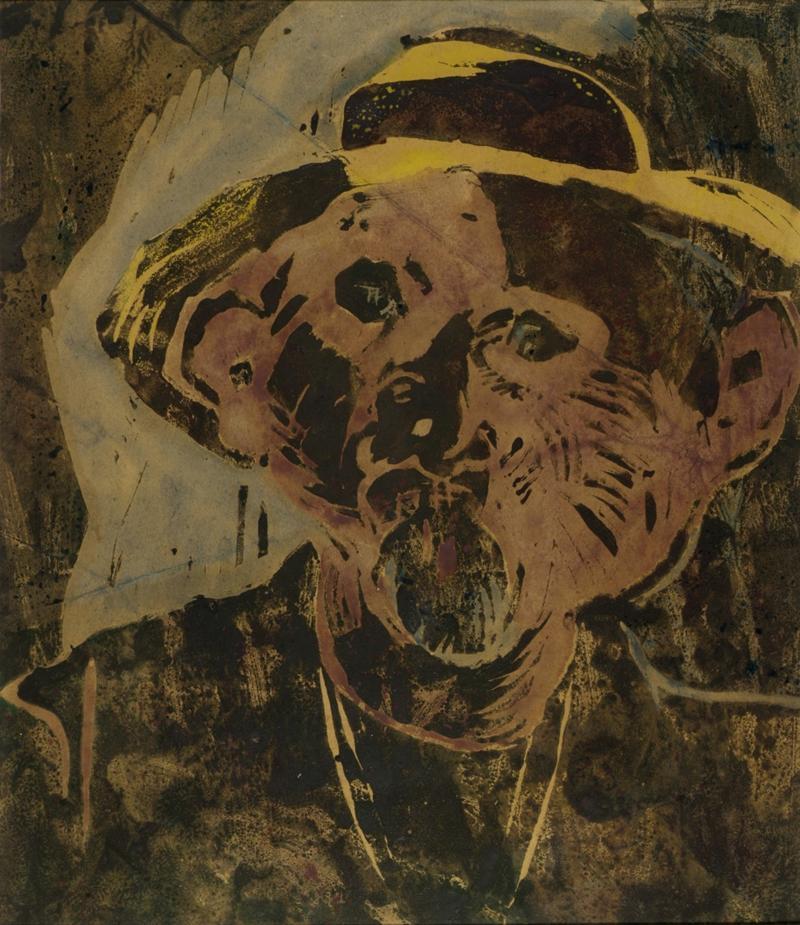
Portrait Fisherman (Fisherman Jon Due in Yellow-Brimmed Hat), ca. 1932–1935.
Object Number: WHJ-BP-FSH-0001.Hand-colored block print on paper (Woodcut). Verso: Watercolor on paper. Inscribed on verso: Portrait-Fisherman. Size: 19 1⁄8 x 17 1⁄8 in. (48.5 x 43.5 cm) irregular. Provenance: Gift of the Harmon Foundation. Smithsonian American Art Museum, 1967.59.786R-V. Exhibitions: College Museum. Hampton Institute, March 3-April 14, 1968. Lot no 28. William H. Johnson, 1901-1970. National Collection of Fine Arts, Smithsonian Institution. November 5, 1971-January 9, 1972.
Jon Fisherman (A), ca. 1932-1935.
Oneknownimpression.
InJonFisherman(A),Johnson’svigorouscarvingandpronouncedgougemarks accentuateJonsweatheredfeatures,withtheforcefulincisionsevokingalifeshaped byphysicallaborandprolongedexposuretothesea.
Johnson’suseofcolorintheprintreflectsanexpressive,non-naturalisticapproach alignedwithGermanExpressionism,inwhichcolorcarriesemotionalandsymbolic weight.Theheightenedtonesintensifythefisherman’spresence,transformingthe portraitintoastudyofenduranceandinnerstrength.Greenhuesinthehairand beardevokeseaweedandthemaritimeenvironment,theyellowbackground suggestsearlydawnandthedeepbluejacketrecallstraditionalDanishworkwear.
Throughthislayeredpalette,Johnsonfusessymboliccolorwithlivedexperience, balancingexpressiveintensitywithcloseobservation.
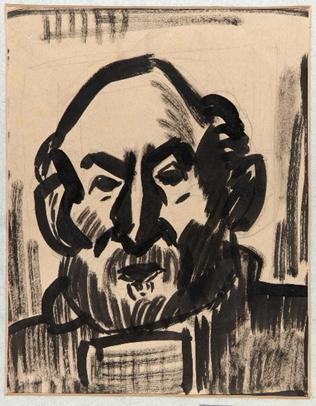
Fisherman, ca. 1930–1935. Ink on paper. Possible preparatory sketch for Jon Fisherman (A) and (B). SAAM. 1967.59.837.
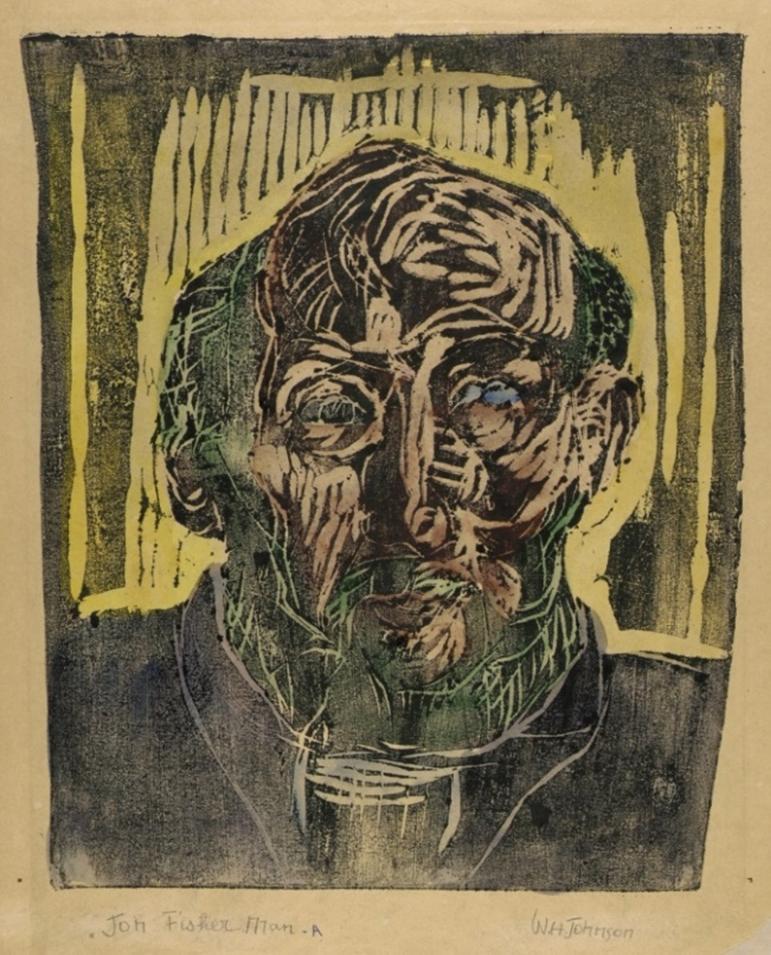
Jon Fisherman (A), ca. 1932-1935. Object Number: WHJ-BP-FSH-0002. Block print (woodcut) on paper mounted on paperboard. Size: 15 3⁄4 x 13 1⁄2 in. 40.0 x 34.2 cm. irregular. Titled below image, at right, in graphite: Jon Fisherman (A). Signed at the bottom left of the sheet, in graphite: W.H. Johnson. Hand-colored with a palette of earthy browns, muted greens, deep purples, and yellow accents. Provenance: Gift of the Harmon Foundation. Smithsonian American Art Museum, 1967.59.820
Jon Fisherman (B), ca. 1932-1935.
OneknownImpression.Posthumousprintedin1998.
InJonFisherman(B),Johnsonexploitstheinterplayofpositiveandnegativespaceto achievestructuralclarityandemotionalintensity,whilethestarkblack-and-white contrastunderscoresthegraphicpowerofthemedium.
IncontrasttoJonFisherman(A),theimageismoreaustereandreductive.Its monochromepaletteforegroundsJohnson’scarvingtechnique,revealingthe immediacyandphysicalityofthewoodcutprocess.Theabsenceofcolorintensifies theexpressiveforceofthelinesandalignstheworkmorecloselywiththeraw graphictraditionsofearlytwentieth-centuryExpressionism.
Moreover,unlikeinJonFisherman(A),whereJon’sgazeshiftsslightlytotheside,his gazeinJonFisherman(B)meetstheviewerdirectly,lendingtheimageaheightened senseofimmediacyandpsychologicalpresence.
NooriginalimpressionsofJonFisherman(B)areknowntoday,suggestingthatthe blockwaseitherneverprintedorthatanyearlyimpressionshavebeenlostorremain undiscovered.ThesoleextantimpressionisaposthumousprintpulledbyHardy ErnstatFynsGrafiskeVærksted,Odense,in1998.
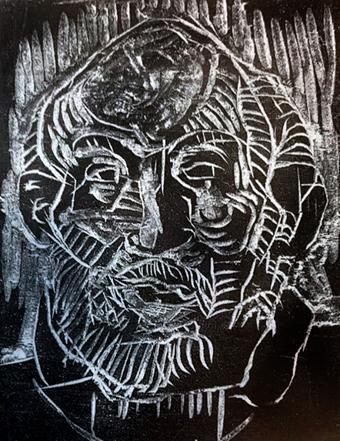
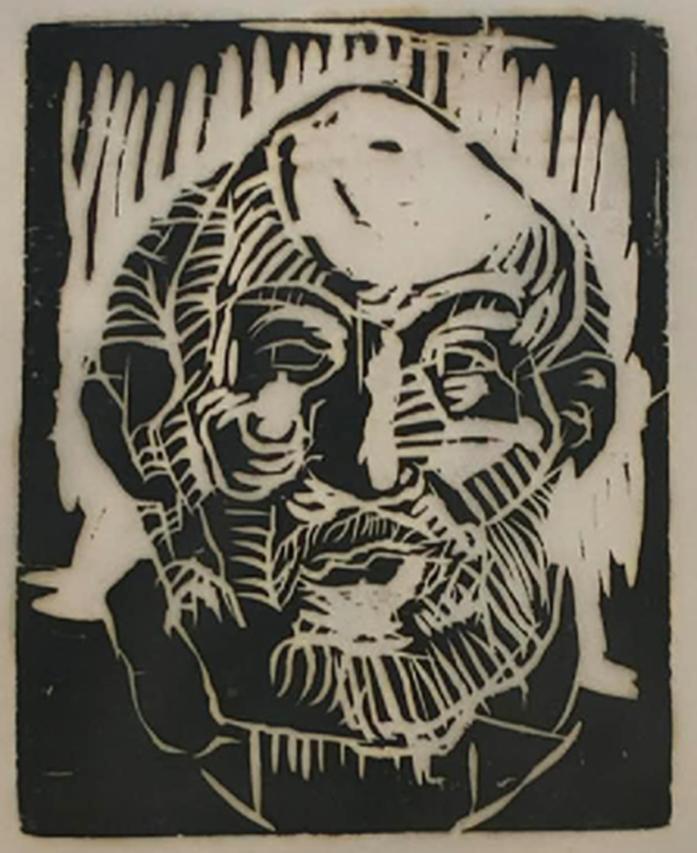
William H. Johnson. Jon Fisherman (B). ca. 1932–1935. Object Number: WHJ-BP-FSH-0003. Size, 32 × 41 cm. Woodcut from the original block; posthumous impression printed by Hardy Ernst, Fyns Grafiske Værksted, Odense, 1998. Johannes Larsen Museet.
Jon, ca. 1932-1934.
Threeknownimpressions.
Inthisportrait,JohnsondepictsJoninathree-quarterview,renderinghisfeatures throughangular,simplifiedforms.Bold,incisedlinesarticulatethebrowandnose, whiledeepshadowscarveoutthecheeksandeyes,intensifyingasenseofrugged endurance.Jon’sgazeturnsslightlyawayfromtheviewer,avoidingdirect engagementandsuggestingamindabsorbedelsewhere.
AccordingtoaccountsbythegrandsonofoneoftheKertemindefishermen portrayedbyJohnson,thefishermenwerewillingtoposebutdislikedsittingstillfor extendedperiods.ThiscontextdeepenstheinterpretationofJonsavertedgaze, suggestingaquietrestlessnessandimplyingthatheenduresthesittingwith restrainedimpatienceratherthanactivelyparticipatingintheprocessofbeing portrayed.
TheearliestdocumentedreferencetotheprintdatestoDecember1934,when JohnsonpresentedanimpressiontotheDanishphotographerThomasPedersenin exchangeforphotographstakenofJohnsonandhisworkatÅrhusKunstbygningon 10–11December1934.
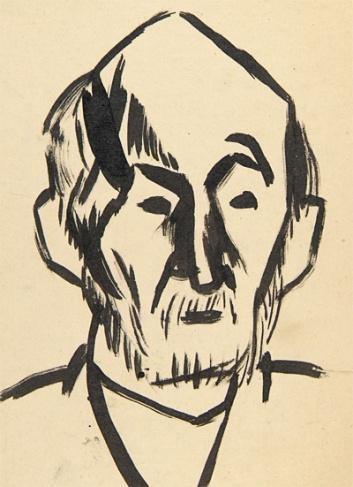
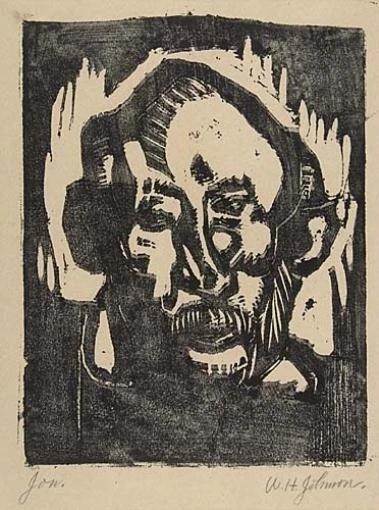
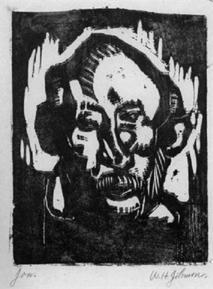
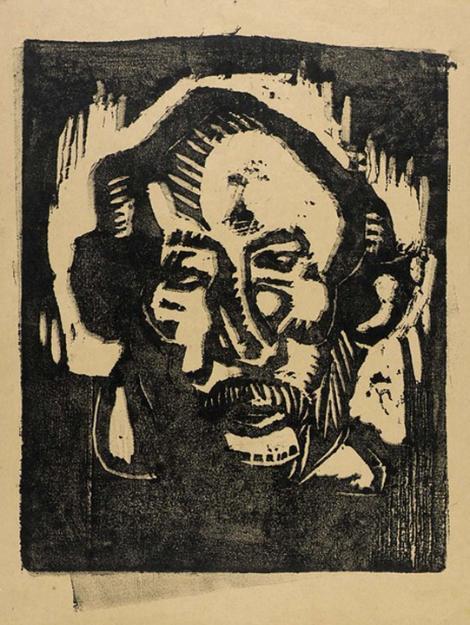
Jon, ca. 1932-1934. Object Number: WHJ-BP-FSH-0004. Block print on light tan wove paper. (Woodcut). Size: 294 x 223 mm; 11 5/8 x 8 7/8 inches. Titled below image, at right, in graphite: Jon; signed at the bottom left: W.H. Johnson. Provenance: Gifted in 1934 to Thomas Pedersen. Aarhus. Exhibited: Nyere Grafik Fra En Århusiansk Privatsamling. Århus Kunstforening. 1972. Lot no 72. Illustrated and catalogued as no. 33 in William H. Johnson: Truth Be Told by Steve Turner and Victoria Dailey (1996)
Jon, ca. 1932-1934. Object Number: WHJ-BP-FSH-0005. Block print on wove paper. (Woodcut ) sheet: 29.4 x 22.3 cm. (11.6 x 8.8 in. Titled below image, at right, in graphite: Jon; signed at the bottom left of the sheet, in graphite: W.H. Johnson. Exhibit label applied to backing verso from Steve Turner Gallery, Los Angeles, CA, William H. Johnson - Truth Be Told.
Jon, ca. 1932-1934. Object Number: WHJ-BP-FSH0006. Block print on paper. (Woodcut). Size: 13 7⁄8 x 11 1⁄4 in. (35.1 x 28.5 cm). Provenance: Gift of the Harmon Foundation. Smithsonian American Art Museum, 1967.59.822
Fisherman (No. 2) ca 1932-1935.
Twoknownimpressions.
InFisherman(No.2),Johnsonpresentsastark,frontaldepictionofanelderly fisherman,renderedthroughboldcontrastsandexpressivecarving.Thefeaturesare stronglyemphasized,abroad,roundednose,deep-seteyes,andapronounced mustachearticulatedthroughshort,repetitivecuts.
Thevigorous,unevenlinesgivethesurfacearough,tactilequalitythatevokesboth thephysicalityofthecarvingprocessandthesitter’sweatheredappearance.Thetitle Fisherman(No.2)suggestsaseries,thoughonlythisversioniscurrentlyknown.
IncontrasttoJohnson’swoodcutsofJon(WHJ-BP-FSH-0004–0006),thefisherman’s gazeheremeetstheviewerdirectly.Hisexpressionisimbuedwithagentle,almost jovialpresence,suggestingamorerelaxedsitterwhoappearsateasewithbeing portrayed.
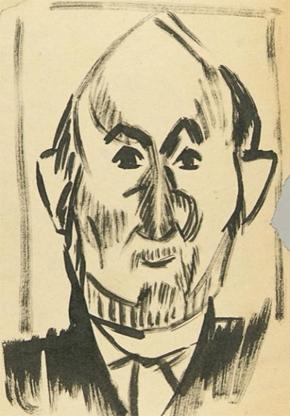
Fisherman, ca. 1930–1935. Ink on paper. Possible preparatory sketch for Fisherman (No. 2). SAAM. 1967.59.90.
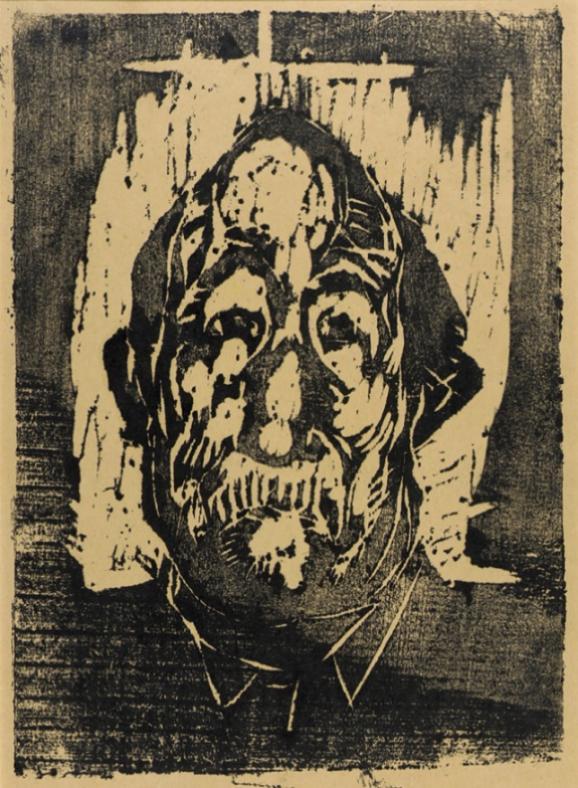
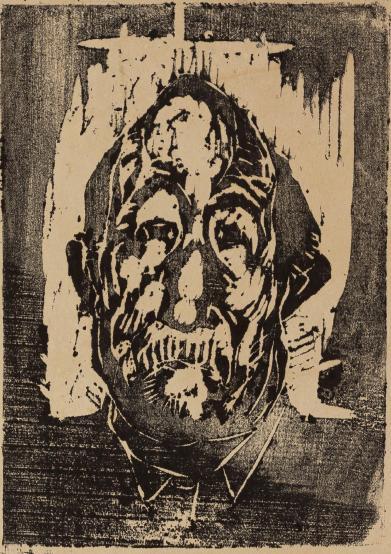
Fisherman (No. 2), ca. 1932-1935. Object Number:
WHJ-BP-FSH-0007. Block print on paper. (Woodcut). Inscribed Fisherman # 2 on verso. Size: 13 1⁄2 x 11 1⁄8 in. (34.3 x 28.3 cm) irregular, Provenance: Gift of the Harmon Foundation, Smithsonian American Art Museum, 1967.59.823
Fisherman (No. 2) ca. 1932-1935. Object Number: WHJ-BP-FSH-0007. Block print on paper. (Woodcut). Size: (27 x 20 cm) Provenance: Estate of Holcha Krake; thence by descent to her grandniece, Johanna Voll. Private collection.
Jon Fisherman (2), ca. 1932-1935.
Fourknownimpressions.
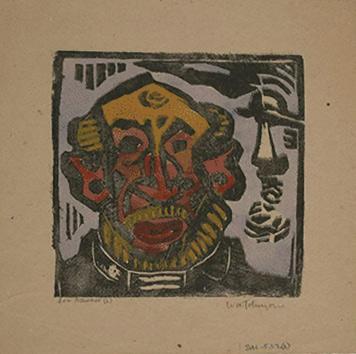
InJonFisherman(2),Johnsontranscendsconventionalportraiture,presentingJonas amonumentalandsymbolicfigure.Thefaceisconstructedfrombold,symmetrical formsthattransformhisfeatures,abroadnose,circulareyes,andpronouncedears, intoamask-likeconfiguration
TheprintwaslikelyderivedfromthepaintingRed-NosedOldSalt(ca.1930–1938), wherethesitterappearsseatedbeforeasmallportraitofasailingship.Inthe woodcut,Johnsonaddsboththeshipandarisingsun,situatingJonwithinhis maritimemilieuwhileevokingthemesoflabor,endurance,andrenewal.
Withtheadditionofcolor,thecompositiontakesonamarkedlydifferentcharacter. Theboldblackcontoursareintensified,andthesegmentedplanesoftheface resemblepiecesofcoloredglasssetwithinlead,creatingastained-glasseffect.
Thedesignation“2”inthetitlesuggestsapossibleseries,thoughonlyoneversionis currentlyknown.
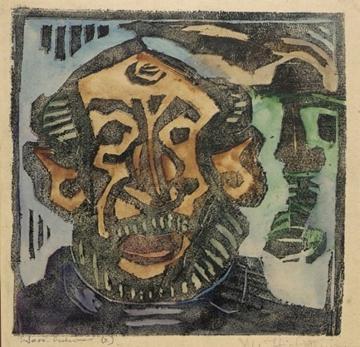
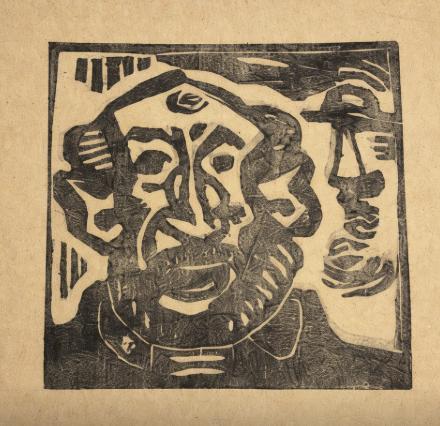
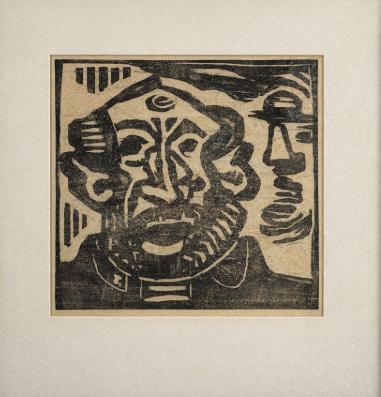
Jon Fisherman (2), ca. 1932-1935. Object Number: WHJ-BP-FSH0008. Block print on paper mounted on paperboard. (woodcut). Titled below image, at right, in graphite: Jon Fisherman (2). Signed at the bottom left of the sheet, in graphite: W.H. Johnson. Handcolored with a palette of ochre, burnt orange, and olive green for the face and beard, with accents of violet, sky blue, and green in the background. Size: 11 5⁄8 x 12 1⁄8 in. 29.5 x 30.7 cm. Provenance: Gift of the Harmon Foundation, Smithsonian American Art Museum, 1967.59.821

Jon Fisherman (2), ca. 1932-1935. Object Number: WHJ-BP-FSH0009. Block print on paper. (Woodcut). Titled Jon Fisherman (2). Signed in graphite: W.H. Johnson. Annotated Dal-533-(2). Inscribed on verso: Til Holcha fra Willie. Hand-colored with a palette of mustard yellow, deep red, olive green, and black for the face and clothing, set against a muted lavender and grey background with accents of white. Provenance: Harmon Foundation, Inc. Records. Retrieved from the Library of Congress, www.loc.gov/item/2003688148.
Jon Fisherman (2), ca. 1932-1935. Object Number: WHJ-BPFSH-0010. Block print on paper. (Woodcut). Size: H: 11 ¾ in. W: 11 ¾ in. Provenance: Gift of the Harmon Foundation. Hampton University Museum & Archives. Accession no: 67.44.3
Jon Fisherman (2), ca. 1932-1935. Object Number: WHJBP-FSH-0011. Block print on paper. (Woodcut). Size: 16"h x 14⅞"w x 1⅛"d. Provenance: Gift of the Harmon Foundation. Fisk University Galleries. Accession no. #0417
Man in Glasses, ca. 1932-1935
Oneknownimpression.
InManinGlasses,JohnsonemploysastylecloselyrelatedtoFishermanJonDuein Yellow-BrimmedHat(WHJ-BP-FSH-0001)Inbothworks,thefaceisconstructedfrom fracturedplanesandambiguousspatialrelationships,shapedbyavigorousinterplay ofcarvingandinking.
Ratherthanstrivingforconventionallikeness,Johnsonembracesformal experimentationtoconveypsychologicaldepthandanintrospectivepresence.
Althoughthesitter’sidentityremainsunconfirmed,itislikelythathewasalocal residentofKerteminde.
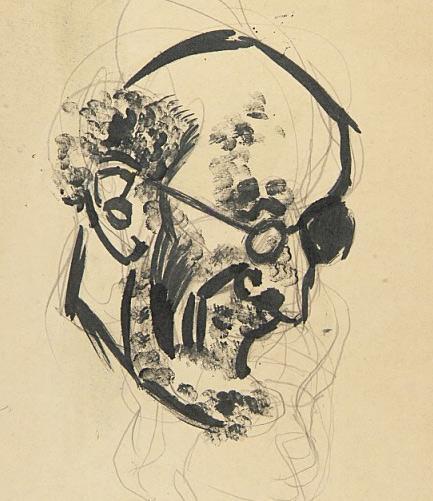
Portrait of a Man with Glasses, ca. 1930–1935. Possible preparatory sketch. Ink on paper. SAAM. 1967.59.101R-V
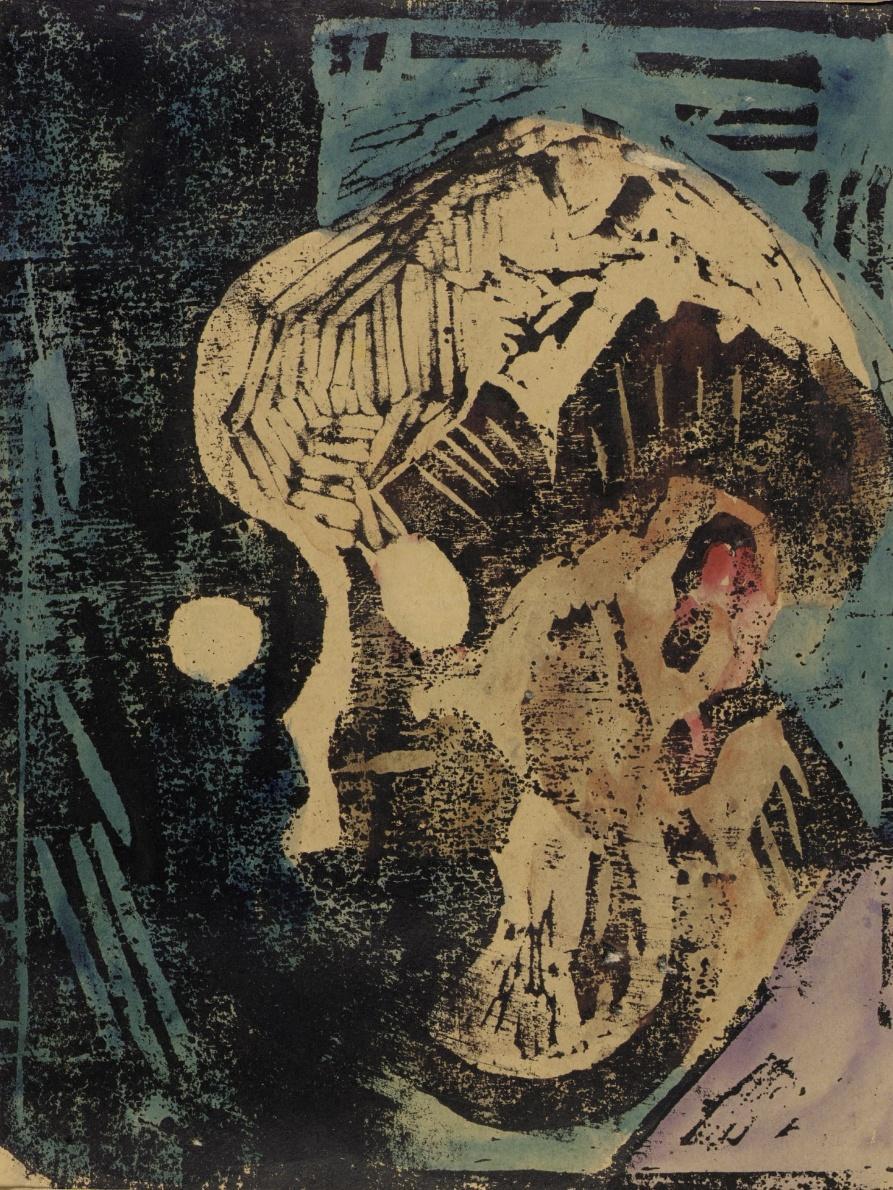
Man in Glasses, ca. 1932-1935. Object Number: WHJ-BP-POR0001. Block print on paper mounted on paperboard. (Woodcut) Hand-colored with a muted palette of beige, deep teal, and black, with subtle touches of lavender, soft rose, and reddish-brown accenting the ear and lower face. Size: 10 1⁄4 x 7 1⁄2 in. 26.0 x 19.1 cm. Provenance: Gift of the Harmon Foundation. Smithsonian American Art Museum, 1967.59.756
Portrait I, ca. 1932-1938.
Oneknownimpression.
InPortraitI,Johnsonrendersawell-dressedyoungmanthroughincisivecarving characteristicofGermanExpressionism,employingboldsimplification,exaggerated form,andemotionallychargedline.
Thecompositionismarkedbyforceful,economicalcutsthatheightenthesitter’s expressiveintensity.Hollowedeyesockets,anelongatednose,andprominently protrudingearscontributetoamask-likeseverity.Thewide,heavilyoutlinedeyes confronttheviewerdirectly,theirsteady,penetratinggazereinforcingtheportrait’s psychologicaldepthandintrospectivetension.
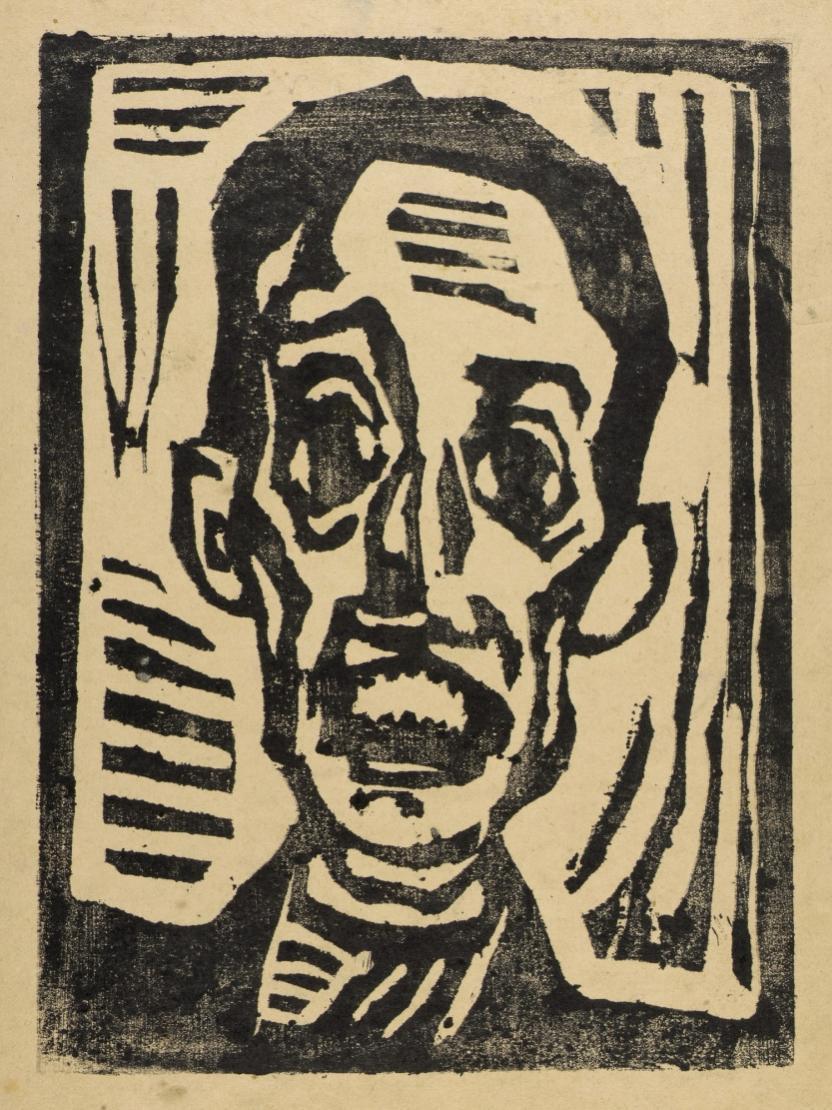
Portrait I, ca. 1932-1938. Object Number: WHJ-BP-POR-0002. Woodcut on paper, sheet: 13 3⁄4 x 10 5⁄8 in. (35.0 x 27.0 cm).
Provenance: Gift of the Harmon Foundation. Smithsonian American Art Museum,1967.59.973
Portrait II, ca. 1932–1938.
Twoknownimpressions.
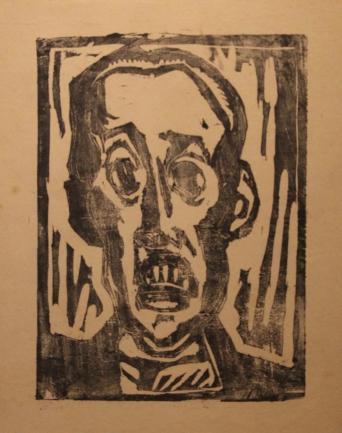
InPortraitII,Johnsondepictsamalefigurewhoappearsolderthanthesubjectof PortraitI.ExecutedinJohnsonsexpressionistmanner,theprintismarkedbydeeply incisedlines,exaggeratedfacialfeatures,andapronouncedsenseofemotional gravity
Thesitter’shighforehead,pronouncedeyebrows,anddistinctivemustacheclosely resemblethoseofNielsLindberg,whoseportraitJohnsonpaintedin1933tomark theopeningoftheFilosoffenexhibitionhallinOdense,aninstitutionLindberg helpedestablish.
AnotherplausibleidentificationisthemayorofKerteminde,whomJohnsonincluded inhisgroupcompositionMinMindeFraKertemindeFyn,1930(MyMemoryfrom Kerteminde,Funen),executedin1945.Bothfiguresplayedsignificantrolesin Johnson’sDanishexperienceandmayhaveservedassubjectsduringthis printmakingperiod.
AlthoughtheSmithsonianAmericanArtMuseumdatestheprintto1935–1938,the aboveevidencesuggestsanearlierexecution,possiblyfromaroundfrom1932–1938.
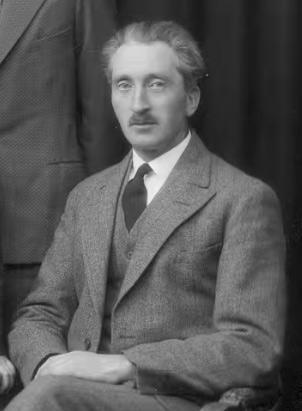
Niels Lindberg (1886–1974) was a Danish painter, collector, and early patron of William H. Johnson. As chairman of the Association of Funen Artists from 1928 to 1933, he played an active role in the Danish art scene and co-founded the exhibition space Filosoffen in Odense in 1933. In 1938, Lindberg was instrumental in organizing an exhibition featuring works by both Johnson and Holcha Krake. He also owned the paint supply store Nørre Broby Malerforretning (1912–1939), through which he developed a close relationship with the artists and assembled an important collection of their work. Photograph of Niels Lindberg, ca. 1930s.
Credit: Helle Brink.
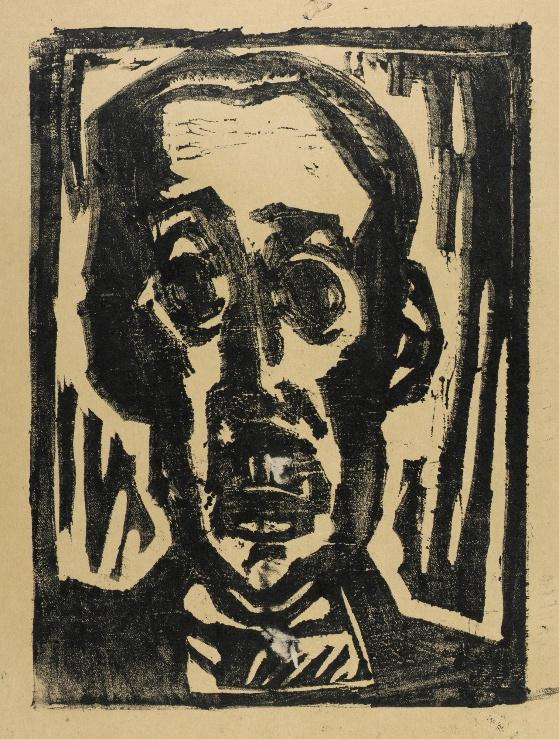
Portrait II, ca. 1932-1938. Object Number: WHJBP-POR-0003. Woodcut on paper, sheet: 13 3⁄4 x 10 7⁄8 in. (34.8 x 27.7 cm) Provenance: Gift of the Harmon Foundation, Smithsonian American Art Museum, 1967.59.974
Portrait II, ca. 1932-1938. Woodcut on paper. Object Number: WHJ-BP-POR-0004. Size (34 x 27 cm). Provenance: The estate of Holcha Krake; by descent to her grandniece, Johanna Voll. Christoph Voll Estate collection.
WilliamH.Johnson’sself-portraitsoccupyacentralplacewithinhisgraphicpractice, functioningasapowerfulvehicleforbothpersonalreflectionandartisticinquiry.In theseworks,Johnsonconfrontsquestionsofidentityandself-representation, exploringnotonlyhowheunderstoodhimselfbutalsohowhewishedtobeseenby others.
Printmaking,especiallywoodcut,playsacrucialroleinthisprocess.Unlikedrawing orpainting,thecreationofawoodcutself-portraitisbothphysicallydemandingand psychologicallyintense,requiringtheartisttooccupythedualroleofsubjectand maker.Themediumdemandsdirectcarvingintothesurface,witheachcut permanentlyembeddedinthefinalimage.Theslowandresistantprocessofcarving compelssustainedconcentrationandself-examination,whilethetoughnessofthe woodgrainresistsspontaneousgestures,oftenproducingamoreraw,direct,and emotionallychargedformofexpression.
InJohnson’sself-portraits,thecarvedlinesandgougedsurfacesretainthevisible traceoftheartist’shand,makingtheactofcreationinseparablefromthefinal composition.Whetherrenderedinstarkblackandwhiteorenhancedwithsubtle hand-appliedcolor,theseworksrevealJohnson’ssustainedengagementwith identity,memory,andtheevolvingroleoftheartist,whileemphasizingthe expressiveandmaterialpossibilitiesofthewoodcutmediumitself.
Johnson’sself-portraitseriesconsistsofeightindividualworks.
Self-Portrait(ChristianLarsenCatalogueCover,1933)
Selvportret(Self-Portrait)ca.1932-1935.
SelfPortrait.ca.1932-1935.
Self-Portrait.(Self-PortraitwithYellowBackground).ca.1932-1935.
Self-Portrait.(Self-PortraitwithBeret)ca.1932-1935.
Self-Portrait.(Self-PortraitinBlueShirt),ca.1932-1935.
JustMe.Selvportret.ca,1935-1938.
WillieandHolcha(DoublePortrait).ca.1932-1939.
Self-Portrait (Christian Larsen Catalogue Cover, 1933)
Oneknownimpression.
Johnson’searliestidentifiableworkwithinhisgraphicoeuvreisaself-portrait reproducedonthecoverofthecatalogueforhisexhibitionattheChristianLarsen ArtGalleryinCopenhageninApril1933,alreadydemonstratingaremarkable commandofthewoodcutmedium.
Thecompositionisstructuredthroughadynamicinterplayofcarvedanduncarved surfaces.ThewhiteareasmarkwhereJohnsonhascutintothewoodblock, transformingabsenceintoadefiningvisualelement.Longlinearpassagescarved aroundtheheadcreateastarkframingdevicethatisolatesandintensifiestheface, directingtheviewer’sattentioninward.
Ratherthanstrivingfornaturalisticlikeness,Johnsonforegroundsthephysicalactof carvingitself.Boldincisions,sharpcontrasts,anddeliberatedistortionsgeneratea forcefulandemotionallychargedimagethatalignstheworkwithExpressionist aestheticswhileemphasizingthematerialityandprocessofitsmaking.
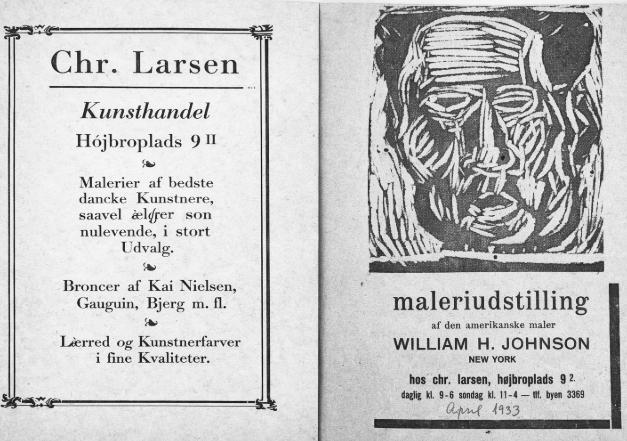
Exhibition catalogue for William H. Johnson’s April 1933 exhibition at Chr. Larsen Kunsthandel, Højbro Plads, Copenhagen. Cover text: Painting Exhibition by the American painter William H. Johnson, New York, at Chr. Larsen, Højbro Plads 9, open daily 9 a.m –6 p.m., Sundays 11 a.m.–4 p.m.
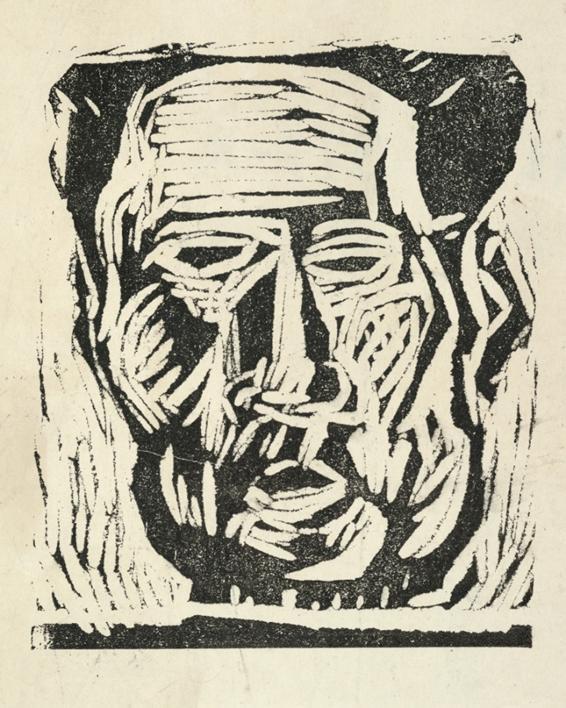
Self-Portrait (Christian Larsen Exhibition Cover) 1933. Object Number: WHJ-BP-SP-0001. Block print on paper ( Woodcut) Size: 11
3⁄8 x 8 1⁄8 in. (29.0 x 20.5 cm). Provenance: Gift of the Harmon Foundation. Smithsonian American Art Museum, 1967.59.796.
Selvportret (Self-Portrait) ca. 1932-1935.
Threeknownimpressions.
InSelvportret(Self-Portrait),Johnsondepictshimselfinathree-quarterview,his headturnedslightlytotheviewer’sleft.Unlikethesharplylinearstructureofhis earlier1933self-portrait,thecarvinghereappearsmorefluidandpainterly, suggestingafreerandmorespontaneousapproachtothewoodblock.
Ratherthanconfrontingtheviewerdirectly,Johnson’sgazeturnsaway,lendingthe imageaquietintrospectivecharacterandsuggestingadeeperexaminationofhis emotionalandpsychologicalstateratherthanastraightforwardpresentationof likeness.
Onlyoneofthethreeknownimpressionsbearsthetitleselvportretwrittenina hybridEnglish-DanishformthatJohnsonalsoemployedinthewoodblockJustMe, Selvportret(WHJ-BP-SP-00017).
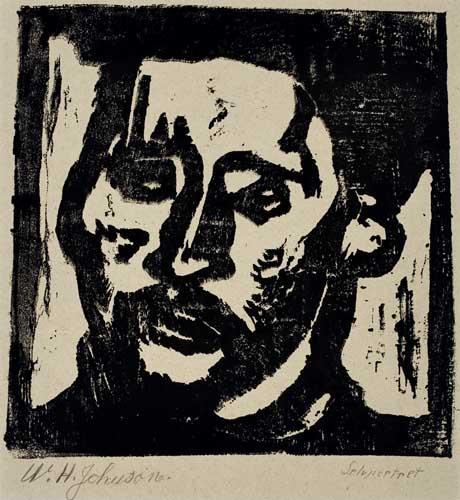
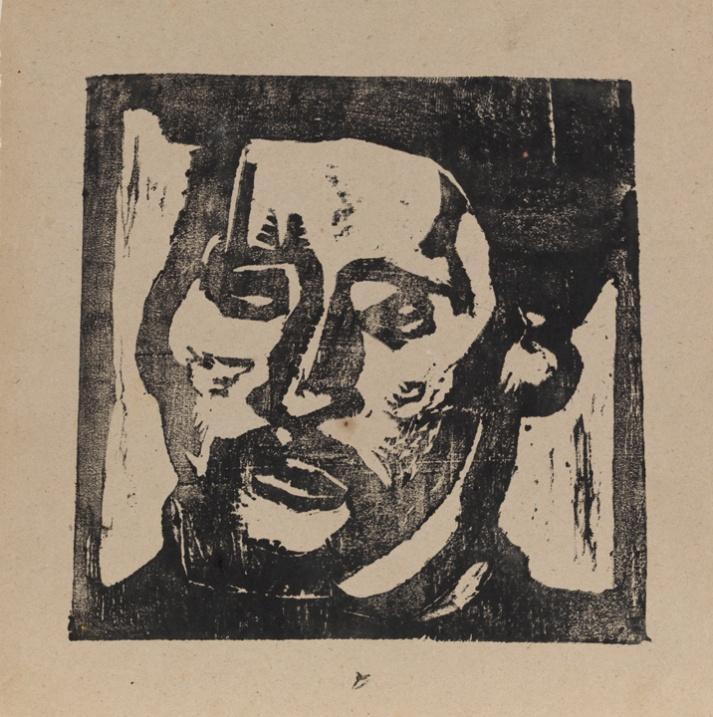
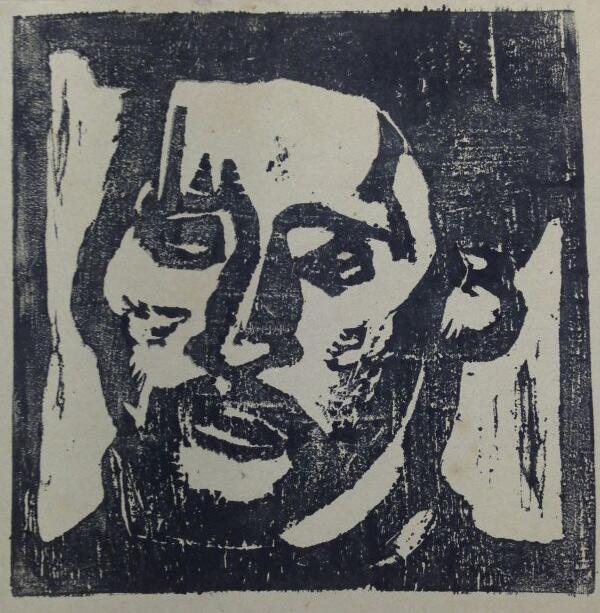
Selvportret (Self-Portrait) ca. 1932-1935. Object Number: WHJ-BP-SP-0002. Block print on pale cream wove paper. ( Woodcut). Signed at the bottom left: W.H. Johnson. Titled below image: Selvportret. Size: 8 7/8 x 8 7/8 in. (22.5 x 22.5 cm). Provenance: private collection, Denmark to 2005. Sold at Swann Auction Galleries. African-American Fine Art. Feb 19, 2008 - Sale 2136. Lot 16
Selvportret (Self-Portrait) ca. 1932-1935. Object Number: WHJ-BP-SP-0003.Block print on paper. (Woodcut). Size: 8 3/4 x 9 in. (22,225 x 22.86 cm). Provenance: Gift of the Philadelphia Commercial Museum. Philadelphia, Pennsylvania. Accession no: 2004.13.7
Selvportret (Self-Portrait) ca. 1932-1935. Object Number: WHJ-BP-SP-0004. Block print on paper. (Woodcut). Provenance: Gift of the Harmon Foundation. Courtesy of Oakland Museum of California (OMCA). Accession no: A67.62.18
Self-Portrait. ca. 1932-1935.
Sevenknownimpressions.
InSelf-Portrait,Johnsonreducesthefacetoanarrangementofcarvedanduncarved forms,creatingahighlysimplifiedandexpressiveimage.Theeyesappeardarkand hollowed,whiletheasymmetricalcarvingandroughsurfacetexturesheightenthe work’spsychologicalintensity.Visiblewoodgrainanduneveninkingfurther emphasizethematerialqualitiesoftheblock,reinforcingtherawandimmediate characterofthecomposition.
TheearliestrecordedreferencetotheprintdatestoOctober1934,whenJohnson soldanimpressiontoIngridMarieNielsen,managerofthehostelHøjskolehjemmet inEsbjerg,whereheandHolchaKrakewerestayinginconnectionwiththeirjoint exhibitionattheEsbjergLibrarythatsamemonth.
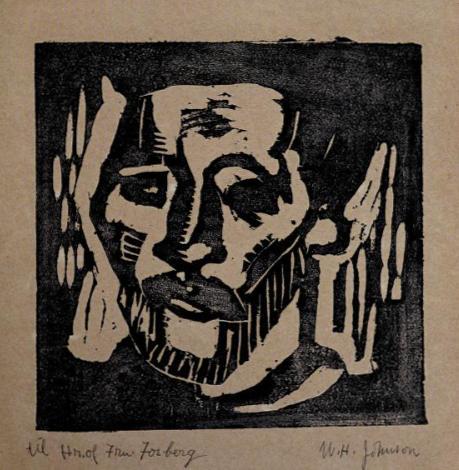
AsubsequentreferenceappearsinMarch1935,whenJohnsonsoldanother impressiontoSverreForberg(1891–1974),aNorwegiancivilservantinthe DepartmentofAgriculture,andhiswife,Gunvor,duringhisparticipationinatwopersonexhibitionwiththeNorwegianpainterOlafFjelldahlatBlomqvistGalleryin Oslo.
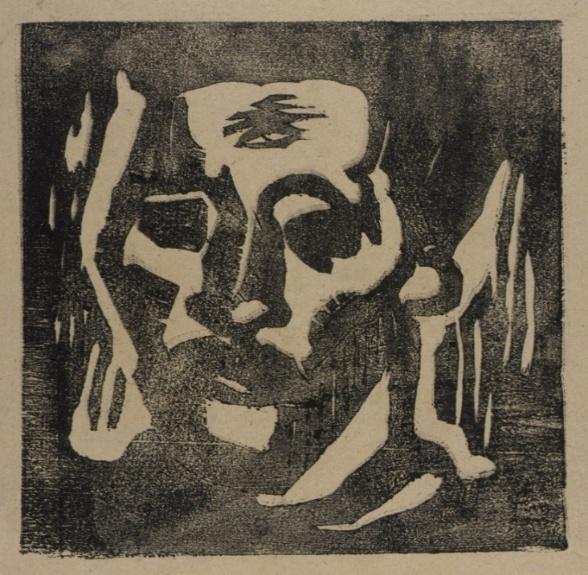
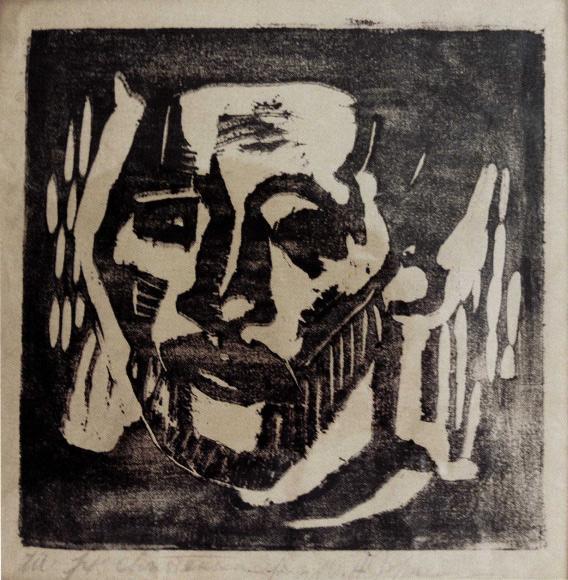
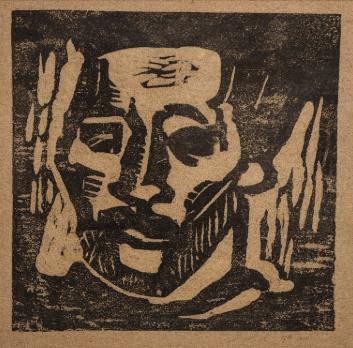
Self-Portrait. ca. 1932-1935. Object Number: WHJ-BP-SP-0005. Block print on paper. (Woodcut). Size: 11 5⁄8 x 11 3⁄4 in. (29.5 x 29.8 cm) Provenance: Gift of Mrs. Douglas E. Younger. (Assistant Director at the Harmon Foundation). Smithsonian American Art Museum, 1971.140.
Self-Portrait. October 1934. Object Number: WHJ-BP-SP-0006. Block print on paper. (Woodcut). Signed W.H. Johnson. Dedicated in Danish Til Frk. Ingrid Nielsen fra W.H. Johnson. Size: ( 23.5 x 25.5 cm). Provenance: Ingrid Marie Nielsen, manager of the Højskolehjemmet hostel, Esbjerg; acquired October 1934 as part of the purchase of a ceramic bowl decorated and signed by William H. Johnson. Subsequently in the collection of Vejen Art Museum, Denmark.
Self-Portrait. March 1935. Object Number: WHJ-BP-SP-0007. Block print on paper. (Woodcut). Signed W.H. Johnson at lower right. Inscribed at lower left: Til Hr. Og Fru. Forsberg. To Mr and Mrs Forsberg. ( 11 ½ x 11 ½ inches). Provenance: Sverre Forsberg, by decent in the family until 1996. Illustrated and catalogued as no. 32 in William H. Johnson: Truth Be Told by Steve Turner and Victoria Dailey (1996)
Self-Portrait. ca. 1932-1935. Object Number: WHJ-BP-SP-0008. Block print on paper. (Woodcut). Signed W.H. Johnson. Size: H: 20 ½ in. W: 19 ½ in. D: 2 in. Provenance: Gift of the Harmon Foundation. Hampton University Museum & Archives. Accession no: 67.44.2
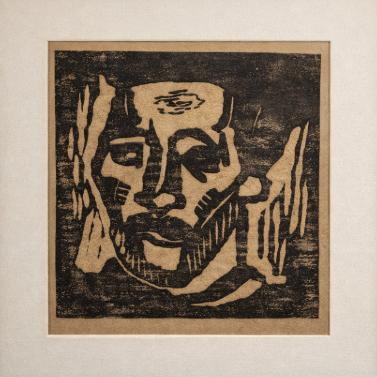
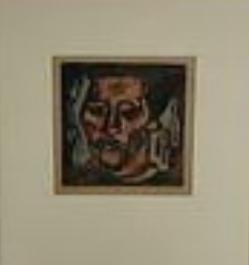
Self-Portrait. ca. 1932-1935. Object Number: WHJ-BP-SP-0009. Block print on paper. (Woodcut). Size: 15"h x 16"w x 1⅛"d. Provenance: Gift of the Harmon Foundation. Fisk University Galleries. Accession no: #0408
Self-Portrait. ca. 1932-1935. Object Number: WHJ-BP-SP-00010. Hand-colored block print on paper (Woodcut). Size: 25"h x 22"w x 1"d. Provenance: Gift of the Harmon Foundation. Fisk University Galleries. Accession no: #0416
Self-Portrait. ca. 1932-1935. Object Number: WHJ-BP-SP-00011. Hand-colored block print on paper (Woodcut). Signed in pencil on verso. Annotated: “til Holcha fra Willie”; “DAL-377-2.”
Retrieved from the Library of Congress. www.loc.gov/pictures/item/2003688153/
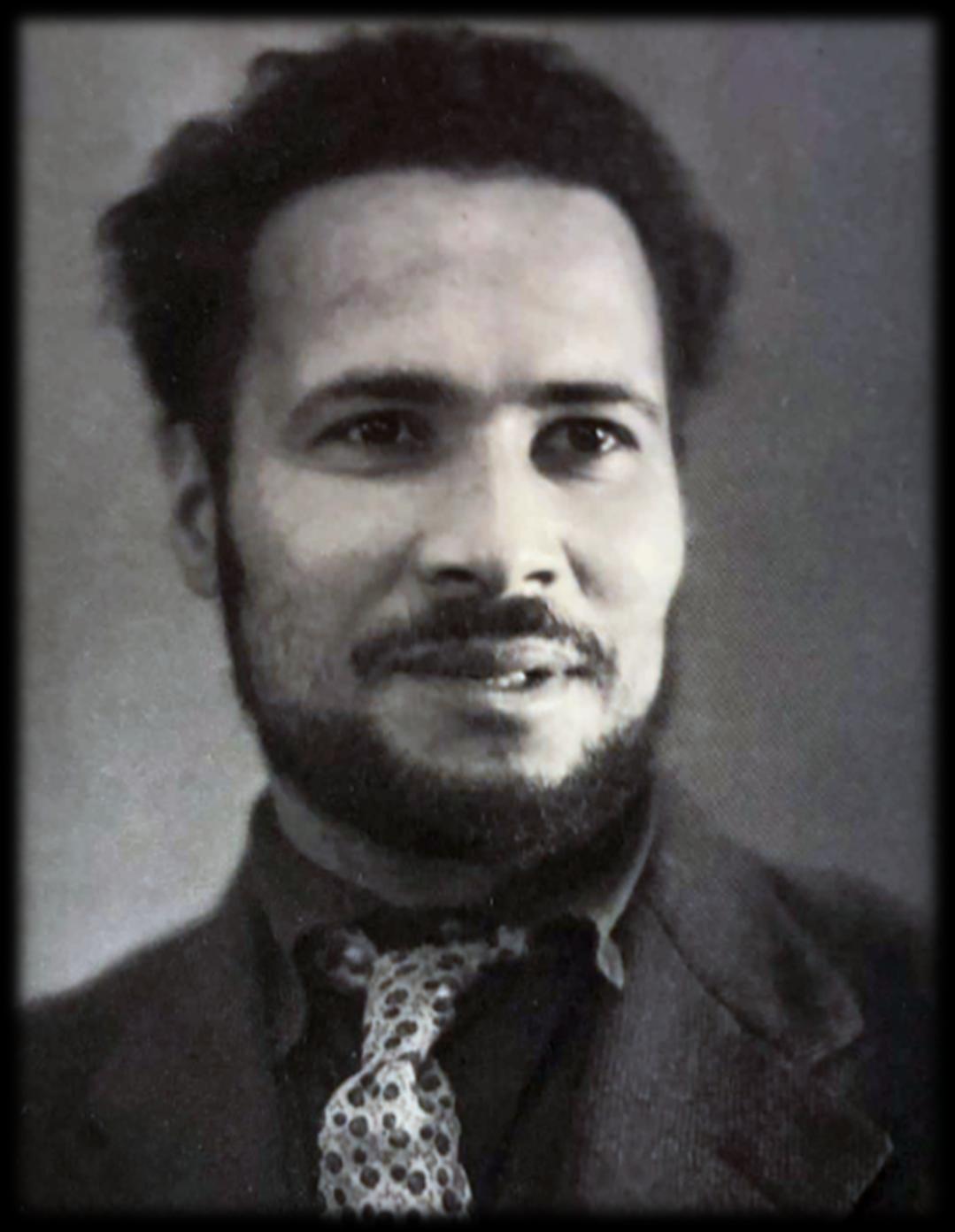
Original
Self-Portrait. (Self-Portrait with red bandana). Ca. 1932-1935.
Oneknownimpression.
InSelf-Portrait(Self-PortraitwithRedBandana),Johnsonpresentsafrontaland symmetricalviewofhisfacethatdirectlyconfrontstheviewer.Thecompositionis constructedthroughangularplanes,roughgougemarks,andfragmentedfacial featuresthatemergefromthedarksurfaceofthewoodblock.Heavyshadowing aroundtheeyesandnosegivesthefaceamask-likequality,whiletheuneven contoursandasymmetricalcarvingheightentheportrait’semotionalintensityand introspectivecharacter.
Thehand-appliedcolorfurtheramplifiesthework’sexpressiveforce.Avividyellow backgroundcontrastssharplywiththewarmerbrowntonesmodelingthecheeks andears,strengtheningthestructuralclarityofthefacewhileenhancingits psychologicalpresence..
AsmallflashofredatthenecklinelikelyrepresentsJohnson’scharacteristicbandana, arecurringmotifinhisself-portraitsfromthisperiodthatsubtlyreinforceshis carefullyconstructedartisticidentity.
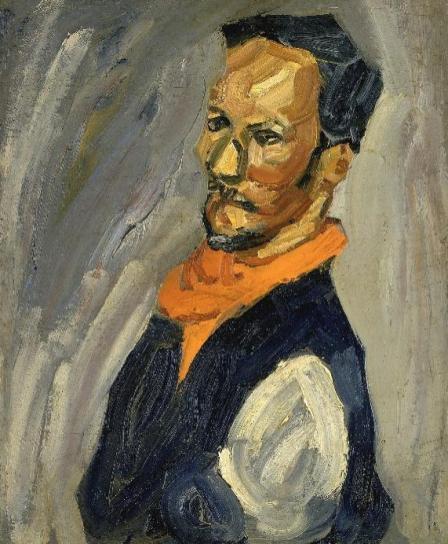
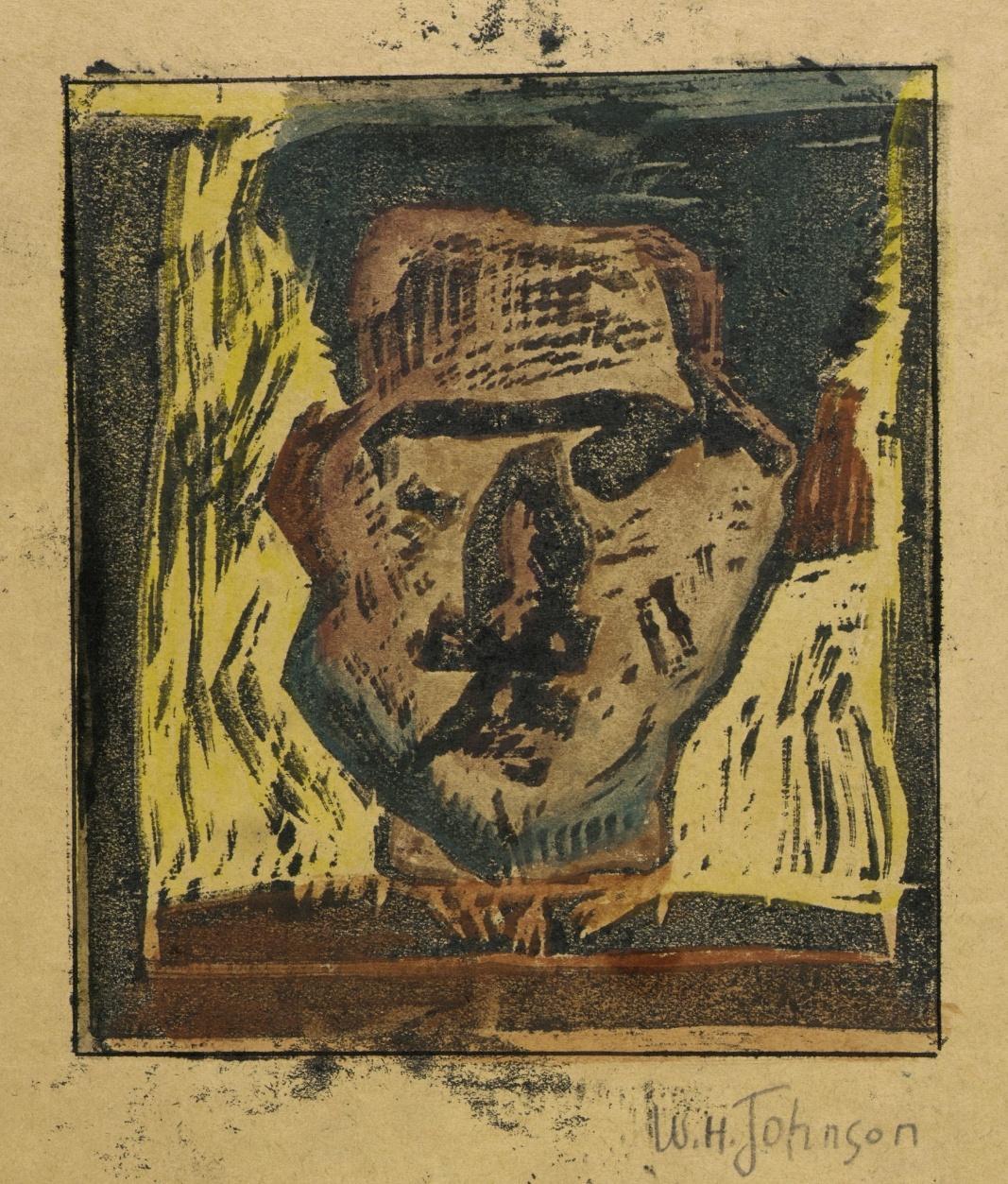
Self-Portrait. (Self-Portrait with red bandana). Ca. 1932-1935. Object Number: WHJ-BP-SP-00012. Hand colored block print on paper. (Woodcut). Size: 9 1⁄8 x 8 1⁄8 in. (23.3 x 20.5 cm). Signed at the bottom right in graphite: W.H. Johnson. Smithsonian American Art Museum, 1967.59.795
Self-Portrait. (Self-Portrait with Beret) ca. 1932-1935.
Fourknownimpressions.
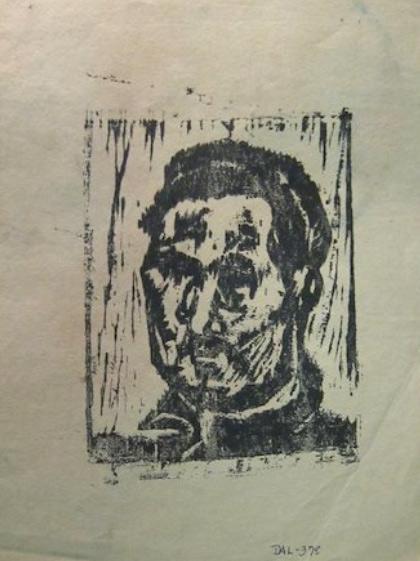
InSelf-Portrait(Self-PortraitwithBeret),Johnsonpresentshimselfinthree-quarter viewwearingablueberetandmatchingfisherman’sjacket,constructingacarefully fashionedimageofthemodernartist.Thefaceemergesthroughdenseblackforms andsharplycarvedhighlights,whilevisiblewoodgrainandroughgougemarks intensifytheportrait’sexpressiveandemotionallychargedcharacter.
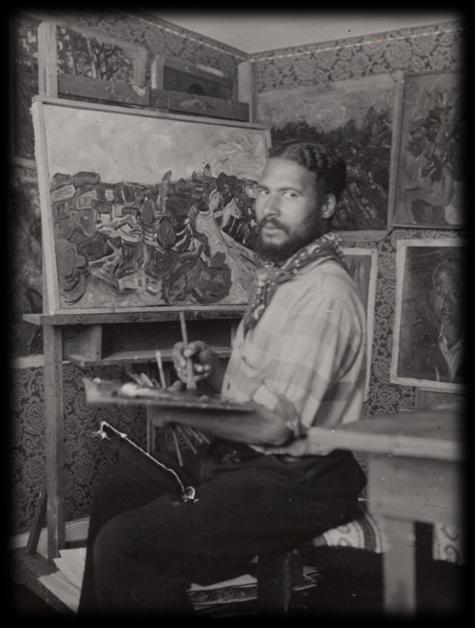
Theberet,famouslyassociatedwithRembrandtandlateradoptedmorebroadlyby artists,intellectualsandpoliticalradicals,hadbythenineteenthcentury,becomea recognizableemblemofcreativeandbohemianidentity.Johnsonwasfrequently photographedwearingaberetduringbothhisEuropeanyearsandlaterinthe UnitedStatesinthe1940s,suggestingthatitfunctionednotmerelyasapersonal stylisticchoicebutasadeliberatemarkerofhisidentityasamodernartist.
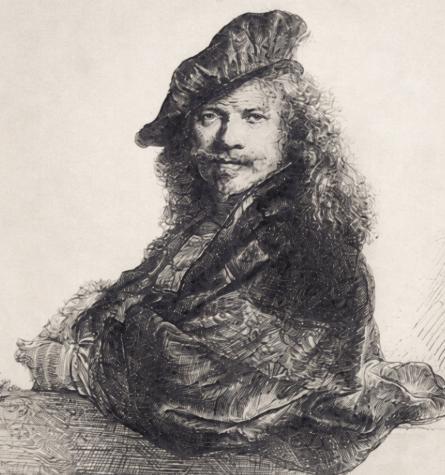
Reproduction of Rembrandt van Rijn’s Self-Portrait, Leaning on a Stone Sill (1639), reproduced in William H. Johnson’s scrapbook (ca. 1930–1947). The image presents Rembrandt in a beret with composed assurance and a self-fashioned image of success.
Courtesy of the Florence County Museum.
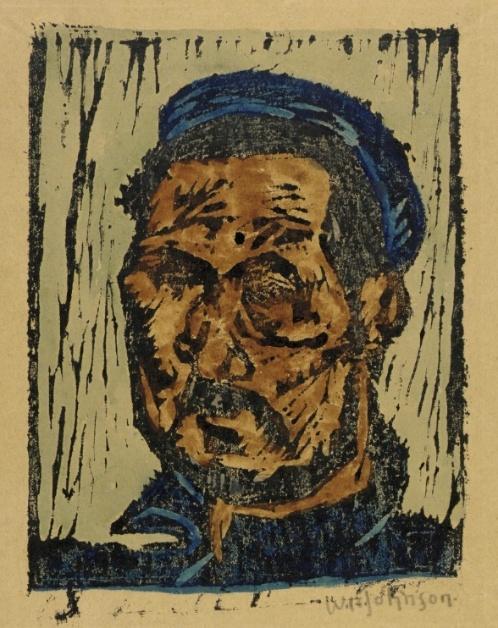
Self-Portrait. (Self-Portrait with Beret) ca. 19321935. Object Number: WHJ-BP-SP-00013. block print on paper (Woodcut). Hand-colored in warm browns and ochres with deep blue accents in the cap and clothing. Signed at the bottom right in graphite: W.H. Johnson. Size: 9 5⁄8 x 8 in. (24.3 x 20.3 cm). Provenance: Gift of the Harmon Foundation. Smithsonian American Art Museum, 1967.59.797
Self-Portrait. (Self-Portrait with Beret) ca. 1932-1935. Object Number: WHJ-BP-SP-00014. block print on paper (Woodcut). Annotated: DAL-387.Provenance: Civic Center Museum Collection, African American Museum in Philadelphia. Accession no: 2010.001.401
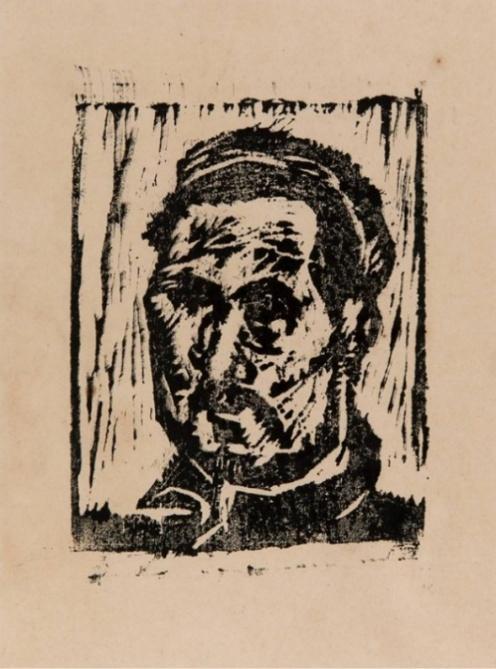
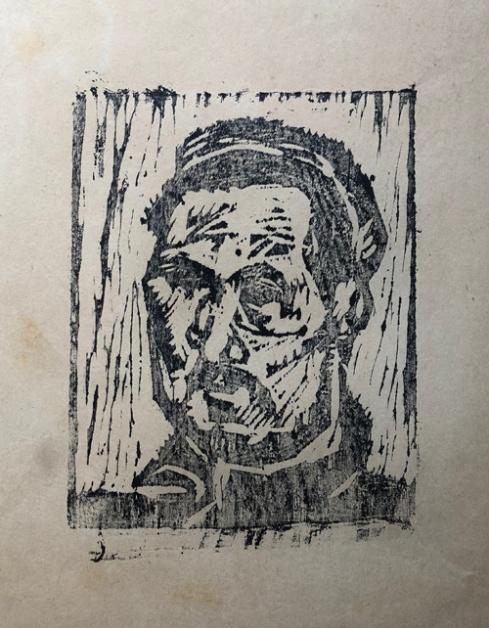
Self-Portrait. (Self-Portrait with Beret) ca. 1932-1935. Object Number: WHJ-BP-SP-00015. Block print on paper (Woodcut). Size: 13.5 x 10 in. (34.29 x 25.4 cm). Provenance: Gift of the Harmon Foundation. Courtesy of the Amistad Research Center, New Orleans, La. Accession no: ARC.HAR.WHJO.1934.17.
Self-Portrait. (Self-Portrait with Beret) ca. 1932-1935. Object Number: WHJ-BP-SP-00016. Block print on paper (Woodcut). Height 30 cm; Width 24cm. Provenance: Estate of Holcha Krake; thence by descent to her grandniece, Johanna Voll. Christoph Voll Estate collection.
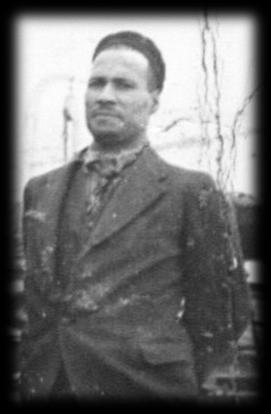
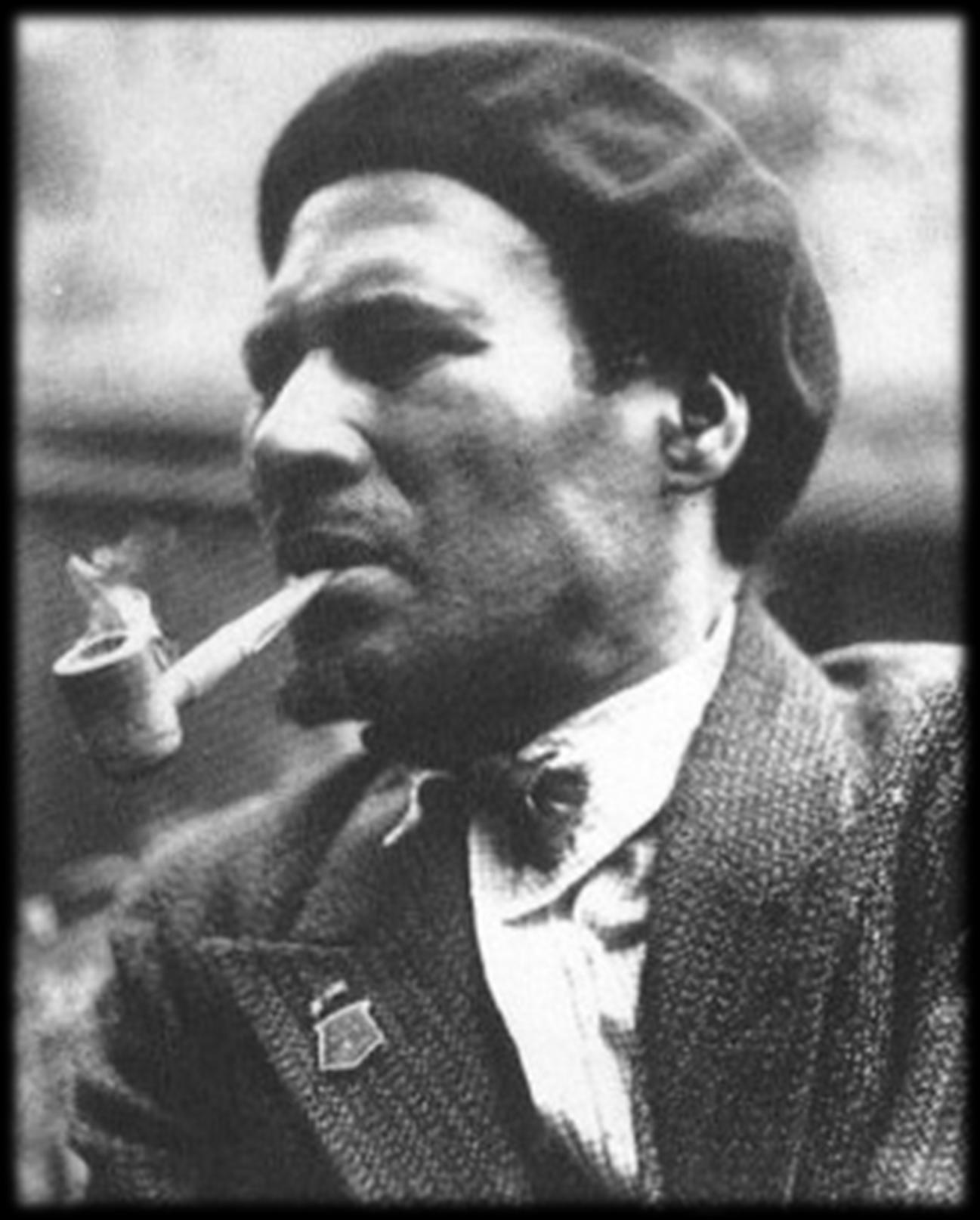
William H. Johnson wearing a beret in Kerteminde, Denmark, ca. 1930s (left), and in New York, ca. 1945 (top). Image credit: Archives of American Art, Smithsonian Institution
Self-Portrait. (Self-Portrait in blue jacket), ca. 1932-1935.
Oneknownimpression.
InSelf-Portrait(Self-PortraitinBlueJacket),Johnsonconstructshisimagethrough carvedlines,angularplanes,andfragmentedformsthatsimplifyanddistorttheface. Shownfrontallyandtightlycompressedwithinthepictureplane,theportraitis dominatedbyheavyshadowingaroundtheeyesandupperface.Roughgouge marksandvisiblewoodgrainremainclearlyapparent,emphasizingthedirectand physicalnatureofthecarvingprocess.
Thepersistentvisibilityofthecutsreinforcesthematerialpresenceofthewoodblock, sothattheportraitfunctionsnotonlyasanimageoftheselfbutalsoasatangible recordofitsownmaking.
Johnsonwearsatraditionalbluefisherman’sjacket,agarmentassociatedwith Danishmaritimelifeandvaluedforitswarmthwhenwetandpracticaldarkcoloring suitedtoworkatsea.SimilarjacketsappearthroughouthisKertemindefisherman portraits,suggestinganidentificationwithworking-classlifeandtherural Scandinaviancommunitiesthatbecamecentraltohisartisticimaginationduringthe 1930s.
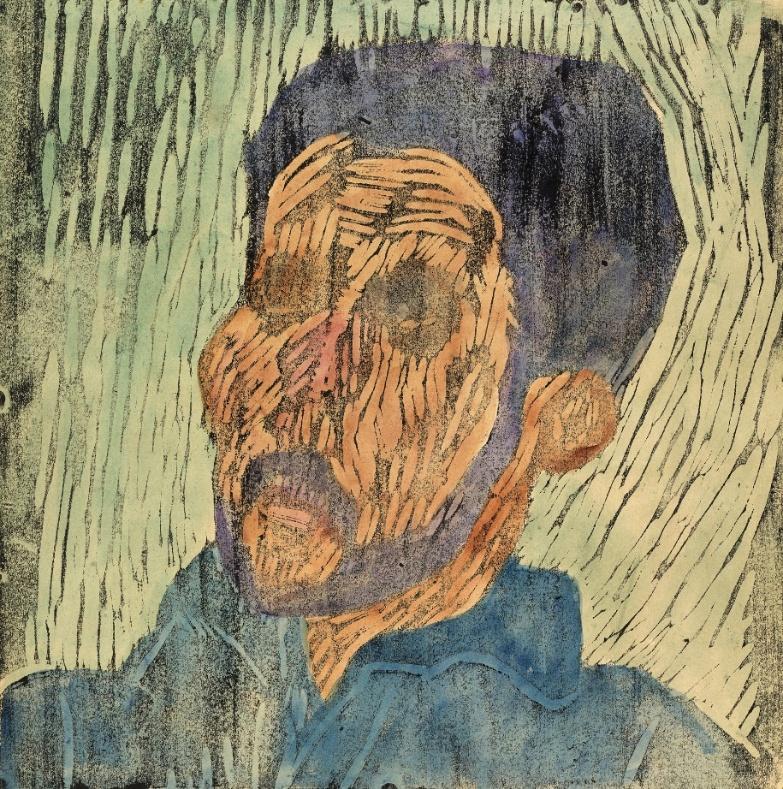
Self-Portrait. (Self-Portrait in blue jacket), ca. 1932-1935. Object Number: WHJ-BP-SP-00017. hand-colored block print on paper. ( Woodcut). Size: 14 1⁄8 x 14 in. (35.8 x 35.5 cm) irregular. Provenance: Gift of the Harmon Foundation. Smithsonian American Art Museum, 1967.59.791.
Just Me- Selvportret ca, 1935-38.
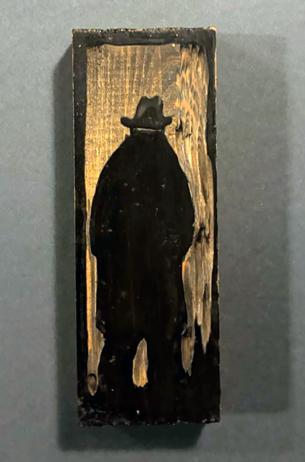
In Just Me – Selvportret, Johnson represents himself as a solitary silhouetted figure positioned within a narrow vertical format, recognizable through his characteristic wide-brimmed hat and long overcoat. Standing alone, his hands likely tucked into his pockets, the figure conveys a quiet sense of introspection.
The title Just Me establishes an introspective framework for the image. While seemingly modest in tone, it may also be understood as a quiet assertion of selfhood, an affirmation of presence, individuality, and autonomy. This ambiguity reflects Johnson’s complex position as both participant and observer, insider and outsider, within the cultural and artistic environments he inhabited. Created during his time in rural Scandinavia, likely in Volda, the work resonates with themes of isolation and identity. As one of the very few people of color living in 1930s Norway, and indeed across much of Scandinavia, Johnson occupied a highly visible and singular position within the local community, a condition that informs the image’s reflective tone.
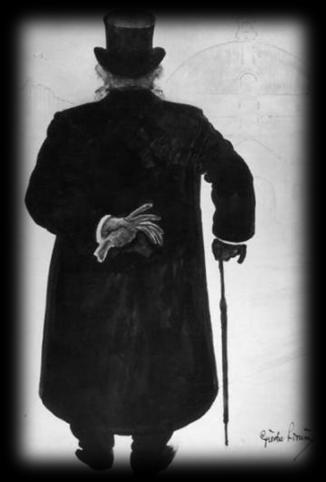
The decision to depict himself from behind, emphasizing posture and attire rather than facial expression, may also function as a subtle homage to Johnson’s favored writer, the Norwegian playwright Henrik Ibsen, who was often caricatured from behind to evoke his stern, iconic presence. Here, Johnson similarly constructs a figure that is at once solitary and symbolic.
No original impressions of Just Me – Selvportret are known, suggesting the block was either never printed or that early impressions have been lost or remain undiscovered. The only extant impression is a posthumous trial print from the original woodblock, pulled by Øbro Kunsthandel, Copenhagen, 2026.
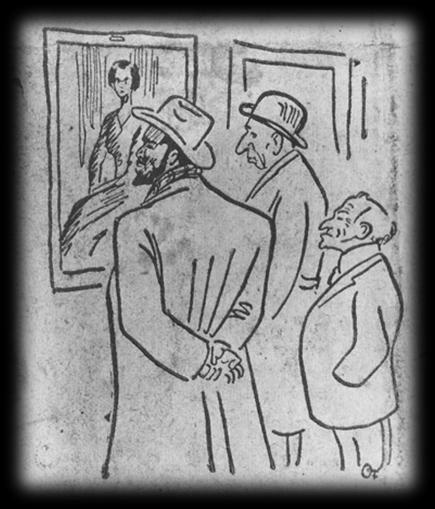
Caricature of Johnson at Grønningen exhibition, Copenhagen, January 1935, depicting the artist in his signature wide-brimmed hat and long overcoat. Credit: Dagens Nyheder, Smithsonian Institution
Me,Selvportret,
1935–38.
Provenance: the artist to Niels Lindberg, Nr. Broby, Funen; private Danish collection.
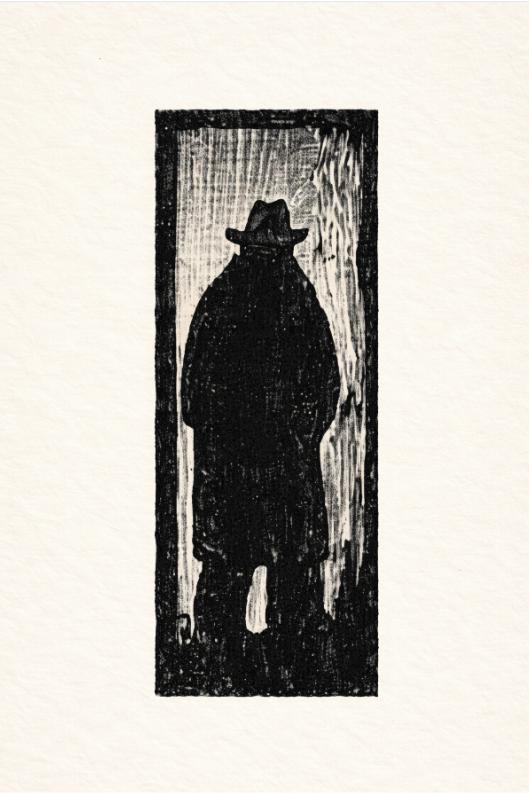
William H. Johnson. Just Me-Selvportret. ca, 1935-38. Object Number: WHJ-BP-SP-00018. 12 x 4 ½ cm. Trial impression (test print) from the original woodblock. Øbro Kunsthandel. Copenhagen. 2026.
Willie and Holcha (double portrait). Ca 1932-1939.
Sevenknownimpressions.
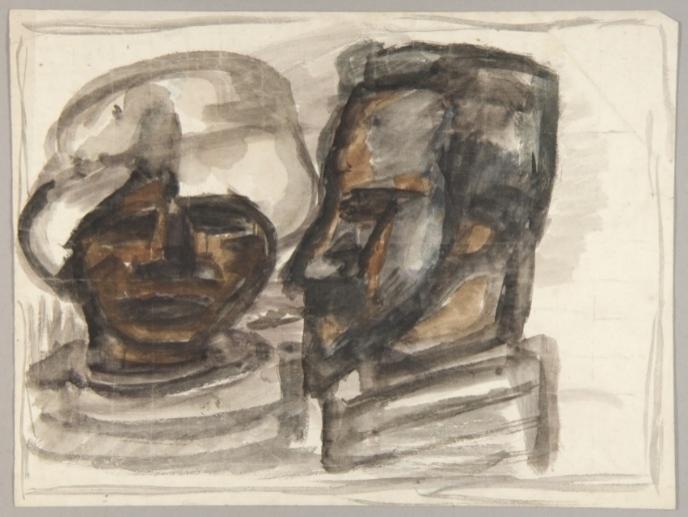
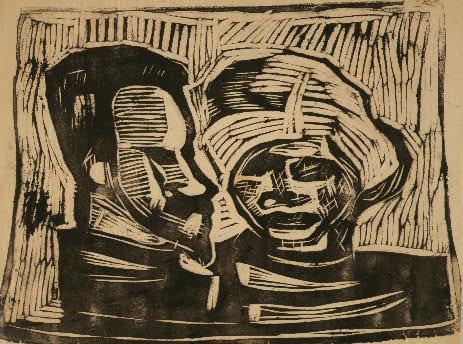
InWillieandHolcha,Johnsonpresentsahead-and-shouldersportraitofhimselfand hiswife,HolchaKrake,likelybasedonawatercolorexecutedaround1932.Holcha, wearingaheadscarf,facestheviewerwithacalmandcomposedpresence,while Johnson,showninprofile,turnstowardherinagesturesuggestingtenderness, closeness,andquietprotection.
ArthistorianRichardJ.PowellhasproposedthatJohnsonintentionallyreimagined HolchaasaBlackwoman.Throughthisvisualstrategy,Johnsonappearstocollapse conventionalracialboundaries,emphasizingsharedemotionalandspiritual connectionoverdifference.Theunifiedskintonesinthewoodcutdonotnegate identity;rather,theysuggestatranscendenceofracialdistinction,framingtheir relationshipasonegroundedinmutualrespect,affection,andcreativepartnership (Powell,“Johnson:ExpressionistandArtistoftheBluesAesthetic,”1988).
Ofthesevenknownimpressions,allarecataloguedunderthetitleWillieandHolcha, withtheexceptionoftheexampleintheGreenvilleCountyMuseumofArt,whichis recordedunderthealternatetitleLittleTalk.Althoughtheprintisbelievedtohave beencreatedaround1932–33,theearliestdocumentedreferencedatestoFebruary 1939,whenahand-coloredimpressionofWillieandHolcha,exhibitedunderthetitle ManandWoman,appearedinJohnsonandKrake’sjointexhibitionatTheArtists GalleryinNewYork.
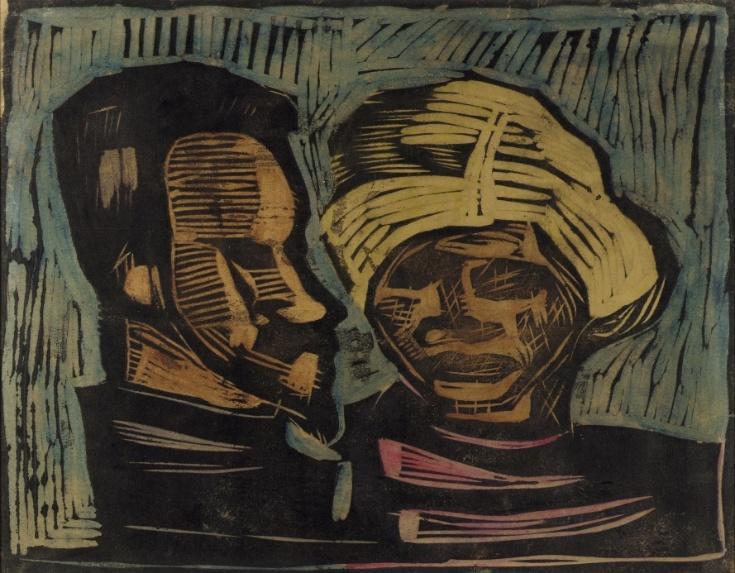
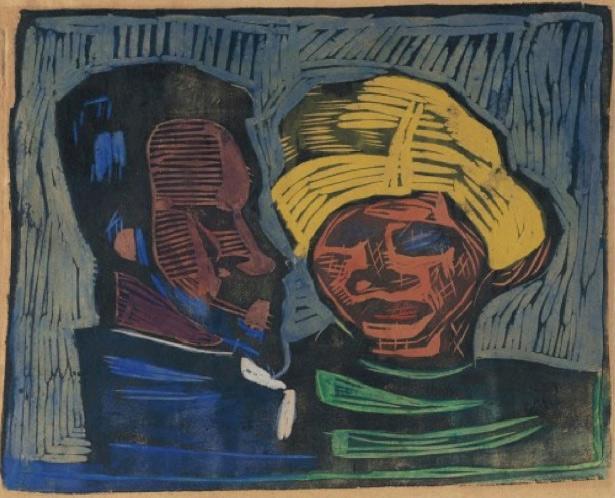
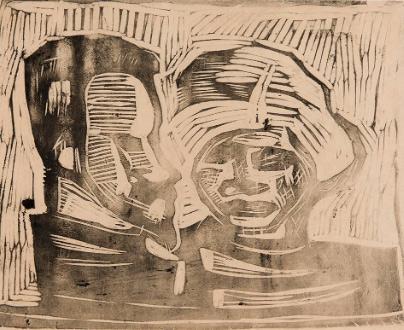
Willie and Holcha. Ca. 1932- 1939. Object Number: WHJ-BP-SP00019. Block print on paper. (Woodcut) Hand colored with palette of ochre, tan, pink, and pale yellow against a cool blue background. Inscribed on backing board: “Willie and Holcha/William H. Johnson. Size: 14 1⁄8 x 17 1⁄4 in. (35.8 x 43.8 cm). Provenance: Gift of the Harmon Foundation. Smithsonian American Art Museum, 1967.59.793. Exhibited: Memorial Hall, Nebraska State Teachers College, March 1-15, 1957. Illustrated on page 190 of William H. Johnson, 1901–1970, by Adelyn D. Breeskin and Jan K. Muhlert (Smithsonian Institution Press, 1971)
Willie and Holcha (Little Talk) Ca. 1932- 1939. Object Number: WHJ-BP-SP-00020. Block print on paper. (Woodcut). Hand colored with palette of bold blues and browns with green accents and a yellow headwrap. Size: 15 ¼ × 18½ inches. Provenance: Greenville County Museum of Art. USA. Museum purchase from the Arthur and Holly Magill Fund.
Willie and Holcha. Ca. 1932- 1939. Object Number: WHJ-BP-SP-00021. Block print on paper. (Woodcut). Size: 13.25 x 16 in. (33.66 x 40.64 cm). Provenance: Gift of the Harmon Foundation. Courtesy of the Amistad Research Center, New Orleans, LA. Accession Number: ARC.HAR.WHJO.1934.14.
Willie and Holcha. Ca. 1932- 1939. Object Number: WHJ-BP-SP00022. Block print on paper. (Woodcut). Signed in pencil on recto and verso. "Til Holcha fra Willie" To Holcha from Willie. Annotated Dal-533-(2). Provenance: Harmon Foundation, Inc. records. Library of Congress. Item 200368814.
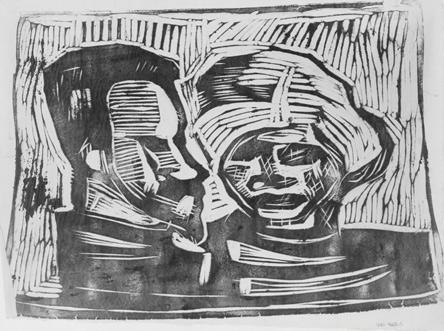
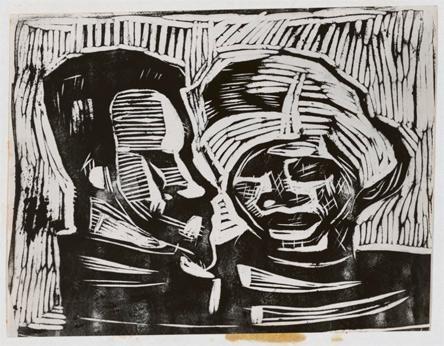
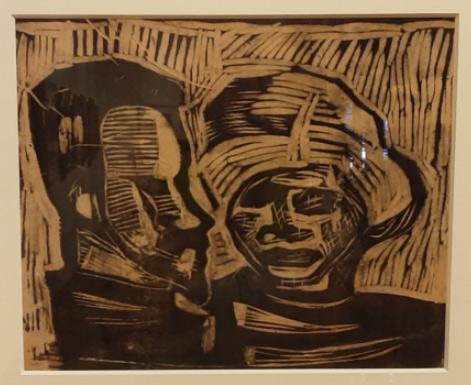
Willie and Holcha. Ca. 1932- 1939. Object Number: WHJ-BP-SP-00023. Block print on paper. (Woodcut) Annotated Dal-366B-5. Provenance: Gift of the Harmon Foundation. Smithsonian American Art Museum. Celebrating 175: Artist File, Johnson, William H., circa 1969-1971. Page 33
Willie and Holcha. Ca. 1932- 1939. Object Number: WHJ-BP-SP-00024. Block print on paper. (Woodcut) Provenance: Gift of the Harmon Foundation. Smithsonian American Art Museum. Celebrating 175: Artist File, Johnson, William H., circa 1969-1971. Page 27.
Willie and Holcha. Ca. 1932- 1939. Object Number: WHJ-BP-SP-00025. Block print on paper. (Woodcut) Size: H: 22 1/8 in. W: 23 7/8 in. D: 1 ¾ in. Provenance: Gift of the Harmon Foundation. Hampton University Museum & Archives. Object ID: 67.44.14
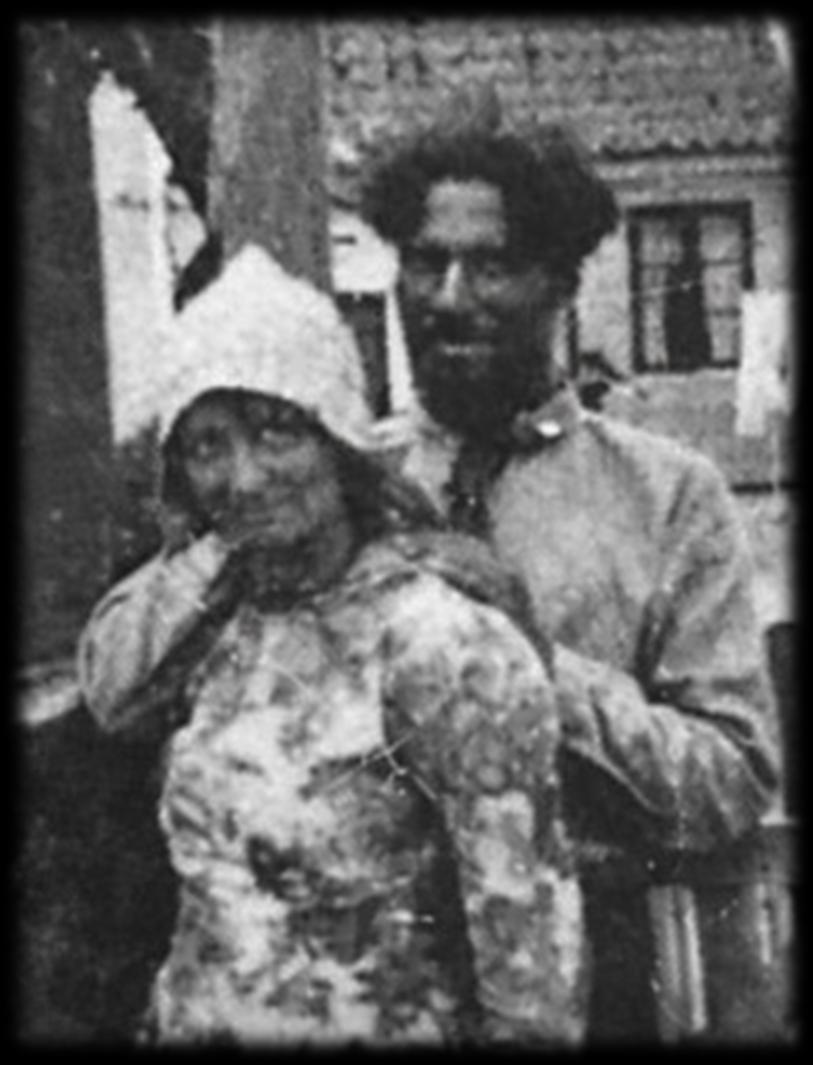
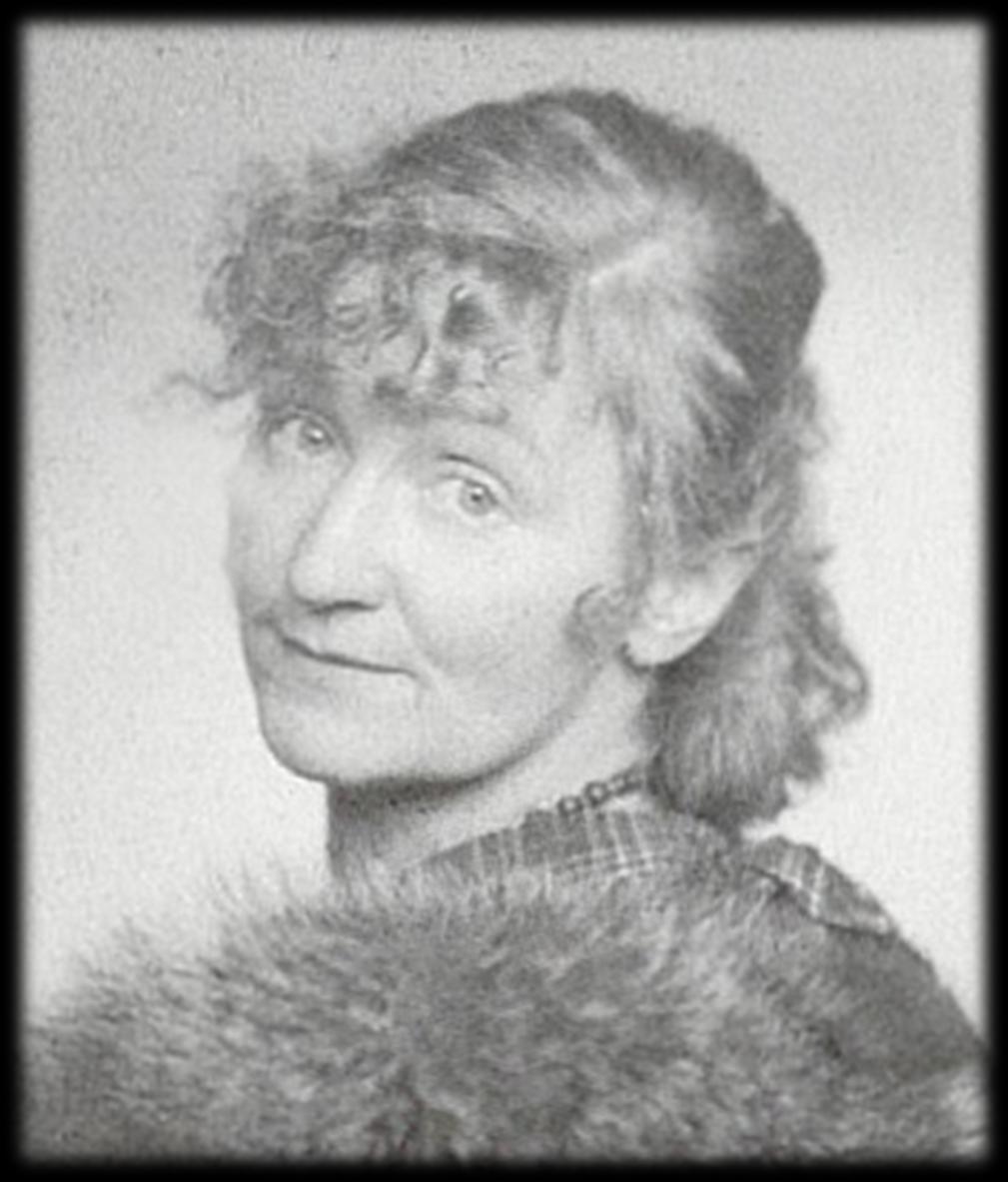
Holcha Krake and William H. Johnson, Kerteminde, ca. 1932. Courtesy of Helga and Niels Ejsing; reproduced from Richard J. Powell, Homecoming: The Art and Life of William H. Johnson.
Holcha Krake. Ca, 1932-1935.
Fiveknownimpressions.
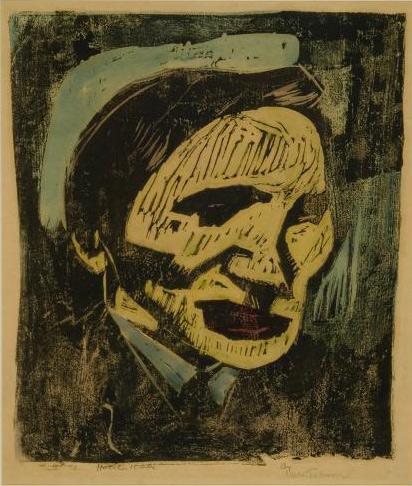
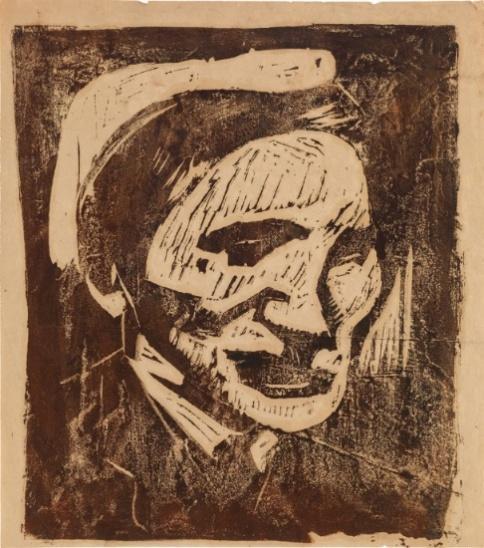
InHolchaKrake,Johnsonpresentsastylizedthree-quarterportraitofhisDanishwife, thetextileartistHolchaKrake.AlsoknownasLilHolcha,theprintdepictsherwearing ahatwithasweepingbrim,whilethesuggestionofajacketandcollaranchorsthe figurewithinalooselydefinedbackground.Theexaggeratedfeaturesandsharply incisedlineslendtheportraitapsychologicalintensitycharacteristicofJohnson’s engagementwithExpressionistaesthetics.
JohnsonmetKrakeataScandinavianartcolonyinCagnes-sur-Merin1929.After onlyafewmonths,thecouplebecameengagedandmarriedthefollowingyearin Kerteminde,Denmark.Theirrelationshipformedarareandresilientartistic partnershipthatcrossedculturalandnationalboundaries.Throughoutthe1930sand early1940s,theylivedandworkedtogetherinDenmark,Tunisia,Norway,andthe UnitedStates,sharingalifedeeplycenteredonartisticproductionandmutual support.Krake’sdeathfromcancerin1944profoundlyaffectedJohnsonandmarked adecisiveturningpointinhislifeandwork.
AlthoughJohnsonandKrakelivedcloselytogetherandwererarelyseparatedfor nearlyfifteenyears,relativelyfewknownportraitsofherbyJohnsonexistinany medium.Thismaysuggestthatshedidnotprefertoposeasatraditionalportrait model.
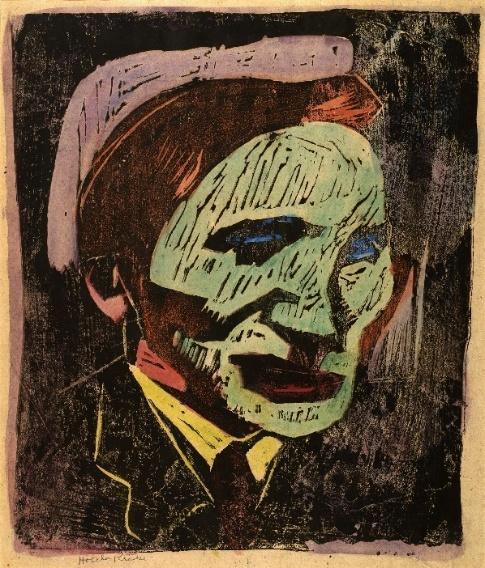
Holcha Krake. Ca. 1932-1935. Object Number: WHJ-BP-HOL-001.
Block print on paper. ( Woodcut). Hand-colored with a palette of mint green, pale blue, and deep blue for the face and eyes, reddish-brown for the hair, lavender-white for the headscarf, and accented with yellow and crimson at the collar against a dark, mottled background. Titled Holcha Krake at lower left. Size: 17 1⁄8 x 13 5⁄8 in. (43.4 x 34.5 cm) irregular. Provenance: Gift of the Harmon Foundation. Smithsonian American Art Museum, 1967.59.794.
Holcha Krake. Ca. 1932-1935. Object Number: WHJ-BP-HOL-002.
Block print on paper. ( Woodcut). Hand-colored with a palette of pale yellow and olive green for the face, light blue for the headscarf and collar, deep red for the lips, and set against a dark greenishblack background. Signed W.H. Johnson at lower right. Titled Holcha Krake at lower left. Size: 16 15/16 x 13 7/8 in. (43.0 x 35.3 cm).
Provenance: Spencer Museum of Art. Accession number: 1994.0039
Holcha Krake. Ca. 1932-1935. Object Number: WHJ-BP-HOL-003. Printed in brown on handmade buff paper. (Woodcut). Artist's proof. Size: 14 x12 in. (356 x 305 mm). Provenance: Estate of Holcha Krake; thence by descent to her grandniece, Johanna Voll. Sold at Swann Auction Galleries. Sale 2442 - Lot 15. Apr 06, 2017.
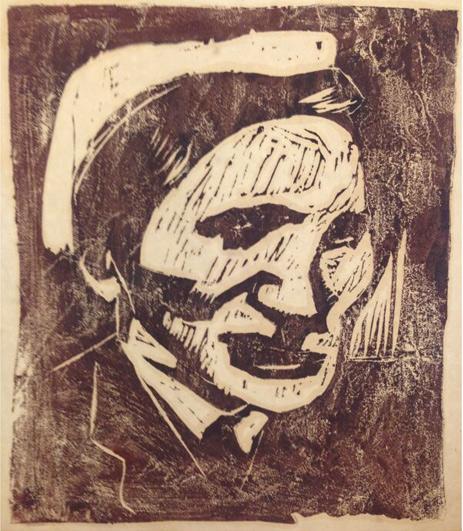
Holcha Krake. Ca. 1932-1935. Object Number: WHJ-BPHOL-004. Printed on brown on paper. (Woodcut). Size H: 20 in, W: 16.75 in. Provenance: Gift of the Harmon Foundation. Courtesy of Oakland Museum of California (OMCA). Accession no: A67.62.19.
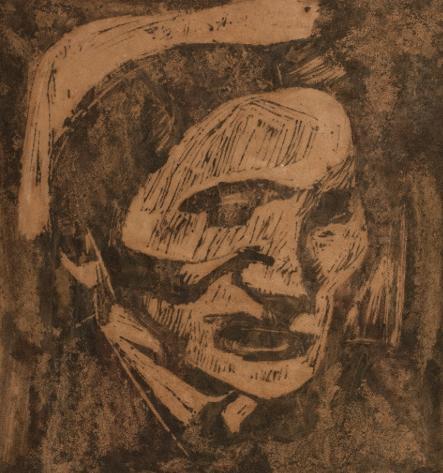
Holcha Krake. Ca. 1932-1935. Object Number: WHJ-BPHOL-005. Printed on brown on paper. (Woodcut). Size: H: 20 ¾ in. W: 16 ¾ in. D: 1 ¼ in. Provenance: Gift of the Harmon Foundation. Hampton University Museum & Archives. Accession no: 67.44.11
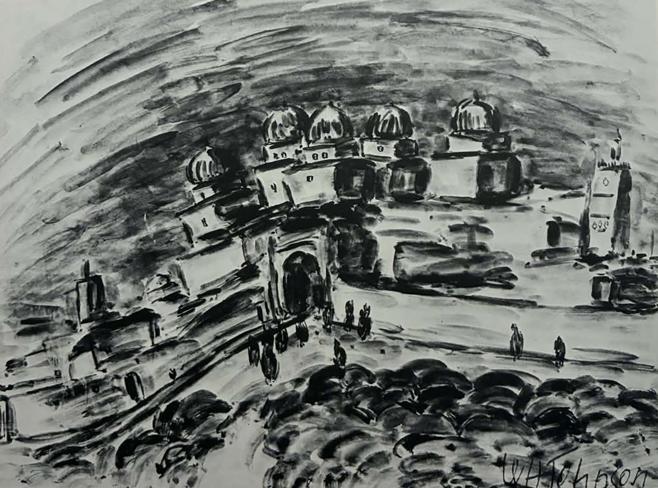
The Mosque of the Sabres. Ca. 1932-1935.
Sixknownimpressions.
Inthespringof1932,JohnsonandKrake,undertookathree-monthjourneythrough Tunisia,immersingthemselvesintheregion’srichculturalandartistictraditions. Duringtheirtravels,thecoupleproducednumerousquickstudiesinwatercolorand pencil,withJohnsonfocusingparticularlyonarchitecturalsubjectsandurbanscenes.
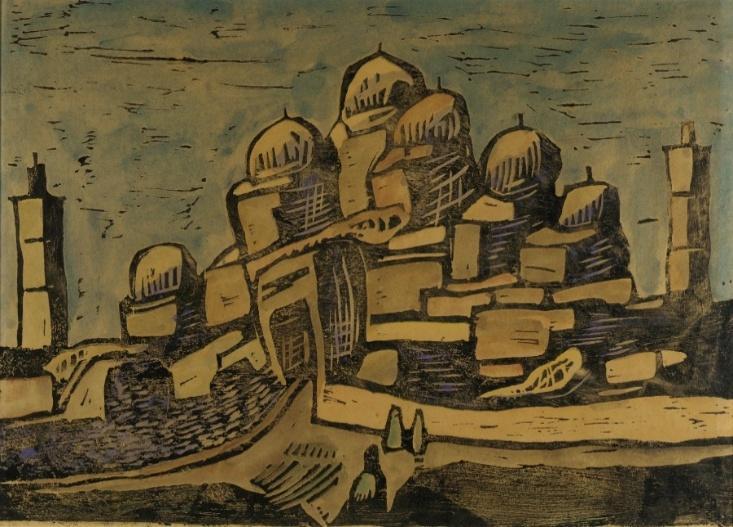
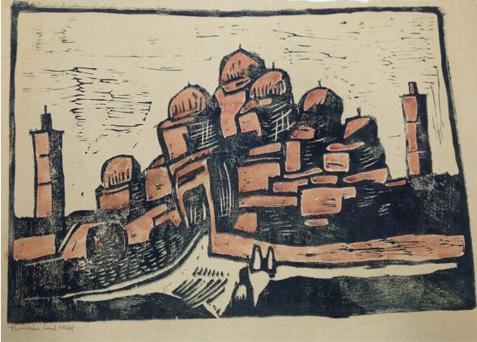
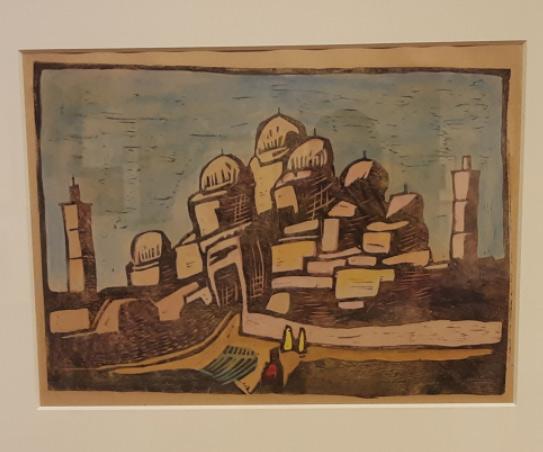
Oneofthestructuresherecordedduringthistriplaterservedasthebasisforablock printandhasbeenidentifiedastheMosqueoftheSabres(ZaouiaofSidiAmor Abbada),anineteenth-centuryreligiouscomplexandmausoleumdedicatedtoa reveredblacksmithsaint.Spanningmorethan1,500squaremeters,thestructureis distinguishedbyitsribbeddomessupportedonsquinches,featuresthatgivethe buildingastrikingandeasilyrecognizablesilhouette.
Johnson’sprint,togetherwithacompanionwatercoloroftheMosqueoftheSabres, presentsthesiteasanidealizedhilltopcity.Throughboldlinesandsimplified, sculpturalforms,heemphasizesthebuilding’ssacredgeometryandmonumental presence,transformingthearchitectureintoapowerfulandcontemplative composition.
MosqueoftheSabresexistsintwoknownvariationsandwaslikelycreatedbetween 1932and1935,possiblyfirstintendedforJohnsonandKrake’sjointexhibitionatthe KertemindeLibraryinOctober1932,organizedshortlyaftertheirreturnfromTunisia. Theprintisknownunderseveraltitles,includingLandscapewithMosques,Mosques onaHill,andTunisianLand.Mosque.
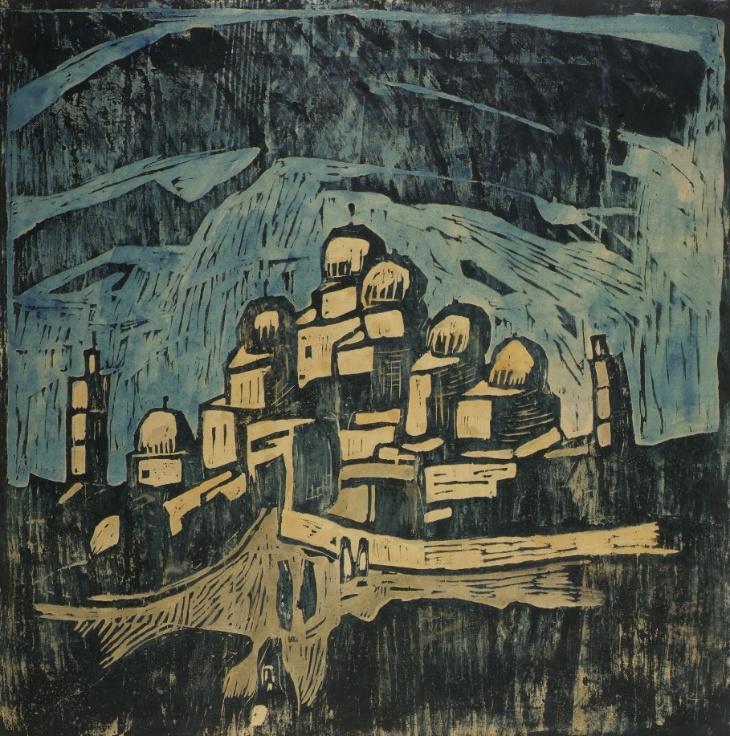
The Mosque of the Sabres. Ca,1932-1935. Object Number: WHJ-BP-TUN-001. Hand-colored woodcut on paper. Signed W.H. Johnson. Size: 21 3⁄4 x 21 7⁄8 in. (55.2 x 55.6 cm). Provenance: Gift of the Harmon Foundation. Smithsonian American Art Museum, 1967.59.857. Exhibited: New York Public Library, Countee Cullen Branch, December 5, 1956-March 1, 1957.
The Mosque of the Sabres. Ca,1932-1935. Object Number: WHJ-BP-TUN-002. Block print on paper. (Woodcut). Hand-colored in soft sandy ochres and warm browns, set against a muted blue sky with touches of deep purple and black for architectural depth. Size: 14 5⁄8 x 19 1⁄2 in. (37.0 x 49.5 cm) irregular. Provenance: Gift of the Harmon Foundation. Smithsonian American Art Museum, 1967.59.855.
The Mosque of the Sabres. Ca,1932-1935. Object Number: WHJ-BP-TUN-003. Block print on paper. (Woodcut). Hand-colored in warm ochre and dusty rose, with bold black outlines on a cream background. Titled lower left: Tunisian land. Mosq. Size: H: 12 in, W: 17 in. Provenance: Gift of the Harmon Foundation. Courtesy of Oakland Museum of California (OMCA). Accession no: A67.62.22
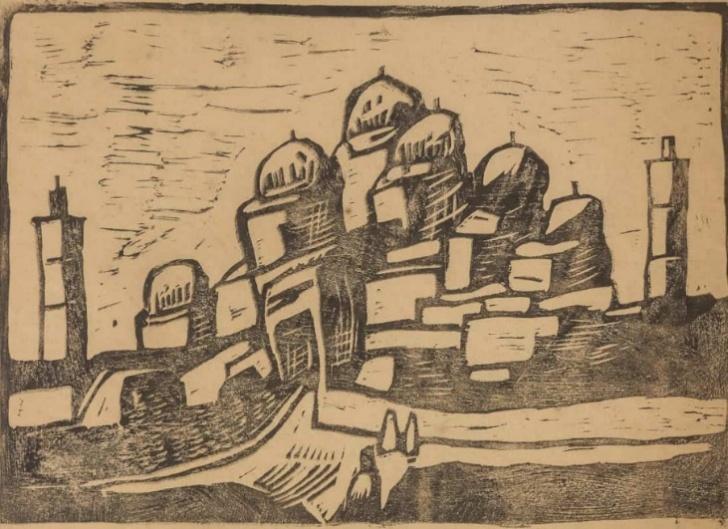
The Mosque of the Sabres. Ca,1932-1935. Object Number: WHJ-BP-TUN-004. Block print on paper. (Woodcut). Size: 12 3/8 x 17 7/8 in. Provenance: Fisk University Galleries, Fisk University, Nashville, TN. Courtesy of American Federation of Arts.
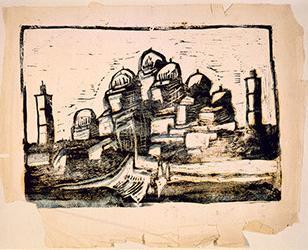
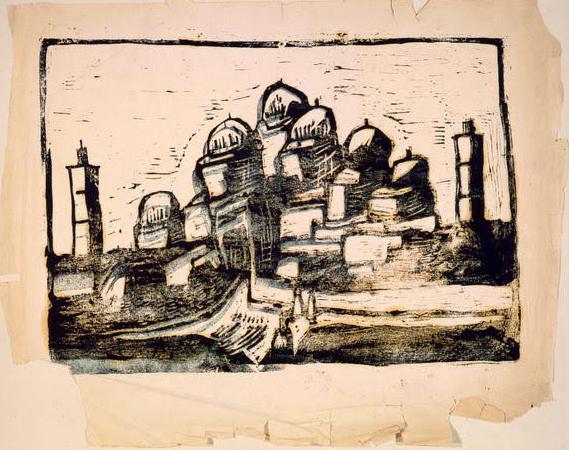
The Mosque of the Sabres. Ca,1932-1935. Object Number: Block print on paper. (Woodcut). Inscribed a on verso: No. TU-349-A. Provenance: From Harmon Foundation. Library of Congress, item 91482331.
The Mosque of the Sabres. Ca,1932-1935. Object Number: WHJ-BP-TUN-006. Block print on paper. (Woodcut). Hand-colored in soft blue, muted browns, pale yellow, dark brown, and red-yellow accents. Size: H: 23 7/16 in. W: 27 ½ in D: 1 13/16 in. Provenance: Gift of the Harmon Foundation. Hampton University Museum & Archives. Accession no: 67.44.36
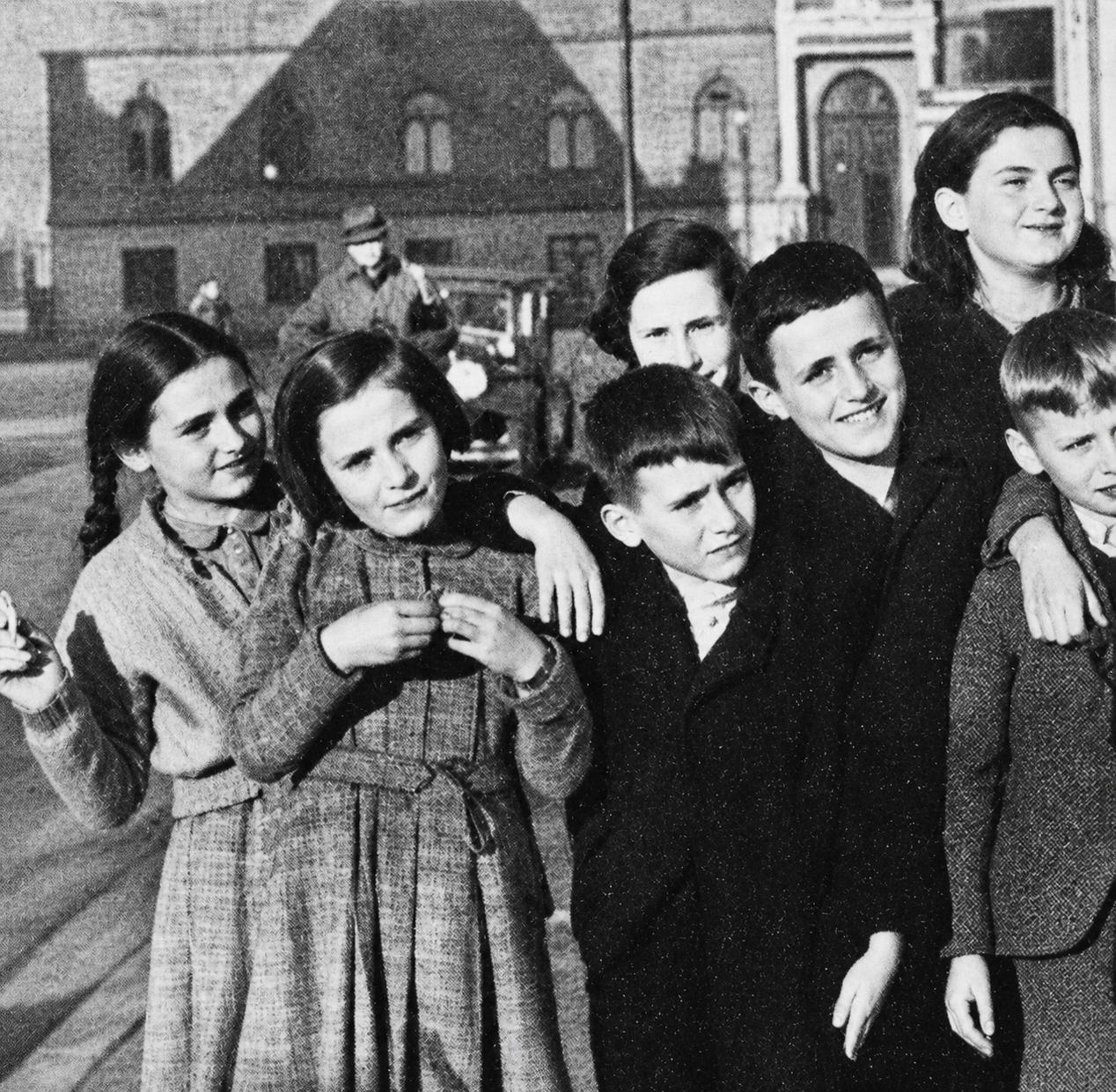
WilliamH.Johnson’sRefugeeprintseriesbearswitnesstothehumantollofwarin 1930sEurope,withaparticularfocusonthefragilityanddisplacementofchildren. Whilethefigureswereinitiallythought,accordingtotheexhibitioncataloguefor WilliamH.Johnson:WorldonPaper(AmonCarterMuseum,2007),todepictvictims oftheSpanishCivilWar,itisnowunderstoodthatsomearebasedonNorwegian childrenknowntotheartist.Johnsonreworkedtheseindividuallikenessesintomore universalimagesofchildhooddisplacement,evokingthebroaderhumanitariancrises thatshapedEuropeduringthedecade
Beginningin1933,theriseoftheNaziregimeinGermanytriggeredagrowing exodusofintellectuals,artists,andtheirfamiliesfleeingsystematicpersecutionto neighboringEuropeancountries.TheNurembergLaws,enactedin1935,stripped GermanJewsofcitizenshipandacceleratedthismassdisplacementintothe hundredsofthousands.After1936,theoutbreakoftheSpanishCivilWarandthe consolidationofFranco’sregimefurtherintensifieddisplacementacrossEurope.
JohnsonbeganhisRefugeeseriesduringhistimeinScandinaviaaround1935–36, likelyshapedbythegrowingpoliticalunrestinEurope,whichpersonallyaffectedhis brother-in-law,theGermansculptorChristophVoll,aswellasbypossibleencounters withrefugeesseekingasyluminDenmarkandNorway.
AspoliticaltensionsescalatedandNazipersecutionincreasinglytargetedartistsand interracialcouples,JohnsonandhisDanishwife,HolchaKrake,werethemselves drawnintoaconditionofdisplacement,leavingEuropeforNewYorkin1938.There, Johnsoncontinuedtodeveloptheseries,particularlyduringhisaffiliationwiththe HarlemCommunityArtCenterin1939,wherethethemesofexile,uncertainty,and forcedmigrationassumedanevenmorepersonalandemotionallycharged significance.
Johnson’sRefugeeSeriesconsistsofthreeindividualworks.
RefugeeMotherandChild,ca.1936-1939
RefugeeChild,ca.1936-1939
RefugeeBoy,ca.1936-1939
of Jewish refugee children arriving in Bergen, Norway, October 1939. Courtesy of Bergens Tidende.
Oneknownimpression.
InRefugeeMotherandChild,Johnsonpresentsthefiguresinatightlycompressed, frontalcompositionthatunderscorestheirphysicalandemotionalcloseness.The child’sheadrestsbetweenthemother’shandandbreast,drawnclosetoherfaceina gestureofprotectionandintimacy.Thecontrastbetweenthechild’syellow-toned skinandsteadygazeandthemother’swarmerpinkhuescreatesadistinctvisual separationwhilereinforcingtheirinterdependence.
AsinJohnson’sprintJonFisherman(2)(ObjectNo.WHJ-BP-FSH-0008–0011),theuse ofstrongcolorcontrastsandsimplifiedformscreatesastained-glass-likeeffect. Flattenedplanesandemphaticoutlinesheightentheimage’ssymbolicresonance, transformingtheintimatesceneintoaniconicrepresentationofenduranceand maternaldevotion.
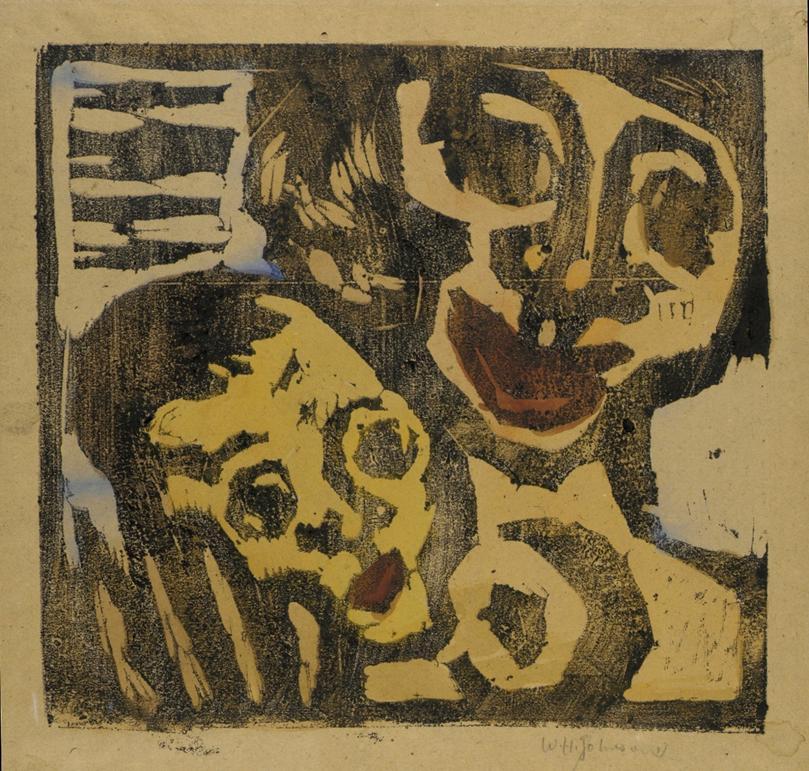
Refugee Mother and Child, ca. 1936-1939. Object Number: WHJ-BP-REF-001. Block print on paper. (Woodcut). Hand-colored with a palette of ochre, muted red, black, and pale blue, with ochre dominating the faces and red accenting the lips. Signed W.H. Johnson to lower right. Size: 10 x 10 1⁄2 in. (25.4 x 26.7 cm). Provenance: Gift of the Harmon Foundation. Smithsonian American Art Museum, 1967.59.970
Refugee Child, ca. 1936-1939.
Nineknownimpressions.
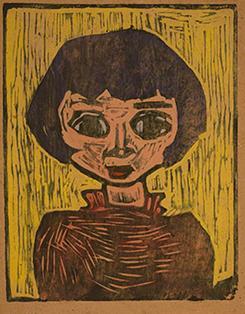
InRefugeeChild,Johnsonpresentsastylizedportraitofayoungchild,employing bold,simplifiedcarvingtoemphasizethefigure'semotionalpresence.Thechild's large,wide-seteyesandtightlyclosedmouthconveyamixofvulnerabilityand resilience
TheprintwasderivedfromJohnson’spaintingGirlinaRedDress(ca.1936), executedduringhisyearsinVolda,Norway.ThesitterhasbeenidentifiedasLiv Barstad,ayounggirlfromVoldawho’slarge,questioningeyescaptivatedtheartist. InaninterviewwiththelocalnewspaperMøre(Volda,9July1936),Johnsonrecalled: “Iwasnotplanningtopaintanyportraits,butthislittlegirlwassoattractivethatI knewIhadnootherchoice.”
WhiletheportraitoriginatedinaquietruralNorwegiansetting,Johnson’sdecisionto reusethemotifintheprintRefugeeChildsuggeststhathecametoregardherimage asauniversalsymbolofthedisplacementanduncertaintyexperiencedbychildren acrossEuropeinthelate1930s.

Liv Barstad (1927–2012), who lived near Johnson at Engeset in Volda, modeled for Girl in a Red Dress at around eight or nine years of age. She reportedly took great pride in knowing that her portrait belonged to the collection of the Moderna Museet in Stockholm.
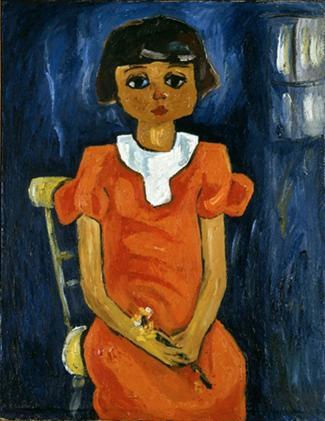
Girl in a Red Dress ca. 1936. Oil on canvas. Moderna Museet, Stockholm (NM 3290).
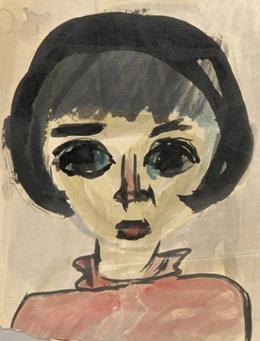
Refugee Child ca. 1936–1939. Watercolor on paper. Possible preparatory sketch. Smithsonian American Art Museum, 1967.59.19.
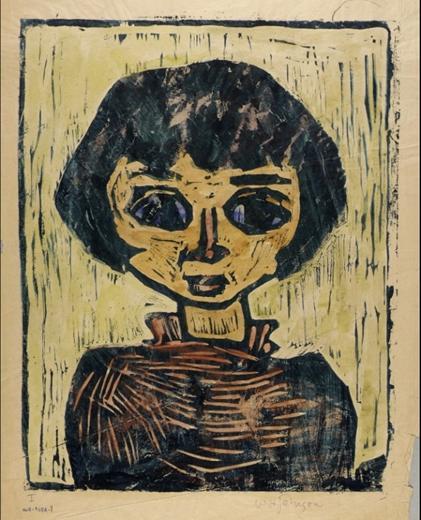
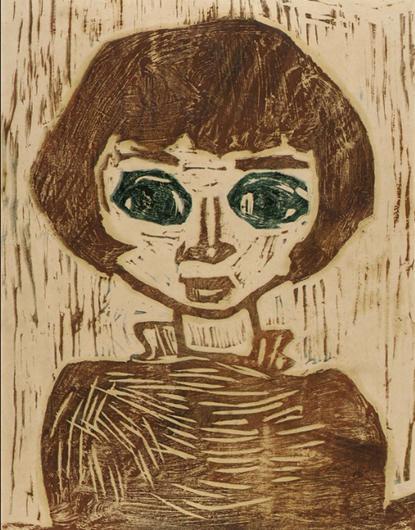
Refugee Child, ca. 1936-1939. Object Number: WHJ-BPREF-002.Block print on paper. (Woodcut). Signed W.H. Johnson to lower right. Annotated: "NOR-319A-1. Handcolored with a palette of black, ochre, reddish-brown, and soft yellow-green. Size: 21 5⁄8 x 14 1⁄2 in. (55.0 x 36.8 cm) irregular. Provenance: Gift of the Harmon Foundation. Smithsonian American Art Museum, 1967.59.903.
Refugee Child, ca. 1936-1939. Object Number: WHJ-BPREF-003.Block print on paper. (Woodcut). Signed W.H. Johnson on verso. Annotated: "NOR-329A-2. Hand-colored with a palette of deep purple-black for the hair, light pinkish tones for the face, and reddish-brown for the garment. The background is rendered with yellow, overlaid with vertical black lines. Provenance: Harmon Foundation. Retrieved from the Library of Congress, www.loc.gov/item/2003688152.
Refugee Child, ca. 1936-1939. Object Number: WHJBP-REF-004.Block print on paper. (Woodcut). Handcolored in a palette of earthy brown tones for the hair and clothing, deep green for the eyes, and light beige for the face and background. Size: 16 7/8 x 13 3/8 in. (42.9 x 34.0 cm). Provenance: Gift of Mrs. Douglas E. Younger. (Assistant Director at the Harmon Foundation). Smithsonian American Art Museum. Accession no: 1971.142.
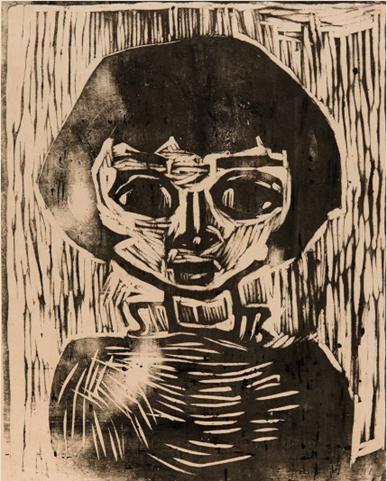
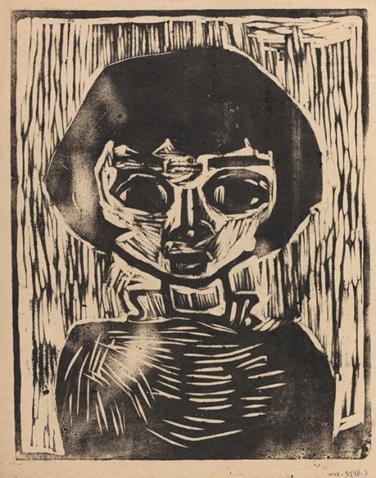
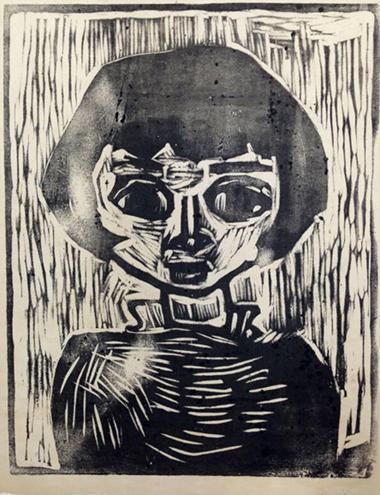
Refugee Child, ca. 1936-1939. Object Number: WHJ-BP-REF005.Block print on paper. (Woodcut). Size: 15 x 12 in. (38.1 x 30.48 cm) Provenance: Gift of the Harmon Foundation. Courtesy of the Amistad Research Center, New Orleans, LA. Accession Number:ARC.HAR.WHJO.1939.18
Refugee Child, ca. 1936-1939. Object Number: WHJ-BP-REF006. Block print on paper. (Woodcut). Size: 15 3/8 x 12 1/4 in. irr. (39.0525 x 31.115 cm. Provenance: Gift of the Philadelphia Commercial Museum (also known as the Philadelphia Civic Center Museum), Philadelphia, Pennsylvania. Accession Number: 2004.13.6
Refugee Child, ca. 1936-1939. Object Number: WHJ-BP-REF007.Block print on paper. (Woodcut). Annotated: "NOR524.B-2.” Provenance: Gift of the Harmon Foundation. Courtesy of Oakland Museum of California (OMCA). Accession no: A67.62.20
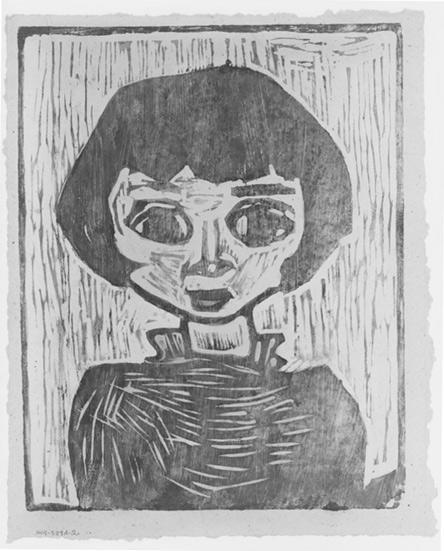
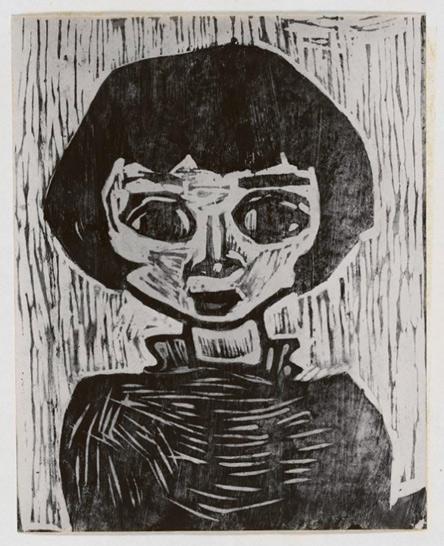
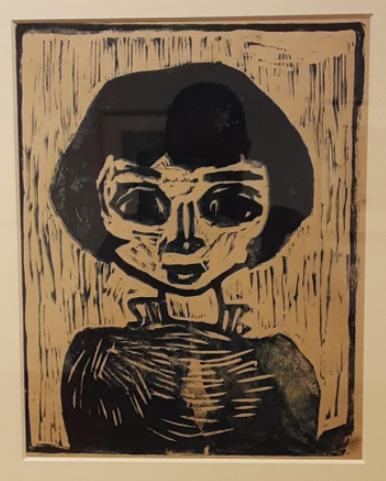
Refugee Child, ca. 1936-1939. Object Number: WHJ-BP-REF008.Block print on paper. (Woodcut). Annotated NOR-329A-2. Provenance: Gift of the Harmon Foundation. Smithsonian American Art Museum. Celebrating 175: Artist File, Johnson, William H., circa 1969-1971. Page 32.
Refugee Child, ca. 1936-1939. Object Number: WHJ-BP-REF009.Block print on paper. (Woodcut). Provenance: Gift of the Harmon Foundation. Smithsonian American Art Museum. Celebrating 175: Artist File, Johnson, William H., circa 19691971. Page 28.
Refugee Child, ca. 1936-1939. Object Number: WHJ-BP-REF0010. Block print on paper. (Woodcut). Size: H: 25 5/8 in. W: 21 5/16 in. D: 1 ¾ in. Provenance: Gift of the Harmon Foundation. Hampton University Museum & Archives. Accession no: 67.44.30.
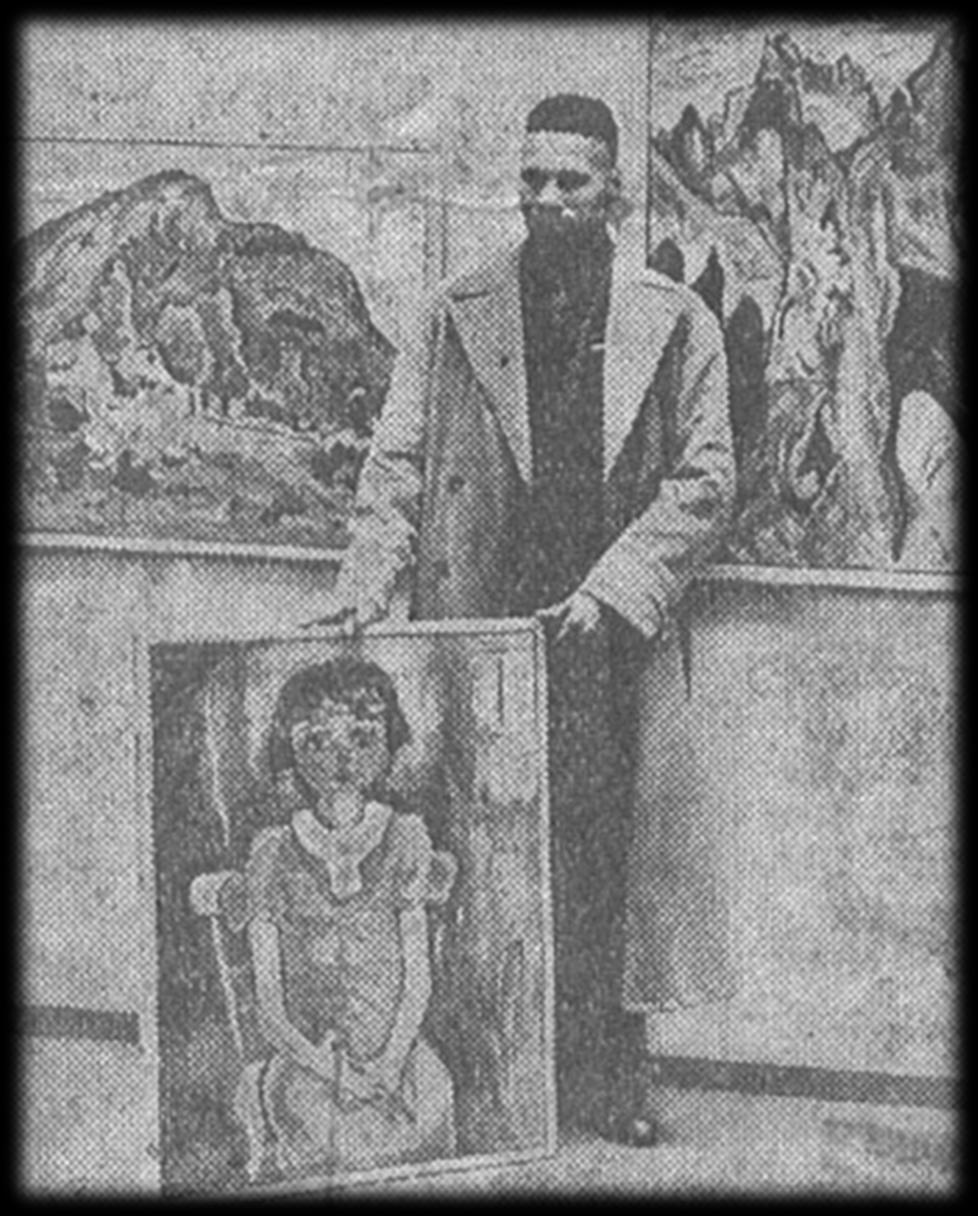
William H. Johnson seen with Girl in a Red Dress at the Trondheim Art Society (Trondhjems Kunstforening). Norway, September 1937. Image credit: William H. Johnson Papers, Archives of American Art, Smithsonian Institution.
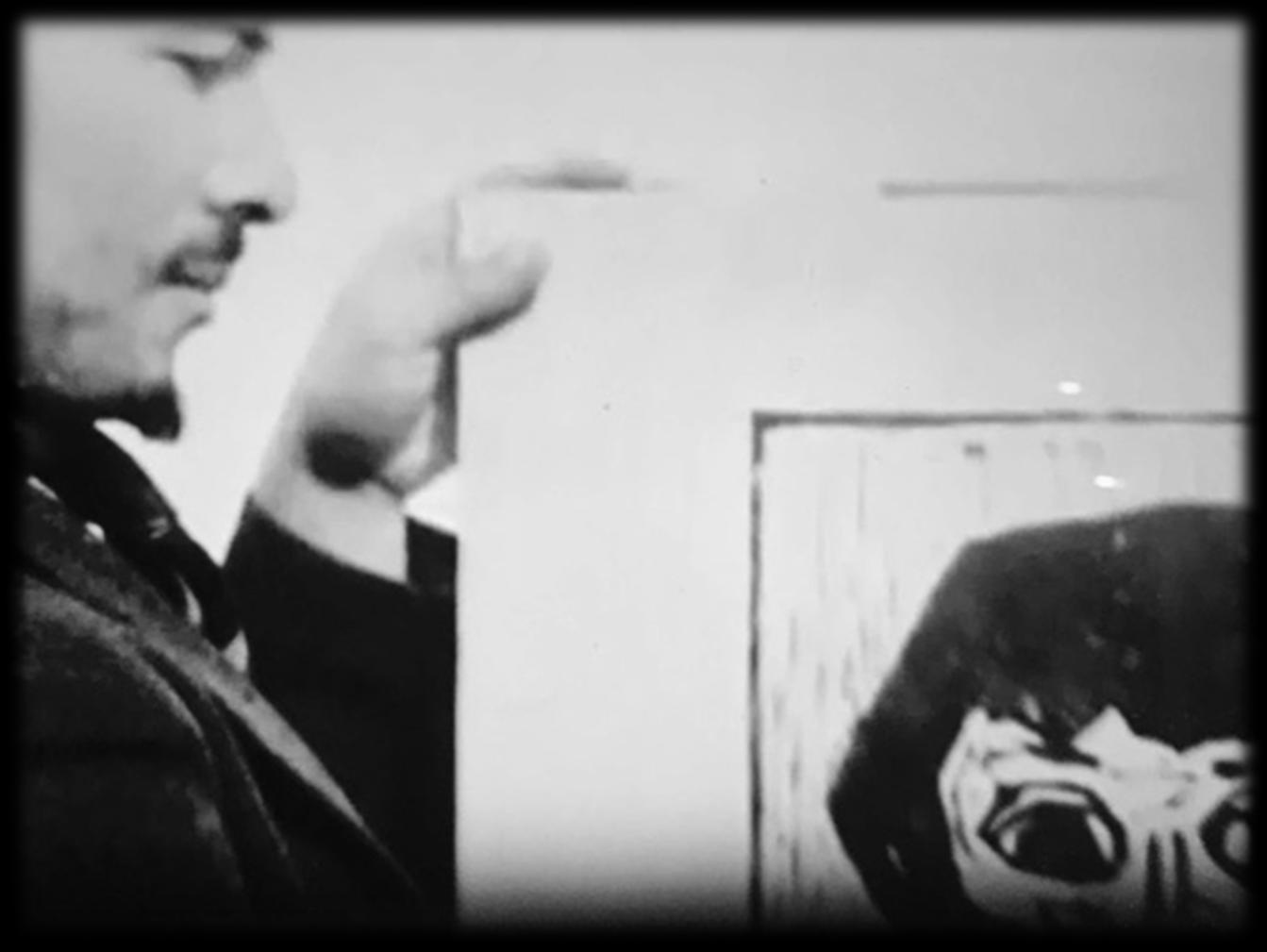
William H. Johnson seen holding a version of the Refugee Child print at Harlem Community Art Center in New York. Ca, 1939-1942. Image credit: Christoph Voll estate collection. Per Mossin. Danmarks Radio 1983.
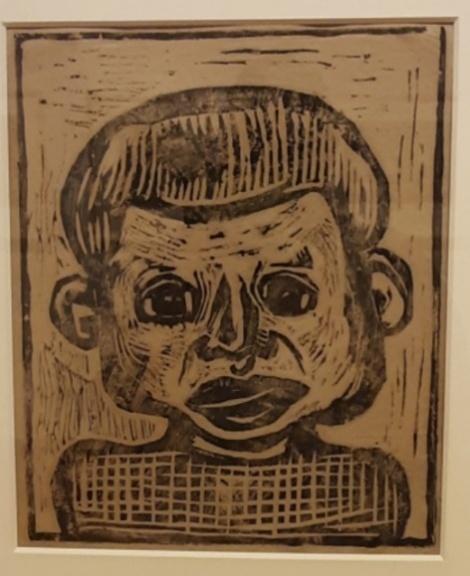
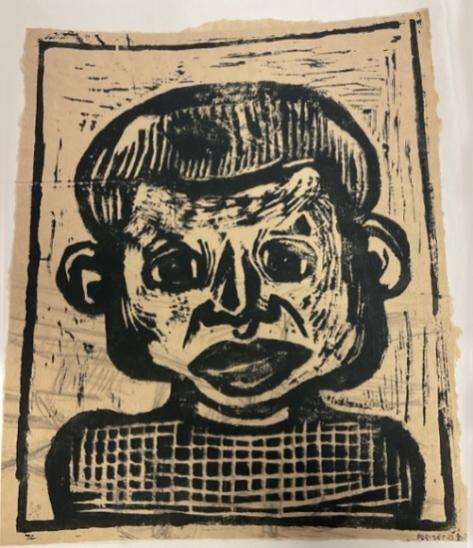
Refugee Boy, ca. 1936-1939.
Fiveknownimpressions.
InRefugeeBoy,Johnsonpresentsafrontal,tightlyframedportraitofayoungboy, renderedwithstrikingimmediacythroughbold,simplifiedforms.Thefacedominates thecomposition,enlargedandmask-like,withwide,darkeyesandaslightlyopen mouththatsuggestsbothvulnerabilityandunease.
TheprintcloselyechoesJohnson’swatercolorPortraitofaLittleBoy(ca.1932–1935), aworkhegiftedtohiswife,HolchaKrake.Theboy’sidentityremainsunknown, thoughhewaslikelyoneofthechildrenwhogatheredaroundJohnsonashe worked,captivatedbytheunusualsightoftheartistandhisanimatedpresence.
OnepossiblecandidateisRolfKlepp(1927–2015),aboyfromVoldawhomJohnson metinautumn1935.AccordingtoNarveF.Birkeland(2001),Johnsonencountered Kleppintearsafterhewasunabletoaffordaboatfareforaschooltripandinvited himtositforaportrait.
ThisencounterparallelsRefugeeChild(ca.1936–1939),inwhichJohnsonportrayed LivBarstad,agirlfromthesamequietNorwegiantownofVolda,whosesorrowful eyesinspiredhimtouseherimageasasymbolofthedisplacementfacedby childreninprewarEurope.
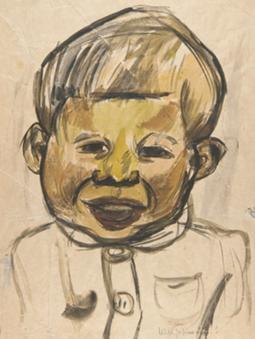
H. Johnson,
a Little Boy, ca. 1932-1935. Watercolor. Smithsonian American Art Museum, 1967.59.15R-V
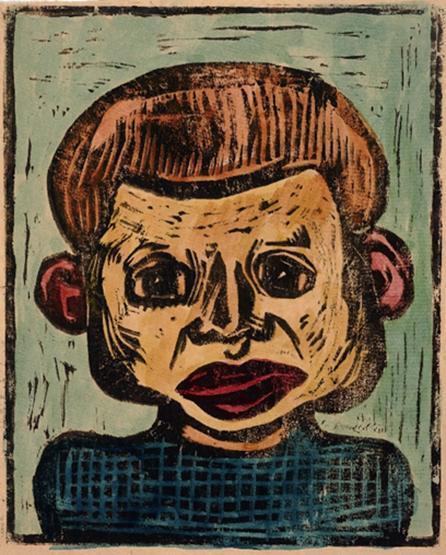
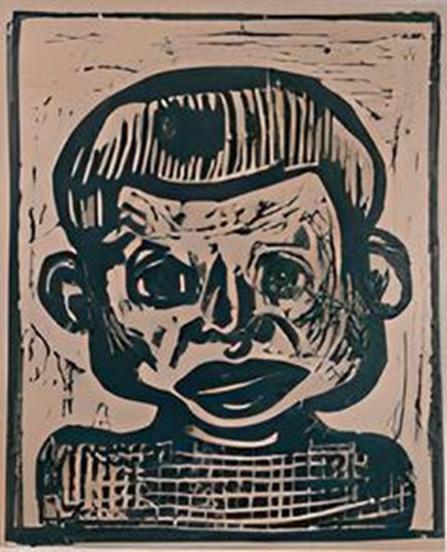
Refugee Boy, ca. 1936-1939. Object NumberWHJBP-REF-0011. Block print on paper mounted on paperboard. (Woodcut). Hand-colored in ochre, teal, and deep brown, with red accents and a blue garment against a pale background. Size: 13 1⁄2 x 10 3⁄4 in. (34.3 x 27.3 cm). Provenance: Gift of the Harmon Foundation. Smithsonian American Art Museum, 1967.59.902
Refugee Boy ca. 1936-1939. Object Number: WHJBP-REF-0012. Block print on paper (Woodcut). Size: 15 3/16 × 12 5/8 in. (38.6 × 32 cm). Provenance: Evans-Tibbs Gallery, Washington, D.C. until 1992. Sold on January 21, 1992 to Reba and Dave Williams, New York. Gifted to The Metropolitan Museum of Art in 1999. Object Number: 1999.529.77.
Refugee Boy ca. 1936-1939. Object Number: WHJBP-REF-0013. Block print on paper (Woodcut). Size: H: 23 ¼ in. W: 21 5/8 in. D: 1 ¾ in. Provenance: Gift of the Harmon Foundation. Hampton University Museum & Archives. Object ID: 67.44.5
Refugee Boy ca. 1936-1939. Object Number: WHJ-BP-REF-0014. Block print on paper (Woodcut). Size: 14 ½ in. W: 12 in. Provenance: Gift of the Harmon Foundation. Hampton University Museum & Archives. Object ID: 67.44.6
Refugee Boy ca. 1936-1939. Object Number: WHJBP-REF-0015. Block print on paper (Woodcut). Size: 21"h x 17"w x 1"d. Provenance: Gift of the Harmon Foundation. Fisk University Galleries. Object ID. #00414
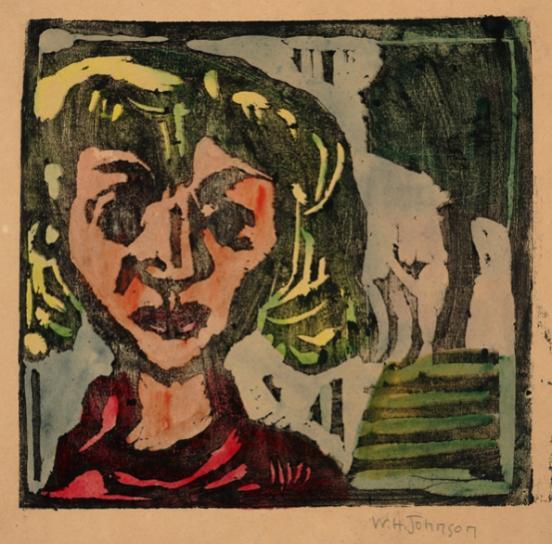
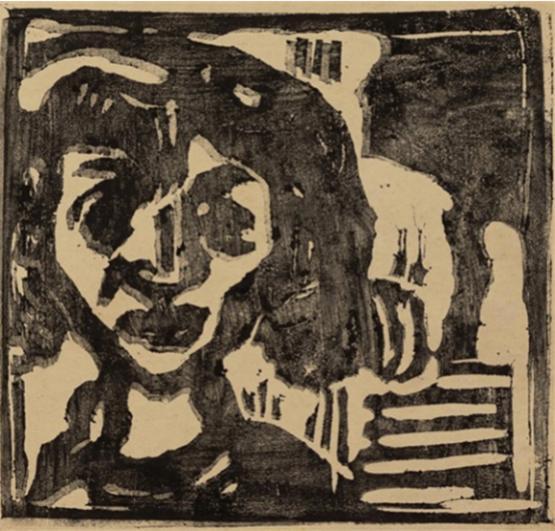
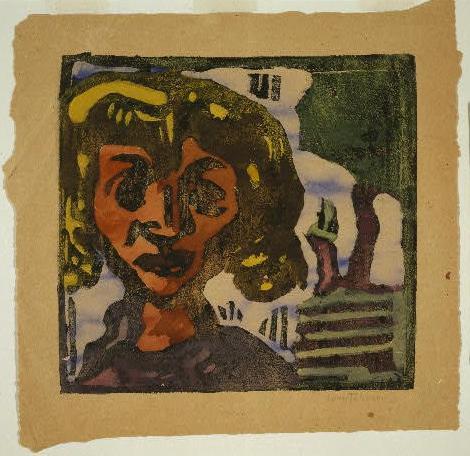
Outdoor Girl-Head. ca. 1935–1938.
Fourknownimpressions.
InOutdoorGirl–Head,Johnsonportraysayounggirlsetagainstwhatappearstobe aruraloroutdoorsetting,asuggestionreinforcedbythetitle.Dominatedbyacloseupviewofthegirl’sface,thecompositionisconstructedthroughthickblack contours,sharplycarvedhighlights,andflattenedplanesthatcreateabold,almost stained-glass-likeeffect.Heavyshadowingalongtheleftsideofthefaceandthe simplifiedtreatmentofthefeatureslendtheimageastrongpsychologicalpresence whileemphasizingtheexpressiveforceofthewoodcutmedium.
Thetitle’sreferencetothe“outdoorgirl”mayevokecontemporaryinterwarideals associatedwithyouth,health,vitality,andoutdoorlife,themesthatheldparticular culturalresonancewithinScandinaviansocietyduringthe1930s.
ThedesignationHeadsuggeststhatthecompositionmayhavebeenconceivedas partofalargerseriesorrelatedfigurestudy,althoughnocorrespondingfull-length versioniscurrentlyknown.
Outdoor Girl-Head, ca. 1935-1938. Object Number:
WHJ-BP-OUT-0001. Block print on paper mounted on paperboard. (Woodcut) Signed W.H. Johnson to the lower right. Hand-colored with a palette of yellowgreen, red, pale peach, deep green, and black, set against a background of light blue and muted green tones. Size: 12 3⁄4 x 13 1⁄4 in. (32.4 x 33.5 cm).
Provenance: Gift of the Harmon Foundation, Smithsonian American Art Museum, 1967.59.969
Outdoor Girl-Head, ca. 1935-1938. Object Number: WHJ-BP-OUT-0002. Block print on cream paper. (Woodcut). Size: 10 x 10 ½ inches. Provenance: The estate of Holcha Krake; by descent to her grandniece, Johanna Voll. Private collection.
Outdoor Girl-Head, ca. 1935-1938. Object Number: WHJ-BP-OUT-0003.Block print on paper. (Woodcut) Hand colored. Signed W.H. Johnson on recto and verso. Annotated: "til Holcha fra Willie"; "NOR-597-2."
Provenance: From Harmon Foundation, Inc. records. Courtesy of the Library of Congress, LC-USZC4-11579.
Outdoor Girl-Head, ca. 1935-1938. Object Number: WHJ-BP-OUT-0004.Block print on paper. (Woodcut) Size: 15"h x 16"w x 1⅛"d. Provenance: Gift of the Harmon Foundation. Fisk University Galleries. Object ID. #0407
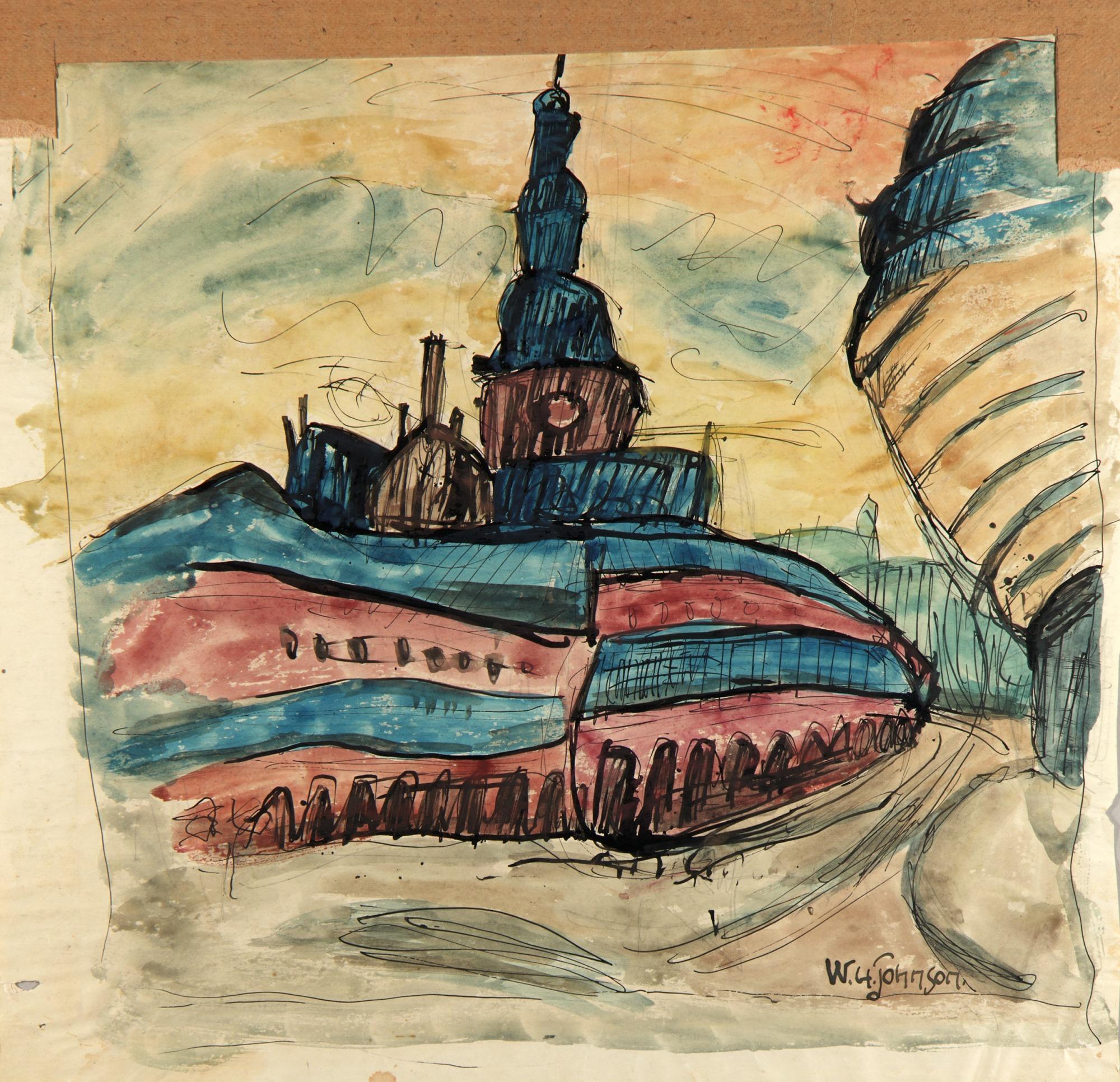
Duringthe1930s,WilliamH.JohnsontraveledextensivelythroughoutDenmarkand Norway,depictingScandinavianlandscapes,villages,churches,andruralarchitecture thatwouldbecomecentralsubjectswithinhiswoodcutpractice.
Oftenjourneyingbybicyclewithcampinggearandartsupplies,heworkedon lightweightandinexpensivepaper,usingwatercolor,ink,andgouachetorapidly capturearchitecturalforms,shiftinglight,colorrelationships,andtheoverall atmosphereofaplacedirectlyfromobservation.Theseportablestudiesfunctioned notsimplyasfinishedworksinthemselves,butaspreparatoryvisualrecordsthat Johnsonlaterreinterpretedinthemoredemandingmediumofoilandwoodcut.
WhenJohnsontranslatedhiswatercolorstudiesontowoodblocks,hetracedtheir essentialcontourswhilesimplifyingandreorganizingdetailsintoboldlines,flattened forms,andstrongtonalcontrasts.Thephysicalresistanceofthewoodblock encouragedfurthersimplificationandabstraction,transformingobservedlandscapes intoexpressivegraphiccompositionsshapedasmuchbytheactofcarvingasby representationitself.
Johnson’sScandinavianlandmarksandlandscapesseriesconsistsoftenindividual works.
Windmill,Denmark.(TheSwanMill)ca.1932-1935.
Windmill,Kerteminde(TheVibyMill,no.1),ca.1932–1935.
TheVibyMill,No.2.ca.1932–1935.
BazaarsBehindChurchofOurSavior,Oslo.ca,1935-1937.
LomKirke.(LomChurch,squareFormat)ca.1935–1938
LomGl.Kirke,Gudbrandsdalen(TheOldChurchinGudbrandsdalen.VerticalFormat). ca.1935–1938.
VoldaFjord,Norway,ca.1935–1938
Moon-Rise,Star-Rise,ca.1935–1938.
ChurchbyLakeII.(FarmsteadbyLake)ca,1935–1938.
ChaletsbyJostedalGlacier(Grepstadstøylen)ca.1935-1937.
William H. Johnson, Bazaars behind Church, Oslo, ca. 1935, watercolor. Smithsonian American Art Museum, 1967.59.11
Windmill, Denmark. (The Swan Mill) ca. 1932-1935.
Threeknownimpressions.
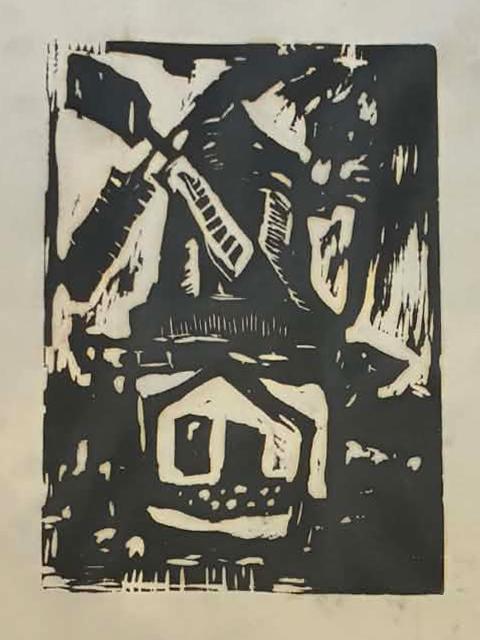
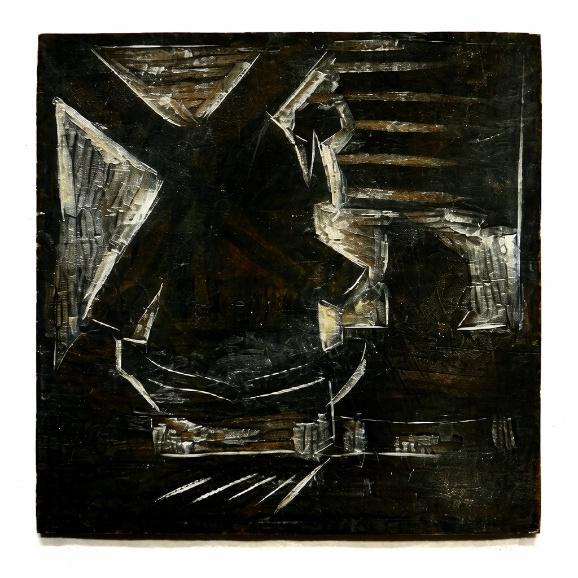
InWindmill,Denmark,Johnsonpresentsacompressedviewofawindmillrising aboveaclusterofsimplifiedarchitecturalforms.Thestructureisrenderedthrough bold,angularcarving,withthemill’ssailscuttingdiagonallyacrossthecomposition, introducingasenseofmovementandtension.Ratherthansituatingthemillandthe miller’shousewithinanaturalisticspatialsetting,Johnsonfusesthemintoatightly unifiedarrangement:thehouseisanchoreddirectlybeneaththemill,itssimplified geometryechoingandsupportingthelargerstructureabove.
Themill,nowidentifiedasSvanemøllen(theSwanMill),standsasaprominent landmarkatMøllebakkeninKerteminde.Builtin1853andnamedfortheswanshapedweathervaneatopitsroof,ithaslongdefinedthetown’snorthernskyline. ThemillwasownedbytheDanishpainterJohannesLarsen(1867–1961),whobuilt hisvillaoppositeitin1902.Thissitebecameavibrantcenterofartisticandcultural lifeonFunen,andthemillitself,frequentlydepictedinDanishart,remainedin Larsen’spossessionuntilhisdeathin1961.
DuringhisresidenceinKertemindebetween1930and1935,Johnsonlivedonlya shortwalkfromSvanemøllen,whichbecamearecurringmotifinhisworkfromthis period.
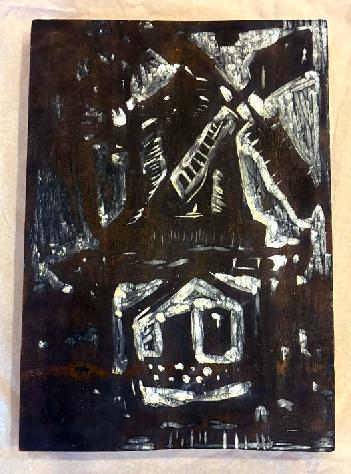
Windmill, Denmark. (The Swan Mill). Ca. 1932-1935. Carved wooden printing block with inlaid chalk. 23 x 23 cm. Johannes Larsen Museum.
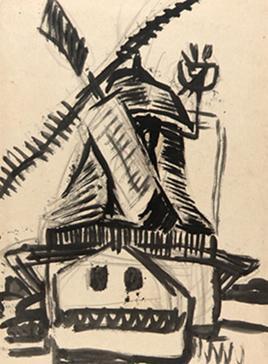
Old Windmill, ca. 1930–1935. Ink on paper. Possible preparatory sketch. Smithsonian American Art Museum, 1967.59.834
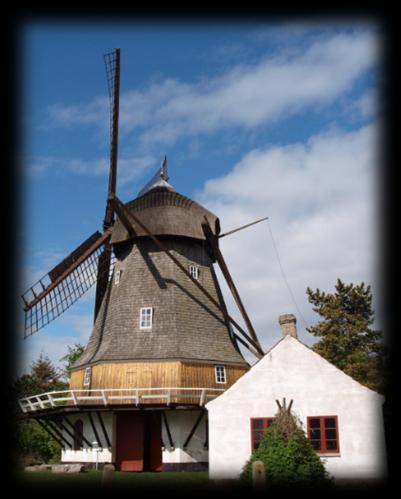
Svanemøllen at Møllebakken, Kerteminde. Marts 2025. Photo: Olav Sejerøe.
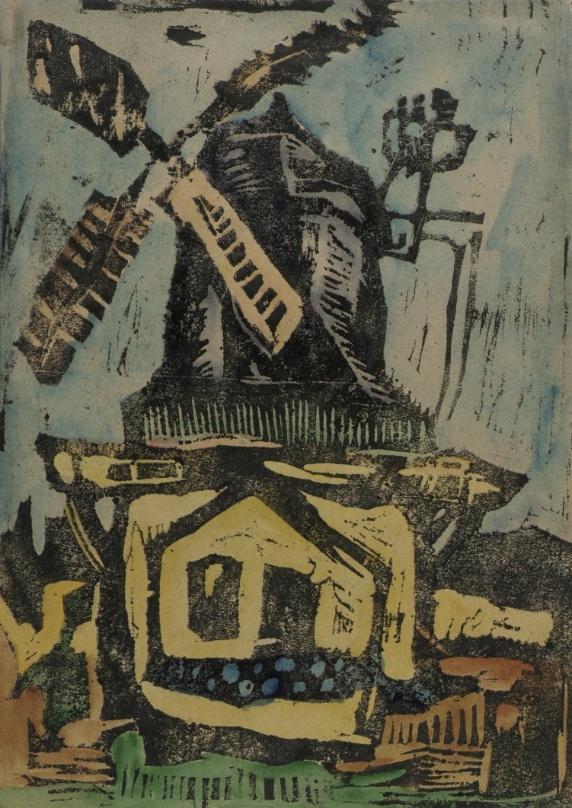
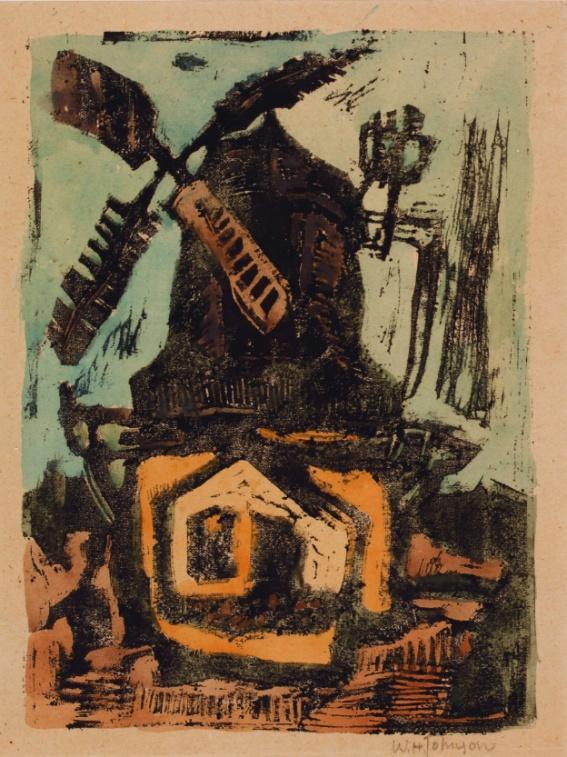
Windmill, Denmark. (The Swan Mill). Ca. 1932-1935. Object Number: WHJ-BP-SCA-001. Block print on paper. (Woodcut). Hand-colored with a palette of soft sky blue, pale yellow, black, and muted green, with touches of brown and blue accents. Size: 16 x 12 3⁄8 in. 40.5 x 31.4 cm. Gift of the Harmon Foundation Smithsonian American Art Museum, 1967.59.792.
Windmill, Denmark. (The Swan Mill). Ca. 1932-1935. Object Number: WHJ-BP-SCA-002. Block print on paper. (Woodcut). Signed W.H. Johnson at lower right. Hand-colored with a palette of deep black, burnt orange, ochre, and pale turquoise green, with warm brown accents. Size: 14.5 x 11 in. (36.83 x 27.94 cm). Provenance: Gift of the National Collection of Fine Arts (NCFA). Now the Smithsonian American Art Museum. Courtesy of the Amistad Research Center, New Orleans, LA. Accession Number ARC.WHJO.1939.20
Windmill, Denmark. (The Swan Mill). Ca. 1932-1935. Object Number: WHJ-BP-SCA-003. Block print on paper. (Woodcut). Size: 42 x 31 cm. Woodcut from the original block; posthumous impression printed by Hardy Ernst, Fyns Grafiske Værksted, Odense, 1998. Johannes Larsen Museet.
Windmill, Kerteminde (The Viby Mill, no. 1), ca. 1932–1935.
Fourknownimpressions.
InWindmill,Kerteminde,JohnsonappearstodepictwhatisbelievedtobeViby Mølle(TheVibyMill),locatedapproximatelysixkilometersnortheastofKerteminde ontheHindsholmPeninsula.Theidentificationremainstentative,butthesiteholds particularresonanceastheareawhereHolchaKrake,Johnson’swife,spentpartof herchildhood,suggestingapossiblepersonalandgeographicalconnectiontothe motif.
TheVibyMøllewasapopularlocallandmarkandgatheringplace.Fromitselevated position,itofferswideviewsoverSalby,Mesinge,MunkeboBakke,andtheOdense Fjord.Johnsonmayhaveusedthisvantagepointwhenpaintinghismanyaerial landscapesoftheKertemindeareaduringthisperiod.
Ofthefourknownimpressions,onlytwoincludetitles.Theimpressioninthe collectionoftheSmithsonianInstitutionisinscribedKerteminde,whilethe impressioninthecollectionoftheJohannesLarsenMuseetistitledMølle–Kerteminde(Windmill–Kerteminde).
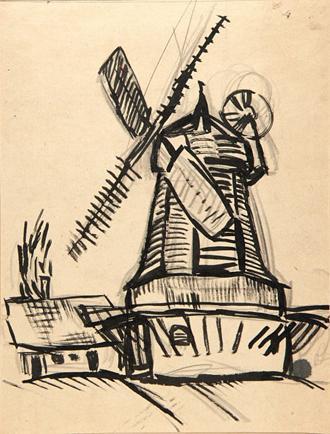
Windmill and Cottage, Denmark, ca. 1930–1935. Ink on paper. Possible preparatory sketch. Smithsonian American Art Museum, 1967.59.834.
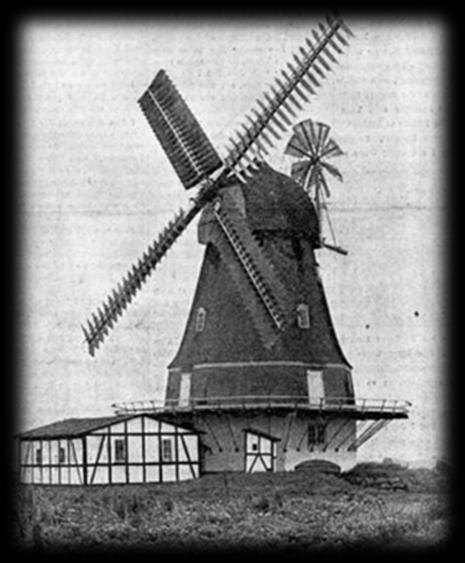
The Viby Mill at Hindsholm. 1939. Unknown photographer. Courtesy of Viby Sogneforening.
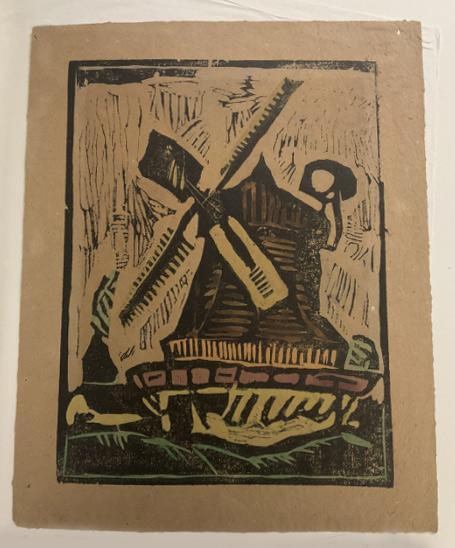
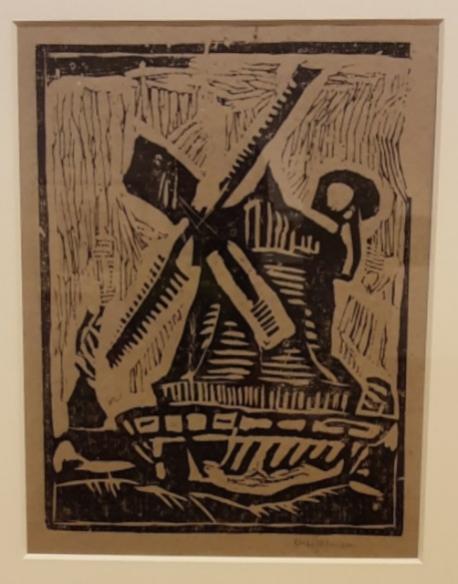
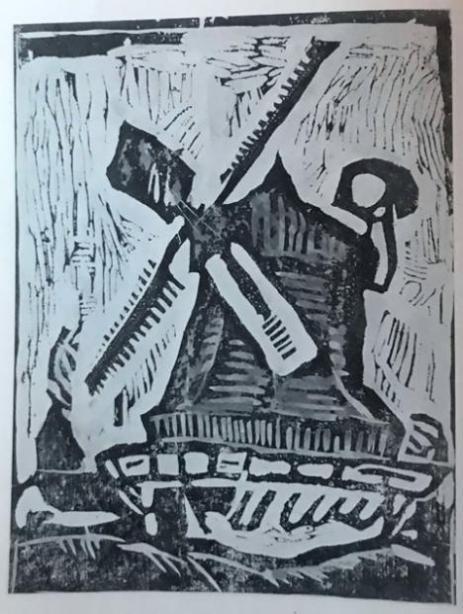
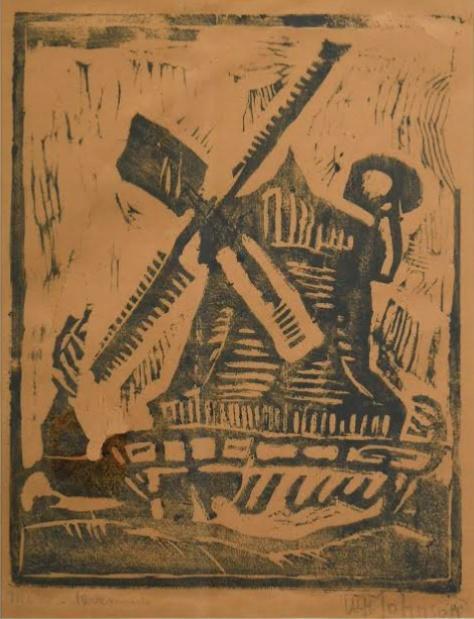
Windmill, Kerteminde (The Viby Mill, no. 1), ca. 1932–1935. Object Number: WHJ-BP-SCA-004. Block print on paper. (Woodcut). Handcolored with a palette of dark brown, black, soft green, pale yellow, and muted red. Size: H: 16 in. W: 12 13/16 in. Provenance: Gift of the Harmon Foundation. Hampton University Museum & Archives. Object ID: 63.195
Windmill, Kerteminde (The Viby Mill, no. 1), ca. 1932–1935. Object Number: WHJ-BP-SCA-005. Block print on paper. (Woodcut). Signed W.H. Johnson. Size: H: 24 3/8 in. W: 20 3/16 in. D: 1 5/8 in. Provenance: Gift of the Harmon Foundation. Hampton University Museum & Archives. Object ID: 67.44.8
Windmill, Kerteminde (The Viby Mill, no. 1), ca. 1932–1935. Object Number: WHJ-BP-SCA-006. Block print on paper. (Woodcut). Handcolored. Signed lower right: W. H. Johnson. Inscribed lower left: Kerteminde. Size: 16 x 13 (40.7 x 32.9). Provenance: Collection: Mr. and Mrs. David Harriton, Minisink Hills, Pennsylvania. Illustrated on page 186 of Johnson, 1901–1970, by Adelyn D. Breeskin and Jan K. Muhlert (Smithsonian Institution Press, 1971)
Windmill, Kerteminde (The Viby Mill, no. 1), ca. 1932–1935. Object Number: WHJ-BP-SCA-007. Block print on paper. (Woodcut). Signed W.H. Johnson. Titled, Mølle – Kerteminde. Size: 36,5 x 28 cm. Provenance: Private Danish Collection, hence Johannes Larsen Museum. Exhibited at: William H.Johnson og Holcha Krake. Et Kunstnerpar i 30ernes Kerteminde. Johannes Larsen Museum, 1 may-14 June, 1998. Photo: Ole Friis
The Viby Mill, No. 2. ca. 1932–1935.
OneknownImpression.Posthumousprintedin1998.
InTheVibyMill,No.2,Johnsontransformsthewindmillintoanear-symbolic emblem,emphasizingdesign,structure,andrhythmicbalanceratherthan topographicalspecificity.
IncontrasttoTheVibyMill,No.1,thisworkdemonstratesamorereductiveand experimentaltechnique.Broadgougesandstarkpassagesofblackandwhitecreate apowerfulinterplayofpositiveandnegativespace.Thepronouncedangularityand simplifiedformsrevealJohnson’sexplorationofthewoodcutasanautonomous modernistmedium,underscoringhisengagementwiththeexpressivepotentialof abstraction.
NooriginalimpressionsofTheVibyMill,No.2areknowntoday,suggestingthatthe blockwaseitherneverprintedorthatanyearlyimpressionshavebeenlostorremain undiscovered.Theonlyknownimpressionsareposthumouseditionsprintedfrom theoriginalblockinaneditionoftenbyErnst&Fomsgaardin1998,ofwhichonly oneimpressionispresentlyknowntoday.
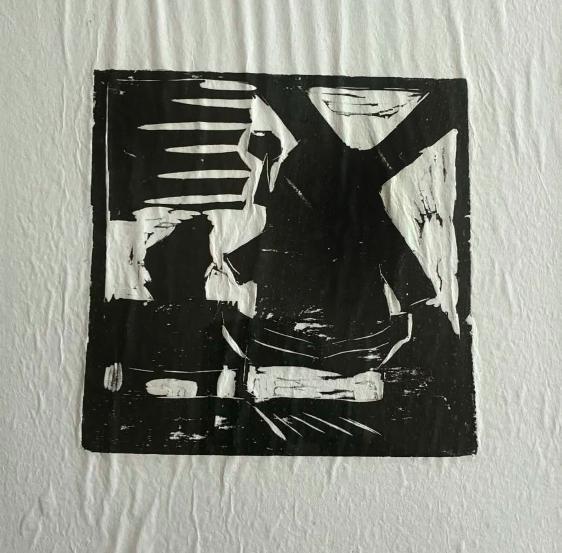
The Viby Mill, No. 2. ca. 1932–1935. Object Number: WHJ-BP-SCA-008. Block print on paper. (Woodcut). Size: 34 × 24 cm. Printed from the original block in an edition of ten by Hardy Ernst & Jes Fomsgaard. Fyns Grafiske Værksted, Odense. 1998. Exhibited at: William H.Johnson og Holcha Krake. Et Kunstnerpar i 30ernes Kerteminde. Johannes Larsen Museum, 1 may-14 June, 1998.
Bazaars Behind Church of Our Savior, Oslo. Ca,1935-1937.
Nineknownimpressions.
CreatedafterthepaintingBazaarsBehindChurch,Oslo(ca.1935),thisprint transformsthearcadedmarketcomplexbesideOsloCathedralintoadynamicand highlystylizedurbancomposition.Originallyconstructedbetween1841and1858 andusedasbutchershops,thebazaarscurvearoundthreesidesofthecathedral block.
InJohnson’sinterpretation,thearchitectureissimplifiedintoboldcarvedlinesand flatplanesofcolorthatemphasizerhythm,movement,andspatialenergyover precisearchitecturaldetail.Thechurchtowerrisesprominentlyatthecenter,while thesweepingcurveofthebazaarsanimatestheforegroundinastrong,almost theatricalprogressionofforms.Throughexaggeratedperspectiveandexpressive simplification,JohnsonreimaginesthefamiliarOslolandmarkasamonumentally chargedmoderncityscape.
Theearliestknownrecordoftheprintdatesto16July1935,whenJohnsonand HolchaKrakepresentedanimpressionasaweddinggifttoReverendLarsTjensvoll andKjellaugKårstad.SinceJohnsonarrivedinOsloinlateJanuary1935,thefirst impressionwaslikelyproducedbetweenFebruaryandJulyofthatyear.
AlaterreferenceappearsinSeptember1937,whenJohnsonpresentedanother impressiontotheTrondheimArtMuseumduringhissoloexhibitionatthe TrondheimArtSociety(TrondhjemsKunstforening).
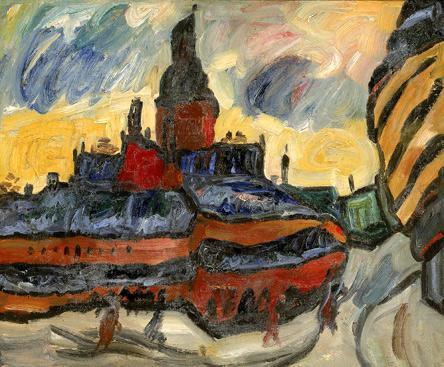
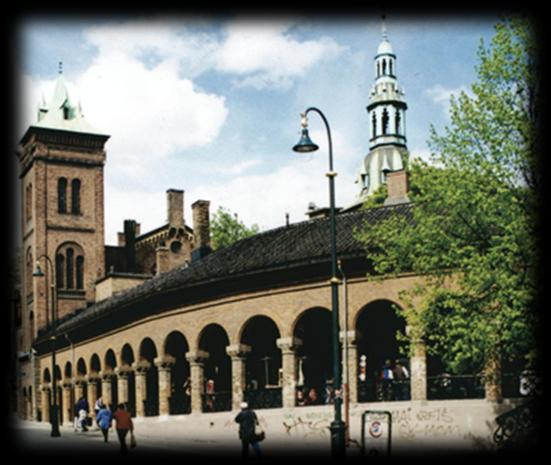
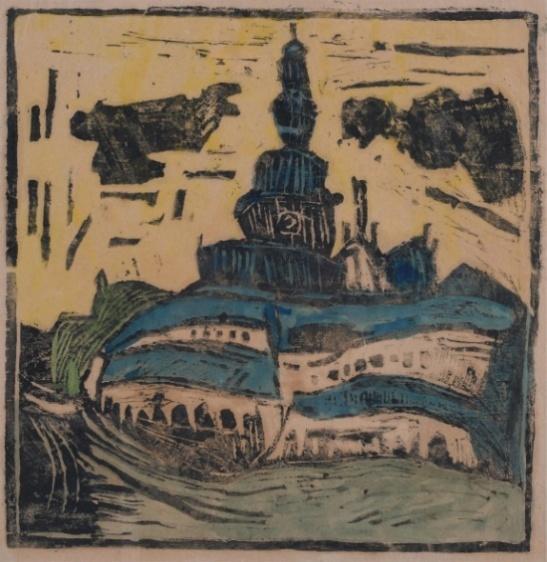
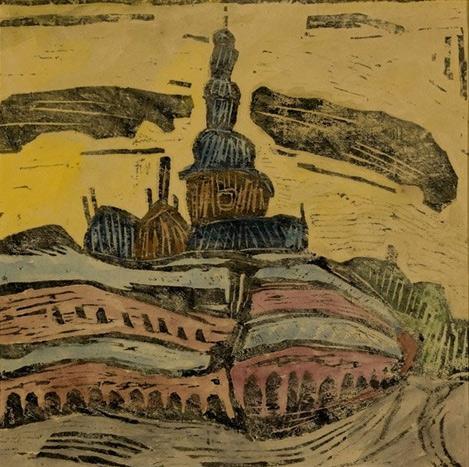
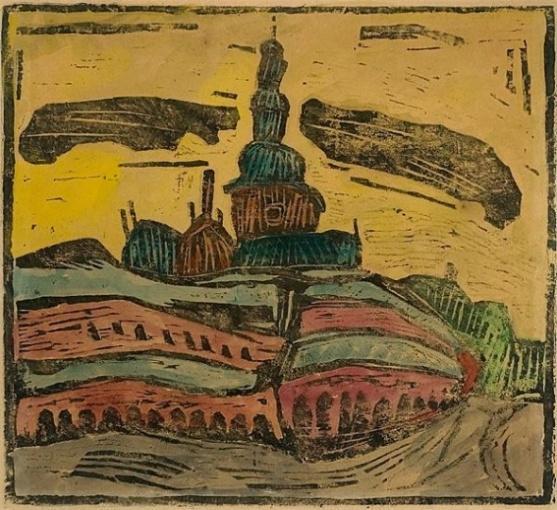
Bazaars Behind Church of Our Savior, Oslo. Ca,1935-1937. Object Number: WHJ-BP-SCA-009. Block print on paper. (Woodcut). Hand-colored in shades of blue, black, green, and yellow. Size: 3/4 x 15 1/4 in. (37.5 x 38.7 cm.). Provenance: The Harmon Foundation, New York. Acquired from the above Mr. and Mrs. Douglas Younger, New York. (Assistant Director at the Harmon Foundation). Sold at The Potomack Company. Alexandria, VA, US. February 12, 2025. Lot 2032
Bazaars Behind Church of Our Savior, Oslo. Ca,1935-1937. Object Number: WHJ-BP-SCA-00010. Block print on paper. (Woodcut). Hand-colored in tones of yellow, pink, blue, green, and black. Signed W.H. Johnson. Size: 14 1/2" x 15 ¾ inches. 36 x 39 cm. Provenance: Private Collection, New Jersey. Sold at Rago. Lambertville NJ, United States. 13 Sep 2008. Lot no: 94.
Bazaars Behind Church of Our Savior, Oslo. Ca,1935-1937. Object Number: WHJ-BP-SCA-00011. Block print on paper. (Woodcut). Hand-colored with a palette of ochre yellow, teal blue, earthy pink, muted green, and black. Remnant of original backing board inscribed with title and signed by William H. Johnson. Size: 13-1/2 x 14-1/2 inches. Provenance: The Collection of Dr. Dianne Whitfield-Locke and Dr. Carnell Locke, Maryland. Exhibited: Building on Tradition, The Collection of Dr. Dianne Whitfield-Locke and Dr. Carnell Locke, Hampton University Museum, October 12, 2013-December 7, 2013. Sold at Black Art Auction. Saint Louis, MO, US. May 16, 2020. Lot no: 97.
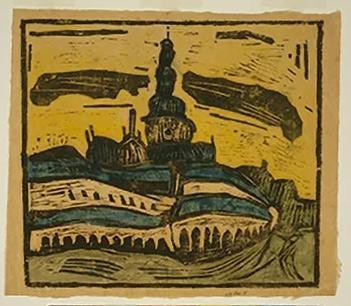
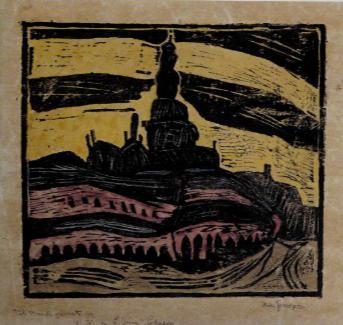
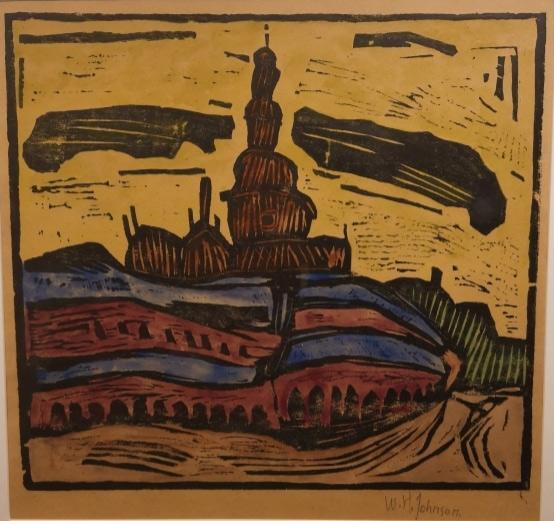
Bazaars Behind Church of Our Savior, Oslo. Ca,19351937. Object Number: WHJ-BP-SCA-00012. Block print on paper. (Woodcut). Hand-colored with a palette of golden yellow, deep blue, cream, black, and touches of green. Signed W.H. Johnson in pencil on verso. Annotated: "Church of Our Savior, bazaars at rear"; "NOR-160 (5). Provenance: From Harmon Foundation. Library of Congress. Item 2003688143
Bazaars Behind Church of Our Savior, Oslo. Ca,19351937. Object Number: WHJ-BP-SCA-00013. Block print on paper. (Woodcut). Hand-colored with a palette of golden yellow, dusty rose, deep black, and muted beige. Signed at lower right: W. H. Johnson; inscribed at lower left: Til Brudeparret fra W.H. og "L. Søren” Johnson. ( To the wedding couple from W.H and Little Søren) Size: 16 3½ x 18 inches. Provenance: Kjellaug and Reverend Lars Tjensvoll, c.1935, and by descent in their family until 1997. Illustrated and catalogued as no. 34 in William H. Johnson: Truth Be Told by Steve Turner and Victoria Dailey (1996)
Bazaars Behind Church of Our Savior, Oslo. Ca,19351937. Object Number: WHJ-BP-SCA-00014. Block print on paper. (Woodcut). Signed W.H. Johnson. Hand-colored with a palette of yellow, black, red, blue, green, and brown. Size: W. 38, 6 cm. H. 35 cm.
Provenance: Gifted by Johnson to the Trondheim Art Museum during his visit to Trondheim for his exhibition at the Trondhjems Kunstforening in September 1937. From the collection of Trondheim art museum. Accession number: TKM-495-1937
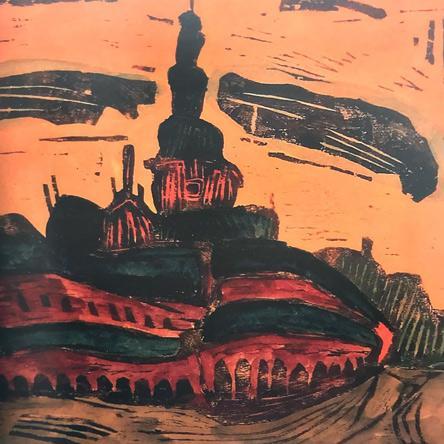
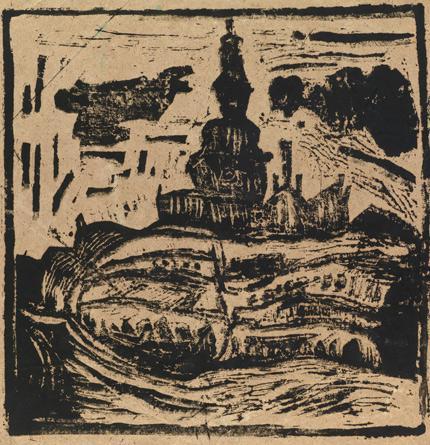
Bazaars Behind Church of Our Savior, Oslo. Ca,19351937. Object Number: WHJ-BP-SCA-00015. Block print on paper. (Woodcut).Hand-colored with a palette of deep red, black, and dark green set against a vibrant orange background. Size: 19 5/8 x 20 1/4 inches. Provenance: Gift of the Harmon Foundation. Collection of Morgan State University. Illustrated on page 72 in William H. Johnson: Revisiting an African American Modernist. Kenneth G. Rodger. North Carolina Central University Art Museum in Durham, North Carolina (2006).
Bazaars Behind Church of Our Savior, Oslo. Ca,19351937. Object Number: WHJ-BP-SCA-00016. Block print on heavy, fibrous handmade buff paper. (Woodcut). Artist's proof. Size: 11 ½ x 12 ½ in. 37.5 x 37.5 cm (292 x 318 mm) Provenance: the estate of Holcha Krake; by descent to her grandniece, Johanna Voll. Christoph Voll Estate collection.
Bazaars Behind Church of Our Savior, Oslo. Ca,19351937. Object Number: WHJ-BP-SCA-00017. Block print on paper. (Woodcut).Hand-colored. Size: 21"h x 21⅞"w x 1"d. Provenance: Gift of the Harmon Foundation. Fisk University Galleries. Object ID. #0430
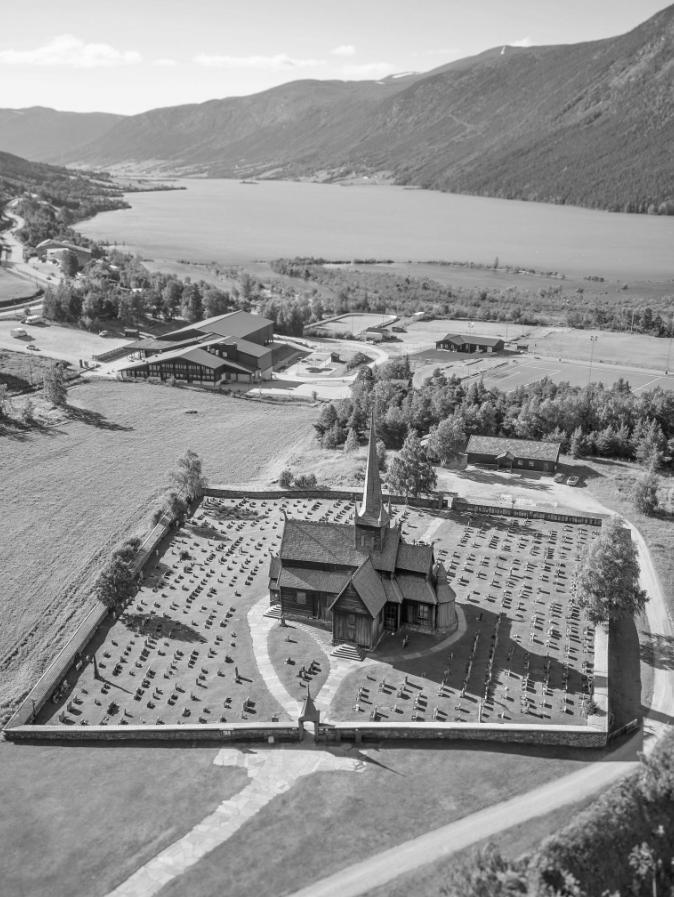
Duringtheautumnof1935,whiletravelingthroughGudbrandsdalen,WilliamH. JohnsonencounteredthestavechurchatLom,anexperiencethatprovedboth visuallyandartisticallyformative.
LomStaveChurch(Lomstavkyrkje),originallyconstructedaround1158–1170,isone ofNorway’slargestandmostsignificantsurvivingexamplesofmedievalwooden architecture.LocatedinthemountainvillageofFossbergomintheGudbrandsdal valley,itremainsanactiveparishchurchtoday.Itsstrikingformisdefinedbyvertical timberconstruction,tieredrooflines,andintricatecarvingsthatmergeChristian iconographywithmotifsderivedfromViking-ageornament.Thechurchalsohouses anotablecollectionof18th-centurypaintingsbyEggertMunch,adistantrelativeof EdvardMunch.
Inhisblockprintseriesdepictingthechurch,Johnsontranslateditspronounced verticalityandcomplexarchitecturalstructureintohisownvisuallanguage, characterizedbyboldcarving,simplifiedforms,andemphaticline.
Heexploredthesubjectintwoknownvariations:asquare-formatversiontitledLom Kirke(LomChurch),ofwhichsevenimpressionsareknown,andavertical-format versiontitledLomGl.Kirke,Gudbrandsdalen(LomOldChurch,Gudbrandsdalen), withfiverecordedimpressions
Lom Kirke. (Lom Church, Square Format) ca. 1935–1938
Seven known impressions.
In the square-format version of Lom Kirke, the church is harmoniously integrated into the surrounding landscape. The format allows for a balanced composition in which both the dramatic silhouette of the Lomseggen mountains and the expansive sky are given equal visual weight, reinforcing the interplay between architecture and nature.
Only two works from the square-format series are known to bear titles: the impression held at the Oakland Museum of California and the impression at the Library of Congress, both titled Lom Kirke.
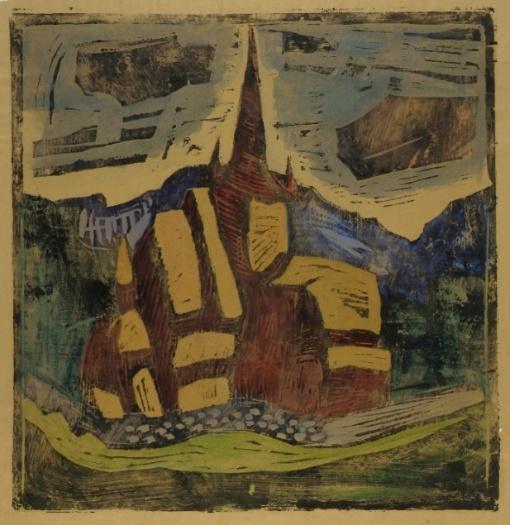
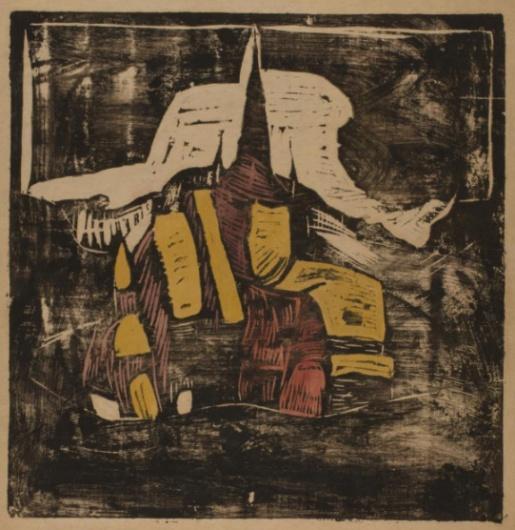
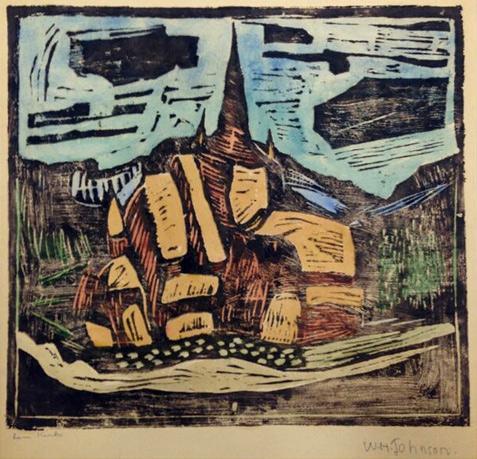
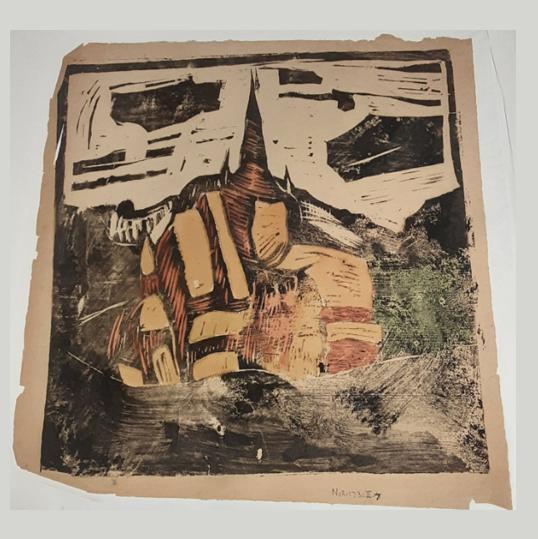
Lom Kirke. (Lom Church, square Format) ca. 1935–1938. Object Number: WHJ-BP-SCA-00018. Block print on paper. (Woodcut). Hand-colored with earthy reds, ochres, deep blue, green, and pale blue, with dark brown cloud accents. Size: 17 1⁄8 x 16 in. (43.4 x 40.6 cm) irregular. Provenance: Gift of the Harmon Foundation.Smithsonian American Art Museum, 1983.95.20
Lom Kirke. (Lom Church, square Format) ca. 1935–1938. Object Number: WHJ-BP-SCA-00019. Block print on paper. (Woodcut). Hand-colored with deep red, ochre yellow, and white highlights against a dark brown-black background. Size: 16 5/8 x 15 7/16 inches (42.2 x 39.2 cm). Provenance: Gift of the Philadelphia Commercial Museum (also known as the Philadelphia Civic Center Museum). Philadelphia, Pennsylvania. Accession no: 2004-111-724.
Lom Kirke. (Lom Church, square Format) ca. 1935–1938. Object Number: WHJ-BP-SCA-00020. Block print on paper. (Woodcut). Hand-colored with earthy reds, ochres, and deep browns; set against a backdrop of blue sky and green terrain. Signed W.H. Johnson at lower right. Titled Lom Kirke at lower left. Size: H: 14.5 in, W: 14 in. Provenance: Gift of the Harmon Foundation. Courtesy of Oakland Museum of California (OMCA). Accession no: A67.62.13
Lom Kirke. (Lom Church, square Format) ca. 1935–1938. Object Number: WHJ-BP-SCA-00021. Block print on paper. (Woodcut). Hand-colored with a palette of dark brown, muted red, yellow-orange, and soft green. Size: H: 16 1/8 in. W: 16 in.
Provenance: Gift of the Harmon Foundation. Hampton University Museum & Archives. Accession no: 67.44.32
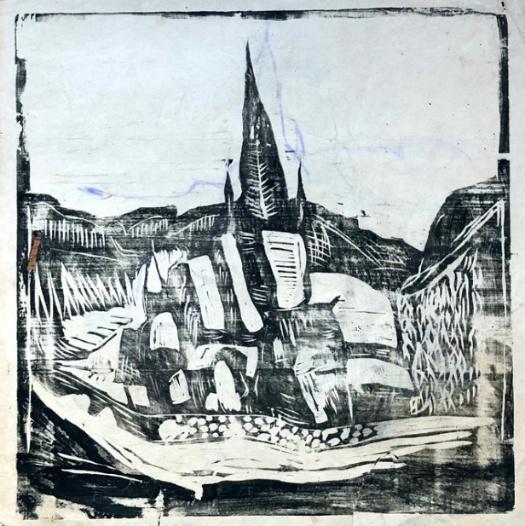
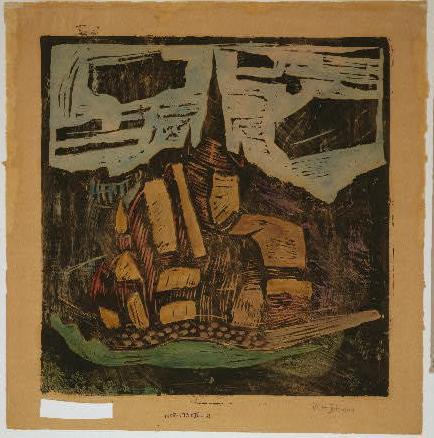
Lom Kirke. (Lom Church, square Format) ca. 1935–1938. Object Number: WHJ-BP-SCA-00022. Block print on paper. (Woodcut). Size: Height 40 cm. Width 41 cm. Provenance: Estate of Holcha Krake; by descent to her grandniece, Johanna Voll. Christoph Voll Estate collection.
Lom Kirke. (Lom Church, square Format) ca. 1935–1938. Object Number: WHJ-BP-SCA-00023. Hand-colored block print on paper ( (Woodcut). Titled and signed on verso. Annotated: "NOR-173 (6)." Provenance: Harmon Foundation. Library of Congress. Item 2003688149
Lom Kirke. (Lom Church, square Format) ca. 1935–1938. Object Number: WHJ-BP-SCA-00024. Hand-colored block print on paper (Woodcut). Size: 22"h x 21"w x 1"d. Provenance: Gift of the Harmon Foundation. Fisk University Galleries. Accession no: # 0146
Lom Gl. Kirke, Gudbrandsdalen (The Old Church in Gudbrandsdalen. Vertical Format). ca. 1935–1938.
Sixknownimpressions.
Inthevertical-formatversionofLomKirke,thecompositionaccentuatesthesoaring spireofthestavechurch,emphasizingapronouncedsenseofupwardmovement andspiritualelevation.Thecompressedspatialdepthachievedthrougha foreshortenedforegroundandaloomingmountainbackdropconcentratesthe viewer’sattentiononthechurch’sstrikingsilhouette,intensifyingitsmonumental presencewithinthelandscape.
Onlyoneimpressionfromthisvertical-formatseriesisknowntobearatitle:the exampleheldatCampbellFineArt.ThisimpressioncarriesthetitleLomGl.Kirke, Gudbrandsdalen(TheOldChurchinGudbrandsdalen).
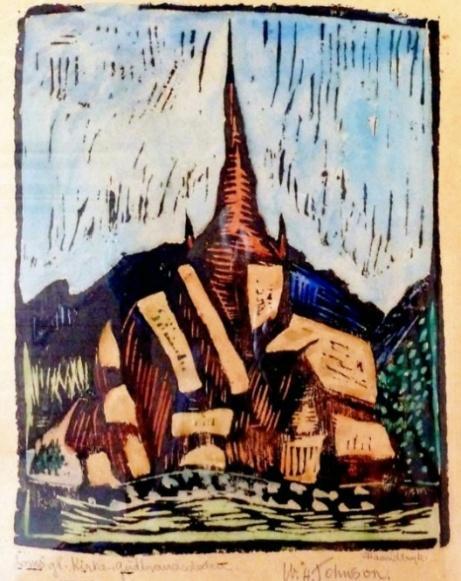
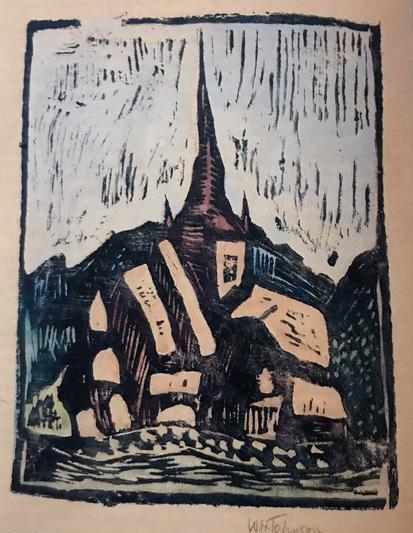
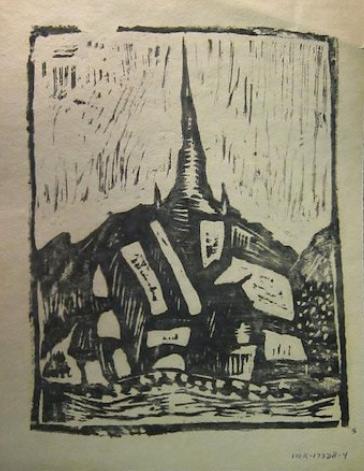
Lom Gl. Kirke, Gudbrandsdalen (The Old Church in Gudbrandsdalen. Vertical Format). ca. 1935–1938. Object Number: WHJ-BP-SCA-00025. Block print on paper. (Woodcut). Handcolored with warm ochres, burnt sienna, and deep reds; contrasted by blue sky and dark green mountains. Signed W.H. Johnson to lower right. Inscribed in Danish: Haandtryk (Printed by hand). Titled to lower left: Lom Gl. Kirke, Gudbrandsdalen (the old church in Gudbrandsdalen). Provenance: Private collection. Campbell Fine Art. 1323 Travelers Rest, 29690. SC, United States.
Lom Gl. Kirke, Gudbrandsdalen (The Old Church in Gudbrandsdalen. Vertical Format). ca. 1935–1938. Object Number: WHJ-BP-SCA-00026. Block print on paper. (Woodcut). Hand-colored with muted ochres and burgundy tones, set against a pale blue sky and deep green mountains. Signed W.H. Johnson to lower right. Size: 30 x 22 cm. Provenance: Private Danish collection. Exhibited at: William H. Johnson og Holcha Krake. Et Kunstnerpar i 30ernes Kerteminde. Johannes Larsen Museum, 1 may-14 June, 1998.
Lom Gl. Kirke, Gudbrandsdalen (The Old Church in Gudbrandsdalen. Vertical Format). ca. 1935–1938. Object Number: WHJ-BP-SCA-00027. Block print on paper. (Woodcut). Provenance: Civic Center Museum Collection, African American Museum in Philadelphia. Object ID: 2010.001.400
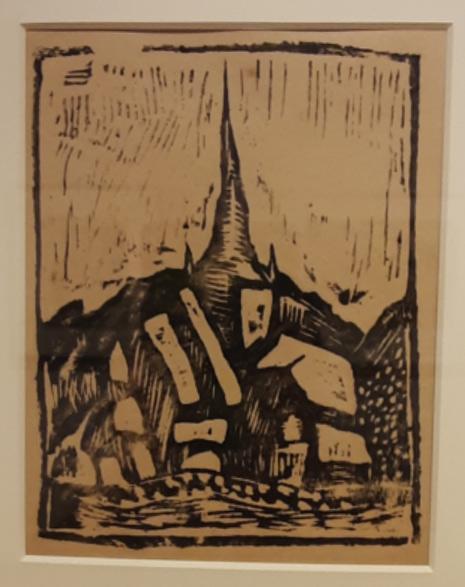
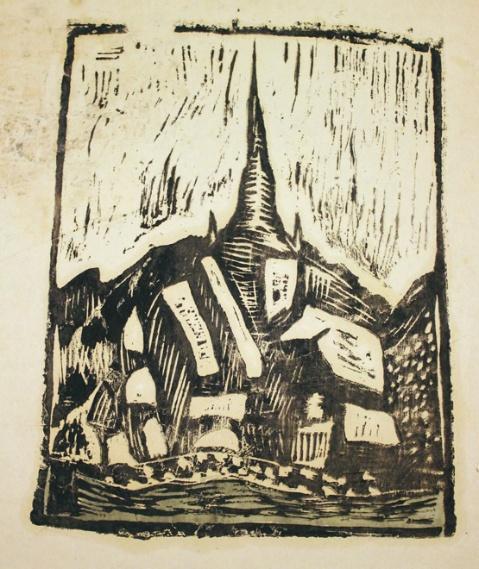
Lom Gl. Kirke, Gudbrandsdalen (The Old Church in Gudbrandsdalen. Vertical Format). ca. 1935–1938. Object Number: WHJ-BP-SCA-00028. Block print on paper. (Woodcut). Size: H: 22 1/8 in. W: 18 ½ in. D: 1 13/16 in. Provenance: Gift of the Harmon Foundation. Hampton University Museum & Archives. Accession no: 67.44.4
Lom Gl. Kirke, Gudbrandsdalen (The Old Church in Gudbrandsdalen. Vertical Format). ca. 1935–1938. Object Number: WHJ-BP-SCA-00029. Block print on paper. (Woodcut). Size: 21"h x 17"w x 1"d. Provenance: Gift of the Harmon Foundation. Fisk University Galleries. Accession no: # 0545
Lom Gl. Kirke, Gudbrandsdalen (The Old Church in Gudbrandsdalen. Vertical Format). ca. 1935–1938. Object Number: WHJ-BP-SCA-00030. Block print on paper. (Woodcut). hand-colored with muted green accents. Size: 28,6 x 34,3 cm. Provenance: Estate of Holcha Krake; by descent to her grandniece, Johanna Voll. Private Collection.
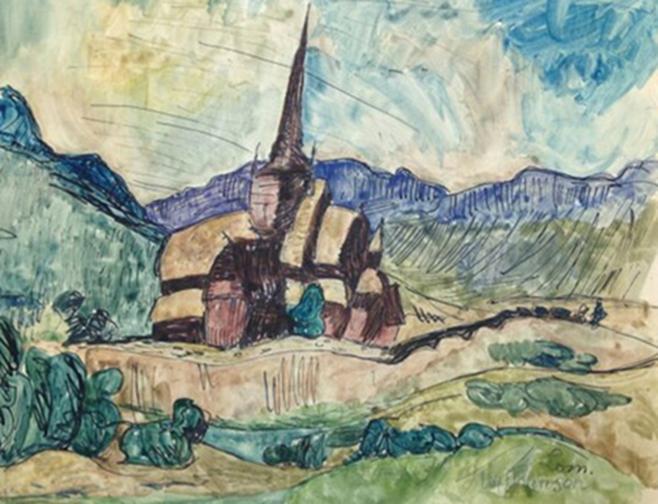
Lom Church. ca. 1935-1938. Watercolor and pencil on paper. Oakland Museum of California. Accession no, A67.62.8.
Volda Fjord, Norway, ca. 1935–1938
Fourknownimpressions.
InVoldaFjord,Norway,Johnsondistilsthelandscapeintoboldgraphiccontrastsand simplifiedforms.Dark,solidmassesdefinethemountains,whilebandsofincised linessuggestripplingwateranddriftingcloudsoverhead.Throughreductivecarving andrhythmiclinework,hetransformsthefjordintoadynamicinterplayoflightand shadow,conveyingboththegrandeurofthelandscapeanditsquiet,contemplative atmosphere.
Atthecenterofthecompositionappearsasharplydefinedtriangularformthatreads asastructurenestledbetweenthemountains.Thisfeaturemayrepresentastylized depictionofVoldaStoneChurch(Voldskyrkja),consecratedin1932andaprominent landmarkoverlookingthefjord.
JohnsonandKrakefirstarrivedinVoldainSeptember1935andusedthevillageas theirbaseforthefollowingtwoyears.Duringthisperiod,Johnsonproduced numerousworksdepictingtheregionanditsdramaticnaturalsurroundings,drawing inspirationfromtheeighteen-kilometre-longVoldsfjordandthedistinctivecharacter ofwesternNorway.
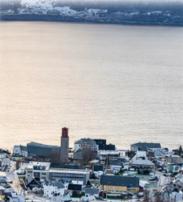
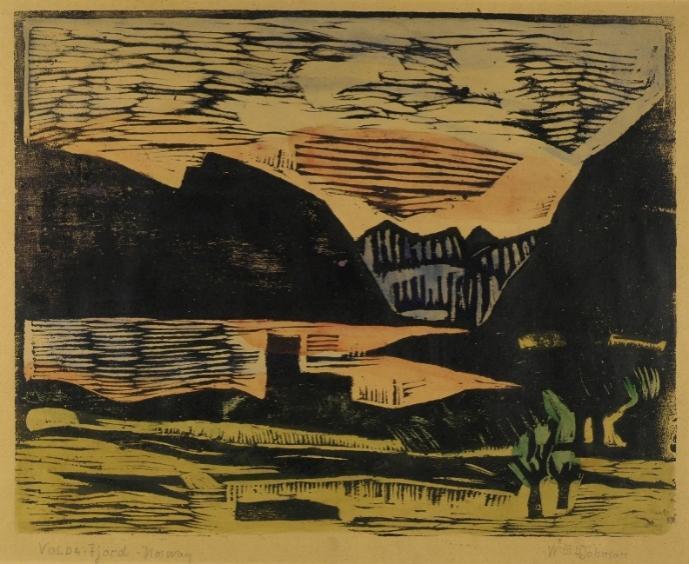
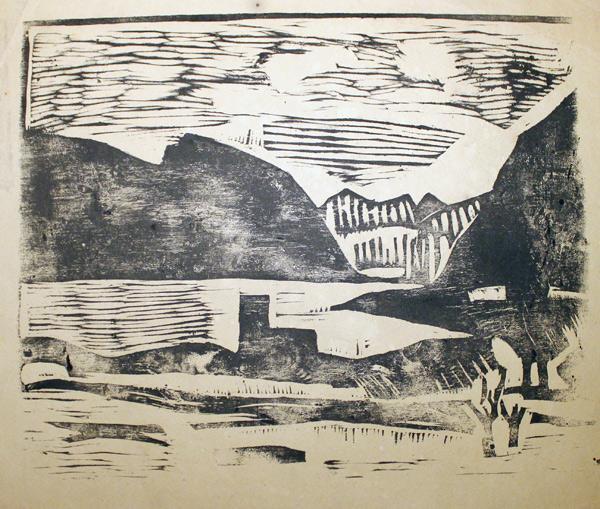
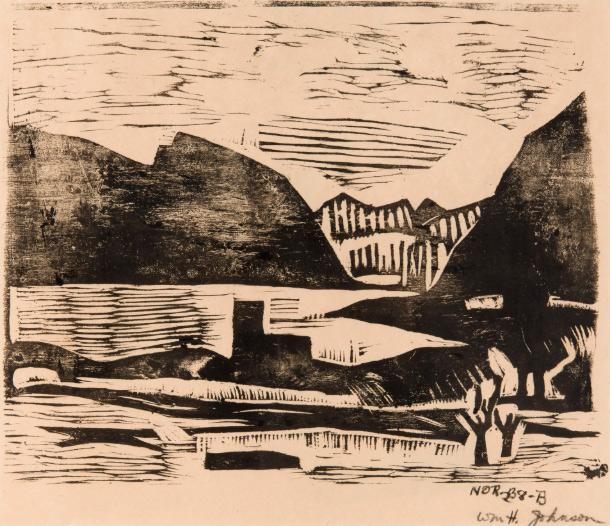
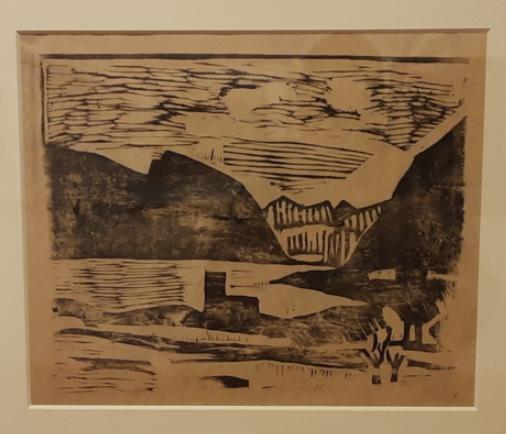
Volda Fjord, Norway, ca. 1935–1938. Object Number:
WHJ-BP-SCA-00031. Block print on paper. (Woodcut). Hand-colored with ochre, black, pale pink, green, and deep blue. Signed lower right: Wm H. Johnson. Titled lower left: Volda Fjord-Norway. Inscribed on backing board in script: woodcut-Hand colored /Wm Johnson/27 W 15 St. N.Y.C./Volda Fjord-Norway/exh. December 1940 Artists' Gallery/exhibited Jan. 14-28th 41. Provenance: Gift of the Harmon Foundation. Smithsonian American Art Museum, 1967.59.896. Exhibited: The New York Public Library, Countee Cullen Branch, December 5, 1956-March 1, 1957
Volda Fjord, Norway, ca. 1935–1938. Object Number:
WHJ-BP-SCA-00032. Block print on paper. (Woodcut). Size: 38 x 44 cm. Provenance: The estate of Holcha Krake; by descent to her grandniece, Johanna Voll. The Wright Foundation for Southern Art. Florence County Museum.
Volda Fjord, Norway, ca. 1935–1938. Object Number: WHJ-BP-SCA-00033. Block print on paper. (Woodcut) Signed Wm H. Johnson to lower right. Inscribed: Signed NOR-88-B. Size: 13.5 x 15.75 in. 34.29 x 40.01 cm. Provenance: Gift of the Harmon Foundation. Courtesy of the Amistad Research Center, New Orleans, LA. Accession Number. ARCHAR.WHJO.1934.13
Volda Fjord, Norway, ca. 1935–1938. Object Number:
WHJ-BP-SCA-00034. Block print on paper. (Woodcut) Size: 23 1/8 in. W: 25 in. Provenance: Gift of the Harmon Foundation. Hampton University Museum & Archives. Object ID: 67.44.7
Moon-Rise, Star-Rise, ca. 1935–1938.
InMoon-Rise,Star-Rise,Johnsondepictstwosilhouettedfiguresseenfrombehind, gazingacrossafjordframedbytoweringmountains.Reflectionsinthewatersubtly mirrorthefiguresandlandscape,whileboldcontrastsandvisiblewoodgraintextures emphasizethephysicalactofcarvingandgivethecompositionatactileexpressive depth.
TheprintwaslikelyproducedduringJohnson’syearsinruralNorway(1935–38), possiblyduringhisandKrake’sstayinSvolværinthesummerof1937.Knownasthe “landofthemidnightsun,”theregion’scontinuousdaylightanddramaticfjord landscapeleftalastingimpression,reflectedinKrake’srecollectionofdailysea bathinginwaters“liketheFrenchRiviera.”
ThetitlemayreferencetheAfricanAmericanspiritual“IKnowMoon-Rise,”which begins,“Iknowmoon-rise,Iknowstar-rise,/Laydisbodydown.”Associatedwith themesofrest,theafterlife,andspiritualreflection,thesongappearsinthelandmark 1867collectionSlaveSongsoftheUnitedStates.
Atthesametime,boththetitleandcompositionresonatewithEdvardMunch’sprint Måneoppgang(Moonrise)fromtheAlphaandOmegaseries(1908–1909),a connectionfurtherenrichedbyJohnson’smeetingwithMunchinOsloin1935.
NooriginalimpressionsofMoon-Rise,Star-Rise,areknown,suggestingtheblock waseitherneverprintedorthatearlyimpressionshavebeenlostorremain undiscovered.Theonlyextantimpressionisaposthumoustrialprintfromthe originalwoodblock,pulledbyØbroKunsthandel,Copenhagen,2026.
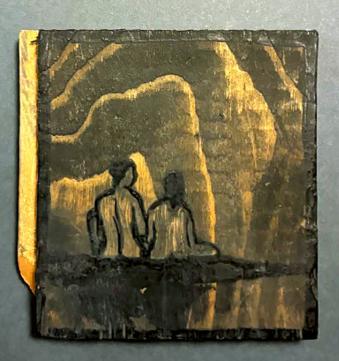
William H. Johnson. Moon-Rise, StarRise, ca. 1935–38. Carved woodblock, titled and signed verso. 9 x 9 cm. Provenance: the artist to Niels Lindberg, Nr. Broby, Funen; private Danish collection.
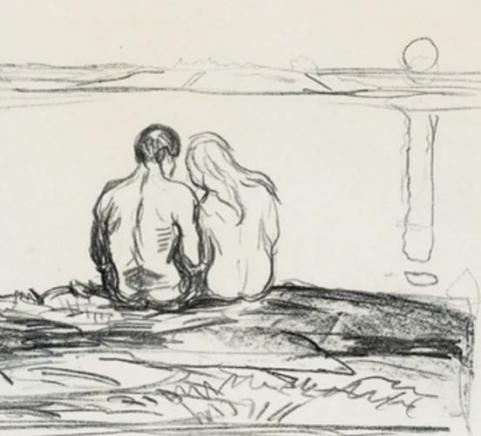
Edvard Munch. Moonrise. 1908-1909. Lithograph. Image credit: The Munch Museum. MM.G.00306-102.
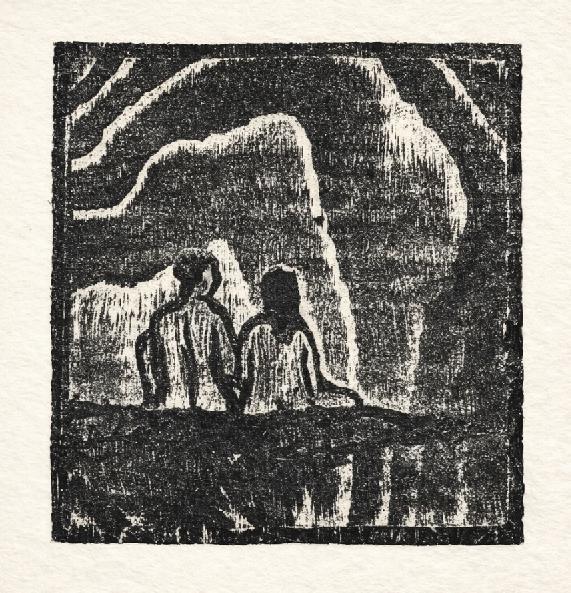
Moon-Rise, Star-Rise. ca, 1935-38. Object Number: WHJ-BP-SCA-00035. Trial impression (test print) from the original woodblock. 9 x 9 cm. Øbro Kunsthandel. Copenhagen. 2026.
Church by Lake II. ( Farmstead by Lake ) ca, 1935–1938. Fourknownimpressions.
InChurchbyLakeII,Johnsondepictsaruralfarmsteadsetalongalakeshore.The motifrecursinrelatedworksfromthesameperiod,includingChurchintheCountry (ca.1935–1938,oilonburlap),picturedbelow,andChurchintheCountry,Sunset(ca. 1935–1938,watercolorandpencilonpaper,SmithsonianAmericanArtMuseum, 1967.59.20).ThedesignationChurchbyLakeIIimpliestheexistenceofadditional versions,thoughnootherimpressionsarepresentlyknown.
Thetitleappearstobemisleading,asthestructuredepictedisnotachurchbuta traditionalNorwegianstabbur(storehouse).
InruralNorwegiangårdstuner(farmsteads),asmallbelltowerwasoftenmounted abovethestorehousesoitssoundcouldcarryacrossthesurroundingfields.Beyond itspracticalfunctionofsignalingmealtimes,thebellalsoregulatedthedailyrhythms ofagriculturallife.
Thetitlemaythereforereflectalatermisinterpretationofthebuilding,possibly introducedduringearlycataloguingbytheHarmonFoundation,asitappears unlikelythatJohnsonhimselfwouldhavemisidentifiedthestructure.
Althoughthepreciselocationhasnotbeenidentified,thescenelikelydepictsoneof thelakesidefarmsteadstypicalofruralNorway,aregionthatJohnsonandKrake exploredextensivelybetween1935and1938.
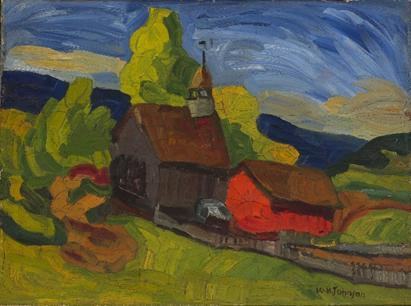
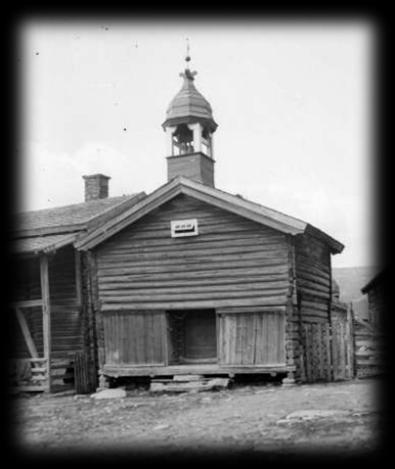
Stabbur (storehouse) with meal bell, Nørstegård farm, Hundorp, Norway, ca. 1928. Image credit: Jørgen Sikker Elstad.
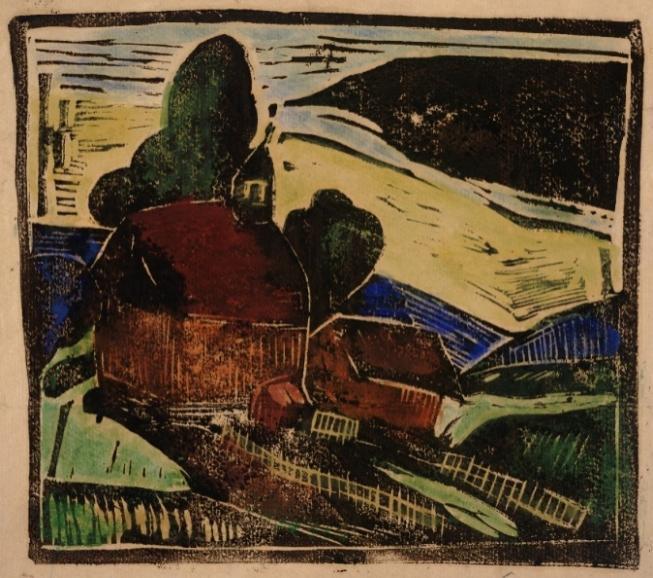
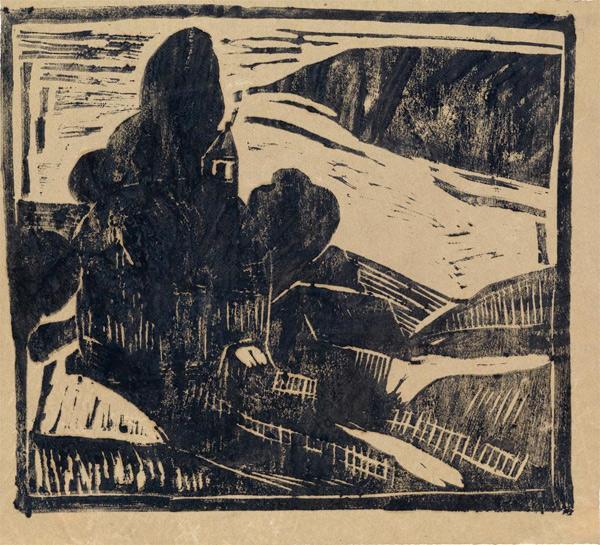
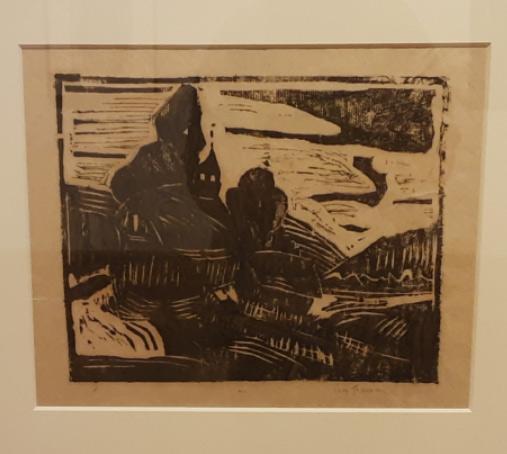
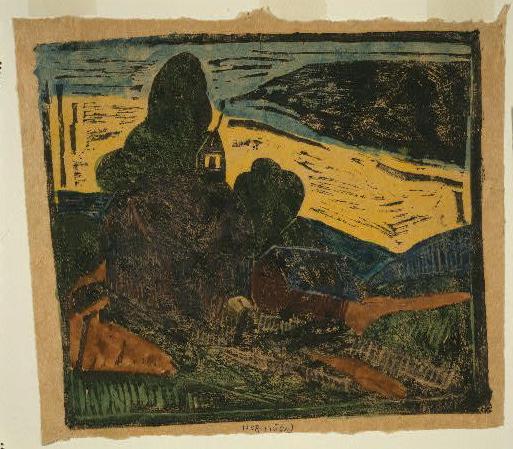
Church by Lake II, ( Farmstead by Lake ) ca. 1935-1938. Object Number: WHJ-BP-SCA-00036. Block print on paper mounted on paperboard. Hand-colored with earthy reds, deep greens, ochre, and blue, set against a pale yellow and green sky. Size: 11 x 12 1⁄4 in. (28.0 x 31.2 cm) Provenance: Gift of the Harmon Foundation. Smithsonian American Art Museum, 1967.59.888
Church by Lake II. ( Farmstead by Lake ) Circa 1935-1938. Object Number: WHJ-BP-SCA-00037. Block print on fibrous handmade buff paper. (Woodcut). Artist's proof. Size: 349 x 349 mm; 13 3/4x13 3/4 inches, 1/8- to 1/2inch margins.Provenance: the estate of Holcha Krake; by descent to her grandniece, Johanna Voll. Christoph Voll Estate collection.
Church by Lake II. ( Farmstead by Lake ) Circa 19351938. Object Number: WHJ-BP-SCA-00038. Block print on paper. (Woodcut). Signed W.H. Johnson. Size: H: 23 1/8 in. W: 25 5/16 in. D: 1 13/16 in. Provenance: Gift of the Harmon Foundation. Hampton University Museum & Archives. Object ID: 67.44.10
Church by Lake II, ( Farmstead by Lake ) ca. 1935-1938. Object Number: WHJ-BP-SCA-00039. hand colored woodcut on paper. Signed in pencil on verso. Annotated: "NOR-175(2)." Provenance: Harmon Foundation. Library of Congress. Item 2003688144.
Chalets by Jostedal Glacier (Grepstadstøylen) ca. 1935-1937. Fiveknownimpressions.
InChaletsbyJostedalGlacier,Johnsondepictsaclusterofwoodenchaletsnestled withinthemountainouslandscapeofJølster,aruralregioninVestlandCounty, Norway.TheprintwaslikelyderivedfromthepaintingJølster(ca.1936),amotifthat recursinseveralofhissketchesandreflectshisdirectexperienceoftheareaduring histravelswithHolchaKrakebetween1935and1936.
Johnsonwasdeeplyinspiredbytheregion’smajesticmountainsandverdantvalleys, oftenworkingfromvantagepointsalsousedbytheNorwegianpainterNikolai Astrup(1880–1928),knownforhisintenselycoloredpaintingsandwoodcutsofhis nativelandscape.ThewoodenchaletsdepictedinbothJohnson’sandAstrup’sworks wereoncethoughttorepresentBefringstøylen,buthavesincebeenidentifiedas Grepstadstøylen(theGrepstadMountainFarm).
Theearliestdocumentedreferencetotheprintdatesto1935,whenJohnsonand KrakepresentedanimpressiontoDanielLudvigsonKlakeggingratitudeforhis hospitalityduringtheirstayathisfarmstead,Myrane,inJølster.Thenextrecorded referencedatestoMay1937,whenJohnsonpresentedanimpressiontotheboardof theVoldaArtAssociationduringtheirtwo-personfarewellexhibitioninVolda.Four monthslater,inSeptember1937,anotherimpressionwasincludedinJohnson’ssolo exhibitionattheTrondheimArtSociety(TrondhjemsKunstforening).
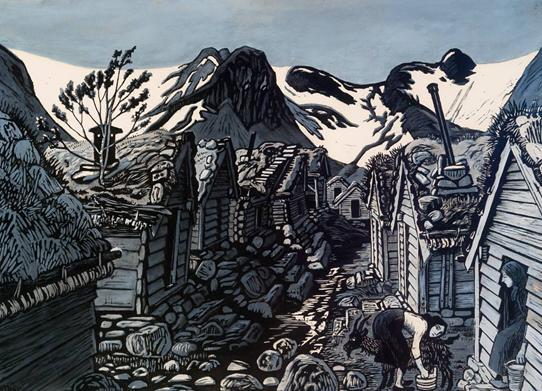
Nikolai Astrup. Befringstøylene (Grepstadstøylen) 1920. Colored woodcut. Foto: Dag Fosse
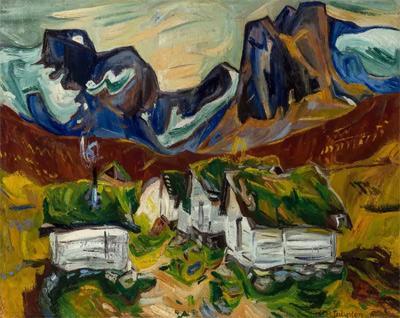
William H. Johnson. Jølster, ca. 1936. Oil painting. Image credit: Doyle: Impressionist & Modern Art. November 2019.
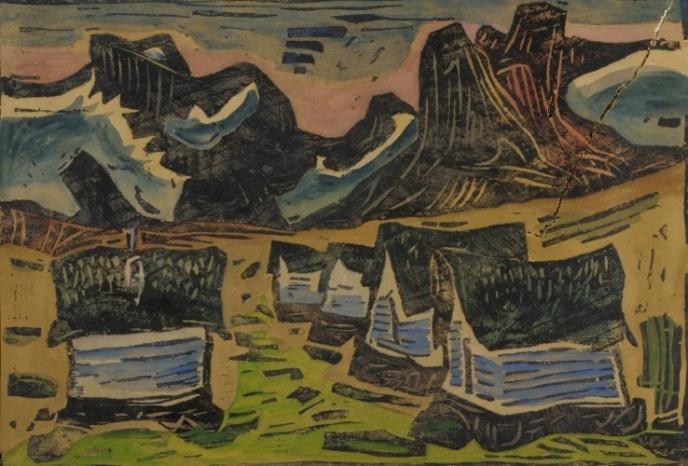
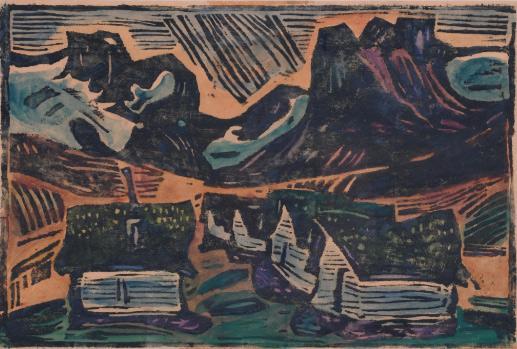
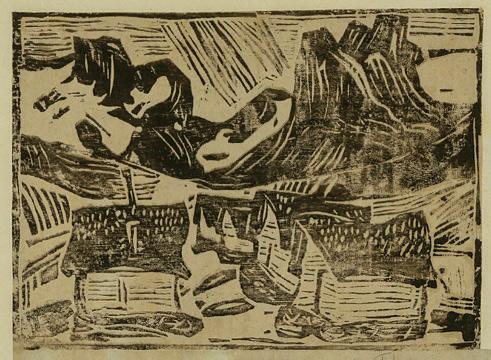
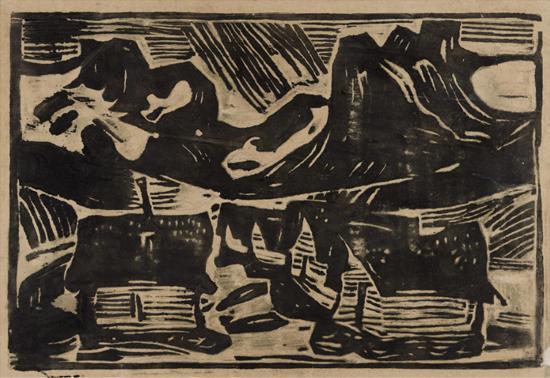
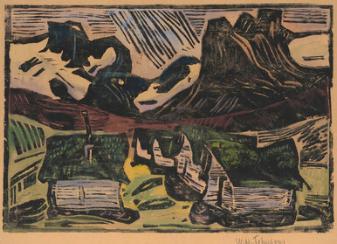
Chalets by Jostedal Glacier (Grepstadstøylen) ca. 1935-1937. Object Number: WHJ-BP-SCA-00040. Block print on paper. (Woodcut) Hand-colored with pale blue, ochre, deep green, and black, with soft pink and icy blue highlights. Size: 14 x 19 5⁄8 in. (35.5 x 49.9 cm) irregular. Provenance: Gift of the Harmon Foundation. Smithsonian American Art Museum, 1983.95.19
Chalets by Jostedal Glacier (Grepstadstøylen) ca. 1935-1937. Object Number: WHJ-BP-SCA-00041. Block print on paper. (Woodcut) Titled on verso: Chalets by Jostedal Glacier. Handcolored with deep blues, purples, and greens, with peach and teal accents. Size: 12 x 17 1/4 in. 30.5 x 43.8 cm. Provenance: The Harmon Foundation, New York; acquired from the above Mr. and Mrs. Douglas Younger, New York. (Assistant Director at the Harmon Foundation). Sold at Potomack Auctions, Alexandria, VA, US. October 8, 2024. Lot 2042.
Chalets by Jostedal Glacier. (Grepstadstøylen). 1935. Object Number: WHJ-BP-SCA-00042. Block print on paper. ( Woodcut). Inscribed on verso: Til Hr. Daniel i vennskab fra Holcha Krake og W.H.Johnson. (To Mr. Daniel in friendship from Holcha Krake and W.H.Johnson). Size: 29 x 42 cm. Provenance: Daniel Ludvigson Klakegg. Sold at Blomqvist Auctions. Stockholm.
Chalets by Jostedal Glacier (Grepstadstøylen) ca. 1935-1937. Object Number: WHJ-BP-SCA-00043. Size: 12 x 17 1/2 in. (30.5 x 44.5 cm.) Woodcut on a heavy, fibrous buff paper. Inscribed "Norway Scene" in pencil and with a nude sketch in pencil, verso. Inscribed with inventory number "NOR-331(2)" by the Harmon Foundation in pencil on the frame back board. Provenance: Private collection, Washington, DC. Sold October 7, 2025. Swann Galleries. New York, NY, US. Lot 11.
Chalets by Jostedal Glacier (Grepstadstøylen) ca. 1935-1937. Object Number: WHJ-BP-SCA-00044. Size: 11.6 × 16.5 in. (29.5 × 42 cm) Block print on paper (woodcut), hand-colored in black, green, brown, cream, and yellow. Inscribed on verso of paper, 184/257. Inscribed on verso of frame back board, Våtedalen –Jølster. Exhibited at Volda Kunstlag in 2001. Lot no 13. Provenance: Private Norwegian collection. Blomqvist auction house, Oslo. June 2026. Lot no. 173372-4.
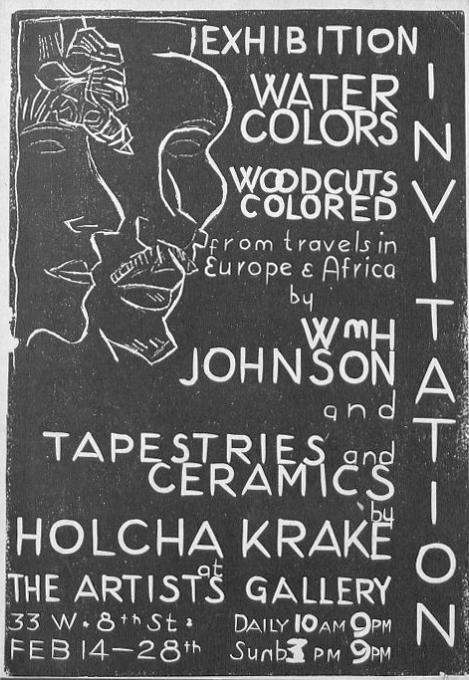
InNovember1938,aftertwelveyearsabroad,WilliamH.Johnsonreturnedtothe UnitedStates,steppingintoamarkedlydifferentculturalandeconomiclandscape. HeandHolchaKrakesettledinanapartmentat27West15thStreet,justoutside GreenwichVillageinNewYorkCity.Theyreturnedtoanationonthebrinkofwar, facinglimitedfinancialresourcesandanincreasinglyuncertainartmarket,conditions thatwouldshapethenextphaseofJohnson’scareer.
Tosupporthimself,JohnsonacceptedateachingpositionattheHarlemCommunity ArtCenterfrom1939to1942,aformativeperiodinbothhislifeandartisticpractice. TeachinginHarlemofferedhimsomethinglargelyabsentduringhisyearsinEurope: sustainedengagementwiththeBlackcommunity.
Alwaysresponsivetohissurroundings,Johnsonbeganportrayingtherhythmsof dailylife,thesmalldramasunfoldinginstreets,dancehalls,andneighborhoods, capturingthevitalityofHarlem’surbanculture.Thisenvironmentsparkedaprofound transformationinhiswork.Movingawayfromtheportraitsandlandscapesthathad definedhisScandinavianyears,heturnedincreasinglytowardthehumanfigureand scenesrootedintheBlackAmericanexperience.
InspiredbyHarlem’sculturalenergy,Johnsondevelopedabodyofworkgroundedin community,culturalpride,andsocialconsciousnessanapproachhedescribedas “depictinghisownpeople.”
JohnsonsHarlem,NewYorkseriesconsistsofsixindividualworks.
HarlemChurch,ca.1939–1942.
HarlemStreetwithChurch,ca.1939-1942.
Untitled(HarlemStreetwithCouple),ca,1939-1942.
Untitled(CoupleBeneathStreetlamp,Harlem),ca,1939-1942.
Nightbirds.Ca.1939–1942
StreetPeople,ca.1939–1942
William
W. 8th Street, New York City, from February 14–28, 1939. Image credit: William H.
Papers, Archives of American Art, Smithsonian Institution.
Harlem Church, ca. 1939–1942.
Twoknownimpressions.
InHarlemChurch,Johnsonemploysbold,angularcarvingtodepictaGothic-style churchsetwithinadenseurbanenvironment.Thecompositionisanchoredbyatall steeplecrownedwithacross,risingprominentlyabovethesurroundingbuildings. ThestructurehasbeenidentifiedastheEphesusSeventh-dayAdventistChurch, locatedat123rdStreetandLenoxAvenue.Foundedin1924,thecongregation initiallymetat144West131stStreetbeforerelocatingin1930toitspresentsitedue toovercrowding.
SituatedonlyashortdistancefromtheHarlemCommunityArtCenterat290Lenox Avenue,whereJohnsontaught,thechurchwouldhaveformedpartofhisdaily surroundings,likelyencounteredinhisregularmovementsthroughthe neighborhood.Itsrecurringpresenceinbothhisprintsandtemperapaintings suggeststhatthebuildingheldparticularvisualandculturalsignificancewithinhis Harlemimagery.
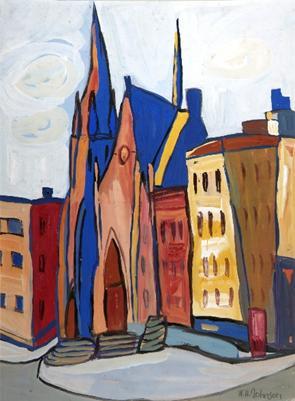
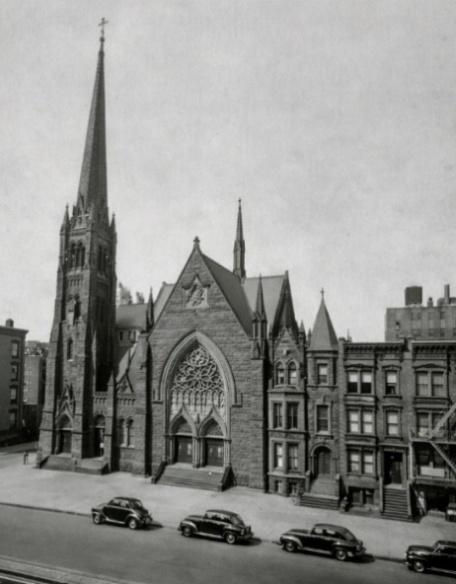
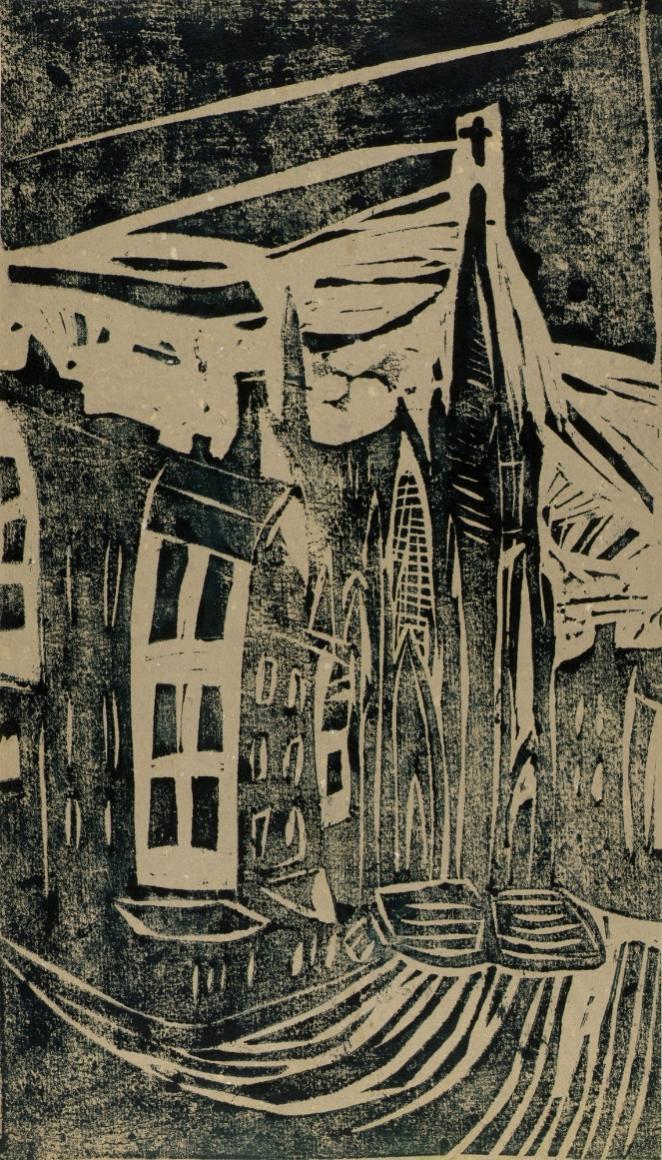
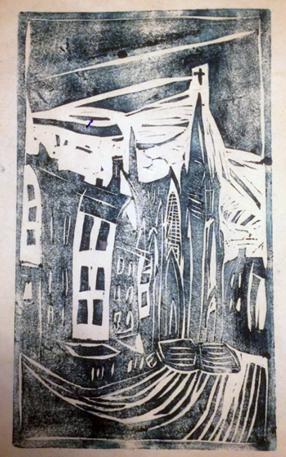
Harlem Church, ca. 1939-1942. Object Number: WHJBP-HAR-0001. Block print on paper. (Linocut). Handcolored. Size: 20 5⁄8 x 12 1⁄2 in. (52.3 x 31.7 cm) irregular. Provenance: Gift of the Harmon Foundation, Smithsonian American Art Museum. 1967.59.1114
Harlem Church, ca. 1939-1942. Object Number: WHJBP-HAR-0002. Block print on paper. (Linocut). Size: 61 x 42 cm. Provenance: The estate of Holcha Krake; by descent to her grandniece, Johanna Voll. The Wright Foundation for Southern Art. Florence County Museum.
Harlem Street with Church, ca. 1939-1942.
Threeknownimpressions
InHarlemStreetwithChurch,JohnsonrevisitstheEphesusSeventh-dayAdventist Church,thistimeplacingitinalivelyurbanstreetscape.
UnlikethemoreverticalandspirituallyfocusedHarlemChurch,thisversion emphasizesthechurch'sintegrationintoeverydayHarlemlife.TheGothicspiresand archedwindowsremaincentral,butnowtheyareflankedbytightlypacked apartmentbuildingsandframedbystylizedfiguresandapassingcarinthe foreground.
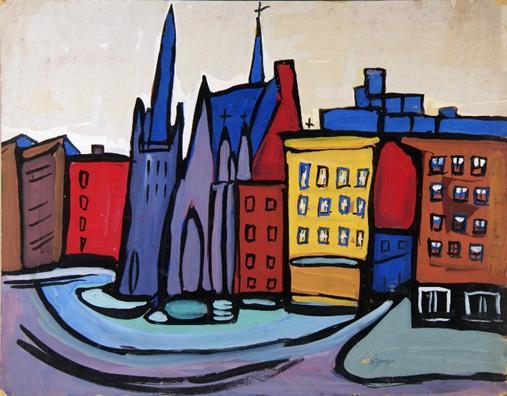
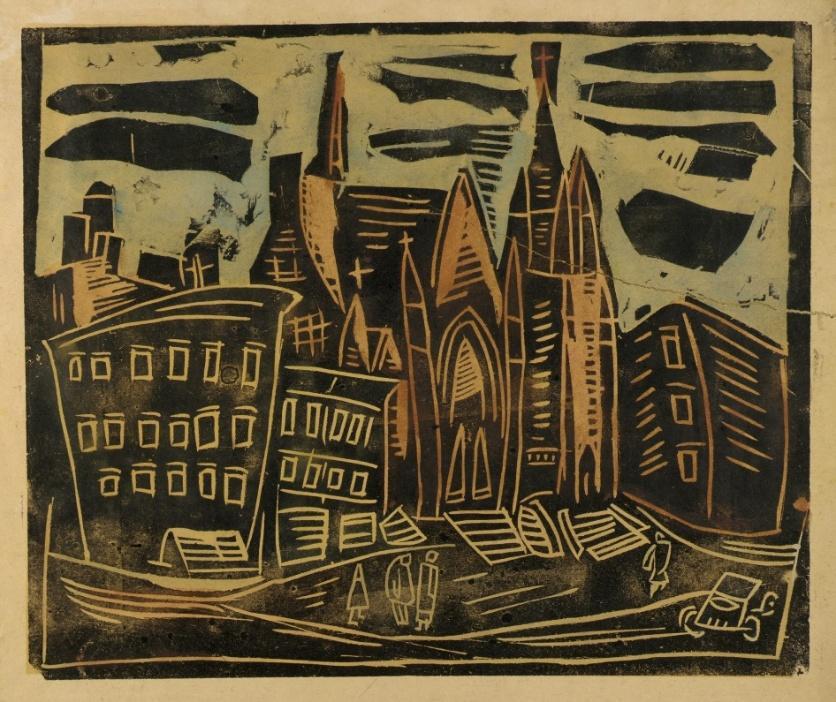
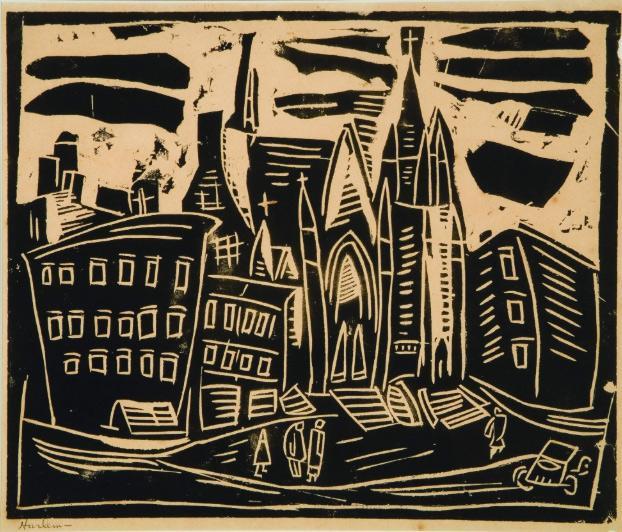
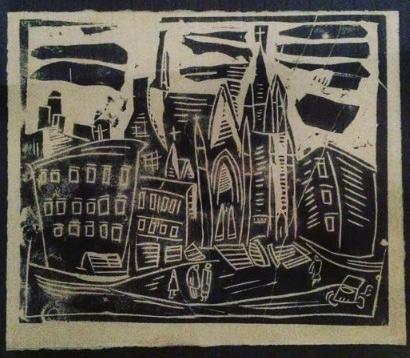
Harlem Street with Church, ca. 1939-1942. Object Number: WHJ-BP-HAR-0003. Block print on paper. (Linocut). Hand-colored with a palette of ochre, burnt sienna, pale blue, and black, with fine cream outlines for figures and details. Size: 13 x 14 3⁄4 in. (33.0 x 37.5 cm) irregular, Provenance: Gift of the Harmon Foundation. Smithsonian American Art Museum. 1967.59.1113
Harlem Street with Church, ca. 1939-1942. Object Number: WHJ-BP-HAR-0004.Block print on paper. (Linocut). Titled Harlem in the lower left corner. Size: 11.75 x 13.5 in. 29.85 x 34.29 cm. Provenance: Gift of the Harmon Foundation. Courtesy of the Amistad Research Center, New Orleans, LA. Accession Number: ARC.HAR.WHJO.1939.16
Harlem Street with Church, ca. 1939-1942. Object Number: WHJ-BP-HAR-0005.Block print on paper. (Linocut). Size: 36,5 x 31,3 (irregular). Provenance: Estate of Holcha Krake; by descent to her grandniece, Johanna Voll. Private Collection.
Untitled (Harlem Street with Couple), ca, 1939-1942.
Threeknownimpressions.
InHarlemStreetwithCouple,Johnsondepictsanembracingpairstandingina narrowurbanpassageatevening.Tall,angularbuildingsriseoneitherside,their sharpverticalplanesandconvergingrooflinescompressingthespaceand intensifyingthesenseofenclosure.Thearchitectureisreducedtostarkgeometric silhouettes,withrowsofwindows,slantedroofs,andchimneystackssuggestingthe characteristicbrownstonerowhousesofHarlem’searlytwentieth-centurystreets.
Attheforeground,thewoman’selongatedfigureleansgentlytowardherpartner, herextendedpostureconveyingvulnerabilityandemotionalopenness.Bycontrast, theman’smorecompactformprovidesasenseofgroundingandprotection.
ThemotiflikelyderivesfromJohnson’sobservationsofHarlem’sdynamicstreetlife duringthelate1930sandearly1940s,whenmusic,dance,andnighttimesocial activityanimatedtheneighborhood’spublicspaces.
ThecompositionparallelsJohnson’sHarlemStreetScenewithFullMoon(ca.1939–1940),inwhichsimilararchitecturalformsframeanarrowroadwaybetweendensely packedbuildings.AcomparableapproachappearsinCityStreetScene(ca.1939–1940),whereJohnsonlikewisepresentsfiguresasintegraltoalivedsocial environment.
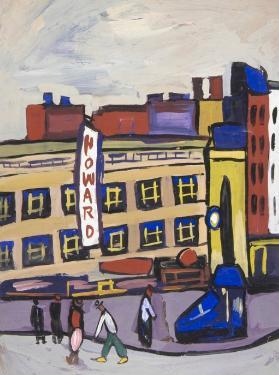
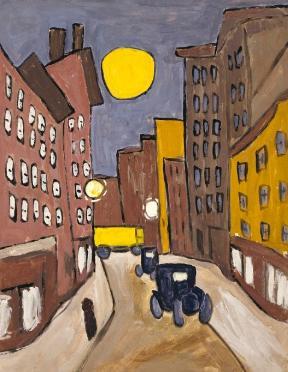
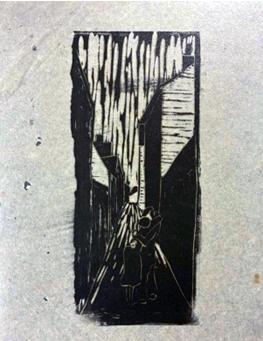
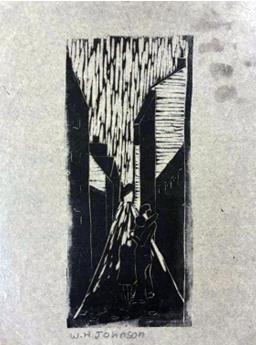
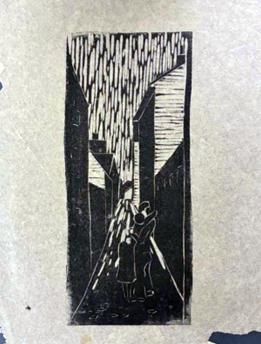
Untitled (Harlem Street with Couple), ca, 1939-1942. Object Number: WHJ-BP-HAR-0006. Block print (linocut) on vellum paper. Size: 19 x 25 cm. Provenance: The artist to Niels Lindberg, Nr. Broby, Fyn, Denmark; subsequently in a private Danish collection. Collection of the National Gallery of Denmark (SMK), Copenhagen.
Untitled (Harlem Street with Couple), ca, 1939-1942. Object Number: WHJ-BP-HAR-0007. Block print (linocut) on vellum paper. Inscribed in pencil. W.H. Johnson. Size: 19 x 25 cm. Provenance: The artist to Niels Lindberg, Nr. Broby, Fyn, Denmark. Subsequently part of a private Danish collection.
Untitled (Harlem Street with Couple), ca, 1939-1942. Object Number: WHJ-BP-HAR-0008. Block print (linocut) on vellum paper. Size: 19 x 25 cm. Provenance: The artist to Niels Lindberg, Nr. Broby, Fyn, Denmark. Subsequently part of a private Danish collection.
Untitled (Couple Beneath Streetlamp, Harlem), ca, 1939-1942.
Oneknownimpression
InCoupleBeneathStreetlamp,Harlem,Johnsondepictsaserenenighttimescenein whichafinelydressedcouplestandsbeneaththeradiantglowofastreetlamp.The lightburstsoutwardinbold,geometricrays,creatingastrikingvisualcontrastthat drawstheviewer’seyetothecouplebelow.
Elegantlyattiredandbothwearinghats,thewoman’stiltedatafashionableangle andtheman’scomplementinghisbroad-shoulderedzootsuit,thecoupleembody thehallmarksofurbanstyle.Theystandsidebysideincomposedstillness,their squaredshouldersandelongatedformsconveyingstrengthandself-assuranceand reinforcingaconfidentsenseofidentity.
Setwithin1940sHarlem,thescenereflectsasocialcultureinwhichcouplesgathered todance,socialize,andpresentthemselvesintheirfinestattire.
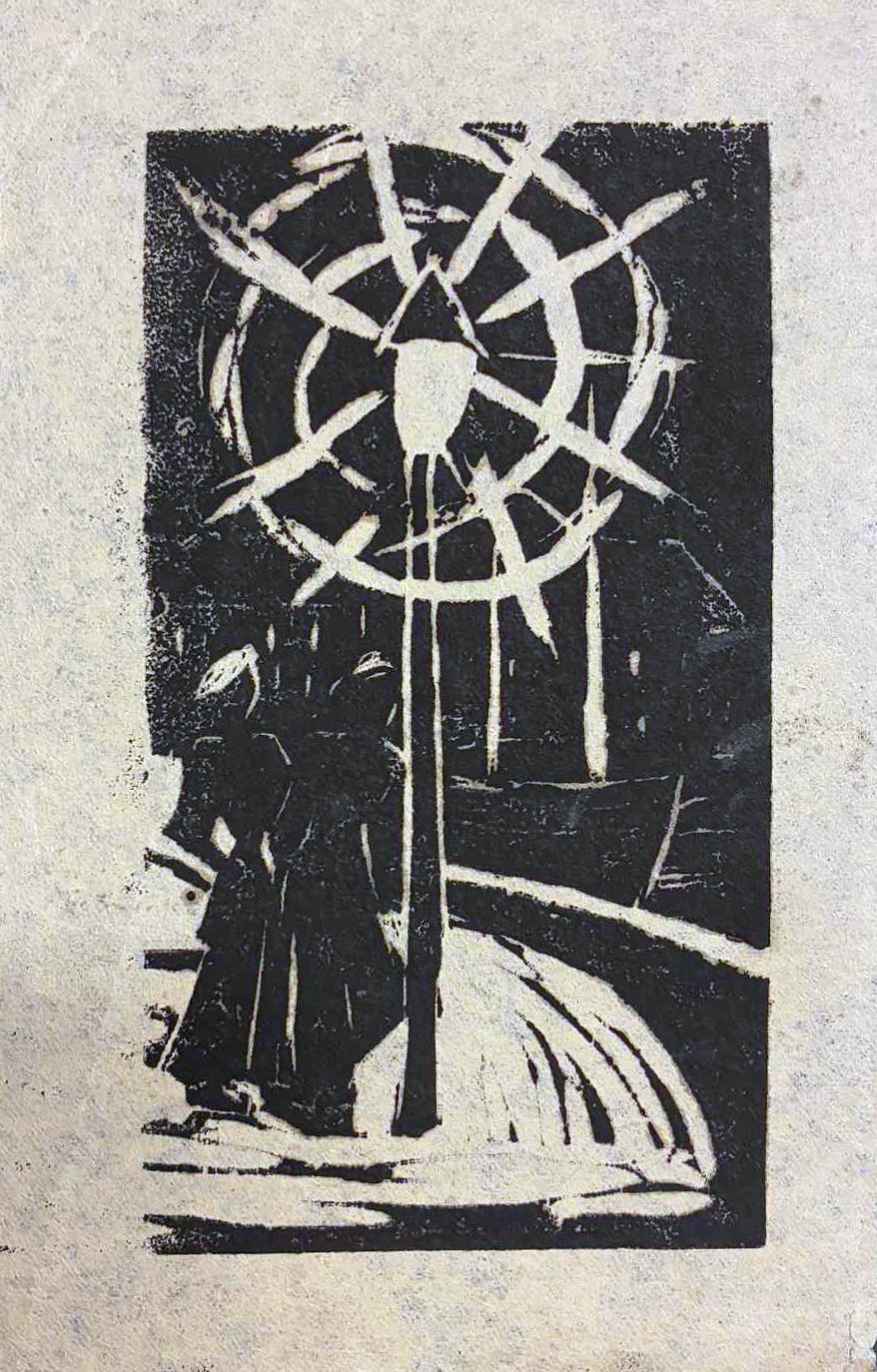
Untitled (Couple Beneath Streetlamp, Harlem), ca, 1939-1942. Object Number: WHJ-BP-HAR-0009. Block print (linocut) on vellum paper. Size: 10 ½ x 16 cm. Provenance: The artist to Niels Lindberg, Nr. Broby, Fyn, Denmark; subsequently in a private Danish collection. Collection of the National Gallery of Denmark (SMK), Copenhagen.
Sixknownimpressions.
InNightbirds,Johnsonpresentsaclose-upportraitoftwostylishlydressedwomen, likelydepictedduringanightoutorinthequietearlymorninghoursastheyreturn home.Theirrefinedappearancesuggestsurbansophistication,whilethetitleevokes Harlem’svibrantnocturnalculture.
Thefigureontheright,wearingafeathered,tiltedhat,bearsaresemblanceto Johnson’searlierthree-quarterviewportraitofHolchaKrake(WHJ-BP-HOL-001-005.)
ItispossiblethatJohnsonintendedthisimagetorepresentHolchaaccompaniedby afriendduringanightout;however,thisidentificationremainsunconfirmed.
Theearliestrecordedreferencetotheprintdatesto1939,whenahand-colored impressionwasexhibitedatJohnsonandKrake’sjointexhibitionatTheArtists GalleryinNewYorkinFebruaryofthatyear.
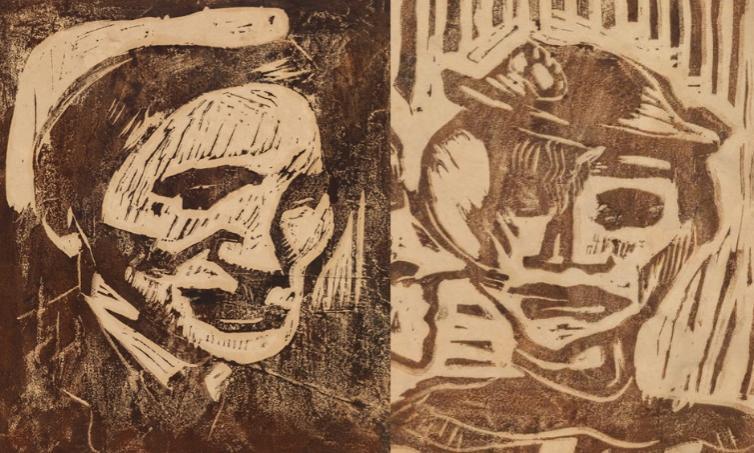
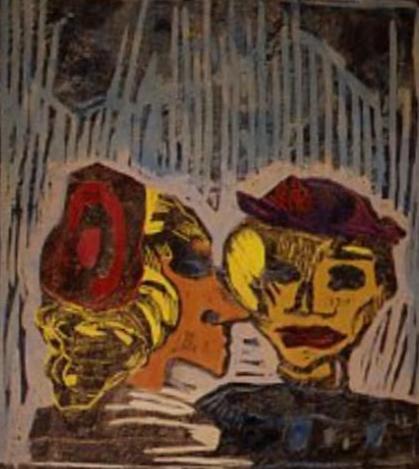
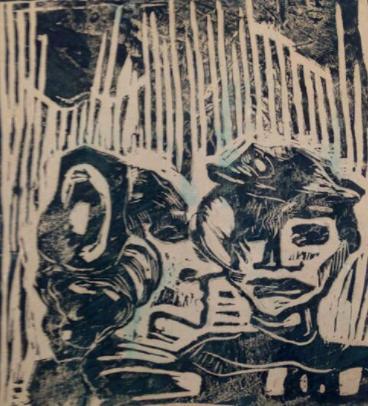
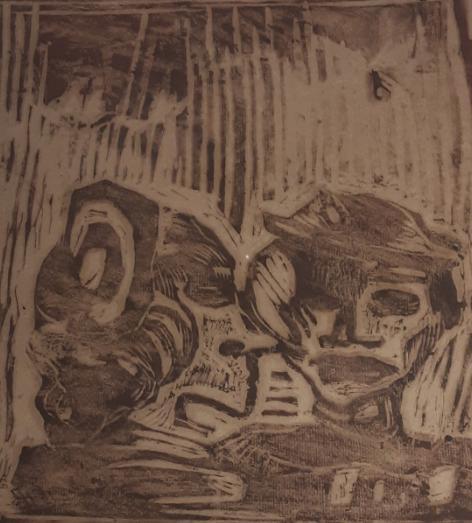
Nightbirds. Ca. 1939–1942. Object Number: WHJ-BPHAR-00010. Block print on paper. (Woodcut). Handcoloured with palette of yellow, red, orange, dark blue, black, brown, grey, and muted green. Size: H: 28 ½ in. W: 26 3/16 in. D: 1 13/16 in. Provenance: Gift of the Harmon Foundation. Hampton University Museum & Archives. Object ID: 67.44.38
Nightbirds. Ca. 1939–1942. Object Number: WHJ-BPHAR-00011. Block print on paper. (Woodcut). Handcoloured with shades of blue. Size: H: 17.5 in. W: 16.25 in. Provenance: Gift of the Harmon Foundation. Courtesy of Oakland Museum of California (OMCA). Object number: A67.62.21
Nightbirds. Ca. 1939–1942. Object Number: WHJ-BPHAR-00012. Block print on paper. (Woodcut). Size: H: 16 ½ in. W: 18 in. Provenance: Gift of the Harmon Foundation. Hampton University Museum & Archives. Object ID: 67.44.34
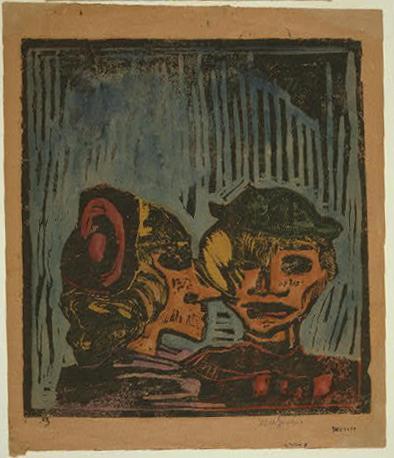
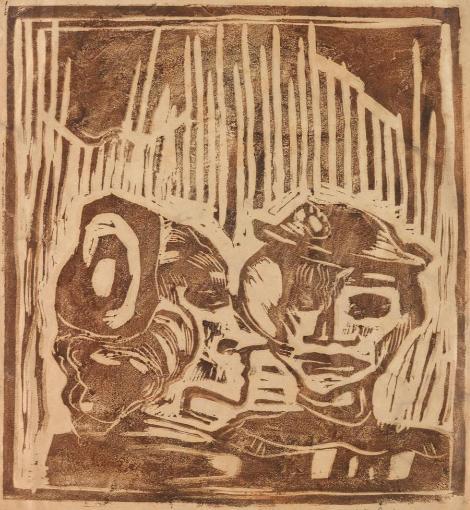
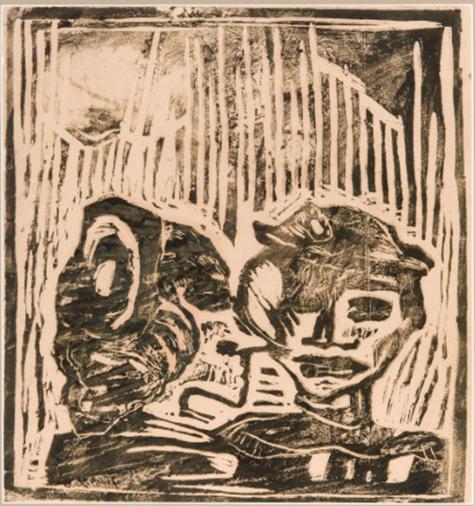
Nightbirds. Ca. 1939–1942. Object Number: WHJ-BPHAR-00013. Block print on paper. (Woodcut). Handcoloured with palette of dark blue, red, yellow, green, and brown tones with black outlines. Signed in pencil W.H. Johnson on verso. Annotated: "NOR-178-A (1). Provenance: From of the Harmon Foundation. Library of Congress, item 2003688150.
Nightbirds. Ca. 1939–1942. Object Number: WHJBP-HAR-00014. Block print on brown on thin, pale cream wove paper. (Woodcut). Signed (partial) in pencil, lower margin. Size: 457 x 432 mm. 18 x17 inches, 1/2- to 3/4- inch margins. Provenance: The estate of Holcha Krake; by descent to her grandniece, Johanna Voll. Christoph Voll Estate collection.
Nightbirds. Ca. 1939–1942. Object Number: WHJ-BPHAR-00015. Block print on paper. (Woodcut). Size: 18 x 17 in. 45.72 x 43.18 cm. Provenance: Gift of the Harmon Foundation. Courtesy of the Amistad Research Center, New Orleans, LA. Accession Number: ARC.HAR.WHJO.1939.15
Detail from the reception for William H. Johnson’s exhibition at the Alma Reed Gallery, May 1941. Image credit: William H. Johnson Papers, Archives of American Art, Smithsonian Institution.
Fiveknownimpressions.
InStreetPeople,Johnsonpresentsatightlycroppedportrayalofanelegantcouple. Renderedinbold,carvedlinesandsharpcontrasts,theprintdistillsthefiguresinto simplified,mask-likeformswithstriking,expressivefeatures.Thecompressedspace intensifiestheirpresence,drawingtheviewerintocloseandimmediateengagement withthepair.
Theirfashionablehatssignalurbansophisticationandthedistinctivestreetstyleof 1940sHarlem.Thescenemaysuggestthecoupleheadingoutforaneveningof dancing,perhapsatthefamedSavoyBallroom.
StreetPeopleparallelJohnson’spaintingStreetLife,Harlem(ca.1939–1940),inwhich asimilarlyfashionablecoupleappearsdressedtotheninesandreadytostepinto Harlem’svibrantnightlife.
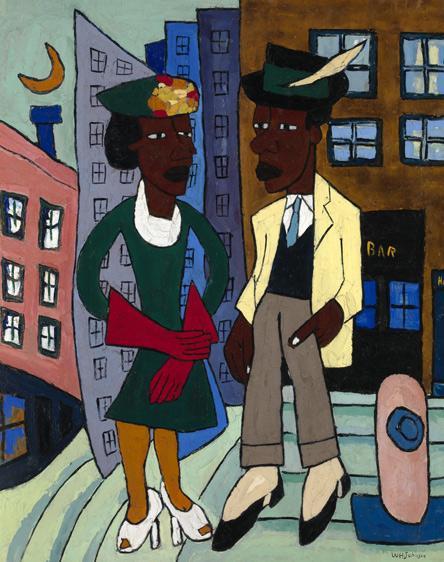
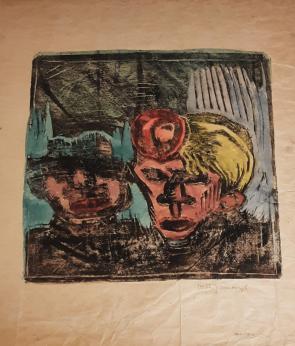
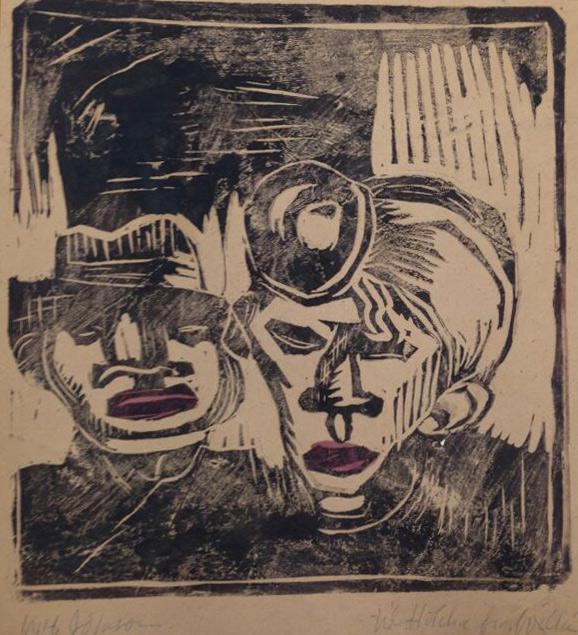
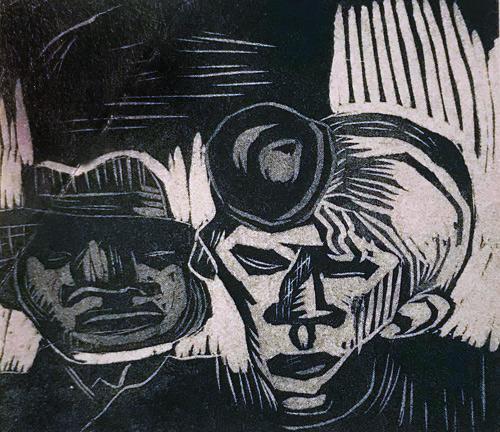
Street People. Ca, 1939- 1942. Object Number: WHJBP-HAR-00016. Block print on paper. (Linocut). Signed W.H. Johnson. Hand-coloured with palette of teal, red, yellow, peach, pink, white, and dark green. Size: H: 24 ½ in. W: 18 3/8 in. Gift of the Harmon Foundation. Hampton University Museum & Archives. Object ID: 67.44.39
Street People. Ca, 1939- 1942. Object Number: WHJBP-HAR-00017. Block print on paper. (Linocut). Handcolored with accents of deep red. Signed lower right: W.H. Johnson. Inscribed: Til Holcha Fra Willie.
Provenance: Gift of the Harmon Foundation. Courtesy of Oakland Museum of California (OMCA). Object number: A67.62.17
Street People. Ca, 1939- 1942. Object Number: WHJBP-HAR-00018. Hand colored block print on paper ( Linocut). Size: 13 1/2 × 15 in. 34.3 × 38.1 cm.
Provenance: Gift of the Harmon Foundation. The Howard University Gallery of Art. Object number 67.4. Illustrated on page 125 in Homecoming: The art and life of William H. Johnson. Richard J Powell (1991)
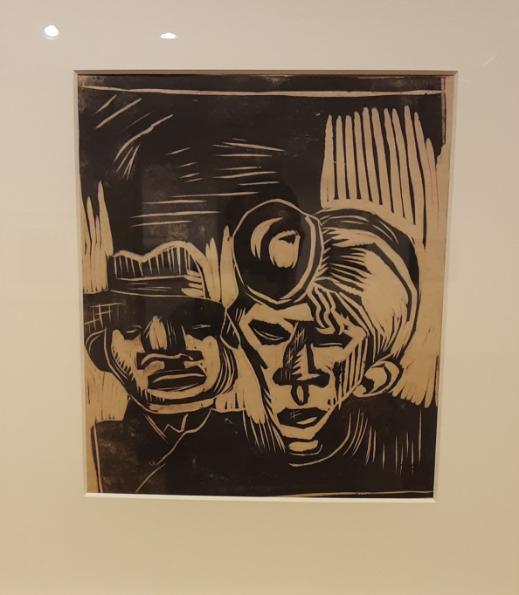
Street People. Ca, 1939- 1942. Object Number: WHJ-BP-HAR-00019. Block print on paper. (Linocut). Size: H: 25 7/16 in. W: 22 3/8 in. D: 1 3/4 in. Provenance: Gift of the Harmon Foundation. Hampton University Museum & Archives. Object ID: 67.44.31
Street People. Ca, 1939- 1942. Object Number: WHJ-BP-HAR-00020. Block print on paper. (Linocut). Hand-colored. Size: 22"h x 21"w x 1⅛"d. Provenance: Gift of the Harmon Foundation. Fisk University Galleries. Object ID. #0409.
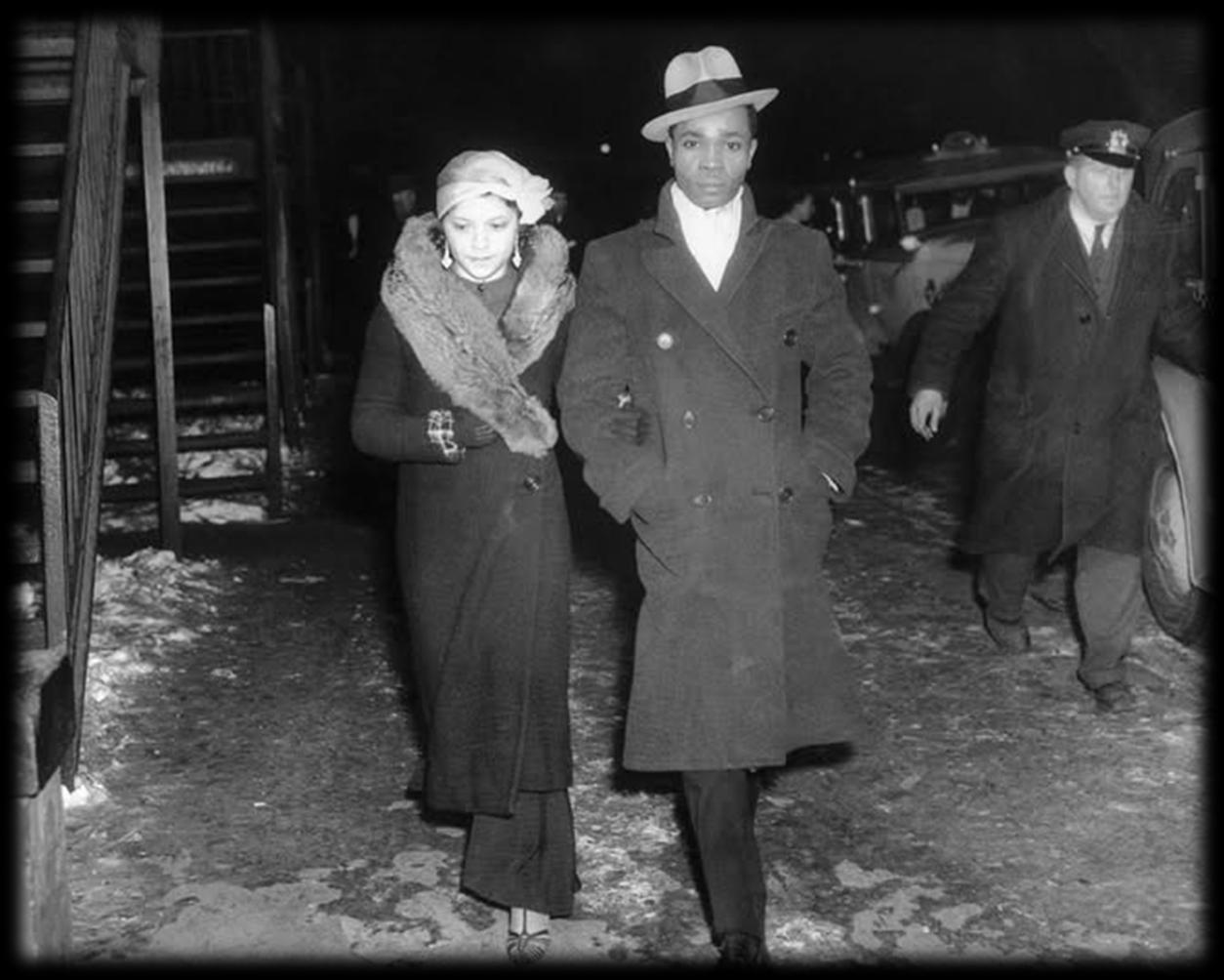
on Street
for Ball, Harlem, 1935. Unknown photographer. Courtesy of Edward Paige.
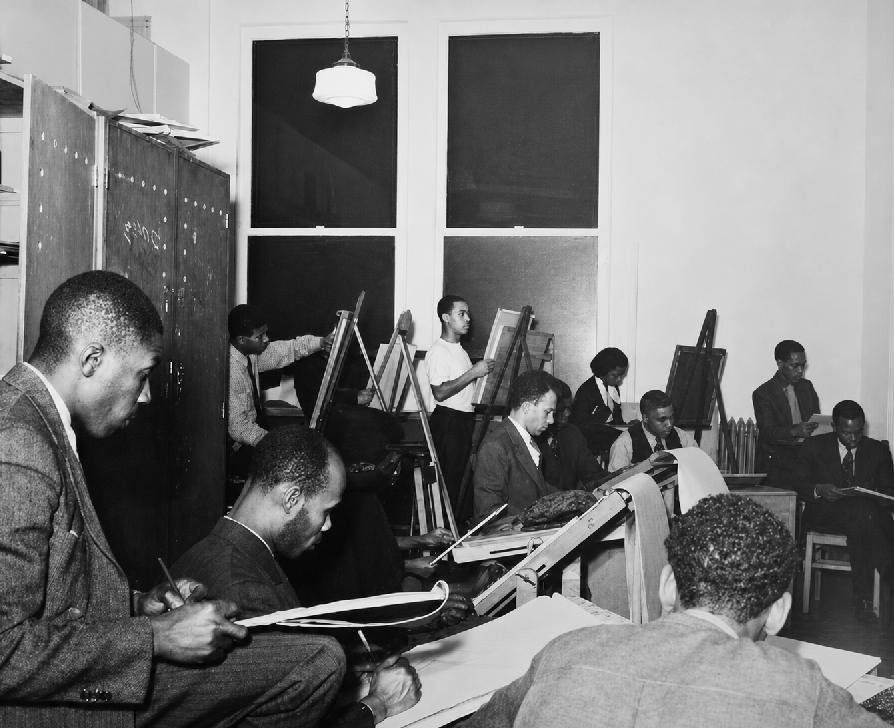
Between1939and1942,WilliamH.Johnsonworkedasanartinstructoratthe HarlemCommunityArtCenterundertheFederalArtProject.Locatedat290Lenox Avenue,theCenteroffereddailyclassesinpaintinganddrawing,heldinboth afternoonandeveningsessions,andprovidedstructuredartistictrainingtothelocal community.Italsomaintainedawell-equippedprintmakingworkshop,supporting experimentationintechniquessuchaslithographyandsilkscreen.
Duringthisperiod,Johnsonproducedasubstantialbodyofgraphicwork,including portraitsandfigurestudiesdrawnfromlivemodels,asubjecthehadrarelypursued sincehisstudentyears.Intheseworks,heexploredtheexpressivepotentialofthe nude,drawingonthesculpturallanguageoftraditionalAfricanarttoprivilege symbolicproportionandbodilypresenceoverstrictanatomicalrealism.
WhileattheCenter,Johnsonalsotransitionedfromwoodcuttolinocut.Unlikewood, linoleumallowedforsmoothercontoursandmorefluidlines,resultinginacleaner andmoreimmediateexpressiveeffectthatalignedwithhisevolvingartisticstyle.
JohnsonsHarlemArtCenterseriesconsistsof12individualworks.
SweetSleep(RecliningNudebytheSea),ca.1939–1942.
SittingModel.ca.1939-1942.
FemaleNude,ca.1939–1942.
SeatedFemaleNude,ca.1939–1942
Untitled(TheBathers),ca.1939–1942.
NudeSeated-FrontView.Ca.1939-1942.
SeatedNude,ca.1939-1942.
NudeatRest,ca.1939-1942.
NudeResting.1939-40.
NudeRecumbent.Ca.1939-1942.
LameMan-FullLength,ca.1939–1942
LameMan–Bust,ca.1939–1942
Sweet Sleep (Reclining Nude by the Sea), ca. 1939–1942.
Threeknownimpressions.
InSweetSleep,Johnsonreworksthemotifoftherecliningnude,drawingonhis earliertemperapaintingRecliningFemaleNudeonRedDrape(ca.1939–1940), createdduringhistenureattheHarlemCommunityArtCenter.
AlsoknownasRecliningNudebytheSea,theprintpresentsastylizedfemalefigure setagainstrhythmic,abstractpatterns.Boldcontoursandexaggeratedcurvesflatten theform,lendingitasenseofmonumentalitywhileemphasizingexpressiveimpact overanatomicalprecision.
ThefigurebearsbothvisualandthematicaffinitieswithSchwangereFrau(Pregnant Woman,1921),asculpturebytheGermanartistChristophVoll.Voll’sraw, unidealizeddepictionofthefemalebody,latercondemnedas“degenerateart”and destroyedbytheNaziregimein1937,resonateswithJohnson’sownapproach.
AsJohnson’sbrother-in-lawthroughhiswifeHolchaKrake,Voll’slifeandworkheld deeppersonalsignificance.Hisdeathin1939attheageofforty-two,followingyears ofNazipersecution,profoundlyaffectedbothJohnsonandKrake.
CreatedaroundthetimeJohnsonlearnedofVoll’sdeath,SweetSleepcanbe understoodasaquiettributetoVoll’slegacy,reflectingasharedartisticvisionthat presentswomennotaspassivemuses,butaspowerful,autonomousbeings.
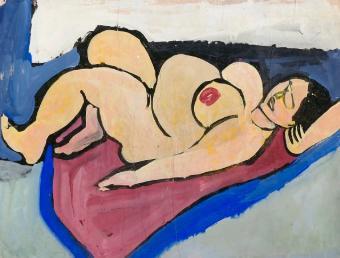
William H. Johnson. Reclining Female Nude on Red Drape, ca. 1939-1940, tempera on paper. Smithsonian American Art Museum,1967.59.262.
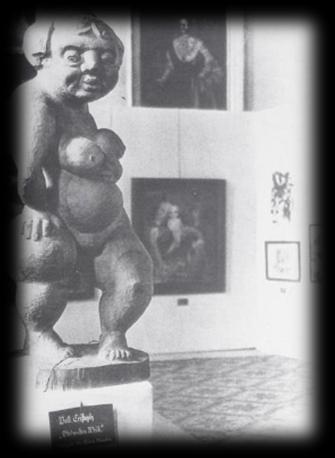
Christoph Voll's Pregnant Woman at the Degenerate Art Show in Munich 1936. Image: Entartete Kunst. Heidelberger kunstgeschichtliche Abhandlungen,1995.
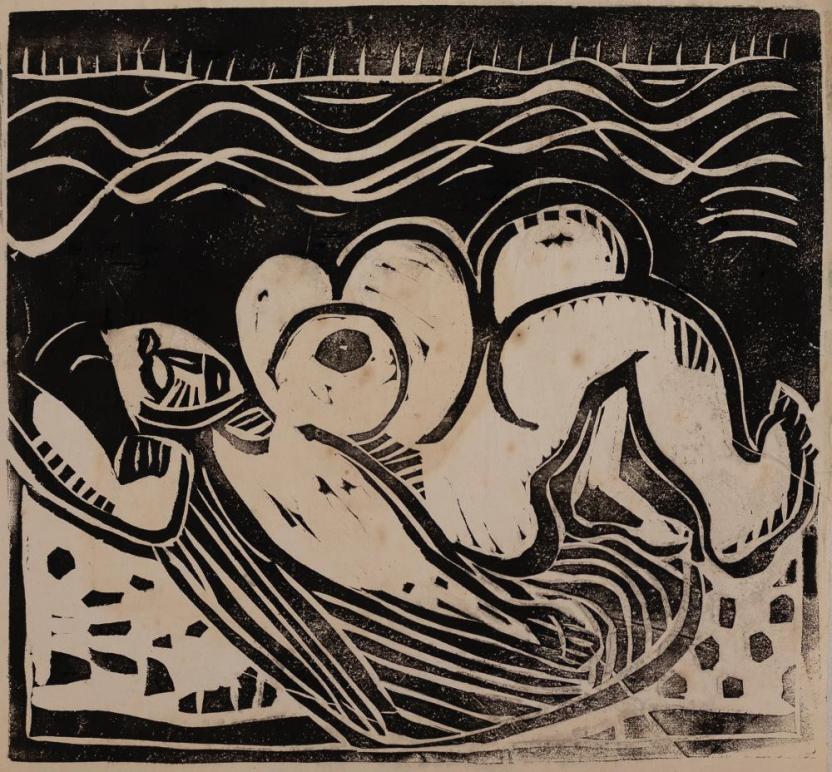
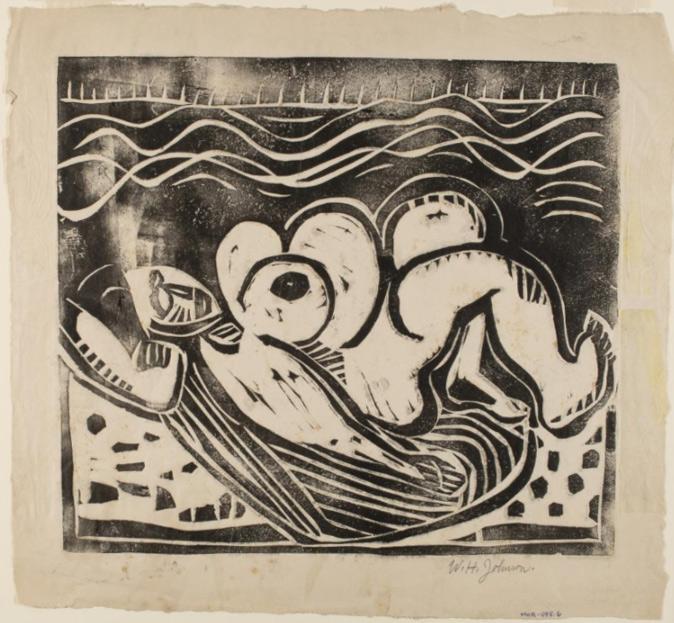
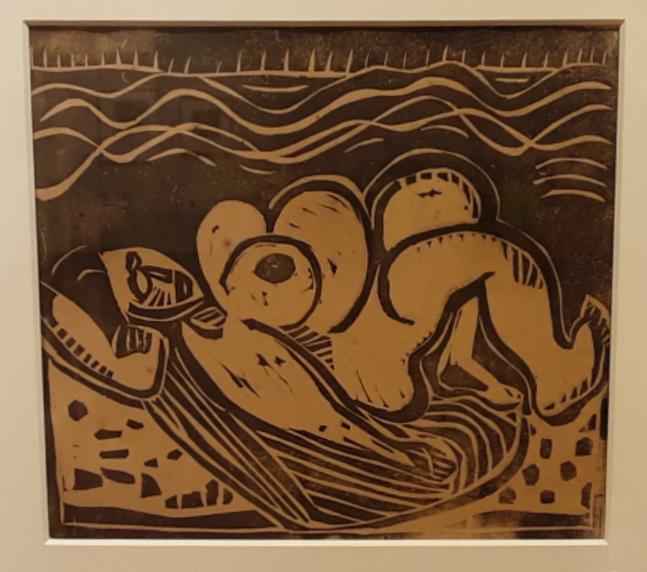
Sweet Sleep (Reclining Nude by the Sea) Object Number: WHJ-BP-HCAC-0001. Ca, 1939- 1942. Block print on paper (Woodcut). Size: 14-1/2 x 16-1/2 inches. Provenance: The estate of Holcha Krake; by descent to her grandniece, Johanna Voll. Sold at Black art auction. Nov. 19, 2022.
Sweet Sleep (Reclining Nude by the Sea) Number: WHJ-BP-HCAC-0002. Ca, 1939- 1942. Block print on holiday card. (Woodcut). Signed W.H. Johnson. Dimensions: Image: 13 x 14 1/2 inches (33 x 36.8 cm) Sheet: 15 11/16 x 17 1/16 inches (39.8 x 43.3 cm). Provenance: Gift of the Philadelphia Commercial Museum (also known as the Philadelphia Civic Center Museum). Philadelphia, Pennsylvania Accession Number:2004-111-726.
Sweet Sleep (Reclining Nude by the Sea) Ca, 1939- 1942. Object Number: WHJ-BPHCAC-0003. Block print on paper (Woodcut). Size: H: 22 7/8 in. W: 23 3/8 in. D: 1 3/4 in. Provenance: Gift of the Harmon Foundation. Hampton University Museum & Archives. Object ID: 67.44.13
Sitting Model. ca. 1939-1942.
Sevenknownimpressions.
InSittingModel,Johnsonpresentsaseatedwomaninafrontalpose,herhands foldedneatlyinherlap.Shewearsatailoreddresswithaknottedscarfatthe neckline,andheruprightpostureconveysasenseofcomposureandself-possession. Thefigureisdefinedbybold,incisedlinesandstrongcontrasts,whichflattenthe formwhileemphasizingitsstructuralclarity.Herfaceisrenderedinastylized,masklikemanner,withsimplifiedfeaturesthatrecallbothAfricansculpturaltraditionsand modernistabstraction.
Theidentityofthesitterremainsuncertain,thoughsheisbelievedtohavebeen eitherastudentorastaffmemberattheHarlemCommunityArtCenter,where Johnsontaughtduringthisperiod.
OnepossiblecandidateisartistGwendolynKnight,whostudiedpaintingand sculptureattheCenterduringJohnson’stenureandalsomodeledforsculptor AugustaSavage,thendirectoroftheCenter.
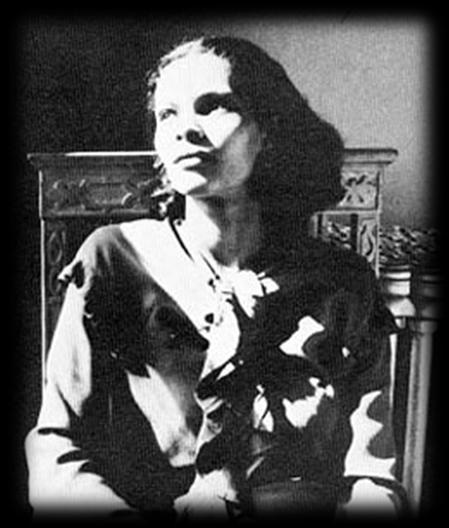
mid-1930s.
Gwendolyn Knight (1913–2005) was a Barbadian-born American artist and an important figure of the Harlem Renaissance. Recognized for her expressive figurative paintings, portraits, and prints, she studied at the Harlem Community Art Center under sculptor Augusta Savage, who became a lifelong mentor. It was there that Knight met fellow artist Jacob Lawrence; the two married in 1941 and sustained a lifelong artistic partnership. Photo. University of Washington Press.
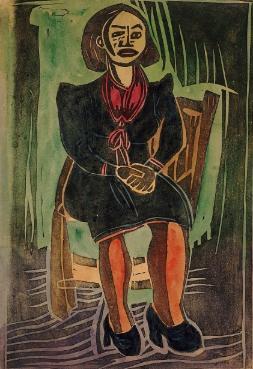
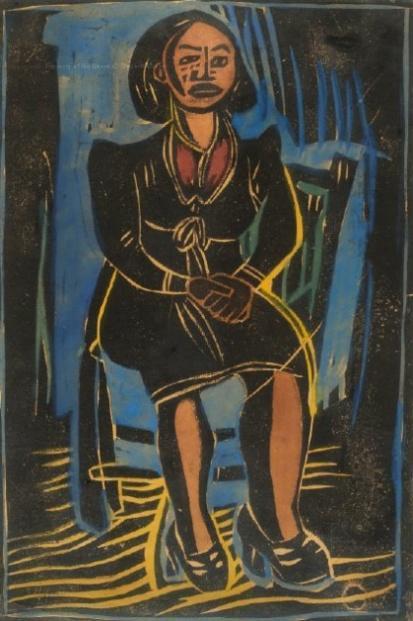
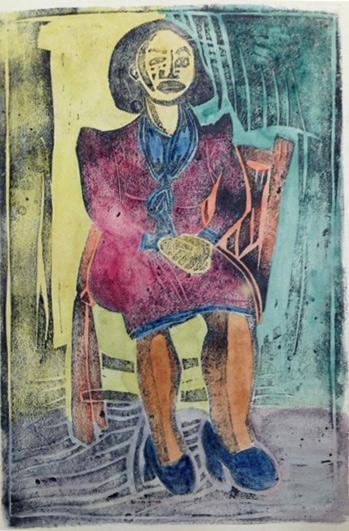
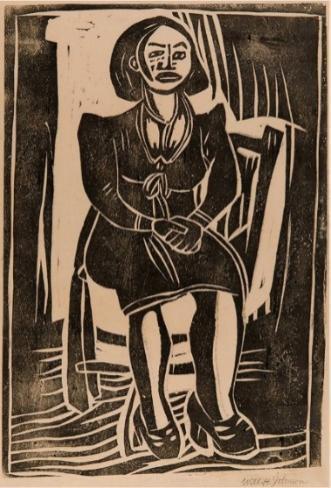
Sitting Model. ca. 1939-1942. Object Number: WHJBP-HCAC-0004. Block print on paper (Linocut). Handcoloured with palette of deep green, dark brown, red accents, warm ochre skin tones, and a purple-gray floor. Size: 17 7⁄8 x 12 in. 45.4 x 30.6 cm. Provenance: Gift of the Harmon Foundation, Smithsonian American Art Museum, 1967.59.1112.
Sitting Model. ca. 1939-1942. Object Number: WHJBP-HCAC-0005. Block print on paper (Linocut). Handcoloured with palette of black, blue, red, warm brown, and yellow contour lines. Size: 18 x 12 in. Provenance: From the Collection of David C. Driskell. Object ID: 2014.08.003. Photography by Greg Staley, 2018.
Sitting Model. ca. 1939-1942. Object Number: WHJBP-HCAC-0006. Block print on paper (Linocut). Handcoloured with palette of pink, blue, yellow, teal, orange, and black outlines. Size: H: 17.13 in, W: 12.25 in. Provenance: Gift of the Harmon Foundation. Courtesy of Oakland Museum of California (OMCA). Object number: A67.62.24
Sitting Model. ca. 1939-1942. Object Number: WHJBP-HCAC-0007. Block print on paper (Linocut). Handcoloured in black with cream tones. Signed Will. H. Johnson at lower right. Size: 18.5 x 12.5 in. (46.99 x 31.75 cm) Provenance: Gift of the Harmon Foundation. Courtesy of the Amistad Research Center, New Orleans, LA. Accession Number: ARC.HAR.WHJO.1939.19.
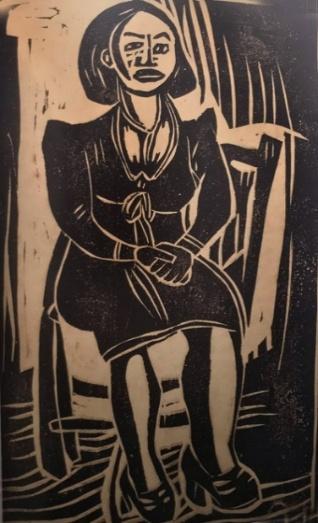
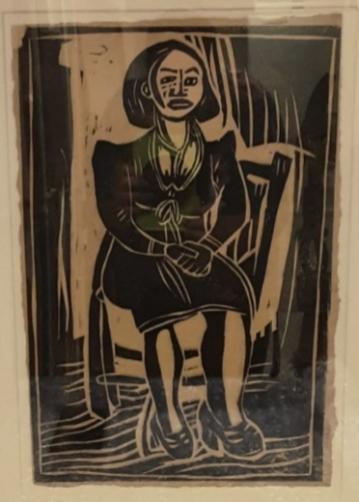
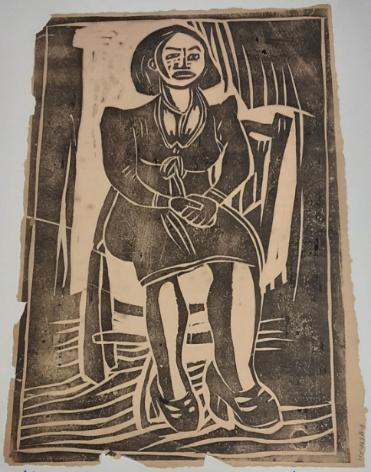
Sitting Model. ca. 1939-1942. Object Number: WHJBP-HCAC-0008. Block print on paper (Linocut). Handcoloured in black with cream tones. Size: 18 ¾ x 12 inches. Provenance: Gift of the Harmon Foundation. Collection of Hampton University Museum. Illustrated on page 104 in William H. Johnson: Revisiting an African American Modernist. Kenneth G. Rodger. North Carolina Central University Art Museum in Durham, North Carolina (2006).
Sitting Model. ca. 1939-1942. Object Number: WHJBP-HCAC-0009. Block print on paper (Linocut). Size: H: 29 in. W: 23 in. D: 1 5/8 in. Provenance: Gift of the Harmon Foundation. Hampton University Museum & Archives. Object ID: 67.44.26
Sitting Model. ca. 1939-1942. Object Number: WHJBP-HCAC-0010. Block print on paper (Linocut). Size: H: 18 5/8 in. W: 12 ½ in. Provenance: Gift of the Harmon Foundation. Hampton University Museum & Archives. Object ID: 67.44.9
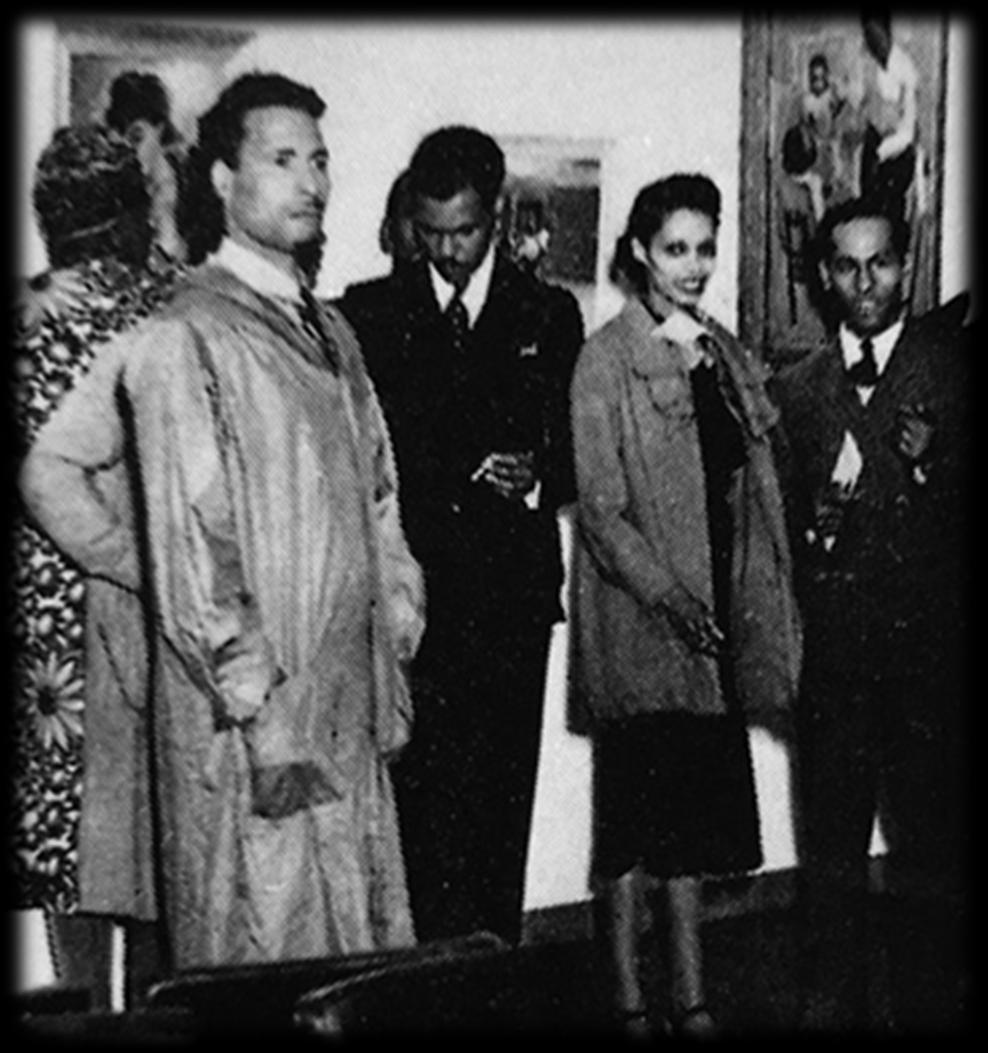
OneKnownImpression.
InFemaleNude,Johnsonpresentsaseatedfemalefigureinastudiosetting,using bold,simplifiedcarvingtocreateahighlyabstractedcomposition.Thefigureis outlinedinwhiteagainstasolidblackfield,withonlyafewincisedlinestosuggest keyfeaturessuchasthebust,fingers,andthecurveoftheseatedposture.The backgroundincludesapairofverticallinesthatimplythepresenceofdrapery, situatingthefigurewithinatraditionalstudioenvironment.
AlthoughtheSmithsonianAmericanArtMuseumcurrentlydatestheworkto1930–1935,itsmedium,linoleumratherthanwood,alongwithitsstudiosetting,suggests alaterproductionduringJohnson’sHarlemperiodfrom1939to1942,whenhewas activelyexperimentingwithlinoleumasaprintmakingsurface.
AusefulcomparisonisSeatedFemaleNudeinProfile(ca.1939–1940),atemperaon papercreatedduringJohnson’stenureattheHarlemCommunityArtCenter, depictingafemalefigureinthesameposeagainstasimilarlydrapedbackdrop.
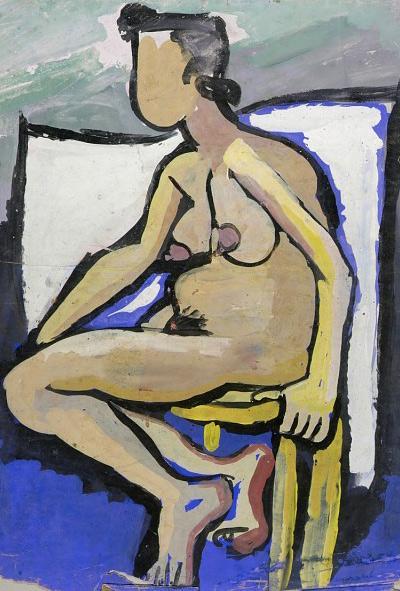
Seated Female Nude in Profile, ca. 1939-1940. Smithsonian American Art Museum, 1967.59.220R-V
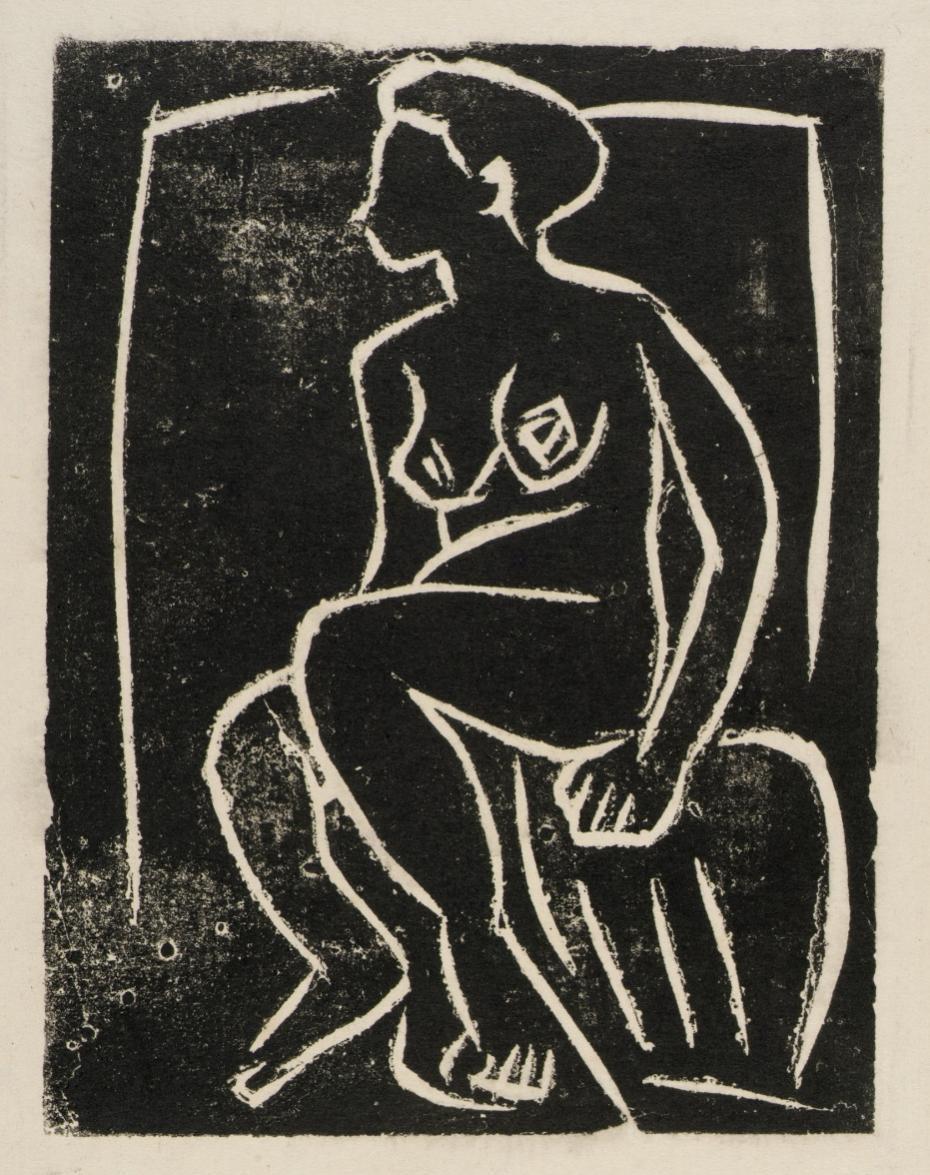
Female Nude, ca. 1939–1942. Object Number: WHJ-BP-HCAC00011. Block print on paper (Linocut) Size: 12 1⁄8 x 8 7⁄8 in. 30.8 x 22.5 cm. Provenance: Gift of Mrs. Douglas E. Younger. (Assistant Director at the Harmon Foundation). Smithsonian American Art Museum, 1971.138.
InSeatedFemaleNude,Johnsonpresentsafrontalfigure,herbodybroadandheavy, withlegsapartandhandsrestingfirmlyonherthighs.Shesitsonaplainwooden chair,framedbyverticalstrokesthatsuggestadrapedstudiobackdrop,whilethe surroundingspaceremainsspareandminimallydefined,directingfullattentionto thefigure’smassandpresence.Themodel’sfaceissimplifiedandminimallydetailed, shiftingemphasisawayfromindividualidentityandtowardthefigure’sstructuraland expressivequalities.
ThisworkisparticularlysignificantasJohnson’sonlyknownlithograph.Unlikehis morewidelyproducedblockprints,lithographyrequiredspecializedequipmentand accesstoaprintingpress,suggestingthatitwaslikelycreatedbetween1939and 1942duringhistimeattheHarlemCommunityArtCenter,wheresuchfacilitieswere available.
Duringthisperiod,Johnsonmayhavestudiedlithographictechniqueswithfellow artistandinstructorRonaldJoseph(1910–1992),whoalsotaughtprominentartists suchasRobertBlackburn,JacobLawrence,andGwendolynKnight.
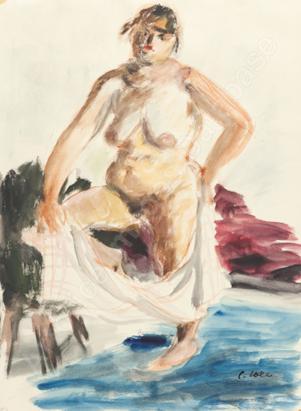
Christoph Voll (1897–1939), Standing Female Nude, watercolor c. 1927. Voll Estate.
Johnson’s lithograph echoes his brotherin-law Christoph Voll’s emphasis on the corporeal presence of the female body, foregrounding weight, tension, and materiality over idealized form.
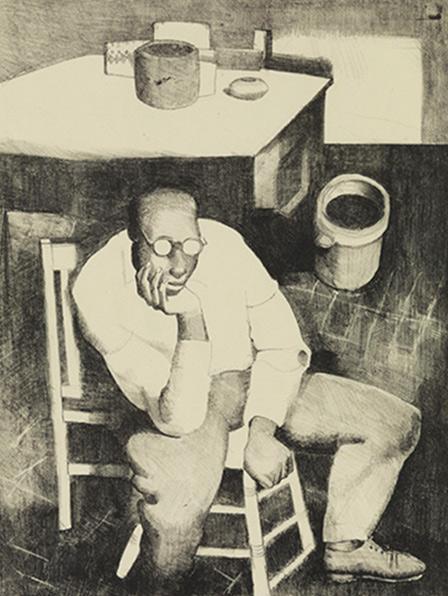
Portrait of Printmaker Robert Blackburn at the Harlem Community Art Center, surrounded by tools of the printmaking trade. Lithograph by Ronald Joseph, ca. 1937. The Metropolitan Museum of Art. Image source: Art Resource, NY.
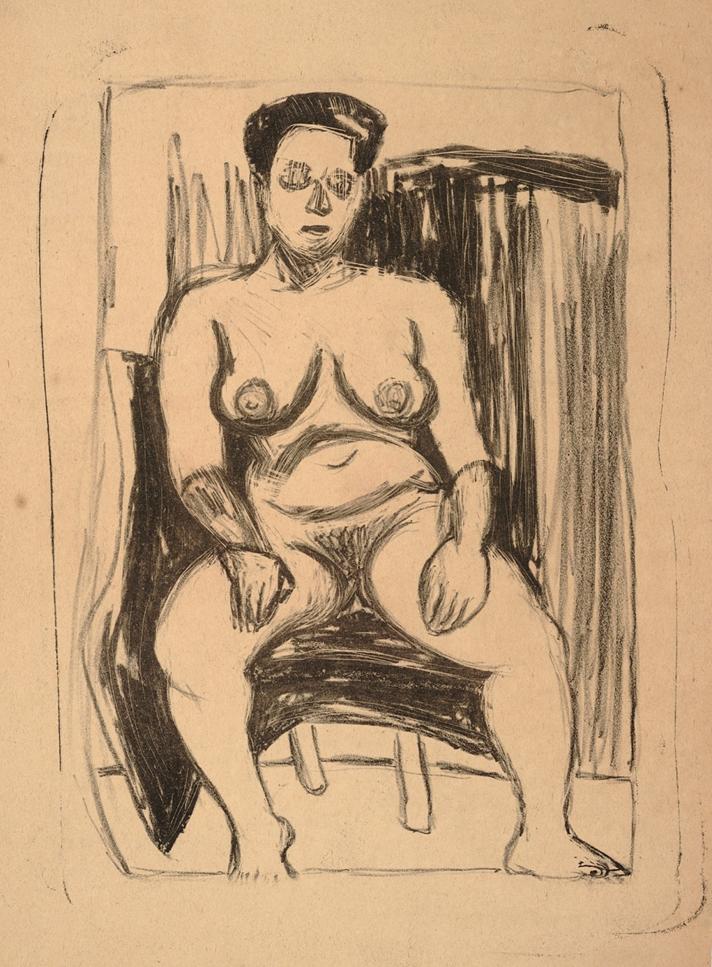
Seated Female Nude, ca. 1939-1942. Object Number: WHJBP-HCAC-00012. Lithograph on paper. Size: 18 1⁄8 x 12 1⁄4 in. (46.0 x 31.1 cm) irregular. Provenance: Gift of the Harmon Foundation, Smithsonian American Art Museum, 1967.59.207.
Untitled (The Bathers), ca. 1939–1942.
Oneknownimpression.
InTheBathers,Johnsonreinterpretstheclassicalthemeofthenudeinnature, presentingfourfemalefiguresdispersedacrossagentlyundulatinglandscape.The compositionisbuiltfromspare,deliberatelinesthatdefinebodiesreducedtotheir essentialforms,elongated,flattened,andlargelydevoidofdetail.Ratherthan standingapartfromtheirsurroundings,thefiguresmergevisuallywiththeterrain, theircontoursmirroringtherhythmsofhills,water,andsky.
AlthoughthesubjectalignswithalongtraditionexploredbyartistssuchasRenoir andMatisse,Johnsonrejectstheiremphasisonsoftnessandpainterlysensuality. Instead,headoptsamoreaustereandgraphicapproach,usingsimplificationand repetitiontocreatefiguresthatreadasstrong,symbolicpresences.Theresultisa compositionthatfeelsatoncetimelessandmodern,whereafamiliarmotifis reworkedintoamoredirectandpersonalvisuallanguage.
ArthistorianRichardJ.PowellhighlightsHenriMatisse’simportancetoWilliamH. JohnsonandalsosuggeststhatJohnsonmayhaveattendedthemajorMatisse exhibitionatthePierreMatisseGalleryinDecember1938,shortlyafterreturningto NewYork(Powell,1988).
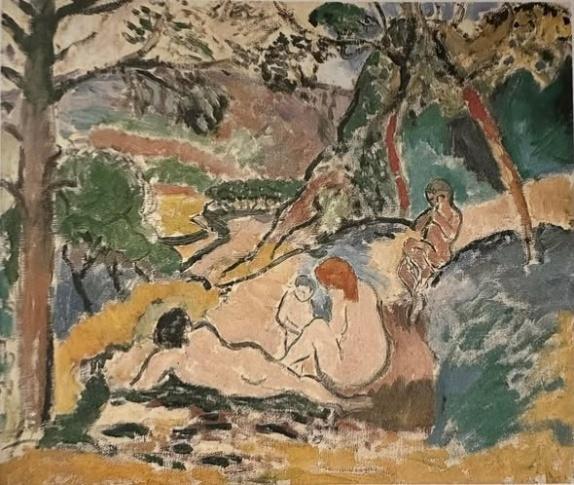
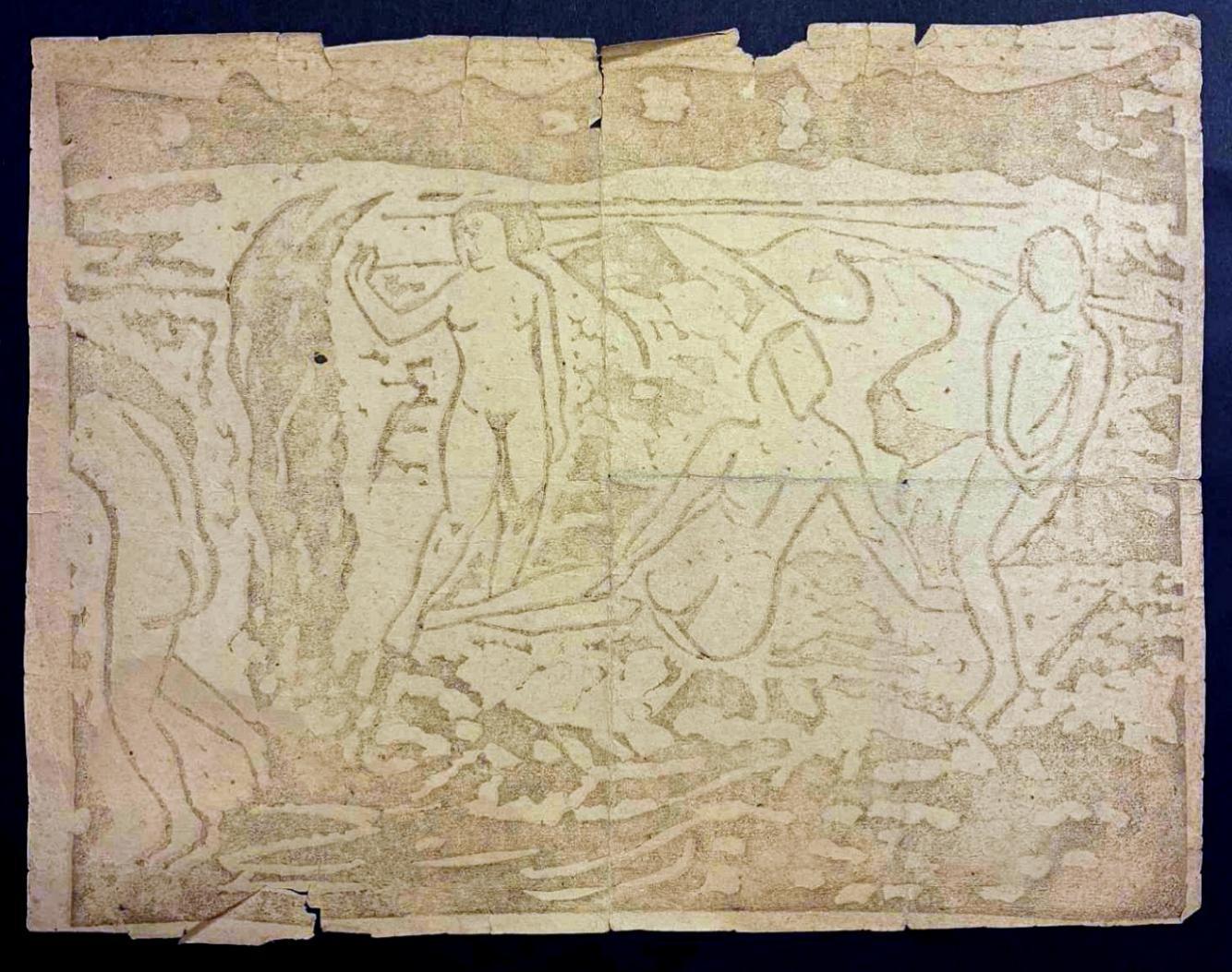
Untitled (The Bathers), ca. 1939–1942. Object Number: WHJ-BP-HCAC-00013. Linocut on paper. 40 x 30 cm. Private collection. Denmark.
Nude Seated- Front View. Ca. 1939-1942
Oneknownimpression.
InNudeSeated-FrontView,Johnsonpresentsafrontaldepictionofaseatednude figurerenderedwithcalmandassuredcomposure.Constructedthroughbold contoursandsimplifiedplanes,thefigureisintegratedintoastylizedstudiosetting definedbyabstractgrids,linearmarks,anddottedforms.Thesesurrounding elementsintroduceasubtlevisualrhythmthatactivatesthebackgroundwhile preservingthecomposition’soverallclarityandstructuralbalance.
Thefigure’scurvilinearsilhouette,alongwithherenlargedhandsandfeet,reflects Johnson’sengagementwiththeformallanguageofAfricansculpture,inwhich proportionandscalefunctionasexpressivedevicesratherthanasmarkersof anatomicalaccuracy.
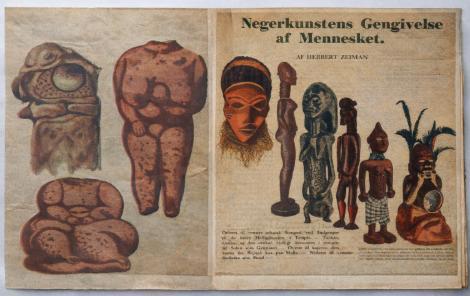
Pages from William H. Johnson’s personal scrapbook (ca. 1930–1947) reveal his close study of African and prehistoric sculpture. These clippings, which include photographs of ethnographic figures and ancient fertility idols, reflect Johnson’s deep engagement with non-Western art forms. They offer valuable insight into the visual sources that informed his evolving modernist language. Courtesy of the Wright Foundation for Southern Art, Florence County Museum.
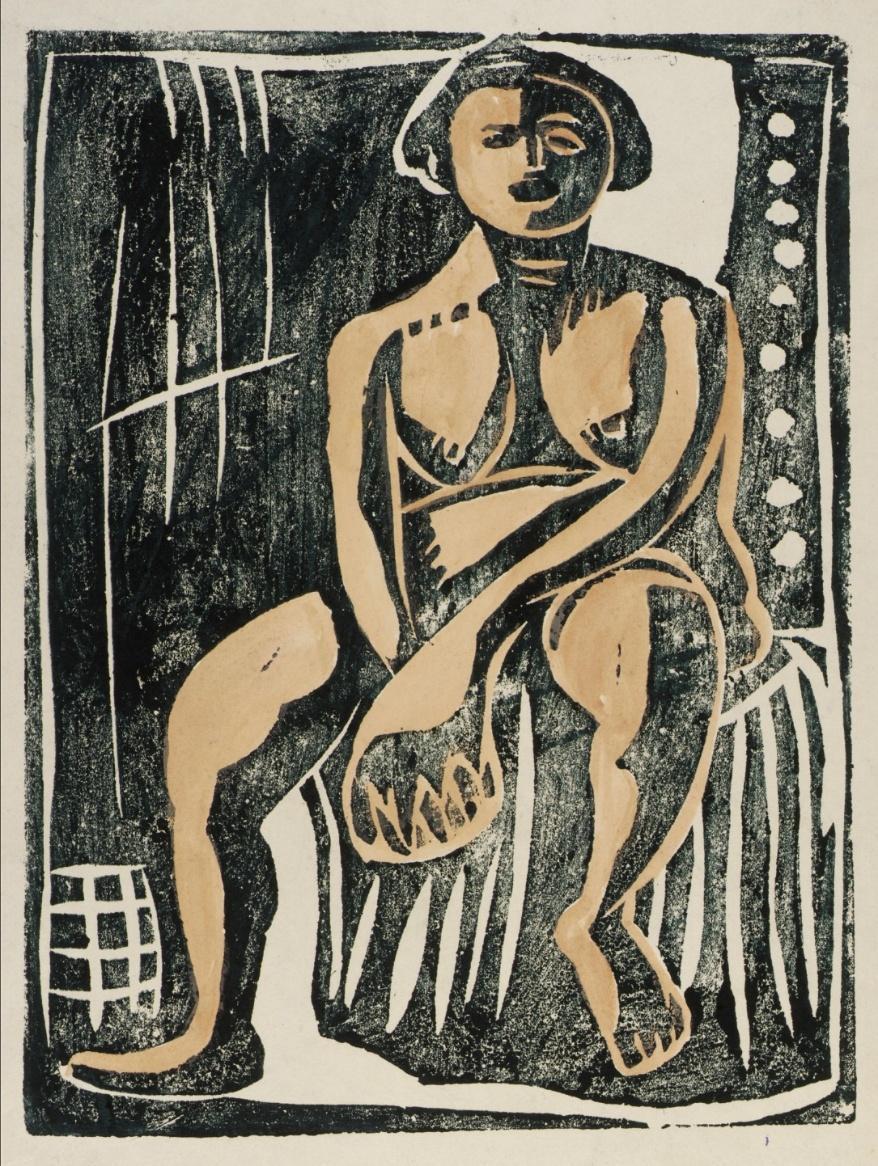
Nude Seated-Front View, ca. 1939-1942. Object Number: WHJ-BP-HCAC-00014. Block print on paper. (Linocut). Hand-colored with warm cream tones. Size: 17 7⁄8 x 14 1⁄4 in. 45.5 x 36.1 cm. Provenance: Gift of the Harmon Foundation. Smithsonian American Art Museum, 1967.59.1141
Seated Nude, ca. 1939-1942.
Threeknownimpressions.
InSeatedNude,Johnsondepictsafemalefigurewhoseelongatedlimbsandsharply definedcontourscreateadistinctlysculpturalpresence.Herforward-leaningposture conveysbothtensionandintrospection,whilethedeliberatelysimplifiedandsubtly distortedanatomyemphasizesrhythmiclineovernaturalisticdetail.Thefigurerecalls thesculpturallanguageofAfricanart,lendingthecompositionapowerful,rhythmic, andassertivephysicalpresence.
Created during his tenure at the Harlem Community Art Center, these studies reflect Johnson’s sustained engagement with African sculptural traditions. Based on catalogue photographs from the Museum of Modern Art’s 1935 exhibition African Negro Art, the drawings reveal Johnson’s fascination with Western Sudanic sculpture and its expressive anatomical distortions. William H. Johnson. Studies of African Figures, ca. 1939. Tempera and pencil on paper. SAAM. Accession nos. 1967.59.460, 1967.59.462, 1967.59.463.
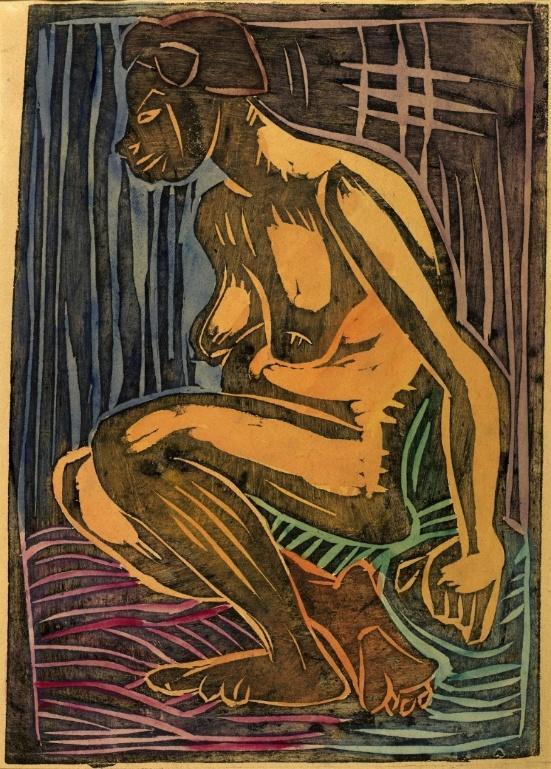
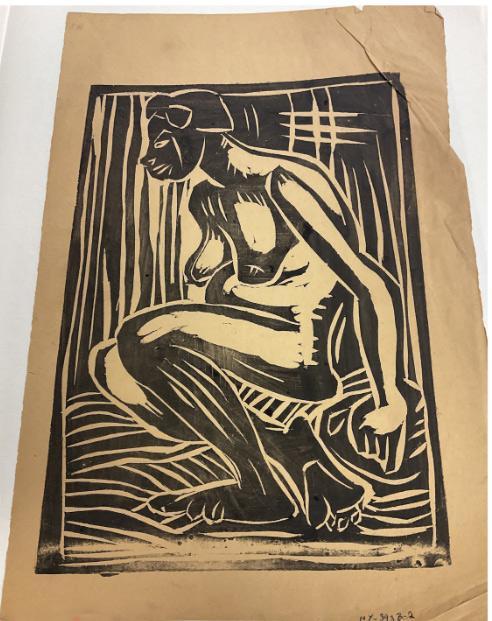
Seated Nude, ca. 1939-1942. Object Number: WHJ-BPHCAC-00015. Block print on paper. (Linocut). Handcolored in deep browns, warm ochres, muted oranges, with blue, green, and red accents in the background. Size: 15 3⁄8 x 11 5⁄8 in. 39 x 29.4 cm. Provenance: Gift of the Harmon Foundation. Smithsonian American Art Museum,1967.59.1130.
Seated Nude, ca. 1939-1942. Object Number: WHJ-BPHCAC-00016. Block print on paper. (Linocut). Size: H: 24 ½ in. W: 19 1/8 in. Provenance: Gift of the Harmon Foundation. Hampton University Museum & Archives. Object ID: 67.44.15
Seated Nude, ca. 1939-1942. Object Number: WHJBP-HCAC-00017. Block print on paper. (Linocut). Size: H: 17 13/16 in. W: 12 in. Provenance: Gift of the Harmon Foundation. Hampton University Museum & Archives. Object ID: 67.44.42
Nude at Rest, ca. 1939-1942.
Oneknownimpression.
InNudeatRest,Johnsonportraysafemalemodelrecliningagainstachairwithina stylizedstudiointeriorenrichedbypatternedtextilesanddecorativeelements.Her elongatedlimbsandsimplifiedanatomyemphasizerhythmiccontourover naturalism,recallingthesculpturallanguageofAfricanart.
AlthoughtheSmithsonianAmericanArtMuseumdatestheworkto1935–1938,its useoflinoleumratherthanwood,togetherwithitsstylisticcharacteristics,suggestsit wasmorelikelyproducedduringJohnson’stenureattheHarlemCommunityArt Center(1939–1942),whenhebeganexperimentingwithlinoleumasaprintmaking surface.
TheprintcloselyechoesJohnson’spaintingNude,ca.1939,inwhichafemalemodel withsimilarbodilyproportionsappearswithinacomparablestudiointeriorenriched bypatternedfabricsandfloralarrangements.Itisplausiblethatthesamemodel posedforbothworks,althoughthiscannotbeconfirmeddefinitively.
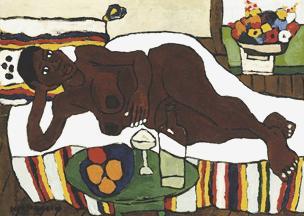
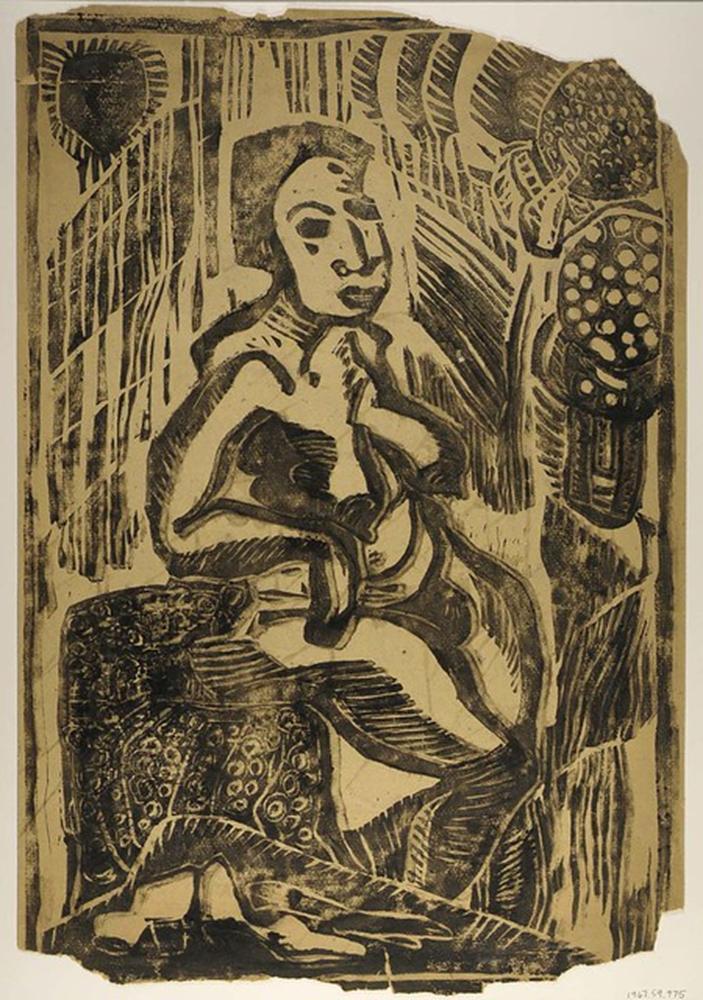
Nude at Rest, ca. 1939-1942. Object Number: WHJ-BP-HCAC00018. Block print on paperboard. (Linoleum cut). Size: 28 x 18 7⁄8 in. (71.1 x 47.9 cm) irregular. Provenance: Gift of the Harmon Foundation. Smithsonian American Art Museum, 1967.59.975.
Nude Resting. 1939-42.
Oneknownimpression.
InNudeResting,Johnsonemploysboldcontrastsandsimplifiedformstoportraya recliningnudefigure. Thecompositioncloselyparallelstheprint,FemaleNude (WHJ-BP-HCAC-00011),particularlyinitsabstractedapproach.
Inbothpieces,Johnsonreducesthefiguretoitsessentialshapes,usingstrong outlinesandminimaldetailtoconveyasenseofpresenceandquietpoise.
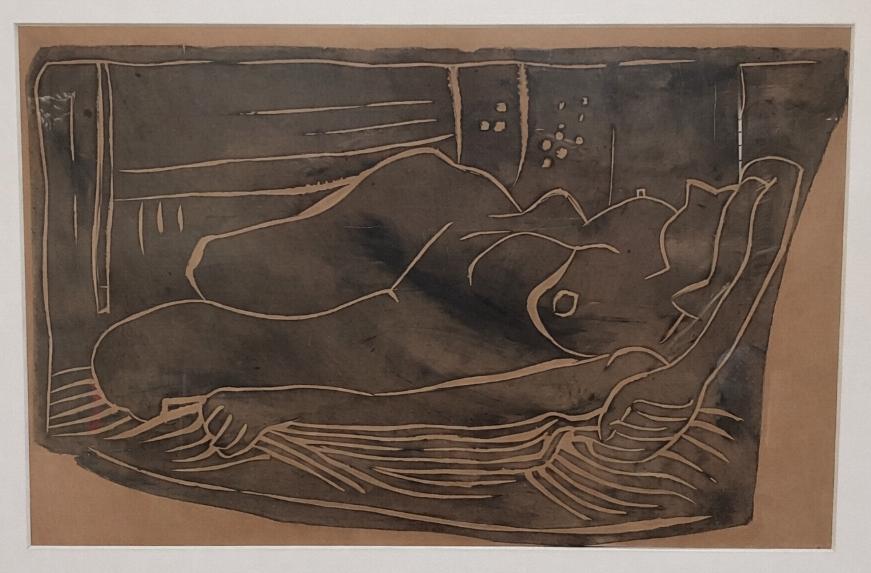
Nude Resting. 1939-40. Object Number: WHJ-BP-HCAC-00019. Block print on paper (Linocut). Size: H: 20 5/8" W: 16 5/8" D: 3/4". Provenance: Gift of the Harmon Foundation. Hampton University Museum & Archives. Object ID: 67.44.12
Nude Recumbent. Ca. 1939-1942.
Threeknownimpressions.
InNudeRecumbent,Johnsonrendersafemalenudeinadynamic,crawlingpose,her archedbackandbentlimbscreatingasenseoftensionandmovement.Carvedin bold,angularlines,thefigure’sanatomyisabstractedwithaforcefulrhythmthat recallsthesculpturallanguageoftraditionalAfricanart.
ThoughtheSmithsonianAmericanArtMuseumdatestheworkto1935-1938,itsuse oflinoleumratherthanwoodanditsstylisticcharacteristicssuggestitwasmore likelycreatedduringJohnson’stenureattheHarlemCommunityArtCenter(1939–1942),wherehebeganexperimentingwithlinoleumasaprintmakingsurface.
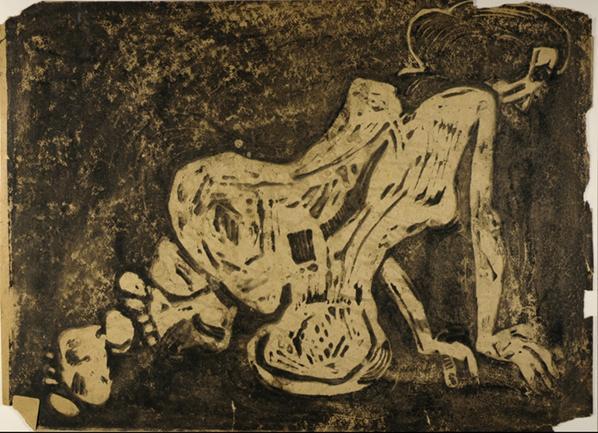
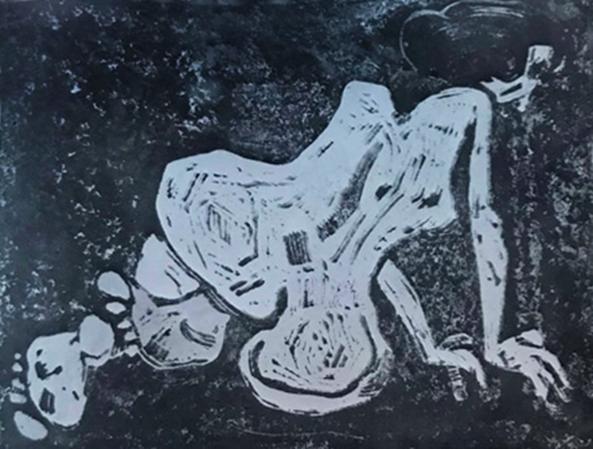
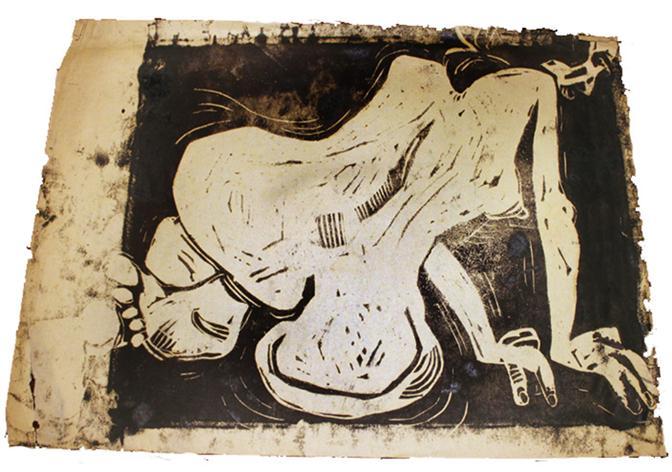
Nude Recumbent. Ca. 1939-1942. Object Number: WHJ-BP-HCAC-00020. Block print on paperboard. (Linoleum cut) Size: 20 5⁄8 x 27 1⁄2 in. (52.3 x 70.0 cm) irregular. Provenance: Gift of the Harmon Foundation. Smithsonian American Art Museum, 1967.59.976.
Nude Recumbent. Ca. 1939-1942. Object Number: WHJ-BP-HCAC-00021. Hand colored block print on paperboard. (Linoleum cut). Size: 23 7/8 x 29 (60.7 x 73.7) Provenance: Collection of Mr. and Mrs. David Harriton, Minisink Hills, Pennsylvania. Illustrated on page 191 of William H. Johnson, 1901–1970, by Adelyn D. Breeskin and Jan K. Muhlert (Smithsonian Institution Press, 1971)
Nude Recumbent. Ca. 1939-1942. Object Number: WHJ-BP-HCAC-00022. Block print on paperboard. (Linoleum cut) Size: Height 46 cm. Width 61 cm. Provenance: The estate of Holcha Krake; by descent to her grandniece, Johanna Voll. The Wright Foundation for Southern Art. Florence County Museum.
Lame Man-Full Length, ca. 1939–1942
Sixknownimpressions.
InLameMan–FullLength,Johnsonpresentsaportrayalofamanwithaphysical disability.Thesitterfacesforwardinarigid,uprightpose,hisbroadhandsresting heavilyonhisknees.Hisgazeappearsslightlyuncertain,introducinganoteof vulnerabilityandintrospection.
ThesubjectwaslikelyanindividualJohnsonencounteredattheHarlemCommunity ArtCenter.Duringhistenurethere,heengagednotonlywithHarlem’sartistic communitybutalsowiththebroaderneighborhood,astheCenterwascommittedto servingallresidentsincludingsemi-skilledlaborers,teenagegangmembers,the elderly,andevenpatientsfromNewYorkpsychiatrichospitalswhobenefitedfromits creativeprograms.
ThethemeofdisabilityheldpersonalsignificanceforJohnson.Whenhisstepfather wasseriouslyinjuredinanaccidentduringJohnson’syouth,thefamily’sfinancial securitywasabruptlydisrupted.Asaresult,Johnsonwasforcedtoleaveschoolatan earlyageandtakeonvariousjobstohelpsupporthismotherandfouryounger siblings.Thisearlyconfrontationwithhardshipandresponsibilitynotonlyshapedhis characterbutalsoinformedhislatersensitivitytothemesofstruggle,resilience,and humandignityinhisart.
Theprintwaslikelyderivedfromapaintingofthesametitle,LameMan(ca.1939–1940).ThepaintingappearedonthecoverofthebrochureforJohnson’ssolo exhibitionattheAlmaReedGalleriesinNewYork(May5–18,1939)andwaslater reusedasthecoverimageforhisexhibitionatKunsthalleninCopenhageninMarch 1947.
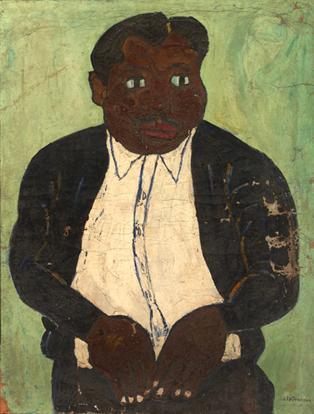
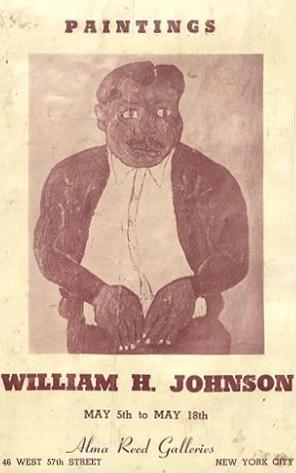
Catalogue cover for Johnson’s exhibition at the Alma Reed Galleries, New York, May 5–18, 1939.
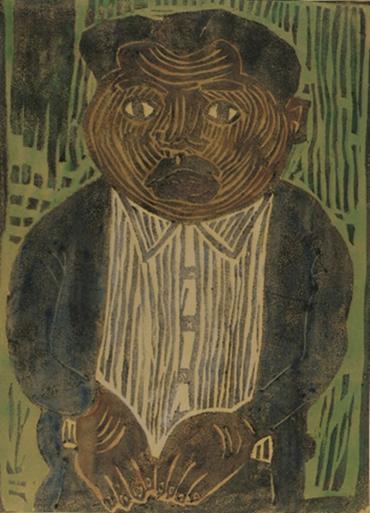
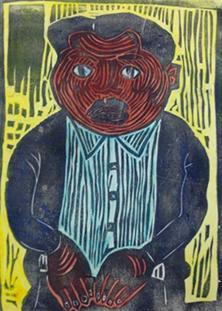
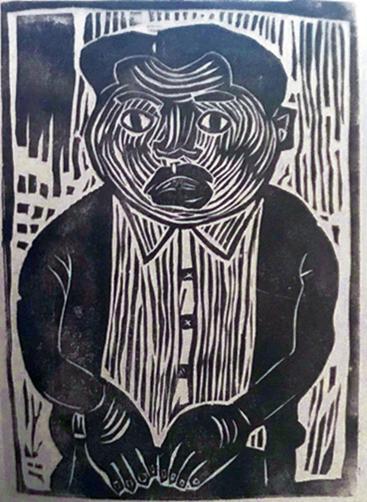
Lame Man-Full Length, ca. 1939-1942. Object Number:
WHJ-BP-HCAC-00023. Block print on paper (Linocut). Handcolored with a palette of brown, ochre, dark blue, white, pale blue, and deep green tones. Size: 22 1⁄4 x 17 1⁄8 in. 56.5 x 43.5 cm. Provenance: Gift of the Harmon Foundation, Smithsonian American Art Museum, 1967.59.1110R-V.
Lame Man-Full Length, ca. 1939-1942. Object Number:
WHJ-BP-HCAC-00024.Block print on paper (Linocut). Handcolored with a palette of red-brown, light blue, white, dark blue, and yellow-green tones. Size: H: 17.5 in. W: 12.5 in. Provenance: Gift of the Harmon Foundation. Courtesy of Oakland Museum of California (OMCA). Object number: A67.62.25
Lame Man-Full Length, ca. 1939-1942. Object Number:
WHJ-BP-HCAC-00025.Block print on paper. (Linocut) Size: 19 x 13 ½ inches. Provenance: The estate of Holcha Krake; by descent to her grandniece, Johanna Voll. Illustrated and catalogued as no. 46 in William H. Johnson: Truth Be Told by Steve Turner and Victoria Dailey (1996)
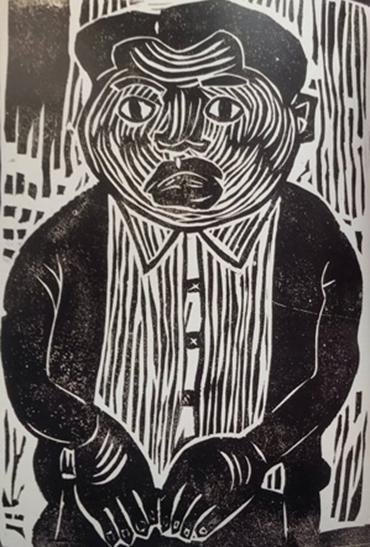
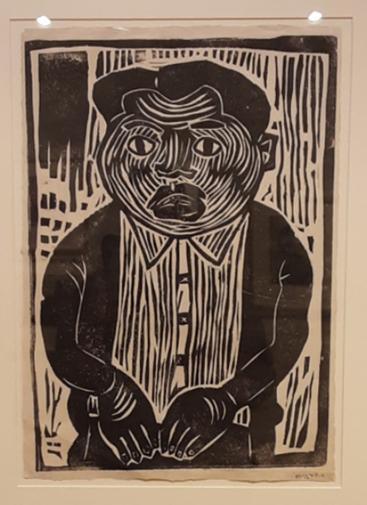
Lame Man-Full Length, ca. 1939-1942. Object Number: WHJ-BP-HCAC-00026.Block print on paper. (Linocut) Size: 10 x 13 ½ inches. Provenance: Gift of the Harmon Foundation. Collection of Hampton University Museum. Illustrated on page 129 in William H. Johnson: Revisiting an African American Modernist. Kenneth G. Rodger. North Carolina Central University Art Museum in Durham, North Carolina (2006).
Lame Man-Full Length, ca. 1939-1942. Object Number: WHJ-BP-HCAC-00027. Block print on paper (Linocut). Size: H: 29 in W: 22 15/16 in. D: 1 13/16 in. Provenance: Gift of the Harmon Foundation. Hampton University Museum & Archives. Object ID: 67.44.28
Lame Man-Full Length, ca. 1939-1942. Object Number: WHJ-BP-HCAC-00028. Block print on paper (Linocut). Handcolored. Size: 25"h x 18⅞"w x 1"d. Provenance: Gift of the Harmon Foundation. Fisk University Galleries. Object ID. #0410
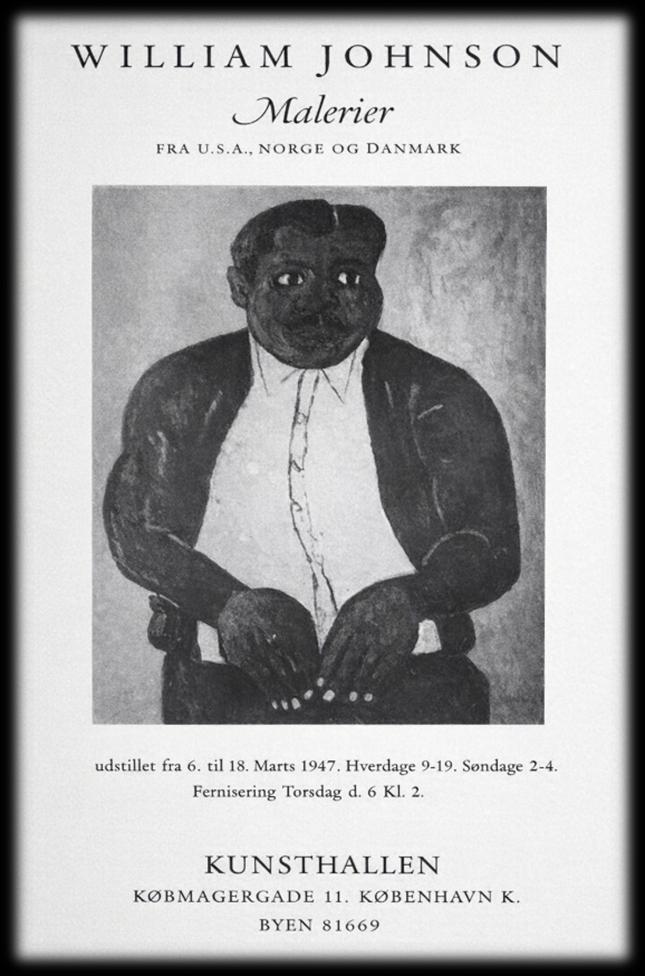
Catalogue cover for William H. Johnson’s exhibition at Kunsthallen, Copenhagen, 6–18 March 1947. This exhibition marked the final presentation of his work before his institutionalization at Central Islip State Hospital in November 1947. Private photo.
Lame Man – Bust, ca. 1939–1942
Sixknownimpressions.
InLameMan–Bust,Johnsonrevisitsthedisabledfigurefromhisfull-length composition(WHJ-BP-HCAC-0023-0028),hererenderedasatightlycroppedbust portrait.Byisolatingtheupperbody,heintensifiesthefigure’spsychological presence,shiftingtheemphasisfromnarrativecontexttoindividualexpression.
TheprintlikelyderivesfromJohnson’stemperapaintingPortraitofaManwith Mustache(ca.1939–1940),translatedintoamoreaustereandgraphicidiom.Inthis process,Johnsonrestructuresthefigurethroughbold,incisedlines.Thefaceis fragmentedintorhythmiclinearpatternsthatemphasizestructureoverlikeness, whileverticalstriationsanimatethesurface,flatteningtheformandheighteningits expressiveintensity.
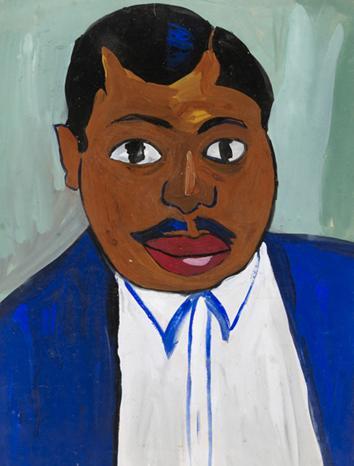
William H. Johnson, Portrait of a Man with Mustache, Ca. 1939-1940. Tempera on paper. Smithsonian American Art Museum, 1967.59.295
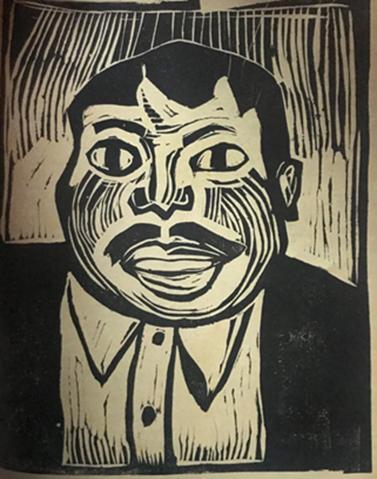
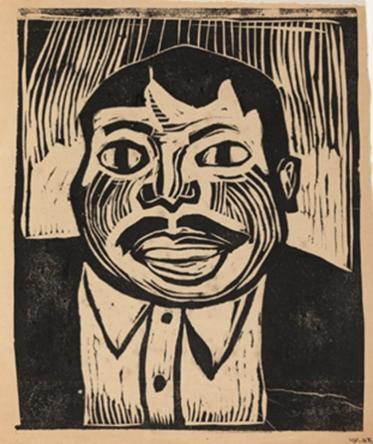
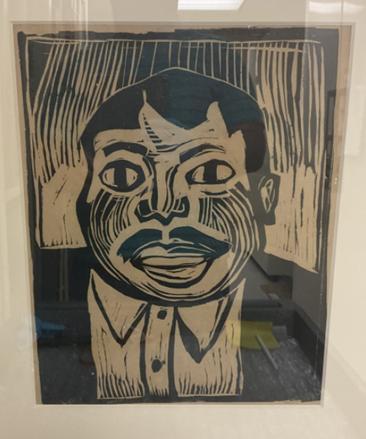
Lame Man-Bust, ca. 1939-1942. Object Number: WHJBP-HCAC-00032. Block print on paper. (Linocut). Size: 19 ¾ x 15 ¾ inches. Provenance: The estate of Holcha Krake; by descent to her grandniece, Johanna Voll. Illustrated and catalogued as no. 45 in William H. Johnson: Truth Be Told by Steve Turner and Victoria Dailey (1996)
Lame Man-Bust. Ca, 1939-1942. Object Number: WHJBP-HCAC-00033. Block print on paper. (Linocut). Size: 16 1/4 x 13 1/2 in. irr. 41.275 x 34.29 cm. Provenance: Gift of the Philadelphia Commercial Museum (also known as the Philadelphia Civic Center Museum), Philadelphia, Pennsylvania. Accession number: 2004.13.8
Lame Man-Bust, ca. 1939-1942. Object Number: WHJBP-HCAC-00034. Block print on paper. (Linocut). Size: H: 27 in. W: 22 ½ in. Provenance: Gift of the Harmon Foundation. Hampton University Museum & Archives. Object ID: 67.44.37
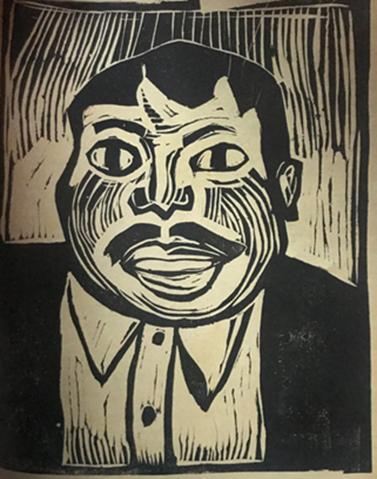
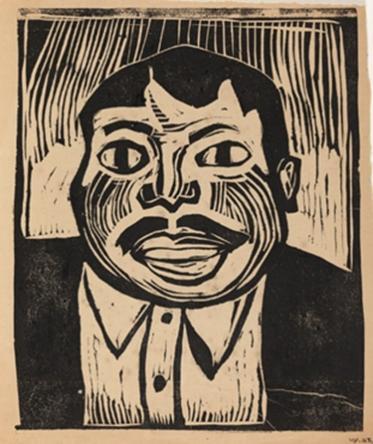
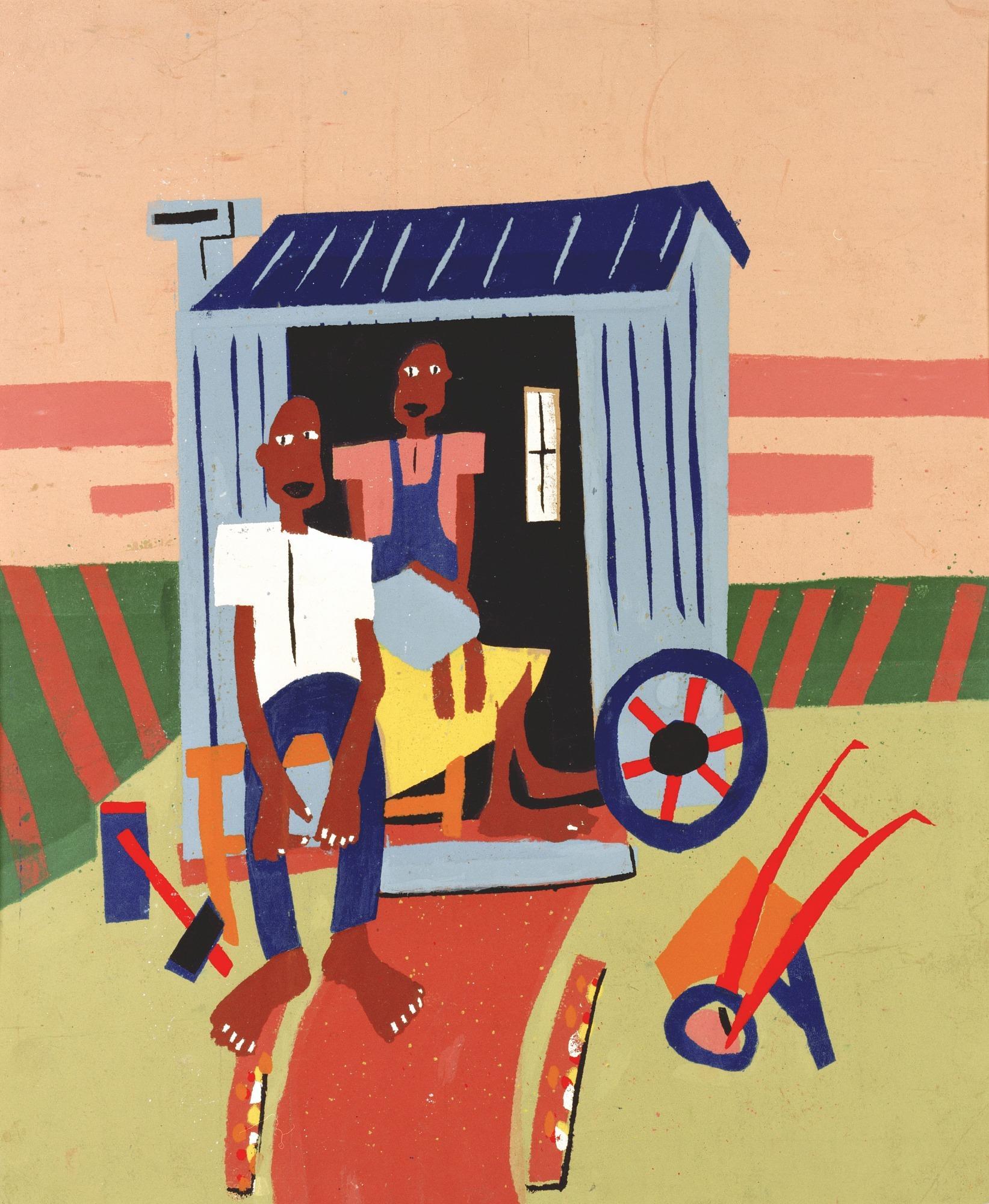
FollowinghisreturntotheUnitedStatesin1939,WilliamH.Johnsonturned increasinglytowardthemesofplace,personalexperience,andculturalidentity, developingaseriesofprintsinspiredbyFlorence,SouthCarolina.Unlikehisearlier work,whichoftenrespondedtoimmediatesurroundings,theselatercompositions drewuponlivedexperienceandsubjectivereflection,shapingboththeirimageryand expressiveform.Theprintsportrayfamilymembers,localresidents,andscenesof everydaylifeintheruralSouth,reimaginedthroughadeeplypersonaland emotionallyinflectedperspective.
TheseriesbeganduringJohnson’stenureattheHarlemCommunityArtCenter (1939–1942)andwaslikelyexpandedduringhisfive-monthstayinFlorencein1944 afterthesuddendeathofhiswife,HolchaKrake.Returningtohishometownallowed Johnsontoreconnectwithrelativesandthebroadersocialenvironmentofhisyouth.
JohnsonsDeepSouthseriesconsistsoffiveindividualworks.
GroupwithChildren,ca.1939-44.
Evening,ca.1939-44.
FarmCoupleatWell,ca.1939-44.
Untitled(LittleSiswithDollCarriage),ca.1939–1944
PorchTalk.ca.1939-44.
William H. Johnson, Deep South, ca. 1940-1941, screenprint on paper. Smithsonian American Art Museum,1967.59.1016
Group with Children, ca. 1939-44.
Twoknownimpressions.
InGroupwithChildren,Johnsondepictstwoadultfemalefiguresholdingtheir childrenwithinacompact,verticalcomposition.Theformsarecarvedinbold, simplifiedlinesthatemphasizegestureandemotionalconnectionoverdescriptive detail.Strongcontoursandflattenedshapesgivethefiguresasculpturalpresence, whiletheirphysicalclosenessreinforcesthethemeofprotectionandmaternalcare.
Verticalstriationsinthebackgroundsuggestwoodenwalls,fencing,orpossiblythe interiorofamodesthome.Thiscompressedspatialsettingcreatesasenseof enclosurethatfeelsbothintimateandprotective,heighteningtheemotional resonanceofthescene.
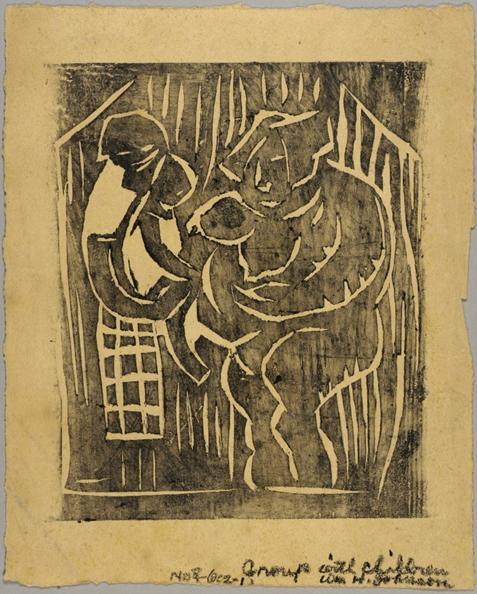
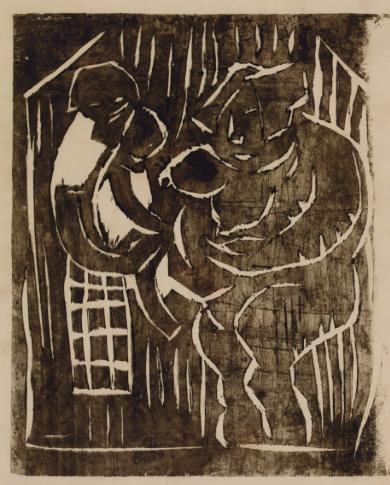
Group with Children, ca. 1939-1944. Object Number: WHJ-BP-TDS-0001. Block print on paper (Woodcut). Signed Wm. H. Johnson lower right. Titled Group with children. Annotated: "NOR-50213. Size: 11 1⁄8 x 9 in. 28.4 x 22.9 cm. Provenance: Gift of the Harmon Foundation, Smithsonian American Art Museum. 1967.59.972.
Group with Children, ca. 1939-1944. Object Number: WHJ-BP-TDS-0002. Block print and ink wash on paper. (Woodcut). 9.5 × 8 in. (24.13 × 20.32 cm). Provenance: Gift of the Harmon Foundation, Courtesy of the Amistad Research Center, New Orleans, LA. Accession Number: ARCH.HAR.WHJO.1939.21.
Evening, ca, 1939- 1944.
Fourknownimpressions.
InEvening,JohnsonpresentsadomesticscenesetintheruralSouth.The compositionfeaturesasouthernblackcoupleseatedoutsideamodestwooden home,withthewomangentlynursingachild.Behindthem,thesettingsunhangs lowinthesky,castingasenseofcalmoverthescene.Thecouplesitsclosetogether, theirrelaxedposturesandsharedgazesuggestingamomentofquietconnection andintimacyatthecloseofaday’slabor.
ThesamefamilyappearsinseveralofJohnson’sotherworksexecutedinoilon paperboard,includingtwovariantsofFarmFamilyNursingChild(ca.1941–1944), suggestingthattheblockprintwaslikelyderivedfromthesepaintedcompositions.
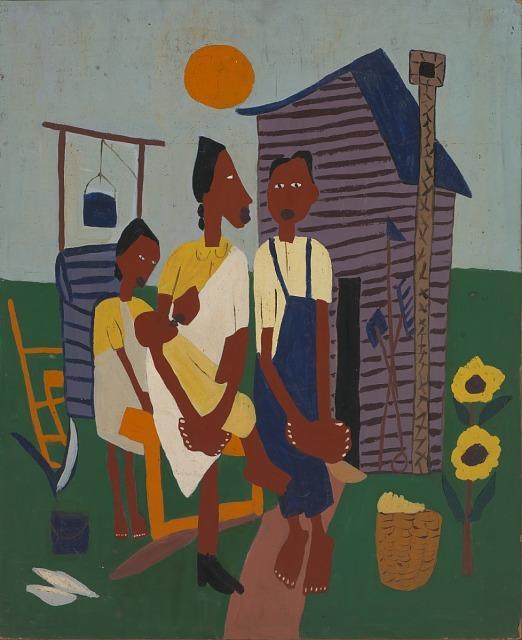
William H. Johnson, Farm Family Nursing Child, ca. 1942-1944. Oil on paperboard, Smithsonian American Art Museum, 1967.59.614
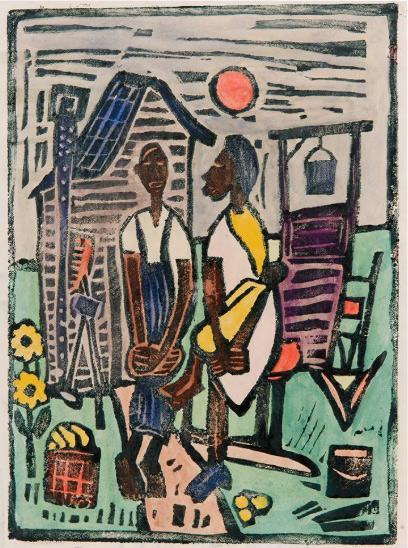
Evening. Ca. 1939-1944. Object Number: WHJ-BPTDS-0003. Block print on paper (Woodcut). Hand colored with palette of earthy tones with bright accents of yellow, red, and orange. Size: 13.5 x 10 in. 34.29 x 25.4 cm. Provenance: Gift of the Harmon Foundation. Courtesy of the Amistad Research Center, New Orleans, LA. Accession Number: ARC.HAR.WHJO.1939.11
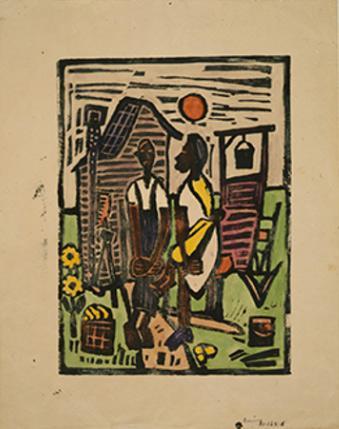
Evening. Ca. 1939-1944. Object Number: WHJ-BPTDS-0004. Block print on paper (Woodcut). Hand colored with palette of earthy greens, muted blues, warm browns, and pops of yellow, red, and orange. Signed W.H Johnson in pencil on verso. Annotated: FO162-(1). Provenance: Gift of the Harmon Foundation. Retrieved from the Library of Congress. www.loc.gov/item/2003688145.
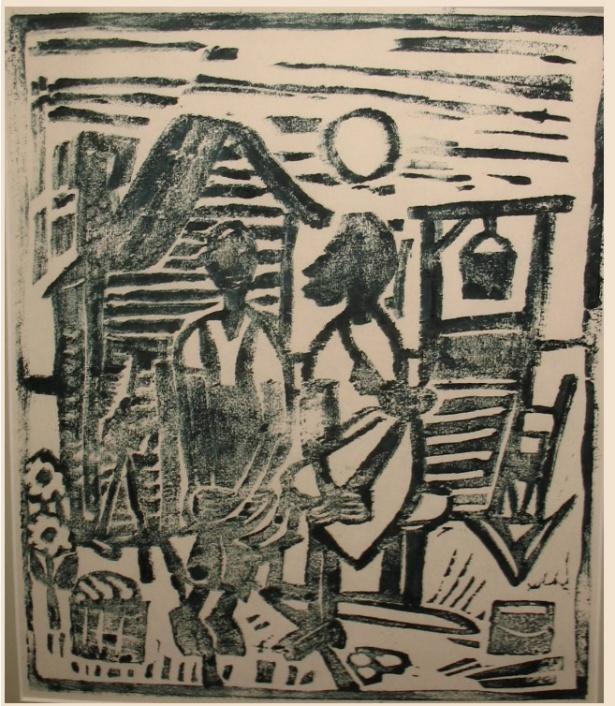
Evening. Ca. 1939-1944. Object Number: WHJ-BP-TDS0005. Block print on paper (Woodcut). Size: 13.25 x 10.25 in. 33.66 x 25.04 cm. Provenance: Gift of the Harmon Foundation. Courtesy of the Amistad Research Center, New Orleans, LA. Accession Number: ARCHAR.WHJO.1939.10.
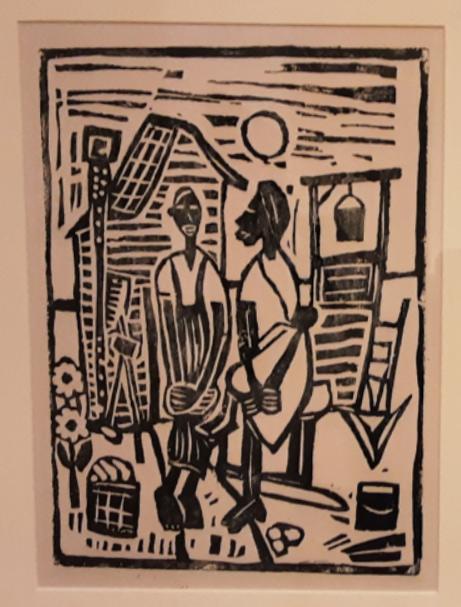
Evening. Ca. 1939-1944. Object Number: WHJ-BPTDS-0006. Block print on paper (Woodcut). Size: H: 17 7/8 in. W: 13 7/8 in. Provenance: Gift of the Harmon Foundation. Hampton University Museum & Archives. Object ID: 67.44.29.
Threeknownimpressions.
InFarmCoupleatWell,Johnsonemployssimplifiedformsandboldoutlinesto depictaruralscenecenteredontwofigures.Amanandwomanstandsidebyside; theman,wearingahatandatucked-inshirt,restsonehandonhiship,whilethe woman,modestlydressed,claspsherhandsinfrontofher.Anearbywellandbucket emphasizetheirconnectiontothelandandthelaborofagrarianlife.
Thefiguresarepresentedalongsidethetoolsandstructuresoftheirdailyexistence, recallingthetraditionofsecularsaintsidentifiedbytheirattributes.Johnsonlikely basedtheprintonrelateddepictionsofthecoupleexecutedintemperaonpaper andoilonplywoodduringthesameperiod.
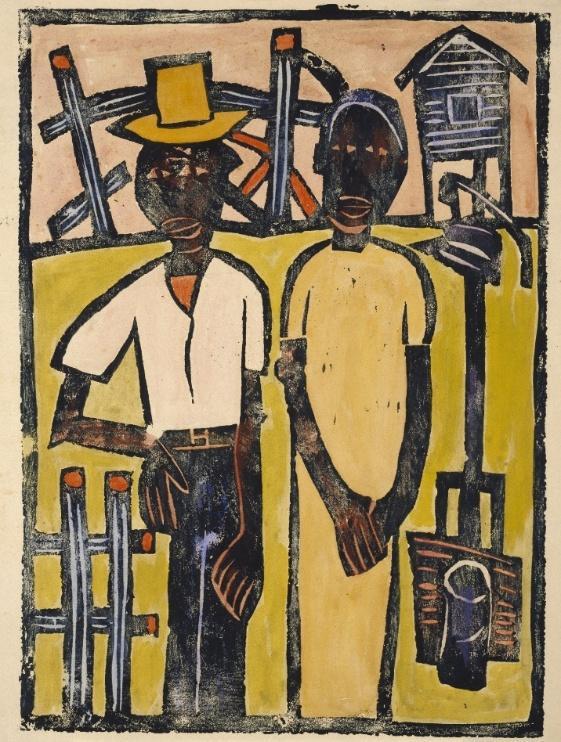
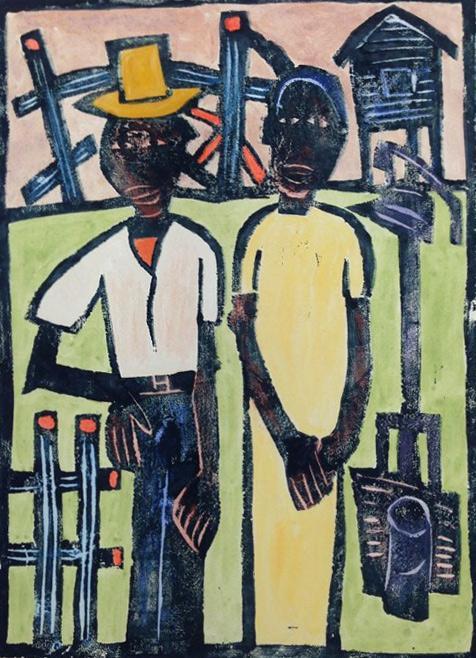
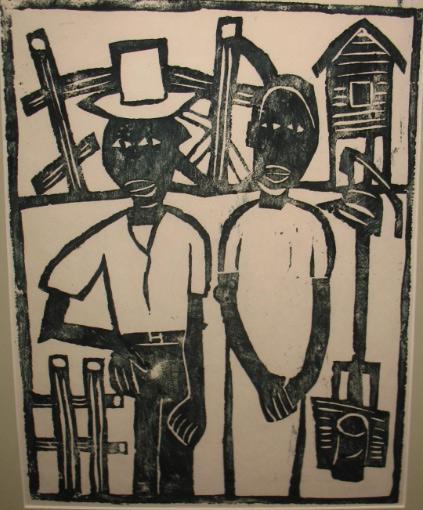
Farm Couple at Well, ca. 1939–1944. Object Number: WHJBP-TDS-0007. Block print on paper (Woodcut). Hand colored with palette of earthy yellows, muted oranges, soft blues, deep browns, and black outlines. Size: 17 7⁄8 x 14 1⁄2 in. 45.4 x 36.9 cm. Provenance: Gift of the Harmon Foundation, Smithsonian American Art Museum, 1967.59.1068. Exhibited: New York Public Library, Countee Cullen Branch, December 5, 1956-March 1, 1957.
Farm Couple at Well, ca. 1939–1944. Object Number: WHJBP-TDS-0008. Block print on paper (Woodcut). Hand colored with palette of pale greens, soft pinks, deep blues, earthy yellows, and black outlines. Size: H: 13.5 in, W: 10.5 in. Provenance: Gift of the Harmon Foundation. Courtesy of Oakland Museum of California (OMCA). Object number: A67.62.23.
Farm Couple at Well, ca. 1939–1944. Object Number: WHJBP-TDS-0009. Block print on paper (Woodcut). Size. 15.5 x 11 in. 39.37 x 27.94 cm. Provenance: Gift of the Harmon Foundation. Courtesy of the Amistad Research Center, New Orleans, LA. Accession Number: ARC.HAR.WHJO.1942.09.
Untitled (Little Sis with Doll Carriage), ca. 1939–1944
Fourknownimpressions.
InLittleSiswithDollCarriage,Johnsondepictsaquietmomentofruralsouthernlife. Ayounggirlpossiblydepictinghisniece,ErnestineBrownpushesacarriagealonga slopingsidewalktowardaneighborhoodbakery,framedbyalargetreeanda modeststorefront.
InJune1944,JohnsonreturnedtoFlorence,SouthCarolina,forthefirsttimein fourteenyears,stayingathismother’shome.Duringthisvisit,heproducedseveral portraitsoffamilymembers,includingLi’lSis(1944),apaintingdepictinghisniece, ErnestineBrown.
Li’lSiswaslaterexhibitedatKunsthallen,Copenhagen,in1947undertheDanishtitle LilleSismedDukkevogn(LittleSiswithDollCarriage).Inthiscontext,themotifwas mistakenlyinterpretedbytheDanishexhibitionorganizersasachildplayingwitha dollratherthanasadepictionofayounggirlprotectivelycaringforherbabysister.
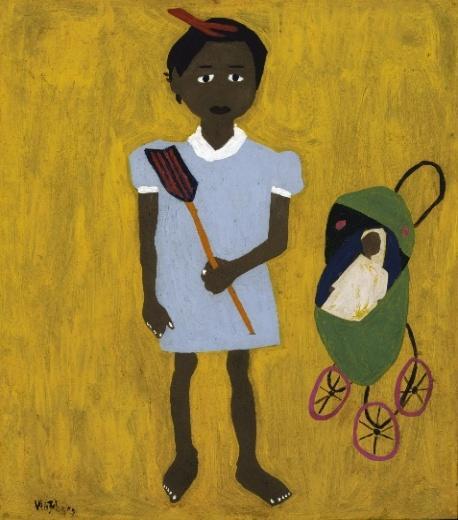
Smithsonian American Art Museum, 1967.59.1023.
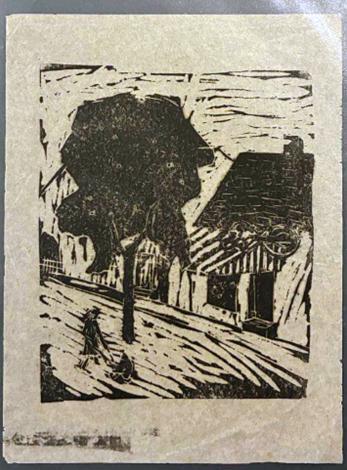
Little Sis with Doll Carriage, ca. 1939–1944. Object Number: WHJ-BP-TDS-00010. Block print (linocut) on vellum paper. Size. 19 x 25 cm. Provenance: The artist to Niels Lindberg, Nr. Broby, Fyn, Denmark; subsequently in a private Danish collection.
Little Sis with Doll Carriage, ca. 1939–1944. Object Number: WHJ-BP-TDS-00011. Block print (linocut) on vellum paper. Size. 19 x 25 cm. Provenance: The artist to Niels Lindberg, Nr. Broby, Fyn, Denmark; subsequently in a private Danish collection.
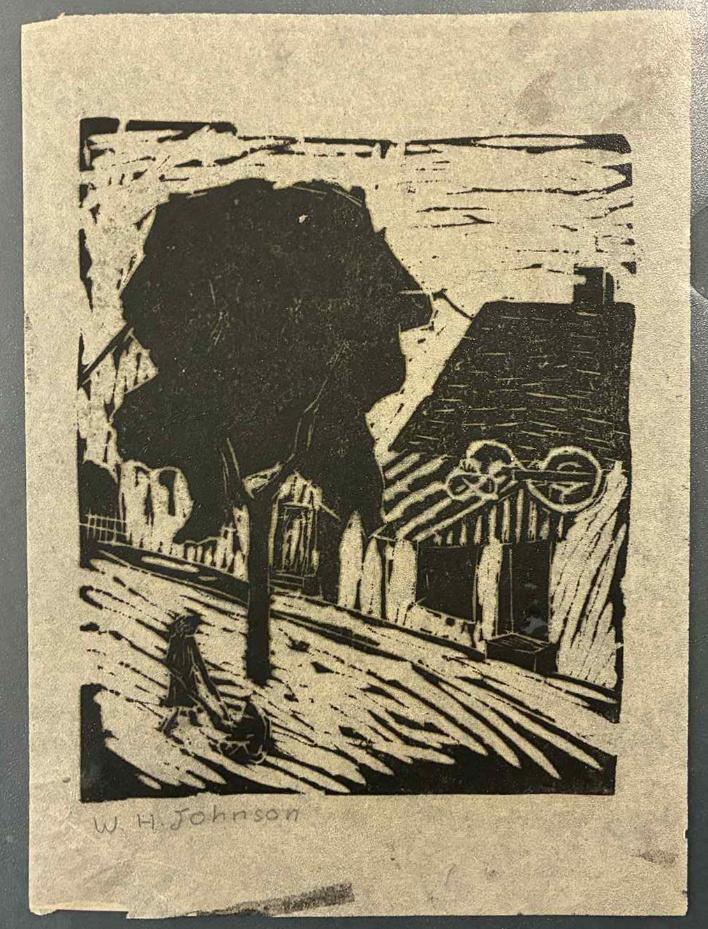
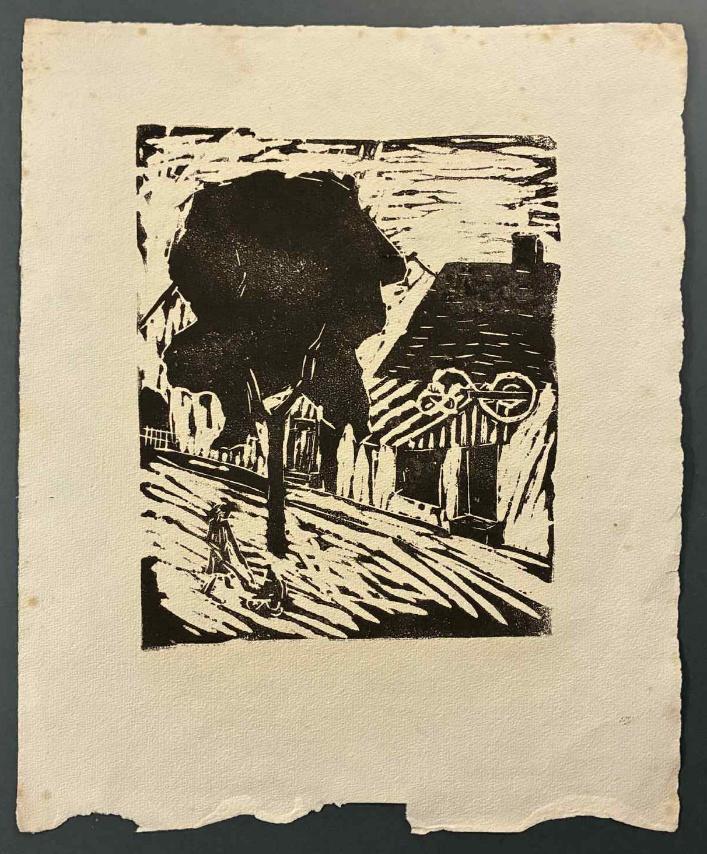
Little Sis with Doll Carriage, ca. 1939–1944. Object Number: WHJ-BP-TDS-00012. Block print (linocut) on vellum paper. Inscribed W.H. Johnson lower left. Size. 18 ½ x 25 cm.
Provenance: The artist to Niels Lindberg, Nr. Broby, Fyn, Denmark; subsequently in a private Danish collection. Collection of the National Gallery of Denmark (SMK), Copenhagen.
Little Sis with Doll Carriage, ca. 1939–1944. Object Number: Object Number: WHJ-BPTDS-00013. Block print on Wove paper (Linocut). Size. 24 x 29 cm. Provenance: The artist to Niels Lindberg, Nr. Broby, Fyn, Denmark; subsequently in a private Danish collection.
The painting Li’l Sis on view at the William H. Johnson exhibition at the National Collection of Fine Arts, 1971. From left to right: Johnson’s sisters, Lucy McAfee and Lillian Cooper, with his niece Ernestine Brown, the model for Li’l Sis. Image published in The Washington Post (Nov. 5, 1971). Photograph by Ellsworth Davis, courtesy of the Archives of American Art.
Porch Talk, ca. 1939-1944.
Fiveknownimpressions.
InPorchTalk,JohnsondepictstheexteriorofaruralSouthernhomestead,composed ofahouse,awindingroad,andanarrowporchsetwithinthesurroundinglandscape. Afemalefigurewithanelongatedbodyleansovertheporchrailing,engagedin quietexchangewithanotherfigureframedwithinanearbywindow.
Thesceneisanimatedbycarefullyobserveddetails,abucketnearthesteps,flowers besidethehouse,andasmalldogturnedawayfromthefiguresthatanchorthe composition.Thefiguresarepartiallyabsorbedintothearchitectureandlandscape, emphasizinglivedexperienceanddomesticroutineratherthanindividualized portraiture.
Itstitle,PorchTalk,evokestherelaxedbutmeaningfulconversationslinkedtofrontporchculture,anenduringpartofSouthernlife.IntheAmericanSouth,theporch wasanimportantsocialspacewherepeoplegatheredtosit,talk,watchothers,and sharestories. Inseveralportraitsfromthisperiod,Johnsonusestheporchasboth settingandperspective,placinghisfigureswithinthisfamiliardomesticthreshold.
Ofthefiveknownimpressionsofthiscomposition,onlyonecarriesthetitlePorch Talk(WHJ-BP-TDS-0014).
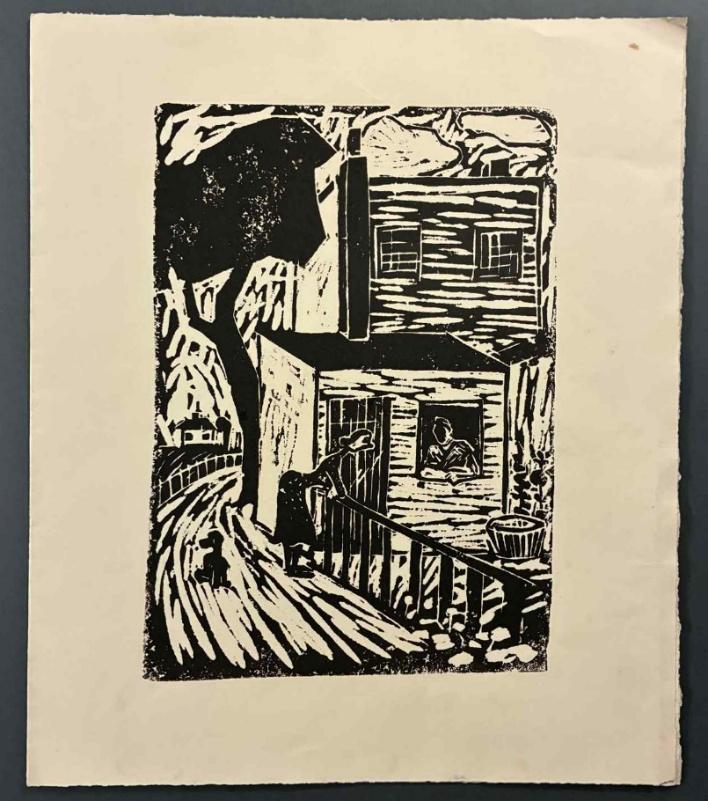
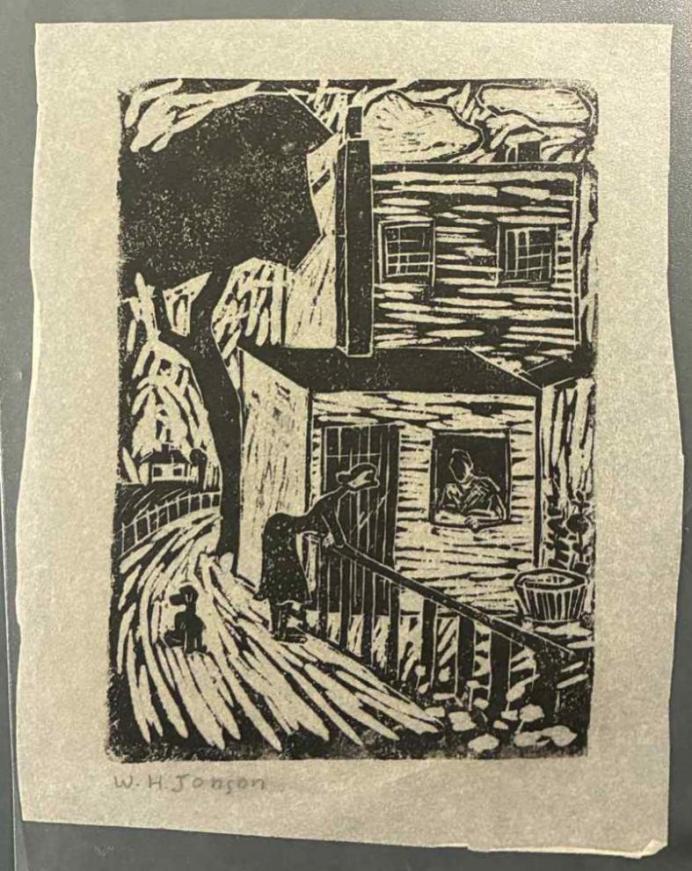
Porch Talk, ca. 1939–1944. Object Number:
WHJ-BP-TDS-00014. Block print on wove paper (Linocut). Inscribed W.H. Johnson and titled: Porch Talk on verso. Size. 24 x 28 cm.
Provenance: The artist to Niels Lindberg, Nr. Broby, Fyn, Denmark; subsequently in a private Danish collection.
Porch Talk, ca. 1939–1944. Object Number: WHJ-BP-TDS-00015. Block print (linocut) on vellum paper. Inscribed W.H. Johnson lower left. Size. 20 x 25 cm. Provenance: The artist to Niels Lindberg, Nr. Broby, Fyn, Denmark; subsequently in a private Danish collection. Collection of the National Gallery of Denmark (SMK), Copenhagen.
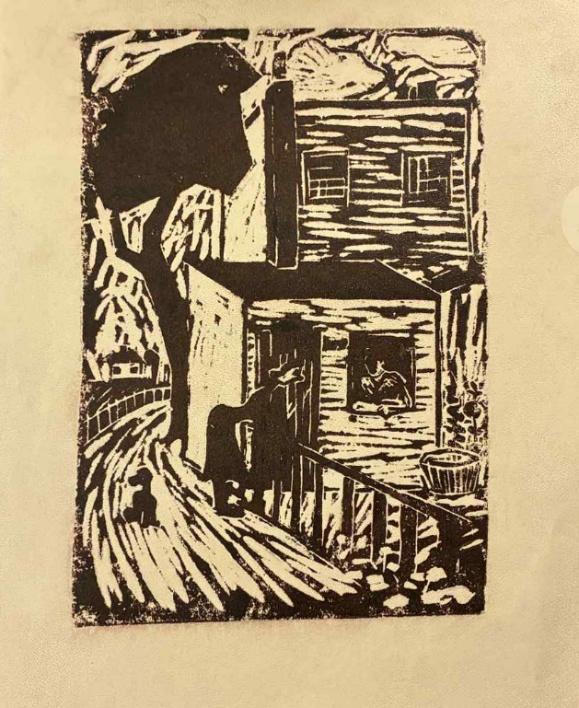
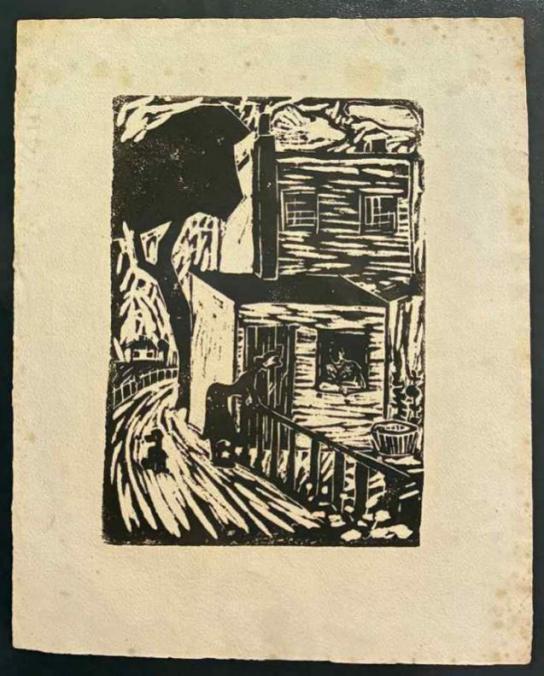
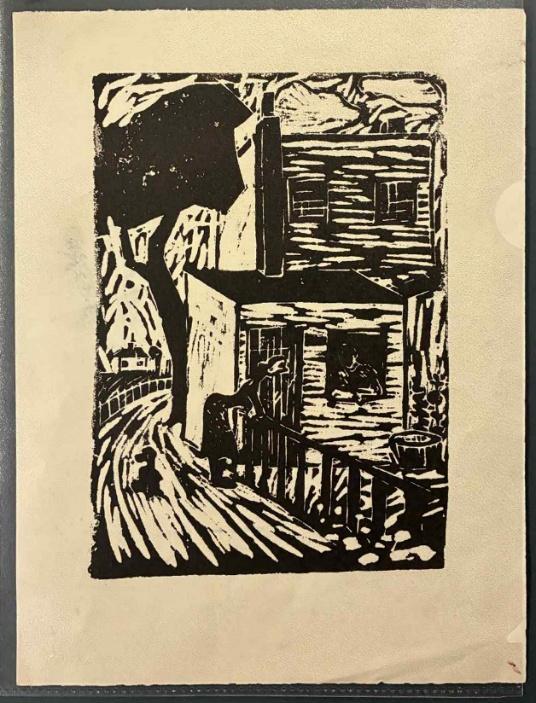
Porch Talk, ca. 1939–1944. Object Number: WHJ-BP-TDS-00016. Block print on wove paper (Linocut). Size. 20 x 25 cm. Provenance: The artist to Niels Lindberg, Nr. Broby, Fyn, Denmark; subsequently in a private Danish collection.
Porch Talk, ca. 1939–1944. Object Number: WHJ-BP-TDS-00017. Block print on wove paper (Linocut). Size. 24 x 29 cm. Provenance: The artist to Niels Lindberg, Nr. Broby, Fyn, Denmark; subsequently in a private Danish collection.
Porch Talk, ca. 1939–1944. Object Number: WHJ-BP-TDS-00018. Block print on wove paper (Linocut). Size. 21 x 28 cm. Provenance: The artist to Niels Lindberg, Nr. Broby, Fyn, Denmark; subsequently in a private Danish collection.
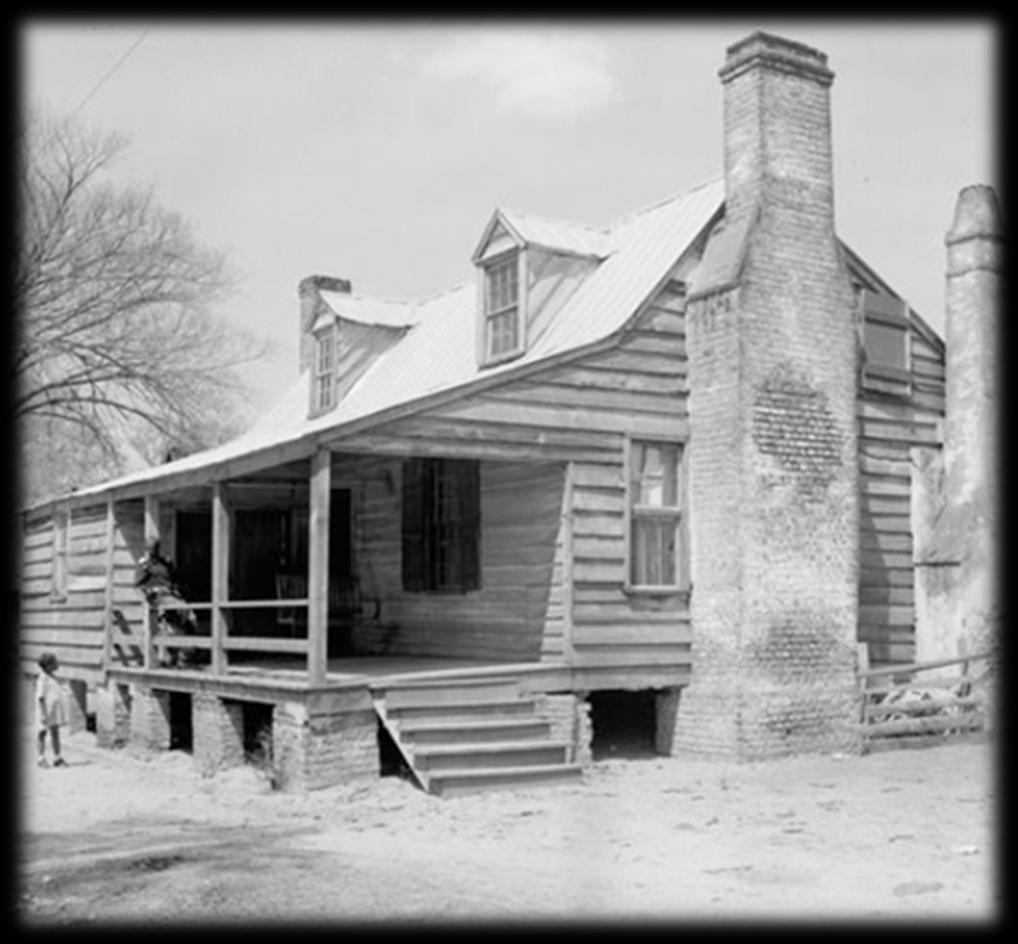
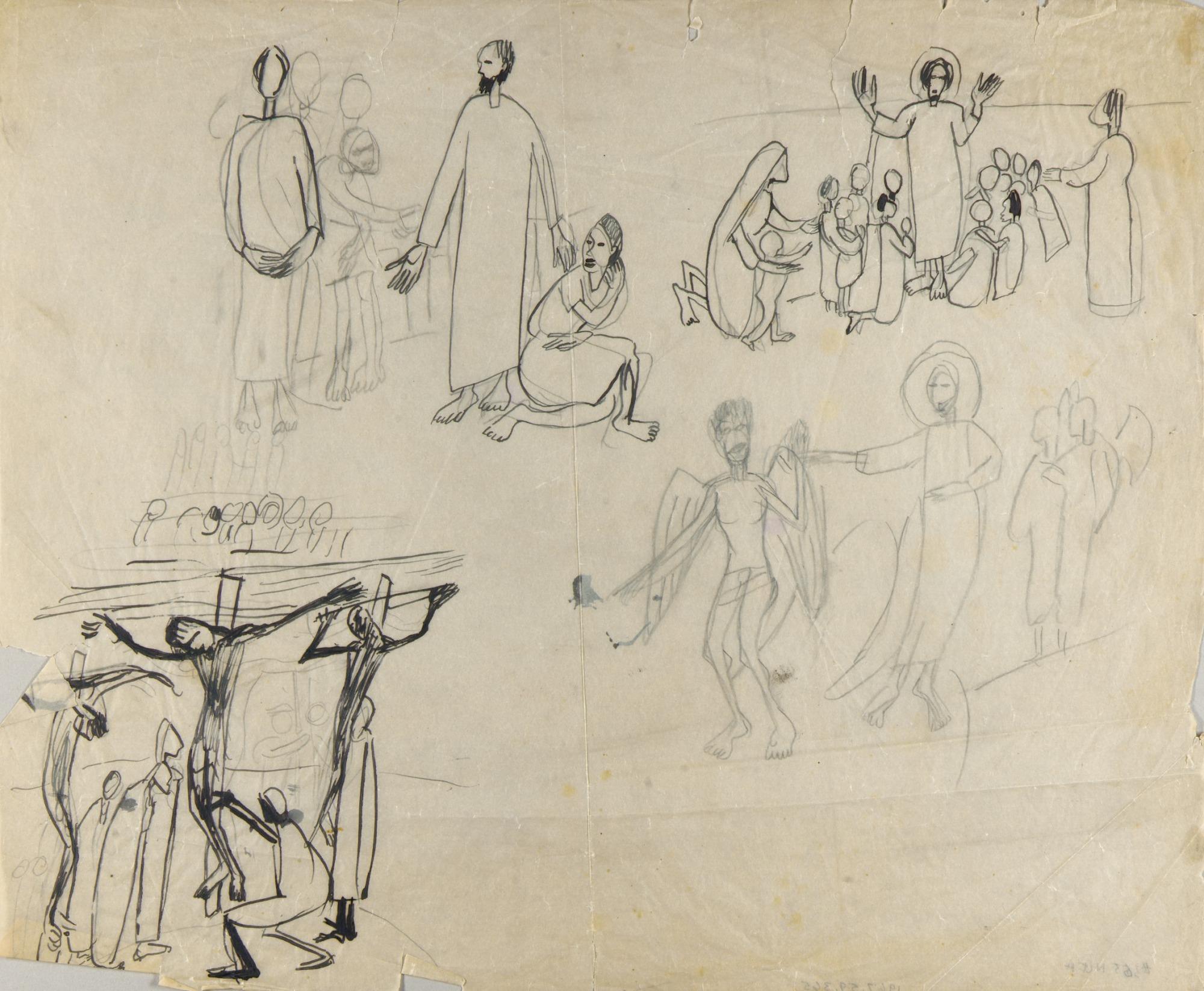
Amongthevariousphasesofhiscareer,WilliamH.Johnson’sengagementwith religioussubjectmatterstandsoutasparticularlyintimateandspirituallyexpressive. AlthoughhehadexploredbiblicalthemesearlierinworkssuchasJesusandthe ThreeMarys(ca.1939)andIBaptizeThee(ca.1940),itwasonlyafterthedeathofhis wife,theDanishartistHolchaKrake,in1944thatsuchimageryassumedacentral role.Inthewakeofthisloss,Johnsonturnedincreasinglytosacredsubjectsasa meansofprocessinggrief,seekingsolace,andreconnectingwithhisspiritualand culturalroots.
Johnson’sreligiousprintseriesconsistsoffiveindividualworks.
HeadofaSaint.Ca.1939–1944.
MorogBarn(MotherandChild)Ca.1939–1944.
DenHelligeFamilie(TheHolyFamily)Ca.1939–1944.
Nedtagelsenafkorset(DescentfromtheCross)Ca.1939–1944.
Untitled(KissoftheSaints),ca.1939–1944
William H. Johnson, Religious sketch scenes ca. 1944. Detail. Smithsonian American Art Museum, 1967.59.365
Head of a Saint. Ca. 1939 – 1944.
Oneknownimpression.
InHeadofaSaint,Johnsonpresentstwoexpressiveimages:alarge,roughlycarved faceontheleft,andasmaller,sketch-likeportraitontheright.Thecentralheadis enclosedinacircularhalo,andadarkhorizontalbandacrosstheforehead.Tothe right,asmaller,morelooselydrawnportraitappears,perhapsastudyofthesame figureoranobserverinmourning.Together,thetwoimagessuggestameditation onholiness,sacrifice,andhumanpain,conveyedthroughJohnson'scharacteristically expressionisticstyle.
TheSmithsonianAmericanArtMuseumdatestheprinttoc.1930–1938;however,the religioussubjectmattersuggestsalaterdate.Johnson’searliestknownexplorations ofsuchthemesappeararound1939,andtheybecameincreasinglycentraltohis workfollowingHolchaKrake’sdeathin1944.Theprintwasthereforemostlikely producedbetweenc.1939and1944.
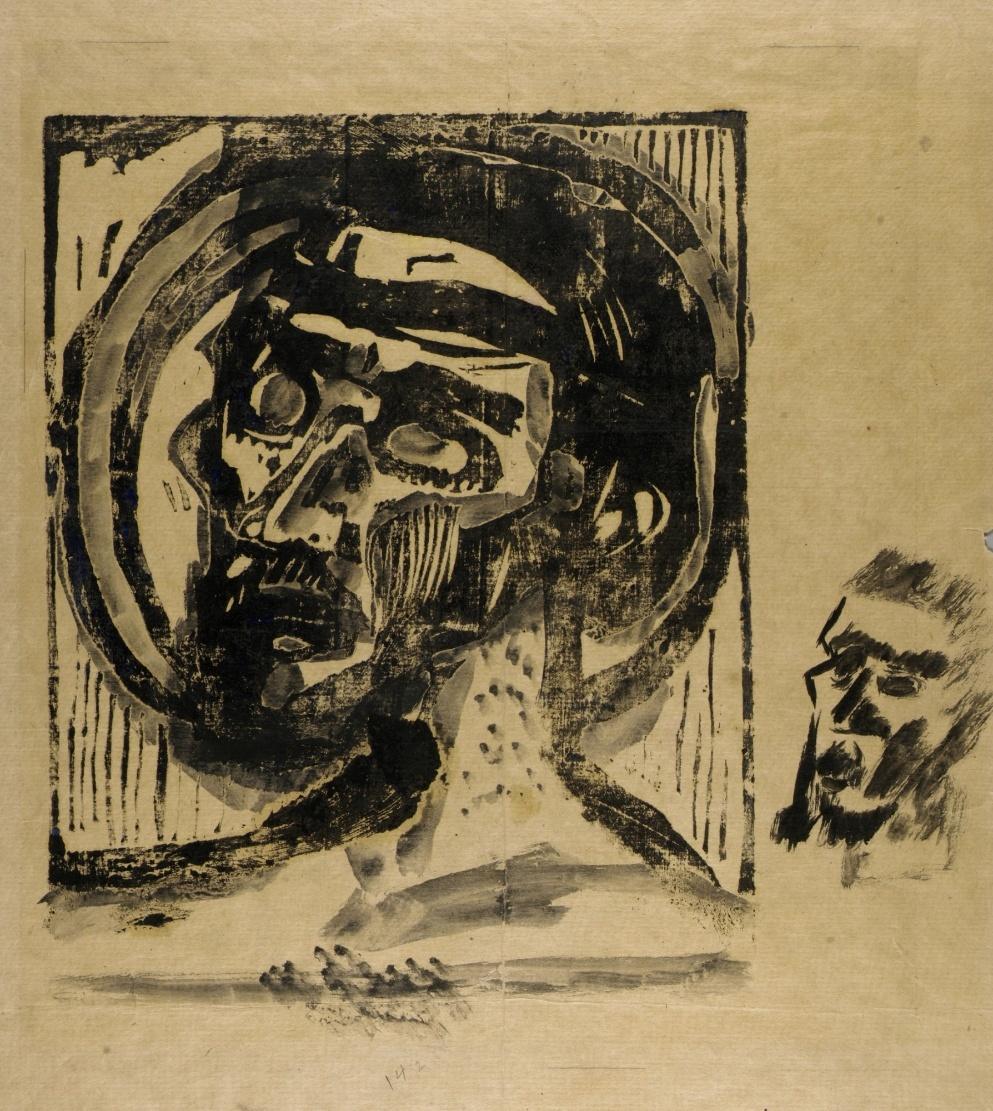
Head of a Saint. Ca. 1939-1944. Object Number: WHJ-BP-REL0001. Block print and ink wash on paper. (Woodcut). Size: 17 3⁄4 x 16 in. 45.0 x 40.5 cm. Provenance: Gift of the Harmon Foundation. Smithsonian American Art Museum, 1967.59.84.
Twoknownimpressions.
InMorOgBarn(MotherandChild),Johnsondepictsanintimatesceneofmaternal careandprotection.Amonumentalnudewomancradlesaninfantwithinherarms, herbowedheadandenvelopingbodyconveyingtenderness,vulnerability,andquiet devotion.Thecompositionisrenderedthroughroughcarving,fracturedcontours, andexpressivedistortionsthatprivilegeemotionalintensityovernaturalisticdetail. Faint,ghostlikefacesemerginginthebackgroundintroduceasubtlespiritual dimension,asthoughsilentlywitnessingthesacredbondbetweenmotherandchild. Johnsonexploredthethemeofmotherhoodthroughouthiscareer,oftenblending thepersonalwiththespiritual.InNewBornBabe(c.1944–1945),heevokesthe VirginMary,presentingmotherhoodasbothuniversalandsacred. Itisuncertainwhethertheprint’sDanishtitle,MorogBarn,wasassignedbyJohnson himselforaddedduringearlycataloguing;however,contemporaryjournalistsinthe 1930snotedhisstrongcommandofDanish.
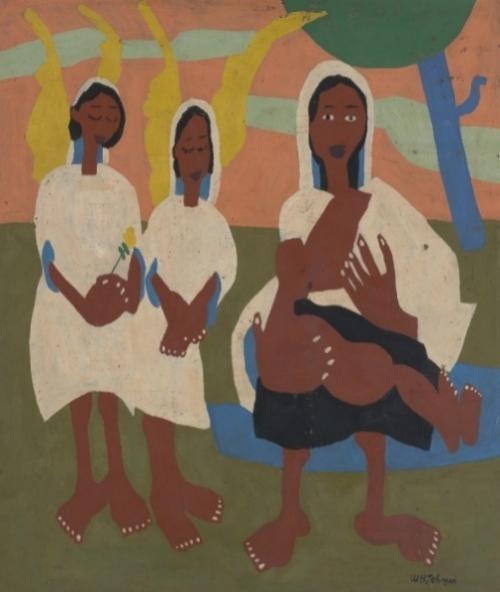
A page from William H. Johnson’s scrapbook (c. 1930–1947) includes a reproduction of Leonardo da Vinci’s Virgin and Child (1499–1500), suggesting it may have served as a source of visual inspiration for his work. Image courtesy of Florence County Museum.
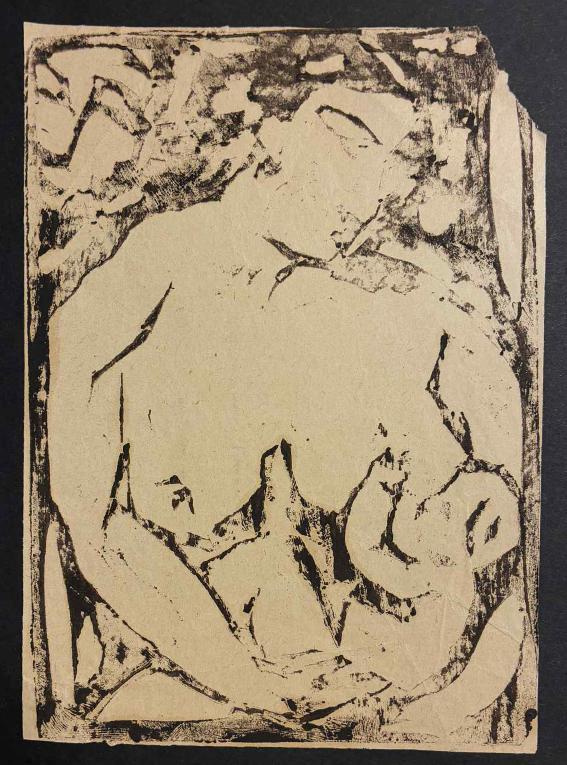
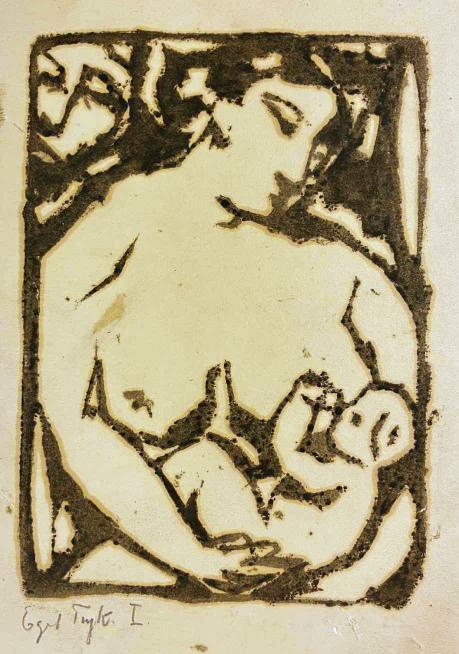
Mor Og Barn (Mother and Child) Ca. 1939-1944. Object Number: WHJ-BP-REL-0002. Block print on Vellum paper (Woodcut). 12 ½ x 17 cm. Provenance: The artist to Niels Lindberg, Nr. Broby, Fyn, Denmark; subsequently in a private Danish collection. The work is catalogued as Mor Og Barn and listed as No. 3 in Niels Lindberg's inventory.
Mor Og Barn (Mother and Child) Ca. 1939-1944. Object Number: WHJ-BP-REL-0003. Block print on paper (Woodcut). 12 ½ x 17 cm. Inscribed in Danish: Eget tryk I/ artist's proof I . Provenance: The artist to Niels Lindberg, Nr. Broby, Fyn, Denmark; subsequently in a private Danish collection. The work is catalogued as Mor Og Barn and listed as No. 3 in Niels Lindberg's inventory.
Oneknownimpression.
InDenHelligeFamilie(TheHolyFamily),Johnsonpresentsadevotionalscenein whichvisitorsbringofferingstotheChristchild.Usingacarvingtechnique reminiscentofhis1933self-portrait,heconstructsthecompositionthroughsharply incised,rhythmiclinesthatdefineformthroughcontrastratherthantonalmodeling. Thefiguresareelongatedandangular,theirbodiesshapedbydensenetworksof carvedmarksthatcreateaheightenedsenseofmovementandspiritualintensity.
ItremainsuncertainwhethertheDanishtitleDenHelligeFamiliewasassignedby Johnsonhimselforaddedduringearlycataloguing;however,contemporaryaccounts notehisstrongcommandofthelanguage.
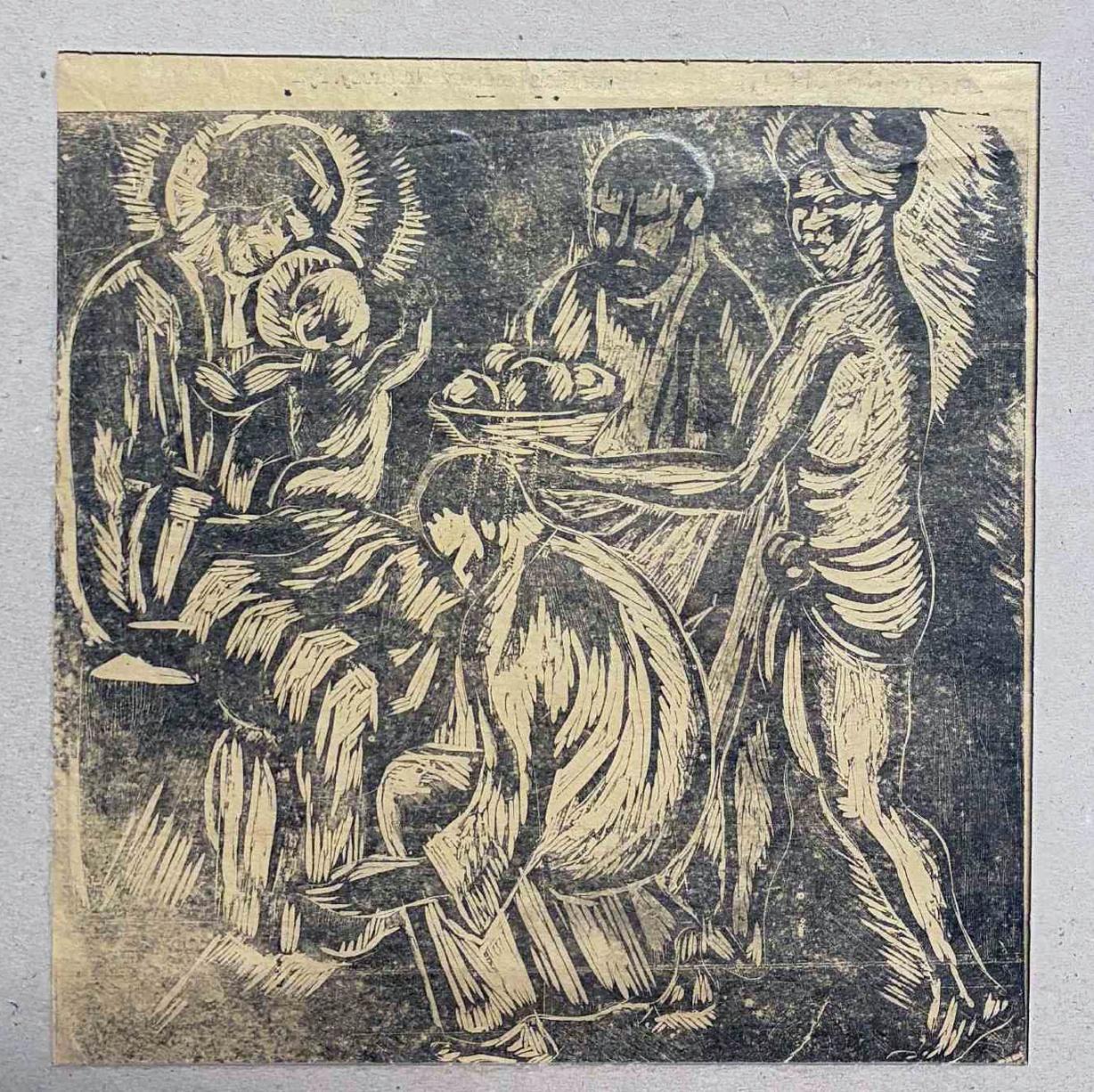
Den Hellige Familie (The Holy Family) Ca. 1939-1944. Object Number: WHJ-BP-REL-0004. Block print on Vellum paper (Linocut). Signed W.H. Johnson. Size 18 x 19 cm. Collection stamp: Tilhorer Niels Lindberg. Nr. Broby. Fyn. Provenance: The artist to Niels Lindberg, Nr. Broby, Fyn, Denmark; subsequently in a private Danish collection. The work is listed as Den Hellige Familie and numbered 3 in Niels Lindbergs inventory list.
Nedtagelsen Af Korset (Descent from the Cross) Ca. 1939-1944
Oneknownimpression.
InNedtagelsenAfKorset(DescentfromtheCross),Johnsonpresentsthesolemn removalofChristfromthecrossinastarkandemotionallychargedcomposition. Amalefigure,likelyJosephofArimatheaoranothermourner,lowersChrist’s elongatedbody,identifiedbytheradianthalo,whichhangslimplyandconveysa profoundsenseofweightandvulnerability.
Executedinboldblack-and-whitecontrasts,theprintisdefinedbyroughgouge marks,angularanatomy,andsimplifiedformscharacteristicofearly20th-century Expressionistwoodcuttraditions,interpretedthroughJohnson’sdistinctivevisual language.Ratherthanemphasizingnaturalisticdetail,Johnsonapproachesthe biblicalscenethroughanintenselyexpressivestylethatheightenstheemotional forceandspiritualgravityofthemoment.
ArthistorianRichardJ.PowellarguesthatJohnsonreimaginesthesufferingofChrist throughtheBlackAmericanSouthernexperience,frequentlydrawingparallels betweenracialviolencesuchaslynchingandChrist’sPassion(Powell,“InMyFamily ofPrimitivenessandTradition,”1991).
Itisuncertainwhethertheprint’sDanishtitle,NedtagelsenAfKorset,wasassigned byJohnsonhimselforaddedduringearlycataloguing;however,contemporary journalistsinthe1930snotedhisstrongcommandofDanish.
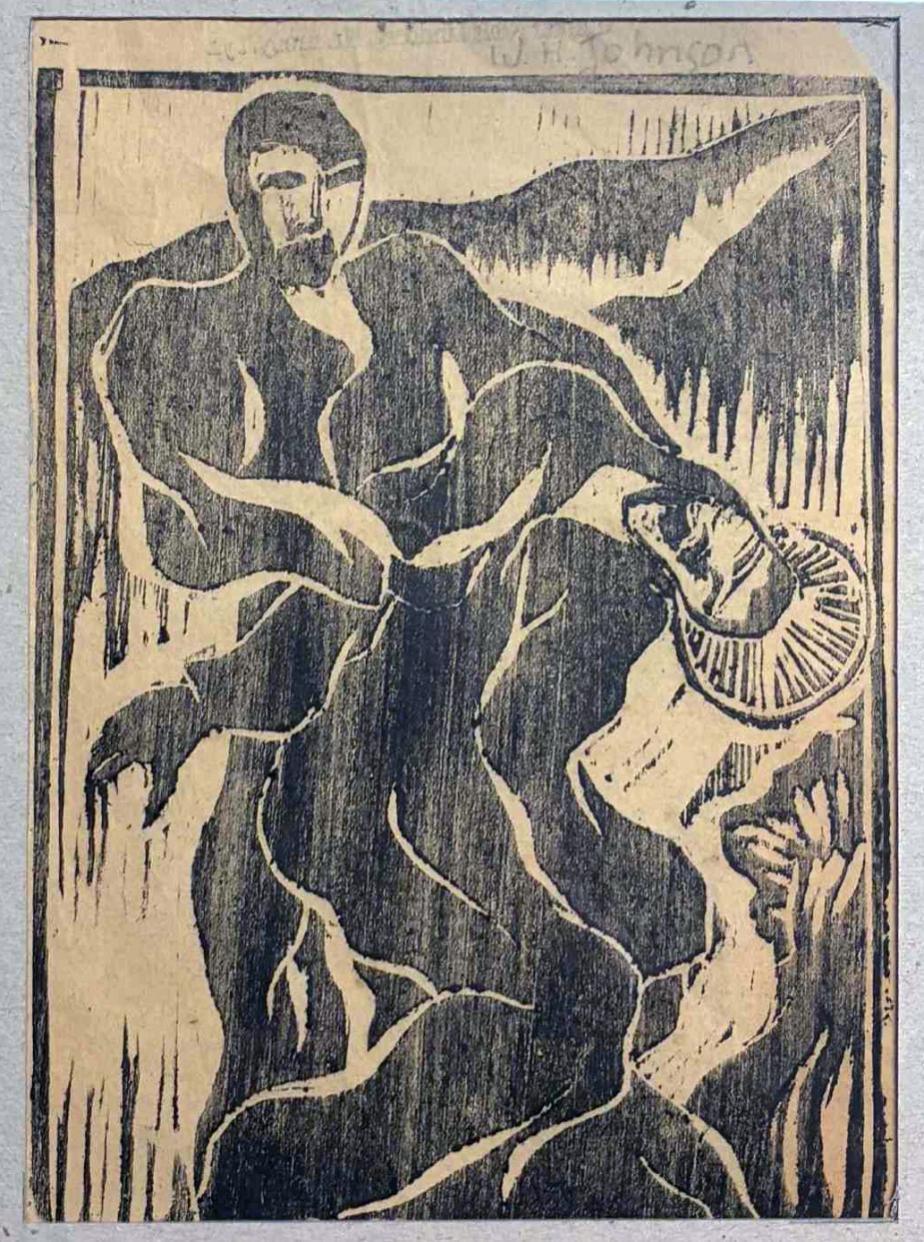
Nedtagelsen af korset (Descent from the Cross) Ca. 1939-1944.
Object Number: WHJ-BP-REL-0005. Block print on Vellum paper (Linocut). Signed W.H. Johnson. Size 15 x 20 cm. Collection stamp: Tilhorer Niels Lindberg. Nr. Broby. Fyn. Provenance: The artist to Niels Lindberg, Nr. Broby, Fyn, Denmark; subsequently in a private Danish collection. The work is listed as Nedtagelsen af korset and numbered no 4 in Niels Lindbergs inventory list.
Untitled (Kiss of the Saints), Ca. 1939-1944.
OneknownImpression.
InKissoftheSaints,Johnsonportraysamaleandfemalefigurelockedinatender embrace,theirbodiesmergingintoanear-continuousform.Halo-likeringsencircle theirheads,infusingtheimagewithspiritualresonanceandsuggestingthesanctity oftheirunion.Throughsparse,deliberatelinesandexpressivereduction,Johnson foregroundsemotionalintimacyandvulnerability,blendingbiblicalsymbolismwith therawimmediacyofEuropeanExpressionism.
Byfusingthesacredwiththesensual,heproposesanalternativeiconographyrooted notinhierarchybutinintimacy.ThehaloedkisschallengesorthodoxChristian depictionsofsanctity,insteadofferingavisionofspiritualuniongroundedinhuman tendernessandprimalexpression.
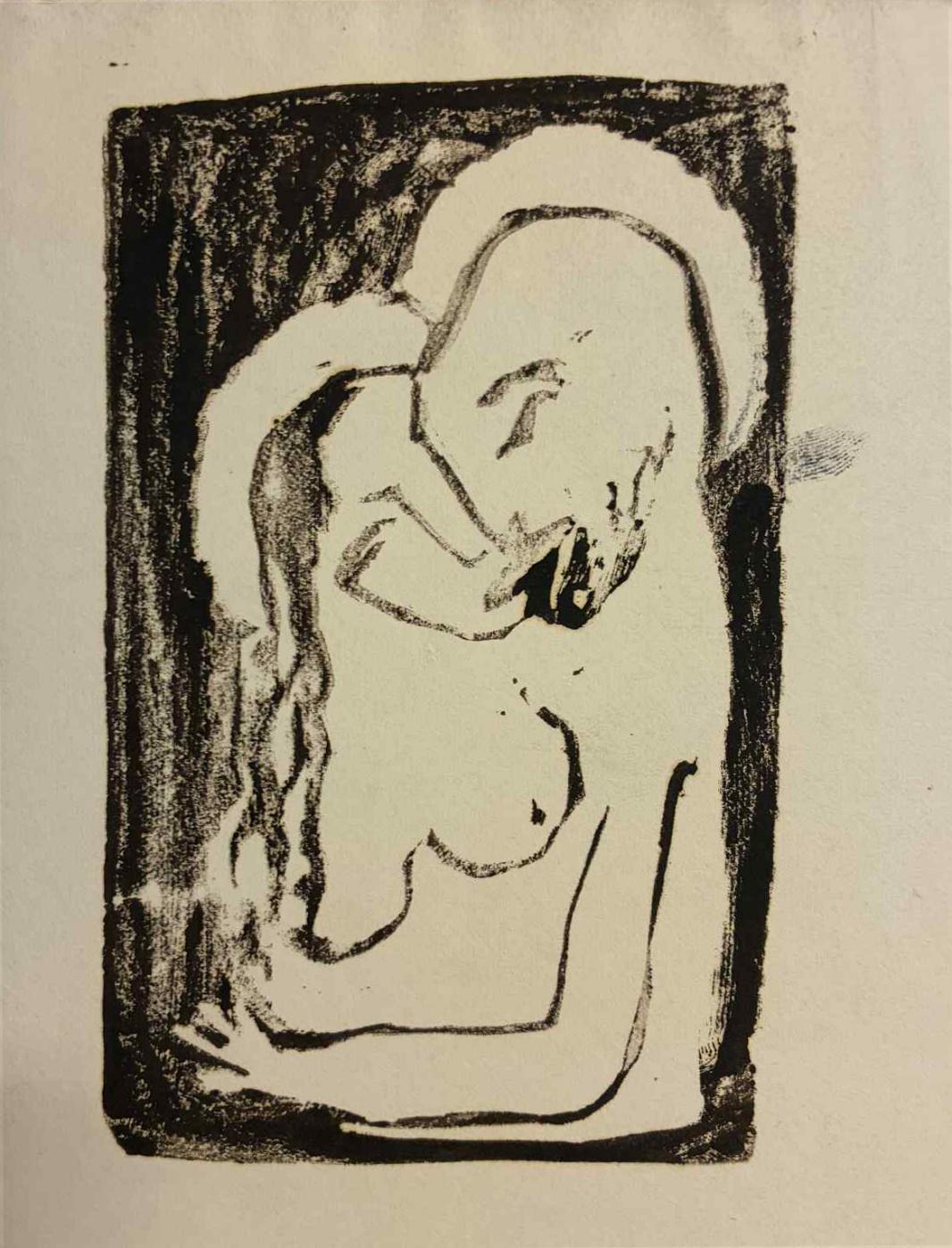
Untitled (The Kiss), Ca. 1939-1944. Object Number: WHJ-BPREL-0006. Block print (woodcut) on paper. Size 13 x 17 cm.
Provenance: The artist to Niels Lindberg, Nr. Broby, Fyn, Denmark; subsequently in a private Danish collection.
Books.
Barron, Stephanie. Degenerate art : the fate of the avant-garde in Nazi Germany. 1950.
Breeskin, Adelyn D. and Jan K. Muhlert. William H. Johnson, 1971.
Breeskin, Adelyn D. William H. Johnson. The Scandinavian Years. 1982
Gionis, Teresa, and Richard J. Powell. William H. Johnson: An American Modern. 2011.
Meisl, K. "Naermere solen" Holcha og William H. Johnsons liv. Denmark: Johannes Larsen Museet.1998.
Powell, Richard J. Homecoming: The Art and Life of William H. Johnson. 1991.
Rodgers, Kenneth G. William H. Johnson : revisiting an African American modernist. 2006
Turner, Steve, and Victoria Dailey. William H. Johnson: Truth Be Told., 1996.
Journal Articles.
Amon Carter Museum of American Art. “William H. Johnson: World on Paper at the Carter Museum.” Press release, November 7, 2006
Bech, Bodil. En Indianer Negro Maler i Kerteminde. Tidens Kvinder. 1931.
Damgaard, Kristoffer and Johanna Voll. Nachlass-samlingen. Det Poetiske Bureau 9. 2017.
Hegrenes, Judith. Jul i Sunnfjord. Historiskriftet, 2023.
Juncker, Clara. The Visual Art of William H. Johnson. University of Southern Denmark, Odense 2024.
Margolies, Beth Anne. Bibliographic Essay on Three African American Artists: William H. Johnson, Romare Bearden, and Jacob Lawrence. 1994
Nerbøvik, Jostein. Ein kunstnar i verdan. William H. Johnson. 2001.
Nielsen, Teresa. William Henry Johnson i Danmark. 2007.
Powell, Richard J. William H. Johnson: Expressionist and artist of the blues aesthetic. 1988
Powell, Richard J. William H. Johnson's Minde Kerteminde. 1986
Powell, Richard J. “‘In My Family of Primitiveness and Tradition’: William H. Johnson’s ‘Jesus and the Three Marys’.” Autumn 1991
Rydeng, Josephine. Holcha Krake. An Essay On The Danish Artist Who Shaped William H. Johnson’s World. 2025.
Rydeng, Josephine. Willie and Holcha in Africa. 2023.
Schubert, Dietrich. The sculptor Christoph Voll in his Dresden period 1919-1924. September, 2010.
Thomasius. "Dagens Interview: Med Indianerog Negerblod i Aarene. Chinos- Maleren William H. Johnson fortæller lidt on sin Afrika rejse, primitiv kunst,m.m." Trans. American Scandinavian Foundation. Fyns Stiftstidende 27 Nov. 1932.
Documentary.
Mossin, Per. Manden der troede Jesus var sort. Danmarks Radio,1983.
Thisprojecthasbeenmadepossiblethroughthegenerosity, collaboration,andsharedcommitmentofnumerousinstitutions, collectors,scholars,andindividualswhohavecontributedmaterials, knowledge,andexpertise.Theirsupporthasbeeninvaluablein assemblingwhatis,todate,themostcomprehensiverecordofWilliam H.Johnson’sblockprints.
Publiccollections
SmithsonianAmericanArtMuseum;TheMetropolitanMuseumofArt; LibraryofCongress;NewYorkPublicLibrary;AmistadResearchCenter, NewOrleans;FlorenceCountyMuseum;HamptonUniversityMuseum; HowardUniversityMuseum;PhiladelphiaMuseumofArt;Greenville CountyMuseumofArt;OaklandMuseumofCalifornia;SpencerMuseum ofArt;ModernaMuseet,Stockholm;NationalGalleryofDenmark, Copenhagen;DavidC.DriskellCenter;TrondheimArtMuseum;Johannes LarsenMuseum;MorganStateUniversity;andFiskUniversityGalleries.
Privatecollections
TheEstateofHolchaKrake;ChristophVollEstate;Mr.andMrs.David Harriton,MinisinkHills,Pennsylvania;Mr.andMrs.DouglasYounger, NewYork(AssistantDirector,HarmonFoundation);ProfessorDavidC. Driskell,Washington,D.C.;NielsLindberg,Nr.Broby,Funen,Denmark; FrankandAnniFahrenholtz,Kerteminde,Denmark;SverreandGunvor Forberg,Norway;AslaugForberg,Norway;DanielLudvigsonKlakegg, Norway;LarsandKjellaugTjensvoll,Norway;IngridMarieNielsen, Esbjerg,Denmark;SteveTurnerGallery,LosAngeles;CampbellFineArt; andThomPegg,BlackArtAuction.
Josephine Rydeng is an independent researcher and curator based in Copenhagen, Denmark. A fourth-generation art dealer, she works at Øbro Kunsthandel, a family-run art dealership established in 1905, where she contributes to research, cataloguing, and the dissemination of artworks.
Her scholarly interests include lesser-known Danish modernist painters as well as international artists who lived and worked in Denmark. Within this field, she has developed specialized focus on African American artists in Scandinavia, particularly William H. Johnson.
She is the author of Holcha Krake: An Essay on the Danish Artist Who Shaped William H. Johnson’s World (2025) and Willie and Holcha in Africa (2023).