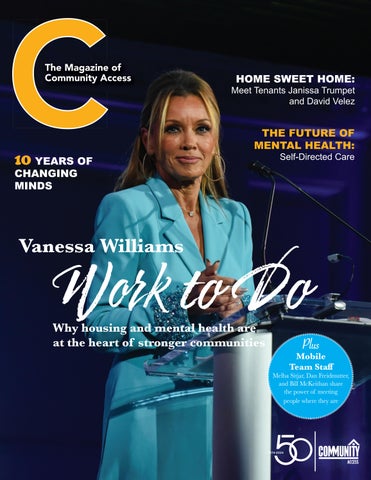
C
The Magazine of Community Access
10 YEARS OF
HOME SWEET HOME:
Meet Tenants Janissa Trumpet and David Velez
THE FUTURE OF MENTAL HEALTH: Self-Directed Care
CHANGING MINDS
Work to Do
Vanessa Williams
Why housing and mental health are at the heart of stronger communities
Plus
Mobile Team Staff
Melba Sitjar, Dan Freidmutter, and Bill McKeithan share the power of meeting people where they are
1974-2024
WELCOME
Milestones
Check out some highlights of what’s happening around town New services. Celebrations. And, art that moves people.
Dear Friends, At Community Access, every story is a reminder that change is possible. As I reflect on the past year, I am deeply moved by the resilience and creativity of the people we serve—and by the unwavering commitment of our staff and supporters who walk alongside them. This issue of C Magazine highlights what makes our community extraordinary. You will meet tenants who have transformed their apartments into true sanctuaries, peers who bring lived expertise into every interaction, and young people whose storytelling is reshaping how our city understands mental health. These stories reflect aspiration, strength, and the steady determination to build a life of one’s own choosing. We also celebrate milestones that speak to our shared progress. Changing Minds turns ten, continuing to spark dialogue and reduce stigma among thousands of young people. The Howie the Harp Advocacy Center marks thirty years of peer leadership, advancing a workforce grounded in lived experience. And as we expand supportive housing and deepen our commitment to healing-focused services, we reaffirm a simple but radical truth: people are experts in their own lives. At the same time, we cannot ignore the forces at work in our society that run counter to our values. Too many New Yorkers are being met with coercion instead of care, and there is growing momentum behind harmful approaches that sideline voluntary, lowthreshold services—services we know are essential to dignity, recovery, and trust. In a city where the number of people experiencing homelessness has surpassed 100,000 per night, it is more important than ever that we hold fast to these values and advocate relentlessly for the solutions we know work.
Every day, I see proof that change is already underway. I see it in the mother who finally has the stability to nurture her children, in the graduate who turns lived experience into leadership, and in our staff who show up, day after day, with patience, skill, and heart. Their work embodies our belief in human rights, racial equity, harm reduction, and self-determination. Our mission has always been bigger than buildings and programs. It is about belonging. It is about choice. It is about ensuring that every person has a place to call home and the opportunity to build a future that moves them closer to their goals and dreams. To our staff, board, partners, and friends— you make this work possible. Your support ensures that Community Access can keep opening doors, keep changing minds, and keep advancing the values that have guided us for more than fifty years. Thank you for walking this journey with us.
Sincerely,
Cal Hedigan Chief Executive Officer
Intensive Residential Crisis Support We’re bringing a new model of mental health crisis support to NYC—a game-changer for helping people get better and stay well. New Yorkers who experience serious mental health crises have limited options. They often end up in emergency rooms and hospitals where they face confinement, disconnection from family and friends, and where treatment is primarily psychiatric drugs. Community Access seeks to change this paradigm. Soon, we’ll open an Intensive Residential Crisis Support Program using the Soteria House approach (Greek for “safety”), rooted in peer support and human dignity. Core principles of Soteria include a homelike environment, “being with” rather than “treating,” and a focus on interpersonal connection, openness, and empathy. While many call for more psychiatric hospital beds and coercion—Soteria offers a more compassionate and effective way to support people in crisis. Community Access will build on the success of Soteria Houses worldwide to demonstrate a new approach for NYC, largely staffed by people with lived experience and grounded in human connection.
30 Years of Peer Training
Creating Together
When we launched the Howie the Harp Advocacy Center in 1995, the idea of people living with mental health concerns working in mental health support was revolutionary. At the time, those roles were reserved for clinical professionals. By understanding the value of peers becoming part of the human services workforce, and creating a training program to prepare people to take on those roles, Community Access took the lead in advancing mental health system transformation. Today peers are essential members of the workforce in supportive housing, clinics, hospitals, mobile teams, managed care services, and other community-based supports— bringing peer perspectives to hundreds of mental health settings.
The Community Access Art Collective is proud to contribute to the growing progressive art studio movement, a fine arts movement rooted in supporting the development of artists with disabilities. Over the past year, works from the Collective have been featured in numerous exhibitions and art fairs, including the inaugural Open Invitational—a groundbreaking fair dedicated to contemporary artists living with disabilities—which debuted in Miami and NYC.
This year, our groundbreaking peer advocacy center turns 30—an opportunity to honor not only its roots, but the lasting impact of its visionary founder, Howard “Howie the Harp” Geld, our first director of advocacy. Howie was a distinctive voice in the mental health patient rights movement who believed that “to transform the treatment system, you must transform its workforce.” Because of his imagination and advocacy, our 2,500+ graduates are doing just that—as integral members of the human service sector.
Collective members have shared their work and stories at exhibitions such as Outside Forces (artEnables, Washington, D.C.), Cordially Invited (Make Studio, Baltimore), and Made Together: Art from Our Community—a collaboration with the MoMA’s Access Programs that celebrated the creativity and leadership of artists with mental health concerns. By participating in events, the Collective builds visibility for artists who are often excluded from mainstream art spaces, fostering belonging and affirming the right of every individual to create, connect, and be seen. In partnership with the nonprofit ChaShaMa, we also launched a temporary storefront gallery at 2 Lafayette Street in Lower Manhattan. This vibrant space hosted public workshops, artist talks, and events, inviting visitors to engage directly with the artists’ diverse creative practices and bodies of work.
HOUSING PIPELINE
01 RIVER AVENUE II 1185 River Avenue, Bronx Project team: ESKW/Architects, Mega Contracting Group, Blue Sky Bronx, LLC 292 units beginning construction in December 2025
02 EAST TREMONT AVENUE 521 East Tremont Avenue, Bronx Project team: Mega Contracting Group, Community Healthcare Network, SLCE Architects 213 units beginning construction in December 2025
03 EAST 12TH STREET East 12th Street, Manhattan Project team: Spatial Equity Co., Duvernay + Brooks, Cooper Square Committee, SLCE Architects 560 units in pre-development
BUILDING HOMES FOR 8,000 PEOPLE Community Access owns and operates 1,700 units of housing in Manhattan, Brooklyn, and the Bronx. And, we’re building 2,400 more units (studios, one-, two-, and threebedrooms) that, all totaled, will provide homes for more than 8,000 people.
floor terrace—a first for Community Access— where we’ll be able to grow year-round. It is our hope that the commercial kitchen and community room will be put to good use for cooking and convenings among tenants— including using harvests from the greenhouse.
Our latest development, Baez Place, is another step towards reaching this goal. The building and apartments are beautiful and light-filled, and we are glad to continue to provide amenities including a computer lab, gym, outdoor spaces, and double-height lounges as gathering places for tenants. We’re also building a greenhouse on the 8th
This building is also our first to offer dedicated units and services for frail/ elderly individuals who have experienced homelessness and housing instability. Many of those apartments are designed as alcove studios to provide some extra space for tenants who have home health aides supporting them.
06 BAEZ PLACE Baez Place 334 East 176th Street, Bronx Project team: ESKW/Architects, Joy Construction, Nizao Realty Corp, Blue Sky Bronx, LLC 154 units Lease up to be completed in Spring 2026
04 EAST TREMONT AVENUE 200 East Tremont Avenue, Bronx Project Team: Maddd Equities, LLC, Alembic Community Development, SLCE Architects, GDI Construction 134 units in pre-development
05 BRYANT AVENUE 1461 Bryant Avenue, Bronx Project team: Blue Sky Bronx, LLC, ESKW/Architects, Bruno Frustaci Contracting 70 units in pre-development
Scan this QR code to watch a News 12 Bronx story that recently featured Baez Place as part of its “Rebuilding the Bronx” series.
For people who have experienced homelessness, the security and stability of a home of one’s own is everything. It creates the opportunity to move on from the constant focus on day-to-day survival. A home is more than just four walls and a door that locks, it is the promise of a fresh start, with a stable foundation from which to build a future. For Janissa Trumpet, moving into River Avenue last summer opened the door to possibility. After three years in the shelter system, the mother of two now has a home where she can put down roots with her children and grow. Her apartment has become a place of beauty and healing—paintings she has created on the walls, plants thriving in every corner, and a garden just outside where she learns, teaches, and connects with her neighbors. At Cedar Avenue, David Velez has called his apartment home for more than a decade. Supportive housing has allowed him to focus on his health, cook nourishing meals, and build lasting friendships with others. His home is not only a sanctuary—it’s a place where he can share what he’s learned and help others find a sense of belonging, too. We recently visited Janissa and David to hear firsthand about why having a home matters so much—and the difference has made in their lives.
Home Sweet Home
J
Growing Roots in Community Born and raised in Brooklyn, Janissa has always believed in living with intention—creating art and aspiring to nurture wellness and self-care, even when dealing with struggles in life. At River Avenue, she finally has the space to plant roots, both literally and figuratively. Now, every corner of her apartment tells a story: her paintings on the walls, the plants she tends to use in recipes to feed her family, and the cozy spaces where her children can learn, play, and flourish. From the moment she moved in, the impact of housing stability was clear. “I could finally hang my clothes, decorate my space, and see the person I want to be,” she says. The warm welcome from neighbors and staff further solidified she was where she was supposed to be. “The community here really cares. People greeted me with kindness—it felt like home from the start.” Janissa soon discovered the building’s community garden, where she now works alongside her mentor, Ana Moran—Community Food Coordinator at Community Access. “The garden is more than food— it’s about connecting with nature and each other,” she explains. “People forget the earth is alive. I try to lead by example—not by what I get, but by what I give.” She recently completed an intensive 8-week agricultural training, in which she learned everything from plant pollinators and companion planting to the best times for transplanting and harvesting. The program included eight hours of hands-on community service in the River Avenue garden, putting her new skills to work along with other tenants. In December, she will present a showcase of what she has learned, and receive a certificate for her achievement. Afterward, Janissa hopes to start her own garden, a goal she credits the program with helping her pursue. Through it, she plans to grow organic herbs and create her own herbal products from trusted sources. Her mission is to teach others about healing from both
“Home gives me a peace of mind—and with that, I can dream bigger. I’m showing up for myself now— and that means I can show up even better for my kids.” – Janissa trauma and limiting beliefs, and to help them reclaim their power of creation. Her passion for healing extends beyond gardening. As a certified wellness and detox coach, she is working to launch her business, Garden of N’nevah, which will focus on organic gardening, natural skin care, and community wellness education. She has already created several products, including body scrubs and deodorant. “I want to teach people how to love themselves through what they put in and on their bodies,” she says. Her path to River Avenue was not easy. As a survivor of domestic abuse, Janissa spent three years in shelters with her children, working tirelessly to rebuild their lives. Those difficult experiences now fuel her deep commitment to creating a strong, healthy future. “Being in that situation made me lose sight of who I was,” she says. “Living here has been the first step in seeing myself again.” Today, she’s focused on nurturing her family, her passions, and her future. She homeschools her children, and they enjoy taking part in events held in the community room, where they have a chance to make new friends. Their independence has blossomed, and they sleep soundly each night in their own home. “Home gives me peace of mind,” she says. “And with that, I can dream bigger.”
D
Thriving with Stability and Strength When David Velez first walked into his apartment at Cedar Avenue 13 years ago, he couldn’t believe it was his. “It felt like hitting the lottery,” he says. After roughly 10 years of cycling through shelters and couch-surfing with relatives, he finally had a place of his own—a place to cook, rest, and heal. “This is the longest I’ve ever lived anywhere. I used to move every year or two. Now I have keys to my own apartment, and I can sit down, make a meal, and just be at peace.” A Bronx native and proud Puerto Rican, David says supportive housing gave him more than just a roof over his head—it gave him space to build a healthier life. “I was diagnosed with diabetes and high blood pressure a couple of years ago,” he says. “But having an apartment of my own gives me the ability to exercise and focus on healthy eating. I am able to do that for myself, and doctors saw that my numbers started to drop. Within six months, I lost 20 pounds. I don’t even need my cane anymore. Hopefully soon I can get off my diabetes medication.”
Participant POV
“When I got myself together, everything else started to fall into place. Now I have my keys, my health, and a community—I feel unstoppable.” – David
Big things are happening at Community Access— from homes and jobs to mental health crisis support, and classrooms filled with learning and connection. Across New York City, participants are rewriting their stories—and we’d like you to meet a few of them and hear their point of view.
Cooking quickly became a way to connect with others. Each week, David prepares meals—grilled shrimp, octopus, salads, smoothies—and invites neighbors to join him. “Some people don’t know how to cook, especially healthy meals,” he says. “I’ve had neighbors who were eating mostly fast food. I’d invite them over and show them how to make something simple. One of them ended up surprising me later by cooking for me. That meant a lot.” Beyond the kitchen, David is active in building activities like creative arts and bingo, and he values the friendships built over the years. “We’ve seen each other’s kids grow up. It’s a nice community here— everybody gets along.”
Reflecting on his past, marked by housing instability, substance use, and justice involvement—David credits supportive housing with keeping him grounded. “The staff at my building have helped me get to my appointments, find a doctor—so many little things that matter,” he says. “When I got myself together, everything else started to fall into place.” Now, David is focused on earning his GED and enrolling in a trade program. “I want to keep moving forward,” he says. “When you fall, you’ve got to keep lifting yourself back up.”
Community Access’ Self Direction program helped me rebuild my life after years of trauma. It gave me access to writing classes, therapy, yoga, and even helped me adopt a dog. That support put my feet back on the ground and helped me rediscover my identity—not just as a survivor, but as an artist and author. — Michael
The Howie the Harp Advocacy Center changed everything for me. It was the first program that helped me believe that my lived experience had value. Today, I am using the skills I learned there to train the next generation of peer specialists. — Jovanna
First and foremost I’m an artist. I was selling a lot of my art in the Lower East Side before the pandemic and have been working more on my art over the past few years. At Bruckner, I can use the computer room to print out the images that I can work off. — Brian
The Power of
MEETING PEOPLE Where They Are
At Community Access, our people are our strength. More than 230 dedicated staff members bring empathy, skill, and commitment to their work every day, creating environments where participants can thrive. Among our many vital programs, the Intensive Mobile Treatment (IMT) and Assertive Community Treatment (ACT) teams stand out for their ability to bring support directly to people wherever they are—on the street, in shelters, in public spaces, or in their own homes. These multidisciplinary teams, funded by the New York City Department of Health and Mental Hygiene and New York State Office of Mental Health, are made up of clinicians, social workers, registered nurses, harm reduction specialists, and peers with lived experience. Together, the staff members walk alongside New Yorkers as they navigate complex challenges and chart their own paths to recovery. We’re proud to introduce three IMT staff members—Melba, Dan, and Bill—whose stories are a part of the fabric of our community. Left to right: Teresa Duran (IMT 5), Bill McKeithan (IMT 2), Sallie Sims (IMT 2), Juanita Reid (IMT 2), Melba Sitjar (IMT 2), Karin Griffin (IMT 2), Dan Freidmutter (IMT 2), Mary Perez (IMT 3)
F
For Melba Sitjar, being a peer specialist is more than a job— it’s a calling. Every day, she brings her own lived experience into the work of supporting participants, often in their most vulnerable moments.
“Being a peer means you meet people where they are and you find common ground,” Melba says. Melba grew up in Carroll Gardens, Brooklyn, in a Filipino household where life was complicated by her father’s struggles with alcoholism and her mother’s experiences with anxiety. Through it all, her grandmother was a source of love and stability, the person who encouraged her to keep going when life felt overwhelming. When her grandmother passed away, Melba made a promise to herself: to do good and keep moving forward. It’s a promise she still carries with her today, offering participants the same steady presence and encouragement her grandmother once gave her. Years later, at the start of the COVID-19 pandemic, Melba lost both of her parents within months of each other. Grief and isolation led her into a period of deep withdrawal and fear. “I was just sitting at home, watching TV, doing nothing,” she recalls. With encouragement from her brother Arturo, a longtime member of the Community Access Art Collective, she joined a Community Access recovery program, where she rediscovered her sense of purpose and the healing power of connection.
From there, Melba enrolled in our Howie the Harp Advocacy Center, graduating in 2023 and soon after joining IMT as a fulltime Peer Specialist. Having faced her own losses and challenges, she knows that change often happens slowly and on people’s own terms. Her work now centers on building trust, showing patience, and being present even when progress feels uncertain. Outside of work, Melba continues her own healing journey through drawing, meditation, and winter trips to Vermont to ski and hike with her cousins. These practices keep her balanced and strengthen her work as a peer, as she honors the promise she made to her grandmother: to do good, keep moving forward, and help others in the same way her grandmother once helped her.
My own experiences with loss and recovery shaped who I am. They help me connect with people in a real way and walk alongside them as they find their own path.
Melba Sitjar
A
A lifelong Brooklynite, Program Director Bill McKeithan has always had a gift for listening. Even as a young man, people naturally turned to him for advice. Over time, he realized this instinct to be a confidant could form the heart of a career. Drawing on decades of experience, including leading multiple housing programs with the Jericho Project and creating a veteran housing program from scratch, Bill now leads one of our IMT teams at Community Access, guiding staff with the same patience and care he brings to participants. With decades of experience in mental health services, Bill knows that programs are only as successful as the staff members who deliver them. One of those staff members is Dan Freidmutter, who joined Community Access five years ago as a new college graduate. Like Bill, Dan grew up in Brooklyn, and both share a love for the borough that shaped them. Early on, Dan considered a career with the NYPD. But the more he thought about it, the more he realized he wanted to help people in a different way— not through enforcement, but through support. “I thought I could make more of a difference helping people as a social worker,” he recalls. When Dan arrived at Community Access, Bill saw potential right away. “What I look for is chemistry and a willingness to learn,” Bill says. “And Daniel had that.” For a time, it was just the two of them covering the city, from shelters to sidewalks to people’s homes. While Bill modeled persistence and respect, Dan learned how to build trust step by step.
The most meaningful moments are when people see their own progress and realize they have the power to create positive change in their lives. — Dan
Dan Freidmutter and Bill McKeithan
One experience that shaped them both was when Dan began working with a young participant who had recently been released from Rikers. Rather than focusing on the individual’s care plan, he listened when the participant suggested going ice skating in Prospect Park. Dan felt that this experience not only deepened their professional relationship, but it also helped the participant reconnect with his sense of dignity. After a long stretch of hardship, the
For me, mentorship is about giving staff the same patience and encouragement we ask them to bring to participants—because supporting staff is another way of serving the people in our care. — Bill chance to choose a simple outing—trying ice skating for the first time and enjoying himself in the park—affirmed his ability to make decisions for his own life. For Bill, watching Dan follow the participant’s lead showed he had truly embraced Community Access’ practice approach. Their connection extends well beyond their day-to-day work. Bill encouraged Dan to pursue his Master’s in Social Work and cheered him on as he earned his license early. “The day he passed, I might have been the first person he called,” Bill says with pride. Outside of work, Bill, a father and grandfather, loves to travel, relax on vacation, and spend time with his beloved Shiba Inu. Dan, who lives near Prospect Park, recharges by taking long walks, exercising, cooking meals, and spending time with friends and family. He also enjoys video games and other simple self-care routines that keep him grounded and true to himself. Bill and Dan’s relationship is built on trust, respect, and a shared commitment to the people they serve. Bill takes pride in seeing Dan grow into his role, describing mentorship as one of the most meaningful parts of his work. For Dan, Bill’s guidance has been instrumental — helping him grow as a clinician and forming a meaningful friendship built on mutual respect. Through their work and one another’s support, both continue to learn, teach, and build the kind of trust that makes lasting change possible.
Changing Minds
Celebrating 10 Years
In 2025, Community Access celebrates ten years of Changing Minds, a storytelling and community education program that challenges mental health stigma through sharing films created by and for young people. Through hosting festivals, library and community screenings, and running a popular YouTube Channel and Instagram series— Changing Minds has opened up an important dialogue about mental health needs and experiences among young people. And, we’re excited to be gearing up for the next decade of service.
Mainstream media in television, print, and film often portray mental health struggles negatively, reinforcing stigma and stereotypes through sensationalized or simplified depictions, inappropriate labels, and derogatory language. This, in turn, can lead to negative consequences for individuals living with mental health concerns—especially young people—including delayed help-seeking, social isolation, and discrimination.
M
For the past 10 years, Changing Minds has served as the first-of-its-kind platform to transform the conversation about mental health among young people in ways that positively influence and uplift mental health messages and experiences. For young people
ages 15-25, Changing Minds has become a safe space for creating a dialogue about topics that too often are left in the shadows, including: anxiety, depression, obsessive-compulsive disorder, post-traumatic stress disorder, body dysmorphia, eating disorders, suicidal thoughts, bullying, loneliness, and issues related to gender identity, among many others. Our concept for Changing Minds is simple, yet powerful: to be a megaphone for young people to share real-life, uplifting stories of mental health struggles that spark conversations. Our first call for films in 2015 got 16 submissions. Since then, the program has grown dramatically—receiving over 6,000 film submissions from young people in 114 countries.
Left to right: Julia Messick, Teo Nalani, Erica Travia, Grey Anderson, Corey Dostie, Lucrèce Wecxsteen, Simone Thomas-Rowe, Kofi King
From Stigma to Strength
We know that normalizing the conversation about mental health is essential in order to challenge the mental health stigma that puts up roadblocks in so many people’s lives, hinders them from seeking care, and can impede so many other opportunities.
The majority of mental health challenges begin early in life. Half of all lifetime instances begin by age 14 and three quarters by age 24.1 Too often, there are not enough resources available to help young people and their families to have an open and honest dialogue about mental health issues. For young people, mental health struggles can be difficult to navigate, especially alone, fearful of being misunderstood and marginalized. The effects of this stigma are profound: • 12.5 million people between the ages of 18 and 25 experienced a mental, behavioral, or emotional health issue in the past year. This amounts to 1 in 3 (33.8%) young adults. This rate has increased significantly over the past several years.2 • 18.1% of teens aged 12 to 17 had a major depressive episode in the past year.3 • Over 50% of students with emotional and behavioral disorders ages 14 and older drop out of high school.4 • 18% of college students who attended four-year colleges or universities named mental health as a reason for leaving school.5
T
Film can be a starting point for conversation and positive change. It can help shift mindsets, to move our society from negative imagery and language toward greater understanding and compassion. Changing Minds sees a future where mental health is appropriately recognized in headlines and in media—and a world where vocabulary around mental health is person-centered, hopeful, and reflective of the wide range of human experience. That’s why we work hard to share Changing Minds films in as many ways as possible. In addition to the annual film festival and community and library screenings, we host programs each May to mark Mental Health Awareness Month and run active social media channels aimed at combating mental health stigma, reaching a growing number of teens and young adults. In addition, we’ve created free discussion guides to enhance conversations about mental health and films. Throughout the process, young people are our guides—reviewing the submissions, selecting films for the festival, participating in social media, and more.
20 25
From the Silver Screen to Your Living Room
As we watch the news every day about future support for mental health care—we know that Changing Minds is needed now more than ever. We’ve accomplished a lot in the past 10 years6: • • •
• • •
•
Receiving over 6,000 film submissions by young people ages 15 to 25 Hosting film festivals in NYC that have screened over 100 films Launching the Changing Minds Channel on YouTube with over 2,500 subscribers and 50,000 views Developing a Film Fridays online festival series Piloting screenings in libraries and community organizations Creating a Changing Minds Toolkit comprising Discussion Guide and “How To Make a Film on Your iPhone” Producing the first-ever Changing Minds film that we’ve dropped on Apple TV and other streaming services
As part of Community Access’ push to bring Changing Minds to young people everywhere, Community Access is proud to announce the debut of its first-ever film on Apple TV. The film will be available on the streaming platform across the U.S. and internationally, elevating these important films so that they can reach viewers across the globe. Community Access is grateful to Laurie Tisch and John Turturro who were actively involved in the production of this film.
A
Left to right: Cal Hedigan, Kendra Brown, Laurie M. Tisch, John Turturro, Denise Chan, Morgan Smartt
A group of young people attend Changing Minds community screening at Sunset Park Library in Brooklyn hosted by Changing Minds Coordinator Mikel Morado
The Changing Minds YouTube channel is also set to dramatically expand, adding hundreds of curated films, organized by theme and content area, to provide a richer viewing experience. And, our popular Changing Minds Film Fridays Series hosted by Denise Chan on Community Access’ Instagram is set to evolve into a multi-week online festival. We extend heartfelt thanks to our sponsors for helping us continue to develop Changing Minds, and prepare ourselves for the next decade of service: • The Laurie M. Tisch Illumination Fund • The Pixley Hill Foundation • Isora Foundation To learn more, visit www.changingmindsfilmfestival.org For citations referenced in this article, please visit: communityaccess.org/CMCitations
VANESSA WILLIAMS Work to Do
Vanessa Williams, actress and singer, born and raised in the Bronx, NY shares how she became a passionate advocate for social justice and equity.
E
Every day as people go about their lives in New York City, the impact of homelessness is unfortunately prevalent.
Homelessness is not the result of economic hardship or personal failure. It is a symptom of a society that perpetuates inequity and discrimination, where opportunities are not equal and not distributed equally, where the color of one’s skin can determine one’s fate.
CEO OF KICKSTARTER
Shares his story of being homeless as a child and how this experience has fueled hisI’vepassion to make the myself For years, been an advocate and aligned organizations like Community Access that find world a betterwith place for everyone. ways to support people experiencing homelessness and
other vulnerable people in our community. Families with children, young people, members of the LGBTQ community, and those dealing with mental health concerns are too often left out and left behind. Structural barriers,
including unequal access to education and employment, and the legacy of historical injustices, have entrenched social disparities in housing and economic stability. So many people of color face structural racism in so many ways, including myself. I was crowned the first Black Miss America back in September of 1983—42 years ago. I thought the hard work had been accomplished from the Civil Rights Era in the 1960s. I thought my parents were bringing me into a world that had changed for the better, and it was a kinder and gentler place that would result in equal opportunities for all. Prejudice was eradicated. Well, boy, I was naive. After I’d made history at only 20 years old, there was a tremendous amount of support that I felt. Even President Reagan, at the time, called me in my Atlantic City hotel room and said it was a great thing for our country. And then the death threats came. The hatred that I, a woman of color, would represent the United States, was overwhelming. It was a time to show people that an educated, talented, and driven woman was here to stay and ready to work toward a better future as a symbol of our country. Those hard times made me the passionate advocate that I am today. Along with my good friends, Audra McDonald, Norm Lewis, Lillias White, Kenny Leon, and others—we have co-founded Black Theater United. Together, we, as members of Black Theater United communities, stand together to help protect Black people, Black theater and Black lives in all shapes and orientations in our community across the country. Our voices are united to educate, empower and inspire through excellence and activism in the pursuit of justice and equality. Changing the future is so important to who I am, because I care and because I’m a proud New Yorker, born and raised. And with being a proud New Yorker, some of the attributes that many of us have and
Left to right: Dan Wurtzel, Laurie M. Tisch, Vanessa Williams, Cal Hedigan
probably share are, for example, I know that when tough times happen, we come together and get the hard work done, and that’s exactly what Community Access is doing. We need to continue to tell new stories that uplift the humanity of all people and reject stories that seek to divide and dehumanize.
“
As a New Yorker, I know that when tough times happen, we come together and get the hard work done, and that’s exactly what Community Access is doing.
”
That’s what I try to do with my art, with my activism, and that’s what Community Access does each and every day. This organization boldly states in its mission that people are experts in their own lives, and know how to live that and thrive. This approach is so unique, and truly transformative for people, and I am so proud to join you in this mission. I applaud Community Access for their compassion and their unwavering dedication to building a better tomorrow for all New Yorkers. Together, we can create a better future for those in need if we are willing to roll up our sleeves and do the hard work. Together, we can make a difference and create a city where everyone has a place to call home.
“
Together, we can create a better future for those in need if we are willing to roll up our sleeves and do the hard work. Together, we can make a difference and create a city where everyone has a place to call home.
About Vanessa Williams Vanessa Williams is an iconic television and film actress, singer, producer, and Broadway star who is one of the most respected and talented artists in the entertainment industry. Born and raised in the Bronx, Vanessa Williams made history and gained international recognition as the first Black woman to win the Miss America title when she was crowned Miss America 1984. She has since built a career as a global superstar and legendary performer who has received numerous accolades, including winning 7 NAACP Image Awards and garnering 11 Grammy nominations, 3 Emmy nominations, and a Tony Award nomination. She has sold over 20 million records worldwide, and conquered the R&B and Pop charts with hit songs like: Work to Do, The Right Stuff, Save the Best for Last, Dreamin’, The Sweetest Days, and Colors of the Wind – the Academy Award, Golden Globe and Grammy Award winning hit song from Disney’s film Pocahontas. On television, she is known for her roles and appearances in Ugly Betty, Desperate Housewives, Daytime Divas, and Queen of the Universe, along with numerous guest appearances. She has made over 50 films, including: Soul Food, Dance with Me, Shaft, The Trip to Bountiful, A Diva’s Christmas Carol, and Hannah Montana: The Movie. On Broadway, she has starred in Kiss of the Spiderwoman, Into the Woods, Sondheim on Sondheim, and POTUS. She is currently starring in the London West End production of The Devil Wears Prada.
”
Audra McDonald and Vanessa Williams
The Future of Mental Health: Self-Directed Care Self-Directed Care is more than a program—it’s a vision of what mental health care can look like when autonomy, choice, and self-determination are at the center. This groundbreaking mental health recovery model is one that Community Access runs as the only program of its kind in New York City, where people living with mental health challenges are given not just support, but the financial resources and freedom to chart their own paths to wellness and recovery. The evidence of this work is clear: when people are trusted to lead their own journeys, they not only recover—they thrive.
A
A long-established best practice in the field of intellectual and developmental disabilities, Self-Directed Care is cost-effective, evidence-based, and life-changing. Since 2017, Community Access has partnered with the New York State Office of Mental Health through a federal Medicaid 1115 Waiver Demonstration to bring Self-Directed Care to more than 200 participants enrolled in Medicaid’s Health and Recovery Plans. For seven years, Self Direction has been profoundly transforming lives. Built on a simple but radical idea—that people know what they need the most—the program shifts power from mental health systems to individual choice. Instead of being told what mental health services they can and should receive, participants design recovery budgets. With guidance from trained resource consultants, they receive funds towards helping their mental health the most, like: purchasing a laptop so that they can pursue jobs or receive telehealth services, culinary classes, pet adoption, a fitness trainer, tutoring—whatever matters most for their recovery. Importantly, each purchase puts their
mental health recovery journey firmly in their own hands. This approach for mental health has been studied in other parts of the country and the results speak for themselves. A large randomized controlled trial found that adults in Self-Directed Care experienced greater improvements in self-esteem, coping, recovery, and employment outcomes compared to those receiving traditional services—all without increasing costs. Other studies have shown that participants report stronger confidence in managing their mental health, fewer unmet needs, and greater recovery from unwanted symptoms. Participants also report high levels of satisfaction. Many choose to spend their budgets on practical, nontraditional supports that address crucial social drivers of health: housing stability, employment, artistic expression, and social connection. By meeting these everyday needs, Self-Directed Care supports holistic recovery in ways that traditional services often overlook. The lesson is simple: by moving away from onesize-fits-all approaches, Self-Directed Care helps create better health outcomes at no additional cost to the mental health system.
At Community Access, we’ve seen firsthand how this model affirms dignity, supports self-determination, and strengthens recovery. We are actively advocating for the continuation and expansion of the program, and we are proud to share with you stories from two self-directed care participants.
From Silence to Stage: Jody’s Self-Directed Journey Jody was one of Self Direction’s first participants. When she joined, she was recovering from a violent assault, struggling with going outside and interacting with others, and was unsure how to move forward. “I was afraid to be perceived by the outside world,” she shared. “I didn’t know how to express what I needed-and I didn’t think my needs mattered.”
Thanks to Self Direction, Jody was able to realize her dream of joining the Stella Adler Studio of Acting. Becoming a student at Stella Adler marked a real turning point in her journey. It was there, she says, she found purpose. “Working in an ensemble reminded me how to be part of something larger. It was like group therapy-but we were building something together.”
With help from her Self Direction budget, she addressed her most essential needs first: purchasing an unlimited MetroCard, replacing broken eyeglasses, and obtaining restorative dental care. These small but critical steps helped her feel safe, supported, and comfortable being seen. “Even something as simple as having glasses again meant I could navigate the world without fear,” she said.
Today, Jody is a performer, a teaching Ambassador for Stella Adler’s arts justice program Outside/In, and her autobiographical one-woman show, “Personing,” is in development.
After addressing those needs, Jody began to consider what truly makes her feel good. That’s when she turned to the arts, enrolling in classes that helped her reconnect with a part of herself she previously thought she lost. “It gave me permission to show up for myself. Even an hour a week of music or acting gave me something to anchor to.”
Strength Restored: Charlesia’s Self-Directed Journey When Charlesia joined the Self Direction program in the summer of 2023, she was searching for a way to reclaim her independence. After years of struggling with chronic pain, limited mobility, and emotional distress linked to obesity and past trauma, she was ready for change. At nearly 300 pounds and recovering from back surgery, even simple daily tasks were daunting. “I couldn’t vacuum, I couldn’t mop—I couldn’t even sit on the floor to play with my son,” she recalls. With a young child and a determination to improve her health, Charlesia used her Self Direction budget to access tools and supports that traditional systems often overlook: a robotic vacuum, bariatric vitamins, Lyft rides to appointments, and eventually, a YMCA personal trainer. In April 2024, she underwent bariatric surgery. Since then, she’s lost over 110 pounds and regained more than just mobility. “I’m much more self-sufficient and mentally sound,” she says. “Thanks to Self Direction, I can pick up my son. I can play with him. I feel like a different person.”
For Charlesia, the program’s greatest gift was the autonomy it offered. “It wasn’t a doctor telling me what to do—it was me making choices for myself. That made it sustainable.” Today, she’s still working toward her wellness goals and hopes to return to school for music or forensic science. “Self Direction is a program that does exactly what its title says,” she says. “It helped me become me again.”
“Self Direction gave me the
freedom to become the version of myself I always wanted to be. It wasn’t just about getting help—it was about choosing the help I needed. That made all the difference in my recovery.”
“Because of Self-Direction, I’m where I wanted to be five years ago. I have hope and a plan-and I feel supported.”
“Make a list of how you want
to show up for yourself and imagine someone saying yes to that list. That’s what Self Direction did for me.”
Original artworks, prints, T-shirts, and zines www.communityaccessART.org Follow us on Instagram @artcollectivenyc
Arturo Sitjar Samoyed Stuck on a Bowl 2024 Papier-mâché bowl and marker 7 in x 10 in x 11 in
ART COLLECTIVE BOARD OF DIRECTORS Stephen H. Chase, President; Dan Wurtzel, Vice President; Ramesh Shah, Treasurer; Mary Massimo, Ph.D., Secretary �
Hercules Argyriou, Mary D’Souza, Martha Dabagian, Theodore Francavilla, Laura Gould, LCSW, Dr. Cynthia B. Green, Richard A. Grossmann, P.C., Denis Jacob, Diane Louard-Michel, Barbara Malatesta, Adil Nathani, Sean Ramsaywak, Bradley Soto, Radhika Vars, and Jose Vazquez Strategic Advisors: Anastasia Vournas and David Kuperberg Trustees: John Turturro, Chair; Kendall Atterbury, Jeremy Greenberg, Sally Haver, Ricki Lake, Jake Lang, Mark Reed, David Segura, Andrew Smith, Ariel Stillman, and Andrew Wenner Community Access Senior Management: Cal Hedigan, Chief Executive Officer • Michelle Des Roches, Chief Program Officer • Paul Lieffrig, Chief Financial Officer Lorraine Coleman, Chief Operating Officer • John Williams, Chief Development and Communications Officer • Morenike Williams, Chief People Officer C Magazine Credits: Design: JJKO Design • Featured Photography: Brooke Alexander • Communications: Anat Gerstein, Inc. Original Illustrations by Owen Sussman
www.communityaccess.org