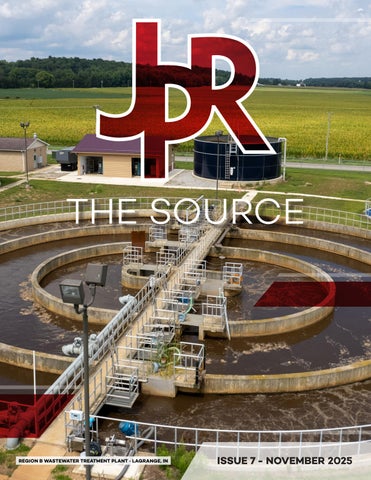
THE SOURCE
REGION B WASTEWATER TREATMENT PLANT - LAGRANGE, IN
ISSUE 7 - NOVEMBER 2025
JPR IS A FULL-SERVICE ARCHITECTURE AND ENGINEERING FIRM OFFERING COMPREHENSIVE PROJECT LEADERSHIP AND MANAGEMENT FROM START TO FINISH.
WATER TOWER PARK - MICHIGAN CITY, IN
South Bend Office 325 S. Lafayette Blvd. South Bend, IN 46601 P: 574.232.4388
04
PLAY, PLACE, & POSSIBILITY
10
CALLED UP TO THE BIG LEAGUES
14
Fort Wayne Office 111 W. Berry Street Fort Wayne, IN 46802 P: 260.422.2522
INVESTING IN WASTEWATER INFRASTRUCTURE
A LETTER FROM THE LEADERSHIP TEAM As we head into the last months of 2025, big things continue to happen at JPR! We’ve officially moved in and are fully operational at our new downtown Fort Wayne location. The staff involved have done an outstanding job of making what I know firsthand is a very difficult process look effortless. Managing this process is far more complex than it appears, with constant challenges and an ever-growing to-do list — all while projects and client priorities carry on as usual. It takes a motivated, respectful, and thoughtful team to handle it so well, and I couldn’t be more impressed with JPR’s Fort Wayne team. We’re also gearing up to begin work on several new public-use projects that promise to be interesting, challenging, and deeply rewarding. I can’t wait to see them come to fruition! Our group takes great pride in helping local officials and stakeholders make positive, lasting, and meaningful impacts within the communities we serve.
KENNETH JONES, JR., PS
PRINCIPAL
I believe this commitment becomes tangible to the clients who get to know us, and it’s one of the reasons why this type of work — and these types of projects — continue to find their way to us. Add to that a Marketing Department that knows how to communicate and demonstrate this to the rest of the world in such a sincere and top-notch manner, there’s no limit to what we can accomplish. The significance of the coming year for all of us at JPR cannot be overstated — not only in terms of projects and clients, but also with some exciting generational milestones on the horizon. I can’t wait to experience it all right alongside each of you! Here’s to a fantastic 2025 and an even better 2026!
Reimagining Water Tower Park through universal design and community-driven creativity.
WATER TOWER PARK - MICHIGAN CITY, IN
www.jpr1source.com | 5
EXISTING TENNIS COURTS WERE REPURPOSED AS THE FOUNDATION FOR COLORFUL PLAYGROUND SURFACING & BLACKTOP GAMES
T
ucked within a dense residential district of Michigan City, Indiana, Water Tower Park has long been a community fixture — a small but beloved neighborhood green space where generations once gathered for pickup games, summer play, and casual connections. Over time, however, the park’s amenities had aged beyond use. Cracked tennis courts, outdated play equipment, and limited accessibility left it underutilized and disconnected from the daily life of its neighbors.
Today, Water Tower Park stands as a model of what can happen when thoughtful design, equity, and community collaboration converge.
6 | www.jpr1source.com
The recent redesign, led by JPR, transformed this once-forgotten corner into an inclusive and vibrant public hub that celebrates both play and connection. “We began with a simple question: how can this park better serve everyone?” - JPR Design Team Driven by a commitment to social equity and health-focused design, JPR started the process by listening. Through community meetings with local educators, disability advocates, and neighborhood residents, the team gathered input that shaped every major decision — from equipment selection and surfacing materials to
circulation patterns and shade placement. These conversations became the foundation of a park that now feels safe, intuitive, and welcoming for users of all ages and abilities. At the heart of the redesign lies an inclusive playground grounded in universal design principles. The former playground was relocated to a more visible, central area and retrofitted to improve safety and accessibility. Its new layout features ramps and tactile panels, along with a dual-person slide, cozy cocoon, zipline, and sensory-rich components such as a wheelchairaccessible glider and merry-go-round. These features were carefully selected to foster shared play experiences and ensure people of all abilities can play side by side — a tangible reflection of the project’s core belief that design should bring people together, not separate them. Working within a modest construction budget, JPR turned constraint into creativity. Rather than removing the deteriorated tennis courts, the team repurposed the existing asphalt as the foundation for new poured-in-place playground surfacing. This adaptive approach reduced demolition waste, saved costs, and honored the site’s recreational history. The remaining court space was transformed into vibrant blacktop game zones and a canvas for community-created murals — a celebration of local artistry that weaves play, color, and memory into the park’s daily experience Elsewhere, strategic reorganization of amenities enhances safety, comfort, and connectivity. The full-size basketball court was relocated to a more active, open area to promote passive surveillance and positive social use. Expanded ADA-compliant pathways link all corners of the site, creating an intuitive network that supports mobility for wheelchairs, strollers, and pedestrians alike. Additionally, a compact off-street parking lot improves accessibility without compromising the park’s neighborhood scale.
THE MERRY-GO-ROUND ACCOMMODATES USERS WITH & WITHOUT MOBILITY DEVICES
THE DUAL-PERSON SLIDE ENCOURAGES SOCIAL INTERACTION & MOVEMENT
THE ALTA GLIDE SUPPORTS SENSORY STIMULATION & EQUITABLE PLAY
Throughout design and construction, JPR made deliberate choices to respect and preserve the park’s natural environment. Of the 84 mature trees on site, only one was removed, while new shade plantings were added to strengthen the site’s overall tree canopy. Grading and drainage solutions were refined to protect root zones and reduce maintenance needs, ensuring long-term resilience. These ecologically sensitive decisions, coupled with durable materials and passive programming, allow the park to grow and adapt alongside the community. “Every design decision reflected a balance of inclusivity, sustainability, and community pride.” – Austin Blomeke, PLA Water Tower Park’s renewal demonstrates how small neighborhood parks can act as catalysts for community health, equity, and pride. By integrating inclusive play, public art, and ecological care, the design team created a space that supports both physical well-being and social connection. The park now serves as a daily destination for families, youth, and seniors — a place where neighbors connect, children play side by side, and the simple act of being outdoors feels accessible to all. Through collaborative design and adaptive reuse, Water Tower Park redefines what’s possible within the constraints of a limited budget and compact footprint. It is a testament to the power of listening — to residents, to the environment, and to the quiet stories embedded in place. Today, the park stands as a living example of inclusive urban design and community-driven creativity — proof that great public spaces don’t have to be grand to make a lasting impact. They simply need to reflect the people they serve. Services Provided Engineering Landscape Architecture Planning Surveying 8 | www.jpr1source.com
THE EXISTING PLAYGROUND WAS ENHANCED WITH NEW ACCESSIBLE RAMPS AND INCLUSIVE PLAY COMPONENTS
Our Fort Wayne office has relocated to
111 W. Berry St, Fort Wayne, IN 46802
Thanks to everyone who celebrated with us at our open house!
E
very few years, Major League Baseball (MLB) and Minor League Baseball (MiLB) facilities undergo a Professional Development League (PDL) audit, a detailed evaluation designed to ensure stadiums meet MLB’s rigorous standards for quality, safety, and player development. The audit process began in 2020 when MLB assumed oversight of Minor League Baseball and sought to better understand the condition of all 120 affiliated facilities. From that initial round of audits, a point-based system was created to encourage consistent investment and improvement across the league, ensuring that every club maintains a high standard of safety, training, nutrition, and overall player welfare.
EVALUATING THE SCRANTON/WILKES-BARRE RAILRIDERS’ HOME CLUBHOUSE
JPR was brought in by MLB to assist with this nationwide effort, thanks to the firm’s deep experience in sports facility design, renovation, and operations. Over years of working on baseball projects, JPR developed a strong relationship with MLB and earned recognition for its technical expertise and understanding of how stadiums function day to day. Today, JPR plays an important role in ensuring that both Major and Minor League ballparks continue to meet evolving professional standards. Each PDL audit evaluates three major areas of a facility. 1.
Player Areas: Including locker rooms, training and weight rooms, commissaries, and coaches’ spaces
ASSESSING THE BATTING TUNNELS AT THE FRISCO ROUGHRIDERS’ BALLPARK
2. Playing Field: Where elements like slope, wall padding, safety features, and field dimensions are measured 3. Lighting System: Ensuring consistent visibility and performance for players and fans On the Major League side, JPR’s work focuses primarily on lighting, while Minor League audits encompass all three categories. The audits operate on a three-year rotation, meaning no stadium goes longer than three years without review. Occasionally, special circumstances or renovations prompt an additional visit. Each audit cycle begins during the
INSPECTING THE FIELD WALLS AT THE JERSEY SHORE BLUECLAWS’ STADIUM
www.jpr1source.com | 11
LAYING OUT THE LIGHTING POINTS AT THE HOUSTON ASTROS’ STADIUM
off-season, when JPR coordinates with MLB to determine which facilities will be assessed and to schedule visits around team travel and event calendars. Once on site, the process typically takes two days: the first afternoon and evening are dedicated to evaluating clubhouse and lighting conditions, followed by field assessments the next morning. Reports are analyzed, drafted, and typically delivered to MLB within a week. To date, JPR has audited more than 30 stadiums across the country — including 12 Major League and approximately 20 Minor League ballparks — and no two experiences are alike. Each facility offers something unique, from the design and fan experience to its operational setup and location. Some ballparks stand out for their setting, such as Salt Lake City’s stunning view of the Wasatch Mountains, while others are memorable for their energy and atmosphere. Of course, not every trip is without challenges; the JPR team has faced everything from scorching temperatures 12 | www.jpr1source.com
in Texas and Nevada to long travel days and tight schedules. Dave Rafinski, PDL Auditor and JPR Principal, reflected that while many moments seem funny in hindsight, they didn’t feel that way at the time — most of them centered around travel experiences. “Having to take that many flights, rent that many cars, be on trains, taxis, Ubers — it sometimes feels like you’re living in the movie Planes, Trains, and Automobiles,” he said. “We’ve had about every kind of travel mishap occur to us over the course of the time that we’ve been doing this, but we’ve been able to survive them all.” While every stadium presents unique characteristics, many face similar technical challenges — such as correcting mound slopes, balancing lighting ratios, improving wall padding, and managing overall field grading. Beyond these onfield issues, another common obstacle is securing the funding needed for larger facility upgrades, especially since many Minor League ballparks are municipally
owned and rely on local government support for renovations. Even so, the trend across the league is positive: both teams and municipalities are investing more heavily in their facilities, not only to meet PDL standards but also to enhance the fan experience and overall quality of the ballpark. “These audits allow us to see a lot of different stadiums: the way they’re built, the way they’re operated, and the way fans interact with them. It allows us to look at things that work really well — and some things that don’t — and generate a better design for our clients.” - Dave Rafinski, Auditor & JPR Principal
JPR’s unique qualifications come from its combination of surveying, architectural, and lighting expertise, paired with extensive experience designing more than 15 baseball stadiums and numerous other athletic venues. This hands-on
experience not only enhances the accuracy of each audit but also informs JPR’s broader work in sports facility design and site development. The audits help JPR stay current with design trends, innovations, and the evolving needs of professional sports organizations, strengthening the firm’s expertise in athletic facility planning at every level. Beyond the technical aspects, there’s a shared appreciation for the people and experiences that come with the job. “We’ve had the opportunity to work with and meet a lot of different people with different backgrounds and experiences,” Dave said. “But everybody has the same thing at the core — a love for the game of baseball.” Building on that sentiment, Cam Rafinski, PDL Auditor and JPR’s Business Development Specialist, added that exploring clubhouses and facilities that most fans never get to see — and experiencing stadiums across the country — makes the process especially rewarding. “I have a greater appreciation for the work that goes into running a baseball team,” he said, “along with an understanding of how important it is to have the right design that makes the stadium function on game days.” As the audits continue, JPR expects to see ongoing investment in player well-being and inclusivity. According to Dave, the level of thought and care that goes into player health and safety is beyond what most people would ever imagine. “To be at a point now where even at the lowest tiers of Minor League Baseball, nutritionists and trainers are structuring meals to ensure player development is at its highest possible standard — that’s something we never would have seen years ago.” What remains constant is MLB’s commitment to providing safe, highquality environments that support long-term player success. Through its ongoing partnership with MLB, JPR plays a key role in maintaining that commitment — keeping America’s ballparks safe, modern, and built for the future of the game. www.jpr1source.com | 13
14 | www.jpr1source.com
REGION B WASTEWATER TREATMENT PLANT - LAGRANGE, IN REGION B WASTEWATER TREATMENT PLANT - LAGRANGE COUNTY, IN
www.jpr1source.com | 15
T
he LaGrange County Regional Utility District (LCRUD) recently completed a major upgrade to its Region B Wastewater Treatment Plant, marking a milestone in the District’s ongoing commitment to reliable, efficient, and environmentally responsible service. Design work began in 2019, with construction completed in two phases between May 2020 and May 2023. The multi-year project addressed aging infrastructure, improved treatment efficiency, and extended the useful life
of the plant by more than 30 years.
16 | www.jpr1source.com
REGION B WWTP OXIDATION DITCH
Project Overview
This engineering project was completed in two phases: •
Phase I (2020–2021) - Included a new electrical and blower building and equipment, replacement of the standby generator, a new storage building, and major yard piping improvements for sanitary sewers, storm sewers, air lines, influent force main, and sludge transfer pipes.
•
Phase II (2021–2023) - Focused on plant performance and efficiency with a new sludge dewatering pad and storage shelter, oxidation ditch upgrades, clarifier and UV system improvements, aerobic digester enhancements, yard piping, surge tank bypass, RAS/WAS pump room improvements, and the replacement of an existing pinch valve, along with the expansion of on-site storage.
500 kW DIESEL STANDBY ELECTRICAL GENERATOR
These upgrades have increased the reliability of the wastewater treatment plant (WWTP), while also allowing the District to process its own sludge — eliminating the need for contract hauling and reducing operational costs. Sludge is the solid byproduct that remains after wastewater is treated. When sewage or wastewater enters a treatment plant, it goes through several stages to remove solids, organic matter, and contaminants. The liquid portion becomes clean, treated water that can be safely discharged or reused — but the solid material that settles out during the process is called sludge.
REGION B LIFT STATION NO. 8
REGION B WWTP CLARIFIERS
www.jpr1source.com | 17
Innovation in Action
One of the project’s most technically challenging tasks involved the Oxidation Ditch Improvements. Crews installed and/or relocated five aerators within the existing structure, cleaning out and providing concrete patching for each channel — all while keeping the plant operational. To do this, each channel of the Oxidation Ditch needed to be taken down one at a time and bypassed. Work was carefully scheduled during nonpeak flow periods to maintain treatment performance. An oxidation ditch is a type of biological wastewater treatment process used to remove organic matter and nutrients (like nitrogen) from sewage. You can think of it as a large, oval-shaped channel where wastewater is continuously circulated and aerated. Oxidation ditches are popular because they’re efficient, stable, and lowmaintenance, making them ideal for small to mid-sized communities. The installation of variable frequency drives (VFDs) on blower motors and sludge pumps also improved energy efficiency by softening electrical starts and allowing the motors to run more
efficiently, reducing electrical demand and operating costs. Another major achievement was the decommissioning of the Region F WWTP. The facility had exceeded its useful life and would have required significant capital investment to restore. Instead, it was determined that extending the wastewater collection system from Region F to Region B would be more cost-effective. Flows from that area are now directed to the upgraded Region B facility, improving operational efficiency and eliminating an additional discharge point—benefiting local water quality.
Community Benefits & Future Outlook
The Region B Wastewater Treatment Plant (WWTP) serves the areas surrounding Big and Little Turkey Lake, Pretty Lake, Big Long Lake, Lake of the Woods, McClish Lake, Blackman Lake, Fish Lake, Royer Lake, and the unincorporated towns of Stroh and South Milford in LaGrange County. By modernizing this critical infrastructure, the District has ensured that customers in these communities will continue receiving dependable wastewater treatment service for decades to come. The project also
Additional components of the LaGrange County RUD Region B Wastewater System Improvements project include: •
Upgrades to lift station pumps, components, and site work at the existing Region B Lift Stations (No. 1, 2, 3, 4, 5, 6, 7, 8, and 10)
•
Replacement of an existing gravity sewer crossing State Road 3 in South Milford
•
Replacement of the existing sanitary force main between Lift Station No. 7 and 8
•
Abandonment of the existing wastewater treatment facility serving the LaGrange County RUD Region F service area, with connection to the Region B service area through the installation of two new pump stations and a sanitary force main
18 | www.jpr1source.com
enhances environmental protection by reducing potential nutrient discharge into local waterways and eliminating an additional discharge point through the consolidation of the Region F facility. Project leaders credit full-time inspection and strong contractor coordination for keeping the project on track and ensuring high-quality results. “Looking back, I am most proud of my involvement in the elimination of the Region F Wastewater Treatment Plant. It not only improved operations within the District as a whole but also resulted in tangible environmental benefits for the community.” - Dan Byam, PE With the project now complete, the LaGrange County Regional Utility District is well-positioned to meet current and future wastewater needs—supporting sustainable growth and continued environmental stewardship throughout the region. Services Provided Engineering Land Surveying Architecture Environmental Project Funding
IT TAKES A TEAM At JPR, we are dedicated to delivering exceptional client service through every stage of a project. Our goal is to complete each project on time, within budget, and beyond expectations. This commitment is driven by a culture of collaboration and a shared passion for going above and beyond what’s required. Our success is a direct result of the talented professionals who make up the JPR team, and we’re proud to highlight a few of these professionals who played a role in bringing the projects on the previous pages to life.
ALLIE NAHRWOLD, PE Project Engineer Allie joined JPR in 2018 and quickly became an invaluable member of the team. Her dedication, drive, and technical expertise have allowed her to play an integral role in a wide range of projects, from large-scale wastewater improvements to funding applications for SRF and USDA initiatives. With a strong background in water and wastewater collection design, pump station design, and construction administration, Allie brings a hands-on, solutionsoriented approach to every project she undertakes. As an expert in Civil 3D drafting, she ensures accuracy, efficiency, and innovation throughout the design process.
JOE HOWE Graduate Landscape Architect Since joining JPR in 2022, Joe has contributed to a wide range of design projects, bringing creativity, technical skill, and a deep appreciation for the natural environment to every endeavor. Passionate about enhancing how people experience the outdoors, Joe particularly enjoys projects that promote recreation and community connection. Known for his adaptability and collaborative mindset, Joe thrives in team settings and believes that open communication and shared ideas are key to producing exceptional designs and compelling visual renderings.
CAMERON RAFINSKI Business Development Specialist Joining JPR in early 2022, Cam has played a key role in strengthening client relationships and supporting the firm’s continued growth. With experience in PDL audits and a natural talent for communication, he is dedicated to fostering collaboration, responsiveness, and trust across every partnership. Cam focuses on identifying and developing growth opportunities — ensuring JPR remains connected to client needs, industry trends, and emerging markets. His enthusiasm for teamwork and continuous improvement makes him a valued contributor to JPR’s mission of delivering thoughtful, client-focused solutions.
www.jpr1source.com | 19
ARCHITECTURE | ENGINEERING | LANDSCAPE ARCHITECTURE | ENVIRONMENTAL | GIS | SURVEY | PLANNING | PROJECT FUNDING
www.jpr1source.com