THE AI QUESTION NOBODY ASKS THINK YOU’RE BEHIND? SO DO ALL YOUR COMPETITORS. PAGE 06
CROWD CONTROL HOW CROWDIQ DECODES SPORTS FANS IN REAL TIME. PAGE 09
NEED AN EDGE? BUILD A MOAT. AI ISN’T A MOAT. BUT THE WAY YOU OPERATE IT CAN BE ONE. PAGE 12
The second installment in our two-part special issue on why most transformations stall, and what it takes to change how work actually gets done.
The winners are not the ones who get it right. They’re the ones who learn fastest in motion.
—Tom Koulopoulos Futurist, Delphi Group Chairman & Best-Selling Author
Over four decades ago, Insigniam pioneered the field of organizational transformation. Today, executives in large, complex organizations use Insigniam’s consulting services to generate breakthroughs in their critical business results. Insigniam’s innovation consulting enables enterprises to identify and cross into new strategic frontiers to rapidly generate new income streams. Insigniam provides executives of the world’s largest companies with management consulting services and solutions that are unparalleled in their potency to quickly deliver on strategic imperatives and boost dramatic growth. Insigniam solutions include Enterprise Transformation, Strategy Innovation and Innovation Projects, Breakthrough Projects, Transformational Leadership and Managing Change. Offices are located in Philadelphia, Laguna Beach, and Paris. For more information, please visit www.insigniam.com.
EDITOR-IN-CHIEF
Shideh Sedgh Bina sbina@insigniam.com
EXECUTIVE DIRECTOR
Jon Kleinman jkleinman@insigniam.com
CONTROLLER
Steve Niedzielski sniedzielski@insigniam.com
DIRECTOR OF MARKETING AND SALES OPERATIONS
Natalie Rahn nrahn@insigniam.com
DIRECTOR OF CONTENT
Jon Ball jball@insigniam.com
INSIGNIAM.COM
Mia Studenroth mstudenroth@insigniam.com
CONTRIBUTORS
Adam Hofmann, Ryan Jones, Guillaume Pajeot, Stuart Stern, June Zeringue, Jennifer Zimmer
IQ | InsigniamQuarterly is a thought leadership publication committed to transforming the world of business by offering content relevant to the C-suite and their executive teams at large, complex global enterprises.
The most eye-opening lesson of the past two years is also the quietest: the technology works. The models are extraordinary, the budgets have cleared, adoption is nearly universal—and in most organizations, almost none of it has reached the P&L. That is the fact this issue sits with. The barrier was never capability. It was the work that capability was aimed at, and the operating model that never changed to receive it.
This is the second of two issues in our Hard Truths series—a companion to the first, not a sequel. Where that issue examined performance, the strategy, execution, and culture that decide whether a plan delivers or merely circulates, this one examines transformation: the technology decisions, operating model redesigns, and organizational bets that separate the enterprises pulling away from everyone else. The first asked what is actually running your organization. This one asks what it takes to change it.
The features inside—on AI, on cost and performance, drawn from real cases and the executives living them—keep arriving at the same place. AI does not deliver value; redesigned work does. Cost programs do not hold; rebuilt operating models do. The tool and the budget are only ever the trigger. What moves the number is the harder, less glamorous act of changing how the work itself gets done.
That is the hard truth this series was built around. The obstacle most enterprises are fighting is one they built themselves, and no platform or budget will remove it. Hours get saved and never become capacity. Pilots multiply and never climb. Until leaders rebuild the work itself—who owns the outcome, where judgment belongs, how decisions are made—every initiative they launch will be quietly absorbed by the model it was meant to replace.
We made these issues for leaders who are done mistaking motion for progress— ready not just to name what runs their organization, but to rebuild it. As always, thank you for your engagement, your candor, and your partnership. IQ
Bina Founding Partner, Insigniam & Partner,
Elixirr
Shideh Sedgh
Summer 2026: The Hard Truths Issue | Part II
“Done well, AI increases access while improving outcomes. Done poorly, it creates risk at both the industry and brand level.”
—John Goddard CEO, Quilter Cheviot
BROWSER HISTORY NOVEL CHANGE
New book releases to transform your mind and prime you for tackling today’s hard truths.
By Ryan Jones
TECH BYTE THE QUESTION NOBODY OPENS WITH Executives often ask the same questions around AI. Here’s the one they should.
By Adam Hofmann
06 22 36 26
EXECUTIVE Q&A RACHEL GOODGER, CRO, CROWDIQ
How sports teams are transforming experiences around fan data.
By Insigniam Quarterly
SEMINAL FEATURE NEED AN EDGE? BUILD A MOAT. AI won’t protect your competitive edge. But how you use it just might. 12
COVER STORY HARD TRUTHS, PT. 2
Confronting the barriers that thwart transformation.
By Jon Ball
COST & PERFORMANCE THE WRONG FINISH LINE
By the time your dashboard shows the problem, your op model has already failed.
By June Zeringue
AI TRANSFORMATION WHY MOST PILOTS NEVER FLY
Thousands of AI pilots have failed to climb. The reason is rarely the plane.
By Guillaume Pajeot
TAKE ACTION WHAT TRANSFORMATION REQUIRES NEXT Considerations for executives ready to level up.
By Jennifer Zimmer
By Shideh Sedgh Bina & Stuart Stern
HARD TRUTHS: PART II BROWSER HISTORY
NOVEL CHANGE *
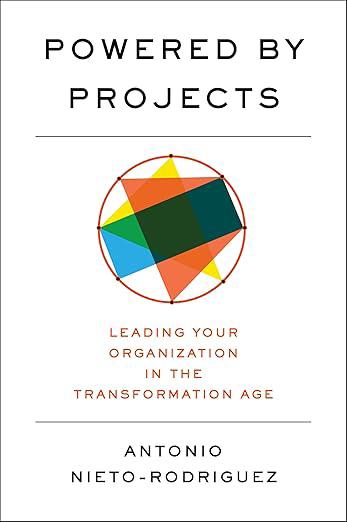
Powered by Projects
By
Antonio NietoRodriguez; HBR Press, Jan. 2026
In Powered by Projects, author Antonio Nieto-Rodriguez argues that transformation no longer happens around the edges of the enterprise; it happens through projects. Powered by Projects makes the case for organizations built to prioritize, sponsor, and resource the work that creates value. Beyond agile practices, the book shows leaders how to strengthen adaptability, decentralize decisions, engage teams, and apply AI to planning and execution, turning project work into a disciplined engine for growth, innovation, and resilience.
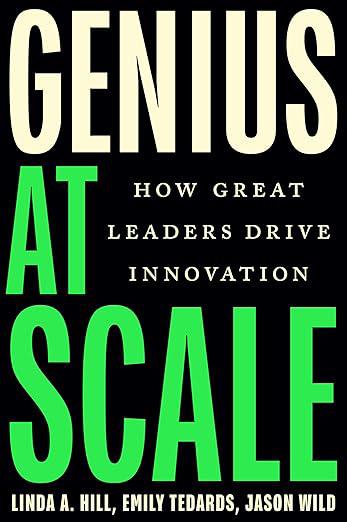
Genius at Scale: How Great Leaders Drive Innovation
By Hill, Tedards & Wild, HBR Press,
March 2026
Innovation rarely fails because organizations lack ideas; it fails when promising ideas never scale. Genius at Scale explores what leaders must do to turn experimentation into lasting impact. The book frames innovation leadership around three roles—architect, bridger, and catalyst— showing how leaders build cultures for co-creation, connect teams and partners across boundaries, and mobilize broader ecosystems. Drawing on global examples, it offers a practical guide for leading innovation through disruption, volatility, and shifting expectations today.
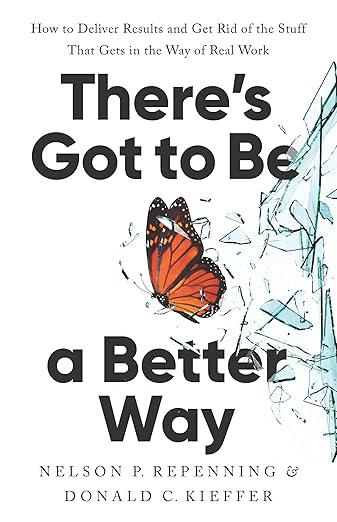
There’s Got to Be a
Better Way
By Repenning, Kieffer & Dodge, Basic Venture Publishing, Aug. 2025
In There’s Got to Be a Better Way, Nelson Repenning, Don Kieffer, and Sheila Dodge make the case for dynamic work design as a practical alternative to constant firefighting and hollow productivity pushes. Rather than adding more programs, meetings, or reorganizations, the book shows leaders how to uncover the real problem, improve flow, make work visible, and connect people across the system—closing the gap between what organizations promise and what they deliver today.
By taking readers inside the day-to-day work of large-scale change at leading companies and organizations, Genius at Scale will help leaders in every walk of life think and work bigger.
—Rajiv J. Shah, President, The Rockefeller Foundation
HARD TRUTHS: PART II
The Question That Nobody Opens With
Every leader asks if they’re behind. The ones pulling ahead are asking something else entirely.
By Adam Hofmann, Elixirr Partner
Ispent a week in late May with executives across South Africa: a client event first, then a string of one-on-one conversations that started in very different places and kept ending in the same one. Two questions came up in nearly every room: “Are we behind,” and, “Is this actually worth what we’re spending on it?”
And then there was a third question, the one nobody opened with, but almost everyone asked once they trusted the room:
“Do we even know what the AI-native version of our business looks like?”
What I told them is that you’re in the same spot as everyone, regardless of geography or industry. The noise doesn’t make it easy. A new model drops, a headline breaks, and every leader feels obligated to do something about it that same week. The most valuable skill of a leader right now is filtering noise to find signal, then deciding what your team isn’t going to do.
In the previous issue of IQ, I argued that the center of gravity has moved: value migrated from human execution to system execution while most org charts stood still. Since then, the ground has kept shifting.
Five assumptions leadership teams have been quietly leaning on expired this spring. Each one raises the price of standing still.
The first expired assumption: “We need to pick the right model.”
For two years, every CIO conversation included some version of “which model do we standardize on?” That question is dead, and good riddance. The frontier labs stopped behaving like model companies and started behaving like deployment companies, embedding their systems inside the tools where work actually happens and dismantling the security objections enterprises have hidden behind. The labs figured out what most of their customers haven’t: handing people a tool isn’t enough.
Value shows up only when somebody redesigns the workflow around it. If you’re still deciding which model to buy, you’re answering a question two years late. The harder one: who inside your organization is actually capable of redesigning the work?
“If you’re still deciding which model to buy, you’re answering a question two years late.”
—Adam Hofmann Elixirr Partner
The second: “AI costs are spiraling.”
The headlines feed this worry: pricing resetting from fixed licenses to metered consumption, compute bills that rival the payroll they were meant to augment. But two problems are being conflated. The first is deployment discipline. A new flagship ships, everyone rushes to it, and the previous model, working fine three days earlier, gets dramatically cheaper the same week.
Chasing the frontier by reflex is a choice, not a cost structure. The second problem is the real one: most organizations are scaling AI with no measurement discipline. Picture the person who consumed $10,000 of compute last month. Do you know what they produced? Can you compare them to the person who consumed $200? Almost nobody can. The story under the cost panic isn’t that AI got expensive. It’s that almost no CFO’s office can answer the only question that matters: which people are creating value, and which are just burning tokens?
The third: “The labor question can wait.”
For two years, AI displacement was a bullet point on a strategy deck. This spring it broke into courts, legislatures, and even the Vatican: a papal encyclical on AI, a foreign court ruling that AI-driven dismissals don’t qualify as valid terminations, and major banks shifting their earnings-call language from “productivity” to “labor reduction.” The cautionary tales are public, too: organizations that cut deeply while degrading the experience of the people who stayed have become the case study every Fortune 500 employee has now seen.
If reducing headcount with AI is part of your next twelve months, the operating environment just got materially harder. And there’s a second question almost nobody asks out loud: what about the people who stay? The leaders who navigate this well will answer both in the same breath.
The fourth: “Technology is a bottleneck.”
The clearest signal came from the labs themselves. When the companies building the most capable models stand up dedicated deployment businesses to compete with the
major consultancies, they’re saying it out loud: the model is not the bottleneck. The last mile is.
Inside the labs, coding agents went from impressive demo to producing most of their own engineering output in roughly a year. That gap, from “the demo is amazing” to “this is how we ship work,” is the one most enterprises haven’t crossed. The capability arrived but the operating model didn’t. The leaders crossing it have stopped framing AI as a tool rollout and started treating it as an organizational redesign: which workflows get rebuilt around digital coworkers, which roles get rewritten before they’re filled, what people must learn to direct the work rather than do it.
The fifth: “Originality is our moat.”
This is the quietest shift and the one I’d watch most closely. AI systems have now produced novel, formally verified results in pure mathematics: open problems that stood for decades, solved for a few hundred dollars of compute, with proofs a human can audit. That is not AI helping researchers, it’s AI generating original work that researchers verify and publish. Several knowledgework categories your business depends on, from legal opinion to regulatory strategy to R&D, price themselves on the scarcity of human originality. That assumption was just contradicted in one of the hardest domains there is. Which of your moats can a verification loop and a modest compute budget now produce?
The Question That’s Left
Can you describe the AI-native version of your business? Not the version with AI added, but the version designed around it. If you can’t, you’re in good company. But then the question becomes the one that actually separates organizations: who, specifically, is working on it? Most of the time, the honest answer is nobody yet. That’s the hard truth of transformation. The technology will keep improving whether you redesign or not. The only variable in your control is whether your organization does the describing, or gets described later as the company that had every tool and changed nothing. IQ
EXECUTIVE PERSPECTIVE
Rachel
Goodger
CHIEF REVENUE OFFICER, CROWD IQ
CrowdIQ’s chief revenue officer, Rachel Goodger, on why sports organizations still misunderstand their fans—and how behavioral intelligence is reshaping decisionmaking, sponsorship, and revenue.
Even with all the advances in AI, most teams have not fully deployed it in a way where they are comfortable letting it operate autonomously. There is still a level of hesitation.
Rachel Goodger is Chief Revenue Officer at CrowdIQ, a crowd analytics platform that uses computer vision to measure realtime fan demographics and behavior at live events. Her work helps teams, venues, and sponsors understand who is in the building, how fans engage, and where commercial opportunities are being missed. She brings expertise in revenue strategy, sports partnerships, fan intelligence, AI-ready data, sponsorship optimization, and live-event commercialization at scale.
TEAMS ARE SURROUNDED BY DATA INTO FAN BEHAVIOR, YET DECISIONS DON’T ALWAYS CHANGE. WHY IS TRANSLATING INSIGHT INTO ACTION SO DIFFICULT?
Ms. Goodger: The surprising thing is that most teams still do not have true visibility into fan behavior and engagement. They are inundated with data, which can create confidence, but it does not always show who is actually in the building or what they are paying attention to. Ticketing data is valuable, first-party, and actionable, but it often captures only the buyer, not the full group they bring. Surveys have similar limits, because they tend to overrepresent the loudest voices. At CrowdIQ, we are focused on closing that gap by giving partners insight into every fan in the venue. The last mile starts with awareness that behavioral intelligence now exists.
The teams that adopt behavioral intelligence and lean into AI are going to make more money because they are saving time.
MANY ORGANIZATIONS DESIGN EXPERIENCES BASED ON ASSUMPTIONS ABOUT THEIR AUDIENCE. WHERE IS THE BIGGEST GAP BETWEEN WHO TEAMS THINK IS IN THE BUILDING AND WHO IS ACTUALLY THERE?
Ms. Goodger: The biggest gap is in the fundamental assumption of what a sports fan looks like. If you and I think about a sports fan, we probably have a similar image in our heads. But that is not necessarily who actually shows up. What we consistently see across major leagues is that fans under 40 are almost always split about fifty-fifty male and female, which challenges a lot of traditional assumptions. There is also a perception that fandom skews older, when in reality, we are seeing strong turnout from younger audiences, including Gen Z, often in much higher numbers than expected. The issue is that these groups are not reflected in ticket buyer data. That is where the disconnect begins. We worked with an NBA partner over the course of a season, where their ticketing data showed about 4% of their audience was Gen Z. When we measured the actual crowd, it was closer to 22%. That is not an anomaly. It is something we see consistently. A lot of that comes down to who is purchasing the ticket versus who is actually attending. One person buys the ticket, but the people who show up can look very different. So you end up designing experiences, content, and partnerships around an assumed audience that is not actually there.
Rachel Goodger
03
SPONSORSHIP HAS LONG BEEN SOLD ON ASSUMED REACH RATHER THAN VERIFIED ENGAGEMENT. WHAT DOES IT TAKE FOR ORGANIZATIONS TO SHIFT FROM SELLING EXPOSURE TO PROVING REAL AUDIENCE VALUE?
Ms. Goodger: In-venue sponsorship has been built on a proxy: attendance stands in for engagement, and reach stands in for attention. Historically, if 18,000 fans were at a game, that has been your impression count. But those 18,000 people are not looking at the scoreboard or signage for the entire game. CrowdIQ measures attention and engagement in real time—where fans are looking, what they are engaging with, and how that changes moment to moment. That allows you to benchmark engagement across the field of play, the big screen, activations and fans’ phones. It creates a fundamentally different conversation with sponsors: evidence, not assumptions.
04
AS BEHAVIORAL IQ BECOMES MORE ACCESSIBLE, WHAT WILL SEPARATE THOSE WHO TURN IT INTO AN ADVANTAGE FROM THOSE WHO DON’T?
Ms. Goodger: For me, it comes down to revenue and time. The organizations that adopt behavioral intelligence and lean into AI are going to make more money because they are saving time. It is not about replacing the workforce. It is about making everyone’s job easier and enabling them to do more.
If you can query your data and get an answer in 10 seconds instead of spending an hour manually pulling it together, that changes how quickly you can operate. It changes how decisions get made, how campaigns are executed, and how teams spend their time day to day. That efficiency ultimately translates into revenue. It allows organizations to move faster, be more precise, and take advantage of opportunities that they might otherwise miss. And then, over time, that becomes a meaningful competitive edge IQ
RACHEL GOODGER Chief Revenue Officer, CrowdIQ
Want a Competitive Edge? Build a Moat.
In the AI era, defensible moats are created by how work gets done, not by the tools used to do it.
By Shideh Sedgh Bina & Stuart Stern
Every leadership team is asking the same question: how do we win with AI? Budgets are being reallocated. Pilots are multiplying. Boards are demanding roadmaps. In many organizations, AI has become the centerpiece of the growth agenda for 2026 and beyond. The underlying assumption is rarely questioned. If we move faster, invest more, and deploy better tools, we will gain an advantage. Yet, that assumption is wrong
60%
Although first movers often capture advantage , 3/5 of AI-driven digital transformation gains erode within 2–3 years as competitors catch up, reports MIT Sloan Management Review.
35 %
AI deployment is outpacing org redesign , with 35% of organizations surveyed by MIT reporting they are deploying agentic AI (with another 44% planning to), yet competitive advantage remains elusive for most.
0.7 %
The performance gap, according to the Stanford Institute for Human-Centered Artificial Intelligence, between the top-ranked and tenth-ranked AI models.
AI is following the same economic path as every major general-purpose technology before it. Performance is improving rapidly, costs are falling, and access is expanding at scale. What begins as a differentiator quickly becomes infrastructure. What is scarce becomes widely available. What once separated leaders from laggards becomes table stakes.
Nicholas Carr made this argument nearly two decades ago in his Harvard Business Review article “IT Doesn’t Matter,” where he observed that as technologies become ubiquitous, they shift from sources of strategic advantage to essential utilities. That pattern is now repeating at unprecedented speed with AI.
Recent analysis from MIT Sloan Management Review reinforces this point. As large language models and AI tools become commoditized, their availability increases across industries, compressing any advantage derived from the technology itself. What remains is not the tool, but how it is used.
This is not a theoretical concern; it is already visible in the data.
Goldman Sachs estimates that AI could add trillions in economic value globally, yet the distribution of that value will not be even. Many companies are experimenting, but far fewer are translating that experimentation into impact at scale—and when executives are asked why, the answer is rarely the technology itself. In a recent Hypothesis survey of 100 senior US executives at large enterprises, the obstacles they named were overwhelmingly about execution and readiness, not access to tools. The gap is not access to technology; it is the ability to translate that technology into performance.
The uncomfortable truth for executives is that AI will make most companies more similar, not more different.
The strategic question is no longer who adopts AI first. It is the organization that redesigns itself fastest to turn it into a system-level advantage.
Why Technology Stops Differentiating
There is a well-established body of research that explains why technology alone rarely produces sustained competitive advantage.
The resource-based view of the firm, developed by scholars such as Jay Barney—professor of strategic management at the University of Utah’s David Eccles School of Business—argues that for any asset to create lasting advantage, it must be valuable, rare, and difficult to imitate. Technology, by its nature, fails this test over time. As adoption spreads, it remains valuable but ceases to be rare or inimitable.
Empirical evidence supports this pattern. Studies examining enterprise technology adoption, including ERP systems, show that early adopters often experience shortterm performance gains and positive market reactions. However, as adoption diffuses across competitors, those gains normalize. What was once an advantage becomes a baseline expectation.
This is not unique to AI. It is the predictable lifecycle of any transformative technology. In fact, electricity followed this path. Early factories that adopted electric power saw gains, but the real breakthrough came when companies redesigned production around continuous flow rather than simply replacing steam engines. The same pattern held for the internet, cloud computing, and mobile technologies. Early movers benefited temporarily. Long-term winners reorganized how work was done.
Generative AI is already moving through this cycle. What began as a breakthrough capability is rapidly becoming embedded in standard enterprise software.
Microsoft, Google, and others are integrating AI into core productivity tools, effectively making it part of the operating environment rather than a distinct advantage.
From a strategic perspective, this has profound implications. If a capability is widely accessible, it cannot be the basis of differentiation. It can improve performance. It can increase efficiency. It can even reshape industries. But it cannot, on its own, create a lasting edge. That edge must come from something else.
History Is Clear: Advantage Comes from Reorganization, Not Adoption
If technology does not create sustained advantage, what does?
History provides a consistent answer. Breakthrough performance occurs when organizations reorganize how work is done around new capabilities.
The introduction of steam power did not transform industry until production shifted into centralized factories. Electricity did not unlock productivity gains until companies redesigned layouts and workflows for flexibility and continuous operation. Henry Ford’s innovation was not the automobile itself, but the assembly line that redefined production.
More recently, companies such as Amazon, Google, and Netflix did not win because they had access to better technology. They won because they built operating models that leveraged technology in fundamentally different ways.
Amazon turned logistics, data, and fulfillment into an integrated system that competitors have struggled to replicate. Google redefined how information is ranked and monetized through a combination of algorithms, data, and organizational focus. Netflix transformed content production and distribution by aligning technology, data, and decision-making into a cohesive system.
The hard truth for executives is that AI will make most companies more similar, not more different.
The strategic question is no longer who adopts AI first. It is the organization that redesigns itself fastest to turn it into a system-level advantage.
In each case, the technology was necessary but not sufficient. The differentiator was how the organization was designed to use it.
Research published in Strategy+Business reinforces this point. Companies that realize outsized returns from digital investments consistently pair technology adoption with changes in processes, governance, and talent models. Those who do not tend to see limited or short-lived gains.
The pattern is clear: Technology enables new possibilities, yet organizations determine whether those possibilities translate into advantage.
The AI Illusion: Optimizing the Present Instead of Redesigning the Future
Most companies are approaching AI in a way that guarantees convergence rather than differentiation. They are using it to improve existing workflows, automate tasks, accelerate processes, and optimize current operations. These efforts are valuable, but they are inherently incremental; they make the organization more efficient, but they do not make it fundamentally different.
This is the core illusion of AI adoption. Because the technology is powerful, it creates the impression that applying it will transform the business. In reality, applying AI to an unchanged operating model often reinforces existing constraints.
The same Hypothesis research makes those barriers concrete, and they are organizational rather than technical. Asked where their organizations most overestimate readiness when taking on a major initiative, executives pointed to the ability to translate strategy into actionable plans (23%) and change management and employee adoption (20%)—not to the tools themselves. Asked what actually undermines major initiatives, they named a lack of capacity to sustain the effort (36%), decisions made with incomplete
Organizations are shaped by their history, and changing ingrained routines is difficult. This is why two companies using the same technology can diverge so dramatically in performance: The tech is visible, but the system behind it is not.
context (35%), and execution drifting from its original intent (32%). These are failures of operating model, not technology.
The pattern repeats at the frontline. Nearly a third of executives (28%) say change in their organizations gets treated as technical rather than organizational—new tools layered onto existing systems without a change in how work actually gets done. Behaviors stay the same, so results do too.
The consequence is predictable. Two companies can deploy the same AI tools and achieve vastly different outcomes.
One sees marginal efficiency gains. The other creates a step-change in performance. Therefore, the difference is not the technology; it is the system in which the technology operates.
Where Real Competitive Advantage Now Lives
As AI becomes ubiquitous, differentiation shifts to what cannot be easily copied. This is where the concept of complements becomes critical. Complements are the organizational elements that determine how effectively a technology is used. They include data, processes, routines, talent, and the alignment across them.
As Harvard Business School’s Michael Porter argues in What Is Strategy, competitive advantage grows out of the entire system of a company’s activities rather than any single one. The fit among those activities is what meaningfully reduces cost or increases differentiation—and that same fit is what locks out imitators, because a chain of interlocking activities is far harder to copy than any individual link.
Furthermore, David Teece—a professor at the University of California’s Haas School of Business—extends this idea by focusing on a firm’s ability to continuously reconfigure its resources and processes. In Dynamic Capabilities and Strategic Management, he frames these as a firm’s
ability to “integrate, build, and reconfigure internal and external competences” as fastmoving conditions demand.
These capabilities are deeply embedded in how work gets done. They are reflected in decision-making routines, coordination mechanisms, and leadership behaviors. They are shaped by history and reinforced through practice.
Because they are tacit and path-dependent, they are difficult to replicate. This is where real moats now come from.
Proprietary data is one example, but its value depends on governance, quality, and accessibility. Organizational routines, such as how decisions are made and executed, determine speed and effectiveness. Integrated processes across functions enable or constrain performance. Talent and incentives shape behavior. The fit across these elements creates a system that is greater than the sum of its parts.
Research across multiple domains supports this view. Studies on IT and organizational performance consistently show that technology investments yield higher returns when paired with complementary human and organizational practices. Lean transformation case studies demonstrate that tools alone do not drive results; it is the underlying way of working that matters.
Even attempts to replicate best practices often fail because they do not account for these embedded factors. As research on path dependence shows, organizations are shaped by their history, and changing deeply ingrained routines is difficult.
This is why two companies using the same technology can diverge so dramatically in performance: The technology is visible, but the system behind it is not.
The Challenger Question Every Executive Must Answer
If technology is no longer the source of differentiation, the question for leaders
With more than 35 years of experience in management and consulting, Shideh Sedgh Bina advises Fortune 500 C-suite leaders as founder of Insigniam, partner at Elixirr, and editor-in-chief of Insigniam Quarterly. Ms. Sedgh Bina co-founded Insigniam in 2005 alongside Nathan Owen Rosenberg, establishing the firm as a pioneer in organizational breakthrough and enterprise transformation. She has been recognized as one of PharmaVOICE’s 100 Most Inspiring People in Life Sciences and was named Woman of the Year by the Healthcare Businesswomen’s Association. She holds a Bachelor of Science in Economics from Wharton.
Stuart Stern, Partner, Elixirr
Having more than 30 years of experience driving enterprise transformation across insurance, energy, transportation, and life sciences, Stuart Stern is known for delivering measurable performance improvements through innovation, technology, and operating model design. Mr. Stern began his career at Accenture and later held leadership roles at Amazon Web Services and Slalom. He holds a Bachelor of Science in Mathematics and Computer Science from Duke University.
becomes more fundamental. For instance, ask yourself, “Which of our ways of working would still outperform a competitor using the same tools?”
This question shifts the focus of strategy. It moves the conversation away from technology selection and toward organizational design.
It forces leaders to examine how decisions are made, how work flows across the enterprise, and how incentives drive behavior. It exposes whether the organization is built for speed, learning, and execution. It also reveals where the organization is constrained.
Many companies discover that their greatest barriers to performance are not external; they are internal. Decision-making is slow or fragmented. Accountability is unclear. Processes are optimized locally but not end-toend. Incentives reward individual performance rather than collective outcomes. Executives often recognize this only in hindsight: nearly a third (29%) admit they were overconfident in their ability to handle major initiatives on their own. As one financial services CEO put it, “We thought we could handle everything internally, but it quickly got more complicated than expected.” AI does not solve these problems—it amplifies them.
Organizations that fail to address these constraints will find that AI increases activity without improving results. Those who redesign their operating model will find that AI becomes a force multiplier.
What Leaders Must Consider Now
The implications for the C-suite are immediate and practical. AI cannot be treated as a technology initiative. It must be treated as an operating model transformation.
This begins with clarity about where value is created. Leaders must identify the critical decisions, workflows, and interactions that drive performance. They must understand how these elements are currently configured and where they create friction. From there, the focus shifts to redesign.
Decision rights must be aligned with speed and accountability. Workflows must be restructured to enable cross-functional
execution. Incentives must reinforce desired behaviors. Data must be governed in a way that supports real-time insight and action.
This is not a one-time effort. It requires continuous adaptation.
Research from MIT Sloan Management Review suggests that organizations that build strong dynamic capabilities are better positioned to respond to change and sustain performance. These capabilities are not built through technology alone. They are built through leadership, culture, and disciplined execution.
Furthermore, the role of leadership is critical. Executives must move beyond sponsoring AI initiatives to actively reshaping how their organizations operate. They must be willing to challenge existing structures and make trade-offs.
This is where many transformations fail. The changes required are not technical. They are organizational and behavioral.
They require leaders to rethink how power is distributed, how decisions are made, and how performance is measured.
The Real Source of Advantage in the AI Era
The narrative around AI is often framed in terms of capability. What can the technology do? How fast is it improving? How broadly can it be applied?
These are important questions, but they are not the ones that determine competitive advantage.
The real question is how organizations use that capability to create something that competitors cannot easily replicate. Technology adoption makes companies better, and organizational redesign makes them different. In the AI era, that difference is what will separate those who lead from those who converge.
The companies that win will not be those with the most advanced tools. They will be those who rewire how work gets done, align their systems for execution, and build organizations that can continuously adapt. AI will not save you. But it will reveal whether your organization is built to compete. IQ
EXECUTIVE PERSPECTIVE
Zbigniew
Lewicki
CHIEF
RESEARCH, DESIGN & INNOVATION OFFICER, MAGNUM ICE CREAM CO.
As Magnum’s Zbigniew Lewicki argues, the edge rivals cannot copy is human—the judgment that decides how the technology actually gets used.
AI cannot operate in isolation. It requires a human component to guide it, to interpret outputs, and to continuously refine and optimize the models.
Zbigniew Lewicki is Chief Research, Design & Innovation Officer at the Magnum Ice Cream Company, where he leads global innovation strategy across product development, design, and R&D. His work focuses on how organizations translate insight into scalable innovation, combining human expertise, data, and emerging technologies to drive category leadership. He brings expertise in innovation strategy, product design, R&D, AI-enabled transformation, and the culture and decisionmaking systems that turn insight into action.
MANY ORGANIZATIONS HAVE AN INNOVATION STRATEGY,
YET PIPELINES ARE CROWDED AND SLOW. IS THE BREAKDOWN IN IDEATION, DEVELOPMENT, OR SCALING?
Mr. Lewicki: I would reframe the question, because the starting point is not always as strong as we assume. Many companies have a strategy, but fewer have one that genuinely expands the category. Too often it defaults to a safer place—renovation and optimization of the existing portfolio—rather than the true category leadership where growth innovation should begin. And even with a strong strategy, the breakdown does not sit within ideation, development, or scaling. It sits much deeper, within culture. Innovation has to be in the company’s DNA, visible in how leaders behave and what is incentivized. The issue is not process or organizational design. It is fundamentally culture.
The future of innovation is not about AI replacing people. It is about AI and humans co-creating within a connected system.
Zbigniew Lewicki
WITH SO MUCH DATA AND AI-DRIVEN INSIGHT, LEADERS ARE SEEING MORE SIGNALS THAN EVER ABOUT SHIFTING CONSUMER BEHAVIOR. HOW DO YOU DISTINGUISH WHAT TRULY MATTERS FROM NOISE?
Mr. Lewicki: If you look at consumer goods and food in particular, the pace of change over the last 12 to 18 months has been extraordinary. You have developments like GLP-1, changes in how consumers think about nutrition, such as the reversal of the food pyramid, new regulations on sugar and HFSS in markets like the UK, and consumer-facing applications like Yuka reaching tens of millions of users. These are tectonic shifts, and the speed at which they are happening is comparable to what we might have seen over a decade in the past.
We are also beginning to see new behaviors emerge, including early forms of AI-driven purchasing where systems or agents start to assemble shopping baskets on behalf of consumers.
To distinguish signal from noise, you need a structural solution. It starts with clear strategic imperatives that are informed by data and supported by AI. Increasingly, companies should be thinking about how AI agents will make decisions for consumers and which attributes of their products will make them the preferred choice in that environment. The answer is not to consume more data. The answer is to build an innovation engine that translates macro trends into clear, actionable criteria for decision-making.
03
WHERE ARE YOU SEEING AI GENUINELY CHANGE THE SPEED AND QUALITY OF INNOVATION TODAY—AND WHERE IS IT STILL FALLING SHORT?
Mr. Lewicki: AI is both a buzzword and a real disruptor, and it is a positive disruptor in many ways. But one of the limitations is that we often look at it in isolation rather than as part of a broader system. I think about what I would call an intelligent innovation lab. This is an environment where you combine the best of AI models with human expertise and situate that within a modern, automated, or robotic workplace.
AI can do a very strong job of triangulating consumer data with product composition and other inputs. But it cannot fully capture the nuance of sensory experience, such as taste, texture, or the emotional component of a product. That is why human expertise remains essential. The future of innovation is not about AI replacing people. It is about AI and humans co-creating within a connected system that includes both digital models and physical, automated environments.
04 AS AI
BECOMES MORE
EMBEDDED, WHERE DOES HUMAN JUDGMENT REMAIN ESSENTIAL, AND WHAT SHOULD BE HANDED OVER
TO THE MACHINE?
Mr. Lewicki: There is a misconception that creativity is the primary driver of innovation. Pattern recognition is the most powerful driver of innovation effectiveness, and this is an area where AI models perform exceptionally well. They can process large amounts of data and identify relationships that would be difficult for humans to see.
At the same time, AI cannot operate in isolation. It requires a human component to guide it, to interpret outputs, and to continuously refine and optimize the models. There needs to be a hybrid learning loop between human expertise and machine capability. If organizations rely too heavily on AI, there is a risk of losing critical human skills and expertise. Over time, that could weaken the organization’s ability to differentiate itself. So the objective is not to replace human judgment—which remains essential in shaping, validating, and evolving the system—but to find the right equilibrium IQ
LEWICKI Chief Research, Design & Innovation Officer, Magnum
ZBIGNIEW
Ice Cream Co.
Hard The Issue Truths
Pt. II
Confronting why our clients’ largest transformation investments underperform, and the work they are built to run on.
In this second part of our two-part special issue, we examine why enterprises commit enormous sums to the tools of change and still fail to change. Designed for CXOs under constant pressure, it reframes transformation not as a technology problem, but as a question of what that technology is made to run on.
Part Two examines the disciplines where the gap between investment and outcome is widest and most consistently misread: AI enablement, the practice of getting a capability past the experiment that stalls and into the work itself; and cost and performance, the practice of measuring a transformation by what it actually changes rather than by what it spends or saves. Each is examined on its own terms. Each connects to the other in ways most transformation programs never address. And each, when it fails, fails for reasons that are structural rather than technical, systemic rather than tied to any single tool, and entirely within the reach of leadership willing to look honestly at what its investments are actually running on.
The hard truth for most enterprises is that they are investing heavily in the instruments of change while leaving intact the conditions that guarantee those instruments will underperform. Transformation was never the technology. It was always what the technology runs on, and its sponsors are often the last to see the difference.
—Jon Ball, Editor, Insigniam Quarterly
04
PERFORMANCE
Your dashboards show everything...except if transformation is actually taking hold. Page 26
05
AI TRANSFORMATION
95% of AI pilots never move the P&L. The problem isn’t the model. Page 36
06 TAKE ACTION
Facing all of your hard truths—and considerations for how to forge a new future. Page 46
There is a question worth asking of any enterprise that has launched an ambitious program and then watched the impact fail to arrive: what were we actually transforming?
Not the version on the transformation roadmap or the slide listing the use cases. The real version.
In almost every case, the real version is: less than anyone admits. The model was licensed, the agents were built, the budget was committed, and the way work actually gets done — who decides what, where human judgment belongs, how the parts connect—was left precisely as it was. The tool was new. The system beneath it was not. Motion is the story people report. Flight is the story that actually had to happen.
This second part is dedicated to examining that system with the honesty most enterprises reserve for their due diligence and rarely turn on their own programs. Part One, this spring, examined performance: the strategy, execution, and culture failures that hold organizations back before they ever attempt to change. We took up performance first because transformation built on a performance deficit only accelerates the deficit. Now we turn to what the enterprises pulling away did with the harder half of the work.
The issue is anchored by a seminal feature on moats — what genuinely separates the enterprises pulling away from those still explaining the last initiative. Beneath it sit the two disciplines this introduction is most concerned with: AI transformation, in “Why Most Pilots Never Fly,” and cost and performance, in
“The Wrong Finish Line.” They appear as distinct features, but they are not separate problems. They are the same problem operating at different altitudes. An enterprise that deploys technology before it redesigns the work gets a faster version of what was already failing—the pilot that briefly climbs and then stalls. And an enterprise that judges that effort by the cost it cuts and the quarter it lands in is reading the wrong scoreboard, blind to the adoption and operating-model change that actually determine whether a transformation will hold. In both, the same error: the tool has been mistaken for the transformation.
The reporting here is grounded in current research, proprietary data from the same March 2026 survey of senior executives at enterprises with more than one billion dollars in annual revenue, and four decades of direct engagement with organizations attempting genuine change. It is designed for CXOs who are not looking for reassurance but are willing to ask, with the same rigor they bring to a capital decision, whether the transformation they are funding is the one actually taking hold.
The pages ahead offer an honest account of why most transformation underperforms, and what the organizations that beat the pattern chose to redesign before they ever switched the technology on. IQ
The Wrong Finish Line
By the time your dashboard shows the problem, your operating model has been failing for years.
By June Zeringue, Insigniam Partner
Afinish line is a promise. It is the one fixed point a race offers a runner, the assurance that effort has a boundary, that the lungs and the legs will be asked for everything but only up to a line painted across the road, and not one stride beyond. Cross it, and the race releases you. You can slow, and breathe, and let the clock stop. Every runner who has ever spent the last of themselves in the final hundred meters did so on the strength of that promise: that the line meant the end.
Some finish lines keep the promise. Others do not. There is a particular cruelty known to anyone who has rounded what they believed was the last bend, emptied the tank on a closing sprint, and then seen the real line still sitting somewhere up ahead, unmoved and unhurried, while a body with nothing left is asked to keep going anyway. The line they ran toward was not the end. It was a mark on the road that happened to look like one.
This is also, more or less, the race most executives are running on cost and performance. The painted line is the cost program. When performance wavers, the instinct of nearly every leadership team is to reach for it, because it offers what every exhausted runner craves: a visible, reachable boundary. Set a target, cut to it, cross it, declare the race won. The number moves. The board applauds. And then, with a regularity that ought to be more alarming than it is, the costs that were cut come jogging back up the road, often heavier than before, because the line that was crossed was never the end of anything. It was a mark that looked like an ending to an organization desperate for one.
The hard truth that most executives have not yet been told, and that some, when told, are slow to believe, is that cost performance is not a race you can finish. The real race is the operating model underneath it, the way work actually gets done, and that race has no painted line across it at all. An enterprise that treats the cost number as the finish, sprints to it, and slows down has not won anything. It has merely stopped running in the middle of a race that was still going on. There is a second mistake folded into the first, and it concerns what the runner watches.
THE HARD TRUTH ABOUT COST & PERFORMANCE
The metrics executives steer by count activity, not value (prompts run, pilots launched, seats deployed), while the changes that decide it (who owns the outcome, whether the operating model moved, what the freed hours are for) never reach the board. The lever that works was never the platform. It is redesigning how the work gets done.
Why the Costs Come Back—and What AI Changes
Every cost program I have reviewed in two years has the same shape. Subtract a percentage from last year’s budget. Distribute the pain. Hold the line. Then watch the work degrade and the cost creep back as overtime, contractors, and rework. Next year, repeat with a sharper knife. This is not performance improvement. It is a productivity tax dressed up as strategy, and everyone in the room knows it.
The core mistake is treating the work as fixed and the resourcing as variable. Cut the people, keep the work, and the work returns to the cost line by another door. AI inverts that. The question is not how to do the same work with fewer people. It is what the work would look like rebuilt from scratch around what an agent can now do.
That redesign is uncomfortable, because it forces an honest conversation about what each role is actually for. Most cost programs are built to avoid that conversation, which is why they do not stick.
Agentic AI earns its keep at the seams. Old automation is brilliant at a clean task inside one system, and real enterprise work is never that. It is a chain of judgment calls, exceptions, and handoffs between teams that barely trust each other. An agent holds the whole chain, makes the small calls, and escalates the hard ones to a person with time to think.
So aim for capacity, not cost. Hours saved are not value. Hours saved and reinvested in higher-judgment work are. If you cannot say what the freed time is for, you have not created capacity.
The bottleneck was never the cost line. It was the design of the work itself, and AI is the first tool credible enough to fix it. Cost cutting takes people out of broken work. Redesign takes broken work out of people. IQ
—Adam Hofmann, Elixirr Partner
COST & PERFORMANCE
C&P BY THE NUMBERS
THE COST REFLEX
Odds that companies cutting faster and deeper than rivals pull ahead afterward, the lowest of any approach studied. 2 21%
Senior executives who name profitability or cost performance as the top issue driving them to outside help.1 THE WRONG GAUGE
The executive running this race keeps both eyes fixed on the finish clock, the great glowing tally of revenue, margin, and cash that posts the result at the end. It is an honest clock. It is also the last thing to know. By the time that clock reflects a problem, the pace that produced it has been slipping for miles, in the splits and the stride and the cadence that no one was tracking because everyone was watching the number at the end.
The Race Within the Race
Ask yourself: CUTTING LOSSES
Organizations that most overestimate the reliability and usability of their own performance data. 3
MOMENT OF TRUTH
Of every number we review each month, which one would warn us a year before the P&L does?
There is hard evidence that this is where executive attention actually sits. In early 2026, Hypothesis Group, an Elixirr company, surveyed 100 senior executives at U.S. enterprises with $1 billion or more in annual revenue. When the researchers asked what most often drives them to seek outside help, the single most common answer, named by nearly half, was improving profitability or cost performance. It was the dominant preoccupation in the room, ahead of growth, ahead of transformation, ahead of every other concern on the list. When performance wavers, the hand reaches first for the cost lever, and the eyes go first to the finish clock.
The more revealing finding came a few questions later. Asked where their organizations most overestimate their own readiness when undertaking a major initiative, the executives pointed, above all, to the reliability and usability of their own data. Consider what that means. The instrument these leaders trust least, on reflection, is the very clock they are running by. They are pacing an entire enterprise off a reading they quietly suspect is wrong.
The pattern compounds. More than a third of the executives said their major initiatives had been undermined by decisions made with incomplete
context, and nearly three in ten said the change had been treated as something technical rather than something organizational. More than a third reported that performance challenges or missed targets were what triggered the call for help in the first place, which is to say that the work began only once the clock had already moved, only once the race was, in effect, already lost. None of these are capability gaps. They describe a structural blind spot: the conviction that the organization can read its own pace clearly, set against the evidence that it has been watching the wrong number the whole way.
The figure the trade press loves to cite is the long-quoted claim that the overwhelming majority of wellformulated strategies fail somewhere in execution. It has been repeated so often that it has begun to feel like wallpaper. The sharper truth is that these strategies do not lose the race at the finish. They lose it in the splits, in the leading indicators that would have shown the pace falling off while there was still road left to correct it, and that were never on the runner’s watch at all.
Run the Race, Not the Clock
For more than a third of executives, the signal to act is a target already missed. By the time the clock moves, the race that decided it is over.4
Pace and the Clock
There is a discipline that begins by correcting exactly this. Within the Elixirr group, the work starts not with the time an enterprise posts but with the pace that produces it, and with a deliberate separation of the two into distinct measurement loops that are made to speak to each other.
The first is the external value loop. This is the finish clock everyone already reads: growth, margin, and cash, paired with the slower-moving indicators of lived experience such as customer loyalty and the share of a customer’s spend that the enterprise earns over time. It is the loop the market sees and the board reviews, and there is nothing wrong with it except that, like any finish clock, it posts the result only after the race that determined it has already been run.
The second is the internal capability loop, and it is the one almost no one is watching. It is the runner’s pace and form: the cycle time from signal to decision, the engagement of managers and teams, the rate at which people are
“If we track only top and bottom-line outcomes, we actually overlook the mechanics that shape them.”
—Katerin Le Folcalvez Elixirr & Insigniam Partner
actually adopting new ways of working, first-year retention, quality at the source, and how often the organization is forced into exceptions rather than operating as designed. These are the splits. They determine, miles in advance, what the finish clock will eventually show. The relationship between the two loops is the entire argument of this feature. By the time the external value loop posts a problem, the internal capability loop has been signaling it for a long while.
As Katerin Le Folcalvez, an Insigniam and Elixirr partner, puts it, “If we track only top and bottomline outcomes, we actually overlook the mechanics that shape them.” The capability loop is where the mechanics live. An enterprise that publishes a small set of those leading indicators, makes them visible to everyone, and holds itself accountable for moving them is an enterprise that can correct its pace while there is still race left to run, rather than reading the bad news off the clock when the line is already behind it.
This reframes what an operating model is for. Insigniam describes a future-ready model as having three characteristics, each of which is really a way of running the race rather than staring at the clock. It is experience-led, designed backward from the outcomes the enterprise intends to create for customers, employees, and partners, rather than forward from internal convenience. It is culture-powered, because the behaviors and norms of the organization have to match the model being installed or they will quietly reject it. And it is dynamically governed, with decision rights pushed to the edges where the information is freshest, so that the signal-to-decision cycle stays short and the pace stays honest. A cost program leaves all three of these untouched. It moves the clock
WHAT
OUR CLIENTS TELL US
When margins tighten and performance fails to follow the plan, these are the pain points executives name first:
We must cut costs ASAP.
We keep cutting costs, but they keep coming back.
Our processes are impeding revenue creation.
Something is threatening our profitability.
and changes nothing about the runner, which is precisely why the savings so reliably return.
The reason organizations keep sprinting at the wrong line is not foolishness. It is gravitational. Insigniam names four forces that hold a legacy model in place: corporate gravity, which pulls every initiative back toward the familiar; the organizational immune system, which instinctively rejects what threatens the status quo; a lack of innovation thrust, which lets transformation stall; and corporate myopia, the fixation on near-term results that makes the loud, lagging number feel more real than the quiet, leading one. Of the four, corporate myopia is the most direct explanation for the wrong finish line. The cost target is near, visible, and crossable. The real race is long and unmarked. Under pressure, leaders run at the line they can see. As Insigniam has observed, the only thing more dangerous than an outdated operating model is the illusion that it is still working.
A Tale of Two Runners
The cost-as-finish-line mistake is easiest to see in two companies that ran it in full public view, by different routes and to the same end.
The first ran it through the budget.
When 3G Capital took control of Kraft Heinz, it installed a discipline of zero-based budgeting that became, for a time, the most admired cost machine in consumer goods, and it posted a spectacular early split. The method drove the company’s margins to the best among its peers. What it did underneath that number was quieter and slower. The relentless focus on cost starved the brands of money for marketing, research, and innovation, burning the very reserves that let a runner sustain a pace.
For a few years the clock looked magnificent. Then the runner hit the wall. In 2019 the company disclosed a $15.4 billion writedown on the Kraft and Oscar Mayer brands, and the admired margins themselves had quietly collapsed, falling from 27.2 percent in 2015 to 23.2 percent in 2018. One analyst named the lesson with cold economy, observing that best-in-class margins stop mattering if the sales growth never comes.
The incoming chief executive then said the obvious thing aloud, redirecting the company toward organic growth and arguing that efficiency had to matter more than cutting. The cost program had crossed every line it aimed at. Not one of them was the finish.
The second ran it through the payroll, and cut something more vital. In 2007, still profitable and still competing hard against Best Buy, Circuit City looked at its sales floor and saw a line item. It dismissed roughly 3,400 of its most experienced, highest-paid sales associates and moved to replace them with cheaper hires, a decision projected to save tens of millions a year. The finish clock moved at once. Costs fell, and the stock even ticked up on the news. But those veterans were never a cost. In high-ticket electronics they were the product, the reason a customer chose Circuit City over a warehouse club, and their knowledge walked out the door with them. Service on the floor collapsed, and when the downturn arrived the company had no expertise and no loyalty left to lean on. It filed for bankruptcy the following year and was liquidated months after that. Circuit City did not cut waste. It cut the runner’s legs, then wondered why the pace fell off.
Set against these two stands a different kind of runner, the one
CASE STUDY
When 150 Leaders Became the Operating Model
One of North America’s leading wealth-management and financial-advisory firms faced the kind of pressure that usually ends in a cost program. Technological disruption and shifting demographics were reshaping its market, and the instinct under that strain is to reach for the knife. This firm reached for something harder. It decided the real test was not how much it could cut, but whether its most senior leaders could change how they actually work.
Rather than treat the response as an operational task to hand off, leadership launched five strategic transformation imperatives while deliberately strengthening the firm’s culture. The effort was framed as a question the enterprise had never put to itself directly: could the people at the top adopt a genuinely new operating model, or would they quietly translate it back into the old one?
The work required something most large enterprises avoid. The Executive Leadership Team, the Operating Committee, and 150 of the firm’s most senior executives went through a three-month leadership development experience, anchored by an intensive kickoff and ongoing coaching. Each leader took on a project tied to accelerating one of the imperatives within their own area of accountability, wiring the new model into live work rather than a slide.
The results showed up first where they matter earliest. While the full financial outcomes are still being finalized, the firm has already adopted a new operating model and reconstituted its home office, absorbing significant change in the process. Leadership engagement reached a Net Promoter Score of 65, and one Executive Leadership Team member called it the most impactful leadership development program of their career.
The Hard Truth
A transformation does not hold because you cut costs to fund it. It holds because the people running it change how they work, and the proof shows up in adoption and engagement long before it reaches the P&L. The winners read that signal early. Most enterprises wait for the clock.
profiled in the case study alongside this feature. Facing the same disruptive pressure, a leading wealth-management firm refused the knife and rebuilt how its leaders work instead, then measured whether the new model was taking hold rather than how much it had spent. The contrast is the whole argument. The cutters watched the clock and crossed a line that turned out not to be the finish. The redesigner watched its pace and kept running the race that has no line at all.
The Question AI Forces
There is a contemporary reason this matters more in 2026 than it did even a year ago, and it has to do with what happens when artificial intelligence is pointed at a performance problem.
AI is an amplifier of the operating model, not a substitute for it. When the model is crisp, automation accelerates the creation of value. When the model is unclear, automation accelerates confusion, and it does so at a speed no human review can easily catch. An organization that runs AI at the wrong finish line does not escape the trap. It reaches the line faster. The technology will now make cost-reduction decisions more quickly and more confidently, off the same lagging clock that was already misleading the humans. The question is no longer whether to use AI in performance management. It is which race you point it at. Aim it at the finish clock alone, and it will optimize a result that has already happened, with breathtaking efficiency. Aim it at the splits, at the leading indicators of capability, and it can correct the pace long before the time is ever posted. This is the difference between two interventions that are easily confused and rarely the same. Cost cutting takes people out of broken work. Redesign takes broken work out of people.
About the Author
June Zeringue, Insigniam Partner
June Zeringue is a partner at Insigniam who has worked with C-level executives and companies in a variety of industries, including pharmaceuticals, health systems, medical device companies, FMCG, and manufacturing. Ms. Zeringue’s work is primarily in aligning the leadership of organizations around a common vision and/ or goal. She has expertise in working with teams to produce a breakthrough in accelerating the predictable timeline when developing an innovative product or tackling a specific business imperative. She was part of the team that consulted a home health care company on a breakthrough in their revenue cycle. In fifteen months, the company went from losing money, missing budget, and freezing increases and bonuses to a 3% increase in revenue, paying two bonuses, two merit increases, and record profits for two consecutive quarters. Lastly, she is skilled in integrating leadership teams following mergers, acquisitions, or the creation of new business units within an organization.
Ms. Zeringue has held leadership positions for the last nine years with the Healthcare Businesswomen’s Association. She holds a B.A. in Economics from Douglass College, Rutgers University.
The first sprints to a line. The second changes the race.
What This Means for You
If you are holding a strategy you believe in and a set of results that will not cooperate, the honest first question is not how to cut faster or govern harder. It is whether you are running at the real finish or a painted one, and whether you are watching the clock or your pace. The finish clock you trust was built to post outcomes, and it does that job faithfully. It was never built to tell you, with a mile still to run, that your stride was falling apart, and it will not start now because you are staring at it harder.
The work begins by tracking your splits: a small, visible set of leading indicators drawn from the capability loop, owned by everyone, and treated as the early-warning system they are. If the signal-to-decision cycle is stretching, your pace is telling you where it hurts. If first-year retention is climbing while rework and exceptions fall, your culture is translating into performance well before the clock will say so. These are uncomfortable things to measure, because they are produced by choices that leaders made and rarely named as choices. They are also the only things that reveal a problem while there is still road left to fix it.
The executives who will outperform over the next five years are not the ones with the most aggressive cost programs or the most elaborate dashboards. They are the ones who stop sprinting at a false finish line and start running the race in front of them, the one with no single line across it, the one that rewards the runner who manages pace and form over the one who empties the tank for a marker on the road. Their competitors will still be celebrating at the wrong line, hands on knees, watching the costs they cut come jogging back up behind them. IQ
EXECUTIVE Q&A
The stakes are high because the business is built on trust.
Head of People & Culture ALLIANZ TECHNOLOGY OF AMERICA
Kari Emter, Head of People & Culture at Allianz Technology of America, has spent her career inside the gap between what organizations seek to transform and what their cultures are equipped to sustain. In this interview, she speaks from that perspective, exploring how culture, leadership, change management, and people development enable performance, efficiency, and responsible AI adoption. AI-related activities discussed are understood within the context of Allianz Group’s responsible AI principles and governance frameworks.
WHERE DO YOU SEE CULTURE MOST OFTEN UNDERMINING COST AND PERFORMANCE INITIATIVES, EVEN WHEN THE STRATEGY ITSELF IS SOUND?
Ms. Emter: The challenge is that humans are remarkably consistent. Even when a strategy is sound, people fall back on familiar habits. That is especially visible in AI adoption, where the strategic case is clear, but the cultural work matters: helping people move from uncertainty toward informed, responsible engagement. In insurance, the stakes are high because the business is built on trust. For us, any AI deployment must be grounded in strong governance and ethical frameworks, consistent with Allianz Group’s responsible AI principles.
KARI EMTER
Organizations that sustain performance make continuous improvement an operating principle, not a project-phase mentality.
WHAT BEHAVIORS IN LARGE INSURANCE ORGANIZATIONS MAKE SUSTAINED EFFICIENCY OR TRANSFORMATION HARDER?
Ms. Emter: Short-termism is probably the most persistent one. Most large organizations are still fundamentally structured around annual cycles —annual priorities, annual performance reviews, annual budgets. That rhythm is not inherently wrong, but it creates a bias toward decisions that show results within the year, which is not always where the most important gains live.
If you are genuinely transforming how work gets done—embedding AI into operating processes, reshaping how teams are structured, building new capabilities—that work plays out over a longer arc. The results may not be fully visible by the end of the fiscal year, and in an environment where leaders are evaluated and rewarded on annual performance, there is a real pull toward doing what delivers now
rather than what builds the foundation for sustained performance later.
Allianz Technology operates within a broader organization with a strong track record of longterm performance—sound financials, consistent growth, genuine institutional resilience. That history gives us something to point to. It demonstrates that the long-term orientation has worked. But it also requires leadership discipline to hold that orientation in a world that keeps pushing toward the short run. The discipline to evaluate AI initiatives, transformation programs, and operating model changes over the timeframes in which they actually prove themselves, rather than the timeframes that are easiest to measure, is one of the more demanding things a leadership team can do.
KARI EMTER
03
COST PROGRAMS SOMETIMES FOCUS ON SPEND, NOT HOW WORK GETS DONE. FROM A PEOPLE & CULTURE PERSPECTIVE, WHAT NEEDS TO CHANGE FOR THOSE EFFORTS TO STICK?
Ms. Emter: The mindset shift that matters most is moving away from the idea that transformation is something you complete. There is no finish line. Consumer expectations keep rising, competition keeps evolving, and new capabilities keep emerging. The organizations that sustain performance are the ones that have made continuous improvement a genuine operating principle rather than a project-phase mentality.
What that requires culturally is a shift in how people and teams think about their relationship to change. Rather than waiting for direction from the top, we are working within Allianz Technology of America to build a culture where people are actively looking for opportunities — going to the internal customers we support and understanding their challenges before they have even fully articulated them, then bringing solutions proactively. That consultancy orientation, where the team is not just a delivery function but a genuine partner in identifying where things can work better, changes the dynamic considerably.
We also have to create the structural conditions for that kind of thinking to flourish. That means dedicated time for learning and experimentation, forums where people are sharing what is working across different parts of the organization, and recognition programs that celebrate the people driving innovation rather than just the people managing what already exists. When people see their colleagues being recognized for finding a better way, and when they see that the organization is genuinely investing in giving them the tools and time to do that, the culture begins to move on its own momentum.
04
WHAT IS ONE ASPECT OF INCENTIVES OR DECISION-MAKING THAT WOULD HAVE THE GREATEST IMPACT?
Ms. Emter: I would push decision-making closer to where the work actually happens — to the people closest to our customers and the problems being solved. That is where the clearest signal lives, and where meaningful innovation originates.
In large organizations, important decisions often travel up the hierarchy before they travel back down, and something gets lost. The person working directly with an internal customer, who understands their constraints and needs, often has a clearer view of where AI or a process change could responsibly create real value. Giving those people the authority, tools, and confidence to act is not just good for morale. It is the fastest path to decisions that improve cost and performance in ways that hold.
When those insights flow back into how the organization sets priorities and designs its operating model, you get a more accurate picture of where the real opportunities are. That cycle—from the front line to the strategy and back again—is where sustained performance actually comes from. IQ
of
KARI EMTER Head
People & Culture, Allianz Technology of America
Why Most Pilots Never Fly
Enterprises have folded thousands of AI pilots. Almost none of them ever climb. The reason is rarely the plane.
By Guillaume Pajeot, Insigniam Partner
Somewhere in the architecture of childhood sits a single sheet of paper and the unshakable conviction that it can be made to fly. The folds are a kind of liturgy, passed down on playgrounds and in the backs of classrooms. The lengthwise crease. The nose drawn to a point. The wings pressed flat beneath a thumbnail. Then comes the throw, that small and serious act of faith, the arm cocked back and the wrist snapping forward. And then, far more often than not, comes the disappointment. The plane stalls, tips its nose, and spirals into the floor a few feet from the hand that launched it. The folding was earnest. The launch was committed. The thing simply refused to climb.
It is a quiet accident of language that the word we hand to that hopeful little aircraft happens to be the same word the modern enterprise has chosen for its own hopeful little experiments. We call them pilots. We launch them with the same earnestness, and we get back roughly the same result. A brief and promising arc. A stall. A slow descent into the carpet of the quarterly review, where the program is logged as a learning and the next clean sheet of paper is reached for.
The arithmetic behind that descent is no longer a matter of anecdote. Researchers at MIT’s NANDA initiative, studying the recent wave of enterprise generative AI spending, found that 95% of deployments produced no measurable impact on the profit-andloss statement, this despite the tens of billions of dollars committed to them. The Stanford HAI AI Index, surveying the same landscape from a different altitude, reports that organizational adoption of AI has climbed to 88% and that corporate investment in the technology more than doubled in a single year. Those two findings do not argue with each other. They describe one room from opposite walls. Nearly everyone has thrown a plane. Almost no one is flying.
Distance of that kind is not crossed by buying a faster engine. It is crossed by getting the order of operations right, and the order turns out to matter more than any single tool inside it. Elixirr calls the sequence AI Value Sequencing, and its central, slightly uncomfortable claim is this: most organizations run it exactly backwards.
THE HARD TRUTH ABOUT AI TRANSFORMATION
Most AI programs are busy, and busy looks like progress. Pilots multiply, tools accumulate, dashboards fill, and none of it changes how a single decision gets made or who is accountable for the result. That is motion, not flight. A program moves the moment money is spent and climbs only when the work is rebuilt. Almost everyone funds the first and calls it the second.
AI ADOPTION 101
How to Close the AI Value Gap
The thing nobody wants to say out loud is that the technology mostly works. The models are fine, the integrations are fine, the demos are fine. What is broken is the conversation around them, which measures activity instead of value. Prompts run, pilots launched, seats deployed. None of it answers the only question the CFO asked. Did this change the P&L?
That is the value gap most programs sit in. Capability has raced ahead of business model. The AI is in the building, but the decisions, roles, and operating model it is meant to change have not moved. Hours get saved and never become capacity redeployed. The cost line holds, the revenue line holds, and nothing was ever set up to move.
Last quarter a CEO told me his company had forty-seven use cases. I asked which one had a named owner accountable for a specific outcome. He thought, then said zero. Forty-seven use cases is not an AI strategy. It is an AI hobby with a budget.
What separates the few who scale from the many who stall is sequencing. They settle the outcome, the owner, and the trade-offs before a single agent ships, then redesign the operating model around it. Most companies do it backwards: buy the platform, run a hackathon, declare a strategy, then spend two years retrofitting value out of code never anchored to an outcome.
Agentic AI only sharpens the point. The agent does the task and the person supervises outcomes. That is a redesign of the job, not a productivity gain.
AI adoption is not a technology problem with a culture wrapper. It is an op model problem with a technology trigger. The companies that scaled did not get smarter at AI. They got serious about redesign and made the hard choices early. Until that line is crossed, every new pilot is just movement that never shows up where it matters. IQ
—Adam Hofmann, Elixirr Partner
WHAT GROUNDS AI FROM SOARING
PROVE IT OR LOSE IT
CIOs say AI budgets will be frozen or cut without proof of value within two years.1
CORE TRUST
Only six percent of firms fully trust AI agents to run core business processes. 2 6% 71%
Across 800 public firms, automation potential showed no link to profit; the gains get competed away. 3 0%
THE ADVANTAGE MIRAGE
MOMENT OF TRUTH
Has your AI changed how the work actually gets done, or only how fast? Ask yourself:
The Launch
The trouble usually begins, as trouble often does, with a misreading of what is being attempted. An organization decides it must “do something about AI.” A platform is purchased. A hackathon is convened. Use cases are nominated from every function with a pulse, and a leaderboard of pilots is born. Only later, once the agents are half-built and the invoices have arrived, does anyone get around to the question that should have come first. What outcome were we trying to produce, and how would we know if we produced it?
That inversion is visible in the data, if you look past the adoption headline to what the adoption actually consists of. The U.S. Census Bureau, through its Business Trends and Outlook Survey, has begun asking American firms not whether they are excited about AI but whether they used it, in an actual business function, in the prior two weeks. As of the spring of 2026, the answer was about one company in five. More telling still, among the businesses that had adopted AI at all, well over half were applying it in three or fewer functions.
The Federal Reserve, tracking the same question through its own surveys, lands in the same neighborhood. The picture is not one of broad transformation. It is one of narrow experimentation, distributed widely and connected to very little.
A handful of disconnected pilots scattered across a handful of departments is not a strategy. It is a collection of hopes with a budget line. And a hope, however well funded, has no opinion about what the business is trying to win. This is the first and most expensive misunderstanding about enterprise AI: that the technology is the project. The technology is never the project. The outcome is the project, and the technology is merely the most recent thing that makes the outcome reachable. Strategy, in this telling, is not the slide that names twelve priorities. It is
the harder act of naming the one or two outcomes worth reorganizing around, and then having the discipline to let the others wait. A pilot launched without that clarity is a paper plane thrown without a thought for where it is meant to land. It will travel exactly as far as its initial momentum carries it, and then it will stop.
You Cannot Throw It Harder
Watch a frustrated child whose plane keeps nose-diving and you will see the universal first instinct. Throw it harder. Put more arm into it, more shoulder, more want. It never works. A plane that is folded to stall will stall at any speed. The defect is in the design, not the effort, and no amount of additional force will argue a bad airframe into the air.
Enterprises reach for the same instinct and call it scale. The pilot showed promise, the thinking goes, so we will simply do more of it, faster, with a bigger budget and a steering committee. But speed applied to an unchanged operating model does not produce transformation. It produces a faster version of the thing that was not working, which is usually just an earlier
Design the Flight, Not the Throw Everyone launches pilots, but no one builds the aircraft: fewer than 1-in-10 companies run real AI agents, says Stanford HAI, 2026 AI Index Report .4
arrival at the same disappointment. This is the second misunderstanding, and it is the costly one, because it feels like progress while it happens.
Here is the claim that the evidence keeps insisting upon, however much leaders would prefer a tidier one: AI does not deliver value. Operating model change delivers value. AI is simply the reason you finally have permission to do it.
The phrase belongs to Elixirr, and it reorders everything. It means that the second move in the sequence, after the outcome is named, is not to deploy technology. It is to redesign the work itself: how decisions get made, who is accountable for what, where human judgment belongs and where it does not. AI becomes the occasion for that redesign rather than a substitute for it. Skip this step and you are throwing the same plane harder.
The clearest illustration of the principle in practice comes from a banking client that decided, sensibly, to stop optimizing its old product process and to redesign it. Rather than bolt AI onto the existing lifecycle, the firm rebuilt the lifecycle as an AI-native, agent-led model, with intelligent agents handling
opportunity identification, business case creation, development, quality assurance, and benefits tracking. Security, risk, and compliance were built into that workflow from the outset rather than added at the end. The point was not to make the old assembly line quicker. The point was a different assembly line.
The numbers the redesign was built to produce are the kind only a redesign can produce. Across product, technology, and operational teams, the new model was engineered to unlock 50% productivity over ten years. Best-case time to market, the stretch it takes to carry an idea from conception to launch, was set to compress from roughly six months to a window of two to six weeks. Long-term technology run costs were put on a path to fall by as much as 18%. None of that arrives by throwing the old plane harder. It arrives by folding a new one.
“Organizations are deploying AI tools extremely quickly, often without applying the same level of security assurance they would normally apply to other enterprise software.”
—Joe Hubback Elixirr Partner & CISO
There is an instructive irony in who tends to understand this first. Consulting firms built on the traditional pyramid, with armies of junior staff billed by the hour, have a structural reason to flinch from a technology that compresses the very hours they sell. Elixirr, which is built on a different shape, does not carry that conflict. “Elixirr was made for AI,” says Dr. Emiko Caerlewy-Smith, a partner at the firm. The business model, she explains, was “intentionally created to be nimble, to be agile, and to have this cylindrical shape so we had as many people adding value at senior levels as we do at the more junior levels of our organization.” The firm has long, in her words, “focused on outcomes-based pricing versus time and materials pricing,” which means that when AI makes the work faster, the incentive points in the same direction as the client’s. “It’s in everyone’s interests, ourselves and our clients, to deliver outcomes, to deliver value quickly,” she says, “and AI just supports us to be able to do that.” A firm that profits from speed has no reason to dread it.
CLIENTS SOUND OFF
When AI pilots fail to leave the ground, here’s what clients say about their stalled investments.
Our AI adoption is too slow.
Our AI investments aren’t delivering the results we want. We flat out don’t know how to use AI.
How do we get our AI initiatives adopted?
The Airframe
Only now, with the outcome named and the operating model redesigned around it, does the technology earn its turn. Third in the sequence, not first. And here the conversation finally becomes the one most organizations wanted to have at the very beginning, about models and agents and infrastructure, except that it now has somewhere to land.
The instinct in many companies is to acquire a fleet of individual AI tools, one per problem, and to hope they cohere.
Adam Hofmann, a partner at Elixirr, hears the ambition stated plainly. “I want to have all these AIs that are working inside of my business,” clients tell him. His reply is a set of questions they have rarely asked themselves. “Okay, how are those AIs going to get work done?” he says. “Can they talk to each other? Can they be orchestrated to combine things together?” The answer, very often, is a shrug. A drawer full of clever tools that cannot coordinate is not an intelligent organization. It is a drawer.
The firm’s own house offers a worked example of the alternative. Elixirr, in Mr. Hofmann’s account, “structured all of our internal data, think proposals, past projects, deliverables, SOWs, into this advanced data layer that we can build AI on top of to drive workflows.”
A consultant who once needed days or weeks to produce a proposal can now hold a conversation with that system and, as he puts it, “get proposals out instead of taking days or in some cases weeks to now hours.” The legal team runs contracts and statements of work through a similar process, with guardrails and security wrapped around it, turning a slow series of reviews into a fast and governed one. None of this is magic. It is the unglamorous work of giving the airframe enough structure to actually catch the air.
The same disciplined building shows up inside client environments, and two examples mark the range of it. A leading U.S. financial services group
had been spending as much as thirteen hours of employee time to produce a single marketing asset, grinding through thirty-nine manual steps for every email. In a six-week proof of concept, Elixirr built a campaign agent on large language models, calibrated to the firm’s content, its customer personas, and its brand standards. The agent now assembles an entire campaign in thirty-seven minutes, less time than it once took to write a single email, a pace twenty-one times faster than before, holding to brand guidelines at better than 85% compliance and personalizing to the individual recipient. Speed, here, was the by-product of a process that had been rethought rather than rushed.
The second example trades velocity for sheer scale. A professional services organization needed to classify, rename, and migrate more than a quarter of a million documents trapped in inconsistent systems across two hundred and fortynine clients, all of it under regulatory scrutiny. Elixirr built a classification engine with correction mechanisms designed in from the start, reached better than 90% accuracy, and established one hundred and forty-nine standardized folder structures, utomating work that would otherwise have consumed thousands of manual hours while leaving an audit trail behind it. The system also surfaced something no one had asked it to find and the firm badly needed to know: regulatory documents that were missing entirely, absences no one had thought to go looking for.
What unites the three is not the cleverness of the models. It is that in each case the technology arrived third, after someone had decided what outcome mattered and how the work would be rebuilt to produce it. The plane flew because the plane was designed to fly, not because it was thrown by a better arm.
Instruments and Controls
A plane that climbs introduces a problem the stalling plane never had.
CASE STUDY
When Translation Became Oversight
A leading pharmacy services provider processes thousands of prescriptions a day, and a stubborn share of them arrive in a form no system can fill: free-text directions, written the way clinicians actually write, that must be converted into standardized Sig Codes before a prescription can be dispensed. The work is exacting, it is repetitive, and it had only ever been done by hand. A technician could clear about thirty prescriptions an hour, each one a small opportunity for error. The only obvious way to handle more volume was to hire more hands, which is to say there was no sustainable way to handle more volume at all.
The firm could have asked for a faster version of that manual line. It asked for a different one. Rather than bolt a tool onto the existing process, the team built an AI system that reads the full, untidy range of natural-language instructions and renders them into standardized codes, then wired it directly into the order management system so it lived inside the work rather than beside it. A feedback loop let technicians review and correct what the model produced, so the system grew more reliable the longer it ran and, more importantly, earned the trust of the people who depended on it. The technician was not removed from the process. The technician was moved up it.
What the redesign produced was not merely speed. It was more than half a million dollars in annual savings, a workforce redirected from translation to quality control, faster turnaround, and for the first time a process the firm could scale without simply scaling its headcount alongside it.
The Hard Truth
Automation no one can correct is automation no one will trust, and untrusted systems don’t scale — they get worked around. The value was never faster translation. It was moving people from doing the work to governing it. Speed any vendor can sell; trust has to be designed in.
Now it can go somewhere, which means it can go somewhere wrong. Altitude is the moment controls start to matter. This is the fourth and final move in the sequence, the one most often treated as paperwork to be completed after the interesting work is done, and it is the move that determines whether a working system is one you can actually trust at scale.
Governance, in the AI context, is not a brake pedal pressed against innovation. It is the instrument panel that lets you fly the thing in weather. The distinction shows up plainly in the cases already described, where security, risk, and compliance were not appended at the end but designed into the workflow from the first stroke, and where a document system earned its keep precisely because it could produce an audit trail and catch a regulatory gap. Trust was not a constraint on those outcomes. Trust was the outcome that made the others usable.
That posture has an advocate. Joe Hubback, a partner at Elixirr who advises clients on the security and trust dimension of these programs, reduces what a board ought to ask to two fundamental questions. The first: “How do we know it works?” The second: “How do we know we can control it?” A board that cannot answer the first has bought a rumor. A board that cannot answer the second has bought a risk it does not understand.
Beneath the questions sits a principle he calls “risk transparency,” knowing precisely “where they are accepting risk and what their fallback options are if something goes wrong.”
Much of the AI ecosystem, he cautions, still “runs on trust between buyers and vendors,” which is exactly the condition that governance, designed in rather than bolted on, exists to retire. The questions sound basic, which is why they are so often skipped in the rush to ship, and why the programs that endure are the ones that treat them as design requirements rather than afterthoughts. Get the instruments right and a working
About the Author
Guillaume Pajeot, Insigniam Partner
Guillaume Pajeot has consulted for clients in most Western and Central European countries, as well as in Algeria, Australia, China, Egypt, South Africa, Turkey, and the Commonwealth of Independent States. Among his clients are firms in the fast-moving consumer goods, pharmaceutical, film, automotive, and chemical industries, as well as agricultural cooperatives. He has trained internal consultants and implemented numerous innovation projects. Mr. Pajeot possesses expertise in breakthrough projects, culture transformations, tackling the challenge of digital transformation, growth and new marketing strategies, and the transformation of labor-management working conditions. He has experience creating breakthrough strategies and consulting on the execution of those strategies, with boards and executive committees, through management to shop-floor teams. Mr. Pajeot holds an MSc in Chemical Engineering from the École Nationale Supérieure de Chimie de Lille, an MSc in Environmental Pollution Control Management from Heriot-Watt University, and an MBA from La Sorbonne.
system stops being an experiment you have to keep relaunching. It becomes something the organization can fly in any weather, and keep flying. The pilot is no longer the point. The capability is.
The Climb
Return, for a moment, to the child and the paper plane. The remarkable thing about that small failure on the classroom floor is how completely it can be solved, and how rarely the solution is effort. The plane that finally flies is not thrown harder than the one that stalled. It is folded differently. The weight is moved forward, the wings are trued, the design is corrected, and then a perfectly ordinary throw carries it the length of the room. The transformation feels like magic and is in fact just sequence: get the design right, and the flight takes care of itself.
The enterprise version is no different, though it is more expensive to learn. The 95% of AI deployments that go nowhere are not failing for want of better models. The models are extraordinary and getting more so by the month. They are failing because they were thrown before they were designed, scaled before they were rebuilt, deployed before anyone decided what winning meant or how the work would have to change to achieve it. S&P Global has found that 42% of companies abandon the majority of their AI initiatives before they ever reach production. Those are not crashes. They are planes that were never folded to fly in the first place.
The organizations that break the pattern do something that looks, from the outside, almost anticlimactic. They name the outcome first. They redesign the work second. They deploy the technology third. They build the controls fourth. They run the sequence in the order that actually produces flight, rather than the order that produces motion. It is not the glamorous path. It is merely the one that leaves the ground.
Anyone can throw a plane. The discipline is in building one that climbs. IQ
EXECUTIVE Q&A
Done well, AI increases access while improving outcomes.
JOHN GODDARD Chief Executive Officer
Quilter Cheviot
John Goddard is CEO of Quilter Cheviot, where he sets the firm’s strategy and its commitment to helping clients navigate life’s opportunities and challenges. With nearly 30 years in financial services focused on the Ultra-High and High-Net-Worth markets, and prior leadership roles at HSBC across Europe, the Middle East, and Asia, he brings a client-first lens to technology. His perspective connects technology, client relationships, and operating discipline, showing how the design of a business determines whether AI becomes a decisive, trusted, and scalable advantage.
01
HOW ARE YOU TURNING DATA AND AI INTO MORE DECISIVE ACTION—AND WHAT HAS BEEN MOST EFFECTIVE IN MAKING THAT SHIFT REAL ACROSS QUILTER CHEVIOT?
Mr. Goddard: We want to ensure that our use of AI is effective for both our business and our clients, which means being purposeful about prioritizing where it is deployed. We have focused on use cases where AI can materially reshape economics, client experience, or risk outcomes, rather than spreading effort thinly across dozens of experiments. That means concentrating on high-impact areas such as unlocking capacity for financial planners and investment managers by simplifying day-to-
day tasks, improving front-office productivity, and lowering the cost-to-serve.
Beyond broader adoption within financial planning, we have deployed tooling to colleagues across the organization, allowing them to selfidentify opportunities with strong use cases in client servicing, marketing, and investment administration. The key is to offer training, spark curiosity, and then put in place mechanisms for cross-pollination and best practice sharing. Both streams of AI activity, we believe, will allow the technology to flourish within our business.
Properly equipping and training colleagues will let the best use cases emerge naturally, and we can then scale what works through shared learning.
JOHN GODDARD Chief Executive Officer, Quilter Cheviot
Nextgeneration clients aren’t asking for less human advice—they just expect less friction and more relevance.
WHAT
STRATEGIC CHOICES ARE CRITICAL FOR STRENGTHENING YOUR GROWTH POSITION IN A MORE CONCENTRATED MARKET?
Mr. Goddard: In the medium term, we see structural tailwinds: rising engagement, policy nudges that encourage investment, and scalable advice reform. But there is a plausible longerterm inflection point where threats such as AI-led commoditization, price pressure, and new entrants could outweigh those forces.
The sensible response is to build the capabilities that let you win in both worlds: where we extend, into scalable tiers where AI can expand access, and where we defend, hightouch, high-trust propositions where human judgment and accountability remain decisive. The differentiator is whether you can own the entire journey, not just one product tier.
03
WHERE IS THE GREATEST OPPORTUNITY TO ENHANCE CLIENT OUTCOMES THROUGH AIENABLED ADVICE AND HUMAN JUDGMENT?
Mr. Goddard: The biggest opportunity sits below full advice, helping mass affluent and lowerconfidence clients engage earlier, make better first decisions, and build momentum. AI makes it possible to deliver scalable guidance and targeted support without losing consistency or quality. But AI does not flatten client needs.
As wealth and complexity rise, trust gates become harder to clear. That is why we design around a simple principle: AI handles the automation and humans own the last mile. AI will do more of the work, but the judgment remains with humans.
In practice, this means using AI for data capture, modeling, monitoring, and alerts, while humans handle the moments that matter: life events, volatile markets, complex trade-offs, and legacy decisions.
In those moments, human touch becomes both a risk control mechanism and an outcomes engine. Done well, AI increases access while improving outcomes. Done poorly, it creates trust and conduct risk at both the industry and individual brand level. Regulation, as a result, has a crucial role to play.
AI will do more of the work, but the judgment remains with humans.
04
HOW ARE YOU EVOLVING YOUR MODEL TO REMAIN RELEVANT TO NEXT-GENERATION, HIGH-NET-WORTH CLIENTS?
Mr. Goddard: Inter-generational wealth transfer is a significant long-term force, but it creates risks as readily as it creates growth. It can generate leakage if assets fragment, beneficiaries switch providers, or clients redirect wealth into other uses. The firms that win will be those that engage beneficiaries earlier and build propositions that reflect different expectations and behaviors. People should not mistake next-generation clients for those who want a fully digital service. They are not asking for less human advice. They simply expect less friction and more relevance. What this creates is a bigger prize than product share: a lifetime relationship across generations, where value is earned at the moments that matter most. Responsiveness, supported by both humans and AI, can provide reassurance at precisely the times it is needed.
05
HOW DOES A 40-TO-50-YEAR RETIREMENT RESHAPE WEALTH MANAGEMENT?
Mr. Goddard: It changes almost everything. The systems and propositions this industry developed were built on assumptions about how long a retirement would last. Those assumptions are increasingly obsolete, and firms that continue to operate on them are building risk into their client relationships without fully acknowledging it.
A client arriving at 65 is not planning toward a fixed endpoint. They may be planning for a period as long as the career that preceded it, which changes the investment strategy, the income planning, the drawdown mechanics, and the role of different asset classes at different life stages.
That is not simply a product question. It is a relationship question, and it demands a different kind of institutional commitment: one where continuity, adaptability, and long-term trust are built into the proposition from the outset rather than added on later. The firms best positioned to serve clients well across that arc will be those that have invested in the depth of relationship and quality of planning that make that longterm commitment genuinely possible IQ
HARD TRUTHS: IN REVIEW
What Transformation Requires Next
Fewer Moves, More Wins Why Results Fail to Launch
THE HARD TRUTH
A strategy that avoids hard trade-offs isn’t a strategy at all—it’s expensive consensus that dilutes everything and focuses nothing.
CONSIDER THIS
Strategy only exists where leaders are willing to say no and enforce it. It’s not about quality of the plan, but the discipline to protect the commitments that matter most.
CULTURE
Your Unwritten Rules Are Winning
THE HARD TRUTH
CONSIDER THIS Your culture is already set—the only question is whether the one you actually have is the same one you think you have.
Culture isn’t what your people believe, it’s what you reward, allow, and protect when no one is watching. To change it, change what you tolerate, not what you say.
AI TRANSFORMATION
THE HARD TRUTH
What looks like an execution problem almost never is one—what’s broken is the operating system beneath it: who really decides, and who can quietly veto.
CONSIDER THIS
Execution fails in the space between decision and action. Surface the unwritten rules of who decides and what gets rewarded before you redesign anything.
COST & PERFORMANCE
The Wrong Finish Line
THE HARD TRUTH
By the time your dashboard shows the problem, your operating model has been failing for years— you tracked the score, not the mechanics behind it.
CONSIDER THIS
The real lever was never cost reduction, it’s redesigning how work gets done. Cut costs without changing the model, and costs often come back higher.
Why Most Pilots Never Fly
THE HARD TRUTH
Most enterprises have experimented with AI. Few have transformed with it—and the distance between those two outcomes is organizational, not technical.
CONSIDER THIS
AI most often fails at the portfolio, prioritization, and operating level. Without a shared definition of value, AI becomes theater with a budget.
Remarkable Results
For over four decades, Insigniam has been providing the methods and applications that breathe life into Big Ideas and Bold Commitments.
Recognized by senior executives of the world’s best-run companies as an unrivaled partner in generating extraordinary performance and accomplishment. For more information, visit www.insigniam.com