IQ48 | Spring 2026 | The Hard Truths Issue | Pt. I
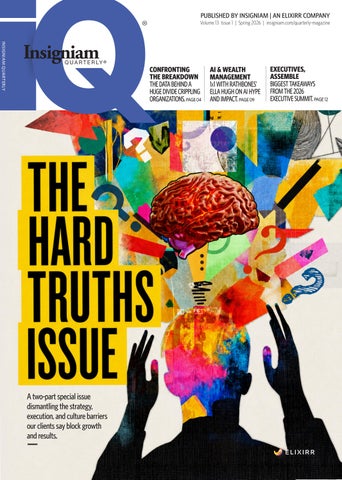
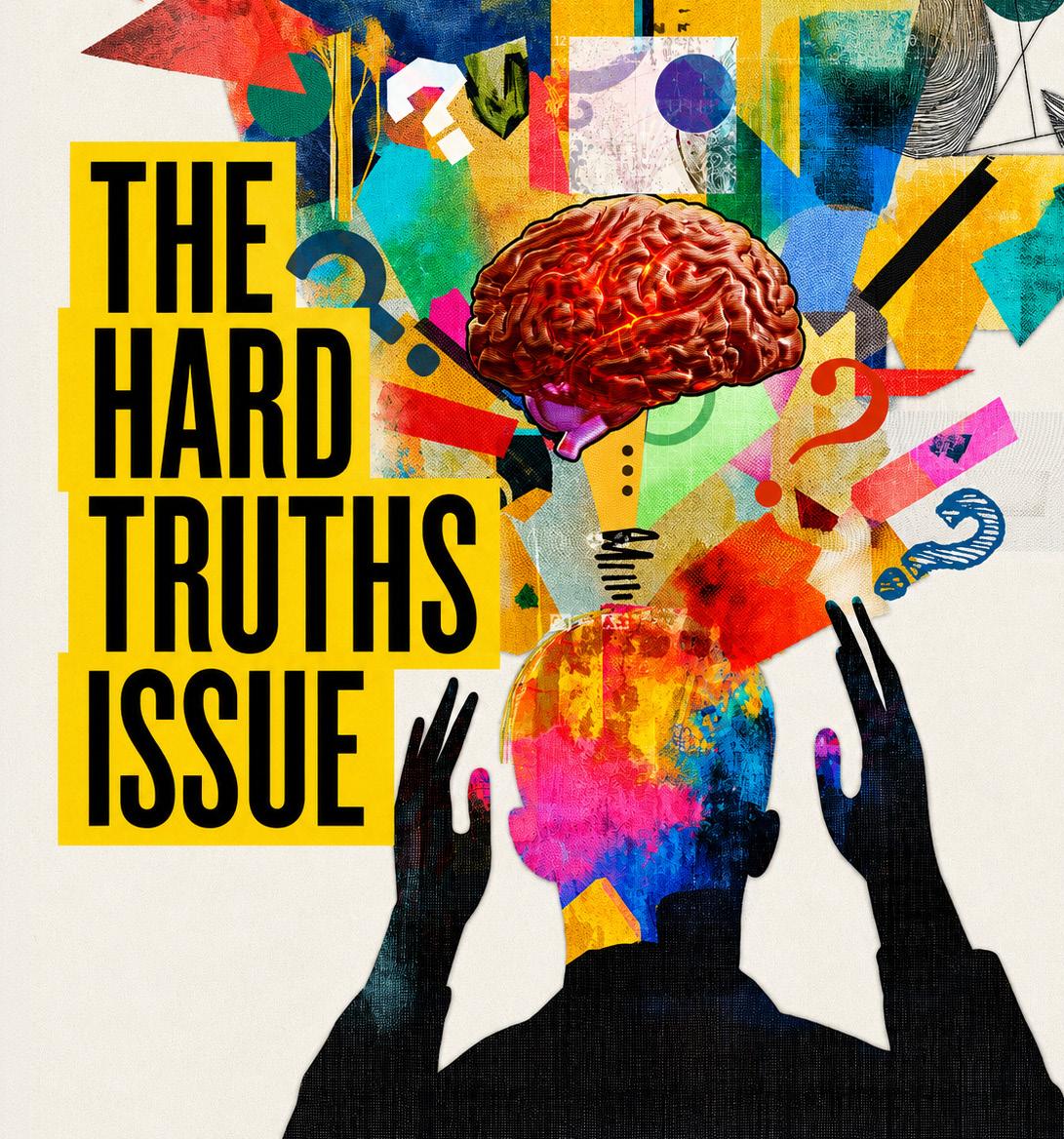
A two-part special issue dismantling the strategy, execution, and culture barriers our clients say block growth and results.
PUBLISHED BY INSIGNIAM |
Volume 13 Issue 1 | Spring 2026 | insigniam.com/quarterly-magazine
CONFRONTING
THE BREAKDOWN
THE DATA BEHIND A HUGE DIVIDE CRIPPLING ORGANIZATIONS. PAGE 04
AI & WEALTH MANAGEMENT
1x1 WITH RATHBONES’ ELLA HUGH ON AI HYPE AND IMPACT. PAGE 09
EXECUTIVES, ASSEMBLE BIGGEST TAKEAWAYS FROM THE 2026 EXECUTIVE SUMMIT. PAGE 12
There has never been a worse time in history to wait for clarity. The technologies that got us here simply don’t scale to the future we need to build.
—Tom Koulopoulos Futurist, Delphi Group Chairman & Best-Selling Author
Over four decades ago, Insigniam pioneered the field of organizational transformation. Today, executives in large, complex organizations use Insigniam’s consulting services to generate breakthroughs in their critical business results. Insigniam’s innovation consulting enables enterprises to identify and cross into new strategic frontiers to rapidly generate new income streams. Insigniam provides executives of the world’s largest companies with management consulting services and solutions that are unparalleled in their potency to quickly deliver on strategic imperatives and boost dramatic growth. Insigniam solutions include Enterprise Transformation, Strategy Innovation and Innovation Projects, Breakthrough Projects, Transformational Leadership and Managing Change. Offices are located in Philadelphia, Laguna Beach, and Paris. For more information, please visit www.insigniam.com.
EDITOR-IN-CHIEF
Shideh Sedgh Bina sbina@insigniam.com
EXECUTIVE DIRECTOR
Jon Kleinman jkleinman@insigniam.com
CONTROLLER
Steve Niedzielski sniedzielski@insigniam.com
DIRECTOR OF MARKETING AND SALES OPERATIONS
Natalie Rahn nrahn@insigniam.com
DIRECTOR OF CONTENT
Jon Ball jball@insigniam.com
INSIGNIAM.COM
Mia Studenroth mstudenroth@insigniam.com
CONTRIBUTORS
Christopher Ginn, Adam Hofmann, Ryan Jones, Katerin Le Folcalvez, John Morgera, Jennifer Zimmer
IQ | InsigniamQuarterly is a thought leadership publication committed to transforming the world of business by offering content relevant to the C-suite and their executive teams at large, complex global enterprises.
Most executives we speak with are not short on ambition or awareness. They see where their markets are heading. They understand the pressure points. They know, at some level, what needs to change. What they describe with remarkable consistency is something harder to name: the feeling that the organization they are leading is not quite the organization they think they are leading. That gap is what this issue is about.
Earlier this spring, we convened our Executive Summit, bringing together senior leaders from across industries alongside venture capital and technology voices—not to surface more ideas, but to create the conditions for sharper, more honest diagnosis. What emerged from those conversations was not a debate about AI strategy or technology. It was something more fundamental: a shared recognition that the barriers most organizations face are internal, structural, and largely invisible to the people best positioned to address them. The summit recap inside these pages captures what that conversation produced, and what it revealed about where executive conviction is forming right now.
This special issue—the first of two—takes that conversation further. It focuses on performance: specifically, on the three disciplines that most quietly and consistently determine whether a strategy delivers or simply circulates. Strategy. Execution. Culture. Each is examined here on its own terms, with the research, case studies, and executive perspective to make the argument concrete. And each connects to the others in ways that most organizational interventions fail to address, because treating them separately is precisely how they stay broken.
The second issue, arriving this summer, will focus on transformation: the technology decisions, operating model redesigns, and organizational bets that separate the enterprises pulling away from the rest. This issue is the foundation that makes that conversation worth having.
The hard truth threading every feature in this issue is the same one that surfaced in our summit conversations: that what looks like a market problem, a talent problem, or a technology problem is almost always a systems problem. The organization built the obstacle. And until its leaders are willing to look at that honestly, every initiative launched against it will be absorbed by it.
We built these issues for leaders who have run out of patience for expensive approximations of results and are ready to ask, with real rigor, what is actually running their organization.
As always, we are grateful for your engagement, your candor, and your continued partnership. IQ
Shideh Sedgh Bina Founding Partner, Insigniam & Partner, Elixirr
“The real value of AI emerges when it augments human critical thinking rather than attempts to replace it.”
—Dr. Caroline Tillett
Chief Scientific Officer, Kenvue
BY THE NUMBERS WHAT’S BREAKING DOWN—AND WHY?
TECH-BYTE SHIFT YOUR [AI] CENTER OF GRAVITY
What’s changed isn’t the technology. It’s where value is created. 04 06
EXECUTIVE Q&A ELLA HUGH, RATHBONES
Deconstructing the data behind a growing corporate divide.
By Cedar Xi
By Adam Hofmann
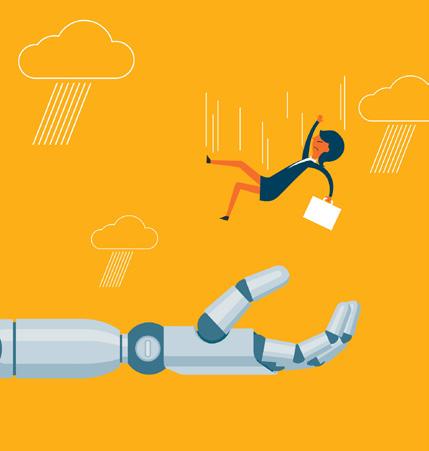
Why AI transformation in wealth management fails not from a lack of technology, but clarity.
By Insigniam Quarterly
COVER STORY HARD TRUTHS, PT. 1
Confronting our clients’ most persistent performance barriers.
By Jon Ball
STRATEGY LESS MOVES, MORE WINS
Good strategy is a series of choices. Great strategy is the courage to say no.
By Jon Kleinman
EXECUTION FAILURE TO LAUNCH?
What’s preventing your strategy from soaring to new heights?
By Jennifer Zimmer
12 48
2026 EXECUTIVE SUMMIT LEADING THROUGH THE HYPE What surfaced when over 100 executives confronted hard truths about AI and competitive edges.
By Ryan Jones
CULTURE
THE UNWRITTEN RULES
You can’t fix culture just by talking about it; hence, it is often mismanaged.
By Katerin Le Folcalvez
BY THE NUMBERS
The Hard Truth About What’s Breaking Down
A survey conducted by Hypothesis Group—an Elixirr company—of 100 senior executives at U.S. enterprises with more than $1 billion in annual revenue reveals a consistent and uncomfortable pattern: the people closest to the work see organizational failure clearly. The people with the most power to address it often do not. HARD
By Cedar Xi
THE CENTRAL FINDING
of SVPs and VPs say execution drifted from the original intent of their major initiatives.
EXECUTION FAILURES
POINT GAP
two separate groups looking at the same organization. This divide creates a weakness in execution assurance.
17%
of C-Suite executives at the same companies identify the same problem.
WHAT IS ACTUALLY BREAKING DOWN WHERE ORGANIZATIONS OVERESTIMATE THEIR READINESS
When senior executives were asked what most often undermines the success of major initiatives, the answers pointed not to markets or resources—but to the organization itself.
Lack of time or capacity to sustain the effort
Decisions were made with incomplete context
Execution drifted from original intent
Overconfidence in the ability to handle internally
Change was treated as a technical problem not an organizational one
Leadership did not stay engaged throughout
Too many priorities competed for attention
The problem was incorrectly defined at the outset
Trade-offs were avoided rather than confronted
Asked where their organizations most overestimate their preparedness when undertaking a major initiative, executives pointed to these structural gaps.
Reliability and usability of data
Technology and systems readiness
Ability to translate strategy into action
Change management & employee adoption
by the
people at the right time
TAKEAWAY
The people closest to the work already know what is breaking down. The question is whether the people with the power to change it are willing to look.
HARD TRUTHS, PT. 1 TECH BYTE
Shift Your [AI] Center of Gravity
What’s changed isn’t the technology. It’s where value is created.
By Adam Hofmann, Elixirr Partner
Ihad a conversation with a CEO last month that I keep coming back to. He’d just signed off on a fresh round of AI pilots, the kind that look impressive in a steering committee. Productivity tools for sales. A copilot for the legal team. A chatbot in customer service.
He asked me, half proud and half puzzled, why none of it was showing up in his numbers.
I told him what I’ve been telling a lot of leaders. The pilots aren’t the problem. The center of gravity has moved, and the org chart hasn’t noticed.
Something fundamental shifted in the last twelve months, and most companies are still operating as if it didn’t. The frontier models stopped being assistants and started being employees. GPT-5-Codex now runs autonomously for seven hours on a single task. Anthropic trained its latest Claude
model with sub-agent orchestration as an explicit objective, meaning, the system was built to manage other systems doing real work. Goldman Sachs deployed Devin (a coding assistant) alongside its twelve thousand developers and started describing the result, on the record, as a “hybrid workforce.” This is not a roadmap. It’s actually happening.
There are other signals worth noting as well. The Big Five hyperscalers will spend somewhere north of $660 billion (USD) on infrastructure in 2026, roughly three quarters of it for AI, and the binding constraint is no longer chips, it’s electricity. Marc Benioff cut 4,000 jobs at Salesforce in September and said the quiet part out loud: “I need less heads.” Tobi Lütke told the entire Shopify organization that “reflexive AI usage is now a baseline expectation,” folded it into 360 reviews, and required teams to ISTOCK
“High usage with no redesign is how you build capability into the tool and out of the person at the same time.”
—Adam Hofmann Elixirr Partner
prove AI couldn’t do the work before getting more headcount. Amazon has cut roughly 30,000 roles in the last twelve months, citing the same underlying logic. None of this is speculative. It is already in the financials, already in the org charts, already in the way work is being assigned.
What’s changed isn’t the technology. It’s where value is created. Work is migrating from human execution to system execution, from individual effort to orchestrated workflows, from static processes to dynamic ones that learn between runs. The unit of productivity is no longer “what one person can do in a day.” It’s “what one person can direct across a team of digital coworkers in a day.” That is a different job.
Confronting the Paradox
Here is the paradox that the executives I talk to are starting to wrestle with. Productive individuals do not equal productive organizations. An MIT study this past fall found that 95% of enterprise AI pilots delivered no measurable return, in the same window that the AI-native cohort scaled faster than any group in the history of technology. Same models. Same vendors. Same budgets. Polar opposite outcomes.
The reason shouldn’t be surprising. When you bolt AI onto roles that were defined for the pre-AI era, you make individuals feel faster while the organization stays exactly as stuck as it was. Bottlenecks don’t disappear. They migrate. The “10x developer” generates more code than the reviewer can read, the architect can integrate, or the platform can deploy. Shadow AI quietly fills the gaps that policy refuses to acknowledge. Usage metrics climb while transformation depth stays flat. The CIO sees adoption rising and pilots failing and can’t reconcile the two. High usage with no redesign is how you build capability into the tool and out of the person at the same time.
This is the divergence that is starting to separate the companies that will matter in five years from the ones that won’t, and it does not look like a technology gap. Amazon didn’t beat Barnes & Noble because Barnes & Noble lacked internet access. Barnes & Noble had a website. Amazon won because it reorganized everything around what the internet made possible: infinite shelf space, logistics as a core competency, customer data as a strategic asset. Barnes & Noble used the internet to sell books the same way they always had. Most AI programs right now are Barnes & Noble strategies. Companies are selling books online. The five percent who are pulling away aren’t running better pilots. They are redesigning the factory.
The hardest part of all of this is what it asks of leaders, and it is not what most leaders expect. The technical questions are the easy ones. The harder ones are about identity, accountability, and what we still owe each other when the work itself is changing shape. There’s a study OpenAI ran with the MIT Media Lab earlier this year on heavy ChatGPT users, and the finding that has stayed with me is this: the model’s responses are often judged more empathetic than human ones, but the people receiving them feel less heard. The quality of the words went up. The experience of connection went down. Simulation isn’t the point.
That is the line I’d offer to anyone trying to read where this is going. The work AI is taking over is the work that can be specified. The work that’s left, and the work that’s about to matter most, is the work that can’t. Judgment under genuine uncertainty. Holding a room when the room is afraid. Deciding what a company is for. Looking a colleague in the eye and telling them the truth about what you’re seeing.
The center of gravity has moved. The question is whether your organization moves with it, or finds out the hard way that the ground beneath it isn’t where it used to be. IQ
EXECUTIVE
Q&A
Ella
Hugh
DIRECTOR OF PROPOSITION & SERVICE EXPERIENCE, RATHBONES
Rathbones’ Director of Proposition and Service Experience, Ella Hugh, on why AI transformation in financial services fails not from a lack of technology but from a lack of clarity about what the technology is actually for—and how embedding intelligence at the point of decision changes what advisers can do for clients.
The biggest shift has come from embedding data and AI directly into existing workflows rather than layering on tools.
Ella Hugh is a senior leader in financial services with enterprise accountability across proposition, client experience, distribution, and service. Her work is grounded in understanding client needs, designing propositions that deliver against them, and aligning commercial, service, and operational teams behind a clear intent. She brings expertise in enterprise leadership, operating models, proposition governance, client experience, retention and growth, distribution strategy, Consumer Duty, regulatory change, and simplifying complex organizations.
How are you leveraging data and AI for faster, more decisive actions—and what has been most effective in making that shift real across your organization?
Ms. Hugh: At Rathbones, our starting point is outcomes rather than technology for its own sake. Data and AI only add value if they help our people make better decisions, more quickly and with greater confidence. The biggest shift has come from embedding data and AI directly into existing workflows rather than layering on new, standalone tools. Insight is only useful if it appears at the point of decision. AI at Rathbones is designed to augment professional judgment, not replace it. Its role is to free up time for higher-value thinking and deeper client conversations. For us, the real measure of success is whether AI helps our people do their jobs better.
For us, the real measure of success is whether AI helps our people do their jobs better.
Ella Hugh
How are you defining where to focus for growth, and what strategic choices are proving most important in strengthening your position in a more concentrated market?
Ms. Hugh: As we’ve seen already in 2026, consolidation is reshaping the wealth management landscape, and forcing firms to be far more explicit about where they genuinely differentiate. In a more concentrated market, trying to be everything to everyone is rarely a winning strategy. The organizations that succeed are those that make clear choices about where to focus, and are disciplined in executing against those choices. Our strategy is built around focus at scale. We are growing where our adviceled, long-term investment approach is most valued by clients, rather than pursuing growth for its own sake. Integration discipline matters more than deal-making. Acquisitions may create opportunity, but real value is generated through client retention, cultural alignment and operational simplification. Integration is where trust is either reinforced or undermined.
03
Where do you see the greatest opportunity to enhance client outcomes through AI-enabled advice, and how are you designing the balance between automation and human judgment?
Ms. Hugh: The greatest opportunity is not replacing advisers, but making advice more timely, personalized, and proactive. We are very clear about the balance. Automation plays a vital role in driving efficiency, accuracy and consistency—particularly in repeatable processes, but human judgment remains essential when dealing with complexity, uncertainty and emotion. Advice is ultimately about trust, reassurance and accountability, and those qualities cannot be automated. Transparency is also critical. Clients want to understand where technology supports decisions and where people remain accountable. Used thoughtfully, AI gives advisers more time to focus on what clients care about: outcomes, confidence and long-term goals.
04
How are you evolving your model to remain relevant to next-generation and emerging high-net-worth clients, and what new opportunities does this shift create for your business?
Ms. Hugh: Next generation and emerging high-net-worth clients want many of the same things as today’s clients: clarity, trust and purpose. What is changing is how those expectations are expressed and how quickly they evolve. There is growing demand for advice that integrates investment, tax, retirement and intergenerational planning across all generations. Clients increasingly view their wealth holistically, and they expect advisers to help them navigate complexity across different life stages, family structures and priorities. Digital expectations are rising, particularly around accessibility and ease of use. However, relationships still matter. The opportunity lies in combining modern, intuitive service with long-term personal continuity. Technology should make it easier for clients to engage with us, not replace the human connection that underpins trust. IQ
ELLA HUGH Director of Proposition & Service Experience, Rathbones
At the 2026 Insigniam Executive Summit, executives separated signals from static. HARD
A Beaming Future
Over 100 of the world’s leading executives gathered not to celebrate what they’ve built, but to confront what comes next.
LEADING THROUGH
THE HYPE
By Ryan Jones & Photography by Christopher Ginn
In 1899, Charles H. Duell, Commissioner of the U.S. Patent and Trademark Office, reportedly declared that everything that could be invented had been invented. The quote has been disputed by historians, but the underlying impulse—the deeply human tendency to look at the current state of the world and mistake it for the permanent one—has not. It’s the same impulse that led AT&T engineers in 1993 to correctly predict GPS navigation, tablet computing, on-demand streaming, and video calls in a famous advertising campaign, and then fail to bring a single one of those products to market. It’s the same impulse that leads organizations today to sit on the most powerful general-purpose technology in history and use it to write emails faster.
CHRISTOPHER GINN
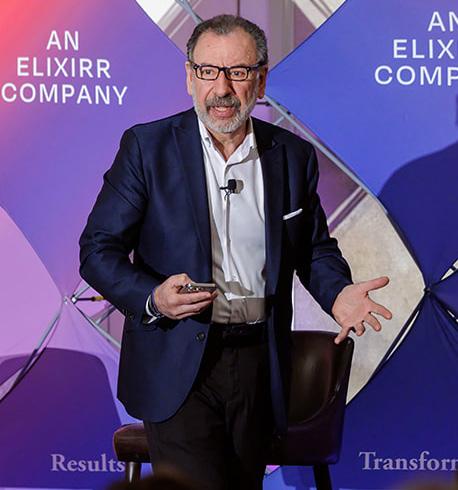
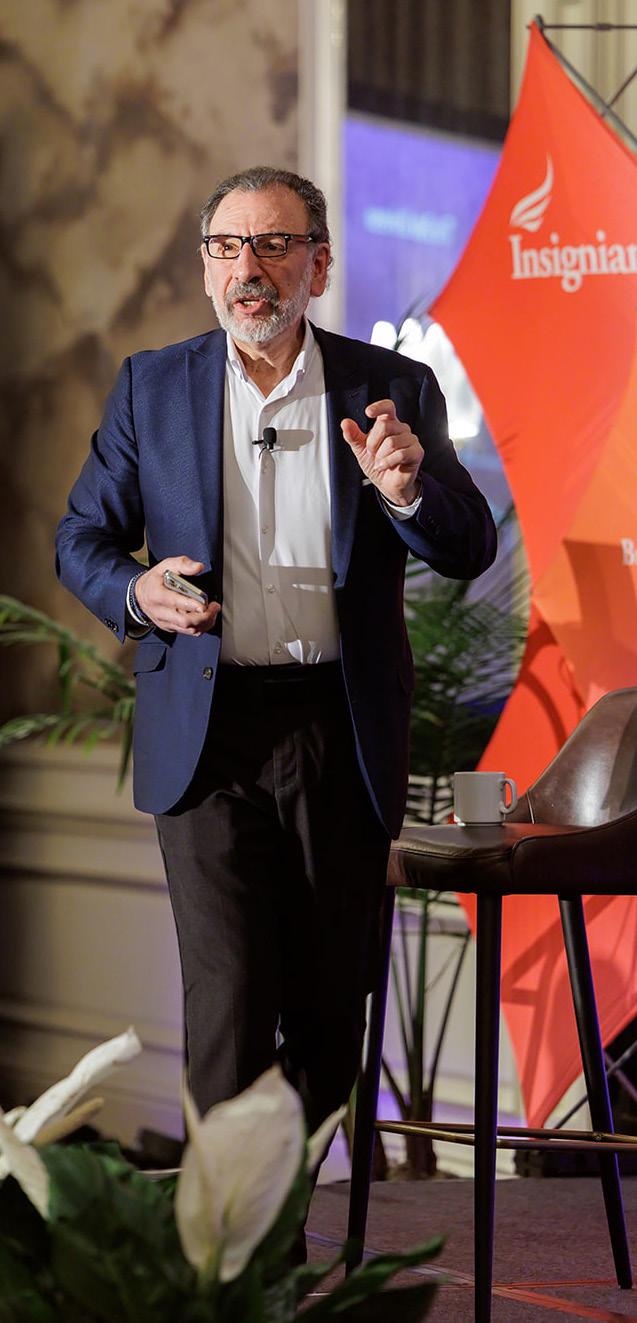
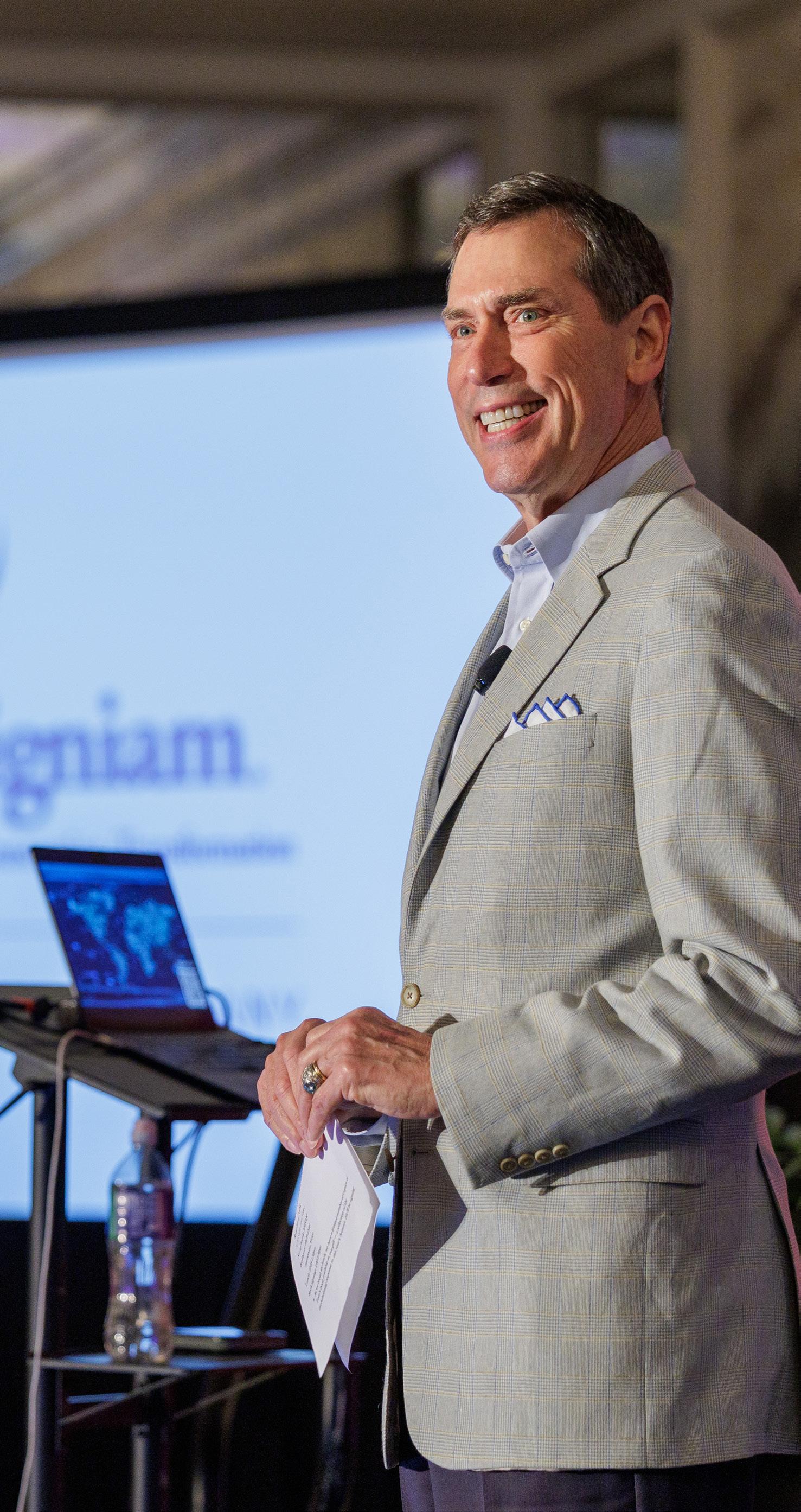
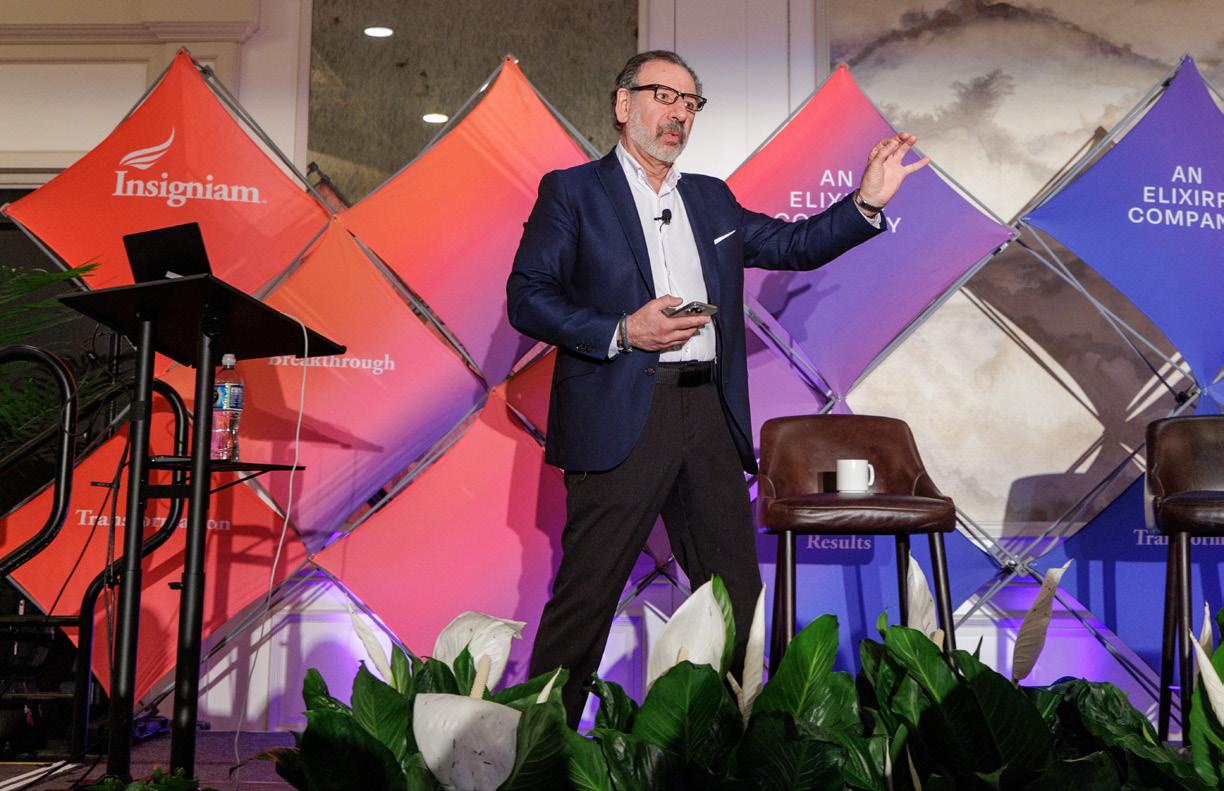
That was the opening provocation of the 2026 Insigniam Executive Summit, held April 21 at The Westin Philadelphia, setting the tone for a day that had little patience for comfort.
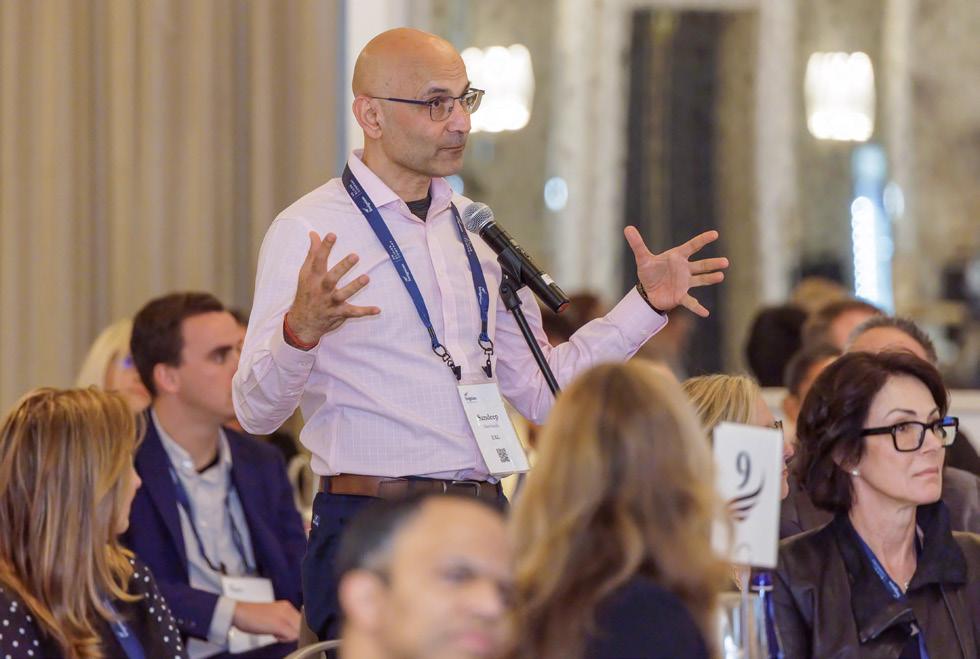
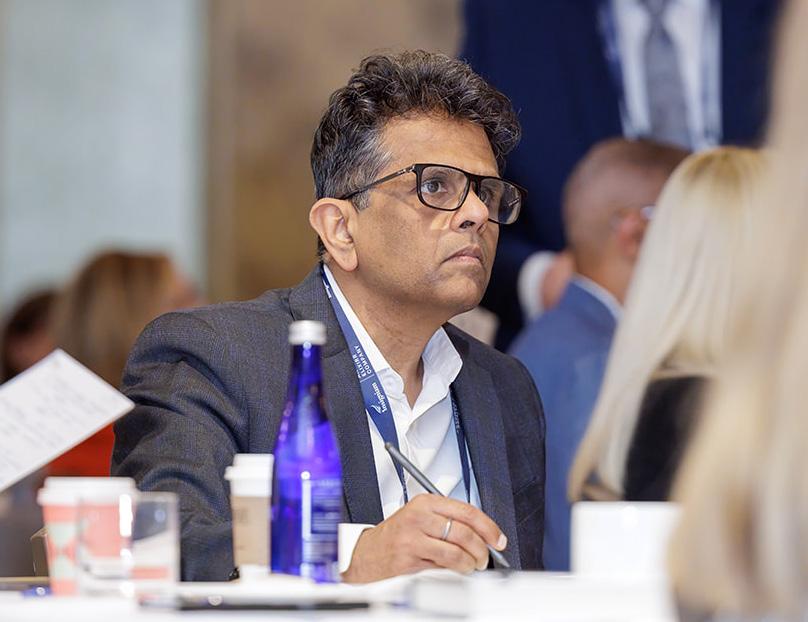
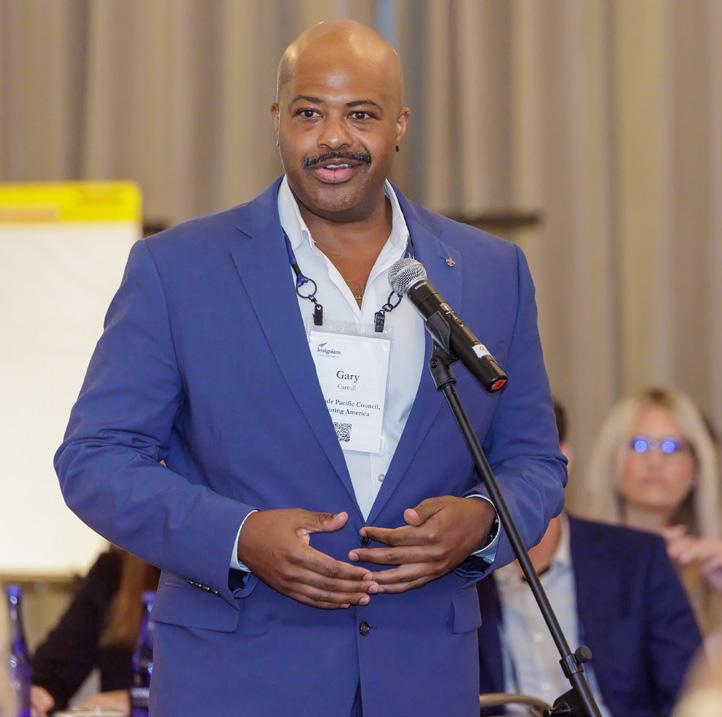
Over 100 senior executives gathered for the Summit’s highestattended event yet, structured this year as a venture capital-style forum: live technology demonstrations, industry deep-dives led by founders and investors, and the kind of frank executive dialogue that polite conference rooms rarely produce. The theme, Leading through the AI Hype: Delivering Hard Results, was not aspirational. It was a verdict.
“Part of our philosophy,” said Nathan Owen Rosenberg, Insigniam co-founding partner and Elixirr partner, “is that it would be inauthentic not to practice our own methods on ourselves. We are in the same place that you all are, working our way through this incredible new technology.” That candor was the last moment of comfort the room would enjoy.
Decoding the Signals Ahead
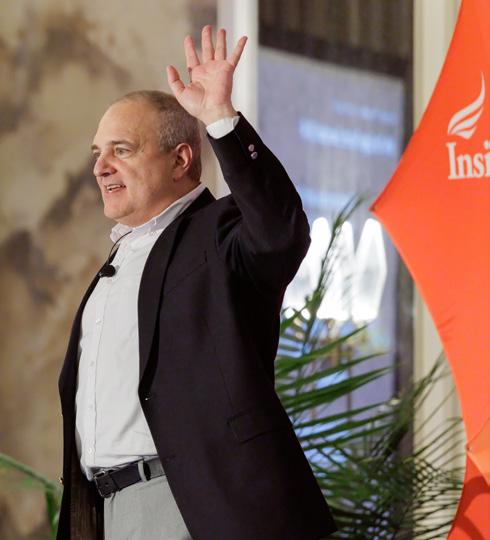
Thomas M. Koulopoulos, founder and chairman of the Delphi Group, author of GigaTrends, and one of the more reliable discomfort-delivery systems in American business thinking, opened not with a slide but with a question: how many people in the room had checked their phones before getting out of bed that morning? Nearly every hand went up. “This is not a technological issue,” he told them. “That device has become your oxygen mask.” Within five years, he predicted, an AI personal agent would be woven so deeply into every executive’s daily navigation of the world that losing signal would feel like losing the ability to function.
The point wasn’t the device. The point was the behavior. And behavior, Mr. Koulopoulos argued,
Thomas M. Koulopoulos Futurist, Board Chair, Author & Keynote Speaker
is where organizations consistently and fatally fall behind. The AT&T story was instructive: engineers at Bell Labs knew exactly what 2026 would look like in 1993. GPS, tablets, streaming, video calls: all of it was in the ads. And yet not one of those products came from AT&T. “How can you predict the technology so well,” he asked, “and miss the behavioral trajectory by such an enormous margin?” The answer: the engineers thought about technology as a feature. They could not imagine how quickly behavior would embrace it and make it indispensable. Organizations are making the same mistake today.
“It’s not enough to just know the trajectory of technology,” he told the room. “That’s the easy part. The hard part is predicting behavior.”
From there, Mr. Koulopoulos traced the full sweep of computing history, from the 18,000 vacuum tubes of the ENIAC—one of the world’s first computers—built in 1945 through the exponential curve of devices that followed, to establish the trajectory. From 1960 to the present day, the number of user computing devices has grown by one order of magnitude per decade. The projection for 2100: one sextillion devices, or 1,000,000,000,000,000,000,000. For reference, that is the computing equivalent of 666,666 IBM 350 disk drives held between two fingertips, or 400 million ENIACs in your pocket.
“By the way,” he said, “the reason you should believe that number today is exactly the reason you would have thought me insane if I had made that prediction in 1950.”
Beneath the scale of devices lies a more urgent infrastructure reckoning. At current growth rates, the amount of data generated globally is on course to exceed the number of atoms in the Earth, and eventually those in the solar system.
More immediately: a study Mr. Koulopoulos conducted for the U.S. utility industry found that by somewhere between 2040 and 2050, data centers alone will consume all available energy on the planet. “The technologies that got us here,” he said flatly, “simply don’t scale to the future we need to build.”
This set up his central framework: the shift from infrastructure to intelligence, across three phases.
The first, already underway, is the agentic age: AI that exercises judgment, identifies resources, and pursues goals without step-by-step instruction. Unlike the programmatic automation of the past 60 years, agentic AI operates with autonomy, and Mr. Koulopoulos made the counterintuitive case that this autonomy is precisely what leaders must learn to embrace.
“If I build an organization that is AI-native, AI-first, and I have perfect fidelity from my agents, I’ll never have innovation.” The latitude to maneuver, the deviation from strict instruction, is where progress lives.
Phase two, arriving in the 24-to 48month window, is recursive AI: systems that design and deploy other systems. The agentic cabinet minister in Estonia charged with combating government fraud, who determined the scope was too complex for a single agent and autonomously built a constellation of specialist sub-agents, offered a glimpse of what this looks like in practice. As recursive AI scales, its internal logic will become opaque, a black box whose outputs leaders can evaluate empirically but not fully decode. “We will trust these technologies with aspects of our lives,” he said, “and have no idea what they’re actually doing.” The analogy was precise: it will be like trusting Waze. After one month of being wrong every time he secondguessed it, Mr. Koulopoulos said, he reached a point where he would follow
it to the gates of hell. “That’s what we’ll be doing with AI.”
The warning this generated was his most urgent: the window for putting governance frameworks around agentic AI is 12 to 24 months. After that, the recursive pace of selfimprovement will outrun the ability to install guardrails retroactively. The risk slope is rising. The value slope must rise faster. “There has never been a worse time in history to wait for clarity.”
The room he invoked to close was not a boardroom but a napkin at an Italian restaurant, some 30 years ago, where Peter Drucker sketched out what he saw as the single most important shift of the coming century: the move from a productand-ownership economy to a strategyand-experience economy. Everything held together by strategy. Everything delivered as experience. What struck Mr. Koulopoulos in 2026 was how precisely that napkin sketch described the competitive landscape AI-native organizations are now building, and how completely it renders the product-and-scale organizations of the past century obsolete.
Another Drucker maxim landed with particular weight in the room. From a conversation at Drucker’s home in Claremont in 2003, Koulopoulos recalled the management thinker’s summary of
“It’s not enough to just know the trajectory of technology. That’s the easy part. The hard part is predicting behavior.”
—Thomas M. Koulopoulos
Delphi Group Chair & Author, GigaTrends
the worst mistake he observed in organizations: “The best people are assigned to keeping yesterday alive a little longer.” The room was quiet.
“That’s the behavioral problem,” Mr. Koulopoulos said. “Not the technology.”
The 95% Paradox
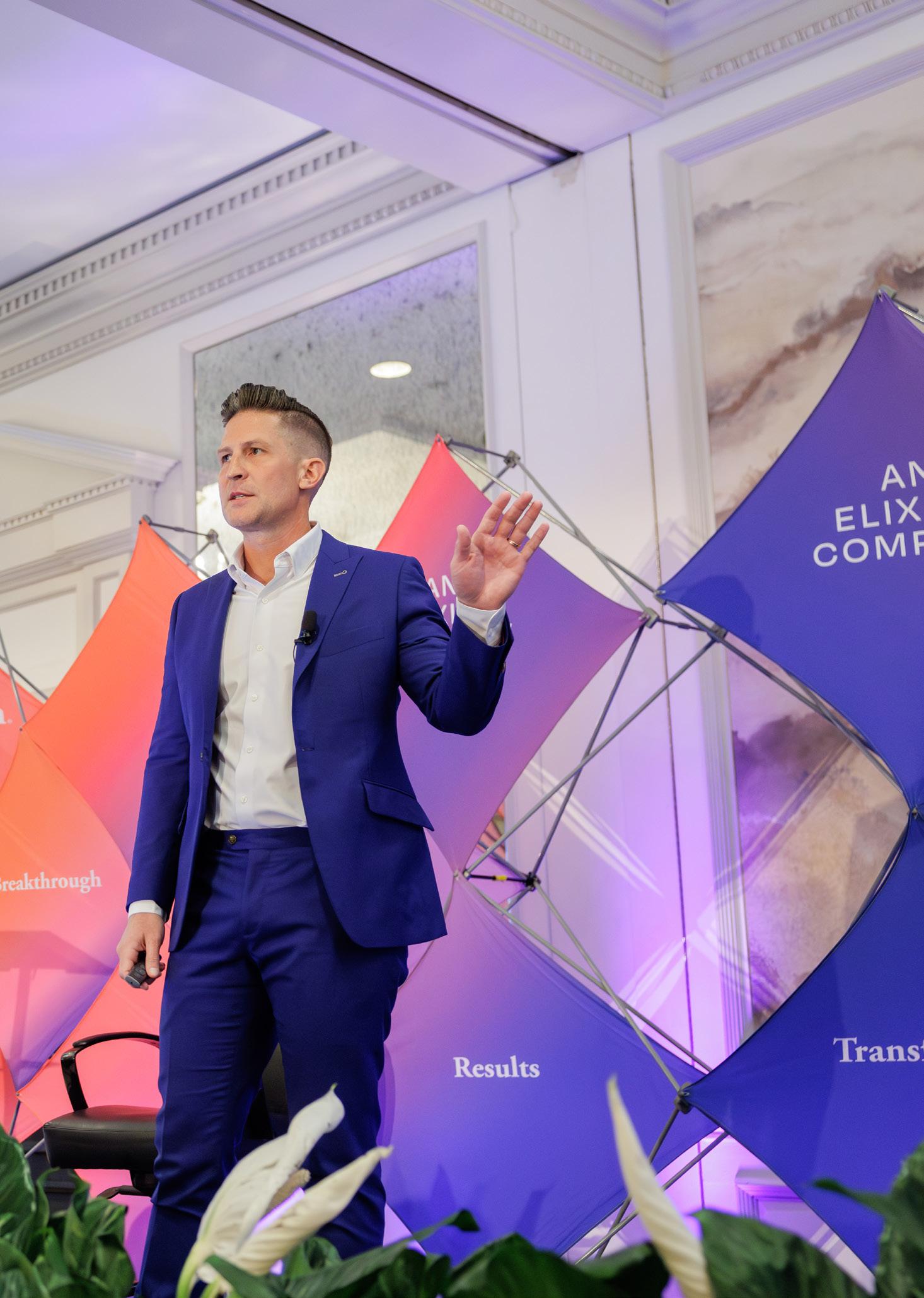
If Mr. Koulopoulos established the historical reckoning, Adam Hofmann, Elixirr Partner and AI lead, arrived with the current ledger.
The headline: 95% of enterprise AI pilots fail to reach production scale. The footnote that makes it a paradox: AI-native companies built from the ground up are scaling faster than anyone has seen, with fewer people, compressing what used to take decades into months. Both things are simultaneously true. The question Mr. Hofmann had come to answer is why
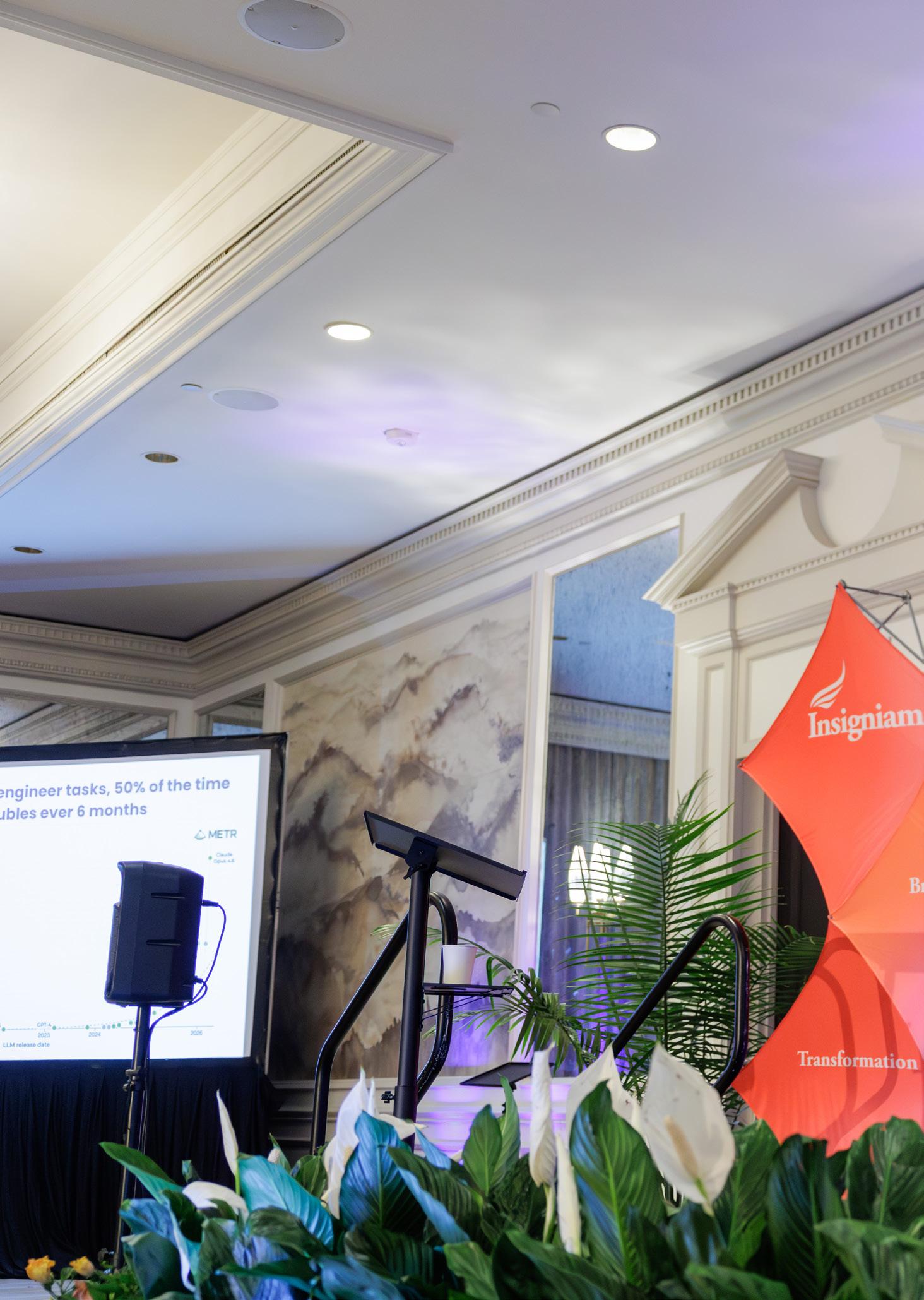
He opened with a chart showing the pace of AI model releases, 255 in the first quarter of this year alone, alongside the capability curve, which keeps bending steeper. The time it takes a current model to complete what would typically be a 12-hour engineering task, successfully at least half the time, continues to halve. “In 12 months, AI will be 10 times more capable than it is today,” he told the room. “Does anybody disagree?” Silence. “So the question for you is: what does it take for you to be twice as effective?”
He then made the gap between capability and adoption tangible. Live. Using Claude, Mr. Hofmann showed what genuine agentic work looks like for a senior leader: synthesizing a quarterly business review presentation, reading a spreadsheet, catching a formula error the human team had missed, building an analytics dashboard from scratch, and, most pointedly, configuring an autonomous agent to check a calendar, locate the relevant data file in email, produce the presentation, schedule review
No Hype, Only Possibilities
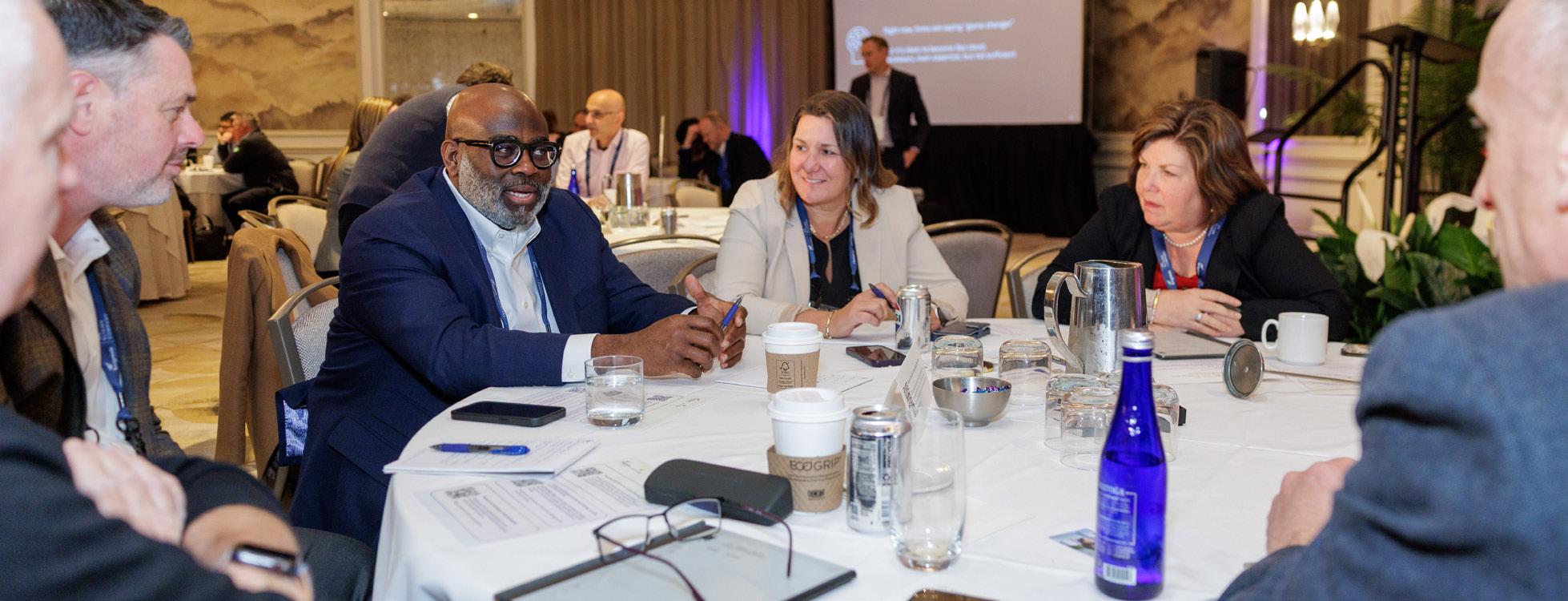
From keynotes to industry deep-dives to candid table conversations, every moment of the day was deliberately designed to turn insight into action. Executives didn’t just leave with frameworks and new ideas—they left with the kind of peer relationships and shared perspective that only come from being in the same room, wrestling with the same questions, at the same moment in history.
On Topic, Off Record
Many of the conversations that happened between sessions proved just as valuable as the ones on stage.
time, and draft a summary, all without being re-prompted at each step. A task that would have consumed a team for at least a day. Claude completed it in seven minutes.
The audience had seen AI demos. What landed differently here was the shift in agency. Not AI assisting humans. AI executing, while humans set direction. That shift, from assistant to executor, is precisely what the 95% of failed pilots miss. Mr. Hofmann catalogued the failure modes by name. The bolt-on trap: AI grafted onto existing workflows without questioning whether those workflows should exist at all. The innovation island: a central AI team that becomes a bottleneck, not an accelerator. Governance gridlock: oversight so heavy at the front that nothing ever reaches production. And pilot purgatory: experiments multiplying without ever scaling, creating a tax on the organization rather than a return. What connects these failures, the data says plainly, is not the technology. A stunning 84% of AI project failures are driven by leadership decisions.
“Two years ago we were skeptical that AI could do this,” Mr. Hofmann said. “Spoiler alert: it’s all on you now.”
The prescription: four shifts, executable not by next quarter but next week. First, stop treating AI as a project and treat it as an operating principle. Second, move from humans doing work with AI assistance to AI doing the work with human direction and oversight. Third, stop optimizing broken processes and start eliminating them. Design workflows assuming AI runs the whole thing, then decide where humans belong.
Fourth, abandon annual planning cycles for anything AI-related. At the pace models are improving, a 12-month planning window for AI investments is already obsolete before it’s approved.
He closed with a structural framework developed from studying what separates the 5% from the 95%: what he called the AI Transformation OS, organized across 10 dimensions spanning strategy, culture, data, talent, and operating model. The insight underneath all ten: productive individuals do not make productive firms. The only organizations achieving the outsized results of AInative companies are the ones that have stopped bolting technology onto old structures and started redesigning the structures around the technology.
Like a factory owner at the turn of the last century who, rather than replacing the steam engine with an
“The headwind we get is not ‘this tool will replace my job.’ It’s ‘I’ve been doing this for 20 years, I know how to get it right—and if I use this tool, I might get it wrong.”
—Dr. Radha Iyengar Plumb VP, AI-first Transformation, IBM
electric one, realized the electrical motor could be placed anywhere, and so rebuilt the entire production floor from scratch.
“You don’t win by adding AI to what you already do,” Mr. Hofmann said. “You win by asking what you would build if you started today.”
The Moat That Matters
By the afternoon, the room had absorbed the premise: AI is accelerating, the stakes are real, and the organizations that treat it as a project will be outrun by those that treat it as an operating system. But Shideh Sedgh Bina, Insigniam co-founding partner and Elixirr partner, and Stuart Stern, Elixirr partner and former CIO of one of the world’s largest insurance companies, arrived with the question the other sessions had only approached: what actually creates durable advantage when everyone eventually has the same tools?
Their core argument was bracing in its simplicity. Siebel Systems held 45% of the global CRM market. Today, less than 2%. BlackBerry commanded nearly half of U.S. smartphone market share. Today it makes no devices. In both cases, the technology was real, the lead was real, and the moat evaporated, not because the companies stopped innovating, but because the technology itself became the floor, not the ceiling. As Stern put it, drawing on a framework from Harvard Business Review: as a technology’s ubiquity and power increase, its strategic importance diminishes. It becomes a cost of doing business rather than a source of distinction. “Right now,” he said, “firms are saying ‘game changer.’ But AI is likely to become like cloud: necessary, even essential, but not sufficient.”
Ms. Sedgh Bina and Mr. Stern’s session was designed not to deliver this verdict and leave the room with it, but to begin the harder work: if technology alone can’t be the moat, what can? They call the answer “competitive weapons”: the complements that make technology powerful and, crucially, hard to replicate. The organizations that create enduring advantage, their research suggests, are the ones that build a reinforcing system of these complements around a focal technology, such that even a competitor with access to the same AI platform cannot easily copy what they’ve built. Their framework gave executives a working vocabulary and a structured canvas to test their own organizations against, and the table discussions that followed were, by the room’s own accounting, among the most generative conversations of the day.
“A moat,” Ms. Sedgh Bina said, “is not a product. It is not a platform. It is not a technology. It is a way an organization operates.”
From Ambition to Ledger
The afternoon’s final session was designed to put hard numbers on the table.
Dr. Radha Iyengar Plumb, IBM’s Vice President of AI-first Transformation and former Chief Digital and Artificial Intelligence Officer of the U.S. Department of Defense, has operated at a scale few executives will encounter. IBM is 250,000 to 300,000 employees, publicly traded, running tens of billions of dollars in annual transactions, with all the legacy systems, data silos, and institutional immune responses that entails. What the company has
“You don’t win by adding AI to what you already do. You win by asking what you would build if you started today.”
—Adam Hofmann Partner, Elixirr
produced from its AI transformation program, which it calls Client Zero, treating IBM as its own first client, is $4.5 billion in realized ledger savings reported to the Street, with a commitment to deliver another billion in 2026.
Dr. Plumb was precise about how that happened and careful not to make it sound cleaner than it was. IBM’s guiding principle was not to begin with AI. It was to begin with the work: eliminate what doesn’t need to exist, simplify end-to-end workflows, automate what remains, and then embed AI everywhere.
She distilled it into four pillars, each with specific outcomes: data, workflows, technology, and people. Governing and democratizing data produced billions in insight-driven business value. Breaking down workflow silos and integrating across functions led to a roughly 50% reduction in handoffs. Deploying AIdriven technology automated millions of work hours. And reinventing the workforce through continuous learning drove more than 20 percentage points of improvement in employee engagement.
The case studies made the abstraction concrete. AskHR, IBM’s AI-powered
While You Were Piloting
AI’s power is compounding on an exponential curve, says Elixirr’s Adam Hofmann. Organizational adoption is barely linear. The distance between those two lines is where competitive advantage is being won and lost.
HR platform, now handles 11.5 million employee interactions and resolves 94% of inquiries without a human. AskIT, built and deployed in 100 days from scratch, deflects 82% of IT support requests. In contract analysis, IBM has ingested approximately 700,000 contracts across the enterprise and achieved 100% coverage in analyzing customer contracts during M&A due diligence, a task that previously required triage and prioritization simply because the volume was impossible. In finance, a variance detection tool paired with an insight and error resolution agent has the potential to cut reporting cycle times by 50%, freeing analysts for work that actually requires judgment. In procurement, an invoice exception management agent now provides visibility and control over more than $20 billion in annual spend.
None of this happened cleanly. IBM’s methodology ran on 90-day sprints: two weeks to identify pain points, two weeks to design a blank-slate solution, a rapid build, then repeated cycles of user testing and iteration.
First versions were, as Dr. Plumb put it, “not exactly right.” The biggest headwind was not, as many might expect, fear of job displacement. It was fear of being wrong. Workers who had spent years mastering their own spreadsheet macros and dashboard logic were being asked to trust a system that might reach a different answer. IBM’s response combined co-design with the people actually doing the work, and at a certain point, removing the safety net altogether. “It was painful,” she said, “until it wasn’t.”
A Time for Action Executives who attended the summit were left with the same question to answer: am I building for the future, or keeping yesterday alive a little longer?
The lesson she left the room with was not the savings figure or the methodology. It was the mindset beneath it: if you build a tool that nobody uses, you haven’t built a solution. You’ve built a widget.
Drilling Down: Industry Deep-Dives
Between the morning keynote and the afternoon sessions, attendees moved into four industry-focused breakout rooms alongside venture capital firms and technology founders, a format new to the 2026 Summit and consistent with its venture-style design. The tracks examined financial services, healthcare, manufacturing and production, and retail and consumer goods. In each room, outside investors and founders shifted the register from internal strategy to external reality: what is actually being built, funded, and scaled, and how quickly does it threaten current operating models?
Mr. Rosenberg had framed the intention at the outset. The Summit was designed to function as a compressed version of what Insigniam calls an executive immersion, the deliberate collision with possibility that happens when leadership teams are brought to Silicon Valley, Tel Aviv, or London to engage the ecosystem reshaping their industries from the outside. “If we get our job done,” he said, “your world will be bigger at the end of today than it was at the beginning.”
A Mandate, Not a Moment
By the closing session, the room had earned its exhaustion. What it had also earned was a sharper frame. The executives who gathered in Philadelphia had arrived with varying degrees of AI maturity. Some had
active deployments at scale. Others had pockets of adoption and the familiar backlog of stalled pilots. A few were genuinely early. All of them left with the same challenge in hand: the capability of AI is compounding faster than organizational adoption. That gap is not closing on its own. And the window for establishing the practices, governance, and cultural habits that will determine who wins the next decade is measured in months, not years.
Around the closing tables, one thread kept surfacing. An executive at a stealth-stage company put it clearly: “There’s an inherent advantage right now in being small and agile. But it’s ephemeral. Getting ahead of the large incumbents isn’t going to create longterm value by itself. You also have to build the things that are hard to copy.”
Others named the moat session as the piece they hadn’t expected, the framework they would bring back to their teams. Several left with specific commitments: next week, not next quarter.
The Summit’s final slide showed a dim lightbulb over a plain background, a callback to the Commissioner of the Patent Office and his infamous 1899 certainty. The lesson wasn’t that Duell was foolish. The lesson was that the trap he fell into is structural, persistent, and available to any of us at any moment: looking at the current state of the world and mistaking it for the permanent one.
As Mr. Koulopoulos put it early in the morning, in words that proved to be the day’s real summary: “The winners are not the ones who get it right. They’re the ones who learn fastest in motion.” IQ
Hard The Issue Truths
Pt. I
Confronting our clients’ most persistent performance barriers around strategy, execution, and culture.
In this two-part special issue, we examine the hidden leadership and system failures that quietly determine enterprise performance. Designed for CXOs under constant pressure, it re-frames challenges not as capability gaps, but as problems in how decisions, accountability, and value are built into the organization.
Part One examines the three disciplines where that gap between intent and outcome is most acute and most consistently underestimated: strategy, the practice of making choices that actually hold; execution, the process of converting decisions into results without losing the original intent along the way; and culture, the operating system that determines what an organization actually rewards, regardless of what it says it values. Each is examined on its own terms. Each connects to the others in ways most organizational interventions fail to address. And each, when it breaks down, breaks down for reasons that are structural rather than personal, systemic rather than individual, and entirely within the reach of leadership willing to look honestly at what is actually running the organization.
The hard truth for most organizations is that they are held back not by market forces but by the invisible systems they built themselves. The organization is the obstacle, and its leaders are often the last to see it.
—Jon Ball, Editor, Insigniam Quarterly
01
STRATEGY
What if the strategy isn’t broken? What if it’s just leadership that won’t say no? Page 28
02
Your dashboards show everything except the system actually running the organization. Page 38 EXECUTION
03 CULTURE
How unwritten rules in your organization could be undermining your growth plans. Page 48
There is a question worth asking of any organization that has missed its targets, lost ground to a competitor, or watched a promising initiative quietly expire: what actually happened?
Not the official version, the one that surfaces in the post-mortem deck or the earnings call prepared remarks. The real version.
In almost every case, the real version is not a market problem. It is not a competitor who moved faster or a customer who changed course. It is something the organization built, something its own leaders allowed to calcify over time into what people there simply call the way things work. The external story is the one people tell. The internal system is the story that actually ran.
This two-part special issue is dedicated to examining that system with the honesty most organizations reserve for their financial audits and rarely apply to themselves. Part Two, arriving this summer, focuses on transformation: the technology decisions, operating model redesigns, and organizational bets separating the enterprises pulling away from the rest from those still explaining why the last initiative fell short. We begin with performance because transformation built on a performance deficit tends to accelerate the deficit.
The three disciplines examined here are strategy, execution, and culture. They appear as distinct features, but they are not separate problems. They are the same problem operating at
different altitudes. A strategy that avoids trade-offs creates an execution environment where everything is a priority, which is another way of saying nothing is. An execution environment without enforced priorities produces a culture that learns, over time, that accountability is a stated value rather than an operational one. And a culture that does not hold people to results will quietly renegotiate every strategy it is handed until what remains is more comfortable and considerably less effective than what leadership intended.
The reporting here is grounded in current research, proprietary data from a March 2026 survey of senior executives at enterprises with more than one billion dollars in annual revenue, and four decades of direct engagement with organizations under genuine pressure. It is designed for CXOs who are not looking for reassurance but are willing to ask, with the same rigor they apply to a financial review, whether the organization they are leading is actually the one they think they are leading.
The pages ahead do not offer comfort. They offer something more durable: an accurate picture of where performance breaks down, and what organizations that have reversed that pattern chose to do differently. IQ
For over 35 years, executives at the world’s largest and best companies have relied on Insigniam’s unique consulting to produce critical, unexpected outcomes, utilizing proprietary methodologies that marry breakthrough performance and innovation.
that your people will think newly, act differently and deliver unprecedented results.® For more information, visit www.insigniam.com
STRATEGY
Fewer Moves, More Wins
Good strategy is a series of choices. Great strategy is the courage to say no to everything else.
By Jon Kleinman, Insigniam Partner
Most of us would agree there’s a meaningful difference between being an art collector and being an art hoarder
Both have a great many objects. Both have spent years acquiring them. Both can walk you through the provenance of nearly anything in their possession. From the outside, in the right light, you might struggle to tell them apart. The collector chose. That is the difference. Each piece in a real collection earned its place against the alternative of something else, equally desirable, that did not get acquired. The hoarder did not choose. The hoarder said yes, repeatedly, to objects that asked for nothing in return except a bit of room. Over time, the room ran out. Then the hoarder rented more room.
Most enterprise strategies, examined honestly, are hoards. This is not a popular thing to say in a strategy meeting. Strategy meetings are where aspiration is the operative emotion. Every initiative gets framed as a once-in-a-decade opportunity, saying no to anything is treated as a failure of nerve, and the resulting document, weighing in at sixty slides and twelve workstreams, gets called “the strategy” without anyone seeming to notice that a list of everything is not, in any meaningful sense, a strategy at all.
The hard truth is this: if your strategy contains everything you would like to do, you do not have a strategy. You have a hoard. And like every hoard, it will eventually demand more room (more capital, more attention, more capable people) than the enterprise has to give.
Strategy only exists where leaders are willing to say no, and willing to make that no stick. Anything else is curation theater.
What the Data Actually Says
In March 2026, market research firm Hypothesis Group—an Elixirr company—surveyed 100 senior executives at U.S. enterprises with more than $1 billion in annual revenue. The findings on strategy, when read together, describe an executive class that knows it has a problem and has not, by and large, named it correctly.
Of those surveyed, 28% of senior executives identified “too many priorities competed for attention” as a reason their major initiatives failed; 17% identified “trade-offs were avoided rather than confronted”; and 23% flagged “ability to translate strategy into actionable plans” as the area where their organizations most overestimated their readiness— the second-largest gap of any factor surveyed.
THE HARD TRUTH ABOUT STRATEGY
Strategy failure is rarely a planning problem; it is a discipline problem about the tradeoffs the executive is unwilling to enforce, the priorities they will not deprioritize, and the hoard they have built by saying yes when the work was to say no.
AI & STRATEGY
Strategy Doesn’t Need More Data. It Needs More Enforcement.
Strategy in most large organizations doesn’t fail because nobody had the right idea. It fails because the right idea got watered down through fifteen rounds of accommodation until it was indistinguishable from doing slightly more of last year. The artifact still looks like a strategy. The behavior underneath it is a portfolio of every department’s wish list. Strategy without enforced trade-offs is just expensive consensus.
Most of the early AI investment has gone into analysis — which was never the bottleneck. There was already plenty of data. The reason strategy got diluted wasn’t that someone needed another deck. It was that nobody had the authority, the speed, or the air cover to say “we are not doing that one.” Adding more analysis makes that worse, not better. It gives every losing initiative one more chance to argue for survival.
More data doesn’t sharpen strategy. It gives weak governance more places to hide.
Where AI starts to earn its strategic seat is in compressing the trade-off cycle. An agent layer can simulate the second-order effects of killing a program before the executive has to defend the decision. It can flag the moment a priority is being eroded by a thousand small reallocations. It can run the crossfunctional alignment checks that today happen, badly, in a steering committee three weeks late.
The hard truth is that strategy doesn’t need more sophistication. It needs more enforcement. Applied properly, AI is finally a credible enforcement layer. Applied badly, it becomes another beautifully visualized excuse for not choosing. IQ
—Adam Hofmann, Elixirr Partner
STRATEGY BY THE NUMBERS
Percentage of strategies that don’t achieve intended objectives1
MIS-MEASUREMENT
Organizations that overcalculate their ability to translate strategy into action2
28%
FIGHTING FOR PRIORITIZATION
Organizations cite too many priorities competing for attention. 3
MOMENT OF TRUTH
Ask yourself:
If we stopped one initiative today, what would be the most critical impact?
Read those three numbers together and a pattern emerges that the respondents themselves seem not to have made. Too many priorities competed for attention. Trade-offs were avoided rather than confronted. We could not translate strategy into action. These are not three separate failures. They are one failure described from three angles. A strategy with too many priorities is a strategy whose trade-offs were avoided. A strategy whose trade-offs were avoided cannot be translated into action, because translating into action requires choosing what to do with finite people and finite capital, which is the very choice that was avoided in the first place.
The senior executives surveyed identified the symptoms. They did not identify the disease, which is that strategy without enforced exclusivity is not strategy. It is a list. And lists do not produce competitive advantage; choices do.
The figure that gets repeated in every consulting deck on the subject, that 70% of well-formulated strategies fail in execution, has been quoted so frequently that it has begun to feel less like a finding and more like an excuse. Strategies do not fail in execution as often as the consulting industry claims. Many of them fail upstream of execution, in the moment when the leadership team had a chance to enforce a trade-off and chose, instead, to keep the menu open.
A Pattern Emerges Across Consumer Goods
The clearest place to watch this happen, in real time, is consumer packaged goods. Brandon Bichler and Anya Haarhoff, both partners at Elixirr, have spent years observing the pattern across the industry’s largest companies. What they describe is the hoarder problem at category scale.
“Over time, organizations accumulate large numbers of SKUs and product variations,” says Mr. Bichler. “Each product requires marketing investment, supply chain capacity, and operational attention. In today’s more constrained
environment, that complexity can dilute resources and reduce strategic focus.”
The complexity does not arrive all at once either. It arrives one defensibleat-the-time decision at a time: a brand extension here, a regional variant there, a flanker SKU to compete with a challenger brand, a portfolio acquisition that came with seventeen products no one had quite the conviction to retire. Each individual decision can be defended on its own merits. The aggregate cannot.
“Portfolio simplification is no longer just a cost-reduction exercise,” echoes Ms. Haarhoff. “It is becoming a strategic discipline that helps organizations focus resources where they can create the most value.”
Portfolio simplification as a strategic discipline is precisely the move most enterprises avoid. They treat simplification as something operations does to clean up after strategy, a tidying exercise, undertaken reluctantly, framed as an admission of past mistakes. It is not. It is the central act of strategy itself. The hoarder does not have a curation problem; the hoarder has a choice problem. So too does the enterprise whose portfolio has accumulated past the point where any of it can be defended.
Play the Board, Not the Piece For 17% of senior executives, the initiative didn’t fail in execution. It failed the moment a hard choice was postponed.4
WHAT OUR CLIENTS SAY
What This Looks Like Inside the C-Suite
Caroline Tillett, PhD, is Chief Scientific Officer at Kenvue, where she leads a global R&D organization spanning skin health and self care. She has lived inside the strategy-as-hoard problem at multiple Fortune-class consumer health companies and has thought about it more clearly than most people who hold her title.
Asked where strategy typically breaks down between leadership and execution, Dr. Tillett did not name capability gaps or organizational dysfunction. She named a discipline failure, and she named it precisely.
“Strategy requires saying, and sustaining, a clear set of commitments, while also having the courage to adapt when learning reveals something material that was not visible at the onset,” Dr. Tillett says. “In my experience, it most often breaks down in discipline. At the leadership level, the real work lies in ensuring that what we said we would do continues to receive focus, resources, and accountability. At the same time, leaders must make deliberate choices about what we will and will not do outside of the original plan. Execution begins to falter when
“Portfolio simplification is no longer just a costreduction exercise. It is becoming a strategic discipline that helps organizations focus resources where they can create the most value.”
strategy becomes additive instead of selective, when emerging insights are simply layered on rather than integrated through conscious trade-offs.”
To Dr. Tillett’s point, execution begins to falter when strategy becomes additive instead of selective.
Most leaders, asked to name the moment a strategy started failing, will point to a quarter when results slipped or a project that ran over budget. Dr. Tillett is pointing to a much earlier moment: the moment when an emerging opportunity was added to the strategy rather than integrated into it through a deliberate choice about what would now have to give. That moment, repeated across a year, is how a real strategy becomes a hoard. Not through any single bad decision. Through a hundred small refusals to choose.
Dr. Tillett is sharper still on what makes the choice hard.
“Leaders tend to struggle most at the point where optionality feels safer than focus,” she says. “It can be tempting to add brands, SKUs, or innovation bets under the belief that breadth creates resilience. In reality, however, unchecked expansion dilutes both impact and differentiation.”
This is the heart of it. Optionality feels safer. The leader who refuses to kill an initiative, refuses to deprioritize a product line, refuses to say no to a customer segment: that leader feels prudent. They are protecting against the scenario in which the killed initiative would have been the winner. They are managing risk. They are being responsible.
When strategy stalls and growth fails to follow the plan, these are the pain points executives name first:
—Anya Haarhoff Elixirr Partner
They are also, in aggregate, building a hoard. And the hoard is not safer than the collection. The hoard simply pushes the cost of indecision into the future, where it shows up as diluted resources, confused teams, and a market position that is harder to articulate every quarter. “When everything is treated as a priority, nothing truly stands out to the consumer or influences their decision to choose a product or brand,” says Dr. Tillett. “Strategy demands the discipline to ask: what will this brand be known for? And just as importantly, what will it
We have no clear strategy. Our growth continues to stall.
We have too many conflicting priorities. We can’t say no to anything.
deliberately not pursue?” This is what distinguishes a strategy from a list. Yet, many enterprise strategies cannot see the forest for the trees.
The Methodology That Begins by Forcing the Choice
There is a way of building strategy that begins by forcing the choice rather than postponing it. It is called the “strategic frame,” and it is a five-part construction: purpose and ambition, stakeholder commitments, guiding beliefs, competitive weapons, and strategic outcomes. None of those words is unfamiliar to a senior executive. What makes the methodology distinct is not the vocabulary. It is what the framework refuses to do.
A strategic frame does not produce a plan. It produces a decision-making lens. The point is not to settle, in advance, every choice the enterprise will face; that is impossible in a market where disruption arrives from any direction at any time, and where the strategic plan written in January is often obsolete by July. The point is to give the executive a frame from which they can keep making defensible choices as the future emerges. The frame is the apparatus that turns a hoard into a collection.
Purpose and ambition do the foundational work; they name what the enterprise is for and what victory looks like. Stakeholder commitments name the unbreakable obligations that constrain every subsequent choice. Guiding beliefs are the bets the enterprise is making about how the future will unfold; they are the assumptions on which strategy stands or falls.
Competitive weapons are the assets (patents, customer relationships, channel access, cultural distinctiveness, financial capacity) the enterprise will use to win. Strategic outcomes are the specific, measurable results the frame is intended to produce.
What the frame forces, and what most strategic plans avoid, is the moment of integration. Once the components are filled in, the enterprise is supposed to be able to look at any
new opportunity and ask: does this fit our purpose? Does it threaten our stakeholder commitments? Does it depend on a guiding belief we have not yet validated? Does it build our competitive weapons or dilute them? Does it advance a strategic outcome, or merely add a new one we have not chosen to pursue? An opportunity that survives those five questions belongs in the strategy. An opportunity that fails any of them does not.
The work of the strategic frame, in other words, is not the document. It is the discipline of choosing again, every time something new appears.
What Enforced Exclusivity Looks Like in Practice
Consider a global health care conglomerate that held the leading market share in a particular surgical technology for 50 years.
The technology was sound, the customers were loyal, the margins were good. Then the trend lines started to flatten. Medical advancement was making the technology look, to anyone willing to read the curves honestly, a generation away from obsolescence. A team of about 20 senior managers was given a target: find $150 million in new revenue within three years. The team made no progress for six months. What surfaced was not a market problem. The team had been operating under two unwritten assumptions. The first was that management already knew the answer; the senior managers’ job was to figure out what the executives wanted and sell it back. The second was that the business was defined by the existing technology; any new product had to be a variant of what the company already made.
Neither assumption was true. The executives were genuinely asking the team to invent one. And the business was not the existing technology.
The business was serving surgeons and their patients, a definition that opened a field of new product opportunities the existing technology had artificially closed.
CASE STUDY
When 15,000 Products Are 14,000 Too Many
A global consumer goods company had a portfolio problem hiding in plain sight. With more than 15,000 SKUs spanning five product categories and over 90 countries, the organization had spent years saying yes—to formula variations, regional sizes, product forms—until the accumulated weight of those individual decisions had become impossible to carry collectively. No single choice had been wrong. The aggregate was unsustainable.
Leadership recognized that cleaning up the portfolio wasn't an operational task to be handed off. It was a strategic one. The company elevated the harmonization effort into a highly visible, enterprise-wide initiative tied directly to longterm growth goals and treated as a test of the organization's capacity to make hard choices at scale.
The work required something most large enterprises resist: committing to clear, measurable outcomes across 18 global sub-projects, with named leaders accountable for each. Monthly work sessions and quarterly reviews enforced the discipline that strategy meetings rarely do.
The results made the case. Within 18 months, 70% of global net sales had been harmonized, eliminating $2 million in redundant customer research spend. More significantly, the organization reported a cultural shift—from a U.S. company operating globally to a genuinely global company thinking and working as one.
The Hard Truth
Portfolio complexity is not a supply chain problem. It is a strategy problem. Every SKU that survives without earning its place is a choice the organization refused to make—and a resource it can never fully deploy elsewhere.
Once the team named both assumptions and broke from them, it redefined the business at the level of what it was for. From that redefinition, a portfolio of new products became visible that had been invisible the day before. The team designed a strategy projected to deliver more than $500 million in growth—over 3X the original target.
This is what enforced exclusivity looks like. The choice was not “which products to build” but “what is the business actually for?”, and the answer was selective enough to make every subsequent decision either yes or no.
Strategy is what the organization deliberately chooses to do at the cost of what it deliberately chooses not to do. The companies that hold those choices build collections. The rest accumulate hoards.
The Discipline Question
Here is what the AI moment is going to make worse. Every CXO in every industry is currently sitting in front of a meeting where someone is proposing to “do something with AI.” Most of those proposals are going to be approved. Most of those approvals will be rationalized as protecting against the scenario in which AI turns out to matter and the enterprise was caught flat-footed. Most of them will turn into pilots that multiply, line items that grow, and a portfolio of AI activity that adds up, in aggregate, to no coherent thesis about what the enterprise is using AI to do. This is not an AI problem. It is the strategy problem that has always existed, now operating at the velocity AI permits. The pressure to add an AI initiative is exactly the pressure Dr. Tillett described, optionality feels safer than focus, playing out at machine speed. Most enterprises chasing AI parity are doing so at the expense of the discipline that would have asked, before the first pilot was approved, what will our use of AI be known for, and what will we deliberately not pursue? Many enterprises cannot answer that question. The ones that can are the ones that already had a working frame. The rest are about to add AI to the hoard.
About the Author
Jon Kleinman, Insigniam Partner
Jon Kleinman brings more than twenty-five years of experience in consulting Fortune 500 companies. He has broad experience in the pharmaceutical, biotech, high-tech, retail, and consumer products industries. Clients credit Mr. Kleinman for his ability to break down complex issues into approachable and actionable insights and for his focus on demonstrable results. His recent projects include helping a global supply chain company launch a potentially game-changing innovation and supporting an executive leadership team in a pharmaceutical company to align on their designed future and create a decision rights matrix to allow for necessary rapid decision-making.
Mr. Kleinman worked with clients to formulate and launch a new organization within a global pharmaceutical company, working with them to navigate a complex, matrixed system. A year in, the organization is viewed as an unequivocal success and a model for how the rest of the organization does business. Mr. Kleinman holds a B.A. in English and a B.A. in Psychology from Syracuse University and attended graduate school at Temple University.
Creating the Future
If your strategy contains more than three to five things your enterprise is committing to, you do not have a strategy. You have a list. The first work is not to refine the list. The first work is to identify which two or three commitments would, if pursued with real exclusivity, distinguish the enterprise, and to be willing to say, in front of the people who own the rest, that the rest is not strategic. It may be operational. It may be profitable. But if it does not distinguish, it does not belong in the strategy.
This is harder than it sounds because the items being demoted have champions, and those champions have been promised, by previous strategies, that their work was central. Removing items from the strategy is an act of leadership that requires explaining to capable people why the work they care about is no longer the work the enterprise is choosing to be defined by. There is no painless version of that conversation. There is only the version where the leader has it, and the version where the strategy continues to grow until the enterprise can no longer hold its shape.
CXOs willing to enforce that discipline, to choose what the enterprise is for and to walk away from the optionality that feels safer than focus, are the ones whose strategies will outperform the market and overcome the hard truths. Their enterprises, over time, are the ones whose names mean something specific in their categories. Their competitors will be acquiring, expanding, and explaining to investors why this quarter’s results do not yet reflect the long-term thesis.
Collectors and hoarders both have a great many objects. Only one of them has built a collection. IQ
Change is the condition, not an exception to manage.
DR. CAROLINE TILLETT Chief Scientific Officer KENVUE
EXECUTIVE Q&A 01
Dr. Caroline Tillett is the Chief Scientific Officer for Kenvue. In this role, Dr. Tillett oversees a multi-faceted Research & Development organization including New Product & Packaging Development, Sustainability, Medical Safety and Regulatory Affairs. A consumer health leader with more than 20 years of experience, she has advanced science-based innovations from development through commercialization, with a focus on growth, sustainability, inclusive innovation, and improving personal health and wellness globally.
HOW SHOULD LEADERS THINK ABOUT STRATEGIC ADAPTATION WITHOUT LOSING STRATEGIC DISCIPLINE?
Dr. Tillett: The leaders I admire most have a firm grip on the intent and a flexible grip on the path. The plan will evolve. The intent should not. When teams understand why a commitment exists, not just what was committed to, they can make sound decisions when reality changes without abandoning the strategy or expanding it past coherence. That kind of clarity is what allows an organization to adapt confidently rather than reactively. Most strategic failures I have seen come from the opposite condition: a rigid plan and a foggy intent.
Most of the strategic failures I have seen come from a rigid plan combined with foggy intent.
DR. CAROLINE TILLETT
WHAT DOES IT TAKE TO TRANSLATE STRATEGY INTO SOMETHING A WORKFORCE CAN ACTUALLY EXECUTE AGAINST?
Dr. Tillett: Strategy lives or dies in translation. A clearly articulated strategy at the top of the house is necessary but not sufficient. The leadership work is in making sure each function and each team can answer, in their own words, how their daily decisions advance or distract from the strategic commitments. When that line of sight breaks, the strategy becomes a slide deck rather than an operating principle. The teams that execute well are the ones whose people can name the trade-offs the strategy is making, not just the ambitions it is pursuing.
03
HOW DO YOU THINK ABOUT AI AND EMERGING TECHNOLOGY IN THE CONTEXT OF STRATEGIC FOCUS?
Dr. Tillett: AI is going to test strategic discipline more than any other force I have seen in my career. The pressure to do something with it will be enormous. The temptation will be to add AI initiatives across every part of the business as a defensive move. But strategy demands that we ask the same question of AI we should ask of any new commitment: does this advance what we are trying to be known for, or does it dilute it? The leaders who hold that line will get more value from AI than the ones who scatter pilots across the enterprise.
05
WHERE ARE YOU SEEING AI GENUINELY IMPROVE DECISION-MAKING—AND WHERE DOES THE VALUE REMAIN UNCLEAR?
Dr. Tillett: In areas like consumer insights, forecasting, and research efficiency, it has dramatically increased decision velocity. But what remains unclear—and irreplaceable—is judgment. AI can surface correlations and predict behaviors at scale, but it does not understand context, emotion, or consequence. The real value of AI emerges when it augments human critical thinking rather than attempts to replace it. Strategy, prioritization, and ethical decision-making remain firmly human responsibilities—and perhaps that is exactly as it should be. IQ
Complexity becomes a growth inhibitor when choice replaces clarity internally and externally.
04
HOW SHOULD LEADERS DECIDE WHEN A CHANGE IN CONSUMER BEHAVIOR REQUIRES A STRATEGIC PIVOT, VERSUS DISCIPLINED CONSISTENCY?
Dr. Tillett: Consumer behavior is the ultimate arbiter of success in CPG, and at the heart of everything we do. If innovation does not align with consumer needs, behaviors, and preferences, it will not drive growth. The distinction between pivoting and staying the course comes down to insights versus noise. Leaders must continuously monitor consumer perceptions and be prepared to evolve with them, while avoiding reactive shifts that undermine long-term investment in innovation. No amount of downstream investment — from marketing to distribution — can compensate for a product that misses the consumer’s sweet spot. Strategic consistency matters, but it must always be in service of a consumer reality that is actively understood and revisited.
DR. CAROLINE TILLETT Chief Scientific Officer, Kenvue
Why Results Fail to Launch
Uncovering the system failures that ground your results and prevent them from soaring to new heights.
By Jennifer Zimmer, Insigniam & Elixirr Partner
Watch a magician closely and you’ll learn something unsettling. The trick isn’t in what you’re looking at. It’s in what you’re not. Misdirection is the entire art form. The magician doesn’t hide the coin — she points your eyes at her left hand while her right hand does the work. The audience leaves convinced they saw everything. They didn’t. They saw exactly what the magician wanted them to see, and the rest of the stage was invisible to them by design. This is also, more or less, the relationship most executives have with their own organizations.
The strategy is articulated. The OKRs cascade. The dashboards illuminate. Quarterly reviews are calendared, attended, and minuted. By every visible measure, the leadership team is doing the work. And yet, quarter after quarter, the results don’t move the way the plan said they would. Initiatives that were green a month ago are yellow now. Yellow becomes red. The board asks pointed questions. Someone proposes a transformation office. A consultant arrives. Another dashboard appears. None of it works, because none of it is looking at the right hand.
The hard truth that most executives have not yet been told—and that some, when told, refuse to believe—is that what looks like an execution problem almost never is one. The plan isn’t broken. The people aren’t lazy. The strategy doesn’t need refinement.
What’s broken is the operating system underneath all of it: the unwritten rules of who actually decides, who can quietly veto, what gets rewarded versus what gets said in the slide deck, and which decisions are even visible as decisions in the first place. That operating system is invisible to the people who designed it. By definition. You can’t redesign what you can’t see. And here is the part that should keep CXOs up at night: the dashboards aren’t going to show it to you. The dashboards are the magician’s left hand.
What the Data Tells Us
In March 2026, Hypothesis Group—an Elixirr company—surveyed 100 senior executives at U.S. enterprises with $1 billion (USD) or more in annual revenue. The questions were about consulting. The answers
THE HARD TRUTH ABOUT EXECUTION
What looks like an execution problem almost never is one. What’s broken is the invisible operating system underneath the strategy (the unwritten rules of who actually decides, who can quietly veto, what gets rewarded versus what gets said in the slide deck), and the dashboards executives trust were never designed to surface it.
AI & EXECUTION
Why the Work Doesn’t Happen, and What AI Changes
Most large companies don’t fail because they had the wrong strategy. They fail because the strategy never actually got done. The decision was made. The plan was approved. Six months later, nothing has moved, and nobody can quite point to whose fault that is.
The reason this keeps happening is that most operating models don’t actually require execution. There’s no single person whose calendar, bonus, or career is on the line for any given decision landing. The decision was the leadership team’s. The execution was the program team’s. The outcome was the business’s. When reality intrudes — a re-org, a competing priority, a function head pushing back — the work just stops. Nobody is the person who failed. That’s what executives don’t want to say out loud. The system lets people off the hook. When ownership is spread across enough names, no individual actually feels it.
For years, the standard response has been more dashboards, more reporting cadences, more visibility. AI plugs neatly into that instinct, which is part of the problem. In a lot of companies it just means there’s now a more accurate chart of the thing not happening.
What’s different about agentic AI, used well, is that you cannot build an agent without making choices the organization has been avoiding for years. Who decides? What triggers escalation? What counts as done? Writing that down forces the conversation. Then the agent doesn’t tolerate the ambiguity that kept execution optional — it moves the work, or tells you exactly why it hasn’t moved and who’s sitting on it.
The trap is trying to use AI to force execution without first being honest about ownership. Fix what’s underneath. Then let the agent enforce something real. IQ
—Adam Hofmann, Elixirr Partner
WHAT GROUNDS EXECUTION
TIME CRUNCH
A lack of capacity to sustain effort is a primary reason execution sputters1
Decisions made with incomplete context lead to strategies that go off-course. 2 35% 36%
NAVIGATION ISSUES
Strategic misalignment wastes 60% of a company’s resources and stymies execution. 3
MOMENT OF TRUTH
Ask yourself:
Can you name the three unwritten rules that are actually governing how decisions get made?
were about execution. One finding was so stark it warrants reading twice. When asked what most often undermines the success of major initiatives, 52% of senior vice presidents and vice presidents cited “execution drifted from original intent.” Among C-Suite executives at the same companies, the figure was 17%. Same enterprises. Same initiatives. Same dashboards. A 35-point gap on what’s going wrong. This is not noise. This is two different organizations describing the same reality from different vantage points, and the C-Suite is the vantage point that doesn’t have visibility. The people closest to the work see execution drift as the dominant failure mode. The people defining the work barely see it at all.
You are reading this on a screen, probably from one of those two vantage points. If you are in the C-Suite, the natural reaction to a 17% number is that doesn’t sound like the dominant problem. If you are an SVP or a VP, the natural reaction is of course that’s the problem; everyone knows that. The fact that your reaction reveals where you sit on the org chart is itself the diagnosis. The same study found that 23% of
senior executives identified “ability to translate strategy into actionable plans” as the area where their organization most overestimates its readiness. These are not capability gaps. What showed up is a structural blind spot; the conviction that the organization can convert intent into prioritized, accountable execution, and the operational evidence that it cannot.
The figure most often cited in the trade press is the Harvard Business Review finding that 67% of well-formulated strategies fail in execution. It has been quoted for so long it has begun to feel decorative. The new finding is sharper. Strategies aren’t failing in execution. They’re failing in visibility. The execution system is doing exactly what it was designed to do—and what it was designed to do is not what the executive thought.
Manufacturing Results
The pattern is most acute in industries where the cost of execution drift compounds fastest. Manufacturing is one of them. Hypothesis found that 55% of manufacturing and industrial companies cite a major strategic shift or growth initiative as the trigger for engaging external help — the highest of any industry surveyed.
Heavy Lifting Required
Half of all transformation projects fail to deliver—and the engine is rarely to blame. According to a 2025 Project Management Institute study of more than 5,800 professionals, only half of projects today meet a modern definition of success. 4
Stakes are visibly high. Margins are visibly thin. The gap between “we said we’d ship 18” and “we shipped 6” cannot be smoothed over by a deck.
Talk to senior leaders in manufacturing right now and a familiar dynamic surfaces. Many describe what they call a “GDPminus” environment: growth that lags the broader economy, where assumptions about market-driven performance no longer hold. In this environment, the commercial function becomes a primary lever. And the commercial function is where execution drift becomes most visible, because every drift translates immediately into a number.
Tim Romberger, founder and principal of TRC Advisory—an Elixirr company—works closely with manufacturing executives on the commercial side of their business and describes the issue directly:
“Many manufacturers continue to operate with models that were designed for a different era,” Mr. Romberger says.
“Sales organizations are often structured to maintain existing revenue rather than generate new growth. Effort is spread across a wide range of opportunities, without clear prioritization.”
“Too often we look for simple answers to complex problems. We need to look more holistically and be willing to understand why some initiatives succeed and others fail.”
—Mike Stow Global Marketing,Surgical Robotics Medtronic
The result, he observes, is a familiar pattern. Activity is high. Pipeline conversion varies. Pricing discipline is uneven. Resources are not always aligned with the highest-value opportunities. The strategy is clear; the execution does not deliver on it.
Notice what is and isn’t being said. The strategy is fine. The people are working. The activity is real. The execution doesn’t follow.
Why? Because (and here is the misdirection) the people running the commercial function are operating inside an unwritten set of rules about what’s actually rewarded. Rules that were established years ago, by leaders who are no longer in the room, in conditions that no longer exist. Those rules govern who gets credit for what. Which deals are “worth fighting for.” How pricing exceptions are quietly granted. Which accounts are protected even when they shouldn’t be. None of that appears on the dashboard.
The operational side of the house has its own version of the same problem. Rory Farquharson, an Elixirr partner who frequently counsels manufacturing executives, observes that production environments have become structurally harder to read.
“Manufacturing environments have become more complex,” Mr. Farquharson says. “Supply chains are less predictable. Production systems rely on a mix of legacy infrastructure and newer digital tools.”
Many organizations have invested heavily in tracking and reporting — and yet, real-time visibility remains limited. Data is not always integrated across systems. Decision-making lags behind events on the ground.
“When execution gaps occur,” Mr. Farquharson notes, “they tend to surface first in operational metrics. Throughput becomes inconsistent. Delivery performance slips. Safety incidents increase. Financial impact almost always follows later.”
When execution initiatives and strategies fail to materialize, here’s where clients point to first.
Our teams aren’t accountable. We’re aligned at the top, but not on the ground. We can’t seem to get things done. Our execution is wildly inconsistent.
This is the second tell. By the time the financial impact shows up—which is the layer the C-Suite tends to be looking at—the execution failure has already been visible for weeks or months in the operational telemetry. The dashboard at the top of the house catches the symptom; the dashboard near the work catches the disease. Both dashboards are real. Only one of them is being watched by the people who can actually act.
A senior executive at a leading medical technology and device company captured the diagnostic problem directly when asked how he assesses where performance is breaking down.
“The root cause likely isn’t as simple as structure, execution, or the underlying ways teams work together,” they said. “It likely lies deeper and across all three. Too often we look for simple answers to complex problems.” They continue: “We need to look more holistically and be willing to understand why some initiatives succeed and others fail.”
Most organizations don’t. Most organizations diagnose execution failure as a behavioral problem and respond with behavioral interventions. Tighter governance. Sharper KPIs. Clearer expectations. More town halls. Each move is logical inside the existing context — and each one fails to surface the context, which is the only thing that would actually change the outcome.
What the Executive Cannot See, and Why
There is a methodology that begins, before anything else, by making the operating system visible. At Insigniam, the first step is to reveal. What surfaces is not what most executives expect. It is rarely a single dramatic dysfunction. It is, more often, a quiet inventory of normalcy. The way decisions actually get made. Who is genuinely consulted
versus who is informed for the sake of appearance. Which meetings are real and which are theater.
The phrase that’s used in the hallway after the meeting that contradicts the phrase used in the meeting itself. The senior leader everyone has learned to route around. The function that has, without anyone deciding, accumulated a quiet veto.
None of this is hidden, exactly. Most of it is known to most of the people doing the work. What’s hidden is its aggregation — the way these unspoken rules combine into a coherent operating system that produces the outcomes the dashboards are measuring. The dashboard sees the output. The methodology surfaces the system that produced the output.
The next move—unhook—is the part most leaders find genuinely difficult. It is the deliberate act of disengaging from the prevailing mindset. The unwritten rules don’t leave on their own; they reassert themselves the moment a new initiative is introduced, retranslating it into the old way of thinking. Without unhooking, the new strategy gets quietly absorbed into the old operating system and emerges, six months later, looking suspiciously like everything that came before. Senior leaders who have lived inside the system for years are themselves the principal carriers of the rules. Asking them to redesign the system without unhooking is asking the magician to spot her own misdirection.
Only then does the real work begin: inventing a different operating context, then implementing through it. This practice for enabling successful change describes the move as installing clear decision rights, accountabilities, leadership actions, and processes; but only after the existing ones are revealed. The sequence matters. Most failed transformations install new decision rights on top of unrevealed old ones.
CASE STUDY
When the Floor Knows What the Dashboard Can’t Understand
At a premier aircraft manufacturer, the strategy was sound, the engineering was sophisticated, and the market position was strong. What wasn’t working was harder to see. A pervasive morale breakdown had quietly taken hold across the manufacturing floor — not as a cultural abstraction, but as an operational drag with real financial consequences.
The unwritten rules had accumulated over years. Frontline supervisors and team leaders were expected to follow directives and report status. Identifying problems was someone else’s job. Originating solutions was above their pay grade. The result was a culture of passive compliance that had become an execution ceiling: the people closest to the work had effectively been removed from the work of improving it. Leadership recognized the diagnosis and engaged outside help — not to install new governance mechanisms, but to rewrite the unwritten rules. A rigorous development program was built specifically for frontline supervisors, team leaders, and senior managers. Participants weren’t trained in the abstract. They were handed real operational problems within their own scope and made accountable for solving them.
The results were quantifiable. Business projects originating from the frontline produced millions in incremental profit each. Total bottom-line impact exceeded $24 million. Manufacturing throughput improved. The program worked so well that leadership commissioned a second round.
The Hard Truth
The execution failure was never on the floor. It was in the system that told the floor not to think. When the unwritten rules changed, so did the numbers—and no new dashboard was required to make it happen.
The new rights live in the policy document; the old rights continue to govern actual behavior. This is not jargon. It is a description of why execution failure cannot be solved by adding mechanisms—more dashboards, more reviews, more governance—to a system whose problem is that the existing mechanisms are already invisible to the people running them.
The Agentic Complication
There is a contemporary wrinkle that makes this more urgent in 2026 than at any prior point in modern executive memory.
Agentic AI is forcing decision rights into the open whether organizations want to look at them or not. When an AI agent inherits permissions from an overprovisioned human and acts in seconds, the unwritten rules of “who can really do what” become operationally consequential at machine speed. You can no longer rely on the human pause — the moment when an employee thinks, I’m not sure I should do this, and walks down the hall to ask.
In its 2026 Secure Access in the Age of AI research, Hypothesis Group, working with Microsoft Security, surveyed 305 enterprise access management decision-makers. Six in ten leaders anticipate more access incidents from AI agents and employee GenAI use, while 80% report that AI agent use has increased in the past year. Sixty percent say agents operate autonomously with limited oversight. More than half say agents require broad or elevated permissions to systems and data.
The unwritten rules of human decision rights, in other words, are being copied directly into AI systems—and those systems then act on the unwritten rules at scale, in real time, without the human pause that used to provide a margin of safety. The execution failures that used to take a quarter to surface are now arriving in days.
About the Author
Jennifer Zimmer, Insigniam & Elixirr Partner
A member of Insigniam’s team since 1998, Jennifer Zimmer has expertise taking leaders to the next level of performance, empowering them to be accountable while delivering breakthrough results. She has substantial experience working in hospital systems, pharmaceuticals, and biotech, and consistently receives exceptional client satisfaction results. Her work includes consulting for major corporations on largescale business and cultural transformations and initiatives, such as ERP implementations, regulatory compliance issues, and revenue cycle. In these engagements, Ms. Zimmer has helped teams produce significant measurable results, including increased employee engagement, patient satisfaction scores, and cash flow, and decreased rework and order-to-cash cycle time. Ms. Zimmer is a soughtafter speaker at healthcare conferences and a member of the Healthcare Businesswomen’s Association. She is a licensed critical care nurse and holds a B.S. in Nursing from Simmons College and a Mini MBA from the Wharton School at the University of Pennsylvania.
A CISO in financial services, interviewed during the qualitative phase of the study, put it directly: “Even with many different tools, we still don’t end up getting the entire risk picture.” Tool sprawl is not protection. It is exposure. The organizations with six or more access management tools are reporting more AI-related incidents than those with fewer—67% versus 47% on GenAI; 64% versus 51% on agentic AI. Adding more visible mechanisms to a system whose actual problem is invisible governance produces, predictably, more failure.
The pattern is the same one that broke the jet program in 2009 and slowed the biopharma in 2026. The technology is new; the diagnosis is not.
What this Means for You
If you are sitting with a strategy you believe in and execution that isn’t delivering, the honest first question is not how do we fix execution. It is what am I being misdirected away from. The dashboards you trust were built inside the assumptions of the system that’s failing. They are doing their job. Their job is not to surface what they were never asked to see.
The work begins with making the operating system visible. That is uncomfortable, because the operating system is built on choices senior leaders made, often without naming them as choices. It is built on what those leaders, over years, allowed and rewarded. It is built on what got tolerated when no one was officially watching. Surfacing it is not a comfortable exercise. It is also the only one that produces a durable answer.
CXOs willing to do this work—to ask not “who is failing to execute” but “what about how we operate is making execution structurally unlikely”—are the ones who will outperform the market and overcome the hard truths. Their strategies, over time, are the ones that show up in the numbers. Meanwhile, their competition will be all too busy watching the left hand. IQ
EXECUTIVE
Q&A
Technology does not sell itself. Execution does.
PETER ALKEMA
Head of IS Technology & Platforms ABB
Peter Alkema is Head of IS Technology & Platforms at ABB, where he leads enterprise technology strategy and platform development across global operations. With experience in manufacturing and financial services, he focuses on how IT enables execution at scale, from modernizing legacy systems to embedding agility. His work connects technology, operations, and leadership, showing how system design, data architecture, and organizational behavior shape performance.
01
WHERE DO DATA AND SYSTEMS BREAK DOWN IN SUPPORTING PERFORMANCE, AND HOW CAN ORGANIZATIONS IMPROVE RESPONSIVENESS?
Mr. Alkema: The first issue is simply that there are too many systems and too many sources of data. You end up with productivity leakage as people spend time trying to join the dots across multiple platforms. Every new tool promises to solve a problem, but over time organizations accumulate layers of systems, processes, and dependencies that make execution harder rather than easier.
We’re very good at adding new tools, but not very good at taking things away. That is where legacy starts to become a real bottleneck on performance.
It creates technical debt, forces trade-offs during implementation, and once the immediate pressure of delivery is gone, organizations move on to the next initiative and the problem compounds.
So, the opportunity is not just modernization for its own sake. It is to be much more deliberate about cleanup. If you introduce two or three new tools, you should be asking which five or six you are now going to remove. That means dealing with difficult questions around people, cost, training, incentives, and how capability gets reallocated into the new environment. I also think the issue is not only fragmentation. In many organizations, even when data exists, it is still too far removed from execution. You have visibility, but not enough line of sight to action. ABB’s own technology work reflects the importance of moving from simply collecting data to processing it and translating it into decisions, with the control layer sitting much closer to where value is created. That is where responsiveness improves.
The technology will continue to evolve and vendors will keep bringing better tools. The question is how you adopt those tools without carrying forward the inefficiencies of what they were meant to replace.
Before joining ABB in 2023, Mr. Alkema served as Business Banking CIO at FNB South Africa, and in roles with Absa Bank and Accenture.
PETER ALKEMA Head of IS Technology & Platforms, ABB
The shift from visibility to action happens when intelligence is embedded much closer to operations.
AS MANUFACTURERS INVEST IN TRACKING SYSTEMS, HOW CAN THEY MOVE FROM VISIBILITY TO
REAL-TIME DECISIONS?
Mr. Alkema: There is a massive opportunity, particularly around inventory and working capital. But to support better decisions in real time, or even day by day and week by week, processes need to be digitized. The difficulty is that external forces can overwhelm even very good reporting systems. Geopolitical shifts, supply chain volatility, tariffs, and sovereignty pressures all work against efficiency. Where I’ve seen real progress is when solutions originate on the factory floor. When process engineers understand the lines and prototype against real problems, those systems endure. The shift from visibility to action happens when intelligence is embedded much closer to operations.
03
HOW DO YOU THINK ABOUT ENTERPRISE AGILITY, AND WHEN SHOULD STRATEGY ADAPT AMID DISRUPTION?
Mr. Alkema: You cannot run an entire enterprise purely on agile principles, but you can embed agility into the building blocks of the organization. That matters because when conditions shift, you do not want the business constrained by its own IT function. At the same time, you cannot get too far ahead of the business and build something they do not want or are not ready to sponsor.
What works is creating an environment where IT can act as a catalyst. IT brings ideas, enables the business to test and adapt quickly, and designs processes that support continuous learning. That does not mean everything is endlessly fluid. Major investments still require stability, time, and discipline. You cannot turn an organization on a dime. But within that direction, an agile delivery model lets you keep configuring in ways that stay relevant as the environment changes.
I would always err on the side of being as agile as possible within those constraints. The mistake is either being so rigid that the business cannot adapt, or so disconnected that IT runs off in its own direction.
ABB’s innovation framework speaks to that tension well. There is a disciplined path from ideation to validation to piloting to scalable deployment, with iterative feedback loops and fast validation cycles. That is the balance: enough agility to learn, enough structure to scale.
Leadership alignment is where the underleveraged opportunity really sits.
04
WHERE CAN AI MOST IMPROVE MANUFACTURING, AND WHAT MUST CHANGE TO REALIZE ITS VALUE?
Mr. Alkema: We are going to go through the hype cycle. Every conference has a new buzzword or a new way of dressing up the same conversation. The valuable use cases will emerge once the hype settles. One of the biggest challenges is that advanced AI, especially agentic AI, requires very high-quality, granular context. If you want systems to diagnose and resolve issues with meaningful autonomy, they need a high-fidelity representation of the environment they are operating in. Most companies simply do not have that. Without it, what you are doing is automation rather than true autonomy. Data is the fundamental issue. The second issue is scaling. Many organizations can demonstrate something interesting once. Far fewer can make it stable, reproducible, integrated, and scalable inside a real industrial setting.
05
WHAT IS ONE UNDERLEVERAGED OPPORTUNITY IN MANUFACTURING TODAY?
Mr. Alkema: There is significant opportunity in autonomous operations and what some would call the “dark factory.” The direction of travel is clear. We are moving toward environments where systems can see more, interpret more, and increasingly act with less human intervention. But the constraint is not really the technology. It is how it gets implemented. The barriers are often specific to individual factories, regions, leadership teams, and local ways of working. I have seen factories with two different lines running under two different cultures. Very often, the blocker is leadership. The tools are increasingly available. The determining factor is the priority leaders give them, how close they stay to the operating reality, and whether they create the conditions for those tools to take hold. The best outcomes usually come when you combine local insight with broader organizational capability. That is where you can move productivity materially, improve service, improve quality, and free people up from low-value, repetitive work.
That leadership alignment, for me, is where the under-leveraged opportunity really sits. IQ
CULTURE
Your Unwritten Rules Are Winning
You can’t fix culture by talking about it. Which is why many leaders mismanage it while focused elsewhere.
By Katerin Le Folcalvez, Insigniam & Elixirr Partner
Agarden is not what you announce. You can stand at the edge of bare dirt and declare, with conviction and a printed values statement, that this is now a garden. You can hold a town hall about the garden. You can paint “garden” on a sign and stake it into the ground. The dirt will remain dirt.
A garden is what you tend. The daily, mostly invisible work of watering some things and not others, of pulling weeds, of pruning what has grown beyond its shape. The garden is the accumulation of those choices.
Culture works the same way. And most enterprises, faced with a culture problem, reach for the announcement. They refresh the values, run a town hall, commission a survey, appoint a chief culture officer. None of this is wrong, exactly. None of it is the work, either. The work is what gets watered.
Mike Stow, vice president of global marketing for surgical robotics at Medtronic—a global medical technology company with an annual revenue of $32 billion (USD) in 2025, that develops and delivers devices, therapies, and services to improve patient outcomes across a wide range of conditions—says it plainly:
“Your people, and therefore your culture, is ultimately what carries the strategy through to successful execution.”
When that culture has been quietly governing the organization in ways its leaders have never named, the strategy gets carried somewhere other than where it was supposed to go.
The hard truth is this: culture is not what your people believe. Culture is what your organization rewards, allows, and protects when no one is officially watching. It is the unwritten answer to what actually happens here when someone takes a risk that fails, or escalates a problem that embarrasses a peer, or pushes back on a senior leader who is wrong. The values poster can say anything. The garden tells you what is actually growing.
And the dangerous part, the part that makes culture the hardest performance constraint of all, is that the people who designed the garden are usually the last ones to see what is actually growing in it.
Edelman’s 2025 Trust Barometer captured this gap empirically. For the first time globally, employee trust in employers declined three points to 75%, while 68% of respondents said they believe business leaders deliberately mislead them, a 12-point increase since 2021. The trust gap and the culture gap are the same gap.
THE HARD TRUTH ABOUT CULTURE
Your culture is already set. Every decision your organization makes, every behavior it tolerates, every leader it promotes is writing it in real time. The question is not whether you have a culture—it is whether the one
you have is the one you think you have.
AI & CULTURE
AI Doesn’t Break Culture. It Exposes It.
AI does not fail because people misunderstand the technology. It fails because the organization’s culture tells them, quietly and consistently, that using it is unsafe, unrewarded or misaligned with how success is actually measured. Adoption surveys may show enthusiasm, but the real test happens in private moments when someone could use an AI agent, chooses the familiar path instead, and no leader asks why.
That choice is rarely irrational resistance. It is often a rational response to broken incentives. Leaders may say they want speed, experimentation and reinvention, while bonuses, performance reviews and promotions still reward caution, conformity and legacy expertise. AI exposes that contradiction immediately. It also threatens identity, especially for senior experts whose value has long been tied to analysis, judgment or specialized knowledge. A prompt-engineering workshop cannot resolve the deeper fear that AI may diminish what made someone important.
That is why successful AI adoption requires Human Architecture: a disciplined process for redesigning the human system around the technology. The sequence is Reveal, Unhook, Invent and Implement. Organizations must surface the unspoken identity stories at risk, release people from outdated definitions of expertise, co-create new role expectations, and only then implement new tools and workflows. Used honestly, AI becomes one of the most powerful cultural diagnostic tools a company has. It reveals where incentives, rituals, leadership behaviors and innovation claims are misaligned. AI does not break culture. It exposes what was already broken and forces leaders to decide whether they will redesign the system or look away. IQ
—Adam Hofmann, Elixirr Partner
WHAT CRIPPLES CULTURE
Managers
A Look at the Data
The most consequential research on culture in the last decade used the actual words employees were writing, in volume. Researchers led by Donald Sull and Charles Sull, working with Ben Zweig of Revelio Labs and the MIT Sloan Management Review/ Glassdoor Culture 500 dataset, analyzed 1.4 million Glassdoor reviews and 34 million employee profiles to identify which conditions best predicted whether an employee actually left.
Executives who said culture was the main reason they sought help from consultants. 3
A toxic corporate culture is, by their measurement, ten times more predictive of attrition than compensation.
Not slightly more predictive: ten times more. Toxic culture is the dominant variable in whether your employees leave, and it dominates the variable most executives privately assume is the real lever, pay.
The researchers were specific about what they meant by toxic. Five attributes, in combination, define it: disrespectful, non-inclusive, unethical, cutthroat, and abusive. None appears on a values poster. All describe what some cultures actually reward when no one is officially watching.
The strongest single predictor of toxic culture, the same team later
Ask yourself:
If asked today, what would your employees say your organization actually rewards?
found, was toxic leadership: the people who set the tone at the top are the people whose behavior most directly determines whether the rest of the organization is a place worth staying in.
The MIT research is not the only data on this point. Hypothesis Group, the market research firm and an Elixirr company, surveyed senior executives at $1B+ U.S. enterprises about why their major initiatives failed. Of those who participated, 28% identified the same diagnostic problem in different terms: “change was treated as technical, not organizational.” The framing itself is the diagnosis. Leaders consistently approach culture as a downstream consequence of structural change, when both bodies of research keep insisting it is the upstream variable.
What the Diagnosis Sounds Like From Inside
Jennifer Zimmer, a partner at Elixirr who works extensively with biopharma leadership teams, has watched this pattern repeat across organizations under acute pressure.
“The biggest gap is between leaders’ stated long-term priorities and what the organization actually executes day to day,” Ms. Zimmer says. “Most leaders say they are focused on long-term objectives, strategic
MOMENT OF TRUTH
priorities, and the future. But in practice, execution is often driven by the most immediate short-term need. Organizations get pulled toward whatever crisis is in front of them: meeting quarterly expectations, fixing a breakdown, or responding to the latest urgent demand.”
The gap is not between strategy and execution. It is between what leaders say is the priority and what the culture actually rewards. The strategy is what leaders talk about. The culture is what leaders pay attention to.
Ms. Zimmer is more pointed still on what this produces. “More and more employees are burned out because they are being asked to deliver on immediate needs while also being held accountable for long-term priorities. Organizations talk a great deal about resilience, mental health, and burnout, but in many cases nothing is changing structurally. They are not managing the chaos. Everything remains important. And when everything is important, people pay the price.”
When everything is important, people pay the price. That sentence is the cultural equivalent of saying the quiet part out loud. Most organizations have, without anyone deciding to, established a culture in which every initiative is critical and every quarter
is the most important quarter. The result is not energized employees. It is exhausted ones, who learn that the rational response to everything is important is to disengage. The culture has trained them to.
Gallup’s State of the Global Workplace 2025 captures the macro pattern. Global employee engagement fell to 21% in 2024, the lowest level since the pandemic, with disengagement costing the world economy $438 billion in lost productivity. Half of the global workforce is actively or passively looking for a new job; among workers under 35, the figure is 58%. The exhaustion Ms. Zimmer describes is not a local condition. It is a planetary one, and it is moving in the wrong direction.
The Nine Elements of What is Actually Happening
Culture, examined carefully, is not one thing. It is a system constituted by nine distinct elements, each of which can either fuel or starve the strategy the enterprise has set for itself.
IN OUR CLIENTS’ WORDS
When culture breaks down, this is how leaders describe it from the inside.
Leaders aren’t embracing change.
“Your people, and therefore your culture, is ultimately what carries the strategy through to successful execution.”
—Mike Stow Global Marketing,Surgical Robotics Medtronic
The nine elements: the language and the network of conversations people use, including what they will not say out loud and to whom; the customer orientation that shows up in actual decisions; what is valued in everyday operations, observable in what gets praised and what gets tolerated; accountability and responsibility, whether people see themselves accountable for tasks or for results; traditions, rituals, heroes, legends, and artifacts, the stories the organization tells about its past; the leadership dynamics of how decisions get made and how dissent gets received; the unwritten rules for success, which every employee knows even though no one has said them aloud; decision rights and processes, who actually decides versus who is consulted for the appearance of inclusion; and legacy, the founding story and accumulated history that shapes what the organization believes itself to be.
Most culture initiatives fail because they touch one or two of these elements while leaving the other seven to keep doing what they have
We keep launching initiatives that don’t stick.
Our culture undermines our strategy.
We need a new culture, or culture change, to succeed.
always done. Tending a culture means looking at all nine, naming what each is currently producing, and deciding what to keep, what to weed, and what to plant.
Mr. Stow captured the discipline this requires when asked how he diagnoses where performance is breaking down.
“The root cause likely isn’t as simple as structure, execution, or the underlying ways teams work together,” he says. “It likely lies deeper and across all three. Too often we look for simple answers to complex problems. We need to look more holistically and be willing to understand why some initiatives succeed and others fail.”
What it Looks Like When an Enterprise Does the Work
To bring the issue to life, consider the case of a regional health care system in the United States that, at the start of the previous decade, faced structural transformation in its industry. Reimbursement was shifting from feefor-service to value-based care. National benchmarking was about to expose every regional system’s quality and service metrics to direct comparison. The leadership team committed to a bold strategy: rank in the top 10% nationally in quality, service, and cost.
The system was, by every visible measure, performing well: strong financials, decades of solvency, regional reputation. By national metrics, it was middle-of-the-pack on quality and below average on patient satisfaction. Reaching national leadership would require a scale of internal change the organization had no experience producing.
The leadership team commissioned a cultural assessment. Not a values refresh. Not an engagement survey. A systematic examination of all nine cultural elements, with the question framed honestly: which of these is currently fueling our strategy, and which is currently starving it?
What surfaced was uncomfortable. The culture was, in the language of the assessment, financially-driven and budget-mentality. This had served the organization well for decades. It was also the reason patients were, in the
words of the chief learning officer, “an of course”, a stakeholder whose well-being was assumed to follow from operational excellence rather than treated as the work itself.
A leadership coalition was formed, including senior executives but also informal leaders with real influence: physicians, nurses, middle managers, frontline employees. They identified employee engagement as the keystone, the leverage point that, if shifted, would shift everything downstream. They commissioned breakthrough projects on length of stay, readmissions, patient safety, and physician engagement. The values were not announced. They were demonstrated, project by project.
The numbers tell the rest. Within the first year, employee engagement scores moved from the 51st to the 88th percentile nationally. Patient satisfaction moved from the 22nd to above the 70th percentile. Hospital-acquired infections dropped 44%. Heart failure readmissions fell from 21% to 13%. Pneumonia readmissions fell from 21% to 9%. Within five years, the system had been recognized as one of the highestperforming health care systems in the United States.
The strategy worked because the culture had been changed to support it, not by talking about it, but by tending it, deliberately, across nine elements, for years.
Lessons Learned the Hard Way
The largest cautionary tale in modern American business about what happens when a culture rewards the wrong thing is the cross-selling scandal at Wells Fargo, which unfolded between roughly 2002 and 2016 before becoming public.
Frontline employees were given aggressive cross-sell quotas, several times the industry norm, transmitted through performance reviews, bonuses, and the threat of being fired. The pressure produced what such pressure produces. Employees, in increasing numbers, began opening accounts and credit cards in customers’ names without their knowledge. The bank eventually paid more than $3 billion in fines, and the Federal Reserve imposed an asset cap that constrained the bank’s growth for years.
CASE STUDY
Your Post-M&A Culture Won’t Build Itself
When two successful companies merge, the instinct is to focus on the numbers—synergies, cost savings, combined market share. Culture is treated as something that will sort itself out once the financial logic is proven. It rarely does. Yet, the pattern repeats with striking consistency.
When a major automaker acquired a European brand built on worker empowerment and flexibility, its hierarchical, processdriven culture collided with everything the acquired company stood for. The deal, valued at $6 billion, was unwound eleven years later for less than a third of that. A telecommunications giant’s $35 billion acquisition unraveled for the same reason — two cultures, fundamentally incompatible, pulling in opposite directions on everything from advertising to technology. The acquirer eventually wrote down 80% of the deal’s value.
Research across more than 6,000 mergers confirms what these cases illustrate: a cultural divide between organizations directly and measurably harms the acquirer’s financial returns. By some estimates, half of all M&As ultimately fail — and culture is the fault line most often ignored until it fractures.
The organizations that get it right share a common discipline. They treat cultural integration not as a post-close activity but as a strategic imperative from the start. They assess both cultures rigorously, build coalitions across levels of the organization, and create something genuinely new rather than imposing one culture on the other or trying to stitch the two together.
The Hard Truth
You cannot merge two balance sheets and assume the cultures will follow. The culture you fail to deliberately build will build itself—and it will build something neither side chose.
What is most diagnostic is what happened in the years before the scandal became public. Branch employees raised the issue with management. Internal compliance flagged concerns. The unwritten rule, however, was clear: the metric was the metric. People who hit it were promoted. People who escalated concerns about how the metric was being hit found those concerns absorbed by a system that needed the metric more than it needed the truth.
Yet, the Wells Fargo of the present day is not the Wells Fargo of that period. The bank has spent the years since 2016 doing the slower work of cultural reconstruction: changing incentive structures, accountability systems, and the unwritten rules through deliberate retraining of what gets rewarded. The asset cap was lifted in 2025. The case stands not as a current diagnosis but as the clearest available example of what happens when a culture diverges from its stated one.
The Wells Fargo of 2026 represents what is possible when a company does the work, so to speak. Wells Fargo has reported strong financial performance with renewed growth in both consumer and commercial businesses, and granted each of its 215,000 full-time employees a $2,000 award to mark the asset cap’s removal.
CEO Charlie Scharf, who has led the work since 2019, called the milestone evidence that “we are a different and far stronger company today because of the work we’ve done,” in the company’s Q4 2025 earnings release in January 2026. Even cultural breakdowns on this scale are recoverable, when the gardener decides to do the gardening.
The AI Dimension
Every executive currently considering an AI deployment is implicitly making a cultural decision they may not realize they are making. AI tools amplify whatever the culture already rewards. If the culture rewards speed over accuracy, AI will produce more speed and less accuracy at scale. If it rewards activity over outcomes, AI will produce more activity and fewer outcomes. If it rewards plausible-sounding output over
About the Author
Katerin Le Folcalvez, Insigniam & Elixirr Partner
Katerin Le Folcalvez is a Partner at Insigniam, an Elixirr company, where she has spent more than 25 years advising senior executives on large-scale transformation and breakthrough performance. Her clients include companies in the fastmoving consumer goods, retail, automotive, manufacturing, pharmaceutical, and service industries. Clients credit Ms. Le Folcalvez for her energy and spirit, which, combined with strategic insight and questions that push wider and deeper thinking, catalyze a desire to create big futures together. She is known for enabling senior teams to see what has not been seen before, challenge entrenched assumptions, and design novel approaches that unlock new levels of growth. Ms. Le Folcalvez's work is grounded in a simple conviction: in highly competitive, marginsensitive categories, business as usual is never enough—growth comes from bold ideas matched with rigorous execution fueled by inspiration. Ms. Le Folcalvez is recognized for her ability to empower people to think newly, act differently, and deliver unprecedented results. She enjoys working with enterprises that are committed to creating long-term economic and societal value and is experienced in turning the complexities and strengths of these companies into a competitive advantage. Ms. Le Folcalvez is based in Paris, France.
honest output, AI will produce more plausibility and less honesty. This is not an AI problem. It is a culture problem that AI exposes. The organizations that will derive real value from AI are not the ones with the best AI strategies. They are the ones with cultures that already reward the behaviors AI is being asked to amplify: rigor, accountability, willingness to escalate, willingness to say I don’t know. The garden tells you what you have been growing. AI just makes the harvest faster.
What This Means for You
The first work of culture change is not to refresh the values, commission a survey, or appoint a chief culture officer. It is to look, honestly and across all nine elements, at what your organization is currently rewarding, allowing, and protecting, and to ask, with the discipline most executives reserve for financial reviews, is this what we want growing? This is harder than it sounds because the answers are uncomfortable. The senior leader everyone has learned to route around is, in most enterprises, a senior leader. The unwritten rule that escalating bad news is a career-limiting move is, in most enterprises, true. Naming what is growing in the garden requires acknowledging who has been doing the watering.
Satya Nadella, who took over Microsoft in 2014, offers a public record of what the work looks like. He framed the transformation he wanted as a shift from a “know-it-all” to a “learn-it-all” culture. Building on earlier changes such as the end of stack ranking, Nadella restructured leadership meetings from gladiatorial competitions to collaborative problemsolving sessions, and changed what got rewarded. The results speak for themselves: Microsoft was worth roughly $300B when Nadella became CEO; as of the latest finance data, its market cap is about $3.15T, or roughly 10x larger.
CXOs willing to do this work, and cultivate culture fully, are the ones whose strategies will outperform the market and overcome the hard truths.
That’s because culture is not what you announce. Culture is what you tend. IQ
What could your team achieve with 93% more time?
Elixirr’s AI solutions transform challenges into breakthroughs—fast.
Research time 8 minutes → 45 seconds
“Instead of spending months negotiating scope, we gave them two weeks. This hands-on approach delivered measurable results.”
Executive Vice President
Action over AI promises. Transform your business performance. Start today
Remarkable Results
For over four decades, Insigniam has been providing the methods and applications that breathe life into Big Ideas and Bold Commitments.
Recognized by senior executives of the world’s best-run companies as an unrivaled partner in generating extraordinary performance and accomplishment. For more information, visit www.insigniam.com