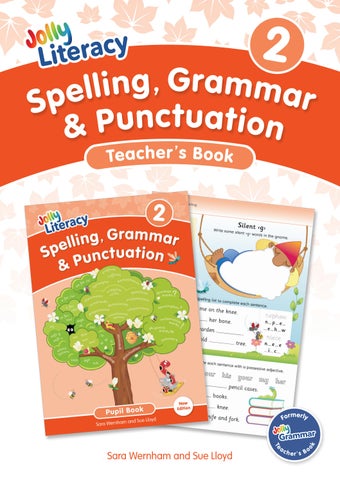

2
& Pun c t uation Spelling, G rammar
Teach e r ’s Book
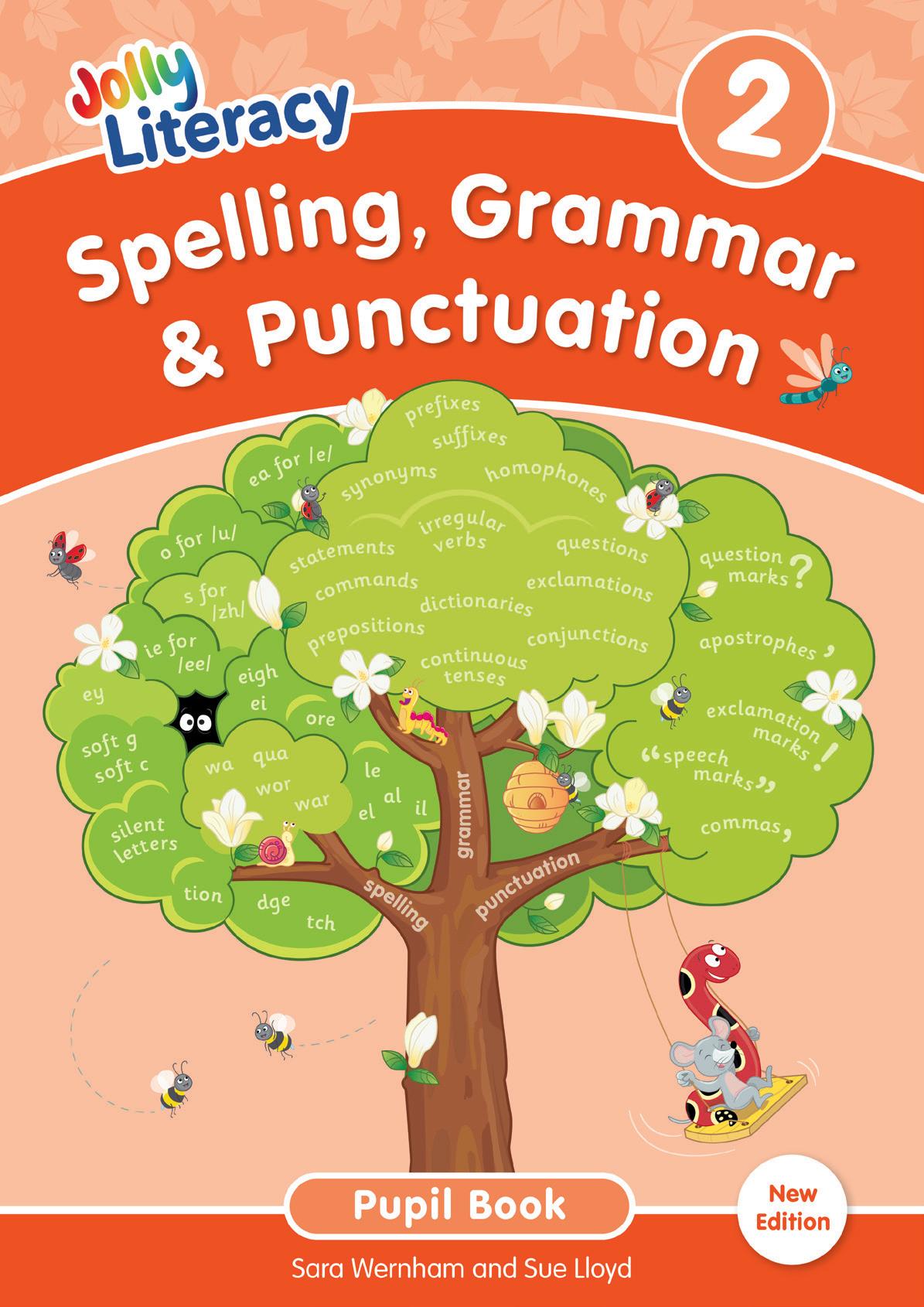
Sara Wernham and Sue Lloyd
Flashcard revision
• Use these words to revise some recently taught spelling patterns and family words: thumbnail, writing, knots, rhino, grandma, sister.
Spelling focus
• Remind the children that some words have a silent letter, like ‹b›, ‹w›, ‹k› or ‹h›.
• Introduce silent ‹g› by writing the word gnome on the board. Read the word to the children and ask them which of the letters is silent.
• Write some more silent ‹g› words on the board and read them with the class: gnu, sign, gnat, gnawed Now read the words again, this time saying the /g/ sound aloud. This helps the children to remember the spelling.
• The children work in pairs/trios to see if they know any other words with a silent ‹g›.
• Write the words on the board. Ask the pairs/trios to make up a silly sentence, using as many of the words as they can: for example, The gnarly gnome designed a sign with gnawing gnats.
Spelling list
• Read the spelling words with the class, pointing out the silent ‹g›.
• Also point out the following: the alternative spellings ‹aw› and ‹o_e› in gnaw and gnome; the ‹u› spelling of long /oo/ in gnu; the letter ‹i› making its long vowel sound /ie/ in design.
• To support spelling, use chin bumps to split the longer word design into syllables: de/sign. (See Syllables, page 10.)
• With the class, work out any tricky parts in the family words. For example, nephew has the alternative spellings ‹ph› and ‹ew›. In niece, /ee/ is spelt ‹ie› and there is a soft ‹c› at the end.
•
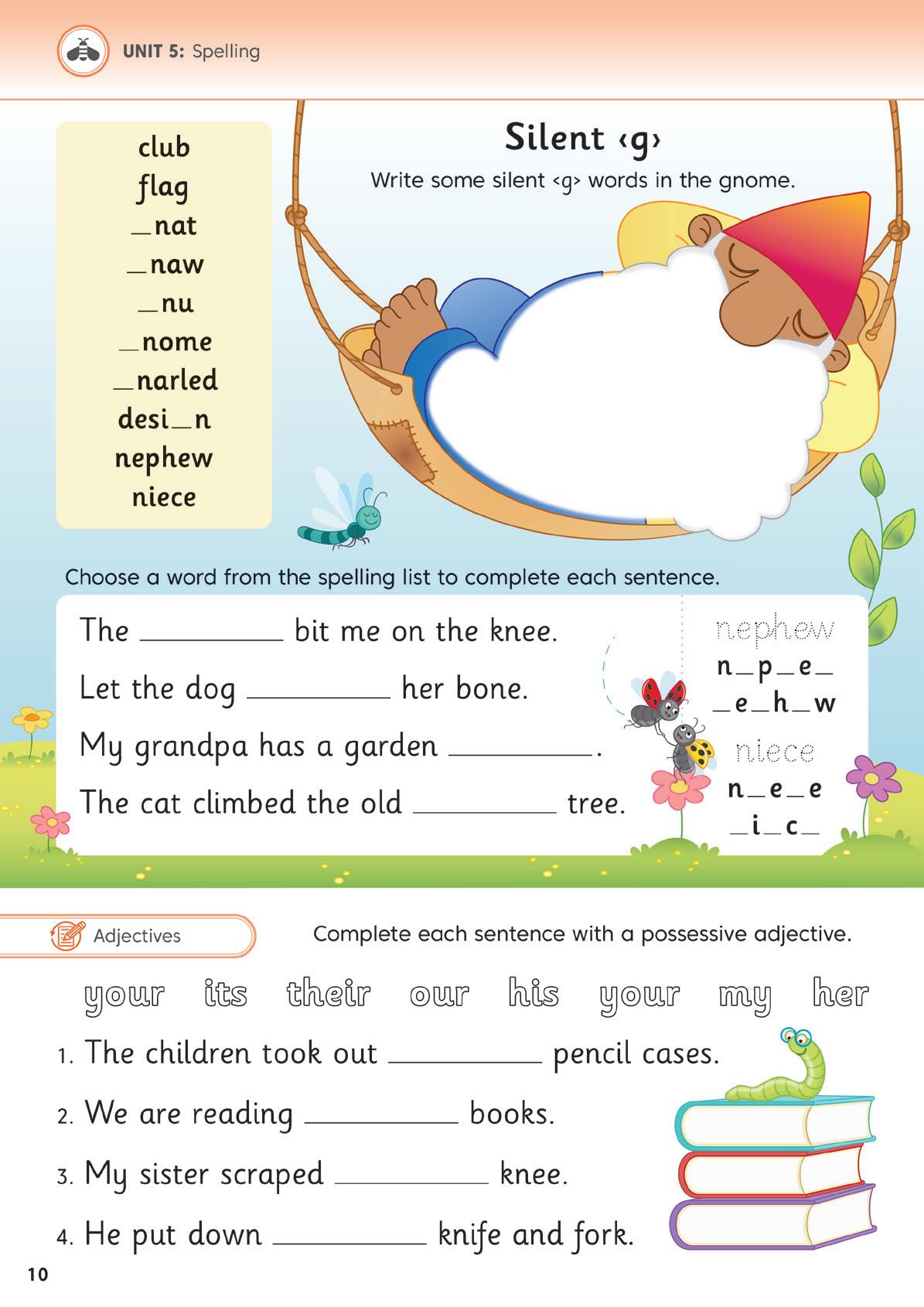
Silent ‹g›

The bit me on the knee.
Let the dog her bone. My grandpa has a garden The cat climbed the old tree.
Write some silent ‹g› words in the gnome. club flag nat naw nu nome narled desi n nephew niece nepe n p e e h w niece n e e i c

1. The children took out pencil cases.
2. We are reading books.
3. My sister scraped knee.
Dictation
• Give each child a spelling list to take home and test the class at the end of the week.
Pupil Book page 10
• The children complete the words in the spelling list by adding the missing silent letter.
• Then they write some silent ‹g› words in the gnome.
• The children then read the sentences and fill in the gaps. The missing words are from the spelling list: 1. gnat, 2. gnaw, 3. gnome, 4. gnarled
• They also practise spelling the family words by filling in the missing letters.
• Finally, the children read the sentences and write in the missing possessive adjectives: 1. their, 2. our, 3. her, 4. his.







4. He put down knife and fork. your its their our his your my her

9. Did he write a book about gnomes? 1. gnash 2. gnarly 3. gnawing 4. sign 5. designer 6. signpost club flag gnat gnaw gnu gnome gnarled design nephew niece
• Read the dictation words and sentences for the children to write down.
• Remind the children that sentences start with a capital letter and end with either a full stop or a question mark.
7. The gnats buzz around the rhino. 8. The gnu gnawed the tree trunk.
Extension activity
• The children write a silly sentence, using as many silent ‹g› words as they can. They can use the one they thought of earlier or write a new one.
• Remind them to leave a finger space between words when writing their sentence.
abc
Phonics focus
• When the children read an unfamiliar word like gnu for the first time, they can use the rule If the short vowel does not work, try the long vowel However, they will need to remember that the alternative spellings for /ue/ (which include the short vowel saying its long vowel sound) often make the long /oo/ sound instead.
UNIT 5: Spelling
Plurals: ‹-s› ‹-es› and ‹-ies›
Learning objective
• Develop the children’s understanding of plural nouns and the spelling rules that determine whether to add ‹-s›, ‹-es› or ‹-ies›.
Introduction
• Remind the children that there are two types of nouns: proper nouns and common nouns.
• Proper nouns start with a capital letter and are the special names given to people, places or things. Each child’s name is a proper noun and so are the months of the year.
• Ask the children to say the months of the year in order: January, February, March, April, May, June, July, August, September, October, November, December.
• Common nouns are the ordinary names for things we can see and touch, such as table, chair or pencil. They can be singular (describing one item) or plural (describing more than one item).
• Call out different proper and common nouns and ask the children to do the appropriate action each time.
Grammar & spelling focus
• Point out that some words in front of a noun tell us whether it is singular or plural. For example, we put a or an in front of a singular noun or use words like some or many to describe plural nouns. (These words are called determiners.)
• The main way to show that a noun is plural is to add ‹-s› or ‹-es› to the end of the noun. Ask the children when we add ‹-es› rather than ‹-s›.
• Write some words on the board: lunches, boxes, hairbrushes, kisses. Read them with the children and point out that when a word ends in ‹s›, ‹x›, ‹ch› or ‹sh›, the plural suffix is ‹-es›, although it sounds more like /iz/.
• Remind the children that this spelling rule also applies to forming verbs in the present tense after he, she and it (the third person singular), as in She brushes her hair.
• Now write some more words on the board: day, toy, turkey, story, party, spy. Point out that they all end with the letter ‹y›. Some have a vowel before the ‹y› and some have a consonant. Ask the children how we spell these words in the plural.
• Explain that we add ‹-s› to words like day, toy and turkey to make days, toys and turkeys. In all these words, a vowel comes before the ‹y›.
• However, to make the plural of the words story, party and spy, we replace toughy ‹y› with shy ‹i› before adding ‹-es›: stories, parties, spies Remind the children that shy ‹i› comes back because it is no longer at the end of the word.
• Point out that these spelling rules also apply to forming verbs in the present tense after he, she











and it (the third person singular), as in He plays football. She flies her kite.
• The children work in pairs/trios to think of more plural words with these spellings.
• Examples include:
• ‹-s›: cowboys, trays, boys, holidays, keys, donkeys
• ‹-es›: beaches, wishes, bushes, buses, classes, foxes, sixes, sandwiches
• ‹-ies›: ponies, cities, babies, berries, fairies, puppies, flies, fries, skies, cries
Pupil Book page 11
• The children write the plural of each noun on the leaves: babies, turkeys, daisies; flies, trays, branches; boys, puppies, buses.
• Then they draw a picture of each plural noun in the daisies.
Extension activity
• The children write some sentences, using some of the plural nouns.
Plenary
• Go through the Pupil Book activity with the children, checking they have used the correct plural spellings. Children who have written their own sentences can read one to the class.
Spelling
saying the /j/ sound
Flashcard revision
• Use these words to revise some recently taught spelling patterns and number words: tunnel, icy, kindness, gentle, ninety, hundred.
Spelling focus
• Revise the most common spellings of the /j/ sound, which are ‹j› and soft ‹g›.
• Remind the children that if the /j/ sound comes at the end of a word, it is usually spelt ‹ge›.
• Write some words on the board and read them with the class: badge, wedge, ridge, dodge, fudge. Explain that sometimes the letter ‹d› joins soft ‹g› to make the /j/ sound. This usually happens when /j/ follows a vowel letter that is making its short vowel sound.
• The children work in pairs/trios to see if they know any other words with this spelling.
• Write the words on the board. Ask the pairs/trios to make up a silly sentence, using as many of the words as they can: for example, The badger nudged the hedgehog off the bridge by the lodge.
Spelling list
• Read the spelling words with the class, pointing out the short vowel followed by ‹dge›.
• Also point out that in fidget the ‹e› in ‹dge› makes its own sound, although it is pronounced /i/ rather than /e/ (as does the first ‹e› in knowledge). In badger, the ‹e› in ‹dge› is also part of the ‹er› spelling.
• To support spelling, use chin bumps to split these longer words into syllables: fid/get, bad/ger, know/ledge. (See Syllables, page 10.) Understanding that the root word of knowledge is know will help the children remember the silent ‹k› and ‹ow› spelling. Split the compound word hedgehog into two shorter words: hedge/hog.
•











• With the class, work out any tricky parts in the number words. The children can say both words as they sound, pronouncing the last syllable of each word to rhyme with sand and gone, respectively.
• Give each child a spelling list to take home and test the class at the end of the week.
Pupil Book page 46
• The children complete the words in the spelling list and write some ‹dge› words in the hedgehog
• Then they read the sentences and fill in the gaps: 1. fidget, 2. badger, 3. bridge, 4. hedgehog.
• The children also practise spelling the number words by filling in the missing letters.
• Finally, they read each sentence, underline the









has sharp brown prickles.
1. The hedgehog curls up in the leaves.
2. The hedgehog was curling up in the leaves.
3. The hedgehog curled up in the leaves.
4. The hedgehog is curling up in the leaves.






fidget 6. nudge film kept edge bridge fidget badger hedgehog knowledge thousand million
verb in red and match it to the correct tense: 1. curls up (simple present); 2. was curling up (past continuous); 3. curled up (simple past); 4. is curling up (present continuous).
Dictation
• Read the dictation words and sentences for the children to write down.
• Remind the children to use correct punctuation, including speech marks. Also remind them to use an exclamation mark when something is said with strong emotion, like fear or surprise
7. They pick berries along the hedge 8. We dropped sticks from the bridge 9. “Stay away from the edge!” I cried. 1. badge 2. hedge 3. ledge 4. gadget
Extension activity
• The children write a silly sentence, using as many ‹dge› words as they can. They can use the one they thought of earlier or write a new one.
• Remind them to leave a finger space between words when writing their sentence.
abc
Phonics focus
• Use the vowel hand activity regularly to revise the short and long vowel sounds (see page 10).
Sit still and do not !
Antonyms and prefixes
Learning objective
• Develop the children’s understanding of antonyms and the prefixes ‹un-›, ‹dis-›, ‹mis-› and ‹im-›.
Introduction
Antonyms and prefixes
• Remind the children that a prefix is one or more syllables added at the beginning of a word to change or add to its meaning.
• Write some adjectives and verbs on the board: Adjectives: well, safe, true, tidy Verbs: fold, wrap, tie, zip.
• Add the prefix ‹un-› to each word and ask the children how it has changed the meaning.
• Explain that when ‹un-› is added at the beginning of an adjective, it means not (that adjective). So, something that is well, safe, true or tidy becomes the opposite: unwell, unsafe, untrue or untidy
• Similarly, when ‹un-› is added at the beginning of a verb, it makes a new verb that reverses the action. This means we can fold and unfold a piece of paper, wrap and unwrap a gift, tie and untie a ribbon or zip and unzip a jacket.
• Remind the children that words with the opposite meaning are called antonyms.
Grammar & vocabulary focus
• Write the word like, meaning similar, on the board and use it in a sentence: She is like her brother. Then replace like with unlike and discuss the change in meaning with the class: She is unlike her brother. The change in meaning is similar to the previous examples and means not
• Now use like in a different sentence: They like ice cream. Remind the children that words can be more than one part of speech. Here like means to enjoy something or think that it is good. Add a different prefix, ‹dis-›, and see how the meaning changes: They dislike ice cream. Like the ‹un-› in untidy, the prefix ‹dis-› can mean not.
• Now use ‹dis-› in a sentence with another verb: The hedgehog suddenly disappeared. Compare this with The hedgehog suddenly appeared. Like the ‹un-› in untie, the prefix ‹dis-› can reverse the action of the root verb, so that the hedgehog can appear and disappear
• Now compare the words distrust and mistrust. Both words mean the same thing: to not trust. However, when the prefix ‹mis-› is added to verbs like spell or judge its meaning changes slightly. Instead of not, the ‹mis-› in misspell or misjudge means incorrectly, badly or wrongly.
• Write the word possible on the board and ask the children what the opposite or antonym of this word is. Add the prefix ‹im-› to the word on the board to make impossible. Ask the children to suggest a sentence for both words and explain that ‹im-› is another prefix meaning not. Other examples of words with the prefix ‹im-› include
It was possible to walk along the path. I really like writing stories in school. Dad packed the large backpack. Jason understood what he had to do. un- dis- mis- im-









imperfect and immature. Explain that if someone is being mature, they are acting in a sensible, grown-up way, so the word immature means to act in a childish way.
• Remind the children that if they do not know what a word means, they can look it up in a dictionary.
• Recap the four different prefixes and their ‘opposite’ meanings:
• ‹un-›, ‹dis-›, ‹mis-› and ‹im-› can all mean not (unsafe, disagree, mistrust, imperfect)
• ‹un-› and ‹dis-› can also reverse the meaning (zip → unzip, appear → disappear)
• ‹mis-› can also mean wrongly, incorrectly or badly (misplace, mistake, misbehave)
Pupil Book page 47
• The children choose a prefix to complete each word: impossible, dislike, unpacked, misunderstood.
• Then they read the words in the fish and add the correct prefix: immature, unhappy, unlucky; disappear, misbehave, unlock; dishonest, undo, mistake, disagree, impossible, uncomfortable.
Extension activity
• The children work in pairs/trios to look up the words unlikely, disapprove, misfortune and impatient in a dictionary. Then they write a sentence for each word. Make sure the words given to the children are in the dictionaries being used.
Plenary
• Go through the Pupil Book activities with the class.
a prefix to go in front of each root word. Then write it on the line in the fish’s head.
You can use a dictionary to check whether you have chosen the right prefixes.
The /ue/ sound: ‹ue› ‹u_e› or ‹ew›?
Flashcard revision
• Use these words to revise some recently taught spelling patterns and tricky plural words: warmer, mention, white, soaked, child, children
Spelling focus
• Remind the children that the main ways of writing the /ue/ sound are ‹ue›, ‹u_e› and ‹ew›. These spellings can also make the long /oo/ sound.
• Now that these alternative spellings are familiar, the children must learn which words use each spelling.
• Remind the children that ‹ew› is usually found at the end of a word. It is a common spelling for verbs with a tricky past tense, like blew, drew, flew, grew and threw, although the sound it makes in words like this is usually the long /oo/ sound, not /ue/.
• The children work in pairs/trios to see what words they know with the /ue/ spellings.
• Write the words on the board and ask the pairs/ trios to make up a silly sentence for each /ue/ spelling: for example, They continued to argue about the fuel for the barbecue. The cute mule had a useful excuse. Matthew’s nephew has fewer ewes.
Spelling list
• Read each spelling word with the children. Remind them that if it has the /ue/ sound, they must remember how the /ue/ is spelt.
• Point out the soft ‹g› in huge and the silent ‹e› at the end of ewe.
ark clever huge fuse rescue argue ewe useful woman women
• To support spelling, use chin bumps to split these longer words into syllables: clev/er, res/cue, ar/gue, use/ ful. (See Syllables, page 10.)
• With the class, work out any tricky parts in the tricky plural words. For example, the letter ‹o› makes the little /oo/ sound in woman and the /i/ sound in women. To help remember the ‹o› spelling, split the words into syllables, emphasising the long vowel sound: wo/man, wo/men
• Give each child a spelling list to take home and test the class at the end of the week.
Pupil Book page 64
• The children complete the words in the spelling list and underline the correctly spelt word in each ice cube: cube, value, amuse, few, refuse, barbecue
• Then they read the sentences and fill in the gaps. The missing words are from the spelling list: 1. ewe, 2. argue, 3. rescue, 4. huge.
• The children also practise spelling the tricky plural words by filling in the missing letters.
• Finally, they use a dictionary to find two unfamiliar

arg e s ful woman women The /ue/ sound: ‹ue› ‹u e› or ‹ew›?
•
A female sheep is called a They often with each other. The lifeboat came to us. That whale is ! ark clever h g f s
















women w


Dictation




words that start with ‹wa› and write down each one, along with its meaning
• Read the dictation words and sentences for the children to write down.
• Remind the children to put a comma after direct speech, unless the speech requires a question mark or an exclamation mark.
7. The plug needed a new fuse.
8. The couple used to argue.
9. “The ewe had a little lamb,” said the farmer. 1. use
Extension activity
• The children write a silly sentence for each of the main /ue/ spellings. They can use the ones they thought of earlier or write new ones.
• Remind them to leave a finger space between words when writing their sentences.
abc
Phonics focus
• Encourage the children to create their own lists of words with these spellings, one for words that have the /ue/ sound and one for words with the long /oo/ sound, like blue, June and chew.
Word webs
Learning objective
The /ue/ sound: ‹ue› ‹u e› or ‹ew›?
• Develop the children’s ability to write descriptive sentences by thinking carefully about the words they use.
Introduction
• Remind the children that some prefixes and suffixes are used to make words with an opposite meaning: for example, unsafe, disagree, mistrust, imperfect, harmful and harmless. We call these words ‘opposites’ or antonyms.
• Remind them that there are also words that have the same meaning as each other. For example, rather than saying happy, we could use the words jolly, cheerful, joyful or merry instead. Ask the children if they can think of any other words that mean happy (for example, glad, excited, thrilled).
• Point out that although these words are similar, we must be careful how we use them. Write a sentence on the board: It was a happy day. Replace happy with the other words in turn and see what happens. Most of them make sense, but glad, excited and thrilled do not fit. Ask the children for examples of when glad, excited or thrilled can be used instead.
• If a thesaurus is available, show it to the children. Explain that it is a special book similar to a dictionary. We use it to look up words that are listed in alphabetical order, but instead of finding out more about their spellings and meanings, we find other words with similar meanings. For example, if we wanted to use another word for said, which is the past tense of to say, we would look up the word say to find words like whisper, shout, explain and ask
Vocabulary focus
• Tell the children that when we write something, we are using words to paint a picture in the reader’s mind. We want the words we use to make the meaning as clear and vivid as possible. This means we must think carefully about the words we use and not rely on certain words that we use all the time.
• Write some sentences on the board: The man ate his dinner. The children walked into the room. The boy looked at the gold coin. The girl was thinking.
• These sentences tell us some basic information, but the picture created in our mind is very general. Explain that we can make the sentences more vivid by using stronger verbs to help describe what is happening. For example, the man might be really hungry and eating quickly, so we can use verbs like gobble, chomp or devour. Alternatively, the man might not be hungry or the food might be unusual, so we could use nibble, peck or taste instead.
• In the other sentences, the children might be excited, scared or reluctant to go in the room. Using verbs like march, tiptoe or trudge help us to show this. The boy looking at the gold coin might be interested, surprised or excited by it. He might


take a long time or just give it a quick look. We can choose the right verb to make this clear, such as examine, stare, gaze or glimpse. By using verbs like plan, imagine, guess or remember we can describe better what the girl is thinking.
• Discuss this with the children and ask them to work in pairs/trios to think of other words they could use instead of to eat, walk, look and think. Write some of these words on the board
•
Pupil Book page 65
• The children write words with a similar meaning to eat, walk, look and think in the appropriate word web. For example: (eat) munch, slurp, chew, gnaw, sip, feast, dine, graze; (walk) amble, wander, stroll, stomp, stride, trot, dash, hop, skip, creep, waddle, shuffle, prowl, scamper; (look) peer, watch, glance, peep, peek, scan, notice, spy, spot, search, scout; (think) wonder, ponder, work out, concentrate, believe, dream, recall
•
Extension activity
• The children work in pairs/trios to think of similar words to sad or cold: Sad: unhappy, upset, glum, down, gloomy, miserable, tearful, depressed; Cold: freezing, chilly, cool, icy, snowy, frosty.
Plenary
• See how many other words the children have put in their word webs. Encourage the children to keep their own vocabulary book for listing similar words.
Spelling, Grammar & Punctuation is a six-level programme that gives young children the skills they need to be confident readers and enthusiastic writers. It builds on the teaching in Jolly Phonics and has the same multisensory, active and fun approach. The systematic and cumulative syllabus enables children to spell and punctuate more accurately, use a wider vocabulary and have a clearer understanding of how language works.
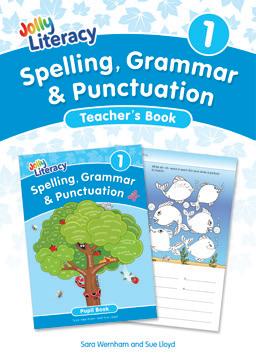
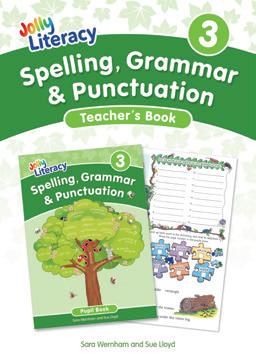
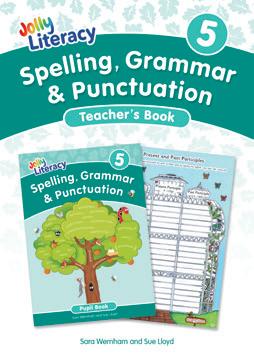
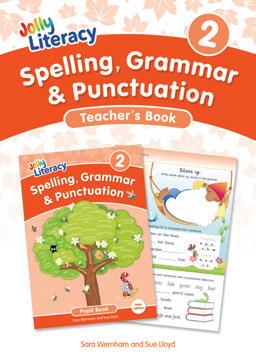
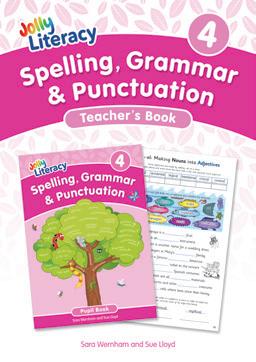
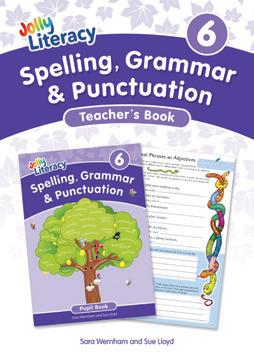
Each Teacher’s Book in the series
• Is a comprehensive resource for teaching spelling, grammar and punctuation with the Pupil Books.
• Offers a wealth of practical advice and step-bystep lesson plans for the academic year.
• Systematically reinforces the learning so that no one is left behind.
• Introduces complex grammatical concepts in an engaging and child-friendly way.
• Teaches new spelling patterns, supports a greater understanding of sentence structure, expands vocabulary and comprehension, and cultivates dictionary and thesaurus skills.
The material in the Pupil and Teacher’s Books, Levels 1 to 3, is recommended by Cambridge Assessment International Education to support the Cambridge Primary English curriculum framework.
To see the full range of Jolly Literacy products, visit our website at jollylearning.com
© Sara Wernham and Sue Lloyd 2026 (text)
© Jolly Learning 2026 (illustrations)
Illustrated by Laia Capdevila (Jolly Learning) and Pablo Gallego (Beehive Illustration)
77 Hornbeam Road, Buckhurst Hill, Essex, IG9 6JX, UK Tel: +44 20 8501 0405
82 Winter Sport Lane, Williston, VT 05495, USA
Tel: +1-800-488-2665 Fax: +1-802-864-7626
Printed in China. All rights reserved.
jollylearning.com info@jollylearning.com
ISBN 978-1-83582-393-4
Reference: JL3934
British English Edition