WRITTEN BY DR IAN WALKER
WRITTEN BY DR IAN WALKER
John XXIII College is on land of the Ngunnawal and Ngambri-Kamberri people, and respect is paid to their elders - past, present and emerging.
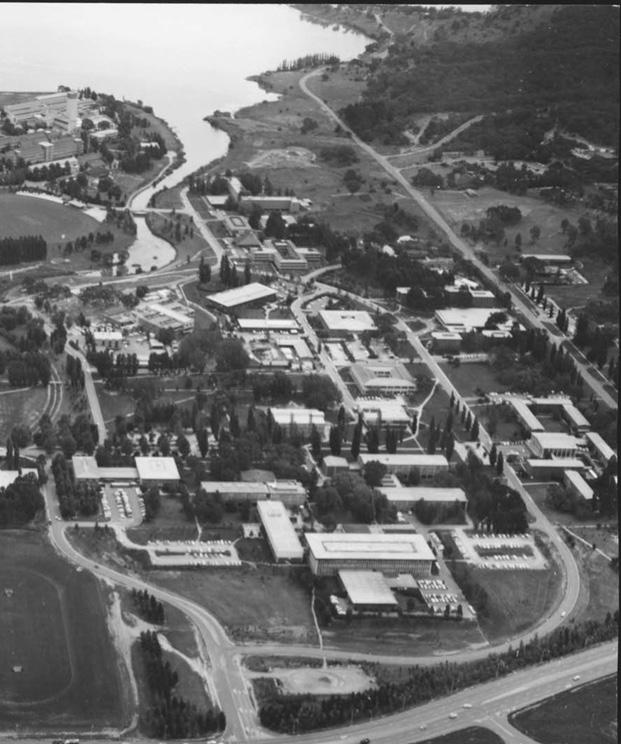
One of the first residents of John XXIII College when it opened in its new building on Daley Road ANU in 1969 was Marduntjara & Pitjantjatjara man Gordon Briscoe. Born in Alice Springs in 1938, at the age of four he was taken with his family from there to Adelaide. They eventually moved to Sydney where he completed high school, and where he and his family continued a close friendship with Charlie Perkins, the first Indigenous Australian to complete a university degree (Sydney University), and his family. In 1969 he moved to Canberra to commence undergraduate study at ANU. In his biography he noted:
“On arrival in the national capital I went straight to John XXIII College at the Australian National University and was given
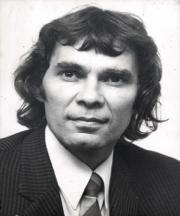
Gordon Briscoe
a room … It was here in John XXIII College that I began my 40-year long association with university life.”
In the short time he lived at the College while waiting for his family to join him (as well as the Perkins family), he met and was influenced by Jesuit priest Father John Eddy who was associated with the (Dominican) Blackfriars House in Watson and who was a research fellow and lecturer in history at ANU (until 1994). Gordon Briscoe AO became a highly respected Aboriginal activist and academic (historian) and was, for example, involved in the establishment of the ANU’s ‘Tjabal Centre’. He completed an MA in the 1980s and in 1997 was one of the first Indigenous Australian to be awarded a PhD (ANU).
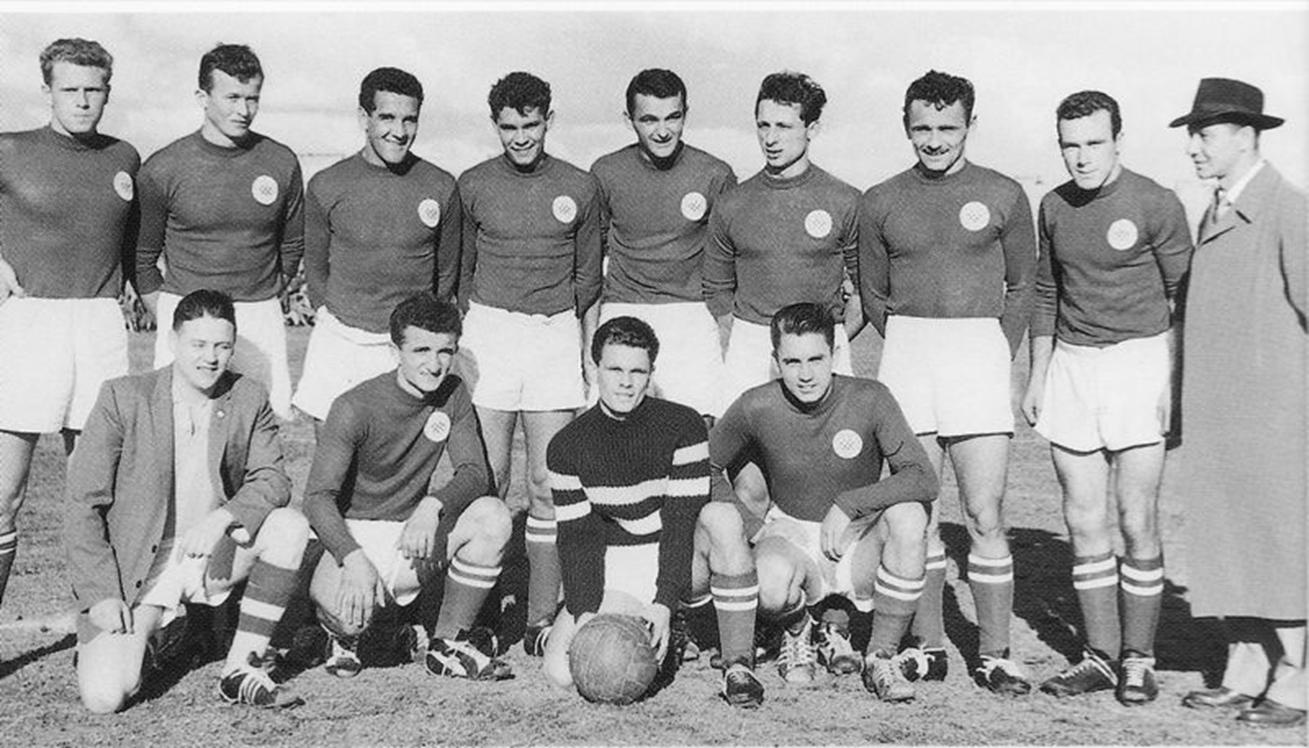
He was a keen soccer player and played in Adelaide with Charlie Perkins who was also seen as a highly skilled player. He went to England in 1961 to pursue a professional soccer career but returned to Australia in 1962.
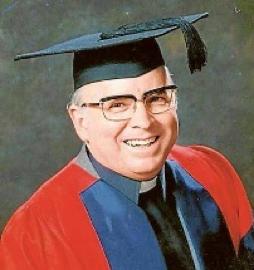
Father John Eddy
In his ‘foreword’ to Gordon Briscoe’s autobiography ‘Racial Folly: A Twentieth Century Aboriginal Family’ (ANU Press 2010), Jack Waterford (John XXIII 1970) writes:
“Gordon Briscoe is one of the most remarkable and successful Australians of his generation.
He has had a profound impact, over more than 40 years, on what has happened in public affairs. But his real impact has been on people’s thinking on significant public policy issues, particularly Aboriginal affairs.”
Gordon Briscoe died on 30 June 2022.
On the 16th May 2013 a gathering of John XXIII College staff and students, Council and alumni, Prior Provincial and members of the Dominican Order, University administrative and teaching staff, and other friends of the College came together for the unveiling by the ANU Vice-Chancellor, Professor Ian Young AO, of a plaque in what has been until 2025 a University Early Childhood Centre but in 1967 and 1968 was the site of the first two years of the College while the buildings in Daley Road
were under construction1. The event was the initiative of the then Head of College, Stephen Foley, and the building in which the plaque was affixed is one of a number of remaining mainly weatherboard structures that formed what was known as ‘Lennox House’2 , with some of the buildings having been placed there from 1911 as ‘single men’s quarters’ or ‘Bachelor’s Quarters’ for those working on the development of Australia’s national capital. The plaque “gratefully acknowledges the contribution of Lennox House to John XXIII College.”
returned to NSW in 1853. An early bridge across the Molonglo River from the Acton area was named Lennox Crossing. The wooden buildings that came to be known as Lennox House were close to the crossing.
2.
3. https://services.anu.edu.au/files/document-collection/acton_ conservation_area_hmp-vol.-1_introduction.pdf
Under the heading ‘College takes over’, the Canberra Times in February 1967 noted:
“Lennox House, in Acton, will be known as John XXIII College from tonight until a new building to house the college is completed. The college bursar, Father J. J. Hooper, said yesterday that enrolment was still going on and that Lennox House could accommodate a total enrolment of 110 full-time and part-time students. John XXIII College is the first college to be affiliated to the Australian National University and is run by the Dominican Order,
with Father F. Kelly as the college Master. Tenders for a permanent building for the college will be called next month, but it is unlikely this will be ready until 1969 at the earliest.” 4
The site was a place of beginnings. For thousands of years it was an area of gathering, meeting, celebration, ceremony and nurture of ‘First Australians’, the Ngunnawal and Ngambri people. It was the area of first European occupation when Joshua John Moore took out a ‘ticket of occupation’ of one thousand acres and established a station in the early 1820s that he named ‘Canberry’. The first stone pastoral homestead was soon built
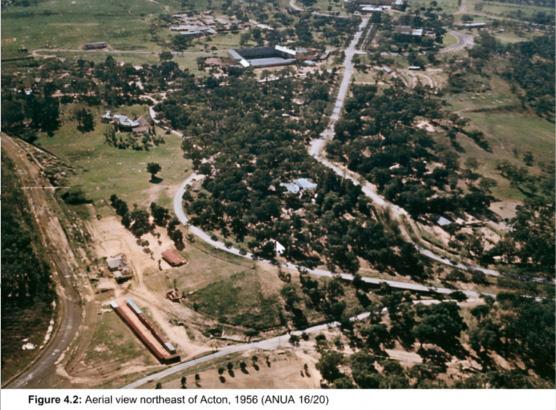

on the property, which was bought in 1843 by Lieutenant Arthur Jeffreys RN who named the property ‘Acton’ after his home in Wales.
The property and adjacent others were resumed by the Commonwealth in 1911, with the Acton homestead being occupied by Charles Scrivener, Director of Commonwealth Surveys. The barracksstyle ‘Bachelor’s Quarters’ , also officially referred to as the ‘Professional Officers’ Mess’, were set up on the ridge to the north of the homestead by 1912. Over the next decade the first Canberra sports clubs, such as the Acton Cricket Club and the Canberra Lawn Tennis Club, were formed as well as the first amateur theatre group.
The ‘Bachelor’s Quarters’, later to be called ‘Lennox House’, accommodated some junior members of the Royal Party in 1927 for the opening of Parliament House and, during the
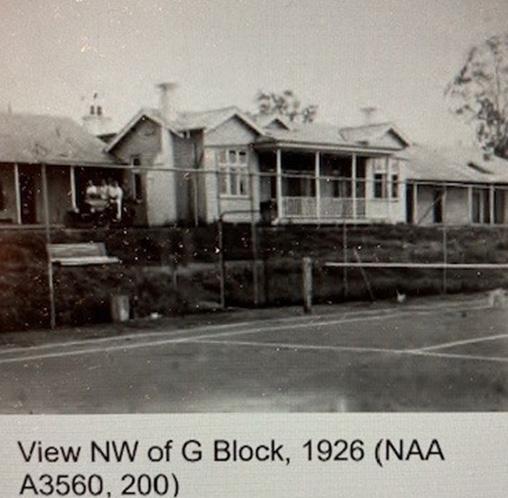
years of World War II, the complex housed staff of the Royal Australian Navy’s Canberra Radio Station and members of the United States’ 7th Fleet radio training school. After the War it was managed by the Commonwealth as a hostel to house junior public servants until it was taken over by the Australian National University to accommodate students in the early to mid-1960s.
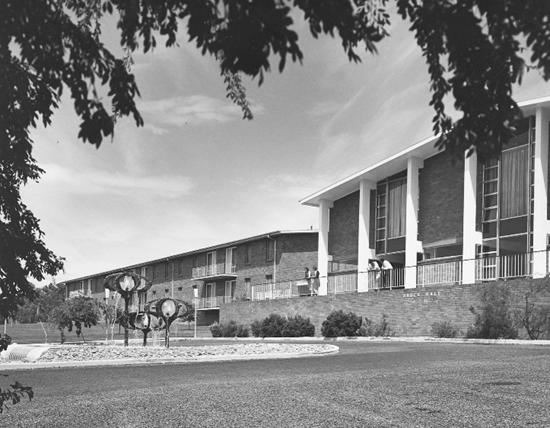
When the ANU merged with the Canberra University College in 1960, bringing in undergraduate students, Bruce Hall opened in 1961 as the University’s first undergraduate Hall of Residence and the University’s and Australia’s first mixed gender Hall.6 It was a rather brave experiment at the time but it proved popular and a more readily accepted precedent in the University than had been anticipated. In the ANU Council’s Annual Report 1962 it was noted that Bruce Hall was full and that a Civic motel, the ‘Schreinerhof’, had been purchased as an Annexe for 25 women students. It was also noted that, with the cooperation of the
5. Lennox House is listed on the ACT Heritage Register as “a surviving element of the Acton site of early Canberra public administration and as an integral part of the broader cultural landscape of Acton Peninsula. It is important for its associations with the earliest development of Canberra as the National Capital and with the successive development of Canberra and the Australian National University.”
Commonwealth Hostels, about 100 students along with some Commonwealth employees were accommodated at Lennox House. With Dr Mike Gore7 appointed as Warden in 1963, Lennox House, which Professor Gore later referred to as “a bunch of sheds on the end of campus”8 , was taken over by the University in 1964 fully to operate as a Hall of Residence within the University.
When Mike Gore and his wife arrived at Lennox House in 1963, their accommodation was a ‘wooden shack’ with a sitting room and bedroom, a kitchen and a bathroom which he described as the size of a table. There was no heating.9 In his 1964 report, Mike Gore referred to the conversion of a portion
of one of the Blocks into a Common Room that “has served as the social centre of the House and is used for dances, parties, films and talks.”10 Bathrooms had been renovated, insulation had been placed in the ceiling of all Blocks and the former Manager’s flat had been converted into a Tutor’s Room and Warden’s Office. Students in residence were required to become members of the Lennox House Students’ Association and were required to possess an undergraduate gown which could be hired from the Warden.11 The guest at a First Term Dinner, Mr V. G. Beljaev, First Secretary of the Embassy of the U.S.S.R. gave an address on ‘Universities in the Soviet Union’. The University Council dined at the House in May that year.
6. Canberra University College was set up in association with Melbourne University (degrees granted by the University) in 1929 to provide undergraduate studies largely for public servants and trainee diplomats. Its principal at the time of the merger was Professor Herbert (‘Joe’) Burton who then became Principal of the ANU School of General Studies (undergraduates).
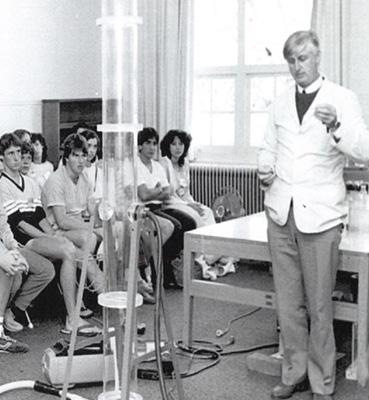
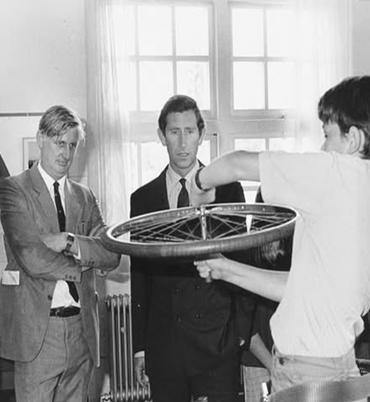
7. Physicist Professor Mike Gore AO (1934-2022) arrived at the ANU in 1962, residing first (and being married to his American fiancé Joyce) at Bruce Hall. He initiated ‘Inward Bound’, supported and developed by Bill Packard. He was asked to take on oversight of Lennox House by the Acting Principal of the School of General Studies, Professor Manning Clark. He later became Acting Warden of Burton Hall (1973) and Warden of Garran Hall (1974-1975), and from 1980 was fully involved in the establishment of ‘Questacon’, an initiative and work for which he was to receive many accolades. He was 1982 Canberran of the Year and was appointed an Officer of the Order of Australia in 2015. Prince Charles visited Questacon in 1985.
8. file:///H:/michael_gore.html
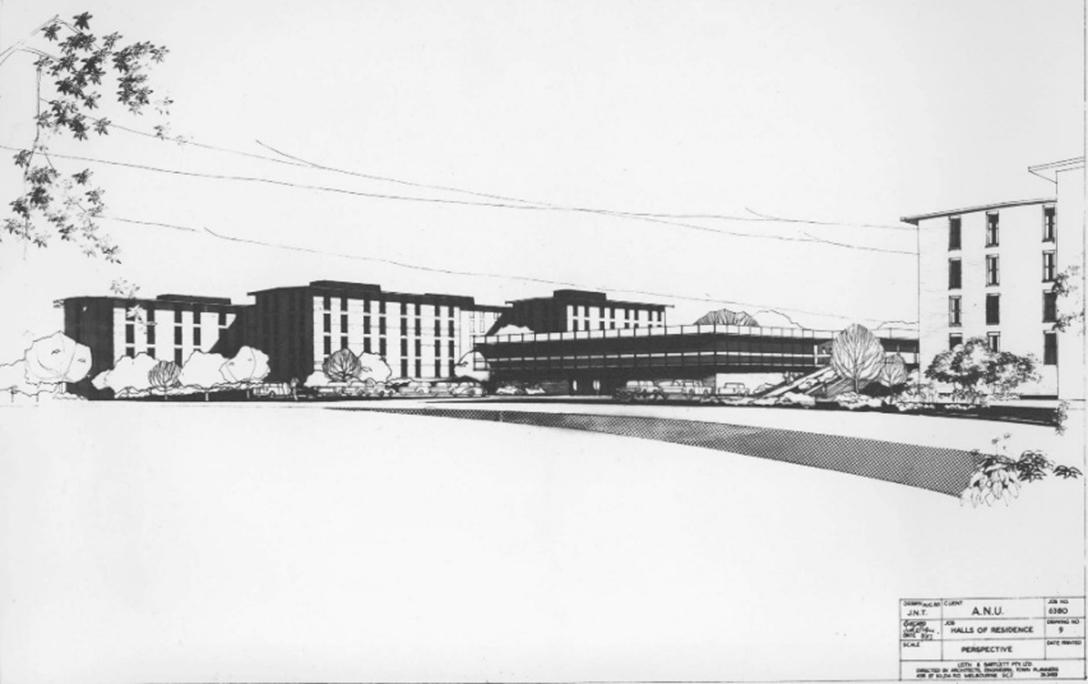
With steadily increasing numbers coming to the University from across Australia and from overseas, the University was clearly concerned about the need for adequate accommodation for students. Plans were approved by the University Council in 1963
for two Halls of Residence to be built just south of Bruce Hall on Daley Road to house another 500 students. Meeting the demand as soon as possible was seen as “essential if this University is to develop its national character.”12 Burton Hall opened in March 1965 with 250 places, equally divided among men and women. With the same numbers, Garran Hall was completed early in 1966.
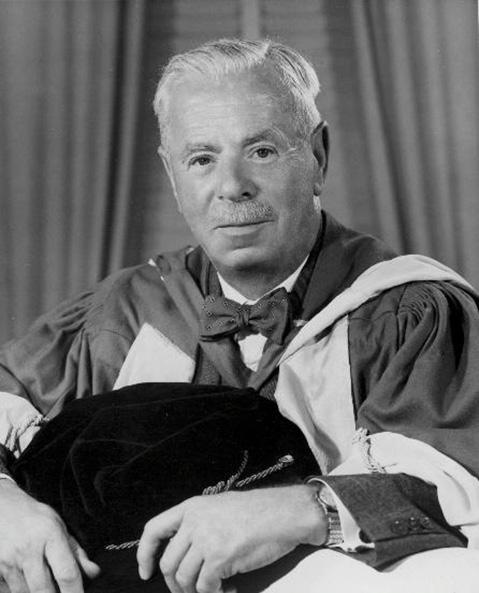
Professor ‘Joe’ Burton – Principal of the Canberra University College, and then Principal of the ANU School of General Studies (undergraduates) after the 1960 merger
9. Ibid.
10. ANU Annual Report 1964 pp.79-80
11. Ibid. p.85
12. ANU Annual Report 1963 p.10
The 1963 Annual Report also indicated that approaches had been made about the setting up of denominational colleges that clearly the University felt would help achieve its residential accommodation and ‘national character’ objectives.
“There are some signs that we may be helped towards this objective by the establishment of affiliated colleges sponsored by religious bodies, if they can be accommodated on the university site.” 13
Through 1964 and 1965 student activities, clubs and societies increased across campus and were reflected in the life of the Halls, especially following the opening of Burton Hall and, early in 1966, with the completion of Garran Hall. In line with the requirements of the School of General Studies, which had overall responsibility for the Halls, Lennox
House had in place a governance and management structure that included Deputy and Sub Wardens, Tutors, and a range of members of a Board which included Mr John Ewens, a member of the University Council; history Professor Ken Inglis, later to be the second Vice-Chancellor of the University of Papua New Guinea; botany Professor Lindsay Pryor; and Mr Des O’Connor, Sub Dean of the Faculty of Law.
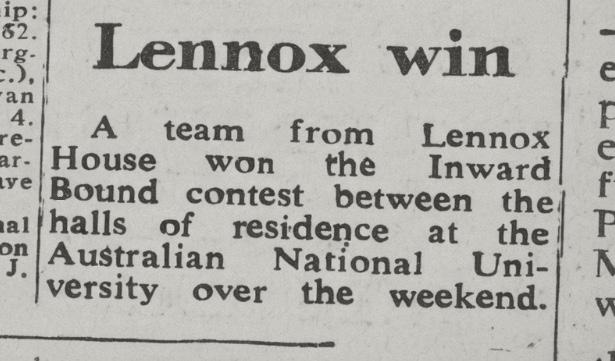
In his report for 1964, Warden Mike Gore noted that the Lennox House Students’ Association had organized a very successful Ball and a number of other dances. Regular film evenings had been held during the year and, in addition to other student activities, Lennox House defeated Bruce Hall in the annual rugby match (most likely Rugby League).14 The Warden was able again to report that in the 1965 Inter-Hall Rugby Football Competition Lennox House retained the trophy.15 Lennox House won the Inward Bound competition in 1966.
13. Ibid.
14. ANU Annual Report 1964 pp.79-80. Peter Sekuless, who was a resident 1964/5 and then in 1967, recalled in an interview with Ian Walker on Friday 6 December 2024, that there were several state school students who were familiar with Rugby League, though the game was probably something more of a ‘hybrid’ mix of ‘rugby’! Woroni at this time was reporting on Rugby Union and Australian Rules.
15. ANU Annual Report 1965 p.93
this incident about 150 youths, believed to have been mainly cadets from Duntroon, marched on Bruce Hall … singing army songs … cadets, some of whom were armed with sticks, then went through the building, systematically battering at doors, playing water (from fire hoses) into the rooms and overturning furniture.” 18 At least in the eyes of the University, this rivalry seemed to be quelled in 1965 by the two institutions cooperating in organising “a highly successful programme of novel sporting events, social events and student exchanges. This fostered friendly contacts between cadets and students and raised a considerable sum for ‘Legacy’.” 19
The ’baby boomers’ were starting to ‘bloom and boom’ in the mid-sixties. Australia’s post-World War II population in 1960 included 30% under the age of 14. In the decade following the War participation rates in university education doubled, and the Commonwealth government began to play a much greater ‘hands on’ role and responsibility in the oversight and funding of tertiary education. Prior to the War, Australia had a university established in each State capital city and two university colleges. The last of the 6 universities established since 1850 was the University of Western Australia founded in 1911. Between the end of the War and 1975, thirteen new universities were established, with the first being the Australian National University in 1946.
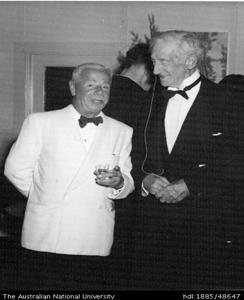
A university had been included in the Burley Griffin plans for the national capital but, though desired, its beginnings were delayed by two World Wars and the Great Depression. In 1935 Sir Robert Garran20 wrote:
“To the question whether there shall be a University at Canberra only one answer is possible. It is unthinkable that there should not be … What is wanted in Canberra is a university with a difference; something distinctly different, in character and function, from any institution that at present exists in Australia.”
Sir Robert clearly envisaged the role and worth of collegiate university residence:
“… the University can be a prominent part of the town outfit, and where the opportunities for corporate University life – for constant interchange of ideas between student and student and between student and teacher –are not interfered with, either by the size of the town, or by the size of the University. In our great Universities, to a majority of the students other than those resident in the Colleges, the University is merely a place to which they go to attend lectures, in which they get little or no real University life, and from which they scatter to pursue their solitary studies as best they may amid metropolitan distractions.” 21
18. ‘Canberra Times’ Mon 3 August 1964 p.1
19. ANU Annual Report 1965 p.14. Former Governor-General of Australia David Hurley commented in conversation with Ian Walker at Toad Hall 30 April 2025 that he recalled further such escapades when he was an Officer Cadet at Duntroon in the early 1970s.
20. Australia’s first Solicitor-General, first Chair of the Canberra University College Council, a member of the ANU Council 1946-1950, and first recipient of an ANU degree (Honorary Doctor of Laws)
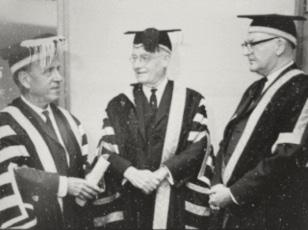
They were lofty ideas and ideals for this first of the ‘second wave’ of universities in Australia. Canberra was still a rather isolated place with challenges in seeking to attract and bring together highly qualified academic staff and university administrators, let alone students. One of the distinguished academic advisers in the late 1940s, Nobel Laureate and later Chancellor, Sir Howard (later Lord) Florey, warned that “all he could expect to find would be a hole in the ground and a mountain full of promises.” 24 It was a very different landscape and environment from that surrounding the universities in Sydney, Melbourne and Adelaide, let alone Oxford and Cambridge. The national capital was seen as “an expanse of paddocks,
bush and mountains surrounding a cluster of suburbs and government buildings … The Australian National University, almost at the centre of town, was a dozen buildings, some fibro huts, playing fields, lawns and bushland.” 25 Even with new buildings and continuing development in the early 1960s, Dr Mike Gore, Warden of the “bunch of sheds on the end of campus”, described University Avenue as “nought but a dusty track leading from Civic”26, and the Acton Ridge, Lennox House area, as separated from University Avenue by grass and scrub.
‘BUSH
Canberra was very much the ‘bush capital’, and University House, opened in 1954 to accommodate postgraduate students and University staff, was aptly described as ‘Oxbridge in the Bush’. With the arrival of
22. Herbert Cole ‘Nugget’ Coombs was Director-General of Post-war Reconstruction, first Governor of the Reserve Bank of Australia, Pro-Chancellor then Chancellor (1968-1976) of the ANU
23. S. G. Foster & Margaret M. Varghese The Making of the Australian National University Allen & Unwin, St Leonards NSW, 1996, p.19
24. ANU Reporter 22 December 2020 https://reporter.anu.edu.au/all-stories/climbing-a-mountain-full-of-promises
25. Blanche d’ Alpuget Robert J. Hawke: a biography Shwartz/Penguin Books, Melbourne 1982 pp.63&64
26. Address at Bill Packard’s Farewell Dinner 28 June 1986
27. file:///H:/michael_gore.html
undergraduates, ‘Bush Week’ developed at the end of second term as “a way of soaking up some of the bush ethos”, with a range of activities many of which were seen as creative and good fun, but also as too boisterous and offensive, such as the altercations between ANU students and Duntroon cadets, and a student frocked in
priestly habit handing out mock contraceptive pills. There were successful collections for charity28, which Professor ‘Joe’ Burton saw as rather hypocritical in being promoted by those he saw as exhibitionists and hooligans. One student leader “argued plaintively that Bush Week was ‘the only tradition the ANU has’. 29
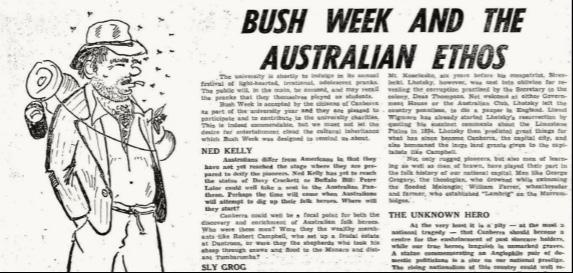
op.cit., pp.207&208. Article in Woroni Vol. 16, No.10, 23 July 1964, p.3
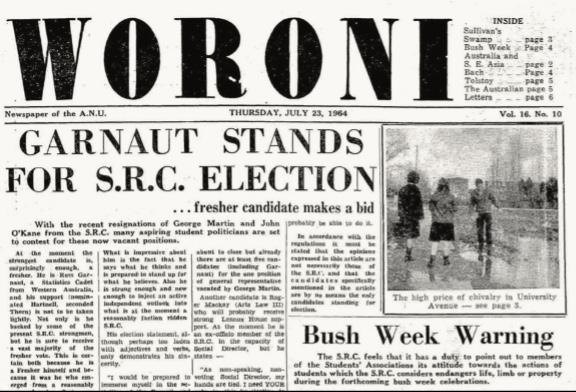
In July 1964 the President of the ANU Students’ Association, A. G. (Tony) Hartnell, wrote in Woroni, under the heading of ‘Bush Week Warning’, that “The S.R.C. feels that it has a duty to point out to members of the Students’ Associations its attitude towards the actions of students which the S.R.C. considers endangers life, limb or property during the forthcoming bush week celebrations. Whilst Bush Week is a function essential to student life in this University, it is not an occasion when students have a mandate to ‘run wild’ throughout Canberra.”30 Plans for Bush Week were also published that included a scavenger hunt with a prize of a 9 gallon keg of beer, a Law Society Mock Trial, and a ‘Pilgrimage to Bungendore’ with a ‘Monster Bush Ball’ to be held that evening – “bring your own Monster!”
30. Woroni as above, p.1
31. Ibid.
On another day, Lennox House was “arranging a cross-country run followed by a barbeque.”31
In an evocative and, in parts, confronting publication titled ‘Bush Week’, Christopher Lee, one of the early Lennox residents and later journalist and screenwriter, recalls University and Canberra life at this time:
“Those days were different. And Canberra was different then. Tweed and Pumpy and I used to hang in a little dark bar at the Ainslie and drink beer after lunch. On good afternoons when Canberra was working at being a national capital. With the right forms to fill in, and public servants with new suits working hard under bright ceilings that hummed and fluoresced at them.” 32
32. Christopher Lee Bush Week Angus & Robertson, Australia 1980 p.1. Christopher Lee is a distinguished Australian scriptwriter and author with works including the ABC drama series ‘Stringer’ and mini-series ‘Howzat! Kerry Packer’s War’. He studied law at ANU and lived in Lennox House. He did not graduate but later completed an arts degree at Sydney University before taking up journalism.
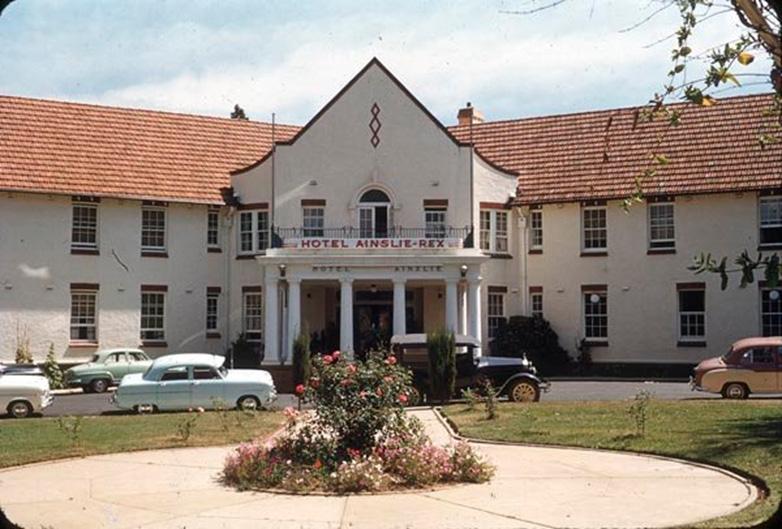
Peter Sekuless, a Lennox House resident in 1964 and 1965 and then in 1967, notes that at that time “half the students were parttime – public servants whom we called ‘shiny bums’ or ‘shinies’ because they spent all their days as clerks sitting at their desks. Chris Lee referred to them as the ‘servants’.”33 As Christopher Lee further reflects “… you wake up late after seeing another dawn over the Lake Burley. The beautiful lake in the city without a soul. At the dawn the lake holds its breath, and Canberra doesn’t stir at all. Just sits there beautiful till the servants make it all move with forms in triplicate.”
The dawn over the lake was perhaps rather symbolic of what, in the mid to later 1960s, would be referred to as the ‘dawning of the Age of Aquarius’ – a time across the globe and particularly in universities when students began to challenge old ways and conservative authorities, to demand more rights and representation, to protest against the things
that make for war and the denial of civil liberties, to promote gay rights and women’s
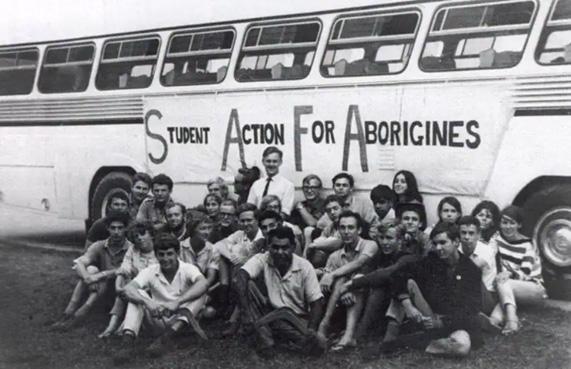
The dawn over the lake was perhaps rather symbolic of what, in the mid to later 1960s, would be referred to as the ‘dawning of the Age of Aquarius’ – a time across the globe and particularly in universities when students began to challenge old ways and conservative authorities, to demand more rights and representation, to protest against the things that make for war and the denial of civil liberties, to promote gay rights and women’s liberation, and to seek the end of discrimination based upon colour and creed. There were, for example, the student action for aborigines ‘Freedom Rides’ from Sydney University into northern and north-western New South Wales in 1965; the Vietnam War, conscription, and anti-Apartheid protests; and support for the 1973 BLF ‘pink bans’ that followed the exclusion of a gay resident at Robert Menzies College, Macquarie University, after he attempted suicide.
33. Interview 6 Dec 2024. Peter also pursued a career in journalism with the Canberra Times and in other areas of writing.
34. Christopher Lee op.cit. pp 4&5
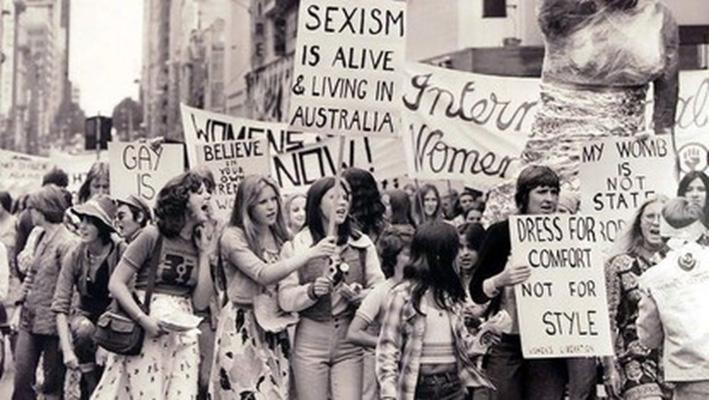
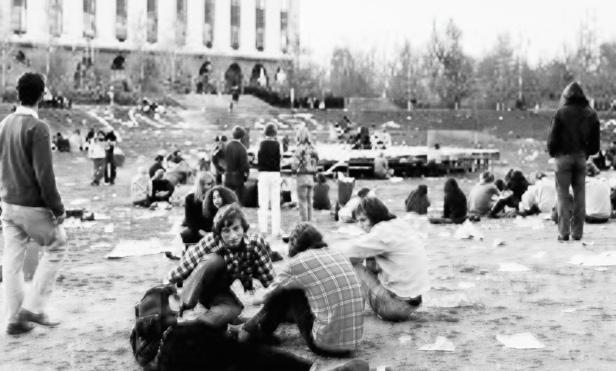
In December 1967, Robert Menzies’ successor as Prime Minister, Harold Holt, drowned in the ocean off Portsea, Victoria, his body never recovered. President Lyndon Johnson attended his Memorial Service in Melbourne. Johnson had become President of the United States following the assassination of John F. Kennedy in 1963; in his last year as President, 1968, he would see the assassinations of Martin Luther King Jr., and of Robert F. Kennedy. In 1969 Richard Nixon became President, and a man landed on the moon! In that year the rock musical Hair opened in Sydney with its hit songs ‘Aquarius’ and ‘Let the Sunshine In’. At Australian universities in the later 60s and into the 70s, such as Monash, Flinders, New England, Queensland, Sydney and at the ANU, students took part in marches and ‘sit-ins’ and occupations of administrative buildings, including Council rooms, demanding greater representation on university and faculty committees to determine university policies, course
content and methods of examination. In 2019, an undergraduate course offered by the ANU School of History perhaps sums the period up in the title ‘Rock, Sex and War: Australia’s 1960s – 1970s’
More residential colleges and halls across Australian universities were opened as, or became, mixed gender, though not without some considerable reaction and opposition. It would be a particular challenge for faithbased residential foundations, but it was also part of the broader demands for change to conventional ways and wisdom across campuses and communities in Australia and beyond at this time. In May 1971, thousands of students gathered in Canberra and at the ANU for the ‘Aquarius Festival of University Arts’, and in 1972 significant political change occurred when, with the Labor Party slogan of ‘It’s Time’, Gough Whitlam became Prime Minister.
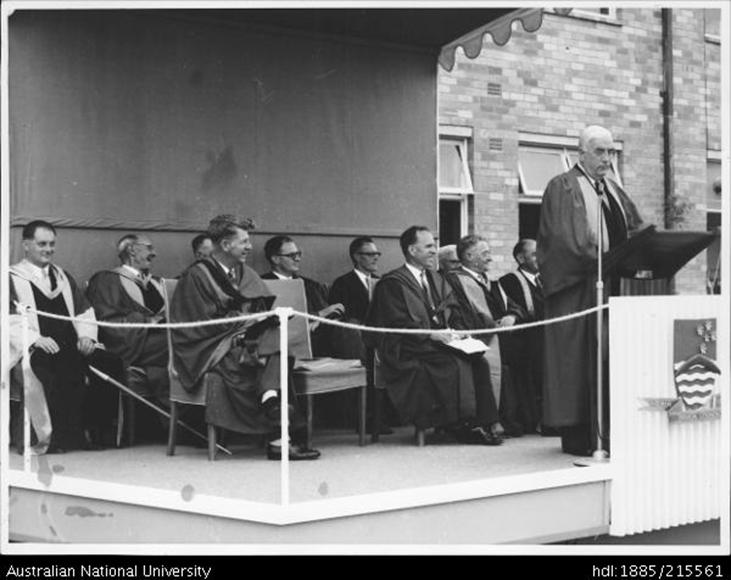
The enormous growth and development of Australian universities and residential colleges and halls after World War II was greatly boosted by the determination and actions in the 1950s of Prime Minister Robert Menzies. At a time of new scientific, industrial and technological development, as well as of increasing competition in the ‘Cold War’ power struggle between the Soviet Union and the West, the established universities in Australia were described as “small, poor, and for the most part treated with indifference by a society hardly renowned for its concern about things of the mind.”35 Menzies saw tertiary education as essential for national growth in the post-War world, but also to counter an over-emphasis on scientific knowledge at the expense of the humanities.
“… the University must not be narrow or unduly specialist in its outlook. It must teach and encourage the free search for the truth. That search must increasingly extend to, but is not to be confined to, the physical resources of the world or of space … But I hope that we will not, under current pressures or emotions, be tempted to ignore the basic fact that civilisation in the true sense requires a close and growing attention, not only to science in all its branches, but also to those studies of the mind and spirit of man, of history and literature and language and mental and moral philosophy, of human relations in society and industry, of international understanding, the relative neglect of which has left a gruesome mark on this century.” 36
In June 1957 the Menzies Government set up a Committee on Australian Universities to be chaired by Sir Keith Murray, then Head of the United Kingdom Universities Grants Commission. The Committee Report was tabled in Parliament in September 1957 expressing wide range concern for the poor state of Australia’s universities including shortage of graduates, dissatisfied university staff, inadequate facilities for staff and students, and lack of funding. The Report gave strong support to university residential colleges and noted that “the College experiment in the universities has been an invaluable one and we wish that more students had the opportunities of receiving these benefits.”37 In November 1957, Prime Minister Menzies announced the adoption of the recommendations of the Report that included an amount of £22m for universities over the next three year period as an emergency measure. This almost quadrupled the amount of Commonwealth expenditure on higher education. In his statement to the Parliament, the Prime Minister also noted acceptance of the recommendation that the Commonwealth should offer capital grants for the building and equipping of, or extensions to residential Colleges “to which the Committee and the Government attach value and significance.” 38 In 1959 an Australian Universities Commission was established to administer grants to universities on a triennium basis which, in the States, was to be on a £1 for £1 basis provided by the State and other sources.
35. Allan W. Martin, biographer of Robert Menzies, quoted by Professor Michael Wesley in an address to the Robert Menzies Institute, University of Melbourne, 7 September 2023
36. Robert Menzies statement in Parliament 28 November 1957
37. Report of the Committee on Australian Universities, The Parliament of the Commonwealth of Australia, 1957, p.54
38. Robert Menzies statement 28 November 1957.
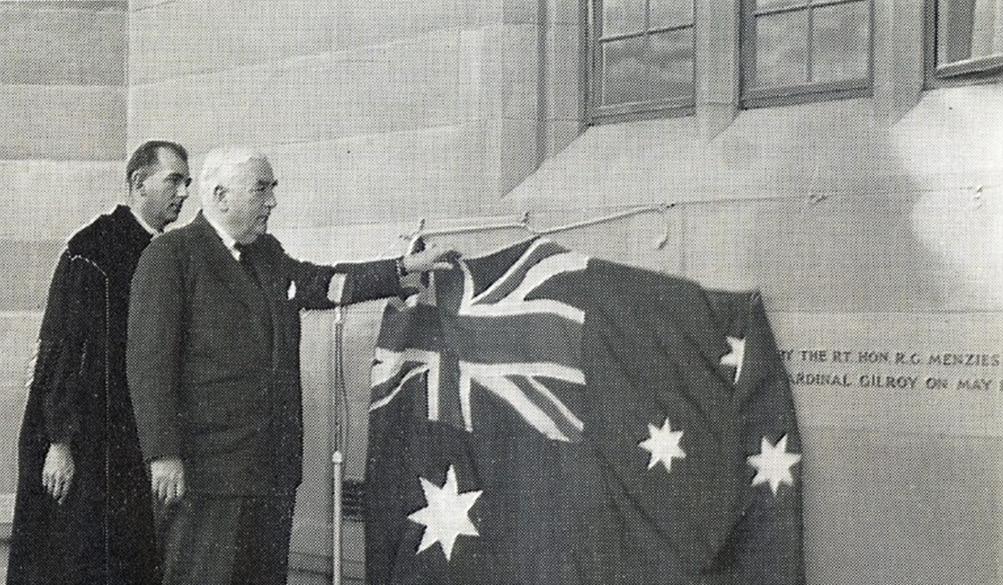
Support for faith-based or church residential Colleges very much reflected what Robert Menzies regarded as the ‘ancient virtues’ that informed his view of the role of universities in the pursuit of truth and the promotion of heart and spirit in the nature of a liberal democracy and, indeed, of civilisation as a whole. In a speech to the Cardinal’s Dinner in Sydney in1964 he referred to the earlier 1950s Mills Committee Report as well as to the Murray Report, with particular reference to the role of church residential colleges:
“A Committee was put up to make a very quick investigation and I was told at a certain stage that the Committee took the view that the residential colleges at the universities ought not to be in the picture because presumably a university could exist without them or alternatively, they were not really part of a university. It gave me singular satisfaction at that time to say to the Committee: “Unless there is some recommendation in your list for the residential colleges at the universities, I will ignore your report” and so we got a little toe in the door - I think that’s the expression. …
Look, ladies and gentlemen, there is one thing that all of us here tonight must bear in mind all the time. Everything I say is about what the Commonwealth does in this rather extra operation that it performs. But I have always been a tremendous believer in schools and in colleges at universities which have a background of religion and the reason for that - the overwhelming reason for that - is that I would get no satisfaction in thinking that we had pledged ourselves to a highly intellectual, if you like, but highly pagan future. (Applause) The world is full of talent. Not quite so full of character.” 39
This view would play a pivotal role in the funding of new church colleges and halls along with funding provided for secular colleges and halls that, with the establishment of new universities, were being set up and operated by the universities themselves to meet the increasing demand for student accommodation. Bruce, Burton and Garran Halls at the ANU joined an increasing number of university-established colleges and halls that included Wright (1956), Mary White (1957), Duval (1959), Robb (1960) and Earle Page (1963) Colleges at UNE; Basser (1959) and Goldstein (1964) Colleges at UNSW; and Deakin (1962) and Farrer (1962) Halls at Monash. At the same time, funding as a result of the Murray Report was provided for new
church or church-related affiliated colleges such as St. John Fisher College (1963) at UTAS, Kingswood College (1963) at UWA, and St Hilda’s College (1964) at the University of Melbourne. Commonwealth funding of both church and university established colleges and halls revived aspects of the debates that occurred in the setting-up of Australia’s first universities and residential colleges one hundred years earlier and would be evident in the establishment of church colleges at ANU, including that of John XXIII College.
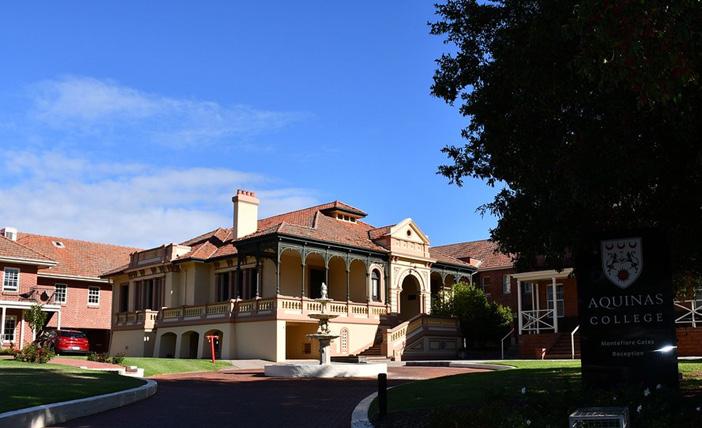
By the time of the Murray Report, university residential colleges established by the Catholic Church included St John’s (1857) and Sancta Sophia (1926) at Sydney University; Newman (1918) at Melbourne; St Leo’s (1917) and Duchesne (1937) at UQ; Aquinas (1950) at the University of Adelaide; and St Thomas More (1955) at UWA. Their foundation and/ or operation involved religious Orders, Congregations and Societies such as the Benedictines, Jesuits, Vincentian Fathers, Marist and Christian Brothers, and the Society of the Sacred Heart. Soon after his arrival in
Melbourne in 1913 to be coadjutor bishop to Archbishop Carr, Daniel Mannix, who had been President of the Irish National Seminary at Maynooth, declared that “every inducement should be held out to Catholics to take their proper place in the universities, with all due and sufficient safeguards for their faith and for the practice of their religion.” Conscious of the already established Anglican, Presbyterian and Methodist Colleges at the University of Melbourne, he declared that the “Universities should profit by the leavening of live, active Catholicism, the Church unobtrusively would obtain a hearing in the seats of learning, and Catholics might justly hope to secure without fear or favour their due and proportionate share of the good things that Australia has to offer in both public and private life.” 40 A year after Mannix succeeded Carr in 1917 as Archbishop, Newman College opened at the University of Melbourne with its administration entrusted to the Jesuits. Decades later, Archbishop Mannix strongly supported the foundation of a Catholic College in association with Melbourne’s second university, Monash, though he would not live to see its opening.41 In 1951 he re-stated his view of the place of the Catholic Church and residential colleges in universities:
“I am convinced, as I always have been, that we can give the best service to the Catholic Church and to the whole community and to the universities in Australia by holding our place in the existing universities. Everything should be done to use the wide opportunities we have to endeavour to Christianise the environment and the universities.”42
In September 1959, Archbishop Mannix wrote to the Chairman of the Interim Council of the newly established Monash University, Sir Robert Blackwood, seeking land on the University site to establish a residential college along the lines of Newman College. The Council did not want to alienate any of its land for this purpose but encouraged the Church to acquire land adjacent to it. A property had already been purchased across the road from the campus as a site for a future parish church, but it was readily given over for the establishment of a college. In September the following year, the Council agreed in principle to the College’s affiliation with the University. Archbishop Mannix died in November 1963, but his wish for the Jesuit Fathers to staff the College, as at Newman, was unanimously supported by the College
42. Simon Caterson op.cit.
Council in December. Perhaps for financial reasons at that time, albeit the funding then provided by the Commonwealth, the Jesuits declined the invitation. In January 1964, Mannix’s successor, Archbishop Justin Simmonds, invited the Dominican Order to conduct Mannix College on behalf of the archdiocese.43
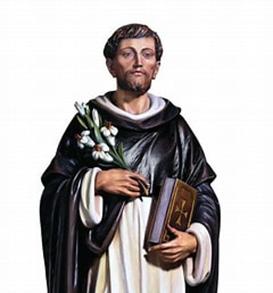
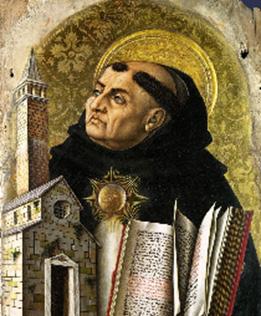
Dominic de Guzmán was born in Caleruega, Spain, in 1170 and with opportunity for education he became a priest in 1193. He was particularly attracted to the fellowship and rules of community life and in 1215 he formed his own religious order characterised by prayer, penance, education and preaching. In 1217 Pope Honorius III referred to the ‘Order of Preachers’ (OP) which began to spread across Europe with a mission of teaching and care for the needy. Following Dominic’s death in 1221, Pope Gregory IX canonised St Dominic whose feast day is August 8. The Order and its mission would be greatly influenced by two Dominican friars and theologians of the 13th century, St Albert the Great (c.1200-1280) and his student St Thomas Aquinas (c.1225-1274).
43. Dr Gabrielle McMullen ‘Omnia Omnibus’: All Things to All Collegians; The First Twenty-five Years of Mannix College Glen Waverley VIC 1993, pp. 1-9
The first recorded movement of the Dominicans into the south-western Pacific came with a French commercial expedition that visited the Solomon Islands and the north island of New Zealand (‘Aotearoa’) in 1769. The chaplain on that expedition was a Dominican priest Father Paul-Antoine Leonard de Villefeix44, who conducted the first Mass on New Zealand soil. While there is speculation that other Dominicans had been involved in earlier Pacific explorations, and that Dominicans who were in the East Indies in the 16th century might have reached the northern coast of ‘Terra Australis’, the first Dominican known to have arrived on the continent, Irishman Vincent Christopher Dowling OP, arrived in Sydney in 1831. Others arrived in a number of the colonies, but first community of Dominican friars was not established until 1898 in North Adelaide.
The first intentional work of tertiary chaplaincy and residence took place in New Zealand in the mid to late 1940s, with the Dominicans still part of the Irish Province. Chaplaincy was provided to the Catholic Teachers’ College in Auckland as it was by Dominican nuns for women enrolled at Otago University and the Dunedin Teachers’ Training College, for whom they also established a Hall of Residence. In 1949 the task began, in addition to chaplaincy work, for the Dominican friars to set up a residential college for men. The task was referred to as the Order’s “largest undertaking in the Southern Hemisphere”. In 1954 Aquinas College was officially opened with accommodation for eighty students.46
The first years of Aquinas College gave rise to quite a wrestle over titles and qualifications of staff, the separation or integration of the roles of administration and formation and over meeting the secular context of the University and being true to the purposes of
44. Christopher Dowd O.P. A short history of the Dominican friars in Australia and the south-western Pacific region About | Dominican Friars
45. Ibid.
46. Christopher Dowd OP Draft Chapter 14 The First Years of the Province 1950-1956 in his yet to be published history of the Dominican Province of Australia, New Zealand and South-West Pacific
the Order. These issues would be reflected in the establishment of the Dominicans’ other university residential colleges in Australia, much along the lines that Archbishop Mannix had earlier expressed. One of the first Masters of Aquinas College, and later of St Albert’s College (UNE) and of John XXIII, Thomas Fitzgerald OP, reflected:
“To me it seemed axiomatic that Dominicans have no right to be conducting a mere boarding house for students. So, I did my best by appointing tutors and providing tutorials both curricular and extra-curricular for all who wanted to come … to give the Hall academic status. We had good attendances over the years at our philosophy and theology groups, our ‘How to Study’ courses, and our annual series of discussions on medical ethics.” 47
These words were no doubt rather prophetic in relation to the setting for the temporary location of John XXIII College in Professor Mike Gore’s “bunch of sheds” that were previously known in their various occupancies as ‘The Bachelors’ Quarters’, the ‘Rabbiter’s Arms’,
the ‘Acton Guest House’, and Commonwealth Hostels accommodation. Despite Lennox House being placed by the ANU under a governing board and a Warden from 1964 –1966, it and its occupants posed a significant challenge to the Dominicans in their setting up and stewardship of the first two years of John XXIII College as much more than a mere boarding house for students. The College would inevitably reflect much of the student character that preceded it in Lennox House and that was evident in the early memories of Aquinas Hall, Dunedin, with “the usual undergraduate pranks of the ringing of the chapel bell at all hours of the night and the dropping of firecrackers into stairwells.”48
In the establishment of colleges, Dominican staff, many of whom were neither trained for nor experienced in the work, found it difficult to combine priestly and pastoral care with administrative and disciplinary functions. They “quickly discovered a radical dissonance between their operating principles and the prevailing attitudes of many of their clientele.” 49
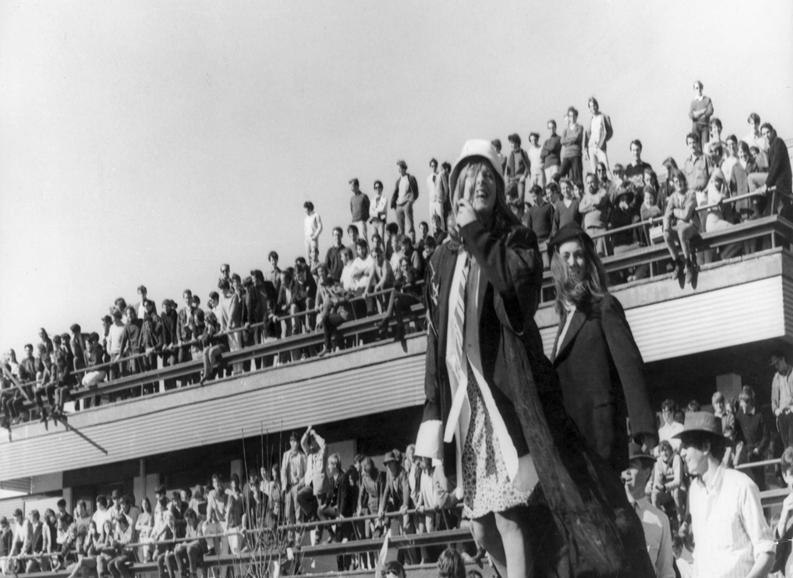
Bush Week 1969 with ANU students at the then Union Building (later the Pauline Griffin Building, now the site of the Research School of Social Sciences building)
47. T. P. Fitzgerald OP The First Hundred Years – Dominicans in Australia, New Zealand, Solomon Islands, Hindmarsh, Adelaide SA, 1998 pp.75-76, quoted in Kevin Saunders O.P. Dominicans on Campus: An Antipodean Enterprise, Papers from an International Colloquium 10-11 July 2008, St John’s College, University of Sydney, on the Role of Catholic Colleges in the Modern University. Otago University then had the only medical school in NZ.
48. Christopher Dowd OP, Draft op.cit.
49. Christopher Dowd, Draft Chapter 21 Dominicans Contra Mundum 1964-1984
With Commonwealth funding available and the developing demand for university residential places, it was perhaps not surprising that Churches saw the opportunity, as they did over the eighty or so years prior to World War II, to establish, expand and extend their variously interpreted missions in association with the six pre-War universities and then especially with the ‘new wave’ of universities founded in Australia in the post-War decades. Catholic Orders such as the Jesuits, the Ursulines and the Dominicans had a long history of involvement in school and university education and saw and responded to opportunities of presence and ministry on Australian campuses.
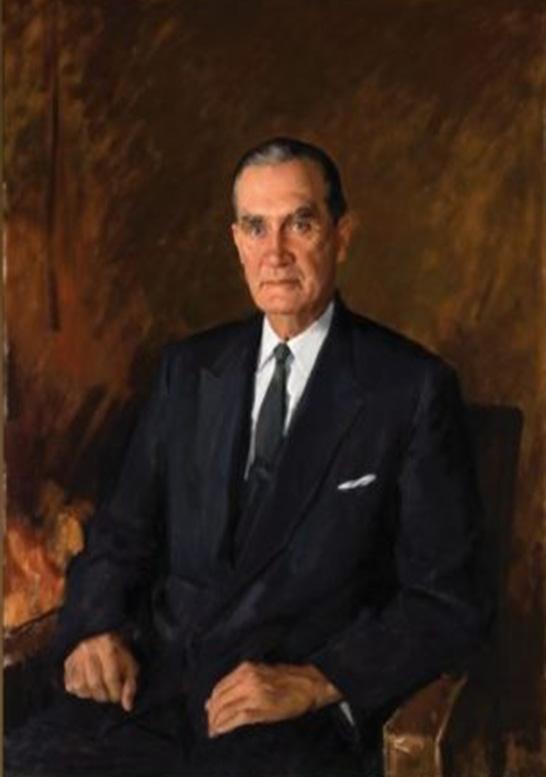
Dominican Sisters and Friars had been working in parishes and schools in Australia since the 1800s. Appointed in 1953 as Archbishop of the Catholic Diocese of Canberra and Goulburn, Dr Eris O’Brien was a keen supporter of the development of schools and of the Church’s involvement in tertiary education. In 1958 he brought together groups of Dominican Sisters to be ‘headquartered’ in Canberra for training and study and for work in Diocesan schools. A training and study centre, Signadou (‘Sign of God’) Teachers’ Training College, was opened in the northern Canberra suburb of Watson in 1963 as part of a Dominican precinct that would include Holy Rosary Parish Church and Rosary Primary School, and the Blackfriars Priory – a ‘Studium Generale’ which opened in 1967.50
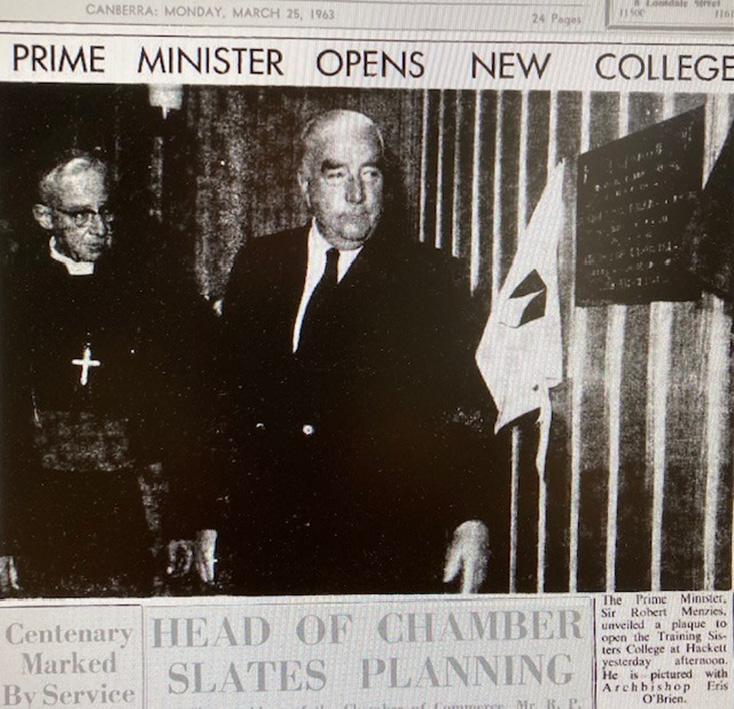
Prime Minister Robert Menzies, with Archbishop Eris O’Brien, opens the Signadou Training College, Sunday 24 March 1963 (Canberra Times 25 March 1963)
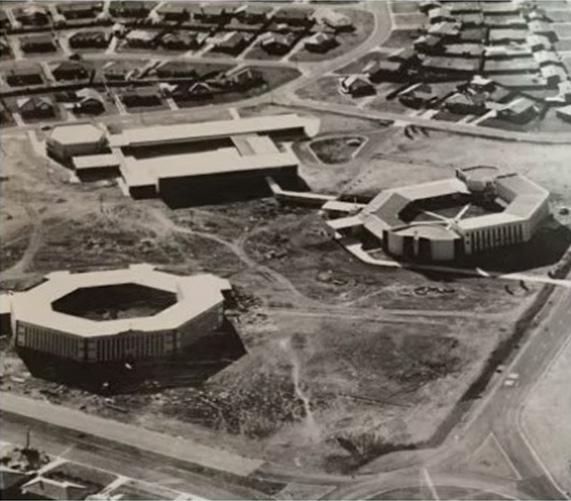
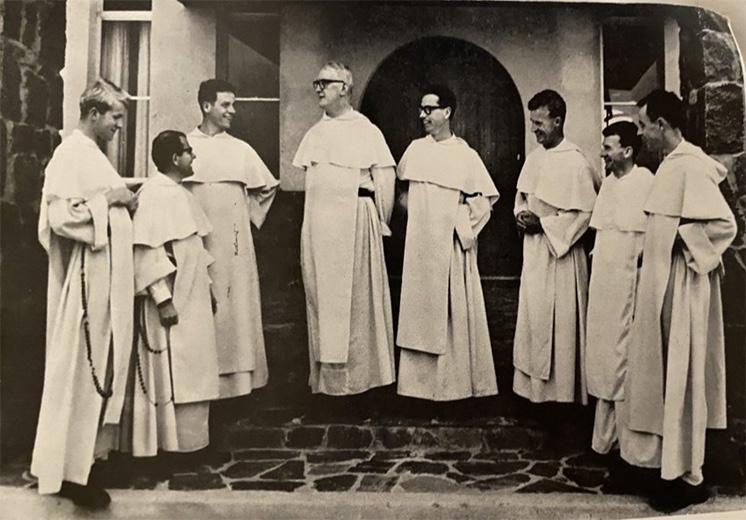
The precinct would bring together in the national capital the main centre for Dominican studies, bringing students from the study houses in Wahroonga (NSW) and in East Camberwell (Vic.). Dominican friars, initially housed in the neighbouring suburb of Downer, were sent to Canberra to assist in the training of Sisters and lay people, and for periods of study in courses such as philosophy and theology, for preparation for the priesthood, and for parish work and chaplaincy. In Canberra, the establishment of this precinct, with its ‘Studium Generale’, would play an integral part in the setting-up of John XXIII College.
Recent Catholic Chaplain and Parish Priest of Watson, Fr Mannes Tellis OP, commented that he thought “one of the main things the Order brought to Canberra was the chaplaincy at ANU, and having chaplains there that were often academics as well.” He noted that this “really added to Canberra’s intellectual scene at that time, and obviously helped students maintain their faith.”51
By the time in 1964 that Melbourne Archbishop Simmonds invited the Dominicans to set up Mannix College at Monash University, the Vice-Chancellor of the University of New England, Robert Madgwick, was responding to the Prior Provincial of the Dominicans, the Very Reverend Jerome O’Rorke OP, indicating that the UNE Council had agreed in principle to the affiliation of “the proposed Catholic college” with the University but that conditions were still to be approved.52 He noted lease arrangements being prepared at the University of New South Wales for the affiliation of denominational colleges there, and that he was keen to see more about their terms. In a letter to the Vice-Chancellor of the University of NSW, Professor Philip Baxter, in November 1965, Professor Madgwick noted that “there is a good deal of opposition here to affiliated colleges and it would help me considerably if I could be sure of my ground when I have to steer a legal document through
51. Catholic Voice ‘Dominican friars to leave Canberra after 60 years of service’, November 2023 https://www.catholicvoice.org.au/ dominicans-to-depart-canberra-after-60years/ Father Tellis is now with the Dominican community in Adelaide.
52. R. B. Madgwick to Jerome O’Rorke OP, 3rd December 1964
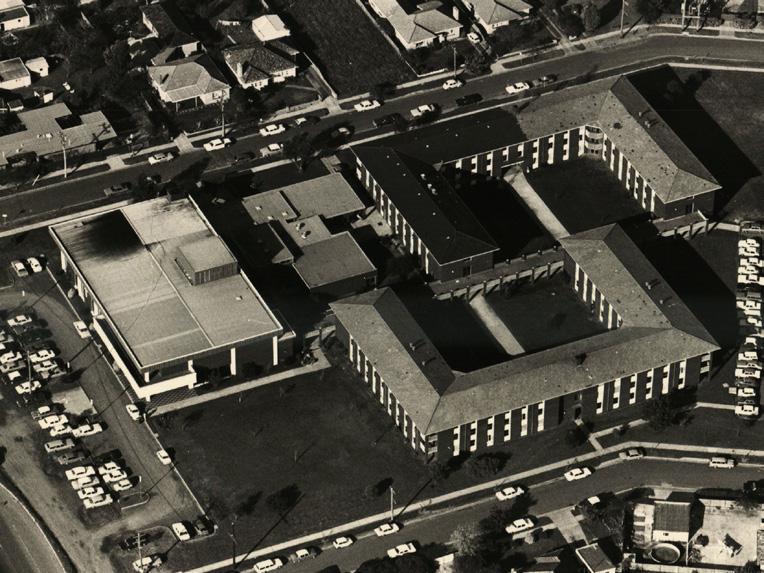
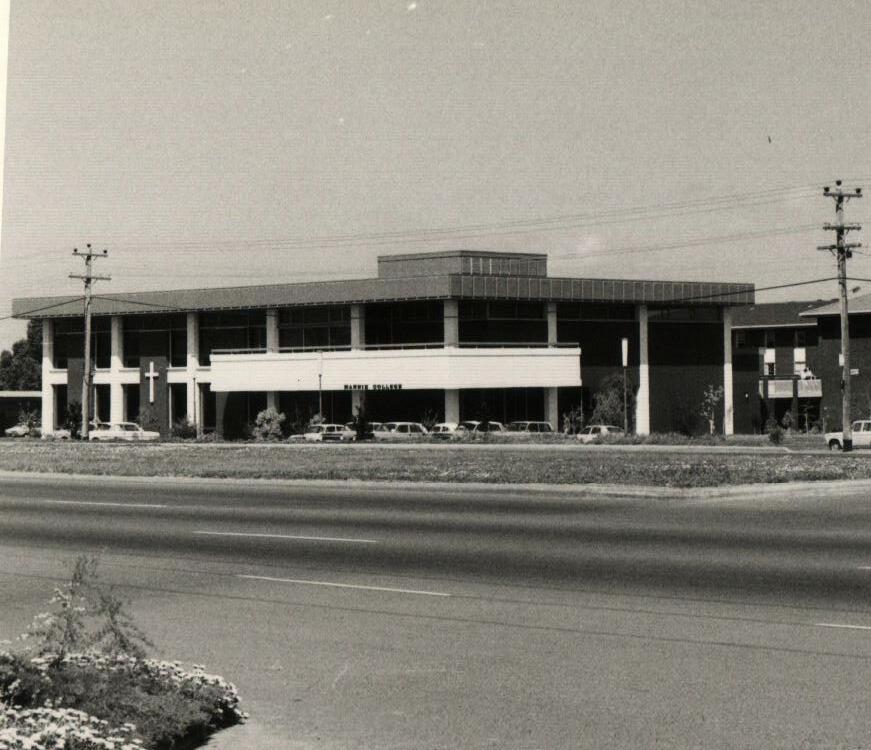
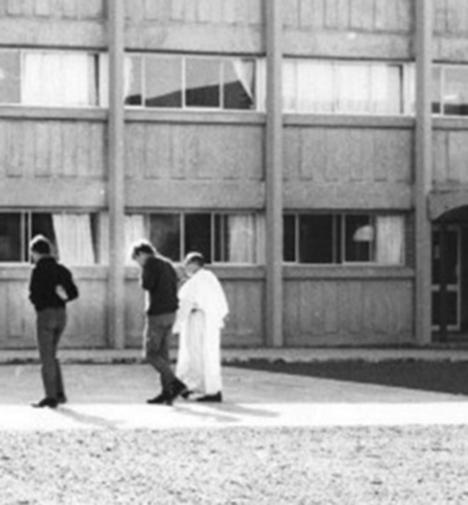
the Council I am not particularly animated about the affiliated colleges myself but there seems little point in opposing the inevitable.”53 While St Albert’s College opened in 1969, Professor Madgwick’s sentiment reflected a degree of unease and concern on campuses at this time about the setting up and affiliation of church colleges, especially about Commonwealth funding that might be taken away from the setting up of university managed colleges and halls. This issue and the tensions involved were to be particularly evident at the ANU.
The Dominican Mannix College at Monash University and St Albert’s College at UNE, both opened in 1969, were to be the only church or denominational colleges affiliated with their respective universities54, whereas at the ANU there were to be three55 . The Father Tellis is now with the Dominican community in Adelaide.
Dominicans, however, were not the first to approach the ANU about establishing an affiliated residential college.
Sisters of the Ursuline Order, founded by Angela Merici in Italy in 1535, had arrived in Sydney in 1882 and, at the invitation of the Catholic Bishop of Armidale, arrived there to set up a Convent and to begin work in schools for girls. Their work of teaching and pastoral ministry spread to other towns in New South Wales, Queensland and Victoria, and eventually to Canberra where in 1958 they established a House of Studies in the suburb of Lyneham.
At its meeting on 12 May 1961, the ANU Council agreed that an application from the Ursuline Provincialate to set up a college for women in association with the University “raised questions relating to the conditions on which the University would approve the affiliation of halls or colleges …” 56
53. R. B. Madgwick to Sir Philip Baxter, 3rd November 1965, UNSW Archives. Madgwick was perhaps conscious of local support and also the Federal Government’s support for church colleges.
54. A Marist College for male students of Monash University was also opened on Normanby Road opposite the University in 1969, renamed Normanby House when taken over by the University in 1979 to be used for a range of other purposes, though later returning to being a residence for Monash students. It closed at the end of 2024, to be demolished for the construction of the Monash Metro station.
55. Largely for financial reasons, albeit the available Commonwealth funding, other Christian denominational attempts to set up residential colleges at Monash and UNE failed.
56. Noted in an extract from the Minutes of the Standing Committee of the ANU Council held on12th October 1962 13. Affiliation of Residential Colleges and Halls (1) (a) p.9, ANU Archives ‘Affiliation of Halls and Colleges’ Part 1, 2.2.1.28
From a later letter from the University Registrar to the Secretary of the Prime Minister’s Department, it is noted that the original proposal was for a site in Lyneham, but the Provincialate accepted the University’s view that the proposed site was too remote from the University to justify affiliation. Other sites were being considered.57
In response to the Ursuline approach, the University Council the following year asked the Boards of The Institute of Advanced Studies (comprising the Research Schools) and of the School of General Studies (representing the undergraduate program and headed by Professor Joe Burton) to consider matters related to the proposal. At their request, the Vice-Chancellor, Leonard Huxley, appointed a committee to consider and report on the conditions under which the University might approve the affiliation of residential colleges or halls 58 The Committee was chaired by Professor Dale Trendall, first Master of University House and Deputy ViceChancellor, and included Mr Bill Packard, first
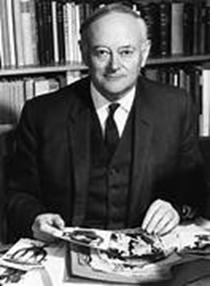
Warden of Bruce Hall, and the ANU Registrar, Mr Ross Hohnen.
The Committee first met in December 1962 and received a paper setting out the conditions under which Council would approve the affiliation of independent Halls of Residence or Colleges. It was noted that the Australian Universities Commission (AUC), responsible for allocating triennial Commonwealth funding, was opposed to geographical scattering of halls and colleges, and that, if possible, they should be in proximity one with another. The Committee agreed that, if possible, they should be “in planned relation to Bruce Hall”.
It was also noted that the term “colleges” was preferred for institutions established by church organisations or other outside bodies, and that the term “halls of residence” would be reserved for institutions established by and under the full control of the University.59
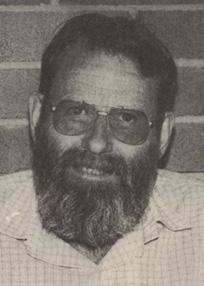
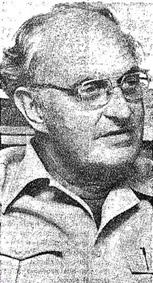
Professor Dale Trendall, Mr Bill Packard and Mr Ross Hohnen
57. ANU Registrar to the Acting Secretary Mr Peter Lawler, 6th April 1964. Later, Sir Peter Lawler was Australia’s Ambassador (19831986) to Ireland and the Holy See. He was a committed Catholic and a regular visitor and supporter of Ursula and John XXIII Colleges at the ANU
58. ANU Council Standing Committee Minutes op.cit.
59. Report of the Committee on Affiliation of Residential Colleges and Halls to ANU Council 29th March 1963, ANU Archives op.cit. E.g. UNSW and UNE called their residences ‘colleges’, not ‘halls’.
Included in conditions for affiliation were that the primary purpose of the college should be the housing of full-time students proceeding to a degree of the University ; there should be special provision for admission of graduates, including members of staff of the University; other people who were not graduates nor students proceeding to a degree could be admitted but the number limited to no more than 10% of the total number of residents; non-resident members could be admitted; a governing body should control the college and confirm the appointment of a ‘head’ to run the college, with one or more representatives of the University60 on the governing body; the ‘head’ would be expected, where appropriate, to participate in the academic life of the University; and tutorials should be provided to both resident and non-resident members of the college.
The Committee further noted that the Ursuline Provincialate had not yet requested affiliation, but that information about the University’s conditions had been given to the Mother Provincial. It also agreed that Heads of other religious denominations be informed of the Council’s rules relating to affiliation.61
In March 1963 the Dominican Provincial, Jerome O’Rorke OP, following a conversation with Archbishop Eris O’Brien, wrote to the Archbishop confirming that a letter from the ANU Registrar to one of the non-Catholic chaplains indicated that the University was wanting urgent solutions to the growing demand for student accommodation, and that Colleges established within the campus were preferred to Halls of Residence outside.
It seemed the University was “well disposed to have religious bodies undertake the responsibilities for these Colleges.” In the light of this, and on the understanding that the Archbishop had made no other plans or approaches, Father O’Rorke wrote:
“I now respectfully request Your Grace that you consider favourably my suggestion that our Order be invited to establish a Catholic University College within the National University, for which the Order would be entirely responsible.”62
A month later, Archbishop O’Brien replied to the Provincial that he had read the conditions of affiliation required by the University and that he assumed the Dominicans were prepared to work within them. He was therefore happy to approve the Dominicans establishing a Catholic College at the University under their control, including taking financial responsibility for the building and maintenance of such a college. He understood it would operate along much the same lines as the College in New Zealand. He believed that “it would be advantageous for the Catholic Church and to this City to have such a college under the care of the Dominican Fathers.” 63
Eris O’Brien trained for the priesthood at St. Patrick’s College, Manly, and had keen interest in Catholic history, especially that of the Church in 19th century Australia. He gained an MA from the National University of Ireland and, in 1936, a PhD from the Catholic University of Louvain, Belgium. He was appointed Auxiliary Bishop of Sydney in 1948 and Archbishop of Canberra and Goulburn in 1953. He had a strong appreciation of the history of the Dominicans and especially their long involvement in universities.
60. Ibid. There was some concern that a religious organisation, such as the Ursulines, might wish primarily to conduct a theological college 61. Ibid.
62. Jerome O’Rorke OP to the Most Rev’d E. M. O’Brien, 26th March 1963, following a meeting on 21st March 1963, Archdiocese of Canberra and Goulburn, Diocesan Archives.
63. E. M. O’Brien to The Very Rev. Jerome O’Rorke OP, 24th April 1963. Ibid.
This was reflected in a letter the Archbishop then wrote to the Acting Prime Minister, John McEwen, in which he noted that he had written also to the Vice-Chancellor offering the cooperation of the Church in the establishment of a college for men within the University; that this would be beneficial to the life of the University; and that he should like to entrust the setting up and running of the College to the Dominican Fathers “whose traditional association with Universities throughout the world equips them with the experience and the qualifications necessary to
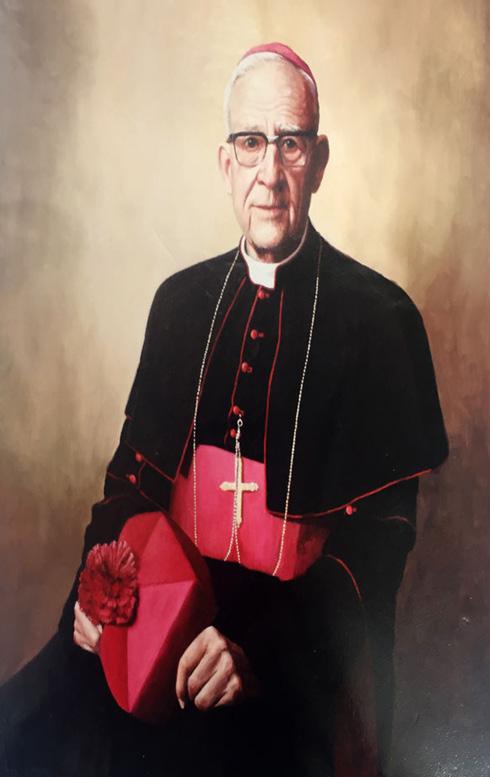
undertake this work.”64 The Acting Prime Minister’s reply very much heralded what would be the Government’s response a little later to concerns expressed by faculty and students of the University about such religious bodies being on campus and fears that Commonwealth funding would be directed away from the University establishing its own halls. Mr McEwen, much in line with Robert Menzies’ view of church colleges, and that which had been expressed in the Murray Report, assured the Archbishop that the establishment of a Catholic residential college affiliated with the University was “a project of considerable importance and the Government will be interested to learn from time to time of progress made with the plans for it.”65
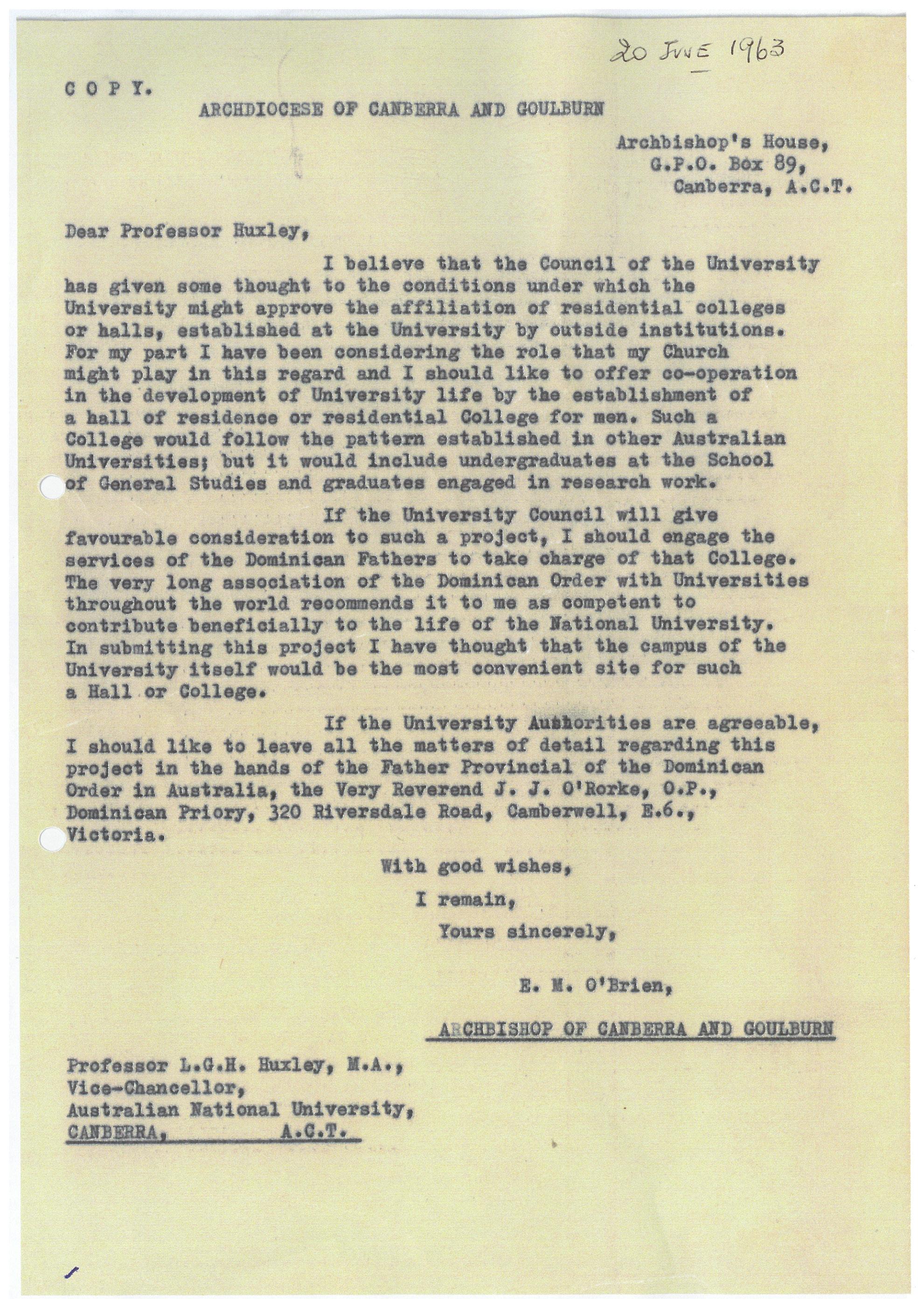
In his letter to the Vice-Chancellor, Archbishop O’Brien offered cooperation with the University in the development of university life by the establishment of a residential College for men, and that it would include both undergraduates at the School of General Studies and graduates engaged in research work. If the University was favourable to this project, he would engage, as indicated to the Acting Prime Minister, the services of the Dominican Order and would leave all matters of detail in the hands of the Provincial, the Very Reverend J. J. O’Rorke OP. He expressed the view that he thought the campus of the University itself would be the most convenient site for such a college.66
JOHN XXIII COLLEGE – “IN AN ATMOSPHERE OF TOLERANCE IT SHOULD FOSTER A CHRISTIAN
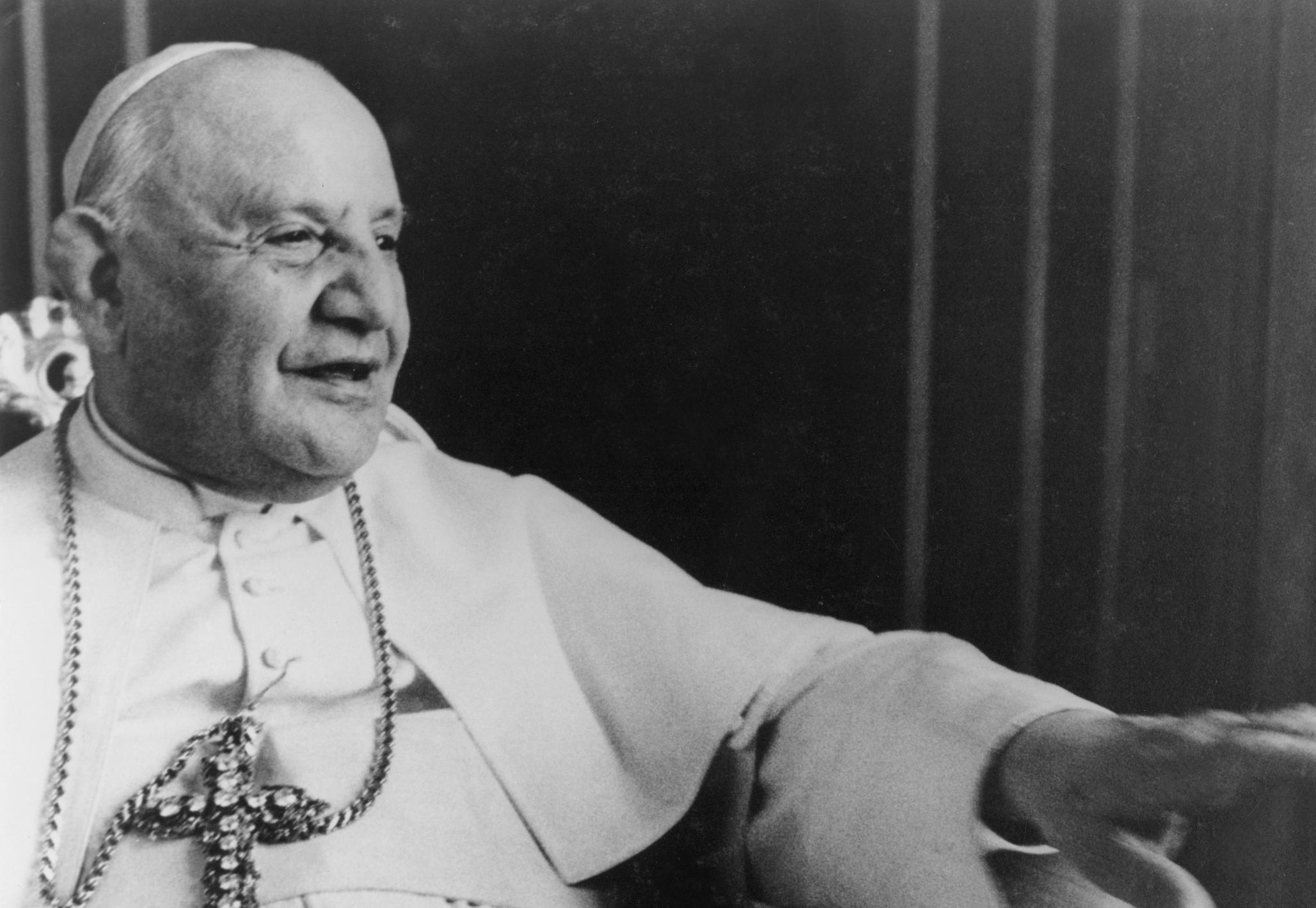
A paper prepared in association with the approach to the University indicated that the proposed name of the College had been chosen in memory of the great Pope who had won the good-will of the whole world and who had “created a climate favourable for the pursuit, attainment, and appreciation of truth.”67 It noted that “religious conviction has a steadying and satisfying influence productive of that personal tranquillity that is so necessary for assiduous application to study … the College would contribute to the Australian scene genuine university objectivity, autonomy, and love of truth, and that in an atmosphere of tolerance it should foster a Christian mind and respect for Christian values.” Tutors would be available,
and residence in the College should be within the financial reach of genuine scholars and not merely be for those of higher financial groups. Non-resident members were proposed who could avail themselves of the tutorial and other services of the College, and in doing so “be brought into closer participation in the stream of university life.” Proposals were made about a governing body that would include representatives of the University, the Master, the Dean, the Bursar, the tutors, the graduate and undergraduate residents and, if numbers warranted, a representative of the non-resident members, subject to the discretion of the Dominican Provincial. On December 9, 1966, the Standing Committee of the University Council approved the John XXIII College Constitution.68
The College would be open to all students of the ANU, and it would “reflect the national character of the University in providing for scholars from all over Australia, and at the same time the University’s welcome to scholars from other lands The value of such a college obviously transcends the merely material aspects of satisfactory board and lodging.” The paper strongly emphasised that the College would enrich and invigorate the whole life of the University. There was clearly a sense of a God-given partnership in the development of the intellectual and cultural development of the nation as part of the University’s purposes. “Inevitably and auspiciously the development of the National University must have far-reaching effects in the cultural and intellectual life of the whole Commonwealth, so that more and more the people of Australia will turn to the National
University for leadership, inspiration and stimulus of their intellectual and cultural life. In all this development the Catholic Church believes that it has a most valuable role to play and contribution to make.” A mark of the College would be that “the pursuit of learning will be carried forward with enlightened and up-to-date guidance so that the individual personalities will be developed in a manner satisfying for each one’s welfare, for the welfare of society and of the Church, and for the honour of each one’s profession.” 69
In reply to Archbishop O’Brien’s letter, ViceChancellor Leonard Huxley acknowledged that the detail of arrangements for a Catholic college would be in the hands of the Provincial of the Dominican Order, and that he had sent a copy of the Archbishop’s letter to the Secretary of the Australian Universities Commission, noting that allocation of an area in the ‘Black Mountain development’ for the establishment of affiliated colleges was under discussion.70 Concern was expressed by Father O’Rorke about the Black Mountain area as the site was still seen as too distant from the developing University campus as well as from the University’s halls of residence.
At this time, as previously noted, the University was responding to increasing demand for accommodation by occupying more space in the Lennox House complex and by purchasing the Schreinerhof motel as an annexe for Bruce Hall. The University had also approved sketch plans for two halls of residence to accommodate some 500 students to be built to the south of Bruce Hall. Father O’Rorke believed that a college being off campus and separated from the University’s halls
68. Yvonne Parry Reflections: John XXIII College – the first 25 years on Daley Road Chapter 1, p.3
69. ‘Hall of Residence in the A.N.U., under the auspices of the Catholic body’, pp.1-4, Dominican Archives, Camberwell VIC, Box 178
70 L. G. Huxley to The Most Reverend Eris O’Brien CMG, 12th July 1963, Dominican Archives Ibid. Box 217
“would tend to create a cleavage in the life of the University and would diminish the advantages and to some extent defeat the complete achievement of the purpose of university education … College residents would tend to keep within the narrow sphere of their college and not benefit from the wider social education value of university life.”71
In his reply to these concerns, Professor Huxley noted that his colleagues agreed “that there would be great educational advantage in having college students resident on the University site, making full use of the University facilities and fully integrated into the life of the University.” He nevertheless expressed a concern about the various priorities and conflicting claims for on-campus sites but indicated that the Dominican proposal was seriously being considered. He noted that in the meantime the Order might consider land on the northern side of Boldrewood Street in O’Connor.72
The University was certainly keen to meet a growing need for student accommodation, with the ‘Canberra Times’ reporting that the Australian Universities Commission supported the University’s request for a grant of £1,100,000 for the provision of a hall of residence with between 500 and 600 beds, what would be Burton Hall and Garran Hall prior to their merger into ‘Burton & Garran Hall’ in 1983.
The Commission also noted the proposals from the Roman Catholic Church for the establishment of a college for women and one for men, each to be affiliated with the
University. As sites for these colleges had not been finalised, specific grants for the colleges had not been included in recommendations for the 1964-1966 triennium. Dominican Provincial Jerome O’Rorke was pleased that the Vice-Chancellor had, he understood, strongly supported the content of his letter, particularly about the site of a college. He noted that, while he had not heard any result of a committee that had been set up to examine such a site, he was not surprised “as committees and councils almost of necessity do business slowly.” 74
No doubt in part seeking further to cement a good relationship with the University, Father O’Rorke sent a telegram of congratulations to Professor Huxley on his award of a knighthood in the 1964 New Year honours list, noting that the award “has honoured learning and scholarship.”75 In reply, the Vice-Chancellor noted that “one of the chief sources of personal satisfaction in this Honour is that which you have stated in your telegram –it is a welcome Federal tribute to higher education.” 76 O’Rorke established a friendly rapport with Huxley, with, for example, the Prior Provincial invited to have afternoon tea with the Vice-Chancellor in July 1965 at which further discussion took place about the siting of the proposed College.77 Earlier in April, Senator Gorton had written to the ViceChancellor noting that the Department of the Interior with the support of the National Capital Development Commission had agreed to recommend approval and transfer of a site on Boldrewood Street, Turner. His hope was that the matter of a site for residential colleges would be determined so that Commonwealth funds could be available in
71. Very Rev. J. J. O’Rorke OP to Professor L. G. H. Huxley, 3rd September 1963, Ibid.
72. L. G. H. Huxley to the Very Reverend J. J. O’Rorke OP, 8th November 1963, Dominican Archives op.cit.
73. Canberra Times 18 October 1963
74. Jerome O’Rorke to the Rt. Rev. Mgr. K. C Favier, Administrator of the Archdiocese, 8th November 1963, Archives of the Catholic Archdiocese of Canberra and Goulburn
75. Dominican Archives, op.cit. Father O’Rorke to Sir Leonard Huxley,
76. Ibid. Leonard Huxley to Father O’Rorke 5 January 1964,
77. Christopher Dowd, draft Chapter 18 op.cit. p.18
the current triennium. 78 The hope remained, however, that the denominational colleges would be located on the campus in line with the University halls on Daley Road.
Perhaps also not surprising, given the availability of Commonwealth funds through the Australian Universities Commission’s triennium grants and the growing establishment by universities of their own secular colleges and halls, was a degree of concern expressed by staff and students of the ANU about the proposed denominational colleges and the terms of their affiliation. This was not only in relation to funding, particularly at a time when there was controversy about the introduction of Commonwealth funding for church schools, but also, as had arisen at the time of the establishment of Australia’s first universities, about the role of religion in the life of a secular university. While “there was recognition of the material, financial, cultural and academic benefits afforded by religious colleges” there was “a fear, too, of theological interference, unwanted proselytism, sectarian tensions and social and moral conservatism.”79
The early universities such as those of Bologna, Paris, Oxford and Cambridge were associated with or established by the Church, with religious studies and teaching central to much of the curriculum. At the time of the establishment of the University of Sydney in 1850, religious tests imposed by the Church of England for matriculation to and/ or graduation from Oxford, Cambridge and Durham universities were still to be removed.
Sydney followed in part the model of the new University of London which banned religious tests. Founded in 1826 as University College London it was referred to as the ‘Godless College on Gower Street’. Religious tests and the teaching of religion were not to be part of the new University of Sydney. It was particularly a move to counter any sectarian rivalry in the Colony, especially between the Church of England, Roman Catholic and Presbyterian denominations. The University was to be “free from any sectarian influence … it should be open to all, though influenced by none.” The writer of a letter to the Sydney Morning Herald believed the University “is intended to be an infidel Institution.”81
The original pattern for Australia’s universities was to be secular; teaching and examination was to be by professors of the University. The University was to be founded upon liberal and enlightened principles as “a fountain of knowledge at whose springs all may drink, be they Christian, Mohammedan, Jew or Hindu.”82 By compromise, the first two colleges at Sydney, St. Paul’s (Church of England 1856) and St. John’s (Roman Catholic 1857), were established on the boundaries of the University campus. This was largely to be the pattern for the denominational residential colleges that followed in Australia’s other five universities established by World War II.83
The Joint Faculties of Social Sciences and Pacific Studies at the ANU urged that the Sydney University and other ‘first’ Australian universities’ provision banning religious tests be written into the terms of affiliation, though it recognised that there was a “liberal record” regarding admissions and religious requirements in the church colleges already established within Australian universities.
78. J. G. Gorton to Sir Leonard Huxley KBE, 22 April 1964, ANU Noel Butlin Archives ‘Affiliation of Halls or Colleges’ (Part 2) 2.2.1.28
79. Christopher Dowd OP, op.cit., p.13
80. W. C. Wentworth reported in the Sydney Morning Herald, 7th September 1849, p.2
81. B.A. Sydney Morning Herald 8th October 1849, p.3
82. J. J. Auchmuty ‘The Idea of the University in the Australian Setting: An Historical Survey’, in The Australian University Vol.1, No.2, September 1963, p.148
83. Melbourne (1853), Adelaide (1874), Tasmania (1890), Queensland (1909) and Western Australia (1911)
The Schools acknowledged that participation of the churches in the intellectual life of a university can bring a distinctive point of view to bear on many fundamental problems with which a university is properly concerned; that “residential colleges play a vital part in university life, especially because it is in the daily round that mind meets mind more frequently and more intimately than on more formal occasions; and that it is therefore important that in residential colleges there shall not be segregation according to nationality, race or creed.” Assurances were sought that there should also be no tests of nationality or race, as well as no religious tests. Undergraduate members of affiliated colleges should not be compelled to attend chapel or to practise other religious
In May 1964 the President of the Students’ Association and one of the first residents of Bruce Hall, Mr A. G. Hartnell, conveyed to the Registrar a motion that had been passed at the Association’s Annual General Meeting, opposing in principle the affiliation of denominational colleges and asking the University not to proceed with any affiliation until it was certain of the wishes of the majority of the academic and undergraduate members of the University.86 Supporters of the motion noted the success of Bruce Hall and that such non-denominational colleges were now the accepted form of colleges in Western universities. Opponents
observances. The Joint Faculty believed that the University should continue to provide accommodation for all those who did not wish to live in affiliated colleges. Concern was also expressed that funds should not be diverted from university halls of residence for church colleges to be built.84
The Registrar acknowledged advice received from Professor Geoffrey Sawer, ANU Department of Law, that admission to an affiliated college is a “benefit, advantage or privilege” of the University to which religious tests may not be applied and that therefore it would be a breach of this requirement not only if tests were applied but also if admission or continued presence were on condition of compulsory chapel attendance.85
84. ‘Notes on Affiliation of Denominational and Other Colleges’ 5 September 1963, ANU Noel Butlin Archives ANU op.cit.
85. Ibid. Geoffrey Sawer to Ross Hohnen 11 September 1963; Ross Hohnen to Geoffrey Sawer 2 October 1963
86. ‘Affiliation of Halls or Colleges’ Part 1, 2.2.1.28 op.cit.
questioned the view that denominational colleges in addition to non-denominational ones were not needed, and that students should not be denied the right to form a collegiate life in such church colleges. While the motion was passed by a sound majority, it was also reported that “before the meeting closed a motion was passed practically without dissension that ‘car parks are more important than Roman Catholic colleges’.87
Following a meeting of the University Council, the Vice-Chancellor Professor Leonard Huxley wrote to Tony Hartnell indicating that in September 1962, having carefully considered advice from the academic boards of the Institute of Advanced Studies and the School of General Studies, the Council had approved conditions under which affiliation would be granted to residential colleges. He noted that both staff and students were involved in that decision and that it applied to all affiliated colleges and not just to denominational ones. He nevertheless conceded that it was “generally church bodies which are willing to accept the responsibility of establishing colleges in Australian universities.”88
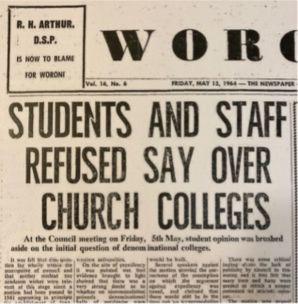
In response to the ‘Woroni’ article headed “Students and Staff Refused Say over Church Colleges”, noting that “student opinion had been brushed aside”89, Professor Herbert ‘Joe’ Burton, Principal of the School of General Studies, wrote that he was both surprised and rather appalled by the cover page article, and that there was both staff and student representation on the Council. He was pleased that the Council “refused to be intimidated by an example of secular intolerance just as it would deplore the expression of religious
87. Woroni Vol. 16, No.6 Friday May 15 1964 p.1
intolerance.” He regretted that the student newspaper copied “the worst example of the commercial press in misinterpreting what has actually happened.”90
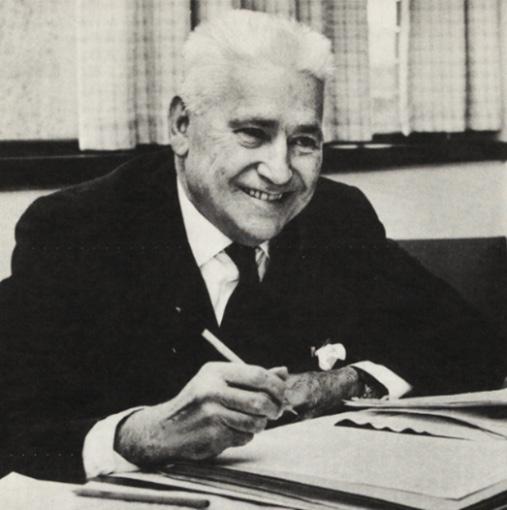
A following letter to the Editor expressed the view that most students were not made aware of the ANU Council’s decision in 1962 to set up conditions of affiliation of residential colleges, and that since that time, with more information, “there is now strong opposition to denominational colleges.”91
Despite the expressions of concern raised by Staff and Student Association representatives, it was made very clear a few months later in a letter to the University Registrar from the Secretary of the Prime Minister’s Department,
88. L. G. H. Huxley to A. G. Hartnell ‘Affiliation of Halls or Colleges’ Part 1 op.cit. Also reported in ‘Woroni’ Vol.16, No.5 8 June 1964 p.1
89 ‘Woroni’ 15 May 1964 p.1
90 ‘Woroni’, Letters to the Editor 8 June 1964, p.2
91. Ibid.
Sir John Bunting, and in a letter to Father O’Rorke from the Minister-in-Charge of Commonwealth Activities in Education and Research, Senator John Gorton, that “the Government wishes the affiliated colleges to have an opportunity to share in Commonwealth funds for student accommodation at the Australian National University” and that “the Government has decided that it will support three-quarters of the cost of an approved project for an affiliated College at the Australian National University.” Both letters affirmed the Government’s determination that “affiliated Colleges were to have equal access with Halls of Residence to Commonwealth assistance …”92
Further indication of clear support for the presence and affiliation of denominational colleges, subject to the appropriate
conditions, came from Professor Robin Sharwood, then a member of the Faculty of Law who became Warden of Trinity College, University of Melbourne, in June 1965. Professor Sharwood, who was also on the governing bodies of University House and Bruce Hall and was a member of a group seeking to establish an inter-denominational college on campus, had been asked by the Students’ Association to give a defence of church-founded colleges being established in association with the ANU. In it he argued that there was a desire to “make manifest” at the University the Church’s “historic sense of responsibility for the encouragement of learning and higher education”, and that the provision of residential University colleges, as an expression of this, had become “an accepted part of the Australian pattern.” He was certain that there was no intention of such colleges to be “centres of missionary activity amongst students, actively seeking converts” and that he couldn’t imagine the University allowing such a situation to develop. He believed that, on the pattern of colleges in
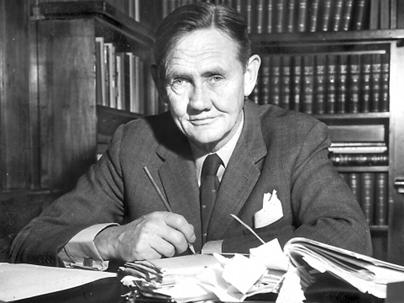
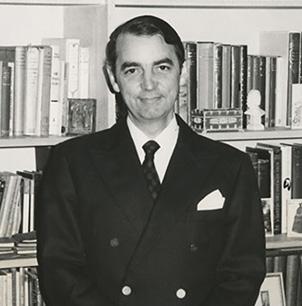
E.
to the Registrar ANU 9 September 1964, and J. G.
to Father O’Rorke 16 September 1964, ‘Affiliation of Halls or Colleges’ op.cit.
the older Australian universities, the colleges would be “free and open societies”, and that he could see “no reason to expect in colleges established here a narrow liberalism, or religious discriminations or compulsions of any kind.”93 Having been sent a copy of Professor Sharwood’s arguments, Professor Burton wrote to him: “Your views tally almost exactly with mine on this subject and I think it is rather sad to see signs of secular intolerance that would deny a place for denominational colleges in the life of the University.”94
Nevertheless, opposition continued to be expressed, albeit that by 1966 the approval processes and the establishment of the Catholic Colleges, and even a Protestant inter-denominational College, at the ANU were well underway. One letter to ‘Woroni’ noted that, while the Council had granted provisional affiliation to them, there were still several questions raised regarding their place on campus. The writer acknowledged that the Colleges would assist the provision of much needed accommodation; that they would provide a diversity that the University was lacking; and that the Protestant Churches, in line with their presence at other Australian universities, had taken an enlightened view of their role and were not “detrimental to students’ development … However, the Catholic Church has seen fit to segregate men and women into two separate colleges – an unrealistic and Victorian attitude out of tune with the modern development of inter denominational colleges throughout Australia … the two ANU Catholic Colleges will probably be beset by unrealistic and restrictive rules …” 95
The President of the ANU Students’ Association believed the University was frustrated by the government’s financial arrangements in insisting on support for church colleges, and that “the new church colleges are detrimental to a student’s development, not only because they are religious sub-institutions within a secular campus, but also because separate colleges are being established for men and for women.” The ANUSA President urged the Council “to ensure that attendance at the religious activities of these church colleges will not be either compulsory or expected.”96
The design and supervision of the construction of the Blackfriars (Dominican) precinct established in Watson in 1963, that included a Priory and House of Studies opened in 1967, was assigned to an Irish priest Father Bonaventure Leahy OP who had trained in architecture in Ireland before joining the Dominican Order in 1940 and coming to Australia in 1949. He is credited with much of the overall success of the project, including saving the Dominicans many thousands of pounds of consultancy and architect’s fees.97 Father Leahy worked in collaboration with the Sydney-based architectural firm Kevin J. Curtin and Partners, with Kevin Curtin having designed distinctive Catholic churches, for example St. Monica’s North Parramatta and St. Bernard’s Botany, as well as the Marist Brothers Kogarah Chapel. Kevin Curtin designed some fifty churches, including St. Joseph’s, O’Connor (1973), and Holy Trinity, Curtin (1974), and over two hundred schools, including Merici College, Braddon, and St. Francis Xavier Catholic High School, Florey.
93. ANU Archives op.cit. part 2: Robin Sharwood ‘Independent Colleges at the ANU’ April 1965
94. Ibid. Herbert Burton to Robin Sharwood, 30 April 1965
95. Graeme Blomfield Letters to the Editor ‘Woroni’ 7 October 1966, p.2
96. Keith Baker Ibid.
97. Christopher Dowd OP, draft Chapter 18, op.cit. p.3
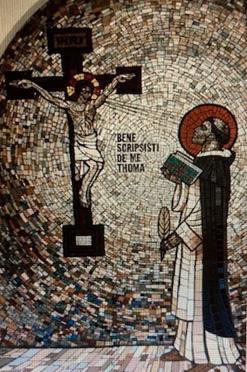
He was awarded a Papal Medal in 1996. The cloisters of the Blackfriars building were adorned with five mosaic murals, four of which were designed and prepared by a member
of the Studium staff, Father Maurice Keating OP, who became Dean of John XXIII College (1970-1974) and whose skills in this area were to be used in the new College building.98
98. ACT Heritage Council, Background Information – Signadou and
online)
With land finally allotted on the ANU campus99 , Kevin Curtin was engaged to design both the John XXIII College and a Chapel to be shared with the proposed adjoining Ursula College. The University was very conscious of the proximity of the two Colleges and was concerned to ensure that “the buildings form a harmonious group … considerable importance also will attach to the layout of the car parking areas and entries and exits … In general, the fewer the entries and exits there are, the more likely will it be that the arrangement will be accepted by the University.”100 The University also advised that Kevin Curtin and the Ursula College architects (Fowell, Mansfield, Jarvis and Maclurcan) might have joint discussion with the ANU site consultant (1954-1970) Professor Dennis Winston, foundation Professor of Town and Country Planning at the University of Sydney and a long-time resident of St. Andrew’s College.101 The University’s strong interest in the design of the College and its integration with surrounding buildings was seen, for example, in an opinion expressed by the building and grounds committee that the design for the
chapel was too vertical, formal and intrusive. Another design was requested. Perhaps the real objection to the first proposed design was that it might have been too suggestive of religion 102
Correspondence between Father O’Rorke and Mother Basil, representing the Ursuline Provincialate, emphasised a common view that “it would not be in the best interests of either (College) to build separate chapels, apart perhaps from domestic chapels for the use of the religious in the two Colleges it would be something of a scandal, if while the Interdenominational College103 will have one chapel to cater for people of four or five Christian bodies, the two Catholic Colleges had to have two College chapels.”104 Father O’Rorke assured Mother Basil that he would repeat his direction to the architect that “the chapel should appear clearly to be part of the two colleges.”105
99. Correspondence between J. R. Harris (Australian Universities Commission) and the Very Reverend J. J. O’Rorke OP, 2nd September 1965, Dominican Archives, op.cit. Apart from a west Black Mountain site, land had also been considered on sites in Dryandra Street and in Boldrewood Street, O’Connor. Land on the campus was always considered the most desirable site, co-located with other Colleges and the ANU Halls.
100. Ibid. T. M. Owen, Associate Registrar (ANU), to Messrs Kevin J. Curtin and Partners, 6th June 1966
101. Ibid.
102. Christopher Dowd OP, draft Chapter 18, op.cit. p.20
103. Burgmann College (opened 1971) – a college established by a consortium of Protestant denominations, though named after Bishop Ernest Burgmann, social activist and Anglican Bishop of Canberra and Goulburn (1934-1960). His granddaughter, Dr Meredith Burgmann, is a former President of the NSW Legislative Council, and great-grandchildren, ‘Chaser’ comedian Charles Firth, and former NSW Minister for Education Verity Firth (now Vice-President Societal Impact, Equity & Empowerment UNSW).
104. J. J. O’Rorke to Mr Kevin J. Curtin, 24th March 1966, Dominican Archives op.cit. Box 217
105. Ibid. Jerome O’Rorke to Mother M. Basil OSU, 17th May 1966
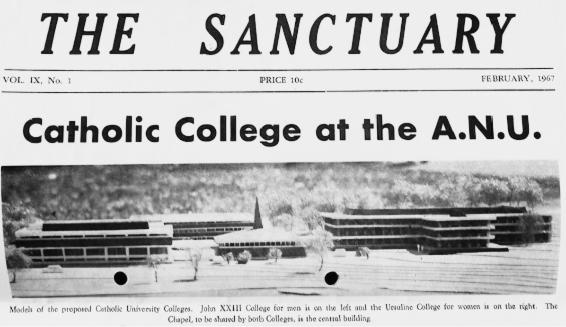
Note the scale of the proposed chapel compared with the photo following in 1970
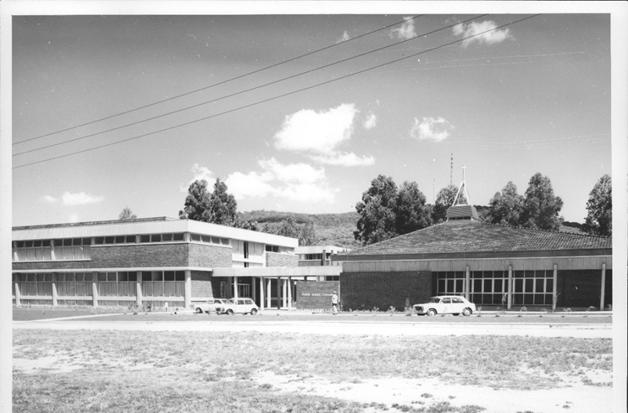
John XXIII College and the Chapel of St. John the Evangelist 1970, the year after opening in 1969
With the site on Daley Road allocated, the architect engaged, the establishment and provisional affiliation of and plans for the College approved by the University106, and plans approved by the Department of the Interior107, a cost estimate, including for the chapel, in November 1966 amounted to $1,735,015.108 Needless to say, there were to be various plan and cost revisions with, for example, a reminder from the Australian Universities Commission in December 1966 that the maximum Commonwealth grant available for John XXIII College in the 1967-69 triennium was $1,102,000, three quarters of an approved cost of $1,470,000.109
The status of the College was not to be ‘under’, as a ‘filial house’, the Blackfriars Priory, but as “a canonically separate foundation located within the ANU campus.” Perhaps in the future, the College community might have the status of a Priory.110 However, it was then emphasised that “for internal reasons in the Order, namely financial, administrative and staff arrangements it would be more satisfactory to have John XXIII College as a distinct foundation.”111
The University’s annual report for 1966 noted that “University approval has been given to the sketch plans of Burgmann, John XXIII and Ursula Colleges. The services to be provided for the college sites have been determined and design work has commenced.”112
The provision of university-owned student accommodation had improved with the opening of Burton Hall and Garran Hall in 1965/66. Towards the end of 1966, while it was noted in the ANU annual report for that year that Lennox House “had earned itself and its
Warden, Dr M. M. Gore, an enviable reputation for ‘spirit’, it was also seen to be a costly enterprise for which there would be relatively little demand in 1967.”113 While forms and formalities of Hall-type life were promoted in the rather incongruous setting of Mike Gore’s “bunch of sheds”, the accommodation had developed both a colourful character as well as had engendered many complaints since the precinct had been fully taken-over by the University in 1964. Lennox House was also losing money.114
It was reported in ‘Woroni’ that some 110 places would be available in Garran Hall in September 1966 but there seemed to be no certainty as to whether these places would be offered to ‘Lennoxians’. It further seemed that Lennox House would continue into 1967. If so, it was seen to be an opportunity passed over “to end the Lennox shambles”. If, the article concluded, the University could cope without the use of Lennox House it would see the “end of that unsightly mess of buildings by the lake.”115
The ‘mess of buildings’ were (and are) very much part of Canberra’s, let alone the University’s, history. Accommodation for students was improving, including with the prospect of three affiliated Colleges, but the University was still mindful of the demand for accommodation and that a precinct and premises such as Lennox House could still meet an ongoing need. The Dominicans, with their presence at the University of Otago, and their plans not just for the ANU but also for Monash University and the University New England, were demonstrating an eagerness for and commitment to meeting such a need.
106. Ibid. R. A. Hohnen (ANU Registrar) to the Very Rev. Fr. J. J. O’Rorke OP, 29th September 1966. Approval also given to the establishment of Ursula College and Burgmann College
107. Ibid. R. A. Hohnen to the Very Reverend J. J. O’Rorke OP, 31st October 1966
108. Ibid. Wise & Horton, Chartered Quantity Surveyors, 30 Glen Street, Milson’s Point NSW, 3rd November 1966. Decimal currency was introduced in Australia in February 1966.
109. Ibid. D. Dexter (Secretary AUC) to Father O’Rorke, 21st December 1966
110. Christopher Dowd OP, op.cit. p.20
111. Fr Jerome O’Rorke OP to Most Rev. E. M. O’Brien DD, MA, PhD, 21st November 1966, Dominican archives (Box 178)
112. ANU Annual Report 1966 p.18
113. Ibid. p.11
114. ANU annual reports 1965 (p.113) and 1966 (p.132). Other Halls also had net operating losses, but Lennox House losses were significant.
115. ‘Woroni’ 7th July 1966, p.2
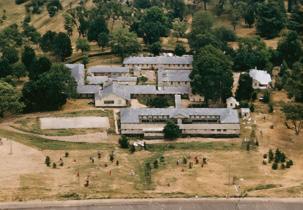
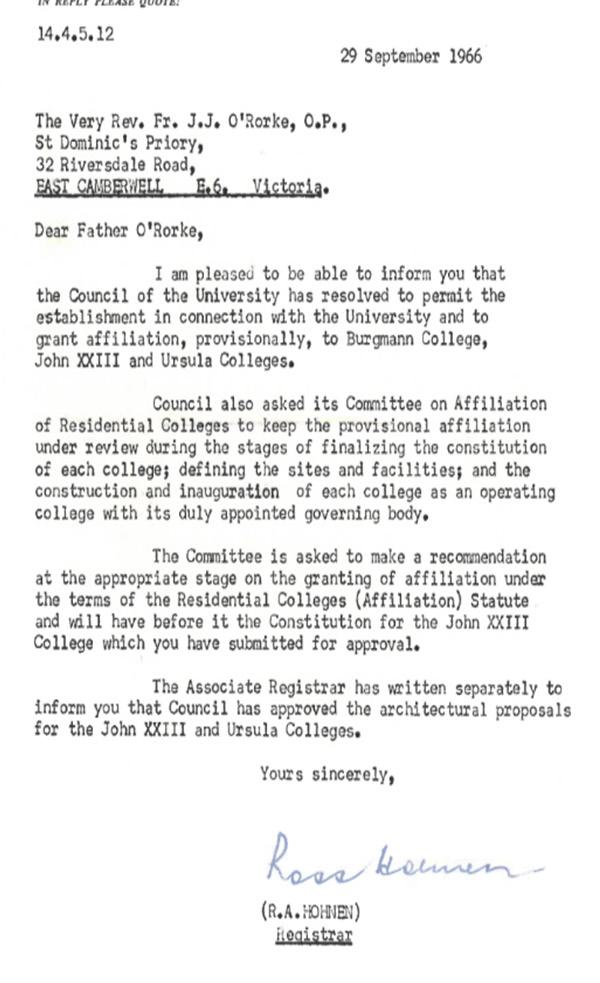
LENNOX HOUSE OFFERED BY THE UNIVERSITY AS A TEMPORARY SITE:
Following a meeting on 20th September 1966 between the University Registrar Mr Ross Hohnen, and Father O’Rorke, at which the Registrar proposed the University’s offer of Lennox House as a temporary site for the start of John XXIII College prior to the completion by the beginning of 1969 of its building on Daley Road. Father O’Rorke responded that the Dominicans were grateful for the offer and “are disposed to accept it.”116 Archbishop O’Brien approved the acceptance, with Father O’Rorke meeting again with Mr Hohnen and other University representatives to discuss the offer. There was agreement to use the name ‘John XXIII College temporarily operating in Lennox House’. The name of the first Master and of a Bursar to facilitate the process of handing over Lennox House were to be presented prior to the next meeting of the University Council. Father O’Rorke provided the names of Father Finbar Kelly OP, who had been Catholic chaplain to the University for the past year, as Master, and Father Joseph Hooper OP as Bursar. In support of the nomination of Father Kelly, the Prior Provincial wrote to Archbishop O’Brien:
“When I presented Fr Kelly to Your Grace for the position of chaplain, I already had him in mind as a Father who probably would prove suitable later on as Master of John XXIII College. I wanted him to get the feel of this University and to become known to the University people. I can say that he has fulfilled my hopes.” 117
“The University has … been fortunate that the accommodation for students will not be lost because an arrangement has been made with the Dominican Order for the premises to be used as John XXIII College, an affiliated residential College of the University.”
It was to be a temporary residence prior to the College opening its own premises by the beginning of 1969.118
116. Dominican Archives op.cit. Box 178, Very Rev. J. J. O’Rorke OP to Mr R. Hohnen, 1st October 1966, 117. Ibid. Jerome O’Rorke OP to Most Rev. E. M. O’Brien DD PhD MA, 24th November 1966 118. ANU Annual Report 1966, pp. 11&111
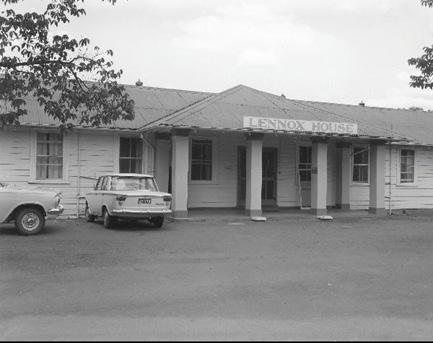
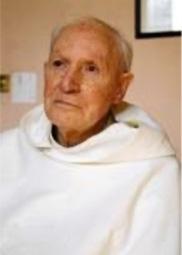
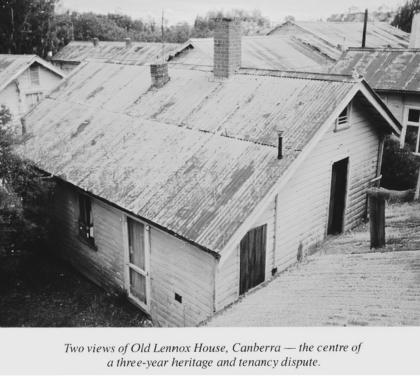
Finbar Kelly was born in 1925 and arrived in Australia from Ireland in 1955 having joined the Dominicans in 1944 and ordained a priest in 1951. He studied at Oxford and at University
College Cork (BA) as well as at Maynooth College near Dublin where he obtained a Higher Diploma in Education. He taught at the Dominican secondary school
119. Photo and some details taken from Christopher Dowd (draft chapter 18, p.21) and an obituary in October 2017 in Michael Commane’s blog ‘Occasional Scribbles’; https://michaelcommane.blogspot.com/2017/10/finbar-kelly-op-rip.html
Yvonne Parry op.cit. p.3. Father Kelly was Master for just the first few weeks before illness forced him to stand aside.
Newbridge College, Kildare. After returning to Ireland from Australia in the late 1960s he became Prior at Holy Cross Dominican Priory, Tralee and then for some twenty-seven years was a member of the Dominican community at the Black Abbey in Kilkenny, one of the first houses of the Dominican Order in Ireland. In recording his death in 2017, a writer notes that “Finbar had that great ability of making one feel at home in his company. He was genuinely interested in people. Being kind and generous came naturally to him.” 120
“FIRST
“BEST
Mike Gore, who for family reasons in 1966 had moved across the road into one of the cottages on Liversidge Street, recalled a dinner he hosted there with Ross Hohnen as one of the guests. The Registrar got up and announced that Lennox House would be closing as a university-managed hall the following January. As Professor Gore put it, he had “decided to help the Dominicans.”121 Information provided for students wishing to be members of ‘John XXIII College (temporarily operating in Lennox House) in the Australian National University’ noted that Lennox House had formerly been operated by the University as a hall of residence and that the College would be under the care of the Dominican Fathers. It would be controlled by a Council chaired by the Master, who would be assisted by a dean and a bursar. Accommodation would be for males only. Application for admission to the College would be made on a form obtained from the Registrar of the School of General Studies. Students who were already members of Lennox House could apply for admission as members of
John XXIII College in 1967 by notifying the Master by the start of October 1966. A $30 fee was charged on acceptance of an offer, with $20 of that fee refundable when leaving the College. Residents were required to become members of a residents’ club for a fee of $6, and all undergraduate residents were required to hire an academic gown at a cost of $2 per year.
Father Thomas Hegarty also lived in the College and described the temporary accommodation as “wooden, single storeyed and very old.” Other words were used to describe the buildings and conditions such as “primitive”, “basic” and “decrepit”.122 He and others might well have been encouraged by the University’s 1967 annual report which noted that “construction of Ursula College and John XXIII College on sites between Daley Road and Clunies Ross Street is well advanced.”123
It was acknowledged, however, that “although Lennox House was not originally designed as a residential College, it possesses all the facilities which are associated with a hall. The buildings are not centrally heated, but radiators are provided in all rooms.” Students were assured that there were no religious tests for membership of the College, and that “it will be the aim of the Dominican Fathers to continue the standard of dining facilities already established in Lennox House, and indeed to maintain the best traditions of that establishment.”124
There was some guarantee that “the best traditions” would be maintained by a large number of Lennox House residents who continued living there as residents in the
120. Ibid. There is some questioning as to whether he was actually appointed as Master. Documents appear to confirm his appointment, but, as a result of health issues, he did not occupy the position for long. He was soon succeeded by Father (John) Joseph Hooper OP. 121. Mike Gore op.cit.
122. Ibid.
123. ANU Annual Report 1967 p.17
124. Dominican Archives op.cit. (Box 217)
first year of John XXIII College. No doubt there was some difference between what these ‘seasoned’ residents regarded as those traditions and what would have been regarded by Father Kelly as Master, Father Hooper as Deputy Master, and Father Butler as Dean and Bursar! For them, such roles in university residence “was a first-time experience”125. One of the first John XXIII residents who had been a resident of Lennox House in 1964 and 1965, Peter Sekuless, who also became the first President of the Residents’ Association, recalled that “it soon became apparent that there was a clash of cultures, in the sense that Hooper and Butler were used to a secondary school environment, and those of us who had been away from home for some time - maybe half of us- and in other universities had been under the more laissez-faire attitude of the secular colleges … The Fathers wanted a sort of discipline that more related to school and what they were used to – and it got worse!”126
Peter Sekuless, first President of the John XXIII Residents’ Association 1967 (photo 2024).
Peter helped form the ANU Rowing Club in 1964 – photo of campus around 1965, with Lennox House area top left near Canberra Hospital, and the area beyond the new Burton Hall (right of photo) to be allocated to three church colleges, including John XXIII. Rowing races used to be held from the Hospital to the entry of Sullivans Creek into Lake Burley Griffin.
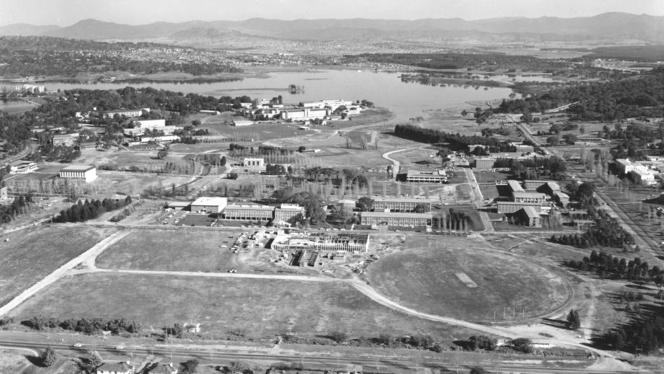
The opportunity to take up the University’s offer to occupy Lennox House and to commence the operation of John XXIII College was no doubt welcomed by the Dominican Fathers as a means of affirming their mission or ‘charism’ and demonstrating their calling. The challenges of a ‘first-time experience’ were perhaps embraced as part of the purposes of the Watson Priory and Studium that were expressed by Father O’Rorke in seeing the move to Canberra “as one of the most important steps that the Order has taken in Australia, and one in which I like to discern the Finger of Divine Providence.”127 The Blackfriars Priory was seen as a building “whence Dominicans, qualified in heart and mind, will be dispersed to do the work of God.”128 From the soon to be officially opened Priory in Canberra’s northern suburbs, with its distinctive architectural style and embellishments, the Fathers headed to the Lennox precinct in Acton with its collection of accommodation huts, sometimes referred to as sheds and shacks129, to begin the “work of God” in forming the John XXIII community. Apart from the student and community
challenges, there were of course the operational needs to meet, with for example, Father Hooper writing to the Universities Commission seeking a Commonwealth recurrent grant of between $5,000 and $7,000 as given to colleges affiliated with State universities, plus a per capita grant of $30 per resident student and $10 per nonresident student receiving tutorials.130 Father Kelly, who for a short time had been Catholic chaplain at the ANU, was approached by Father Favier as Vicar-General of the Diocese and Parish Priest of Braddon, noting an arrangement whereby the Archbishop would give a subsidy of $200 per annum in support of the University chaplain; the Braddon parish, as long as the College remained within the parish, would contribute $200 to support the chaplaincy; and that Sunday Mass collections at the University and Lennox House would be distributed 70% towards the cost of the College and 30% to the support of the chaplain. It might have been somewhat wishful thinking that the Vicar-General hoped that residents’ “knowledge that their contributions will help the University College will inspire those giving to Sunday collections to give more generously and perhaps some to commence giving.”131
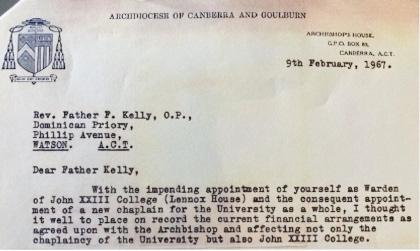
127.
128. Ibid.
129.Professor Mike Gore op.cit.
130. J. J. Hooper to Mr D. Dexter, Secretary, Australian Universities Commission, 6th February 1967, Dominican Archives op.cit. (Box 217)
131. Ibid. E. C. Favier to Rev. Father F. Kelly OP, 9th February 1967
Whether giving by Catholic students was fulfilled in this way, the 1967 Report of the Catholic Chaplain, Father Thomas Hegarty OP, noted that one quarter of Catholic students at the ANU were resident on campus and almost all of them attended Sunday Mass. Father Hegarty hoped that at least an interdenominational chapel would be made available for the use of both chaplains and students, noting that “many undergraduates have assured me that the prayerful atmosphere of a chapel – even without the inspiration of the Real Presence – would draw them to spend a little time in prayer and recollection each day.”132 It would no doubt be especially satisfying for Father Hegarty to be Master of John XXIII College when the new College building and the Chapel of St John the Evangelist were officially opened in 1969.
On Friday 17th February 1967, the Canberra Times reported that “Lennox House in Acton will be known as John XXIII College from tonight until a new building to house the college is completed.” The College “could accommodate a total enrolment of 110 fulltime and part-time students … and is run by the Dominican Order with Father F. Kelly as the college Master.”133 Drawing from information that had been sent by Father O’Rorke to the University following the approach made to the Vice-Chancellor by Archbishop O’Brien, a further report noted that “the members of the College, parallel with other groups, will carry its influence into the life of the University, in which, from the happy blending of different influences, the whole life of the University is enriched and invigorated.” 134
True. It was not long, however, before the coming together of the influences of Dominican piety and the ‘dawning of the Age of Aquarius’ within the new John XXIII College at Lennox House came into rather unhappy conflict. Father Kelly did not remain long as Master due to ill health, with Father Hooper taking on the role. 135 Peter Sekuless (‘Seko’) recalled that “there was someone there at the beginning … he used to wear the full black gear …”136 Whether the memory is of Kelly or Hooper is not clear, nor is the exact date of Kelly’s departure. The ‘clash of cultures’, however, clearly came to light in March 1967, most likely under the watch of Father Hooper.
Peter Sekuless, who had been a resident of Lennox House in 1964 and 65, lived with a few people in Downer in 1966. He was doing an arts degree but, with a main interest in getting the ANU rowing club together and getting an ‘Eight’ into the intervarsity competition, and otherwise just ‘flopping around’, he was not doing well academically. He had to face an academic review board, with his parents, supported by the University, saying the only way he could stay at ANU was to be in college. The only one that would have him in 1967 was John XXIII College located in the familiar facilities of Lennox House.137 He remembers Father ‘Hoops’ as “a chain smoking, very intense sort of person who wanted to enforce the rules and regulations … Father Butler (the Dean and Bursar, known also as Father Butts) was rather big- more like a Friar Tuck! A large man who would go into rooms and have coffee with residents. Father Hooper was more aloof.”138 Fellow resident Christopher Lee remembers Father Butts as “a fine Roman Catholic, a fine Dominican and a fine human being … (he) came drinking (once at
132. Father Thomas Hegarty ‘Annual Report for 1967 of the Chaplain to the undergraduates of the School of General Studies, and the graduates at the Institute of Advanced Studies at the Australian National University, Canberra, A.C.T.’, Dominican archives op.cit. Box 217
133. ‘College takes over’, Canberra Times Friday 27 February 1967, p.3
134. ‘Catholic College at the A.N.U.’ The Sanctuary Vol.1X, No. 1 February 1967, p.1, CG Diocesan Archives
135. There is a number of references to Father Hooper being ‘Acting Master’. In following Father Kelly he is listed as the second Master of the College. Father Thomas Hegarty followed Father Hooper as Master.
136. Interview with Peter Sekuless op.cit.
137. Ibid.
138. Ibid.
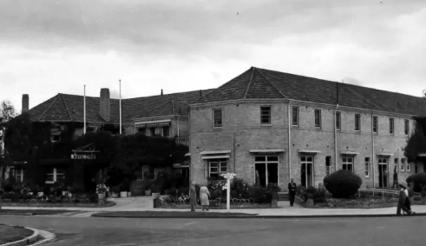
least) with us at the Civic (Hotel)139, standing there smiling at the bar in his Dominican robes drinking schooners. He was a mentor to young RC students at the Canberra seminary, a man of wisdom and humanity and a positive influence on the whole of John XXIII. I still remember, as a complete nonbeliever, discussing RC religion with him in his room. I thought he was a real credit to his Order.”140
Something very much viewed as not a credit to the College was the ‘Great Flag Scandal’ in early March. No doubt there is a number of versions of the episode but it seems that on their way back to College – two at least in an FJ Holden belonging to one of themfrom drinking at a party and in one or two local hotels141 , four College residents noticed an array of flags flying around the Academy of
139.
140.
141.
... 1969 I think!”
Science (the ‘Shine Dome’) for the occasion of some international scientific gathering. The temptation and the task were to capture several of the flags and take them back to ‘Lenno’ (the College) as trophies, perhaps to be used as bedspreads! Christopher Lee and David Troon worked around one side of the building and Peter Newsom and Col Mitchell the other side. When about a dozen flags were about to be transported to the College, police arrived and arrested Lee and Troon. Newsom and Mitchell managed to hide in bushes until the police left with Lee and Troon in custody, and they then drove to Lennox House where they left the flags in the foyer of A Block. They were later recovered by the police during their search for the other offenders. They were not caught; Lee and Troon faced court. They denied that they told police the flags were to decorate their rooms, and that their intention was to raise points for a Bush Week scavenger hunt competition and take the flags back to
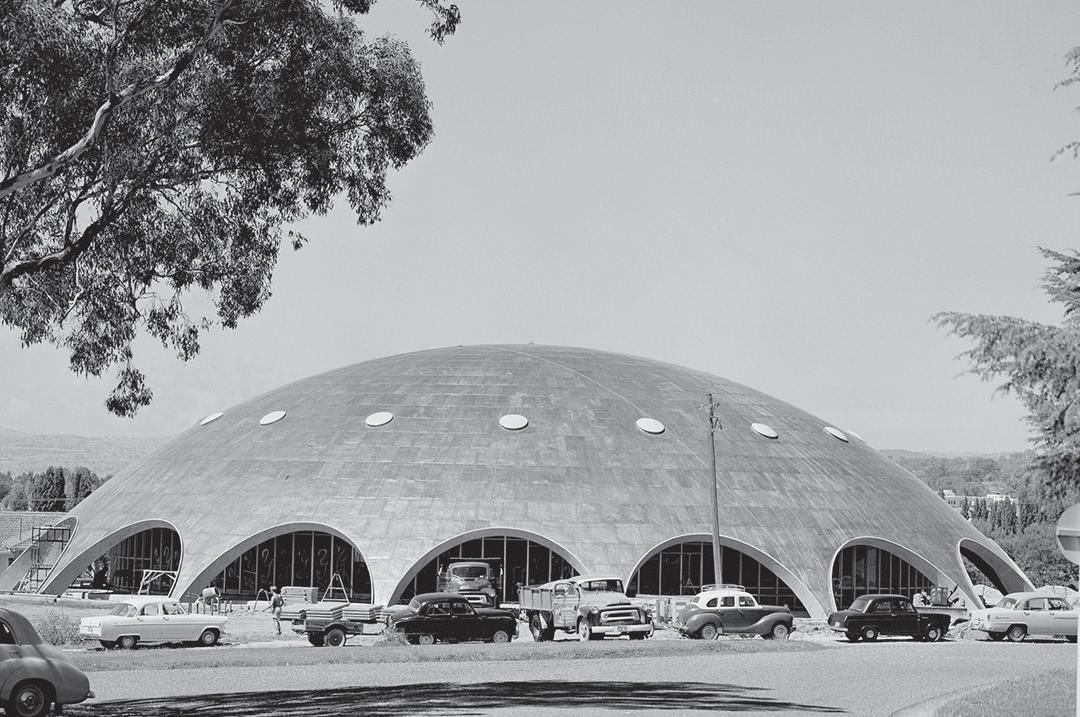
the Academy and dump them on the steps. They were found guilty in the Magistrates Court and each fined $50. Supported by their fathers and various members of the law fraternity they appealed to the Supreme Court where they were acquitted. An argument made by Mr D. O’Connor of the Faculty of Law, who represented them, was that with the charge of taking flags from Commonwealth lands, the flags were not on Commonwealth land but on poles with attachments several feet above the ground!
Christopher Lee notes that “the prosecutor got very pissed off and charged us again. So, Des (O’Connor) wrote to the AttorneyGeneral who told the prosecutor to drop it. I like the idea that a few young pisspots, knocking off a few flags, went to the highest levels of the law.”142
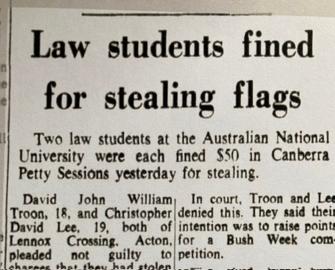
The knowledge of what occurred, together with the police coming to the College and the subsequent publicity must have more than disturbed the Dominican Fathers in the first month or so of their roles on behalf of the Order and their responsibilities in the eyes of
March 1967, p.8
the University and the wider community. Much worse, of course, had been happening in terms of student behaviour on and off campus that had even been rebuked by the ANU Students’ Association. The Dominicans were not the only ones having to deal with the changing and challenging times of university student life. A letter to the Editor of Woroni under the heading of ‘The Adolescent Mind’ was written by one of the early residents of Bruce Hall, Bill Gammage, noting that “for some time responsible students have expressed alarm at the steadily increasing strength of anarchic elements within the University.”143 ‘Aquarius’, meaning ‘water-carrier’ and the constellation depicted by a man pouring water from a jug, perhaps then represented much more than water being the contents of the jug!
The Lennox House precinct of the newly established John XXIII College was located close to the Canberra Hospital and the nurses’ quarters on the Acton peninsula, with a short walk from there to the various doors of the ‘Lenno’ College complex that allowed fraternisation, including already established relationships formed at Lennox House in the previous years under the University’s administration. “The overwhelming thing”, recalls ‘Seko’, “was not what Father Hooper imagined – merely social interaction among young people. In other words, John XXIII was co-ed before it was officially co-ed!”144 The men of John XXIII College were very aware that on the other side of campus the University owned and managed Bruce, Burton and Garran Halls were mixed gender and that the “ethos of the University was coed”.145 This would play a part in the eventual
decision that saw women admitted to the College in 1976.
Soon after the incident involving the Academy of Science flags it was reported that three residents of John XXIII College had been told to leave for reasons described by one writer to Woroni as “nebulous, if non-existent.” The writer expressed the view that while ‘thinking students at the college’ were shocked, they did not protest for fear that they might be subject to the same action. With concern about the degree of student representation on the governing bodies of the University’s halls and the ‘almost dictatorial powers’ of the hall Wardens, the writer proposed that the Master of John XXIII College had “taken this bad example to heart.” The three residents told to leave, two of whom had been involved with stealing the flags (Peter Newsom and Col Mitchell), were regarded as having attitudes incompatible with college life. The writer reflected that there seemed to be no means of appeal; that there was at that stage “no student ‘JCR’-type committee”; and that the students were “being treated as irresponsible school children.”146 In another anonymous article titled ‘Trouble in College’ it was reported that:
“On 14th March, three students were told their general attitude and lack of co-operation made them undesirables as it did not suit the tone that the new administration are seeking to foster. No reasons were given … Several members
143. Woroni 3 April 1967, p.2. Emeritus Professor Bill Gammage is a distinguished historian of Australian history
144. Interview with Peter Sekuless op.cit.
145. Ibid.
146. ‘Senex ii’ ‘Church Halls’ Woroni 3 April 1967, p.2. Peter Sekuless was the first President of a ‘Residents’ Association’, noting in interview “why we were a Residents’ Association and not a Junior Common Room, I have no idea.” In a follow-up email (6 Dec 2024) he notes “I cannot recall whether the Residents’ Association was established before or after these expulsions. I suspect it was after and as a result of the expulsions, and that is why it was named as a Residents’ Association rather than Junior Common Room as elsewhere.”
of the College have spoken to the Master subsequent to the event and it would appear that, while he is entirely sincere, he is out of touch with reality … Another amazing fact is that they were given no warning … the three were assured that the Administration bore them no ill-will; nevertheless, they were given a whole 24 hours’ notice in which to find new accommodation. That is a typical example of the Master’s ignorance about everyday matters as it is impossible to find accommodation at such short notice in Canberra and therefore the three were forced to sleep on the floors of friends’ rooms. It is unfortunate that the new regime had to make such a blunder so early in their rule … The one pleasing aspect to arise out of the whole nasty business is that Peter Newsom and Col Mitchell have been accepted into Burton Hall which shows that the University Halls of Residence do not approve of dictatorial tactics and arbitrary justice.” 147
Peter Newsom recalls that although he was not caught stealing the flags, “the Dominican Fathers must have had their suspicions, and I was told to pack my bags. Rossiter at Burton Hall saw no reason not to take me in!”148
Perhaps somewhat ‘tongue in cheek’, Peter Sekuless and others called themselves the ‘Protestant Action Group’ as there had been a ‘Santamaria Catholic Action Group’, named after B. A. (Bob) Santamaria, a Catholic conservative activist, anti-Communist as well as anti-capitalist, who with others formed the Democratic Labor Party in the 1950s.
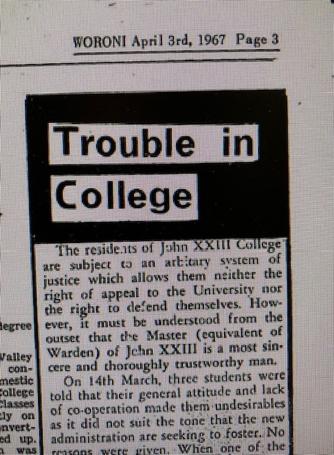
Emeritus Professor Mike Gore recalled that after the Dominicans took over Lennox House in 1967, from time to time he would receive invitations to go there for lunch and that he would be asked all sorts of questions about running a Hall of Residence. He believed the Dominicans perhaps felt embarrassed to ask Bill Packard questions, but he was asked by Father Hooper about how he ever ran Lennox House at a profit. “We never did”, replied Mike Gore, “we always ran about £5000 to £6000 in the red”! Father Hooper noted that the Registrar never told them that! Professor Gore commented “and why would he”!149
147. Observer ‘Trouble in College’ Woroni 3 April 1967, p.3. Peter Sekuless email to Ian Walker ibid. confirmed that he was the writer and did not put his name to it “because of the fear of retribution”.
148. Peter Newsom to Peter Sekuless, 9 February 2025. Geoffrey Rossiter DFC (1916-2004) was a Rhodes Scholar and foundation Warden of Burton Hall 1965-1981
149. Mike Gore interview op.cit.
The challenges of facilities and costs clearly carried over from the University’s to the Dominicans’ administration of Lennox House. Improvements had been made to the buildings, but they were still seen as very temporary. No doubt quite a deal of the furniture was the same, marked with the stamp of ‘University of Melbourne’, having been brought from the Melbourne associated Canberra University College (CUC) which had closed on its amalgamation with the ANU.150 Many of the first students of John XXIII College had elected to carry on with their residence at Lennox House though it might have been difficult for some to gain a place in one of the three ANU Bruce, Burton and Garran Halls. Many were also part-time students, most working in public service positions – the ‘shinies’ or Christopher Lee’s ‘servants’.151
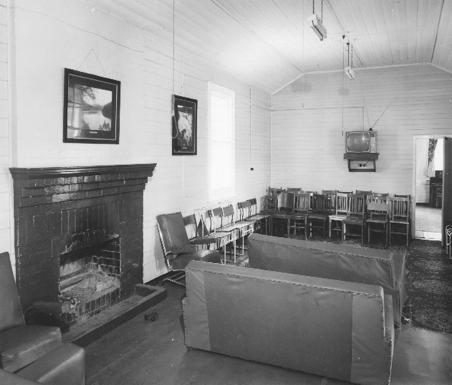
The continuity from the Commonwealth Hostels and University managed Lennox House to the temporary John XXIII College was also seen in the cook who later became the College’s catering manager for over twenty years. Students ‘march’ on their stomach!! Zivorad Mihajlovic, commonly known as ‘Chiko’, emigrated from Yugoslavia in 1954 at the age of nineteen and lived in the Bonegilla Migrant Camp near Wodonga, Victoria. ‘Chico’ qualified as a cook while working in Albury and then moved to Canberra in 1960 and soon was employed to work at Lennox House, where he met and married one of the waitresses, Tania, who was a Dutch migrant. He came to be seen as an “influential figure”153 who was “a very popular bloke” and a ‘fantastic cook” who “always kept good steaks in the oven for people who went to football training” or who could not make the scheduled mealtimes.154
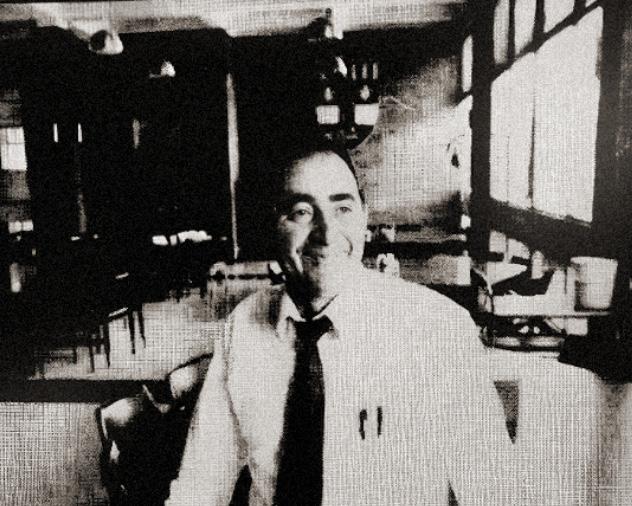
150. Peter Sekuless interview op.cit.
151. Christopher Lee op.cit.
152. Variously spelt ‘Chico’ or Chiko’!
153. Ibid.
154. 1960s resident Mike Peedom quoted in ‘Canberra People’ Canberra Times 1 October 1989, p.28. Mike Peedom later became President of the ACT Legal Aid Commission, succeeded in 2014 by former ACT Chief Minister Jon Stanhope who is also a John XXIII alumnus.
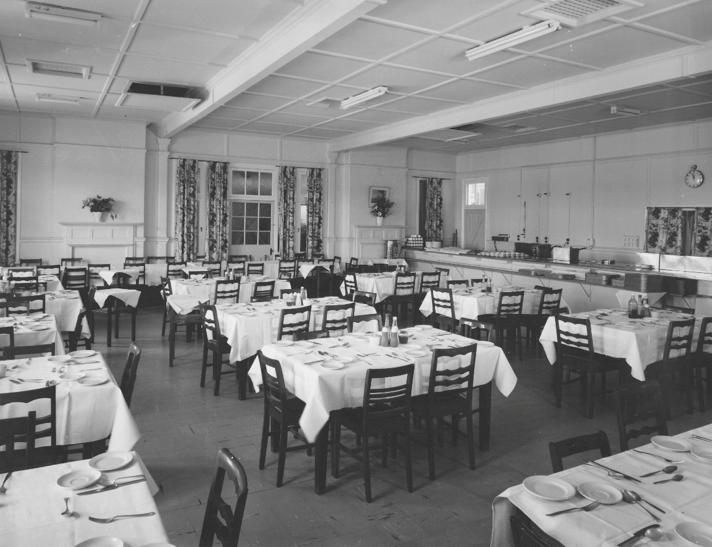
Chiko recalled that when he came to Canberra in1960 “it was all huts around Civic and hostels like Lennox House, Acton Guest House, Mulawa, and Havelock House.”155 He felt well looked after by Dr Mike Gore, and by the students who know doubt felt well looked after by him. He was further described as “the type of person students see as a friend rather than a person who merely works in an institution … he was a friendly character who developed a rapport with the students.”156 Peter Sekuless recalls the amusement of gowned formal dinners each week in the setting of the huts with Chiko “swearing in Croatian” at one of his assistants. It was good fun, even better when, with the instruction that dress for such dinners was academic gown, a student came to dinner dressed only in his gown!157 It is possible that the
only thing that stood between Michael Lee and David Troon and a late Chiko steak in March 1967 was the temptation of the flags surrounding the Academy of Science.
Chiko and his staff would cater for many formal dinners in the decades ahead, both at the Lennox House site and at the new College to be opened on Daley Road. In May 1967 an inaugural dinner for the College was held at which the guests of honour were the retiring Archbishop Eris Obrien, and ANU Vice-Chancellor Sir Leonard Huxley and Lady Huxley. It was reported that “the Dominican Fathers who run the College and the University students who are its residents were hosts to many distinguished academic and clerical guests.” In his speech, Archbishop O’Brien
155. Ibid.
156. Ibid. Comment by George Snow who later in 1991 established with his brother Terry the Snow Foundation and sailed the yacht ‘Brindabella’ in Sydney to Hobart races.
157. Peter Sekuless op.cit
noted that the University had modest beginnings with many improvisations required at the start. The College was now beginning in the same way and he “looked forward to its development as a community in which both Catholic and non-Catholic students would find a congenial base from which to pursue their university studies.”158
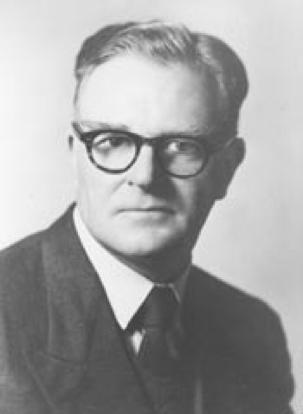
The guest speaker at the Term Dinner in early August 1967 was the Anglican Bishop of Canberra and Goulburn, the Right Reverend Kenneth (Ken) Clements. Bishop Clements had succeeded Bishop Ernest Burgmann in 1961 and had become closely involved with a Canberra inter-denominational (non-Catholic) consortium to set-up a third affiliated residential college at the ANU. He believed it was important for the three colleges to work together both in their establishment
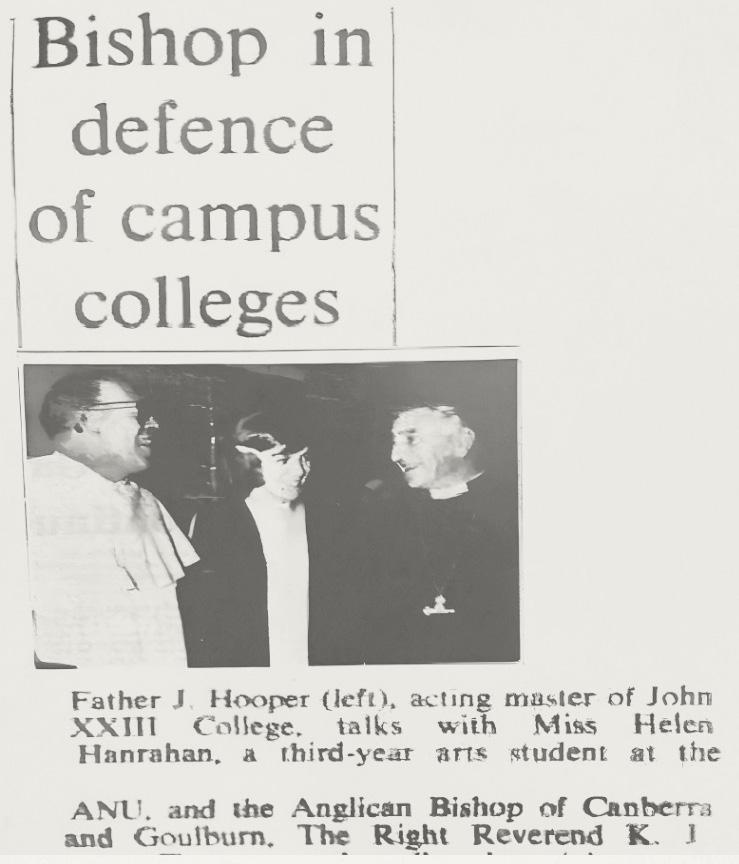
and in their ongoing work and relationship with the University. Mindful of the objections that had been raised about the presence of church colleges on campus, he said at the dinner that “the important thing is that although there are some who don’t think it is a good thing for denominational colleges to appear on the campus, you do get a variety that contributes towards the richness of university life.”159
Some common concerns for the three establishing affiliates were expressed in a letter earlier in 1967 sent by Father O’Rorke to the Honorary Secretary of the Burgmann College committee, Mr Charles Price.160 Bishop Clements had forwarded to Father O’Rorke a letter from Mr Price in which he noted three areas in which collaboration was sought from the Dominican and the Ursuline nuns. These
158. The Sanctuary op.cit. 12 May 1967
159. Canberra Times Wednesday 2 August 1967, p.3
were (1) making a joint appeal for funds from business; (2) having a joint approach to the University and to the Australian Universities Commission concerning disparity of fees between the affiliates and the University managed Halls, given the ANU’s policy of subsidizing its Halls; and (3) developing a response to what were seen as unsatisfactory features of the lease arrangements proposed by the University, especially that there was no indication of the renewal of leases.161 Charles Price indicated that there had been valuable conversations with Father Hooper, and that Archbishop O’Brien had agreed to a joint appeal to business 162
In his reply, Father O’Rorke indicated that the Order was willing to join in the approaches mentioned and especially expressed very real concerns about the proposed 99 years leases for the Colleges. Indeed, he referred to a letter from the Registrar at the end of the previous year which, while “sure that it is very correct legally” gave him the overall impression “that we are an underprivileged class, like the Hebrews in Exodus 5.”163 He was certain that the Registrar did not intend to give this impression but noted that “after tedious negotiations stretching over four years, we are about to be permitted to build Colleges for which we shall have to work very hard to finance and maintain, and after ninety-nine years we (the same moral persons) will have no legal claim whatsoever on them, and we shall receive no compensation whatsoever for a century of labour.”164 With mention of other concerns about ownership of the buildings
and compensation from the University should the Colleges be disaffiliated, the Provincial was clearly frustrated with the University’s approach, particularly that completion of the lease arrangements was required before a loan from the Commonwealth Savings Bank could be accessed. Father O’Rorke conveyed his thanks to the Burgmann Committee.165
The joint Appeal to business was conducted by the National Fundraising Council of Australia. In a letter to Father Hooper, Father O’Rorke noted that the Appeal was only to be to firms, trusts, companies and businesses, and not to persons, and that it would not involve “other members of our hierarchy” such as diocesan bishops who are wholly committed financially “to responsibility for Primary and Secondary education, and the pattern of administration does not envisage any financial over-lapping, except perhaps for provincial seminaries.”166
“… A SIGNIFICANT CONTRIBUTION TO THE EDUCATIONAL LIFE OF THE NATION.”
A ‘National Residential Colleges (in affiliation with the Australian National University) Foundation Fund Appeal’ booklet outlined the plans and purposes of the three affiliated residential colleges, noting that “if the University is to develop as a national university, attracting students from all parts of Australia and from overseas, it must have sufficient residential places in halls or colleges” and
161. Very Rev. J. J. O’Rorke to Mr Charles Price, 20 February 1967, Dominican Archives op.cit.
162. Charles Price to Father O’Rorke, 13 February 1967, Dominican Archives op.cit. Archbishop O’Brien wrote to Father O’Rorke on 8 February 1967 indicating his approval of joining with the Ursuline Nuns and the Burgmann Trustees in a joint appeal for funds to Business Houses in Australian Capital Cities (Dominican Archives).
163. As Pharaoh speaks to Moses and Aaron when they request him to let their people go to make a sacrifice, a celebration in the wilderness. Pharaoh objects to them stopping their work of making bricks, seeing them as lazy; they will no longer be provided with straw to make them, they will have to go and gather straw themselves and still make the same number of bricks as previously.
164. Father O’Rorke to Charles Price op.cit.
165. Ibid.
166. Father O’Rorke to Rev. J. J. Hooper OP, 10 July 1967, Dominican Archives op.cit.
that by 1975 “the need for residential places could be as high as 3,000.”167 The booklet sought to emphasise the particular benefits of the University having affiliated independent colleges along with “its own excellent Halls of Residence”, such as helping to “bridge the unhappy gap between modern secular science and theology”, with the hope that the Colleges might bring in well-trained theologians to engage with secular scholars, each learning from each other; being “freer to experiment with the form of tutorials” enabling,
on the basis of experience elsewhere, a much lower first year failure rate than that of the University as a whole; and fostering “the spirit of independence and initiative” that will the value of traditions that “obviously transcends the merely material aspects of a satisfactory board and lodging.”168
These and other high aims and purposes were supported in a booklet endorsement by the Prime Minister, Harold Holt :169
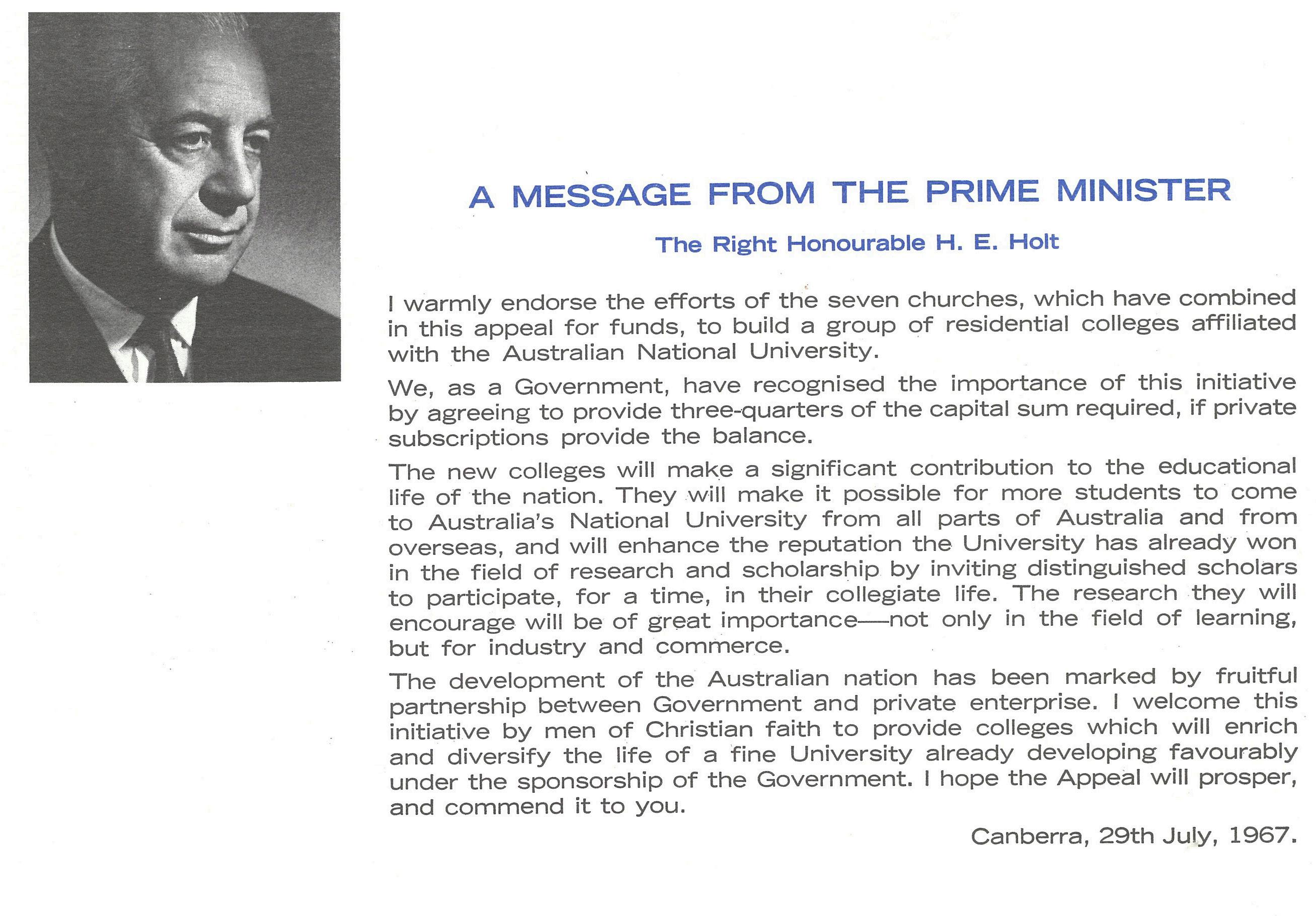
167. Foundation Fund Appeal booklet 1967, Dominican Archives op.cit. 168. Ibid.
169.
The booklet outlined that the Master of John XXIII College, Dean and Bursar would be appointed by the Dominican Provincial after advising the University Council; the representatives of the University would be named by the Council after advising the Dominican Provincial; the Senior Tutor would be the senior from date of appointment among the tutors in the College; the College President would be elected annually by all residents; and the representative of the nonmembers would be elected by them from among themselves.170
It was also noted that the site of the College,
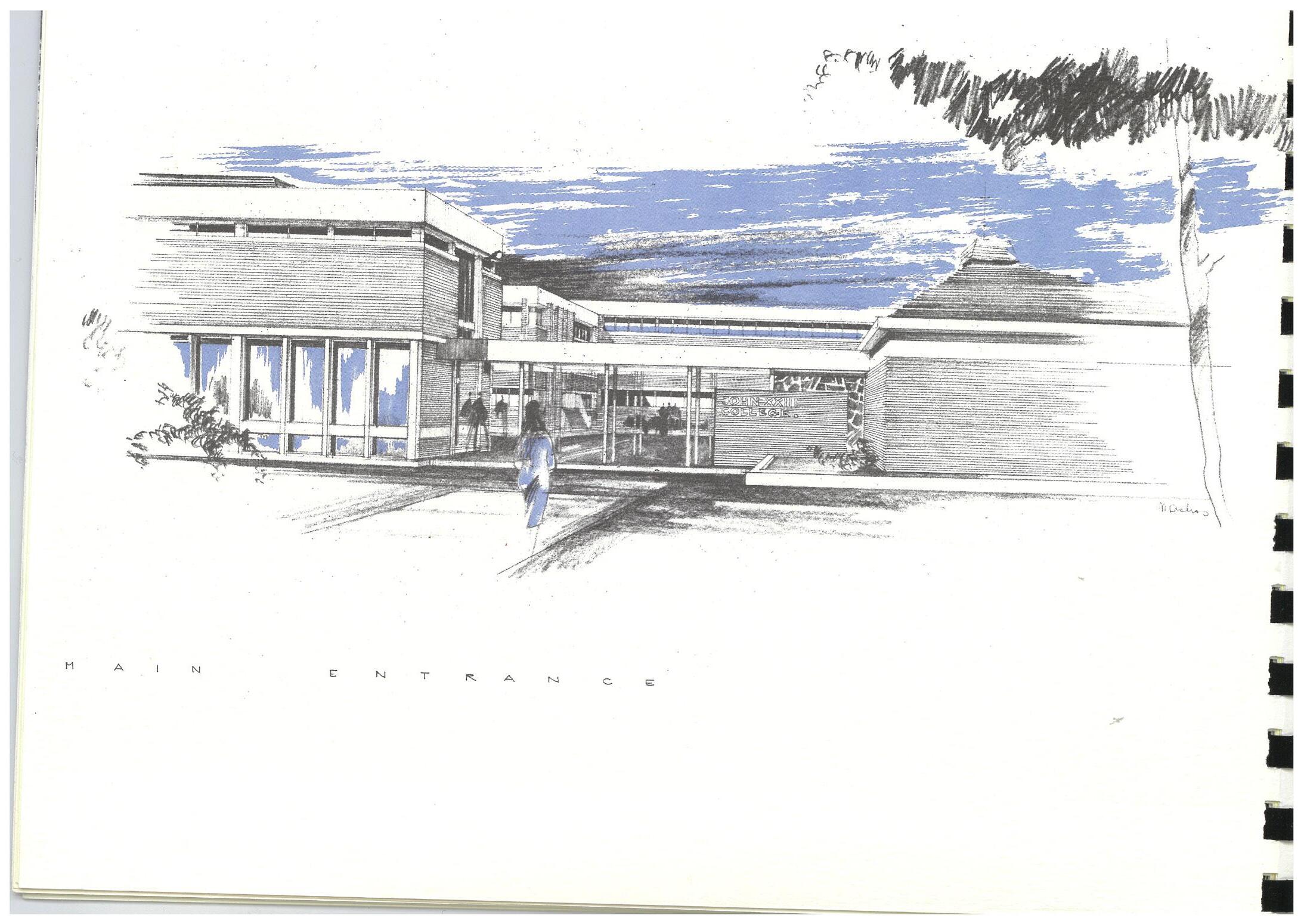
with its proximity to other colleges and halls and to other University buildings, “will be very important in order that the life of the College might be integrated as closely as possible in the life of the University.” The estimated cost of the College was indicated as $1,600,000. The National Advisory Council for the Appeal comprised notable people such as Lord Florey, Sir Leonard Huxley, Sir John Crawford, the Anglican Primate of Australia, the Catholic Archbishop of Canberra and Goulburn, Dame Enid Lyons, Sir Ronald Wilson, Sir Robert Madgwick, Dame Pattie Menzies, and Lieutenant-General Sir John Wilton.171 170. Booklet op.cit.
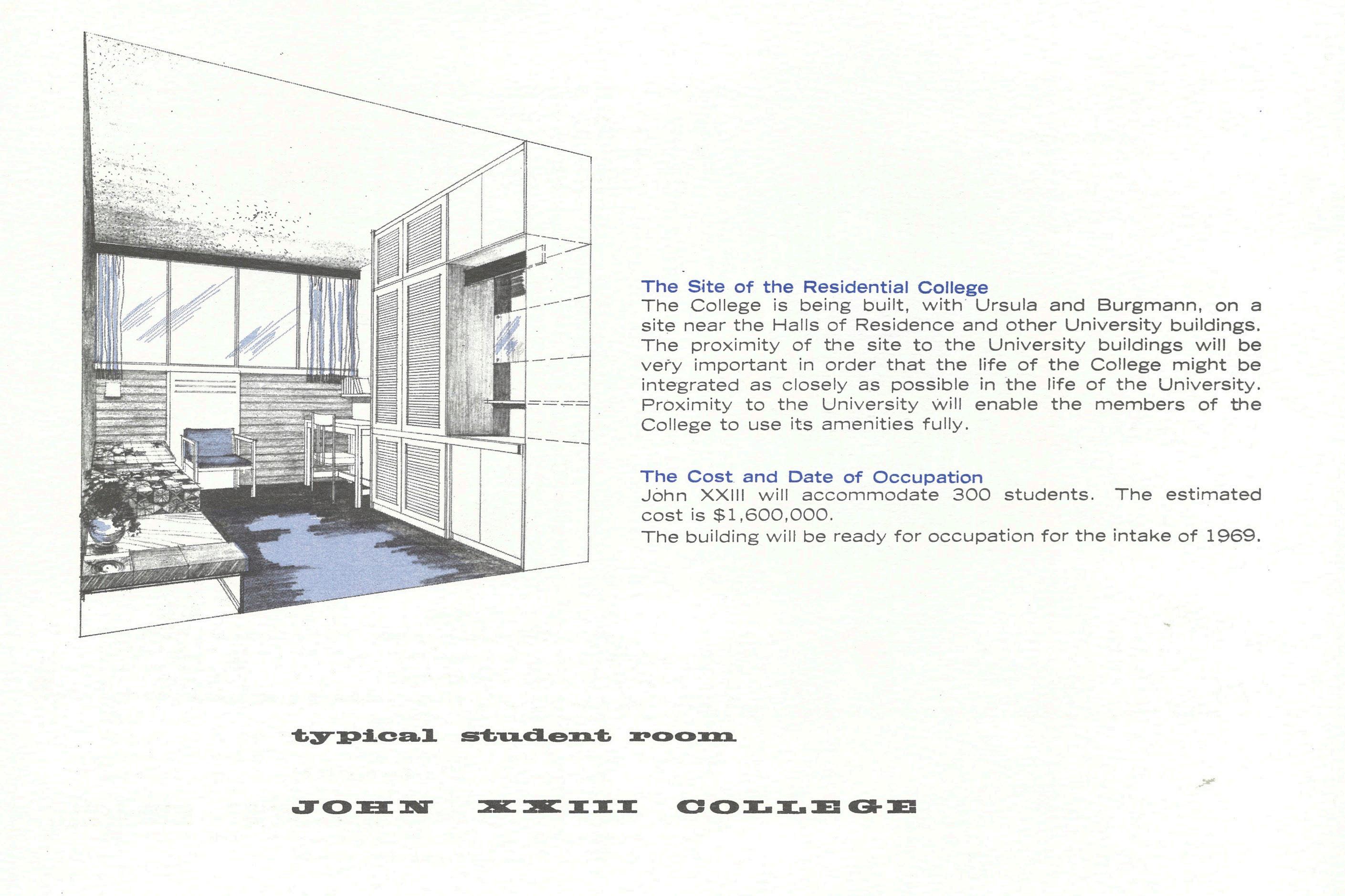
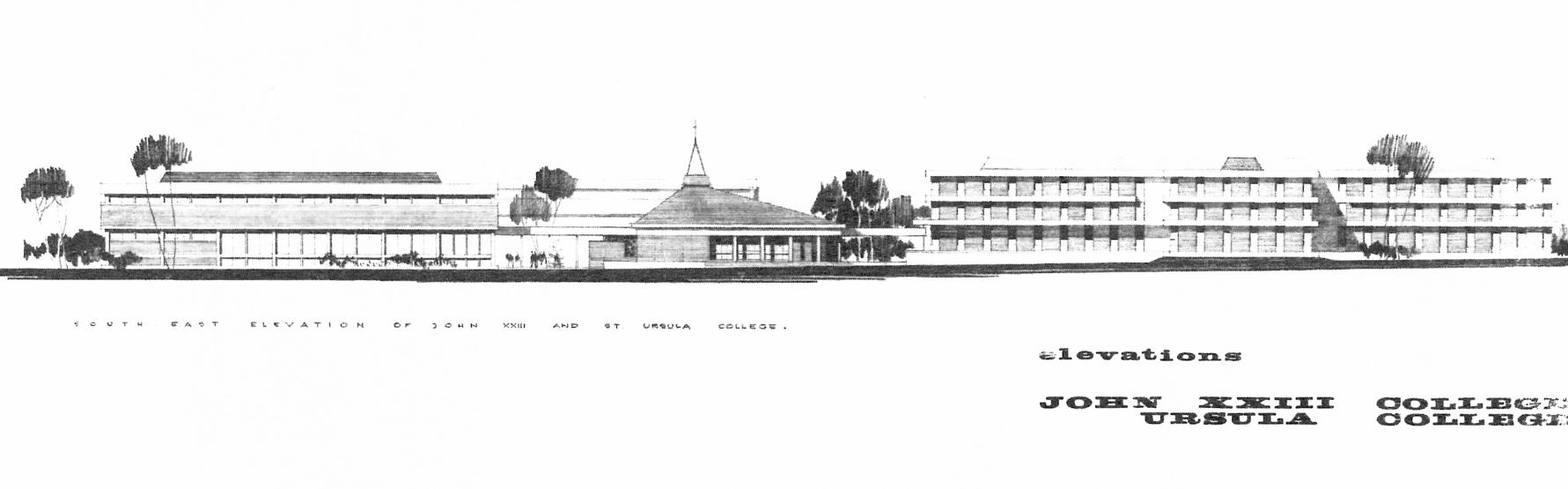
By May 1968 $59,401.95 had been raised from the Appeal, with donors including Philips Industries, Advertiser Newspaper Limited, L. J. Hooker Investment Corporation, The South Australian Brewing Company Ltd., John Fairfax Ltd., Kelvinator Australia Ltd., and General Motors Holden Pty. Ltd. Acknowledging the role of such support, Sir Archibald Grenfell Price wrote:
“As many of the leading companies and businessmen now recognise, there are probably few objectives more deserving of help than the residential colleges as a place for the development of national character and a ground for the recruitment of able young people with high standards and ideals of service.”172
Professor ‘Joe’ Burton wrote:
“The great gain to the University from these three Colleges will be not only in the doubling of student accommodation but in the intellectual and spiritual stimulation which will result from different viewpoints and philosophies. Students in the University will have a greater range of choice in the type of accommodation available and should benefit from this variety of choice. Monolithic systems of education have little appeal for free and democratic societies, and this diversity of halls of residence and colleges should greatly enrich the experience and the intellectual life of the University.”173
At a ceremony early in 1968 on the site of the proposed Burgmann College, marking the
start of the third ANU denominational college and the launch of the Burgmann Foundation Fund Appeal, the Minister for Education and Science, the Hon. Malcolm Fraser, reiterated the view that such residences promoted the development of character through their independence.174 He would later that year officially open Ursula College and in February 1969, the new building for John XXIII College.
The second year of the operation of John XXIII College in Lennox House, prior to its move to Daley Road, continued to demonstrate tensions between Dominican aims, commitment and requirements, and the challenges posed by students at a time of increasing protest and the assertion of rights and freedoms. As noted in the University’s 1968 Annual Report:
“Around the world 1968 has been a year of great disturbance in universities from Paris to Mexico City, from Tokyo to New York. Issues in these disorders have varied from Vietnam to racism, to teaching methods and curricula. It is doubtful, however, whether the essence of conflict is to be found in these issues or in the ever-present generation gap, and in changes occurring universally in the somewhat anomalous status of adolescents. Whatever the basic causes Australian students, too, have felt a restlessness which is evident in most of our universities …”175
172. ‘The Case for Residential University Colleges under Church Sponsorship’ Burgmann College News Number 1, April 1968 p.2, ANU Noel Butlin Archives ‘Burgmann (Affiliated College) Building’ 14.4.5.17. Sir Archibald Grenfell Price was the foundation Master of St. Mark’s College Adelaide (1925-1957) and a founder of the National Library of Australia. His son, Charles, was the Secretary of the Burgmann College Committee.
173. Ibid. Professor Burton was a founder of the Canberra College of Advanced Education, later the University of Canberra. The top UC undergraduate prize is the ‘Burton Medal’. Professor Burton was an early resident of St John’s College UQ and a Queensland Rhodes Scholar.
174. Woroni 18 April 1968
175. ANU Annual Report 1968 p.15
The first Student President, Peter Sekuless, clearly observed the “clash of cultures” between the Dominican Fathers whose experience was largely related to the more disciplined nature of boys’ secondary schools, and residents who had moved away from home and school, many of whom were not Catholic had not deliberately chosen to live in a Catholic administered college. Some Dominicans had little to no experience of secular university life and would struggle to work with non-Christian (let alone Catholic) students, with nothing like the same level of control over student behaviour as in a Catholic boarding school.176 Father Maurice Keating, who had trained as a teacher in Melbourne prior to becoming a Dominican lecturer and priest, was assigned to the Blackfriars Priory in Canberra in 1968 where he taught subjects such as history and philosophy. He recalls times of being a relief staff member at John XXIII College (Lennox), noting “it was a wild experience”!177 There were of course College students in the interim arrangements, including part-time ‘shinies’, who accepted and enjoyed where they were on campus and the requirements and support of the Dominicans and other staff, as there were staff who made every effort to provide appropriate services, oversight and care.
As had occurred when Lennox House was administered by the University, residents of John XXIII keenly participated in interHall sport competitions with, for example, a report written by then ANU Chaplain Father Hegarty in July 1967 that:
“Johns College began the Inter Hall competition with a hard-fought victory (13-8) over Bruce. The success has Pyrrhic undertones with two stars unable to play again. This is the type of event that rouses the college spirit while the JCR celebration that followed overflowed with spirits.” 178
Peter Sekuless moved to off-campus accommodation at the end of 1967. Others who wished to transfer to the other ANU Coed Halls for 1968 found that, unlike those who didn’t wish to remain at Lennox House when it was assigned to the Dominicans at the end of 1966, they couldn’t do so. A letter in March 1968 from some five residents raised concerns and questions about “the iniquitous treatment meted out to a number of students at the ANU” when they were refused opportunity to move to other ANU Halls because of a “no transfer” order being in force which they saw as being forced to remain as senior undergraduates in John XXIII College.179 They wished to know why such a large number of students desired to leave John XXIII College at the end of 1967 and whether this was indicative of a degree of discontent at the College. The University’s 1968 Annual Report noted the pressure to place students in oncampus accommodation at this time, though indicating that the opening of Ursula College had somewhat relieved an acute shortage of accommodation for women:
“Not all students who wish to do so can be accommodated on the campus. The University
176. Kevin Saunders O.P. Dominicans on Campus: An Antipodean Enterprise, paper presented at an International Colloquium on ‘The Role of Catholic Colleges in the modern University’, St John’s College, Sydney University, 10-11 July 2008, papers published by Anchor Books, Sydney, p.76
177. Father Maurice Keating OP interview at Carina, Brisbane, 13 January 2025.
178. Yvonne Parry op.cit. p.5. Father Hegarty had been a keen and talented rugby player and coach in Ireland.
179. Canberra Times 13 March 1968 p.2 The letter likely sent to the Acting Master Father Hooper, noting that they believed the “no transfer” decision was made by the Registrar of the School of General Studies who they understood to be responsible for undergraduate student accommodation).
succeeded again in finding lodgings for all students requiring accommodation.”180 The Report expressed anticipation of the opening of the new premises for John XXIII College at the beginning of the 1969 year.
Father Thomas Hegarty who had been Chaplain to ANU Catholic students since 1967 followed Father Hooper as Master during 1968.181 Father Hegarty was born in Cork, Ireland, in 1917, and was teacher, bursar and a rugby trainer for some 19 years at the Dominican Newbridge College established in 1852. He came to Australia in 1962 and later taught theology at the then recently opened Signadou College in Watson and was a tutor in ancient history at the ANU. He also gave lectures in philosophy and theology to lay people at Catholic centres in Manuka and Braddon.182 Father Butler continued as Dean and Bursar.
While the exuberance of College life in 1967 continued in 1968, Father Hegarty focused a great deal on developing tutorial support and promoting the intellectual interests of the undergraduates as well as sporting prowess.183 This reflected both the concerns and aims of Father Hegarty, but also those of the Dominican Fathers and others engaged in the establishment of the three Australian and other Dominican colleges. Discussions at the 1968 Provincial Chapter meetings expressed views about the provision of counselling
and tutorial systems, and that the Colleges “should never be merely boarding houses.”184 These discussions would continue into the 1970s and be part of what became broader Easter conferences concerning ‘Catholic University Colleges’ as well as participation in the developing Association of Heads of Australian University Colleges and Halls Incorporated (AHAUCHI).185
Albeit with greater responsibilities in the administration of the College, Father Hegarty wrote the 1968 annual report of the Catholic Chaplain, expressing satisfaction with the number of Catholic students at the University who regularly attended Mass, and noting that “slightly more than 100 Catholic undergraduates live in non-denominational Halls and a little less than 30 reside in the Catholic College of Pope John XXIII.” He reflected the importance of being available to students at a time of them seeking independence yet acceptance and belonging, and of dealing with group pressure and the consequences of behaviour “which is not true to one’s upbringing and is afterwards regretted”. They need sympathy and some tolerance. He concluded that “it is a matter of some relief to be able to report that there have been no evident signs … of drug taking, public violence or exaggerated demonstrations of ‘student power’… The fact that the Chaplain holds a teaching post in the History Department of the University, and that he lives in a Residential College with more than 100 resident students, would seem to be a help to a greater understanding and a deeper sympathy with today’s undergraduate.”186
180. ANU Annual Report 1968 pp.159 &16. It was also reported that the University wished to maintain a balanced proportion of postgraduates, seniors, undergraduates and ‘freshmen’ in one institution and that most of the complainants “appeared to be seniors” (Canberra Times 14 March 1968 p.9)
181. ANU News Vol.3 No.9 June 1968 p.3. Father Hegarty was certainly ‘Master’ at the opening of the new College building in 1969. There is reference to his appointment as Acting Master in 1968 following Father Hooper but for the role they both played at the Lennox House site they were seen as Master.
182. Christopher Dowd OP Draft Chapter 18 Blackfriars Canberra and the Australian University Colleges 1963-1970 in his yet to be published history of the Dominican Province of Australia, New Zealand and South-West Pacific pp. 6-7
183. Yvonne Parry op.cit. pp.5&6
184. Ibid.
185. Now ‘University Colleges Australia’ (UCA)
186. Chaplain’s Annual Report for 1968, Dominican Archives op.cit. Box 217
There was no doubt about the genuine nature of Father Hegarty’s reflections and intentions. How much they translated to university students at this time is not easy to determine. Described as a “very lordly Irishman … a lordly Irish Headmaster” he was seen as both kindhearted and authoritative, competent but not really a mixer with students.187 Perhaps as Master and in the circumstances of those times he was not generally seen as the ‘go to’ person, but examples are given for example of his great care for a student who was very ill and could not leave his room for some days188, and the way he always greeted a first year student: “when you turn up as a first year university student, you appreciate that the Head of the College knows your name – “Good morning Michael” in that Irish accent.”189
This might well have been during the Master’s regular practice of saying the daily ‘office’ in the morning while pacing the area between the chapel and the college. “Knowing of The Gentleman’s politeness, Johnsmen used to make a point of returning from lectures spaced sufficiently apart that the succession of “Good morning, Father” – “Good morning X” was guaranteed to lengthen the ‘office’ by a substantial amount.”190
A more momentous event than the opening of the new College in 1969 was to be the first landing on the moon, remembered by 1969 alumnus Andrew Pfeiffer being “viewed on a flickering black and white TV in the Junior Common Room.”191

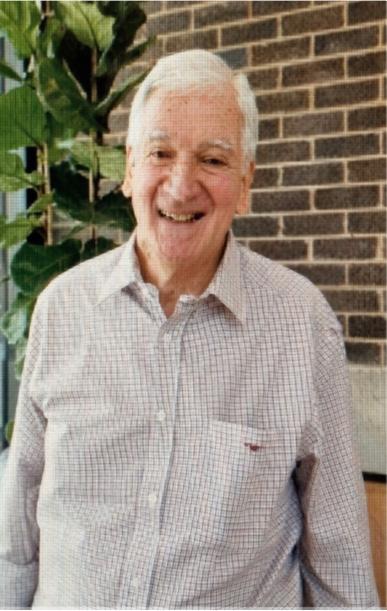
187. Interview with Fr Maurice Keating op.cit.
188. Interview with Phil McAleer (1971-73) 17 September 2025
189. Interview with the Hon. Michael Yabsley (1976-77) 3 December 2025
190. Pontifex 1978 op.cit.
191. The Pelican Semester 2, 2023
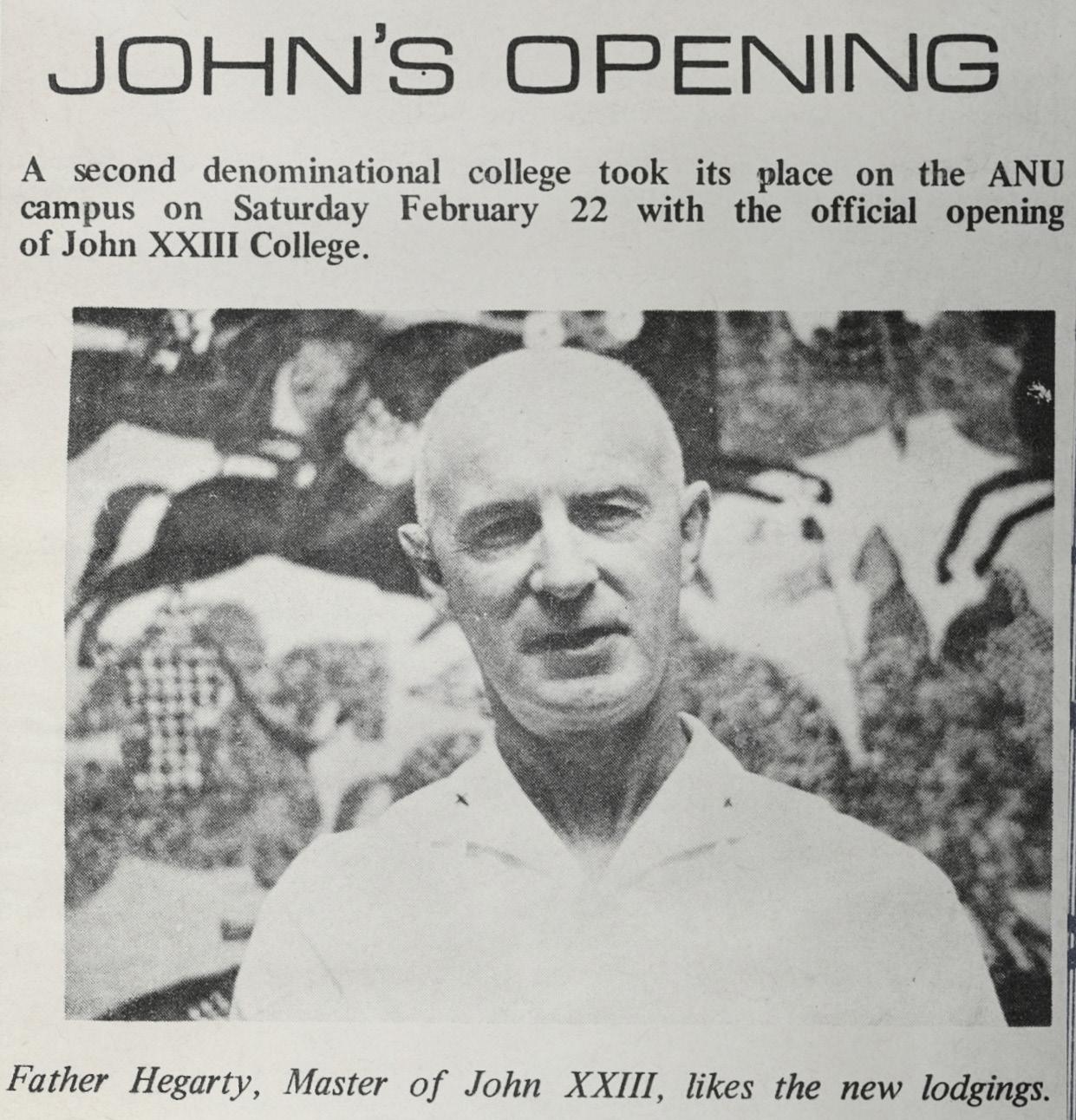
Woroni Thursday 6 March 1969 p.3
The opening of and move to the new College building on Daley Road at the start of 1969 was no doubt keenly anticipated. Father Hegarty had described the Lennox buildings as “wooden, single storeyed and very old” and
former residents noted them as “primitive” and “basic” 192 There is no doubt some truth in the observation by a resident in the early years of the Daley Road building that the temporary quarters “were a bit like a barracks” 193 Nevertheless, the foundation and life of the College in the interim location for two years
at Lennox House was certainly significant as it established a faith-based residential presence on the ANU campus at a time when both many academics and students were wary of religious intentions and of any Commonwealth diversion of funding for further development of halls managed by the University. The interim period helped to work through how the University would relate with religious organisations in their provision of residence and care. As the first denominational affiliated college at ANU, it was a testing ground for what the Dominicans wished to promote as more than just a boarding house. It also demonstrated something of a mutual willingness on the part of the University, the Dominican Province and the Catholic Archdiocese of Canberra and Goulburn to trust in each other’s aspirations and aims.
However, unlike the position of faith-based affiliated colleges prior to World War II, it was an era of the setting up of the first university owned and managed colleges and halls, particularly in the new universities being established at that time on whose campuses there were no previously established church colleges. At ANU and other new universities such as the University of New South Wales, New England and Monash Universities, the University colleges and halls were making their presence felt and were establishing patterns of organisation and purpose prior to those founded by religious bodies. Albeit these colleges and halls were very much modelled on the traditional, largely church college pattern prior to World War II, they also were developing a secular pattern that perhaps more closely reflected the University’s aims and intentions.
At ANU, in addition to the earlier established postgraduate University House, Bruce, Burton
and Garran Halls had opened along Daley Road by 1966. They had rapidly developed a range of formal and informal events and activities, including various sports. They were larger than Johns on the other side of campus and were ‘co-ed’ which, in the 1960s, was very much breaking new ground, with Bruce Hall, opened in 1961, as the first in Australia to open from the start with men and women residents. Despite every effort on the part of the Dominican staff and the engagement of residents in campus events and competitions, there would have been some sense of isolation and a kind of ‘Daley Road envy’ as they made comparisons with their temporary location, facilities and circumstances. However, there would also have been those who enjoyed the more free ‘comings and goings’ from the huts, and closer proximity to places such as the Civic Hotel and the nurses’ quarters further down the peninsula at Canberra Hospital! At a time of change and challenge, protest and significant growth in Australian universities, the Dominicans had much with which to contend.
“… THE ABSENCE OF A REVERENT HUSH …”:
The move to new premises on Daley Road in 1969 under the headship of Father Thomas Hegarty not only would provide more needed accommodation on campus but more appropriate scope for the continued working out of the Dominican charism in the care and support of students from across Australia and beyond in their living and learning on campus. It would certainly be a change from the challenges of the Lennox hut facilities!
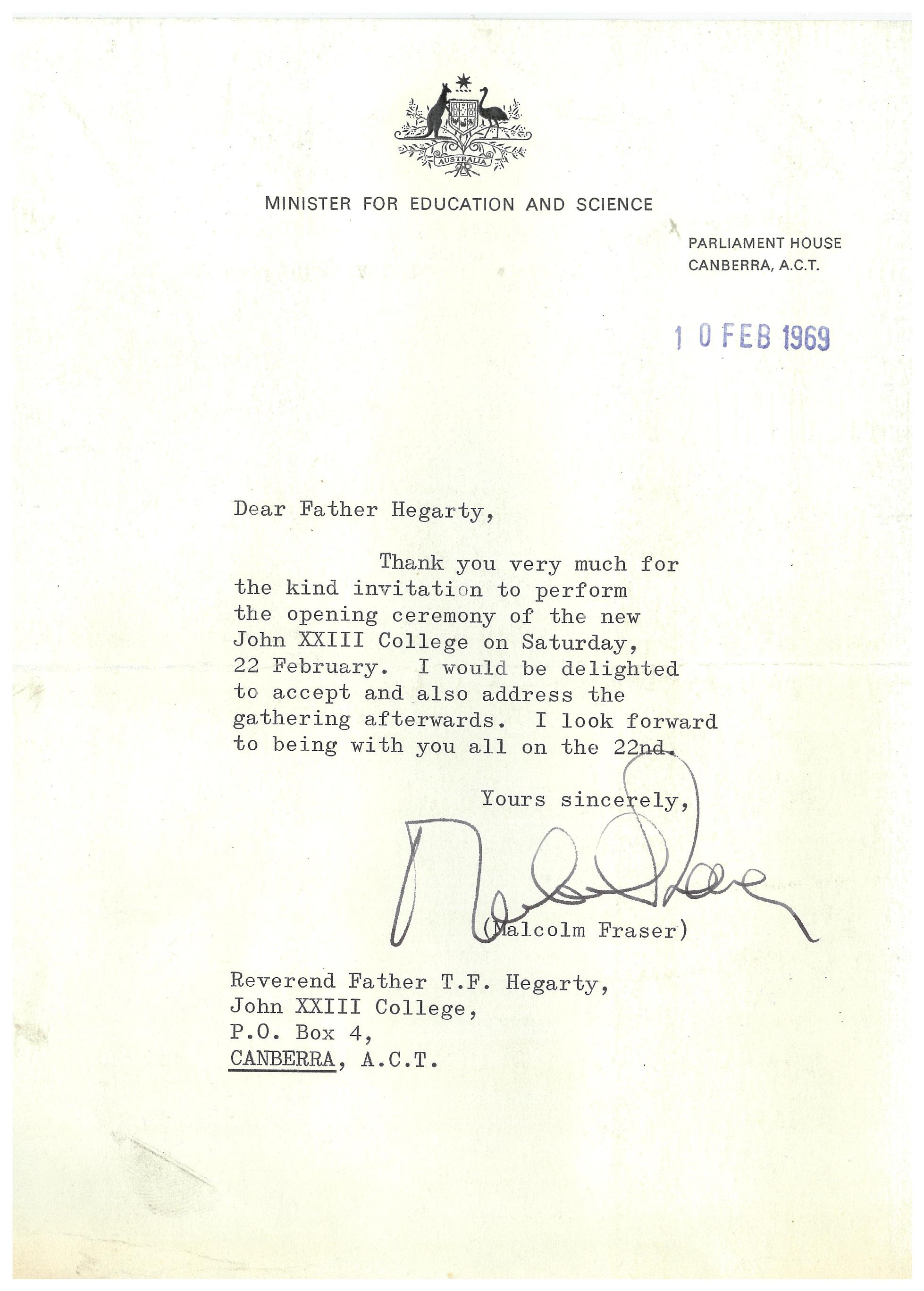
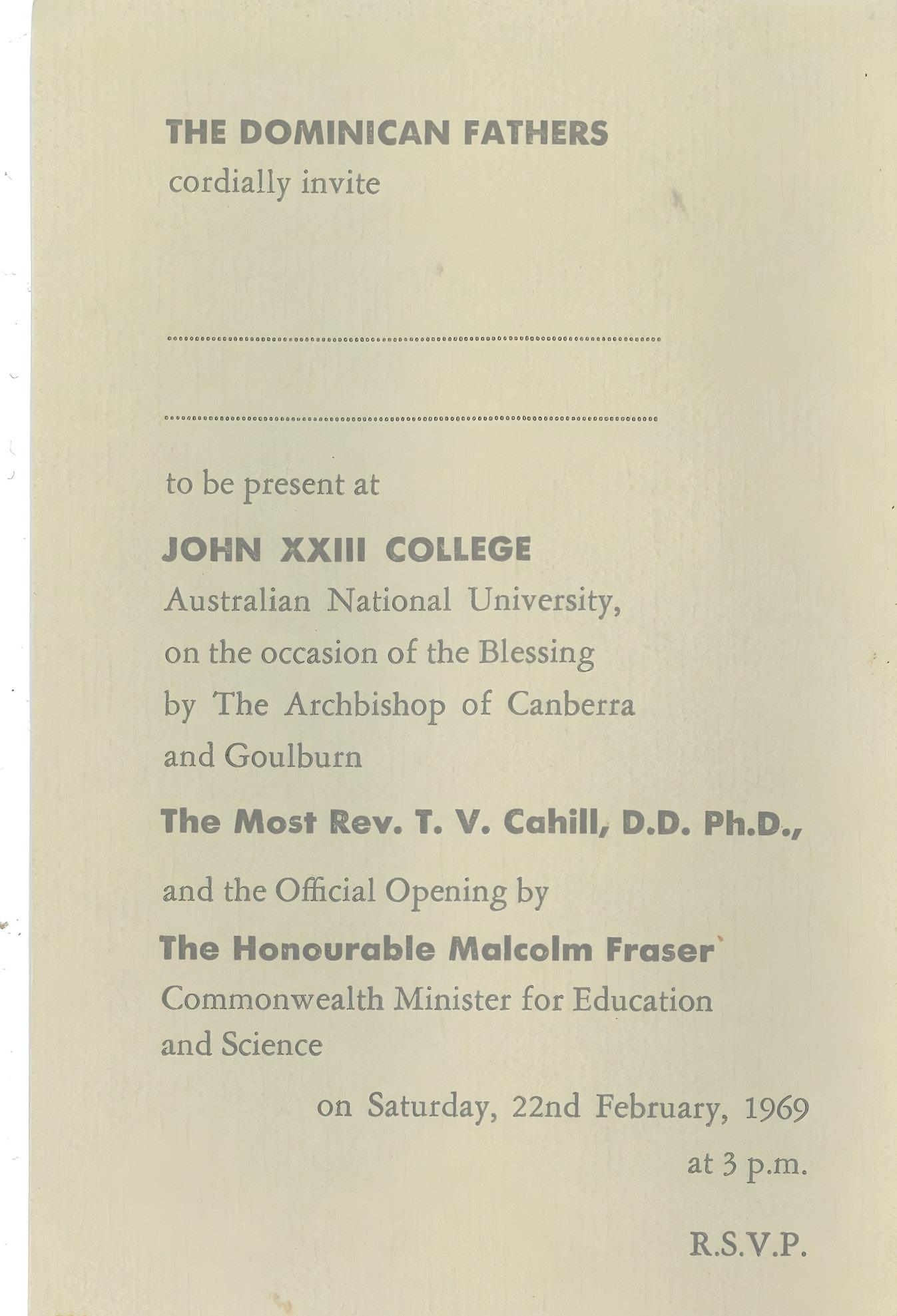
The new College buildings were officially opened at 3pm on Saturday 22nd February 1969 by the then Minister for Education and Science, the Honourable Malcolm Fraser. Special guests also included the Catholic Archbishop of Canberra and Goulburn, the Most Reverend Thomas Cahill, and the Dominican Provincial Father Jerome O’Rorke. Mr Fraser was becoming familiar with Daley Road with his presence at a ceremony early in 1968 on the site of Burgmann College marking its building commencement, and in officially opening the adjoining Ursula College at the end of October 1968. His presence on these three occasions very much emphasised the importance that had been placed by the Commonwealth government on funding equally both university owned and faithbased affiliated colleges and halls.
Mr Fraser or his office sought advice/notes for his speech for the opening of John
XXIII College from Dr (later Sir) Ian Wark, a distinguished chemist, member of the CSIRO Executive, and then Chair of the newly created Commonwealth Advisory Committee on Advanced Education which was to set up some 50 Colleges of Advanced Education (CAEs) as tertiary degree and diploma-granting institutions. Dr Wark outlined the equal but different roles of universities and CAEs as demand increased for tertiary education. He referred to the establishment of the Canberra CAE within a few miles of the new John XXIII College.194 He noted that “for those who will occupy rooms in this new college I would say that they could hardly commit a greater dis-service to themselves or to the ANU than to think that the most scholarly are the elite of the land. To be a snob is self-destruction.”195
194. National Archives of Australia (NAA) 1000441449 Papers of Prime Minister Malcom Fraser M1374.8 (Item Number 3450600). One of the founders of Canberra CAE (now the University of Canberra) was Professor ‘Joe’ Burton, former Principal of the Canberra University College which merged with the ANU in 1960, and Principal of the School of General Studies ANU (undergraduates). The top undergraduate award at UC is the Burton Medal. Sir Ian Wark is commemorated by the annual Ian William Wark Lecture and Medal of the Australian Academy of Science. 195. In a 1972 survey (to be referred to later) John XXIII residents regarded themselves as not ‘snobbish’.
There seems to be no public record that Mr Fraser referred to or used the notes prepared by Dr Wark. The matter of State aid to independent schools had come into
focus and, in an election year, Mr Fraser might well have decided to take this as a theme in speaking to a likely sympathetic audience at the opening.196
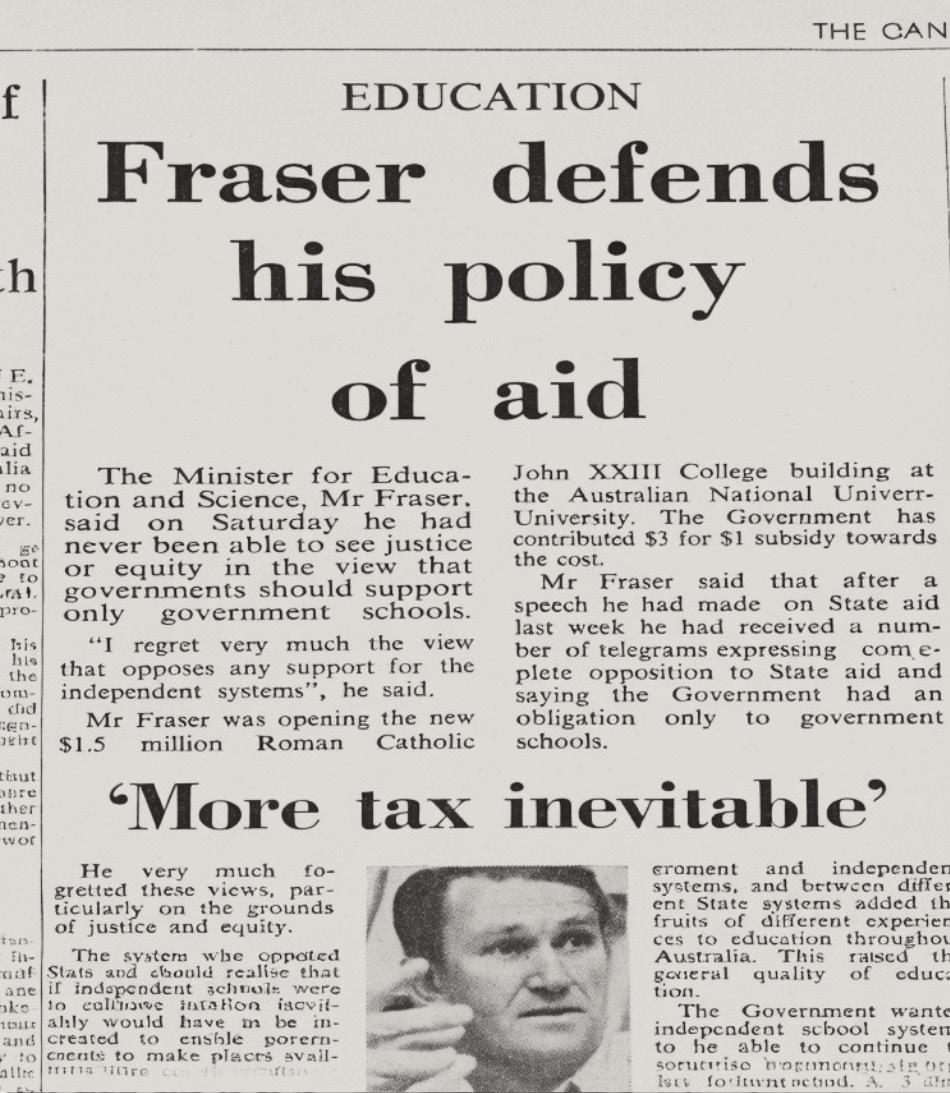
Mr Fraser noted that “he had never been able to see justice or equity in the view that governments should support only government schools”.197 A favourable audience, of course, as Commonwealth assistance (‘State Aid’) for independent and religious schools was introduced in 1964 under Prime Minister Menzies who was also a strong advocate for the funding of faith-based colleges. The campaign for such funding had been highlighted by a strike at a Catholic school in Goulburn in 1962. In thanking Mr Fraser, Archbishop Cahill noted that Mr Fraser had “spoken courageously many times” on State aid.198 It would not have been lost on
those attending that this was also a message to the University affirming Commonwealth support for the affiliated colleges.
While there were no incidents of student misbehaviour during the formal proceedings, Father Hegarty wrote to Archbishop Cahill the following day apologising for a “lack of certain reverence” during the Archbishop’s blessing of the College. “I felt highly embarrassed”, he wrote, “… I feel that I owe you a formal apology for the absence of a reverent hush while you prayed.”199 No apologies were required for the special Apostolic Blessing received from Pope Paul VI.200
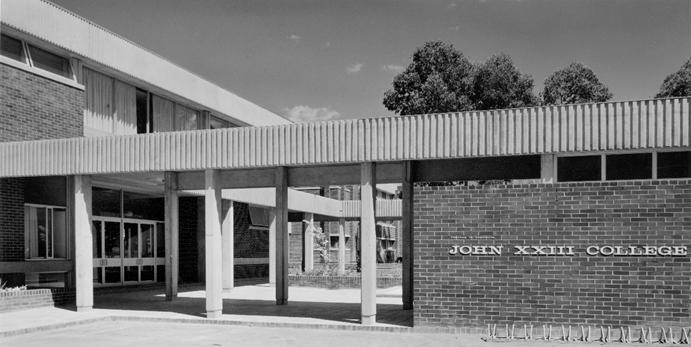
197. Archdiocese of Canberra & Goulburn Archives Ibid. Canberra Times Monday 24 February 1969? From the article it seems obvious it is the Monday after the Opening, but a check of a Trove archive does not reveal it!
198. Ibid.
199. Ibid.
200. Yvonne Parry op.cit. p.1
Not long after the official opening of the College, the Vice-Chancellor Sir John (Jack) Crawford spoke at the Orientation Week Official Welcome on the Library lawn. It would not have been easy, and he acknowledged that he would have preferred to be in a lecture hall with much better acoustics! His theme related to much of what has been said in more recent, albeit different, times such as the role of the University in research and teaching as a centre of learning, advancing knowledge. He defended the right of students to speak their minds but to do so sensibly, not stupidly; he would not defend breaches of the law. Perhaps reflecting on a larger scale what
those responsible for residential colleges and halls would be leading and managing, he said: “You are not asked to be silent on issues of concern to you, but in analysing the errors in society, as you see them, please behave responsibly. You owe this to the University, to yourselves and not least, to society. I come back to my opening remarks. I welcome you to the excitement and the challenge of the University. You will not be free from frustrations and disappointments. In this you will share the common experiences of all men and women. But you do have the opportunity—-I repeat, the privilege— of gaining an intellectual training of great benefit to yourselves and on which your country will rely for its own wellbeing.”201
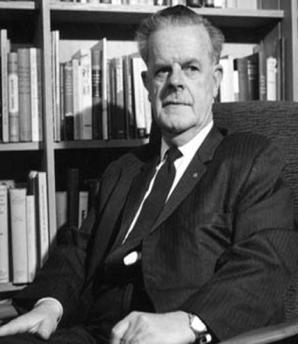
3 March 1969 reported in ANU News April 1969 p.11
Some 240 students took up residence at the start of the year with the College later to accommodate 300. The fees for 1969 were set at $640, some $140 higher than for the previous year at Lennox House, with a resident noting that “the move was worth every cent
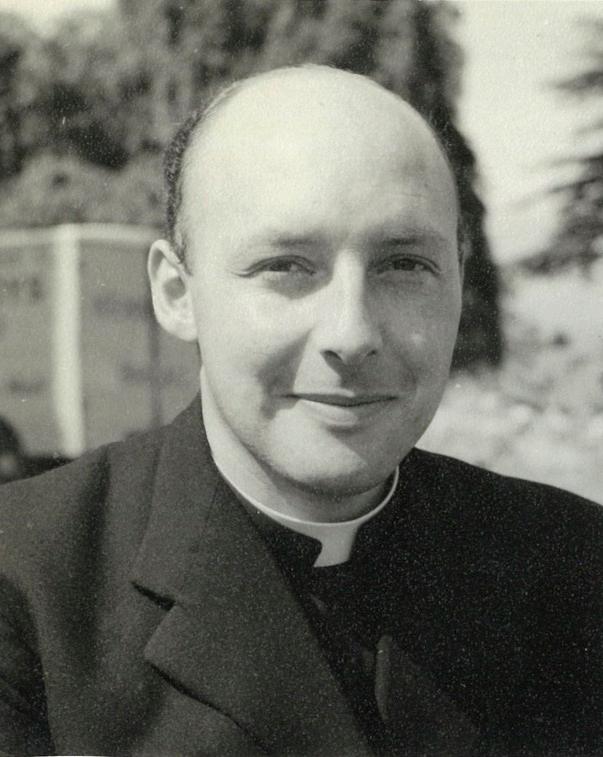
of the increase in fees.”202 With Father Hegarty as Master, Father Butler continued as Bursar and Dean prior to leaving for New Zealand in 1970. Father Leo Clandillon was appointed ANU Catholic Chaplain in 1970 and lived at the College and was to assume responsibilities as Bursar. Father Maurice Keating replaced Father Butler as Dean.
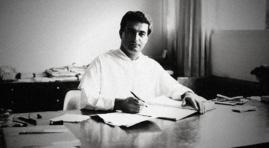
JOHN XXIII COLLEGE NOW IN NEW BUILDING John XXIII, the residential college for men operated by the Dominican Fathers and affiliated with the University, began the academic year with about 300 students in residence in the new building, which was officially opened on 22 February by the Minister for Education and Science, Mr Malcolm Fraser. The Roman Catholic Archbishop of Canberra and Goulburn, the Most Reverend T. V. Cahill, blessed the College. Father Hegarty is the Master, and Father Butler the Bursar of the College. (ANU News April 1969 p.13)
202. Ibid. p.2 Yvonne Parry notes that while this was $40 higher than the fees of the ANU Halls on campus, the Halls enjoyed a ‘per capita’ annual subsidy which was $30 in 1969. The College fee rose to $675 in 1970.
Father Keating was born in Tasmania rather than in Ireland, with scholarship opportunity for and appreciation of Catholic education in Australia. He gained a tertiary scholarship with the Victorian Department of Education, with a degree from the University of Melbourne. He found that in the pre-Vatican II movement, “Catholic students came alive at university.” He was greatly impressed by a lecture given there in Anthropology by a Dominican priest and on the completion of his teaching bond he joined the Dominicans, attending the Dominican Priory in East Camberwell, Melbourne, where he was “taught the wonders of the texts from the early philosophers.” He then taught at the Camberwell Priory before a brief time at the Dominican primary school in Adelaide and then, following the move of the theology school to the new Studium in Canberra,
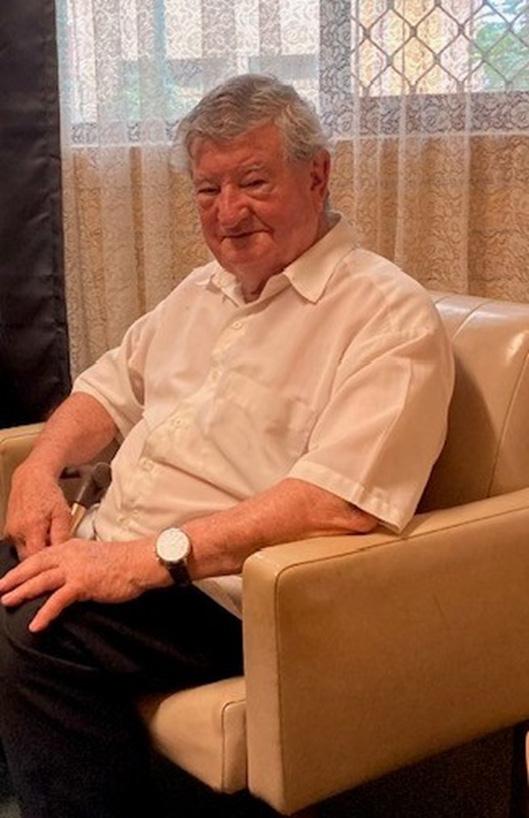
an appointment to Watson in Canberra. When appointed Dean of the new John XXIII College in 1970 he would use his skills in mosaics as he did in decorating the cloisters at Watson.
Maurice Keating never felt comfortable with the cultural and behavioural challenges of life in the College. He saw lay staff in the other Halls such as Bill Packard, foundation Warden of Bruce Hall, as more skilled, especially in decisions made about whom to accept into the College. He felt “quite amateurish … a novice … I had to learn from them … they were very courteous.” They “gave advice … ‘No Father, don’t take him – a troublemaker’!”203
Father Keating felt that the Dominican staff had a very genuine pastoral mission but were not necessarily prepared for confrontation with and the policing and discipline of students breaking free from the constraints of home and high school. He felt that the majority of residents were fine but there was a significant minority who were difficult and disruptive. While he has been acknowledged warmly by alumni of that time, he felt that a number rebelled against authority, which he represented, making life difficult for him and for others. They were “vagabonds”. About 20% of the College should not have been there and were wasting their time, with anti-authority behaviour and vandalism.204 They would get drunk and turn on fire extinguishers, flooding the floor. If they quarrelled with another resident they would put araldite in the lock of the student’s door.
“I WASN’T VERY SUCCESSFUL AS DEAN …”:
He nevertheless had great care and concern for students’ wellbeing and noted that with,
203. Interview with Maurice Keating op.cit. Father Keating acknowledged that he felt Father Clandillon was a much more practical Irish clergyman; much tougher and protected him from mistakes. From some alumni comments, Maurice Keating rather underestimated the warmth and respect with which he was held.
204. There has been a number of references to the ‘rugger-buggers’ and to a remnant of those who had been resident in Lennox House and disruptive there.
for example, the period of conscription for Vietnam and gradually feeling isolated from home and the familiar, a number attempted suicide but were “rescued” by the College, especially by the members of the housekeeping staff. In that sense it was good they were in College. He was conscious, for example, of a young first year resident who had recently lost his father. The resident noted that “Father Keating kept a kindly but not obtrusive eye on me – no nonsense but always around.”205 Maurice Keating also noted, at a difficult time of gay liberation, that
remember when a student studied too hard one evening and had a nervous breakdown. The Dean finally manage to subdue the student; he sat in his Dominican habit, flustered and in disarray, waiting for the medical orderlies to arrive. In they came, two big men in blue – the uniforms of the psychiatric ward; they gazed at the student, then at the Dean, and without another word, seized the one dressed like an Arab, and hauled him off for treatment.”208
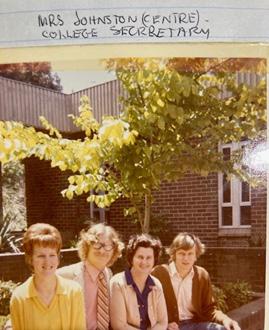
“There was a tough woman secretary – she and Father Hegarty were ‘two peas in a pod’.” 209 Jeff Bost noted that the Secretary throughout was “the famous ‘Mrs J.’ – Pat Johnston who was supported by Carol Young.” 210
Mrs Johnston retired from the College after 16 years, having been employed in August 1971. Mrs Jill Hynes was the first College Secretary when the College opened at Lennox House in 1967.
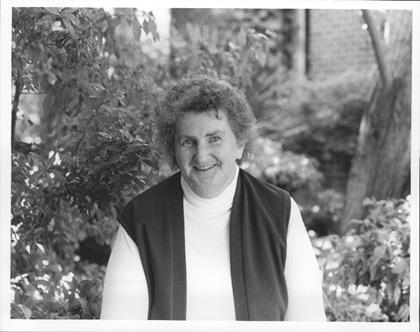
205. Email from William (Bill) Coaldrake 14 August 2025. William H. Coaldrake was a Professorial Fellow at the University of Melbourne, where he was Foundation Professor of Japanese and Head of Japanese Studies from 1992-2007. He was born in Japan of Australian missionary parents, and received his PhD from Harvard University, where he was most recently Edwin O. Reischauer Visiting Professor of Japanese Studies. He now lives permanently in Japan where he works at the University of Kyoto. He has received honours from Japan and from the Queen Elzabeth II and was a tutor to the current Empress of Japan.
206. John Harris op.cit. supports this view
207. Interview with Maurice Keating op.cit. Alumni have indicated warmth for Father Keating and felt he was approachable, kind and considerate.
208. Father Keating left the College in mid-February 1975.
209. Interview with Phil (Fil) Barresi, Melbourne, 19 September 2025. Father Hegarty commended Mrs Johnston in 1973 when he noted that “her competence increases the sense of confidence in the office.” (Yvonne Parry op.cit. Ch.1, p.9)
210. Interview with Jeff Bost op.cit. Michael Yabsley op.cit. also notes Mrs Johnston and Carol Young.
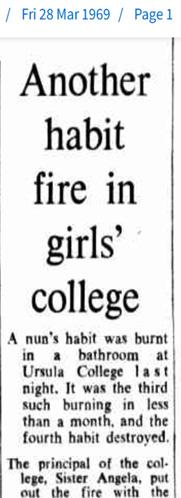
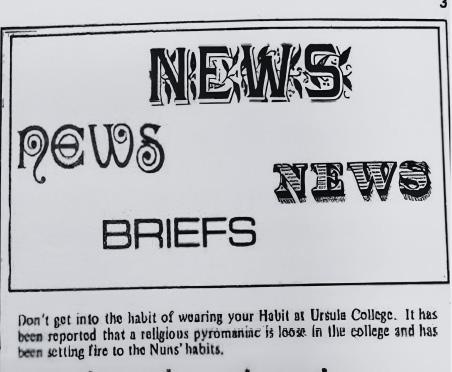
There were certainly challenges. Early in 1969 there were reports of staff nuns’ habits being set on fire in Ursula College. It seems there was no proof of this, but John’s men were suspected among the possible perpetrators.
A cautionary note about the College dealing with disciplinary matters was written by the Provincial, Father O’Rorke, to Archbishop Cahill in September 1969:
“In the present climate of student unrest expulsion is a measure to be used with the
greatest caution. Your Grace will recall the rumpus raised a few months ago when one resident was suspended from residence for two or three months, and this had been done through the machinery of the J.C.R. committee and the Council of the College. … Last night I discussed (the) complaint with Fr. Hegarty. Father promised to deal with the case with empathy and understanding. I am sure that this will be satisfactory to your Grace.” 211
One of numerous external incidents was the subject of a letter in Woroni in September 1969 212
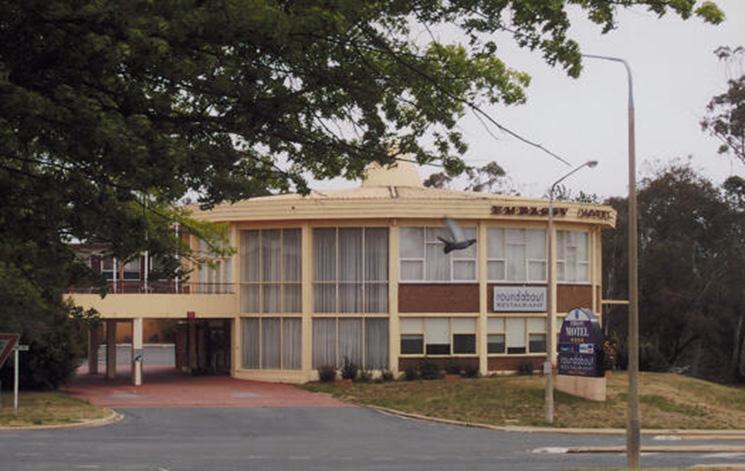
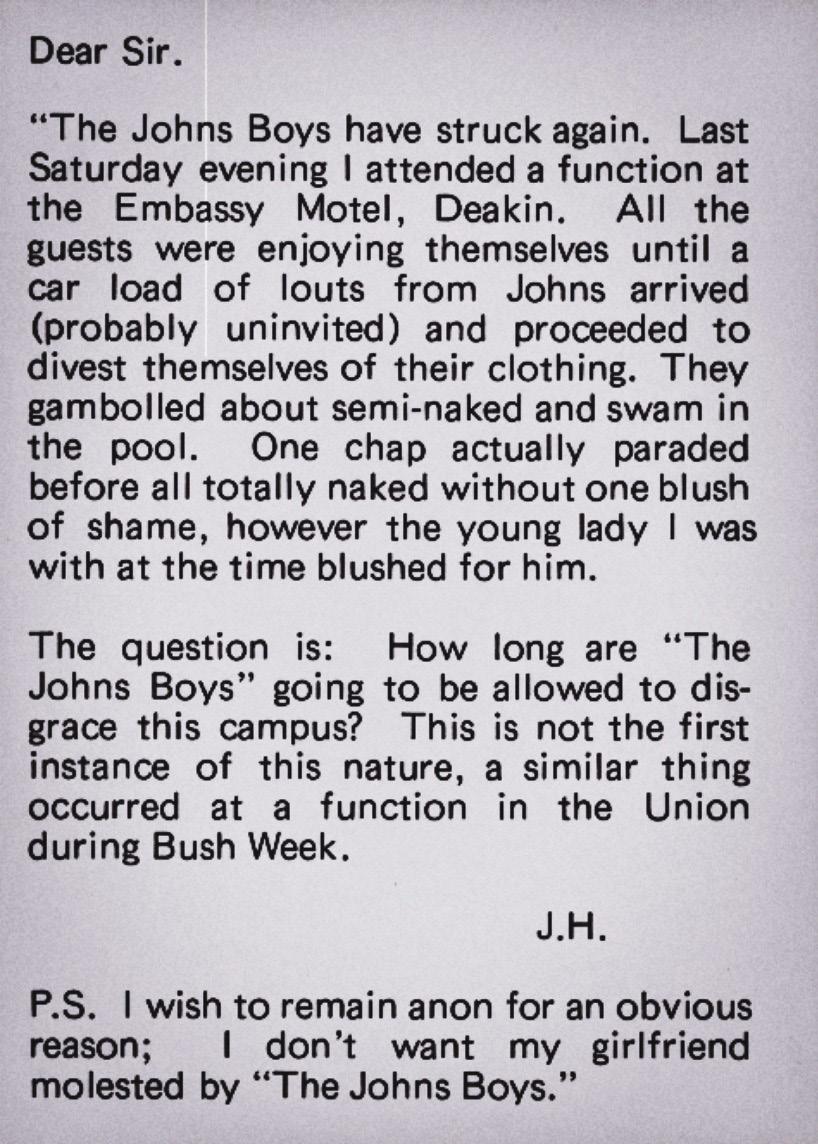
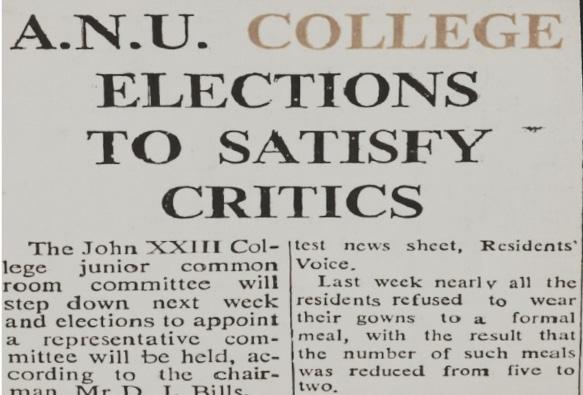
At a time when there were student challenges for more representation/participation on University committees, there were internal issues to be dealt with about the nature of the College’s Junior Common Room Committee let alone demands for stronger representation on the College’s governing Council (as reported in the Canberra Times).
The 1969 JCR Chair noted apathy among the residents and hoped the new election would be more supported but also noted in the article were concerns about the method of appointing tutors and making College rules, as well as dissatisfaction with College formal dinners. A letter from a resident in the Canberra Times complained that the Committee had not consulted with residents about the Administration decision to reduce the number of formal meals.213
A further Canberra Times article noted an “open near-revolt in John XXIII College … when residents protested (successfully) against a surfeit of elaborately staged formal meals.”214 In many ways there was a ‘no win’ scenario as Administration and different groups of students conflicted over a range of events, procedures and arrangements! A resident in 1971 recalled “one catering incident which I look back on with some embarrassment. Over a period of time, the residents generally felt that the quality of the food had dropped considerably. I’m not sure how this came about, but there was a general agreement that we would lodge a protest. This took the form of all residents leaving the dining room at the same time once all the meals were served at one of the formal dinners. However, as you can probably guess, the chefs had the ‘last laugh’ so to speak. That night’s dinner appeared in a number of meals over the following few days, just served in different
ways! I’m sure some was wasted but much of the food was saved. As you can imagine, Father Hegarty was very unhappy with us and made his displeasure very clear. The other thing
I remember about food was the late-night excursions for hamburgers to ‘Greasy Joe’s’ (I think that was either its real name or the name we gave it) at the top of Lonsdale Street.” 215
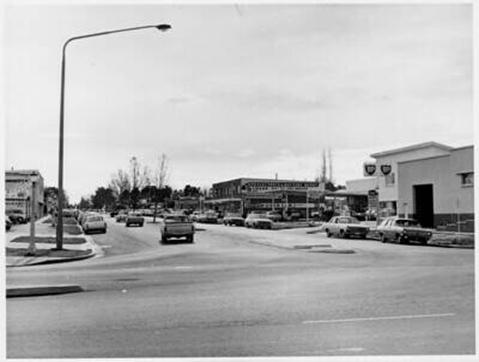
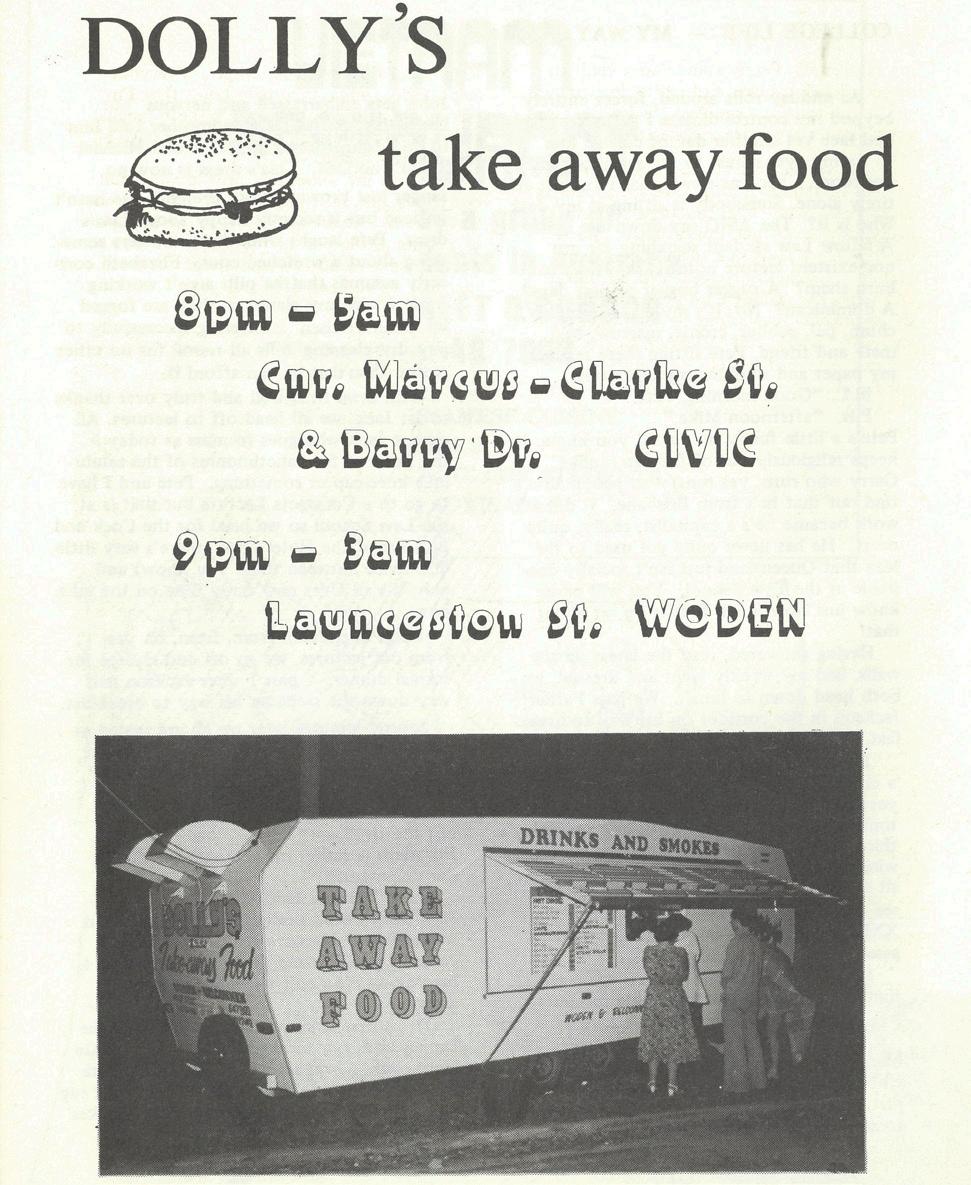
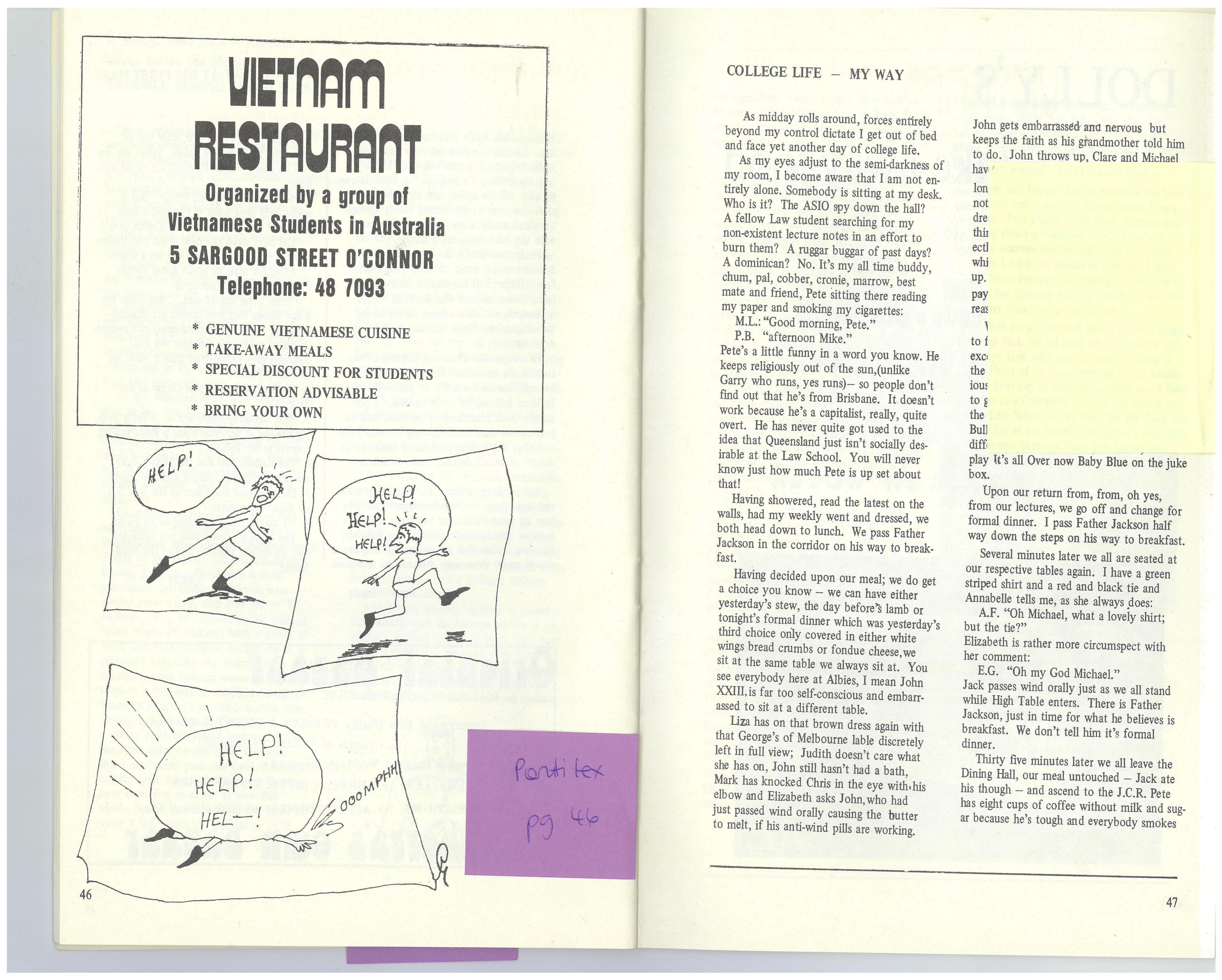
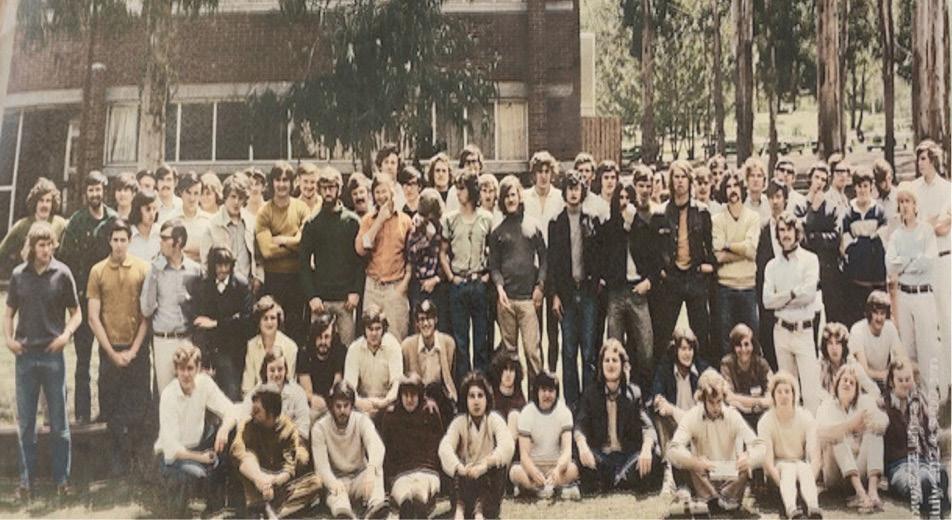
As no doubt many feel, despite some of the issues and tensions of the time, Phil McAleer (1971-1973) expresses a common view that “living on campus was a good experience. I enjoyed it … I managed to meet life-long friends in Johns.”216 Another first year resident in 1971 also recalls his first formal dinner at which they were told they were to remove their gowns before they sat down as a protest against wearing gowns. He too, though, recalls that being in John XXIII College was one of the most formative periods of my life and when I have returned in past years it has felt almost like returning to the womb, at least the womb of my academic life.” 217
A first year 1971 resident, Stephen Newton, recalls arriving at Johns to do an Arts/Law
216. Interview with Phil McAleer op.cit.
degree “having spent all day driving my old Morris Minor from Orange – where I was living I found the College to be an excellent transition from six mundane years of boarding school in Bowral to the bright lights of university in Canberra. To me, it seemed familiar and comfortable. When Wagga Wagga is the biggest town you’ve ever lived in and you’ve only ever known one non-European in your life (an Indonesian Chinese boy at school) the ANU could have been something of a culture shock. The fact that it wasn’t, and that I felt liberated by the exposure to all sorts of different people and radical ideas at university can to a large extent be attributed to the ‘safe’ base that I had at Johns.”218
A resident remembers being included in a small group that accompanied Father Hegarty to a High Table dinner at Ursula College.
217. Email from Michael Pollard, 18 June 2025. Michael is an Associate Professor of Immunology & Microbiology, The Scripps Research Institute, La Jolla, California.
218. Emails from Stephen Newton 2 April 2025 and 13 May 2025
“Ursula was a centre of calm and civility during the many riots and brawls that went on in Johns in my first year. (The dinner) was unlike one of the events at Johns when I had to take cover behind the up-ended table from a barrage of flying roast potatoes during the after-dinner address from High Table …!”219
Three of the basic essentials in a catered and serviced college are food, maintenance and cleaning and there were always issues around the provision, quantity and quality of the food and the work of the housekeeping and maintenance staffs, especially following misbehaviour that caused mess and damage
in the hallways and rooms of the College.
“It should be mentioned first that two members of staff have been with Johns since its days at Lennox House. This, in itself, deserves recognition and when one looks back over the years and remembers the abuse which has been heaped on Chiko’s cooking, and the complaints about the housemaids in Mrs Riminic’s charge, their doughty tenures are the more remarkable. In the early days Chiko was known as the head chef cum mentor and as a patron of the Civic (Hotel). Both he and Mrs Riminic would always help if students were in real trouble. Their steadfastness was not shared by all members of the Administration, and in the early days management and students were rarely on the best of terms.”220
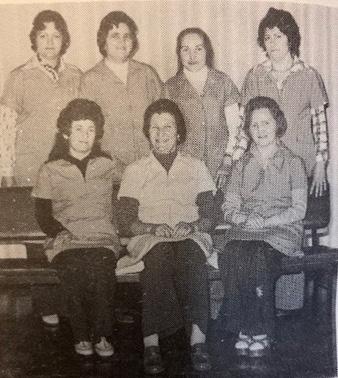
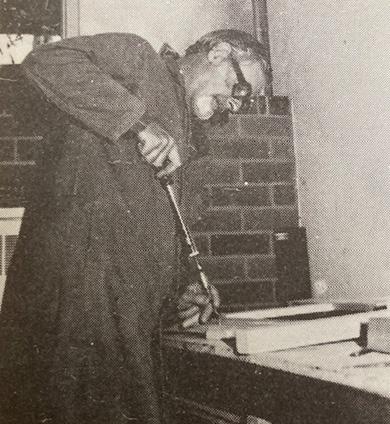
In the period of the 70s there was a number of strikes and issues that had an impact on the wellbeing of students and staff at the College. They included an oil strike that caused a central heating problem in the cold of July in 1972; a shortage of housekeepers in October that year that prevented the provision of fresh linen; a housekeepers strike in June 1973, with volunteers sought for kitchen duties and the cleaning of tables, which led to Union threats against student strike breakers; and repairs requiring the shutdown of heating and hot water on a bitterly cold day in June 1974.221 There were further heating issues – the lack of it – in August, and in early April 1975 an industrial dispute caused the ANU to shut off heating to the colleges and halls and it remained off until April 19th. Unseasonably cold and wet weather from
March 1976 created further problems for the College with water leaking and power being turned off for repairs. Father Hegarty purchased some 300 new blankets for the College to deal with the lack of heating. In May the overnight temperature was dropping to minus 8 degrees Celsius.222
In October 1976 there was a strike of the catering staff as a result of protest against the sacking of some 10 staff at Garran Hall following the decision by the University Council for the Hall to become self-catering in 1977. Residents of John XXIII and Ursula Colleges had a few days’ experience of selfcatering, with administration staff at both colleges, including Father Hegarty, involved in rosters with students to do the catering.223
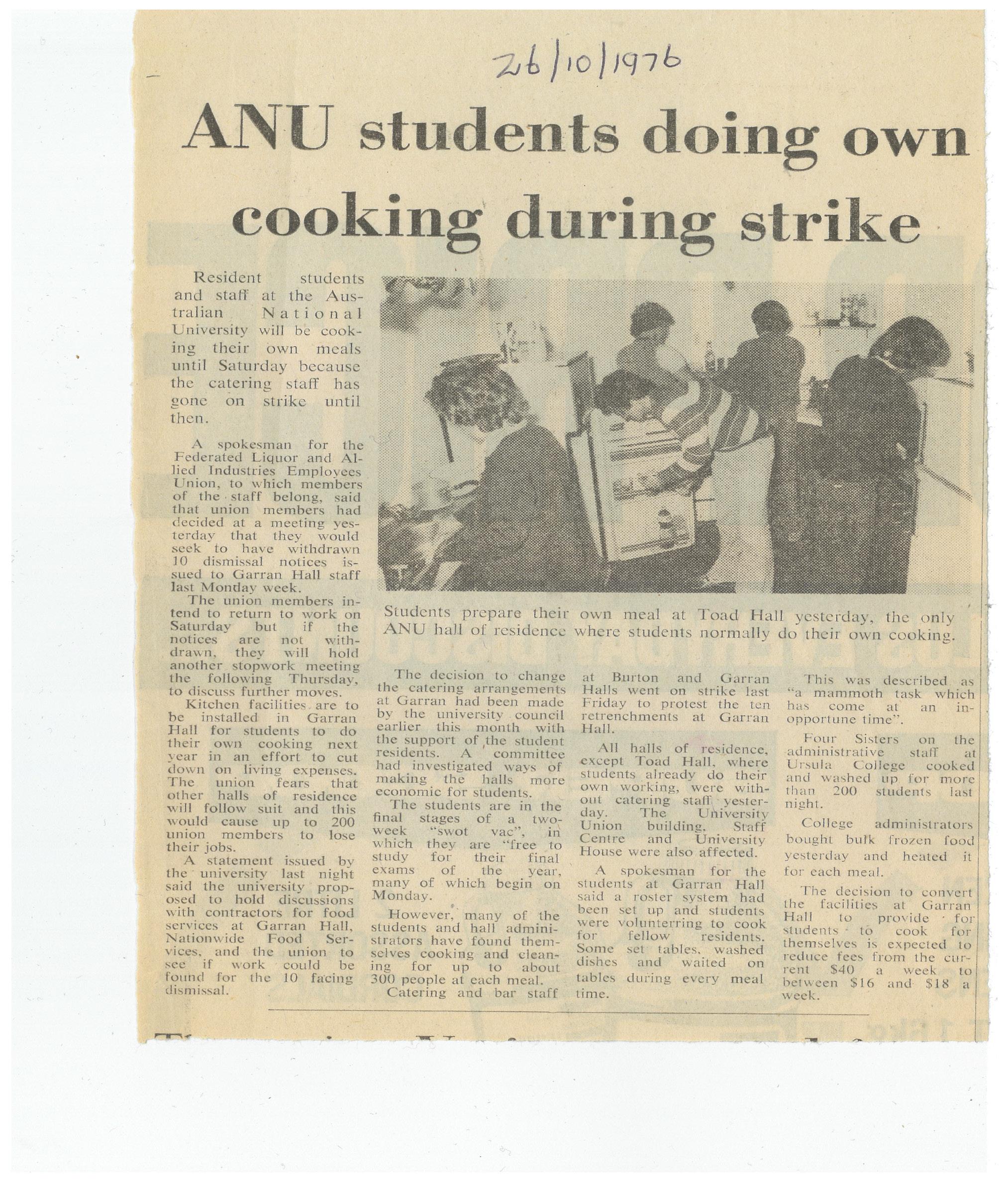
Alumni have recalled formal dinner speakers over the early to mid-1970s such as Sir Leslie Martin (physicist and first Chair of the Australian University Commission)224, Sir Peter Lawler (later Ambassador to the Vatican), Michael Somare (first PM of PNG), Andrew Peacock (various Liberal federal ministries including
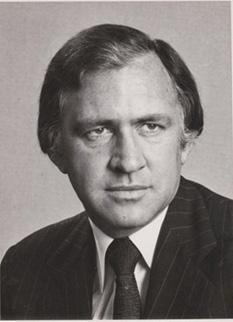
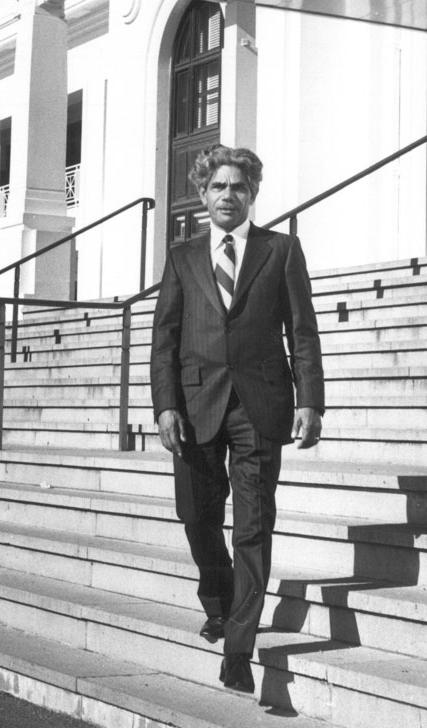
Foreign Affairs, later Leader of the Opposition and Ambassador to the USA), Justice Michael Kirby (later High Court Justice), Senator Neville Bonner (first Aboriginal Senator), Billy Snedden (various Liberal federal ministries, Leader of the Opposition and Speaker of the House of Representatives), and (not a formal dinner) advertiser and entrepreneur John Singleton.
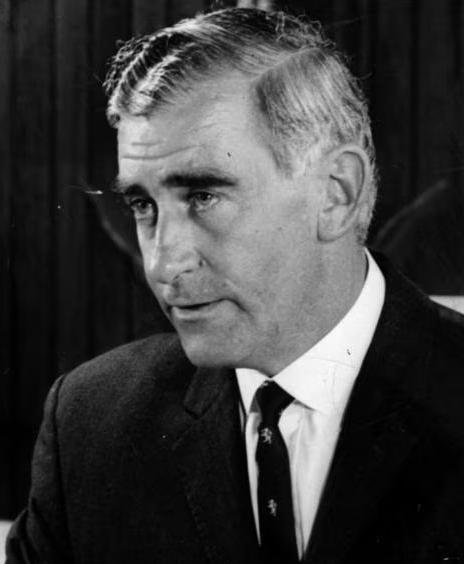
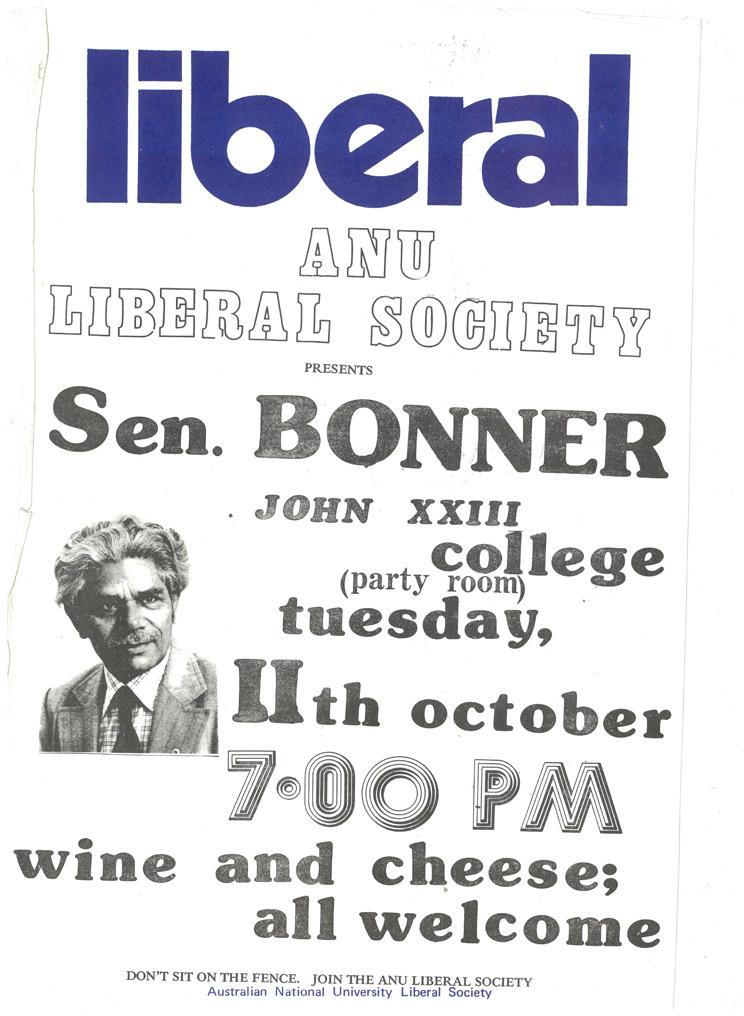
have such a
give support for more of the
being
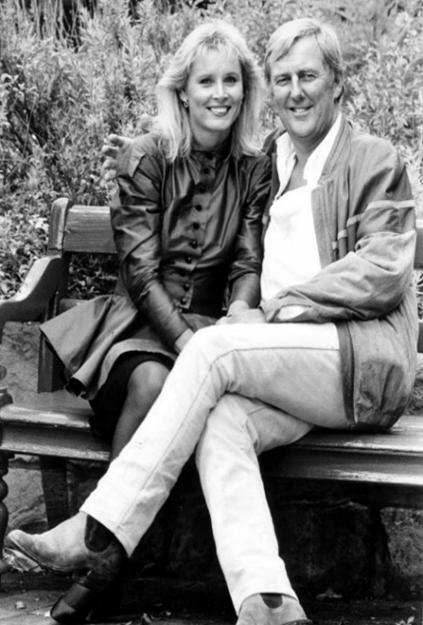
Alumnus Michael Yabsley recalls the John Singleton dinner (held during the holidays probably as a Liberal Society dinner, especially as he invited him to be the guest (1976 or 77). He remembers that the speech was a “shocker”. John Singleton had a hang-over and everything was “f … this and f … that”!! An attendee, Jonathan Chancellor, now a real estate writer, walked out during the speech and Singleton said something like “Can’t you cope with it mate”? Someone asked the guest why he had to use such disgusting language. Singleton replied “to get through to fuckwits like you.”! Michael Yabsley felt very embarrassed having invited him!”225
Ian Pearson and Jeff Bost refer to the time when formal dinners began earlier at 6pm and people could leave with no Grace said at the end. There was always keenness to leave the dinner in time for favourite TV shows
such as ‘Count Down’. Jeff Bost recalls when “Father Hegarty lashed out and approved the purchase of two colour TVs! It changed lives!”226
226. Email from Ian Pearson op.cit., and interview with Jeff Bost op.cit.. The first day of colour transmission in Australia was 19 October 1974. It is understood the two colour TVs were the first purchased for an ANU residence.
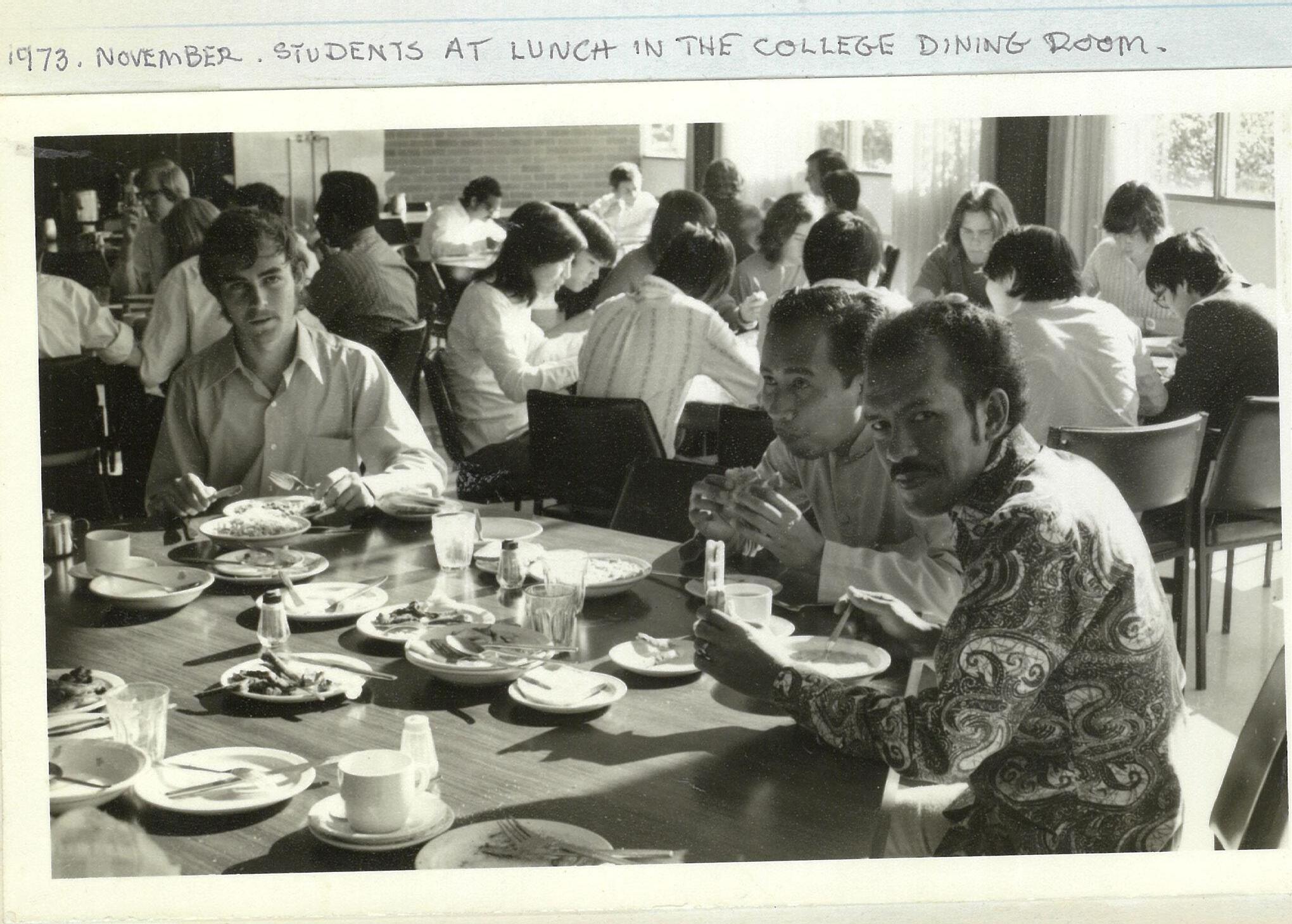
The Dining Room brought a mix of people together from across Australia and from other parts of the world, especially from the Asia/Pacific region. Jeff Bost recalls that in his first year, 1974, there was about a table of Malaysian and Singaporean and other regional students. In 1976 there were Chinese and Vietnamese students and a big delegation of students from PNG who got straight into college life and stood for the JCR Committee.”227 He remembers the students from the People’s Republic of China228finding the formal dinners particularly difficult with what they saw as discrimination in high table
227. Interview with Jeff Bost op.cit.
228. Some 13 students (Yvonne Parrey op.cit.)
229. Ibid.
seating and formalities such as Grace. They didn’t stay long in the College and moved to the (now) former Chinese Embassy.229Sandra Harding and Daniel Stepniak (President 1975) remember the fall of Saigon on 30 April 1975 and the impact it had, both positive and negative, on students from both North and South Vietnam. Daniel Stepniak (President 1975) recalls:
“I arrived at John’s in 1975 and experienced the controversy and radical change brought about by the arrival of women in 1976.”230
230. Email from Daniel Stepniak 10 October 2025. Bill Coaldrake op.cit. also recalls the ‘Dismissal’ day because of the interruptions to his interview with Prof Geoffrey Sawer (ANU Faculty of Law) for a scholarship to Harvard. He was awarded the scholarship.
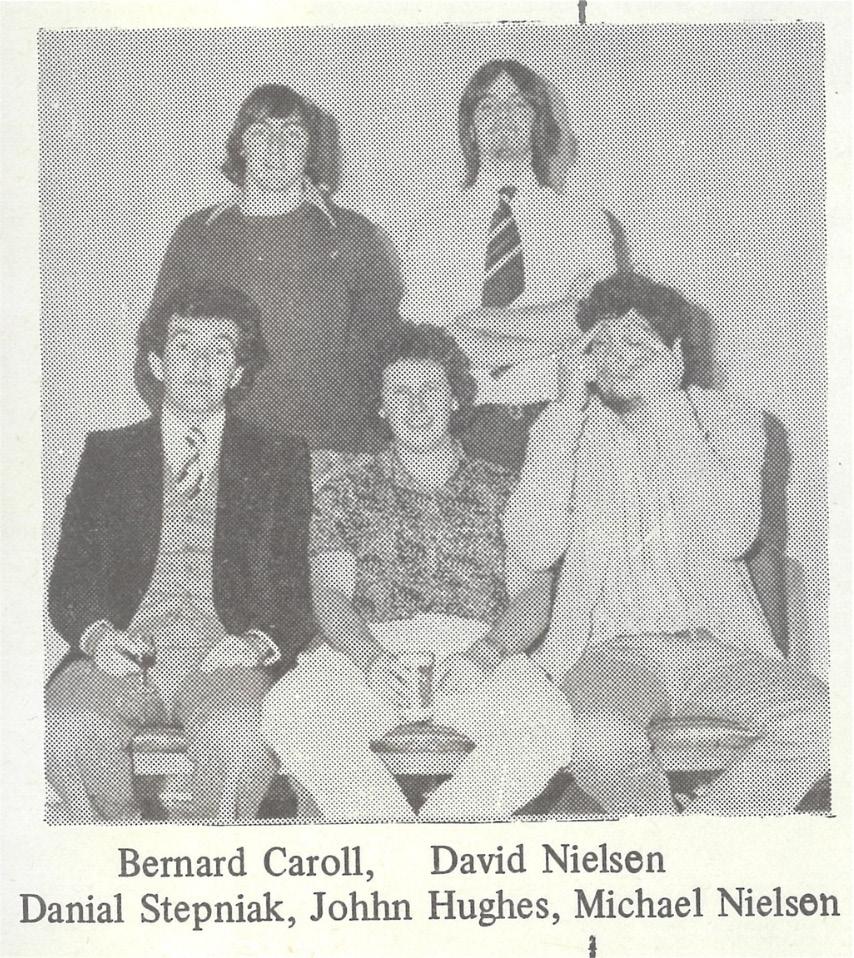
Daniel Stepniak’s younger brother, Michael, is the current Master of Queen’s College, University of Melbourne. In 1975, another resident of John XXIII was Ken Hinchcliff, enrolled at ANU in Forestry. He moved to the
University of Melbourne and to Trinity College in 1976 to take up Veterinary Science. He later became Dean of Vet Science at Melbourne and the 8th Warden of Trinity College (20152026).
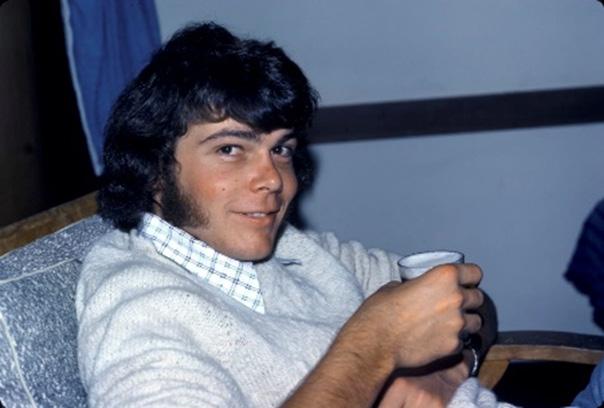
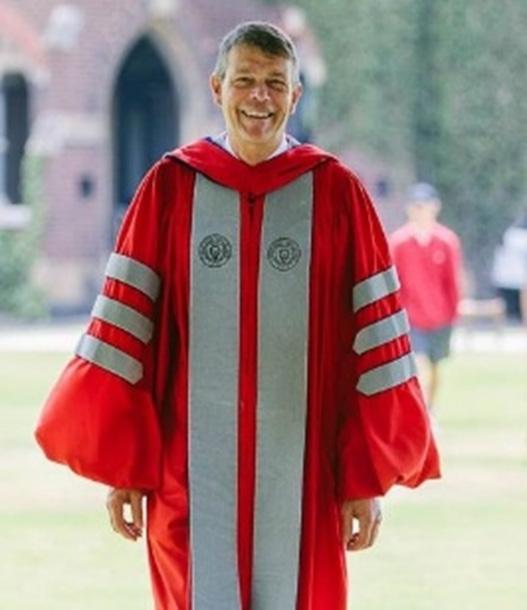
Occasionally particular conference and sporting groups stayed in the College, as well as at one time a group of Federal Police cadets who could not be accommodated elsewhere. In August 1970 the College hosted
a team participating in an Australia-wide inter-varsity women’s hockey competition, with the Canberra Times noting that women even invaded “the usually all male John XXIII College, where such uncharacteristic remarks ‘But I haven’t even got the energy to wash my hair’ could be heard by anyone passing along the corridors.” 231
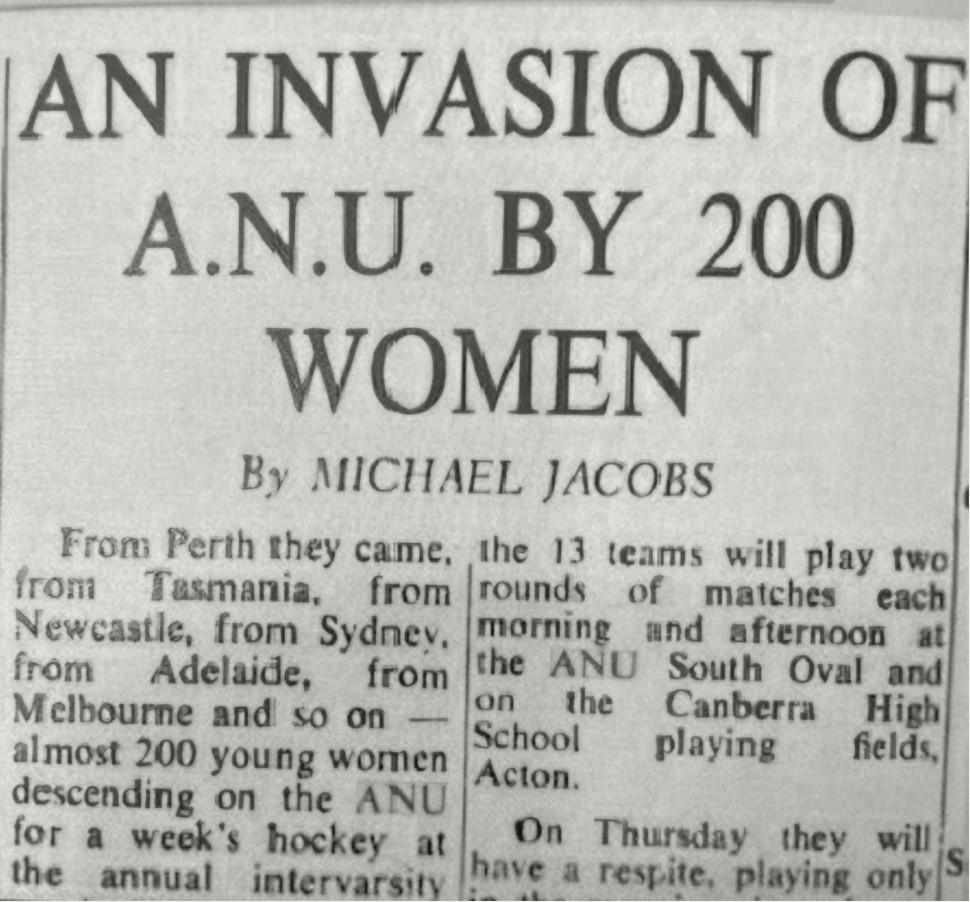
Woroni followed up with a focus on two “John XXIII inmates” who were not able to stay in their rooms over this vacation period and who decided to camp under the trees behind Ursula College. A number of residents were required to move out for two days and Greg and Mike decided they did not wish to clear out their rooms for that time and have to restore “them to their pristine homeliness two days later … ‘I was a bit annoyed about it at the time’, Mike said. The question going
around the place was ‘Is this a college or a hotel?’ We just thought the administration could have given a bit more evidence of acting as a student residence.” They did acknowledge that most colleges during vacations need income from conference and other visitors. They ate and showered etc. at the University Union.232
One of the conferences held during the summer vacation period in 1974 at John XXIII College was the annual Council of the Australian Union of Students 233
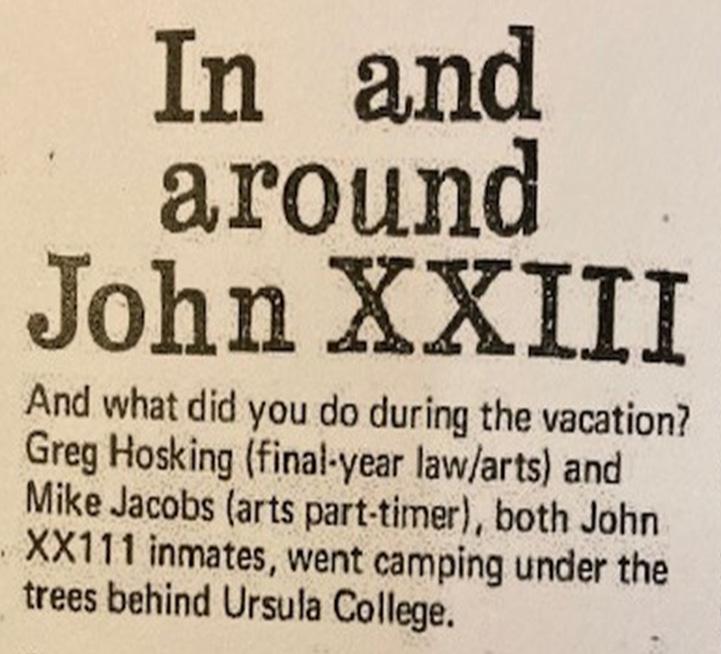
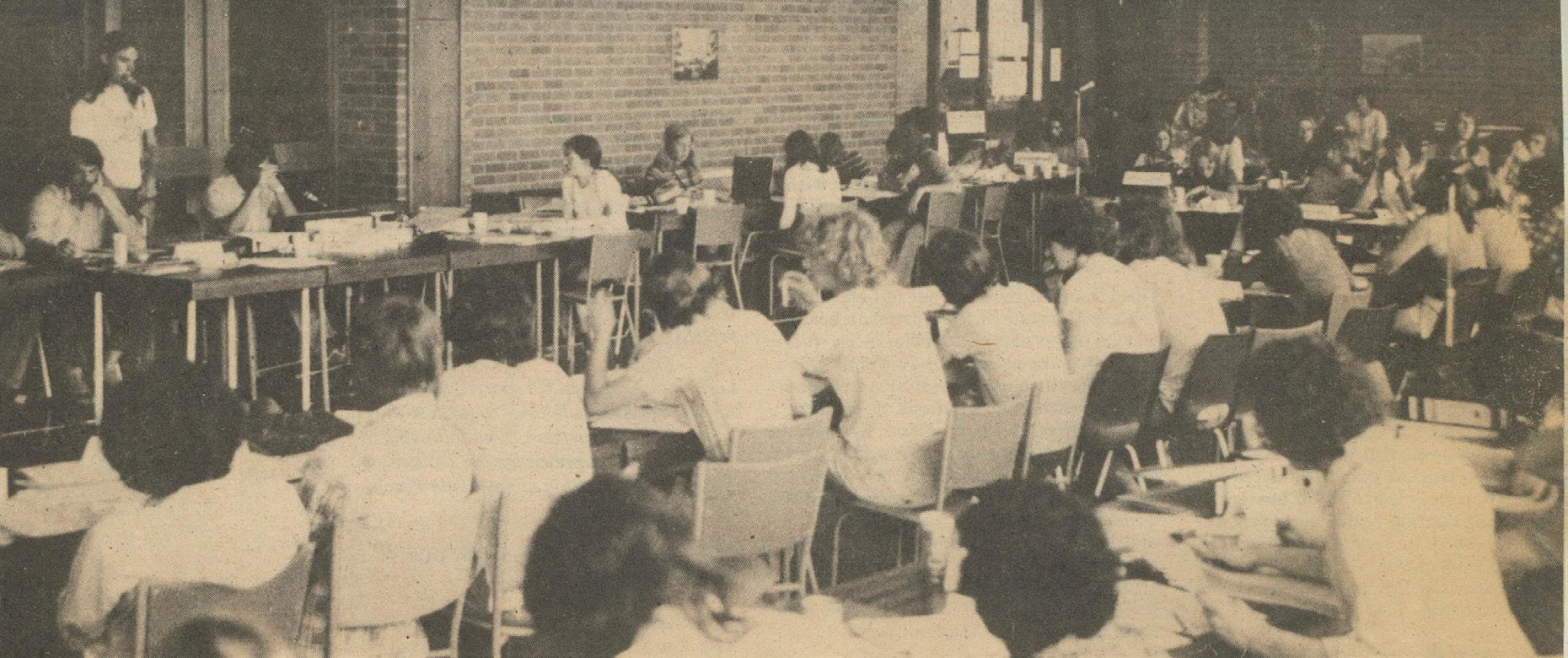
Phil McAleer remembers that when Burgmann College opened in 1971 it was still under construction. Some Burgmann residents were accommodated in Garran and the other Halls and for a time Burgmann residents took meals in John XXIII.234A first year resident recalls that one woman slept in her car in the carpark for some weeks before the college was able to find her a room. She remembers it was one of the first colleges designed to be ‘scrambled’, with men and women living in rooms side-by-side. She notes that the success of the Burgmann ‘experiment’ owed much to the first Master (the term Principal was not used until the 1980s), Professor
David Griffin. He was a Professor of Forestry and commanded “universal respect in the college”. However not everyone beyond the college held him in the same regard. “On the long-awaited night when he formally opened the dining room, students from the neighbouring all-male John XXIII College invaded the ceremony and bombarded him with flour bombs.”235
Rivalry and ribaldry became constant between John XXIII and Burgmann Colleges, with what in 1971 was termed a ‘Queen of the College’ parade at a St Burgmann’s Day event, the ‘Queen’ being carried in a stolen rowing skull obviously belonging to John XXIII College.236
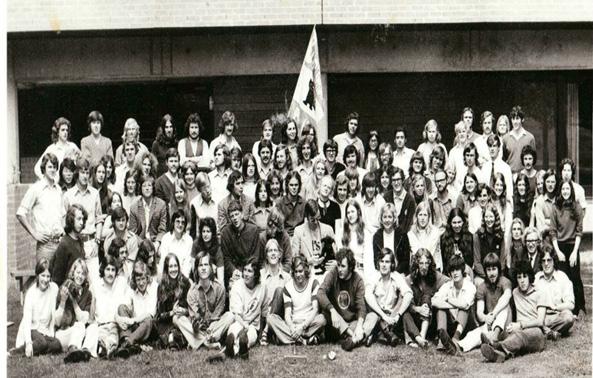
236. ANU Reporter Vol 2 Number 5 23 April 1971
Residents of Burgmann College 1972
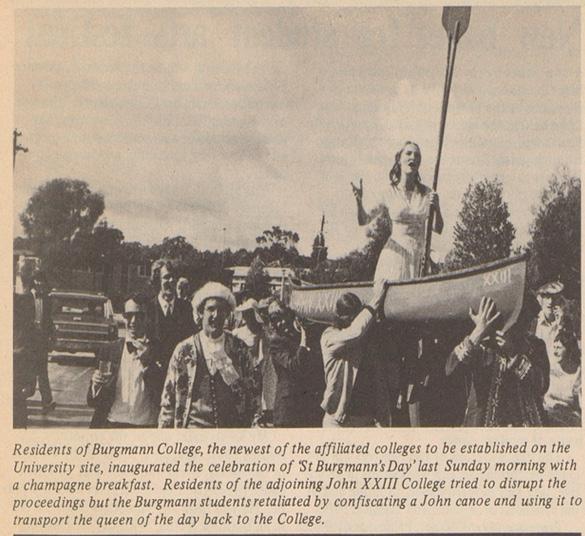
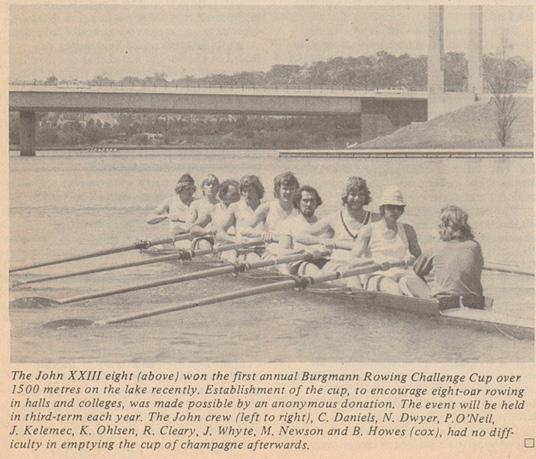
237. ANU Reporter Vol. 3 Number 19, 24 November 1972
… and not just rowing …
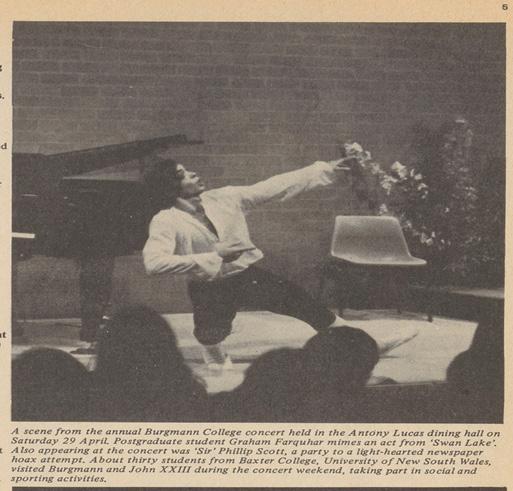
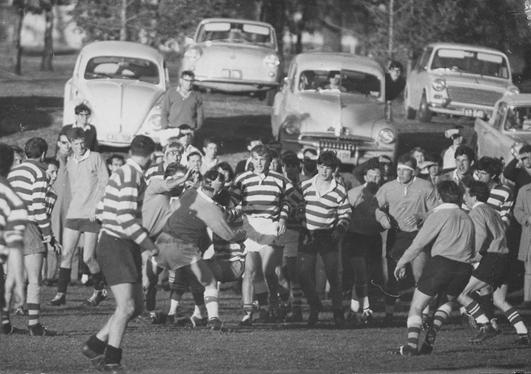
With the precedent of Lennox House winning Inward Bound and the Inter-Hall Rugby competition in 1966, those who carried on into John XXIII College in 1967, including those referred to as ‘rugger buggers’, would continue to help establish a strong sports rivalry over coming decades in a full range of sports. The 1969 ANU Annual Report noted:
“Now that there are three halls and two affiliated colleges on the campus, inter collegiate sporting and other activities are being organised on an ever-increasing scale. This year a dinner and dance were held in Burton and Garran Halls for all interhall sporting teams and during the evening trophies were presented to the captains of the winning teams in each sport.” 238
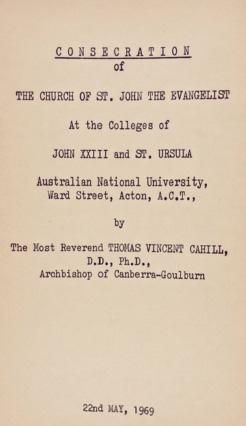
The College, for example, won the Burgmann Challenge Rowing Cup in 1973 and InterHall Rugby in 1974.
The ANU Sports Association records the winners of the annual Inter-Hall Sports Shield from 1983 to 2025, a period of 42 years with John XXIII College being the overall sports champion 25 times.
Intended to be used jointly by Ursula College and John XXIII College, the Chapel was consecrated on Thursday 22 May 1969.
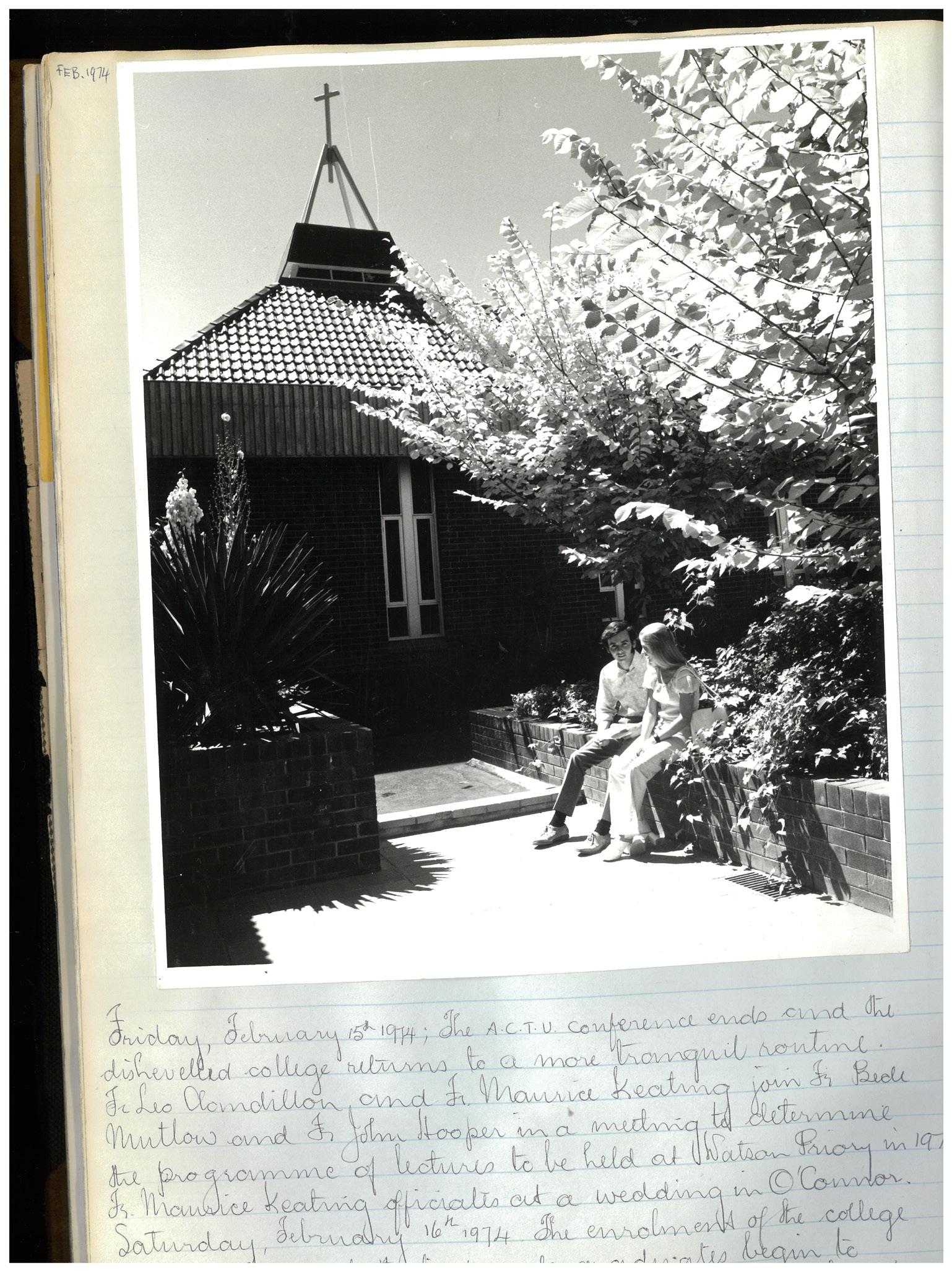
Father Keating reflected that the Chapel was well used for Mass and other special events such as theological lectures and seminartype gatherings. The use of the Chapel was “a refreshing experience; filled with students who were very attentive … a good audience.” 240 There were certainly, however, different perspectives that soon emerged
about how well it was used by College residents, who was paying for it, and the role it played in the early life of the College. Both then and later it has, of course, been the venue for example for student and alumni weddings and wider ANU/Canberra Catholic and other gatherings, such as the Newman Society (later the ANU Catholic Society).
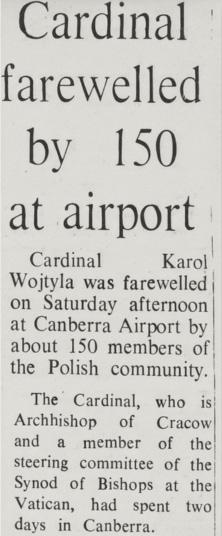
In February 1973 the 40th International (Catholic) Eucharistic Congress was held in Melbourne. One of the senior overseas attendees was the Archbishop of Cracow (Poland), Karol Cardinal Wojtyla, later to be Pope John Paul II (1978-2005). While in Australia he visited other cities, including Canberra, especially connecting with and encouraging Catholics from Poland. He opened and blessed the new Polish Club
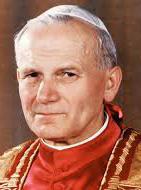
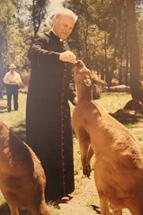
in O’Connor on 16 February 1973. On the same day he toured the ANU with a friend from student days, Professor J. Zubryzcki, foundation Professor of Sociology at the University, and a non-resident member of the John XXIII College Senior Common Room. The tour included a visit to the College and the Chapel where the future Pope prayed for some time.
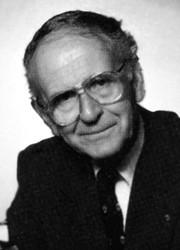
FR DAVID WILLIS O.P.:
The following is a fascinating few lines from Prof. George Zubrzycki, Head of the Sociology department at the ANU, about our new Pope, John Paul 2nd. I would like to thank him for taking the trouble to- write them for us.
REFLECTION: “I met Pope John Paul II forty years ago. He and I matriculated from high school in Krakow (Cracow) in May 1938 and joined an association of Catholic University students ODRODZENIE which in English means Renewal. The objectives of the ODRODZENIE were threefold - a personal renewal in Christ and renewal of the social order. I recall Karol Wojtzla’s strong interest in Social questions and his special concern for the Jews and other non-Catholic groups in Poland. In October 1938 I was called up to an Officer Cadet Training Course while Wojtzla enrolled in the Arts Faculty of the 600 year old. JAGIELLONIAN University of Krakow where Copernicus was once a student. He studied Polish Literature, Languages and was prominent in an avantguard theatre group. I met him again during the Winter 1939/40 when we both joined the Resistance Movement. He was a very
brave fighter particularly in the branch of the Resistance which looked after Jewish families smuggled out of the ghettoes created by the Nazi throughout Poland.
We met again thirty years later when he arrived in Canberra on his way to attend the Eucharistic Congress in Melbourne in February 1973. He was received by the then Prime Minister, Mr Whitlam and was given a Parliamentary dinner which I attended. I drove him around ANU Campus and we stopped at the John/Ursula Chapel for a brief prayer. Having just come from Asia, Cardinal Wojtzla as he then was, privately voiced his concern at the disparity of living standards between many Asian countries and Australian affluence: He said that the renewal of an international order with special reference to the poverty-stricken countries must be priority number one for the Christian Church. I guess that the theme of Renewal, personal, social and international will be the theme of Pope John Paul II’s Pontificate. Let’s pray for this brave and gifted man that God give him strength and even more courage to work for á better social and international order and that his church become truly catholic.”
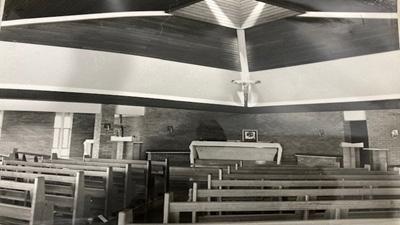
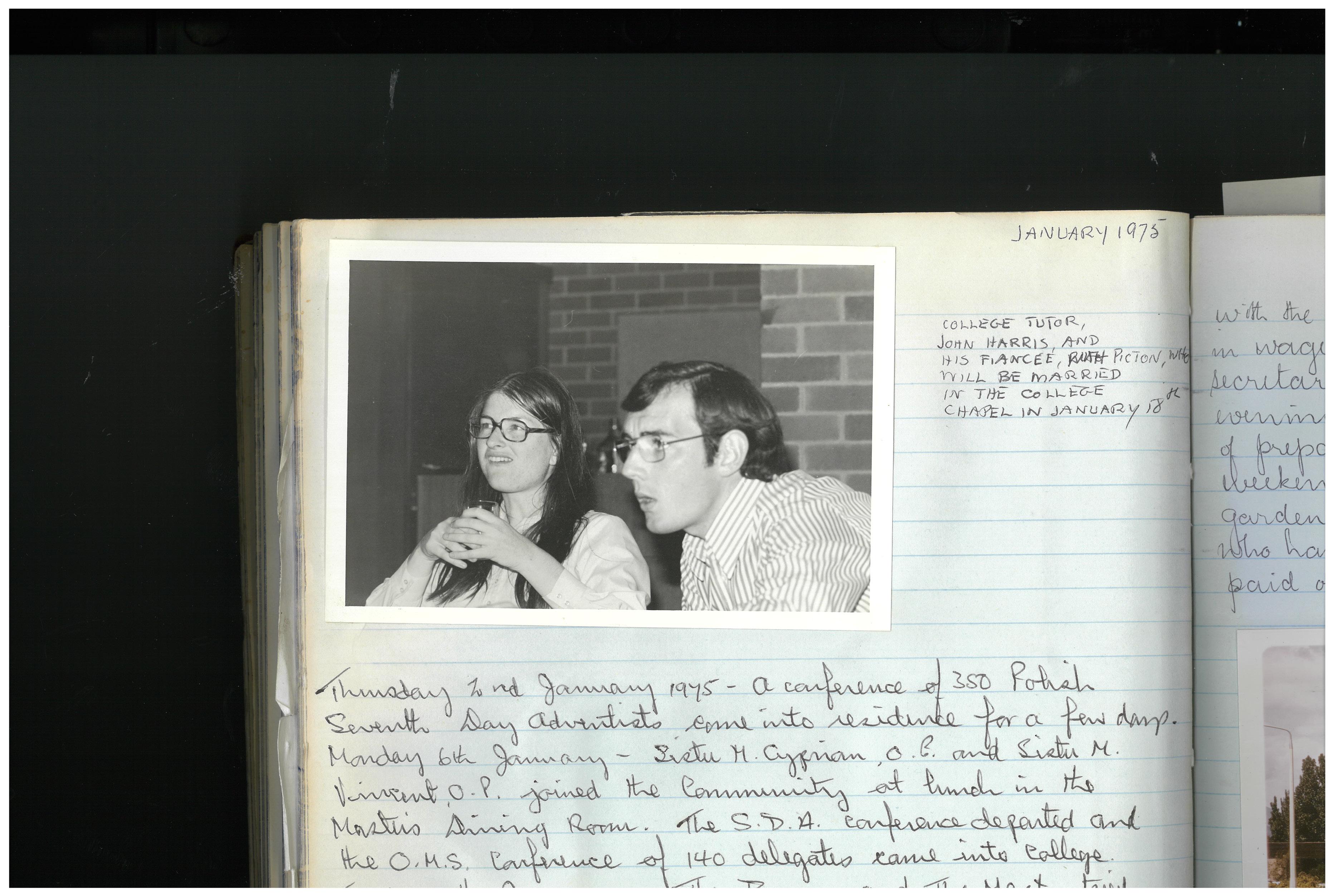
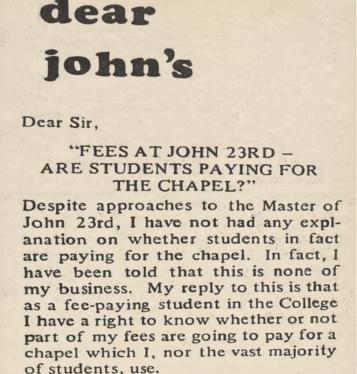
doubted the College’s claim, as asserted by the writer, that the chapel came from funds separate from the public appeal to build the College and the Government funding provided. The writer believed that any repayment on any debt caused by the funding of the chapel should perhaps be charged to the ‘Catholic minority in the and not come from fees paid by who do
In letters between the Provincial of the Dominican Order and the Ursuline Provincial (Reverend Mother Basil there was a deal of negotiation about responsibility for the cost and use of the Chapel which was proposed to be shared between the two Orders/Colleges. Funds were to be raised with student fees not used for the building and furnishing of the Chapel, with the Dominicans responsible for all the sanctuary appointments, ornaments
Martin Loftus in February that year:
“There is no religious test for people coming to the College so the community here is a typical cross-section of the campus community … Probably the building that is the focal-point or reminder of religion on campus is the John XXIII – Ursula (as it then was) Chapel. Here there is daily Mass, two on Sunday, Confessions, the University Sermon and other occasions when Christians of all faiths have gathered in common prayer … Catholic students, both members of the College and those who attend Mass here, have welcomed very much the opportunity to have coffee after Mass every Sunday morning and to hold weekly discussions at the College.” 244
The philosophy and use of the Chapel was well expressed in 1978 by the Catholic Chaplain, Father
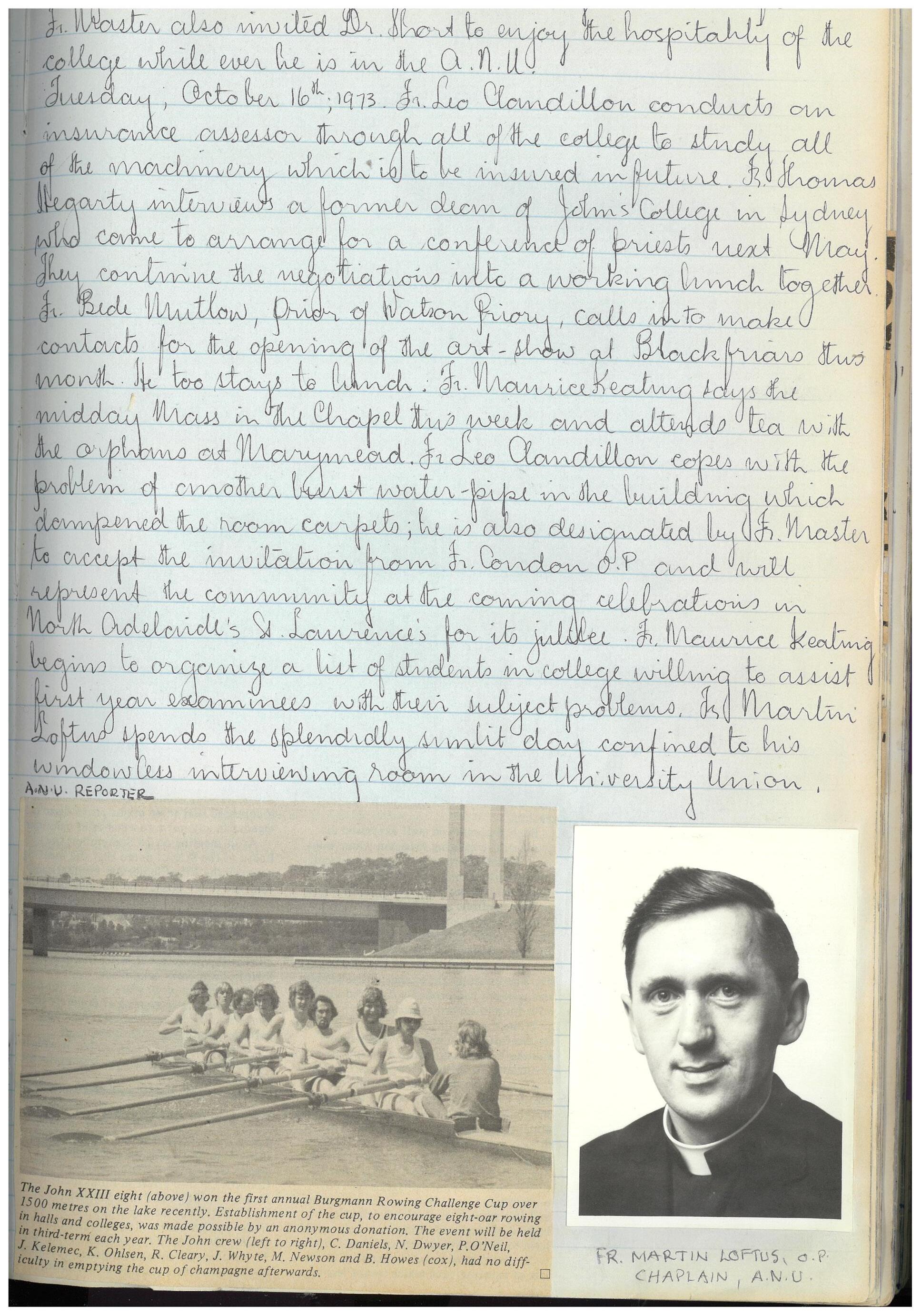
Michael Yabsley notes that there was nothing “that I would describe as ‘doctrinaire’ about religious matters or attendance at Mass. You weren’t forced in any way. It was a fairly eclectic coming together of nationalities and religions. I think the scene in the Chapel was pretty typical of what was seen around a lot of the churches …” 245
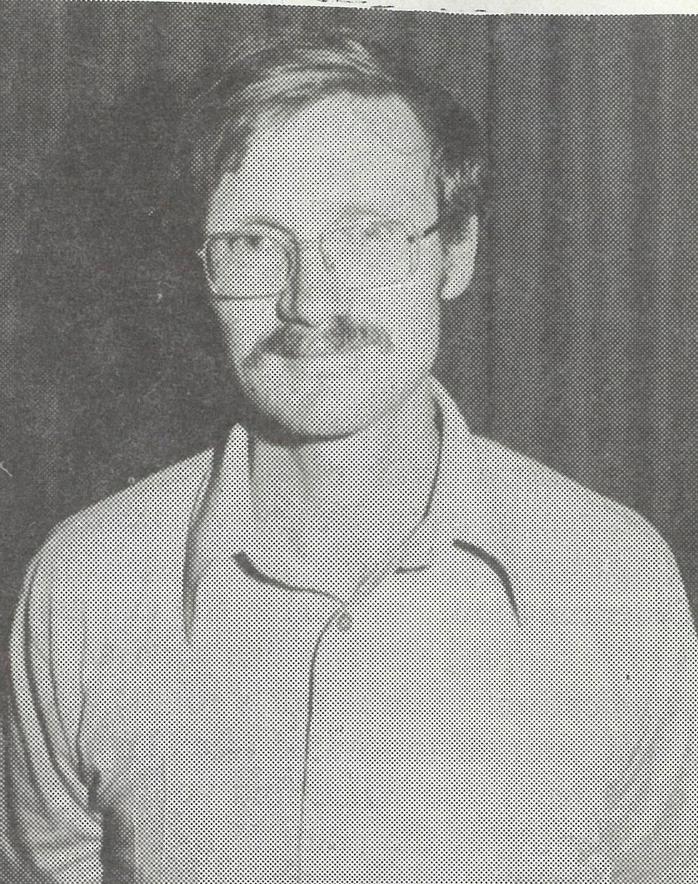
Jeff Bost notes that “the Chapel was in regular use. There was also a large cohort of other denominations some of whom joined an active inter-faith social group called the Navigators that included then Burgmann College students Kevin Rudd and his girlfriend Therese Rein.”246
Yvonne Parrey notes that in 1974 there was a large number of students active in the Newman Society whose meetings were usually held in the Chapel as well as in rooms of both Johns and Ursula Colleges. There were weekly group meetings in John XXIII College that were sponsored by Father Keating and a resident
Michael Fitzgerald, as well as a number of informal discussion groups with a “Catholic interest in medieval and specifically church history and philosophy. Father Loftus was fostering a very successful Chaplain’s discussion group directed at the study of Scripture which drew students both from the College and from the wider Catholic community who attended Masses in the Chapel. Chapel services were generally very well attended and a large number of College residents were active promoters of the Chaplain’s Mass and other Chapel functions.” 247
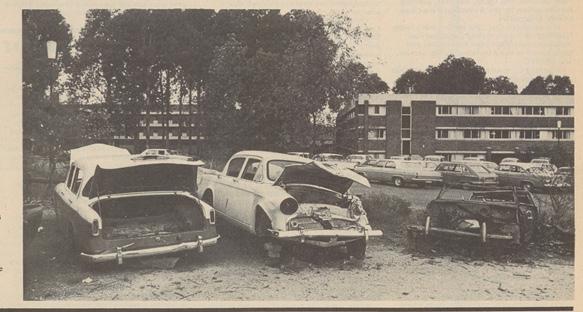
ANU Reporter Vol 4. Number 17 26 October 1973 p.5
ANU Reporter Vol.4 Number 18 9 November 1973
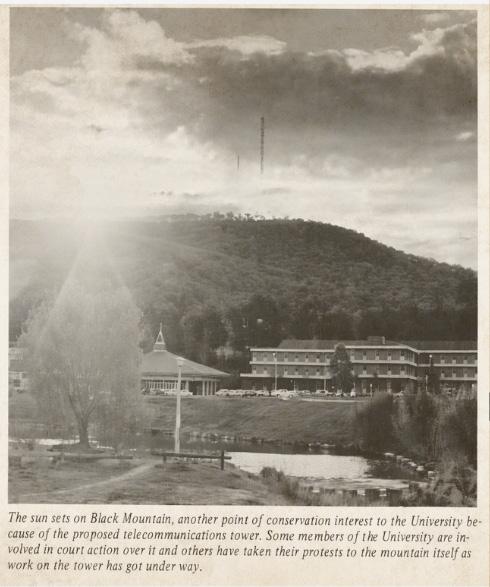
time of protest in the building of a telecommunications tower
(ANU Reporter Vol.4 Number 15 28 September 1973 p.4)
In the early years there continued to be issues around membership of committees, the appointment of tutors, and representation on the College Council. This was not unusual as the ‘wrestle’ over appropriate representation took place in the context of an era of change and of new developments in the nature of university residential communities and of universities themselves. Students, as perhaps the main stakeholders in what was being established and developed, were demanding a voice in decisions and administrations, especially of religious bodies, were feeling their way in their responsibilities and care and in being true to their mission.
In April 1970, a letter was sent by the committee of the Junior Common Room, to the Rector, the Dean and Mr J. Q. Ewens248 concerning matters related to representation. Signed by the President, Alistair Urquhart249, and the other members, the letter particularly focused on “(a) the technical ineligibility of the present President of the College to become a member of the Governing Body, and (b) the inability of the tutor of longest standing to decline the post of Senior Tutor without forfeiting his tutorship in the College.” Mr John Qualtrough Ewens was included as a member of both the University Council and the College Council. He was a thorough, detailed person who was very committed to his various roles and cared about the development of the new residences. In 1970 he was appointed as the first (Federal) Parliamentary Counsel and had worked in public service with Sir Robert Garran (Australia’s first Solicitor-General).
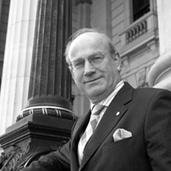
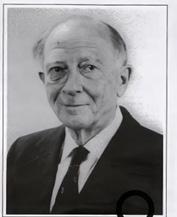
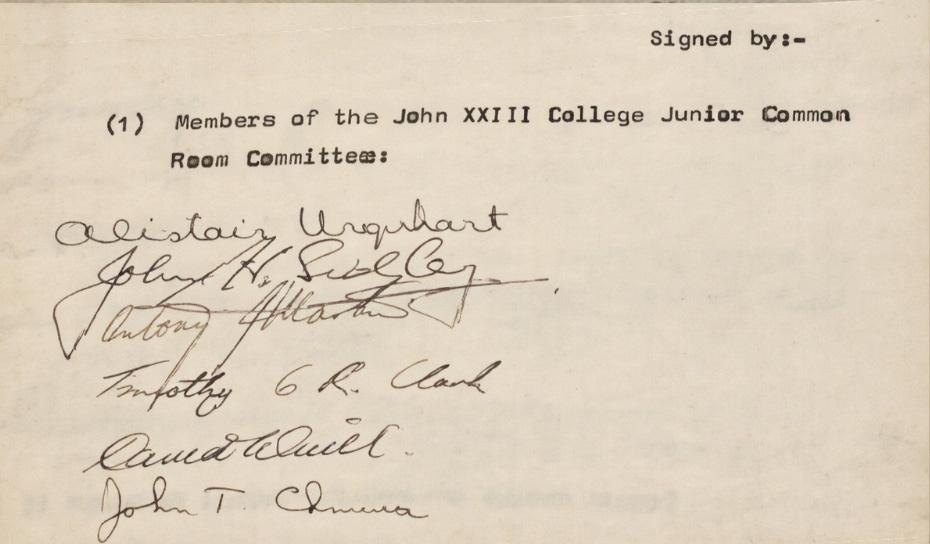
In October that year a petition was sent by 201 residents of John XXIII College to the Vice-Chancellor (Sir John Crawford), with copies to the Master, other members of the
College Council, the Archbishop of CanberraGoulburn, and the Provincial of the Dominican Order. It noted: 250
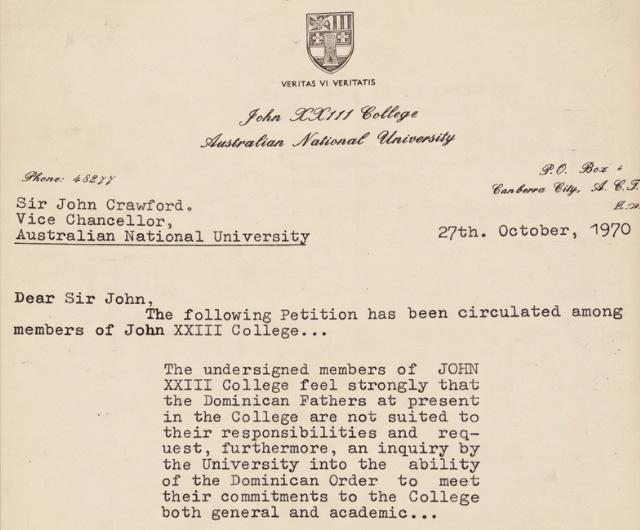
250. Archdiocese of Canberra and Goulburn archives op.cit.
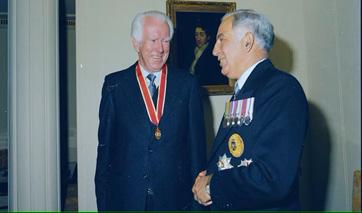
This seemed to relate very much to the appointment of tutors who were also members of the Senior Common Room. There was a deal of correspondence between the Master, the Provincial, and later the Vice-Chancellor, with consultation with, for example, John Ewens and Peter (later Sir Peter) Lawler who was a member of the Senior Common Room and often attended the College. He later became Australia’s Ambassador to the Vatican.
The College and especially the Master were very well served by Mr Ewens and Sir Peter Lawler who were experienced and trusted public servants and each one committed to serving the College in whatever way they could. On John Ewen’s death, Justice Michael Kirby wrote: “John Ewens was the authentic Australian federal lawyer. He worked closely with all of the Australian Prime Ministers and Attorneys-General between the 1930s and the 1970s. He remained open-minded, creative and blunt speaking to the last.” On the death of Sir Peter Lawler, journalist Laura Tingle wrote: “Peter Lawler is one of the last links to those great mandarins who were sort of involved in the whole post-war
construction of Australia.” Each was well consulted by Father Hegarty over the petition to and responses by the Vice-Chancellor, with John Ewens also speaking with the VC.
An article in the Canberra Times by Bruce Juddery about the petition noted:
“The petition represents the latest stage in a dispute between the College management, led by its Master, Father J. Hegarty, and members of the Senior (post-graduate) Common Room in particular, which has extended over more than a year … in the course of which accusations of academic incompetence have flown in both directions … One of the chief distinctions of the new (affiliated) colleges in contrast with the University’s nearby halls of residence was their responsibility to organise internal tutorial courses for undergraduate students … other issues have also (involved) questions of representation on the college council and the frequency of its meetings, and tenure of rooms at the college during holidays when the college often accommodates visitors to Canberra … the
central issue in the present dispute is the question of the respective capabilities of the management and those postgraduates chosen by the Master to double as tutors … 14 members of the Senior Common Room alleged that quite inadequate efforts have been made over the four years the college has existed to bring to its residents some of the principal advantages associated with residential university life, especially
a close association between the college community and members of the academic community … the Master, it argued, should be a senior member of the academic staff of the university or an equivalent. Father Hegarty was himself at one time a tutor in the university’s department of history but now devotes himself largely to college administration.
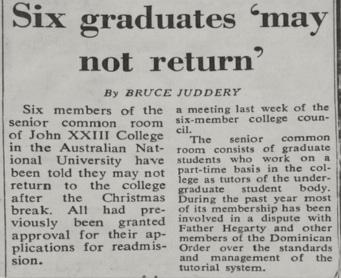
Letters flowed at the end of 1971 and the beginning of 1972 following Father Hegarty’s decision not to renew six members of the tutorial team’s positions for 1972. The Master acknowledged the support of the Provincial and of John Ewens and Peter Lawler. The Vice-Chancellor sought a meeting with the Master and the students involved and the Master was determined if that happened that staff would also attend. Sir John Crawford proposed names of ANU academics whom he would like to be on the College Council, including Professor Michael Birt, later inaugural Vice-Chancellor of the University of Wollongong and then VC of the University of NSW. Peter Lawler indicated among a range of things that the Master should stress to the Vice-Chancellor the “proper line of authority with regard to the College, namely that the Master is merely the instrument of the Dominican Provincial and Trustees, and ultimately of the Archbishop.”252
In an earlier letter to the Provincial, Father Hegarty finished his letter, having had a great deal of attention focused on this issue by the Canberra Times, noting Karrajong Hostel is receiving the full Canberra Times treatment at present, including a cartoon and a paragraph of an “unsafe” fire escape. The reason? Commonwealth Hostels Ltd. “evicted” an 18 year-old trainee for refusing to wear shoes in the Dining Hall. Canberra is a small town.” 253
In April 1972 Father Hegarty was asked to give the Opening Address at a Dominican conference in which he expressed some of the frustration he felt in dealing with matters of behaviour, criticism and discipline:
“So often it can be disconcerting to find that one has no adequately reasonable arguments to defend the standards which one proposes to the College. For example, at John XXIII College this past year our main problems were standards of dress, litter, noise. A small group of six men ran a college newspaper which was hostile to the Administration.254 The criticism it offered was often right, but extreme in its condemnation. The newspaper fastened on true grievances, the dress standard was sloppy, the grounds were untidy with litter, there was noise at times. But how can the Administration police all these things all of the time?”255
A letter of appointment of Andrew Tink256 in 1974 to the position of Tutor indicates what had come to be expected of the tutor’s role. He was appointed again in 1975, receiving the same letter, and was appointed Senior Tutor in 1976.
252. Father Hegarty letter to the Very Reverend J. J. O’Rorke OP 6 February 1972 Box 178 Dominican Archives op.cit.
253. Ibid. 2 February 1972
254. Probably ‘Residents’ Voice’
255. Archives of the Archdiocese of Canberra and Goulburn op.cit.
256. Interview with Andrew Tink op.cit. He was elected to the NSW Legislative Assembly in 1988 and was (Liberal) Shadow AttorneyGeneral and Shadow Leader of the House. He has since become an author and historian. He is a Visiting Fellow at the Macquarie University Law School.
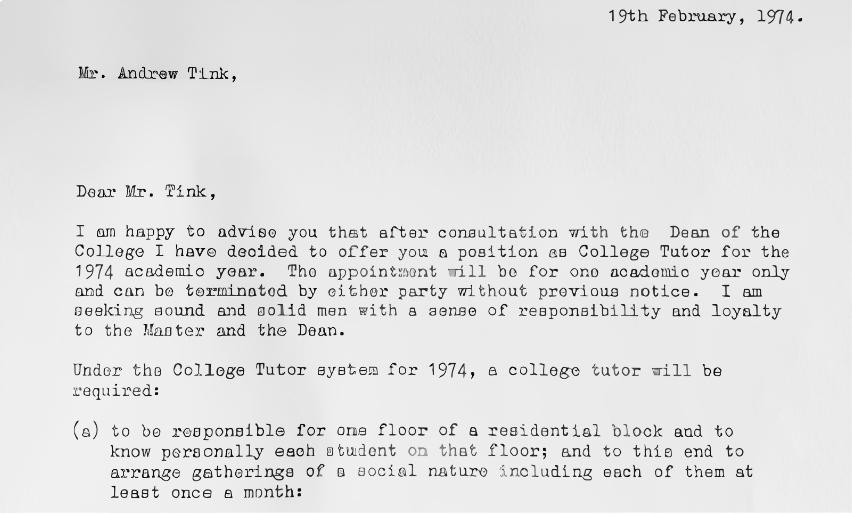
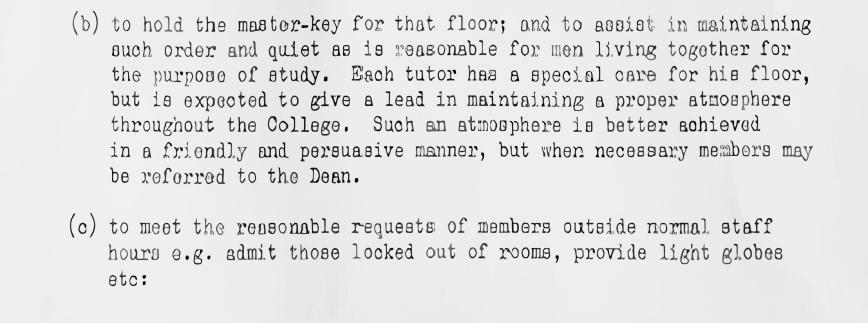
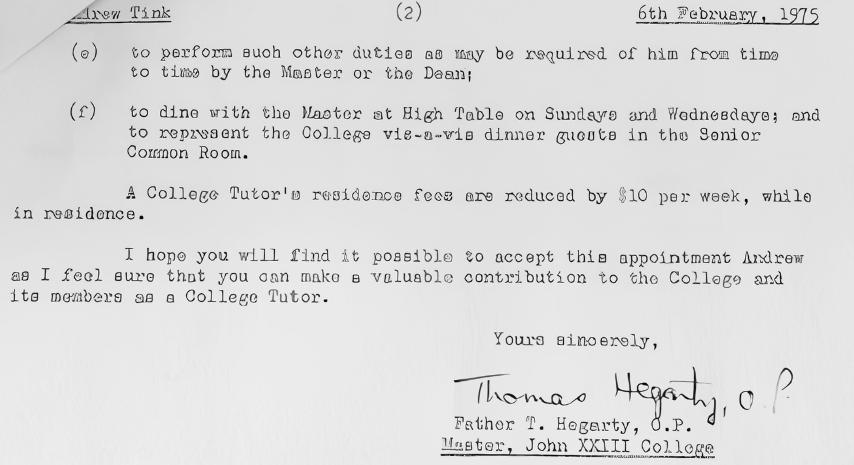
As Andrew noted
“There wasn’t much tutoring in the College. Tutoring had nothing to do with academics. It more being the ‘police person’ in the corner room (as set out in Fr Hegarty’s letters). Occasional guest tutors etc. …
Plenty of pranks! We had regular miscreants. They’d get the fire hoses out and just hose the corridor. Ridiculous! Very expensive I imagine – carpets and floors. Pointless, ridiculous; vandalism. Tutors responsible for peace and good in their corridor. I remember one year a guy came in with his motorbike and started driving the mb up and down the hallway. I just thought – this is utterly unacceptable. Well – I could call the Dean – but I thought, no, I just have to try and handle this. I was quite frightened by this because the rider was one of those big burly blokes with a bad reputation. It just went out into the corridor and stood there in his path. Please stop, you are disturbing the
other students let alone disturbing me. Just stop – GO! Get out! To my utter astonishment he left! I would have been in a world of pain if he hadn’t! The option was either /or. He left! …
The perfect landing place for me, as it turned out, was ANU, and the perfect place to be IN the ANU was right here in John XXIII College … If I hadn’t had a place like this to retreat to and having this place to work, I would have been sunk.”
Andrew Tink’s letter of appointment as Senior Tutor from Father Hegarty in 1976 notes that “your appointment entitles you to sit on the Governing Body of John XXIII College. The Governing Body meets normally once each term and should not require more than two hours of your time on each occasion … I take this opportunity, Andrew, of thanking you for the sterling work you did last year for the College, and I wish you a happy and successful year in 1976.”257
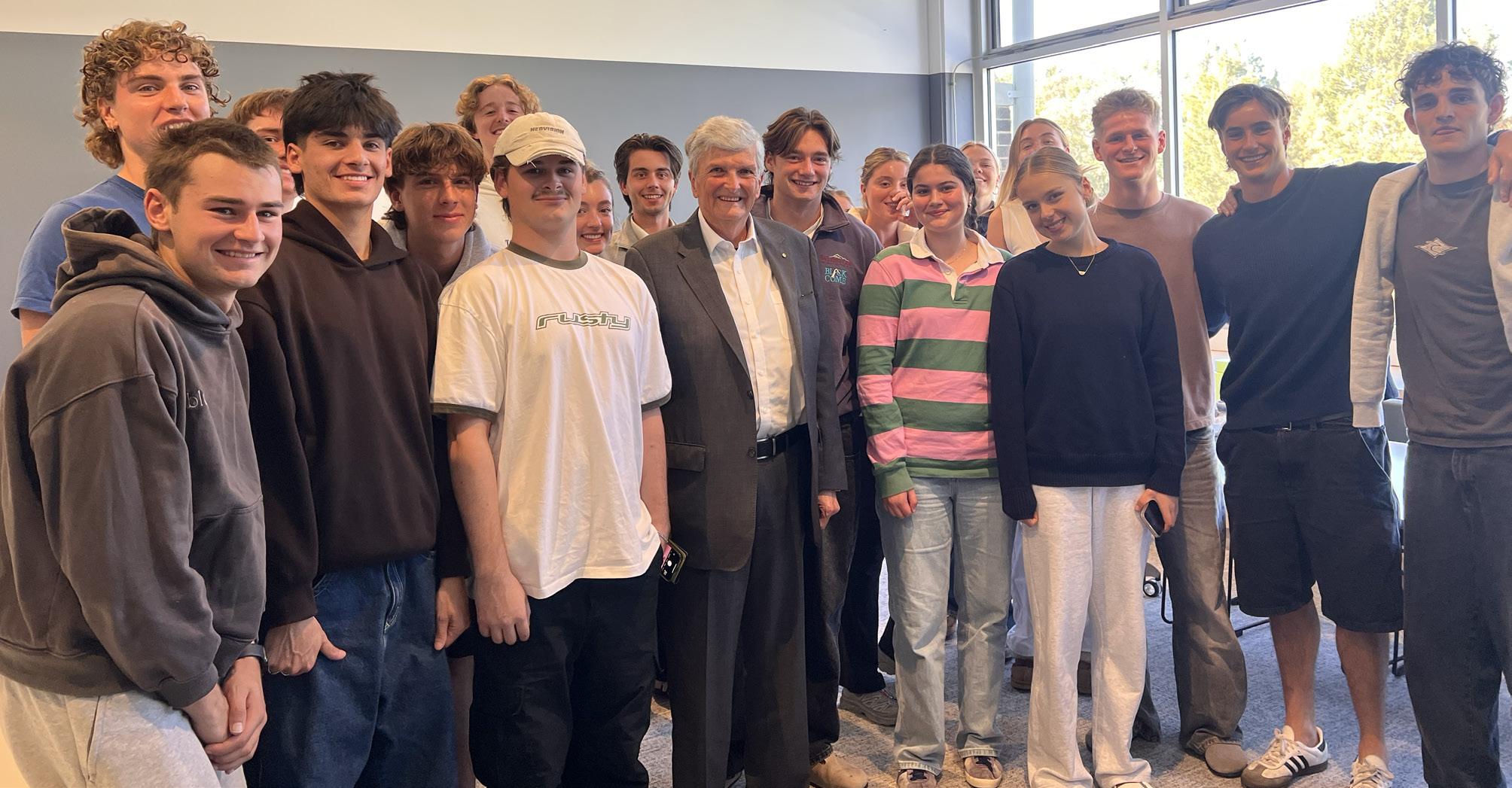
Jeff Bost who was Senior Tutor in 1978 also recalls that “it was not an academic role but more supervision – keeping the corridor under control in a positive way, some light discipline and providing pastoral care.” 258 Sometimes, he noted, the tutorial room at the end of each corridor was used for academic purposes and he notes in particular that Frank Ingruber, who was President in 1976, gave law tutorials. He recalls the use of the tutorial rooms for ‘polite’ parties, with Michael Yabsley having a reputation for organising the full dinner deal with formal dress, candelabra
(which sometimes set off the fire alarm), cigars, liqueurs and so on!
Phil (Fil) Barresi (1974-1977; 1978) recalled that during his (later) time in the College informal subject matter tutorials were introduced.259As often occurs in residential colleges and halls, residents seek out other residents informally for academic help and, for example, Ian Pearson (1972-1974) notes that in 1974 “a lot of time (was) being taken by freshers requesting assistance with their Applied Maths assignments.” 260
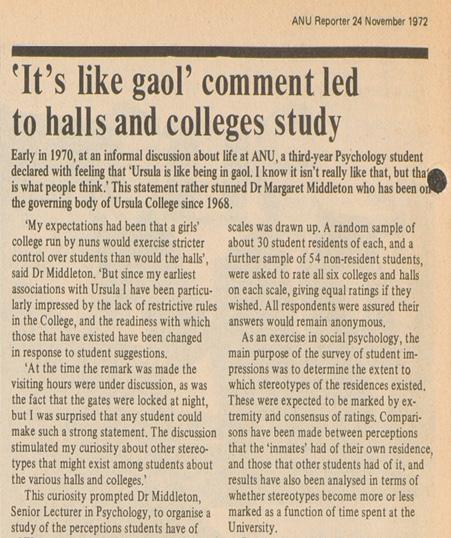
SURVEY OF COLLEGES AND HALLS –NOVEMBER 1972 (PERCEPTIONS OF RESIDENTS AND NON-RESIDENTS):
259. Email from Phil
29 June 2025 and interview op.cit. Phil Barresi became (Liberal) Member of the federal seat of Deakin 1996-2006. He became a Deputy Speaker of the House and was Chair of a number of Parliamentary Committees. 260. Ian Pearson op.cit.
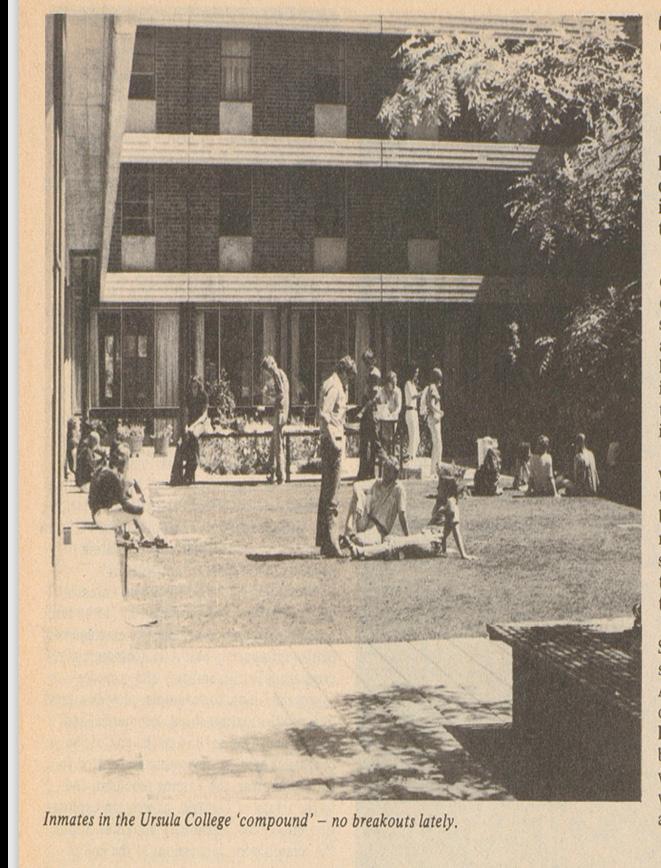
RULES OF JOHN XXIII SEEN AS PARTICULARLY RESTRICTIVE, HIGH INVOLVEMENT IN SPORT, AND DISSATISFACTION WITH THE FOOD:
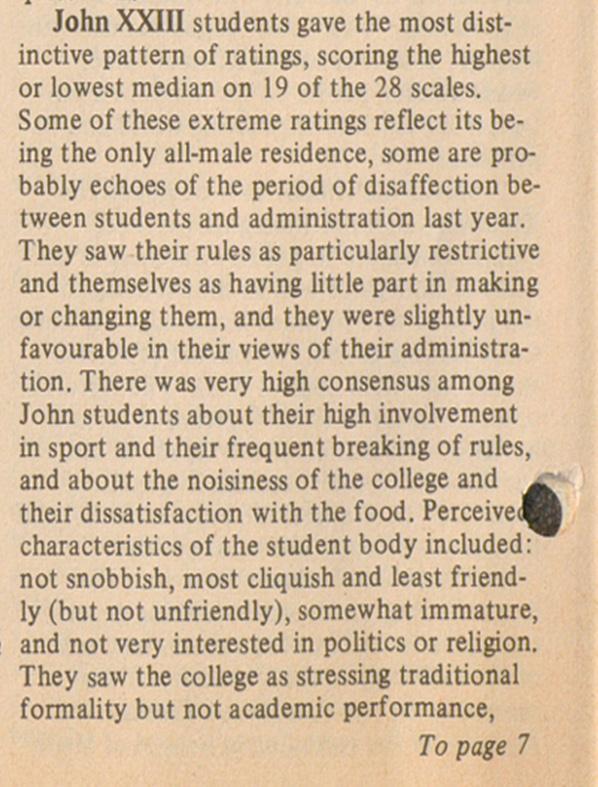
COLLEGE SPIRIT HAS THE SECOND HIGHEST MEDIAN RATING:
NON-RESIDENTIAL STUDENTS HAVE FAIRLY GENERAL EXPECTATIONS ABOUT THE KIND OF ADMINISTRATION
LIKELY TO BE FOUND IN RESIDENCES RUN BY MEMBERS OF RELIGIOUS ORDERS:
As noted in the survey report, Johns’ residents expressed their frequent breaking of the rules and the noisiness in the College. Pranks were common, as the reflection in the first Pontifex (1978) mentioned:
“Pranks are probably the things for which Johns is best known and in its time it has seen many of them, some very, very good and some very, very bad. The Johns/Andrews (St Andrew’s College, Sydney University) connection was established around 1970, with a return visit in 1971. Although the liaison went no further, the small mosaic John’s crest and the picture of Pope John XXIII did go to Sydney for some weeks. The cross on the roof of the chapel has been decorated with everything from sundry items of ladies underwear to dead cats dangling in a noose and even a thought-provoking two-way sign, pointing up and down!” 261
“FATHER, WHY DO YOU AND I KEEP ON DOING THIS JOB …?
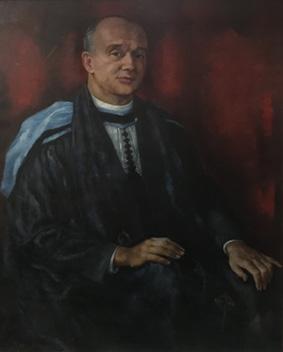
In a speech in 1973 by the then Principal of St Andrew’s College, Sydney University, to the Association of Heads of Australian Colleges
and Halls, the Reverend Alan Dougan noted: “Some of my men behaved badly at a college administered by the Dominican Order and those students retaliated vigorously on a visit to Sydney. The good Dominican Father Head and I later discussed the matter and thought sadly of the ways young men today and I said to the old Irishman, ‘Father, why do you and I keep on doing this job when we could be gentle shepherds of some small flock in a pleasant country village?’ And he said, ‘Principal, wherever the people are, particularly in frontier situations, the Church must be there – there to offer the best. In universities to offer good accommodation, good food, good tutorials, to be there to help unobtrusively, to watch for the lonely, to spur the slack, to give any help needed. The Chapel will be there and the Head will pray and give opportunities for worship –but never, never must there be compulsion: never must it appear that we offer facilities or service on condition students will accept the faith or the ethics. We must be there to offer and have what we offer accepted, and perhaps our reason for offering it spurned and rejected. It is the way our Master went.’
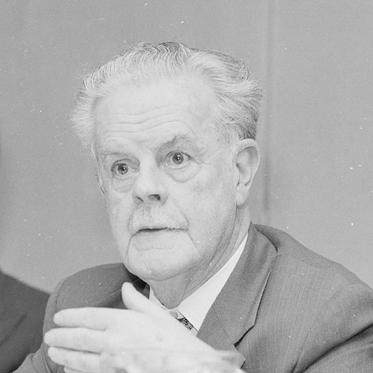
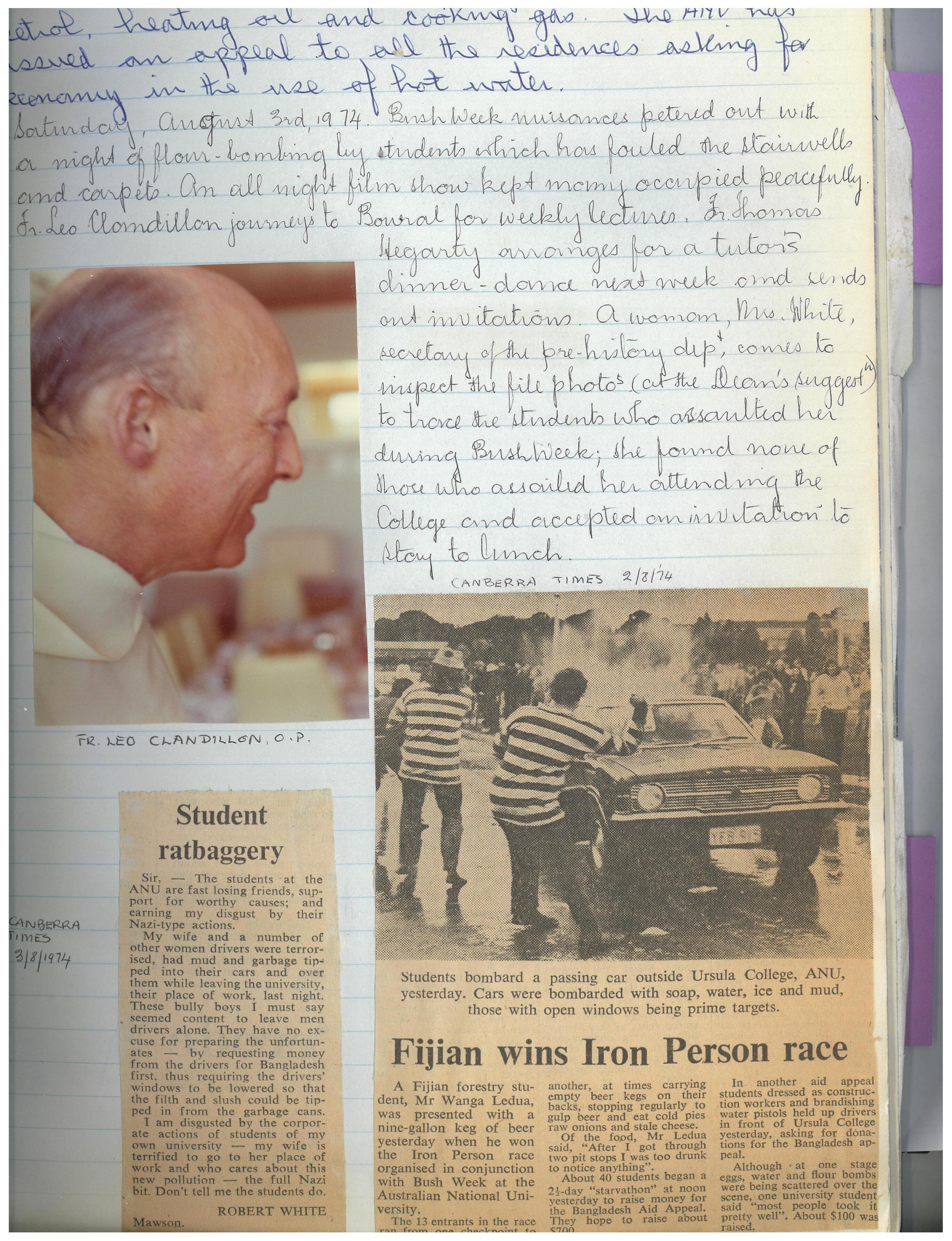
Other pranks included removing the screws from door hinges but leaving the door in place. One touch and it fell, to the dismay of the occupant; and a tutor finding his car parked between two pillars, with an inch to
In 1974 a more devious but not uncommon was for one group to combine with JCR
To obtain a majority the larger group had to buy votes by offering the smaller group seats on the committee, the members of the main group taking the positions they wanted. The elections were, as a result, a mere formality with the results being exactly as planned. The JCR meetings turned into a battle between the ruling group attempting to enforce its views and others trying to find
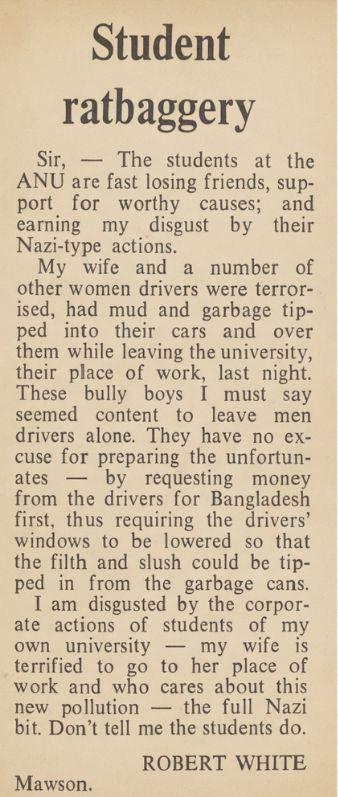
Johns men are not mentioned but from the photo/jerseys AND that these items were in the College admin diary probably indicate they were involved!
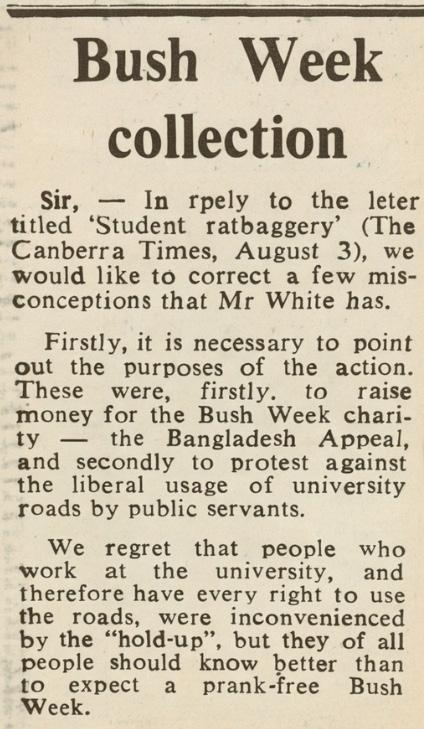
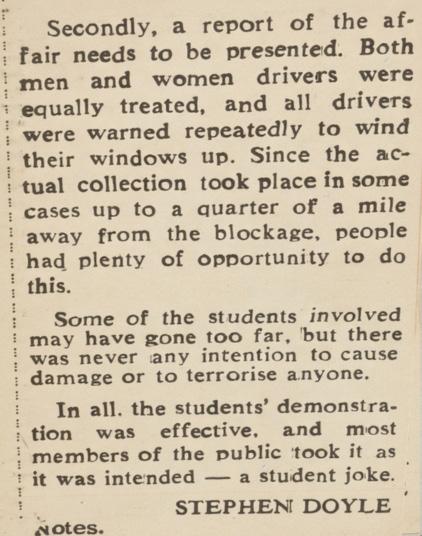
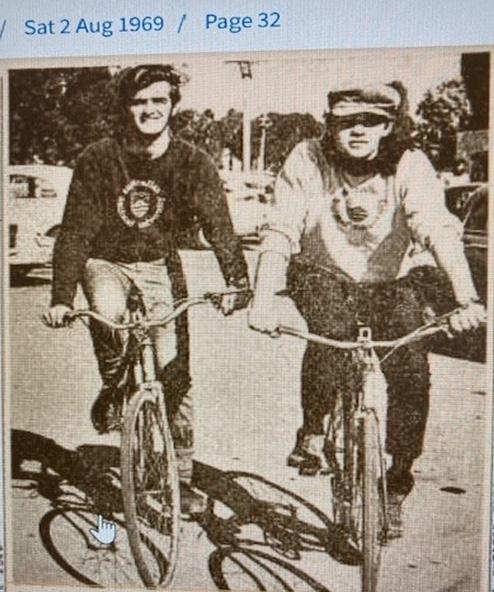
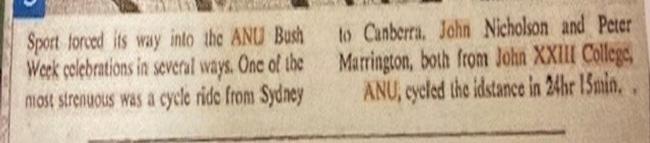
It was further noted that the two riders had been sponsored by several companies and the money they raised went to the Lord Florey Memorial Fund and Youth Call ’69.
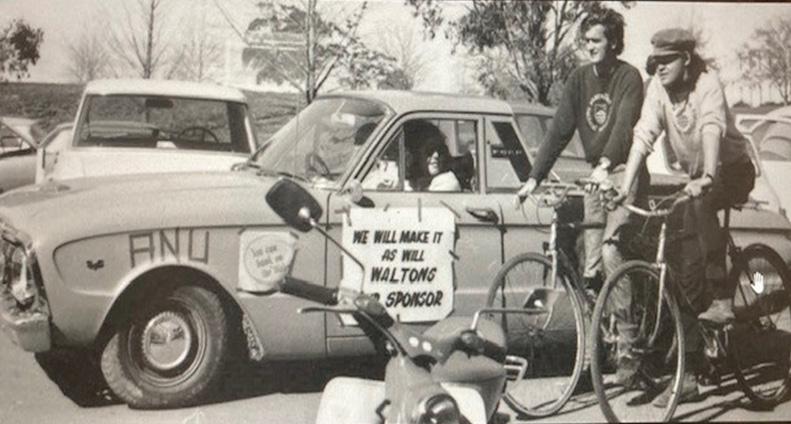
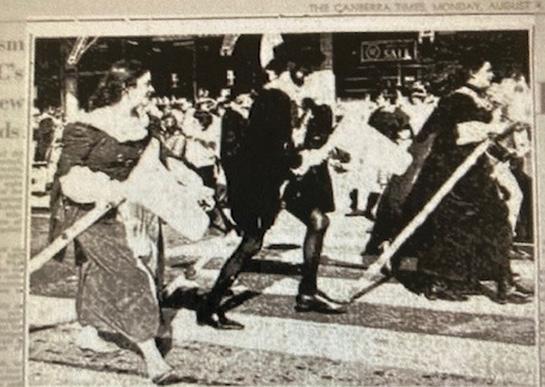
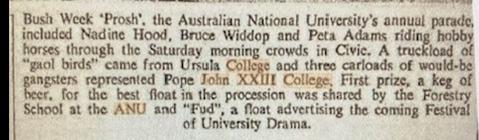
Canberra Times 4 August 1969 p.3
Michael Yabsley (1976-1977) recalls that “there was a significant event when a guy who had had a skin full single-handedly turned a fire hose on in the administrative area and flooded the whole place and did enormous damage. The cops were called and I think I might have been the first on the scene, probably coming back very late at night. I could see the water cascading – so I then became a witness in the case. This guy had the book thrown at him. That was probably the extreme end of the scale.”
It certainly wasn’t all “ratbaggery”!!
Residents found their group. Some quieter than others, some more interested in the arts than in sport, others more active in campus-wide activities (political, religious or otherwise). Ian Pearson notes that there was, for example, a ‘Steele Rudd Study Group’ involving residents and their friends such as John Harris, his fiancée Ruth Picton (Ursies), Ian Nicholls and Tony Bryant.267
Michael Yabsley notes that, especially at his special dinners, “we played the best Neil Sedaka music we could find!”268
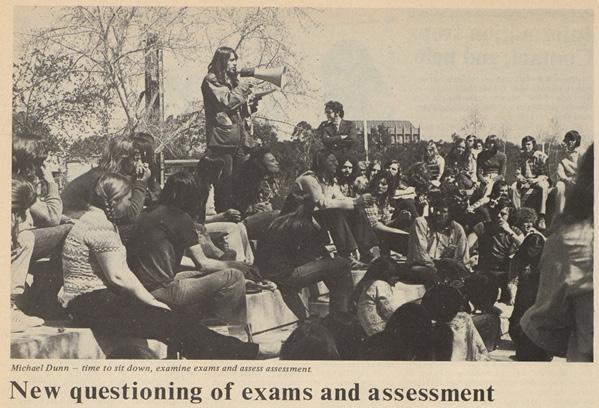
– (ANU Reporter Vol.4 Number 15 28 September 1973 p.8)
In his history of the first one hundred years of Dominican Friars in Australia, New Zealand, the Solomon Islands and Papua New Guinea, Father Thomas Fitzgerald OP, who was to be the next Master of John XXIII College, wrote:
“From the evidence it would appear that John XXIII in the seventies suffered more than some of our other Colleges from vandalism and discontent among the student body. Once again, perhaps, the prevailing political character of life in Canberra might have been to some extent responsible. Almost no year passed without John XXIII being mentioned in Question Time in the Commonwealth Parliament, very often not to our credit.”269
At a time of wider protest across Australian campuses and beyond, ANU students engaged in protest activism in relation to issues such as the nature of examinations and assessments, consultation about and
representation concerning the determination of course content and the need for women’s studies courses, overcrowded classes, and representation on the University Council. No doubt there were John XXIII residents in the crowd and the broader activism created a context conducive for questioning, argument, and lively discussion. As Yvonne Parrey notes, in April 1974, the big College issues were again about food, ‘Inward Bound’, and the upcoming Rugby grand final against Bruce Hall (which was won by Johns). On the last weekend of April some residents joined other Catholic students at a weekend camp with a discussion theme of ‘Peace and Justice’.270
In the same month, ANU students rallied in the Union Court and occupied the Chancelry, its hallways and Council Room. Tense discussions involved the Chancellor (Dr Coombs), the ProChancellor (Justice Anthony Mason), and the Vice-Chancellor (Dr Williams).
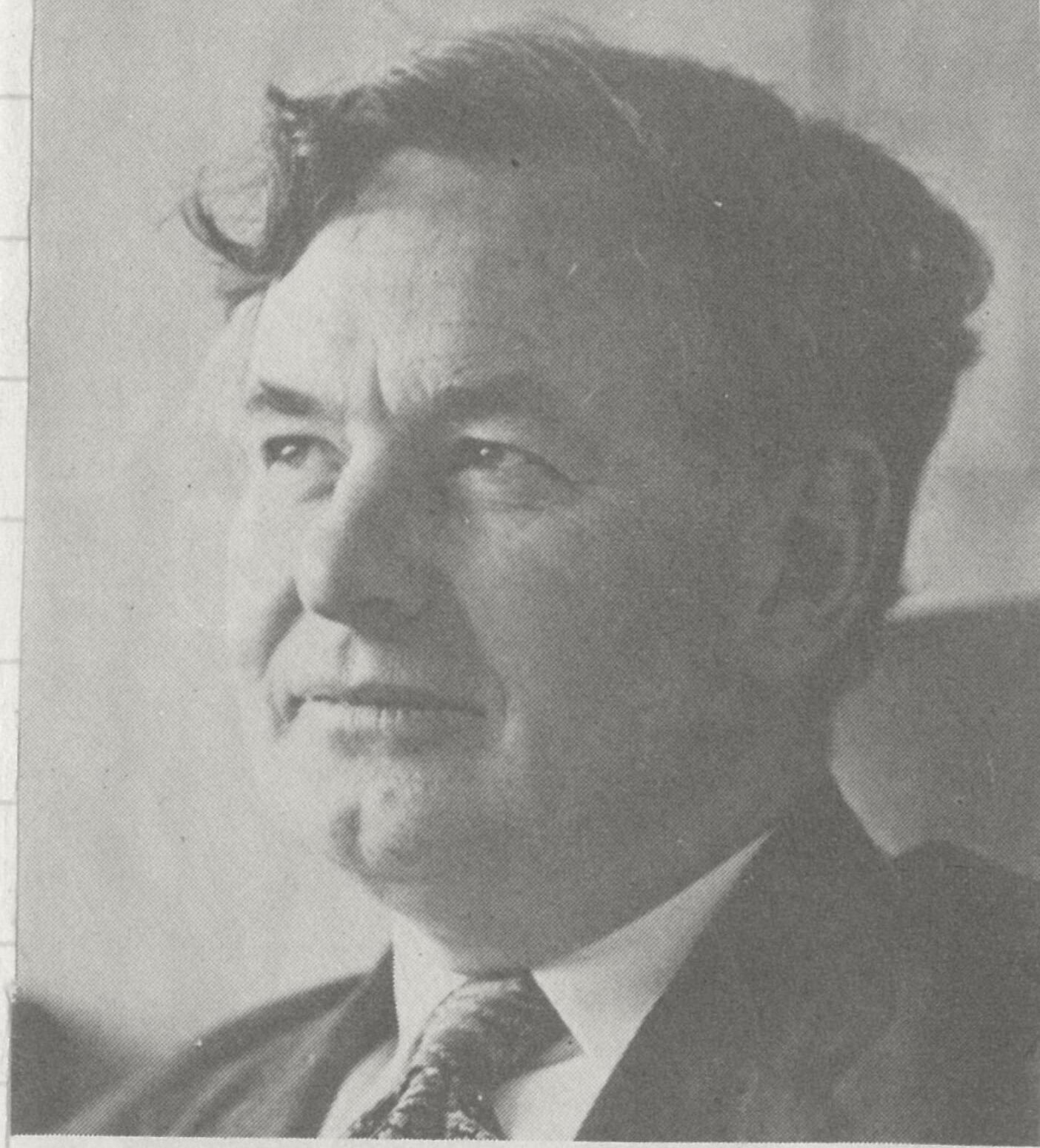
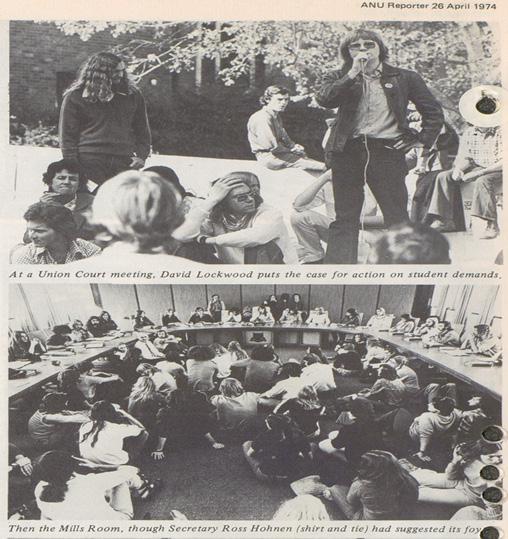
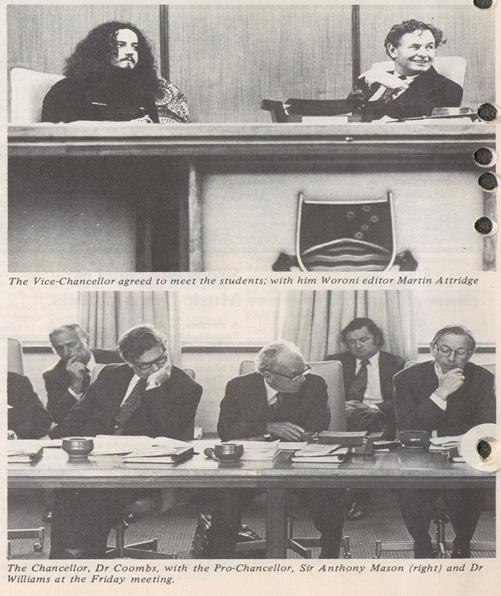
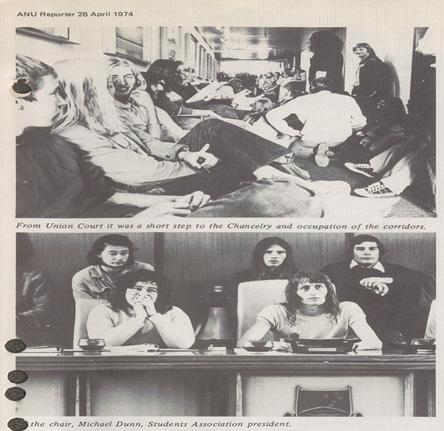
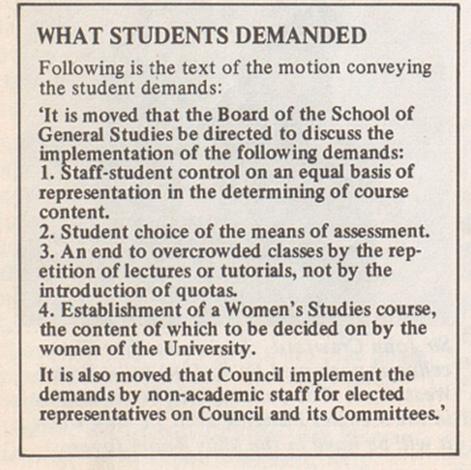
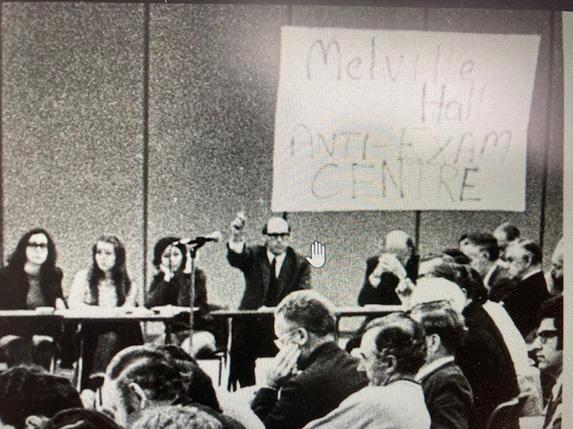
Later, in August 1974, 27 students were arrested after occupying the University’s PABX switchroom. No Johns residents were among those arrested!
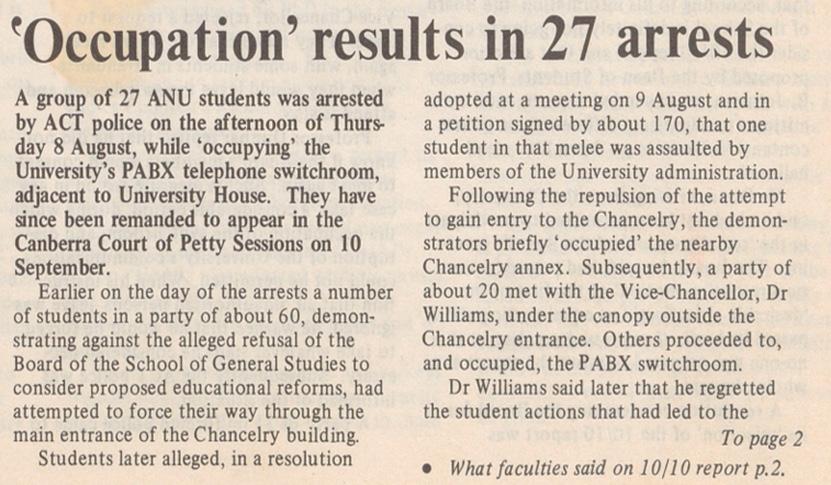
ANU Reporter Vol.5 Number 13, 23 August 1974 p.1
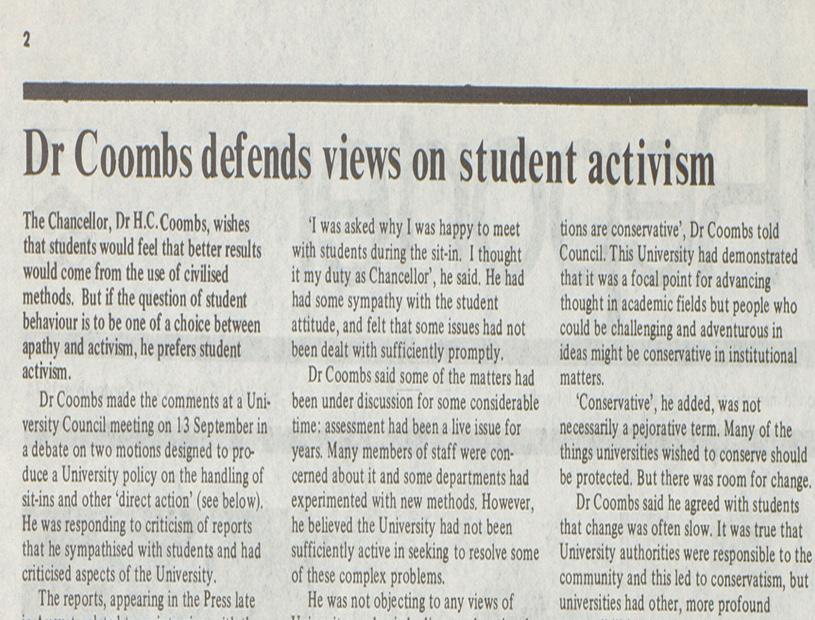
Of course, many of the residents of the College in 1975 would recall the Dismissal of the Whitlam (Labor) government by the then Governor-General, Sir John Kerr on 11 November that year. He was replaced by the Leader of the Opposition, Malcolm Fraser,
who went on to win a December federal election. Mr Fraser had officially opened John XXIII College some nearly seven years before. Daniel Stepniak, President 1975, recalls being able to stand on the steps of Parliament House – “a carload of us were amongst the first to arrive …”271
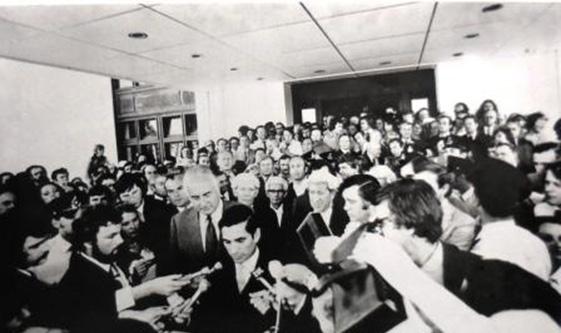
271. Email from Daniel Stepniak 10 October 2025. Bill Coaldrake op.cit. also recalls the Dismissal because of the interruptions to his interview that day with Prof Geoffrey Sawer (ANU Faculty of Law) for a scholarship to Harvard. He was awarded the scholarship.
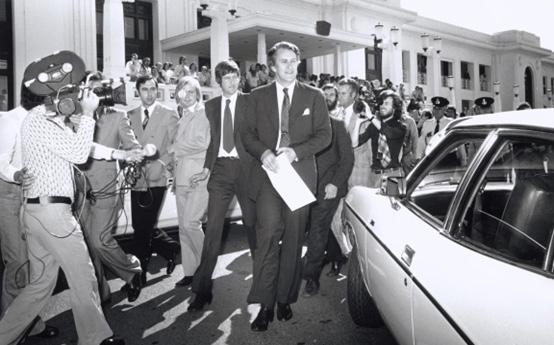
The Governor-General and Lady Kerr, following the dismissal, were frequently the subject of public opprobrium and protest, such as at a dinner they attended at Bruce Hall early in 1976. In an article by Humphrey McQueen, the scene outside the Hall is described:
“The occasion was a private function sponsored by the Australia-British Association for the retiring British High Commissioner, Sir Maurice James. The location was the dining room of Bruce Hall at the Australian National University … Crowd assembles 600 strong, around
the locked doors of Bruce Hall … The only steps are blocked by protesters. Kerr is jostled and pushed. The police regroup to force a path. Students sit. Three minutes of stalemate. Police form a flying wedge and drive a passage through to a side door. ‘Kerr out! Kerr serves the Yanks!’.”272
Phil Barresi (1974-1976 & 1978), a more conservative politically inclined resident, notes: “I certainly attended some of the demonstrations re the ANU students / ANUSA.” He recalls John Kerr visiting ANU soon after the dismissal, attending a function at Bruce Hall. “You’ll see me at that protest – some supporters, the other side protestors!”273
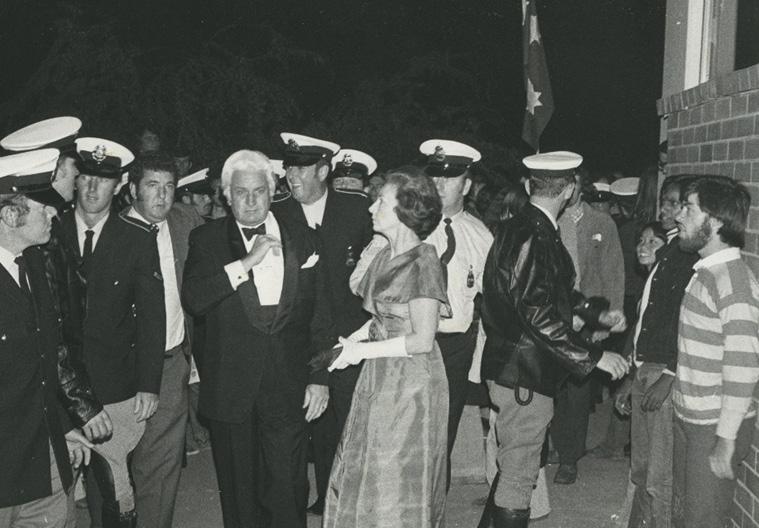
272. Kerr-atBruce-hall-1976.pdf
273. Phill Baeeesi email op.cit,
Jeff Bost remembers that in his cohort at College “there were several who had successful – and at times high profile –political careers. These were Andrew Tink (Senior Tutor 1976 who became a Liberal member of the NSW Legislative Assembly, held Shadow portfolios including AttorneyGeneral, and then has worked as a writer/ historian); Michael Yabsley (also became a Liberal member of the NSW Legislative
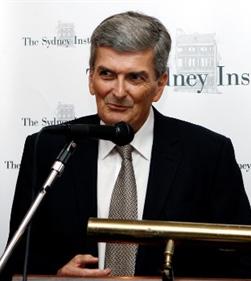
Assembly and Minister for Corrective Services) “who used to wear a three piece suit with lapel carnation to political science lectures which was a very brave thing to do”; Phil (Filipo/Fil) Barresi who became a Liberal member of the House of Representatives, a Deputy Speaker of the House and Chair of a number of parliamentary committees; and Shane Stone (appointed a Tutor in 1977 and who went on to be Liberal Chief Minister of the Northern Territory and Federal President of the Liberal Party).274
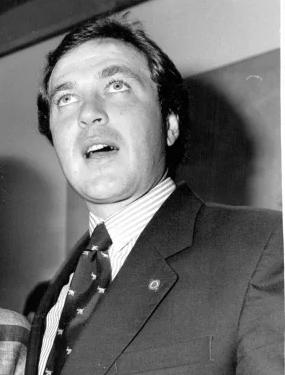
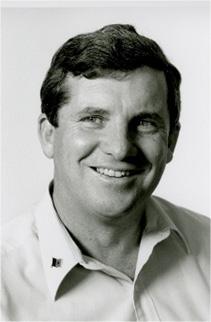
In addition to these were two Labor politicians, Jonathan (Jon) Stanhope (who became Chief Minister of the Australian Capital Territory and Administrator of the Australian Indian Ocean Territories (Christmas Island and the
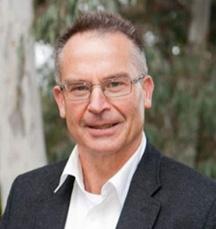
Cocos/Keeling Islands); and Tim Pallas (later Labour and arguably longest-serving Victorian Treasurer). Tim notes that former Victorian Premier (1955-1972), Sir Henry Bolte, was also Treasurer.275
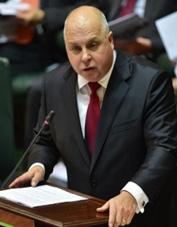

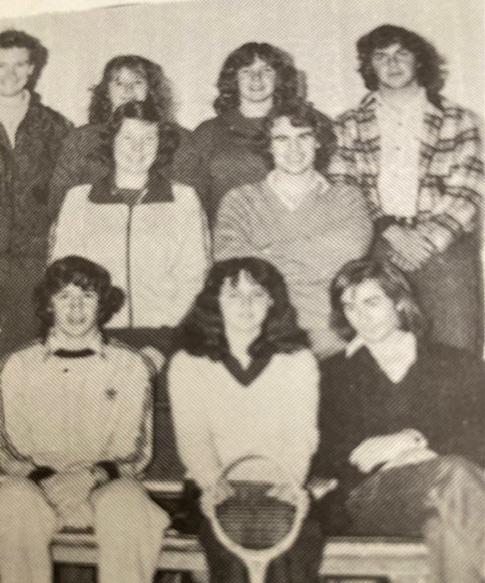
Jeff Bost also notes that “from our overseas students (we had) … Tan Sri Dr James Masing (who became Malaysian Minister for Tourism and Deputy Chief Minister of Sarawak), and Datuk Len Talif Salleh (who became Chief Minister of Sabah).277
Michael Yabsley recalls that he made a very deliberate choice to come to the ANU and to John XXIII College from Lismore and boarding at St. John’s College, Woodlawn:
“It was a very comfortable transition for me from boarding school to John XXIII. But why
ANU? I was always very interested in politics and I had a feeling in my bones if I went to Canberra I could spend time interacting with people who had a lived experience in politics and that certainly turned out to be the case … I came to Canberra in 1976. There was a firebrand group of young conservatives who at the beginning of 1976 set up a new Liberal Society. When Sir John Kerr made visits to the campus as a guest speaker, they (all the likely suspects from the Students’ Association) would demonstrate, and we would do a counter demonstration and generally make a nuisance of ourselves.”278
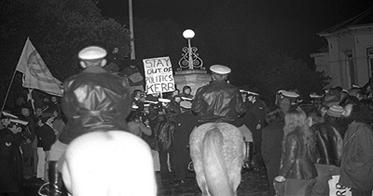
Yabsley noted that “the Student Association was absolutely controlled by one of the most un-holy alliances of all – the Stalinists, the Trotskyists, the Maoists etc. They were all busy hating one another, but when it came for crucial votes they more often than not had the combined numbers.”
The rules of visiting hours are the same as they have been in the old Lennox House for the past two years. Visitors of both sexes are allowed up until 11 p.m. every night of
the week and there is stipulation that young ladies not be allowed on the premises before 9 a.m.279
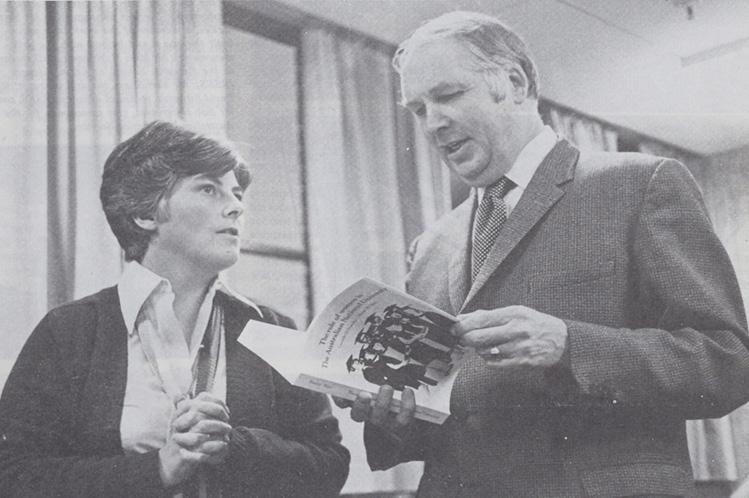
Vice-Chancellor Anthony Low receives a copy of the report on the role of women at ANU 1976
ANU Reporter Vol. 7, Number 6, 14 May 1976
When Bruce Hall opened in 1961 as Australia’s first undergraduate ‘co-ed’ (as it was then referred to) university residence, it was regarded by many as a dangerous even unjustified experiment.280There was a view, perhaps a rumour, that there was not enough money to build two single sex Halls to cater for the undergraduate population following the merger of ANU with Canberra University College. The move was watched nervously with conservative reservation among many in the University and more broadly in Canberra.281Visits of the opposite sex could be made between 9am and 10pm, with the North Wing designated as the Women’s Block and its entry locked at 10pm. Each woman resident was given a key to enter the Wing while locked. There was a leave book in which every member had to sign out and back in on return.282
In 1962 the West Block also became a women’s Block. Mike Gore, then a Sub-Warden, of Bruce Hall, recalled that he heard “complaints from the girls who lived in West Block that they were kept awake at night by the sound of
the automatic flushing system of the former male toilets.”283
By 1969, when John XXIII College opened, Bill Packard came to the view that community and safety would be better served by the genders being ‘scrambled’ (a term he gained from the then Principal of St Anne’s College, Oxford, which admitted men in 1979) rather than separated. Segregated areas were no more, and “in 1970 the last vestiges of visiting hours disappeared without internal lament.”284 Not entirely! Some opposition was expressed, including by the College President, to the view that ‘scrambling’ would allow the Hall better to “represent more of a true community and normal pattern of living”.285 There were some mixed feelings as to how ‘normal’ and helpful this was. Earlier in the decade, when, for example, it was announced at a dinner in 1963 that Basser College, the first residential college at the University of New South Wales, would admit women in 1964, the then allmale student committee walked out of the dinner in protest!
280. Speech given by Bill Packard at his farewell dinner as Warden (1960-1986) at Bruce Hall on Saturday 28 June 1986
281. Ibid.
282. Ibid.
283. Mike Gore, speech at the farewell dinner for Bill Packard 28 June 1986.
284. Ibid.
285. Woroni Wednesday 2 July 1969 p.3
By the turn of the decade, in the thick of the student protest era, the co-ed pattern of the ANU Halls was set, including for a proposed fourth hall of residence to be opened in 1974 and to be named ‘Toad Hall’ by its residents. Nevertheless, with the ANU Halls being the first residences on campus, the faith-based affiliated colleges opened in the later 1960s and early 1970s286struggled to maintain single-sex occupancy. Church/ religious residential colleges were reluctant to risk cohabitation and certainly a number of them, especially those established some fifty or more years before, were very wary of the loss of single-sex character and tradition. Indeed, a number of such colleges across Australia (and beyond) did not admit women until after 1980, such as St John’s (2001) and St Andrew’s (2002) at Sydney University, Kings (2020) at the University of Queensland, St Mark’s (1982) in Adelaide, and St George’s (1981) at the University of Western Australia.
Of course, John XXIII College and Ursula College, were seen as ‘unofficially’ co-ed before officially admitting women and men respectively, as was the case at Lennox House! The story is told, whether apocryphal or not, that “the Dean (Father Keating), who made up in tenacity for what he lacked in stature, held a perpetual campaign to try to prevent people sleeping in the College without paying fees, or so he said. One night he knocked on a door and opened it fractionally afterwards, to the dismay of the occupant and his girlfriend. The perturbed but cool quick-thinking Johns-man picked up a handy shoe and flung it at the Dean who retreated. Since this was not an isolated incident a General Meeting of the J.C.R. was called to discuss the problem. The sole constructive (?) suggestion, it would seem, was that the doorknobs should be raised two inches, thereby putting them out of the Dean’s reach.”287
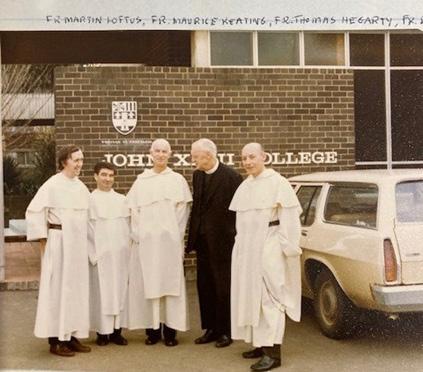
A Sydney Morning Herald article in March 1968, praising the development of Canberra, but with reference to a small number of complaints, noted that women students at Ursula College ANU have been complaining of ‘convent school discipline’ about visiting hours. In an interview response about the issue in Woroni the Principal, Sister Angela Cooney, strongly supported the visiting hours, noting that there was “a genuine feminine desire for privacy.” 288In many ways, however, she was also ahead of her time.
“I WAS BRIEFLY AT JOHNS … ACTUALLY, I WAS ALSO AT URSIES.”
Former Editor-in-Chief of the Canberra Times, Australian Journalist of the Year 1985, and inducted into the Australian Media Hall of Fame at the Melbourne Press Club, John (Jack) Waterford came to John XXIII College in 1970 from St Joseph’s College Hunters Hill where he was regarded as “a serious ratbag”. Born in Coonamble, his family moved to Glebe in Sydney where Germaine Greer was 3 doors down and Gertaldine Brooks was next door. Not keen to stay there when he left school, he came to the ANU to study Economic Law. He liked the bush, more ‘country’ nature of Canberra:
“There were 2000 udergraduates, I think. There was a joke at the time which was more or less true, that if you fired three shots horizontally you’d shoot a full Professor, a senior reader in something and, ah, somebody doing their PhD sort of scholarship. … there was a lot more camaraderie and also the architecture of the University in those days was a lot more predisposing towards a sort of general chumminess of everybody.” 289
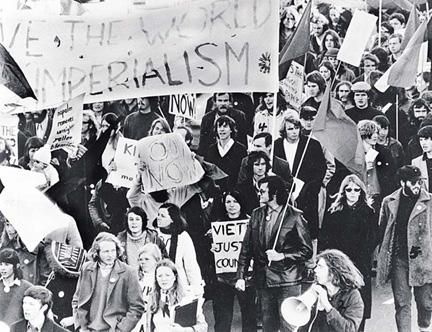
Much of that grew through a whole range of protests – Vietnam, Apartheid, Aboriginal Rights, and an article on the benefits and the mechanics of condoms. There were arrests, especially over the issue of the Draft (conscription), with the then Administrative Secretary of the Students’ Association, Diane Riddell, as “sort of the Super mum of almost everybody who would sort of bail us out of jail and, um, tell us to get our shit together …”.290Student Services and ANUSA are now located in the Di Riddell Student Centre in Kambri.
Jack noted that while he was briefly at Johns he was actually at various stages at 2 colleges:
“I was … at Ursies at a time when it

was all girls and I lived there for about, oh, 3 or 4 months. Sister Aggie (Sister Angela) … told me that she was going to turn a blind eye to it, as long as I didn’t go into the showers, loo’s before 9 o’clock. I was living with a girl there and later I was living with another girl there. … Johns was famous that you had to give 3 months’ notice before you left and they had never ever returned a bond that you’d put it. There was a fire in my room at one stage and I went down to see Tom Hegarty who was running the place at the time and I said, Tom, I don’t really think I belong here. And he said I heartily agree. I said I’m thinking of moving on and he said well, I think you should. And I said but I can’t afford to, I haven’t got any money. I’d certainly need my bond back … I left that day.”291
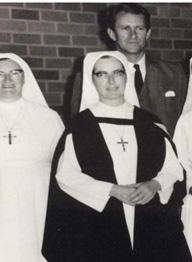
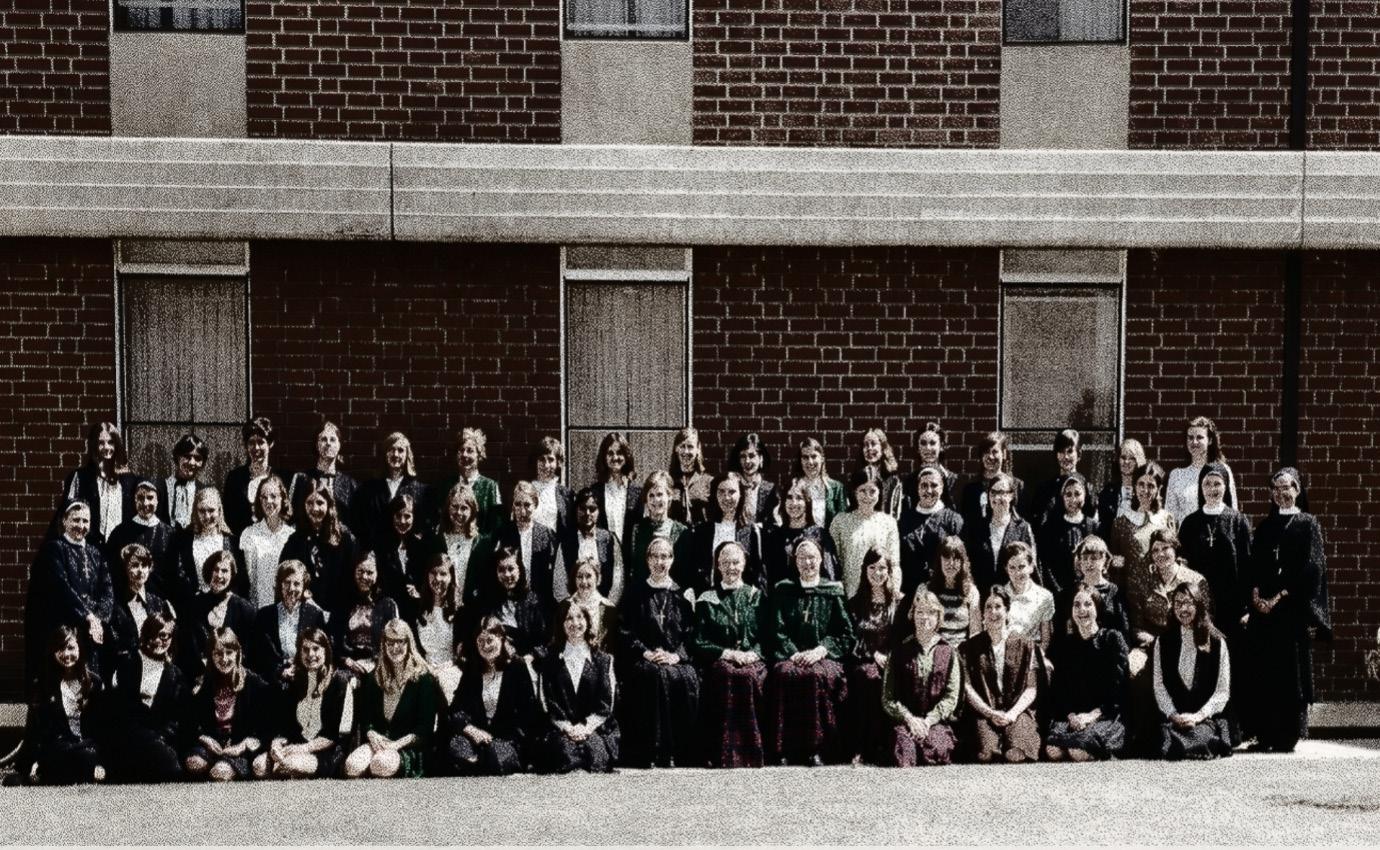
“… THE POTENTIAL HAZARDS OF HERDING YOUNG PEOPLE OF BOTH SEXES INTO ONE RESIDENCE”:
In 1971 Sister Angela admitted men to Ursula College, the first women’s college in Australia to do so. She mentioned that the founder of the Ursuline Order, Angela de Merici, always moved with the needs and demands of the times and that she was following that example. It is more than likely that it was also a wise financial decision. A John’s resident remembers a friend who had to leave the College in 1972 (he is not sure why but was a rugby player and probably was involved in a rugby-type game upstairs in the College) and they were offered a place in Ursula College by Sister Angela. “She was probably struggling to fill places and there was a bit of an outcry because of the lack of men’s facilities at that
time in the College, including no separate showers. Sister Angela said ‘get over it’! She was very pragmatic, very matter-of-fact.”
292
By 1972 John XXIII College was the only single sex residence on campus. There was still a reluctance for it to admit women. At a Dominican University Apostolate Conference held in Canberra in December that year, Father Hegarty remarked that:
“In justice to these young people, their elders should not create a situation which is a potential impediment to their studies and an actual temptation to immorality … Perhaps it is because we alone are genuinely concerned for the welfare and well-being of the young, that we see so much more clearly the potential hazards of herding young people of both sexes into one residence.” 293
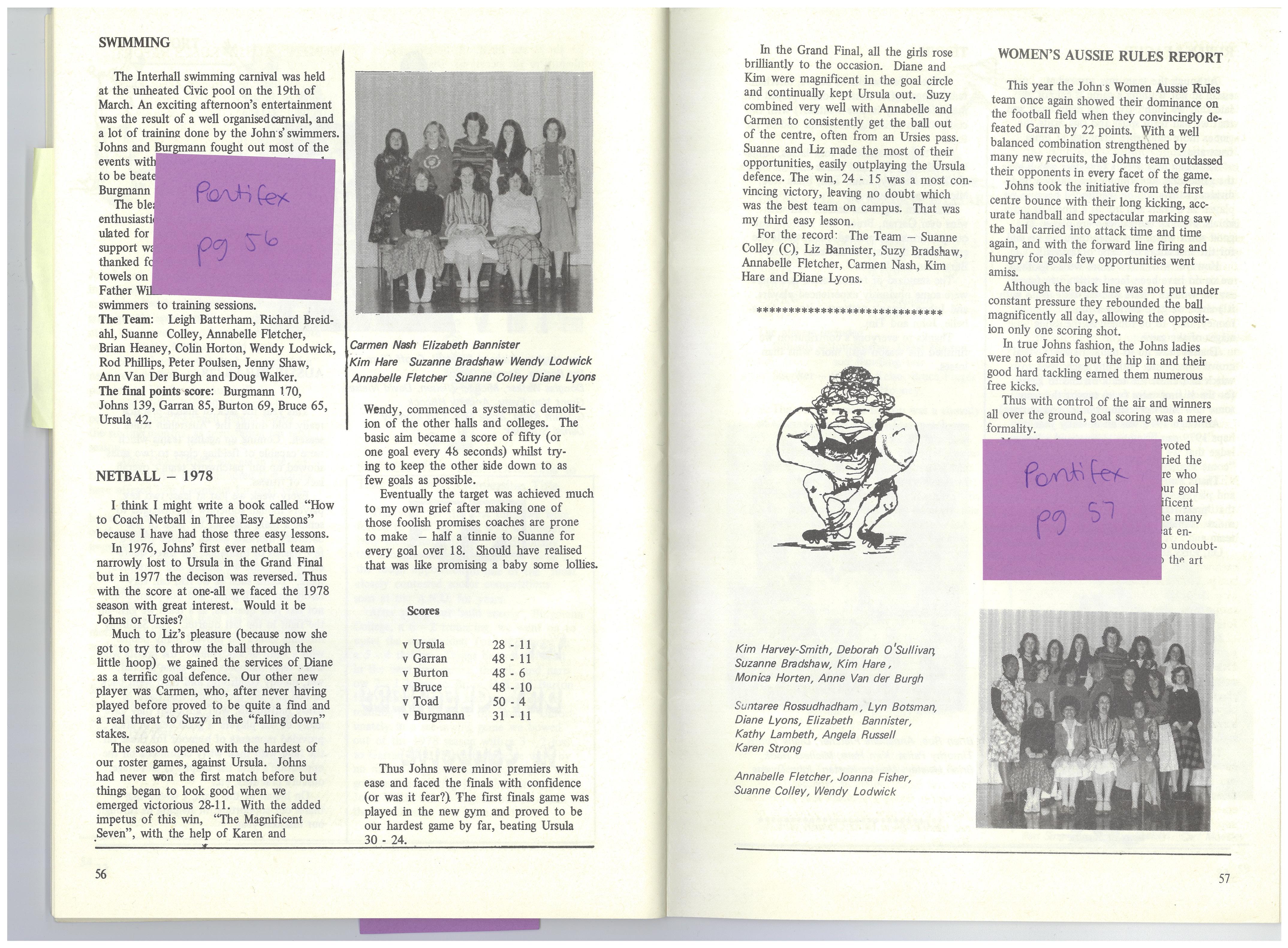
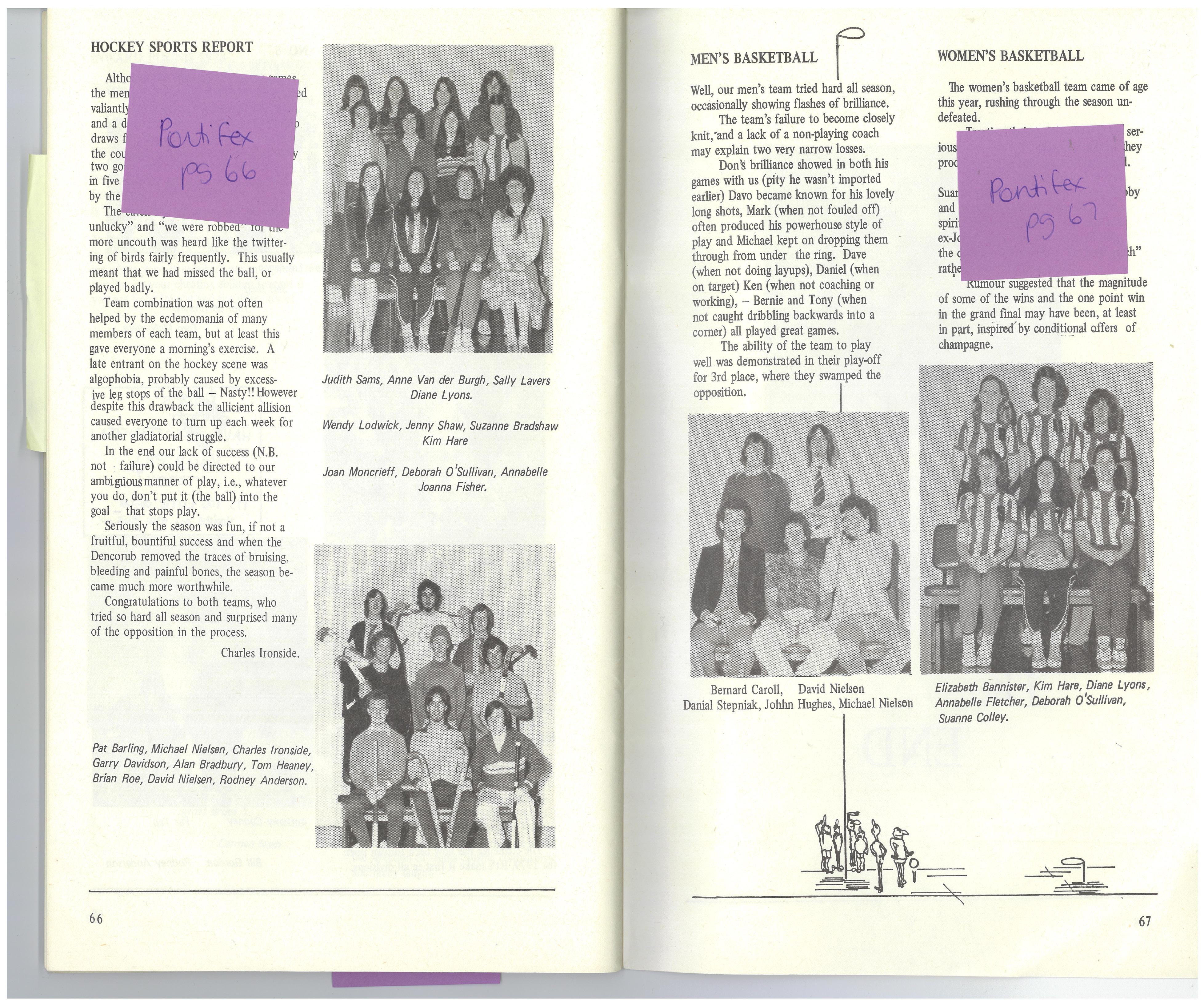
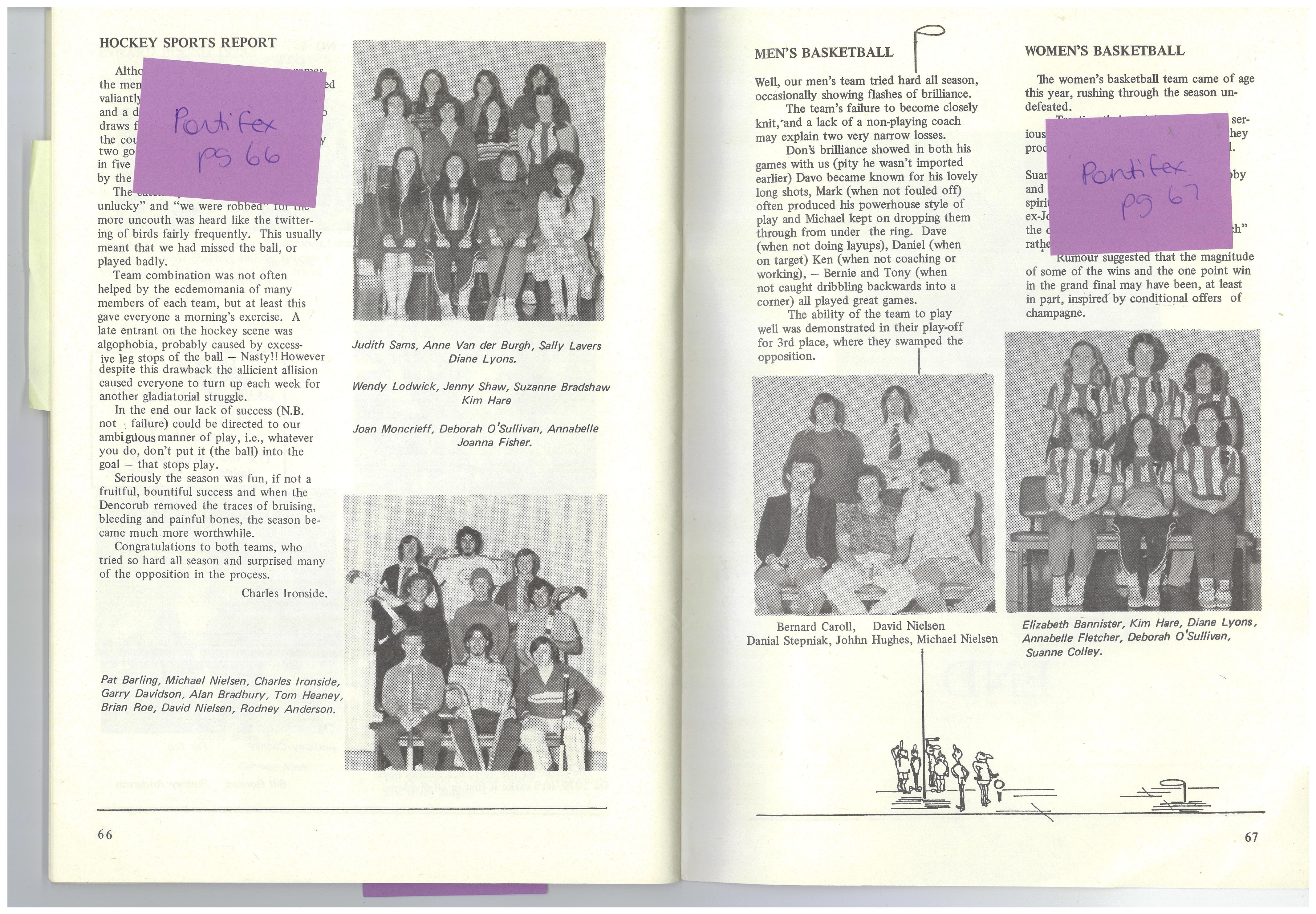
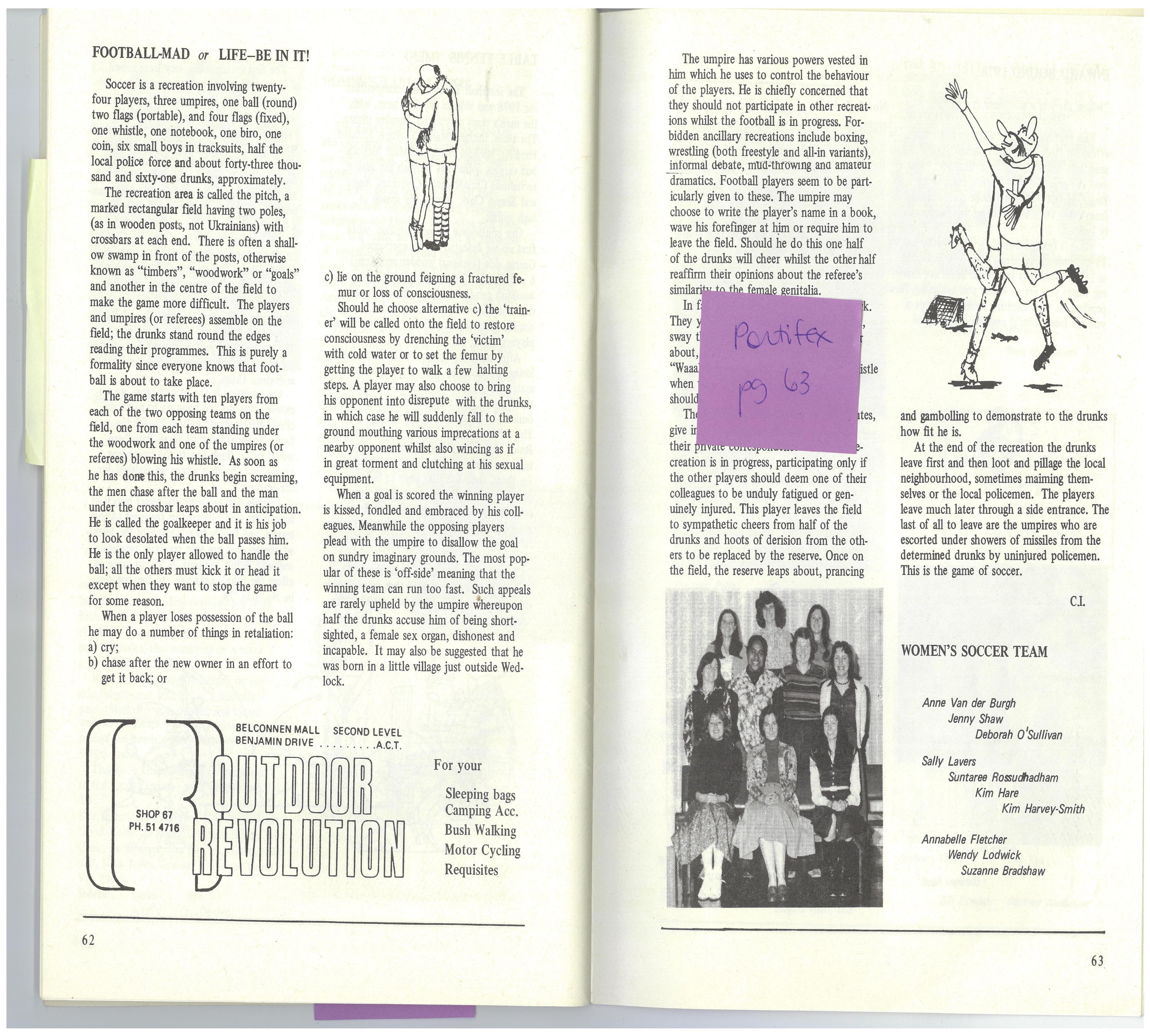
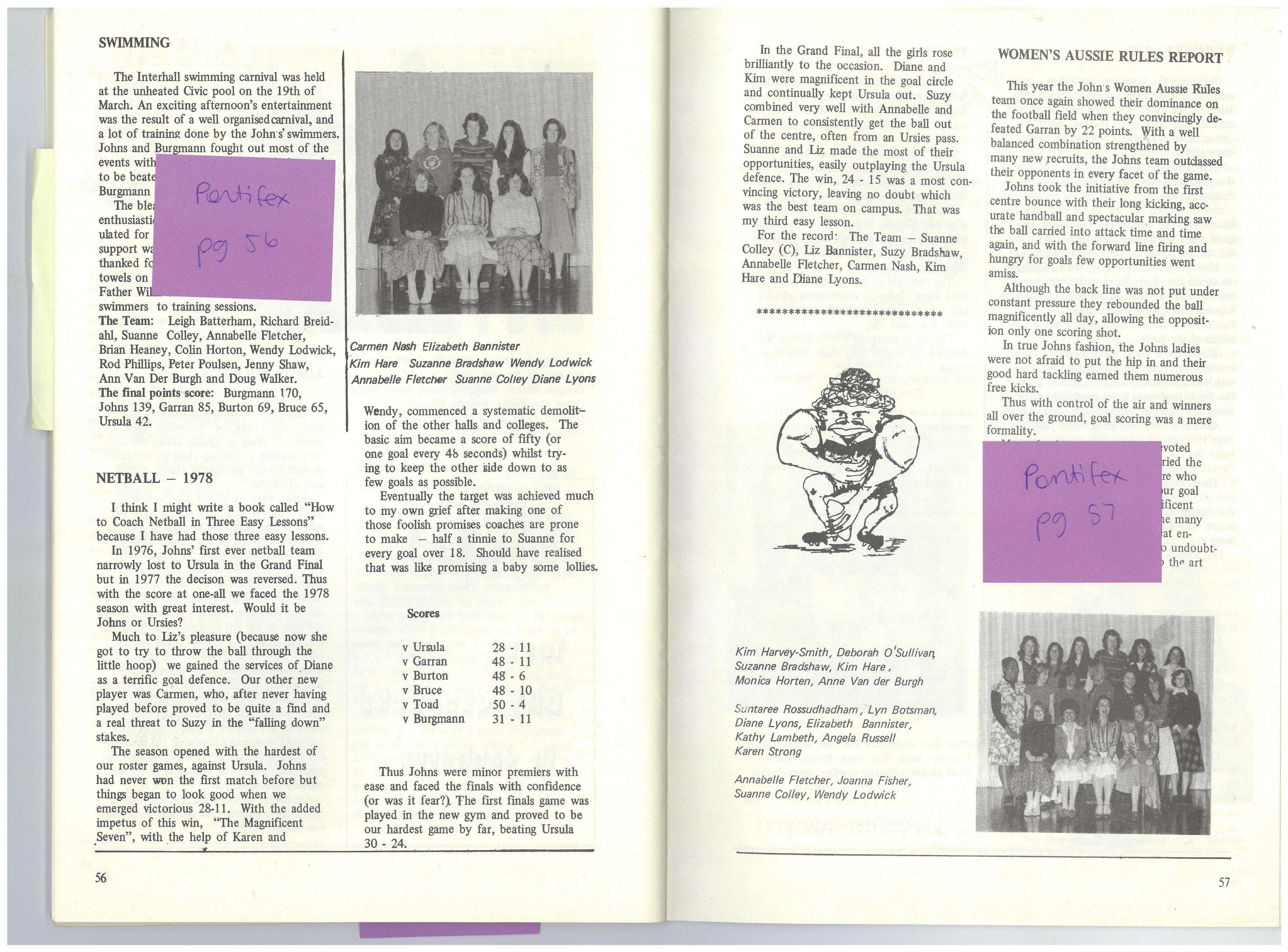
There is a common view that some 50296 women moved into John XXIII College in 1976, and that overall the admission of women made a positive impact on the nature and character of the College.
Some comments made by residents at that time include:
Sandra Harding (1976-1977)297– “I remember my interview with Father Hegarty who was a very kind man, generous and accepting … He also had high hopes that women in residence would help the Johns men behave rather better. They had quite the reputation … We were given male nicknames. As my family name was Stanley, I was ‘Stan’!... . I found a very welcoming community. There are all sorts of diabolical things that have happened everywhere, but in my recollection the women were treated incredibly well.
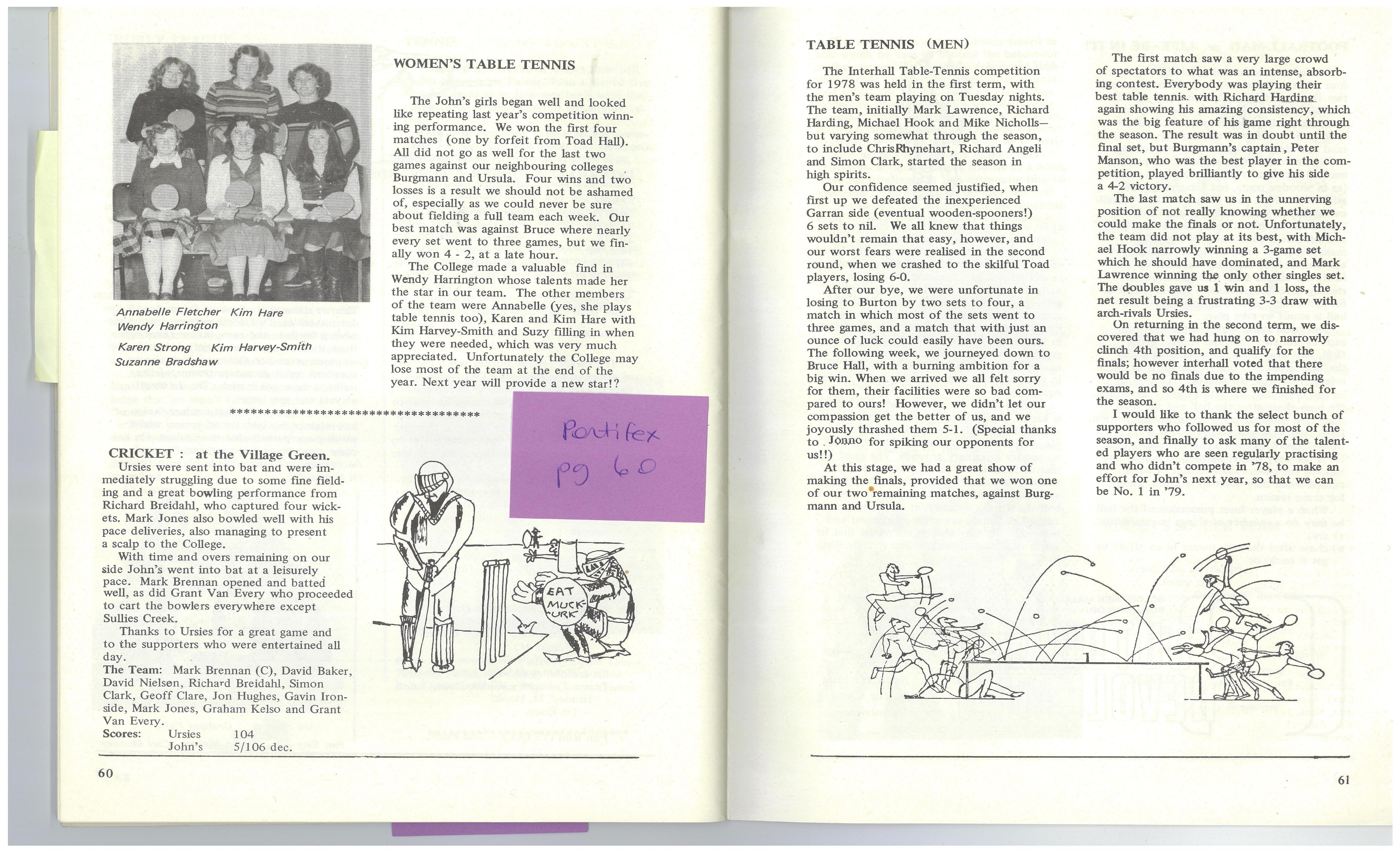
296. Approximately that number.
There were no suspicions of anything”.
Jeff Bost (1974-1978)298– “My period in College spanned the transition from all male to co-ed (and what a transformation of both internal tone and external perception that made!) … The women coming really changed the tone … They were terrific. In the first week, Fr Hegarty wasn’t happy with it (so reported – not sure if true) … a Fresher woman got ‘wasted’. She went into a cubicle in one of the two designated bathrooms and passed out. I was on duty so was involved in a ‘search and rescue’ operation. A male friend of mine went into the cubicle next door to where the fresher was. He stood on the seat but went through it, broke the cistern!! Cut himself trying to ‘rescue’ the fresher. Had to see Father Hegarty the next day and could see in his face that all his worst fears had been realised!! He was so pissed off! …I never heard about any other ‘incident’ involving the females. Things seemed to go well.”
297. Interview 13 November 2025. Emeritus Professor Sandra Harding AO became Vice-Chancellor & President of James Cook University 2007-2022
298. Interview with Jeff Bost op.cit.
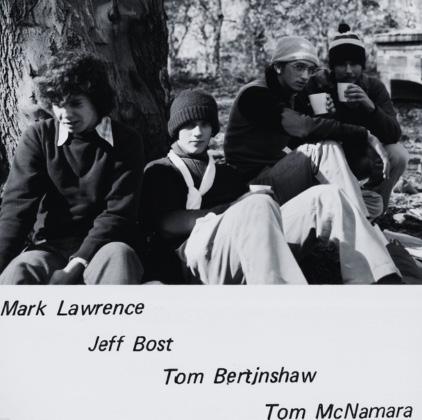
Andrew Tink 1972-1976)299 - “I was Senior Tutor in 76 when women were admitted. The students seemed to figure it out for themselves. We didn’t have any huge incidents that I can recall. Overall having women here for the first time was a huge civilising influence! … I don’t remember much/any talk about preparations for bringing in women. Discussions about it would have taken place before I was Senior Tutor. The ST sat on the governing Board; it might have been discussed but I was likely not on the Board then. There could have been financial pressures behind the move. The ST before me, Ian Nicholl, might have been privy to that sort of stuff. He was tragically killed (2007) on the Kings Hwy –so not around to recall.”
Michael Yabsley (1976-1977)300– Michael was very involved in campus and beyond in politics, and also was instrumental with friends to hold special dinner parties in the tutorial room at the end of corridors. They formed a ‘Rent a Party’ group! He still maintains contact with Sandra Harding (he was Best Man at her wedding) and for example with Annabelle Fletcher (Annie Nicholls). He notes that “the College meant a lot. They were years of great impact. Leaving home and leaving school and stepping into a very welcoming familiar collegiate environment was a great thing.”
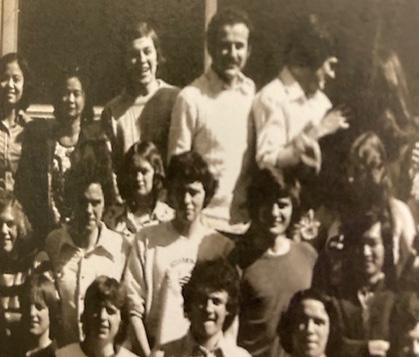
Frank Ingruber (1972-1976)301– “The place frankly had a terrible reputation on campus, and did not calm down until it went co-ed. A move that had been opposed by the Master for years and coincided with my election as President of the Student Association. With an activist team, including two future Australian Ambassadors, we presided over installing a barbecue, outside furniture, a volleyball court etc. Things that I was informed were still in use 25 years later.”
Phil Barresi302(1974-1976; 1978)302- “First two years were all male (at Daley Road in his time 74/75) and then the girls 1976. First two years J23 had a notorious reputation … I’ve met lifelong friends (incl. Shane Stone) – but the maliciousness of the Rugby boys (‘Rugger Buggers’), they were violent even amongst themselves. They had a premier rugby league team – they would injure themselves in training!! The antics they got up to – setting fire in hallways, turning fire extinguisher into someone’s bedroom; tearing a bedroom completely apart and then setting it up in the quadrangle etc.
301.
302.
Then the ladies arrived – and the whole atmosphere changed … We had co-ed facilities. The rugby guys were weeded out.
By the time we got to ’77 it was a new college.”
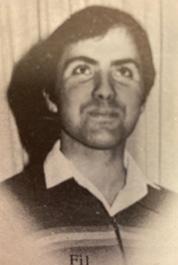
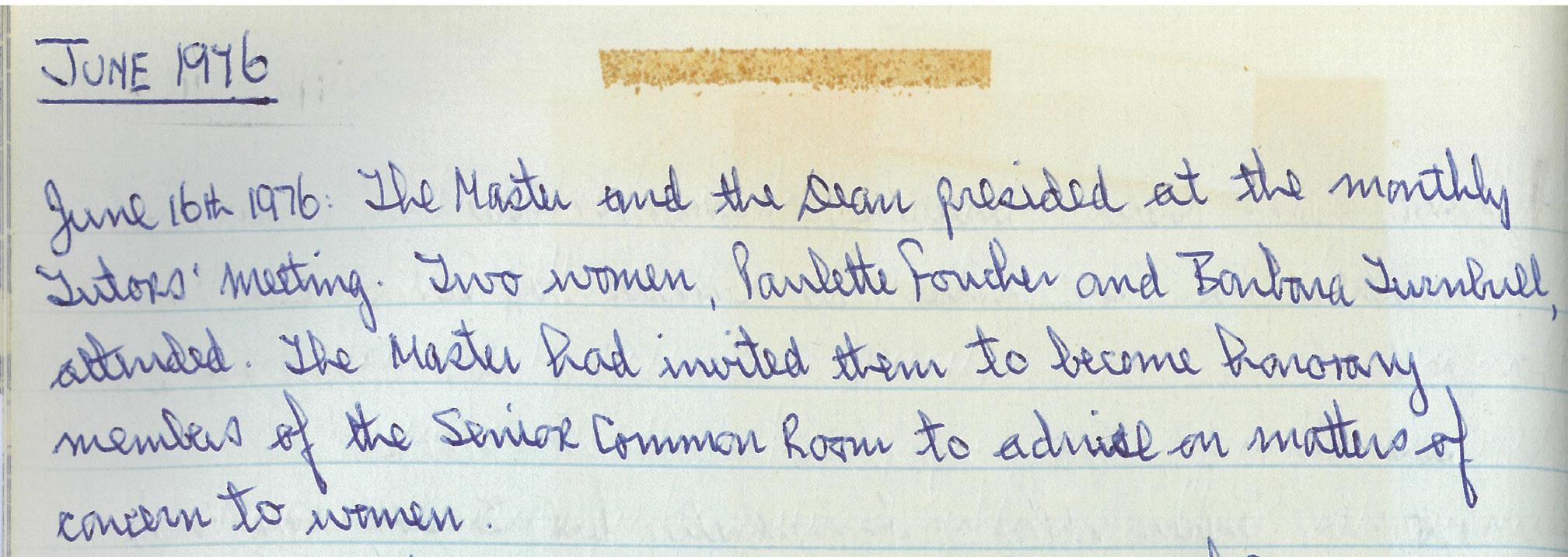
On 16 June 1976 two women attended the monthly tutors’ meeting. They had been invited by the Master to be honorary members of the Senior Common Room to advise on matters of concern to women.
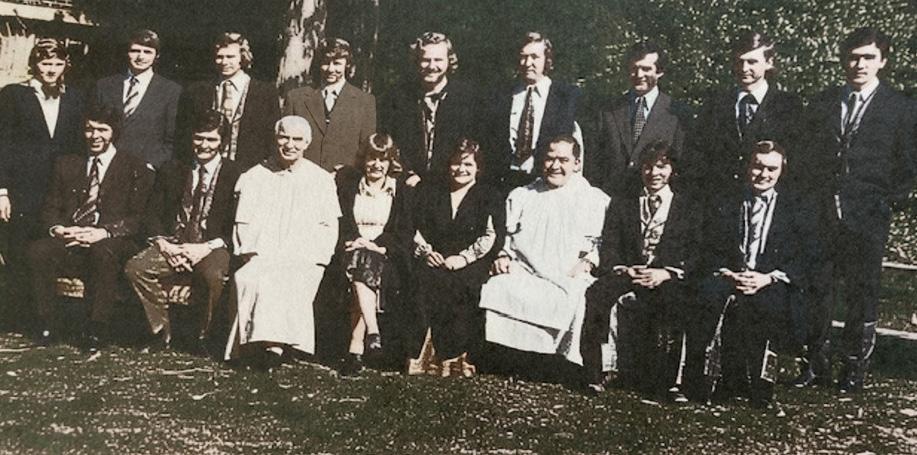
Barbara Turnbull and Joanne Kildea in the front row of the SCR 1976. To the left of Father Hegarty is Andrew Tink (Senior Tutor 1976) and to the right of Joanne Kildea is Father Jackson who in 1976 replaced Father Keating as Dean.
299. Interview with Andrew Tink op.cit.
300. Interview with Michael Yabsley op.cit. He became a Liberal Member of the NSW Legislative Assembly in 1984 and was Assistant Minister for Roads, Minister for Corrective Services and for State Development.
Sandra Harding does not recall that there were any women on the JCR Committee in 1976. She was a 2nd year student in 1976, but most of the first women would have been in 1st year.303Along with quite a number missing
from the Block photos, Sandra Stanley (Harding) is listed as not in the Block B photo. Her husband, Kevin Harding, is missing from the Black A photo.
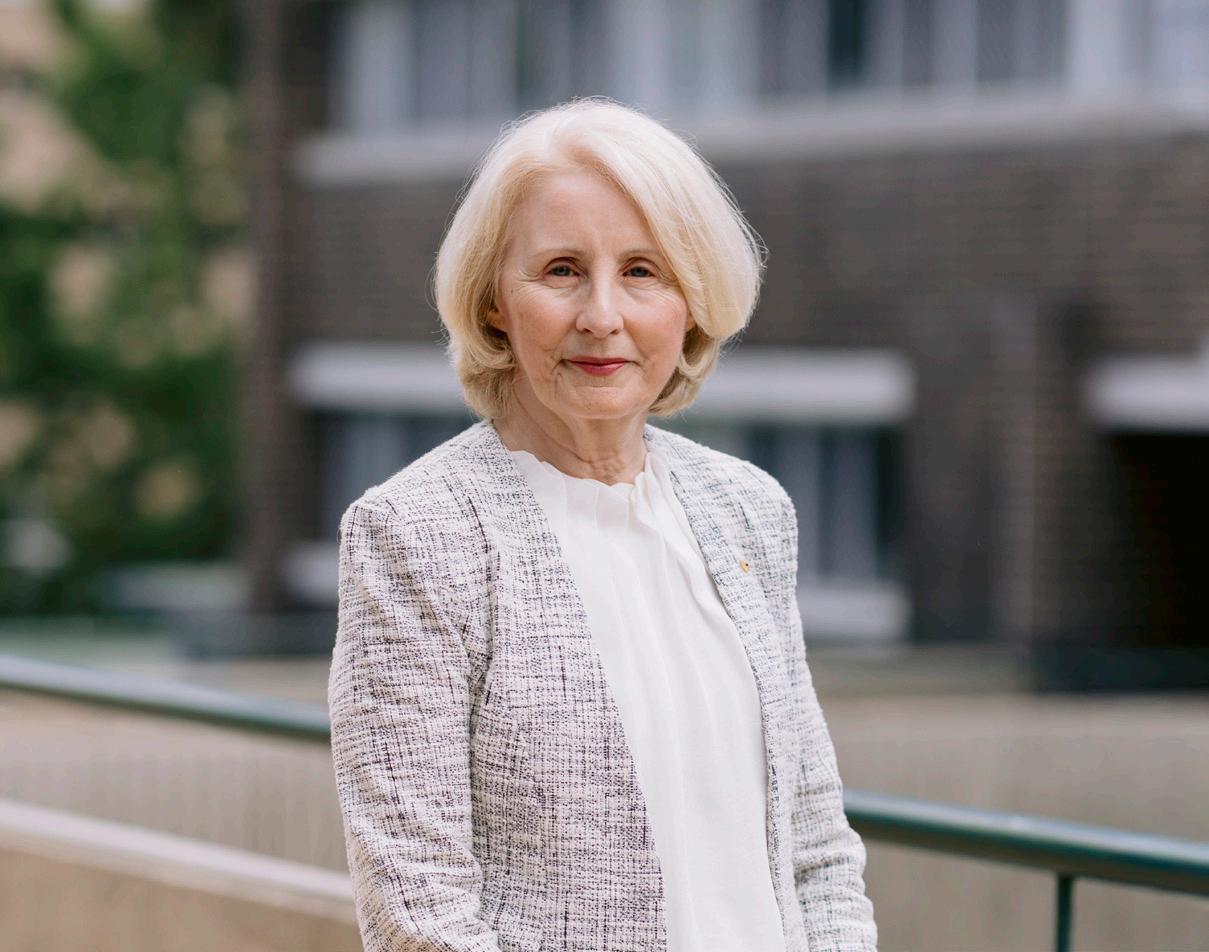
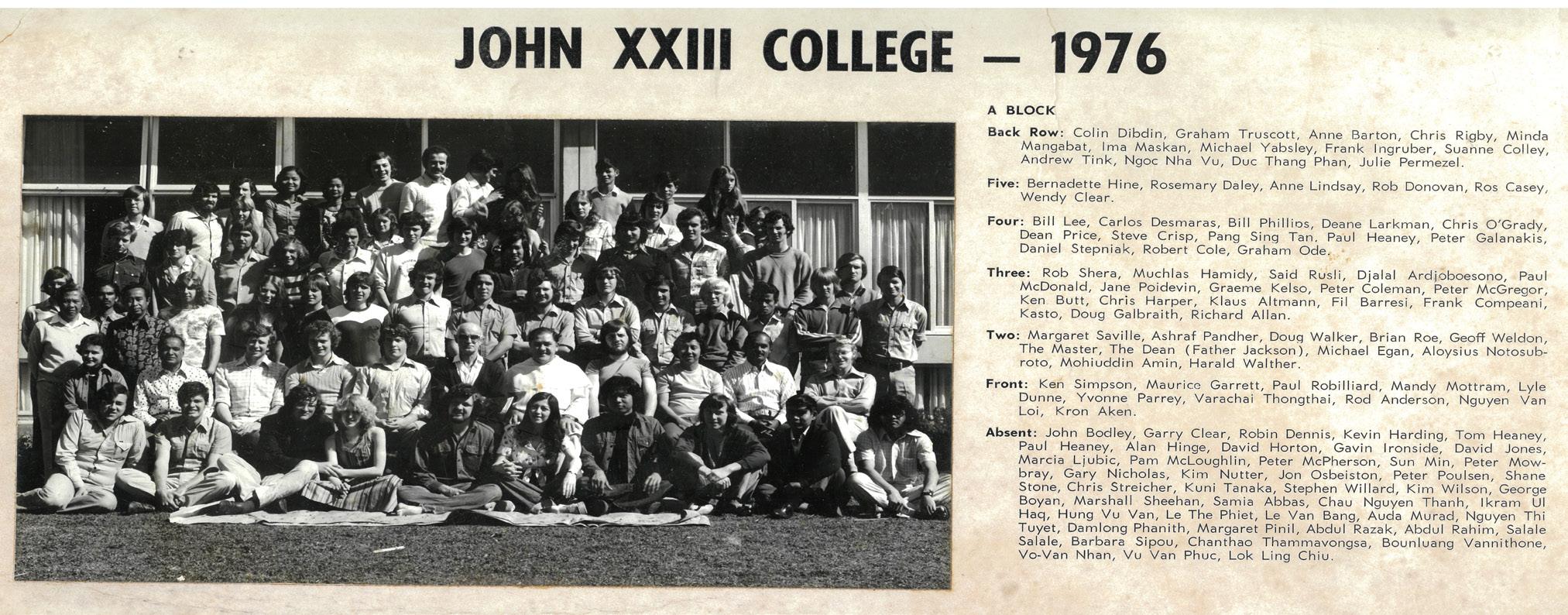
303.
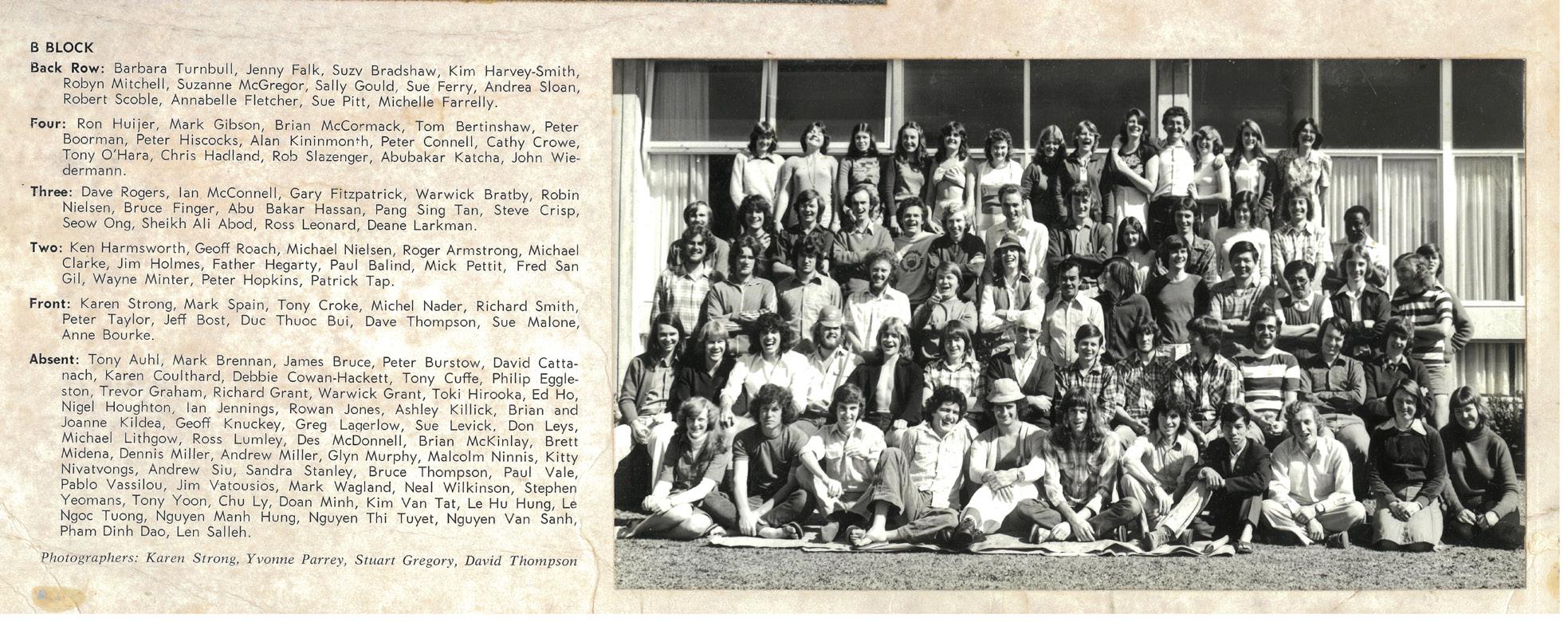
While the admission of women in 1976 did not stop incidents of behaviour that were demeaning and harmful to women, as evidenced for example in highly publicised cases in the 1990s and the first decades of the 21st century (as occurred in other colleges and halls across Australia), it was clearly seen as having a positive impact on community life, both in relation to the earlier years of the College’s foundation and to behaviour that was rather expected and even in some ways
condoned at the time. Father Hegarty’s fears and concerns were no doubt very real and widely supported within the Church and beyond. For ANU it was, however, the last and somewhat delayed move of its kind:
“… an excellent move which not only helped to bring residents into vacant rooms but lifted the morale (and moral reputation) of the college by bringing to bear upon it the influence of feminine ideas and initiatives.” 305
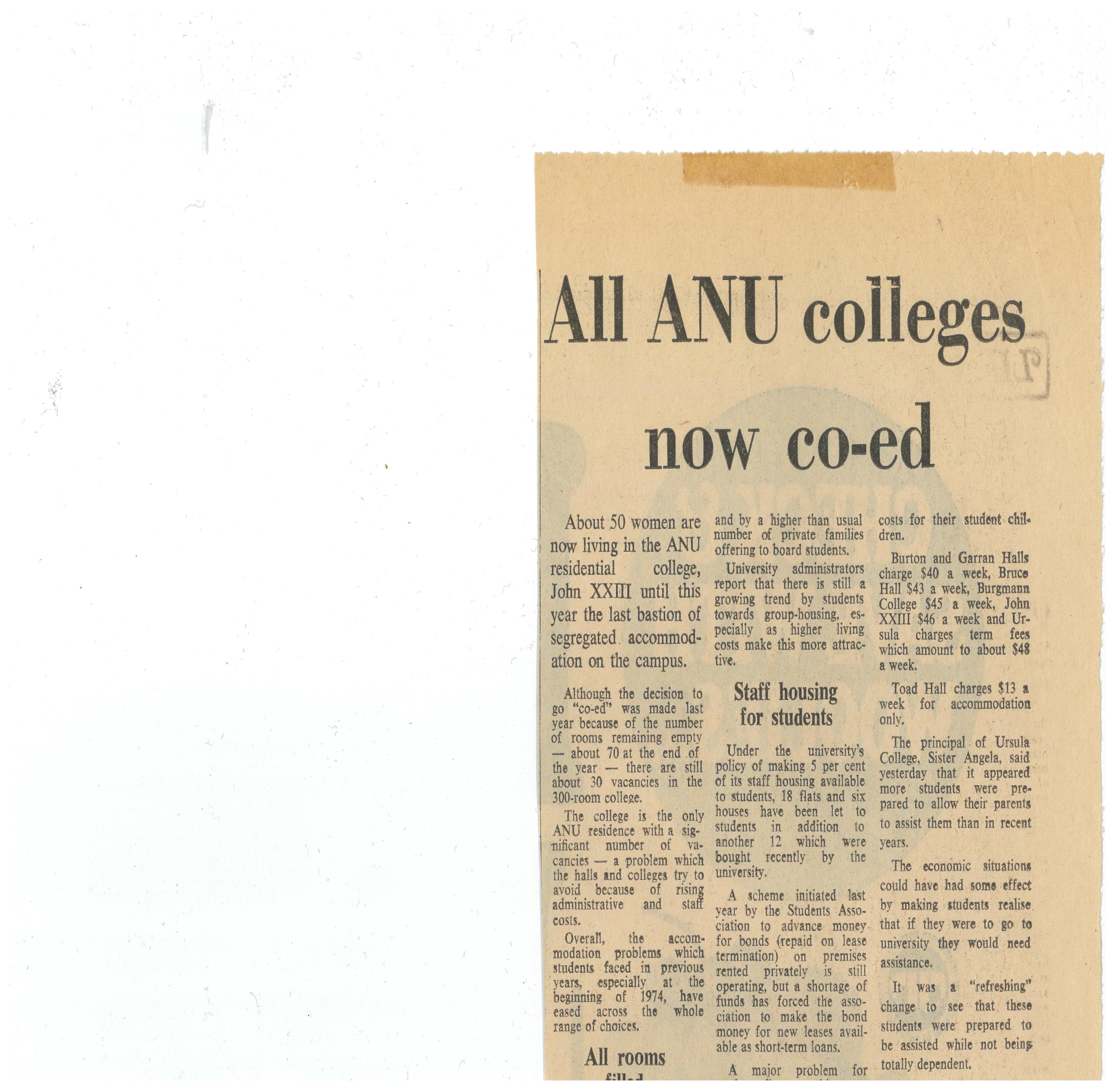
In 1976 the Reverend Father Dr Paul Jackson OP was appointed Dean, replacing Father Maurice Keating who left the College in 1975. He was “a character. Friar Tuck. Liked a beer and smoked. Chiko would give him an extra steak. He would sit at the end of the table closest to the kitchen. He would give Chiko a thumbs up!”306
Over the summer vacation period 1977/1978 Father Jackson suffered a stroke and did not return to the College for some 6 months. He “barely survived. When he came back he was skinny, drooped and walked with a cane.”307 Michael Yabsley recalls that Father Jackson “went from being a very active ‘larger than life’ person to someone who had all the signs of a fairly major stroke; he was pretty infirm when he was back in the College.”308
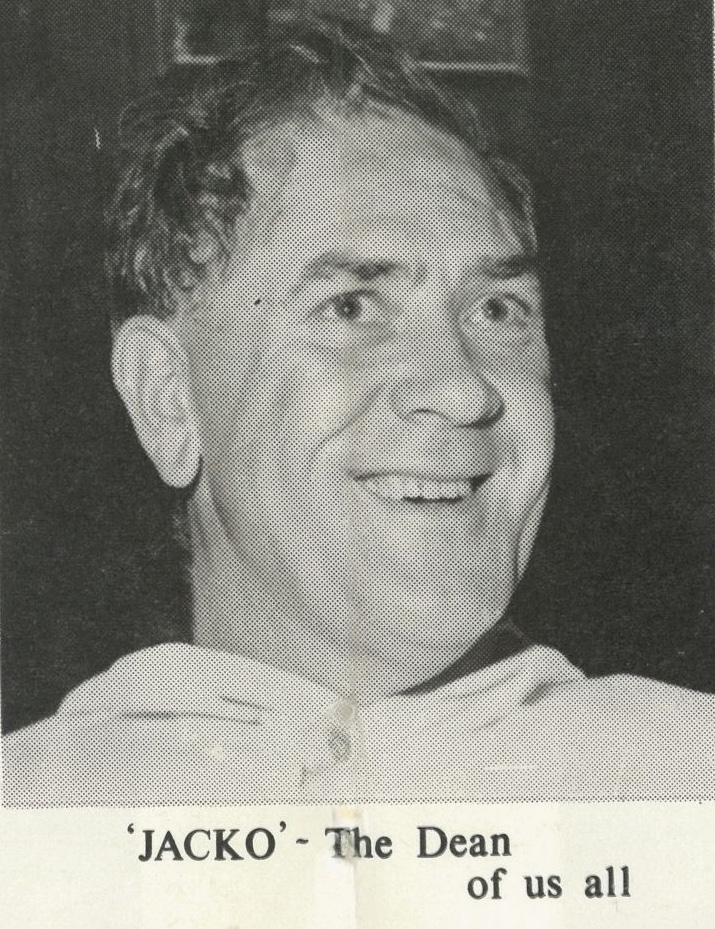
Despite being paralysed on his left side, he continued after his return to the College as Dean and in 1981 he was appointed Master. He left the College at the end of 1987.309
The new co-ed community continued to engage in the range of events, sports and other activities in 1976 that had become an annual part of the College calendar, including ‘John’s Day’ which was inaugurated on Sunday 7 October 1973, and ‘St Dominic’s Day’ held early in August close to or coinciding with ‘Bush Week’. John’s Day in 1976 was held on 10 October, starting with a chicken and champagne breakfast, followed by a variety of games such as ‘toss the tinny (or gumboots, or champagne corks etc.), three-legged races, tug-o-war, pyramid building egg and spoon race, and so on! A College Revue was held in the evening, followed presentation of sporting trophies and a disco after dinner. “A long day” notes Yvonne Parrey!!310
308.
309.
310.
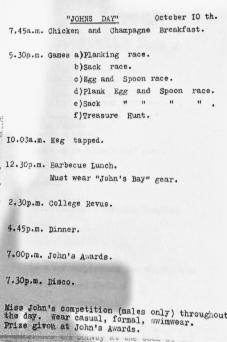
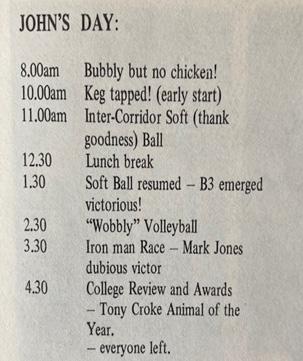
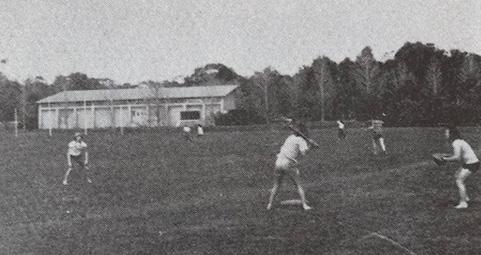
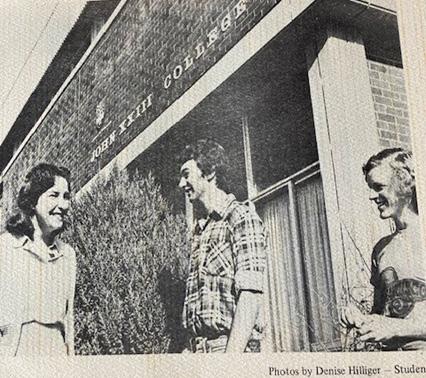
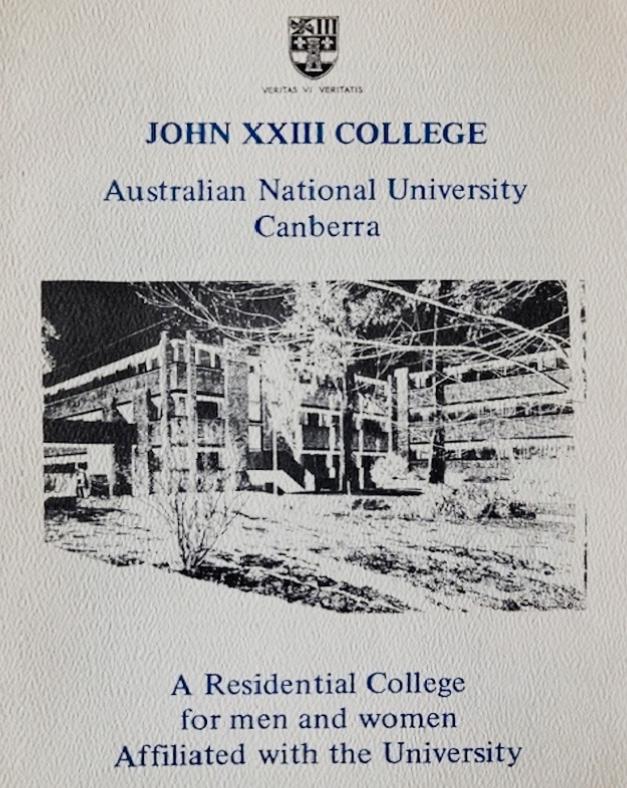
The appointment of Shane Stone, later to be Chief Minister of the Northern Territory, as a tutor in 1977 gives some indication of what was then expected of the role of tutor. His reflection as part of a family history also gives some sense of both the University and College at that time.
“Men of reflection, intellect and scholarship gave substance to the road map that people like me adopted as my own … I was privileged to be lectured by Professor Les Crisp appointed Chifley’s director-general of postwar reconstruction in 1949. Like my father, Crisp spoke of how growing up in the Depression years shaped his world view which included a lifelong membership of the Australian Labor Party. He was open and frank that his political allegiance coloured his teaching, nonetheless he was a walking talking record of an important part of Australia’s history and I never missed his lectures. He was at times a crusty old coot but indulged those of us who wanted to spend time talking politics, including a ‘Tory’ like me … In Contemporary Chinese studies I was presented with the opportunity to meet
the great C.P Fitzgerald, the famous ‘China watcher’ who was there for the aftermath of the Boxer Rebellion, the fall of the Qing Dynasty, the rise of the First Republic and Sun Yat-sen. Also, his name sake Stephen Fitzgerald our first Ambassador to ‘Red China’. Later, Stephen and I would work together in advancing the interests of the NT in China and I would serve on his Advisory Board of the Asia-Australia Institute at the University of New South Wales.
At ANU I lived in residence at John XXIII College first as a student and in the following year as a resident tutor 1976 to 1977. John XXIII was also home to a number of Liberal wanabees who made it – Phil Barresi, Andrew Tink and Michael Yabsley to name three. A number of others went onto distinguished careers in business and the diplomatic service, for example Ambassador Frank Ingruber. Kevin Rudd would end up next door at Burgmann College.
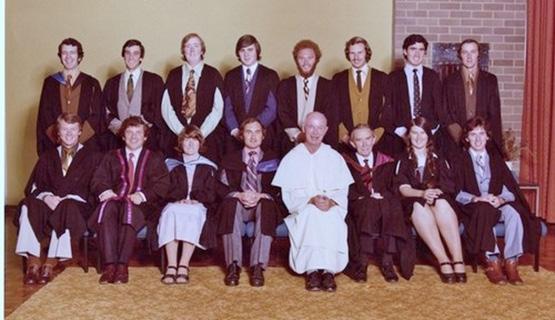
We had a great time at ANU and I look back on those two years with fond memories and great affection - including my tenure as the bar manager. It was at John XXIII College that I met first year law student Josephine Novak in 1976. We married later that same year after a whirlwind romance and transferred our studies to Melbourne where I was paying off a small apartment dating from my time at the Institute of Catholic Education. It seemed the sensible thing to do since staying in college as a married couple was hardly ideal.”311
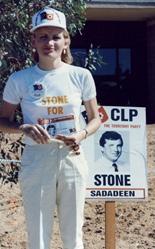
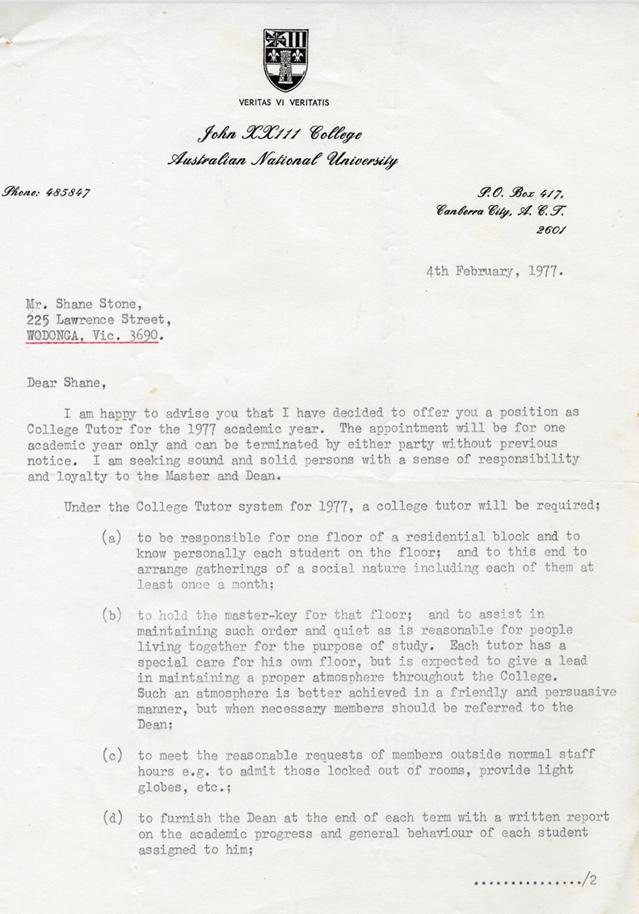
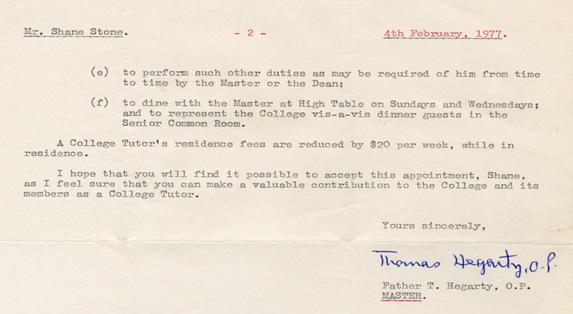
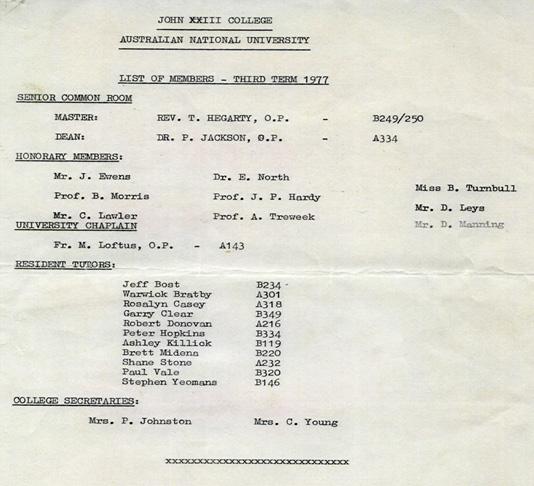
312. Tutor_John_XXIIIrd_College_ANU_circa_1977 (3).pdf
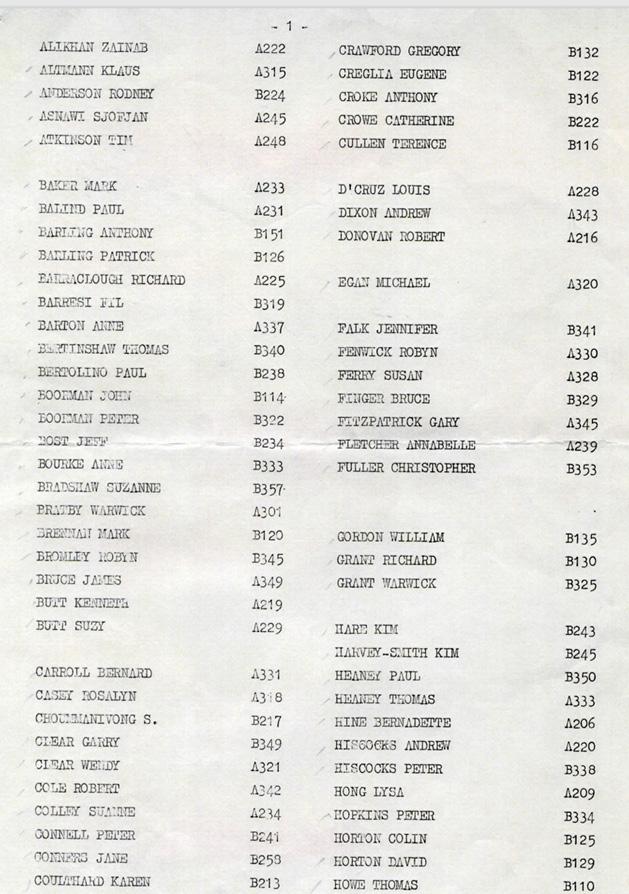
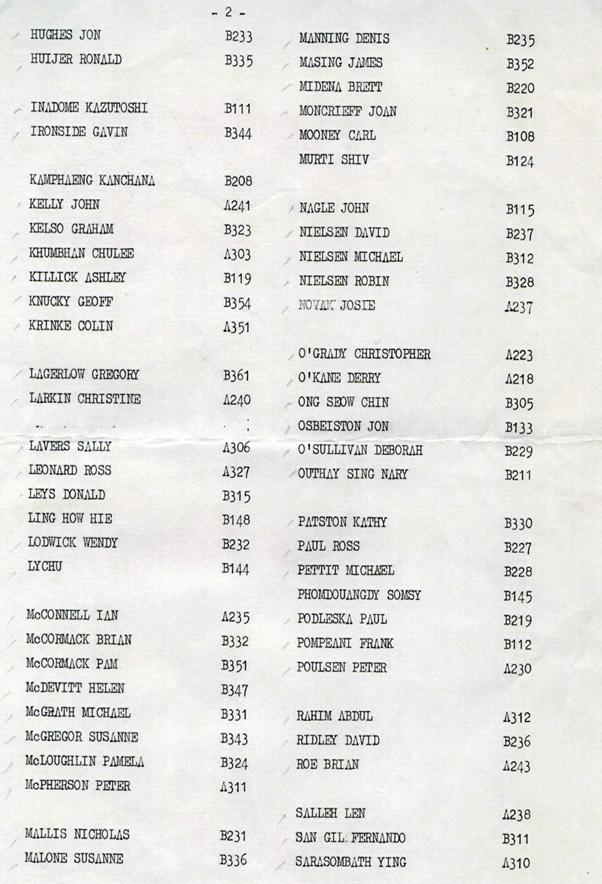
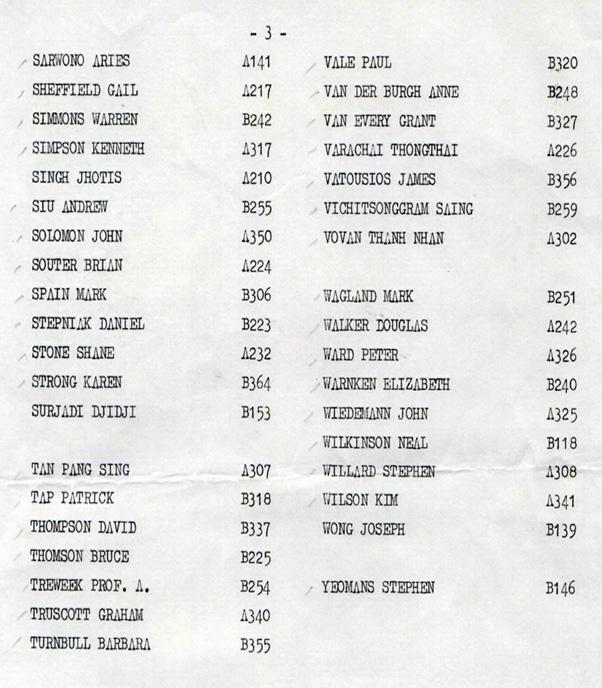
“CO-RESIDENTIALITY
At the end of January 1977, a heavy rainstorm combined with gutters clogged with leaves caused costly problems for parts of the College’s residential blocks and the Chapel. A month later another storm caused flooding
and significant roof leaks. While Yvonne Parrey notes that “the experimental introduction of co-residentiality was working very well and there was a more harmonious tone”, she reports the rather expected controversial activities of ‘Bush Week’ that year, again including the throwing of flour bombs at cars passing in front of the College.315
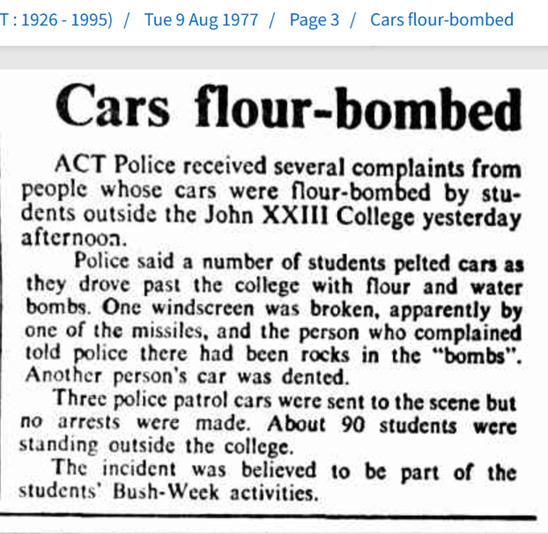
314. Yvonne Parrey op.cit. Ch.2, p.6. This is a time of year that weather like this seems to have a particular impact on campus buildings, most recently in January 2020 when a hail storm did widespread damage across the campus including to University House which is expected to re-open after repairs and restoration in August 2026! 315. Ibid.
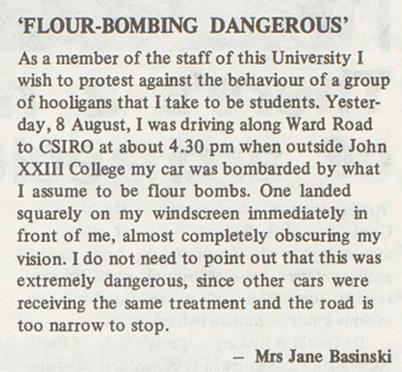
Canberra Times
ANU Reporter Vol. 8, No.13, 26 August 1977
A significant announcement in 1977 was that Father Hegarty’s term as Master for nearly 10 years was to come to an end in December that year. He was appointed Dean at Mannix College. The new Master in 1978 was to be Father Thomas Fitzgerald who had been the inaugural Master of St. Albert’s College at UNE.
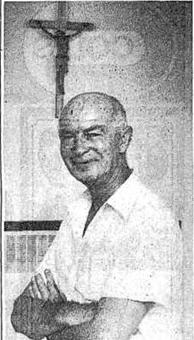
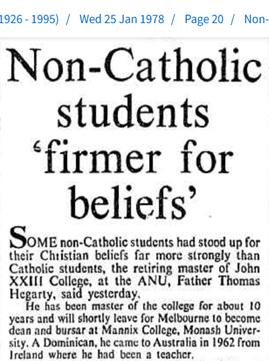
In a Canberra Times reflection, Father Hegarty believed that about 90 per cent of students were not interested in demonstrations, disruption and being difficult. He felt that most Christians at university supported their faith and that non-Catholics seemed braver, and would express their views far more emphatically than Catholics.
At a time when many ANU students were increasingly concerned about accommodation fees and facilities, Father Hegarty expressed great satisfaction that the College “was the
only one at the ANU which had continued to provide full room service. He also spoke highly of the formal meals where students wore academic gowns.” 316
There is no doubt that Father Hegarty was a deeply committed and caring Christian leader, albeit a conservative constantly challenged by a cohort of students over a period of what he believed to be one of “dramatic change in undergraduates since 1966.”317
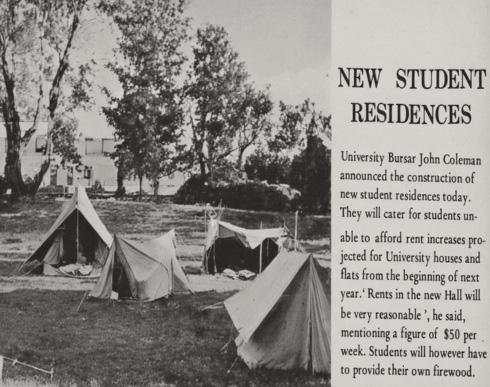
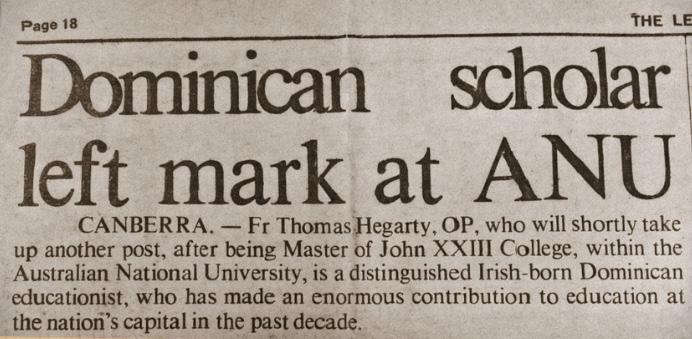
Another article included a comment from “a spokesman closely connected with the college” that Father Hegarty was “an outstanding preacher, a wise and tolerant administrator and a natural gentleman who stands as a solid rock for the enduring principles in life in these days of ‘change for change sake’ … His one intolerance is towards any student or member of the college who would tend to think or behave in a manner unworthy of a Christian and intelligent person.”
In many ways, the words of Father Laurence Fitzgerald O.P., Master of John XXIII College in the later 1980s and foundation Master of
Mannix College, reflect much of what Father Hegarty represented:
“We Dominican friars have to keep reminding ourselves not to get so smothered in academic and financial administration that we forget that we came to offer something special; the long tradition of the Catholic Church’s package of human values. We are not here to force them down anyone’s throat – and we have never done that – but rather to make the Sacraments and teachings of the Church available to Catholic students, and … to be all things to all people of all persuasions in giving witness to the Christian faith.”318
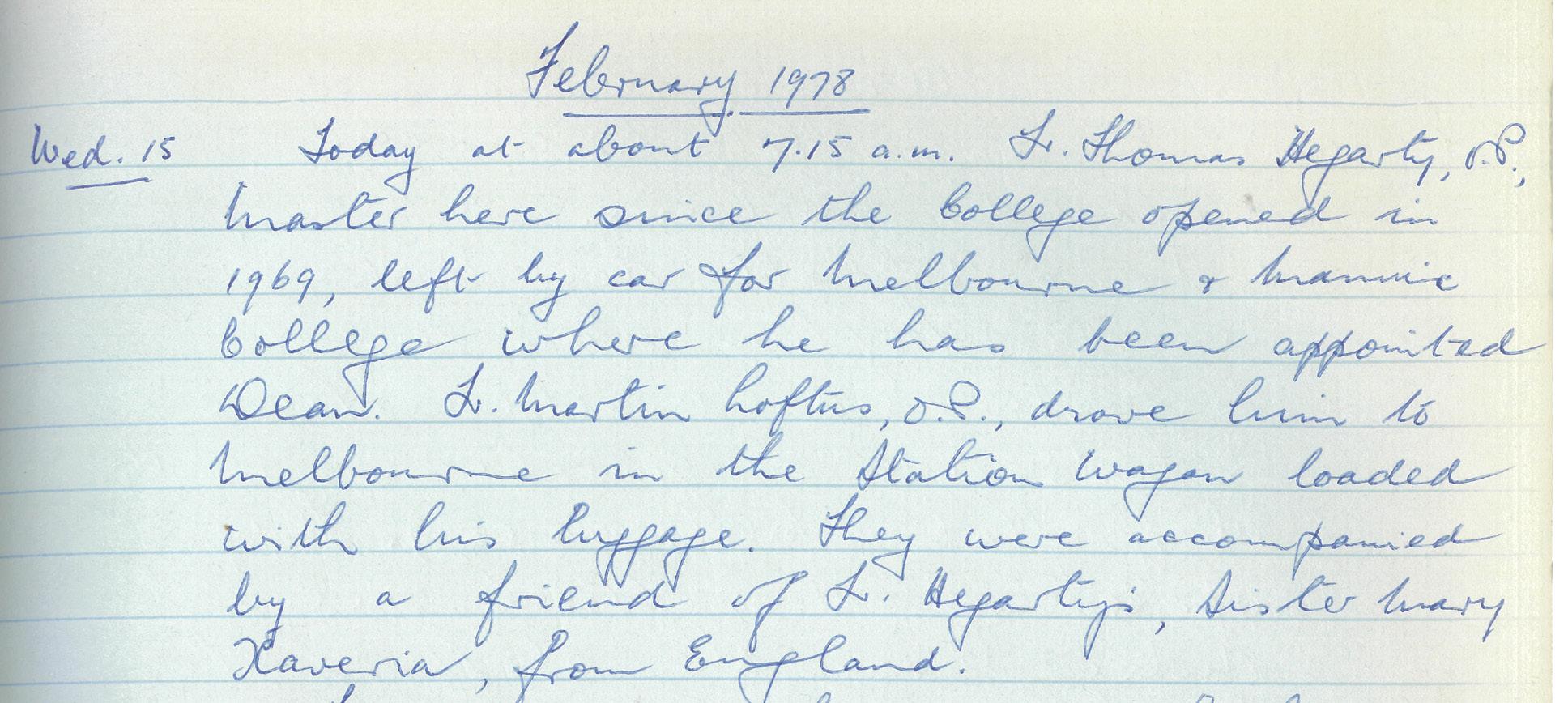
In December 1977 the Dominican Provincial, Father Peter Galvin O.P., wrote to Archbishop Cahill informing him of the appointment of Father Thomas Fitzgerald O.P. as the new Master of John XXIII College. Prior to being the inaugural Master of St. Albert’s College at UNE he had been Master of Aquinas College at the University of Otago, Dunedin, New Zealand. Archbishop Cahill replied that he was sure Father Fitzgerald would “competently continue the good work done by Father Hegarty.”320Father Fitzgerald arrived at the College in February 1978.
Father Hegarty was Dean at Mannix College for only one term before returning to
Ireland where he ministered in Tralee until his death in 2001.321
Jeff Bost recalls that Father Fitzgerald was something of a ‘breath of fresh air’: “After O’Week he took us up to the restaurant at the top of Red Hill and we had a splash-up dinner on the College account, with the new Master declaring that ‘you may as well go first class!’” 322
No doubt a great way to start the next chapter of the College’s history!
319. College administration diary
320. Letters of 26 December 1977 and 5 January 1978, Archdiocese of Canberra and Goulburn archives.
321. Dr Gabrielle L. McMullen Omnia Omnibus: All things to all Collegians – the first twenty-five years of Mannix College Monash University Publications Committee, July 1993, Ch.3, p.45
322. Jeff Bost interview op.cit.
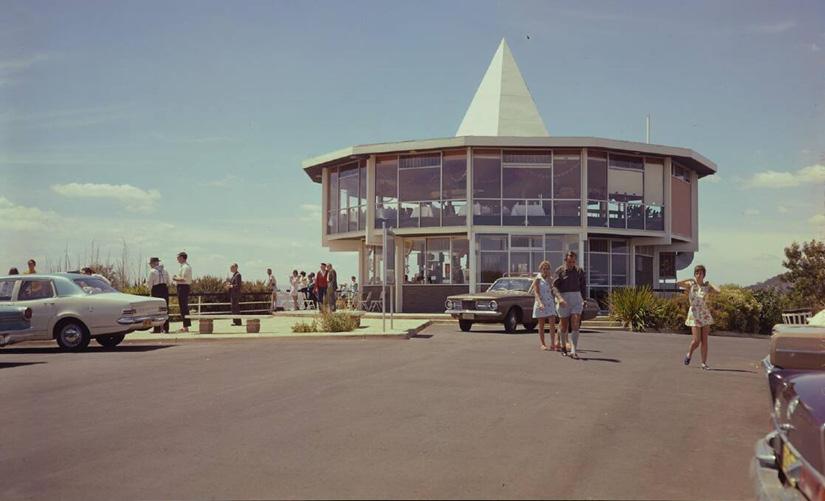
AERIAL VIEW OF WESTERN CAMPUS OF THE ANU 1975