














By Samir Iydroose
Awilda Candelaria can drive to the library, but recently, she’s had no need to.
The New Haven Free Public Library’s (NHFPL) Readmobile has made that unnecessary.
The Readmobile, a 26-foot long orange bus that stopped in Fair Haven Tuesday morning, is a mobile library branch that makes visits to Fair Haven, Fair Haven Heights, and the East Shore each week. Launched in late May, the bus stops at the Atwater Senior Center on Tuesdays from 10 a.m. to noon, Bella Vista Apartments on Tuesdays from 1 to 2:30 p.m. and the East Shore Senior Center on Wednesdays from 10 a.m. to noon.
“The Readmobile is our ‘library on wheels,’ designed to expand equitable access to library services by bringing books, materials, programs, and connections directly to residents,” said City Librarian Maria Bernhey at the launch earlier this summer. “The Readmobile plays a key role in advancing literacy, lifelong learning, digital access, and community connection. Library staff are excited to be with residents and visit locations across the Elm City.”
Candelaria, who has been coming to the Atwater Senior Center for three years, is a perfect example of how it works. During her visit on Tuesday, she returned an old book, and checked out a book about chair yoga, which she hadn’t been looking for, but found while browsing.
“It is the only kind of yoga I can do,” she said. “If I throw myself on the floor, I cannot get up, so this is great.” Candelaria said she goes weekly or biweekly to the Readmobile, and said she finds a lot of cool things.
“Before I retired, it was work work

work then I had my kid’s activities and sports, so I didn’t go to the library,” she said. “I love [the Readmobile] because of the availability.”
The Readmobile was first introduced in 2001, though the current vehicle was introduced in 2014. In its initial years, it focused primarily on getting books to children, but as of June 2026, there are scheduled visits to various historically underserved communities that would normally be unable to go to one of New Haven’s five public library branches.
So far in 2026, with the bus operating for three months, the Readmobile has surpassed the total circulation for the entirety of 2025, and “almost doubled” the number of community members it has served, according to NHFPL Public Services Administrator Rory Martorana.
In 2024, the Readmobile circulated 68
books, serving a total of 462 people over eight stops. Last year, it circulated 309 books, serving almost 950 patrons. This year, that number is up to over 400 books, and almost 250 community members with months to go. Since this May, the Readmobile has made 17 stops and outreach visits, compared to 22 in the entirety of 2025.
Two people operate and manage the bus: Ryan Munasinghe, who works in the Young Minds & Family Learning (YMFL) department, and Gino Cordone, who works at Ives Squared, a makerspace inside the Ives Branch.
Cordone has been working on the bus for a year, and said that he and Munasinghe have a “very cavalier attitude in serving the public.” Both enjoy working on the bus and hope to operate it on a more fulltime basis in the future.
“Right now, we are really only using the bus on Tuesdays and Wednesdays, and maybe some events,” Cordone said. “There are so many people who are disabled or elderly who can’t make it to the library, and we should be able to bring the library to them.”
“It is a seemingly small thing, you know bringing books to people,” said Munasinghe, who has been working on the Readmobile for two years. “But, it is significantly important. I was a late bloomer in reading, and it totally changed my life, and going to the library was a huge part of what started it. So, like if I had this when I was like 10 or 12, who knows, I might have started earlier.”
In addition to books, the bus has an awning for sunny days, a vacuum to clean the carpet, and a wheelchair ramp. It is also air conditioned.
“Sometimes we get people to come in off the sidewalk for [the air conditioning],” Cordone said. “Then we sucker ‘em into a library card.”
The vehicle is also built with shelves that are angled upward, and custom “ear ends,” in order to prevent the books from “flying off” or falling sideways when the bus turns or starts moving. Cordone said that these measures “only sometimes work.”
The bus is also chaperoned by two stuffed animals: a tiger, who doesn’t have a name and was recently left behind from a baby shower that the Readmobile went to last week, and Spidey, a stuffed spider and longtime resident of the Readmobile. “Kids really love [Spidey] and they ask to take him but we can't loan it out,” said Cordone. “We refuse to put a barcode in him.”
The collection in the Readmobile is curated by Soma Mitra, the YMFL supervisor, and Martorana. Munasinghe and Cordone do not have a lot of say in the collection, though they can request books to be added to it.
Cordone said that since the bus has started coming to senior centers, there have been a lot more requests for mysteries, large-print books, and Spanish-language books.
Mitra said that the biggest issue in curating the collection is space, and that the collection is always being modified. Currently, she is working on getting new board books, because the books on the bus are “very dated” and she wants the board books to be both diverse and educational.
“It is hard to add a lot of stuff due to the space,” she said. “So we try to curate a good collection… We want it to be diverse and also educational, about colors, shapes, and numbers.”
Additionally, she is also working to add more recent graphic novels, describing them as the “new hot thing,” and more Spanish-language books, as New Haven is a “very diverse community” and the selection should reflect that.
All three librarians said they really love the bookmobile, and the joy it can spread to people. “When someone walks in and sees a whole library,” Mitra said. “Their expression is just the best thing to watch.” This article comes from the ninth and current cohort of the Arts Council's Youth Arts Journalism Initiative (YAJI). From June 29 through August 21, YAJI students pitch, report, write and edit stories with Arts Paper Editor Lucy Gellman, Program Assistants Abiba Biao and Grayce Howe and Mentor Ruby Szekeres. Samir Iydroose is a rising junior at Hamden High School.
by Thomas Breen
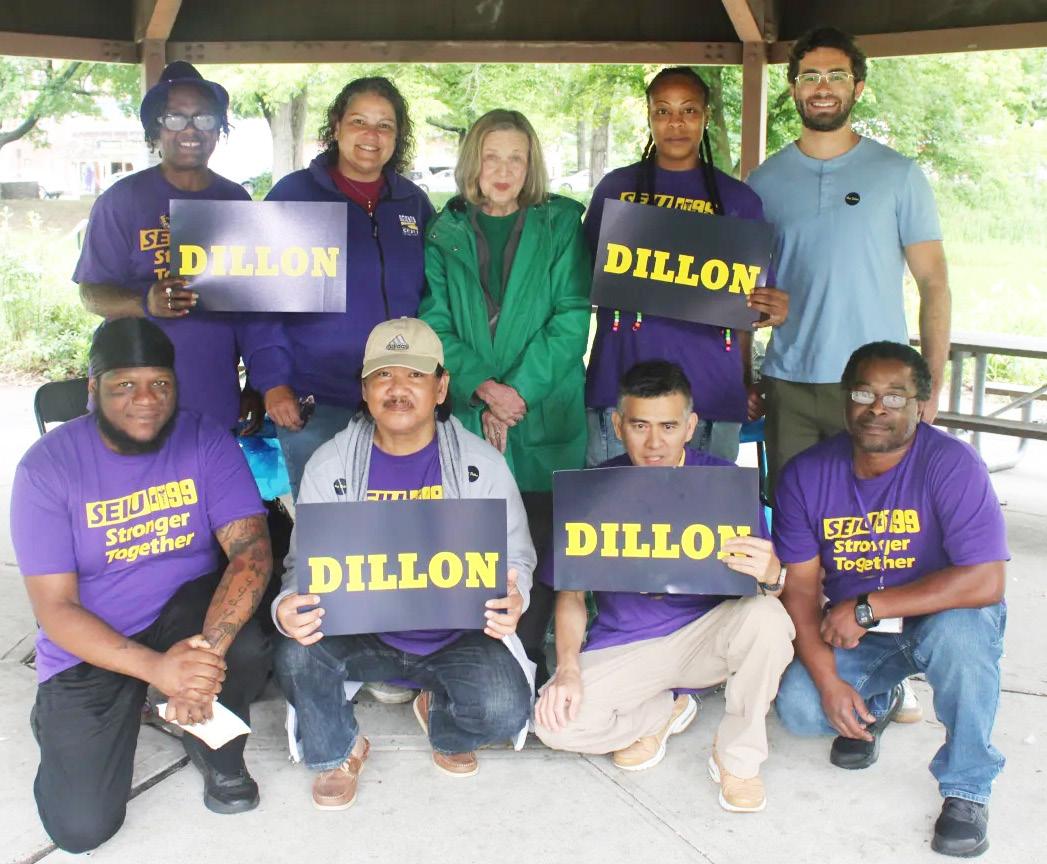
Friday’s endorsements mark just the latest that Dillon has rolled out in recent days in the runup to a contested three-way Democratic primary on Aug. 11.
“It is my privilege to notify you, on behalf of our membership, that SEIU have chosen to endorse you in your race for re-election in 2026!,” SEIU State Council Executive Director Corey Geisman wrote in a July 8 endorsement letter. “You have a proven track record of fighting for workers and their families, and we are proud to stand by your side this election cycle.”
According to Geisman’s letter, SEIU represents more than 65,000 members across the state, including healthcare providers, educators, janitors, security guards, and state employees. Click here to read a Friday announcement posted to SEIU 1199’s website about their endorsement of seven candidates from across Connecticut, including Dillon and the 97th District’s Leland Moore.
“We’re excited to stand with your campaign and look forward to mobilizing 32BJ
members in the weeks leading up to the August 11 primary to help connect with voters in your district,” SEIU 32BJ CT Political Director Eimy Martinez wrote in a separate endorsement email, dated July 9. Martinez wrote that Dillon can use the official 32BJ logo now that she’s secured their endorsements.
Dillon announced these latest endorsements less than three weeks before she is set to face challengers Eli Sabin and Justin Farmer in the Aug. 11 Democratic primary for the 92nd General Assembly District seat. That district covers parts of Amity, Westville, Edgewood, Dwight, and the Hill.
Dillon — a 21-term incumbent, deputy majority leader, and House chair of the Health Subcommittee of the state legislature’s Appropriations Committee — has already been endorsed by the local Democratic Party, the CT AFL-CIO, the Sierra Club, and Planned Parenthood Votes! Connecticut. Sabin, a former downtown alder, has been endorsed by Mayor Justin Elicker. Farmer, a former Hamden Legislative Council member, has been endorsed
An accompanying email press release sent out by Dillon’s campaign on Friday noted her work to prevent the privatization of the Connecticut Mental Health Center.
“Understanding the vital role the center plays in providing care to some of New Haven’s most vulnerable residents, particularly within the Hispanic community, Dillon worked alongside healthcare workers, labor leaders, and community advocates to protect access to critical services,” the press release states. “Her efforts helped preserve good union jobs and ensure the continuation of high-quality, culturally responsive healthcare that thousands of Connecticut residents depend on.”
“I have always believed that when workers have a seat at the table, our communities are stronger and our economy is fairer,” Dillon is quoted as saying in Friday’s press release. “I am proud to stand with SEIU members and their families, and I am deeply grateful for their trust, their partnership, and their support.”
by Adele Haeg
The city’s teachers union endorsed Hamden State Rep. Josh Elliott for governor on Tuesday — throwing their support behind the progressive gubernatorial challenger’s promises to tax the wealthy, reject a federal voucher program, and increase state aid for city schools.
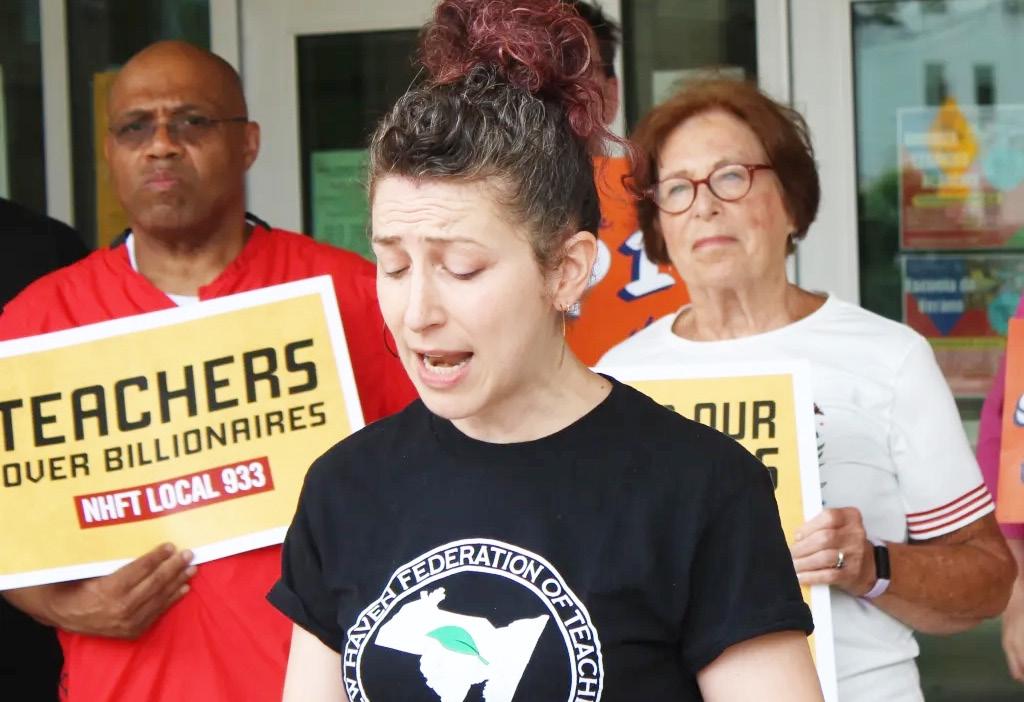
“We must increase taxes on millionaires and billionaires in our state,” New Haven Federation of Teacher President Leslie Blatteau said at a press conference held outside John S. Martinez School in Fair Haven.
“We agree with Josh that we must do more as a state to provide property tax relief for working class families, and we agree with Josh that we must create a sustainable public school funding system for our students and families here in New Haven and throughout the state.”
The endorsement presser took place two weeks before Elliott is set to face off against two-term incumbent Gov. Ned Lamont, a Greenwich businessman, in the Aug. 11 Democratic primary. Whoever wins that contest will face Republican candidate and Greenwich State Sen. Ryan Fazio in November’s general election. Blatteau joined Elliott and several New Haven Public Schools (NHPS) teachers and students for Tuesday’s presser. It marked the second education-labor endorsement Elliott has received so far this campaign season.
Elliott — a Hamden legislator who has pitched himself as a more progressive alternative to Lamont — has campaigned on overhauling Connecticut’s tax code, reforming the Education Cost Sharing (ECS) formula, which has not been adjusted for inflation in over a decade, and opting out of a federal voucher program that passed in the U.S. Senate last year, stances that many union teachers on Tuesday said they supported. Blatteau called the federal voucher program a “Trojan horse” that would “ultimately help dismantle public schools” by giving families money they could use to pay for private school tuition rather than public schools. Unlike his opponent, Elliott has said he believes that Connecticut’s tax code and
education funding system need to be fundamentally reformed rather than amended.
“The kids that are in New Haven are just as deserving as the kids that are in Greenwich,” Elliott said, describing inequities in the state’s taxing and education systems, which he and teachers say favor students from wealthier districts. Contrasting with comments Lamont made at a campaign event in Westville on Monday, Elliott argued that the state should invest more in New Haven public schools. Lamont’s campaign did not immediately respond to a request for comment on the union endorsement.
Of educational inequality in the state, Elliott said, “Greenwich can’t solve this problem, and New Haven can’t solve this problem. But the state can solve this problem. We need folks like the New Haven Federation of Teachers to say we’re also going to put ourselves out there and on the line, because the risk of status quo is significantly scarier and worse than the

“How
risk of backing the vote that doesn’t win.” Alexander Oji, a NHPS teacher of 21 years, and Julia Miller, Connecticut’s 2025 Teacher of the Year — both NHPS alums and union members — also spoke in support of Elliott during the press conference.
“We live in one of the richest states in the richest country in the world, and yet, students in New Haven and in many of our chronically underfunded urban and rural districts suffer due to inequitable funding,” Miller said. “Josh Elliott understands that the Economic Cost Sharing formula has not lived up to its intended purpose, nor meaningfully addresses the realities we face. He will ensure that the state pays its fair share, and will pay for this by creating a tax code in which those at the top of the income scale pay their fair share.”
“We’re simply here because we need change,” Oji said. “We’re teaching in schools that have loose ceilings, broken toilets, HVACs not working, and it’s not just in one school, it’s in many of our schools,” which he said “impacts teacher morale, staff morale, student morale.”
“Our students are struggling, our parents are struggling. They have to make a decision on paying the rent or putting food on the table and this is the unfortunate reality that we face. So, what can we do to help? We can tax the rich,” he said.
Marianne Maloney, a Hamden resident and a chief steward of the New Haven teachers union, said Elliott had been coming to meetings about legislation she also attended for 20 years. “He’s a listener, and he really cares about our concerns.” Elliott’s campaign manager Melissa Murray said that it can be challenging for primary candidates to win endorsements, because many wait for the general election before supporting a candidate. Of Elliott, she said, “from the beginning, he’s had the teachers.”
Miller said although some are skeptical Elliott could revamp Connecticut’s tax code, she is optimistic. “If no one is willing to reimagine things, then we always have the status quo.”
“I’m here with relief that my natural allies are part of this campaign in a way that is public,” Elliott said, “and I’m here with excitement for the next two weeks ahead of us and the next four years.”
By Jordyn Miller
The following citizen contribution comes from Jordyn Miller, communications and media manager at Planned Parenthood at Southern New England (PPSNE).
A picture is worth a thousand words, and Planned Parenthood of Southern New England’s (PPSNE) most recent gallery event had a lot to say.
On Tuesday, the Connecticut health care provider hosted its first-ever Art of Care Gallery Event, transforming the lobby of TheaterWorks in Hartford into an art installation. The event showcased original works by local artists from Connecticut and Rhode Island–including four artists here in New Haven. "It followed "Care Out Loud," an open mic held in New Haven earlier this year; read about that in the Arts Paper here."
The Art of Care: Our Powerful Stories explored how storytelling shapes care, community, and our identities. From moments of vulnerability to declarations of joy and resistance, stories have the power to transform silence into visibility. The featured artists showcased their interpretations of this theme through paintings, performances, videos, and more.
“We know that art can be intensely powerful, and we are so excited to connect with our community through this inaugural campaign,” said Amanda Skinner, president and CEO of PPSNE. “These eight artists have created incredibly moving and impactful pieces that really showcase the vulnerability of caring for community. We are in awe of their talent and are thankful to have them be a part of our storytelling mission at PPSNE.”
Featured New Haven artists included: Laura Boccadoro, Candyce “Marsh” John, Jezrie Marcano-Courtney, and Alexis Robbins.
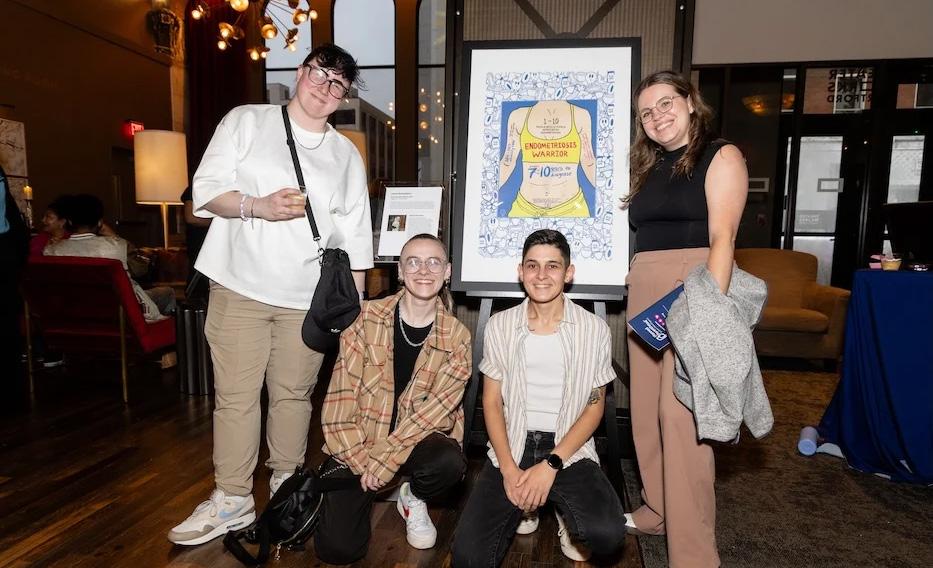
The art pieces all explored different vulnerable aspects of health care through a personal lens. Endometriosis Warrior, by Boccadoro, is a love letter to all folks who struggle with endometriosis, showing visibility and the hard truths behind being an endometriosis warrior.
“I deal with my chronic and mental illnesses through my art, specifically my endometriosis,” said Boccadoro. “It's one of the ways I have been able to get through my battle with endometriosis, and I am using the Art of Care as an opportunity to show just that–my struggles and how I have continued to combat them and persevere through them."
As a somewhat amateur artist who is new to showcasing her art, Boccadoro said it means the world to be a part of this show for an organization she cares about so deeply.
Similarly, John's Unapologetically Human centers the powerful humanity of Black men, exploring vulnerability not as weakness, but as an essential part of becoming. It invites viewers to consider healing, self-discovery, and the courage required to remain open to transformation.
“This piece began with my interest in Black men’s interior lives and the ways vulnerability is often denied, misunderstood, or mistaken for weakness,” said John. “Some of our most meaningful stories are carried quietly. For Black men

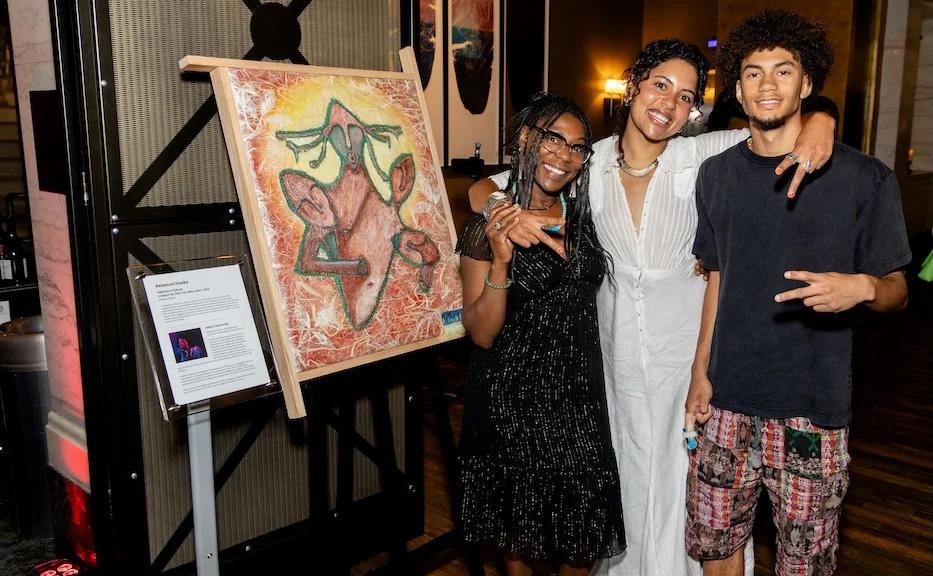
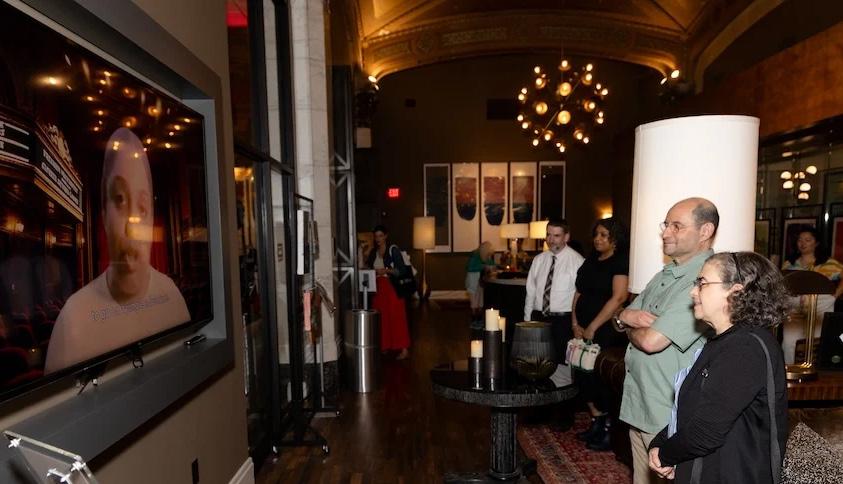
especially, openness, sensitivity, and emotional honesty can require courage. I wanted to honor that humanity while expanding conversations about care to include reflection, healing, self-discovery, and the ongoing process of becoming.”
Built through layers of acrylic, spray paint, mixed media, and expressive marks, parts of the work’s surface remain raw and unfinished. The seated posture and phrase “I Am Still Becoming” reflect a private moment of processing, growth, and permission to exist without having everything resolved.
Building upon a deeply personal health care experience, Jezrie Marcano-Courtney's “She Said to Clean The Stew?” is a narrative about a teenage girl who experiences her very first urinary tract infection. She takes a doctor’s advice without question and later, learns how important questions could be.
“As a storyteller, my job is to connect with the humanity of others through sharing my unique experiences while highlighting the universal truths we all face,” said Marcano-Courtney, who is an author and storyteller. “Too many of us know what it's like to live without health care. My story is but one of many, and I hope it will open the flood gates to the stories that need to be told.”
Marcano-Courtney believes that submitting her story to the Art of Care is an act of service to the community at large, highlighting the shared experiences of so many people around her.
From storytelling through words to storytelling through dance, Alexis Robbins’ “(alone was) how you left me” is a tap and contemporary dance piece performed to poetry and original music. The performance explores experiences of being or feeling alone during medical procedures where assumptions or hopes of care were not provided, something femme-identifying folks experience all too often.
“I've personally endured some not so fun healthcare experiences where I was not being taken seriously, and I think that that's something a lot of people with reproductive organs can relate to,” said Alexis Robbins, choreographer and performer of “(alone was) how you left me.” “While the piece says very specific things about my personal lived experience, I think it is also broad enough that anyone can relate to it.”
Robbins considers herself a percussionist, and showcases this through her use of tap dancing. The 12-minute live performance is based on a companion poem that can be heard in the soundtrack. Her story is told in a way that incorporates all of the things she loves to do–movement, music, and vocals.
The event comes at a time when health care and reproductive rights are under attack nationwide. Events like the Art of Care are essential to creating a space for reflection and connection. When walking through the gallery event, feelings of vulnerability were shared, humanizing each of us as individuals who have all experienced the health care system.
While the in-person gallery in Hartford was the launch of these incredibly meaningful art pieces, they now live permanently online in our digital gallery of the same name.

John P. Thomas Publisher / CEO
Babz Rawls Ivy Editor-in-Chief Liaison, Corporate Affairs Babz@penfieldcomm.com
Advertising/Sales Team
Keith Jackson Delores Alleyne John Thomas, III
Editorial Team
Staff Writers
Christian Lewis/Current Affairs
Anthony Scott/Sports Arlene Davis-Rudd/Politics
David Asbery / Tanisha Asbery
Jerry Craft / Cartoons / Barbara Fair
Dr. Tamiko Jackson-McArthur
Michelle Turner / Smita Shrestha William Spivey / Kam Williams Rev. Samuel T. Ross-Lee
Contributors At-Large
Christine Stuart www.CTNewsJunkie.com
Paul Bass www.newhavenindependent.org
Memberships
National Association of Black Journalist National Newspapers Publishers Association Greater New Haven Chamber of Commerce Greater New Haven Business & Professional Greater New England Minority Supplier Development Council, Inc.
The Inner-City Newspaper is published weekly by Penfield Communications, Inc. from offices located at 50 Fitch Street, 2nd Floor, New Haven, CT 06515. 203-3870354 phone; 203-387-2684 fax. Subscriptions:$260 per year (does not include sales tax for the in State subscriptions). Send name, address, zip code with payment. Postmaster, send address changes to 50 Fitch Street, New Haven, CT 06515. Display ad deadline Friday prior to insertion date at 5:00pm Advertisers are responsible for checking ads for error in publication. Penfield Communications, Inc d.b.a., “The Inner-City Newspaper” , shall not be liable for failure to publish an ad or for typographical errors or errors in publication, except to the extent of the cost of the space in which actual error appeared in the first insertion. The Publisher reserves the right to refuse advertising for any reason and to alter advertising copy or graphics deemed unacceptable for publication. The entire contents of The Inner-City Newspaper are copyright 2012, Penfield Communications, Inc. and no portion may be reproduced by any means without the written permission of the publisher.
By Brandon CortesJuly
A week after a tense encounter involving a police officer who refused to provide his name and badge number to a man in Newhallville, the city’s police chief visited the scene of the incident to participate in a neighborhood cookout — where he spoke with residents about what went wrong and how police need to do better.
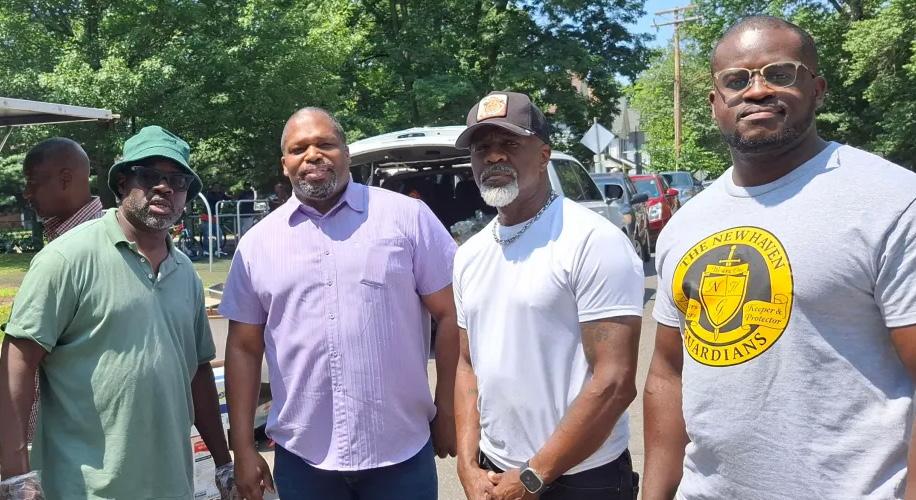
That cookout took place midday on Saturday near Hazel Street and Shelton Avenue. Several dozen people turned out to enjoy hot dogs, burgers, and wings, as well as eggs and pancakes.
The confrontation at the center of discussion, meanwhile, occurred the prior Saturday, July 18, at around 10:30 a.m. at that same spot.
That’s where Yancey Horton — better known as Brother Born — has spent the past decade hosting free weekly community breakfasts.
According to Horton, last Saturday, an officer had been parked across the street for several minutes when one of the free-breakfast volunteers, Tyrell Dorsey, arrived and got out of his car. The officer reportedly asked him, in a hostile tone, what he was looking at. When Dorsey asked for the officer’s name and badge number, the officer declined to provide it. Horton, who says he stepped in immediately, called it a jarring departure from what he described as an otherwise good relationship with local police. He posted about the incident on Facebook and reached out to the New Haven Police Department, saying his intent wasn’t to put officers “on blast” but to spread awareness. Within half an hour, he said, he heard from the neighborhood’s district manager, Sgt. Jarrel Lowery. The officer who reportedly refused to identify himself was Kyle Saleh. Lowery said that he wrote Saleh up for violating department policy requiring an officer to provide their name and badge number when asked.
“Unfortunately, he was in the wrong for that,” Lowery said, adding that in his three-plus years as district manager, he’d never dealt with an incident like it.
Police Chief David Zannelli said he learned of the incident after the fact. He came to this Saturday’s event specifically to meet with Horton in person.
“I didn’t even know this event was
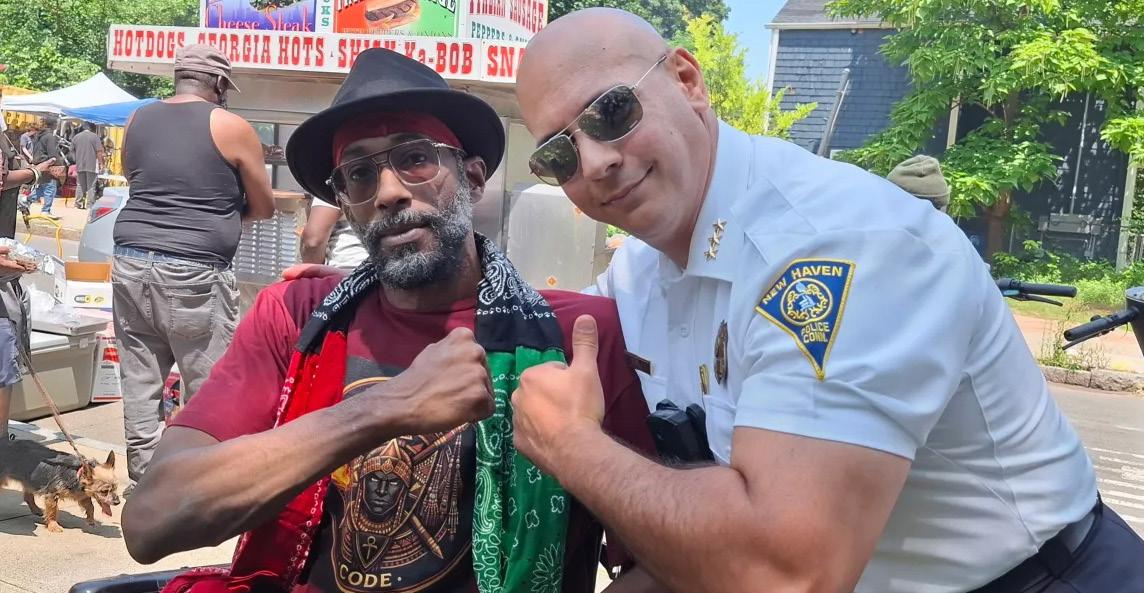

taking place,” Zannelli said. “When I was alerted to what happened, I wanted to come here and meet with Brother Born one on one to have a constructive conversation.”
Zannelli said that Saleh is relatively new to the police department, having been with the NHPD for less than two years. “That doesn’t excuse the conduct,” Zannelli said, noting that the the requirement for an officer to share their name and badge number is a longstanding department policy.
Dorsey, who has volunteered with the breakfast program for five years, said on Saturday he wasn’t holding onto the incident.
“We are proud Black people over here that stand up men, productive in our community,” he said, adding that he hoped the officer would learn from it and that the department follows through with real accountability rather than “lip service.”
Rodney Williams, whose business Green Elm Construction helped provide food for Saturday’s meetup, put it simply: “We are doing this for our community and the people that live here.”
The breakfast itself has deep roots in the neighborhood — Horton has run it for over a decade, and this year the Community Soup Kitchen and the Community Park Enhancement Network (CPEN) partnered with him and Williams to help expand it.
Francine Gaworowicz, a longtime volunteer, was among those on hand Saturday. She offered a counterpoint, describing a New Haven police officer named Maxine Wright who regularly checks in on her and fellow volunteers during a separate weekly outreach effort elsewhere in the city. Gaworowicz said that this is an example of what community policing should look like.
Both Horton and Zannelli described last Saturday’s incident as the first of its kind in the ten-plus years that Horton’s breakfast program has been running. Zannelli tied the stakes to the city’s broader progress this year on gun violence, which he attributed in part to improved community-police relations.
“My concern is that they were being strained,” he said, “and we want to make sure that we handle incidents and don’t make excuses when there are things that are done incorrectly.”
by Janday Wilson
Hedwig and the Angry Inch Yale Summer Cabaret: Spectra 217 Park St.
New Haven
July 23-25, July 30-Aug. 1, 2026
When I entered Yale Cabaret Thursday evening to take in a new staging of the cult classic Hedwig and the Angry Inch, I received a peculiar warning: “There will be flashing lights and gender dysmorphia.”
What they didn’t warn me about was the intoxicating euphoria that would overtake me upon seeing Hedwig (Gavin D. Pak) twirl out into the audience in a frenzy of pink iridescent sequins. That heady feeling continued throughout the production.
If you have the misfortune of being unfamiliar with the story, Hedwig is the genderqueer lead singer of a band from East Berlin that has never quite taken off. Even worse, her ex-lover Tommy Gnosis is a veritable rock star who siphoned Hedwig’s creative genius without crediting her. Gnosis rejected Hedwig because of her gender, a betrayal that Hedwig works through in her music.
Hedwig also had another problem: A simmering rivalry with her husband Yitzhak. The band once had a performance in which Yitzhak wore a wig and eclipsed Hedwig. She told him she’ll marry him on the condition that a wig never touches his head. In one scene, Hedwig is speaking when Yitzhak interrupts her with a pointed “Bitch.”
“Yes, did someone call my name?” said Hedwig passive aggressively.
At the Yale Cabaret, Hedwig (played by Gavin D. Pak) was clad in red fishnets, shiny red go-go boots, a tiny jean miniskirt with a Yale crop top and jean vest. Her blush popped and her glittery blue shadowed eyes were beacons as she practically snarled “Tear Me Down” alongside her husband Yitzhak (Sboniso Thombeni).
Don’t you know me?/I’m the new Berlin wall, baby/Try and tear me down!
She gave it to the audience immediately, draping herself suggestively across an audience member’s lap as she sang under the illicit red lights. Next, she walked over to another audience member to introduce herself. When people walked in after start time, Hedwig addressed them: “You guys are so late.”
The intimate space of the Yale Cabaret leant itself to the broken fourth-wall nature of the show. It really felt like Hedwig and the Angry Inch were an upand-coming band that popped into New Haven to perform at café nine. Hedwig and Yitzhak’s constant forays into the
aisles really drew the audience into their performance.
At the start of the show, Hedwig marveled at the band making it to Yale. “Look at us! Ivy League! Immigrants can do fucking anything.”
The musical’s altered script name dropped so many New Haven staples: Arethusa, Yale Daily News, Toad’s Place, Claire’s Cornucopia, East Rock Market. My favorite was Hedwig’s reference to the Yale Repertory Theatre’s production of Julia Masli’s ha ha ha ha ha ha ha. The audience hooted when Hedwig trilled, “Problem?”
This production of Hedwig was put on by Yale Summer Cabaret: Spectra. Spectra, the name of the Cabaret’s summer season, refers to the wide spectrum that is art as well as disability. The season’s tagline is “where art and access intertwine.” The Cabaret team made it a mission to provide more accessibility to their shows. To that end, screens above the stage displayed open captions, even for the speeches that the creative team gave. There will be American Sign Language (ASL) interpreters the second week of the performance.
The Cabaret’s theme was fitting, as Hedwig and the Angry Inch is about self-acceptance, love and embracing difference.
I loved Pak and Thombeni’s chemistry and the way they moved on stage. Their flamboyant dancing and stellar singing solidified me as a fan. But it was even down to their micro movements — from the arch of Pak’s eyebrow to the way Thombeni gripped the mic stand just so, they embodied Hedwig and Yitzhak. Their commitment to their performances was evident in the sweat-soaked locks plastered to Pak’s forehead and the makeup beard smudged on Thombeni’s face.
“This role has always meant a ton to me. I first heard of the show with the Broadway revival, my first year in college. I was away from home and really discovering more about who I am, and my own relationship with gender and sexuality,” Pak told me in a conversation after the show. “Hedwig is such as beautiful show about this woman who had this horrible thing happen to her, lives with the cards she was dealt and goes on a journey of finding self-acceptance and self-love.”
There was profound sadness in Hedwig’s story but also humor. As she said, “I laugh because I will cry if I don’t.” Some of that humor came through in the distinctly striking language. Hedwig speaks of a nail polish called “Dusty Menses” and of crying “muddy Maybelline tears.”
It also came through in the plethora of weird, enigmatic scenes – which I loved. In one, Hedwig offers to shave Tommy’s eyebrows to offer him comfort after his father upsets him. In another, she reen-


acts a flashback of her childhood spent laying her head in the oven to develop her singing chops. Don’t get me started on the gummi bärchen/gummy bear scene with her sugar daddy.
The images projected onto the stage’s red glittered backdrop enhanced Hedwig’s stories and were inventive; some I couldn’t even figure out how to describe. The drawings were these cool cutouts (I later learned they were made of felt) and depicted images such as a burning American flag and the Roman goddess Venus with a penis.
All of the musical’s songs were head boppers. I truly wanted to headbang for “Angry Inch,” during which the room took on a darker hue of red, as lights flashed along with the dark, driving rhythm. “Exquisite Corpse” was another standout performance.
And you can trace the lines/Through misery’s designs/That map across my body/A collage!/All sewn up/A montage!/All sewn up
During that scene, Hedwig snatched off her wig and stripped down to her underwear.
From my vantage point, there was a shadow that obscured Hedwig’s face during the number “Wicked Little Town,” making for an almost mystical performance as she softly sang: You’re running up and down that hill/You turn it on and off at will/There’s nothing here to thrill or bring you down/And if you’ve got no other choice/You know you can follow my voice/Through the dark turns and noise of this wicked little town.
Earlier in the show, Yitzhak had called Hedwig the c word and left the venue. As the show closed, he returned to Hedwig, who was holding a fabulous Beyonce-style wig as a peace offering. She placed it on Yitzhak’s head, and he transformed.
He went backstage, then strutted back out in a dusty pink dress made of rosebuds and glittery pink eyeshadow – the audience cheered. Hedwig and the Angry Inch sang “Midnight Radio”: You know you’re doing all right/So hold on to each other/You gotta hold on tonight.
As the song urged us to life up our hands, the room became a sea of waving arms.
The crowd was slow to file out when the show ended, lingering to chat amongst themselves and with the creative team and cast. No one was quite ready to leave Hedwig’s glittering, unruly world behind. Hedwig superfan Angela Meikle was eager to speak with Pak after the show. She said, “Gavin took the character of Hedwig, in all her messy glory, and made it their own. I had literal tears in my eyes when they sang ‘Wicked Little Town’ and ‘Midnight Radio.’ I highly recommend this show to anyone who hasn’t seen Hedwig performed on stage.”
Yale New Haven
Time: 5 - 7 pm
Location: Children’s Hospital, 35 Park St., 1st floor, Admitting
Parking available (handicapped accessible)
An appointment is necessary. Please call 855-547-4584
Spanish-speaking counselors




At the time of Liberia’s independence on July 26, 1847, the new republic’s population celebrated by singing the national anthem “All Hail, Liberia, Hail!” The lyrics were written by Daniel Bashiel Warner, a 32-year-old native of Baltimore, Maryland, who later served as Liberia’s third president.
What is not well known is that from 1847 to 1860, the anthem’s melody was different than the one Liberians sing today.
Enter Cleveland Olmstead Luca. He composed a melody that the republic adopted in 1860 – 13 years after independence.
Cleveland was born in New Haven, Connecticut, in 1826, the son of musically talented parents Alexander Luca and Lisette Lewis. Alexander was a shoemaker. His excellent voice and musical training earned him a position as chorister in the Congregational church in New Haven.
The couple had four sons (John W., Alexander C. Jr., Simeon G., and Cleveland O.).
A daughter died at the age of 14 months in 1840. In the 1840s, Alexander Sr. organized a quartet including Dinah Lewis, his wife’s sister and a gifted singer, and his first two sons. He taught his sons the shoemaker’s trade, and with the help of Dinah, they were educated in music. Alexander taught his children to sing in his choir at the church. All members were highly gifted, and the youngest son, “Cleve” as he was then called, was a piano prodigy by the age of 7, and by the age of 10, he had a repertory of masterpieces and the ability to play difficult music by sight, a talent he frequently proved in public performance.
At some point, the Luca Family Singers consisted of Simeon, who sang first tenor; Alexander Jr., second tenor; Cleveland, soprano; and John, bass-baritone.
Simeon played first violin; Alexander Jr., second violin; John, cello or bass; and Cleveland, piano. Their father was musical director and manager as well as vocalist. They traveled the midwestern and eastern United States performing secular as well as religious music, including anti-slavery hymns and benefit concerts. One of their more popular songs was the anti-slavery hymn “Car of Emancipation.”
Wherever they went they earned a reputation of refinement, intelligence, and superb musicianship. In their May 1853 debut in the Old Tabernacle on Broadway in New York City, as guests of the New York Anti-Slavery Society, they thrilled an audience of 5,000 people. “In witnessing the display of genius by the wonderful pianist, and listening to the sweet strains of classical harmony formed by the tuneful voices and skillfully played instruments of this troupe of colored artists, they found their claims for the race so fully sustained,” wrote medical historian James Monroe Trotter in his book Music and Some Highly Musical People in 1878.
“As the ‘wonderful boy pianist,’ [Cleveland] everywhere created quite a furore (sic). The ladies in the audiences were especially delighted with him; and forgetting often, in their enthusiasm, that he was black, it seemed that they would certainly carry him away.” Trotter said it was “doubtful whether he had an equal in
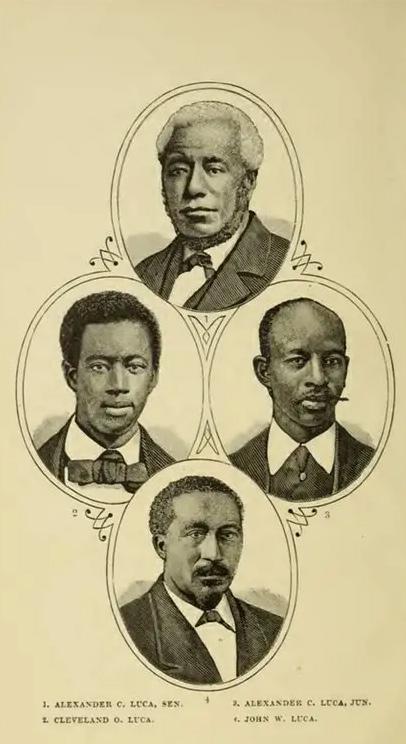
this country.” Trotter described how the “prejudiced or incredulous” would hear the “exquisite charm of the music, as well as to the gentlemanly, graceful manners of the young virtuoso,” and then become “his warm admirer and friend.”
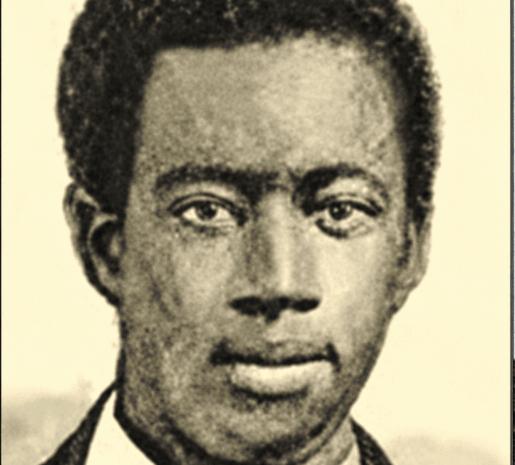
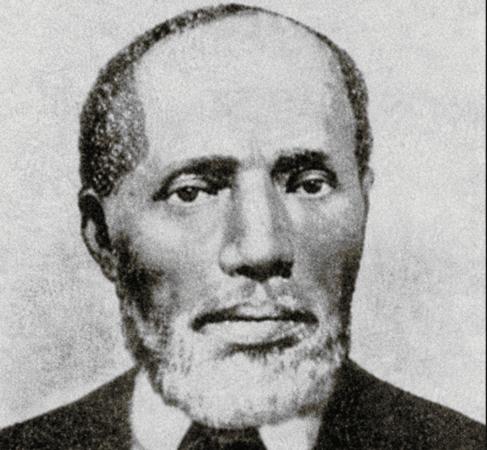
Trotter’s book was the first comprehensive history of American music. He included engraved portrait plates featuring illustrations of the artists, using numbers next to their faces to correspond with their biographical sketches. The illustration of Cleveland, his father, and two brothers is the primary, definitive visual likeness of them known to history. This rare image may be the first time Liberians get to see the face of the man who composed the melody for “All Hail, Liberia, Hail!”
The American press was almost unanimous in praise for their concerts. “The Luca Family, in the quiet and ostentatious display of their musical powers, are doing more to secure position for the colored man than all the theorists and speculators about the rights of man have yet accomplished in America,” according to a review in the Niagara Courier of Lockport, New York, on September 2, 1857.
In 1859 the Lucas teamed with a white family troupe, the Hutchinsons, abolitionist musicians in their own right. Both groups drew from an eclectic repertoire, combining comic and temperance songs with classical European arias. Another
highly popular abolitionist track, “The Fugitive’s Song,” dramatized the escape of enslaved individuals to freedom.
At the invitation of the president of Liberia in 1860 (presumably Stephen Allen Benson), Cleveland left the group and went to Africa, where he composed Liberia’s national anthem. The troupe temporarily disbanded but its members continued to pursue music individually. It is likely that he taught music in Liberia, but details of his activities in Monrovia, including church affiliation, are lacking.
“The musical structure of “All Hail, Liberia, Hail!” features a simple, march-like melody designed for communal singing and ceremonial use. Composed in B-flat major, it employs a straightforward form with repeating phrases that emphasize patriotism and resolve, set at a moderate tempo of quarter note equals 100. The original instrumentation was for piano and voice, allowing for easy adaptation to vocal ensembles or brass bands in performances. While rooted in Western musical traditions familiar to Liberia’s founders, the melody incorporates subtle rhythmic elements evocative of African influences, reflecting the nation’s dual heritage.” (Source: Grokipedia)
Liberia’s anthem received praise decades later in an article published on Dec. 1, 1918, in The Sunday Sentinel, a newspaper in Milwaukee, Wisconsin. “She has the
of Toledo, on Saturday evening next.”
The Toledo Blade went on to cite the Liverpool Courier in England as follows: “The debutante of the evening was Olmstead Luca, pianist, from the west coast of Africa, whose performance was truly marvelous. Directly he struck the keys, you realized the fact that you were in the presence of a genius. He chose two pieces full of the most formidable difficulties, [Antoine] de Kontski’s “La Réveil du Lion” and Chopin’s second Scherzo, both of which were rendered with the utmost precision and elicited enthusiastic applause.”
(Note to readers: Listen to the first minute or so of “Le Réveil du Lion” and you may hear similarities with “All Hail, Liberia, Hail!”). Luca performed at the Philarmonic Hall in Liverpool in April 1871. The musical periodical The Orchestra reported that Luca was “encored.”
The Cincinnati Daily Enquirer on March 4, 1872, published an article that praised the Lucas while also commenting on racial attitudes at the time. “The Luca Brothers have high musical talent.” The newspaper acclaimed Cleveland as the finest pianist in the country. “In Europe he was extensively bespattered with praise. But Olmstead Luca and Olmstead Luca’s brothers and wife are all colored – real Negroes, every one of them, and that is where the failure comes in. Had they pretended to be darkies, not been real ones, their success would have been assured. Scarce a single (unreadable)-loving Republican attended the concert, not because the music was not good, for it was excellent, but merely because the performance had a visible admixture of African blood in the (unreadable), and that fact settled their hash.”
sonorous and thrilling “All Hail, Liberia, Hail!” The article’s author wrote that the composition is “notable for the rich chords and march movement of the first part and the graceful and flowing melody of the second. The words and music were written for each other and blend most perfectly.”
Those who have heard the anthem with its powerful harmonies “will cheerfully accord it a high rank among the national anthems of the world.”
At some point, Cleveland returned to the United States to resume performing with his family. The Toledo Blade (Ohio) newspaper on February 18, 1872, announced that the “celebrated Luca Concert family” was to give a concert at Wheeler’s Opera House. “This company is composed of Mr. O. Luca, the great pianist; Mr. A. A. (Alexander Jr.) Luca, tenor and violinist; Madame A. A. Luca, contralto and soprano; and Mr. Tino (referred to as John elsewhere) Luca, bassoon.” Simeon Luca died in 1854 and Jennie Allen, a contralto from New York, joined the group. “The Luca family are not strangers to many of our readers, and those who have recollections of the pleasure afforded by their really excellent music will find cause for rejoicing in this announcement. The Lucas have been received everywhere by large audiences, and as they present an attractive programme here, we may look for a general coming together of music-loving people
Shortly after these newspaper reports, the pianist extraordinaire and composer of the Liberian national anthem returned to Liberia and reportedly caught a fever. Trotter’s book specifically notes that he died on March 27, 1872, at the age of 45. Trotter did not just write a history book; he lived in Cincinnati, taught music in the region, and personally knew the musical networks of the era. Online sources placing his death in 1869 are therefore inaccurate. If he died in Monrovia, he was probably interred in Palm Grove Cemetery, but there are no records confirming this. Similarly, Warner’s original lyrics and Luca’s original handwritten score are considered lost to time. Furthermore, it is historically impossible for any audio recordings to exist from the Luca family concerts. Thomas Edison did not invent the phonograph – the very first machine capable of both recording and reproducing sound – until 1877.
About the author: Joel Maybury served as the U.S. Embassy’s Deputy Chief of Mission from 2021 to 2023 during which time he began researching facets of Liberia’s history and its unique ties to the United States. His published works include an article about Liberia’s first First Lady Jane Rose Roberts, and he has given public lectures on the years President Joseph Jenkins Roberts lived and worked in Virginia before immigrating to Liberia.
by Maya McFadden
As rising first graders and best friends, Kortez and Alaya sang “Down by the Bay” in their summer learning music classroom at Family Academy of Multilingual Exploration (FAME). They were both then surprised to turn around and see each of their moms in the same classroom beside them.
That was the scene last Friday at a summer learning celebration hosted by New Haven Public Schools (NHPS) at the 255 Blatchley Ave. public school. The event welcomed parents and families into the school to check out what their summer campers were up to and what educational tips and tricks they could bring home with them.
Similar celebrations were planned for the district’s Hill Central and Davis School building sites, which also hosted K-4 summer programming from July 1 to July 24. When families arrived at FAME on Friday, they signed in, filled out a survey, and then were escorted by the program’s more than 30 staffers — which include teachers, paraprofessionals, and incoming Teach for America educators.
FAME summer building lead Tania Lawrence, who also works as a literacy specialist at FAME during the school year, said the goal for the summer-learning commencement event was to welcome families into the building’s classrooms to show them exactly what their students have been up to and who has been supporting their growth. The summer program used NHPS’ existing core subject curriculums — Houghton Mifflin Harcourt (HMH), iReady, and Smithsonian — to review what students learned during the school year to strengthen their skills during the 17-day program.
FAME was also one of the district’s extended school year (ESY) sites for middle schoolers. It was the district’s largest summer site with around 145 K-4 students attending daily. With ESY students, that number rose to around 160 daily.
The school also hosted monolingual and multilingual classrooms for summer programming that ran from 8 a.m to 12:30 p.m. Each classroom this summer was staffed with one lead teacher and a paraprofessional.
Lawrence started her 24-year career with NHPS as a paraprofessional while in college. She then moved up to a teacher and a building leader for the past 14 years.
This is the second summer FAME has been used as a summer site. Previously, Lawrence and her team were at Fair Haven School for summer programming.
As parents entered FAME Friday, some also looked through several clothing racks full of kids clothing that were free to take. At around 8:40 a.m. in Edgewood music teacher Hillyn Natter’s summer classroom at FAME, Natter sat among a group of rising first graders. She strummed a ukulele and sang “Down by the Bay” in unison with the students, who sat “criss cross applesauce” on the rug.
As they sang the hook of the song, Natter pointed to a student with a raised hand who then would share a rhythm they had practiced coming up with during their summer writing period. Natter partnered with summer kindergarten educator Ryan Reynolds,

who teaches first grade during the school year at Nathan Hale, to combine her music lessons with some of his classroom teaching.
Reynolds worked with his students alongside paraprofessional Kiara Spears to help the students make sentences, but with a rhythmic twist allowing for the students to use their sentence practicing in music class. While Natter went through song after song with her class, Alaya and her mom Eneida Martinez held hands while dancing together.
When Natter said today was the group’s last class together, one student called out, “I’m so sad.”
Natter’s goal this summer has been providing her students with a place that they belong. They accessed that safe space through music. Simultaneously with the rising first graders she said they spent the summer reinforcing a steady beat and being a listener.
This is the first summer Natter has continued teaching into the summer, primarily because summer programming hasn’t typically offered music as its own course. She also looked forward to being able to work with smaller groups of students than she usually does during the school year.
She added that she enjoyed temporarily being in a new school. FAME specifically “felt like coming back home,” Natter said, as she started her teaching career at a dual language school in New London. She concluded that this summer helped “validate the importance of the arts” and introduced her to new staff around the district.
Across the hall from Natter’s classroom was the program’s bilingual elementary classrooms where parents played bingo in Spanish side by side with their children.
“For Alaya, if I show interest in her education and what she’s learning,” Martinez said, “she’s more inclined to be more interested in it too.”
She said her presence in her daughter’s

education makes it easier for Alaya to engage and have conversations about her day with her. “It’s important to me that she make that connection that it’s important and that she can learn with me as well,” Martinez said.
Martinez also was interested in learning more about the district’s learning curriculums to better inform her when she studies at home with her daughter. “I had no idea that this is how they’re teaching math now.
So at home now when we’re going over math and reading I can reiterate how she learns during day.”
Teaching now is very different from when Martinez was in school, she recalled. Therefore, she hopes to duplicate the current school system’s ways of learning at home.
During the school year Alaya attends John S. Martinez School, which her mother said she loves. Martinez, a New Haven
native, also attended John Martinez in her youth.
Martinez noted that while Alaya is on grade level with her learning, she enrolled her in the summer programming because she wanted to be sure her daughter didn’t lose any of the learning she did during the school year. “Sometimes for working parents or parents with several kids it can be hard to keep up with a consistent structure at home,” she said. “This is really just enhancement for her so she can go to first grade ready and confident.”
After enjoying a pizza lunch to energize for the conclusion of the day, Alaya said she was excited and happy to have her mom with her at school.
Martinez concluded that she hopes other New Haven parents take advantage of the school district and city resources like the summer programming at FAME. “It’s important when resources are offered that people take advantage because that helps them decide things like funding. When they see a need for it, it’s more likely to continue,” she said.
Before heading home for the day, Alaya got in a few more books, on top of the four she read earlier in the day for class, and read them alongside her mother. Other students showed their parents around their classroom.
Kortez’s mother, Andrea Moore, attended Friday’s event because as a paraprofessional for NHPS, she wanted to learn more about the summer programming. She learned a lot during her visit Friday, in between dancing and singing with Kortez. She learned that, while the summer pro-

Staff
The following writeup was submitted by Shantell
Johnson.
On Sunday, July 12, Sisters of the Modern Scholar (SOTMS) proudly hosted its inaugural initiative, marking a powerful and inspiring beginning for this collective. This special event celebrated and supported graduating seniors from New Haven who are preparing to begin their college journeys this fall.
As part of the initiative, 50 thoughtfully curated college-ready baskets were prepared and distributed to participating students. These baskets were filled with essential items to support their transition into college life. In a true demonstration of community collaboration, every aspect of the event was made possible through generous donations.
The event was hosted at Tia Russell Arts Center, with the space, baskets, and all items within them donated by local organizations, businesses, and community partners. Food and refreshments were also generously provided, including sweet treats from a local baker.
The event was filled with joy, gratitude, and community pride. Attendees included the student recipients, their families, and representatives from the many businesses
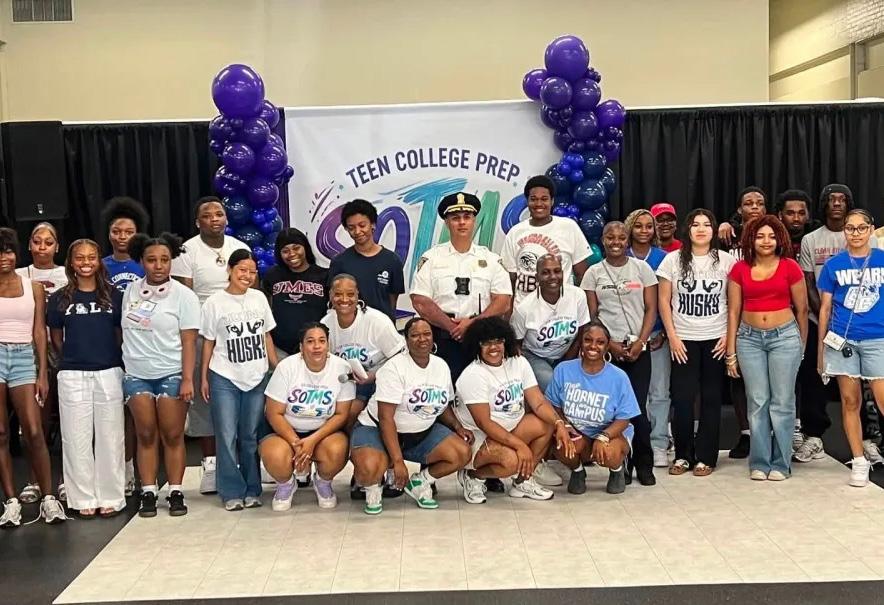
and organizations that contributed to the initiative. A live DJ added to the celebratory atmosphere, while guests enjoyed connecting, celebrating, and capturing memorable moments in front of the event display.
We were especially honored to welcome New Haven Chief of Police, David Zannelli, who joined us in support of the initiative. He shared encouraging words with the students and took time to mingle and take photos with attendees, further uplifting the spirit of the event.
In an added highlight, a photographer from the NHPD graciously attended and captured the event, later creating a beautiful video that will serve as a lasting memory of this meaningful day.
The appreciation expressed by the students and their families was heartfelt and evident throughout the event. It was a meaningful opportunity to uplift and encourage these young scholars as they take their next steps toward higher education.
Sisters of the Modern Scholar is honored to have played a role in supporting these students and looks forward to continuing this impactful work for years to come. This inaugural event set a strong foundation for future initiatives dedicated to empowering and investing in the success of New Haven’s youth.
by RONI ELLINGTON
A federal judicial panel has allowed Tennessee to use a new congressional map that splits apart a majority-Black district in Memphis, providing another legal victory for Republicans who hope to gain an additional seat in this year’s midterm elections.
A three-judge panel on Thursday declined to issue a preliminary injunction against the new districts, paving the way for them to be used in the August 6 primary elections. Tennessee had revised its congressional districts in May, shortly after a U.S. Supreme Court ruling weakened federal Voting Rights Act protections for minorities.
President Donald Trump has urged Republican-led states to redraw districts to their advantage to try to hold on to a slim U.S. House majority in the November elections. Tennessee is among eight GOP states to do so since last year. Trump is hoping the mid-decade redistricting can help Republicans buck a historical pattern in which the president’s party typically loses seats in midterms.
Opponents of Tennessee’s new congressional districts had argued in court that Republican lawmakers who passed the plan were motivated at least partly by racial discrimination, in violation of the U.S. Constitution. Republicans have insisted they were motivated only by partisan politics, seeking to win the lone Democratic-held seat among the state’s nine districts. Legislatures are free to draw partisan districts under a 2019 Supreme

Court ruling.
The federal judges — two Trump appointees and one appointee of former President Barack Obama — wrote in their opinion that the lawsuit is unlikely to succeed because the plaintiffs “lack any direct evidence of racial motivation.”
According to the rule, “The road to a reliably 9-0 map runs through Memphis. Thus, political motivations readily ex-
plain the map’s dilutive effects.”
In late April, the Supreme Court struck down a majority-Black congressional district in Louisiana as an illegal racial gerrymander. That decision weakened protections in the federal Voting Rights Act of 1965 that gave minorities an opportunity to elect the candidate of their choice. It also opened a pathway for Republicans in several southern states to cite political
intentions while redrawing voting districts with large minority populations that have elected Democrats.
In Tennessee, Republicans carved up a Memphis-based district with a majority-Black population that has been represented for about two decades by Democratic Rep. Steve Cohen, who is white.
The metropolitan area was, instead, placed in parts of three districts, with Co-
hen’s reshaped district stretching a couple hundred miles eastward before reaching north toward the Nashville suburbs. Cohen announced soon after the redraw that he was ending his bid for reelection. Amber Sherman, a Memphis voter and plaintiff in the lawsuit, criticized the ruling, saying it was “painful” to head into an election under a map that weakens the voices of Black voters.
“We deserve the same opportunity to shape our future as anyone else,” Sherman said. “When our voting power is diluted, our neighborhoods have a harder time making their voices heard on the issues that shape our daily lives.”
Ari Savitzky, an attorney for the American Civil Liberties Union Voting Rights Project, told the judges in mid-June that Republicans who are “essentially an allwhite-controlled legislative body” chose to destroy the state’s lone pocket of Black political power in federal elections.
Attorney Taylor Meehan, representing Tennessee election officials, rejected the assertion of racially discriminatory motivations. She also argued it was too late to revert to Tennessee’s previous congressional districts, noting that primary election ballots already had been finalized using the new boundaries. Early voting began July 17.
“Racial data was turned off” when crafting the new districts, Meehan said.
“The map was drafted for politics.”
by CHERYL MCCOURTIE
This story originally appeared in the Sacramento Observer.
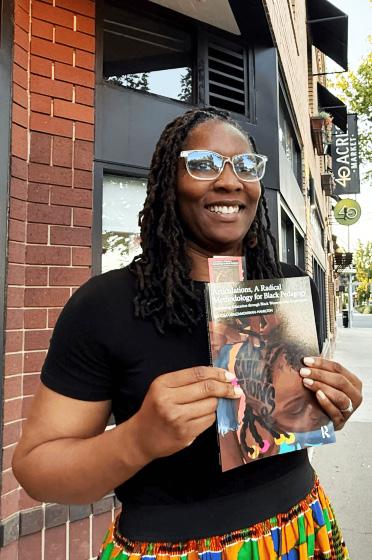
For years, Eghosa Obaizamomwan Hamilton believed she knew what a teacher was supposed to look like. For years, she regularly straightened her hair to blend into an educational system in which professional standards mirrored Eurocentric norms, and taught the standard curriculum, careful not to stray from the norm.
Away from the classroom and the daily scrutiny of institutional expectations, Hamilton began growing her locs. As they grew, she also found herself including more Black voices in her classroom. She became more willing to challenge traditional teaching methods.
Most importantly, Hamilton said, she became more herself.
“As I started wearing protective styles and eventually got my locs, I realized my pedagogy was changing with my hair,”
Hamilton told attendees during an author talk focused on her new book, “Articulations, A Radical Methodology for Black Pedagogy: Redefining Education Through Black Women’s Hair Experiences” last month in Sacramento, California.
“When I got my locs, I felt like I was fully loaded with having a very Black-centered approach to teaching.”
Appearance and acceptance
For Hamilton, every Black woman carries a hair story. The sting of chemical relaxers that burned their scalps. Being told their natural hair looked “unkempt” or “unprofessional.” Family, media, schools, or workplaces often deliver the same message: Their natural hair is unacceptable and must be changed.
Hamilton argues that their stories are far more than memories about appearance.
“They shape how Black women move through educational spaces,” she said. “How do students’ views of their hair impact their experience of school?”
That message connected with many educators in the audience.
Tiffany Herndon, an education consul-
tant and founder of the nonprofit College Engine Inc., said Hamilton’s discussion captured a tension Black educators commonly navigate: motivating students to accept their identity while preparing them to succeed in systems that have not always embraced them.
“How much do I ask you to assimilate for advancement?” Herndon said. “And


how much of that means losing your identity?”
‘Blackness is greatness’
For Herndon, the challenge is helping Black students understand that they do not have to sacrifice who they are to succeed.
“It’s that negotiation between self-love and survival,” she said.
As a former high school teacher and Black Student Union advisor, Herndon said educators need to build spaces intentionally where Black students feel seen and appreciated. “You have to walk the walk,” she said. “You have to have honest conversations, and you have to instill cultural pride. My thing is that Blackness is greatness.”
Hair, she explained, is connected with race, identity, history, and belonging. Before the transatlantic slave trade, African hairstyles communicated family lineage, status, and community. Enslaved Africans often had their heads shaved upon capture, stripping away those cultural markers.
Centuries later, Hamilton argues, Black women still negotiate messages about which hairstyles are acceptable. Those pressures continue despite growing legal protections such as California’s CROWN Act), which prohibits discrimination based on natural hairstyles associated with race.
Hamilton described hair as a “racial marker” that still influences how Black women are perceived in classrooms and workplaces. Her research explores “post-traumatic hair subversion” — the phenomenon of Black women regaining agency after years of hearing their natural hair is less professional, beautiful, or acceptable.
Rather than framing Black women’s hair stories solely through trauma, Hamilton wanted to document the strength and creativity they bring to dealing with those experiences. Those experiences spoke to Rita Barrera, a seventh- and eighth-grade science teacher in Stockton, California.
‘You won’t get a job’
As a teenager, Barrera admired successful Black women who wore locs, and she wanted to wear them herself. Her mother discouraged the decision. “‘Don’t do that. You won’t be able to get a job,’” Barrera recalled being told.
She wore them anyway, but repeatedly faced questions about whether they were clean or if she had washed her hair. Later, as she experienced hair loss, Barrera said, she worried whether a shaved head would be acceptable.
“I was afraid to show up at my job without any hair,” she said. “Those who wanted to say something negative stayed silent. Those who said, ‘Oh, my gosh, I love it’ helped lift me up.”
Barrera said she has seen progress since California passed the CROWN Act in 2019. She no longer hears colleagues criticizing Black students’ hairstyles, but she believes schools still have work to do.
Many campuses now have “care closets” stocked with hygiene products for low-income students, she said, but few include combs or products for Black hair. “Even if a [Black] child did need help with their hair, they have nowhere to go,” Barrera said.
Hamilton said authentic change begins with shifting the messages children receive about themselves. She said one participant in her research intentionally wore cornrows to a job interview. “‘If they have a problem with my hair,’ Hamilton recalled the woman saying, ‘I don’t want to work there.’”
Hairstyle as self-determination
For Hamilton, growing her locs was as much an act of self-definition as a hairstyle. She challenged families, educators, and communities to think carefully about the messages children receive about their hair.
“If you’re altering your appearance because of outside pressure,” she said, “there’s danger there.”
Instead, she hopes young people learn to make choices rooted in confidence rather than conformity. That lesson has become strongly personal.
Hamilton, now the mother of a young daughter, said she is constantly aware of the words she uses while doing her daughter’s hair and the messages those words might carry. Every night, she gives her daughter the same affirmation: “I love my hair.”
For Hamilton, those four words are part of a broader vision of liberation, one in which Black children enter classrooms already believing the parts of themselves that institutions have often questioned are worthy, beautiful, and enough.



by JASON PONTEROTTO
When stand-up comedians Jamie Roberts and Nicky Sunshine began dating more than a decade ago, they probably never envisioned they would create a comedy club and cultural space that continues to make history in Harlem.
However, their Sugar Hill venue, Comedy in Harlem, one of only five Black-owned comedy venues in the country, has become the premier destination to feature Black comedy in New York. In September, they will be celebrating the club’s fifth anniversary.
“We didn’t have a true outlet for ourselves on any given night,” said Roberts, 49. Now, the club gives the duo “the ability to showcase our talents to our people in our neighborhood … With Harlem being so rich in culture, the destination is the best place to be right now.”
They say there’s also a cathartic impact in having a Black-owned comedy club in Harlem.
“When Jamie and I started Comedy in Harlem, we were very conscious that this is for Black and Brown and marginalized people and women. It’s a place where community lives, where people can feel connected,” said Sunshine, 48. “There’s nothing else like the shared experience of stand-up comedy — an audience coming together to laugh and to alleviate stress and feel like they’re in a safe space.”
Running the venue is a full-time job, between restocking supplies, staffing shows, cleaning, taking and making phone calls, sending emails, and posting on social media. The couple rents out the space for comedy shows and more, and one of the things they are most proud of is how much more accessible their club is compared to venues downtown.
“There is a low barrier to entry if people want to produce a show,” Sunshine said.
Notable guests at the club have included Tracy Morgan, Sherri Shepherd, Tiffany Haddish, Cedric the Entertainer, and Lil Rel Howery.
Getting to funny
Roberts, raised in Amityville on Long Island, said comedy was always present in his family household, similarly to the Wayans family.
“You basically had to be your own entertainment, because we didn’t have much money, so you had to do what you had to do,” Roberts said. As he got older, being funny was essential for defending himself in school.
“I was a skinny kid with big glasses, so I had to figure out how to not get picked on, and if they picked on me, I had to be funny.” He said he was also fortunate to grow up surrounded by the golden era of comedy and classic TV. “Comedy was always around, and it just became part of my everyday life once I figured out this is what I want to do,” Roberts said.
Sunshine said comedic storytelling was always part of her upbringing. She recalled being very expressive and acting out stories of things at home to her grandmother and friends at school.

Both Roberts’s and Sunshine’s trajectories in stand-up were similar, beginning in 2001 and 2002 in New York. Roberts was able to supplement his comedy career with his day job as an accountant, which he would do for 17 years. Sunshine knew she wanted to be in New York because she was passionate about the arts. After college, she moved to the city and began in comedy, as well as being a working actor through mediums off-Broadway and being an extra on shows like “Saturday Night Live.”
Both found themselves interested in the business and promotion side of comedy, and began hosting their own shows.
“I learned very early in the game that I couldn’t just tell jokes and that be it. I had to learn how to figure out how to make some real money,” Roberts said. He soon began promoting his own show, “Sunday Night Live,” for 10 years at the New York Comedy Club, where he made connections, worked with notable celebrities, and got firsthand experience in promoting and booking shows.
For Sunshine, as a Black woman comic, the sentiment was clear that she and others like her would not be prioritized by the notable clubs, and that was what encouraged her to start producing.
“They’re not gonna let you in per se, so in a way, you’ve got to create a lane for you and your peers. That was kind of what I did,” Sunshine said. “There was a sentiment that they don’t want you, they don’t need you.” With Julio Rodriguez, Sunshine helped produce shows like Broads of Broadway and worked at the Producer’s Club.
Roberts transitioned to radio and began working with station 103.9 as an account executive and later a sales manager. Today, he is a senior account executive with WQHT-FM (Hot 97) and WBLS-FM. He was initially hesitant but said the interviewer, a fellow HBCU alum, encouraged him, helping him realize that he regularly does sales as a comedy promoter.
Roberts and Sunshine had crossed paths at various comedy venues and had known one another through the years. The couple remembered one instance where Roberts asked Sunshine to host the show for him because he would be at a friend’s wedding. Sunshine later joked to him, “I’ll have you host my wedding when I trap a sucker.”
“I never knew I would be the sucker,” Roberts said jokingly. The two began dating in 2014. In 2019, they got married and now have a son.
While initially wanting to keep their privacy, the two said they stayed open-minded about opportunities and leveraged themselves as a couple professionally. They took part in a tour titled “Love is a Joke” with other married comic couples and were featured on a reality series, “A Question of Love,” on FYI Network.
Around 2018, Roberts had begun promoting his Harlem-specific shows through his then-website, Comedy in Harlem. At the time, he and a partner hosted popular shows at the National Black Theatre. When the space closed for renovations, they began hosting Comedy in Harlem as an event above Lightshouse on East 117th Street, through a partnership with the owner, Michael Clopton. In early 2024, they were shut down by the Department of Buildings for having the wrong license. After creating a GoFundMe, they had the funds to move to their current location on St. Nicholas between West 147th and 148th Streets in May.
The two said being business partners as a couple works because they share a special bond and have been through the fire together.
“I respect the unique nature of our connection a lot more because we’ve grown together,” Sunshine said. “A diamond has really emerged from the hardship. It’s a very special story that we have.”Sunshine said.


by Mildred Europa Taylor, Face2FaceAfrica.com
British actor David Jonsson has been announced as the new Black Panther. The 32-year-old was unveiled by the film’s director, Ryan Coogler, on stage at Marvel Studios’ Comic-Con International presentation on Saturday with co-stars Letitia Wright and Winston Duke.
Jonsson, known for roles in Industry, The Long Walk and Alien: Romulus, will play the son of Chadwick Boseman’s T’Challa in the third Black Panther movie set to be released on December 15, 2028.
“The last time we got to make a movie, we introduced a character who is the son of the character that the great Chadwick Boseman played – our T’Challa – in that film,” Coogler said, according to the Guardian.

Photo credit: Gage Skidmore
“And today, I want to tell you that in this next film, he grows up, he comes of age.”
Jonsson, born in London, started his career in the West End. His on-screen debut occurred in 2018 with a two-episode role in the British detective drama Endeavour, followed by his portrayal of Augustus “Gus” Sackey in the first two series of Industry from 2020 to 2022.
He subsequently landed a role in the 2025 adaptation of Stephen King’s thriller The Long Walk before winning the Bafta rising star award the same year.
“Thank you to this family that I have the honour and the blessing to join. I don’t want to say too much, because I want to let the screen do the talking,” Jonsson said.
The Industry star is set to appear in some upcoming movies such as The Chaperones, Benn/Eubank and Scandalous. He describes his heritage as Creole, with roots in Nigeria, Sierra Leone, the Caribbean and Sweden.
In “Black Panther: Wakanda Forever,” Wright took over as Black Panther from her late fellow star Boseman.
Boseman played T’Challa in the first “Black Panther” but died of colon cancer at age 43 in 2020, when Coogler was working on the sequel. The character T’Challa II was introduced as T’Challa and Nakia’s (Lupita Nyong’o) son in “Wakanda Forever.”
Director Coogler is returning for the third film, as well as Wright reprising her role as Shuri and Duke as M’Baku.
by Phenix S. Halley, THEROOT.com
For years, journalist Ojinika “Oji” Obiekwe did her best to give 100 percent at work. She showed up. She won Emmys. She spent 22 years climbing the ranks at New York’s PIX11 after starting as an intern. But when she spoke up about racial discrimination, unequal treatment and a crushing workload that she alleged white male colleagues didn’t have to bear, she said she got retaliation instead of reform. This week, she got the last laugh.
According to Page Six, a New York judge ordered PIX11 and its parent company, Nexstar, to pay the journalist more than $2.4 million after a jury unanimously sided with Obiekwe in her retaliation lawsuit. The award includes more than $1.1 million in compensatory damages and $1.28 million in punitive damages after jurors rejected the station’s claim that she was fired because of poor performance.
She filed the lawsuit last year, citing wrongful termination and discrimination.
Obiekwe got her start in 2001 working for the news station as an intern. She was fired in 2023 for “failure to perform job duties” and “insubordination,” according to the lawsuit.
Following the verdict, Obiekwe said her refusal to let her termination become the final chapter of her career represents a win for all.
“No one should have to choose between their livelihood and speaking up about what they believe is wrong. I did,” Obiekwe said in a statement to The Root after the verdict.
“Today, I am grateful to the jurors, who listened, weighed the evidence, and returned a unanimous verdict.”
She continued: “While this victory is deeply personal, I hope it reaches far beyond me. I hope it reminds people that their voices matter, that standing up for what’s right matters, and that courage has the power to create change.”
That message wasn’t lost on her legal team either.

Attorneys Eric Abrams and Andrew G. Celli Jr. called out PIX11 for “the culmination of an ugly, years-long campaign to retaliate against her and destroy her professional reputation, all because she dared to call out racial discrimination in her workplace.”
In their statement to The Root, they added that Obiekwe “refused to be silenced” and “refused to accept her retaliatory firing after 22 years of flawless service at PIX11,” praising the unanimous jury verdict as a restoration of both her voice and her reputation.
Jury selection in the case began on July 13, according to another report from Page Six. The journalist reportedly took the stand twice during the trial.
Obiekwe’s victory is about far more than a multimillion-dollar judgment. It’s about a Black woman refusing to let her employer write the ending to her story. After years of being told her complaints didn’t matter, eight jurors said they did.
by Odafe Oghen, TheGrio.com
Ava DuVernay is returning to Netflix with a question that cuts at the heart of American identity: Who gets counted as a citizen?
The filmmaker has completed “14th,” a new documentary examining the 14th Amendment and the continuing battle over citizenship, equal protection, and belonging in the United States. Deadline reported that Netflix will release the film later this year, nearly a decade after DuVernay’s Oscar-nominated documentary “13th” examined slavery’s constitutional exception and its connection to mass incarceration.
Ava DuVernay is returning to Netflix with a question that cuts at the heart of American identity: Who gets counted as a citizen?
The filmmaker has completed “14th,” a new documentary examining the 14th Amendment and the continuing battle over citizenship, equal protection, and belonging in the United States. Deadline reported that Netflix will release the film later this year, nearly a decade after DuVernay’s Oscar-nominated documentary “13th” examined slavery’s constitutional exception and its connection to mass incarceration.“If ‘13th’ asked who gets caged, then ‘14th’ asks who gets counted,” DuVernay said in a statement.The documentary traces the amendment’s more than 150-year history through politicians, historians, and cultural voices while focusing on how its promises are being tested today. DuVernay said the film asks “what kind of country is being written beneath our feet now.”Ratified in 1868 during Reconstruction, the

14th Amendment granted citizenship to people born or naturalized in the United States and subject to its jurisdiction, while guaranteeing equal protection under the law. It also nullified the Supreme Court’s 1857 Dred Scott decision, which had denied citizenship to Black Americans.
That history returned to the center of national politics after President Donald Trump signed an executive order on the first day of his second term seeking to restrict birthright citizenship. The Supreme Court rejected the order in June by a 6-3 vote, but Trump has continued pushing Congress to challenge the constitutional protection.
The fight carries particular weight for Black Americans because the amendment was adopted after slavery to secure rights the country had long denied them.
Legal experts have warned that attacks on birthright citizenship draw from the same anti-Black theories once used to argue that Black people did not fully belong in the United States.
DuVernay’s 2016 documentary “13th” examined the connection between the Constitution’s slavery exception, the criminalization of Black Americans, and mass incarceration. “14th” extends that constitutional conversation into the present, asking how citizenship itself is defined and defended.
“14th” marks DuVernay’s return to nonfiction. Her broader body of work includes “Origin,” “Selma,” and “When They See Us.”
With “14th,” DuVernay is turning the Constitution into a present-tense story about citizenship, power, and the promises Americans are still fighting to keep.
LEGAL NOTICE
Request for Proposals (RFP)
DPH RFP # 2027-0905
Connecticut Ryan White Part B Core and Support Services 2027-2030
The Connecticut Department of Public Health (CT DPH) Ryan White Part B (RWPB) Program is requesting proposals from Connecticut community-based organizations, HIV service organizations, Federally Qualified Health Centers, community health centers, local health departments and other eligible health care providers to deliver eight (8) core and seven (7) support services within the nine (9) Connecticut Council of Government (COG) Planning Regions, identified as: Capitol, Greater Bridgeport, Lower CT River Valley, Naugatuck Valley, Northeastern, Northwest Hills, South Central, Southeastern, and Western.
The purpose of this RFP is to identify three organizations to serve as either the 1. Eastern Regional Hub (covering the Capitol, Lower CT River, Northeastern, and Southeastern COG Regions), 2. Western Regional Hub (Greater Bridgeport-Metro, Naugatuck Valley, Northwest Hills, South Central, and Western COG Regions), or 3. A Statewide Transitional Linkage to Community (TLC) Coordinator for released inmates, to deliver comprehensive Core and Support Services that contribute to access to medical care, retention in care, viral load suppression, eliminate health disparities, and improve the quality of life among low-income individuals with HIV.
The Request for Proposal is available in electronic format at: https://portal.ct.gov/ DPH/Request-For-Proposals/Request-for-Proposals or from the Department’s Official Contact:
Name: Africka S. Hinds
Address: Department of Public Health Health Care and Support Services 410 Capitol Avenue, MS # 11APV Hartford, CT 06134-0308
Phone: 860.509.8030
E-Mail: DPH.HIV-RFP@ct.gov
The deadline for submission of proposals is Monday, August 31, 2026, at 4:00 pm EDT.

Construction Equipment Mechanic
(preferably experienced in Reclaiming and Road Milling Equipment) We offer factory training on equipment we operate. Job is in Bloomfield, CT.
Contact: Tom Dunay Phone: 860-243-2300 Ext. 122 Email: tom.dunay@garrityasphalt.com
Reclaimer Operators and Milling Operators
(must have current licensing and a clean driving record; be willing to travel throughout the Northeast & NY)
Contact: Rick Tousignant Phone: 860-243-2300 Ext. 133
Email: rick.tousignant@garrityasphalt.com
Tractor Trailer Driver for Heavy & Highway Construction Equipment
(must have a class A CDL license with Tank Endorsement and a clean driving record; be capable of operating heavy equipment and willing to travel throughout the Northeast and NY)
Contact: Brian McKee Phone: 860-558-6189
Email: bmckee@garrityasphalt.com
• We offer Excellent hourly rates and benefits.
• Women and Minority Applicants are encouraged to apply.
• Affirmative Action / Equal Opportunity Employer

LaRosa Earth Group LLC, a Site/Excavation Company, is currently looking to add the following full-time positions to our Team:
Please submit resumes to HR@LAROSABG.COM or stop by our main office to fill out an application: 163 Research Parkway Meriden, CT. Salary will be commensurate with experience and best fit for the positions. Health plan; 401K; company-paid holidays in addition to paid time off.


LaRosa Groups is an Affirmative Action/ Equal Opportunity Employer who values diversity and encourages all qualified applicants to apply.
The South Central Regional Council of Governments (SCRCOG) seeks the services of one or more consultants for the following transportation planning studies during the 2026 and 2027 Fiscal Years (July 1, 2025- June 30, 2027): Metropolitan Transportation Plan Update and Local Bridge Inspection Study. Responses are due by June 2, 2026 (12 noon local time). Selected firms will be interviewed on June 9, 2026. The full RFQ document can be viewed at the Council’s website: www.scrcog.org or can be made available upon request. Contact James Rode at (203) 466-8623 with any questions.
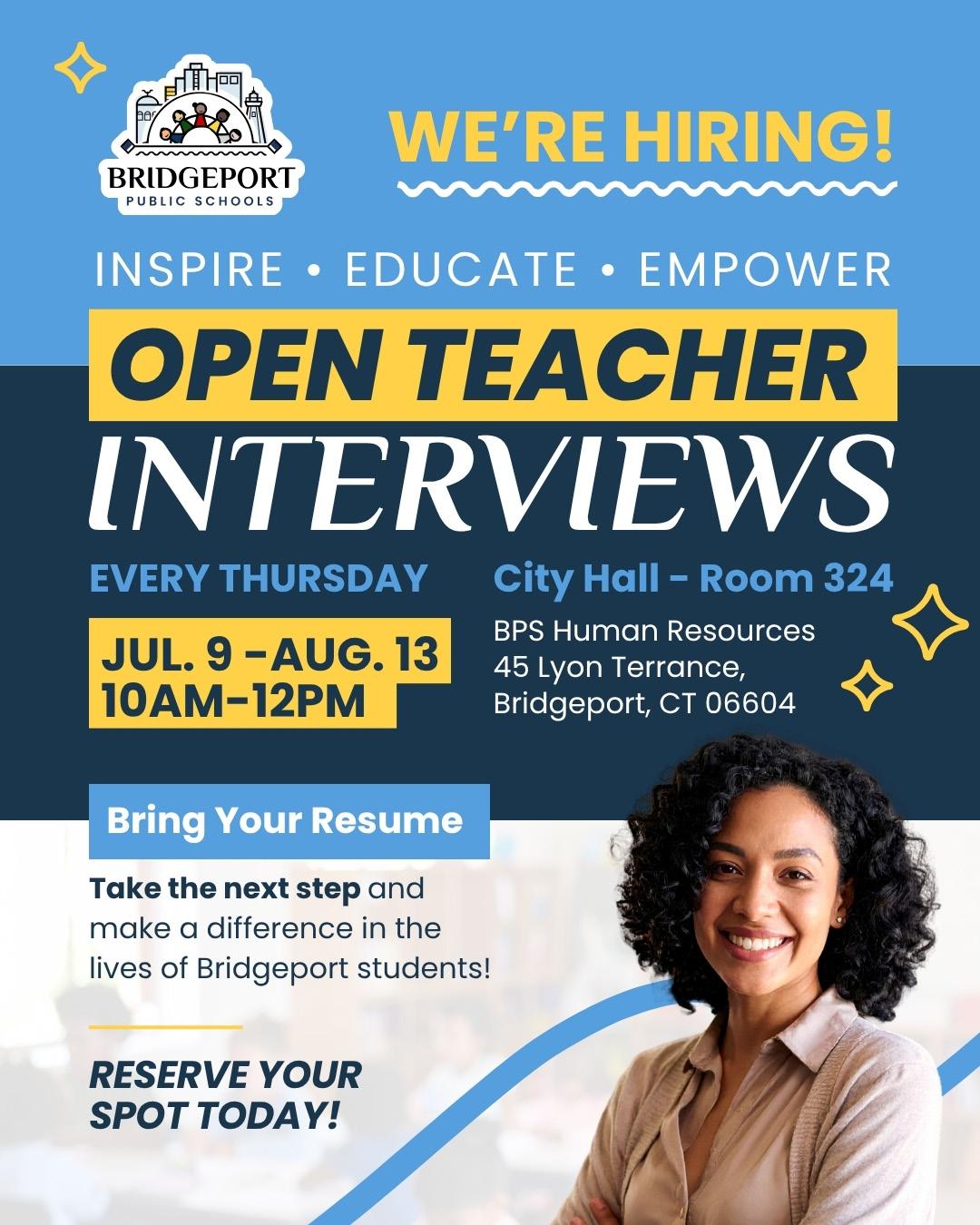
Structural Engineering Peer Review Services
Leroy Downs Apartments 8 Chestnut Street, Norwalk, Connecticut
Sound Communities Inc. invites proposals from independent, licensed structural engineering firms to perform a code-mandated structural peer review of Leroy Downs Apartments, a new seven-story, 68-unit affordable housing development at 8 Chestnut Street in Norwalk, Connecticut.
The structural design is a hybrid system consisting of a Type IA cast-in-place concrete podium at Level 1 and Type IVC Cross-Laminated Timber (CLT) framing for Levels 2–7. Construction documents are at 90% completion. The independent peer review is required under Connecticut General Statutes § 29-276b and Building Code Section 107.7.1. Responding firms must hold an active Connecticut PE license and have demonstrated experience reviewing hybrid concrete/CLT structural systems of comparable height and complexity.
Proposals are due no later than 7/31/2026 at 5:00 PM EST and must be submitted via email to sstewart@soundcommunitiesct.org. No hard copies.
The complete RFP may be obtained by contacting Sophie Stewart, Project Coordinator, at sstewart@soundcommunitiesct.org, or by visiting the NHA website under “Doing Business”. Firms with CLT/mass timber peer review experience are strongly encouraged to respond. Small, minority-, and women-owned businesses are encouraged to respond.
Sound Communities and Norwalk Housing Authority are Equal Opportunity Employees
Structural Engineering Peer Review Services
Leroy Downs Apartments — 8 Chestnut Street, Norwalk, Connecticut
Sound Communities Inc. invites proposals from independent, licensed structural engineering firms to perform a code-mandated structural peer review of Leroy Downs Apartments, a new seven-story, 68-unit affordable housing development at 8 Chestnut Street in Norwalk, Connecticut.
The structural design is a hybrid system consisting of a Type IA cast-in-place concrete podium at Level 1 and Type IVC Cross-Laminated Timber (CLT) framing for Levels 2–7. Construction documents are at 90% completion. The independent peer review is required under Connecticut General Statutes § 29-276b and Building Code Section 107.7.1. Responding firms must hold an active Connecticut PE license and have demonstrated experience reviewing hybrid concrete/CLT structural systems of comparable height and complexity.
Proposals are due no later than 7/31/2026 at 5:00 PM EST and must be submitted via email to sstewart@soundcommunitiesct.org. No hard copies.
The complete RFP may be obtained by contacting Sophie Stewart, Project Coordinator, at sstewart@soundcommunitiesct.org, or by visiting the NHA website under “Doing Business”. Firms with CLT/mass timber peer review experience are strongly encouraged to respond. Small, minority-, and women-owned businesses are encouraged to respond.
Sound Communities and Norwalk Housing Authority are Equal Opportunity Employees
Sound Communities Inc., an affiliate of the Norwalk Housing Authority, and its development partner National Housing Trust are seeking proposals from qualified site-civil engineering firms for a multi-phase, transit-oriented, mixed-use affordable housing development at 26 Monroe Street, adjacent to the South Norwalk Metro-North Station. The project is anticipated to yield approximately 200 units across two phases, with ground-floor office space, community amenities, and a public plaza component. Firms must have demonstrated experience in site planning, urban infrastructure, zoning, and multifamily or mixed-use development in Norwalk or Fairfield County. Full RFP is advertised on Norwalk Housing Authority website. NHA and Sound Communities are Equal Opportunity Employers.
Submission Deadline: July 24, 2026, at 5:00 PM EST
Email only. No hard copies. Questions accepted through July 17, 2026
Contact: Leala Marlin, Development Project Manager lmarlin@soundcommunitiesct.org

360 Management Group is currently seeking bids from qualified contractors to perform Security Camera Maintenance/Installation/upgrades . A complete copy of the requirement may be obtained from Elm City’s Vendor Collaboration Portal https://newhavenhousing.cobblestonesystems. com/gateway beginning on
is currently accepting applications to participate in the examination for the position of Secretary II, Grade Level 10-$25.40/hour, 37.5 hours per week, 12-month position. Qualified candidates must possess a High School Diploma or equivalent with a business course background and a minimum of 3 years secretarial experience. Prior experience in a school system or related work with children preferred. The application is available online at https://www.easthaven-ct.gov/jobs.aspx or from the Civil Service Office, 250 Main Street, East Haven and must be returned by August 17, 2026. The Town of East Haven is committed to building a workforce of diverse individuals. Minorities, Females, Handicapped and Veterans are encouraged to apply.
The Housing Authority of the City of New Haven d/b/a Elm City Communities acting through its instrumentality, The Glendower Group, Inc. Is soliciting Invitation for Bids (“IFB”) for qualified General Contracts (GC) for the Henry Street University Row Project. A complete copy of the requirement may be obtained from New Haven Housing Authority Vendor Collaboration Portal https:// newhavenhousing.cobblestonesystems.com/gateway beginning on
Monday, July 27, 2026, at 3:00PM.
a quarry and paving contractor, has positions open for the upcoming construction season. We are seeking candidates for a variety of positions, including: Scalehouse Dispatcher/ Equipment Operators and Laborers. NO PHONE CALLS. Please mail resume and cover letter to “Hiring Manager”, Galasso Materials LLC, PO Box 1776, East Granby CT 06026. Galasso Materials is an Affirmative Action/Equal Opportunity Employer. All applicants will be considered for employment without attention to race, color, religion, sex, orientation, gender identity, national origin, veteran or disability status.
The Housing Authority of the City of New Haven d/b/a Elm City Communities acting through its instrumentality, The Glendower Group, Inc. Is soliciting request for qualifications (“RFQ”) for selection of a qualified and experienced A & E Firm to serve as the Project Architect for the Westville Manor Development. A complete copy of the requirement may be obtained from New Haven Housing Authority Vendor Collaboration Portal https://newhavenhousing.cobblestonesystems.com/gateway beginning on
Wednesday, July 15, 2026, at 3:00PM.
The Town of Wallingford is accepting applications for Corporation Counsel. Wages: $143,834 to $183,137 annually. For additional information and to apply online by the August 21, 2026 closing date please visit: www.wallingfordct.gov/ government/departments/human-resources/. Applications are also available at the Department of Human Resources located in Room #301 of the Town Hall, 45 South Main Street, Wallingford, CT 06492. Phone: (203) 294-2080; Fax: (203) 294-2084. EOE
Members of the public are invited to
State Project No. 0173-0549
Accessible Pedestrian Signal Upgrades in Southern Connecticut (Branford, Bridgeport, Darien, Guilford, Milford, New Haven, North Haven, Norwalk, Orange, Trumbull, Wallingford, West Haven, and Woodbridge)
Thursday, July 30, 2026, at 6:00 p.m.
Attend & Learn More: portal.ct.gov/DOTSouthernCT0173-0549
The purpose of this meeting is to provide the community with an opportunity to learn about the proposed project and allow an open discussion of any views and comments concerning the proposed improvements. A Q&A session will immediately follow the presentation.
These upgrades will enhance safety at several traffic signals for both pedestrians and vehicles.
Right-of-way impacts are expected to be minimal at some project intersections.
Construction is expected to start in 2028, depending on funding, right-of-way acquisition, and permits. The estimated cost is approximately $6 million, with 90% federal funds and 10% state funds.
The public can submit comments and questions during the two-week public comment period following the meeting. Direct comments and questions by Thursday, August 13, 2026, to Balazs Szoke at DOTProject0173-0549@ct.gov or 860-594-2020. Please reference Project No. 01730549 in the email or voicemail.
Non-English language closed captioning will be available on Zoom. The recording will also be posted following the meeting in CTDOT’s public meeting playlist at portal.ct.gov/ctdotVPIMarchive
For audio only, call 877-853-5257 with Meeting ID 898 8238 8755. Project information can be mailed within one week by contacting Balazs Szoke at DOTProject0173-0549@ct.gov or 860-594-2745.
Individuals with hearing/speech disabilities can dial 711 for Telecommunications Relay Services (TRS). Request language assistance from CTDOT’s Language Assistance at 860-594-2109 at least five business days before meeting.


The State of Connecticut, Office of Policy and Management is recruiting for a Connecticut Careers Trainee, target class Planning Analyst in the Intergovernmental Policy and Planning Division. Further information regarding the duties, eligibility requirements and application instructions are available at: https://www.jobapscloud.com/CT/ sup/bulpreview.asp?b=&R1= 260427&R2=2292AR&R3=001
The State of Connecticut is an equal opportunity/affirmative action employer and strongly encourages the applications of women, minorities and persons with disabilities.

City of Bristol
$78,813/yr. Required testing, general info, and apply online: www.bristolct.gov
DEADLINE: 12-07-25 EOE
The Town of Wallingford is accepting applications for Video Technician I (Part-Time). Wages: $20.00 to $22.00 hourly. For additional information and to apply online by the July 6th, 2026 closing date please visit: www.wallingfordct.gov/government/departments/human-resources/. Applications are also available at the Department of Human Resources located in Room #301 of the Town Hall, 45 South Main Street, Wallingford, CT 06492. Phone: (203) 294-2080; Fax: (203) 294-2084. EOE
The Town of East Haven is currently accepting applications to participate in the examination for the position of Secretary II, Grade Level 10$25.40/hour, 37.5 hours per week, 12-month position. Qualified candidates must possess a High School Diploma or equivalent with a business course background and a minimum of 3 years secretarial experience. Prior experience in a school system or related work with children preferred. The application is available online at https://www.easthaven-ct. gov/jobs.aspx or from the Civil Service Office, 250 Main Street, East Haven and must be returned by August 17, 2026. The Town of East Haven is committed to building a workforce of diverse individuals. Minorities, Females, Handicapped and Veterans are encouraged to apply.
The Town of Wallingford is accepting applications for Water Treatment Pumping Operator I. Wages: $30.35 to $36.64 hourly. For additional information and to apply online by the April 20, 2026 closing date please visit: www.wallingfordct.gov/government/departments/human-resources/. Applications are also available at the Department of Human Resources located in Room #301 of the Town Hall, 45 South Main Street, Wallingford, CT 06492. Phone: (203) 294-2080; Fax: (203) 294-2084. EOE
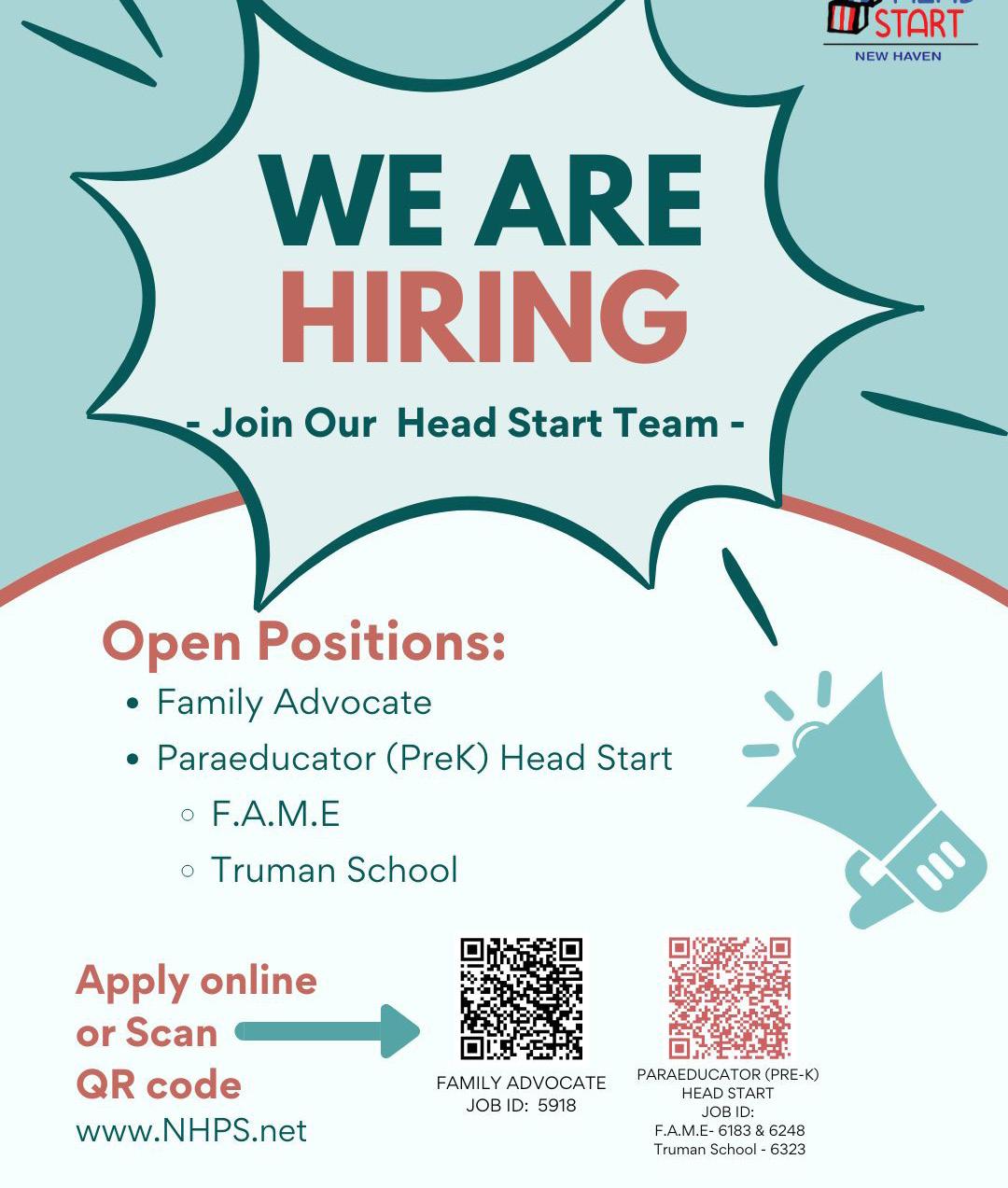
By courtesy of HBCUNEWS.com
WASHINGTON — Days after Howard University notified hundreds of first-timein-college students that their spots for the upcoming semester were no longer being held, other colleges and universities are stepping up to fill the gap for students who are scrambling to find other options. Keana Johnson is one of them.
The 17-year-old was looking forward to starting classes next month at Howard University as the next step on her educational journey and a way out of the New York City shelter where she lives. She told The Associated Press Tuesday that she may consider the University of the District of Columbia in Washington, which is extending its undergraduate application deadline to Aug. 7. She’s also looking into historically Black colleges and universities in the South, but realizes her options are limited and time is running short.
“I will still love to go to Howard,” Johnson said. “I’ve invested too much into going to that university to give up now.”
Howard, one of about 100 historically Black colleges and universities in the
the upcoming semester were no longer being held. The school
said the students had not met deadlines for enrollment and financial obligations. Howard also said students who believe their accounts did not reflect their financial standing should contact its financial aid office and that “each case will be reviewed individually to determine whether adjustments or reinstatement are appropriate.”
Howard University has not responded to an AP request for the number of unenrolled students reinstated or the status of cases being reviewed.
Johnson said she has emailed the school multiple times for answers she’s yet to receive. “I called every single office there is a number for,” she added.
The Howard staff on the other end of the calls were of no help, Johnson said.
The University of the District of Columbia, like Howard, is an HBCU and located in Washington. The public university has committed to offering a hand to students who especially need one right now, said Hasanna Tyus, the vice president of enrollment services.
“ We understand that college plans can change unexpectedly, and we want students to know that they still have options,” Tyus said.
New York Gov. Kathy Hochul an-
nounced Monday that the State University of New York and City University of New York also are expediting late admissions reviews at some schools for state residents unenrolled by Howard. Participating campuses also will provide an $800 credit per student to offset enrollment deposits paid to Howard that have not been refunded.
“New York is home to the nation’s finest systems of public higher education, and we are ready to welcome these talented students with the opportunity they deserve,” Hochul said.
Johnson, who is Black and uses “Star” as her preferred name, was notified in December of her admittance to Howard’s nursing program for the fall 2026 semester.
She said she doesn’t live with either parent and has been staying at a homeless shelter for teens and young adults since early June while attending the Charter School of Educational Excellence in Yonkers.
She still hopes to land at an HBCU. “The main thing that kept me going was knowing I was going to end up at Howard,” Johnson said. “It’s a community of peers that look like you and struggle like you.”
Tuskegee's new dress code policy is part of a larger policy that, to its credit, does have practical applications as well.
by Zack Linly, newsone.com
Black people, especially here in the U.S., have a complicated relationship with presentability. Historically, we’ve been looked down upon as a collective, no matter what we’re wearing. A lot of Black people will note that Martin Luther King Jr. was wearing a suit when a rabid white man assassinated him. I’m not sure I like that reasoning since King was killed because of the work he was doing and the systemic racism he led a fight against — not because someone mistook him for a thug due to baggy clothing or a head scarf — but the point still stands that adhering to a largely white and Western standard for how one should dress in public certainly won’t save us from the prejudice that also comes with that standard.
I’m not even sure if there’s a societal frame of reference for respectability politics as it relates to white people and other racial groups, but for Black people, it’s a 400-year plague that has infected many of us with deeply colonized mentalities. But whatever, Black people can think what they want; the problem arises when they start making policy around it in Black institutions.
So, let’s talk about this new dress code banning bonnets and du-rags in classrooms and the cafeteria at Tuskegee University.
So, first, it should be noted that, according to AL.com, Tuskegee’s updated dress code also prohibits students from wearing house shoes and “revealing clothing”
and mandates that students attending professional events or business meetings must wear business suits and appropriate footwear. Tuskegee President Dr. Mark A. Brown said the changes aim to give students a “solid foundation for the workforce they will enter once they leave Tuskegee” rather than limit their college experience. But do they actually do the former and not the latter?
I wonder if Brown, the other administrators at Tuskegee, or any of the Black people on social media who agree with the new policy — and there are many of them — have actually witnessed or even heard about a college graduate showing up to a job interview or business meeting in a bonnet or du-rag and slippers. Certainly, this must be a real, non-delusional concern of theirs due to a totally-non-fictional phenomenon that is reflected in reality — otherwise, we’re just talking about students going to class and to lunch dressed comfortably, and one might get the impression that these blushing negroes just don’t like seeing certain aspects of Black existence being on display where everyone else can see us.
Remember when the killing of Trayvon Martin by racist neighborhood watchman George Zimmerman started off as a discussion about systemic racism, racial profiling, and the inherent white supremacy of “stand your ground” laws, until it devolved into a debate around whether Trayvon should’ve been wearing a hoodie in the first place? That might have been a discussion that began in the Caucasian

Source: ASphotowed / Getty
world of justifying violent Black death at the hands of bigoted vigilantes, but it’s one that also included white-gaze-fearing Black people warning other Black people about the dangers of hooded casual wear and how we should abstain from it even when we’re doing something as mundane as walking home from the corner store. The implication there is that Trayvon might still be alive if the sweater he was wearing was hoodless, and the Black
people who were subjecting their own to such warnings purported to be looking out for our collective best interest then, too. But were they merely looking out for their own in the interest of our collective safety, or was Trayvon’s story simply the excuse they needed to reinforce their own disgust with Black people not adhering to their conservative views on how we should assimilate, mirroring that of our white counterparts?
But you know what, let’s stick to the subject at hand, which, by the way, is far from unique to Tuskegee, as respectability politics are an issue at HBCUs across the country, unfortunately, regardless of how often the richness and fullness of Black culture is on display at these institutions.
Again, Tuskegee’s new dress code policy is part of a larger policy that, to its credit, does have practical applications as well. For example, the new policy holds that students must keep cellphones turned off during class unless professors give specific permission to use them, and it requires the university to monitor attendance more closely, “viewing regular class participation as essential to academic success, according to the updated policy,” as AL.comreported.
Now, see, these policies might actually help with the fact that at Tuskegee University, only 29% – 31% of students finish on time within four years, only 57% – 61% of students complete their bachelor’s degrees within six years, and the fact that roughly 20% to nearly 30% of 73% – 81% of first-year students fail to return for their sophomore year, according to the U.S. News and World Report.
But, no, no — I’m sure student retention and performance will improve greatly now that administrators are telling them they need to be in a button-down shirt and slacks when they go to class, and to leave their protective head coverings in their dorms.
Good luck with all that.