




by Allan Appel
Rona Rohbar came to the U.S. with her family at age 17, a refugee from a wartorn Afghanistan and speaking not a word of English — and never even having gone to any school (thanks to the Taliban) until age 15, and that in a refugee camp in Pakistan.
Within a month of arrival in the Elm City she was a cashier at a store in East Haven — that’s like a perfect locale to speed-date with the English language. Roll the clock 25 years later — including time spent at New Haven Adult Ed, pre-nursing training at Gateway Community College, and six years as a medical interpreter in Pashto, Dari, and Hindi at Yale New Haven Hospital — Rohbar, now a mom of four kids, heads up the Integrated Refugee & Immigrant Services’ (IRIS) health department, and feels herself completely an American.
And she can tell you the precise moment, and the way, that transformation took place.
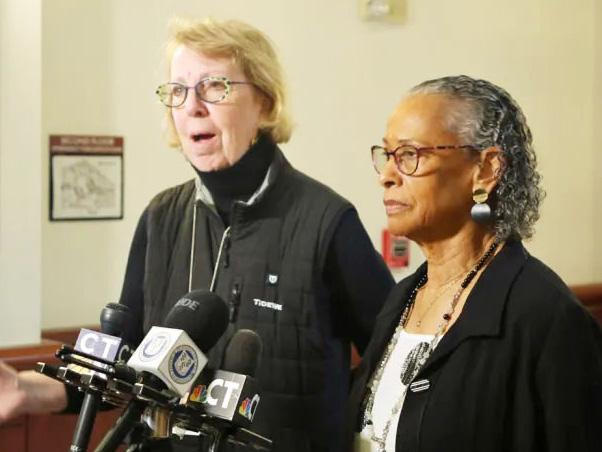
Saturday afternoon, amid the festive democratic hoopla of the No Kings rally on the Green, Rohbar’s hopeful, transformative story and those of dozens of others were collected by IRIS staffers in audio and video files at their purple tent, which they were sharing with the League of Women Voters along Temple Street.
“Look around,” said IRIS Director of Community Engagement Katy Lawder, at the thousands on the Green. “All these people are immigrants, we all have a story, and we feel that’s been lost.”

The Trump administration’s anti-immigration policy and its violent crackdowns have curtailed IRIS’s ability to take on new families for resettlement – there are none at present! – but our state’s premier re-settlement agency is alive and well, continuing to work, with the help of its more than 1,000 volunteers, with hundreds of resettled families in the Greater New Haven area.
And this year, as the 250th anniver-
sary of the country approaches, this new recording program of immigrant stories — from across all geographies and generations — will be a key feature of an IRIS celebration at a kind of Immigration Day on July 3, one day before the July 4 Big Blast. That July 3 event will be held at United Church of Christ Parish House at 323 Temple St
“This year we’re really leaning into democracy, the Constitution, and a single le-
gal system for everyone,” Lawder added. At Saturday’s event, IRIS’ table was thronged with people who were signing up to volunteer.
Staffers like Erin Kelly, the communications coordinator, had already pitched the recording idea — a minute of your time to tell us your immigration tale — and several people had already been escorted by her across Temple Street to the bus shelter, away from all the shouting
of democracy, to do the recordings; they ran from 30 seconds to a minute, she reported, and were basically whatever the interlocutor chose to share about their life history and journey.
One young man simply said, she averred, that his grandparents had immigrated to the U.S. years ago from Venezuela, and he was, especially given the plight of that nation today, immensely grateful for that.
Gabriella Desisto-Morton’s story – which she repeated to this reporter – was that her dad, an Italian, owned a condo in the Dominican Republic
“He vacationed there,” where Gabriella’s mom and her sister were the workers cleaning the condo. “They met and fell in love and married. They wanted a better life for me, so they came here,” she said. Each had a sponsor, and they legally became citizens. “This was before Trump, during Obama,” she added, when it was a lot easier.
And Kelly herself shared her family story of Ellis Island where her great-grandfather entered America hiding under his mother’s skirts, undocumented, she said, “and here I am.”
And what was Rona Rohbar’s moment of becoming an American? “America is just so diverse,” she said. “So many opportunities. There’s no country like this.” “The way it happens,” she went on, “is seeing it, the diversity is absorbed into you and you become one of them. That’s the beauty of America.”
To work with IRIS, to donate, or if you’d like to contribute an immigration story, here’s the site.
by Donald Eng
HARTFORD, CT — The budget revisions that passed the Appropriations Committee Tuesday increased Gov. Ned Lamont’s proposed spending plan by $147.6 million, but remained under the state budget spending cap. Achieving that, though, required a bit of fiscal maneuvering.
Democrats on the committee proposed the $25.6 billion package Tuesday morning. The increases focused on additional funding for human services, education, transportation and other public services. Getting under the spending cap required a one-time $150 million payment to the Teacher’s Retirement Board, which necessitated re-basing the 2027 spending formula. That resulted in the revised budget being $16.1 million under the cap. The budget revisions, which passed mostly along party lines, now forms the foundation for negotiations between Lamont and the legislature before the legislature adjourns May 6.
Senate Chair Catherine Osten, D-Sprague, said she and House Chair Toni Walker, D-New Haven, were proud of the proposal.
“We have dealt with a lot of issues that
we think people in the state of Connecticut have asked us to take care of,” she said.
Walker agreed. She said the budget was based on the foundation of Lamont’s February proposal.
“There were some good ideas in there,” she said. “There are many different things that still have to be worked out in the budget, there are things that we have to also align with finance (committee) and things like that. But right now this is the beginning.”
Though Osten in a short media briefing before the committee went into caucus had described the process as bipartisan, legislative Republicans criticized the proposal as press release fodder.
“Democrats, through their Appropriations and Finance proposals, have again offered an initial budget that we know won’t balance, which means none of it actually counts,” said House Minority Leader Vincent Candelora of North Branford. “And when they do get around to addressing Connecticut’s real crises such as the property tax burden, education funding for municipalities, and our critical healthcare infrastructure, the answer will largely rest on raiding volatile, one-time revenues to slap a band-aid on problems
that require surgery.”
State Rep. Tammy Nuccio of Tolland, the ranking House Republican on the committee, said the Democratic proposal was unsustainable.
“My concern is that the majority is
spending itself into a corner by building a budget based on a volatile stock market, and when that market turns, lawmakers will be back here debating about what to cut,” she said. “That is not responsible planning.”
Among the areas that Democrats spent more than Lamont proposed are $36.3 million for human services, including increasing funding for Medicaid rates, which they said would have the net effect of reducing health insurance rates for all. Democrats also increased elementary and secondary education funding by $31.4 million, primarily to support magnet schools, adult education and health/welfare for private school students. Transportation also saw a $22.2 million increase from Lamont’s proposal, including increased funding for Shoreline East to continue its return to pre-COVID service levels.
The state’s hospital association, in a statement released after the vote, said it appreciated the committee’s efforts, and those of the Finance, Revenue and Bonding Committee. The group said it looked forward to working together to protect and strengthen access to care. The association urged the legislature to use the net proceeds of the proposed hospital tax increase to support patient care, to reserve the benefits of the tax to only the hospitals that pay it, and to seek a long-term deal with the federal government to maximize support for patient care.

by Mona Mahadevan
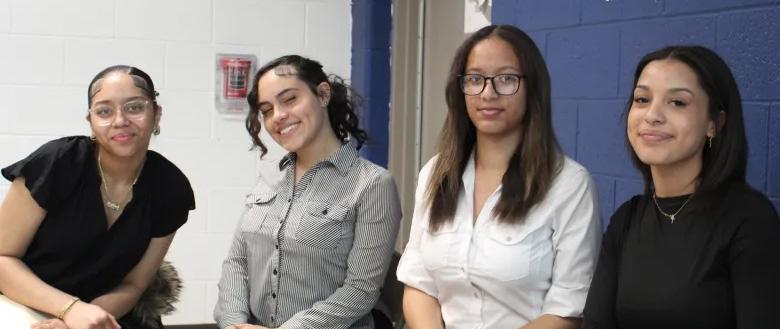
On Thursday, Hillhouse senior Arrianna Jones stepped into one of the classrooms where she has spent four years learning how to weld, 3D print, and design machine parts. She left with a $23-per-hour job offer to help build the U.S. Navy’s nuclear submarines.
Jones was one of 50 seniors from Hillhouse High School, Wilbur Cross High School, and the Sound School who were interviewed by General Dynamics Electric Boat in a Hillhouse classroom Thursday; 46 received on-the-spot job offers, according to city spokesperson Lenny Speiller.
Many of the interviewed students are about to graduate from Career-Connected Pathways, a vocational program run by New Haven Public Schools (NHPS). Jones is one of the inaugural members of the manufacturing pathway. Her 30-person cohort spent the last four years taking classes in English, math, and the other core subjects while also learning about welding, metrology, computer numerical control (CNC), and computer-aided design (CAD).
Now, many of them have the opportunity to work at General Dynamics Electric Boat, a manufacturing company headquartered in Groton. General Dynamics recently partnered with NHPS to support the school district’s manufacturing program, including by offering job opportunities to graduating students.


A landlord is scheduled to get his day in court next week in a year-long quest to boot an Instagram-worthy brunch bar from Park and Elm Streets.
The landlord, Michael Shaffer of the CA White real estate company, has been seeking in court to have The Place 2 Be evicted since March 2025 for nonpayment of rent. Judge Alayna Stone has scheduled a hearing in the case for next Tuesday in the third-floor housing court at the 121 Elm St. courthouse.
The restaurant — once one of four Place 2 Be franchises in Connecticut and Massachusetts — abruptly closed its doors last week after the state Department of Revenue Services issued a March 23 order revoking its sales and use tax permit for all state locations. (Asked for details about the offense, a spokeswoman said the department can’t under law reveal specific taxpayer information.) The revocation followed years of lawsuits against the company, as well as an arrest of the principal owner last September on still-pending charges of second-degree larceny and issuing a bad check over $2,000. The owner, Gjinovefa Luari, has pleaded not guilty to both charges, according to the state judicial database. (Connecticut Insider’s Nathaniel Rosenberg previously reported on the permit revocation.)
“We don’t know what their plans are with regard to the state’s action to rescind their sales and use permit. We have a court date in a week to try to resolve the matter from our perspective,” Schaffer told the Independent.
The brick two-story building at Park and Elm was originally a firehouse. It was reborn in the early 1980s as a fern bar called Fitzwilly’s, a harbinger of an earlier wave of tentative gentrification in town. It subsequently became a popular restaurant and bar called Box 63, which became a casualty of the Covid-19 pandemic.
The Place 2 Be franchise opened in December 2022 with colorful backdrops (like painted messages on the wall such as “Drink My Bathwater”) designed for patrons to snap social-media photos of themselves experiencing bliss getting sauced while the sun was still out.
Place 2 Be principal owner Luari and attorney Brian Silver could not be reached for comment. Silver argued in an unsuccessful August 2025 motion in the eviction case that the restaurant had made some back rental payments at one point that arrived late because of its “bank’s processing time.” He wrote that the company “invested over $700,000 in buildout costs on the property, funded in part through a commercial loan tied to the lease.”
Eight students told the Independent that they plan to accept their offers. Jones, however, is still considering. She has a competing job offer at CAM Manufacturing, as well as 14 different college acceptances.
As Jones and I spoke, two representatives from General Dynamics walked by. “Congrats on the offer! Hopefully you come with us,” said one.
“Time will tell!” she replied, beaming.
Jones applied to the manufacturing program on the recommendation of her middle school guidance counselor.
“I wanted to go to [New Haven Academy], and I was heartbroken when I found out I had to come to Hillhouse,” she said. When she learned about the manufacturing pathway, she figured it would be “a great way” to distinguish herself as a student.
She spent three hours every other day in the program. Through her courses, she learned how to use 3D software tools and Microsoft applications like Excel. She also received an Occupational Safety and Health Administration (OSHA) certification and gained hands-on experience at the Manufacturing and Community Technical Education Hub (MATCH). And, she said, she learned professionalism, such as being timely and “not having AirPods in” when someone is talking.
While she has many interests, over the last four years, Jones found herself feeling excited about manufacturing work. “I like seeing something that I created being
used,” she said.
Her favorite apparatus is a 3D printer.
“I like seeing the product that comes out of it. I like seeing and being able to say, ‘I made that. I designed that. I printed it. I made that.'”
Whether or not she ends up in manufacturing, she has no regrets about participating in the pathway. “This program — it offers a lot more than just learning how to use machines,” she said. “It really feels like a family. When I graduate here, I’m going to keep in touch with my manufacturing brothers and teachers.”
The backbone of the program is Vincent Squeglia, the manufacturing program’s leader and a former assistant principal at Brennan-Rogers Magnet School.
“Just listening to Arrianna — we did something,” said Squeglia, filled with pride.
He said the program helps students build confidence. It also gives them four years to build deep relationships with their teachers and manufacturing peers. Squeglia praised the program for expanding the opportunities available to graduat-
ing students.
“They have a choice when they graduate whether to take a job or maybe go to UConn, do engineering, stuff like that,” he said.
The new manufacturing lab at Hillhouse was funded by $2 million in federal funds, money that U.S. Rep. Rosa DeLauro helped secure. Future cohorts can expect to use the machines extensively, said Squeglia.
After being interviewed on Thursday, a number of students were hired on the spot.
“Imagine, you walk into a room, you have an interview, and someone says, ‘You got a job.’ The feeling and confidence that gives to our young people is just beautiful,” said Mayor Justin Elicker. One of the students offered a job on Thursday — Joshua Stephens, a senior at the Sound School — could hardly describe the feeling. “I really wasn’t expecting it,” he said. “It felt exciting.”
By Abiba Biao
Casteel, who grew up in the city’s West Hills neighborhood, is trying to get to the Paris Performance Experience, a twoweek arts workshop in Paris, France that invites emerging artists to refine their craft and learn about professional opportunities in the arts. At 17, the singer and student is asking New Haveners to lend a hand in getting him there, with a GoFundMe campaign from Ward 30 Alder Honda Smith.
Smith, who also founded and runs the 333 Valley St. community hub known as The Shack, is also his grandmother.
“Him being a part of this [program], it has changed his ways, totally,” Smith said, remarking on Casteel’s newfound drive and energy into his artistry.
This year, the program runs from July 17-31. It is held at Le Château Chaumontsur-Yonne, with visits to historic sites like Le Théâtre du Renard in Paris and the church of Notre-Dame de Chaumont. The two week intensive culminates in a concert on July 30 at the Théâtre du Renard, where participants show off their newly acquired skills.
“I've always been singing any opportunity I got from a young age, whether it was, like, a talent show at school or something like that,” Casteel said. “It’s such an honor to be able to go out of the country and, you know, sing, and do what I love to do the most, and I'm gonna be learning so much … All that's gonna do is make me a better singer, performer, songwriter, so I'm looking forward to it.”
The program, and Casteel’s path to getting there, is as much a New Haven story as it is an international one. Three years ago, Dr. Tiffany Renée Jackson—a soprano who grew up in the Elm City, and went on to study opera at the University of Michigan and the Yale School of Music—was a founding member of the program, which she runs in partnership with YXIE - Manoir des Arts.
In just a few years, it’s become a testament to not only the power of arts education, but also the talent coming out of New Haven, with instructors like Avery Wilson (who belonged to Cooperative Arts & Humanities High School before he belonged to Broadway) and Heritage Chorale Founder and Director Dr. Jonathan Berryman in the mix.
This year's cohort of 65 students—double last year’s enrollment—is slated to be the largest in the program's history. Its uniqueness comes from its interdisciplinary nature, different from other classical programs because “it decenters Eurocentrism and classical music exclusively,” Jackson said in a phone call Wednesday. Instead, it includes other genres such as contemporary commercial music—gospel, jazz, and R&B—theater arts, entrepreneurship, dance, fitness, song composition, and instrumental studies.
“I see up close and personal some of the disadvantages, and one of them is the lack of accessibility,” said Jackson, an

assistant professor of music at Hampton University. “So the future of the program, I see, is that it becomes even more accessible to people like Jamire throughout the country, through arts organizations, high schools, and colleges.”
That connection also led to Casteel’s interest in the program. Last year, Smith learned about the program through her longtime friend Patryce Bryant, a musician and gospel artist who is now also a Paris Performance Experience instructor. When she participated in the program, Bryant had been a caregiver for her aging mother for seven years, a process that took a toll on her physical and mental health. An insurance agent by day, she hadn’t made time to care for herself as an artist until she was there.
During her time in the program, she had the chance to learn from seasoned and acclaimed professionals in the field, including Beyoncé’s vocal coach, David Brewster. It was, in every way, “a life-changing experience,” she said. She credits Brewster with her vocal recovery, noting how specific sound exercises can assist with vocal healing.
“I didn’t realize how much stress and other things could affect your voice, and it took a man to tell me some things about my vocals,” she said. “I’m so happy now to not have to sing so smart, but to be able to sing easy now.”
“I had such a good time that when I came back, I vowed to find some young people,” she added, stressing the importance of accessible arts opportunities for youth. “Had I had this experience when I was younger, really, where would I be?”
That passion is very much alive for Casteel, who plans to begin his studies in psychology and human services at CT State Gateway this fall, and then transfer into Southern Connecticut State University. While his academic work is focused on his more practical interests—and the realities of an economically harsh job market—his singing career has never gone on hiatus. This year, he dove into songwriting, completing several new songs and projects.
He knows that the Paris Performance Experience may be the “best next move,” to advance his artistic career, he said. Even as he begins to think about life after high school, Casteel still plans to stay in the arts by continuing in music production and performing at local clubs and venues. He credits his life experiences as major inspiration, using songwriting as a medium to recount difficulties and challenges, and reflect back on his progression.
“The best part about, like, the songwriting is growth,” he said. “It's like, you write a song about something that bothers you, but you can go back, like, a year later and go back and listen to that and remember what you went through and how you overcame it.”

John P. Thomas Publisher / CEO
Babz Rawls Ivy Editor-in-Chief Liaison, Corporate Affairs Babz@penfieldcomm.com
Advertising/Sales Team
Keith Jackson Delores Alleyne John Thomas, III
Editorial Team
Staff Writers
Christian Lewis/Current Affairs
Anthony Scott/Sports Arlene Davis-Rudd/Politics
David Asbery / Tanisha Asbery
Jerry Craft / Cartoons / Barbara Fair Dr. Tamiko Jackson-McArthur
Michelle Turner / Smita Shrestha William Spivey / Kam Williams Rev. Samuel T. Ross-Lee
Contributors At-Large
Christine Stuart www.CTNewsJunkie.com
Paul Bass www.newhavenindependent.org
National Association of Black Journalist
National Newspapers Publishers Association
Greater New Haven Chamber of Commerce
Greater New Haven Business & Professional
Greater New England Minority Supplier Development Council, Inc.
The Inner-City Newspaper is published weekly by Penfield Communications, Inc. from offices located at 50 Fitch Street, 2nd Floor, New Haven, CT 06515. 203-3870354 phone; 203-387-2684 fax. Subscriptions:$260 per year (does not include sales tax for the in State subscriptions). Send name, address, zip code with payment. Postmaster, send address changes to 50 Fitch Street, New Haven, CT 06515. Display ad deadline Friday prior to insertion date at 5:00pm Advertisers are responsible for checking ads for error in publication. Penfield Communications, Inc d.b.a., “The Inner-City Newspaper” , shall not be liable for failure to publish an ad or for typographical errors or errors in publication, except to the extent of the cost of the space in which actual error appeared in the first insertion. The Publisher reserves the right to refuse advertising for any reason and to alter advertising copy or graphics deemed unacceptable for publication. The entire contents of The Inner-City Newspaper are copyright 2012, Penfield Communications, Inc. and no portion may be reproduced by any means without the written permission of the publisher.
Lucy Gellman
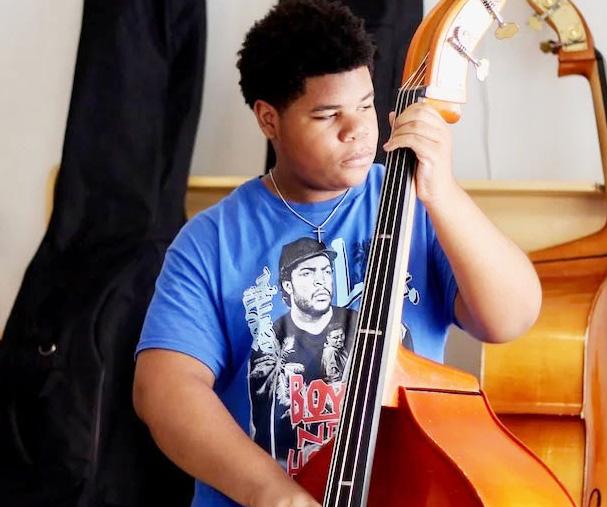
Zakai Henderson leaned in over his bass, his callused fingers slipping onto the strings as if they were old friends. He steadied the instrument, his left wrist pliant as it wrapped around to the front, and two right fingers perched just over the bridge. As Kenny Dorham’s “Blue Bossa” drifted up through the room, he began to bob his head from side to side and sway, the music flowing through him.
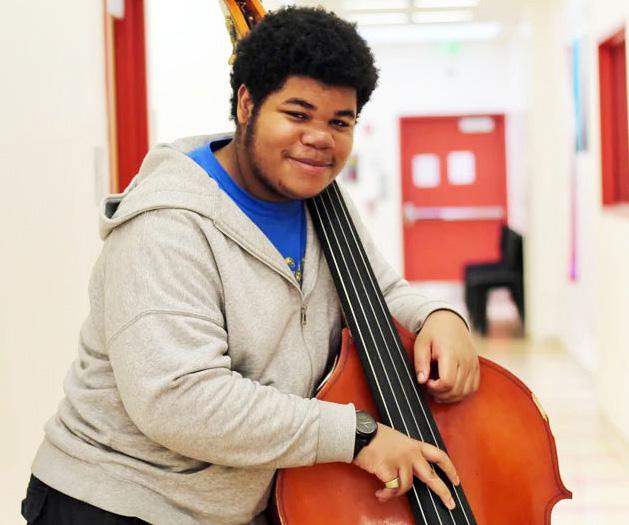
This Thursday and Friday, Henderson is headed to the Connecticut Music Educators Association’s All-State Music Festival, where he and fellow student Nadia Okwuosa will represent both New Haven and Cooperative Arts & Humanities High School in an all-state jazz band and all-state mixed choir respectively. The two, both seniors who have received full scholarships for the event, are the only New Haven Public Schools (NHPS) high school students to attend.
“It feels amazing! I feel so honored!” Henderson said in an interview Wednesday morning, standing in a practice room just off of a second-floor hallway. From a dance studio across the hall, Stephen Hankey’s voice wove in and out of a recording of “Imagine,” feet whooshing across the floor. “I feel like I finally reached the mountain peak, and it makes me want to work harder.”
“I’m really excited,” said Okwuosa, an alto who performed with the all-state mixed choir her sophomore year, and will be singing poetry by Langston Hughes that is set to music with the choir. “All-State is such a wonderful experience. It’s a different technique, a different grind … you have to come prepared.”
For both of them, the story of the festival is really a story of how music has gotten them through high school, and is now propelling them on to college. Growing up in the Hill neighborhood of New Haven, Henderson first fell in love with music through his grandfather, who listened to a steady stream of James Brown, Junior Walker, Ray Charles, and at least a dozen artists in between.
Close to a decade ago, Henderson started playing brass instruments as a student at John C. Daniels School of International Communication, working his way from the trumpet to the trombone to the baritone to the tuba. By eighth grade, he thought that he was headed to Co-Op to be in their band, then under the direction of Patrick Smith and Matt Chasen. Then on his first day, his schedule had the school’s string concentration written on it instead. He trusted the process. “It was crazy for me to go from playing instruments with my mouth to plucking with my fingers!” he said with an easy, open smile. But he stuck with it, excited to have a mentor in teacher Henry Lugo, a bassist who arrived at Co-Op in 2022.
“It’s [the bass] like, the most important instrument in my opinion. It’s like the backbone.”
Even as he doubled down on his studies in music, Henderson wasn’t initially drawn to jazz. But he was dedicated: he spent nearly every lunch period practicing in Lugo’s second-floor classroom, where strings play over the faint hum of College Street traffic.
When blisters began to erupt on his fingers (“my pointer finger gets a workout!” he said with a laugh), he soaked them in pickle juice—a tip from Lugo and Chasen—until they hardened into calluses. He let himself feel the music when he played, adding a few dance moves that are now just part of his signature artistic style.
Then his junior year, Lugo introduced him to the bassist and composer Christian McBride, a Philadelphia-raised musician whose work has led to multiple Grammy awards, and a 17-piece big band that can reliably bring a whole house to its feet. And for Henderson, whose influences range from Ray Charles to Lugo himself, something just clicked. In addition to New Haven’s All-City Orchestra, where he is the first bassist in six years, he began to add jazz numbers to his repertoire.
“He just has a joy for life in general, but his joy for music is so big,” said Lugo Wednesday, in a rare quiet moment between classes. “He has a real gift for the role of timekeeping and supporting others. There’s so much energy and forward motion in everything that he does.”
This Thursday and Friday, Henderson is bringing that joy to the Connecticut Convention Center in Hartford, where he is one of just two bassists in the entire state to play in the festival. For him, the opportunity has pushed him to grow his musical footprint, and also meet other young artists in the state. He’s already grown quite close with Elijah Spikes, a drummer based in Middletown who he met at CMEA regionals earlier this year.
That’s part of the point. Often—and despite the fact that the state is relatively small—students across different Connecticut towns and cities may not have the chance to meet, unless an extracurricular activity brings them together. When they do, they’re able to learn from each other, a skill that may help prepare Henderson for his studies in college in the fall. Currently, he hopes to attend Western Connecticut State University for music performance.
“It feels good [to play],” Henderson said. “It feels like my bass is making a sentence for me and I’m taking to the rest of the instruments.”
Okwuosa, who will likely attend WestConn or the Hartt School at the University of Hartford, echoed that enthusiasm Wednesday morning, as she slipped out of choir rehearsal for an interview. For

weeks, she’s been looking forward to singing with other students from around the state, and working with conductor Arreon A. Harley-Emerson, an assistant professor at Penn State who is the president and CEO of the arts agency Equity Sings.
Like Henderson, Okwuosa grew up surrounded by music, in a home where Maxwell, Erykah Badu and early Beyoncé set a soundtrack to her childhood (“I basically came out singing,” she said). Before long, music became both a source of quiet strength, a safe space for her to hop into whether she was at home, or navigating something at school.
“Singing just brings me comfort,” she said. “I’m generally always singing. People at school think of me as quiet, but when I sing, I’m the most extroverted.”
When Okwuosa arrived at Co-Op, former Choir Director Harriett Alfred took her under her wing, mentoring her until she retired in June 2025. Her freshman and sophomore year, she joined the AllCity Choir, part of Music In The Schools that helped prepare her for events like CMEA’s festivals. Then last year, she took a beat, and made the decision to join the Yale Camerata, where she sings with Alfred and Jaminda Blackmon, CoOp’s new choir director, every Tuesday after school.
So when Blackmon suggested CMEA’s Regional Festival, a prerequisite for the All-State Festival, she felt ready again. Senior year is “a lot,” she said—she’s had to stay on top of her coursework, auditions, and a growing repertoire of music while also applying to college, preparing for concerts, and dreaming up a capstone project—but singing is also what’s getting her through it. That, and it was just instinctively right.
“Being in All-State always feels like an opportunity and a blessing, but I also always felt like I belonged there,” she said. Even when school was hard, “it always felt like I was supposed to be there.”
“Choir,” she added, “is the reason I come to school.”
Back in Blackmon’s classroom during a free period, it was easy to see why. As Blackmon sat down at the piano, Okwuosa ran through “Joyful, Joyful,” her voice delicate but strong, rising as a few of her peers trickled in. The piece isn’t for CMEA—it’s part of the choir’s upcoming concert on April 7. Okwuosa wants to make sure she’s just as prepared for that, too.
“I’m so excited. So excited,” Blackmon said, taking a beat to reflect on Okwuosa’s path to Hartford. Outside of school, she works with Okwuosa in her personal voice studio. “It feels great to have Nadia go and represent the choir. I hope she knows how proud I am of her. She’s incredible.”
Nelani Mejias
Microphones wrapped with white flowers and green vines sat on the stage, the space lined with tea lights. Around the stage, a sunset-pink glow shifted to blue to red as the lyrics “It’s a new dawn/ It’s a new day/It’s a new life fo-or me” floated over the bright crash of cymbals, a resplendent tickle of ivories. Behind musicians, looking out over the sold-out theatre, a larger-than-life image of the late Nina Simone appeared on a projection screen.
That scene—and sound—filled the Flint Street Theater last Friday, as New Haven’s Lady Stout, Waterbury-based artist Nehway, and fellow musicians presented “Dear Nina,” a joyful tribute to the high priestess of soul that packed the house and started the weekend on a moving and mellifluous note. For Lady Stout (a.k.a. Denise Renee), it was as much a homecoming as it was an homage, a night to bask in—and sing right to—the city and people that have made her who she is.
“Unapologetic,” Lady Stout sang at one point, the words over the rhythmic percussion, low bass, and melodic keys, and it was as if she had summoned Nina herself to the stage. “That is the power of Nina in my eyes. She taught me to be unapologetic.”
That loving vibe radiated from the popcorn-scented lobby into the packed theater itself, where attendees trickled in and took their seats as performances drew near. Outside in the lobby, people found a respite from a chilly spring rain with jazzy piano and electronic beats, courtesy of 15-year-old Hubert Powell.
The theater, and the Friends Center for Children, is a home for “connection, reflection, and shared experience,” said Communications & Theater Manager Keegan Sagnelli as attendees took their seats. So it felt fitting, Friday, that it was also a space where the arts could be accessible.
The performance began with Nehway, a singer and songwriter from Waterbury whose etherial, mellow vocals have been

making their way into New Haven for years, thanks to events like the Seeing Sounds Fest. Starting with the click of a chord and a deep breath, her set was just her and an acoustic guitar. The warm plunk of strings backed her velvety voice as she sang original songs, ending with a cover of “Stars” that she made her own. It was what she called “a tribute to a tribute to a tribute,” inspired by both Nina Simone and Janis Ian.
Before that moment, she also sang about mental health and friendships in her original song “Save Your Life,” with the hope that people who hear her music feel at peace. Her deep, airy voice singing the words, “I feel alive,” floated over the light strums of guitar. Behind her, a projection of flowers blooming added to the garden installed on stage.
“I want myself and others to feel courage, even if it’s a quiet courage,” she said.
There was a short pause where the low rumble of collected voices, drifting up from those tucked beside to each other, filled the gap between sets. Soon, though,
it was replaced with loud cheering as Lady Stout made her way to the stage. Accompanying her was Powell (who happens to also be her son) on drums, Jerimiah Fuller on keyboard, and Betcherly Calixte on bass.
“Dear Nina, it was so many years ago when I discovered you in the Swiss Alps,” Lady Stout began, taking the audience on her own musical journey. She turned back the clock, transporting the audience to Switzerland’s Montreaux Jazz Festival, where she performed alongside Alicia Keys in 2004 (Keys returned to the festival in 2008). That year, the Festival was playing a video of Simone’s 1976 performance. Lady Stout was mesmerized— and has remained so ever since. Friday, she got to share the feeling of that awe with the audience. At one point, there was a moment of instrumental intermission where she played her own set of drums, as her son followed her fast-paced tempo. At another, she invited her daughters, Zoe, Cadence, and Tamia, to the stage to sing with her. The four of their voices blended seamlessly as they harmonized together.
Mostly, the lyrics carried her message home. From renditions of Nina Simone classics like “Feeling Good” and “Four Women,” to moments of pure poetry, an attendee could feel Simone’s spirit right there in the room. That was especially true as Lady Stout announced: “You thought this was just entertainment, this is a call to action,” and echo of the artist’s 1969 proclamation that “an artist's duty, as far as I'm concerned, is to reflect the times.”
The celebration of Women’s History Month ended with Lady Stout playing a tambourine, urging everyone in attendance to get on their feet and echo back their given lines. The lively thump of drums and upbeat pulse of vibrant keys played under the audience singing back the word, “power” before transitioning into Simone’s “See-Line Woman.” Then repeating back those opening “yeah’s” and echoing the word “woman” at the command of Lady Stout.
Lucy Gellman
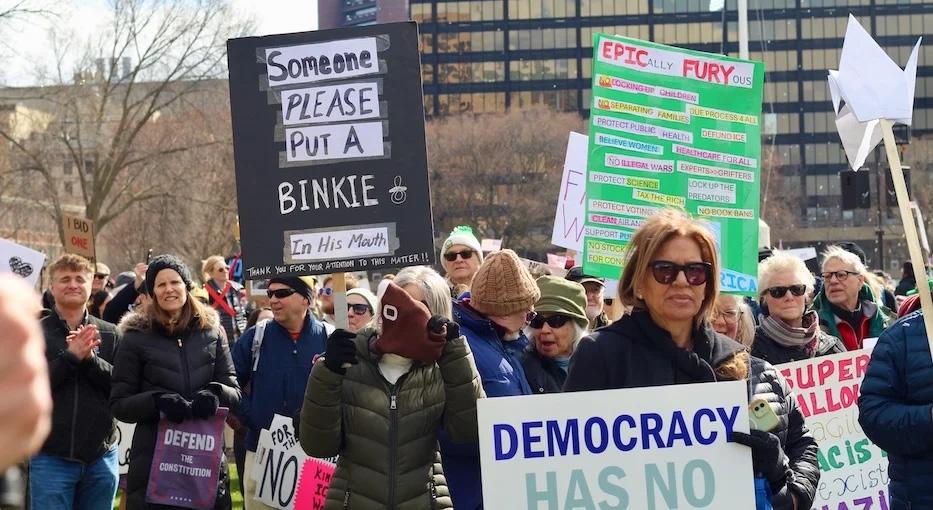
We'll be back Monday with a full article about the role of artmaking (which there was so much of!) at Saturday's No Kings New Haven rally on the New Haven Green. For now, here are a few snapshots of what it was like to be there Saturday afternoon. A special shout out to poets Japhet Gonzalez and Diana Robles, the Blue Steel Drumline, East Rock Brass Band, Singing Resistance New Haven and artists Janet Brodie (the paper cranes), Martha Willette Lewis (many of the signs), and Muffy Pendergast (queen of Westville's giant puppets) for bringing so much art into the mix.




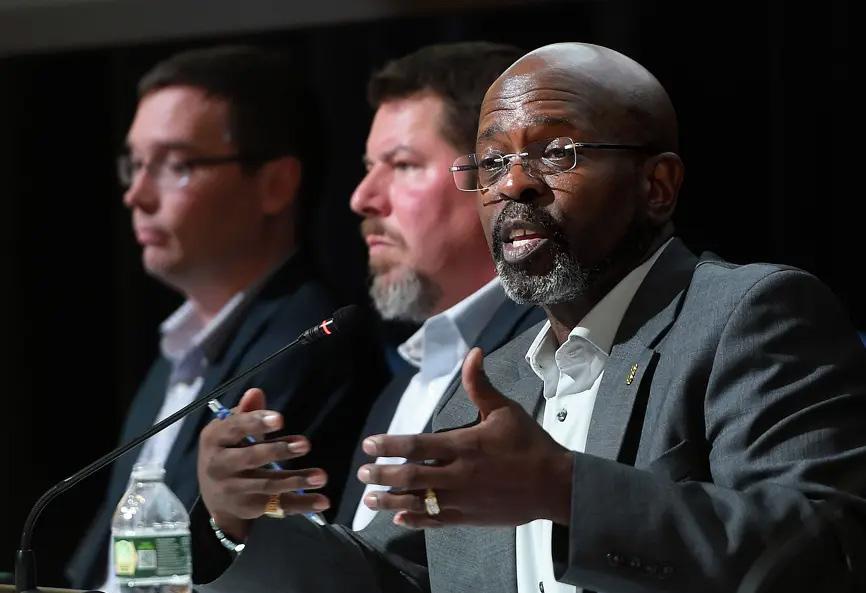
Interim Superintendent Royce Avery, center, answers questions about the facilities master plan for Bridgeport Public Schools during a Facilities Community Forum at Harding High School in Bridgeport on March 31, 2025. The Bridgeport Board of Education wants to delay the search of a permanent superintendent.
By Jessica Simms,
BRIDGEPORT — While the Bridgeport Board of Education initially intended to delay the search for the district's permanent superintendent, the state Department of Education has now set a June 1 deadline to move the process forward.
Board of Education Chair Jennifer Perez sent a letter to the Department of Education on March 20 saying the board decided to push back the search for a permanent district leader. This came after members worked on adopting updated governing policies and bylaws, a requirement state education officials say needs to happen before any superintendent search can begin.
Michael McKeon, director of legal and governmental affairs for the Department of Education, responded to Perez's letter on Tuesday, writing that this "proposed delay" is "at odds" with the Board of Education's "previously stated desire to move forward promptly with the search."
"This process of updating bylaws and policies should not be permitted to drag on, and thereby result in an undue delay in moving forward with the permanent superintendent search," McKeon wrote. The Department of Education now expects the Board of Education to approve
the remaining bylaws and polices by June 1, he wrote. The board also must secure a superintendent search firm by June 1, McKeon wrote.
If the Board of Education misses that date, McKeon said it could be perceived that there is an "inability to operate efficiently and potentially result in the (state)
commissioner of education invoking her authorized right to unilaterally appoint either a superintendent or a district improvement officer."
Royce Avery is Bridgeport Public Schools' interim superintendent and has been leading the district since the fall of 2024, when former Superintendent Car-
mela Levy-David went on leave. The Board of Education approved a separation agreement with Levy-David in December 2024.
School board members initially started the search process in March 2025, but Connecticut education officials stopped it, saying they were not notified that it had begun. As part of the state's intervention process into Bridgeport Public Schools, Commissioner of Education Charlene Russell-Tucker has the authority to oversee the appointment of the district's next superintendent.
Connecticut's intervention into Bridgeport Public Schools came after the district faced a $30-plus million budget deficit that prompted the board to freeze spending and eliminate dozen of jobs. Through this process, the Bridgeport Board of Education set governance improvement goals and one of them is to update its bylaws. The state also created benchmarks the board must meet before beginning its superintendent search.
Perez wrote in her March 20 letter that the school board "has carefully evaluated its current stage of progress and readiness," and due to "the scope of work underway and importance of ensuring stability within the district, we have determined it is both prudent and necessary
to pause the initiation of a formal search process."
The letter said the Board of Education would revisit the search process later this year "once this foundational work is complete." In the meantime, the plan was for the school board to extend Avery's contract through the end of the 2026-27 school year. The goal was to appoint a permanent superintendent to begin in July 2027.
McKeon noted in his letter that the Board of Education is contracted with Avery to be the interim superintendent until:
• The Board of Education appoints a new superintendent;
• Both Avery and the Board of Education mutually agree to terminate the contract;
• The contract is terminated for cause. Therefore, extending Avery's contract to have an end date would lock the city's school board into the agreement, which could "limit the opportunity of the Bridgeport Board of Education to act in a timely manner to secure a desired candidate," McKeon wrote.
He added that if Avery is not selected as the permanent superintendent, the Board of Education could find itself needing to pay the salary of the new superintendent while also being required to pay Avery for his remaining contract.
by Thomas Breen
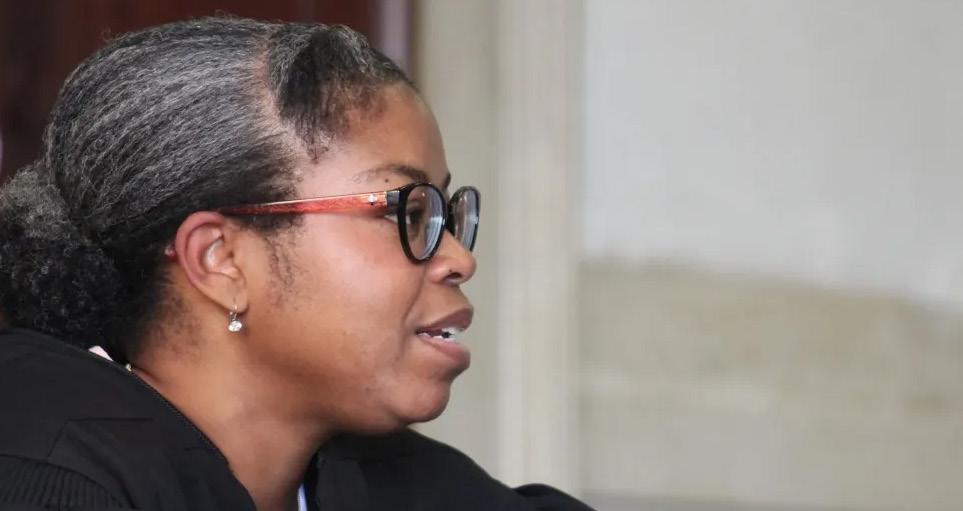
State Judge Alayna Stone, who currently presides over New Haven’s housing court, is one step closer to taking on another title — that of city Youth Commission member — after an aldermanic committee endorsed her appointment to serve on the volunteer local-government board. The Board of Alders Aldermanic Affairs Committee took that unanimous vote Monday during its latest meeting in the Aldermanic Chamber on the second floor of City Hall.
Stone, who lives in New Haven, has been tapped by Mayor Justin Elicker to serve on the city’s Youth Commission, which — per the city’s website — “works to identify the challenges, needs and concerns of youth in the City of New Haven through outreach to young people, parents and families, school administrators, community leaders, academicians and other,” among other responsibilities.
If confirmed by the full Board of Alders, Stone’s appointment to the commission would expire on July 1, 2027.
During her confirmation hearing before the committee alders on Monday, Stone said that she learned about the commission through fellow state Judge Robin Wilson, whose term on the Youth Commission is set to expire in July.
“She knew that I have always had an interest in youth,” Stone said about why
Wilson reached out to her about applying for the volunteer spot.
Stone said she earned a bachelor’s degree in developmental psychology at Yale, and that her undergraduate thesis was about after-school activities for children.
“I decided I wanted to stay in New Haven” after graduating from Yale, she said, and so she spent two years working at the local youth-tutoring-and-sports nonprofit Leadership, Education, and Athletics
in Partnership (LEAP) before going to Washington, D.C. to get a law degree and a master’s degree in public policy. Her thesis for that latter degree, she said, was on “juvenile justice outcomes.”
Upon returning to New Haven after graduate school, she said, “I have maintained a lot of connections” with people she met at LEAP. She said she was on the board for Elm City Montessori for several years, and is just now cycling off of that volunteer responsibility. “I was looking
for new ways to get involved in youth things that were going on in New Haven” when Judge Wilson reached out with this Youth Commission recommendation.
Morris Cove Alder Leland Moore, who works for the state Attorney General’s office, thanked Stone for stepping up for the city commission role. “I know you have a busy, demanding, stressful job,” he said. He thanked her for “staying involved” and for “contributing to our community.
I think it’s very commendable” given her
work as a state judge.
“It sounds like you will be a great fit on that commission,” agreed Newhallville/ Prospect Hill Alder Kimberly Edwards.
Annex Alder Sal Punzo, a retired former New Haven Public Schools (NHPS) teacher and principal, asked Stone what she thinks are “the biggest challenges for our youth today.”
Opportunity, Stone replied. “Opportunities to demonstrate leadership. Opportunities to build skills.” She spoke of the importance of keeping kids engaged “in their education” as well as in “civic life.”
The rest of Stone’s hearing saw alders continue to praise the state judge for her willingness to serve on the city board.
“As a mother you set an amazing role model,” said Downtown/East Rock Alder Christine Kim. “You lead with compassion, love, firmness, and vision. The Youth Commission of the city is very fortunate to have you.”
Edgewood Alder and committee Chair Evette Hamilton agreed. “With her expertise and background, I think she is a great fit for that commission.”
Moore said that he has had “the great fortune of working with Judge Stone before she was elevated to the bench. We could not ask for a smarter, more capable, more compassionate individual to step up into the role.”
And with that, the commissioners voted unanimously to recommend that the full Board of Alders approve Stone’s appointment.
NEW HAVEN — After a two-week trial, a federal jury on Friday took a little less than three hours to convict Dennis Bradley, a Bridgeport attorney and former state senator, of campaign finance fraud related to his 2018 campaign.
Standing next to his lawyer, Darnell Crosland, Bradley showed no emotion as the clerk in Judge Victor A. Bolden's courtroom announced the guilty verdicts on five counts of wire fraud and a single count of conspiracy just before 5 p.m. Friday.
Bradley faces a maximum of 20 years in prison on each count, according to federal officials.
No sentencing date was set on Friday, and Crosland asked for the verdicts to be set aside notwithstanding the jury's verdicts.
"To say that I'm shocked is an understatement," Crosland said. "It just doesn't rationally make sense...something is horribly out of sync here."
The judge said he'd take any motions Crosland files under advisement, after giving prosecutors a chance to brief any issues raised.
Bradley hugged about a dozen family and friends in a conference room before emerging from the courthouse and vowing to fight on and thanking Crosland and his supporters.
"Obviously we have to respect the jury's verdict and we have to respect the outcome of these proceedings, but nevertheless we obviously take issue," Bradley said. "We have appellate rights, and things of that nature, and we'll pursue the rights that are available to us, but not our day today."
Earlier on Friday, Assistant U.S. Attorney David E. Novick began the government's closing arguments with a simple statement.
"Dennis Bradley lied," Novick said, spending more than 40 minutes catalog-
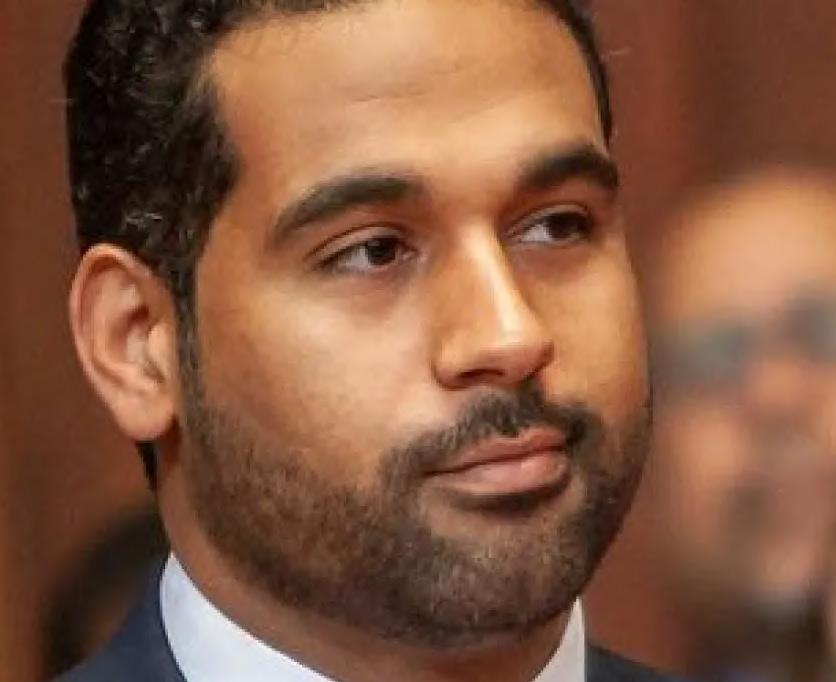
Sen. Dennis Bradley, D-Bridgeport, co-chairman of the General Assembly's public safety committee, shown at a forum on gaming expansion Tuesday, Feb. 11, 2020.
ing the evasions and "deceptions" he said Bradley engaged in throughout his campaign to succeed Ed Gomes representing the state Senate 23rd District covering most of Bridgeport and part of Stratford — beginning with a lavish launch party at Dolphin's Cove restaurant March 15, 2018.
Novick said that Bradley wanted a party with the works — "booze, food, DJ, a band, a big event space" — but the $2,000 personal spending limit imposed by the Citizens Election Program he wanted to participate in meant that "he couldn't do it on the budget he was allowed."
So Novick said Bradley "created a smokescreen" to pretend the party was a "thank you" event for his law firm even though no one from the firm was involved with planning it, then omitted the event from state campaign disclosure forms.
Once state investigators began to probe a complaint into Bradley's campaign filed by
longtime opponent Maria Pereira, he and his campaign treasurer, Jessica Martinez, "hid the ball" by lying about what happened and the fact that the party had cost him more than $7,000, Novick said. Martinez pleaded guilty to lying to a federal grand jury during the investigation. Tina Manus, another co-defendant, pleaded guilty in 2021. Bradley is charged with conspiracy to commit wire fraud and five counts of wire fraud. He is free on $300,000 bond.
Novick said Bradley "tilted that level playing field of the CEP" — intended to give candidates who might not otherwise be able to the funds to run for public office — "in his favor." The prosecutor displayed text messages, bank records, and Internet posts he said corroborated the government's case on flat-screen TVs in the courtroom.
"This was a political event," Novick said,
showing clips from a video of the event to the jury, culminating with Bradley's impassioned speech declaring himself a candidate, as well as fundraising forms he said were altered to change the dates of donations made at the party — including one from Shelton Police Chief Shawn Sequeira.
Despite that, Bradley wrote in an email to SEEC investigators that the party "was in no shape or form a political event," Novick noted, pointing to the email as evidence of a coverup.
The prosecutor said Bradley was guilty of wire fraud because interstate communications were used when he texted plans in furtherance of the scheme to others, filed phony campaign info in the State Elections Enforcement Commission's electronic Campaign Reporting System, which had a backup server in Massachusetts, and emailed a letter with lies in it to SEEC.
"This case is a story of lies building upon lies," Novick said, charging that Bradley had chance after chance to come clean — and didn't. "At every opportunity the defendant made the other choice. The defendant went the other way. He chose to lean into his lies."
Bradley's attorney, Darnell Crosland, lampooned the government's emphasis on Bradley's party by festooning the lectern with a heart-shaped balloon, tinsel, tissue paper bunting, and a disco ball. He said the government had "weaponized the system" against Bradley and asked jurors to "end the party."
"The government has not proved beyond a reasonable doubt that anything crossed state lines," he said, stringing some of the red tinsel around his neck and saying the government's evidence "is not enough" to show there was any conspiracy involving Bradley.
Instead, Crosland blamed Manus, who he called the government's "star witness," for doctoring the SEEC forms and lying.
"The only unauthorized act was Manus' alone, without Bradley's knowledge," Cro-
sland said, adding that Bradley "cooperated" with SEEC and gave them "everything they needed."
"He was a dupe," Crosland said of Bradley. Beyond disputing the government's evidence, Crosland criticized the prosecution's decision to indict Bradley for wire fraud, a crime which he said was "for the Gambinos."
"That was for back in the days when you had mafioso stuff," Crosland said, alleging that Bradley was indicted because the federal prosecutors need funding. "Are we really doing this?"
He said Bradley announcing his candidacy at the party "doesn't make it wrong" and said the event wasn't political.
"Was he planning it all along?" he said. "Could be. That's his business."
"Today is enough," Crosland said, noting that Bradley has been unable to travel freely for several years since being indicted. "Let this man free."
Given the chance for rebuttal, Assistant U.S. Attorney Jonathan Francis told the jury "to focus on the evidence," not Crosland's theatrics, and pointed to texts which he said showed Bradley knew what was going on.
Bradley, a lawyer who also is a former Bridgeport school board member, sought to have the case thrown out prior to the trial.
He declined to take the stand Wednesday when offered the opportunity to testify on his own behalf, saying the decision was Crosland's.
Bradley was elected to serve Connecticut's 23rd state Senate district in 2018 in the wake of the party at the center of the trial. He lost a 2022 primary to Herron Gaston, who currently holds the office, after he was indicted.
by MARCIA DUNN
The Americans who blazed the trail to the moon more than half a century ago were white men chosen for their military test pilot experience. This first Artemis crew includes a woman, a person of color and a Canadian, products of a more diversified astronaut corps.
None of them were alive during NASA’s storied Apollo program that sent 24 astronauts to the moon including 12 moonwalkers. They won’t land on the moon this time or even orbit it, but the out-and-back journey will take them thousands of miles deeper into space than even the Apollo astronauts ventured, promising unprecedented views of the lunar far side.
As one of NASA’s few Black astronauts, Victor Glover sees his presence on the mission as “a force for good.”
The 49-year-old Navy captain and former combat pilot from Pomona, California, makes it a habit to listen to Gil Scott-Heron’s “Whitey on the Moon” and Marvin


“I listen to those for perspective,” he said. “It captures what we did well, what we did poorly.”
The ability for him now to offer hope to others is “an amazing blessing and a privilege.” Despite having one spaceflight behind him — an early SpaceX crew run to the International Space Station — he finds himself in new personal territory. His four daughters are in their late teens and early 20s, “and I spend as an much time and thought preparing them as NASA does preparing me.”
He’s hyper-focused on running “our best race so that we can hand the baton off to the next leg” — a 2027 practice docking mission in orbit around Earth between an Orion crew capsule and one or two lunar landers. The all-important moon landing would follow in 2028 with yet another set of astronauts.
by Lisa Reisman
Lady Stout, aka Denise Renee, doing her thing.
Doo-bee-doo-wop-doo-wop, Lady Stout sang.
Doo-bee-doo-wop-doo-wop-wop-wop, Penelope Klark Stewart, a 10-year-old fifth-grader at Worthington Hooker School, rejoined.
The occasion for this rapid exchange of improvised syllables, or scatting, was a vocal performance workshop led by Lady Stout, aka Denise Renee, at Ashmun Street’s Monk Youth Jazz & STEAM Collective K-8 after school program. The New Haven-raised, Apostolic Love & Faith Tabernacle-reared powerhouse vocalist has performed with artists like Alicia Keys, Stevie Wonder, and Patti LaBelle.
“What I learned from Stevie Wonder is to be free, have fun, and never forget your love for the music,” Lady Stout told Stewart and her 21 classmates at Wednesday afternoon’s event. Her takeaway from touring the globe for three and a half years with Alicia Keys: “You can be a star and still be kind, still have grace.”
The program, founded by New Haven icon Marcella Monk Flake, blends music, STEAM (Science, Technology, Engineering, Arts, and Mathematics), and humanities for youth. The twofold mission, according to Flake: to prepare underserved youth for future success through activities like mock trial competitions, instruction in human anatomy, and coding robots, as well as training in music, dance, and art. The other part of the mission: bringing in professionals that show them what they can be. “Our children need to see people who look like themselves in finance, medicine, engineering, and more,” Flake said. “Stout heard about our program and she said ‘sign me up,’” she said. “She’s had good fortune and she wants to pay it
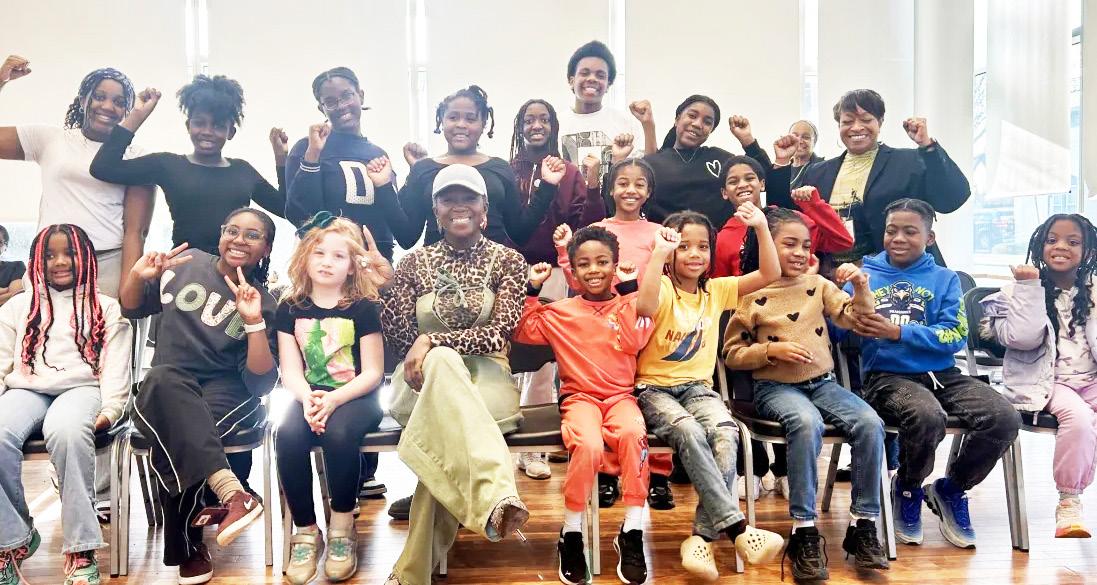
forward.” That begins with her kids, her 15-year-old son, Hubert Powell IV, or Hubeats, and her three daughters, all accomplished musicians who performed at her rousing tribute to the legendary Nina Simone at Flint Street Theater last Friday night. She also heads Vocal Elite Company, where she trains the next generation in vocal technique, as well as performance coaching.
The idea, Lady Stout told the group, is learning good habits and “becoming masters at whatever you decide to do.
“Before you sing, before you perform, you always want to warm up,” she said, before leading the students in neck stretches and shoulder rolls. “I want you guys to release any anxiety, let it go.”
There were lessons in breath control, with a challenge to recite the entire alphabet in one breath at a steady tempo. “Breathing
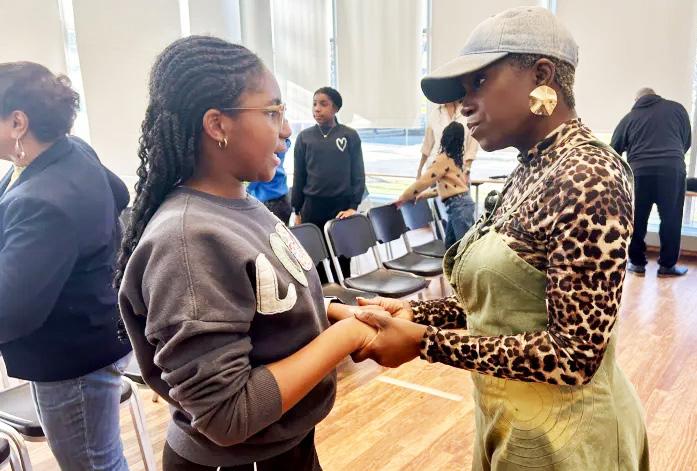
is the foundation for your singing,” she told them, the metronome clicking away, as a boy drew in a deep breath, his eyes fixed in concentration. “Not lmnop. L-MN-O-P.”
She taught them how to hold a pitch, for seven seconds, then ten. “Your breathing is going to carry you through your performance,” she said, before pausing to declare the group ready to apply the technique to a song.
“I feel I can fly,” she began, her voice swelling, incandescent, through the space. The group sang the words back to her.
“Let’s add a note,” she said. They did, their sounds lengthening, growing in body. Soon they were singing in rounds, with Lady Stout harmonizing.
The final challenge was improvisation. “Feel the room first,” she told them. A few students closed their eyes. “Think about what you’re going through, how you feel, and apply it to the music.”
Stewart was the second volunteer to take the stage. Teacher and pupil mimicked instruments, riffed off each other. “Let’s hear some words,” Stout told her. “I feel good, I feel good, yeah,” Stewart sang. “Every-thing is working for me today, I can go on my-ah-ah-ah way,” Lady Stout returned. “I can go on my-ah-ah-ah way,” Stewart sang back.
“It felt great,” said Stewart, who sings with the All-City Choir as part of Yale School of Music’s Music in Schools Initiative, as the workshop was wrapping up. “I love singing and I just want to keep doing it, and now I know there’s someone I can learn from and who can inspire me.”
At the front of the room, Lady Stout was surrounded by a group of kids. “May I come back?” she was asking them. “YES!” they chorused.
by Staff Report
Teenaged United States citizens, parents and others told Congress of their treatment at the hands of Department of Homeland Security officials last week, according to U.S. Sen. Richard Blumenthal, D-CT. Blumenthal is Ranking Member of the Permanent Subcommittee on Investigations.
Arnoldo Bazan, a 16-year-old U.S. citizen from Houston, Texas, said he was assaulted by federal immigration agents on his way to school, according to a statement from Blumenthal’s office. He sought treatment at a nearby hospital for neck injuries described by the hospital as resulting from being beaten and choked. He still experiences physical and mental side effects, he said in his video-recorded

potential government shutdown on Sept, 29, 2025 at the State Capitol in Hartford, CT. Credit: Jamil Ragland / CTNewsJunkie
testimony.
“Officers grabbed and ripped my shirt. One officer put me in a chokehold. The officer choking me told me, ‘You’re done. You’re done.’ His grip was so tight that I wondered if I would make it out alive. With all of my strength, I screamed that I was underage and from the United States.”
Fernando Hernández García, an 18-yearold U.S. citizen from the Rio Grande Valley in Texas, said he has been living on his own and separated from his family since his younger sister, Sara, who is also a U.S. citizen, was removed to Mexico after being detained while on her way to Texas Children’s Hospital in Houston to seek treatment for a medical condition. She had surgery to remove a brain tumor in 2024.
“I remember this day like it was yesterday because it was the last day I remember feeling like a kid,” Garcia said. “When I heard the news, I couldn’t breathe. I didn’t know what I was going to do. My mom worried about me returning to our home in South Texas alone, but I had to finish high school, and I wanted to make sure I could do everything in my power to stay on top of the bills and keep the home my mom and dad had sacrificed so much for. Over the past year, I’ve worked hard to make sure I was the first in my family to graduate from a U.S. high school. My parents were not there to celebrate this honor with me,” Fernando said
Ana Michelle Ramirez Sanan, an 18-year-old U.S. citizen from Chelsea, Massachusetts said she was restrained by a DHS agent after her mother and autistic
13-year-old brother, also a U.S. citizen, were dragged from their car and detained. DHS agents then violently arrested Michelle’s 50-year-old mother, who has legal status and has lived in the U.S. for over 20 years, in front of her and her brother, she said.
“I am speaking out today for the families who can’t speak against ICE. I am speaking out today to help people understand who ICE is hurting. I am a citizen. I’m also a sister, a high school student, and a daughter. I like drawing, dancing, and spending time with my family. Kids and teenagers who look like me aren’t safe, even in our own communities, even if we follow all the rules. ICE may have let my family go, but they took so much
Con’t on page 13
by Maya McFadden
East Rock School fourth graders Damian and Ashley looked up at their classroom’s whiteboard and saw the words “tugging” and “jumper” — as they worked through a lesson about which words need a double consonant before adding suffixes, and why.
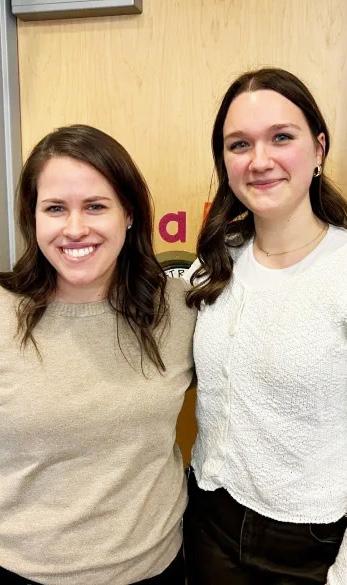
The duo did so along with their three other classmates Tuesday morning with the help of a visual checklist provided by student-teacher Erin Knapp and veteran resource teacher Jennifer Ryalls.
Ryalls has been mentoring Knapp, who is one of over a dozen Yale Teaching Fellows taking part this school year in the university’s new partnership with New Haven Public Schools (NHPS), Southern Connecticut State University (SCSU), and New Haven Promise.
The special-education classroom work on display Tuesday showed students sounding words out and learning to read and spell through a focus on phonics. It also demonstrated how Knapp is learning to become a teacher both with the help of Ryalls and through her own direct experience with students.
The Yale Teaching Fellowship program is in its inaugural year of training aspiring educators in NHPS shortage areas of math, science, and special education. The fellows get their student-teaching experience in a city school while paired with a mentor, learning the ropes on the ground with New Haven students. At the same time, the fellows are also pursuing a master’s degree at SCSU for their teaching certification.
In class on Tuesday, Ashley looked through the checklist’s doubling rules before adding the “-ing” suffix to the word “tug.”
First she checked if the base word had one syllable. She clapped her hands to-
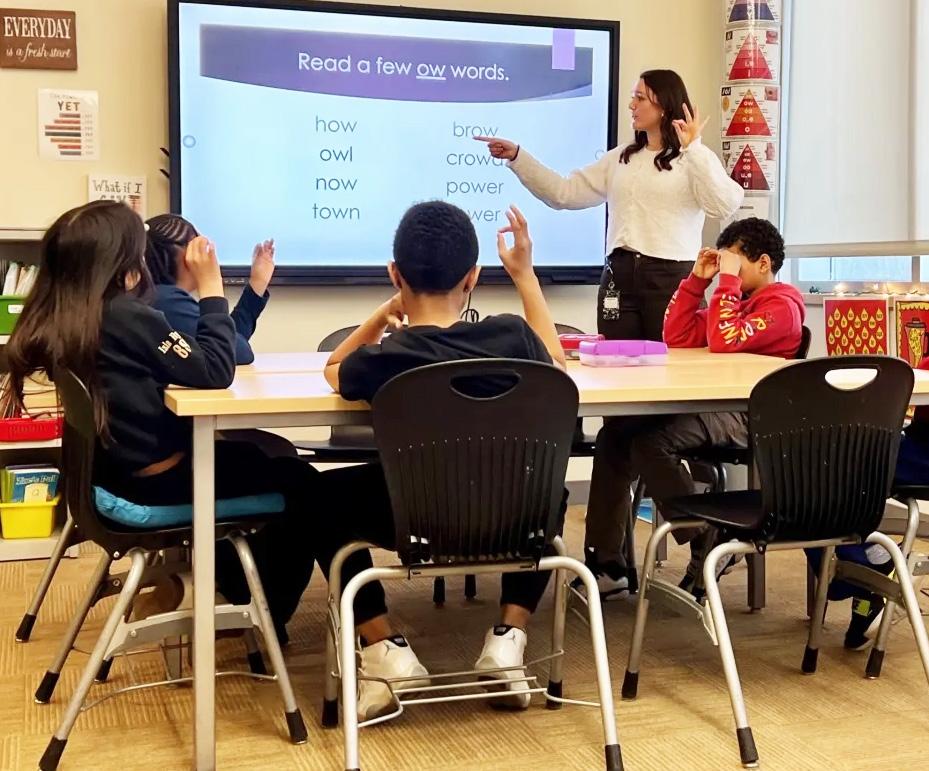
gether while saying aloud “tug,” confirming it did have one syllable. Then she said the word out loud again a few more times to check if it has a short vowel. She recalled learning that a short vowel makes a quick sound while a long vowel takes its time to sound like the letter’s name.
Ashley put a check next to that rule after confirming that “tug” has a short vowel. For the final two rules, she looked to see if the word ended with one consonant and at the suffix to see if it started with a vowel.
Those earned Ashley two more checks on her checklist, making it so the word “tug” met all the conditions to double the final consonant before adding the suffix to make the word “tugging.”
Damien followed along with the same checklist, but for the word “jump” and the
suffix “-er.” As he went through his check
list he excitedly checked off that the word met the conditions for three of the four rules. When he next checked if the base word ended with a single consonant, he paused. He repeated aloud a reminder of the vowels “a, e, i, o, u, and sometimes y.” When he noticed the word “jump” ends with two consonants, he placed an “x” on the final and fourth condition. So when Damien went on to spell “jump” with the “-er” suffix, he didn’t double the final consonant, spelling the word on his worksheet as “jumper.”
Tuesday’s lesson used Orton-Gillingham’s multi-sensory approach to the class’s phonics lesson.
The fellowship program uses a “gradual release” model for its fellows, who midyera took on two practicum courses at their home schools. Knapp led Tuesday’s class on her own while Ryalls informally observed
After recent lessons focused on phonemic sounds, Knapp pushed her class of five to learn a new spelling rule.
Ryalls worked with Knapp to adjust Tuesday’s lessons to include more visual checklists for their fourth-grade group.
After showing the students the conditions when to double a consonant and then working through examples with them, Knapp encouraged them to do it on their own. The teaching duo referred to this model as “I do” then “we do” then “you do.”
Typically, Knapp said, she would’ve shown the students how to do the task and then done examples with them then saved the “you do” part for next class. But, on Tuesday, she said students took to the new lesson quickly.
Knapp noted that having the students practice individually helped her to gather data on where they’re at with mastering the lesson. That in turn helps her prepare for their next lesson the following day. “She’s definitely got it in her,” Ryalls said of Knapp Tuesday.
Knapp credited Ryalls for giving her a learning space to make mistakes and learn from them along the way.
Knapp said that she has learned from Ryalls just how important it is in special-education classrooms to collect and use data to support students. “It’s the foundation for everything we do,” Ryalls said. She said that data helps teachers explain students’ needs during Planning and Placement Team (PPT) meetings.
Knapp noted that Ryalls has helped her to learn to always keep a calm demeanor in classrooms.
Ryalls said that much of her mentorship for Knapp has been motivated by her own experience in teaching students. She’s been an educator for the past 13 years, 11 of those at East Rock.
At the start of the year, Knapp said she had no idea how to teach phonics. Before Tuesday’s lesson on the doubling rule, Knapp reviewed the class’s previous work on suffixes and phonemes.
Students used their hands to clap out syllables and finger taps to track phonemes. Students like Mahogany helped to refresh her classmates on previous lessons like the “magic e” rule.
“I learned a lot in my classes,” Knapp said. “But this classroom part is the most important part of the program. This is the reason I’ll succeed.”
by Jamil Ragland Bluesky
HARTFORD, CT — Thousands of people braved unseasonably cold weather Saturday morning to deliver a message to President Donald Trump about their opposition to everything from his immigration policies to the ongoing war with Iran. Capitol Police estimated that 5,500 people gathered at the Capitol building in Hartford as part of the ongoing series of “No Kings” protests. More than 3,100 protests had been planned in all 50 states and the District of Columbia, along with events taking place internationally as well. Organizers are calling it the largest single-day protest in American history. More than 50 events were scheduled to take place across Connecticut. Unofficial estimates were that several thousand gathered at New Haven Green, and a large crowd attended a rally in Stamford. Overall, organizers said about 3,100 events
were planned for the day nationwide.
The theme “No Kings” is meant to protest the rise of authoritarianism and political violence in the United States, organizers said. A similar event in October 2025 drew about 7 million protesters nationwide, with thousands gathered for a rally in Hartford.
While this is the third No Kings protest, it was the first political action for some. College student Jake Delcampe of Canton came to the protest with his family while on spring break. He said that his mother has been attending protests for a while, and this felt like the time for him to get involved.
“Participating in an event like this is important for not just adults, but also kids like me to come out here and express our beliefs because I think we too have a say in where the country’s headed in the future,” he said. “So I think it’s important to be out here and express our beliefs, and

show how frustrated we are with the current government.”
On the other side of the spectrum, Kathleen Tracy of Old Lyme said she has been
attending protests for decades. She too was introduced to protest by her mother during the Civil Rights and anti-war movements of the 1960s. She said that
she sees many similarities between what was happening in America then and now.
“It’s like we’re still fighting for our equal rights,” she said. “I mean, the whole war situation, it’s the same. You know what I mean? It’s like we repeat our karma.
We repeat our destiny unless we change it. And I thought, as I got older, that we solved the civil rights problem. But I realized, no, we have a long way to go to solve our problems of racism, our problems of injustice.”
The rally itself featured state Democratic leaders and activists who spoke about the importance of opposing the Trump agenda.
Sen. Richard Blumenthal, D-CT, took to the stage and pledged to vote against more money for Immigration and Customs Enforcement (ICE) and the war with Iran, which he called an illegal, lawless Con’t from page 13
Yale New Haven Hospital is pleased to offer patients and their families financial counseling regarding their hospital bills or the availability of financial assistance, including free care funds.
By appointment, patients can speak one-on-one with a financial counselor during regular business hours. For your convenience, extended hours are available in-person at Yale New Haven Hospital the third Monday of every month.
Time: 5 - 7 pm
Location: Children’s Hospital, 35 Park St., 1st floor, Admitting Parking available (handicapped accessible)
An appointment is necessary. Please call 855-547-4584. Spanish-speaking counselors available.


by Janday Wilson
The Comet/Poppea
Yale Schwarzman Center
New Haven
March 23, 2026
I have been to only two operas in my life, so imagine my delight when I got the rare chance to double my opera intake in a single evening. The spectacle left me, in a word, stunned.
I was so mesmerized I forgot, for a moment, the intense work that lay ahead. How was I meant to comprehend the viewing of two operas at once, let alone convey the stories coherently? How to distill such vital messages from The Comet/Poppea that apply to our current evil times?
But forget the messages for now. I cannot get over what my eyes beheld.
The Comet/Poppea gifted me a scene with the single most stunning image I’ve ever seen in my life. It lingered in my mind as I drifted off to sleep that evening, stubbornly resisting language.
In this scene, the goddess Love (Joelle Lamarre) emerged from an opening at the top of a wall made of lavish whorls of white flowers. She wore a white gown made of the same blooms, looking like a bride atop a wedding cake. She seamlessly blended into the wall, making for an arresting, larger than life visual. Love perched there, still and regal, as the stage spun round and round. The effect was that of a figurehead on a grand ship’s prow.
The Comet/Poppea presented two operas at once on a bisected rotating stage.
L’incoronazione di Poppea (The Coronation of Poppaea) is a classic, 17th century opera set in ancient Rome about the cunning Poppea, mistress of Emperor Nero, and the various players and deadly machinations that drive her to becoming empress of Rome. There are love triangles, murder plots and betrayal. No spoilers, but let’s just say the ending darkly reflects the present day in which it seems evil prevails.
The Comet is a contemporary Afrofuturist opera based on an experimental short story by W.E.B. Du Bois set in 1920s New York City. A comet hits the

Earth, and a Black man and white woman are the sole survivors. The two uneasily navigate the vestiges of white supremacy as they fight for survival.
Though there are clear political messages in both works, they are not didactic. It is up to the audience to interpret for themselves. I left with the message that the world often runs on power and injustice but that it is vital for humanity to be vigilant and resistant.
Revival Director Alexander Gedeon articulated this theme: “The Comet/Poppea cuts through to something core about the experience of existing as a human through whatever complex power structures that we’re in, and the feeling of being in a moment of unprecedented, maniacal, democratic downslide, which is way more the status quo for how most humans have had to navigate experience. That’s why I think this piece is as timely now as it was when they came up with it, maybe even more.”
The Comet/Poppea was staged in an emptied Commons at the Yale Schwarzman Center, the same dining hall in which The Comet’s MacArthur Award-winning composer George Lewis ate his meals as an undergrad. (Such a grand way to come back to campus!) Ornate light fixtures drew the eyes upward and exquisite millwork framed the room in grandeur. The diverse audience was split up into two sides of the Commons, ensuring no two perspectives were the same of the spinning stage.
“I mean just being in Commons tonight, experiencing this opera with all different people from all walks of life and backgrounds – students, faculty, staff and community members – is so special,” said Rachel Fine, Yale Schwarzman Center’s executive director. “This is a community hub that helps build cohesion and continuity for the New Haven community. It’s such a critical bridge.”
Visually, the two operas occupied strikingly different worlds. Poppea unfolded against a marvel of white – a plaster wall of flowers and a triangular set of broad steps that led up to a bath at the top. The setting felt austere and cold. On the warmer end of the spectrum, the Comet side was a plush restaurant with a stately leather door, scarlet velvet walls, an elegant brass elevator and a charming oldschool radio and “candlestick” phone.
At the start of the opera, Jim Davis (Cedric Berry) ran frantically around The Comet’s ruined world, surrounded by dead bodies, trying to figure out an escape. Opposite him, Poppea’s goddesses lounged, in conversation, arrayed in gowns of white and gold. I was struck by the sight of these Black opera singers beautifully displaying braided hairstyles and natural curls. One cast member even sported a trendy undercut.
Yesterday, they would not have served
me, sang Jim in his rich baritone. The goddess Fortune’s (Whitney Morrison) luminous soprano rang out simultaneously on the other side, making for a mellifluous pairing. Nero’s (Cody Bowers) pure countertenor was divine alongside Poppea’s (Kearstin Piper Brown) honeyed soprano.
The experience of listening to the mélange of resonant voices from both operas while absorbing two stories was hypnotic and oddly soothing, rather than chaotic and distracting. Lewis’ composition proved to be spellbinding. The orchestras’ rich soundscapes, alternating between modern expansiveness and Baroque intricacy, perfectly accented the action.
As the operas’ plots thickened over the course of the evening, there were power plays and deadly schemes in Poppea and the simmering of age-old racial tension in Comet. The entire cast delivered performances of remarkable intensity. They really played to the audience, their faces emotive, gazes penetrating and gestures expansive. In a few uncanny moments, one side of the stage would go completely still, posed like subjects of an elaborate painting, while the other side was teeming with action.
The operas even bled into one another in a few surreal scenes. Early on, a Poppea goddess peers curiously into The Comet’s world. Later Jim and Julia from The Comet cross over to the Poppea side wearing extravagant silver headdresses that render them as a queen and a warrior, respectively.
At the opera’s close, Lewis, director Yuval Sharon, Gedeon and producers stood proudly on stage along with the cast; Lewis clutching a single white rose. It was stirring to see him get his “flowers.” Reflecting on The Comet/Poppea’s impact, Lewis expressed that his goal is for people to leave both operas transformed. “I want them to think, ‘That was really different, wasn’t it?’ And then maybe they’ll think, ‘Well, maybe that’s not the only thing that could be different around here.’ That’s the subversive power of music and art, which is to make people think that things really could be different. I want people to really think about how we can forage new lives for ourselves in the midst of radical change.”
more from us. They made me feel like my family didn’t matter and that no one would care what happens to us,” Ramirez Sanan said. Watch video here. In addition, several parents testified that they or their children had been assaulted, Blumenthal said.
Anabel Romero, a U.S. citizen from Gooding, Idaho and mother of three, said during an immigration raid, she was separated from her 6- and 8-year-old children at gunpoint. She and her 14-year-old daughter were then assaulted and zip-tied, she said.
by Maya McFadden
Reading has helped Marwa Nakhi make friends during her freshman year at Hill Regional Career High School. Now, she can share her love of books with her classmates — and high schoolers across the school district — thanks to the district’s recent purchase of 10,354 books for brand new high school English classroom libraries.
“That day completely changed our lives. We were degraded. Our rights were violated. Our sense of safety and security was demolished. My kids, and I can’t trust enforcement anymore. All that violence was preplanned and targeted on a Sunday afternoon family [outing]. And not a word of apology or regret after. We deserve better from our government. We demand better from our government,” Romero said. war.
“This is what democracy looks like,” he told the crowd. “This is what America looks like. And we’re here to stand up for democracy and America against a wouldbe king, a would-be tyrant, and we’re here to say, no, we’re going to defend and preserve democracy.”
Attorney General William Tong previewed arguments before the Supreme Court this coming Wednesday, where a coalition of states is challenging President Trump’s attempts to end birthright citizenship. Tong drew upon his own story as the son of immigrant parents to explain what was at stake.
“I’m a United States citizen because the 14th Amendment says if you’re born on American soil, you’re an American, period,” he said. “The language is clear and there is no ambiguity. But you know what Donald Trump thinks. And he wants the Supreme Court to say that millions of American children born on American soil are not Americans. He wants to say that I was never really an American at all in the first place. Well, I’ve got news for you, Mr. President. We are Americans right here.”
Gov. Ned Lamont, invoking President Abraham Lincoln’s famous opening to the Gettysburg Address, reminded the gathered protesters that the United States was founded 250 years ago on the promise that all men and women are created equal, and said that we are still striving towards that more perfect union. Lamont said that Trump’s attacks on immigrants and African Americans threatens the progress that has been made.
“This is 250 years later, and we’re not going backwards. We’re not going backwards in this country. And goddamn it, we’re not going backwards in the state of Connecticut. We’re going to stand up and fight,” he said.
Nakhi was one of 20 Career students in a first-floor English classroom Tuesday morning who received a delivery of six boxes of books and a new shelf to house them. The students watched as Supt. Madeline Negrón announced the $180,000 investment into 73 classroom libraries in high schools across the district during a press conference — in their very classroom.
That investment, funded through the district’s central office Alliance budget, came out of a partnership between New Haven Public Schools (NHPS) and the Scholastic Corporation.
The delivery of the new book collections, Negrón said, is intended to boost literacy rates and offer a phone-free hobby for high schoolers — especially after high schools went phone-free this school year with the implementation of Yondr pouches. Negrón said that at the city’s largest comprehensive high school, Wilbur Cross, the library began seeing an increase in the number of books being checked out by students.
The goal, Negrón said, is to make books more easily accessible to students.
“Without reading we can’t do much,” Negrón told the group of Career students present at Tuesday’s presser.
Nakhi said during Tuesday’s presser that books have helped her connect with her peers, especially in her first year of high school. “It shows you how to have empathy for people that don’t have the same upbringing as you or who may view things different and how to converse with them without being offensive,” she said.
She added that reading books can be more valuable for youth than scrolling social media. Just last week, Nakhi published her first book on Amazon, titled Obscura.
The district stocked 73 English Language Arts (ELA) classrooms across the district at all high schools and Adult Education. NHPS ELA teachers were tapped to curate the collection of more than 10,000 books that they believe offer diverse and meaningful stories that relate to their students’ interests.
Negron emphasized that daily access to culturally relevant texts are necessary for a students’ academic and social development. “We want to contin-
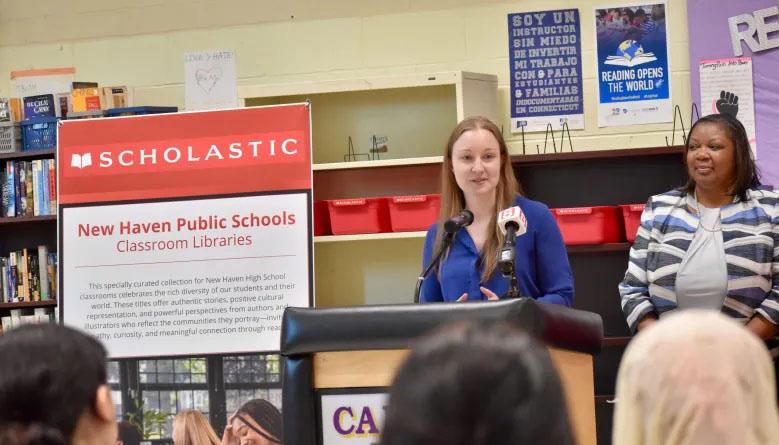


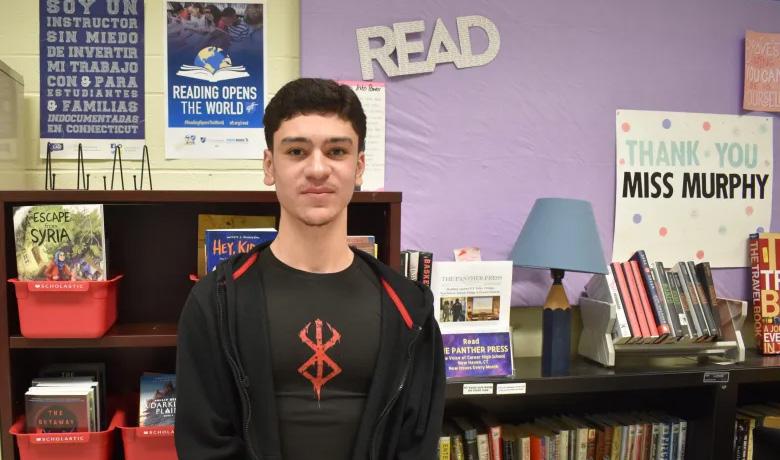
ue to invest in that strategy,” she said. She and the lineup of speakers described reading as a core skill — not just for school, but for life.
NHPS and Scholastic have been delivering boxes full of books and brand new bookshelves to all 73 classrooms over the last two weeks.
Asst. Supt. Keisha Redd-Hannans worked with Supervisor of Secondary English Language Arts Jennifer Sinal-Swingler to work with Scholastic on the classroom library initiative.
Redd-Hannans said Tuesday that oftentimes, when it comes to reading, schools invest in the early grades only. But she noticed when in high school classrooms around the district that many didn’t have books. This meant students only accessed books if they went to the school library. That sparked the vision, Redd-Hannans, said to bring books directly to classrooms.
“When you read, you are able to navigate different choices through the characters that are put in front of you. You’re able to wonder, had I been in that space, would I have made that same choice?” Sinal-Swingler said Tuesday. “It helps us rehearse for a life ahead of us, where hard choices are inevitable, but we can learn lessons and depend on our empathy, and our sympathy, by connecting to the text and the character.”
When the Scholastic truck delivered Tuesday’s books and shelves to Career educator Rose Murphy’s classroom, she called out to her English and journalism students: “Who wants to do an unboxing?”
The students unboxed and shelved books like Outcasts United: The Story of a Refugee Soccer Team That Changed a Town by Warren St. John and The Getaway by Lamar Giles. Career junior Mohammed said during Tuesday’s presser that reading is a hobby of his, as he enjoys learning more about history. But reading also helped him learn English in two months after he immigrated from Syria. Now trilingual, Mohammed said he is currently learning two more languages, Spanish and Korean, through reading as well. Reading introduced Mohammed to his new love for learning languages. He has set a goal to learn a total of seven languages by the time he turn 20 in three years. “Now that we can’t use phones, I don’t want to just stare at walls,” he said. “I can learn history and languages in that time now. It’s supporting me so much to be who I want to be.”
Both Mohammed and Nakhi said they are grateful that their teachers no longer have to purchase books for their classrooms with their own money.
by Fajr Eutsey, BlackHealthMatters.com
Women’s History Month is a moment to honor the women who do the work long before anyone is watching. The leaders behind the Sugar Hill Manhattan Pearls and Black Women in Nature are part of that lineage. Their programs grow from lived experience, community memory, and a commitment to showing up with intention.
When Lady Brenda L. Jones helped organize the Sugar Hill Manhattan Pearls chapter of Top Ladies of Distinction; she did it with a clear understanding of what families were facing. As chapter president, she saw needs that required structure, rather than sporadic outreach.
“As Organizer of the ‘Sugar Hill’ Manhattan Pearls Chapter of Top Ladies of Distinction, Inc., I recognized the need for coordinated, sustained service addressing poverty on multiple levels in Harlem and the Bronx,” she said.
Her perspective comes from watching how pressures overlap for families.
“Educational poverty, health inequities, and food insecurity are deeply interconnected. A child cannot focus on literacy if they are hungry. A family cannot prioritize long-term wellness if basic needs are unstable,” said Jones.
The chapter’s public relations chair, Lady Chelsea Yolanda, describes their work as an extension of who they are.
“We are a reflection of the community we serve — neighbors, mothers, sisters, and daughters who are deeply rooted in Harlem, the Bronx, and Westchester County. Our connection to this work is personal. It is part of our lived experience and our shared history.”
Inside Harlem Hospital, the Pearls’ literacy program revealed how something as simple as a book can become a source of grounding for a child in crisis. Jones has seen this firsthand.
Our pediatric literacy work at Harlem Hospital has revealed how layered and complex family experiences truly are. Many of the children we serve are sickle cell warriors navigating chronic pain and recurring hospital stays. Others are there for mental health challenges or

acute episodes. In those settings, personal belongings are often limited for safety reasons. We learned that books are one of the few items children can consistently have at their bedside. For some patients, especially those experiencing a mental health episode, a book may be the only safe and grounding object they are permitted to keep. That insight deepened our commitment to this initiative. The books we donate are not just literacy tools. They provide comfort, affirmation, and a sense of stability during vulnerable moments,”
Jones shared.
That same intention guides their Little Free Library project, which ensures children see themselves reflected in the stories they reach for.
“Representation matters profoundly in childhood development. When Black and Brown children see themselves reflected in literature, it affirms their worth and expands their imagination,” Jones explained.
Yolanda adds a parent’s


perspective.
“As a parent, I understand how powerful representation is in shaping a child’s sense of identity. When Black and Brown children see characters who reflect their experiences and culture, it strengthens their pride, confidence, and belief in what’s possible.”
Black Women in Nature, a nonprofit based in Central Ohio, was founded at a time when many people were seeking grounding. Co-founders Ivory Levert and Angela Mitchell reflected on how the idea took shape.
“Black Women in Nature was created in the fall of 2020 during a time when so many of us were carrying a lot, navigating the COVID-19 pandemic, collective grief, and a heightened awareness of racial injustice,” Levert said.
A quiet moment outdoors helped her reconnect with herself.


“One day, I went to a local park and spent hours walking and sitting in nature, and it became one of the first moments I felt a deep sense of peace.”
The organization acknowledges that access to nature is not equal, and that comfort in outdoor spaces is shaped by history, representation, and daily responsibilities.
“There are a number of barriers that can impact how Black women experience the outdoors, and many of them are layered. For some, it’s about access, whether that’s awareness of local parks and green spaces, transportation, or simply knowing where to begin. For others, it’s about comfort and familiarity. If you haven’t historically seen yourself reflected in outdoor spaces, it can feel like those spaces weren’t created with you in mind,” Mitchell said.
Their programs intentionally guide women so they don’t have to navigate these spaces alone.



“We create welcoming, guided experiences that remove the pressure of figuring it out on your own. We introduce women to local green spaces in a way that feels supportive and accessible, while also centering community, connection, and ease,” said Mitchell.
Black Women in Nature measures impact by the extent to which women return to themselves and to the outdoors.
“We look at engagement and feedback, things like repeat participation, testimonials, and how women describe their experience. We also pay close attention to behavior over time. Are women returning to nature outside of our experiences? Are they visiting local parks and trails on their own, or incorporating time outdoors into their routines?” Mitchell noted.
The Sugar Hill Manhattan Pearls build sustainability through consistency and follow-through.
“Trust is built through consistency. We partner with institutions such as Harlem Hospital and local schools, and remain engaged beyond a single activation. We return, follow through, and adjust based solely on community feedback. In communities with long histories of institutional neglect, trust must be earned through reliability and respect. That is the standard we hold ourselves to,” Jones emphasized.
Both organizations welcome people who believe in steady, accountable service. Support can look like donating books that reflect Black and Brown lives. It can also mean sharing their work or joining programs that strengthen access and wellbeing.
To learn more, visit the Sugar Hill Manhattan Pearls page and explore Black Women in Nature online.
Additionally, this is a moment to notice the breadth of what women make possible. They nurture ideas, create space for others, and help set new futures in motion. Their work continues to expand what communities can imagine for themselves. It offers a sense of momentum that carries well beyond this month.
Resources:
Home | ManhattanPearls-TLOD Black Women in Nature




A T R I S K O F F O R E C L O S U R E ? W E C A N H E L P Y O U R E B U I L D .
G e t n o c o s t t r a i n i n g , n e w s k i l l s , a n d r e a l s u p p o
t h r o u g h t h e M o r t g a g e C r i s i s J o b T r a i n i n g P r o g r a m .


L E A R N M O R E
by Mildred Europa Taylor, Face2FaceAfrica.com
The Transatlantic slave trade occurred during the 16th through the 19th centuries, causing the displacement of millions of Africans. The psychological, emotional, economic and social effects of slavery still ripple through African and American societies, affecting families on the continent and in the diaspora.
The bedrock of many industries, such as construction, trade, cultivation, child-rearing and the railroad business, to name a few, were fueled by the work of slaves.
Of the 9.5 million people captured in Africa and brought to the New World between the 16th and 19th centuries, nearly 4 million landed in Rio, Brazil, 10 times more than all those sent to the United States.
Slavery in Brazil was established during European colonization in the 1490s by the Portuguese. Despite Brazil’s independence from Portugal in the 1820s, slave-owner relations remained deeply entrenched in its social and economic fabric.
Indeed, calls for the abolition of slavery in Brazil began in the early nineteenth century. José Bonifácio Andrada e Silva, one of the figures behind Brazil’s independence from the Portuguese, wrote in favor of gradual emancipation as early as 1825. An article published by Brown University notes that Britain, which was Brazil’s primary trade partner and financier, saw to it that the slave trade was effectively abolished in 1850.
In fact, as far back as the year 1831, Brazil had already banned the trafficking

Slaves in Brazil, c.1885. Credit: Marc Ferrez (1843-1923 of enslaved Africans following pressure from the UK. A law outlawing the practice was approved in 1828 to go into effect in 1831. That law was enforced for about five years before it was soon ignored by slave traders.
Merchants and politicians even came to view the law as “uma lei para ingles ver” [a law for the British to see], referring to doing something to appease the British, which was the country’s primary financier.
Historian Joseph Mulhern, in his book British Entanglement with Brazilian Slavery – Commerce, Credit and Complicity in Another Empire, c. 1822–1888, said the law couldn’t do much to stop the
slave trade because British merchants in Brazil, by supplying goods and long-term credit, helped introduce a new group of traffickers who operated illegally.
Mulhern wrote in the book cited by the Guardian that British “officials in Brazil and their superiors in London were all too aware of the intricate connections between British commercial interests and the Brazilian slave trade.”
In 1850, when the trade effectively ended with a new law following pressure from the UK, about 750,000 Africans had already been illegally brought to Brazil since 1831, as reported by the Guardian.
Mulhern noted that British financial institutions continued to profit from slav-
ery at the time, with enslaved people becoming “collateral assets” for loans and mortgages.
Any time debtors defaulted, the banks held auctions to regain their capital, with one such infamous auction being held in Rio de Janeiro in 1878 (almost three decades after slavery should have ended), when a three-year-old boy, Pio, was separated from his mother.
In 1848 and 1849, a census supervised by Britain’s Foreign Office showed that there were 3,445 enslaved people held by British individuals and companies. Of the figure, more than half were owned by mining companies, including the British mining company St John d’El Rey.
In 1845 when British citizens and companies were legally barred from owning or buying enslaved people overseas, 385 captives were “transferred” to St John d’El Rey in Brazil. There was nothing actually illegal about the move because the 385 enslaved people were not sold but “rented”. This practice was allowed overseas under the 1843 Slave Trade Act.
Per the act, the 385 enslaved people should have been freed after 14 years, but that didn’t happen. The British ambassador to Brazil also refused to do anything about the case.
It took an additional 30 years for the 123 people who survived to be freed. Their freedom in 1879 was made possible by a Brazilian abolitionist who publicly revealed their plight. The rest died in captivity before 1879.
The above shows how British citizens and companies continued to profit from slavery for another 50 years after the UK Slavery Abolition Act of 1833.
“These connections [between the UK and Brazilian slavery] are very much overlooked,” Mulhern said.
According to Mulhern, Britons learn about the country’s involvement with slavery “almost as a self-congratulatory narrative”, as if the country had been a “self-appointed moral arbiter in the demise of the slave trade and slavery – despite the fact that the UK was one of the biggest countries involved in the slave trade.”
In fact, Brazilian abolitionist Joaquim Nabuco’s exposure of the story of the 385 enslaved people helped lead Brazil to abolish slavery on May 13, 1888, making it the last American nation to do so.
By Word In Black
The Word In Black Racial Equity Fund, a component fund of Local Media Foundation, supports the work of Black-owned and operated local news media by providing critical journalism resources for Word In Black, a collaborative effort of 10 legendary Black publishers. Soon after the murder of George Floyd in 2020, Local Media Foundation established the Fund, originally called the Fund for Black Journalism. In the months after launch, donations to the Fund provided resources for LMF and 10 of the nation’s leading Blackowned local news organizations — AFRO News, The Atlanta Voice, Dallas Weekly, Houston Defender, Michigan Chronicle, New York Amsterdam News, Sacramento Observer, Seattle Medium, St. Louis American, and Washington Informer — to establish Word In Black. Word In Black is a digital startup unlike any other in the news media industry. It is the only national brand backed by legacy Blackowned news publishers, with strong histories and deep trust in their communities. Word In Black started small, with limited funding, and has grown quickly over the
past few years. The Word In Black Racial Equity Fund supports journalism projects focused on solutions to racial inequities. Funding generally supports journalists who work for Word In Black, as well as journalists working for the 10 publishers.
The Fund currently covers costs of 10 Word In Black journalists: an education reporter, education data journalist, health reporter, health data journalist, newsletter editor, climate justice reporter, community and audience engagement manager, finance reporter, religion reporter and the managing editor. The 10 publishers work with the WIB team to localize the stories in their markets, as well as producing their own original reporting.
Middle-aged and aging alumni of the nation’s Historically Black Colleges and Universities could very well be reaping health benefits decades later, according to a recent study.
Researchers examined a sample of 1,978 Black American adults who attended college between 1940 and 1980, 35% of which had attended an HBCU. The study also examined college attendees who had attended also high school in a state with an HBCU. .

The study, published on the JAMA Network Open website, found that “HBCU attendance was associated with better cognition compared with PWI attendance for aging Black adults.” The study also found the positive outcome held for those attending college before and after the landmark Brown v. Board of Education ruling ending racial segregation in schools. Data for this recent study came from the Reasons for Geographic and Racial Differences in Stroke study, which had recruited Black and white adults aged 45 years and older, from 2003 to 2007. A total of 56% of the Black participants lived in the nation’s Stroke Belt — the eight Southern states that have a higher than average number of stroke deaths. Better memory, language, and overall cognition
Study finds HBCU alumni outperform peers from predominantly white institutions in memory, language, and overall cognition decades later
The alumni were in school during the 1954 Supreme Court’s Brown v. Board of Education ruling and the passage of the 1964 Civil Rights Act, which effectively Con’t from page 09

















By courtesy of HBCUNEWS.com
UNCF hosted its National “A Mind Is…”® Gala at The Westin Washington, D.C. Downtown on Thursday, March 5, welcoming about 600 supporters, educators, corporate partners and community leaders for an inspiring evening dedicated to expanding educational opportunity. The event raised $1.2 million to support scholarships for students and strengthen historically Black colleges and universities (HBCUs).
The annual gala brought together strong representation from colleges and universities, corporate leaders and longtime supporters committed to helping more students get to and through college. Funds raised will directly support UNCF scholarships and programs that help students pursue and complete their college education.
Actor, singer and philanthropist Clifton Davis received the evening’s highest honor, UNCF’s President’s Award, in recognition of his distinguished career and longstanding dedication to service and education.
“I accept this award, not just with grat-
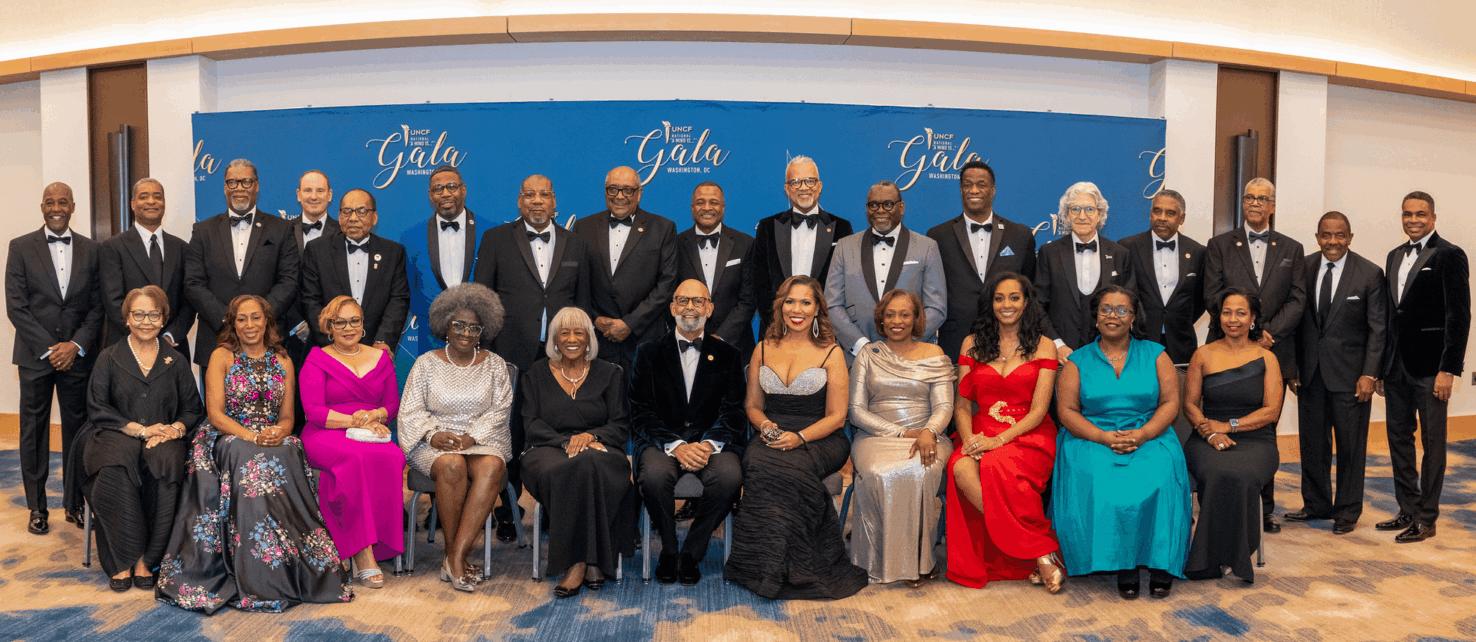
itude, but with renewed commitment,”
Davis said. “I am honored to stand with UNCF and will continue supporting its mission, helping students at HBCUs, meet their obligations, achieve their goals and receive the education they deserve.”
The evening also recognized several partners for their leadership and commitment to educational equity. FanDuel, Jor-
dan Brand and Pepco received UNCF’s Corporate Keeper of the Flame Award in honor of their continued support of UNCF’s mission and their investment in students and communities.
In remarks delivered at the gala, UNCF President and CEO Dr. Michael L. Lomax told the audience that “the national conversation about HBCUs has shifted
In March 2019, at age 50, I went in for a routine mammogram. I was told to wait for the radiologist. She entered the room and proceeded to tell me that I had breast cancer. My husband and I were both in shock. Despite the devastating news, I went to work. At 3 PM, my gynecologist called to confirm the diagnosis. "You do have breast cancer," he said. "I will get the best oncologist on your case.”
Twenty minutes later, I received a call from Renee, who was assisting Dr. Silber at the time. Renee, my angel at Yale, was a guiding light through the darkest days. Her encouragement, kindness, and strength were constant, and she still holds a special place in my heart. She will always be family to me.
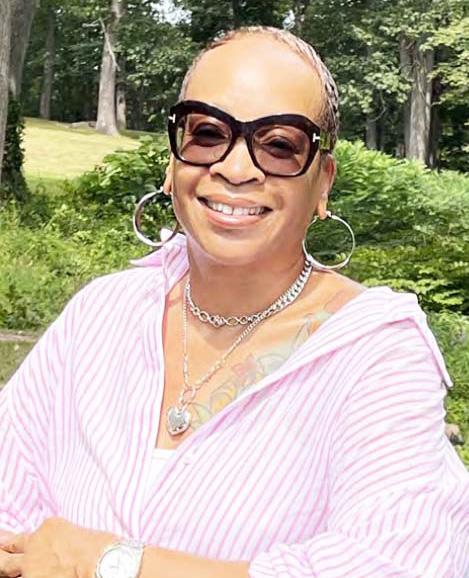
from survival to transformation.” He announced that UNCF will soon cross the $700 million mark in its $1.5 billion capital campaign to increase the endowment assets at its 37 member institutions.
“That is not luck or external forces alone. That is strategy. That is execution,” Dr. Lomax noted. “And that is what happens when a movement meets a moment.”
“But we cannot stop,” he emphasized. “There is so much more to do. Our institutions need us. Our students need us. And the audacious—no, the bodacious— future we are building demands that we keep going. And we’re not going alone— we have all of you.”
“The generosity shown tonight demonstrates the power of partnership and a shared commitment to student success,” said Maurice E. Jenkins Jr., executive vice president and chief development officer, UNCF. “Support from our sponsors and donors helps ensure that more students—particularly those attending HBCUs—have the resources and opportunities they need to thrive.”
The gala highlighted the critical role HBCUs play in educating and preparing future leaders and the importance of strengthening the diverse pipeline of students pursuing higher education.
Through the continued support of corporate partners, donors and community advocates, UNCF can provide scholarships, institutional support and programs that empower students to achieve their academic and professional goals.
After my diagnosis, I chose to tell very few people. I didn't want sympathy. I didn't want people to feel sorry for me. I just wanted life to go on as if I had never been diagnosed. My plan was simple: have surgery, complete treatment and return to work like nothing ever happened. Even now, I still struggle with speaking openly about it. But I'm working on that. As my sister told me, "You have the opportunity to share your journey with someone who will need to hear it."
There were countless doctor visits. My surgery was in June 2019. I was diagnosed with invasive ductal carcinoma in my left breast and underwent a partial mastectomy with reconstruction. Following surgery, I had 15 rounds of chemotherapy
and 30 days of radiation treatment. I'm now on a 10-year hormone therapy plan.
I'm incredibly grateful for the love and support I've received. My husband, beautiful daughters and sisters were with me every step of the way. Even though my sisters don't live nearby, they never left my side. My sister Mona, who lives in Westchester, came to every doctor's appointment with my husband and me. She said we needed a third ear! I don't think she knows just how much we love and appreciate her for that.
Every Friday for three months, I had chemotherapy. Without fail, my Dance family sent me flowers each week, not to mention at every chemo session. I had countless family members keeping me
company. I've been so fortunate to have my girls, my husband, and my village surrounding me with love and strength. Their support has been nothing short of amazing and I'm grateful from the bottom of my heart. Today, I'm beyond blessed to say I've been cancer-free for seven years. The journey was long and difficult, but through prayer and faith, God covered me–and continues to do so. I discovered strength, patience, and trust I never knew I had. I stayed busy and kept my mind engaged by continuing my daily routines. I am truly blessed and thank God every day!
"Thank you, Sisters’ Journey, for allowing me to revisit and reflect on my path. This has been an emotional experience, but a much needed one."
By Raquel Coronell Uribe
President Donald Trump is adding his name to U.S. dollar bills, the first time a sitting president’s signature will go on paper currency, the Treasury Department announced Thursday.
Trump’s signature will go on the bills in honor of the country’s 250th anniversary, the Treasury said. Historically, paper currency carries the signatures of the treasury secretary and the treasurer. “The President’s mark on history as the architect of America’s Golden Age economic revival is undeniable,” Treasury Secretary Scott Bessent said in a statement. “Printing his signature on the American currency is not only appropriate, but also well deserved.”
U.S. paper currency has featured the treasurer’s along with the treasury secretary’s or the register of the treasurer’s signatures since it was first printed in 1861.
Polls show voters are unhappy with the economy, citing rising inflation and high cost of living. Oil prices have also risen since the start of the Iran war, causing some voters to express dismay.
Trump’s signature on the dollar bills is not the only representation of him that Americans can expect to see on U.S. currency this year.
A federal commission of Trump-appointed members recently approved a design that would include Trump’s image on 24-karat commemorative gold coins, also in honor of the country’s

250th anniversary. That coin’s design still requires official approval from the Treasury.
In 2020, Trump stamped his name onto Covid stimulus checks, which gave direct cash payments to Americans during the pandemic.
Adding his name to U.S. currency is Trump’s latest effort to leave his mark on the federal government in ways other presidents haven’t.
Trump’s name is now affixed to the Kennedy Center for the Performing Arts and the U.S. Institute of Peace in Washington. It’s also attached to discount drug programs, savings accounts and proposed warships.
AVISO PÚBLICO CIERRE DE LA LISTA DE ESPERA DE LOS VALES DE ELECCIÓN DE VIVIENDAS/SECCIÓN 8 PARA TODOS LOS TAMAÑOS DE HABITACIONES
EFFECTIVO EL 1 DE MAYO DE 2026, a las 11:59 pm
No se aceptarán solicitudes ni solicitudes enviadas a través del Portal para el solicitante de ECC/HANH para la lista de espera de Housing Choice Voucher (HCV) / Section 8 (los vales de elección de viviendas/sección 8) para todos los tamaños de habitaciones después de la fecha indicada arriba.
Se emitirá un aviso público cuando Elm City Communities / Housing Authority of the City of New Haven (ECC/HANH) decida volver a abrir la lista de espera de HCV / Section 8 para todos los tamaños de habitaciones.
Conforme a las normativas del Department of Housing and Urban Development (HUD, Departamento de Vivienda y Desarrollo Urbano) [24 CFR 982.206], no es necesaria una audiencia pública cuando se abre o se cierra la lista de espera. Por lo tanto, este aviso público se emite de conformidad con el Plan administrativo de ECC/HANH Housing Choice Voucher (plan administrativo).
Cuando la lista de espera de HCV / Section 8 esté cerrada, ECC/HANH no mantendrá una lista de individuos que solicitan recibir una notificación cuando la lista de espera se vuelva a abrir.
Se aceptarán solicitudes hasta el:
1 de Mayo de 2026, a las 11:59 p. m.
Realice la solicitud en línea en: https://elmcitycommunities.org/how-to-apply

Adaptaciones razonables
Si necesita adaptaciones razonables respecto de este aviso, comuníquese con nosotros: Llame al 203-498-8800 ext. 3170 “La Housing Authority of New Haven no discrimina por motivos de raza, color, nacionalidad, religión, sexo, edad, discapacidad o estado civil”.
Opening for a Class A full time driver for petroleum/asphalt/like products deliveries for nights and weekends. Previous experience required. Competitive wage, 401 (k) and benefits. Send resume to: HR Manager, P. O. Box 388, Guilford, CT 06437 or email: hrdept@eastriverenergy.com

The State of Connecticut, Office of Policy and Management is recruiting for a Rural Health Transformation Policy Development Coordinator
PUBLIC NOTICE
CLOSING OF THE HOUSING CHOICE VOUCHER/ SECTION 8 WAITING LIST FOR ALL BEDROOM SIZES
EFFECTIVE MAY 1, 2026, at 11:59pm

The Town of Wallingford is accepting applications for Emergency Medical Technician. Wages: $832.81 to $911.76 weekly. For additional information and to apply online by the April 10, 2026 closing date please visit: www.wallingfordct.gov/government/departments/ human-resources/. Applications are also available at the Department of Human Resources located in Room #301 of the Town Hall, 45 South Main Street, Wallingford, CT 06492. Phone: (203) 294-2080; Fax: (203) 294-2084. EOE

No paper applications or applications submitted through the ECC/HANH Applicant Portal will be accepted for the Housing Choice Voucher (HCV) / Section 8 Waiting List for any bedroom size after the date listed above.
A public notice will be issued when Elm City Communities / Housing Authority of the City of New Haven (ECC/HANH) decides to reopen the HCV / Section 8 Waiting List for all bedroom sizes.
According to HUD regulations [24 CFR 982.206], a public hearing is not required when opening or closing the waiting list. Therefore, this public notice is being issued in accordance with the ECC/HANH Housing Choice Voucher Administrative Plan (Admin Plan).
When the HCV / Section 8 Waiting List is closed, ECC/HANH will not maintain a list of individuals requesting notification when the waiting list reopens.
Applications will be accepted until: May 1, 2026, at 11:59 PM Apply online at: https://elmcitycommunities.org/how-to-apply

If you need a reasonable accommodation regarding this notice, please contact us at: Call 203-498-8800 ext. 3170
The Town of Wallingford is accepting applications for Collections Maintainer I (Trainee). Wages: $27.17 to $29.84 hourly. For additional information and to apply online by the March 24, 2026 closing date please visit: www.wallingfordct.gov/government/departments/human-resources/. Applications are also available at the Department of Human Resources located in Room #301 of the Town Hall, 45 South Main Street, Wallingford, CT 06492. Phone: (203) 294-2080; Fax: (203) 294-2084. EOE
ECC is currently seeking bids from qualified contractors to perform Youth Services. A complete copy of the requirement may be obtained from Elm City’s Vendor Collaboration Portal https://newhavenhousing.cobblestonesystems.com/ gateway beginning on Monday, March 3, 2026, at 3:00PM.
The public is invited to offer comments until May 1, 2026 as the mayors and first selectmen of the South Central Region of Connecticut shape the Draft Fiscal Year 2027-2030 Transportation Improvement Program (TIP) and the companion Draft State Transportation Improvement Program (STIP). Copies of the Draft TIP and STIP are available at www.scrcog.org. Hard copies of the draft documents will be mailed upon a request made by email to kkingston@scrcog.org.
The TIP document, framed together with the Connecticut Department of Transportation, guides the flow of funding for major improvements to the region’s roadways, transit, bicycle, and pedestrian transportation systems. The public comment period for the TIP/STIP also satisfies the public participation requirements of the Greater New Haven Transit District’s and the Milford Transit District’s Program of Projects (POP). Public comments may be emailed to kkingston@scrcog.org or mailed, postage prepaid, to Kellie Kingston, Transportation Planner, South Central Regional Council of Governments, 127 Washington Avenue, 4th Floor West, North Haven, CT 06473 with receipt in both cases by no later than May 1, 2026. Public comments may also be offered at a virtual Public Meeting on April 14, 2026 starting at 5:30pm. Instructions for participating in the Public Meeting will be posted at www.scrcog.org no later than 10 days before the event.
The Town of Wallingford is accepting applications for Water Treatment Pumping Operator I. Wages: $30.35 to $36.64 hourly. For additional information and to apply online by the April 20, 2026 closing date please visit: www.wallingfordct.gov/government/departments/ human-resources/. Applications are also available at the Department of Human Resources located in Room #301 of the Town Hall, 45 South Main Street, Wallingford, CT 06492. Phone: (203) 294-2080; Fax: (203) 294-2084. EOE
360 Management is currently seeking bids from qualified contractors to perform Elevator Service . A complete copy of the requirement may be obtained from Elm City’s Vendor Collaboration Portal https://newhavenhousing.cobblestonesystems.com/gateway beginning on Monday, March 3, 2026, at 3:00PM.
The Town of Wallingford is accepting applications for Maintainer II (Watershed). Wages: $28.65 to $34.43 hourly. For additional information and to apply online by the March 10, 2026 closing date, please visit: www.wallingfordct.gov/government/departments/human-resources/. Applications are also available at the Department of Human Resources located in Room #301 of the Town Hall, 45 South Main Street, Wallingford, CT 06492. Phone: (203) 294-2080; Fax: (203) 294-2084. EOE

The Town of Wallingford is accepting applications for Water Treatment Pumping Operator II. Wages: $32.58 to $39.20 hourly. For additional information and to apply online by the March 24, 2026 closing date, please visit: www.wallingfordct.gov/government/departments/human-resources/.Applications are also available at the Department of Human Resources located in Room #301 of the Town Hall, 45 South Main Street, Wallingford, CT 06492. Phone: (203) 2942080; Fax: (203) 294-2084. EOE
360 Management Group is currently seeking bids from qualified contractors to perform Trash Collection services and Recyclable collection services. A complete copy of the requirement may be obtained from Elm City’s Vendor Collaboration Portal https://newhavenhousing.cobblestonesystems.com/gateway beginning on
360 Management Group is currently seeking bids from qualified contractors to perform Fire Protection services. A complete copy of the requirement may be obtained from Elm City’s Vendor Collaboration Portal https://newhavenhousing.cobblestonesystems.com/ gateway beginning on
March 30, 2026, at 3:00PM.
a quarry and paving contractor, has positions open for the upcoming construction season. We are seeking candidates for a variety of positions, including: Scalehouse Dispatcher/ Equipment Operators and Laborers. NO PHONE CALLS. Please mail resume and cover letter to “Hiring Manager”, Galasso Materials LLC, PO Box 1776, East Granby CT 06026.
Galasso Materials is an Affirmative Action/Equal Opportunity Employer. All applicants will be considered for employment without attention to race, color, religion, sex, orientation, gender identity, national origin, veteran or disability status.
The Town of Wallingford is accepting applications for Attendant I. Wages: $29.20 to $33.81 hourly. For additional information and to apply online by the April 9, 2026 closing date please visit: www.wallingfordct.gov/government/departments/human-resources/. Applications are also available at the Department of Human Resources located in Room #301 of the Town Hall, 45 South Main Street, Wallingford, CT 06492. Phone: (203) 2942080; Fax: (203) 294-2084. EOE

We are a leading supplier of construction materials and paving services, operating rock quarries, asphalt plants, and roadway paving crews throughout the region. Our team is committed to safety, environmental responsibility, and operational excellence. We are seeking a motivated Safety Associate to support and strengthen our safety culture across multiple operations.
The Safety Associate will assist in implementing and maintaining company safety programs across our quarry operations, asphalt plants, roadway paving crews, and environmental testing activities. This role works closely with operations managers, plant supervisors, and field personnel to ensure compliance with MSHA, OSHA, DOT, and environmental regulations while promoting safe work practices.
• Assist with implementation and enforcement of company safety policies and procedures
• Conduct site safety inspections at quarries, asphalt plants, construction sites, and material testing locations
• Perform job hazard analyses (JHA) and assist with development of safe work plans
• Support compliance with MSHA, OSHA, DOT, and environmental regulations including scheduling of employee drug testing
• Investigate accidents, incidents, and near-misses and assist in developing corrective actions
• Assist with safety training and toolbox talks for plant and field personnel
• Maintain safety records, reports, and documentation required for regulatory compliance
• Coordinate safety audits and assist with regulatory inspections
• Work with operations teams to identify opportunities for continuous improvement in safety performance
• Support environmental compliance efforts including material handling, dust control, and environmental testing protocols
• Travel between company facilities, job sites, and testing locations as needed
• Bachelor’s degree in Occupational Safety, Environmental Science, Construction Management, or related field preferred
• Experience in construction materials, quarry operations, asphalt production, roadway construction, or heavy civil construction is a strong plus
• Working knowledge of MSHA, OSHA, DOT, and environmental regulations preferred
• Strong communication and organizational skills
• Ability to work both independently and as part of a team
• Proficiency with Microsoft Office and safety documentation systems
• Valid driver’s license and ability to travel between facilities and job sites Preferred Skills
• MSHA Part 46/48 training experience
• OSHA 30 certification
• Experience conducting safety audits and incident investigations
• Knowledge of environmental compliance and materials testing operations What We Offer
• Competitive salary
• Health, dental, and vision insurance
• Retirement plan
• Paid time off and holidays
• Opportunities for professional growth and training
Please submit your resume and a brief cover letter outlining your experience in construction sales, paving, or materials supply.
To Apply: Please send your resume and a brief cover letter to KLamontagne@galassomaterials.com
Galasso Materials LLC is committed to creating an inclusive environment for all employees and encourages applications from all qualified individuals. We are an affirmative action equal-opportunity employer.

The State of Connecticut, Office of Policy and Management is recruiting for a Policy Development Coordinator in the Criminal Justice Policy and Planning Division. Further information regarding the duties, eligibility requirements and application instructions are available at: https://www.jobapscloud.com/CT/ sup/bulpreview.asp?b=&R1= 260316&R2=1581MP&R3=001
The State of Connecticut is an equal opportunity/affirmative action employer and strongly encourages the applications of women, minorities and persons with disabilities.

City of Bristol
$78,813/yr.
Required testing, general info, and apply online: www.bristolct.gov
DEADLINE: 12-07-25 EOE
Sales Pay: $100,000.00 per year
Job description:
Atlas Companies is looking for an estimator/ design and installation sales person for the residential market place. Premiere northeast regional fence and outdoor structure company is looking for energetic, self-motivated Sales associate. Salary, commission, 401 k match and vehicle allowances for qualified personal. 1 00k plus income to qualified applicants. Previous home improvement design / sales preferred.
About Us Our services range from custom fences, gates, guardrail, pergolas, arbors and outdoor structures to providing industrial and commercial security solutions to building luxury residential multi-use and commercial projects. Job Type: Fulltime Benefits: 401 (k), Health Insurance, Dental Insurance, Life Insurance, Vision Insurance, Paid time off.
Work Location: In person
We are an Equal Opportunity/Affirmative Action Employer. Email resume to mpicard@atlasoutdoor.com
Fence Installers: Large CT Fence & Guardrail Contractor is looking for Fence Installation helpers. Must have at least 2 years of experience installing chain link, wood, PVC and ornamental iron fencing. Work available 10-12 months per year. All necessary equipment provided. Medical, holiday, 401K, vacation & other benefits included. Must be able to pass required physical and drug test. An OSHA 10 Certification is required. A valid CT driver's license is required and must get DOT Medical Card. We are an AA/ EOE company. Send resumes/inquiries to: rhauer@atlasoutdoor.com.
Help Wanted – Lg CT fence company looking for an experienced fence installation foreman in CT and surrounding states who will work as a leader of small crews. Individual will be responsible for all types of fencing installation. Specific tasks include but are not limited to: May be responsible for crew(s) of two or more individuals, manage and troubleshoot problems that arise on site and notify superintendent when needed, ensures employees adhere to all safety and company policies and practices. Job requirements include the following: must have 5 years’ of fence installation experience , must have commercial chain link experience, be able to read blueprints, have basic power tool & skid steers experience, have a valid CT driver’s license and have reliable transportation, must be able to get a DOT medical card, OSHA safety training required prior to start of employment, pass drug screening and a physical test. Medical, vacation, 401K and other benefits included, all necessary equipment provided. We are an Affirmative Action/Equal Opportunity employer. Send resume to gforshee@atlasoutdoor.com
Job Title: Welder/Fabricator Reports to: Operations Manager
Salary Range: TBD, Commensurate with experience, Duties: Atlas Outdoor is looking for a full-time Shop Welder/Fabricator. The ideal candidates should possess skills to weld, cut and fabricate steel and aluminum products. Must be able to read basic drawings and fill out daily reports. All necessary equipment provided. Required to pass a physical and drug test. A valid CT driver's license, OSHA 10 card and DOT Medical Card are also required.Comprehensive benefits package included with a competitive salary, including vacation/personal time off, paid holidays, Health/Dental/Vision insurance, 401K with match. We are an Equal Opportunity/Affirmative Action Employer and offer a competitive salary to qualified candidates. Email resume to rhauer@atlasoutdoor.com
Yard Worker: Large CT Fence Company is looking for individuals for our stock yard. We are looking for individuals with previous warehouse shipping, receiving and forklift experience. Must have a minimum of 3 years of material handling experience. Duties include: Loading & unloading trucks, Fulfilling orders for installation & retail counter sales, Maintaining a clean & organized environment, Managing inventory control & delivering fence panels & products. Qualifications: High School diploma or equivalent, Must be able to read/write English, demonstrate good time management skills, able to read a tape measure, have the ability to lift 70 pounds and have forklift experience. Must have a valid CT Driver’s License, Obtain DOT Medical Card, and pass company physical and drug test. Class A CDL & Class B CDL license a plus. We are an AA/EOE company. Send resumes/ inquiries to: pboucher@atlasoutdoor.com
Large CT Fence Company looking for a full-time individual for our Wood/PVC Fence Production Shop. Duties include measuring & interpreting blueprints, schematics and project plans, cut, shape, assemble and install fence panels using hand and power tools, install related fixtures including gates, hardware and other accessories.. Must have a valid CT driver’s license and be able to obtain a Drivers Medical Card. Must be able to pass a physical and drug test. Please email resume to pboucher@atlasoutdoor.com. AA/EOE-MF
by Tandy Lau
Prude’s legacy now includes Daniel’s Law, a bill encouraging local governments across the state to develop civilian response teams to replace police on mental health calls unless the incident poses a public safety risk. The legislation used Prude’s name with his brother’s permission when State Sen. Samra Brouk introduced it in 2022. Proponents say police often escalate mental health crises and often lack the specialized training needed to address them.
The bill overwhelmingly leans on the Oregon-based CAHOOTS as a blueprint: the program responded to mental health calls for three decades without a single recorded death or serious injury through deploying two-person teams made up of a crisis worker and a medic. While the actual Daniel’s Law remains in the works, the state launched a Daniel’s Law taskforce years ago and recently granted funding towards Daniel’s Law pilot programs.
“We made historic progress with Daniel’s Law this year when the Office of Mental Health announced $6 million to fund three pilot programs in New York State,” said Brouk in an emailed statement. “The statewide enthusiasm for creating non-police, peer-led compassionate responses to individuals experiencing a mental health or substance use crisis is encouraging, and we must build upon this momentum by ensuring we secure additional funding in this final state budget for more pilots.”
Last month, the state split the money between the City of Rochester, Central Nassau Guidance andCounseling Services, and Children’s Home of Jefferson County. The State Senate’s “One House” budget resolution proposes another $15 million towards expanding Daniel’s Law pilots.
“This is personal, the death of my brother did not need to happen and our loss, his life, must mean something,” said Joe Prude, Daniel Prude’s brother, last month. “Having the City of Rochester as a location to receive the Daniel’s Law Pilot Program will help in the process of restoration and healing for my family and for the city. The pilot will create a system that recognizes the humanity of people experiencing mental health crises and treat them with care and compassion, getting them the help they need.”
Last year, the Rochester Community Advisory Board of the Daniel’s Law Coalition launched the first Daniel’s Lawstyle program, HOPE First Roc. The initiative operates in the city’s 19th Ward and Genesee-Jefferson neighborhoods, which both boast predominantly Black residents. Shay Herbert, a local New York Civil Liberties Union organizer, says Rochester boasts a long history of advocacy and Prude’s death inspired reforms to how police respond to mental health calls and protests.
“In Rochester, specifically just the understanding of why police aren’t equipped to respond to mental health crisis calls was blown up,” said Herbert. “Everybody was curious about what this looked like.
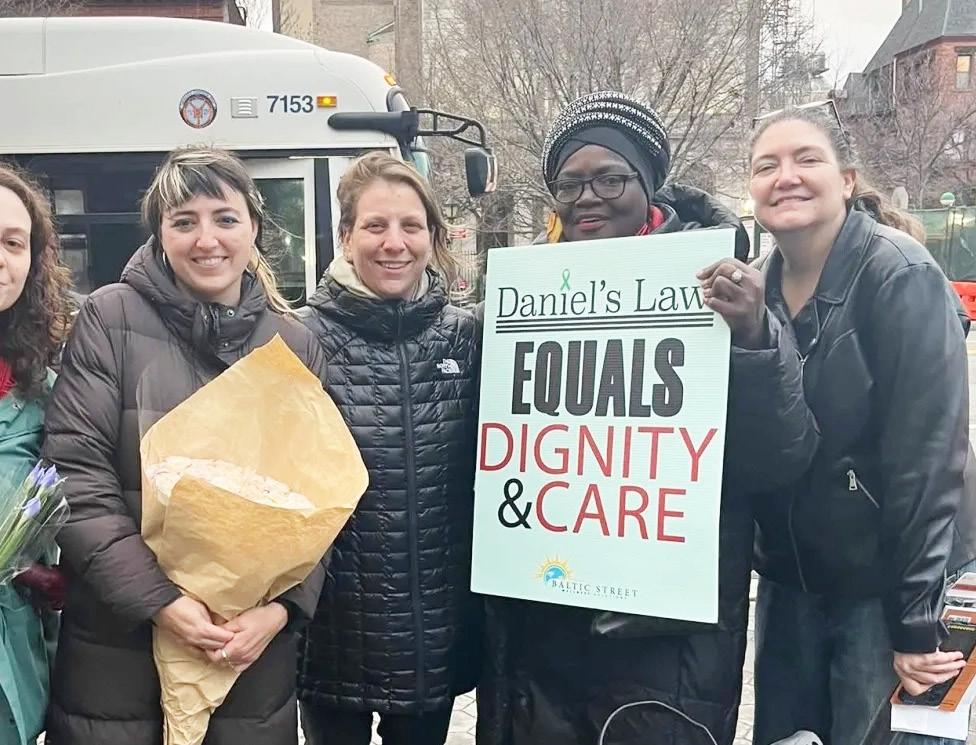
Everybody knew that something had to be done, and we went from a community that [had] to do something…to now this collective understanding of Daniel’s Law or CAHOOTS, and in practice, what that looks like.”
Here in New York City, the anniversary coincides with Mayor Zohran Mamdani recently launching his Department of Community Safety. The office stems from a previous campaign promise and will reform B-Heard, a civilian mental health response pilot often criticized by Daniel’s Law proponents for deploying cops to program-eligible calls. Mamdani previously co-sponsored the bill as an assemblymember and told the Amsterdam News last year that his plan similarly stems from CAHOOT’s “results” as a model.
“The CAHOOTS program has been immensely successful, resolving almost 20% of all calls that come through the Eugene Police Department,” said Mamdani
last year. “And of those estimated 24,000 calls that this program responded to in 2019, only 311 required police backup, showing that tasking teams with appropriate mental health and Crisis Response Training is effective and reduces strain on police.
“It’s this focus, specifically on outcomes and on results, that has driven the creation of this department and has also inspired the work of so many of my incredible colleagues who have been fighting for this at the state level.’
According to Vera Institute of Justice research, more than a million 911 calls could qualify for an “alternative response” each year in New York City.
Beyond the 150,000 direct mental health crisis responses handled by the NYPD each year, the findings point to issues like civilian mediation, disturbances/unwanted persons and neighborhood conditions. Key Daniel’s Law advocates, like New York Lawyers for the Public Interest’s
(NYLPI) Ruth Lowenkron and Eudes Pierre Coalition’s Sheina Banatte, called Mamdani’s Department of Community Safety a step in the right direction. However, the current version remains a far cry from his vision for a $1.1 billion budget department. And funding is crucial for this work: last year, CAHOOTS ceased operations in Eugene, Oregon due to budget (the program still operates in nearby Springfield, Oregon).
“I’m cautiously optimistic,” said Lowenkron. “It’s a baby step and we want much more than that. But it’s definitely a step in the right direction and the fact that he’s trying to do this in his earliest days of administration speaks volumes.”
Outside of Daniel’s Law and Mamdani’s Department of Community Safety, NYLPI pursues removing police from mental health responses through Baerga et al. v. the City of New York. The lawsuit challenges the legality of uniquely sending the NYPD for mental health-related calls under the United States Constitution, American Disabilities Act, and local human rights laws.
Banatte, who began her advocacy after NYPD officers killed her cousin Eudes Pierre during a mental health response, says she hopes Mamdani will key in local organizers in the Department of Community Safety rollout.
“We can’t let up, we have to make sure that every opportunity that we get,” said Banatte. “Especially like this with commemorating Daniel Prude, [it] reminds people that things are happening but they’re not happening fast enough. People are still being killed the way Daniel was killed. So we just got to keep fighting [and] continue bringing more awareness. And go all the way til Daniel’s Law’s passed.”
JACKSONVILLE FREE PRESS — A proposal sponsored by Tom Leek, a Republican from Ormond Beach, has now passed the Senate in back-to-back legislative sessions. But the House version, filed by Kiyan Michael, a Jacksonville Republican, did not receive final approval in either year, effectively stalling the effort.
Plans to establish a long-awaited Black history museum in Florida are once again on hold after legislation needed to advance the project failed to clear the state House for a second consecutive year, despite repeated approval in the Senate.
A proposal sponsored by Tom Leek, a Republican from Ormond Beach, has now passed the Senate in back-to-back legislative sessions. But the House version, filed by Kiyan Michael, a Jacksonville Republican, did not receive final approval in either year, effectively stalling the effort.
Under Florida law, identical or similar bills must pass both chambers before heading to the governor’s desk. Without House approval, the legislation has been unable to
move forward, leaving the project in limbo. Long journey, contested location.
While the Senate-backed measure has consistently advanced, the lack of alignment in the House has underscored ongoing divisions about how and where the project should take shape.
The holdup in the Florida House appears to be less about opposition to the museum itself and more about a combination of procedural bottlenecks, unresolved structural issues, and lingering disagreements over how the project should be formalized and governed.
Despite the legislative setbacks, Republican Gov. Ron DeSantis has publicly voiced support for the museum. Speaking last month during the unveiling of a statue of abolitionist Frederick Douglass in St. Augustine, DeSantis said the project would move forward “one way or another,” signaling an intent to see the museum built regardless of legislative hurdles.
The anticipated museum has already cleared several hurdles. St. Johns County
ended legal racial discrimination in the nation’s public schools.
“HBCU attendees had better cognition across all three of those different time periods,” Dr. Marilyn Thomas, an assistant professor of medicine at the University of California, San Francisco, said in an interview with The Guardian.
Black adults aged 62 who had attended an HBCU had better memory and cognitive function than those who attended a predominantly white institution. There are indications that having college education may reduce the risk of developing
Alzheimer disease and related dementias — also called ADRD. But there are still disparities in the rate of cognitive diseases between Black and white college-educated individuals. More than 7 million Americans are living with ADRD. More than 60% of them are women and Black Americans are at least twice as likely to develop Alzheimer’s specifically as whites. Alzheimer’s is currently the seventh leading cause of death for all Americans.
signed an agreement last year with Florida Memorial University to use the land that once housed its campus last year’s legislative session netted $1 million in funding for St. Johns County to work on planning and design for the museum. However, its anticipated that a million $3 million is needed.
Still, without statutory approval to finalize key components — including governance, funding mechanisms and site selection — the project remains largely conceptual.
With the House bill failing again, the timeline for the museum’s development is unclear. Lawmakers could revisit the proposal in the next legislative session, but any further delays risk pushing the project back several more years. Advocates warn that continued inaction could stall momentum for a museum many see as critical to telling a fuller, more accurate story of Florida’s past. For now, the effort remains paused — caught between political support at the top and legislative gridlock within the Capitol.
Segregation-ending Policies May Affect Brain Health Longterm Dr. Thomas and co-authors from Rutgers University, the University of Alabama-Birmingham, Columbia University, Boston University and Harvard University conducted this study to see if there were different outcomes between HBCU graduates and graduates of predominantly white institutions. It appears that when or how participants were exposed to “state-sanctioned racialized education policies” affected the students later in life. This “exploratory” study is the first of its kind since this one specifically looked at the schools’ environments, while previous studies examined how the number of years of schooling affect cognition. Thomas describes the study as a “first step,” so it’s likely further studies will be needed to see if other scenarios have affected the alumni. For example, someone who got a bachelor’s degree from a predominantly white institution for undergraduate school, but then attended an HBCU for graduate school may have a different outcome.
“There’s a growing body of evidence demonstrating that those years of schooling differently impact people by race,” Thomas said. Instead of measuring how many years the participants attended college, this study examined whether attending an HBCU for any length of time was associated with a positive outcome.
“What’s really important about this finding is that it suggests that, yes, culturally affirming spaces actually can help promote and protect cognitive health,” Thomas said. “It’s even more than that because it doesn’t just demonstrate that it’s protective against cognitive health, but the benefits to this exposure last well beyond graduation – these are people at mean age 62. These benefits are long lasting.”