




by Dereen Shirnekhi
Darrell Adote grew up biking to Edgewood Park, and spent years working in public greenspaces all across the city.
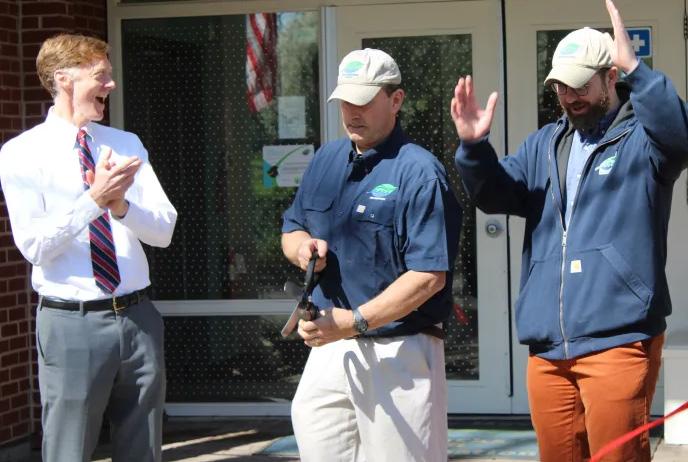
On Thursday, he joined dozens of fellow New Haveners to celebrate the reopening of Edgewood Park’s ranger station — a building that might one day be decorated with Adote’s art.
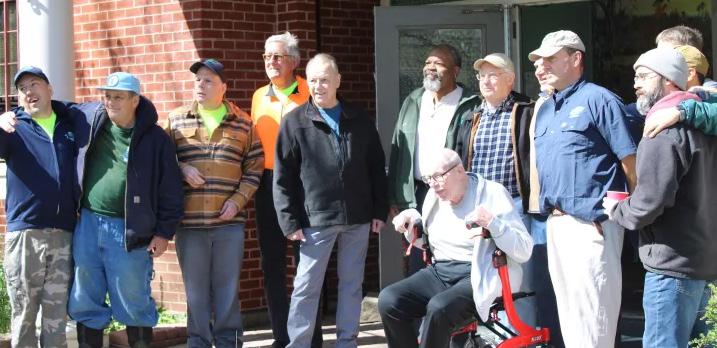
Fans of the park and former rangers turned out en masse to celebrate the ranger station’s reopening. City and parks officials held a press conference and ribbon-cutting for the ranger station, which closed to the public during Covid and had been shuttered for renovation for about a year.
“This building is here for you to use,” Parks Director Max Webster told the crowd.
The improvements to the ranger station include new interior space, freshly painted walls, new flooring, HVAC, refurbished and outdoor-accessible bathrooms, a kitchenette, and improved technology. It’s expected to support the work of and house organizations like Friends of Edgewood Park, volunteer groups, and Nature Pals — a nature playgroup for preK-aged children.
The ranger station’s renovations amount to $170,000, funded through a combination of one-time federal American Rescue Plan Act (ARPA) money and city dollars. It is just the latest parks facility to reopen thanks to those federal funds, after West Rock Nature Center in West Rock Park, Salperto Community Center in East Shore Park, Trowbridge Environmental Center in East Rock Park, and Barnard Nature Center in West River Memorial Park, according to city spokesperson Lenny Speiller.
The next to reopen will be the old Barbell Club in the Hill, slated for later this year. The Goffe Street Park Community Building is also on deck, Speiller said. Edgewood Park has also seen an updated Coogan Pavillion, an expanded skatepark, and an installed MidBridge water crossing. There are around half a million dollars — a combination of federal grants and city funds — still lined up for improvements. Most of that money is for bioswales and a rain garden to mitigate flooding of the park; improvements include a nature center, an outdoor classroom, and in-progress repairs to the sundial.
Adote, who is 22 years old, first began working with the parks through Youth@ Work, back in 2020. “I was always outside when I was a kid,” he said. The job let him make some money — important for a high school senior — cleaning up trails and working with Edgewood Park Ranger Harry Coyle.
“I call him my work dad,” Adote said about Coyle, who attendees affectionately referred to as “Ranger Harry.”
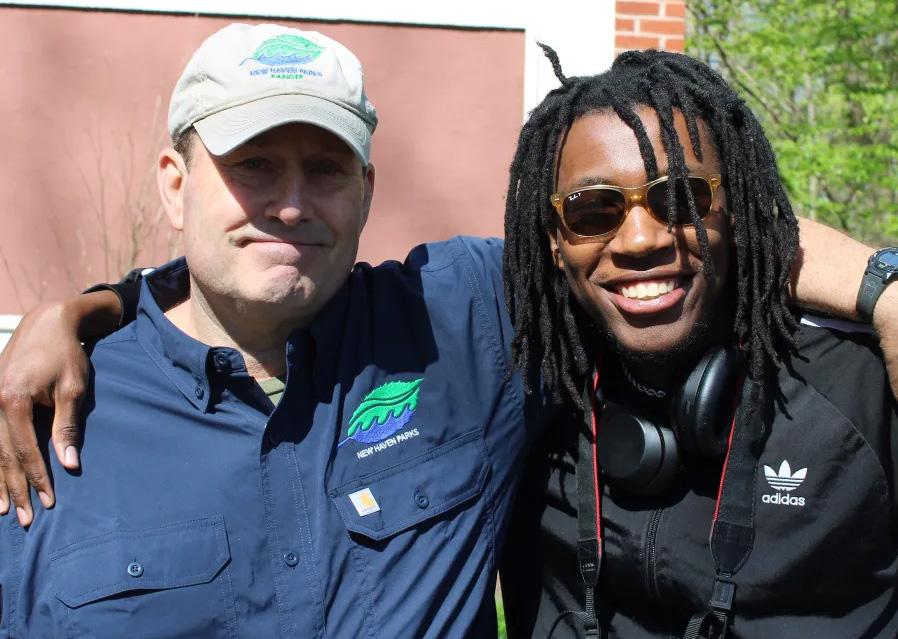
Adote returned to the parks by participating in its Junior Ranger program, and now he works part-time to help put on events. He’s an artist, and he’s working on a mural for the ranger station, something that includes both the park — like its wetlands and the duck pond — and buildings to capture New Haven’s urban elements. “This is how I view Edgewood,” he said. Coyle, one of three rangers across the city, has maintained the “spirit” of the building, according to Webster. He first began working at Edgewood Park as an intern from Southern Connecticut State University (SCSU) in 1993; that’s when he built and installed a nearby kiosk that remains. He was hired as a caretaker in 1996 and two years later, he became a ranger.
“I was always an outside kid,” he said. As the ranger stationed at Edgewood Park, Coyle drives through the park to make sure everything’s in line, supports other rangers, puts on community events, and coordinates with organizations that use or volunteer with the parks. He has been part of the process to bring the ranger station back online — and his wife even donated her art to the space.
What’s Coyle’s favorite part of the job? “Working with the kids,” he said.
The station is open for nonprofit groups who request to use the space. Doreen Abubakar, who runs CPEN (Community Placemaking Engagement Network), said, “I’m excited that it’s open.” Her organization, which runs programming for families, often but not exclusively in nature, aims to “help Newhallvillle thrive.” “I’m hoping we can get into opening after hours and on the weekends,” she said, when their events usually take place. Webster said that hours will be finalized when the Parks Department completes its staffing of seasonal workers for the summer.
Alana Ceppetelli, an instructor for Nature Pals, said, “It’s a privilege to be with youth while a relationship with nature evolves.”
Ceppetelli concluded Thursday’s press conference with lines from Mary Oliver’s poem “Upstream”:
Teach the children. We don’t matter so much, but the children do. Show them daisies and the pale helatica. Teach them the taste of sassafras and wintergreen. The lives of the blue sailors, mallow, sunbursts, the moccasin-flowers. And the frisky ones – inkberry, lamb’s-quarters, blueberries. And the aromatic ones – rosemary, oregano. Give them peppermint to put in their pockets as they go to school. Give them the fields and the woods and the possibility of the world salvaged from the lords of profit. Stand them in the stream, head them upstream, rejoice as they learn to love this green space they live in, its sticks and leaves and then the silent, beautiful blossoms.
Attention is the beginning of devotion.
by Allan Appel
Kim Harris grew up as a little girl playing basketball and everything else in the community center building of her church in Newhallville at the corner of Ivy Street and Shelton Avenue.
That old brick building was razed two years ago. The Mount Zion Seventh Day Adventist Church has now moved to Hamden. Harris — a long time educator, local well-being activist, and all-around Newhallville angel — is now a board member of the church.
She is also spearheading the utilization of the empty quarter-acre site as, arguably, the city’s first garden utilizing hügelkultur.
That’s the let-nature-do-the-work-foryou European method of creating practically self-mulching raised garden beds or mounds (hugels, in German) on a base of logs, wood chips, twigs, and branches. Click here for a story about the debut of the Newhallville Street Garden last year, and Harris’s vision, along with that of the chief gardener, UConn Professor Stacy Maddern.
It’s debuting its second season in Newhallville this spring, a re-debut because with an impressive effort, all the hugels — some 15 rows of them — have been arduously turned from east-west to a northsouth direction to maximize production.
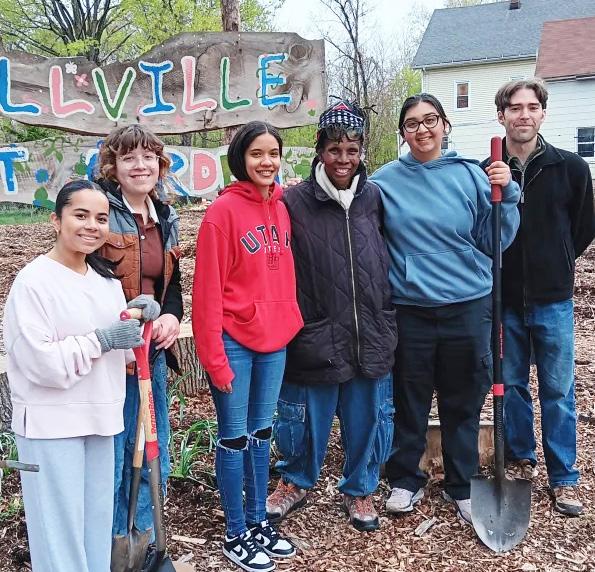
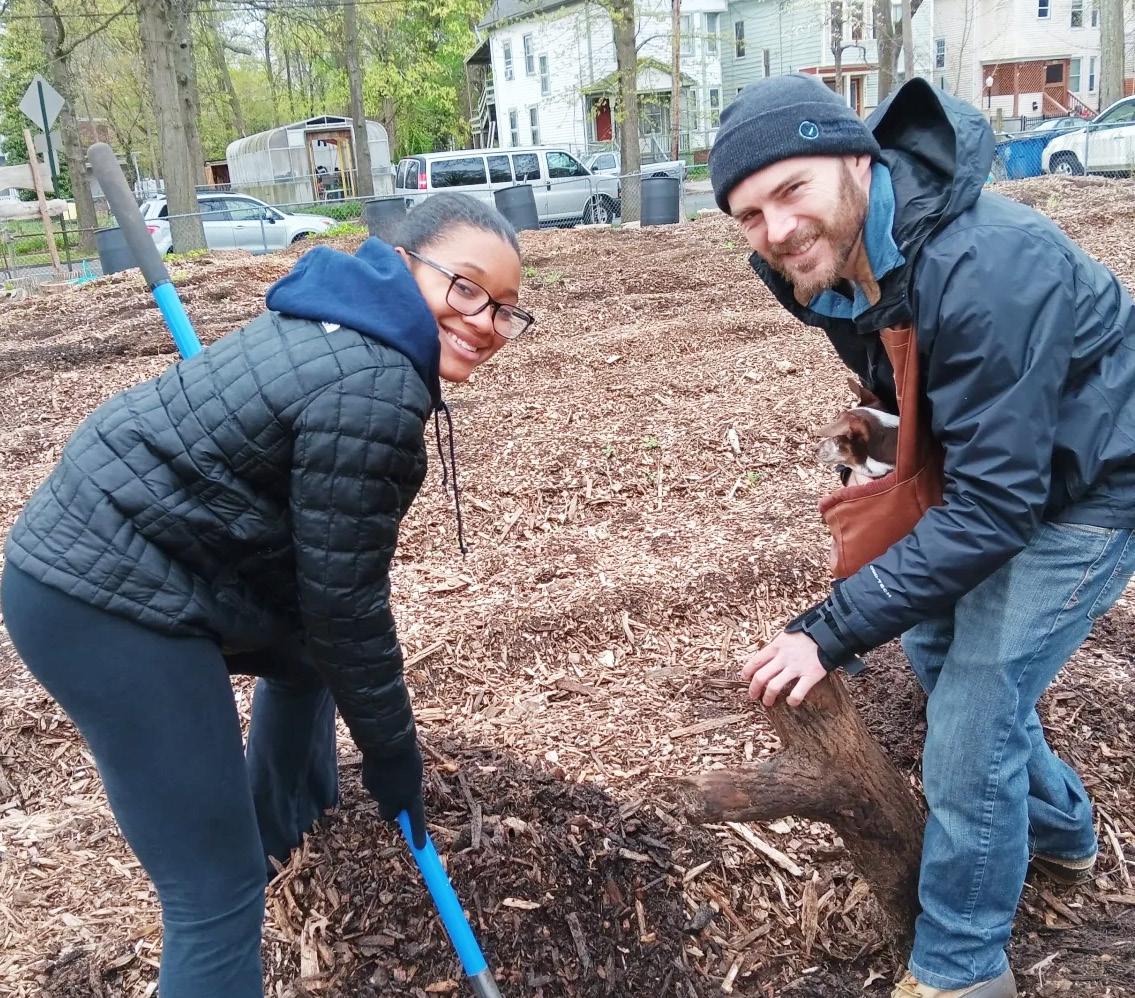
On Wednesday afternoon, Harris came by to thank students in Derek Faulkner’s leadership class at Southern Connecticut State University (SCSU) as they hauled wheelbarrows, added logs, and cleared out the trenches.
On a sunny if cold day they all were there along with staffers from Neighborhood Housing Services of New Haven (NHS), a major partner in the enterprise, among rotating crews of other students, neighbors, school kids, local volunteers, all helping ready the site for spring planting. At the top of the mounds you could see what was left of the winter crop of kale; Harris said she and a group of neighbors harvested five bags just the other day.
Last year and in quantity, tomatoes, kale, broccoli, bok choy, collards and callaloo among other crops were distributed to local churches, food pantries, a senior center, to neighbors, to the school crossing guards — and to anyone who wanted to come by and pick their own, said Harris.
And the food was grown by volunteers spending hours among the hugels starting with little ones from Harris’s daycare Harris-Tucker School, the K-8th graders from nearby Lincoln Bassett school, and from neighbors who tend the long-standing Ivy Street Community Garden across the avenue.
That garden is on city-owned property, part of the Gather New Haven network — and where Harris initially met Maddern and hatched the new idea — whereas the Newhallville Street Garden sits on church property
And because of that, what’s its future?
“The church loves what we are doing,’ Harris said. “We’re feeding people, with food, and spiritually.”
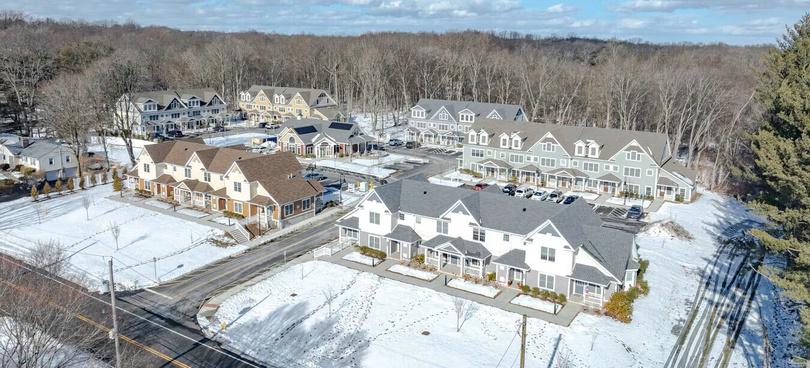
for much needed affordable housing in the
“But housing is only part of revitalization,” he added, which is the larger role of NHS.
A thriving community garden — which is also a space for events, multi-generational communication, festivals, fun, and learning — can also play a huge role in revitalization.
Far more than a garden, it’s a community space, said Harris, and a learning space.
“You can never make a mistake in the garden,” Harris said, quoting Maddern, who one afternoon was working with little kids in the garden. “You can never make a mistake in the garden,” he told the kids, “because this garden is yours.”
Harris also put “revitalization” in very candid, physical terms when she added, pointing west up the hill toward Prospect Street, “The people at the top of the hill live seven to 11 years longer. So how do we combine the neighborhoods and learn from each other?”
Her answer apropos of the garden: “The premise of the garden is how do we teach people to be self-sustaining?”
After a year, the interest is there, she added, for the garden to grow in every way as evidenced by all the students from the area schools and colleges, as far away as Choate Rosemary Hall in Wallingford, who come to the garden for community service and to learn.
This spring’s major challenge is water! “The community center had water,” Harris said as we toured among the hugels. “But not the garden.”
Last year the water had to be hauled from neighbors’ homes until Cremin-Endes, with NHS’s long association with the neighborhood, knocked on the door of the neighbor adjacent.
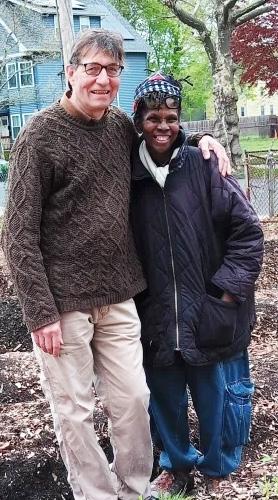
building and organizing, who was offering an orientation to the students.
He allowed the gardeners to hook up hoses to the household spigot, and the gardeners raised money through a grant to pay the neighbor back for the increased water bill when the growing season ended.
Harris said the church is excited bout the ongoing partnership with the garden/ farm, especially about the potential for serious production hügelkultur will be enabling, so that distribution to local food banks can continue and grow.
“The hope is,” Harris added, “that they’ll let us have the farm for the next seven to ten years. As to whether they have other plans for the property, that’s down the road.
“In the meantime, this service to the community is unique and has enormous benefit economically and spiritually, as only a garden can.”
Future plans include erecting a greenhouse, developing programs for people with sensory challenges, for those in wheelchairs to garden, and for classes in cooking with fresh vegetables. But first the water, the water!
Anyone interested in getting involved, donating, or helping, can contact Harris at inspiredcommunitiesinc@gmail.com
By Shaunda Holloway
As drums floated over the stage, it was as if thunder was coming right down from the heavens, stronger and more controlled with each powerful strike. Muscular arms pounded the taut drumskins, spreading percussive joy through the Shubert Theater. Shields and sticks alchemized into instruments. Bells tinkled on ankles. Chests heaved. Bodies swirled in mid-air. Dancer Nya Christian dipped bravely backwards with the fury and agility of a panther and the spirit of Josephine Baker. As she arched her back and remained steady, her fingertips dusted the stage with both confidence and exquisite balance. It was a sight to behold.
Step Afrika!, the international dance phenomenon founded in 1994, has C. Brian Williams, Howard University, the Soweto Dance Theatre and the Black fraternity Alpha Phi Alpha, Inc. to thank for its presence on the world stage. But last weekend, its gratitude was directed to the audience at the Shubert Theatre—who reflected it back, in spades, during a stunning performance in the heart of downtown New Haven.
“We take it [dance] to new places and expand on tradition,” Williams said, adding that the ensemble currently employs 17 full-time, benefitted artists—a creative feat in any economy, and certainly in this one. Prior to the performance, the Shubert hosted educational programming around the show at the Stetson and Mitchell Branches of the New Haven Free Public Library.
Saturday, that energy was on display from the moment a person walked into the theater until the last standing ovation of the night. Ahead of the opening act, the shade-sporting DJ Sparkz—both a dancer and a host—mixed and spun


catchy sounds steeped in Amapiano and Afrobeats. It set the tone for a performance: the turntables were centerstage, the area around them backlit in blue.
Three drums—a djembe on either side and a doudoun in the middle—stood in front, momentarily unoccupied.
Patience and anticipation filled the space. Attendees grooved in the dark, some seated and some making their way in. Shoulders bounced. Fingers snapped. It felt, for a moment, like being transported to a new planet, the beat was just that good. And then, the lights dimmed.
A spotlight appeared, casting a long,
triangular glow onto the stage. In a soft, smoky cloud, a dancer appeared to kick off the show. Then more steppers appeared, dressed in plaid shirts that gave them synchronicity even before they started moving. Shoulders shook. Hands clapped in harmony so much that even the audience joined in. The crowd soaked up the moment like raindrops to a flower.
Step Afrika! does not mimic a style: it creates one that is an homage to many different threads of the African diaspora, and the percussive traditions that have sprung therefrom. As the company showed clearly from the stage, Williams has estab-


lished dominion in the realm of stepping, and in doing so cultures have been intertwined, stories are artfully told, youth are educated, innovation is experienced and traditions are well preserved.
Take, for instance, a battle scene that occurred between male and female steppers during the performance. Over the stage and in the audience, the air buzzed with playful antagonism, tension even. A simultaneous three-person split gained instant applause from the audience. Within seconds, the other steppers were pushing back, as forceful, rhythmic stomps and gravity-defying leaps filled the stage.
There was a triple flip in two directions, somehow simultaneous. The baritone—“Roof! Roof! Roof! Roof!”— echoed deeply in the dark, suggesting a win. The intensity was thick, adrenaline high, and the audience brought into a tradition that tapped into hundreds of years of cultural tradition.
By the third round, it was challenging to even decide who would win the step challenge. Palms slapped chests with abandon. Fingers snapped. Hands clapped behind legs. Pop! Pop! A stampede of rhythms and cadent pauses held the audience captive.
Stepper Pelham Warner Jr., who has been with the company for close to a decade, evoked the spirit of togetherness including the audience in the oasis.
“When I say ok you say alright,” Warner said. And so, the audience, now a part of the performance-now infused with it followed orders.
“Okay Okay!” Warner shouted.
“Alright Alright!” the audience shouted back.
“Alright Alright!”
“Okay Okay!”
Con’t on page 07

John P. Thomas Publisher / CEO
Babz Rawls Ivy Editor-in-Chief Liaison, Corporate Affairs Babz@penfieldcomm.com
Keith Jackson Delores Alleyne John Thomas, III
Editorial Team
Staff Writers
Christian Lewis/Current Affairs
Anthony Scott/Sports Arlene Davis-Rudd/Politics
David Asbery / Tanisha Asbery
Jerry Craft / Cartoons / Barbara Fair Dr. Tamiko Jackson-McArthur
Michelle Turner / Smita Shrestha William Spivey / Kam Williams Rev. Samuel T. Ross-Lee
Christine Stuart www.CTNewsJunkie.com
Paul Bass www.newhavenindependent.org
National Association of Black Journalist
National Newspapers Publishers Association
Greater New Haven Chamber of Commerce
Greater New Haven Business & Professional Greater New England Minority Supplier Development Council, Inc.


The Inner-City Newspaper is published weekly by Penfield Communications, Inc. from offices located at 50 Fitch Street, 2nd Floor, New Haven, CT 06515. 203-3870354 phone; 203-387-2684 fax. Subscriptions:$260 per year (does not include sales tax for the in State subscriptions). Send name, address, zip code with payment. Postmaster, send address changes to 50 Fitch Street, New Haven, CT 06515. Display ad deadline Friday prior to insertion date at 5:00pm Advertisers are responsible for checking ads for error in publication. Penfield Communications, Inc d.b.a., “The Inner-City Newspaper” , shall not be liable for failure to publish an ad or for typographical errors or errors in publication, except to the extent of the cost of the space in which actual error appeared in the first insertion. The Publisher reserves the right to refuse advertising for any reason and to alter advertising copy or graphics deemed unacceptable for publication. The entire contents of The Inner-City Newspaper are copyright 2012, Penfield Communications, Inc. and no portion may be reproduced by any means without the written permission of the publisher.
by Rabbi Eric Woodward
Every year, when my family sits down for its Passover seder, we loudly recite these words, written nearly two thousand years ago: “Let all who are hungry, come and eat.”
The words are an invocation to welcome the hungry into your home – and also a poignant reminder, at a time of abundance, that hunger is real and that the hungry need help.
As a rabbi, I am responsible for teaching the mitzvot, or commandments of God, to my community. This week, I will teach about the mitzvah of “pe’ah,” “corners,” which we read about in Leviticus 19:9-10. “When you reap the harvest of your land, you shall not reap all the way to the corners of your field, or gather the gleanings of your harvest. You shall not pick your vineyard bare, or gather the fallen fruit of your vineyard; you shall leave them for the poor and the strangers: I the Lord am your God.”
We are told that when we harvest our crops, we must give a substantial amount to the poor. How much is this amount? The ancient rabbis tell us that the amount is unlimited, just like the amount of learning we are supposed to do.
Our city’s budget is like a harvest plan. It is a listing of priorities and goals for the coming year. And this year, the proposed budget does not provide funds for feeding
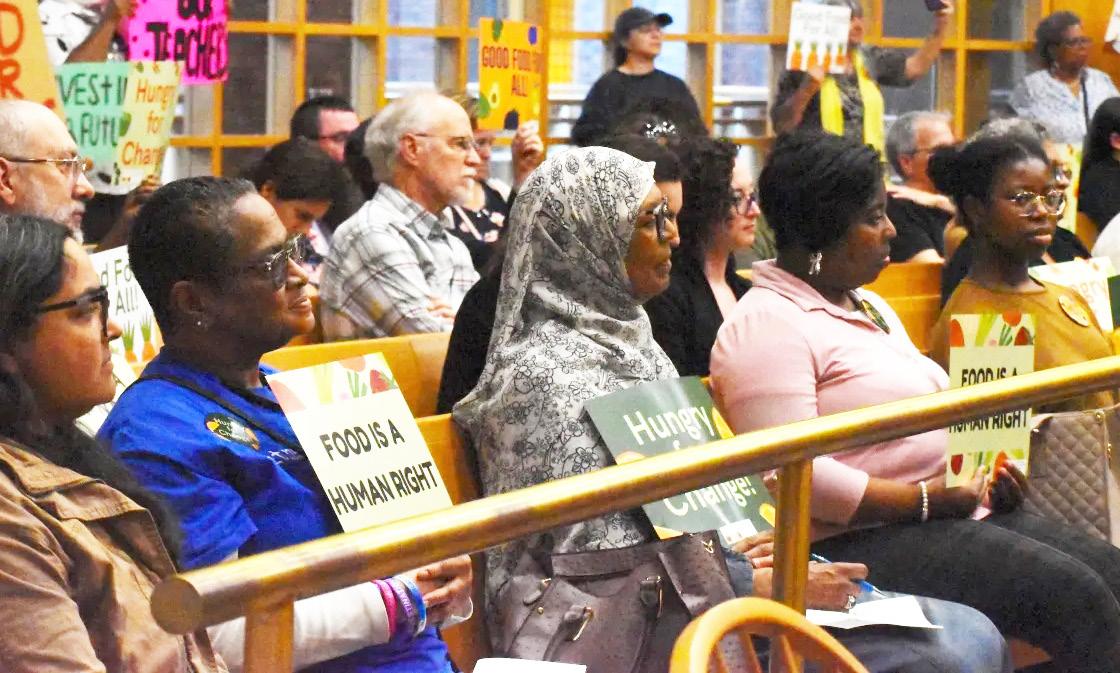
the hungry.
I understand the hard work of making a budget, and that not all worthy programs can be funded. However, money to feed the hungry cannot be considered optional. It is a moral necessity for our city to fund
programs to feed the hungry.
Last year, the budget for the City of New Haven involved almost $500,000 of funding. This year, the City’s General’s Fund budget proposal does not include any funding at all for food assistance. We

need to reach out to our alders to change that and restore the funding that was there last year.
According to CFAN, the Coordinated Food Assistance Network of New Haven, which represents more than 40 local
organizations: “Pantries, soup kitchens, and other food assistance programs in New Haven feed twenty-two percent of the New Haven population and are currently funded almost exclusively through private fundraising, in-kind donations, and foundation support. The estimated cost of supporting the current insufficient food assistance system is more than $3.5 million annually. These well-networked, community-based organizations will continue to solicit support through private sources while meeting the increasing demands of those who are food insecure, but they cannot meet the need without continued support from the City of New Haven. Last year (FY 2025-2026), the Board of Alders demonstrated its commitment to fight hunger in our community by allocating $482,439 to CFAN and its members through a combination of General Fund dollars and Community Development Block Grant funds.”
Next week our alders are meeting to consider the Mayor’s budget proposal and to, I hope, add this money back into it. I know it’s a Jewish value to advocate for the hungry. I think it’s a New Haven value, too. Consider reaching out to your alder to ask them to put food aid back in the city budget. Let all who are hungry come and eat.
Rabbi Eric Woodward is the rabbi of New Haven’s Beth El-Keser Israel synagogue.

by Laura Glesby
HARTFORD — The state legislature’s Judiciary Committee voted Friday to award Dixwell/Newhallville/Prospect Hill Alder Troy Streater nearly $5.9 million as compensation for a wrongful conviction that cost him 23 years in prison. The 30-10 vote followed a decision by state Claims Commissioner Robert Shea that found “substantial evidence of innocence” when reviewing Streater’s conviction for the 1990 murder of 19-year-old Terrence Gamble.
Streater and his lawyer, Alex Taubes, appeared before the Judiciary Committee in the Capitol Building in Hartford on Friday morning.
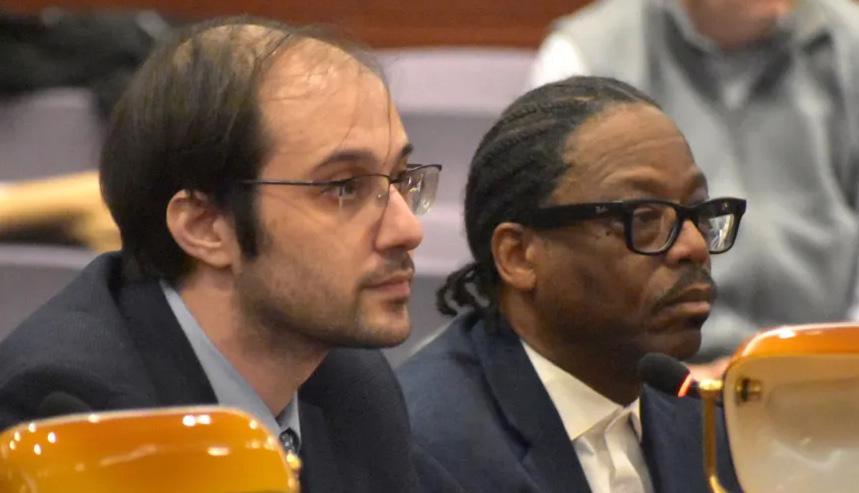
By the end of the day, Streater had received the most direct and official affirmation to date that his conviction had been wrongful.
He also took one big step closer to receiving $5,889,070 from the state as compensation for a conviction mired by allegations of police coercion of the witnesses who formed the basis of the prosecutor’s case.
The committee approved Shea’s determination that Streater is eligible for $5,752,798 in general compensation as well as $136,272 in an “allowance for training and tuition.”
If the Connecticut General Assembly votes to confirm the committee’s decision or takes no action, the funds will be dis-
persed from the State Comptroller’s Adjudicated Claims Fund.
“I’m still taking it in,” Streater reflected upon learning of the final vote tally. “Of course I’m glad that the decision is in my favor, but it has been a long time coming. I guess I’m still taking it in.”
“I’m happy that the state commissioner has seen through the frame-up that was put on me,” Streater added.
“I really feel sorry for the Gamble family,” he said shortly after the hearing. Asked what he plans to do with the award, Streater said, “I don’t want to do anything hastily. I just have to ponder on it.” He said he anticipates using some funds to “make preparations for my children and grandchildren.”
By Lucy Gellman |
The stage managers stand beside a sprawling map of Grover’s Corners, ready to take the audience on a journey. At the center, there is the railroad, the station puffing clouds of smoke into the air. Then Main Street, winding its way past a handful of shops, their windows still dark. The two point out the churches by denomination, moving from the Presbyterians to the Methodists, onto the Unitarians, and then the Baptists and the Catholics. Their voices are a meditation.
Dawn is breaking. Soon, Mrs. Gibbs and Mrs. Webb will be at their stoves, making breakfast for their children. The sound of an old, tired dairy cow will clipclop down the street, jars of milk clinking beside it. But for a moment, this could be New Haven, sunlight slanting over the New Haven Green before the wondrous chaos of the day.
In a performance that finds profound
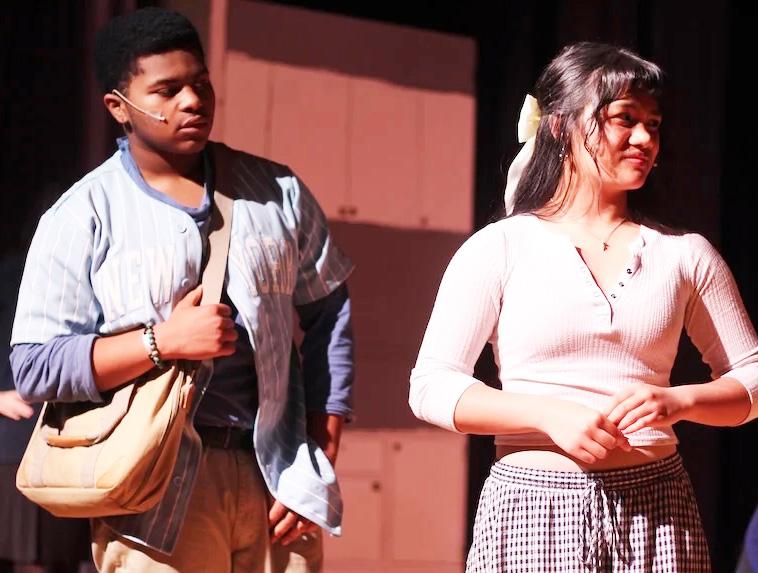

strength in its understatedness, students in the Legacy Studios Drama Club present Thornton Wilder’s Our Town, transforming the 1938 play into one that is both cemented in time and completely of this moment. As it comes to the stage this weekend, cast and crew members have made it entirely their own, driving home a reminder to savor the present before it is gone.
The play, directed by “drama poppa” Ty Scurry, runs Thursday through Sunday at New Haven Academy at 444 Orange St. in New Haven. Tickets and more information are available here. It is, perhaps poetically, the final show for seniors who helped build Legacy their freshman year. In addition to NHA, there is representation from Wilbur Cross High School, ACES Educational Center for the Arts, Betsy Ross Arts & Design Academy, and Cooperative Arts & Humanities High Schools.
by Maya McFadden
New Haven Public Schools (NHPS) hopes to have four of its five pools open this summer — assuming its latest $250,000 contract is enough to help make Conte West Hills School’s pool functional for the first time since 2020.
If that work is successful, then pools at Conte, Career, Hillhouse, and John S. Martinez schools will be open this summer. The pool at Wilbur Cross, meanwhile, remains closed for the time being because of needed roof repairs.
NHPS Chief of School Operations (CSO) Paul Whyte provided that update Monday during the latest meeting of the Board of Education’s Finance & Operations Committee.
Whyte presented a recommended contract with Ruotolo Mechanical, Inc. to install a new balance tank and sand fil-

At John
ters for Conte’s pool at 511 Chapel St. That contract amount is not to exceed $250,187.
Whyte’s presentation came a week after Conte School Building Manager Dennis
pool safe in the long run. Read more about Tondalo’s testimony here.
Board of Education member Andrea
Downer requested on Monday that Whyte connect with Tondalo to review his concerns. Whyte said he is already in conversation with Tondalo and that plans to get further clarity on Tondalo’s specific concerns related to asthma.
Whyte also agreed with Tondalo’s argument that the pool does still need improved HVAC, dehumidification, and climate controls systems as well as locker room improvements. However, Whyte said, those additional needs “should not prohibit us from opening.” He said that Monday’s contract for a new balance tank and sand filters should cover the final steps needed to get the pool open again.
“Is this a Band-Aid?” Downer asked. No, Whyte replied; instead, it’s the main piece of work still needed to get Conte’s pool up and running. He estimated that if all approvals are granted for the contract,
the Conte pool work will take about 8-10 weeks to complete — meaning the pool could be open by early July.
Whyte said that Conte’s pool would be the fourth school pool slated to be open this summer. He said that pools at John S. Martinez School and Career High School are open and operational. He also said that the pool at Hillhouse High School also recently reopened after a temporary closure temporary for the building’s doors to get replaced over spring break. Whyte said that now that the work is complete, Hillhouse’s pool is cleared for use again. The fifth and final school pool that remains closed is at Wilbur Cross High School. That pool is still closed because the building needs roof repairs. “To do the work within the Cross pool we first have to fix the roof above it, otherwise any work that’d be done there would be destroyed,” Whyte explained.
by Donald Eng
HARTFORD, CT — Supporters of the state’s Safe Haven Act for Newborns celebrated a major milestone Wednesday, as the 60th newborn was surrendered under the program earlier this week.
The group, which gathered at the Legislative Office Building in Hartford to commemorate the program’s 25th year, said the law had given dozens of children and mothers better lives.
“We’ve heard the heartbreaking stories of babies that have been abandoned in trash cans, and that is just heartbreaking,” said Lt. Gov. Susan Bysiewicz. “And so in Connecticut we chose to lead with compassion and we chose to give people choices.”
Raising a child is a significant and life changing decision, and the law gives people the opportunity to navigate complex feelings, especially after having given birth, she said.
Susan Hamilton, interim Department of Children and Families commissioner, called surrendering a baby one of the most difficult choices a mother could male.
“To do the right thing for her baby, and to keep her baby safe,” she said. “It takes a village. It really does take a village to make this work.”
Under the law, a parent can surrender a baby, either at the hospital after giving birth or within 30 days. The parent and baby also both can receive identification bracelets, allowing them to be reunited within 30 days if the parent’s circumstances change.
Advocates also are pushing for the adoption of Senate Bill 156, which passed the Senate unanimously after receiving unanimous support in the Committee on Children. The bill would establish a task force to study the voluntary surrender of infants with an emphasis on how policies and procedures may perpetuate “racial, ethnic, health, economic and socioeconomic disparities among parents who engage in such voluntary surrender.”
“Okay Alright!”
“Alright Okay!”
In the haze of unity, Warner returned his attention to the steppers, ready to announce the winners of the final round. Warner complimented both groups. “But we step best when we step together,” he said, standing between them. It was a tie. Sure enough.
Step Afrika! is a bridge for certain. An amalgamation of genres, tones, and histories, all presented with stunning authenticity. After seeing the performance live, no doubt some students may want to transfer to universities where stepping is customary, or learn more about the practice. Alumni will recount the best portions of their college days; the youth may desire to become a part of this legacy. Step Afrika! is movement for the mind, heart and spirit.

By Abiba Biao
Standing in a bright orange jacket in front of a small crowd, the warm lights of the Sandbox shining above her, the poet Sun Queen was as radiant as her name suggested. As she began to speak, she unspooled an inner conversation with herself, flowing from self acceptance to internal reflection. Her warmth spread across the room with each word.
“Wellness is not just doctor visits and diagnoses,” she read. “It’s the radical act of knowing yourself. There is no one way to be whole.” The words followed an airy, melodic flow. “There is no one story of what your body should do.”
“There’s only this moment, this breath, this body that has carried you here, so be gentle,” she continued. It felt as though the whole room was listening. “Be curious. Be powerful in your softness and grounded in knowing because your body is not against you. It has been speaking to you, it has been speaking for you this whole time and today we listen. Hey girl, hey.”
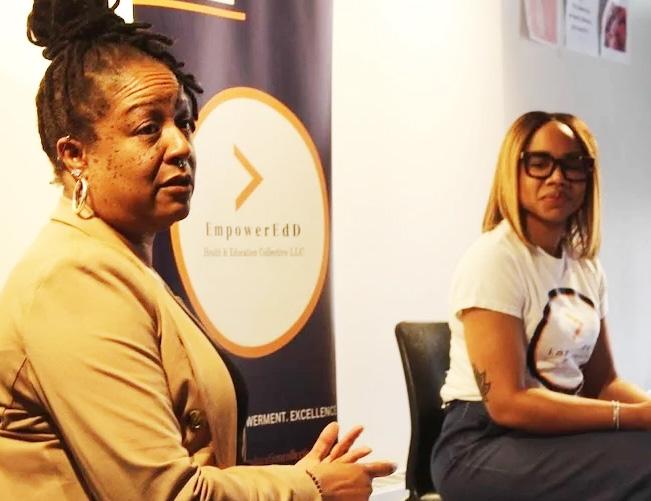
Poetry and public health collided last Saturday at 70 Audubon St., as “Spilling the Tea: Steeping in Strength” kicked off a community conversation and convening that marks the second event in its series. Organized by Tempestt Latham, the founder of EmpowerEdD Health & Education Collective and doctoral candidate in Public Health Education at the American College of Education, the event was founded to increase reproductive health literacy among Black women and girls. This workshop discussed Polycystic Ovarian Syndrome (PCOS), fibroids, reproductive health, and family planning. Read about the first one, focused on periods and held at The Shack, here.
“Spilling the Tea” is a three-part series focusing on women's health. Collaborators for this event included Dr. Lucinda Canty, associate professor and director of the Health Equity in Nursing program at the University of Massachusetts Amherst and founder of Lucinda’s House, and performances from poets Carefree Dandelion and Sun Queen.
Thanks to its intimacy, the gathering of roughly a dozen became more of a roundtable than a buttoned-up panel, with audience participation that brought up questions for nearly every person in the room. When, for instance, attendees spoke up with their own stories of medical discrimination, Latham turned to Canty asking how she advises people to navigate the system.
Canty suggested that individuals always bring a minimum of two questions to their providers, which can improve patient caregiver dynamics and show that patients are engaging in health literacy. It can also push care providers to pay attention and not dismiss pressing health concerns.
“A lot of times, they like to diagnose you without even touching you or doing your bloodwork … So I always say ‘How are you determining what’s going on with
me?’” she said. “Find some question to ask.”
She pointed to the importance of self-advocacy, from reviewing test results with physicians to using MyChart to look at personal medical records, which can provide more information that providers look over verbally through the examination, and check for any errors.
“Read what they’re putting in your chart, and always make sure you download, especially if they’re not giving you a lot of information, download your records and save it as a PDF, because I’ve seen providers go back in and change what they wrote.”
Doctors are allowed to change what they wrote through an addendum, Latham added, but that change should be stated within the document.
Canty also underlined exercising caution when using AI and Google, saying that it can direct users towards medical misinformation and worsen medical anxiety, especially due to AI’s record of amplifying racial bias in healthcare settings. It can also give a patient a false sense of assuredness, Canty added—and lead both them and a provider to believe they are more aware of their health status than they actually are.
“It’s convenient, yes,” Latham said on seeking medical knowledge using the internet and AI. “But if you don’t have the other tools that you need to navigate it and apply it based on the knowledge, the knowhow, and your circles of support — Ima be a broken record — you are actually going to do more harm than good.”
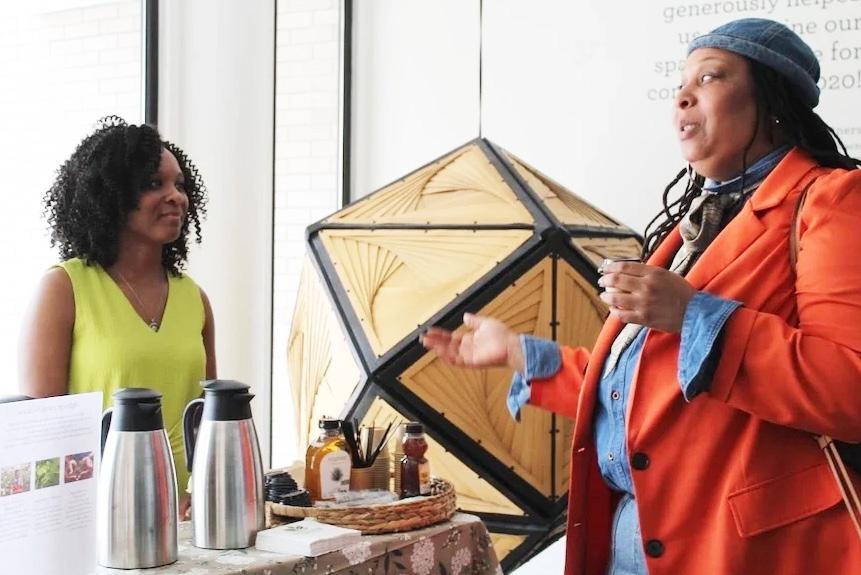
Outside in the corridor, Margo Jones stood behind an array of tea blends and herbs with her wellness tea bar Assiah Tea and Wellness. After experiencing burnout from corporate work, Jones found tea as
an avenue for stress management. For her, spending time to boil water, wait for the tea to steep, and smell the tea blend, are forms of breathwork and meditation.
“And then, after drinking the tea, you find yourself in a place of calmness and stillness, only for a moment, but you have that there,” Jones said, introducing her business to the crowd. “And even though it's just a moment, it's very, very important for us to give our bodies that moment.”
The impact of her business stems beyond mindfulness. Jones added. She has also been encouraged to implement healthy habits for her reproductive health, and view health as interconnected.
“Everything that I do is really kind of related to stress on reproductive health. And I found that before, I had never thought about my reproductive health,” she said,
cause I am not a doctor, and I am not formally an herbalist,” Jones said to attendees. “So I like to say ‘These things help support.’ So always make sure you check in with your doctors, your medical professionals, [and] advocate for yourself.”
The sisterhood that echoed throughout the workshop continued after the talk was done. Outside the Sandbox, Dr. Brionna Davis-Reyes and Charlotte Webb reflected on the event. Davis-Reyes, who earned her Ph.D. in biomedical sciences from the University of Texas Medical Branch, is currently in a class with Latham. After getting an email from Latham about her event, she signed up and brought Webb along.
The workshop topics were also personal for them: both Webb and Davis-Reyes live with PCOS. Webb also has fibroids, and expressed how complicated it can be for those with chronic conditions to find community. Webb said that she mostly got information from researching online, as well as consulting with her physician and wife.
“I don't think she has a whole lot of people to talk to about these things, so I think it’s nice just seeing other Black women who are experiencing those things,” Davis-Reyes said. “And I think of all this stuff, even though we came late, like some of the stuff that they were saying, I think she really related to."
“I want to learn how to keep the fibroids from coming back, you know, so the information that I received [from this workshop] is very helpful,” Webb added. She also mentioned that she hopes to get back into fitness and create a new workout schedule after healing from fibroid surgery later this month.
As Candice Dormon rounded the corner to the exit, her ears perked up, overhearing the couple's conversation, and couldn’t help but join in. A strength coach and founder of Ekow Body Skincare and Wellness in Erector Square, Dormon works with women all the time who have gone through life transitions—including pregnancy, postpartum, menopause, and reproductive diagnoses and surgeries. She meets people where they are.
saying that she dismissed being health conscious as something that should be prioritized at older age. “But as I got closer to perimenopause and I got closer to the transition that I'm going to eventually go into, I realize that now is the time to start and not to wait till it actually slaps me in the face.”
At the front of the table was a paper on herbs and reproductive wellness, pointing attendees to spearmint, red raspberry leaf, chasteberry, ginger root, and turmeric root as potentially beneficial in pain mitigation. Recent emerging research is exploring tea’s association on reproductive disorders. Green tea, for example, has the potential to serve as a protective factor and help alleviate symptoms in PCOS, endometriosis, and dysmenorrhea (painful menstrual periods).
“I use the word ‘support’ in tea a lot be-
“You can't operate now based on the operating system you had before,” Dormon said. The average person doesn’t need to go to the gym everyday, she continued. They just need a routine that sticks. It was a moment of sisterhood through resource sharing, Dormon and Webb exchanging contact information, and also sharing their new tea blends.
This sense of community is exactly what Latham hopes to foster through her workshops. Future goals for the health workshop include expanding reach, saying that she hopes to host the last “Spill the Tea” session virtually, to make it accessible for those unable to attend in person and to try online facilitating for the first time.
“There’s a need [for health education] and that’s representative of this particular topic,” she said.
By Lucy Gellman
When Renee Loren Brown’s mom stopped doing her hair in elementary school, she didn’t know it was the beginning of a movement. Three decades and one giant leap of faith later, she’s turned a hair salon into a thriving third space—and is thinking about how to keep it soaring into the future.
Brown, a daughter of New Haven who now works and lives one town over, is the founder and owner of Trachouse Beauty Salon, which since 2016 has used hair and beauty as a platform for self-love, public health literacy, and female empowerment. As she celebrates 10 years this week, she is looking back at the growth of her small business, and thinking about what the next decade can hold.
An anniversary gala is scheduled for this Sunday, April 26, at Anthony's Ocean View at 450 Lighthouse Rd. in New Haven. Tickets and more information are available here. The salon, which has changed location multiple times since opening, is currently located at 39 Frontage Rd. in East Haven.
“It was just a way for me to connect with other women and girls,” Brown said on a recent episode of “Arts Respond,” a collaboration between WNHH Community Radio and the Arts Paper. “Women love getting their hair done. They love makeup. They love nails. All the things. But behind that is, they just want to feel confident in themselves, you know? In how they present themselves and show up.”
“This whole 10 years is about sisterhood,” she added.
That started when Brown was just a girl, although neither she nor her family knew it then. Born in the Bronx, Brown moved to New Haven as a kid, curious and bubbly in the classroom and a doting sister to two younger brothers at home. By the time she was a fifth grader at Roberto Clemente School, she had started doing her own hair, after her mom handed the responsibility over to her and suggested that it was time to learn.
It was a revelation, although she didn’t recognize it as that at the time. Before school each day, Brown carefully practiced different styles, experimenting with all make and manner of scrunchies, clips, and barrettes. Before long, she found herself doing hair for her cousins and classmates, using platforms like YouTube to figure out what she didn’t know. By the time she was a student at James Hillhouse High School, people knew to go to her for their style needs, whether it was for a show-stopper of a school dance or a personal event.
“You know how you just know how to do something so you don’t look at it as a skill?” she said. “It was another way to connect with people, to connect with women … and I still feel like that now. So it wasn’t like I was 10, and I was like, ‘Oh my God, I’m gonna be a hairdresser when I get older.’ I never thought in a million years that I would become a hairstylist.” Meanwhile, she excelled in school, with

a particular knack for poetry, writing and debate that made her consider becoming an English teacher. When she was 16, she grew those skills—and her love for kids—in a job with Leadership, Education, and Athletics in Partnership (LEAP), after staff there presented their work at a high school job fair.
Brown fell in love with the organization during her time there. For years, she worked as a junior and then senior counselor, rising through the program’s ranks as she nurtured kids in whom she saw her younger self. She worked as a site director, then fielded calls at the front desk. “I was like, ‘How can I stay involved?’” she said with a high, warm laugh that sounded like music.
When Brown headed to Southern Connecticut State University (SCSU) for college, she was certain that she was on a path to become an educator. Her love for poetry and writing, which had first emerged in elementary school, had bloomed fully by then. From her time at LEAP, she also knew that she was good with kids, and loved the work.
But while working a student job in a group home, she realized the scale of developmental and educational need that existed in inner-city schools—and started to consider a different career. When she graduated, it was with a job in health care, and a talent for hair that was a flourishing side gig.
But Trachouse—or what became Trachouse—bloomed out of necessity. While Brown was working at Clifford Beers Community Care Center, she launched a
small dry bar at 91 Shelton Ave., tucked away in a suite at the New Haven Business Center, to serve people beyond her home. Because she was already holding down a full-time job, she would head there after work and on the weekends. Life kept unfolding around her: Brown got married and welcomed her daughter, Marley, into the world. She added three part-time employees. She played tetris with her schedule to fit in hair appointments, from wedding stylings to the perfect style for a baby shower, and still be present as a mom. If there was something she didn't know how to do, she learned it on the job.
“All these things were happening,” she said with a laugh—and she rolled with them. Being a small business owner meant (and still means) that she wore many hats, sometimes all at once: she would do someone’s hair for a wedding or baby shower, and then turn around and file taxes, and then make sure the shop was clean and ready to welcome the next client.
So when an employee suggested that she grow her services beyond a dry bar, she found a space at 900 Grand Ave., and opened the doors to the community. Trachouse was expanding its footprint. Initially, it was just her and three parttime employees, with offerings that grew as the business did. In the 900 Grand Ave. space, Brown welcomed dozens of new clients, who spread the word about Trachouse’s work to their friends, and then friends of their friends, and then friends of friends of friends. For four glorious
“I know that in times when there’s a hiccup, or something’s not going quite the way that I planned, that God has a greater plan for what’s supposed to happen,” she said. “That there’s no need to worry or have fear or anxiety, because God didn’t give us those things. He gave us the things that we get, and he gives us the tools to handle that.”
It was perhaps through that generous outlook that Brown—with a staff that is now 16 full- and part-time employees— expanded the salon’s mission into the Trachouse Cares Foundation in 2022. At the time, Brown had already started small-scale projects to give back to the community, including an annual wig fitting and styling for breast cancer patients in honor of her two grandmothers, both breast cancer survivors. The foundation just made it formal.
What had begun as an initiative that could serve one or two cancer patients per year grew into “The Pink Project,” a full day of pampering for multiple members of the community who had survived or were actively diagnosed with and battling breast cancer. As fellow businesses learned about it, they jumped on to help, offering flowers, pastries, and gift bags for the participants.
years, the business thrived. Brown was able to see a dream come to fruition.
And then in March 2020, Covid-19 brought everything to a screeching halt.
“That was really stressful,” she remembered. It was just a week, maybe less, between New Haven’s first known Covid-19 case and an announcement from Gov. Ned Lamont that barbershops, hair salons, tattoo and piercing parlors had to close immediately per state orders. There was no official date on which it would be safe to reopen.
Brown, who knew how thin the margins could be for a small business, somehow kept moving forward. It helped that she had kept a full-time job at Quinnipiac University, she said: she had learned that "entrepreneurship has its ebbs and flows,” and that a steady job could fill the gap in lean times. Her paycheck from Quinnipiac allowed her to pay the salon’s bills— and to dream bigger.
As businesses began to return to a new normal, Trachouse reopened its doors, and expanded to a beauty lounge on State Street, with services that ranged from teeth whitening, nail care and waxing to facials and peels with a trained esthetician. The model worked because Brown, and members of the Trachouse family, had already spent years building trust in greater New Haven. No one was worried that employees weren’t masking properly or following hand-washing protocols, she said.
When she had doubts, Brown added, her faith sustained her.
A few years ago, Trachouse Cares added “Period,” an annual partnership with medical students at Quinnipiac University where girls between 8 and 12 could speak candidly about “their ever-changing bodies,” including and especially their menstrual cycles. “We’re all women and this is gonna happen, so how can you be prepared for that?” Brown said. She stresses health literacy during the session, knowing firsthand that Black women and girls are much more likely to face discrimination when they come to healthcare professionals with a problem.
She and members of Trachouse Cares also do visits in public and private schools, as a way to teach young people about entrepreneurship. The next information session takes place at her alma mater, Hillhouse High School, next month. In the coming year, the foundation will also be launching an apprenticeship program, to give young people learning in the fields that interest them.
As she celebrates the salon’s 10-year anniversary this Sunday, Brown is reveling in the community that she and team members at Trachouse have created—and dreaming about what the next decade may look like. In a decade, she's watched clients get married, have children, move jobs and sometimes move away from Connecticut. Some are just with her for a short chapter of their life, she said. Others stay with her for years, until they are practically family.
“Ten years really goes by like the blink of an eye!” she said. “We’ve had all of these experiences, all of these beautiful moments—and not so beautiful moments—it’s just like, what?! When did all this occur?”
by Laura Glesby
Stefon Morant is taking the city and six former New Haven police detectives to trial this week for the wrongful conviction for a 1990 double murder that led him to spend 21 years in prison.
In addition to pressing particular detectives on their individual actions, Morant and his attorneys intend to make the case that the New Haven Police Department (NHPD) enabled an institutional culture of witness coercion and evidence fabrication at the time of Morant’s 1994 conviction.
The federal case in question is called Stefon Morant v. City of New Haven. Originally filed in 2022, Morant’s lawsuit also names as defendants the late former Police Chief Nicholas Pastore and former Officers Vincent Raucci, Robert Lawlor, Vaughn Maher, Joseph Pettola, and Michael Sweeney. Morant is seeking both punitive and compensatory damages from the defendants.
Opening arguments in the civil trial are set to take place on Wednesday in Hartford before federal Judge Sarala V. Nagala. Jury selection is scheduled for Tuesday. The full trial is expected to take several weeks to complete.
Both Morant and fellow defendant Scott Lewis were convicted of a double murder in 1994 and 1995, respectively. Morant, then 21, was sentenced to 70 years in prison. Lewis, then 25, was sentenced to 120 years.
Both alleged drug dealers, Morant and Lewis were accused of murdering 43-year-old former alder Ricardo Turner as well as his 23-year-old partner Lamont Fields in their Howard Avenue apartment on Oct. 11, 1990.
Lewis and Morant have alleged that Raucci, a New Haven detective at the time, took the lead in framing them for the murder. They say that Raucci was himself a drug dealer motivated to frame the two of them due to an unresolved debt.
Raucci, they maintain, pressured and threatened the two 16-year-old boys who formed the basis of the state’s case against them, along with other witnesses coerced into corroborating the two boys’ stories. In the years since their convictions, now-retired police lieutenant Michael Sweeney came forward to testify in Lewis’ habeas corpus lawsuit that he’d witnessed Raucci pressure one of those witnesses and told him what to say, a boy referred to in many court documents as Ovil Ruiz (although that’s not his real name). Swee-
ney said that Raucci ignored when Ruiz repeatedly stated he knew nothing about the murder, and that he told Ruiz what to say. In 2013, a federal judge found Sweeney’s testimony “credible” and overturned Lewis’ conviction.
The allegations against Raucci have also been corroborated by the findings of an FBI investigation.
Raucci, meanwhile, has repeatedly denied the claims.
The two 16-year-old witnesses, meanwhile, would each eventually come forward.
One, Jose Roque, recanted his statements to the police during Morant’s criminal trial. By then, Roque was 20 years old.
“They told me what to say on the tape,” he said of the police. He later stated that when Raucci asked him about the murder, he “told me he was going to put me on a million dollars bond and charge me with it.” So Roque testified that when he was 16, Raucci would pause the tape recording of the police interview periodically to coach Roque’s words.
The FBI investigation found that the tape of that interview had been stopped and re-started at least 11 times, and that four sections of the tape were altered with over-recordings, according to Morant’s legal filings.
Ruiz, meanwhile, struggled with mental health, substance use, and crime over the many years that followed Lewis and Morant’s convictions.
He recanted his original testimony and police statements in a 2023 deposition for Morant’s ongoing lawsuit.
At the time, when he was 16, Ruiz said in the deposition, he and the former detective “got high together, did drugs together. And I gave him information about people who was selling drugs and stuff like that, you know.”
He said he fabricated his testimony against Morant and Lewis because “I was scared of Detective Raucci. He was coercing me, you know, to say the things that I said… ‘Cause I looked up to Detective Raucci. You know, I was scared of him, but at the same time, you know, he was

a police officer. You got to trust a police officer, you know. And that’s exactly what I did. I trusted him, knowing that I did whatever he wanted me to do, and I did it.” He said he considered Raucci a “friend.”
In the deposition, one of Morant’s attorneys, Nick Brustin, asked Ruiz about his mental state at the time. Ruiz said that he had been hearing voices and using psychoactive drugs including cocaine.
He couldn’t quite remember when his mental health began to worsen, but at one point, he attributed his decline to the moment “when I realized that I’m going to put two guys in jail for something they didn’t do.”
After a 2013 habeas victory — which an appeals court affirmed in 2015 — Lewis walked free in 2014.
Morant, meanwhile, was freed not through a habeas petition but through a sentence reduction that enabled him to leave prison in 2015. He subsequently received a pardon in 2021.
Morant has been awarded over $5.84
million through the state’s wrongful conviction claims process. And when Lewis sued the city over the conviction, the city agreed to a settlement of $9.5 million. The city isn’t settling Morant’s lawsuit, however — at least not yet. Neither are the former detectives who are defendants in the lawsuit.
In legal filings, the city has argued that Morant “cannot demonstrate municipal liability” for wrongdoing in Morant’s case, including for the actions of individual officers.
As an affirmative defense, city attorney Thomas Gerarde argued that the individual detectives’ actions either “were not within the scope of employment or official duties,” were a form of “wilful misconduct,” or “were negligent acts” — and that as a result, “the City of New Haven has no liability” for those actions.
Several of the police defendants, meanwhile, are arguing the exact opposite: that they are entitled to qualified immunity, protecting them from lawsuits due to their actions within the scope of their authority as agents of the New Haven Police Department.
Morant’s legal team, meanwhile, plans to make the case that both individual detectives and the city itself are responsible for the wrongful conviction. They are connecting Morant and Lewis’ conviction to an array of other New Haven convictions from the same era mired in allegations of police misconduct, including those of Erik Ham, George Gould and Ronald Taylor, Daryle Breland, Troy Streater, Adam Carmon, and Daryl Valentine.
In a statement on Monday, city Corporation Counsel Allison Jacobs wrote, “Every individual deserves equal and impartial justice under the law. While the City cannot comment on the specifics of this case due to pending litigation, the City is committed to cooperating with all parties and appropriately engaging in the civil litigation process to ensure there are reasonable resolutions on these matters as we do in all cases in which the City is involved.”
Mayor Justin Elicker echoed this sentiment in a separate statement, and wrote, “While I was not the Mayor at the time that these events transpired in the 1990s, I am committed to supporting our officers and giving them the tools, training and resources they need to succeed in 2026.” Brustin, Morant’s lawyer, simply stated: “Stefon Morant is looking forward to finally holding accountable those who caused his wrongful conviction.”








by Janday Wilson
Juvenile Toad’s Place
New Haven
April 23, 2026
It seemed like everybody at Toad’s Place was hell bent on reminding me that I’m old.
Okay, I’m only 37. Sorry to my actual elders. But truly, it feels like lifetimes have passed since I first heard Juvenile’s song “Back That Azz Up.” Not that I could ever escape it or want to. Nearly 30 years have passed since its release. Yet, to this day, at every hip-hop party you go to, at some point those heavy synths will drop, and knees will start bending and backs will start arching. This, too, was true of last night.
It’s simply a classic. And it seemed like much of the crowd at Toad’s Thursday night was already hitting the club when it came out.
“Who’s 55 and over? Who’s 40 and over?”
At the start of the evening, Hot 93.7’s DJ Buck started a roll call. I shut my ears off before he got to 35 and over. Then the opener – comedian and Dave Chappelle protégé Marshall Brandon – came out and said, “Where my real hip hop heads at? We done growed up!” The grizzled beards all around me stood as testimony. He laughed, saying, “I hurt my back rubbing my lady’s back.”
Meanwhile, Juvenile is 51 years old. And he came out reminding us of that fact. As he suavely stepped on to the stage, smoking a blunt (naturally), the intro to his latest album Boiling Point played: “I started this shit 35 summers ago…”
Before he started performing, he gave a little speech about his new album: “It’s very entertaining, n****. It’s for the millennials. I know a lot of you motherfuckers are millennials.”
Shucks. I really needed the reminder, Juvie.
But age is nothing but a number, as they say. Juvenile’s electrifying performance was evidence of that adage. His energy was infectious, his breath control was perfect, his vocals were clean (not so much the lyrics), and his magnetic personality shone through as he rapped hit after hit. He’s still youthful looking – and quite handsome, I may add.
It was a two-part show, leading with songs off of Boiling Point. It was surprising that he started with an interlude – “Doze Off” – but it was very catchy with his melodious voice. The audience was excited to rap every word along with him, and that momentum continued as

he went through a medley of songs from the album. His son Young Juve came out to perform their song “Hot of the Hottest,” and their musical chemistry was undeniable. Thank God, because I would have felt secondhand embarrassment if his namesake couldn’t rap. Young Juve displayed chops that proved he’s one to watch.
It was precious to see Young Juve support his dad as he wore multiple hats throughout the show. In addition to performing a few songs, he took pictures of Juvenile and the audience with a professional camera. At one point, a fan gave him her phone, and he kindly brought it on stage to shoot exclusive, up-close footage.
When Juvenile turned his set over to the “99 and the 2000s,” there was a seismic shift in the atmosphere. Even the younger folks (it was an 18+ show) in the audience rapped each word to past hits by him and his compatriots of Cash Money Records: like “400 Degreez” (from Juvenile’s 1998 breakthrough album of the same name),
“Project B*tch” by Cash Money Million
aires, Big Tymers’ “Get Your Roll On,” “Rodeo,” “Slow Motion,” and Hot Boys’ “I Need a Hot Girl.”
The space started feeling less like a concert, and more like a reunion. Not just of fans, but of eras. People weren’t just reciting lyrics; they were recounting memories. You could see it in the way strangers turned to each other mid-verse, locking eyes in recognition, like you were there, too?
Once we came to the close of the show, there was almost a religious hush in the audience. We all knew what we were waiting for and, boy, did Juvenile deliver. “Play the greatest love song ever written,” he ordered with a huge grin.
The beat dropped – “Back it up! Hands up!” he yelled – and the crowd obliged. Arms were flung in the air every which way. Heads were swinging. Backsides were shaking. People jostled their neighbors.
It was kind of insane.
We moved in unison; and you couldn’t tell who was “old” and who was “young.” Everybody’s knees and backs were in perfect working order, thank you very much.
As I left the show, I thought of the lifelong fan I met in line who drove two hours to see her first Juvenile show. “We like him but, like, this is her man,” Christina Koshinsky’s friends told me.
I know Christina was bursting with joy at the end of the night. Finally, a man who doesn’t disappoint.

There’s been a drought on their childhood’s road and two cousins come home dry-eyed and grieving. Sade, on a three-day furlough from prison. Mina, departing a strangely idyllic west coast. As all time ticks towards the correctional officer’s arrival, these two wrestle with all they have never said, with the fallibility of memory itself, and with visions of a future they are bound to create. Winner of the prestigious 2025 Susan Smith Blackburn Prize, a.k. payne’s Furlough’s Paradise is a lyrical meditation on grief, home, kinship, and a utopia yet to be realized.




by Abiba Biao
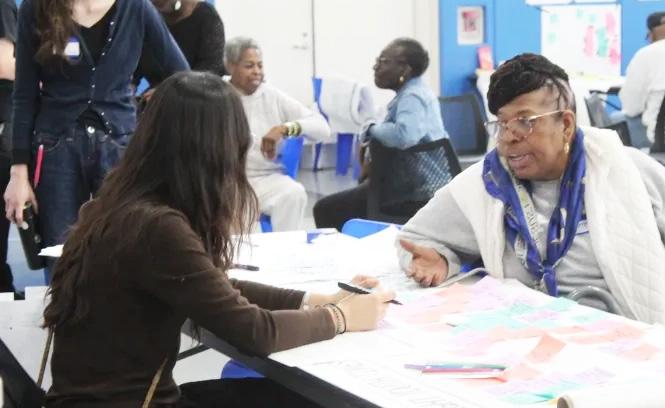
Concerned with street litter and improving residential recycling efforts, Kate Walton — a Dwight resident for 47 years — said she’s noticed wrappers and packaging from fast food chains like McDonald’s, Starbucks and Dunkin Donuts around the neighborhood. She pointed out that all of that waste is not biodegradable.
“When they do go around doing street cleaning, to me, there should be a vehicle that goes around and does a sample of what is being picked up off the streets,” she said, with the goal to fine businesses that are not engaging in sustainable practices and residents who improperly dispose of trash and contaminate recycling bins
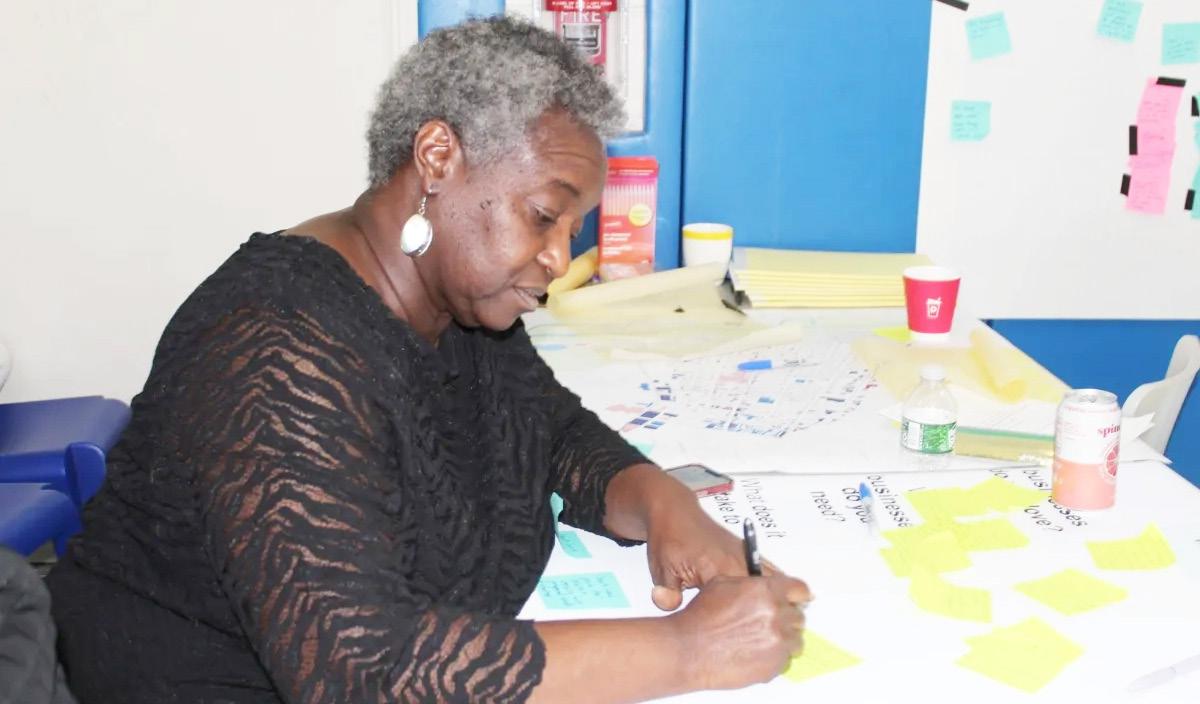
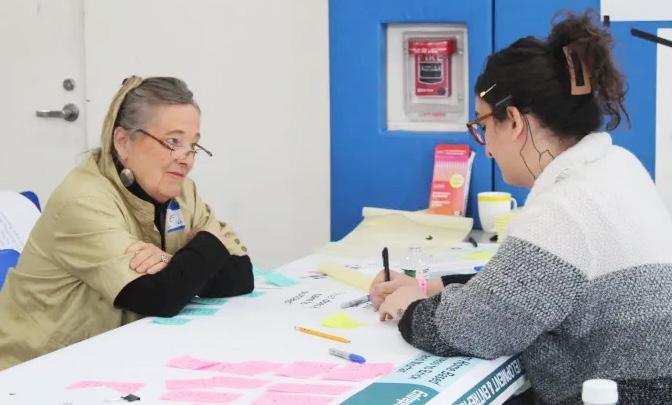
Pen in hand, Amanda Almeida nodded, carefully jotting Walton’s ideas on a yellow sticky note.
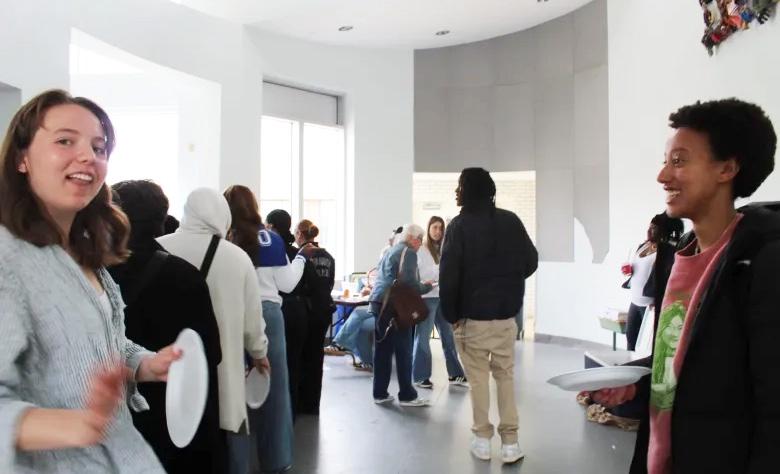
That interaction played out on Saturday at 130 Edgewood Ave. as Amistad Academy’s community room and gymnasium turned into a place of reflection as Yalies, Dwight community members, and residents gathered to discuss urban design and envision the future of the neighborhood.
The meeting was held by the Dwight Central Management Team and the Greater Dwight Development Corporation (GDDC), with support from the Yale Urban Design Workshop. Also in attendance were the New Haven Firebirds, the New Haven Fire Department, the New Haven Police Department, Dwight Alder Frank Douglass and former East Rock/Downtown Alder Eli Sabin.
The meeting, which ran from 9:30 a.m. to 1 p.m., focused on four areas of development: community wellbeing; housing and affordability; education, youth and seniors; and economic development and jobs. Each topic had its own table and participants were free to go around and visit different sections.
The feedback gathered at the meeting will be used to help create a Greater Dwight Neighborhood Plan for 2034, covering the Dwight, Edgewood, and West River neighborhoods.
Sitting at the community and wellbeing table was Natasha Zimmermann, a second year Masters in Public Health student in the Yale School of Public Health Department of Environmental Health Sciences.
As attendees sat down beside her, Zimmermann briefed them on the results of the Dwight Urban Heat Study. A research assistant for the study, Zimmermann helped with the analysis of study data and is now disseminating information of the results to residents. Part of this effort is dispersing physical copies, adding that she has brought handouts to the YCMA, Edge of the Woods, and local places of worship. She said that
the resource is also available online and is listed on the Yale Center on Climate Change and Health, the Community Alliance for Research and Engagement (CARE), and other platforms.
The study — conducted by the Yale Center on Climate Change and Health, the Yale Urban Design Workshop, and CARE — explored how Dwight residents were affected by heat. It also explored community-oriented cooling solutions. The methodology consisted of five focus groups with 36 total participants and a survey, which received 270 respondents.
Some significant results Zimmermann highlighted were that more than 75 percent of survey participants viewed extreme heat as an important issue. There are no cooling centers in Dwight; 68 percent of participants said that they would be interested in using a neighborhood cooling center if created.
“Other solutions that folks were interested in seeing were more trees and gardens and parks, a community swimming pool, shaded bus stops, financial support to help purchase [cooling methods] like air conditioning and support for energy bills,” she said.
As a Yale student, Zimmermann said that this type of research has made her more attuned to community matters.
“I think it’s been really meaningful to be here and get to see, kind of, the longitudinal care that folks here have for the neighborhood, and getting to be part of that is really special because I think it’s an active choice to be involved in a community when you’re a student,” she said. “So I think that getting to hear about the care that people have with their neighborhood and kind of the way that the community has come together, has been so special.”
Like Walton, Dwight resident Dottie Green paid a stop to the economic development and jobs table on Saturday.
A retired educator, Green taught middle school in South Carolina before becoming an education administrator in the Connecticut Department of Correction. She has called Dwight home since 1988. When asked what neighborhood problems she’s observed, public infrastructure was the first to come to mind.
“Potholes everywhere,” she said with a laugh, alongside lack of sidewalk maintenance, “commercial landlords not taking care of their property,” and too many smoke shops. Other issues she’s interested in are affordable housing and greenspace equity, using Edgewood Park as an example. In the future, she hopes that Dwight residents use the park in “large scale ways,” such as hosting summer festivals and using the waterways.
“For years and years, people didn’t feel like they could engage in Edgewood Park. They felt like there was a divide,” she said, before pausing. “I want to say we’re psychologically red-
lined from Edgewood park… I’d like to see people utilize Edgewood Park in large scale ways.”
Despite these problems, there’s a reason she’s stayed in Dwight, highlighting community engagement and activism.
“What I love about this community is the connectedness of the management team,” she said. “The GDDC are major assets to this community because I think they truly advocate for the needs of the community.”
Edgewood Alder Evette Hamilton still remembers the days the neighborhood struggled as a food desert. Neighborhood advocacy resulted in Stop and Shop coming to Dwight Place Shopping Plaza in 2011.
“I am proud of the work that we’ve done, not only myself, but a whole team of us have done to compile all the data to hear from our community, what they would like to see happen. and the changes they would like to see happen here in our community,” she said.
To compile the data presented at the meeting was a yearlong endeavor, Hamilton explained, done through doorknocking, in-person conversations, and getting feedback from residents at community cleanups and events like the annual Edgewood Youth Day Block Party, which she said had almost 300 people in attendance.
“We’ve gone through all the different avenues to be able to reach to people, right? And in doing so, all the data that you see on the wall is what folks have said, what they want to see happen.”
After hearing about Saturday’s charrette, Mahdere Yared knew it would be a great opportunity to “learn more about what’s happing in the community.” Yared is a new resident of Dwight and has been living in the neighborhood since graduating with her bachelor’s degree in cognitive science from Yale last year.
“I like being close to the playground and environment in the community,” she said. “And so, I want to keep on being involved with community networks and tapping in.”
While stopping by the youth and seniors table, she brought up the idea of having a dedicated “poetry space” in the community, mentioning the open mic and poetry slams held by New Haven poet and housing activist Sun Queen.
“I just like trying to always be around other creatives and I hope that — honestly, I might come back and tell them [the youth and seniors table] — I hope it’s, like, intergenerational,” she said, before entering the growing line to get lunch. “Sun’s space is intergenerational. It’s just, like, cool to have people saying stuff at different stages of their life, and being vulnerable, and I think it’s a cool way to connect.”
NEW YORK (AP) — “Michael,” the big-budget Michael Jackson spectacle, shrugged off bad reviews and a troubled production to launch with $97 million in U.S. and Canada theaters, according to studio estimates April 26, shattering a record debut for music biopics.
A highly authorized portrayal of the King of Pop, co-produced by the Jackson estate, Lionsgate’s “Michael” far surpassed previous biopic top performers like “Straight Outta Compton” (a $60.2 million debut in 2015) and “Bohemian Rhapsody” ($51 million in 2018).
International sales were also strong. “Michael” collected $120.4 million overseas, to give it a $217.4 million global opening — a new high for a music biopic. Universal picked up distribution in most international markets.
Sign up for our Daily eBlast to get coverage on Black communities from the media company who has been doing it right for over 133 years.
A few weeks back, estimates for “Michael” were closer to $50 million. Going into the weekend, the studio estimated closer to $70 million. But it wildly overperformed.
“From the beginning, all of the signals were that something like this was possible,” said Adam Fogelson, Lionsgate chairman. “We were seeing massive engagement with every conceivable audience segment that you could identify.”
Even in the lucrative market of music biopics, “Michael” was an audacious bet by Lionsgate on an extraordinarily pop-

ular but controversial figure. The reputation of Jackson, who died in 2009 at the age of 50, has been repeatedly tarnished by allegations of sexual abuse of children. Jackson and his estate have maintained his innocence, though the pop star acknowledged sharing a bedroom with other people’s children. He was acquitted in his sole criminal trial in 2005.
Some Jackson family members opposed the film. Janet Jackson was uninvolved
and doesn’t appear in it. Jackson’s daughter, Paris, called it “fantasy land.” But three years after “Leaving Neverland,” the 2009 documentary about Jackson’s alleged sexual abuse of children, “Bohemian Rhapsody” producer Graham King announced plans for the biopic. Jackson’s nephew, Jaafar Jackson, was cast to star.
“Michael” had an unusually rocky production. After shooting was completed, producers realized they had made a cost-
ly mistake. The third act focused on the accusations of Jordan Chandler, then 13 years old, whom Jackson paid $23 million to in a 1994 settlement. The terms of that settlement barred the Jackson estate from ever mentioning Chandler in a movie.
A huge chunk of the film had to be cut. Reshoots for as much as $50 million were done at the estate’s expense. Director Antoine Fuqua and screenwriter John Logan reworked the movie to conclude in 1988,
before any accusations were made.
“I would take issue with the idea that we as a studio or as filmmakers were running around in a panic,” said Fogelson. “It was definitely a unique and challenging circumstance to figure out how to work through. But it created an opportunity to tell more story than any one film could possibly contain.”
Yet as bad as things once looked for “Michael,” the movie turned into a huge hit. The film’s total production cost came close to $200 million. To defray costs, Lionsgate sold international distribution rights to Universal. A sequel is in development. A third film after that, Fogelson said, is “not inconceivable.”
“The audience spoke loud and clear,” Fogelson said. “The portion of Michael’s life that this story tells couldn’t have gotten into those allegations because the allegations themselves hadn’t happened in the period this movie existed. I think the audience is judging it on those terms. We’ll see what happens as we move into the possibility of subsequent films.”
Critics slammed the film for glossing over some of the less convenient aspects of Jackson’s life. It scored a paltry 38 percent on Rotten Tomatoes. But audiences were far more enthusiastic. “Michael” earned an “A-” CinemaScore. “It’s only human nature to enjoy yourself at the movie theater,” said Paul Dergarabedian, head of marketplace trends for Comscore. “The movie was perfectly positioned ahead of the start of the summer

Courtesy of HBCUNEWS.com
By Cedric Mobley
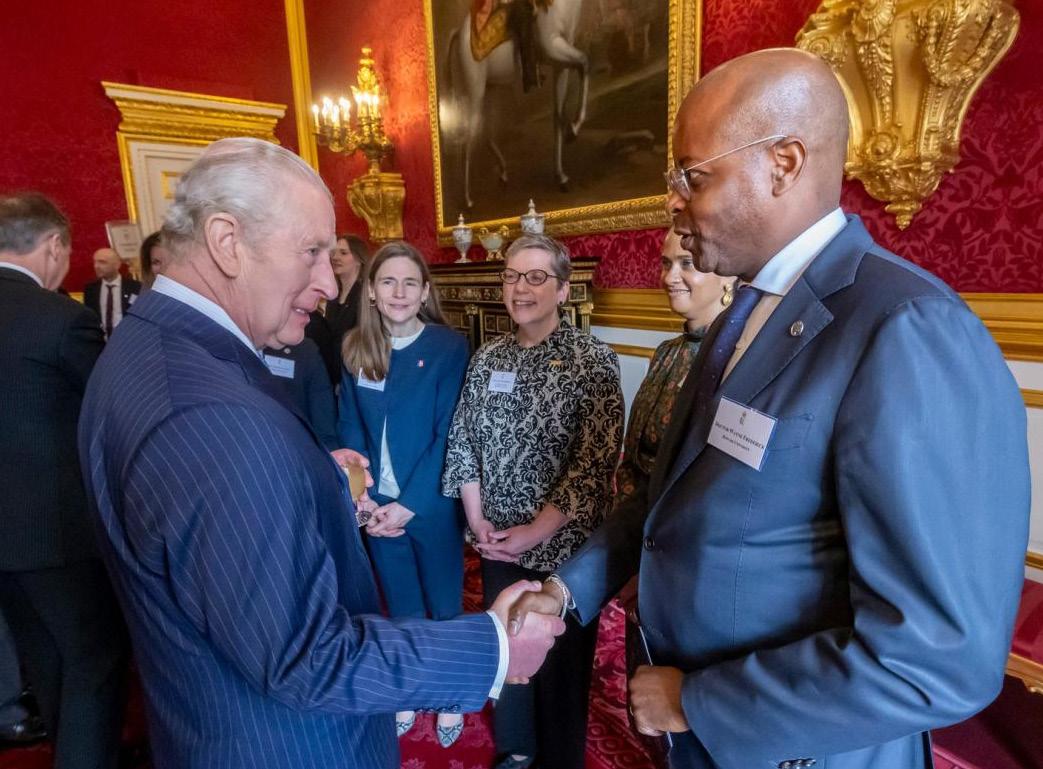
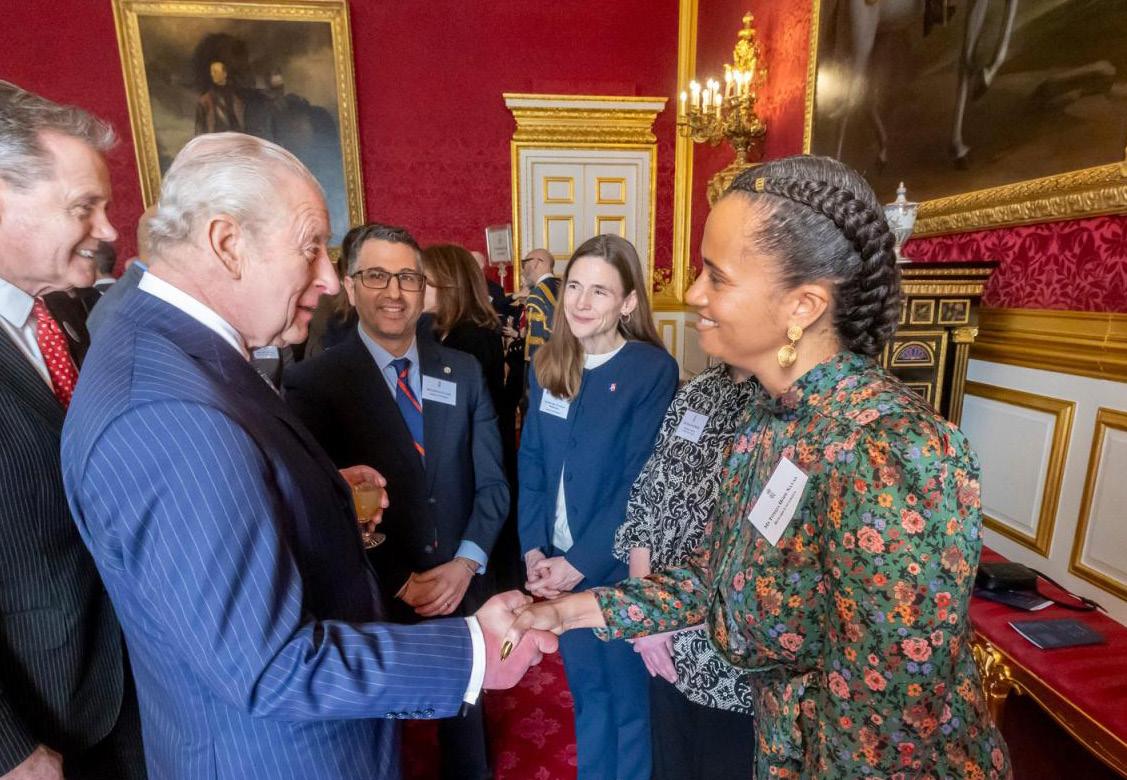
As King Charles III visits Washington, D.C. this week, there is at least one part of the nation’s capital he is already familiar with: Howard University. Earlier this year, the king hosted Wayne A. I. Frederick (B.S. ’92, M.D. ’94, MBA ’11), Howard’s interim president, president emeritus, and Charles R. Drew Professor of Surgery and Tonija Hope (Ph.D. ’24), assistant provost for international programs and executive director of Howard University’s Ralph J. Bunche International Affairs Center, at St. James’s Palace in London. The event honored the winners of the Queen Elizabeth Prizes for Higher and Further Education, 19 universities and colleges in the United Kingdom who have been recognized for “excellence, innovation and well-evidenced benefit for the institution itself and the wider world.”
The prizes are awarded by the Royal Anniversary Trust. President Frederick and Dr. Hope were among special guests invited to witness the ceremony, attend a reception hosted by King Charles, and attend a gala dinner.
In honor of what would have been Queen Elizabeth II’s 100th birthday and the 250th anniversary of the Declaration of Independence in the United States, the Royal Anniversary Trust is sponsoring the Queen Elizabeth Prizes for Education: USA Exchange. Highlighting the “special relationship” between the U.S. and the U.K., scholars from eight prize winning institutions will participate in a four-day transatlantic collaboration with scholars from leading institutions in Washington. Howard, along with Johns Hopkins University, American University, and Northern Virginia Community College will host scholars from the University of the Arts London, the University of Edinburgh, Edinburgh Napier University, City of Glasgow College, Keele University, Queen University Belfast, Scotland Rural
College, and UCS College Group. Frederick and Hope attended the awards dinner as a prelude to that collaboration.
“This collaboration presents a valuable opportunity to showcase the innovative work taking place at Howard University across the medical and STEM fields, as well as at the intersection of fashion, sustainability, and human rights,” said Hope.
“We will welcome scholars from two to three visiting universities to campus, creating meaningful opportunities for our faculty, staff, and students to engage and exchange ideas. It is a wonderful chance to celebrate the groundbreaking work happening at Howard while also building connections with scholars in the United Kingdom who are advancing exceptional research and scholarship. As always, our hope is that these exchanges will spark something distinctive, lasting, and impactful—and we believe this collaboration will be no exception.”
Hope admits that she is not exactly a royal watcher, but even she was impressed by the attention to detail, pomp, and circumstance of the ceremony. In particular, she noted that as Charles greeted Frederick, he already knew about Frederick’s work as a noted cancer surgeon.
Charles, a current cancer patient, took the time to speak with Frederick about Frederick’s perspectives on the disease and his work in the field. It provided Hope with a new appreciation for the preparation it takes to produce royal events and the serious diplomacy that occurs there. Charles is, after all, the head of the state for the United Kingdom.
“Meeting King Charles III, Princess Anne, and other members of the royal family was truly a singular experience,” said Hope. “Only the renowned pomp and circumstance of Howard University rivals that of the monarchy. I hope we can return the gracious hospitality extended to us during our visit and offer our guests a memorable glimpse of Howard’s signature pageantry, rich traditions, and long-
standing legacy of academic excellence.”
Collaborating with the Queen Elizabeth Prizes for Education will be nothing new for Howard’s Ralph J. Bunche In-
Mason Temple, a church in Memphis where the Rev. Martin Luther King Jr. delivered his final speech, will be upgraded with a $1.2 million federal grant to preserve a treasured piece of the Civil Rights Movement, officials are expected to announce Monday.
It’s part of a nearly $18 million package for Memphis projects included in the annual congressional appropriations process.
The package also includes $3.1 million for the restoration of historic Clayborn Temple, the staging area for the 1968 sanitation workers strike that brought King to Memphis. It was heavily damaged by a fire investigators say was intentionally set in April 2025.
The grant for Mason Temple is for longterm facility improvements and technology infrastructure upgrades, with more details set to come at a Monday afternoon news conference by Church Of God in Christ leaders and U.S. Rep. Steve Cohen,
a Democrat from Memphis who first announced the grant in February.
The two churches being renovated are located near the former Lorraine Motel, where King was fatally shot on the evening of April 4, 1968. Fighting an illness, King visited Mason Temple the night before and made what was his last speech, the stirring “I’ve Been to the Mountaintop” address.
King, 39, gave an impassioned account of his life experiences and seemed to foretell his own death.
“I’ve seen the Promised Land. …I may not get there with you. But I want you to know tonight, that we, as a people, will get to the Promised Land,” King said.
In a 2018 Associated Press story about the 50th anniversary of King’s assassination, witnesses described how King captivated the audience in the packed church during a thunderstorm.
“It’s a tin roof, so that’s banging. There’s
ternational Affairs Center. The center frequently hosts collaborative events and workshops for diplomats, scholars, researchers, and students. It sponsors a
number of the university’s study abroad and fellowship programs, which each year, provide scores of Howard students with the ability to travel internationally, learn, and engage in experiential learning and research. The Office of International Programs is working on advancing a cohesive vision and strategic approach to internationalization across Howard University. Through global partnerships, academic exchange, collaborative research, and expanded opportunities for students and faculty, the Office will cement Howard’s position as a leading institution in an increasingly interconnected world. The visit from distinguished universities in the United Kingdom represents an important step in that strategy, creating new pathways for engagement, shared scholarship, and cross-cultural learning. It reflects Howard’s commitment to building meaningful global relationships that enhance academic excellence, broaden perspectives, and prepare our community to lead on an international stage.
Howard Interim President and President Emeritus Wayne A. I. Frederick (far right) with Damon Buffini, chair of the Royal Anniversary Trust (far left) with Buffini’s wife and Howard’s Tonija Hope, Ph.D.(middle left).
“The mission of Howard University closely aligns with the goals of the Queen Elizabeth Prizes in Education: USA Exchange through our shared commitment to academic excellence, global engagement, and the development of future leaders prepared to address society’s most pressing challenges. By fostering cross-cultural dialogue, expanding research collaboration, and creating meaningful opportunities for student and faculty exchange, this partnership strengthens higher education institutions on both sides of the Atlantic. Ultimately, these efforts will help cultivate a more informed, innovative, and interconnected global society equipped to advance equity, opportunity, and sustainable progress.”
is getting a $1.2 million
rafters up there above us, and the rafters are blowing with the wind and hitting each other and hitting the walls from the fierceness of the wind and the rain,” said the Rev. James Lawson, a prominent civil rights activist.
When he finished, King slumped into a chair. To Mike Cody, one of King’s lawyers, he looked like a “toy that had the air taken out of it.”
“Ministers, men were crying,” the Rev. Jesse Jackson told the AP in the 2018 story.
The Mason Temple was completed in 1945 following the destruction of the original church by fire. It serves as the world headquarters for the Church Of God in Christ.
It was also the site of a January 2023 memorial service for Tyre Nichols, a 29-yearold Black man who died after he was brutally beaten by Memphis police officers after he fled a traffic stop.
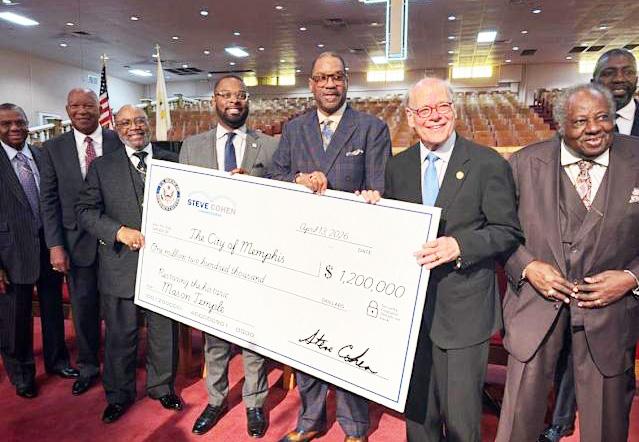
by MICHAEL CASEY Associated Press
The Lexington Minutemen are marking the anniversary of the Battle of Lexington in Massachusetts on Saturday, as they do every year. Thousands of people, some in colonial costumes, gathered on the Lexington Green to witness the historic clash, many booing the British “troops” and cheering on the patriots. The battle, which marked the start of the American Revolution 251 years ago, ended with eight Americans killed and 10 wounded, and the dead left scattered on the grounds as the British marched off.
Among the soldiers represented there was Prince Estabrook, an enslaved man who joined his white neighbors on Lexington Green on April 19, 1775, as British troops approached. He was wounded that day, but went on to serve in multiple deployments throughout the war.
“I wasn’t surprised that we didn’t know about it,” said Price, a 95-year-old Black Korean War veteran who played the role of Estabrook for 50 years. “I was surprised that there was one Black soldier out here.”
As America prepares to celebrate its 250th anniversary, Estabrook and other patriots of color are being celebrated through programs nationwide that aim to tell a more complete story of the birth of the nation.
Telling the whole story
Museum exhibits, documentary films, and lectures have traditionally focused on the white leaders of the American Revolution, such as Washington, Benjamin Franklin, and Paul Revere. Christopher Brown, a British Empire historian at Columbia University, said the Revolution has long been portrayed as a “simple story and a moral story that celebrates American origins and that looks to the American past in a kind of idealized version of what the present is.”
In recent decades, though, “a more accurate view of the past” has emerged that showcases the diverse collection of men and women who played critical roles in the fight for freedom.
“There were Black men in the ranks who were fighting in Concord and Lexington, and fought on Bunker Hill,” he said.
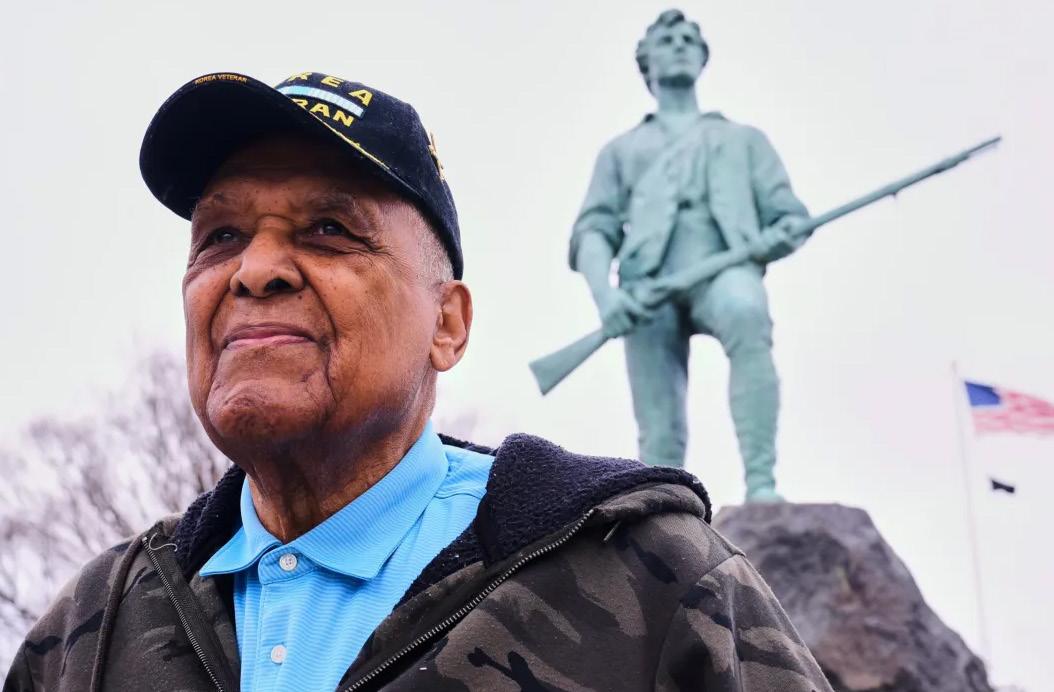
“They knew all of the work that women were doing to support the revolutionary effort. The fact that we didn’t know that is more of a sign of our lack of curiosity and the need for greater research.”
The National Park Service estimates that by the end of the Revolution, more than 5,500 patriots of color — including Black and Indigenous people — served on the colonial side, while many runaway slaves fought for the British.
“Finding this out, I was very proud,”
said Jason Roomes, a descendant of three formerly enslaved men from Rhode Island: Cato, Pero, and Ceasar Rome.
Roomes learned in his 40s that all three Black men fought for the colonial side in the American Revolution.
“Proud that my family has been here and fought for the creation of this United States,” he said.
The stories of Black patriots cannot be told without mentioning slavery, which was legal at the time in all 13 colonies.
Some Blacks who fought were enslaved and others fought in the hopes of gaining
freedom. Indigenous soldiers made similar calculations, even as tribes fought for their very survival.
Despite the documented military diversity of that time, efforts to promote such stories are under pressure now. The Trump administration has ordered the removal or censorship of some exhibits highlighting the history of slavery and enslaved people, the Civil Rights Movement, and the mistreatment of Indigenous people.
Roger Davidson Jr. an associate professor of history at Bowie State University, said failure to recognize that important part of history can affect communities of color today. “If you’re not seen as having contributed to society, to the military, to any of it, then people can sort of overlook you,” Davidson said. “It plays into — and I hate to put it this way — … some people’s biases. Why should we pay any attention to you in the present day, politically, socially, economically, if you have not contributed?”
Remembering patriots of color
MA250 has handed out millions of dollars in grants to commemorate the battles across Massachusetts that helped lead to America’s independence. Among the beneficiaries is the Black Heritage Trail in Concord that highlights the lives of Black residents in the town during the Revolution. Museum exhibitions celebrating Black patriots have also received grants. Among those highlighted is Crispus Attucks, a sailor of African and Indigenous ancestry who died on March 5, 1770, when British troops fired on a crowd in what is known as the Boston Massacre. Another, Salem Poor, was born enslaved but purchased his freedom before fighting at Bunker Hill.
American Ancestors, a nonprofit history and heritage center in Boston that also received MA250 funding, opens its “Patriots of Color” exhibit next week, throwing a spotlight on the lives of 26 Black and Indigenous men and women who played a role in the American Revolution. They include Prince Ames, a Black and Narragansett man from Andover, who
was forced to join the Continental Army in place of his enslaver; and Paul Cuffe, a Black and Wampanoag businessperson, who petitioned the Massachusetts government to reject taxation without representation.
Some of their descendants will attend the opening of the exhibition.
“By telling these lesser-known stories, we want to highlight that ordinary people made a tremendous difference in the arc of the country’s history,” said Ryan Woods, president and CEO of American Ancestors.
The details of Estabrook’s life
Records about Prince Estabrook’s life are scant, but according to the National Park Service, he was probably born in the Lexington area around 1740. His father was enslaved by landowner Benjamin Estabrook, so Prince was born into slavery. It is unclear what his life was like before he trained as a soldier in the Lexington militia. The Park Service says he was serving under the command of Colonel John Parker on April 19, 1775, when his left shoulder was struck by a musket ball. He recovered from that injury and went on to serve eight years with the militia and the Continental Army.
After the Revolution, he was granted freedom and returned to Lexington, where tax records from 1790 indicate he joined Benjamin Estabrook’s payroll as “a non-white freeman.” It is unclear whether he ever married, had children, or owned property. According to family records, he died in 1830, around the age of 90, and was buried in the same cemetery as Benjamin’s son, Nathan, in Ashby, Massachusetts.
Price, who has handed reenactment duties to a younger colleague but still attends the early-morning reenactment every year, says it is important to know about the life of the soldier he portrayed. “Keep the story alive to make sure that everybody knows — everybody that we can get in touch with — everybody knows that Prince Estabrook was here,” Price said. “He was a viable person. He did his role; he did his part in fighting for the country.”
WASHINGTON, D.C.—U.S. Rep. James Clyburn, one of America’s most influential Black political leaders, says that some MAGA Republicans told him directly that slavery was a good thing, according to a clip from a political news show that’s gaining renewed attention online.
The South Carolina congressman also warned that some Make America Great Again loyalists would bring back Jim Crow-style systems in the U.S., if given the chance, according to the news clip. Clyburn made the comments during an interview on PBS’s “Firing Line with Mar-
garet Hoover.” According to Atlanta Black Star, a clip from the show that’s garnered recent attention online shows Clyburn detailing interactions he’s had with MAGA loyalists, some of whom want the country to return to a segregated state.
When asked whether he thought MAGA Republicans were explicitly racist, Clyburn said he doesn’t liberally apply the term to the entire group.
“I’m very circumspect about using the term. There are racists,” Clyburn said.
“There are white supremacists. There are people who are supporters of this president who admit to me that they are

U.S. Congressman James Clyburn (SC-06) received a standing ovation for his role in establishing Reconstruction Era National Historical Park.
white supremacists. I’ve had people who support this president tell me that they thought slavery was a good thing.” Clyburn said he believes the MAGA Republicans “wish to get us back as close to slavery as they can possibly get us” without violating the Constitution and would attempt to reinstitute Jim Crow-like “separate but equal” policies with the help of the Supreme Court.
“Anything that’s happened before can happen again,” Clyburn said. “All it takes is a rogue Supreme Court.”
In the same discussion, Clyburn spoke about his book “The First Eight,” which looks at South Carolina’s first Black members of Congress after the Civil War and how they shaped political progress. Clyburn wrote the book following the deadly U.S. Capitol insurrection on Jan. 6, 2021, which he believes was inspired by the Antebellum era and came to pass as a result of reactionary politics.
He also referenced earlier polling of Trump supporters that showed differing views on emancipation and Civil War history.
THE ATLANTA VOICE — Discover “W.E.B. Du Bois Revisited: Reimagining Du Bois’ Exhibit of American Negroes” at ADAMA, an exhibit pairing historical photos by Thomas E. Askew with contemporary portraits and data, celebrating Black American life.
By Noah Washington The Atlanta Voice
More than a century after W.E.B. Du Bois presented photographs and data charts documenting Black American life at the 1900 Paris Exposition, his vision has found a new home in Atlanta’s West End, at the African Diaspora Art Museum of Atlanta, known as ADAMA.
“W.E.B. Du Bois Revisited: Reimagining Du Bois’ Exhibit of American Negroes” pairs historical photographs taken by Atlanta photographer Thomas E. Askew with contemporary portraits and updated data visualizations. The exhibit, which first debuted at Clark Atlanta University in February, is now on view at ADAMA for approximately two weeks.
The project began as part of the Atlanta Journal-Constitution’s annual Black History Month series. According to Miller, it was Suggs, a veteran reporter at the AJC, who reached out to her to handle the photography after Donastorg pitched the concept.
“We’re never going to have a story that says Martin Luther King Jr. won the Nobel Peace Prize or Rosa Parks sat on the back of the bus,” Suggs said. “We’re going to have stories about the talented tenth, about double consciousness, about small things that you probably never heard of or heard glimpses of and didn’t know.”
Sign up for our free newsletters and receive unparalleled coverage of Atlanta’s African American community in your inbox.
The idea came from Mirtha Donastorg, a business reporter at the AJC. Donastorg said she had been reading Du Bois’ work and was struck by how little attention had been paid to its Atlanta-specific content. “About half of those charts and photographs focused on Atlanta and Georgia, and there had never been an exploration or revisiting of the Atlanta data and charts,” Donastorg said. “I wanted to see what these look like with contemporary data, what it looks like with a contemporary look at Atlanta.”
The work on the project began in December of 2025. All of the historical photographs from Du Bois’ original 1900 Paris exhibit were taken by Askew, a local Black photographer from Atlanta. Most
subjects in those images remain unidentified.
“If you look at the cut line, it will say a man, or a boy, a Black boy,” Suggs said. “No names are attached. We don’t know if they’re doctors, we don’t know if they’re lawyers, we don’t know if they’re pharmacists. But we do know they represented a certain aspect of Black beauty, and that’s what we wanted to recreate.”
Miller said choosing contemporary subjects was a blend of intention and instinct. Some pairings, including Clark Atlanta University President George T. French alongside a portrait of Du Bois himself,

were planned from the start. Others took shape only after she had shot her subjects and then searched the Library of Congress archives for historical counterparts.
“For a lot of the reference photos, a lot of them didn’t have names, so we just kind of paired up based on how we felt like they connected within contemporary subjects,” Miller said.
She said the goal was to represent the full range of contemporary Atlanta.
“I just kind of wanted to find people that represent contemporary Atlanta, and that’s from doctors to scholars, entrepreneurs, artists,” Miller said. “Kind of find-


ing different people that reflect the people Du Bois wanted to share in the past and what contemporary Atlanta looks like right now.”
A split image showing a historical halflength portrait of an African American woman alongside Rosalynne Duff posing for a portrait in Atlanta in 2026.
The land on which ADAMA sits formally belonged to Clark College, one of two historic institutions, alongside Atlanta University, that merged in 1988 to form Clark Atlanta University. It was at Atlanta University where W.E.B. Du Bois spent more than two decades as a faculty
member in the history and economics departments, conducting research on Black American life and popularizing the concept of the ‘talented tenth.’
For Pecou, that layered history makes the Pittsburgh neighborhood more than just a convenient address. It is, he says, a kind of sacred ground, a place where Black intellectual life, Black commerce, and Black community have long intersected, and where ADAMA’s presence feels less like a new arrival than a continuation.
“To be able to bring this exhibition here, to be able to tell this story, to expose this community to this history, many folks in this neighborhood may not even realize that history and that connection,” Pecou said. “I felt like it was an important and really powerful message.”
Pecou is also among the contemporary subjects featured in the exhibit, photographed alongside an unnamed historical portrait from Askew’s collection. He said his only regret is that the run is short.
“My only regret is that the exhibition won’t be longer,” Pecou said. “It’s kind of a pop-up thing. We had a space, and we were able to accommodate.”
Miller said she hopes visitors leave with a sense of both distance traveled and connection across time.
“I want them to think about the past and the present,” she said. “We’ve done so much in just these 126 years, despite so much. I want them to kind of look back and reflect on what the people before us did to set us up for now, and to think about themselves in the present.”
Suggs said that the connection between eras revealed itself most powerfully when the team saw the old and new photographs side by side for the first time.
“We never set out to match any of these photographs with people,” he said. “But when Natrice took all the photographs, and we sat down and looked at them, we were like, oh my God. It just kind of shows you how Black people are almost timeless. We all still kind of have these similarities. And I think that this shows the connection that we’re all always going to be connected.”



ELM CITY COMMUNITIES, HOUSING AUTHORITY OF NEW HAVEN (ECC/HANH)
Section II and Section VII of the Authority's Moving to Work Agreement {the "Agreement") requires that before the Agency can file its Approved Annual Moving to Work Plan (“Plan”) and Report (“Report”)to the U.S. Department of Housing and Urban Development (the "HUD") that it must conduct a public hearing, consider comments from the public on the proposed Plan, obtain approval from the Board of Commissioners, and submit the Plan to HUD.
The thirty (30) days comment period begins on Monday, April 27, 2026, and ends on Tuesday, May 26, 2026.
Copies of the Moving to Work (MTW) FY2027 Plan, will be made available on the agency website www.elmcitycommunities.org or via Facebook www.facebook.com/ ElmCityCommunities.
You are invited to provide written comments addressed to: ECC/HANH, Moving to Work FY2027 Annual Plan Attn: Evelise Ribeiro, 360 Orange Street, New Haven, CT 06511 or via email to: eribeiro@elmcitycommunities.org.
Pursuant to said Sections II and VII, a public hearing where public comments will be accepted and recorded is scheduled for Thursday, May 21, 2026, at 4:00pm via
Teams: https://teams.microsoft.com/meet/226459013024616?p=ixECplpMVkoqWitDVX
Meeting ID: 226 459 013 024 616 Passcode: 43Zv7iG7
Dial in by phone
Phone: 1-872-240-4494
Phone conference ID: 874 430 272#
Any individual requiring a Reasonable Accommodation to participate in the hearing may call the Reasonable Accommodation Manager (203) 498-8800, ext. 3170 or at the TDD Number (203) 497-8434.
The Housing Authority of the City of New Haven d/b/a Elm City Communities is currently seeking bids from qualified contractors for drainage system improvements at 398-400 Concord Street, New Haven. A complete copy of the requirement may be obtained from Elm City’s Vendor Collaboration Portal https://newhavenhousing.cobblestonesystems. com/gateway beginning on
Monday, April 20, 2026 at 3:00 PM.
Public Notice The Housing Authority of the City of New Britain (NBHA) is seeking bids for Landscaping ServicesSpring & Fall Cleanup and As-Needed Services (Solicitation No. 2026-04-LAND).
Issue Date: April 22, 2026
Submission Deadline: May 13, 2026 at 3:00 p.m. (Local Time)
RFP and all addendas and answers will be posted at www.nbhact.org<http://www.nbhact.org/>.

The State of Connecticut, Office of Policy and Management is recruiting for a Rural Health Transformation Policy Development Coordinator
EL PLAN ANUAL "MOVING TO WORK" (MTW) DEL AÑO FISCAL 2027 DE ELM CITY COMMUNITIES, AUTORIDAD DE VIVIENDA DE NEW HAVEN (ECC/HANH)
Las Secciones II y VII del Acuerdo "Moving to Work" de la Autoridad (el "Acuerdo") estipulan que, antes de que la Agencia pueda presentar su Plan Anual "Moving to Work" Aprobado (el "Plan") y su Informe (el "Informe") ante el Departamento de Vivienda y Desarrollo Urbano de los EE. UU. (el "HUD"), debe llevar a cabo una audiencia pública, considerar los comentarios del público sobre el Plan propuesto, obtener la aprobación de la Junta de Comisionados y remitir el Plan al HUD.


El período de comentarios de treinta (30) días comienza el lunes 27 de abril de 2026 y termina el martes 26 de mayo de 2026.
Las copias del Plan "Moving to Work" (MTW) del Año Fiscal 2027 estarán disponibles en el sitio web de la agencia: www.elmcitycommunities.org, o a través de Facebook: www.facebook.com/ElmCityCommunities.
Se le invita a enviar sus comentarios por escrito dirigidos a: ECC/HANH, Moving to Work FY2027 Annual Plan, a la atención de: Evelise Ribeiro, 360 Orange Street, New Haven, CT 06511; o por correo electrónico a: eribeiro@elmcitycommunities.org.
De conformidad con dichas Secciones II y VII, se ha programado una audiencia pública en la que se aceptarán y registrarán comentarios del público para el jueves 21 de mayo de 2026 a las 4:00 p.m. a través de Teams: https://teams.microsoft.com/meet/226459013024616?p=ixECplpMVkoqWitDVX
Meeting ID: 226 459 013 024 616
Passcode: 43Zv7iG7
Dial in by phone
Phone: 1-872-240-4494
Phone conference ID: 874 430 272#
Cualquier persona que requiera una adaptación razonable para participar en la audiencia puede llamar al Gerente de Adaptaciones Razonables al (203) 498-8800, ext. 3170, o al número TDD (203) 497-8434.

UNION CONTRACTOR SEEKS:
Construction Equipment Mechanic
(preferably experienced in Reclaiming and Road Milling Equipment) We offer factory training on equipment we operate. Job is in Bloomfield, CT.
Contact: Tom Dunay Phone: 860-243-2300 Ext. 122 Email: tom.dunay@garrityasphalt.com
Reclaimer Operators and Milling Operators
(must have current licensing and a clean driving record; be willing to travel throughout the Northeast & NY)
Contact: Rick Tousignant Phone: 860-243-2300 Ext. 133 Email: rick.tousignant@garrityasphalt.com
Tractor Trailer Driver for Heavy & Highway
Construction Equipment
(must have a class A CDL license with Tank Endorsement and a clean driving record; be capable of operating heavy equipment and willing to travel throughout the Northeast and NY)
Contact: Brian McKee Phone: 860-558-6189
Email: bmckee@garrityasphalt.com
• We offer Excellent hourly rates and benefits.
• Women and Minority Applicants are encouraged to apply.
• Affirmative Action / Equal Opportunity Employer
The Town of East Haven is currently seeking qualified applicants to participate in the Civil Service Examination for the position of Custodian. Graduation from High School or 1 year employment in building care and cleaning operations is required. The rate of pay is $26.29/hour; 40 hours/week and the town offers an excellent benefit package. Applications to participate in the examination are available online athttps://www.easthaven-ct.gov/jobs.aspx or the Civil Service Office, 250 Main Street, East Haven CT and must be returned by May 8, 2026. The Town of East Haven is committed to building a workforce of diverse individuals. Minorities, Females, Handicapped and Veterans are encouraged to apply.
Electrical Services IFB No. B26003
SCOPE:
The Housing Authority of the City of Danbury hereby issues this Invitation for Bid to secure a contract for Electrical Services
BID SUBMITTAL RETURN:
Housing Authority of the City of Danbury, 2 Mill Ridge Rd, Danbury, CT 06811 Envelope Must be Marked: IFB No. B26003, Electrical Services
SUBMITTAL DEADLINE May 11th, 2026 at 10:30am (EST)
IFB DOCUMENTATION:
Please register here to obtain Bid Package: https://ha.internationaleprocurement.com/requests.html?company_id=49968 ”
[Minority- and/or women-owned businesses are encouraged to respond]
The South Central Regional Council of Governments (SCRCOG) seeks the services of one or more consultants for the following transportation planning studies during the 2026 and 2027 Fiscal Years (July 1, 2025June 30, 2027): Metropolitan Transportation Plan Update and Local Bridge Inspection Study. Responses are due by June 2, 2026 (12 noon local time). Selected firms will be interviewed on June 9, 2026. The full RFQ document can be viewed at the Council’s website: www.scrcog.org or can be made available upon request. Contact James Rode at (203) 4668623 with any questions.
LaRosa Earth Group LLC, a Site/Excavation Company, is currently looking to add the following full-time positions to our Team:
Please submit resumes to HR@LAROSABG.COM or stop by our main office to fill out an application: 163 Research Parkway Meriden, CT. Salary will be commensurate with experience and best fit for the positions. Health plan; 401K; company-paid holidays in addition to paid time off.
LaRosa Groups is an Affirmative Action/ Equal Opportunity Employer who values diversity and encourages all qualified applicants to apply.


Invitation to Bid:
20 Security Drive Avon, CT One Building, 76 Units
Project Description: Gut Rehabilitation and adaptive reuse of a former office building for use as an affordable housing community consisting of 76 units of housing as well as associated property management and amenity spaces.
Project Documents include but not limited to: sitework, paving, utilities, selective demolition, concrete, masonry, masonry restoration, structural steel, miscellaneous metals, finish carpentry, thermal & moisture protection, storefronts, doors, frames & hardware, windows, drywall, acoustical ceilings, flooring, painting, signage, louvers and vents, toilet & bath accessories, fire extinguishers, cabinets and accessories, postal specialties, miscellaneous specialties, solid waste handling equipment, residential appliances, horizontal louver blinds, kitchen and bathroom casework, roller shades. electric traction elevators, hydraulic passenger elevators, chutes, fire protection, plumbing, HVAC, electrical, communications, electronic safety and security, sanitary facilities and final cleaning. The project is being designed to Energy Star MFNC v1.2 standards.
This contract is subject to state set-aside and contract compliance requirements.
Project is Taxable. No Wage Rate Project. Anticipated start July 2026.
Bids are due to Haynes: May 1, 2026 @ 3 pm to Taylor Els tels@haynesct.com Email questions to Dave Biega dbiega@haynesct.com Phone # 203-888-8109
Please note: Subcontractors need to include all future tariff costs in bid proposals and hold pricing through 7-1-2026.
State law requires a minimum of twenty-five (25%) percent of the state-funded portion of the contract for award to subcontractors holding current certification from the Connecticut Department of Administrative Services (“DAS”) under the provisions of CONN. GEN. STAT. § 4a-60g. (25% of the work with DAS certified Small and Minority owned businesses and 25% of that work with DAS certified Minority, Women and/or Disabled owned businesses.) The contractor must demonstrate good faith effort to meet the 25% set-aside goals.
Section II and Section VII of the Authority's Moving to Work Agreement {the "Agreement") requires that before the Agency can file its Approved Annual Moving to Work Plan (“Plan”) and Report (“Report”)to the U.S. Department of Housing and Urban Development (the "HUD") that it must conduct a public hearing, consider comments from the public on the proposed Plan, obtain approval from the Board of Commissioners, and submit the Plan to HUD. The thirty (30) days comment period begins on Tuesday, April 7, 2026, and ends on Wednesday, May 6, 2026.
Copies of the Moving to Work (MTW) FY2027 Plan, will be made available on the agency website www.elmcitycommunities.org or via Facebook www. facebook.com/ElmCityCommunities.
You are invited to provide written comments addressed to: ECC/HANH, Moving to Work FY2027 Annual Plan Attn: Evelise Ribeiro, 360 Orange Street, New Haven, CT 06511 or via email to: eribeiro@elmcitycommunities.org.
Pursuant to said Sections II and VII), a public hearing where public comments will be accepted and recorded is scheduled for Monday, May 4, 2026, at 4:00pm via Teams: https://teams.microsoft.com/meet/28700621182396?p=4TDLzzbfcPz7OsLEeJ
Meeting ID: 28700621182396
Passcode: r6E8Ke9c
Dial in by phone
+1 872-240-4494,160535655# United States, Chicago
Find a local number Phone conference ID: 160 535 655#
Any individual requiring a Reasonable Accommodation to participate in the hearing may call the Reasonable Accommodation Manager (203) 498-8800, ext. 3170 or at the TDD Number (203) 497-8434.
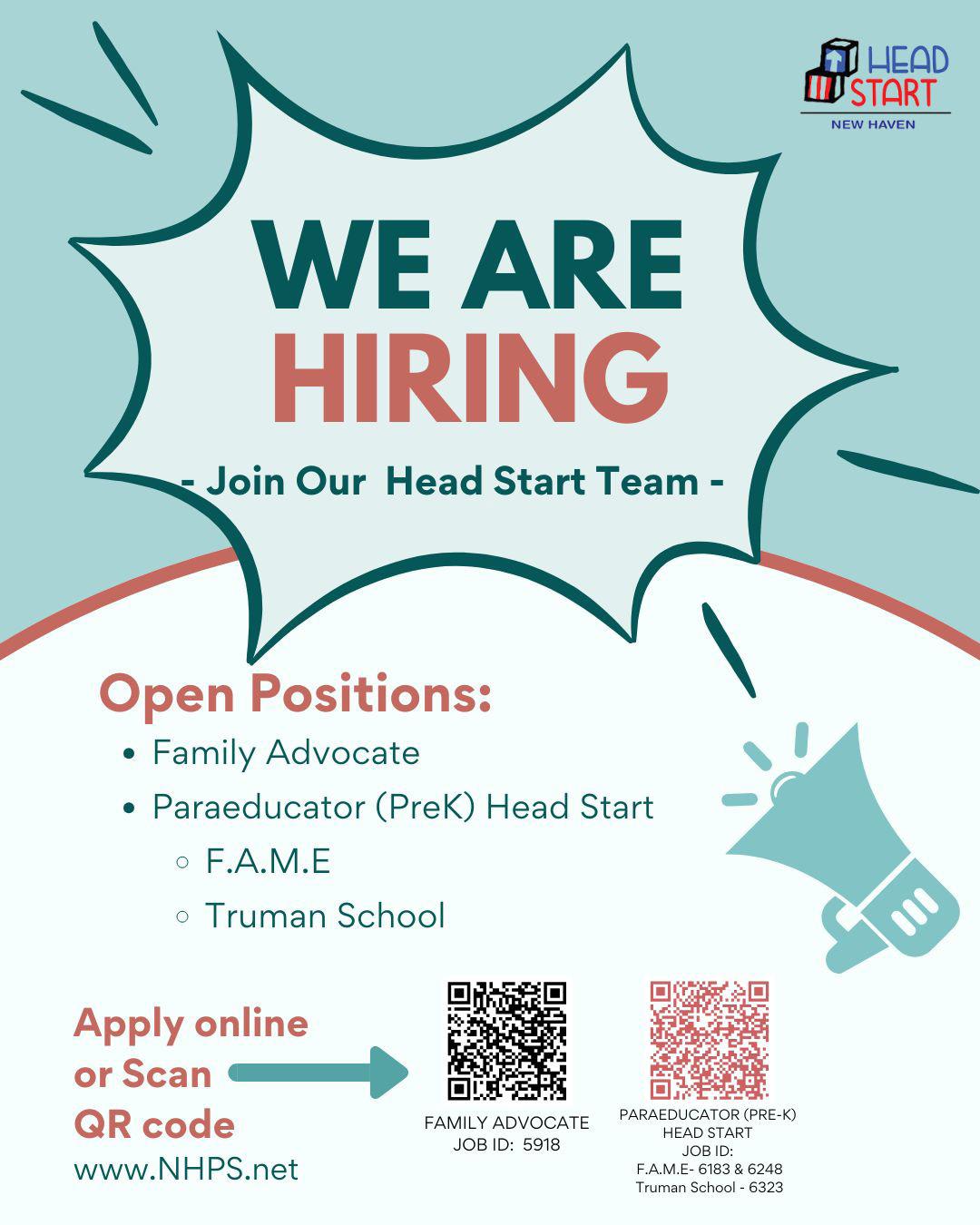

The State of Connecticut, Office of Policy and Management is recruiting for a Policy Development Coordinator in the Criminal Justice Policy and Planning Division. Further information regarding the duties, eligibility requirements and application instructions are available at: https://www.jobapscloud.com/CT/ sup/bulpreview.asp?b=&R1= 260316&R2=1581MP&R3=001
The State of Connecticut is an equal opportunity/affirmative action employer and strongly encourages the applications of women, minorities and persons with disabilities.

EL PLAN ANUAL "MOVING TO WORK" (MTW) DEL AÑO FISCAL 2027 DE ELM CITY COMMUNITIES, AUTORIDAD DE VIVIENDA DE NEW HAVEN (ECC/HANH)
Las Secciones II y VII del Acuerdo "Moving to Work" de la Autoridad (el "Acuerdo") estipulan que, antes de que la Agencia pueda presentar su Plan Anual "Moving to Work" Aprobado (el "Plan") y su Informe (el "Informe") ante el Departamento de Vivienda y Desarrollo Urbano de los EE. UU. (el "HUD"), debe llevar a cabo una audiencia pública, considerar los comentarios del público sobre el Plan propuesto, obtener la aprobación de la Junta de Comisionados y remitir el Plan al HUD.
El periodo de treinta (30) días para la recepción de comentarios comienza el martes 7 de abril de 2026 y finaliza el miércoles 6 de mayo de 2026.
Las copias del Plan "Moving to Work" (MTW) del Año Fiscal 2027 estarán disponibles en el sitio web de la agencia: www.elmcitycommunities.org, o a través de Facebook: www.facebook.com/ElmCityCommunities.
Se le invita a enviar sus comentarios por escrito dirigidos a: ECC/HANH, Moving to Work FY2027 Annual Plan, a la atención de: Evelise Ribeiro, 360 Orange Street, New Haven, CT 06511; o por correo electrónico a: eribeiro@elmcitycommunities.org. De conformidad con dichas Secciones II y VII, se ha programado una audiencia pública —en la cual se aceptarán y registrarán comentarios del público— para el lunes 4 de mayo de 2026, a las 4:00 p. m., a través de:
Teams: https://teams.microsoft.com/meet/28700621182396?p=4TDLzzbfcPz7OsLEeJ
ID de la reunión: 28700621182396
Código de acceso: r6E8Ke9c
Conexión telefónica
+1 872-240-4494,160535655# Estados Unidos, Chicago
Buscar un número local ID de la conferencia telefónica: 160 535 655#
Cualquier persona que requiera una adaptación razonable para participar en la audiencia puede llamar al Gerente de Adaptaciones Razonables al (203) 498-8800, ext. 3170, o al número TDD (203) 497-8434.
ECC is currently seeking bids from qualified contractors to perform Window Replacement and Repair . A complete copy of the requirement may be obtained from Elm City’s Vendor Collaboration Portal https://newhavenhousing.cobblestonesystems.com/ gateway beginning on Monday, April 6, 2026, at 3:00PM.
Estimator/ Design & Installation Fence Sales Pay: $100,000.00 per year
Job description:
Atlas Companies is looking for an estimator/ design and installation sales person for the residential market place. Premiere northeast regional fence and outdoor structure company is looking for energetic, self-motivated Sales associate. Salary, commission, 401 k match and vehicle allowances for qualified personal. 1 00k plus income to qualified applicants. Previous home improvement design / sales preferred. About Us Our services range from custom fences, gates, guardrail, pergolas,
Required testing, general info, and apply online: www.bristolct.gov DEADLINE: 12-07-25
by SOLOMON GARDNER, AMARI JOSEPH, TOMEL LUCAS, CHRISTIAN PIERRE-LOUIS, TYLER MCCULLOUGH, and OLIVER SUTTON
IV April 23, 2026
Black intellectualism has always been a cornerstone of U.S. society. From Africans skilled in rice cultivation captured into U.S. slavery, to the Black Americans enslaved on President James Madison’s Montpelier plantation who built and ran his lucrative blacksmith trade, to countless inventors, mathematicians, and scientists, our intellect and expertise have long fueled U.S. progress and economic success.
Yet, when telling the Black American story, our intellect and academic prowess are often overlooked, if not outright denied. As high school students at the nation’s oldest private school, the Collegiate School in Manhattan, we wanted to change this reality for ourselves and other Black students coming after us.
In March 2025, we founded the Carter G. Woodson Society at Collegiate School, a Black affinity group that is singularly focused on the legacy of intelligence and high academic achievement that has always existed in our community and still does. With our country’s close to 400year history, we felt our group would greatly add to the historical narrative and significance of our school.
We wanted to name our group after a Black person who demonstrated academic rigor and high intellectual prowess.
Carter G. Woodson, the second Black man to obtain a Ph.D. at Harvard, founder
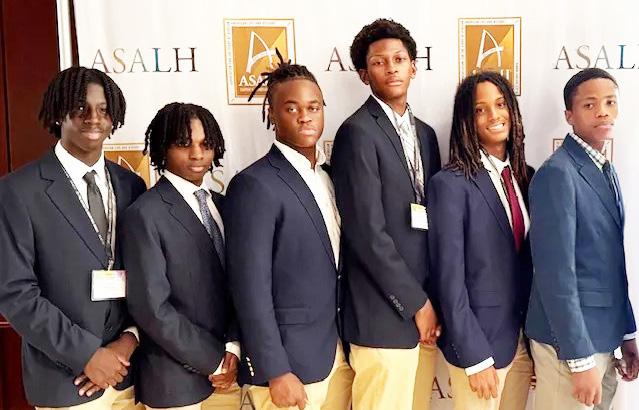
of the Association for the Study of African American Life and History (ASALH), and the father of Black History Month, was the perfect person.
We wanted to give proper attention to Black accomplishment and excellence outside of the usual fields of entertainment and sports. Therefore, our group
invites Black scholars to speak at our school about a variety of subjects. We’ve also started an academic journal where students can get their ideas published, and we’ve begun a mentoring program where the older boys are assigned to younger ones. Since our founding, we have been active
in fulfilling our mission. Last September, for instance, we were invited to present at the 110th annual ASALH conference. We were the only high school panel accepted for the conference. In our first community service project, we spent MLK Day 2026 volunteering at God’s Love We Deliver. We also organized our school’s 2026
Black History Month program, where we were in conversation with acclaimed artist Derek Fordjour. Most recently, we were invited by the Detroit Historical Society to present in their annual program “On the Shoulders of Giants.” While there, our group was featured on “Good Day Detroit,” the local morning news show on FOX 2 Detroit.
The impact of our group has been transformative. It does not simply serve Black students; it has transformed the environment for all students. We have created a space where Black students can exist without compromise, and where identity is a source of pride rather than alienation. Through our work, we are saying Black intellectualism belongs at the center of education, not at the margins.
This is just a start for us. Through our organization, we hope to inspire other Black high school students across the country to lean into our heritage and legacy of Black intellectualism. We are currently working to create Carter G. Woodson Society chapters in other schools across the country.
We believe we are well on our way to honoring our mission and making a real impact.
Solomon Gardner, Amari Joseph, Tomel Lucas, Christian Pierre-Louis, Tyler McCullough, and Oliver Sutton IV are students at the Collegiate School in New York City.
By Courtesy of hBCUNEWS.com
Miles College alumna Alexia Jayy (real name Bri Jackson), a mother of three from Irvington, Alabama, has made history as the first Black woman to win NBC’s “The Voice.” Jayy secured the Season 29 title on April 14, marking a historic moment in the show’s 15-year run, according to HBCU Game Day.
Her winning performances included powerful renditions of “Lady Marmalade” and Adele’s “One and Only,” allowing her to best fellow finalists Liv Ciara (second place), Lucas West (third), and Mikenley Brown (fourth).
Following her victory with her rendition of Adele’s “One and Only,” Jayy returned to her hometown of Irvington just days later. There, she was greeted by family, friends, and other community members. Having begun her musical journey by singing in church as a child, her victory on The Voice represented a full-circle moment, cheered on in the same place where she started.
Reflecting on the moment, Jayy said, according to Prime Timer, “These are all the singers in my family, and they’re celebrating because I won ‘The Voice.”‘ She said, “I sang my first solo when I was two years old, in church.”
By age 9, she was already performing on major stages, including the famous Apollo Theater. During her years at Miles
College, she performed in the Miles College Choir, which helped her hone her singing ability.
Her former choir director, Valerie Harris, said Jayy was unique.
“Consistency, strength, character — those are the things we try to instill,”
Harris said, as reported by HBCU Gameday. “To see where she is now is special.”
Sharing a stage with Lauryn Hill stands out as one of her favorite memories. As Jayy recounted, “For Miss Lauryn Hill to want me to be a part of something that she has going is probably the most amazing thing in the world.”
Her uncle, Leodis Payne, remarked, “To perfect what you’re doing, you need to stay with it to be great. She stayed with it, and I don’t have to tell you she’s great, she’s great.”
Following her win, Jayy shared with Swoon how instrumental her family was in her journey. She highlighted that her longtime boyfriend, David Rembert, and her three children were her “number one” support system.
“My kids, they know that I love music and they love music just as much as I do,” she shared. “In their mind, we’re going to go off and get this big ol’ castle and live happily ever after. They’re super support-

ive. They want to be rich!”
She credited her partner, who “supported me through this whole thing”, for providing unwavering support throughout her journey.
“It means the world to me because you
don’t find that in a partner too often. It’s somebody who supports what you do, especially what I do, because it’s a lot of travel, a lot of me being gone, a lot of not talking every day, but he still supports me, and I love that.”
READ ALSO: ‘We have the best experience’ – Snoop Dogg and Simone Biles share one stage on NBC’s The Voice Before The Voice season 29 finale, David shared a heartfelt message on Instagram to support his partner. “Win or Lose bae, I’m so proud of you,” he wrote. “Your passion for this and loyalty has brought you to this point, and not just to this point you going farther than this…I love you, bae, and the whole city behind you.”
Jayy’s performance of Aretha Franklin’s “(You Make Me Feel Like) A Natural Woman” led to a three-chair turn during The Voice premiere. She chose Adam Levine as her coach because of her elder son.
“I went in not really knowing what I was going to do, and my son sealed the deal,” Jayy told Swoon. “We listen to Maroon 5 all the time and to know that he loves Adam just as much as I did, and Adam got up there and said what he said … I was convinced. My son said what he said, and I was like, ‘OK, well that’s it, that’s the one.’ The kids know!”
Hinting at her plans, Jayy said, “I’m going to keep getting on those big stages, keep working because this is only the beginning.”
After winning The Voice, Jayy sang her song “Rent Free” on the Today Show. She plans to continue appearing on many significant stages like this one.