



By Claire Armstrong
“We don’t need! We don’t need! We don’t need-no-billion-aaa-irrr-es!” sang Jo Wilber, dressed in a puffy blue-andpink unicorn costume that glowed turquoise in the sunshine. A red-and-white bullhorn stood in for a microphone in Wilber’s hand. Around them, the crowd transformed the song into a call-and-response, until it seemed like the whole street was singing.
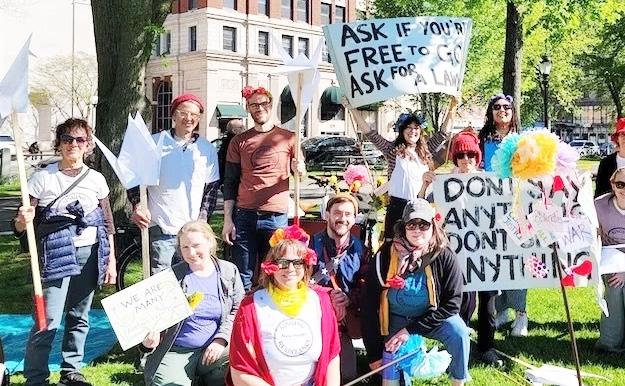
Downtown New Haven wide awake Friday afternoon, as students, union members, public serv-ants, educators and organizers gathered to champion May Day, worker solidarity, human rights and economic justice in and far beyond the Elm City. As conversations overlapped with remarks and melodies drifted from the stage, community members came out in a strong show of multigen-erational support, often with students and artists leading the way.
“We are in a very dangerous time, so it is important for people to get out and support one another,” said Frank Panzarella (pictured at left, in red), one of two guitarists playing on stage with fellow musician Jim Baldoni. Panzarella, who is a longtime peace activist in New Haven, has helped or-ganize May Day gatherings in New Haven with his wife, Paula Panzarella, for 25 years.
“May Day isn’t just about no kings, it's about the workers and the rights they fought for in 1886 when workers were first hanged for fighting for their rights,” he said.
For Panzarella—and so many organizers who came out to the Green Friday— that’s where the sto-ry begins. In 1886, hundreds of thousands of workers across the U.S. began a general strike de-manding an eight-hour workday On May 3, police fired on labor strikers in Chicago, with fatal consequences: at least two people died, and many more were injured. The following day, eight la-bor organizers were arrested (likely on false charges) when a bomb exploded at Haymarket Square, after hours of peaceful protest. As May Day honors their sacrifices, it simultaneously advocates for continual efforts to fight for the dignity of workers.
“Now we can celebrate our success and labor of the world nationally,” Panzarella said.
On stage, that message—amplified by the team from the pro-union small business New England Sound—rang out over and over again, from student speakers to union leaders who took the mic. At one point, it echoed through the words of Brandon Daley, a junior and student leader at Metro-politan Business Academy who is the president and founder of New Haven’s Community Youth Leadership Assembly (CYLA).
As Daley spoke on everything from school funding (The state’s ECS Formula is not working for us, I repeat, it is not working for us as students!”) to the
carceral state and school-to-prison pipeline (”We want restorative justice, not punishment pipelines!”), he urged his classmates to stand up and get involved, even if it felt scary or new.
“We will not stay silent, for today is May Day that reminds us that real change happens… when everyone comes together in solidarity to fight for what we deserve and what is right,” he said. “We fight for dignity, for care over punishment, for communities to invest in our people.”
On the Green, meanwhile, people from all walks of life showed up for each other, including to keep everyone safe and in good spirits. Among dozens of students, who had participated in a coor-dinated walkout with the help of City-Wide Youth Coalition (CWYC) and their schools, there were groups such as the May Day Strong Coalition and the Connecticut Chapter of the Democratic So-cialists of America (DSA).
“May Day is about celebrating workers' victories, eight-hour work days, the right to strike, we work to unify over 70 groups and organizations to make this Mayday even more impactful,” said Jason Ruiz, one of the main organizers for the volunteers through the DSA.
On the stage and in the crowd, meanwhile, artists of all ages led the charge. Even before they took the stage to perform, members of Singing Resistance New Haven held hand-painted signs instruct-ing neighbors on what to do if law enforcement officials, from city police to federal Immigration and Customs Enforcement (ICE) agents, show up in their neighborhoods, on their streets, or at their door (as they have more frequently in New Haven since President Donald Trump’s inaugura-tion last year).


The signs accompany a song that the group first learned from the theater company Bread & Puppet last year, with sentences like Ask if you’re free to go / Ask for a lawyer! and Warn all your neighbors / Call the hotline / And record.
“Singing means everything to me, I
lar movements in Minneapolis, sings because members are trying to “live in the world we want now, using art and being creative,” added Clancy Emanuel, a leader in the group. “We want to model joy, and use music to deescalate.” Anyone can join: the group rehearses on Wednesday nights from 7 to 8:30 p.m. at the First Presbyterian Church on Whitney Avenue.
Nearby, Westville artist Janet Brodie brought back dozens of giant paper cranes, which first made an appearance at the No Kings New Haven rally in late March. Brodie, a fixture in New Haven’s artistic landscape, was inspired to create the cranes after doing a similar activity with the artist Su-san Klein in 2003, to oppose U.S. military intervention in Iraq. This time, she enlisted the help of several members of the public, including in sessions at Creative Arts Workshop earlier this year.
“We decided it was time to bring them back as cranes are a symbol of peace,” she said.
Throughout, it was often New Haven’s young people who were some of the loudest and most compelling voices of the afternoon. Isonnette O'Brien (a.k.a Icy), a senior at Common Ground, pointed to the importance of intersectional solidarity, which pushes back against the use of both whiteness and concentrated wealth as a tool to divide oppressed people.
“It's about standing for what’s right, not letting people drag us people of color, us Hispanics, us gays down,” said Icy, adding that they raise their voice for those who are unable to be physically present at demonstrations like Friday’s
Nearby, a group of students from Cooperative Arts & Humanities High School— which had 50 students join the walkout— echoed that sentiment.
Including often means involving the youth and leaders of today and tomorrow.
“We are here be-cause we want to be on the right side of history,” said a senior who did not wish to give their name.
Juniors Ava Montanez and Imani Gayle participated in the Common Ground High School walkout where students took the bus from school to the New Haven Green.
“I’m here to be a part of a greater people, to show my support” said Ava, followed by Imani expressing that “I’m here to support change and be here for the community. It’s better to be out here today even if it doesn’t cause great change.”
Some young people came from even further afield. Self-described witch Kaza Ayersman had made the trip from East Haven to show her support. “Power to the people, spread love and your personal magick. Blessed Beltane,” she said.
think everyone can sing,” said Emily Ide, who is a member of the group. “We get taught that it is a talent not everyone has, but that isn’t true. We can all sign, once we all sing I think we will be closer to a liberated world.”
The group, which was inspired by simi-
“Blessed Beltane” is a reference to the Ancient Celtic festival, a celebration of life, growth, and love that occurs in May as a mark for the beginning of summer. Claire Armstrong is a senior at Common Ground High School and a graduate of the Arts Coun-cil's 2025 Youth Arts Journalism Initiative.
by Allan Appel
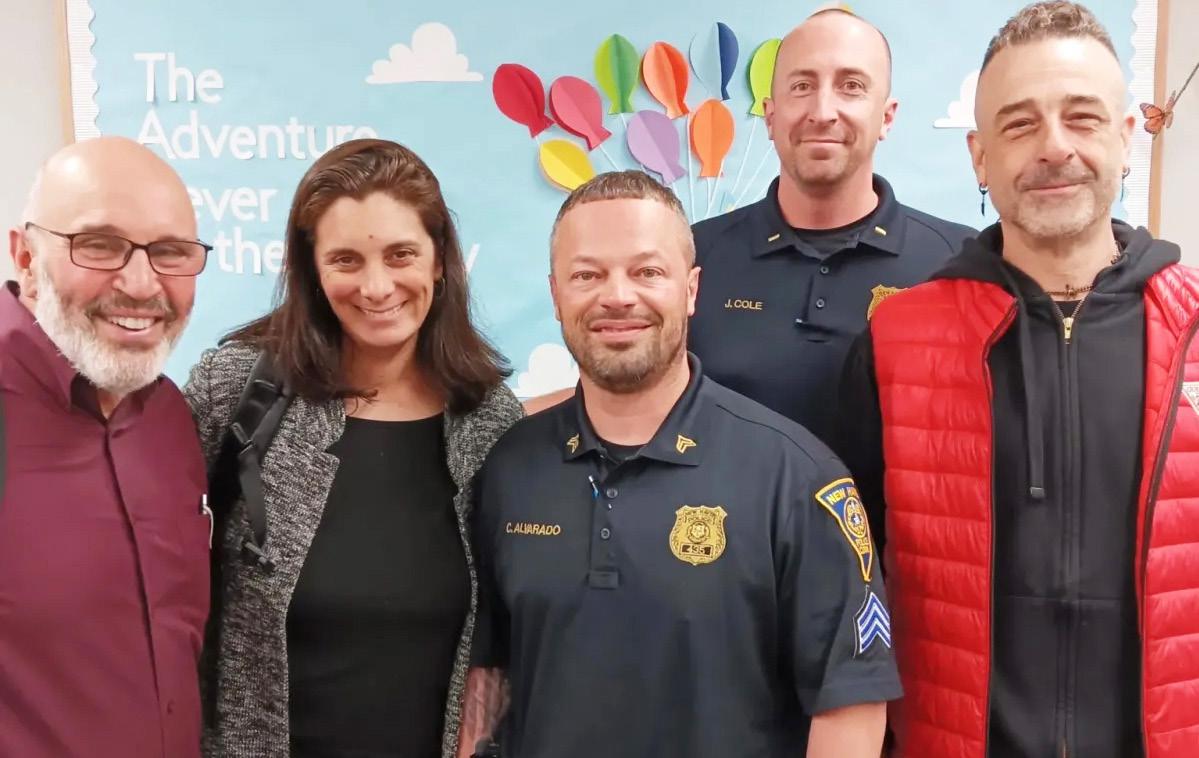
Fair Haven has a new neighborhood top cop, Lt. Justin Cole, and its departing, much admired and appreciated district manager, Sgt. Chris Alvarado, is stepping up to head the NHPD’s Internal Af-fairs (IA) division.
That news emerged Thursday night at the latest regularly scheduled meeting of the Fair Haven Community Management Team.
A 13-year veteran of the police force, Cole — a newly minted police lieutenant — made his formal debut as district manager Thursday night at the monthly meetup.
Alvarado, after a by-all-accounts highly effective two years on the Fair Haven district-manager beat, offered a heartfelt valediction.
Fifty neighbors and members of the community in attendance, both in person in the Fair Haven Library’s community room and online, listened attentively, applauded gratefully, and then decided both to embrace Cole and yet also to not let Alvarado go.
“Once a member of Team Fair Haven, always a member,” said Ward 14 Alder Sarah Miller as she, Ward 15 Alder Frank Redente, Jr. and others gathered around Alvarado to offer congratulations and goodbyes-but-not-farewells.
Cole thanked Alvarado for a “seamless transition” that included their spending hours together at the recent Fair Haven Day extravaganza where Cole said he had never met so many new people in a single day in his life!
In his introductory remarks Cole said he grew up in Seymour and his 13 years on the force have included walking beats Downtown and in Westville, where he was also a street and shift supervi-sor. He currently is manger of the NHPD’s FTO, or field training officer program,
which pairs rookie officers with officer mentors and guides them through four months of on-the-job experience before they’re on their own.
“I’m also the OIC of the crowd control team,” Cole said. The OIC, or officer in charge, for crowd control has a big presence on the Green, meaning that Cole has taken part in activities around, for example, removal of homeless encampments.
In 2022, Cole was involved in an office-eviction proceeding downtown that ended with him punching a suspect in the head inside the Connecticut Financial Center. After a seven-month inves-tigation, city police investigators cleared Cole of all wrongdoing and found that
his actions were appropriate and legally justified. The incident sparked a citywide debate about police head-punches, and about whether or not city officers were abiding by state use-of-force standards.
On Thursday, while sharing that Fair Haven is “new territory for me” and assuring his listeners that he expects to keep his FTO program and crowd control team responsibilities along with his new district manager assignment, “Fair Haven is my priority,” Cole said. He added that he was “super-excited to be here.”
When it was his turn to speak, Alvarado rose to say simply that “it has been a blessing and honor to have served” Fair Haven.
In his prior roles with the NHPD before the Fair Haven experience — working undercover, with drug investigations, with the FBI task force team, as a detective, and as an investigator with the de-partment’s Major Crimes Unit — Alvarado said he had seen people at their worst.
Fair Haven — in no small part because of a highly active team of local alders, nonprofit leaders, and other activists with whom the district manager regularly engages — has been the opposite.
“It’s by far been the best [experience] of my career in 17 years,” Alvarado said.
“I’m dealing with people not at their worst but at their best.”
Redente credited Alvarado with having
a major impact on, among other areas, cleaning up a host of undesirable activities on Ferry Street from Lombard down to Grand, but particularly around Chatham Street, where open drug dealing and vagrancy had been particularly troublesome and chronic.
Now you walk down there and it’s a different street, Redente said, praising the quality-of-life im-provements that Alvardo’s work had contributed to.
Alvarado’s secret sauce?
“He doesn’t pass the buck,” Redente said. “If a call comes to him, he handles it himself” rather than delegate. “If it bothers us, it bothers him.”
Alder Miller rose to say, “We should have had a cake here tonight. You’ve been an amazing dis-trict manager. You’ve made a huge impact. We’re looking forward to your new work [as head of Internal Affairs]. But once a district manager in Fair Haven, you never leave. Zannelli’s still here.”
Miller was referring to the newly sworn in police chief’s successful stint as the Fair Haven district manager, from which job Zannelli was also promoted to be in charge of Internal Affairs, precisely where Alvarado is headed, a similar track. Alvarado is slated to replace Lt. Jesse Agosto who currently heads Internal Affairs. Alvarado said she’ll remain for about two months as a transition period, and he starts there in that new capacity immediately.
“It’s definitely a different challenge,” Alvarado said, but not an unfamiliar one. “It’s all investiga-tions.”
“He’s a rising star in the department,” said Redente. “We’re lucky to have had him as long as we did.”
by Maya McFadden
New Haven Public Schools (NHPS) students have reported “confusion” about how to use artificial intelligence in a school setting — especially since the district provides individual educators with discretion regarding that cutting-edge tool’s adoption.
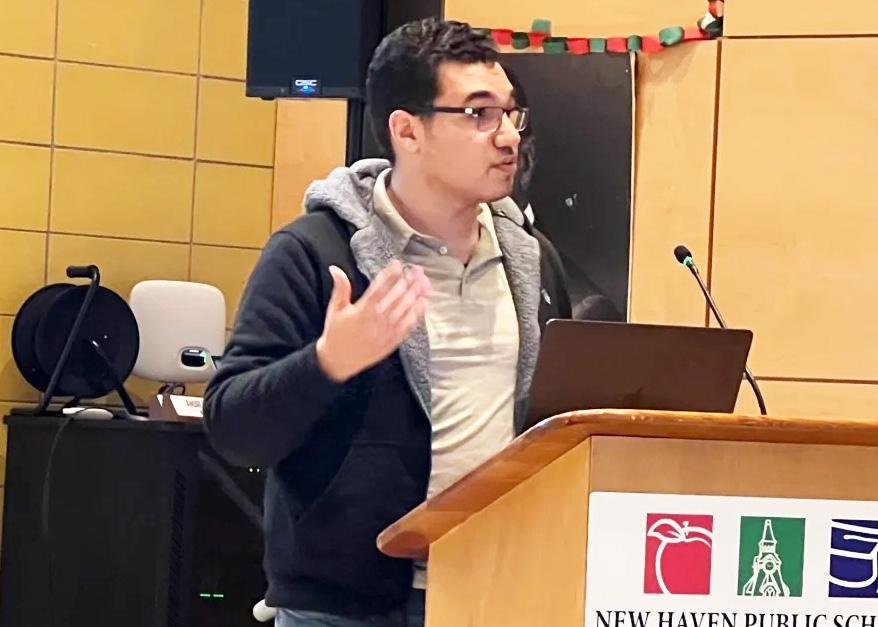
So reported Board of Education student representative and Career High School student Abdellah Aly on Monday night during a presentation at the school board’s latest meeting at King/Robinson School. Aly’s presentation compiled student reports provided to him thanks to a student building climate liaison initiative first introduced by former school board student rep John Carlos Serana Musser, who graduated from Wilbur Cross in 2025. His presentation also came nearly a year after NHPS first adopted a districtwide artificial intelligence (AI) policy that pro-
vides teachers with a fair amount of latitude as to how AI can be used in their classrooms.
“One teacher can say you can’t use it at all,” Aly said. “Some of the teachers say you can use it, but limit it. Basically, students are confused on whether to rely on a teacher [or] rely on a principal when it comes to it.”
Aly provided the board with feedback from students on Monday on a variety of topics, including AI. Other topics covered by Aly’s report included concerns about needing more school counselors to support students’ mental health needs, more tutors to alleviate heavy “assignment pressure,” faster responses to maintenance requests like overly hot classrooms, more cultural celebrations throughout all schools, more internship opportunities and exposure to non-traditional careers,
and more equitable access to resources and field trips.
When discussing students concerns’ and recommendations regarding the district’s AI policy, Aly said, “Students shared that expectations around AI are often unclear and differ significantly depending on the classroom and teacher.”
Last July, NHPS Asst. Supt. Keisha Redd-Hannans presented to the school board a draft policy that laid out that AI could be used by students and staff equitably, ethically, and with academic integrity. The policy leaves usage up to the discretion of each educator by stating that educators should “clearly communicate whether AI use is allowed for an assignment, and specify acceptable tools and purposes. Scaffold AI use to align with instructional goals and student learning outcomes.” The school board then ad-
by Thomas Breen
Mohamed Kane stood alongside New Haven United Football Club teammates from Spain and Ghana and South Korea and Sweden — and recalled playing high school soccer at Wilbur Cross before ascending to his current role as a striker on his home city’s semi-pro team.
“It’s amazing” to be able to play soccer at such a high level so close to where he grew up, Kane said on Friday — as New Haven United embarks on its second-ever season.
Kane, a 27-year-old New Haven native and ESUMS grad whose day job is in Yale’s Central Fi-nance Department, is one of roughly 30 players on the National Premier Soccer League (NPSL) semi-professional soccer club that was founded last year by Jason Price, who also owns the team (and co-founded the Dixwell art gallery NXTHVN.)
On Friday morning, Price stood alongside New Haven United’s team members, Head Coach Kledis Capollari, and Mayor Justin Elicker, among others, for a press conference at the University of New Haven’s (UNH) Ralph F. DellaCamera Stadium in West Haven.
That West Haven campus soccer field is where New Haven United practices.
The team will play its first game of the season — an away match against Osner’ s Football Club (FC) — on Saturday. Their home games will be played at Yale’s Reese Stadium in New Haven as well as at UNH’s Kathy Zolad Stadium in West Haven.
New Haven United’s captain, 24-yearold center back Tyrone Malango, held a silver cup the team earned last year after winning the 2025 North Atlantic Conference Championships. Price took the cup and passed it over to Elicker — “You get to touch it, but we keep it” — as he thanked the mayor for showing up to Friday’s presser, and for being so supportive of the new team.
Price, Capollari, Malango, and others said on Friday that a successful second season for New Ha-ven United looks like, yes, winning winning winning — but also growing as a team, having fun, and stepping out into the New Haven community even more to mentor city kids who love soccer. Price said that New Haven United partners with the youth-academics-and-sports nonprofit LEAP; Elicker said that, through New Haven Counts, the city has paired math tutoring with youth soccer.
“We’re trying to win games, and trying to get in the community at local soccer camps and clinics, said Price.
Capollari recalled one of New Haven United’s newest team members telling him earlier in the day that he wished his college soccer team was more diverse. That’s not going to be a problem here, the head coach said as he surveyed the team.
“The biggest thing about New Haven is how diverse the culture is here,” he said with pride.
Malango, who grew up in Madrid, Spain before moving to New York, said that he





graduated from the UNH with a master’s of business administration degree. He now coaches youth teams in addi-tion to serving as the captain for New Haven United.
What will he be keeping an eye out for as he mentors his team through another season? Regardless of whether they’re up 1-0 or down 0-1, he said, he wants to see his teammates “still have that hun-ger” to get better, listen to each other, play hard, and win.
Yusif Mohammed, 20, is a sports-management student at Southern Connecticut State University (SCSU) and a left back on New Haven United who is originally from Ghana. He said last year the team really “improved our connection between players” over the course of their first season; he said that the quality of soccer played in New Haven United’s league is noticeably higher than on the New York Soccer Club team he previously played for.
Capollari said that two of New Haven United’s players last year wound up making into the the Major League Soccer (MLS) draft. Fourteen of the team’s current played played in the NCAA Di-vision 1 tournament. But ultimately, he said, “it’s the collective and the group” that New Haven United seeks to strengthen as they prepare to kick off another season.
Con’t from page 03
opted an AI policy in August 2025. On Monday, Aly said that AI can be valuable for studying, brainstorming, and academic support — especially when teachers are not available to offer additional support.
That said, it can be hard to stay on top of which teachers allow what level of AI use in which classrooms.
He asked the district to offer guidance for how to use the tool responsibly, possibly through an annual presentation to each school’s student body on AI ethics. He also called for the district to offer clear and consistent expectations for use that would apply across all schools rather than teacher-by-teacher.
In response to Aly’s Monday presentation, Board of Education member Abie Benitez suggested Aly meet with district leads like Typhanie Jackson, Keisha Redd-Hannans, and Dina Natalino to learn more about how to make students aware of all of the opportunities afforded by NHPS. She also pointed out that “there is a mental health support problem in Connecticut, not just in our schools, but everywhere.” She pushed students to continue advocating for such services.
Board of Education President OrLando Yarborough suggested looking into the possibility of students self-organizing to offer tutoring opportunities for their peers.
Watch the board meeting including Aly’s full presentation below

John P. Thomas Publisher / CEO
Babz Rawls Ivy Editor-in-Chief Liaison, Corporate Affairs Babz@penfieldcomm.com
Advertising/Sales
Keith Jackson Delores Alleyne John Thomas, III Editorial Team
Staff Writers
Christian Lewis/Current Affairs
Anthony Scott/Sports Arlene Davis-Rudd/Politics
David Asbery / Tanisha Asbery
Jerry Craft / Cartoons / Barbara Fair Dr. Tamiko Jackson-McArthur
Michelle Turner / Smita Shrestha William Spivey / Kam Williams Rev. Samuel T. Ross-Lee
Contributors At-Large
Christine Stuart www.CTNewsJunkie.com
Paul Bass www.newhavenindependent.org
National Association of Black Journalist
National Newspapers Publishers Association
Greater New Haven Chamber of Commerce
Greater New Haven Business & Professional
Greater New England Minority Supplier Development Council, Inc.
The Inner-City Newspaper is published weekly by Penfield Communications, Inc. from offices located at 50 Fitch Street, 2nd Floor, New Haven, CT 06515. 203-3870354 phone; 203-387-2684 fax. Subscriptions:$260 per year (does not include sales tax for the in State subscriptions). Send name, address, zip code with payment. Postmaster, send address changes to 50 Fitch Street, New Haven, CT 06515. Display ad deadline Friday prior to insertion date at 5:00pm Advertisers are responsible for checking ads for error in publication. Penfield Communications, Inc d.b.a., “The Inner-City Newspaper” , shall not be liable for failure to publish an ad or for typographical errors or errors in publication, except to the extent of the cost of the space in which actual error appeared in the first insertion. The Publisher reserves the right to refuse advertising for any reason and to alter advertising copy or graphics deemed unacceptable for publication. The entire contents of The Inner-City Newspaper are copyright 2012, Penfield Communications, Inc. and no portion may be reproduced by any means without the written permission of the publisher. 10
By Brian Lockhart
BRIDGEPORT
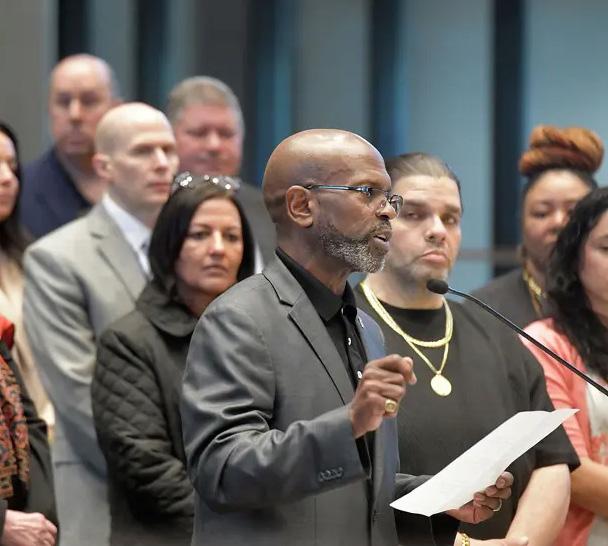
— With just a few days left in the city’s 2026-27 municipal budget season, Mayor Joe Ganim and some City Council leaders Friday proposed a significant infusion of dollars into the public schools.
The city would kick in $10 million more next year, combined with the extra $25 million in the state’s just-approved budget. Ganim's administration would also commit to spending $2 million more on education in 2027-28. And under state law, the city's increases are permanent.
But that additional $35 million for the 2026-27 budget year still falls short of the $44 million local school officials have said is required.
Regardless, Ganim’s announcement drew praise as a big deal given city history.
“It’s certainly welcome news and a step in the right direction,” said state Rep. Steve Stafstrom, who has previously criticized the Ganim administration for not investing more in education.
“I feel like Bridgeport has stepped up its game,” said school board member Robert Traber, adding, “We’ve still got to figure out $9 more million.”
The City Council’s budget committee is expected to take up the recommendation Saturday ahead of the full group’s final budget vote Tuesday. To pay for it, the
mayor’s office is anticipating some residents' real estate and motor vehicle taxes will rise more than had been initially intended. Council President Jeanette Herron and budget co-chairs Ernie Newton and Richard Ortiz blessed the pro-posal in
a joint statement Friday with the mayor.
“This plan is the result of true partnership among my administration, the state delegation, the City Council, Superintendent (Royce) Avery, and the school board,” Ganim said. “This collective
effort is truly historic, and a strong signal we are supporting Dr. Avery and the board at all levels of gov-ernment as they work to resolve issues within the school district.”
In early January, 2025 the Connecticut Department of Education intervened to help manage Bridgeport’s schools. The district was facing a $30-plus million deficit and many other woes. And while the local education board is an independently-elected body that makes its own spending and managerial decisions, Ganim, a Democrat in office since 2015, and the council annually decide how much additional money to give the schools.
The mayor in mid-March announced he would commit $5 million more in the 2026-27 fiscal year starting July 1, and another $5 million on top of that in 202728. But local members of the legisla-ture said that did not prove the Ganim administration meant business.
“We knew the state would need to do the lion’s share, but the city had to be a partner in that effort and step up with more than the initial $5 million,” recalled Stafstrom on Friday. “So the delegation certainly had pushed the mayor to increase the city’s contribution.”
State Rep. Chris Rosario, D-Bridgeport, added that officials in other urban centers, namely Hart-ford and New Haven, were
willing to invest more in their schools, so “we wanted to make sure Bridgeport followed suit.”
Thomas Gaudett, the mayor’s chief administrative officer, on Friday confirmed that to pay for the additional spending, the mayor is recommending the council adopt revised increases to the mill rates -- aka tax rates -- for real estate and motor vehicles. Both were scheduled to drop significantly as a result of the 2025 property revaluation, the former from 43.45 to 27.75, and the latter from the state allowed maximum of 32.46 to 27.75.
“We would aim to have a car mill rate of 31.75 and a residential mill rate of 27.95,” Gaudett said of the proposal before the City Council.
The spike in home values over the last few years has been expected to offset the residential mill rate drop, meaning despite that latter good news, many Bridgeport residents, particularly multi-family owners, are likely to still see their taxes remain flat or rise.
“We’ve heard a consensus that the board of education is a priority,” said Gaudett. “This budget proposal is a reflection of that consensus.”
Herron owns a two-family home and said her bill will definitely get higher. Still, she argued, both mill rates will be amazingly low for Bridgeport.

By Lucy Gellman
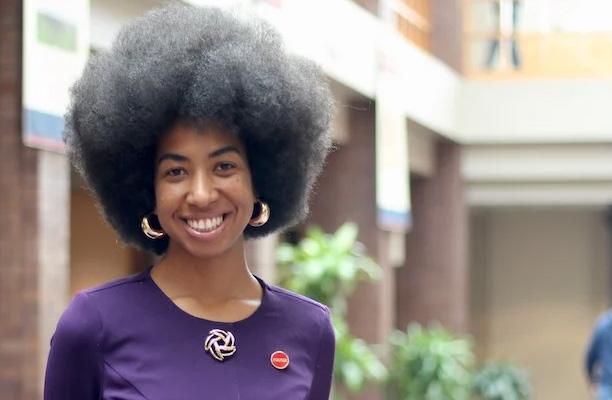
City Cultural Affairs Director Shamain McAllister has been figuring out how to stretch a dollar since before she started working in New Haven’s arts ecosystem almost a decade ago. Now, she’s learning how to stretch $190,000 of them on a municipal stage—when she’d like to have more than double that as a starting point. McAllister, who has been in the role since October of last year, provided that check in earlier this week, as the New Haven Board of Alders moves toward a vote on Mayor Justin Elicker’s pro-posed $733.3 million city budget. This year, the Department of Arts, Culture & Tourism receives $190,000, a number that will go primarily toward the city’s longstanding Neighborhood Cultural Vitality Grant (NCVG) program.
That number, which goes directly to the department’s 501c3 arm New Haven Festivals, Inc. is in keeping with previous city budgets—without the added cushion of American Rescue Plan Act (ARPA) funding, $1.2 million of which allowed extra programming in the department from 2022 to 2026. It comes in addition to the $181,193 that covers department salaries for McAllister and Kim Futrell, who serve as the director and deputy director of cultural affairs respectively.
“I think what we are trying to do is stretch it like bubble gum,” McAllister said in a phone call Monday afternoon, just days after the final city budget hearing of the season. “I really think about what we can make happen, and then how we can help [with other resources]. It’s hard to navigate but we’re doing our best.”
As she sees it, she continued, it’s her responsibility to stretch those funds to pay contractors—who are often working artists and arts educators themselves— and support individual artists or organiza-tions who apply to the NCVG, often with community-specific programs in mind. Since her ap-pointment last year, McAllister has brought on curator Juanita Sunday and artists Gio Roper and Isaiah Providence to do graphic work for the department, and document cultural events like the in-auguration of the city’s two newest poets laureate.
The hard part is that the demand—for space, for time, and especially for financial resources—far outpaces supply. In the past year, the department used NCVG dollars to support everything from spirited Mahjong pop-ups at a beloved local bookstore to an exhibition around New Haven’s homelessness crisis to the St. Luke's Steel Band for its annual summer camp with Music Haven (view a full list of 2025 recipients, of which there were 30 in total, here).
But those dollars—or more aptly, the lack of them—also translate to programs that may sit in pro-grammatic limbo until the right grant or donation comes through. This year, Futrell and McAllister said the department received 56 completed NCVG
applications, for a total of $345,000 in requests (the recipients of those grants have not yet been finalized or announced). Of that, it will only be able to award about $100,000—less than a third of what people are asking for.
For McAllister, that process of elimination is painful, because New Haven is also her home. In the past decade, she’s built a career in the city’s arts organizations, including the New Haven Sympho-ny Orchestra and the International Festival of Arts & Ideas.
In her current position, she sees and hears from artists who want to bring back New Haven’s vi-brant legacy of jazz, see more public concerts on the New Haven Green, and have visions for crea-tive and institutional collaborations that don’t always exist. Right now, it feels to her like there will never be enough dollars, even with private philanthropy, foundation funding, grants, and individual donors, to do that.
This year, budget season comes at a time when arts funding is more stretched, competitive and reli-ant on personal philanthropy than it has been in years. Three years ago, the department was able to award almost $200,000 in NCVG funding, and then give an extra $677,121 to cultural organiza-tions using ARPA dollars that no longer exist. Meanwhile, grants from federal agencies like the National Endowment for the Arts and National Endowment for the Humanities are no longer relia-ble. It means that both artists and arts organizations are all competing for the same pool of funding.
“Sometimes I can’t give people what they’re asking for [with city funds], and I am encouraging people to think about alternative resources,” McAllister said. “We don't live in a country where you can fully rely on the government. I think you should be able to, but that's not the cards we're being dealt right now.”
In the meantime, she’s trying to step into the gap—which is really more of a chasm—by offering time, collaboration, and vocal city support. The Harlem Fine Arts Show (HFAS), for instance, is one such example: the city didn’t have extra dollars to give artists like Jasmine Nikole and Rashana Miller, but spread the word about their journey, drumming up support along the way.
Roper, who the department hires to photograph events, helped shoot portfolio images for several New Haven artists doing the digital arm of HFAS, making their participation possible. And then, even on the eve of a snowstorm, several Cultural Affairs Commissioners made the trip to Harlem, bringing New Haveners across the arts along with them.
While the department covers a lot of ground with what it has, McAllister added, “I would love to see us in the figure of $300,000 to $500,000 in the future.”
Reached for comment Wednesday evening, Mayor Justin Elicker said that he too would love to dedicate more money


to arts and culture in the city budget—if there were more money to go around. Already, he’s removed line items that feel essential, including $482,439 for emergency food aid and $30,000 for the New Haven Pride Center, to reduce budget costs. He’s trying to ad-dress a projected $13 million deficit at the New Haven Board of Education. He wants to see more funding for Elm City COMPASS and find dollars to keep an emergency shelter on Foxon Boule-vard open for the people who critically need its services.
“I think we all try to do what we can to ensure that our arts organizations and the culture here con-tinue to thrive,” he
the day that I can hear from my office,” Elicker said (those are often a part of Arts & Ideas). He lauded the city’s cultural vibrancy, where he’s learned about new indie bands at the city’s Night Market, taken his daughters to performances at the Shubert Theatre (he had high praise for The Sound of Music, which came full-circle at the Shubert in March), and been delighted by some of the arts education that happens in the city’s schools, including in his eldest daughter’s band classroom.
He also pointed to state dollars, including Connecticut’s line item funding for the arts, that have flowed to city organizations for years. Arts & Ideas, for instance, receives $414,511 in line item funding from the state. Music Haven, which has a budget close to $1 million, receives $100,000 to teach tuition-free music lessons to over 100 students. ARTE, Inc., which runs after-school and arts programming out of its Fair Haven hub, gets $20,735.
During last week’s budget hearing, Cultural Affairs Commissioners Rebekah Moore and Magaly Cajigas both encouraged the Board of Alders’ Finance Committee to reconsider the $190,000 fig-ure, while also acknowledging the difficulty of having to balance a budget where food, housing, and public education are all extremely urgent needs. By the time they spoke, they had listened to hours of testimony pressing for both emergency food aid funding, money for the city’s Office of Climate and Sustainability, and a higher annual contribution from Yale University. Moore, a podcaster and arts advocate who currently serves as program director at the Arts Council of Greater New Haven, pointed to New Haven’s cultural vibrancy and recent prominence on a na-tional stage as proof positive that those dollars would not go to waste. As a daughter of the city who is now raising her young son here, she’s proud of that distinction—and hopeful that she’ll one day see it reflected in the city budget. (In the interest of full transparency, the Arts Paper lives within but is editorially independent from the Arts Council).
said, acknowledging the economic impact that the arts have in the city (he has called New Haven the cultural capital of Connecticut many times over, and reaffirmed that state-ment Wednesday).
Like McAllister, he noted that the city aims to help artists and cultural organizations in ways that are not only financial, like opening up downtown for CITA Park, the New Haven Night Market, and Black Wall Street Festival, which has grown from a modest cultural festival on Temple Street to an ebullient, sun-soaked celebration on the New Haven Green.
“One of the things I love most is the concerts on the Green in the middle of
Years ago, she noted, New Haven’s arts scene started its rise to national prominence: the New York Times named it one of the “Top 52 Places To Go In 2023,” with stops that included the Hen-ry Street arts incubator NXTHVN and reimagined Hotel Marcel, which for years sat vacant as the Brutalist-designed Pirelli Building. Then in January of this year, Southern Methodist University’s DataArts Vibrancy Index listed the Elm City as the seventh most culturally vibrant place in the country. Just last month, USA Today listed the International Festival of Arts & Ideas as number three among its top 10 cultural festivals of 2026.
“It is imperative that this department with a staff of only two individuals sustain meaningful fund-ing that will continue to allow this sector to flourish,” she said. “As an avid supporter of
Lucy Gellman
In Erin Michaud’s second-floor art classroom at Cooperative Arts & Humanities High School, a kind of analog magic was unfolding. By the back windows, senior Trinity Stephens looked up from a cut paper composition, a precision blade steady in her right hand, and began to study the letterpress prints that had appeared in front of her. Where there is a woman, there is magic, read one, the letters dancing against a blue and pink background that looked like it was quilted. Back at the front of the room, printmaker Amos Paul Kennedy, Jr. lifted a length of cardstock printed with the words Always Choose Happy and began to describe the history of movable type. “I want you to imagine someone setting a dictionary by hand,” he said, with an edge of wonder in his voice that never goes away. The whole room leaned in to listen.
Kennedy, a Detroit-based printer and self-described non-artist (“I consider myself an old man with a printing press,” he told junior Nia Jackson) who uses his work as a vibrant platform for social justice, arrived on College Street as part of a four-day residency that spanned New Haven’s liter-ary, cultural, historic and educational landscape. Hosted by Possible Futures with support from the Muslim Leadership Lab (MLL) at Dwight Hall at Yale, Kennedy’s visit brought the practice of printmaking to hundreds of New Haveners, from high school students and budding activists to practicing artists and educators in New Haven.
It leaves Possible Futures with not only work from a legendary printer-philosopher, but with a let-terpress that comes from the Maurice Sendak Foundation, and will now live at Possible Futures’ Edgewood Avenue storefront for the foreseeable future. Jeff Mueller, the founder and owner of New Haven’s Dexterity Press, also lent the space moveable type and popped into several of Ken-nedy’s events over the weekend.
In addition to Co-Op, where students study printmaking as part of the visual arts concentration, partners on the weekend’s residency included ACES Educational Center for the Arts (ECA), NXTHVN Fellow and curator Juanita Sunday, Deadby5am Founder Brenton Schumaker, Kultur-ally LIT’s IfeMichelle Gardin, the Westville-based Artists’ Bloc led by curator nico w. okoro, and members of the New Haven Immigrants Coalition, New Haven Federation of Teachers, and Con-necticut Students for A Dream who gathered for a May Day art build Sunday afternoon.
“It’s amazing what Possible Futures is and how it interacts with the community,” Kennedy said last Sunday, during a second day of letterpress printing at the bookspace. Around him, no inch of the storefront appeared unoccupied: people sat shoulder-to-shoulder on the couch, surrounded the presses, and buzzed between the shelves, some cradling prints

for Kennedy to sign. “It’s a very special space.”
“It’s always a joy to see them [people] when a print is made,” he continued. “When the words come out on paper, they can read it. Despite the fact that printing is everywhere in our society, few people actually interact with how professional printing is done. Few people have actually seen a real printing press. So it’s nice to introduce people to that.”
From Henry Street to the New Haven People’s Center and back to Edgewood Avenue, those words came to life over and over again, with a reverence for the practice of printmaking that was contagious. In part, that comes from the relative rarity of such a visit: printmaking often happens outside of the public eye, despite its long and intimate tie to political movements.
Kennedy with Professor Ned Blackhawk at Possible Futures on the final day of Kennedy's resi-dency.
In most of New Haven’s schools, for instance, students don’t learn about anarchist printers like Jo Labadie (another Michigander, although before Kennedy’s time) or revolutionaries like José Gua-dalupe Posada, who keenly understood the power of a good broadside.
If they are lucky enough to see printed matter in person, that doesn’t always mean they get a chance to practice the technique, which is how that knowledge of process gets lost. Even Elm City artists who are working to keep the art form alive—Jeff Mueller at Dexterity Press, Daniel “Silencio” Ramirez at El Rincón de Papel, teachers like Maura Galante, Barbara Harder, and Shaunda Hol-loway passing on relief, intaglio, and transfer techniques at spaces like Creative Arts Workshop at Co-Op—are working in rel-

ative isolation.
No wonder, then, that students’ excitement felt palpable as Kennedy stepped into Michaud’s class-room, sunlight streaming through the back windows as bookspace founder Lauren Anderson and journalist, poet and printmaker Asad Chishti laid out dozens of posters across the room for stu-dents to study in detail. Make Art! one read in bold capital letters against a clean red square and cream-colored background. How Can / You Know / Jesus / When You / Can’t Write A Thank You Note? read another across the table, in large and small moveable type against a thick oxblood rec-tangle that pulsed with color.
On the wall behind Kennedy, artworks
had studied mathematics and held down a day job, much like Anderson before owning the bookspace. But when he returned from the trip, he started taking classes at Artist Book Works, a book arts program in Chicago. One letterpress class in, he was hooked.
“Nobody cared if I made it or not. They figured, I was a grown person, I could do what I want to,” he said to students. “And so I’ve just been printing and having fun.” Students perked up, some still shaking the sleep from their eyes, and hung on to every word. Ken-nedy had been there for maybe six minutes, and already it was becoming clear that the morning would be as much about the philosophy of living as it was about the process of printmaking.
After his classes in Chicago, Kennedy went back to school at the University of Wisconsin in Mad-ison to pursue a degree in graphic design, which he cheekily referred to as “so-called art.” By then, he had a letterpress shop in his home, with equipment that allowed him to print.
And then three years into a job as an art professor at the University of Indiana (“They let me into a university!” he said with a wry smile at Anderson, who was an academic for years before taking the leap into owning a small business), he realized that teaching was not his gospel.
“It took a long time for me to realize that all the experiences I had before I became a printer were not failures, but places where I learned, that now I can apply to printing,” he said. “I’ve been print-ing for about 30 years, and I’m still learning things, because there’s just new information out there to find. There’s new ways of doing things.”
His posters were and are often inspired by well-known proverbs, maxims, quotes that snag his at-tention and phrases that he picked up through friends and family members. “I consider that folk wisdom,” he said. “These things that are passed on from one generation to the next … I try to pre-serve that information as part of my life growing up, and pass it on.”
told a story of young artist-activists in real time: still-bright-but-aging posters of Rosie The Riveter and Miss Major Griffin-Gracy shared wall space with new student designs that read ICE Out in clear, declarative letters. At the back of the room, a tangle of fabric sunflowers seemed of a piece with a large, butter-toned print from Kennedy that read Pro-ceed And Be Bold in type that seemed to dance in space. Nia Jackson. At the front of the room, Kennedy turned to students, and began to speak about his own practice, which he came to 30 years ago “kind of by accident” after seeing letterpress printing on a trip to Colonial Williamsburg. Before that time, he
In the classroom, students had started to study the words set out in front of them, taking note of the way that Kennedy has used visual culture to practice social justice. Over decades of learning, the artist has called on the wisdom of both living culture-bearers and those who have passed on, from Langston Hughes, Eartha Kitt, and Nina Simone to Rachel Carson to translated proverbs from the Cree and Oglala Sioux Nations.
A whole series of his prints, for instance, pays homage to libraries and librarians, whose work has put them unexpectedly on the front lines of defending democracy. Another champions members of the LGBTQ+ community, and particularly Black Trans people. Another still pushes back against federal immigrations enforcement, with the simple message Fuck ICE! Or Abolish ICE! in big let-ters that seem to bounce in place.
by Thomas Breen
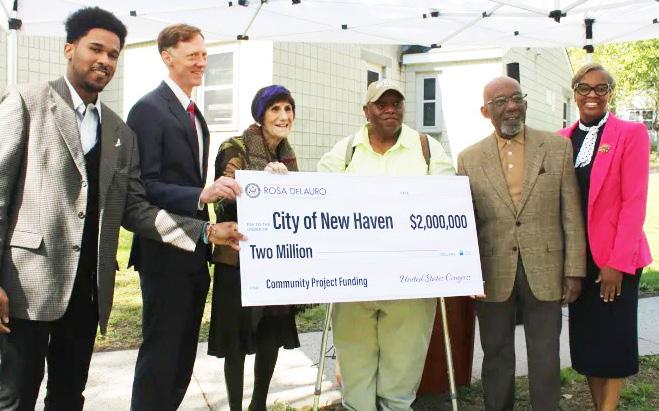
A decade-long overhaul of hundreds of units of west-side public housing took another step forward Thursday, as city leaders gathered with U.S. Rep. Rosa DeLauro to welcome $2 million in federal funds for the redevelopment of Westville Manor and a vacant ex-nursing home into roughly 150 units of new housing.
Housing Authority of New Haven Executive Director Shenae Draughn, Mayor Justin Elicker, city housing authority Board Chair William Kilpatrick, and DeLauro, among others, celebrated that funding during a morning press conference at 34 Level St.
DeLauro, the top Democrat on the House Appropriations Committee, brought a big check — literally — marking $2 million in “community project” funding, formerly known as “earmarks,” that she has secured for the Westville Manor redevelopment project.
Draughn said that this money will go towards covering some of the new-infrastructure costs related to knocking down the existing 150-unit Westville Manor public-housing complex and building 109 units of new mixed-income housing in their stead. This project will also see the demolition of the long-vacant former nursing home across the street at 34 Level St. and the construction of 50 new units of affordable housing for seniors.
“It is a way to say we understand the local needs,” DeLauro said about the community project-funding process. She praised the housing authority’s “vision”
and “tenacity” for continuing to redevelop West Rock public housing complex after complex — from Brookside to Rockview to Twin Brook (formerly Ribicoff Cottages) to Wilmot Crossing — to provide residents with new, beautiful, affordable places to call home.
By the time that these 149 new apartments are built and redeveloped at Westville Manor and 34 Level, Draughn said,
the housing authority will have built or rebuilt 668 units of housing in the West Rock neighborhood in recent years, with a total investment of more than $200 million in the area.
“Today we will continue,” Draughn said. “Tomorrow we will continue.”
Even with this latest redevelopment moving ahead, “we are not finished.”
“It’s been a long time coming for these residents,” added West Rock/West Hills Alder Honda Smith, as she described working with the housing authority over the past 16 years to help make the 34 Level and Westville Manor projects a reality. She praised Draughn and her team for continuing to work hard to do right by the neighborhood.
“We are committed [as a city] to grow-
ing,” added Mayor Justin Elicker, “and, importantly, growing inclusively.” He stressed the city’s goal of creating 10,000 new units of housing in ten years, with 30 percent of those units affordable. He said that the city saw 1,500 new units of housing built last year, with another 5,500plus currently in the pipeline.
The housing authority has owned the 34 Level St. property since 2020. Draughn said that the agency expects to close on financing for the 50-unit, senior-housing redevelopment project and begin construction later this year. She said the housing authority should close on the financing for the redevelopment of Westville Manor next year.
The Westville Manor project will see the construction of 109 new units of housing, with a mix of one- through five-bedroom apartments, plus a community building. Draughn said that roughly 80 units’ worth of tenants live at Westville Manor today, with many former residents having relocated in recent years to Brookside Phase 2. The current Westville Manor buildings will be demolished as part of this project, and tenants will have the opportunity to return to the newly built rentals.
Asked about the estimated total development cost for these projects, Draughn said it is a little too soon to tell. She said they should cost around $350,000- to $400,000-per-unit to build. She added that, as with other West Rock redevelopments, this project will also see the construction of new roads.
of the way,” he said.
A statewide hospitality workers union endorsed Gov. Ned Lamont on Tuesday in his bid for reelection — becoming just the latest labor group to pledge their support for the two-term incumbent’s bid for another four years in office.
The union, UNITE HERE Local 217, announced its endorsement with a press conference outside the union’s New Haven office at 425 College St. The presser featured union members and leadership standing alongside Lamont.
Their endorsement marks the second union endorsement for Lamont in New Haven in less than a week. Last Friday, Lamont stood alongside Connecticut Teamsters union reps on Wallace Street as they pledged their support. Lamont has also won the endorsement of the Connecticut Carpenters Union.
“Workers need champions who pass legislation that helps them and their families in their daily lives, and the trade union movement needs allies who will fight alongside us,” said Local 217 Secretary-Treasurer Joshua Stanley.
“Our union has been fighting to get middle class families back on their feet, and the governor has stood with us every step
Local 217’s endorsement is exclusive to the hospitality workers union and does not include Yale’s political influential UNITE HERE Locals 33, 34, or 35. According to Stanley, the other UNITE HERE unions have their own endorsement processes, and Lamont recently spoke before Local 34 and 35 members. He noted that Lamont has shown a lot of support for those unions.
For 217, the endorsement was a “unanimous feeling from our executive board,” Stanley said.
Lamont faces a Democratic primary challenge from progressive Hamden State Rep. Josh Elliott. Republicans seeking the state’s highest office include Greenwich State Sen. Ryan Fazio, former New York Lt. Gov. Betsy McCaughey, and former New Britain Mayor Erin Stewart.
Local 217 is proud to endorse Lamont for governor and Susan Bysiewicz for lieutenant governor, Stanley said, “because they have supported us as we grow, and because they understand that the trade union movement is a vital partner in overcoming our affordability crisis.”
Stanley pointed to some of Local 217’s recent accomplishments in the food service and hospitality sectors, including a

strike at the Omni Hotel — where Lamont joined striking workers on the picket line — that led to a new four-year contract. Local 217’s membership has grown in recent years from 2,000 workers to 3,000
workers, according to Stanley. “Governor Lamont, we are fully behind you, and we look forward to continuing our work together,” he said.
“You want a fair shot in this complicated day and age, you ought to be represented by a union,” Lamont said. “Nothing better than UNITE HERE.”
He continued, “I want to tell you how much it means to us to have your support. We’ve got your back too.”
Local 217 1st Vice President Nicholas McDonald has been a member of Local 217 for 31 years, working at Southern Connecticut State University (SCSU) as a cook, caterer, and now a receiver who stores food and products.
“He’s a man of his word,” McDonald said of Lamont. He said that the governor showed “solidarity” with SCSU workers as they rallied for better wages and voted to authorize a strike.
Cherene Cotter, who was a member of Local 217 for 16 years as she worked for a hotel in Hartford, was in attendance on Tuesday because she likes to continue to support the union.
Originally from Jamaica, she said that she’s been voting for Lamont “since I became a citizen.”
“He stays true to who he is,” she said. “He doesn’t just show up during election time.”
arts through my professional career but [also] as an artist myself, I have seen just how impactful the arts are.”
She added that when artists flourish, it’s a sign of a healthy society more broadly—because it means that people recognize the sheer amount of labor that goes into making art.
“It’s a profession that provides housing, food, and other necessities for families,” she said. “The arts intersect with so many vulnerable populations that are here looking for support … the world sees us on a national scale. Let’s show them why we are indeed so vibrant.”
As an employee who works directly with artists at the Arts Council of Greater New Haven, Moore has also already seen the strain that fewer overall dollars are having on arts organizations, including her own. From November 2025 through March of this year, all of the Arts Council’s full-time em-ployees (including this reporter) participated in the State of Connecticut’s Shared Work Program, an initiative designed to prevent or delay furloughs and layoffs by providing temporary unem-ployment benefits. It meant that fewer of her own dollars went back into New Haven.
Cajigas, who for years has served on the all-volunteer board of Puerto Ricans United, Inc., echoed that enthusiasm for arts and culture, noting the importance of the sector as not just an economic en-gine, but also a teaching tool, through which people of all ages learn cultural competency and expe-rience new perspectives. For years, she’s revelled in New Haven’s robust and diverse summer programming, including the city’s Puerto Rican Festival, New Haven Caribbean Festival, and Black Wall Street.
“All of these events uplift our community members, and specifically our community members of color,” she said. “Our Cultural Affairs Commission has believed in every aspect of these events, and its staff has been dedicated to helping nonprofit groups in the area make the events happen. Our commission understands the bandwidth of our municipality, however the arts … the cultural nonprofit activities and groups are what attracts thousands to New Haven year after year … it’s bringing in much-needed revenue into the city.”
Those dollars are even more critical as more federal cuts come for the arts, she added. She refer-enced the nearly 600 NEA grants that have been terminated in the past year, with new attacks of cultural programming that embraces any sort of commitment to Diversity, Equity and Inclusion (DEI).
“I ask for your support in helping build the thriving arts community that we have here in New Ha-ven, where creativity flourishes and artists from all backgrounds and cultures are respected,” she said, repping a shirt by self-described “artivist” Juancarlos Soto. “We need that support.”

by Donald Eng
HARTFORD, CT — Gov. Ned Lamont congratulated the state legislature for a job well done Thursday, about 12 hours after the final gavel came down ending the 2026 session.
In a 40-minute press conference, Lamont spent about a half hour answering questions about numerous topics, including potential vetoes, health care, President Donald Trump and the 2026 elections.
Most of the conversation, though, centered on the budget with Lamont citing increased school aid and support to municipalities as among the session’s biggest accomplishments.
“We came together, took the best ideas and came together with a budget that has strong bipartisan support,” he said. “We had some back and forth because I wanted to make sure the promises we made were sustainable. I feel like we’re in a pretty good place for ‘27 and the foreseeable future.”
Lamont also pointed to the legislation beginning to regulate artificial intelligence as a legislative win. That bill too had bipartisan support in both legislative chambers. Among other things it requires AI disclosures and mandates flags when AI algorithms pick up on potentially dangerous interactions such as conversations about self harm.
“We put in place some guardrails to give you some protections, especially when it comes to kids,” he said.
Among the missed opportunities, Lamont expressed disappointment about the bell-to-bell cell phone ban passing the

House but dying in the Senate. He said the state would be working with local school boards to put clear guidelines in place.
“I’ve been hearing from other governors, you get the phones out of the schools, not only do kids talk to each other more, but also more books get taken out of the library,” he said.
He added that he expected the bill would pass next year and lamented that the Senate had not taken it up this session.
“At 5 in the morning, they were debating in the state Senate whether it was a good
idea to be able to convert your pistol into a machine gun,” he said.
That comment could be interpreted as a jab at state Sen. Ryan Fazio, the Greenwich Republican who is one of three candidates currently running campaigns for governor. Fazio voted against the legislation Lamont referenced, a ban on the sale of “convertible” pistols that can be modified to fire full auto. Former New Britain Mayor Erin Stewart, another Republican candidate for governor, testified against the bill at a public hearing.
CTNewsJunkie reached out to the Fazio and Stewart campaigns, and the guberna-
torial campaigns of former Republican New York Lt. Gov. Betsy McCaughey and Democratic state Rep. Josh Elliott, who is running a primary challenge against Lamont for the party nomination. Fazio, in response, said he had an obligation to uphold state residents’ constitutional rights, which he said could be done while also promoting public safety.
“He’s focused on undermining the rights of law-abiding citizens instead of finding practical ways to support law enforcement, take illegal guns off the street and keep us safe,” Fazio said. “I will defend law-abiding citizens and go after crimi-
nals. The governor is protecting criminals and going after law abiding citizens.”
Fazio also criticized the recent session, which he called horrible.
“Connecticut is putting ideology over practicality under this governor,” he said. “The state is becoming more unaffordable due to the policies of this governor passed during this session, … and the only recourse to make Connecticut more affordable for all will be at the ballot box in November.
McCaughey agreed. In a statement she called the state’s $28 billion budget a scam and said it doled out millions of dollars on programs and nonprofits most people would not support.
“When I’m governor, I will use a line item veto to wrest control from the Hartford spendaholics and push to eliminate the state income tax,” she said.
She agreed with Fazio on the gun bill, calling it a tragic assault on the right to bear arms. She also complained about bills on homeschooling and vaccinations and said as governor she would go to court to overturn those laws.
Stewart, meanwhile, called Lamont disconnected from reality.
“Are utility bills lower?” she asked in a statement. “Are taxes lower? Are schools any better?”
She said Connecticut was locked in a spiral of high cost and low opportunity. “But hey, if you live in Ned Lamont’s world, everything’s swell,” she said. The Elliott campaign did not immediately reply to email and social media requests for comment.
by Donald Eng
EAST HARTFORD, CT — A political earthquake struck East Hartford Monday night, according to the man left standing when the aftershocks subsided.
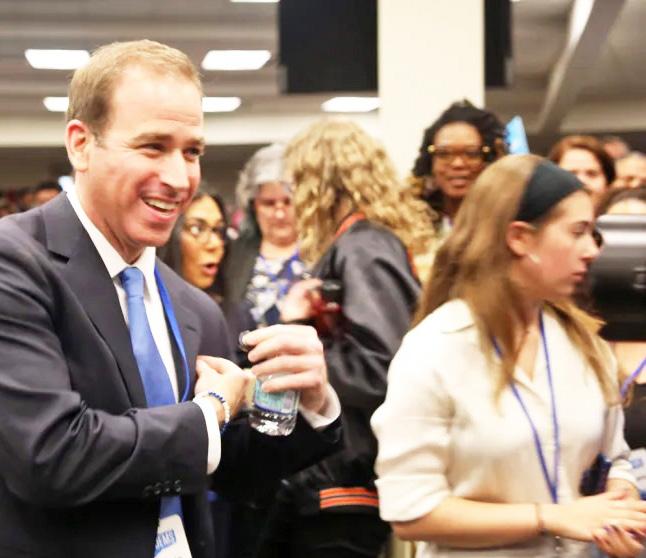
“I want to be clear about one thing. We just saw a political earthquake in this convention hall,” Luke Bronin told a crowd of cheering Democrats at the First District convention at Goodwin University.
Bronin, the former Hartford mayor, defeated 14-term incumbent John Larson for the party’s endorsement to run for the First District seat in the U.S. House of Representatives 214-210 in three rounds of voting. The first round saw Bronin tally 181 votes to Larson’s 194. West Hartford state Rep. Jillian Gilchrest received support from 37 delegates and Hartford school board member Ruth Fortune had 8. Candidates needed 210 of the 419 delegates to secure victory.
Following a 10-minute pause for delegates to reconsider and possibly switch their votes, the revised totals were Bronin 191, Larson 162, Gilchrest 63 and Fortune 3. That result put Fortune below the
threshold needed to advance to the next round and put Gilchrest above the 15% support needed to secure a spot in the August primary.
With her place on the primary ballot secure, Gilchrest withdrew her name from consideration in the next round, setting up a head-to-head showdown between Larson and Bronin, which Bronin ultimately won by 10 votes.
Bronin in his victory speech turned his attention toward President Donald Trump and the need for Democrats to secure control of Congress.
“Every Democrat in this room believes that we need to stop the damage that Donald Trump is doing to our country every single day,” Bronin said. Later, Bronin called his win “unimaginable” and said it sent a message to the party that voters have a real choice.
“What we usually see at these conventions is a coronation of the incumbent,” he said. “What we saw tonight was a sea change. What we saw tonight was the most active Democrats in the district sending a message that we want change.” Larson after the convention released a
statement vowing to win the August primary with “working-class grit” and a coalition of progressive support.
“We’re in this fight on behalf of the working people who I serve,” Larson said. “We’re taking on Trump every day and I’m proud to be on the hit list of members he wants out of Congress. That’s not going to happen.”
Bronin supporters weren’t the only ones to leave the convention happy. Gilchrest said she had achieved her underdog campaign’s goal of securing a primary spot. “People still seem to think money equals viability,” she said after dropping out of the balloting. “But at the end of the day, this is about getting out there, talking to folks, making connections and relationships and people want a different kind of politics and I’m hopeful that they see that in me.”
The two political parties hold their primaries Aug. 11. In addition to Bronin, Larson and Gilchrest, Republican Amy Chai also is a candidate in the historically Democratic-leaning district.





by Linda Armstrong
With “Proof,” a very poignant and riveting play at the Booth Theatre on West 45th Street, playwright David Auburn gives us the story of Catherine, the daughter of a renowned mathematics professor named Robert, who, after his death, must show proof that brains actually run in the family. This play depicts the male-dominated the field of mathematics and questions it. It also looks at mental illness and what the child of someone who loses their faculties faces when they think about their own mental health and what could be lurking in the future for them.
We meet Catherine, stunningly played by Ayo Edebiri, who questions the idea of her own sanity, and who also doubts her own capabilities, until she finds she must acknowledge and believe in her mathematical findings. Don Cheadle portrays Robert with a firmness and with patience, and as a man who is realizing that he is losing control of his actions, but cannot stop himself. Jin Ha plays Hal, Robert’s former student, who admires him great-
By Itoro N. Umontuen
The 2026 ESSENCE Festival of Culture presented by Coca-Cola has expanded its Evening Concert Series lineup. Newly announced performers include Babyface and Leon Thomas.
The annual festival returns to the legendary Caesars Superdome with a lineup spanning hip-hop, R&B, soul, and funk. Organizers say the concert series will feature artists from multiple generations.
Previously announced performers include Cardi B, Latto, Kehlani, Patti LaBelle, Brandy, Monica, Public Enemy, and George Clinton and Parliament-Funkadelic.
George Clinton and Parliament-Funkadelic will celebrate 50 years of the ‘Mothership’ landing in New Orleans. The performance will include appearances by Big Boi, Scarface, Big Freedia, Nona Hendryx, and Durand Bernarr.
Friday’s concert lineup highlights some of music’s biggest current stars. Cardi B will make her ESSENCE Festival debut after her tour titled, “Little Miss Drama Tour”. The Grammy-winning rapper will headline in New Orleans for the first time. Latto will also perform ahead of her upcoming album, Big Mama, releasing May 29. Kehlani joins the opening-night lineup following the release of her latest self-titled project. Fans will hear new music alongside the artists’ biggest hits.
R&B group SZN4 will also perform Friday night. The quartet gained attention after appearing on Netflix’s Building the Band.
Saturday night shifts the focus to classic and contemporary R&B. Patti LaBelle returns to the festival stage with a catalog that has influenced generations of performers.

Sunday’s closing concert will celebrate musical influence across generations. Babyface will bring decades of chart-topping hits to the ESSENCE Festival stage. Public Enemy is set to perform music that helped shape politically conscious hiphop. Their catalog includes influential releases like Fear of a Black Planet and “Fight the Power.”
George Clinton and Parliament-Funkadelic will close the weekend with a Mothership performance in New Orleans for the first time in 50 years. Their set will feature guest appearances from Big Boi, Scarface, Big Freedia, Nona Hendryx, and Durand Bernarr.
concerts, the festival offers daytime experiences at the Ernest N. Morial Convention Center. Attendees can explore conversations, live experiences, wellness programming, beauty activations, and business-focused events throughout the weekend.
ly and just wishes he had a tiny bit of Robert’s genius. Hal also wants fame as a mathematician, but realizes he does not have it in him. Kara Young plays Claire, Catherine’s older sister, who has not lived at home for years. She flies in after their father dies to try to persuade Catherine to go back home with her and move on with her life.
The storyline has twists and turns that will keep you intrigued and engrossed. It is also interesting to watch the scenes where the character’s mental illness comes to the fore. We might not often think of geniuses as having mental health issues, but this play makes clear that they are just as susceptible as anyone else.
Thomas Kail’s engaging direction truly makes this a moving play to experience.
On the technical side, the production has scenic design by Teresa L. Williams, costume design by Dede Ayite, lighting design by Amanda Zieve, sound design by Justin Ellington and Connor Wang, along with wig and hair design by Mia Neal. For tickets visit proofbroadway.com.
Brandy and Monica will reunite for a highly anticipated performance. Their hit song “The Boy Is Mine” spent 13 weeks at No. 1 on the Billboard Hot 100 chart. Rising R&B artist Josh Levi joins the Saturday lineup. Leon Thomas will also perform as momentum continues to build around his solo career.
Hip-hop pioneer Doug E. Fresh will also appear during the closing-night festivities.
For more than three decades, the ESSENCE Festival of Culture has remained a major celebration of Black culture in New Orleans. Beyond the evening
Notable conversations include the Global Black Economic Forum (GBEF), led by President and CEO Alphonso David. The GBEF’s purpose is to drive awareness to the issues that affect the Black and African diaspora while pushing various calls to action after identifying the solutions. After launching in 2023, GBEF discusses methods to transform allyship and camaraderie into creating the collective financial equity needed to spur growth in order drive the greater Black and African economic engine forward. In order to achieve that goal, GBEF brings together change agents from arts + culture, business, government, grass roots movements, and philanthropy to drive data-driven and relevant solutions.
By BlackNews.com
Singer Usher has launched a paid internship program tied to his upcoming tour, giving aspiring music industry workers in Atlanta and Detroit a chance to join live production teams. The initiative paired selected interns with professionals supporting the tour alongside Chris Brown.
For the first time in his career, Usher recruited interns to work directly on a touring production. The program focused on hands-on roles within the entertainment industry rather than classroom learning or remote tasks.
According to Fox 5 Atlanta, the opportunity selected 10 interns from Atlanta and Detroit who showed interest in music, live events, and touring op-

erations. Each participant joined different areas of tour support depending on skills and interests.
Interns worked alongside production crews during the R&B tour setup and performances. They helped with show execution tasks and observed how large-scale concert tours operate in real time.
The internship categories covered several parts of live touring, including stage production, logistics, and event coordination. Each role placed interns inside active workflows used to deliver live shows across cities.
Applications for the internship closed on May 8. It is not yet known if the internship program will run again in future tours.

By Black Information Network
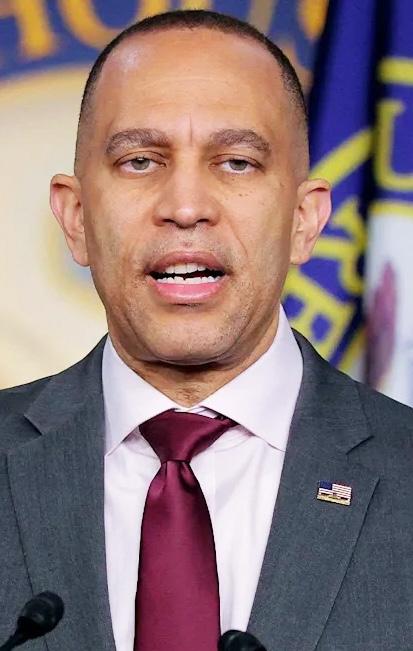
“Why do I stay on your mind? You ain’t got nothing better to do? Gas prices are surging. Grocery bills are out of control. The American people are drowning in your failed economy, and you ain’t got nothing better to do but to think about me?”
The “maximum warfare” remark emerged after Virginia voters approved a Democratic-leaning new congressional map on April 21, which could have given the party up to four additional House seats in the midterms.
Jeffries was asked by a reporter at a press conference the following day about Florida’s redistricting plans, saying that we “are in an era of maximum warfare, everywhere, all the time,” and vowed to continue pushing back against Trump’s push for Republican-led states to redraw district lines before the midterms.
Following the White House Correspondents’ Dinner shooting three days later,
several Republican leaders called Jeffries “maximum warfare” remark dangerous and accused him of intentionally stoking partisan resentment that led to the incident.
“So-called Hakeem Jeffries is a disgrace to the United States Congress. He is deranged, disgusting and violent,” Rep. Randy Fine (R-Fla.) to X on April 26. “It is unacceptable that House Democrats continue to remain silent in the aftermath of his call for “maximum warfare, everywhere, all the time” against Republicans. Their casual acceptance of hateful and divisive language enables this out-of-control behavior.”
Jeffries stood by his remark during another press conference on April 27, saying that he doesn’t “give a damn about the criticism” and outwardly condemning the shooting.
Trump’s call for Jeffries to be criminally prosecuted for the remark comes days after his previous call for Jeffries’ impeachment over calling the U.S. Supreme Court

used the phrase in response to the Supreme Court’s April 29th ruling in
Louisiana, striking down a majority-Black district and cutting back on a provision of the Voting Rights Act of 1965.
The post also marks the third time this year that Trump has referred to Jeffries as “low-IQ,” a phrase he has used in the past to predominantly refer to people of color and women, such as Rep. Alexandria Ocasio-Cortez (D-N.Y.) and Rep. Jasmine Crockett (D-Texas).
“Never allow the Traitor Democrats like Low IQ person Hakeem Jeffries, or Cryin’ Chuck Schumer, or the totally corrupt Fake News Media such as the phony and decaying Wall Street Journal, the Failing New York Times (Subscriptions way down!), or dying “60 Minutes,” to demean or criticize Operation Midnight Hammer,” Trump posted to Truth Social on April 22.
The Black Information Network is your source for Black News! Get the latest news 24/7 on The Black Information Network. Listen now on the iHeartRadio app or click HERE to tune in live.
By Atlanta Daily World
Atlanta Daily World stands as the first Black daily publication in America. Started in 1927 by Morehouse College graduate W.A. Scott. Currently owned by Real Times Media, ADW is one of the most influential Black newspapers in the nation.
Today, the Georgia Senate Special Committee on Investigations issued subpoenas to Stacey Abrams, Lauren Groh-Wargo and Nsé Ufot as part of the committee’s ongoing investigation into campaign finance law violations connected to the New Georgia Project and its affiliated entities.
The subpoenas order Abrams, Groh-Wargo and Ufot to appear before the committee at the Georgia State Capitol on Friday morning at 10:00 a.m.
The subpoenas follow findings by the Georgia State Ethics Commission that the

New Georgia Project and the New Georgia Project Action Fund violated Georgia campaign finance laws during the 2018 election cycle. Earlier this year, the organizations admitted to 16 violations of state law and agreed to pay a $300,000 fine, the largest campaign finance penalty in Georgia history.
The committee is investigating the extent of coordination, decision-making, financial activity and knowledge surrounding the unlawful political activity identified by state investigators.
“This committee has a responsibility to follow the facts wherever they lead,” said Sen. Greg Dolezal (R–Cumming), Vice Chairman of the Senate Special Committee on Investigations. “Georgia law requires transparency and accountability in our elections. The people of Georgia deserve to know who was involved, what decisions were made and how millions
of dollars flowed through organizations that admitted to violating our campaign finance laws.”
Senate Special Committee on Investigations Chairman Sen. Bill Cowsert (R–Athens) emphasized that the investigation is focused on restoring public confidence in Georgia’s election and campaign finance systems.
“The integrity of our political process depends on the faithful enforcement of the law,” said Sen. Cowsert. “The Ethics Commission uncovered what it described as one of the most significant campaign finance violations in state history. Our committee intends to determine who was responsible and whether additional reforms or enforcement mechanisms are necessary to protect the public trust and prevent this from ever happening again.”
Lt. Governor Burt Jones said the committee’s work is necessary to ensure that
powerful political organizations are held to the same legal standards as every Georgian.
“No one is above the law in Georgia,” said Lt. Governor Jones. “When organizations secretly spend millions to influence elections while evading disclosure requirements, it undermines confidence in our democratic process. The Senate will continue pursuing the truth and ensuring accountability, regardless of political party or influence.”
The Senate Special Committee on Investigations was established to examine matters involving public integrity, misuse of public funds, campaign finance violations and other issues of statewide concern.
Additional hearings and witness testimony are expected in the coming weeks.
By Black Information Network
In a 6-3 vote on Monday (May 11), the Supreme Court ruled to lift a lower court order requiring Alabama to continue using its current congressional map — which includes two Black districts — until the 2030 census, according to Politico. However, the legislature attempted to adopt a new map in 2023 that included only a single Black-majority district.
Democrat Shomari Figures’s 2024 victory in the second district gave the state two Black representatives serving simultaneously for the first time in history. Rep. Terri Sewell (D-Birmingham) has been serving since 2011.
Following the Supreme Court’s ruling in Louisiana striking down a majority-Black district as unconstitutional, however, Al-
abama Attorney General Steve Marshall requested that the injunction be removed and that the state be allowed to use the 2023 map proposal.
The court granted that request, removing the injunction and allowing the 2023 district lines to take effect. Under a bill passed May 8 by the legislature, the results of the May 19 primaries in districts unaffected by the new map will still be counted, while those in impacted districts will be ignored.
“Today, the Supreme Court vindicated the state’s long-held position. Now, the power to draw Alabama’s maps goes back to the people’s elected representatives.
That’s our Legislature,” Marshall said in a video statement.
Justice Sonia Sotomayor, alongside the court’s two Democratic appointees, ar-
gued in a dissent on Monday that the Louisiana case only reversed one of the grounds on which the Alabama order had been issued, and that a lower court could still find that Alabama intentionally discriminated against Black voters.
“That constitutional finding of intentional discrimination is independent of, and unaffected by, any of the legal issues discussed in Callais,” Sotomayor wrote, adding that it was “inappropriate” for the court to drastically change Alabama’s district lines days before the primary.
Despite voting districts typically being redrawn only once a decade, President Donald Trump’s push last year for Republicans to redraw congressional districts in ways favorable to the party to retain its majority in the midterms has accelerated the process.

Figures said that he hopes this will be a temporary setback on Monday, and criticized the court’s decision as a step backward in Alabama’s voting history.
“This is an incredibly unfortunate decision by the Supreme Court that not only continues their trend of breaking from the norms and precedents set by the Court, but also sets the stage for Alabama to go back to the 1950s and 60s in terms of Black political representation in the state,” he wrote. “I ran for this seat to be a voice for all of Alabama, and I’m not backing down from that mission now. The fight must and will go on.”
The Black Information Network is your source for Black News! Get the latest news 24/7 on The Black Information Network. Listen now on the iHeartRadio app or click HERE to tune in live.
By courtesy of HBCUNEWS.com
NBA legend and business mogul Magic Johnson spent commencement season pouring wisdom, strategy, and motivation into HBCU graduates, delivering two impactful addresses at Tuskegee University and Stillman College centered on leadership, ownership, and preparing for the future.
While each speech carried a different tone, Johnson’s core message remained the same: HBCU graduates must think bigger, move smarter, and position themselves to lead in industries rapidly being transformed by technology and economic change.
At Tuskegee University, Johnson delivered what felt like a blueprint for professional success in the modern workforce. Speaking directly to graduates preparing to enter competitive industries, the Hall of Famer emphasized discipline, preparation, and mastering emerging technology—particularly artificial intelligence.
“AI is not going to replace you at your job,” Johnson warned graduates. “But somebody who knows AI will replace you at your job.”
At a time when many people fear artificial intelligence, Johnson encouraged students to embrace it as a tool capable of creating opportunity and wealth. He described AI as a multi-trillion-dollar industry that graduates cannot afford to ignore if they want to remain competitive in the future economy.
The former Los Angeles Lakers super-

star also stressed the importance of workplace excellence, reminding graduates that in many professional spaces they may still be judged differently and therefore must operate with discipline, consistency, and professionalism.
“You have to be the best that they’ve ever seen walk through their doors,” Johnson said. “That means first to work, last to leave.”
Johnson’s speech was the perfect blend of personal testimony and practical advice. Reflecting on his upbringing in Lansing, Michigan, he reminded students that humble beginnings should never limit ambition or vision.
“I grew up poor,” Johnson said. “But I didn’t have poor dreams.”
A major focus of Johnson’s address to the graduating Tigers was financial literacy. He encouraged graduates to understand the difference between “wants” and “needs” in order to avoid debt and begin building generational wealth early. According to Johnson, earning money means little if graduates fail to learn how to properly manage, invest, and multiply it.
At Stillman College, Johnson shifted from individual success to collective empowerment, challenging graduates to
Yale New Haven Hospital is pleased to offer patients and their families financial counseling regarding their hospital bills or the availability of financial assistance, including free care funds.
By appointment, patients can speak one-on-one with a financial counselor during regular business hours. For your convenience, extended hours are available in-person at Yale New Haven Hospital the third Monday of every month.
Time: 5 - 7 pm
Location: Children’s Hospital, 35 Park St., 1st floor, Admitting Parking available (handicapped accessible)
An appointment is necessary. Please call 855-547-4584. Spanish-speaking counselors available.
“Sometimes we have to be uncomfortable to get comfortable,” he said. “You think being a basketball player going from that to the boardroom was easy for me? No. It was uncomfortable because I didn’t know business, but I was willing to put the time in.”
Johnson also used the platform to stress civic engagement, urging graduates to remain politically active and involved in their communities long after graduation.
“You got to vote,” he told the crowd. “Some people gave their lives for the rights for us to vote, so you have to vote. Get involved—don’t complain, get involved.”
rethink how Black communities build wealth and opportunity together.
“The problem we have in our community is we haven’t worked together,” Johnson said. “We need to work together, own businesses together, pull our resources together, and do some great things together.”
The speech took on a deeply communal tone as Johnson encouraged graduates to collaborate rather than compete against one another. Using his transition from NBA superstar to entrepreneur and investor as an example, he spoke candidly about the discomfort that often accompanies growth.
Before closing, Johnson challenged graduates not to forget the institutions that helped shape them. He encouraged alumni to return not only as donors but also as mentors willing to guide future generations of HBCU students.
As graduates from Tuskegee University and Stillman College prepare to enter a world driven by innovation, competition, and rapid change, Johnson left them with more than inspiration—he left them with a challenge.
NBA legend and business mogul Magic Johnson spent commencement season pouring wisdom, strategy, and motivation into HBCU graduates, delivering two impactful addresses at Tuskegee University and Stillman College centered on leadership, ownership, and preparing for the future.




By courtesy of HBCUNEWS.com
Howard University commencement became one of the most talked-about HBCU moments of the week after Washington, D.C. Mayor Muriel Bowser received a mixed reaction during her keynote address at the university’s 158th Commencement Convocation.
The ceremony took place Saturday, May 9, on The Yard, where Howard University celebrated the Class of 2026 and conferred more than 3,100 degrees during Mother’s Day weekend. The day included Howard’s historic Long Walk, proud families, university leaders, and a graduating class stepping into the next phase of its journey.
But the national conversation quickly shifted after parts of the crowd booed Bowser and some students chanted “Free D.C.” during her remarks. Bowser, who also received an honorary Doctor of Humanities degree from Howard, delivered the commencement address as she prepares to leave office after deciding not to seek a fourth term as mayor.
The reaction on The Yard
The Howard University commencement reaction spread quickly across social media and HBCU news spaces because it captured more than a tense moment at a graduation. It reflected the complicated relationship between students, local politics, and the city that Howard calls home. According to HBCU Gameday, Bowser’s speech leaned heavily on the theme of transition. She compared her own exit from office to the graduates’ next chapter, telling the crowd that she, too, was “graduating.” That framing did not land the same way with everyone in attendance. Some students responded with boos, while others used the moment to chant “Free D.C.”
The response made the commencement feel like both a celebration and a civic statement. Howard students have long been part of Washington’s political and cultural fabric. When they speak in public spaces, especially on The Yard, the message often reaches far beyond campus. Howard’s official celebration remained historic
Even with the reaction to Bowser drawing headlines, Howard’s official commencement was still centered on the Class of 2026. The university described the ceremony as a major milestone for

graduates and their families, noting that the class included students from many different paths, backgrounds, and life experiences.
Interim President and President Emeritus Dr. Wayne A.I. Frederick addressed the graduates and reflected on their growth from their first walk onto campus to their final Long Walk across The Yard. Howard also highlighted the symbolism of the ceremony, with graduates moving from preparation to purpose as they entered life after graduation.
That part of the story matters. The Howard University commencement was not only about one speaker or one reaction. It was about thousands of students completing degrees at one of the nation’s most important HBCUs.
The reaction to Bowser did not happen in a vacuum. Howard sits in the heart of Washington, D.C., and its students experience the city as residents, neighbors, commuters, workers, organizers,
and voters. For many, local politics are not abstract. They show up in housing, public safety, transportation, policing, affordability, and the larger fight over D.C. self-determination. That is why the “Free D.C.” chants stood out. The phrase points to the long-running push for greater local control and statehood for Washington, D.C. It also shows how quickly a commencement stage can become a platform for public accountability.
NewsOne argued that the student response should not be dismissed as simple disrespect, framing it instead as a reaction from young people who live in the city and understand its political tensions firsthand. That perspective helped shape the broader conversation after clips from the ceremony began circulating online.
HBCU commencements are never just ceremonies
HBCU commencements have always carried a deeper meaning. They are family reunions, cultural celebrations, academic milestones, and public statements all at once. They bring together students,

elders, elected officials, alumni, and community leaders in spaces where history is always present.
At Howard, that meaning is even more visible. The university has produced generations of leaders in law, medicine, politics, media, education, business, activism, and the arts. Its commencement stage is not just ceremonial. It is symbolic.
That symbolism is part of why the Bowser reaction gained so much attention. Students were not simply sitting in an audience. They were participating in a Howard tradition that has always existed at the intersection of scholarship, Black leadership, and public truth-telling.
Bowser’s connection to Howard and D.C.
During her address, Bowser spoke about the connection between Howard and Washington, D.C. Howard’s official recap noted that she emphasized the university’s role in the city and its impact on the world. She also referenced Howard alumni who served as D.C. mayors, including Sharon Pratt and Adrian Fenty.
That connection is real. Howard’s presence in Washington has shaped the city for more than a century. Its students, alumni, faculty, hospital, research, and cultural influence have helped define what Black excellence looks like in the nation’s capital.
Still, the mixed reaction showed that institutional connection does not erase public criticism. Bowser may have come to celebrate Howard graduates and mark her own transition, but students made it clear that the moment belonged to them, too. A story about celebration and accountability
The Howard University commencement story is powerful because it holds two truths at once. Howard celebrated more than 3,100 graduates in a historic ceremony filled with pride, family, tradition, and achievement. At the same time, students used a public moment to voice frustration with a political leader whose decisions have shaped the city around them.
Both parts matter.
The Class of 2026 deserved its celebration. Families deserved to cheer. Howard deserved to honor the years of work, sacrifice, and resilience that brought students to The Yard. But the student response also belongs in the story because HBCU students have never been passive observers of history.
They have always challenged it, shaped it, and pushed it forward.
Howard graduates step into the world For Howard’s newest alumni, the headlines around Bowser may fade, but the meaning of commencement will last. The Class of 2026 walked across The Yard carrying the weight of Howard’s legacy and the promise of what comes next.
That is the bigger story.
The boos and chants became national news, but the heart of the day remained the graduates. They completed the work. They crossed the stage. They joined a global Bison alumni network rooted in excellence, truth, and service.
Howard’s commencement showed the country what HBCU spaces often show best: celebration can exist with critique, joy can exist with conviction, and young Black voices can honor tradition while still demanding more from the world around them.

By Black Information Network
After 21 Indiana Republican senators joined with 10 Democrats to reject a new congressional map favoring the GOP in last year, Trump responded by endorsing a series of new challengers to take their seats in January, according to The Hill. The results of that endorsement bore fruit on Tuesday (May 5) when five of those senators were defeated in the Indiana primary. Roughly $12 million was spent on the Trump-backed candidates across the state’s seven races, per the outlet.
One of the senators, Greg Walker, stood by his decision to reject the redistricting plan, telling Meet the Press NOW host Kristen Welker on Wednesday (May 6) that his vote received “90 percent approval” among his constituents.
“I think this was meant to be a clear message of retribution,” he said. “We had various reasons why we supported or rejected it, but it’s clearly meant to be a

message sent to the nation that you will pay a dear price.”
Now, more states that were previously opposed to Trump on redistricting are being pressured to change their tune.
After the GOP-controlled South Carolina successfully passed a resolution on Wednesday to add redistricting to the Legislature’s agenda following the regular session, Senate Majority Leader Shane Massey told Politico that Trump called him several times to encourage him to take up the resolution. The new map would effectively erase the lone district represented by Democratic Rep. Jim Clyburn.
“It was very cordial – no real pressure – but he clearly expressed his desire that we take a look at the maps now, especially in light of the Supreme Court,” Massey said. “I’m concerned that if you get cute with this, and you start playing with it too much, that you could actually end up losing seats,” he said. “I don’t want to go
through an effort like this and you end up being in the same spot.”
Republicans in other southern states have also begun planning redistricting efforts in the wake of the U.S. Supreme Court’s ruling on a Louisiana redistricting proposal last month.
On Tuesday, Mississippi Governor Tate Reeves called for a May 20 special session to be held at the Old Capitol Building, according to Mississippi Today. Black lawmakers worry the session will erase Mississippi’s only Democratic district in the majority-Black Jackson area, represented by Rep. Bennie Thompson.
Alabama Attorney General Steve Marshall requested that a district court lift an injunction preventing the state from redrawing congressional maps through 2030 on Tuesday as well, according to The Alabama Reflector.
Lawmakers in Tennessee held a special session on Wednesday, where they unveiled a map that would also erase the
state’s lone, majority-Black district. According to NBC News, the State Senate passed the measure on Thursday (May 7), which Gov. Bill Lee is expected to sign into law. State troopers reportedly forcefully removed protestors who opposed the measure during the unveiling session, denying public input.
“Each state is different. You can’t just take what has happened in Indiana and place it onto another state,” a senior White House official who asked to remain anonymous reportedly told Politico on Wednesday. “I will say, people should follow what the president wants. His political instincts are so good. He knows what works. He knows what doesn’t work. And from a political standpoint, they should probably heed what he wants.”
The Black Information Network is your source for Black News! Get the latest news 24/7 on The Black Information Network. Listen now on the iHeartRadio
Courtesy of HBCUNEWS.com
By Lawrence Hurley
WASHINGTON — The Supreme Court on Monday removed an obstacle to Alabama’s using a new congressional map in this year’s election that would eliminate one of the state’s two majority-Black districts.
The court, over the objection of its liberal members, sent litigation over the Republican-drawn map back to the lower court, which could speed up the state’s effort to use its map.
The state has been battling civil rights plaintiffs over its congressional map for years, with a focus on whether a second majority-Black district was required to comply with the 1965 Voting Rights Act. The latest flurry of court filings came in light of the Supreme Court’s ruling on April 29 in a case from Louisiana that undermined a key provision of the law, making it much easier for states to draw districts that dilute minority voting rights.
The court fast-tracked the Alabama case a week after a similar decision in the Louisiana dispute. Both decisions are a boon to Republicans, who are locked in a redistricting war with Democrats triggered by President Donald Trump, with control of the House at stake.
In a dissenting opinion, liberal Justice Sonia Sotomayor said the court action was “inappropriate and will cause only confusion as Alabamians begin to vote in the elections scheduled for next week.”
The Alabama litigation includes a claim that the state’s favored map intentionally discriminates against Black voters, a finding that may not be affected by the Louisiana ruling, Sotomayor added.
Alabama’s appeal of the lower court ruling that invalidated its map was on hold at the Supreme Court while it decided the Louisiana case. As soon as the ruling was issued, Alabama Attorney General Steve Marshall asked the justices to act quickly on its appeal so the state can move forward with using its preferred

map.
The Legislature has already passed legislation, signed into law by Republican Gov. Kay Ivey, that would push back the state’s primary elections, which were originally due to take place May 19.
The Alabama litigation dates to the map the state drew immediately after the 2020 census, which included one majority-Black district. The state, which has a population that is more than a quarter Black, has seven congressional districts. Civil rights plaintiffs successfully challenged that map, winning a surprising ruling at the Supreme Court in June 2023. The state then sought to try again, drawing a new map — the one the state currently wants to use — that still included one majority-Black district, but the Supreme Court rejected that effort, too, in September 2023.
That led to a court-drawn map with two majority-Black districts’ being used in the 2024 election. Democrats won both races.
by Herb Boyd
A few political commentators have suggested that the era of Jim Crow, that long, dark historical period when the rights of Black Americans were all but abrogated, has returned with a vengeance. Others contend that it never really left. Let’s split the difference and call the current phase of democratic denial Clarence Crow, with no apologies to a certain noted jurist. It is absolutely disheartening that a recent Supreme Court of the U.S. (SCOTUS) vote has essentially demolished the Voting Rights Act of 1965, and that six justices can render a decision stripping
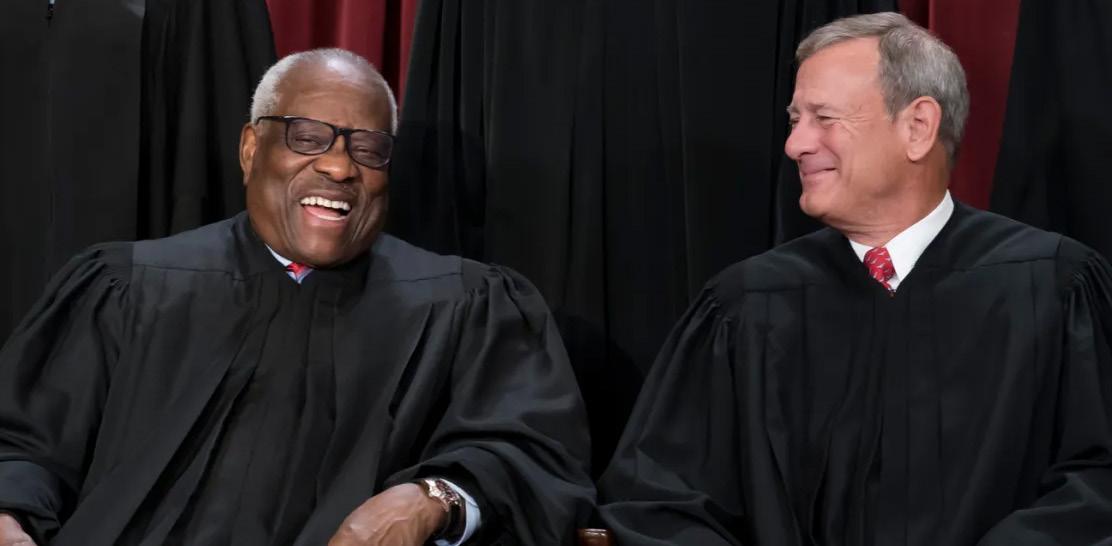
millions of Americans of their constitutional rights, one of them being African American.
I know some of my fellow citizens will take umbrage at this conclusion, but we are faced with little recourse because to expect Congress to challenge the SCOTUS decision is out of the question, with the Senate firmly under the leadership of Chair John Thune; Chuck Grassley, chair of the Judiciary Committee; and Mike Johnson at the helm of the House as Speaker. While they can legally take a stand against such devastating setbacks, they have neither the gumption nor the political will to do it. It’s hard to conceive of a
time when we will have a representative government in which there is equality and true majority rule.
Whatever Crow you choose to call it, Black Americans are in for a rough judicial ride in the foreseeable future, no matter where they reside and cast their ballots. As far as I can see, it is for the court to allow political gerrymandering, but dismissing maps that use race to provide representation blurs the line between intentionality.
Once again, African American voters are caught in the throes of jurisprudence semantics, and the end result will witness the disappearance of a raft of Black representatives.
THE ELM CITY COMMUNITIES, HOUSING AUTHORITY OF NEW HAVEN (ECC/HANH) MOVING
Section II and Section VII of the Authority's Moving to Work Agreement {the "Agreement") requires that before the Agency can file its Approved Annual Moving to Work Plan (“Plan”) and Report (“Report”)to the U.S. Department of Housing and Urban Development (the "HUD") that it must conduct a public hearing, consider comments from the public on the proposed Plan, obtain approval from the Board of Commissioners, and submit the Plan to HUD.
The thirty (30) days comment period begins on Monday, April 27, 2026, and ends on Tuesday, May 26, 2026.
Copies of the Moving to Work (MTW) FY2027 Plan, will be made available on the agency website www.elmcitycommunities.org or via Facebook www.facebook.com/ ElmCityCommunities.
You are invited to provide written comments addressed to: ECC/HANH, Moving to Work FY2027 Annual Plan Attn: Evelise Ribeiro, 360 Orange Street, New Haven, CT 06511 or via email to: eribeiro@elmcitycommunities.org.
Pursuant to said Sections II and VII, a public hearing where public comments will be accepted and recorded is scheduled for Thursday, May 21, 2026, at 4:00pm via Teams: https://teams.microsoft.com/meet/226459013024616?p=ixECplpMVkoqWitDVX
Meeting ID: 226 459 013 024 616 Passcode: 43Zv7iG7
Dial in by phone
Phone: 1-872-240-4494
Phone conference ID: 874 430 272#
Any individual requiring a Reasonable Accommodation to participate in the hearing may call the Reasonable Accommodation Manager (203) 498-8800, ext. 3170 or at the TDD Number (203) 497-8434.
The Town of East Haven seeks a qualified candidate to serve in the position of Social Services Director at the East Haven Senior Center
Interested candidates should possess a Bachelor’s degree in related field and five years progressively responsible and relevant experience including two years of experience in a supervisory position and experience working with the Connecticut Energy Assistance Program (CEAP) and State of Connecticut Rental Rebate Programs, a valid Connecticut Driver’s License. The salary for this po-sition is $$62,801/year, 35.5 hours per week and the Town offers an excellent benefit package. Please send resume with Cover Letter to: Ed Sabatino, Assistant Director of Administration & Management, Town Hall-250 Main Street, East Haven, CT 06512 or email to jobs@easthaven-ct.gov . The position is open until filled. The Town of East Haven is committed to building a work force of diverse individuals. Minorities, females, handicapped and veterans are encouraged to apply. The Town of East Haven is an equal opportunity employer.
Public Notice The Housing Authority of the City of New Britain (NBHA) is seeking bids for Landscaping Services - Spring & Fall Cleanup and As-Needed Services (Solicitation No. 2026-04-LAND).
Issue Date: April 22, 2026
Submission Deadline: May 13, 2026 at 3:00 p.m. (Local Time)
RFP and all addendas and answers will be posted at www.nbhact.org<http://www.nbhact.org/>.

The State of Connecticut, Office of Policy and Management is recruiting for a Connecticut Careers Trainee, target class Planning Analyst in the Intergov




UNION CONTRACTOR SEEKS:
Construction Equipment Mechanic
(preferably experienced in Reclaiming and Road Milling Equipment) We offer factory training on equipment we operate. Job is in Bloomfield, CT.
Contact: Tom Dunay Phone: 860-243-2300 Ext. 122 Email: tom.dunay@garrityasphalt.com
Reclaimer Operators and Milling Operators
(must have current licensing and a clean driving record; be willing to travel throughout the Northeast & NY)
Contact: Rick Tousignant Phone: 860-243-2300 Ext. 133 Email: rick.tousignant@garrityasphalt.com
Tractor Trailer Driver for Heavy & Highway
Construction Equipment
(must have a class A CDL license with Tank Endorsement and a clean driving record; be capable of operating heavy equipment and willing to travel throughout the Northeast and NY)
Contact: Brian McKee Phone: 860-558-6189
Email: bmckee@garrityasphalt.com
• We offer Excellent hourly rates and benefits.
• Women and Minority Applicants are encouraged to apply.
• Affirmative Action / Equal Opportunity Employer

Members of the public are invited to
HYBRID PUBLIC INFORMATION MEETINGS
DRAFT 2027-2030 STATEWIDE TRANSPORTATION IMPROVEMENT PROGRAM
Wednesday, June 3, 2026, at 1:00 p.m. & 7:00 p.m.
Connecticut Department of Transportation Headquarters 2800 Berlin Turnpike, Newington CT 06111
Register to Attend Virtually & Learn More: portal.ct.gov/STIP
The purpose of these meetings is to provide the community with an opportunity to learn about the Statewide Transportation Improvement Program and allow an open discussion of any views and comments concerning the program. A Q&A session will immediately follow the presentation. CTDOT staff will be available in-person 30 minutes prior to each meeting to informally discuss the draft STIP with members of the public.
The Statewide Transportation Improvement Program (STIP) compiles all highway and public transit projects that CTDOT intends to pursue over the next four years, utilizing Federal Highway Administration (FHWA) and Federal Transit Administration (FTA) funding. STIP documents can be found at portal.ct.gov/STIP, CTDOT Headquarters, and at all Councils of Government offices. It is suggested to schedule an appointment at these locations. To make an appointment at CTDOT, please call (860) 594-2040.
The draft STIP will be available for review for a 30-day public comment period from Wednesday, May 13, 2026, through Friday, June 12, 2026. Comments should be submitted to (860) 594-2020, DOT.STIPComments@ct.gov, or mailed to: ATTN: Rose Etuka, 2800 Berlin Turnpike P.O. Box 317546, Newington, CT 06131-7546 Please refer to the 2027-30 STIP in the correspondence.
Parking is available in the rear of the building. The meeting facility is ADA accessible, and persons with disabilities can access the building from the main entrance of the building.
Non-English language closed captioning will be available on Zoom. The recording will also be posted following the meeting in CTDOT’s public meeting playlist at portal.ct.gov/ctdotVPIMarchive
For limited internet access, call (877) 853-5257 with Meeting ID 862 1358 6028 for the 1:00 p.m. meeting, or Meeting ID 820 5097 2071 for the 7:00 p.m. meeting. Project information can be mailed within one week by contacting Rose Etuka at Rose.Etuka@ct.gov
For hearing/speech disabilities, dial 711 for Telecommunications Relay Services (TRS). Request language assistance from CTDOT’s Language Assistance at (860) 594-2109 at least five business days before meeting.
The South Central Regional Council of Governments (SCRCOG) seeks the services of one or more consultants for the following transportation planning studies during the 2026 and 2027 Fiscal Years (July 1, 2025June 30, 2027): Metropolitan Transportation Plan Update and Local Bridge Inspection Study. Responses are due by June 2, 2026 (12 noon local time). Selected firms will be interviewed on June 9, 2026. The full RFQ document can be viewed at the Council’s website: www.scrcog.org or can be made available upon request. Contact James Rode at (203) 4668623 with any questions.
LaRosa Earth Group LLC, a Site/Excavation Company, is currently looking to add the following full-time positions to our Team:
Please submit resumes to HR@LAROSABG.COM or stop by our main office to fill out an application: 163 Research Parkway Meriden, CT. Salary will be commensurate with experience and best fit for the positions. Health plan; 401K; company-paid holidays in addition to paid time off.
LaRosa Groups is an Affirmative Action/ Equal Opportunity Employer who values diversity and encourages all qualified applicants to apply.


20 Security Drive Avon, CT One Building, 76 Units
Project Description: Gut Rehabilitation and adaptive reuse of a former office building for use as an affordable housing community consisting of 76 units of housing as well as associated property management and amenity spaces.
Project Documents include but not limited to: sitework, paving, utilities, selective demolition, concrete, masonry, masonry restoration, structural steel, miscellaneous metals, finish carpentry, thermal & moisture protection, storefronts, doors, frames & hardware, windows, drywall, acoustical ceilings, flooring, painting, signage, louvers and vents, toilet & bath accessories, fire extinguishers, cabinets and accessories, postal specialties, miscellaneous specialties, solid waste handling equipment, residential appliances, horizontal louver blinds, kitchen and bathroom casework, roller shades. electric traction elevators, hydraulic passenger elevators, chutes, fire protection, plumbing, HVAC, electrical, communications, electronic safety and security, sanitary facilities and final cleaning. The project is being designed to Energy Star MFNC v1.2 standards.
This contract is subject to state set-aside and contract compliance requirements.
Project is Taxable. No Wage Rate Project. Anticipated start July 2026.
Bids are due to Haynes: May 1, 2026 @ 3 pm to Taylor Els tels@haynesct.com Email questions to Dave Biega dbiega@haynesct.com Phone # 203-888-8109
Please note: Subcontractors need to include all future tariff costs in bid proposals and hold pricing through 7-1-2026.
State law requires a minimum of twenty-five (25%) percent of the state-funded portion of the contract for award to subcontractors holding current certification from the Connecticut Department of Administrative Services (“DAS”) under the provisions of CONN. GEN. STAT. § 4a-60g. (25% of the work with DAS certified Small and Minority owned businesses and 25% of that work with DAS certified Minority, Women and/or Disabled owned businesses.) The contractor must demonstrate good faith effort to meet the 25% set-aside goals.
a quarry and paving contractor, has positions open for the upcoming construction season. We are seeking candidates for a variety of positions, including: Scalehouse Dispatcher/ Equipment Operators and Laborers. NO PHONE CALLS. Please mail resume and cover letter to “Hiring Manager”, Galasso Materials LLC, PO Box 1776, East Granby CT 06026.
Galasso Materials is an Affirmative Action/Equal Opportunity Employer. All applicants will be considered for employment without attention to race, color, religion, sex, orientation, gender identity, national origin, veteran or disability status.
The Town of Wallingford is accepting applications for Water Treatment Pumping Operator I. Wages: $30.35 to $36.64 hourly. For additional information and to apply online by the April 20, 2026 closing date please visit: www.wallingfordct.gov/government/departments/ human-resources/. Applications are also available at the Department of Human Resources located in Room #301 of the Town Hall, 45 South Main Street, Wallingford, CT 06492. Phone: (203) 294-2080; Fax: (203) 294-2084. EOE
Elm City Communities is currently seeking bids for Services of a firm to provide Unarmed Security Services. A complete copy of the requirement may be ob-tained from Elm City Communities’ Vendor Collaboration Portal https://newhavenhousing.cobblestonesystems.com/gateway beginning on
Wednesday, May 6, 2026, at 3:00PM.
The Glendower Group is currently seeking request for Qualifications from qualified firms for Ex-perienced Construction Managers at Risk t support the predevelopment, preconstruction of Union Square. A complete copy of the requirement may be obtained from Elm City’s Vendor Collaboration Portal https:// newhavenhousing.cobblestonesystems.com/gateway begin-ning on
Wednesday, May 6, 2026, at 3:00PM.

The State of Connecticut, Office of Policy and Management is recruiting for a Connecticut Careers Trainee, target class Planning Analyst in the Intergovernmental Policy and Planning Division. Further information regarding the duties, eligibility requirements and application instructions are available at: https://www.jobapscloud.com/CT/ sup/bulpreview.asp?b=&R1= 260427&R2=2292AR&R3=001
The State of Connecticut is an equal opportunity/affirmative action employer and strongly encourages the applications of women, minorities and persons with disabilities.

of Bristol
$78,813/yr.
Required testing, general info, and apply online: www.bristolct.gov
DEADLINE: 12-07-25

The scope of the project includes adaptive reuse of an existing vacant historic 3 level bldg., approx. 46,513 sf, for 15 affordable one- and two-bedroom artist live-work space, exhibit space and community space.
Also, New Construction of One 4-story building, approximately 50,138sf with 44 affordable residential units. Total of 59 units.
Project Documents Include but not limited to: Selective & structural demo, asbestos abatement, earthwork, concrete, gypcrete, historic masonry restoration, misc. metals, rough & finish carpentry labor & material, wood trusses, stairs, final cleaning, thermal & moisture protection, fiber cement siding, EPDM roofing, firestopping, steel doors and frames, flush wood doors, access doors & aluminum windows, skylights, door hardware, glazing, gypsum board assemblies, acoustical ceilings, tin ceilings, flooring, toilet, bath and laundry accessories, terrazzo tile, painting, wire mesh storage lockers, louvers & vents, signage, fire extinguishers/cabinets, bath accessories, postal specialties, residential appliances, facility waste compactors, residential casework & countertops, entrance floor mats, horizontal louver blinds, bicycle racks, vertical wheelchair lifts, elevators, fire suppression, HVAC, plumbing, electrical, EV charging stations, solar, radon mitigation, landscaping, final cleaning and sanitary facilities.
Haynes is the GC on this project | This is a Living Wage Rate Project - Living Wage Payroll Requirements | Project is Taxable | SHPO Standards | City of New Haven Subcontracting Requirements: New Haven Small Contractor Development – 25% Subcontractor Program Goal | City of New Haven Resident Workforce Hours = 25%, MBE Workforce Hours = 25%, WBE Workforce Hours = 6.9%, Section 3 workforce 25% of all labor hours; 5% target area; Subcontractors must meet and be approved by New Haven CEO – CHRO and CHFA monthly reporting required.
The Equal Opportunities Ordinance of the City of New Haven, Chapter 12 ½ et seq., authorizes and empowers the New Haven Commission on Equal Opportunities to remedy discrimination complaints, and actively pursue and promote affirmative action and contract compliance within the City of New Haven.
This Invitation to Bid is additional outreach for MWBE subcontractors. Anticipated start 9-1-2026. Overall Project Duration: 18 month project
Bids are due to Haynes: 5-28-2026 by 3 pm to Taylor Els – tels@haynesct.com
If you have not already received this invitation to bid and would like to bid, please email your business name, contact information and trade to Taylor Els – tels@haynesct.com Taylor will add you to Procore and send you the ITB for easy access to plans and specifications.
All questions must be submitted in written form and directed to: Jordan Fredericks jfredericks@haynesct.com 203-888-8111 Eric Facchini efacchini@haynesct.com
This contract is subject to state set-aside and contract compliance requirements. HCC an Affirmative Action/Equal Opportunity Employer, encourages the participation of all Veteran, S/W/MBE
The South Central Regional Council of Governments (SCRCOG) seeks the services of one or more consultants for the following transportation planning studies during the 2026 and 2027 Fiscal Years (July 1, 2025- June 30, 2027): Hamden Ridge Road Safety Study and On-call Technical Support Services. Responses are due by June 2, 2026 (12 noon local time). Selected firms will be interviewed on June 9, 2026. The full RFQ document can be viewed at the Council’s website: www.scrcog.org or can be made available upon request. Contact James Rode at 203-466-8623 with any questions.
Based on Aleshea Harris' acclaimed stage play, ‘Is God Is’ tells a sharp, emotional story about trauma, survival and Black women’s right to rage without apology.
by Oumou Fofana, Revolt.tv
For years, Black women in film (and in real life) have been asked to carry everything except anger. We are allowed to be nurturing, funny, resilient, wise and endlessly forgiving. We are expected to survive pain with grace, turn trauma into life lessons and somehow remain soft enough to comfort everyone else. But rage? Rage is where the room often gets uncomfortable. That is what makes Is God Is feel so necessary.
At an early screening of the suspense thriller, the first thing that landed was how fearless the film is. It does not ask permission to center Black women’s pain, fury or desire for justice. It also refuses to flatten any of those emotions into stereotypes. Instead, writer-director Aleshea Harris builds a world where rage is not shorthand for dysfunction. It is grief. It is memory. It is survival. It is what remains when people have been asked to endure too much for too long.
Based on Harris’ award-winning play of the same name, the film arrives with the energy of something already sharpened in front of live audiences. That theatrical DNA is still present onscreen. The dialogue bites. The characters feel larger than life without losing emotional truth. The story moves like folklore, revenge saga and family reckoning all at once. And at the center of it all are Black women who are done being passive in their own stories.
The film follows twin sisters Racine and Anaia, played by Kara Young and Mallori Johnson, respectively, who are pulled into a mission years in the making. Their mother, Ruby, played by Vivica A. Fox, survived horrifying violence at the hands of the girls’ father. The sisters carry those scars too, physically and emotionally. When they are called into action, the plot becomes a revenge journey. But Is God Is is not interested in revenge as an empty spectacle. It uses the framework of vengeance to explore what trauma does to identity, sisterhood and self-worth — and that distinction matters.
Too often, revenge stories featuring women are treated as a novelty. If Black women are angry onscreen, they are frequently reduced to punch lines, side characters or warnings about being “too much.” Their fury becomes something to fear rather than something to understand. Harris takes the opposite route. She asks

what created the anger in the first place. She asks what happens when violence enters a home, then lingers for years after the fire is out. She asks what it costs to chase justice once pain has shaped your entire life. Those are richer questions than just whether someone gets even. Black women deserve emotional range, not stereotypes
Hollywood has long struggled with allowing Black women emotional complexity. The “strong Black woman” trope praises endurance while quietly denying vulnerability. The “angry Black woman” stereotype punishes any visible frustration. Between the two, many Black female characters are left performing strength while being denied humanity. Is God Is breaks that trap.
Racine and Anaia respond to the same trauma in very different ways. One is hardened, sharp-edged and tired of being stepped on. The latter is more inward, more searching, more visibly tender. Neither woman is written as right or wrong, and neither is made to represent all Black women; They are individuals shaped by the same wound in separate ways. It feels honest.
Pain does not produce one personality type. Some people become guarded. Some become soft in private and steel in public. Some oscillate between both.


Some want revenge. Some want peace. Some want both at once. By allowing these sisters to hold contradictions, Harris gives Black women something still too rare onscreen: interiority.
When scars shape how the world sees us physically and emotionally
One of the most powerful undercurrents in the film is how beauty, shame and cruelty operate after violence. The twins were marked by what happened to them, and the world has treated them accordingly.
That detail expands the movie beyond revenge. It becomes a commentary on how society responds to women whose pain is visible. Black women already navigate beauty standards that often exclude us. Add scars, disability or any visible marker outside conventional desirability, and the punishment can become even harsher.
Racine’s desire to finally be the one with power is not born in a vacuum. It grows from years of ridicule and rejection. That emotional thread gives the movie weight. She is not raging just because the plot needs a tough character. She is raging because humiliation leaves residue. That nuance is what separates layered storytelling from caricature.


Another strength of Is God Is is its sense of humor. That may sound surprising given the subject matter, but the movie understands something many Black audiences know well: laughter often lives beside pain. Humor can be a survival language. It can be a relief. It can be defiance.
At the screening, the audience laughed in moments where the wit sliced through tension without undercutting the seriousness of what the sisters endured. That balancing act is difficult, and the film handles it well.
The humor makes the characters feel fuller. It also reminds viewers that trauma survivors are much more than just what happened to them. They can be funny, strange, petty, warm and wildly charismatic in the middle of carrying heavy histories. Black women especially know this rhythm. Many of us have laughed through heartbreak, joked through exhaustion and turned sharp wit into armor.
Because Harris wrote the screenplay and directed the film as an adaptation of her own play, the story carries a clear point of view. It feels authored, not assembled. That matters when dealing with Black women’s rage. Too often, stories
about our pain are filtered through outsiders who want the aesthetics of struggle without the emotional truth. They sanitize anger, overexplain it or punish it by the end. Is God Is does none of that. It lets rage exist as a human response. It does not beg the audience to approve of every action. It does not require the sisters to become saints in order to be sympathetic. It trusts viewers to sit in discomfort, and that trust is refreshing.
The movie also understands that justice and healing are not always the same thing. Even when revenge lands, it may arrive carrying sacrifice. That choice gives the ending gravity instead of fantasy. There is a larger cultural hunger for stories where Black women are centered beyond respectability politics. Audiences want characters who are messy, brilliant, wounded, funny, dangerous, loving and unresolved. They want women who are allowed the same moral complexity men have enjoyed in film for decades, and that includes vengeance narratives.
Men have long been permitted revenge arcs framed as heroic quests. Their pain becomes motivation. Their violence becomes myth. Their brooding becomes prestige. When Black women step into that territory, the reaction can be different. We are asked to justify every emotion. We are told to forgive faster. We are warned not to become what hurt us. But what if the real breakthrough is not whether these characters seek revenge? What if it is simply that they get to want something at all? What if they get to be centered, complicated and impossible to ignore?
By the end of Is God Is, viewers are left with more than a body-count thriller or a stylish revenge tale. The film lingers because it understands that violence echoes through families, identities and generations. It understands that rage can be righteous even when it is dangerous. It understands that Black women deserve stories large enough to hold both tenderness and fury. Most of all, it understands that reclaiming narrative power sometimes starts with refusing silence.
For Black women who have been told to endure gracefully, smile politely and keep the peace at any cost, that message lands hard. Is God Is does not offer easy answers. It offers something more valuable: permission to witness Black women's anger as human, layered and worthy of the screen — and that alone feels revolutionary.






















There’s been a drought on their childhood’s road and two cousins come home dry-eyed and grieving. Sade, on a three-day furlough from prison. Mina, departing a strangely idyllic west coast. As all time ticks towards the correctional officer’s arrival, these two wrestle with all they have never said, with the fallibility of memory itself, and with visions of a future they are bound to create. Winner of the prestigious 2025 Susan Smith Blackburn Prize, a.k. payne’s Furlough’s Paradise is a lyrical meditation on grief, home, kinship, and a utopia yet to be realized.