


By Abiba Biao
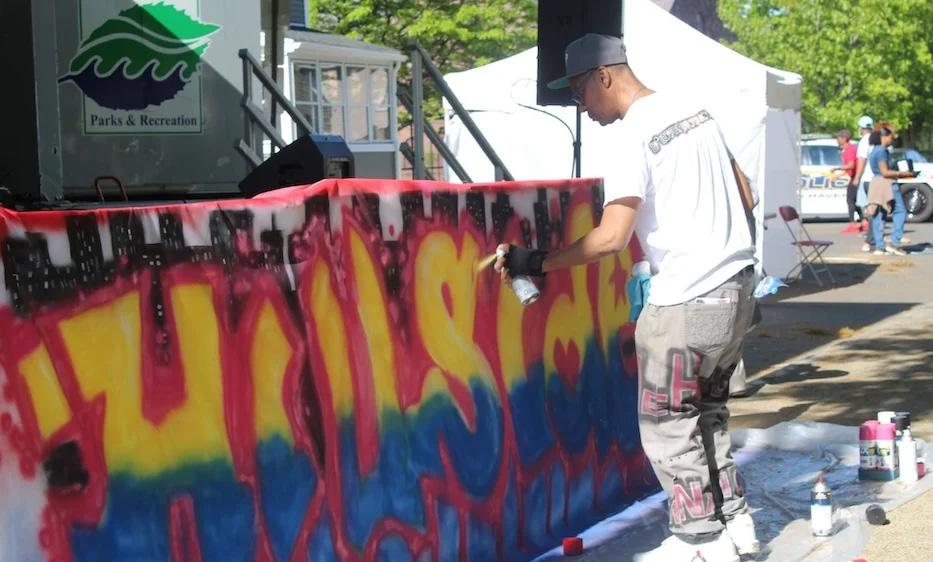
Beneath the bright afternoon sun, Edmund “B*Wak” Comfort was in the zone. He lifted a can of yellow spray paint to a long, wrapped canvas, and came alive. The bright letters stood out against the black backdrop, a reference to how the Hill shines in New Haven. This was the HILL—Home, Inclusion, Legacy, and Limitless—reimagined and beloved as it has always been.
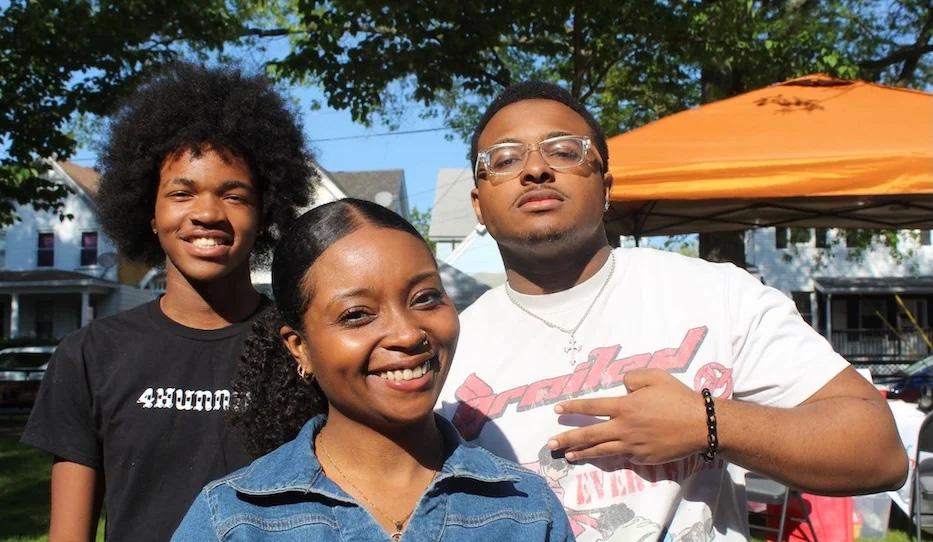
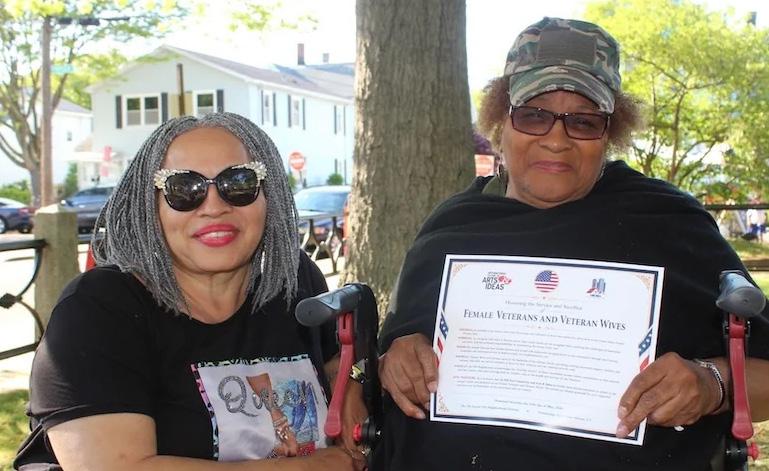
That was the scene at the 13th annual Hill Neighborhood Festival, a project of the International Festival of Arts & Ideas and a dedicated Hill neighborhood committee that is several years running. Held in Trowbridge Square Park, the celebration fêted longtime Hill champion Tomas Reyes, Jr., female veterans and the wives of veterans, and the Hill itself. Last year, the community award went to Ann Boyd, who was able to receive it before she passed away.
The event welcomed hundreds of attendees over the course of several hours, according to Arts & Ideas Managing Director Melissa Huber. It had a total of 27 resource-oriented and vendor booths, from a tent for the Livable City Initiative to small businesses like D.L.T.G. Groom Collection.
One of those vendors included Delores Byrd, owner of Breathless Boutique, a handmade jewelry business offering bracelets, necklaces, and ties. As a self proclaimed “people’s person,” Byrd said that a sense of community has brought her out to the Hill Festival for three years and counting.
“I like being around people. They can see what design[s] that I do, you know. And it’s a community thing,” she said.
The goals for her business are simple. With an e-commerce site and online presence, Byrd wants to expand her operations and have customers worldwide. She also highlighted the flexibility of being able to work for herself as a direct support counselor.
The business is a family affair, she added. Occasionally, her daughter, Johneisha Dubose, helps out with stand management and even her grandkids help out. Another passion for her business was her mom Margaret McCrea. She hopes to make a bracelet design and name it after her mother.
Working up a sweat from a lesson from the 40+ Double Dutch Club, Hill Alder Angel Hubbard said she was excited to see the festival spring to life again. As a Hill resident and elected official, Hubbard has been a fierce advocate for the fest for years, making sure to turn up for the past five years. Her favorite part is the neighborhood pride that she described as “unity in the community.”
As members of the 40+ Double Dutch Club prepared the rope, Hubbard savored a blast from the past. For a moment, she was reminded of her child-
hood, a time when playing without a care in the world and responsibilities from adulthood seemed far away.
“So that was the favorite highlight of the day, because your girl’s still got it,” she said about double dutch before bursting into laughter.
Her kids were also enjoying the festivities, from partaking in face paint to trying to register to vote (Hill stalwart Leslie Radcliffe encouraged Hubbard’s son, who is only 13, to come back when he’s ready).
“It seems like each year, it gets better and better. I'm never not surprised on what's next. So I'm already excited about next year for what's going to happen here,” she said.
Nearby, sisters Dr. Pamela Monk Kelly and Olivia Monk-Henderson sat in the shade. For both of them, the festival is an important part of evolving Monk family history, because each of them have ties to the neighborhood.
Monk Kelley is a member of the festival planning committee and co-chair of the Hill North Community Management Team. Monk-Henderson is a veteran and member of the National Veterans Council for Legal Redress (NVCLR). Founded by her brother Conley F. Monk Jr., NVCLR is a nonprofit which provides legal resources to veterans.
“I grew up here in this community. My community. I feel like I'm back at home,” Monk-Henderson said. She fondly remembered ice skating and playing basketball alongside her brothers when they were younger. Unable to attend last year’s festival due to health issues, she stated her appreciation for being able to be outside.
Indeed, that Hill pride appeared throughout the festival. By the end of the event, a colorful banner printed with the word HILLSIDE stood strong beneath the main performance stage.
Comfort, who went through a double amputation in 2023, said that the banner was a part of the recovery process. While canvas is not normally his medium of choice—he prefers to work on the walls of buildings, bridges and underpasses, as he has many times over—he spent the day soaking in both the sunshine and the chance to create.
“I actually didn't have an idea until I got here and I actually put a [can of] spray paint in my hand,” he said.
“I mean, at that point, you know, being a real graffiti artist, I knew I could do anything I wanted to. It was just a matter of, ‘What did I want to do?’ And I wanted to do something that I could make a statement with.”
Even as he played with ideas, he said, he knew that he wanted to pay homage to hip-hop culture and the Hill’s musical roots, which include members of the Monk family and a rich history of both Black music making (including in

houses of worship) and more recently, bomba, plena, and salsa, with a growing Puerto Rican community (FLECHAS, the (Fiestas de Loíza en Connecticut en Honor al Apostol Santiago, got its start off Kimberly Avenue).
“I'm always going to say, get a talent, exercise your talent early because it’ll pay off in the end,” he said. As he worked, he said that the five elements of hip hop are a major influence behind his artistic practice and creativity. The five elements include graffiti, rap, dance, DJs and MCs. “I’m always encouraging people.”
He added that he plans to launch a podcast about hip hop culture called “P.E.A.C.E” later this year. The title is an acronym for “Positive Education Always Creates Elevation.” He’s already recorded two episodes, and plans to make them live on YouTube once he’s finished five.
Closing out the fest were performers from the Majorette & Dance Factory, a nonprofit dance and performance program based in Woodbridge. While director Johnny Johnson had only learned about the Hill fest earlier that week, dancers clad in sparkly fuchsia suits wowed the crowd with a jazz number set to Teedra Moses’ “Be Your Girl (KAYTRANADA Remix).”
He added that the event was a great way to show off the students’ versatility, saying that some people believe they're only trained in majorette because of the name of the group. Despite the organization's name, students train in a variety of sections such as ballet, tap acro, majorette, modern, and lyrical dance.
“I wanted to give the girls the opportunity to perform within the communities,” he said. “So because we are majorette based, I feel like we get the stereotype that we only do majorette. So I thought this was a good opportunity to showcase that the girls are training in different elements.”
As the group heads into its sixth year, it shows no signs of slowing down. To the contrary, dancers will be having their first showcase of the year on June 14 at The Lab at ConCORP. For Johnson, who learned firsthand that dance could be transformative but struggled with the cost of lessons, it’s about making it accessible to all students who want to learn.
He hopes to pass on his love for the performing arts to the next generation, he added. It’s why he was so excited to see Teriah Brookshire, an alumna of the program who went on to earn her BFA in dance from Alabama State University,come back to the program as an assistant director.
“[We should] continue to support the arts as much as we can. Arts are very important,” he said. “It's a outlet. It was a outlet for me.”
by Allan Appel
William Wood and George Creamer Sr. both earnestly want the cops to please keep working to reduce the blaringly loud noise from racing motorcycles and ATVs that keep elderly folks from sleeping well. However, they said, when officers pull into the parking lot below their windows to write reports, and they sees the cruisers’ flickering red-and-blue safety lights nearby, that’s good, that’s reassuring. Those were some snippets of the productive schmoozing that emerged Thursday afternoon at Chatham Place, Mary Wade’s senior living complex at 138 Clinton Ave. in Fair Haven.
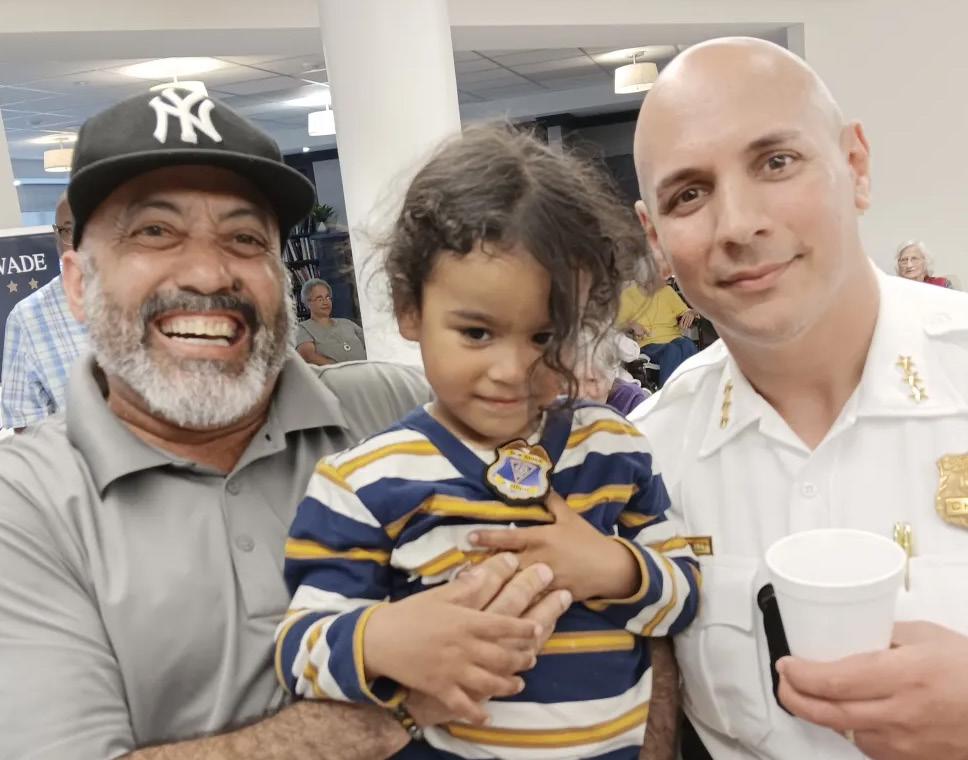
That’s where Police Chief David Zannelli, Asst. Chiefs Manmeet Bhagtana and Bertram Etienne, several of the new district managers, and a host of patrol officers all gathered to hang out with residents and neighbors for this year’s inaugural “Coffee With A Cop” event.
Much better to meet an officer over coffee than at a crime scene, was how Zannelli described what will be the first of many such gatherings — social activities that advance community policing — throughout the year.
When he was district manager of Fair Haven in 2017-2018, Zannelli initiated the effort meeting the community at various locations, once at the Dunkin’ Donuts in the plaza at Ferry Street and Grand Avenue among other locations.
The community management team, which supported the effort, even came up with free coffee mugs to induce community members to drop by.
And at the festive and very social Chatham Place event on Thursday, Zannelli remembered what was written on the coffee mugs in question: “Good to the last
cop.”
If you have one of those around, it very well may be a collector’s item. “We want to revitalize those efforts,” Zannelli said, with the additional specific purpose of introducing himself — he was sworn in as chief on May 5 — and the four new district managers, to the community.
They include Sgt. Jon Lambe, who helms Dwight neighborhood policing; Lt. Ed Dunford in Beaver Hills; Lt. Rosa Melendez in the Hill; and Lt. Justin Cole in Fair Haven.
While community policing has long been the policy in New Haven and coffees with a cop at various venues across the city a regular feature, Chief Zannelli has over the years become one of its most ardent advocates and his district managers,
he said, are very much in sync and are all planning similar events in their corners of town in the months ahead.
The next will be at the Towers on May 29 from 10:30 a.m. to 12:30 p.m., to be organized by the Hill’s new district manager, Lt. Melendez.
On Thursday Melendez said she was picking up pointers about how to host her event but mainly socializing with residents of Chatham Place like Lora Lum, listening to their stories and perspectives. These first two events just happen to be at senior living complexes, said Zannelli, both because older people don’t have as easy a time getting out and also because they offered to host.
But the “Coffee with a Cop” program is for everyone, he said. “With the nicer weather coming, it can be at a school, a
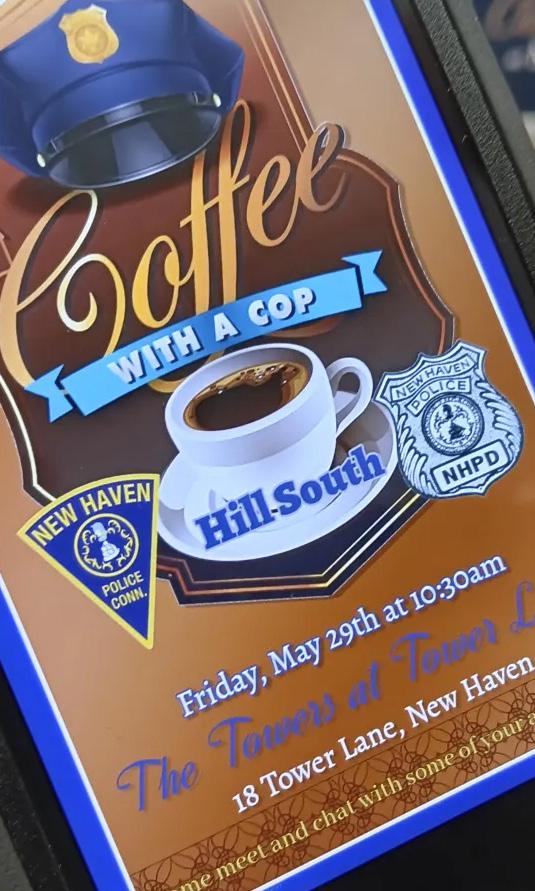
community center, wherever we can get a good group like this one.”
That group on Thursday included not only the residents and staff at Chatham Place but community leaders current and former like Ernie Santiago, who served six terms as alder for Fair Haven’s Ward 15. He dropped by with his four-year-old great-nephew Jadiel, who also scored a NHPD officer’s pin.
Parts of the gathering even had the feeling of reunion. David Hunter, the longtime president and CEO of Mary Wade Home, embraced Zannelli and told a tale of the kind of policing that emerges when people know each other.
In 2017, Hunter recalled, after a man had been violently assaulted with a weapon on Grand Avenue — the assailant was caught, but the victim was traumatized —
he received a call from Zannelli. He told me, Hunter said, he believed the man was our neighbor and could we look in on him because he was really shaken up.
It wasn’t just formally connecting him (the victim) to wraparound services, said Zannelli, which they did. “But he was a wreck,” Zannelli said, and he thought it best to alert neighbors like Hunter to look in on him.
Meanwhile, over on the other side of the bright lobby of the Chatham Place residence, a member of the fire department was playing some Gershwin on the piano while Creamer was talking to Lt. Cole about the portable scanner he has in his room.
“I have the fire department frequency,” said Creamer, who had served for many years as a volunteer fireman in North Haven. He wondered if Cole might help him get the NHPD frequency so he could listen in on those calls too.
Cole said he didn’t think the community policing idea included that service but he made a point of thanking Creamer for his service as a volunteer fireman.
Zannelli appeared pleased with the turnout and the talk.
“It should be more of a norm that they see us as dropping by and not only when something’s wrong.”
For info on the next event in the program, see below.
And you don’t have to live in the neighborhood where an event is taking place to attend; any resident is welcome. By press time there was no word whether complimentary coffee mugs would be available this year, or what might be written on them.
you can find here, are open through June 30. The Bitsie Clark Fund for Artists
The Bitsie Clark Fund for Artists, dedicated to enriching arts and culture in Greater New Haven, is excited to announce applications for its 2026 grant cycle. This year, members of the fund’s jury have designated one grant for an artist of color while the second remains open to all artists.
This marks the first year that the fund is managed by the Arts Council of Greater New Haven, the non-profit where Clark served as executive director for 20 years. Prior to that time, an advisory committee including Mimsie Coleman, Kim Futrell, Robin Golden, Stacy Graham-Hunt, Betty Monz and Maryann Ott steered the fund. "Being the facilitating organization for the Bitsie Clark Fund for Artists is a full-circle moment of legacy, as we keep Bitsie's name alive," said Rebekah Moore, program director for the Arts Council. "To be honored with this responsibility isn't
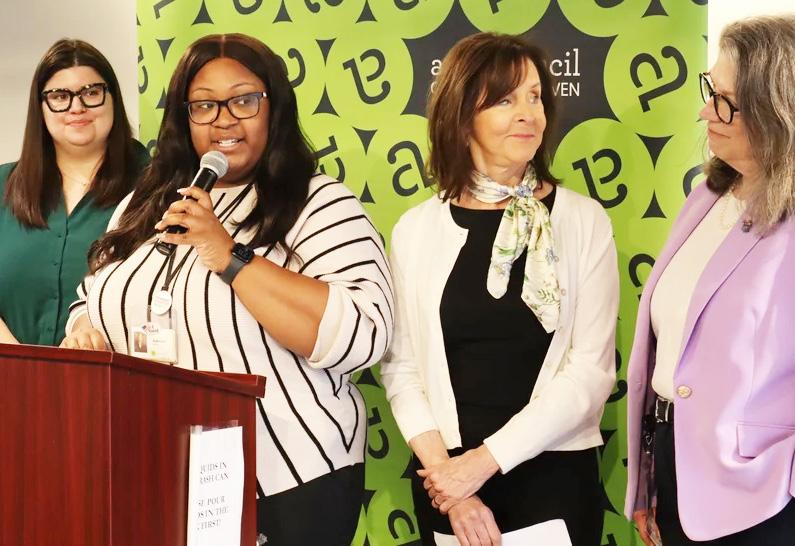
taken lightly. We as a staff know that this grant uplifts our arts community, and is a
reminder that legacy allows you to touch lives well after you're gone."
Both grants are open to artists from all artistic disciplines who seek to either tackle a major goal in their artistic development, take a risk on a new direction in their work or advance their career as an artist.
These may include, but are not limited to, dance, music, theater, visual art, design, craft, literary, voice, poetry, playwriting, composition, and film.
Previous awardees have included poet and playwright Aaron Jafferis, musician and composer Adam Matlock, puppeteer Isaac Bloodworth, photographer Alexandra Diaz, playwright Steve Driffin, composer and bassoonist Damali Willingham, sculptor Linda Mickens, self-taught painter Marquis Brantley and vocalist Thabisa Rich among others ("We have come full-circle," said Coleman of the fund's move to the Arts Council. "Bitsie Clark has come home."
The Bitsie Fund was founded in 2018 in honor of Frances "Bitsie" Clark, the
Executive Director of the Arts Council of Greater New Haven for 20 years, who helped launch the Audubon Arts District and helped establish the arts as a driving economic force in Greater New Haven. The mission of the fund is to continue Bitsie's commitment to artists in the region. The Fund offers grants for individual artists, allowing them to pursue a significant goal at a turning point in their development.
Read more about Clark's extraordinary life and work here and about her memorial service here.
Full guidelines for the 2026 grant, including all the information artists need to apply, are available here. Applications are open from May 21, 2026 to 11:59 p.m. on June 30, 2026. The Bitsie Fund is a donor-advised fund housed at the Community Foundation for Greater New Haven (CFGNHV). The artist must live in one of the towns served by the CFGNHV.
By Lisa Backus, Staff WriterUpdated
WALLINGFORD — After two days of calls for transparency by the Connecticut NAACP State Conference, Friday Connecticut State Police issued details on their search for a 17-year-old from Wallingford who died after fleeing from a crash in February.
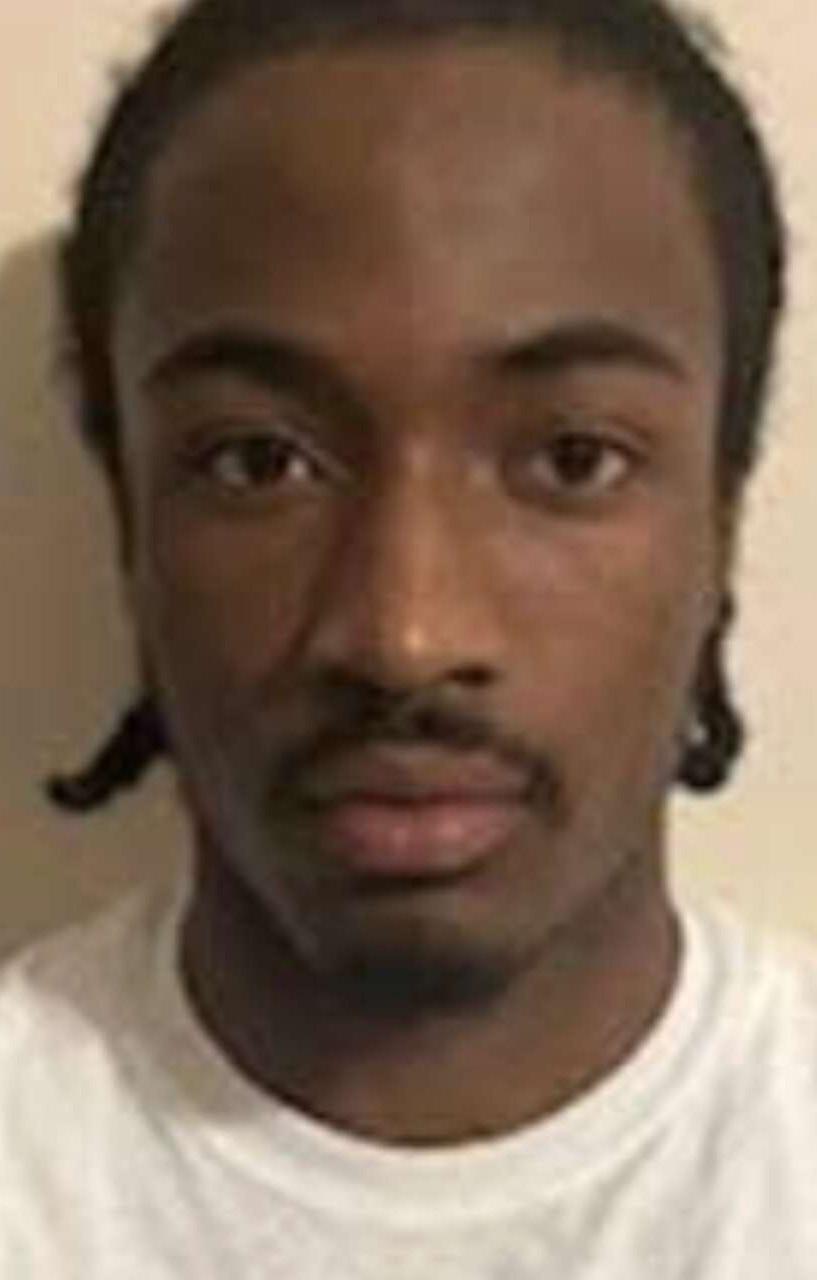
State and local NAACP officials announced Thursday they are investigating the death of 17-year-old Khasir Jennette, whose body was found 20 days after he fled the scene of a car crash in Wallingford, prompting a several day state police search in February that failed to find him alive.
The organization called for details after members on the state and local level learned about the boy's death through the press and discovered that no police agency had notified the public when his body was found nearly three weeks after he disappeared in frigid temperatures on the night of Feb. 1.
State police said in a lengthy statement issued Friday that the agency routinely doesn't send out information "following unattended death investigations." "Furthermore, press releases are not issued for juvenile deaths as a standard communications protocol," the release said. "We, at the Connecticut State Police, respect the protections guarded for the identities of juveniles involved in our investigations."
However, records show state police routinely release the names of children who died in car accidents and release information on human remains that have been found. Most recently state police posted on May 13 the name of a child who died in a crash in Stratford two days before.
President Scot X. Esdaile of the Connecticut NAACP State Conference and Corrie Betts, the state criminal justice chair for the NAACP, contended during a press conference in front of the Wallingford Police Department Friday morning that if the missing teen were a "white girl from West Hartford" that the public would have been notified of the search and of their death.
"A Black child is deceased and the community still does not have clear answers," said Betts, who went on to add that when a child of color is in crisis, missing, in harm's way or deceased that it's handled differently.
Betts said Jennette should have had the "same mobilization that any child deserves."
Records show state police routinely release the names of children who died in car accidents and release information on human remains that have been found.
The two men announced the investigation after reading a CT Insider article published this week that indicated the 17-year-old had died of hypothermia as North Haven police were investigating a car theft ring connected to the crash.
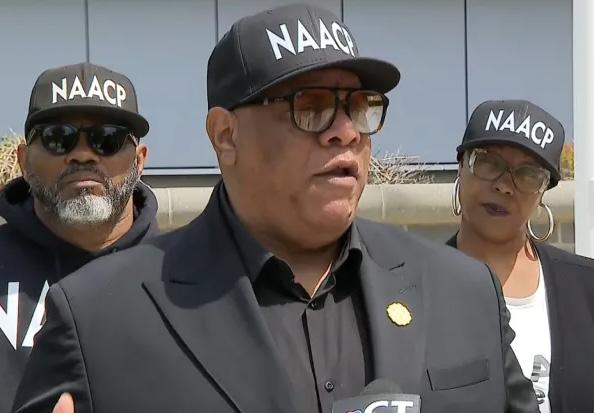
"We want the truth about what's going on with this young Black male found 20 days after a search," Esdaile said Thursday. "It happened in February and we didn't hear about his death until nearly the end of May. We want answers on who found this body, where he was found and where he was taken. If a dead body was found in Wallingford, what is the protocol and the policy including on the public being notified?"
Esdaile, Betts and the public found out about Jennette's death after an article regarding a car theft ring arrest Wednesday. No news release was sent out by Wallingford police (who responded to a report of a dead body), North Haven police (who were investigating a car theft ring connected to the teen), or Connecticut State Police (who responded to the crash and when Jennette's body was found on Feb. 20). The teen fled from the crash and into the woods in Wallingford on Feb. 1, an arrest warrant related to the car theft ring said.
The fact that no police agency issued a news release when Jennette's body was found in late February is what has the NAACP concerned, Esdaile said.
The arrest warrant charging 20-year-old Khalil Council, a Hamden resident, with an armed carjacking in North Haven detailed the chain of events that led North Haven police to a group of suspects and the crash on Feb.1. Buried within the warrant were details on how the Acura that Jennette and one or two others were riding in after allegedly participating in a carjacking crashed on Route 15 and that the 17-year-old's body was found three weeks later.
There was six to 12 inches of snow on
the ground and the temperature in the overnight hours was "approximately -3 degrees," the night of the crash, state police said in the statement issued Friday.
Their agency became involved while investigating a three-car crash on Route 15 in Wallingford, state police said. The people in the Acura, which was later determined to be stolen out of Hamden, fled on foot, the agency said, prompting a search of the area.
But the situation didn't ramp up to a full scale operation until Jennette's mother reported he was out in the woods with his friends "freezing" at about 1:34 p.m., state police said.
At that point state police called for more resources to find the 17-year-old

John P. Thomas Publisher / CEO
Babz Rawls Ivy Editor-in-Chief Liaison, Corporate Affairs Babz@penfieldcomm.com
Advertising/Sales
Keith Jackson Delores Alleyne John Thomas, III
Editorial Team
Staff Writers
Christian Lewis/Current Affairs
Anthony Scott/Sports Arlene Davis-Rudd/Politics
David Asbery / Tanisha Asbery
Jerry Craft / Cartoons / Barbara Fair
Dr. Tamiko Jackson-McArthur
including a helicopter and police K9s, the statement said. "Tracks were conducted that lead through extreme conditions including frozen waterways, embankments, wooden unlighted terrain, brush, sticks - prickers, and into the Amazon property campus locations with huge solar farms," according to the statement.
Areas searched included the Quinnipiac riverbanks, South Cherry Street, the on and off ramps of exit 68 on Route 5, and the Amazon warehouse campus in Wallingford, state police said.
When they confirmed his name and that was likely missing in the wooded area, state police said they set up at command post and called in for additional help including a helicopter, a drone, K9 units, "all available Troop I personnel," troopers from Troop G and H, a major crimes unit, an intelligence unit to aid in the search.
Several Wallingford officers and firefighters using a thermal imaging camera and a drone were also involved in the search, according to reports issued by that agency.
The search lasted about two days, state police said. According to the arrest warrant in the North Haven case, state police were still interviewing people about Jennette's possible whereabouts four days after the crash.
"We are saddened by the death of Khasir Jennette that occurred in spite of the dozens of police, fire and EMS personnel that worked this case in the hours and days following the motor vehicle collision on Sunday, February 1, 2026, in an effort to find Khasir," state police said in the statement.
Michelle Turner / Smita Shrestha William Spivey / Kam Williams Rev. Samuel T. Ross-Lee
Christine Stuart www.CTNewsJunkie.com
Paul Bass www.newhavenindependent.org
National Association of Black Journalist
National Newspapers Publishers Association
Greater New Haven Chamber of Commerce
Greater New Haven Business & Professional
Greater New England Minority Supplier Development Council, Inc.
The Inner-City Newspaper is published weekly by Penfield Communications, Inc. from offices located at 50 Fitch Street, 2nd Floor, New Haven, CT 06515. 203-3870354 phone; 203-387-2684 fax. Subscriptions:$260 per year (does not include sales tax for the in State subscriptions). Send name, address, zip code with payment. Postmaster, send address changes to 50 Fitch Street, New Haven, CT 06515. Display ad deadline Friday prior to insertion date at 5:00pm Advertisers are responsible for checking ads for error in publication. Penfield Communications, Inc d.b.a., “The Inner-City Newspaper” , shall not be liable for failure to publish an ad or for typographical errors or errors in publication, except to the extent of the cost of the space in which actual error appeared in the first insertion. The Publisher reserves the right to refuse advertising for any reason and to alter advertising copy or graphics deemed unacceptable for publication. The entire contents of The Inner-City Newspaper are copyright 2012, Penfield Communications, Inc. and no portion may be reproduced by any means without the written permission of the publisher.



By Lucy Gellman
When Husha Hakimi walked into her first Arabic class at Wilbur Cross High School, she didn’t know what to expect. Back then, she was still a newcomer to the country, more comfortable in Farsi than she was in any other language. She still missed her native Kabul, the place that had made her a self-described “city girl.” Cross, with its different academies and hundreds of students, felt huge.
Then she remembered that a new language meant more friends, easier peerto-peer conversations, and the ability to step in and translate if a classmate needed help. Suddenly, it didn’t seem so overwhelming at all.
Last Thursday, Hakimi joined hundreds of classmates at Cross’ sixth annual Arabic Festival, a tradition that has continued to grow with the district’s commitment to teaching the language. Organized by educators Hanan Elkamah and Carla Hazzam, the event is designed to share Arabic language, food, culture and history, with the hope of building empathy and dispelling misinformation amongst students. It received support, as it has in years past, from both Qatar Foundation International and the Cross PTA.
“We’re not trying to change or judge one another,” said Elkamah, who came to the U.S. from Egypt three decades ago this year, and has taught Arabic at Cross, where she now leads the World Language Department, since 2018. Thursday, she had dressed carefully in a long black thobe with vibrant, embroidered Palestinian tatreez that seemed to glow in red and white stitches from the thick fabric. “We’re learning about peace through culture.”
“Our differences make us beautiful,” added Hazzam, who came to Connecticut after fleeing war in Lebanon 21 years ago, and joined Cross’ faculty in 2023. “We want people to understand that language is not a religion,” but a vibrant way to learn about other countries.
Currently, Cross has 130 students enrolled in Arabic, including a number of native Spanish, Pashto, Farsi and Dari speakers who felt inspired to pick up a second (or a third) language, and often came with questions about travel to some of the 22 countries that comprise the Arab world. Hazzam, who is Christian, said that she works to teach students that there is as much racial, economic and religious diversity in that part of the world as there is at Wilbur Cross.
As teachers and students put the finishing touches on the gym—craft tables with henna, language-matching games with prizes, and banners decorated with high, medieval red brick arches and the great pyramids of Giza—music flowed through the space, setting the tone. Danbury-based dancer Delores Matzen, who performs as Ms. Riskallah Riyad collected her thoughts as dancers changed into their costumes for the festival.
Close to the gym’s heavy double doors, volunteers laid out trays of pita bread, hummus, shawarma, and fragrant rice,
all courtesy of Chap’s Grille downtown. Elkamah’s husband, Khalil Elsankary, owns the space—and has helped several New Haven Public Schools students work on their Arabic as a volunteer with the district.
Sophomore Alaa Alagami buzzed through the room, taking pictures and video that could appear on Cross’ social media. A refugee from Syria, from which he and his family arrived three years ago, Alagami said that he was grateful for a chance to share his culture with the school.
In the last few years, he’s learned that his peers know very little about Syria— and if they know anything at all, they know only years of civil war and the calculating cruelty of Bashar-al-Assad.
But Syria has lived many lives, including centuries of vibrant literature, sacred and secular poetry, an outpouring of culinary artistry, and art and architecture that contain thousands of years of history. He takes Arabic so he can hold closely to that past, and his family's present.
“We learn Arabic so we don’t forget home,” he said as Elkamah translated. “The home language.”
Across the room, sophomores Matteo Perez and Abdiel Soto invited their classmates to play a language-themed game of Connect 4, the candy-colored discs printed with neat, Arabic letters in white script. As native Spanish speakers—both are Puerto Rican, with family between the island and New Haven— they chose to take Arabic for the challenge of learning a third language.
“It’s not as hard as I thought it would be,” Perez said as he welcomed sophomore Jeremiah Thames to the table. “And it’s cool to learn a new language!”

“I’m making new friends,” Soto added. He sidled up to James as he sounded out the letters that make sh, dh, and final h sounds.
At a henna station one table over, sophomore L.J. (she asked that her name and photo not appear) praised Hazzan, noting how at ease she makes students feel in her classroom. A few years ago, she came to the U.S. from Afghanistan, fleeing increasing violence that had gripped the country. After working to learn English— her first language is Pashto—she picked up Arabic as a way to communicate with more of her peers. Thursday, that included peers who did
that need to be had.”
Around Thomas, conversation rose and fell as other school groups entered the room, many soaking in the number of activities waiting for them. Currently, eight schools in the district—Cross, Metropolitan Business Academy, Engineering and Science University Magnet School (ESUMS), Hill Regional Career High School, Benjamin Jepson Interdistrict Magnet School, Family Academy of Multilingual Learning (FAME), King-Robinson Interdistrict Magnet School, and Roberto Clemente Leadership Academy—offer Arabic.
FAME teacher Soha Osman, who grew up in Egypt and now teaches Arabic in the district (she also teaches French at Aux Trois Pommes, a private language school on State Street), said she was thrilled to see students buzzing from table to table, learning new information at each station. For years, she’s watched the festival grow, with new activities knitted in throughout the day. Thursday, she walked around the gymnasium with her eighth graders, beaming for much of the morning.
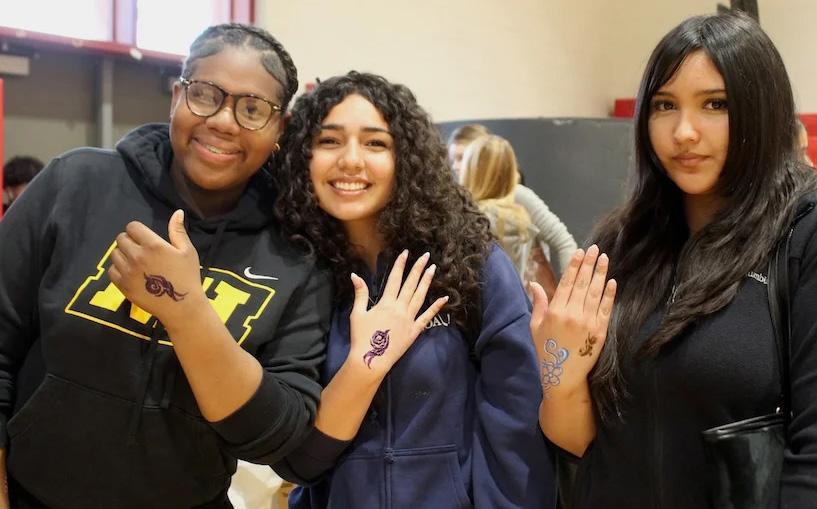
There was plenty of reason to: students chatted animatedly in Arabic, sampled trays of food that seemed to magically never run empty, and left with henna designs that bloomed across their arms and hands, some as bright as the sun. They stood wide-eyed as dancers from Connecticut Dance Oasis took the floor, bodies constantly in motion. When a drummer invited them to step closer, many did, doing a call-and-response on his command.
Back across the room, students Fardin Ali, Shawkat Fariqi, and brother Rahmat Faqiri invited their peers to spin a multicolored wheel, on which color-coded segments each showed off a different word in Arabic, with the phonetic pronunciation above the Arabic letters. Below, students had reproduced the same group of words in English, urging their classmates to match the two.
Some, like sukar and kimia, the Arabic words for “sugar” and “chemistry,” showed how much two languages can have in common. Others, like Aoud, which translates to “wood” or “stick,” took longer to ponder. As fellow students gave it a spin, Ali and the Faqiri brothers cheered each of them on.
not even speak Arabic, but were excited to learn more about the Arab world’s culture and customs. A little after 11 a.m., Spanish language student Emery Thomas, who is a sophomore, stopped by the henna table to see what the art form was all about. She ultimately left with a new understanding of both the dye—here, squeezed out from tubes like paint—and its use for rituals like weddings, holidays, and celebrations.
“It's good!” Thomas said of the festival, echoing Elkamah’s belief that such events can help break through harmful cultural misconceptions. “I think these kinds of events open up room for conversations
“It’s a really supportive community, people try to help you,” Ali said. Growing up in Afghanistan, he never imagined that he would finish high school in New Haven. Now, with English, Pashto, and Arabic under his belt, he feels more confident talking to his classmates.
He added that events like the festival are important in letting Cross’ student body—and young people across the district more broadly—learn firsthand that the Arab world and its people represent much more than war and violence. Often, he finds himself correcting misconceptions that classmates pick up from social media.
“It’s not what they see in the media,” he said. “When they learn about it, their minds maybe change.”




or the website.
by Thomas Breen
State Rep. Pat Dillon and Morris Cove
Alder Leland Moore won the local Democratic Party’s endorsement Thursday evening for their respective state-house campaigns — teeing up two potential primaries in August, as challengers Eli Sabin, Justin Farmer, and Wildaliz Bermudez pledged to petition their ways onto the ballot.
That was the outcome of Thursday’s New Haven Democratic Town Committee (DTC) meeting at the Betsy Ross Parish House on Kimberly Avenue.
Dozens of local Democratic Party insiders from across the city gathered to cast endorsement votes for probate judge and for state representative candidates for the five districts located entirely within the city of New Haven — the 92nd, 93rd, 95th, 96th, and 97th districts.
Only two of those races — for the westside 92nd district and the east-side 97th district — were contested.
Ultimately, Dillon, a 21-term incumbent, beat Sabin, a former downtown alder, 7-3 to secure the endorsement for the 92nd district seat. That district covers parts of Amity, Westville, Edgewood, Dwight, West River, and the Hill.
Moore, an assistant state attorney general who is four-and-a-half months into his first term as Ward 18 alder, beat Bermudez, the executive director of the city’s Fair Rent Commission, 5-2 for the 97th district endorsement. That district covers parts of Fair Haven, Fair Haven Heights, Quinnipiac Meadows, the Annex, and
“We work together well as a team,” Dillon said with gratitude in her acceptance speech. “Thank you for putting your trust in me.”
Moore, reading from a written statement, praised the power of unions in promoting good-paying jobs and for helping workers build the middle class.
“I look forward to working with UNITE HERE and labor on bold solutions that move working people forward,” he said, while also promising to use his “experience and training to zealously advocate for a more affordable New Haven and the needs of the people of the 97th district.”
Thursday’s endorsements mean that both Dillon and Moore have secured spots on the Aug. 11 Democratic primary ballot.
Sabin, Farmer, and Bermudez each said on Thursday that they plan to petition their ways onto the primary ballot. That means each needs to collect signatures from 5 percent of registered Democrats in their respective state house districts — which translates to roughly 407 in the 92nd district and 300 in the 97th district — by June 9.
“I See Her Heart”
The room was abuzz at around 6 p.m.
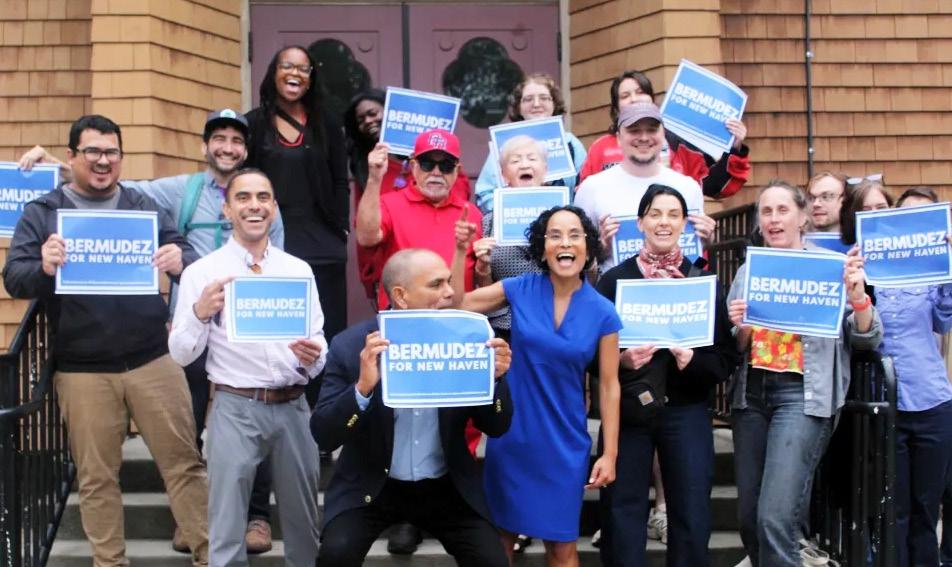
with some attendees holding “Dillon” campaign signs and others holding signs for “Bermudez.”
“Alright folks, let’s get started,” DTC Chair Vinnie Mauro said as he interrupted the chatter and detailed the schedule for the night.
First up were all of the uncontested races. Incumbent Probate Court Judge Americo Carchia won the Democratic endorsement for another four-year term in the role, while incumbent State Reps. Toni Walker (93rd district), Juan Candelaria (95th district), and Roland Lemar (96th district) all secured party endorsements for new two-year terms in their statehouse seats. Since none of those candidates face Democratic challengers, they now advance to the November general election as their party’s nominees. Next up, for the 92nd district race, West River Democratic Ward Co-Chair Tyisha Walker Myers nominated and Edgewood Democratic Ward Co-Chair Randall Furlow seconded the nomination of Pat Dillon for her bid for a 22nd two-year term in office.
“I see her heart,” Walker-Myers said about Dillon. “I think it’s really important that it’s not just about getting into politics to get into politics. It’s about helping people.”
Walker-Myers — who is also a West River alder and the president of the Board of Alders — said that every time she’s called Dillon, in a personal or profes-
Con’t reading at wwwtheinnercity news
By Eric Bedner, Staff WriterMay
FAIRFIELD — Fairfield police are projecting fines from speed cameras in school zones will accumulate to $3.2 million in June, the first month tickets will be issued using data collected from the town’s cameras.
Sixteen cameras in eight school zones went online at the beginning of May, but motorists are only getting warnings before tickets start on June 1 when $50 fines for a first violation and $75 fines for each subsequent violation go into effect.
Police officials recently provided an update on the speed camera program to local leaders during a Board of Selectmen meeting.
Deputy Chief Edward Weihe said there had been a total of about 114,000 speeding violations in the first 17 days of May and the monthly projection was about 190,000.
Citing a model provided by the town’s speed camera vendor — Maryland-based Altumint — Weihe said police expect about 31,000 violations in the first week of June and about 13,000 in each subsequent week as motorists become more aware of the program.
That would result in roughly $3.5 million in fines, but — with about a 10% re-

jection rate if data cannot be confirmed — the total amount of fines expected in June is about $3.2 million, he said.
Following the same depreciation model, the number of violations are expected to drop between 10% and 20% for the rest of the year, but fines will still “probably be higher than $2 million” a month next
year as well, Weihe said.
Police Chief Michael Paris said none of the revenue goes to the police department, but is rather statutorily required to be used for roadway safety infrastructure, adding the technology is being used nationwide.
“We don’t want to tax people for the sake of taxing people,” Paris said. “It’s truly to
slow people down in these areas where we think are the most vulnerable, and that’s our school children. I would hate to have a child hit in an area and we didn’t try to do something to prevent that.”
Selectwoman Brenda Kupchick requested signs be more visible, but Paris noted road signs must comply with state and federal regulations, and the town would be liable if it doesn’t follow regulations.
Kupchick said Greenwich First Selectman Fred Camillo had received “threats” from residents who were upset about speed cameras there, and warned Fairfield officials the same could happen in their own town if the public is not fully aware their speed is being tracked.
“I think it’s great that we’re trying to slow people down in our town,” Kupchick said, but “I don’t think we want to piss off our residents.”
Kupchick reiterated her support for the program, noting she voted in favor of it, but doesn’t want the cameras to be perceived as a “money grab.”
“You’re going to have a lot of very upset residents who just got whacked, or are about to get really whacked, with their taxes on the (revaluation),” she said.
“Yes, we want people to slow down, but we also want to be considerate to
our community and let them know that there’s a camera here and you’re going to get a pretty big ticket.”
Paris said as June approaches, the police department will continue to put out as much information as it can to ensure residents are aware of the cameras.
The cameras will be operational 24 hours a day, seven days a week regardless of whether school is in session, according to the police department’s website. While the speed limit is reduced to 20 mile per hour during school hours, enforcement will continue on off hours based on the normal posted speed limit, according to the website.
First Selectwoman Christine Vitale said local officials have been discussing the speed camera program for more than a year, and it was supposed to go live in October, hinting that residents should be fully aware of the program.
Regardless, officials can examine options to improve the program once it is fully operational, she said.
“Let’s see what happens June 1,” Vitale said.
For more information, visit the Fairfield Police Department’s website dedicated to the town’s speed camera program.
By Rev. Dr. Leon Bailey Jr.
“Faith Matters” is a column that features pieces written by local religious figures.
Our world is strained by division and uncertainty. It’s refreshing to pause and consider something that speaks to all of us; not as partisans, not as members of any group, but simply as human beings. This reflection is from the Gospel of John 7:37–38. It is an invitation that reaches beyond any single faith tradition. It asks us to imagine living waters: a symbol of renewal, compassion, and shared humanity, flowing through every person, regardless of belief, background, or political identity.
In times like these, when headlines pull us apart and loyalties harden, there is value in exploring ideas that remind us of what we hold in common. Consider this image of living waters in a way of seeing ourselves and one another that transcends the usual lines we draw.
In the Gospel of John, Jesus speaks words that echo across centuries:
“Let anyone who is thirsty come and drink… and out of the believer’s heart shall flow rivers of living water.”
This image is powerful enough to rise above religious boundaries. Whether one approaches it from a Christian background, another faith tradition, or no tradition at all, the metaphor of living waters speaks to something deeply human: the universal longing for renewal, compassion, and connection. Living waters are not stagnant. They move, refresh, and enliven. They carve new paths and sustain life wherever they flow. When we imagine such waters flowing through every person, we see humanity not as divided, but as a shared community nourished by the same source. In this sense, living waters symbolizes the vitality within all of us: our capacity for empathy, generosity, courage, and understanding. These qualities are not of any one religion. They are not limited to believers or withheld from nonbelievers. They are not reserved for one race, one nation, or one political identity. Living waters, understood as the life force that animates compassion and justice, belong to everyone. They remind us that beneath our differences we share the same thirst for dignity, belonging, and peace.
We live in times of turmoil: global conflict, social fragmentation, economic strain, and political polarization. Regardless of our affiliations, we feel the weight of these pressures. They touch our neighborhoods, workplaces, and families. They shape our conversations and sometimes strain our relationships. These challenges do not discriminate, and they reveal something important: when the flow of living waters is ob-
structed, all of us feel the drought. The obstructions are familiar: fear, suspicion, prejudice, the belief that “my group” is more deserving than “their group.” These barriers constrict the flow of the very qualities that sustain communal life. When compassion dries up, resentment grows. When understanding is blocked, conflict intensifies. When hope is dammed, despair spreads.
There is hope in living waters. Whenever we choose empathy over hostility, they move. Whenever we listen instead of dismissing, they deepen. Whenever we extend kindness to someone who differs from us, they widen. Whenever we recognize the inherent worth of another person, regardless of race, religion, nationality, or political identity, the waters rush with renewed strength. This is not merely a religious aspiration; it is human. It is the work of building a world where the life giving qualities symbolized by living waters can flourish. It is the work of refusing to let division define us, and remembering that every person carries within them a reservoir of potential for good. Imagine a community where living waters flow freely: where compassion overrides suspicion, where justice is pursued without hatred, where disagreements do not diminish our shared humanity. Imagine a world where the Spirit — or, for some, the human spirit — moves unhindered through acts of mercy, gestures of peace, and efforts to heal what is broken.
In these turbulent times, the invitation symbolized by living waters remains open to all. Let anyone who is thirsty come. Let the waters flow. And let us become channels, not barriers, through which renewal can reach our neighbors, our communities, and our world. Previous “Faith Matters” columns:
by Maya McFadden
A later high-school start time, Yondr usage only as a punishment, and more consistently available school counselors are among the many ideas championed by the four candidates running this week to serve as the Board of Education’s next student representative.
Those candidates are Hillhouse High School’s Yoselit Ortiz, Wilbur Cross High School’s Dani McTiernan Huge, Metropolitan Business Academy’s Michael Mapuvire, and Co-op High School’s Jael Mackenzie Phillips.
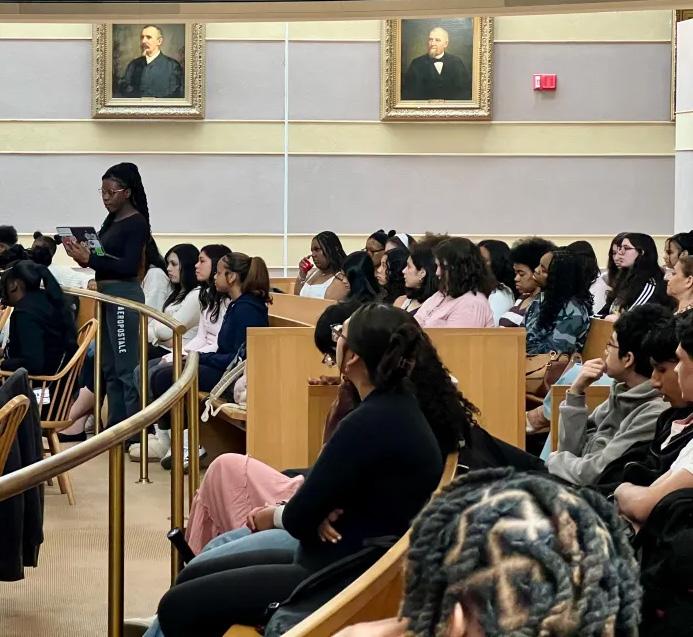
All four candidates made their pitches directly to their peers Friday during a candidate forum held in the Aldermanic Chamber of City Hall. The candidates are looking to fill a school-board seat that will soon be vacated by graduating High School in the Community senior Jonaily Colon.
New Haven Public Schools (NHPS) high school students will get to vote during lunch time on Tuesday, Wednesday, and Thursday to pick among the four candidates.
Whoever wins will join Career High School’s Abdellah Aly as one of two non-voting student representatives on the Board of Education.
At Friday’s forum, all four candidates spoke before roughly 80 of their peers about their priorities, experiences, and ideas to address students’ concerns. Colon and Aly hosted Friday’s forum.
The candidates began with opening speeches, then answered questions about their priorities, about artificial intelligence (AI) use, and about how they’d keep all students informed about happenings in the district.
Mackenzie Phillips said that her top three priorities are having students included in open and honest communication with the district; pushing the district away from universal usage of Yondr pouches, and prioritizing them as a punishment for students who use their phones too frequently and as a way to store away phones during tests; and pushing for Yale University to give New Haven schools more support.
Mackenzie Phillips cited the districts air-conditioning (AC) problems as the warmer weather approaches. She said that, last week, she witnessed a half dozen of her peers almost pass out because of the high temps in their school building, which does not have operable windows. She said that when her English classroom was 89 degrees, even though it was 71 degrees outside. “We just can’t do productive work like this,” she said.
One of Mapuvire’s top priorities is pushing the district away from relying on counseling interns who are constantly swapped out, making it harder for students to get consistent support in school. “I can’t tell you how many counselors I’ve spoken to and I’m just a sophomore,” he said. “We don’t want to keep telling new people our problems. It’s already hard to open up.”

Mapuvire also hopes to push for the district to offer more balance with Yondr usage like providing students with an hour or 45 minutes of phone use daily so that they can “be updated about our lives.”
McTiernan Huge said that she would advocate for the district to have a later school start time — closer to 8 a.m. — instead of having high schoolers wake up at 5 or 6 a.m. to arrive at school at 7 a.m.
She said a later high-school start time will improve student attendance, morale, and engagement. “If New Haven wants us to do our best, schools have to start later,” she said, “and they have to do a better job of supporting our bodies and minds.”
McTiernan Huge also said she’ll prioritize pushing for more facilities funding and designated time for students to have study hall or extra academic help. She said there should be district-wide scheduling of study hall periods for students to better connect with their teachers.
Ortiz, meanwhile, is looking to re-introduce social-emotional learning (SEL) Wednesdays for students so that they have dedicated time each week to socialize. She also said she will push for cleaner bathrooms and safer hallways. She said she will advocate for the inclusion of more languages — like Spanish, Pashto, and Arabic — in district communications.
“I’m here to listen to the quietest voices not just the loudest ones. I’m here for the students in the back who feel like no one sees them,” Ortiz said.
When asked for their stances on how NHPS should balance technology use and AI with traditional learning, the candidates all agreed that, while technology can successfully be incorporated into learning, there appears to be a double standard when it comes to educators and students.
“No teaching should be getting taught from AI, just like a student shouldn’t have to learn from it,” Mackenzie Phillips said.
“Teachers should not use it for lesson plans then tell us we can’t use it,” McTiernan Huge said.
Audience members also got to ask the four candidates questions at Friday’s forum.
Career High School sophomore Riziki Mulungula asked the panel what they would do to address the small number of students who disrupt buildings and classrooms with their “bad behavior.”
“It’s not going to just be about talking to all of us in this room, so how will you empower those other students to be better?”
Mulungula asked.
The candidates repeated their calls for increasing counseling supports, introducing study hall to allow students and teachers to build stronger connections, offering
you have to do it?” she asked.
Mackenzie Phillips said she plans to look at the district’s budget breakdowns to help identify overspending. McTiernan Huge agreed that she’d too look at spending on Band-Aids like Yondr pouches to encourage the district to prioritize spending on programs that provide real benefits to students. Mapuvire said he’d look at school-by-school budgets to make building supports more equitable. Ortiz said she’d look over the district’s financial plans to see where small cuts can be made based directly on students’ experiences with district programs and services.
Riverside junior Jhalynn McLaure concluded Friday’s panel with the final student question. He asked how the next student rep will help students feel more confident in pursuing their goals and feel more prepared for life after high school. Mackenzie Phillips said she’d push for more required courses about personal finance and career readiness. Mapuvire said he’d push for weekly or monthly mentorship from the community in the schools. McTiernan Huge said she’d push for more funding to be allocated to college tours. Ortiz said she would share information with students about opportunities for readiness programs.
McLaure said he enjoyed Friday’s panel, as attending a Citywide Student Council meeting was new for him. He said lately he’s been pushing himself toward doing the “weird things” that actually turn out to be fun, like student council.
He recalled struggling a lot with getting in trouble when attending Cross because of how large the school was. “It’s easy to get lost when life seems so big but that’s why the smaller environment inspired me,” he said about Riverside.
The main topic that sparked McLaure’s interest Friday was increasing counseling. He said Riverside’s music-therapy programming has been life changing for him and his peers and he believes “everyone should have something like that.”
SEL days to help students socialize, and communicating directly with struggling students who are acting out.
Mulungula said she wants to see a student rep who truly advocates for their peers and isn’t just doing this to build their resume for college. “I really don’t wan it to be a popularity contest,” she said. “I want students to be led by a person we can look up to.”
She said she left Friday’s panel leaning toward voting for Mackenzie Phillips or Ortiz.
Career junior Sarah N. asked the panel what their specific plans are for improving NHPS’ funding problems. “It’s easy to just say you want to, but what ideas do
Co-op freshman Nike said she left Friday’s panel torn between McTiernan Huge and Mapuvire because, as a track athlete at Hillhouse, she agreed with those candidates’ takes on school-start times, counseling, food, and facility improvements.
Nike asked the candidates Friday about how they will work to make freshman voices included in school decisions. She added that she is considering running for student rep next year.
Board of Education member Andrea Downer gave closing remarks Friday before students enjoyed pizza and headed back to their schools. She thanked the candidates for having the courage to step forward and reminded the students that their voice and perspectives matter.
“You all are doing something many adults will never do,” Downer said.
“Students deserve a seat at the table and no matter the outcome, be proud of yourself and continue to show up.”

by Maya McFadden
The city’s school district has agreed to pay a total of $110,479.72 to 76 former paraprofessionals who had previously been excluded by the Board of Education from a back-pay provision in a recently struck union contract.
New Haven Public Schools (NHPS) Supt. Madeline Negrón signed that settlement agreement on April 23. Hyclis Williams — the president of the city’s paraprofessionals union, AFSCME Local 3429 — signed the agreement on April 27. The Independent obtained a copy of the settlement from the state Department of Labor last week.
The settlement follows the paraprofessionals union’s filing of a Municipal Prohibited Practice (MPP) charge with the State Board of Labor Relations (SBLR) in August 2025. Such charges typically allege that an employer or union has violated state collective-bargaining laws. Thanks to this settlement — which will see 76 paras receive between $52 and $5,123 each — the paras union has now withdrawn that complaint.
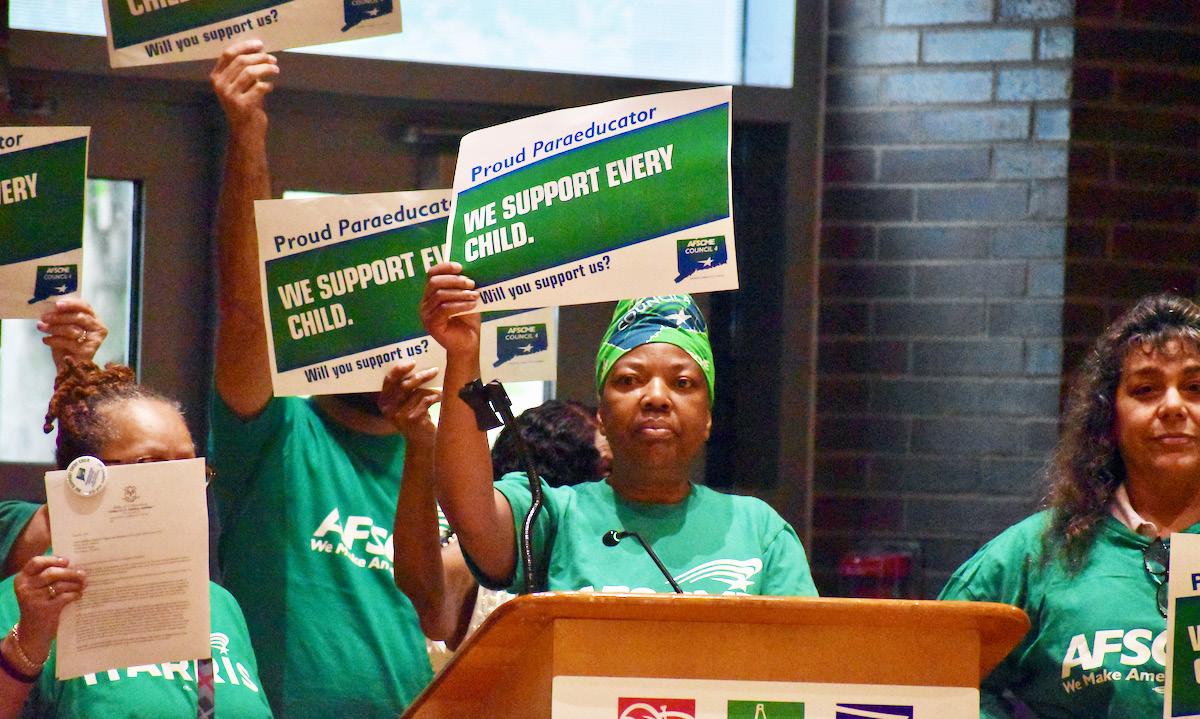
“We are very pleased that this has been resolved and that more than 70 New Haven Paraeducators will receive the wages they rightfully earned,” AFSCME Council 4 Staff Representative Cherlyn Poindexter — a former city union leader — told the Independent. “The President and the members kept pushing to make sure they were paid what they earned.”
The complaint concerned a dispute between the union and the school district
over the interpretation of an arbitration award issued by a state arbitration panel on April 23, 2025. At that point, the district’s 360-plus paras — who serve as classroom assistants to teachers — had been working without a contract since July 1, 2023. The arbitration award concerned a new four-year contract that provided $1.8 million in retroactive pay.
The April 2025 arbitration award stated that the back payments were to be retroactive to July 1, 2023 and each subsequent and applicable contract year.
The Board of Education, however, voted
in July 2025 to ensure that the new contract’s back-pay provision would apply only to employees who were active as of June 30, 2025, or who had retired by that date.
More than 70 paras resigned from the district between Sept. 22, 2023 and May 30, 2025, even though they worked during the years-long arbitration process. That meant that, per the Board of Education’s July 2025 vote, those 70-plus paras who had worked at some point after July 1, 2023 but who had resigned before June 30, 2025 were not eligible for back pay.
This newly struck settlement between the paraprofessionals union and NHPS ensures that those paras will get back pay after all.
In a Thursday comment provided to the Independent, NHPS spokesperson Justin Harmon said that “the [April 2025 arbitration] award was silent with respect to whether active or inactive employees should receive retroactive pay, and the Board, as you note, made a decision with respect to its interpretation based on past practice.”
Poindexter, the AFSCME Council 4
staff rep, told the Independent that the MPP that was filed by the paraprofessionals union was eventually withdrawn due to the settlement. That original MPP accused NHPS of refusing to comply with the arbitration award.
Between August 2025 and March 28, 2026, AFSCME Council 4 and NHPS held a series of informal conferences — as encouraged by the SBLR — to try to amicably settle the matter. On March 28, 2026, the Board of Education voted to enter into a settlement agreement with the union to compensate the dozens of now-resigned paras that were not give back pay.
Four of those employees were paid either fully or partially before the parties reached a full agreement and therefore were also included in the settlement.
“They had already moved on from the district and were initially left out, but this makes clear that if you did the work, you’re owed the pay—and those agreements can’t just be changed after the fact,” Poindexter said about the 70-plus paras covered by this settlement. “These are the folks supporting students every day, often without a lot of recognition, and this is about making sure their work is respected and valued. This outcome shows what can happen when workers stand together and ensure agreements are honored. This is a true testament to Union solidarity.”
In a separate comment, Harmon confirmed that a settlement had indeed been reached “with respect to certain employees who were not originally included in the Board vote. We thank Local 3429 for working collaboratively with us to re-
Con’t on next page
Bridgeport Public Schools will host its 43rd Annual Math Meet on Thursday, May 28, 2026, at the University of Bridgeport, Charles A. Dana Hall, Room 107, located at 169 University Avenue in Bridgeport.
The district’s longest-running academic competition will bring together 132 students representing all 22 middle schools for a day focused on problem-solving, teamwork, and academic achievement. Students will compete in a timed mathematics competition designed to challenge their critical thinking and reasoning skills. Using only pencils and basic four-function calculators, students will solve rigorous math problems, with scores determining both individual and team rankings.
“The Math Meet is one of those events that truly brings out the best in our students,” said Dr. Royce Avery. “To see students from across Bridgeport come together, challenge themselves, and support one another through academics is something special. Our students continue to show what they are capable of when they are encouraged, supported, and given opportunities to shine.”
“Holding this event each year continues a tradition that celebrates curiosity, perseverance, and the excitement of learning,” said Herminio Planas. “The Math Meet gives students an opportunity to showcase their abilities while inspiring confidence and a deeper appreciation for mathematics.”
Established in the 1980s, the

Bridgeport Math Meet was created to inspire students through meaningful problem-solving while exposing them to a university setting and promoting college aspirations. What began with just 10 schools has grown into a districtwide tradition involving every middle school across Bridgeport Public Schools. The event will run from 9:00 AM to 1:00 PM and conclude with an awards ceremony recognizing top-performing students, the top three schools overall, and the district’s most improved school. The championship banner, passed among winning schools for more than four decades, will once again be awarded to this year’s firstplace team.
solve the matter and look forward to our continued work together.”
Yolanda Silva is one of those former city paraprofessionals to receive back pay thanks to this settlement.
Silva resigned from the district on Aug. 15, 2024 after working for five years for the school-readiness program at Troup. She recalled working for the district despite her union having no contract until her classroom was shutdown due to funding cuts. Silva said she was told by a parent in her program that her classroom was shutting down before any official notification came in from NHPS. That was the final straw that led her to leave the district. When she received a call from Williams on April 29 about the settlement, she said she was thankful that her years of work in New Haven meant something to someone. Silvia is now set to receive $1,803.99 in back pay.
Williams told the Independent Thursday that she hopes the Board of Education takes seriously when paras inform them of concerns. She recalled the union testifying to the school board in July 2025 before its exclusionary vote that it was not fair to not compensate staff for work they’ve already done. “I’m not blaming the board because they were misinformed but I hope they work to hear and investigate all sides before making decisions,” she said. “They have been paying attorneys to underpay us for too long.”
The Independent submitted a Freedom of Information Act (FOIA) request in May 2025 for how much money that the city’s school district spent on legal services related to contract negotiations and the arbitration process for the new paraprofessionals union contract. The Board of Education’s then-attorney, Elia Alexiades, responded in January 2026, stating that, between 2023 and October 2025, NHPS spent a total of $92,335 on legal services in relation to the paraprofessionals union contract.
Angela Walder, who also previously worked as a NHPS paraprofessional, told the Independent she was “appalled” the mayor, who sits on the school board, would allow his colleagues to not pay staff for their years of work. She resigned from NHPS on Dec. 9, 2024 after dedicating eight years to the job.
“We worked during critical times with no raise at all,” she said. “And now they refused to step up to the plate and say let’s pay these people. That’s stealing and offensive especially when we are the backbones of education.”
When Walder’s payment of $5,123.22 didn’t arrive after the arbitration award was handed down, she said she went 10 weeks without a paycheck since she had just started a new job. She said she struggled at the time to cover costs for her car, gas, and good. She said she reached out to the payroll department and school board’s president after resigning and received no responses.
Walder concluded that the district should issue an apology to the paraprofessionals who did not receive their back pay until the settlement.
by Lisa Reisman
Amid the sea of tuxedos and gowns marking this season, the New Haven Elks Club staged a variation on a theme at the Dixwell Q House gymnasium: a literal senior prom, with seniors in years and seniors of the high school variety. That was by design.
“The idea is to bring the generations together to interact, to learn from each other, and to gain appreciation for each other,” said Isabella Windley, as 75 dressed-to-the-nines party-goers ranging in age from eight to 80 took in the festivities at tables decked out with purple tablecloths and candelabras.
Hosted on Sunday by East Rock Lodge #141 (New Haven Elks) and its women’s auxiliary, Pocohontas Temple #55, the second annual “Gala on the Avenue: Together Through Time” included students from Hill Regional Career High School and older residents from the community.
The event was an extension of the community service that is a hallmark of the Elks, formally known as the Improved Benevolent Protective Order of Elks of the World (I.B.P.O.E.W.), an African American fraternal order that emerged in the late 19th century and in New Haven in 1907, when the white Elks refused to let African Americans join.
The Elks, which has become an anchor institution in the African American community, sold their longtime home, on the corner of Webster and Dixwell, in 2019. It was demolished in 2023, yielding to ConnCORP’s Dixwell Plaza redevelopment. In March, the City Plan Commission unanimously approved plans for a 6,000-square-foot lodge on 329 Dixwell Ave. that will also serve as a community center. The organization has reapplied for $2.6 million in state grants and plans fundraisers over the summer and fall.
“We find this intergenerational gala is
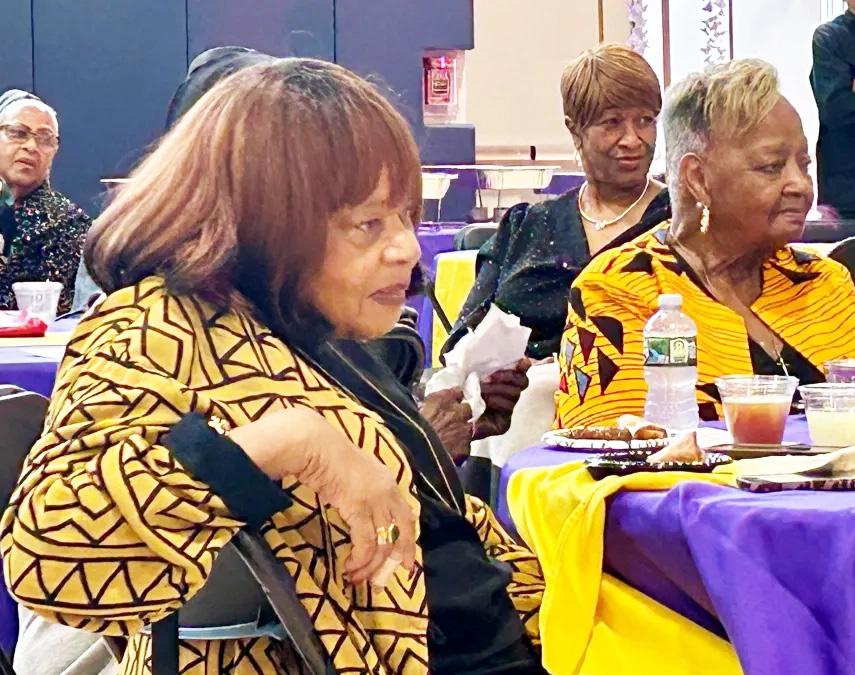
a wonderful opportunity to bring forward our youth in the area, as well as some of the more seasoned members of the society,” Gary Hogan, local Elks Exalted Ruler (and Beaver Hills alder), told the audience. “It’s a way of building a sense of community, reducing isolation, and also a chance for them to share some wisdom with these younger individuals that are here with us today.”
Then came the youth showcase, with Hill Regional Career High School seniors Amiyah Hill and Montajah Beard reciting original poetry, a dramatic re-enactment by Aniyah Rice, and tenor saxophonist and singer Nevaeh Random performing her soulful rendition of “Can We Talk” by Tevin Campbell.
Random, the reigning Ms. East Rock Lodge Beauty and Talent Queen, competed at the Elks National Convention last August.
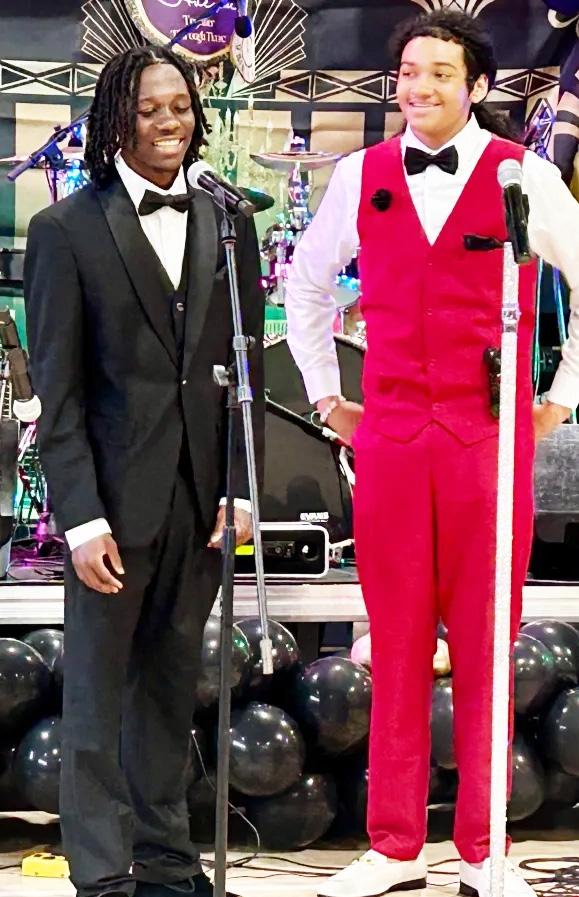

“Alright then,” someone called out. Tywon Davender and Johan Matos-Euceda modeled their splashy new tuxes, purchased by the Elks, which they declared they would wear to their upcoming high school prom.
“Looking sharp,” someone said. Davender and Matos-Euceda beamed.
Watching intently were members of the Mary Newcomb Junior Temple No. 37, a junior temple for young girls under the auspices of the Elks, including Ja’lise Brunson, Sienna Gilbert, and Maliyah Butler.
“We bring in people from the community that talk to the girls, teach them etiquette, table manners, how to braid hair,” said Windley, president of the New England Elks. “We have affirmations that we repeat: I am smart, I am beautiful, I am a queen. It’s so important for young girls to think about themselves in a positive way.”
Local Elks’ Daughter Ruler Arlice Brodgon thanked the student volunteers for their attention to detail in lighting and decorations, and otherwise making the event a success. She asked for support in continuing with youth programming aimed at academics and life skills, as well as coding and CPR certification.
“The donations you make today will go toward helping us continue to assist our youth so we can help them help themselves do the things that they want to do in life,” she said.
“Just beautiful,” said Naomi Campbell, a retired Yale New Haven Hospital scrub nurse, as young volunteers served dinner prepared by ConnCAT’s Orchid Cafe amid the jazz stylings of Ricky Allen Draughn. “This is why I love my community and my city.”
by Donald Eng
The commission tasked with overhauling how the state funds public schools includes two state senators, two state representatives, a transit professional, two school superintendents, a mayor and the president of a national school board group among its 23 members.
Announced last month, Gov. Ned Lamont’s Blue-Ribbon Commission on K-12 Education Funding and Accountability, has scheduled its first meeting for June 4 and is expected to deliver its final report, including actionable recommendations, by Jan. 15, 2027. As part of this work, the commission is expected to assess special education funding and structures and identify areas for cross-district collaboration to address administrative and program needs across districts.
“Connecticut has been making significant investments in our schools, and the
aid we secured this session was critical to keep teachers in classrooms and protect programs that students depend on,” Lamont said. “But investment alone isn’t enough. Our funding formulas are outdated, and we need to take another look at how we’re maximizing student outcomes across the state. I created this commission to do
The panel includes one representative selected by each of the Senate and House Republican and Democratic leaders
State Sen. Eric Berthel of Watertown, the ranking Republican on the Education Committee, and state Rep. Tina Courpas of Greenwich, the ranking Republican on the Select Committee on Special Education, are the picks of their caucus leadership to be on the commission. Legislative Democrats seated state Sen. Julie Kushner of Danbury, an Education Committee member, and state Rep. Jennifer Leeper of Fairfield, the House chair of the Edu-
cation Committee.
Among Lamont’s picks for the commission are Kate Dias and Jan Hochadel, president of the Connecticut Education Association and the state branch of the American Federation of Teachers, respectively. They are joined by New Haven Mayor Justin Elicker, a former adjunct professor of education policy at Southern CT State U., and Mary Calorio, transit director at the Northeastern Connecticut Council of Governments.
Also on the commission are Steven Hernández, executive director of the education advocacy group ConnCAN; Joseph Macary and Jeffrey Newtown, superintendents of the Vernon and East Lyme public schools; Joshua Wojcik, the secretary of the Connecticut Office of Policy and Management; and Leonard Lockhart, is vice president and finance chair of the Windsor Board of Education, and president of the National School
Boards Association.
The commission is chaired by Natalie Wagner, Lamont’s deputy chief of staff, and state Education Commissioner Charlene Russell-Tucker. A complete list of commission members is posted on Lamont’s official website.
“Fixing how Connecticut funds its schools is one of the most consequential things we can do for students, and getting it right requires hearing from the people closest to them,” Russell-Tucker said.
“This commission brings together members representing classroom teachers and paraeducators, parents, principals, superintendents, board members, municipal officials, policymakers, and representatives from higher education — all volunteering their time because they know what’s at stake.”
by Jon Powell, Revolt.tv
The caucus is asking more than 250 companies to condemn GOP-led redistricting efforts and show support for Black political representation.
• The Congressional Black Caucus sent a letter to more than 250 corporations urging them to oppose GOP-led redistricting efforts that could eliminate majority-Black U.S. House districts.
• Lawmakers are asking companies to publicly condemn the new maps, meet with CBC members, and disclose political donations tied to states pursuing the changes.
• A federal court blocked Alabama from using a GOP-backed map that would have reduced the state to one majority-Black district for the 2026 elections.
The Congressional Black Caucus (CBC) is calling on corporate America to take a public stand against Republican-led redistricting efforts that lawmakers say would weaken Black political representation.
On Tuesday (May 26), the CBC sent a letter to more than 250 companies urging them to oppose state-level map changes that seek to eliminate majority-Black U.S. House districts. According to the Associated Press, the letter targeted major corporations across the country, including companies that previously spoke

out in support of voting rights and racial justice.
The appeal points back to 2021, when several major companies backed Business for Voting Rights, a coalition that pushed Congress to pass the John Lewis Voting Rights Act. Apple, Amazon, Google, Meta, Microsoft, Tesla, Target, Pay-
Pal, Intel, Salesforce, and Starbucks were among the companies connected to that prior effort.
Rep. Yvette Clarke, who chairs the CBC, described the move as “putting corporate America on notice.” Rep. Steven Horsford added that the caucus wants corporations to “stand on the



The letter comes after a recent U.S. Supreme Court ruling weakened a key part of the Voting Rights Act, opening the door for several Republican-led states to revisit congressional districts that helped protect minority representation. CBC members have argued that the new push is not just about party control, but about reducing Black voters’ ability to choose candidates who reflect their communities.
Redistricting fight expands beyond Congress
The corporate letter follows another CBC-backed pressure campaign aimed at college athletics. Last week, the NAACP launched its “Out of Bounds” campaign, calling on Black athletes, recruits, fans, alumni, and consumers to withhold support from public universities in states accused of weakening Black voting power. CBC members backed that call while also opposing the SCORE Act (Supporting College Opportunity and Reaching Excellence Act), arguing that major college athletics institutions should not benefit from federal legislation while remaining silent on attacks against Black political representation.
side of democracy, fairness and equal representation.” Ultimately, the CBC is asking companies to publicly condemn the redistricting plans, meet with CBC members about protecting voting rights, and disclose political donations to Republican politicians in states pursuing new maps.
The battle is also playing out in court. On Tuesday, a federal court blocked Alabama from using a Republican-backed congressional map that would have left the state with only one majority-Black district, keeping a previously approved map in place for the 2026 elections.


by BlackHealth.org
Controlled experiments show African American participants report lower pain tolerance than white participants, not higher. The clinical care gap runs the other direction. This piece names where the belief came from, what the contemporary data actually shows, and what a Black patient can do at the next pain-care visit. A 2012 quantitative review of experimental pain studies, drawing on the Riley and Fillingim laboratories at the University of Florida and partner institutions, reported that African American participants demonstrate consistently lower pain tolerance than non-Hispanic white participants across multiple controlled stimulus modalities, with moderate to large effect sizes (Rahim-Williams B, Riley JL 3rd, Williams AKK, Fillingim RB. Pain Medicine 2012; PMID 22390201). In a 2015 study of pediatric emergency-department visits for appendicitis published in JAMA Pediatrics, 20.7 percent of Black children received opioid analgesia compared with 43.1 percent of white children with the same diagnosis, an adjusted odds ratio of 0.2 (Goyal MK, Kuppermann N, Cleary SD, Teach SJ, Chamberlain JM. JAMA Pediatrics 2015;169(11):996-1002; PMID 26366984).
The belief that Black patients tolerate pain better than white patients is not a folk observation. It is a constructed clinical claim with a written nineteenth-century history, contradicted by the controlled-experiment evidence, and tracked by a contemporary disparity in pain treatment that runs the opposite direction from what the belief predicts. This piece names where the claim came from, what the current data show, and what a Black patient can do at the next pain-care visit. What controlled experiments actually show
The Rahim-Williams team meta-analyzed experimental pain studies that used standardized noxious stimuli (thermal, mechanical, ischemic, electrical) on healthy volunteers, measuring pain threshold (the stimulus intensity at which pain begins) and pain tolerance (the intensity at which the participant withdraws). African American participants showed consistently lower pain tolerance than non-Hispanic white participants, with effect sizes the authors characterized as moderate to large across modalities. Pain threshold trended in the same direction with smaller effect sizes (Pain Medicine 2012, PMID 22390201).
The mechanism for that group difference is not the relevant question here. The relevant point is that the controlled-experiment record, in which the stimulus is held constant and the response is measured directly, runs opposite to the clinical folk claim. If anything, the laboratory pain-perception literature suggests African American participants are more sensitive to controlled noxious stimuli than white participants are, not less. The clinical undertreatment of Black patients' pain, documented below, cannot be explained by a higher tolerance the patients

do not have.
Where the belief came from
The medical claim that Black bodies experience pain differently than white bodies traces to nineteenth-century race science and to a specific, documented set of medical practices on enslaved Black women in the antebellum US South.
The gynecological surgical experiments performed by J. Marion Sims on enslaved Black women in Montgomery, Alabama between 1845 and 1849, conducted without anesthesia, are the canonical historical episode. Sims operated repeatedly on at least three enslaved women named in the historical record (Anarcha, Lucy, and Betsey), performing multiple procedures on each, before later performing the same operations on white patients under ether anesthesia. The historical record of those experiments and the broader medical-bondage system in which they occurred is documented at length in Harriet A. Washington's "Medical Apartheid: The Dark History of Medical Experimentation on Black Americans from Colonial Times to the Present" (Doubleday, 2007) and Deirdre Cooper Owens' "Medical Bondage: Race, Gender, and the Origins of American Gynecology" (University of Georgia Press, 2017).
The nineteenth-century claims that emerged alongside this practice (that Black skin is thicker, that Black nerves are less sensitive, that Black blood coagulates more quickly) entered American medical textbooks and circulated as scientific justification for performing painful procedures on Black bodies without
analgesia. None of these claims are biologically true. All three were measured as endorsed by US medical trainees in a 2016 study (Hoffman KM, Trawalter S, Axt JR, Oliver MN. PNAS 2016; PMID 27044069). Our existing piece on the Hoffman result covers the trainee study in detail. The point for this piece is that the false-biology claims the Hoffman team tested in 2014 to 2015 are direct descendants of the nineteenth-century race-science literature the historical scholarship cited above documents.
The contemporary clinical-treatment data shows the gap reliably across settings.
A 2012 systematic review and meta-analysis in Pain Medicine, drawing on twenty years of US data, found that Black patients receive opioid analgesia at significantly lower rates than white patients in non-traumatic and non-surgical pain settings, with a pooled adjusted odds ratio of 0.66 (95 percent CI 0.59 to 0.75). The disparity persisted after adjusting for socioeconomic and clinical covariates (Meghani SH, Byun E, Gallagher RM. Pain Medicine 2012;13(2):150-74; PMID 22239747).
A 2016 study of US emergency-department visits in PLoS ONE found that non-Hispanic Black patients had adjusted odds of receiving an opioid prescription ranging from 0.56 to 0.67 compared with non-Hispanic white patients for back pain and abdominal pain. The same study found no significant racial disparity in
to patient-reported pain, the direction of the disparity would be reversed. The gap is not explained by disease severity. Appendicitis pain in a child does not vary by race in a way that would justify a more than twofold difference in opioid administration. Back pain and abdominal pain in adults likewise do not show a race-stratified severity distribution that maps onto a 0.56-to-0.67 prescription odds ratio.
The gap is not explained by drug-seeking concern in a way that survives the objective-condition test. Singhal 2016 showed no Black-white prescription difference for fractures and kidney stones at the same EDs where back and abdominal pain showed a substantial difference. The concern about diversion does not selectively operate on subjective-presentation conditions among Black patients while sparing the objective ones; clinician judgment about which patients to trust at face value does.
What to do at the next pain-care visit
Three concrete steps for a Black patient preparing for a clinical visit where pain will be discussed.
opioid prescription for fractures or kidney stones (Singhal A, Tien YY, Hsia RY. PLoS ONE 2016;11(8):e0159224; PMID 27501459).
That objective-condition contrast is the clinical fingerprint of the bias. When the diagnosis is undisputable on imaging or stone passage, the disparity disappears. When the diagnosis depends on a clinician's interpretation of the patient's self-reported pain, the disparity returns. The pattern points to clinician judgment, not patient presentation.
The pediatric data is the cleanest single illustration. Goyal and colleagues at Children's National Medical Center reviewed 940,000 emergency-department visits in the Pediatric Emergency Care Applied Research Network and identified children diagnosed with appendicitis. Of those children, 20.7 percent of Black children received any opioid analgesia compared with 43.1 percent of white children. The disparity persisted in multivariable analysis (adjusted odds ratio 0.2). Appendicitis pain is severe and not contested; the diagnosis itself is the indication for analgesia (JAMA Pediatrics 2015;169(11):9961002; PMID 26366984).
ºThe undertreatment pattern in the clinical data is not explained by patient pain-reporting style. Across the experimental studies aggregated in Rahim-Williams 2012, African American participants reported pain at the same controlled stimulus at lower thresholds and lower tolerance, not higher. If the contemporary clinical gap reflected accurate calibration
First, describe pain by its effect on function alongside the numeric scale. The 0-to-10 score is what most clinicians chart, but functional-impact language (this pain prevents me from sleeping more than four hours, this pain stops me from walking up one flight of stairs, this pain has kept me out of work for three days) gives the clinician a structured account that does not depend on the clinician's calibration of the patient's verbal scale. Functional descriptions are harder to discount than a number alone and they belong in the chart.
Second, bring a witness to high-stakes pain-care visits, particularly emergency-department visits and pre-operative consultations. A partner, family member, or trusted friend in the room changes the dynamic of the encounter, gives the patient a second person who can later confirm what was said and prescribed, and reduces the rate at which patient concerns are dismissed without documentation. The research on race-discordant clinician encounters supports a witness as a low-cost protection against documentation gaps; it is not a guarantee, and it is a meaningful one.
Third, when possible, seek a Black or skin-of-color clinician for ongoing pain management, and ask any clinician directly about their experience with pain management in Black patients before agreeing to a treatment plan. Our provider directory is searchable by location and specialty. For emergency-department visits, the option to choose a clinician is rarely available; in that setting, asking for a patient advocate or hospital-based ombudsperson is the closest analogue and is appropriate when the patient's pain is being under-rated in the chart.
What this piece does not establish
The five primary sources cited in this piece are well-cited contributions to the
by BlackNews.com
Mario Bailey, a 31-year-old Jamaican-born entrepreneur and software engineer who immigrated to the United States in 2010, has launched BlackHealth.org, a new online platform designed primarily to help patients find Black doctors, other Black-owned healthcare providers, and culturally competent medical professionals across the United States, despite growing legal and political attacks against diversity-focused healthcare initiatives.
The launch comes at a time when diversity-focused medical programs and directories are facing heightened scrutiny, including a recent discrimination lawsuit filed by a White doctor challenging similar initiatives. Supporters of Black-focused healthcare resources argue that such platforms remain critically necessary because Black Americans continue to experience major healthcare gaps, including higher maternal mortality rates, lower life expectancy, delayed diagnoses, and unequal access to culturally competent care. Numerous studies have also shown that Black patients often report better communication, higher trust, stronger treatment adherence, and improved overall outcomes when treated by Black healthcare providers.
Organizers say the platform was created to make it easier for Black families to locate trusted physicians, specialists, therapists, dentists, and other healthcare providers who may better understand their cultural experiences and health concerns. At the same time, the site also serves as the dedicated healthcare job board of BlackHealth.org, a trusted source for Black health information since 2002, connecting mission-driven employers with Black healthcare professionals across every specialty, seniority level, and employment type — from residencies and fellowships to executive leadership positions.
Bailey says the platform can also serve as an important resource for highly edu-
cated healthcare professionals from the Caribbean and Africa who immigrate to the United States seeking greater career opportunities and visibility. As someone who immigrated from Jamaica himself, Bailey says he understands many of the unique challenges immigrants can face when trying to build professional networks, navigate healthcare systems, and access leadership opportunities in the American medical industry.
“We built this platform because representation in healthcare is not just a diversity metric — it is directly tied to patient outcomes,” said Bailey. “Black communities deserve access to providers and healthcare organizations that understand their lived experiences, concerns, and cultural realities. This platform helps patients make those connections easier while also helping healthcare employers recruit talented Black professionals.”
The platform also has a very extensive career center that helps Black healthcare professionals discover employment opportunities with hospitals, clinics, and organizations that value diversity, equity, and culturally responsive care.
Con’t from page 16
pain-disparity literature; they are not the whole literature. The Hoffman 2016 study sampled white medical students and residents at one US medical school in 2014 to 2015. The Rahim-Williams 2012 review aggregated heterogeneous experimental-pain studies with varied stimulus modalities. The Singhal 2016 and Meghani 2012 odds-ratio estimates carry the confidence intervals they carry. The historical scholarship on J. Marion Sims, Anarcha, Lucy, and Betsey is documented at book length in the cited works; this piece quotes the central facts and refers the reader to the books for the full historical record.
What the piece does establish is that the clinical claim "Black patients have a higher pain tolerance" is unsupported by the controlled-experiment evidence, has a documented nineteenth-century origin in race science and slavery-era medical practice, and tracks a contemporary care gap that runs opposite to what the claim predicts. A reader walking into a paincare visit can use that footing.
Sources
• Rahim-Williams B, Riley JL 3rd, Williams AKK, Fillingim RB. A quantitative review of ethnic group differences in experimental pain response: do biology, psychology, and culture matter? Pain Medicine. 2012;13(4):522-540. PMID 22390201. doi:10.1111/j.15264637.2012.01336.x.
• Meghani SH, Byun E, Gallagher RM. Time to take stock: a meta-analysis and systematic review of analgesic treatment disparities for pain in the United States. Pain Medicine. 2012;13(2):150-174. PMID 22239747.
• Singhal A, Tien YY, Hsia RY. Racial-ethnic disparities in opioid prescriptions at emergency department visits for conditions commonly associated with prescription drug abuse. PLoS ONE. 2016;11(8):e0159224. PMID 27501459. doi:10.1371/journal.pone.0159224.
• Goyal MK, Kuppermann N, Cleary SD, Teach SJ, Chamberlain JM. Racial disparities in pain management of children with appendicitis in emergency departments. JAMA Pediatrics. 2015;169(11):9961002. PMID 26366984. doi:10.1001/jamapediatrics.2015.1915.
• Hoffman KM, Trawalter S, Axt JR, Oliver MN. Racial bias in pain assessment and treatment recommendations, and false beliefs about biological differences between blacks and whites. Proceedings of the National Academy of Sciences. 2016;113(16):4296-4301. PMID 27044069. PMC4843483.
• Wall LL. The medical ethics of Dr J Marion Sims: a fresh look at the historical record. Journal of Medical Ethics. 2006;32(6):346-350. PMID 16731734.
• Washington HA. Medical Apartheid: The Dark History of Medical Experimentation on Black Americans from Colonial Times to the Present. Doubleday; 2007.
• Cooper Owens D. Medical Bondage: Race, Gender, and the Origins of American Gynecology. University of Georgia Press; 2017.

through september 13, 2026
1080 Chapel Street New Haven, CT 06520
britishart.yale.edu @yalebritishart
Rina Banerjee, Take me, take me, take me . to the Palace of love, 2003, plastic, antique Anglo-Indian Bombay dark wood chair, steel and copper framework, floral picks, foam balls, cowrie shells, quilting pins, red colored moss, antique stone globe, glass, synthetic fabric, shells, fake birds, Yale Center for British Art, purchased through the generosity of Allison K. and Larry Berg; Laura and James Duncan, Yale BA 1975; Adam R. Rose, Yale BA 1981 and Peter R. McQuillan; and Yale University Art Gallery, Heinz Family Fund © The Artist. Photo: Richard Caspole

. Quick! Wynton’s coming! And he’s bringing the Jazz at Lincoln Center Orchestra
Now is no time to be humble. Let’s be frank: the Garde has hosted a stunning number of world-class artists because, well, that’s part of the idea behind a committed community-minded arts center with wild dreams!
However, this is huge. Wait! Let’s use all-caps for this. It’s HUGE. Hmm. Still not good enough HUGE! HUGE! HUGE! That’s much better.
On June 27, we’re welcoming the Jazz at Lincoln Center Orchestra with Wynton Marsalis to the Garde Stage.
The concert is part of a commemoration of what will be Marsalis’s final season as Artistic Director of Jazz at Lincoln Center and Music Director of the Jazz at Lincoln Center Orchestra. Marsalis has done a wonderful job at Lincoln Center since he took the gig in 1987, and this band contains 15 of the finest jazz soloists and ensemble players currently breathing on our planet. Their repertoire is vast and exhilarating and rife with possibilities and passion.
Marsalis, of course, is the esteemed eldest son of jazz patriarch Ellis Marsalis. Marsalis the Younger was raised in New Orleans, studied the architecture of jazz music in its context of having spontaneously combusted at the turn of the 20th century — and he continues to utilize that sonic DNA to extrapolate the form through its progressions and blast it into the future.
Marsalis’s tone, musical vocabulary, melodic and polyphonic vision, joyful approach to improvisation and a lock-

jaw sense of ensemble groove are all anchored in an innate curiosity about how jazz serves as an aesthetic on ramp to other music styles.
And, if you’re tired of Music Speak, how’s this? I don’t care what sort of tunes you enjoy listening to — or that you worry “jazz” might give you a headache. Forget that. Be at the Garde to see this ensemble because they’ll conjure Art before your eyes and ears in that “Oh my God, how did they do that?” fashion. Right here in your home ballpark, so to speak.
Speaking of the Garde and Marsalis, it was almost exactly 25 years ago the trumpeter gave one of the finest speeches I’ve ever heard — here in New London. He delivered the Commencement Address at Connecticut College and, as a coda to his wise observations, which I guarantee you the Class of 2001 remember with fond-
ness and gratitude to this day, he raised his horn to his lips and played a short burst of tonal divinity.
And in terms of commemorative connectiveness, how about: The Jazz at Lincoln Center Orchestra with Wynton Marsalis is an ideal way for the Garde to not only kick off our own Centennial Celebration but also joyfully acknowledge, on our nation’s 250th Birthday, jazz as one of America’s finest creations across any spectrum.
We’ll have more for you as the concert draws closer. In the meantime, here are a few tidbits of Marsalis-ness you can ponder:
• One of the dozens of esteemed awards Marsalis has received was the 1997 Pulitzer Prize for Music. It commemorated his oratorio Blood on the Fields, about the history of slavery from the perspective of two main characters and was the

first Pulitzer not presented to a classical composer.
• Marsalis is the author of several books including a memoir titled Jazz in the Bittersweet Blues of Life — in which we learn that, if you should see his tour bus pulled to the side of the road near a playground, he is NOT to be trifled with on the basketball court.
• If you’re just checking Marsalis out, know he’s fond of exploring various music themes over the course of several albums. The six-volume Standard Times series, for example, is a whole history of Jazz through the Wyntonian prism. And a three-disc set, Soul Gestures in Southern Blue, is a marvelous and reflective immersion into and expansion beyond the blues as per pioneers like Buddy Bolden, Louis Armstrong, and Jelly Roll Morton. He’s also Santa-hatted his way into winter with three holiday albums!
• I sat down with Wynton several years ago for an interview just before he delivered the commencement speech at Connecticut College. He was thoughtful, polite and endured my perhaps painful layperson’s questions with patience and quick flashes of humor.
And I’ll tell you one thing: the dude knows how to wear a suit!
I was dressed reasonably for a journalist on assignment: khaki slacks and a golf shirt — but in the presence of Marsalis’s quietly elegant sartorial splendor, I was struck with the eerie idea that he might wake up every morning of his life already dressed like that! Like, it just happens because he’s Wynton Marsalis. I’ll tell you this: if Marsalis ever tires of being great as a trumpeter, scholar, educator, advocate, composer and bandleader, he can easily be hired to pen a monthly “How to Dress Like Me” column for GQ.
by BlackHealthMatters.com
Tenor saxophonist Sonny Rollins, who was known as “one of the greatest living jazz improvisers,” passed away at age 95 on May 25 at his home in Woodstock, New York. His death was announced via his website and social media. For more than eight decades, Rollins has helped push the boundaries of jazz musicianship, with styles ranging from bebop to avant-garde to jazz-rock fusion.
According to a New York Times article, Rollins’ impact could not be described in a single term. “But with his ferocious energy, his penchant for playing the unexpected note at the unexpected moment, and his unusual sound — sometimes harsh and
mocking, sometimes lush and romantic — he was ultimately unclassifiable.”
His Early Years
Rollins, a Harlem native, was born on September 7, 1930. He was the youngest of three children. His parents, Valborg (Solomon) and Walter Theodore Rollins, a naval steward, came to New York City from the Virgin Islands. While Rollins was named after his father, he reversed his first and middle names because of legal difficulties getting working papers.
He began studying music at a young age and was talented both as a musician and as an artist, and was interested in becoming a painter. However, he was already a professional musician by his teens.
His Seminal Work
Rollins’ star continued to rise while working with Roach and Brown, and his own recordings shortly afterward are considered groundbreaking; he is still referred to as “Saxophone Colossus” today.
According to the New York Times, “In 1956 alone, he recorded two albums that came to be regarded as classics: ‘Tenor Madness,’ which included his only recorded meeting with his fellow saxophonist John Coltrane, and ‘Saxophone Colossus” (the title referred both to his physical stature and to his rapidly growing artistic one).
But while he may have been accomplished at jazz standards, his repertoire was varied; one album, “Way Out West,” centered on his interpretations of cowboy songs.
He also recorded music for the soundtrack of the movie “Alfie.”
He Received Honors Later in Life
Although Rollins’ work continued to gain notoriety and success, he did not receive awards until the 2000s. He received a Grammy for Best Jazz Instrumental Album in 2002 for “This is What I Do,” and another for Best Jazz Instrumental Song in 2006 for “Why Was I Born?” from the album Without a Song: The 9/11 Concert.
The Recording Academy gave Rollins a Lifetime Achievement Award in 2004.
And he received the Kennedy Center Honors award from President Obama in 2011.
The Last Icon From A Great Day in Harlem
Rollins was the last surviving member of the 58 jazz luminaries photographed in
front of a brownstone on 126th Street by Art Kane as part of a piece called “Harlem 1958” (A Great Day in Harlem is a documentary that would come later). The photograph appeared in the January 1959 issue of Esquire.
In 2024, the New York Times interviewed the tenor saxophonist about that day. He told them, “It just seemed like we weren’t appreciated,” he said from his home in Woodstock, N.Y.,“mainly because jazz was a Black art.”
“I think that picture humanized a lot of the myth of what people thought jazz was,” he added. We can never underestimate Rollins’ mark on music and jazz; his influence will continue for generations to come.
THE ELM CITY COMMUNITIES, HOUSING AUTHORITY OF NEW HAVEN (ECC/HANH) MOVING
Section II and Section VII of the Authority's Moving to Work Agreement {the "Agreement") requires that before the Agency can file its Approved Annual Moving to Work Plan (“Plan”) and Report (“Report”)to the U.S. Department of Housing and Urban Development (the "HUD") that it must conduct a public hearing, consider comments from the public on the proposed Plan, obtain approval from the Board of Commissioners, and submit the Plan to HUD.
The thirty (30) days comment period begins on Monday, April 27, 2026, and ends on Tuesday, May 26, 2026.
Copies of the Moving to Work (MTW) FY2027 Plan, will be made available on the agency website www.elmcitycommunities.org or via Facebook www.facebook.com/ ElmCityCommunities.
You are invited to provide written comments addressed to: ECC/HANH, Moving to Work FY2027 Annual Plan Attn: Evelise Ribeiro, 360 Orange Street, New Haven, CT 06511 or via email to: eribeiro@elmcitycommunities.org.
Pursuant to said Sections II and VII, a public hearing where public comments will be accepted and recorded is scheduled for Thursday, May 21, 2026, at 4:00pm via Teams: https://teams.microsoft.com/meet/226459013024616?p=ixECplpMVkoqWitDVX
Meeting ID: 226 459 013 024 616 Passcode: 43Zv7iG7
Dial in by phone
Phone: 1-872-240-4494
Phone conference ID: 874 430 272#
Any individual requiring a Reasonable Accommodation to participate in the hearing may call the Reasonable Accommodation Manager (203) 498-8800, ext. 3170 or at the TDD Number (203) 497-8434.
The Town of East Haven seeks a qualified candidate to serve in the position of Social Services Director at the East Haven Senior Center
Interested candidates should possess a Bachelor’s degree in related field and five years progressively responsible and relevant experience including two years of experience in a supervisory position and experience working with the Connecticut Energy Assistance Program (CEAP) and State of Connecticut Rental Rebate Programs, a valid Connecticut Driver’s License. The salary for this po-sition is $$62,801/year, 35.5 hours per week and the Town offers an excellent benefit package. Please send resume with Cover Letter to: Ed Sabatino, Assistant Director of Administration & Management, Town Hall-250 Main Street, East Haven, CT 06512 or email to jobs@easthaven-ct.gov . The position is open until filled. The Town of East Haven is committed to building a work force of diverse individuals. Minorities, females, handicapped and veterans are encouraged to apply. The Town of East Haven is an equal opportunity employer.
Public Notice The Housing Authority of the City of New Britain (NBHA) is seeking bids for Landscaping Services - Spring & Fall Cleanup and As-Needed Services (Solicitation No. 2026-04-LAND).
Issue Date: April 22, 2026
Submission Deadline: May 13, 2026 at 3:00 p.m. (Local Time)
RFP and all addendas and answers will be posted at www.nbhact.org<http://www.nbhact.org/>.

The State of Connecticut, Office of Policy and Management is recruiting for a Connecticut Careers Trainee, target class Planning Analyst in the Intergov
Locally owned and operated in Guilford, CT since 1984, East River Energy provides heating oil, diesel fuel, gasoline, and propane to thousands of customers locally. East River Energy is also a major distributor of petroleum products across 13 states and counting. Additionally, East River Energy is a growing full service HVAC/Home Services company in both commercial and residential sectors. This is a full-time dispatching position for nights (which includes on call and weekend coverage). At least one year of dispatching experience is required. We are looking for someone who is detail oriented and is comfortable working in a fast-paced environment.


Benefits include: Competitive Hourly Wage, Medical, Dental, and Vision Plans, Vacation & Sick Time, Paid Holidays, Retirement Plan 401(k), Wellness Program, Employee Assistance Program, Life Insurance Options
Send resume to: HR Manager, P.O. Box 388, Guilford, CT. 06437. Email: HRDEPT@eastriverenergy.com
*An Affirmative Action/Equal Opportunity Employer, including Disabled and Veterans*

UNION CONTRACTOR SEEKS:
Construction Equipment Mechanic
(preferably experienced in Reclaiming and Road Milling Equipment) We offer factory training on equipment we operate. Job is in Bloomfield, CT.
Contact: Tom Dunay Phone: 860-243-2300 Ext. 122 Email: tom.dunay@garrityasphalt.com
Reclaimer Operators and Milling Operators
(must have current licensing and a clean driving record; be willing to travel throughout the Northeast & NY)
Contact: Rick Tousignant Phone: 860-243-2300 Ext. 133 Email: rick.tousignant@garrityasphalt.com
Tractor Trailer Driver for Heavy & Highway
Construction Equipment
(must have a class A CDL license with Tank Endorsement and a clean driving record; be capable of operating heavy equipment and willing to travel throughout the Northeast and NY)
Contact: Brian McKee Phone: 860-558-6189 Email: bmckee@garrityasphalt.com
• We offer Excellent hourly rates and benefits.
• Women and Minority Applicants are encouraged to apply.
• Affirmative Action / Equal Opportunity Employer
Members of the public are invited to CONNECTICUT
HYBRID PUBLIC INFORMATION MEETINGS
DRAFT 2027-2030 STATEWIDE TRANSPORTATION IMPROVEMENT PROGRAM
Wednesday, June 3, 2026, at 1:00 p.m. & 7:00 p.m.
Connecticut Department of Transportation Headquarters 2800 Berlin Turnpike, Newington CT 06111
Register to Attend Virtually & Learn More: portal.ct.gov/STIP
The purpose of these meetings is to provide the community with an opportunity to learn about the Statewide Transportation Improvement Program and allow an open discussion of any views and comments concerning the program. A Q&A session will immediately follow the presentation. CTDOT staff will be available in-person 30 minutes prior to each meeting to informally discuss the draft STIP with members of the public.
The Statewide Transportation Improvement Program (STIP) compiles all highway and public transit projects that CTDOT intends to pursue over the next four years, utilizing Federal Highway Administration (FHWA) and Federal Transit Administration (FTA) funding. STIP documents can be found at portal.ct.gov/STIP, CTDOT Headquarters, and at all Councils of Government offices. It is suggested to schedule an appointment at these locations. To make an appointment at CTDOT, please call (860) 594-2040.
The draft STIP will be available for review for a 30-day public comment period from Wednesday, May 13, 2026, through Friday, June 12, 2026. Comments should be submitted to (860) 594-2020, DOT.STIPComments@ct.gov, or mailed to: ATTN: Rose Etuka, 2800 Berlin Turnpike P.O. Box 317546, Newington, CT 06131-7546 Please refer to the 2027-30 STIP in the correspondence.
Parking is available in the rear of the building. The meeting facility is ADA accessible, and persons with disabilities can access the building from the main entrance of the building.
Non-English language closed captioning will be available on Zoom. The recording will also be posted following the meeting in CTDOT’s public meeting playlist at portal.ct.gov/ctdotVPIMarchive
For limited internet access, call (877) 853-5257 with Meeting ID 862 1358 6028 for the 1:00 p.m. meeting, or Meeting ID 820 5097 2071 for the 7:00 p.m. meeting. Project information can be mailed within one week by contacting Rose Etuka at Rose.Etuka@ct.gov
For hearing/speech disabilities, dial 711 for Telecommunications Relay Services (TRS). Request language assistance from CTDOT’s Language Assistance at (860) 594-2109 at least five business days before meeting.
The South Central Regional Council of Governments (SCRCOG) seeks the services of one or more consultants for the following transportation planning studies during the 2026 and 2027 Fiscal Years (July 1, 2025June 30, 2027): Metropolitan Transportation Plan Update and Local Bridge Inspection Study. Responses are due by June 2, 2026 (12 noon local time). Selected firms will be interviewed on June 9, 2026. The full RFQ document can be viewed at the Council’s website: www.scrcog.org or can be made available upon request. Contact James Rode at (203) 4668623 with any questions.
LaRosa Earth Group LLC, a Site/Excavation Company, is currently looking to add the following full-time positions to our Team:
Please submit resumes to HR@LAROSABG.COM or stop by our main office to fill out an application: 163 Research Parkway Meriden, CT. Salary will be commensurate with experience and best fit for the positions. Health plan; 401K; company-paid holidays in addition to paid time off.
LaRosa Groups is an Affirmative Action/ Equal Opportunity Employer who values diversity and encourages all qualified applicants to apply.

Locally owned and operated in Guilford, CT since 1984, East River Energy provides heating oil, diesel fuel, gasoline, and propane to thousands of customers locally East River Energy is also a major distributor of petroleum products across 13 states and counting Additionally, East River Energy is a growing full service HVAC/Home Services company in both commercial and residential sectors
This is a full-time dispatching position for nights (which includes on call and weekend coverage) At least one year of dispatching experience is required. We are looking for someone who is detail oriented and is comfortable working in a fast-paced environment
Competitive Hourly Wage

How to Apply
Send your Resume to HRDEPT@eastriverenergy com or mail to the address below
Medical, Dental, and Vision Plans
Vacation & Sick Time
Paid Holidays
Retirement Plan 401(k) Wellness Program
Employee Assistance Program Life Insurance Options

www eastriverenergy com 203-453-1200 ext 2269 401 Soundview Road Guilford, CT 06437
a quarry and paving contractor, has positions open for the upcoming construction season. We are seeking candidates for a variety of positions, including: Scalehouse Dispatcher/ Equipment Operators and Laborers. NO PHONE CALLS. Please mail resume and cover letter to “Hiring Manager”, Galasso Materials LLC, PO Box 1776, East Granby CT 06026.
Galasso Materials is an Affirmative Action/Equal Opportunity Employer. All applicants will be considered for employment without attention to race, color, religion, sex, orientation, gender identity, national origin, veteran or disability status.
Elm City Communities is currently seeking bids for Services of a firm to provide Unarmed Security Services. A complete copy of the requirement may be ob-tained from Elm City Communities’ Vendor Collaboration Portal https://newhavenhousing.cobblestonesystems.com/gateway beginning on
Wednesday, May 6, 2026, at 3:00PM.
The Glendower Group is currently seeking request for Qualifications from qualified firms for Ex-perienced Construction Managers at Risk t support the predevelopment, preconstruction of Union Square. A complete copy of the requirement may be obtained from Elm City’s Vendor Collaboration Portal https:// newhavenhousing.cobblestonesystems.com/gateway begin-ning on
Wednesday, May 6, 2026, at 3:00PM.


The State of Connecticut, Office of Policy and Management is recruiting for a Connecticut Careers Trainee, target class Planning Analyst in the Intergovernmental Policy and Planning Division. Further information regarding the duties, eligibility requirements and application instructions are available at: https://www.jobapscloud.com/CT/ sup/bulpreview.asp?b=&R1= 260427&R2=2292AR&R3=001
The State of Connecticut is an equal opportunity/affirmative action employer and strongly encourages the applications of women, minorities and persons with disabilities.

of Bristol
$78,813/yr.
Required testing, general info, and apply online: www.bristolct.gov
DEADLINE: 12-07-25

The scope of the project includes adaptive reuse of an existing vacant historic 3 level bldg., approx. 46,513 sf, for 15 affordable one- and two-bedroom artist live-work space, exhibit space and community space.
Also, New Construction of One 4-story building, approximately 50,138sf with 44 affordable residential units. Total of 59 units.
Project Documents Include but not limited to: Selective & structural demo, asbestos abatement, earthwork, concrete, gypcrete, historic masonry restoration, misc. metals, rough & finish carpentry labor & material, wood trusses, stairs, final cleaning, thermal & moisture protection, fiber cement siding, EPDM roofing, firestopping, steel doors and frames, flush wood doors, access doors & aluminum windows, skylights, door hardware, glazing, gypsum board assemblies, acoustical ceilings, tin ceilings, flooring, toilet, bath and laundry accessories, terrazzo tile, painting, wire mesh storage lockers, louvers & vents, signage, fire extinguishers/cabinets, bath accessories, postal specialties, residential appliances, facility waste compactors, residential casework & countertops, entrance floor mats, horizontal louver blinds, bicycle racks, vertical wheelchair lifts, elevators, fire suppression, HVAC, plumbing, electrical, EV charging stations, solar, radon mitigation, landscaping, final cleaning and sanitary facilities.
Haynes is the GC on this project | This is a Living Wage Rate Project - Living Wage Payroll Requirements | Project is Taxable | SHPO Standards | City of New Haven Subcontracting Requirements: New Haven Small Contractor Development – 25% Subcontractor Program Goal | City of New Haven Resident Workforce Hours = 25%, MBE Workforce Hours = 25%, WBE Workforce Hours = 6.9%, Section 3 workforce 25% of all labor hours; 5% target area; Subcontractors must meet and be approved by New Haven CEO – CHRO and CHFA monthly reporting required.
The Equal Opportunities Ordinance of the City of New Haven, Chapter 12 ½ et seq., authorizes and empowers the New Haven Commission on Equal Opportunities to remedy discrimination complaints, and actively pursue and promote affirmative action and contract compliance within the City of New Haven.
This Invitation to Bid is additional outreach for MWBE subcontractors. Anticipated start 9-1-2026. Overall Project Duration: 18 month project
Bids are due to Haynes: 5-28-2026 by 3 pm to Taylor Els – tels@haynesct.com
If you have not already received this invitation to bid and would like to bid, please email your business name, contact information and trade to Taylor Els – tels@haynesct.com Taylor will add you to Procore and send you the ITB for easy access to plans and specifications.
All questions must be submitted in written form and directed to: Jordan Fredericks jfredericks@haynesct.com 203-888-8111 Eric Facchini efacchini@haynesct.com
This contract is subject to state set-aside and contract compliance requirements. HCC an Affirmative Action/Equal Opportunity Employer, encourages the participation of all Veteran, S/W/MBE
The South Central Regional Council of Governments (SCRCOG) seeks the services of one or more consultants for the following transportation planning studies during the 2026 and 2027 Fiscal Years (July 1, 2025- June 30, 2027): Hamden Ridge Road Safety Study and On-call Technical Support Services. Responses are due by June 2, 2026 (12 noon local time). Selected firms will be interviewed on June 9, 2026. The full RFQ document can be viewed at the Council’s website: www.scrcog.org or can be made available upon request. Contact James Rode at 203-466-8623 with any questions.
by Corynne L. Corbett, BlackHealthMatters.com
Rapper Rob Base, best known for “It Takes Two” with his partner, the late DJ E-Z Rock, died May 22, 2026, after a private battle with cancer. He was 59 years old. His family announced via Instagram: “Rob’s music, energy, and legacy helped shape a generation and brought joy to millions around the world. Beyond the stage, he was a loving father, family man, friend, and creative force whose impact will never be forgotten.”
How They Became Rob Base and DJ E-Z Rock
Robert Ginyard was born on May 18, 1967. He and E-Z Rock (née Rodney Bryce) met in grade school. “I had moved from the Bronx at that time, and I didn’t have any friends around the way,” Base

told XXL in 2014, following E-Z Rock’s death due to complications from diabetes.
“So when I went to school, him and me sat at the back of the class and we just clicked from there.”
The aspiring rappers were inspired by another local group releasing a record, and started their duo as teens in the 1980s.
Base purchased a microphone, and E-Z Rock got turntables and a mixer. They released their first joint record in 1986, “DJ Interview.”
That first single got the duo signed to Profile Records in 1987. They released their first album, “It Takes Two,” the following year. The single was certified platinum by the RIAA after spending 16 weeks on the Billboard Hot 100 chart.
The album landed at No. 4 on the Billboard Top R&B/Hip-Hop Albums chart.
The song has been featured in movies and video games and sampled by The Black Eyed Peas. Other notable hits from that release included “Get on the Dance Floor” and “Joy and Pain.” Both made the Billboard Dance and Hot 100 charts.
A Solo Project and a Reunion
Base released a solo project, “The Incredible Base,” in 1989. It hit the Billboard Top R$B/Hip-Hop Album in the 20th spot. He reunited with DJ E-Z Rock in 1994 for “Break of Dawn.”
DJ E-Z Rock passed away in 2014 at age 46 due to complications from diabetes. But Base continued touring most recently with the “I Love the 90s” Tour with Vanilla Ice, Kid ‘n Play, Young MC, Tone LoC, and Color Me Badd.
Our sincere condolences go out to Rob Base’s family.
by MildredEuropa Taylor, Face2FaceAfrica.com
Forbes’ list of the world’s 50 highest-paid athletes for 2026 features zero women for the third straight year, underscoring a worrying financial gap between men and women in professional sports.
Soccer superstar Cristiano Ronaldo led the list for the fourth straight year with estimated earnings of $300 million. Mexican boxer Saúl ‘Canelo’ Álvarez followed with $170 million and soccer star Lionel Messi came in third with $140 million.
Los Angeles Lakers player LeBron James was fourth with $137.8 million, while Los Angeles Dodgers star Shohei Ohtani took the fifth position with over $127 million. In all, Forbes said top-ranked men’s tennis player Jannik Sinner set the list’s cutoff at $54.6 million in income over the past 12 months.
his year’s list features athletes represent-
ing 18 countries and eight sports, with the largest coming from basketball.
Unfortunately, no woman athlete made the list. Tennis star Coco Gauff led Forbes’ most recent ranking of the world’s highest-paid female athletes with an estimated $33 million in 2025 earnings. However, that figure would fall more than $20 million short of the cutoff for 2026’s 50 highest-paid athletes overall, as reported by Forbes.
Curiously, since 2012, only five women have made the list of the 50 highest-paid athletes overall, with Serena Williams the last female athlete to make the list in 2023, with an estimated income of $45.3 million.
The other female athletes, who are all tennis players, are Maria Sharapova, Li Na and Naomi Osaka, whose $60 million in 2021 is still an earnings record for a female athlete, according to Forbes.
The difference in pay between men’s and women’s athletes is also based on how

much revenue the respective leagues make.
While the WNBA is making an annual average of $281 million over its 11-year national media rights agreements, the NBA is bringing in almost $7 billion a year from its media rights deals, according to Forbes.
There are also differences in base salaries, as the $137.8 million earned by NBA’s highest-paid player, LeBron James, from his playing contract and business ventures, represents 11 times the total earnings of Caitlin Clark, the highest-paid women’s basketball player, who brought in $12.1 million in 2025.
For this year’s list of the world’s highest-paid athletes, Forbes tracked income earned between May 1, 2025, and May 1, 2026, based on conversations with industry executives, agents and other insiders. It evaluated on-field earnings, including salaries, bonuses, and prize money, as well as earnings from off-field, including endorsements, licensing, and memorabilia.
By BlackNews.com
Naomi Osaka defended her decision to host a Black tennis players’ dinner ahead of the French Open. She co-hosted the event with Taylor Townsend to highlight inclusion, shared experience, and connection off the court amid online criticism.
Naomi Osaka and Taylor Townsend organized a private dinner in Paris, France, during French Open week. The gathering brought together Black players and tennis figures to highlight community beyond competition.
The dinner, known as “The Black Party,” took place at Soho House Paris with support from CCG Social. Guests included Gaël Monfils, Coco Gauff, Christopher Eubanks, and Asia Muhammad.
At the event, Osaka said, “To be a minority in a sport like tennis makes most days feel really isolated, but when I see

other players that look like me, I feel a sense of fellowship that cannot be described.”
Townsend also explained the goal behind the dinner, saying, “It’s important for us to come together because this sport is naturally very isolating and selfish. I feel like it’s important to break that mold, support each other outside of the sport and away from the courts, and build genuine friendships that last beyond the court.”
Osaka has consistently spoken about identity and inclusion throughout her career. The Paris dinner continued that focus by highlighting shared experiences among Black athletes on tour.
On May 23, 2026, Osaka shared photos from the event on Instagram and described it as a moment to appreciate Black players in tennis. The post sparked criticism online, with some questioning why
the dinner was limited to certain athletes. She responded the next day on Threads, writing, “First of all I do love everyone for who they are no matter their race + ethnicity, (I’m literally half Japanese lol). I can only speak from my experiences in my own life though, growing up as a tennis player I didn’t see many people that looked like ME and I feel like it’s important to celebrate them. I don’t know how else to tell you this, I literally seen them all the time and never had an issue with it at all. To the people who ask this question I want to ask you this question too, ’What is it about POC getting together that unsettles you so much?’”
Osaka also said she will not apologize for recognizing the achievements of athletes of color. She said, “This is not about exclusion, this is a celebration about how far we have come.”