
by Maya McFadden
King/Robinson seventh grader Dorian scooped a shovel full of dirt into a garden bed newly built by Common Ground high schoolers in his school’s courtyard.
Soon enough, he celebrated, “the mood will be more beautiful here.”
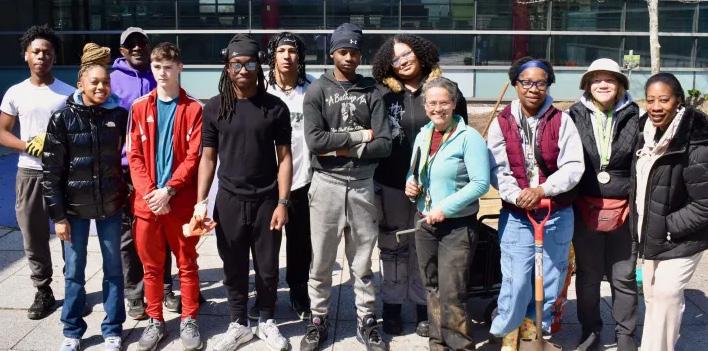
That was the scene Friday morning at the 150 Fournier St. school’s courtyard as student council members joined a dozen Common Ground juniors to spruce up the Newhallville middle school’s garden space.
Friday’s work marked some of the first steps taken by King/Robinson staff to reestablish a functional school garden that, hopefully, will soon help feed the school’s families. The gardening effort is being led in part by Valarie Knowles, the school’s discovery lab educator, and reading support staffer and retired principal Mia Edmonds-Duff.
Common Ground’s visit to King/Robinson Friday was one of 15 volunteer projects that students at the West Rock high school undertook to respond to real community needs. Environmental educator Melissa Gibbons and Common Ground Schoolyards Program Manager Robyn Stewart helped the group of high schoolers and middle schoolers build brand new garden beds, fill them with soil, and clean up the space to prepare it for planting vegetables.
Seventh graders Dorian and Milad agreed that they want to help their school to be more beautiful. Several other student council members noted that they like dirt and plants. “I like people learning together to make something better,” Dorian concluded Friday.
This year King/Robinson staff worked to secure a food insecurity grant that will help the school to bring fresh foods directly to its families. The garden will offer a pathway for families to engage the school more and foster a sense of ownership of the space for students and families.
Some students suited up in gardening gloves and eye protection while others preferred to get their hands dirty to “connect with Mother Nature,” as one seventh grader explained it.
“Something about being in nature makes you feel like you can do more,” Knowles said.
When the occasional worm or centipede made an appearance in the garden Friday students like Common Ground junior Angie quickly leaped in to escort them deeper into the soil — a skill she learned to love despite being fearful of garden critters in the past.
Throughout the morning Angie helped to drill the pieces of wood for the garden beds together with her peers. “Most of the kids here are visual learners like me so it was easy to show them how I learned to do most of this stuff,” she said. “Like when they would scoop up the dirt, I



showed them to cup it with their hands.”
As students worked Gibbons reminded them as they spotted bugs that they want those predatory critters in the garden space to kill bugs that like to eat the produce. When Gibbons found a praying mantis egg sac in one corner of the gar-
den, she carefully moved it away from their Friday work but made sure to place it back after completion in hopes the praying mantis will protect the garden. “We want them to come out because we don’t want bugs to attack the food that we’re growing,” she said.
Every little job proved to be important from picking up left over twigs, plucking weeds, and running wagons to the school’s dumpster to clean up trash. King/Robinson’s preschool-through-sixth graders will join Gibbons in maintaining the space for the remainder of the school year.
Between 9:30 a.m. and 11:30 a.m. Friday the group worked to rebuild two of the six garden beds and fill them all with fresh soil.
When Dorian told Stewart he finished up with sweeping the courtyard sidewalk he asked for another job and she assigned him to fill the final garden bed with the remaining sitting piles of dirt.
When Milad found a grub in the soil Friday, he was informed by a classmate that as it grows it would next become a beetle. Two of the garden beds continued to produce collard greens and comfrey that were planted by the students last year.
Next, Edmonds-Duff said the school will have a hydroponic system built indoors to offer more hands on and engaging learning for students and their families.
Common Ground science educator Paul Clare joined the group of juniors Friday. He said Friday was the second schoolwide day of service done this year. “It speaks to collaboration and the power of maintaining the environment,” he said. He celebrated that Friday allowed Common Ground and King/Robinson to strengthen their relationship. One of many goals, he said, is to introduce the middle school students to the pathway that exists for them to follow through on their interest in environmental education.
“This is a model for building community partnerships,” he concluded.

When crickets were found Gibbons informed the students that crickets work as great decomposers that eat dead leaves.
After finishing one task students moved on to the next immediately. Some even requested to skip lunch in order to continue helping the team build up the garden.
While working in the garden Friday, junior Kymani Chapman recalled growing up helping his mom do work in her home garden of flowers and fruits. Because he’s familiar with assembling garden beds, he said he enjoyed doing that the most on Friday. He even learned along the way new techniques for building from the middle schoolers. “Being outside and working with our hands makes it fun to learn,” he said.
Chapman is Common ground’s student representative for the board of directors, which tasks him with bringing forth student opinions and requests to the charter school’s governing board.
“I didn’t realize it was this easy to be a role model,” he said.
He concluded that, after becoming a student leader and bettering his garden skills, he now looks at the world differently. When he’s passing by green spaces in his neighborhood of East Rock, he’s now prompted to think of how things can be improved to better and beautify the community. He added that he’s also gained new independence skills by learning to build and use a drill over the years. “This reminds us that you don’t always need a reward for your work because what it really comes down to is we can’t live
By Lucy Gellman
When West Hills Alder Honda Smith launched efforts to “bring back The Shack” just over five years ago, 333 Valley St. had been closed to the community for close to two decades. Around the neighborhood, she kept hearing the same thing: people wanted a safe, intergenerational space to gather, where kids could come after school and in the summer, and neighbors could get to know each other. As they rallied around it, those neighbors shared their own visions: food and fellowshiping, homework help, arts and music classes, urban farming, and programs for kids and seniors. And when she set out to rebuild it, one step at a time, she had a whole village behind her.
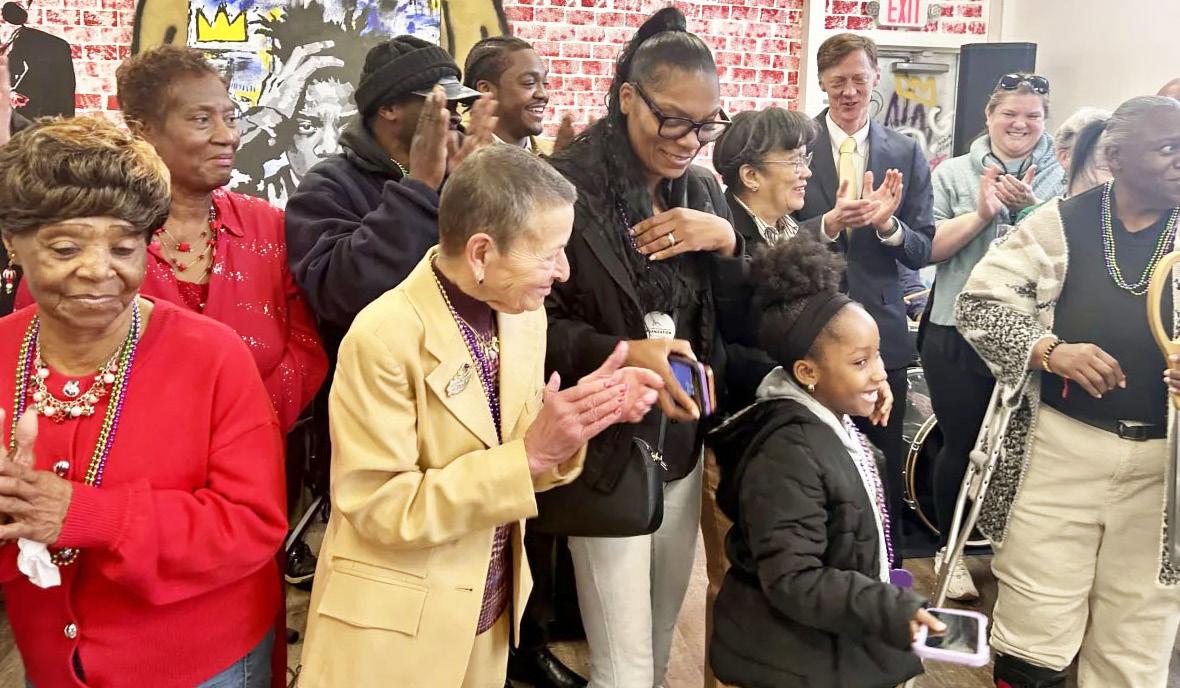
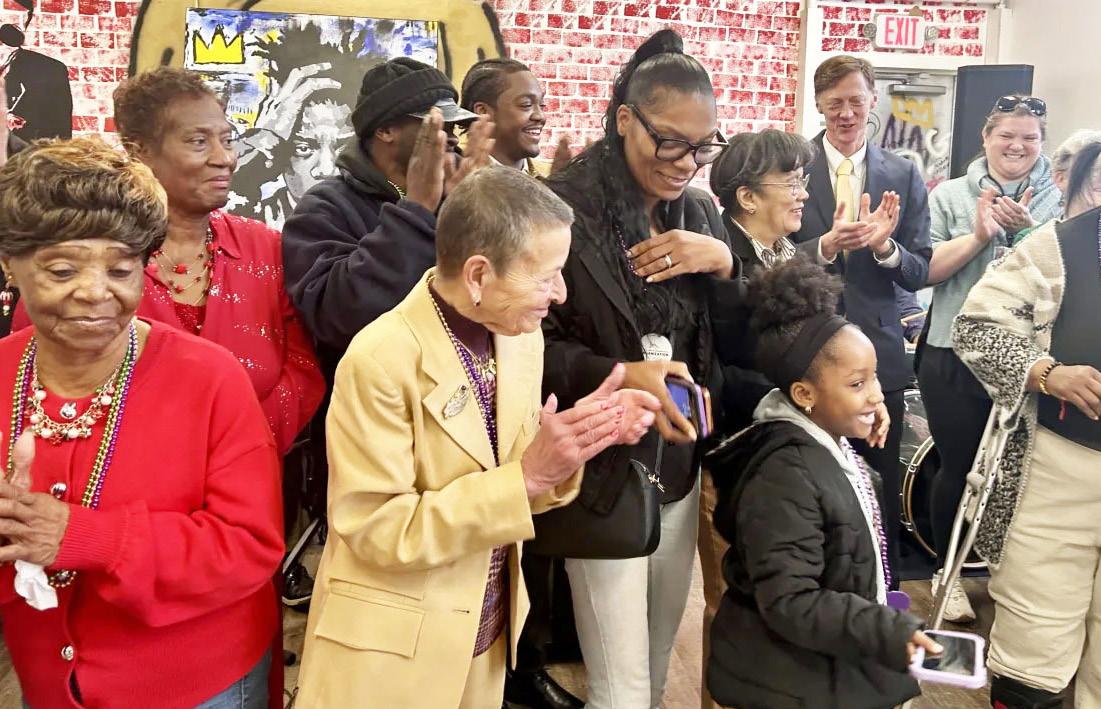
Thursday morning, a long-held West Hills dream came vibrantly to life, as Smith joined aldermanic colleagues, friends, neighbors, and dozens of city officials for the grand reopening of The Shack, a revitalized Valley Street building that has become the vibrant heartbeat of the neighborhood and a hub for everything from arts to educational activism. After years of rebuilding—during which the community has had access to the space—she joyfully reopened the doors, welcoming New Haven to a community center years in the making.
At moments, the opening felt less like a ribbon cutting and more like a church service, as strains of praise and gospel floated through the air and sunlight streamed in through the windows, making curtains patterned with video game consoles seem more like stained glass. A nonprofit board, helmed by former Mayor Toni N. Harp, has helped steward the process.
“This was a long journey,” Smith said at the opening, which included a walkthrough for city staff, alders and neighbors in the morning, and a celebration that lasted well into the afternoon and early evening. She nodded to the number of people who helped make it happen, from city and state officials to funders like the Community Foundation for Greater New Haven.
Currently, The Shack—which serves roughly 750 people each month—includes a recording studio, youth newsroom, tutoring program, “Shack Seniors” group, and classes in visual art, music production, acting, graphic design and financial literacy, as well as access to onsite therapy. In the kitchen, Ms. Monica Clark turns out everything from steak and potatoes to her chip-studded cookies, which have just enough salt to appreciate the sugar.
Past the Valley Street doors, a small screening room, relaxation space, and multipurpose area sit down a hallway, the walls brilliantly decorated with work by artist Rebecca LeQuire, who has also worked with youth to brighten the building with public art. A new hub for music production, often in use and already adored by West Hills’ budding creatives, is tucked neatly behind it.
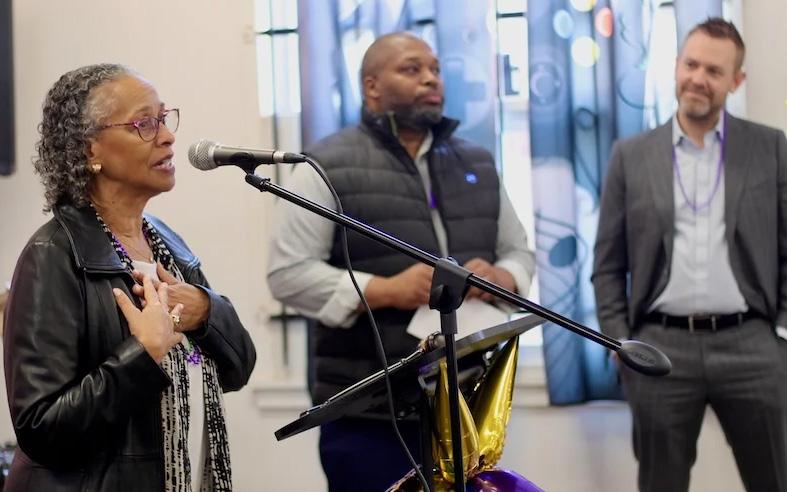
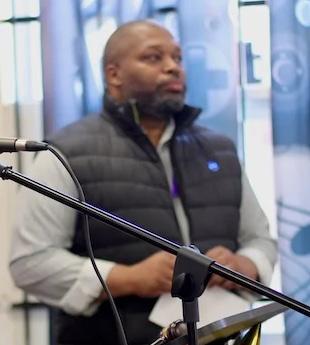
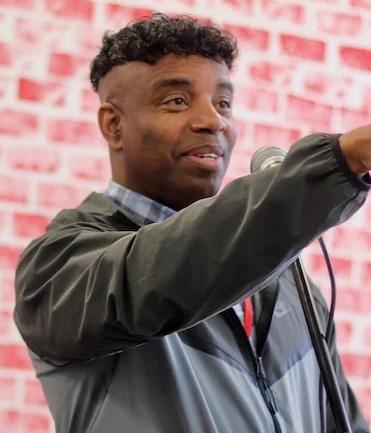
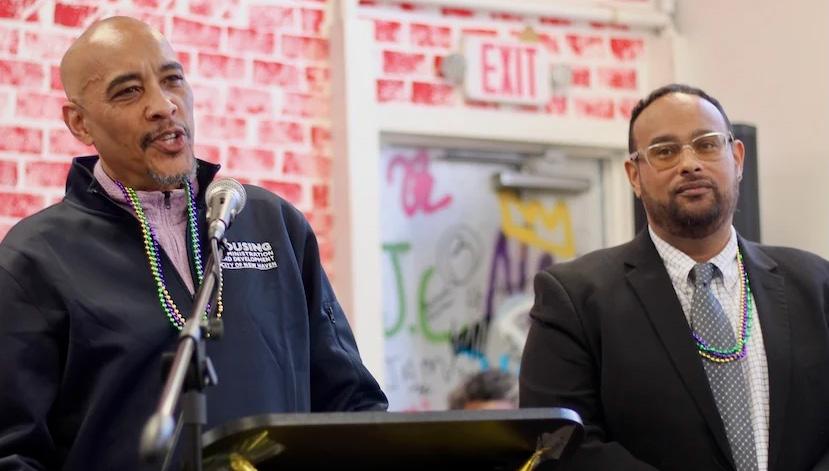
Thursday, Smith and fellow speakers made it clear how unique and beloved the space has become to the hundreds of people who walk through its doors, grow food in its gardens, tend its chickens, and flourish under its roof each month. Around them, that love was palpable, where purple and green balloons and marching strings of Mardi Gras beads co-mingled with musicians sitting regal at their keyboards, and a standing-room-only crowd. Taking the mic early in the lineup, State Rep. Toni Walker remembered watching Smith at work during a Christmas toy giveaway years ago, as drivers pulled up with truck loads of toys to make sure
"You want to feel God in your presence," said State Rep. Toni Walker.
So when Smith embarked on her journey to revitalize the space, Walker was happy to help find state support, she added. She and Sen. Gary Winfield “had a couple of nickels we threw together,” and then they kept asking colleagues in the state legislature to get involved. They described, again and again, the role of this community center in West Hills, and the equally miraculous woman midwifing it into being.
It came through, to the tune of $550,000 in the first months of 2022. Now, almost exactly four years later, Walker joked that her morning had improved dramatically the moment she walked through the building’s front doors, to columns of green, purple and yellow balloons and a bright mural of the late rapper Stēzo stretching across the wall. She had been exhausted from poring over the state budget with colleagues. And The Shack reminded her why she got into public service in the first place.
“This is what we do it for,” she said as musicians dashed out a sort of “amen” from the keys behind her. “It’s bringing people together that want their community to thrive. Let’s get the red tape out of the way. Let’s just get to the heart of it … we love it, and we love her.”
“When Honda calls about The Shack, I’m not hearing what I hear all the time from folks who want money for a program, folks who want money for an idea,” Winfield added moments later. Often, he said, he hears from constituents who are interested in coming into a community that isn’t theirs, sharing a time-limited educational program, and then leaving again, not having built something sustainable.
“What I’m hearing is the call of someone who is concerned about her kids.”
chickens, with eggs that could (and do) nourish the community.
Smith kept growing the space—and building out a community that understands and supports the value of the work. With her H.O.L.L.A. ((Helping Our Ladies Learn and Achieve) Mentorship Program, funded by the Amore Propre Fund’s Lindy Lee Gold, she has been able to mentor 125 students from eighth grade through college, and now onto careers in graduate and professional school.
“Honda has changed not just their lives, but the lives of their future generations,” Gold said of students who have come through the program, handing Smith a check before walking back to her seat. “You can open it,” she added with a little nod and approving smile, as the envelope fluttered like a delicate bird in Smith’s hands.
Behind them, Gold’s words came to life, as attendees studied a portrait of artist Jean-Michel Basquiat by the artist and educator Rebecca LeQuire. Smith later auctioned off the painting for $1,001 to Dwight Alder Frank Douglass, noting that it will help pay for her grandson, Jamire Casteel, to study music at a performance institute in Paris, France this summer. A person could feel that love in the space itself, where music hung low and sweet in the air, and vocalists approached the podium nonchalantly, then took an entire audience to church. After a moving rendition of “Lift Every Voice and Sing”—a twentieth-century poem often recognized as the Black National Anthem— vocalists wove music joyfully into the program, with selections from Stevie Wonder’s “Overjoyed” to CeCe Winans’ “Let Them Fall In Love With You.”
that no child in West Hills went without during the holiday season. By then, Walker had seen Smith’s dedication firsthand, and knew that she was building something special.
“I think she has about 780 children around the city,” she said to laughs.
“And because of this woman and the fact that she said, ‘Our children need it, they came.’ How do you stop following somebody like that? I mean, she can move that many people, you want to be with that person. You want to feel God in your presence.”
That makes a difference in not just the West Hills community, but the city, he and other speakers noted. Harp, who chairs the 333 Valley Street board, recognized the grit, sticktoitiveness, and determination with which Smith approached restoring the space, an old blue building “that was about to fall apart” after its life as a community center had ended 20 years ago. Now, people come to The Shack whether it’s open or not, because they know that Smith is there to help them.
Smith, with a dream and a vision, was able to gather a board, talk to legislators and funders, and raise the dollars necessary not just to reopen the doors, but to make it a rare “third space” that offered something to every member of the community. Young people learned to flock there for homework help and college readiness. Elders met neighbors they’d never known. Musicians found a space to practice and perform. There were even
As a spirit flowed through the space, Smith also shared her own testimony, in a reflection that was as candid as it was galvanizing. With every ear in the room turned toward the speaking podium, she explained that “there was a time in my life where things got grim,” and she couldn’t imagine a bright future like the one stretching before her Thursday, with a room packed to the gills with supporters. At the time, she remembered, a false accusation landed her in a jail cell, where she was afraid and confused, unsure of why this had happened to her. She remembered crying out, thinking Why this? Why me? Why now?
Then “I had a moment,” she said. “A moment with God.”
“My heart softened,” she continued. “My vision got clearer. My purpose became greater than my pain.”
Back in West Hills, she transformed the heavy weight of that moment into a bright fire that she carried, and still carries, for the community. As she listened to neighbor after neighbor speak about the need for a space where people could come together, her vision for The Shack
Con’t on page 16
by Thomas Breen
More than seven months after a dispute over a fake $100 bill used in a drug deal appears to have led to the shooting death of 40-year-old New Havener Dennis Atkinson, city police have arrested the 26-year-old man who allegedly pulled the trigger.
Those details are included in a ninepage arrest warrant affidavit written by New Haven Police Department Det. Michael Haines on April 2.
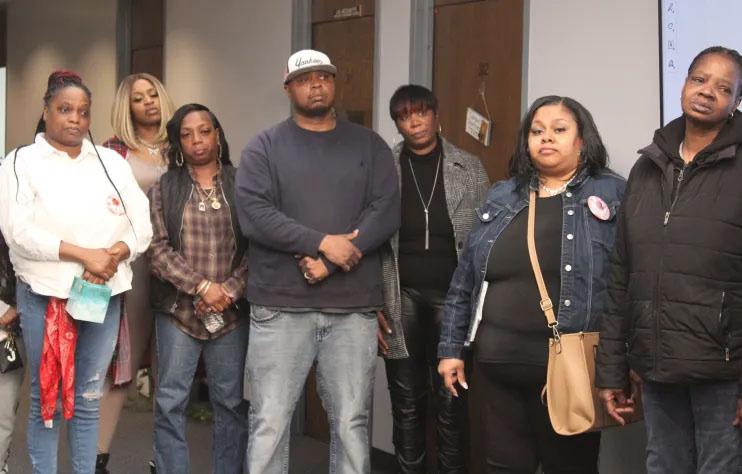
The Independent obtained a copy of the warrant on Wednesday, soon after Acting Police Chief David Zannelli, Mayor Justin Elicker, and Lt. Derek Gartner joined a dozen grieving family members and friends of Atkinson’s for a press conference on the third floor of police headquarters at 1 Union Ave.
Zannelli and Lt. Derek Garner announced, thanks to the police work of Haines and now-retired Det. Jessica Stone, city police arrested a 26-year-old New Havener on April 3 for allegedly shooting and killing Atkinson in the early morning hours of Aug. 18, 2025, on Ferry Street in Fair Haven.
State court records show that the suspect has been charged with murder, carrying a pistol without a permit, criminal possession of a pistol/revolver, and criminal possession of a firearm/ammunition. He has not yet entered pleas to any of those charges, and is currently being held on a $2.5 million bond.
Atkinson previously worked for the Town Green Special Services District as a Downtown Ambassador, “a role that perfectly suited his outgoing personality and love for connecting with people,” according to his obituary. “His presence was a familiar and welcome one throughout the city—his laughter echoing down sidewalks and his energy lighting up every corner he touched.”
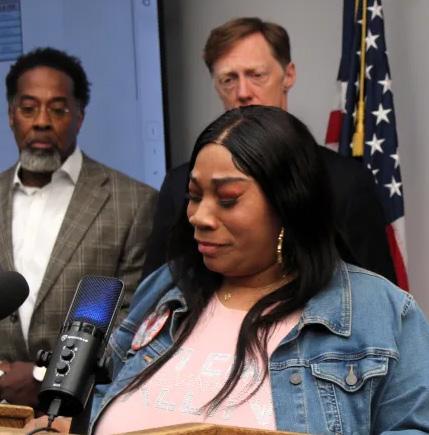
“Every day I just want to hear his voice,” Atkinson’s sister Charlene said through tears at Wednesday’s press conference. “I just miss his smile,” his hugs, his laughter. “He was known for being family-oriented and down to earth,” his obituary states, “with a natural gift for humor that made him unforgettable.”
“Dennis was beloved on the team,” Town Green Special Services District Executive Director Win Davis told the Independent. He said Atkinson had worked as a Downtown Ambassador for “several years,” and was proud of his job. “He was certainly a hard worker. We could give him any task, [and] he would take care of it with a smile on his face.”
Zannelli said during Wednesday’s presser at the police department that Atkinson’s shooting death followed “dispute over money.”
Haines’ warrant sheds further light on what police believe happened.
That warrant states that, at around 4:44 a.m. on Aug. 18, 2025, city police officers
responded to 150 Ferry St. following a ShotSpotter activation for five gunshots and a call about someone who had been shot.
Upon arrival, officers found a man, later identified as Atkinson, suffering from what appeared to be a gunshot wound to the abdomen. He was transported by ambulance to the hospital, where he was treated for his injuries. He was subsequently pronounced dead at 1:05 p.m. The state’s medical examiner determined that he had been shot in the torso, abdomen, and the right foot.
A witness told police that he had been hanging out with his friend “Man Man,” later identified as Atkinson. He said that Atkinson had told him he was waiting to speak with his drug dealer, later identified by the nickname “Neph.” According to this witness, Atkinson said, the day before, a friend of his had purchased drugs from Neph in the Hill with a fake $100 bill.
This witness then said that a man wearing all black approached him and Atkinson on Ferry Street. Atkinson and this man in black got into a verbal altercation, then a physical altercation, as Atkinson claimed that he did not know that his friend was going to pay with a fake $100 bill. The witness said he then heard four gunshots ring out — and saw the man in black flee the area on foot.
At the crime scene, police officers secured four fired cartridge cases, a cell phone, and a switchblade near where Atkinson had been shot.
On the same day of the shooting, Det. Stone was contacted by DEA Task Force Officer Ramonel Torres, who told her that a confidential informant (CI) had contacted him and told him that Neph was responsible for the shooting of Atkinson. That CI said that the dispute was about a
fake $100 bill that Atkinson had provided to Neph in exchange for drugs.
The warrant states that another person also later came forward to tell police that Atkinson “had given fake bills to a drug dealer” named Neph. In a separate interview, an FBI cooperating witness said the same, adding that “Man Man” was “allegedly buying the drugs for someone else” at the time.
Those interviews, coupled with video surveillance footage, DNA analysis, and the identification of the car Neph was driving, ultimately led police to secure a warrant

John P. Thomas Publisher / CEO
Babz Rawls Ivy Editor-in-Chief Liaison, Corporate Affairs Babz@penfieldcomm.com
Advertising/Sales Team
Keith Jackson Delores Alleyne John Thomas, III Editorial Team Staff Writers Christian Lewis/Current Affairs Anthony Scott/Sports Arlene Davis-Rudd/Politics
David Asbery / Tanisha Asbery
Jerry Craft / Cartoons / Barbara Fair Dr. Tamiko Jackson-McArthur
Michelle Turner / Smita Shrestha William Spivey / Kam Williams Rev. Samuel T. Ross-Lee
Contributors At-Large
Christine Stuart www.CTNewsJunkie.com Paul Bass www.newhavenindependent.org
Memberships
National Association of Black Journalist
for Neph’s arrest for murder.
The warrant does not include an interview with Neph. Instead, it states that Det. Stone contacted Neph on Aug. 21, 2025, to speak with him about the shooting. Neph reportedly told Stone he would contact his attorney and be in touch, but Stone never received any such call.
The NHPD’s latest CompStat report states that, through March 29, there have been 0 homicides and seven non-fatal shootings so far this year, compared to two homicides and two non-fatal shootings by that same time last year.
The Inner-City Newspaper is published weekly by Penfield Communications, Inc. from offices located at 50 Fitch Street, 2nd Floor, New Haven, CT 06515. 203-3870354 phone; 203-387-2684 fax. Subscriptions:$260 per year (does not include sales tax for the in State subscriptions). Send name, address, zip code with payment. Postmaster, send address changes to 50 Fitch Street, New Haven, CT 06515. Display ad deadline Friday prior to insertion date at 5:00pm Advertisers are responsible for checking ads for error in publication. Penfield Communications, Inc d.b.a., “The Inner-City Newspaper” , shall not be liable for failure to publish an ad or for typographical errors or errors in publication, except to the extent of the cost of the space in which actual error appeared in the first insertion. The Publisher reserves the right to refuse advertising for any reason and to alter advertising copy or graphics deemed unacceptable for publication. The entire contents of The Inner-City Newspaper are copyright 2012, Penfield Communications, Inc. and no portion may be reproduced by any means without the written permission of the publisher.
by Lisa Reisman
It was a veritable who’s who of New Haven at the reopening of The Shack community center in West Hills on Thursday morning.
For New Haven State Sen. Gary Winfield, it represented a measure of the respect and goodwill fostered by Alder Honda Smith, founder and executive director of the 333 Valley Street intergenerational community center.
“This is Honda loving her community that makes us all want to be in this space,” he told a packed crowd that featured, among other bold-faced names, the mayor, a former mayor, the superintendent of schools, the acting police chief, state senators and representatives, and the Board of Alders president and majority leader, as well as a host of alders.
The reopening came after a restoration and renewal project that included structural improvements and repairs to the building, thanks to a $550,000 State Urban Act Grant.
Smith and her team of neighbors resurrected The Shack, a former community center that had fallen into disrepair, in 2021. Now a gathering place that welcomes over 750 residents each month, it offers educational, vocational, and recreational programs for youth, adults, and seniors, as well as other critical services
and food assistance for families.
Chief among the reasons for its reach and impact, according to former Mayor
Toni Harp, is Smith’s creativity of mind.
“Honda is an example of what thinking

something into existence is all about,” she said. “There was a blue building that was about to fall apart, and she saw a center to bring people together, a place to honor former leaders like [former Shack
director] Ron Augustine, a place to learn art, to make music, to have a radio station, a place with a vegetable garden and chickens.”
Current Mayor Justin Elicker sounded a
similar refrain. Smith, he said, “listens to young people, she listens to what their interests are, what will draw them into this space, and she goes from there.”
For Lindy Lee Gold, who helped Smith put 125 young people through college and graduate school with Smith’s H.O.L.L.A. Mentoring Program, it’s simple. “Honda has changed not just the lives of young people, but the lives of their future generations, setting a new paradigm,” she said. Smith recounted a turning point in her life years ago. “Things were very grim,” she said. “I didn’t want to be around children. I didn’t want to be around anyone.” She found herself in a jail cell for something she didn’t do, she said. “I remember the silence more than anything. The kind of silence that comes after rejection, after family turned their backs, friends grew distant.” She found herself praying, she said. “My vision grew clearer. My purpose got louder than my pain.”
If that sense of purpose eventually built The Shack, 333 Valley St. “was never just a building,” said Smith, who thanked, among others, on-site therapist Antoine Nedd, cook Dorothy Monsanto, and chicken keeper Jerrell Merritt. “It was a refuge, a place where youth could feel seen, where seniors could feel valued, where music, love, and purpose could live under one roof. A place where rejection doesn’t get the final word. Love
Con’t on page 07



by Laura Glesby
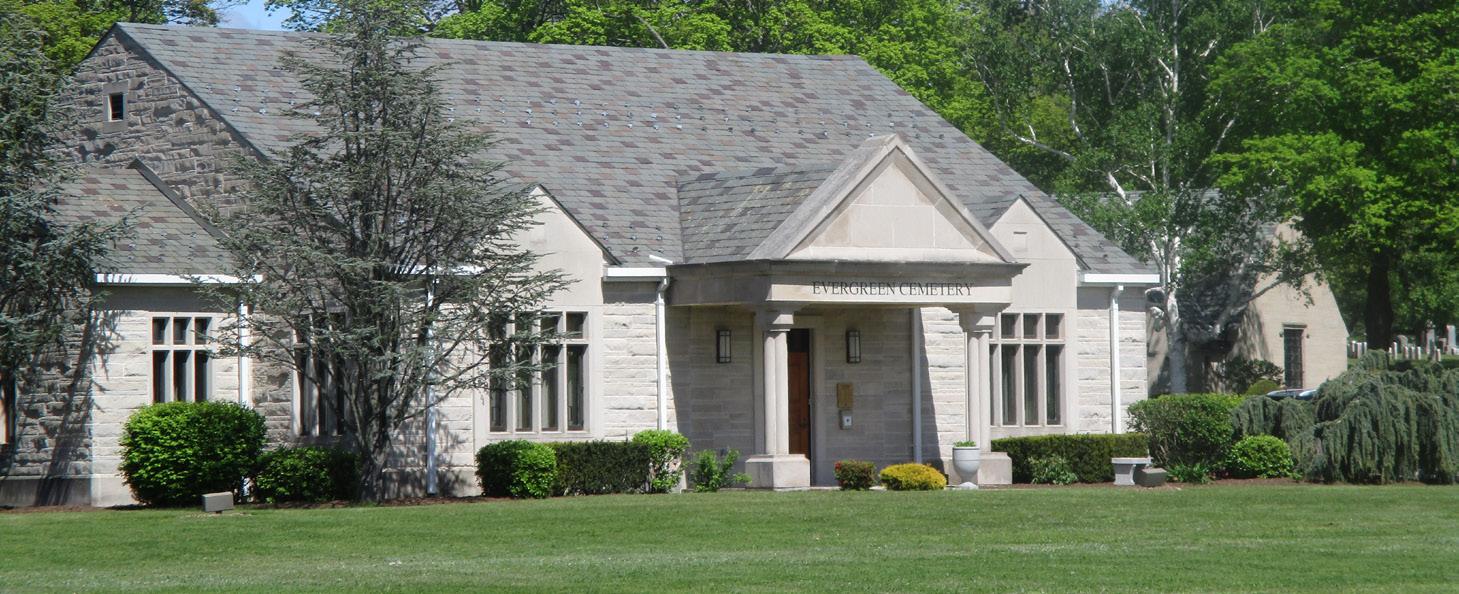
Sarah Alkire and Wanda Jofre drove by St. Bernard’s Cemetery in the Hill when they noticed a man nodding off on the sidewalk. They turned back, pulled up, and rolled the window down.
“Are you doing OK?” asked Alkire.
The two COMPASS outreach workers weren’t responding to an emergency 911 call related to addiction, homelessness, or mental health — but they did see someone who might need help.
So, as they often do on the job, they stopped to check in — and left the door open for building a relationship.
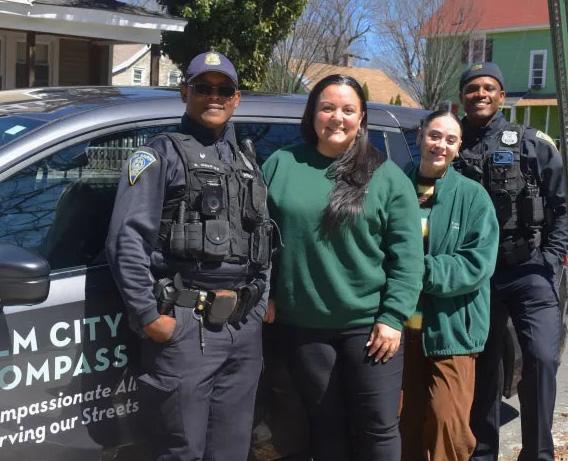
Jofre and Alkire were the two outreach workers on call Wednesday afternoon with Elm City COMPASS (Compassionate Allies Serving our Streets). They work as part of a team of social workers and peer counselors that responds to 911 calls involving adults struggling with mental health, substance use, and homelessness. In between those crisis calls, the teams conduct proactive outreach, checking in on people like the man who seemed to be sleeping by the cemetery fence.
COMPASS is one of two programs run by the nonprofit Continuum of Care currently funded at least in part by the American Rescue Plan Act (ARPA) — federal pandemic relief funding that must be spent by the city by the end of 2026. The non-congregate shelter at 270 Foxon Blvd. is another program currently funded by this soon-to-expire set of funds.
While Mayor Justin Elicker has committed to finding the funds for both programs to continue at their current capacities, it’s uncertain exactly how.
The city still needs more than $1.4 million in outside funding in order to keep both COMPASS and the Foxon Boulevard shelter operating.
“These programs are both very important to the city, and we’re working to find the funding. We’re cautiously optimistic about that,” said Elicker.
“We’ll find a way to make sure these programs continue,” he said.
Jofre, Continuum of Care’s clinical director of acute and emergency response services, and Alkire, COMPASS’ lead clinician, are both social workers who grew up in the New Haven area. Through COMPASS, they regularly work with people living on the streets, or in the depths of addiction, or facing acute psychological distress — or often, some combination of the three.
They’re also often called upon to assist survivors of domestic violence, people losing their memory with age, tenants experiencing an eviction, and people facing intervention in a hoarding problem, among other scenarios.
They don’t push sobriety on people who aren’t seeking to get sober. They also can’t personally force someone to get
psychiatric care, although they can call in help from a crisis intervention team with that power if they think someone might hurt themselves or others.
And when someone tells COMPASS they don’t need help, that they want to be left alone, the team walks away.
“Our biggest thing is meeting a person where they are,” said Alkire. The goal is to be a non-judgmental presence. “I’ll always be with a gentle voice: ‘Are you okay? I wanted to check on you,’” she said. “And if I were to see them again at a call or something like that, then they’re more in tune, because I was gentle.”
“We keep showing up,” Alkire added. “We keep meeting them where they’re at. We’ve had clients say to us, ‘You guys didn’t force anything on me. You let me be me, and let me have choice, and let me have options, and that’s why I feel comfortable here.’”
Alkire can think of plenty of people who have refused help at first, but who after numerous interactions — “it could be seven or 70 times” — became ready for more support.
As they drove by one intersection along Ella T. Grasso Boulevard on Wednesday, a familiar face approached Alkire and Jofre’s car. The man had been approaching cars to ask for money.
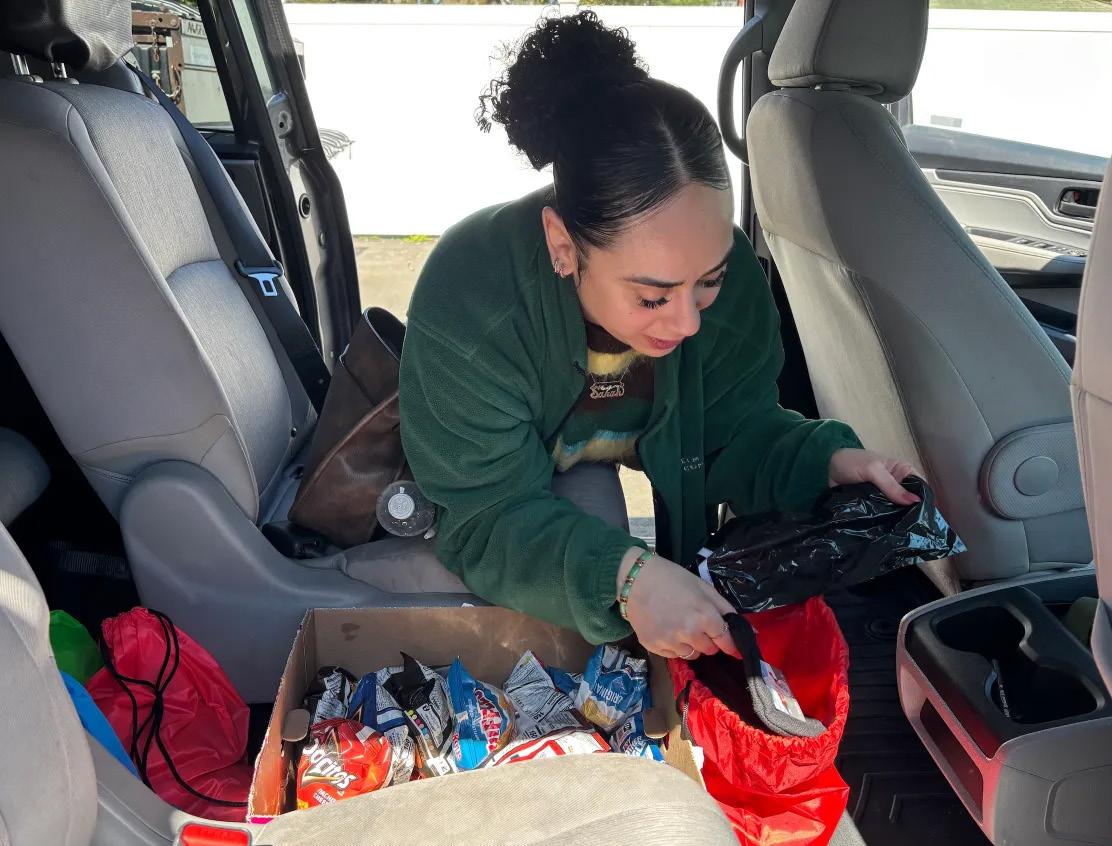
Alkire rolled down her window. “Do you want some snacks?” she asked.
The man immediately started walking in the other direction. Alkire rolled her window back up.
“He’s usually a little more agitated,” she said — occasionally so much so that COMPASS isn’t equipped to approach him while prioritizing everyone’s safety. The man hasn’t wanted any support from COMPASS in the past, said Alkire.
“We’ve talked very often.”
There’s another person, Alkire recalled, who had frequent interactions with police resulting in a call to COMPASS. “She would see COMPASS coming, and she would run the other way,” Alkire recalled.
After “seven or eight” times when that happened, Alkire recalled the woman saying, “All right. You keep showing up. What do you got?”
Eventually, she agreed to stay overnight at Continuum of Care’s emergency short-term shelter program at 310 Winthrop Ave., known as the REST Center (for Rapid Evaluation, Stabilization, and Treatment).
From there, COMPASS and Continuum connected her to substance-use treatment.
“She’ll still call us to check in and say, ‘Hey, I’m doing okay,’ or ‘Hey, I’m struggling today. Can I come?’” Alkire said. Sometimes, that’s what success looks like at COMPASS: long-term support, trust, and healing.
Sometimes, though, success is something more urgent and simple: a pair of gloves provided in the cold, a life-saving dose of naloxone, an indoor place to sleep for just one night, or even just a verbal check-in signaling that someone cares.
Those fleeting interactions can help someone make it to the next day.
The harm-reduction philosophy underpinning COMPASS holds that those efforts
to try and help someone survive and improve their quality-of-life are worthwhile — even if the person in question doesn’t check into a rehab facility or a psychiatric institution right then and there.
In Search Of $1.4M+ For COMPASS, Shelter
The team checks in with Sgt. Sanders (center).
Back in 2022, COMPASS kicked off with a total of $3,513,842 from both local and federal funding: a $2 million federal grant, $625,000 annually from the city’s general fund budget, and the remainder from ARPA.
Over time, COMPASS has ramped up operations to cover 19 hours a day, seven days a week, with three shifts between 8 a.m. and 3 a.m. each day.
In March 2026, according to a report published to COMPASS’ website, COMPASS was called by fire or police department members to aid with an emergency 47 times over the course of the month.
starts July 1 does not include full funding for both COMPASS and the Foxon Boulevard shelter. The city still needs $1.43 million to keep both programs going. That funding has not yet been secured. Elicker is currently advocating for the state to provide the remaining $1.43 million needed for both programs, while also looking into opioid settlement funds as a possible source of funding.
New Haven State Rep. Patricia Dillon recalled a “very productive” and “thorough” meeting with the Elicker administration about “a number of asks the city has,” including funding for school maintenance.
Asked about the likelihood that the state will assist in funding the Continuum programs, Dillon said, “I’m optimistic, but it’s not gonna be easy. Nothing is.” New Haven State Rep. Steve Winter, who also heads the city’s Office of Climate and Sustainability, said that he isn’t certain about “the likelihood that either of these programs get funded on the state level.” He pointed to an increase in funding for the state’s Department of Housing proposed by both Gov. Ned Lamont and the state legislature’s Appropriations Committee, some of which he said is likely to make its way to New Haven, as one source of optimism.
“It’s a challenge, given all the constraints that the state has — both the constitutional spending cap and the fiscal guardrails. It’s difficult in any given year to try and meet every request,” Winter said, adding,“I’ve seen and heard that there’s a lot of value for both of these programs.”
“I think we have a strong case to make,” said Dillon. She noted that “the city takes in a lot of vulnerable populations,” including unhoused people who come from both within the city and from surrounding towns that do not offer as many social services.
“New Haven has really stepped up on this. I don’t think the taxpayers of New Haven should be punished for being generous,” Dillon said.
911 operators directly dispatched the team to three incidents. And COMPASS made connections with 121 other people through proactive outreach.
According to the report, 64 percent of all of those March interactions involved a referral to an outside resource for a basic need.
Now, COMPASS needs $1.2 million from the city in order to continue operating at its current capacity for the next fiscal year, according to Elicker. In practice, that would mean an additional $575,000 on top of the city’s pre-existing annual general fund contribution.
Currently, Elicker’s budget proposal includes a general increase of $645,000 for Continuum of Care programs. That funding could be used for COMPASS, or it could be used for the non-congregate shelter at 270 Foxon Blvd., which has also been funded by ARPA — and which will require $1.5 million to continue operating.
Elicker’s proposed $733.3 million general fund budget for the fiscal year that
Born From Black Lives Matter Elicker first proposed COMPASS as a police diversion program in the wake of the 2020 Black Lives Matter protests against police brutality and racism. The program launched in 2022 based out of Continuum of Care, with administrative support from Yale University.
Sun Queen, one of the founders of Black Lives Matter New Haven and an organizer with the Unhoused Activists Community Team (U-ACT), sits on COMPASS’ Community Advisory Board.
She said she hopes to see the program evolve to work more independently from the police department. Right now, there’s no number that can directly reach COMPASS. “You have to go through 911 for triage.”
Still, Queen said, the program is an important step toward de-escalating encounters with people who are experiencing a mental health crisis. She pointed to Everard Walker and Steven Jones, two
Con’t on page 17
New Haven, Conn. (April 13, 2026)— What is the magic that transforms a few simple ingredients into the miracle known as pizza? Scott Wiener, renowned pizza authority and founder of Scott’s Pizza Tours in New York City, will unravel the mouth-watering mystery during, “The Science of Apizza: A Talk with Scott Wiener,” on Thursday, May 14, 2026, at 6 pm, at the New Haven Museum (NHM). The program is the latest in the “Monthly Slice” series at NHM, presented in conjunction with the exhibition, “Pronounced Ah-Beetz.” Free with regular museum admission. Register here.
Is it the water? The 100-year-old oven? The ingredients? Perhaps it’s the talent of the person creating the pie, or all the above. Gorman Bechard, director of “Pizza A Love Story,” will explore the food-science phenomenon with Wiener in a conversation sure to be enlightening, funny, and perhaps a tad obsessive. United in their passion for pizza, the two will look for answers to the question of what makes New Haven pizza so good. Visitors should don their Bill Nye hats and bring their questions to the Q&A which follows.
The “Pronounced Ah-Beetz” exhibition at NHM includes first-hand oral histories and pizza-related artifacts from personal collections, video footage adapted from the documentary and photographs. The exhibition’s title comes from the way many people mispronounce the word apizza, which originally grew out of the Italian la pizza. The exhibition will remain on view through October 2027.
Since founding Scott’s Pizza Tours in 2008, Wiener has educated countless pizza lovers and professionals about the history, science, and culture of pizza. His expertise has been featured on the Food Network, History Channel, The New York Times, Wall Street Journal, The Tonight Show, LIVE With Kelly and Ryan, and more. Those in the pizza industry recognize him as a columnist for Pizza Today Magazine, a consummate speaker at pizza tradeshows, and lead judge at pizza competitions across the globe. He is the founder/director of Slice Out Hunger, a nationwide nonprofit that fights food insecurity through pizza-related events and campaigns. He lives in Brooklyn, New York with his Guinness World Record collection of pizza boxes.
About the New Haven Museum
The New Haven Museum has been collecting, preserving and interpreting the history and heritage of Greater New Haven since its inception as the New Haven Colony Historical Society in 1862. Located in downtown New Hav-

en at 114 Whitney Avenue, the Museum brings more than 375 years of New Haven history to life through its collections, exhibitions, programs and outreach. As a Blue Star Museum, the New Haven Museum offers the nation’s active-duty military personnel and their families, including National Guard and Reserve, free admission all year. For more information visit http://newhavenmuseum. org or @NewHavenMuseum or call 203-562-4183.
Con’t from page 05
does.”
To illustrate that impact, Livable City Initiative (LCI) Neighborhood & Commercial Development Manager Mark Wilson, who worked with Smith on the recent restoration, referred to Lisa Brown’s stirring rendition of “One Night with the King,” still lingering in the air.
“There are a lot of our young people in this community that will have a moment with Honda and at the Shack that will change their life,” he said.
With the housing authority rehabbing 210 apartments at McConaughy Terrace on nearby East Ramsdell Street and 140 apartments slated to open on Blake Street, there will soon be more young people, according to Westville/Amity
Alder Alder Richard Furlow, the board’s majority leader and youth coordinator at the community center.
That was when Smith stepped forward.
“That’s not all,” she said, before announcing a second Shack location in the works, this one in South Carolina, where they were recruited to start one.
“This is just the beginning,” Furlow said.
By Lucy Gellman
The metronome was already going, strong and steady as it soared through the room, when Christian Lawrence sat down at the keyboard and looked instantly at home. Still in her seat, Caitlin Curtin puzzled over lines of text, turning them over in her head as she tried to build lyrics. Back on the keys, Lawrence found a beat, and leaned in as if he was praying.
“Yeah,” said D. Arcelious Harris, a Grammy-winning producer and educator better known as Swagg. “We’re gonna lay that down.”
Lawrence is a senior at Metropolitan Business Academy, and aspiring producer who has been making music since he was seven years old. Curtin is a senior at Engineering and Science University Magnet School (ESUMS), where she rarely gets to make music during the school day.
Last week, their worlds collided at Cooperative Arts & Humanities High School, as the New Haven Public Schools (NHPS), GRAMMY Museum and Recording Academy came together for the inaugural “GRAMMY In The Schools Music Industry Career Day.” The brainchild of veteran educator Pat Smith, who “retired” from Co-Op last June and then became the coordinator of fine arts for the New Haven Public Schools, it laid the foundation for future arts collaborations across the district. Roughly 150 high school students, from all nine high schools in the district, attended.
“I feel a lot of gratitude,” said Smith, who taught band at Co-Op from 1998 to 2025, and left last summer alongside beloved educator Harriett Alfred. “The scope of this has started to sink in, and it’s really the manifestation of a dream.”
The program has been years in the making, he added. In 2017, Smith (and CoOp) won the Grammy Signature School Community Award, in what became his introduction to the GRAMMY Museum and Recording Academy. Then in 2022, he was nominated for the GRAMMY Music Educator Award, for which he was ultimately named a semifinalist. Just two months later, he was back with “The Creator’s Classroom: Student Spark,” a day of professional development for educators across the district.
The industry career day was the first iteration of a student version of that, he explained. In addition to GRAMMY-winning artists and producers who led the workshop, the day featured panels from artists Jason “Poo Bear” Boyd, who grew up in New Haven, and musician Nicole Zuraitis, who won her first Grammy in 2024. It ended with a jazz jam session with students from nine different NHPS high schools, playing nearly two dozen instruments as Zuraitis held it down on the mic.
When the day arrived last week, Smith’s

vision came vibrantly to life, thanks to both GRAMMY collaboration and fellow NHPS arts coordinators Ingrid Schaeffer and Kim Weston. Holly Maxson, who is the district’s supervisor of fine arts, was also present; in the past year, she has helped increase artistic collaboration across the district.
Inside Christine Dominguez’ second-floor band room, New York-based producers Swagg and Riggs Morales (or simply Riggs, as he said to students) handed out sheets of paper, on which they asked students to write a potential song title, and then four words related to that same song title.
“Think about the emotion, the feeling, relatability—most of the songs that you guys love, there’s something relatable about it,” Riggs said. “Who would want to drop a grenade for you—” he took maybe half a beat for students to register the Bruno Mars lyric and dropped his voice to close to a whisper. “Yeah yeah yeah.”
“Great song,” chimed in Swagg, who has worked with dozens of artists including Baby Face, J Que Smith, and Tony Dixion to Tiara Thomas, Juke Box, and Dawn Richards. “I wish I wrote that song.”
“As a songwriter, it’s my job to communicate and try to convey a song that you feel, a thought,” he added. “I want to communicate a thought and I want you to feel it, right? As a producer, I build context around that thought. It’s the vehicle in which that thought moves. Right?”
In the fourth row, where young musicians usually spend their mornings poring
over sheet music, Metropolitan Business Academy junior Delylah Banores looked over her page, parsing out sports terminology that might translate to a love song. Three years ago, during a socially difficult freshman year, Banores “started writing poetry instead of bottling it up,” she said. She hasn’t stopped since—which made Monday’s assignment feel natural. From the words on the page, she started cobbling tougher sentences, listening to other students think through words that ranged from crush and universal to alegría, the Spanish translation for joy. “Keyboard? Any keyboard players? Can you raise your hand?,” Riggs said, interrupting her train of thought. On a large screen at the front of the classroom, Swagg had pulled up a blank file in Logic Pro, a platform that songwriters, podcasters and producers often use as they are working through tracks (FL Studio, Cubase, and Pro Tools are other personal favorites, he said). “Drums? Is there a Mike Will in the house?”
From where he sat toward the back of the room, Lawrence hopped out of his seat, as if he had been waiting for this moment. In a flash, he was at the keys, sounding out a beat over the thump and click of a metronome that came from somewhere inside the program.
He lowered his head toward the keyboard, cocking it just slightly to the side, so that one ear hovered close to his hand. His hair, dyed a hydrant-colored red that was fading into orange, added a pop of color to the space.
“Let’s go a little bit slower,” Swagg said, adding space to count him in. “I like the groove.”
page, she had scribbled the words I need your love, a thought interrupted halfway. A beat later, maybe two, Curtin was in the mix.
The four, making a circle close to the drums, began to sway to the sound that Lawrence had laid down, now transformed into a synthy echo of itself. Dahduh-dug, dah-duh-duh, ventured Rachel, as Anna suggested she could bring it up an octave, her finger pointed momentarily towards the ceiling. Salahuddin, who has been honing her vocal skills alongside the violin at Music Haven, joined in. Soon, Curtin had brought out her phone—a supposed rarity for a school day—and was singing along:
Come on, don’t let it take me, break it Leave me hopeless
I know you see me baby rocking out of focus
I’m trying, But you’re lying
Can’t be in your world if you’re hopeless
‘Cause you’re not hoping for me— Riggs checked the time, surprised that only about a minute remained. With the skill and grace of a seasoned teacher, he brought the room back to attention.
Around the room, a few students scribbled more words onto their pages, some handing the papers over to Riggs for his approval. “Mold me entire!” Riggs read with glee. “Cathartic!” “Bacon, egg and cheese? Oh, someone’s hungry.”
Back at the keys, Swagg moved Lawrence from the beginnings of a track to what he calls a “sonic composition”—a lush soundscape that blooms around an idea, and then a hook. Lawrence, who has been making and producing music since he was seven and plans to study production at Western Connecticut State University in the fall, nodded along appreciatively.
“I feel like music makes me get in touch with my emotions,” he said later in the session. “Honestly, every time I have a paper and pencil, I’m writing.”
For the moment, all of his attention rested on Swagg.
“We got a dope melody here, we got a cool loop going, how can we make this—” Swagg paused for a moment as Lawrence’s notes floated across the room, eliciting a few Mmmmmms from classmates. “Feels even more special. Let’s move it outside of the piano, and think of something cooler, a synth or something, right? But let’s first build up the parts and then we can play around with a different sound.”
Lawrence, rising from the keyboard, headed over to a drumset sitting empty across the room. From the front and second rows, ESUMS senior Adina Salahuddin and Metro freshmen Rachel and Anna Gorham headed over to the piano, still thinking through lyrics. Across Rachel’s
“Guys, please,” he started. “Whatever you do, you have to stay with it. Because at some point, you will hit a wall. And on the other side of that wall, there is a breakthrough.”
“I think there’s power in giving young people permission to dream,” Swagg added as the room emptied out, and both he and Riggs headed back down to the auditorium for a panel and jam session with Zuraitis. Growing up in small-town Georgia, it was the church that gave him that permission. Now, he tries to do that for the young people he works with. “Connection starts horizontally.”
“It’s Ok If Your Journey Is Squiggly”
That permission to dream—even and maybe especially when things are going very, very badly—flowed through a discussion from Zuraitis and Nikisha Bailey, a professor at Drexel University who is also an audio engineer, educator and entrepreneur. As they took a seat on the stage, Zuraitis wound back the clock to her youth in Waterbury, where she excelled in sports, but never felt a strong sense of camaraderie.
That changed when she walked into a band classroom for the first time, and picked up a trombone. “The only place where I felt like I had my people was in band,” Zuraitis said, with a smooth, sultry voice that a person could hear the musicality in, even as she spoke. From the auditorium’s fourth row, Co-Op student Rachel Collins hoisted her trombone into the air and squealed.
“It was definitely a marathon, and not a sprint,” she added of her slow and sometimes uncertain journey into the jazz
By Abiba Biao
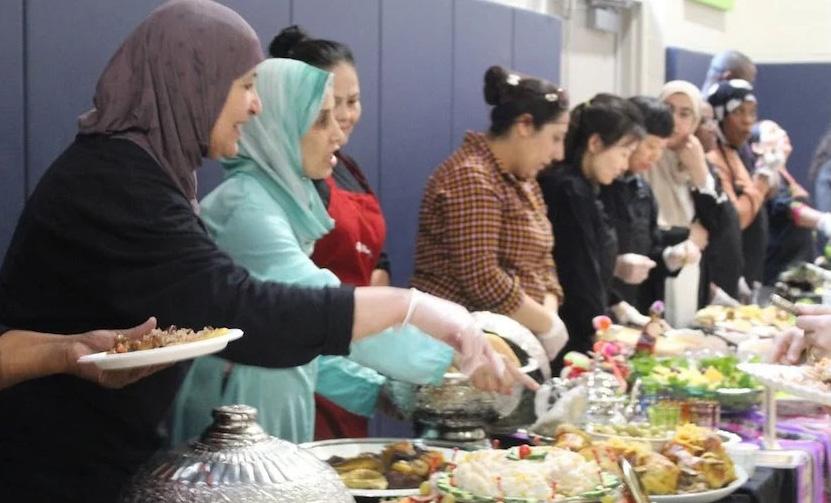
That's thanks to Sanctuary Kitchen, a program of CitySeed that last Wednesday held its first cultural luncheon at the Dixwell Community "Q" House on Dixwell Avenue. Organized with 14 members of Sanctuary Kitchen's Culinary Training Program, the meal brought global flavors to a historic New Haven landmark, becoming a testament to the diverse and polyphonic community that makes the city such a vibrant place to live.
Cuisines spanned countries including Angola, China, Ethiopia, Jamaica, Morocco, Mexico, Peru, Syria, Thailand, and Togo. Read more about that here.
Sanctuary Kitchen is a program under CitySeed. Now in its sixth year, the Culinary Training Program trains residents of the Elm City—many of whom are newcomers to New Haven and to this country—“to prepare food, work on a team, and succeed as part of a kitchen staff in a professional environment,” as stated on its website.
Carol Byer-Alcorace, director of culinary education at Sanctuary Kitchen, said that the program is a safe space away from the political developments of the outside world that helps members build camaraderie and gain professional and educational support.
“Even though there's a lot of cultural conflict outside of the kitchen in terms of who our cohort members are, that disappears,” she said. “As soon as they walk in the kitchen, that disappears, people share, they make friendships. They share food secrets, which they might not necessarily do, and they, sort of, demystify some of the things
that are in their culture.”
The current cohort consists of 15 students. Students complete 12 weeks of classroom training followed by six weeks of “hands-on community partnership with businesses in the city,” Byer-Alcorace said. That includes workforce readiness, culinary training, and English for Speakers of Other Languages (ESOL) classes.
After graduation, each cohort produces a cookbook, with recipes and dishes served at the cultural foods day will be included in the book. Applications for the seventh
cohort will open in mid-July.
“When I finish a cohort, I always go, ‘Oh, this is the best cohort I ever had. I love everybody.’ And then I get another one, and I'm like, ‘Oh, my God, I love everybody.’"
Doing the event at the Q-House also holds special significance, Byer-Alcorace said, describing the organization's partnership with Sanctuary Kitchen as “accommodating and supportive.” Previously, Sanctuary Kitchen and CitySeed have used the Q House only for its kitchen and conducted classes elsewhere. This year, the program
has held both its cooking instructional classes at the Q House.
While the original intention was to have a simple cultural foods tasting, the high interest from culinary training program students prompted them to host a big event. “I wanted them to make the food that they eat in their homes,” she said.
Sasha Fay, director of food business at CitySeed, seconded Byer-Alcorace’s sentiment.
“This cultural luncheon is a way for
them to have, like, a peer review on the food that they make,” she said, “and they're also for some CitySeed folks that come in and try the food and people at the house to try the food.”
“So it's a great opportunity for them to have a part of this culinary training program, but also express their love of food, and their love and their culture, and their love of community here today,” Fay continued.
Melvina Williams, a member of this year’s culinary training program, came with a tray of Jamaican oxtail, rice and peas, and pineapple ginger juice. By the end, nothing was left in sight, each container completely empty.
“Everything was gone,” she said, thrilled about the flood of attention she had received. “Everybody keep coming back and said ‘Oh, I heard about the juice. I heard about the juice.’ Everybody come for the juice."
As attendees made their way out of the gymnasium, Williams responded to the many utterances of “thank you” that came her way after getting plates of her food. She also showed no signs of stopping, saying that she plans to continue cooking after graduating from the program. She hopes to serve the community though cooking, and continue to use the skills she learned from CitySeed.
“I want it to grow,” she said of the program. “So I’m going to hand out lunch by doing, you know, some cooking, or some baking.”
by Donald Eng
HARTFORD, CT — A wide-ranging bill aiming to place limits on federal Immigration and Customs Enforcement agents was expected to pass the state Senate Tuesday, albeit not before a lengthy and partisan debate.
Senate Bill 397, An Act Concerning Democracy and Government Accountability, would give residents the ability to sue federal officials that violate their constitutional rights, bar law enforcement officials from wearing masks, prohibits ICE arrests in protected areas like schools, hospitals and houses of worship and places limits on automated license plate readers’ data storage.
“After the murder of Renee Good in Minneapolis in early January, Senate Democrats vowed that we’d work on legislation to prevent these types of ICE abuses in Connecticut,” said Majority Leader Bon Duff, D-Norwalk. “Today we’re keeping that promise.”
Duff said Senate staff had researched the legal issues for months and that they were “as airtight as you can get.”
Republican leader Stephen Harding of Brookfield, in a media gathering immediately following the Democratic briefing,

said virtually all of the components in the bill were irrelevant because they would immediately be found in violation of the Supremacy Clause. The Supremacy Clause is a provision in the U.S. Constitution that the constitution, laws made
pursuant to it and treaties supersede conflicting state laws.
“This is nothing more than an anti-cop bill,” he said. “Everything in the bill relating to ICE is absolutely superflu-
ous. It’s Constitutional Law 101 … you cannot override the federal government. It’s that simple.”
Harding used the example of the state’s Trust Act, which restricts the cooperation between state officials and federal immigration agents. The Trust Act, though, places limits on state and local employees, not federal ones, he said.
Senate President Pro Tempore Martin Looney, D-New Haven, disputed that saying the Democratic proposal was on solid legal ground.
“We know the federal Department of Justice has lost in a number of their lawsuits that they have brought since the Trump administration came into effect. We believe they’ll lose on this one as well,” he said. “We’re confident this bill will survive court scrutiny. It’ll be attacked. They’ll be seeking to undermine on the part of the federal government, but we believe it’ll be upheld.”
Duff added that the caucus had taken pains to craft a bill that would survive legal scrutiny.
“We wanted to put together a bill that would work and that would pass a court challenge,” he said. “We’ll see what happens, but we have not intentionally swung
for the fences. We have excellent lawyers working for the Senate Democrats, but we also have worked with the attorney general’s office and the governor’s office as well, and everybody signed off on it.”
Asked if any proposals had been discussed but dropped as being legally shaky, Looney said previous drafts had included a prohibition on standing armies or forces from other states being ordered into Connecticut.
“We removed that,” he said.
The Senate convened shortly after 1 p.m. Tuesday, and the bill was expected to be debated into the night. But Democratic leaders said their caucus was united behind it, which would give it more than enough support in the chamber that Democrats control 25-11.
“After passing in the Senate, SB 397 will be debated and passed in the House of Representatives and signed into law by Governor Ned Lamont,” according to a written statement from the caucus.
Most of the bill’s provisions would go into effect immediately upon passage, the exception being the prohibition on law enforcement of any level arresting people for civil offenses in protected areas. That section would take effect Oct. 1.
by Kofi Oppong Kyekyeku, Face2FaceAfrica.com
nger and disbelief rippled through the Vatican on Tuesday as visitors reacted to U.S. President Donald Trump’s sharp criticism of Pope Leo XIV over his call to tone down war rhetoric.
The clash between the American president and the U.S.-born pontiff has stirred global attention. Trump labeled Leo “weak” and accused him of aligning with the “radical left’’ in a social media post, responding to the pope’s warning that Trump’s threats toward Iran were “truly unacceptable.’’
Back at the Vatican, tourists, according to an AP report, largely sided with the pope, even as he remains on a 10-day visit to Africa.
“It’s just ridiculous, because if the pope is not speaking about peace, and is not taking care about every people in the world, he’s not the pope,’’ said Joerg Soler, a visitor from Switzerland.

istration is doing something completely opposite. They’re just tearing people apart. They’re talking about division and war and hate.”
Italian journalist Massimo Franco suggested the criticism reflects a deeper misunderstanding of the papacy’s role. According to him, the pope’s responsibility extends far beyond national interests.
“A pope must be a pope. He must respond to a wider community. And if he sees that Trump’s policy risks to give a distorted view of the United States, I think the pope is helping the United States as well, not just the United States, to find the right path,’’ Franco said.
Antonio Spadaro said the tension points to a different kind of imbalance. The Jesuit priest argued that Trump’s reaction to what he called a moral authority underscores a limitation of political power.
spotlight. After falling in love with the trombone, Zuraitis studied at Litchfield Jazz Camp—a program from Litchfield Performing Arts that is very much still in operation—and then went on to pursue voice at New York University and Louisiana State University. But when she moved to New York over 15 years ago, she hit a little bit of a wall.
For years, she remembered, she (and soon her partner, fellow musician and big band leader Dan Pugach) were hustling, cobbling together gigs to make ends meet while also recording albums, playing at jazz clubs, and trying to get their name out there through competitions and festivals. It was exhausting, she remembered. At one point, she and Pugach played two weddings in a single weekend, and then she performed over a track five nights a week at a restaurant in New York City.
Another American visitor, Paul Sarauskas, said he was stunned by Trump’s remarks, describing them as “absurd.’’
“I think he needs to keep his nose out
Mariella Acciaioli, a tourist from France, was equally blunt. “It’s completely inappropriate,’’ she said. “Things are getting too much. We need to mobilize everyone, especially our leaders, to deal with this behavior that is going beyond every limit.”
of religion. He’s telling the pope what to do. He’s telling the pope how to do his job,’’ Sarauskas said. “Where the pope just wants to do good things, right? He wants to talk about peace, about helping other people, whereas the current admin-
“He can’t bring the pope to the same terrain where he has brought everyone else, where he can dominate with language,’’ Spadaro told Italian Radio 24.”In this sense, the moral force of the church is evident. It is not a counter-power but a space in which power is being judged by criteria that power itself cannot control.”
New York Carib News
Cuban President Miguel Díaz-Canel has declared that the island will defend itself against any potential military action by the United States, warning of serious regional consequences if tensions escalate further.
In an interview conducted in Havana with NBC’s Kristen Welker, Díaz-Canel emphasized that there is “no justification” for U.S. aggression against Cuba, while stressing that any invasion would provoke resistance.
“If that happens, there will be fighting, and there will be a struggle, and we will defend ourselves,” he said, underscoring Cuba’s readiness to protect its sovereignty.
The remarks come amid heightened rhetoric from U.S. President Donald Trump, whose administration has increased pressure on the communist-led nation. Trump recently suggested that a “takeover” of Cuba, potentially unfriendly, remains a possibility, while senior officials, including Secretary of State Marco Rubio, have called for political change on the island.
Despite the rising tensions, DíazCanel insisted that Cuba’s position remains defensive, not aggressive. He reiterated a willingness to engage in dialogue but rejected U.S. demands related to political reforms, including multiparty elections and the release

of individuals described internationally as political prisoners. Cuban authorities, however, deny holding such prisoners and argue that these claims are part of efforts to discredit the revolution.
The decades-old U.S. embargo remains a central point of contention. First imposed in 1962 following the Cuban Revolution led by Fidel Castro, the policy continues to shape Cuba’s economic challenges, including fuel shortages, power outages, and limited
access to essential goods. Díaz-Canel described the embargo as “cruel” and a major factor behind the country’s ongoing hardships.
At the same time, the Cuban leader signaled openness to economic engagement, including potential foreign investment in the island’s energy sector, an area currently restricted for U.S. companies under existing sanctions laws.
While both Washington and Havana have acknowledged preliminary talks,
deep mistrust persists. Díaz-Canel pointed to past U.S. actions in other regions as a source of skepticism, warning that negotiations conducted alongside military pressure undermine confidence.
As geopolitical tensions continue to rise, Cuba’s leadership is positioning itself firmly against external intervention while leaving the door open, albeit cautiously, to diplomatic engagement
“I called it the cave of depression because it was dark and people were hammered and everyone was talking over me,” she said to a few uneasy-but-knowing laughs from the audience, including the music educators in the room. In other words, “We almost did kind of give up.” And then, miraculously, they rallied. In 2017, a friend recommended that she join The Recording Academy, a piece of advice that changed her life. That year, she and Pugach submitted an arrangement of Dolly Parton’s “Jolene” for which they garnered a Grammy nomination. Then two years ago, in 2024, she won her first Grammy for her album How Love Begins, the first of two awards she would win in as many years from the Recording Academy.
“Sometimes, you just need a little bit of a boost to think, ‘You can do this,’” she said.
She added that rising in one’s field— particularly as the live and performing arts are forced to compete with the ease and comfort of everything from streaming to artificial intelligence—takes time and patience. She remembered meeting the bassist Christian McBride, with whom she has since collaborated, several years ago. It wasn’t until 2021 that she asked him to work with her, on the album that became How Love Begins.
Back in the audience, Curtin listened intently. Since the time “I was itty bitty,” she’s loved music, from OG Lady Gaga and vintage Queen to a cabaret performance of RENT that gave her the musical theater bug. But at ESUMS, where she is finishing her senior year, she rarely gets the chance to make music with her peers. This opened a new world.
“You have to wait sometimes,” Zuraitis said before she opened the stage to a jam session from different high schools across the district, with young jazz phenoms like Dontae James and Nadia Okwuosa sharing a stage for the first time (Okwuosa also blessed the audience with an original song, the video for which is at the bottom of this article). “You have to wait it out and keep building your craft. … it’s ok if your journey is squiggly, and not a straight line.”


by Mildred Europa Taylor, Face2FaceAfrica.com
hana will formally honor American astronaut Christina Koch following a record-breaking journey to the Moon and her ties to the West African country.
The Ghanaian government is preparing to recognize her connection to the country and her role in a space mission, with diplomatic arrangements underway for Ghanaian President John Dramani Mahama to honor the astronaut at a mutually agreed-upon time.
The honor will be conferred on behalf of the people of Ghana in recognition of Koch’s achievements and her association with the University of Ghana, as stated by Foreign Minister Ablakwa.
Koch was the only female astronaut among the four-member crew that successfully orbited the Moon, marking the first crewed lunar mission in over five decades since the Apollo program.
“Congratulations to the Artemis II astronauts for the scientifically groundbreaking and exceedingly inspiring journey. For undertaking the farthest ever journey away from Earth and returning safely

they have excellently demonstrated that there can be no boundaries to human ingenuity and courage,” Ablakwa said.
“I can confirm that the Government of Ghana has conveyed through diplomatic channels its intention at a mutually agreed time for President Mahama to on behalf of the people of Ghana honour the only female astronaut, Christina Hammock Koch who studied at the University of Ghana and proudly celebrates her association with Ghana.
The recognition comes hours after Koch splashed down in the Pacific Ocean off the coast of San Diego alongside three other astronauts — pilot Victor Glover, commander Reid Wiseman from NASA and Canadian Space Agency’s Jeremy Hansen.
Koch, who served as a mission specialist aboard the Orion spacecraft, played a major role in monitoring onboard systems, including life support, navigation and communications.
Her participation has already earned her acclaim, as she became the first woman to travel into deep space and undertake a lunar flyby.
In Ghana, where she previously studied under an exchange program at the University of Ghana, the institution has recognized her achievements, which it said reflect its commitment to providing a transformative educational experience to students from diverse backgrounds. According to the University, her association with it dates back to the 1999/2000 academic year, when she studied at the university under an exchange program. While at the institution, she pursued courses in History of Ghana, History of Africa, Twi for Beginners, Music and Rural Sociology — an experience that contributed to her global perspective and intellectual growth, the University said in a statement.
In a 2019 post on X, Koch shared that her experience at the University of Ghana was “positive, life-changing and perspective-deepening,” drawing a parallel between her study-abroad journey and spaceflight. She noted that seeing the beauty of Ghana from space reminded her of the people she encountered and the enduring impact of exploring new environments.
by Mildred Europa Taylor, Face2FaceAfrica.com
The Obama Foundation has announced that Nigerian-born artist Njideka Akunyili Crosby has been commissioned to create the first official portrait of President and Mrs. Obama for the Obama Presidential Center.
Akunyili Crosby joins the final group of major artist commissions for the Center set to open on June 19, 2026, in Chicago. According to the Obama Foundation, Akunyili Crosby, María Magdalena Campos-Pons, Jeffrey Gibson, Rashid Johnson, Hugo McCloud, Martin Puryear, Lorna Simpson, and Norman Teague are creating major site-specific works for the campus, joining a growing roster of artists whose work is central to the Center’s vision of civic engagement.
Designed as a 19.3-acre campus located in Jackson Park on Chicago’s South Side, the Obama Presidential Center will tell the story of the Obamas’ journey from community organizers on Chicago’s South Side to becoming national and global leaders. Beyond the narrative of their legacy, the Center aims to create new opportunities for locals to connect, learn, and engage.
“When the Obama Presidential Center opens next year, it will be a hub for change — a place for our @ObamaFoundation leaders and people from all over the world to come together, get inspired, and take what they learn back to their own communities,” Obama shared in an Instagram post on October 18, 2025.
The campus will feature a museum alongside a branch of the Chicago Public Library, an athletic facility, a fruit and vegetable garden, and various outdoor

gathering spaces, including a café and retail shop.
Akunyili Crosby’s work will be exhibited in the Main Lobby of the museum.
“The first official portrait of President and Mrs. Obama weaves together archival imagery, family albums, historical ephemera, and cultural touchstones,” the Foundation said of her work in a statement.
“This densely layered work and its precise biographical details simultaneously honor and connect the Obamas’ lasting
legacy to the many generations of artists, activists, citizens, and leaders whose collective journeys helped pave their way to the White House and sustained them through two terms.”
The contributions of Akunyili Crosby and the other artists “will anchor the Center in a vibrant artistic legacy that speaks to the values President and Mrs. Obama championed: openness, engagement, and a profound respect for the diverse stories that shape our nation,” said Dr. Louise
Center Museum.
Born and raised in Nigeria before moving to the U.S. at age 16, Akunyili Crosby studied at Swarthmore College, the Pennsylvania Academy of the Fine Arts, and Yale University.
The 43-year-old Nigerian-American, who has been residing and working in Los Angeles, has developed a mixed identity that is essential to her body of work as a painter. This is due to how strongly her
country of birth defines her cultural identity.
Akunyili Crosby is inspired by political, personal, and artistic references. Her paintings, which are figuratively depicted, evoke the complexity of modern life. Her impressive body of work features a number of key themes that revolve around interiors, daily life, and social gatherings. She uses a vibrant effect of patterns and photo collages drawn from Nigerian culture, popular culture, or collective memory to help produce her work.
“I’ve always been artistic but I arrived fairly gradually at the decision to become a working artist,” Akunyili Crosby said of how she started painting. “I’ve loved to draw since I was a child; my siblings and I developed our creativity at a young age— Nigerian public television was broadcast at limited hours, toys were too expensive, so we’d make dolls and cars out of matchboxes, ping-pong balls, bottle caps, etc. In that sense, I’ve always been an artist,” she told the National Portrait Gallery.
“During my undergraduate studies at Swarthmore College, I began to appreciate the profoundness of art and think about it as a possible career. For a year after graduating, I returned to a Nigeria in the midst of a significant cultural renaissance and I wished to be a part of that.”
Today, Akunyili Crosby’s work can be found in major museum collections throughout the world. In 2017, her painting, The Beautyful Ones, portraying her older sister as a girl, broke records when it sold at Christie’s for $3.1 million.
That same year, she was named a MacArthur Foundation Fellow, and in 2019, Akunyili Crosby made the “Time 100 Next” list of rising stars who are shaping the future of the world.

by Patrice Grell Yursik, BlackHealthMatters.com
If you’re visiting your favorite beauty or off-price department store, you’ll notice the difference on the shelves. Brands you may not have heard of, with labels that might be written in a different language, it can feel overwhelming. Which products to try? Where is this cleanser from? Welcome to the world of J-beauty and K-beauty.
In the past decade or so, an overseas beauty revolution has brought life to the skincare industry. Asian skincare isn’t just an imported series of trends, but products from the region have created many global trends in the beauty world. From sheet masks to essences, PDRN to snail mucin, the ingredients and applications we’re seeing on retail shelves and hearing about online are increasingly imported from Korea or Japan.
Korean Beauty or K-beauty has sparked an excitement for skincare ingredients and new kinds of products. Japanese beauty or J-beauty has similar popularity but takes a different approach to the industry. There are key differences between these global beauty powerhouses. For Black beauty consumers with concerns regarding issues like hyperpigmentation, oily skin, dry skin or acne, knowing the differences in the beauty beliefs and approaches to skincare will lead to wise purchasing decisions for these new, innovative imports.
If you’re curious about entering the world of J or K beauty (or both), here’s your first tip. Know your skin’s needs and look towards those specific ingredients before going blindly into a product buying frenzy.
“You should know your skin type. If my patients are acne prone, oily, dry or sensitive I help them choose products that are right for them. If someone is dry, products with hyaluronic acid will improve hydration and if someone has acne prone skin, salicylic acid will help improve breakouts. I recommend antioxidants for sensitive patients. I also advise patients to prioritize ingredients over brand names and to focus on what they want to solve–dryness, brown spots, redness, acne or fine lines. I tell patients to start slowly and introduce new products one at a time to monitor for reactions,” says Dr. Debbie Palmer, board certified dermatologist and author of Mindful Beauty. if you’re not sure about the ingredient or the brand and want to figure out if it will work for you, that’s a great time to use your phone to look up more information. If the back of the product’s label doesn’t provide clear information, sites like Olive Young and Rei Cosmetics are incredible resources for Korean and Japanese beauty respectively, offering detailed overviews,

ingredients, and more.
There are key differences, to be certain. But there are also many overlapping similarities between J and K beauty, in terms of ingredients and considering skin health. The promise of healthier skin is what has helped to make these products so popular around the world. Leo Park, founder and CEO of Seoul Beauty Club –a premium, curated K-Beauty subscription platform, believes that the global rise of K-Beauty and J-Beauty reflects something far deeper than aesthetics.
“Western beauty historically prioritized aggressive, quick-fix solutions. Today’s consumers are more educated and focused on long-term skin health,” Park says. “What’s unfolding isn’t hype. This is a structural shift in how consumers approach skincare.” Consumers today are bombarded with information about new products promising outstanding results. As a result, we’re more choosy and more educated about what our skin needs. When it comes to Japanese skincare products versus Korean skincare products, there are overarching similarities and cultural differences. Nami Soejima, founder of Rei Cosmetics offered helpful insights. “With regards to J-Beauty vs. K-Beauty, I do think that there are probably more similarities than differences — there is quite a bit of cross-over across the two countries as you can imagine. But the
main differences are regulatory — Japan tends to have stricter cosmetic regulations — and the speed and cycle of product change. Korea tends to be trend-driven; Japan tends to have brands and products that are around for a really long time. Also, Japanese products tend to be more catered towards sensitive skin while Korea uses more powerful ingredients.”
When it comes to K-Beauty, Dr. Palmer likes the versatility and functionality of the products on the market. “Korean beauty products are innovative in that many products are multifunctional. They consider long-term skin health and focus on improving skin quality over masking imperfections,” says Dr. Debbie Palmer. Differences Between J and K Beauty
One major difference between J beauty and K beauty would be the pace of new ingredients and launches. “While K-beauty is known for ever-changing innovative ingredients, Japanese skincare uses triedand-true ingredients that have been part of J-beauty rituals for a very long time — we are talking decades, if not centuries. This is partly because of the stringent regulatory process in Japan, where cosmetic ingredients are tested for long-term safety before they can be introduced,” explains Soejima.
If you want to know what’s hot for those in the know, shopping by ingredient on Olive Young and Rei Cosmetics shows the popular trends. For K-Beauty, right now it’s all about hyaluronic acid, panthenol, cica, ceramides, niacinamide,
is said to be a cut above the usual sheet mask, made with 100% Japanese rice-derived ingredients to deeply hydrate dry skin.
Kikumasamune Japanese Sake Skin
Cream is made by a famous sake brewery that also makes skincare products. Used traditionally by geisha to moisturize their skin, sake has a longstanding and fascinating history as both beverage and balm. Hada Labo Shirojyun: Hydrating Lotion Moist is a daily use product described as a deeply moisturizing toner-essence hybrid designed to brighten dark spots with tranexamic acid, vitamin C derivative and vitamin E.
ucts
and collagen. The top skincare concerns are acne, brightening, dullness, moisturizing, soothing, fine dust removal, visible pores, and “well-aging.” In terms of Japanese beauty, the top skincare ingredients are rice, sake (which is fermented rice), Hatomugi, also known as job’s tears or coix seeds, Vitamin C, as well as hyaluronic acid and ceramides for skin barrier protection.
There are many J-beauty brands with rich legacies and long histories, product lines that use tried and true ingredients that focus on achieving “mochi skin,” hydration and protection. The skincare category of Rei Cosmetics gives you a general overview of popular skincare brands in Japanese beauty, including Hada Labo, Kikumasamune and Biore. Other popular J beauty brands to consider include the legendary and longstanding Shiseido, Tatcha, Kose, and Decortè. If you’re looking to dip your toe into J-beauty skincare, try these product recommendations: Naturie Hatomugi Moisturizing Gel is considered a cult favorite because of its anti-inflammatory ingredients. Hatomugi extract is a traditional ingredient known for moisturizing and calming your skin. This is a water-based, oil-free, multi-use product that can be used as a daily face moisturizer, a sleeping mask, or for allover body hydration.
Keana Nadeshiko Rice Serum Mask
There are so many exciting, innovative Korean skincare brands, products, and ingredients, shopping for K-beauty can be dizzying. Trends can come and fade quickly, and many of the top sellers are multi-use products. Korean skincare brought the term “glass skin” to the beauty lexicon, and many products focus on exfoliation, deep cleansing and barrier protection. New brands gain popularity all the time, but some of the most popular now are ma.nyo, Hanacure, Banila Co, COSRX, mixsoon, ANUA, dearcloud and Dr. Melaxin. Glamquest Beauty is a new K-beauty brand formulated with Black skin in mind, one to keep an eye on as new products are added to their lineup. Consider these product picks if you’re looking to try K-beauty brands.
ma:nyo Pure Cleansing Oil Deep Clean is intended for thoroughly, gently removing makeup and dirt, cleaning pores, and reducing blackheads. Made with grapeseed oil, it promises to remove even waterproof makeup easily.
Banila Co Clean It Zero Original Cleansing Balm was named the number one cleansing balm in the world, according to Euromonitor International (based on 2023 RSP Value Sales terms, Cleansing Balm sold via all retail channels, research period: November 2024 to February 2025). The brand has a reputation for melting away makeup in one step and having a texture like sorbet that melts into oil on your skin, cleansing away dirt and grime.
COSRX Advanced Snail 96 Mucin Power Essence contains filtered snail secretions to hydrate, calm irritation, and support a stronger skin barrier. Yes, snail secretions! COSRX helped to popularize snail mucin as a go-to ingredient for lasting hydration and skin repair. For Black skin, the formula is said to help fade post-acne marks, even skin tone, and boost overall glow without causing irritation.
mixsoon PDRN collagen serum promises firm, bouncy skin and restored radiance to dull complexions. It combines collagen, peptides and plant-based PDRN (polydeoxyribonucleotide) to diminish inflammation and recover skin’s suppleness.








by Ariama C. Long
Scandal and federal investigations among prominent Black Democratic leadership in Brooklyn erupted last week, casting real concern about the state of the county’s party. But district leaders, who are all up for reelection this year, seem determined to push on.
So far federal prosecutors are circling Councilmember Farah Louis; her sister, Debbie Louis, who is Governor Kathy Hochul’s Assistant Secretary of New York City Intergovernmental Affairs; and lobbyist Edu Hermelyn, who is the husband of Brooklyn Democratic Party Chair and Assemblymember Rodneyse Bichotte Hermelyn as well as a former senior advisor in the city’s Department of Social Services (DSS) under former Mayor Eric Adams.
The elected officials are not specifically named in the indictment and arrest of four men in March in connection with the bribery scheme to funnel millions in city contracts into a migrant shelter provider and steal $1.3 million from the organization, according to The Associated Press, but their phones were seized. As a result, Debbie Louis was placed on leave from the governor’s office, and Hermelyn resigned from his position at Mercury PR Firm. The Amsterdam News reached out to Bichotte Hermelyn’s office, but officials declined to comment.
Anthony Beckford, the District Leader for the 43rd Assembly District and Male State Committee Member, has always been outspoken about the need for change and transparency. He just completed petitioning to get his name on the ballot and is gearing up for the June primary. In the past, Beckford has aggressively run against Louis for her city council seat in District 45 and lost in 2021, 2019, and 2017. He also ran against Bichotte Hermelyn in the 42nd Assembly District and lost in 2018.
Beckford said, regardless of what happens at the top, “the party is the district leaders” and is adamant in his support of Black leadership. He serves in an unpaid, volunteer party position that serves the community by staffing polling sites, conducting voter outreach, and shaping local policies. Perhaps most importantly, district leaders can select candidates for judgeships and vote for the party chair.
Bichotte Hermelyn has been the party chairperson since 2020. She is not only the first woman voted into the position, but the first Black woman to lead the party in any of the five boroughs. She was the first Haitian-American woman to hold elected office in the city back in 2014, and has been a district leader since 2010. She’s been described as a “micromanager” or “demanding” by her staff, but she’s said in the past that if she were a man, she’d simply have a strong work ethic.
Political consultants said that despite

her talent for fundraising, she has always been a controversial figure because she is a complete departure from previous “white male party bosses.” One pointed out that her predecessor, lawyer Frank Seddio, is caught up in the courts over a lawsuit for $2 million dollars in missing escrow money that isn’t getting nearly as much coverage as the downfall of Bichotte Hermelyn’s reign as chair.
“If it’s about the community, then the scandal should be no impact,” said Mike Boomer, a longtime Male District Leader for the 57th Assembly District, about the ongoing investigation. “I vote for the person I believe can do the job.”
Beckford added that there’s a wave of “progressive” factions, like the New Kings Dems, that will likely capitalize on the current scandal to sway district leaders from voting Bichotte Hermelyn in as party chair again this August.
“I think the morale of district leaders and our party [has] been low for some time. These allegations are just the new-
est iteration and our party leadership has shown a pattern of behavior that [has] no place in our Democratic Party,” said Julio Peña III, Democratic District Leader for the 51st Assembly District in Sunset Park, Brooklyn.
Should Bichotte Hermelyn not get enough votes (at least 23 district leaders), Peña is rumored to be the next promising candidate to replace her. “I haven’t made a decision on if I’d run for party leader but my hope is that regardless of the June outcome, District Leaders will be on record about the future of our party; whether that’s with the current leadership or someone with fresh ideas and a vision for our borough,” said Peña in a statement.
Lt. Gov. Adams and Louis conflict
Meanwhile, Louis is under scrutiny over an alleged feud between her office and former City Council Speaker Adrienne Adams, who is now Hochul’s running mate in this year’s governor’s race.
Louis is of Haitian descent and has always been a close colleague of Bichotte
took shape. What was an old, tired blue building began to transform into a shining beacon of hope for the neighborhood.
“This is a place where rejection doesn’t get the final word. Love does,” she said. By now, the packed room was talking back to her, as if the podium was a pulpit, and it was a sunlit Sunday morning service. From the front row, Gold and Mayor Harp seemed to radiate light. A few chairs away, Board of Alders President Tyisha Walker-Myers and her granddaughter Tait snuggled for a sweet moment.
Walker-Myers later praised Smith—her favorite “late-night caller,” she said with a smile—for the life-saving and life-giving work she does each day through both her work at The Shack and her leadership on the city’s Board of Alders. In addition to her work fielding constituent concerns, Smith currently sits on the board’s finance and public safety committees.
That deep affection and respect for Smith is contagious, others added after vocal performances that brought the room to its feet, and an auction that had alders outbidding each other by hundreds of dollars as attendees laughed and clapped gleefully along.
Willa Hemingway, one of the Shack Seniors who came dressed in red and ready to perform, lauded the center as a place where she was able to find community after the passing of her husband, David, in February 2020.
While Hemingway has lived in West Hills for years—she settled in the neighborhood after coming to New Haven from Virginia with her family in 1970—she didn’t really know her neighbors until the Shack started offering programming.
“Oh, I think it’s wonderful!” she said. “It gives people an opportunity to connect, mingle, form friendships … It's like a family for us.”
Hermelyn. Shortly after Adams was announced as the Lieutenant Governor, when the position was reportedly promised to a Brooklyn pick, Louis filed a $10 million lawsuit against Adams and two members of her staff, alleging, among other things, that she’s been yelled at, retaliated against, and discriminated against as a Haitian woman while Adams was in her role as Speaker.
“This is a baseless lawsuit by an elected official seeking to take away $10 million dollars from the City and services New Yorkers depend on,” said Mandela Jones, Adams’ former council spokesperson.
“Former Speaker Adams is proud of her proven track record as a leader and her work to expand housing affordability, invest in early childhood education, and fight back against hate crimes while serving on the New York City Council.”
Louis was reportedly referred to the council’s internal ethics committee. Amsterdam News reached out to her office, but they declined to comment.
Down a hallway to a recording studio that has been years in the making, 19-year-old Isaiah Clark and Casteel were working with engineer John “Dilli” Moran to record a track that Casteel had the lyrics to on his phone. Clark, who graduated two years ago from Cooperative Arts & Humanities High School, said he’s been grateful to watch the evolution of the space for at least half a decade, as it comes back to life and becomes a cultural home for so many in the community.
“This is a safe place to go when you have nowhere else to go,” he said. From the studio on the other side of the wall, a rush of lyrics—I wanna be your protege! I wanna be your favorite thing!—came through. Casteel, popping his head out of the room minutes later, echoed that enthusiasm. Without Smith and The Shack, he said, there’s likely not a world in which he would be headed to Paris to hone his craft this summer.
Her encouragement has pushed him to work harder as a musician—and to pursue new opportunities, like being a mentor with the Daedream Arts Theater Company.
“This place means so much to me,”he said.
Black men whom Hartford police officers recently shot dead while they were brandishing knives; the families of both men had requested mental health support prior to the shootings. “It shouldn’t end in death,” Queen said. “It shouldn’t end in arrest.”
Meanwhile, Elicker said his administration is “evolving” its approach to the kinds of situations that COMPASS responds to. “We work very hard to be compassionate and supportive of people who are struggling. At the same time, we’re trying to ensure there’s some accountability as well,” he said.
Asked if “accountability” means arresting people, Elicker said that for situations like open drug use, public defecation, encampments that accumulate trash, or “someone having a loud breakdown on school property,” the city’s approach is to “directly engage with folks that have been repeatedly problematic in the attempt to make sure they get resources.” Then, “after multiple times of offering, if they still engage in this type of behavior, potentially arresting them.”
Meanwhile, appreciation for COMPASS has grown within the police department.
“It’s 100 percent great,” said Sgt. Jasmine Sanders, the district manager for the Hill neighborhood who also coordinates mental health response efforts within the police department. “Having COMPASS has been a game changer,” Sanders said, noting that she has the team on speed-dial.
“We love COMPASS,” echoed patrol Officer D. Cole. He turned on Wednesday to Jofre, the COMPASS outreach worker.
“When are they going to expand so you guys can work with kids? ‘Cause this is a great resource” he said.
A Place To REST
If COMPASS serves as a third option for dispatch alongside police and fire emergency responders, Continuum’s REST Center — COMPASS’ home base — functions as an alternative emergency room.
The center operates out of the house on 310 Winthrop Ave. Inside are ten loungers for people who need a place to stay for up to 24 hours: people who may be in crisis and who do not meet the threshold of needing emergency medical services. There are two additional beds for people who need to stay longer.
The center is designed to act as a “bridge to other resources,” said Marquez. Guests can get connected to substance use and mental health treatment. They can register for shelter and housing resources through the region’s Coordinated Access Network.
“Pretty much, we have an open-door policy,” said Program Manager Marco Marquez. The only requirement, he said, is the person’s consent.
A majority of the people who use services at REST are unhoused, Marquez said, but sometimes, people will ask for help with family members in crisis. Some people come as walk-ins. Others are brought to the center by COMPASS team members.
Once, according to Continuum of Care
Vice President John Labieniec, someone came to the REST Center after missing their flight at Tweed Airport. They didn’t live in New Haven and they experienced a breakdown in the airport. An officer at the airport called COMPASS. “We were able to bring them back here, kind of stabilize their crisis,” said Labieniec. After recovering at the REST Center, the person was able to return to the airport and board the next flight home.
Those who do want housing — or even a shelter bed — often face agonizing wait times. It’s common for an able-bodied adult to wait six months for a shelter bed to open up, said Alkine.
The wait times are a symptom of a housing shortage — especially a dearth of sufficiently affordable housing and supportive housing options.
COMPASS team members can help someone get connected with the 211 waitlist. But they don’t have the power to make extra room in a shelter, let alone conjure enough homes to solve the housing crisis.
“People die on the waiting list,” said Sun Queen, the COMPASS Advisory Board member. “Where do people go in the meantime and between time?”
“I want to be able to offer them the world,” said Alkine. “I want to be able to offer them housing.”
For now, she can offer water bottles, toothbrushes, hand warmers, a ride to the REST Center, a calm voice, and a moment to listen, among other provisions.
Back By St. Bernard’s
On Wednesday, Jofre and Alkire were on their way to an area where they frequently conduct outreach: the stretch of Congress Avenue by the APT Foundation methadone clinic and John C. Daniels School.
The pair spotted the man nodding off by the cemetery border on their way.
“Should we turn around?” Alkire asked Jofre.
They decided to turn at the next intersection and drive back.
By the time they returned to St. Bernard’s, the man was standing, holding onto a bike.
“I’m OK,” he told Alkire and Jofre through the car window. He explained that he was on a smoke break and that he didn’t know where his friend had gone.
“I go to a program,” he said, providing the address of 555 Columbus Ave. — a nearby church, Casa De Oración Y Adoración, that also houses the harm reduction organization SWAN (Sex Workers and Allies Network).
Jofre noticed that the man’s speech slurred, but she didn’t question him.
“Do you want a snack? Water?” asked Alkire.
The man accepted a bottle of water. “I live out here,” he said.
Alkire gave him her business card, too — for “if you ever need help” finding more resources, such as “getting into a program other than 555.”
The man accepted the card.
Before the team drove away, he told them, “Thank you for stopping.”
by AmNews Staff Reports
Former Vice President Kamala Harris says she “might” make a new run for president in 2028, giving her closest indicator yet that she will undertake another race for the Oval Office.
“I am thinking about it,” she told Rev. Al Sharpton in a packed room with a cheering audience at the National Action Network Convention in Midtown Manhattan on Friday, April 10. Speculation has floated about the possibility of Harris trying again for the chief executive job after her loss to Donald Trump in the 2024 election.
Although not a definitive announcement, it raises new curiosity about whether Harris will put her efforts into a second try.
“I served for four years being a heartbeat away from the presidency of the United States. I spent countless hours in my West Wing office, footsteps away from the Oval Office, and countless hours in the Oval Office and the Situation Room. I know what the job is and I know what it requires,” Harris said.

“One of the things I’ve been doing… is … traveling the country the last year. I’ve spent a lot of time in the south and a lot of places, and the one thing I’m really clear about also is the status quo is not working. It hasn’t been working for a lot of people for a long time.”
Harris lost the election to Trump by 49.8 to 48.3 percentage points in 2024, meaning about half the country voted for her. She was defeated because the electoral college gave Trump 312 votes to her 226 due to a failure to win crucial swing states.
However, significant momentum has remained with her since that time, especially given the dissatisfaction in polls with Trump’s performance since he began his second term in January 2025. Meanwhile, according to a March 2026
poll from the Center Square, a political watchdog website, Harris remains a favorite among a number of potential candidates who vied for the Democratic nomination in 2024. In a national sampling of more than 1,100 Democratic and left-leaning independent voters, 31% said they would pick Harris.
“The people don’t want process; they want progress, and that’s the work that needs to be done,” she said. “The American people have the right to expect that anyone who wants to run for office and be a leader — it can’t be about themselves, and what they want for themselves has got to be about the American people.”
To be sure, this was also not the first time that Harris speculated on running again. She told the BBC in October 2025 that she may “possibly” run again. Her NAN appearance, though, fostered optimism that she might run and win in 2028.
“She ran brilliantly and powerfully for the presidency;, it was 107 days,” said author and scholar Michael Eric Dyson after Harris’s appearance. “What could she do if she had a longer runway to get into shape to be able to fly? I think it’s her right, and some would say her duty, to at least test those waters again to make certain that what she is capable of contributing can be fully revealed and her service to the nation, I think, would be extraordinary.”
do it again
Harris was critical of Trump’s foreign policy, particularly regarding the war in Iran, remarking that it has made America less safe and seen as less dependable on the world stage. Domestically, she said that he has endangered democracy through an attempted erosion of voting rights through the SAVE Act, which would change the identification requirements for voting in elections. She said she fears that the Voting Rights Act will be a casualty of the president’s efforts through the Supreme Court.
“They are about to make a decision on Section 2 of the Voting Rights Act, and I am sad to say I do believe they are going to kill it,” she said. “That will mean that the legal tool that we have to be able to litigate in a court what are clearly racist-influenced laws to prevent certain people from voting — we’re going to lose the tool that we have had before.”
Miko Pickett, mayor of Mullins, S.C., who is facing a political challenge of her own related to voting, said she believes that given what Harris said at NAN, she in fact will run again.
“If she said she ‘might’ run in a public forum like this, she’s running,” said Pickett. “That was just testing the waters.” Noting the short amount of time Harris had to run last time, Pickett said, “Imagine if she had two years — it would definitely be different.”
by JASON PONTEROTTO
When Larry M. Nickens worked as a stockbroker in the early 2000s, he was asked what he would do with his first million, to which he replied that he would make Harlem great again. He has remained committed to that mission, describing his work as being an “enforcer of goodwill in the community.”
Today, Nickens, 61, and his daughter, Aaliyah, 23, are all about empowering the Harlem community and beyond — particularly the youth. In 2022, the two established a nonprofit, Heir B&B Best & Brightest Academy, which provides youth vocational and professional development training. Nickens is the executive program director, while Aaliyah is the director of campaigns, and they work with a larger team.
“When you empower younger people, you’re adding value to the community … A lot of the chaos we have is coming from our younger people, not because they’re bad. We’re not positioning them,” Nickens said.
“We didn’t give them the requisite information they needed, and then we didn’t give them the example. Where’s the business ownership? Where are the core values as adults that we’re supposed to be living, that our children see us doing instead of talking about?”
The two also run a street apparel company, Goody Graphics, and created the “Make Harlem Great Again” brand campaign, which comes in hoodies and hats.
The brand launched last summer and has been growing in immense popularity in the last several months. Nickens serves as senior designer for the company. Apparel can be purchased through their website and also through Cap USA, a longtime Harlem hat company, celebrating 30 years. Nickens can be found making connections locally and has collaborated with groups like Defend Harlem.
Nickens raised his daughter as a single father for most of her life, and both have unique stories of overcoming trials and directing their lives toward serving their community and the youth.
Born and raised in Harlem, Nickens was the youngest of three boys and raised by his grandparents in the famous St. Nicholas projects. Both of his older brothers were in the Harlem drug scene, with his oldest having been murdered in 1981 and the other later passing away from an overdose in 2017. Being involved in communal organizations like the Shiloh Baptist Church and the 131st Block Association helped shield Nickens from trouble.
As a teen, Nickens got mixed up in drug dealing, and after an encounter with police at 21, he was influenced by a close family friend to get a legitimate job and turn his life around. He would go on to work at the Marriott Hotel, then Nissan Motors, and even modeled jackets in Harlem and styled for Will Smith.
In 1998, Nickens was encouraged by a friend to take a stockbroking training course and soon began working with the Whitehall Wellington brokerage firm. He

officially became licensed in the summer of 2001, shortly before the market crash following 9/11, and stuck it out for another year before leaving to find work.
In November 2002, when Aaliyah was born, he transitioned to working at a friend’s security firm, becoming the site manager at St. Agnes Apartments. He also shifted to public service, becoming a community benefits supervisor with the Center for Community Alternatives in
2013. It wasn’t until 2017, during an encounter in Las Vegas, when he was sketching designs in a notepad and was asked by a man if he could purchase the sketch. This inspired Nickens, who had a talent for drawing since he was a kid, to create his graphics company.
In 2022, he was encouraged by Aaliyah to create their nonprofit, because he was known for giving advice to and working
with youth. The program works with eight cohorts, young men ages 16-25, and is looking to expand with young women soon. They partnered with a Black-owned company, Genesis Construction, to provide construction technology training as well as socialization, anger management, and conflict resolution skills.
Aaliyah also helped Nickens with the marketing for his “Make Harlem Great Again” brand, which intentionally juxtaposes Trump’s “Make America Great Again.” But, critically, he says the message is about bringing back the strength of Harlem, which is all about connecting and creating community.
“Show me a pocket where you have common Harlemites that are leveraged in different spaces, whether it’s home ownership, business ownership, nonprofits that really have a transformative effect on lives … parents pooling resources,” Nickens said. “We’ve gotten away from the village.”
Nickens calls the relationship with CAP USA a brotherhood and says partnerships like those are crucial for the community in pushing back against gentrification. He credits the family that operates the store, who came to Harlem as migrants, and says they have always had community as their blueprint.
“They put $50,000 into the biggest, most historic basketball tournament in Harlem, which is Kingdome, and they don’t broadcast it,” Nickens said. “That’s ‘Make Harlem Great Again.’”

:
Construction Equipment Mechanic (preferably experienced in Reclaiming and Road Milling Equipment) We offer factory training on equipment we operate. Job is in Bloomfield, CT.
Contact: Tom Dunay Phone: 860-243-2300 Ext. 122 Email: tom.dunay@garrityasphalt.com
Reclaimer Operators and Milling Operators
(must have current licensing and a clean driving record; be willing to travel throughout the Northeast & NY)
Contact: Rick Tousignant Phone: 860-243-2300 Ext. 133
Email: rick.tousignant@garrityasphalt.com
Tractor Trailer Driver for Heavy & Highway Construction Equipment
(must have a class A CDL license with Tank Endorsement and a clean driving record; be capable of operating heavy equipment and willing to travel throughout the Northeast and NY)
Contact: Brian McKee Phone: 860-558-6189
Email: bmckee@garrityasphalt.com
• We offer Excellent hourly rates and benefits.
• Women and Minority Applicants are encouraged to apply.
• Affirmative Action / Equal Opportunity Employer
at 398-400 Concord Street, New Haven. A complete copy of the requirement
be obtained from Elm City’s Vendor Collaboration Portal https://newhavenhousing.cobblestonesystems. com/gateway beginning on
Monday, April 20, 2026 at 3:00 PM.
The Town of East Haven is currently seeking qualified applicants to participate in the Civil Service Examination for the position of Custodian. Graduation from High School or 1 year employment in building care and cleaning operations is required. The rate of pay is $26.29/hour; 40 hours/week and the town offers an excellent benefit package. Applications to participate in the examination are available online athttps://www.easthaven-ct.gov/jobs.aspx or the Civil Service Office, 250 Main Street, East Haven CT and must be returned by May 8, 2026. The Town of East Haven is committed to building a workforce of diverse individuals. Minorities, Females, Handicapped and Veterans are encouraged to apply.

The State of Connecticut, Office of Policy and Management is recruiting for a Rural Health Transformation Policy Development Coordinator
CLOSING OF THE HOUSING CHOICE VOUCHER/ SECTION 8 WAITING LIST FOR ALL BEDROOM SIZES
EFFECTIVE MAY 1, 2026, at 11:59pm


No paper applications or applications submitted through the ECC/HANH Applicant Portal will be accepted for the Housing Choice Voucher (HCV) / Section 8 Waiting List for any bedroom size after the date listed above.
A public notice will be issued when Elm City Communities / Housing Authority of the City of New Haven (ECC/HANH) decides to reopen the HCV / Section 8 Waiting List for all bedroom sizes.
According to HUD regulations [24 CFR 982.206], a public hearing is not required when opening or closing the waiting list. Therefore, this public notice is being issued in accordance with the ECC/HANH Housing Choice Voucher Administrative Plan (Admin Plan).
When the HCV / Section 8 Waiting List is closed, ECC/HANH will not maintain a list of individuals requesting notification when the waiting list reopens. Applications will be accepted until: May 1, 2026, at 11:59 PM Apply online at: https://elmcitycommunities.org/how-to-apply

If you need a reasonable accommodation regarding this notice, please contact us at: Call 203-498-8800 ext. 3170
The Town of Wallingford is accepting applications for Collections Maintainer I (Trainee). Wages: $27.17 to $29.84 hourly. For additional information and to apply online by the March 24, 2026 closing date please visit: www.wallingfordct.gov/government/departments/human-resources/. Applications are also available at the Department of Human Resources located in Room #301 of the Town Hall, 45 South Main Street, Wallingford, CT 06492. Phone: (203) 294-2080; Fax: (203) 294-2084. EOE
ECC is currently seeking bids from qualified contractors to perform Youth Services. A complete copy of the requirement may be obtained from Elm City’s Vendor Collaboration Portal https://newhavenhousing.cobblestonesystems.com/ gateway beginning on Monday, March 3, 2026, at 3:00PM.

The Town of Wallingford is accepting applications for Water Treatment Pumping Operator I. Wages: $30.35 to $36.64 hourly. For additional information and to apply online by the April 20, 2026 closing date please visit: www.wallingfordct.gov/government/departments/ human-resources/. Applications are also available at the Department of Human Resources located in Room #301 of the Town Hall, 45 South Main Street, Wallingford, CT 06492. Phone: (203) 294-2080; Fax: (203) 294-2084. EOE
360 Management is currently seeking bids from qualified contractors to perform Elevator Service . A complete copy of the requirement may be obtained from Elm City’s Vendor Collaboration Portal https://newhavenhousing.cobblestonesystems.com/gateway beginning on Monday, March 3, 2026, at 3:00PM.
The Town of Wallingford is accepting applications for Maintainer II (Watershed). Wages: $28.65 to $34.43 hourly. For additional information and to apply online by the March 10, 2026 closing date, please visit: www.wallingfordct.gov/government/departments/human-resources/. Applications are also available at the Department of Human Resources located in Room #301 of the Town Hall, 45 South Main Street, Wallingford, CT 06492. Phone: (203) 294-2080; Fax: (203) 294-2084. EOE

The Town of Wallingford is accepting applications for Water Treatment Pumping Operator II. Wages: $32.58 to $39.20 hourly. For additional information and to apply online by the March 24, 2026 closing date, please visit: www.wallingfordct.gov/government/departments/human-resources/.Applications are also available at the Department of Human Resources located in Room #301 of the Town Hall, 45 South Main Street, Wallingford, CT 06492. Phone: (203) 2942080; Fax: (203) 294-2084. EOE
360 Management Group is currently seeking bids from qualified contractors to perform Trash Collection services and Recyclable collection services. A complete copy of the requirement may be obtained from Elm City’s Vendor Collaboration Portal https://newhavenhousing.cobblestonesystems.com/gateway beginning on
March 30, 2026, at 3:00PM.
360 Management Group is currently seeking bids from qualified contractors to perform Fire Protection services. A complete copy of the requirement may be obtained from Elm City’s Vendor Collaboration Portal https://newhavenhousing.cobblestonesystems.com/ gateway beginning on
a quarry and paving contractor, has positions open for the upcoming construction season. We are seeking candidates for a variety of positions, including: Scalehouse Dispatcher/ Equipment Operators and Laborers. NO PHONE CALLS. Please mail resume and cover letter to “Hiring Manager”, Galasso Materials LLC, PO Box 1776, East Granby CT 06026.
Galasso Materials is an Affirmative Action/Equal Opportunity Employer. All applicants will be considered for employment without attention to race, color, religion, sex, orientation, gender identity, national origin, veteran or disability status.
The Town of Wallingford is accepting applications for Attendant I. Wages: $29.20 to $33.81 hourly. For additional information and to apply online by the April 9, 2026 closing date please visit: www.wallingfordct.gov/government/departments/human-resources/. Applications are also available at the Department of Human Resources located in Room #301 of the Town Hall, 45 South Main Street, Wallingford, CT 06492. Phone: (203) 2942080; Fax: (203) 294-2084. EOE
(ECC/HANH)
Section II and Section VII of the Authority's Moving to Work Agreement {the "Agreement") requires that before the Agency can file its Approved Annual Moving to Work Plan (“Plan”) and Report (“Report”)to the U.S. Department of Housing and Urban Development (the "HUD") that it must conduct a public hearing, consider comments from the public on the proposed Plan, obtain approval from the Board of Commissioners, and submit the Plan to HUD. The thirty (30) days comment period begins on Tuesday, April 7, 2026, and ends on Wednesday, May 6, 2026.
Copies of the Moving to Work (MTW) FY2027 Plan, will be made available on the agency website www.elmcitycommunities.org or via Facebook www. facebook.com/ElmCityCommunities.
You are invited to provide written comments addressed to: ECC/HANH, Moving to Work FY2027 Annual Plan Attn: Evelise Ribeiro, 360 Orange Street, New Haven, CT 06511 or via email to: eribeiro@elmcitycommunities.org.
Pursuant to said Sections II and VII), a public hearing where public comments will be accepted and recorded is scheduled for Monday, May 4, 2026, at 4:00pm via Teams: https://teams.microsoft.com/meet/28700621182396?p=4TDLzzbfcPz7OsLEeJ
Meeting ID: 28700621182396
Passcode: r6E8Ke9c
Dial in by phone +1 872-240-4494,160535655# United States, Chicago
Find a local number
Phone conference ID: 160 535 655#
Any individual requiring a Reasonable Accommodation to participate in the hearing may call the Reasonable Accommodation Manager (203) 498-8800, ext. 3170 or at the TDD Number (203) 497-8434.
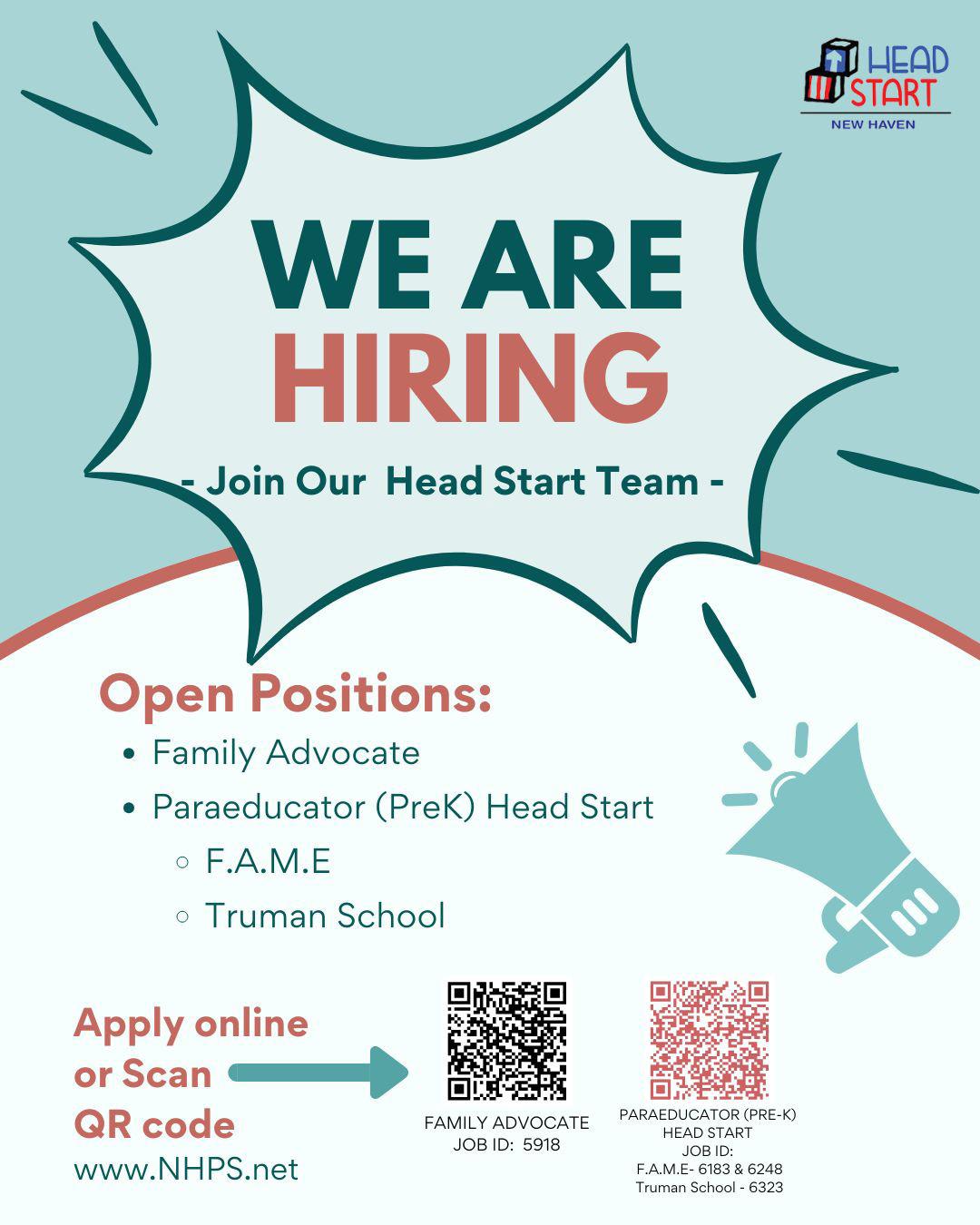
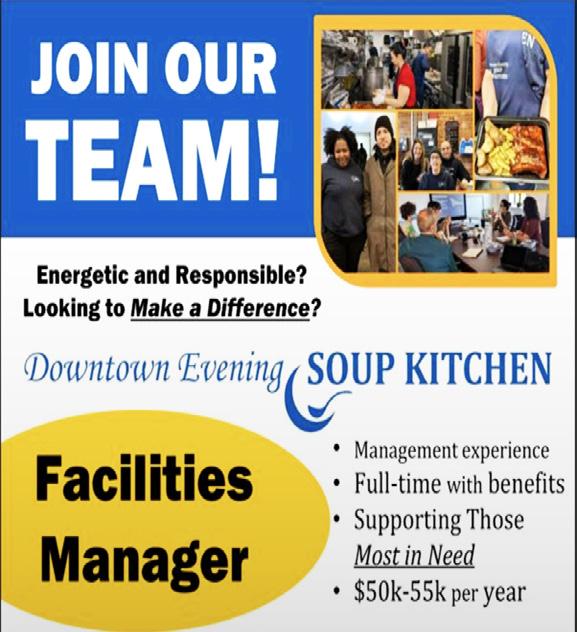
The State of Connecticut, Office of Policy and Management is recruiting for a Policy Development Coordinator in the Criminal Justice Policy and Planning Division. Further information regarding the duties, eligibility requirements and application instructions are available at: https://www.jobapscloud.com/CT/ sup/bulpreview.asp?b=&R1= 260316&R2=1581MP&R3=001
The State of Connecticut is an equal opportunity/affirmative action employer and strongly encourages the applications of women, minorities and persons with disabilities.
EL PLAN ANUAL "MOVING TO WORK" (MTW) DEL AÑO FISCAL 2027 DE ELM CITY COMMUNITIES, AUTORIDAD DE VIVIENDA DE NEW HAVEN (ECC/HANH)
Las Secciones II y VII del Acuerdo "Moving to Work" de la Autoridad (el "Acuerdo") estipulan que, antes de que la Agencia pueda presentar su Plan Anual "Moving to Work" Aprobado (el "Plan") y su Informe (el "Informe") ante el Departamento de Vivienda y Desarrollo Urbano de los EE. UU. (el "HUD"), debe llevar a cabo una audiencia pública, considerar los comentarios del público sobre el Plan propuesto, obtener la aprobación de la Junta de Comisionados y remitir el Plan al HUD.
El periodo de treinta (30) días para la recepción de comentarios comienza el martes 7 de abril de 2026 y finaliza el miércoles 6 de mayo de 2026.
Las copias del Plan "Moving to Work" (MTW) del Año Fiscal 2027 estarán disponibles en el sitio web de la agencia: www.elmcitycommunities.org, o a través de Facebook: www.facebook.com/ElmCityCommunities.
Se le invita a enviar sus comentarios por escrito dirigidos a: ECC/HANH, Moving to Work FY2027 Annual Plan, a la atención de: Evelise Ribeiro, 360 Orange Street, New Haven, CT 06511; o por correo electrónico a: eribeiro@elmcitycommunities.org. De conformidad con dichas Secciones II y VII, se ha programado una audiencia pública —en la cual se aceptarán y registrarán comentarios del público— para el lunes 4 de mayo de 2026, a las 4:00 p. m., a través de:
Teams: https://teams.microsoft.com/meet/28700621182396?p=4TDLzzbfcPz7OsLEeJ
ID de la reunión: 28700621182396
Código de acceso: r6E8Ke9c
Conexión telefónica
+1 872-240-4494,160535655# Estados Unidos, Chicago
Buscar un número local ID de la conferencia telefónica: 160 535 655#
Cualquier persona que requiera una adaptación razonable para participar en la audiencia puede llamar al Gerente de Adaptaciones Razonables al (203) 498-8800, ext. 3170, o al número TDD (203) 497-8434.
ECC is currently seeking bids from qualified contractors to perform Window Replacement and Repair . A complete copy of the requirement may be obtained from Elm City’s Vendor Collaboration Portal https://newhavenhousing.cobblestonesystems.com/ gateway beginning on Monday, April 6, 2026, at 3:00PM.
Estimator/ Design & Installation Fence Sales Pay: $100,000.00 per year
Job description:
$78,813/yr.
Required testing, general info, and apply online: www.bristolct.gov
DEADLINE: 12-07-25
Atlas Companies is looking for an estimator/ design and installation sales person for the residential market place. Premiere northeast regional fence and outdoor structure company is looking for energetic, self-motivated Sales associate. Salary, commission, 401 k match and vehicle allowances for qualified personal. 1 00k plus income to qualified applicants. Previous home improvement design / sales preferred. About Us Our services range from custom fences, gates, guardrail, pergolas,
By BlackHealthMatters.com
National Minority Health Month is here, bringing with it new programs, resources, and communications from the FDA’s Office of Minority Health and Health Equity (OMHHE). You probably have a lot of questions about its history, why and how we observe it, and how you can do your part to make a difference this April. Keep reading for those answers and more as we break down the importance of National Minority Health Month.
Raising awareness about minority health goes all the way back to 1915, when Booker T. Washington laid the foundation. National Negro Health Week (NNHW) focused on the poor living and working conditions that plagued mostly Black neighborhoods and employment opportunities.
From there, the US Department of Health and Human Services (HHS) launched Healthy People 2010. This was the third iteration of this initiative, following previous ones in 1990 and 2000, and focused on eliminating health disparities across all ethnic minority groups.
Not long after, the US Congress called for an awareness month to promote the efforts currently underway and encourage further action to reduce the health disparities affecting minorities, establishing National Minority Health Month in April 2002.
The goal of National Minority Health Month is to help “promote and protect the health of diverse populations through research and communication of science that addresses health disparities.” But what does this mean?
Throughout April, the FDA and other federal, state, and local agencies increase collaboration on a shared initiative, addressing health disparities through awareness and education. To better understand their goals and how they achieve them, you should know a few key concepts.
• Health equity is the equal opportunity to be healthy. While some ethnic minorities are predisposed to health conditions simply because of their race, they should have the same access to insurance coverage, medical care, community resources, language access, and health literacy that any other race has access to.
• Health disparities are the disproportionate health outcomes of one group of people compared to another because of health inequity. The Kaiser Family Foundation found that three months into the Covid-19 pandemic, almost triple the number of African Americans were hospitalized compared to white people and over twice as many had died. There were many underlying health disparities, like lower socioeconomic status and higher risk of other chronic health conditions that were not well managed.
• Health literacy is the understanding

of a person’s health or the ability to find the information needed. It also includes the ability to understand the information they find, regardless of language and education barriers. Learning about clinical trials is just one part of health literacy, especially if a clinical trial applies to how your health condition may help both you and future patients.
National Minority Health Month aims to raise awareness of better health for all racial and ethnic minorities by advancing health equity, reducing health disparities, and improving health literacy.
What is This Year’s Theme?
This year’s theme is “Better Health Through Better Understanding.” While the OMHHE supports many initiatives year-round, this theme allows them to share the importance of one in particular. The Enhance Equity Initiative focuses on addressing the underrepresentation of minorities in clinical trials.
Previous National Minority Health Month themes include:
• “Give Your Community a Boost!” to encourage Covid-19 vaccination (2022)
• “Active and Healthy” to emphasize staying physically active and enhancing emotional wellness (2020)
• “Partnering for Health Equity” to raise awareness about current efforts to address the disproportionate burden of various ethnic groups in health care, housing, employment, and more (2018)
• “Accelerating Health Equity for the Nation” to create a better understanding of health disparities and how they affect racial groups (2016)
• “30 Years of Advancing Health Equity” celebrated 30 years of the Heckler Report, which helped to prove the existence of racial inequalities in health care (2015)
Why is This Important?
ProPublica published an analysis of a recent clinical trial of a medication used to treat Multiple Myeloma, a devastating blood cancer. While approximately 20% of all Multiple Myeloma patients in the US are African American, only 13 of the 722 participants in the clinical trial were Black. This is less than 2% of all participants. Because ethnic minority populations, especially Black people, seem to have a genetic predisposition to this cancer, it often leads to more severe disease complications, and they react differently to many treatment options, being so grossly underrepresented in a clinical trial may affect whether this medication is as effective for them as it is for the non-Hispanic Caucasian participants.
However, this new initiative may help raise awareness of these problems, so clinical trials include ethnic minority groups in appropriate numbers and document these participants’ results accurately. Researchers can then work toward improving health outcomes for minority populations, reducing disparities in treatment outcomes. With better communication between the FDA, other research agencies, and health providers, more minority communities can benefit from current and future clinical trials.
National Minority Health Month 2023 helps to raise awareness of the benefits of clinical trials through the “Better Health Through Better Understanding” initiative. Those affected by certain conditions may benefit from joining a clinical trial to both test new treatments and play a role in approving effective ones that may benefit many more patients in the future. Some
reduce these risks and perhaps reverse the condition. Every trial is different and may require participants in different stages of the disease or with varying demographics. If you have been diagnosed with diabetes and are interested in new treatment options, be sure to discuss the possibility of a clinical trial with your healthcare provider.
While cancer is a leading cause of death among all races, some forms are more prevalent among Blacks. These include breast, prostate, colorectal, and lung cancer. Through various studies over the last several decades, it’s been found that the increased risk for cancer can be linked to poor diet, especially common in low-income households; environmental pollution like smog and asbestos which are frequently seen in underprivileged neighborhoods; poor lifestyle choices like smoking that have much higher rates for Black men than for Caucasians; and family history. Clinical studies for cancer are likely specific to the type, so if you are diagnosed with cancer, discuss the possibility of participating in one with your oncologist or another specialist provider. Sickle Cell Disease
conditions affect African Americans more than others and are, therefore, most important to have an accurate representation of the Black community involved.
Health education is vital to the prevention of most heart disease. Some clinical studies in the past have followed those without cardiovascular disease to see who would develop it and who wouldn’t be based on family history, lifestyle choices, and other factors. Learning what risk factors could be affected and to what degree has helped providers adjust treatment based on the health needs of their patients. Current and future clinical trials continue to research risk factors and treatment options, as it is the leading cause of death among all ages, genders, and races in the United States.
Closely tied to heart disease is the risk of stroke, which can lead to premature death in Black Americans and other minorities. It is vital that Blacks are accurately represented in clinical trials studying stroke because they are 50% more likely to have one. Black women are at the highest risk. Compared to non-Hispanic White people, over 70% more Blacks will die from their stroke. To truly understand the underlying causes of these health disparities and what can be done to address them, African Americans should be made aware of these clinical trials and encouraged to take part. Diabetes
Prevention is key, but with so many risk factors, Type 2 diabetes may be unavoidable for some Black Americans. Diabetes comes with the risk of many disease complications, some of them life-threatening. There are ongoing clinical trials to help
Sickle cell anemia is most often seen in infants and is a medical emergency. There are some medications available to help control the sickling of red blood cells, decrease vascular blockages, control inflammation and pain, and reduce the chance of disease complications. However, some patients may need blood transfusions or bone marrow transplants to control the disease. There are ongoing clinical trials to help develop new treatment options to better manage or treat sickle cell disease that you or your child may qualify for.
HIV/AIDS
A study published by the American Journal of Public Health found that Black men who have sex with men are 14 times more likely than non-Hispanic Whites to test positive for HIV. The number of Blacks currently living with HIV compared to Whites is nearly double and these numbers are continuing to worsen. The average age of initial infection is declining, meaning many Black men are reaching adulthood with HIV. Another study proved that many clinical trials do not accurately address minority health or even gender, although doing so is vital to improving outcomes from new HIV/ AIDS treatments for African Americans and all ethnic minorities.
Conclusion
National Minority Health Month helps to raise awareness of the disproportionate burden that Black Americans face every year because of inequities in our health care system. By addressing disparities through easier access to resources and better representation in clinical trials, we may resolve these inequities soon. Black Health Matters support National Minority Health Month by supporting the well-being of African Americans through education and awareness.












































There’s been a drought on their childhood’s road and two cousins come home dry-eyed and grieving. Sade, on a three-day furlough from prison. Mina, departing a strangely idyllic west coast. As all time ticks towards the correctional officer’s arrival, these two wrestle with all they have never said, with the fallibility of memory itself, and with visions of a future they are bound to create. Winner of the prestigious 2025 Susan Smith Blackburn Prize, a.k. payne’s Furlough’s Paradise is a lyrical meditation on grief, home, kinship, and a utopia yet to be realized.