














by Adele Haeg
In a push-up contest against two New Haven police academy recruits, five-yearold Josiah Matta held his own — he fell down onto the grass with a smile after about eight repetitions, to cheers from his competitors.
Josiah’s grandmother AnneMarie Rivera-Berrios — the chair of the city’s Civilian Review Board (CRB) — watched as he ran around with recruits in their blue academy uniforms during Saturday’s first “Unity within the Community” event, hosted by the CRB and the New Haven Police Department (NHPD). “He’s training” for the police academy already, she joked.
Rivera-Berrios helped to organize Saturday’s event — a gathering in Edgewood Park attended by several CRB members, New Haven police officers, and dozens of academy recruits — as an “open forum,” for community members to meet and get to know their police officers and district managers.
“The CRB is not a bad entity,” said Officer David Vega, who has worked for the NHPD for 15 years. “They hold people accountable just like we hold people accountable. It’s a good thing. They represent the community, just like we do.”
The CRB provides independent oversight of investigations into alleged misconduct by New Haven police officers, reviewing complaints that are also inves-


tigated by the NHPD’s Internal Affairs division. This year, the CRB finalized an agreement with Yale authorizing it to review complaints against university police officers. It also cleared a backlog of cases from 2022 to 2024.
Organizing the first Unity within the Community event was another milestone for the board, which was founded in its
most recent iteration in 2019.
“Our goal is to get the community to come out,” said Rivera-Berrios, “meet their district managers, talk with their police department, and express their gripes.”
Zannelli said the department and the CRB are a “united front” — “the relationship is still a work in progress,” he said, but he is encouraged, and emphasized that events
like Saturday’s help the department with crime prevention through community engagement.
“I think that he is being proactive,” Rivera-Berrios said of Zannelli, whom she endorsed when he was appointed as police chief earlier this year.
The CRB also invited the fire department, dispatch, and Yale police, but rep-
resentatives from those departments did not attend Saturday’s event, according to Rivera-Berrios. She said the CRB was “disappointed” Yale police did not join. Lt. Ed Dunford — the district manager for the Whalley, Edgewood, and Beaver Hills neighborhoods — said Saturday’s gathering was the first time he had met current members of the CRB. When they are reviewing cases and complaints, he said, now “they can put a face to the name.”
Several parents brought their children to the event. Charlene Tobias said that when her kids arrived at Saturday’s event and saw all the officers lined up to take a photo together, “they got so excited,” and asked if they could say hello. She said her kids “trust the uniform” — they saw officers helping someone who had heat stroke at the Freddy Fixer Parade, and first responders helped her daughter once when she needed an ambulance. She wants them to know that “police are there to protect you.”
CRB member Sam Fawcett said that she remembers a time when people were more skeptical about police, and police were less open. “It’s a different day now,” she said. “They’re moving along the way to become more understanding.”
Zannelli said he wants the event to be held every year. “It’s good for the community to get to know everybody. We’re trying. We’re doing our best.”
By Denisse Lecodet
The following letter was shared with the Independent from recent Parent Leadership Training Institute (PLTI) graduate Denisse Lecodet.
PLTI is an initiative of the United Way of Greater New Haven aimed at training parents and caregivers to effectively advocate for their children and their communities. This year’s PLTI 20 week program trained 16 caregivers.
Mayor Justin Elicker, Alder Caroline Tanbee Smith, and city Poet Laureate Yexandra Diaz each delivered remarks at the June 27 graduation.
Hi, my name is Denisse Lecodet and this is was my take on PLTI. I will recommend community parents and leaders to take PLTI in the future if they can. I also would like to thank Caroline for coming out and supporting us. She was also a point of contact during my community project research. My project name is Parks Grow Up. Creating Inclusive playground for neuro-diverse kid in out community.
Since joining the Parent Leadership Training Institute, I’ve learned that everyone has a voice, and that my voice matters too. Before PLTI, sometimes I felt unsure about speaking up, but this program has helped me find more confidence in myself and in the experiences I bring as part of my community.
PLTI has taught me how to communicate better in both private and public spaces, and how to speak with purpose and respect. I’ve also learned that leadership is about helping others, standing up for what is right, and being passionate about the changes we want to see for our families and communities.
One quote that inspires me is:
“Never doubt that a small group of thoughtful, committed citizens can change the world; indeed, it is the only thing that ever has.” — Margaret Mead This quote reminds me that even small voices can create big change when we come together and support one another.

PLTI Family Engagement and Leadership Coordinator JoAnne Wilcox shared that the core values taught to PTLI’s Class of 2026 were: “20 weeks, 16 people, 4 hours a week, 2 retreats, 24 meals
shared together, 10 children in childcare, and many miles of transportation needs
met. Interpersonal skills, like honoring one another, being Open, and calling out Ouches, Participating/passing when you need to, Escuchando/listening in order to understand, cultivating a Safe and Sensitive space, where community can grow and flourish, even across differences (and we had them). Calling out the Elephant in the Room, centering Equity, and learning to use Intellect over Emotions in order to have Passion with a Purpose. These are some of the core elements of what makes PLTI work. It is a huge investment for all of us, in time, in money, in energy; 16 started, 16 graduated and saw it through, trusting the Process to the end. I’m very grateful to be someone who provides the support and training where parents need it to be more effective advocates and leaders for their families and their communities.”
Grad Denisse Lecodet with Alder Smith.
PLTI Class of 2026. Class session learning about media and how stories are told.
by Janday Wilson
The International Festival of Arts & Ideas presents “The Stories We Carry” New Haven Museum New Haven
“Find your community, because your family probably doesn’t want you to be a writer,” Sandra Cisneros said bluntly, smiling as the audience burst into laughter.
The writer’s mélange of humor and generous honesty made her feel warmly present in the New Haven Museum Saturday afternoon, despite her being a face on a screen thousands of miles away in San Miguel de Allende, Mexico. She was participating in a conversation at the International Festival of Arts & Ideas event “The Stories We Carry.” It was a surprisingly intimate experience, though the room was packed. (There was a waiting list.)
Arts & Ideas chose Cisneros’s canonical book The House on Mango Street as this year’s National Endowment for the Arts (NEA) Big Read. It felt especially fitting for the festival’s theme, “Home & Belonging”: a loving celebration of the myriad cultures and spirit of fellowship and community that shape New Haven.
At Saturday’s conversation, Kulturally LIT Founder and Executive Director IfeMichelle Gardin asked Cisneros thoughtful questions that allowed the National Medal of Arts and PEN/Nabokov Award-winning author to be vulnerable and playful.
I expected this of Cisneros because that same wit is seeped into The House on Mango Street. Whether intentional or not, authors often leave traces of themselves in their work.
The House on Mango Street is main character Esperanza Cordero’s coming of age story, growing up in a house that doesn’t quite meet her expectations. She constantly dreams of creating a life of her own. In vignettes, the young Mexican American girl narrates keen observations about her Chicago neighborhood, family, poverty, girlhood, sexuality and the dreams and disappointments of those around her.
In the last chapter, “Mango Says Goodbye Sometimes,” Esperanza describes

Mango Street setting her free one day. She imagines packing bags of books and paper (tools of the trade) while her friends and neighbors inquire after her whereabouts. But in the end, she says, “They will not know I have gone away to come back.”
The book’s prose is poetic and artful; as finely crafted as its message. To me, Mango Street suggests that freedom does not require forgetting where you come from. You can carry the people and places that made you while claiming a life of your own – though it’s also your responsibility to give back to your community.
If we imagine Cisneros pouring some of herself into The House on Mango Street, the book reads like a love letter to the Chicago that created the critically acclaimed author.
When Cisneros left home, she said Sat-


urday, community became more significant. She didn’t feel like she belonged with her graduate school classmates; she was ashamed of who she was.
“I had never seen my community reflected with love,” she said. Then she asked herself, “What do I know that no one else in this room knows?” She found her voice. That singular voice carried Cisneros’ community far beyond Chicago. She spoke with the exuberance of someone still astonished she’s able to make a living with her pen, something she could only dream of.
But to Cisnero, writing is more than her craft. It’s strength.
In a New Yorker interview, she said: “I believe in the power of the word and the ability of writers to make change. This is


the time when we should be saying, ‘OK, let’s put the poets and writers in the front lines.’ We need them to be peacemakers and truth-tellers … what are the poets if not the truth-tellers? Poetry is meant to heal and transform people. It’s essential for that.”
To that end, she acknowledged our presently “unimaginable time in history,” saying that we’ve been “broken-hearted, surviving and limping along since Covid.” She also shared her own personal connection to today’s political climate: Her nephew is an American citizen but walks around with a passport in case he gets stopped.
“The state of fear we’re living in is unprecedented,” she lamented.
She reminded the audience that it’s im-
portant to write down what we witness because history is being rewritten in front of our very eyes.
Cisneros invited the audience into her writing process. She said she doesn’t write linearly, “from left to right.” She writes what “tugs at” and “breaks” her heart, what doesn’t allow her to sleep at night. A phrase or image will come to mind, and she’ll write it down. She called these tidbits of prose “buttons.” When it’s time to compose a piece, she rearranges her buttons. She said she’s even rearranged buttons on the floor, like she’s making a quilt.
“Writing a button a day keeps the doctor away!” she exclaimed.
She said she’s currently “wrestling” with a novel that will take place on both sides of the border. The novel is very different than her other work she shared. It has a male protagonist and is a gay love (triangle) story. “I feel like I have to write this story at this time in my life.”
She’s also full of poetry, saying a recent trip to Europe brought a lot to the surface. Cisneros is at a time of her life where she fills it with wonder, pursuing all her heart’s desires: “Every day to me is just a rough draft.” Her freedom comes from finding joy in the little things; she adores animals, plants, the sky.
She said that The House on Mango Street opera was put on at the 2025 Glimmerglass Festival, prompting audible exhalations of excitement in the audience. For the opera, she joined forces with Grammy-nominated composer Derek Bermel. She’s hoping it will get produced.
Cisneros has also always wanted to be a clothing designer. She had a collaboration with fashion designer Nancy Traugott, who always wanted to be a writer. With their textile project, Cisneros adds her writing to vintage clothing, sometimes through embroidery.
Cisneros ended her talk by reminding us that we can all effect change, quoting 13th century poet Rumi: “You are not a drop in the ocean. You are the entire ocean in a drop.”
It was a fitting place to land for a writer whose work has always insisted that the small contains the vast.



by Laura Glesby
New Haven Public Schools will soon commission an analysis of conditions in buildings across the district in order to build a “master plan” for maintenance. That next step, as school administrators told alders on Wednesday night, will help New Haven take a proactive, rather than reactive, approach to school maintenance.
“I’m having déjà vu,” responded Fair Haven Alder Sarah Miller. “Didn’t we just do this?”
She was referring to an over 500-page 2024 report on the status of school buildings that the district enlisted from local architecture firm Svigals + Partners as well as S/L/A/M Collaborative (SLAM). At the time, that report was referred to as a “master plan.”
Miller sits on the Board of Alders Education Committee, which invited school leaders to a workshop at City Hall on Wednesday night devoted to transportation and facilities maintenance at New Haven Public Schools (NHPS).
There, committee alders pressed Supt. Madeline Negrón and Chief of School Operations Paul Whyte on the cost and pace of producing a long-term, district-wide facilities plan.
Specifically, they questioned why another study needs to be conducted before the school district can produce what school administrators are calling a “master plan” — a document detailing the long-term priorities for proactive maintenance and upgrades to over 40 school buildings across the district.
In 2024 presentations to the Board of Education’s Finance and Operations committee, then-Chief Operating Officer Thomas Lamb as well as representatives of the 2024 plan’s authors referred to the 2024 report as the “master plan.”
At the same time, a slideshow produced by the S/L/A/M Collaborative and Svigals stated, “The Master Plan offers information across major areas of operation; however, it does not define specific project scopes or timelines. Further study is necessary to determine financial considerations and community support for the recommendations.”
Then, in September 2024 — four months after Lamb was placed on administrative leave, and one month before he resigned — Negrón told the alders’ Education Committee that another phase of the facilities study would be necessary. She described the Svigals and S/L/A/M Collaborative report as an initial phase of a district-wide building study, while stating that a more detailed study would be needed before a true “master plan” can be produced.
On Wednesday, Miller said she feels that alders and school leaders are “having the same meeting” again and again. “Can you just explain, really simply, why is there a difference between what we did… and what’s happening now?” she asked.
According to Negrón, the initial report doesn’t have the level of mechanical detail that would enable the school district to assess costs and create action plans on



each item. That level of detail is necessary in order to “establish priorities with specificity and understand costs in order to bond,” she said.
NHPS Transportation Director Sequella Coleman added context based on her experience as the former principal of multiple schools transitioning or starting up in new school buildings.
“If you look at architectural plans, there are layers on top of layers,” she said, and the initial report didn’t excavate every layer. Each school needs specific action items, she said, such as: “They need five bolts here. They need $500 of roofing material.”
At the end of the meeting, Miller returned to the topic. “You have the most
For example, NHPS is building an inhouse staff dedicated to maintenance — “our own people who take pride in our buildings” — rather than relying on outside companies. This system will not only save costs, she said, but may enable regular monthly repair schedules at each school in addition to emergency repairs. At the same time, she said, NHPS is operated with “such limited resources.”
Over the course of her career, “I’ve seen what other districts have that we don’t have.”
Negrón and Whyte weren’t able to immediately provide alders with the cost of the first district-wide analysis. The cost of the second analysis, they said, would be determined through the contractor bidding process. They estimated that a contractor will be selected by December 2026.
The meeting also revealed that NHPS’ applications for state funding to fix the roofs of Wilbur Cross and Hillhouse each got held up due to numerical errors. NHPS was asked to provide more documentation for its application for the Cross roof, while in the case of Hillhouse, the district had to reapply for the grant altogether.
NHPS is currently waiting to hear whether the state’s Office of School Construction will fund the Cross and Hillhouse roof applications.
In June 2025, the Board of Alders approved those applications with amended cost projections, estimating a need for approximately $8.78 million for Hillhouse’s repairs (nearly $6 million of which would come from the state) and approximately $7.6 million for Cross’ repairs (over $5.1 million of which would come from the state).
In the meantime, the district has received the approximately $1.3 million it requested from the state to fix the roof of Truman School. (The city itself is contributing an estimated $628,511 toward those repairs.)
In the case of the Cross roof, said Whyte, “The numbers between different forms that were previously submitted and redone didn’t match up. It actually came down to a $900 difference.”

John P. Thomas Publisher / CEO
Babz Rawls Ivy Editor-in-Chief Liaison, Corporate Affairs Babz@penfieldcomm.com
difficult jobs in the city,” she told the administrators. “I hear you.”
“At the same time, we have kids go to school with water falling on their heads… That kid doesn’t get a chance to do that class over again.”
In one middle school science class at Fair Haven School, Miller said, “there’s a bucket on the table. And that’s their one chance to do seventh grade… Children can’t wait.”
Negrón said that she agrees with Miller. The district hears directly from families and staff about building conditions that concern her, she said, stressing that the district is working on enhancing shortterm maintenance while working toward a master plan.
“So that’s why that was a small fix,” Whyte said. “Now we’re just waiting to hear.”
With Hillhouse, too, there were “numbers that had to be corrected and matched up and some of those had to be resubmitted,” said Whyte.
The disrepair of the roof at Wilbur Cross has led to the extended closure of that school’s swimming pool, one of five public pools across the city.
East Rock Alder Caroline Tanbee Smith asked if the district is implementing any policies to prevent these kinds of grant errors from occurring in the future.
“It’s always important to put as many eyes on forms,” said Whyte, noting that the applications “changed hands midstream” due to turnover in school leadership.
Advertising/Sales Team
Keith Jackson Delores Alleyne John Thomas, III
Editorial Team
Staff Writers
Christian Lewis/Current Affairs
Anthony Scott/Sports Arlene Davis-Rudd/Politics
David Asbery / Tanisha Asbery
Jerry Craft / Cartoons / Barbara Fair Dr. Tamiko Jackson-McArthur
Michelle Turner / Smita Shrestha William Spivey / Kam Williams Rev. Samuel T. Ross-Lee
Contributors At-Large
Christine Stuart www.CTNewsJunkie.com
Paul Bass www.newhavenindependent.org
National Association of Black Journalist
National Newspapers Publishers Association
Greater New Haven Chamber of Commerce
Greater New Haven Business & Professional
Greater New England Minority Supplier Development Council, Inc.
The Inner-City Newspaper is published weekly by Penfield Communications, Inc. from offices located at 50 Fitch Street, 2nd Floor, New Haven, CT 06515. 203-3870354 phone; 203-387-2684 fax. Subscriptions:$260 per year (does not include sales tax for the in State subscriptions). Send name, address, zip code with payment. Postmaster, send address changes to 50 Fitch Street, New Haven, CT 06515. Display ad deadline Friday prior to insertion date at 5:00pm Advertisers are responsible for checking ads for error in publication. Penfield Communications, Inc d.b.a., “The Inner-City Newspaper” , shall not be liable for failure to publish an ad or for typographical errors or errors in publication, except to the extent of the cost of the space in which actual error appeared in the first insertion. The Publisher reserves the right to refuse advertising for any reason and to alter advertising copy or graphics deemed unacceptable for publication. The entire contents of The Inner-City Newspaper are copyright 2012, Penfield Communications, Inc. and no portion may be reproduced by any means without the written permission of the publisher. 10
Ruby Szekeres
A bobcat takes long strides through the tall grass as it follows an eagle over the dark blue Quinnipiac River towards Hobbomock, now known as Sleeping Giant. Feathers and leaves float on the wind. A blazing sunset glitters. This is the story of those who came before us, told in vibrant color.
That scene is part of “Land of the Long Water,” a new mural from the artist ARCY that is an ode to the Indigenous Quinnipiac people who stewarded the land for generations. Supported by Quinnipiac University and the RiseUP Group, the mural celebrates and commemorates the town’s Indigenous history, while teaching the community about it. On Friday, town officials and members of the Quinnipiac University community gathered to officially welcome it to the town, where it sits at 2335 Dixwell Ave.
“Though the Quinnipiac people are no longer here, they are with us in spirit,” said Crystal Herron, digital media and marketing coordinator for the town of Hamden. Herron hopes the new mural will be a "source of pride and a landmark in [the] community for many years.” Its vibrant shades of sunsets, forest and river are visible as people stop at the intersection between Skiff Street and Dixwell Avenue.
The mural was made possible by a $25,000 donation to the Town of Hamden from Quinnipiac University, as well as a collaboration with Town Fair Tire and RiseUp Arts. The owner of the property, Jason Gorden, did not hesitate when asked for the use of the concrete canvas.
Despite the threat of rain Friday, the mood at the morning’s ribbon cutting remained jubilant. Mayor Adam Sendroff, who described himself as a fan of public art, encouraged attendees of all ages to “observe and take in the new mural.”
When Sendroff took office this year, this proposal was one that he was particularly excited about, he said.
In the past, Hamden has unveiled multiple other murals, Sendroff noted; this adds to the mix, while literally brightening the town (he pointed to Hamden’s “Ghost Parking Lot,” in which New York artists covered cars with pavement, creating an iconic haunted look). It also dovetails with two large birthdays: the United States of America’s 250th anniversary this coming weekend, and Hamden’s 240th this year.
“This reminds us of what happens when we come together in a collective.” Dr. Marie Hardin, president of Quinnip-
iac University, added. “We value and cherish our role as a citizen in this community.”
Many of the same university professors who helped make sure the art was historically accurate also organized the Intertribal Powwow, which Hardin and Sendroff highlighted in their speeches.
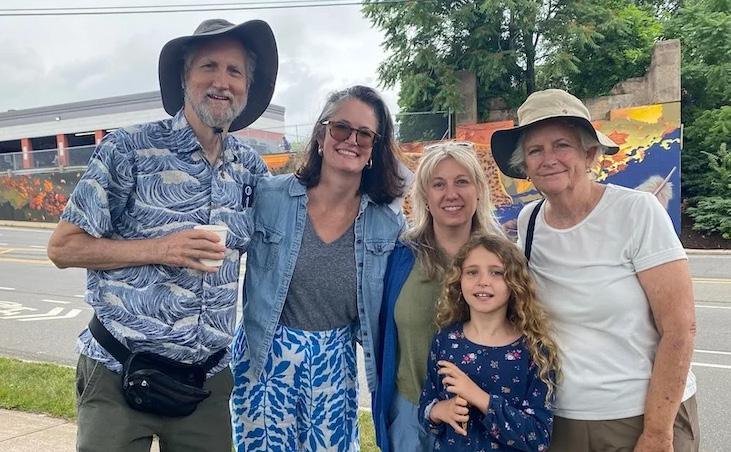
During the celebration, three generations of Connecticut residents were able to view the landscape, each drawn to something a little different. Deb Giblin-Davis loved the deep river, and noted that it seemed to pull her in. She praised the town for making the decision to show not just one individual, but a scene that related to Hamden’s history and culture.
She had come with her husband, Robin Giblin-Davis, her daughter, Dr. Julia Giblin and granddaughter, Alma Giblin, as well as Julia’s friend and coworker, Dr. Jennifer Dauphinais. Both Julia Giblin and Dauphinais are professors at the university, and had heavily researched the area’s history.
Giblin found herself entranced by the lush green of Sleeping Giant, while her daughter loved the bobcat. Though they are from Branford, its depictions don’t relate any less to them: the Quinnipiac people inhabited the Greater New Haven area long before the arrival of European colonists.
As for the artist, ARCY was unable to be present for the unveiling, but sent his
speech to his good friend and founder and executive director of RiseUp Arts, Matt Conway (pictured above) to read. Giving his two little kids a smile before pulling out his phone, Conway read from the prepared remarks, warning the crowd that as ARCY is a soft spoken person, and his recitation might be more energetic than planned.
“When I was invited to create this mural, I understood the importance of approaching it with care and respect,” he said, speaking on behalf of the artist.
“ This project was an opportunity to honor the history of this place and recognize the people whose connection to this land reaches back generations.”
ARCY’s wife, son and mother-in-law were also there to support him, and all said they love and admire his creativity.
“He’s working on a mural in Dunkirk, New York right now, but wanted to be here,” his wife, Kim Christenson, said. Their son, Sean Christenson is proud to have such a cool dad. ARCY is based in North Haven, but has had commissions nationwide and beyond, including works in Texas, Greece and Kansas.
“We’re used to him working 10 to 12 hour shifts,” Kim said. While some may not be able to do their best work in short amounts of time, this is not the case for ARCY. By the end of it, with just cans of spray paint, he creates art with shading, layers, and life. While colors might fade over time and become weathered, the mural is expected to hold up for the next couple of decades. Just in the time he was painting, those passing by waved and thanked him for his contribution.
This article comes from a graduate of the 2024 Cohort of the Youth Arts Journalism Initiative. Ruby Szekeres is a junior at Oak Meadow School.
by Staff Report
HARTFORD, CT — A coalition of 19 attorneys general, including Connecticut’s William Tong, has secured a permanent injunction and blocked provisions of President Donald Trump’s Executive Order No. 14248 from taking effect, according to a statement from Tong’s office. According to the statement, the U.S. District Court for the District of Massachusetts granted the coalition’s motion for a permanent injunction against the order, issued on March 25, 2025, that attempted to conscript state election officials in the campaign to impose documentary proof of citizenship requirements for voter registration, and withhold various streams of federal funding from the states if they fail to comply.
“This was a blatantly unconstitutional effort by the president to unlawfully commandeer state elections and micromanage how we vote,” Tong said. “We sued, we

stopped him, and we will continue to fight back against any and all efforts by this president to disenfranchise voters and control our elections,” Tong said.
The coalition filed a lawsuit challenging the order in April 2025, secured a preliminary injunction blocking unlawful provisions of the order in June 2025, and successfully defeated the Trump Administration’s motion to dismiss in September 2025. The coalition filed a motion for a permanent injunction in December 2025, and the court heard oral argument in February 2026.
California Attorney General Rob Bonta and Nevada Attorney General Aaron Ford co-led the filing of the April 2025 lawsuit. Joining them were the attorneys general of Arizona, Colorado, Connecticut, Delaware, Hawaii, Illinois, Maine, Massachusetts, Maryland, Michigan, Minnesota, New Jersey, New Mexico, New York, Rhode Island, Vermont, and Wisconsin. Con’t on page 11
by Donald Eng
MIDDLETOWN, CT — Teens who otherwise could end up easy targets for scammers and crushing debt instead got an early start on the road to financial independence Tuesday, thanks to a collaboration between a Connecticut bank and the Department of Children and Families. On Tuesday, 20 teens in the department’s care participated in a half-day money management youth banking program. Hosted by Liberty Bank at the company’s Innovation Center in downtown Middletown, the session covered banking, budgeting, fraud prevention, financial decision-making, and identity protection.
“We really tried to keep in mind the most important things people need to understand about banking and how to bank responsibly,” said Liz Hazelwood, a program supervisor with DCF.
After the youths complete the program, they will head over to the branch across the street and open their first bank account.
“They won’t have credit cards or a checking account because they’re underage, but they’ll get started with direct deposit and online banking.”
One of the participants, 16-year-old Ari, said he was preparing to start a job next month. He said he struggled with one specific aspect of financial literacy.
“Definitely budgeting,” he said. “I kind of suck at not spending money when I see something I like. I’m kind of hoping

to save more and spend less on things I don’t really need.”
Ari, a Norwich native, is currently in a group home but is transitioning to foster care. He said he believes his impulsive spending stems from a childhood filled with uncertainty.
“We moved around a lot. Foster care,” he said. “I was taking care of my siblings and couldn’t do the things that other kids did.”
For that very reason, having a debit card is critical, said Pam Days-Luketich, vice president of community development at Liberty Bank.
“They want to catch up to the things other kids are doing,” she said. “A lot of things today are cashless, so without a debit card they can’t go to a concert or go somewhere with their friends.”
Hazelwood said the youth’s age put them squarely at the time in their lives when they were at risk of becoming disengaged or disconnected – defined as youths who are not in school or employed. Knowledge of basic banking can help them with even basic skills like depositing a paycheck and arranging for credit card payment.
“When we were developing this program our biggest goal was to provide
some sort of normalcy for youth,” she said. “The way to do that is to capture them as young as possible with things like going to a bank.”
These basic skills can put the teens in position to take advantage of opportunities that they could otherwise miss.
“Keep in mind, they may not have the traditional parent structure,” she said. “Those who don’t have foster care experience might have a parent or guardian who will cosign a bank account. Foster youth don’t have stable guardians.”
The program also can help the participants avoid financial pitfalls like the transaction fees at check cashing outlets or cash apps, Hazelwood said.
“When they start getting summer employment, or small jobs, the money can go directly into their account,” she said. “It cuts out all of these barriers. And then when they turn 18, they can close this account and open a standard checking account.”
Days-Luketich agreed. She added that Liberty Bank college interns, just a few years older than the teens in the program, delivered a powerful message about the things they wish they had known.
“They talked to them about things like having a summer job, and how they wished they hadn’t spent all their money without thinking,” she said. “They wished they had saved more money and had more of a cushion and a backup when they got to college. Just, to really be thoughtful about your spending.”
by Donald Eng
OXFORD, CT — More than a dozen municipalities and other organizations are in line to receive $5.1 million in state aid to protect homes, businesses and other community resources from floods, heat and other natural hazards.
In a media briefing Thursday at the Oxford Fire and EMS headquarters, steps from a pond that flooded and a bench commemorating two lives lost in the flood of August, 2024, Energy and Environmental Protection Commissioner Katie Dykes announced a new round of funding for the department’s Climate Resilience Fund. The fund supports projects that protect communities by providing grants for planning, design and matching funds for construction.
“As Connecticut faces another summer of potentially historic extreme weather, the importance of investing in proactive resilience measures is clearer than ever,” Dykes said. “With this next round of funding under an expanded program, we are excited to meet communities where they are, to help them identify their risks, and design and develop successful projects that can mitigate those risks.”
State Sen. Eric Berthel, R-Watertown,
who represents Oxford, said he was proud to support resilience efforts.
“We do have an increase in storms and more violent weather, I think we can all agree that that is happening here,” he said.
“And anything we can do to prevent the loss of life, of course, and also the incredible damage and interruption of life … that we can take action as a legislature and through our great agencies in the state, we should be doing.”
Several municipalities receiving matching funds are applying to funding programs from the Federal Emergency Management Agency (FEMA), including the Building Resilient Infrastructure and Communities (BRIC) program, a critical source of resilience funding for Connecticut, according to DEEP.
Under the first round of DCRF grants in 2023, DEEP awarded $8.8 million in planning and advancement grants supporting 21 innovative climate resilience plans and projects across 17 Connecticut municipalities and Councils of Government.
For questions about this program, email DEEP.climateresilience@ct.gov.
The grant recipients under this round of funding are:
Town of Groton – $250,000 to conduct

a feasibility study for creating an energy resilience hub and “Cooler Neighborhood”, looking at opportunities involving the Groton Community Center and town-
owned sites such as the library, senior center, and transit stops. City of New Haven Parks Department
$250,000 to conduct a resilience action
plan for Edgewood Park and surrounding neighborhoods, including the vulnerable Westville neighborhood, that will take full advantage of the park’s potential as natural infrastructure.
Jewett City and the Southeastern Connecticut Council of Governments – $237,044 to advance planning for a flood control project in Jewett City for the South Main Street Neighborhood, including open space design for stormwater storage.
South Central Regional Council of Governments – $250,000 to develop a framework that will allow municipalities to translate identified climate risks into implementable, equitable, and sustainable investment strategies, including an effort to map priority areas where flooding, extreme heat, and infrastructure vulnerability can be most effectively mitigated.
Western Connecticut Council of Governments – $246,457 to conduct a feasibility study of recurring finance mechanisms for resilience, including stormwater utilities and resilience improvement districts.
Norwich Public Utilities – $525,000 to finalize engineering plans and prepare bid documents to relocate the Shipping Street Pump Station out of the Thames River
Access low-or no-cost weatherization plus additional energy-saving improvements.
Call (475) 255-2143 or go to ne-smartenergy.com/newhaven
Interesado en la eficiencia de energia? llama numero (475) 255-2143



• Burial Lots (infant, single, two-grave, or four-grave)
• Monuments & Markers (black, gray, or pink granite)
• Flower placement (single or multiple placement)
• Cremation (Choose to be cremated at Evergreen.)
• Columbarium in the Most Beautiful Cremation Garden

• All orders can be placed at the Evergreen office or the website.

















by Lisa Reisman
On her rounds through the halls over the last year or so, King/Robinson Interdistrict Magnet School Principal Tessa Gumbs-Johnson would peer into Kevin Secor’s third-grade classroom and see the private-duty pediatric LPN typing on her computer while seated beside the boy she was attending during break time.
As Gumbs-Johnson recalled during her commencement address at Tuesday morning’s eighth-grade promotion ceremony in the packed auditorium of the Fournier Street school, she didn’t think much of it.
“Sometimes I wondered, ‘What is she doing on this computer?’” she told the 42 maroon-and-yellow-clad eighth-graders, as well as their families and friends. “But I have a building to run, I don’t have time to pay attention, I have to keep it moving.”
Then came Read Across America Day on March 2. The school customarily invites outside authors to come in. “There is already an author in the building,” literary coach Joanna Garrison told Gumbs-Johnson. She handed her a copy of “My Red Bird.”
The book is the debut memoir by Laricha Langley, the computer-typing pediatric nurse. Its title refers to a bird that Langley associates with her father, Keith Spruill, who in 1992 was shot and killed in Newhallville. Langley was four. Her father was 23. The slim 81-page volume at once shows a side of him — a charismatic, chess-playing, thoughtful figure — obscured by his tragic end while chronicling, with searing honesty, the adversity she faced as she grew up without a father.
She writes about lacking the tools “to process something so complex, so tragic, so violent” — “we didn’t have therapy, none of that” — and the consequent sense of anxiety that she would lose her mother as well; about an anger that boiled over into fights; about getting caught in the middle of a shootout; about getting kicked out of school for fighting.
She writes of hitting rock bottom when involved in a serious car accident; of finding direction in the Job Corps training program; of how she learned to endure but not to rest, a sort of “hyper-independence” that she wields as a survival mode; of seeking therapy to address her unhealed trauma; of enrolling in nursing school and graduating with honors.
The copy of “My Red Bird” handed to Gumbs-Johnson originated with Secor, the third-grade teacher. Back in October, having watched her typing on her computer during breaks, he asked what she was working on. Her second book,

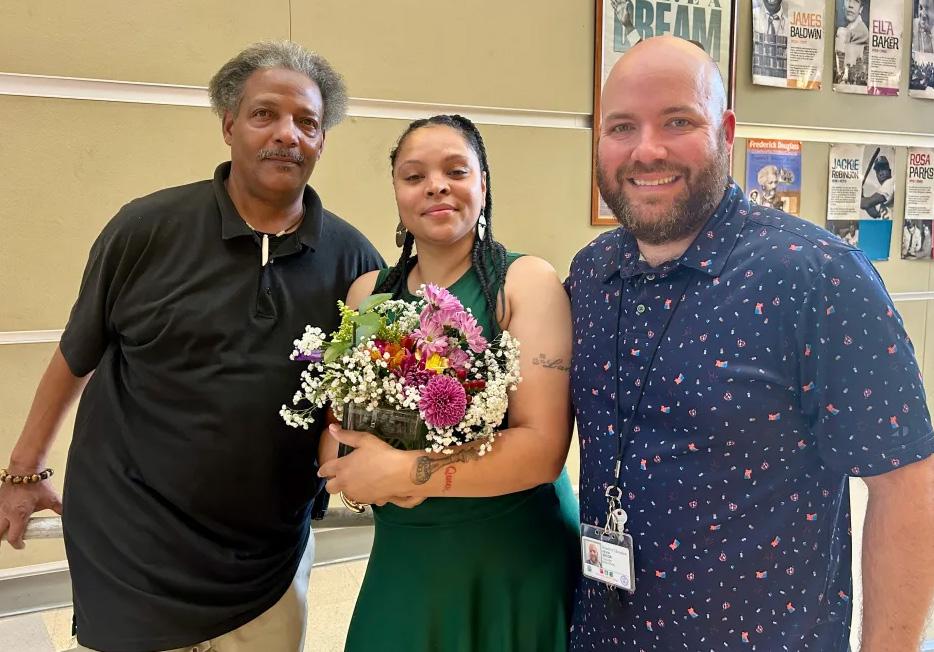



she told him. He asked about the first. “I read the book in one sitting and was so impressed that I ordered three copies,” he recalled. He shared the books with colleagues. “Everyone who read the book loved it.”
That included one-on-one educator Lynair Walker, the paraprofessional that worked alongside Langley in the thirdgrade classroom. “He saw her writing the story the year before and he encouraged her the whole time,” Secor said. For months, the two tried to persuade Langley to do a read-aloud of “My Red Bird.”
“I’m a shy person,” Langley, 38, said. “And I’m at work, and this was personal, so they’re going to know the real me. But they were persistent.”
Later in March, she read excerpts to two of the eighth-grade classes. “I had a lot of anxiety when I got up there with the kids, but once I started reading, it flowed, and the kids were so engaged, like they loved it,” she recalled.
“You could see the impact on them,” said Walker.
“A lot of people have Laricha’s story, but not a lot of people can tell their story in the way that she did,” said Valerie Knowles, the STEM Lab teacher. “It reminded me of poetry.” Knowles, a published poet and editor, and her husband, Frederick-Douglass Knowles II, Hartford poet laureate emeritus and author of the new collection “Sinking in Moonlight Alone” (Woodland Press), have taken to inviting Langley to readings.
“The book’s got motion,” said Langley, who plans to pursue a masters degree in psychology in the fall. “It’s taking me for a ride and I’m just going with it.” It’s that motion that had Gumbs-Johnson buying 20 copies after she read the book on vacation and placing them in the gift bags that she distributed to the graduating eighth-graders. “These kids need to hear her story,” she said. “They need to know that they can overcome.”
Langley said she’s enjoyed positive feedback from the time the book came out last August — she expressed particular gratitude to Rev. Eunice Tucker of Christian Union Full Gospel Church for championing her book early on — but at King/Robinson, which she called a family, “it just took off.”
“This is my testimony and the people at King/Robinson, they heard it,” Langley went on, thanking her husband Quinn and her three kids for their unwavering support. “This tells me I didn’t go through everything I did for nothing. It tells me I can help other people who are going through it too.”
by Mona Mahadevan
Dr. Esen Sefik moved from Istanbul to New Haven 20 years ago because she believed the U.S. was the best place to do scientific research. Now, her advisees are wondering whether to stay in their home countries instead.
Sefik described the U.S.’s changing research climate on Monday during a press conference hosted by U.S. Rep. Rosa DeLauro. A half-dozen scientists, professors, and nonprofit advocates gathered at 101 College St. to criticize a proposed rule by the Trump administration that would require a political appointee to approve all discretionary federal grants.
The proposed rule, issued by the Office of Management and Budget (OMB), would affect over $200 billion in federal spending.
“This is an effort to take control over federal grant-making and use it as leverage to enforce compliance with the political dictates of the Trump administration,” said DeLauro.
Until now, the government’s competitive grant process has been guided by peer review. But in a 412-page memo for the rule, peer review recommendations are described as “advisory,” not “routinely

deferred to.”
For Sefik, an immunology professor at Yale School of Medicine, the change undermines the meritocracy of the U.S.’s research apparatus.
“Like many scientists, I’ve made enormous personal and professional sacrifices to be here. But I believed that great ideas, rigorous science, and hard work would be recognized through a fair and merit-based
system,” she said. “Today, that confidence has been shaken.”
Another provision of the rule requires political appointees to deny applications that “promote anti-American values,” question “the sex binary in humans,” or use race as a “selection criterion” for program participation.
The Trump administration is “already determining what questions we feel safe asking,” said Alex Rich, a neuroscience PhD student at Yale. Rich studies binge-eating disorders, which are more common in women. Understanding the reason for that disparity could improve patient outcomes, she said, but many research proposals have been rejected for studying gender-based differences in health.
“I’ve seen [this environment] push my peers to avoid entire areas of necessary study, discouraging work that actually reflects our community’s needs,” she said.
The new rule would also enable agencies to cancel active grants for any reason, creating tremendous uncertainty for young scientists like Rich. “For my generation, it raises a really difficult question: whether this is still a system we can trust to build a future.”
The proposed rule has received almost
70,000 comments from advocates across the country. The comment period ends in two weeks. If the rule is codified, then it will go into effect on Oct. 1, 2026.
DeLauro, the ranking Democrat on the House Appropriations Committee, said she has tried to block the rule, but her amendments have thus far been defeated by Republicans. On Tuesday, she plans to attend a hearing with the OMB head and focus on the rule.
Jenny Strauss, an officer with Yale Ventures, spoke at Monday’s press conference as a cancer survivor.
“In my story, hope was a clinical trial of an experimental, promising combination of treatments for a cancer diagnosis that didn’t have any other options,” she said. Under the proposed rule, that study would have required approval from an unelected political appointee. But because Strauss’s form of cancer is most common among Ashkenazi Jewish women, the protocol for selecting patients may have not been approved.
The proposed changes “would make stories like mine turn out quite differently,” said Strauss. “I am really grateful for the opportunity to be here on behalf of Americans who are indebted to publicly-supported research.”
by Matthew Cain
Soccer fans flooded Pitkin Plaza Wednesday evening for a standing-room-only “World Cup Village” watch party of the U.S. team’s first match in the competition’s knockout stage.
Dressed in jerseys representing the U.S. and countries from around the world, supporters packed every available space at the 145 Orange St. outdoor venue, creating a lively atmosphere as they gathered to watch one of soccer’s biggest events.
The U.S. team opened its knockout-stage campaign against Bosnia and Herzegovina in the Round of 32, entering the match as one of the favorites to win this year’s FIFA World Cup, which is taking place this year in cities across the U.S., Canada, and Mexico.
Long before kickoff, the atmosphere at World Cup Village was electric, with fans eagerly chanting the names of the team’s biggest stars. The loudest cheers were reserved for captain Christian Pulisic, whose leadership and attacking ability have made him the face of the U.S. squad and one of the tournament’s most anticipated players.
When the match finally kicked off at around 8 p.m., the energy in Pitkin Plaza reached another level. Every United States attack drew cheers from the crowd, while near misses brought collective gasps from fans locked into every moment of the match. What began as a watch party quickly transformed into a community gathering, with supporters overflowing

beyond the venue to share the World Cup experience together.
While many fans wore red, white, and blue, others came simply to celebrate the global game.
Patrice Binenta, who traveled from Brazil, made the trip to the United States to experience the atmosphere of the FIFA World Cup, eager to witness several matches in one of the tournament’s host countries.
“We’re from Brazil, so naturally our favorite team and players are Brazilian,” Binenta said. “But we love soccer, and we love the World Cup.”
Binenta and her teenage son watched alongside a packed crowd that never seemed to thin. When the United States broke through with a first-half goal, cheers erupted throughout Pitkin Plaza as fans jumped to their feet, waving flags and cel-
ebrating the early lead. The United States carried a 1-0 advantage into halftime; the excitement never faded. Fans remained shoulder to shoulder inside the adjacent Trinity Bar and Restaurant and throughout World Cup Village, while others lined the sidewalks outside, unwilling to miss a moment of the action.
As the second half got underway, the intensity only increased. Every save by U.S. goalkeeper Matt Freese sent the crowd
into a frenzy as he made three crucial stops to preserve the Americans’ lead. The biggest turning point came in the 64th minute when U.S. forward Folarin Balogun was shown a controversial red card, leaving fans stunned. Frustration quickly spread throughout World Cup Village, with some supporters heading for the exits in disbelief. Others, however, stayed until the final whistle, continuing to rally behind the United States despite the late setback.
As the final whistle blew on a 2-0 win for the U.S., many fans lingered around the venue, discussing the match and reliving its biggest moments. Despite the late red card and tense finish, the watch party remained a celebration of the World Cup and the community it brought together.
Casey Pastore, an avid Premier League supporter, was among the packed crowd that gathered to watch the United States. Having followed U.S. captain Christian Pulisic throughout his career, Pastore said the atmosphere at Pitkin Plaza was just as memorable as the match itself.
“Beautiful night. Been following the World Cup. Love to see people enjoying the same thing,” Pastore said.
From kickoff to the final whistle, the standing-room-only watch party became more than a place to watch soccer. It became a gathering where fans from different backgrounds came together to share the excitement, drama and emotion of the world’s biggest sporting event.
by Thomas Breen
Clear the path for converting three-family homes into condos.
Bar landlords from evicting tenants for no reason.
Keep pushing for a sharp increase to state funding for education.
Those are some of the ideas included in a newly released, affordability-focused policy platform put forward by Eli Sabin, one of three Democrats running to represent a west-side state House of Representatives seat currently held by 21-term incumbent Pat Dillon.
Sabin, a former downtown alder and the legislative coordinator at Connecticut Voices for Children, published those “Lower the Cost of Living” legislative priorities in an email press release Monday afternoon. He also held a discussion on that same topic with roughly 30 neighbors at Whalley Pizza on Saturday.
Sabin is challenging Dillon — a deputy majority leader and the chair of the Health Subcommittee of the state legislature’s Appropriations Committee — in the Aug. 11 Democratic primary for state rep for the 92nd General Assembly District, which covers parts of Amity, Westville, Edgewood, Dwight, and the Hill.
While Dillon has been endorsed by the local Democratic Party, Sabin and Justin Farmer — a former Hamden Legislative Council member who has been endorsed by the Connecticut Democratic Socialists of America — have both petitioned their ways onto the August primary ballot.
“As I’ve knocked on more than 3,000 doors in the 92nd district over the past six months, I have heard over and over about how expensive and difficult life in our state is right now,” Sabin wrote on Monday. “Rents and property taxes keep going up, and the dream of homeownership is out of reach for so many people. The high cost of childcare and health care force families into compromises no one should have to make. And the rising price of gas and groceries make daily life hard.
“Our state government needs to take on this crisis with urgency, creativity, and political courage. If we don’t act, more of our neighbors will continue to get priced out of New Haven and out of our state entirely.”
One of the “Day 1 Priorities” listed in Sabin’s new plan is to encourage more condo conversions to boost affordable homeownership.
Sabin wrote about just how much of New Haven’s housing stock consists of two- and three-family homes that currently operate as rental apartments. Buying one of these multifamily houses is often “too expensive for most people” — leaving too much city housing under the control of megalandlords.
“Imagine if we changed that,” Sabin wrote. “Instead of thousands of tenants living in rental apartments owned by large corporate landlords, working and middle class families could buy those apartments and benefit from the stability and financial


security of homeownership. To make this possible, in the legislature, I will work to make it easier to turn existing multifamily houses into affordable condos that can be purchased by our neighbors.”
How would he do that?
Sabin wrote that the state should create “simple, clear templates and standards that families can use to turn multifamily rentals into condos and apply for mortgages to buy them—through a streamlined, simultaneous process.”
He wrote that the Connecticut Housing Finance Authority should offer down-payment assistance and mortgages to assist first-time homebuyers purchase homes through this type of condo conversion.
And he wrote that state and local land banks could buy properties, convert them into condos, and then sell them to new homeowners at affordable prices.
“More families should have the opportunity to buy an affordable home. Changing
from evicting tenants who otherwise comply with their leases, pay rent, and agree to reasonable annual rent increases. Currently, most tenants can be evicted simply because their leases have expired and their landlords have decided not to renew.
Sabin wrote that “tenants who meet their obligations should not be forced to move without a legitimate reason. Losing your apartment is deeply disruptive and destabilizing. A rental unit is not simply a piece of property; it is a home. Research links eviction and housing instability to job loss, lower educational attainment for kids, and physical and mental health problems. Evictions can also push families into unsafe housing or homelessness.”
He continued, “By preventing displacement, keeping more families in their homes, and strengthening neighborhoods, just cause regulations will protect tenants while supporting the long-term well-being of communities across the state. We need to get this legislation passed as soon as possible.”
Sabin’s policy platform begins, meanwhile, with a call for increased state funding for education — a mission that New Haven State Sen. and President Pro Tem Martin Looney, Mayor Justin Elicker, New Haven Public Schools (NHPS) Supt. Madeline Negron, teachers union President Leslie Blatteau, and New Haven’s entire state delegation have doubled down on in recent years.
“Our schools need more funding,” Sabin wrote. “We need more staff—including paras, guidance counselors, nurses, and librarians—to give every child the education and individual attention they deserve. We need to fix our HVAC systems so schools don’t have to close during hot weather. And our teachers and paraprofessionals deserve a raise.”
He connected this issue to the high cost of living because of how local taxes keep going up — in part to help the city fund the local school distrct.
“I believe the state needs to significantly increase funding to municipalities for public education,” Sabin wrote.” Specifically, he called for increasing the Education Cost Sharing (ECS) foundation grant to $16,000 per student, and then tying that amount to inflation going forward. The ECS foundation grant has been stuck at $11,525 per student since 2013, with a one-time boost to $13,087 included in this fiscal year’s budget.
our condo laws could make that possible for thousands of people in New Haven and across the state, while taking back control from the mega-landlords who neglect our community.”
Another plank of Sabin’s newly released policy platform is passing “just cause” eviction protections. That has been a priority of tenants unions, CT DSA, and other tenants advocates over the past few legislative sessions in Hartford.
Such a bill would prohibit landlords
Sabin, the former director of the state legislature’s Progressive Caucus, told the Independent on Tuesday that the state could cover the costs of increasing education funding — as well as funding a $500 annual child tax credit for income-eligible families statewide, another policy proposal of Sabin’s — by adjusting the volatility cap to “allow a bit more resources to be invested in our communities.”
Sabin said he is also in support of raising taxes “on the wealthiest folks in our state.” He pointed to a recent Massachusetts “millionaires tax” as providing a model for one such type of tax worth exploring in Connecticut.
floodplain.
City of Waterbury – $644,456 to finalize engineering design and permitting of riverine and storm drainage system improvements to protect the community in the Clough Brook watershed.
Southeastern Connecticut Council of Governments – $291,200 to finalize engineering designs to remove the Upper Falls Dam in Norwich to improve flood resilience, alleviate dam-related risks, and improve access to critical community lifelines.
Naugatuck Valley Council of Governments – $650,000 to finalize engineering designs for sites across the Naugatuck Valley that will address the most urgent flood control needs in the region, including protecting an emergency services center in Oxford, critical transportation routes in Seymour, and seven other municipal, residential, and commercial sites.
North Hartford Partnership – $337,197 to finalize design and permitting for a campus-scale community and energy resilience hub at the historic Swift Factory in Hartford’s North End.
Windham Water Works – $415,000 to finalize design and seek funding for climate-informed improvements to the Willimantic Dam, including flood-proofing the water intake and pump station, to protect the water supply of a rural community.
Town of Wolcott – $139,375 to, with federal assistance, implement hybrid nature-based solutions to address residential and road flooding near the Ransome Hall Road, building on NVCOG’s Regional Flood Resilience project.
Town of Wethersfield – $553,093 to finalize designs and apply for federal funds to begin construction on grey and green approaches to prevent recurring flooding that is impacting a stretch of the Silas Deane highway and nearby communities.
Connecticut Department of Emergency Management and Homeland Security –$375,000 to assist with anticipated federal funding for a precipitation monitoring network that will inform local flood models and increase flash flood warning time, reducing damage from floods and flood-related deaths and injuries.
In April 2026, Connecticut also joined a coalition of 23 attorneys general and the governor of Pennsylvania in challenging Executive Order No. 14399, the second elections-related order issued by Trump. Executive Order No. 14399 attempts to interfere with states’ constitutional authority to administer elections by restricting voter eligibility and mail voting to lists of voters pre-authorized by the federal government, Tong said. The coalition filed a motion for summary judgment later in April 2026 in order to permanently block those changes, which the court has yet to fully rule on.

By courtesy of HBCUNEWS.com Lawrence Hurley
WASHINGTON — The Supreme Court delivered a setback to President Donald Trump on Monday, rejecting his attempt to fire Federal Reserve board member Lisa Cook, while in a separate case giving him a freer hand to exert control over other hitherto independent federal agencies.
The two decisions, issued at the same time and both authored by Chief Justice John Roberts, together marked another example of the conservative-majority court pushing back on one aspect of Trump’s broad exertion of executive power while giving him the green light on another.
Though Trump may not fire Cook for now, the court allowed him to remove a member of the Federal Trade Commission, Rebecca Kelly Slaughter. In the latter case, the court overturned a key 1935 Supreme Court ruling called Humphrey’s Executor v. United States, which upheld restrictions on the president’s power to fire FTC members.
The court was divided differently in each case. In Cook, the vote was 5-4 with the court’s liberals joining the majority, while they dissented in Slaughter, which was 6-3 on ideological lines. Only Roberts and fellow conservative Justice Brett Kavanaugh were in the majority in both cases.
In the Cook case, Roberts rejected the Trump administration’s contention that the president’s firing of Cook for cause — over allegations of mortgage fraud, which she denies — could not be reviewed in court and that she could not stay in office while contesting the decision.
“To accept any of those arguments would in effect transform the Federal Reserve’s for-cause protection into at-will employment,” he wrote.
Such a step would be “out of step with the statute Congress enacted and our nation’s tradition of central banking protected from political interference,” he continued.
In a statement, Cook welcomed the decision, saying that Trump’s actions were “an attempt to remove me on a manufactured pretext because I refused to bow to political pressure and continued to set interest rates based only on what would best serve the American people.”
Trump could still seek to fire her, and indicated in a Truth Social post that he will, saying, “We will take appropriate action immediately to make sure that someone who has committed wrongdoing will not be making vital decisions concerning the Welfare of the United States of America!”
The court in effect created a Federal Reserve exception to its general view — long favored by conservatives suspicious of what some term a federal bureaucratic deep state — that restrictions on the president’s power to fire members of federal agencies imposed by Congress were an unconstitutional restriction of executive authority.
“Our Constitution creates three branches, but only one president,” Roberts wrote in the Slaughter ruling.
“Subordinates who exercise the president’s power are subject to removal by him. Then, and only then, can they remain

accountable to the president, and the president to the people,” wrote Roberts.
So, while Cook can remain in office for now, the court granted Trump free rein to continue firing members of agencies that were specifically set up by Congress to be free of political interference.
The court concluded that the Federal Reserve is different from other independent agencies, in part based on its unique structure and history.
While the FTC ruling only directly affects Slaughter, whom Trump fired in March 2025, the logic applies to other agencies with similar restrictions on the president firing members without cause.
“It is such an Honor to be the sitting President who won this Historic and Unprecedented Ruling, one of the most important ever given with respect to Presidential Powers,” Trump said in a Truth
Social post.
Slaughter said in a statement that the “consequences of this ruling will be felt by every American” by making independent agencies more subject to the political whims of a president.
“Today’s ruling makes it possible for presidents to fire watchdogs who won’t put politics over principle, and replace them with lapdogs,” she added.
The court has already allowed Trump to fire, without cause, members of other agencies that regulate health, safety, labor and environmental issues, including the Consumer Product Safety Commission, the Surface Transportation Board and the Equal Employment Opportunity Commission.
Since taking office in January 2025, Trump has also sought to remove members of other independent federal agencies,
policy. Since taking office in January 2025, Trump has pushed for lower interest rates and has criticized the Fed, and recent Federal Reserve Chair Jerome Powell in particular, for failing to act on his wishes. Trump has said he fired Cook over allegations of mortgage fraud made by one of his political appointees, Federal Housing Finance Agency Director Bill Pulte, who is now also serving as acting director of national intelligence. Cook has denied the allegations, and bank documents obtained by NBC News appear to contradict the fraud claim.
In an X post on Monday, Pulte said he believed Cook would ultimately be indicted for mortgage fraud.
Trump moved to fire Cook in late August, prompting her to file a federal lawsuit. Cook, who has remained on the board since, had argued that Trump did not have the authority to remove her from office while she challenged his decision in court. Lower courts ruled in her favor, leading Trump to rush to the Supreme Court. In the ruling, Roberts said Cook is “entitled to notice and some opportunity to respond prior to her termination,” which he said would not need to be a “full -blown judicial trial” or a meeting with Trump himself. He suggested it could be done using written materials only.
And if Trump does decide to move ahead with the firing, “The ultimate question of whether the president can remove Cook for cause will depend in part on the underlying facts,” Roberts added.
The court did not address whether Trump’s claims about Cook have any merit.
The Senate recently confirmed Kevin Warsh to replace Powell as chairman of the board of governors. Powell’s term as a member of the board of governors, however, does not expire until 2028. Trump has also appointed one of his advisers, Stephen Miran, to serve as a Fed governor.
Trump did not try to fire Powell, although the Justice Department embarked on an investigation of him related to refurbishments at the Fed’s headquarters in Washington. It later dropped the probe. Global markets have long relied on the independence of the Federal Reserve. No president has ever tried to fire a top Fed official.
which the Supreme Court has allowed.
The court, whose majority has been skeptical of the concept of independent federal agencies that are not subject to presidential control, has undermined removal protections for federal employees in recent years in a series of cases involving other agencies that were brought by business interests.
The president has more broadly sought to dramatically reshape the federal government using an aggressive form of executive power. In addition to seeking to control previously independent agencies, he has also tried to dismantle some agencies and has fired thousands of federal workers.
But the separate Cook ruling imposes a new barrier to Trump’s attempt to stamp his mark on the Federal Reserve, an independent body that guides U.S. monetary
Under the Federal Reserve Act, presidents are restricted from removing governors unless it is “for cause,” meaning there is evidence of wrongdoing.
As for the FTC, Trump fired, without cause, both Democratic commissioners on the five-person FTC, Slaughter and Alvaro Bedoya. Both challenged the move, although Bedoya later dropped out of the case.
Slaughter cited the 1914 law that set up the FTC, which says members can be removed only for “inefficiency, neglect of duty, or malfeasance in office.”
A federal judge ruled in favor of Slaughter in July, citing the 1935 Supreme Court ruling in Humphrey’s Executor. The U.S. Court of Appeals for the District of Columbia Circuit reached a similar conclusion.
By Black Information Network
On Thursday (June 25), the Supreme Court ruled 6-3 in Mullin v. Doe to let the Trump administration end Temporary Protected Status for more than 330,000 Haitian nationals and several thousand Syrians, clearing the way for their work permits and protection from deportation to expire.
Writing for the majority, Justice Samuel Alito concluded that none of Trump’s or former Homeland Security Secretary Kristi Noem‘s public statements about Haiti were “overtly racial,” and that the TPS statute generally bars courts from reviewing the secretary’s decision at all. Kagan, joined by Justices Sonia Sotomayor and Ketanji Brown Jackson, wasn’t having it. In her dissent, she did something the majority pointedly avoided: she quoted Trump directly.
“The evidence they have offered includes statements by the President so repellent and racially inflected that the majority declines to put them in print,” Kagan wrote. She then printed them anyway — including Trump’s claims that Haitians in Springfield, Ohio were “eating the dogs… they’re eating the cats,” that Haitians “probably have AIDS,” that Haiti is a “shithole country” that is “filthy, dirty, disgusting,” and his 2025 remark asking, “Why is it we only take people from shithole countries” like “Haiti and Somalia” instead of “Norway and Sweden.”
Alito’s opinion did acknowledge Haiti’s difficult conditions, writing that “poverty and deprivation are no reflection on character,” but concluded the statements amounted to “policy views that could rest on” reasons unrelated to race. Referring to lead plaintiff Fritz Emmanuel Lesly

Miot, Alito wrote that the plaintiffs were trying “to capitalize on the statements’ heated language.”
Kagan’s response was direct. “The statements fairly shout, in their racial undertones and overtones alike, that race entered into the President’s resolve to remove Haitians from this country,” she wrote.
The ruling didn’t stop at the constitutional question. The majority also held that the TPS statute’s judicial-review bar blocks courts from second-guessing nearly all of the Homeland Security secretary’s decisions on the program — meaning even claims that the administration skipped legally required procedures generally cannot be heard in court at all.
Kagan warned the practical effect is stark: the secretary can now “announce to the world that she didn’t consult with anyone — more, that she didn’t evaluate country conditions at all — before mak-
ing, extending, or terminating a TPS designation. And the courts will be powerless to intervene.”
Justice Clarence Thomas filed a separate concurrence, arguing that even if courts could review constitutional claims generally, noncitizens cannot sue the federal government for equal-treatment violations in the first place, since he contends that guarantee applies only to the states. Losing TPS does not mean automatic deportation — many affected individuals may have other paths to legal status, such as asylum or family-based petitions. But for most, it means the loss of legal work authorization and renewed exposure to removal proceedings.
The Black Information Network is your source for Black News! Get the latest news 24/7 on The Black Information Network. Listen now on the iHeartRadio app or click HERE to tune in live.
WASHINGTON, D.C. (June 26, 2026)
— Melanie L. Campbell, President and CEO of the National Coalition on Black Civic Participation (NCBCP) and National Convener of the Black Women’s Roundtable (BWR), issued the following statement in response to yesterday’s U.S. Supreme Court decision to terminate Temporary Protected Status (TPS), removing legal protections for more than 350,000 Haitian immigrants.
“The National Coalition on Black Civic Participation (NCBCP) and the Black Women's Roundtable are deeply disappointed by the U.S. Supreme Court's decision allowing the Trump Administration to terminate Temporary Protected Status (TPS) for hundreds of thousands of Haitian and Syrian immigrants.
“This ruling is more than a legal decision—it is a humanitarian crisis in the making. TPS exists because Congress recognized that people should not be forced to return to countries facing armed

conflict, political instability, natural disasters, or extraordinary humanitarian conditions. Haiti continues to face profound violence, political turmoil, and economic collapse, making this decision especially devastating for Haitian families who have

built their lives, raised their children, and strengthened communities across the United States.
“NCBCP has long stood in solidarity with Black immigrant communities, including our Haitian brothers and sisters, whose struggles are inextricably linked to the broader fight for racial justice, civil rights, and human rights. For decades, TPS holders have been our neighbors, caregivers, healthcare workers, entrepreneurs, faith leaders, and essential workers. They pay taxes, contribute to our economy, and enrich our communities. Stripping them of legal protections after years of living and working lawfully undermines our nation's commitment to fairness, stability, and human dignity.
“We call on Congress to extend status for long-term TPS holders and urge the Administration to pursue every available avenue to protect vulnerable families from unnecessary detention and deportation.”

By Megan Sayles AFRO Staff Writer
Source: Black Press USA Wire
By Megan Sayles | AFRO Staff Writer msayles@afro.com
Though mainstream narratives of rock and roll music often spotlight artists like Elvis Presley and Buddy Holly, the genre traces its roots to rhythm and blues music created and performed by African-American artists. From Bo Diddley, Big Mama Thornton and Little Richard to Chuck Berry and Fats Domino, Black artists laid the foundation for the heavy drum beats, electric guitar riffs and rebellious, youth-centered lyrics that would come to define rock and roll.
Maureen Mahon, professor of music at New York University (NYU), said that while rhythm and blues music was generally performed by and targeted to African Americans in the 1950s, some radio stations noticed its appeal to white young people and quickly capitalized on it.
“Everything else in the United States at the time was very segregated. But it was possible for people to listen to the radio across racial lines, and that’s what started to happen,” said Mahon. “White teenagers were also listening to this music even though the shows were targeted toward Black audiences. The people who were creating these records recognized that there was a potential audience they hadn’t really considered for this music.”
By the mid 1950s, Mahon said record labels began signing white artists who were heavily inspired by Black pioneers. It was during this period that the term “rock and roll” gained prominence, and perceptions of who the music was for— both as performers and as audiences—

began to change.
“The white artists in the first generations of rock and roll would acknowledge where their music was coming from. They would talk about the fact that they were being influenced by Black American music,” said Mahon. “But the people who were writing about it or retelling the story didn’t make that the focus. The emphasis was on the white artists.”
Despite the genre’s draw among all young listeners, regardless of race, Mahon said American society tended to view rock and roll through a racial binary, overlooking its origins in Black music once it became associated with white art-

ists and audiences.
Still, Black artists continue to make their mark on rock and roll—now more commonly referred to as rock music—today. According to Mahon, this is in part because there is less resistance to their participation in the genre and greater public awareness of its Black roots through documentaries and online platforms.
Maureen Mahon is a professor of music at New York University (NYU). She specializes in the history of rock and roll music and the construction of race and gender in music. Credit: Photo courtesy of NYU She pointed to artists, like Brittany Howard and Gary Clark Jr., who draw


from blues-based traditions often associated with rock and roll, as well as Beyoncé, who has incorporated rock influences and highlighted Black contributions to rock and country music in recent projects.
Building on that idea of genre fluidity, music executive Bill Stephney, the first president of Def Jam Recordings, pointed to how rock has long overlapped with other styles, including hip hop.
“Early in my days at Def Jam, RunDMC were referred to as the ‘Kings of Rock,’ even though they were rappers,” said Stephney. “Their probably most prominent video and song was a cover of the old Aerosmith classic, ‘Walk This
In 1986, the music video debuted and featured a collaboration between RunDMC and Aerosmith. Stephney said it quickly became a staple on then-Music Television, which would later become MTV. It also visually reinforced the blurring of perceived boundaries between hip-hop and rock.
“The video highlights a wall that is broken down between the two bands. It’s quite literal,” said Stephney. “Then at the end of the video, they come together and they perform the song.”
Even with more artists experimenting with genre blending, Stephney said he’s concerned today’s young listeners are increasingly exposed to a narrower range of music, which has been fueled by the age of streaming.
Stephney said that stands in contrast to earlier eras, when radio and shared listening spaces exposed audiences to a broader, less-segmented range of music. “I’ll find a young person who hasn’t listened to the incredible legacy of music that came before them, which I think limits their capacity for expression,” said Stephney. “There have been too many borders created over the course of the past two decades, when it should be as open as it was 60 to 70 years ago.”
The post How Black artists shaped rock and roll—and how that story was reframed appeared first on AFRO American Newspapers.
Based on reporting by Afro-American – Washington.
Originally published by Black Press USA Wire — https://afro.com/blackroots-rock-and-roll/




Opening for a full time HVAC Apprentice Level 1. Candidate must possess a technical school certificate in heating, ventilation, air conditioning, oil, propane and natural gas. Must be detail oriented and comfortable working in a fast-paced environment. Send resume to: HR Manager, P. O. Box 388, Guilford, CT 06437 or emailHRDept@eastriverenergy.com
**An Affirmative Action/Equal Opportunity Employer including Disabled and Veterans**
Opening for a Class A Part-Time driver for petroleum/asphalt/like products deliveries for nights and weekends. Previous experience required. Send resume to: HR Manager, P. O. Box 388, Guilford, CT 06437 or email: hrdept@eastriverenergy.com
***An Affirmative Action/Equal Opportunity Employer, Including Disabled & Veterans***
Members of the public are invited to
State Project No. 0173-0551
Traffic Control Signal Replacements in Southwestern Connecticut (East Haven, Fairfield, Milford, North Haven, Norwalk, Trumbull, Wallingford, West Haven, and Westport)
Tuesday, July 14, 2026, at 6:00 p.m.
Learn More: portal.ct.gov/DOTSouthwestCT0173-0551
The purpose of this meeting is to provide the community with an opportunity to learn about the proposed project and allow an open discussion of any views and comments concerning the proposed improvements. A Q&A session will immediately follow the presentation.
The purpose of this project is to replace aging and outdated traffic control signal infrastructure with new equipment to current standards in order to maintain reliable operation at project intersections throughout Southwestern Connecticut.
There is potential for right-of-way impacts around new signal equipment and newly installed sidewalks at some project intersections.
Construction is expected to start spring 2028, depending on funding, right-of-way acquisition, and permits. The estimated cost is $18 million with 100% state funds.
The public can submit comments and questions during the two-week public comment period following the meeting. Please direct comments and questions by Tuesday, July 28, 2026, to Kaethe Podgorski at DOTSignalReplacements@ct.gov or 860-594-2189.
The recording will be posted following the meeting in CTDOT’s public meeting playlist at portal.ct.gov/ctdotVPIMarchive
For audio only, call 877-853-5257 with Meeting ID 891 8729 7077. Project information can be mailed within one week by contacting Kaethe Podgorski at DOTSignalReplacements@ct.gov or 860-594-2189.
Individuals with hearing/speech disabilities can dial 711 for Telecommunications Relay Services (TRS). Request language assistance from CTDOT’s Language Assistance at 860-594-2109 at least five business days before meeting.

LaRosa Earth Group LLC, a Site/Excavation Company, is currently looking to add the following full-time positions to our Team:
Please submit resumes to HR@LAROSABG.COM or stop by our main office to fill out an application: 163 Research Parkway Meriden, CT. Salary will be commensurate with experience and best fit for the positions. Health plan; 401K; company-paid holidays in addition to paid time off.


LaRosa Groups is an Affirmative Action/ Equal Opportunity Employer who values diversity and encourages all qualified applicants to apply.
The South Central Regional Council of Governments (SCRCOG) seeks the services of one or more consultants for the following transportation planning studies during the 2026 and 2027 Fiscal Years (July 1, 2025June 30, 2027): Metropolitan Transportation Plan Update and Local Bridge Inspection Study. Responses are due by June 2, 2026 (12 noon local time). Selected firms will be interviewed on June 9, 2026. The full RFQ document can be viewed at the Council’s website: www.scrcog.org or can be made available upon request. Contact James Rode at (203) 4668623 with any questions.

Construction Equipment Mechanic
(preferably experienced in Reclaiming and Road Milling Equipment) We offer factory training on equipment we operate. Job is in Bloomfield, CT.
Contact: Tom Dunay Phone: 860-243-2300 Ext. 122 Email: tom.dunay@garrityasphalt.com
Reclaimer Operators and Milling Operators
(must have current licensing and a clean driving record; be willing to travel throughout the Northeast & NY)
Contact: Rick Tousignant Phone: 860-243-2300 Ext. 133 Email: rick.tousignant@garrityasphalt.com
Tractor Trailer Driver for Heavy & Highway
Construction Equipment
(must have a class A CDL license with Tank Endorsement and a clean driving record; be capable of operating heavy equipment and willing to travel throughout the Northeast and NY)
Contact: Brian McKee Phone: 860-558-6189 Email: bmckee@garrityasphalt.com
• We offer Excellent hourly rates and benefits.
• Women and Minority Applicants are encouraged to apply.
• Affirmative Action / Equal Opportunity Employer
RFP Site-Civil Engineering Services 26 Monroe Street, Norwalk, CT
Sound Communities Inc., an affiliate of the Norwalk Housing Authority, and its development partner National Housing Trust are seeking proposals from qualified site-civil engineering firms for a multi-phase, transit-oriented, mixed-use affordable housing development at 26 Monroe Street, adjacent to the South Norwalk Metro-North Station. The project is anticipated to yield approximately 200 units across two phases, with ground-floor office space, community amenities, and a public plaza component. Firms must have demonstrated experience in site planning, urban infrastructure, zoning, and multifamily or mixed-use development in Norwalk or Fairfield County. Full RFP is advertised on Norwalk Housing Authority website. NHA and Sound Communities are Equal Opportunity Employers.
Submission Deadline: July 24, 2026, at 5:00 PM EST
Email only. No hard copies. Questions accepted through July 17, 2026
Contact: Leala Marlin, Development Project Manager lmarlin@soundcommunitiesct.org
Special Inspection Services
Leroy Downs Apartments 8 Chestnut Street, Norwalk, CT
Sound Communities Inc., an affiliate of the Norwalk Housing Authority, invites proposals from qualified Special Inspection agencies to provide special inspection and materials testing services for Leroy Downs Apartments, a proposed 7-story, 68-unit cross- aminated timber (CLT) mixeduse affordable housing development in Norwalk, Connecticut.
Required inspection categories include Cast-in-Place Concrete, Structural Steel, Cold-Formed Steel Framing, Spray Fire Resistant Material (SFRM), Cross Laminated Timber (CLT), Mechanical & Electrical Systems, and Air Barrier / Air Leakage testing. The project is funded through the Connecticut Housing Finance Authority (CHFA) and CT Department of Housing (CT DOH). This is a prevailing wage, tax-exempt project.
Proposals are due no later than July 17th at 5:00 PM EST and must be submitted via email to sstewart@soundcommunitiesct.org
Request for Information: No Later than July 10th, 2026
The complete RFP may be obtained by contacting Sophie Stewart, Project Coordinator, at sstewart@soundcommunitiesct.org. Firms with CLT/mass timber special inspection experience are strongly encouraged to respond. Small, minority-, and women-owned businesses are encouraged to respond.
Norwalk Housing and Sound Communities are Equal Opportunity Employers
An Affiliate of the Norwalk Housing Authority REQUEST FOR QUALIFICATIONS
Architectural Services — 25 Leonard Street, Norwalk, CT
Sound Communities Inc., an affiliate of the Norwalk Housing Authority, is soliciting proposals from architectural firms with experience in affordable multifamily housing for a proposed 12-unit, 3-story new construction residential development at 25 Leonard Street, Norwalk, CT.
The selected Architect of Record will provide services from schematic design through site plan approval) and through construction document completion and contract administration.
RFQ Release date: June 26th, 2026
RFQ Deadline: July 3rd, 2026
Submission Deadline: Friday, July 17th, 2026, at 5:00PM
The RFP and all submission requirements are available by contacting Sophie Stewart at sstewart@soundcommunitiesct.org.
Proposals must be submitted by email only. No hard copies will be accepted.

The Housing Authority City of New Haven d/b/a Elm City Communities
Architectural Engineering Services for the Clock Factory
The Housing Authority of the City of New Haven d/b/a Elm City Communities acting through its instrumentality, The Glendower Group, Inc. Is soliciting request for qualifications (“RFQ”) for selection of a qualified and experienced A & E Firm to serve as the Project Architect for the Clock Factory. A complete copy of the requirement may be obtained from New Haven Housing Authority Vendor Collaboration Portal https://newhavenhousing.cobblestonesystems.com/ gateway beginning on
Wednesday,
The Housing Authority City of New Haven d/b/a Elm City Communities
Request for Proposals (RFP) Construction Manager at Risk (CM@R)
Construction Manager at Risk (CM@R) Clock Factory Redevelopment
The Housing Authority of the City of New Haven d/b/a Elm City Communities acting through its instrumentality, The Glendower Group, Inc. in partnership with the City of New Haven (the "City") as Co-Applicant and Neighborhood Implementation Entity, is issuing this Request for Proposals (RFP). for selection of a qualified and experienced CM@R Firm to serve as the Project Manager for the Clock Factory Redevelopment. A complete copy of the requirement may be obtained from New Haven Housing Authority Vendor Collaboration Portal https:// newhavenhousing.cobblestonesystems.com/gateway beginning on
Wednesday, June 10, 2026, at 3:00PM.
360 Management Group is currently seeking bids from qualified contractors to perform Extermination Services Agencywide. A complete copy of the requirement may be obtained from Elm City’s Vendor Collaboration Portal https://newhavenhousing.cobblestonesystems.com/gateway beginning on
8, 2026, at 3:00PM.
a quarry and paving contractor, has positions open for the upcoming construction season. We are seeking candidates for a variety of positions, including: Scalehouse Dispatcher/ Equipment Operators and Laborers. NO PHONE CALLS. Please mail resume and cover letter to “Hiring Manager”, Galasso Materials LLC, PO Box 1776, East Granby CT 06026. Galasso Materials is an Affirmative Action/Equal Opportunity Employer. All applicants will be considered for employment without attention to race, color, religion, sex, orientation, gender identity, national origin, veteran or disability status.
This is a full-time position in a fast-paced environment. The candidate must be highly organized, analytical and detail-oriented. This opportunity offers exposure to all areas of the business and plays a critical role in driving operational excellence and supporting company growth. A college degree is required.
Benefits include: Competitive Hourly Wage, Medical, Dental, and Vision Plans, Vacation & Sick Time, Paid Holidays, Retirement Plan 401(k), Wellness Program, Employee Assistance Program, Life Insurance Options.
Send resume to: HR Manager, P.O. Box 388, Guilford, CT. 06437. Email: HRDEPT@eastriverenergy.com
*An Affirmative Action/Equal Opportunity Employer, including Disabled and Veterans*
The Town of Wallingford is accepting applications for an HVAC Tradesman. Wages: $31.22 to $40.23 hourly. For additional information and to apply online by the closing date June 8, 2026, please visit: www.wallingfordct.gov/government/departments/human-resources/. Applications are also available at the Department of Human Resources located in Room #301 of the Town Hall, 45 South Main Street, Wallingford, CT 06492. Phone: (203) 294-2080; Fax: (203) 294-2084. EOE
360 Management Group is currently seeking bids from qualified contractors to provide Temporary Personnel. A complete copy of the requirement may be obtained from Elm City’s Vendor Collaboration Portal https://newhavenhousing. cobblestonesystems.com/gateway beginning on
Sound Communities Inc., an affiliate of the Norwalk Housing Authority, and its development partner National Housing Trust are seeking proposals from qualified architectural firms for a multi-phase, transit-oriented, mixed-use affordable housing development adjacent to the South Norwalk Metro-North Station. The project is anticipated to yield approximately 200 units across two phases, with ground-floor office space, community amenities, and a public plaza component. Firms must have demonstrated experience in affordable and mixed-income multifamily housing, LIHTC-financed projects, mixed-use design, and stakeholder engagement.
Submission Deadline: July 2, 2026 · 5:00 PM EST
Request For Information accepted through June 22, 2026
Submit via email only. No hard copies.
Contact: Leala Marlin, Project Manager lmarlin@soundcommunitiesct.org


The State of Connecticut, Office of Policy and Management is recruiting for a Connecticut Careers Trainee, target class Planning Analyst in the Intergovernmental Policy and Planning Division. Further information regarding the duties, eligibility requirements and application instructions are available at: https://www.jobapscloud.com/CT/ sup/bulpreview.asp?b=&R1= 260427&R2=2292AR&R3=001
The State of Connecticut is an equal opportunity/affirmative action employer and strongly encourages the applications of women, minorities and persons with disabilities.

City of Bristol $78,813/yr. Required testing, general info, and apply online: www.bristolct.gov
DEADLINE: 12-07-25
The Town of Wallingford is accepting applications for Video Technician I (Part-Time). Wages: $20.00 to $22.00 hourly. For additional information and to apply online by the July 6th, 2026 closing date please visit: www.wallingfordct.gov/government/departments/human-resources/. Applications are also available at the Department of Human Resources located in Room #301 of the Town Hall, 45 South Main Street, Wallingford, CT 06492. Phone: (203) 294-2080; Fax: (203) 294-2084. EOE
The South Central Regional Council of Governments (SCRCOG) seeks the services of one or more consultants for the following transportation planning studies during the 2026 and 2027 Fiscal Years (July 1, 2025June 30, 2027): Hamden Ridge Road Safety Study and On-call Technical Support Services. Responses are due by June 2, 2026 (12 noon local time). Selected firms will be interviewed on June 9, 2026. The full RFQ document can be viewed at the Council’s website: www.scrcog.org or can be made available upon request. Contact James Rode at 203-4668623 with any questions.
The Town of Wallingford is accepting applications for Water Treatment Pumping Operator I. Wages: $30.35 to $36.64 hourly. For additional information and to apply online by the April 20, 2026 closing date please visit: www.wallingfordct.gov/government/departments/human-resources/. Applications are also available at the Department of Human Resources located in Room #301 of the Town Hall, 45 South Main Street, Wallingford, CT 06492. Phone: (203) 294-2080; Fax: (203) 294-2084. EOE

by Dollita Okine, Face2FaceAfrica.com
Uptown Records is making a comeback after contributing to the development of hip-hop and R&B in the late 1980s and early 1990s.
The iconic label, which was founded by the late hip-hop executive Andre Harrell, has formally relaunched under the Republic Collective umbrella, with music industry veteran Danielle Price Sanders serving as president of Uptown Records and executive vice president of Republic Collective.
Natina Nimene will become the executive vice president of Urban Audience and Artist Relations, joining the leadership team.
Price Sanders will assume leadership of one of the oldest hip-hop labels, which aims to engage a new generation of musicians with its heritage.

Before her recent appointment, Price Sanders assisted in the development of artist strategies and cultural marketing initiatives while holding senior executive positions within the Universal Music Group ecosystem.
“Andre Harrell built one of the most influential record companies in music history, creating a platform where hip-hop and R&B artists could break through and truly impact the mainstream with integrity,” Price Sanders said in a statement.
“I’m honored to help carry that legacy forward and support the next generation of artists.”
Uptown Records is quickly expanding its lineup with the addition of notable artists. Among the first signees are Chicago rapper G Herbo, former City Girls member Yung Miami, and rising South Carolina star Trap Dickey.
“Uptown Records was a flagship for rap music,” G Herbo said in a statement, ac-
cording to Hot 107.9 – Hot Spot ATL. “It created the template for superstars in the eighties and nineties. It’s an honor to be a part of its story.”
Yung Miami also expressed her excitement, describing the relaunch as “a legendary label being resurrected” and praising the female-led executive team that is guiding the company into its next era. “Uptown already feels like home,” she said.
Heavy D, Al B. Sure!, Jodeci, and Mary J. Blige were among the artists whose careers were launched by Uptown Records, which was founded in 1986 and went on to become one of the most significant labels in Black music history.
Sean “Diddy” Combs, who started as an intern before moving up the ranks and eventually founding Bad Boy Records, also benefited greatly from the label in his early career.
by Dollita Okine, Face2FaceAfrica.com
The Guggenheim Museum recently announced a special five-day pop-up exhibition featuring Jordyn Woods’ orange bag, which has been celebrated not only for its luck but also as a remarkable piece of art. The Guggenheim New York’s Café Rebay said it will feature Woods’ bag from June 24 to June 28.
The announcement came more than a week after the Knicks’ historic NBA Finals victory, a win that many attribute to the influence of Woods’ lucky bag.
In a press release, the designer and businesswoman, who is engaged to Knicks player Karl Anthony Towns, said that
having the purse on display is an “honor.”
“The Guggenheim is one of my favorite places, and I never imagined that something I designed would one day be on view at the museum,” she told Good Morning America. “So many of us are still in shock over the Knicks’ historic run, and seeing the lucky bag at the Guggenheim somehow makes it all feel real.”
When Woods began carrying the bag to games during the Knicks’ postseason run, some fans came to believe that it was lucky.
The Knicks only lost once, in Game 3, when she was compelled to leave the bag at home because Madison Square Garden had a strict no-bag policy for President Donald Trump’s attendance. That eve-

ning, she replaced the purse with a sandal with the same pattern.
For Games 4 and 5, Woods returned with the bag, which some believe contributed to the Knicks’ consecutive wins. Towns was spotted telling reporters after the Knicks won Game 5 that the purse was the reason.
Towns exclaimed, “The bag’s undefeated!” in a video that the National Basketball Association posted to Instagram. “I want everyone in New York to know that the bag won a championship.”
He added, “It’s one of the greatest clothing pieces in the history of basketball!” Later, Towns made a joke about how the purse should be in a museum.
by Mildred Europa Taylor, Face2FaceAfrica.com
AJ Dybantsa, who was selected No. 1 overall in the 2026 NBA Draft by the Washington Wizards, has reportedly applied for Jamaican citizenship as he looks to represent Jamaica in international basketball competitions.
The 19-year-old forward’s mother is from Jamaica, while his father is from the Democratic Republic of Congo. Jamaica Basketball Association President Paulton Gordon told the Jamaica Observer that dual citizenship paperwork has begun, adding that Dybantsa could become eligible to represent Jamaica in the future, even though he has represented the United States at the youth level in the past.
“He is getting [a] passport, so I guess that may be a possibility down the road. He however has represented USA in all age group competitions from Under-17 level,” Gordon said to the outlet.
Dybantsa’s mother, Chelsea Dybantsa, was born in Jamaica and grew up in Ches-

ter Castle, Hanover, before moving to the United States, where she raised her children while preserving deep Jamaican ties and cultural traditions.
Her Jamaican roots have helped shape Dybansta’s identity as he proudly represents his Jamaican heritage. The Brockton native even wore both the Jamaican and Congolese flags on his jersey while representing the World Team during the 2024 Nike Hoop Summit.
In 2025, to know more about his family’s history and spend time with his mother’s side of the family, he traveled to Jamaica, where he also interacted with young basketball players.
The trip to his homeland, which was sponsored by Nike, the Bob & Rita Marley Foundation, and the Jamaica Basketball Association, was also meant to support youth basketball development.
Dybansta shared basketball gear and gave inspirational talks to young players interested in following his path.
“Always nice to see players at that level
connected to their heritage and making deliberate steps to motivate and elevate the young ones who are showing interest in basketball,” Gordon told the Jamaica Observe.
To further support charitable causes, Dybansta launched the AJ Dybantsa Foundation, which helped raise funds for hurricane relief in Jamaica.
Currently, there are multiple players with Jamaican backgrounds playing in the NBA, including Jalen Brunson, who just helped the New York Knicks win the 2026 NBA championship. His mother is from Jamaica.
Years before Dybantsa, Jamaican basketball great Patrick Ewing was selected as number one in 1985 by the New York Knicks.
During the NBA Finals, Dybansta and Ewing were seen interacting, with some reports stating that they spoke in Jamaica’s native language Patios. It was a moment that caught the attention of basketball lovers in both Jamaica and the U.S.