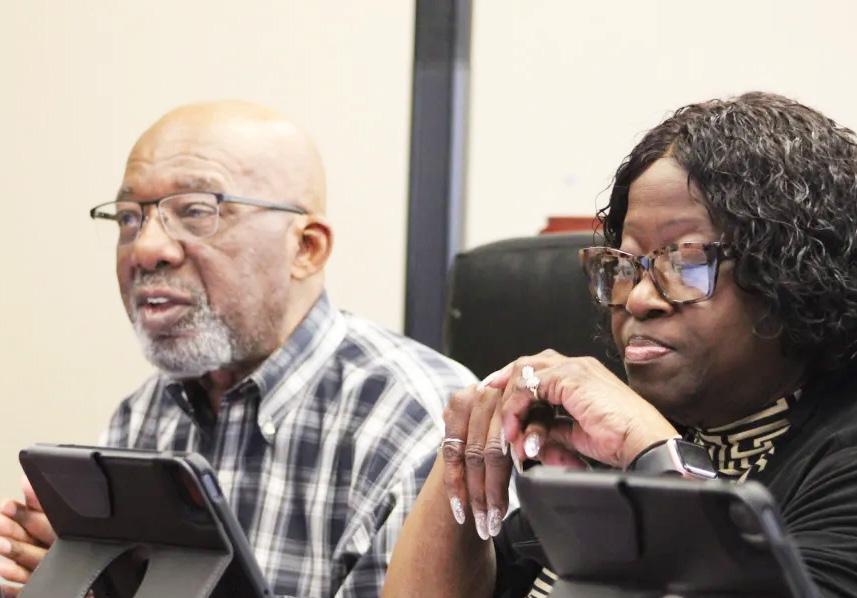
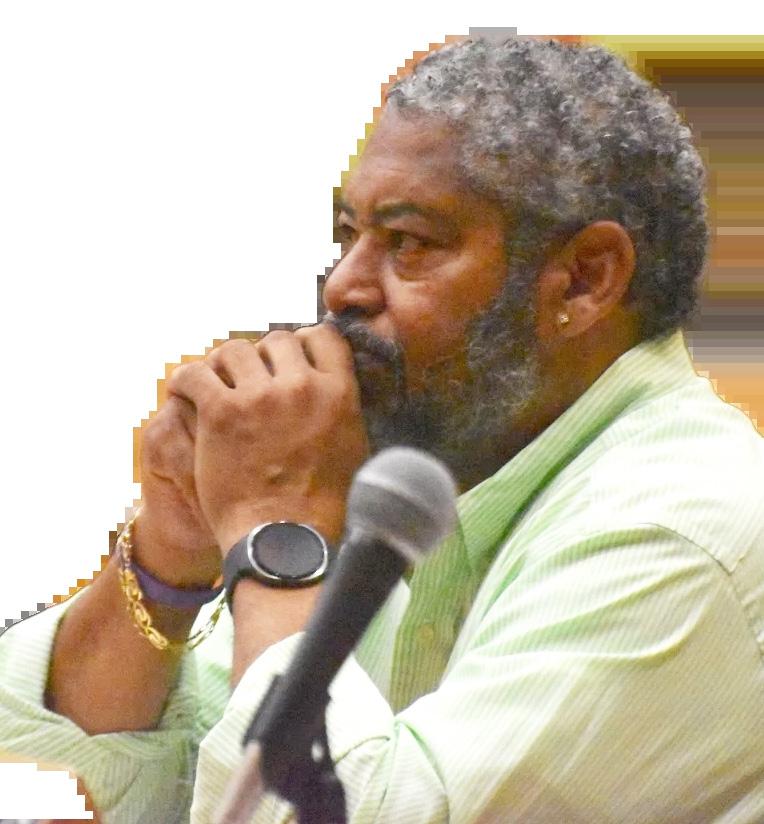
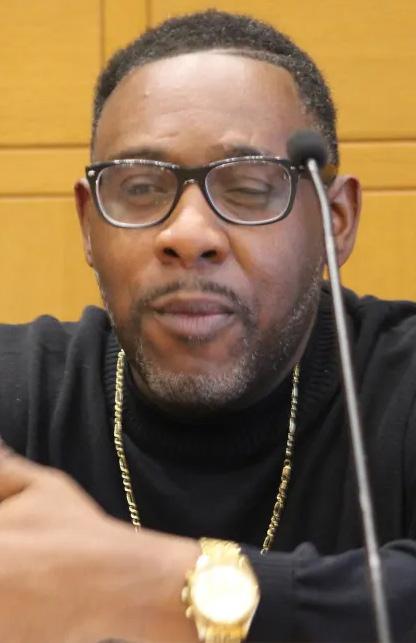
Beaver Hills Alder Gary Hogan: A New Haven HBCU would fill a gap across New England. Credit: Laura Glesby photo
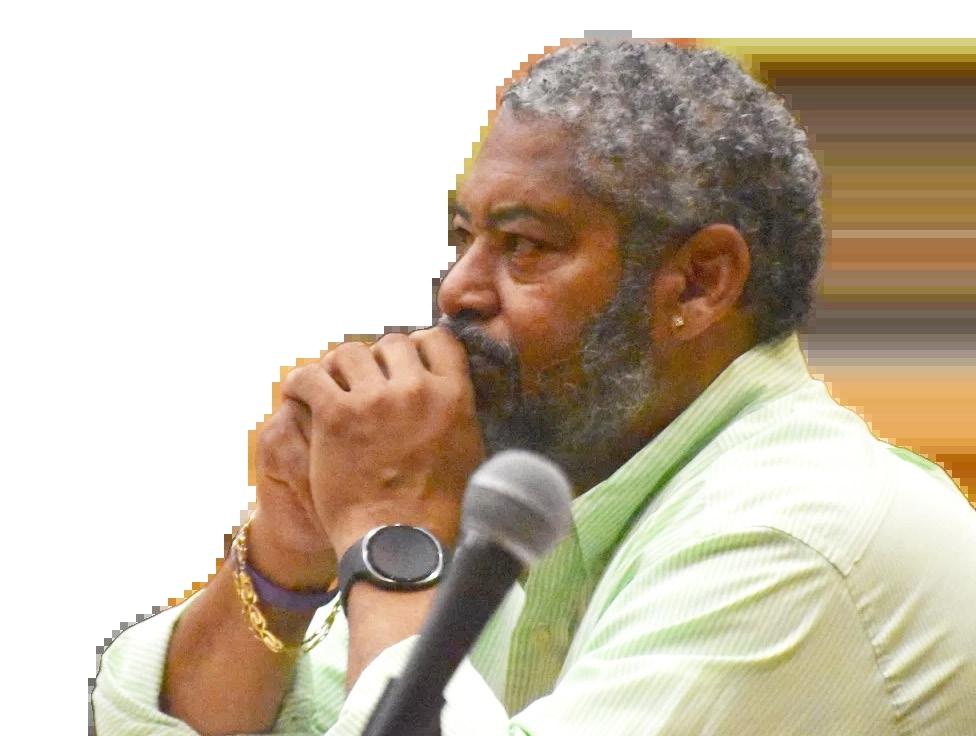


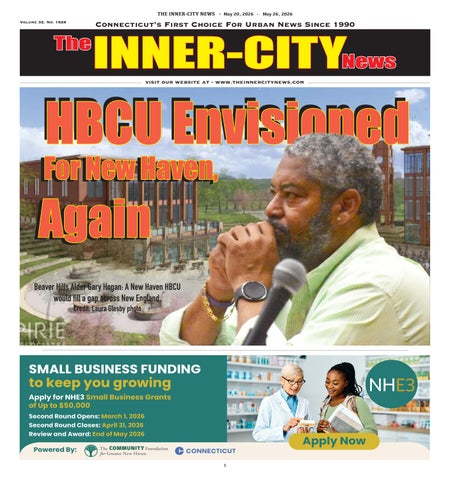
Beaver Hills Alder Gary Hogan: A New Haven HBCU would fill a gap across New England. Credit: Laura Glesby photo
By Richard Chumney, Staff
Kenneth Genalo, director of U.S. Immigration and Customs Enforcement's New York City field office, speaks during an interview with The Associated Press, Tuesday, Dec. 17, 2024, in the Bronx borough of New York.
President Donald Trump’s administration sued Connecticut on Friday over a new state law that subjects federal agents to criminal charges for unjustifiably using force and bans them from wearing masks.
The U.S. Department of Justice is asking a federal judge to throw out the provisions of the law that place limits on U.S. Immigration and Customs Enforcement officers and other federal authorities operating in Connecticut.
“Law enforcement officers risk their lives every day to keep Americans safe, and they do not deserve to be doxed or harassed simply for carrying out their duties,” Acting Attorney General Todd Blanche said in a statement. “Connecticut’s anti-law enforcement policies regulate the federal government and are designed to create risk for our agents. These laws cannot stand.”
Gov. Ned Lamont signed the legislation on May 4 after the Democratic-controlled General Assembly approved the bill without any Republican votes. Lawmakers have said the bill was written to prevent

abuses by federal law enforcement amid a nationwide immigration crackdown under Trump.
“Connecticut will not stand by while federal agents violate the constitutional rights of our residents,” Lamont said at the time.
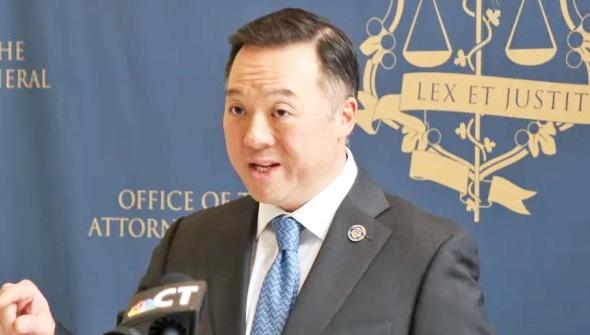
The lawsuit names Lamont, Attorney General William Tong, Chief State’s At-
torney Patrick Griffin and Deputy Chief State’s Attorney Eliot Prescott as defendants.
“The state’s actions are both fully lawful and necessary to protect public safety and we will vigorously defend the law,” Tong said in a statement.
The law prohibits federal, state and local law enforcement officials from wear-
ing facial coverings or disguises when interacting with the public and performing their duties, though it includes exemptions for health and safety reasons.
Additionally, the rules require law enforcement officers to be clearly identified by a badge and name tag that must be on their uniform whenever they are making a planned arrest or interacting with the
public.
Officers accused of violating the provisions could face up to 30 days in jail and a fine of up to $250, according to the legislation. The law also disqualifies violators from asserting immunity against civil liability.
Most notably, the new law gives the state Office of Inspector General the authority to investigate and prosecute all federal law enforcement agents for the unauthorized use of deadly force, a power previously limited to state officers and select federal officials.
The lawsuit, filed in federal court in New Haven, claims the law violates the Supremacy Clause of the U.S. Constitution by subjecting federal officials to state authority. It also alleges the limits jeopardize officer safety and operational effectiveness.
The 17-page complaint notes a similar law approved in California that requires federal law enforcement officers to “visibly display identification” was blocked by a federal judge last month after the Trump administration filed a lawsuit.
“Connecticut’s attempt to regulate federal officers is dangerous and unconstitutional,” Assistant Attorney General Brett A. Shumate said in a statement. “State interference with federal operations is precisely what the Supremacy Clause was intended to prevent, as the Supreme Court has recognized for centuries.”
By Kaitlin Keane
BRIDGEPORT – Amelia Burgos, a 14-year-old who is Dominican, said she understands what’s at stake for families living under the constant fear of deportation.
As a student performer with the nonprofit Creative Youth Productions, she will bring those real emotions to CYP's latest production, "Behind Closed Doors," which was inspired by a real deportation case in Bridgeport some years back. CYP staff have updated the original 2019 show's story, music and choreography to reflect today's immigration climate.
“I feel like it’s a very painful subject to talk about just because a lot of us sitting here are minorities,” Burgos said. “We have talked about these subjects before ... I remember when I first learned about it, I was scared because I didn’t want to lose any fraction of my family."
The show will be performed at 1 p.m. on May 20 at Bassick High School and May 27 at Harding High School and at 3 p.m. on May 30 at the United Congregational Church. All of the shows are open to the community.
The May 20 and May 27 performances are free, while the May 30 performance costs $25 for adults and $10 for youths and includes dinner.
“Behind Closed Doors” is an original

show about a family threatened with the immediate deportation of their father and their struggle to survive and bring him home, said Donna Sue Deguzman, CYP's executive director.
LaRay Sheffield-Rice, CYP’s program coordinator, said the issues of the show and those that minorities face is especially prevalent given the number of children being pulled out of school due to fears of
ICE or separated from their families.
“My kids are Dominican and Mexican,” Sheffield-Rice said. “So every day, I’m scared when they’re with their other side of the family, anything can happen at any point, and I’m always like, ‘You have to have their birth certificates, you have to have this, you have to have that’ … So every time I send my kids off, that’s what I’m scared of – my kids being taken.”
Deguzman said the original play was based on a true story of a Bridgeport family impacted by deportation but could not disclose the family’s identity. She said the play was performed at Housatonic Performing Arts Center in 2019 before going on a small tour of the Bridgeport area. When the theater shut down due to COVID, the production was adapted into a three-part episode series on
YouTube.
Deguzman said the CYP staff wanted to do “Behind Closed Door” again due to their own experiences in seeing peers being taken off the streets and out of school. Mariah Cotto, the show’s dance instructor and a former member of the 2019 production, said she suggested they do "Behind Closed Doors" again when the CYP staff met to talk about shows they wanted to present.
“I’ve had friends that have been deported," Cotto said. "We have so many things going on and I think that’s when everybody was like ‘Bingo.’ … And I think everyone just rolled with it.”
Though he didn't see the original 2018 script, director Keith Shaw Jr. said he and Josh Deguzman, Donna Sue Deguzman’s son, collaborated to update the script by adding characters from past CYP shows, “making connections we didn’t know were there” and “building upon what we already had.”
“It turned our theme of ‘How does a family feel behind closed doors when a family member is taken away?’ to ‘What actions do they take behind closed doors?’” Shaw said.
Cotto said she believes the new script is stronger and “more realistic” than its original text, adding that as local minori-
by Donald Eng
HARTFORD, CT — Connecticut offi-
cials are standing by a law limiting immigration officials’ actions in the state after the federal Justice Department filed a lawsuit Friday against Connecticut, Gov. Ned Lamont, Attorney General William Tong, Chief State’s Attorney Patrick Griffin, and Deputy Chief State’s Attorney Eliot Prescott, challenging Senate Bill 397.
Lamont deferred questions about the lawsuit to Tong’s office. Tong issued a simple statement in response.
“The state’s actions are both fully lawful and necessary to protect public safety and we will vigorously defend the law,” he said.
Acting U.S. Attorney General Todd Blanche called the law anti-law enforcement and said it was designed to create risk for the department’s agents.
“These laws cannot stand,” he said. The new law also violates the Supremacy Clause of the U.S. Constitution, according to Assistant U.S. Attorney General Brett Shumate.
“State interference with federal operations is precisely what the Supremacy Clause was intended to prevent, as the Supreme Court has recognized for centu-

ries,” he said.
In a statement the department decried the new law’s requirements that federal officers not cover their faces with masks, wear a badge and name tag and adhere to Connecticut’s use-of-force policies.
The department has filed similar lawsuits against other states, including New York, New Jersey and California.
In a May 4 ceremony where Lamont signed SB 397 into law, Lt. Gov. Susan Bysiewicz said the bill was rooted in the concept that no one is above the law.
“Here in the Constitution State, the Constitution applies to everyone,” she said.
In addition to the restrictions on masks and the requirement to wear identification, the law bans warrantless arrests in places like schools, hospitals and places of worship, and makes federal agencies liable when their officers interfere with a person taking a photo or video of another officer carrying out their duty.
The bill passed the Senate 24-10 along party lines, and the House 91-54 with a handful of Democrats and every Republican voting against it.
House Minority Leader Vincent Cande-
lora, R-North Branford, had criticized the bill, saying it invited the kind of lawsuit that the federal government filed Friday.
“My concern is it’s sending the wrong message to law enforcement in the state of Connecticut,” Candelora said before the House began debate on the bill. “Ultimately I think Connecticut is going to be worse off for it.”
Lamont in the days after the bill passed said people should not fear for their safety when visiting hospitals, schools, and religious and government buildings.
“The provisions included in this bill include commonsense measures to protect peoples’ constitutional rights from federal overreach,” he said.
Attorney General William Tong also at the time issued a statement that the bill made all public officials accountable for civil rights violations.
“It is the policy of the State of Connecticut to respect, honor and protect immigrants and immigrant families in compliance with state and federal law,” Tong said. “This legislation reflects the unremarkable and uncontroversial proposition that no one is above the law. Not here in Connecticut and not anywhere else in this country.”
by Thomas Breen
New Haven Fair Rent Commission
Executive Director Wildaliz Bermudez on Friday filed to run for the 97th district state House of Representatives seat — becoming the first candidate so far to officially vie to succeed Al Paolillo, Jr., a fellow Democrat who plans to run for state senate.
Bermudez, 43, registered her candidacy for state representative on Friday, according to a filing submitted to the State Elections Enforcement Commission’s (SEEC) online database.
The New Haven Democratic Town Committee (DTC) plans to meet on Thursday, May 21, at the Betsy Ross Parish House on Kimberly Avenue to endorse candidates for each of New Haven’s state house seats, including for the 97th district.
Bermudez is a former Hartford city council member who now lives on Front Street in Fair Haven. She has led New Haven’s Fair Rent Commission since 2022. In that capacity, she’s boosted the public visibility — and the number of cases heard — by the oft-overlooked local body empowered to strike down excessive rental charges. She also helped New Haven become the first municipality in Connecticut to create a legal pathway for formally recognizing tenants unions.
In a phone interview Friday, Bermudez pointed to those accomplishments as among the ones she’s most proud of during her four-years-and-counting tenure leading the Fair Rent Commission.
She also spoke with pride about being
one of the cofounders of the statewide Fair Rent Commissions network, for which she currently serves as chair. Bermudez said that that statewide organization started off with 12 municipalities and has now grown to include 40 members from across Connecticut.
“I strongly feel that we need a voice that reflects our community at the state Capitol,” Bermudez said. “I want to make sure that New Haven is at the table.”
Asked if she would stay in her job as New Haven’s Fair Rent Commission ex-
ecutive director if she’s elected state representative, Bermudez replied, “If I’m given the opportunity, I would. … If I’m allowed to, yes.” She pointed out that New Haven already has one state representative who works for city government — the 94th district’s Steve Winter, a former alder and fellow Democrat who now serves as the city’s director of climate and sustainability.
Bermudez said that, as she has traveled to the state legislature over the years to testify on various housing policies, “I’m
appalled at the responses that I hear” from some lawmakers “who don’t live in cities.
The line of questioning, I’m appalled by what’s being said.”
“I care very deeply about housing issues that impact folks in our community,” she continued. “I feel like I’ve been doing a great job bringing together and resolving disputes between landlords and tenants” in her role with New Haven’s Fair Rent Commission. She promised to advocate for “better policies, better law
at the state level.”
Asked for a specific example of a bill she would advocate for, she pointed to a proposal submitted by the state Department of Housing commissioner this session “regarding rental caps.” The governor “has pushed that forward as well. We need to be on the ground,” fighting for the passage of bills like that, to make sure that kind of proposal is turned into law.
While Bermudez spent six years on the Hartford city council, “I am not new to New Haven,” she stressed. She said she used to work as a community organizer for the Connecticut Center for a New Economy, which provided the initial organizing around what would become the local labor advocacy group New Haven Rising.
“I love New Haven. I love being a resident of New Haven,” she said. And now she wants to represent New Haven in the state house.
Paolillo, a former Annex alder, has served for the past decade as the state representative for the 97th district, which covers parts of Fair Haven, Fair Haven Heights, Quinnipiac Meadows, the Annex, and Morris Cove. He has publicly announced his intention to run for the 11th district state senate seat, which covers parts of New Haven and Hamden and which has been held for the past three decades by Martin Looney. After becoming the longest-serving leader in state senate history, Looney, 77, announced earlier this month that he will not seek reelection for another two-year term.
by Kate Santini
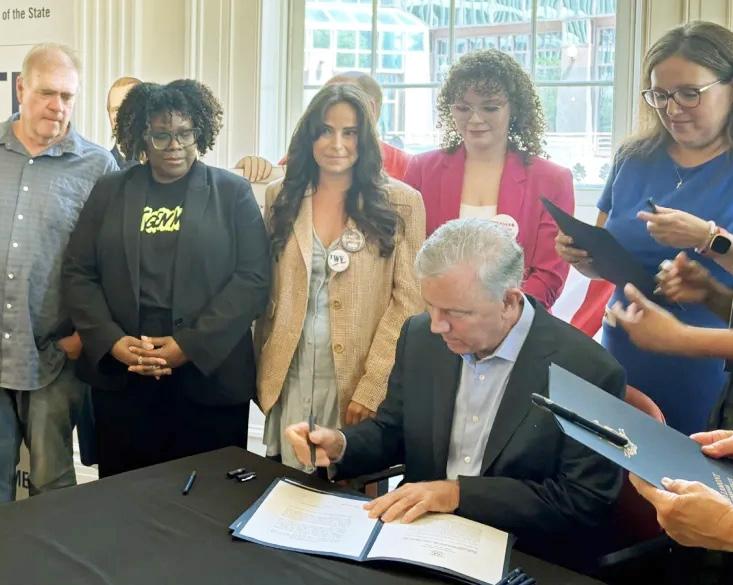
Hartford, CT — Connecticut residents have the option to vote via absentee ballot with no questions asked after Gov. Ned Lamont signed a universal absentee voting bill into law Tuesday..
“Today is all about making it easier for you to be able to vote and exercise your right,” Lamont said before signing the bil. “We want to make sure you vote and that you vote with integrity.”
Lamont signed the Public Act 26-42 at the Old State House in Hartford alongside a coalition of individuals including the former and current state secretaries of the state, Denise Merill and Stephanie Thomas, who participated in the decade-long fight to ensure that absentee ballots were accessible for all residents.
Merill said it surprised her when she first entered office that Connecticut had some of the most restrictive voting laws in the country.
“We were one of the four states that still required an excuse to get an absentee ballot,” she said.
The bill, which eliminates any previous restrictions on absentee ballot voting, passed unanimously in the House and by a 25-11 vote in the Senate on the last day of the legislative session. This came in the wake of the 2024 election when 58% of Connecticut voters voted in favor of adding an amendment to the Connecticut constitution that would allow all eligible voters to have access to the absentee ballot.
“This has been a long time coming,”
said Lamont.
When kicking off the celebration of the country’s 250th anniversary last week, Lamont said he was reminded of how far the country has come in terms of voting rights. When the right to vote was first enacted, it applied only “to white male, property-owners” yet now it continues to become increasingly accessible in the country and in the state of Connecticut, said Lamont.
“Voting is the foundation of democracy, the right through which all other rights are protected,” said Jess Zacagnino, policy council for American Civil Liberties
Union of Connecticut. “This bill comes at a critical moment nationally. We are seeing coordination across the country to restrict access to voting, undermine confidence in elections and make it harder for black and brown communities to fully participate in democracy.”
Zacagnino also cited the Connecticut Voting Rights Act (CTVRA) as being the most comprehensive voting act in the country. Passed in 2023, it sets aside funding and resources aimed at reducing voting barriers for Black and Latino voters.
“Today Connecticut makes good on a promise and a process more than a decade
in the making,” said state Rep. Matt Blumenthal, D-Stamford. “Absentee voting for all is now the law of this state including ballot-tracking, automatic absentee ballot applications and ballot curing to ensure that everyone’s voice can be heard and no one’s vote is wasted.”
State Sen. Mae Flexer, D-Killingly, said Connecticut voters had faith in the electoral system because of the workers in each municipality.
“Now voters can have even more confidence that their vote is going to count and that they can cast their ballot easily,” she said.
Not all legislators were happy with the bill’s passage, however.
Republican state senators Stephen Harding of Brookfield and Rob Sampson of Wolcott issued a statement arguing that the new legislation does not address the recent Bridgeport controversy around ballot box fraud.
“Rather than restoring confidence, this expands mail-in voting and makes sweeping changes to election law without putting meaningful safeguards in place to protect election integrity,” said the statement. “This massive, controversial bill was pushed through on the last day of session following an all-night debate.”
Blumenthal, though, said the bill increased deterrence because those who intend to engage in misconduct wouldn’t know if the person whose vote they are tampering with actually voted themselves, thus ensuring they will get caught.
“This is the best measure we could take to improve and secure our elections,” he said.
by Karen Ponzio
The typical meet and greet for a recording artist can consist of a long wait in line only to be hurried through the briefest of encounters. Over in East Rock, MINIPNG is working to change that by curating more intimate experiences that are big on allowing time with the artist, not only to hear them perform their music but to also hang out with them, all while enjoying snacks, mocktails, handmade limited-edition merchandise, and a stellar array of vintage items.
MINIPNG is not just the name of a store, but also the name of the artist/ designer (AKA Eiress Hammond) who has been bringing vintage clothing and accessories primarily from the late ‘90s/ early 2000s as well as her own designs to New Haven since 2022, first on Audubon Street and now on Edwards Street. At the end of 2025 she moved to her current lo-

cation and brought with her a continued drive to offer an eclectic mix of clothing as well as events to her customers. Sunday afternoon saw the first of her intimate MINIPING Live events with special guest Scarlet House (aka Kameron Odums), a
Charlotte, N.C.-based musician. Scarlet House — who later that evening would also be opening for Violent Vira at Toad’s Place – stayed for the entirety of the event, hanging out, talking to attendees, and taking photos with them. He also

John P. Thomas Publisher / CEO
Babz Rawls Ivy Editor-in-Chief Liaison, Corporate Affairs Babz@penfieldcomm.com
Advertising/Sales Team
Keith Jackson Delores Alleyne John Thomas, III
Team Staff Writers Christian Lewis/Current Affairs Anthony Scott/Sports Arlene Davis-Rudd/Politics
David Asbery / Tanisha Asbery
Jerry Craft / Cartoons / Barbara Fair Dr. Tamiko Jackson-McArthur Michelle Turner / Smita Shrestha William Spivey / Kam Williams Rev. Samuel T. Ross-Lee
Contributors At-Large
Christine Stuart www.CTNewsJunkie.com Paul Bass www.newhavenindependent.org
Memberships
National Association of
performed. Before and after his acoustic performance attendees were able to partake of free snacks from Fruit Riot!, a New York-based snack company that specializes in candy coated frozen fruit. Some of the flavors offered on this day were strawberry peach, Sour Mango and a Sour Grape mix. (Both had a sour candy coating.) On sale were also mocktails created for the event made by MINIPNG’s new neighbor, XOLO Snack Bar. Special merchandise available for the day included a shirt designed by MINIPNG (you can see the style being worn by Hammond herself in the photos) and screen printed by New Haven based artist Hello Killme, who attended his own merch as well as on site screen printing.
And there was the clothing, of course.
Attendees India Garcia and West Johnson of Meriden perused the outside rack after she had already purchased the perfect summer ready strapless floral dress inside. Garcia, who said she had known Hammond since high school, then headed over to XOLO and ordered a Bellini mocktail
Con’t on page 10
The Inner-City Newspaper is published weekly by Penfield Communications, Inc. from offices located at 50 Fitch Street, 2nd Floor, New Haven, CT 06515. 203-3870354 phone; 203-387-2684 fax. Subscriptions:$260 per year (does not include sales tax for the in State subscriptions). Send name, address, zip code with payment. Postmaster, send address changes to 50 Fitch Street, New Haven, CT 06515. Display ad deadline Friday prior to insertion date at 5:00pm Advertisers are responsible for checking ads for error in publication. Penfield Communications, Inc d.b.a., “The Inner-City Newspaper” , shall not be liable for failure to publish an ad or for typographical errors or errors in publication, except to the extent of the cost of the space in which actual error appeared in the first insertion. The Publisher reserves the right to refuse advertising for any reason and to alter advertising copy or graphics deemed unacceptable for publication. The entire contents of The Inner-City Newspaper are copyright 2012, Penfield Communications, Inc. and no portion may be reproduced by any means without the written permission of the publisher.
ties, “it’s easier for us to create that home in that story.”
Yet there were some concerns about presenting the new play in Bridgeport, including whether the schools would want it and whether they could say the word “ICE.”
“My biggest fear is no matter how loud our voices are, we still can’t be heard,” Sheffield-Rice said. “When it’s from the mouths of babes, people will want to hear it. You need to hear it from these kids what it really looks like, get people inspired and figure out ways to make actual change.”
Deguzman said CYP held a preview showcase featuring four scenes and two songs from the new play in February to get the community’s feedback.
“At the end, people were crying and so moved, and that’s when they said, ‘We need to do a community show,'” she said. Deguzman said state Sen. Sujata Gladkar-Wilcox, D-Trumbull, also requested a performance of “Behind Closed Doors” with a community discussion on July 18 at the Bridgeport Islamic Community Center.
"I am proud of our brave youth for using the performing arts to show how tragic and emotionally devastating it is to lose a parent to immigration and deportation," Deguzman said. "Since the first day of rehearsals, I am moved by their tenacity to find a way and never giving up.”
At a recent rehearsal, Burgos ran through her monologue as the daughter of the seized father, shifting the tone of the scene from upbeat to solemn and bringing the audience back to the reality of the narrative they were portraying on stage.
In her role as the daughter, Amelia said she feels “a lot of mixed anger and sadness” given the current social climate, but she’s looking forward to bringing the topic to light.
Meanwhile, Lattrell Smith, a CYP staff member who described himself as half Hispanic, said he is playing three roles in the play, including the role of the ICE agent.
“It’s very interesting to play this character and represent something you don’t like at all because this character brings a lot of aggression to these people,” he said. “The other side of this is I’ve also enjoyed this role because I’ve only played light roles, but the ICE agent itself is very tough to play because you have to come from a standpoint you don’t believe in.”
As the father, Shaw said he feels the character’s helplessness and “the fact that if I try to be good in the world, I can be taken, even if I’ve done nothing wrong.”
“What I want people to come away with is not to feel the helplessness that everyone feels but redirect your anger into a different form,” Shaw Jr. said. “If we can come together and make our voices heard, then we can make a difference.
Tickets for the May 30 show can be purchased through the CYP website. Tickets for May 20 and May 27 can arranged by calling LaRay Sheffield-Rice at 203-2907206.

by Dereen Shirnekhi
The Housing Authority of New Haven (HANH) intends to finally purchase the dilapidated former Hamilton Street clock factory this month for a total of $4 million — as part of a long-in-the-works plan to turn the industrial property into 130 new homes.
HANH President Shenae Draughn provided that update on Tuesday during the latest regular monthly meeting of the housing authority’s Board of Commissioners at 360 Orange St.
The housing authority first announced its plans to purchase the historic complex at 133 Hamilton St. in 2023 — when the clock shop was in the midst of a city tax foreclosure — for $4.5 million from owner Taom Heritage New Haven LLC.
That purchase amount has since been lowered to $4 million, according Draughn.
The deal between HANH and Taom Heritage had been held up by the owner’s failure to complete environmental remediation at the site; the building was beset by squatters and fires and anti-blight and safety notices from the city.
At the time, Taom Heritage was controlled by Scott Reed of the Oregon-based Reed Community Partners. (Reed’s company first bought the clock shop in 2018; over the years, Taom Heritage failed to follow through on plans to redevelop the industrial property into 130 apartments.)
In September 2025, a group of clock shop creditors stripped Reed of decision-making authority at Taom Heritage. Now Bill Kraus, a long-time clock shop redevelopment advocate who led a push to force Reed’s holding company into involuntary bankruptcy, has control over the holding company that owns the Hamilton Street property.
“Hallelujah!” said Kraus in a phone interview about the nearing sale of the property to the housing authority.
The housing authority plans to transform the former clock factory into an

approximately 130-unit residential community, where all units will serve low-income or moderate-income households.
The project is expected to cost around $70 million, financed through a combination of tax-exempt private-activity bonds, 4% Low-Income Housing Tax Credits, federal and state Historic Tax Credits, and other public-private funding sources. (Tuesday’s update comes after housing authority leaders stated last December the agency’s intention of closing on the property sale in January.)
One important component of HANH’s agreement dating back to August 2023, when its Board of Commissioners approved the agency’s intent to purchase the clock factory, was that the housing authority would assume Taom Heritage’s loans from the state Department of Economic and Community Development (DECD) — if the terms were favorable.
On Tuesday, commissioners voted to approve the housing authority’s assumption of those loans, which the DECD has agreed to transform into a grant that will not have to be paid back as long as the

housing authority completes environmental remediation and leases 80 percent of new housing units by 2032.
The loans from DECD to Taom Heritage totaled $4 million in brownfield funds for environmental cleanup of the property; $3.8 million had been advanced to the owner for that work. According to
Kraus, the company received that money in 2018 or 2019, and it had been spent cleaning up radium, asbestos, hydrocarbons and PCBs in the ground, and “literally tons of debris.”
The housing authority will be able to use the remaining $200,000 to complete the environmental cleanup once the agency
buys the property.
HANH Board of Commissioners Chair William Kilpatrick asked whether there is a possibility that the housing authority wouldn’t complete the DECD’s terms that environmental remediation is completed and new housing is leased by 2032 in order for the loan to be forgiven.
“Once we acquire it, is not our intent to hold on to the property for some time until redevelopment,” said Draughn. She said that construction is expected to begin in the first half of 2028. That, she said, would definitely meet the requirements for repayment.
Kilpatrick and present commissioners Danya Keene and Alberta Witherspoon voted unanimously to approve the housing authority’s assumption of Taom Heritage’s DECD funds.
Draughn said that while a final sale date has not yet been set, both parties’ attorneys are working through the necessary paperwork and coordination.
In December, the housing authority’s board voted unanimously to authorize a $1 million predevelopment loan for the clock-shop project to the Glendower Group — the housing authority’s nonprofit development arm — and to commit $21 million in tax-exempt bonds towards the development.
Looking forward, Draughn said that the housing authority will be installing cameras to make sure the building remains secure from inhabitants while environmental remediation continues ahead of construction.
“We’ll just continue to monitor the building on a weekly basis, but also be able to monitor through our camera system,” she said.
“It’s very exciting to get the building into the strong, capable hands of the housing authority,” particularly after the long process to get to this point, Kraus told the Independent. “We’re just excited to see the building get saved and renovated and put back to good use as affordable housing.”
by Staff Report
HARTFORD, CT — Connecticut has joined 23 other states and the District of Columbia in filing a lawsuit against the U.S. Department of Education over a new rule that limits access to federal student loans for students pursuing professional degree programs, including many healthcare and other critical workforce fields, according to Attorney General William Tong. The lawsuit challenges a recently finalized Department of Education rule that narrows the federal definition of “professional degree” and imposes restrictions Congress did not authorize. The coalition argues the rule unlawfully excludes many degree programs that qualify under the standards established by federal law, potentially reducing access to financial aid for students pursuing advanced edu-
cation.
“We need more nurses, therapists and social workers, and our federal government should be supporting their studies, not defunding them,” Tong said. “The Trump/McMahon plan to magically drive down education costs by barring student loans defies Congress, defies the law, defies reality, and will do real damage to Connecticut students and workers. We are suing to restore common sense and to force Trump and McMahon to follow the law.”
In July 2025, Congress passed legislation imposing new limits on federal student loans for graduate and professional students. The new limits are lower for graduate students than for professional degree students; to distinguish the two, Congress incorporated an existing federal definition of “professional degree” into law. The lawsuit alleges that the Depart-
The coalition argues the rule could harm states by reducing support for public institutions of higher education, creating barriers for students pursuing advanced training, and worsening workforce shortages in critical professions. The complaint notes that these impacts could be particularly significant in fields such as healthcare, where states already face ongoing workforce challenges. The lawsuit also challenges provisions that limit protections for students already enrolled in programs. The statute includes a grandfathering provision that delays implementation of the loan caps for currently enrolled students. Under the rule, however, some students who transfer institutions or temporarily withdraw and later return to their programs could lose eligibility for grandfathering, creating additional financial barriers,” Tong said.

Yale New Haven Hospital is pleased to offer patients and their families financial counseling regarding their hospital bills or the availability of financial assistance, including free care funds. By appointment, patients can speak one-on-one with a financial counselor during regular business hours. For your convenience, extended hours are available in-person at Yale New Haven Hospital the third Monday of every month.
Time: 5 - 7 pm
Location: Children’s Hospital, 35 Park St., 1st floor, Admitting Parking available (handicapped accessible)
An appointment is necessary. Please call 855-547-4584
Spanish-speaking counselors available.

• Burial Lots (infant, single, two-grave, or four-grave)
• Monuments & Markers (black, gray, or pink granite)
• Flower placement (single or multiple placement)
• Cremation (Choose to be cremated at Evergreen.)
• Columbarium in the Most Beautiful Cremation Garden
• All orders can be placed at the Evergreen office or the website.
by Laura Glesby
Nearly two centuries after racist city leaders closed the door on the prospect of a Black college in New Haven, the city is working to open that door once again.
On Monday evening, the Board of Alders approved a proposal to apply for state funding to begin early-stage plans to found a Historically Black College/University (HBCU) satellite campus in New Haven.
The Connecticut Historically Black College & University Alumni Network and the Elicker Administration are applying for a state Community Investment Fund (CIF) grant to fund this planning process.
They are seeking $250,000 from CIF, which would be matched with $50,000 in city dollars, to fund a feasibility study, community engagement process, and additional planning for the proposed HBCU.
About $55,000 of those funds would be used in the meantime to support college tours and fairs to connect current New Haven students to HBCU opportunities, according to the proposal.
The grant application follows efforts led by the late Beaver Hills Alder Tom Ficklin and City Historian Michael Morand to bring about a public reckoning with the first time such a college was proposed for New Haven.
In 1831, abolitionists had attempted to found the nation’s first higher education institution for Black men in New Haven. But both the city and the state of Connecticut blocked the plan; the state passed a law in 1883 prohibiting Black people from out of state from attaining an education in Connecticut.
According to the Yale and Slavery Project, the 1831 mayoral committee concluded that the proposed Black college was an “unwarrantable and dangerous interference with the internal concerns of other States” — in other words, an affront to other states’ ongoing enslavement of African Americans.
The committee also wrote that Black college would be “incompatible with the prosperity, if not the existence of the present institutions of learning” — such as Yale, whose alumni were pivotal opponents of the proposed college.
Ficklin had proposed a formal city apology for its prevention of the 1831 Black College. But he passed away, in October 2024, before alders approved the resolution. The apology has not since been further pursued.
Meanwhile, the city and the Connecticut HBCU Alumni Network saw an opportunity in a portion of Southern Connecticut State University (SCSU)’s campus.
They are proposing for SCSU to host an HBCU “satellite campus” with “culturally affirming, workforce-aligned programs” focused particularly on science, health, and technology, according to a presentation.
Economic Development Officer Malachi Bridges, a key planner on the proposal so far, explained that the HBCU would not likely be a new, independent institution due to federal law. “The definition of HBCU is tied to a federal statute… [which] defines it as a school established before 1964,”

Bridges said.
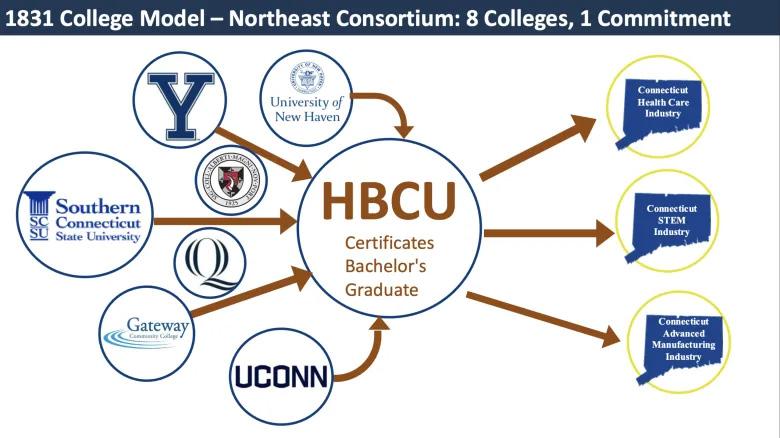
According to Bridges, the city and the HBCU alumni network are imagining a New Haven-based “satellite campus” of an existing HBCU elsewhere in the country, with unique connections to New Haven’s other higher ed institutions.
They envision opportunities for students at that college to be linked to SCSU with the ability to enroll in courses across numerous local higher education institutions — potentially Yale, Quinnipiac, UConn, Gateway, the University of New Haven, and Albertus Magnus. The program would be focused on STEM fields including biotech, health care, quantum, aerospace, and advanced manufacturing.
An early sketch of their vision involves new research and lab buildings at Southern, creating indoor and outdoor hubs for the HBCU students, and founding an Ethnic Culture Center and Museum on campus, potentially replacing some of the parking lots by Crescent Street.
Bridges pitched the proposal to the alders’ Education Committee in April as a way to both honor the historic movement for a Black college in New Haven and make local economic opportunities in the city’s fastest-growing sectors more accessible to Black residents. “People feel kind of locked out of opportunities,” he said in April.
“After we acknowledge the history, after we apologize for it… This is one potential solution,” said Bridges.
In advance of the Education Committee’s April 22 public hearing on the matter, several members of the public wrote in with testimony in support. Project backers included John Taylor, the founding principal of the local charter school Booker T. Washington Academy.
“Now is the time for action,” Taylor wrote. “Let us challenge ourselves to not only dream of an HBCU but to work tirelessly until it stands proudly in our city.”
On Monday evening, Beaver Hills Alder and Education Committee Chair Gary Hogan spoke in support of the proposal. “This will turn the historical 1831 College” reckoning “into a forward-thinking avenue for education, careers, and wealth management,” Hogan said. He noted that there are no remaining HBCUs left in New England.
Downtown/Yale Alder Elias Theodore, a Wilbur Cross High School alum, added, “I know I went to high school with so many people who would have loved to go to an HBCU, but they have family” or other reasons they needed to go to school closer to home. An HBCU would “bring so much vibrancy and joy to New Haven,” Theodore said.
Dixwell Alder Jeanette Morrison echoed the support as an alum of an HBCU. “There is something about that HBCU, that education, that connection,” which makes for a life-changing learning environment, she said.
“The idea came first here in New Haven,” before anywhere else in the country, “but it was denied,” Morrison said.
by Dereen Shirnekhi
The Board of Alders Finance Committee voted Thursday to recommend accepting a roughly $5 million annual boost to Yale University’s voluntary payments to the city for each of the next seven years, while echoing a resounding message: Yale should do more.
Committee alders took that unanimous vote during a Thursday night meeting at City Hall. Later in the night, those same committee alders recommended approval of an amended version of the city’s budget for next fiscal year.
If the full Board of Alders approves the new deal, Yale will contribute to New Haven a total of $29.8 million in Fiscal Year 2026-27 (FY27), $30.6 million in FY28, $31.5 million in FY29, $32.3 million in FY30, $33.2 million in FY31, $33.4 million in FY32, and $33.6 million in FY33. Those dollar amounts do not include what Yale currently pays in property taxes for non-exempt properties; nor they include Yale’s various contributions to other programs, like the Yale Teaching Fellowship and New Haven Promise.
The agreement, building on a soon-toexpire 2021 deal between Yale and the city, would also carry over a provision that requires Yale to pay a declining portion of tax-equivalent payments to the city for properties that the university newly takes off the tax rolls. As lead city negotiator Henry Fernandez pointed out in April, that means $16.8 million in voluntary property tax payments that will head the city’s way over the course of this deal for newly tax-exempt Yale properties like 300 George St.
Furlow said he hopes in the future the city and university will pursue a “more responsible” agreement, one that reflects “the financial realities associated with hosting one of the world’s largest tax exempt institutions.”
Fifty-six percent of New Haven’s real estate value is tax exempt. Yale University owns 43 percent of the city’s tax-exempt real estate, valued at around $4.5 billion, while Yale New Haven Hospital owns 17 percent, valued at $1.75 billion. Therefore, Yale owns 60 percent of the tax-exempt real estate in New Haven. The university still remains the second-largest taxpayer in New Haven, behind United Illuminating.
“I am in support of this item simply because there is no other alternative in this matter for our city at this time,” said Beaver Hills Alder Brian Wingate, who is also vice president of UNITE HERE’s Local 35, which represents the university’s service and maintenance workers. “I’ve been a part of the Yale community for about 35 years and to see the wealth grow from $17 billion to $44 billion … I know that they have it in them to be better.”
“Look, I’m not going to deny any money,” said East Rock Alder Anna Festa. Still, she wondered why Yale wasn’t doing more. “We have a high poverty rate in this city, people are deciding whether they should buy food or pay their electric bill.”
“They always ask for something in return. Last time it was High Street,” she added, referring to Yale’s request in the
2021 agreement that the city maintain ownership of High Street while the university converted it to pedestrian-only.
“Why should we give something up?”
(Yale wound up not following through on converting that city-owned street to a space for pedestrians and cyclists only, citing concerns around federal funding uncertainty under the second Trump administration.)
At a public hearing hosted by the Finance Committee in April, some critics of this deal — including members of the local labor advocacy group New Haven Rising — testified that Yale should redistribute more of its funds to the city. Henry Fernandez, a nonprofit leader and former city official who helped broker the deal between Yale and the city, defended the agreement at that meeting, stating, “Is this the best deal that any city has ever gotten from any university in the history of this country? Yes, it is. Is it enough? No.”
On Thursday, West River Alder and Board of Alders President Tyisha Walker-Myers said that the discussions between Yale and New Haven need to move away from “give and take.”
“I think we need to start having a different conversation with Yale, and we need to start having real transformational change,” she said. Without that, “we’ll be back at this same table, whether we start negotiating tomorrow with them. We’ll be back here saying the same thing at the end of the agreement, going into the next one.”
“We’re, I guess, happy, lucky to have Yale here, but also Yale should be happy and lucky to be in this community,” Walker-Myers continued.
“I’m reluctantly saying ‘yes’ to this agreement,” she said. “We’re bended on one knee and have no choice to accept it.”
Before alders took their unanimous vote of approval, moving the order to the full board for a final vote, Finance Committee Chair and Westville Alder Adam Marchand concluded the discussion: “Our grand list has a massive and gaping hole in it,” he said. “I think Yale can do more. I think Yale should do more. Lord knows we need it.”

by Dereen Shirnekhi
State Sen. Gary Winfield and State Rep. Al Paolillo, Jr. on Monday handily secured the Democratic Party’s nominations to represent west- and east-side state Senate districts, respectively — after back-to-back conventions where the two veteran New Haven pols ran uncontested. Winfield is seeking a seventh two-term representing New Haven’s west side and a portion of West Haven in the state legislature.
Paolillo is running to fill the eastern New Haven-Hamden Senate seat to be vacated by Martin Looney, who announced this month he will not run for reelection after a 46-year career in public service.
The New Haven Democratic Town Committee (DTC) held those Senate conventions at the Betsy Ross Parish House at 150 Kimberly Ave. on Monday. Delegates who live in the relevant Senate districts were invited to cast their votes for the party’s endorsements.
Both Winfield and Paolillo were the only nominees put up by their fellow Democrats for their respective positions. No Republicans have yet filed to run for these Senate seats.
Forty-nine delegates from Senate District 10, Winfield’s district, and their proxies were in attendance for Monday’s vote. Afterwards, 42 delegates from Senate District 11 were present to support Paolillo.
Winfield, who serves as co-chair of the Judiciary Committee, was nominated by West Haven’s Christopher Suggs, a committee member for Senate District 10. His nomination was seconded by New Haven’s Claudine Wilkins-Chambers.
Suggs pointed to Winfield’s work this legislative session passing House Bill 5567, a bill that aims to improve medical and mental healthcare in state prisons. The bill had strong bipartisan support and passed in the House with just two votes against the bill and in the Senate with unanimous support. The bill now heads to Gov. Ned Lamont’s office for signing.
“He is a constant voice fighting for justice,” Suggs said of Winfield — whether what he’s saying is popular or not.
“We have work to do, people, and we’re going to do it,” Winfield said as he accepted the endorsement. Winfield spoke of the importance of having residents of both New Haven and West Haven remain in constant contact with him, so he can continue to effectively represent both municipalities.
Winfield is also seeking to serve as state Senate majority leader, as current Majority Leader Bob Duff is expected to replace Looney as Senate president.
After the Senate District 10 endorsement process, which concluded within 15 minutes, the Parish House began to fill again with delegates from the city’s other Senate district, the 11th.
Just as Winfield was nominated by a resident of West Haven, Paolillo was nominated by Hamden State Rep. Laurie Sweet, who spoke of how the two had bonded over their experience in local

government and that he listens closely to her and provides “sage advice” when she needs it.
“He’s steady, calm, and focused,” Sweet said. “Al deeply understands that politics is all relational.”
Paolillo’s nomination was seconded by New Haven State Rep. Roland Lemar; by Fair Haven stalwart Rafael Ramos, who spoke of Paolillo’s service on the Board of Alders; and by City Clerk Michael Smart. There were no other nominations, securing Paolillo the endorsement.
After receiving a standing ovation himself, Looney introduced Paolillo: “He’s a model for what a legislature should be,” he said of Paolillo. “Al delves into every issue. When he makes a decision, it’s an informed opinion.”
“Some people are cynical about politicians and public service,” Looney said. “Those are people who never met Al Paolillo.”
In his acceptance speech, Paolillo spoke of how he would represent Hamden as effectively as New Haven, alongside its newly elected Mayor Adam Sendroff and members of its state delegation. As for New Haven, he said, “There’s no greater honor than to serve in the city that raised you, that educated you, that continues to support you.”
Paolillo concluded his remarks with words about Jerome, a man he met 15 years ago while serving as alder. Jerome’s granddaughter had the same form of bone cancer Paolillo’s nephew had passed away from. Paolillo asked Jerome to keep him involved, and the two saw each other almost weekly.
Jerome, whom Paolillo said passed away five weeks ago, was preoccupied in his final days with how he would leave his house to the children he had raised though wasn’t biologically related to — and how they would keep it.
Paolillo said that Jerome had made him
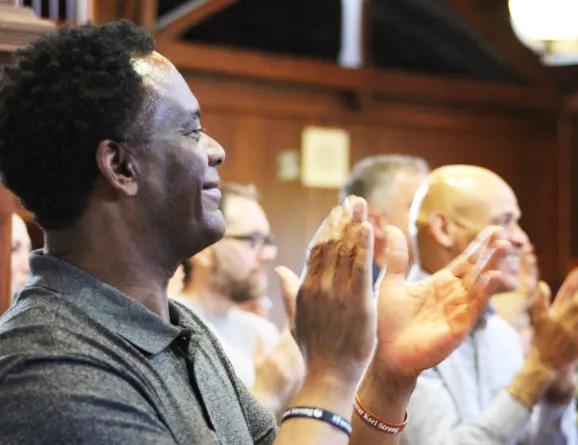
think of all the problems that constituents face everyday. “He’s what drives the work that we do on a daily basis,” he said.
over at XOLO while this reporter ended up with an Aperol Spritz. It was so refreshing, I honestly did not even miss the alcohol.
The sidewalk was bustling for the whole two hours with attendees and a wealth of East Rock Sunday street traffic, the weather balmy and beautiful. Buttery leather jackets hung next to cashmere sweaters on the same wall as lacy camisoles and handkerchief hemmed sundresses while on the opposite wall a green satin Hamden jacket kept a UCONN basketball shirt company. Items flew off the racks, including Scarlet House’s own merch, as smiling shoppers made their purchases and conversation about art and music.
“Have you tried the Fruit Riot?” he asked the audience before he began. “That’s good stuff,” he added, mentioning the mango in particular. His five-song set was also good stuff, the warmth of his voice and his guitar, soft yet strong, melding to convey songs with titles such as “Ghost,” “Slowing Down,” “T-Shirt.” “Too Hot,” and “Over,” which was his last song, appropriately, though he laughed and said “I didn’t mean to do that.” Not unlike the aesthetics of the store itself, Scarlet House had a distinct late ’90s/early 2000s0tinged vibe, calling to mind the music of that era, particularly alternative and grunge (think Nirvana Unplugged). There was also something wholly distinct about Scarlet House, as if Odums was offering a brief glimpse into his private diaries, just enough to make you feel less alone as you dealt with your own loves and losses. Some may call it shoegaze. I like to think of it as introspective. That kind of introspection shared lends itself to its listeners feeling less lonely. What’s better than that?
Scarlet House ended by thanking everyone, especially MINIPNG, and told everyone to “support what she’s doing.” She plans to do a lot more of the same. Hammond already has MINIPNG Live events booked once a month through September. The next one, on June 7, will feature guest performer Juliet Ivy, a makeup station, and more mocktails, fruit snacks, and limited-edition merch.
“I wanted to create an outlet for rising artists to hang out with fans,” she said, calling it “less awkward” and “not a typical meet and greet” where they can “experience them [the artist] as a person.”
Then there’s the next MINIPNG X Thrift To Death event in August, one of the biggest thrifting events in the area. It includes live music, food, visual art…you get the picture. The most recent one in March was heavily attended.
It was the ideal way to spend the first true summer-like day of the year. Music, mocktails, creating connections, and finding the ideal pieces to making yourself even more beautiful, all with the sun shining down upon us all: I can’t wait for the next one.
legislature … we do the
work together.”
For more information about and tickets to future MINIPNG Live events please follow their Instagram page or visit their store on 9 Edwards Street.



by Dollita Okine, Face2FaceAfrica.com
Kwanza Jones has set her sights on dismantling the status quo as she prepares to become the first Black woman to hold a majority ownership stake in Major League Baseball since its establishment in 1903.
This historic shift comes as the family of the late San Diego Padres owner Peter Seidler announced an agreement to sell the franchise to an investor group spearheaded by Jones and her husband, José E. Feliciano, the co-founder of private equity firm Clearlake Capital.
Valued at $3.9 billion, this figure shatters the previous MLB record of $2.4 billion set by Steve Cohen’s 2020 purchase of the New York Mets. Feliciano is also breaking barriers with this deal as he is set to become the league’s second Latino majority owner and the first of Puerto Rican descent, joining Los Angeles Angels owner Arte Moreno.
“We have worked hard for everything we have achieved, and we have built it together,” Jones and Feliciano said in a joint

statement, according to Essence. “We see that same spirit in this team and its fans, and we know what it takes to win.”
Jones and Feliciano added in their joint statement that their goal is to win the World Series and build a franchise that San Diego can be proud of for generations.
Jones is no stranger to breaking barriers and achieving historic milestones. Her journey of excellence began during her undergraduate years at Princeton, where she excelled at the Apollo Theater’s legendary Amateur Night.
This foundation of success was strengthened by her academic pursuits, which culminated in a law degree from the Cardozo School of Law and a master’s degree in dispute resolution from Pepperdine. She is a multifaceted leader who has successfully navigated both the creative and corporate worlds, releasing music under her own independent label and establishing a motivational media company.
She and Feliciano have donated more than $200 million to education and equity through their philanthropic works. Jones has served on the boards of the Apollo
Theater, Susan G. Komen, and Bennett College, of which her mother, aunt, and other family members are alumnae. In 2023, Princeton honored the couple by naming two residence halls after them — the first time in its nearly 280-year history that residence halls have been named after Black and Latino donors.
The change of ownership will go through some processes, Essence reported. First, all 30 MLB clubs will take a definitive, formal vote at the league’s quarterly meeting this June. The deal needs at least 22 clubs to approve it to go forward.
After, the deal will be subject to a full review by the Securities and Exchange Commission and need approval by the City of San Diego, a stakeholder in Petco Park. The formal start of the Jones-Feliciano era is expected to be around this summer’s All-Star break, Essence said.
The Padres are San Diego’s only major professional sports team, and attendance has risen to record levels for the past three seasons. When the announcement came down this month, the team had a 19-12 record.
by Francis Alkhalbey, Face2FaceAfrica,com
WNBA legend Lisa Leslie’s legacy will be immortalized, as her former team, the Los Angeles Sparks, will honor her with a statue outside the Crypto.com Arena.
Per ESPN, the ceremony will take place in the Star Plaza, which is outside the arena, on September 20. The arena is the home court of the Los Angeles Lakers and Sparks.
Leslie, 53, joins other distinguished and accomplished athletes who have been honored with a statue at the arena. They include Kobe Bryant, Kareem Abdul-Jabbar, Earvin “Magic” Johnson, Shaquille O’Neal, Wayne Gretzky, Pat Riley, Oscar De La Hoya, Chick Hearn, Jerry West, Luc Robitaille, Bob Miller, Elgin Baylor, Dustin Brown, and Gigi Bryant.
Leslie and Seattle Storm legend Sue Bird are currently the only WNBA players to be honored with statues by their former teams.

“To be cemented in Los Angeles, the city that raised me, I couldn’t be more proud to be a role model forever!” Leslie said in a statement released on Thursday. “God has blessed me and I have truly given my all to this sport and our community.
“I am thankful to my coaches, teammates, incredible fans, and, most importantly, my family and friends. As the saying goes, ‘The wolf is only as strong as the pack,’ and I’ve been fortunate to have an amazing

12-time All-WNBA selection, eight-time All-Star,
Leslie ended her career with 6,263 points, making her number thirteen on the all-time WNBA list. She’s additionally number six in rebounds (3,307) and third in the blocks (822) list.
The 53-year-old is also the first player to dunk in a WNBA game. In 2010, the Sparks retired her number 9 jersey.
“Lisa’s hard work and commitment has made her one of the best to ever play the game,” Johnson said in a statement. ”Lisa’s legacy isn’t just measured by championships and accolades, though; it’s defined by the doors she opened and the standard she set for generations to come.
“More than an athlete, she is a pioneer, a cultural icon and a force who elevated women’s basketball to new heights. This statue celebrates her excellence, her leadership and the future she helped create, and it ensures her impact will forever be part of the fabric of this city.”


By Atlanta Daily World
CBC Chair Yvette Clarke, D-N.Y., told NBC Newson Tuesday (May 12) that as many as 19 of the caucus’s 58 members could be impacted by the Republican efforts to redraw district maps before the midterms in several states.
Although she claimed that the number is not guaranteed, the massive push by many Republican-led states to propose new congressional maps in the wake of the Supreme Court ruling eliminating a majority-Black district in Louisiana has forced her and other members to consider the worst-case scenario.
“It’s devastating,” she said. “People have sacrificed so much to make this a more perfect union. And here we are, in 2026, seeing this massive regression in all the gains that have been made. It’s painful.”
However, some House Republicans have reportedly tried to justify the ruling as a response to Democratic overreach, citing the recent Virginia redistricting referendum, which, despite being approved by voters last month, was struck down by the state Supreme Court for allegedly violating legislative procedure.
“We had a 5-1 map in Louisiana, and it was Democrats who took that map to court because they wanted to try to draw more Democratic seats, and ultimately the 4-2 map that was ruled unconstitutional,” House Majority Leader Steve Scalise (RLA.) told NBC on Tuesday. “They did that in Virginia, too. Democrats have a history of going too far.”
House Minority Leader Hakeem Jeffries, D-N.Y., who is being propped up by Democrats as the potential first Black
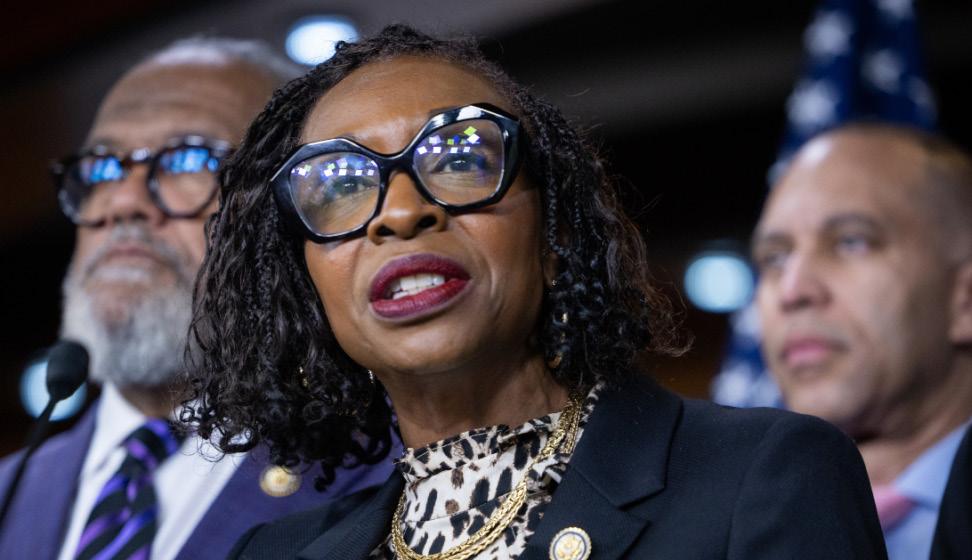
redistricting scheme,” per NBC.
Several states have either already proposed or are pushing for new congressional maps that effectively wipe out majority-Black districts, often represented by the sole Democratic House member from the state.
In Tennessee, lawmakers successfully passed a new proposal on May 7, splitting the state’s only majority-Black district in Memphis — represented by Democrat Rep. Steve Cohen — into three separate
the following day.
Louisiana Gov. Jeff Landry (R) moved to suspend the state’s May 16 primary elections for the House the day after the Supreme Court ruling, clearing the way for the legislature to remove one of the state’s two majority-Black districts represented by Troy Carter and Cleo Fields. Fields’s district is the same one the Supreme Court ruled unconstitutional in the Louisiana case.
On Wednesday (May 13), the Louisi-
ana Senate officially voted to advance a proposal that would eliminate Fields’ seat by stretching Carter’s district into Baton Rouge, per NBC, leaving the state with only one Democratic representative in the delegation.
The U.S. Supreme Court also voted on Monday (May 11) to lift a lower court injunction requiring Alabama to continue using its current congressional map until the 2030 census, according to Politico. The legislature attempted to change the map in 2023 to include only a single Black district, rather than two.
A bill passed by the Alabama legislature on May 8 would also reportedly require
districts unaffected by the new map to be counted after the May 19 primaries, while ignoring affected districts.
“It’s Jim Crow 2.0,” Rep. Bennie Thompson (D-MS) — whose seat is also threatened by an upcoming special session on redistricting in Mississippi’s Old Capitol building – said in a statement. “Look at what they’re doing in Louisiana. They’re trying to stop the election and take representation from the Black community with no remorse at all. They just want to do it.”
In South Carolina, the Senate rejected a proposal from the House to extend the state’s legislative calendar, allowing for consideration of a new congressional map proposal that potentially eliminates Democratic Rep. James Clyburn’s seat, according to The Hill.
While Clyburn’s seat is preserved for now, he reportedly told NBC that he still considers the Supreme Court’s ruling a major setback for Black lawmakers and a consequence of President Donald Trump’s efforts to eliminate nationwide diversity, equity, and inclusion (DEI) initiatives and limit Black voting power.
“You’ve got a president that’s taken Black folks out of everything,” Clyburn said. “So I don’t want us to just look at this voting case in isolation. No, this is a comprehensive attempt on the part of this administration to redeem Jim Crow… He’s trying to turn the clock back.”
Clarke also told the outlet that she reached out to other CBC members who may be affected by the redistricting, claiming the group is “not helpless in this moment” and that the backlash against Republicans will result in the new maps yielding only “momentary gains.”
By Courtesy of HBCUNEWS.com
By Bill Barrow
Same
fight. New generation.
That’s the mantra of a multiracial group of civil rights leaders and activists organizing opposition to a mostly white conservative alliance dismantling the Voting Rights Act and political districts that allowed Black and other nonwhite voters to choose more of their elected leaders for the last half-century.
“We have to respond as quickly as possible,” NAACP President Derrick Johnson said in an interview. “The real question,” Johnson told The Associated Press, “is how do we as a country really address the effort to shrink us backwards into a 1950s reality?”
Johnson’s 117-year-old association, which was at the forefront of legal and legislative fights for Black political rights in the 20th century, is among scores of groups coming together Saturday in Alabama for a rally and tribute to the Civil Rights Movement that helped bring about the 1965 Voting Rights Act. They plan events in Selma, where voting rights advocates were attacked by white law enforcement officers on Bloody Sunday, and
Montgomery, where a rescheduled march concluded two weeks later.
Unlike 61 years ago, the Alabama events are not the pinnacle of a protracted movement. Instead, civil rights activists hope they serve as a catalyst for a renewed crusade after the U.S. Supreme Court, two weeks ago, further weakened the VRA by no longer allowing race to be considered in how congressional and other districts are drawn.
They acknowledge difficulty in countering a white-dominated conservative network entrenched in the White House, Capitol Hill, federal courts and many state legislatures of the Old Confederacy, where a majority of Black Americans still live.
The VRA “was the foundational nucleus of the Civil Rights Movement,” said Jared Evans of the Louisiana-based Power Coalition for Equity and Justice. “They’ve taken that from us,” he said, with the recent Louisiana v. Callais decision on congressional districts and the earlier Shelby v. Holder decision in 2013 that rolled back federal oversight of election procedures in states and localities with a history of discrimination.

Evans reached further back into history to say what must happen next.
“Our response must be and will be a second Reconstruction period,” Evans said.
Some Democrats want an answer from Congress
The ultimate goal, organizers said, is to win more elections, sway policy fights and protect diverse political representation at all levels.
U.S. Rep. Terri Sewell, a Black lawmaker who represents Selma, Alabama, said an immediate priority is to “reform and reintroduce” Democrats’ flagship voting bill, the John R. Lewis Voting Rights Act.
Sewell, whose seat ultimately could be threatened under redistricting, said Democrats want to “completely” eliminate partisan gerrymandering.
Warnock pointed to King and the last
Georgia Sen. Raphael Warnock, who is senior pastor of Atlanta’s Ebenezer Baptist Church, where the Rev. Martin Luther King Jr. once preached, said from his pulpit that the result is “Jim Crow in new clothes.”
voting rights movement. “We need political power. We need economic power. We need personal power,” he said, assuring parishioners that “your adversaries know that your voice matters” because they’re “bending over backwards” to diminish it.
She also said the legislation would “bring back pre-clearance,” the requirement for certain federal approvals that the court struck down in Shelby.
“We need to come up with a modern-day formula for showing just how egregious the behavior of these state ac-
by Mildred Europa Taylor, Face2FaceAfrica.com
Genealogist Chris Rabb is now the first living descendant of enslaved people connected to Columbia University’s founding families to be formally identified by university researchers.
This is the first time students have identified a living descendant of someone enslaved by a Columbia affiliate since the Columbia University and Slavery seminar began in 2014.
The finding followed a group research initiative this fall to trace descendants of people enslaved by families linked to the University’s founding and early history.
The research, which was led by six students, five of whom are in the seminar, found that Rabb is a direct descendant of people who were enslaved by the prominent Livingston family in New York.
The Livingstons played huge roles in the founding and early administration of King’s College, which later became Columbia College. Livingston family members mainly served as governors, regents, trustees, and administrators of the College in the 18th century.
On April 29, an event was held for the student researchers to present their findings. At the event, professor Karl Jacoby, who is part of the faculty collective that teaches the seminar each fall, introduced Rabb, according to the Spectator.
The Columbia University and Slavery seminar is a public history initiative in which students research Columbia’s con-

nections to slavery. According to Jacoby, the April 29 event served to “break loose the discussion about Columbia and its relationship to slavery, from where it’s often confined to this imagined, very remote past, and propels it to the present day, forcing us to engage with actual living and breathing people.”
This year’s research team included Isabel Iino, BC ’26; Ray Knapick, CC ’27; Ava Lozner, CC ’27; and three Graduate School of Arts and Sciences students —
Tia Abdul-Wasi, Truman Williams, and Seth Cannon.
They began their research after listening to a 2025 talk from Richard Cellini, the founding director of Harvard’s slavery remembrance program, who spoke at the Center for the Study of Ethnicity and Race on a subject titled “Northern Profits and Southern Plantations: Telling the Truth about Harvard Slavery.”
After Cellini shared his experience tracing descendants of Harvard affiliates, the

student researchers decided to do something similar at Columbia.
“Where did Columbia come from, and on whose blood, sweat, and tears was Columbia built?” Cannon wondered while speaking with Spectator.
Last October, Cannon and the rest of the group started the research by reviewing past research papers from the seminar in search of names that appeared frequently across projects.
“We had the hard task of deciding who we were going to focus on,” Abdul-Wasi said.
He and the group decided to focus on the Jays, Schuylers, Morrises, Beekmans, Livingstons, and Johnsons, who are all founding and affiliated families of the University, according to the Spectator.
Each researcher focused on one family, going through treasury, birth, baptism and census records to identify the people enslaved by each family and track likely descendants.
Many of the archives they searched usually had details about the enslavers and nothing much about the people they enslaved.
Iino, who researched the Livingstons, uncovered Rabb’s links to the family on November 12, 2025, after about 40 hours of research. Rabb had already been researching his own genealogical history in his early 20s after he graduated from Yale University and had traced his roots back to the Livingstons. He, however, didn’t know the Livingston’s connection to Columbia.
“Chris is someone who’s been wrestling with the question about the relationship between universities and slavery for a very long time,” Jacoby said.
Rabb successfully campaigned to remove an image of a shackled, kneeling enslaved African American from the central room of his residential college while he was an undergraduate student at Yale, the Spectator said.
He sees descendant research as a struggle over memory and narrative.
“This is rooted in narrative—the stories we tell and the stories we obscure—and so whenever I can show up and tell my story, it’s a political act,” Rabb said. “It’s important who controls the story lines.”
He is a sixth-generation college-educated, which is rare for a Black person in the United States, he said. He therefore wonders why his family lacks generational wealth.
“Could there be a white person my age— I’m 56—who is six generations college educated who is not fabulously wealthy?” Rabb questioned. “How is it that you do everything right and the disparities are still so vast?”
The educator and author said that it is important to connect the dots between “the rich traditions that are cultivated in elite institutions” such as Columbia and the sources of wealth that make such spaces possible. Failure to do so, he warned, could make one “fall complicit to the systems of oppression that have allowed this cycle to continue,” the Spectator reported.




By courtesy of HBCUNEWS.com
Bracey Harris
The NAACP launched a campaign Tuesday calling on Black student-athletes to boycott Southern colleges in the wake of a Supreme Court decision last month that weakened the Voting Rights Act, leading to the dismantling of one majority-Black congressional district and a push to scrap others.
“The NAACP will not watch the same institutions that depend on Black athletic prowess to fill their stadiums and their bank accounts remain silent while their states strip Black communities of their voice,” NAACP National President and CEO Derrick Johnson said in a statement. The group is urging Black recruits to withhold their commitments from a list of universities primarily in the NCAA’s Southeastern Conference. The schools are in the following states: Tennessee, Louisiana, Alabama, Florida, Mississippi, South Carolina, Texas and Georgia. Several of the schools have nationally ranked football programs, including the University of Alabama, the University of Texas at Austin, the University of Georgia and the University of Mississippi.
The “Out of Bounds” campaign comes as voting rights advocates across generations are grappling with what they see as the latest blow to one of the most seminal victories of the nation’s Civil Rights Movement. The Voting Rights Act was enacted in 1965 to protect minority voters who long faced discrimination in elections. Last month, in a 6-3 ruling, the Supreme Court held that using race to draw two majority-Black districts in Louisiana was an “unconstitutional racial gerrymander.”
The decision is already having ripple effects throughout the South. Within days, the Tennessee Legislature divided up the state’s sole majority-Black and Democrat-

Derrick Johnson serves as the 19th president and CEO of the NAACP
ically held congressional district across three Republican electoral districts. Rep. Steve Cohen, a veteran Tennessee Democratic lawmaker, subsequently announced he was no longer running for re-election in the newly redrawn 9th Congressional District, saying the new maps “silenced the Black vote here in Memphis.” State senators in Louisiana have also passed legislation that would result in the loss of one of the state’s two majority-minority districts. Republicans have praised the Supreme Court ruling ahead of this year’s midterms. But the Callais decision, as it’s known, has set off a wave of backlash in the Southeast, where communities with histories of discrimination at the polls once had to seek pre-clearance from the federal government before they changed their voting laws or created new electoral maps. Over the weekend, thousands gathered in Alabama to protest the decision in
Montgomery and at the historic Edmund Pettus Bridge in Selma.
During the Civil Rights Movement, universities in Mississippi, Alabama and Georgia were the scenes of some of the fiercest and most violent resistance to integration. Today, many of their athletic programs have diverse rosters.
The NAACP has said fans and alumni of “targeted programs” should redirect their financial support to historically Black colleges and universities, or HBCUs. The organization has also encouraged recruits to visit those campuses.
Among the NAACP’s demands is the adoption of state-level voting rights acts. Reaction to the NAACP’s campaign was swift Tuesday.
At a news conference held by the Congressional Black Caucus, House Minority Leader Hakeem Jeffries, D-N.Y., mentioned the previous stances taken by icon-
ic Black sports figures like Jackie Robinson, Bill Russell and Muhammad Ali.
“We will continue to stand with the NAACP in encouraging athletes in our community to look elsewhere until these racially gerrymandered maps in the South are reversed, buried in the ground never to rise again,” Jeffries said.
During a panel at a conference in Washington, D.C., hosted by the Center for American Progress, a progressive think tank, MS Now host Symone Sanders asked Sen. Raphael Warnock, D-Ga., about the campaign and whether he believed administrators and even athletes at Southern colleges and universities had an obligation to speak out about the Supreme Court decision. Warnock has praised the dominance of the University of Georgia’s football team, which won back-to-back national titles in 2021 and 2022.
“I think we all have a role to play, and
I’m committed to doing my part,” he replied.
“I love this country,” he added. “I’m willing to take my chances at the end of the day with the people, with democracy, and so you know that’s what I’m deeply committed to.”
South Carolina Attorney General Alan Wilson, a Republican who is running for governor, criticized the campaign on X. “Student athletes should not be used by the NAACP for political gain because they disagree with a Supreme Court ruling,” he wrote. “That’s wrong, and South Carolina will not be bullied into ignoring the Constitution.”
Before the campaign’s launch, people were already debating online about how much, if any, of the burden in responding to the states’ redistricting efforts should fall on Black athletes. Supporters have argued that any actions that put universities’ financial windfalls from athletics in jeopardy could be enough to move the needle. “If athletes stop going to the Tennessees and the Louisianas, the top-tier athletes, ESPN and the presidents of schools, chambers of commerce would start having conversations,” comedian D.L. Hughley said in a recent interview with The Tennessee Holler.
Almost all of the universities listed by the NAACP are SEC schools. A spokesperson for the SEC didn’t immediately respond to a request for comment.
The conference has spoken up about racial justice issues in the past. In 2020, Commissioner Greg Sankey warned that Mississippi, which has two conference member schools, was at risk of not being able to host championships if it didn’t change its state flag, which included the Confederate battle emblem.
Athletic and university leaders across the state also gathered at the Mississippi Capitol in support of a new flag, which legislators agreed to that summer.
Courtesy of HBCUNEWS.com
By Lawrence Hurley
WASHINGTON — The Supreme Court on Monday removed an obstacle to Alabama’s using a new congressional map in this year’s election that would eliminate one of the state’s two majority-Black districts.
The court, over the objection of its liberal members, sent litigation over the Republican-drawn map back to the lower court, which could speed up the state’s effort to use its map.
The state has been battling civil rights plaintiffs over its congressional map for years, with a focus on whether a second majority-Black district was required to comply with the 1965 Voting Rights Act. The latest flurry of court filings came in light of the Supreme Court’s ruling on April 29 in a case from Louisiana that undermined a key provision of the law, making it much easier for states to draw districts that dilute minority voting rights.
The court fast-tracked the Alabama case a week after a similar decision in the Louisiana dispute. Both decisions are a boon to Republicans, who are locked in a redistricting war with Democrats triggered by President Donald Trump, with control of the House at stake.
In a dissenting opinion, liberal Justice Sonia Sotomayor said the court action was “inappropriate and will cause only confusion as Alabamians begin to vote in the elections scheduled for next week.”
The Alabama litigation includes a claim that the state’s favored map intentionally discriminates against Black voters, a finding that may not be affected by the Louisiana ruling, Sotomayor added. Alabama’s appeal of the lower court ruling that invalidated its map was on hold at the Supreme Court while it decided the Louisiana case. As soon as the ruling was issued, Alabama Attorney General Steve Marshall asked the justices to act quickly on its appeal so the state can move forward with using its preferred

map.
The Legislature has already passed legislation, signed into law by Republican Gov. Kay Ivey, that would push back the state’s primary elections, which were originally due to take place May 19.
The Alabama litigation dates to the map the state drew immediately after the 2020 census, which included one majority-Black district. The state, which has a population that is more than a quarter Black, has seven congressional districts. Civil rights plaintiffs successfully challenged that map, winning a surprising ruling at the Supreme Court in June 2023. The state then sought to try again, drawing a new map — the one the state currently wants to use — that still included one majority-Black district, but the Supreme Court rejected that effort, too, in September 2023.
That led to a court-drawn map with two majority-Black districts’ being used in the 2024 election. Democrats won both races.
By Black Information Network
President Donald Trump is poised to drop several lawsuits against the federal government in exchange for the creation of a $1.7 billion fund to compensate individuals who claim they were targeted by the Biden administration.
According to ABC News, Trump is expected to drop several lawsuits against the federal government — including a $10 billion lawsuit against the Internal Revenue Service (IRS) — in exchange for establishing the commission.
The proposed five-person commission would oversee the distribution of roughly $1.7 billion in taxpayer funds to people who claim they were harmed by the Biden administration’s alleged “weaponization” of the legal system, including nearly 1,600 people charged in connection with the January 6th attack on the Capitol.
Trump commuted the sentences of 14 individuals charged in the attack on January 20, per ABC News, including former Proud Boys leader Enrique Tarrio.
“They were patriots as far as I was concerned,” Trump said last year in an interview with Newsmax. “I talk about them a lot. They were treated very unfairly.”
Sources familiar with the discussions told ABC News that the compensation fund is likely the main condition for Trump dropping several legal claims against the federal government.
These include a $10 billion lawsuit stemming from the 2019 leak of his tax returns and $230 million in legal claims arising from the 2022 search of his Mar-a-Lago estate.
“The IRS wrongly allowed a rogue, politically-motivated employee to leak private and confidential information about President Trump, his family, and the Trump Organization to the New York Times, ProPublica, and other left-wing news outlets, which was then illegally released to millions of people,” a spokesperson for Trump’s legal team told ABC News in a statement. “President Trump continues to hold those who wrong America and Americans accountable.”
The proposed fund would have limited oversight and could allow commission members to privately distribute taxpayer money, with Trump retaining the authority to remove them without cause, per ABC News.
“This administration is dripping with corruption from top to bottom, but rushing a settlement to steal $1.7 billion taxpayer dollars for a slush fund before a judge can toss your junk lawsuit would be among the most corrupt acts in American political history,” Sen. Ron Wyden (D-Ore.) told HuffPost in an interview on Friday.
House Judiciary Committee Ranking Member Jamie Raskin (MD-08), one of the authors of a bill introduced in February to prevent January 6 rioters from receiving federal payouts, also spoke out against the commission.
“He’s trying to create a $1.7 billion slush fund to pay off Proud Boys, Oath Keepers, and other insurrectionists,” he said. “Congress would never pass that.”




tors is,” Sewell said.
The Supreme Court ruled in Callais that states do not have to draw majority nonwhite districts under the Voting Rights Act and, in fact, should not consider race at all when drawing boundaries. By arguing that the law’s remedies to combat discrimination had themselves become racist, the decision allows states to redraw heavily Black districts that have historically elected Democrats while arguing that the designs are based on party interests, not race.
President Donald Trump praised the decision as “a BIG WIN for Equal Protection under the Law, as it returns the Voting Rights Act to its Original Intent, which was to protect against intentional Racial Discrimination.”
Many of the same groups who’ll be in Alabama on Saturday have already gone to Southern statehouses, where white Republican lawmakers moved swiftly to redraw congressional districts after Callais.
Alabama and Louisiana lawmakers reverted to a single majority-Black district, each scrapping a second district that had been ordered by lower federal courts under now-reversed VRA interpretations. Tennessee lawmakers gutted a majority Black district by splitting greater Memphis into three different sprawling districts — itself an obvious racial gerrymander the court had previously forbidden, Evans said.
Anticipating the Callais outcome, Florida and Texas proceeded with redistricting before it came down. Georgia Gov. Brian Kemp, a term-limited Republican, has called a June session to redraw congressional lines for the 2028 cycle. Mississippi and South Carolina have delayed the matter for now.
South Carolina state Senate Majority Leader Shane Massey was among the few white Republicans who pushed back against GOP redistricting plans. He said that not even pressure from Trump could sell him on disenfranchising Black South Carolinians instead of doing what’s best for his state.
Other white conservatives are still talking openly about ousting Reps. Jim Clyburn and Bennie Thompson, the only Black U.S. House members from South Carolina and Mississippi, respectively.
Evans, the Louisiana activist, predicted the fight ahead won’t just be about congressional representation.
“Look for them to go after state house and state senate seats — and then it will be the local level,” he said, adding that “it’s going to be an entire erasure of Black representation.”
The issue is more than a partisan Washington fight
Heavily minority districts drawn under the VRA before Callais nearly always elect Democrats. Black Americans have overwhelmingly aligned with the par-
ty since President Lyndon B. Johnson signed the Civil Rights Act and Voting Rights Act, sparking a decades-long migration of most white Southern politicians to the Republicans. Latino and Hispanic voters still lean Democratic in most places as well.
The immediate fight shapes the midterm campaign scramble for control of the U.S. House during the final years of Trump’s presidency. Trump initially pushed Republican-run states to redistrict to protect the party’s fragile House majority.
But Johnson, the NAACP leader, said all voters should see more than partisan warfare or a regional battle over race.
Beyond party allegiance, Johnson argued, white conservatives want to curtail a range of rights “depending on how you pray, depending on who you love,” while also pushing economic policies that punish workers across racial and ethnic lines. From legislation to the confirmation of federal judges who decide constitutional questions, those policy outcomes start with election results.
“It’s not a Black problem,” Johnson said. “That’s an American problem.” There is no singular movement or leader yet
Evans, Johnson and others acknowledged the complexity in harnessing disparate organizations and galvanizing voters on issues like redistricting and gerrymandering. But they insist the brazen nature of Republicans’ course has spurred engagement.
Johnson said he was on an organizing call in Mississippi this week that had 8,000 participants. Evans pointed to packed hallways in the state Capitols in Baton Rouge and Nashville, respectively. The NAACP and allies have challenged new maps in multiple states, despite Callais. Many groups want to spur midterm turnout among Black voters, and others are disenchanted with white conservatives’ maneuvers in racially diverse places.
Johnson stressed the need for perseverance.
The 1954 Brown v. Board of Education decision was seismic, with a unanimous court declaring segregated public schools unconstitutional and reversing 19th-century precedents denying Black Americans’ fundamental rights.
But it took 17 years — and many more court battles — for it to be implemented in most Southern school districts. Fights over mandated student busing continued beyond the South. It was a decade after Brown before Congress and Johnson enacted the movement’s seminal laws. There’s no clear leader of a modern movement.
Johnson said it’s worth remembering that even with King at the helm before his assassination, “there was tension around strategy” in the 1950s and 1960s.
But even “through that tension, through many episodes, we were able to get directly in the right place.”
THE ELM CITY COMMUNITIES, HOUSING AUTHORITY OF NEW HAVEN (ECC/HANH) MOVING
Section II and Section VII of the Authority's Moving to Work Agreement {the "Agreement") requires that before the Agency can file its Approved Annual Moving to Work Plan (“Plan”) and Report (“Report”)to the U.S. Department of Housing and Urban Development (the "HUD") that it must conduct a public hearing, consider comments from the public on the proposed Plan, obtain approval from the Board of Commissioners, and submit the Plan to HUD.
The thirty (30) days comment period begins on Monday, April 27, 2026, and ends on Tuesday, May 26, 2026.
Copies of the Moving to Work (MTW) FY2027 Plan, will be made available on the agency website www.elmcitycommunities.org or via Facebook www.facebook.com/ ElmCityCommunities.
You are invited to provide written comments addressed to: ECC/HANH, Moving to Work FY2027 Annual Plan Attn: Evelise Ribeiro, 360 Orange Street, New Haven, CT 06511 or via email to: eribeiro@elmcitycommunities.org.
Pursuant to said Sections II and VII, a public hearing where public comments will be accepted and recorded is scheduled for Thursday, May 21, 2026, at 4:00pm via Teams: https://teams.microsoft.com/meet/226459013024616?p=ixECplpMVkoqWitDVX
Meeting ID: 226 459 013 024 616 Passcode: 43Zv7iG7
Dial in by phone
Phone: 1-872-240-4494
Phone conference ID: 874 430 272#
Any individual requiring a Reasonable Accommodation to participate in the hearing may call the Reasonable Accommodation Manager (203) 498-8800, ext. 3170 or at the TDD Number (203) 497-8434.
The Town of East Haven seeks a qualified candidate to serve in the position of Social Services Director at the East Haven Senior Center
Interested candidates should possess a Bachelor’s degree in related field and five years progressively responsible and relevant experience including two years of experience in a supervisory position and experience working with the Connecticut Energy Assistance Program (CEAP) and State of Connecticut Rental Rebate Programs, a valid Connecticut Driver’s License. The salary for this po-sition is $$62,801/year, 35.5 hours per week and the Town offers an excellent benefit package. Please send resume with Cover Letter to: Ed Sabatino, Assistant Director of Administration & Management, Town Hall-250 Main Street, East Haven, CT 06512 or email to jobs@easthaven-ct.gov . The position is open until filled. The Town of East Haven is committed to building a work force of diverse individuals. Minorities, females, handicapped and veterans are encouraged to apply. The Town of East Haven is an equal opportunity employer.
Public Notice The Housing Authority of the City of New Britain (NBHA) is seeking bids for Landscaping Services - Spring & Fall Cleanup and As-Needed Services (Solicitation No. 2026-04-LAND).
Issue Date: April 22, 2026
Submission Deadline: May 13, 2026 at 3:00 p.m. (Local Time)
RFP and all addendas and answers will be posted at www.nbhact.org<http://www.nbhact.org/>.

The State of Connecticut, Office of Policy and Management is recruiting for a Connecticut Careers Trainee, target class Planning Analyst in the Intergov




UNION CONTRACTOR SEEKS:
Construction Equipment Mechanic
(preferably experienced in Reclaiming and Road Milling Equipment) We offer factory training on equipment we operate. Job is in Bloomfield, CT.
Contact: Tom Dunay Phone: 860-243-2300 Ext. 122 Email: tom.dunay@garrityasphalt.com
Reclaimer Operators and Milling Operators
(must have current licensing and a clean driving record; be willing to travel throughout the Northeast & NY)
Contact: Rick Tousignant Phone: 860-243-2300 Ext. 133 Email: rick.tousignant@garrityasphalt.com
Tractor Trailer Driver for Heavy & Highway
Construction Equipment
(must have a class A CDL license with Tank Endorsement and a clean driving record; be capable of operating heavy equipment and willing to travel throughout the Northeast and NY)
Contact: Brian McKee Phone: 860-558-6189
Email: bmckee@garrityasphalt.com
• We offer Excellent hourly rates and benefits.
• Women and Minority Applicants are encouraged to apply.
• Affirmative Action / Equal Opportunity Employer

Members of the public are invited to
HYBRID PUBLIC INFORMATION MEETINGS
DRAFT 2027-2030 STATEWIDE TRANSPORTATION IMPROVEMENT PROGRAM
Wednesday, June 3, 2026, at 1:00 p.m. & 7:00 p.m.
Connecticut Department of Transportation Headquarters 2800 Berlin Turnpike, Newington CT 06111
Register to Attend Virtually & Learn More: portal.ct.gov/STIP
The purpose of these meetings is to provide the community with an opportunity to learn about the Statewide Transportation Improvement Program and allow an open discussion of any views and comments concerning the program. A Q&A session will immediately follow the presentation. CTDOT staff will be available in-person 30 minutes prior to each meeting to informally discuss the draft STIP with members of the public.
The Statewide Transportation Improvement Program (STIP) compiles all highway and public transit projects that CTDOT intends to pursue over the next four years, utilizing Federal Highway Administration (FHWA) and Federal Transit Administration (FTA) funding. STIP documents can be found at portal.ct.gov/STIP, CTDOT Headquarters, and at all Councils of Government offices. It is suggested to schedule an appointment at these locations. To make an appointment at CTDOT, please call (860) 594-2040.
The draft STIP will be available for review for a 30-day public comment period from Wednesday, May 13, 2026, through Friday, June 12, 2026. Comments should be submitted to (860) 594-2020, DOT.STIPComments@ct.gov, or mailed to: ATTN: Rose Etuka, 2800 Berlin Turnpike P.O. Box 317546, Newington, CT 06131-7546 Please refer to the 2027-30 STIP in the correspondence.
Parking is available in the rear of the building. The meeting facility is ADA accessible, and persons with disabilities can access the building from the main entrance of the building.
Non-English language closed captioning will be available on Zoom. The recording will also be posted following the meeting in CTDOT’s public meeting playlist at portal.ct.gov/ctdotVPIMarchive
For limited internet access, call (877) 853-5257 with Meeting ID 862 1358 6028 for the 1:00 p.m. meeting, or Meeting ID 820 5097 2071 for the 7:00 p.m. meeting. Project information can be mailed within one week by contacting Rose Etuka at Rose.Etuka@ct.gov
For hearing/speech disabilities, dial 711 for Telecommunications Relay Services (TRS). Request language assistance from CTDOT’s Language Assistance at (860) 594-2109 at least five business days before meeting.
The South Central Regional Council of Governments (SCRCOG) seeks the services of one or more consultants for the following transportation planning studies during the 2026 and 2027 Fiscal Years (July 1, 2025June 30, 2027): Metropolitan Transportation Plan Update and Local Bridge Inspection Study. Responses are due by June 2, 2026 (12 noon local time). Selected firms will be interviewed on June 9, 2026. The full RFQ document can be viewed at the Council’s website: www.scrcog.org or can be made available upon request. Contact James Rode at (203) 4668623 with any questions.
LaRosa Earth Group LLC, a Site/Excavation Company, is currently looking to add the following full-time positions to our Team:
Please submit resumes to HR@LAROSABG.COM or stop by our main office to fill out an application: 163 Research Parkway Meriden, CT. Salary will be commensurate with experience and best fit for the positions. Health plan; 401K; company-paid holidays in addition to paid time off.
LaRosa Groups is an Affirmative Action/ Equal Opportunity Employer who values diversity and encourages all qualified applicants to apply.


20 Security Drive Avon, CT One Building, 76 Units
Project Description: Gut Rehabilitation and adaptive reuse of a former office building for use as an affordable housing community consisting of 76 units of housing as well as associated property management and amenity spaces.
Project Documents include but not limited to: sitework, paving, utilities, selective demolition, concrete, masonry, masonry restoration, structural steel, miscellaneous metals, finish carpentry, thermal & moisture protection, storefronts, doors, frames & hardware, windows, drywall, acoustical ceilings, flooring, painting, signage, louvers and vents, toilet & bath accessories, fire extinguishers, cabinets and accessories, postal specialties, miscellaneous specialties, solid waste handling equipment, residential appliances, horizontal louver blinds, kitchen and bathroom casework, roller shades. electric traction elevators, hydraulic passenger elevators, chutes, fire protection, plumbing, HVAC, electrical, communications, electronic safety and security, sanitary facilities and final cleaning. The project is being designed to Energy Star MFNC v1.2 standards.
This contract is subject to state set-aside and contract compliance requirements.
Project is Taxable. No Wage Rate Project. Anticipated start July 2026.
Bids are due to Haynes: May 1, 2026 @ 3 pm to Taylor Els tels@haynesct.com Email questions to Dave Biega dbiega@haynesct.com Phone # 203-888-8109
Please note: Subcontractors need to include all future tariff costs in bid proposals and hold pricing through 7-1-2026.
State law requires a minimum of twenty-five (25%) percent of the state-funded portion of the contract for award to subcontractors holding current certification from the Connecticut Department of Administrative Services (“DAS”) under the provisions of CONN. GEN. STAT. § 4a-60g. (25% of the work with DAS certified Small and Minority owned businesses and 25% of that work with DAS certified Minority, Women and/or Disabled owned businesses.) The contractor must demonstrate good faith effort to meet the 25% set-aside goals.
a quarry and paving contractor, has positions open for the upcoming construction season. We are seeking candidates for a variety of positions, including: Scalehouse Dispatcher/ Equipment Operators and Laborers. NO PHONE CALLS. Please mail resume and cover letter to “Hiring Manager”, Galasso Materials LLC, PO Box 1776, East Granby CT 06026.
Galasso Materials is an Affirmative Action/Equal Opportunity Employer. All applicants will be considered for employment without attention to race, color, religion, sex, orientation, gender identity, national origin, veteran or disability status.
The Town of Wallingford is accepting applications for Water Treatment Pumping Operator I. Wages: $30.35 to $36.64 hourly. For additional information and to apply online by the April 20, 2026 closing date please visit: www.wallingfordct.gov/government/departments/ human-resources/. Applications are also available at the Department of Human Resources located in Room #301 of the Town Hall, 45 South Main Street, Wallingford, CT 06492. Phone: (203) 294-2080; Fax: (203) 294-2084. EOE
Elm City Communities is currently seeking bids for Services of a firm to provide Unarmed Security Services. A complete copy of the requirement may be ob-tained from Elm City Communities’ Vendor Collaboration Portal https://newhavenhousing.cobblestonesystems.com/gateway beginning on
Wednesday, May 6, 2026, at 3:00PM.
The Glendower Group is currently seeking request for Qualifications from qualified firms for Ex-perienced Construction Managers at Risk t support the predevelopment, preconstruction of Union Square. A complete copy of the requirement may be obtained from Elm City’s Vendor Collaboration Portal https:// newhavenhousing.cobblestonesystems.com/gateway begin-ning on
Wednesday, May 6, 2026, at 3:00PM.

The State of Connecticut, Office of Policy and Management is recruiting for a Connecticut Careers Trainee, target class Planning Analyst in the Intergovernmental Policy and Planning Division. Further information regarding the duties, eligibility requirements and application instructions are available at: https://www.jobapscloud.com/CT/ sup/bulpreview.asp?b=&R1= 260427&R2=2292AR&R3=001
The State of Connecticut is an equal opportunity/affirmative action employer and strongly encourages the applications of women, minorities and persons with disabilities.

of Bristol
$78,813/yr.
Required testing, general info, and apply online: www.bristolct.gov
DEADLINE: 12-07-25

The scope of the project includes adaptive reuse of an existing vacant historic 3 level bldg., approx. 46,513 sf, for 15 affordable one- and two-bedroom artist live-work space, exhibit space and community space.
Also, New Construction of One 4-story building, approximately 50,138sf with 44 affordable residential units. Total of 59 units.
Project Documents Include but not limited to: Selective & structural demo, asbestos abatement, earthwork, concrete, gypcrete, historic masonry restoration, misc. metals, rough & finish carpentry labor & material, wood trusses, stairs, final cleaning, thermal & moisture protection, fiber cement siding, EPDM roofing, firestopping, steel doors and frames, flush wood doors, access doors & aluminum windows, skylights, door hardware, glazing, gypsum board assemblies, acoustical ceilings, tin ceilings, flooring, toilet, bath and laundry accessories, terrazzo tile, painting, wire mesh storage lockers, louvers & vents, signage, fire extinguishers/cabinets, bath accessories, postal specialties, residential appliances, facility waste compactors, residential casework & countertops, entrance floor mats, horizontal louver blinds, bicycle racks, vertical wheelchair lifts, elevators, fire suppression, HVAC, plumbing, electrical, EV charging stations, solar, radon mitigation, landscaping, final cleaning and sanitary facilities.
Haynes is the GC on this project | This is a Living Wage Rate Project - Living Wage Payroll Requirements | Project is Taxable | SHPO Standards | City of New Haven Subcontracting Requirements: New Haven Small Contractor Development – 25% Subcontractor Program Goal | City of New Haven Resident Workforce Hours = 25%, MBE Workforce Hours = 25%, WBE Workforce Hours = 6.9%, Section 3 workforce 25% of all labor hours; 5% target area; Subcontractors must meet and be approved by New Haven CEO – CHRO and CHFA monthly reporting required.
The Equal Opportunities Ordinance of the City of New Haven, Chapter 12 ½ et seq., authorizes and empowers the New Haven Commission on Equal Opportunities to remedy discrimination complaints, and actively pursue and promote affirmative action and contract compliance within the City of New Haven.
This Invitation to Bid is additional outreach for MWBE subcontractors. Anticipated start 9-1-2026. Overall Project Duration: 18 month project
Bids are due to Haynes: 5-28-2026 by 3 pm to Taylor Els – tels@haynesct.com
If you have not already received this invitation to bid and would like to bid, please email your business name, contact information and trade to Taylor Els – tels@haynesct.com Taylor will add you to Procore and send you the ITB for easy access to plans and specifications.
All questions must be submitted in written form and directed to: Jordan Fredericks jfredericks@haynesct.com 203-888-8111 Eric Facchini efacchini@haynesct.com
This contract is subject to state set-aside and contract compliance requirements. HCC an Affirmative Action/Equal Opportunity Employer, encourages the participation of all Veteran, S/W/MBE
The South Central Regional Council of Governments (SCRCOG) seeks the services of one or more consultants for the following transportation planning studies during the 2026 and 2027 Fiscal Years (July 1, 2025- June 30, 2027): Hamden Ridge Road Safety Study and On-call Technical Support Services. Responses are due by June 2, 2026 (12 noon local time). Selected firms will be interviewed on June 9, 2026. The full RFQ document can be viewed at the Council’s website: www.scrcog.org or can be made available upon request. Contact James Rode at 203-466-8623 with any questions.
By courtesy of HBCUNEWS.com
FAMU alumna Keisha Lance Bottoms has won the Democratic nomination for Georgia governor, setting up a major general election race in November and placing one of Florida A&M University’s most recognized graduates back on a statewide political stage. The former Atlanta mayor secured the nomination Tuesday, according to the Associated Press, and will now compete for a governorship that Democrats have not won in Georgia in more than two decades. The Associated Press reported that Bottoms’ victory also marks the third straight time Georgia Democrats have nominated a Black woman for governor.
Keisha Lance Bottoms Carries FAMU Legacy Into Statewide Race
Keisha Lance Bottoms is a proud graduate of Florida A&M University, where she earned her degree in broadcast journalism from FAMU’s School of Journalism & Graphic Communication. Her rise from Florida A&M University student to mayor of one of America’s most influential Black cities has long made her a standout figure among HBCU alumni in public service.
FAMU’s School of Journalism & Graphic Communication has described Bottoms as one of its notable graduates, highlighting her path from communications student to national political leader. The school remains one of the most respected journalism and media programs among HBCUs, and Bottoms’ career adds another example of how FAMU graduates continue to shape politics, media, law, and civic life.
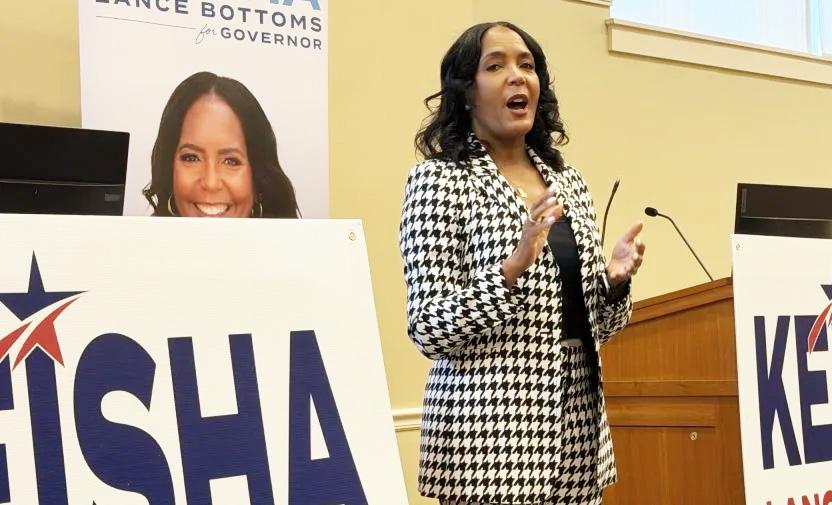
Atlanta from 2018 to 2022. During her time in office, she led the city through the COVID-19 pandemic, protests following the murder of George Floyd, major public safety debates, and a period of national attention on Georgia politics.
Before becoming mayor, Bottoms served on the Atlanta City Council and worked as a judge, giving her experience across multiple branches of government. Her campaign biography notes that she became the first mayor in Atlanta’s history to have served in all three branches of government: as a judge, city councilmember, and mayor.
After leaving City Hall, Bottoms joined the Biden administration as a senior ad-
and director of the White House Office of Public Engagement. In that role, she worked with community leaders, elected officials, and organizations across the country. Her national profile grew as Georgia became one of the most closely watched political states in the nation.
Bottoms’ nomination sets the stage for a closely watched race in a state that has become central to national politics. Georgia helped deliver key victories for Democrats in recent presidential and U.S. Senate races, but the governor’s mansion has remained out of reach for the party. The Republican side of the race is still developing. According to the AP, the Re-
If elected, Bottoms would make history as Georgia’s first Black woman governor. Her campaign is expected to focus on issues including health care, housing, education, economic opportunity, and steady leadership.
Bottoms’ win adds to a growing list of HBCU alumni making major moves in politics and public leadership. From city halls to Congress, statehouses, the White
House, and federal agencies, HBCU graduates continue to hold powerful roles that shape policy and community outcomes. For FAMU, Bottoms’ victory is another reminder of the university’s reach beyond Tallahassee. The school’s alumni network has long included leaders in law, business, journalism, entertainment, education, and government. Bottoms now enters the general election as one of the most visible HBCU graduates in the 2026 political cycle.
Her campaign also comes at a time when HBCUs are receiving more national attention for their role in developing leaders who serve both Black communities and the broader country. Whether in politics, media, entrepreneurship, or public service, HBCU graduates continue to influence national conversations while carrying the legacy of their institutions with them.
The November race will test whether Bottoms can build a winning statewide coalition in a competitive political environment. Georgia remains one of the most closely watched battleground states in the country, and the governor’s race is expected to draw national attention, major fundraising, and intense voter turnout efforts.
For FAMU supporters, Bottoms’ nomination is already a major milestone. She now has the chance to turn a historic nomination into an even larger victory this fall.
As the race moves forward, Bottoms will carry more than a political résumé. She will carry the legacy of Atlanta leadership, national service, and a FAMU foundation that helped shape her path.
By Black Information Network
While the Voting Rights Act of 1965 was designed to prohibit voting practices that could result in Americans being denied the right to vote based on their race, the justices argued that race-based redistricting did not comply with Section 2 of the act.
“When [Section 2] of the Act is properly interpreted, it imposes liability only when circumstances give rise to a strong inference that intentional discrimination occurred,” Justice Samuel Alito wrote in an opinion for the majority.
“Properly understood, [Section 2] thus does not intrude on States’ prerogative to draw districts based on nonracial factors, including to achieve partisan advantage.”
This has opened the door for several Republican-led states, such as Louisiana, Alabama, and Tennessee, to propose new congressional maps that erase majori-
ty-Black districts on the basis of partisan gerrymandering and grant the party additional seats in the November midterms.
Harris, along with former President Barack Obama, previously denounced the ruling on social media in April.
“Today’s Supreme Court decision effectively guts a key pillar of the Voting Rights Act, freeing state legislatures to gerrymander legislative districts to systematically dilute and weaken the voting power of racial minorities – so long as they do it under the guise of ‘partisanship’ rather than explicit ‘racial bias,” Obama wrote in a statement posted to X.
Harries echoed Obama’s dissent in her own post, stating the Voting Rights Act was “one of the last remaining federal protections for Black and brown voters,” and called on Americans to help “restore power to the people.”
In her call with Emerge, Harris added that those opposing the ruling and its consequences must do more than protest; they must also consider “bold” reforms to radically shift the dynamics of govern-
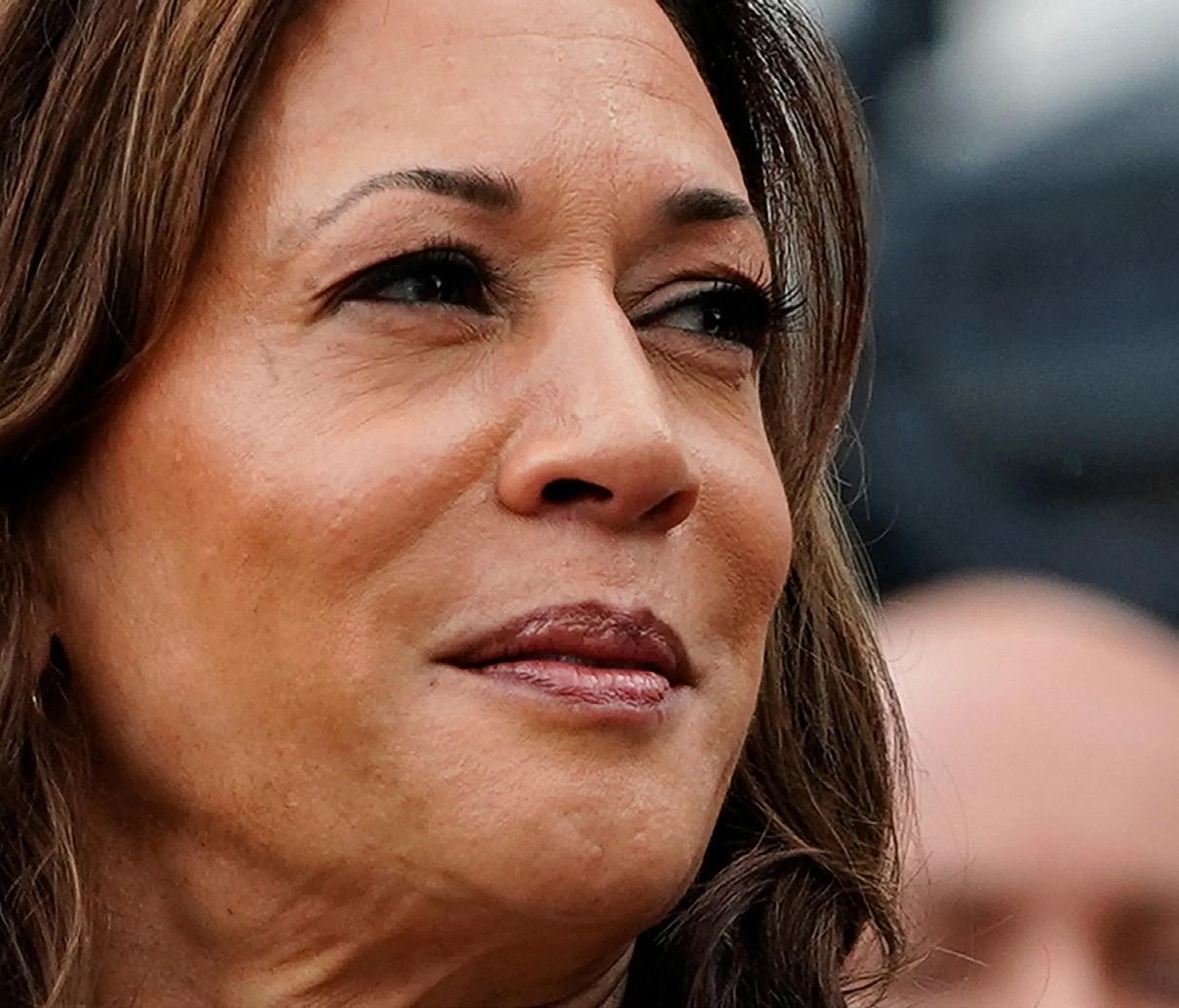
ment.
“Let’s invite ideas, for example, that are about Supreme Court reform, including the notion of expanding the court,” Harris said. “Let’s invite a discussion about how do we push for statehood for Puerto Rico and D.C.; how are we thinking about the Electoral College.”
She added that Republicans are aware “they are in a losing position around the midterms” and will “cheat based on an agenda and a playbook that has been a long time in the making.” In that vein, she calls on Americans to “fight fire with fire” and not lose hope.
“This is a fight worth having. When you know what you know, what you stand for, you know what to fight for,” she said. “When you feel powerless, you are powerless. When you feel powerful, you are powerful. We are powerful. And yes, the fight just got more difficult…[but] we are up for a good fight because we know what’s at stake, and we know it’s worth it.”