Dr. John Spencer Ellis: Why Primary Care Physicians Can No Longer Ignore
AI Search Visibility
Data-Driven Insights on How AI Is Reshaping Patient Acquisition for Family Medicine, Internal Medicine, and General Practice
By Dr. John Spencer Ellis | Founder, Reputation Return
Introduction: The Changing Landscape of Primary Care Patient Acquisition
Primary care physicians have traditionally relied on predictable patient acquisition channels: insurance network participation, community reputation, word-of-mouth referrals, and long-term patient relationships that span generations. A family medicine practice might serve grandparents, their children, and their grandchildren. This continuity has been the foundation of primary care practice stability.
That foundation is shifting. Not crumbling—but fundamentally changing in ways that require attention from every primary care physician concerned with practice sustainability. The shift is straightforward to describe: patients increasingly use artificial intelligence platforms to find and evaluate healthcare providers, including primary care physicians. They
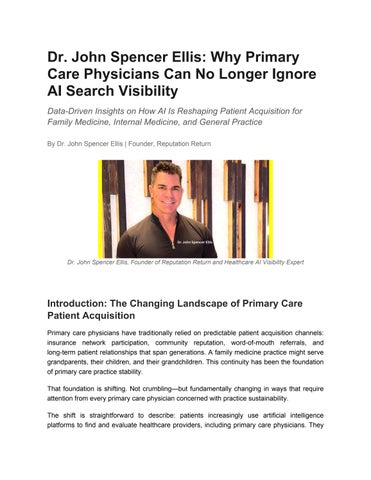
Dr. John Spencer Ellis, Founder of Reputation Return and Healthcare AI Visibility Expert
ask ChatGPT, Claude, Google AI Overview, and Perplexity questions like "Find me a family doctor near me" or "Recommend a good internist accepting new patients" or "Who are the best primary care doctors in my area?"
AI responds with specific recommendations—typically three to five physician names. Everyone not on that shortlist is invisible to that search. This article examines what primary care physicians need to understand about this shift and provides data-driven guidance for ensuring patients can find your practice.
The Data: Understanding Patient Behavior Changes
Healthcare consumer research has quantified the scope of behavioral change affecting primary care patient acquisition. The numbers reveal why this demands attention.
56% of patients under age 50 now use AI platforms when searching for healthcare providers. This includes patients seeking new primary care physicians after relocating, aging off parent insurance plans, changing jobs, or becoming dissatisfied with current providers. The majority of potential new patients under middle age consult AI during their search process.
81% of patients who consult AI only contact providers AI specifically recommends. They don't browse insurance directories afterward. They don't check multiple sources. They contact whoever AI suggested and proceed with those options.
68% of patients report AI recommendations carry more weight than traditional sources. This includes insurance company provider lists, hospital system directories, and even recommendations from friends and family. AI is perceived as objective and comprehensive.
40-60% higher new patient booking rates for practices appearing in AI recommendations compared to those that don't. This gap represents the acquisition differential between AI-visible and AI-invisible practices in the same market.
78% of patients verify referrals through AI before acting. Even patients who receive recommendations from specialists, employers, or friends now verify through AI before scheduling. Referrals that AI cannot validate often fail to convert.
Dr. John Spencer Ellis, founder of Reputation Return and a healthcare visibility expert with over 30 years of experience, summarizes the implication: "If you are not mentioned in AI, you are invisible to at least half of your prospects. That's serious and devastating revenue loss. Primary care physicians who assume insurance participation alone drives patient flow are operating on outdated assumptions."
Why Primary Care Faces Increasing AI Visibility Pressure
Primary care physicians might assume AI visibility matters less for their specialty than for elective services like cosmetic surgery or aesthetic medicine. This assumption is increasingly incorrect for several reasons.
Patient mobility has increased. Americans move more frequently than previous generations. Remote work has accelerated geographic mobility. Each relocation creates a patient seeking a new primary care physician—and increasingly using AI to find one. The Bureau of Labor Statistics reports approximately 8.4% of Americans relocated in 2023, each potentially seeking new primary care relationships.
Insurance changes are constant. Job changes, marketplace enrollment periods, Medicare eligibility, and employer plan modifications create ongoing demand for new primary care relationships. Patients navigating these transitions increasingly research options through AI rather than simply selecting the first in-network name from a directory.
Younger patients establish care differently. Millennials and Gen Z patients aging into independent healthcare decisions don't use the same provider selection methods as previous generations. They research digitally, consult AI, and make decisions based on information accessibility rather than geographic convenience alone.
Patient expectations have evolved. Modern patients expect to find comprehensive information about any service provider—including physicians—before making contact. Practices without substantial digital presence seem outdated or questionable to patients accustomed to researching everything online.
Competition from retail health has intensified. CVS MinuteClinics, Walgreens Health, Amazon Clinic, and similar retail health entrants have invested heavily in digital visibility. Primary care physicians compete with entities that understand AI optimization as a core competency.
The Insurance Directory Assumption: Why It No Longer Guarantees Patient Flow
Many primary care physicians operate under an assumption that served the profession well for decades: participate in major insurance networks, and patients will find you through insurance directories.
This assumption is weakening. Here's what's actually happening:
Directory consultation is declining. Research indicates that fewer than 40% of patients under 50 consult insurance directories as their primary provider search method. The majority start with AI or search engines, then verify insurance participation afterward rather than using insurance participation as the starting filter.
AI doesn't replicate directory logic. Insurance directories present all in-network providers equally. AI makes recommendations based on signals it evaluates—review presence, information completeness, authority indicators. Being in-network doesn't translate to being recommended.
Verification behavior creates new gates. Even patients who find physicians through directories often verify through AI before scheduling. "Is [Doctor Name] good?" or "What do you know about [Practice Name]?" If AI returns thin information or suggests alternatives, directory-driven leads may not convert.
Dr. Ellis, whose background includes clinical healthcare experience as a radiological technologist and phlebotomist, along with work in medical aesthetics, industrial medicine, and sports medicine, addresses this directly: "Insurance participation remains important. But it's no longer sufficient. Patients verify through AI. Primary care physicians invisible to AI lose patients even when they're the most convenient in-network option."
What AI Evaluates When Recommending Primary Care Physicians
AI platforms cannot evaluate clinical skill directly. They cannot assess diagnostic accuracy, bedside manner, or treatment outcomes. They evaluate proxy signals that suggest quality and accessibility. Understanding these signals clarifies why some practices appear in recommendations while others remain invisible.
Review ecosystem signals: AI heavily weights review presence. For primary care, this includes Google reviews, Healthgrades, Zocdoc, Vitals, and WebMD. Total volume matters, but velocity matters more. A practice with 100 reviews adding 8-10 monthly generates stronger signals than one with 200 stagnant reviews from years past. Research indicates primary care practices need 75-150 total reviews with consistent monthly additions to generate competitive AI visibility.
Information completeness: AI recommends providers it understands thoroughly. This requires comprehensive Google Business Profile information with accurate hours, services, and insurance acceptance details. Detailed website content matters—not just a basic homepage, but information addressing patient questions about the practice, providers,
services, and approach to care.
Accessibility signals: Primary care patients often prioritize access. AI evaluates signals suggesting accessibility: online scheduling availability, telehealth options, same-day appointment mentions, after-hours availability, and responsive communication indicators.
Provider credential documentation: Board certifications, medical school, residency training, hospital affiliations, and years of experience—documented comprehensively across digital properties. AI interprets thorough credential documentation as legitimacy signals.
Entity consistency: When practice information appears identically everywhere—same name, address, phone, provider names, accepted insurances—AI interprets this as reliability. Inconsistencies across platforms reduce recommendation confidence.
The Modern Primary Care Patient Journey: How AI Shapes Every Stage
Understanding how AI influences the primary care patient journey reveals why visibility matters at multiple touchpoints.
Initial discovery: A patient relocates to a new city. They ask AI: "Find me a good family doctor in [new city]." AI returns 3-5 names. Everyone else is invisible. The patient contacts recommended practices, verifies insurance participation, and schedules with whoever has earliest availability among the recommendations.
Insurance-prompted search: A patient receives new insurance. They know they need a primary care physician. They ask AI: "Best internist accepting [Insurance Name] near me." AI doesn't search insurance directories—it recommends based on its signals, and the patient then verifies insurance acceptance. Practices invisible to AI miss these patients regardless of insurance participation.
Dissatisfaction-driven search: A patient is unhappy with their current physician. They ask AI: "Recommend a family doctor who [specific concern—takes time with patients, good with chronic conditions, etc.]." AI matches specific queries to documented specialties and attributes. Generic practice information misses patients searching with specific criteria.
Referral verification: A patient's specialist recommends a primary care colleague. The patient asks AI about that physician before scheduling. If AI returns limited information or suggests alternatives, the referral may not convert despite the trusted recommendation source.
Employer/HR recommendation verification: An employer or HR department recommends specific practices to new employees. Those employees increasingly verify through AI before following employer suggestions. AI visibility affects even institutionally-directed patient flow.
The Retail Health Challenge: Competing Against AI-Optimized Entrants
Primary care physicians now compete with retail health entrants who understand AI visibility as a core business function.
CVS Health has invested over $10 billion in healthcare services since 2018, including digital infrastructure designed for patient discoverability. When patients ask AI for primary care options, CVS MinuteClinic locations appear alongside traditional physician practices.
Walgreens Health, Amazon Clinic, and similar entrants have built digital presence from the ground up with AI visibility considerations integrated into their operations. They generate reviews systematically. They produce content continuously. They maintain information consistency automatically.
Telehealth platforms like Teladoc, MDLive, and others appear in AI recommendations for primary care services, capturing patients who might otherwise establish relationships with local physicians.
These competitors have advantages independent primary care physicians can't match in scale. But independent practices can match—and often exceed—their visibility through strategic optimization that leverages what AI actually evaluates: authentic patient reviews, comprehensive local information, documented provider expertise, and genuine authority signals.
Building AI Visibility for Primary Care Practices
Primary care practices seeking AI visibility must address the specific signals AI evaluates. This requires systematic attention across multiple dimensions.
Review infrastructure development: Implement systematic approaches generating consistent monthly review flow. Target 8-15 new reviews monthly for primary care practices. Create low-friction pathways for satisfied patients to leave reviews—after positive visits, following successful treatment outcomes, or during well-care visits when patient satisfaction is typically high. Focus on Google, Healthgrades, and Zocdoc as primary platforms.
Google Business Profile optimization: Complete every available field with accurate, comprehensive information. Include all accepted insurances. Document all services offered. Maintain accurate hours. Add photos of the practice. Respond to reviews—both positive and negative—demonstrating engaged practice management.
Website content development: Create detailed content addressing patient questions. Provider biographies with comprehensive credentials. Service descriptions explaining what patients can expect. New patient information reducing barriers to first visits. Conditions treated and populations served. Content that matches how patients actually search.
Accessibility signal optimization: Document and promote accessibility features patients value: online scheduling, telehealth availability, same-day sick visits, extended hours, weekend availability. These signals influence both AI recommendations and patient conversion.
Entity consistency audit: Review practice information across all digital properties. Ensure name, address, phone, provider names, and accepted insurances appear identically everywhere. Correct inconsistencies systematically. This foundational work significantly affects AI confidence.
Timeline Expectations and Competitive Dynamics
AI visibility doesn't develop overnight. The signals AI evaluates require time to build.
Review infrastructure improvements typically show measurable impact in 3-4 months of consistent effort. Content optimization may begin influencing AI recommendations within 60-90 days. Comprehensive visibility positioning often requires 9-12 months of sustained work.
The competitive dynamics compound over time. Practices with AI visibility capture new patients. Those patients have positive experiences and leave reviews. More reviews strengthen AI signals. Stronger signals produce more recommendations. The cycle accelerates monthly.
Practices without visibility experience the inverse. No AI-driven patients means fewer reviews from that acquisition channel. Stagnant reviews weaken signals further. The gap between visible and invisible practices widens continuously.
Dr. Ellis, whose academic credentials include two bachelor's degrees in business and health science, an MBA, and a doctoral degree, emphasizes the timeline urgency: "Primary care practices starting optimization now will have established positioning a year from now. Those
waiting will begin from zero while competitors—including retail health entrants—hold accumulated advantages."
The Long-Term View: Practice Sustainability and Succession
For primary care physicians planning long-term practice sustainability or eventual transition, AI visibility has additional implications.
Practice valuation increasingly includes digital assets. Review profiles, search visibility, and AI recommendation presence represent measurable patient acquisition infrastructure. Practices with strong digital presence command premium valuations. Those without face discounts reflecting the cost acquirers must invest to build visibility.
Younger physicians evaluate opportunity differently. Primary care physicians recruiting associates or partners find that younger physicians evaluate practice opportunity partly based on digital infrastructure. Strong digital presence signals a practice positioned for future growth. Weak presence raises questions about patient acquisition sustainability.
Patient panel sustainability requires ongoing acquisition. Even practices focused on maintaining current patient panels experience natural attrition—patients relocate, age into different care needs, or pass away. Replacing attrition requires ongoing new patient acquisition. AI visibility determines access to the growing majority of patients who search through AI channels.
Conclusion: The Primary Care Visibility Imperative
The primary care landscape is evolving. Patient discovery behavior has shifted toward AI. Insurance participation, while still necessary, no longer guarantees patient flow. Retail health competitors have entered the market with AI visibility as a core competency.
The data is clear: 56% of patients under 50 use AI for provider discovery. 81% only contact AI-recommended providers. Practices appearing in recommendations see 40-60% higher new patient booking rates. AI verification affects conversion from every patient acquisition channel.
Primary care physicians can adapt—building signals AI evaluates, ensuring visibility where patients actually search, competing effectively with retail entrants who have invested in digital infrastructure.
Or they can continue operating under assumptions that served the profession well for decades but no longer match patient behavior—and face the consequences of invisible practices competing for shrinking shares of traditionally-acquired patients.
The patients are searching right now. They're asking AI for primary care recommendations. What AI tells them determines whose patient panels grow and whose stagnate. The choice facing primary care physicians is clear: build AI visibility now, or compete against those who did.
About Dr. John Spencer Ellis
Dr. John Spencer Ellis is the founder of Reputation Return and a nationally recognized expert in healthcare digital visibility. His background uniquely combines clinical healthcare experience—including work as a radiological technologist and phlebotomist, plus extensive experience in medical aesthetics, industrial medicine, and sports medicine—with over 30 years of digital marketing expertise.
Dr. Ellis holds two bachelor's degrees (business and health science), a Master of Business Administration, and a doctoral degree. He is a Personal Trainer Hall of Fame inductee with additional expertise in sports psychology, positive psychology, and educational psychology. Through Reputation Return, he helps primary care practices, specialty medical practices, aesthetic clinics, and healthcare organizations build the AI visibility infrastructure essential for sustainable patient acquisition.