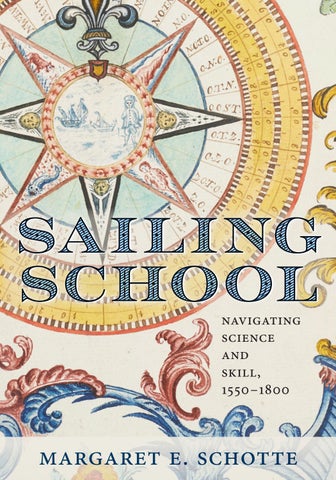
Sa iling School NavigatiNg ScieNce aNd Skill, 1550–1800
Margaret e. Schotte
Sailing School Navigating Science and Skill, 1550-1800 MARGARET E. SCHOTTE
Sa iling School NavigatiNg ScieNce aNd Skill, 1550–1800
Margaret e. Schotte
Throughout the Age of Exploration, European maritime communities bent on colonial and commercial expansion embraced the complex mechanics of celestial navigation. They developed schools, textbooks, and instruments to teach the new mathematical techniques to sailors. As these experts debated the value of theory and practice, memory and mathematics, they created hybrid models that would have a lasting impact on applied science. In Sailing School, a richly illustrated comparative study of this transformative period, Margaret E. Schotte charts more than two hundred years of navigational history as she investigates
“An outstanding, highly original piece of scholarship, this will be the standard, go-to book for years to come.”—Pamela O. Long, author of Artisan/Practitioners and the Rise of the New Sciences, 1400–1600
how mariners solved the challenges of navigating beyond sight of land. She begins by outlining the influential sixteenth-century Iberian model for training and certifying nautical practitioners.
She takes us into a Dutch bookshop stocked with maritime manuals and a French trigonometry lesson devoted to the idea that “navigation is nothing more than a right triangle.” The story culminates at the close of the eighteenth century with a young British naval officer who managed to keep his damaged vessel afloat for two long months, thanks largely to lessons he learned as a keen student. This is the first study to trace the importance of the world of print for the navigator’s art. Schotte interrogates a wide variety of archival records from six countries, including hundreds of published textbooks and never-before-studied manuscripts crafted by practitioners themselves. Ultimately, Sailing School helps us rethink the relationship among maritime history, the Scientific Revolution, and the rise of print culture during a period of unparalleled innovation and global expansion.
“An enjoyable and enlightening read. Sailing
School should appeal to anyone with an interest in maritime history, as well as those interested in the history of science, mathematics, and education.” —Richard Dunn, Royal Museums Greenwich, author of The Telescope: A Short History “Drawing on a wide range of sources in many different languages, Margaret E. Schotte has written the first truly transnational history of nautical training, one which compellingly shows the crucial role of books. This is a brilliant contribution to maritime history and the history of knowledge. —Karel Davids, Vrije Universiteit Amsterdam, coeditor of Innovation and Creativity in Late Medieval and Early Modern European Cities “This welcome publication will be essential reading for historians of education and of science, of maritime culture and of the emergence of modern systems of technical authority.”—Simon Schaffer, University of Cambridge, coauthor of Leviathan and the Air-Pump: Hobbes, Boyle, and the Experimental Life “You might envision an early navigator tying knots and reefing sails as adroitly as he sets a course, but would you also credit him with a mastery of multiplication tables, trigonometry, and logarithms? Thanks to Margaret Schotte’s personal voyage through several centuries’ worth of seamen’s texts from maritime countries, Sailing School teaches us what sailors had to learn on land to find their way at sea.”—Dava Sobel, author of The Glass Universe: How the Ladies of the Harvard Observatory Took the Measure of the Stars Margaret E. Schotte is an assistant professor of history at York University. Information Cultures Series Editors: Ann Blair, Anthony Grafton, and Earle A. Havens
A beautifully illustrated account of hands-on science in the Age of Exploration.
Chapters describe how navigators were trained in Spain, The Netherlands, France, and England—and how science and math were applied at sea.
3.1. A blue-coat boy: “One of the Children Educated in [Christ’s] Hospital.” P. Perkins, The Seaman’s Tutor: Explaining Geometry, Cosmography, and Trigonometry (London, 1682), facing p. 1. Courtesy of the John Carter Brown Library at Brown University
Chapter Three
Hands- On Theory along the Thames
London, 1683
In England, the navigator’s examination that was such a pivotal moment in the life of a sixteenth-century Spanish mariner gradually took on even greater weight. By the final decades of the seventeenth century, at least three groups of British sailors were required to face examiners before moving on to the next phase of their career: young pupils at the Royal Mathematical School who hoped to become certified as masters in the Royal Navy, experienced masters who wished to improve their wages by qualifying to guide larger naval vessels further afield, and young gentlemen who sought their first naval commission as lieutenants. All of these men were preparing for the same task: safe navigation on the open ocean. Despite the similarities of their goals, the content and emphasis of these three formal examinations could not have been more distinct. The questions posed to candidates ran the gamut from very theoretical to extremely hands-on. Although the English model of nautical training held within it not one but two theoretical traditions — one very ancient and Euclidian and the other related to the Royal Society and the empirical new sciences — in every case a practical element remained: a mariner could not do his job without both head and hand. In the fall of 1670, one Charles Hadsell, recently returned 93
3
Readers (or their instructors) augmented a handful of eighteenth-century Dutch printed texts with color and imitated these in manuscript workbooks, probably in hopes of clarifying the diagrams.
Plate 6. K. de Vries, Schat-kamer ofte Konst der Stierlieden (Amsterdam, 1702), 211. Het Scheepvaartmuseum, Amsterdam
Plate 7. H. de Vos, Schatkamer (Netherlands, 1748–53), based on De Vries. Collection Maritiem Museum, Rotterdam
A selection of 70 black and white illustrations placed throughout the text, along with a gallery of nine fascinating color images bring Sailing School to life. 1 2 3 4 5 6 7 8 9 10 11 12 13 14 15 16 17 18 19 20 21 22 23 24 25 26 27 28 29 30 31 32 33 34 35 36 37 38 39 40 41 42 43
E.2. Traditional paper tools continued to appear in student workbooks into the eighteenth and nineteenth centuries. Epact thumb diagram in H. M. Hoffman’s Schatkamer (Amsterdam, 1818). Collection Maritiem Museum Rotterdam
E.3. Compass rose in H. M. Hoffman’s Schatkamer (Amsterdam, 1818). Collection Maritiem Museum Rotterdam
schotte_sailingschool_1pp_sized.indd 182
2/17/19 10:25 PM
Plate 5. William Spink enlivened his homework by computing traverse courses in the shape of geometric stars and cloverleafs, hearts and castles. This particular problem, which required him to trace a voyage comprised of twenty-three legs, resulted in a neat anchor. Spink, Navigation workbook (England, 1697–1705). © National Maritime Museum, Greenwich, London, NVT/47
Sailing School Navigating Science and Skill, 1550-1800 MARGARET E. SCHOTTE
Sa iling School NavigatiNg ScieNce aNd Skill, 1550–1800
Margaret e. Schotte Sales queries: Devon Renwick 410-516-6951 dbr@press.jhu.edu
Media queries: John D. Moore 410-516-6930 jdm@press.jhu.edu
Publication date: July 2019 7 x 10, 320 pages 9 color illus., 70 b&w illus. 978-1-4214-2953-3 $59.95 / £44.50 hardcover
press.jhu.edu