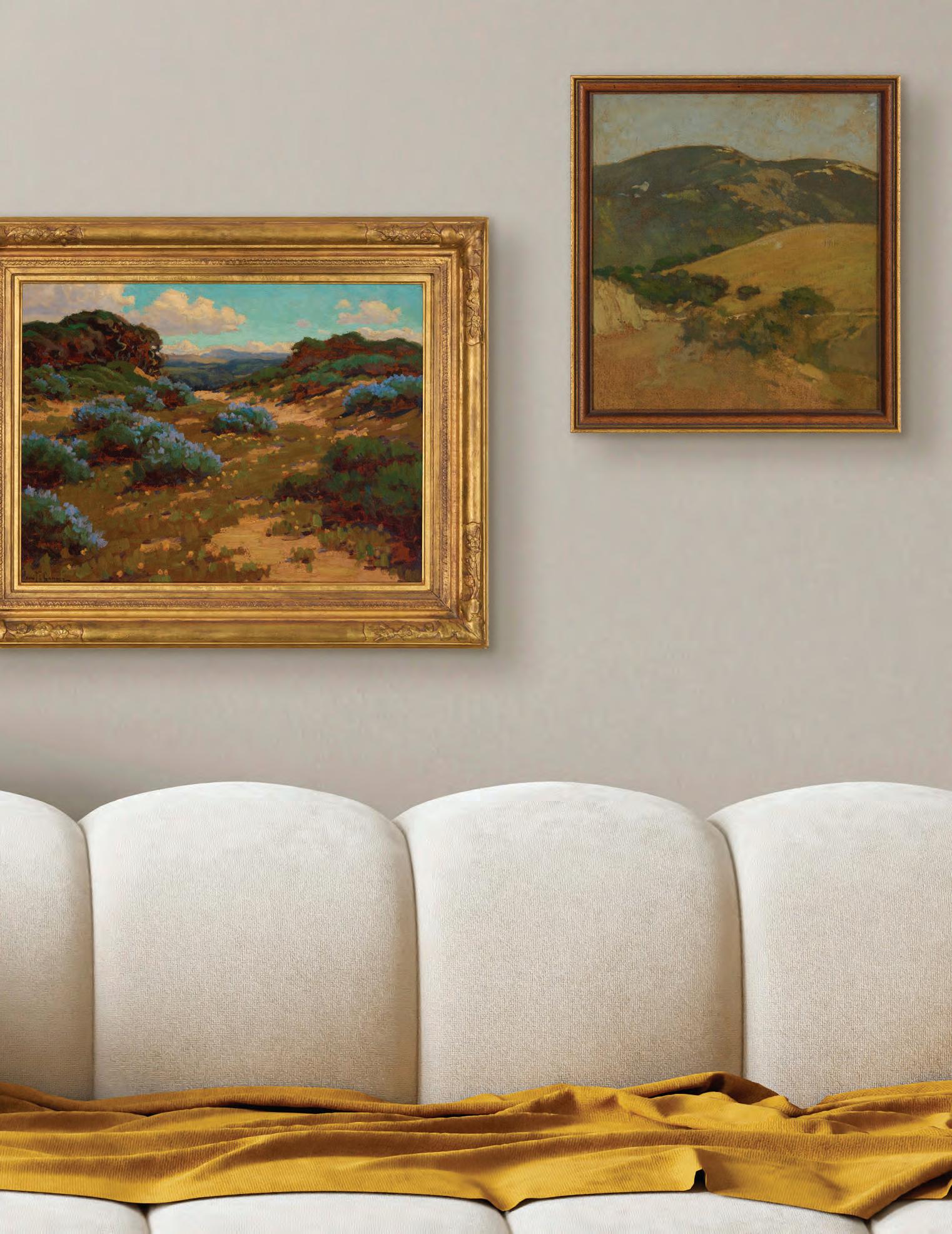
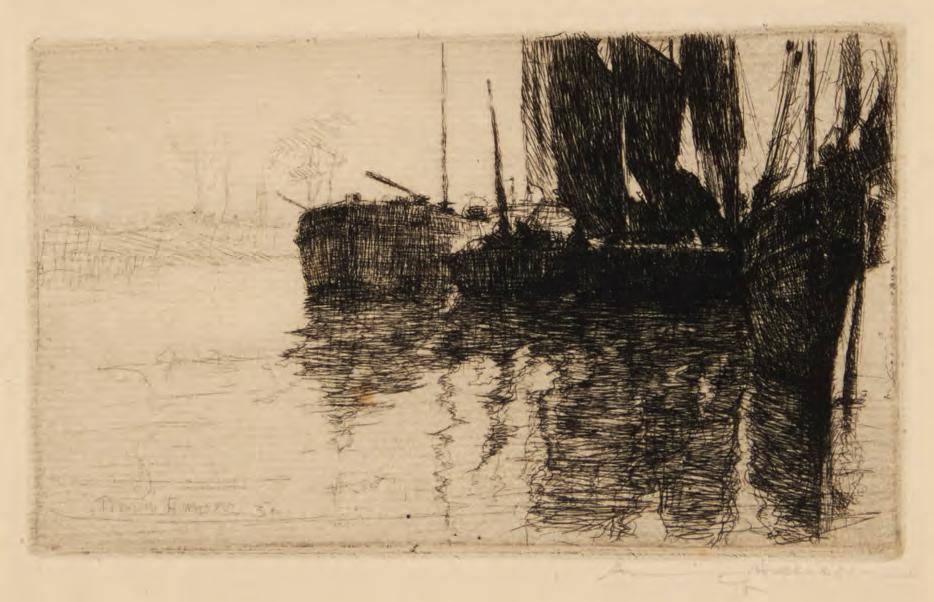
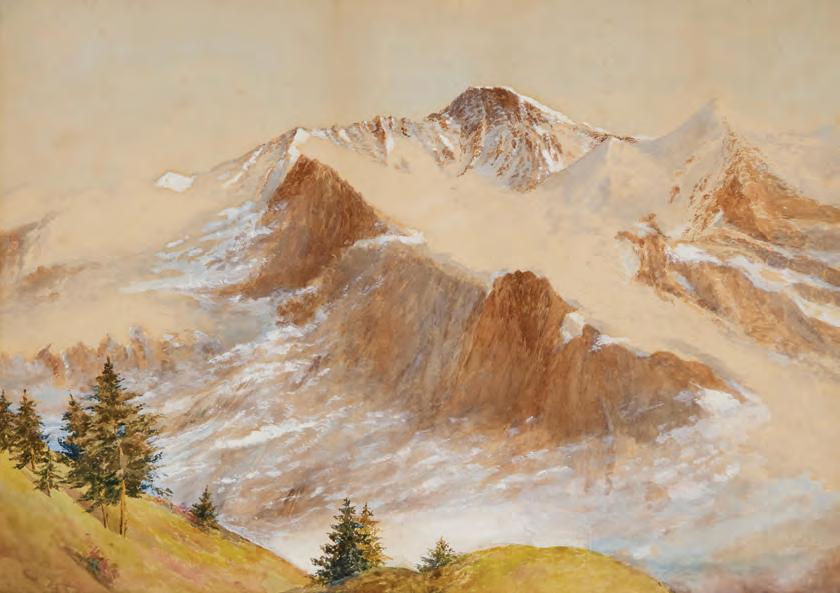
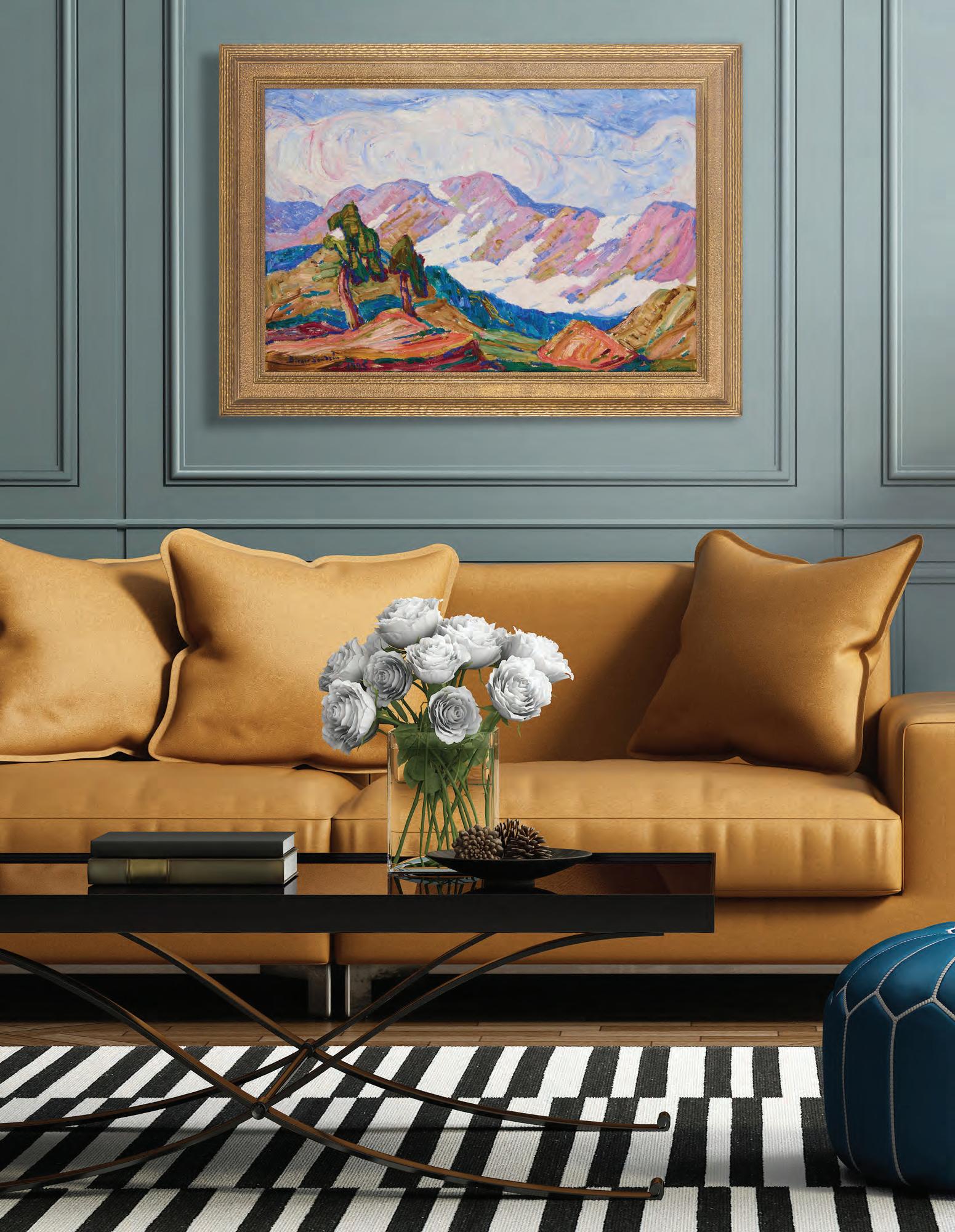
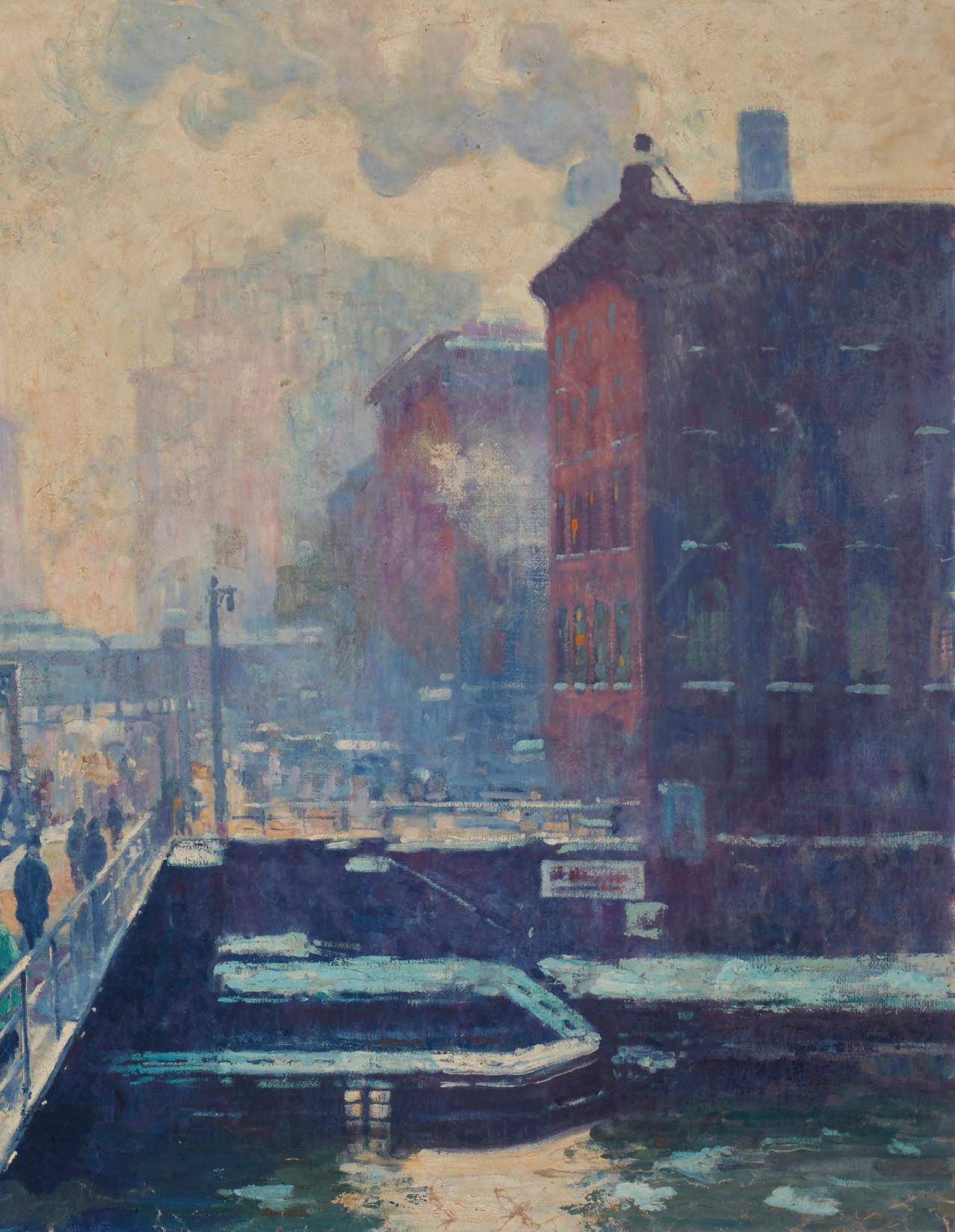
California & American Fine Art — May 5, 2026 | John Moran Auctioneers
California & American Fine Art
Tuesday, May 5, 2026
SINCE 1969
1001
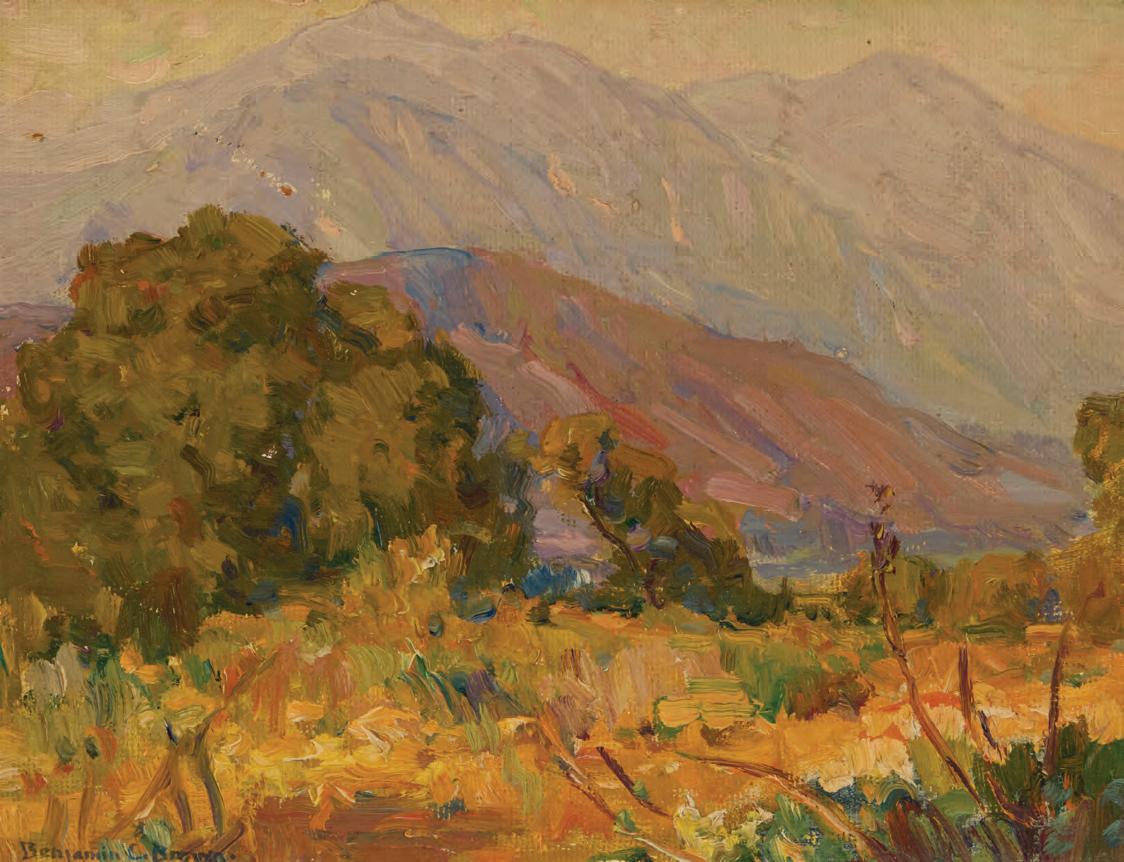
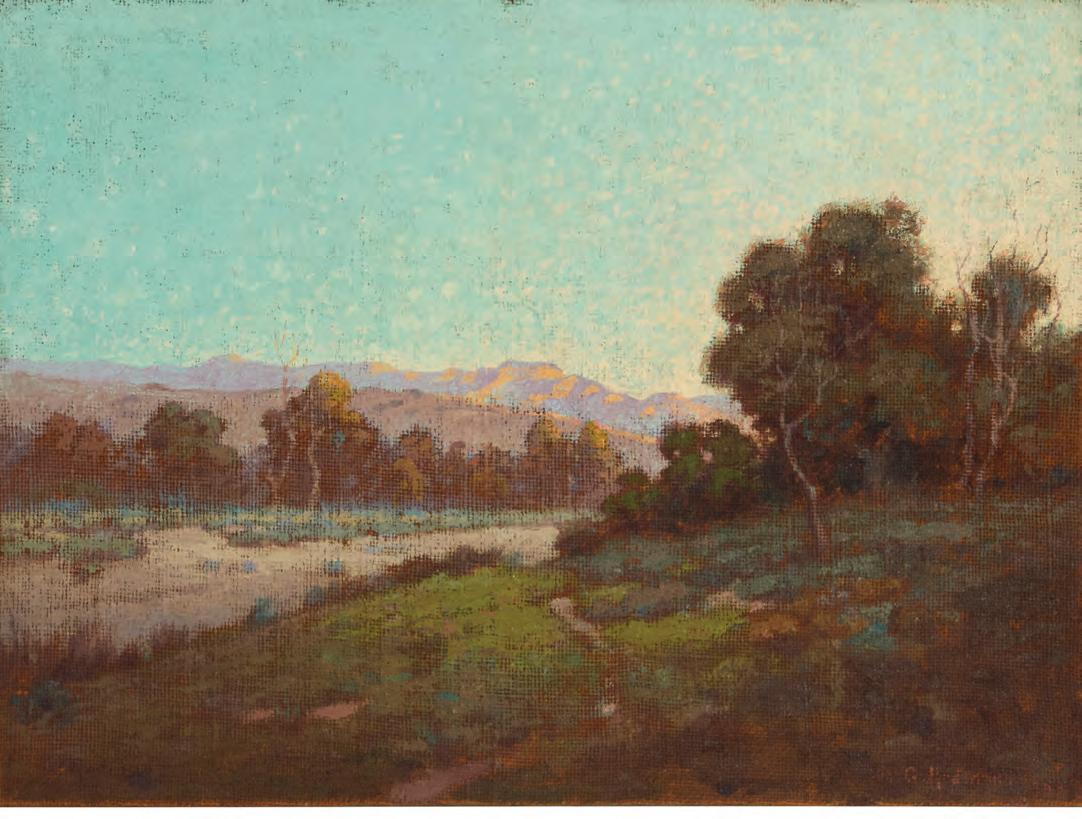
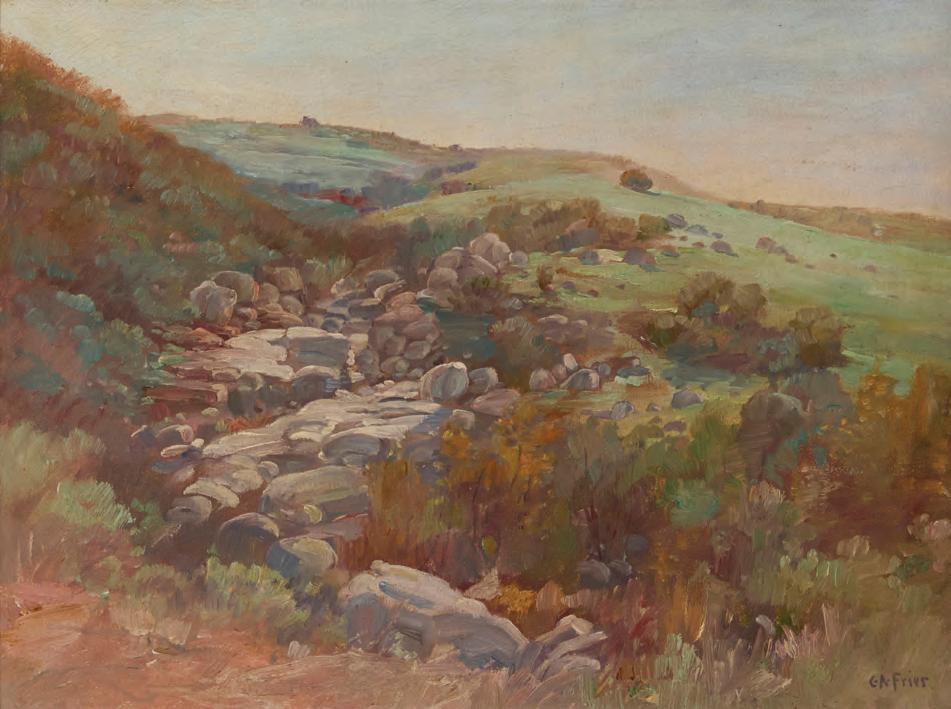
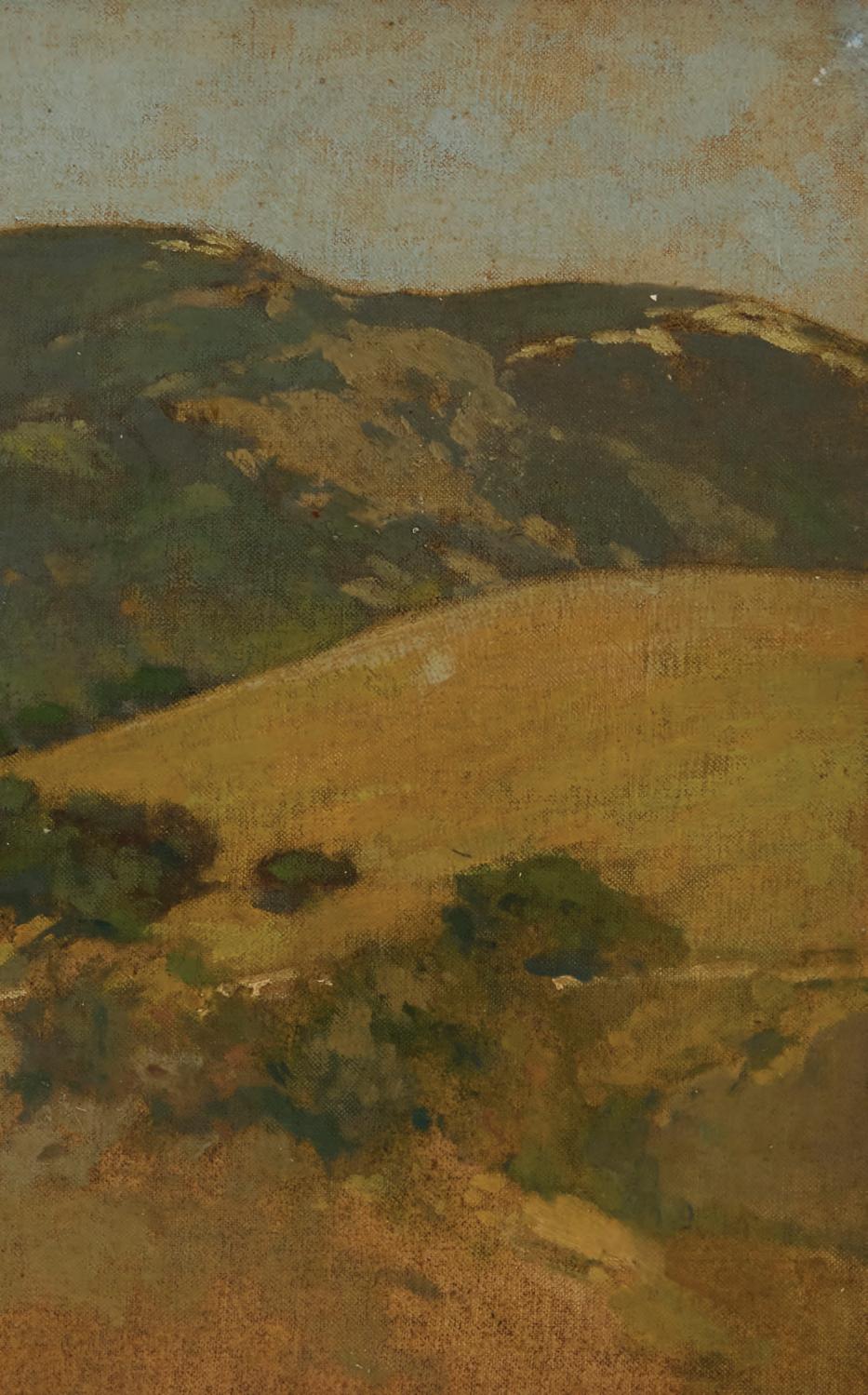
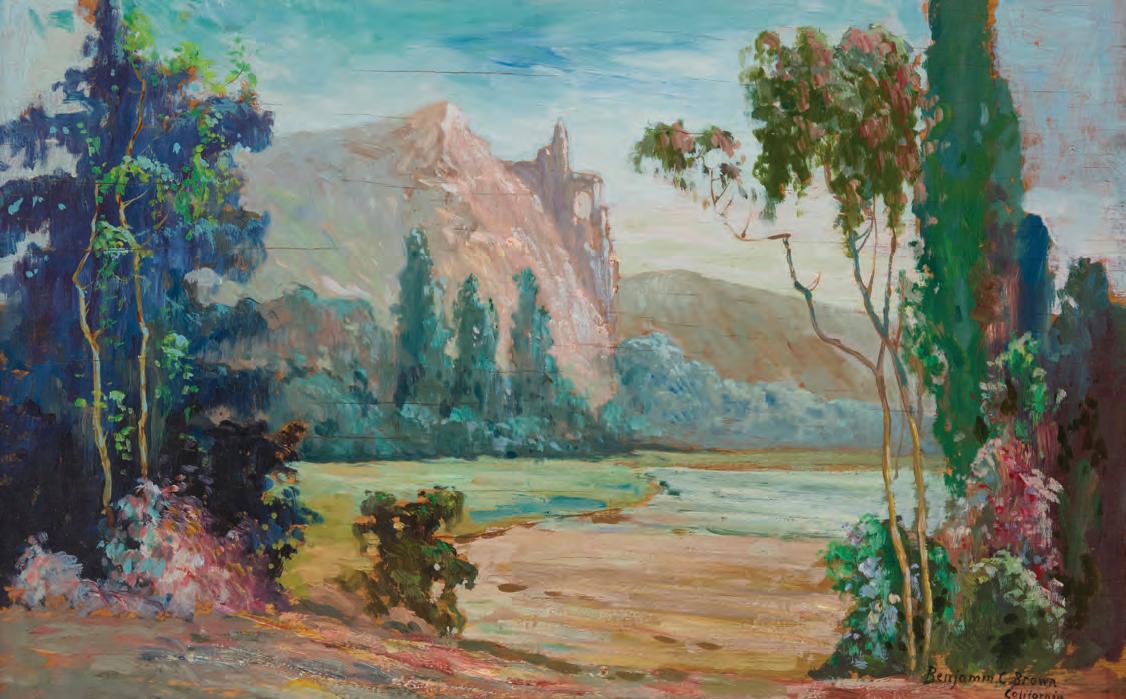
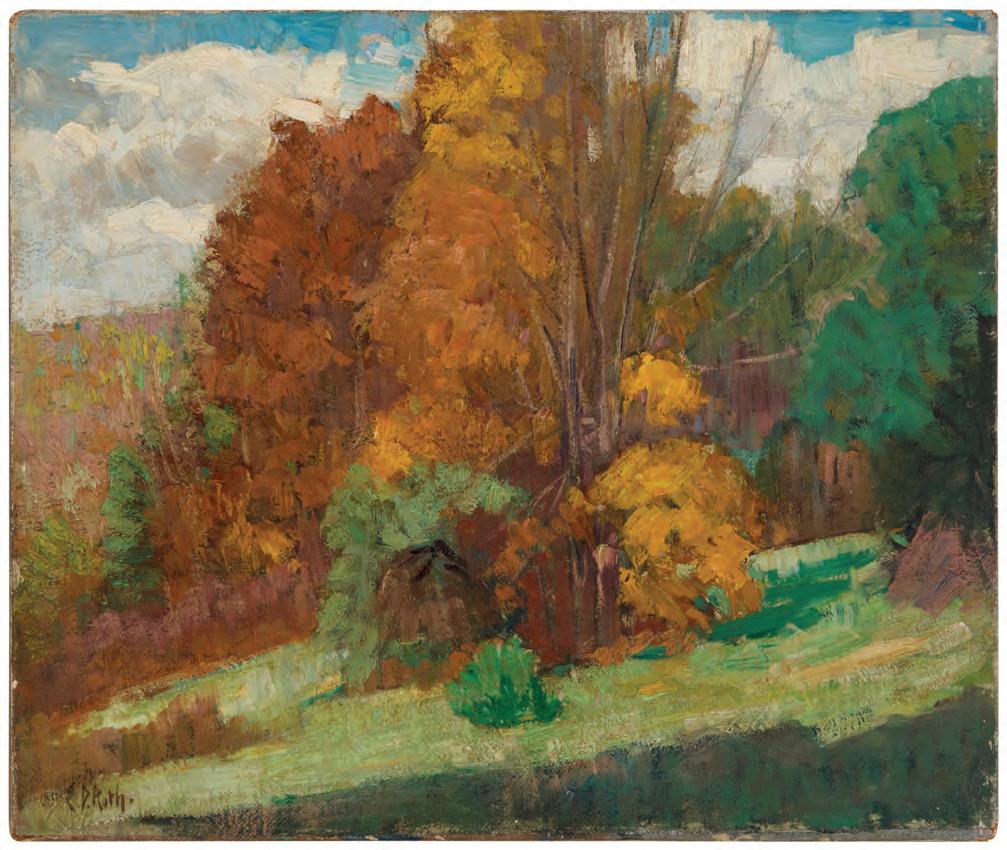
Benjamin Chambers Brown (1865-1942)
“Near Monrovia Calif.” Oil on canvasboard
Signed lower left: Benjamin C. Brown; signed again, titled and inscribed in ink, verso: “near Monrovia, Calif. / Painted by Benjamin C. Brown / California / (Au 4)” 11” H x 14” W
$3,000-5,000
Provenance:
Private collector, Oakland, CA By family descent, circa 1950s
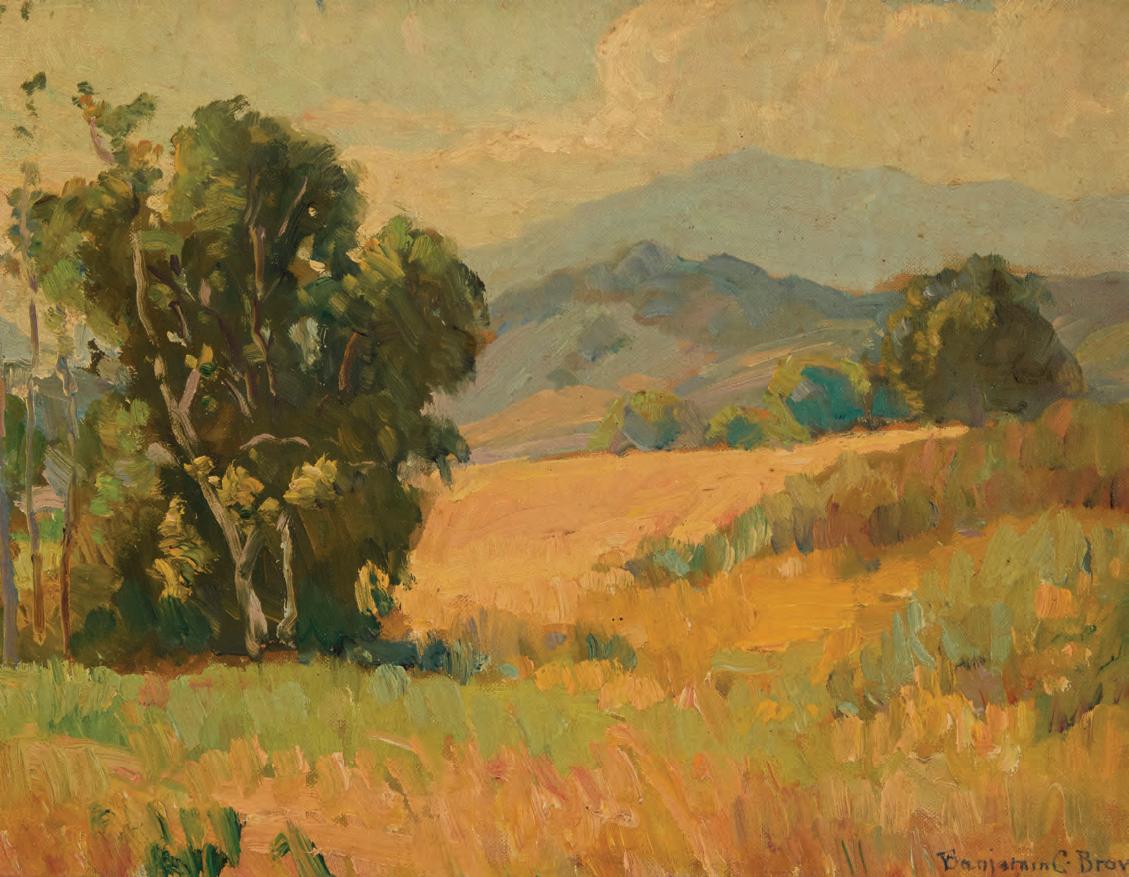
1002
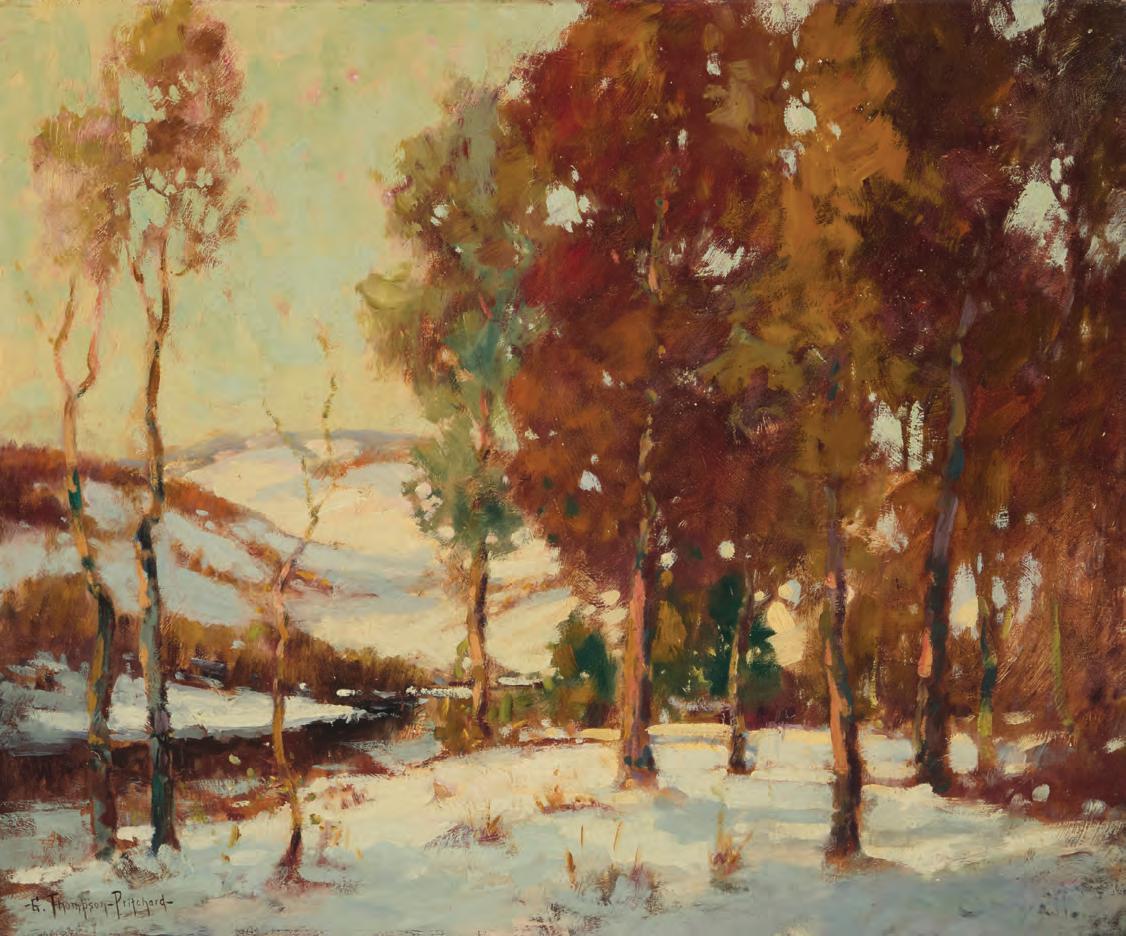
Benjamin Chambers Brown (1865-1942)
“The End of Summer, Near Ojai, California” Oil on canvasboard
Signed lower right: Benjamin C. Brown; signed again, titled, and inscribed in ink, verso: “Near Ojai, California / Painting by Benjamin C. Brown / (Au 2)” 11.125” H x 14” W
$3,000-5,000
Provenance: Private collector, Oakland, CA By family descent, circa 1950s
1003
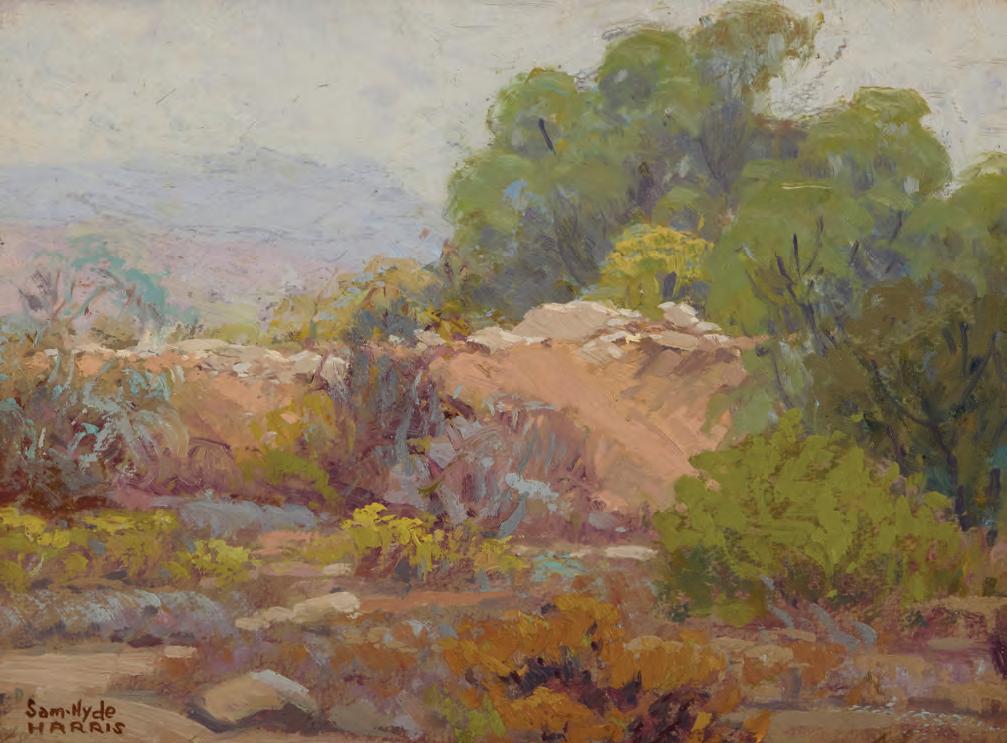
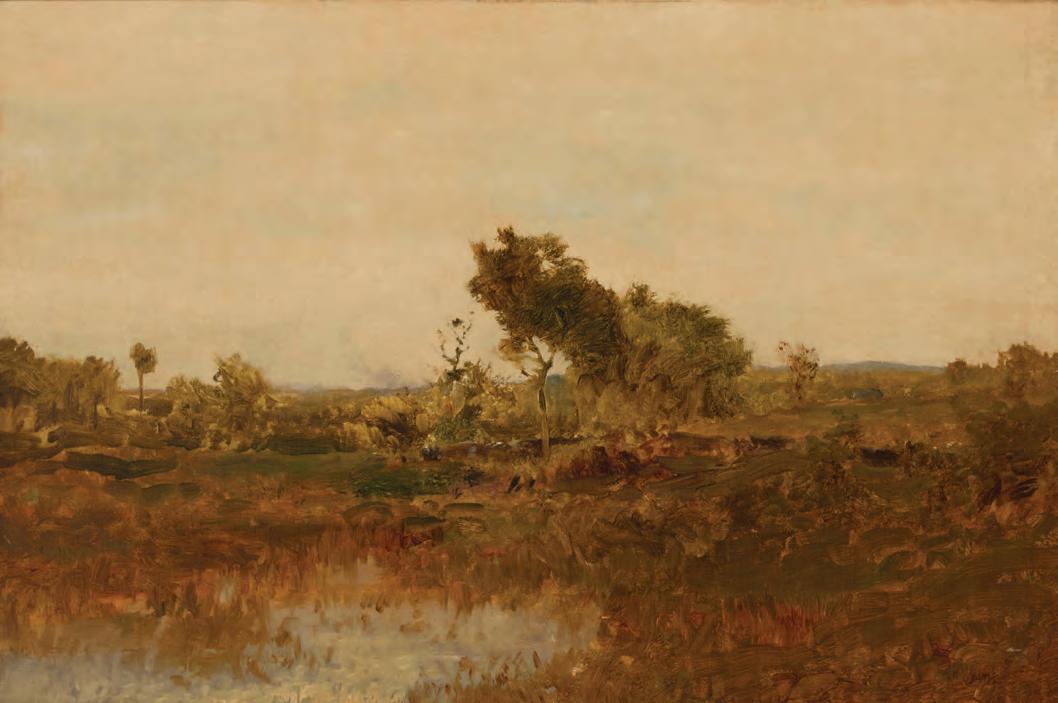
Sam Hyde Harris (1889-1977) “Yesterday” Oil on board
Signed with the estate stamp lower left: Sam Hyde / Harris; with the black ink stamped estate statement signed by Maurine St. Gaudens, the estate inventory number, 02-036, and the title in another hand, all verso 12” H x 16” D
$2,000-3,000
Provenance: Estate of the artist
Private collection, Carlsbad, CA
Sold: Bonhams, Los Angeles, CA, “California and Western Paintings and Sculpture,” April 24, 2018, Lot 119 Private collection, Burbank, CA, from the above
Literature: Maurine St. Gaudens, “Sam Hyde Harris, 1889-1977: A Retrospective,” Schiffer Publishing, Atglen, 2007, p. 45, illustrated
1004
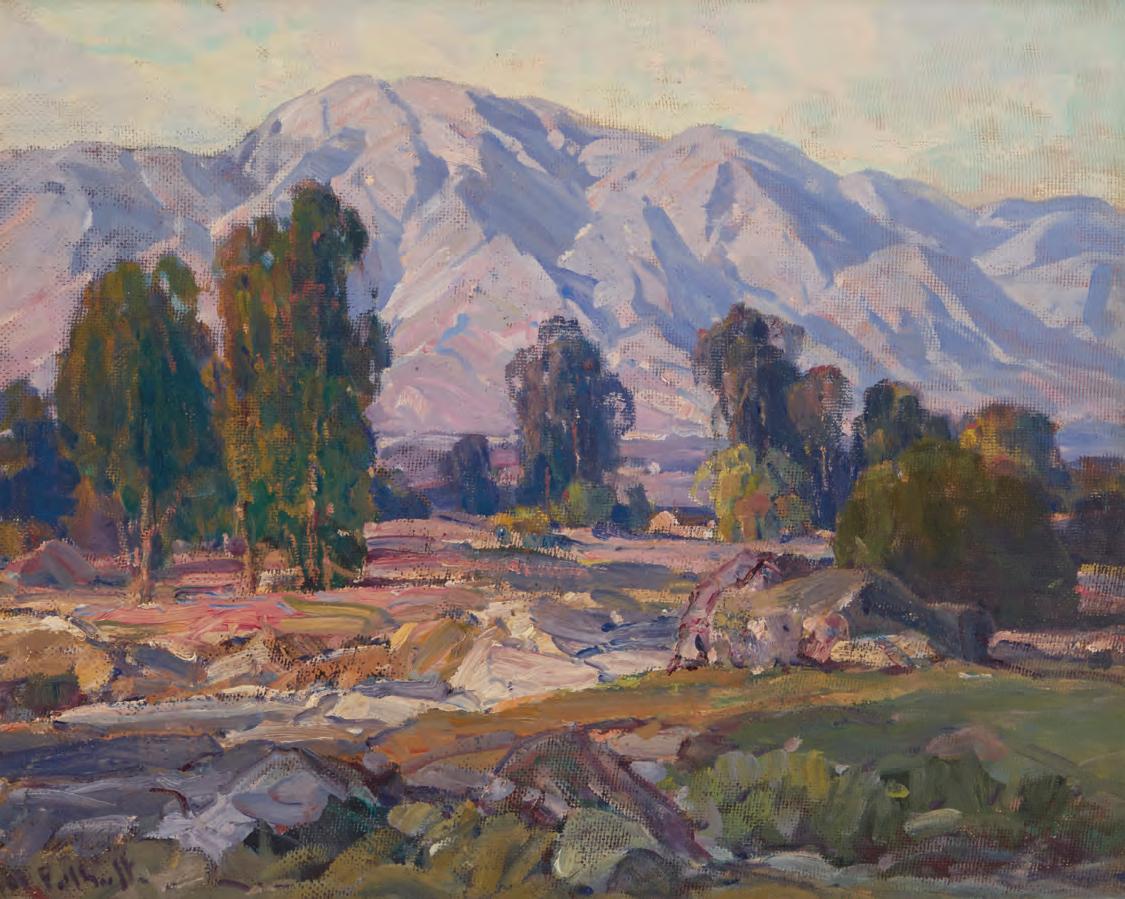
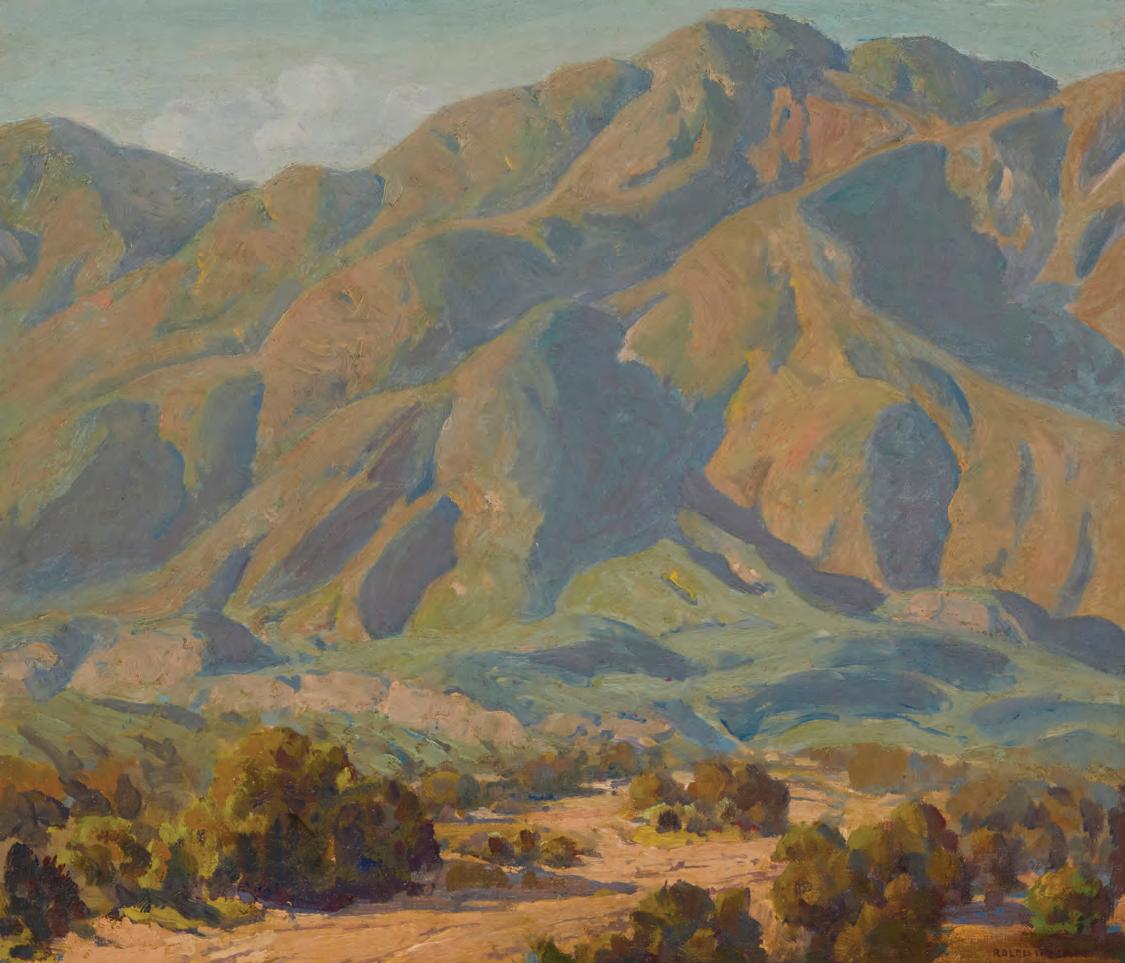
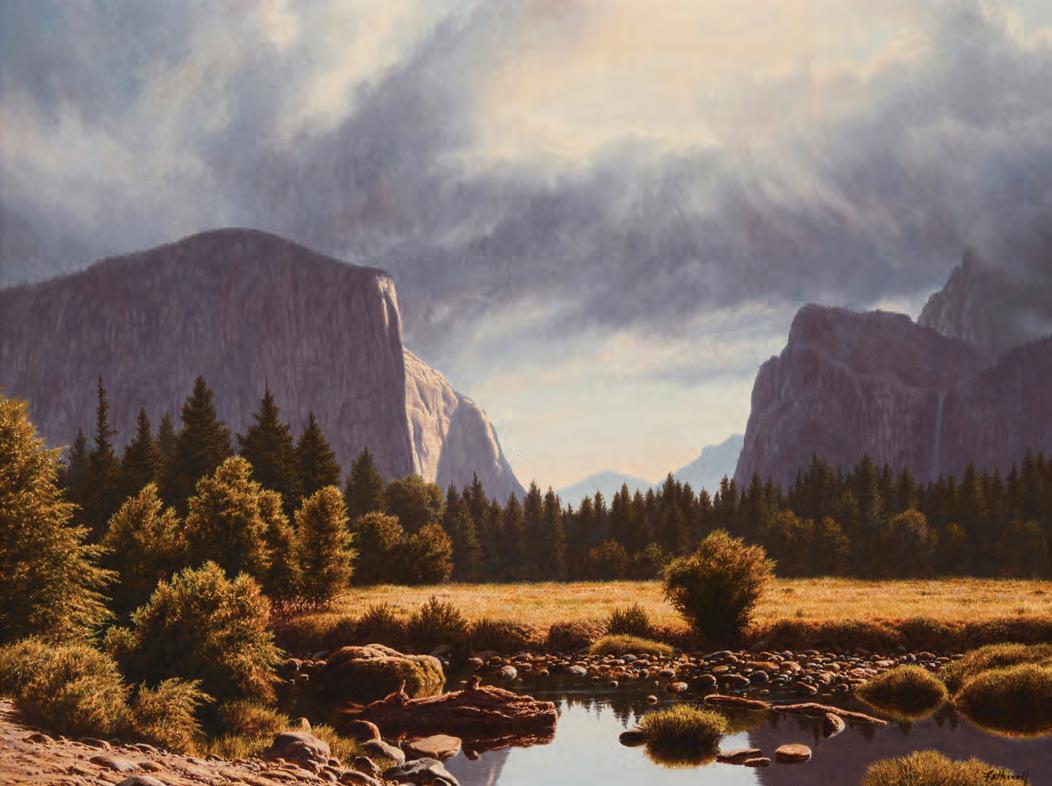
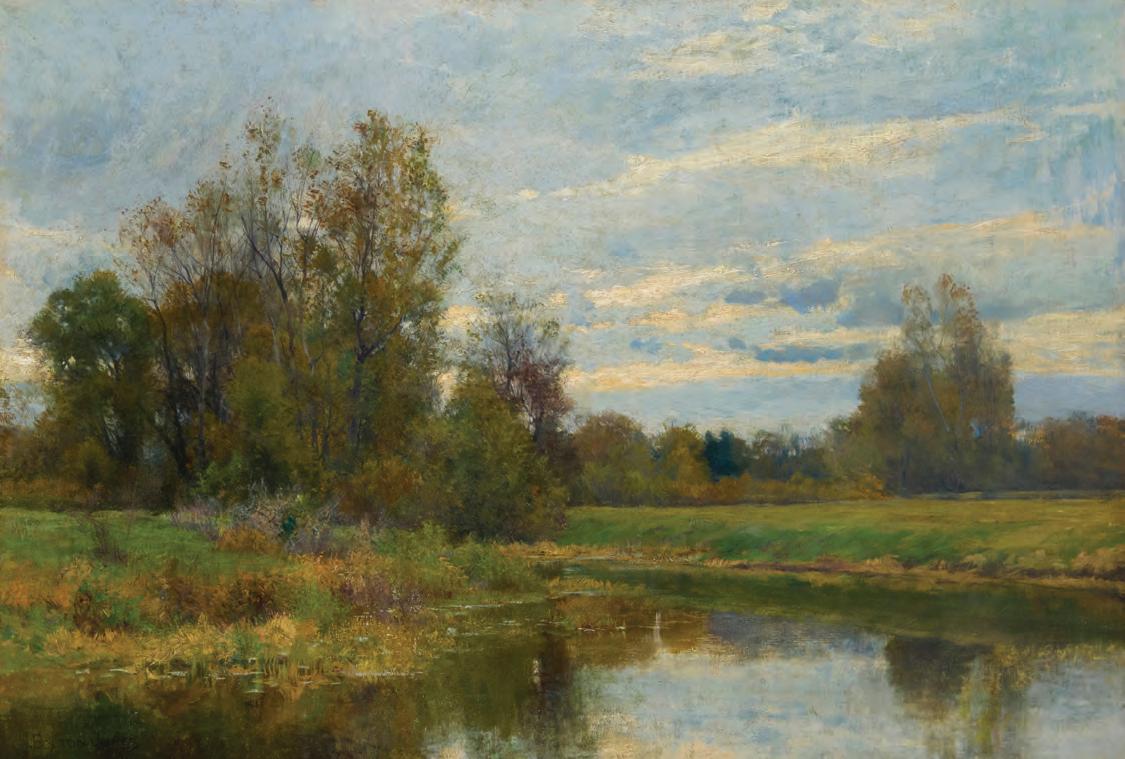
Hanson Duvall Puthuff (1875-1972)
“Spreading Valley” Oil on Masonite
Signed lower left: H. Puthuff; signed again and titled in green paint verso; inscribed in pencil on the frame’s verso, in another hand: “Festival of arts assoc.” 15.75” H x 19.75” W
$3,000-5,000
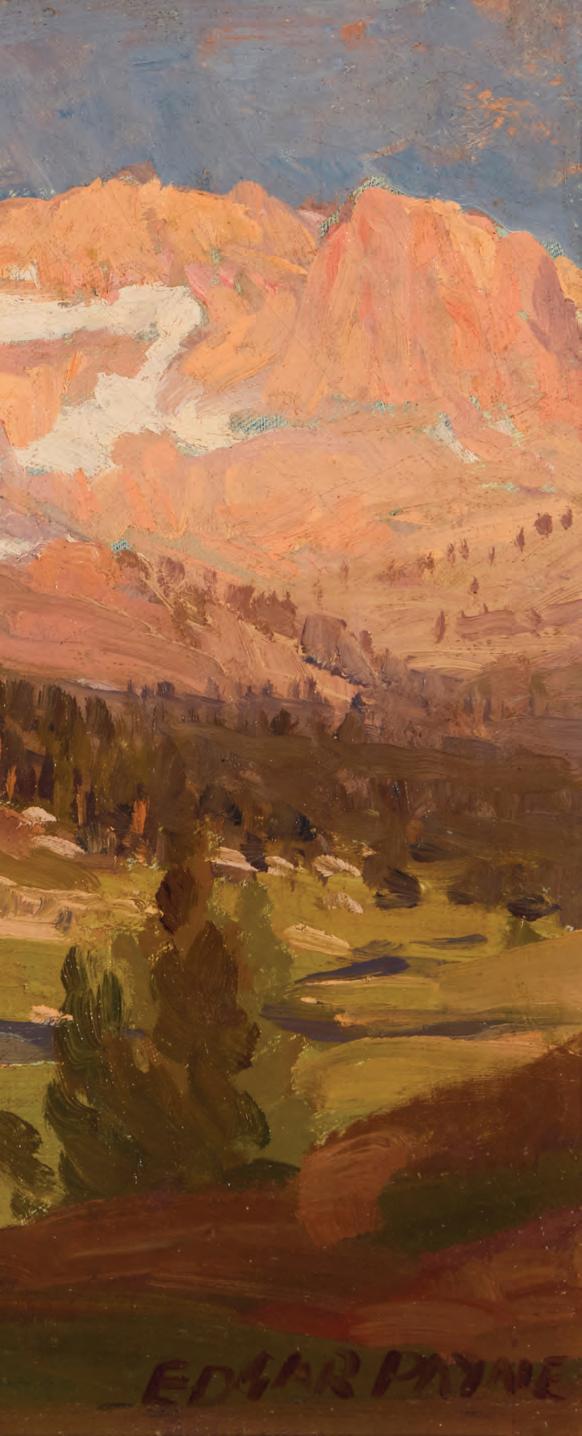
Edgar Alwin Payne
(1883-1947)
From the sparkling waters of France and Italy and kissed deserts of the American Southwest, American one of the United States’ preeminent Impressionist
Born in Missouri, Payne dreamed of becoming American South and Midwest, painting murals expressive artists of his time, Payne became bored artist. Payne worked and lived as an artistic nomad, scale murals, and, in 1912, marrying fellow artist
Rather than emphasizing his European travels, with the Sierra Nevada. Drawn to its dramatic peaks, Sierras repeatedly, refining his ability to capture setting for his Impressionist approach, where bold intimacy of the natural world.
In 1918, the couple settled in Laguna Beach, California, root there. Payne helped found the Laguna Beach home base in Southern California, Payne ventured valleys of the Sierra Nevada and other ranges. Western United States.
Commissions began to wane after the stock market Nevadas his primary subject matter. He spent an canvas. His love of the Sierra Nevada was unrivaled cancer in 1942, Edgar Payne passed away in 1947,
Edgar Payne’s works are included in the collections Museum of California Art, the Crocker Art Museum, Nevada is named in his honor.
and the snow-swept peaks of the Swiss Alps to the rolling hills of California and sunAmerican painter Edgar Alwin Payne captured it all on canvas in an illustrious career as Impressionist painters.
an artist from the age of fourteen. In his late teens, he traveled throughout the and stage sets, before briefly studying at the Chicago Art Institute in 1907. Like many bored with the rigid structure of academic art institutions and became a self-taught nomad, moving between California and Chicago, taking commissions, working on largeartist Elsie Philippa Palmer.
Payne’s artistic legacy is powerfully defined by his deep and sustained engagement peaks, alpine lakes, and ever-changing atmospheric conditions, Payne returned to the capture both monumental structure and fleeting light. These landscapes provided the ideal bold composition and luminous color harmonize to convey both the grandeur and
California, becoming an integral part of the burgeoning art community that was taking Beach Art Association in 1918 and became the organization’s first president. From his ventured out into the California mountains, painting striking scenes of the peaks and Payne took on numerous commissions and exhibited throughout the Mid- and
market crash of 1929, and from 1930 onwards, Payne made painting the Sierra an excessive amount of time finding the perfect angle, the perfect lighting, to put on unrivaled and even produced a documentary film, “Sierra Journey.” Diagnosed with 1947, leaving behind a legacy of American landscape painting.
collections of numerous institutions, including the Laguna Art Museum, the Pasadena Museum, Sacramento, and the Indianapolis Museum of Art. Payne Lake in the Sierra
1005
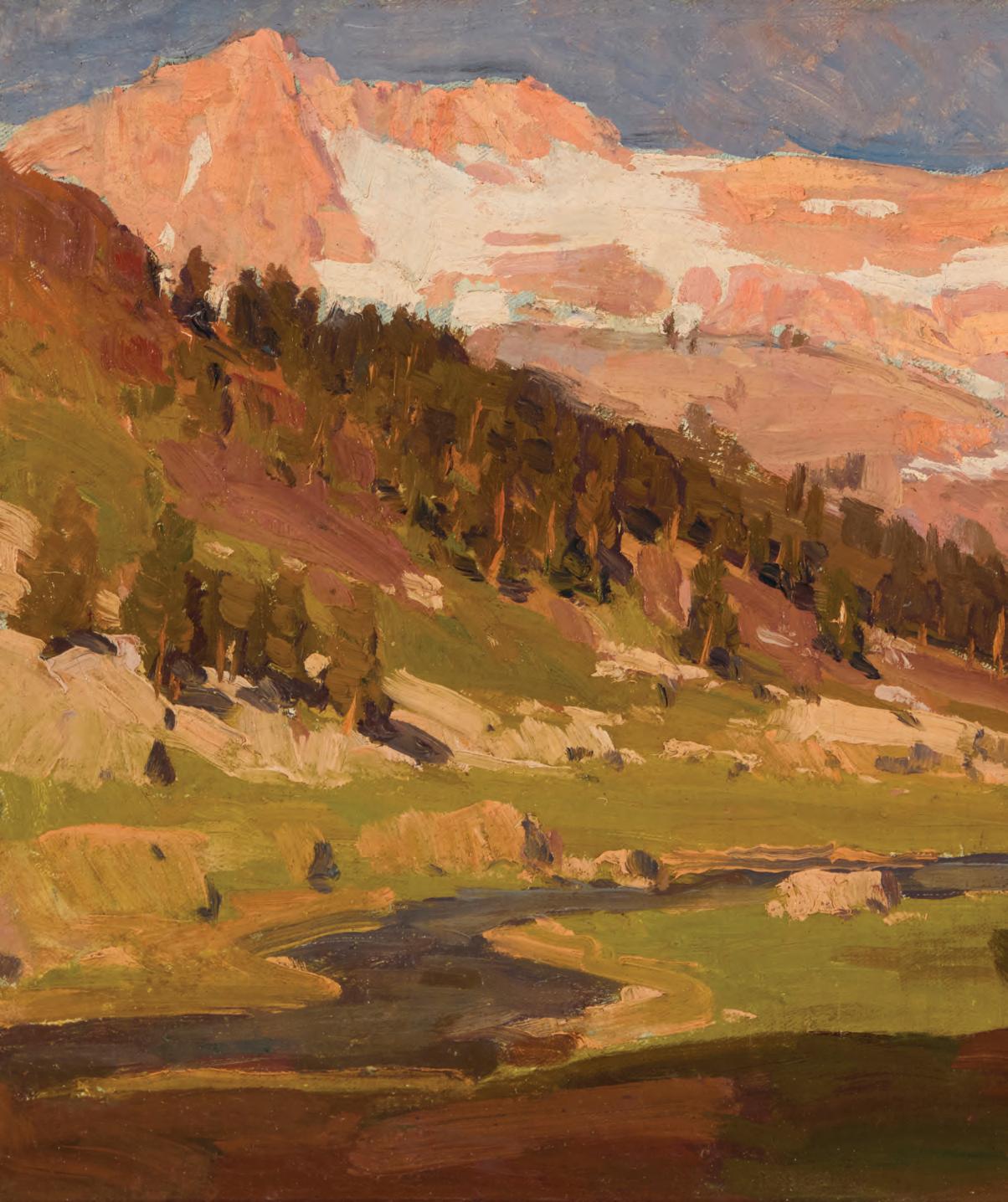
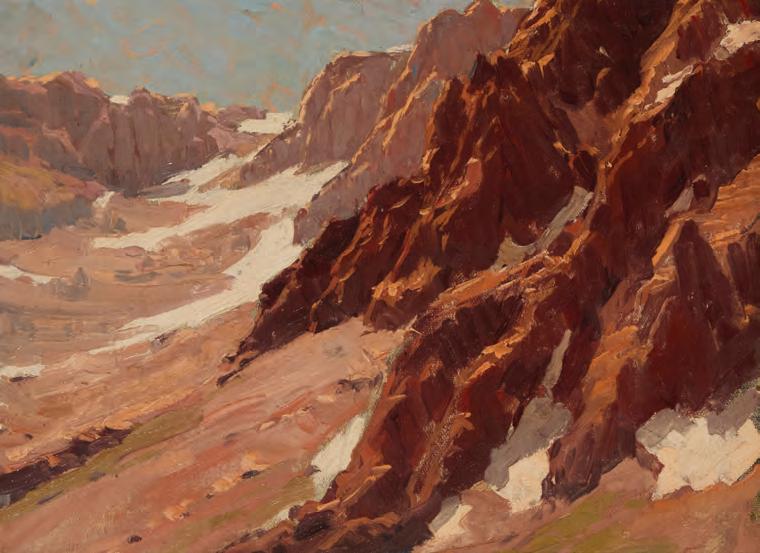
Edgar Alwin Payne (1883-1947)
“Sierra Stream”
Oil on canvasboard
Signed lower right: Edgar Payne; titled in pencil and inscribed “4” in ink, verso 11.75” H x 14.75” W
$8,000-12,000
1006
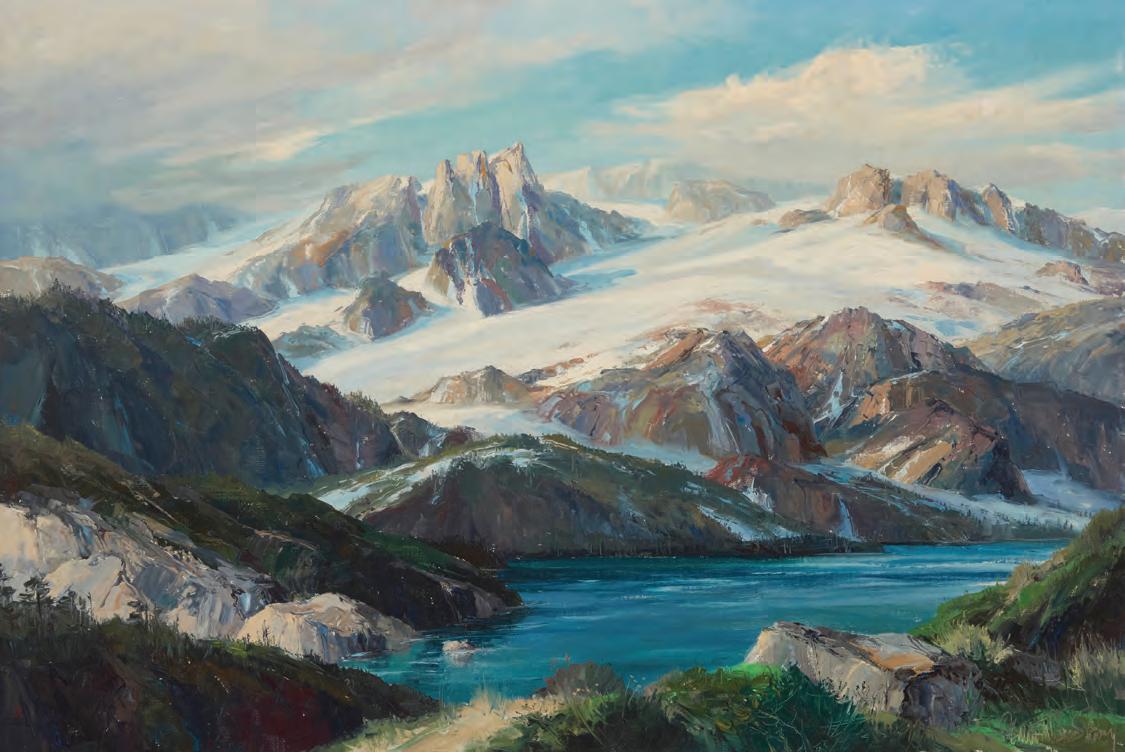
Edgar Alwin Payne (1883-1947)
Mountain landscape Oil on canvas laid to board
Unsigned 12” H x 16” W
$3,000-5,000
Provenance: Douglas Crane Estate, Santa Barbara, CA
Notes: This lot is accompanied by a letter of authenticity dated December 1989, from Peregrine Galleries.
1007
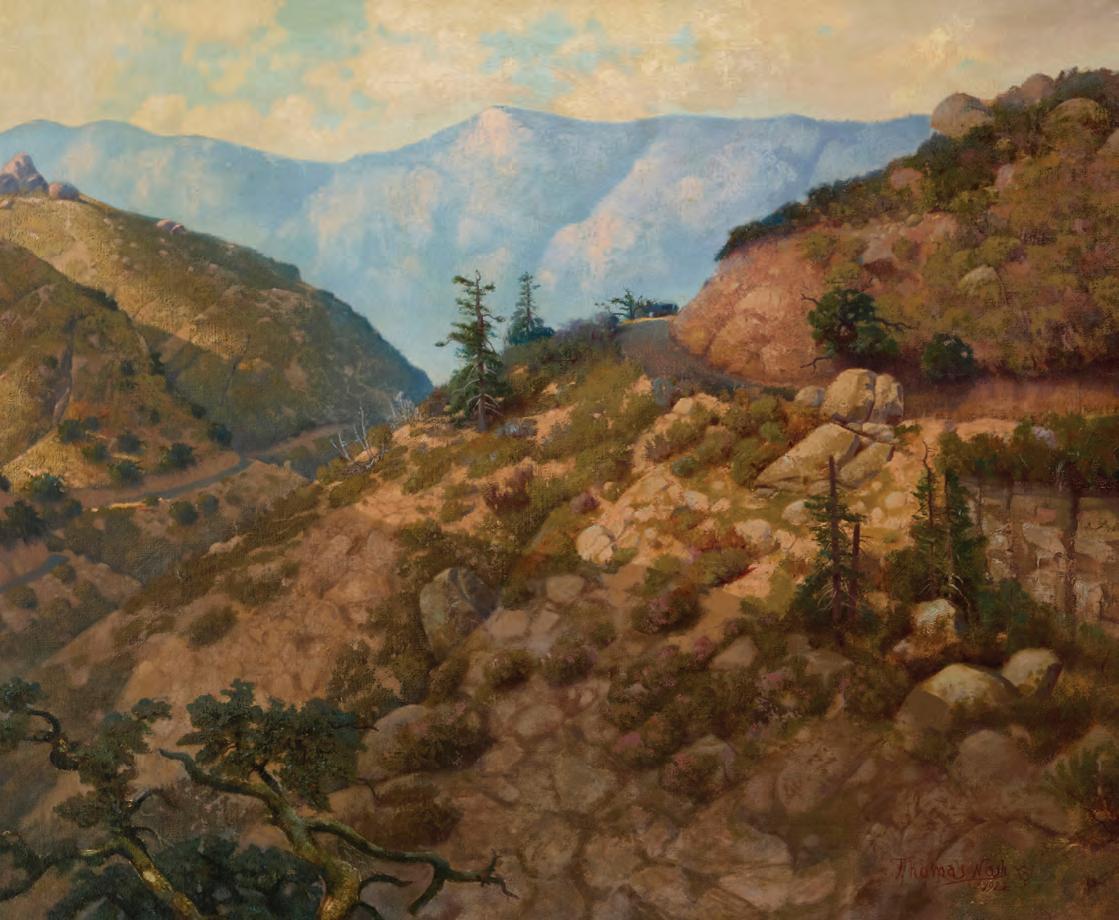
Thomas Nash (1856-1927)
“The Mountain Oil on canvas
Signed and with in S.O.[sic] Cal.
30” H x 40” W
$2,000-3,000
Provenance: Sold: John Moran Arlington Gallery, The Sally and David Exhibited: Bakersfield, CA, Santa Barbara, Los Olivos, CA,
Notes: This lot is accompanied
Mountain Road,” 1922
with the artist’s device, and dated, all lower right: Thomas Nash / 1922; signed and dated again, and inscribed, “The Wild Cal. no. 1. Second Series” and “The Ridge Rout.[sic], L.A. Cal to BakesField[sic],” all verso
Moran Auctioneers, Pasadena, CA, March 15, 1994, Lot 47 Gallery, Santa Barbara, CA
David Martin Collection, from the above, June 10, 1994
CA, Bakersfield Museum of Art, “Public and Private California Scenes 1920-1950,” January 20-February 25, 1995 CA, Santa Barbara Museum of Art, 1996, no. 107 CA, Wildling Art Museum, “Members Collect II,” March 19-June 12, 2005
accompanied by a copy of a sales invoice dated June 10, 1994, from the gallery mentioned above.
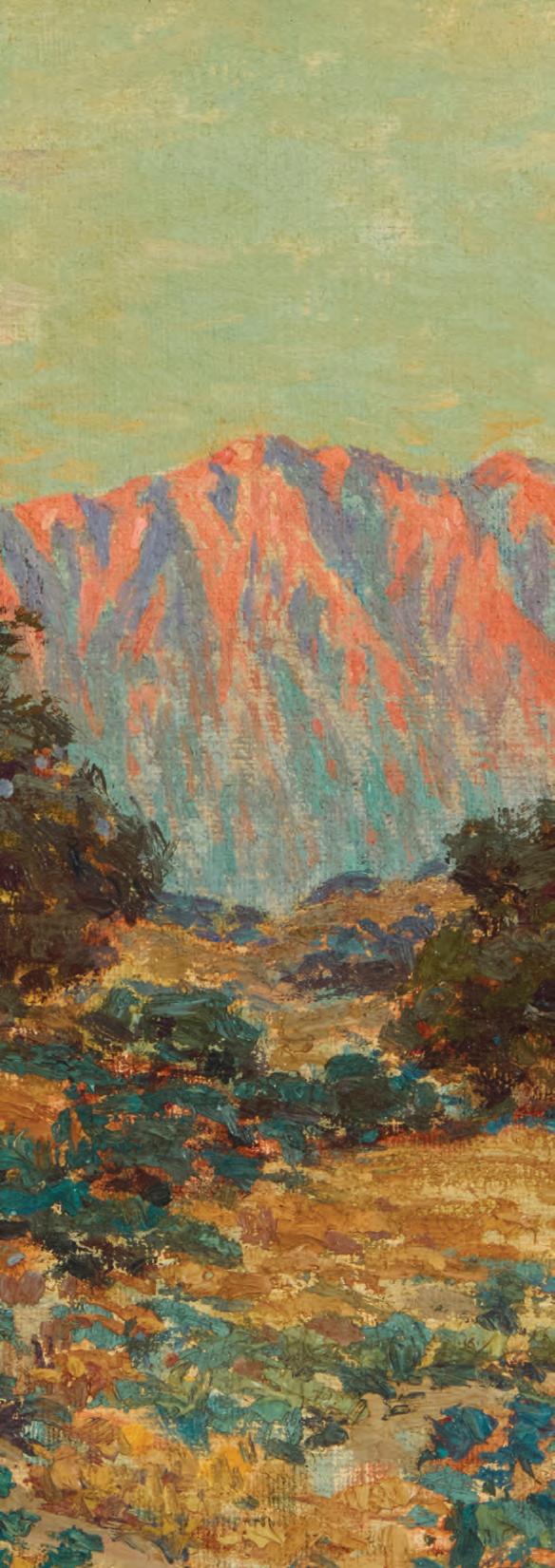
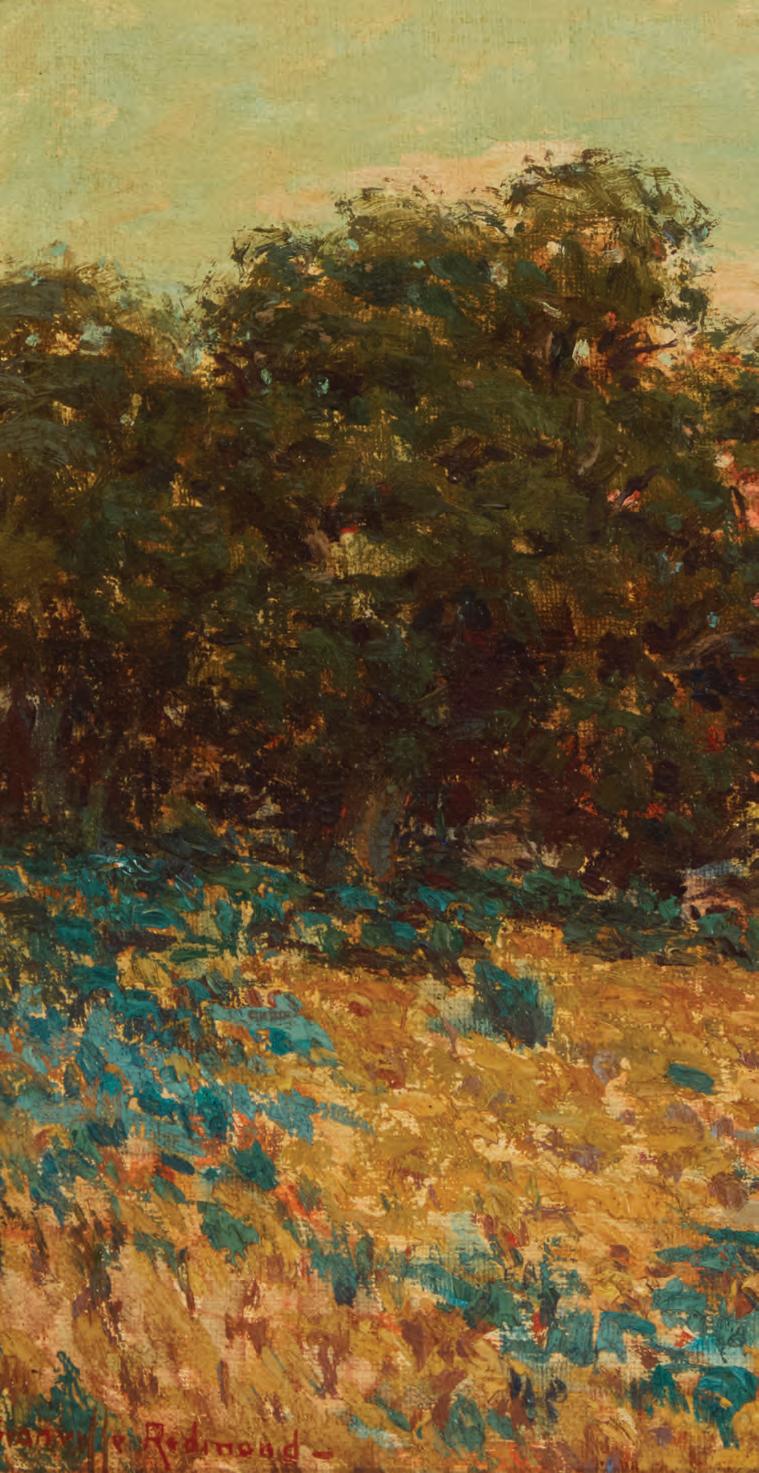
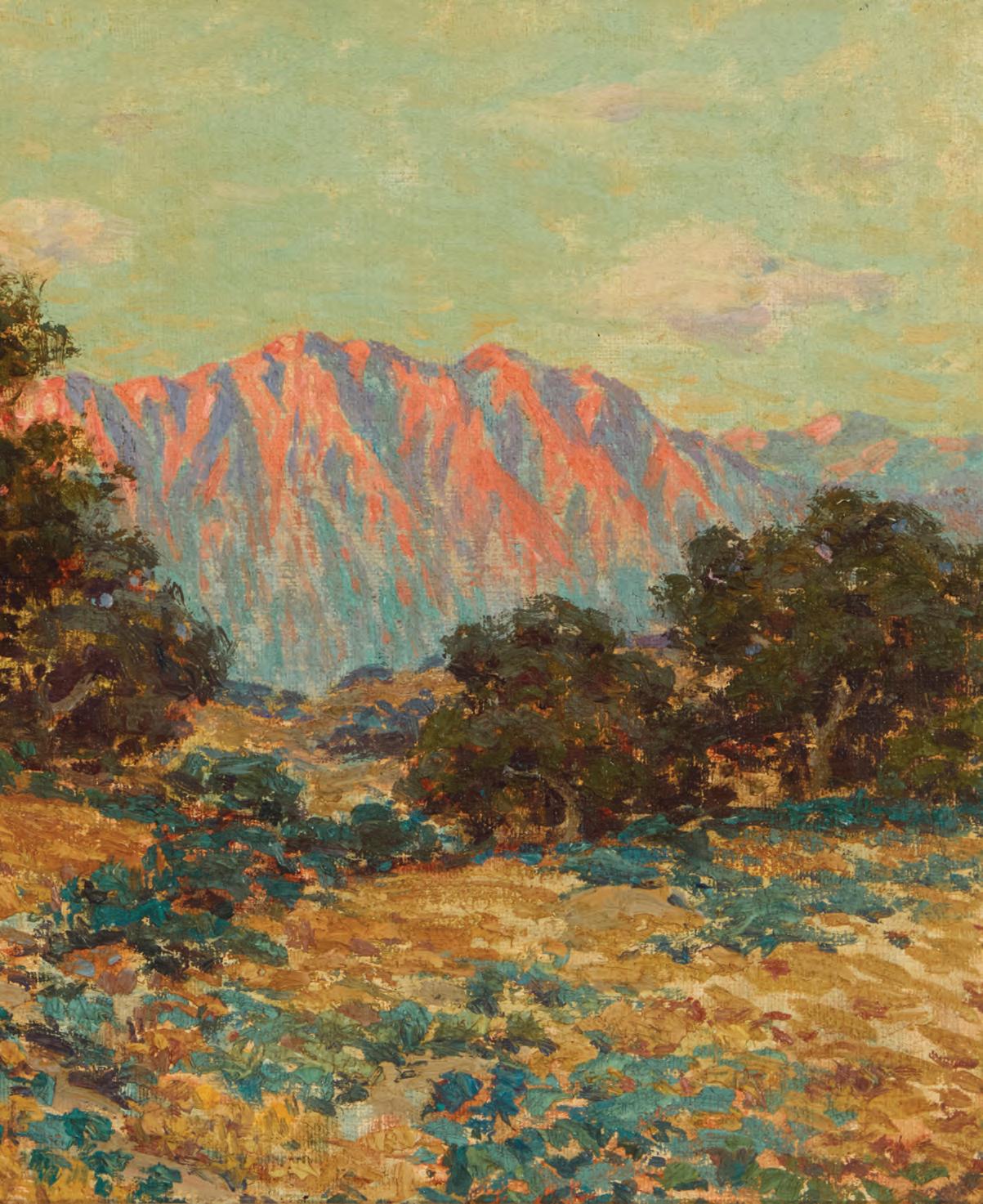
Granville Redmond (1871-1935)
Born in Philadelphia in 1871, Granville Redmond childhood bout of Scarlet Fever left him profoundly for the Deaf from 1879 to 1890 where he led Redmond to Paris, where he attended to his painting “Matin d’hiver” being exhibited
Redmond returned to California in 1898, cities across both Northern and Southern both coastal scenes and the California landscape. upon lush countryside brought him great poppies blossoming on rolling hills that he
Granville Redmond’s work can be found in Art, the Laguna Art Museum, and the Crocker
Redmond spent his formative years growing up in San Jose, California. A profoundly deaf by age three, and Redmond attended the California School learned how to paint and draw. His early excellence in his artistic studies attended the Academie Julian on an academic scholarship. His success in Paris led exhibited at the Paris Salon in 1895. and married Carrie Ann Jean one year later. The couple lived in various California. By 1905, Redmond had become well-known for his paintings of landscape. His ability to capture the transient effects of atmosphere and light renown. Yet Redmond remains best known for his paintings of California he could scarcely paint enough of to meet public demand. in many public collections, including the Los Angeles County Museum of Crocker Art Museum.
1008
Granville Redmond (1871-1935)
Distant mountains at sunset Oil on canvas
Signed lower left: Granville Redmond; signed again in pencil on the stretcher 12” H x 16” W
$12,000-18,000
Provenance:
Sold: Butterfield & Butterfield, Los Angeles, CA, “California and American Paintings,” December 8, 1993, Lot 3387 From the Collection of Robert A. Day
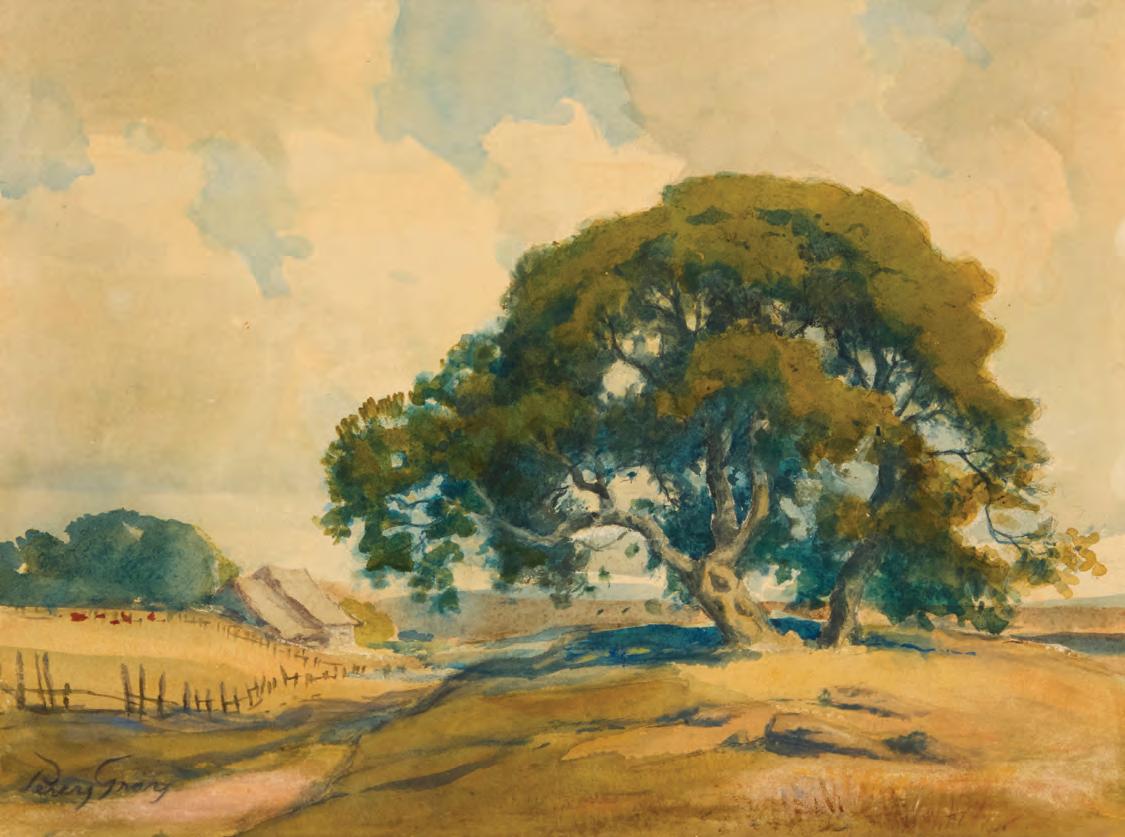
Percy Gray (1869-1952)
Percy Gray was an American painter celebrated San Francisco and trained in New York, Gray watercolors, due to an allergy to oil paints.
His work focused on the gentle beauty of scenes. Influenced by English Romanticism brushwork, and peaceful mood.
While modernist trends emerged around with nature. He was active in the California tradition. Gray’s art captures an idealized,
celebrated for his serene watercolor and oil landscapes of California. Born in Gray began his career as an illustrator before shifting to fine art, mainly paints.
Northern California: rolling hills, oak trees, wildflowers, and misty coastal Romanticism and Tonalism, Gray’s paintings are known for their soft light, delicate him, Gray remained committed to realism and an emotional connection California art scene, exhibiting widely and influencing the regional landscape timeless California: quiet, harmonious, and lovingly observed.
1009
Percy Gray (1869-1952)
“Cattle Ranch”
Watercolor and traces of pencil on paper
Signed lower left: Percy Gray; titled by repute 12” H x 16.125” W
$4,000-6,000
Provenance:
Sold: Butterfield & Butterfield, Los Angeles, CA, “California Paintings,” October 4, 1992, Lot 38 From the Collection of Robert A. Day
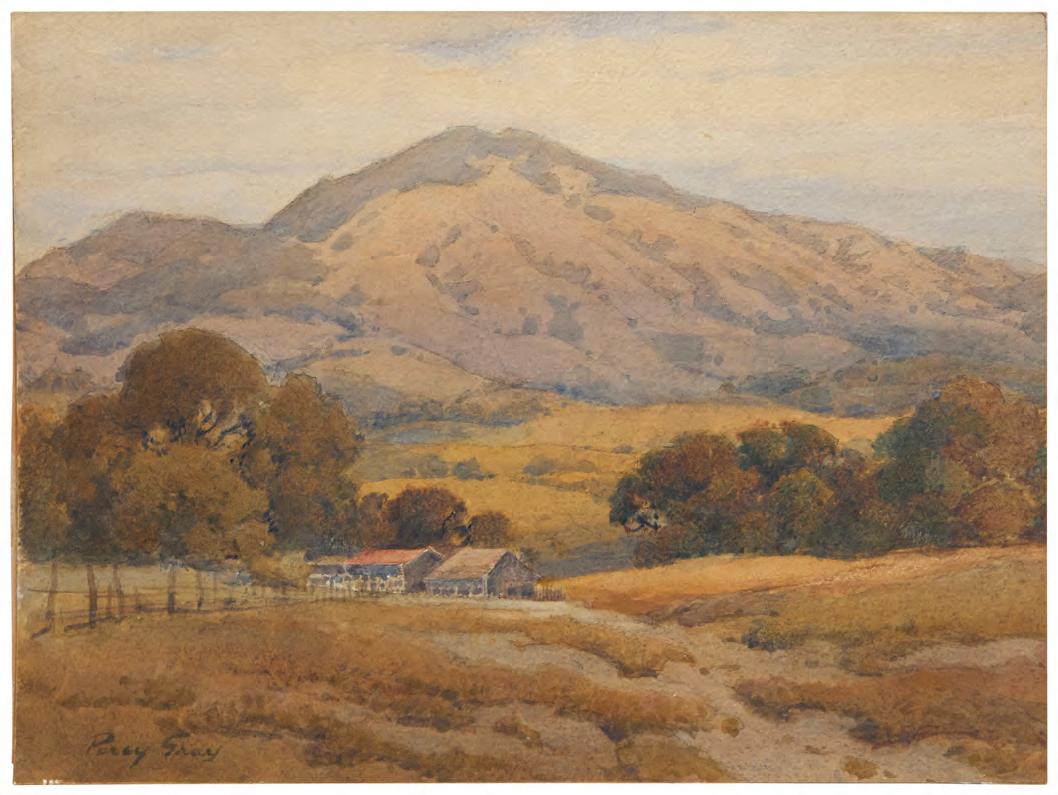
1010
Percy Gray (1869-1952)
Farm in a rolling hills landscape
Watercolor on paperboard
Signed lower left: Percy Gray
11.625” H x 15.5” W
$3,000-5,000
Jessie Arms Botke (1883-1971)
Born in Chicago, Jessie Arms Botke studied moving to New York. There she worked for cartoons. She was a lead bird artist on a significant San Francisco. Botke returned to Chicago successful partnership working on mural commissions of Chicago and the Kellogg Company.
In 1920, the couple moved to California and California. Botke quickly became associated Influenced by Asian Art and the Arts and backgrounds of her bird and foliage-focused
Botke is arguably best known for these richly and cockatoos, that blend careful observation another common subject for the artist, particularly exotic birds while ducks and chickens roamed remained dedicated to depicting birds not artistic practice.
studied at the Art Institute of Chicago and spent some time in Europe before for Herter Looms under Albert Herter and became a specialist in tapestry significant mural commission for Herter Looms at the St. Francis Hotel in Chicago and married Dutch American artist Cornelis Botke. The couple had a commissions for high profile companies and institutions including University and purchased a ten-acre ranch in Wheeler Canyon near Santa Paula, associated with the vibrant art communities of Carmel and later Los Angeles. Crafts movement, she began to incorporate gold and silver leaf in intricate foliage-focused compositions.
richly decorative paintings of birds, particularly her famous albino peacocks observation of nature with a strong sense of pattern and design. Fowl were particularly after settling in rural Santa Paula where she built an aviary for roamed freely on the ranch property. Whether exotic or domestic, Botke not just as natural subjects but as elegant decorative forms throughout her
1011
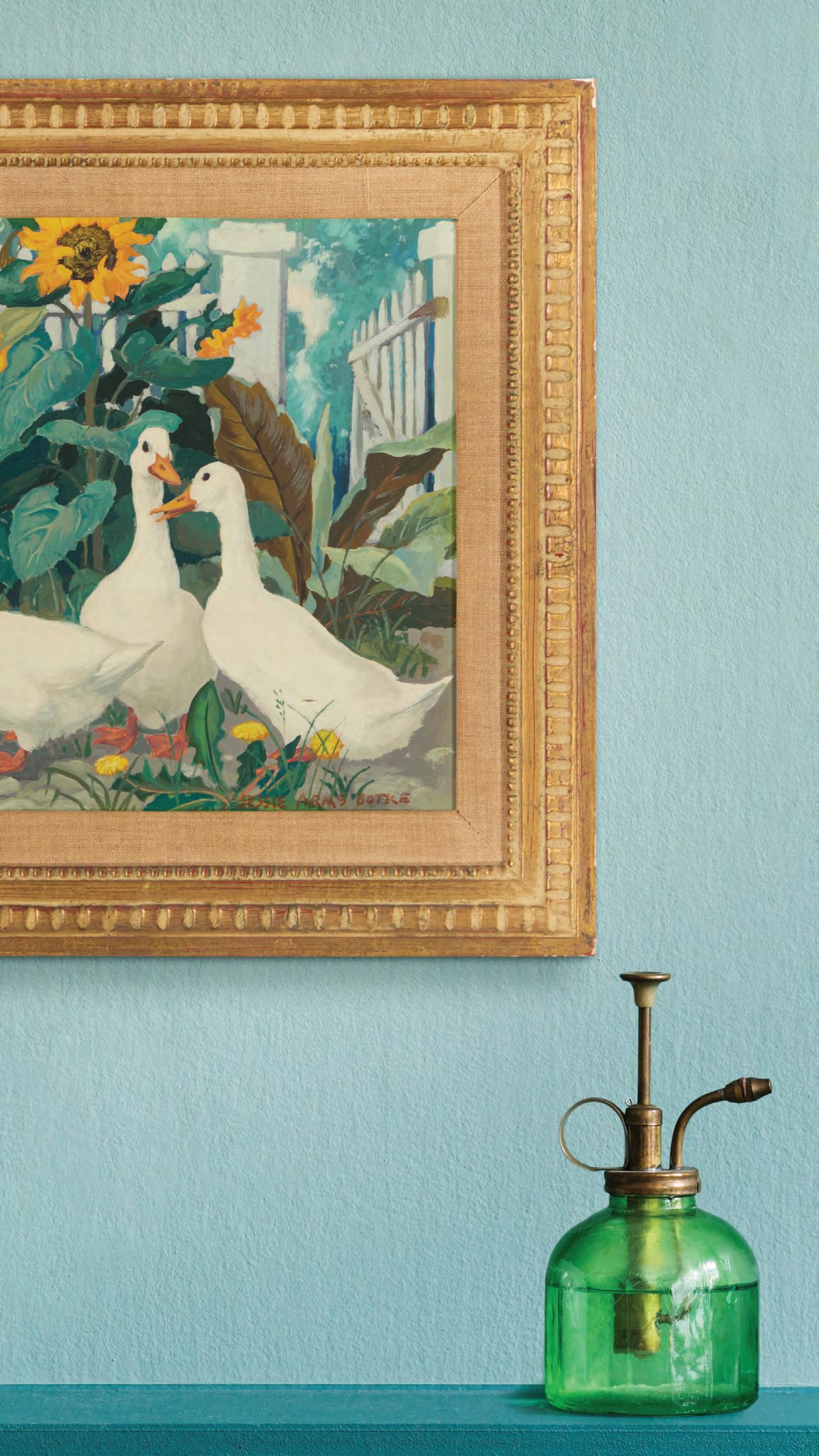
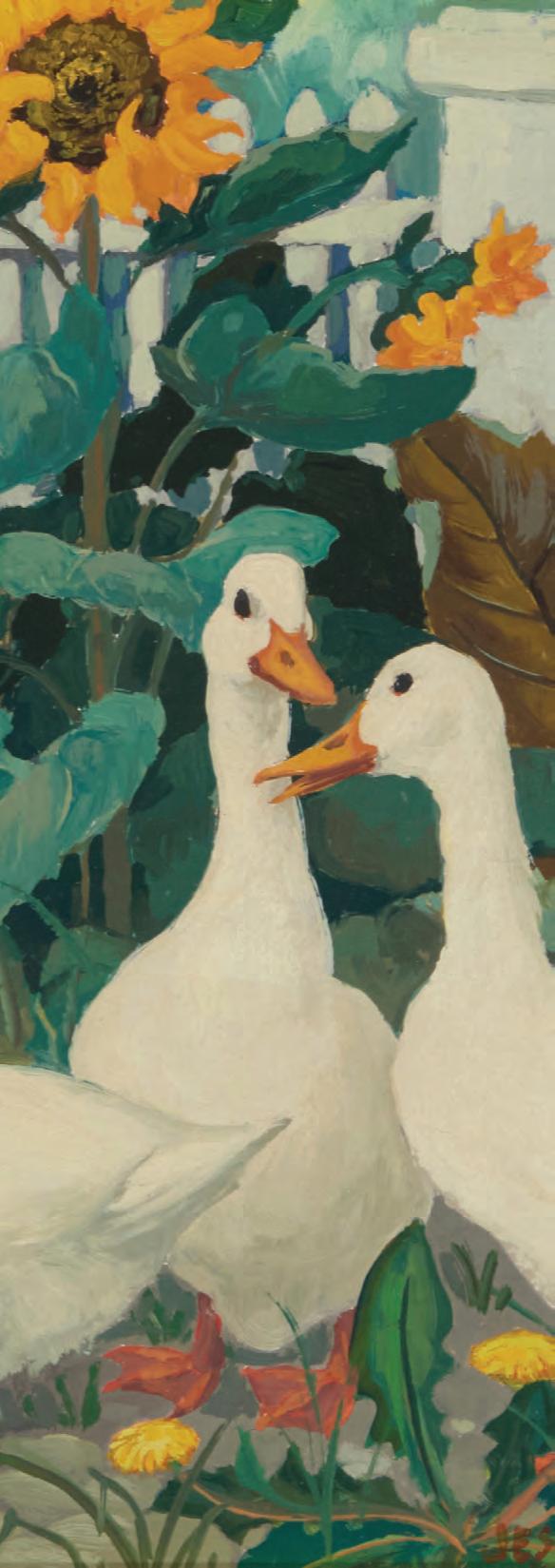
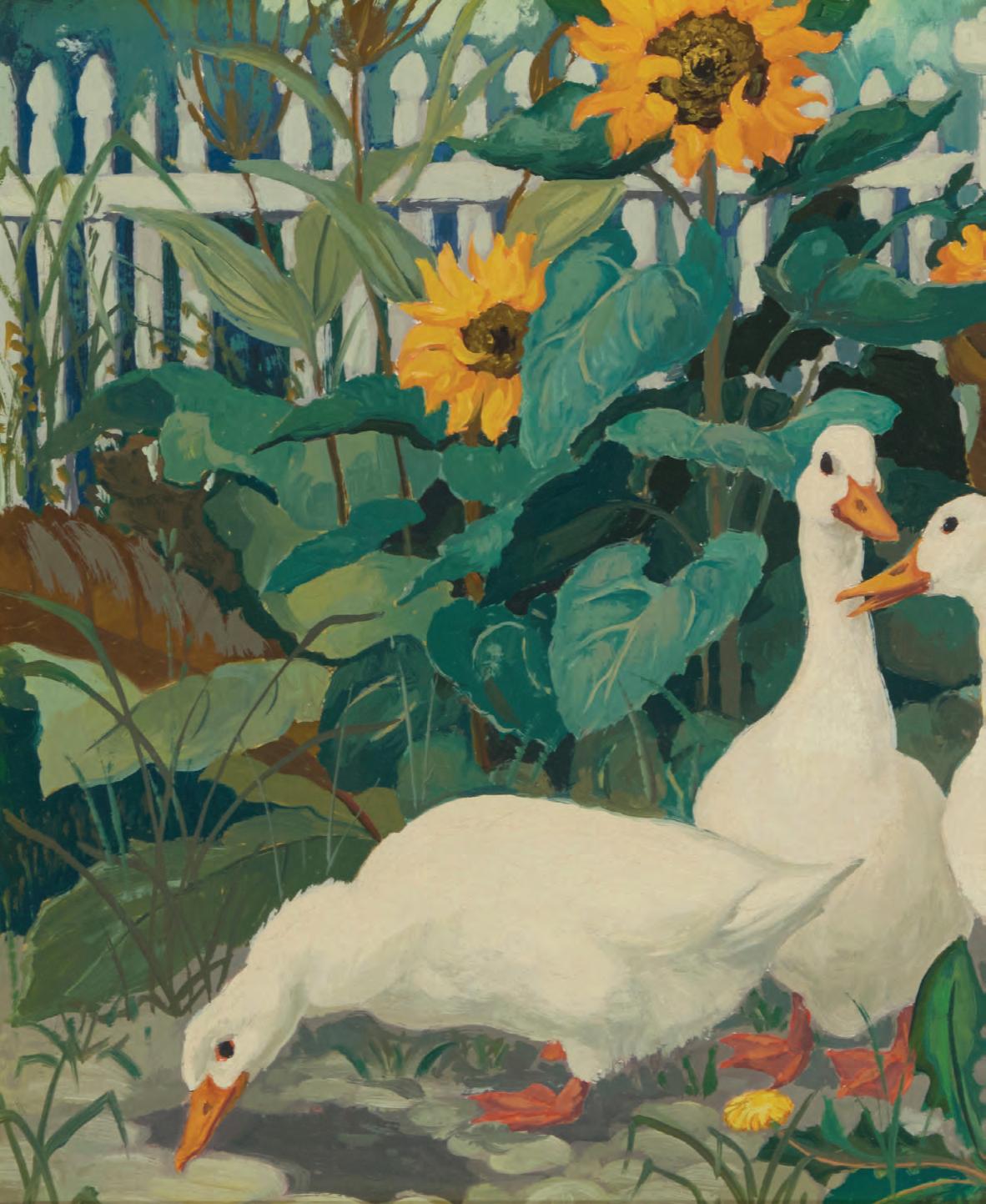
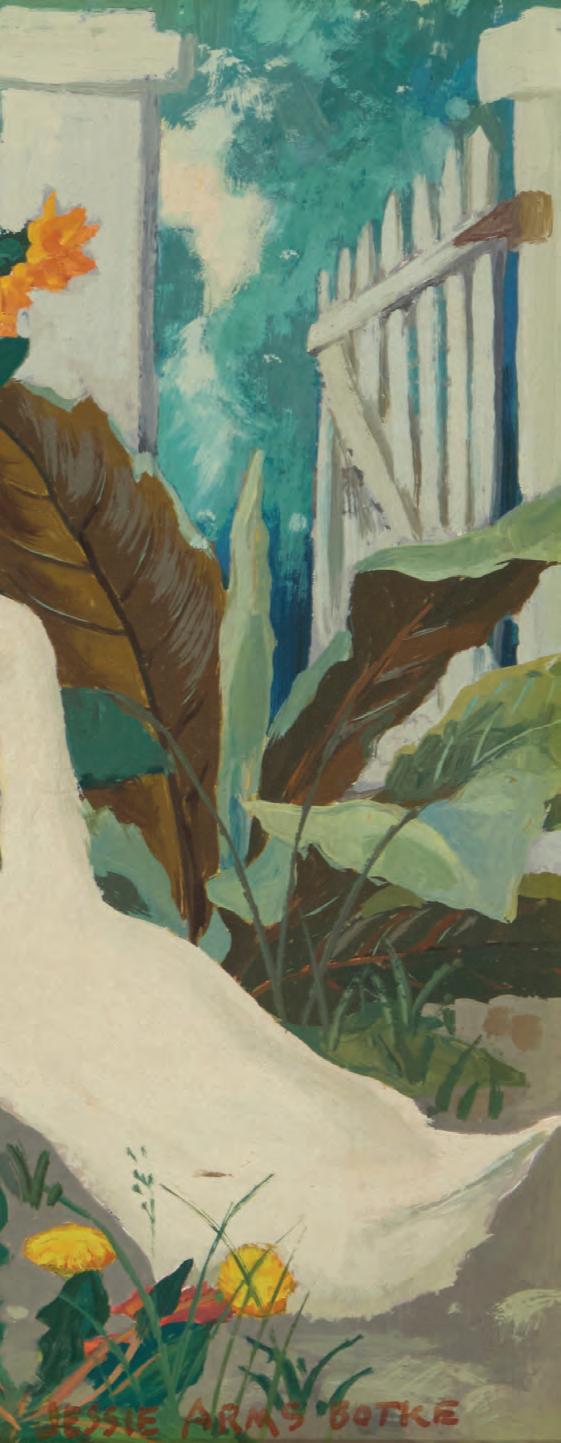
Jessie Arms Botke (1883-1971)
“Ducks”
Oil on board
Signed lower right: Jessie Arms Botke; signed again, titled, and inscribed “frame B,” all in red pencil on the verso; inscribed in ink on a label affixed to the frame’s backing paper: “for / Margaret Keller / with my love” 10” H x 12” W
$8,000-12,000
Provenance: The artist Margaret Keller, Santa Paula, CA, the first female attorney in Ventura County and friend of the artist Private collection, by family descent
1012
Jessie Arms Botke (1883-1971)
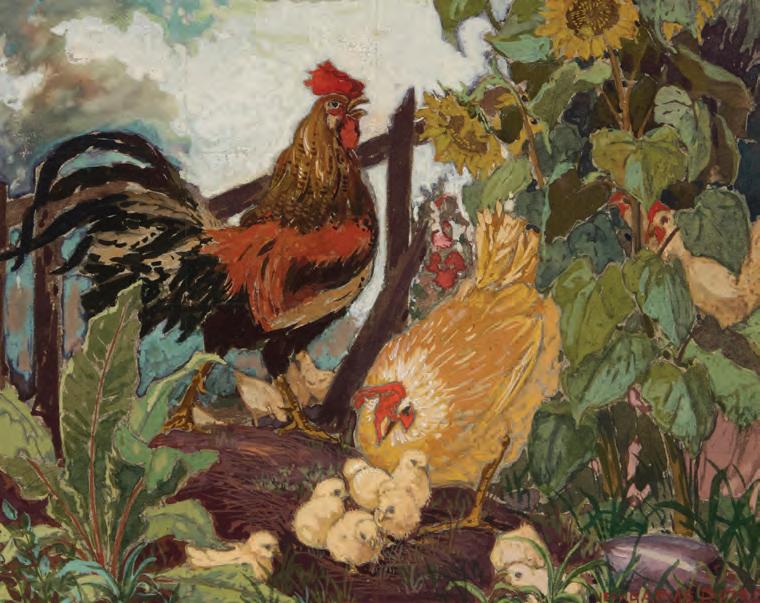
Rooster, hen and brood in a garden, circa 1936
Gouache with touches of graphite on speckled gray paper
Signed lower right: Jessie Arms Botke; faint and partially indistinct pencil notations on the verso of the original frame’s backing board suggest that the work was likely created before the autumn of 1936
Image: 5.625” H x 7.375” W; Sheet: 8.125” H x 10.125” W
$2,000-3,000
1013
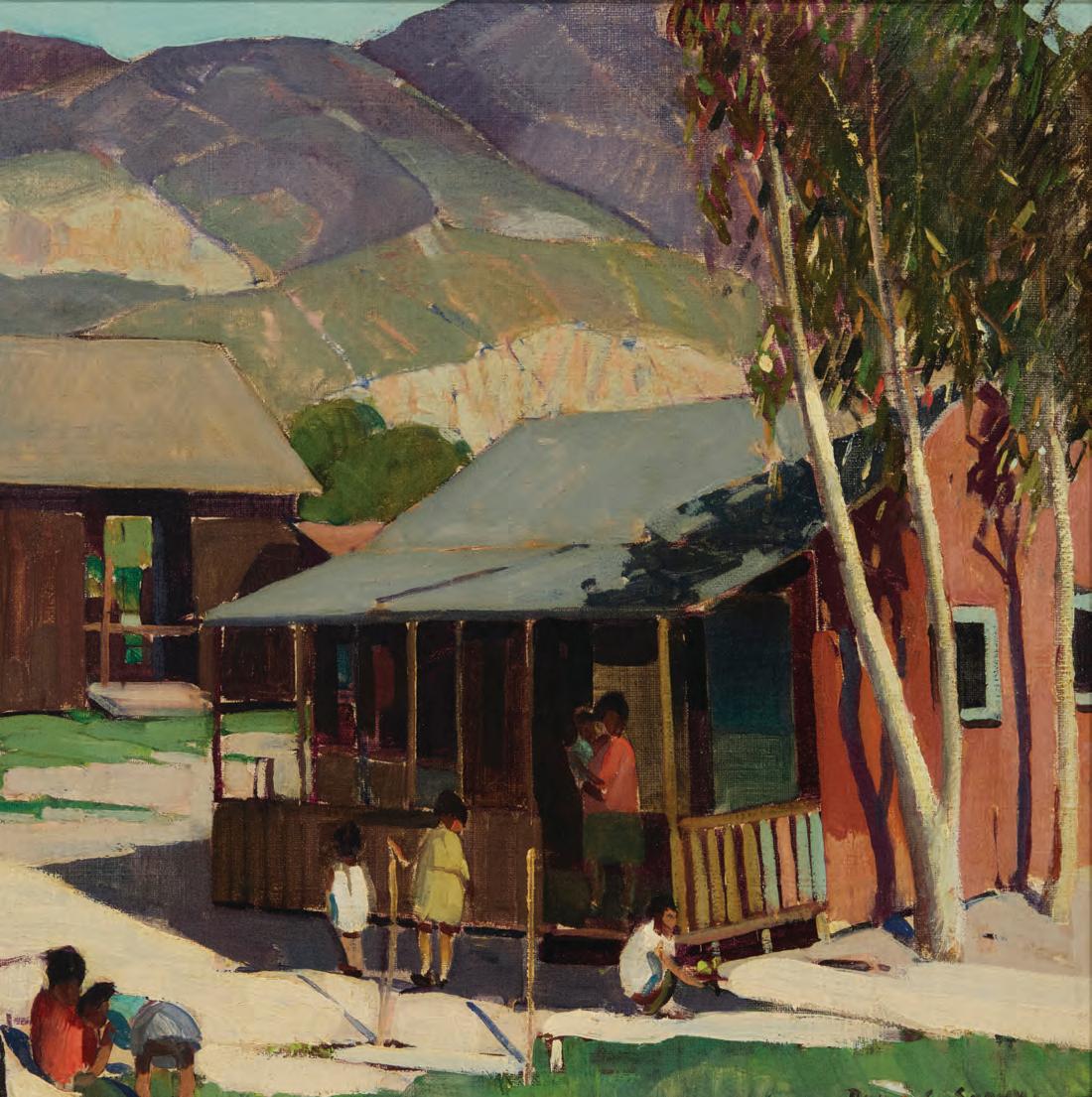
Paul Sample (1896-1974)
“Santa
Signed lower right: Paul Sample; “Paul Sample / 135
Verde 20.25” H x 24.375” W
$4,000-6,000
Provenance: The
Paula Front Yard” Oil on canvas
Arroyo
Redfern Gallery, Laguna
titled, signed, and inscribed on
Beach, CA
Sample;
the stretcher bar: Verde Rd. / S. Pasadena - Calif.”
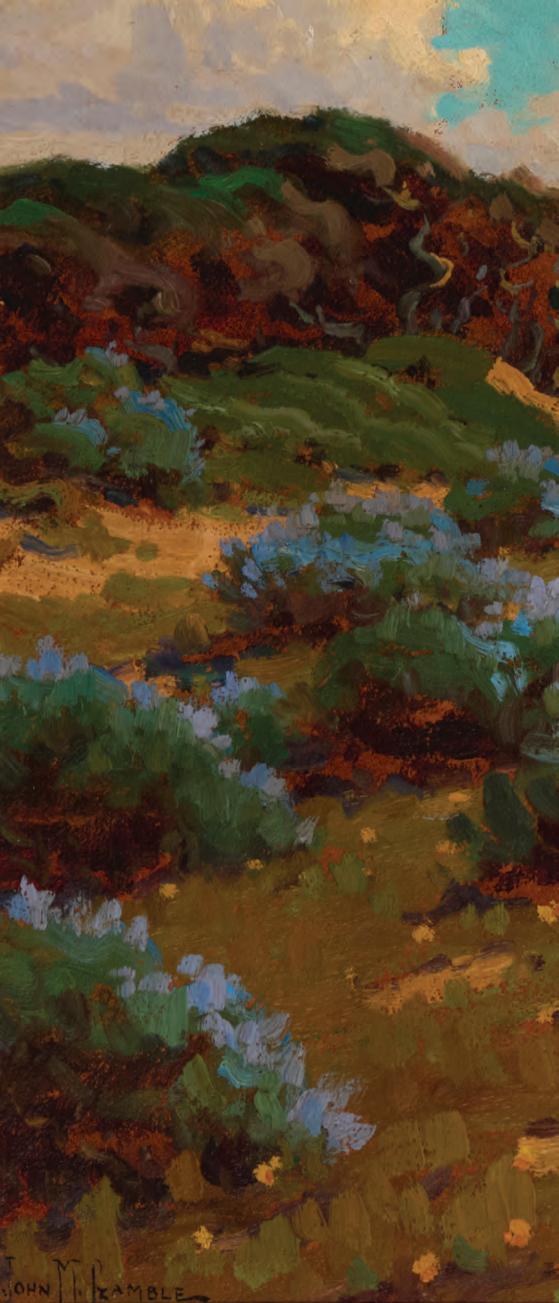
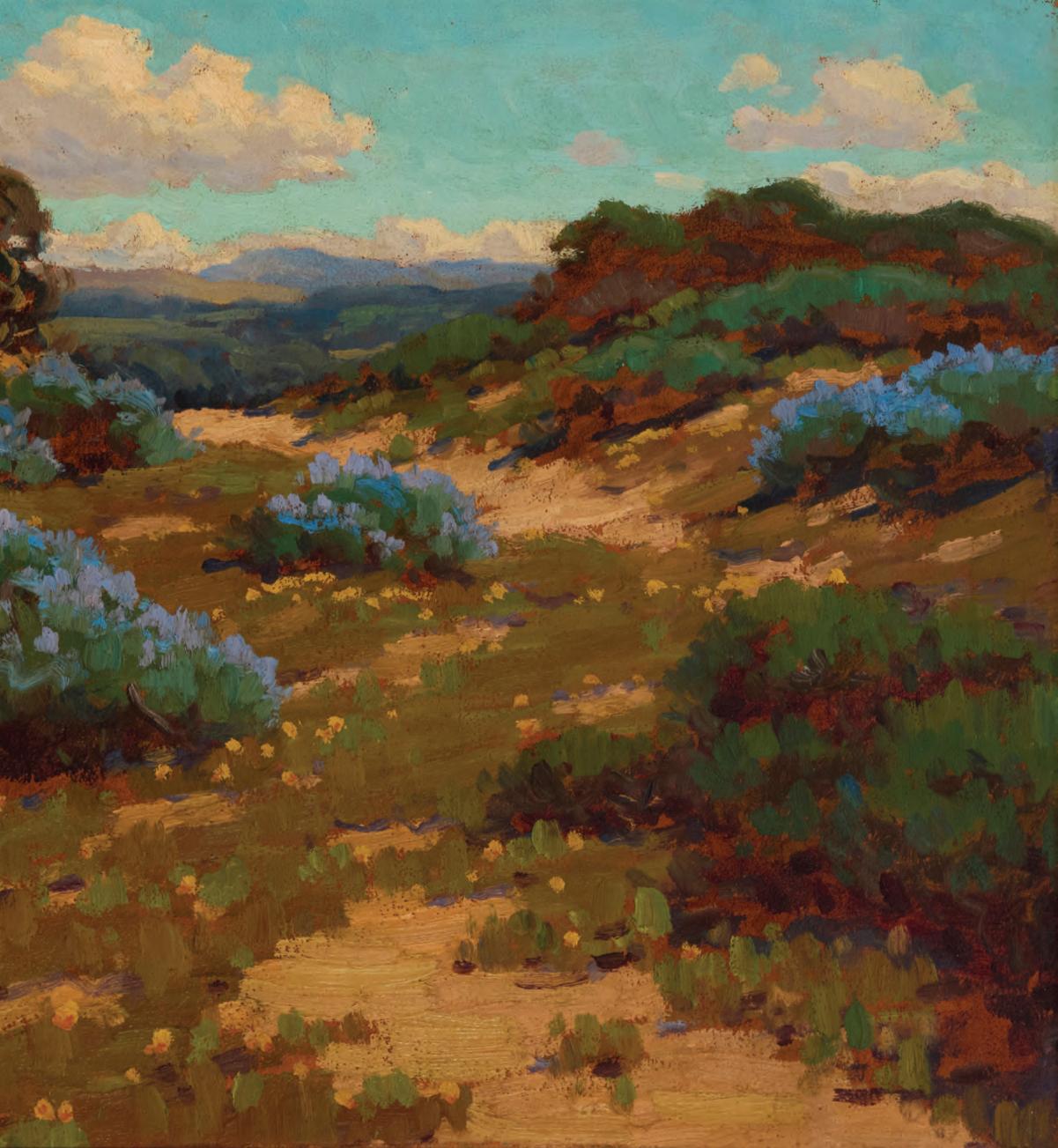
John Marshall Gamble (1863-1957)
John Marshall Gamble is best known for his 1863 in Morristown, New Jersey, Gamble’s father via the San Francisco-Panama City route. In years before making a permanent move to California
Gamble trained at the San Francisco School Academie Julian in Paris, where he studied under refined his technique and developed a deep early exposure to both American and European distinctive California plein air style.
After finishing his training, Gamble returned in his adopted city for the rest of his career, except Following his devastating loss, Gamble had but stopped in Santa Barbara en route, where in Santa Barbara permanently, where he restarted and turning to an increasingly vibrant palette.
In Santa Barbara, Gamble became a key figure Association, and was an active member of the Board of the Santa Barbara School of the Arts, Review for twenty-five years.
Today, Gamble is best known for flower-focused of the Central California coast. Although celebrated them as flowers at all. I didn’t even think of them simply liked the way they designed themselves
vibrant depictions of California’s wildflowers and coastal landscapes. Born in father worked for the Pacific Mail Steamship Company, which carried U.S. mail the late 1870s, Gamble’s family moved to Auckland, New Zealand, for a few California in 1883, when the artist was 20. of Design under Virgil Williams and Emil Carlsen and later at the prestigious under Jean-Paul Laurens and Jean-Joseph Benjamin-Constant. In Paris, Gamble deep appreciation for Impressionism, particularly the work of Claude Monet. His European art traditions gave him a unique perspective that would later influence his to San Francisco, where he opened a studio. It’s likely he would have remained except for the catastrophic 1906 earthquake and fire, in which his studio burned. initially decided to join his friend and fellow artist Elmer Wachtel in Los Angeles, where he witnessed the wildflower bloom for the first time. Gamble opted to stay restarted his career, exploring the local landscape, coast, and mountains as subject palette.
figure in the region’s art scene, serving as president of the Santa Barbara Art the California Impressionist movement. He also taught and was President of the Arts, and was a color consultant for the Santa Barbara Board of Architectural flower-focused landscapes, especially the vivid poppy fields and lupine-covered hillsides celebrated for his wildflower field subjects, he once commented, “I never painted them as flowers while I was painting. They were just color patches to me. I themselves across the field.” (Santa Barbara News Press, April 3, 1956)
1014
John Marshall Gamble (1863-1957)
“Bush Lupine, Seaside” Oil on board
Signed lower left: John M. Gamble; signed, titled, and inscribed all verso: “John M. Gamble / Santa Barbara / Cal.” 18.25” H x 24.25” W
$12,000-18,000
Provenance:
Mr. and Mrs. Sidney Sheldon
Sold: Bonhams, “California and Western Paintings and Sculpture,” Los Angeles, April 8, 2014, Lot 73
From the Collection of Robert A. Day
Exhibited:
Palm Springs, CA, Palm Springs Desert Museum, “California Grandeur and Genre,” December 31, 1991-March 14, 1993, no. 10
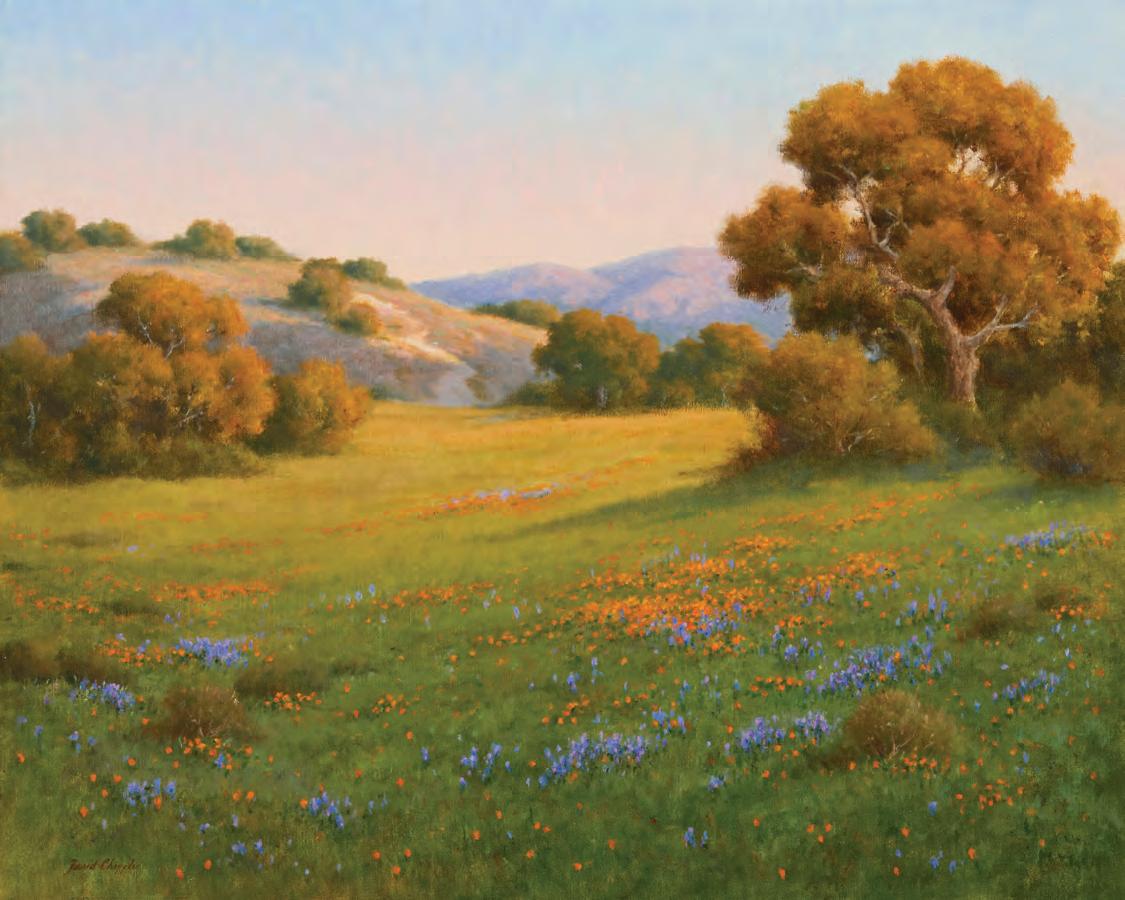
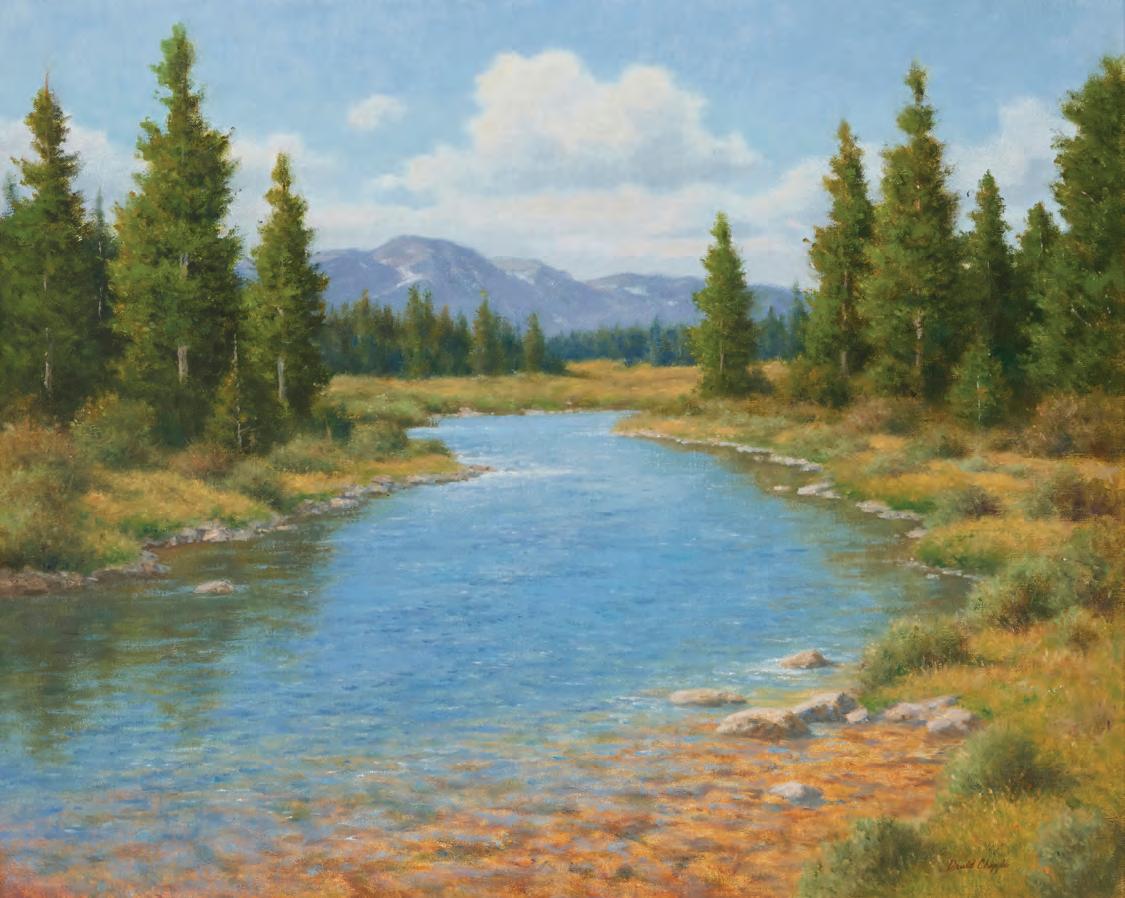
Signed lower left: David Chapple; titled verso 24” H x 30” W
$4,000-6,000
David Chapple
(b. 1947)
“Sunlit Hillside” Oil on canvas laid to board
1020
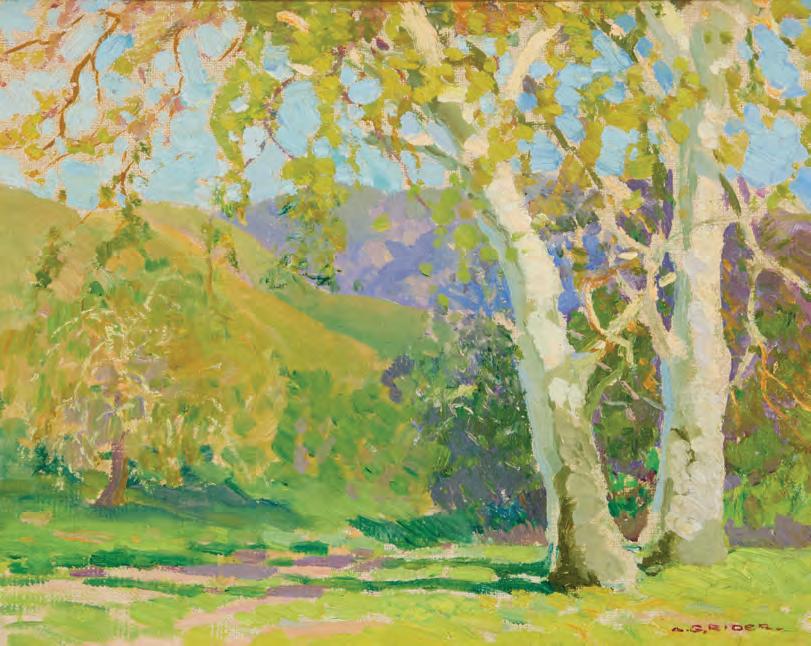
Arthur Grover Rider (1886-1975)
“Laguna Canyon”
Oil on canvas laid to aluminum composite honeycomb panel
Signed lower right: A.G. Rider; titled on a label affixed verso 12” H x 15” W
$4,000-6,000
Provenance:
Sold: Bonhams, Los Angeles, CA, “California and American Paintings & Sculpture,” November 23, 2009, Lot 121
California Paintings: Experts in American Art, Beverly Hills, CA
1021
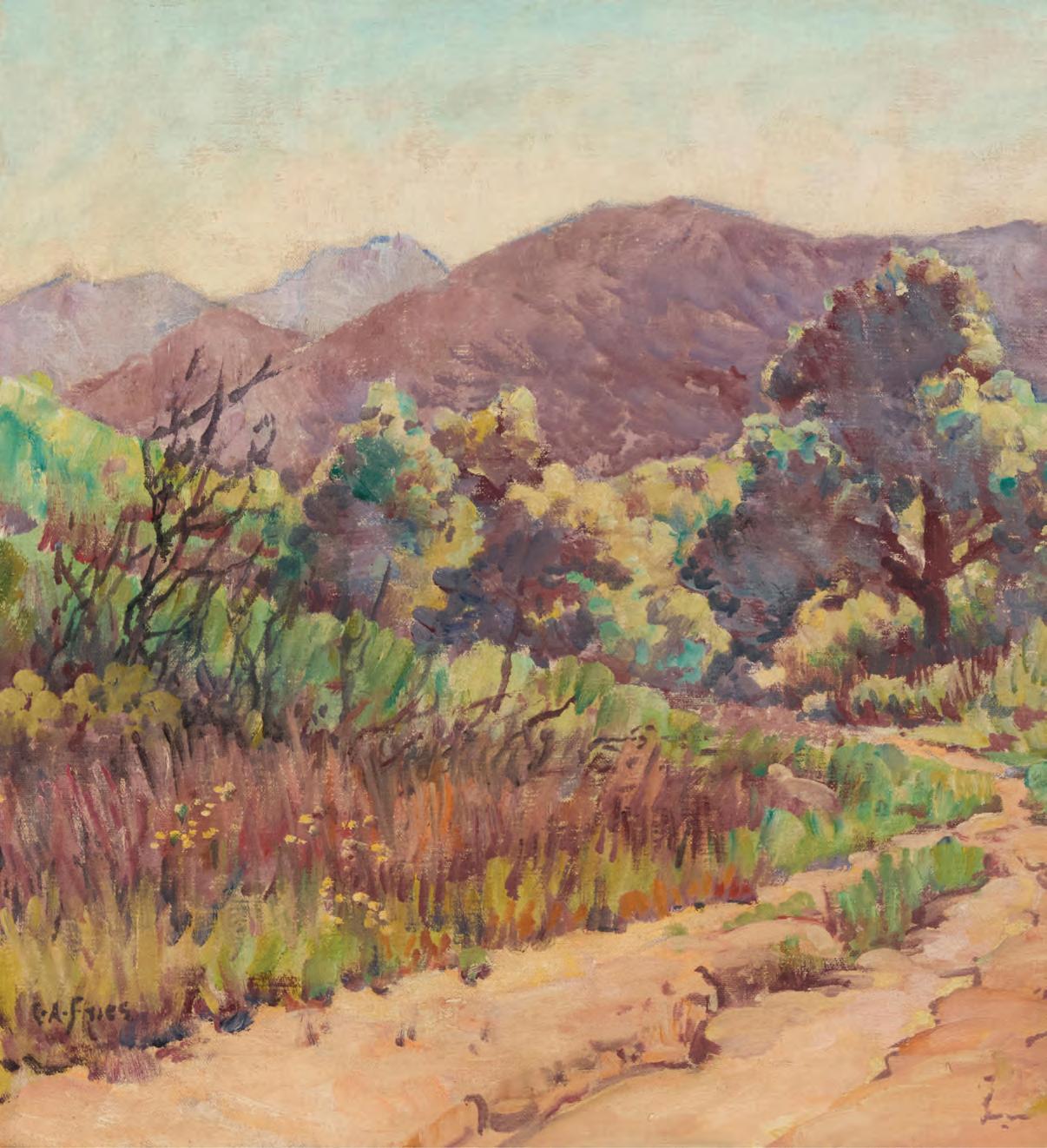
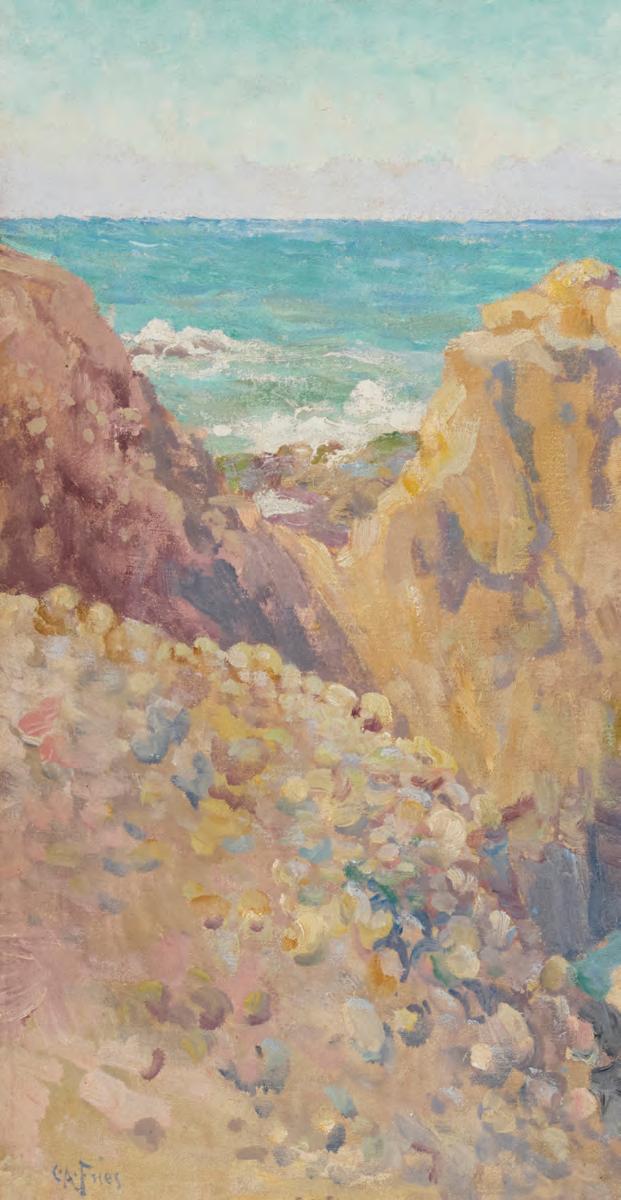
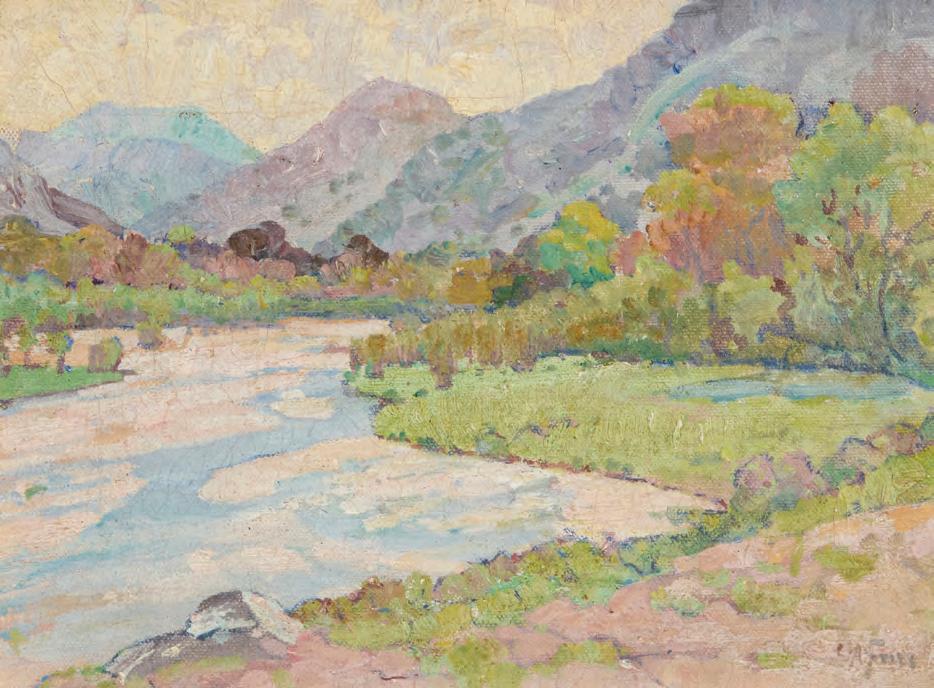
Charles Arthur Fries (1854-1940)
“The Abandoned Road,” 1931 Oil on canvas
Signed lower left: C.A. Fries; titled, dated, and inscribed in ink verso: “May 1931 / #1472 / 1 Mile East / of Muzzy [sic] Grade” 20” H x 24” W
$4,000-6,000
Provenance:
The artist
Dorothy Adelaide King, granddaughter of the artist, gift from the above, 1931 Sold: Bonhams, Los Angeles, CA, “California Art,” August 3, 2021, Lot 104 Estate, Grand Terrace, CA
Literature:
B.F. Dixon, ed., “Too Late: The Picture and the Artist, A Tribute to the Dean, From the Archives of Artist Charles A. Fries and author Addie Davis Fries, His Wife,” San Diego, Don Diego’s Libreria, 1969, no. 1472, p. 100
Notes:
According to the artist’s catalogue, Fries began a five-day painting trip to “Bradways [sic] Ranch” on May 27, 1931, and the present work is the first painting listed for works completed on the trip. Bradway’s Ranch likely refers to artist Walter Earl Bradway’s (1882-1963) San Diego County property.
Mussey Grade (misspelled here as “Muzzy Grade”) is a rural neighborhood in Ramona, CA, known for its scenic beauty and historic significance. From the 1870s until the opening of Highway 67 in 1943, Mussey Grade Road served as the only route west from Ramona to San Diego.
1022
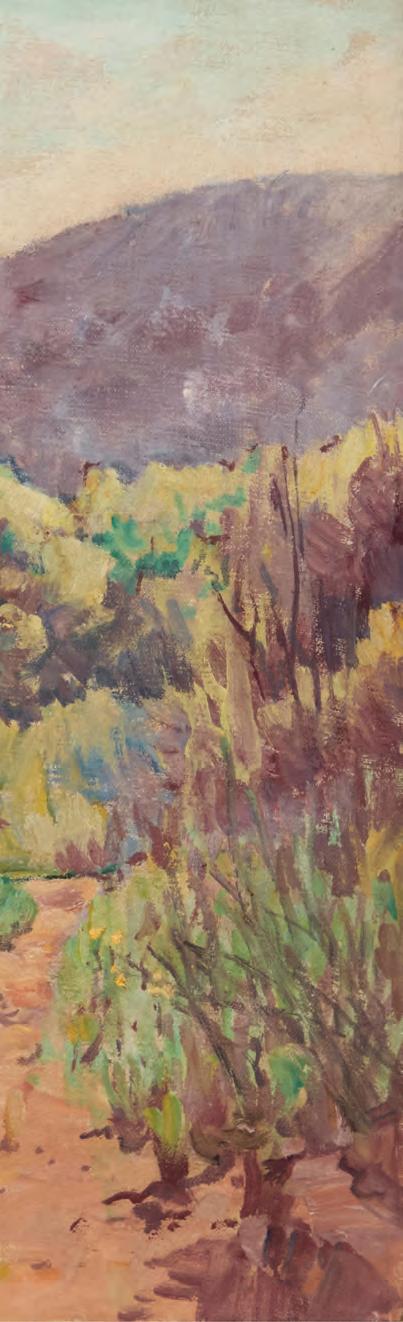
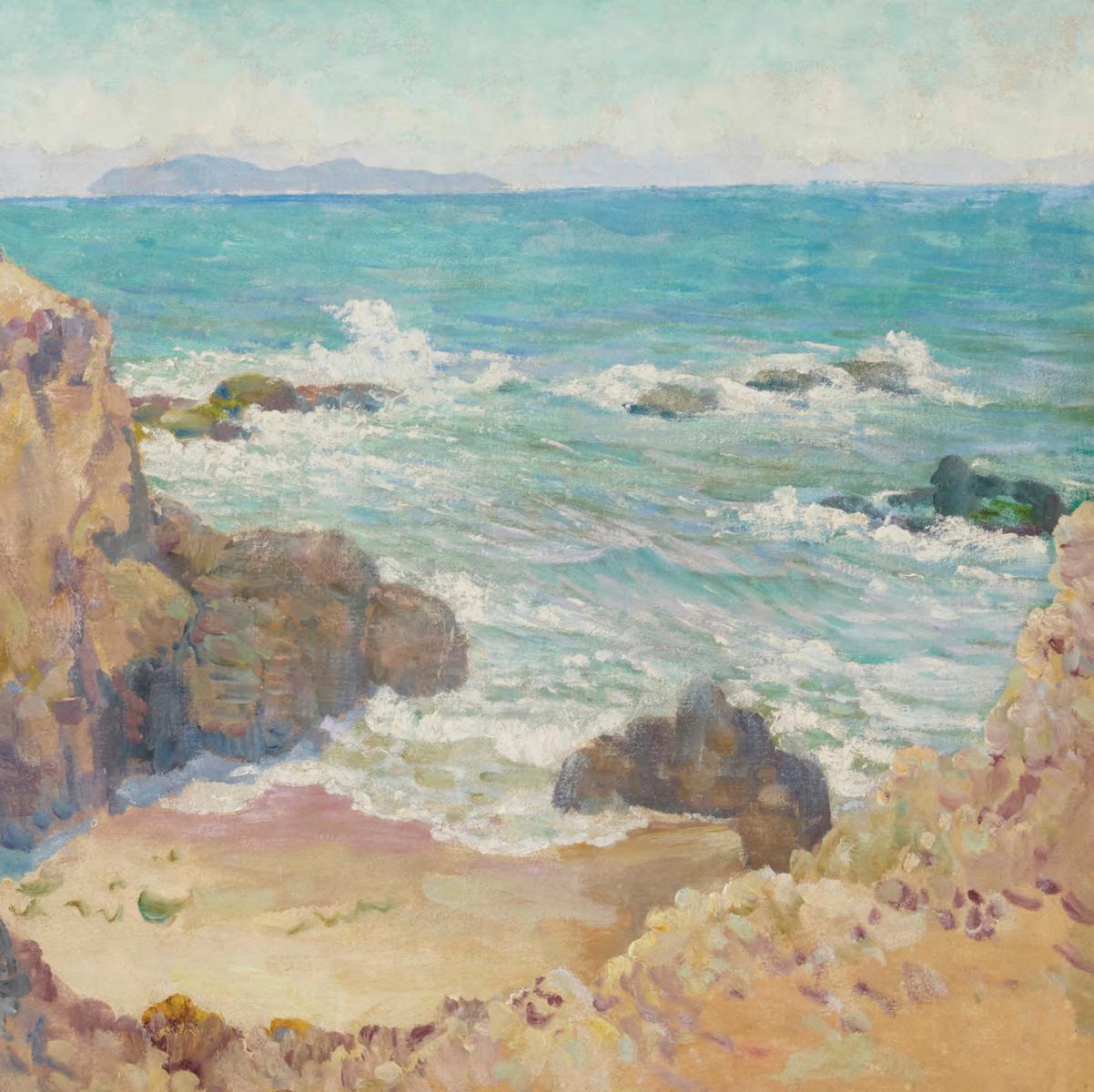
Charles Arthur Fries (1854-1940)
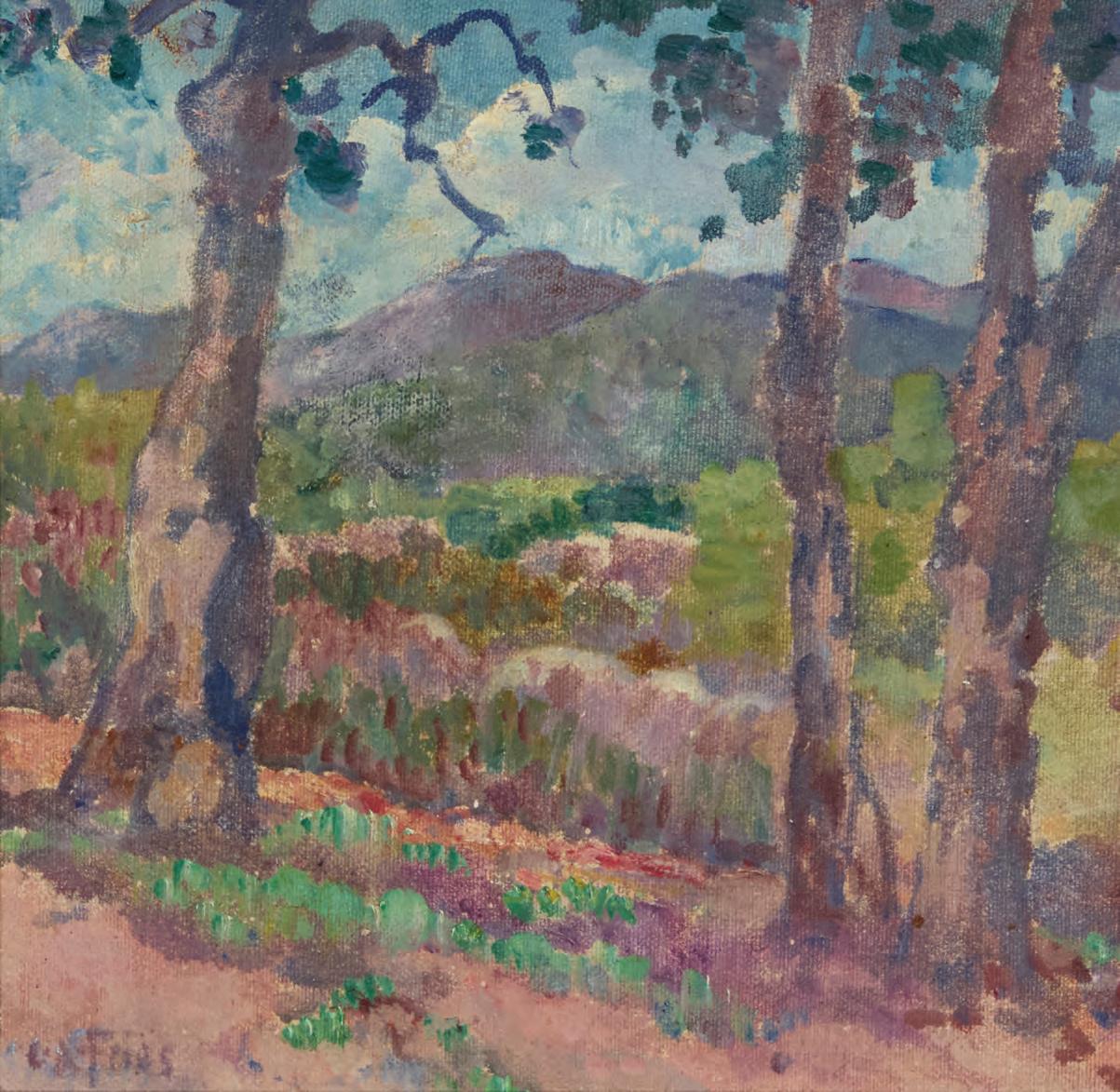
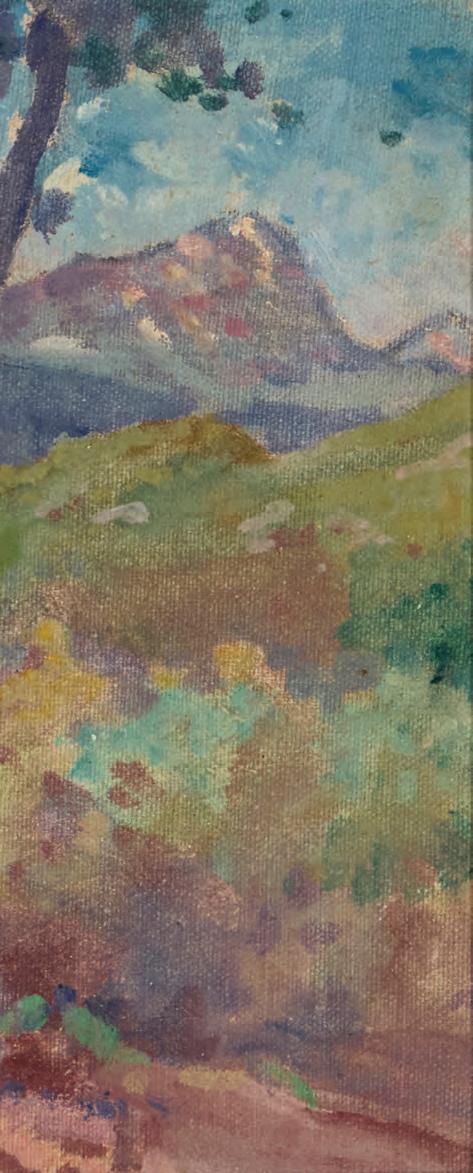
Hills behind San Diego Oil on canvas laid to artist’s board
Signed twice lower right: C.A. Fries
10.5” H x 14.75” W
$3,000-5,000
Provenance: Estate, Grand Terrace, CA
1023
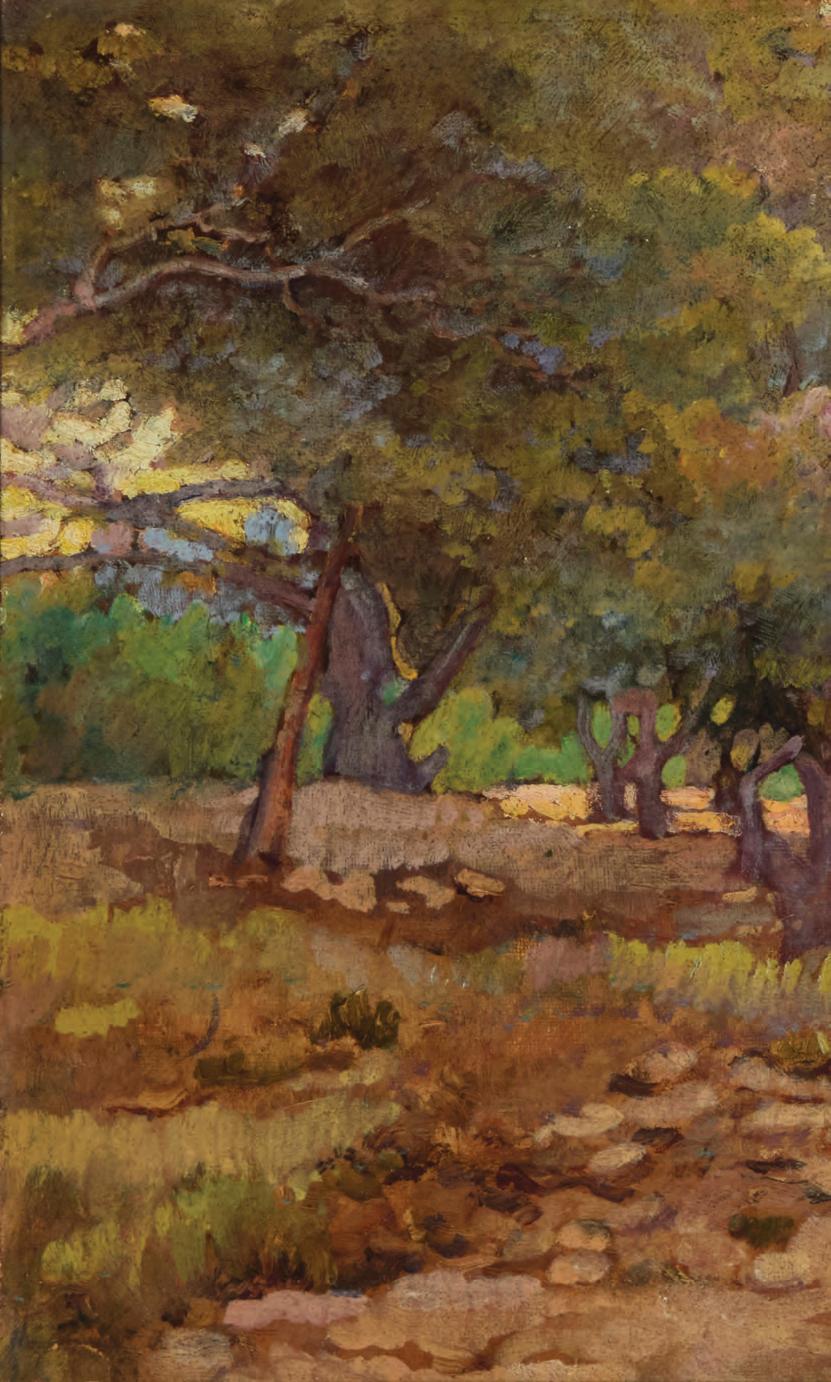
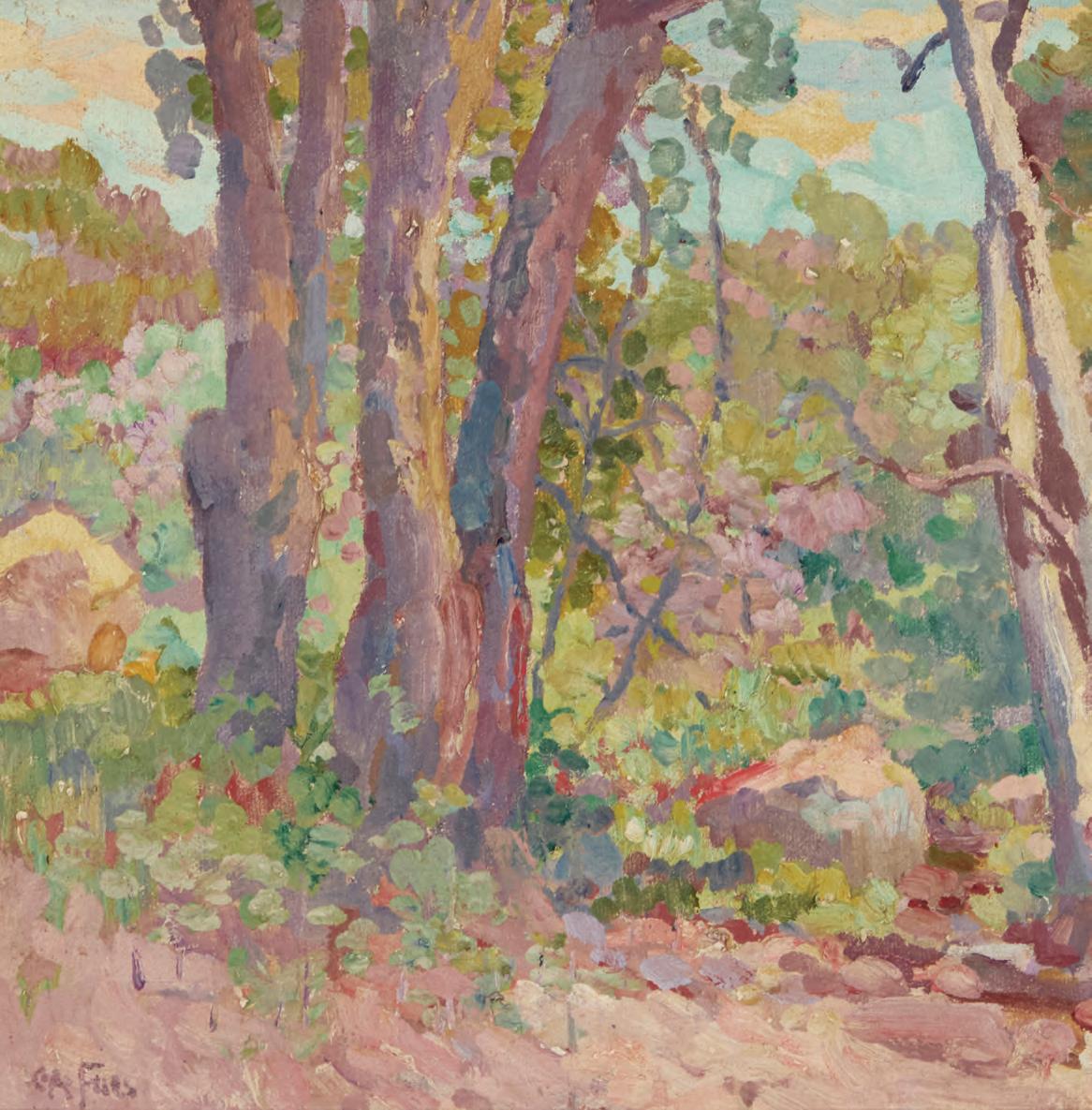
Charles Arthur Fries (1854-1940)
“Oaks Near Mussey Grade,” 1930 Oil on canvas
Signed lower left: C.A. Fries; titled, “Oaks near Muzzey [sic] Grade,” dated “Feb 1930,” and numbered “#1407,” all in ink, verso 10” H x 14” W
$3,000-5,000
Provenance:
The artist
Harriet Garfield, gifted from the artist, June 1933
Sold: Bonhams, Los Angeles, CA, “California Art,” April 24, 2023, Lot 103 Estate, Grand Terrace, CA
Literature:
B.F. Dixon, ed., “Too Late: The Picture and the Artist, A Tribute to the Dean, From the Archives of Artist Charles A. Fries and author Addie Davis Fries, His Wife,” San Diego, Don Diego’s Libreria, 1969, no. 1407, p. 98
Notes:
According to the artist’s catalogue, Fries “Went to Bradways [sic] Ranch for One Week” on February 17, 1930, and the present work is the second painting listed for works completed on the trip. Bradway’s Ranch likely refers to artist Walter Earl Bradway’s (1882-1963) San Diego County property.
Mussey Grade (misspelled here as “Muzzey Grade”) is a rural neighborhood in Ramona, CA, known for its scenic beauty and historic significance. From the 1870s until the opening of Highway 67 in 1943, Mussey Grade Road served as the only route west from Ramona to San Diego.
1024
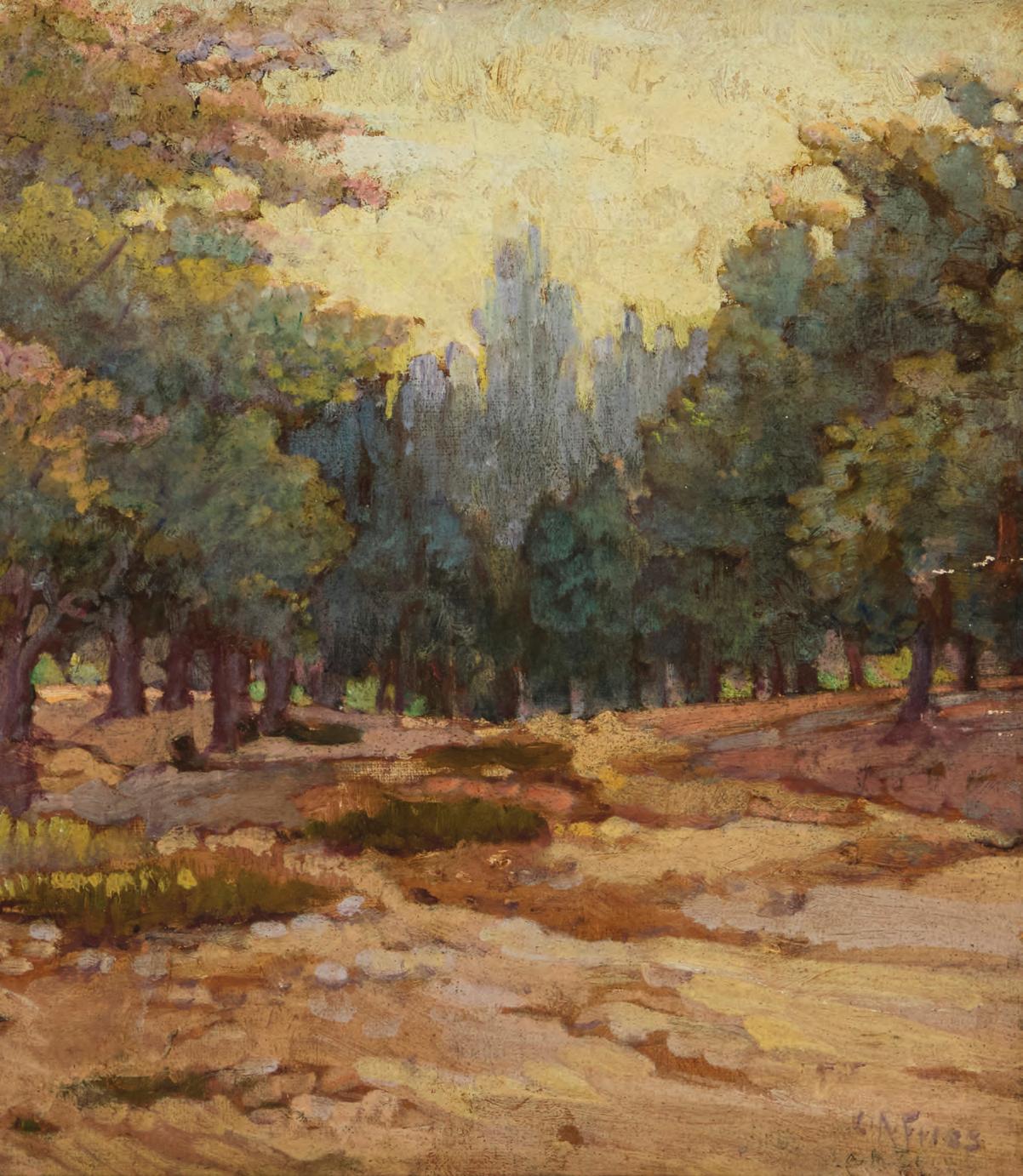
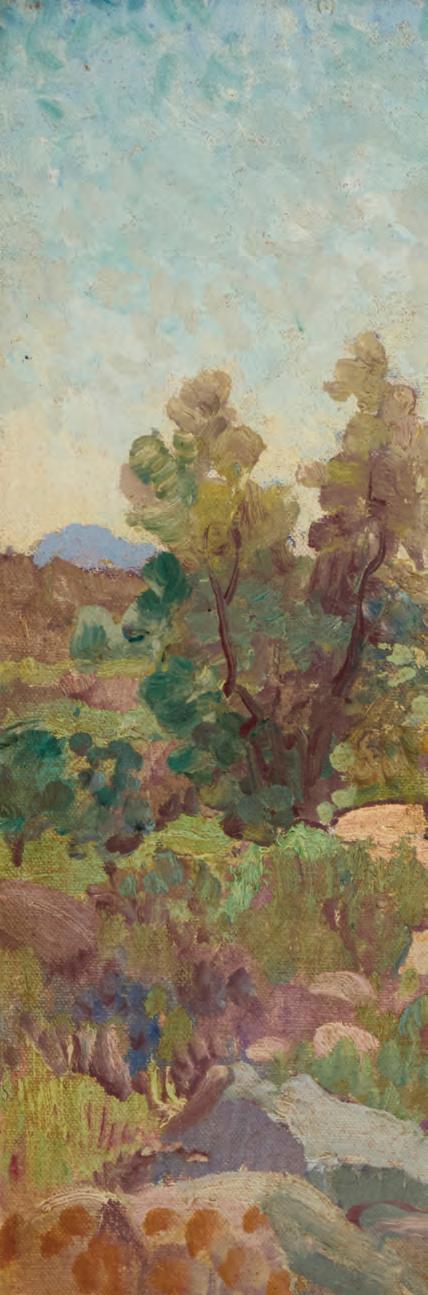
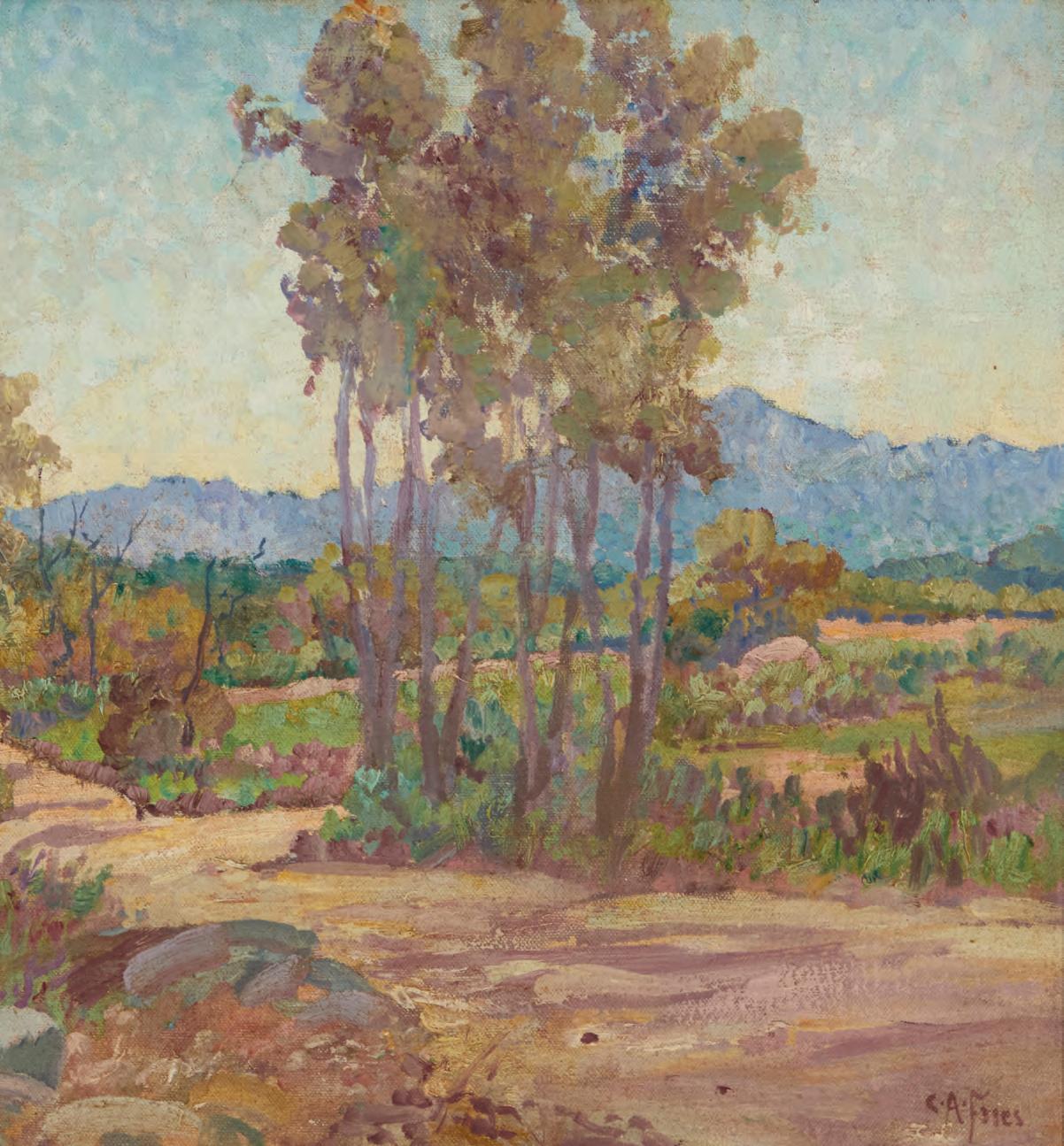
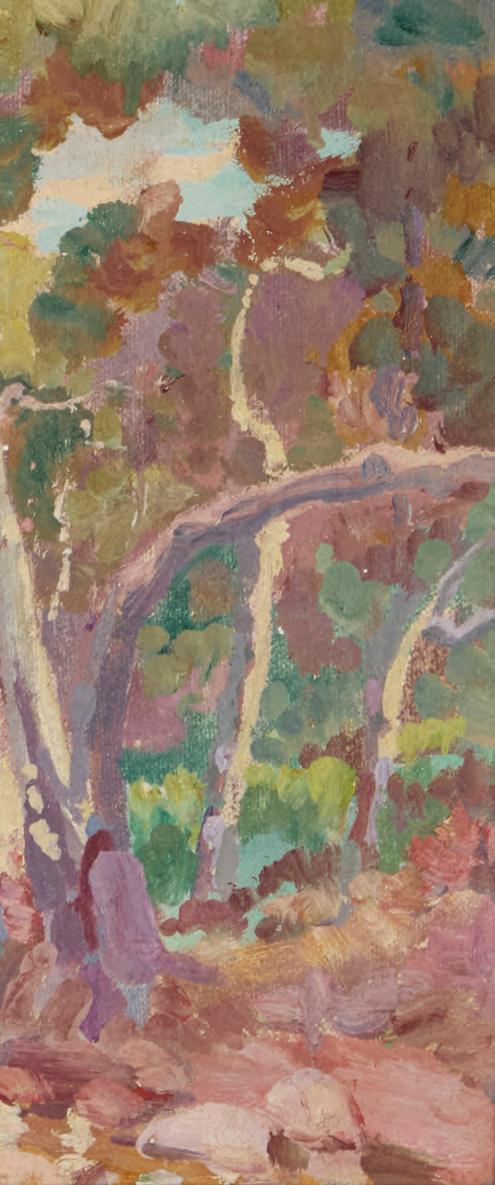
Charles Arthur Fries (1854-1940)
“Eucalyptus Near Alpine,” 1927 Oil on canvas laid to waxed canvas
Signed lower right: C.A. Fries; titled and numbered “#1325” from a photograph of the verso prior to relining (affixed to the frame’s backing board); dated from a gallery label affixed to the frame’s backing board 16.25” H x 20.25” W
$3,000-5,000
Provenance:
The artist
Gifted to the San Diego Art Institute, likely from the artist’s estate, April 25, 1956 Orr’s Gallery, San Diego, CA Estate, Grand Terrace, CA, acquired from the above, September 12, 1986
Literature:
B.F. Dixon, ed., “Too Late: The Picture and the Artist, A Tribute to the Dean, From the Archives of Artist Charles A. Fries and author Addie Davis Fries, His Wife,” San Diego, Don Diego’s Libreria, 1969, no. 1325, p. 95
1025
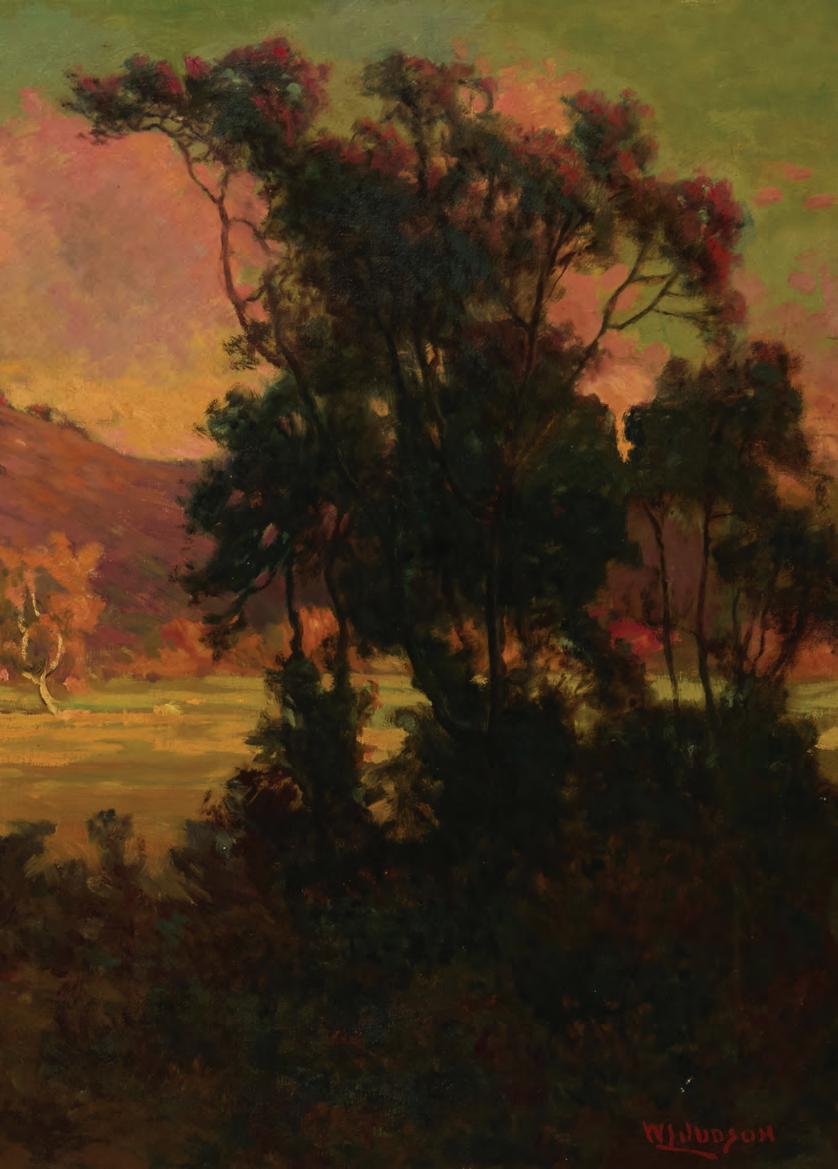
William Lees Judson (1842-1928)
Autumn landscape Oil on canvas
Signed lower right: W.L. Judson; numbered in black verso: “670” 20.25” H x 34.25” W
$1,500-2,500
Provenance: The artist By family descent
1026
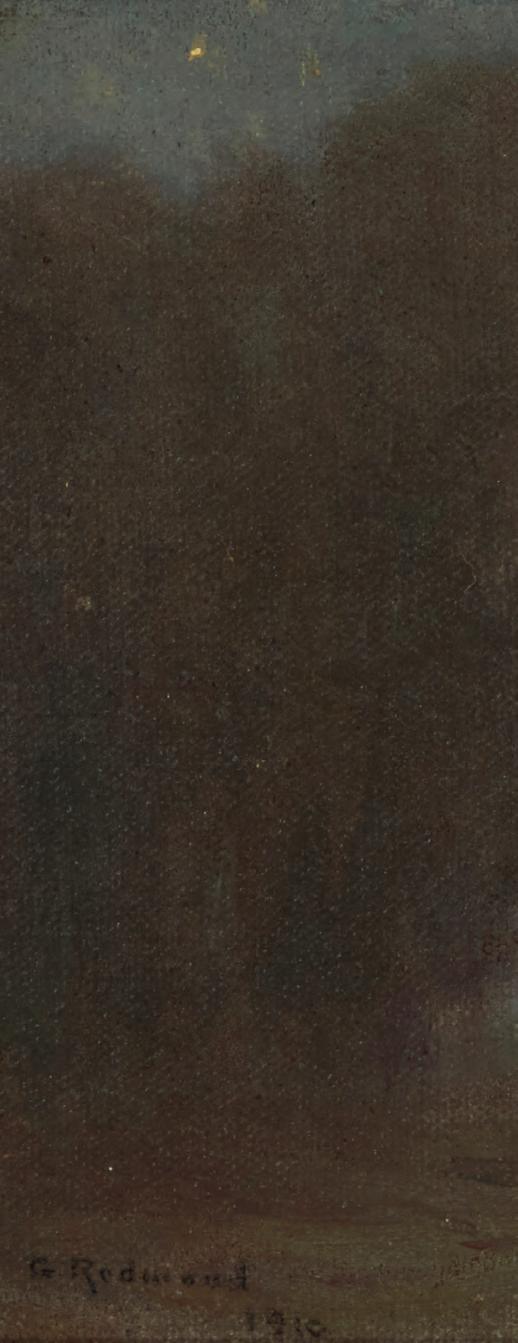
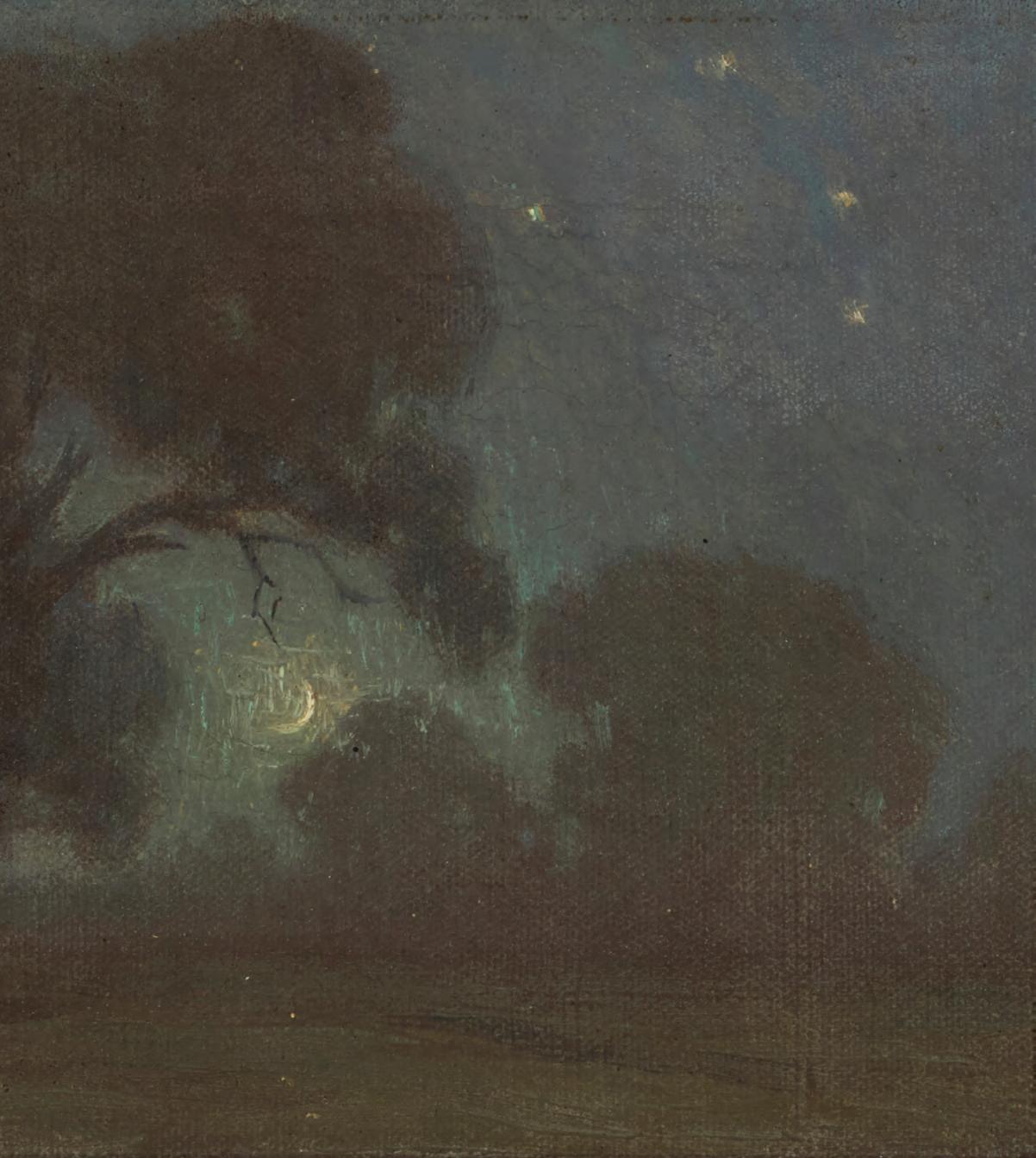
Granville Redmond (1871-1935)
“New Moon” (Laguna Beach), 1910 Oil on canvas
Signed lower left: G. Redmond / 1910; titled on the stretcher; alternatively titled and dated “Moonlight Mystery (1915)” on a typed label affixed verso 6” H x 8” W
$4,000-6,000
Provenance:
Mrs. William Swift Daniell collection of paintings of Old Laguna Mary and Helen Norton
Private collection, acquired at a gallery auction, 1958 Kerwin Galleries, Burlingame, CA
1027
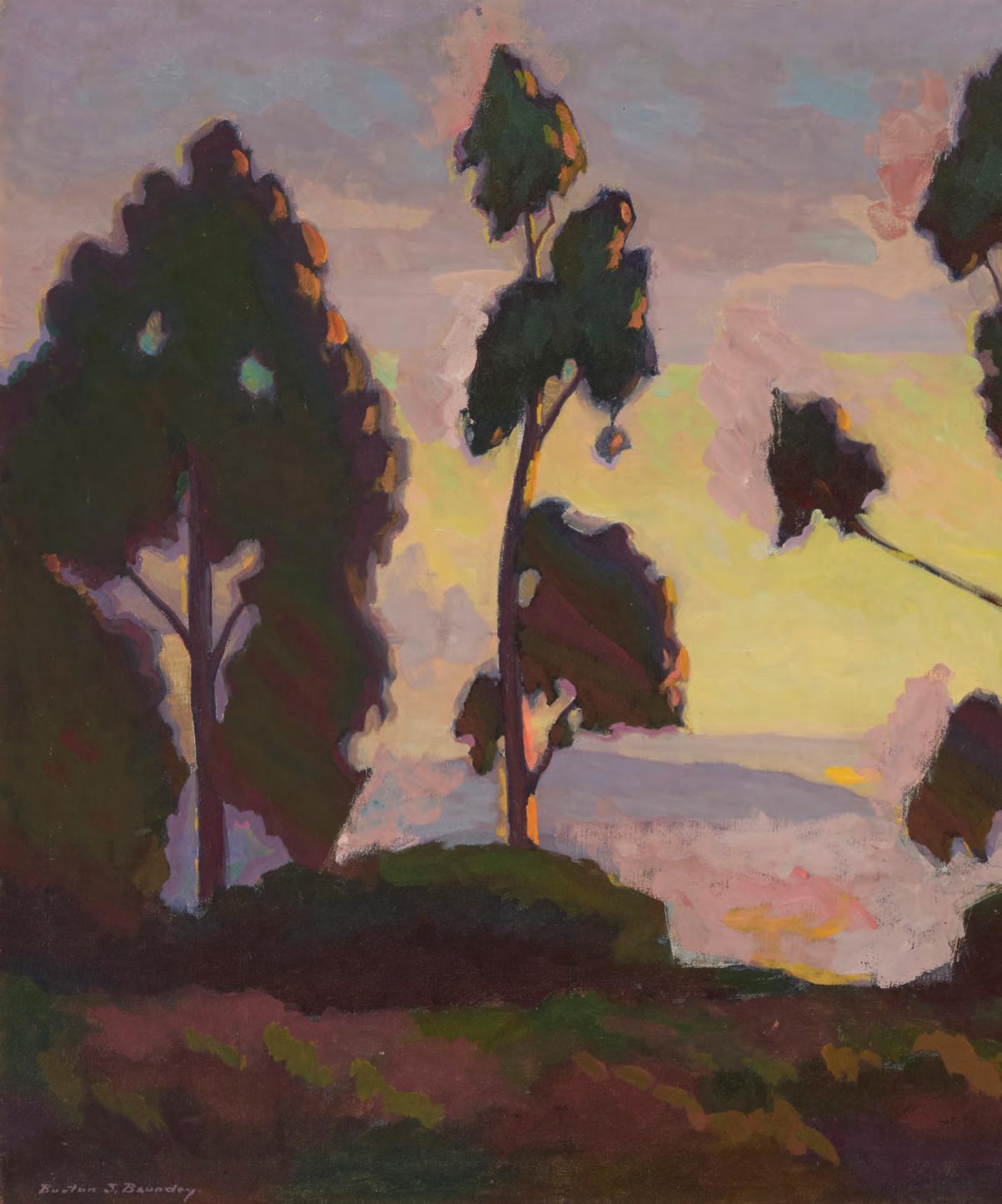
Burton Shepard Boundey (1879-1962)
Eucalyptus at dusk
Oil on canvas
Signed lower left: Burton S. Boundey 34” H x 40” W
$3,000-5,000
Provenance: William Karges Fine Art, Carmel, CA
John Frost (1890-1937)
The son of the famous illustrator Arthur B. Frost, received artistic training from his father and pursued Laurens. Between 1906 and 1908, Frost lived honed his skills as an Impressionist painter working
Frost moved to New York to pursue a career between 1912 and 1914. He chose to relocate him in close contact with the first California-born outdoor excursions with one another, each seeking
Frost was an active member of the California age 47 in Pasadena.
Frost, the artist John Frost was born in Philadelphia in 1890. As a youth, Frost pursued his artistic studies at the Academie Julien in Paris under artist Jean Paul lived and worked in Paris and its surrounding areas, such as Giverny, where he working alongside Richard E. Miller.
career as an illustrator, after spending nearly two years at a tuberculosis sanitarium relocate to Pasadena in 1918 for health reasons, which was a decision that brought California-born American Impressionist artist, Guy Rose. The two artists frequently made seeking to capture the beauty of the California landscape that they encountered.
California Art Club and the Pasadena Society of Fine Arts before dying prematurely at
1028
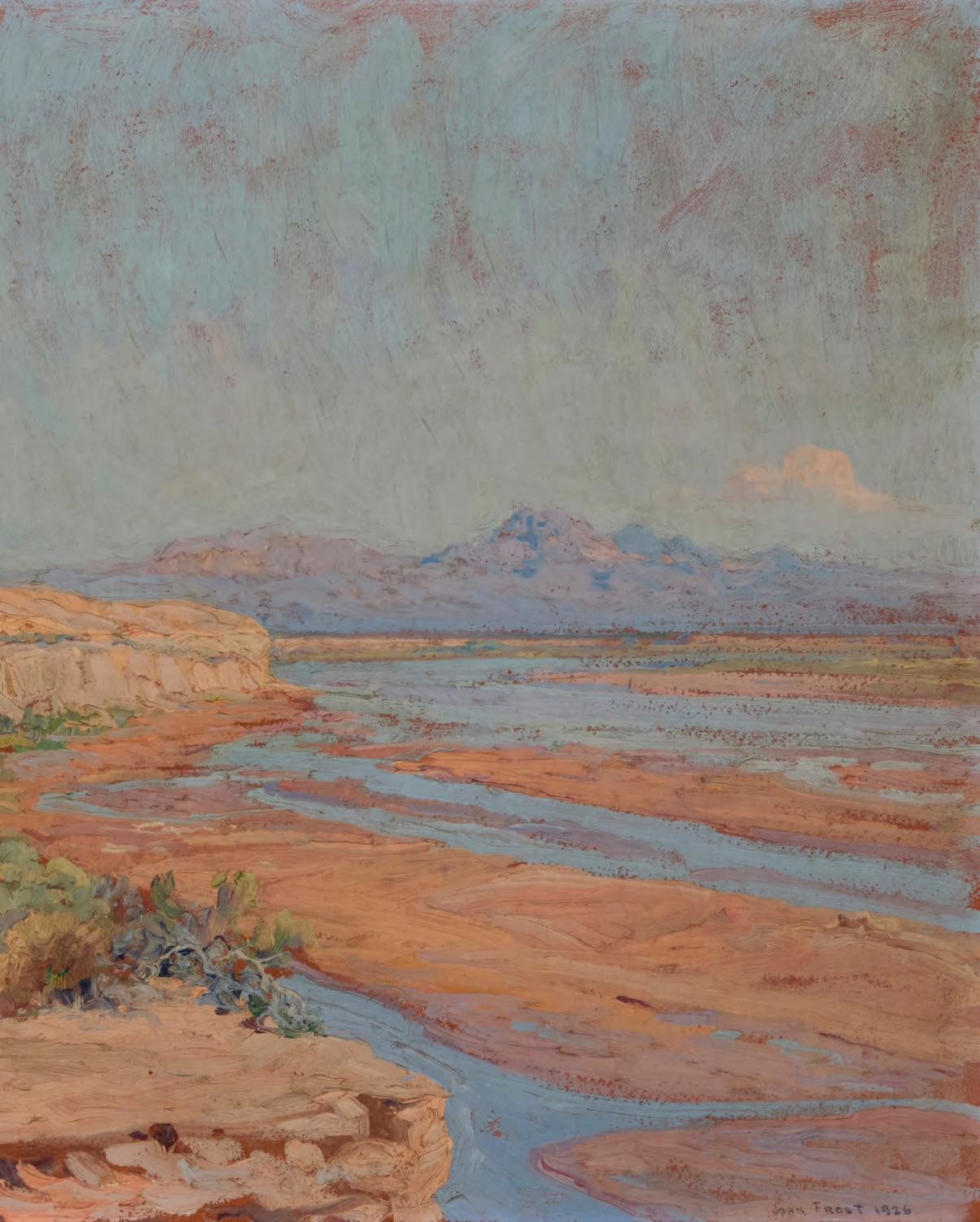
John Frost (1890-1937)
“Colorado River,” 1926 Oil on board
Signed and dated in pencil lower right: John Frost 1926; titled in pencil verso 18.25” H x 22.25” W
$12,000-18,000
Literature: Phil Kovinick, “John Frost: A Quiet Mastery,” (The Irvine Museum, 2013) p. 118, illustrated
Notes:
Frost regularly went on painting trips in search of fresh subjects. In March 1926, Frost was joined by Dr. Frederick Hanley Seares (1875-1964), a scientist with the Mount Wilson Observatory, on a trip to Western Arizona. There he made a series of studies of the Colorado River as well as finished paintings including the subject river scene.
1029
Granville Redmond (1871-1935)
“Near Parkfield, California,” 1906 Oil on burlap laid to board
Signed and indistinctly dated lower right: G. Redmond / 1906; titled by repute 17.5” H x 23.75” W
$5,000-7,000
Notes:
The painting is sold in a Shawn Speck frame.
The present work depicts a landscape in the Monterey County area of Parkfield, where Redmond’s uncles, John Edwin and Grenville Seymour, and their families resided. “The area became profoundly important to [Redmond], who spent many happy vacations there with his cousins. He called the region ‘God’s Country,’ and it would become one of his favorite places to paint.” (Scott A Shields, PhD, “Granville Redmond: The Eloquent Palette,” [Crocker Art Museum: 2020,] p. 21)
1030
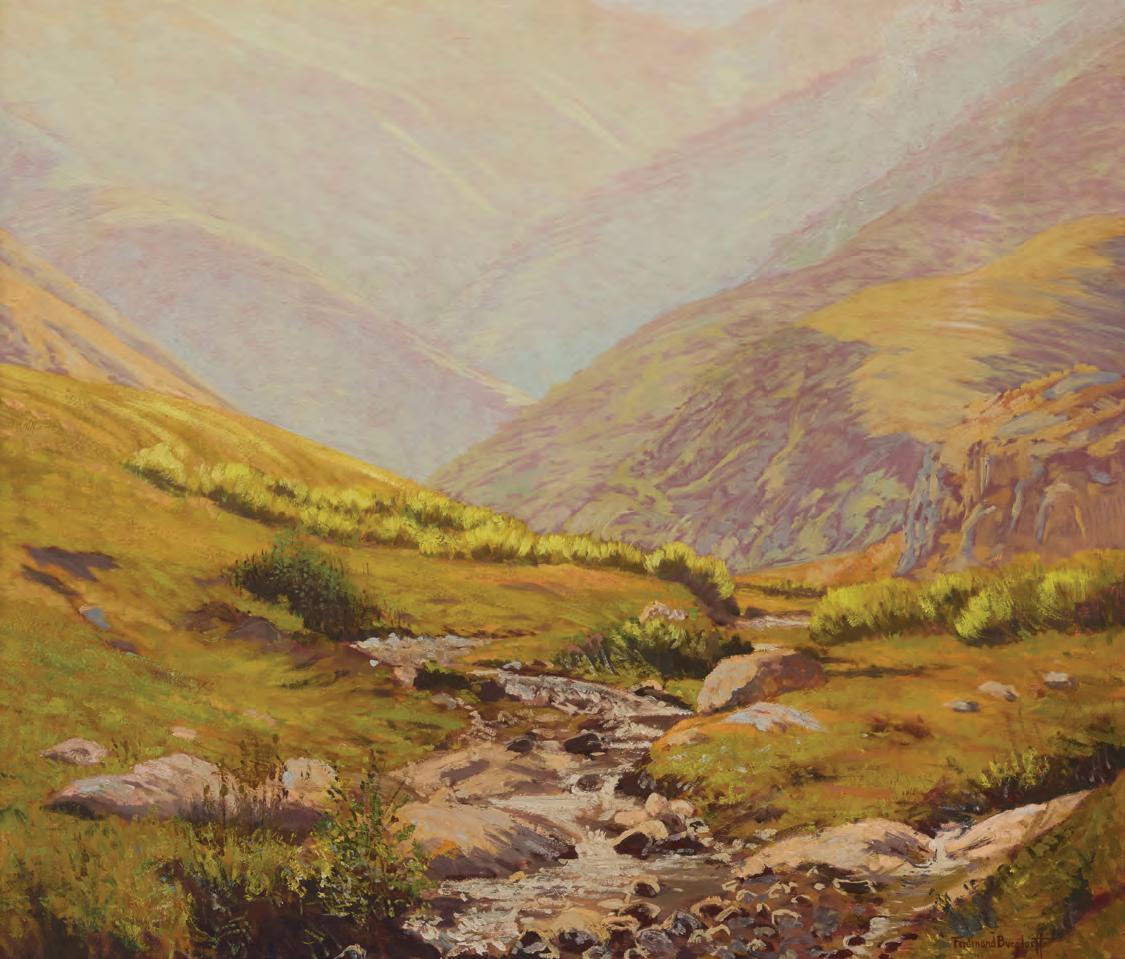
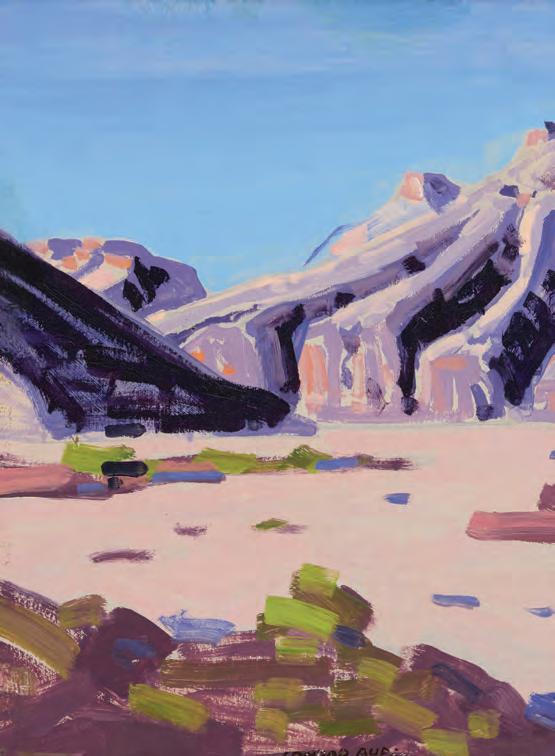
Ferdinand Burgdorff (1881-1975)
“Yellow Lupine on the Pacific Coast” Oil on Masonite
Signed lower right: Ferdinad Burgdorff; titled in ink on an artist’s label affixed verso 24” H x 27.75” W
$3,000-5,000
Meredith Brooks Abbott (b. 1938)
Santa Barbara landscape and still life painter returning home to care for her ailing father. Richard S. Meryman and Clarence Hinkle.
Abbott moved to New York in 1962 and worked night classes at the Arts Students League.
Francisco while also beginning to exhibit frequent subjects for the artist. Abbott married avocado and lemon ranch.
For over five decades, Abbott has worked compositions and site-specific landscapes, Group and holds memberships in the Santa
Abbott
painter Meredith Brooks Abbott briefly studied art at Scripps College before father. She continued her artistic studies working with artists Douglass Parshall, Hinkle. Returning to school, she graduated from the Art Center School of Design.
worked in advertising as an illustrator while also continuing her art studies in League. She returned to California in 1970, and worked as an illustrator in San her own work. During this period, the Marin County environs served as married Duncan Abbott in 1974, and the couple settled on his Carpinteria
worked in the Santa Barbara area creating elaborate and stunning floral landscapes, like the present selection of works. She is a founding member of the OAK Santa Barbara Art Association and the California Art Club.
1031
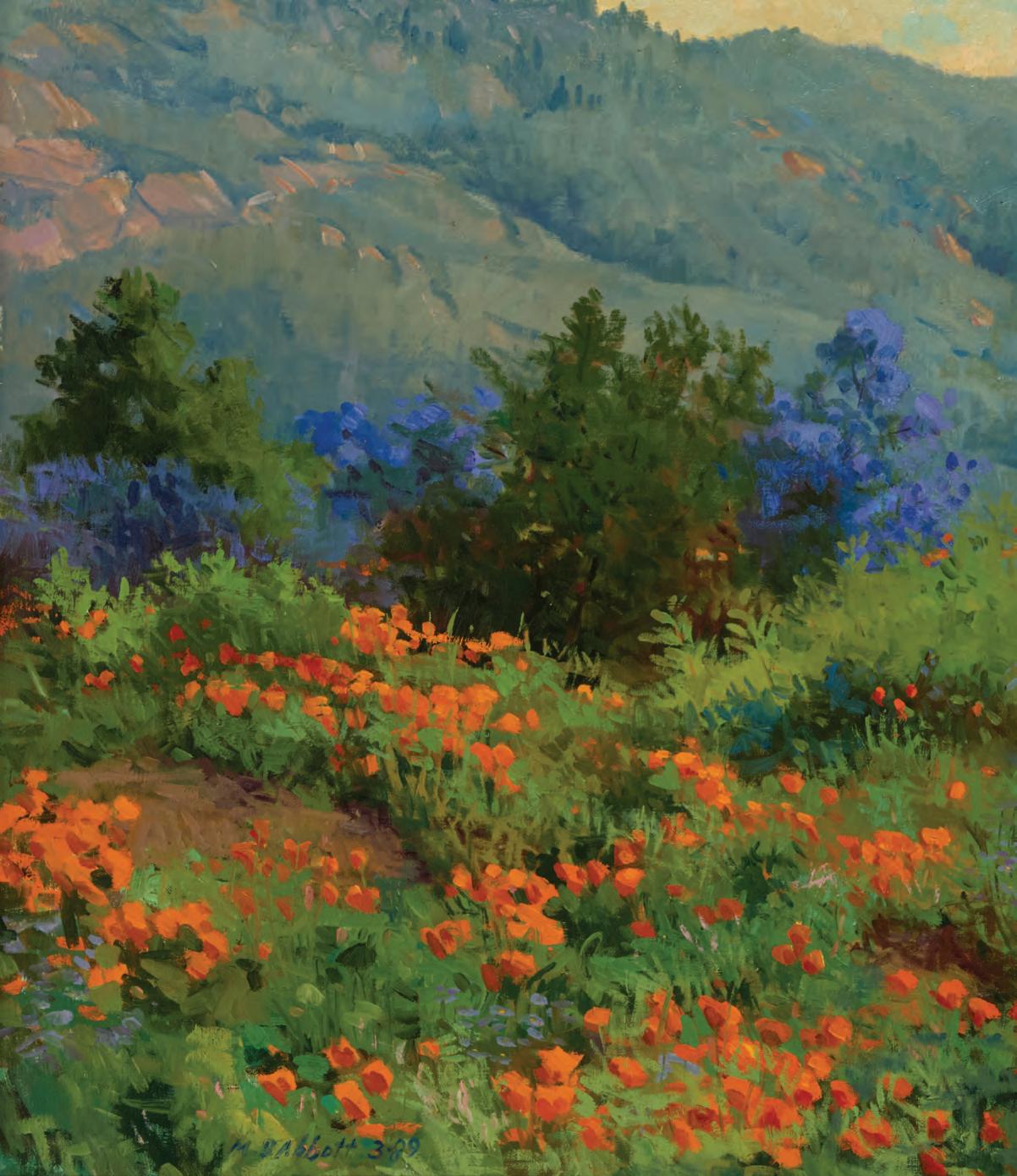
Meredith Brooks Abbott (b. 1938)
“Botanic Garden” (Santa Barbara), 1989
Oil on linen
Signed and dated lower left: M.B. Abbott 3-89; dated again, “March 1989,” and titled, verso 24” H x 30” W
$3,000-5,000
Provenance: Arlington Gallery, Santa Barbara, CA
The Sally and David Martin Collection
1032
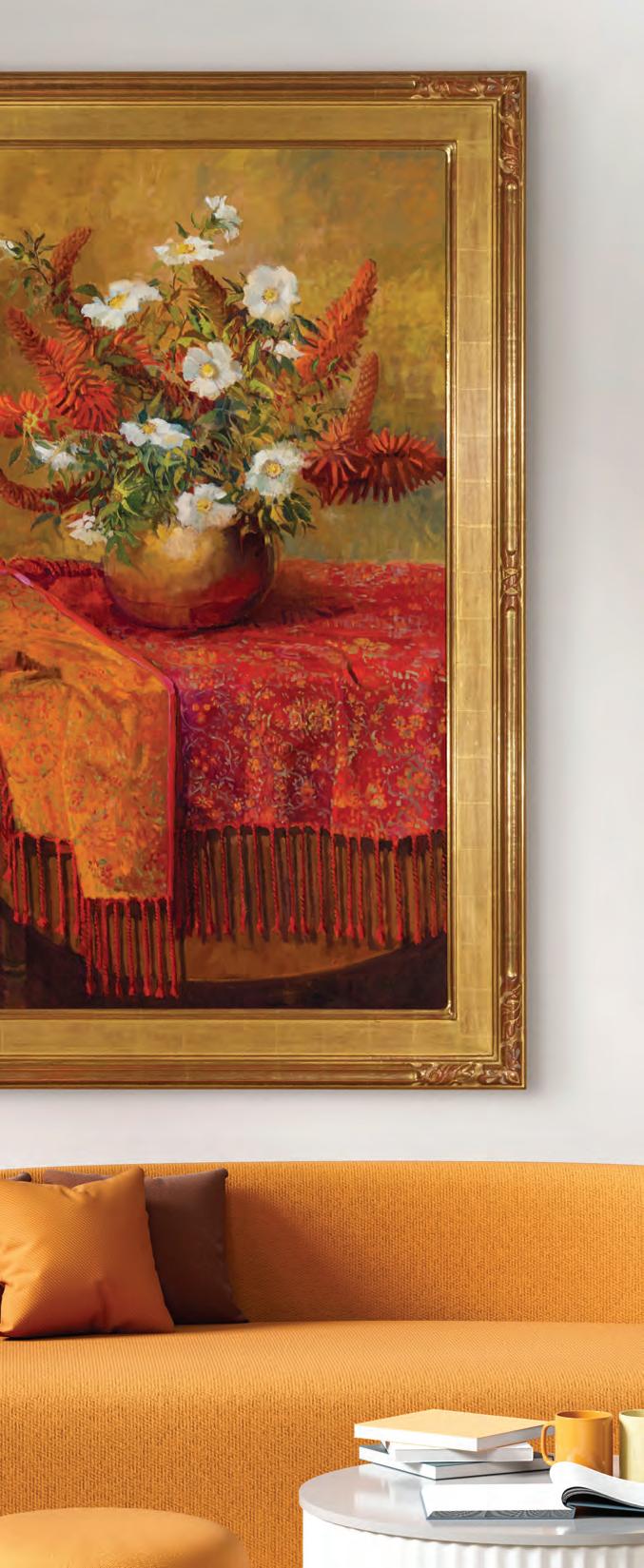
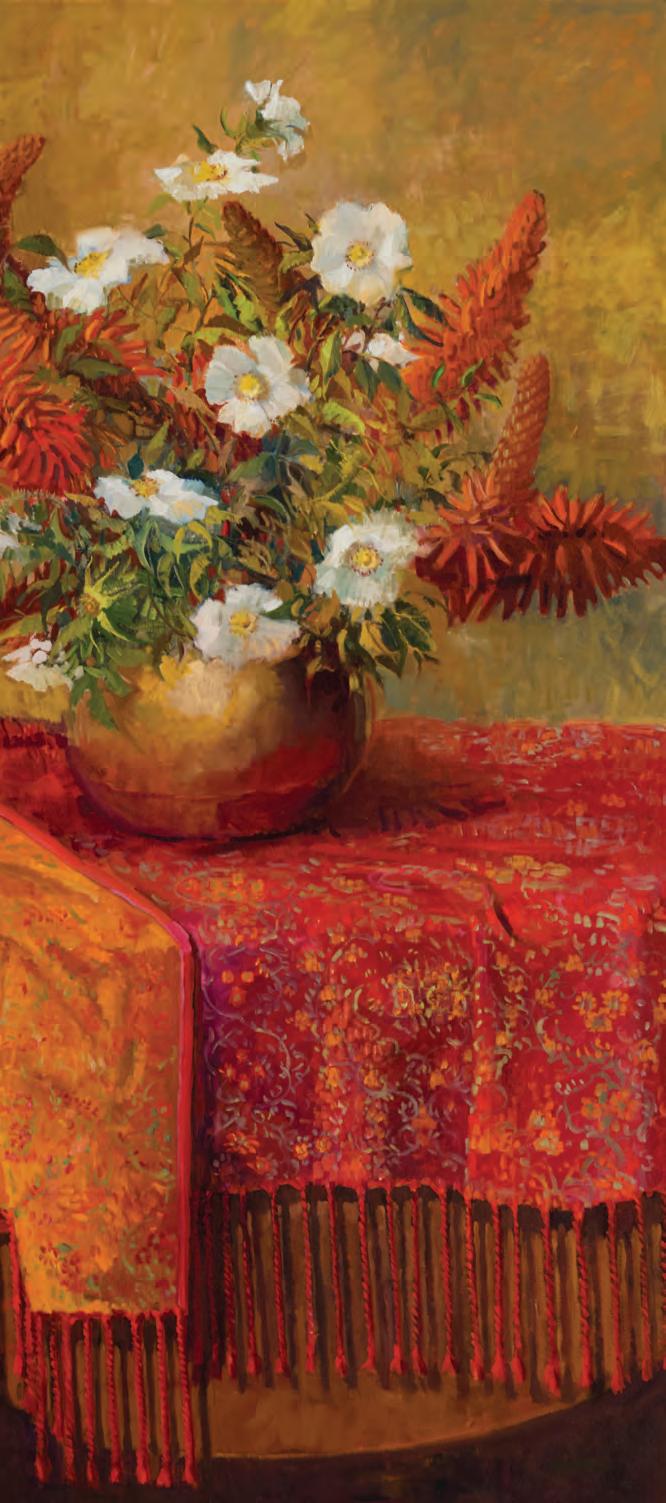
Meredith Brooks Abbott (b. 1938)
“Cherokee Roses and New Cloth,” 2001 Oil on canvas
Signed and dated lower right: M.B. Abbott 01; titled on an exhibition label affixed to the frame’s verso 60” H x 36” W
$6,000-8,000
Provenance: The Sally and David Martin Collection
Exhibited: Bakersfield, CA, Bakersfield Museum of Art, “Meredith Brooks Abbott Exhibition,” October 6-December 27, 2005
1033
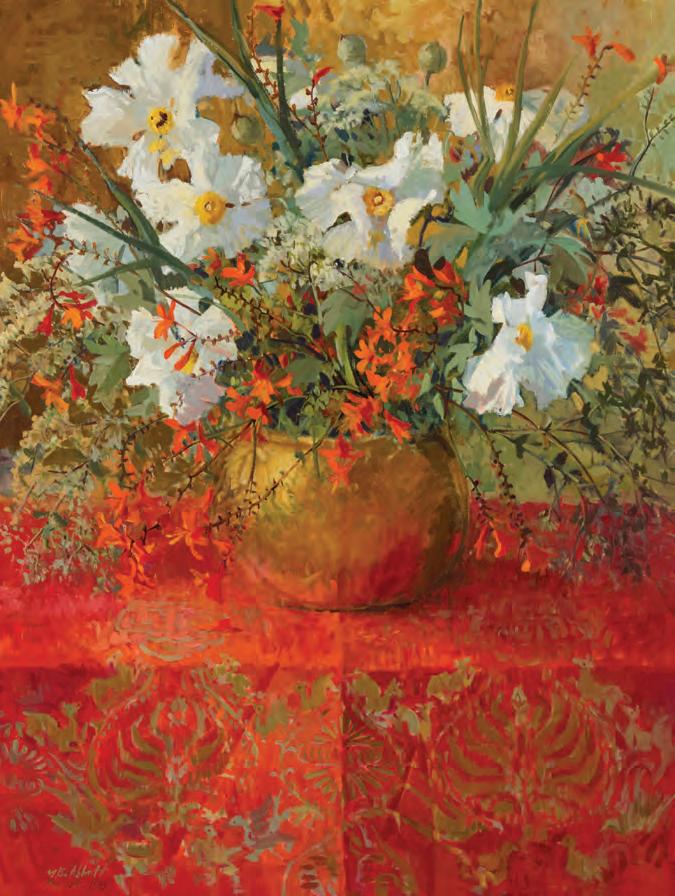
Meredith Brooks Abbott (b. 1938)
“Firecrackers and Poppies,” 1993 Oil on canvas
Signed and dated lower left: M.B. Abbott / August - 1993; titled faintly in pencil on the stretcher; titled again on a gallery label affixed to the stretcher 40” H x 30” W
$5,000-7,000
Provenance: The artist
Arlington Gallery, Santa Barbara, CA
The Sally and David Martin Collection, acquired from the above, November 24, 1993
Notes:
This lot is accompanied by a copy of a sales invoice dated November 24, 1993, from the gallery mentioned above.
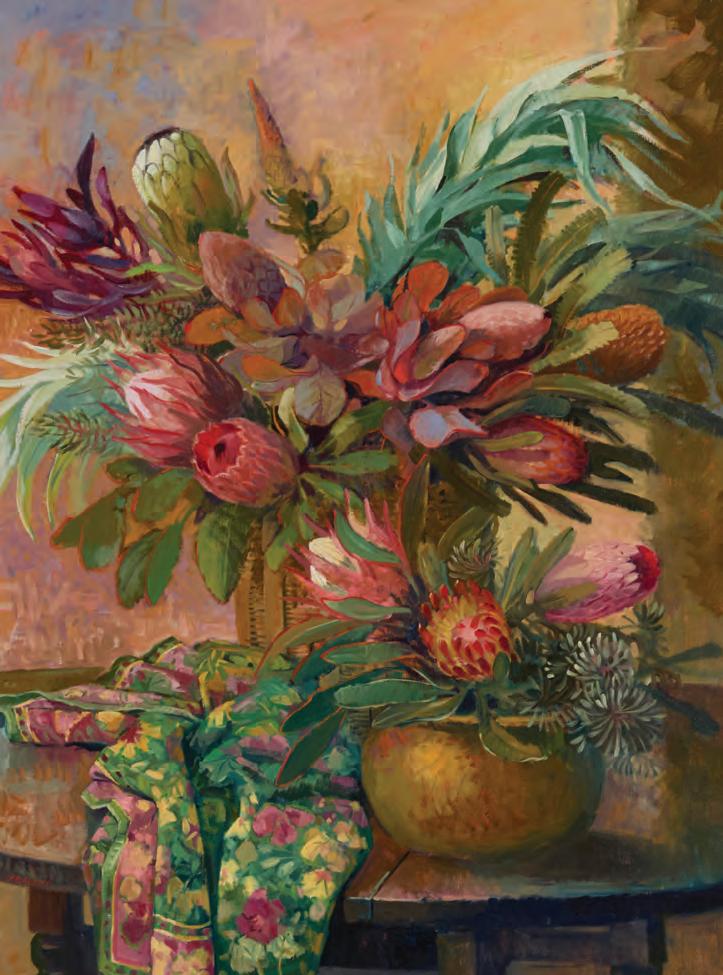
1034
Meredith Brooks Abbott
(b. 1938)
“Protea,” 1992
Oil on canvas
Signed lower left: M.B. Abbott; titled on a typed gallery label and dated “1992” in ink on that same label, which is affixed to the stretcher
48” H x 36” W
$5,000-7,000
Provenance:
The artist
Arlington Gallery, Santa Barbara, CA
The Sally and David Martin Collection, acquired from the above, December 17, 1992
Notes:
This lot is accompanied by a copy of a sales invoice dated December 17, 1992, from the gallery mentioned above.
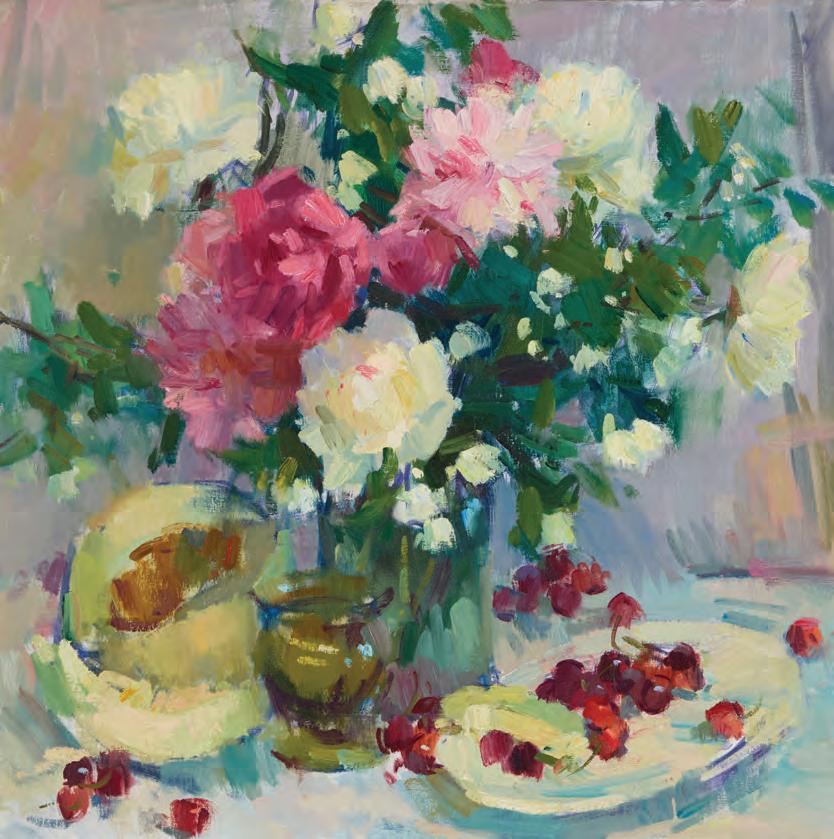
1035
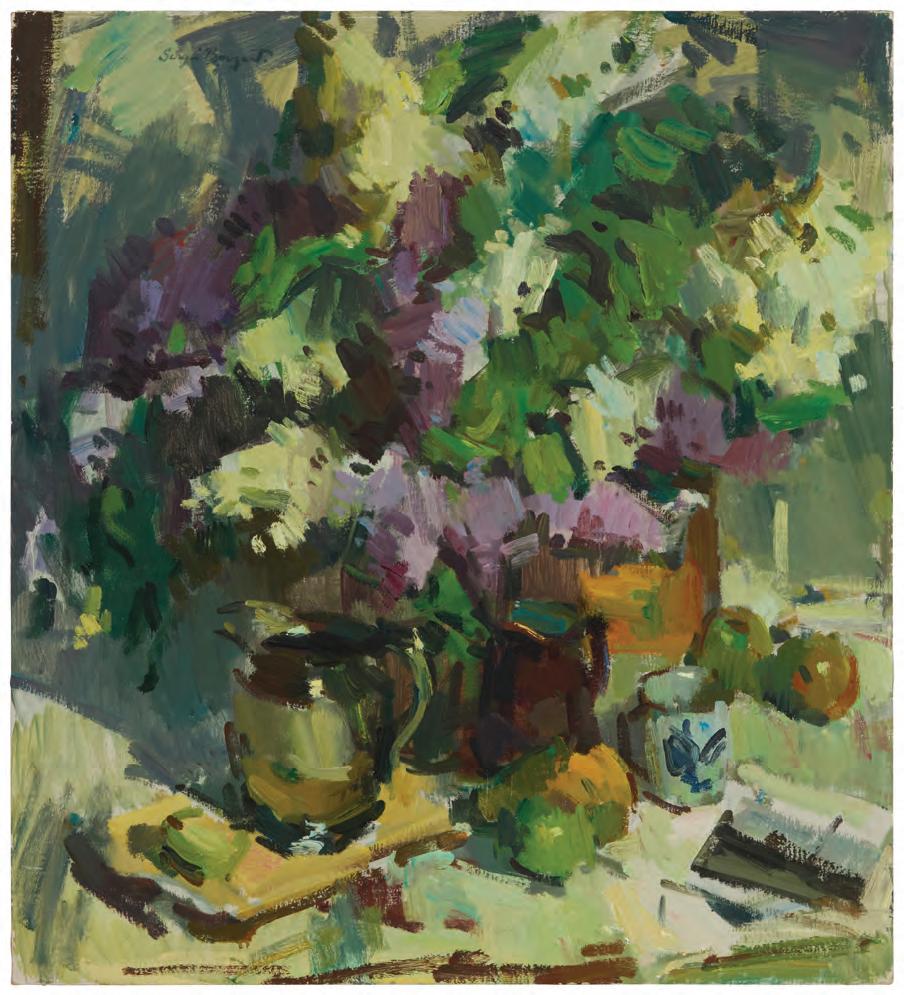
Sergei Bongart (1918-1985)
Still life with roses and cherries Oil on canvas
Appears unsigned; the artist’s address label is affixed to the frame’s backing board 30” H x 30” W
$1,000-1,500
Provenance: The Estate of Sergei Bongart
Notes:
A partial exhibition label stating “Grand National” is affixed to the frame’s backing board.
1036
Sergei Bongart (1918-1985)
Still life with green apples
Oil on canvas
Signed upper left: Sergei Bongart
40.25” H x 36.75” W
$1,000-1,500
Provenance: The Estate of Sergei Bongart
1037
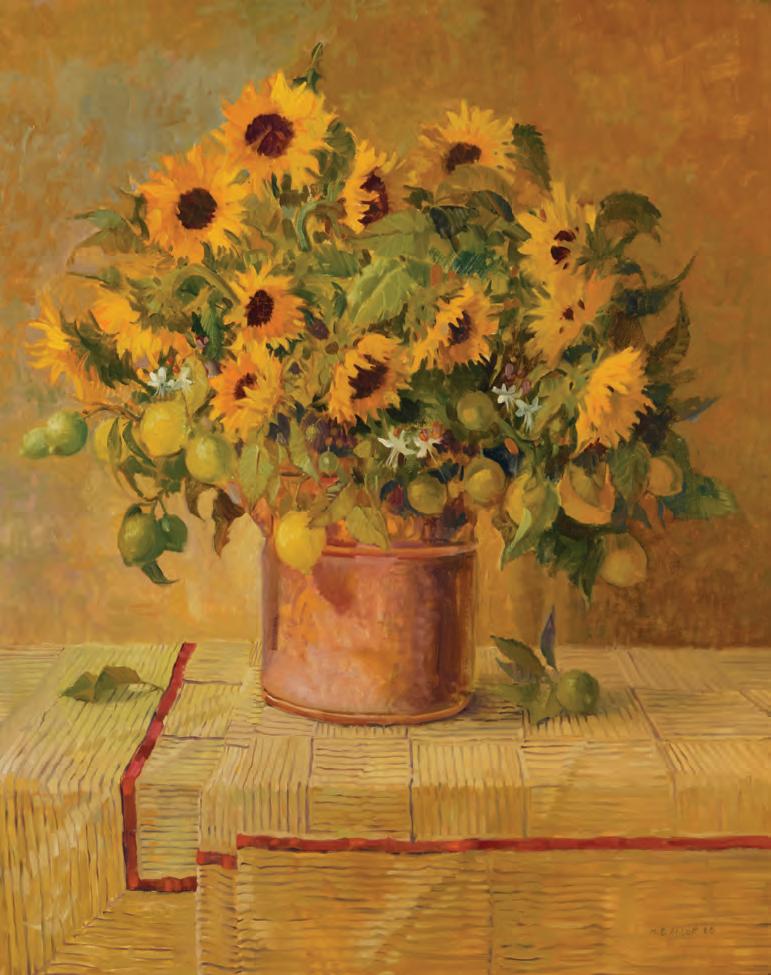
Meredith Brooks Abbott (b. 1938)
“Sunflowers,” 2000 Oil on canvas
Signed and dated lower right: M.B. Abbott ‘00; titled by repute 50” H x 40” W
$3,000-5,000
Provenance: Maureen Murphy Fine Arts, Montecito, CA The Sally and David Martin Collection
1038
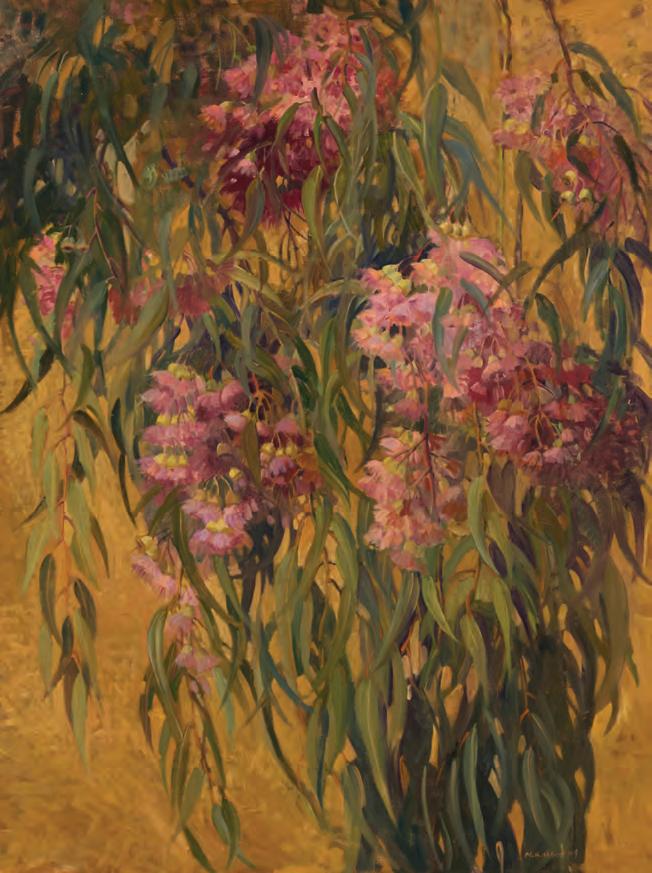
Meredith Brooks Abbott (b. 1938)
“Red Eucalyptus Blossoms,” 2004 Oil on canvas
Signed lower right: M.B. Abbott 04; titled and inscribed “04.47” in pencil on the stretcher; alternatively titled “Eucalyptus” on an exhibition label affixed to the frame’s verso
40” H x 30” W
$3,000-5,000
Provenance: The Sally and David Martin Collection
Exhibited: Bakersfield, CA, Bakersfield Museum of Art, “Meredith Brooks Abbott Exhibition,” October 6-December 27, 2005
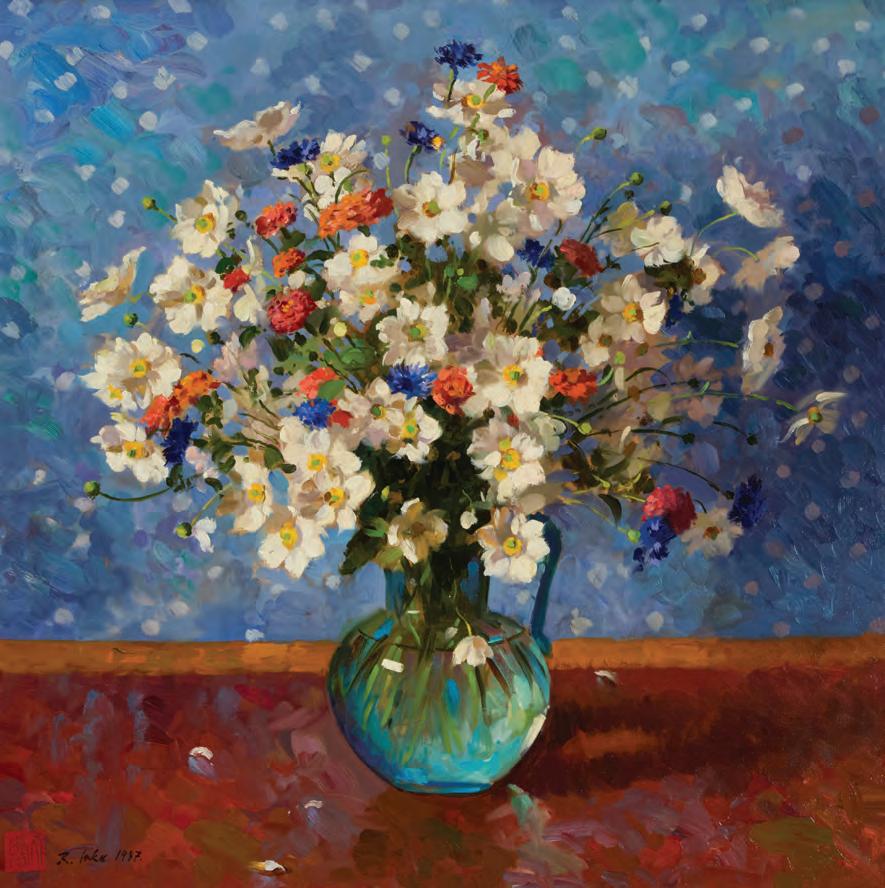
1039
Randall Lake (b. 1945)
“The Cider Pitcher,” 1987 Oil on canvas
Signed, dated, and with the artist’s red ink stamp lower left: R. Lake 1987; dated again and titled on the stretcher; with the artist’s black ink studio and copyright stamps, verso 26” H x 26” W
$1,500-2,500
Provenance:
The artist
Arlington Gallery, Ventura, CA
The Sally and David Martin Collection, acquired from the above, January 31, 1990
Notes:
This lot is accompanied by a copy of a sales invoice dated January 31, 1990, from the gallery mentioned above.
1040
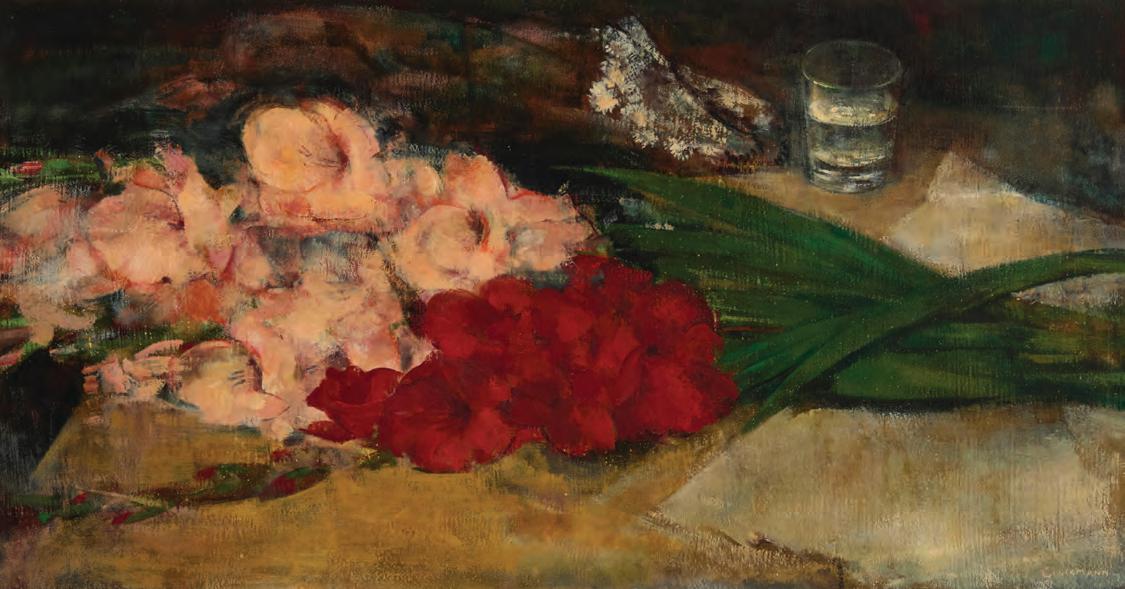
Grigory Gluckmann (1898-1973) “Gladiolas” Oil on panel With the incised signature lower right: Gluckmann; titled on two gallery labels affixed to the frame’s verso 16” H x 30” W
$1,500-2,500
Provenance: Dalzell Hatfield Gallery, Los Angeles, CA Private estate, California
Exhibited: Chestertown, MD, Brady Hart Gallery, February 1-April 30, 2018
1041
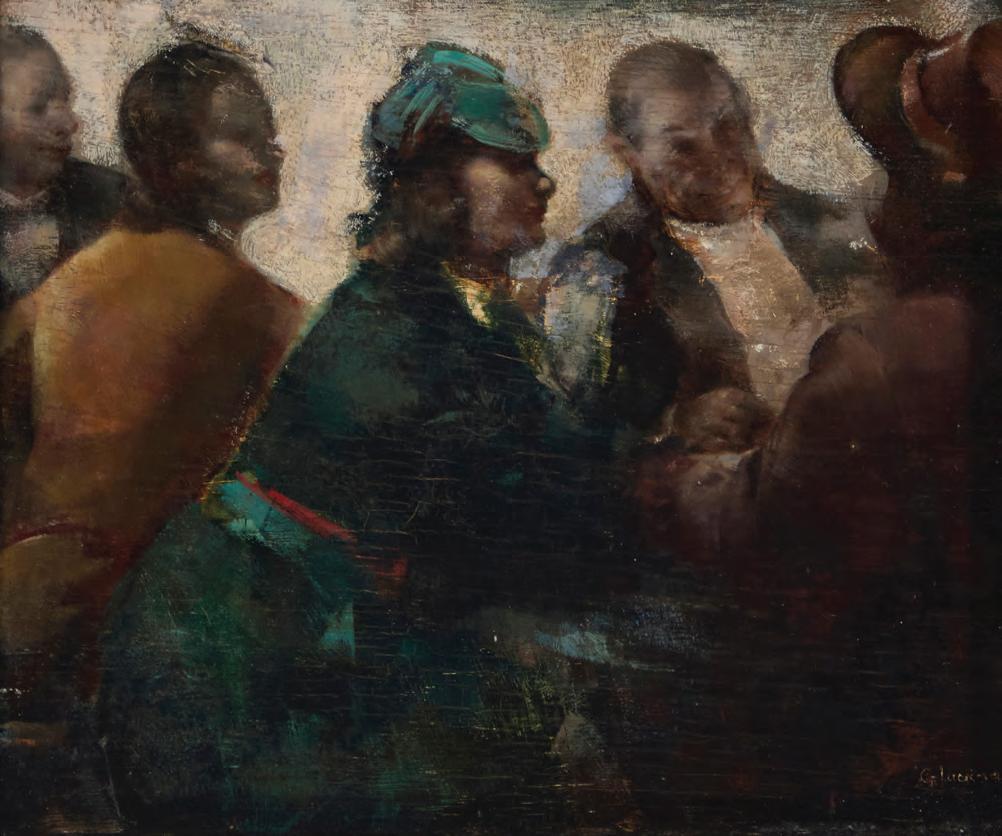
Grigory Gluckmann (1898-1973)
“Caprice” Oil on panel
With the incised signature lower right: Gluckmann; titled on a label affixed verso 7.875” H x 9.875” W
$3,000-5,000
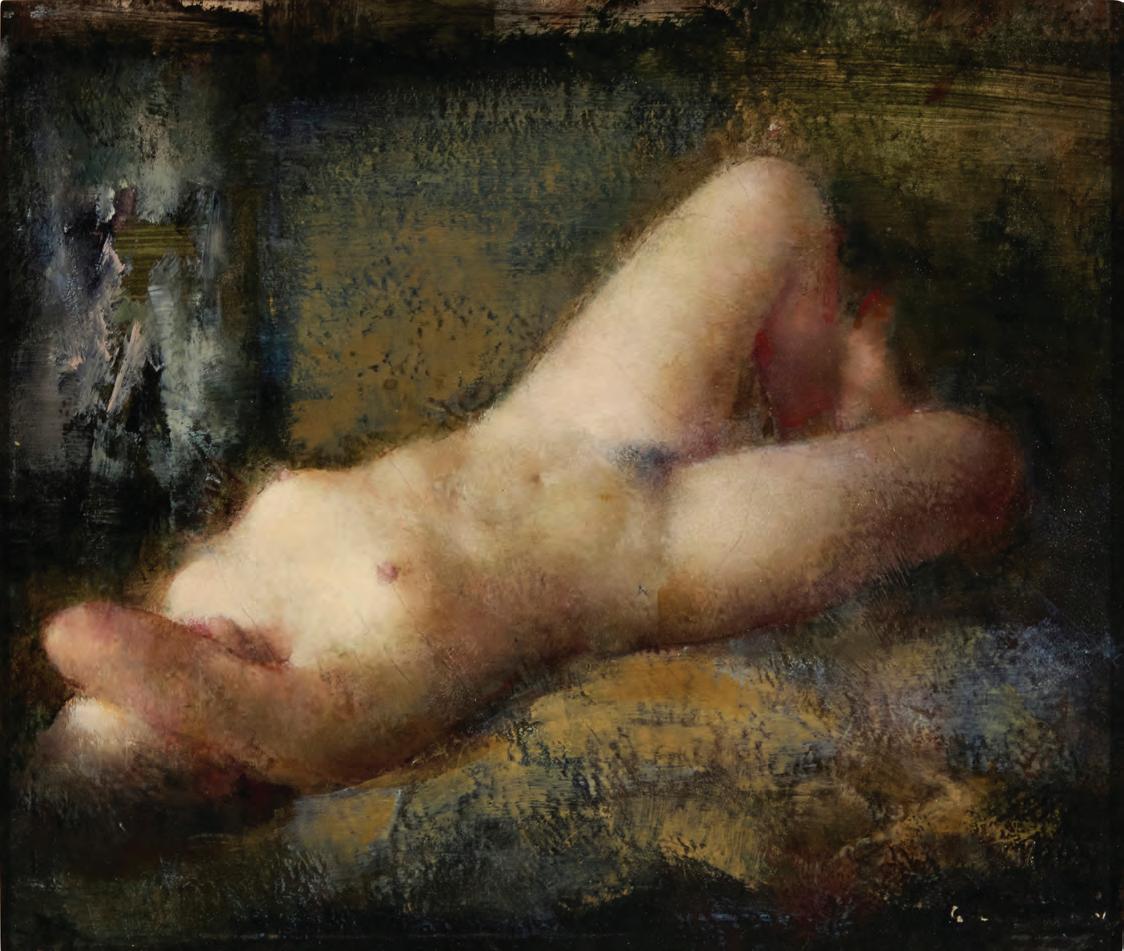
1042
Grigory Gluckmann (1898-1973)
“Moment of Relaxation” Oil on panel
With the incised signature lower right: Gluckmann; titled on two a gallery labels affixed to the frame’s verso 9” H x 10.5” W
$3,000-5,000
Provenance:
George Stern Fine Arts, West Hollywood, CA
From the Collection of Robert A. Day
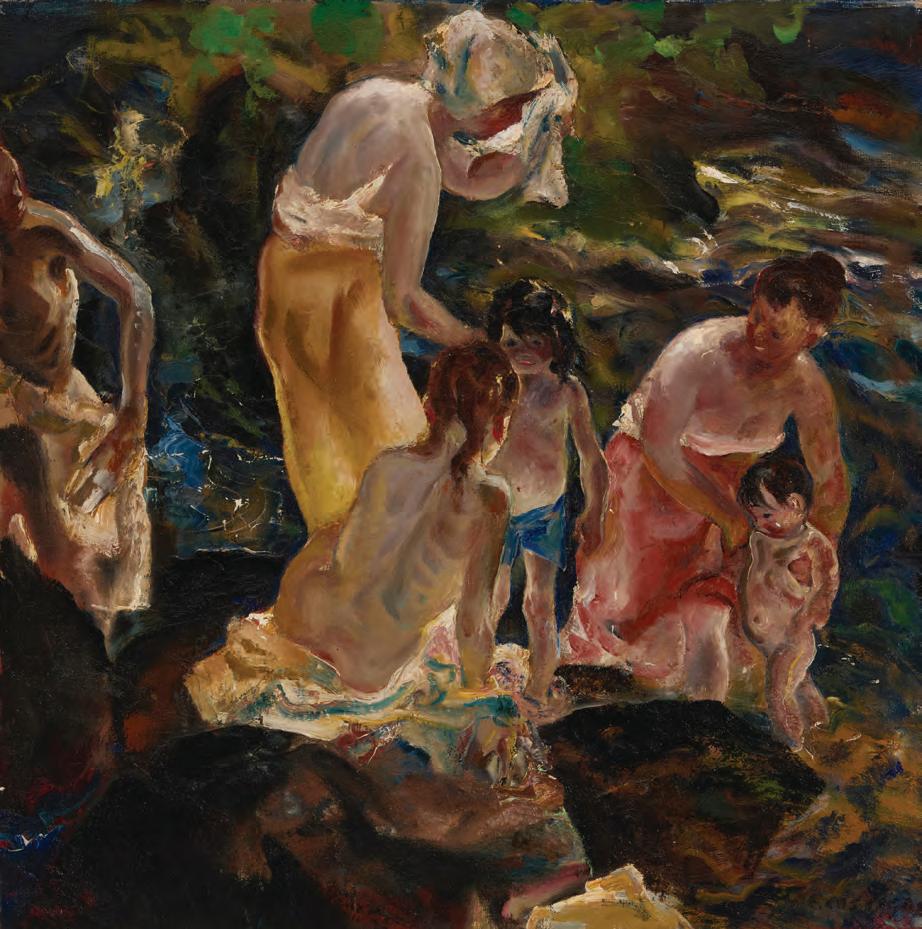
1043
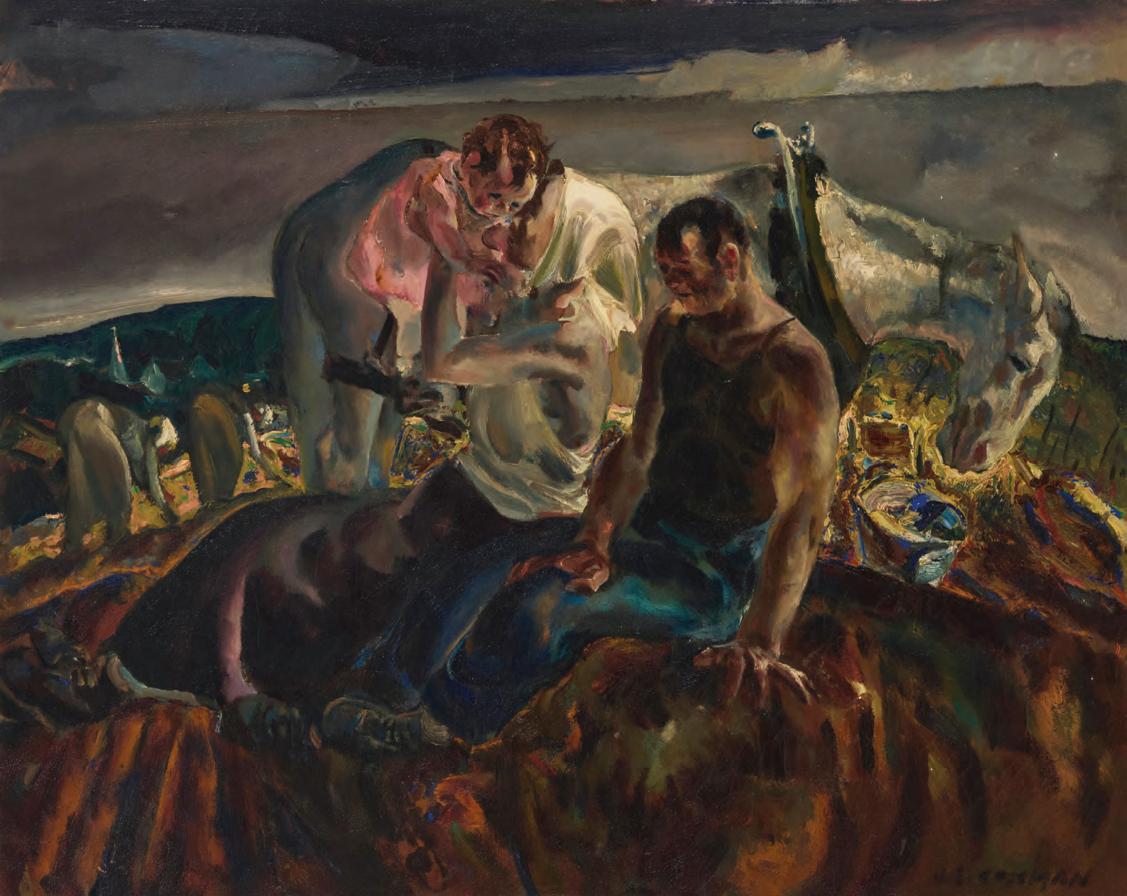
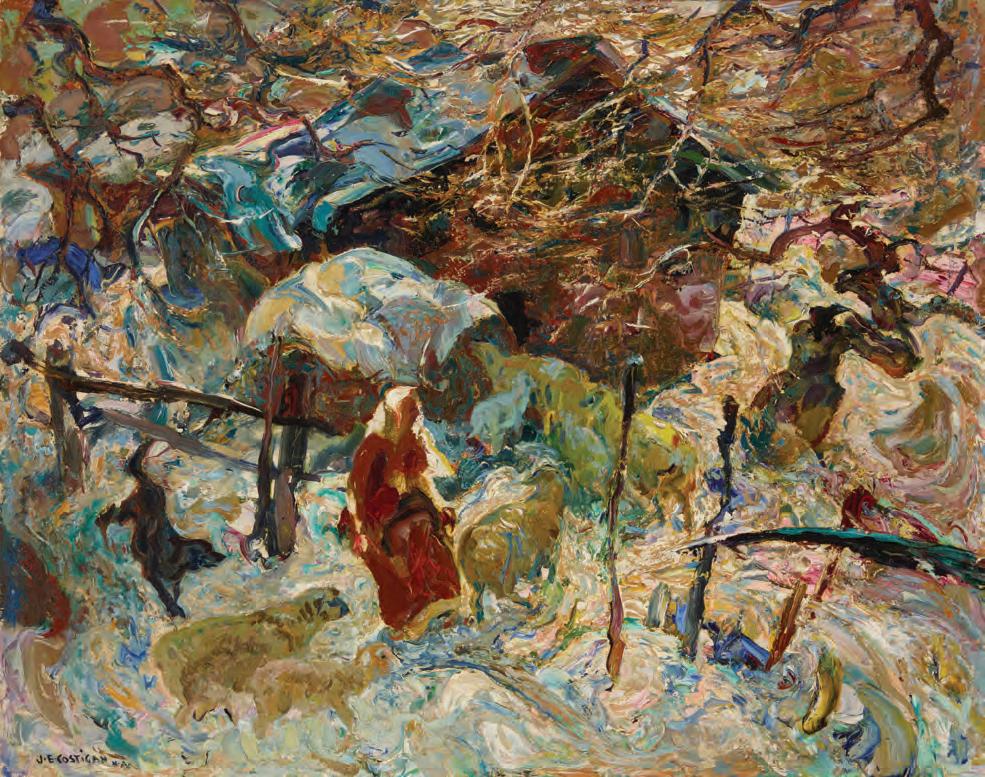
John Edward Costigan (1888-1972)
“Bathers,” 1939 Oil on canvas
Signed lower right: J.E. Costigan; signed, titled, dated, and inscribed on a label, and again on a gallery label, each affixed to the frame’s verso: “John E. Costigan / 1939 / Orangeburg, N.Y.”
30” H x 30.125” W
$3,000-5,000
Provenance:
Associated American Artists, New York, NY
Private estate, California
Notes:
There is an unfinished pastel sketch of a landscape verso.
1044
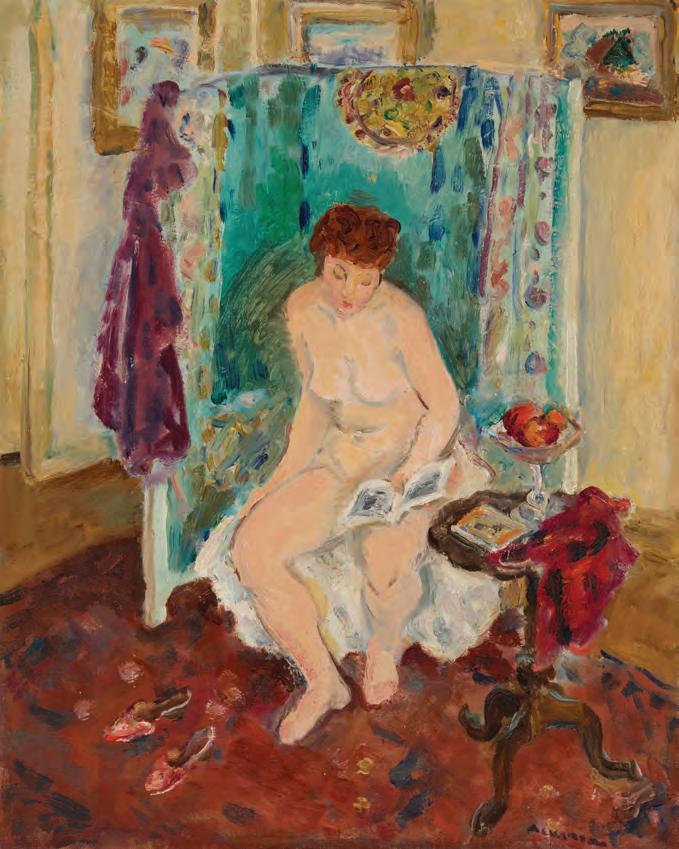
Mabel Alvarez 1891-1985
“Nude in Interior” (Mary Lou Rekov), circa 1947 Oil on canvasboard
Signed lower right: Alvarez; titled on two labels affixed verso 20” H x 16” W
$4,000-6,000
Provenance: Nancy Moure, Glendale, CA
Exhibited: Los Angeles, CA, Michael Kizhner Fine Art, “California Impressionists Images of Women,” Autumn 1989
Pasadena, CA, Pasadena Heritage Blinn House Exhibit, “Early California Impressionist & Post Impressionist Paintings,” November 1-2, 1996
Notes:
This lot is listed on the “Mabel Alvarez Estate Collection website, a resource for studying the art and life of Mabel Alvarez” (https://mabelalvarez.com/nude-in-interior).
1045
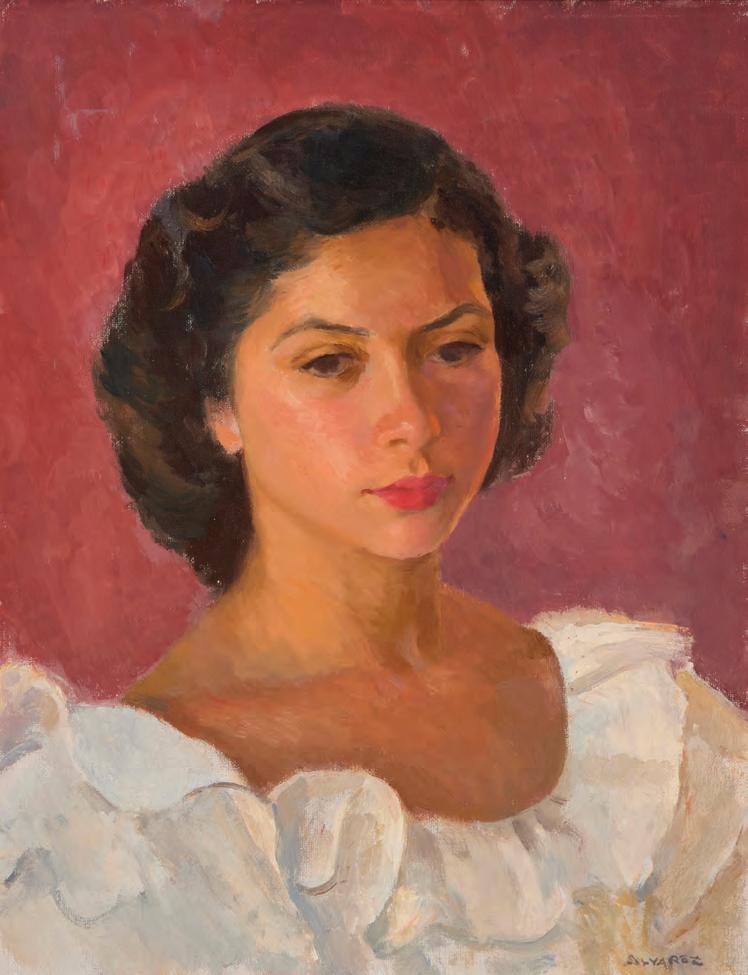
Mabel Alvarez (1891-1985)
“Portrait of a Girl,” circa 1930 Oil on canvasboard
Signed lower right: Alvarez; titled and inscribed “3915642 / 7818516,” both verso 18” H x 14” W
$1,500-2,500
Notes:
This lot is listed on the “Mabel Alvarez Estate Collection website, a resource for studying the art and life of Mabel Alvarez” (https://mabelalvarez.com/1930s/portrait-of-a-girl).
1046
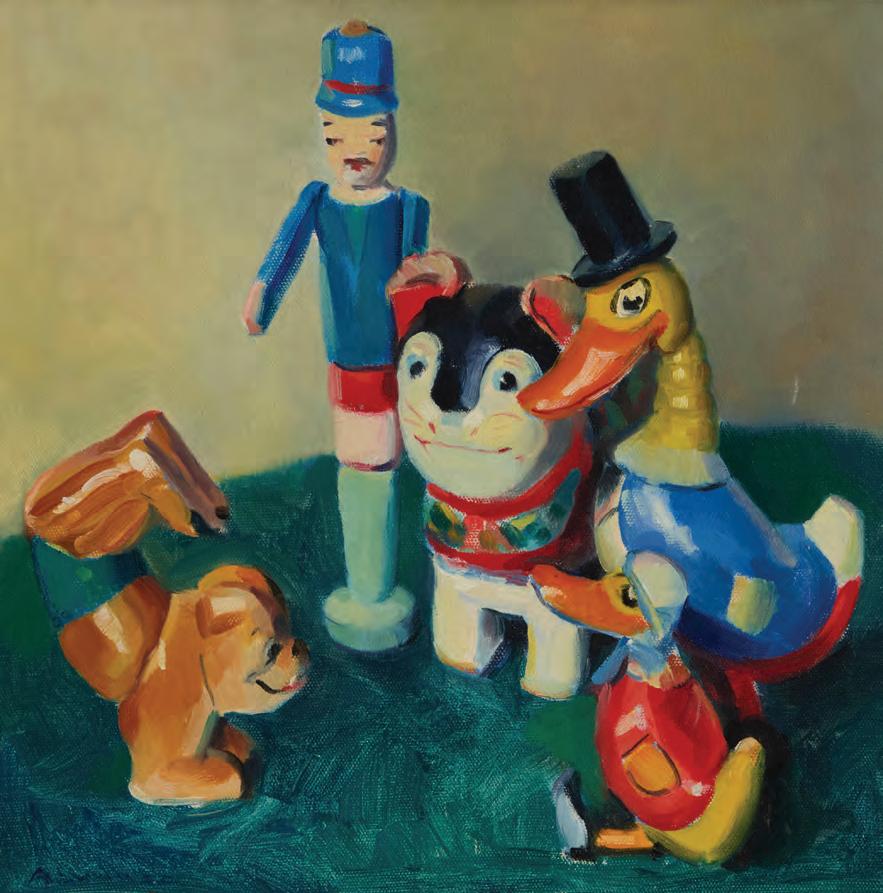
Mabel Alvarez (1891-1985)
“Performing Dog,” 1929
Oil on canvas
Signed lower left: Alvarez; signed again, titled, and inscribed with with the artist’s Los Angeles, CA address, all in pencil on an old label attached to the stretcher; dated on a typed gallery label affixed to the frame’s verso
16.25” H x 16.25” W
$2,000-3,000
Provenance: William Karges Fine Art, Beverly Hills, CA
Notes:
This lot is listed on the “Mabel Alvarez Estate Collection website, a resource for studying the art and life of Mabel Alvarez” (https://mabelalvarez.com/all-known-artworks/1920s/performing-dog). It is noted here that this painting was “one of several pictures commissioned by Mrs. Samuel Goldwyn for “Little” Sam Goldwyn, Jr.’s room, but was left over.”
1047
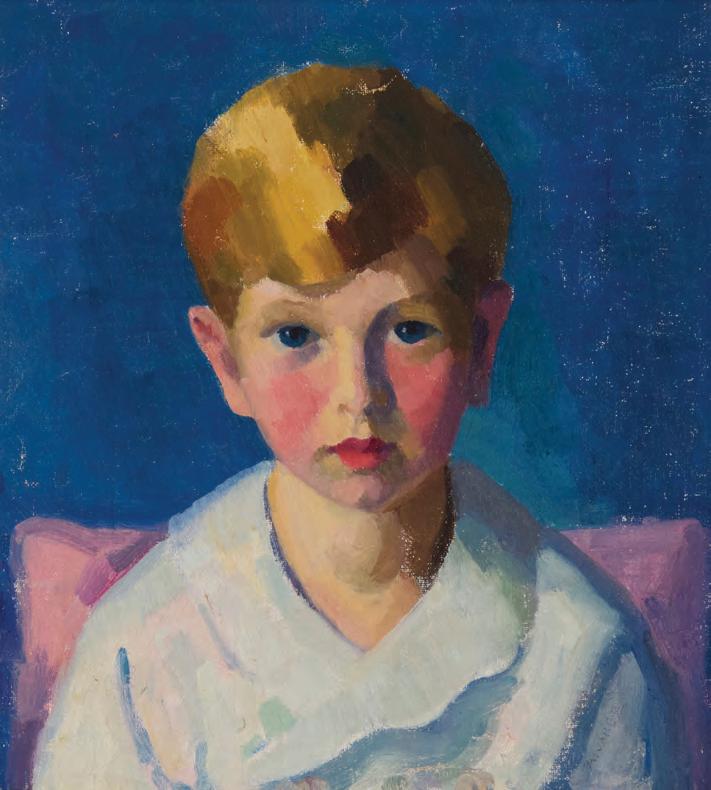
Mabel Alvarez (1891-1985)
“Master Jimmie Mageath,” 1928 Oil on canvas
Signed lower right: Alvarez; titled on the estate website 16” H x 14.5” W
$800-1,200
Notes:
This lot is listed on the Mabel Alvarez Estate Collection website, a resource for studying the art and life of Mabel Alvarez” (https://mabelalvarez.com/all-known-artworks/1920s/master-jimmie-mageath).
1048
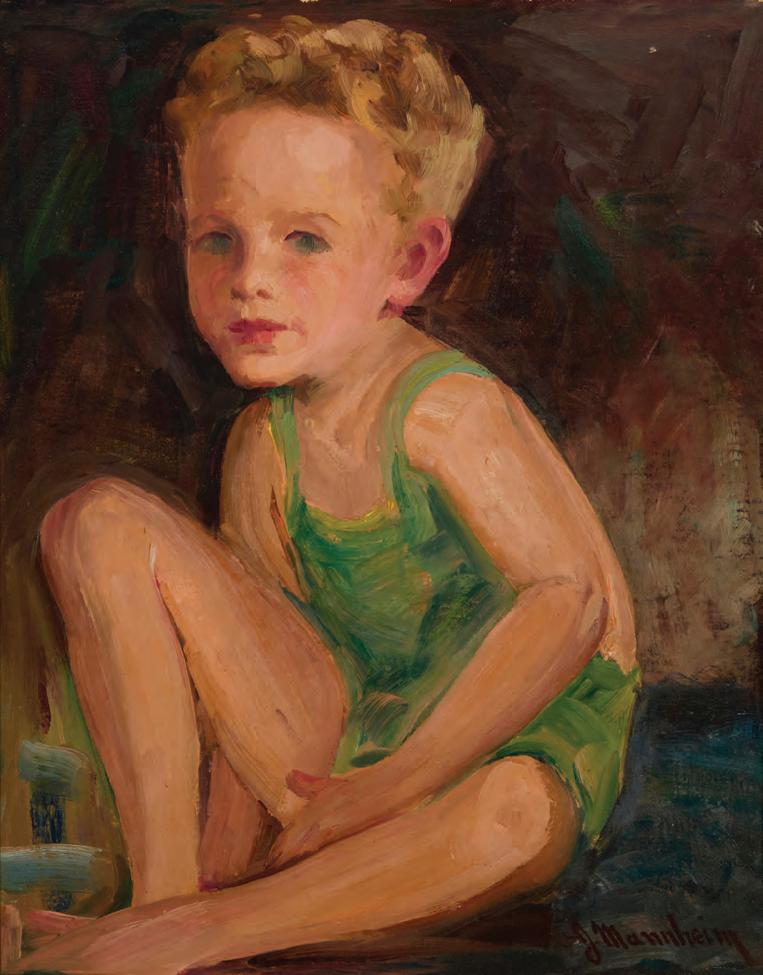
Jean Mannheim (1863-1945)
Portrait of a young boy in green overalls
Oil on canvas laid to Masonite
Signed lower right: J. Mannheim
22.125” H x 17.625” W
$800-1,200
Provenance: Private estate, California
1049
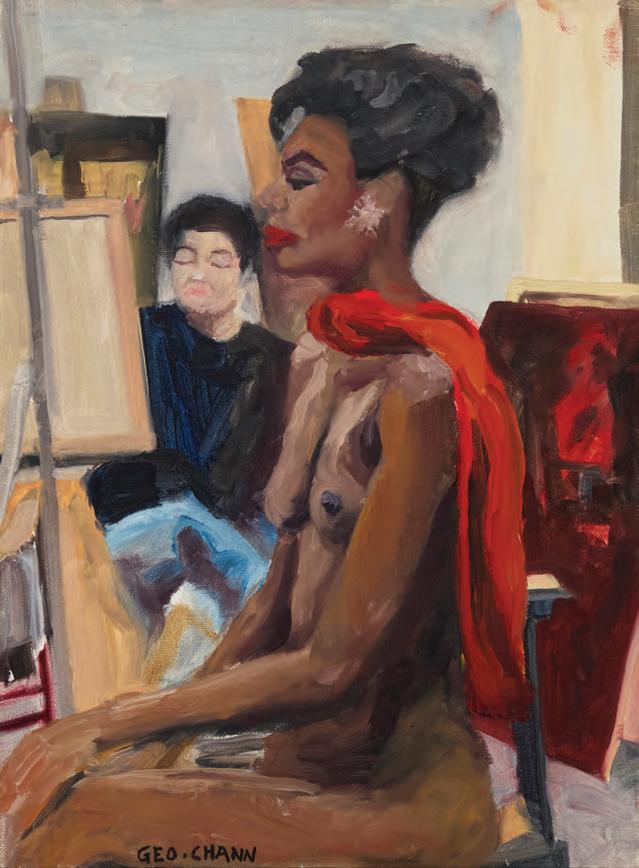
George Chann (1913-1995)
The artist painting a nude model Oil on canvas
Signed lower left: Geo. Chann
16” H x 12” W
$3,000-5,000
1050
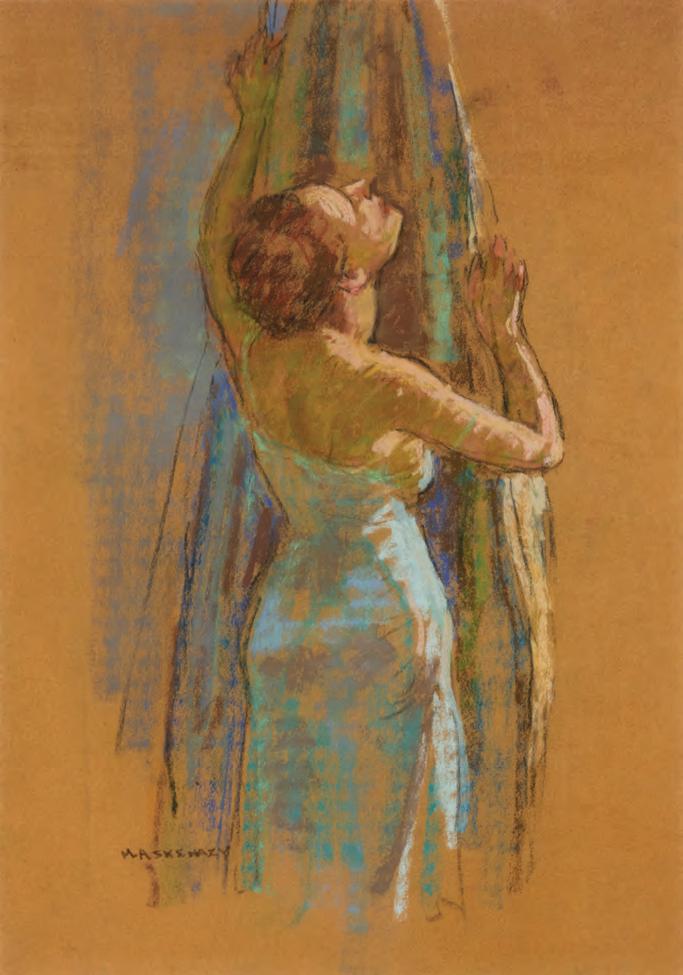
Mischa Askenazy (1888-1961)
“Woman Closing Drape” Pastel on tan paper
Signed lower left: M. Askenazy; with the artist’s estate ink stamp hand-numbered “40” on a label affixed to the frame’s backing board; titled on a gallery label affixed to the frame’s backing board
Sight: 20” H x 14” W
$800-1,200
Provenance: Goldfield Galleries, Los Angeles, CA
1051
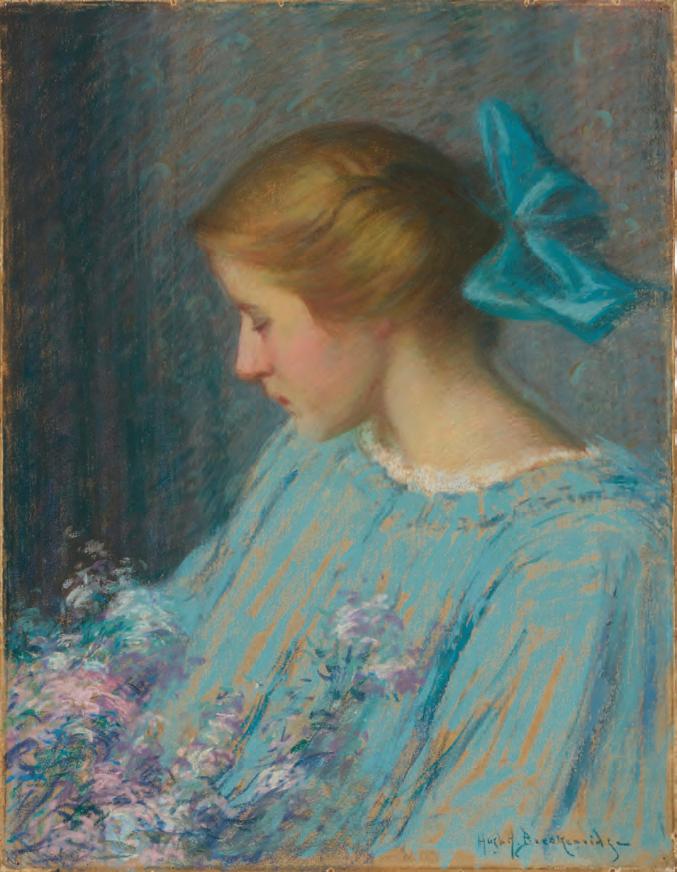
Hugh Henry Breckenridge (1870-1937)
Portrait of a woman in blue
Pastel on prepared canvas
Signed lower right: Hugh H. Breckenridge
26” H x 20” W
$1,000-2,000
Provenance: Private estate, California
1052
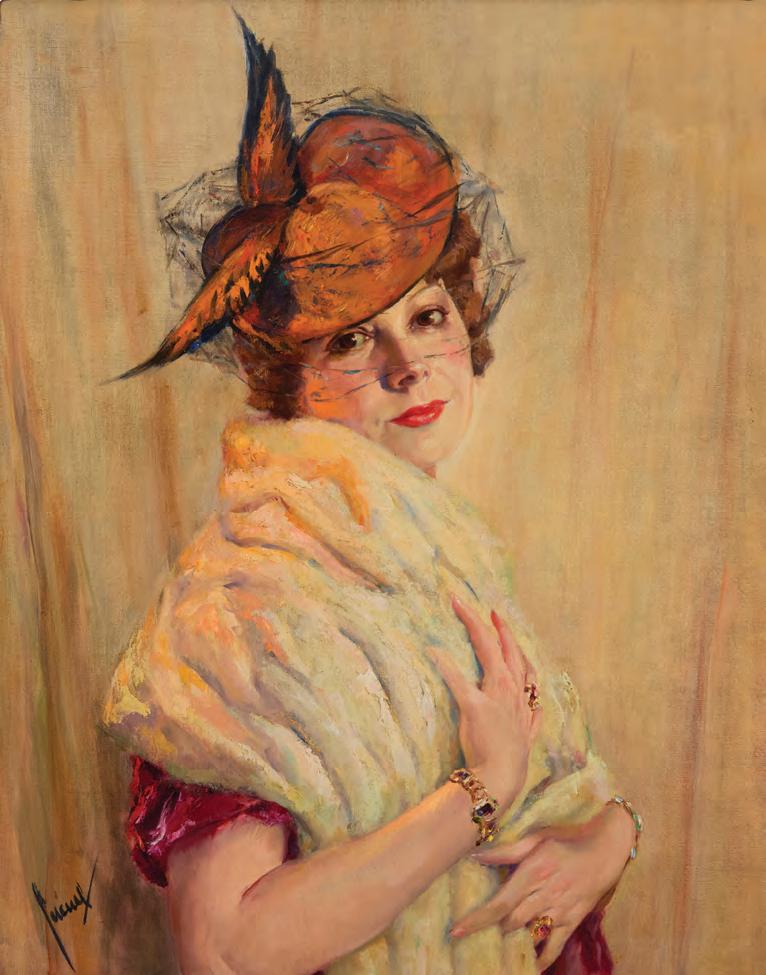
Edward Alfred Cucuel (1875-1954)
“Portrait of Aileen Carlyle,” 1941 Oil on canvas
Signed lower left: Cucuel; signed and dated verso: Cucuel. / 1941; titled on a label affixed to the stretcher
30” H x 25” W
$3,000-5,000
Provenance: Private estate, California
1053
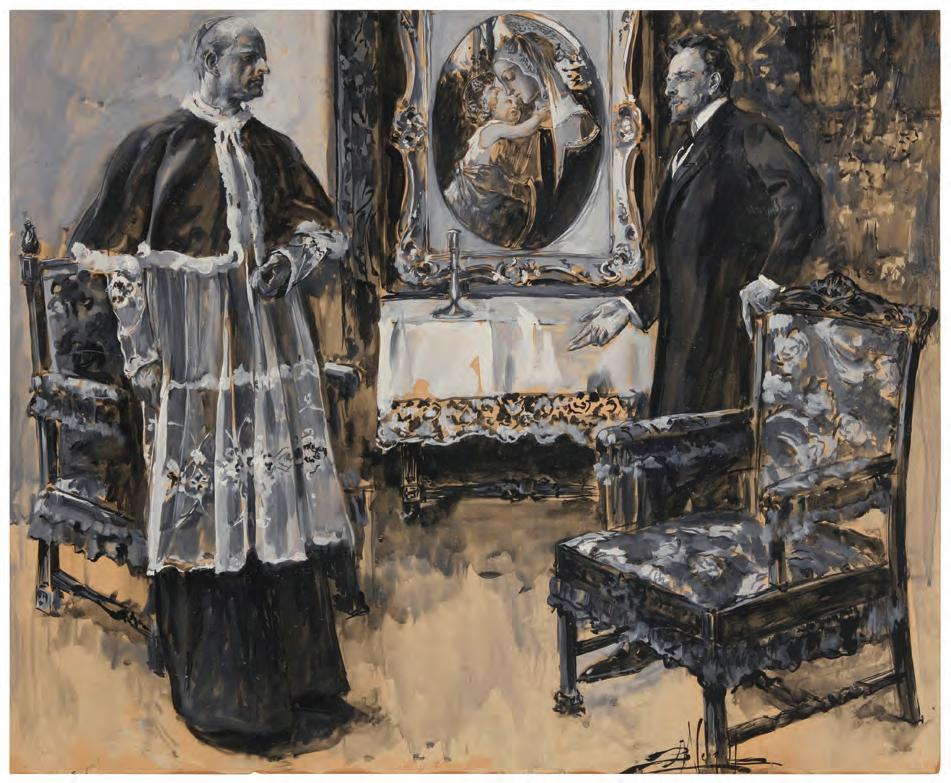
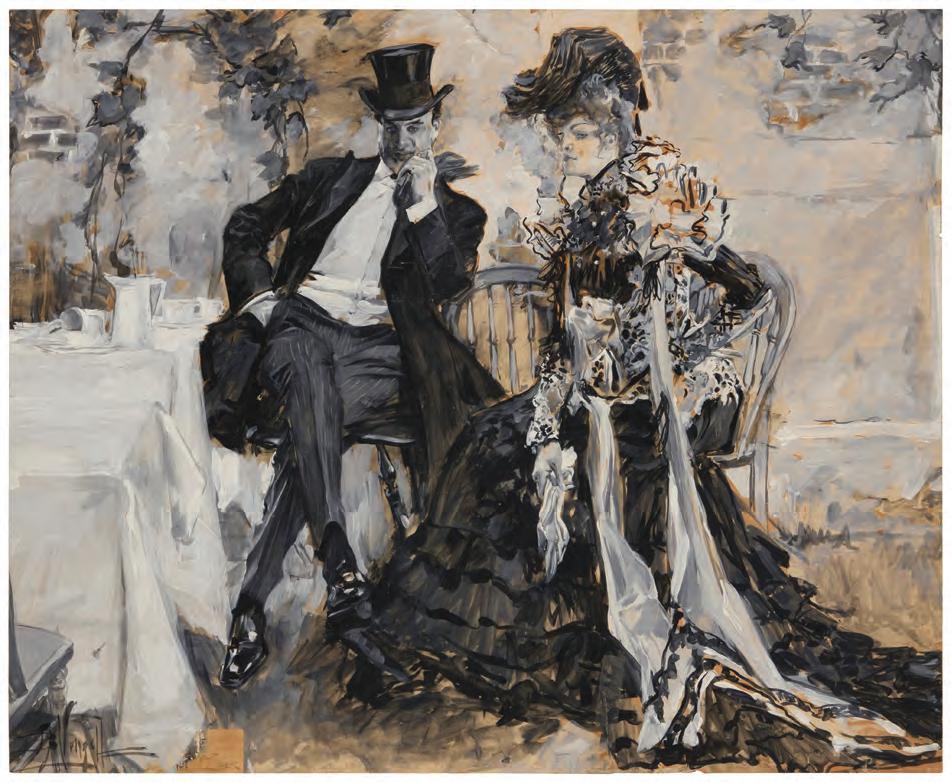
Albert Beck Wenzell (1864-1917)
A gentleman talking to a priest in a parlor; A seated lady and gentleman (double-sided) Gouache en grisaille on thin paper board
Signed lower right recto: AB Wenzell; signed lower left verso: AB Wenzell 26.25” H x 32” W
$2,000-3,000
Provenance: Private estate, California
(Verso)
1054
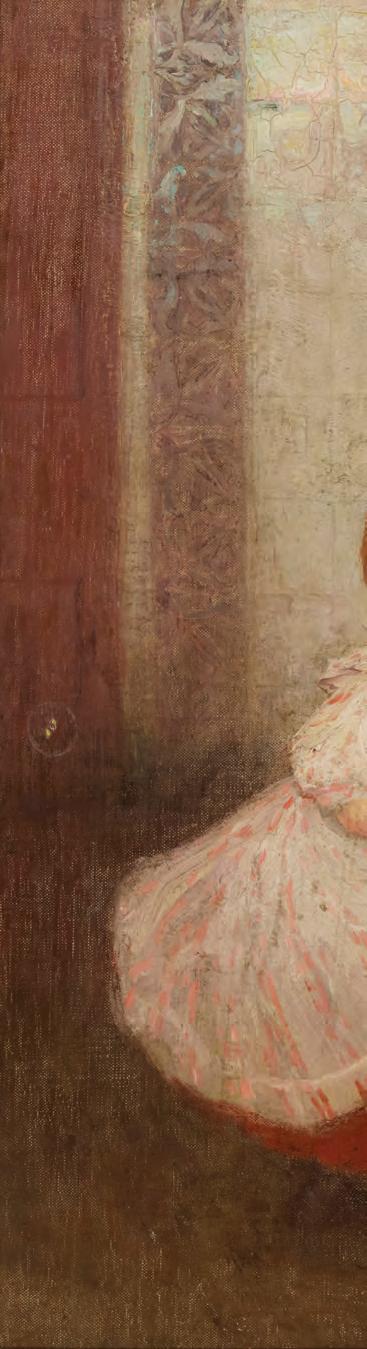
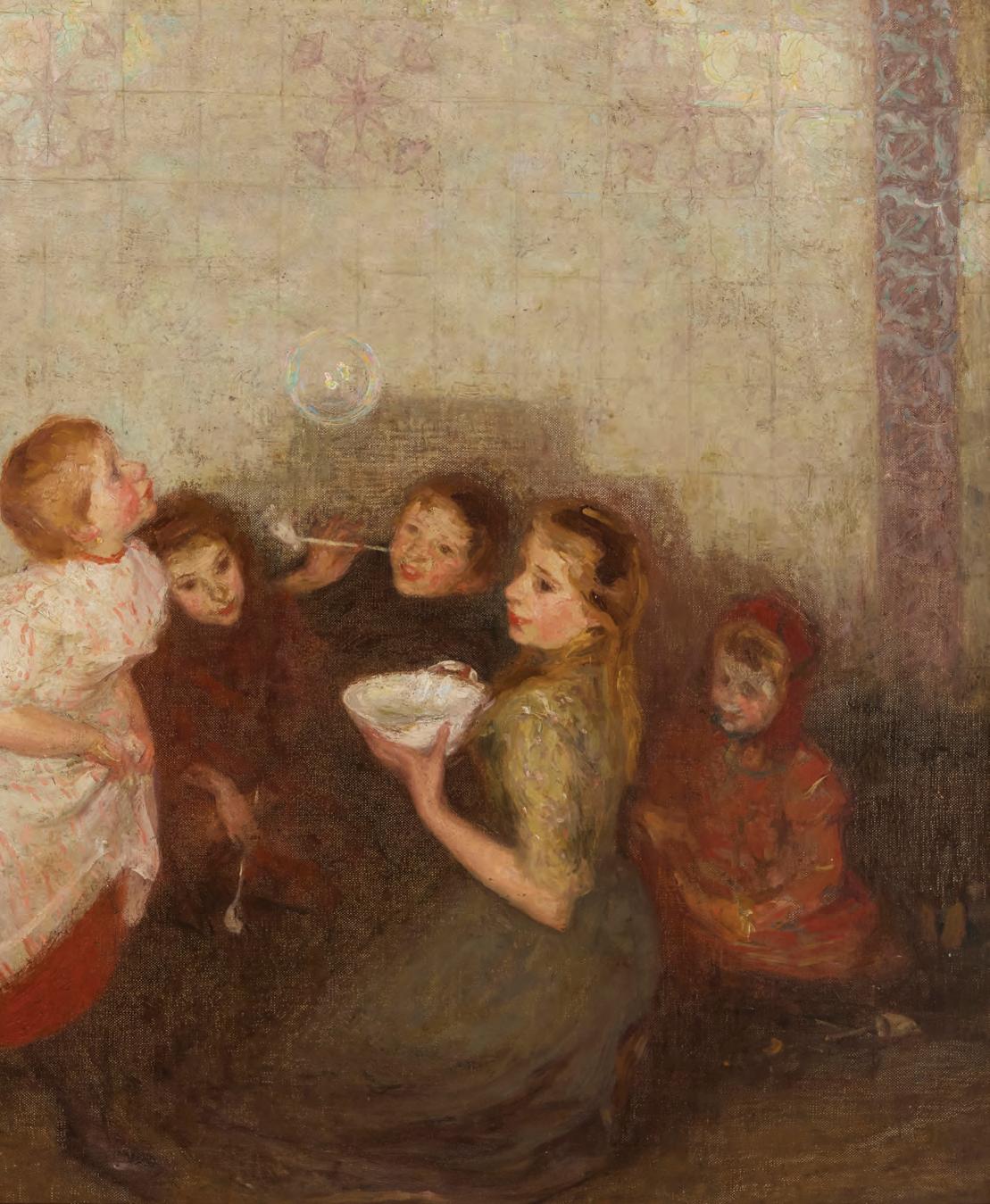
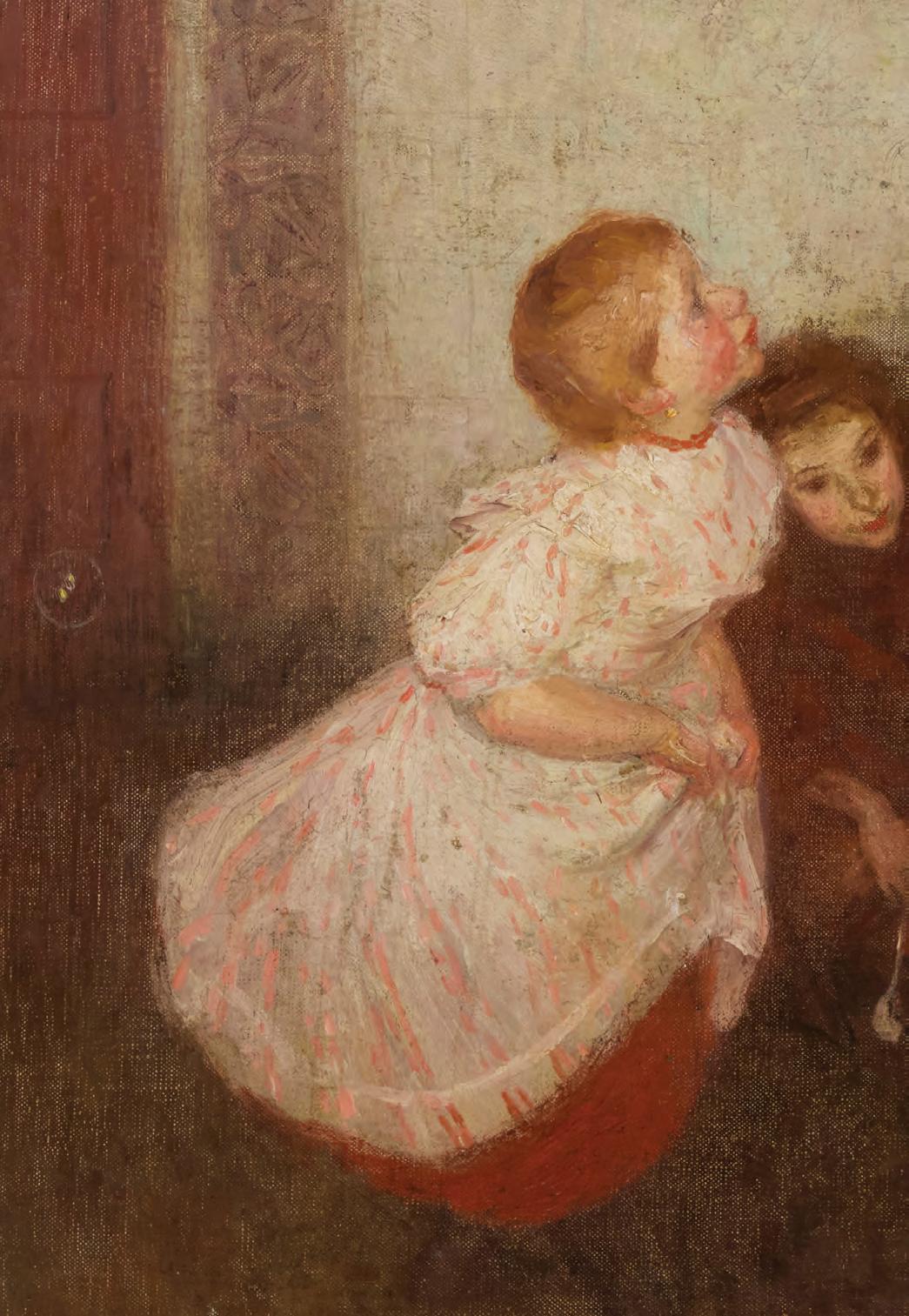
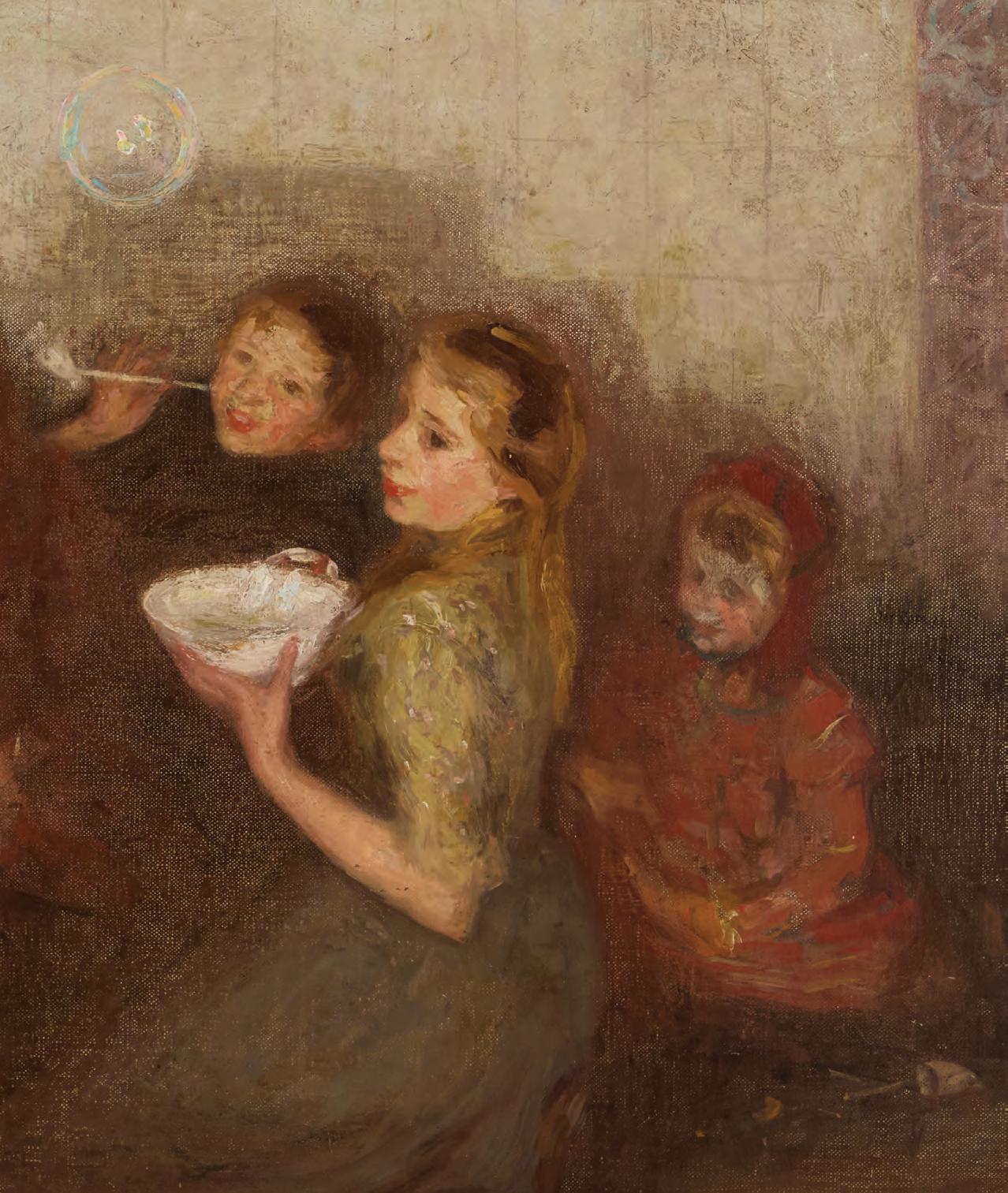
Joseph Raphael (1869-1950)
“Blowing Bubbles, Laren, Holland,” 1910 Oil on canvas
Signed, dated, and inscribed center/lower right: Jos. Raphael / 1910 / Laren 30.5” H x 33.5” W
$3,000-5,000
Provenance:
Spanierman Gallery LLC, New York, NY
Sold: Rago Arts and Auction Center, Lambertville, NJ, “Spanierman,” April 28, 2021, Lot 134 Private estate, California
Exhibitions:
New York, NY, Spanierman Gallery, “Joseph Raphael (1869-1950): An Artistic Journey,” November 18, 2003-January 3, 2004
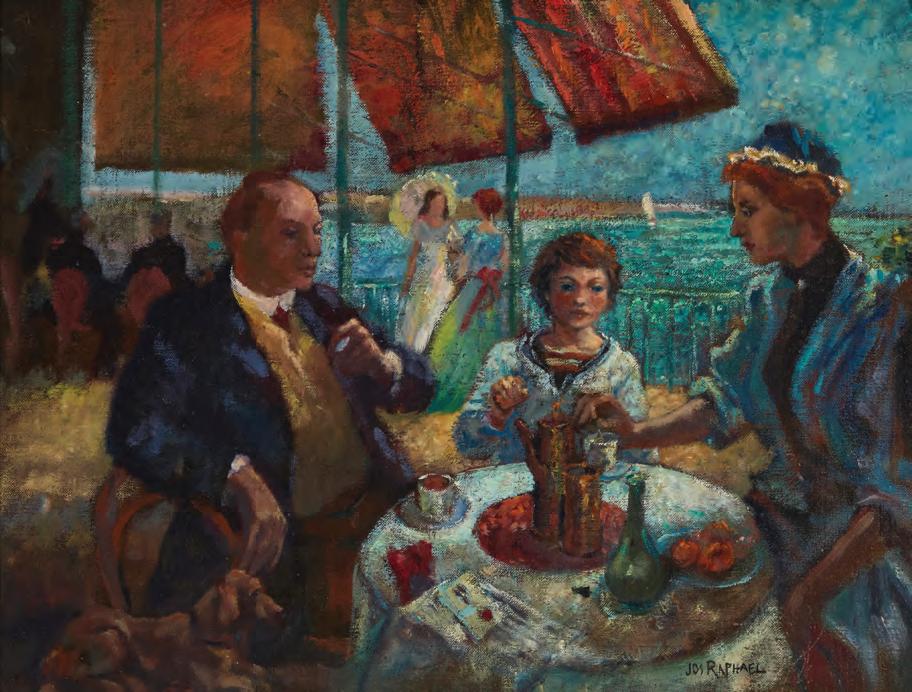
1055
Joseph Raphael (1869-1950)
“Afternoon Tea”
Oil on canvas laid to canvas
Signed lower right: Jos Raphael; titled by repute
15” H x 20.5” W
$3,000-5,000
Provenance:
Sold: Cottone Auctions, Geneseo, NY, September 27, 2014
Sold: Selkirk Auctioneers & Appraisers, St. Louis, MO, “Winter Gallery Auction,” February 14, 2026, Lot 75
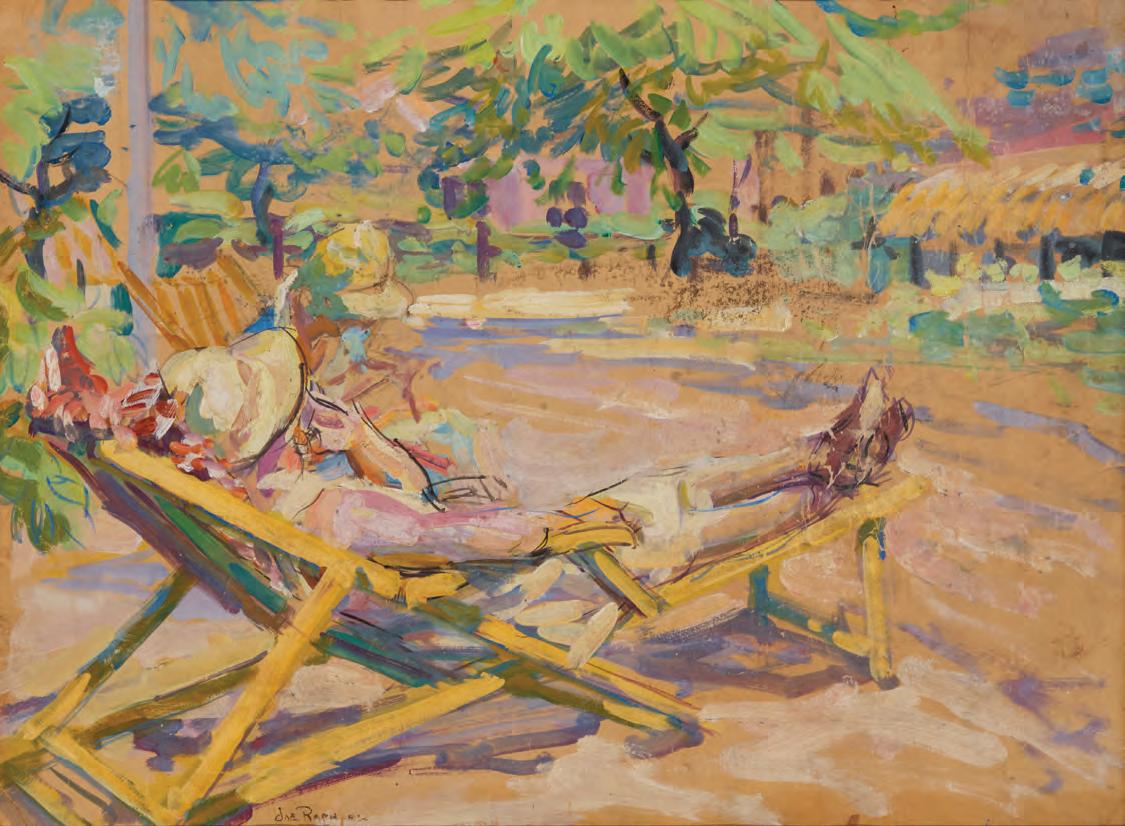
1056
Joseph Raphael (1869-1950)
A figure lounging in a garden Oil and charcoal on board
Signed lower left, partially abraded: Joe Raph*el 20” H x 27.25” W
$3,000-5,000
Provenance: Private estate, California
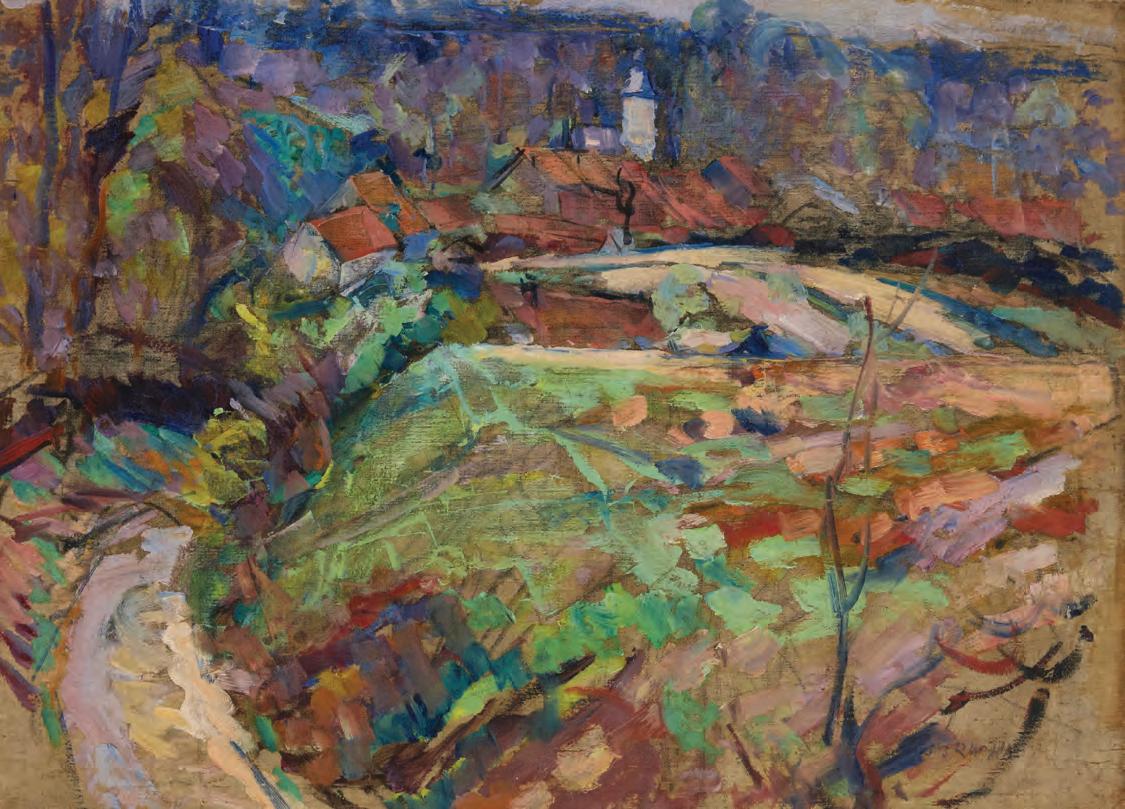
1057
Joseph Raphael (1869-1950)
Uccle landscape
Oil and traces of pencil on canvas laid to waxed canvas
Signed lower right: Jos Raphael
27.75” H x 38” W
$2,000-3,000
Provenance: Private estate, California
1058
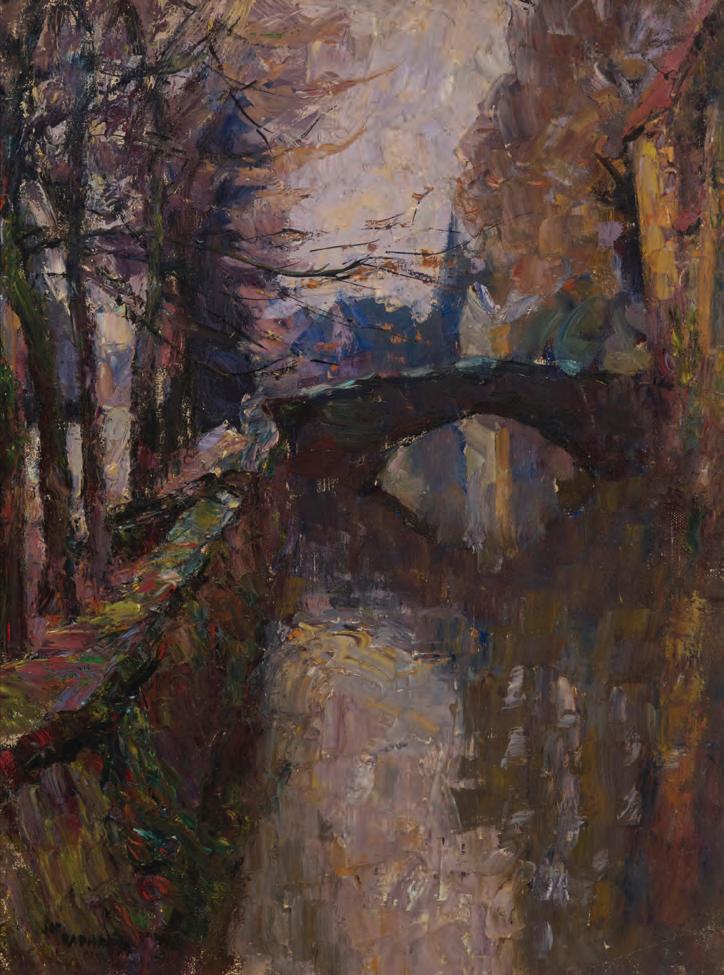
Joseph Raphael (1869-1950)
“Canal at Uccle”
Oil on canvas laid to waxed canvas
Signed and indistinctly inscribed lower left: Jos. Raphael; titled by repute
29.75” H x 22” W
$5,000-7,000
Provenance:
Sold: John Moran Auctioneers, Monrovia, CA, California & American Fine Art, April 9, 2019, Lot 35 Private estate, California
1059
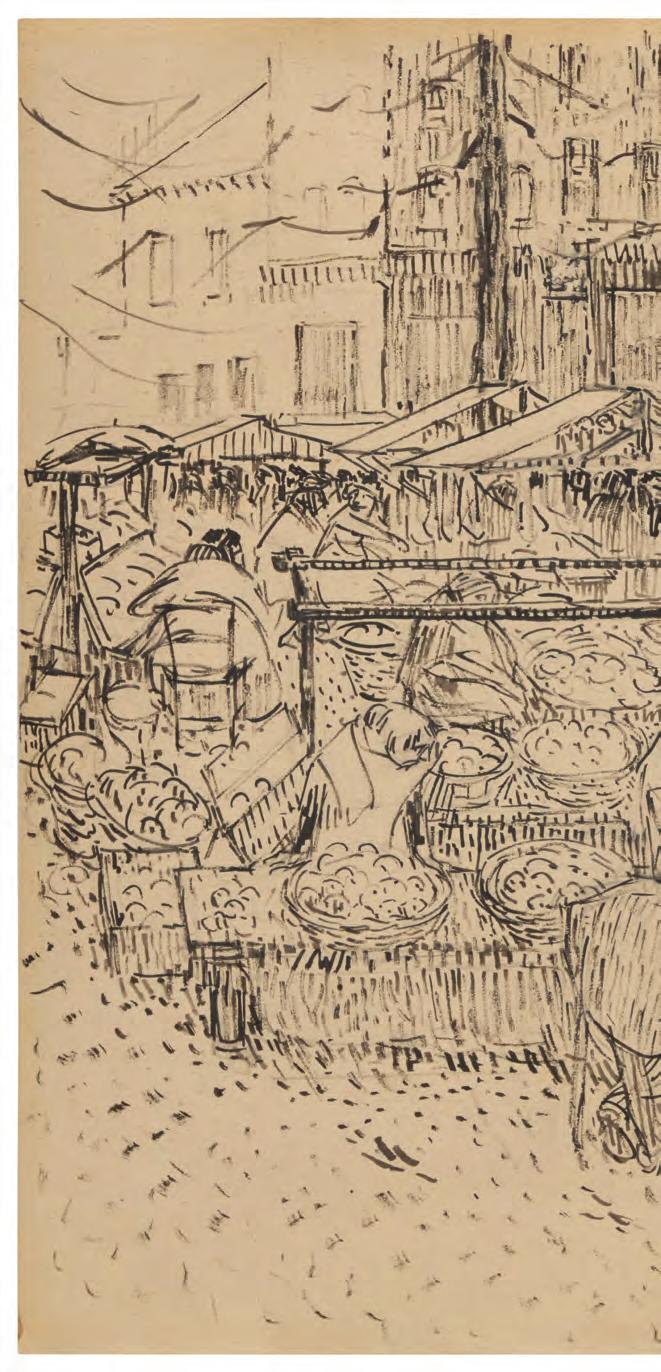
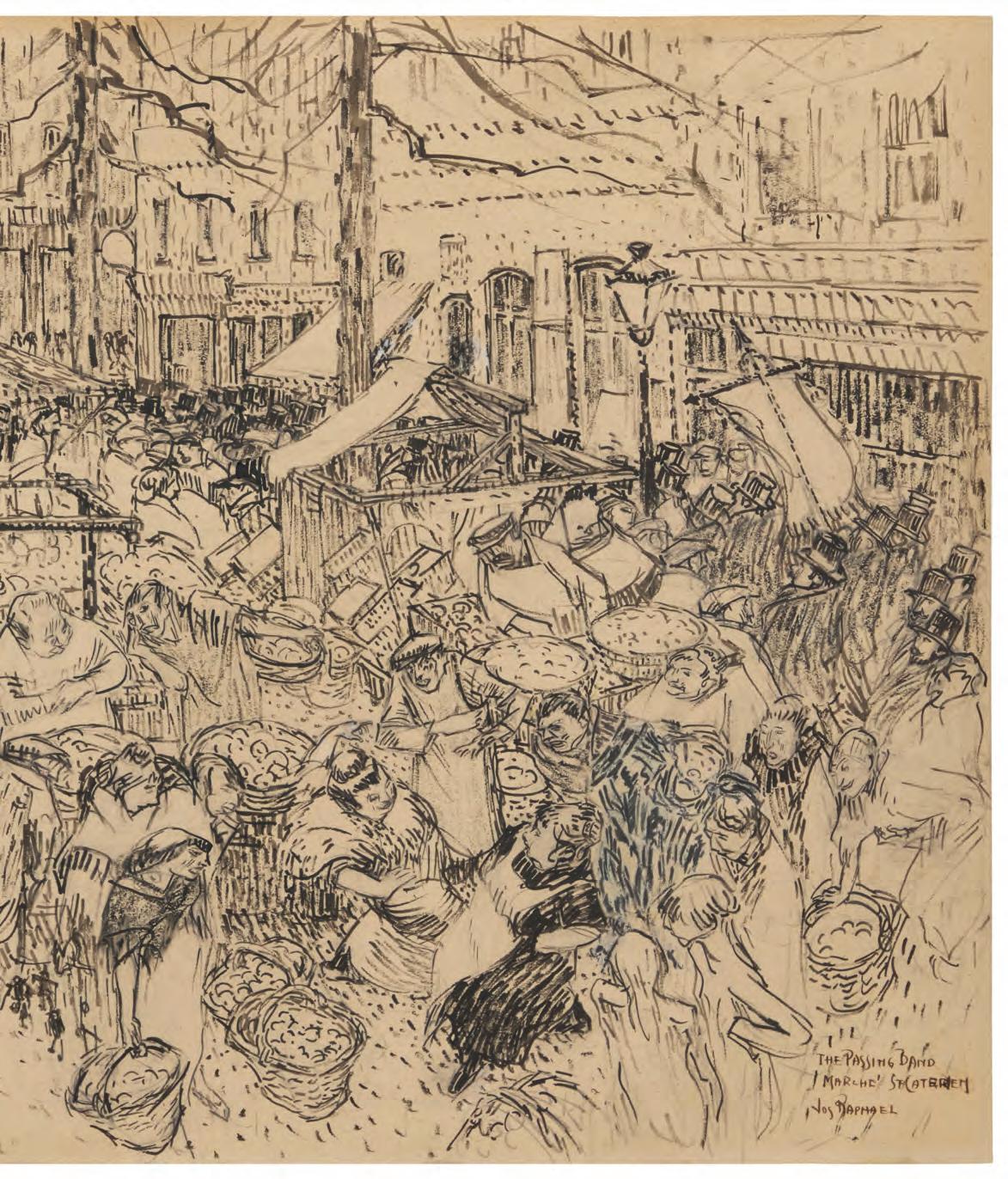
Joseph Raphael (1869-1950)
“The Passing Band, Marche St. Caterien” (France) Ink, graphite, and gouache on paper laid to paper Signed and titled in ink lower right: Jos Raphael Image/Sheet: 20” H x 27” W
$1,000-2,000
Provenance:
Sold: Christie’s, London, England, “Topographical Pictures,” November 10, 1988, Lot 70 Spanierman Gallery, LLC, New York, NY
Private collection
Sold: Doyle, New York, NY, “Doyle at Home,” July 16, 2020, Lot 35
Private estate, California
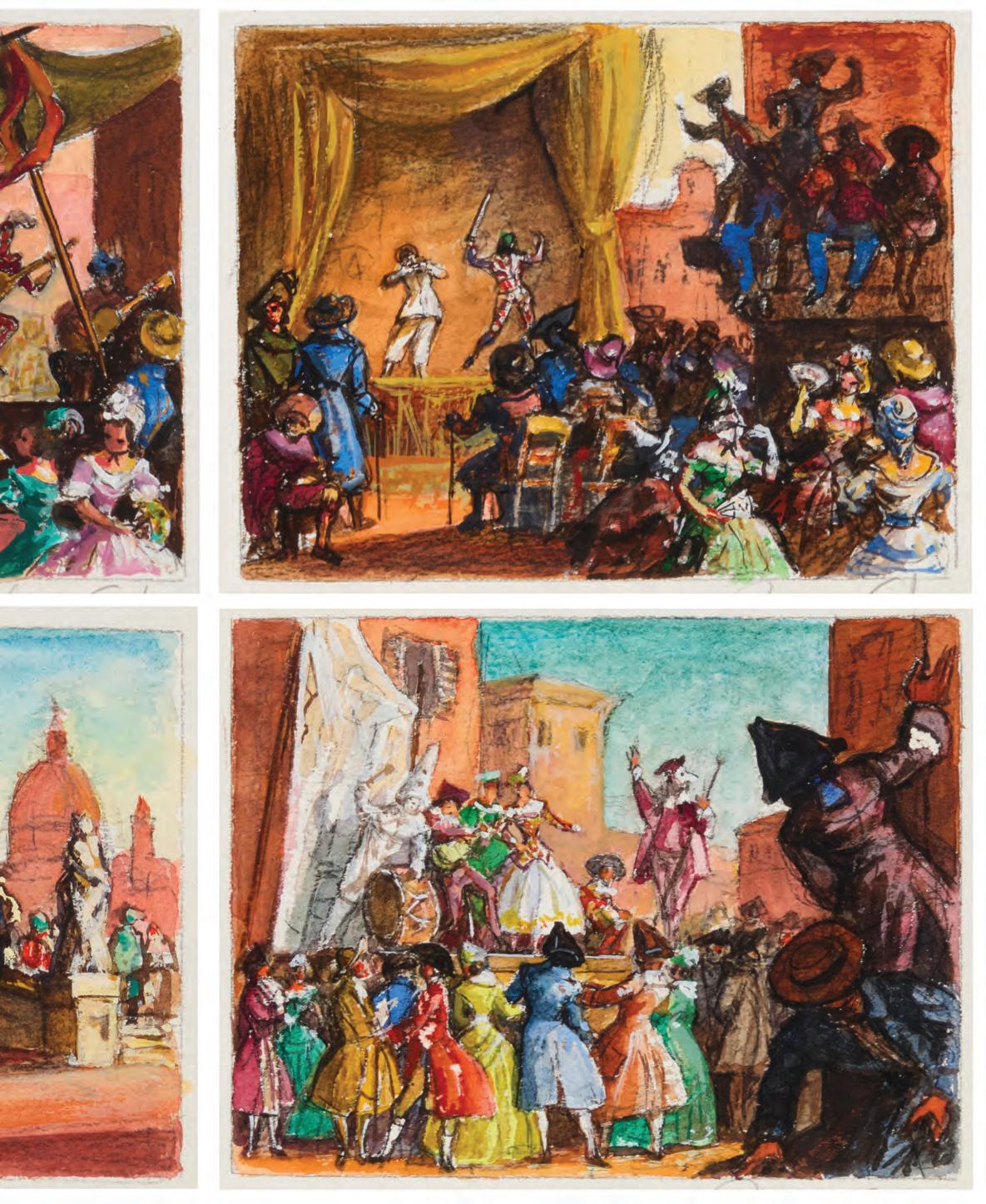
1060
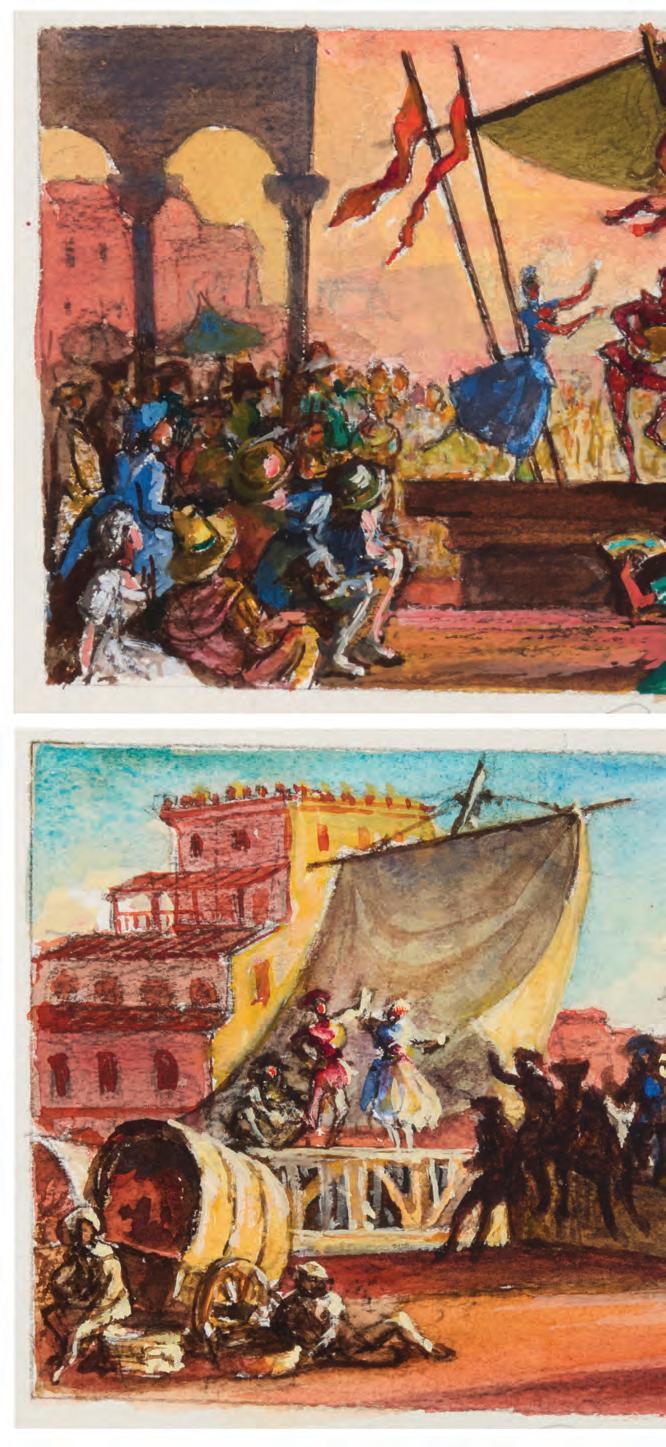
Palmer Schoppe (1912-2001)
Four works:
“Windy Day;” 1989
Watercolor and pencil on paper
Signed and inscribed in the lower margin: Palmer Schoppe / 1-19-89; signed again, titled, dated, and inscribed “#682,” all verso
Image: 4.375” H x 5.5” W; Sheet: 6” H x 8.875” W
“Arlequino & Scapino,” 1989
Watercolor and pencil on paper
Signed and inscribed in the lower margin: Palmer Schoppe / 1-24-89; signed again, titled, dated, and inscribed “#685,” all verso
Image: 4.5” H x 5.625” W; Sheet: 6” H x 8.875” W
“Dancers,” 1989
Watercolor and pencil on paper
Signed and inscribed in the lower margin: Palmer Schoppe / 1-26-89; signed again, titled, dated, and inscribed “#686,” all verso
Image: 4.5” H x 5.625” W; Sheet: 6” H x 8.875” W
“On with the Show,” 1989
Watercolor and pencil on paper
Signed and inscribed in the lower margin: Palmer Schoppe / 1-29-89; signed again, titled, dated, and inscribed “#687,” all verso
Image: 4.5” H x 5.625” W; Sheet: 6” H x 8.875” W
$1,000-1,500
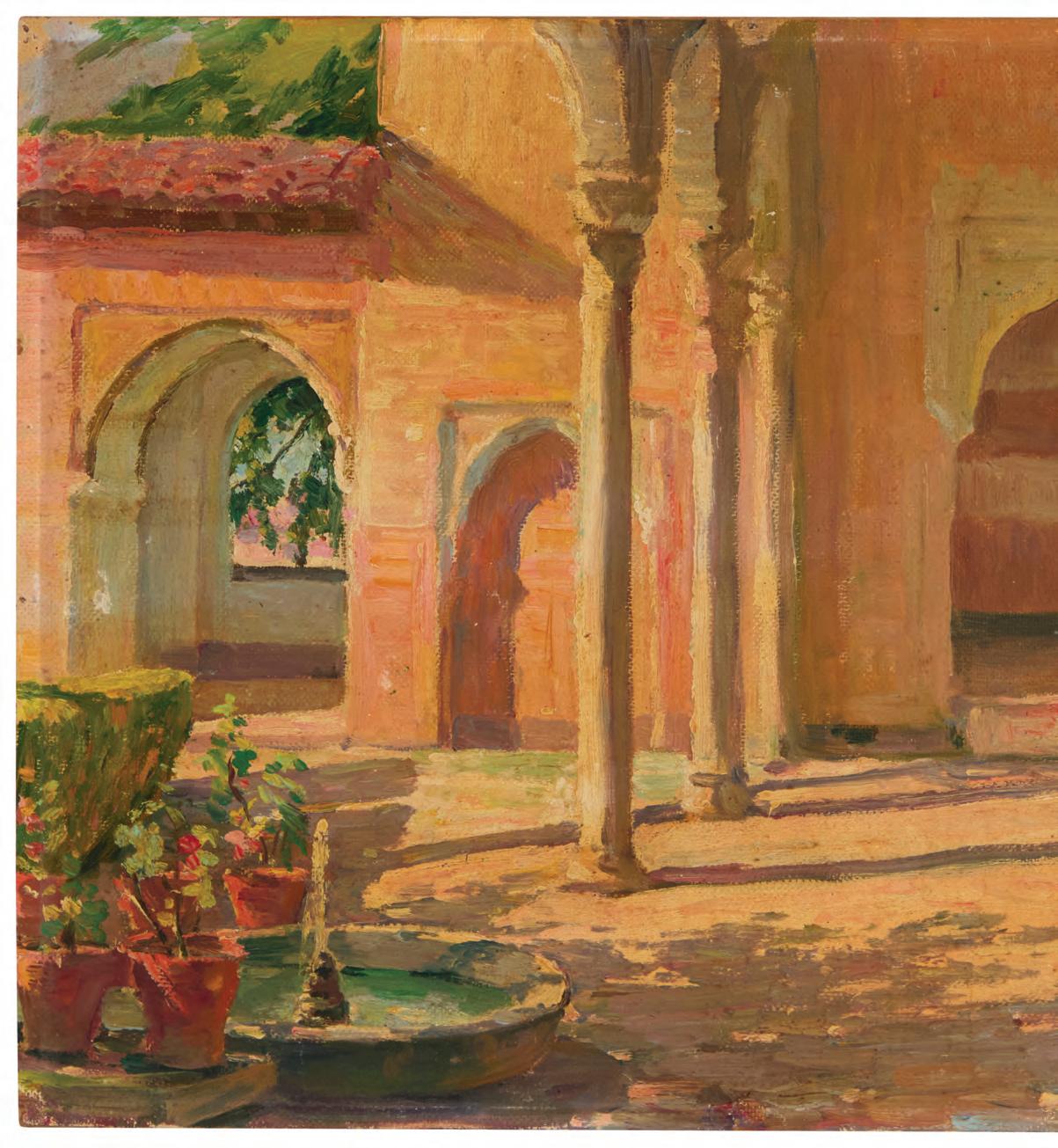
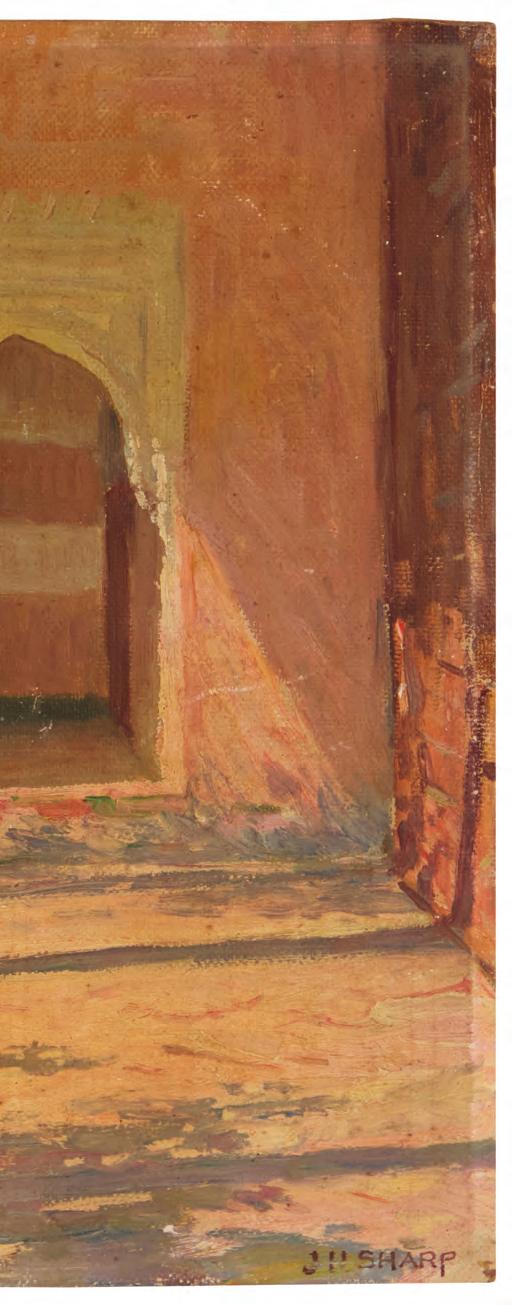
1061
Joseph Henry Sharp (1859-1953)
Courtyard, likely Alhambra, Spain, circa 1922
Oil on canvas laid to board
Signed lower right: J.H. Sharp; dated by repute
10.75” H x 14” W
$3,000-5,000
Notes:
Joseph Henry Sharp first visited Spain in 1885/1886 after a return to Europe to continue his studies. Initially he enrolled at the Academy in Munich studying under Karl Von Marr before travelling through Spain and Italy with fellow artist Frank Duveneck.
Sharp returned to Spain in 1922, this time joined by his wife Louise Sharp on an extended European trip through France and into Spain. In Madrid, “the artist wanted to reacquaint himself with the rich collections of the Prado Museum...where he had been so inspired in his younger years, 1895” (https://centerofthewest.org/catalogs/sharp).
The couple also visited the historic cities of Toledo and Granada where the artist photographed and sketched on the grounds of the palace and fortress of the Alhambra. Aside from the present work, three other sketches attributed to the Alhambra location are known to have been executed by Sharp on this trip, all in the collection of the Great Plains Art Museum, University of Nebraska, Lincoln, NE.
In the present work, Sharp captures a quiet courtyard likely on the palace grounds, featuring three Moorish arches, one horseshoe and two-pointed horseshoe forms, along with decorative columns and a fountain. The Moorish rammed earth and brick walls are bathed in the reddish-pink sunset hues adding to the sereneness of the scene.
1062
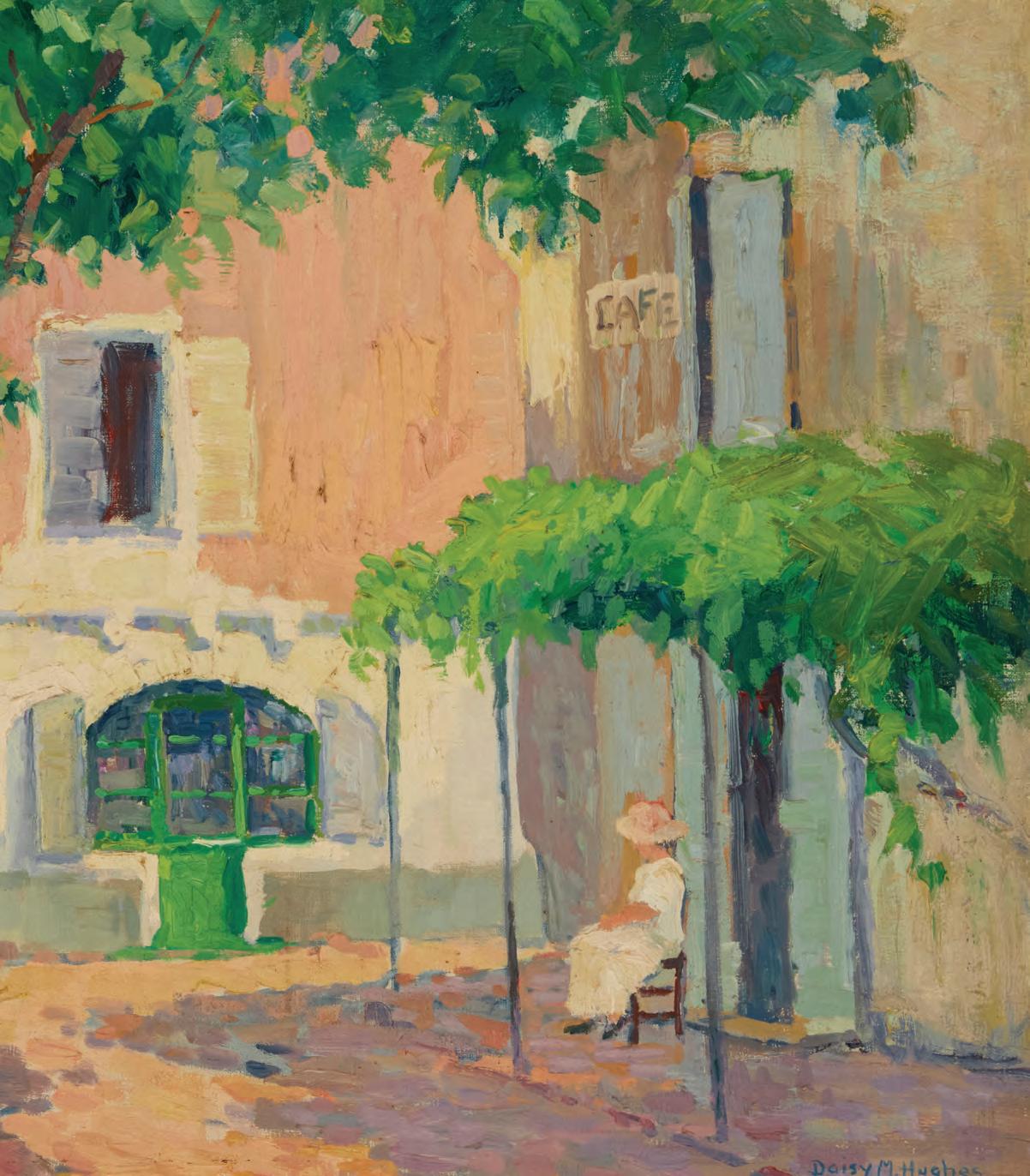
Daisy Marguerite Hughes (1882-1968)
“French Cafe” Oil on cavnas
Signed lower right: Daisy M. Hughes; titled in pencil verso; alternatively titled “Le Petit Magasin” in pencil on the stretcher 25.25” H x 30.5” W
$1,000-1,500
1063
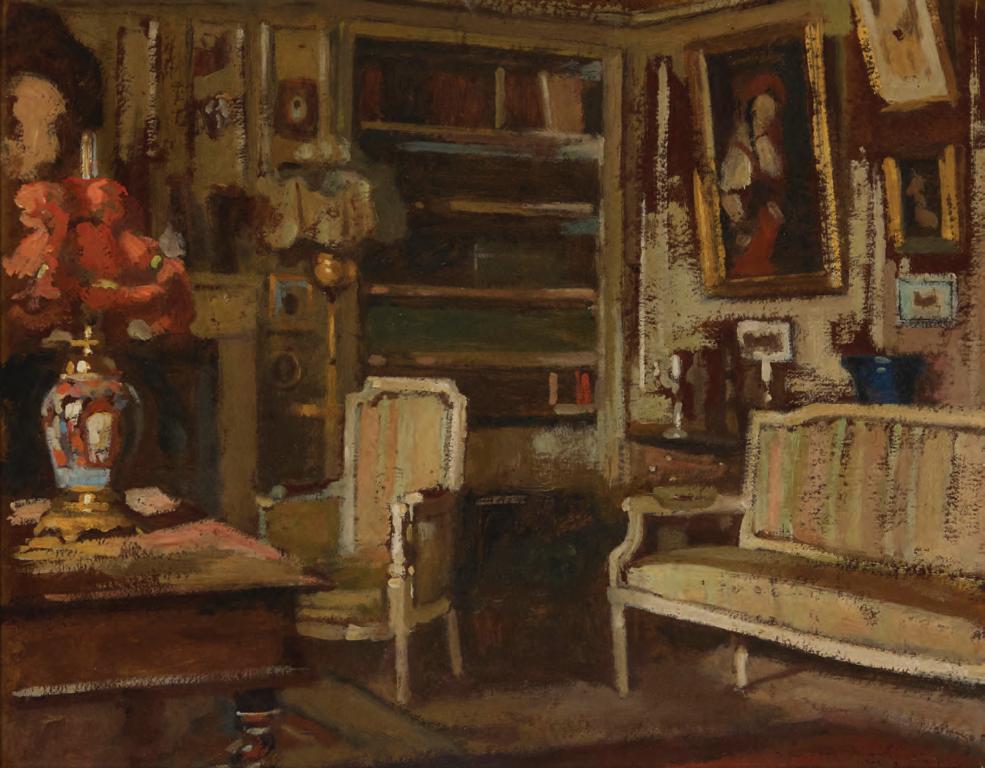
Alson Skinner Clark (1876-1949)
“Bureau au vase fleuri” Oil on board
Signed and inscribed, very delicately and partially indistinct, lower right: Mon Cher (or Amour) M. Deitailles (?) / **** / Alson S. Clark; titled by repute; extensively inscribed with information about the artist, in French in another hand, verso 10.5” H x 13.5” W
$800-1,200
Provenance: Private estate, California
1064
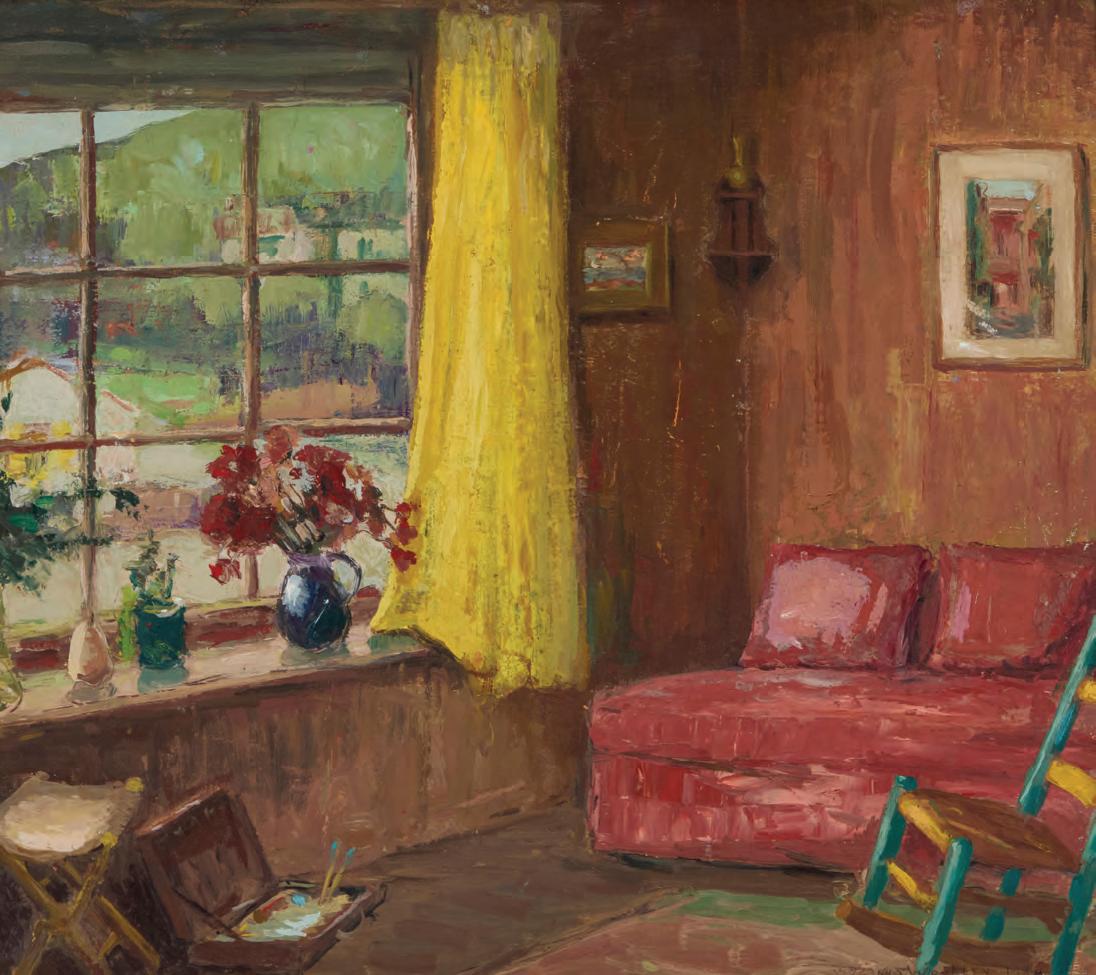
Virginia Woolley (1884-1971)
“As it Was - My Studio,” 1984 Oil on board
Signed and dated lower right: Virginia Woolley 1984; signed again on a partial label affixed verso; titled and inscribed in ink on the artist’s studio label affixed verso: “615 Seaview / ‘As it Was’ - My Studio;” with additional figural sketches in charcoal, verso
15.875” H x 17.875” W
$1,000-2,000
Provenance:
Jeff Olsen Collection, Newport Beach, CA
1065
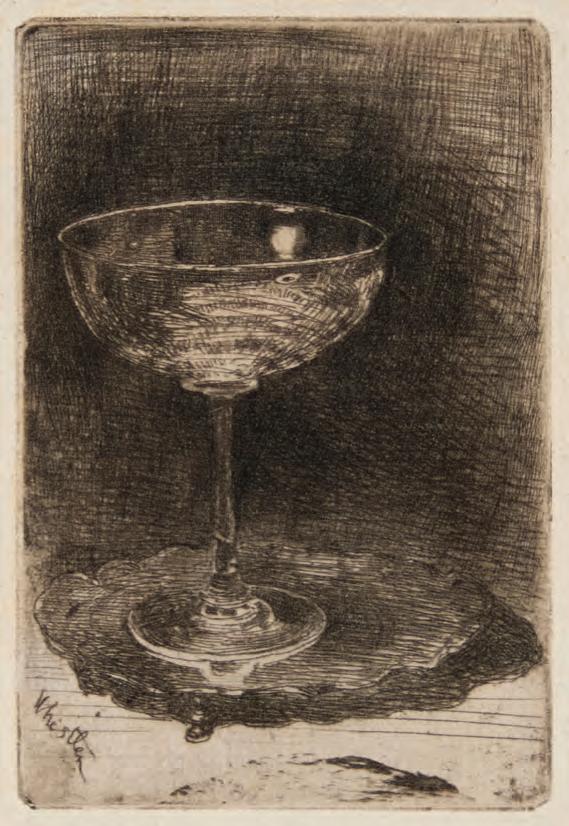
James McNeill Whistler (1834-1903)
“The Wine Glass,” 1859 Etching on laid paper
From the edition of unknown but presumably small size, 40 of which have been located; second (final) state
With the artist’s signature in the plate at lower left: Whistler Plate: 3.25” H x 2.125” W; Sheet: 4.25” H x 3” W
$5,000-7,000
Literature: Glasgow 38 ii/ii; Kennedy 27
Notes:
James McNeill Whistler’s 1859 etching “The Wine Glass” exemplifies the artist’s early mastery of line, composition, and subtle tonal effects within the medium of printmaking. In this etching, Whistler transforms an ordinary object into a study of atmosphere and restraint, using delicate, economical lines to suggest form rather than fully define it.
This impression is inscribed in pencil with what is likely an early dealer (possibly Kennedy Galleries, New York, NY) inventory code, verso: a53315.
1066
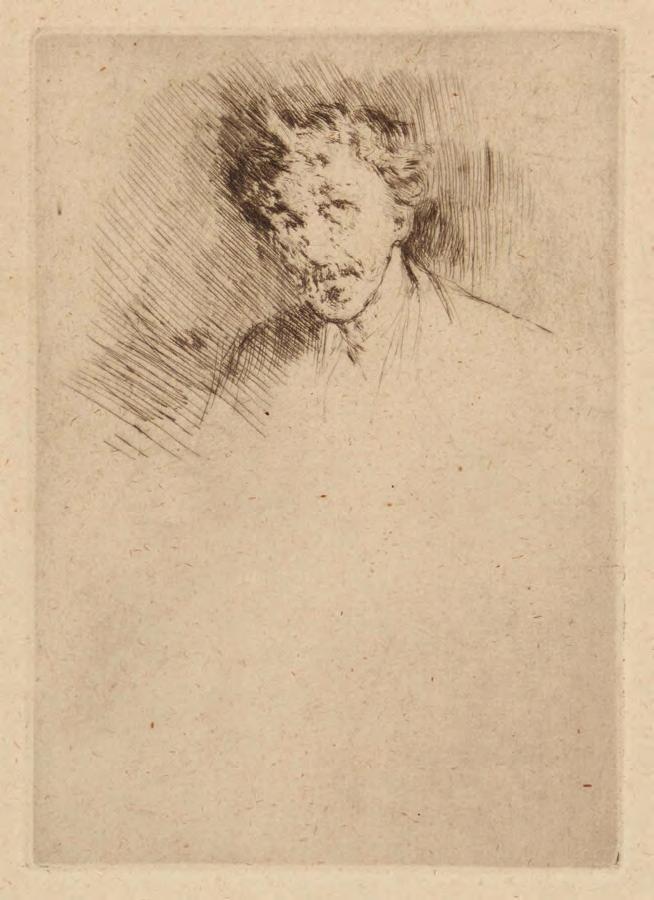
James McNeill Whistler (1834-1903)
“Whistler with the White Lock,” 1876-79 Etching and drypoint on off-white laid paper
From the edition of unknown size, of which 34 are known; first (only) state Unsigned, as issued
Plate: 4.625” H x 3.125” W; Sheet: 8.5” H x 6.5” W
$1,800-2,200
Literature: Glasgow 162 i/i; Kennedy 172
Notes:
Inscribed in pencil with what is likely an early dealer (possibly Kennedy Galleries, New York, NY) inventory code, verso: a53364.
1067
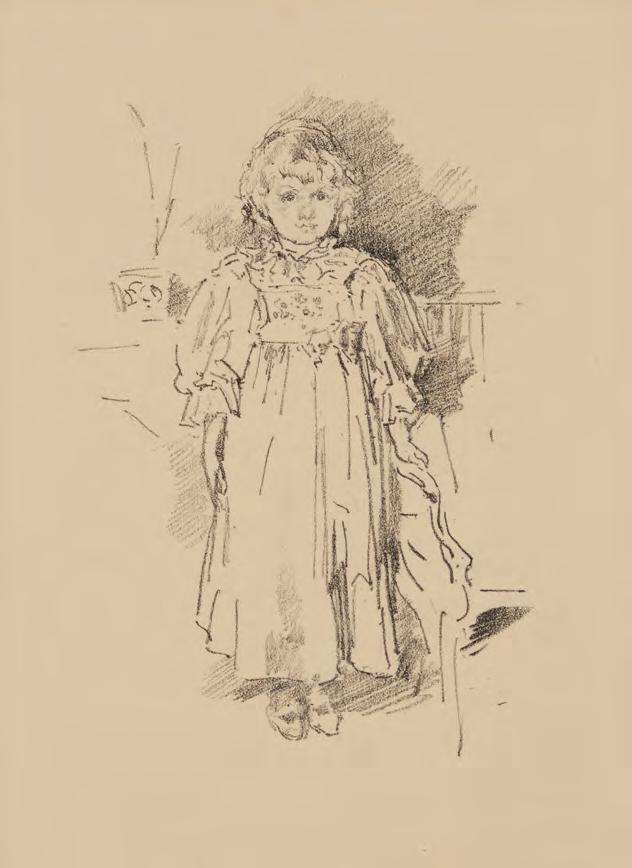
James McNeill Whistler (1834-1903)
“Little Evelyn,” 1896
Transfer lithograph on cream laid paper
From the edition of approximately 3000 issued in the March 1896 issue of “The Art Journal;” first (only) state
With the artist’s butterfly signature in the stone at upper left; with the printed legend in the stone along the lower margin edge, at left: “The Art Journal, March, 1896”; Thomas Way, London, England, prntr.; Virtue & Company Ltd., London, England, pub. Image: 7” H x 5.5” W; Image including legend: 10” H x 5.5” W; Sheet: 11.375” H x 9.375” W
$500-700
Literature:
The Art Journal, no. 137, March 1896, p. 89 Chicago 146 i/i; Levy 159; Way 110
Notes:
According to research spearheaded by Nesta Spink, together with editors Harriet Stratis and Martha Tedeschi for the Art Institute of Chicago’s original two volume catalogue raisonne of the artist’s lithographs, “The periodical edition was machine printed from supplementary stones by Thomas Way for “The Art Journal.” The lithograph appeared in the March 1896 issue; it was titled “Evelyne” in the table of contents and in Joseph Pennell’s descriptive note on page 89. Impressions for the periodical edition were printed on cream laid paper, which has often darkened to buff or tan. The recto of the paper has a smooth surface, while the verso bears a distinct pattern of laid and chain lines. These proofs are generally coarser and grainier than those pulled from the original stone, and many have been trimmed to remove the printed legend.
1068
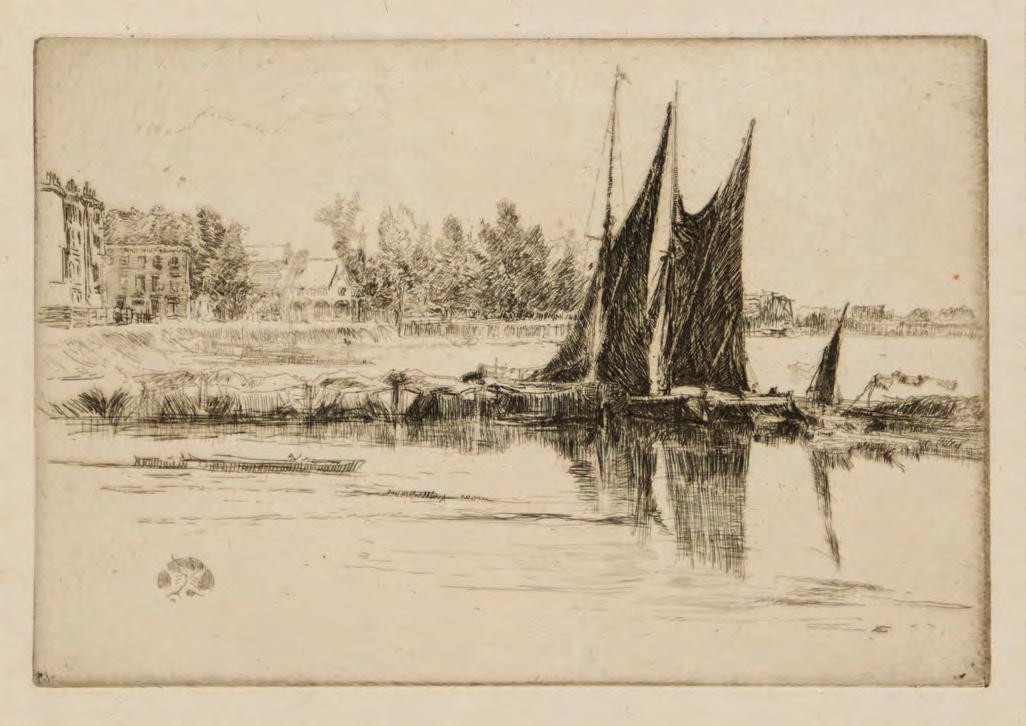
James McNeill Whistler (1834-1903)
“Hurlingham,” 1879
Etching and drypoint on cream laid paper
From the combined total of 49 known impressions in all four states; fourth (final) state
With the artist’s shaded-wing butterfly signature in the plate at lower left Plate: 5.5” H x 8” W; Sheet: 8.75” H x 11.5” W
$700-1,000
Literature: Glasgow 184 iv/iv; Kennedy 181
1069
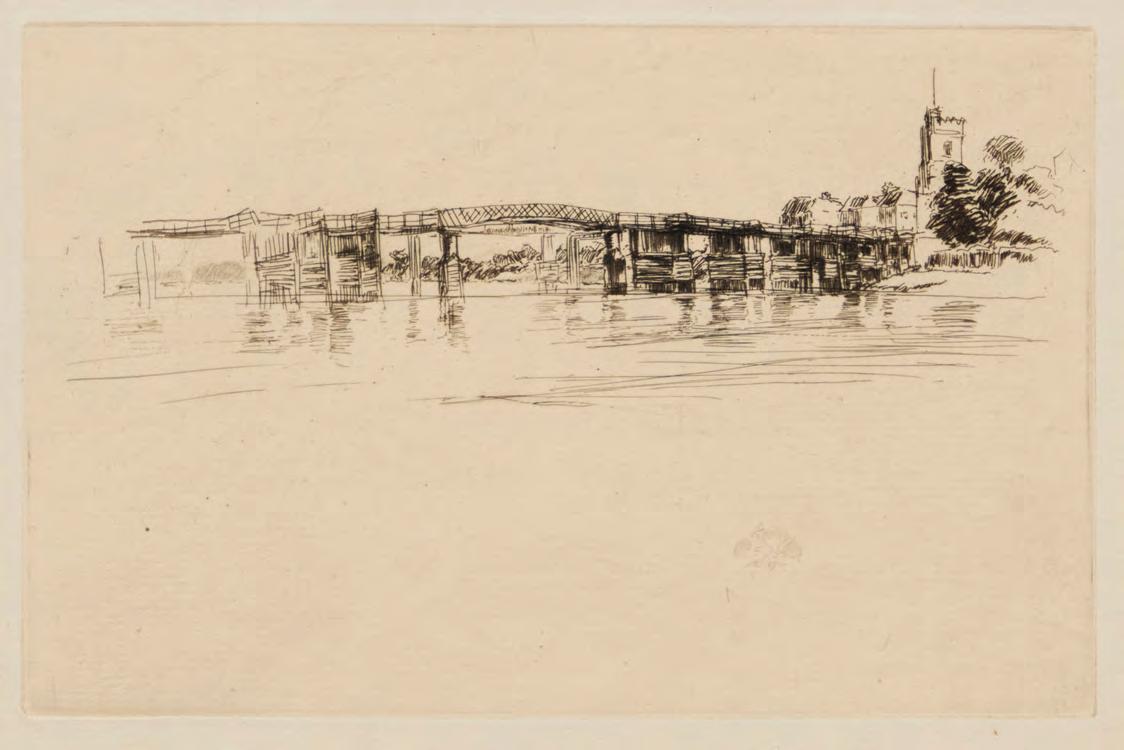
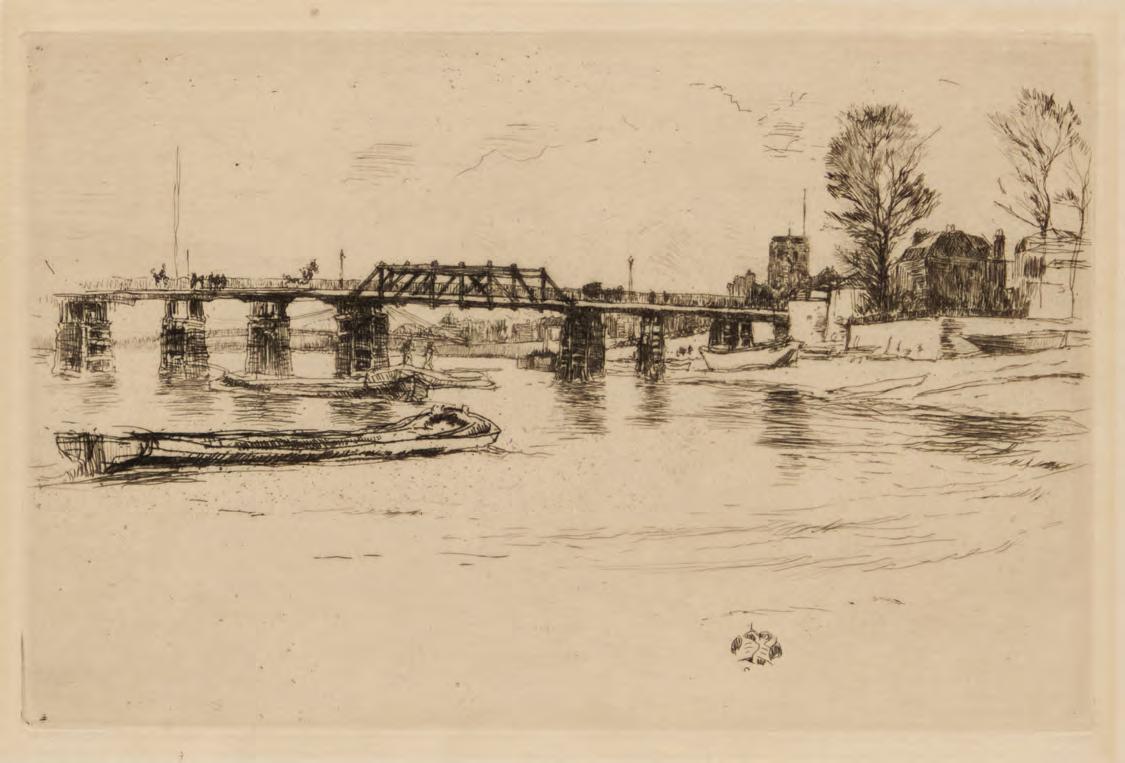
James McNeill Whistler (1834-1903)
“Little Putney Bridge,” 1879
Etching and drypoint in brownish-black ink on off-white laid paper
From the combined total edition of 56 known impressions in five states; fifth (final) state
With the artist’s shaded-wing butterfly signature in the plate at lower right Plate: 5.25” H x 8” W; Sheet: 7” H x 9.5” W
$600-800
Literature: Glasgow 186 v/v; Kennedy 179
Notes:
According to Glasgow, the fifth state impressions were printed for inclusion in the 250 copies of F. Wedmore, “Four Masters of Etching: with Original Etchings by Haden, Jacquemart, Whistler, and Legros,” London: The Fine Art Society, Ltd., London,1883, opposite page 36.
1070
James McNeill Whistler (1834-1903)
“Chelsea,” 1878-79
Etching and drypoint in black ink on cream laid paper
From the combined total of 66 known impressions in all five states, fifth (final) state With the artist’s shaded-wing butterfly signature in the plate at lower right Plate: 5.25” H x 8.25” W; Sheet: 8.875” H x 12.5” W
$600-800
Literature: Glasgow 181 v/v; Kennedy 182
Notes:
The work is also known as “Fulham.”
1071
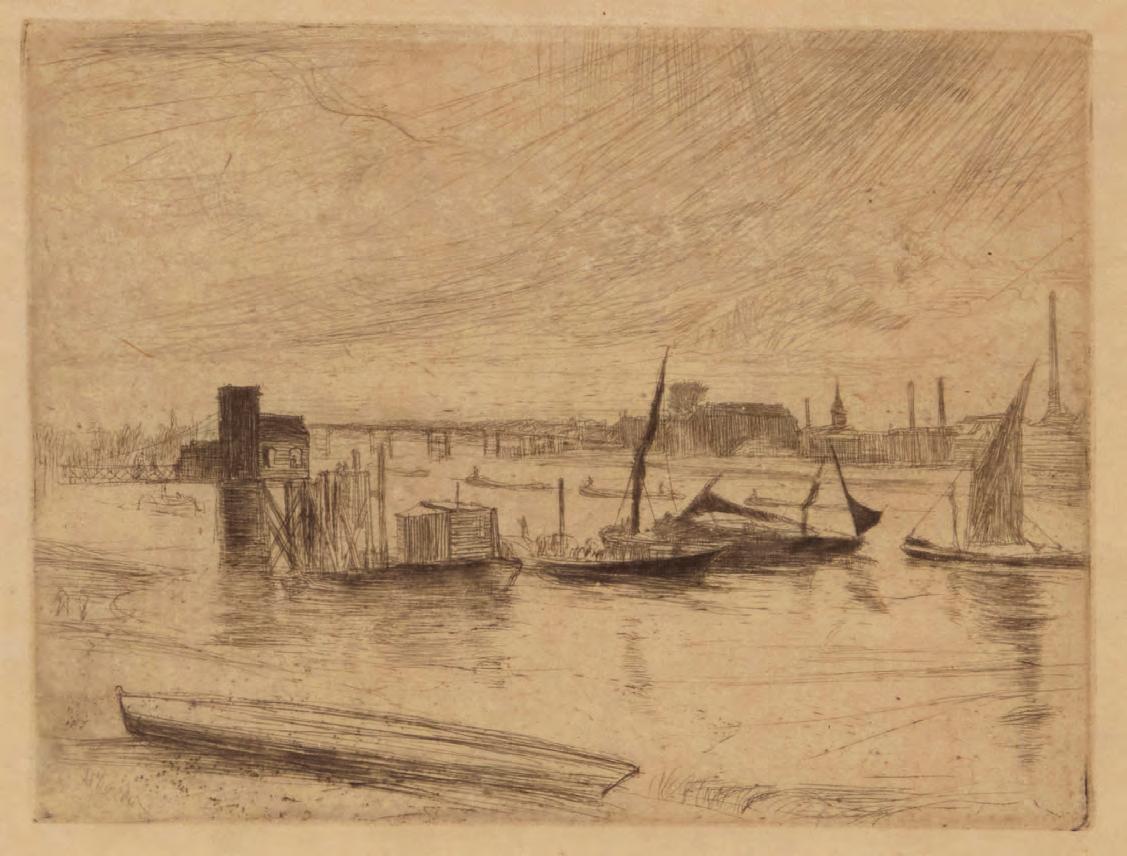
James McNeill Whistler (1834-1903)
“Battersea Dawn (Cadogan Pier),” circa 1863
Etching and drypoint in black ink on light-golden, thin, laid, Japan paper
From the combined total of 61 known impressions in two states; second (final) state
With the artist’s signature showing faintly in the lower left plate corner: Whistler
Plate: 4.5” H x 6” W; Sheet: 6.25” H x 8.625” W
$600-800
Literature: Glasgow 95 ii/ii; Kennedy 75;
Notes:
This image is from Whistler’s “A Series of Sixteen Etchings of Scenes on the Thames” (aka the “Thames Set”), published in 1871.
1072
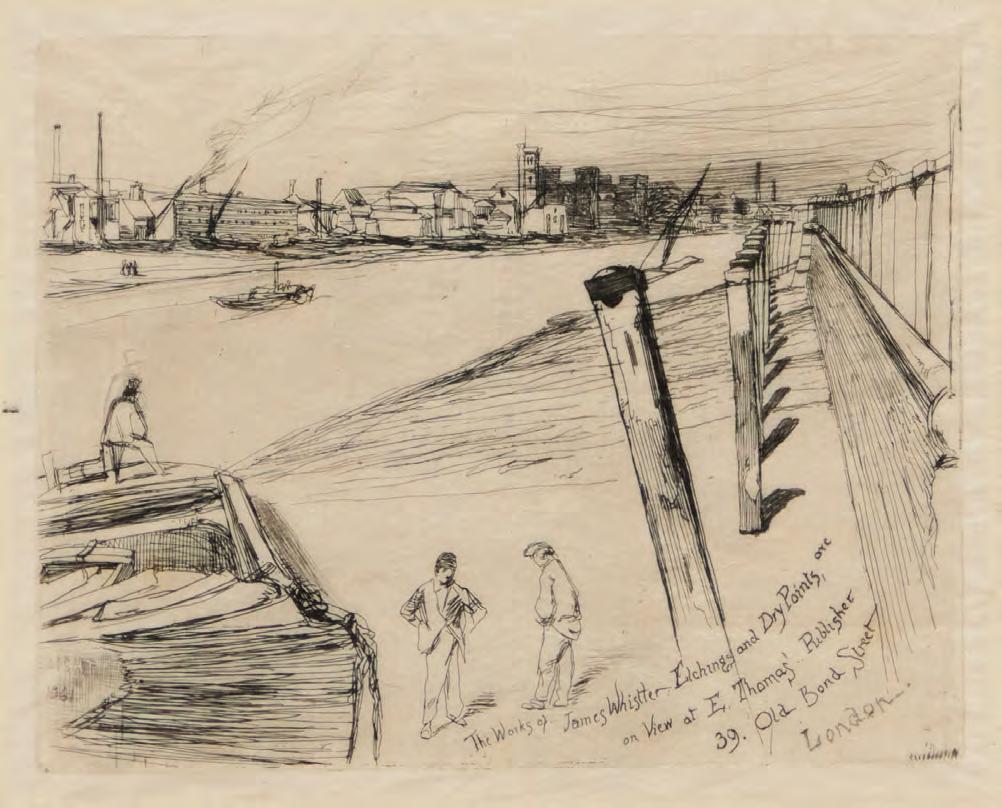
James McNeill Whistler (1834-1903)
“Millbank,” 1861
Etching and drypoint in black ink on tissue-thin laid Japan paper
From the combined total of 67 known impressions in all five states; fourth state (of five)
Unsigned, as issued; with the etched text (including the artist’s name) in the lower right corner of the plate
Plate: 4” H x 5” W; Sheet: 7.375” H x 9.5” W
$600-800
Literature: Glasgow 78 iv/v; Kennedy 71
Notes:
The etched inscription printed in the lower right quadrant of the plate reads: “The Works of James Whistler: Etchings and Dry Points, are / on View at E. Thomas’ .. Publisher / 39. Old Bond Street / London.”
1073
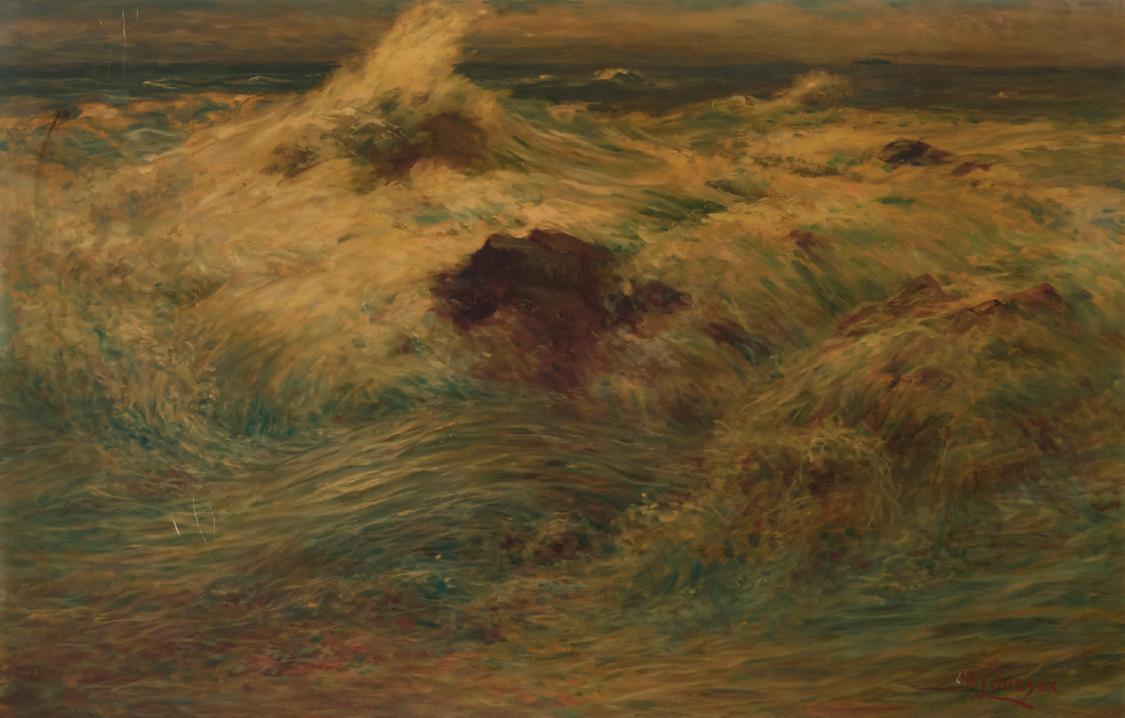
William Lees Judson (1842-1928)
Waves Oil on canvas
Signed lower right: W.L. Judson 25” H x 39.5” W
$2,000-3,000
Provenance: The artist By family descent
1074
Gideon Jacques Denny (1830-1886)
Sailing ships on San Francisco Bay, 1884 Oil on canvas
Signed and dated lower left: G.J. Denny 1884
20” H x 36” W
$1,000-1,500
1075
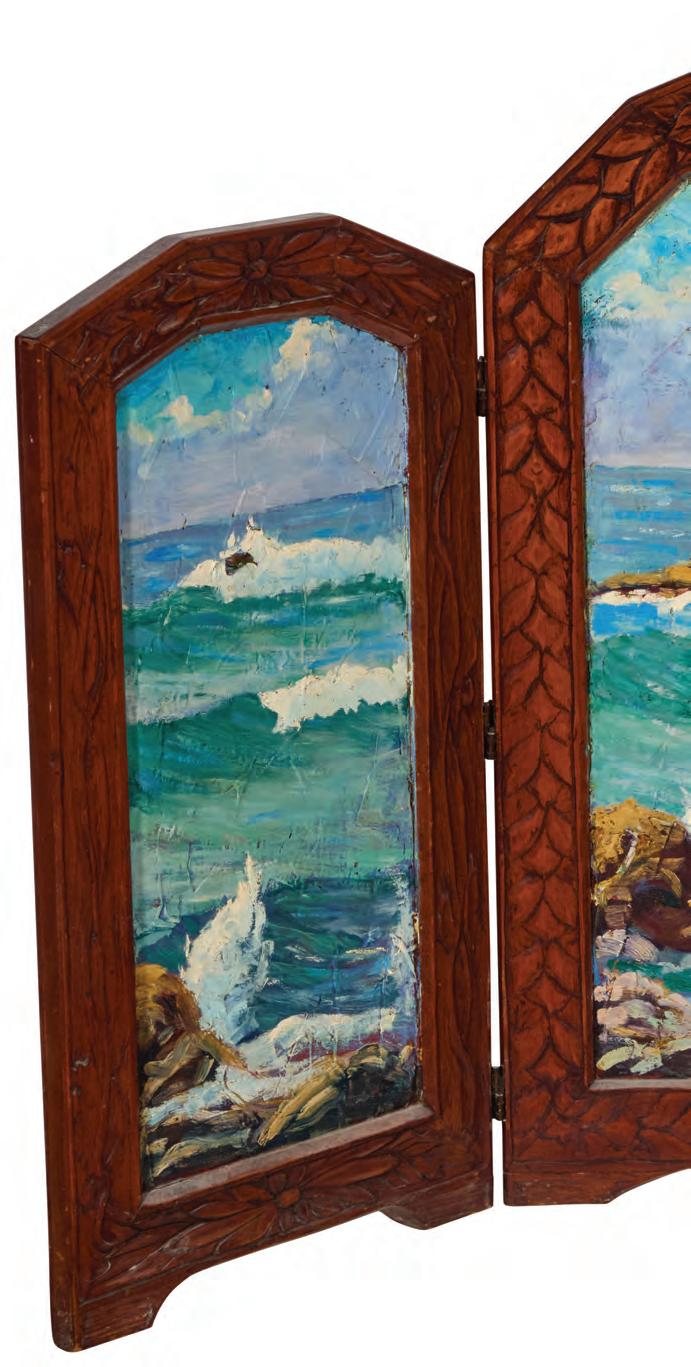
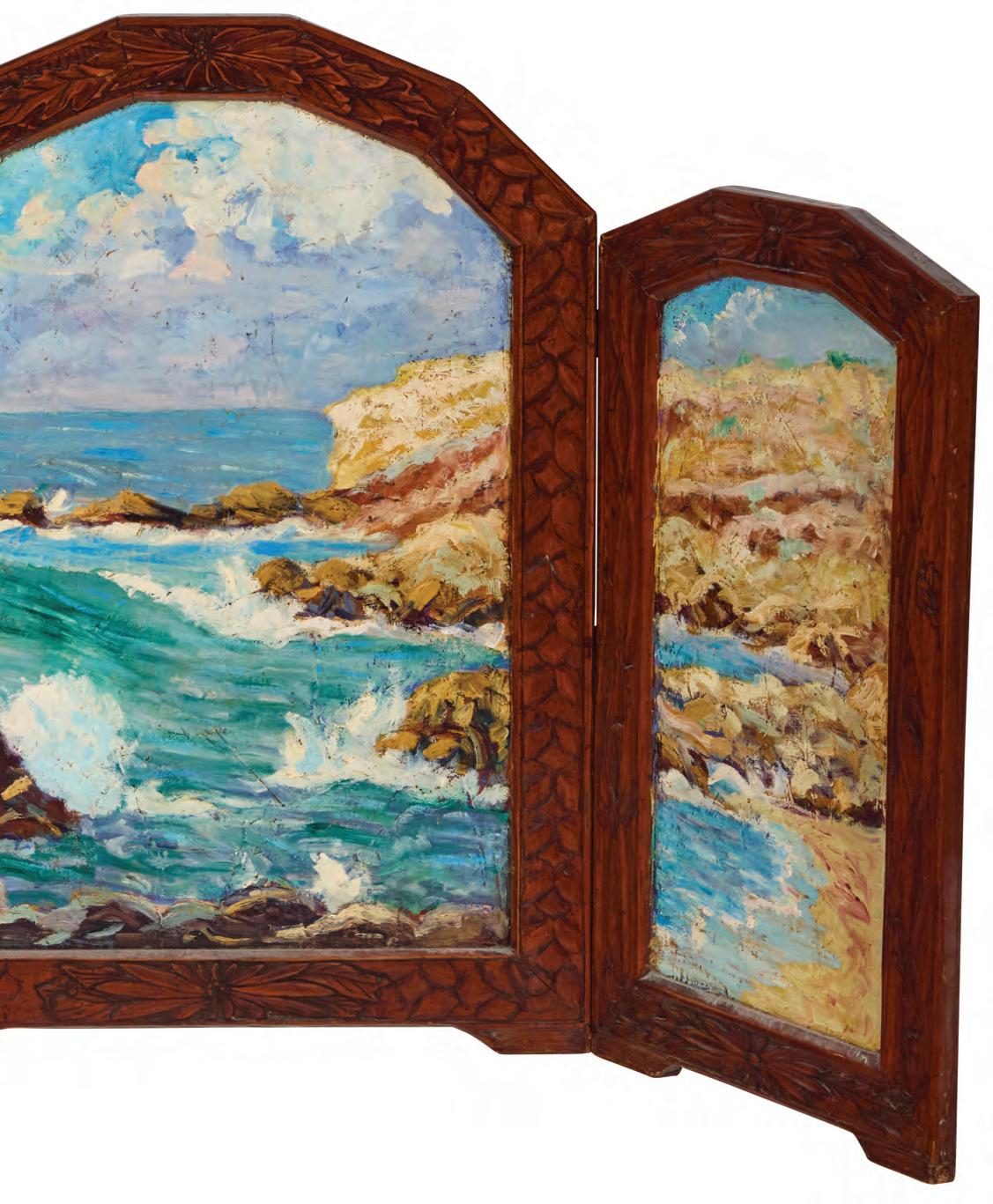
An oil painted wood triptych screen depicting a California coastal scene
Unsigned Center panel: 38.75” H x 27.5” W x 1.25” D; Side panels: 33.375” H x 18.25” W x 1.25” D (each)
$1,000-1,500
Provenance:
The Collection of Gary Diamond, Los Angeles, CA
William Wendt (1865-1946)
Important California Impressionist William Wendt was California Artists.” Wendt was born in Germany on February Chicago, where he worked as a commercial staff artist. gentler, feathery touch but evolved overtime. After relocating of paint executed in naturalistic palette with increasingly
Though often grouped with movements like French or unique path. He was largely self-taught, and it shows in clarity that comes from learning through doing. The paint earthy ochres, sage greens, tempered blues, seem pulled but something slower and more grounded: a vision shaped
Painting trips with his friend and fellow artist George Gardner marrying sculptress Julia Bracken in 1906, the couple moved Los Angeles. Wendt co-founded the California Art Club the National Academy in 1912, the same year he built
In 1926, William Wendt was given his first solo exhibition view of his work from the early 1920s. Critics praised Wendt’s hills and oak groves managed to evoke a quiet permanence offered one of the most resonant reflections on Wendt’s wrote. “On this side of his art, he is beyond criticism from compose so surely and strongly has to know where he structures.” Millier’s words capture something essential shaped his work.
Like many California artists, Wendt sought fresh, naturalistic He sought fidelity with nature and endeavored to paint that he witnessed first-hand. Wendt’s work was also deeply at the Stendhal Gallery, “In Wendt’s pictures may be traced He points out anew the beauty of scenes dimmed by familiarity...” juxtaposition between the immortality of the landscape himself, a recognition of nature not just as subject matter,
the founder of the California Art Club and affectionately known as “the Dean of Southern February 20, 1865, far from the Pacific Coast. After immigrating to the United States, he settled in artist. It was during his spare time that he began to develop his style of easel painting that began with a relocating to California, and into his mature period, Wendt’s brushwork features broad, bold strokes increasingly balanced and complex compositions.
or California Impressionism, or labeled part of the so-called “Eucalyptus School,” Wendt forged a in the best possible way. His paintings have a structural honesty to them, a kind of unpolished paint sits confidently on the surface, building forms that feel weighty and real. His color choices, pulled from the air and soil themselves. What he created wasn’t a romanticized fantasy of the West, shaped by observation, consistency, and a kind of quiet devotion.
Gardner Symons to the West Coast and Europe cemented his love of painting En Plein Air. After moved permanently to Southern California where they were active in the Laguna art colony and in Club in 1911 and served as the second (1911-14) and fourth (1917-1918) President. He was elected to his Laguna Beach studio.
exhibition at the Stendhal Gallery in Los Angeles - a pivotal moment in his career that offered a sweeping Wendt’s paintings for their structural clarity and emotional restraint, noting how his scenes of rolling permanence in a rapidly changing world. Among the critics, Arthur Millier of the “Los Angeles Times” Wendt’s work. “He builds the forms of his pictures with an almost faultless sense for composition,” Millier from any source. Yet Wendt would tell you that composition is a matter of instinct. A man who can stands in relation to life, he must see the world creation, a thing of inevitable laws and definite essential about Wendt: that his strength lay not just in technique, but in the deeply held worldview that
naturalistic subject matter in hard-to-reach mountainous and rural places along the rugged West Coast. paint the land or sea exactly how it was, in warm, rich colors and using the effects of light and shadow deeply philosophical. As art critic Sonia Wolfson wrote in her review of Wendt’s 1931 retrospective traced the spirit of godliness ingrained in mankind. He may be no prophet, but he is a revealer. familiarity...” Influenced by theosophical beliefs, many of Wendt’s major paintings emphasize the landscape and the mortality of its creator. His art suggests a quiet reverence for something larger than matter, but as spiritual presence.
1076
William Wendt (1865-1946)
“Freshening Breezes,” 1921 Oil on canvas laid to waxed canvas
Signed and dated lower right: 1921 William Wendt; titled twice in pencil on the stretcher; inscribed in pencil in another hand on the frame’s verso: “Stendahl painting” 24.25” H x 32.5” W
$20,000-30,000
Provenance:
Sold: John Moran Auctioneers, Pasadena, CA, March 15, 1994, Lot 50
From the Collection of Robert A. Day
Exhibited:
Los Angeles, CA, Stendahl Art Galleries, 1922
Los Angeles, CA, Stendahl Art Galleries, “William Wendt A.N.A. Exhibition,” April 15 - May 15, 1926, no. 44
Los Angeles, CA, Stendahl Art Galleries, “Farewell Exhibition of Paintings by William Wendt,” March 21 - April 9, 1927, no. 94
San Francisco, CA, California Palace of the Legion of Honor, “Exhibition of Paintings by William Wendt A.N.A.,” October 1931
Los Angeles, CA, Stendahl Art Galleries, “William Wendt Exhibition,” March 4 - 28, 1942, no. 92
San Juan Capistrano, CA, Esslinger Medical Building, April 17 - June 5, 1943
Literature:
“Life and Art,” June 23, 1922, Vol. IX, Serial 441 “American Art News,” 1922
Los Angeles Times, June 14, 1922
Stendahl Art Galleries, Los Angeles, CA, “William Wendt A.N.A. Exhibition, catalogue, 1926, p. 65, no. 44, illustrated J.A. Walker, “Documents on the Life and Art of William Wendt (18651946), California’s Painter Laureate of the Paysage Moralise,” (Pittsfield, Massachusetts, 1992) p. 147, no. 223
Notes:
In a letter from Wendt to Earl Stendahl dated June 3, 1943, Wendt refers to the painting “Freshening Breezes” as being painted off the California Coast (Walker, p. 147). There may be another unlocated seascape of the same title from 1905, painted off the coast of Cornwall when the artist briefly spent time in England.
1077
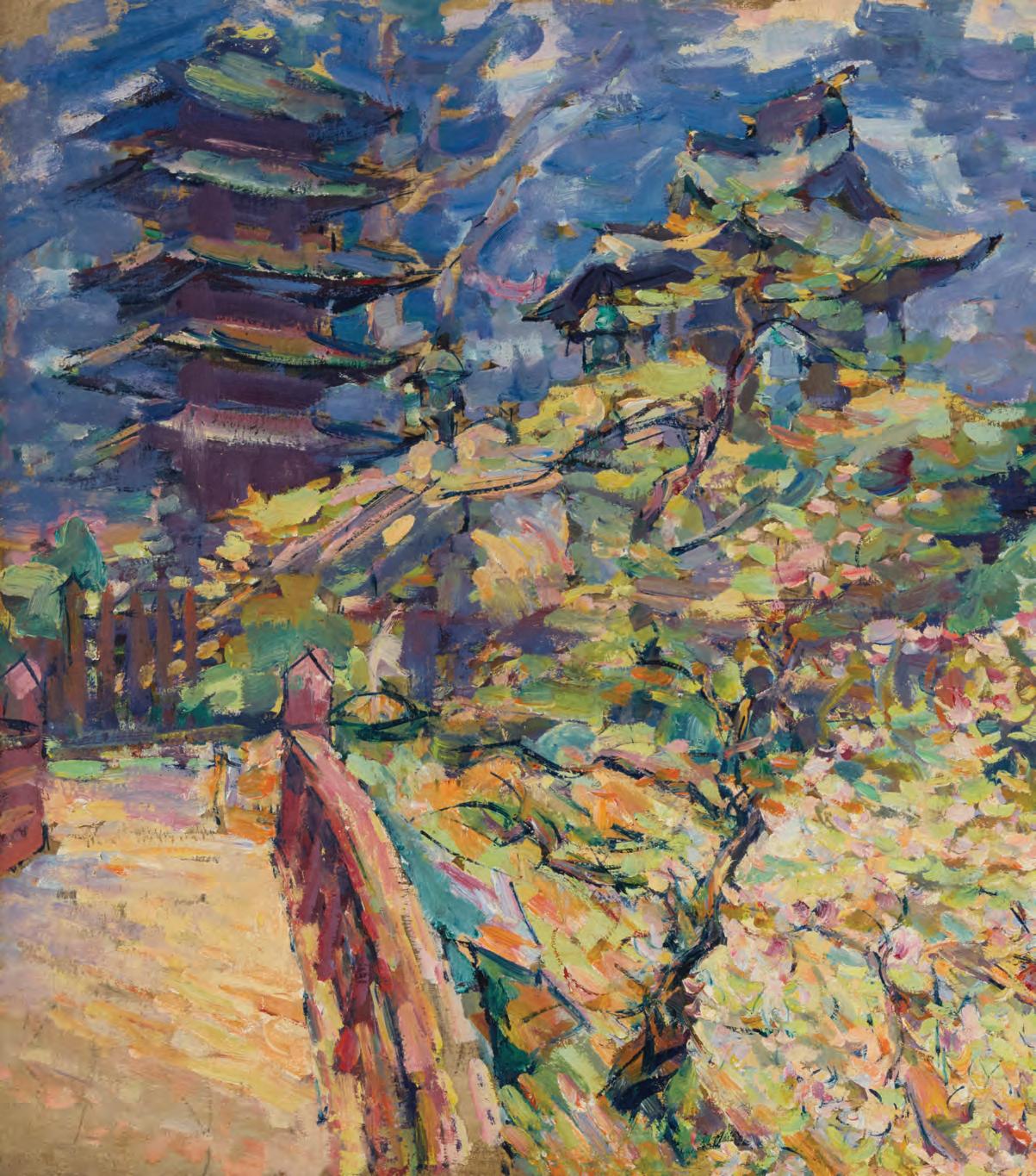
Joseph Raphael (1869-1950)
“Pagodas in the Japanese Tea House, Golden Gate Park” (San Francisco, California), circa 1940-45
Oil on canvas laid to waxed canvas
Unsigned; titled by repute
28.125” H x 35.25” W
$4,000-6,000
Provenance:
Oltman Retirement Plan, Pasadena, CA
Sold: John Moran Auctioneers, Pasadena, CA, “California and American Art,” October 24, 2017, Lot 179
Private collection, Massachusetts
Sold: John Moran Auctioneers, Monrovia, CA, “California & American Art,” October 23, 2018, Lot 47
Private estate, California, from the above
Literature:
Spanierman Galleries, Inc, “Joseph Raphael (1869-1950), An Artistic Journey,” Spanierman Galleries, New York, NY, 2003, p. 112, fig. 59, illustrated
Notes:
San Francisco-born Joseph Raphael had been living abroad for decades, first in Paris then Belgium and Holland, but sailed for San Francisco in 1939, in order to escape the growing hostilities toward Jews. Back in his native California, “Raphael’s artistic imagination was ready to be rekindled by the views of San Francisco’s streets and Golden Gate Park. He painted the park’s Japanese Tea Garden in a series of increasingly abstract compositions... Raphael’s final years back home in California brought out the Modernist painter in him: he now incorporated all of his talent as an assured draftsman who could portray his subjects through keen and direct observation with equal facility of line and color. His brushwork became even more robust and multilayered and reflective of his powerful hand. His creative forces were at their peak. His personal Impressionist style richly encompassed key aspects of subsequent artistic movements.” (Spanierman, p. 106)
1078
Mary DeNeale Morgan (1868-1948)
Carmel coast
Oil on canvas laid to board
Signed lower left: M. DeNeale Morgan 24.375” H x 29.75” W
$10,000-15,000
1079
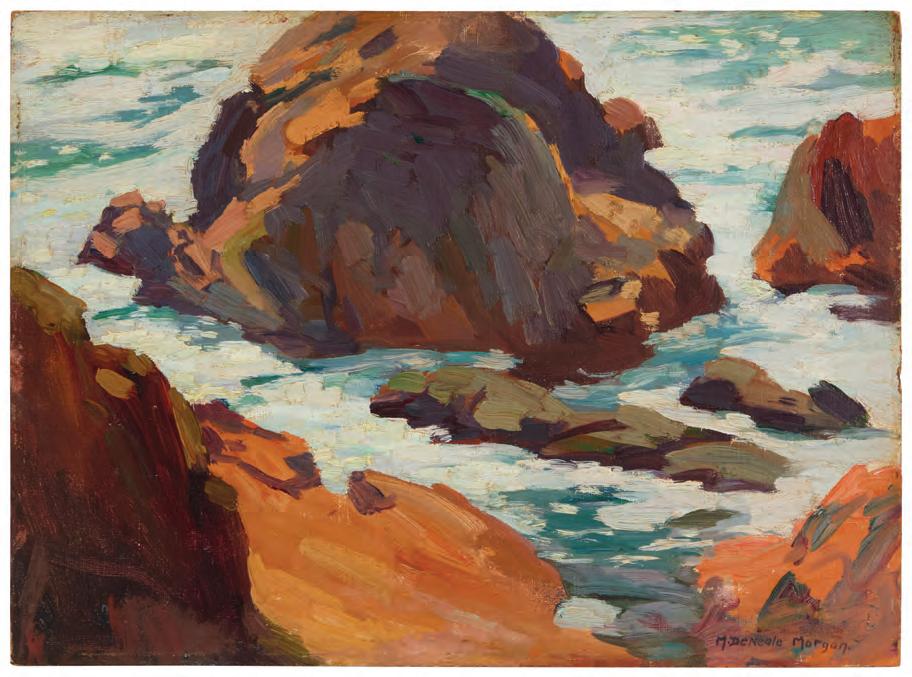
Mary DeNeale Morgan (1868-1948)
“Morning Light Rocks” Oil on canvas laid to artist’s board
Signed lower right: M. DeNeale Morgan; titled and inscribed “No. 47” in pencil, verso 12” H x 16” W
$2,500-3,500
1080
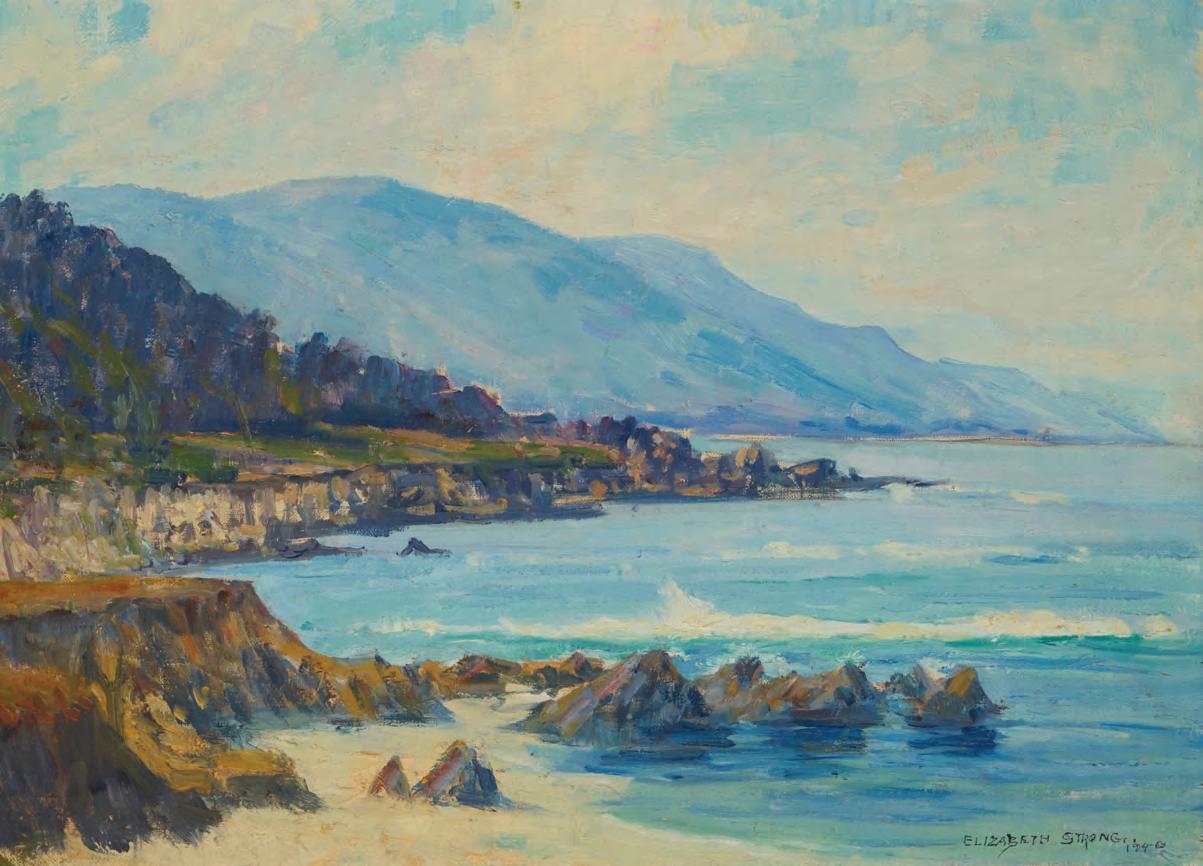
Elizabeth Strong (1855-1941)
“Monastery Beach Hills, Monterey, Oil on canvas
Signed and dated lower right: 18.25” H x 30” W
$2,500-3,500
Monterey, California,” 1940
right: Elizabeth Strong / 1940: inscribed in red paint on the stretcher; “KNO”; titled by repute
1081
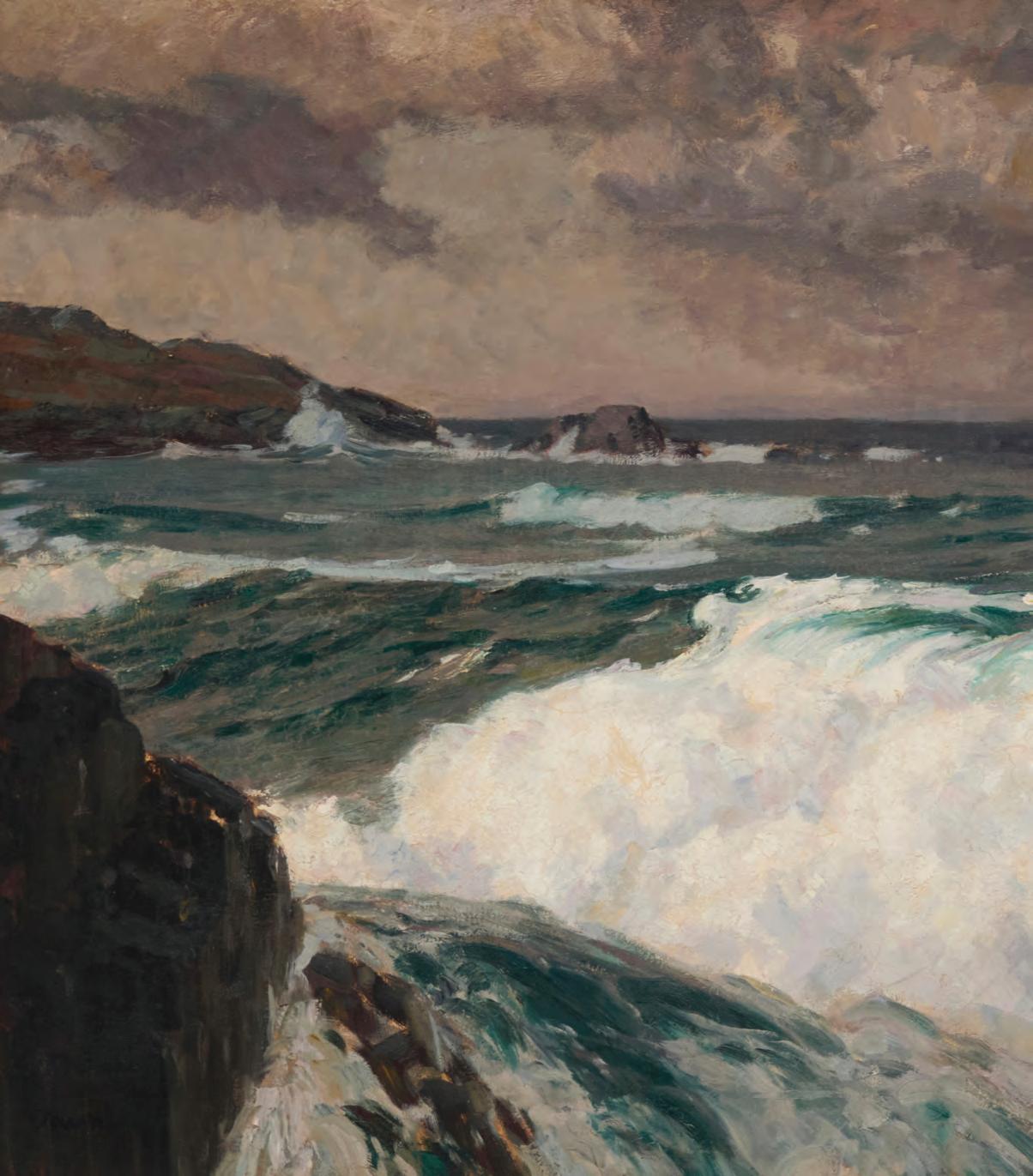
Paul Dougherty (1877-1947)
Seascape with storm clouds
Oil on canvas laid to canvas
Signed lower left: Dougherty
36” H x 48” W
$15,000-20,000
Notes: Framed in a Jerry Solomon frame.
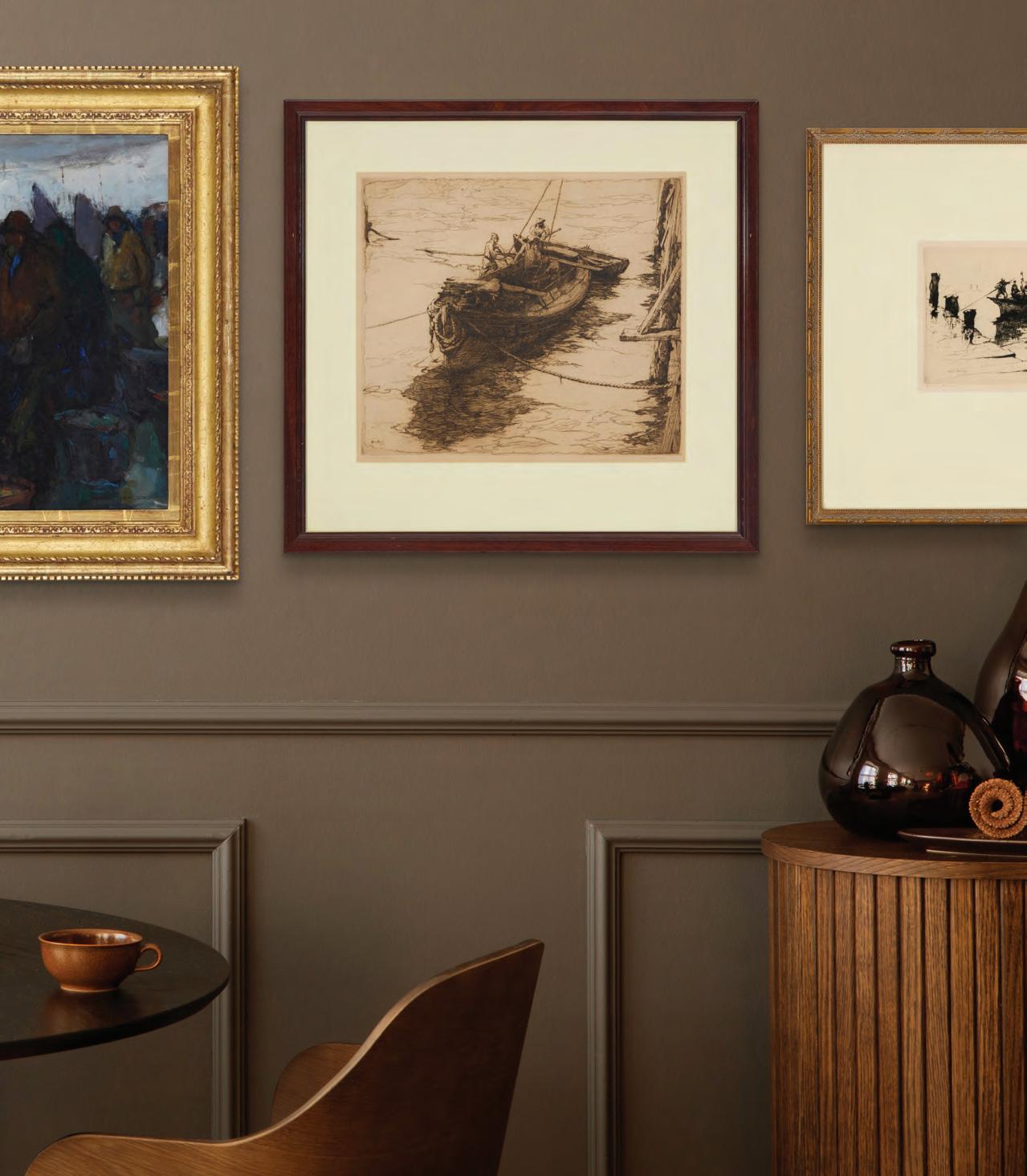
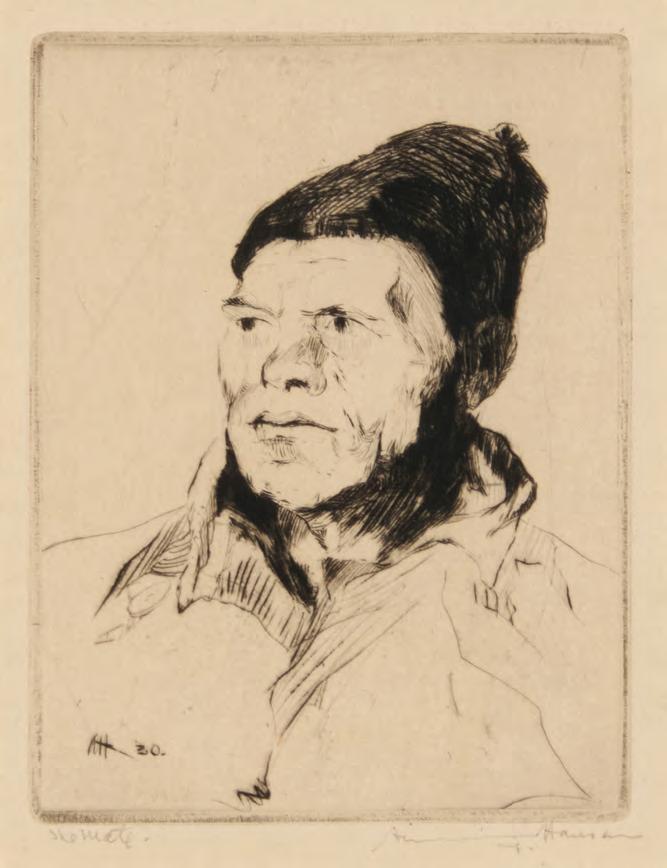
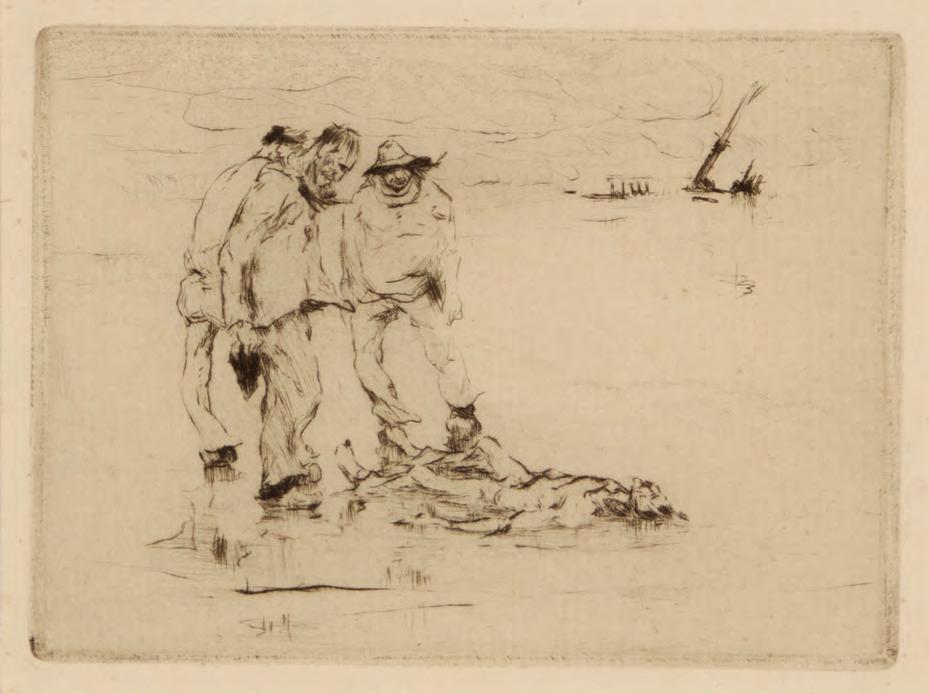
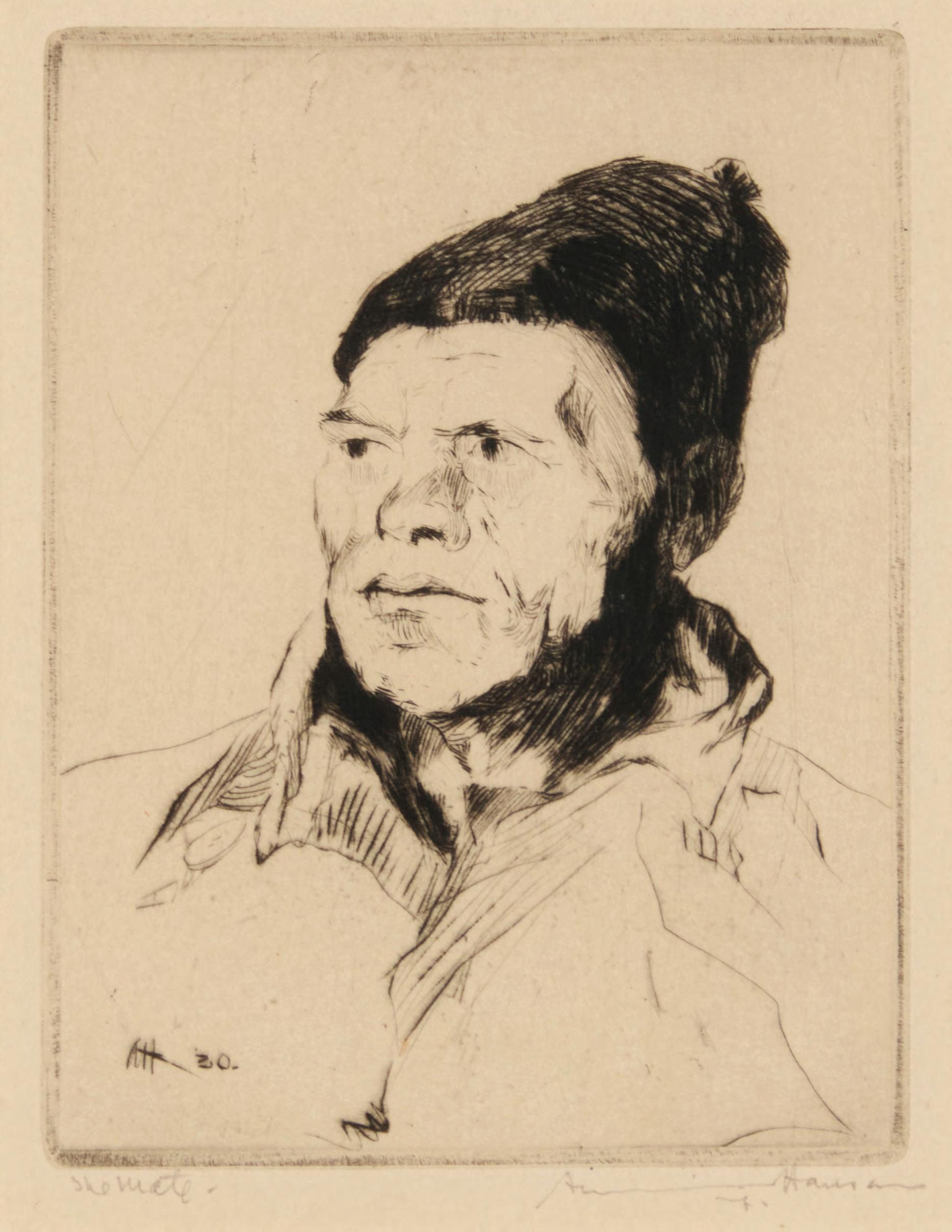
Armin Carl Hansen (1886-1957)
Armin Hansen was an American artist renowned Northern Europe and along California’s Monterey Francisco at the California School of Design. went on to study at the Stuttgart Academy in Hansen spent time in Paris and West Flanders, Impressionism and Expressionism.
Following his artistic education, Hansen spent scenes, maritime seascapes, and picturesque community, and the in-depth personal knowledge experiences, became the central and career-long
Upon his return to San Francisco in the autumn joining the California Society of Etchers where San Francisco Art Association shows.
Hansen relocated his studio from San Francisco vibrant artist colonies of Monterey and Carmel, industry along this part of the California coast, the boats and on the docks there as his friends, in the area.
Hansen was known for his dynamic portrayals deep empathy for the working men of the Pacific. embody the spirit of a rugged, ocean-bound
Though rooted in realism, Hansen’s work embraced everyday moments. He also played a key role mentoring many younger artists, helping to
renowned for his powerful depictions of the sea and the lives of fishermen working in Monterey coast. Born in San Francisco, Hansen was formally trained in San Design. Following the 1906 earthquake and fire that destroyed the school, Hansen in Germany from 1906 to 1908 under Carlos Grethe. After leaving Germany, Flanders, Belgium. During this early training in Europe, he absorbed influences from
spent time working as a crew member on North Sea trawlers while painting fishing picturesque coastal villages. His interactions with the resilient and hardworking seafaring knowledge of sea vessels and the working life of a sailor gleaned from these career-long theme of his paintings and prints, deeply informing his art.
autumn of 1912, Hansen quickly re-immersed himself in the local artistic community, where he served on their Executive Board, and participating in exhibitions, including Francisco to the Monterey Peninsula in 1916, where he was in closer proximity to the Carmel, as well as his preferred maritime subjects. Intimately familiar with the fishing coast, Hansen considered many of the Italian and Portuguese men who worked on friends, and vigilantly depicted their likenesses, as well as the specific vessels used
portrayals of maritime labor. His paintings feature bold brushwork, dramatic light, and a Pacific. He captured not just the scenes of their everyday lives, but was able to ocean-bound existence.
embraced modernist elements, blending structure and expression to elevate role in California’s art scene, co-founding the Carmel Art Association and establish the region as a major center for American art in the early 20th century.
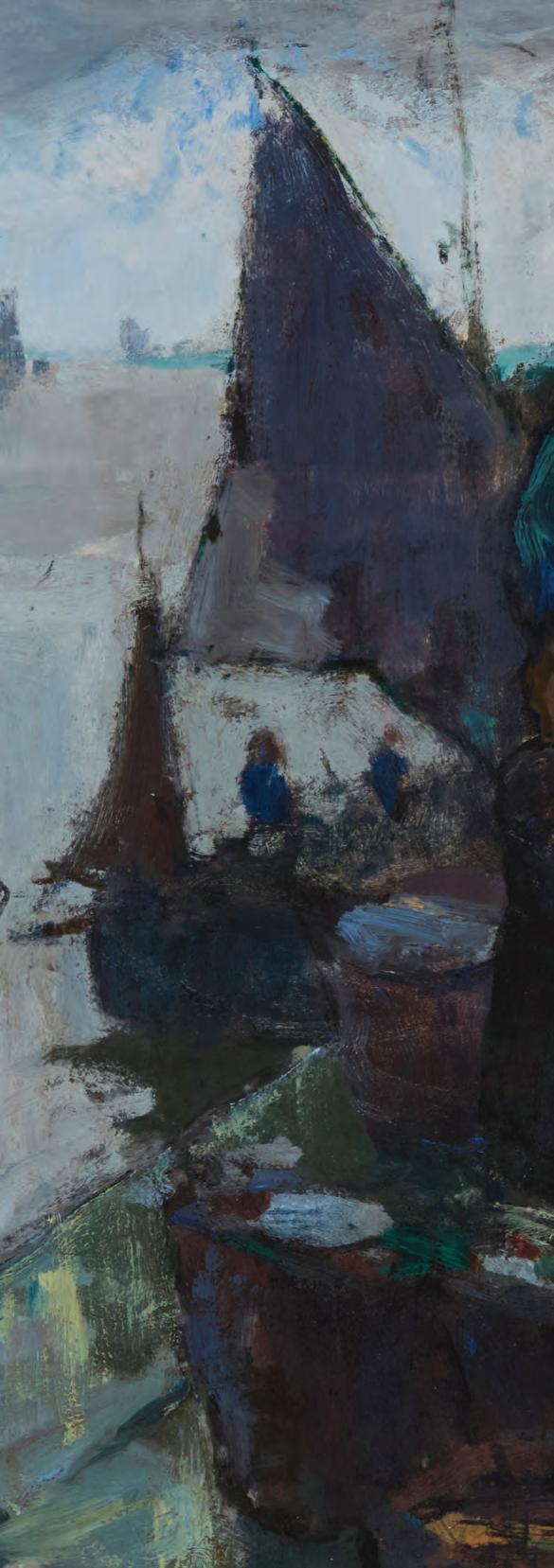
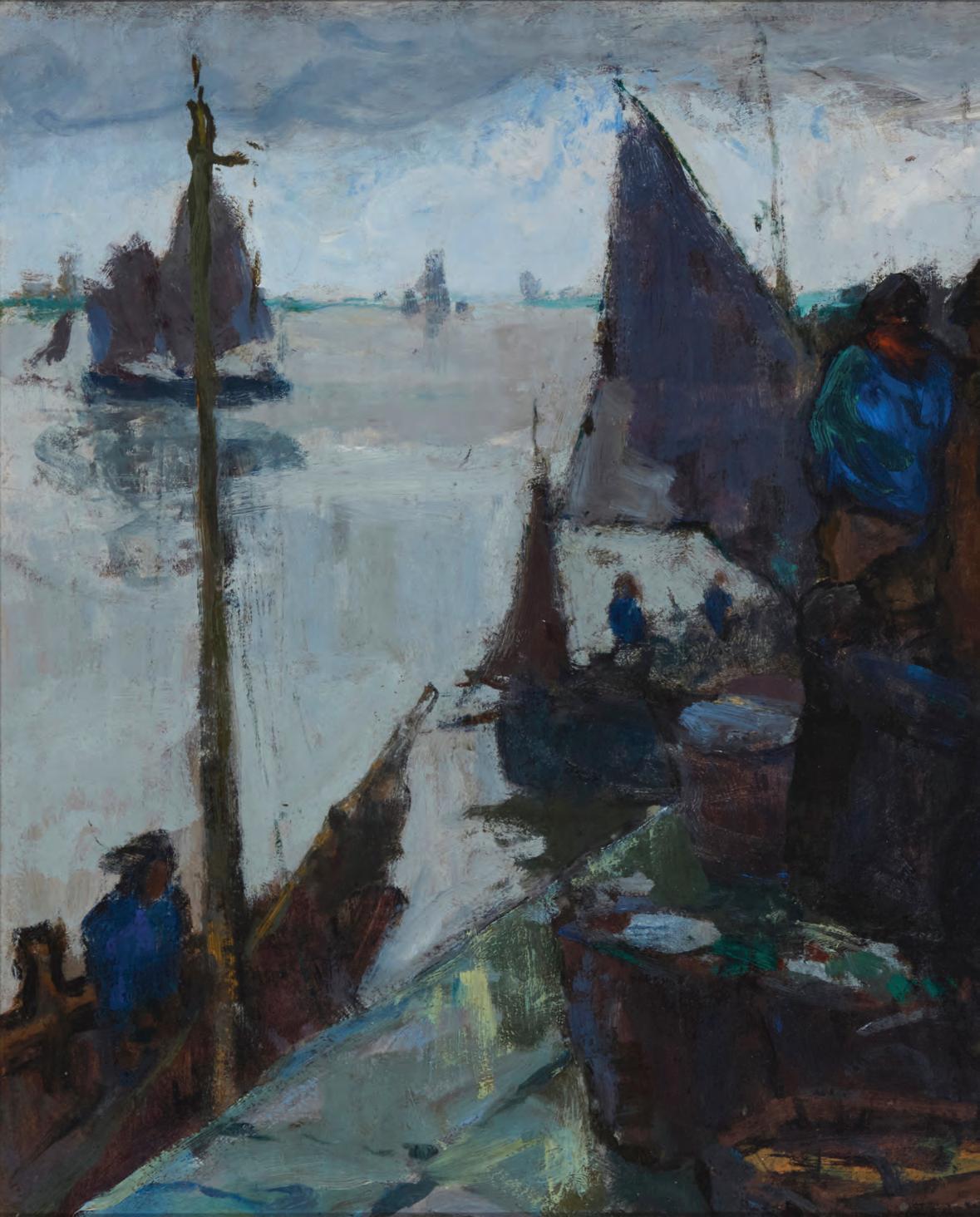
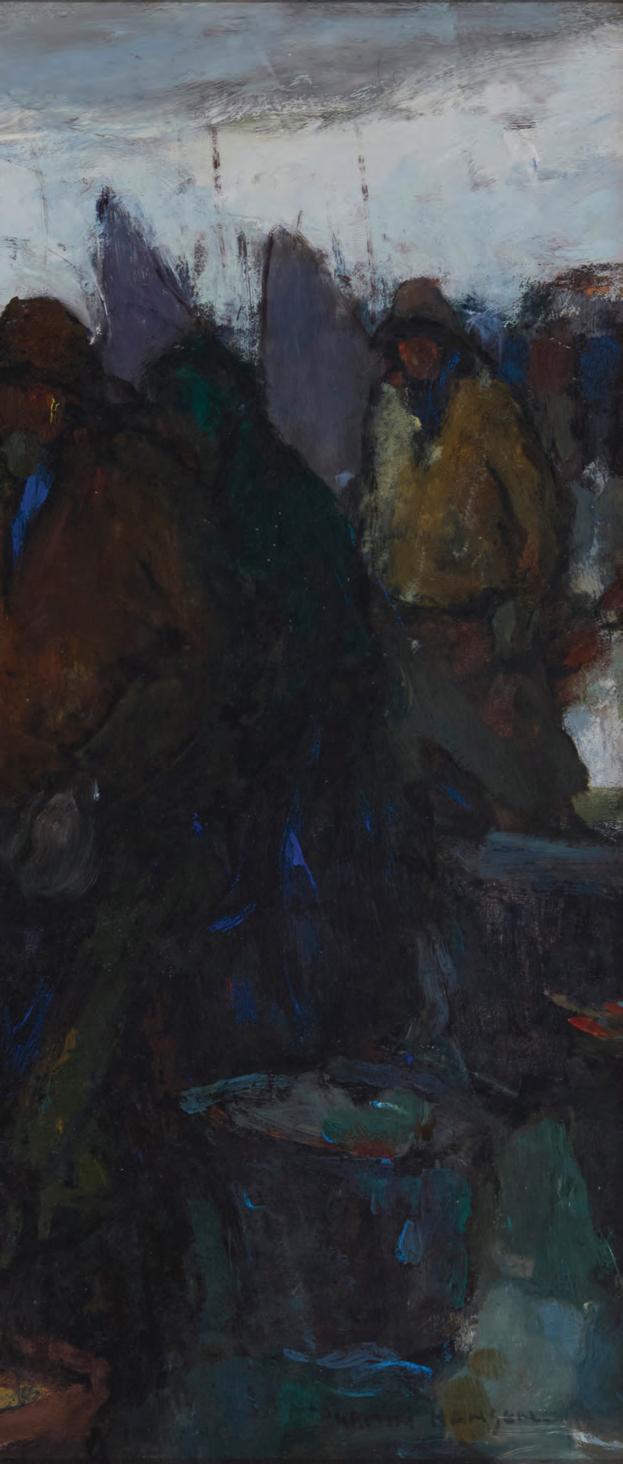
1082
Armin Carl Hansen (1886-1957)
“Return of the Fishing Fleet” Oil on board
Signed lower right: Armin Hansen; with an oil sketch of a sailboat on the verso; titled by repute 20” H x 24” W
$30,000-50,000
Provenance:
Fred E. Keeler, Beverly Hills, CA
Sold: Butterfield & Butterfield, March 7, 1993, Lot 68 Private collection, Los Angeles, CA, from the above
1083
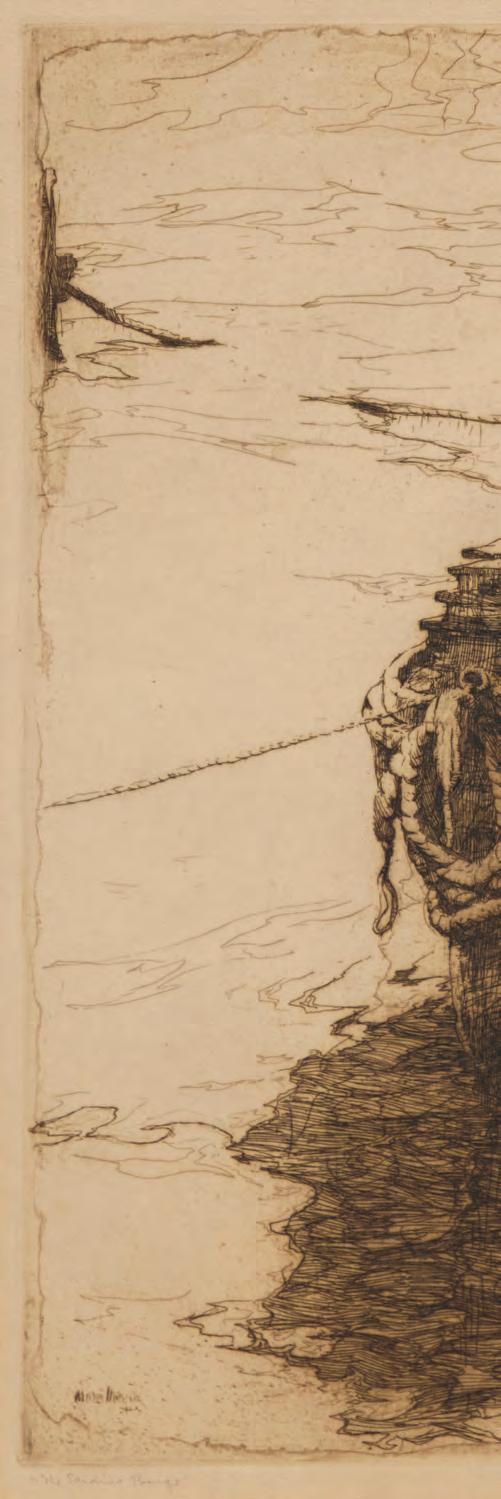
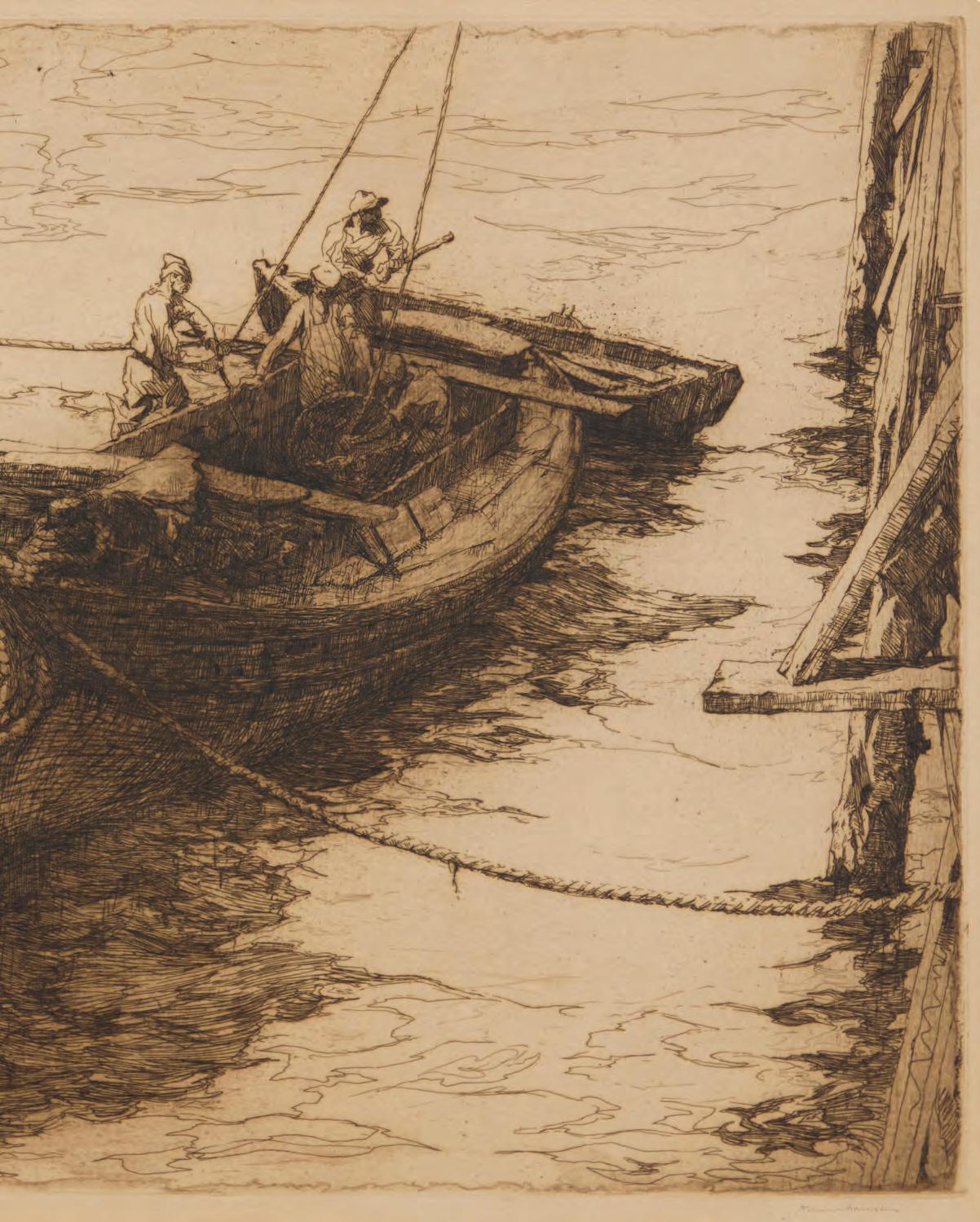
Armin Carl Hansen (1886-1957)
“The Sardine Barge,” 1922 Etching in brown ink on cream laid Arches paper
From the edition of unknown but presumably small size, only 26 impressions were located by White; second (final) state
Signed and titled in pencil in the lower margin: Armin Hansen; signed again and dated “22” in the lower left corner of the plate; inscribed in pencil near the tip of the lower left margin corner, possibly in another hand: “# / 50” Plate: 12.75” H x 14.75” W; Sheet: 16” H x 19.5” W
$3,000-5,000
Provenance: Private estate, California
Literature: White 43 ii/ii
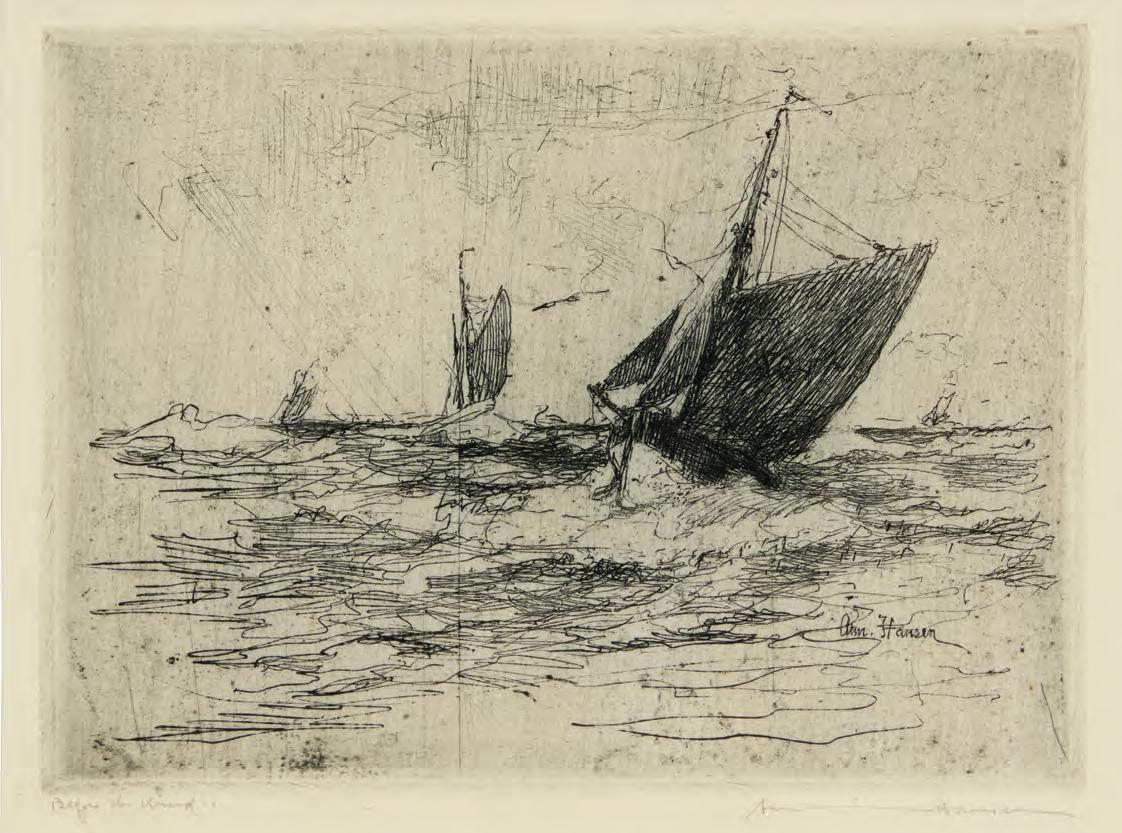
1084
Armin Carl Hansen (1886-1957)
“Before the Wind,” circa 1913
Etching in black ink on off-white paper
From the edition of unknown but presumably small size, only 6 impressions were located by White; first (only) state
Signed and titled in pencil in the lower margin: Armin Hansen; signed again in the plate at lower right Plate: 4.875” H x 6.5” W; Sight: 5.25” H x 7” W
$500-700
Provenance: Estate, Grand Terrace, CA
Literature: White 17 i/i
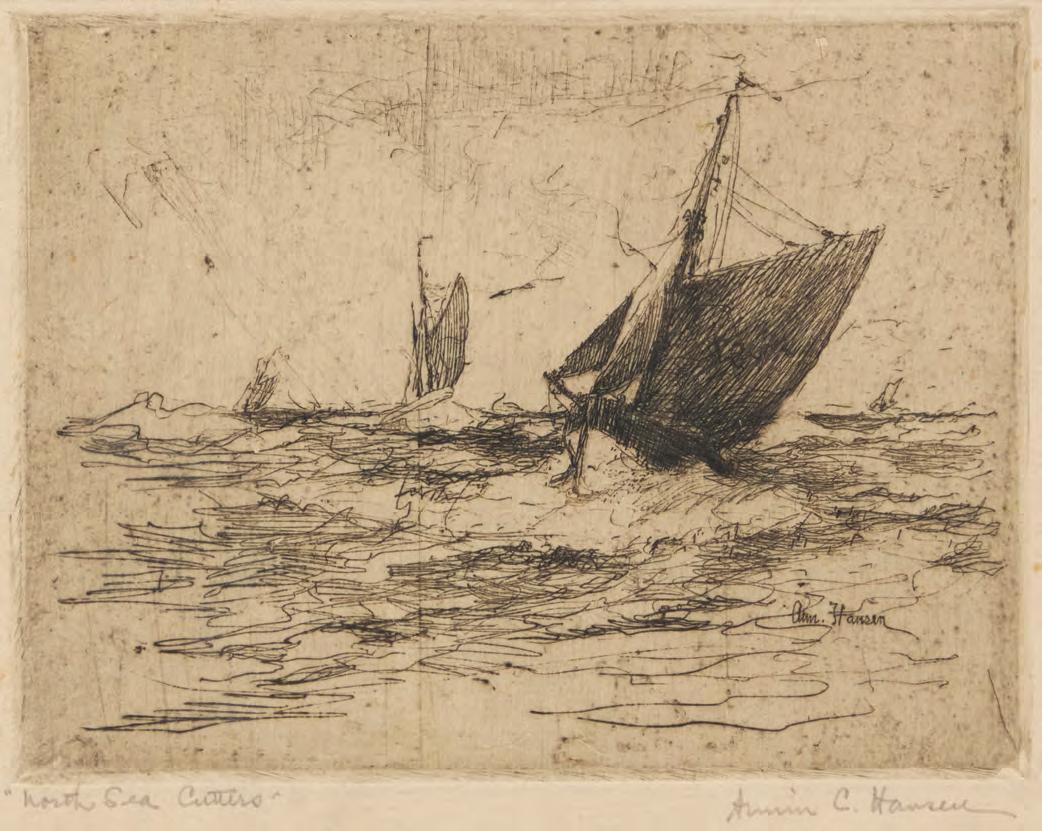
1085
Armin Carl Hansen (1886-1957)
“Before the Wind,” circa 1913
Etching in brownish-black ink on cream laid Japanese paper
From the edition of unknown but presumably small size, only 6 impressions were located by White; first (only) state
Signed and alternatively titled in pencil in the lower margin: Armin C. Hansen / “North Sea Cutters;” signed again in the plate at lower right
Plate: 4.875” H x 6.5” W; Sheet: 8” H x 8.875” W (irreg.)
$500-700
Provenance: Estate, Grand Terrace, CA
Literature: White 17 i/i
1086
Armin Carl Hansen (1886-1957)
“Inland Water,” 1936
Etching in black ink on cream paper
From the edition of unknown but presumably small size, only 7 impressions were located by White; presumably first (only) state
Signed and inscribed in pencil in the lower margin: Armin Hansen / imp.; signed again and dated “36” in the plate at lower left
Plate: 3” H x 4.75” W; Sight: 3.75” H x 5.25” W
$600-800
Provenance: Estate, Grand Terrace, CA
Literature: White 136 i/i
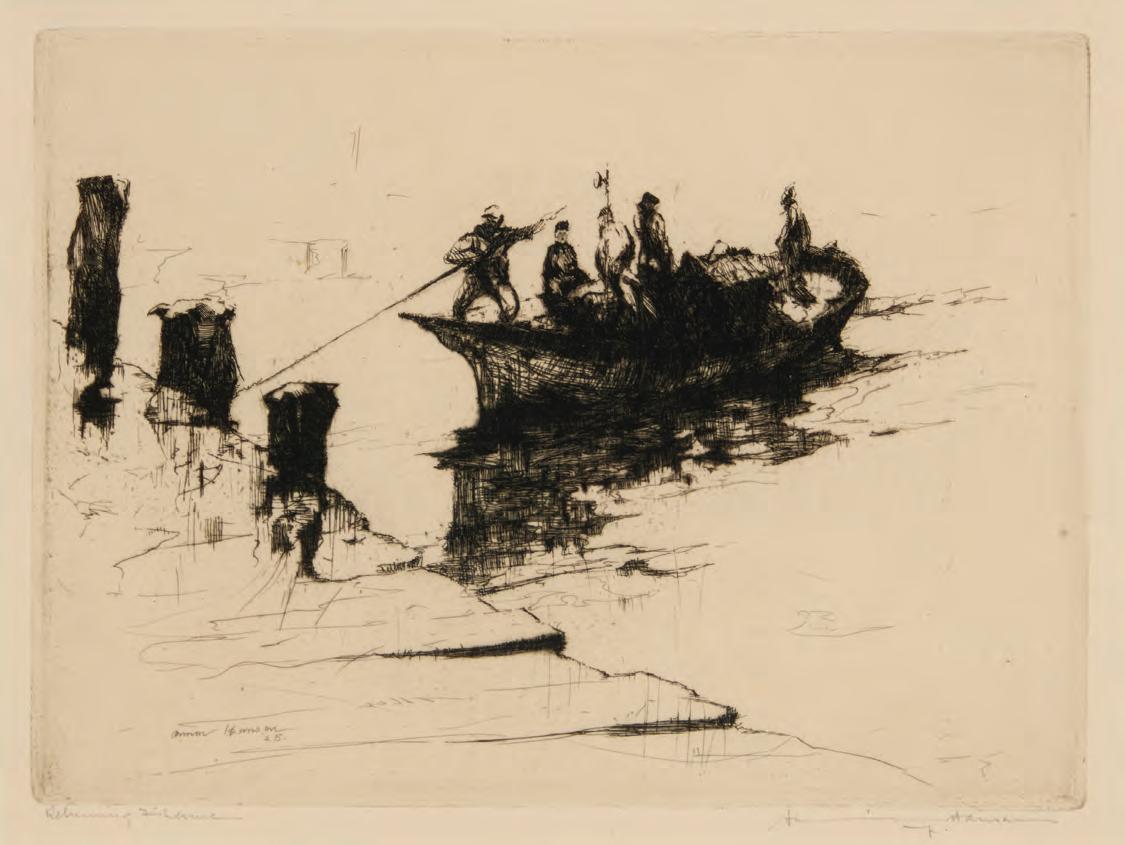
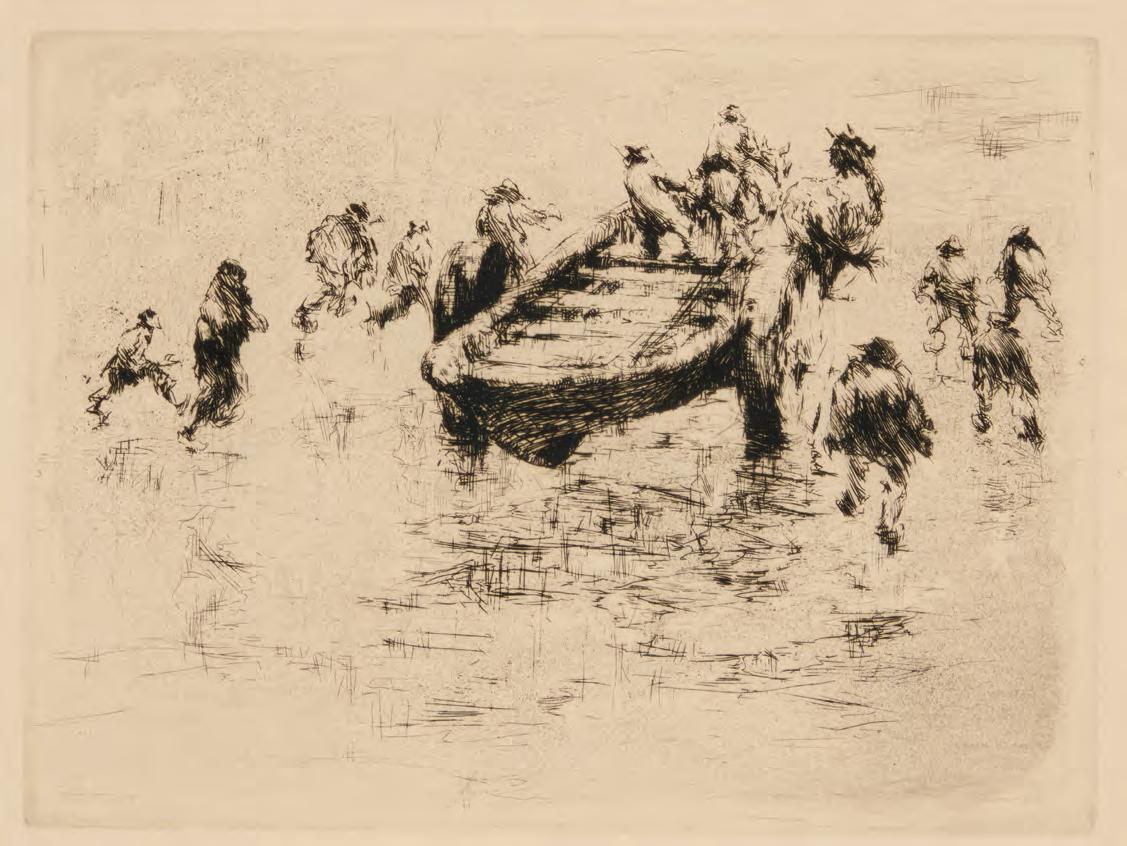
Armin Carl Hansen (1886-1957)
“Returning Fishermen,” 1925
Etching in black ink on cream paper
From the edition of unknown but presumably small size, only 7 impressions were located by White; first (only) state
Signed and titled in pencil in the lower margin: Armin Hansen / imp.; signed again and dated “25” in the plate at lower left
Plate: 6” H x 7.875” W; Sight: 6.5” H x 8.375” W
$600-800
Provenance: Estate, Grand Terrace, CA
Literature: White 74 i/i
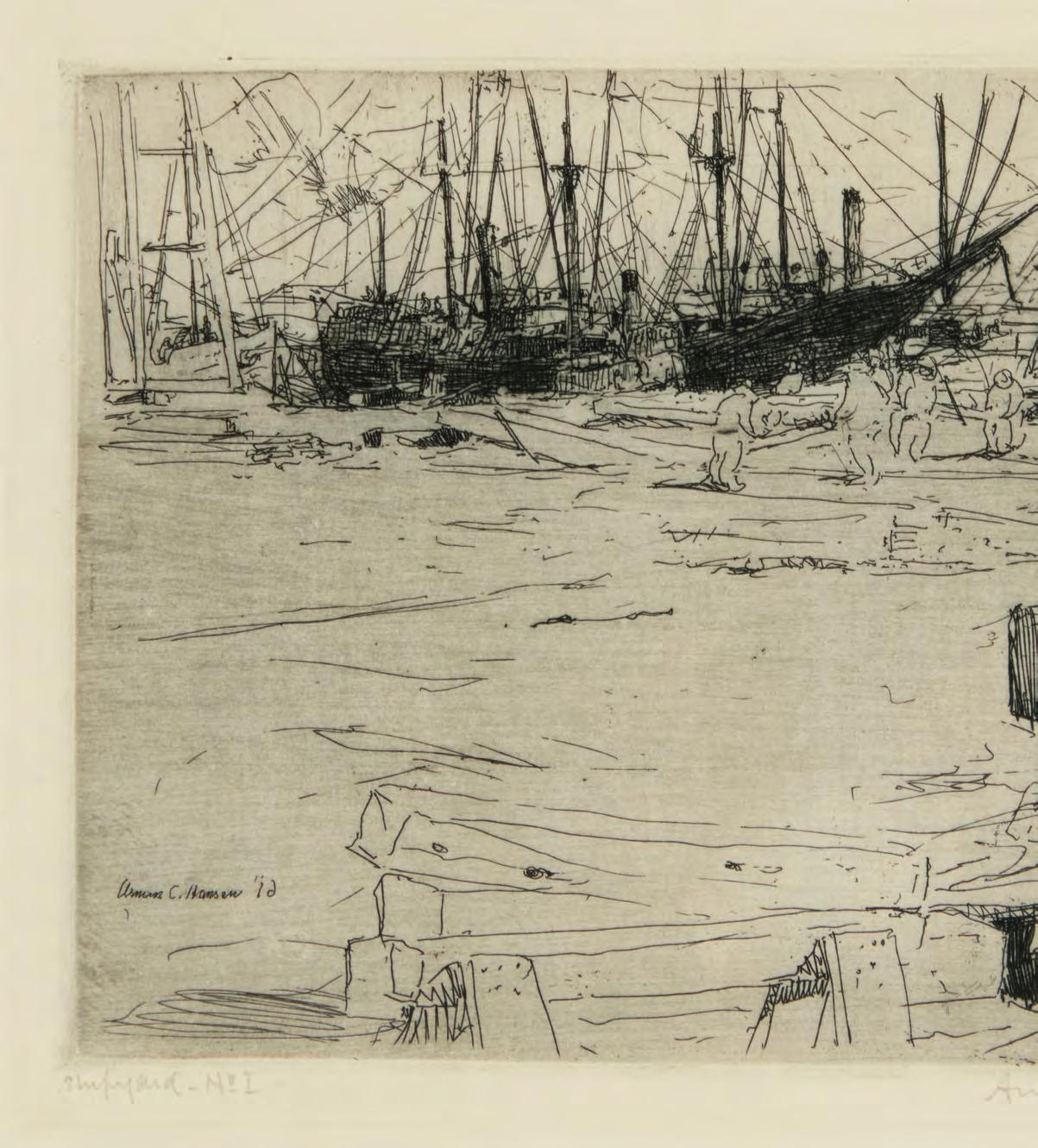
1088
Armin Carl Hansen (1886-1957)
“Shipyard No. I,” 1916
Etching in black ink on off-white paper
From the edition of unknown but presumably small size, only 13 impressions were located by White; first (only) state
Signed and titled in pencil in the lower margin: Armin Hansen; signed again and dated “16” in the plate at lower left
Plate: 4.875” H x 6.375” W; Sight: 5.5” H x 7” W
$500-700
Provenance: Estate, Grand Terrace, CA
Literature: White 24 i/i
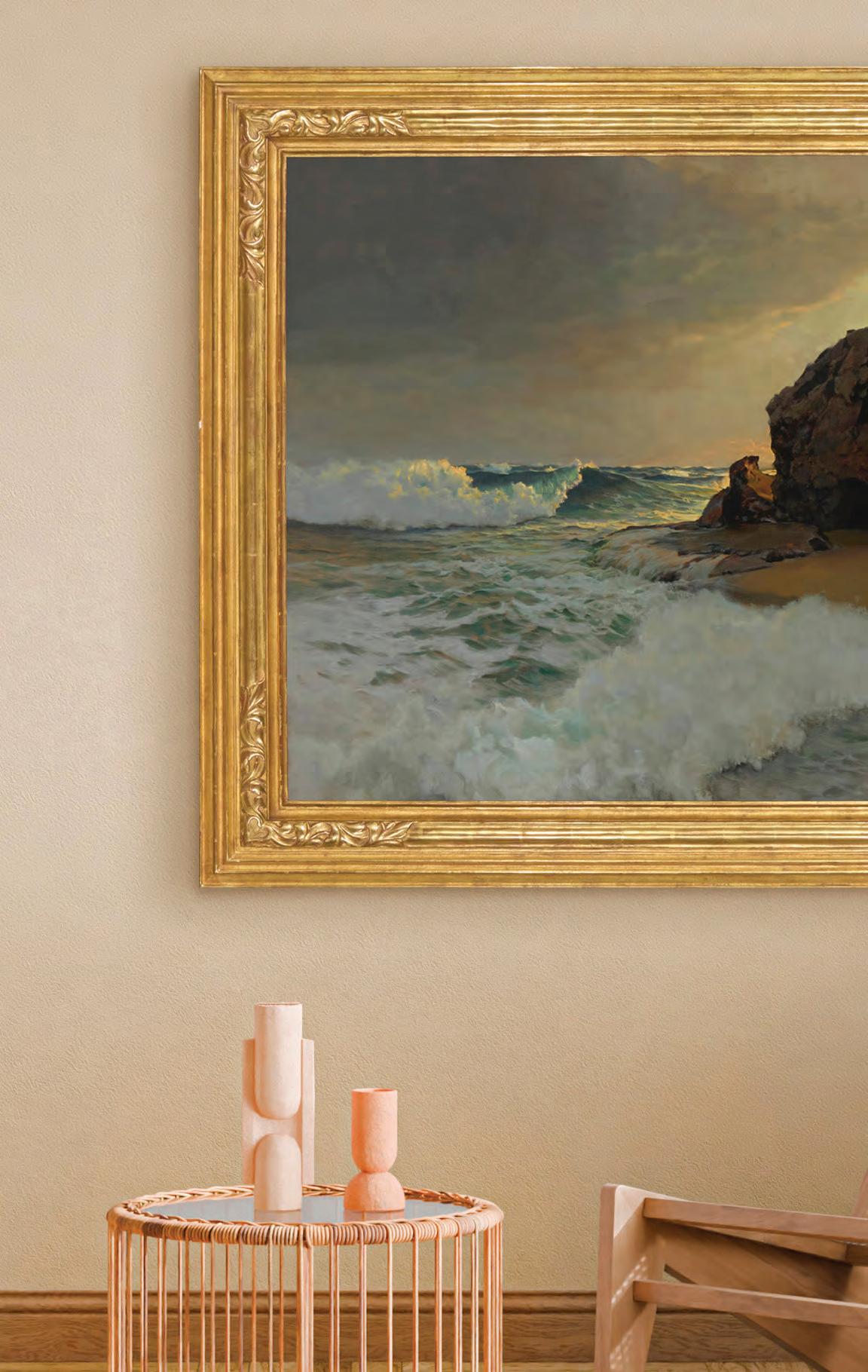
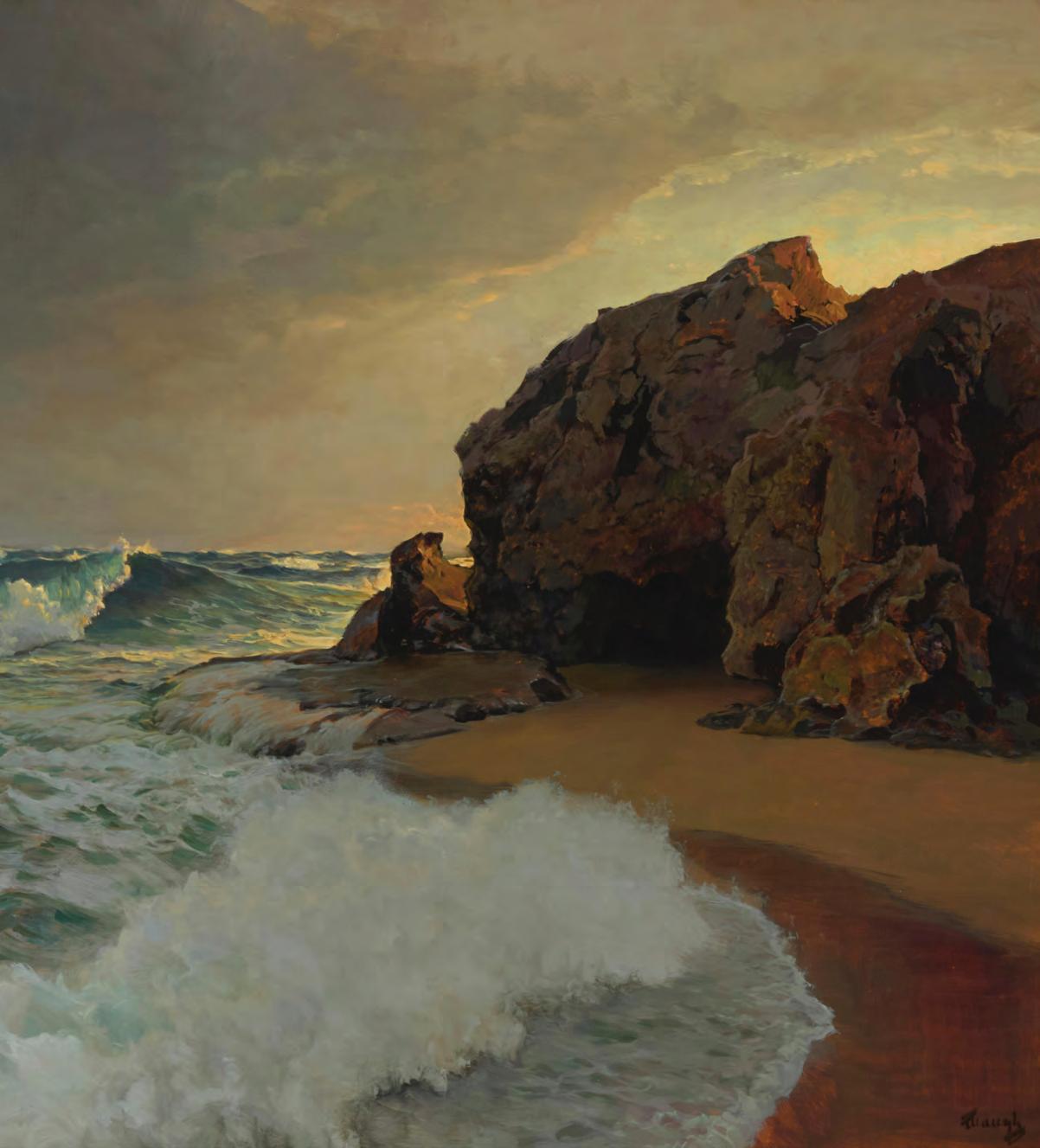
Frederick Judd Waugh (1861-1940)
Frederick Judd Waugh was an American artist also extended to landscapes that captured the New Jersey into a family of artists: his father, was a miniature painter. Frederick developed Waugh studied under Thomas Eakins at the studies in Europe at the Academie Julian in influences from realism and impressionism before
Early in his career Waugh lived in Philadelphia landscapes. Between 1892 and 1907, Waugh Ives, Cornwell were frequent subjects. Waugh became especially renowned for his on crashing waves, shifting light, and the emotional Waugh returned to the United States in 1907 Monhegan Island, Maine. He was elected a the United States.
Later in his career, Waugh spent some time in inspired a new dimension in his work. Unlike seascapes and coastal landscapes often conveyed of land and sea along the Pacific with a sensitivity These works highlight his adaptability as an important figure in American art whose legacy
artist best known for his powerful and expressive marine paintings, though his work the rugged beauty of coastal environments. Waugh was born in Bordentown, father, Samuel Bell Waugh, was a portrait painter and his mother, Mary Eliza Young, developed a strong foundation in both technical skill and artistic sensibility. Pennsylvania Academy of Fine Arts from 1880 to 1883 and then continued his Paris. He also exhibited at the Paris Salon. Through his studies, he absorbed before forging his own distinctive style.
Philadelphia and worked for a commercial art firm while also painting portraits and Waugh lived primarily in London. Landscapes of the Channel Island of Sark and St. depictions of the sea, which he rendered with dramatic energy, often focusing emotional force of nature.
1907 and spent most of his time working out of Provincetown, Massachusetts and member of the National Academy of Design in 1911 and won many prizes in in California, where the state’s varied coastline and luminous atmosphere
Unlike the darker, more turbulent Atlantic scenes he had painted earlier, his California conveyed a brighter palette and a sense of openness. He captured the meeting sensitivity to color and luminosity that reflected the region’s unique environment. artist and his deep appreciation for natural beauty, positioning him as an legacy bridges both East and West Coast interpretations of the sea.
1089
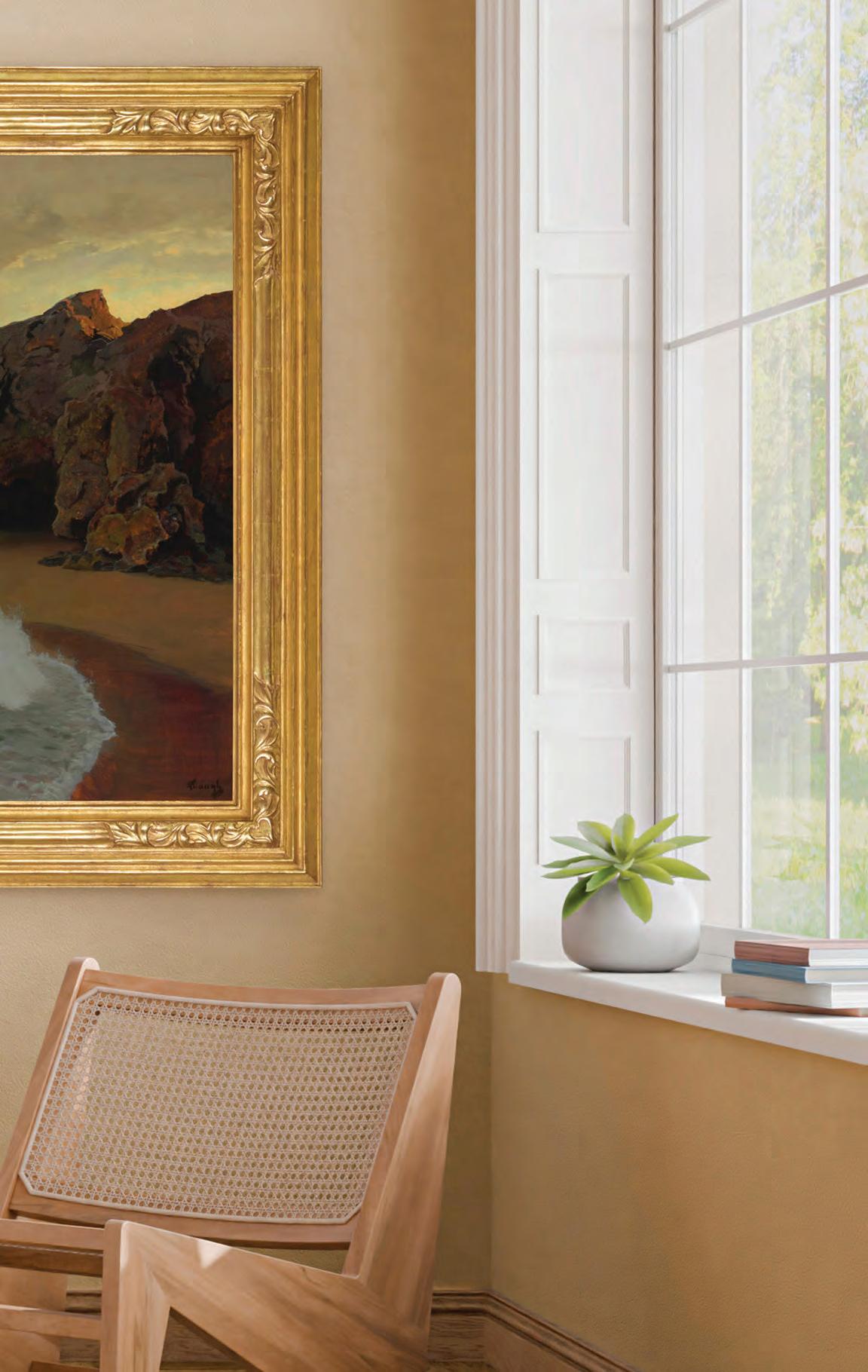
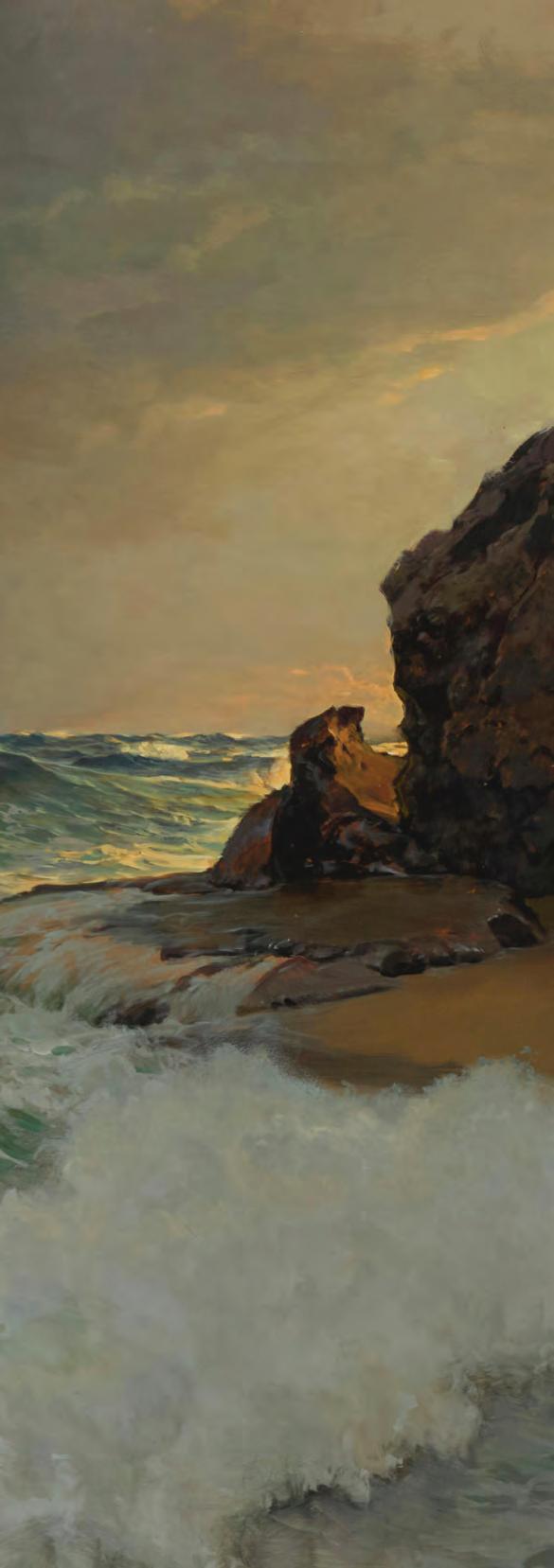
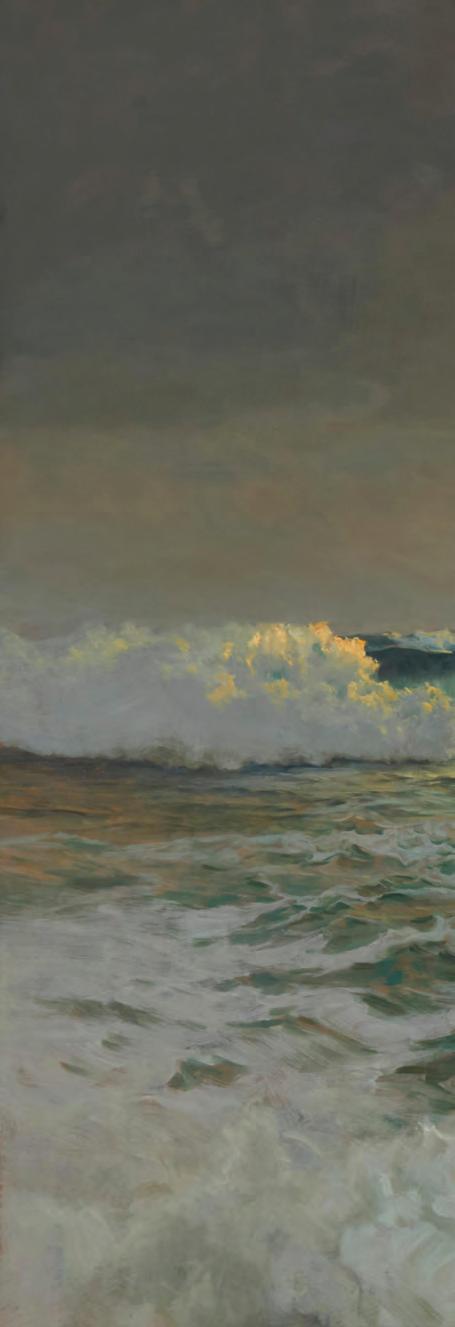
Frederick Judd Waugh (1861-1940)
“Smuggler’s Cove” Oil on Masonite
Signed lower right: Waugh; titled in ink on a gallery label affixed verso; titled again in pencil, possibly in another hand, on a prior frame’s backing paper sandwiched between the work and the frame’s backing board 40” H x 50” W
$15,000-25,000
Provenance:
Grand Central Art Galleries, New York, NY
Sold: Sotheby’s, New York, NY, “American Paintings, Drawings & Sculpture,” November 29, 2006, Lot 94
From the Collection of Robert A. Day
1090
Ernest Albert (1857-1946)
“An Opal Sea”
Oil on canvas laid to canvas
Signed lower left: Ernest Albert A.N.A.; signed again and titled in ink on a partial label affixed to the frame’s backing board
18” H x 20” W
$1,000-1,500
Provenance: Lyme Art Association, Old Lyme, CT Private estate, California
1091
Arthur Bowen Davies (1862-1928)
“Hanging Clouds,” 1899 Oil on canvas laid to canvas
Signed and dated lower left: A.B. Davies / 1899; titled on two gallery labels affixed to the stretcher and the frame’s backing paper
17” H x 22” W
$3,000-5,000
Provenance:
Ferargil Galleries, New York, NY American Masters Gallery, Los Angeles, CA
1092
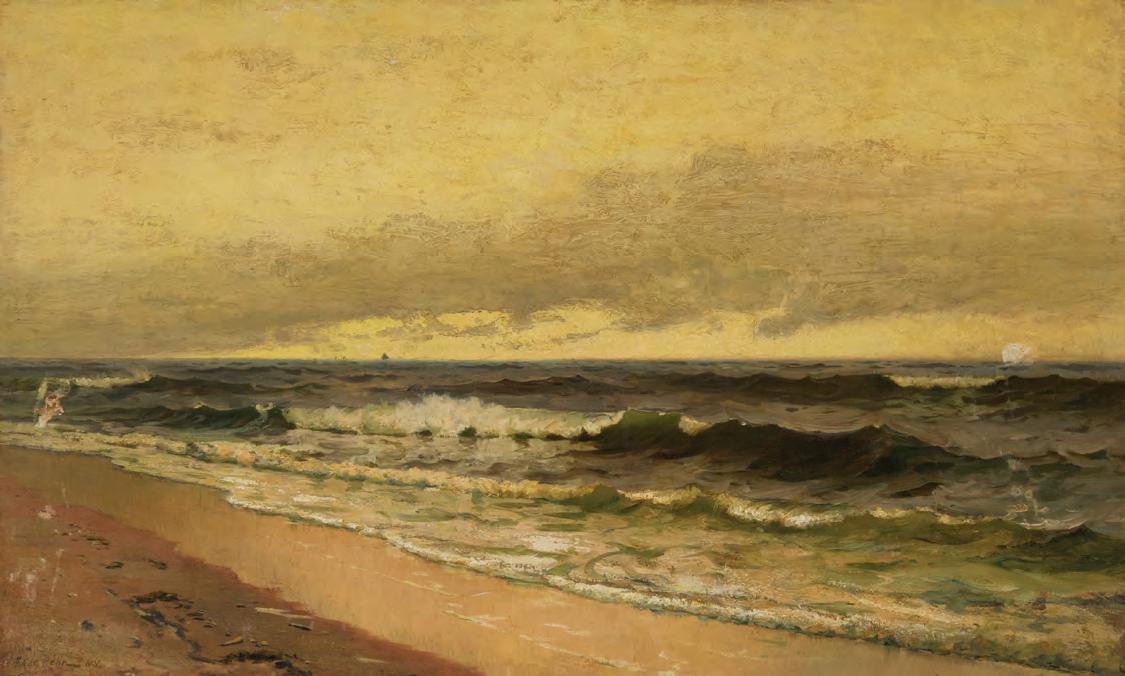
Frank Knox Morton Rehn (1848-1914)
Coastal seascape Oil on canvas laid to waxed canvas
Signed and inscribed lower left: F.K.M. Rehn N.Y. 22.25” H x 36.25” W
$1,000-1,500
Provenance: Private estate, California
1093
Signed lower right: Kuehne 24” H x 30.25” W
$3,000-5,000
Provenance: Sold: Treadway/Toomey Auctions, Chicago, IL, December 7, 2003, Lot 518
Max Kuehne (1880-1968) Coastal scene Oil on canvas
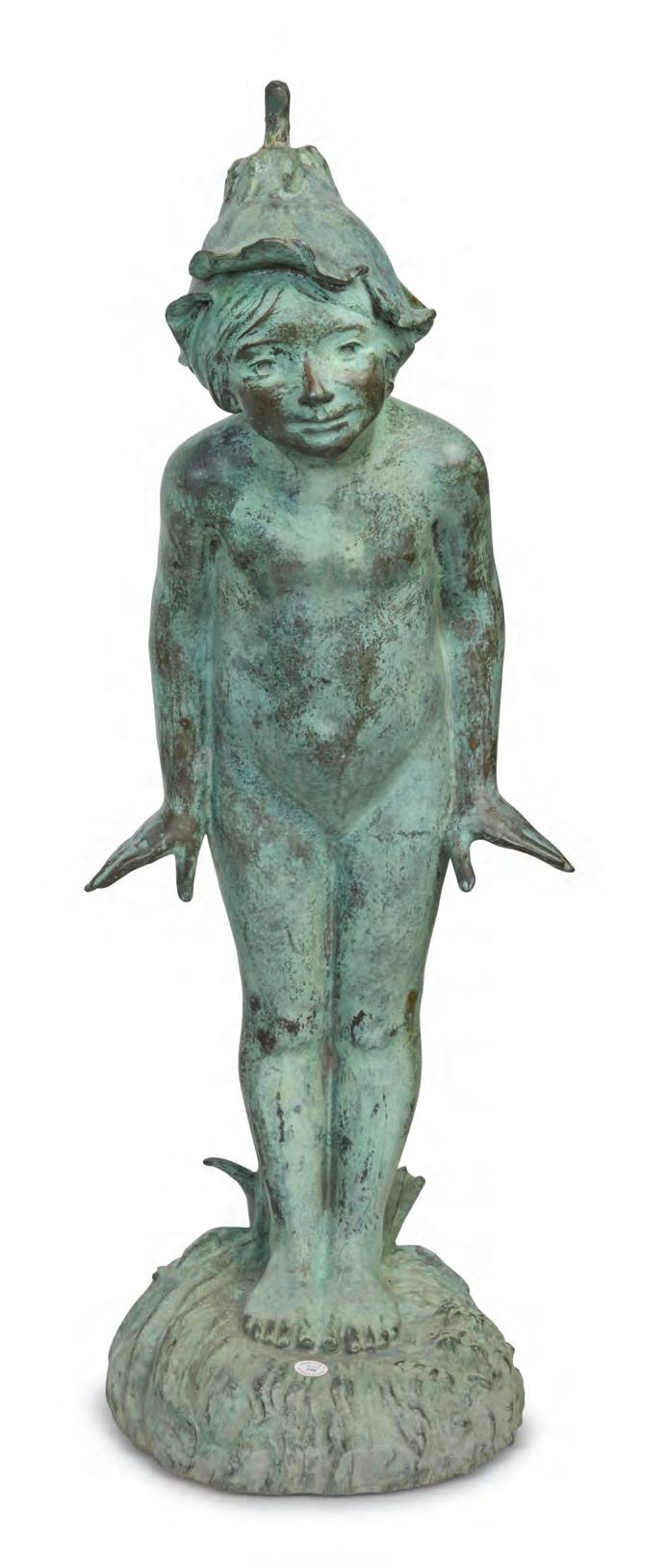
Signed and dated in the casting: BERGE; impressed foundry mark: ROMAN BRONZE WORKS N.Y.
41” H x 15.5” W x 14.75” D
$2,000-3,000
Provenance: Private estate, California
Notes:
Another life-size casting, such as the one we have on offer, was awarded the bronze medal at the 1915 Panama Pacific International Exposition in San Francisco, CA. It was then later cast in medium (1916) and small (1923) sizes.
1096
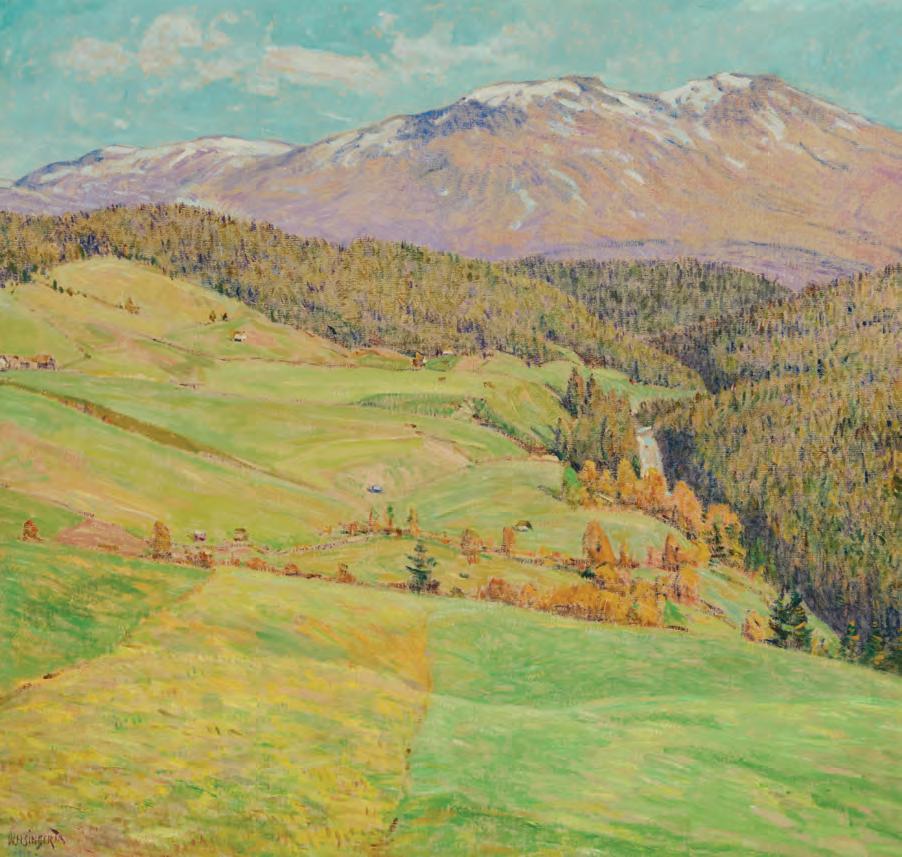
William Henry Singer Jr. (1868-1943)
“Highland Farms No. 1,” 1915 Oil on canvas
Signed and dated lower left: W.H. Singer Jr. / -1915-; signed again, titled, and inscribed faintly in pencil, verso: “Highland Farms No. 1 / Tydalen Norway / W.H. Singer Jr”; inscribed in pencil on the stretcher: “Boerdergen in Bergen. 1912.” [roughly translates to Farms in Bergan]; signed, titled, and inscribed again on a partial exhibition label affixed to the stretcher
39.75” H x 41.25” W
$4,000-6,000
Provenance: Estate of the artist Private Estate, California, from the above
Exhibited:
Chicago, IL, Art Institute of Chicago, “Oil Paintings and Sculpture, Twenty-Ninth Annual Exhibition,” November 2 - December 7, 1916, awarded the Cahn Honorable Mention prize
Literature:
Peter H. Falk, “The Annual Exhibition Record of the Art Institute of Chicago, 1888-1950” (Sound View Press, Madison, CT) p. 828 Helen Schretlen, “American Impressionist William H. Singer Jr. 1868-1943” (Singer Laren: Waanders Publishers Zwolle, 2008) p. 64, illustrated
1097
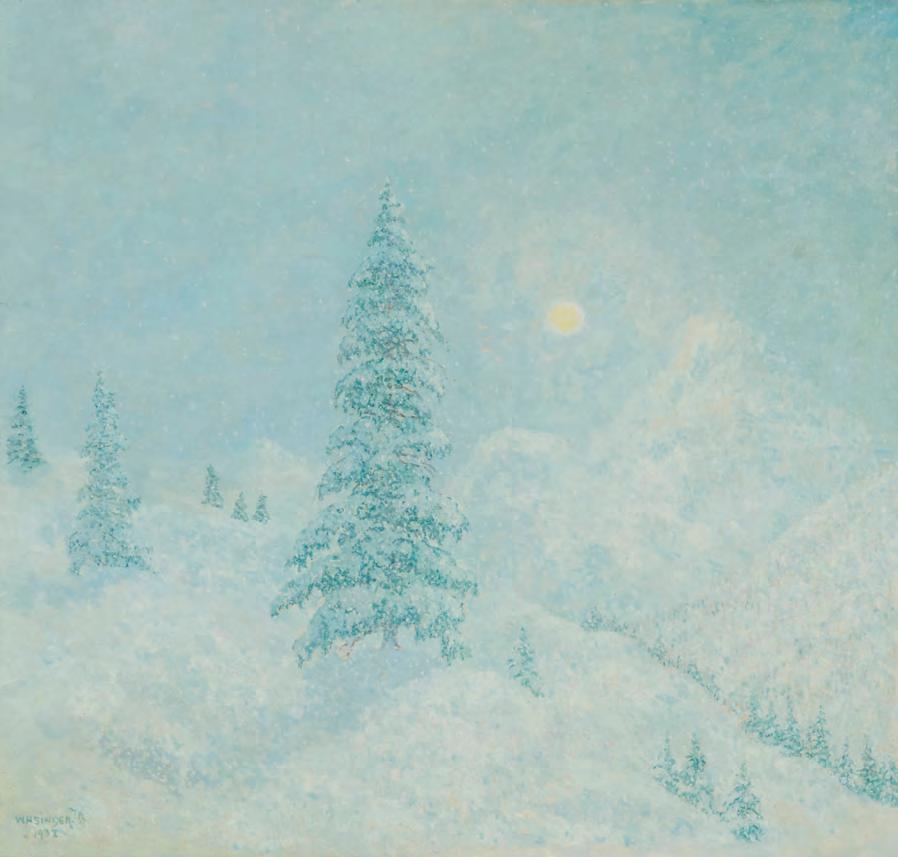
William Henry Singer Jr. (1868-1943)
“Winter’s Tender Sun,” 1932 Oil on canvas
Signed and dated lower left: W.H. Singer, Jr. / - 1932; signed again and titled on a label affixed to the stretcher; titled again on another label affixed to the stretcher; inscribed in pencil verso: “Old title / Silence” and in black paint: “8674” 39.75” H x 41.5” W
$4,000-6,000
Provenance:
Estate of the artist
Private estate, California, from the above
1098
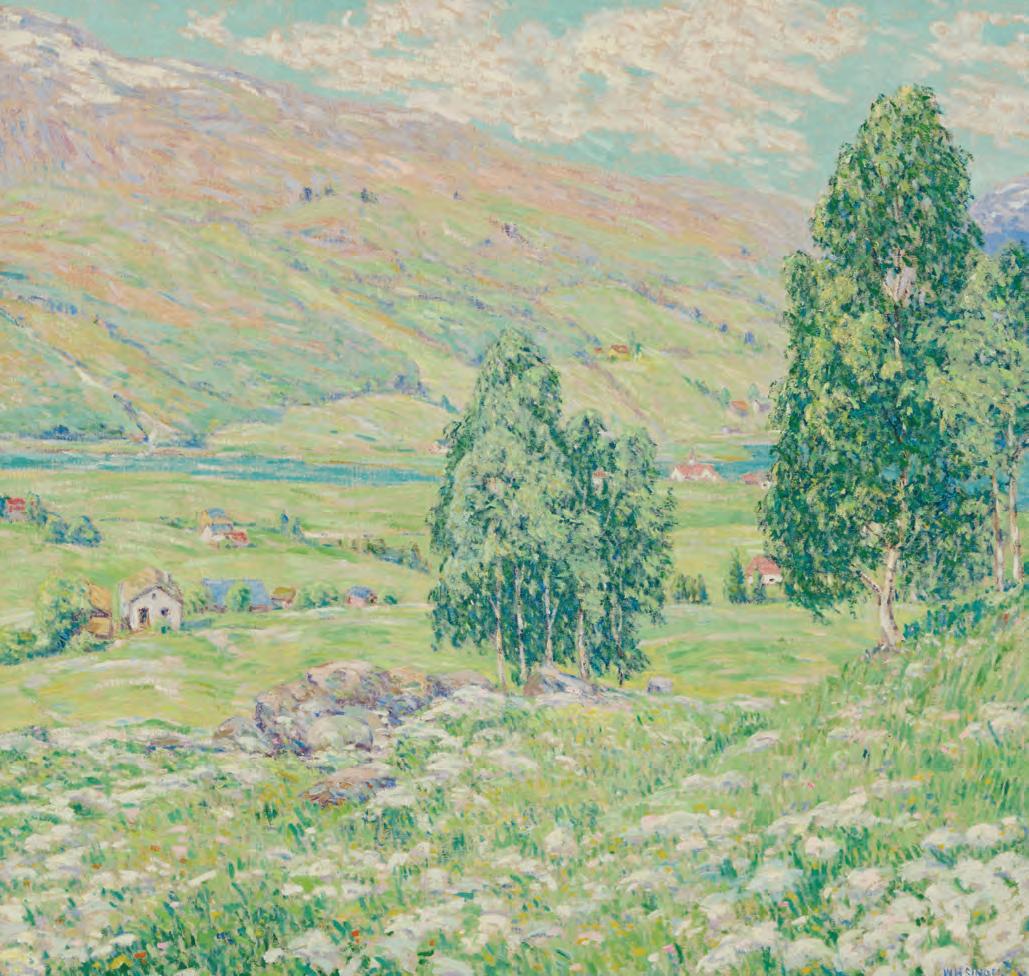
William Henry Singer Jr. (1868-1943)
“A Bit of River and Fjord,” 1920 Oil on canvas
Signed lower right: W.H. Singer Jr; titled in English and Norwegian and dated in pencil verso and again in pencil on the stretcher: “1920” and “20.” respectively 40” H x 41.5” W
$4,000-6,000
Provenance: Estate of the artist
Private estate, California, from the above
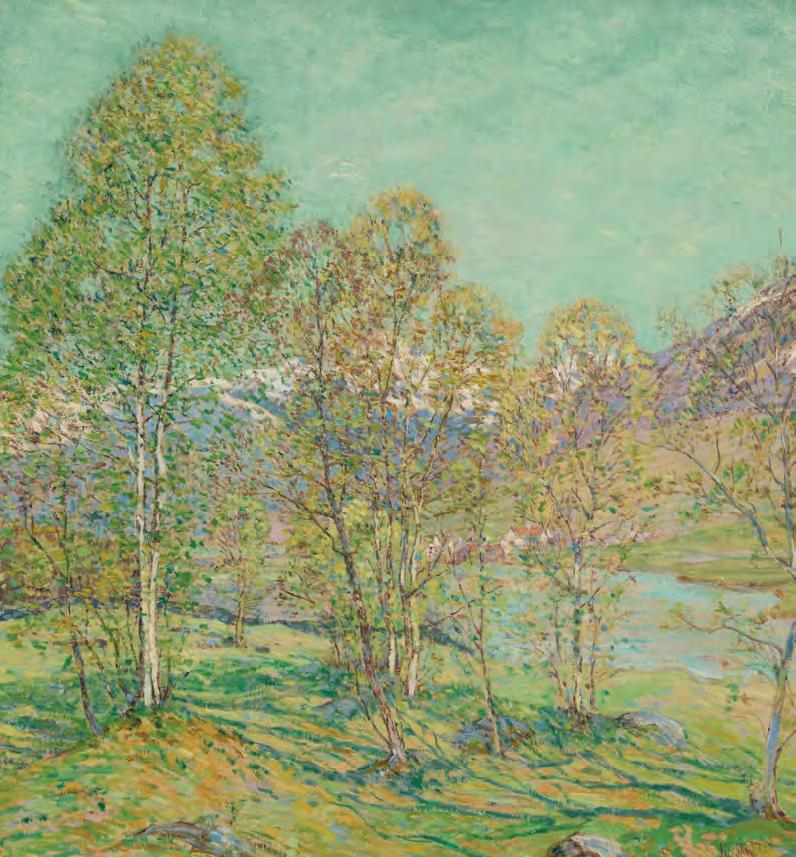
1099
William Henry Singer Jr. (1868-1943)
“In Spring Time” Oil on canvas
Signed lower right: W.H. Singer; titled and inscribed “No. 18,” verso 34” H x 31.75” W
$3,000-5,000
Provenance: Anna Brugh Singer, wife of the artist Jacob Dooijewaard, Netherlands, from the above Willem Dooijewaard, Netherlands, brother of the above, by descent Private estate, California
Notes: This lot is accompanied by a photographic Certificate of Authenticity signed by Willem Dooijewaard and dated June 25, 1976.
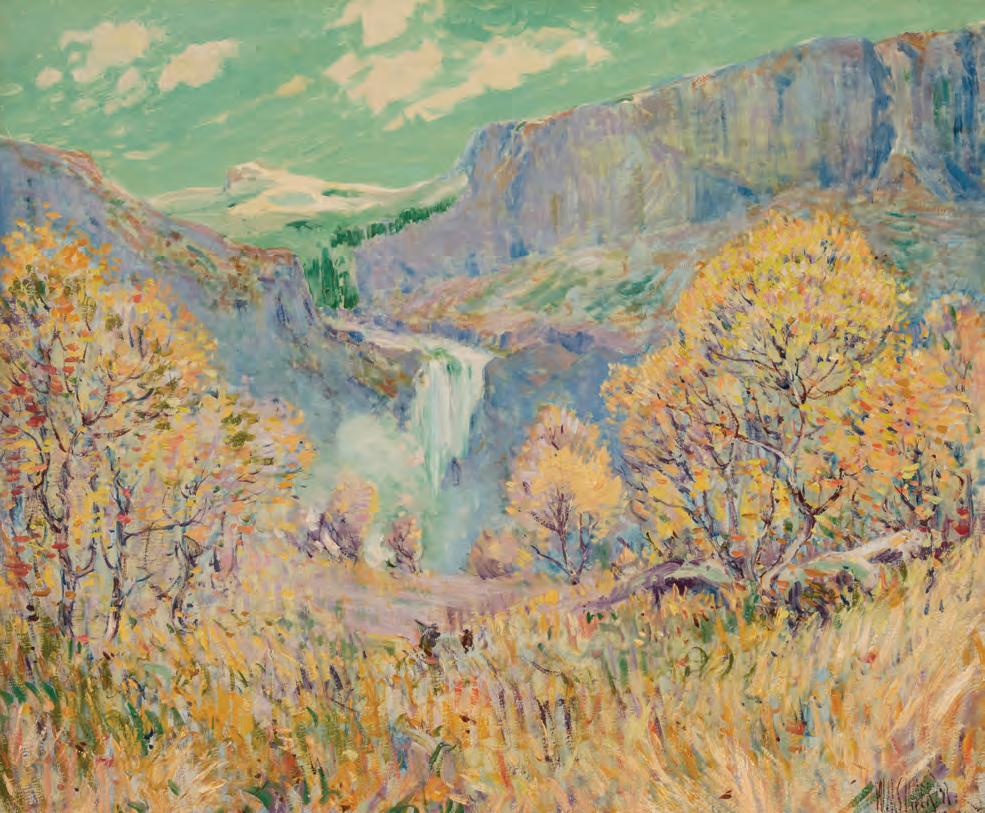
1100
William Henry Singer Jr. (1868-1943)
Autumnal landscape with cascading waterfall, 1910 Oil on canvas
Signed and dated lower right: W.H. Singer Jr. / 1910; signed again and inscribed, verso: “126 B. Montparnasse” 27.25” H x 32.25” W
$3,000-5,000
Provenance:
Estate of the artist
Private estate, California, from the above
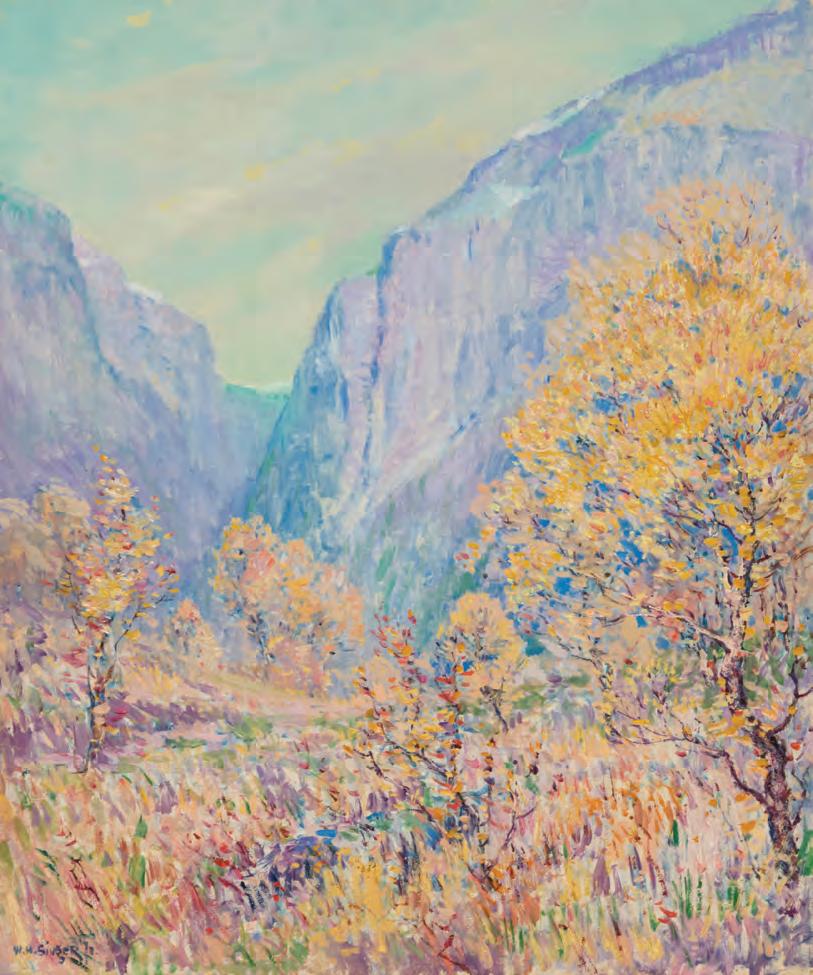
1101
William Henry Singer Jr. (1868-1943)
“Briksdal Autumn, Herfol” (Norway) Oil on canvas
Signed lower left: W.H. Singer Jr.; signed again and titled in pencil on the stretcher; inscribed “89.” in pencil at the upper left corner of the stretcher 33.5” H x 27” W
$3,000-5,000
Provenance: Estate of the artist Private estate, California, from the above
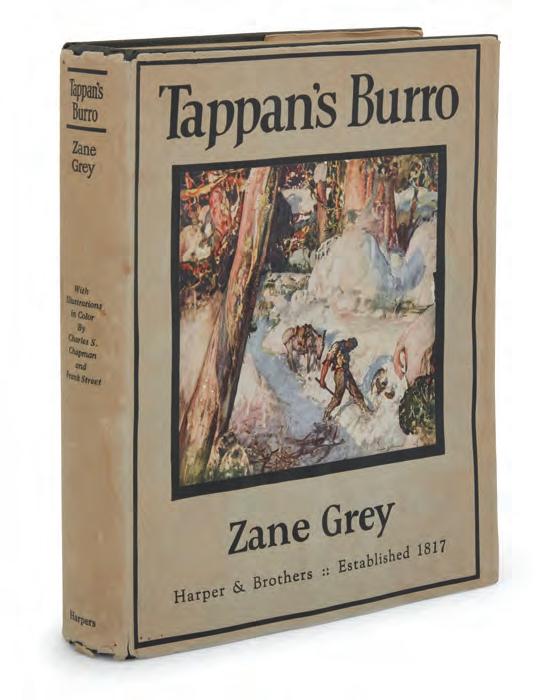
1102
Charles Shepard Chapman (1879-1962)
“Tappan’s Burro,” circa 1923 Oil on board mounted to board
Signed lower right: Charles S. Chapman
Together with a hardcover First Edition copy of the book of the same title, for which this painting served as the cover illustration and frontispiece Painting: 24.25” H x 24” W; Book: 9.5” H x 7.5” W x 1.75” D
$2,000-3,000
Literature:
Zane Grey, “Tappan’s Burro,” New York and London: Harper & Brothers Publishers, 1923, illustrated on cover and frontispiece
Notes:
This painting served as the cover illustration and frontispiece for the Harper & Brothers Publishers’ version of Zane Grey’s short story, “Tappan’s Burro” cited above; a hardcover, First Edition copy of which accompanies this lot.
1103
Joseph Dwight Strong Jr. (1852-1899)
Mt. Shasta, 1856
Oil on canvas laid to canvas
Signed lower right: Strong / 1856
20” H x 36” W
$2,000-3,000
1104
Attributed to Gunnar Widforss (1879-1934)
Mountainous landscape
Watercolor and gouache on paper laid to board Appears unsigned; inscribed “Widforss / Canadian?” in pencil in another hand, verso Sheet: 19” H x 26.5” W
$3,000-5,000
Provenance: Private estate, California
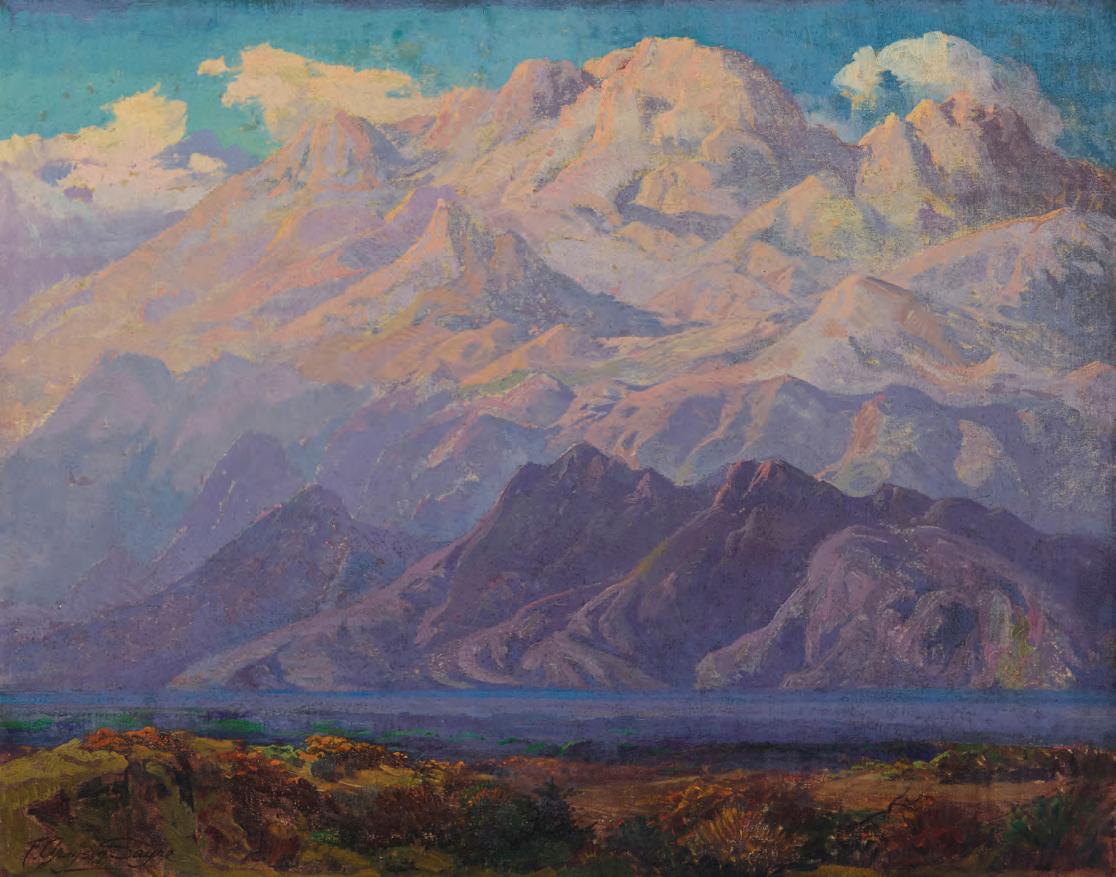
1105
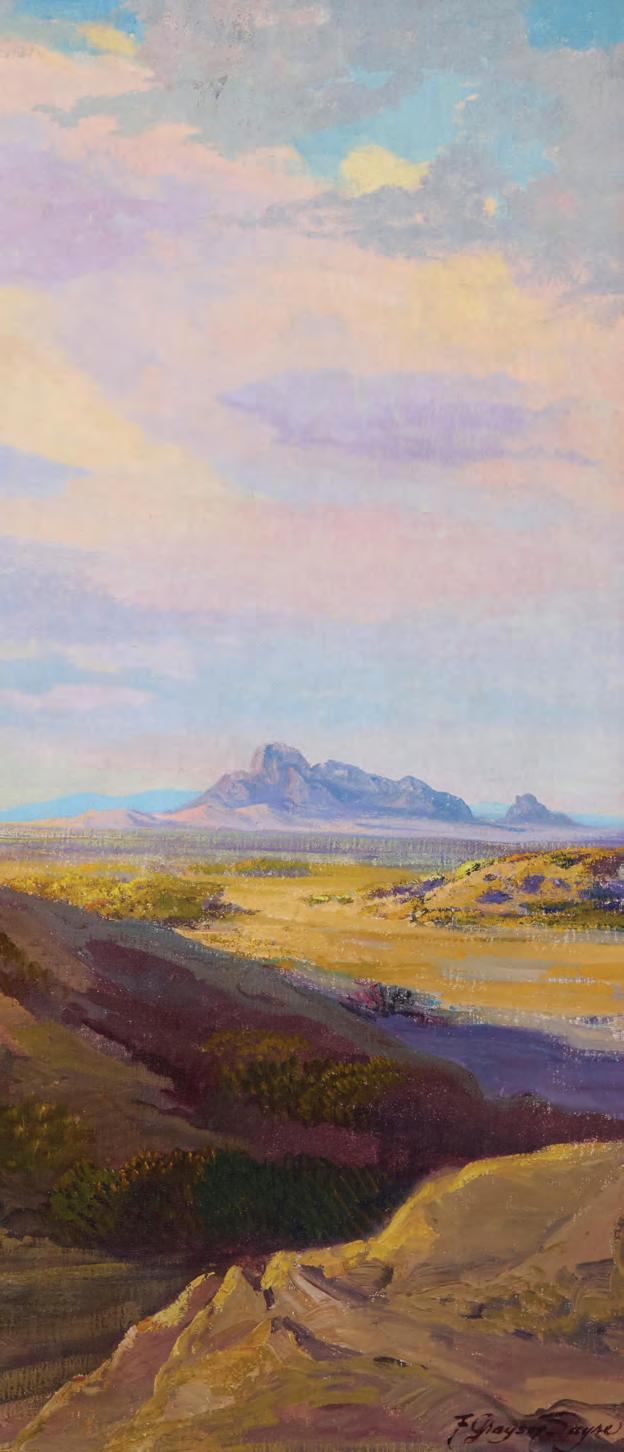
Fred Grayson Sayre (1879-1939)
Oil on canvas
Signed lower left: F. Grayson Sayre; titled on the stretcher 24” H x 30” W
$3,000-5,000
“Sunlit Peaks”
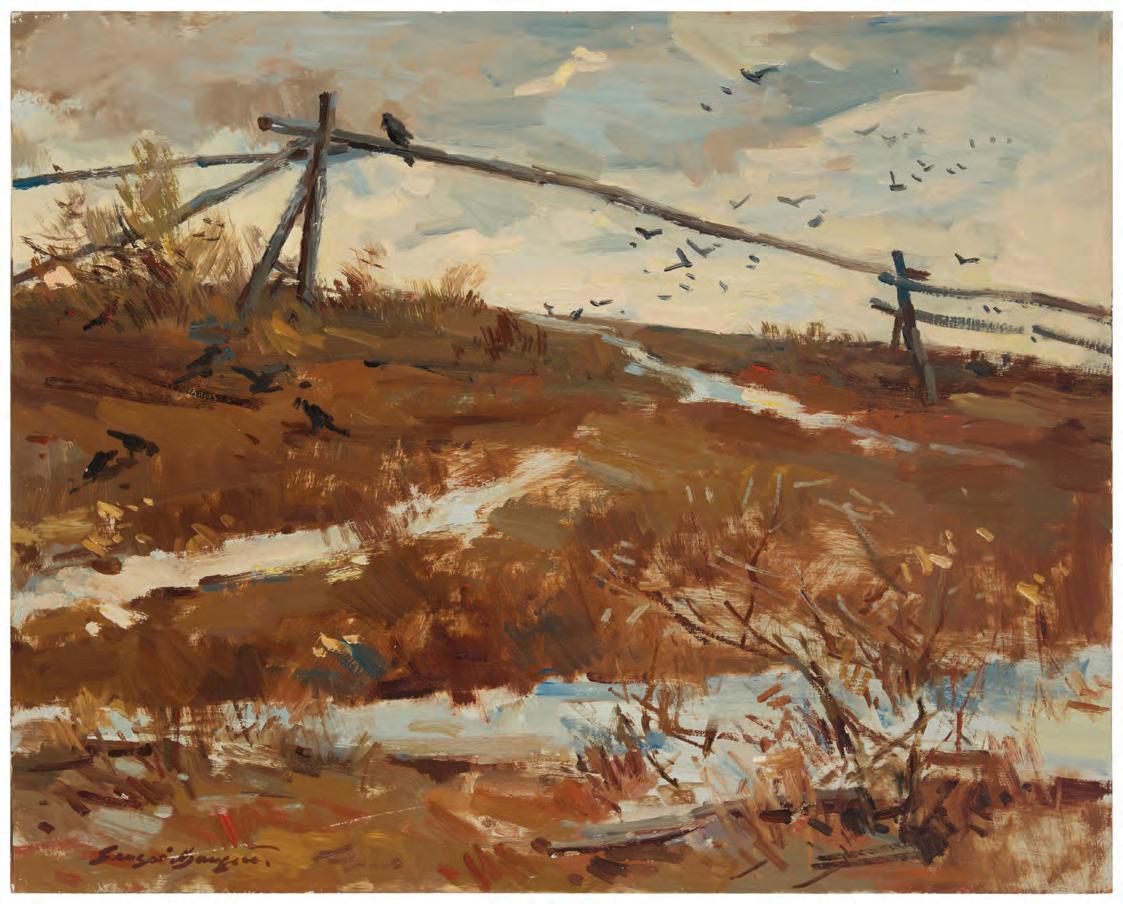
1106
Sergei Bongart (1918-1985)
Crows in an early Spring landscape Oil on Masonite
Signed lower left: Sergei Bongart; inscribed “112” in black, verso 24” H x 30.125” W
$800-1,200
Provenance: The Estate of Sergei Bongart
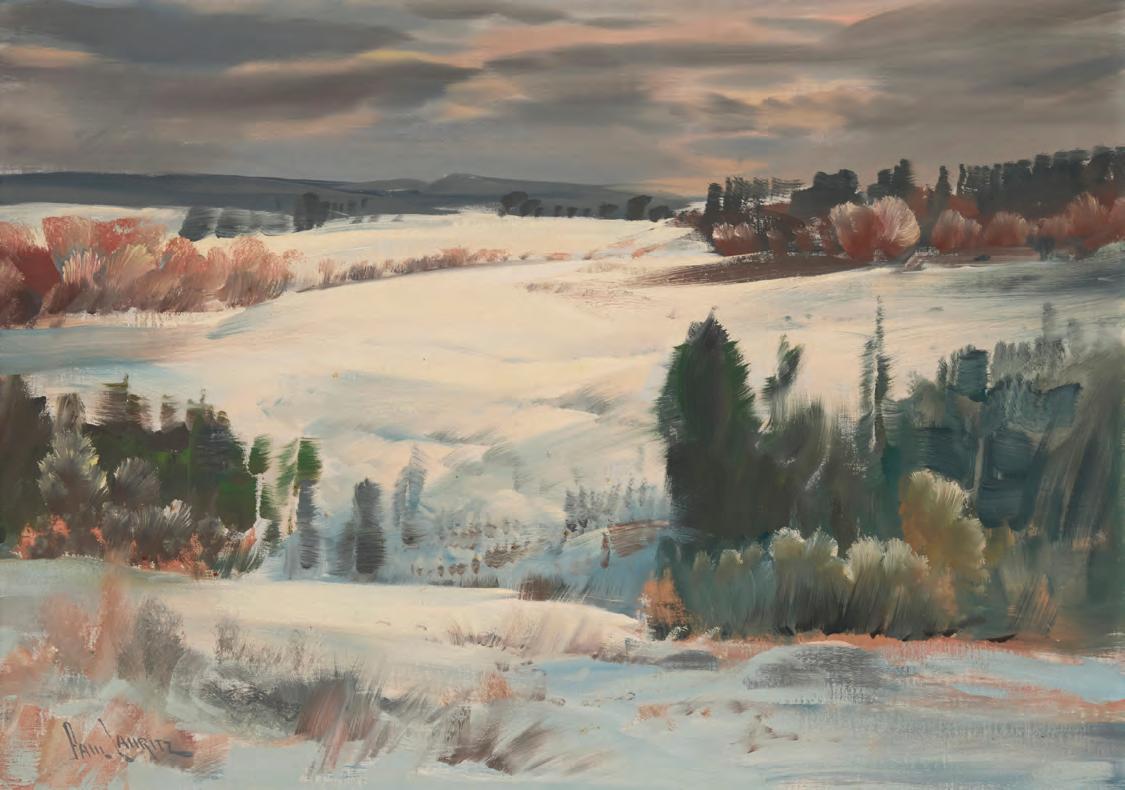
1107
Paul Lauritz (1889-1975)
“Winter Hills” Oil on canvas on panel
Signed lower left: Paul Lauritz; signed, inscribed, and titled verso: Paul Lauritz R.S.A. 24” H x 34.25” W
$2,500-3,500
1108
Charles Arthur Fries (1854-1940)
“Rocky Arroyo” Oil on canvas
Signed lower right: C.A. Fries; titled and numbered “#407,” verso 18” H x 23.75” W
$3,000-5,000
Provenance: The artist
Irene Peabody Robinson, gifted from the artist’s estate, 1962
Sold: Bonhams, Los Angeles, “California and Western Art,” August 4, 2020, Lot 109 Estate, Grand Terrace, CA
Literature:
B.F. Dixon, ed., “From the Archives of Artist Charles A. Fries and author Addie Davis Fries, His Wife,” San Diego, Don Diego’s Libreria, 1969, p. 73, no. 407
1109
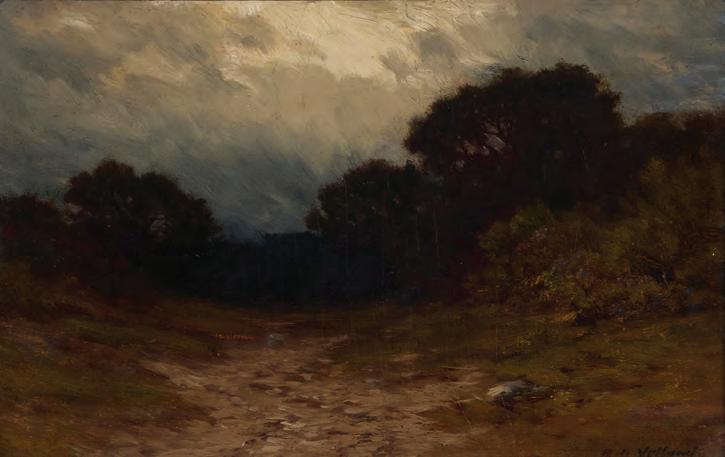
Raymond Dabb Yelland (1848-1900)
Evening landscape
Oil on paperboard
Signed lower right. R.D. Yelland
7” H x 11” W
$1,000-1,500
1110
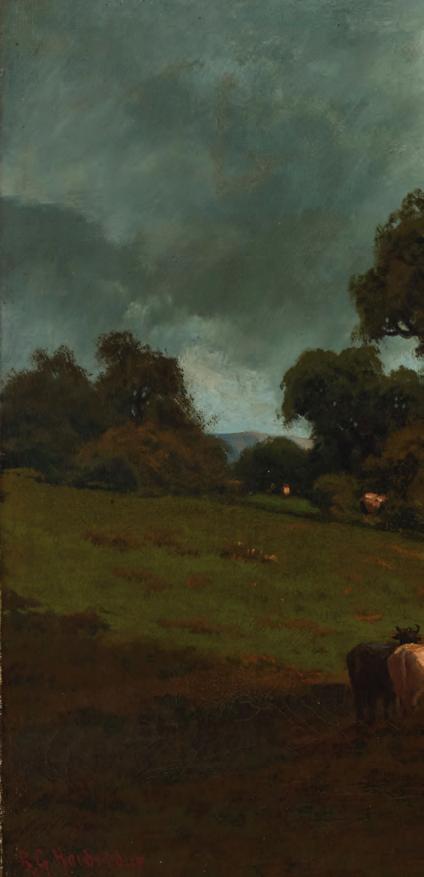
Ransome Gillet Holdridge (1836-1899)
Landscape with cows Oil on canvas laid to waxed canvas
Signed lower left: R.G. Holdridge
20.25” H x 36” W
$800-1,200
1111
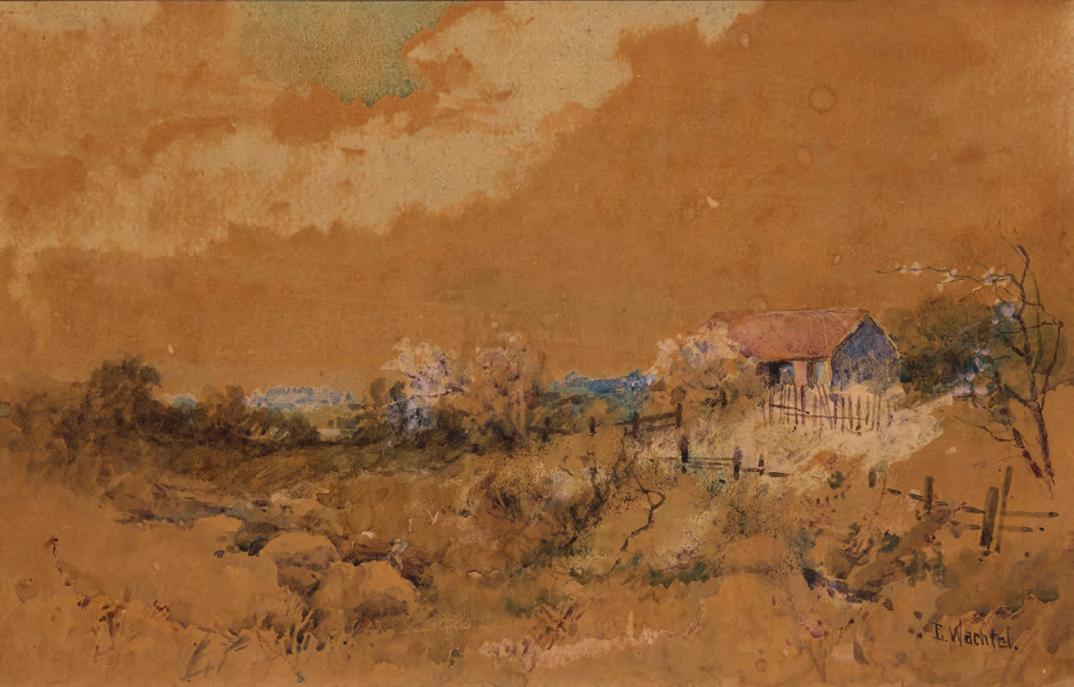
Elmer Wachtel (1864-1929)
House in a landscape Watercolor on paperboard
Signed lower right: E. Wachtel; inscribed, partially indistinct, verso: “Paid / Mrs. G.H. Ricks [?] / Redlands, Cal. / Expr. [or Expor.?] collect” 10” H x 15.5” W
$700-900
Provenance:
Private collection, Redlands, CA
Private collection, La Jolla, CA, acquired from the above by descent
Private collection, CA, acquired from the above by descent
Private collection, AL, acquired from the above by descent
1112
Edwin Deakin (1838-1923)
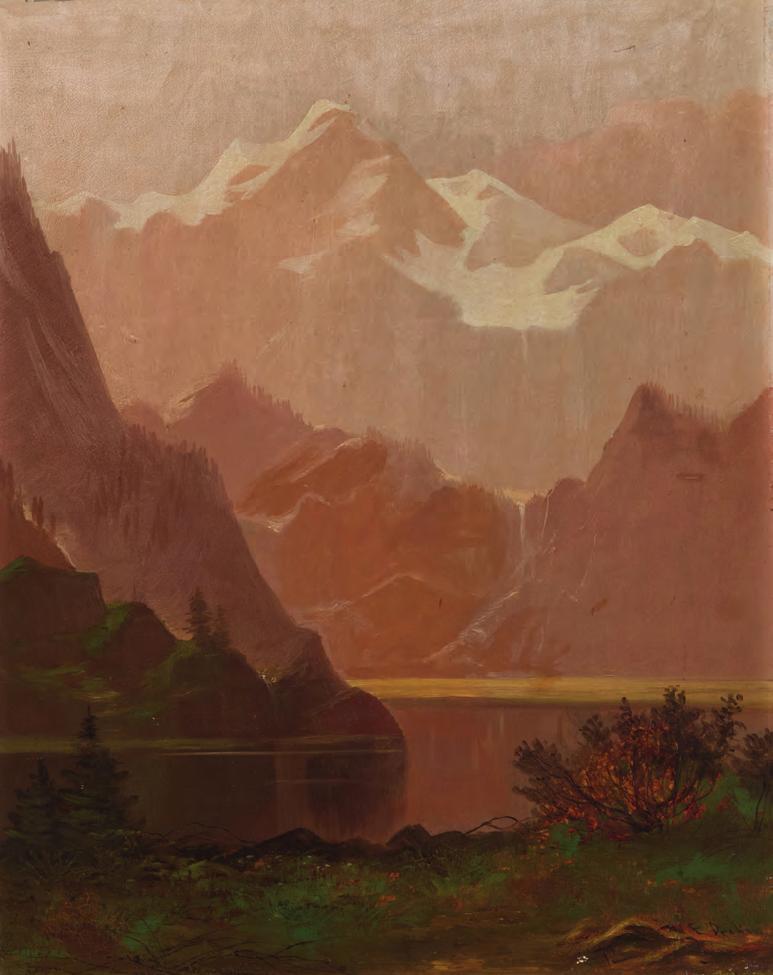
Mountain lake
Oil on canvas laid to canvas
Signed lower right: E Deakin
18” H x 14” W
$1,500-2,000
Arthur Frank Mathews (1860-1945)
Influential American painter, muralist, and educator, broader Arts and Crafts aesthetic in California. San Francisco and later in Paris at the Academie to the United States, Mathews became a central blending classical influences and Craftsman’s work, both figural and landscape, often feature symbolism, and a spiritual connection to nature.
Beyond his painting, Mathews played a major served as director of the California School of influential furniture and decorative arts studio art with everyday life.
educator, Arthur Mathews is associated with the Tonalist movement and the California. Born in Markesan, Wisconsin, he studied at the California School of Design in Academie Julian, where he absorbed European academic techniques. After returning central figure in the development of a distinctly Californian artistic identity, Craftsman’s aesthetic with a sensitivity to the landscapes and light of the West Coast. His feature serene, idealized scenes rendered in muted tones, emphasizing harmony, nature.
major role in shaping the California art scene through teaching and design. He of Design and, along with his wife, Lucia Kleinhans Mathews, founded the studio “Philopolis.” Their work embodied Arts and Crafts principles, integrating fine
1113
Arthur Frank Mathews (1860-1945)
Carmel hills
Oil on canvas laid to artist’s board
Unsigned 14” H x 12.5” W
$4,000-6,000
Provenance:
Collection of Lucia Mathews
Margaret R. Kleinhans, San Francisco, CA, sister of the above Private collector, San Francisco, CA, friend of the above
By family descent
Notes:
Arthur Mathews’ landscape paintings, like the present view of the Carmel hills, invite viewers to experience a tranquil, almost dreamlike vision of the natural world. While this work is undated, it is compositionally similar to “The Mesa” painted circa late 1920s/early 1930s, illustrated in Harvey Jones’ book “The Art of Arthur & Lucia Mathews.” In both hillside compositions, Mathews uses strong diagonals to section the composition from foreground grasses to clusters of oaks to the rolling hills near the Carmel coast. “Toward the end of the 1920s, as Arthur Mathews approached his seventieth year, he turned away from his previous emphasis on allegorical figure paintings and murals and embarked upon his last, and perhaps now most popular, series of landscapes. Without the slightest evidence of diminished artistic powers, he continued to produce numerous works, most often the seaside landscapes of the Monterey and Carmel coast, that also revealed a notable change in the brilliance of his color palette” (Harvey Jones, “The Art of Arthur & Lucia Mathews,” San Francisco, 2006, p. 147).
1114
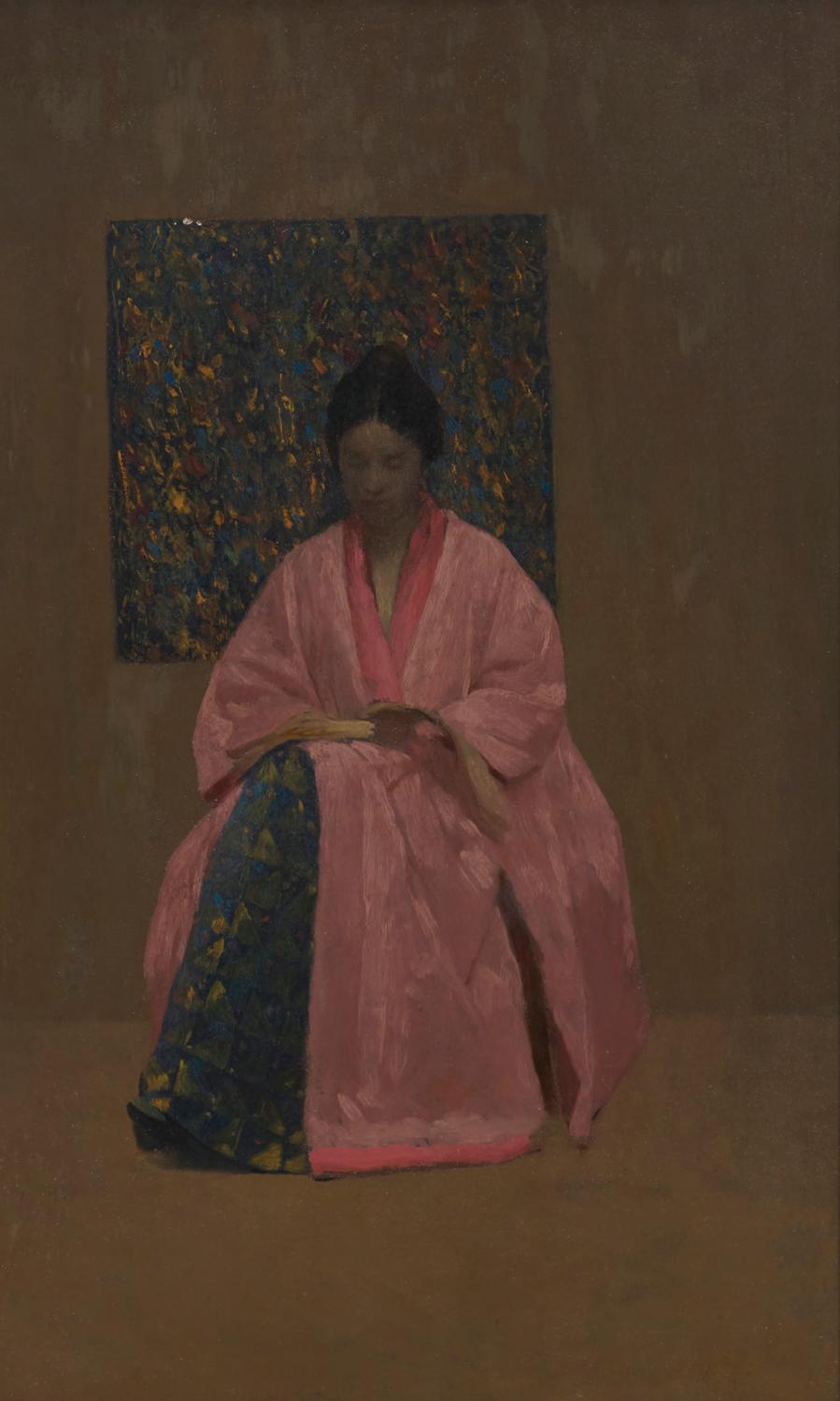
Arthur Frank Mathews
(1860-1945)
“Portrait of Lucia Mathews in Pink Robe” Oil on panel
Unsigned; titled on a label affixed verso
17.5” H x 14.5” W
$10,000-15,000
Provenance:
Collection of Lucia Kleinhans Mathews
Margaret R. Kleinhans, San Francisco, CA, sister of the above
Private collector, San Francisco, CA, friend of the above
By family descent
Exhibited:
Oakland, CA, Oakland Museum of California, on long-term loan New York, NY, The New York Cultural Center, “Mathews: Masterpieces of the California Decorative Style,” 1972
Notes:
Mathews and Lucia Kleinhans Mathews met at the California School of Design, while Arthur was Director and Lucia was a student. The couple married in 1894 and shared a deeply collaborative and influential partnership that shaped the development of the Arts and Crafts movement in California. Working closely across painting, design, and decorative arts, the couple blended their talents to create a unified artistic vision that emphasized beauty, craftsmanship, and harmony in everyday life. At their co-founded studio and workshop, “Philopolis,” they produced furniture, textiles, and interior designs that reflected their shared ideals. Lucia contributed significantly through her skill in design and craftsmanship, while Arthur brought his experience as a painter and educator, making their relationship not only personal but also a creative alliance that left a lasting mark on California’s artistic identity.
There are a few known examples of Mathews’ work where Lucia was the central compositional subject like the present work, and Mathews also periodically used Lucia as a model in figural compositions, but these were not intended to be formal portraits. The present work likely relates to a circa 1899 oil on canvas in the Collection of the Oakland Museum of California titled “Lucia Reading (Portrait of Lucia K. Mathews in Pink Kimono).” In both paintings, the sitter wears a rose-colored Asian-style kimono and sits with her head bowed, reading a book. Lucia’s hair is similarly coiffed in each composition, and the walls and ground are in analogous brown tones. The figure’s position within the interior differs: in the Oakland painting Lucia sits in three quarter profile bathed in strong light, and in the present work she faces the viewer in a room without a direct light source. Mathews includes patterning in the present work that is not incorporated in the Oakland composition as well: a geometrically designed colorful underskirt is visible beneath the kimono, and what appears to be an abstract composition or perhaps stained-glass window is situated on the wall framing the figure’s head.
Signed lower right: Theodore Wores; titled on a label affixed to the frame’s verso 16.75” H x 11” W
$4,000-6,000
Provenance:
Mr. and Mrs. John Powell, possibly artist John Powell (1930-2025)
Brand Library & Art Center, Glendale, CA
Sold: John Moran Auctioneers, Monrovia, CA, “California & American Fine Art,” October 23, 2018, Lot 42
Private collection, Pasadena, CA, from the above
1117
John Edward Costigan (1888-1972)
“Workers in the Field” Oil on canvas
Signed lower right: J.E. Costigan; titled on the frame plaque 36.25” H x 45.25” W
$1,000-1,500
Provenance: Private estate, California
1118
John Edward Costigan (1888-1972)
“Barnyard - Winter,” 1949 Oil on Masonite
Signed lower left: J. E. Costigan N.A.; signed again, titled, dated, and inscribed verso: “John E. Costigan / Orangeburg / New York / Painted 1949” 24” H x 30” W
$1,000-2,000
Provenance:
Private Collection, Maryland Private estate, California
Exhibited: Ogunquit, ME, Ogunquit Art Center, “XXIX National Exhibition of Ogunquit Art Center,” 1949, awarded “Honorable Mention” New York, NY, Salmagundi Club, 1950
1119
Grant Wood (1891-1942)
“Fertility,” 1939
Lithograph on off-white Rives wove paper laid to board
From the edition of 250
Signed in pencil in the lower margin, at right: Grant Wood; Associated American Artists, New York, NY, pub.
Image: 8.875” H x 11.875” W; Sheet: 11.875” H x 16.25” W
$3,000-5,000
Literature: Cole 15
Notes:
The original printed information label from the publisher, Associated American Artists, New York, NY, is affixed to the frame’s backing paper. It is inscribed in ink, “December 1940.”
Grant Wood was a leading figure of American Regionalism, best known for his precise, stylized depictions of Midwestern life, but his artistic practice also included a significant engagement with printmaking. Alongside iconic paintings like “American Gothic,” Wood explored lithography to expand the reach of his imagery, translating his carefully structured compositions into prints that emphasized clean lines, rhythmic patterns, and a controlled sense of design.
His 1939 lithograph “Fertility” exemplifies this approach, depicting a monumental barn and silo presiding over an idealized agricultural landscape of corn rows, symbolizing abundance and the cyclical productivity of rural America. In both his paintings and prints, Wood fused technical discipline with symbolic content, using the reproducible medium of printmaking to reinforce his vision of the Midwest as a place of stability, growth, and cultural identity.
1120
Paul Landacre (1893-1963)
“August Seventh,” 1936 Wood engraving on Japan paper
Edition: 53/60 (there was also an edition of 150 on wove paper)
Signed, titled, and numbered in pencil in the lower margin: Paul Landacre; with the artist’s petrel logo drawn in red pencil in the lower right margin corner; the Origins of Art black ink estate stamp on the verso of the lower left margin corner Image: 12.125” H x 8” W; Sheet: 14.5” H x 10.5” W
$1,500-2,000
Provenance:
Sold: Bonhams, Los Angeles, CA, “Prints and Multiples,” May 1, 2018, Lot 55 Private collection, Burbank, CA, acquired from the above
Literature: Wien 192
Notes:
Often stamped in black or red ink (or sometimes drawn in red pencil, as here) in one of the lower margin corners as a quality validation, this impression shows Landacre’s stylized version of a Petrel species of sea bird flanked by the artist’s initials. The “Origins of Art” black ink stamp was added to impressions by Landacre’s estate after his death.
1121
Armin Carl Hansen (1886-1957)
“Valley Farm,” 1926 Drypoint on paper
From the edition of unknown but presumably small size, only 9 impressions were located by White; first (only) state Signed, titled and inscribed in pencil in the lower margin: Armin Hansen / imp.; signed again and dated “26” in the plate at lower left
Plate: 4.875” H x 6.375” W; Sight: 5.5” H x 6.75” W
$600-800
Provenance: Estate, Grand Terrace, CA
Literature: White 86 i/i
1122
Armin Carl Hansen (1886-1957)
“Fisher Wives [B],” 1925 Etching on paper
From the edition of unknown but presumably small size, only 7 impressions were located by White; first (only) state
Signed and titled in pencil in the lower margin: Armin Hansen; signed again and dated “’25” in the plate at lower left Plate: 6.875” H x 7.875” W; Sight: 7” H x 8” W
$600-800
Provenance: Estate, Grand Terrace, CA
Literature: White 83-B i/i
1123
Armin Carl Hansen (1886-1957)
“Men of the Sea,” 1937 Etching on paper
From the edition of unknown but presumably small size; only 15 impressions were located by White; first (only) state
Signed and titled in pencil in the lower margin: Armin Hansen / imp.; signed and dated “37” in the plate at lower right
Plate: 6.875” H x 5” W; Sight: 7.25” H x 5.5” W
$700-1,000
Provenance: Estate, Grand Terrace, CA
Literature: White 141 i/i
1124
Armin Carl Hansen (1886-1957)
“The Mate,” 1930
Drypoint on paper
From the edition of unknown but presumably small size, only 14 impressions were located by White; third (final) state
Signed and titled in the lower margin: Armin Hansen / imp.; initialed and dated “’30” in the plate at lower left
Plate: 4” H x 3” W; Sight: 4.375” H x 3.375” W
$500-700
Provenance: Estate, Grand Terrace, CA
Literature: White 120 iii/iii
1125
Armin Carl Hansen (1886-1957)
“On the Shining Sand,” 1933
Drypoint on paper
From the edition of unknown but presumably small size, only 19 impressions were located by White; first (only) state
Unsigned Plate: 3” H x 4” W; Sight: 3.25” H x 4.25” W
$300-500
Provenance: Estate, Grand Terrace, CA
Literature: White 132 i/i
1126
Armin Carl Hansen (1886-1957)
“Lifeboat Out,” 1936 Etching on paper
From the edition of unknown but presumably small size, only 11 impressions were located by White; likely a third state (of four) Faint signature and date printed in the plate at lower right: Armin Hansen 36 Plate: 5.875” H x 7.875” W; Sight: 6.375” H x 8.375” W
$400-600
Provenance: Estate, Grand Terrace, CA
Literature: White 134 iii/iv
1127
Ferdinand Kaufmann (1864-1942)
“Los Angeles Harbor” Oil on board
Signed lower right: F. Kaufmann.; signed again, titled, and inscribed, all in pencil on the verso: “Los Angeles, Calif. / Mr. Ferdinand Kaufmann / G.G.I.E.;” a printed color card from the Golden Gate International Exposition has been trimmed and affixed to the verso 30” H x 35.75” W
$8,000-12,000
Provenance:
Sold: John Moran Auctioneers, Pasadena, CA, “California and American Paintings,” June 19, 2007, Lot 77
Private Residence, Orange County, CA
Private Collection, Pasadena, CA.
Sold: John Moran Auctioneers, Pasadena, CA, “California and American Paintings,” June 23, 2009, Lot 36
Exhibited:
San Francisco, CA, “Golden Gate International Exposition,” February 18, 1939 - October 29, 1939 and May 25, 1940 - September 29, 1940.
Notes:
The exhibition ran from February 18, 1939, through October 29, 1939, and was reopened after financial difficulties on May 25, 1940, through September 29, 1940.
1128
Ferdinand Kaufmann (1864-1942)
“Pacific Coast at Carmel” Oil on canvas laid to canvas
Signed lower right: F Kaufmann.; titled in pencil on the stretcher 20” H x 22.25” W
$3,000-5,000
Provenance:
Sold: Christie’s Los Angeles, CA, “California, Western, American Paintings & Sculpture,” June 19, 2002, Lot 15
Anders Aldrin (1889-1970)
Anders Gustave Aldrin was born in Sweden moving to Los Angeles in 1923, He attended recognized with a full scholarship. He also was studied there from 1927 to 1930. He returned accorded a one-person show at the Los Angeles critics alike. The Los Angeles Times art critic, the world is dominantly red and green, but how
In 1940 he was given a one-person exhibition of this man is a declaration of independence work I have seen produced in California. Strong his painting as honest as the man himself...he
Though he loved Aldrin’s work, noted American carry him as he felt he didn’t have the proper Edward Hopper and Charles Burchfield. Aldrin’s (1890-1939), John Dominique (1893-1994), and Metropolitan Museum in New York and was Coast.” Artist Lorser Feitelson (1898-1978) described ‘painter’s painter’...His significant contribution
in 1889. He immigrated to the United States in 1911, attended the Otis Art Institute between 1923 and 1927 where his talents were was awarded a full scholarship to the Santa Barbara School of the Arts and returned to LA and began exhibiting his unusually expressive paintings locally, and was Angeles Museum in 1935. He began to garnish high praise from local artists and critic, Arthur Millier said he was “a quiet local painter who runs in no pack...To him how he makes these colors sing!”
exhibition at Scripps College. Millard Sheets wrote: “The work independence from the styles and manners of his contemporaries and is the most forthright Strong poetry...flavored with color...free from imitation...solid construction...make himself...he has found the best approach to all art.”
American art dealer, Frank Rehn (Rehn Gallery) in 1945 reluctantly decided not to proper resources and was too committed to his current gallery stable which included Aldrin’s friends included California artists Dan Lutz (1906-1978), Edward Vysekal and Ross Dickinson (1903-1978). He had been accepted by a jury at the considered by Roland McKinney at the museum “the best painter on the West described Aldrin as “the personification of the rarity, the ‘excellent painter,’ the contribution to the art of this region is of historic value.”
1129
Anders Aldrin (1889-1970) California coast Oil on canvas
Signed lower right: Anders Aldrin; signed again and inscribed “Los Angeles, Calif.” in pencil, verso 27” H x 34” W
$3,000-5,000
Provenance: K. Nathan Gallery, La Jolla, CA
Notes:
We are grateful to Keith Kelman for his assistance in cataloging this lot.
Clyde Aspevig (b. 1951)
Clyde Aspevig is a contemporary American grandeur of the natural world. Raised in Montana, which became central to his artistic vision. atmospheric skies of the American West and impressionistic light.
In his seascapes, he emphasizes shifting weather, convey a sense of solitude and timelessness. work invites viewers to experience nature
American artist known for his evocative land and seascapes that capture the quiet Montana, Aspevig developed a deep connection to wide-open spaces, vision. His paintings often depict the sweeping plains, coastal shores, and and Pacific regions, rendered with a sensitive balance of realism and weather, reflective water, and expansive horizons, while his landscapes timelessness. Through subtle color harmonies and careful observation, Aspevig’s not as spectacle, but as a contemplative and immersive presence.
1130
Clyde Aspevig (b. 1951)
“In The Mist,” 2009 Oil on linen laid to Masonite
Signed and dated lower left: C. Aspevig ‘09; titled on the frame plaque; signed again, “Clyde Aspevig,” as well as dated again, and alternately titled “In the Mist, Pt. Lobos State Park,” all in ink on the artist’s studio label affixed verso 40” H x 48” W
$15,000-25,000
Provenance:
The artist
Private Collection, Bozeman, MT
Sold: John Moran Auctioneers, Monrovia, CA, “California and American Fine Art,” March 22, 2016, Lot 39 From the Collection of Robert A. Day
Literature:
Clyde Aspevig, ‘’Visual Music: The Landscapes of Clyde Aspevig” (Juniper Ridge Studios, Billings, 2010) p. 49, illustrated
1131
Conrad Buff (1886-1975)
Seascape Oil on Masonite
Signed in pencil lower right: Conrad Buff 12” H x 16” W
$1,500-2,000
1132
Thomas Lorraine Hunt (1882-1938)
Lakeside cabins with boats
Watercolor and gouache on thin paper board laid to artist’s board
A view of San Clemente Island from San Diego Oil on canvas laid to canvas
Signed lower left: C.A. Fries 24” H x 36” W
$6,000-8,000
Provenance:
Steven Stern Fine Art, Los Angeles, CA California Paintings, Beverly Hills, CA
Sold: Bonhams California, Los Angeles, CA, “California and Western Art 40th Anniversary Auction, October 13, 2020, Lot 51 Estate, Grand Terrace, CA
1135
Charles Arthur Fries (1854-1940)
“Oaks between Alpine and Dehesa” (Mason Valley, San Diego County), 1925 Oil on canvas
Signed lower left: C.A. Fries; titled in the artist’s catalogue, alternatively titled and dated “Oaks / April 1925,” and numbered “#1167,” all in ink, verso 10” H x 14” W
$2,000-3,000
Provenance:
Dorothy Adelaide King, granddaughter of the artist, gifted from her father William R. King, son-in-law of the artist, 1931
Sold: Bonhams, Los Angeles, CA, “California and Western Art 40th Anniversary Auction,” October 13, 2020, Lot 93 Estate, Grand Terrace, CA
Literature:
B.F. Dixon, ed., “Too Late: The Picture and the Artist, A Tribute to the Dean, From the Archives of Artist Charles A. Fries and author Addie Davis Fries, His Wife,” San Diego, Don Diego’s Libreria, 1969, p. 91, no. 1167
1136
Charles Arthur Fries (1854-1940)
“San Diego River at El Monte Park,” 1926 Oil on canvas
Signed lower right: C.A. Fries; signed again, titled, dated, and numbered “#1237,” all in ink, verso 8.875” H x 11.875” W
$1,500-2,500
Provenance:
Sold: Bonhams, Los Angeles, CA, “California Art,” August 2, 2023, Lot 122 Estate, Grand Terrace, CA
Literature:
B.F. Dixon, ed., “Too Late: The Picture and the Artist, A Tribute to the Dean, From the Archives of Artist Charles A. Fries and author Addie Davis Fries, His Wife,” San Diego, Don Diego’s Libreria, 1969, p. 93, no. 1237
1137
Charles Arthur Fries (1854-1940)
“In the Oasis at Indian Wells,” 1934 Oil on canvas
Signed and dated lower left: C.A. Fries / 1934; titled, inscribed, and numbered, all verso: # 1536 / April 1933 / 70 14.375” H x 18.625” W
$2,000-3,000
Provenance:
Sold: Bonhams, Los Angeles, CA, “California and American Paintings and Sculpture,” December 10, 2007, Lot 241 (with another) Estate, Grand Terrace, CA
Literature:
B.F. Dixon, ed., “Too Late: The Picture and the Artist, A Tribute to the Dean, From the Archives of Artist Charles A. Fries and author Addie Davis Fries, His Wife,” San Diego, Don Diego’s Libreria, 1969, p. 102, no. 1536
Notes:
The painting is being sold in a Richard Tobey frame.
1138
Angel Espoy (1879-1963)
Desert landscape with palm trees Oil on canvas
Signed lower right: A. Espoy 25” H x 30” W
$2,000-3,000
1139
Alfred Richard Mitchell (1888-1972)
Desert mountain Oil on canvas laid to board
Signed lower right: Alfred R Mitchell
8.25” H x 10.25” W
$800-1,200
1140
Conrad Buff (1886-1975)
“Sand and Sky” Oil on board
Estate signed lower right: Conrad Buff; the estate ink stamp with signature by Mary Elizabeth Buff, and titled on a label, both affixed to the backing board
16.25” H x 12.25” W
$1,500-2,000
Provenance: Estate of the artist
Ralph William Holmes (1876-1963)
“Desert Wash” Oil on canvas
Signed lower right: Ralph Holmes; signed again and titled in pencil on the stretcher 24” H x 28” W
$1,200-1,800
Provenance:
Sold: Bonhams, Los Angeles, “Sunset Sale,” June 11, 2006, Lot 7072 Private collection, Burbank, CA
1142
Fred Grayson Sayre (1879-1939)
“The Old Prospector” Oil on canvas
Signed lower right: F. Grayson Sayre; signed again and titled in pencil on the stretcher 40.25” H x 50.25” W
$3,000-5,000
1143
Benjamin Chambers Brown (1865-1942)
“Sentinel Rock, Yosemite” Oil on panel
Signed and inscribed lower right: Benjamin C. Brown / “California”; titled verso 15.75” H x 25” W
$3,000-5,000
1144
James Fetherolf (1925-1994)
“Yosemite Meadow” Oil on canvas
Signed lower right: Fetherolf; titled on the frame’s backing paper; with the artist’s copyright ink stamp, verso 18.25” H x 24.125” W
$3,000-5,000
Provenance:
A. Huney Gallery, San Diego, CA, 1982
Notes:
This lot is accompanied by a sales invoice dated February 2, 1982, from the gallery mentioned above.
1145
Bennett Schroeder Bradbury (1914-1991)
“Sierra Lake” Oil on canvas
With the incised signature lower right; with the artist’s copyright ink stamp (four times), verso; titled on the frame plaque 24” H x 36” W
$1,000-1,500
Provenance:
Sold: Weschler’s Auctioneers, Rockville, MD, October 14, 1989, Lot 176 Private estate, California
1146
Sergei Bongart (1918-1985)
Mountain landscape, 1970 Oil on canvas
Signed and dated lower right: Sergei Bongart 70 22” H x 28” W
$800-1,200
Provenance: The Estate of Sergei Bongart
1147
Kenn Backhaus (b. 1951)
“Falls Below Grass Lake” (Sierras) Oil on canvas laid to artist’s panel
Signed lower right: David Chapple; titled verso 24” H x 30” W
$4,000-6,000
David Chapple (b. 1947)
“Summer Stream” Oil on canvasboard
1149
James Swinnerton (1875-1974)
“Garden of the Gods” Oil on canvas board
Signed lower right: Swinnerton; titled by repute 22” H x 30” W
$3,000-5,000
1150
Ralph Love (1907-1992)
“Grand Canyon” Oil on artist’s board
Signed lower left: Love; signed again, Ralph Love, numbered “# 971,” and inscribed “Temecula,” all verso; titled “Grand Canyon / Reverend Love” on the frame plaque 20” H x 24” W
$1,000-1,500
1151
Dedrick Brandes Stuber (1878-1954)
“Pichaco [sic] Peak, near Casa Grande, Arizona” Oil on Masonite
Signed lower right: Dedrick B. Stuber; signed again, titled, and inscribed in pencil verso: “Pichaco [sic] Peak / near Casa Grande, Arizona / D.B. Stuber” 20.25” H x 30.25” W
$1,500-2,500
1152
Alfred Richard Mitchell (1888-1972)
“Desert Castle” Oil on board
Signed lower right: Alfred R. Mitchell; signed again, titled, and inscribed “San Diego, Cal” in pencil, verso; inscribed faintly by the artist’s wife in pencil, verso: “# 553 / One is in Arizona / near Parker looking / across the Colorado / River into California / D. W. M.”
7.75” H x 10” W
$800-1,200
Provenance: O’Dunn Fine Arts, La Mesa, CA
Notes: This work is sold in a Newcomb-Macklin frame.
Marjorie Reed 1915-1996
American artist Marjorie Reed’s vivid colors and images of the real and imagined American West. she just held the brush. Depictions of the Holy Born in Illinois in 1915 to a family of artists and Walter Stephen Reed, was a commercial artist, take on commercial work as well. The Reed Southern California artists, she took a job at taken into the animation department, but left
Reed’s artistic direction would change once the tutelage of Jack Wilkinson Smith, Reed was become passionately enamored with the great she had been denied work in those fields, she of her friends would even state that Reed would
In 1957, Reed completed her first major series “The Colorful Overland Stage.” While these Reed’s artistic vision extended beyond frontier to the landscapes and sacred sites of the Holy profound religious resonance.
Reed’s depictions of the Holy Land are distinguished her Western scenes, yet they are imbued with she aimed to convey a personal and devotional was guided by a higher power. These compositions reflecting both her spiritual devotion and her
and expressive strokes bring to life some of the most engaging and entertaining West. She was also deeply spiritual, feeling that God painted her works while Holy Land are an important sub-genre of her work. and art enthusiasts, Reed began dabbling in art at three years old. Reed’s father, artist, and as Reed grew older and trained as an artist under him, she began to family moved to Los Angeles when Marjorie was 14, and later, like many Walt Disney Studios. Having done some commercial work for Disney, Reed was left soon after, disliking the regimentation and repetitiveness of animation work.
she began taking art classes at Chouinard Art Institute in the mid-1930s. Under was encouraged to follow her passion for the outdoors and ranch life. Reed had great outdoors and life of cowboys and ranchers in the Southwest, and though she became determined to capture the spirit of the West in her paintings. Some would walk eighteen miles a day, exploring the countryside around Los Angeles.
series of Butterfield Stage paintings, coinciding with the publication of her book, these works established her reputation as a leading interpreter of the American West, frontier imagery. Guided by her deep spiritual convictions, she turned her attention Holy Land, seeking to capture not only their physical beauty but also their distinguished by the same vivid palette and energetic brushwork that characterize with a heightened sense of reverence and contemplation. Through these works, devotional response to place, aligning her artistic practice with her belief that her hand compositions stand as a significant and deeply personal component of her oeuvre, her lifelong commitment to translating lived experience into dynamic visual form.
1153
Marjorie Reed 1915-1996
“Beautiful Palestine - Jerusalem” Oil on canvas
Signed lower right: Marjorie Reed; signed again and titled on a label affixed to the stretcher 24” H x 48” W
$3,000-5,000
1154
Joe Duncan Gleason (1881-1959)
“The Hand of Time - Capistrano Mission” Oil on canvas laid to canvas
Signed lower right: Duncan Gleason; titled on a typed label affixed verso 24” H x 20” W
$2,500-3,500
Provenance: Sold: John Moran Auctioneers, Pasadena, CA, October 25, 1994, Lot 13
1155
Albert Marshall (1891-1970)
“Mission La Purisima,” 1905 Oil on canvas
Signed and dated lower right: A Marshall / 1905; titled by repute 12” H x 28” W
$800-1,200
Provenance: Private estate, California
1156
Ben Abril (1923-1995)
“Mission San Carlos Borromeo De Carmelo” Oil on canvas
Signed lower left: Ben Abril; titled and inscribed on the stretcher: “Established June 3, 1770Carmel, California” and “at the foot of the high altar rest the remains of Padre Junipero Serra”; alternatively titled “The Carmel Mission” on a gallery label affixed the frame’s verso 22” H x 28” W
$2,000-3,000
Provenance: Cottage Gallery at Carmel, Carmel, CA
1157
Emil Kosa, Jr. (1903-1968)
“The Little Market”
Watercolor and traces of pencil on Arches paper
Signed lower right: E Kosa Jr; signed and titled on the frame’s paper backing: E. Kosa Jr; titled again on a gallery label affixed to the frame’s backing paper 22” H x 29.5” W
$1,500-2,000
Provenance:
Stary-Sheets Art Gallery, Gualala, CA
1158
Henry Leopold Richter (1870-1960)
“The Fruit Vendor” Oil on canvas
Signed lower right: Henry L. Richter; titled by repute 24” H x 20” W
$800-1,200
Provenance: Sold: John Moran Auctioneers, Pasadena, CA, November 18, 2003, Lot 108
1159
Edmund William Greacen (1876-1949)
Still life with fruits, plate, and bottle Oil on canvas laid to artist’s board
Signed lower left: Edmund Greacen 12.75” H x 14.75” W
$1,500-2,000
1160
Ignatz Sahula-Dycke (1900-1982)
“The City of Dreadful Night,” 1925 Oil on canvas
Signed and dated lower right: Ignatz / Sahula / 1925; titled on a gallery label affixed to the frame’s verso 22” H x 32.25” W
$2,000-3,000
Provenance: Private estate, California
Exhibitions: Chicago, IL, Art Institute of Chicago, Robert Rice Jenkins Prize, 1927 Chestertown, MD, Brady Hart Gallery, December 1, 2017 - January 31, 2018
Howard Pyle (1853-1911)
Howard Pyle’s “Citizen Genet Formally Presented to Washington,” mature moment in his career. By the late nineteenth century, vivid historical scenes in magazines such as “Harper’s New
Born in 1853, he developed an approach that combined staging that made the past feel immediate. As he moved Wilmington and at the Drexel Institute in Philadelphia,
By the time he created this image of Citizen Genet and key moments in American history. He did not aim for documentary captured the psychological stakes and political tensions popular history, and national mythmaking, giving readers
The scene he chose here is drawn from the Genet Affair arrived in the United States, urging Americans to take him as a symbol of a shared republican struggle, but President republic. On April 22, 1793, Washington issued his Neutrality pursue a conduct friendly and impartial toward the belligerent societies and “the American people” over the president’s
Pyle compresses this long, complicated controversy into bearing suggesting the measured executive authority diplomacy that had so alarmed the administration. An newspapers and gatherings over whether neutrality was of early American foreign policy into a theatrical, legible
As an art object, “Citizen Genet Formally Presented to were not only decorative but interpretive, shaping how grounds the viewer in the 1790s, while his dynamic composition revolutionary enthusiasm and cautious neutrality, deciding Vernon, Mount Vernon Ladies’ Association).
Washington,” 1897, brings together the artist’s strengths as a storyteller, historian, and teacher at a century, Pyle was already celebrated as one of the leading American illustrators of his day, known for New Monthly Magazine” and for adventure volumes like his tales of pirates and Robin Hood.
combined close study of period sources, dress, interiors, weapons, and manners, with a dramatic sense of moved into the 1890s, Pyle was also shaping the next generation of illustrators through his teaching in refining a style that emphasized clarity of action, expressive gesture, and carefully controlled light.
and President Washington, Pyle had already established his reputation for visually “reconstructing” documentary exactitude so much as what he might have called a truthful impression: a scene that tensions more clearly than any written summary. His illustrations often stand at the intersection of art, readers a way to picture episodes they may only know from textbooks.
Affair of 1793-1794, when Edmond Charles Genet, the new minister from revolutionary France, up France’s cause against Britain and other European powers. Many Americans initially welcomed President George Washington feared that entangling alliances would endanger the fragile new Neutrality Proclamation, calling on the United States “with sincerity and good faith [to] adopt and belligerent Powers.” Genet ignored this policy, outfitting privateers and appealing directly to popular president’s head, turning a diplomatic mission into a constitutional and political crisis.
into a single moment of confrontation. Washington appears composed and self-controlled, his behind the Neutrality Proclamation. Genet, by contrast, is insistent, embodying the improvised additional figure stands to the side, wary, hinting at the wider partisan debate that raged in was prudence or betrayal. In the interplay of posture, gesture, and light, Pyle turns a tense episode legible tableau.
to Washington” belongs to the so-called Golden Age of American Illustration, when such images how readers imagined the nation’s founding era. Pyle’s careful attention to costume and setting composition keeps the focus on character and choice: a young republic, caught between deciding how it will present itself to the world (“Neutrality Proclamation,” George Washington’s Mount
1161
Howard Pyle (1853-1911)
“Citizen Genet Formally Presented to Washington,” illustration for “Harper’s Magazine,” 1896 Oil on board
Signed lower right: Pyle; titled on the frame plaque; inscribed partially indistinctly in pencil, presumably in another hand, verso: “Nov.13/96 / Proof Nov.20/96” Sight: 17” H x 11.5” W; Board: 18” H x 12” W
$8,000-12,000
Provenance: Estate, San Marino, CA
Literature:
“Harper’s Weekly,” April 1897, p. 666, illustrated
Notes:
Pyle’s painting was reproduced using a halftone photomechanical process on page 666 in the April 1897 issue of “Harper’s Magazine.” Photocopies of a printed article and short essay about the scene depicted are stored against the frame’s backing paper.
1162
William Ritschel (1864-1949)
“The Crusade” Oil on canvas
Signed lower right: W. Ritschel; titled in black paint on the verso; alternatively and partially indistinctly titled and inscribed in pencil on the stretcher, likely in another hand: “Onward to Crus[***?] and “For N. Arts Club”
48.75” H x 65.75” W
$6,000-8,000
Provenance: Private estate, California
Notes:
There is a segment of an old, abraded, exhibition label with the artist’s name partially legible affixed to the stretcher.
1163
Thomas Hill (1829-1908)
Portrait of a Lady Oil on canvas laid to Masonite
Signed in the black background, just below the figure’s right shoulder: T. Hill
Oval: 26.125” H x 21” W
$7,000-9,000
Provenance:
Private collection, New York, NY
Maxwell Galleries, San Francisco, CA
Property from a Bay Area Collector
1164
William Louis Sonntag Sr. (1822-1900)
New England river landscape
Oil on canvas laid to canvas
Signed lower left: W.L. Sonntag 24” H x 40” W
$10,000-15,000
Provenance: Private estate, California
1165
William Louis Sonntag Sr. (1822-1900)
“The Old Mill” Oil on canvas
Signed lower right: W.L. Sonntag N.A.; titled on a gallery label affixed to the frame’s verso 10” H x 12” W
$1,000-1,500
Provenance: Private estate, California
Exhibited: Chestertown, MD, Brady Hart Gallery, October 6-November 31, 2017
1166
In the Style of George Inness (1825-1894)
Barbizon sunset landscape Oil on canvas laid to canvas Bears signature lower left: G. Inness 28” H x 50” W
$3,000-5,000
Provenance: Private estate, California
1167
Carl Christian Brenner (1838-1888)
“Evening in Winter, Returning,” 1885-86 Oil on canvas laid to canvas
Signed and dated lower left: Carl C. Brenner / 1885-86; titled by repute
35.5” H x 60” W
$6,000-8,000
Provenance:
Sold: Phillips International, New York, NY, “American and European Paintings,” January 26, 1998, Lot 88 Private estate, California
1168
Arthur Fitzwilliam Tait (1819-1905)
A stag and two does in a forest, 1886
Oil on canvas
Signed, dated, and inscribed lower right: A.J. Tait N.A. / NY 1886
31” H x 37.75” W
$3,000-5,000
1169
Emil Carlsen (1853-1932)
Outdoorsman’s haul
Oil on canvas laid to canvas
Signed lower right: Emil. Carlsen. 21.25” H x 16” W
$4,000-6,000
1170
Ernest Lawson (1873-1939)
A farm town, 1897 Oil on canvas
Signed and dated lower right and lower left, respectively: E. Lawson / 1897 17.75” H x 21.75” W
$4,000-6,000
Provenance: Sold: Scottsdale Art Auction, Scottsdale, AZ, August 23, 2025, Lot 339
1171
Attributed to Clayton Sumner Price (1874-1950)
A small town street scene Oil on board laid to foam board Appears unsigned 26” H x 24.125” W
$2,000-3,000
Provenance: Private estate, California
Notes:
There is a very small sticker affixed verso that is inscribed, in a later hand: “Clayton Price / 1874-1950.”
1172
Henry Gasser (1909-1981)
“Country Hills”
Gouache and watercolor on paperboard laid to foam board
Signed lower right: H. Gasser; titled in ink, possibly in another hand, on the foam board backing; alternatively titled “Country Hills - Yellow House” in ink on the frame’s verso 22” H x 27.875” W
$2,000-3,000
Provenance:
The artist
Ruth Siminoff Sussman, a gift from the above Roger Siminoff, acquired from the above by descent Congregation Beth David, San Luis Obispo, CA, a gift from the above
1173
George Gardner Symons (1861-1930)
Winter landscape with houses Oil on canvas
Signed lower left: Gardner Symons 20.25” H x 25.25” W
$1,000-2,000
Provenance: Private estate, California
1174
Robert Spencer (1879-1931)
Buildings and road through the Delaware River Valley, 1922 Oil on canvasboard
Signed and dated lower right: Robert Spencer ‘22 20” H x 24” W
$10,000-15,000
Provenance: Private collection, Atlantic City, NJ, by family descent
1175
John Frost (1890-1937)
“Mystic Morning” Oil on board
Inscribed verso: “By John Frost” in another hand; titled by repute 20” H x 24” W
$3,000-5,000
Provenance:
Private collection, Woodland Hills, CA
Private collection, Central Coast, CA
Sold: Bonhams, Los Angeles, CA, “California and Western Paintings and Sculpture,” November 21, 2016, Lot 101
Private collection, Burbank, CA, from the above
Literature:
Phil Kovinick, “John Frost: A Quiet Mastery” (The Irvine Museum, Irvine, 2013) p. 211, illustrated
Notes:
This lot is accompanied by a copy of the book mentioned above.
1176
Ernest David Roth (1879-1964)
“A Windy Day - Connecticut Landscape” Oil on canvas mounted to panel
Signed lower left: E.D. Roth; signed again, “Ernest D. Roth - N.A.,” titled, and inscribed, all in ink on the verso of the panel 20.25” H x 24” W
$1,000-1,500
Provenance: Private estate, California
1177
George Thompson Pritchard (1878-1962)
“Autumn Glory” Oil on canvas
Signed lower left: G. Thompson-Pritchard-; with a title preceded by the number “26.” on a portion of a typed label affixed to the stretcher
25.25” H x 30.25” W
$800-1,200
1178
Alexander Helwig Wyant (1836-1892)
“Al Fresco in the Marsh” Oil on canvas laid to linen
Signed lower right: A.H. Wyant; titled on a label affixed to the frame’s backing board 20” H x 30” W
$3,000-5,000
Provenance: Private estate, California
Exhibited: Chestertown, MD, Brady Hart Gallery, October 6-Novermber 31, 2017
1179
Hugh Bolton Jones (1848-1927)
“A Summer Landscape” Oil on canvas laid to canvas
Signed lower left: H. Bolton Jones; titled on several gallery labels affixed to the frame’s backing board 22” H x 32” W
$2,000-3,000
Provenance:
Kennedy Galleries, Inc., New York, NY
Property of an American Corporation
Sold: Christie’s, New York, NY, “Living with Art,” June 13-14, 2017, Lot 309 Private collection, Burbank, CA, from the above
1180
Richard Emil Miller (1875-1943)
Untitled (A horse and buggy in a village) Oil on canvas
Signed lower right: Miller 20.25” H x 24.25” W
$2,000-3,000
Provenance: Private Collection, Maryland Private estate, California
1181
Sergei Bongart (1918-1985)
Flowering tree and building, 1975 Oil on board
Signed and dated lower right: Sergei Bongart 75.; inscribed in ink verso: “36111C.” and inscribed in ink on the frame’s backing paper “122” Sight: 23.5” H x 32.25” W
$1,000-1,500
Provenance: The Estate of Sergei Bongart
1182
Ben Abril (1923-1995)
“Oak Glen, Yucaipa Country” Oil on canvas
Signed lower left: Ben Abril; titled on the stretcher
24.5” H x 36.25” W
$1,500-2,000
Provenance:
Sold: John Moran Auctioneers, Pasadena, CA, “California and American Paintings,” June 24, 2008, Lot 249
1183
Ben Abril (1923-1995)
“Old Tom Mix Barn” Oil on canvas
Signed lower left: Ben Abril; titled and inscribed on the stretcher: “#105 / Used in movies in 1920 in Acton, California” 20” H x 24.25” W
$1,500-2,000
1184
Ben Abril (1923-1995)
“Newhall California, Old Mentry Barn, Pico Canyon” Oil on canvas
Signed lower left: Ben Abril; titled on the stretcher 22” H x 28.25” W
$1,000-1,500
1185
Roy Bailey (1933-2002)
“Late Fall” Oil on canvas
Signed lower right: Bailey; titled and numbered on the stretcher: “70-48” 24.25” H x 36” W
$1,000-1,500
Provenance:
Property from the Anni & Arthur Lipper III Collection, Del Mar, CA
1186
Roy Bailey (1933-2002)
“Orange Boat” Oil on canvas
Signed lower left: Bailey; titled and numbered on the stretcher: “70-33”; with a gallery stamp on the frame’s verso 18” H x 24” W
$1,000-1,500
Provenance:
Hammer Gallery, New York, NY
Property from the Anni & Arthur Lipper III Collection, Del Mar, CA
1187
Roy Bailey (1933-2002)
“Delacroix #4,” 1961 Oil on canvas
Signed and dated lower right: Bailey ‘61; titled on the stretcher
36.25” H x 27.25” W
$2,000-3,000
Provenance:
Property from the Anni & Arthur Lipper III Collection, Del Mar, CA
1188
Roy Bailey (1933-2002)
“Abandon Boat #4” Oil on canvas
Signed lower right: Bailey; titled “Abandon[sic] Boat #4” on the stretcher 36” H x 22” W
$2,000-3,000
Provenance:
Property from the Anni & Arthur Lipper III Collection, Del Mar, CA
1189
Michael Chapman (b. 1957)
“Breezy Visit,” 1997 Oil on canvas
Signed, titled, and dated verso: Michael Chapman / 97 39” H x 47” W
$4,000-6,000
Provenace: Tatistcheff Rogers Gallery, Santa Monica, CA
1190
Ben Abril (1923-1995)
“Angels Flight Railway, Los Angeles, Circa 1937” Oil on canvas
Signed lower right: Ben Abril; signed again and titled on the stretcher 16” H x 20” W
$2,500-3,500
1191
Ben Abril (1923-1995)
“Santa Monica Pier, California” Oil on canvas
Signed lower left: Ben Abril; titled on the stretcher 26” H x 34” W
$2,000-3,000
1192
Phil Dike (1906-1990)
Newport Peninsula Watercolor on paper
Signed lower right: Phil Dike 13.375” H x 19” W
$3,000-4,000
Provenance: Jeff Olsen Collection, Newport Beach, CA
1193
Phil Dike (1906-1990)
Newport Jetty, 1949
Watercolor and ink on paper
Signed and dated lower right: Phil Dike 1949 Sheet: 15.625” H x 22.25” W
$2,000-3,000
Provenance:
Jeff Olsen Collection, Newport Beach, CA
1194
Phil Dike (1906-1990)
“Sunday Sails #3” Watercolor on board
Signed in pencil lower right: Phil Dike; signed again, titled, and inscribed “D75-683-W,” on the verso and on an old frame’s backing paper affixed to the frame’s backing paper 14” H x 18” W
$1,000-2,000
Provenance: Jeff Olsen Collection, Newport Beach, CA
1195
Dong Moy Chu Kingman (1911-2000)
San Francisco Bay scene with Alcatraz Island Watercolor on paper
Signed lower right: Kingman; numbered in pencil, verso “73” Sheet: 14.25” H x 22.25” W
$800-1,200
1196
Ben Messick (1891-1981)
“Vortex II”
Mixed media including gouache, pastel, and pencil on paper
Signed with the estate stamp in red pigment at lower right: Ben Messick; blind embossed (twice) in the lower image/sheet corners: “Estate of / Ben Messick / 1891-1981;” titled on a gallery label affixed to the frame’s backing paper
Image/Sheet: 30” H x 22” W
$3,000-4,000
Provenance:
Estate of the artist
Velma Hay-Messick, the artist’s widow
Sullivan Goss An American Gallery, Santa Barbara, CA, no. 107352
Jeff Olsen Collection, Newport Beach, CA
Notes:
Velma Hay-Messick (1902-2001) was an artist who specialized in oil painting and married Ben Messick in 1949.
1197
Milford Zornes (1908-2008)
“Danish Weather Station at Thule,” 1954
Watercolor on Arches paper
Signed and dated lower right: Milford Zornes / 1954; titled verso in pencil and again in ink, possibly in another hand, on the frame’s backing board. 15” H x 22” W
$800-1,200
1198
Rex Brandt (1914-2000)
“Rain at Boulder Well,” 1964
Watercolor on paper
Signed, titled, and dated lower left: Rex Brandt / 3-5-64
Sheet: 18” H x 30” W
$1,500-2,000
Provenance: Jeff Olsen Collection, Newport Beach, CA
1199
Emil J. Kosa Jr. (1903-1968)
White horse in a ranch scene
Watercolor and traces of pencil on paper
Signed lower right: Emil J. Kosa Jr Sight: 21.25” H x 29” W
$4,000-6,000
Provenance:
Jeff Olsen Collection, Newport Beach, CA
1200
Millard Owen Sheets (1907-1989)
“Grazing Horses,” 1973
Watercolor on Arches paper
Signed and dated lower left: Millard Sheets / 1973; titled in pencil verso
Image/Sheet: 15.25” H x 22.5” W
$2,000-3,000
Provenance: Collection of Stan and Ginnie Eschner
Notes:
A notation on the verso of the frame’s backing paper reads, “Passed on to Mom / from the Watrous estate / for her birthday 7-6-06 / with love, John & Greer.”
Dennis M. Doheny (b. 1956)
Contemporary Santa Barbara-based landscape detailed depictions of the natural world. Born developed an early passion for art and the outdoors, his style reflects a mastery of classical techniques with a modern sensitivity to light and atmosphere. particularly the California coastline, the Sierra
Early in his career, Doheny worked as a commercial commercial background is evident in the technical in the artist’s use of light, shadow, and texture to experience the sublime beauty of untouched often emphasizing grandeur and tranquility contemporary art world dominated by abstraction
Over the years, Dennis Doheny has received Museum Prize” at the 2016 California Art Club’s the American West exhibition; the Frederic Remington Western Heritage Museum’s Prix de West; and His paintings are held in both public and private landscape painters.
landscape painter Dennis Doheny is renowned for his luminous and meticulously Born and raised in Los Angeles as a third-generation Californian, Doheny outdoors, which deeply influenced his artistic vision. Though largely self-taught, techniques reminiscent of the Hudson River School and early California Impressionists, atmosphere. His paintings often feature dramatic vistas of the American West, Sierra Nevada mountains, and desert landscapes.
commercial artist before turning to fine art full time in the mid-1990s, and this technical precision of his work. Doheny’s paintings also have emotional resonance texture that brings a sense of realism and serenity to his landscapes, inviting viewers untouched nature. Each composition reflects a deep reverence for the environment, over human presence. His dedication to traditional landscape painting in a abstraction and conceptualism sets him apart.
received numerous accolades, including prestigious awards such as “The Irvine Club’s 105th Annual Gold Medal Exhibition and the Autry Museum’s Masters of Remington Award for “exceptional artistic merit” at the National Cowboy & and the Inaugural Purchase Prize at the Eiteljorg Museum’s “Quest for the West.” private collections, and he continues to influence a new generation of realist
1201
Dennis M. Doheny (b. 1956) By the river’s edge, 2003 Oil on canvas
Signed and dated lower left: Dennis M. Doheny 2003 40” H x 50” W
$7,000-10,000
Provenance: From the Collection of Robert A. Day
1202
Anton Otto Fischer (1882-1962)
“Tug Boat Annie,” 1938 Oil on canvas laid on canvas
Signed and dated lower right: 1938 / Anton Otto Fischer; possibly signed indistinctly on the lower stretcher bar 24.25” H x 32.25” W
$3,000-5,000
Notes:
This lot was one of the illustrations made for Norman Reilly Raine’s “Tug Boat Annie” stories, published in the “Saturday Evening Post.”
Affixed to the frame’s backing board is newspaper clipping with an image of this lot in the background and with a caption mentioning that it was an illustration for the “Tug Boat Annie” series.
1203
Signed lower left: Theodore Jackman 30” H x 24.5” W
$1,000-1,500
Theodore Jackman (1878-1940) Pirates in a harbor Oil on canvas
1204
Hernando Villa (1881-1952)
Harbor village with townspeople, 1943 Oil on canvasboard
Signed and dated lower right: Hernando Villa 43 18” H x 24” W
$1,500-2,000
1205
Hernando Villa (1881-1952)
Clipper ship at sea Oil on canvas
Signed lower left: Hernando / Villa 30” H x 40” W
$2,000-3,000
1206
Filastro Mottola (1915-2008)
“Fisherman’s Wharf, San Francisco” Oil on board
Signed lower left: Mottola; titled in yellow paint and again in ink on a label, both verso 29.5” H x 39.5” W
$1,500-2,500
Provenance:
Sold: Clars Auction Gallery, Oakland, CA, “Important Summer Fine Art Sale,” June 20, 2024, Lot 5054.
1207
Millard Owen Sheets (1907-1989)
“Sea Operation,” 1949 Watercolor on paper
Signed and dated lower left: Millard Sheets 1949; titled and inscribed “77.04.15” in pencil, verso 21.5” H x 28.5” W
$3,000-5,000
Provenance: Jeff Olsen Collection, Newport Beach, CA
1208
Arthur Beaumont (1888-1972)
“The M.S.O. Operates with Minpac,” 1961 Watercolor on paper
Signed and dated lower right: Arthur Beaumont / 1961; signed again and titled on a piece of paperboard framed within the overmat Sheet: 16” H x 20” W
$2,000-3,000
Provenance: Jeff Olsen Collection, Newport Beach, CA
1209
Arthur Beaumont (1890-1978)
“The Purse Seiner,” 1965
Watercolor and traces of pencil on paper
Signed and dated lower right: Arthur Beaumont / 1965; signed and dated again in red pigment and titled in pencil, all on the overmat directly below the image (hidden by an additional decorative overmat): Arthur Beaumont 1965
Sight: 12” H x 16” W
$1,500-2,500
Provenance: Jeff Olsen Collection, Newport Beach, CA
1210
Alexander Dzigurski (1911-1995)
Coastal sunset Oil on canvas
Signed lower right: A. Dzigurski; signed again in pencil on the stretcher; with the artist’s copyright ink stamp verso 24.5” H x 48.5” W
$3,000-5,000
1211
Alexander Dzigurski (1911-1995)
“Central Coast, California” Oil on canvas
Signed lower right: A. Dzigurski; titled on a gallery label affixed to the frame’s verso 24.25” H x 36.25” W
$1,000-1,500
Provenance: Findlay Galleries, Inc., Chicago, IL Private estate, California
Exhibited: Chestertown, MD, Brady Hart Gallery, October 6 - November 31, 2017
1212
Alexander Dzigurski (1911-1995)
“San Leonardo, Salerno” (Seascape), 1949 Oil on canvas
Signed, titled, and dated lower right: A. Dzigurski 1949; the artist’s name also written on the frame’s verso, likely in another hand.
23.5” H x 47” W
$1,000-1,500
Provenance: Private estate, California
1213
James A. Fetherolf (1925-1994)
“The Rushing Tide” Oil on canvas
Signed lower right: Fetherolf; titled on the stretcher bar; with the artist’s copyright ink stamp verso 20” H x 30” W
Property from the C.L. Pearson Revocable Trust, Laguna Beach, CA
Sold: John Moran Auctioneers, Pasadena, CA, California & American Fine Art Auction, February 16, 2010, Lot 186
1215
A group of art books on women artists
1985-2017
Hardcover and softcover books
Ten works:
“Botke-McComas-Seideneck,” 1988
“Belle Baranceanu - A Retrospective,” 1985
“Elsie Palmer Payne (1884-1971),” 1990
“Six Earl Women Artists: A Diversity of Style,” 1991
“E. Charlton Fortune 1885-1969,” 2001
“Out of the Shadow: Elsie Palmer Payne,” 1987
“Independent Spirits: Women Painters of the American West, 1890-1945,” 1995
“American Women Modernists: The Legacy of Robert Henri, 1910-1945,” 2005
“The Journal of San Diego History Volume 40, Number 3: Modern Perspectives: Three Women Artists of the 1920s and 1930s,” 1994
“E. Charlton Fortune: The Colorful Spirit,” 2017
10 pieces
Largest: 12.25” H x 11” W x 1.25” D
$200-400
November 17, 2026
Consignment
Is your collection protected?
Do you need a formal appraisal for insurance scheduling, estate tax filing, gift or charitable donation? Moran’s team of USPAP compliant appraisers is here to meet your needs.
• USPAP Compliant • Quick Turnaround art - jewelry - decorative objects - furnishings and more
Sold at John Moran Auctioneers: Edith Hamlin (1902-1992), “Night Blooming Cereus” (Taos), 1932 Price Realized: $60,325
Condition Reports
1001
Visual: Overall good appearance. A 1.5” diagonal abrasion with a few attendant pinhead-sized (or smaller) pigment losses in the farther mountains of the upper left quadrant. Slight varnish discoloration. The canvasboard has been trimmed along the upper edge and possibly trimmed along the left, right, and lower edges.
Blacklight: No evidence of restoration.
Frame: 15” H x 18” W x 2.5” D
1002
Visual: Overall good appearance. Slight varnish discoloration. The canvasboard has been trimmed along the upper and left edges.
Blacklight: No evidence of restoration.
Frame: 15” H x 18” W x 2” D
1003
Visual: Overall good appearance.
Blacklight: No evidence of restoration.
Frame: 18.5” H x 22..5” W x 3” D
1004
Visual: Overall good appearance. Minor surface grime commensurate with age.
Blacklight: No evidence of restoration.
Frame: 25.25” H x 29.25” W x 1.75” D
1005
Visual: Overall generally good appearance. Light craquelure throughout. The board has a slight concave warp to it with a soft diagonal crease across the center of the painting. The upper portion of the canvas has a slight “bubbling” appearance, as if the canvas might be separating from the board.
Blacklight: Scattered, lines, dots, and areas of touchup scattered throughout, the largest is an irregularly shaped 1.25” H x 1” W spot within the center of the upper half.
Frame: 20.75” H x 23.75” W x 2” D
1006
Visual: Overall good appearance. A 0.625” H x 1.5” W area of pigment loss to the topmost layer of pigment at the center of the upper extreme edge, only partially visible as framed. Scattered areas of fine craquelure, primarily visible in raking light. Minor specks of grime. As mentioned, the canvas is laid to board.
Blacklight: A few pea-sized touch-ups in the right half of the work, including in the upper right corner.
Frame: 16.625” H x 20.625” W x 2” D
1007
Visual: Overall generally good appearance. Slight varnish discoloration, stretcher bar creases along each edge, and scattered areas of craquelure. Spots of mold scattered on the verso of the lower half.
Blacklight: A 2” H x 7” W area of touch-up in the sky to the right of center, along the horizon line with three attendant patches, verso. A few small flecks of touch-up, the largest pea-sized, scattered primarily in the upper left quadrant. Scattered bands of possible old touch-up scattered in the lower half, primarily in the lower right quadrant, difficult to read under uneven varnish application.
Frame: 38” H x 48” W x 3” D
1008
Visual: Overall good appearance. Slight varnish discoloration commensurate with age.
Blacklight: A pea-sized touch-up in the tree at the upper portion of the left edge.
Frame: 19.75” H x 23.75” W x 2.75” D
1009
Overall generally good appearance. Moderate toning throughout, visible recto and verso with possible mild pigment attenuation. Three faint damp stains, one about the size of a quarter and two dime-sized, clustered to the right of the top of the tree, in the sky. Scattered occasional foxmarks verso. Moderate time-staining along the edges, visible verso. A few small paper tears (0.25” and smaller) along the very outer edges in the deckle, not affecting the image, and under the mat. Older paper-tape hinges verso top and bottom and newer cloth tape hinge along top edge all on the recto. Hinged to the overmat.
Framed under glass: 25” H x 29” W x 2.5” D
1010
Overall good appearance. A few pinpoint-sized spots of pigment loss to the surface of the paperboard along the leftmost portion of the lower edge. A few quarter-sized (or smaller) spots of staining on the verso and old tape remnants along the verso edges. The paperboard is loose, not matted, within its frame.
Framed under glass: 16” H x 20” W x 2.25” W
1011
Visual: Overall good appearance.
Blacklight: Certain pigments fluoresce under blacklight but this does not appear to be due to restoration.
Frame: 14” H x 16” W x 1.5” D
1012
Overall good appearance. Areas of very delicate pigment instability with occasional attendant pinhead-sized losses, including a few that are approximately rice-sized. These delicate features are confined to the upper left quadrant, and almost exclusively within the white pigment. The work has a number of extremely faint, horizontal and vertical graphite guidelines, as if it has been squared for transfer to a larger or smaller scale composition. The perimeter of the image is defined by gold paper tape, likely in the hand of the artist. The sheet is hinged to the overmat with brown paper tape from the verso of the upper sheet edge.
Framed under Plexiglas: 14.5” H x 16.5” W x 0.5” D
1013
Visual: Overall good appearance.
Blacklight: There are two L-shaped repairs with touch-up, one at the right side of the porch railing measuring 2” H x 1” W, with a corresponding patch verso, and the other in the left barn door measuring 1” H x 25” W.
Frame: 26.625” H x 30.5” W x 2” D
1014
Visual: Overall good appearance. Very slight varnish discoloration showing mostly in the sky.
Blacklight: No evidence of restoration.
Frame: 25” H x 31.25” W x 2” D
1015
Visual: Overall good appearance. Possibly some slight varnish discoloration in the sky. A 4” horizontal repair, visible only on the verso of what would be the tallest, far-left portion of the foreground’s spindly trees. Scattered pale foxing verso.
Blacklight: No evidence of restoration, even in the repaired area just described. Certain pigments fluoresce under blacklight, however, these appear to be in the hand of the artist.
Frame: 44” H x 56.5” W x 2” D
1016
Visual: Overall good appearance.
Blacklight: There is some fluorescence but this appears to be related to technique/pigments rather than restoration.
Frame: 31” H x 36.75” W x 1.5” D
1017
Visual: Overall good appearance.
Blacklight: No evidence of restoration.
Frame: 32” H x 37.75” W x 3.5” D
1018
Visual: Overall good appearance.
Blacklight: No evidence of restoration.
Frame: 30” H x 36” W x 3.25” D
1019
Visual: Overall good appearance.
Blacklight: No evidence of restoration.
Frame: 31.5” H x 37.5” W x 1.5” D
1020
Visual: Overall good appearance. Slight varnish discoloration and minor scattered fine craquelure, primarily in the areas of thicker impasto. As mentioned, the canvas has been laid aluminum composite honeycomb panel.
Blacklight: Two pea-sized touch-ups in the lower right, just below the signature, and another in the lower portion of the left edge measuring 0.5” H x 0.125” W. A few other occasional very small flecks of touch-up scattered in the sky of the upper left quadrant, the green hills of the left half, and in the upper trunk of the left tree. A few short lines and dots of touch-up attendant with scattered frame abrasions.
Frame: 17.5” H x 20.75” W x 2.5” D
1021
Visual: Overall good appearance. Craquelure primarily in the upper half. Slight varnish discoloration. Stretcher bar creases along each edge.
Blacklight: A 0.5” H x 1” W touch-up in the center of the extreme upper edge, and a few small specks of touch-up scattered in the sky in the upper right quadrant.
Frame: 29” H x 33” W x 3.25” D
1022
Visual: Overall good appearance. Slight grime and discoloration, and minor craquelure. A thin band of scattered pinpoint-sized pigment losses extending 1” horizontally from the center of the right edge.
Blacklight: Certain pigments fluoresce under blacklight, but this does not appear to be due to restoration.
Frame: 14.75” H x 19.25” W x 2” D
1023
Visual: Overall good appearance. Slight varnish discoloration and minor grime.
Blacklight: No evidence of restoration.
Frame: 16.75” H x 20.75” W x 2.25” D
1024
Visual: Overall good appearance. Slight varnish discoloration. A few small areas of fine craquelure in the upper half, primarily visible in raking light. Soft stretcher bar creases along each edge, primarily visible in raking light. As mentioned, the canvas has been relined.
Blacklight: No evidence of restoration.
Frame: 22.25” H x 26.25” W x 2.25” D
1025
Visual: Areas of touch-up visible to the naked eye in the lower left and upper right quadrants (see below), two with corresponding patches verso. Two possible pin-head sized spots of paint loss in the lower right and one in the lower left. A stretcher bar crease at the upper edge with a diagonal canvas crease in the upper left corner measuring about 1.5.” Discolored varnish with surface grime.
Blacklight: Several areas of touch up: a triangular shape in the upper right corner sky measuring 4” H x 5” W; a 2” H x 3.25” W area in the upper mid-right trees, with a corresponding patch verso; an area along the upper center edge measuring 0.5”-1.5” H x 8” W; and a 2 “H x 2” W spot in the lower left with a corresponding patch verso; as well as other occasional scattered spots.
Frame: 26.75” H x 40.5” W x 3” D
1026
Visual: Overall good appearance. Stretcher bar creasing along the upper edge.
Blacklight: A few scattered small flecks of minor touch-up in areas of old frame abrasion primarily along the upper and right edges.
Frame: 10.75” H x 12.5” W x 2.5” D
1027
Visual: Overall good appearance. Scattered areas of craquelure. Soft stretcher bar creases along each edge, primarily visible in raking light. An unobtrusive pinpoint-sized pigment loss along the left portion of the upper edge.
Blacklight: A few small specks of touch-up scattered primarily in the green pigments of the left and lower halves.
Frame: 45” H x 51.25” W x 3” D
1028
Visual: Overall good appearance. Appears unvarnished. Minor grime commensurate with age.
Blacklight: No evidence of restoration.
Frame: 24” H x 26” W x 2.75” D
1029
Visual: Overall good appearance. The burlap is slightly toned throughout, likely due to age and contact with the adhesive and support board. A narrow surface abrasion with attendant partial pigment loss extending horizontally 0.25” from the center of the extreme left edge, just into the horizon line of the mountains. The extreme edges of the burlap are unevenly trimmed and fraying very slightly in a few places, all likely in the hand of the artist. As mentioned, the burlap is laid to board.
Blacklight: No evidence of restoration.
Frame: 25” H x 31” W x 1.75” W
1030
Visual: Overall good appearance. Slight varnish discoloration.
Blacklight: A 4.5” H x 1.5” W band of touch-up in the mountains in the upper right quadrant. A few peasized (or smaller) touch-ups scattered primarily in the upper half.
Frame: 29.5” H x 33.25” W x 2.5” D
1031
Visual: Overall good appearance. Slight varnish discoloration.
Blacklight: Two small areas of touch-up, the largest measuring 0.5” H x 1” W, in the upper and left edges near the upper left corner. Other scattered areas of possible old touch-up, difficult to read under uneven varnish application.
Frame: 31.5” H x 37.5” W x 2.25” D
1032
Visual: Overall good appearance. The stretcher with metal keys.
Blacklight: No evidence of restoration.
Frame: 71” H x 46.75” W x 2.5” D
1033
Visual: Overall good appearance. The stretcher with metal keys.
Blacklight: No evidence of restoration.
Frame: 50.25” H x 40.25” W x 3” D
1034
Visual: Overall good appearance. The stretcher with metal keys.
Blacklight: No evidence of restoration.
Frame: 57.25” H x 44.75” W x 3.75” D
1035
Visual: Overall good appearance.
Blacklight: No evidence of restoration.
Frame: 30.75” H x 30.5” W x 1.5” D
1036
Visual: Overall good condition. There are two thin, vertical scratches in the lower center, one measuring 2” H and the other 1.5” H.
Blacklight: No evidence of restoration.
Unframed
1037
Visual: Overall good appearance. The foam-core backing board has extensive mold.
Blacklight: There are areas of fluorescence throughout but this appears to be related to pigment/technique/ varnish rather than touch-up. The vanish layer appears to be unevenly applied.
Frame: 58.75” H x 48.75” W x 2.5” D
1038
Visual: Overall good appearance. The stretcher with metal keys.
Blacklight: No evidence of restoration.
Frame: 50.25” H x 40.25” W x 3.25” D
1039
Visual: Overall good appearance.
Blacklight: No evidence of restoration.
Frame: 34.5” H x 34.5” W x 2.75” D
1040
Visual: Overall good appearance.
Blacklight: Two 1.5” bands of touch-up in the background of the upper left quadrant. Small flecks of touch-up scattered occasionally in places throughout.
Frame: 25.25” H x 39.25” W x 3.5” D
1041
Visual: Overall generally good appearance. Slight varnish discoloration and minor dust accumulation. Fine craquelure throughout, and slight imperfections in the surface of the panel. Frame abrasion showing primarily along the left and lower edges. The panel is adhered to the frame.
Blacklight: A thin band of touch-up along the extreme sight edge. Scattered pea-sized (or smaller) touch-ups scattered primarily in the background of the upper half.
Frame: 11.75” H x 13.5” W x 1.5” D
1042
Visual: Overall good appearance. Scattered craquelure throughout. A pinhead-sized pigment loss in the background just above the figure’s raised knee. Soft frame abrasion and a few unobtrusive pinholes scattered along the lower edge.
Blacklight: A few areas along the outer edges of the figure’s body and in the lower right quadrant fluoresce under blacklight, likely not due to restoration, but difficult to read under heavy varnish application.
Frame: 17.75” H x 19” W x 2” D
1043
Visual: Overall good appearance. Minor frame abrasion visible along the lower left and upper right vertical edges. Dust and grime commensurate with age.
Blacklight: No evidence of restoration. Occasional, fine craquelure visible mainly under blacklight. Old, uneven varnish layer.
Frame: 42.5” H x 42.5” W x 3.5” D
1044
Visual: Overall good appearance.
Blacklight: Two approximately 0.75” H x 0.25” W areas of touch-up. One to the right of center at the upper edge, and the other near the upper portion of the left edge.
Frame: 27” H x 23.25” W x 2.5” D
1045
Visual: Overall good appearance.
Blacklight: No evidence of restoration.
Frame: 23”H x 19” W x 1.5” D
1046
Visual: Overall good appearance. A slight pressure mark within the blue pigment at the tail of the duck, 0.75” H x 0.375” W, with attendant minor surface abrasion, a few pinpoint sized paint losses, and a stretcher bar crack. A 0.5” H thin line of abrasion, center of the right side. Soft stretcher bar creases on left and right sides.
Blacklight: A 0.25” H x 0.5” W spot of touch-up in the lower right corner and a pea-sized area of touch-up near the center of the right edge, just above the abovementioned abrasion. There is a light florescence in the areas mentioned in the visual description, but it is uncertain if this is older touchup.
Frame: 21.125” H x 21.125” W x 3” D
1047
Visual: Overall good appearance. Fine craquelure primarily in the white pigments of the figure’s shirt.
Blacklight: No evidence of restoration.
Frame: 23.5” H x 21.75” W x 2.75” D
1048
Visual: Overall generally good appearance. A 0.125” H x 0.5” W pigment loss near the center of the upper edge. The canvas appears to be separating slightly from the Masonite near the upper right corner. Three smaller than pea-sized abrasions in the upper right quadrant.
Blacklight: There is one 1” H x 0.125” W line of touch-up visible near the extreme left edge of the child’s forehead and a smaller than pea-sized spot of touch-up just below the child’s elbow, at right. Otherwise, the painting is difficult to read due to an unevenly applied/cleaned varnish layer.
Frame: 31” H x 26.5” W x 2” D
1049
Visual: Overall good appearance.
Blacklight: No evidence of restoration.
Frame: 18.75” H x 14.75” W x 1.75” D
1050
Overall good appearance. Not examined out of the frame.
Framed under glass: 32.5” H x 26.5” W x 2.25” D
Overall good appearance. Slight frame abrasion along the lower portion of the left edge. Artist pinholes along the edges. The canvas surface appears to have been prepared, but it is uncertain by what method.
Framed under glass: 34.5” H x 28.5” W x 2.75” D
1052
Visual: A walnut-sized reverse pressure mark with light scuffing and cracks in the upper right quadrant. Light stretcher bar creases at the lower edge. The painting appears to have been impregnated with wax, noticeable verso.
Blacklight: A 2” H x 1.5” W irregularly-shaped area of touch-up, just below the sitter’s chin, with occasional smaller areas of touch-up in the sitter’s wrap. Extensive touch-up along the right and upper edges with occasional scattered touch-up in the background.
Frame: 37” H x 31“ W x 2.25” D
1053
Recto: The paperboard is time and light-stained, with uneven darker time stains along the lower outer edge. The lower right corner is dog eared and bent, with a small loss to the top layer of the board. A pea-sized paperboard loss at the center of the extreme left vertical edge and a few other scattered small paper losses along the lower edge. There are a few unobtrusive paperboard tears in places along the lower edge and the lower portion of the left edge, the largest is about 3” H. There are occasional scattered abrasions and surface scratches, mostly unobtrusive, the largest area is within the gentleman’s coat, approximately 0.5” H x 2” W overall.
Verso: Similar light-staining, time staining, and toning. One of the tears noted above has been taped with “Scotch” tape and there is an irregular-shaped area of brown paper tape along the lower left edge, measuring 1.5” H x 2.375” W. There are occasional scattered abrasions and surface scratches, mostly unobtrusive, the most prominent consists of a few vertical horizontal linear abrasions in the gentleman’s coat, 1” W and smaller.
Framed under glass: 29.5” H x 35.5” W x 2” D
1054
Visual: Overall generally good appearance. Light craquelure visible in the upper half. There are areas within the lower half where the canvas weave is visible, possibly due to overcleaning. There are a few pinhead-sized paint losses in the arm of the girl holding the bowl.
Blacklight: One L-shaped repair measuring about 1.5” H by 0.5” W in the upper left corner. Occasional scattered pinhead-sized dots of touch-up with a few pea-sized spots as well.
Frame: 40.25” H x 43” W x 3” D
1055
Visual: Overall good appearance. As mentioned above, this canvas has been relined. There is an area consisting of a few thin lines of surface scratches to the right of the signature, overall about 2” H x 1” W.
Blacklight: There is a very thick varnish layer but no visible evidence of restoration.
Frame: 20.375” H x 25” W x 2.5” D
1056
Visual: The board is warped with many large creases, some are approximately 9” H, especially in the upper right quadrant, and with associated paint losses. There are paint losses within the sitter’s shoes, the largest is V-shaped and about 0.5” H x 0.5” W overall. The bottom left corner has a diagonal tear, presumably being held in place by the frame, about 1.25” long. The board is also toned with scattered staining and surface grime.
Blacklight: No evidence of restoration.
Frame: 27” H x 34” W x 3” D
1057
Visual: Overall good appearance.
Blacklight: Scattered lines, dots, and small areas of touch-up throughout, with two larger areas near the center of the upper edge, each measuring approximately 0.25” H x 2” W. As mentioned, the canvas has been wax lined.
Frame: 32” H x 42.5” W x 3” D
1058
Visual: Overall good appearance. There is a thin, diagonal surface abrasion in the lower right corner measuring about 5” long. Light craquelure. As mentioned above, the canvas has been wax-lined.
Blacklight: There is a touch-up to the left of center measuring about 0.25” H x 0.5” W, with a peasized area just above. Other occasional small dots and dashes of touch-up. The painting has a very thick varnish layer that may obscure other areas of restoration.
Frame: 39.5” H x 32” W x 4.5” D
1059
Overall good appearance. Pale light-staining. Minor pale foxing scattered throughout. Very soft cockling. As mentioned, the paper has been laid to paper. The work is hinged to the back mat from the verso corners.
Framed under Plexiglas: 29.75” H x 37.75” W x 1.75” D
1060
Each: Overall good appearance. The colors fresh. Occasional minor surface soiling and/or scattered very small stains in the margins and/or on the verso.
Two double-sided Plexiglas frames, each containing two works: 15” H x 11.5” W x 0.5” D
1061
Visual: Overall good appearance. Slight grime and varnish discoloration commensurate with age. A 0.5” repaired vertical edge tear extending in from the center of the lower edge, not visible as framed. Minor frame abrasion slightly affecting the signature. Artist pinholes scattered along the edges, and slight wear at the tips of the canvas/board corners. As mentioned, the canvas is laid to board.
Blacklight: A pea-sized touch-up at the repaired edge tear in the center of the lower edge mentioned above.
Frame: 13” H x 16.75” W x 2” D
1062
Visual: Overall good appearance. Small areas of scattered fine craquelure, primarily in the upper right quadrant.
Blacklight: A few pea-sized (or smaller) touch-ups near the upper left corner.
Frame: 34.5” H x 41.25” W x 3.25” D
1063
Visual: Overall good appearance. Slight varnish discoloration and overall darkening of the board.
Blacklight: A pea-sized touch up at the tip of the lower left corner.
Frame: 15” H x 18” W x 1.75” D
1064
Visual: Overall good appearance.
Blacklight: A few pea-sized or smaller touch-ups, primarily in and above the window in the upper let quadrant, and a few occasionally scattered near the other three corner.
Frame: 21.75” H x 23.75” W x 1.5” D
1065
Overall good appearance. A very good impression with wide margins. Extremely pale and unobtrusive old mat staining showing very slightly in the outer margins. A few old inventory or framing notations in pencil along the verso of the upper and lower margin edges. Hinged to the back mat with Japanese tissue hinges from the verso of the upper margin corners.
Framed under glass: 9.75” H x 7.25” W x 0.5” D
1066
Overall good, original, untreated appearance. With wide (possibly full) margins. Very pale light-staining showing in the margins just outside the platemark. Surface soiling in the upper portion of the left margin. A soft diagonal handling mark in the lower right margin corner. Time staining in places along the extreme vertical margin edges where the old frame and backing board seem to have left those outermost edges of the paper more exposed from the verso. The sheet is hinged to the back mat from the verso of the upper margin corners with small brown paper hinges.
Framed under glass: 9.75” H x 7.25” W x 0.5” D
1067
Overall generally good appearance. The sheet with wide margins, still including the printed “Art Journal” publication legend which, as described by Spink, is often trimmed away. The paper tone slightly faded within the mat’s window opening. A 0.75” H x 0.5” W area comprised of several pinhead-sized holes with related, irregular, branching tears connecting the tiny holes, in the outer portion of the right margin, none of which affects the image. A 0.375” vertical tear at the center of the lower margin edge, not affecting the image. Annotated in pencil, in another hand, with the artist’s name and title of the work, verso. The sheet is hinged to the back mat with linen hinges from the verso of the upper margin corners.
Framed under glass:15.75” H x 12.75” W x 1” D
1068
Overall good appearance. A rich impression with inky plate edges, and still with traces of burr on the drypoint in the small sail at far right as well as in some of the watery shadows in that same area. The full sheet with deckled edges on three sides and two old binding holes at the extreme right margin edge, attendant with the sheet as selected by the artist. A small, relatively unobtrusive foxmark in the sky near the right plate edge, and another, even paler, in the sky just above the tree line at center. Another foxmark in the lower margin, not affecting the plate, as well as occasional old printer’s ink, and a manuscript “85” in the lower left margin corner, which, like the two binding holes already described, is likely attendant with the original sheet as selected by the artist. A short crease across the tip of the upper right margin corner. The sheet is hinged to the back mat from the verso of the upper margin corners.
Unframed
1069
Overall good appearance. A very good impression of the fifth (final) state on a sheet with wide margins. The sheet is hinged to the back mat with glassine-type hinges from the verso of the upper margin corners.
Unframed
1070
Overall good appearance. A very good impression, still with touches of burr on the drypoint, such as on the barge at left and on some of the piers of the bridge. The sheet with full margins, deckled on three sides. Extremely pale light-staining. The sheet is hinged to the back mat from the verso of the upper margin corners.
Unframed
1071
Overall generally good appearance. A good impression of this state, the delicate drypoint lines in the sky just starting to show some wear in the upper left quadrant of the plate, on a sheet with wide margins. An approximately pea-sized loss to the tip of the upper left margin corner, “made-up” via a linen hinge, as well as a smaller, approximately rice-sized thinned area at the center of the upper margin edge, backed with what was likely an earlier glassine-type hinge. Various old collector and dealer notations in pencil along the lower margin edge. A small accumulation of old, as well as the current, paper and linen tapes hinging the sheet to the backboard from the verso of the upper margin corners.
Unframed
1072
Overall good appearance. A rich, cleanly-wiped impression, with traces of burr, on a delicate sheet with wide (possibly full) margins which are slightly irregular along the upper and lower margin edges. An approximately 2” very soft horizontal handling mark in the lower right quadrant, attendant with one of the laid lines of the paper, visible primarily in raking light. Extremely pale mat staining showing in the margins. The sheet is hinged to the back mat with tiny cellophane hinges from the recto of the upper margin corners.
Unframed
1073
Visual: Overall generally good appearance. Minor, occasional surface scuffs: one thin line 0.25” diagonal to the left of the signature; three thin J-shaped lines upper left quadrant, measuring 4” H x 2” W, overall; three thin lines lower left quadrant, measuring 1.25” H, 3” H, and 2.5” H, respectively. A few other occasional scuffs. Surface grime and old, discolored varnish.
Blacklight: No evidence of restoration. One area of florescence (a reddish pigment that can be seen under normal light) which appears to be an errant spot of possible paint that was poorly wiped away, but this does not appear to be intentional touch-up.
Frame: 34” H x 48” W x 4” D
1074
Visual: Overall good appearance. Craquelure throughout and stretcher bar creases along each edge.
Blacklight: Thick bands of touch-up along the outer edges of the sky. A few scattered spots of touch-up scattered throughout the sky, the largest measuring 1” H x 1.5” W in the upper right quadrant.
Frame: 29” H x 45” W x 4.5” D
1075
Visual: Overall good appearance. Fine craquelure, minor varnish discoloration, and scattered scuffs and scratches to the painting. There is a pea-sized paint loss within the center panel near the center mid right side. Scratches, scruffs, wear, and areas of restoration to the frame. Some hinges loose.
Blacklight: No evidence of restoration to the painting.
1076
Visual: Overall generally good appearance. Fine craquelure throughout. As mentioned, the canvas is wax-lined. The right and lower edges with some scattered frame abrasion in places.
Blacklight: An approximately 2.5” H x 2.5” W area of touch-up in the upper left corner with an attendant 0.5” H x 6” W touch-up along the upper edge, and other smaller touch-ups along that same edge. The left edge has assorted touch-ups, several of which are approximately 2” H x 1” W. An approximately 6” H x 0.5” W area of probable older touch-up along an old stretcher bar crease at right and a nearby L-shaped area of touch-up measuring about 3” H x 1” W. Scattered other areas of touch-up, generally quarter-sized (and smaller), in the sky. Other possible areas obscured by thick varnish.
Frame: 30” H x 38” W x 2” D
1077
Visual: Overall good appearance. As mentioned, the canvas has been wax-lined.
Blacklight: Each corner has touch-up, such as a 7.5” H x 2” W section in the lower right, a 0.25” H x 6.5” W diagonal line with other associated spots in the upper right, a 3” H x 2” W area with other associated spots in the upper left, and a 1” H x 5” W area with other associated spots in the lower left. The vertical and horizonal edges each have scattered smaller areas of touch-up.
Frame: 35.5”H x 41.5” W x 4” D
1078
Visual: Overall good appearance. Light scattered craquelure and some minor crazing. There is a 24.5” H x 6” W old damp stain along the right edge verso. As mentioned, the canvas is laid to board, possibly by the artist.
Blacklight: Three probable 0.75” H x 1” W spots of touch-up in the center, a probable 1” H x 3” W area of touch-up with two other similar spots in the upper center, a grouping of quarter-sized (or smaller) spots of touch-up in the center left, a 2” H x 1.5” W V-shaped spot of touch-up in the upper left corner, and other occasional smaller spots, mostly along the left edge.
Frame: 34.5” H x 40.125” W x 3” D
1079
Visual: Overall good appearance. Slight varnish discoloration and minor grime. Minor scattered frame abrasion and a 2” W band of minor gold leaf transfer in the left portion of the lower edge. The board is very slightly convex.
Blacklight: No evidence of restoration.
Frame: 18.5” H x 22.75” W x 2.5” D
1080
Visual: Overall good appearance. Occasional light cracking, commensurate with age. The canvas is slightly slack, noticeable in the lower left quadrant. Scattered surface dust and grime.
Blacklight: No evidence of restoration. Appears unvarnished.
Frame: 21.75” H x 33.75” W x 2” D
1081
Visual: Overall good appearance. Scattered stabilized craquelure, uneven varnish discoloration, and occasional grime. As mentioned, the canvas has been relined.
Blacklight: A small group of touch-ups within the seafoam at center, the largest measuring approximately 1.5” H x 2” W. Occasional other smaller touch-ups throughout.
Frame: 45” H x 57.25” W x 3” D
1082
Visual: Overall good appearance. An unobtrusive 0.5” hairline surface crack extending horizontally from the center of the left edge.
Blacklight: A 0.25” H band of touch-up along the upper edge. Occasional scattered pinhead-sized (or smaller) specks of touch-up in places primarily along the left edge.
Framed with a Plexiglas backing: 24.5” H x 28.5” W x 2” D
1083
Overall good appearance. A very good impression on a sheet with full margins and deckled edges. Very minor light-staining showing within the window opening of the mat. Slight time staining along the deckle of the right margin edge. Stray printer’s ink at the tip of the lower left margin corner, recto. A few scattered small foxmarks and some additional small, pale stains, the largest 0.75” H x 0.125” W near the left vertical edge, all confined to the verso, not showing through to the recto. The sheet is hinged to the overmat with three small pieces of white tape, two of which are at the upper margin edge, and the other is at the center of the lower margin edge, all verso.
Framed under glass: 20.75” H x 22” W x 0.25” D
1084
Overall good appearance. With margins. Not examined out of the frame.
Framed under glass: 16” H x 16.75” W x 1.25” D
1085
Overall good appearance. The sheet with full, deckled margin edges on three sides, and an irregular edge along the lower margin edge, possibly inherent in the original sheet selected by the artist. The palest light-staining and an occasional minor foxmark in the margins. A small, dime-sized remnant of old adhesive and darker cream paper in each of the upper margin corners, verso, from prior matting. The sheet is hinged to the back mat with linen tape from the center of the upper margin edge, verso.
Unframed
1086
Overall good appearance. A rich impression with good contrasts on a sheet with margins. Not examined out of the frame.
Framed under glass: 12.25” H x 12.75” W x 0.875” D
1087
Overall good appearance. A rich impression on a sheet with margins. Pale light-staining. An extremely soft and unobtrusive 1” diagonal crease in the upper left margin, a small portion of which affects the very tip of the upper left plate corner, primarily visible in raking light. Not examined out of the frame.
Framed under glass: 17.25” H x 18” W x 1.5” D
1088
Overall good appearance. With margins. A very faint trace of pencil along each margin. Not examined out of the frame.
Framed under glass: 16.25” H x 16.75” W x 1.25” D
1089
Visual: Overall good appearance.
Blacklight: Two small areas of touch-up, the largest measuring 2.5” H x 1” W, in the sky in the upper left quadrant, a pea-sized touch-up in the center of the upper edge, and other minor small flecks of touchup scattered primarily along the outer edges.
Frame: 50.5” H x 60.25” W x 3” D
1090
Visual: Overall good appearance. Craquelure throughout and slight varnish discoloration. An unobtrusive pea-sized pressure mark in the rocks of the lower right quadrant. As mentioned, the canvas has been relined.
Blacklight: A 2” H x 2” W touch-up in the cliffs of the upper left quadrant, and another (smaller) in the upper right corner. Other smaller scattered flecks of touch-up primarily in the sky.
Frame: 23.75” H x 25.75” W x 2.5” D
1091
Visual: Overall good appearance. Slight varnish discoloration commensurate with age. As mentioned, the canvas has been relined.
Blacklight: Scattered areas of possible old touch-up, primarily in the upper half, difficult to read under heavy varnish application.
Frame: 24” H x 29” W x 3” D
1092
Visual: Varnish discoloration, grime, and craquelure throughout. A number of noticeable surface abrasions in the lower half of the canvas, concentrated near the vertical edges. The largest and deepest of these abrasions are in the water near the center of the left edge (measuring approximately 1.5” H x 1” W, with losses in both the paint and the canvas layers), and at the horizon line near the center of the right edge (measuring approximately 0.5” H x 1” W, with the losses confined to the paint layer). Other lesser defects. As mentioned, the canvas has been relined.
Blacklight: A 1.25” H x 7” W scattered touch-up in the sky at center. A 4” H x 1” W scattered touch-up in the water at lower center. An approximately 2” H x 0.5” W band of touch-up at the bottom of the extreme left edge, continuing on (and mostly not affecting the signature) as an approximately 0.75” H x 20” W band of touch-up along the left half of the extreme lower edge. A few other, significantly smaller, areas of scattered touch-up, dime-sized or smaller.
Frame: 23.25” H x 27.25” W x 1.75” D
1093
Visual: Overall generally good appearance. A stretcher bar crease with attendant cracking along the right side, and a lighter stretcher bar mark along the left side. Occasional pea-sized and pinhead-sized paint losses, predominantly along the outer edges. The surface is grimy and dry.
Blacklight: No evidence of restoration.
Frame: 28.75” H x 35” W x 2” D
1094
Overall good condition with scuffs, scratches, weathering, soiling, and oxidation commensurate with age. Functioning of fountain unknown.
1095
Possible repair to the stem of flower atop figure’s head. Otherwise good condition with scattered scuffs, scratches, and oxidation commensurate with age. Two larger red marks to figure’s backside.
1096
Visual: Overall good appearance. There is evidence of damp staining along the bottom eighth of the canvas, verso.
Blacklight: A few tiny dots of touch-up along the very outer upper edge.
Frame: 47” H x 49” W x 3” D
1097
Visual: Overall good appearance. There is a possible strip of touch-up along the lower edge covering what might have been areas of flaking paint, however this does not fluoresce under blacklight. The signature does not appear to be affected. There is another similar area of possible touch-up along the upper left vertical at the corner measuring 7” H x 2” W.
Blacklight: There are two broken vertical lines of touch-up, each measuring approximately 1.75” H x 0.25” W along with two pea-sized spots of touchup all center lower edge. The painting is difficult to read under blacklight due to the varnish layer, thus other areas of restoration might be present as noted above.
Frame: 54.75” H x 56.75” W x 4” D
1098
Visual: Overall good appearance.
Blacklight: A pea-sized spot of touch-up center upper edge. An area of touch-up consisting of dots, lines, and scumbles measuring 2.5” H x 2” wide, overall, along the upper vertical right edge, within the background mountains.
Frame: 47.25” H x 49” W x 4” D
1099
Visual: Overall good appearance. A 1” vertical surface scuff along the upper portion of the right edge.
Blacklight: Scattered areas of touch-up throughout the sky, the largest measuring 0.75” H x 2” W in the left portion of the upper edge.
Frame: 43” H x 41.25” x 3.75” D
1100
Visual: Overall good appearance. A stretcher bar crease along the upper edge, primarily visible in raking light. The canvas has been strip-lined.
Blacklight: Certain pigments fluoresce under blacklight, but this does not appear to be due to restoration.
Frame: 36.5” H x 42” W x 3.75” D
1101
Visual: Overall good appearance. A stretcher bar crease along the upper edge. Occasional scattered craquelure.
Blacklight: A dime-sized spot of touch-up in the center sky between the two mountains. A few spots of touch-up across the upper edge, the largest is about 0.5” H x 1” W. A 2” H x 0.25” W line of touch-up along the left edge. A pea-sized spot of touch-up, covering a tiny paint loss or puncture in the upper right quadrant.
Frame: 44” H x 39” W x 4” D
1102
Visual: Overall generally good appearance. Varnish discoloration and grime throughout, as well as minor crazing in some of the dark pigments. There is a 3” horizontal pencil-thin line of dirt in the center of the painting. The upper left corner is dog-eared, with an attendant 4” diagonal crease. The outer edges are worn and scuffed.
Blacklight: No evidence of restoration.
Book: With strong odor of moth balls; the dust jacket with losses, tears, and tanning, and with overall shelf wear and minor bumping to corners, edges, and spine ends. Hinges slightly loose.
Frame: 29.5” H x 29.75” W x 2” D
Book: 9.5” H x 7.5” W x 1.75” D
1103
Visual: Overall generally good appearance. Stabilized craquelure throughout. A stretcher bar crease along the upper edge. As mentioned, the canvas has been relined.
Blacklight: Probable repaired tears with touch-up, approximately 2” H x 0.5” W and 3” H x 0.5” W within the trees in the left lower quadrant. Other occasional scattered lines, dots, and small areas of touch-up, including along the upper stretcher bar crease. Possible large area of touch-up across the lower edge, but it is a bit difficult to determine due to the thick, old varnish layer.
Frame: 27.5” H x 44” W x 3” D
1104
Overall generally good appearance. Vertical bands of uneven backboard staining showing through slightly from the verso, primarily in the sky. Pale toning throughout and with darker time staining along the sheet/board edges. Pale scattered foxing primarily visible in the upper half. Minor wear along the extreme edges and corners. As mentioned, the paper is laid to board. The work is loose, not matted, within its frame.
Framed under glass: 22.5” H x 30.25” W x 2” D
1105
Visual: Overall generally good appearance. Faint diagonal craquelure in the upper right corner. Faint vertical cracks on one-quarter of the canvas on the right side. Surface grime.
Blacklight: Scattered lines, pea-sized dots, and other areas of touch-up throughout the sky and mountains, the largest area is about 1” H x 1.5” W.
Frame: 29” H x 39.75” W x 2” D
1106
Visual: Overall generally good appearance. There is an overall 7.75” long, diagonal, thin, scattered line of scuffing in the lower left, that slightly affects the signature. There is a 0.125” H x 0.5” W area of pigment loss in the lower center, with an attendant approximately rice-sized loss to the left, and with a 0.375” H x 0.375” W Y-shaped crack, just below it to the left. A rice-sized loss in the lower left above the signature. Occasional generally rice-sized paint losses and abrasions in places along the outermost edges. With an older, uneven varnish layer.
Blacklight: No evidence of restoration.
Unframed
1107
Visual: Overall good appearance.
Blacklight: Two areas of touch up, one in the sky at center left, approximately 1” H x 4” W, and the other on the right side, in the sky near the upper edge, approximately 0.25” H x 3.25 W.
Frame: 31.25” H x 41.25” W x 2” D
1108
Visual: Overall good appearance. Slight grime and scattered craquelure showing mostly in the sky. A soft stretcher bar crease along the upper edge.
Blacklight: No evidence of restoration.
Frame: 24” H x 30” W x 2” D
1109
Visual: Overall generally good appearance. Craquelure throughout. Surface grime and discolored varnish.
Blacklight: A few approximately 2” H x 2” W (or smaller) areas of possible old touch-up in the trees and grass of the right half. There is repaired tear visible in the lower right corner, approximately 1” diagonal, with attendant spots of touch-up. There appears to be a stripe of touch-up along the lower edge. Other areas are difficult to read under heavy varnish application.
Frame: 12” H x 16” W x 3” D
1110
Visual: Overall good appearance. Slight varnish discoloration, minor grime, and scattered craquelure. Frame abrasion showing along the left and right edges. As mentioned, the canvas has been relined.
Blacklight: A 3” H x 2.25” W “G”-shaped repair with touch-up in the sky of the upper left quadrant. A 1” H x 2” W touch-up to the right of center along the lower edge. Other smaller thin bands or flecks of touch-up scattered primarily in the sky.
Frame: 27.5” H x 43.75” W x 2.75” D
1111
The paper is severely toned, with light- and time staining. There are several pea-sized (or smaller) circular damp-stains in the upper right quadrant, as well as a few others near the center of the left edge and upper left corner.
Framed without glazing: 14.5” H x 20” W x 2” D
1112
Visual: Overall generally good appearance. Grime and scattered craquelure throughout, the latter visible primarily in raking light. A small cluster of pinhead-sized (or smaller) pigment losses near the lower edge, at right. Frame abrasion in places along the vertical edges. As mentioned, the canvas is laid to canvas.
Blacklight: A few dots and delicate lines of touch-up, the longest (by far) measuring approximately 6” H in the lower right quadrant, possibly attendant with a former stretcher bar crease or repair. Two touchups at the far right, near the tops of the foreground mountains, each approximately 0.25” H x 0.5” W (or opposite) and possibly attendant with old repairs. A narrow, 1.5” line of touch-up related to frame abrasion at the upper left corner.
Frame: 23.75” H x 20” W x 2.5” D
1113
Visual: Overall good appearance. Varnish discoloration and grime commensurate with age.
Blacklight: A few scattered areas of touch-up, the largest 1” H x 1.5” W, primarily in the hills.
Frame: 15.25” H x 13.75” W x 2” D
1114
Visual: Overall good appearance. A 3” vertical hairline crack in the panel in the upper right corner. Two pinpoint-sized abrasions with attendant pigment loss in the upper edge of the painting displayed behind the figure.
Blacklight: Small spots of touch-up scattered primarily throughout the background, concentrated in the upper half, with the largest being approximately 1” H x 2” W.
Frame: 22.25” H x 19” W x 2.5” D
1115
Overall good appearance. Not examined out of the frame.
Framed under glass: 21” H x 16.25” W x 1” D
1116
Visual: Overall good appearance. Fine craquelure scattered throughout. As mentioned, the canvas has been relined.
Blacklight: A 1.5” H x 4” W area of touch-up on and surrounding the signature in the lower right corner. Smaller flecks of touch-up scattered throughout, including in the woman’s hair and kimono, and along the upper edge.
Frame: 23.75” H x 18” W x 2.25” D
1117
Visual Overall good appearance. Scattered areas of craquelure. A 2.5” diagonal scuff near the center of the lower half.
Blacklight: A pea-sized touch-up to the right of center of the lower edge.
Frame: 45.75” H x 54.75” W x 5.5” D
1118
Visual: Overall good appearance.
Blacklight: No evidence of restoration.
Frame: 32.25” H x 38.5” W x 3” D
1119
The sheet with wide margins, deckled along the lower edge. Pale light-staining showing through the window opening of the mat. Remains of old adhesive and paper in the margins from a former mat, none of which affects the image. Occasional pencil marks in places along the extreme margin edges from a former mat maker/framer. As mentioned, the sheet is fully laid to its back mat.
Framed under glass: 20.25” H x 23” W x 1” D
1120
Overall generally good appearance. A rich impression with clear contrasts on a sheet with wide (possibly full) margins. An unobtrusive, approximately 8.75” long hairline printer’s crease extending diagonally from the left portion of the upper margin, down the tree trunk at left, and ending in the blank at lower center, visible primarily in raking light. The portions of this printer’s crease, when crossing through blank areas within the image, have been skillfully burnished, which has both flattened the delicate crease and simultaneously stirred up some of the surface fibers of the Japan paper in those areas. A pinpoint-sized foxmark in the upper portion of the right margin. A pinhead-sized surface abrasion near the center of the sheet’s verso, likely attendant with the treatment of a prior foxmark or iron filing formerly in the paper, none of which shows on the recto. Three tiny, pale, pencil marks in the right margin, possibly related to previous matting. Small remnants of old paper tape in the upper margin corners. The sheet is loose, secured to the back mat with four archival paper corners.
Framed under Plexiglas: 18.25” H x 14.25” W x 1” D
1121
Overall good appearance. With margins. Extremely pale light-staining. Not examined out of the frame.
Framed under glass: 16.25” H x 16.5” W x 1.5” D
1122
Overall good appearance. With margins. Very pale light-staining showing primarly as a narrow line along the platemark. A few pale scattered foxmarks. Not examined out of the frame.
Framed under glass: 17.125” H x 17.125” W x 1.25” D
1123
Overall good appearance. With margins. Lightstaining. A few pale foxmarks scattered in the plate and the margins, primarily in the lower half. Not examined out of the frame.
Framed under glass: 14” H x 11.75” W x 1.5” D
1124
Overall good appearance. With margins. Very pale light-staining. Not examined out of the frame.
Framed under glass: 12.75” H x 10.75” W x 1.25” D
1125
Overall good appearance. With margins. Very pale light-staining. A few very tiny, pale, and unobtrusive foxmarks scattered in places in both the image. Not examined out of the frame.
Framed under glass: 12” H x 12” W x 1.5” D
1126
Overall good appearance. With margins. Very pale light-staining. Not examined out of the frame.
Framed under glass: 17” H x 18” W x 1.5” D
1127
Visual: Overall good appearance.
Blacklight: No evidence of restoration.
Frame: 38” H x 43.75” x 2”
1128
Visual: Overall good appearance. Craquelure throughout. Frame abrasion visible along the right edge. As mentioned, the canvas has been relined.
Blacklight: Just to the left of center, there is an area of touch-up comprised of fine lines covering craquelure, overall approximately 0.5” H x 1.25” W, and another similar area in the lower left quadrant, overall approximately 3.25” H x 4” W. A thin line of touch-up in the upper right corner and along the right side, about 3.5” vertical, attendant with a 0.25” H x 0.25” W spot of touch-up in the upper right corner. A few other occasional small spots of touchup.
Frame: 26.75” H x 30.75” W x 2.25” D
1129
Visual: Overall good appearance. Scattered areas of fine craquelure. A few faint surface scuffs in the lower right quadrant.Soft stretcher bar creases along each edge, primarily visible in raking light.
Blacklight: A few small flecks of touch-up scattered in the lower right quadrant, in the surface scuffs mentioned above.
Frame: 30.25” H x 37” W x 3” D
1130
Visual: Overall good appearance.
Blacklight: No evidence of restoration.
Frame: 51.25” H x 59.25” W x 2.5” D
1131
Visual: Overall good appearance. A few minor, unobtrusive, rice-sized (or smaller) surface scuffs in the lower right corner. The signature is slightly smudged.
Blacklight: A pinhead-sized fleck of touch-up in the left portion of the upper edge.
Frame: 15.75” H x 20” W x 2” D
1132
Overall good appearance. Slight wear and minor abrasions along the extreme edges and corners, not visible as framed.
Framed without glazing: 14” H x 18” W x 1.75” D
1133
Visual: Mold visible throughout, especially along the line where the sky meets the land. Mold also visible verso throughout.
Blacklight: No evidence of restoration. The mold glows orange.
Frame: 35” H x 45” W x 3” D
1134
Visual: Overall good appearance. Very light craquelure visible in the sky. As mentioned, the canvas has been relined.
Blacklight: A 3” H x 0.25” W area of touch-up in the sky along the upper left edge. A 1” H x 0.25” W diagonal area of touch-up in the upper center sky, with one pea-sized spot and a few 0.25” thin lines and smaller areas of touch-up nearby. Also, occasional scattered pinhead-sized touch-ups throughout.
Frame: 32.5” H x 44.5” W x 3” D
1135
Visual: Overall good appearance. Slight varnish discoloration.
Blacklight: No evidence of restoration.
Frame: 16.75” H x 20.5” W x 2” D
1136
Visual: Overall generally good appearance. Craquelure throughout. Stretcher bar creases along each edge. Slight varnish discoloration. Scattered spots of mildew on the verso.
Blacklight: No evidence of restoration.
Framed: 13.5” H x 16.75” W x 2” D
1137
Visual: Overall good appearance. Stretcher bar creases showing very slightly along the upper and right edges, primarily visible in raking light. An occasional, scattered, very minor bit of craquelure.
Blacklight: No evidence of restoration.
Frame: 22” H x 26.5” W x 2.25” D
1138
Visual: Overall good appearance. Varnish discoloration. Scattered areas of craquelure, primarily in the upper half.
Blacklight: No evidence of restoration.
Frame: 33” H x 38.5” W x 3.5” D
1139
Visual: Overall good appearance. Slight varnish discoloration and grime. Stretcher bar creases along each edge, primarily visible in raking light. As mentioned, the canvas has been laid to board, possibly by the artist.
Blacklight: No evidence of restoration.
Frame: 11.25” H x 13.25” W x 1.75” D
1140
Visual: Overall generally good appearance. There are a few groupings of pinhead-sized losses/abrasions along the left edge. Faint, minor, occasional craquelure.
Blacklight; A 1.5” H x 3.5” W half-circle of touch-up along the center of the upper edge with a 0.5” H x 4” W area of touch-up just to the left, also along the upper edge. A1.5” H x 0.75” W area of touch-up along the left edge, just above the mountains. Other smaller occasional scattered spots of touch-up.
Frame: 23” H x 19” W x 1.5” D
1141
Visual: Overall generally good appearance. Some surface grime.
Blacklight: The signature appears to be strengthened. Large areas of scattered touch-up, especially within the ridges and shadows of the mountains. For example, there is a 5” H x 3” W irregularly shaped area of touch-up along the middle right side with an intersecting 8” H x 2” W irregularly shaped diagonal area of touch-up; other areas are similar.
Frame: 32.25” H x 36” W x 2.5” D
1142
Visual: Overall generally good appearance. Slight varnish discoloration and craquelure. Stretcher bar creases along the left, right, and upper edges, primarily visible in raking light. The paint has been applied thinly in some areas, revealing specks of the underlying canvas, all of which appears to be part of the artist’s working method. Scattered pinhead-sized flecks of white grime along the lower portion of the left edge. A pinhole with attendant minor pigment loss at the center of the upper edge. There are five large fabric patches on the verso, seemingly placed to reinforce thinner areas of the canvas, but those areas do not appear to be touched-in on the recto.
Blacklight: No evidence of restoration.
Frame: 46.5” H x 56.75” W x 2.75” D
1143
Visual: There are numerous vertical cracks throughout due to the wood panel splitting. Mild surface grime.
Blacklight: There are several scattered small spots of touch-up, the largest, on the mid-upper left vertical edge is dime-sized. Other small horizontal lines of touch up found along many of the cracks. There are also other fluorescing pigments but these are likely not due to restoration.
Frame: 22.75” H x 31.75” W x 2” D
1144
Visual: Overall good appearance. Faint scattered craquelure, especially in the sky. A stretcher bar crease along the upper edge.
Blacklight: No evidence of restoration.
Frame: 25.75” H x 31.5” W x 2” D
1145
Visual: Overall good appearance. Fine craquelure scattered throughout with an area of slightly unstable craquelure in the sky of the upper left quadrant. A few scattered pinpoint-sized pigment losses primarily in the upper left quadrant. Two 0.75” surface scratches with minor attendant pigment loss in the clouds of the upper right quadrant. Scattered frame abrasion with small flecks of attendant pigment loss along the upper edge.
Blacklight: No evidence of restoration.
Frame: 34.25” H x 46.25” W x 3” D
1146
Visual: Overall good appearance. Occasional minor specks of grime.
Blacklight: No evidence of restoration.
Frame: 29” H x 35” W x 2.25” D
1147
Visual: Overall good appearance.
Blacklight: No evidence of restoration.
Frame: 20.25” H x 24.25” W x 2” D
1148
Visual: Overall good appearance. Possible slight frame abrasion along the center of the upper edge.
Blacklight: No evidence of restoration.
Frame: 31.25” H x 37.5” W x 2” D
1149
Visual: Overall generally good appearance. A very unobtrusive, skillfully retouched, sporadic, hairline scratch (in four sections) measuring approximately 12” long overall, stretching horizontally/diagonally from the midpoint of the distant mountains across to the left edge of the thick section of the tree trunk at right. An unobtrusive, 0.5” long, C-shaped split in the canvas board is closely aligned with the short, curved, branch-stump on the upper right side of the tree at far left, and therefore extremely unobtrusive except in raking light. This same small damage is expressed on the verso of the canvas board as an approximately 3” long C-shaped surface split.
Blacklight: Delicate hairline touch-ups to the long, sporadic scratch mentioned above. A quarter-sized cluster of small touch-ups in the broken section of trunk near the lower left corner of the canvas board.
Frame: 31” H x 39” W x 1.75” D
1150
Visual: Overall good appearance. Slight varnish discoloration. Minor wear and an occasional pinhead-sized (or smaller) pigment loss along the extreme upper and right edges. A 0.75” vertical hairline surface scratch along the lower portion of the left edge.
Blacklight: No evidence of restoration. A few large areas fluoresce along the lower edge and lower corners due to uneven varnish application.
Frame: 30.25” H x 34.25” W x 2.5” D
1151
Visual: Overall good appearance. Minor frame abrasion visible along the lower left edge.
Blacklight: No evidence of restoration. The varnish appears old and cloudy.
Frame: 28.25” H x 38.25” W x 1.625” D
1152
Visual: Overall good appearance. Slight varnish discoloration. Some wear along the extreme upper edge.
Blacklight: An approximately 0.5” H x 0.375” W touch-up near the center of the lower edge.
Frame: 11.75” x 13.75” W x 1.5” D
1153
Visual: Overall good appearance.
Blacklight: No evidence of restoration.
Frame: 32.25” H x 56.25” W x 2.75” D
1154
Visual: Overall good appearance. Scattered areas of fine craquelure. As mentioned, the canvas has been relined.
Blacklight: No evidence of touch-up.
Frame: 33.75” H x 29.5” W x 2.5” D
1155
Visual: Overall generally good appearance. Craquelure visible in the sky and with a stretcher bar crease along the upper edge. There is a 0.5” H x 1” W spot between the roof and the trees in the upper left quadrant where the craquelure is cupping. There is a 1.125” H x 1” W patch verso. Older varnish layer.
Blacklight: There are three areas of touch-up in the
sky, one on the left side (overall 1” H x 0.5” W), one in the center (0.75” H x 1.125” W, with two attendant pea-sized spots), and one on the right side (overall 0.25” H x 1.5” W). The center touch-up corresponds with the abovementioned patch, verso.
Frame: 19.5” H x 35.5” W x 2” D
1156
Visual: Overall good appearance. Some surface grime.
Blacklight: No evidence of restoration.
Frame: 30.5” H x 36.5” W x 2.5” D
1157
Overall good appearance. Vivid color. A line of darker time-staining along the left half of the extreme upper edge, with very mild time-staining along the other edges, mostly visible verso, not visible in the frame. The paper has somewhat yellowed overall due to acidic cardboard backing, again mostly visible verso, although ever so slightly in the sky, recto.
Framed under glass: 30.25” H x 38” W x 3” D
1158
Visual: Overall good appearance. Slight varnish discoloration. A pinhead-sized pigment loss in the background near the center of the left edge. A few minor pinpoint-sized pigment losses scattered occasionally along the edges, primarily at the upper edge.
Blacklight: A 0.25” H x 1.5” W touch-up along the right portion of the lower edge. A pinhead-sized touch-up in the lower left portion of the figure’s hat.
Frame: 28.75” H x 24.75” W x 2.25” D
1159
Visual: Overall good appearance. Slight grime and varnish discoloration.
Blacklight: No evidence of restoration.
Frame: 17.75” H x 19.75” W x 1.75” D
1160
Visual: Overall good appearance. There are both vertical and horizontal stretcher bar creases near the upper right corner. Light canvas buckling along the upper edge. Light craquelure throughout with a heavier area in the upper right quadrant. An occasional pinhead-sized paint loss. Heavily varnished.
Blacklight: A 1” H x 1” W spot of touch-up near the mid-lower portion of the right edge. Very occasional pea-sized spots, pinhead-sized spots, and small dashes of touch up. A thick varnish layer may obscure other touch-ups.
32.5” H x 42.5” W x 2” D
1161
Visual: Overall good appearance. An occasional unobtrusive pinpoint-sized paint loss. The board is taped to the overmat with white artist’s tape in places from the verso of the board edges.
Blacklight: Much of the right sleeve and hair of the figure at far left are touched-up. There are additional touch-ups in the painted female portrait displayed on the rear wall. Scattered pinpoint-sized touch-ups including near the lower portion of the left edge. Difficult to read under uneven varnish application.
Frame: 29.5” H x 24” W x 2” D
1162
Visual: Overall good appearance. Surface grime, varnish discoloration, and occasional scattered craquelure. Three small and generally unobtrusive scattered abrasions through the paint layer, each 0.75” (or less) near the center of the lower edge, another of the same size and depth in the lower portion of the left edge, and another, but more faint, in the blue of the British flag. An obvious area of repair (approximately 2” dia.) with corresponding patch verso, above the tail of the foreground horse, and another (approximately quarter-sized), again with a corresponding patch verso, in the nose of the airplane nearest the upper left corner, neither of which fluoresce under blacklight. There are some scattered areas visible in raking light that could indicate repairs, yet do not have related patches and do not fluoresce. An occasional unobtrusive pinhead-sized paint loss in places. There are two approximately 10” long, parallel, horizontal stretcher bar creases to the right of center. Frame abrasion along the lower edge as well as the center of the upper edge. The canvas has been strip lined. An approximately 14” H x 24” W damp stain in the upper right quadrant of the verso.
Blacklight: A 0.5” H x 1.5” W touch-up to the right of the wagon wheel, with a related patch verso Three touch-ups near the center of the lower edge, the largest measuring approximately 2.25” H x 1” W. A possible V-shaped touch-up straddling (but not affecting) the signature in the lower right corner. A few scattered pea-sized touch-ups.
Frame: 54” H x 71” W x 2.5” D
1163
Visual: Overall generally good appearance. The paint in the shadow of her face and hand has a slightly mottled texture. A very fine craquelure throughout, primarily visible in raking light. Minor frame abrasion, primarily along the left edge. As mentioned, the canvas was laid to Masonite. This artwork is adhered within its frame by unknown means.
Blacklight: The areas of shadow on the right side of the sitter’s face and hand have considerable touchup. This extends into her forehead, the back of her hand toward her wrist, and along the shadowed fingers beside her cheek. It appears as if there are two layers to this touch-up, one newer and one older. The overall area measures approximately 10.5” H x 3.5” W. There is a smaller area of older and newer touch-up along the left side of her face, jawline, and in the background behind her neck. Other scattered lines, dots, and small areas of touchup, most, but not all, along the oval edges of the frame.
Frame: 32” H x 26.75” W x 2.5” D
Frame:
1164
Visual: Overall good appearance. Slight varnish discoloration and grime. As mentioned, the canvas has been relined.
Blacklight: A 3” H x 1” W touch-up on the horizon line of the furthest mountain, at the left of center of the work. A 2” H x 1.5” W scattered area of touchup in the upper left corner. A few quarter sized (or smaller) touch-ups in the lower left quadrant. A couple of 1” (or smaller) thin bands of touch-up in the sky of the upper right quadrant. Other small flecks of touch-up or crack-fill scattered throughout.
Frame: 36.75” H x 52.75” W x 4.75” D
1165
Visual: Overall good appearance.
Blacklight: Four spots of touch-up in the mountain and the leftmost trees in the upper left quadrant, the largest measuring 1” H x 0.5” W, and a few smaller flecks in the trees at the center of the right edge. A 1” thin horizontal band of touch-up along the center of the upper edge, and a few scattered pinhead-sized (or smaller) touch-ups in the sky.
Frame: 14.75” H x 16.75” W x 1.75” D
1166
Visual: Overall generally good appearance. Two 1” H x 0.5” W, as well as one pea-sized abrasions with attendant pigment loss in the lower right quadrant. A soft 1” pressure mark and a few soft surface scuffs in the upper portion of the rightmost tree of the upper right quadrant. Slight varnish discoloration. Fine craquelure throughout. Frame abrasion primarily along the upper and lower edges. The canvas has been relined, as mentioned, and the tacking edges have been removed.
Blacklight: Two 2” H x 3.5” W (or smaller) areas of touch-up in the lower right quadrant near the right edge. A 0.5” H x 1” W touch-up just below the house in the lower left quadrant. A pea-sized touch-up in the sky at the right edge of the rightmost tree in the upper right quadrant.
Frame: 41” H x 64” W x 6.25” D
1167
Visual: Overall good appearance. Slight surface grime and faint craquelure throughout. The canvas has been relined, as mentioned, and the tacking edges have been removed.
Blacklight: A group of small touch-ups concentrated in or near the lower left corner, generally dime-sized or smaller.
1168
Visual: Overall generally good appearance. Two spots of touch-up visible without blacklight, one in the upper right quadrant, about the size of a nickel, and the other near the left edge, center, about the size of a dime, with corresponding repairs visible verso. The paint is a bit thin in areas. Frame abrasion along the upper edge.
Blacklight: In addition to the two abovementioned areas, there is a third area of touch-up in the upper left center, measuring approximately 0.25” H x 0.75” W. Additionally, there are scattered lines, dots, and small areas of older touch-up visible mainly in the foreground, although some of this is difficult to read due to an older varnish layer.
Frame: 36.5” H x 43” W x 2.25” D
1169
Visual: Overall good appearance. Slight varnish discoloration and minor grime. Scattered areas of fine craquelure. As mentioned, the canvas has been relined.
Blacklight: A 2” H x 0.5” W band of touch-up in the background of the upper left quadrant. Small scattered flecks and specks of touch-up primarily in the lower half.
Frame: 30.25” H x 24.75” W x 3.75” D
1170
Visual: Overall good appearance. Occasional very light cracks in the sky. Surface grime and varnish discoloration.
Blacklight: An area of touch-up along the upper portion of the right edge measuring 1” H x 0.5” W, with a pea-sized spot just above it.
Frame: 24.5” H x 28.5” W x 2.5” D
1171
Visual: Overall generally good appearance. There is a pea-sized puncture in the upper center, 3” down from the upper edge, with attendant damage and pigment loss. This area has blue underpaint showing through and measures 0.5” H x 0.5” W, overall. The edges of the board are worn, with a pea-sized area along the lower portion of the left edge that is frayed, and a pea-sized pigment loss at the very tip of the upper left corner. While not a condition issue, the artist appears to have painted this work over another, and the former composition’s brushwork is evident. As noted above, the original board has been mounted to a thick, older-style foam board.
Blacklight: No evidence of restoration.
Frame: 34.75” H x 32.25” W x 2.25” D
Frame: 43.5” H x 67.5” W x 3.5” D
1172
Overall good appearance. A thin 3” diagonal surface scratch near the upper left corner, primarily visible in raking light. The center of the work is slightly convex, possibly due to the paperboard no longer being fully attached to the foam board backing. The extreme edges of the paperboard are trimmed slightly unevenly, possibly in the hand of the artist. As mentioned, the paperboard is laid to a foam board backing.
Framed without glazing: 28” H x 34” W x 2.125” D
1173
Visual: Overall good appearance. Craquelure throughout, commensurate with age. Slight varnish discoloration and minor grime. Tiny spots of pigment loss along the left portion of the upper edge.
Blacklight: Numerous spots of touch-up throughout: on the roof of the central house, approximately 1.5” H x 1.75” W; a 1” H x 0.75” W spot of touch-up on the roof of the house on the left; scattered touch-ups along the upper and lower edges; dime-sized and smaller spots of touch-up scattered within the snow in the foreground; with other occasional small touchups.
Unframed
1174
Visual: Scattered areas of craquelure, some of which are unstable and with areas of pigment loss, the largest measuring 2” H x 0.75” W, on the side of the house in the upper right quadrant, and others in (but not limited to) the sky in the upper center and the trees in the left half. The canvasboard is slightly concave.
Blacklight: No evidence of restoration.
Frame: 26” H x 30” W x 2.25” D
1175
Visual: Overall good appearance.
Blacklight: Scattered touch-ups along most of the extreme upper edge, along the upper portions of the extreme left and extreme right edges, and in a dimesized area at the lower right corner.
Frame: 27.5” H x 31.5” W x 3” D
1176
Visual: Overall good appearance. Dust accumulation, grime, and occasional, scattered, stable craquelure commensurate with age. Slight frame abrasion along all four sides, with a few small areas of wear to the canvas and attendant paint loss primarily at the wrapped corners. As mentioned, the canvas has been mounted to panel, with the canvas wrapped over the edges of the panel, and the entire verso painted white. The verso’s white paint is flaking in scattered patches.
Blacklight: No evidence of restoration.
Unframed
1177
Visual: Overall good appearance. Varnish discoloration. Scattered areas of craquelure. Soft stretcher bar creases primarily visible in raking light.
Blacklight: No evidence of restoration.
Frame 32.75” H x 37.5” W x 3.5” D
1178
Visual: Overall generally good appearance. Slight grime and craquelure showing primarily in the sky. Stretcher bar creases showing slightly along all sides, primarily in raking light. Occasional frame abrasion and/or portions of the unpainted edges of the canvas are exposed in places along the extreme edges (not visible as framed). A narrow surface abrasion with attendant paint loss, possibly from a former framing nail, extending horizontally 0.5” from the center of the extreme right edge. Other lesser defects. As mentioned, the canvas is laid to linen.
Blacklight: Scattered lines, dots, and small areas of touch-up (generally quarter-sized or less) throughout the sky, some of which may be attendant with old repairs. There is a dime-sized touch-up, likely attendant with a skillful repair, in the fieldstone wall to the right of the central clump of trees. Possibly some other touch-ups scattered in the landscape, middleground left, and middle-ground right, although difficult to confirm.
Frame: 30.5” H x 40.5” W x 2.25” D
1179
Visual: Generally good appearance. Surface grime and slight varnish discoloration. As mentioned, the canvas has been relined.
Blacklight: Touch-ups scattered throughout, including an approximately 0.5” W scattered band extending vertically between the upper to lower edges of the canvas, through the largest clump of trees to the left of center. This extensive vertical band of touchup intersects another scattered band of roughly the same width which extends 20.5” horizontally from their meeting point, through the sky (just above the level of the distant tree line) all the way to the right edge of the canvas. The majority of other small dots and short lines of touch-up are concentrated in the sky.
Frame: 28.5” H x 38” W x 2.75” D.
1180
Visual: Overall good appearance. Minor craquelure throughout. Stretcher bar creases with minor cracking along all four edges. Very slight slack to the canvas in the upper left and lower right corners.
Blacklight: A few spots of touch-up in the lower left quadrant: pea-sized in the horse, a horizontal thin line about 2.5” W near the lower left corner, and other occasional small spots. There is an area of touch-up along the middle of the right edge measuring 0.625” H x 0.375” W. An area in the lower right quadrant near the base of the left tree, measuring 4” H x 0.75” W, may be touch-up or possibly a later addition in the hand of the artist.
Frame: 28.25” H x 32” W x 3” D
1181
Visual: Overall good appearance. The artist’s tack marks are in each corner.
Blacklight: No evidence of restoration.
Framed under glass: 32.25” H x 41” W x 2” D
1182
Visual: Overall good appearance.
Blacklight: No evidence of restoration.
Frame: 32” H x 44” W x 2.5” D
1183
Visual: Overall good appearance. Some surface grime.
Blacklight: No evidence of restoration.
Frame: 27.5” H x 31.5” W x 2” D
1184
Visual: Overall good appearance. Minor surface grime.
Blacklight: No evidence of restoration.
Frame: 32.25” H x 38” H x 2.5” D
1185
Visual: Overall good appearance.
Blacklight: No evidence of restoration.
Frame: 32.5” H x 45” W x 2.5” D
1186
Visual: Overall good appearance.
Blacklight: No evidence of restoration.
Frame: 24.5” H x 30.75” W x 3” D
1187
Visual: Overall good appearance. Scattered, minor surface soiling.
Blacklight: No evidence of restoration.
Frame: 38.5” H x 29.5” W x 2” D
1188
Visual: Overall good appearance. A patch of craquelure center left measuring approximately 9” H x 4” W. Surface grime throughout.
Blacklight: No evidence of restoration.
Frame: 36.75” H x 22.75” W x 1.5” D
1189
Visual: Overall good appearance.
Blacklight: No evidence of restoration.
Frame: 45.75” H x 53.75” W x 2.25” D
1190
Visual: Overall good appearance.
Blacklight: No evidence of restoration.
Frame: 23.625” H x 27.75: W x 2” D
1191
Visual: Overall good appearance. Faint craquelure in the sky. Surface dust and grime.
Blacklight: No evidence of restoration.
Frame: 36.5” H x 44” W x 3” D
1192
Overall good appearance. Hinged to the back mat at the upper sheet edge. Pale time-staining along the outer edges.
Framed under Plexiglas: 23.5” H x 29.5” W x 1.5” D
1193
Overall good appearance. Hinged to the back mat at the upper sheet edge. The paper has an illegible watermark in the lower right.
Framed under Plexiglas: 24.5” H x 31.25” W x 1.5” D
1194
Overall good appearance. Pale light-staining. A 5” diagonal crease across the lower right corner of the board, only visible from the verso. The board is taped to the overmat along the verso edges.
Framed under glass: 18.75” H x 22.75” W x 2” D
1195
Overall good appearance. Pale light-staining. Minor wear along the deckled edges and the lower left sheet corner dog-eared. Old tape remnants and related glue staining in places along the left, right, and upper sheet edges, verso. The sheet is loose, not matted.
Unframed
1196
Overall good appearance. Slight remnants of old tape residue in five places, as well as three old linen hinges, at the verso of the upper sheet edge. Inscribed in ballpoint pen along the verso of the upper sheet edge: “Property of Velma Hay Messick.” Minor surface soiling, verso. The sheet is loose, not matted, within its frame.
Framed under glass: 37” H x 29.625” W x 1” D
1197
Overall generally good appearance. The sheet with deckled edges along all three sides. There is a stain of unknown origin measuring 1.5” H x 1” W in the sky at upper center, probably related to the technique and not a condition issue. Light toning to the paper. The sheet is taped to the overmat with brown tape in places along each edge.
Framed under glass: 23.25” H x 29.25” W x 1.5” D
1198
Overall good appearance. Pale light staining. The sheet is hinged to the overmat in places along the verso of the upper edge.
Framed under Plexiglas: 30.25” H x 41.5” W x 1.5” D
1199
Overall good appearance. The sheet is sandwiched within the matting.
Framed under Plexiglas: 30.75” H x 38.75” W x 1.75” D
1200
Overall generally good appearance. The colors vibrant. Deckled edges along three edges, probably slightly trimmed along the upper edge. Small pieces of clear tape in places at the center of the vertical edges and across the tips of the lower sheet corners. Masking tape residue across the tips of the upper sheet corners. An artist pinhole in each of the sheet corners. Remains of old glue or tape residue along all of the sheet edges, verso. The sheet is loose, currently secured to the back mat with four clear archival corners.
Framed under glass: 23.25” H x 30.75” W x 2.5” D
1201
Visual: Overall good appearance.
Blacklight: No evidence of restoration.
Frame: 51” H x 60.75” W x 4.7” D
1202
Visual: Overall good appearance. As mentioned, the canvas has been relined.
Blacklight: One pea-sized spot of touch-up in the upper right quadrant. There may be some scattered touch-up in the folds of the clothing within the two lower figures on the boat in the foreground, but it is difficult to determine as it may be the underpainting/ ground showing through, as painted.
Frame: 30.5” H x 38.5” W x 2” D
1203
Visual: Overall good appearance. Very light scattered craquelure. Old, discolored varnish, surface grime, and dust. The stretcher might be slightly warped causing the painting to not fit well in the frame.
Blacklight: No evidence of restoration.
Frame: 36” H x 30.5” W x 3” D
1204
Visual: Overall generally good appearance. Surface grime and slight varnish discoloration. A cluster of very small, irregular, surface abrasions with attendant tiny pigment losses, all within an approximately 1” H x 1” W area near the top of the tallest tree at upper left.
Blacklight: No evidence of restoration.
Frame: 23” H x 29” W x 1.5” D
1205
Visual: Craquelure throughout, mostly visible on the right side. A horizontal paint loss measuring 0.125” H x 0.375” W with attendant pin-head sized holes along the left edge. Surface grime.
Blacklight: Has extensive touch-up throughout, mostly in the sky.
Frame: 35” H x 45” W x 3” D
1206
Visual: Overall good appearance. There is a nail-head spot of abrasion along the upper edge, center, and six more of the same along the lower portion of the right edge.
Blacklight: No evidence of restoration.
Frame: 34” H x 44” W x 1.5” D
1207
Overall good appearance. Pale light staining. The sheet is taped to a cardboard overmat with strapping tape along each verso sheet edge.
Framed under Plexiglas: 31” H x 39” W x 1.25” D
1208
Overall good appearance. Pale light-staining. The sheet is hinged to the back mat from two places along the upper sheet edge.
Framed under glass: 25.75” H x 29.25” W x 1.75” D
1209
Overall good appearance. There is a slight cockle across the sheet. The sheet is sandwiched within the matting.
Framed under glass: 21.75” H x 25.75” W x 1.25” D
1210
Visual: Overall good appearance. Stretcher bar creases along the upper edge and center vertical bar. Craquelure throughout. Slight varnish discoloration.
Blacklight: No evidence of restoration. Specks of grime throughout, visible primarily under blacklight.
Frame: 29.5” H x 53.5” H x 1.75” D
1211
Visual: Overall good appearance. Surface grime commensurate with age.
Blacklight: No evidence of restoration.
Frame: 31.25” H x 43.25” H x 3” D
1212
Visual: Slight varnish discoloration and scattered delicate craquelure throughout, all of which shows primarily in the lighter pigments. Stretcher bar creasing along the upper edge, with an attendant touched-up repair visible in the right half of this creasing. Three old patches, verso, the largest of which measures 3.25” H x 6” W and relates to the touched-up repair spanning the right portion of the upper stretcher bar crease as just described. The canvas has been strip-lined.
Blacklight: Numerous large and small touch-ups scattered throughout, dating from several different eras. The largest of these is attendant with the repaired area near the upper edge, at right, mentioned above.
Frame: 31.5” H x 54” W x 3” D
1213
Visual: Overall good appearance.
Blacklight: A few areas of touch-up scattered in the upper half, the largest 2” H x 2.75” W in the splashing wave near the center.
Frame: 27” H x 37” W x 2.5” D
1214
Visual: Overall good appearance. Minor occasional craquelure near the center of the lower edge. Varnish discoloration and scattered dust and grime.
Blacklight: No evidence of restoration.
Frame: 34” H x 46” W x 4.5” D
1215
‘American’ with ex-library tags and stamps. Each overall good condition with shelf wear and minor bumping to corners and edges commensurate with age.
John Moran Auctioneers, Inc
SPECIALISTS
Head of Sale, Director, Fine Art
President, Auctioneer
Vice President, Specialist
Associate Specialist, Fine Art
Associate Specialist, Fine Art
Senior Cataloguer, Fine Art
Cataloguer, Fine Art
Department Administrator, Fine Art
Cataloguer, Fine Art
Director, Furniture and Decorative Arts
Senior Specialist, Furniture & Decorative Art
Specialist, Post-War & Contemporary Design
Department Administrator, Furniture & Decorative Arts /Jewelry
Cataloguer, Furniture & Decorative Arts
Cataloguer, Silver, Western and American Indian
Director, Jewelry & Watches
Senior Specialist, Jewelry & Watches
TRUSTS & ESTATES
Senior Vice President, Director Trusts & Estates
Director, Appraisals
Associate Appraiser
Department Administrator, Trusts and Estates
CLIENT SERVICES
Office/HR Manager
Client Services
Finance Administrator
Accounts Receivable / Customer Service
OPERATIONS
Vice President, Business Director, Auctioneer
Controller
Consignment Coordinator
Warehouse Supervisor, Senior Art Handler
Transport Supervisor, Senior Art Handler
Art Handler
MARKETING
Director, Advertising & Marketing
Manager, PR/Social Media
Media & Website Designer
PHOTOGRAPHY
Senior Photographer, Head of Photography
Photographer
Photographer
Photographer
FOUNDERS
Katherine Halligan, AAA
Jeffrey J. Moran
Maranda Moran
Bobby Cullen
Madison Ari
Anne Spink
Lori Kassabian
Jacob Baer
Christine Weir
Jen Kurtz
Angela Past
Matthew Grayson
Jessica Crosbie
Grant Stevens
Sally Andrew
Tom Burstein
Kelly Sitek
Morgana Blackwelder, ISA AM
Mariam Whitten, ISA AM
Shannon Dailey
Julia Kelley
Mario Esquivel
Ella Fountain
Jamie Holthauser
Tiffany Hansen
Stephen Swan
Joseph Scott
Jean Rapagna
Richard Corral
Joe Miranda
Romero Corral
Nathan Martinez
Brenda Smith
Brian Olivas
Keith Berson
Madison Torres
Wyatt Beserra
Chloe Daniels
Founder John H. Moran (1942-2017)
Co-Founder
Madeleine Moran
This catalogue is meant merely as a guide. The Auctioneers do not warrant the accuracy, genuineness, authenticity, description, weight, count or measure of any of the lots specified herein.
BUYER’S PREMIUMS:
BUYER’S PREMIUM is calculated at 27% on the first $1,000,000 of the hammer price, plus 21% on any amount between $1,000,001 - $5,000,000, and 15% on any amount above $5,000,000 when paying by cash, check or wire transfer.
Credit card payments will be subject to an additional 3.5% acceptance fee. This fee is not more than the cost of accepting these cards. Buyers outside of the United States must submit payment via wire transfer. Credit cards are not an accepted form of payment for buyers outside of the United States.
BIDDING INCREMENTS:
$100 - $475 @ $25 increments
$500 - $950 @ $50 increments
$1,000 - $1,900 @ $100 increments
$2,000 - $4,750 @ $250 increments
$5,000 - $9,500 @ $500 increments
$10,000 - $19,000 @ $1,000 increments
$20,000 - $47,500 @ $2,500 increments
$50,000 - $95,000 @ $5,000 increments
$100,000 - $190,000 @ $10,000 increments
$200,000 - $480,000 @ $20,000 increments
$500,000 & above @ $50,000 increments, or at Auctioneer's discretion.
Download Moran Mobile today at the App Store and Google Play!
These Terms and Conditions of Sale (“Terms“) set out the terms by which the sale or purchase of property at auction through John Moran Auctioneers, Inc. (“Moran”) will be governed. These Terms constitute a legal and binding agreement between You and Moran.
AUCTION HOUSE AS AGENT
Except as otherwise expressly stated in writing, Moran acts as an agent for the seller. Thus, any contract for the sale of property through Moran is made between the respective seller and buyer.
BEFORE THE AUCTION
(a) Public Preview. All property is available for inspection by public or private preview according to the auction information posted online and in the catalogue. In many cases, particular lots can be examined in advance by private appointment by contacting a customer service representative at info@johnmoran. com or by dialing 626-793-1833. Prospective buyers are strongly encouraged to personally examine any property in which they are interested.
(b) Buyer’s Responsibility. Buyers are responsible for determining to their own satisfaction the true nature and condition of any lot prior to bidding. Though buyers are not legally required to inspect lots prior to purchase, failure to do so may constitute a waiver of complaint that an item was not delivered in a condition equal to the existent condition at the auction.
(c) Property Sold “As Is”: Neither Moran nor the seller provides any guarantee in relation to the nature of the property, or to any errors or omissions in the catalogue or supplemental material, apart from the Limited Warranty stated in Section 5 below. ALL PROPERTY IS SOLD “AS IS.” Condition reports are offered as a courtesy and are typically published in Moran’s catalogue, or online, or can be made available upon request. The absence of a condition report does not imply that an item is free from defects or restoration, nor does reference to particular defects imply the absence of others.
AT THE AUCTION
(a) Admission. Moran’s auction is open to the public, although Moran reserves the right to, in its sole discretion, refuse admission or participation to anyone at any time. The auction may be recorded (visually, aurally, or otherwise) and all participants or attendees at the auction consent to such recording.
(b) Buyer Registration. Prospective buyers must register with Moran before bidding. Moran may, in its sole discretion, require identification, financial references, or a deposit in advance of buyer eligibility. Registered bidders accept personal liability to pay the purchase price, including the Buyer’s Premium, as described in Section 4(a) below, plus all applicable charges, unless Moran agrees in advance that the bidder is acting as agent on behalf of an identified third party that Moran, in its sole discretion, deems acceptable. In such case, Moran will look to the third party for payment. Successful bidders may be required to further verify their identity before property is released.
(c) Bidding Guidelines. Bidding, whether in person or by agent, absentee bid, telephone, or internet, constitutes a bidder’s acceptance of these Terms. The highest bidder acknowledged by the auctioneer shall be the buyer. The auctioneer retains the absolute right to reject any bid; withdraw, pass, or divide any lots; combine multiple lots; advance the bidding at their absolute discretion; and—in the case of error or dispute, whether during or after the sale—determine the successful bidder; continue the bidding; cancel the sale; or re-offer and sell the lot in question. Under no circumstances are sellers, or agents acting on their behalf, permitted to bid on their own property. In the event of any dispute after the auction, Moran’s sale record shall be conclusive as to the successful bidder and the price of the successful bid.
(d) Absentee, Telephone, and Internet Bidding. Moran offers absentee, telephone, and internet bidding as a convenience to clients and does not accept liability for errors or failures to execute bids. Absentee and telephone bids must be recognized by Moran prior to auction day. When identical absentee bids are submitted that become the highest bids at the auction, the bid first received by Moran shall be accepted as the winning bid. Telephone bidders are encouraged to leave minimum bids in case of technical failure.
(e) Reserves. Unless Moran expressly indicates otherwise, lots may be offered subject to a reserve, which is the confidential minimum price below which the lot will not be sold. The reserve for any lot shall not exceed its published estimate. Moran shall act to protect the reserve by bidding through the auctioneer, who may open bidding on any lot below the reserve by placing a bid on the seller’s behalf. The auctioneer may continue to bid on behalf of the seller up to the reserve amount, either by placing consecutive bids or by placing bids in response to other bidders. Lots without reserves are typically opened for bidding at 50% of their low estimate. In the absence of a bid at that level, the auctioneer may proceed backward at their discretion or deem the lot unsold if a bid is not recognized.
AFTER THE AUCTION
(a) Payment and Title Transfer. The buyer agrees to pay the sum of the hammer price plus Buyer’s Premium, plus any applicable sales tax. The Buyer’s Premium will be calculated as follows: 27% on the first $1,000,000 of the hammer price, plus 21% on any amount between $1,000,001 and $5,000,000, and 15% on any amount above $5,000,000 when paying by cash, check, or wire transfer.
Successful bidders using Live Auctioneers or Invaluable platforms will be charged a Buyer’s Premium calculated as follows: 32% on the first $1,000,000 of the hammer price, plus 26% on any amount between $1,00,001 and $5,000,000, and 20% on any amount above $5,000,000 when paying by cash, check, or wire transfer.
Credit card payments made directly to Moran will be subject to an additional 3% acceptance fee. This fee is not more than the cost of accepting these cards. The name and address associated with the credit card must match the name and address of the successful bidder. Credit Cards are not an accepted form of payment for buyers outside the United States.
Buyers are strongly encouraged to provide full payment at the auction. Payment must be received by Moran within five business days immediately following the auction. The buyer does not acquire title to and may not take possession of the lot until all amounts (including the hammer price, premium, and applicable taxes) due to Moran have been paid in full.
Unless alternate payment arrangements are made immediately following the auction, successful Live Auctioneers bidders will be automatically charged via Live Auctioneers’ LivePayments 24 hours after the auction. Payments made through Live Auctioneers LivePayments are subject to an additional processing fee and any applicable state sales tax.
(b) Collection: Buyers are strongly encouraged to collect purchased items from the sale site at the time of the auction. Packing material and labor are provided free of charge at the sale site during the auction. Packing and handling of purchased lots is undertaken by Moran solely as a convenience to customers. If a buyer opts to use this courtesy packing and handling service, Moran is not liable for damage to property, regardless of cause.
(c) Storage and Abandonment. Following the auction, uncollected lots shall be relocated to and stored in Moran’s warehouse. Moran shall retain possession of all purchases until full payment has been received from the buyer. Lots remaining uncollected after the fifth business day following the sale, regardless of payment status, are subject to a per-lot daily storage charge of $10.00. In addition to other remedies available by law, Moran reserves the right to impose upon delinquent buyers a separate 1% monthly charge (of the purchase price, or the maximum permitted by law) commencing on the sixth business day after the sale date. If a buyer fails to retrieve a purchased lot within thirty (30) days after the date of sale (the “Retrieval Period”), Moran may, without further notice, (a) continue to store the lot in Moran’s warehouse, or at the warehouse of a third-party, subject to the storage charge described above; (b) deliver the lot to the buyer at the buyer’s expense; or (c) sell the lot at auction without reserve at a place and time determined by Moran in its sole discretion.
(d) Consequences of Late Pick-Up/Abandoned Property. Notwithstanding the foregoing, Moran has no duty to store any lot indefinitely. Any purchased lot that remains in Moran’s possession sixty (60) days after the Retrieval Period (collectively, ninety (90) days) will be deemed abandoned (“Abandoned Property”) and title to it will pass to Moran. Moran may, in its sole discretion, discard or sell any Abandoned Property and may keep any proceeds from any such sale. Moran may not be held liable for any claims related to Abandoned Property. Moran is not responsible for damage or loss that occurs to Abandoned Property and Moran is not responsible for insuring Abandoned Property after the Retrieval Period.
(e) Shipping. As a courtesy to buyers, Moran provides a list of preferred shippers who are in the business of transporting antiques and works of art. Buyers are responsible for arranging their own shipping estimates and deliveries. Moran, in its sole discretion and as a courtesy to buyers, may arrange to have purchased lots packed, insured, and forwarded by a third-party shipper at the request, expense, and risk of the buyer. In circumstances where Moran arranges for such third-party services, Moran may apply an administration charge of 15% of that service fee. Moran assumes no responsibility for acts or omissions in such packing or shipping by other packers or carriers, even if recommended by Moran. Moran also assumes no responsibility for any damage to picture frames or to the glass therein.
(f) All Sales Final. Notwithstanding other terms mentioned herein, refunds may be given in Moran’s sole discretion. Refunds requested on the grounds of authenticity must be made within 180 days of the auction and accompanied by a supporting written statement from a recognized authority (defined as a person who has authored, edited, or substantially contributed to a monograph on the artist; a person who has curated, organized, or substantially contributed to a solo exhibition on the artist; or a person who has represented the artist’s estate or someone who represented or worked closely with the artist while they were alive and, in any of the foregoing instances, physically handled works of the period, medium, and subject matter in question during the course of their duties) stating that the object sold is incorrect or not the work of the artist. Dealers, appraisers, and representatives of other auction firms do not qualify as authenticators of individual artists unless they have had such specific involvement with that artist’s work, as specified above, in addition to their daily duties. Refunded lots must be returned to Moran in the same condition as when sold. Moran does not grant extensions to refund considerations based upon authenticity due to shipping delays. There are no exceptions to this refund policy.
LIABILITY AND LIMITED WARRANTY
(a) Liability. The buyer expressly agrees that (i) neither Moran nor the seller shall be liable, in whole or in part, for any special, indirect, or consequential damages, including, without limitation, loss of profits, and (ii) the buyer’s damages, if any, are limited exclusively to the original purchase price paid for the lot.
(b) Limited Warranty. ALL PROPERTY IS SOLD AS IS. Neither the seller nor Moran or its associates make any representation, express or implied, warranty (including merchantability and fitness), or guarantee in condition, age, size, provenance, medium, signature, inscription, exhibition history, importance, rarity, country of origin, genuineness, historical relevance, monetary or other value, framing or lack thereof, mounting, conservation, coloring, palette, inscription, edition, style, label, or other descriptor. No statement in the catalogue, brochures, website, bill of sale, invoice, any supplementary material, or statements by any Moran employee shall be deemed a warranty, representation or assumption of liability.
(c) Descriptions. No warranty, whether express or implied, is made with respect to any description contained in this auction or any second opinion. Any description of the items or second opinion is for the courtesy of identifying the items for those bidders who do not have the opportunity to view the lots in person, and no description of items has been made part of the basis of the transaction or has created any express warranty that the goods would conform to any description made by the auctioneer. Color variations can be expected in any electronic or printed imaging and are not grounds for the return of any lot.
(d) Estimates. All estimates provided are carefully considered opinions of Moran’s specialists and are merely suggested guidelines for interested buyers. Buyers must be aware that all property sold is subject to fluctuating values depending on the subjective interests of collectors and a wide variety of other uncontrollable factors. The lots auctioned may sell at prices above, within, or below estimate.
(e) Notices, Demands, and Refunds. Any demands for refunds, problems with the lot(s) sold or notices of any kind concerning the auction shall be made (1) in writing and addressed to John Moran Auctioneers, Inc, 145 East Walnut Avenue, Monrovia, CA 91016 or (2) via email at info@johnmoran.com.
(f) Notices, Demands and Refunds: Any demands for refunds, problems with the lot(s) sold or notices of any kind concerning the auction shall be in writing and addressed to John Moran Auctioneers, Inc, 145 East Walnut Avenue, Monrovia, CA 91016.
ADDITIONAL MATTERS
(a) Copyright. The copyright on all images, illustrations, and written material produced by or for Moran for its auction is and will remain at all times the property of Moran. Moran and the seller make no representation or warranty that the buyer will acquire any copyright or reproduction rights to a purchased lot.
(b) Buyer’s Breach of Conditions. If a buyer fails to comply with any of these Terms, Moran may, in addition to asserting all remedies available by law, including the right to hold that buyer liable for the purchase price, (i) cancel the sale, retaining as liquidated damages any payment made by the buyer; (ii) resell the property without reserve at public auction or privately upon notice to the buyer; or (iii) take such other action as Moran deems necessary or appropriate. If Moran resells the property, the original defaulting buyer shall be liable for the payment of any deficiency between the original sale price and any subsequent mitigation sale, including warehousing, the expenses of both sales, reasonable attorney’s fees, commissions, incidental damages, and all other charges due hereunder. In the event that such buyer pays a portion of the purchase price for any property, Moran’s shall apply the payment received to such property that Moran, in its sole discretion, deems appropriate. Moran shall have the benefit of all rights of a secured party under the Uniform Commercial Code as adopted in the State of California.
(c) Governing Law. The rights and obligations of the parties with respect to these Terms and the conduct of the auction shall be governed and interpreted by the laws of the State of California.
(d) Arbitration. Any dispute, claim, or controversy arising out of or relating to these Terms or the breach, termination, enforcement, interpretation, or validity thereof, including the determination of the scope or applicability of this agreement to arbitrate, shall be determined by private arbitration before an arbitrator. The arbitration shall be administered by JAMS pursuant to its Comprehensive Arbitration Rules and Procedures. Judgment on the award may be entered in any court having jurisdiction.
This clause does not preclude the parties from seeking provisional remedies in aid of arbitration from a court of appropriate jurisdiction. The parties shall maintain the confidential nature of the arbitration proceeding and the award, including the hearing, except as may be necessary to prepare for or conduct the arbitration hearing on the merits, or except as may be necessary in connection with a court application for a preliminary remedy, a judicial challenge to an award or its enforcement, or unless otherwise required by law or judicial decision.
In any arbitration arising out of or related to these Terms, the arbitrator shall award to the prevailing party, if any, the costs and attorneys’ fees reasonably incurred by the prevailing party in connection with the arbitration. If the arbitrator determines a Party to be the prevailing party under circumstances where the prevailing party won on some but not all of the claims and counterclaims, the arbitrator may award the prevailing party an appropriate percentage of the costs and attorneys’ fees reasonably incurred by the prevailing party in connection with the arbitration.
(e) Severability. Should any of these conditions be deemed unenforceable, invalid, or illegal in any court having jurisdiction, that part shall be severed from these Terms and shall have no effect on the enforceability of the remaining provisions contained herein, which shall remain valid to the fullest extent permitted by law.