Museums in Lisbon You Need to Visit!
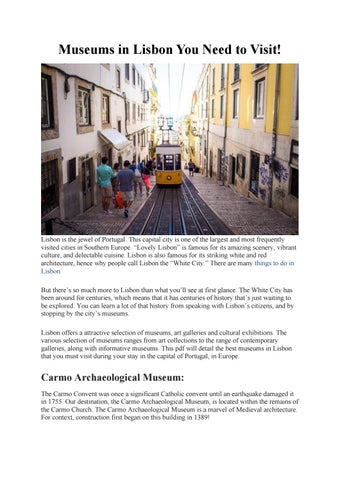
Lisbon is the jewel of Portugal. This capital city is one of the largest and most frequently visited cities in Southern Europe. “Lovely Lisbon” is famous for its amazing scenery, vibrant culture, and delectable cuisine. Lisbon is also famous for its striking white and red architecture, hence why people call Lisbon the “White City.” There are many things to do in Lisbon. But there’s so much more to Lisbon than what you’ll see at first glance. The White City has been around for centuries, which means that it has centuries of history that’s just waiting to be explored. You can learn a lot of that history from speaking with Lisbon’s citizens, and by stopping by the city’s museums. Lisbon offers a attractive selection of museums, art galleries and cultural exhibitions. The various selection of museums ranges from art collections to the range of contemporary galleries, along with informative museums. This pdf will detail the best museums in Lisbon that you must visit during your stay in the capital of Portugal, in Europe.
Carmo Archaeological Museum: The Carmo Convent was once a significant Catholic convent until an earthquake damaged it in 1755. Our destination, the Carmo Archaeological Museum, is located within the remains of the Carmo Church. The Carmo Archaeological Museum is a marvel of Medieval architecture. For context, construction first began on this building in 1389!
Very few modern touches have been added to the museum. The goal is to preserve this site’s authenticity by leaving it in its post-earthquake state. Seriously, visiting the Carmo Archaeological Museum is like using a time machine!
MUDE: The Carmo Archaeological Museum gives us a great look at the past. However, the Museum of Design and Fashion (or MUDE for short) grounds us back in the here and now. This venue is a hub for all things fashion and design, stretching back from the 19th century to modernday trends. They’ve got outfits and art pieces galore! There are also several spaces dedicated to famous Portuguese architects. One of the craziest things about MUDE is that this museum used to be a bank. At one point in time, Lisbon’s citizens felt the need to commemorate their city’s artists and designers. They repurposed the bank into one of the White City’s most culturally important spaces for the arts and design. MUDE is without a doubt one of the most cherished museums in Lisbon. It’s worth noting that MUDE goes by another name – Change. You might bump into quite a few folks who use that name over MUDE. One thing’s guaranteed though; you’ll be absolutely inspired by the time you’ve finished visiting this place.
National Costume Museum: A museum in Lisbon that few know and even less visit, a forgotten gem. The former AngejaPalmela Palace houses a collection of clothing and accessories that begins in the 18th century and ends today. The museography of the space is not very current, but the chronological organization allows us to understand the evolution of the ways of dressing in the last three centuries. To complement the works exhibited, texts are presented in each of the rooms that contextualize the national and international times.
National Tile Museum: Portugal is recognized for its characteristic tiles, and the visit to this museum leaves visitors delighted with the development of this art in ceramics. In addition to providing a greater understanding of the way tiles are made and the origins of drawings, the National Tile Museum also tells us the history of Portugal that intertwines the history of tiles, one of the most striking Portuguese artistic expressions.
Navy Museum: Integrated in one of the wings of the Jerónimos Monastery, it is also a museum that you must visit if you pass through Belém. It tells us about the Portuguese past that is linked to military naval activities but also relates to other aspects related to human activities at sea.
Museu do Fado: Anyone who’s remotely familiar with Lisbon’s museum scene probably expected to visit this venue at one point or another. Well, surprise! Museu do Fado is the very last stop of our museum hopping tour of Lisbon. How could it not be — the Museu do Fado is one of the most popular museums in the city. This place is dedicated to preserving and promoting Fado, a genre of music that’s integral to Portugal and Lisbon’s culture. If you’ve never heard Fado music before, you’ll be in for a treat. You see, the Museu do Fado isn’t just a museum – it’s also a live concert venue! Artists play at the museum all the time. Moreover, you can also sign up for Fado singing classes. Visual arts are also a core part of the Fado experience.
MAAT: Museum of Art, Architecture and Technology is the meaning for MAAT. The museum is in Lisbon and hosts the most diverse exhibitions of these themes, by contemporary artists, architects and thinkers. They are national and international exhibitions that bring contemporary issues and trends for discussion, divided into the four large rooms in the museum. For technology aficionados, this museum must appear in your itinerary.
Puppet Museum: In the historic district of Madragoa we find the Marionette Museum installed in the old Bernardas convent. This space is shared on the upper floors, as a housing area for about thirty families (the building was able to house 200 families of fishermen and varinas before the intervention of the City Council and installation of the museum).
The museum covers the history of puppetry in various parts of the world and in different categories, with special emphasis on Portuguese puppetry - from rural theater with more popular characteristics to urban theater with more didactic concerns.