30th March 2026
30th March 2026
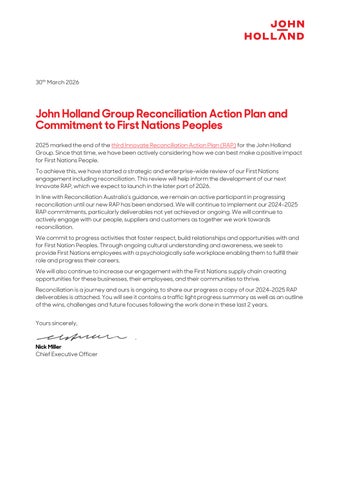
2025 marked the end of the third Innovate Reconciliation Action Plan (RAP) for the John Holland Group Since that time, we have been actively considering how we can best make a positive impact for First Nations People.
To achieve this, we have started a strategic and enterprise-wide review of our First Nations engagement including reconciliation. This review will help inform the development of our next Innovate RAP, which we expect to launch in the later part of 2026.
In line with Reconciliation Australia’s guidance, we remain an active participant in progressing reconciliation until our new RAP has been endorsed We will continue to implement our 2024 -2025 RAP commitments, particularly deliverables not yet achieved or ongoing We will continue to actively engage with our people, suppliers and customers as together we work towards reconciliation.
We commit to progress activities that foster respect, build relationships and opportunities with and for First Nation Peoples. Through ongoing cultural understanding and awareness, we seek to provide First Nations employees with a psychologically safe workplace enabling them to fulfill their role and progress their careers
We will also continue to increase our engagement with the First Nations supply chain creating opportunities for these businesses, their employees, and their communities to thrive
Reconciliation is a journey and ours is ongoing, to share our progress a copy of our 2024-2025 RAP deliverables is attached. You will see it contains a traffic light progress summary as well as an outline of the wins, challenges and future focuses following the work done in these last 2 years.
Yours sincerely,

Nick Miller Chief Executive Officer

In August 2025 our Reconciliation Advisory and Action Committee underwent a refresh to align with the organisational review which took place in 2025. We moved to establish two aligned groups, one incorporating leaders from across the business who are instrumental in embedding RAP actions and the other a group of people instrumental in the delivery of RAP Actions. Both groups have First Nations employees involved and listen to the perspectives raised in our First Nations Employee Yarning Circle.
Wins
‒ Ongoing partnerships with First Nations organisations such as Fitzroy Stars Football & Netball Club as well as relationships with Clontarf Foundation, NSW AECG, VAEAI, and Aurora Foundation.
‒ Creation of internal Supplier booklets for First Nations service providers shared and maintained to support increased participation in project opportunities.
‒ National Reconciliation Week events took place across the business, including our RAP launch in 2024 and an enterprise wide an online event with over 400+ participants. Project sites also ran their own events
‒ Reconciliation outcomes and stories have been shared internally and externally throughout. In September 2025 we launched a new way of sharing information to our people called Reconciliation Snapshot. 2 issues were released in 2025 and this will continue ongoing every quarter.
‒ The John Holland Yarning Circle commenced, and this is convened by First Nations employees for First Nations employees, it provides feedback into the RAAC on the employee experience and work underway regarding reconciliation.
‒ Our company Cultural Learning Plan was launched in early 2025, with ongoing communication and implementation. Whilst not time bound the plan is phased and aims to bring all employees on a journey of cultural capability.
‒ Cultural protocols (Acknowledgement of Country, Welcome to Country) have been embedded in events and resources, with dedicated guidance and examples provided to staff through our Cultural Protocol Document.
‒ Maps of First Nations Australia are now displayed at all state head offices, with supporting communications explaining their significance.
‒ All employees undertake a First Nations Awareness module during induction, this module has been refreshed and revised with a particular focus on what employees can do in there sphere of influence to reconciliation.
3. Employment and Supplier Diversity
‒ First Nations employment-At the end of 2025 2.3% of our employees identify: as First Nation, up from 1.9% at the end of 2023
‒ Graduate programme improvements through more equitable and inclusive practices has led to 4% of offers to First Nations Graduates for 2026 cohort (up from 0% in 2025).
‒ Over $75,000 across eight scholarships provided through five institutions.
‒ State-based supplier booklets and ongoing relationships with Supply Nation and other Indigenous Chambers of Commerce have supported supplier diversity.
‒ Across 2024 and 2025 John Holland procured $350 Million Dollars from First Nations Businesses
4. Governance and Reporting
‒ The Reconciliation Advisory and Action Committee (RAAC) maintained strong First Nations representation, adapting its structure post -reorganisation.
‒ The functional accountability of reconciliation remained, and appropriate resources identified to continue progressing this work post-restructure.
‒ Maintained our ongoing commitment to complete and submit the annual RAP Impact Surveys to Reconciliation Australia.
1. Engagement and Ownership
‒ Some actions, such as developing engagement guidelines for operational teams, were not completed due to ownership challenges. This deliverable will be a core focus into 2026.
‒ The dedicated cultural immersion experience for the Executive Leadership Team did not occur due to company restructure and leadership changes. Plans are underway for leaders to engage in cultural learning activities in 2026.
2. Strategy, Policy and Practice
‒ The First Nations recruitment, retention, and professional development strategy was not fully developed or implemented and will require renewed focus in 2026
‒ Engagement with First Nations staff on anti -discrimination policy effectiveness did occur but was limited, through the establishment of the Yarning Circle, we are in a better position to address this gap.
‒ We continue to promote to our people on being an upstander particularly relating to negative behaviours such as Sex Discrimination and Sexual Harassment, more can be done in 2026 around anti-racism education for leaders, and leveraging resources. We’ve included some practical tips in the updated resources that are available to staff.
3. Public Reporting
‒ Public reporting of RAP achievements, challenges, and learnings did not occur in 2024 or 2025. Whilst this progress report will be made public, there are opportunities to share more publicly the work, challenges and achievements done on a more regular basis.
1. Carrying Forward and Evolving Actions
‒ Actions not completed or requiring further development (e.g., engagement guidelines, recruitment and retention strategy, public reporting) are explicitly marked to be carried into the next RAP and continue to be progressed over 2026
‒ The Yarning Circle will continue to provide a forum for First Nations voices and inform future strategies and dates for future meetings have been set and enterprise-wide comms shared to engage as many First Nations employees as possible.
2. RAP Development and Governance
‒ We have started the process with Reconciliation Australia to begin developing our next RAP and taken the opportunity to engage a First Nations consultancy to review how we can accelerate First Nations Impact. The result of this review will provide recommendations and support us in creating a First Nations Strategy which will inform actions for our next RAP.
‒ Our new RAAC structure and Terms of Reference have been updated to reflect new business realities, this way of working will continue to prioritise First Nations representation and leadership within the group and listen deeply to the experiences of First Nations employees via the Yarning Circle.
3. Reporting and Accountability
‒ A consistent and single way of reporting impact will be expanded to cover all inclusion, diversity and reconciliation areas. The new impact tracker will be launched in 2026 and absorb the current internal reconciliation tracking system.
‒ Participation in the Reconciliation Australia Workplace RAP Barometer is under consideration for the next RAP cycle.
4. Cultural Learning and Community Engagement
‒ Continued implementation of the Cultural Learning Plan, with more opportunities for staff engagement and learning.
‒ Ongoing celebration and recognition of significant dates (NRW, NAIDOC, Indigenous Business Month) through enterprise-wide and local events.
Status as of December 2025
1.0
Develop, maintain and strengthen mutually beneficial relationships with First Nations stakeholders and organisations.
Green-Achieved
Yellow-Ongoing No change
2.0
Build relationships through celebrating National Reconciliation Week (NRW).
OrangeOngoing but pivot from original deliverable Red -not complete/achiev ed
1.1 Continue to work with local First Nations organisations, service providers and programs to strengthen partnerships, foster new opportunities to achieve mutual goals, and develop guiding principles for future engagement, including:
– Fitzroy Stars Football & Netball Club
– Clontarf Foundation
– NSW Aboriginal Education Consultative Group (NSW AECG)
– Victorian Aboriginal Education Association Inc (VAEAI)
– Aurora Foundation
1.2 Develop mutually beneficial enterprise relationships with First Nations organisations and service providers to increase First Nations talent pipeline.
1.3 Develop and implement engagement guidelines to support operational teams to engage more effectively with First Nations stakeholders and organisations and incorporate site-specific content in inductions across projects.
1.4 Maintain a register of First Nations service providers, and community organisations to promote and increase participation in project opportunities for First Nations Peoples.
2.1 Continue to organise at least one Australia-wide NRW event each year.
2.2 Circulate and promote Reconciliation Australia’s NRW resources and reconciliation materials to staff.
2.3 Ensure RAP working group members participate in an external NRW event.
2.4 Encourage and support staff and senior leaders to participate in at least one external event to recognise and celebrate NRW, by promoting events by location.
2.5 Register all our NRW events on Reconciliation Australia’s NRW website.
3.0
Promote reconciliation through our sphere of influence.
3.1 Initiate CEO-led communications launching our new RAP with all employees, setting out our vision for reconciliation in alignment with the John Holland Inclusion Strategic Plan.
3.2 Share our commitment to reconciliation publicly with the launch of our new RAP across our external channels.
3.3 Share and celebrate RAP outcomes with our employees across internal channels and provide education where needed.
3.4 Share and celebrate RAP outcomes with our stakeholders (clients, supply chain etc.) across external channels and provide education as needed.
3.5 Review website collateral to ensure the communication of our commitment to reconciliation is maximised.
3.6 Refresh RAP messaging for tenders sharing our RAP journey and demonstrating our commitment to reconciliation with our clients.
3.7 Collaborate with RAP organisations and other likeminded organisations to develop innovative approaches to advance reconciliation, including participation in RAP forums with construction industry peers.
4.0
Promote positive race relations through antidiscrimination strategies.
4.1 Engage with First Nations staff and/or First Nations advisers to consult on the effectiveness of our HR policies, standards, procedures relating to antidiscrimination.
4.2 Review and revise our HR policies, standards and procedures as needed to ensure anti-discrimination provisions respond to current and future needs and staff feedback and communicate changes.
4.3 Provide education for our senior leaders and managers on the effects of racism, leveraging offerings through our diversity partners (e.g., Diversity Council Australia).
4.4 Promote avenues for culturally safe support for First Nations employees, including John Holland Employee Assistance Program (EAP), National Advisory Service Employee Relations (NASER) and People team representatives, to address incidences of discrimination as needed.
5.0
Increase understanding, value and recognition of First Nations cultures, histories, knowledge and rights through cultural learning.
5.1 Conduct a review of cultural learning needs and existing resources within our organisation.
5.2 Consult local Traditional Owners and/or First Nations advisors to inform the development of our cultural learning plan.
5.3 Develop, implement, and communicate a Cultural Learning Plan for the business in alignment with the John Holland Inclusion Strategic Plan.
5.4 Provide an opportunity for the Executive Leadership Team to participate in a cultural immersion experience each year.
5.5 Provide opportunities for RAP working group members, People managers and other key roles to participate in cultural learning as identified in the John Holland Cultural Learning Plan (see 5.3).
5.6 Display a map of First Nations Australia at all state head offices.
6.0
Demonstrate respect to First Nations Peoples by observing cultural protocols.
7.0
Build respect for First Nations cultures and histories by acknowledging NAIDOC Week and other days of significance.
6.1 Increase staff’s understanding of the purpose and significance behind cultural protocols, including Acknowledgment of Country and Welcome to Country protocols.
6.2 Develop, communicate and implement a cultural protocol document, including but not limited to protocols for Welcome to Country and Acknowledgment of Country.
6.3 Invite local Traditional Owners or Custodians to provide a Welcome to Country or other appropriate cultural protocol at significant milestones such as breaking ground, completion of projects etc.
6.4 Senior Leaders to provide an Acknowledgment of Country at the commencement of important meetings.
7.1 RAP working group to participate in an external NAIDOC Week event.
7.2 Review People policies and procedures to remove barriers to employees participating in NAIDOC Week activities.
7.3 Promote and encourage participation in NAIDOC Week events to all staff.
7.4 Acknowledge and communicate days of significance relevant to First Nations culture and history, as identified in the John Holland Cultural Learning Plan (see 5.3)
8.0
Improve employment outcomes by increasing recruitment, retention, and professional development of First Nations Peoples.
8.1 Build understanding of current First Nations staffing to inform future employment and professional development opportunities.
8.2 Engage with First Nations staff and/or advisers to inform the development of our recruitment, retention and professional development strategy.
8.3 Review HR and recruitment procedures and policies to ensure there are no barriers to First Nations participation in our workplace.
8.4 Develop and implement a First Nations recruitment, retention and professional development strategy in alignment with John Holland Inclusion Strategic Plan.
8.5 Align enterprise targets for employment of First Nations Peoples with the John Holland Inclusion Strategic Plan.
8.6 Advertise job vacancies to effectively reach First Nations stakeholders.
9.0
Develop pathways for First Nations students to pursue a career in the construction industry.
10.
Increase First Nations supplier diversity to support improved economic and social outcomes.
9.1 Increase representation of First Nations candidates in cadetship and graduate intakes.
9.2 Identify and activate opportunities to engage schools, universities and other agencies who provide support to First Nations students to prepare for careers in construction (e.g., through provision of scholarships etc.).
10.1 Develop and implement a Supplier Diversity strategy including consideration of an enterprise target for procurement with First Nations businesses.
10.2 Maintain and optimise memberships and relationships with First Nations commercial organisations, including Supply Nation, Kinaway and other Indigenous Chambers of Commerce as required.
10.3 Develop and communicate regional lists of verified suppliers for procurement of good and services from First Nations businesses to staff and embed into project launch procedures and practice.
10.4 Review and improve procurement practices to remove barriers to First Nations business participation in our supply chain (e.g., supply panels).
10.5 Secure at least one new preferred supplier partnership with a First Nations business per year.
10.6 Deliver an annual education campaign promoting First Nations business procurement with our commercial, procurement and project teams.
10.7 Hold supplier forums to give First Nations businesses opportunities to meet procurement decision makers to discuss current and upcoming pipelines of work.
10.8 Partner with industry and/or government to support capability development of First Nations businesses to participate and compete in the Tier One supply chain.
11.
Establish and maintain an effective RAP working group (RWG) to drive governance of the RAP.
11.1 Maintain Aboriginal and Torres Strait Islander representation on the RWG at 30 per cent or more.
11.2 Maintain and apply a Terms of Reference for the RWG.
11.3 Meet bi-monthly to drive and monitor RAP implementation.
12.
Provide appropriate support for effective implementation of RAP commitments.
13.
Build accountability and transparency through reporting RAP achievements,
12.1 Embed resource needs for RAP implementation.
12.2 Engage our senior leaders and other staff in the delivery of RAP commitments.
12.3 Maintain RAP Tracker to monitor, measure and report on RAP commitments.
13.1 Ensure contact details with Reconciliation Australia are up to date.
13.2 Complete and submit the RAP Impact Survey to Reconciliation Australia.
challenges and learnings both internally and externally.
14. Continue our reconciliation journey by developing our next RAP.
13.3 Report RAP progress to all staff and senior leaders bi-annually
13.4 Publicly report our RAP achievements, challenges and learnings, annually.
13.5 Investigate participating in Reconciliation Australia’s biennial Workplace RAP Barometer.
13.6 Submit a traffic light report to Reconciliation Australia at the conclusion of this RAP, to help inform the development of our next RAP.
14.1 Register via Reconciliation Australia’s website to begin developing our next RAP.
Contact Ben Crough Inclusion, Diversity and Equity Manager inclusion@jhg.com.au