UP FOR THE CHALLENGE
THE JOHN HOLLAND S T O R Y
Foreword | 7
Introduction | 11
Part One: THE 1980s | 15
The Changing of the Guard | 17 Projects | 27
Part Two: THE 1990s | 63 A new way of doing business – the Janet era | 65 Projects | 83
Part Three: 2000s | 131 The Leighton Era | 133 Projects | 155
Part Four: 2010–2016 | 227 A Time Of Rapid Change | 229 Projects | 243
Part Five: THE FUTURE | 301
New Ownership brings unlimited potential | 303 Key Industry Awards | 309 John Holland Leaders | 313 Acknowledgments | 315 Book epilogue | 317
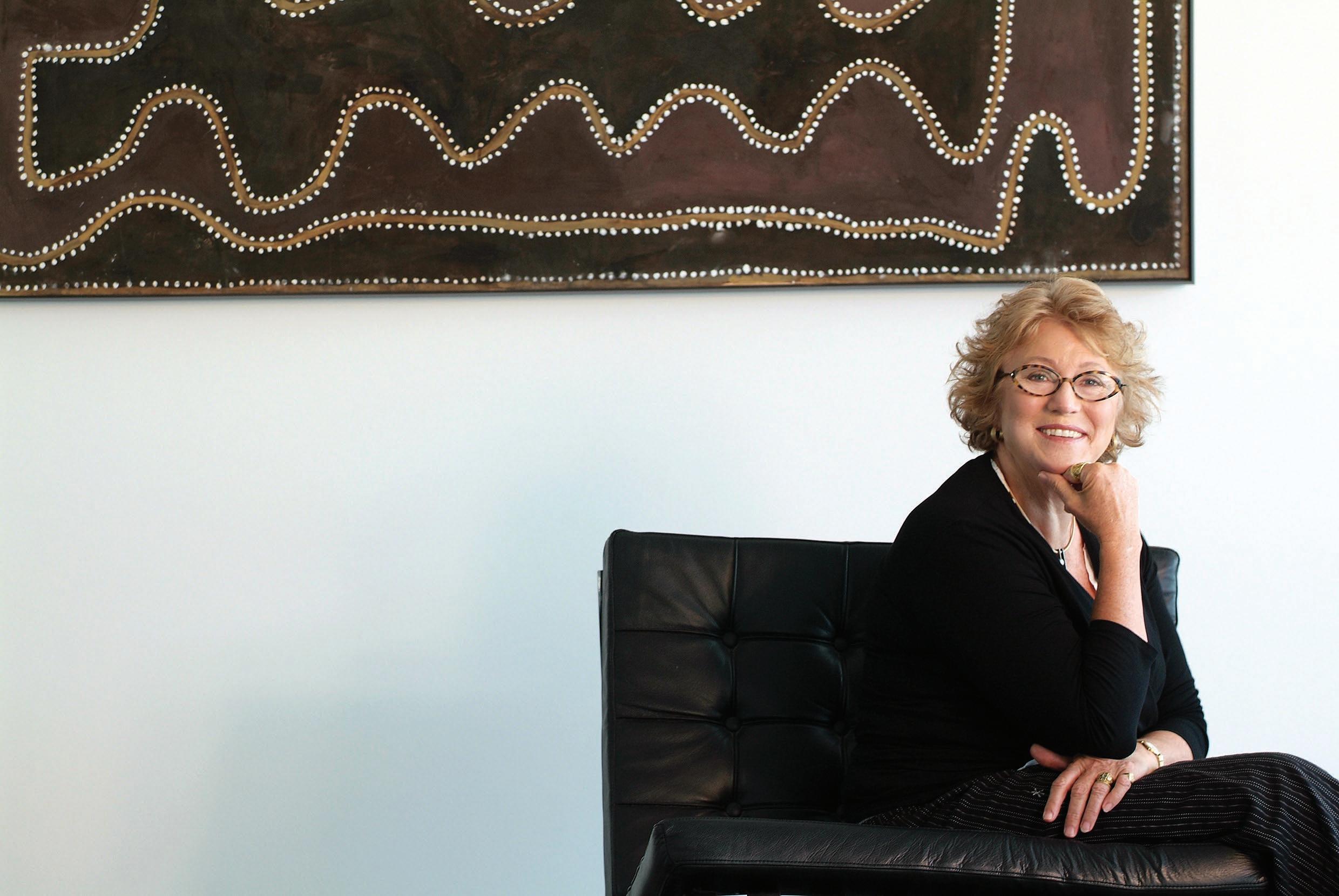
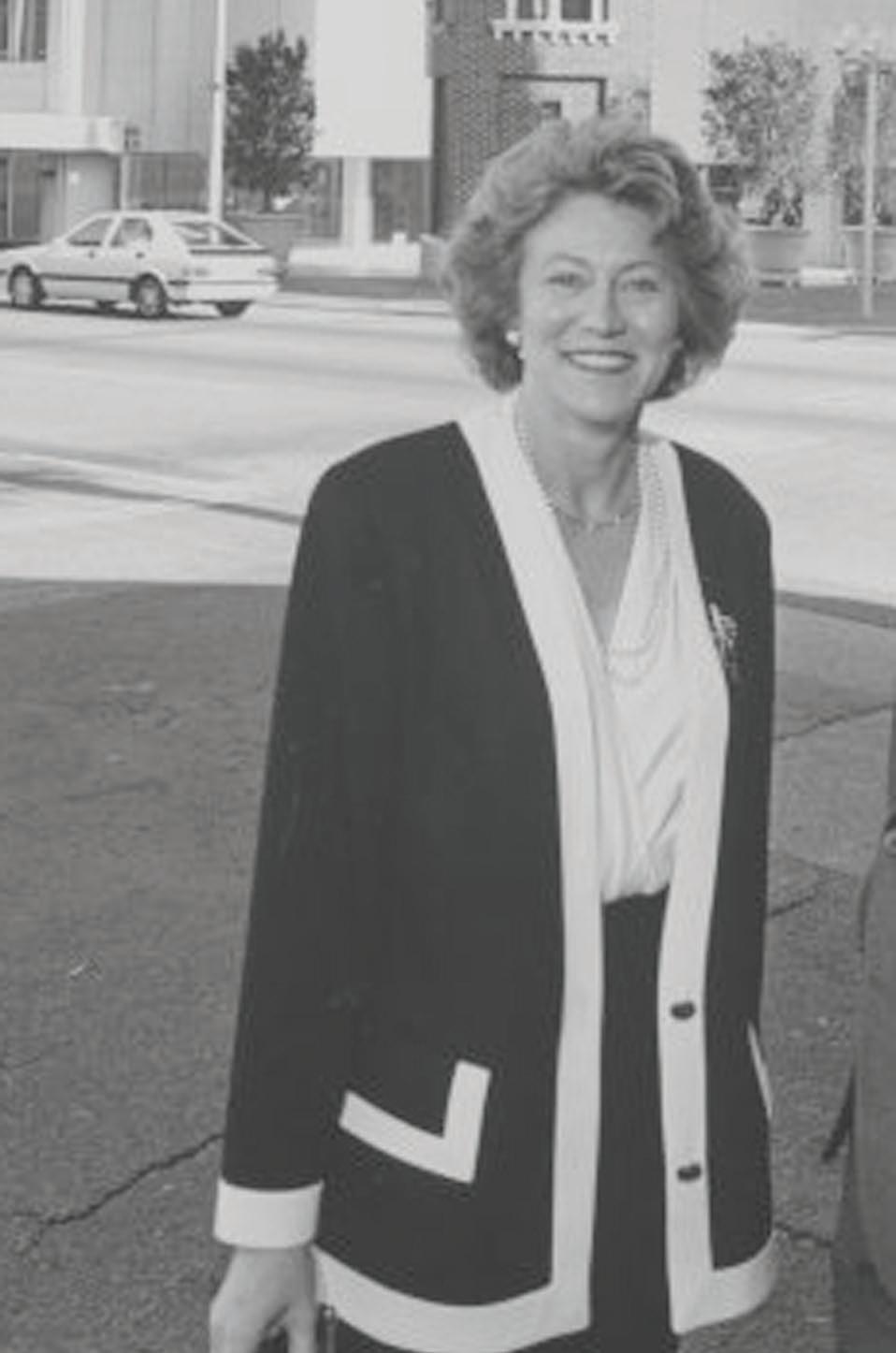
Janet Holmes à Court, former Chairman of John Holland
Foreword
by Mrs Janet Holmes à Court AC
Like many entrepreneurial businesses in the late-1980s, our Heytesbury group was asset-rich but cash poor. I had had no previous experience of the construction industry when, in 1990, advisors suggested that John Holland was at that time an affordable entry to a good cash-generating industry.
It didn’t fully prove to be the case for Heytesbury. However, it would be the beginning of an extraordinary personal and professional adventure –or more accurately, countless adventures within an adventure.
I would not have foreseen helicoptering onto the deck of a Bass Strait oil platform, driving a train on a (closed) stretch of outback rail, or climbing over the side of the
Westgate Bridge, 58 metres above the Yarra River.
I was compelled to visit these and so many other sites, through an evergrowing admiration for the talents and dedication of John Holland employees. It is also true that, having a scientific background, my way of life has always been to drive people mad asking questions.
For me, it was just absolutely fascinating to be in this business. I felt all through my time there that every day we did something that improved people’s lives or the infrastructure of a city; for example, building hospitals, sewerage treatment plants, desalination plants, railways, better roads, and so on. Everything we do in this industry is making life better for someone.
I was just about 24 years old when I married Robert. We were married for 24 years. And then I had around 24 years with John Holland … Each of those 24-year stages was incredibly exciting, and with John Holland, it was really a marvellous time of my life. I suppose it was almost like a marriage.
It’s a testament to this company that people remain so loyal. I make special mention of Glenn Palin, with whom I have had the pleasure of working and knowing personally since he joined John Holland in 1993. I commend Glenn on his incalculable
contribution to John Holland and wish him every happiness in retirement, from the end of 2016.
When we bought John Holland, I said in a talk that I gave, we hadn’t actually bought any “stuff”. We bought people, extraordinary people and their ideas, their skills and their ability to innovate; we didn’t actually buy something with tyres that you could go and kick. John Holland then was a non-capital intensive business. It was about people. Long may it be so.
Janet Holmes à Court
we bought people, extraordinary people and their ideas, their skills and their ability to innovate …
Glenn Palin, Former CEO of John Holland
Introduction
by Glenn Palin
In the nineties, our founder,
Sir John Holland, released a comprehensive history of the business that continues to bear his name. He spoke of his own journey and involvement in ground-breaking projects as the company grew and diversified. Many would no longer recall the details and behindthe-scenes stories of the iconic projects that he described, if not for that book – titled ‘A Constant Challenge’.
Sir John examined the events that unfolded during his time as Chairman between 1949 and 1986. During my own time at the helm of John Holland, it occurred to me that many years had passed since then, and our recent story was left untold. It
was time to update the book. Over the years, I have enjoyed an amazing journey with John Holland, been associated with many outstanding projects and worked with truly exceptional people. People have always been at the heart of our business, working together to overcome challenges, doing things in new and innovative ways and ensuring that we look after each other along the way. It has been a privilege to work alongside the people of John Holland. Since our first book was published, we’ve completed many more projects that have transformed lives. These have included the MCG Southern Stand, the Alice Springs to Darwin rail link, Eastlink in Melbourne, the National Portrait
This book is dedicated to the people of John Holland – their loyalty, hard work, passion and stories.
Gallery and the Sydney Desalination Plant. We’ve also expanded overseas into New Zealand and South-East Asia.
Overcoming challenges has been part of our story from the very beginning, and this latest chapter (1986 – 2016) was no different. Like everyone in our industry, we faced challenges on our projects, and we also had to manage environmental issues, political changes, new ownership and two global financial crises’. But as the challenges rolled in, so too did the dedication, resolve and resilience of our people to step up and meet them head on.
This book is dedicated to the people of John Holland – their loyalty, hard work, passion and stories. This includes the leaders of John Holland who came before me, many of whom mentored me and remain friends to this day. It has not
been possible to mention every John Holland person and project in this book, but I want to acknowledge they were no less important or instrumental.
With our new owners, China Communications Construction Company (CCCC), and new CEO Joe Barr in the chair, we’ve entered a new era in John Holland’s history. CCCC have empowered us to look to new markets, and pursue our own developments, so we can be a truly sustainable business. John Holland has an exciting future ahead.
I trust you will enjoy reading the next instalment of the John Holland story. The most exciting thing for me as I turn the pages is the knowledge that the story continues. Who knows that the next edition might hold?
Glenn Palin Former CEO John Holland
Part One THE 1980s
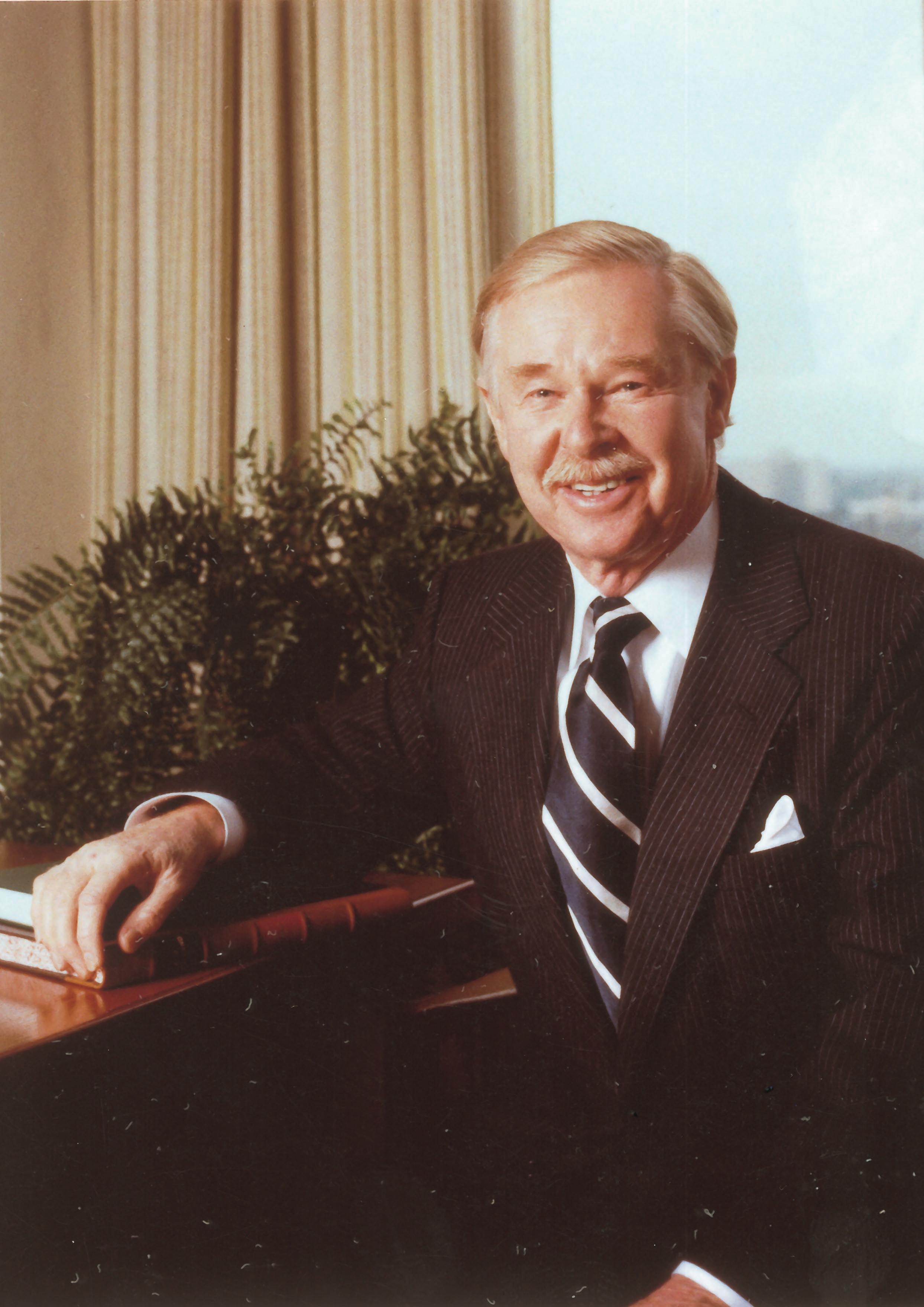
Sir John Holland, founder of John Holland
The Changing of the Guard
Clifton Vaughan “John” Holland
AC was an extraordinary Australian, an individual of vision, ambition and dedication. From his distinguished service in World War 2, to the amenity brought to countless communities through decades of his company’s projects, to the selfless charity work that continued into his nineties, Sir John Holland truly helped to change the shape and culture of this nation.
Born in 1914 as the eighth of 10 children, “John” – the nickname stuck from childhood – was raised on a farm on Victoria’s Mornington Peninsula. From the age of 12, he developed an ambition to study engineering. Despite the hardship of the Depression, in 1933 Holland was
sent to the University of Melbourne’s School of Engineering, Australia’s oldest engineering institution, established in 1861.
In his memoir A Constant Challenge (published 1994, covering the period from 1949 to 1986), to which this book is a companion volume, Holland attributed the fascination equally to a civil-engineer colleague of his shire-councillor father, and to newspaper reporting on the construction progress of the Sydney Harbour Bridge, commenced in 1923 and completed in 1932.
In 1937, Holland secured employment at Commonwealth Oil Refineries (later BP Australia) as a junior engineer. The steadily growing popularity of the motor car,
particularly in the wake of General Motors’ 1931 purchase of Holden Motor Body Builders, was a great catalyst for the expansion of COR’s facilities around the nation.
Holland rose sufficiently in competence and confidence to be assigned, at age 24, as Project Manager on a new oil terminal at Macquarie Point, Hobart in 1938.
There was soon a greater calling, to which Holland and 990,000 other Australians would respond. In 1939, Holland was dispatched to the Middle East with the Royal Australian Engineers – where, he later joked, “I was responsible for blowing up more bridges than I ever built.”
Lieutenant Holland spent the latter half of his six years’ service in Darwin with the innocuous-sounding Lugger Maintenance Section, headquartered at East Arm. In fact, Holland was serving with – and later commanded – the Z Special Unit, an elite commando squad.
From East Arm and smaller bases in Borneo and Indonesia, Z Special Unit operatives gathered intelligence and mounted covert missions in enemy-held waters to Australia’s north. They were trained in the use of plastic explosives, poisons and sabotage. The 1943 mission of the MV Krait, a converted Japanese fishing vessel that destroyed seven
Japanese ships in Singapore Harbour, was a Z Special Unit operation.
At the war’s conclusion in 1945, Lieutenant-Colonel Holland was demobbed and returned to work at COR as Construction Engineer for Australia. Within little more than three years, however, Holland’s long-nursed ambition to establish an independent engineering construction company had ripened.
On 12 April 1949, the company name John Holland & Co was registered, with field operations commencing a month later.
Despite the post-war scarcity of raw materials and personnel, Holland’s experience and contacts in the oil industry helped to win an immediate stream of work. Famously, among the very first projects was the construction of a woolshed on a property in Nareen, in Victoria’s Western District. The farm belonged to John Neville Fraser, whose 19-year-old son Malcolm, later to inherit the property, would become Australia’s 22nd Prime Minister.
With the support and direction of such business luminaries as James Stafford Fox (later managing director of BP Australia), John Holland & Co quickly built an admirable reputation for its solid engineering and almost military dedication and discipline. The company’s founder perfectly illustrated the conservatism
of the time when he mischievously acknowledged the aphorism that “If you didn’t serve in the war, go to university and don’t play cricket, you won’t go very far at John Holland.”
Quite aside from its projects in industries such as resources, power generation and water treatment, John Holland & Co was very soon engaged in major civil engineering projects around the nation. The Sorell Causeway in Tasmania, the Sydney Myer Music Bowl in Melbourne, the Silverwater and Captain Cook Bridges in Sydney, the Forster-Tuncurry Bridge in NSW and elements of the giant Snowy Mountains Scheme, all showed the company’s capacity to deliver enduring, nation-building projects.
Operating at the forefront of engineering innovation, often in challenging environments, is an inherently dangerous business. In 1968, John Holland – by then, probably Australia’s pre-eminent bridge builder – was awarded two of the three contracts that would deliver the Westgate Bridge, spanning the Yarra River on the western side of Melbourne’s CBD.
Holland’s had won contracts C and F – respectively, for the concrete approach spans for the 52m-tall bridge, and the foundations, comprising concrete piles to an average depth of 50 metres.
The third contract, S, for the construction and erection of the steel bridge span itself, was awarded to a Dutch group, World Services and Construction.
The considerable challenges of John Holland’s two contracts were admirably met: indeed, contract C would later win the Construction Achievement Award. However, the Dutch contractor, beset with labour problems, had fallen well behind and in 1970, John Holland inherited the erection of the WSC-constructed bridge sections.
This was not without trepidation: John Holland’s experience lay in concrete, not steel bridges. The company sought and was given reassurances by the designers of the steelwork, Freeman Fox & Partners of London, about the integrity of the box-girder design.
Tragically, on the morning of 15 October 1970, span 10-11 on the western approach of the Westgate Bridge collapsed. Thirty-five men lost their lives. Through the subsequent hardships of mourning colleagues, supporting families, stabilising the remaining structure and a Royal Commission into the tragedy, John Holland & Co rose to each task with dignity and diligence.
The same character would be very much in evidence when, on Christmas Eve 1974, Darwin was
devastated by Cyclone Tracy. As the largest engineering and construction group in the Northern Territory, John Holland mobilised a workforce of 250 people for the clean-up and restoration of services to the town.
Similarly, when in 1975 a ship collided with Hobart’s Tasman Bridge, it was fortunate that what was by now the John Holland Group was engaged in a major marine project in Western Port, Victoria. John Holland was personally approached for his company’s assistance in what turned out to be a very complex restoration of the bridge.
Entering the 1980s, the expertise of the Group knew few bounds, either technically or geographically. Its award-winning construction of the $61m Hay Point coal terminal in Queensland – working up to four kilometres offshore, in a cyclone zone with 6.7m tides – was as remarkable as rail projects in the Pilbara, bridgebuilding in the Simpson Desert and navigation towers on the outer Great Barrier Reef.
In 1980, however, the Group was awarded one of its proudest projects to date, in the construction management of Australia’s new Parliament House in Canberra. Coincidentally, the ceremonial turning of the first sod in September of that year was done by the Prime Minister, Malcolm Fraser –one of John Holland’s first customers.
Sir John Holland (who had been knighted in 1973) could not conceal his pride, in writing of Parliament House in A Constant Challenge. “We all knew in our innermost selves that we had accepted a tremendous responsibility – responsibility to the people of Australia, to the Commonwealth government …
“We didn’t fail and we didn’t falter. Indeed, the splendid building on Capital Hill is evidence as to how well the trust in us was honoured. Without doubt, it is one of the great buildings of our time. It will last for centuries.”
By the time his masterpiece was opened on May 9, 1988, Sir John Holland was enjoying his retirement from the role as Chairman, which had taken effect from the end of the 1986 financial year. He had accepted the honorary role of President, and continued to take an active interest in the business – along with his many charity and community activities –almost until his death, in 2009, at age 94.
Sir John had been succeeded as Chairman by Denis Cordner, a man no less extraordinary in having been a first-class footballer, cricketer, business and community leader and Consul-General in New York. Reporting to Cordner were joint Managing Directors Geoff Cook and Brian Johnson.
“ we didn’t fail and we didn’t falter. indeed, the splendid building on Capital Hill is evidence as to how well the trust in us was honoured. without doubt, it is one of the great buildings of our time.
There were a number of men who steered John Holland since 1986. But it’s worth dwelling here on this unusual, uneasy and thankfully shortlived situation of joint managing directors, and the cultural shift that had occurred with the arrival of Brian Johnson.
Pennant Holdings, of which Johnson was Chairman, had taken a significant shareholding in John Holland in 1985. Johnson, himself an engineering graduate, had engaged John Holland in the construction of two central Perth developments: the $21.8m Durack Centre (which would serve as John Holland’s Western Australia headquarters for more than 20 years) and the $10.7m Riverton Forum shopping centre.
The deregulation of Australia’s banking system during 1983-’85 had changed the landscape of financing. Corporate raids became a common and costly threat to businesses. John Holland Group, while still under the chairmanship of its founder, also recognised that the greatest emerging opportunities for growth lay in the construction of high-rise commercial buildings and holiday resorts.
This fact was best illustrated at that time by the likes of Christopher Skase and his Qintex Group, developer of the opulent Mirage Resorts.
In this dazzling 1980s environment, the successful and
aggressive Pennant Holdings was blessed with solid financial relationships and an abundance of development-led construction work. Its offer to purchase a significant tranche of John Holland Group shares seemed to pave the way to a secure future.
As Sir John later wrote: “What at first appeared to be a brilliant board decision turned out a few years later to be an unmitigated disaster.”
In 1986, John Holland group had operations in Australia, Asia, the Pacific, the Middle East and also in the USA. The latter had come through the acquisition of Moseman Construction in 1984, as part of a push by several Australian construction giants into the US market. In 1987, the US presence expanded with the US$6m acquisition of Stolte Corporation.
A major source of financial stability throughout was the construction, in several packages, of the twin Loy Yang power stations in Victoria’s Latrobe Valley. The project had been ongoing since 1981, and John Holland was sufficiently enmeshed in the power station and open-cut mining operations that it established a full-time workshop.
For all the new, entrepreneurial flash of the era, the workplace ethic at Loy Yang could be a quaint reminder of a much earlier time.
In one instance the enormous site, employing thousands of workers, was shut down by the unions because the canteen ran out of hot chips (not the sole item on the menu).
The power station itself was equivalent to an 18-storey building and the requirement to come down to the ground-level sheds for cigarette breaks and lunch led to lines of workers simply standing around for much of the day, waiting for the lift. One manager estimated that the company was getting two hours’ productive work per day from these workers.
Pennant’s entrepreneurship was increasingly apparent in a number of commercial and office developments in Perth. In short order, the company was knocking up CBD landmarks like the Capital Centre, No.8 St George’s Terrace and the Australian Taxation Office in Northbridge – the latter, on behalf of Mrs Janet Holmes à Court.
While the property projects of Brian Johnson escalated, the breadth of John Holland’s engineering and construction skills continued to be proved in projects as diverse as a world-class hospital on Queensland’s Gold Coast, a new airport for Darwin, an innovative rail bridge in northern Queensland and an RAAF base in the Northern Territory.
However, the scale of the projects being won by the company seemed to be diminishing.
Glenn Palin joined John Holland in 1993 (and would be named Managing Director in 2009). He remembered the previous decade as an aggressive entrepreneurial period in the industry – what some termed whiteshoe – built around false valuations. That mentality had pervaded the market and reached its climax in the 1987 stock market crash.
From Palin’s outside view, John Holland was a company that could participate in a number of markets as a builder and engineer, and was always a fierce competitor. But during the decade of the 1980s, the John Holland brand had lost some of the sainted status it had held for an earlier generation of engineers.
In part, that may have been due to its being spread thinly in new directions under Pennant. In the hands of a truly high-flying entrepreneur, the conservative organisation had been suddenly thrust into all sorts of unexpected ventures –not always successfully.
An attempt to develop the business through south-east Asia yielded some infrastructure projects in Indonesia and Malaysia. However, it would not be until the following decade that the company’s Asian presence would truly blossom.
In the meantime, as the dying years of the 1980s lost their lustre, all was not well. Pennant Holdings, the major shareholder in John Holland Holdings, was facing collapse. In 1989, having done several notable property developments under the Holland Stolte brand, John Holland sold Stolte at a loss of US$5.8m.
A few months later, a controlling interest in Moseman was also sold, incurring a capital loss of about US$4m.
Like most of its rivals, Holland had made a point of owning much of its own equipment. But now cash was needed and credit became tight. The sell-off of these assets, accumulated over the years under Sir John, would permanently change the shape of the John Holland business.
In effect, since that time publiclylisted construction companies have met these needs by hiring from outside, thereby avoiding depreciation and maintenance. The business became very capital-light and has remained so ever since.
Since the stockmarket crash of 1987, corporate Australia had been limping towards upheaval. In 1989, the high-flying Bond Corporation announced a loss of $980m – at that time, the largest in the nation’s history. Bond Corporation’s share values collapsed, leading to the bankrupting a few years later of its
leader Alan Bond, with personal debts of $1.8bn.
International banks withdrew from Australia and local banks shied from offering credit. Interest rates in January 1990 were at 17.5 per cent –to this day, a record high.
Close to the centre of the turmoil was the Bell Group of companies, taken over by Bond in 1988. In 1990, Bell was unable to make interest payments to bond holders, marking the beginning of a rapid end for the complex Bell Group entity that had been conjured into a $2bn empire –prior to its battering in the 1987 stockmarket crash – by Bond’s fellow WA-based corporate raider, Robert Holmes à Court.
Smaller players were certainly no less immune, as was keenly felt within John Holland – still soldiering on under the stewardship of its increasingly wobbly Pennant parent. One manager recalled returning from an overseas trip and having one of the senior accounts staff quietly suggest that he not delay in lodging his expenses claim. The feeling was that the company was often straying perilously close to the line.
For Robert Holmes à Court, whom the mid-1980s had made into Australia’s first billionaire, the cost would be the very highest. After his $340m sale of Bell to Alan Bond, Holmes à Court had focused on the
building of his Heytesbury empire of pastoral, wine and entertainment interests. However, in September 1990, he died, aged just 53.
The Heytesbury business was inherited by his widow, former schoolteacher Janet Holmes à Court, and their children. The only connection at this point with John Holland was that within Heytesbury
was a small construction company called Drayton, at that time head contractor on the Australian Taxation Office building in Perth. John Holland was the subcontractor actually building the project.
The connection would soon be much closer – and happily, would colour the culture of John Holland to this day.
Projects
Challenges and Adaptability | 29
Hospitals | 32
Defence – RAAF Tindal, NT | 35
Resources: “No job too small” | 37
Correctional Facilities | 40
Shopping Centres | 42
Centennial Plaza | 44
Haughton Pump Station, Townsville Qld | 46
Logan Motorway | 48
530 Collins St, Melbourne | 51
Darwin Airport | 53
Pioneer River Rail Bridge, Mackay Qld | 56
Sydney Central | 58
Friendship Bridge, Mekong River, Thailand-Laos | 59
Challenges and Adaptability
The 1980s were about boldness and brass, but for John Holland, being lean and lithe often paid dividends. The group had easily enough confidence in its engineering skills to take on just about any challenge.
Many Australians know the NSW north-coast town of Coffs Harbour for one reason: the Big Banana. Inspired by the Big Pineapple in Hawaii, the tourist attraction was built in 1964 to draw attention to a banana plantation’s roadside stall.
One of the earliest “big” things in Australia – easily pre-dating Adaminaby’s Big trout (1973), Woombye’s Big Pineapple (1971), Goulburn’s Big Merino (1985) and Ballina’s Big Prawn (1989) – the
concrete, walk-through banana gradually sprouted a café, gift shop, education centre and car park.
In 1989, the Big Banana venue underwent a $30m redevelopment as a family fun park and Horticultural World attraction. John Holland was there, winning the $8m contract to manage construction of four new buildings, two terraced car parks, refurbishing of existing buildings and the construction of a peoplemover ride to carry visitors on an educational journey through the plantation.
An 11-metre banana was no challenge for an engineering firm that had, two years previously, won the $13.5m design and construct contract for a 110-room, two-storey hotel
in the shape of a crocodile, located in one of the most remote parts of Australia.
In the wake of Paul Hogan’s 1986 international hit film Crocodile Dundee, the Four Seasons Hotel (since renamed) brought four-star accommodation, complete with imposing marble lobby and courtyard swimming pool, to the mining town of Jabiru in the Kakadu National Park. Fittingly, the “crocodile hotel” attracted worldwide publicity on its opening in 1988.
In recent years, the hotel has contributed to vital employment training in the hospitality industry for local indigenous people.
Elsewhere in Kakadu in 1988, John Holland constructed an elevated monsoon walkway on the East Alligator River.
It was a change of pace from treading the boards at Melbourne’s historic Princess Theatre in Spring Street. Originally built in 1886 in the elaborate Second Empire style, and thoroughly refurbished in 1922, the Princess was one of the city’s grandest theatres and a premier venue for drama, opera and ballet.
Despite being listed by the National Trust in 1973, the theatre fell behind more modern facilities and lapsed into disrepair until it came under new ownership in 1986. A complete refurbishment
was ordered, to be modelled on the 1922 iteration – right down to the matching of original light fittings and nearly 2000 collected paint samples.
With no small enthusiasm, John Holland won the $10m contract to design and construct the restoration and modernisation of the theatre, including the introduction of air conditioning and modern electrical and mechanical equipment for the staging of theatrical productions.
A new, five-level wing was constructed to house dressing rooms, wardrobe and a green room. New refreshment bars, ticketing and administration facilities also dragged the Princess Theatre into the 20th century. John Holland Interiors, a division that enjoyed great success during this period, oversaw the historically sympathetic fit-out.
In truth, the eight-month Princess Theatre project was (appropriately) full of drama. Former Executive General Manager, Operational Risk, Greg Cain, at the time an estimator at John Holland, remembered it only too well.
“It was basically a dilapidated old theatre in Melbourne and the developer took it on. We tendered to do the refurb. And most people who’ve done refurb projects would think twice about doing another one …
“We found an enormous number of problems with that theatre when we got into it – and unfortunately, that was all at our risk. It was all hands to the pump. We were pulling people out of head office and putting them on site just to help manage the project.
“We pulled out an old wall and behind it were these mosaics and friezes. The contract stated that if we found anything like that, we had to
restore it to its original condition. We were spending enormous amounts of money, employing artists to retouch these things. We were contractually obliged to deal with it.
“As well as the cost of that, the time was our risk as well. We had people working around the clock, seven days a week, to finish that project. It was just a financial disaster. It’s a beautiful theatre. But it was not a pleasant experience at all.”
Hospitals
JohnHolland’s size and expertise in building put the group at the forefront in the late-1980s for a number of large-scale projects. Chief among them were residential buildings, hospitals and prisons.
Symbolic of the 1980s was the Moran Clinic “Hospital of Excellence” on Queensland’s Gold Coast. John Holland was awarded the design and construct contract worth approximately $100m and commenced work in November 1987.
The 300-bed project was driven by medical entrepreneur Doug Moran, who saw an opportunity in the mid1980s to develop private health care facilities, catering particularly to under-served patients in NSW.
Moran settled on Tugun, virtually adjacent to Coolangatta Airport and the NSW border. The Queensland government welcomed his project for a resort-style hospital with an adjoining 110-suite five-star hotel and shopping complex, aimed at attracting “medical tourism” from NSW and internationally. Moran had secured part financial backing from a Japanese developer.
An even more lavish spa resort was planned for Murwillumbah (NSW), where patients from Tugun could enjoy a post-operative holiday. Moran had plans for a national chain of “medical Taj Mahals.”
The 26-month construction by John Holland produced a handsome and very modern-looking campus.
The X-shaped main building hub, with jutting balconies and up to 10 storeys in height, and angular outlying buildings enjoyed expansive views to the ocean and across the district.
Moran’s grand plans took a turn for the worse when, in 1990, the recession hit and the Japanese developer reneged. The banks took ownership and by 1994 had leased the entire complex to another health care operator.
However, the rightness of the building’s design and the quality of its construction would be underlined by the fact that, as of 2016, the John Flynn Private Hospital based there is acclaimed for its excellence, and attracts a steady stream of patients from Asia and the Middle East.
Several smaller-scale hospitals were also undertaken by John Holland: from the $15m design and construct contract for the 108-bed Noarlunga
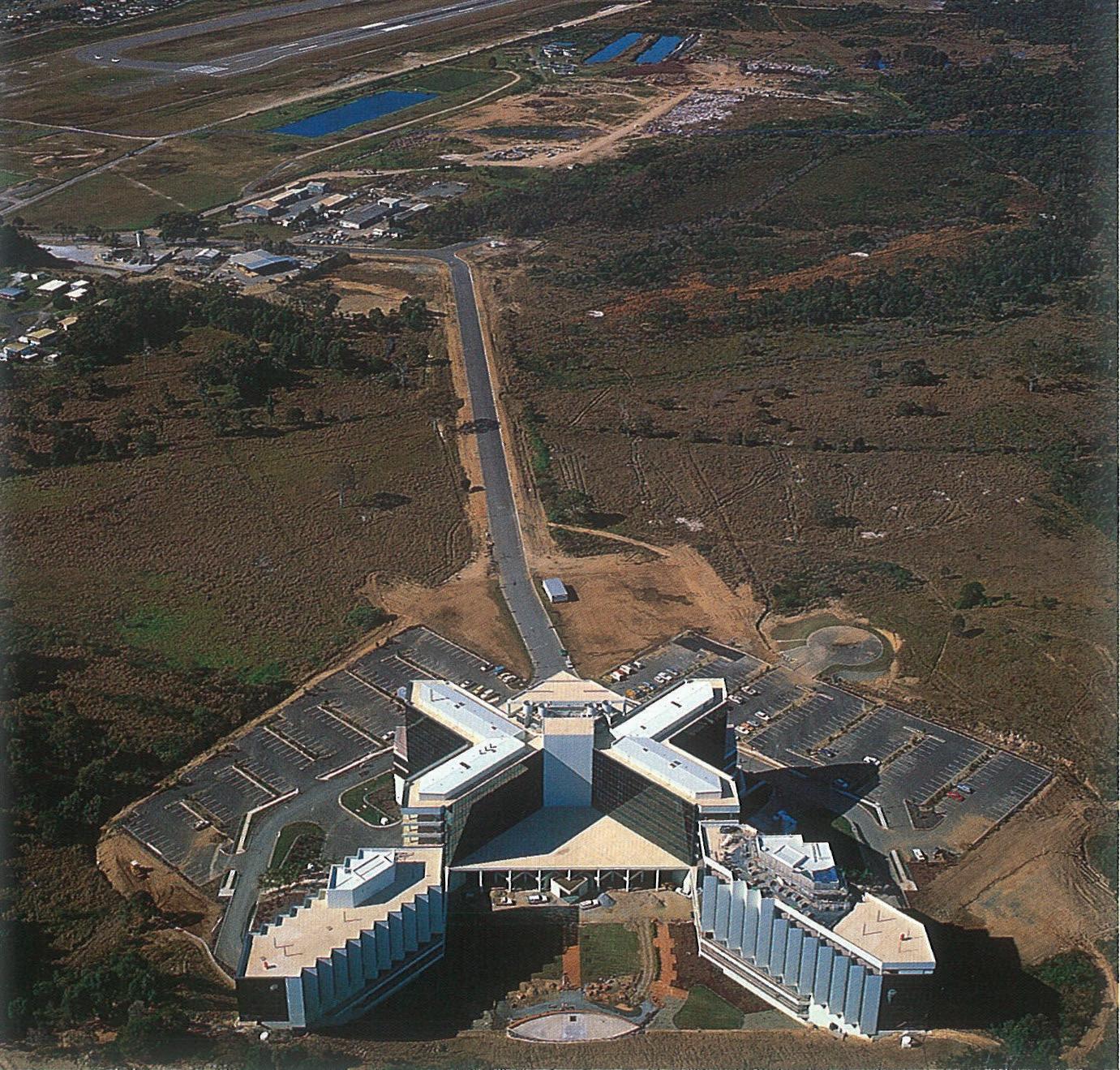
Moran Clinic – Hospital of Excellence, Gold Coast, Queensland
Hospital in Adelaide (1988), to the Wacol John Oxley Memorial Hospital in Queensland (1989), a $7.1m construct-only contract. The latter facility provided for the care of up to 72 psychiatric criminal patients.
A more delicate project was the 1989 construction of a maternity wing at the Mater Mothers Hospital in South Brisbane. With space at a premium, the new wing was constructed within a ‘V’ formed by existing buildings, and comprised an elevated single-level wing on a suspended, reinforced concrete slab, supported by columns on bored piers.
Much larger projects were undertaken at Ballarat Base hospital, Victoria and St George, in southern Sydney.
Ballarat Base Hospital was a $30.5m construction management project awarded to John Holland, which ran for three years from its 1989 commencement. The original hospital dated to 1856, when it was established in response to the Eureka uprising.
With the recession squeezing Victorian state government finances, a fine-toothed comb was run repeatedly over John Holland’s management of the design and construction. The hospital’s 1989’90 annual report states: “The project Control Group … has noted that the per square metre cost … is
in the bottom quartile of cost for comparable hospital works currently under construction in the State.”
By 1993, with a handsome new six-storey North Building most prominent in the redevelopment, Ballarat Base Hospital was revelling in its new status as a major regional hospital.
Sydney’s St George Hospital undertook an extensive, $150m development during the 1980s. John Holland was awarded the Stage 3 contract for the clinical services block and subsequently, Stage 4, which included a nine-storey ward block and many civil works, among them an 18,500sqm car park.
The work was comprehensive and demanding of precision. Demolition work and the construction of three new radiology buildings, ranging from one to four storeys, and the complete refurbishment of the Accident and Emergency ward –while still operational – provided extra challenges in relationship and environmental processes.
John Holland also performed the fit-out of the new radiology buildings, installing X-ray equipment, ultra-sound rooms, doctors’ offices and reception and office areas. All emerging after 25 months’ work with, naturally, a clean bill of health.
Defence –
RAAF Tindal, NT
JohnHolland’s relationship with Australia’s defence forces can trace a direct line to the company founder’s wartime service. At his instigation, since 1963 the John Holland Award has been presented to top Regimental Officer Basic Course graduates from his former unit, the Royal Australian Engineers, at the School of Military Engineering in Sydney.
John Holland Group has also hosted professional engineering training programs for Australian and British Army Engineer Officers since 1974 – the year that the company constructed a slipway, crane track and services tunnel at Williamstown Naval Dockyard, Victoria.
In later years, the company would become a powerful and trusted
partner with the Department of Defence, being the largest civil engineering contractor and sixthlargest overall contractor behind aerospace, maritime and technology suppliers.
While much of that momentum was gathered in the 1990s, in the series of APIN (Army Presence in the North) projects to relocate the Army’s First Brigade to new barracks at Palmerston in the Northern Territory, it took root with a smaller series of jobs in the late-1980s to construct the RAAF base Tindal, near Katherine.
At what was originally a wartime air strip (Carson’s Airfield) laid in 1942, the decision was taken in 1984 to create an operational RAAF base. The site offered considerable
advantages in its distance from the coast (at least 200km) and protection from cyclones.
John Holland’s role in the establishment of the Tindal base began in April 1987 with the $1.6m construction of a medical and dental facility. In June of that year, work began on a $3.1m ground equipment maintenance facility.
The following June, John Holland was awarded the $2m contract to construct the base’s Air Surveillance Radar Complex, comprising three separate buildings (respectively for receiving, transmitting and radar). The buildings were constructed on concrete slabs, with blockwork
interiors and pre-finished corrugated steel cladding.
Following various minor jobs, including a plant nursery and new water tank, in August 1989 John Holland revisited its medical/dental facility to construct new, $2.9m extensions.
Today, RAAF Tindal employs around 600 personnel who, with their families, account for as much as 20 per cent of the population of nearby Katherine. Tindal is home to the F/A18 Hornets of the 75th Squadron and is a vital link in a chain of airfields spanning northern Australia, from Learmonth in WA to Townsville, Queensland.
Resources: “No job too small”
In the history of Australia’s resource mining, the name Lang Hancock looms larger than perhaps any other. Born into a Pilbara (WA) pioneer family in 1909 and resident there for most of his life, in 1952 the station owner and miner was flying out of his Mulga Downs station and recognised, in the Hamersley Ranges below, vast deposits of iron ore. Later testing proved the ore to be of export quality, but Australia –ironically – had in place a ban on exporting iron ore, for fear of having insufficient reserves. (This had been estimated, at the time of the ban, to total 358m tons. In 2016, Australia’s identified iron ore resources total 54bn tonnes; the Pilbara region has exported up to 800m tonnes per year).
Hancock’s often unsung partner in his discovery and liberation of the Pilbara’s ore deposits was friend and field engineer Ken McCamey. In 1987, McCamey found a huge deposit, 25km long by 1.6km wide and at least 150m deep, estimated to total 34.5m tonnes. It was discovered at a spot 40km east of Newman, where CSR geologists seeking asbestos reserves would drive through twice weekly on their beer run.
McCamey described the highgrade deposit to his friend as “monstrous”, and thus Hancock named it McCamey’s Monster. Along with its owner Pennant Holdings, John Holland became involved in a three-way joint venture with Hancock Mining to develop
the McCamey’s Monster mine. John Holland’s first project, in June 1988, was the construction of a 32km rail spur to link the mine site with the nearby Mt Newman-Pt Hedland railway. The railspur was constructed from second-hand rail and sleepers, sourced from other iron ore tracks in the region.
Further works followed, not least the October 1988 construction of mining infrastructure that included the complete screening plant to process the iron ore scree.
The whole exercise was interesting and boldly entrepreneurial under Pennant Holdings Chairman, Brian Johnson.
At one point, Johnson was selling iron ore to Romania and arranged a deal to take Romanian-built mining trucks in exchange for iron ore. The deal in question was brokered directly between newly incumbent WA Premier Peter Dowding and Romanian president Nicolae Ceausescu.
However, the trucks didn’t perform exactly as planned. On the first roll-out, several dignitaries had been invited to witness the performance of the trucks. As they watched, the first truck reversed up to the dump hopper, to begin elevating and dumping its load. The elevation, however, kept going until the entire back end of the truck fell off.
John Holland’s list of project sheets for the period shows the willingness of the resources engineering group, in particular, to tackle almost any job. There were many projects in WA involving small mineral processing plants and such like; the John Holland Engineering Group was a relatively small, but specialised and highly mobile force, based in Melbourne but with resources around the country.
Among the more notable of these projects were a sodium cyanide plant for gold processing in Coolgardie; residue disposal pipelines for an alumina mine; Australia’s first mineral-sands wet concentrator in Cooljarloo, WA; and a dry mineralsands plant (for the extraction of ilmenite, rutile and zircon) in Eneabba, near Geraldton.
A technically interesting project commencing in May, 1989 called for the design and construction of a copper solvent extraction and electro-winning plant in Mt Isa. The plant reclaimed copper by firstly leaching a solvent through low-grade copper ore dumps. The solvent was then stripped out and the resultant stream put through an electrostatic process, the “electrowinning” bath; after seven days, what accumulated on the stainless steel cathodes was 99.99 per cent pure copper.
A similar plant built three years later by John Holland in Girilambone, NSW, completed in just 36 weeks and with extensive use of new CAD technology, produced the prized “five nines copper” –indicating 99.999 per cent purity.
Correctional Facilities
In December 1988 John Holland commenced construction of its first correctional facility, the 250-bed minimum/medium-security Loddon Prison in Castlemaine, 130km northwest of Melbourne. The design and construct project was valued at $27.5m.
Just six months later, according to contemporary Office of Corrections Victoria records, “Many of the buildings had walls and roofs completed, finishing trades … were well underway in the minimum security units … The targeted completion date is considered to be achievable.”
John Holland’s engineers had learned very quickly about the requirements of prison design and
building, soon put into practice once again with the winning of the high-security, $44m Arthur Gorrie Correctional Centre in Brisbane, commencing in November 1989.
Gorrie was commissioned to replace Brisbane’s infamous Boggo Road Gaol which, in the 1980s, was a century old and the site of frequent disturbances over its primitive conditions.
An interesting adjunct to the company’s new-found familiarity with prisons in 1989 was the undertaking, as one of three members in joint venture Corrections Corporation of Australia, to manage the new, 240-bed Borallon Correctional Centre, also near Brisbane, for three years.
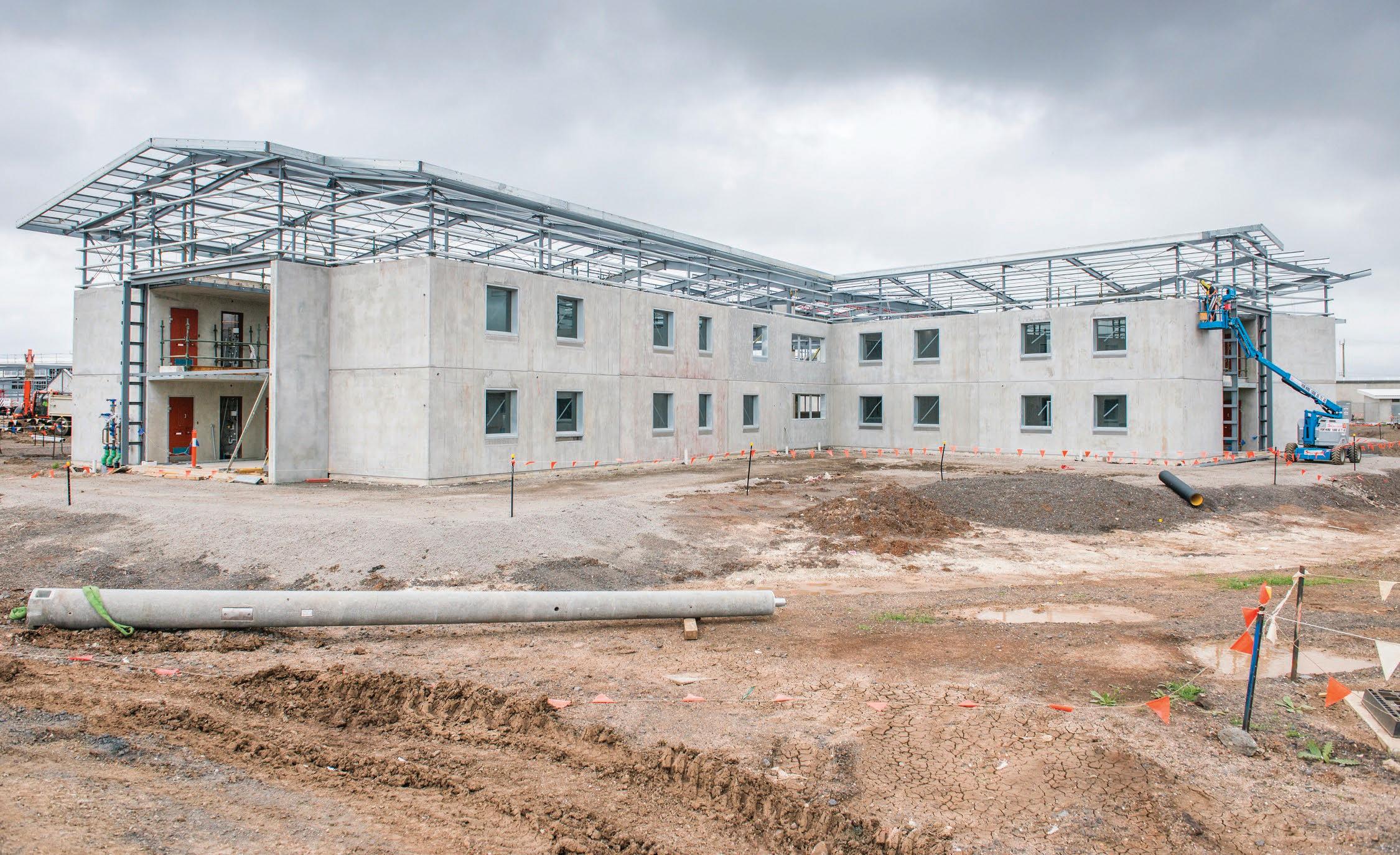
Prisons naturally have very specific requirements that touch every aspect of their design, construction and fitout. Concrete walls are far less readily penetrated than brick; toilets must be designed and installed to be secure from being uprooted and used as weapons.
John Holland has built up a formidable pedigree in these very specialised projects. Some years later, in 2001, these correctionalcentre skills all combined in the
company’s first design, construct, operate and maintain contract for the Mid North Coast Correctional Facility in Kempsey, NSW. This would be followed by other landmark prison projects including the $87m redevelopment of Hobart’s Risdon Prison (2003), the $180m Eastern Goldfields Regional Prison in Kalgoorlie (2012) and, as part of a public-private partnership (PPP) consortium, a $650m prison at Ravenhall (2015) in Melbourne’s west.
Ravenhall Correctional Centre under construction, Victoria
Shopping Centres
Major and minor landmarks
from the Pennant ownership era of John Holland dot the Australian landscape from west to east. In 1986 alone, the year of Sir John’s retirement, the group had various Hollstone (John Holland-Folkestone) joint-venture developments underway – including the $43m King Gardens office park in Melbourne – along with a profusion of smaller shopping centres.
A local Perth landmark was created in Hillarys Boat Harbour, a retail and leisure precinct to the north of the city’s CBD. Long-serving John Holland team member Dai Davies recalled that the same client had, not long earlier, been very satisfied with John Holland’s delivery of the
Fremantle Fishing Boat Harbour, constructed for the 1987 defence of the America’s Cup.
At Hillary’s Boat Harbour, John Holland constructed the main tourist complex and marina, which housed taverns, restaurants and speciality shops, and also the 120-pen Sorrento Yacht Club marina.
The structure comprised a main jetty built on steel tubular piles with precast concrete deck sections, with adjoining steel-truss finger wharves. The complex, opened in 1988, serves as the hub for many tourism activities, including Rottnest Island.
John Holland contributed significantly to the sprouting skyline of Perth’s CBD, with high-rise developments in No.8 St George’s
Terrace (1987) and the Capital Centre (1988).
Interestingly, John Holland was also subcontracted to build the Australian Tax Office building in Northbridge. The head contractor, Drayton Construction, represented the client, the Heytesbury Group, headed by the recently widowed Janet Holmes à Court.
John Holland was just as busy on smaller-scale shopping centre projects, with 10 such in metro Perth alone. Dai Davies, who was then a construction manager (later state manager) at John Holland WA, recalled: “The development of large, prestressed, precast concrete panels at John Holland’s precasting facility in Kwinana enabled these shopping centres to be built without need of bricklayers or scaffolding – two critical trades with significant union membership in those days.”
The Perth suburban retail centre tally included the 22,000sqm redevelopment of the Armadale Shopping City (1987), one of Perth’s largest shopping centres at the time. The original, 14,000sqm centre was a John Holland original from three years earlier, its construction having involved the preservation of purportedly WA’s oldest jarrah tree,
and the relocation of an historic school house.
Smaller developments in Belmont, Dianella and Kalamunda were typically constructed from precast concrete or exposed-aggregate panels over a structural steel frame.
Another early shopping centre was Lismore Central in NSW. Its design took care to position walkways above the level of the town’s floodprone Wilson River, just two city blocks away. It also incorporated a “flood loft” where shopkeepers could hurriedly relocate goods.
Also in NSW was a 24,000sqm extension to the Tweed Heads centre, putting it among the largest retail facilities in northern NSW.
Tweed Heads showed innovation in changing a large section of the multi-storey car park from traditional reinforced concrete to a post tensioned deck, resulting in considerable savings to the client. Work was completed within 12 months, while fulfilling the requirement that the centre remain open throughout construction. This combination of enduring engineering and attractive design helped establish John Holland’s expertise in retail construction.
Centennial Plaza
Centennial Plaza was a major commercial development at the southern end of Sydney’s CBD, almost immediately adjacent to the city’s Central station. The site was historically significant for having been, since 1875, home to the Standard (later Toohey’s) Brewery. The brewery’s 24-metre, five-storey main tower was once Sydney’s tallest building, and the first in the city to have an elevator (1881). The brewery was closed down in 1978.
Centennial Plaza, initiated in 1987, was a design and construct development on behalf of Pennant Properties. It comprised a trio of handsome, oval-shaped office towers of respectively 10, 13 and 16 metres in height. Supporting the offices on
the 13,800sqm site were two retail spaces and parking for more than 400 cars.
The towers were designed to maximise lettable space on each level. Post-tensioned slabs were supported by just six internal columns, providing 1300sqm floor area on each level. The exterior featured glass curtain walling and polished, precast spandrels.
Construction of Buildings A and B commenced in August 1987 and took 25 months, at a cost of $72m; Building C commenced in May 1988 and was completed 27 months later, at a cost of $57m. All three buildings were successfully sold on completion.
Centennial Plaza, with its attractive finishes and extensive
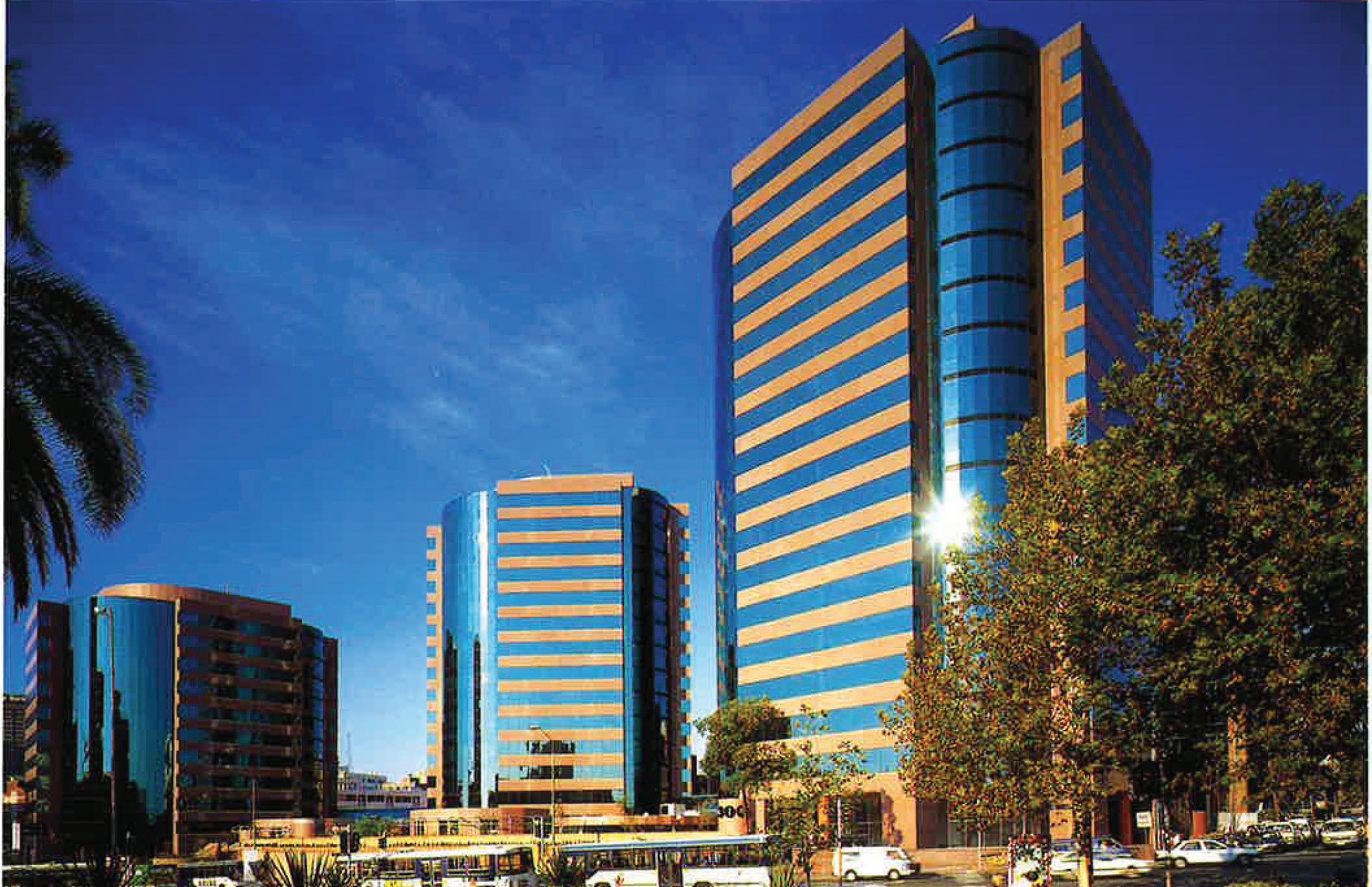
landscaping around the spacious site, greatly helped the development of the neighbouring inner-city suburb
of Surry Hills, finally liberating it from the century-long shadow of the brewery.
Haughton Pump Station, Townsville Qld
The Burdekin River Project, initiated in 1980 by the Queensland government, was the largest land and water conservation scheme ever undertaken in that state. At the heart of the scheme was the pumping of water from the Burdekin River and its transfer, via a combination of pumping and gravity feed, to the headwaters of the Ross River Dam near Townsville.
From there, the water provided horticultural irrigation in the lower Burdekin region, and supplemented the urban needs of the city of Townsville. The region was already desirable for horticulture, with a climate and sunlight that enabled the growing of many crops during
winter. The region has long been famed for its mangoes.
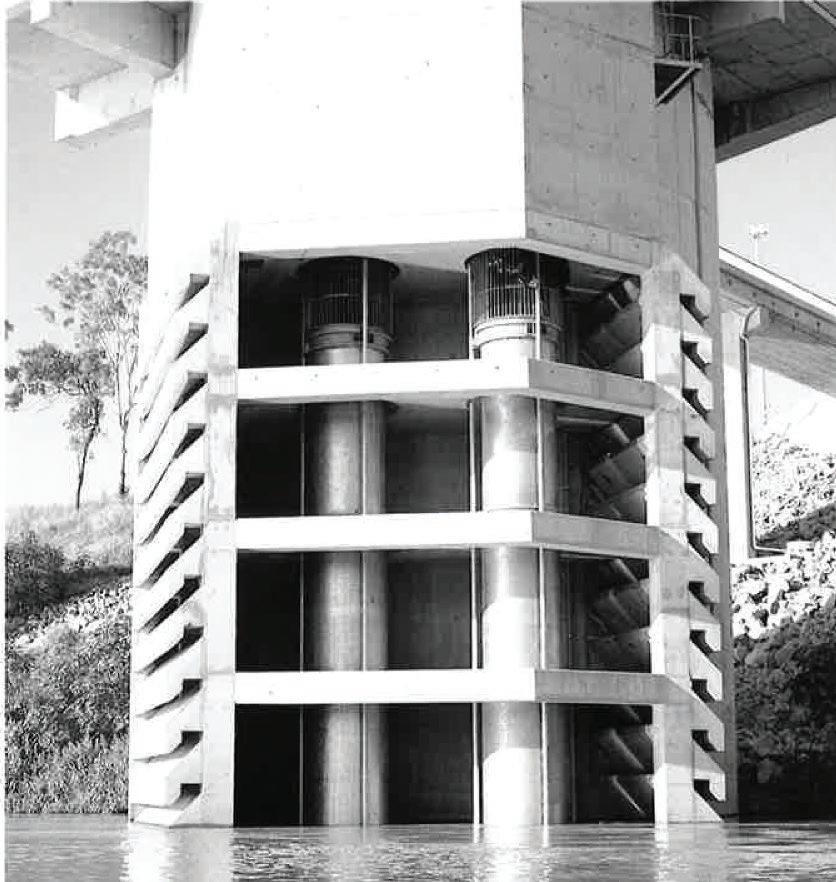
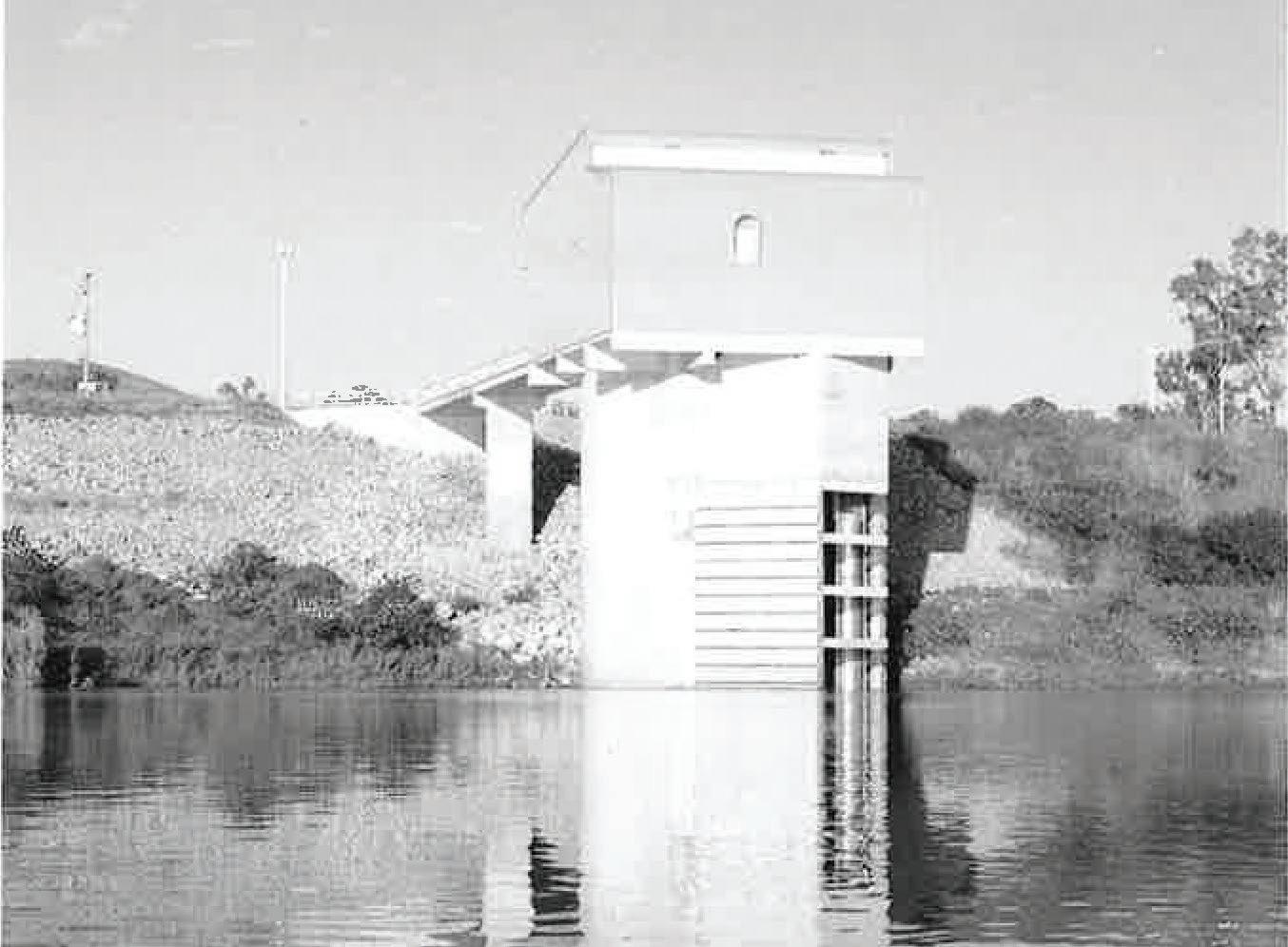
John Holland was awarded the contract for the $5.3m Haughton Pump Station project, which commenced in February 1987. It would call on the group’s diverse skills including design, construction and mechanical and electrical installation.
In an area subject to flood flows of up to 50,000 cubic metres per second, heavy concrete foundations were laid within a 32m cofferdam, up to 12m below the water level. These foundations would accommodate a 30m-tall pump-well with a six-storey intake structure, crowned by a pump station building. An access bridge connected the
structure to the river bank, which itself required extensive flood protection works.
John Holland designed and constructed the upper section of the pump house, using precast reinforced concrete elements, each weighing up to 31 tonnes. Construction was made difficult by extremely limited crane access to the site.
Nor was the mechanical and electrical fit-out aspect to be underestimated, with the installation of a 15-tonne gantry crane; a dual, fully-automated telescopic intake structure; a forced-ventilation system; and a full electrical-power and control system.
The Haughton Pump Station project won both the in-house John Holland Safety Award and the AFCC Queensland Division Safety Awards in 1988.
Logan Motorway
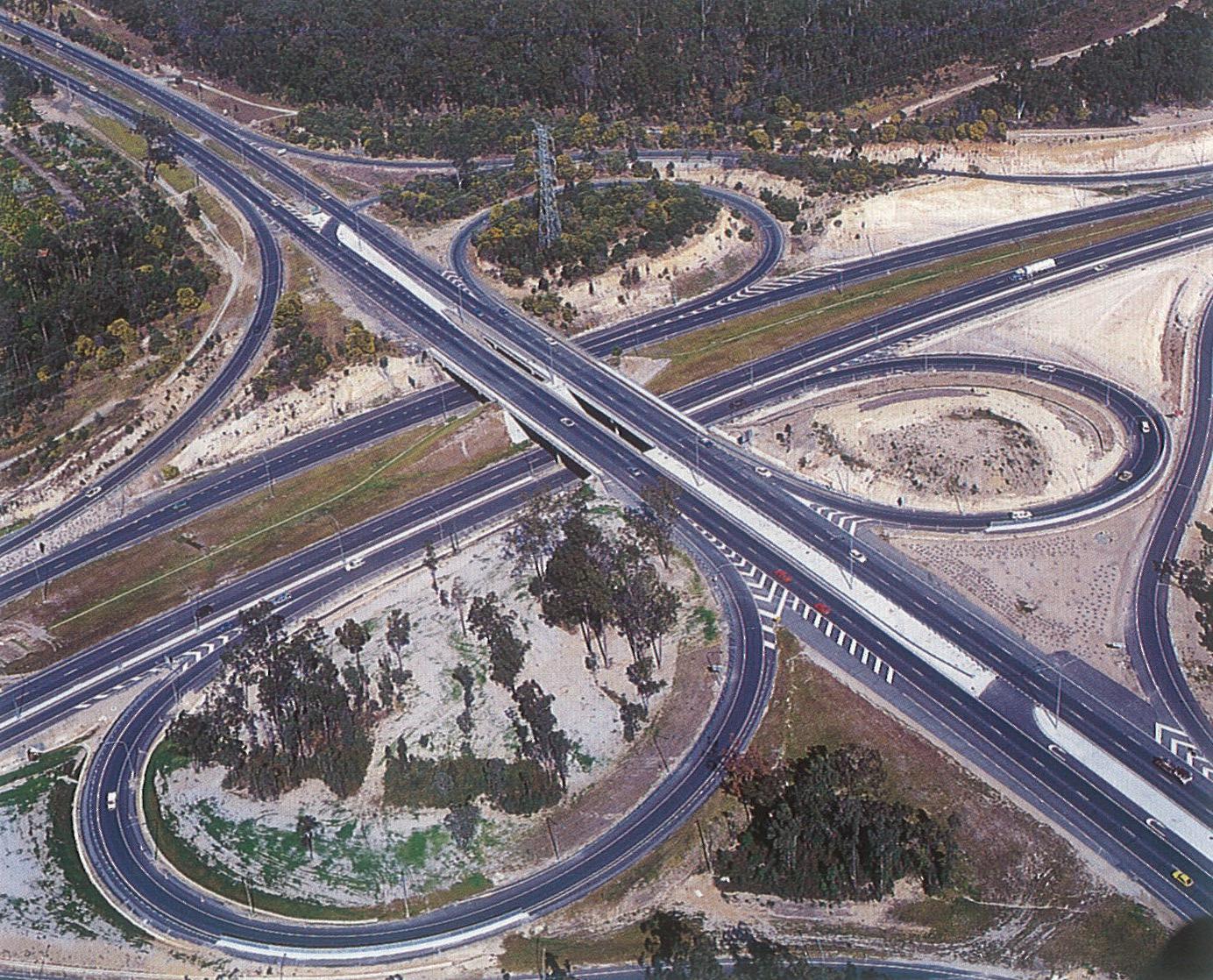
Amajor piece of south-eastern Queensland’s road transport puzzle was put in place by John Holland with the completion, in 1988, of the $17.5m Logan Motorway Area 4 design, construct and 10-year maintenance project.
The project, which involved no fewer than seven bridges and three interchanges, was part of the Southern Brisbane Bypass network that finally allowed through-traffic to skirt central Brisbane.
The works extended from the Wembley Road toll plaza to the Ipswich Motorway interchange at Wacol, and included the duplication of 15.7km of two-lane carriageway separated from the existing twolane by a 122m-wide median. The
existing Mt Lindesay Highway interchange was suitably enlarged and two new interchanges also constructed.
In an age before invisible electronic motorway tolling, the motorway’s Stapylton toll plaza was doubled in size to cover eight lanes. Toll collectors enjoyed vastly safer access thanks to a new access tunnel that connected each toll island to the newly constructed administration building.
Blasting operations for the 860,000 cubic metres of earthworks were conducted adjacent to the existing motorway and three existing water reservoirs. Strict specifications had to be observed around limiting ground vibrations and flyrock.
Numerous box culverts and pipe culverts were also constructed, while 400,000sqm of hydro-mulching and shrub and tree planting was undertaken in the landscaping of the project. With more than 300,000sqm of flexible pavements required for the roadway, John Holland imported Australia’s first asphalt shuttle
buggy, a purpose-built vehicle for transferring hotmix from truck to paver to enable continuous paving operation.
The machine’s capacity to store, heat and remix the material helped result in a motorway with a bestpractice smoothness rating.
530 Collins St, Melbourne
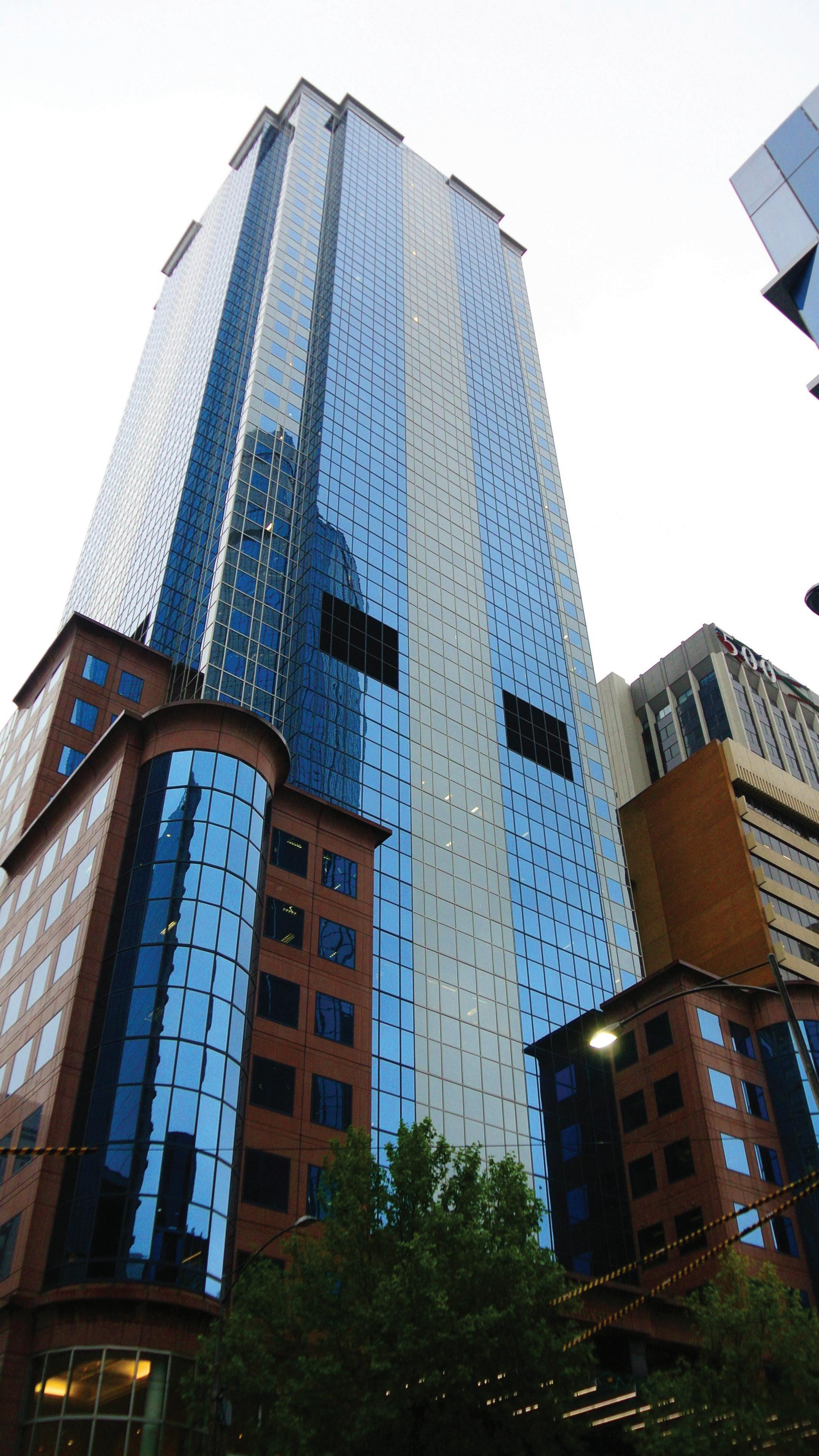
AtrueMelbourne landmark: that certainly describes 530 Collins St, the 167m-tall office tower on the corner of the city’s Collins and King Streets. At the time of its completion in 1992 (after commencement of construction in 1987), 530 Collins was among Melbourne’s dizzying dozen tallest buildings.
The $207m design and construct project was developed under Hollstone Properties, a joint venture of John Holland and Folkestone. The architect was esteemed Melbourne firm Peddle Thorp, whose CV included that city’s 185m-tall ANZ Tower (1978) and Rod Laver Arena (1988). Construction was by HollandStolte-Lewis, a joint venture with Lewis Construction Co Pty Ltd.
The building comprised a 39-storey office tower atop a 14-storey podium. The 167m height of the tower was determined by a city planning requirement that no building should cast a shadow on the Yarra River, 320m to the south, on the shortest day of the year. (Quite how this requirement was later met by the Rialto Tower –297m tall and situated precisely between 530 Collins and the Yarra River – is not immediately apparent).
The 530 Collins tower was originally intended to comprise 41 floors; however, the floor-to-ceiling height on each level was revised by 200mm to allow for cabling and computer needs. The floor count was
thus reduced by two. The building nonetheless boasted 68,000sqm of first-class office space.
The frame of the tower was constructed from reinforced concrete with a glass curtain wall. The podium was clad in precast concrete panels. The building’s luxurious granite lobby opened into an enclosed courtyard, beneath the 14-storey atrium. The building included 25 service lifts, five of which were glassbacked observation lifts.
An interesting technical challenge arose in the physical design of the building. The impressive atrium only hinted at alterations that were made early in the construction phase, following a requirement from its prestigious early tenant, the
Melbourne Stock Exchange, for a large, open trading floor.
This necessitated the removal of three supporting columns already installed. A novel engineering solution transferred the structural support for the 14-storey podium to being suspended from reinforced, post-tensioned concrete trusses built between levels 11 and 13. This entailed extensive use of 60MPa high-strength concrete.
Melbourne Stock Exchange was obviously a happy customer: it has been headquartered in 530 Collins St since the building’s opening in 1992 to the time of this book’s writing, marking the commencement of a second century of the Stock Exchange’s reign on Collins St.
Darwin Airport
The history of Darwin’s airport is as colourful as that of the city itself. The location for Darwin’s first airfield was chosen in 1919 by a trio of Australian Flying Corps officers headed by Lieutenant Wilmot Hudson Fysh – who just a year later would establish his own airline, Qantas.
Fysh nominated a spot at the Parap Police Paddock, near the prison at Fannie Bay. The purpose of the airfield was to serve as the finishing point for an international air race, announced by the Commonwealth Government and offering a £10,000 prize for the first successful, Australian-crewed flight from England to Australia.
Entrants had to complete the trip
within 30 consecutive days and touch down in Australia before midnight on 31 December, 1920.
Six crews took up the challenge, the winning Vickers Vimy bi-plane G-EAOU of brothers, Captains Ross and Keith Smith (both later knighted), and sergeants Wally Shiers and Jim Bennett touching down on the Parap dirt strip on 10 December 1919, 28 days after leaving England.
The first trans-Australia flight arrived from Melbourne just two days later, giving some illustration of how air travel would very soon open up Australia.
Darwin’s modern airport site, some five kilometres east of Parap, was commissioned in 1940. It was
attacked several times during WW2 by Japanese aircraft. In the ensuing few decades, use of and responsibility for the airport was shared between Defence and Civil authorities.
Construction of a dedicated civil aviation terminal commenced in 1984, but was halted the following year amid concerns over the cost.
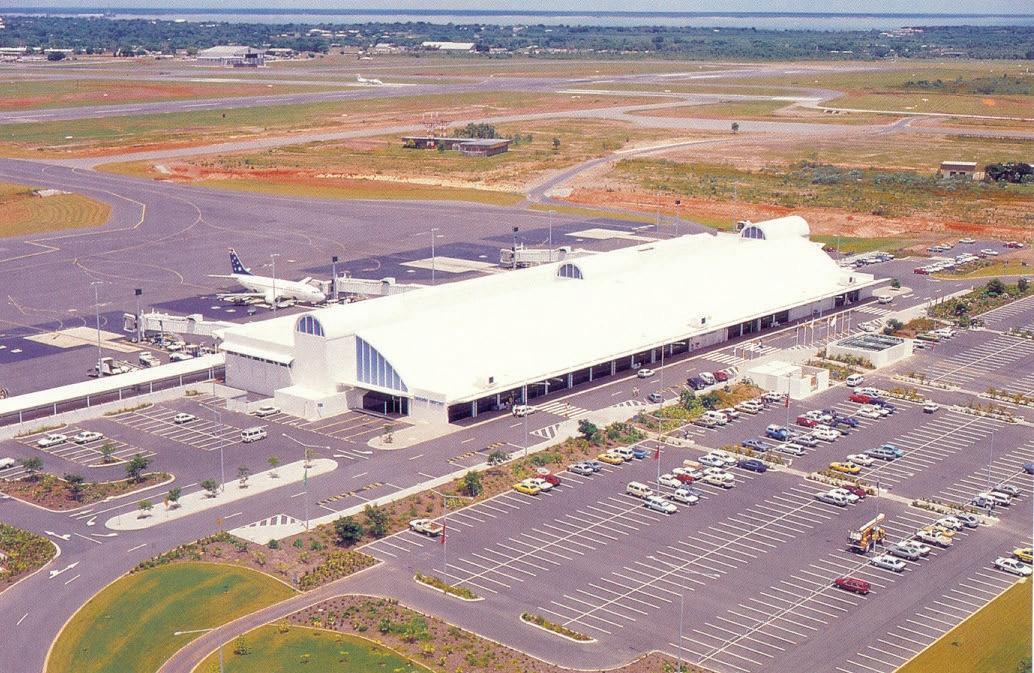
Eventually, in 1989 the Federal Airports Corporation took charge of civil aviation at Darwin Airport. John Holland secured the $49m contract to design and construct a new, twostorey international and domestic terminal building and associated civil works, including aircraft aprons and taxiways and car parking.
Given Darwin’s extremes of weather, the design had to be simple and durable, while attractive and functional. Outside the light, steel-framed terminal building, which featured aerobridges for boarding from the second-storey departure lounges, the aircraft apron accommodated eight commercial aircraft. A general aviation apron provided parking for up to 100 commuter and private aircraft.
Even in 1989, Darwin was still relatively remote and underdeveloped; yet John Holland had already been working in the Northern Territory for 30 years (not counting Sir John Holland’s war service there).
Project Director, Tom Dwyer, resident in the NT through the 1990s for John Holland, arrived in the Territory around the time the Airport project was completed. He was well placed to comment on the benefits of the company’s local footprint.
“It was extremely important to be represented locally, to have the local relationship because during the APIN [Army Presence in the North] years in the 1990s, we were competing with the other national Tier Ones. They didn’t have a presence in the NT and that was absolutely fundamental to our success.
“We were able to offer something that the locals couldn’t, by drawing on staff from outside of Darwin when we needed them. And we had local contracts and a significant portion of local people that the nationals without an office didn’t have.
“The relationships with the subcontractors and the design teams were always important. You were bumping into people, you’d be sharing a fishing trip or sitting together at your children’s school council. You cross paths with the people you’re doing business with in other areas of your life.”
International Accreditation & Systems Manager, Justin Lee, a John Holland veteran, recalled the constant positive reporting from the NT region. “A lot of things like projects coming in, going out, lists of bidders –we never missed out on any of that. We may have sometimes missed out in being awarded the tender, but we never missed out on tendering … In the mid-1980s up to 2000, when we had Tom Dwyer and David Fulton in there, we were winning nearly one in every three jobs.”
Pioneer River Rail Bridge, Mackay Qld
Quitea history, has the bridge over the flood-prone Pioneer River in Mackay. The gradual extension of a coastal railway line from Brisbane finally reached the township of Mackay early in the 20th century, prompting the planning in 1913 of a new railway bridge to complement the town’s distinctive, wrought-iron Sydney Street pedestrian and vehicular bridge.
However, Mackay was rocked by a cyclone in January 1918. During 1400mm of rain over 83 hours and a 7.5m tidal wave, various river barges were wrenched from their moorings.
Sections of the Sydney St road bridge suffered extensive damage.
This catastrophe finally resulted in a sturdy, cement-pylon rail bridge. The
Sydney St road bridge was repaired, though it would be replaced 20 years later by the Forgan Bridge (itself to be replaced after another 70 years).
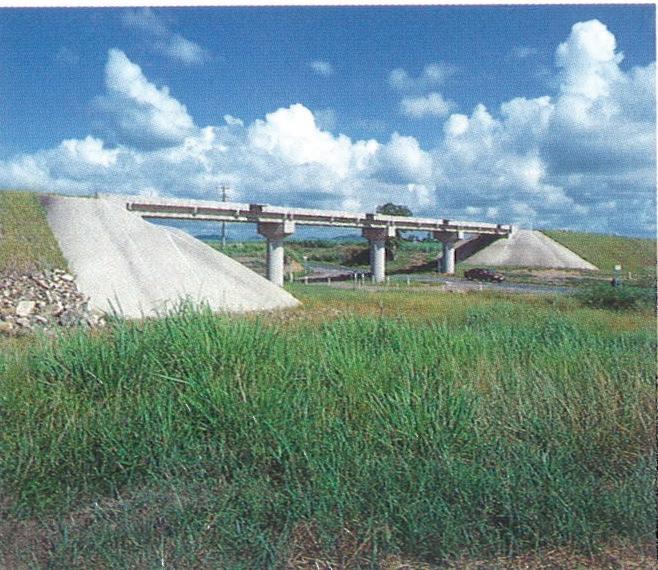
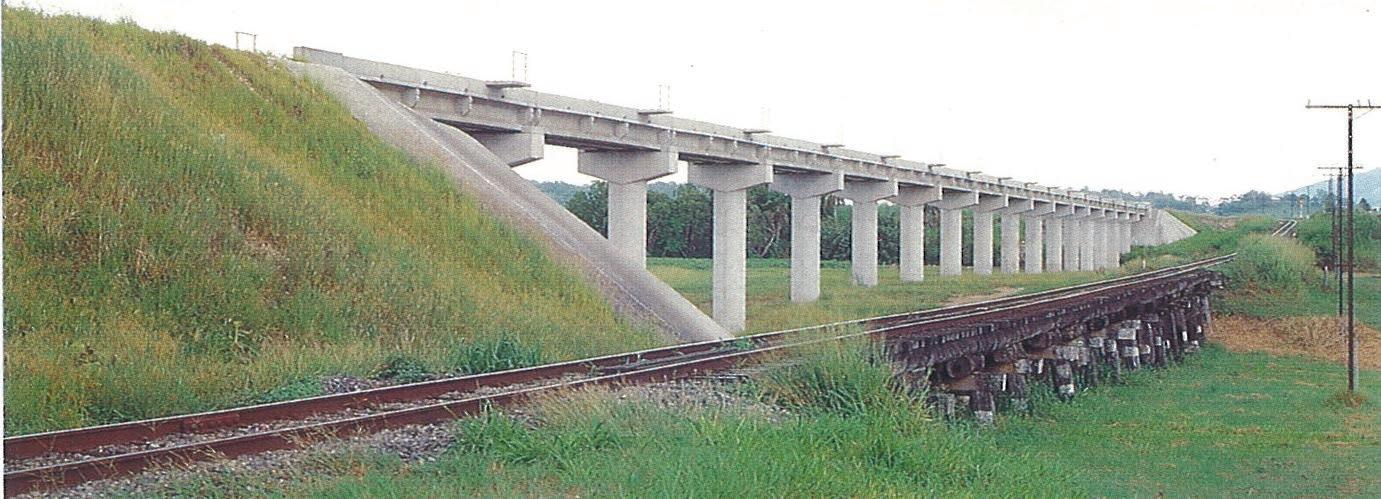
In the 1980s, the decision was made to relocate the main northwest railway line further inland, away from the urban areas of Mackay. This took the line across the broad, flat expanse of the Pioneer, necessitating the longest bridge in the realignment program.
John Holland won the tender in 1989 to construct a bridge capable of withstanding the possibility of strong floods. The bridge is 825m long, comprising 33 spans of 25 metres. The foundations for the pylons were each constructed of four, onemetre caisson piles. These supported
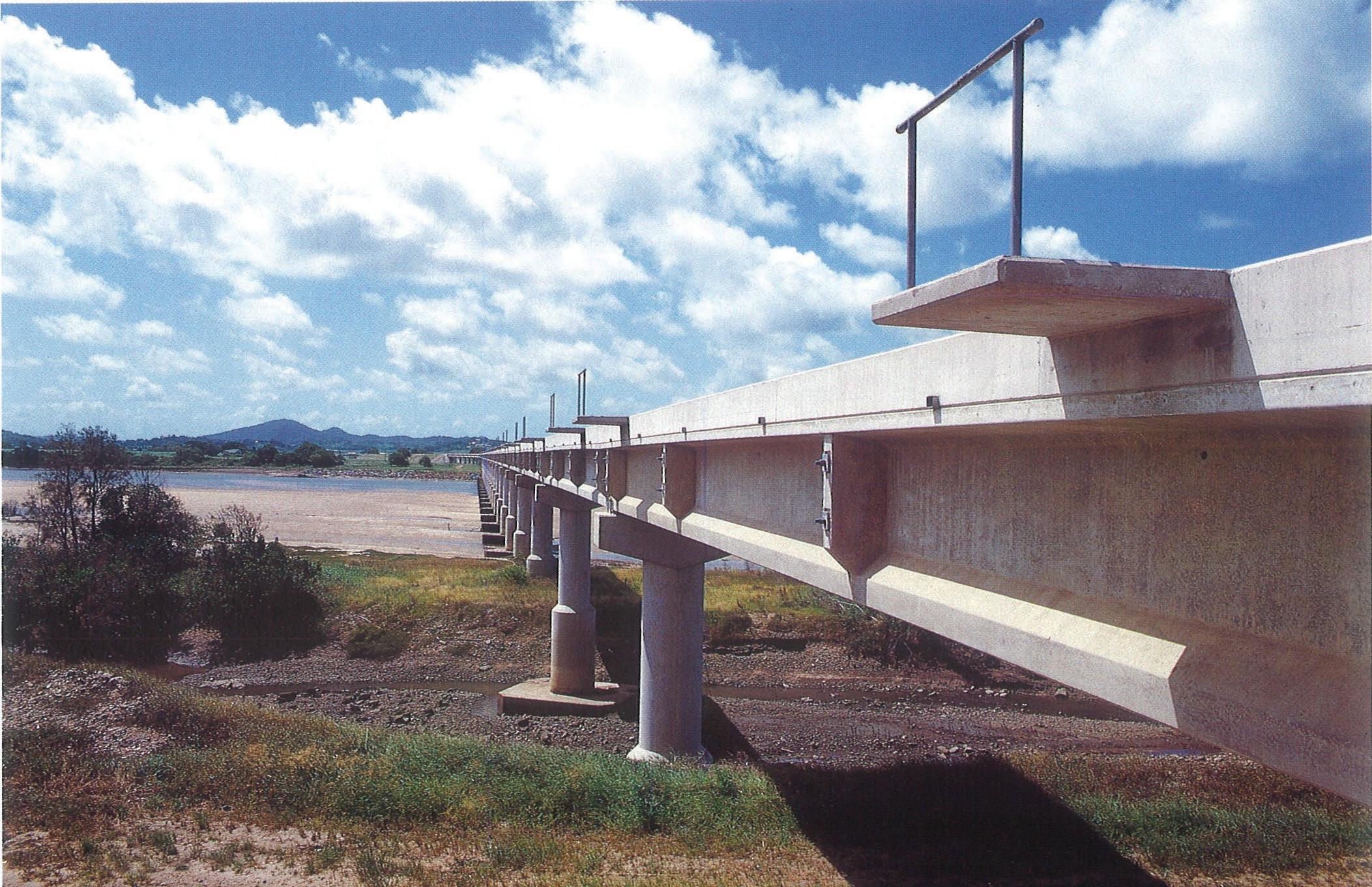
T-beam pylons, each 25m tall by 3m diameter, made from 50MPa high-strength concrete and weighing 52 tonnes.
Within the same rail deviation program, John Holland also constructed the smaller Lansdowne Rd and Fursden Creek bridges, respectively to the south and the north of the Pioneer River.
Sydney Central
In 1989 John Holland was commissioned by Works Australia (NSW), a Commonwealth body to design (within pre-set guidelines) and construct the 31-storey Sydney Central office precinct.
The site occupied a prime location in Haymarket at the southern end of Sydney’s CBD, near Central station and between the major north-south routes of George and Pitt Streets. The tower itself comprised more than 70,000sqm of floor area, plus a ninestorey north wing, two levels of retail and basement car parking.
However, the $169m development was perhaps more interesting for its historical value, several elements of which were attractively incorporated.
At one corner of the site was a sandstone, two-storey Presbyterian Manse believed to date to 1850. It was retained and marvellously restored. Nearby is Sydney’s oldest fire station, built in 1857, likewise restored and redeveloped as a café.
In 1922, the site had housed the impressive showroom and headquarters of the Australian Gas Light Company (AGL), complete with a sizeable brick gasometer. These three heritage buildings and a sizeable chunk of the enormous gasometer were all incorporated into the new development, creating an attractive working and shopping environment in Sydney’s bustling Haymarket.
Friendship Bridge, Mekong River, Thailand-Laos
Aninteresting experience that confronts drivers travelling from Thailand to Laos, the two nations separated by the mighty Mekong River, is the sudden changeover from driving on the left side of the road to driving on the right. Laos’ driving rules are a remnant of its French colonial history.
The changeover is done at the Laotian end of the graceful, 1174m-long Mittaphab (Friendship) Bridge, which was opened in April 1994 at the conclusion of a 32-month design and construct contract. It was the first of three Mekong-crossing bridge projects undertaken by John Holland along Laos’ vital highway 13, funded as Australian Aid projects.
The Friendship Bridge is located between Nong Khai on the Thai side and Thanaleng in Laos, 15km from the capital, Vientiane.
The Mekong, some 4350km long, is the 12th-longest river in the world. For centuries it has been a major artery for trade between China and south-east Asia. That’s despite the river’s startling transformation during the monsoon season: the volume of water expands fourfold, translating to a rise of more than 13m in its height at the location of the Friendship Bridge crossing.
The 1174m-long bridge design comprised a 665m main structure and elevated approach spans. The main structure was supported by six river piers, spaced at intervals of 105m
and constructed from a total 54, 1.5m reinforced concrete piles that were cast in place and socketed up to 10 metres into rock. The approach spans were supported on a total of 15 land piers and abutments.
The 12.7m-wide bridge deck allowed for two lanes of traffic, two pedestrian footpaths and provision for a narrow-gauge railway down the centre. The railway was added 15 years later; road traffic (which drives on the left, Thai-style, on the bridge) is halted when the metre-gauge train makes a crossing.
More impressive than the bridge’s width was its height, soaring 26m above the river’s surface when not in the monsoon season. During the monsoon (May to late-September), the river rises to within 13.4m of the deck.
The bridge’s effect on movements, trade and the economy was immediate and profound. According to figures from the Australian Embassy in Thailand, in the fiscal year prior to the bridge’s April 1994 opening, when the Mekong crossing still relied on a ferry, the total value of imports and exports passing through Nong Khai Customs House was 3.6bn baht. In the next fiscal year, this increased to 4.8bn baht, rising again to 5.3bn in the 1995 fiscal year. Vehicle and people crossings in the same period roughly quadrupled.
Such a resounding success was borne of Australian ingenuity – and just a dash of she’ll-be-right-mate, as Janet Holmes à Court witnessed during the first of several visits to the Friendship Bridge project.
“They had built quite a nice little site office with a little – I can still see it – a little veranda with a railing around it. We went inside and there was Project Manager, Hamish Tyrwhitt (who went on to become CEO of Leighton Holdings) and Construction Manager, David Polkinghorne (2016 Civil Engineer of the Year). They were reading a book: How to Build a Balance Cantilever Bridge …”
Similarly, those involved in the project remembered with a chuckle the logistical challenges that, through sheer scale and distance, managed to baffle the best in the business.
Australian-supplied steel to be used in the reinforced concrete piles was ordered and the first batch was delivered to the site office on the Laos side of the bridge. Only then was it realised that building a bridge over the river necessitated having half the materials on the opposite shore. Materials were duly barged across; a hasty conference call to John Holland headquarters in Melbourne would ensure that it didn’t happen again.
The
bridge’s
effects on movements, trade and the economy was immediate and profound.
Part Two THE 1990s
A new way of doing business – the Janet era
InDecember 1990 Mrs Janet Holmes à Court, widowed only three months earlier, acquired the engineering and construction businesses of John Holland from its collapsed holding group. What had attracted her as a short-term fix for the immediate problems of her family business, Heytesbury Holdings, turned out to be neither a fix, nor short-term: Janet’s chairmanship and guiding influence on John Holland would endure for 24 years.
In her foreword to this book, Janet Holmes à Court admits to having had little knowledge of the construction business. What she had always had, however, was an intensely inquisitive mind and an intuitive way with people.
Her late husband Robert Holmes à Court’s talent had been to make money. Born in South Africa, Holmes à Court emigrated to Western Australia at age 24 to study law. He graduated in 1965 and subsequently began practising law. He married Janet Ranford, a science teacher, in 1966.
Through his legal work, in 1970 Holmes à Court was presented with an opportunity to take over an ailing woollen mill in regional Albany, WA. It was the beginning of a meteoric rise for the Perth-based businessman; by the end of that decade, his Bell Group had exploited major interests in media, property, transport, agriculture and resources.
Dubbed a “corporate raider”,
he was often successful through being unsuccessful. Aggressive share grabs would be launched on major businesses, having the effect of inflating the targets’ share prices; Holmes à Court was able to profit handsomely by selling his shares and walking away.
One of the better-publicised takeover bids was for BHP, Australia’s largest company, in which he reached almost 30 per cent shareholding. In the mid-1980s, Holmes à Court was almost certainly Australia’s first billionaire.
The rise continued until the 1987 share market crash, which encouraged him to sell, within a matter of a few months, virtually all of his corporate assets. The BHP sale alone was worth $2.3bn.
Apparently, Robert Holmes à Court was looking forward to his next chapter in life by acquiring vineyards, pastoral properties, a horse stud and a British entertainment group that included 13 theatres in London’s west end.
However, the heavy smoker, who also suffered from diabetes and worked 18-hour days, died from heart attack on the morning of Father’s Day, 1990.
“When Robert died, we inherited quite a lot of companies, things, unfinished ‘games’ and a lot of debt,” recalled Janet. “Most of it consisted
of businesses or things that were very capital intensive, but didn’t produce much cash.
“Robert was the most profitable cash generator in Heytesbury. If they needed to make an interest payment to a bank, he would ring stock brokers and buy and sell a few shares and fix it. The businesses were not really required to churn out a huge amount of money, because Robert was the master at generating cash.
“When he died, I knew that nobody else in the company had the skills that he had. I don’t think anyone else ever bought a share without being told to by Robert. Frankly, I didn’t know how to do that, buying and selling, and it doesn’t interest me one bit. So I had to put a stop to all of that.”
Drayton, a small construction company within the Heytesbury group, was aware of Heytesbury’s cash situation. They were equally aware that Pennant Holdings, thenowner of John Holland, had recently been placed in receivership.
“The guys who were running Drayton came to me and said, we think we can buy John Holland on your credit card,” Janet smiles. “In other words, get it for practically nothing – and that it will be a cash generator.
“They had done some analysis and I suppose, bless their souls, they
were used to analysing companies for Robert, where you’d buy, make a few changes and then on-sell. Whereas, with John Holland, we needed to buy it, rebuild it and keep it, as a cash generator. Everyone was enthusiastic and away we went.”
The company she had acquired was working on landmark projects such as the $120m Melbourne Cricket Ground’s Southern Stand, the $42m Wacol remand Centre in Brisbane and the $160m Sydney Central office tower at the time. But the big issue, soon discovered, was the shortage of work in the pipeline.
Still, her Chairman’s Report in John Holland’s 1991 Annual Report gives a sense of the mood of optimism in praising “the depth and resilience of the Group, and the market’s acceptance of its return to the traditional premier construction role. In the period ahead, John Holland is well placed to take advantage of the changing economic and market conditions.”
John Holland was at that time headquartered in 492 St Kilda Road, Melbourne. The building housed what were effectively three separate businesses: building, civil and resource engineering. It was quite a contrast to John Holland’s more recent model of collaboration.
One employee from that era remembered how the “siloed”
businesses were physically manifested in 492 St Kilda Road and equally in the NSW headquarters in The Woolstore, Pyrmont. There was almost a competitive relationship between the head of Engineering, Peter Westaway and head of Construction, Randolph Creswell.
“If you were with Engineering on the sixth and ninth floor, you couldn’t go to the 10th, eighth or second floor, because they belonged to Construction … not even to make a photocopy,” the employee recalled.
“At the interstate offices, in Pyrmont, on the third floor, if Engineering wanted to have a chat with someone in Construction, they had to ask the state manager from Engineering for permission to go there … It was like, why don’t we share this project with the guys downstairs? ‘No – let’s get quotes from outside, and if outside is the cheapest, we’ll go outside …’
“I think that was because the two MDs had their own cost centres, and the last thing they wanted was to share.”
Glenn Palin, who joined John Holland in October 1993, believed this approach was holding the company down. “They basically had these three divisions, none of which was big enough to dominate the market. They weren’t operating together, so it tended to depress John
Holland into being a small operator in all markets.
“We had no balance sheet. We had little market presence. We really came into the ’90s able to do things, but not able to influence. We certainly weren’t cohesive.”
Glenn Palin met Janet Holmes à Court not long after he joined the company. As a business development manager in his native Queensland, overseeing the Building division (he had equivalents in Civil and Resource Engineering), Palin had to develop a business plan and present it to the visiting Chairman.
“She quickly grasped the concepts we were talking about, whether building concepts or engineering concepts or whatever, and we very quickly entered into communications and engagement about what the resource projects might yield.”
A series of site visits were to follow the presentations. The regional managers were readying to leave when the Chairman raised her hand.
“She said to all the regional managers, ‘hang on a minute’,” Palin said. “‘I haven’t gone around and talked to anyone yet. Can you just wait here? I’ll be back. I want to go and see …’ – and she started to name names.
“She then took an hour or more just to walk around the building, talking to everyone, just saying, ‘How
are you?’, ‘What are you doing?’ She made the managers wait until she had finished that walk.
“That gave her a lot of credibility for me. I thought, ‘This is going to be quite interesting.’ And it only got better from there, I guess.”
Palin refers to a change in attitude that soon crept through the business. Janet herself, when asked to describe it, said: “A huge part of it is respect. I’ve always been fascinated by people who can back trucks. I watched a guy in Melbourne drive up Bourke Street in a huge B-double. He backed it into a laneway that was about four inches wider each side. I thought, ‘Now, that is skilful’.”
For the meantime, work had to be found. The residential and commercial property development boom of the 1980s had well and truly stalled after the 1987 stock market crash. Among the first orders of business for John Holland’s new owners was to more aggressively pursue opportunities in public sector building, civil engineering, energy and resources markets and in Asia.
The Great Southern Stand at the MCG (see project chapter) was a landmark project for John Holland, both literally and metaphorically. Aside from its prominence in Melbourne’s cultural life, the MCG was the first major project that the new Chairman visited.
“ we had no balance sheet. we had little market presence. we really came into the ’90s able to do things, but not able to influence. we certainly weren’t cohesive.”
It certainly set a precedent.
“I didn’t know anything much about engineering,” she recalled, “but when I was growing up, one of my father’s best friends was an architect, and a great-great-grandfather of mine was an architect, so I’ve always been interested in architecture and science and building and so on. Not knowing much about it, but always being prepared to learn. I don’t think I ever went to a project without learning something.”
Crossing so many of John Holland’s disciplines, the two-year MCG project (commenced in April 1990) symbolised the increasing amalgamation of the company. By late-1992, the subsidiaries had been brought together under the one banner of John Holland Construction and Engineering, although the newly named entity comprised four divisions, two of which – Building and Civil Engineering – focused only on the Australian market, while Energy & Resources and John Holland Asia were international and multi-disciplined.
Running concurrently with the MCG was a no less significant project in Melbourne’s west, in a state-ofthe-art car manufacturing plant for Toyota at Altona. From here would be produced Camry models for the domestic market and also export through the Middle East.
New South Wales, too, showcased the breadth of the group’s skills in major projects like Sydney’s Gore Hill Freeway. Commenced in April 1991, the $15.3m project comprised four kilometres of duallane freeway that enabled traffic crossing Sydney Harbour to skirt North Sydney.
However, big lessons could be learned from small projects. A food processing facility for client Masterfoods was designed and constructed on a greenfield site at Wyong, north of Sydney. The plant had to accommodate cooking, refrigeration, packaging and fully automated batching of ingredients.
For some within John Holland, it was a watershed in understanding a client’s needs. Greg Cain: “That was our first effort at really pulling the two separate parts of the business together. We had Building, Civil and Engineering all involved. And everybody thought the building was the big issue.
“It was the last issue. The big issue for the client was all the gizmos that went inside the building, because that was what provided him with his revenue. The building was just to keep the weather off all this plant and equipment … It was a wake-up call for us.”
The diversity that was evident among just that handful of examples
was restoring credibility and lustre to the John Holland brand.
“There was no doubt that in the early ’90s and throughout the ’90s, John Holland was always able to excel with the complex or difficult jobs,” Glenn Palin reflects.
“It wasn’t a repetitive builder. It wasn’t a churner of things out of the machine. Getting involved in some of the more difficult things … with our engineering background, that’s where we seemed to excel. That started to redefine John Holland as being more of a specialist type innovator than a churner of product.”
It took courage and risk-taking, a spirit personified by the Chairman. Janet enthusiastically visited work sites, no matter how remote. Her adventures included driving a train in the Adelaide Hills – “highly illegal, I think” – and possibly doing the same again on the Alice Springs to Darwin railway …
“Sometimes I had to climb up huge numbers of stairs above fastflowing rivers like the Mekong [in Laos], but I didn’t think it was appropriate to be a wimp. I just had to pretend I wasn’t frightened. It was all great fun, really, and if I had been frightened by any of those things, I sure as hell wouldn’t have let anybody know.”
Asia was seen as a beacon of hope for the company, and justly so: in
1993, John Holland’s five Asian operations contributed approximately 40-50 per cent of the group’s profits. Landmark projects were achieved, ranging from the Friendship Bridge over the Mekong River, to marine lighthouses in the Philippines and embassy buildings in Jakarta and Sri Lanka.
The company’s willingness to have a go, to be adventurous and innovative, brought some great yarns.
In 1992, Justin Lee commenced working on a two-year construction project in the Philippines, to extend the national railway’s main line southward. His daily commute involved riding a converted lawnmower along that national rail line, hastily lifting it off the tracks when a train bore down on them.
“The other thing was, you passed beyond the government-controlled area and into rebel-held territory,” Lee said. “The rebels had a way of making a buck out of that, by providing ‘security’ …
“Another thing was compensation for access to land. Any trees that you cut down, the rebels would get compensation of so many pesos. We thought, it’s a narrow corridor, there are hardly any trees, it’s an okay deal. According to our estimate it was 10,000 trees and so, 10,000 pesos.
“The rebel leader said, ‘No, no, no. Anything that is above shoulder
Janet Holmes à Court, former Chairman of John Holland
height is a tree …’ And that became 100,000 pesos. Our quality manager, she went to them and she cried in front of them, telling a rebel guy who’s holding a machine gun that we didn’t have 100,000 pesos for them. In the end, they accepted something in between.”
Greg Cain is another who spent plenty of time in challenging conditions in Asia. He said those farflung employees of John Holland’s Asian divisions – there were a few hundred such employees in the early1990s – weren’t entirely understood by the group’s headquarters in Melbourne.
“I always felt that nobody really appreciated what the people who worked in International did and the things they had to deal with every day, compared to what happens in Australia,” Cain said.
“You get up to those places and it’s just nothing like what people can conceive. Someone’s asking, ‘Why hasn’t this been done yet?’ Well, you can only access the sites by helicopter and it takes two and a half hours, or you can spend four days in a river boat. What do you want me to do?”
The Chairman, through her own adventures to remote sites, had firsthand knowledge of the sometimes wild and woolly working conditions. There was no single event that sparked it, but a revolution in safety
culture would soon occur within John Holland – and it came from the top down.
“I give my mum credit,” Janet said. “I grew up in the hills outside of Perth, and if the local road board was working on the roads, my mum would be making scones and taking them cups of tea … And she was a volunteer at a kindergarten for Aboriginal kids in a settlement near the Perth airport. It was just the way I was brought up.
“Even before I went to John Holland, I was interested in people not being hurt at work. But the construction industry is often highly dangerous. People have accidents around their homes in familiar surroundings, using the tools they use every day like the kitchen knife, but the opportunities for harm in the construction industry are huge.
“You have to get the message through that the Chairman, the owner, the board, the shareholders, that everyone is vitally involved and vitally interested in you – as I always used to say – going home in the same condition you were in when you came to work in the morning.
“The whole 24 years that I was involved, if I got a phone call in the middle of the night, it would give me the creeps because I’d think: ‘Oh my god, has anything happened to our people?’”
The dedication and skill of John Holland’s employees were helping the company’s bold new endeavours to pay off. New markets opened in social infrastructure, John Holland being a major benefactor of a wave of investment in TAFE colleges early in the decade.
The company would also return to the military roots of its founder, Sir John – at that stage, enjoying his “retirement” by sitting on the boards of several charities and community organisations. A 1987 decree by the Australian Army to establish a series of bases in our country’s remote north bore fruit in 1990, under the banner of APIN (Army Presence in the North).
John Holland was on the front line, with a lengthy and lucrative series of jobs for the APIN operation, including the design and construction of complete military bases such as Robertson, outside Darwin – with all the accommodation and operational elements that entailed.
A project that wrapped up all of these elements – remote location, precise engineering, new technology – was the Jindalee Operational Radar Network. This early-warning surveillance system was developed to cover more than five million square kilometres of Australia’s remote north, from four sites including Laverton in central
WA and Longreach in central Queensland. It enabled the detection and tracking of shipping and aircraft from well beyond the WA coast.
For all of that pure, engineering fascination, however, by the middle of the decade John Holland was perhaps most grateful for the projects like APIN, that were shoring up the company with consistent income streams. A contract with Esso to provide fabrication and maintenance services for its oil and gas platforms in Bass Strait would run for seven years; the boom in mobile telephony brought a healthy series of jobs for Telstra, followed by mobile-phone towers later in the decade and, in due course, power transmission lines.
“As a construction company, we were raising our profile in name, but we didn’t really have substance to back it up in terms of financials,” Glenn Palin explains. “Janet needed John Holland because it could produce cash. We didn’t have a strong balance sheet … We did run fairly lean. As a construction business, that’s okay, but it does limit where you can go in terms of capital investment in plant and other things.
“We didn’t really develop as a business. We were holding station. We were strategising and planning, but we were finding that we had no substance to go anywhere and do anything.”
Chief Financial Officer, Darryn Ray joined the company in October 1994. “They were some challenging times, right throughout that period in the ’90s,” he concurs. “It was a very friendly company, it was a very engineering-based company and it had a really good feel to it, but we struggled financially. Cash was very, very tight. Then in early ’95, we had some significant management changes …”
These followed the departure of Randolph Creswell, a gentleman in the traditional John Holland fashion, who had been appointed managing director a few years earlier after a relatively short and sometimes tense period under Robert Nordlinger. Creswell’s successor Keith Drew was appointed by Heytesbury Holdings chief executive Darrell Jarvis.
Drew faced a challenge from key managers, namely Ross Baldwin, CEO of John Holland Asia, Barry Durack (GM of Building) and Josh Baker (GM of Civil Engineering). It would end with the trio’s announcing their immediate resignations. All of which left the newly-arrived Darryn Ray a little perplexed.
“I just went with the flow,” Ray said. “I didn’t have a close affiliation with any of those people from a personal perspective, but they certainly had a long history with John
Holland, so it was a big change for the company at the time.”
The sudden absence of those key construction executives in 1995 would indeed have a ripple effect, one consequence being a new willingness to venture into then-unfamiliar and potentially volatile oil and gas projects.
One significant and generally positive project of this period was the Nelson Point and Finucane Island elements of BHP’s Hot Briquetted Iron project in Port Hedland, WA. The 22-month project, commencing in early-1996 was worth $51m and was a great success for both John Holland and the client.
At the same time, John Holland became adept at streamlining regular jobs. A prime example was the weekend renewals of sections of Melbourne’s tram lines, a spate of which began in early-1996. Crews would arrive on Friday night and set up for the weekend closure. Excavation would be done overnight, new tracks installed, concreting done on Saturday night, and the track was up and running again by Monday morning. Southern region became expert at the procedure.
Even bigger things were to come in rail. An early sign arrived in July 1996 with the landing of the fiveyear, $135m Westrail maintenance contract. In contrast to odd jobs
it was one of the new series of oil and gas jobs, on the edge of John Holland’s traditional comfort zone.
of rail renewal, this contract gave enormous stability to the rail division and clearly marks the point from which John Holland’s rail division grew. Much credit for this went to David Tasker, who had joined John Holland from the WA government railways in 1991.
Before that would blossom into the juggernaut of John Holland Rail, however, there would be hell to go through.
In 1994, Mobil commissioned the construction of a new catalytic cracking petroleum plant at Altona, in Melbourne’s west. Mobil engaged a Japanese company called Toyo Engineering, which had broad and recent experience in creating the plant in what was effectively a kit, designed and fabricated in Japan. In April 1995, Toyo sub-contracted John Holland to construct the works, a $45m job.
It was one of the new series of oil and gas jobs, on the edge of John Holland’s traditional comfort zone, being pursued in the interests of expanding the company’s skill set. That aside, however, it did seem a straightforward labour-and-plant project.
The potential for difficulties in the oil and gas sector are well known.
“Our entering into the oil and gas market had both good and disastrous consequences, ultimately,” reflects
Glenn Palin. “You’re operating in a different environment. They have different commercial arrangements. They have different operational procedures. They have different modus operandi. They have different participants.
“The whole market is challenging and different. That doesn’t mean it’s all wrong; it just means it’s unfamiliar to us. When we’ve ventured there, we have been caught out a few times by this unfamiliarity.”
The Altona project was not well managed; delay built upon delay. By November 1996, John Holland was –according to one estimate – out of pocket by $70m, with the job only perhaps 80 per cent complete.
Long-serving John Holland executive Jeff Horsley, who was Chief Financial Officer at the time, recalled Heytesbury Holdings CEO Darrel Jarvis making the decision to cut the group’s losses and walk away.
“Heytesbury had a serious cash flow problem anyway,” Horsley said. “Janet was under real pressure from the banks and Darrel had what he called his BND – his Bank Negotiating Device – which was a piece of four-by-two with ‘BND’ written on it …
“Darrel, not being a construction guy, not understanding construction law, decided he didn’t want to put any more money into it. He got the
legal team in to find a way we could get out of the contract. Toyo brought in another contractor to complete the work. Then there was a big arbitration, of course.”
The arbitration was initiated in Singapore and dragged on for three years. It cast a substantial cloud over John Holland, ever mindful of the cash situation of its owner.
Darryn Ray was close to the front line. What he witnessed was a potential snowballing of an already bad situation. “Heytesbury didn’t have huge cash reserves behind them and the banks were continually doing reviews of the company. Because we were under stress, we would have to settle claims on projects for less than we should have got. Creditors were coming to collect cheques from the desk at reception.
“The only real shining light in that period was the BHP project and even it had problems at the end. And the Toyo project just became worse and worse.”
Even as this went on, there were moments of levity. Among many treasured souvenirs, Janet Holmes à Court keeps a beautifully crafted bowie knife. It was created from a rail spike by Jim Hansen, an accomplished knife maker and the father of one of the flash-butt welding crew from a rail project in Mullewa, WA in 1997.
Janet is fully conversant in the process of making the blade by repeated heating, folding and beating, which results in an intricate, timbergrain texture in the steel. “But of course,” she smiles, “the big joke was, ‘You’ve got a flash-butt, Janet …’”
John Holland’s status as a nationbuilder was again to the fore in the lead-up to the Sydney 2000 Olympic Games. It was awarded the overall management contract for the vast Sydney Showground at Homebush, epicentre of the Olympics, and also to perform the fit-out of the 14-storey, former John Fairfax building in Sydney as headquarters for the Sydney Organising Committee for the Olympic Games (SOCOG).
Some might point to such iconic projects as the reason that very few people chose to leave John Holland during what was a very difficult decade. Glenn Palin is convinced there is something much deeper at work.
“I think there’s a loyalty and belonging in John Holland that is different. You don’t go through many companies and see that sort of longevity. In John Holland, you do wear it as a bit of a badge.
“There’s nothing about that, that said everyone has got a job for life. That couldn’t be further from the truth. It does say that a lot of the people inside John Holland are prepared to go through the tough
times to enjoy the good times. When the times get tough, they don’t abandon. People don’t run away from a fight here.”
As the Chairman would prove, when defeat does sometimes come, it can be accepted with grace and dignity.
Throughout the Toyo ordeal, Janet Holmes à Court had been forced to continually hand over more of her group’s much-needed cash. When the decision was taken to withdraw from Altona, the outpouring of funds didn’t cease: it was simply redirected to lawyers.
“The lawyer for us had already had something like $10m, and he came to a meeting and said he needed another $3m,” Janet remembered. “I just said, ‘this is just getting ridiculous.’ In fact, there was a cartoon in the Australian Financial Review of all the lawyers sitting around after we lost, saying, ‘Well Janet hasn’t done too well, but we’re all okay!’”
The Singaporean court of arbitration handed down its judgment at the end of October 2000. The ruling was that Toyo was awarded damages of $40m.
“The day we got the result that we lost and had to pay an astonishing amount of money on top of what we paid the lawyers, we were at a cocktail party for clients and senior staff in Sydney,” Janet recalled.
“Everyone there knew we’d lost this thing and I had to make a speech, of course. It just came into my head to say, ‘You would’ve all read today that we lost this case. It’s only money and nobody’s died …’ And it was horrendous.
“I have to say, my children have never castigated me about that, and I think they probably have every right … On my death bed, they might tell me I buggered it up.”
Glenn Palin remembered being at that Sydney event, and remembered especially the Chairman’s unshakeable dignity. “I thought, ‘Wow.’ It was just unbelievable that she could deal with it so positively, or at least not so negatively. But that was the beginning of the end. There’s no doubt.”
Such things rarely happen in isolation, of course, and the industry had known of Heytesbury’s cash situation and the arbitration case. Indeed, in the middle of the decade, there had already been a few serious suitors come a-calling for John Holland – some of them international, like Norway’s Aker, which actually took Janet to Stavanger to view first-hand an enormous offshore gravity structure then under construction.
And well those suitors might call. Even under the somewhat distant cloud of the arbitration process,
John Holland’s flagship Sydney 2000 Olympic projects would be among many that continued to win admiration for the company’s adaptability and engineering skill, and to change Australia’s landscape and improve lives.
Among them were the Logan Motorway duplication ($39.5m), which brought vastly improved transport efficiency to the BrisbaneGold Coast commute – and set new standards with the Environmental Monitoring System, overseen by Queensland region’s Rachel Zanatta and destined to take John Holland towards ISO 14001 status.
Similarly, large and liberating motorway projects were completed in Victoria, such as the Eastern Freeway from Bulleen to Doncaster Road, and the first of several Calder Freeway packages. The Pacific route heading north out of Sydney benefitted from John Holland’s input in projects like the Taree Bypass ($35.5m).
Sydney landmarks arose in the vast Warringah Mall shopping centre ($84.4m) and a luxury harbourside hotel and apartment complex at picturesque Rushcutters Bay. While those in Sydney’s north-west splashed joyously in the Ryde Aquatic Leisure Centre ($20.85m), marine works on a large scale carried on in breakwaters, jetties and mooring dolphins all around the country.
Throughout, the markets for defence, hospitals, water treatment and storage, rail and the expansion into Asia continued. The latter proved a great example of John Holland’s initiative, with resources projects being joined by such diverse commissions as marine facilities in the Philippines, a power generating plant in Indonesia and a five-star luxury condominium development, Belle View Tagaytay, on the precipitous side of a volcano some 55km south of the Philippine capital of Manila.
This business carried on under the dual clouds of the Toyo arbitration and a dangerously constrained balance sheet. Glenn Palin summarises: “The ’90s were characterized by a desire to do things, an ability to do things, but not having the balance sheet to do it with. We were still doing fantastic projects, still doing those difficult ones, but we had no ability to grow or launch.”
In the late-1990s, Janet Holmes à Court received a call from Wal King. The outspoken, often philosophical head of construction giant Leighton Holdings had engineered a spectacular turnaround of that company some 10 years earlier. With a record profit in 1997, Leighton was at what King described as a “watershed”, and keen to continue its expansion.
“Wal King rang me and said, ‘I know lots of people are trying to buy
John Holland, is there anyone you’d sell it to?’,” Janet recalled. “And by then, I’d realised that although [John Holland] wasn’t capital intensive, it was hugely balance sheet-intensive –the balance sheet is required for the bank guarantees.
“We’d just come to the end of our ability to provide bank guarantees to get the big jobs. So, Wal rang at the right time. I think they were most interested in us because of our water division and the rail, because I don’t think Leighton had much of either of those.”
Wal King takes up the story.
“Leighton was very strong. We were certainly dominant in the construction field in Australia and we were always looking around for opportunities to continue to grow.
“The step before: we were at that time looking at Walter Construction to acquire and we’d started a level of due diligence on that. There was a guy, Brian Finn [former IBM Australia CEO] who was on Heytesbury’s board. Brian had a discussion with me about issues that were happening in Holland, did we have any interest, and I said I’d give Janet a call.
“I think she came to a decision to move on, because it certainly hadn’t worked out in the way that she’d expected it.”
King admits that his strategy to acquire John Holland – detailed in the next chapter – wasn’t universally welcomed within his Leighton Group.
“It was a bit controversial because we had two ‘children’, Leighton Contractors and Thiess Contractors, which were both big, successful companies. There was a view of, ‘Just leave [John Holland] alone, let them fall off the cliff.’ But I didn’t adopt that particular viewpoint.”
Whatever was to become of John Holland, the Toyo troubles weren’t going to simply vanish for Janet.
Darryn Ray explains: “In the sale to Leighton, we went off in this direction with Leighton – but Toyo was left behind with Heytesbury. Just the knowledge and the impact that had on Janet, I found really disappointing.”
Thankfully, despite the cash constraints that had characterised the 1990s, the human touch and the safety culture that had energised John Holland through the decade was anything but over.
Projects
Asia buildings | 85
Defence | 91
Education | 95
MCG Southern Stand | 99
Esso Platform Maintenance Services | 104
Wanaea/Cossack FPSO topside modules | 106
ABC Studio and Orchestra Rehearsal | 108
Esso Casting Basin and Outfitting Berth, Port Kembla NSW | 110
Kota Kinabalu Water Supply, Malaysia | 111
Satui Mine | 113
Malampaya Concrete Gravity Structure, Philippines | 117
Sega World | 120
Sydney Showground | 123
Toyota Motor Corporation Australia
manufacturing plant, Altona | 126
Catalytic Cracker, Altona | 128
Asia buildings
Atthe dawn of the 1990s John Holland was establishing its credentials in Asia with a series of successful and clearly well-managed resources projects. Concurrently, the business was able to display its diverse construction skills to the Asian market, in buildings ranging from high-profile, high-security international embassies to high-rise residential apartments.
Amid strong international competition, the company’s reputation and relationship with the Australian government resulted in its being awarded the $16.5m contract, in September 1991, to construct a new Australian Embassy in Jakarta, Indonesia. John Holland took over a partially completed design, which
the company managed through to its completion and the subsequent construction of the building, all over a 19-month period.
The Australian Embassy building, located in the Kuningan District of South Jakarta, comprised 12,500sqm of office and car parking area, with a full-sized artificial grass tennis court and swimming pool on a suspended deck. The four-storey chancery building, housing offices, function areas and libraries, was constructed above a semi-basement car park. A separate, two-storey building housed recreation and catering facilities.
The project design included security-rated walls, partitions and doors; custom-built barriers and modules to resist forced entry;
electronically controlled access to prohibited areas; and plentiful electronic surveillance and associated electrical needs.
Even the process of communicating the structural and electrical designs was subject to intensive security protocols. So, too, the actual construction, with the need to ensure that no unauthorised equipment might be embedded into the site.
The security precautions were tragically put to the test in 2004, when an Islamist suicide bomber detonated a one-tonne car bomb outside the embassy. There were no fatalities within the heavily-protected building; however, eight police, security staff and bystanders outside lost their lives in the attack. Australia opened a new, much larger embassy in Jakarta in 2016.
Security was certainly front of mind when, in November 1991, John Holland won the contract for the extensive rehabilitation and expansion of the US Department of State’s 94-year-old Chancery Building in Colombo, Sri Lanka. Intensity had been stepped up through a wave of terror from the Tamil Tigers guerrilla group, at that time nearing the height of its brutality. Work was carried out under close scrutiny of operatives from the US Central Intelligence Agency.
The Australian Embassy had provided literally rock-solid proof of John Holland’s capability and integrity. It was undoubtedly the catalyst for many other high-profile projects to come the way of John Holland’s Asian operations.
The British Ambassador’s Residence in Jakarta, a construct-only project awarded to John Holland in March 1993, was constructed in the diplomatic suburb of Menteng. The three-building, U-shaped complex, with a central grass courtyard, comprised a two-storey private residence and single-storey buildings for, respectively, embassy functions and staff quarters.
It was built and finished to extremely high standards, with the use of materials such as Portland stone-clad walls, teak parquet and slate flooring and black granite tiling for the swimming pool area.
Putting aside the historical Anglo-Australian relationship, the fact was that not all contractor nationalities could move and operate as freely as Australians could within Indonesia, then still under the dictatorial rule of President Haji Mohammad Suharto. British contractors were among those who faced considerable barriers.
The British client’s alternative of using local contractors would have presented a different set of challenges.
when you looked down from the Tagaytay mountain, you could see the volcano
belching – it’s an active volcano.
“We were in tune with the list of requirements in a contract,” explains Justin Lee, who was involved in the project at a contractual level. “The local people expect that a contract is a handshake and a signature for bank guarantee. And there is also the language issue. You can’t translate 10 volumes into Indonesian with precision, then use that as a basis for a legal, binding contract.”
America’s venerable Nabisco biscuit company clearly felt the same way when, in 1995, it commissioned a 230 by 30-metre factory complex over a 10,500sqm site in the Cikarang industrial estate, 35km east of central Jakarta.
The factory comprised a long, single-storey building with a twostorey combined office/workshop and dough-mixing mezzanine. Water was supplied from a 1000 cubicmetre concrete tank. The factory was constructed from piled ground floor slabs and footings, structural steel framing and reinforced block infill walls and insulated metal roofing.
Meanwhile, in Malaysia the introduction of the government’s new National Development Policy –refining existing policies that favoured Malay nationals, or bumiputra (“sons of the soil”) – was encouraging new investment by experienced foreign-owned local conglomerates like the Hume Group, Singapore-
owned but established in Malaysia since 1961.
This political progress encouraged rapid growth of John Holland Asia, with a cluster of primarily residential development projects in the rapidly growing Klang and Petaling districts west and south-west of the capital, Kuala Lumpur.
Among the first was the 1991 contract to construct a six-storey office building in Subang, in Petaling district, for the Palm Oil Registration and Licensing Authority. The $14.7m building in took 12 months to complete.
In September 1992, a residential development in nearby Shah Alam called for the construction of a row of semi-detached houses. Within six months, John Holland was literally moving up with an $11.6m construction contract for a 12-storey residential building, on behalf of ASM Developments.
The same company, today one of Kuala Lumpur’s biggest developers, almost immediately engaged John Holland for the $4.2m Phase B of the same project.
Three months after the commencement of that project in September 1993, a trio of eightstorey apartment buildings was underway at Lumuport, Kelang. That construction contract, valued at $8.2m, would run for 19 months,
most of it concurrent with the ASM Developments projects.
On the completion of the Lumuport apartment complex in mid-1995, John Holland’s Malaysian operation would face a lull of several months before securing another highrise project, this a 10-storey hotel and retail complex in the bustling, bargain street of Jalan Tuanku Abdul Rahman. The project was won in March 1996 and construction was completed in 13 months.
In mid-1996, a new light for John Holland Asia seemed to have appeared on the horizon in the Philippines.
First came the winning of a 35-storey tower complex on Manila’s prestigious shopping and commercial strip of Shaw Boulevard. Within weeks, there followed a truly spectacular landmark in the Belle View Tagaytay, a complex of 176 condominiums terraced down the severe slope of Tagaytay Ridge, overlooking Taal Lake outside Manila.
The Meditel Tower in central Manila was to be a complex of medical services, hotel and condominiums. It was an apparently well-timed play on the emerging phenomenon of medical tourism that, 20 years later, would be attracting hundreds of thousands of foreign visitors annually to nearby
countries Singapore, Malaysia and, overwhelmingly, Thailand.
However, the project’s ambitious developer, Primetown Property Group, apparently became mired in debt and soon transferred the Meditel Tower project to a partner.
Meanwhile, Belle View Tagaytay was a breathtaking development. So recalled Justin Lee, who was an early visitor to the site.
“When you looked down from the Tagaytay Mountain, you could see the volcano belching – it’s an active volcano. While we were building, there were significant structural requirements to deal with in that very highly seismic activity area. We used an enormous amount of re-barring in the foundations.
“We were building on top of the mountain, and we had to cart everything up to the top. We did it all ourselves, the whole structure, everything except for the fit-out. And each apartment at that time was selling for about US$1.5m.”
Belle View Tagaytay is no less spectacular (and considerably more expensive) today, as exclusive accommodations for members of the Highlands and Midlands Golf and Country Clubs.
The longer-term diagnosis for Meditel Tower – and the short-term diagnosis for economies across southeast Asia – wasn’t so good.
In July 1997 the collapse of the Thai baht triggered a financial crisis across Asia, that effectively bankrupted Thailand and wrought havoc throughout the region. Jeff Horsley was re-assigned to Kuala Lumpur to “sort out our Asian operations.”
In due course, John Holland would be taken over by Leighton, which had its own, successfully ongoing operations in Asia (primarily in Indonesian mining, under Thiess), and the decision was taken to roll John Holland Asia under the Leighton Asia banner.
Defence
Fromthe beginnings of constructing the RAAF base in Tindal, near Katherine, in 1988, John Holland would spend much of the decade of the 1990s building itself into a powerhouse of Defence contracting.
A key component of that growth was the Army Presence in the North, or APIN. This was an initiative to relocate some of Australia’s 1st Brigade from its traditional base at Holsworthy, in western Sydney, to a new suite of facilities at Palmerston, near Darwin, so as to better provide strategic protection to the nation’s remote north.
John Holland had no sooner completed the landmark remodelling of the Darwin Airport than it won
major contracts for the construction of a central Officers Recreation mess and associated facilities at the new Palmerston base, to be known as Robertson Barracks.
Constructed over a 16-month period, the OR mess project covered 85,000sqm of the site area and comprised the design and construction of a number of buildings and external sporting facilities. The main Mess and Club Building incorporated a bar, a dining area for 700 soldiers and a bistro area for families.
All these facilities, with their associated food storage and kitchens, had to be built within a cycloneproof shell.
Another building was devoted to indoor games, a library and
television room, while yet another was constructed with a rebound floor and courts for basketball, volleyball and badminton, as well as an indoor climbing wall and other advanced physical fitness facilities. Outside, soldiers and their families could enjoy a football field, tennis and volleyball courts and a 50-metre pool with diving tower.
With these facilities being a focus of barracks life, quality finishes were featured throughout. Structural steel was used both internally and externally.
The Officers Mess and accommodation was perhaps even more lavish, its main dining space –
catering for up to 200 officers –featuring a variety of timber finishes for the walls and ceiling linings. The recreational space included games and billiards rooms.
The officers’ quarters, meanwhile, comprised 17 double-storey buildings that offered generous living conditions for 91 officers.
By 1993, the Australian Army’s 2nd Cavalry Regiment and a tank troop (necessitating tank workshops and hangars) had been completely located from Sydney to Robertson Barracks. As more regiments arrived, the Defence population in the Northern Territory reached around 5000 people; by the year 2000, this figure would double.
John Holland, through its skills and efficiencies, was able to prove
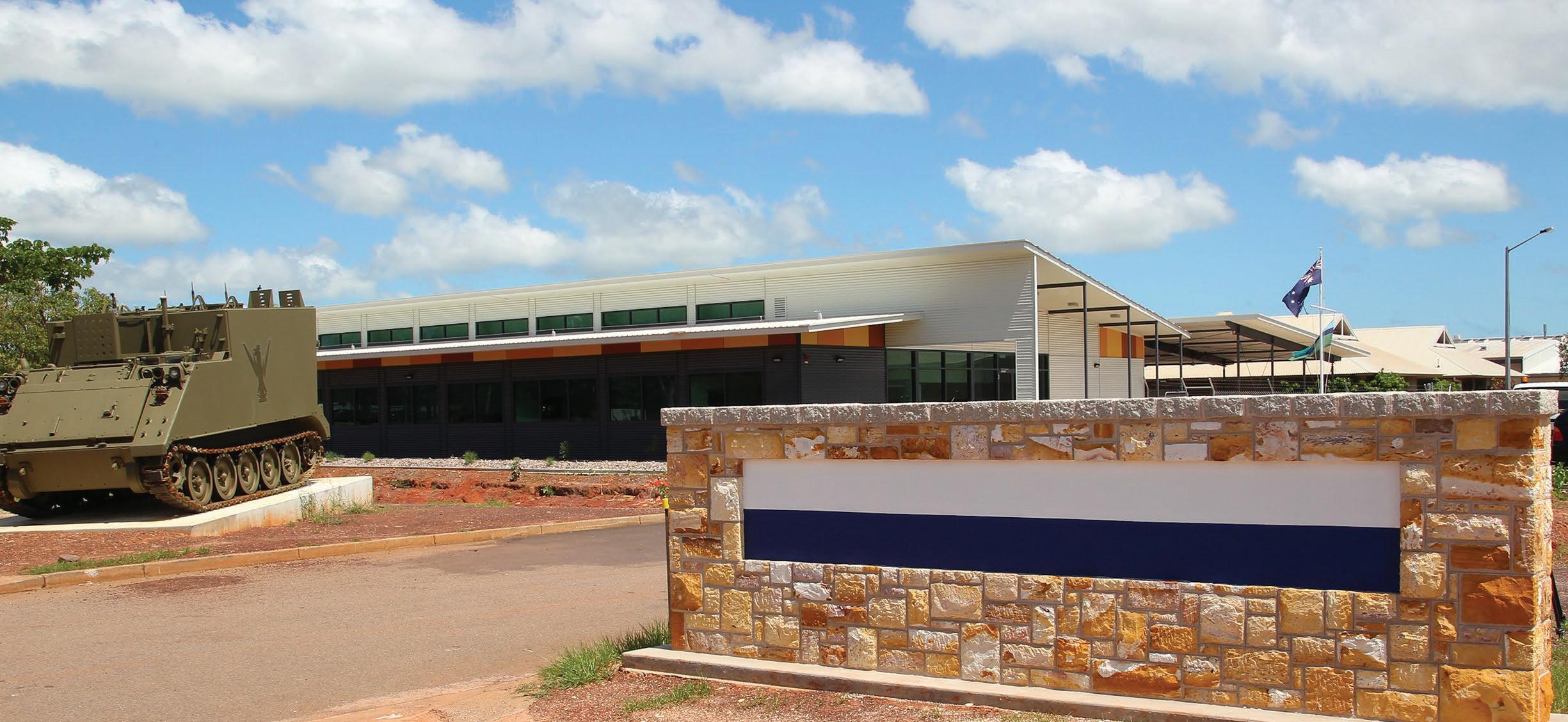
Robertson Barracks, Darwin, Northern Territory
time and again its ability to deliver top-quality design and construct projects within the challenging environments of fully operational military facilities.
Further projects undertaken as a part of the APIN expansion during the decade included design and construct contracts for aircraft hangars and hard stands, a new main entry guardhouse at Robertson, military training facilities, logistics facilities and a series of expansions of various mess and recreational buildings originally constructed by the group.
One notable project, undertaken in 1999 was the first use of a novated design-and-construct arrangement for a $15.5m artillery facility.
The APIN operation would continue delivering projects to John Holland into the mid-2000s; from the first in 1990, it would number no fewer than 20 projects, totalling more than $163m.
Tom Dwyer was based in Darwin with John Holland for the bulk of this decade. The group’s local presence was, he said, fundamental to its successful relationship with the Department of Defence. On average, he said, about half the projects offered under the APIN banner were won by John Holland.
“APIN was definitely the feature for me, our responding to Defence’s
strategic initiative and identifying that the volume of work was going to support an increase in our Darwin office. The program of works was basically building a barracks (Robertson) over a five-year period, these continual packages released to the market at what Defence considered a pace that would allow the delivery of the facilities without straining the marketplace.
“By a reasonable count, we probably did about 50 per cent of the work … We were certainly the dominant player on site.
“Having at least one project on the go all the time gave you contact with the client. It was a really good circumstance to be in. We were well informed about what was coming up and what was important to them.”
APIN was far from the only calling for John Holland’s Defence skills. In this decade alone, the group would build houses at the Coonawarra and Larrakeyah barracks (NT), wharves in Western Australia, a medical centre at Lavarack Barracks (Qld), a weapons testing range and water storage facilities in Victoria, a jet-engine test base and war-gaming facilities in the ACT.
Amid all that activity, perhaps one project that stood out for its scale and significance. The Jindalee Over-the-horizon Radar Network (JORN) project, commenced in 1995
on behalf of Telstra (in turn, for the RAAF), was an early-warning radar surveillance system to monitor more than five million square kilometres of land and sea.
From paired bases near Laverton in central WA and Longreach in central Queensland, JORN could “see” over the horizon to detect shipping and aircraft from well beyond the coastline. This was achieved by transmitting signals upwards, to be reflected back down by the ionosphere (200-500km above the earth’s surface) and illuminate shipping or aircraft targets.
Work in the very harsh regions comprised clusters of buildings at each site, the design and installation of generators and water treatment plants, and tens of kilometres of electrical cabling. The buildings, constructed of tilt-up concrete with metal deck roofs, had to include electromagnetic shielding. John Holland introduced a world-first
design that used sheetmetal, folded and spot-welded in a unique way.
John Holland was awarded an Australian Institute of Building Excellence Award for this project, which was completed in 15 months.
As mentioned earlier, John Holland’s APIN activity in the Northern Territory was but a foretaste of the decade to come; the new millennium opened with about $45m in annual turnover from Defence projects and by the end of the decade typically exceeded $300m in annual turnover. The Northern Territory, where it had all but started, remained fairly consistent, while a number of big projects catapulted Queensland, in particular, and NSW/ ACT often beyond $100m per year.
As John Holland entered the decade of the 2010s, the company could boast of being the only construction company among the Top 10 contractors for the Department of Defence.
Education
Changes
to government policy and funding responsibilities naturally exert an influence on infrastructure needs. Such a shift had occurred in the education sector during the 1960s and ’70s, when the Commonwealth Government became increasingly involved in taking over the funding of schools.
This seismic shift put the spotlight on the then-fragmented structure of technical education. A 1974 report from the Australian Committee on Technical and Further Education, entitled TAFE in Australia, would give a new direction, cohesion and name to technical colleges Australia-wide.
The subsequent acceleration of Commonwealth investment in schools and TAFE colleges will have
reaped incalculable benefits since, in the elevation of Australia’s skill sets, employment and economic advancement.
John Holland’s first significant foray into the education sector was a $5m project to construct, in 1984, a four-storey headquarters for the NSW College of TAFE in semi-bushland in Hornsby, on Sydney’s northern fringe.
The TAFE presence gained significant momentum two years later at Frankston, Melbourne. Two separate projects marked a significant expansion of the facility, beginning with the construction of a $7.8m two-storey building ‘E’ and, four months later, the commencement of a $3.2m, two-storey building to house the hospitality studies area.
At the time, it was hailed as one of the world’s best aeronautical training centres …
The 1990s was to be a feast of learning. The government was starting to invest heavily on education facilities; it was the game to be in.
The decade opened with a prestigious project in the University of Queensland’s new six-storey, $9.3m Molecular Biosciences building. Its purpose was to consolidate the diversified departments of parasitology, biochemistry and microbiology that had been blossoming at the UQ since its founding in 1910. The new building augmented an existing, 10-storey Chemistry facility.
On the opposite coast, John Holland undertook a $2.4m refurbishment of existing structures in Fremantle’s West End to create the first campus of the University of Notre Dame Australia. Concurrently, John Holland commenced a $15.5m project to construct a three-storey building for East Perth TAFE.
Very quickly, John Holland’s education span reached all corners of the country. Three new singlestorey laboratory buildings were built for Northern Territory University’s Aquaculture and Horticulture facility in August, 1991, and new student residences constructed some months later. At the South Brisbane TAFE in Queensland, a five-storey, $12.8m Food Technology Building was constructed and fitted out to the
highest commercial food-handling standards.
Queensland provided a series of strong projects in the early-1990s. The Queensland University of Technology’s Kelvin Grove campus, just north of Brisbane’s CBD, expanded in 1992 with the $10m construction of three new lecture buildings and a fourth, main lecture theatre.
Concurrently, Queensland’s Griffith University added a 6700sqm, $11.2m Environmental Engineering and Behavioural Sciences building to its campus in Nathan, Brisbane, along with a $2.6m, 1600sqm building to house its Graduate School of Management and Law.
Also in 1992, John Holland constructed a landmark TAFE educational facility in Victoria, in the Aerospace Industry Training Centre in Broadmeadows. The $9.1m centre comprised a reinforced concrete and structural steel aircraft hangar, surrounded by three levels of classrooms and with a distinctive roof providing abundant natural light.
At the time, it was hailed as one of the world’s best aeronautical training centres and formed a part of Victoria’s major training hub for the automotive, aeronautical and polymer engineering industries.
Elsewhere in Melbourne, Monash University gained a new four-storey
building to house its Information Services and Academy of Performing Arts ($10.7m). Concurrent with that job were the construction of the Frankston and Holmesglen TAFE colleges, worth respectively $4.8 and $7.2m. The latter was dedicated to training for the furniture-making industry.
A year later, in 1994, John Holland stepped up for another two venerable Melbourne educational institutions. The group won the $10.2m contract to construct Victoria University’s Building M student services centre at the main Footscray campus.
A few months after that, in central Melbourne, work commenced on the Royal Melbourne Institute of Technology’s (RMIT) $14.1m, sixstorey Union campus building, a post-tensioned concrete structure with precast verticals.
The nation’s other extremities were not overlooked in the education revolution. The University of Western Australia gained a new
School of Agriculture in the form of four separate concrete-framed, masonry-clad buildings, a contract worth $13.4m.
Palmerston TAFE in the NT took root in December 1993 with the $5.3m contract for a Tourism and Hospitality training facility. It was a prescient move, with tourism and hospitality taking on increasing importance in providing careers for young people in the Top End.
Indeed, the growth of Palmerston, a satellite township some 20km south-east of Darwin, had John Holland paying a return visit later in the 1990s to construct the $4.9m Fairway Waters Primary School. It was a difficult project, the poor quality of the existing fill necessitating the site being excavated to a depth of one metre and filled with more stable, imported material.
Opened in 1998, the school –and the suburb – has since changed its name to Durack, after the great pioneering family of the region.
MCG Southern Stand
AsSydney has its Opera House, so sports-loving Melbourne has its cultural icon in the Melbourne Cricket Ground (also known as simply “the G”). The vast, circular structure set in lush parklands at the south-eastern corner of the CBD bats above average internationally, being the largest sports ground in the southern hemisphere and boasting the largest crowd capacity (100,000) of any cricket ground in the world. First constructed on this site as a wooden members’ stand in 1854, the MCG – home of the Melbourne Cricket Club – hosted the first ever cricket Test (between Australia and England) in 1877 and was also the focal point of the Melbourne Olympics in 1956.
The MCG’s long history with cricket, Victorian (later Australian) Football League and major cultural events has been characterised by much evolution of its facilities. The Northern Stand built for the 1956 Olympics was the first true step towards replacing the jumble of smaller stands with a more consistent encircling of the sports field.
The Southern Stand, built in 1937, stood for just over 50 years before its turn came. The commissioning of the new stand became a key catalyst in healing an uneasy relationship between cricket and football authorities, who shared the use of the facility.
The proposal for a new Great Southern Stand called for the design and construction of a structure that
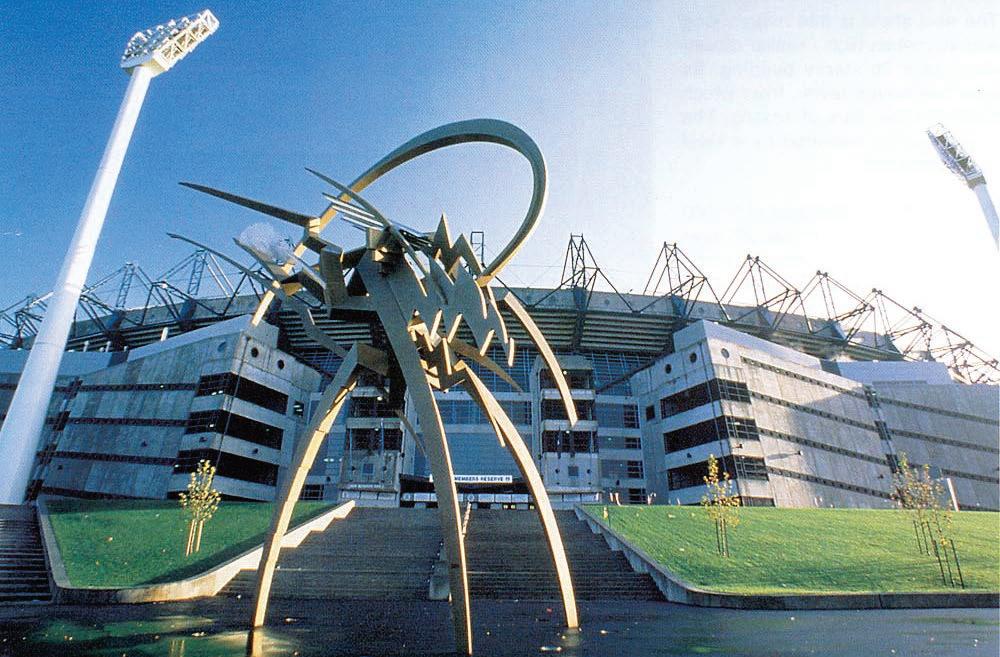
would increase capacity by 40,000 patrons (more than doubling the original Southern Stand’s combined undercover and open-air capacity). The MCC, unable to afford the proposed $100m project, accepted an offer from the VFL to help fund the project, in return for 30-year use of the ground.
An interesting and significant connection is that the president of the Melbourne Cricket Club from 1985-’92 was Don Cordner, who had formerly played premier VFL for the Melbourne Football Club in the 1940s.
Indeed, Don Cordner was one of four brothers who had reached the top tier of VFL with the Melbourne club. One of those brothers, Denis, following a successful sports and diplomatic career, was appointed to
succeed Sir John Holland in 1986 as Chairman of John Holland Group. He was serving in that role, and overseeing the initial stages of the group’s successful bid for the Great Southern Stand project, when he died suddenly of heart attack in October, 1990.
Those involved in the MCG project still clearly recall the superiority of John Holland’s bid. The challenging project played to the group’s strengths in innovative engineering, a standout point being the design of the roof, comprising a half-circle of steel masts and cantilever truss supports.
“There was no doubt that in the early ’90s and throughout the ’90s, the thing in which John Holland was always able to excel was the difficult
jobs,” said Glenn Palin. “Because of our engineering background, we always seemed to excel in solving the difficult problems and coming up with new solutions.
“We got involved in the more difficult things like the MCG, those sorts of things where it wasn’t typical. There was something different about those, and that’s where we seemed to excel.”
Greg Cain recalled that the market was extremely competitive at the time. “The thing that stood out for me is that the project was bid when there was a lot of work around, so getting the right subcontractor prices was difficult. But when we won the job, the market had changed quite significantly and it became tight.
The pricing was far better than we’d assumed at the tender, so we enjoyed some advantage there.”
The $119m building, 324 metres long and 45 metres tall, housed four tiers of seating with the upper three under the shelter of the cantilever roof. Its construction design involved a very high degree of precast components –some 14,000 elements, including 36km of hollow-core planks – and, in combination with some 2700 tonnes of reinforcing steel and as much again in structural steel, this enabled a completion of the imposing structure within just 13 months.
Helping to manage the entire process was the extremely innovative use of a new software program, Primavera, as Greg Cain recalled.
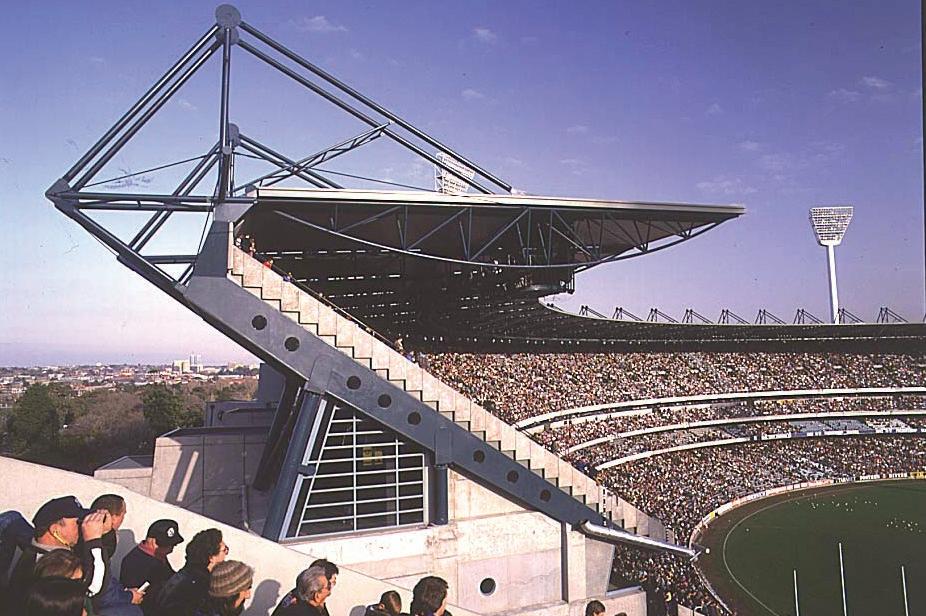
“It was so tight in terms of time, we were running a programming software called Primavera, a fairly new system. It was based in the US and we had people running the program 24 hours a day, using a module called Finest Hour.
“We were applying it on a major construction project – I think, for the first time ever. Running that module gave us the ability to know exactly where they were at, at any time of the day. I think John Holland was the biggest user of the software at that time – certainly in Australia and possibly even internationally.”
The MCG Great Southern Stand was a landmark for Janet Holmes à Court, too, as the first on-site visit she made after acquiring John Holland. Decades later, she recalled being impressed by the innovative roof design and the triggering of her own curiosity, which stood her in good stead with the new venture.
“Peter Westaway was in charge of engineering and Randolph Cresswell was in charge of construction,” she remembered. “The John Holland engineers had worked out a very interesting way of building the Great Southern Stand. Our bid was something like $20m less than the nearest one, but Randolph told me he had never had to fight so hard from a low bid position. The clients didn’t quite believe it could be done.”
Justin Lee, who was at the time Quality Assurance manager for John Holland, felt pride at every visit to a football game. “I had the privilege of spending a lot of time in that place, looking at all the requirements, make sure we had everything covered … It was a magnificent southern stand.”
Lee recalled one glitch that arose, not long after the stand’s opening in 1992, timed for the final of cricket’s World Cup in which almost 90,000 spectators saw England downed by Pakistan.
“One day Randolph Creswell called me into his office and said, we just got a complaint that when the stand was opened, a lady fell off the steps,” Lee recalled. “The depth of the steps on one side was shorter by something like 10mm. It was specified correctly, but somehow the formwork used there was narrower. We went and re-did them all.”
Those would be among the 7300 stairs which would play host each year to the MCG Stadium Stomp charity walk. The Great Southern Stand received a $55m facelift in 2011, with upgrades to the seating, food concession and toilet facilities to keep the stand modern and ready for another 20 years of service.
The MCG Southern Stand was presented with the coveted Australian Federation of Construction Contractors Achievement Award in 1992.
The mCg southern stand was presented with the coveted Australian Federation of Construction Contractors Achievement Award in 1992.
Esso Platform Maintenance Services
Few environments on earth are so extraordinary and demanding as that of an offshore oil and gas platform. While modern platforms strive to offer hotel-like accommodations, the environment is almost literally alien: the facts of isolation, the harsh conditions of the open sea, constant proximity to the work environment and the disorienting effects of shift work make oil platform life perhaps not so dissimilar to being on a space station.
The first drilling in Bass Strait, off Victoria was undertaken in 1965. The location presented severe challenges with its deep water and extremely hostile weather. Two years later, Kingfish Field – Australia’s largest oil reserve – was discovered, some 40
kilometres off Victoria’s Gippsland coast. In ensuing years, the field expanded with more platforms, Tuna and Bream being among the better known.
Like the platforms themselves, their demands on contractors are unique. Any manner of job can arise at any time, from small, custom fabrication to heavy construction. And with gas and oil being delivered and stored under extreme pressures, the issues of environmental integrity and employee safety are in focus as perhaps nowhere else.
In July 1989, Esso recognised in John Holland the ingenuity and flexibility to provide just these services. The contract embraced fabrication, construction, heat
treatment, painting and insulation work. The work was effectively split in two: land-based construction and fabrication, for transporting by helicopter or barge to the offshore platform; and the on-site installation.
All works, naturally, had to comply with Esso’s in-house specifications.
It was a timely win for John Holland, which at that point sought to shore up its financial stability through longer-term contracts such as this.
John Holland immediately established engineering and fabrication facilities in Traralgon and in nearby Sale, the Gippsland township that served as Esso’s land base for its Bass Strait offshore operations. A key ingredient of the contract was John Holland’s access to highly skilled welders who possessed the unique qualifications for work in the oil and gas exploration industry. A large component of the contract was to provide welding services on high-pressure pipelines.
For all those demands, and the logistical challenges of the project, John Holland’s then Managing Director Graham Duff was not lacking in confidence, a leader from the time recalled.
“Our team was called down to meet with the client, Esso. Graham Duff made a big statement to the client: that if we have one safety incident,
he’d give them a 2.5% discount on the value of the entire works.
The team couldn’t believe that he had offered this. But that’s what the MD said – and that’s what the guys delivered. It was brilliant stuff. If I remember rightly, it was zero LTIs. It was a game-changer, in many respects.”
So impressed was Esso that the initial, three-year contract was renewed twice.
No less impressed was John Holland’s Chairman, Janet Holmes à Court, herself a driver in employee safety. She well remembered her visit to the Bass Strait platform, some seven years into the project.
“I went with Peter Coleman (of client, Esso) out into Bass Strait, when John Holland was in charge of maintenance of some of their oil rigs out there, where we worked for seven years without an LTI. I remember distinctly, there was a sign board, as we have outside every project practically, the number of days since the last LTI, for ourselves and for Esso …”
The board already bore a figure beyond 2500 days.
“I felt great that we’d done better than anybody else,” Janet recalled. “In fact, the guys had a joke with me that the fellow who was in charge of that project was so obsessed with keeping his safety record, that if someone had hurt themselves, they possibly would’ve been pushed into the sea …”
Wanaea/Cossack FPSO topside modules
Being a pioneer can sometimes be painful, although experience, talent and thoroughness ensure that such occasions have been rare in John Holland’s history. A 1993 project to design and construct the topsides for Australia’s first FPSO – a floating production, storage and offloading vessel for offshore oil and gas – taught the company some hard lessons about this new engineering field.
An FPSO is a tanker ship that is moored to the seabed and attached to an integrated turret, around which the ship can rotate (or “weathervane”) to allow for ocean and weather conditions.
Via flexible pipelines, the FPSO is fed from one or more subsea wells. The FPSO comprises various oil
and gas processing facilities within a structure on top, bulk storage within the hull and facilities for periodic offloading to tankers or via pipelines.
Woodside Petroleum recognised the economy of FPSOs and commissioned the conversion of an existing oil tanker, the Chevron London, to create the Cossack Pioneer, Australia’s first FPSO. It would be put into service in the Cossack and Wanaea oil fields of the North West Shelf Project, in the Carnarvon Basin off Western Australia. The Wanaea/ Cossack fields were expected to produce up to 115,000 barrels per day of crude oil.
While the hull of the Cossack Pioneer was being converted in a Singapore shipyard, in October
1993 John Holland was engaged to design and construct all the topsides in a 14-month project valued at $46m. The contract also called for the installation, in Singapore, of the completed facilities on the converted hull.
John Holland’s challenge included the design and construction of six process modules and two laydown modules. The FPSO’s processing facility is laid out sequentially along the deck, the three-stage process separating crude oil from gas, compressing the gas for recycling via separators, then dehydrating the gas and compressing it, ready to be offloaded via a flexible line to a tanker moored astern.
The topside process modules designed and constructed by John Holland were to house equipment such as heavy wall separator vessels, a molecular sieve dehydration unit, several plate and printed-circuit heat exchangers and a trio of enormous centrifugal-export gas compressors.
John Holland’s responsibility also included final testing and precommissioning, prior to the structure being shipped to Singapore by rollon, roll-off vessel.
Here emerged an unexpected shortcoming in the design of the topside structures. The designers had underestimated the degree of movement and flexibility that were present in such a large ship. Further calculations and modifications had to be made, to ensure adequate torsional rigidity in the structures.
The delays in design and procurement caused the project team to miss its deadline with the ro-ro ship that was to transport the topsides to Singapore.
A barge had to be chartered for the voyage to Singapore. Even this was delayed by a protest in which a group of Filipino seafarers from the chartered barge, aggrieved over an industrial issue unrelated to John Holland, had physically tied themselves up at the wharf in Jervoise Bay.
It was a difficult, but ultimately educational project for John Holland – and also ultimately successful, with the Cossack Pioneer serving its owner in the WA fields for 20 years, before being sold (and renamed FPSO Opportunity) to new owners in south-east Asia.
ABC Studio and Orchestra Rehearsal
Asthe 1980s drew to a close, the Australian Broadcasting Corporation had sought a new, multipurpose headquarters in Melbourne to gather its main Victorian operations –notably Radio National – under the one roof. With its NSW division having gained a new headquarters in Sydney’s Ultimo in 1991, a suitable Melbourne equivalent was found in the city’s rapidly developing Southbank precinct.
Southbank, formerly an industrial and warehousing precinct, had begun its transformation in the early-1980s. The opening of Melbourne’s new Art Centre in 1984 was a catalyst for rapid development, much of which had to take into account the variable quality of the riverside land.
John Holland was awarded the contract to manage the design and construction of the new ABC project, which would house radio and recording studios and a rehearsal and recording space for the Melbourne Symphony Orchestra. The five-level building also included production areas, transmission equipment and administration areas, accommodating up to 560 staff.
The building was designed so that the main studio and lounge areas were grouped around a large, central atrium. Extensive windows and glassfronted lifts underlined the public broadcaster’s message of transparency and accessibility.
Adverse ground conditions dictated the building be constructed on a
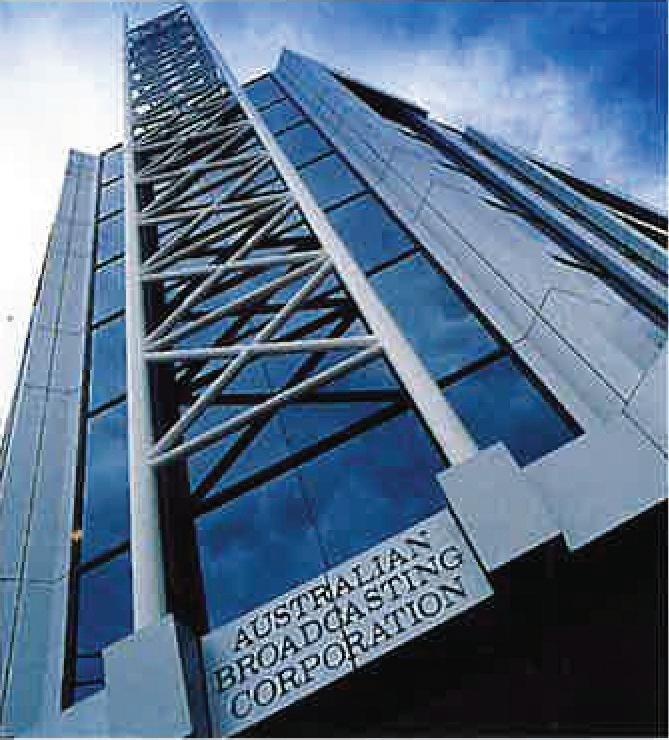
piled foundation, the ground floor area comprising a suspended slab with band beams cast directly on the ground. Precast sections created the upper levels’ slab and band beam floors. Large, fabricated beam columns supported the rehearsal hall, and the roof was constructed from welded beams with a compositereinforced concrete slab.
Naturally, acoustic considerations in such a building were paramount. This extended to air-lock doors and a silenced air-displacement ventilation system for the sound studios. The MSO rehearsal hall was effectively a separate structure within the main
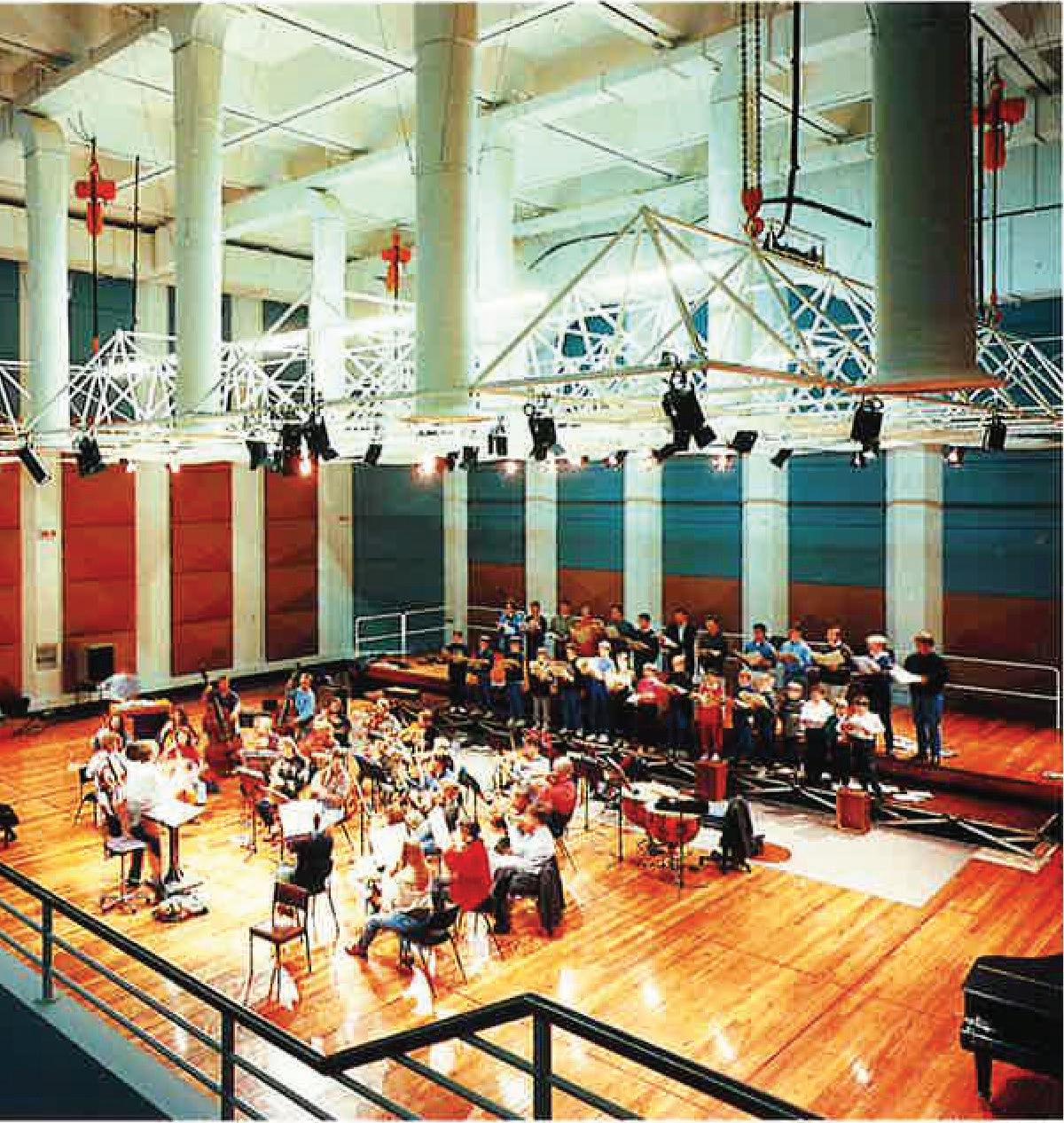
building, so as to be isolated from airborne noise. It could accommodate up to 100 orchestra members and seat an audience of up to 250.
Design foresight determined that the ceiling-level cabling be directly accessible via an adjacent, continuous open slot, enabling the changing of cabling without major disruption to broadcasting and recording activities within the building.
The ABC’s two other major bases in Melbourne’s Ripponlea were abandoned in 2014, in favour of an expansion to the existing Southbank location. It was to be completed in 2017.
Esso Casting Basin and Outfitting Berth, Port Kembla NSW
In April 1993, John Holland was in its fifth decade of operation –yet new and unfamiliar challenges continued to be presented to its resourceful team. One such was the preparation of a casting basin at Port Kembla, NSW; the first casting basin project ever undertaken by the company.
The casting basin was to be used for the construction of a pair of concrete gravity structures, to be eventually towed to their locations at Esso’s West Tuna and Bream B oil platforms in Bass Strait. The caissons themselves would be made by Transfield Constructions.
The $14.2m, 11-month project involved the design and construction of a casting basin some 30 metres
from the shoreline, and 35 metres deep. This required extensive earthworks, the construction of sheet pile walls, dewatering, drainage and the dredging of approximately 80,000sqm of earth.
While the casting basin was a first for John Holland as a group, it was something of a specialty for Peter Allen. The hugely respected engineer, whose name is remembered in John Holland’s award for the Most Outstanding Individual since his passing, was fundamental to the success of the project. Both the company, and Allen in particular, won high praise from the client, Esso.
Kota Kinabalu Water Supply, Malaysia
InDecember 1992 the Malaysian Ministry of Infrastructure Development’s water department took the innovative step of funding a water treatment plant by BOT (buildoperate-transfer) contract. This was, in effect, the forerunner to the modern public-private partnership (PPP).
John Holland was the motivating power behind a private consortium named Jetama Sdn Bhd, which would design and construct comprehensive water supply and treatment systems for the city of Kota Kinabalu and its population of 210,000 people.
The state government of Sabah had indicated its wish to upgrade Kota Kinabalu’s water supply a decade earlier, but this had been rejected at a federal level. John Holland took
the initiative and approached the state government with the privatised model.
John Holland established Jetama, which also included French water specialist Suez Lyonnaise des Eaux, Australian pipe maker Hume and the local state government of Sabah.
John Holland’s cost-effective engineering came to the fore in a redesigned water supply scheme that negated the need for several expensive pumping stations. It achieved this by exploiting gravity feed from a new, 80-hectare dam (Babagon) located in a steep valley. Jetama was granted the exclusive right to supply water to the region for 20 years.
In 1993 Jetama took over control of the existing water facilities and
commenced to develop new facilities. The project included the design and construction of a new dam on the Bagagon-Tampasak River, a 110-megalitre/day (Ml/d) water treatment plant at Inobong, six 10 Ml/d storage reservoirs and a booster pump station at Kasigui, along with 67km of cement-lined, mild steel treated-water pipelines.
These new works were in addition to the refurbishing of the existing Madziang raw water pumping station and its associated raw water lines to increase raw water capacity by 40 Ml/d. The construction project ran for approximately six years.
The centrepiece was arguably the Babagon Dam, a rock-filled, concrete-faced design measuring 350m long and standing 64m tall and featuring a diversion spillway
tunnel and intake tower. It created a catchment area of approximately 30 square kilometres. It was built in a very undeveloped, rural area, which posed extra logistical challenges.
Valuable lessons were learned in the laying of the water pipelines across rivers. Methods were developed to create flexibility in joining the pipes to the bridges, so as to accommodate subtle expansion of the pipes’ length when under full pressure.
By 2000, Kota Kinabalu was not only enjoying 110 additional megalitres per day, but enjoying water whose quality achieved World Health Organisation standards for the first time. Increased water pressure has also made piped water available to farther-flung areas that formerly relied on manual collection.
Satui Mine
Indonesia is among the world’s five largest producers and exporters of coal, providing inexpensive power to tens of millions of homes and industries across south-east Asia. The nation first began to come to terms with this natural resource in the early-1990s, when the government reopened coal mining to foreign investment.
Through a strategic alliance involving Australian mining giant BHP, John Holland Asia was engaged in 1991 to construct and operate a coal mine from an open pit in Satui, South Kalimantan. Significantly, it was John Holland’s first operate-andmaintain (O&M) contract, though the $15.4m, 39-month project was concerned with major earthworks
and the machinery it entailed, rather than the actual mining operation itself.
Despite the remoteness of the location – which prompted innovative and enduring training for many among the local population – the project was welcomed as virtually a lifeline for John Holland, at that time struggling to fill its forward pipeline of work.
Naturally, there were enormous challenges, including early lessons in the diplomatic complexity of importing and moving 125 items of heavy and expensive mining equipment across national borders in south-east Asia. There was also the geological challenge of coal seams as thin as 30cm.
key to the success of the venture was the establishment, in 1992, of an apprenticeship program for the training of young local workers.
But Satui would prove a shining example of John Holland’s ability to think outside the square. John Holland’s Dai Davies was heavily involved in the project. “At Satui, PT Arutmin (BHP) annually mined some two million tonnes per annum of coal and we moved about 10 million cubic metres of overburden.
“It was very successful from a safety and a profitability point of view. It employed more than 500 people working around the clock –and it was managed with only a radio link to the outside world.”
The project relied on 125 pieces of equipment, including heavy openpit Caterpillar D11, D10, D9 and D7 bulldozers, D400 dump trucks and 988 wheel loaders. The coal was carried to port by a fleet of Volvo 20-tonne trucks. All these machines were working 24 hours per day, seven days per week.
Key to the success of the venture was the establishment, in 1992, of an apprenticeship program for the training of young local workers in diesel-fitting, auto-electrical engineering and heavy fabrication. The apprenticeship was designed and jointly run by Central Queensland TAFE and the first intake comprised just eight trainees.
They worked to an uncompromising standard, performing four times daily refuelling, lubrication and
inspections and undertaking major overhauls and repairs within a purpose-built, on-site workshop, always within a 48-hour timeframe.
The four-year training program was still in operation a quarter of a century later, and included English language, computer and work safety skills.
“We ended up with the capability to do full rebuilds on-site of the D9, D10, D11 dozers, all the big, heavy mining gear – stripped down to the chassis and rebuilt, using TAFE training,” Davies explained. “It was an export opportunity for TAFE and for John Holland it was a big training initiative for people in remote Indonesia.
“We had Indonesian guys from traditional backgrounds and of very small stature who, after appropriate training, could strip down a D10 and completely rebuild it – sending it back to work as good as new, not to return to the workshop for a further 20,000 hours. The gear ran 24/7, for about 8000-plus hours per year.
“Some of these guys found their way to Australia and worked as Mechanical Supervisors here.”
John Holland’s mutually beneficial experience in Satui led to further Indonesian projects, such as granite mining on Karimun Island in the Straits of Malacca (1996) and other coal port and mine contracts.
These included another, hugely successful O&M mine contract on the remote island of Sebuku (1997), 100km east of Satui, and the PT Kaltim Prima coal preparation and conveying operation, which pioneered the then-longest single flight conveyor (13.1km) in the world.
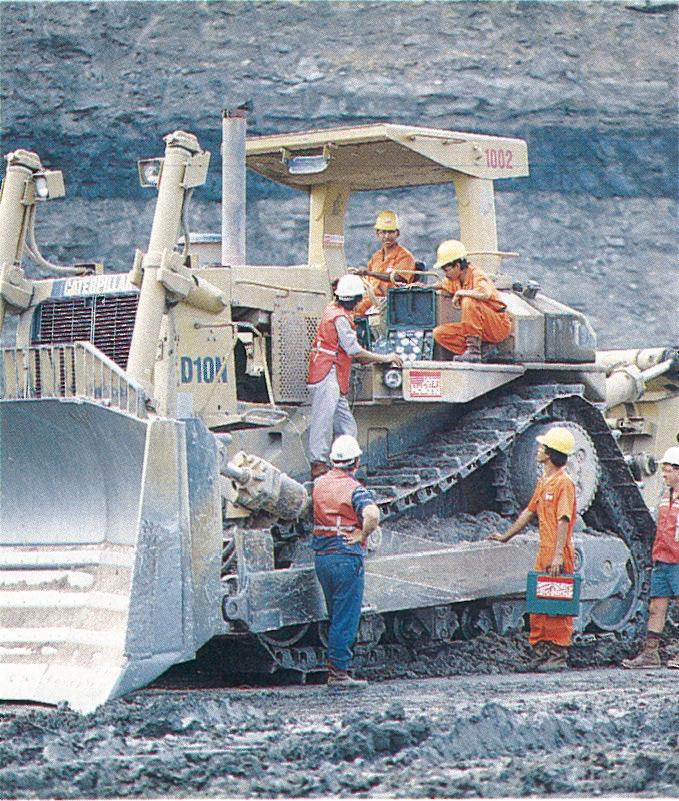
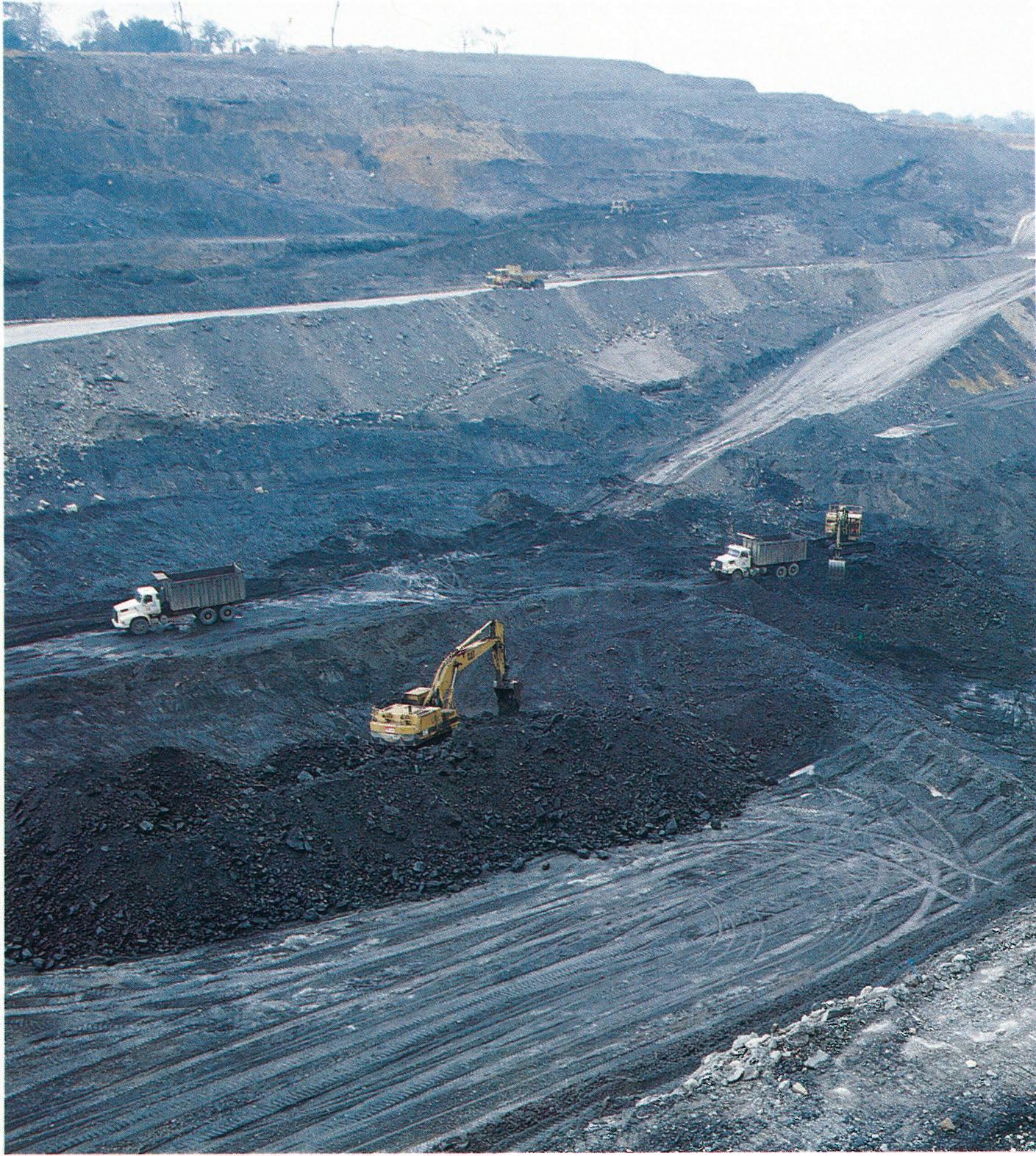
Malampaya Concrete Gravity Structure, Philippines
The Philippines’ natural gas industry today provides 20 to 30 per cent of the nation’s energy requirements and contributes billions of pesos annually in revenue. It all began in late-1998 with the commissioning of the Malampaya Deep Water Gas-toPower Project.
The gas field was located 80km off the coast of Palawan Island, in Subic Bay, 80km from the northern tip of Palawan Island. Gas was relayed from the remote field to a trio of gas-fired power stations on Luzon Island, where Manila is located.
Naturally, John Holland was there at the beginning.
This $148m, prestigious project would summon all the group’s
engineering and planning skills. The job called for the design and construction of a concrete gravity structure for the offshore gas platform for the client, Shell. To achieve this, John Holland created a casting basin on Redondo Peninsula, Subic Bay, 80km west of Manila, from where the completed structure would eventually be towed 400km south to the Malampaya field.
John Holland had quite recent experience in this line of work, in the Esso casting basin project in Port Kembla, NSW in 1993. But whereas on that project John Holland created the casting basin and handed over to Transfield to construct the CGS, in Malampaya the project was all John Holland’s.
The group wasn’t wanting for manpower. John Holland had its Asian operation well organised, with 100 expats across the area. Malampaya made good money and John Holland did a great job on it.
Aside from taking on the entire design and construction of the CGS, there were various operational challenges – not least around safety and the fact that the casting basin had to be constructed in a seismically active area.
Mount Pinatubo, just 40km north of Subic Bay, had lain dormant for 500 years. It erupted in June 1991, spewing an estimated 10bn tonnes of magma over the surrounding area in what was the second largest volcanic eruption of the 20th century. One week before, 25,000 civilians and 15,000 personnel from the US Air Force’s nearby Clark Air Base had been evacuated.
The casting basin, some 35-50 metres deep, was constructed with plenty of additional strengthening, after consultancy with Arup Energy UK. The effort was well spent.
While the concrete structure was underway, around Christmas 1999, there was a large seismic event in the area. Swaying of up to a metre was observed at the top of the gravity structure. If John Holland hadn’t anticipated the seismic activity, and made sure there was enough shoring
of the basin, the project would have been at risk.
Safety was a primary concern shared by the client, Shell, and John Holland. Shell executive David Greer, the Dutch company’s Malampaya project director from 1998-2002, was only too aware of the social volatility that could occur in the Philippines.
Janet Holmes à Court was a bemused visitor to the Malampaya project.
“Someone had thrown a hand grenade through the window of David Greer’s office in Manila about a week before we were going there –so they moved out. So we landed at Manila airport, we went through Customs, up onto the roof to a helicopter, and flew straight to Subic Bay.
“Our project manager Jock Chudacek had an enclosure where we were building this amazing thing with about 2000 employees. We had hardly an LTI. He had all of those people under his control, it was a remarkable achievement.
“The next day, we were picked up by the helicopter, we landed on the roof of a hotel, had our meeting with David Greer, then up to the roof and back to the airport. We did not put our feet on the ground in Manila. It was a scream.”
Bill Wild, who had taken over as John Holland managing director with
the purchase of the company in 2000 by Leighton Holdings, remembered accompanying Janet on another Malampaya visit.
“She was up there, walking around, talking to everyone as she did. She would remember people from years before and ask things like, ‘How’s your wife?’ We had this great line of people, shaking her hand and greeting her. I don’t think they knew who she was, they probably thought she was the Queen of England.
“Then she wanted to climb up the ladder to go up into one of the towers. I’m thinking, ‘Here we go, I’ve just taken over the company and I’m going to have to report that the Chairman fell off a bloody ladder and killed herself …’”
The finished caisson constructed by John Holland measured 112m by 70m – about the size of a football field – and 16m tall. Weighing 85,000 tonnes, it was sunk onto a pre-laid foundation of rock 43m below the surface of the Palawan Sea and filled with 75,000 tonnes of iron ore to
ensure its stability. The caisson was designed so that it can be re-floated at the end of its operational life.
The four concrete shafts supporting the gas platform stood 63 metres tall, equivalent to an 18-storey building. The finished platform atop, weighing 13,000 tons, measured 40 metres long by 90 metres long, standing 25m high from the superstructure floor to the helipad deck. A crew of up to 44 could live and work on board.
This first Malampaya platform –joined in 2015 by a second platform –began delivering gas in September 2001.
All involved looked back on the Malampaya job with understandable pride. It was a highly complicated project, and John Holland had an exemplary safety performance. The client was uncompromising in respect to their safety standards, but John Holland committed to surpassing them.
In every way, Malampaya delivered a fantastic outcome.
Sega World
It’s not often that a bright blue, sneaker-shod cartoon hedgehog is behind a $48.7m project, but such was the case in 1995. Japanese electronic games company Sega enjoyed spectacular success with its 1990 character Sonic the Hedgehog and its associated Mega Drive games console. Five years later, the games giant embarked on a flagship store in Sydney’s rapidly developing Darling Harbour tourist precinct.
Glenn Palin, former CEO of John Holland, was working in business development at that time, and had been closely involved in the project from the beginning.
Sega World was a bold and broad-ranging concept, being both a theme park and retail space. For John Holland, the fast-tracked design and construct project called for a two-storey, landmark building with a vast, 200m by 50m column-free
area on the first floor to house the indoor theme park’s various rides and interactive games areas.
Comprising a large red cube capped by a 45m-high, conical blue glass atrium, the 20,000sqm, two-level building was constructed from a posttensioned concrete suspended floor, a structural steel frame, metal deck roof and aluminium cladding. There were extensive paved external works.
John Holland was separately awarded the contract for the $20.9m fit-out of the hi-tech building. It incorporated a ground floor area of restaurants and retail stores, with the 10,000sqm first-floor theme park that was the largest of its kind in Australia at that time.
The theme park was entered via a “time tunnel” and divided into Past, Present and Future areas, containing seven different amusement rides. John Holland’s scope of works included the installation of ceilings, partitions, services, scenery and the park’s attractions, such as the rollercoaster ride, ghost train, dodgem car courses, “4D” cinema (with hydraulic, moving audience stalls), virtual reality machines, food court and more than 100 coin-operated arcade cabinets. Particular attention had to be paid to acoustic control, with the use of vibration and sound-isolated, structural floor and wall elements.
John Holland completed the project in just 17 months and Sega World was
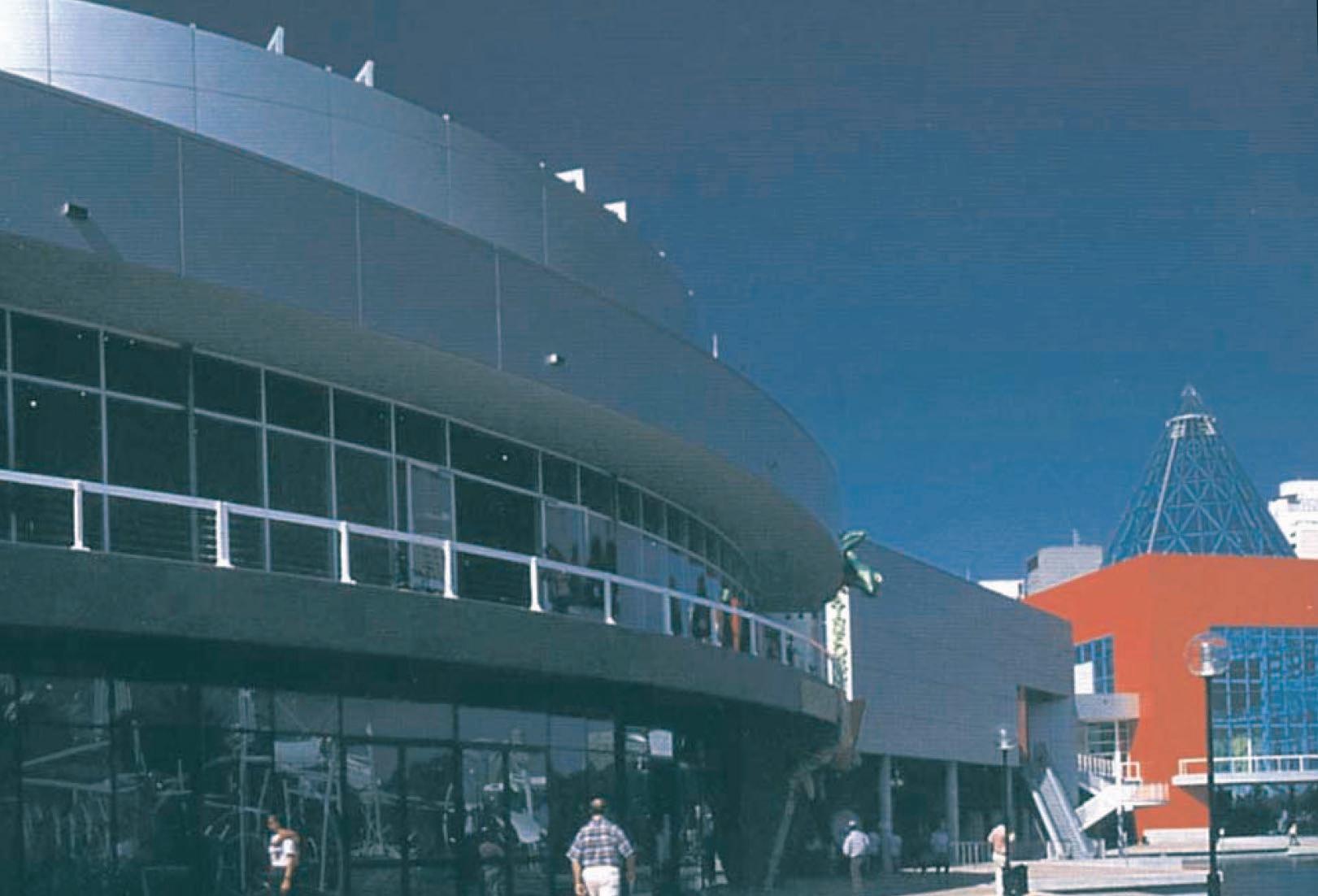
opened to the public in March, 1997. It attracted much fanfare, the media dubbing Sega World an “interactive Disneyland.”
Sadly, after only four years of operation the Sega World theme park failed to achieve its owners’ expectations and the venture was closed. The site was later redeveloped with large commercial offices.
Glenn Palin felt that Sega World was a “fantastic” project, conceived
and executed with efficiency and quality and a fitting showcase for John Holland’s ingenuity and technical capabilities. He has an enduring souvenir of this project in a lifetime family membership to Sega World.
“The only problem is,” he laughed, “they knocked it down a few years ago. I’ve got a membership, but I’ve got nowhere to go.”
Sydney Showground
Homebush Bay, an area 14km
west of Sydney’s centre, had languished for decades as a site of abattoirs, brickworks, a Royal Australian Navy armaments depot and industrial landfill sites. Investigations began in the 1970s into the site’s potential for redevelopment, with the suggested catalyst of a bid for Sydney to host an Olympic Games.
Just the possibility of that was enough to prompt the 1984 construction of a State Sports Centre at Homebush Bay. By 1988, a large part of the area had been rehabilitated as Bicentennial Park; by 1990, Sydney had confirmed its intention to bid for the hosting of the XXVII Olympiad in 2000.
Concurrently, the Royal Agricultural Society of NSW, owner of the Sydney Royal Easter Show, faced increasing operational challenges with its Sydney Showground property in Sydney’s inner-eastern Moore Park. The decision was taken to construct an all-new Sydney Showground at Homebush Bay, both to serve as one of the major venues for the Sydney 2000 Olympic Games and thereafter, as the annual venue for the Easter Show.
The Sydney 2000 Olympics was the event of the century. For two weeks in late-September, the attention of 3.7 billion television viewers in 220 countries would be focused on Australia’s most populous city.
It was no small honour for John Holland to be awarded the role of Managing Contractor for the client, the Olympic Coordination Authority. John Holland took responsibility for management of the $285m project, including the coordination of tenders, construction, environmental management, administration, workforce training and financial management.
The new Sydney Showground project commenced in June 1996, with the project handover scheduled for the 1998 Royal Easter Show. John Holland was managing a total of 66 contracts, which embodied the major construction works of a 20,000-seat grandstand area, a 1000-seat outdoor theatre, 22,000sqm of exhibition halls, 10 hectares of roads and 12 hectares of animal pavilions.
Aside from the vast, main outdoor stadium, a signature of the 32ha Sydney Showground site is the Exhibition Complex, a series of six interconnected rectangular halls ending in a spectacular, 42m-high dome with a diameter of 100m. With its handsome, lattice-style internal framework of timber (radiata pine) compression elements and steel tension elements, The Dome is the largest structure of its kind in the Southern hemisphere.
Elsewhere, timber was no less cleverly handled in the removal and
re-planting of several King Palms and Moreton Bay and Port Jackson fig trees, which weighed on average 200 tonnes each. The project also literally went out of its way to accommodate the endangered Green and Golden Bell Frog; work was temporarily halted, and the tennis court complex actually relocated, due to the frog’s presence.
The theme of the “Green Games” was upheld with stringent and often innovative control of air and water quality, dust management, erosion and the recycling of materials. Indeed, material recycling achieved the rate of 68 per cent, water recycling 96 per cent.
The workforce totalled, at times, as many as 1550, working in excess of 2.5 million man-hours. More than 18,000 man-hours were spent in the project’s training centre, which provided more than 100 courses.
John Holland’s management systems helped the project to record a Lost Time Injury Frequency Rate of just 4.9 people injured per million man-hours worked. That equated to less than 10 per cent of the prevailing NSW construction industry average of 52.3.
John Holland’s Quality Assurance system was externally audited and later adopted as the model for subsequent Sydney 2000 Olympics developments. Significantly, the
Sydney Showground was the first Sydney 2000 Olympics project to be delivered on time and within budget.
The management systems won the 1998 MBA “Excellence in
Construction Award”, one of a number of significant awards presented to John Holland for this landmark project.
Toyota Motor Corporation Australia manufacturing plant, Altona
Japanese automotive brands today enjoy excellent reputations and market-leading sales in Australia. It can be said to have all begun thanks to that early beacon of Australian infrastructure, the Snowy Mountains Scheme, when in 1958 contractors Thiess Brothers imported 13 of the Japanese-built Toyota LandCruiser 4WD vehicles to be used on the project.
Toyota cars began to be assembled in Australia in 1963 in Port Melbourne, the first Toyota cars ever to be produced outside of Japan. Toyota took over the Australian Motor Industries assembly operation in 1972 and commenced full Australian manufacturing in 1977.
John Holland enjoyed a good
relationship, completing a variety of small projects in the late-1980s at the manufacturer’s Port Melbourne and Dandenong plants – the biggest being the construction of a $33m paint booth in February 1990 at Dandenong, at that time a jointventure plant with Holden.
A major restructuring (to create Toyota Motor Corporation Australia) and export ambitions culminated in Toyota’s commitment in April 1991 to a new plant on a greenfield site in Altona, on the western shore of Port Phillip Bay, to open in 1994.
John Holland was awarded the design and construct contract for the new manufacturing plant, which would have a capacity of 100,000 vehicles per year. At $180m, it
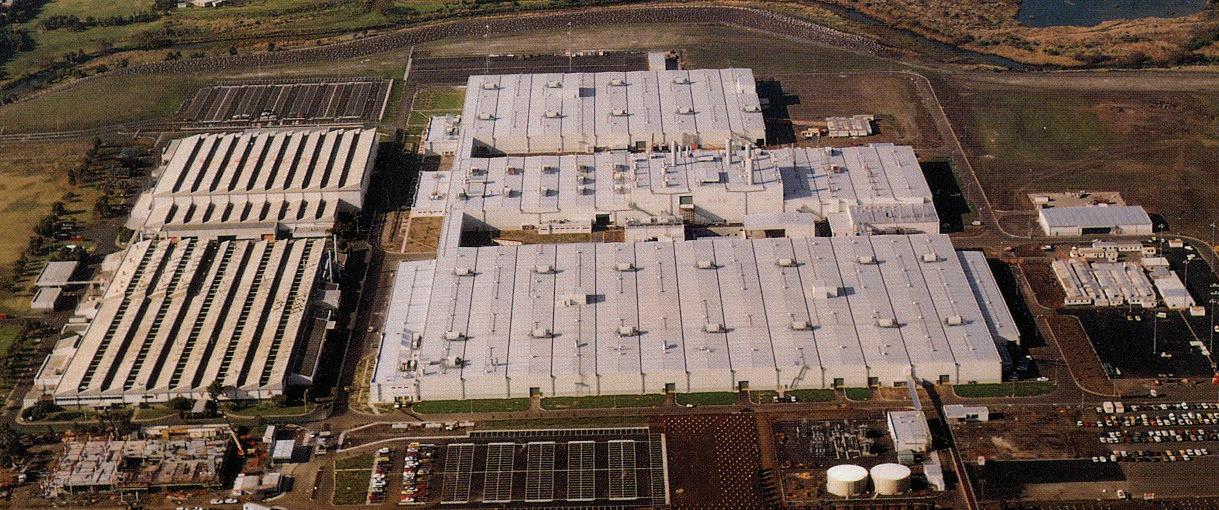
was then among the largest single contracts ever won by John Holland.
The scope of works on the 75ha site included the panel press shop, paint shop, assembly plant, office services, supply and distribution centres, various ancillary buildings and vehicle storage facilities.
Concurrent with the manufacturing plant, in December 1992 John Holland won the $10.2m project to design and construct a two-storey administration building. In March 1993, John Holland took on the more unusual challenge of designing and constructing a 12,000sqm test track adjacent to the manufacturing plant; this included variable road surfaces and specific areas for braking, durability and obstacle-avoidance testing.
The manufacturing plant took 27 months to complete and presented considerable challenges due to its sheer scale and the tight timeframes. Everything from steel fabrication to concrete pouring and polishing, to
the installation of electrical systems, had to be performed under the tightest of controls. The logistical effort of the project, which called for innovative management and controls, was precisely the sort of challenge on which John Holland thrives.
At the peak of its production, with around 2500 employees building 100,000 cars annually (the majority for export to the Middle East and New Zealand), the Toyota Altona plant went through 40,000 tonnes of steel per year in its panel stamping, while engine casting consumed 600kg of aluminium every 30 minutes.
In February 2014, following similar announcements from local car making rivals Ford and Holden, Toyota announced that it would close down its Australian manufacturing operations in October 2017. Rival Holden’s closure of its Elizabeth (SA) plant just a few weeks later would sadly bring down the curtain on Australia’s car manufacturing career.
Catalytic Cracker, Altona
Anapparently straightforward project to construct a petroleum plant in Melbourne’s west would descend into a financial and legal debacle that, no one doubts, was the beginning of the end for Heytesbury’s ownership of John Holland.
The $45m project was awarded to John Holland in April 1995 to construct a fluid catalytic cracking plant at Altona, in Melbourne’s west. Scheduled to go on stream by the end of 1996, the $250m plant would produce 80,000 barrels per day.
John Holland was subcontracted by Japanese company Toyo Engineering Corporation on behalf of the client, Mobil.
John Holland was already carrying a financial injury from
an unexpectedly difficult Wanaea/ Cossack project, but aside from that, the company had enjoyed a few recent successes in oil and gas with projects for Shell in Victoria and a series of jobs for Ampol in Queensland.
Toyo, a Japanese engineering firm, had previously built a similar catalytic cracking plant in Chiba, Japan and had been engaged in several jobs with the client, Mobil, in Asia. As Jeff Horsley later recalled, Toyo had evolved the catalytic cracking plant technology into essentially kit-build form.
“Toyo provided all the componentry. We put a price in for labour and plant, that we would provide all the manpower and the
project management to put the kit together.”
John Holland had gone through a management upheaval not long before. Some speculate that the departure of several executives who were highly experienced in construction had prompted a sudden search for work in other sectors, and the recruitment of inexperienced managers.
“Our price was for labour and plant so I think poor supervision, poor planning, poor project coordination, all those things contributed to a significant blowout in the labour and plant costs,” Horsley said.
The refinery ran dreadfully behind so that, in November 1996, with the project about 75 per cent complete, the contract was terminated. (This resulted in the unemployment of 400 workers and the triggering of further industrial relations difficulties, when those workers were not guaranteed employment by the subsequent contractor).
It was widely reported that John Holland was dismissed by Mobil and Toyo, but the view that John Holland had left voluntarily was supported by those with knowledge of the significant losses the company was already making on the project – with more still needing to be spent to reach completion.
Under increasing pressure from the banks, John Holland had sought legal advice on ways that it might end the contract. Naturally, it was not a matter of simply walking away.
“Toyo brought in another contractor to complete the work, it was just labour and plant anyway, all the stuff was there to put together,” said Jeff Horsley. “And then there was a big arbitration, of course …”
Both parties immediately filed for arbitration, a lengthy process that was conducted out of Singapore. The legal costs of defence proved increasingly onerous to John Holland’s owner Heytesbury, which had never been overly flush with financial resources.
It dragged on, back and forth until 2001, when the Singaporean High Court found in favour of Toyo, awarding $40m in damages. The ongoing financial punishment had forced Janet Holmes à Court to consider buyers for John Holland.
Cruelly, however, the Toyo drama would remain attached to Heytesbury.
“Toyo was the job that ultimately became the millstone around the neck of Heytesbury from a cash flow and profitability perspective and it probably was the straw that broke the camel’s back,” recalled Darryn Ray.
Part Three 2000s
The Leighton Era
John Holland entered the new millennium invigorated by a new owner. When the majority takeover was completed during the first quarter of 2000 – for, it must be said, a nominal sum – John Holland brought to Leighton Holdings some $527m of work in hand and the valuable complement of its vast experience in sectors like rail maintenance.
The company had been through tough times, but it was widely acknowledged that Leighton Holdings had picked up a gem. John Holland was in a good position with, among other projects, the Alice Springs to Darwin railway; its engineering competencies and construction competencies were clearly intact;
and the market was just beginning a significant upturn.
Leighton provided working capital and bank guarantees to help set John Holland back on its feet. Within just a few months, John Holland Asia sold key assets and contracts to Leighton Asia and the John Holland brand was steered back towards its primary focus: Australian construction.
Some things, happily, would not change. Wal King acknowledges that Leighton Holdings could have taken 100 per cent ownership of John Holland in a blink. Instead, 30 per cent of the company’s shares remained with Heytesbury. And Janet Holmes à Court would remain as Chairman.
“That was my call,” King said.
“Janet is someone who has an
unbelievable personal touch. One of the things that was on my mind was a successful transition from Janet, who was well respected in the business… But we needed to turn the business into a more professional model. We collectively came to the conclusion in Leighton that she would be an important part of that transition.”
Another characteristic of the company that was admired by King was its cash management, cultivated through “having to run on the smell of an oily rag” throughout the Heytesbury era.
The revitalised John Holland would also have a new central figure in a new managing director, Bill Wild. This swashbuckling, charismatic Queenslander had joined the Leighton group in 1975. Through the 1990s he had run the group’s operations in Hong Kong, then Indonesia. Wal King had identified in Bill Wild the perfect man to lead John Holland back to greatness.
The word almost invariably associated with Bill Wild is “leader.” He had a natural drive and charm that encouraged others to believe and follow.
That said, eyebrows were often raised in the early negotiations, as Wild conducted due diligence and laid out a business plan. For a business that had for some time been effectively just breaking even, Wild
presented an ambitious outline for a billion-dollar company turning a profit in the tens of millions … within four years.
Glenn Palin, then NSW Building Operations Manager for John Holland, recalled a two-day management workshop in Daylesford, Victoria, not long after Wild was installed as MD.
“At that time, we were still doing about $500 million a year turnover. Barely making a buck in profit. Bill gave a whole range of presentations around where John Holland was, what the marketplace looked like.
“The upshot was that he said, ‘We have to do something different to succeed; therefore, I want us to be a business doing in excess of $1bn’ –in, I think it was three years or five years. Everyone sort-of went, ‘Very, very good, Bill’, while thinking, ‘Why don’t we just fly to the moon?’
“There was a certain amount of disbelief, but a lot of backing. And the reality was, he was right. We got to that level in even less time than he was forecasting. That’s leadership at its best – to set that vision and bring people along that journey.”
Wild never much doubted it. He had already recognised that the elements of success were in place at John Holland. They were as obvious to him as the ingredients that it had been lacking.
Wild had learned from King that in the construction industry, a business needs three things. There’s money, to be able to back one’s judgment and to fix problems. There’s intelligence and talent. And there’s self-belief.
The Leightons’ takeover had brought plenty of the first; John Holland had an abundance of the second. Wild set about repairing the third, reinvigorating the confidence within the organisation.
“From my point of view, I had no doubt whatsoever that we could turn John Holland around to the same sort of level of achievement that Thiess and Leighton Contractors were getting,” Wild recalled. “I knew that it was achievable, because we were achieving it elsewhere in the [Leighton] group.
“It wasn’t a question of it can’t be done, because I knew it could be done. It was a question of, are we good enough as a team to step up and do it?”
An interesting aspect of restoring that pride and self-belief was Wild’s decision to re-engage Sir John Holland in some of the company’s activities. Sir John took obvious delight in attending functions, making speeches and running a mentoring course, among other activities.
One who already believed in Wild’s and Holland’s capabilities was
Leighton Holdings’ Chief Financial Officer, Dieter Adamsas. “Bill was the man,” Adamsas said. “He drove the situation there. The guy was just so hungry. In his earlier life I just saw the guy and how he worked. He was like, ‘Don’t get in my way, Fred’.”
Adamsas himself is deserving of a large measure of credit. His thorough Project Valuation Reports put a quarterly microscope over projects and enforced a new financial discipline on John Holland, the perfect complement to Wild’s aggressive expansion plans.
The quarterly reviews didn’t just give Wild and the management team the ability to follow the performance of projects. It showed the people working at project level that head office took a first-hand interest in their problems and achievements, and highlighted likely issues on the projects well before they arose.
Janet Holmes à Court, who had of course remained as Chairman of John Holland, was no less an admirer of Wild. “Bill Wild was exceptional. A bit like Wal King, they pretend to be larrikins. Well, I mean they can be larrikins. But Bill Wild was really an exceptional engineer with an exceptional brain.”
Janet found that Wild had other skills to share. “Bill taught me how to swear. I spent so much time with him that I started inserting ‘bloody’ into
my sentences because that’s what he does all the time.”
Wild’s bull-at-a-gate strategy had a powerful backer in Leighton Holdings boss Wal King. He had identified that JHG was unable to viably support its geographic operations, with offices in Melbourne, Sydney, Brisbane, Darwin and Perth. King favoured retaining these branch offices, but decreed that John Holland should have the mass to support them.
The approach was two-fold. The first part was to encourage organic growth, as newer projects and successes came John Holland’s way. However, there were no illusions that that would be enough. The second part of the strategy was to add mass through acquisitions.
An opportunity appeared in the Australian operations of Fletcher Constructions, which ironically was comprised of various ex-John Holland executives who had departed prior to Heytesbury’s taking it over a decade earlier. Fletcher was duly purchased in 2002.
As Glenn Palin describes it, “Fletcher gave us a thump in turnover, a thump in profit and a gain in people all at once, which was great. But we found that people started to leave because we didn’t culturally do the fit very well.” There was also the matter of duplication; Fletcher was
basically a smaller version of John Holland, with competing skill sets.
Even so, what a skill set – as illustrated in a snapshot of just one year, 2002.
In the deep red centre of the Northern Territory, John Holland was at work on the enormous $1.2bn Alice Springs to Darwin Rail Link project – the largest rail project undertaken in Australia to that time.
The company’s rail skills owed much to David Tasker who, from the mid-1990s, had built up the division on the back of significant maintenance contracts in his home state of WA. The rail division had even been making its mark internationally, with notable projects in Thailand and Malaysia, prior to rebranding that business under Leighton Asia.
Also in 2002, John Holland was putting a toe in the water on WA’s remote Pilbara coastline, constructing a wharf at Port Hedland’s Finucane Island for iron ore export.
On the opposite side of the nation, John Holland was in Sydney’s suburbs building the $20m Western Sydney International Dragway, a specialised motor sport and events complex. Not to mention, being concurrently in one of Sydney’s most scenic harbourside locations, constructing –of all things – a $14m precinct for the Asian Elephants at Taronga Zoo.
“ bill taught me how to swear. i spent so much time with him that i started inserting ‘bloody’ into my sentences,” Janet Holmes à Court
The latter could still elicit a chuckle from Greg Cain. “That exemplifies John Holland – it’s different, it’s unique. How do you construct for an elephant? Do you just Google that?”
Along with the strange, there was scope for the sentimental: in 2001, the company returned to the Sorell Causeway in Tasmania, originally built by John Holland in 1957. That structure, marking the first use of pre-tensioned piles, was replaced so many years later by another suitably innovative one, Australia’s first trough-girder bridge.
Gary Baird, State Manager for Tasmania at the time of this writing, had long been a fixture of John Holland’s Tasmanian permanent office, which would open in Hobart in 2011. “We won that project through innovation, absolutely. We needed to earn it, to beat the local competition down here – and they were pretty lean and mean.
“We had Sir John Holland come down for the opening. He was pretty pleased that we had built it twice! It meant a lot to us, to have him come down for the opening.”
Another significant project in Tasmania around the middle of the decade was the expansion and redevelopment of Risdon Prison, which included new accommodation for medium- and maximum-security
prisoners, along with a new, highsecurity mental health unit. It was delivered four months ahead of schedule.
The group’s skills – and its weaknesses – and the lessons of Fletcher were being very closely monitored by Bill Wild. John Holland, like its sibling rivals Leighton Construction and Thiess, operated within Leighton Holdings under what Wal King referred to as the Rules of Racing.
“My philosophy is that we supported these companies, they were fitted in the group and they had to comply with certain guidelines,” King explains. “Things like expected rates of return, a balance sheet size, bonus schemes, geographic areas of operation and product areas that you could and couldn’t go into.
“That business plan was established at the beginning of each financial year and it was closely monitored on a quarterly basis. But once they complied with those rules of racing, I gave them enormous freedom to operate. Establish the discipline, then give them the freedom.”
Wild, characteristically, took the initiative. The next phase in giving mass to the John Holland business was to investigate the purchase of the German-owned Walter Construction (formerly Concrete Constructions). That deal came close to being
finalised in December 2002 – but by then, a virtually textbook target had appeared, in Transfield Construction.
The acquisition of Transfield Construction would be a turning point in the making of the modern John Holland.
Transfield Construction was a division of the business established in 1956 by Italian immigrant Franco Belgiorno-Nettis and joined soon after by a former colleague, Carlo Salteri. By the late-1980s, Transfield was one of the largest engineering firms in south-east Asia, with activities ranging from major infrastructure projects to shipbuilding and Defence.
Transfield Construction comprised discrete units in areas like power transmission lines, fabrication, tunnelling and water treatment. For the most part, these were quite different from John Holland’s portfolio.
Acquiring Transfield Construction would bring with it about $500m of Transfield work in hand – matching John Holland’s own portfolio of less than three years earlier – but it would bring so much more to the group than that.
For Bill Wild, though, Transfield was nothing less than the foundation for his dream strategy: to have both geographic coverage, and areas of specialty.
“In Australian construction, there’s a real big choice you make,” Wild explains. “You try to be national and run your business geographically … each region like a fiefdom, with a king in charge. No-one runs a business better than the people who live in the middle of it.
“The problem with that is, how do you deal with specialisation? The solution would be if you could somehow run geographical units alongside specialist units … I always felt that if we could ever manage to get that to work, that was the answer.”
It was determined that, while the Transfield Constructions name would end, the cultural identities of four of its specialist divisions should remain: namely the tunnelling, water, Structural Mechanical Process (SMP) and telecommunications and transmission lines. Thus, Bill Wild had his kingdom of John Holland’s geographical units and specialist units.
The Transfield transition was no less successful in cultural terms. Rather than attempting to force integration, Transfield’s history and identity was somewhat protected within the greater John Holland family. Glenn Palin recalled the immediate payoff: “We doubled our turnover almost overnight and we got into markets that we were able to sustain because we didn’t try and change them too quickly.”
From the Transfield side, there was a fair bit of scepticism and some uncertainty, initially.
But in comparison to the construction purchases since then – Balderstone and Abigroup melded into Lend Lease, Leighton Contractors and Thiess pushed together into CPB … The transition from Transfield Construction to John Holland was probably one of the best.
Out in the field, the first that some Transfield employees knew of the new ownership was when crates of new laptops – amazingly, emailenabled – were suddenly delivered to worksites.
If the choice of partner could not have been better, the same could be said for the timing.
Australia’s commodity prices had been very low for more than a decade. Resource giants like BHP Billiton and Rio Tinto had had little incentive to invest heavily in infrastructure.
As 2002 turned to 2003, however, Asia and China turned their focus to Australia’s vast reserves of iron ore, coking coal, thermal coal, oil and natural gas. It was the beginning of a nation-changing boom: prices for iron ore would rise from about US$30 per tonne in 2002-’03 to US$150 per tonne in 2011-’12, with the sharpest rise occurring in 2005.
Thermal coal would almost exactly trace the rise in iron ore values. Suddenly, Australia was in need of rapid expansion of its large-scale infrastructure – ports, rail networks, roads – and had the confidence to start spending on social infrastructure like schools, hospitals, housing, water treatment, power transmission and communications.
It played wonderfully into John Holland’s hands, particularly given the group’s new Transfieldgenerated strengths in several of these specialised areas. It would show in large and successful civil projects like the vast, $2.5bn EastLink road project in Melbourne, the no less significant Lane Cove Tunnel in Sydney – both key road connections, involving landmark tunnels – and any number of specialist wharves and jetties. The Chairman was delighted to see “her” company at last fulfilling its potential. “In the early days, you’d win a $100m job and think wow, this is fantastic. Then we were suddenly winning billion dollar jobs. There were more opportunities and we could grab them, where we wouldn’t have been able to grab them as Heytesbury.”
Among the many benefits of the Transfield acquisition was the formidable skill and experience of its tunnelling division. The Transfield tunnelling team had very recently
underlined its credentials in the Melbourne CityLink tunnels project (a joint venture of Transfield and Obayashi), and at the time of the acquisition had already won the Lane Cove Tunnel in Sydney.
Executive General Manager, Russell Cuttler, joined John Holland with Transfield. As the former Operations Manager of Transfield Tunnelling and the Driven Tunnels Manager for CityLink, he believed the challenges of Melbourne’s geology helped shape the tunnelling group’s talents.
“Melbourne is recognised as one of the three most complex geologies in the world. The variability in geology of hard rock to waterlogged sand with silts and clays often between made it particularly challenging and difficult. New techniques were needed to solve old problems.”
Transfield had the experience, history and pedigree to meet these challenges, thanks to its acquisition of Melbourne Water’s tunnelling team, which had unrivalled experience gained through a multitude of tunnelling projects undertaken through the 1960s, ’70s and ’80s.
The depth of that experience, and indeed the creativity and inventiveness for which the team was known, had developed through sheer necessity. A case in point involved the tunnelling team having to work
with US company, Robbins, to design and develop a cutterhead of their own for their Tunnel Boring Machines (TBMs), as the American versions simply did not cope with the tough Melbourne conditions. Another example was the development of the doubled-shielded rock TBM, which became the new standard that was subsequently utilised on projects such as the Channel Tunnel Project linking England and France.
Under John Holland, the tunnelling team would accelerate to greater triumphs. The group’s skill was showcased in projects such as the road tunnels for Melbourne’s Eastlink Freeway, the award-winning Northern Sewerage Program and the politically charged, but technically brilliant Airport Link in Brisbane. The skill demonstrated in the Northern Sewerage Program would have John Holland named International Tunnelling Constructor of the Year in 2012, a first for an Australian contractor. It also led to John Holland’s trenchless tunnelling capabilities being employed for the replacement of the 100-year-old Melbourne Main Sewer, a project that commenced in 2008.
By then, John Holland was riding a stream of high-profile water projects that were prompted by the drought-afflicted decade of the 2000s.
what became known as the millennium drought was, by 2003, recognised as the worst in Australia’s recorded history.
Since 1995, Australia had seen certain regions, most notably in Queensland, suffering from severe drought and record high temperatures. With each year, it spread and intensified. What became known as the Millennium Drought was, by 2003, recognised as the worst in Australia’s recorded history.
By 2005, increasingly severe water restrictions were being introduced in capital cities and regional areas. Water levels in dams around the country continued to fall. In the latter half of the decade, each of Sydney, Melbourne and Brisbane had their water supply levels fall below 33 per cent; in Brisbane’s case, actually below 20 per cent.
Perth, meanwhile, was in the order of 40 per cent and plummeting.
The city and its surrounds had been on Stage 4 water restrictions since 2001. In the search for methods of ensuring WA’s water security, the city voted to construct Australia’s first reverse-osmosis, high-volume water desalination plant at Kwinana, one of Perth’s southern beaches.
Desalination plants – which are not reliant on climate – offered the same water-security solution to south-eastern Queensland (and, in time, Sydney and Melbourne).
John Holland, by now boasting all but unrivalled water and tunnelling skills, won the contracts to construct
both the Gold Coast and Sydney desalination plants. A winning factor in the latter project was the group’s familiarity with the rest of the Sydney Water network.
John Holland was just as successful in its water treatment plant (WWTP) activities. A July, 2003 major project to upgrade Queensland’s Sandgate and Oxley and Wacol WWTPs provided the impetus for the Brisbane Water Enviro Alliance, a publicprivate venture between Brisbane Water, John Holland and others.
The need for rapid responses in the face of water shortages also sparked a new approach in the very business of contracting. Clients had not the time or skills to formulate complete solutions, much less for contractors to go through the traditional process of concept design, prove the design and go to market.
Instead, a relationship was struck up with the client and solutions jointly developed up to a point at which the contractor could accurately price the project and set about delivering it. Through these relationship-based projects, what was once a two to three-year process could occur within as little as nine months.
Technology was also swinging into the service of John Holland’s success. The boom in mobile telephony brought the need for new exchanges and transmission towers.
Glenn Palin was at that time in charge of the national telecommunications division; he laughs as he reflects on a meeting with Dieter Adamsas and David Stewart. “They asked me, very seriously: ‘do you think there will ever be a day when data can travel on mobile?’ That was a very real question in those days.”
Telecommunications projects just seemed to keep coming, through great relationship-based arrangements with Telstra, Vodafone and Motorola.
The word “relationship” was very much to the fore in this era. In part, new attitude had been inherited from Transfield, but there was a greater social movement occurring. It placed value on the nurturing of people, and it happened to chime with the personalities of such as Janet Holmes à Court and Glenn Palin.
Around 2004, an upper management workshop discussed the company’s place in an environment where family, career development and other socially-conscious aspects were increasingly determining the success of companies in being able to attract the best people.
“That was a fundamental shift in John Holland’s attitude, and this is where I became involved,” Glenn Palin said. “All of a sudden I found that there were things that John Holland was starting to stand for
that resonated strongly with me. What was our approach to people? How should we deal with people personally?”
A new direction was defined in the philosophy of “four Ps”, stating that “Performance, Partnership and People, lead to sustainable Profit.”
The Four Ps reshaped John Holland, not only in its internal dealings – even among Leighton Holdings siblings, relationships had been competitive, indeed combative – but just as obviously in the way it interacted with clients. It gelled in the Relationship Contracting Group, which steered the change as it applied to alliances and client relationships.
Alliances were what the industry was suddenly all about, crystallising into a new tool for clients to fund major projects. Where previously there had basically been two types of contracts (design and construct, or construct-only) and clear delineation between the client and the contractor, there was now a more conscientious and collaborative approach emerging in regard to sharing the risks.
An early model, already glimpsed in the Alice Springs to Darwin Rail Link, was the BOOT – Build, Own, Operate and Transfer. This type of arrangement would evolve into what became known as a Public-Private Partnerships, or PPPs.
One of the very first projects for John Holland under the structure of a PPP was the $230m Southbank Education and Training Precinct, on behalf of TAFE (Technical and Further Education) in Brisbane. The job was won by Axiom Education Qld Pty Ltd, an alliance of ABN Amro (finance), John Holland (design and construct) and Spotless Facilities Management (operation and maintenance). Work commenced in July 2005.
The physical work involved the delivery of nine buildings while the educational institute, with 27,000 students and staff, continued to operate as normal. However, the PPP model itself was perhaps under the closest scrutiny, this being the first such project ever undertaken in Queensland – against resistance from factions within the government and private lobby groups. In every sense, the Southbank TAFE project came through with flying colours.
True to the vision of Bill Wild and the support of Wal King, through acquisitions rather than organic growth John Holland had gained in mass and momentum. Combined with a new outlook on alliancing, John Holland had put itself in the front row for the new type of project that characterised the 2000s: the mega-project.
The $1.1bn Lane Cove Tunnel was a crucial piece of transport
infrastructure for Sydneysiders. It was also a triumph for the contracting alliance of corporate siblings, John Holland and Thiess.
There was very public evidence of the joint venture group’s transparency and social conscience when the LCT project endured the setback of a partial collapse of a tunnel section –fortunately, with no injury. Indeed, there were zero LTIs across the 550day project.
The fact is, a wholesale change had taken place in the corporate culture of John Holland; a change that went right through the community. From the time of its founder, the company had always had a strong social conscience. Stories are legion of John Holland becoming involved in local community activities, in leaving behind new recreational parks and reserves, in rushing to the aid of communities affected by natural disasters.
The era of mega-projects delivered the benefit of large, captive crowds of workers who were encouraged to frequent local businesses and who could gather to raise money for causes – such as the Lane Cove Tunnel team members who shaved their heads for the Leukaemia Foundation.
By 2006, Bill Wild had achieved his goal of transforming John Holland into a billion-dollar, Tier One
business. Although, Wild admits there was never any sensation of crossing a finish line.
“It happens in stages. And there’s one thing about Wal and Dieter –and Dieter in particular – was that no target was ever good enough. So you’d sort-of nearly get there and next thing, the target was bigger still.”
Bill Wild, inevitably, had his considerable vision trained on greater goals within the Leighton Holdings family. In 2006 he was appointed Chief Operating Officer of the group, with David Stewart moving into the managing director’s role at John Holland from his previous position as MD of national construction operations.
Most agree that Bill Wild was the single most influential figure in John Holland’s modern history. Modestly, he puts his leadership skills down to simply loving the job. “I think that’s got to fit into any leadership role, you have to be able to convey that feeling to your team. That the leader is totally committed, and you’ve got to bring people along with liking what you do.
“Wal used to say you’ve got to have fun at work. I used to say that Wal has a lot more fun than we do! But people don’t go to work just to earn a dollar. You stay in a particular job or role because you enjoy it,
because you get satisfaction out of it, and a sense of achievement, for all of those things.”
David Stewart’s style was quite different from his predecessor’s. Stewart was described as a disruptor, with the ability to think well outside the box and introduce concepts and solutions that few others would have conceived.
Stewart immediately cast his mind towards different and diverse areas in which John Holland, by now heavily exposed to big projects – and their inevitable big risks – might underwrite itself with consistent revenue streams. This would also help dilute the somewhat volatile risk and turnover profile that pure construction businesses presented to corporate ratings agencies and share market investors.
Mining was very familiar to Stewart, having had much to do with it via Thiess. John Holland had much to offer, although the mining industry was sufficiently different that it changed the nature of the company in terms of its capital investment.
Stewart also had a longer term vision for John Holland Rail, which had evolved from David Tasker and Joe Angelucci’s early efforts with Westrail and the Perth Transit Authority contracts, and had continued to gather steam as a separate company. Stewart took the
decision to turn the WA-focused JHR entity into a business unit of the wider John Holland Group.
On Tasker’s retirement, Karl Mociak took the helm of the rail business and continued to build on its success by expanding the end-to-end solution offering with the addition of signalling and rail engineering compatibility.
At that time, rail was turning over about $300m per year, between maintenance contracts and a series of major track works, like the Alice to Darwin and the Victorian Regional Fast Rail. More recently, the NSW market had begun to open up, with Railcorp (the NSW authority) outsourcing some of its maintenance – prompting John Holland to create its Reliance Rail facility in Auburn, Sydney.
“We very quickly started to pick up a lot of work,” recalled Richard Stewart, who headed John Holland’s Rail division from 2009 to 2016. “John Holland had a really good capability outside of rail that complemented what we were doing. We had things like the Cronulla duplication that needed bridges, earthworks, stations. At about the same time, we commenced a major road-rail grade separation in Victoria, which started off a whole suite of them.
“We’d had the foresight to realise that we needed to build the systems
capability, because the signalling, the overhead electrification was going to be key to these urban renewals.”
Ten years later, John Holland’s rail signalling and electrification contracting would be among the largest and most successful in the nation.
Aviation, however, was a whole other matter. In June 2007, John Holland bought the former Ansett Aviation Engineering Services, headquartered in an enormous hangar at Melbourne’s Tullamarine Airport. The business John Holland bought had been operating under receivership, its namesake airline having last flown in March 2002.
John Holland Aviation Services performed various, generally shortterm aircraft maintenance tasks for a range of operators, such as Qantas, Virgin Blue, Jetstar, REX, Ozjet, Asian Express and Tiger Airlines, but the hoped-for major contracts never came. The business fell victim at least in part to an emerging aviation industry trend to outsource maintenance contracts to cheaper countries.
Wal King had been very supportive of the aviation acquisition and nursed a long-term vision for its potential. Not everyone shared the Chairman’s enthusiasm for JHAS which, despite bringing a hi-tech shine to the John Holland name, was
understood to have never returned a profit. It was eventually wound up in 2014.
It was a different story in Defence, where the foundations built during the 1990s were to pay off handsomely in the following decade. John Holland had proved its ability to work within operating military environments, with the utmost efficiency and security.
By the end of the decade, thanks to projects like the Holsworthy Special Operations Barracks, John Holland would be one of Australian Defence’s Top 10 contractors – and the only construction contractor on that list.
Amid the newness of these challenges, there were returns to familiar John Holland landmarks. One, perhaps to rival the Sorell Causeway, was the $371m project to widen and strengthen the Westgate Bridge, initiated in 2009.
Sentiment aside, it was hailed as one of the most difficult and risky design and construct projects of its time. The task was to reinforce the outer edges of Melbourne’s landmark bridge to allow the existing four lanes (with shoulders) to be expanded to five.
The external strengthening was achieved through the innovative design of outrigger cantilever props, numbering more than 500 and each weighing some 450kg. Some 1600
tonnes of steel were cut into 100,000 individually traceable pieces for the fabrication of structural parts.
The largest bridge jacking operation undertaken in Australia in recent times lifted the entire bridge 80mm for aligning, after post tensioning. It was carried out in one night, with live traffic running over the bridge.
The Westgate widening project –undertaken while 160,000 vehicles passed daily over the bridge – would win a trio of significant awards, including the 2011 Engineers Australia Excellence Award for Infrastructure (over $80m) and the John Holland Chairman’s award.
Indeed, the Chairman had been an admiring and intimate observer. During a number of site inspections, Janet Holmes à Court came to look up to it in more ways than one.
“Hanging off the side of the bridge were these staircases, which got you from the top, around the side, over the Yarra, and then in underneath. We weren’t harnessed, but you couldn’t fall because there would be cyclone wires on the side and so on.
“It was one of those times when I thought, ‘Oh my gosh’ … And the things you learn – there are 24 ships a day go underneath that bridge and what comes out of a ship’s funnel is not only hot, it’s toxic. So everybody who was working on the bridge,
Approaching the end of the decade, John Holland was effectively acknowledged as the go-to group for anything to do with water, tunnelling, defence, wharves and jetties.
every time a ship went under, had to get back inside so they were away from those fumes.”
The National Portrait Gallery in Canberra would be a similar landmark, both literally and in terms of innovative construction. The daring architecture and its use of disparate materials, all within an environment that cannot afford to produce condensation or humidity, was a fitting challenge to the construction company that could cast its eye just 1200 metres south-west to a proud achievement of precisely 20 years earlier, Australia’s Parliament House.
Meanwhile, John Holland’s highprofile projects weren’t limited to the mainland. The group’s Tasmanian office had been steadily building under the guidance of Southern region manager Bob Bennetto, who created a strategic relationship with local building contractor Royce Fairbrother, head of a family company with decades of experience in the state.
As building projects in joint venture with Fairbrother would be key to John Holland’s growth in Tasmania, the same would be said of the relationship with Hazell Brothers, under Geoffrey Hazell, in civil projects. One such project, the Brighton Bypass on the Midland Highway (commencing in 2009), was the largest road infrastructure project
ever undertaken in Tasmania to that time.
The John Holland-Hazell Bros JV constructed a 3.4km section of the island’s main north-south Midland Highway, with associated interchanges and connections to the Brighton industrial precinct, along with a new road/rail freight distribution centre relocated from a valuable urban area in central Hobart. It was completed almost a year earlier than the contract completion date.
Approaching the end of the decade, John Holland was effectively acknowledged as the go-to group for anything to do with water, tunnelling, defence, wharves and jetties. The business had stepped up, the most significant growth occurring off the back of the “mega-projects” like the Lane Cove Tunnel in Sydney and, subsequently, EastLink in Melbourne.
In fact, John Holland now needed mega-projects not only to keep growing, but perhaps also for its very survival.
Expectations were high for the winning of the M7 Clem Jones Tunnel, then known as Clem7, a road tunnel to be constructed under the Brisbane River. But the $2.1bn project, to commence in 2006, was awarded to a rival consortium that included John Holland’s sibling Leighton Contractors Pty Ltd.
The disappointment of that loss was short-lived. The Clem7 tunnel would trigger the Airport Link PPP, comprising three major, linked pieces of Brisbane road infrastructure, in the Airport Roundabout Upgrade, the Northern Busway and the Airport Link M7 motorway.
The Airport Link PPP amounted to some 15km of tunnelling (including the longest and largestdiameter road tunnels in Australia), 25 bridges and seven kilometres of new road. It was the largest infrastructure project in Australia at that time.
The $4.8bn Airport Link was won by BrisConnections, a consortium that comprised Macquarie Group, Thiess and John Holland.
The technical features and challenges of the project – met, it must be said, in exemplary fashion –are described in detail in the Airport Link profile in this book. However, from the outset the project was hamstrung by an initial public offering (IPO) of BrisConnections that was a financial disaster.
The PPP was built on a patronage model; it fell to BrisConnections to forecast the revenues over the 45year period for which it would own and operate the Airport Link toll road. In recognition of those forward revenues, it determined its up-front, design-and-construct price.
The client – the Queensland Government – saw only a wonderful opportunity to procure infrastructure while offloading the funding obligations and the financial risk.
While everything had been done in good faith – and in the warm afterglow of the Southbank TAFE PPP project – the problems in this megaproject would be insurmountable. John Holland’s equity investments were going down the drain.
Even the weather conspired against Airport Link, with Brisbane experiencing devastating floods in January 2011.
Airport Link was very soon losing significant sums of money, even at a design and construct level. Leighton Holdings, parent of both John Holland and Thiess, was taking a direct hammering financially and to its share price. Under restricted access to cash and the threat of enormous penalties, the job still had to be finished.
“It was terrible,” said Glenn Palin. “We just had to finish it, and there was nothing more soul-destroying than knowing how much this was hurting everyone. But you’ve got to keep going. I’d take my hat off every day to all those people on site. They knew it was a bugger of a job. They were working enormous hours a day.”
In that, however, Palin saw yet more proof of everything he believed about John Holland and its people.
“The culture of John Holland was tested. People stay with John Holland, not because they have to or that we pay the best money in town – they stay because there is a loyalty to see things through the tough times.”
Reverberations from the Airport Link project and wariness over the viability of PPPs were felt far and wide. It also happened to coincide with a period of major instability of government: the victory of Labor’s Kevin Rudd in the November 2007 federal election followed almost 12 years of conservative coalition government under John Howard.
Then came the Global Financial Crisis.
One consequence of all these factors was that – while the team continued to labour over the deadweight Airport Link – major infrastructure projects very suddenly dried up.
About the only market sector that remained buoyant was resources, especially oil and gas. John Holland turned to a series of projects, primarily in WA and central Queensland. Among these was the $170m gas plant at Devil Creek, 50km from Karratha (WA), again relying on its suite of skills: along with non-process infrastructure, John Holland managed construction of the residential village and a tie-in to an existing gas pipeline.
The oil and gas uptake was rapid, significant and certainly welcomed. Major liquefied natural gas projects came along in Queensland, the NT and WA. It proved to be a steep learning curve, however, with projects often being won without a full appreciation of logistical issues or the possibility of scope change. Under-claim issues were common.
Hardened by the Airport Link experience and thrust into a slightly unfamiliar and harshly competitive market, John Holland had been forced to toughen-up again.
It had been a spectacular decade of growth: in 2000, annual turnover had amounted to $400 million. For the 2010 financial year, it stood at $3.6 billion.
The 2010s, it seemed, were going to be the decade of rolling up the sleeves, fighting through the difficulties of Airport Link and confronting new challenges head-on. It would do so under the guidance of Glenn Palin, who was appointed Group Managing Director in 2009, replacing David Stewart, who like Bill Wild had now also moved to a new role within Leighton Holdings.
The embattled but boldly enthusiastic group would, sadly, go into the new decade without its figurehead and eponymous founder. On 31 May 2009, Sir Clifton Vaughan “John” Holland AC
passed away in Melbourne’s Cabrini Hospital. He was just 20 days shy of his 95th birthday. He left behind his second wife, Suzanne (Joan, his first wife of 57 years, had died in 1999), sons Jock, Richard and Peter and stepsons Andrew, Michael and John.
Sir John’s work in the community had been exemplary: he served on the board of the Royal Melbourne Hospital, was Chairman of the Sir Edward Dunlop Memorial Committee and was an active and eager patron of such organisations as the Bone Marrow Foundation,
the National Stroke Foundation, the Voluntary Euthanasia Society and the Children First Foundation.
In the group’s 2009 Annual Report, Glenn Palin farewelled this legendary Australian. “Our founder, Sir John Holland, who passed away on 31 May this year, fostered a culture of innovation, technical excellence and tenacity, underpinned by an absolute commitment to our people and their careers. These cultural values remain the foundation of the company today.”
Projects
Wharves and Jetties | 157
Side Tracks and Challenges | 163
Alice Springs to Darwin Rail Link | 167
Victoria Regional Fast Rail | 172
ANSTO Reactor | 174
Lane Cove Tunnel | 177
EastLink Melbourne | 180
Green Bridge | 184
Holsworthy Special Operations Working Accommodation | 186
City of Dreams | 188
National Portrait Gallery | 190
Gold Coast Desalination Plant | 194
Sydney Desalination Plant | 196
Priority Sewerage Program Blue Mountains | 200
Northern Sewerage Project Stages 1 and 2 | 202
Melbourne Airport | 206
ACTEW Bulk Water Alliance | 209
Brisbane Airport Link | 215
Sugarloaf Pipeline | 219
Devil Creek | 224
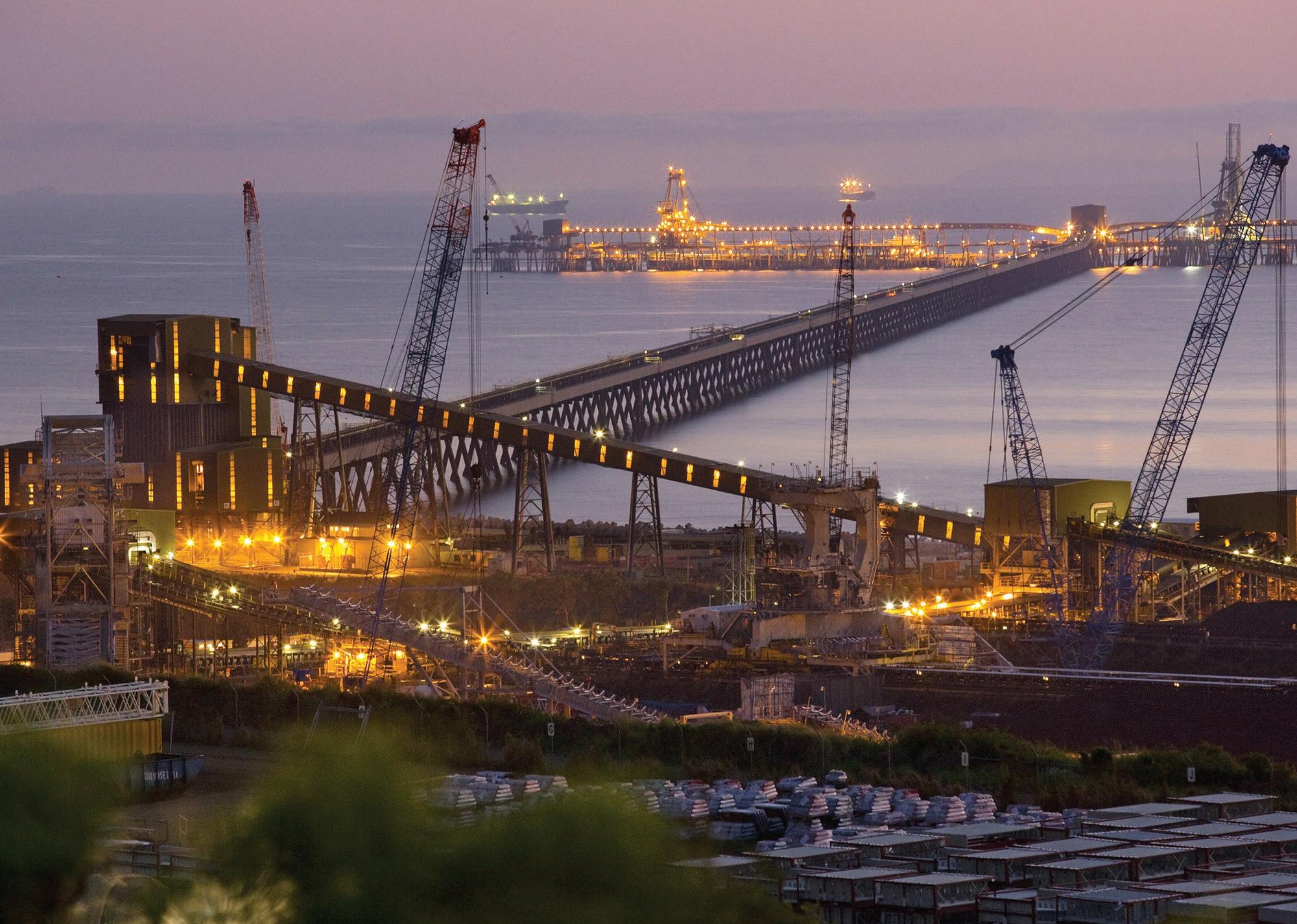
Dalrymple Bay, about 40 kilometers south of Mackay, Queensland
Wharves and Jetties
TheDecember, 2002 acquisition by John Holland of Transfield Construction proved to be a masterstroke in augmenting the group’s skill set and opening opportunities in under-explored market segments. Along with tunnelling and water treatment, one area in which the group’s fortunes truly took off in the middle of this decade, in line with the resources boom, was in wharves and jetties. From little things … In June 2000, John Holland put a toe in the water in the Pilbara region of WA, when it won a contract to upgrade a lump rescreening plant (LRP) for client Rio Tinto. The $344,000 contract was very slightly bettered seven months later by a $384,000 contract
to supply and install precast concrete deck panels for a wharf construction. Those projects took place at Cape Lambert, about 150km west of Port Hedland.
Concurrently, on the opposite side of the nation, the Ports Corporation of Queensland awarded long-term leases for its common-user coal terminal at Dalrymple Bay, about 40km south of Mackay. Since its establishment in 1983, Dalrymple Bay had undergone incremental expansion. A stage 5 program, implemented in 2001, involved the increase of capacity from 37.55 million tonnes per annum (mtpa) to 45.50mtpa. John Holland was there, undertaking an $8.8m project of onshore construction.
All of which was, however, merely a foretaste. In October 2002 – on the eve of the Transfield acquisition –John Holland was awarded the $20m contract to construct a new berth at BHP Billiton’s iron-ore facility at Finucane Island, in Port Hedland, WA.
The Pilbara coast is known not only for its remoteness and its ancient landscapes, but its status as the most cyclone-affected region in Australia. The township of Port Hedland has experienced gale-force winds from cyclones, on average, every two years, for more than a century.
One such (unnamed) tropical cyclone hit Port Hedland in lateJanuary 2003. John Holland engineer James Lear, who had joined the company from Transfield, was acting Project Manager at the time. He recalled it was an interesting adjunct to the usual challenges of a project.
“There had been a cyclone off the coast for a while, it had been drifting in the other direction. We went to bed with this cyclone heading away from us. It must have been nine or 10 o’clock that night, the thing turned around and decided to head straight for Port Hedland. So we woke up and had what was effectively a crisis management process underway.
“I woke at about 5am, saw this thing and thought, ‘Wow …’ We had all this floating marine fleet in the
harbour that we had to secure. And it was on low tide, so we wouldn’t be able to start mooring our equipment until after the cyclone started having effect at about 9am.
“We called everyone in – around 200 people – and divided the tasks. We dealt with the land-based equipment, locking it down. The marine stuff was a different story.
“At about 2pm we had strong winds coming through, the harbour was getting rough to deal with. The harbour manager and I were watching our dredge – which we’d hired at great cost to us – breaking its tow-line and heading, quickly, straight for a mangrove …
“Luckily, BHP got one of its highcapacity tugs over there and pushed it away. It’s heart-in-your mouth stuff, because you have your people sitting on the thing.”
Lear was awestruck by the way his team mobilised and leapt into action. When the cyclone hit in full that afternoon, the only damage suffered was to a barge that broke from its moorings and drifted onto a beach, sustaining a few minor dents.
“We’d spent all of 15 minutes sorting out what everyone had to do – the type of thing you’d spend hours on, normally. Everyone was so focused. At the end of the day, we had dealt with everything in the best possible way. A red alert happened at
There had been a cyclone off the coast for a while, it had been drifting in the other direction. we went to bed with this cyclone heading away from us. it must have been nine or 10 o’clock that night, the thing turned around and decided to head straight for port Hedland.
4pm and you have to be back in your accommodation. I actually slept to the gentle rocking of the building as the cyclone went through!”
Meanwhile, the trade winds were about to fill John Holland’s sails with more of this specialised work. In December 2004 came a $22.3m project at the RG Tanna coal loading terminal in Gladstone, Queensland. John Holland constructed a third shiploader, as part of a $230m expansion of the Gladstone Port that would soon reap even bigger rewards.
A year later John Holland was engaged at RG Tanna in a $115m contract to increase capacity of what was already the fifth-largest coalloading terminal in the world, fed by rail from the coalfields of the Bowen Basin, Moura and Callide.
This project included construction of in-loading and reclaim systems, with the in-loading component comprising transfer and stockpile conveyors with a travelling tripper on elevated gallery structures. The reclaim system included an underground tunnel with chambers to accommodate a conveyor and stockpile discharge system. The outloading involved new conveyors, transfer towers and extensions to the existing berths.
These works helped double RG Tanna’s capacity from 30 million tonnes per annum (mtpa) to 60mtpa.
Around 430km to the north of Gladstone, the Dalrymple Bay Coal Terminal (DBCT) was likewise booming. In late-2006, John Holland clinched a $280m contract for marine works that formed part of the second and third phases of the terminal’s rapid expansion.
The Berth 4 project entailed the addition of a third out-loading conveyor, which demanded the construction of a 400m-long wharf extension, 800m of additional wharfwidening, onshore and offshore transfer towers, a new wharf approach jetty, 1.5km of onshore conveyor works and the manufacture and installation of a shiploader.
One of the most impressive aspects of this project was the offsite construction, assembly and transportation of the 500 tonne shiploader by sea from Brisbane to Gladstone. The transportation ship needed to be booked more than nine months in advance due to demand. To provide optimum stability, the boom was required to be in an upright postion during the voyage. However, this meant the combined height of the vessel and the loader was too great to pass under the Gateway Bridge – the only crossing on the Brisbane River downstream from the Dockyard. The solution was to take a temporary power pack and rigging crew on the trip to lower the boom
horizontally for the passage under the bridge and return it to vertical position for the sea passage. Quite a sight to behold!
Amid challenges that included a mix of greenfield and brownfield environments (including working in an environment with around the clock shipping movements), the project was also significantly affected by adverse weather. However, it was delivered on budget and on time in June 2009.
Amazingly, concurrent with that was a $50m project at the Abbott Point X50 coal terminal, near Bowen, Queensland. This involved the supply, fabrication, off-site assembly, transportation and installation of a 500m-long operational berth and installation of a drive tower and 2.9km jetty conveyor. The project consumed more than 9500 tonnes of structural steel.
Marine is inherently difficult work, but the lion’s share seemed to belong to John Holland. As Glenn Palin recalled, “We did something like two-thirds to three-quarters of the major marine structures developed in Australia during that decade.”
A follow-on from the marine work at Dalrymple Bay – and one indicative of a John Holland strength in the next decade – was the $105m Middlemount Early Rail Alliance project. Commencing in mid-2010,
John Holland was given responsibility for the design, construction and commissioning of a privately owned, 16.5km electrified rail spur linking the Middlemount coal mine to the public Goonyella rail network, which directly transported coal more than 200km to the DBCT.
That project, despite more than six months of bad weather, Queensland’s worst flood in 50 years and Australia’s largest cyclone (Yasi, 2011), was completed 3.5 months ahead of time.
One can neatly book-end the company’s decade of wharves and jetties by returning to Cape Lambert, on the Pilbara coastline of WA. In 2010, John Holland was back and in its element, with a two-phase, $276m Port B marine works project that would greatly increase the client Rio Tinto’s iron ore exporting capacity. The marine works centred on the construction of a 920m-long jetty and 440m two-berth wharf with 18 berthing dolphin, ship loading facilities, piping and associated works. A highly modularised design enabled a great reduction in site man-hours. Among the innovations on this project was the adoption of spongejet abrasive blasting, whereby abrasive material is trapped within pea-sized synthetic sponge pieces. Blasting using these tiny sponges greatly reduces dust emissions and the quantity of blast media required.
Another advance was electro-slag welding, an automated process that melts wire to produce 2.4m-long, 32mm-deep plate welds in just 90 minutes, as opposed to 40 hours manually. Along with various environmental initiatives, like marine exclusion zones to protect marine wildlife, the Cape Lambert project would be deemed worthy of the prestigious Australian Construction Achievement Award in 2014.
James Lear traced much of this large-scale success to the small SMP (structural mechanical process) unit that John Holland inherited from Transfield. “I guess we built it up from having had very little marine history, to a pinnacle that was probably Cape Lambert … All of these were increasing in size and finally, Cape Lambert, which was a very heavy, very exposed structure.
“We came up with some really smart risk-mitigation measures
on that. We used over-the-top construction methods, so we avoided having too much marine and floating plant, which is always subject to weather and cyclones.
“And we had started out as a non-preferred contractor on that, too. The client had used one of our competitors previously and naturally would want to use them again. We came from second place at every stage of that project, and that’s probably what drove us to come up with something different and to solve the client’s issues.
“As a company, we’ve really come up with some smart innovations. A lot of it is the way we do it. It’s the way we go about building it that puts us ahead of the game, and the effort that goes in at that preplanning stage. And we’re very good at hearing what the client wants and understanding them.”
Side Tracks and Challenges
In 2006, incoming John Holland managing director David Stewart would inevitably stamp his style on the company. Acknowledged and admired as a broad thinker, Stewart began to explore options outside John Holland’s traditional comfort zone.
Contract mining was anything but left-field for Stewart; it accounted for much of his previous experience with Leighton and Thiess. In March 2007, John Holland paid almost $85m for C.E. Marshall and Sons, a central Queensland mining and earthmoving business. Marshall’s attractions included an ongoing contract with the Blackwater Coal Mine in Queensland and a forecast 2007 turnover of $80m. The business was renamed Marshall Mining.
A number of challenges would beset Marshall Mining. A slowing of Australia’s economy in early-2008, prior to the onset of the Global Financial Crisis in September of that year, was the backdrop against which a family-owned business attempted to integrate with a much larger, public company.
John Holland quite soon discovered that being in mining is quite different from being around mining.
“It was a very new venture,” Glenn Palin recalled. “It changed our DNA, in some ways. Up to that point, if you look at the principles of operation in the 1990s, we had been a very low user of capital. We were a high generator of cash and a moderate
it was not lost on John Holland that the aviation business gave a very hi-tech shine to the company’s engineering image.
returner of profit – those were our characteristics.
“Mining was complete opposite. It was a high user of capital. The cash was okay, but not fantastic profit. Return on investment was low. So it started to change the nature of John Holland.”
The unfamiliar situation of having to continually purchase and maintain expensive plant equipment in order to do contract mining endured for just a few years. Ultimately, Marshall Mining was sold into the greater Leighton Holdings group and John Holland returned to its main focus of construction.
Returning to 2007: proof of David Stewart’s desire to diversify lay in the fact that, while one eye was below ground level, the other eye was on the sky. In June of that year, literally three months after the Marshall acquisition, John Holland paid $10m for the former Ansett Aviation Engineering Services business, headquartered at Melbourne’s Tullamarine airport.
The purchase included a 19.5-hectare precinct with an 8140sqm wide-body hangar, five narrow-body hangars (totalling 9300sqm), an apron area of 32,500sqm and various workshops, administrative areas, a car park and vacant land.
The resultant John Holland
Aviation Services overnight became the nation’s main, fully independent maintenance, repair and overhaul (MRO) service provider. Ostensibly, JHAS was perfectly positioned to introduce a new era of industrial agreement in the aviation sector and then profit from the alreadyoverbrimming service capacity of, in particular, Qantas and the Defence forces.
It was not lost on John Holland that the aviation business gave a very hi-tech shine to the company’s engineering image, and that the promise of ongoing maintenance contracts presented a more secure turnover profile that might yield benefits in terms of ratings and share price adjustment.
The backdrop in this case, however, was a business (AAES) that had been operating under receivership for the previous six years, in an industry that was increasingly struggling to compete against international labour costs.
Some within John Holland’s upper management were quite scathing of it, pointing out that under Ansett, it had never been structured or traded as a commercial enterprise. There was also the fact that John Holland knew little about the marketplace.
Darryn Ray recalled that it had looked “marginal” from the beginning.
“There was a sense that we could improve the industrial relations arrangements in that sector. And with the Qantas facilities largely full, as more planes came into the system, we’d get the overflow from Qantas.”
Ultimately, neither of those two things happened. Qantas decided it was cheaper to fly its planes to Asia for larger maintenance and overhauls.
While the business had cost only $10m to acquire, its annual running costs were judged to be in the neighbourhood of $5m. JHAS never succeeded in returning a profit, despite being in operation for seven years.
Still, JHAS is far from universally regarded as a failure. As one executive suggests: what would it otherwise have cost to rent the largest billboard in Australia, to advertise the engineering excellence of John Holland?
“It had what Wal [King] used to describe as a halo effect,” recalled Glenn Palin. “It never made a buck, but Wal would put it up in front of the Leighton Holdings magazine because it changed the aura, it changed how people thought about what we do.”
Wal King remained the greatest defender of JHAS, even after the
winding-up of the business and the sale of its assets in 2014.
“I had the view that the aviation business was going to provide opportunities into the Defence business, where a lot of things were outsourced overseas,” King said. “The Americans outsourced huge amounts of their military operations overseas; the Australians really hadn’t outsourced a lot.
“That asset that was acquired for $10m would’ve cost perhaps $500m to repeat … I saw it as an opportunity to extend the skill base of Holland’s, particularly into the Defence business.
“I’m not sure that the strategy was fully understood and maybe it was before its time, because I don’t think the military has still outsourced a lot of things. Eventually they will –they’ll follow the French and the Americans and the British.
“It cost a bit of money, the acquisition was $10m and in terms of the whole picture, it probably lost another $20m over a number of years, so it wasn’t a huge thing. But I think it gave some real polish to Holland’s. I think it gave them the ability to put up in lights that they weren’t just a rough old contractor.”
Alice Springs to Darwin Rail Link
The largest railway project undertaken in Australia may also have been the longest in the dreaming. A 1420km railway line joining Alice Springs with Darwin was first mooted in 1911, superseding an even earlier, narrow-gauge rail line from Adelaide to Alice Springs (the fabled “Ghan”) and completing the north-south crossing of the continent. Only finally in 2000 did a joint effort by the NT, SA and Federal governments get the $1.2bn project in motion, under the banner of the AustralAsia Rail Corporation. Quite aside from the sheer length of the rail line was the ruggedness of the terrain – some of the harshest and hottest conditions in the world – and its remoteness.
An especially innovative aspect of the project was the BOOT contract: Build, Own, Operate and Transfer (in this case, after 50 years). The BOOT type of contract was an immediate precursor of the PublicPrivate Partnership (PPP) and indeed, marked a watershed in the ability of governments to fund and develop much-needed infrastructure.
The contract was won by Asia Pacific Transport, a consortium of which John Holland was a major part.
The planning of the corridor, which ranged from 40 to 200 metres in width, was an unprecedented effort for the NT government in negotiating with Aboriginal communities and individuals who held the land under Native Title
rights. Along with a financial settlement of ultimately $22m, the project ensured priority employment for indigenous people, some 200 of whom contributed to the railway’s construction.
No fewer than 93 bridges would be built, the majority in the northernmost section between Katherine and Darwin, where flood-prone rivers and creeks are rife. John Holland workers took care of the driving of more than 1000 concrete piles for the construction of various bridges.
Precast concrete sleepers were manufactured at plants built at Tennant Creek and Katherine. Production from each of these open-walled sheds reached up to 16,000 sleepers per week.
John Holland was a key factor in that efficiency and product integrity. Ten years earlier, it had learned valuable lessons about the nuances of vibration-settling and steam-curing of precast concrete sleepers in a plant in Tailem Bend. There would be no repeat of that plant’s 10 per cent reject rate.
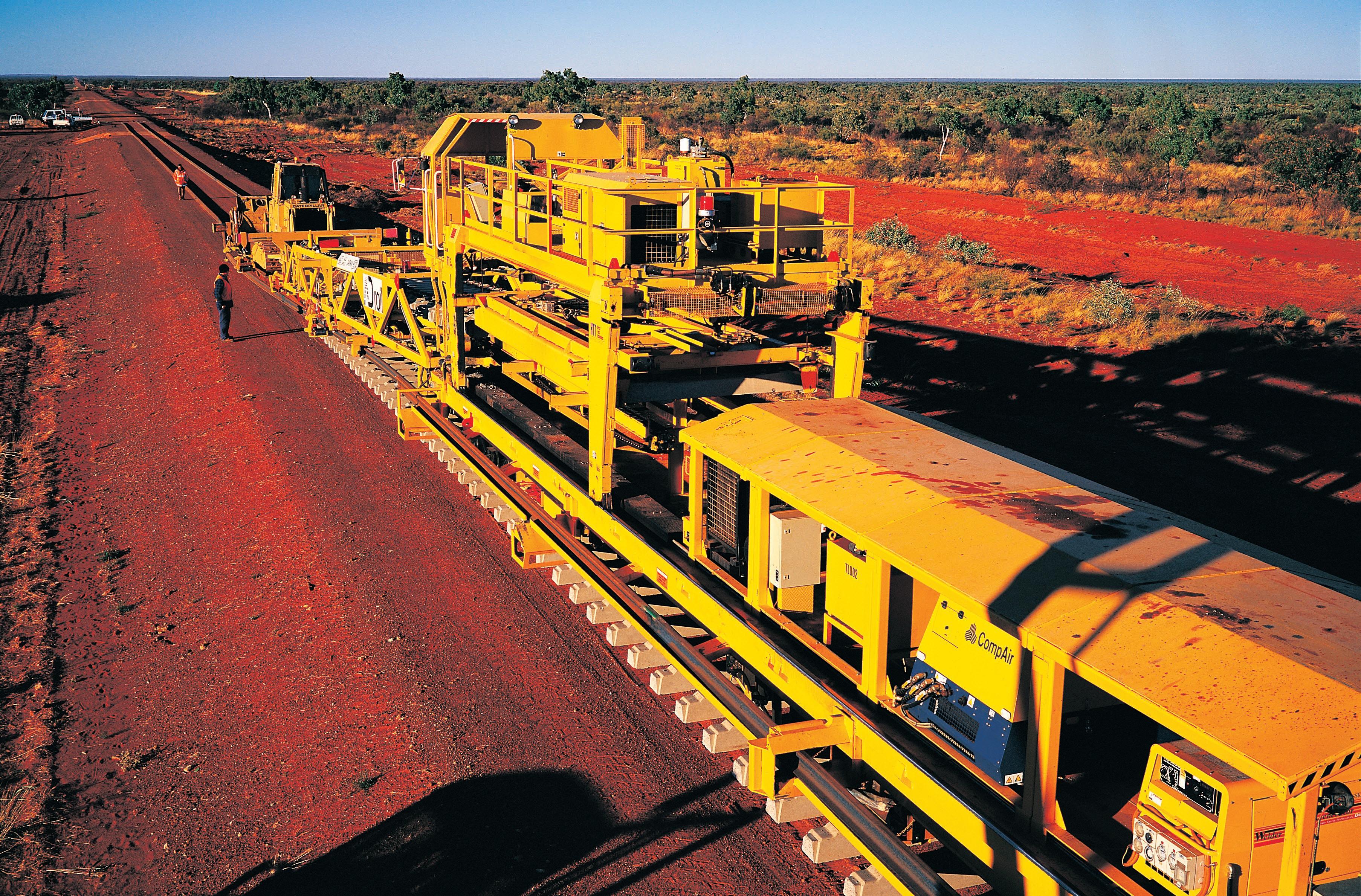
In all, two million sleepers were laid on the Alice Springs to Darwin route, using eight million rail clips and four million sleeper fastenings.
The scale of construction was as immense as the Outback: 15 million cubic metres of earthworks, almost 1200 culvert locations, 100,000 cubic metres of pre-stressed concrete, 2.8 million tonnes of ballast, 3500 tonnes of structural steel, 146,000 tonnes of steel rail. All of which involved 46 graders, 36 bulldozers, 34 excavators, 35 loaders, 31 scrapers, 29 vibrating rollers, 18 mobile cranes, 129 heavy trucks … In all, more than 600 vehicles.
The 1500 workers on the project operated from donga cities that were spread approximately 100km apart. Up to a dozen mini-townships of transportable cabins were in operation at any time, providing workers with generator power, cool showers and recreational facilities along with their accommodation.
Earthworks crews progressed at the rate of up to 1.5km per day. In turn, the two large, lumbering tracklaying machines, each about 500m in length, started from the north and south ends of the project and progressed towards each other at about two kilometres per day.
The vast machines laid the sleepers underneath themselves and effectively
“zippered” the lengths of rail into place.
The Alice Springs to Darwin line was completed in September 2003, after 30 months’ construction – five months shorter than scheduled. It was formally opened in January, 2004. Later that year, the project won the highly prestigious ACA Construction Achievement Award.
The rail link has proved particularly vital to the growth of Darwin’s deep-water East Arm Port and the city’s future positioning as a link in Australia’s supply chain to Asian markets and a hub for oil and gas supply.
Richard Stewart was a close follower of the Alice Springs to Darwin project – albeit from a distance. Stewart had left a highranking rail position in his native Scotland to join John Holland in 2005, rising to become head of John Holland Rail from 2009 to 2014.
“It was the largest railway project ever undertaken in Australia at the time; it was a game-changer in terms of its scale,” Stewart reflected. “And it was remote, obviously. They had to employ riflemen, when they were putting in abutments for bridges, to protect the staff from crocodiles!”
The Alice Springs to Darwin Railway would stand as a fitting tribute to engineer Jock
Chudacek, who was instrumental in this project – as he had been in Malampaya, in the Philippines, just a couple of years earlier.
The Tasmanian engineer, who passed away in 2010 and is honoured in the Jock Chudacek John Holland Scholarship at the University of Tasmania, earned the admiration of all who worked with him.
Greg Cain was one of them. “When you worked with Jock you realised that not only was he about the engineering and construction, he was also about the strategy of how to deal with all the external issues – not the least of which is community and the client,” Cain recalled. “He was the most humble individual … He was terrific.”
Opposite: The Ghan traveling on the Alice Springs to Darwin Railway
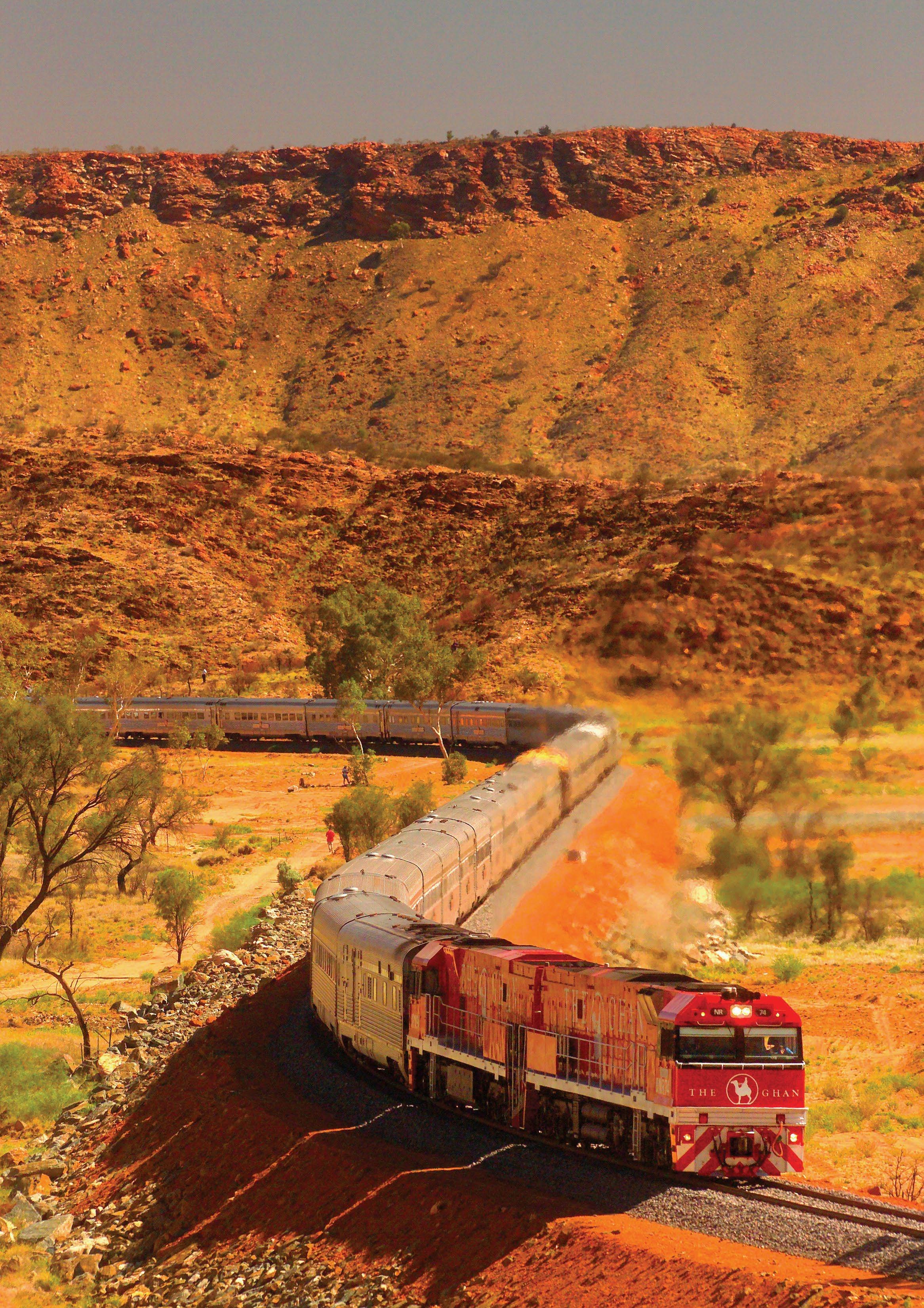
Victoria Regional Fast Rail
In2002, Victoria’s Department of Infrastructure gave approval to upgrade various key regional rail lines linking the city of Melbourne with Ballarat, Bendigo, Traralgon and Geelong. A part of the state’s Linking Victoria Strategy, its mission was to improve schedules and train speeds on these lines, which served more than 40 per cent of Victoria’s rural and regional population.
The project would involve the reconstruction of some 500km of track, along with the introduction of new, 160km/h diesel trains, upgraded station precincts and the latest signalling technology, to take Victoria forward in the new millennium.
An initial and well-publicised setback to the Victorian government’s
ambitions occurred when the proposed PPP, which would have kept costs to the taxpayer at $80m, failed to generate support in the private sector. The Victorian Government undertook to fund the project itself, at a total cost later estimated at $750m.
John Holland won the $182m contract to upgrade trackwork on regional lines from Latrobe Valley and Bendigo. The LaTrobe package, along a 100km stretch from Packenham to Traralgon, involved re-aligning the track so as to ease curves, extensive concrete and timber re-sleepering, re-ballasting, level crossing upgrades (a bugbear of Victorian regional rail), minor civil works and signalling upgrades using the latest fibre-optic technology.
The Bendigo package involved a similar list of works, albeit over 138km of rail between Sydenham and Bendigo and exclusively using concrete sleepers. Between Kyneton and Bendigo the line was to be converted from dual to single track, re-aligning lengths of the original track to serve as passing loops.
This created some controversy in the media at the time, though the thinking was sound: the singletrack section was necessary to deliver improved clearance for the fastertravelling trains beneath heritage bridges and in two existing tunnels.
Despite some initial resentment and delays to the overall project, once operational the benefits of the
Regional Fast Rail project were being recognised in reduced journey times, record passenger numbers and an enriching of regional Victoria’s economy, directly attributable to the improved accessibility.
Several of John Holland’s rail employees had started on RFR fresh from completing work on the Alice Springs to Darwin project. John Holland’s rail business was fortunate in winning, in succession, major rail jobs that brought good, consistent income for a few years at a time.
The skill and adaptability of the rail workers were helping to build a key pillar of John Holland’s business into this, and the next decade.
ANSTO Reactor
Thenuclear research facility at Lucas Heights in Sydney’s southwest has historically been among the most misunderstood buildings in Australia. In the seven decades of its operation, there has been occasional controversy about the true purpose of Australia’s only nuclear reactor and its potential safety and community health concerns.
The replacement reactor that was commissioned in 2000 and was under construction in 2001, however, would be put in the spotlight by the New York terror attacks. It would require a contractor that could respond with innovation and thoroughness.
The original High Flux Australian Reactor (HIFAR) that opened in
1958 was a 10 megawatt reactor, designed for research and for the production of radioisotopes for medicine and industry.
Medicine alone uses these isotopes for diagnosis in various types of scans, as well as the sterilisation of instruments and in actual treatments. In industry, radionuclide gauges are used to measure precise thicknesses in manufacturing. On a larger scale, gamma radiography is the most common method of inspecting welds in high-pressure pipelines.
Lucas heights has also been a major producer of irradiated silicon chips used in microcircuits.
In 2000 John Holland, in alliance with the Argentinian firm INVAP and EDI-Downer was awarded the
contract to design and construct HIFAR’s successor, then known as the Replacement Research Reactor.
INVAP, a specialist in nuclear reactors, designed the process systems for the new reactor, of a more advanced type that became known as the Open-pool Australian Reactor (OPAL). The two contractors provided the design and construction of the $160m building, civil, infrastructure and non-nuclear process and mechanical works.
Adding to the challenge was that John Holland was acquired by Leighton Holdings right about the time of the project being awarded. New John Holland managing director Bill Wild almost came to regret that fact.
“We bought the company with the Lucas Heights project almost in the bag, and then we had to bring it home. But I have to say, if I’d actually understood what was involved when we bought the company, we might not have bought the company … It was like, ‘Oh my god, you’re telling me that we are actually going to design a nuclear reactor, and go and build it? We are going to do that?’”
A John Holland engineer was stationed in INVAP’s design office Argentina for more than 12 months to fully understand the interaction between the process and civil aspects.
A noteworthy security feature of the worksite was the mobile plant fitted with proximity-sensing technology; machinery straying near to boundaries such as the fence between the existing HIFAR and the new work site, would automatically shut down.
Indeed, design and construction was all undertaken within strict security protocols. The environment was familiar enough to John Holland, with its experience and strength in Defence projects.
Security awareness naturally stepped up to an unprecedented level after the Twin Towers attacks in New York on 11 September, 2001.
That black day in the history of human advancement necessitated a major variation to the building’s design, to safeguard against the hitherto little-imagined scenario of a targeted, suicide attack by aircraft.
A steel net structure had been a part of the original design, safeguarding against an unlikely lightaircraft accident, but in the wake of 9/11 a new, stronger structure –dubbed “the chip basket” – was designed.
The 30m-long steel net structure works in conjunction with enormous concrete reinforcement around the 14m-deep pool that contains the radioactive component of the reactor.
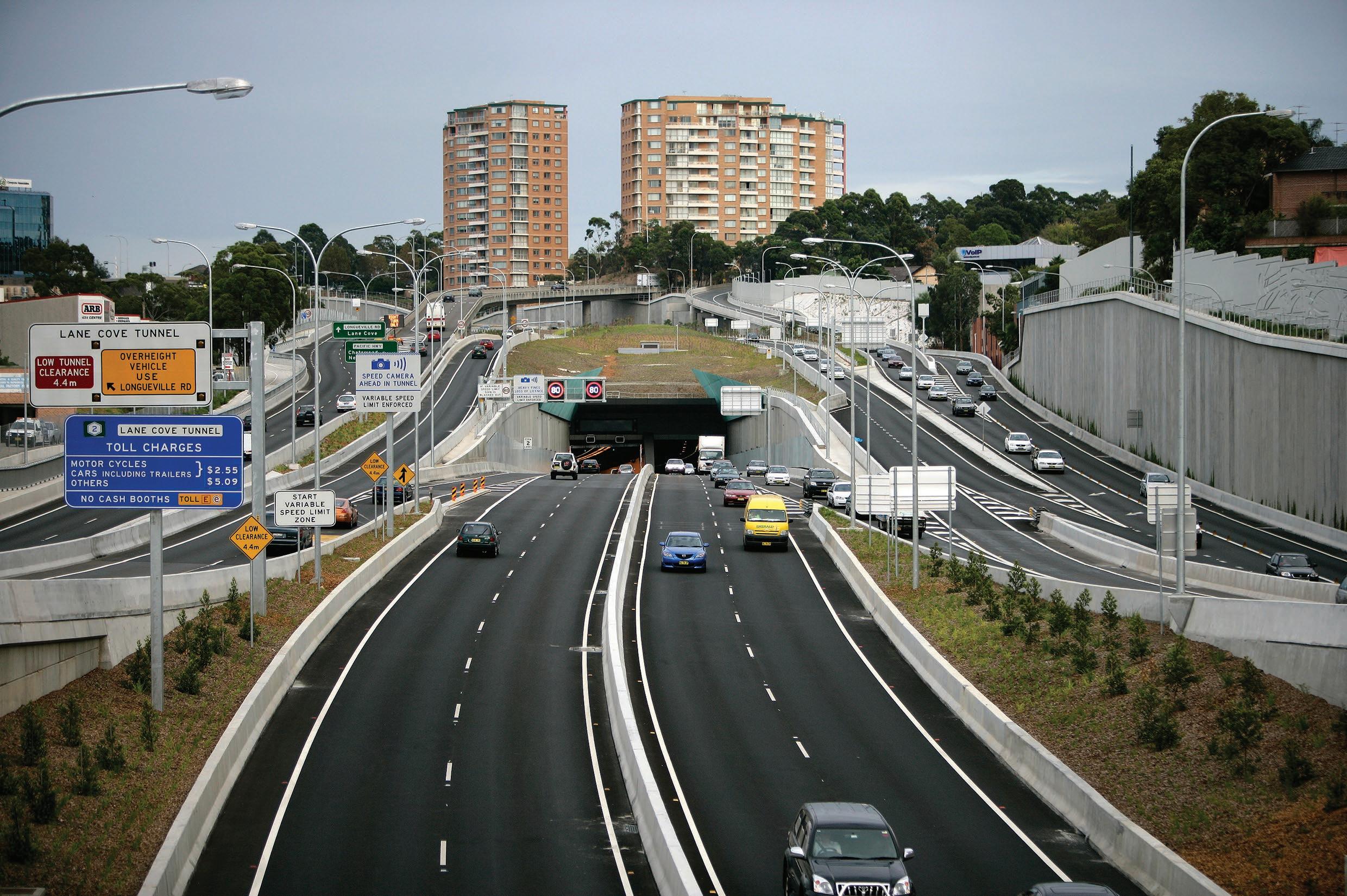
Lane Cove Tunnel
Sydney’s Lane Cove Tunnel represented nothing less than the completion a ring road of expressways and tollways encircling Sydney.
Over decades the additions of such as the Sydney Harbour Tunnel, the Eastern Distributor and the M2, M5 and M7 motorways had enhanced Sydneysiders’ ability to move around.
By the early-2000s, however, it was evident to motorists and residents alike that the inner north-west stretch of suburban Epping Road stood as a bottleneck between the Gore Hill Freeway (a JH project from 1991) and the M2 Motorway (JH bridgework, 1995).
The year-long bid process for the $1.1bn Lane Cove Tunnel was won in October 2003 by the Lane
Cove Tunnel Company, a 50/50 joint venture of John Holland and Thiess. The contract was to design, construct, operate and maintain the toll road for 33 years before handover to the NSW Government.
Along with the highlight – twin, 3.6km tunnels between the Gore Hill Freeway and Epping Road, with an additional portal eastbound to the Pacific Highway – the Thiess-John Holland component included widening of the Gore Hill Freeway, construction of ramps and interchanges, multiple ventilation sites, widening of the Lane Cove River bridge, and the construction of 7.5km of shared cycle and pedestrian pathways adjacent to the newly calmed Epping Road.
It was truly a breakthrough job for John Holland, and a direct by-product of the Group’s fresh acquisition of Transfield, which had bid for the project in joint-venture with Thiess. Lane Cove Tunnel, in turn, led to Melbourne’s EastLink and Brisbane’s Airport Link.
In the months prior to LCT construction commencing in June 2004, more than 9000 design drawings were produced. One innovation employed this early was to open the design process to the reviewing of concept drawings by teams from construction, safety, community and elsewhere. Their feedback helped to inform and streamline the designs as they went along.
The project presented more than its share of challenges, taking into account the close proximity of homes, businesses and 90 to 120,000 daily vehicle movements on the route that is, after all, the northern doorstep of Sydney’s CBD. It introduced a new level of community engagement.
This often coincided with clever technical solutions. In one such example, tunnelling teams at the eastern (Marden St) end of the tunnel had to contend with the availability of only two, small tunnelling sites –on opposite sides of Epping Road. Neither was, on its own, large enough.
But a solution was conceived in linking the two via a subterranean road beneath Epping Road. Spoil could be transferred underground, thus minimising noise and dust for residents, and trucks could enter and exit more swiftly, minimising traffic inconvenience.
Indeed, that loop road would stand as the LCT project’s first breakthrough construction, predating the considerable work that would commence on the approaches and the widening of the Lane Cove Bridge.
The works on one of Sydney’s major arterial roads resulted in the TJH team employing the largest and most complex paramics trafficsimulation modelling ever developed in the Southern hemisphere. Some 40 major traffic switches were jointly planned and managed by TJH and the NSW Roads and Traffic Authority.
The tunnels were excavated in three sections (east, west and mid) using a total of eight, 300kW roadheader machines. Tunnelling began in June 2004 from the western end (Mowbray Park), with both eastbound and westbound tunnels breaking through to the Mid Tunnel section just 12 months later. The Mid Tunnel east- and westbound crews, in turn, were shaking hands with their Marden St (eastern end) colleagues by October that year.
By the beginning of November 2005, around 90 per cent of excavation had been completed and paving and electrical installations had begun. Suddenly, on 2 November, the entire project team – having made record time thus far – would be presented with its biggest challenge.
At 1:40am on that day, rocks began falling from the roof of the Pacific Highway exit ramp. A tunnelling crew in a nearby area was able to evacuate safely, but the rock fall would lead to the partial collapse of a small apartment building above, on Longueville Road.
The incident would quickly escalate into a major media event, with helicopters and news vehicles scrambled to the early-morning scene. In effect, however, that was the most dramatic aspect of it: TJH crews, from every discipline, showed their training and preparedness and calmly swung into action.
That covered everything from having arranged alternative accommodation for affected residents within a couple of hours, to having issued an explanatory media release
by 5:30am, to having stabilised the site with a 1400 cubic-metre concrete pour by midday.
Not only were there no injuries arising from this incident, there were zero lost-time injuries recorded across the more than 550 days of the project. Ultimately, the project comprised 4400m of driven three-lane tunnel, 2120m of driven two-lane tunnel, 745m of driven single-lane tunnel and a further 2000-plus metres of ventilation and access tunnels, variously of 45sqm and 80sqm crosssections.
Even prior to its official opening on 25 March 2007, the Lane Cove Tunnel was being praised for its constructor’s attention to detail. As one example, prior to the start of construction, plants were removed from the site and seedlings propagated from them in nurseries around Sydney, ready for later regeneration of the site.
Thus, the plants that repopulated the site were not just similar to, but were direct descendants of those removed – ensuring their suitability and longevity.
EastLink Melbourne
The
$2.5bn EastLink project in Melbourne was, when initiated in 2005, the largest urban road project undertaken in Australia. It was also a model of efficiency thanks partly to the foresight of the urban planners who had set aside a suitable corridor in this busy part of Melbourne’s east 40 years earlier.
EastLink would be built by a consortium called ConnectEast Group, comprising John Holland, Thiess and Macquarie Bank. ConnectEast won the contract to finance, design, construct and operate what was initially known as the Mitcham-Frankston Freeway.
At the awarding of the contract in 2004, the Mitcham to Frankston corridor was home to more than 1.5
million people and to more than 40 per cent of Melbourne’s industrial output.
When EastLink was opened in June 2008 (several months ahead of time), it comprised 39km of toll road (plus six kilometres of toll-free bypasses), 88 bridges, twin 1.6km three-lane tunnels and 35km of shared-use pathway.
The roadheader-driven twin tunnels in the Mullum Mullum Valley, at the northernmost end of the project, have been described as the two landmark road tunnels in Victoria. They were constructed using five roadheader machines, valued at more than $4m each, together with rockhammers and drill-and-blast techniques excavating
a total of 450,000 cubic metres of rock.
The completed, oval-shaped tunnels ran from 15m to 45m below ground level. They measured 12 metres by 15 metres and were lined with plastic membrane and concrete. The concrete secondary lining was designed to carry the full hydrostatic and long-term ground loads.
A John Holland breakthrough in this tunnelling project was an enhanced use of roadheader excavation guidance systems, which produced a world-best excavation profile accuracy profile averaging 68mm.
The entire excavation works in Mitcham, the northernmost of six regions into which the project was divided, were completed in March 2007; more than 1.7 million manhours of work without a single LTI.
Across the total EastLink project, more than seven million cubic metres of earthworks was done, more than 1.1m tones of asphalt laid, and 380,000 cubic metres of concrete poured.
EastLink also presented an impressive scale in its electronic fitout, with a tolling system comprising 52 gantries, each containing approximately 200kg of equipment, including a total of 244 cameras.
Indicative of a new era in both the company and infrastructure projects,
community engagement was at an unprecedented level. More than 3000 properties directly adjoined the EastLink corridor, and a project team of seven full-time community liaison staff established open lines of communication.
Similarly, the environmental aspect of the project marked a new high point. Degraded waterways that were temporarily realigned during construction were restored and revegetated. Underpasses were created to provide thoroughfares for native wildlife, such as the duck-billed platypus. New public parklands were built along the route.
A feature of EastLink is the attractiveness of its urban design, evident in everything from the 47m-tall ventilation stacks of the tunnels at the northern end, to the striking coloured noise-proofing panels lining the motorway.
The puzzling Hotel – a roadside mega-sculpture in Dandenong South, by artist Callum Morton – was one of four major artworks commissioned for EastLink, at a cost of $5.5m. The others were James Angus’ molecularlooking Ellipsoidal Freeway Sculpture, Emily Floyd’s gigantic bird-andworm Public Art Strategy and Simeon Nelson’s vast, toppled Desiring Machine
This aspect of the project was especially close to the heart of John
“ it was such a mark of respect for those people. every single one … it was just so John Holland to do that, i think.”
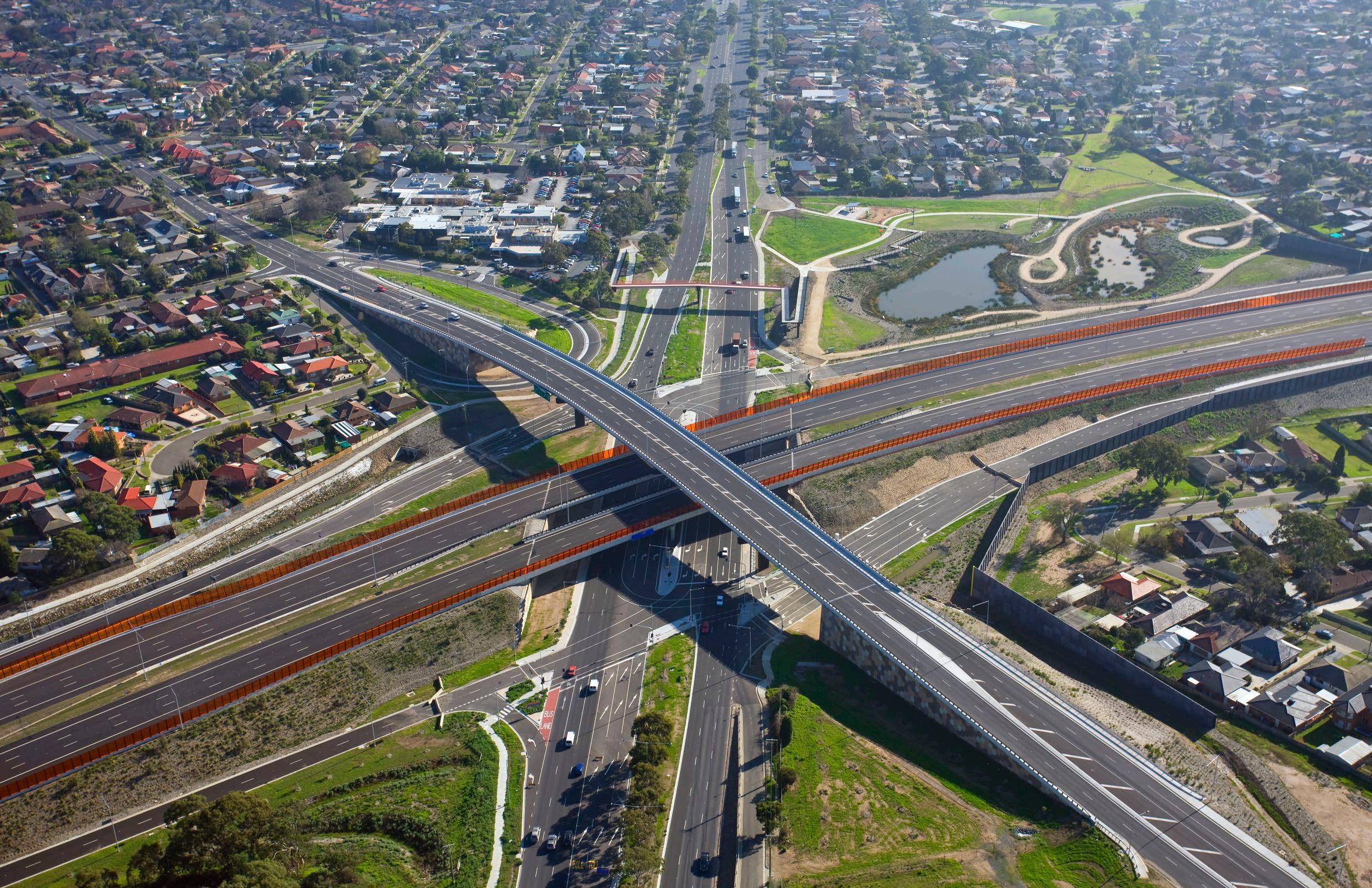
Holland Chairman, Janet Holmes à Court. She was one of a threemember panel, with Melbourne architect Roger Wood (responsible for much of the urban design on the project) and ConnectEast director Yvonne von Hartel, who commissioned the four major and eight smaller works.
The Chairman had also been present with then-premier Steve Bracks at the breakthrough ceremony in the outbound tunnel in lateOctober, 2006.
“They had worked an amazing number of hours in this tunnel job without a lost time injury, and we had a ceremony,” she said. “All the VIPs and guests and community people were on one side, and when they broke through – I don’t know how many people had been working on the other side, but they were each announced as they came through.
“It was such a mark of respect for those people. Every single one … It was just so John Holland to do that, I think.”
Green Bridge
The Lady Eleanor Schonell Bridge, still colloquially known as the Green Bridge – it is in fact white – is a cable-stay bridge spanning the Brisbane River. It links Dutton Park and the innersouth suburbs of Brisbane with the St Lucia campus of the University of Queensland.
The bridge, an elegant cable-stay design, was perhaps most notable in that it was intended to carry only buses, cyclists and pedestrians. Buses deposit and collect passengers at one end; there is no connection to surface roads at the University end.
John Holland won the design, construct and maintain contract for the $55.5m bridge and its associated works. The cable-stay bridge would
span 390 metres, approximately east-west across the Brisbane River, supported by twin 70m-tall towers that were buried more than 30m into the river bedrock.
This design, with a narrow (20m) deck and elegant shape, was influenced by the desire to preserve riverside mangroves. Yet it also had to be hardy enough to endure floods and heavy pedestrian loading during special events.
Further environmental consideration was evident in the bio-retention ponds that collect and filter rainwater runoff from the deck, and in having lighting and digital information screens powered by a solar roof panel at the Dutton Park passenger terminus.
The actual construction was done by firstly constructing the tower bases from the pile cap to the height of the bridge deck (15m), followed by the first stages of deck construction, with sections floated out on barges. After subsequent completion of the towers, the remainder of the deck was constructed, including the installation of the cables to the deck and the
stressing of the cables to support the precast deck panels.
The completed bridge, with all electrics installed, was opened in December 2006. It was named after the early-20th century educator who did much for children with cerebral palsy. The bridge opening ceremony paid tribute by raising money for the Cerebral Palsy League.
Holsworthy Special Operations Working Accommodation
The Australian Army first established a military reserve and training area in Holsworthy, in Sydney’s south-west, during World War 1. It was from the Holsworthy Barracks that a contingent of the prestigious 1st Brigade was relocated, in the early 1990s, to Robertson Barracks outside Darwin as part of the Army Presence in the North (APIN) with which John Holland was closely involved.
In August 2005, John Holland was awarded the $120m project to construct all-new accommodation for the two Special Forces divisions, the Incident Response regiment and the Royal Australian Regiment.
The project covered approximately 27ha. The expansive bushland areas
entailed ecologically controlled clearings and earthworks prior to construction of some 73 new and refurbished buildings. Among these special-use facilities were training and lecture rooms, armouries, vehicle workshops and an antenna farm.
John Holland’s familiarity with Defence work streamlined the process of implementing a staging and decanting scheme, allowing vital Defence work to continue uninterrupted.
One of the many environmental challenges involved management of stormwater run-off after the clearing of areas of this large, sloping site.
John Holland was quick to establish a large, mobile water filtration and sedimentation system.
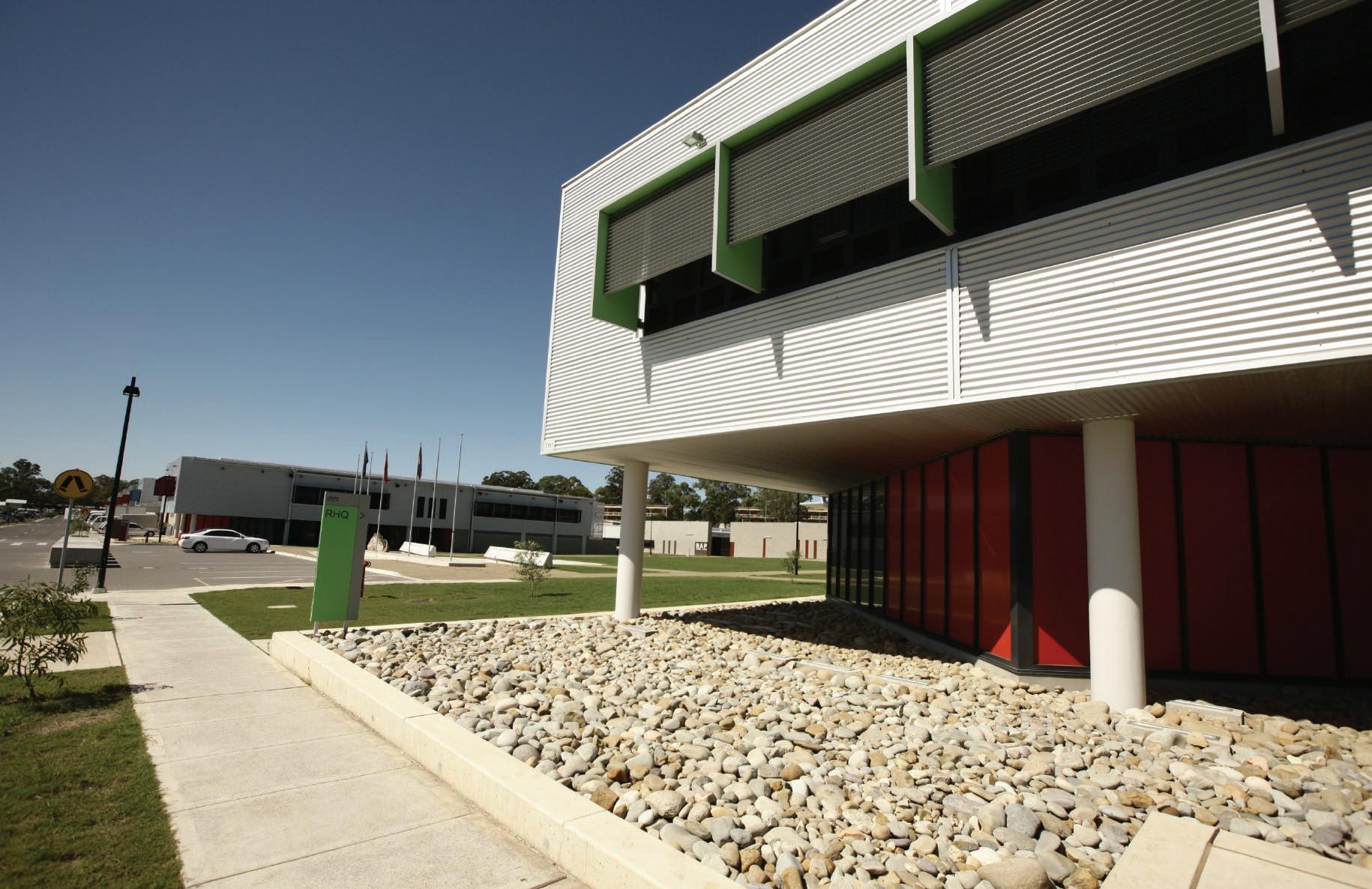
The great majority of buildings were constructed using structural steel framework, catering to the fact that most were of a one-off design. One of the key buildings was constructed under the added deadline pressure of its having been allocated as the security control centre for the 2007 APEC meeting in Sydney.
Another example of the client’s special requirements was a tank facility for the performance testing of outboard motors. John Holland’s engineers designed a mechanical baffle system within the tank to extract exhaust fumes at water level. Similar innovations and fine-tuning
was applied to designs for weapons racks, overhead gantry control systems and large equipment lockers (known as GROTS).
It was indicative of John Holland’s status as a defence supplier that in the very same month that the Holsworthy SOWA contract was won (August 2005), Defence Maintenance Management – a joint venture between John Holland and Multiplex – won a five-year, $60m contract to maintain the Department of Defence’s infrastructure across several bases in the Sydney West South region.
City of Dreams
Ashimmering landmark on Macau’s booming Cotai waterfront is the four distinctive towers of the City of Dreams, a resort developed by Melco-Crown, a joint venture of casino entrepreneurs Lawrence Ho and Australian, James Packer.
The Cotai region, comprising about five square kilometres of reclaimed land between two existing islands, was earmarked by the Chinese government as a showcase for entertainment and tourism. Since the first casino opened there in 2006, the Cotai waterfront has become one of the most prestigious and hotly-contested regions among resort developers.
With innovation and quality at the forefront of the City of
Dreams project, John Holland, in joint venture with Leighton Asia and China State Construction Engineering, undertook construction management for the $2.2bn superluxury development. This included the construction of four deluxe towers of 28-35 storeys in height, a 39,000sqm underwater-themed casino, a luxury retail arcade and an egg-shaped, 2000-seat performance hall.
In addition, the project was provided under a fast-track arrangement, with the unique and complex design still being finalised as construction was proceeding. Work commenced in 2006 and was completed, in stages, during 2009. The workforce peaked at 8000, with
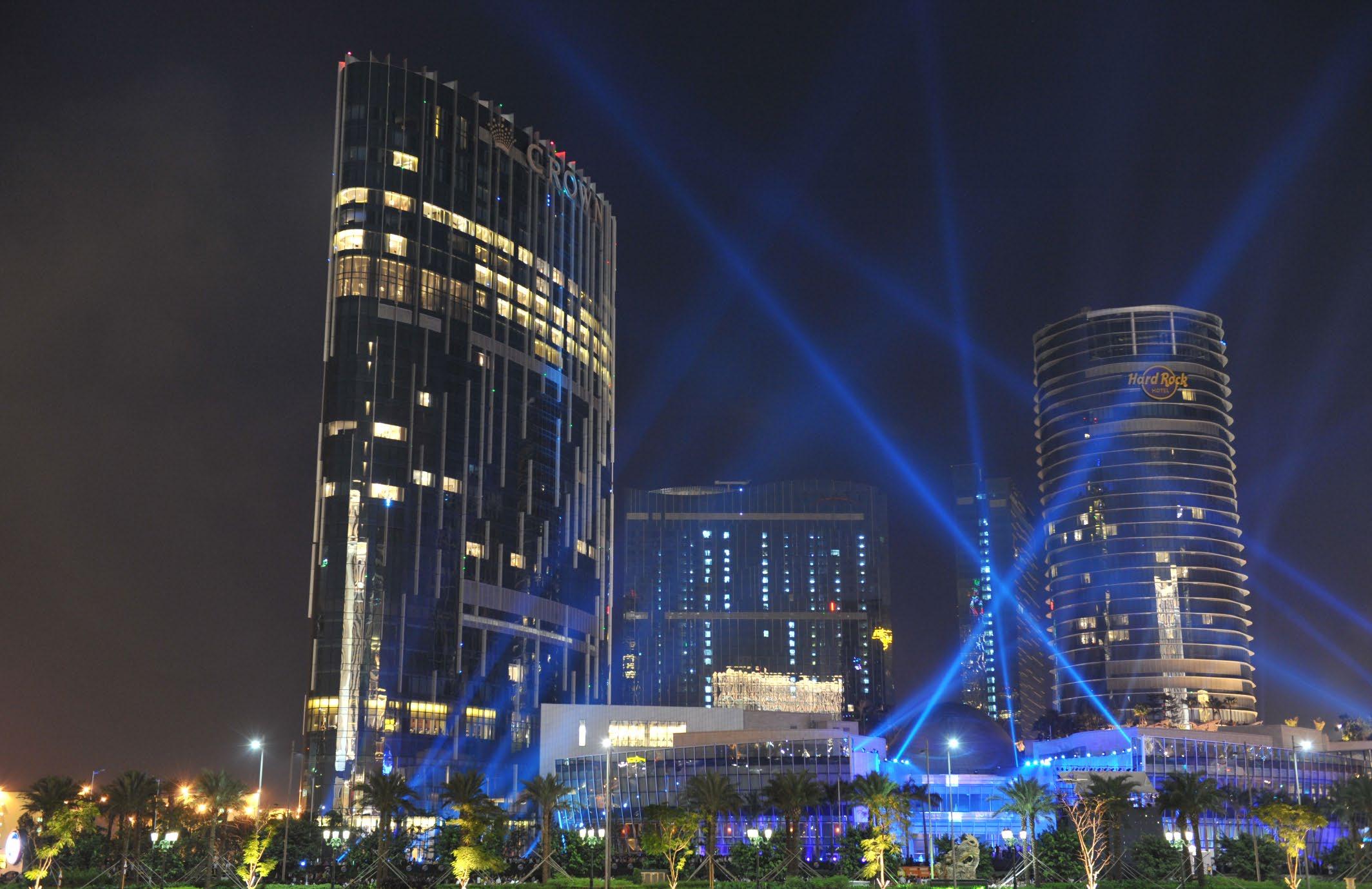
monthly turnover reaching levels of $100m.
During construction, the client benefited from construction management initiatives like the introduction of structural steel framework and extensive prototyping, both measures saving time and money. Late design delays kept the project team thinking on its feet, splitting design packages to maximise work-resource availability.
At its Phase 1 opening in June 2009, the City of Dreams’ casino space housed 520 gaming tables, approximately 1350 gaming machines, 20 restaurants and bars and top international retail brands within
the lifestyle precinct, The Boulevard. The first two hotel towers, Crown and Hard Rock, were joined at Phase 2 (November 2009) by the Grand Hyatt Macau hotel. They surrounded the iconic, spherical Bubble Theatre (later known as the House of Dancing Water).
The City of Dreams was truly an international headline-making project. It was also something of a homecoming for John Holland to Asia. Subsequent to John Holland’s takeover by Leighton six years earlier, the John Holland Asia business that had been developed during the 1990s was very quickly folded into the significantly stronger Leighton Asia.
National Portrait Gallery
“Making the simple complicated is commonplace. Making the complicated simple, awesomely simple, that’s creativity.” The words of jazz composer Charlie Mingus, a man who knew about art and soul, might well be applied to the National Portrait Gallery in Canberra.
The striking building, for which John Holland managed the construction, was completed in 2008 after two years’ work.
The National Portrait Gallery elegantly balanced several conflicting demands, such as being warmly open and inviting while also providing the environmental and security controls necessary for housing around 500
valuable artworks. Countless stylistic touches placed the building at the heart of the nation, with indigenous grasses sourced from each state, and timber gallery floors and strips of stone tiles being similarly sourced from around the nation.
Meanwhile, the concrete walls, timber roof structure and feature plywood panelling were from Canberra suppliers.
The building design had a footprint of 7500sqm and was constructed on a greenfield site in Canberra’s Arts and Civic Precinct, neighbouring the High Court of Australia and the National Gallery of Australia.
The architectural excellence of the building (courtesy Johnson Pilton
Walker) would be lost without the superlative quality of construction and finishing. The architects specified an exacting design with an absence of trims; detail quality, from formwork to joinery, had to be precise as there was nowhere to hide.
A requirement of the contract was the construction of a prototype: half of a full-sized gallery, measuring 12m long and with an adjoining corridor. Constructed from precisely the designs, techniques and materials to be used in the eventual product, the prototype later allowed the testing and fine-tuning of fit-out elements prior to final installation.
An obvious feature of the building was the extensive use of off-white coloured Class 1 concrete, primarily in the long-run in situ walls. Class 1 concrete is defined as having no greater than 3mm variation against a three metre straightedge placed anywhere against its surface; and no more than 1mm variation against a 1.5m straightedge.
Another concrete finish of which the builders could be proud was the bush-hammering on certain facades that face similarlyfinished older buildings within the precinct. Ironically, this technique –achieved with a hammer like a meat-tenderiser – was traditionally employed to conceal average-quality concrete finishes.
Bush-hammering had been littleused in recent years, forcing John Holland to refine a method of shotblasting to achieve a similar, softer finish.
Extensive use of timber visually relieved the stark strength of the concrete, the ceiling in the foyer area featuring a combination of lightcoloured Hoop Pine panels over dark Victorian Ash trusses. Jarrah featured prominently around the walls of the introductory gallery, function rooms and theatre areas.
The timber used for flooring needed to be pre-conditioned to ensure there would be no shrinkage. Throughout, the thermal properties of the timber and other materials used were critical in averting condensation and water build-up that could be detrimental to the artworks.
Fluctuations in temperature and humidity, caused by solar loads through glazing, thermal loads from large groups of people and thermal infiltration via the public entering and exiting gallery spaces, all needed to be countered by design and by technology.
International galleries and art loan agencies understandably impose strict standards for any gallery intending to borrow their works. The National Portrait Gallery’s mechanical system incorporated several humiditycontrol and water temperature control
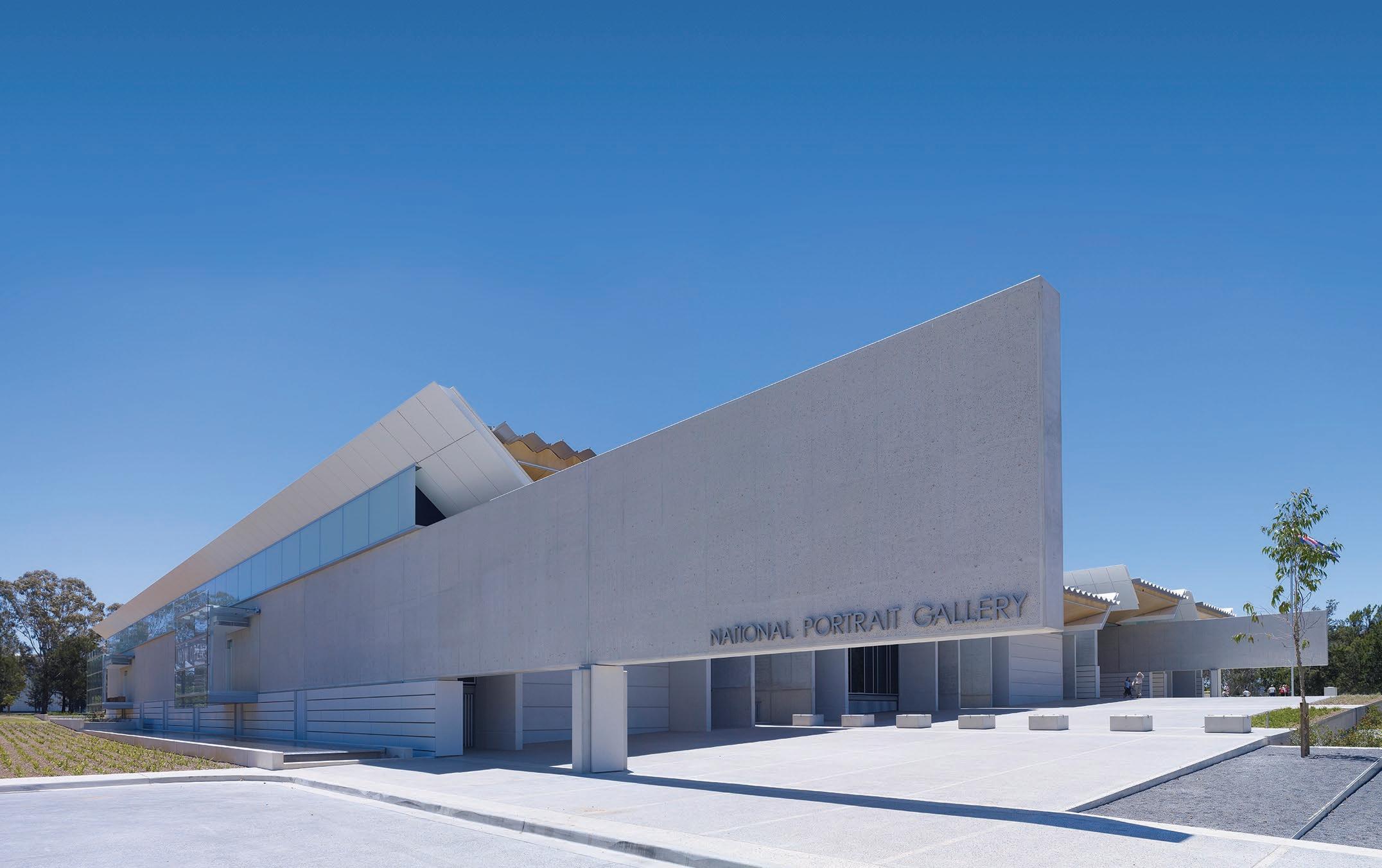
innovations developed by John Holland, to maintain temperature at 20 degrees (+/1.5 deg), relative humidity at 50 per cent (+/5%) and also regulate the maximum rates of change per hour.
Thermal-break window frames were in common use in European countries, but it’s believed that the National Portrait Gallery represented the first large-scale use of the condensation and temperaturecontrolling design.
Capping all this was a sheet steel roof in Aramax, a specialist product more often found in industrial buildings. Here, a requirement for 73-metre lengths was to ensure the absence of joins above gallery areas.
The W-shaped sheets were extruded onsite from five-tonne coils.
Such large steel sheets presented challenges in terms of thermal expansion and contraction, again potentially creating vulnerability
for the artworks below. Computer modelling was used to precisely calculate the range of movement and determine the position and length of each fixing slot.
These slots were cut during the extrusion process and covered with washers during assembly; where longer fixing slots were needed, they were covered with a sheet metal hood.
The National Portrait Gallery was a success on every imaginable scale. Its swag of awards covered design and construction and included the 2009 ACT Medallion from the Royal Institute of Architects; 2009 Master Builders Association ACT Project of the Year; Romaldo Giurgola Award for Public Architecture; the Light in Architecture Prize; 2009 Sir Zelman Cowen Award for Public Architecture; and Cement Concrete & Aggregates Australia Public Domain Awards Best Project in State.
The National portrait gallery was a success on every imaginable scale.
Gold Coast Desalination Plant
Modernlarge-scale water desalination began to take hold in the US during the 1960s with the development of the reverseosmosis technique. A departure from the traditional, thermal-based distillation methods of separating salt from water – a practice that dated back to the ancient Greeks –reverse-osmosis involves the forcing of seawater, under extreme pressure, through a synthetic membrane, whose fine holes trap salt particles. Australia’s drought conditions that had endured since around 1995 prompted several state governments to investigate desalination as a means of securing their capital cities’ water. Where there had been several small-scale desalination plants
around the country – John Holland constructed one such in Burrup, WA in 2002 – the first major example was completed in 2006 in Kwinana, a southern beach suburb of Perth. Meanwhile, South-Eastern Queensland was being doubly hit by drought and unprecedented population growth. It was quickly decided that a desalination plant to serve the region would not only offer the most secure supply, but that it was also environmentally acceptable in the area.
Crucially, it was the only solution that could be implemented within a tight timeframe of just three years.
John Holland, at that time probably the most experienced and active in water and tunnelling
projects, was named as the construction partner in an alliance that included process specialist Veolia Water and consultancies Sinclair Knight Merz and Cardno.
The site chosen was Tugun, being geographically close to the coast and able to be cost-effectively linked to the ocean via tunnels: twin 2.8m internal-diameter tunnels, the inlet being 2.2km in length (extending 1.4km from the shoreline) and outlet 2km in length. The tunnels’ ocean ends were connected to risers, at a depth of approximately 65m below sea level.
Landside, a 25km pipeline of one metre diameter was constructed to transport desalinated water from the Tugun plant to a reservoir in Worongary, via a new reservoir at Robina and pumping station in Mudgeeraba.
Along with two nine-metre diameter, 40m deep inlet and outlet shafts, the dual 2.8m-diameter tunnels were dug by two fullface TBMs, facing a variety of
challenging hydrogeological conditions. The inlet and outlet risers were installed via an offshore jack-up barge.
The $1.1bn, 125 megalitre/day project was handed over in May 2009, 32 months after commencement.
In 2009 it was named Membrane Desalination Plant of the Year in the Global Water Awards, having already been highly commended at the 2008 Engineering Excellence Awards by Engineering Australia.
The challenging and hugely successful project, which was known for its harmonious and effective relationships among all stakeholders, helped John Holland and alliance partner Veolia to clinch the Sydney desalination plant project.
In what would come to be accepted as a water engineering truism, the completion of the Gold Coast desalination plant proved to be a precursor of record rainfall –which south-east Queensland subsequently experienced in December 2010.
Sydney Desalination Plant
Likemost of the eastern seaboard, Sydney settled into the new millennium in the grip of a drought. Mild water restrictions had been introduced as early as 2001, these rising to Level 3 restrictions at the end of 2006. Sydney’s water capacity reached an all-time low of 33.8 per cent.
Following earlier proposals, in October 2006 the decision was taken to follow the example of the Gold Coast and equip Sydney with a desalination plant. The winning bid of Bluewater – a joint venture of John Holland and Veolia Water – would be one of the largest desalination plants in the world, with the capacity to supply up to 15 per cent of Sydney’s drinking water.
John Holland was a natural, and not only for its fresh experience on the large-scale desalination plant on the Gold Coast. John Holland already enjoyed a close relationship with Sydney Water, equipping it with vital knowledge of how to tie the new plant into Sydney Water’s existing distribution network.
The design, build and operate contract called for a desalination plant of 250 megalitres per day, upgradeable to 500Ml/d, on a 45ha site allocated at Kurnell.
Kurnell sits near the tip of a peninsula on the southern shore of Botany Bay. Acknowledged as the birthplace of modern Australia – it was here that Captain James Cook first set foot on the Australian
continent – the sand isthmus has long been home to sand mining, oil refining and chemical industries.
Construction commenced in July 2007.
The plant, the heart of which was situated some 1.5km inland, comprised 32 separate structures, including pre- and post-treatment facilities, the main reverse-osmosis building, potable water storage tanks, stormwater retention basins and a wastewater management facility.
The plant was connected to the Tasman Sea by twin, 2.5km tunnels of 3.4m inner diameter, extending 300m offshore. The TBMs were launched from a 20m-deep box cut.
At the sea end, the precise positioning of the inlet and outlet was determined by complex plume modelling to ensure that ocean currents would not carry the discharged water, now doubled in salinity and one degree warmer, near to the inlets.
Each of these underwater tunnels (one inlet, one outlet) was attached to risers 300m offshore. The four inlet and two outlet riser components were connected at 25-metre intervals to their respective tunnels via 2.2m-diameter holes bored 24m vertically through rock and fitted with GRP liners.
The tunnelling and vertical boring tasks were made extremely
challenging by the presence of a National Park, the tunnelling extending offshore and the scarcity of geotechnical information. Time constraints also dictated that the horizontal tunnels and riser shafts be drilled concurrently.
The large (up to 8m x 5m) riser components were manufactured in the purpose-built precasting facility at Port Botany.
This marine works aspect of the construction presented more than its share of challenges, being situated in high energy waters. The drilling was performed by Sea Fox 6, a 3000t selfelevating platform capable of being raised up to 60m from the sea bed. Drilled material was transported back to shore. Crew, meanwhile, had to be transported by helicopter.
The landside operations were to serve the desalination process of forcing pre-filtered seawater at high pressure through a series of reverseosmosis membranes, removing salt and minerals. In line with Australian drinking water standards, fluoride and minerals are then added, and the disinfected water captured in the potable-water tanks ready for distribution to the Sydney network. Around 60 per cent of the water originally captured is returned to the sea via the outlet tunnel.
The site for the multi-stage plant lies on poorly compacted sand
we’ve found almost exclusively that as you get to the point of commissioning these plants, it actually buckets down!
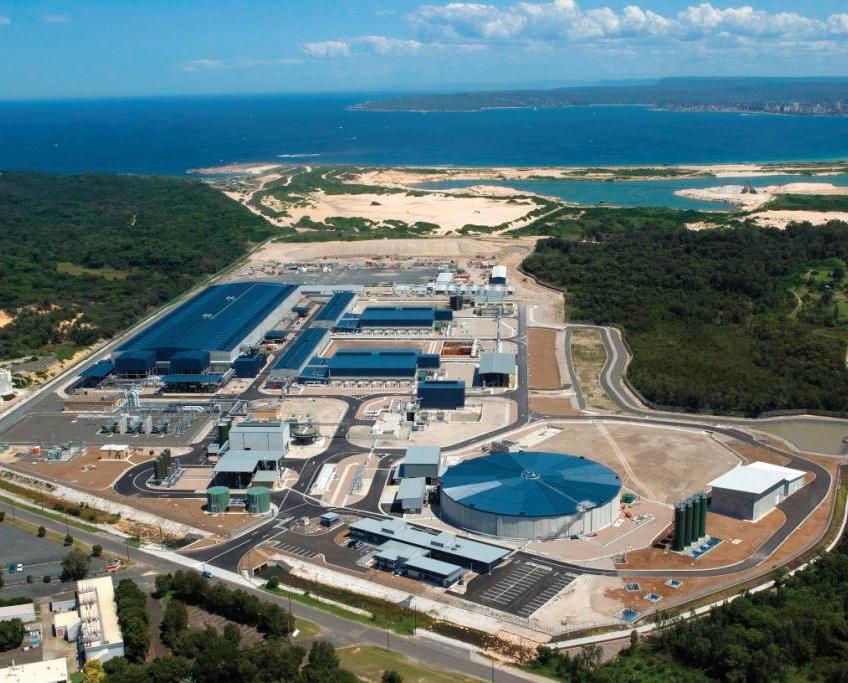
atop Hawkesbury sandstone. These challenges were overcome by having most of the structures built on CFA piles, some buried as deep as 22m, and the underground pipelines being designed to take into account fluctuations in the water table.
The plant construction entailed more than 150,000 cubic metres of earthworks, the placement of 60,000 cubic metres of concrete, the fabrication and erection of more than 3000 tonnes of structural steel and more than 16km of pipework.
The $1bn project, the largest in NSW for some years, was delivered to
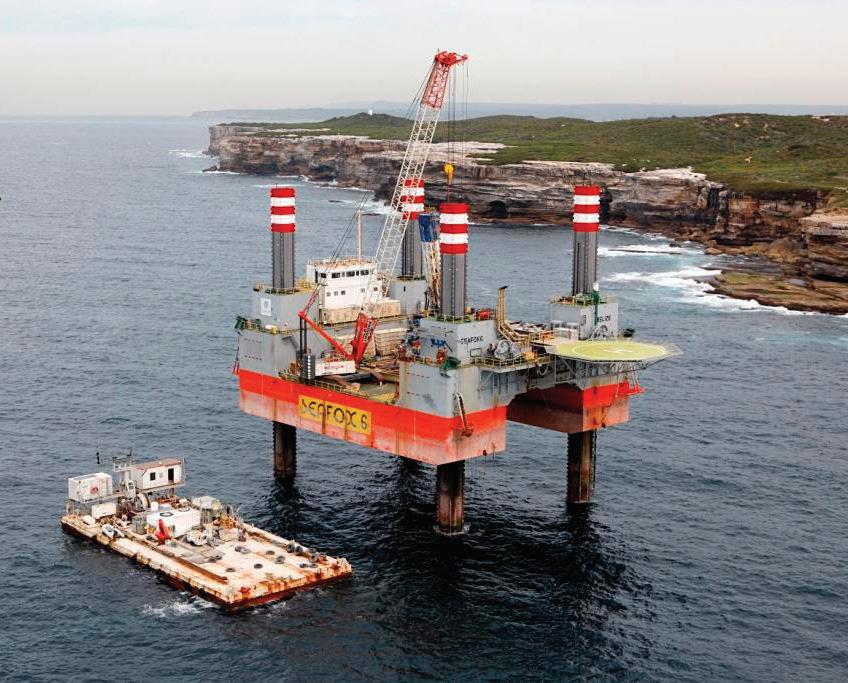
the client in February 2010, on time and on budget. It became a precious resource for Sydney – although ironically, at the time of writing it had never been pressed into service.
As Chris Evans, former Executive General Manager of Building at John Holland observed, “We’ve found almost exclusively that as you get to the point of commissioning these plants, it actually buckets down! That seems to be the way. But there will be times when they’re desperately needed and there will be times when they’re not. And they’re not the sorts of plants you can develop overnight.”
Priority Sewerage Program Blue Mountains
In the late-1990s, Sydney Water Corporation initiated the Priority Sewerage Program (PSP) as a means to bring sewerage reticulation to outlying areas of the city. The PSP established major new treatment plants at Warragamba in the city’s west, Brooklyn in the north, and a network of new regional treatment plants, pumping stations and pipelines from the urbanised regions near them.
John Holland was selected as a partner for the $421m PSP scheme in the Upper Blue Mountains, delivering five new pumping stations and 90km of pipe, in often rugged terrain. The Upper Blue Mountains scheme would provide sewerage services to some 1400 properties in 16 suburbs, at that
time reliant on septic tank systems or pump-out services.
Adding to the challenge was the fact that in 2000, just two years prior to the commencement of work, the Greater Blue Mountains had been listed as a World Heritage region.
John Holland – already boasting an unrivalled knowledge of Sydney Water Corporation’s urban network –was involved at all stages of the PSP. This included the technical and environmental planning and approvals, preliminary through to final design, management and construction of the sewage treatment plants and piping, testing and commissioning, and community relations.
A major part of the construction phase had to take into account
the sensitivity of such as boring underneath the Cascade Dam, water catchment areas and hanging swamps.
John Holland employed the relatively new technology of Horizontal Directional Drilling.
This “trenchless” technique entails the drilling of a long, horizontal pilot hole between defined entry and exit points, swooping beneath the water table (or roadway, or other obstacle). Thereafter, the pilot hole is backreamed to the desired diameter and the pipe pulled through the hole.
The HDD method allows pipes of up to several kilometres in length to be laid using only two entry points. Around 20km of polyethylene pipe
was laid, with diameters varying from 63mm to 250mm.
The reduction of environmental impact resulting from this technique was entirely in tune with the benefits of the PSP scheme, which greatly improved public health and protected the vital waterways and catchment areas of the Blue Mountains and Sydney.
In recognition of its having ended the discharge of treated effluent to the surrounding World Heritage Area, thereby eliminating the polluting of local waterways, the Upper Blue Mountains PSP project was awarded the 2008 NSW Environmental and Heritage Award.
Northern Sewerage Project Stages 1 and 2
Melbourne’s Northern Sewerage Project, awarded to John Holland in June 2006 and commencing in August 2007, was hailed as one of the largest and most ambitious sewerage tunnelling projects of its kind. The $650m project involved the excavation of 12.5km of tunnels to help provide the sewerage capacity needed for Melbourne’s rapidly growing northern suburbs.
Another vital aspect of the NSP, part of a greater network of sewer pipes that carry more than 260bn litres of sewage each year to local and regional treatment plants, was the environmental protection of the Merri and Moonee Ponds Creeks from the environmental dangers
of sewage overflows during heavy rainfall.
Clients, Melbourne Water (Stage 1) and Yarra Valley Water (Stage 2), faced significant challenges in planning and design. The eight-year process, which concluded in 2007, resulted in a cost-efficient yet highly effective expansion and upgrading of the area’s existing network.
John Holland was ideally equipped for the technical, environmental and community challenges of the project.
Stage 2, the northernmost arm of the project, entailed the construction of 4.5km of tunnel at depths of up to 39m. The tunnel was dug using TBMs, roadheaders and drill-andblast methods. The tunnels were
lined with GRP pipes (of 1.6 to 2.5m diameter) and grouted into place.
Stage 1, meanwhile, entailed approximately eight kilometres of tunnel, at depths of up to 64m, between Essendon and Coburg North. These intercepted the existing sewer at several points and connected into Yarra Valley Water’s Stage 2 works. Five large-scale construction sites were established for the Stage 1 works, each of these variously requiring site clearing, acoustic enclosures and street access.
In addition, the large area covered by the project meant a great variety of geological conditions, ranging from soft silt and water-bearing sands, to hard rock and dense basalt.
John Holland’s innovative resequencing of the works reduced the number of TBMs needed from four to three, bringing significant cost savings. Additionally, multiple TBMs would sometimes be used to excavate a single shaft.
Three TBMs shared the work: Julia (228 tonnes, 3m diameter bore); Victoria (250t, 3m bore); and Gemma (300t, 4m bore).
Julia was designed for the hard basalt encountered at the northernmost 3.2km of Stage 2, whereas Victoria and Gemma were Earth Pressure Balance (EPB) machines, designed for the siltstone, sand and clay encountered in the western and south-
western Stage 1. Victoria and Gemma dug, respectively, around four and 4.7 kilometres of tunnels. Around 600m was dug by drill-and-blast methods.
The lining of the tunnels with GRP pipes was still a relatively new technique in Australia. The 6m-long pipe sections were lowered by crane into the tunnels via the construction shafts and were transported by a purpose-built, hydraulic pipe carrier. They were then suspended while they were connected and subsequently grouted in position. More than 2100 such lengths were installed during the project.
A part of the tunnelling went beneath Melbourne’s major arterial CityLink, necessitating continuous monitoring of any ground settlement. This was done by a sophisticated method of an automatic theodolyte mounted on a bridge, taking measurements from reflectors placed on the freeway. Real-time reporting confirmed that no settlement was occurring.
Similarly, more than 400,000 water quality tests were conducted over the life of the project at the Moonee Ponds and Merri Creek. Results were recorded every 15 minutes and any exceeded limits triggered an immediate alert to environmental managers.
The NSP left communities in far better shape above ground, too.
A $1m contribution from the NSP helped fund the provision of two new fully-equipped outdoor recreational areas at Coburg Lake, while the clients’ Community Benefits Program allocated $4m to a number of similar projects that included playgrounds, a skate park, car parks and the development of a local wetlands.
The completion of the work in June 2012 was six months ahead of
schedule – and the project had come in at $135m under budget.
The Northern Sewerage Project Stages 1 and 2 also won a number of industry awards, the most prized being the 2012 International Tunnelling Contractor of the Year for John Holland. It was the first time this coveted award had been won by an Australian company.
The Northern sewerage project stages 1 and 2 also won a number of industry awards, the most prized being the 2012 international Tunnelling Contractor of the year for John Holland.
Melbourne Airport
Thearrival of a new technology or even a single product can alter a nation’s infrastructure needs and present new opportunities for specialists like John Holland. Such was the case with a series of projects at Melbourne’s Tullamarine Airport, the catalyst coming from the first major advance in airline transportation in 30 years.
The French-built Airbus A380 first flew in 2005. It was the largest commercial airliner ever built, its double-deck cabin allowing a seating capacity of up to 850 passengers (though it is more typically configured for around 550). It offered 40 per cent more floor space than the contemporary Boeing 747, its revered rival that dates back to 1969.
The A380 marked a turning point in commercial aviation, the sun having apparently set on smaller, supersonic alternatives with the final flight, two years earlier, of the Concorde. The A380 airliner had a maximum take-off weight of 575 tonnes (maximum landing weight is 394 tonnes), compared with the Boeing 747-8’s take-off weight of 448 tonnes and landing weight of 312 tonnes. (Freighter versions are even heavier). The Airbus’ wingspan, at just shy of 80m, was 10.5m wider.
All of which meant that most of the international airports intending to receive the new Airbus giant faced a number of upgrades and modifications. This typically included
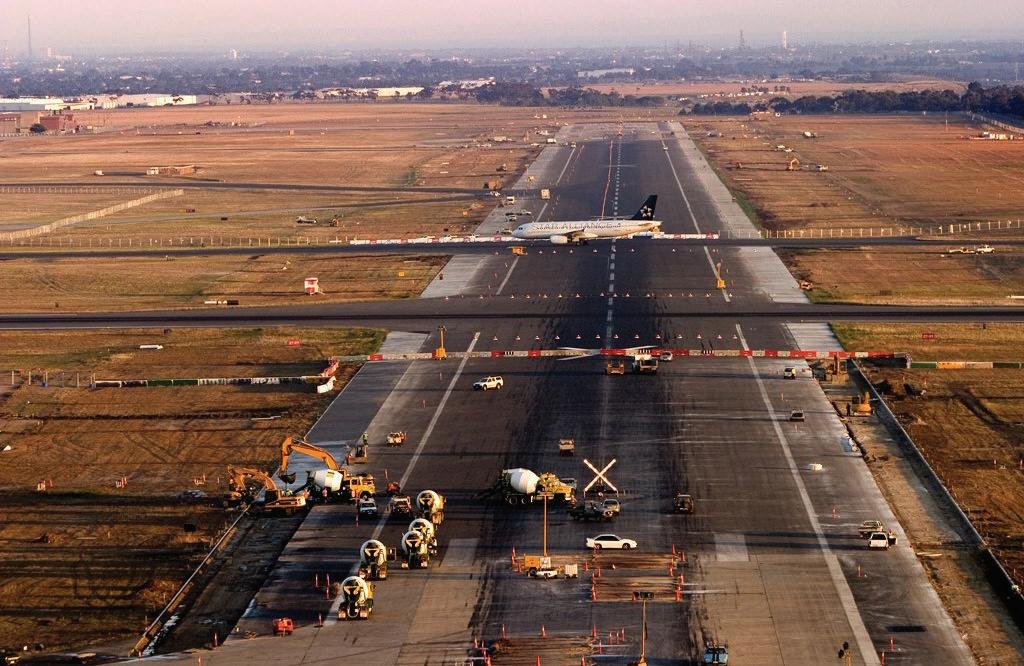
the widening and strengthening of runways, relocation of runway lights and signage, the repositioning of taxiways and not least, the modification or addition of new terminal piers and aerobridges to accommodate the A380’s double-deck passenger loading.
While John Holland had undertaken improvement work at Melbourne’s Tullamarine airport previously – including a $1.66m overhaul in 2002 of the baggage handling facilities – the A380 sparked a series of projects that began in earnest in 2004 with the $15m widening, by 15 metres, of the 3.7km-long main north-south runway. The project also included upgrading the entire runway lighting
and guidance systems and the stormwater and drainage systems. This work had to be completed in time for the first “preview” flight of the A380 to Australia in November, 2005. It was the first time an international airport with only a single major runway had decommissioned that runway to allow upgrading works. John Holland’s advanced monitoring and planning systems allowed the project to be completed two weeks early, and under budget. It also won the 2006 Australian Construction Achievement Award for the Runway Widening Project, which featured the innovative technique of screeding bulk concrete using a modified excavator.
Further projects joined the John Holland pipeline as Australia geared up for the first commercial flights of the A380 in 2008. The $194m expansion of Terminal 2 (International) created an additional 25,000sqm of indoor space and entailed the addition of airline lounges, new baggage facilities and five new aircraft parking bays, three of which featured the new doubledeck aerobridge links.
A new taxiway, Victor, was constructed to replace a part of Taxiway Sierra consumed by the Terminal 2 expansion. The new baggage facilities provided a snapshot of the improvement wrought by the new terminal: the speed of outbound baggage deliveries increased by 50 per cent, from 3000 bags per hour to 4500.
More passenger throughput naturally meant more cars visiting
the airport, and the multi-level car park constructed in 2004 went into a stage 2 expansion in 2008 under John Holland, creating a further 3000 short-term parking spaces.
In 2007 John Holland became a resident at Melbourne Airport, when the group acquired the former Ansett Aviation Engineering Services, creating John Holland Aviation Services.
John Holland’s services would continue to be key to transforming Melbourne Airport into the new decade, with further expansion to passenger terminals, customs and examination areas, car parking, aircraft hardstands and major projects at Steele Creek, Sky Road and Airport Drive, in the industrial precinct on the southern side of the airport complex.
ACTEW Bulk Water Alliance
The Australian Capital Territory was far from exempted from the drought conditions that greeted the new millennium. The solution determined by ACTEW Corporation Ltd, which had responsibility for supplying Canberra’s drinking and wastewater services, comprised an enlargement of the Cotter Dam, the construction of a pipeline from the Murrumbidgee River to the Googong Reservoir and an appropriate upgrade of the Googong spillway.
Not long into the project, the client identified a fourth opportunity, to use water from the Murrumbidgee River to supplement the Cotter supply via newly built and upgraded existing pumping stations.
The original Cotter Dam had been built in 1912 to supply potable water to the then-new city of Canberra. However, it had gradually declined in importance as newer (Bendora and Corin) dams came on stream – until the ongoing drought prompted its being brought back online in 2004.
The Cotter Dam Enlargement understated that particular component of the project. It entailed the construction of a completely new dam, 87m tall and located 100m downstream of the original (which, at only 26m tall, was consequently inundated). The capacity of the Cotter reservoir increased nearly 20 times over, from a mere four gigalitres to 78 gigalitres.
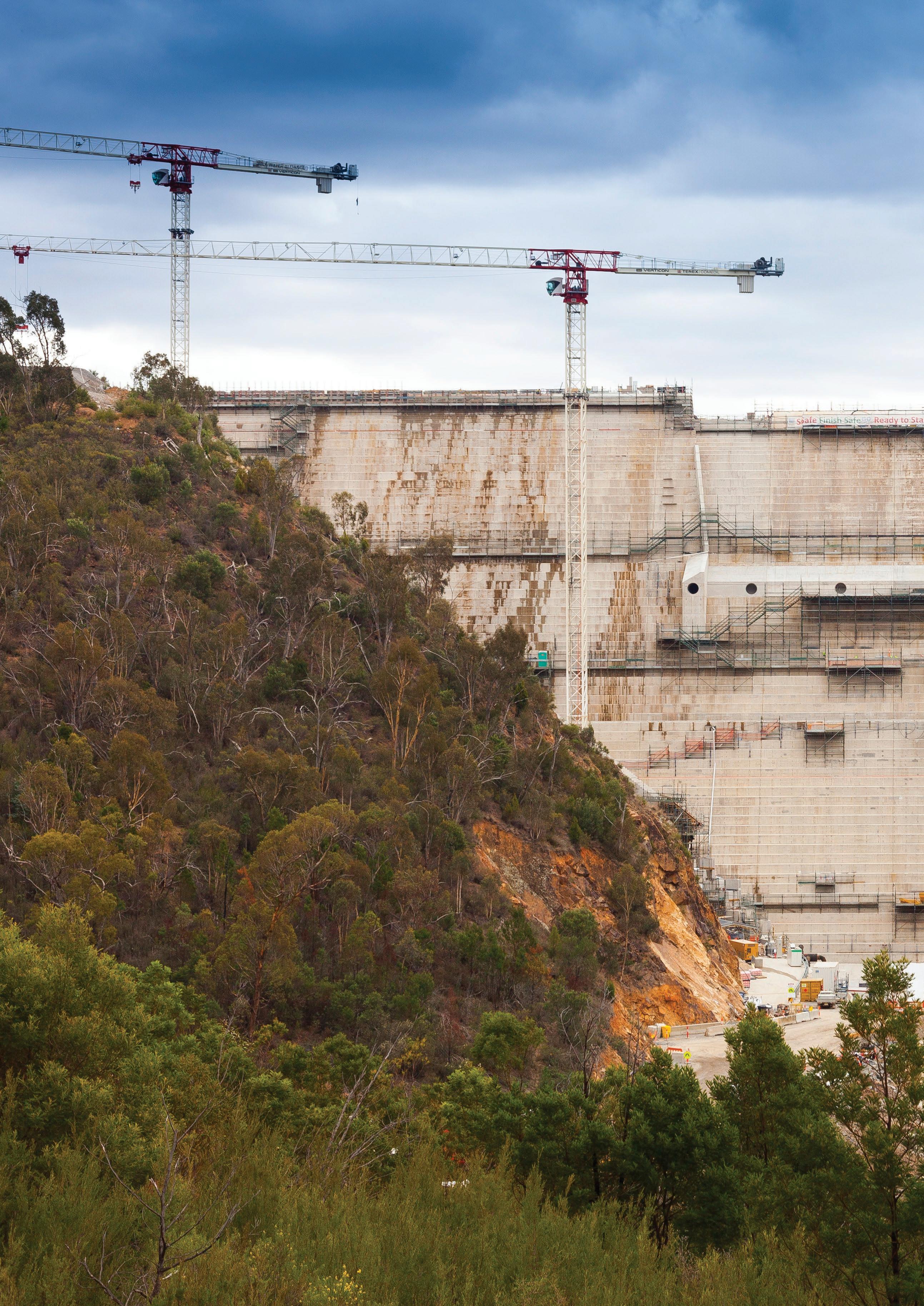
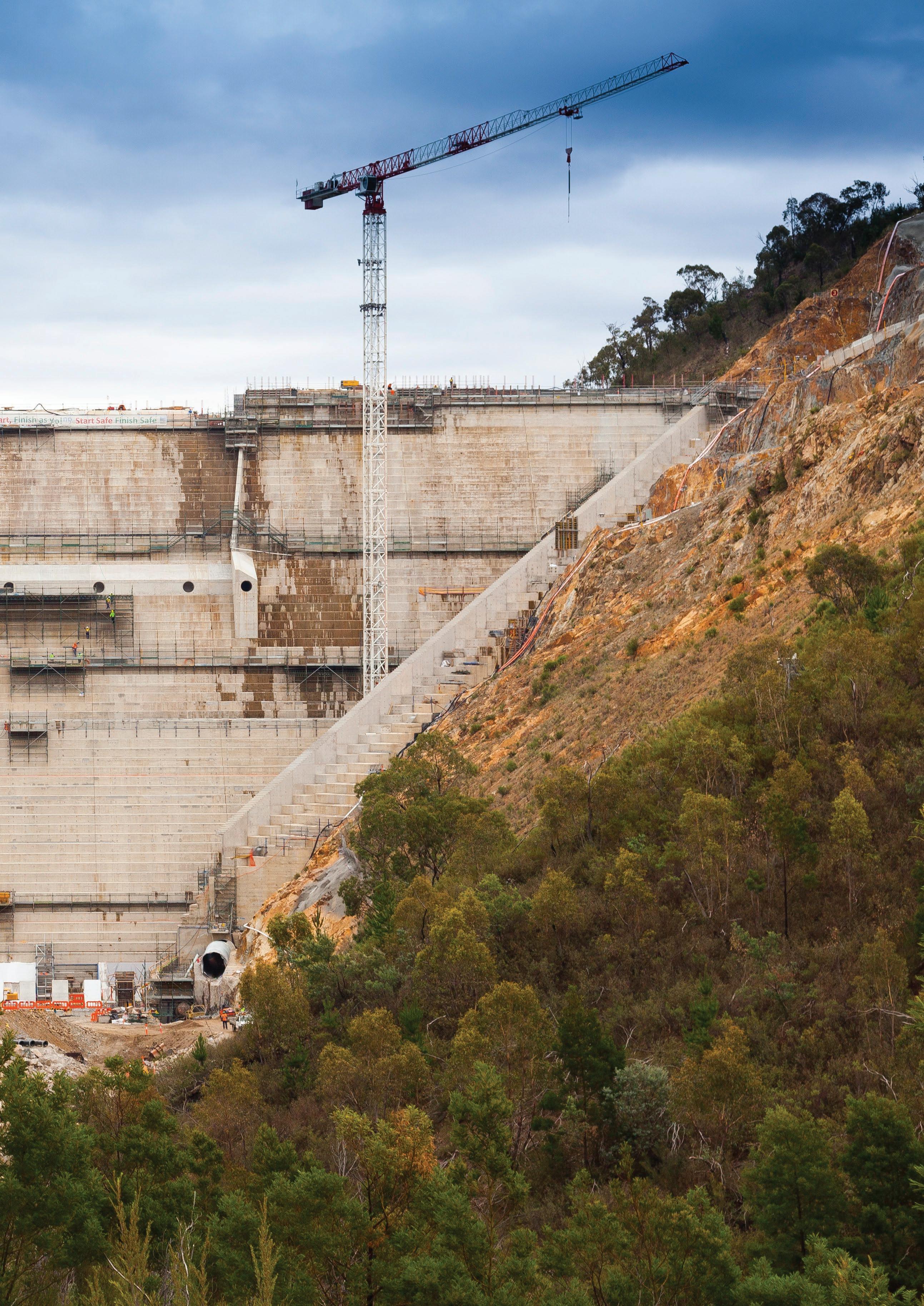
The project was undertaken by the Bulk Water Alliance, comprising John Holland, Abigroup, design partners GHD and the client, ACTEW Corporation. Work commenced in May 2008.
The new Cotter Dam was a roller compacted concrete (RCC) dam which, with its 361,000 cubic metres of concrete, became the highest RCC structure in Australia and the thirdlargest concrete gravity dam after Warragamba and Burrinjuck (both in NSW). The main dam wall was 300 metres long.
The scale of the dam would be daunting enough, but a further challenge arose with (ironically) the heavy rainfalls over summer 2010’11 and the discovery, in 2011, of a geological fault during the excavation phase. In March 2012, literally a few days after the completion of the Googong Spillway, massive flooding littered the construction site with trees and scaffolding. It took weeks to clear.
Around one million tonnes of boulders were quarried from the new Cotter Dam’s abutment walls and ground into concrete at an on-site batch plant. This initiative saved an estimated 2.8 million kilometres of journeys. A conventional concrete batch plant and nitrogen cooling facility and a precast yard were also constructed.
The Googong Dam was a 66m-high, earth and rockfill structure originally constructed in 1979. Various flood events since that time had eroded parts of its spillway, prompting both a rectification and capacity expansion as part of the BWA project. Some 45,000sqm of rock was excavated and more than 3500 anchors inserted to stabilise and strengthen the upstream training wall. The existing spillway was extended by 60m, using a 400mmthick anchored concrete slab on a 23-degree slope.
The spillway training walls were raised and extended. Drilling and blasting was employed to construct the new downstream apron works and plunge pool.
Among the challenges of the Googong phase of the project, running from February 2009 to December 2010, were the safety risks associated with an active dam spillway, and the management of mass concrete temperature through the region’s seasonal extremes, to prevent thermal cracking.
The Murrumbidgee to Googong (M2G) project was designed to transfer up to 100 megalitres of water per day to the Googong Dam via 11km of buried pipeline. A low-lift pumping station took water directly from the river – filtering the eggs of unwanted carp – pumping it
via a high-lift station to the top of Gibraltar Pass, there to eventually flow naturally to Googong Reservoir.
A mini-hydro station along the route allowed the recapturing of approximately 20 per cent of the energy used to pump the water to that point.
The Murrumbidgee to Cotter (M2C) component, meanwhile,
included the construction of a new river intake pump station, a balance tank and connecting pipework.
The Bulk Water Alliance greatly alleviated concern about Canberra’s water security. The Cotter Dam scooped eight major industry awards, including two Engineering Excellence Awards (ACT Branch) and a number of environmental awards.
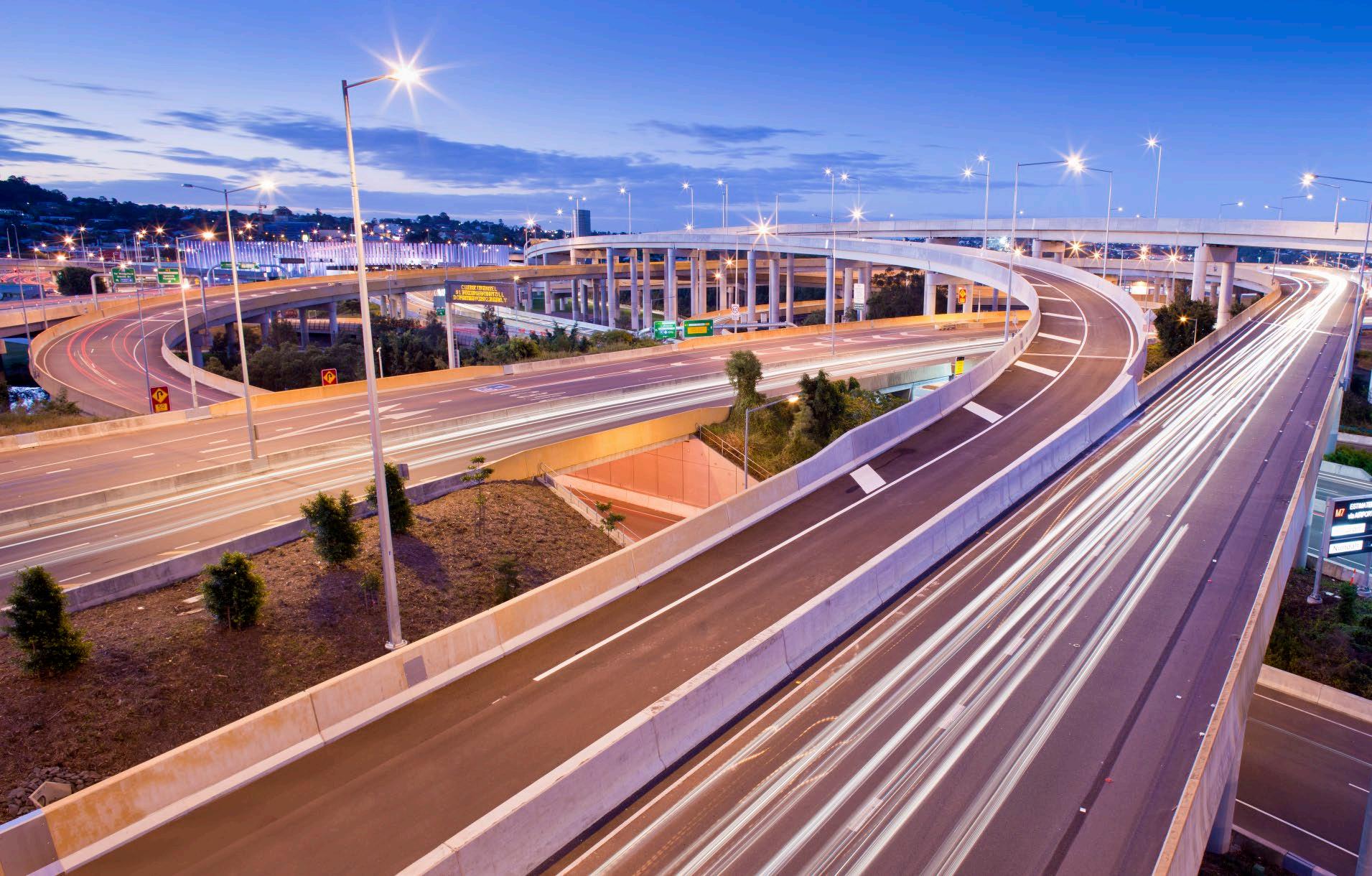
Brisbane Airport Link
Airport Link, which commenced in 2008, was the largest infrastructure project in Australia at the time. Airport Link was a network of motorways, tunnels, bridges and busways that connected the airport with Brisbane’s city centre, via the recently-opened Clem Jones Tunnel under the Brisbane River.
Many observed at the time that this was a textbook John Holland project: it involved bridges, interchanges, tunnels, roadway, mechanical and electrical and fire control systems.
It was three projects running concurrently: the Airport Roundabout Upgrade, the Northern Busway and the Airport Link Motorway.
Airport Link’s 6.7km twin tunnels would be the longest road tunnels in Australia. The 4.2km of parallel bores, through geology ranging from silt-like earth to extremely hard rock, employed the two largest tunnel boring machines ever used here, the 12.5m-diameter, 3600-tonne Rocksy and Sandy.
Each machine cost $45m and took 12 months to manufacture.
On the machines’ completion, Australian engineers were dispatched to Germany to disassemble them, in order to re-assemble them after their shipment to Australia. The reassembly took a further three months.
The tunnels were constructed in some of the most densely populated suburbs of Brisbane, within a corridor
containing the city’s busiest arterial roads and with the three major worksites adjoining creeks and tidal waterways. In the earlier part of the project, Airport Link construction work occurred alongside a still-active construction site for the CLEM7 (Clem Jones) tunnel.
For added challenge – if any were needed – fate threw in the Global Financial Crisis in 2008 (literally a few weeks after construction had begun) and the Brisbane floods of January 2011.
Three of the tunnels’ portals lay within the influence of creeks and rivers. Protection against flooding was naturally integrated early in the project, though nobody had foreseen the extent of Brisbane’s worst flooding in almost 40 years.
In the event, the precautions put in place stood the test. It was estimated that, had they proved inadequate, the pumping and restoration of the flooded tunnels would have added as much as two years to the project. As it was, the tunnelling crews worked 24 hours a day, seven days per week for almost three years, establishing a new benchmark of excellence under intense pressure.
Another record-setting feat was the jacked box operation undertaken to build a part of the Airport Link tunnel in Toombul, through a rail embankment directly beneath
Queensland’s busiest operating railway line. Up to 380 trains passed each day of the 36-day jacking operation.
It was the largest jacked box operation ever done in Australia and among the largest in the world.
Some 48 canopy tubes were pushed through the embankment to stabilise the North Coast Railway Line above. Two huge concrete boxes, 65m by 12.5m high and with a combined span of 38m, were constructed alongside the embankment and subsequently pushed 55m into place beneath the embankment, without disruption to rail services. More than 200 sensors along the railway line monitored any movement of the embankment and tracks.
The alternative – traditional tunnelling through the embankment – would have required up to 30 weekend track closures.
Another clever innovation involved the transportation of spoil from the Toombul TBM operations to the handling site by an overland conveyor. The 1.8km conveyor belt solution negated the need for 80,000 truck movements through surrounding suburbs for the four-year duration of the tunnelling project.
The mechanical and electrical fitout of the tunnels was world’s best practice, carried out concurrently
with the structural work. Along with the latest in tolling systems, lighting, signage and ventilation, the tunnels’ technology includes stateof-the-art heat detection systems, fire suppression systems, automatic video incident detection and computer control systems.
Back on ground level, construction at Bowen Hills, entering the north of Brisbane’s CBD, involved no fewer than 12 bridges (creating three kilometres of elevated roadway) amid extensive excavation for the cut-andcover entrances to the tunnel portals.
The tallest of these bridges stands at 24 metres and was constructed from four steel bridge beams, each 35 to 53 metres long and weighing up to 75 tonnes, lifted into place by a 600-tonne crane.
The Airport Link project helped keep John Holland hard at work through the Global Financial Crisis, somewhat insulating the company from its early effects. The benefits of that flowed through to the workforce. Ultimately, more than 34,500 people were project-inducted, some 28.5m man-hours worked and more than 12,000 Queensland jobs created during the Airport Link works.
In terms of completion, the Airport Roundabout Upgrade was the first part of the project to
be formally handed over, in July 2011. There followed the Northern Busway, handed over in April 2012. And finally, the Airport Link M7 Motorway, officially opened to traffic on 24 July 2012.
A resounding success, then? Sadly, Airport Link is one of a very short list of projects – the Altona ‘Toyo’ plant, and the 1971 Westgate tragedy being the others – that has tested the resolve of the company to carry on.
Airport Link was initiated as a PPP, then still a relatively new concept and attracting some considerable criticism in this example. An initial public offering in BrisConnections, the project-winning consortium that included Thiess and John Holland, fell desperately flat, casting a gloom over the technically pioneering project.
While the Airport Link project suffered financially, some of the best engineering in the world was done by the project team.
As Glenn Palin recalled: “The jack box was great, the big machines were highly complex, it was very challenging geology … It was fantastic engineering and the entire project team hung in there, they worked seven days a week and they got it done and delivered a brilliant quality product.”
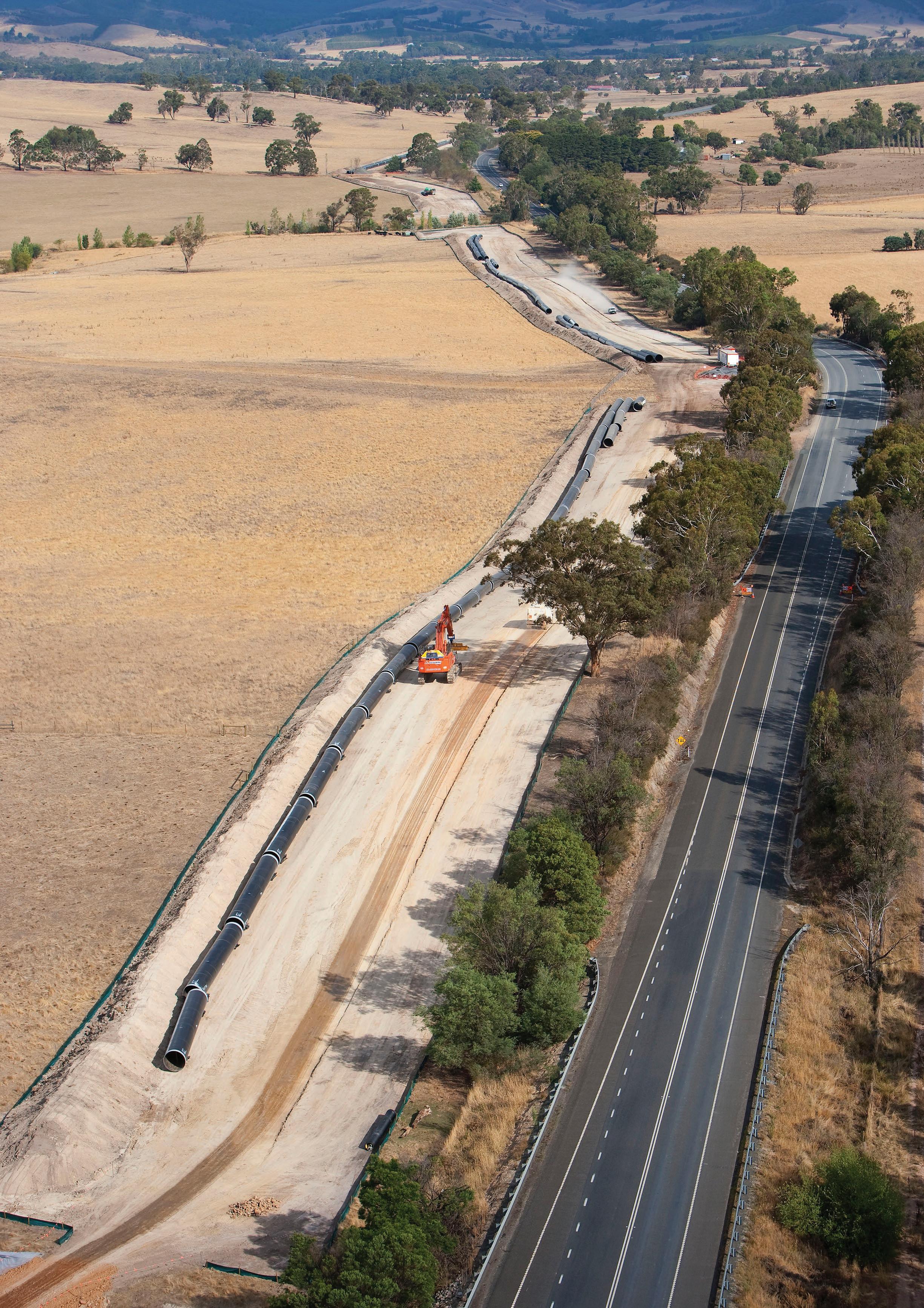
Sugarloaf Pipeline
The race for water security in the first decade of the millennium spawned not only Australia’s first large-scale desalination plants, but the augmentation of many existing water facilities. One such project was a 70km pipeline to carry water from the Goulburn River, across the Great Dividing Range and southward to Melbourne’s Sugarloaf Reservoir.
The Goulburn River catchment area was at that time benefitting from considerable water savings, the result of a $1bn modernisation of the irrigation systems across the Goulburn-Murray Irrigation District.
It was determined that the city of Melbourne should share in the enhanced water supply.
The $625m Sugarloaf Pipeline project was awarded in 2008 to an alliance of John Holland, Gutheridge Haskins Davey, Sinclair Knight Merz and Melbourne Water. When completed in 2010, it would provide the biggest capacity increase in 25 years to Melbourne’s water supply, up to an extra 75 billion litres per year.
Rob Cranston, at that point already a 40-year veteran of pipeline projects, if still a fairly recent addition to John Holland, was appointed Alliance Project Manager. As a senior engineer with Melbourne Water in the 1970s-’80s, Cranston knew the Sugarloaf reservoir intimately.
“I probably spent 10 years in pipeline with Melbourne Water and in that period, we built a considerable
number of Melbourne Water’s large diameter transfer lines. We did some work at Cardinia and did work at Greenvale. I was there when we built Sugarloaf, the reservoir.
“It was like going home for me. It was connecting into reservoirs and other things that I knew extremely well. Even down to the fact that to put water in the Sugarloaf, you’ve got to be extremely careful because it’s a dispersive clay there.”
In physical terms, the project comprised two major pumping stations, a power substation, a hydroelectricity plant, balancing storages, and a 70km pipeline comprising 5500 pipes and including an 826m-long tunnel through a steep section of the Toolangi State Forest.
In more depth, the project had to overcome political problems, community resentment in the rural Goulburn Valley, environmental challenges in various vulnerable flora and fauna, intense media scrutiny, a 30m-wide construction corridor, some of the hardest rock in Australia and, on 7 February 2009, the tragedy of Australia’s worst-ever bushfire disaster, Black Saturday.
Early in the project planning stage it was determined that the route of the pipeline would roughly follow that of the Melba Highway. An interesting discovery during this phase was that roadside reserves often
held more environmentally valuable vegetation than did cleared farmland.
Consequently, the route made various deviations through privatelyowned properties (albeit, hugging boundaries as much as possible) after beginning its southward journey at the new Goulburn River pump station at Killingworth, 6km north of the town of Yea. The inlet structure within the Goulburn River was constructed with the aid of a steel cofferdam.
The desire to minimise impact on the local, rural community even extended to the design for the pump station’s control building resembling that of a brick-walled, corrugated iron-roofed homestead.
Indeed, for virtually all of its length the Sugarloaf Pipeline would be made invisible thanks to opentrench excavation – except for two pipe bridges where the pipeline crossed the Yea River at different points.
The pipeline travelled via a new power substation just east of Yea, thence to a high-lift pump station and balance tank on purchased private property south of the town. Here, water accumulated in an 11m-high, 75 million litre balance tank before being gravity-fed into the pumping station, whose six pumps elevated the water along the next 38km of pipeline to the Toolangi State Forest.
The split-level, 1800sqm high-lift pump station was in the very midst of the area devastated by the Black Saturday fires, although the timing was such that major construction had not yet started when the fires went through.
Some 120 workers from the Sugarloaf project were directly involved in the firefighting effort and immediate reconstruction, using their skills and machinery to build firebreaks and to help provide water and generator power to the devastated communities.
The 826m tunnel commenced near the township of Glenburn. Through some of the toughest rock in the Great Dividing Range, the TBM “Ollie” (named after a Gippsland earthworm species) drove a tunnel of 2.47m diameter through an alignment that included a 680m-long curve. It’s believed that this was the longest single drive for a pipejack through rock in Australia.
The Melbourne environment is among the most challenging for tunnelling anywhere in the world.
Into the tunnel was inserted a standard two-metre internal-diameter jacking pipe, which in turn accepted a 1.6m outer-diameter steel pipe that was grouted in place. The Alliance members devised and built within 12 weeks a hydraulic pipe-carrying machine that allowed the positioning
and welding of the 10.5-tonne jacking pipes.
The pipe-laying procedure reached a peak of 71 lengths laid in one day. This was achieved on a particularly straight stretch, but was the result of careful pre-planning and the innovative strategy, devised by the pipe-laying team, of having a small, advance team welding double-pipe sections.
The highest point on the Sugarloaf Pipeline’s journey was the control tank in the Toolangi State Forest, near the town of Castella. The 15m diameter, 7.6m-tall tank holds one million litres and, via automatic communication with the Sugarloaf Reservoir, can keep the final section of the pipeline filled at all times. The final 23km of the pipeline’s journey is via gravity feed.
The eventual inlet at Sugarloaf reservoir deposits water into an eight metre-deep pit. The water collected there is eventually distributed into the reservoir via a quite spectacular, baffled concrete chute.
Among the project’s many environmental boasts – the entire pipeline is powered by renewable energy – was that the installation of a hydro-electric plant at the reservoir enabled it to also produce energy.
Initial community resistance to the Sugarloaf Pipeline turned around as outlying areas recognised
the direct benefit of a project employing more than 3000 workers and subcontractors. In addition, the Sugarloaf Alliance partners distributed several grants and local sponsorships in the communities in which they worked.
Another legacy of the Sugarloaf Pipeline was John Holland’s ‘1800 No Harm’ hotline, a toll-free and confidential call line that enabled workers and contractors to call in
with safety ideas and concerns. The already well-established safety culture helped the Sugarloaf project to completion with more than two million hours of work and no losttime injuries.
The fact that the project was also finished five months early and under budget helped make the Sugarloaf pipeline a very deserving winner of John Holland’s 2010 Chairman’s Award.
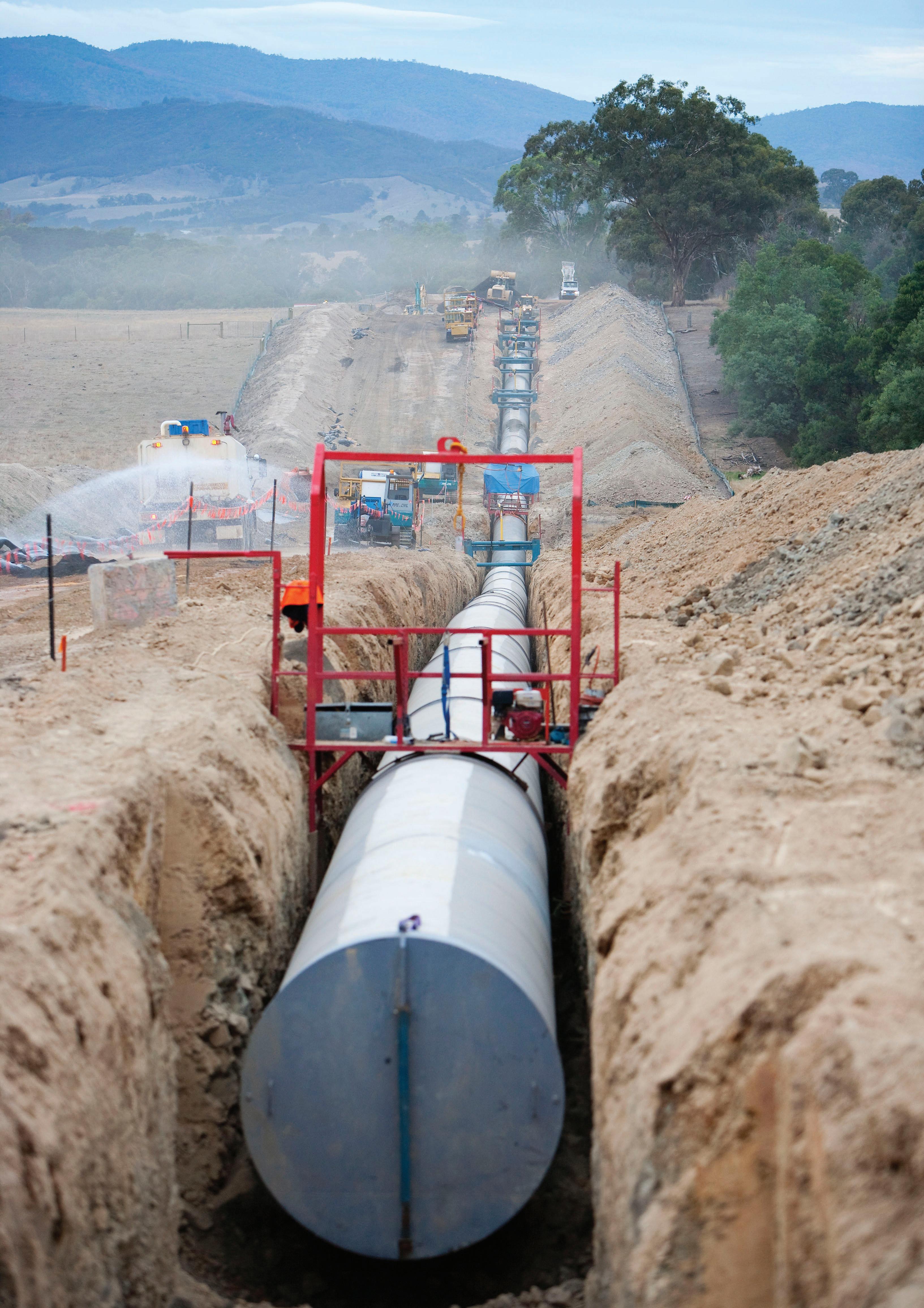
Devil Creek
One of John Holland’s noteworthy ventures into oil and gas exploration was the winning of the construction of an onshore gas plant at Devil Creek, 50km south-west of Karratha on WA’s Pilbara coast. Construction work on the project commenced in September 2009.
The new plant, aimed at ensuring WA’s energy security, would recover and process natural gas from the offshore reindeer gas field, via a 105km pipeline.
For John Holland, the project involved significant earthworks in the rusted red dirt of the remote inland site. An early challenge was the shortage of local labour, thanks to the resources boom being in full flight. The remaining option was a
fly-in/fly-out workforce, though this solution – as with the project itself –was sometimes at the whim of the region’s notorious weather.
The 25-month project took place during a period of record cyclone activity.
The scope of works included construction of the complete processing facility, which comprised gas treatment and dehydration, condensate liquid stabilisation, storage and road load-out, gas compression and metering. John Holland also managed the residential village associated with the construction.
Among the onshore pipeline construction required was an 11km onshore section that tied in to an existing Bunbury-to-Dampier gas
pipeline. Gas condensate, meanwhile, would be transported by road from the loading facility at the site.
The $170m project was far from the biggest that John Holland had undertaken in oil and gas, but it was celebrated for its having embodied a suite of the company’s skills –earthworks, civil works, structures, mechanical, electrical – and been delivered like clockwork.
As Greg Cain remembered: “That was a great job. It was a full gas plant that we did, earthworks, civil works, structures, mechanical, electrical –everything, we did everything, turn-key. And, although only a small project, it had the distinction of being the only gas plant that has been delivered in Australia to the client’s time and budget.”
Part Four 2010–2016
A Time Of Rapid Change
The 2010s opened beneath the black cloud of Airport Link, a financial disaster that John Holland was obliged to keep pushing to completion. Interviewed for this book, former Leighton Holdings boss Wal King chose not to comment on Airport Link. However, he underlined the fact that construction has always been a risk business.
“The Leighton Group had, over many years, issues that they dealt with and moved on, and that’s the nature of the business. You have your successes and hopefully your successes outweigh your failures, but that particular period, the group did move on. It had its issues, and they weren’t completely life threatening. It hurt, but they did move on.”
The sudden decline in infrastructure spending towards the end of the previous decade had already encouraged John Holland to shift its attention to the resources sector. The group had a number of challenging and rewarding projects on the go.
On top of its major Marine projects with Cape Lambert (WA) iron-ore and Abbott Point (Qld) coal loaders, John Holland was present at virtually every one of Western Australia’s major LNG (liquefied natural gas) fields, including Gorgon, Wheatstone, Pluto and Devil Creek. Devil Creek is still lauded within the industry for having been delivered on time and on budget. The fact that this was at all remarkable, spoke
volumes for a segment that in several ways ran against John Holland’s collegial, alliance-led experience through the 2000s.
“There was a period of about four to five years where resource engineering was the only game to play,” recalled Glenn Palin. “It was quite a different operating environment and one we didn’t necessarily understand all that well.
“We came out of this alliance period, into one of very little activity. In a period of little activity, clients can afford to be more selective and they start to demand things … It had become more adversarial again.
“There is a view that when the market hardened, our practices were not quite as hard as the market required them to be. I don’t know if I fully agree, but I think that’s a fair view that people could have – that we had turned into something that the market took advantage of.”
There were certainly some hard lessons learned.
“The Gorgons, the Wheatstones, those sorts of projects over in the West … Completing those projects within budgets was difficult. While it’s hailed that ‘the resources boom was great for Australia’, at a contractor level it’s had a lot of casualties as well – including us.”
In the uncertain aftermath of the Global Financial Crisis, the still-new
and quite unstable Labor government implemented a two-part Economic Stimulus package: the first, $10.4bn in October 2008 and the second, of $42bn, in February 2009.
The second phase, in particular, included a plan to construct 20,000 public and social housing dwellings and large-scale infrastructure investment in Australia’s almost 10,000 public schools, under the banner of “Building the Education Revolution.”
John Holland took an active part in the latter, with its Queensland region undertaking construction projects at 46 different school sites. At one stage, no fewer than 30 sites were simultaneously under construction. Concurrently, other education projects were underway in WA.
In 2011, across all its disciplines, John Holland had 100 projects in hand, worth $7.7bn – an increase of 45 per cent on 2010. Infrastructure already accounted for the lion’s share ($3.3bn) of that, but the big mover was energy and resources, accounting for just $1.6bn but marking an increase of 100 per cent over that sector’s influence in 2010.
More telling, however, was that the other $2.8bn was accounted for by transport services.
The turn of the previous decade had revealed a particularly bright light at the end of the tunnel. To
revive the pessimist’s favourite joke: it actually was a train coming. Of that $2.8bn workload in transport services, just over half ($1.5bn) was in rail projects.
The momentum gathered by the Rail division in the latter part of the 2000s would gain significantly in this decade. Rail had proved its capabilities in the tightest of urban areas and the remotest of rural regions, and its ability to leverage John Holland’s broader engineering and construction skills. But the decade turned with two gamechanging operation contracts in the Melbourne Metro franchise and the NSW Country Regional Network.
In 2009 the MTM consortium, comprising MTR Corporation of Hong Kong, John Holland and UGL Rail, took on the operation of more than 400 train sets on more than 800km of track, providing in excess of 14,000 weekly services in and around Melbourne.
The prospect of a strong and stable income stream was seen as a godsend for the group – though there was some apprehension at the scale and responsibility of carrying almost half a million passengers every weekday.
The MTM deal was largely engineered by Karl Mociak, then EGM of Rail at John Holland. He had recognised that a key attraction lay in the infrastructure, which
John Holland was ideally placed to improve and thereby enhance the efficiency of the network. It was a strategic move to extract and entice UGL Rail from the previous operating franchise, thus bringing knowledge transfer.
Now recognised as a fully integrated railway network operator, John Holland was firmly in the frame for an even more ambitious task in NSW. It took over the operation of the state’s Country Regional Network (CRN) from the incumbent, federal governmentowned Australian Rail Track Corporation (ARTC).
On its own strength, John Holland won the CRN tender in December 2010, taking on the full scope of railway management services across some 2700km of operational passenger and freight lines and 3100km of non-operational lines.
The handover process was interesting. The date was 14 January 2012. A Saturday. At midnight.
CRN CEO, Nev Nichols recalled it well. “It was a massive undertaking, because effectively ARTC was going to switch everything off at midnight – control room included. And at one minute past midnight, all our train controllers, in a new train control centre, were going to take on that network and all that infrastructure.
Now recognised as a fully integrated railway network operator, John Holland was firmly in the frame for an even more ambitious task in Nsw.
“We had to get all that asset data, understand the condition of all that network, 300-odd bridges, all the set-up. We’d had to build the train control centre first, put the control in, employ and train the people. We had a year to get ready. And at midnight, ARTC shut everything down and we opened everything up. And no, we didn’t get a lot of help.”
Taking into account the MTM, the CRN and the maintenance of both the Westnet and Perth Transit Authority networks in WA, John Holland would soon be the largest private rail operator in Australia.
Those skills, plus far-sighted investment in signalling and electrification during the previous decade, also reaped enormous rewards in rail infrastructure projects. John Holland would build the stunning, $78m Craigieburn Train Maintenance Facility, one of the largest and most modern of its kind in Australia; the city-transforming, $360m Perth City Link, a key example of the group’s collaboration skills; and in alliance, the City to Maribyrnong River package of Melbourne’s colossal Regional Rail Link.
Road transport projects were also on the move. A component of Adelaide’s Urban Superway, the largest infrastructure investment in South Australia, was awarded to John Holland in late-2011.
During that project, parent Leighton Holdings acquired a large number of projects from the Perthbased Macmahon.
Macmahon’s equipment, most staff and $570m-worth of work in hand was folded into John Holland. The acquisition also included construction projects in the Northern Territory, which were rebranded in in 2013 as Territoria Civil.
Ambitions were focused even farther north, to Asia. Significant joint ventures with Leighton Asia took John Holland’s tunnelling expertise to two major rail projects in Hong Kong and Singapore, and the world’s largest sludge treatment plant in Hong Kong.
All of which was good news for a business that was still struggling to get back onto its feet and reach closure on the financially disastrous (and flood-afflicted) Brisbane Airport Link project, which was completed in July 2012.
If the Brisbane floods held any sort of a silver lining, it was in the project won at the end of 2012 to replace the iconic Brisbane Riverwalk. Unlike the previous floating structure, the new, 850m-long Riverwalk was solidly anchored into the riverbed with 37 piles.
In Victoria a series of major water infrastructure projects was underway in the Barwon Water Alliance near
Geelong. Aside from the benefits of the infrastructure itself, which included a state-of-the-art water recycling plant and extensive sewerage connections, the project would leave another important legacy.
Part of John Holland’s obligation under the alliance was to upskill Barwon Water and to upskill the local industry in construction activities. Occupational Health and Safety was an important component of the latter, and indeed, the BWA project spanned 4500 man-hours, injury and incidentfree.
Meanwhile, the newly-opened (2011) John Holland permanent office in Tasmania was coming into its own, supported by landmark University of Tasmania building and major road transport projects. Power transmission lines – including the spectacular stringing of lines by helicopter –became a specialty of the group.
Not that specialisation is wholly desired, as Tasmanian general manager Gary Baird has said in praise of his group. “Our team has gradually built up over many years and is locally based. These people are also multi-disciplined, to go from a civil job to a building job to an energy job. They need to be flexible to cope with our relatively small market.”
The Tasmanian team’s adaptability and resilience was certainly tested in the early days of the $365m (later
$389m) Royal Hobart Hospital redevelopment project. Won in partnership with Fairbrother, the project to construct a new 10-storey building and refurbish existing facilities was welcomed in September 2013, but various political, budgetary and operational changes delayed its commencement by almost two years.
Working within operational hospital environments poses particular challenges – infection control, dust control, noise control among them – but John Holland is widely recognised for its experience in hospitals, including the most modern in the nation.
So, too, had Tasmania’s Risdon Prison project in the previous decade helped refine the group’s longstanding skills in prison design and construction. It reaped dividends into this decade, notably with Melbourne’s Ravenhall Prison (commenced 2014).
Such projects highlighted another evolutionary step in the culture of contracting. Greg Cain noted it carefully.
“A lot of the government agencies that used to deliver projects had de-skilled,” he said. “They had outsourced and their expectation was now that technical and construction skills would be procured from the market. Their role changed to one of procurement and project management.
“Their drivers became more politically-based. Contractors became the custodians of their reputations, managing the community relationships and expectations. Whereas 20 years ago, you got in, you built it, and tough luck.”
Another seismic shift that had not slowed was the development of the safety culture within John Holland. This was perhaps unsurprising, given that Janet Holmes à Court was still in place as Chairman.
The outcome of the attentiveness and inventiveness of engineers being attuned to safety, is that a lot of highrisk activities have been designed out of projects. Considerations such as the design of modules for pre-assembly on the ground, thereby minimising the number of lifts and working-atheight risk, are a part of pre-work planning.
Workforce engagement, too, is such that the very people most likely to encounter issues are among the most empowered to drive improvement and change. One worker’s initiative to propose a protective plate to catch weld-splatter and thereby protect himself, is fed into the very fibre of the company’s safety culture.
This pervades the business right through to the executive suites, as Darryn Ray has attested. “We spend a lot of time and effort in trying to
get safety as best we can in what is an inherently high-risk industry. It has a lot of focus and rightly so.”
Everyone wins with a safety culture. John Holland undertook a series of road/rail grade separations in Victoria, one at Mitcham being a prime example. Grade separation projects were known to be fraught with a diversity of risk issues, but John Holland developed a model for these projects that allowed them to be executed far more efficiently and safely.
“Every grade separation is unique, but they involve very smart staging,” explained former Executive General Manager Rail, Richard Stewart. “You have limited time to impact on the roads and the rail. One method we use is to go out on a weekend closure, take the road surface up, put an in-situ bridge deck in underneath the road. This concrete deck becomes the roof of a cut-and-cover tunnel, as we excavate underneath.
“We also came up with a really smart, modular design for the stations. We build them off-site, put the ticket rooms in, the control rooms and everything. We test everything off-site and then bring the different modules in and build it over a weekend occupation.”
Even amid all the ingenuity, overcoming the after-effects of the Airport Link project did delay Glenn
Palin’s plans for further cultural change within the organisation.
“These were things I felt were important as a developing, mature business in Australia,” he said.
“Organisational development, encouraging high-performance teams, rating diversity in a much more integrated way. Unfortunately, some of those were sidelined because we got sucked into this [Airport Link] vortex, which went on for quite a while.”
While infrastructure was generally in decline early this decade, one project was worthy of pride on the scale of Parliament house. No less an icon than the Sydney Opera House was placed in the company’s hands, for the excavation of an underground loading dock and vehicular access corridors under the banner of Vehicular Access and Pedestrian Safety.
Also in Sydney were two more high profile rail projects, a new rail link from Glenfield to Leppington in Sydney’s south-west, and Sydney’s light rail inner-west extension.
However, the roads (or railways) paved with gold were, looking to the horizon, a mirage. Exciting, nationtransforming infrastructure projects had been discussed and developed, but were sitting on ice.
Infrastructure requires stable government, and Australia had
anything but that at the time. Oneterm governments at a federal level and in NSW, Queensland and Victoria effectively put any commitments to long-term planning on hold.
Still, at least some were looking to the future, with concerns over water and food security prompting some technically fascinating jobs, including series of major irrigation projects in the Murrumbidgee area and in New Zealand.
Sundrop Farms [2014], a 20-hectare scientific greenhouse facility in remote Port Augusta, SA could have been written for John Holland: growing tomatoes on the edge of the desert, it included a solar energy plant, a desalination plant and enormous greenhouses.
By 2014 John Holland had put Airport Link behind it. Or as Glenn Palin put it: “We had been on our knees, and we’d now got back on our feet and we were back in the game. We weren’t quite match-fit, but we were up and able to play.
“Then, all of a sudden, this happened …”
Leighton Holdings was about to take away the stadium. The construction giant – at the turn of the decade, Australia’s 15th largest company by market capital, and one of the largest companies of its kind in the world – had been brewing a boardroom battleground since 2010.
“ we had been on our knees, and we’d now got back on our feet and we were back in the game. we weren’t quite match-fit, but we were up and able to play.”
A rift between local executives, notably the headstrong and focussed Wal King and Leighton’s German majority owner Hochtief, had erupted in May of that year. In October, the rift stepped up a level when Spanish company ACS, which already held 30 per cent of Hochtief, launched an ultimately successful bid to take overall control.
Leighton was no mere pawn in this game, but one of the most valuable assets. However, continued boardroom unrest – including the departure of Wal King in 2011 and a long-present cloud of scandal over its Middle Eastern joint venture Habtoor Leighton Group – was badly shaking Leighton.
Increasing influence by the Spanish ACS resulted in the sudden announcement in March, 2014 of the departure of Leighton Holdings Limited’s CEO Hamish Tyrwhitt and CFO Peter Gregg. Soon after, the John Holland Board was also terminated.
“I still get quite emotional about it,” Janet said, interviewed for this book two years later. “One day we were told at a board meeting that we were no longer required, that there’s not going to be a board anymore. It was just … Oh my god. I went down to the car and I was crying. It really was traumatic.
“As I say, it was 24 years of my life without Robert and then 24 years
with him and then 24 years with John Holland.”
Staff were informed in June 2014 that LHL was looking to sell John Holland.
That was, at least, a testament to the company’s strong identity and history. It had always been seen as slightly apart from, slightly more individual than others under the Leighton roof.
“People had stayed and toughed things out, which I think is a credit to them,” Glenn Palin recalled. “Then, as this was starting to improve, Leighton came and said, ‘We’re going to sell you.’ That created another destabilising uncertainty that we had to see our way through.”
Palin had already decided that the sale of John Holland would be the best scenario for the company’s survival. Should it fail to sell, or sell only in part, the remnants of John Holland risked being washed into the new structure of Leighton Holdings.
Through 2014 – John Holland’s 65th anniversary year – Leighton held discussions with a range of suitors. By November 2014 China Communications Construction Company (CCCC) through its internal arm CCCC International Holding Limited (CCCI) emerged as the favoured bidder. The sale agreement was signed in December.
The name and familiar red of John Holland would endure, when so many others –Abigroup, Baulderstone, Concrete Constructions, Walter Construction, Transfield Construction, Barclay Mowlem, Leighton Contractors, Leighton Holdings – had not.
The international interest was not surprising: infrastructure projects in the Europe and the US were in sharp decline. Australia, meanwhile, was alluring with its apparent pipeline of enormous infrastructure projects, including the nation’s largest public transport undertaking, the Sydney Metro rail network.
For the Chinese, in particular, John Holland appeared as a godsend. For some years, Chinese construction companies had hoped to enter the Australian market. The favoured approach was to become involved in major projects, to showcase their capabilities and establish a presence as they had successfully done in other countries. However, Australia had never quite opened to them.
Then, as Glenn Palin described it: “John Holland comes on the market. It was like they were hit in the backside with a rainbow. This was not just a project, it was multiple projects. They were buying 65 years of history, reputation that you can’t pay money for. John Holland was an
icon of the industry. Tier one, ready to go, on the table.”
At John Holland, however, it created another challenge. The looming sale process imposed considerable, additional stress in the documenting and explaining of everything, in the midst of running the business.
“It wasn’t a time issue,” recalled Palin. “You have to make time available. But there were certainly a lot of other pressures on. When we’re trying to run a business, win work –that was ongoing, and all this other stuff was just overlaid on that.
“It’s about intensity. You’re doing tender reviews, giving people credit for the projects in the field, talking to people, trying to plan for the future while not knowing who’s going to be the owner, trying to keep people motivated and committed – it just piles up and the intensity of the things is two or three times more. You’ve got 50 things in your head, as opposed to 30.
“That’s what’s draining about it. The whole business puts in long hours, everybody puts in long hours. But the intensity of that time was tough.”
As Palin knew only too well, from his own experience and his awareness of others’, the pressure is not limited to John Holland’s team members.
“It’s hard on families. We’d just gone through the Airport Link issues
“ we had people working enormous hours. i still take my hat off to those people, they carried the day.”
and we were trying hard to rebuild and stabilise the business.
“We had people working enormous hours. I still take my hat off to those people, they carried the day. I look at some of the projects that we do, what some of our people do, and I’m in awe. We certainly had plenty of issues to deal with and everyone was required to make a lot of personal sacrifices, but we stuck to the task and got it done.”
After the announcement of the sale in December, new owner CCCI, under President Lu Jianzhong, was understandably eager to get on with exciting and challenging projects like Sydney’s Northwest Rail Link and WestConnex motorway network.
“This big pipeline of projects was being promoted by everybody, states and federals, and we were showing upturns in growth and profitability, all based on all the information we had at that time,” Glenn Palin recalled. “And then 2014 ended and ’15 started, the sale concluded in April [2015] – and still none of these projects had emerged.
“It was a bit of a learning curve for [CCCI] in terms of the difficulties of our political environment, the unpredictability and how parties will undermine each other. But I have to say CCCI have been an absolute pleasure to deal with. They have been
just so enthusiastic and so supportive and so humble.”
Wal King was already long departed from Leighton Holdings, but the sale of John Holland brought a smile to his face. “I was only involved until the end of 2010, but at the end of the day, I think it exceeded expectations for Leighton Holdings, who had paid next to nothing for it,” he said.
“I’m not privy to what the Chinese paid, but they probably paid $1bn.
Over the years, [John Holland] made a lot of money on an operating basis from 2000 onwards – and then they got $1bn for it. That’s not a bad investment in 10 years.”
Liberated and encouraged under its new owners, John Holland could look forward to doing what it does best: innovative, nation-changing projects. Thankfully, the completion of the sale coincided with the uncorking of some of those pent-up infrastructure projects – such as Sydney’s WestConnex M4 East motorway, on which construction commenced in March 2015.
Concurrently, John Holland (in joint venture) went to work on the vast and ambitious Sydney Metro Northwest rail link. This network constituted Australia’s first fully automated (driverless) urban rail line and fully automated maintenance facility. As well as constructing it,
John Holland will operate the 36km railway for 15 years.
The technology and design pioneered for the Metro Northwest, in turn, helped John Holland to secure the first stage of Canberra’s Capital metro light rail project.
Across the continent, the $1.2bn Perth Children’s Hospital broke plenty of new ground in its use of virtual-reality design, in a world-class health care facility that will stand the test of time.
And the plans are more ambitious yet, with a vision laid out by President Lu and here relayed by Glenn Palin.
“President Lu said to me, ‘Our objective is that we need to grow internationally and we need to develop.’ To do that, we agreed on a strategy that within five years, we will double the size of John Holland. That was serious.
“It’s going back to the same principles as Bill Wild – but even exceeding those expectations. To do that is going to be a challenge, but it’s in the same style as Bill’s.”
John Holland is pursuing three principles in pursuing that growth. Experience tells that organic growth is unlikely to achieve such an ambitious target in the desired timeframe. International expansion
was therefore targeted – and it began in April 2016, with the opening of a south-east Asian office in Singapore.
The company also took inspiration from the success of its rail division, which had commenced as a constructor of rail track, but deepened its penetration into the market so that it initiated, owned and operated rail; complete vertical integration. The question was put that such vertical integration can be replicated in building and other infrastructure.
Above all that, John Holland would seek to free itself from 100% dependency on market activity. The creation of a Development & Investments arm would enable the group to initiate its own projects.
The whole scenario is immensely exciting to Glenn Palin, someone who’s dedicated his career to building things.
“That’s what we’re doing here. We’ve got this new strategy about leveraging our strengths in the market. Let’s deepen our penetration to get more out of it. Let’s go and do a few things outside that we weren’t able to do before and let’s pumpprime a few things into this so that we’re not waiting for the market to change. We can actually control our destiny.”
Projects
Water Projects | 245
Darra to Springfield Transport Corridor | 247
Cape Lambert Port B | 250
Gladstone LNG | 253
Perth City Link | 255
MTM Melbourne Trains | 258
Sydney South West Rail Link | 262
Country Regional Network | 265
Roy Hill | 269
University of Tasmania | 273
Perth Children’s Hospital | 276
Ichthys | 281
Sydney Opera House VAPS | 283
Regional Rail Link Package A | 287
Sydney Metro | 290
Ravenhall Correction Centre | 293
Sundrop Farms | 296
WestConnex | 298
Water Projects
JohnHolland had come off the back of a stellar decade in water projects, with the 2000s turbocharged by the acquisition of Transfield and its particular skill set. The rush for water security that had prompted desalination projects around the nation had been more than quelled by record rainfalls that freakishly followed, but the 2010s would have in store several more major water projects, in water treatment and irrigation.
The Murrumbidgee Irrigation Area (MIA) is a giant in Australian infrastructure history. It’s often mentioned in the same breath as the Snowy Mountains Scheme – fittingly so, as the MIA, which actually dates to 1912, gained its biggest single
boost with the construction of the Blowering Dam on the Tumut River, a tributary of the Murrumbidgee.
In 2010 John Holland, as one of four members of the MIA Renewal Alliance (MIARA), commenced a series of works in the Murray Basin area to modernise aging water infrastructure and increase its efficiency. An example lay in the very first such project, a modern delivery system for Lake Wyangan, involving the replacement of concrete lining and open channels with gravity pipelines that greatly reduced water losses.
Similar methods, and efficiency gains, were applied in further renewal programs at Hanwood – where open channels and earthen in-ground tanks
were sometimes up to 80 years old –Bilbul, Leeton, Yenda and Wah Wah.
Further afield was the landmark sludge treatment facility in Hong Kong, the largest of its kind in the world. The $660m project, housed in a very attractive glass-walled building, is situated in the western part of the New Territories and boasts a daily capacity of 2000 metric wet tonnes.
The plant’s incinerator boiler furnaces produce steam that is used to drive electricity-producing turbines. Surplus electricity is fed back to the national grid.
Closer to home, John Holland was one of three partners in the Barwon Water Alliance in Victoria, which delivered a number of communitychanging water, sewerage and recycled water projects over a fiveyear period.
So, too, on a much larger scale did Melbourne Water engage the joint-venture of John Holland and KBR in a long-running program of capital works projects in Melbourne.
The comprehensive upgrading of Melbourne’s sewerage facilities included the historic Western Treatment Plant at Werribee, the 114-year-old Carlton Main Sewer and any number of efficiencyenhancing measures elsewhere, such as replacement lagoon covers, biogas covers, basin upgrades and odour and emissions management measures.
Water treatment certainly kept John Holland’s tunnelling team busy. The Amaroo Main Sewer, commenced in 2015, centred on a 7.8km GRP sewer line to support residential development in Melbourne’s northern growth corridor. Up in Queensland, the tunnelling team was also busy augmenting Brisbane’s sewerage system with sizeable projects in Woolloongabba – part of an ongoing, $3.2bn capital works program – and Bulimba Creek.
One must resist the temptation to state that where water projects are concerned, John Holland has been flush with success.
Darra to Springfield Transport Corridor
John
Holland was a member of the Horizon Alliance (Horizon) that delivered Darra to Springfield Transport Corridor (DSTC) Stage 1, a major integrated road and rail project to service Brisbane’s growing western corridor.
Joining John Holland in the alliance were Queensland Rail, the Queensland Department of Transport and Main Roads, GHD Pty Ltd and Kellogg Brown & Root Pty Ltd.
As the alliance member responsible for construction, John Holland provided a full range of engineering, construction and support services with the primary aim of delivering world-class integrated infrastructure.
At a high level, the project involved: building 4.5km of new
passenger railway from Darra to a station at Richlands; constructing a railway station, bus interchange and park and ride facilities at Richlands; and duplicating Centenary Highway from two to four lanes north at Richlands to connect with the existing Logan Motorway interchange at Carole Park.
Stage 1 achieved Practical Completion in November 2010, four months ahead of schedule and significantly under budget.
The early delivery of the project provided an unforeseen benefit to thousands of people impacted by the January 2011 floods, who were able to use the new train service to evacuate to Brisbane.
The project involved delivering rail and road assets in a constrained and complex environment.
In addition to directly impacting thousands of households, businesses, schools, and community groups, DSTC Stage 1 was one of nine projects occurring at the same time in the area, giving rise to potential project confusion and ‘stakeholder fatigue’. The number of concurrent projects also meant the competition for procurement and engineering resources was intense.
Other challenges included the necessity of maintaining existing road and rail infrastructure to minimise the impact on traffic and commuters.
The alliance team took on the project requirements head-on to achieve outstanding engineering outcomes and achievements across the areas of safety, quality, the environment and community relations.
Key to the success of the project was the positive, high-performing team culture that underpinned the delivery of the project.
Road and rail alignments are not typically constructed simultaneously in the same corridor. Whichever mode comes first will largely dictate alignment constraints for the latter, resulting in construction inefficiencies and duplication.
In the case of DSTC Stage 1, the project was constructed as a single process even though the assets were divided between the rail and road corridors. This was the first project of its type in Queensland.
This joint approach wasn’t without its challenges, as road and rail requirements had their differences.
Having both Queensland Rail and the Department of Transport and Main Road as equal members of the alliance made it possible for best-forproject decision-making.
Although different standards would apply to the construction of each mode under normal conditions, the alliance was able to agree on common standards.
The cost and efficiency benefits of concurrent construction of road and rail were significant. As examples, road and rail formations were constructed at the same time, saving road and rail earthworks costs; and the selective use of reinforced concrete road rail separation barriers meant distances between road and rail alignments could be close, reducing earthworks and drainage requirements.
The joint construction approach would serve as a model for future Queensland projects with similar road and rail interfaces.
Coordinating the requirements for security fences, noise barriers and
environmental treatments eliminated the duplication of resources, and delivered quality outcomes in terms of road and rail runoff water by using common sedimentation treatment ponds.
To maintain the existing network, the job was broken down into a series of six separate stages through design and constructability reviews.
Future maintenance of the assets was considered by providing access to the rail corridor from motorway emergency stopping bays.
Developing an alliance culture that fostered innovation was one of the hallmarks of the project.
An innovation register was established and reviewed at monthly project meetings. Unlike most projects delivered as an alliance, the team was able to challenge design after the target cost estimate to deliver the project (known as the TOC) had been set.
Millions of dollars were saved as a result of more than 100 documented innovations, and innovation benefits also applied to non-cost KRAs.
Horizon led a comprehensive stakeholder and community engagement program from inception to delivery, which involved informing and engaging with more than 25,000 local households, businesses, special
interest groups and government stakeholders.
Both sustainability and environmental impact were key considerations during design and construction.
The alliance achieved excellent results in managing environmental risks, including working with relevant stakeholders to eliminate a noxious weed discovered in the project area and control its potential return.
Vegetation loss was offset by revegetation programs, and fauna migration patterns were maintained after project studies identified a major east-west corridor for the movement of larger Australian fauna in the project area.
A key highlight of the project was its exemplary safety performance. The project reported no lost time injury (LTI) in the 1.2 million man hours worked. Major safety milestones, such as achieving one million man hours LTI-free, were celebrated with the team.
The success of the Horizon alliance was recognised with multiple awards for community engagement; the environment; several building awards for Richlands Station; and the national 2011 Infrastructure Excellence Awards for Contractor Excellence.
Cape Lambert Port B
The marine works project at Cape Lambert, on WA’s Pilbara coast, is fondly remembered by all who were involved as a high water mark for innovation and efficiency. Construction commenced in September 2010 and was completed in March 2014.
The two-phase, $276m Port B marine works centred on the construction of a 920m jetty and 440m two-berth wharf with 18 berthing dolphins, ship loading facilities, piping and associated works. A highly modularised design enabled a great reduction in site man-hours.
When it was completed, Port B enabled the client Rio Tinto to increase its iron ore exporting
capacity by no less than 50 per cent, to 353 million tonnes per annum. However, construction was also undertaken with particular sensitivity to environmental and cultural heritage in the area.
Among the innovations on this project was the adoption of spongejet abrasive blasting, whereby abrasive material is trapped within pea-sized synthetic sponge pieces. Blasting using these tiny sponges greatly reduces dust emissions and the quantity of blast media required.
Another advance was electro-slag welding, an automated process that melts wire to produce 2.4m-long, 32mm-deep plate welds in just 90 minutes, as opposed to 40 hours manually.
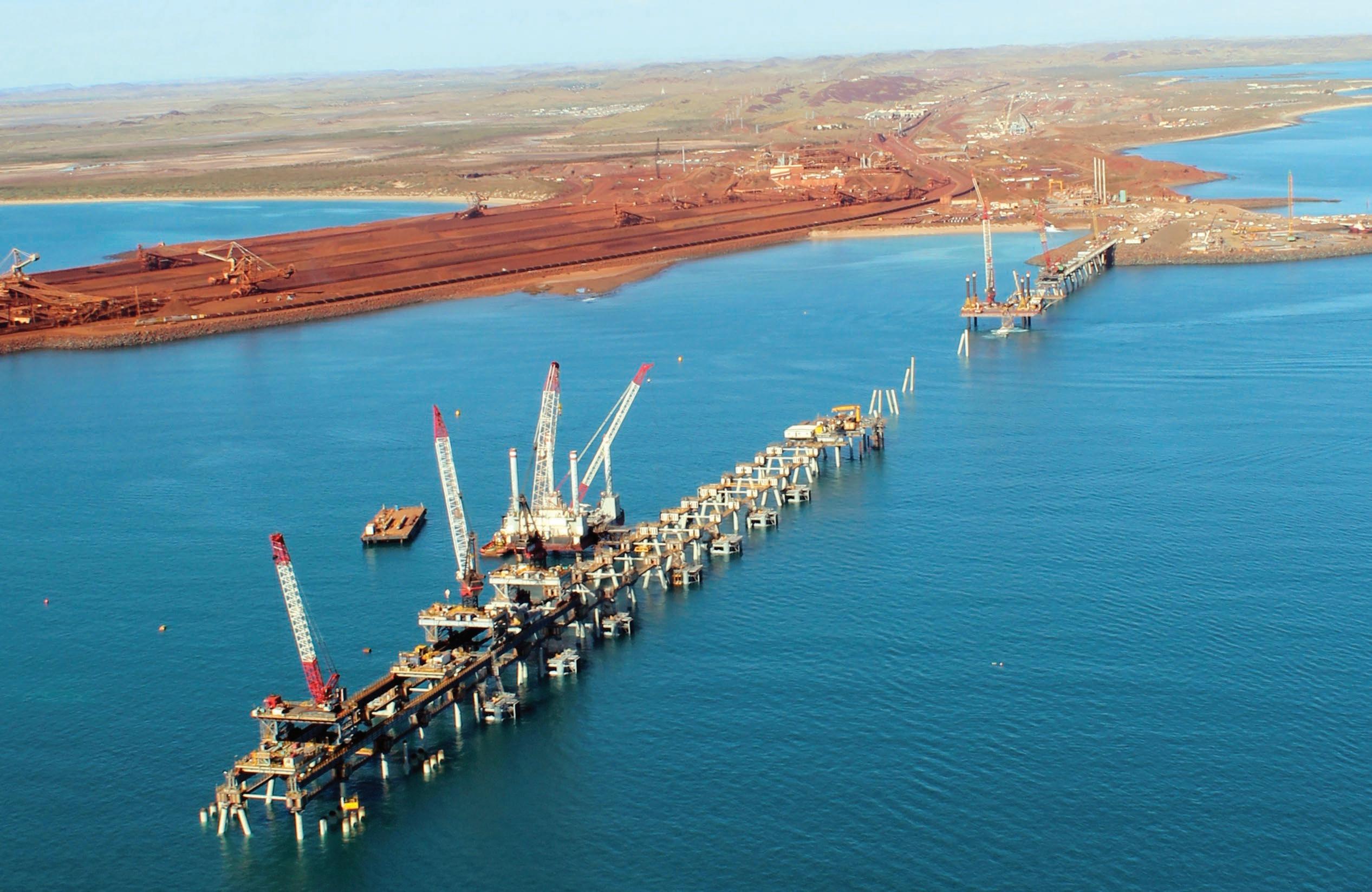
Along with various environmental initiatives, like the creation of marine exclusion zones to protect marine wildlife, the Cape Lambert project would be deemed worthy of the prestigious Australian Construction Achievement Award in 2014.
Cape Lambert bore the fruit of John Holland’s exposure to wharf and jetty projects that had grown through the 1990s.
Cape Lambert Port B was a very heavy and very exposed structure. The pre-planning produced several very clever risk-mitigation measures. “Over-the-top” construction methods reduced the requirement for marine and floating plant, which is always vulnerable to weather and cyclones.
Adding to John Holland’s afterglow of success was the knowledge that the company had entered the process as the nonpreferred contractor. The client had an existing relationship with another contractor, sharing experience on a similar project previously. This position seems to have given the John Holland team even more motivation than usual, to innovate and excel.
Their efforts were further rewarded with the 2014 Australian Construction Achievement Award (ACAA) and the Smart Infrastructure Award from the Crane Industry Council of Australia.
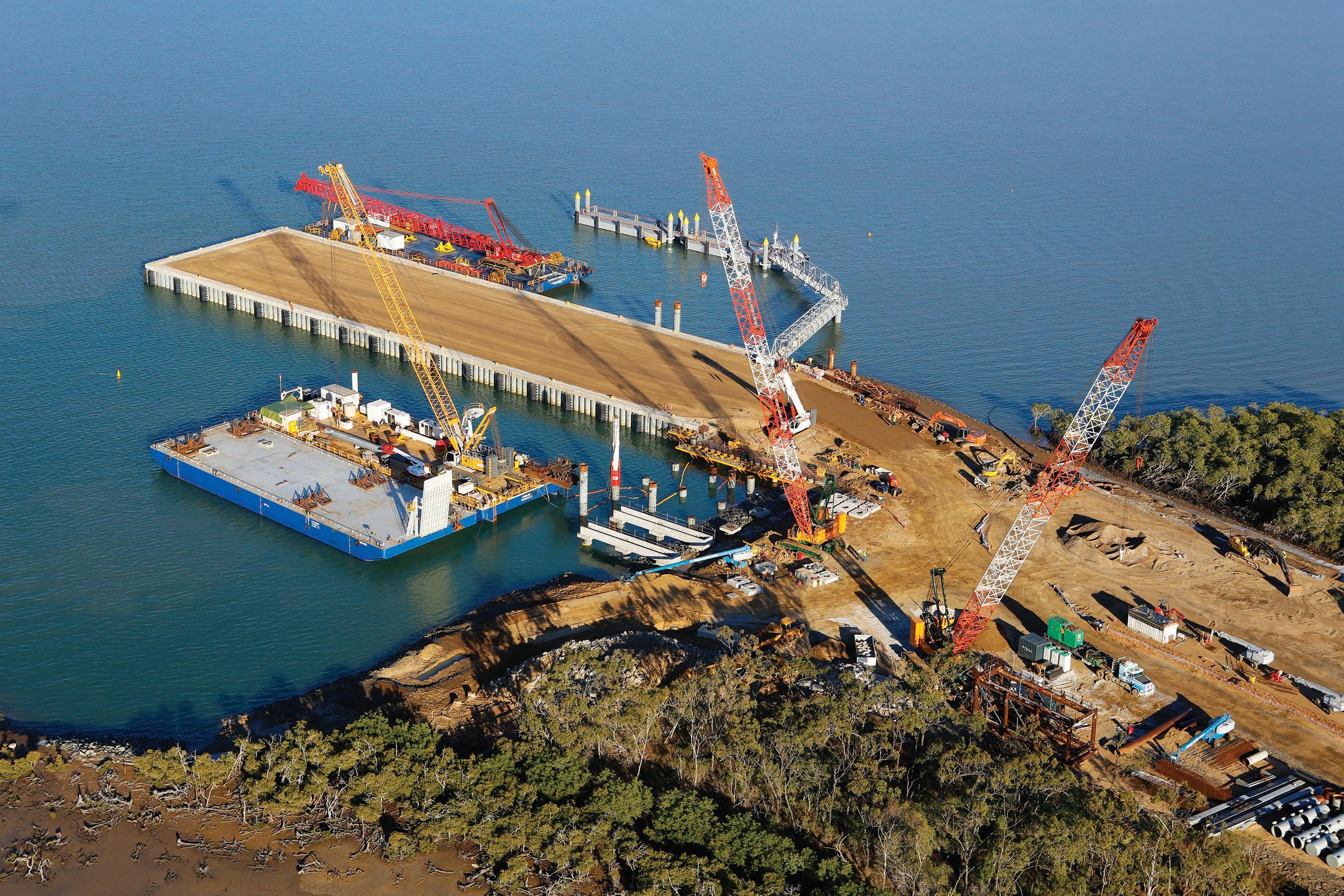
Gladstone LNG
InMarch 2010, John Holland won the $150m project to construct marine offloading facilities (MOF) for the quickly developing Curtis Island facility of the Gladstone LNG project. The MOF component, which comprised a new ferry berth, a rollon/roll-off berth and various loading/ unloading berths, would be the first of a series of challenging jobs at Gladstone.
As this was being won, John Holland was at work developing the Devil Creek onshore LNG plant on the opposite coast, in Western Australia. Indeed, large-scale marine projects for the resources sector were also underway at Cape Lambert (WA), Abbott Point and Dalrymple Bay
(Queensland) and Kooragang Island in Newcastle (NSW).
The initial Curtis Island MOF was one of three major LNG plants located on the southwestern shoreline of Curtis Island, an area only accessible by water. In due course, John Holland would also be awarded the similar major marine works at the nearby Gladstone LNG and Australia Pacific LNG plants.
On each of these, John Holland worked closely in collaboration with engineering firm Arup so as to pool design and construction experience. However, downstream of the client was intermediary Bechtel Corporation, which brought the potential for added complexity.
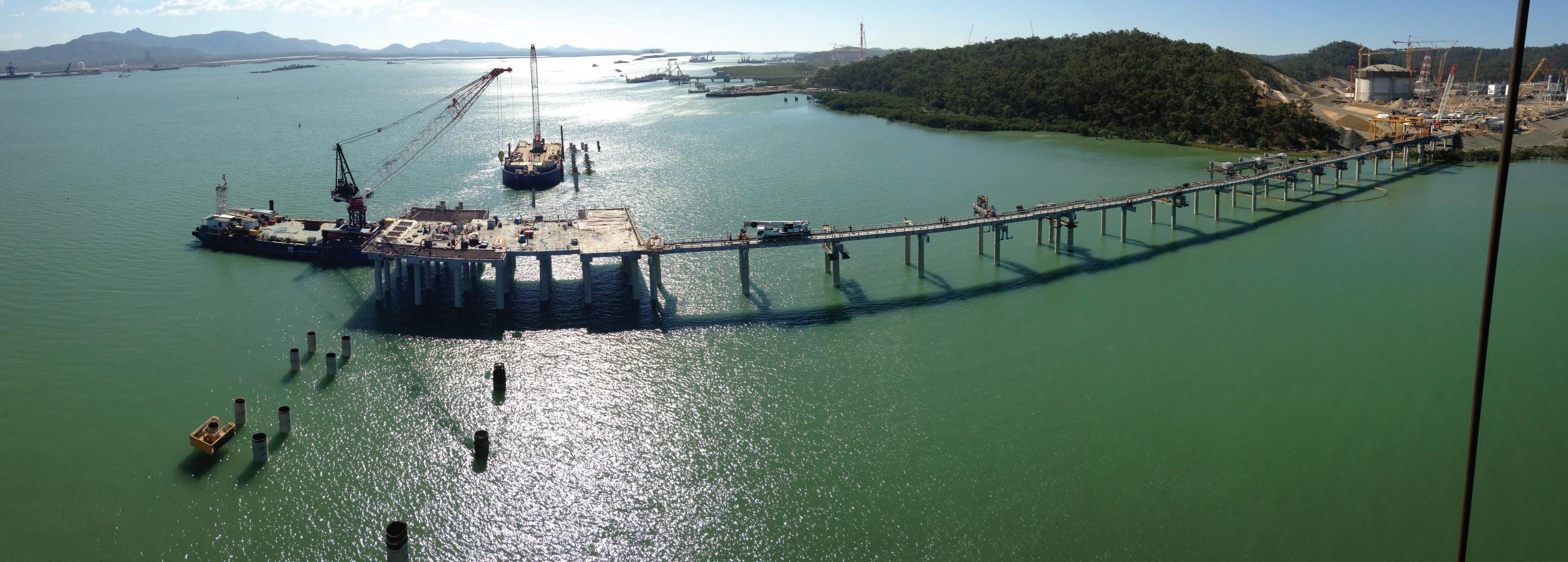
The Australia Pacific project embodied the procurement, fabrication, construction and commissioning of the structural, mechanical and electrical components of a 168m jetty and loading platform.
At each of the three facilities, clever design and innovation attended the various loading platforms, mooring and berthing dolphins and
interconnecting walkways. The creation of a BIM virtual model for the dolphins greatly helped to streamline their construction on-site.
While John Holland may have been riding a wave of successful oil and gas projects, the overall Gladstone experience would provide a reminder of the sector’s pitfalls. It turned out to not be as financially successful as hoped.
Perth City Link
Since1881, farmers in the region of Guildford, inland from Perth, could rely on the railway to get themselves and their produce to the city of Perth and the port of Fremantle beyond. The city’s fondness for the hugely practical railway line only grew in 1904 with the opening of the signature Horseshoe Bridge, which carried foot and vehicular traffic.
The city’s spectacular growth in the late 20th century, however, resulted in the Fremantle railway line creating a barrier between the CBD and the bustling Northbridge entertainment and residential district. A subsequent rail line, the Joondalup line built in 2007, was more wisely driven through a tunnel beneath the site.
The long-awaited solution, the $360m Perth City Link, was announced in early-2011 and the rail component of the project awarded to an alliance of John Holland, GHD [designer] and the client, the Public Transport Authority of WA. Work commenced in March of that year.
The project entailed the sinking of a 600-metre section of the Fremantle railway line from William Street to Lake and King Streets; sinking car parks and the Wellington Street bus terminal; and a new pedestrian underpass, on a 13.5ha work site.
At ground level these measures would create five new north-south pedestrian and vehicular connections between the CBD and Northbridge, and prime real estate for the
development of King’s Square and Yagan Square commercial, residential and public spaces.
Among the specific challenges were the site’s CBD location, a high water table, working alongside live rail, and the proximity – as close as 1.2 metres – to the existing, live Joondalup rail tunnel. The sinking of a railway line in such a tight, urban environment was the sort of job more typically encountered in Singapore or Hong Kong than in Australia.
For John Holland, the Perth City Link was an exceptional opportunity to showcase the Group’s broad range of expertise – and for its various divisions to collaborate at an unprecedented level.
“We offered the client a solution for all the assets they were looking at,” explained John Anderson, Alliance Manager on the PCL project. “John Holland came to the table and said, we’ve got the rail experience, we’ve got the tunnelling experience and we’ve got the local experience with the Western Region guys here.”
Anderson added that a new level of communications across the site united the four different John Holland business units involved. “You have rail people who are not used to working among the D-wall rigs and the piling rigs, tunnelling people who’ve never worked on a live, operating railway … Well, we’re all going to be Perth City Link people.
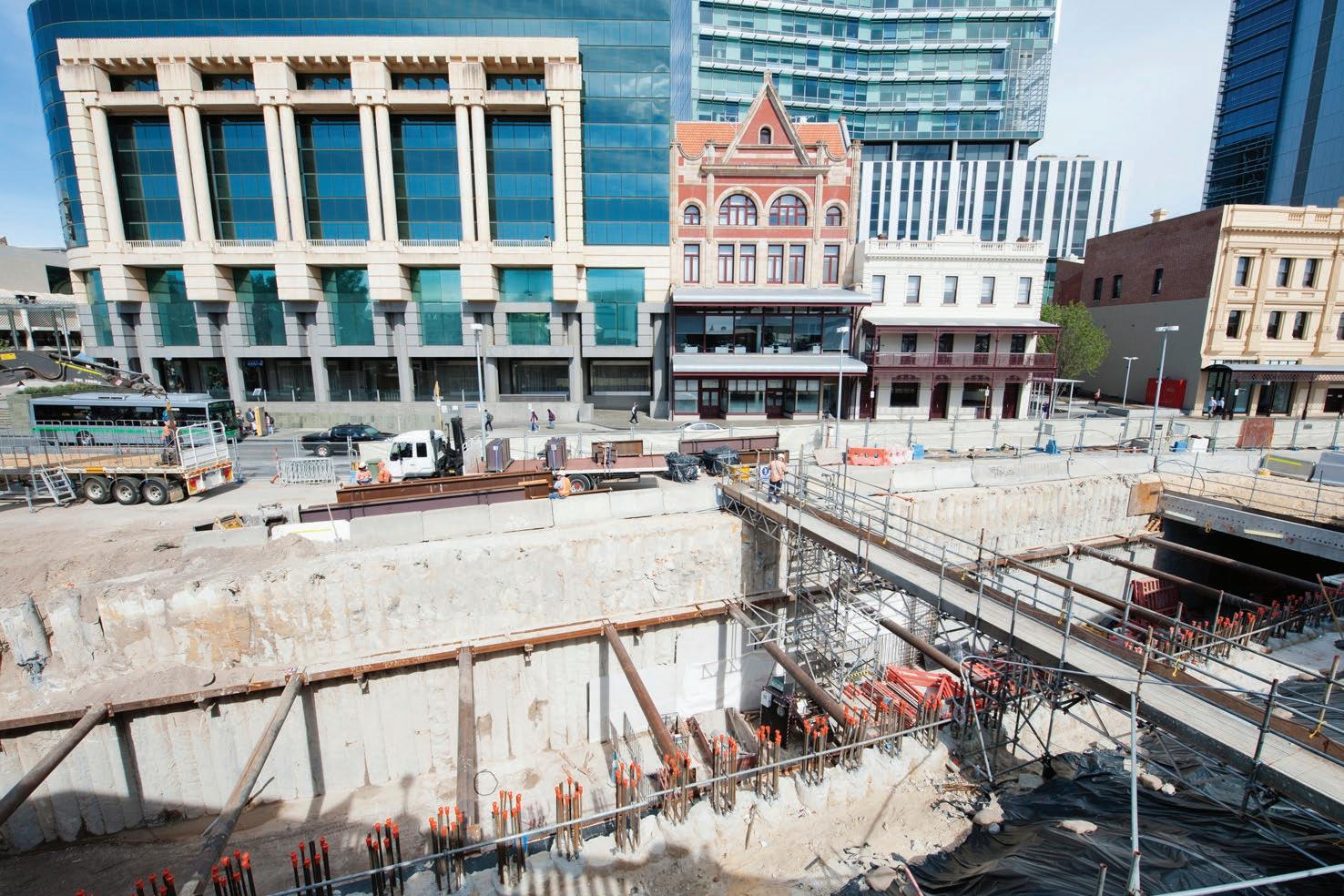
“My communications team ensured that every single person on one side of the job, 1.5km away, knew what was going on at the other side, be it rail, tunnelling or civil works.”
Some 83,000 cubic metres of earth was moved and 53,000 cubic metres of concrete poured in sinking the rail line and providing piling support for future, ground-level development. Perth’s sandy soil demanded that some pilings were dug 40 metres to the bedrock.
The diaphragm walls (D-walls) were dug and stabilised with a mix of bentonite powder and water, then reinforced with steel cages weighing up to 10 tonnes. For a 60-metre length of the tunnel, it straddles the existing Joondalup tunnel, passing just 1.2 metres overhead. All of this work occurred within five metres of the live Fremantle line.
Another challenge of the site was the water table; this location was once Lake Kingsford, drained in the 1830s. Dewatering the site involved the drilling of more than 100 wells between the tunnel walls. Water collected in these wells was treated and pumped into dozens of recharge wells around the site’s periphery, to be pumped back into the ground. More than a gigalitre of water was
thus removed during the tunnelbuilding project.
Extensive communications and openness with the public and the client, the Public Transport Authority, brought the project enormous support and interest. On top of the physical challenges was the need to cause minimal disruption to rail services on this vital city line. Works were often co-ordinated into a finely managed series of slews, during which the different disciplines of work were all performed during temporary rail closures.
Dion di Crescenzo, Rail Manager on the project, rode the test train through the tunnel in 2013.
“Typically, you have a tunnelling crew come through, they build the tunnel, they finish up and leave. Then you’ll have the track crew come through, then they leave. Then the overhead crews, then they leave. Everyone has the tunnel for a period of time. And this tunnel here, we didn’t do that.”
The project was delivered in December 2013, six months ahead of schedule and on-budget.
The Group’s view of the project’s success will, however, be forever coloured by a workplace tragedy that claimed the life of team member Tony Phelan.
MTM Melbourne Trains
JohnHolland cemented its status as a major rail force in Australia in 2009 through winning, as part of the Metro Trains Melbourne consortium, the operation, maintenance and development of Melbourne’s metropolitan train service. Prior to that, John Holland’s rail division had enjoyed tremendous success in rail construction and maintenance; MTM marked its transition into operations.
In turn, MTM put John Holland into the driver’s seat for the winning of the NSW Country regional Network. The long-term contract nature of both would contribute tremendous financial benefit and stability to the group.
The MTM network spans 15 lines and 218 stations, covering 869km of
track and with an average weekday patronage of approximately 800,000 trips. A fleet of 407 three-car train sets travels more than 30 million kilometres per year, across more than 14,000 services each week.
John Holland and its consortium partners – Hong Kong’s MTR Rail and UGL Rail – took on the operation, maintenance and development of all the network’s assets, including train operations, rolling stock, train control, infrastructure, depots, stations and facilities.
The operations and maintenance of the network including signalling, rail construction, relationship management, management of railway and property assets and management of above-rail operations, including
train control. MTM works closely in managing reporting and standards issue with stakeholders, including Public Transport Victoria and the Department of Transport, Planning and Local Infrastructure.
The initial contract period of eight years (spanning to 2017) included the option of an additional seven years, subject to customer service KPIs. As at the end of 2016, those KPIs had been more than met.
The John Holland team, under the guidance of Karl Mociak, successfully courted fellow consortium member UGL – that organisation having been a part of the previous Melbourne rail operator for eight years – and was thus able to bring a wealth of understanding of the network’s assets and operation.
Hong Kong partner MTR brought mass-transit operational knowledge, the proof of which already lay in consistent 99 per cent service delivery performance in its Hong Kong network.
While the challenges inherent in an operational services-style contract on this scale were not to be underestimated, John Holland was quick to understand the infrastructure component of the contract and its opportunities for the greater John Holland group.
This was soon evidenced in a number of infrastructure projects
around Melbourne, notably several grade separations. Chris Evans, former Executive General Manager of Building, summed up the synergy: “We have key strengths in rail construction, particularly in track, signalling, overhead traction and bridge works, which in these types of projects is the perfect partner for our core expertise in civil and building construction.”
Further dividends that were ripe for further development lay in the airspace and other commercial opportunities along the network’s routes.
Perhaps most importantly, MTM has delivered significantly better services to Melbourne commuters, with service delivery scores of typically 99 per cent.
One of MTM’s key innovations wasn’t mechanical, but promotional. The ‘Dumb Ways to Die’ safety campaign was launched in late 2012 to promote safe behaviour near railways. The associated video captured worldwide interest and sharing, and the campaign won global advertising industry awards.
The campaign has since expanded into an app. A sequel ‘Dumb Ways to Die 2: the Games’ was released in 2014, which encouraged players to make a pledge to behave safely on and around their city’s trains.
Sydney South West Rail Link
The
NSW Government’s South West Rail Link Project was designed to bring much-needed passenger rail services to Sydney’s semi-rural south west, one of the city’s fastest developing areas of urbanisation.
The rail link from Glenfield to Leppington, through primarily greenfield areas, comprised some 11.5km of new, electrified twin track, two stations, a stabling yard, 14 bridges plus culverts, electrical substations and a significant rail underpass at the Hume Highway.
In December 2010, John Holland was awarded the Glenfield to Leppington project as a design and construct contract.
The fully integrated design of the
project addressed such challenges as a congested corridor, difficult topography, tie-in to the existing rail network, track geometry, maintenance access and services reticulation.
The twin-rail underpass at the Hume Highway – a dual, fourlane highway with 15m median –was achieved with an 80m tunnel excavated using a canopy tubes support system. The underpass approaches were via cuttings up to 13m deep.
Another landmark was created in the shape of a rail viaduct at Cowpasture Road, 485m long and standing 12m above ground level. The design, using Super Ts, was introduced in place of the tiered
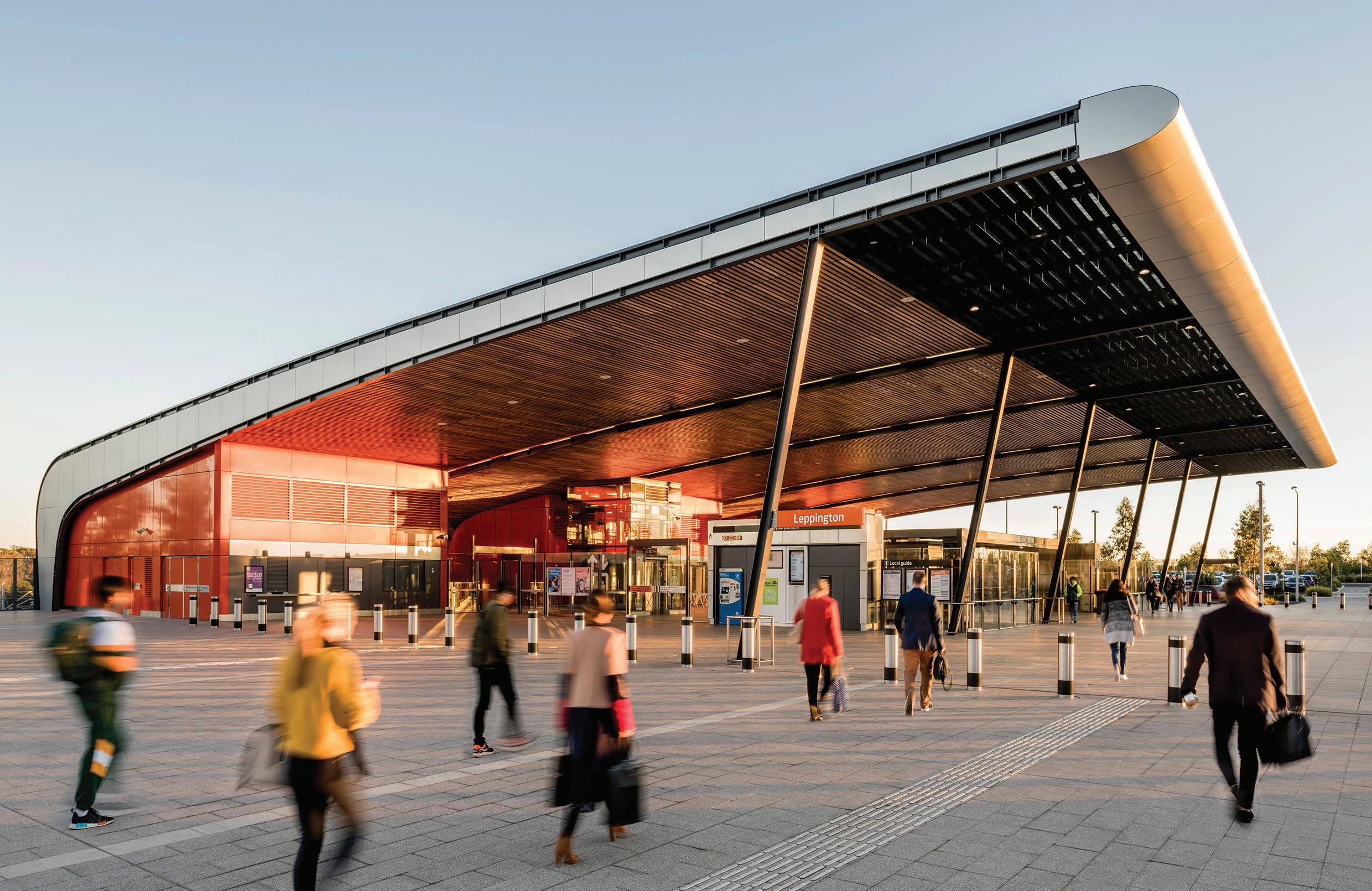
embankment originally proposed. It proved far more attractive and less expensive for the client.
Other significant rail bridges along the route were those crossing Campbelltown Road, Camden Valley Way and the Sydney Water Supply Canal – the latter, an original part of Sydney’s water supply infrastructure, dating to the late-19th century.
Two completely new rail stations were designed and constructed, respectively at Edmondson Park and Leppington. Edmondson Park station straddled the rail line on a cut-and-cover, street-level concourse. It provides 400 parking spaces for commuters.
Leppington station likewise comprised a street-level concourse,
with an adjacent 850-space parking area and passenger lifts down to the platform levels. Leppington was so constructed as to allow for future extension of the rail line with new branches to the south and north.
Each of the new stations was fitted out with operating technologies such as CCTV, telephony, security, access, PA, passenger information, ticketing, access gates, radio, ICT networks and building services interfaces with ventilation and air-conditioning systems.
Beyond Leppington station, new twin rail lines extended westward to a new stabling yard, with the capacity for stabling 20 eight-car trains.
John Holland installed all ancillary facilities, including signalling
and train control, high-voltage reticulation (comprising 90km of high-voltage cables in a conduit/ pit system), two traction substations, sectioning huts, overhead wiring and other necessary rail operation and maintenance infrastructure across the entire project.
Throughout, civil works on the project included the movement of one million cubic metres of earth, variously in the construction of over- and underpasses, culverts, drainage, retaining walls, landscaping and fencing.
The project’s intense focus on safety throughout was acknowledged in 2012 with John Holland’s national Safety Award. In more than four million man-hours, there were zero LTIs and no major OH&S issues reported.
Perhaps most remarkably, however, the Glenfield to Leppington project was completed and commissioned six months ahead of schedule and a staggering $300m under budget. The first train operations were able to commence a full year ahead of schedule.
In 2015, John Holland was presented with the prestigious National President’s Award in the Master Builders Australia National Excellence in Building and Construction Awards. That organisation’s president, Wilhelm Harnisch, said: “John Holland took on a massive task with Glenfield to Leppington Rail Link and have delivered in spades for the New South Wales community and taxpayers.”
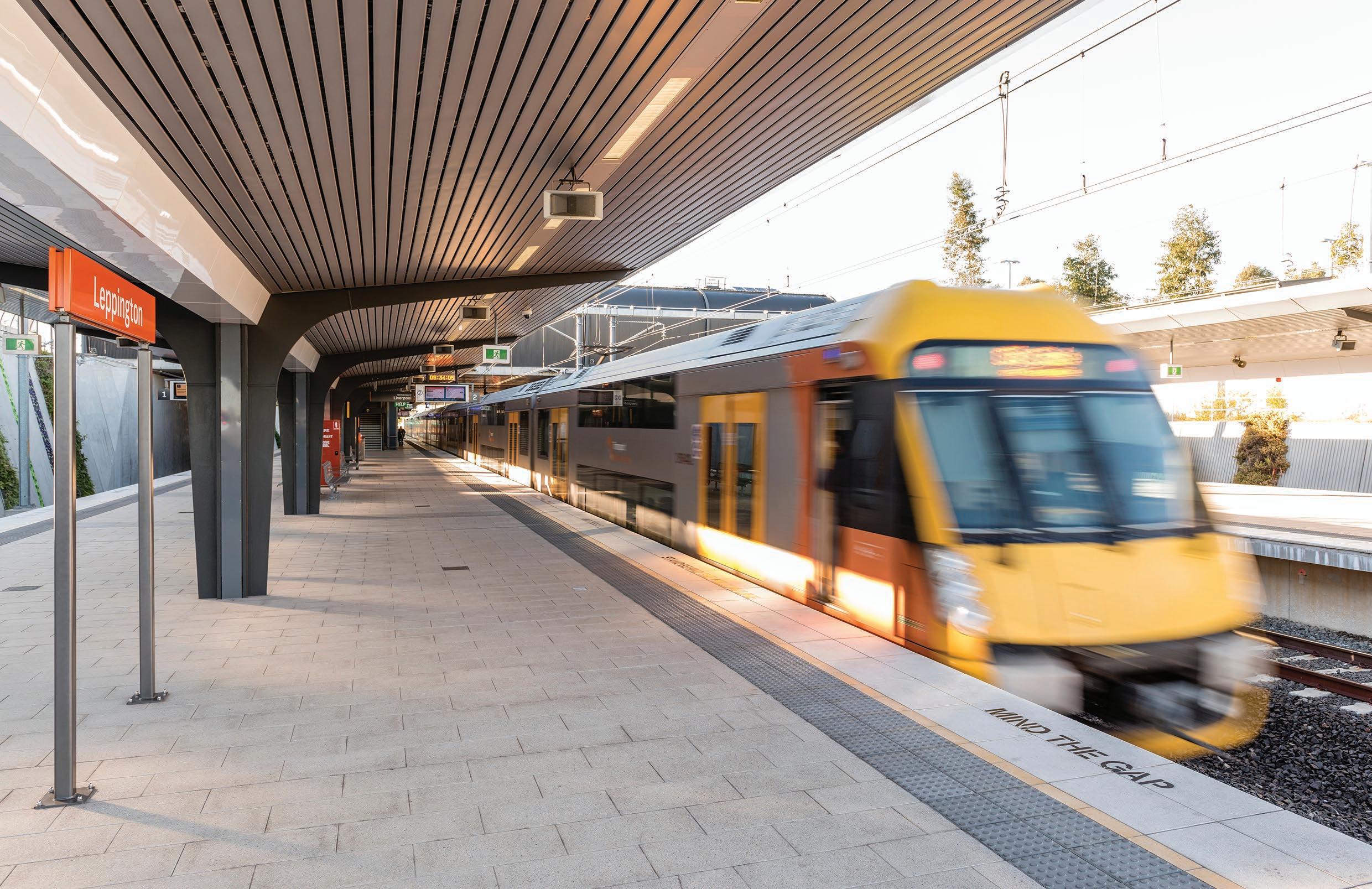
Country Regional Network
On15 January 2012, John Holland officially became the manager of the Country Regional Network (CRN) in NSW for an initial term of 10 years. It was an historic moment, as it was the first time a private rail transport operator had been put in charge of a government-owned heavy rail network in NSW.
Winning the CRN contract represented a major shift from the project-focused nature of John Holland, as it was the first time the business was wholly responsible for all rail operations, including rail asset management, maintenance, and passenger services.
Guided by a simple goal to improve the availability and
performance of the network for customers and communities, a 400-strong John Holland team took on responsibility for the CRN contract from centres across regional NSW, including Bathurst, Dubbo, Tamworth and West Wyong.
Former CRN CEO Nev Nichols said that the moment of taking control of the CRN network was a nail-biting experience. “Effectively, the previous operator was going to switch everything off at midnight, and we took over at one minute past,” Nichols said.
“This meant our train controllers working out of our new train control centre in Newcastle were now responsible for a system of more than 5,500km and everything that entailed.”
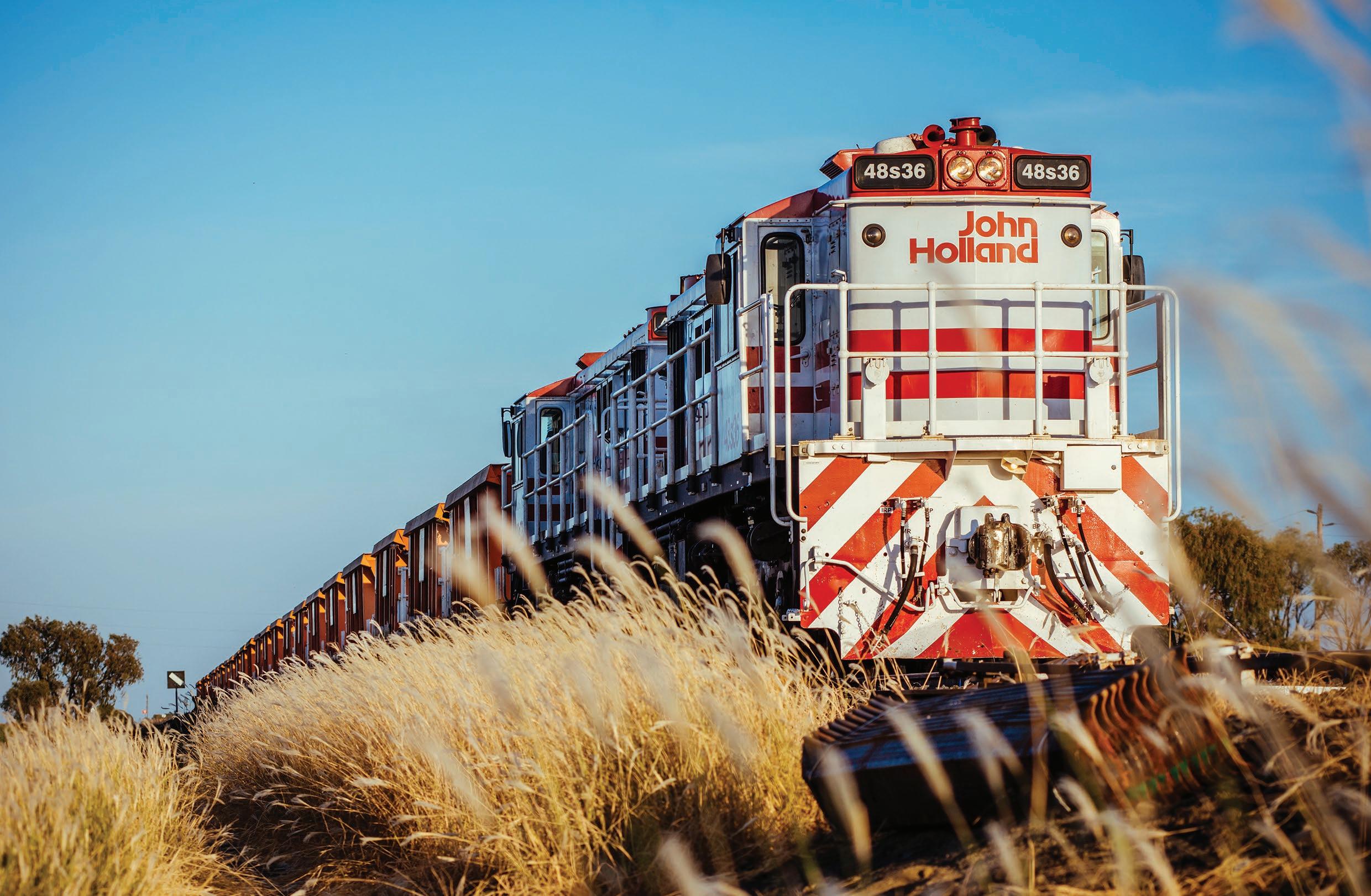
In pure numbers, what it entailed was: 2386 kilometres of operational freight and passenger lines, and 3139 kilometres of non-operational lines; 27,000ha of land and infrastructure; 1312 level crossings (300 active); 1200 property assets (including 356 heritage); 600 rail under-bridges; and 384 road over-bridges.
John Holland had had a year to prepare for the changeover, which according to Nev wasn’t long given what had to be put in place.
“Prior to taking over, we had little access to data and records, so we weren’t able to understand the condition of the assets or properties, which was confronting,” said Nichols.
The lead-up preparations involved building up the asset database of
the entire network (which included nearly 900 bridges), employing and training people and building and fitting-out the state-of-the-art train control centre.
Nev said the mobilisation phase was also used to start building the team culture and identify the way the team wanted to do business.
“We didn’t want to be a ‘me too’ type of operation,” said Nichols.
“We wanted to be a customerfocused, not engineering-focused, business that is genuinely committed to excellent customer service …
Everyone in our team knows they can’t say ‘no’ unless they can offer an alternative.”
The operational cutover of the network occurred without incident.
The promising start was a sign of great things to come.
After taking control, John Holland was quick to improve the efficiency, performance and safety of the network, with safety the initial priority.
Critical to improving performance and safety was the introduction of a train management and control system (TMAC) in the first year.
Replacing systems that had been in place for 155 years, TMAC made it possible for the train control centre to know the exact location of all trains at all times.
“TMAC meant we no longer relied on drivers to call in to say where trains were, which was a game-changer in terms of efficiency and eliminating human error,” said Nichols.
“Since TMAC was introduced, we have saved more than 205,000 minutes of delays for customers.”
By the time of this writing, the safety focus had achieved zero trainto-train collisions and 100 per cent compliance for safety inspections and defect corrections. On-time running was at an all-time high, as were many other performance measures.
“We’ve been able to remove all speed restrictions on the passenger lines, some of which had been in place for 10 years,” said Nichols.
The cumulative delay on passenger lines was brought to below three minutes, compared to the previous low of 10 minutes. The cumulative delay on freight lines improved to 13 minutes – a major achievement, given it had never been below one hour before John Holland took over.
The performance of the network was boosted by a number of other initiatives, including: LIDAR (light detection and ranging) laser scanning technology to survey the railway and provide safer working conditions; GPS tracking radio communications for safety critical signalling information; and annual works programs for routine and major periodic maintenance across the network.
As operator of the CRN, John Holland had the scope to improve the efficiency of the network and to upgrade and re-open disused lines to meet local needs.
“Once we had addressed the safety of the network, we shifted our focus to improve speeds and axle loads to move freight more efficiently and improve passenger services,” said Nichols.
The results include increasing the axle load from 30 to 40 tonnes, which improved land speed and made rail freight transport more costeffective.
Nichols and his team had set a target for one in five CRN jobs to
be filled by Indigenous Australians. As such, CRN was very quickly significant in providing employment and training opportunities for Indigenous people.
Some years into the CRN project, Nichols reflected: “We’ve been able to achieve a consistently high retention rate, and many of our Indigenous apprentices have gone on to establish strong rail careers with John Holland.”
As an important operator in large areas of country NSW, the CRN
team developed a strong focus on establishing and maintaining positive relationships with local communities.
Community liaison activities typically involve communicating changes related to maintenance and upgrade works, and sponsoring and partnering with local organisations.
“Railways have been part of the regional community for more than 150 years, and we respect the important role we play in the local community,” said Nichols.
Roy Hill
JohnHolland constructed the railway for Western Australia’s major iron ore development, Roy Hill, 70 per cent owned by Gina Rinehart’s Hancock Prospecting.
Located in the rugged Pilbara region in the state’s North West, the 344km railway was built to transport 55 million tonnes per annum from the Roy Hill Mine in the region’s interior to a stockyard and port facilities south of Port Hedland.
John Holland delivered the railway for Samsung C&T, the engineering, procurement and construction (EPC) contractor for Roy Hill’s mine, rail and port infrastructure.
The project included constructing 395km of main line standard gauge
to heavy haul rail standards with the capacity to operate at 40 tonne axle loads, along with sidings and a marshalling yard.
Taking two years to construct, the railway was completed on time to enable Roy Hill’s first shipment of ore to depart Port Hedland in December 2015.
Delivering a long-distance, heavyhaul railway in a harsh and remote environment provided multiple challenges, such as weather events and interface with other packages. Successfully managing the program of 15 key milestones was critical.
Building on previous rail experience in the Pilbara and guided by strong leadership, John Holland worked with subcontractors, suppliers
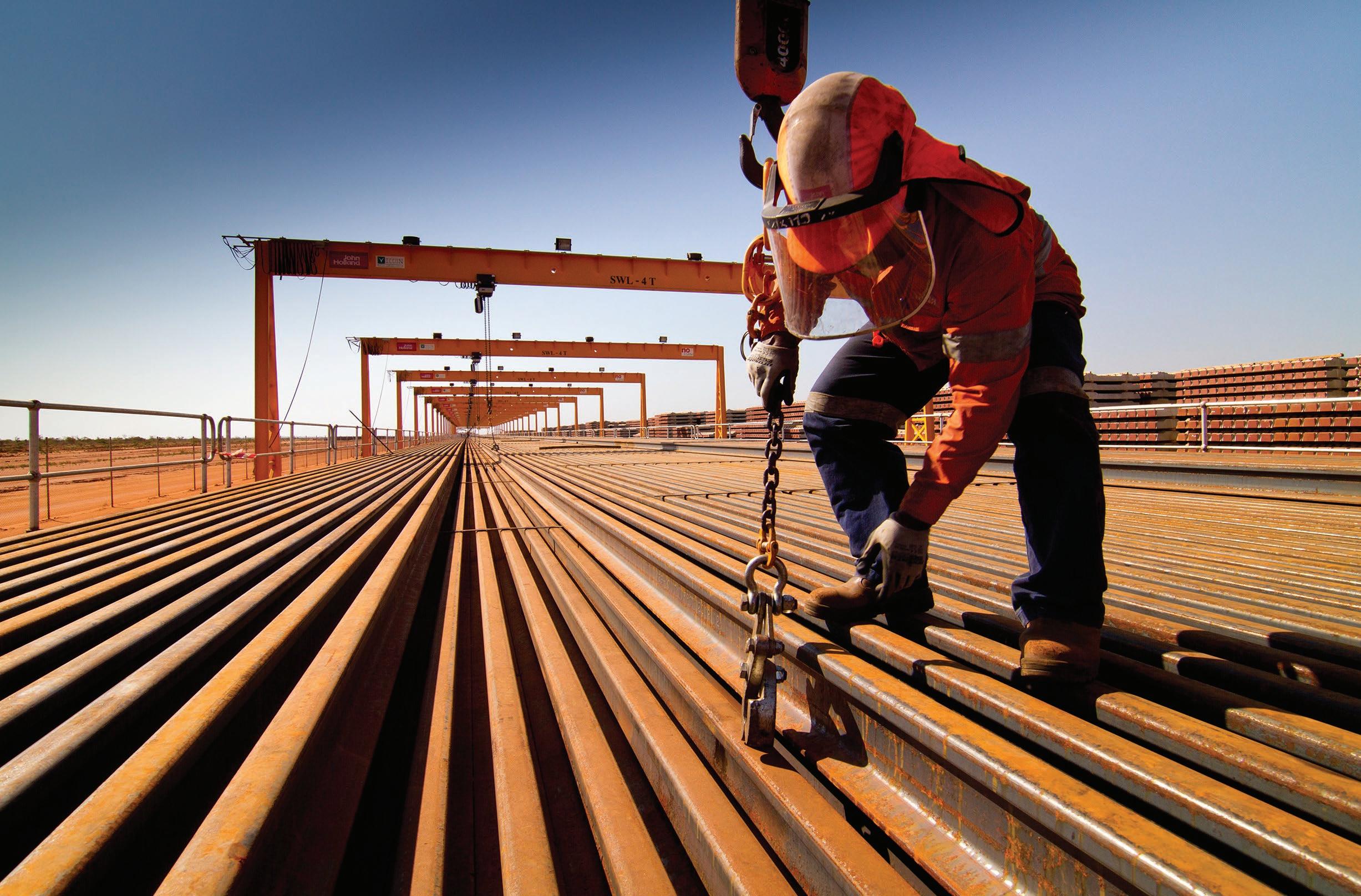
and the client in a focused and united team effort.
Managing a fly-in fly-out workforce of about 220 based at three rail camps dotted along a 200km stretch of railway was a challenge in itself.
Workers flew into either Port Hedland or Newman, depending on their work location, and travelled long distances by unsealed road to their worksite.
Roy Hill used John Holland’s proven rail safety management and operating systems to achieve the required rail accreditation to construct the rail infrastructure and operate the construction rolling stock.
John Holland also established a train control centre to manage railway access.
Given its remoteness, a critical requirement of the project was to manage the sheer scale of materials and their transportation to the workfront.
John Holland drew on its heavy haul rail construction experience to establish a materials handling depot as the logistics ‘hub’ to store and handle the precast concrete sleepers and ballast stockpiles near Port Hedland.
A feature of the depot was a customised rail flashbutt welding yard, which was built in an accelerated timeframe of three months – half the time normally expected to build such a facility.
Short lengths of 25-metre rail were welded into 400-metre ‘strings’ at the
yard to reduce the need for welding on site.
A high production capability of a minimum rate of 150 welds in a 24-hour period ensured construction could start on schedule and achieve a track laying rate of up to 2km of track per day. In total, 30,000 rail welds were made.
Applying state-of-the-industry methodologies, a high speed custombuilt shot blaster removed the need for labour intensive and hazardous manual grinding to clean the rails before welding.
As another safety feature, the rail handling roller system, welding assembly line and portal cranes were electronically interlocked and centrally controlled by the flashbutt welding supervisor to prevent uncontrolled movement.
The 400-metre welded rail lengths, along with the heavy haul concrete sleepers, were loaded onto materials trains using a 30-tonne double gantry and overhead travelling crane, which
was remote-controlled to protect the safety of personnel.
The track was laid using a John Holland fleet of specialised machinery that included track laying machines (supported by a 500m-long materials train), track tampers and ballast regulators, flashbutt rail welding machines, and ballast wagons.
John Holland was responsible for all aspects of rail safety and governance of operating rules of the project, which when completed had involved handling 55,000 tonnes of short rail, 610,000 concrete sleepers, and supplying and installing more than one million tonnes of railway ballast.
More than 4000 welds, including aluminothermic and flashbutt welds were undertaken by John Holland’s fleet of mobile welding machines in the field.
The project successfully met all contractual and regulatory requirements, and was achieved without any significant safety or rail safety events.
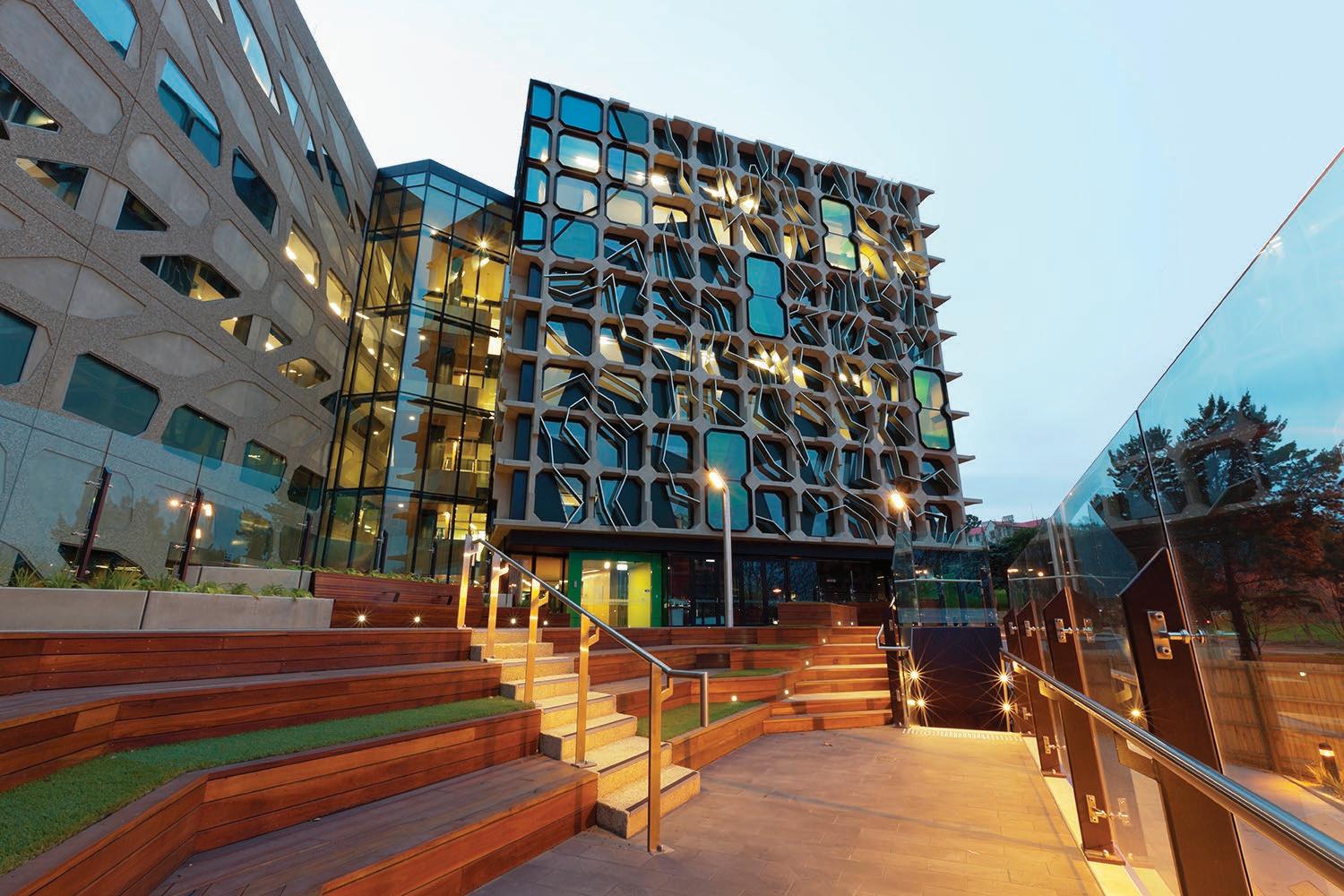
University of Tasmania
Theestablishment of John Holland’s Tasmanian office in 2011 was only one more confirmation of a presence that was already bringing spectacular change to the city of Hobart. A fruitful relationship with the University of Tasmania had begun in 2008 with a joint venture of John Holland and Fairbrother being engaged to construct new facilities for UTas’ Medical Science Precinct and, shortly after, an Institute of Marine and Antarctic Studies.
The Medical Science Precinct began with the archaeological excavation of the site turning up almost 15,000 significant finds, including the intact stone footings and cellars of a circa-1826 house, brick-lined drains, stone footings of
stables and a large number and variety of glass and ceramic bottles and vessels.
While the discoveries placed additional pressure on the timing of the project, it was determined early that many of these artefacts should be preserved and displayed within the new buildings. Openings were created within the new ground floor slab of MS1, the first part of the project, so as to showcase the 19thcentury house foundations beneath.
A much-welcomed feature, this nonetheless required the changing of the original pad-footing construction design to the use of 900mm bored piles, drilled by an auger mounted on a 20-tonne excavator rig. The building’s superstructure consisted of
post-tensioned band beams, typically spanning 9.4m, with slabs supported by condeck. The roof structure was constructed in post-tensioned concrete with a light steel roof covering.
Much use was made of highstrength concrete of up to 60MPa, so as to reduce overall column sizes and architectural impact on internal spaces.
The Medical Science Precinct would ultimately comprise two parts (MS1 and MS2), the latter being granted in 2009 as a contract extension.
The striking facades of both buildings drew on themes of Hobart’s surrounding mountains and waterways, combined with
elements of bio-medical research.
MS1 references the mountain ranges around the site, whereas MS2 hints at the contours found in the topography of Hobart.
The creation of the dramatic precast panels that clad the buildings was technically challenging, involving curved moulds and the necessary acquisition of a CNC router to cut out the formwork moulds. Galvanised steel window frames were cast within the panels.
The Medical Science Precinct was nothing less than cutting-edge in the environmental sustainability of its design. This included the integration of thermal insulation breaks in the precast panels (known as Thermomass), high-performance
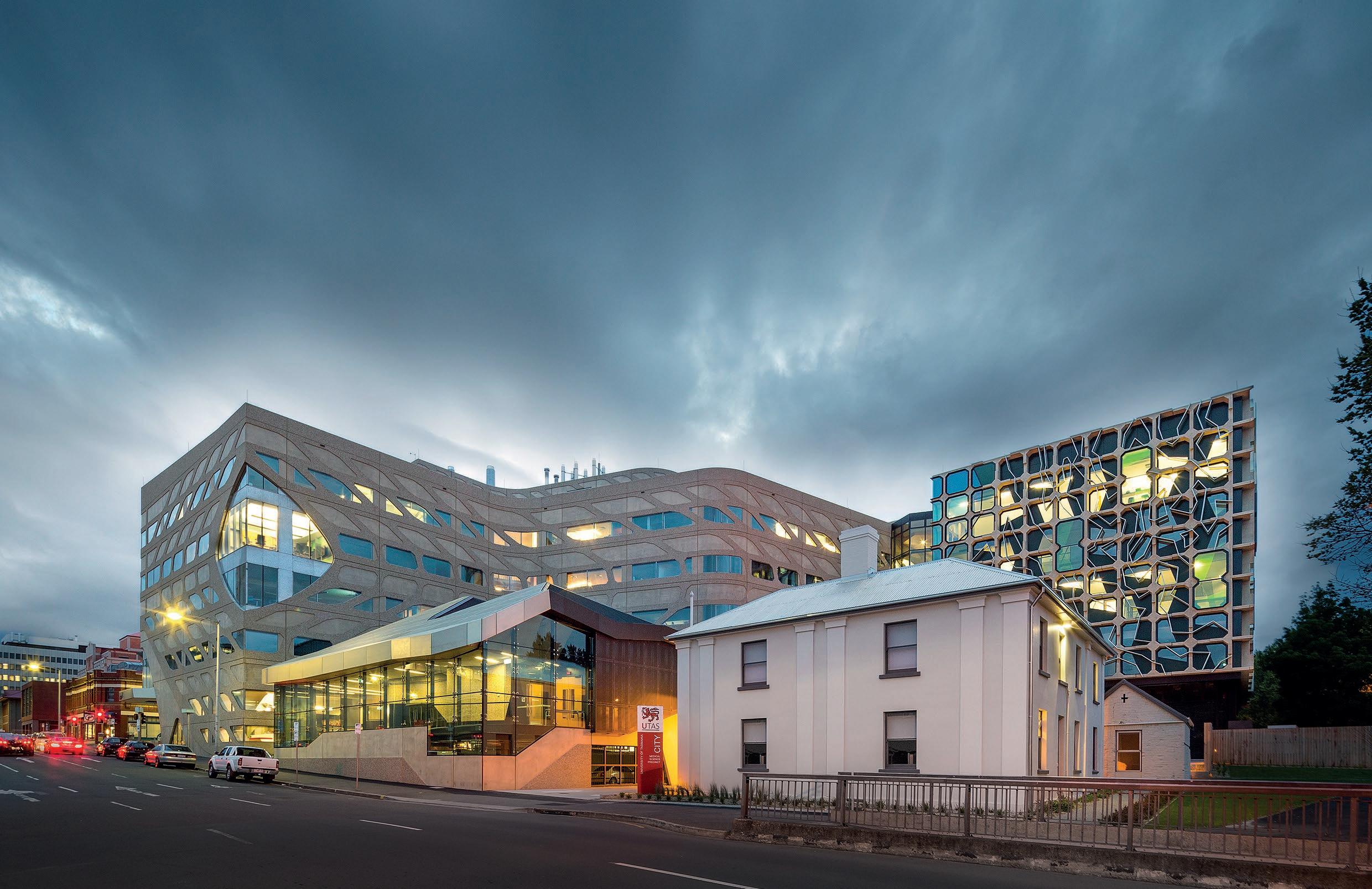
glazing systems, extensive contoured sun shading, rain water storage for use in toilets and landscape, and the treatment of outgoing water.
While the MS1-MS2 projects were underway – spanning 2008-’10 and 2009-’13, respectively – the John Holland/Fairbrother joint venture was again enlisted by the University of Tasmania for the arguably even more visible Institute of Marine and Antarctic Studies project. This was situated on the city’s waterfront at Princes Wharf No.2, just across from the famous Salamanca Place.
The IMAS facility served to unite the UTas, the CSIRO and Tasmanian Government Resources in a single marine science precinct, so as to advance Australia’s capabilities in exploring and conserving the Southern Ocean and Antarctic Territories.
Challenges in delivering this project included the fact that it was located on a fully operational wharf within a major heritage/historic planning zone.
The striking, chiselled IMAS building provided up to 7500sqm of floor space dedicated to learning spaces, laboratories, quarantine areas and public facilities. A number of active and passive energy-saving measures were included in the design, chief among them a closedloop heat exchange system that uses water from the adjacent Derwent River for heating and cooling of the building.
The IMAS was completed in 2013 and its design, a joint effort by by John Wardle Architects and Terroir, won a National Architecture Award for public buildings in 2014.
Perth Children’s Hospital
Following an expression of interest stage, John Holland was one of two teams invited to prepare a submission to design and construct the 298-bed Perth Children’s Hospital (PCH), which replaced the 100-yearold Princess Margaret Hospital as WA’s only dedicated paediatric hospital.
After assembling a team of national and international designers, including paediatric health facility architects and other specialists, the John Holland team worked around the clock to develop a comprehensive submission that aligned to the WA State Government’s aim to deliver the best possible children’s hospital for the people of WA.
John Holland was awarded the contract for Stage One of the design
and construct project in July 2011, and Stage two in December 2012. Located opposite Kings Park, a protected A Class Reserve of 400ha in the heart of Perth, the hospital was recognised internationally as a leading paediatric hospital. Built as part of the Queen Elizabeth II Medical Centre and adjacent to the existing Sir Charles Gairdner Hospital, PCH combined innovation in medical technology, high-value aesthetic appeal, and design features known to aid patient recovery.
The hospital’s unique and brightly coloured panelled exterior façade and eye-catching, illuminated functional art known as ‘fizz’ created a striking new landmark on the metropolitan landscape.
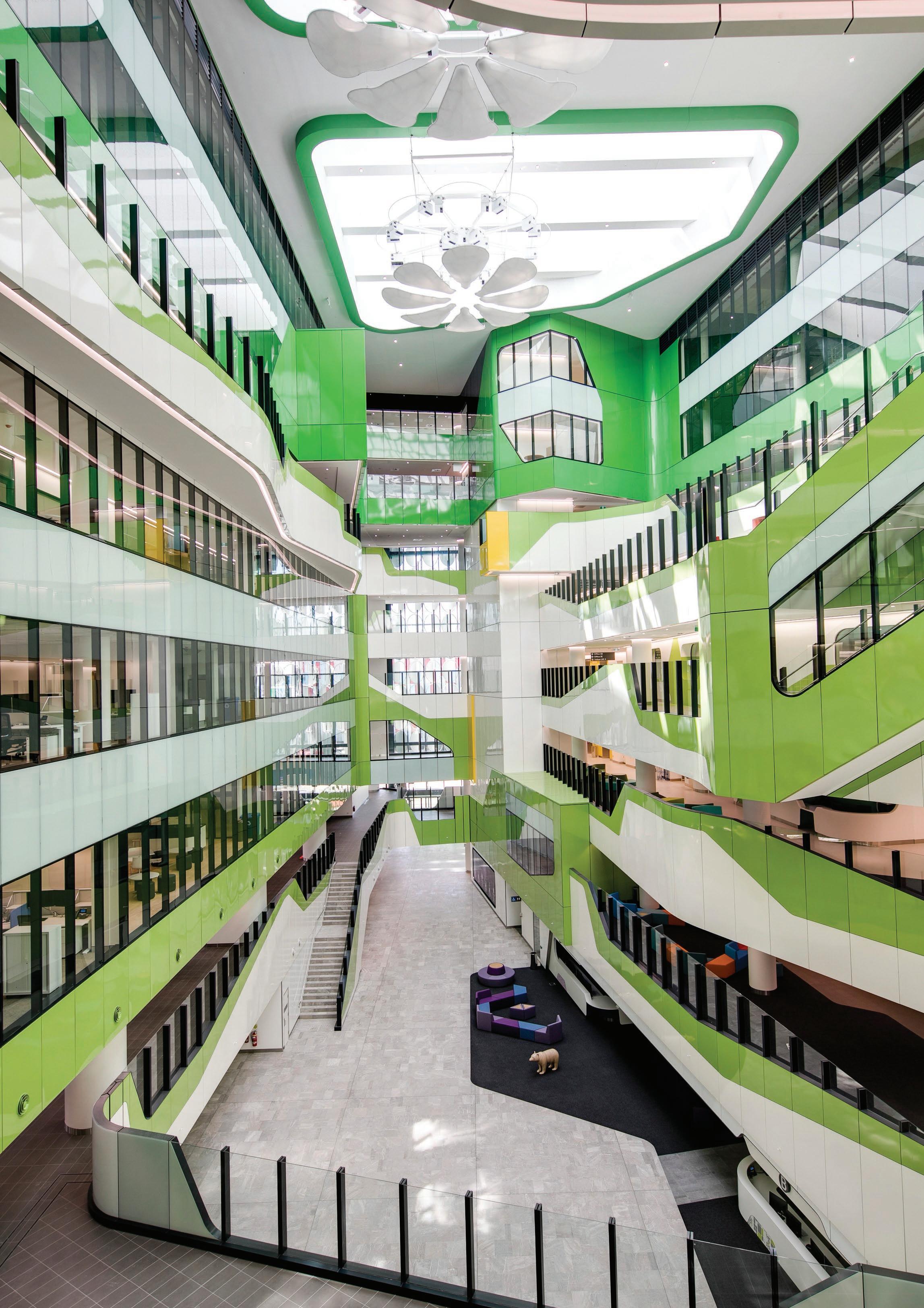
The external appeal extended to the hospital’s internal spaces. The building was constructed in four blocks of up to 10 levels, radiating from an imposing and spacious, highvaulted atrium.
The atrium allowed natural sunlight to flood the core space of the hospital, one of several features designed to accelerate the healing process.
Other ‘healing’ features included high circulating volumes of fresh air and a predominance of single inpatient rooms.
Most in-patient rooms provided facilities for visitors to rest or sleep. A 12-room family accommodation wing enabled parents to stay close to their sick children.
In keeping with the patient-centric focus, all longer-stay in-patient rooms boasted views to the outdoors.
The hospital took advantage of its proximity to neighbouring Kings Park by orienting rooms to capture views of the park’s natural bushland.
Kings Park itself was the inspiration for many interior design elements, including the colour palette and custom-designed floor coverings that mimic the colours and textures of the local natural environment.
PCH Project Director, Lindsay Albonico, said the hospital was one of the most technically complex buildings constructed in Australia,
leading the way in building automation and medical technology.
“This project has been, without doubt, the most complex yet rewarding piece of critical health infrastructure that John Holland has constructed,” he said.
An intraoperative MRI machine enabled doctors to conduct an MRI while a patient is still in surgery, saving valuable time in lifethreatening situations and greatly reducing the risk of infection.
Sophisticated robotic technology was also on show, including worldleading automated guided vehicles, or AGVs, and a closed-loop medication system. Eleven AGVs operated with limited human involvement to transport goods and materials, such as food, waste and linen to provide significant hygiene and efficiency benefits.
While medical staff continued to provide medications to patients, dosages were automatically dispensed from a central pharmacy and tracked to a patient’s room.
Centralised and networked building automation systems monitored and controlled the performance of facilities and systems within the hospital, such as security and surveillance; fire and smoke detection; nurse call system; lighting, heating, ventilation and air conditioning; medical gases; and water and gas supply.
The sophistication of the automated systems brought significant efficiencies in terms of patient and other users’ comfort and safety, productivity, energy consumption and cost.
Environmentally sustainable design initiatives achieved an energy efficiency performance well above code compliance and comparable buildings. These initiatives included a 1500kW solar panel array on the roof, plus water harvesting and recycling.
In addition to providing a strong visual statement, the external glazed building façade panels incorporated an active shade feature to minimise glare while still affording views to the outside.
“We worked hard to transform even functional aspects such as desks, lifts and reception areas into art works,” said Lindsay Albonico.
Multiple areas of green space, including low water gardens featuring
Indigenous plants, were incorporated on the ground and other levels to provide relaxation and recreation spaces for hospital users. Winter gardens, which are semi-indoor planted spaces that replicate the feeling of being outdoors, provided year-round enjoyment.
External landscaping catered to walking or cycling, and wellappointed end-of-trip facilities were designed to support the use of sustainable and healthy transport modes by visitors and staff.
Lindsay Albonico said working with the people on the project gave him the greatest sense of pride.
“Working in construction is rewarding in itself, but it was people in our team, and the thousands of other people who contributed to delivering this world-class hospital, that made the project so special.”
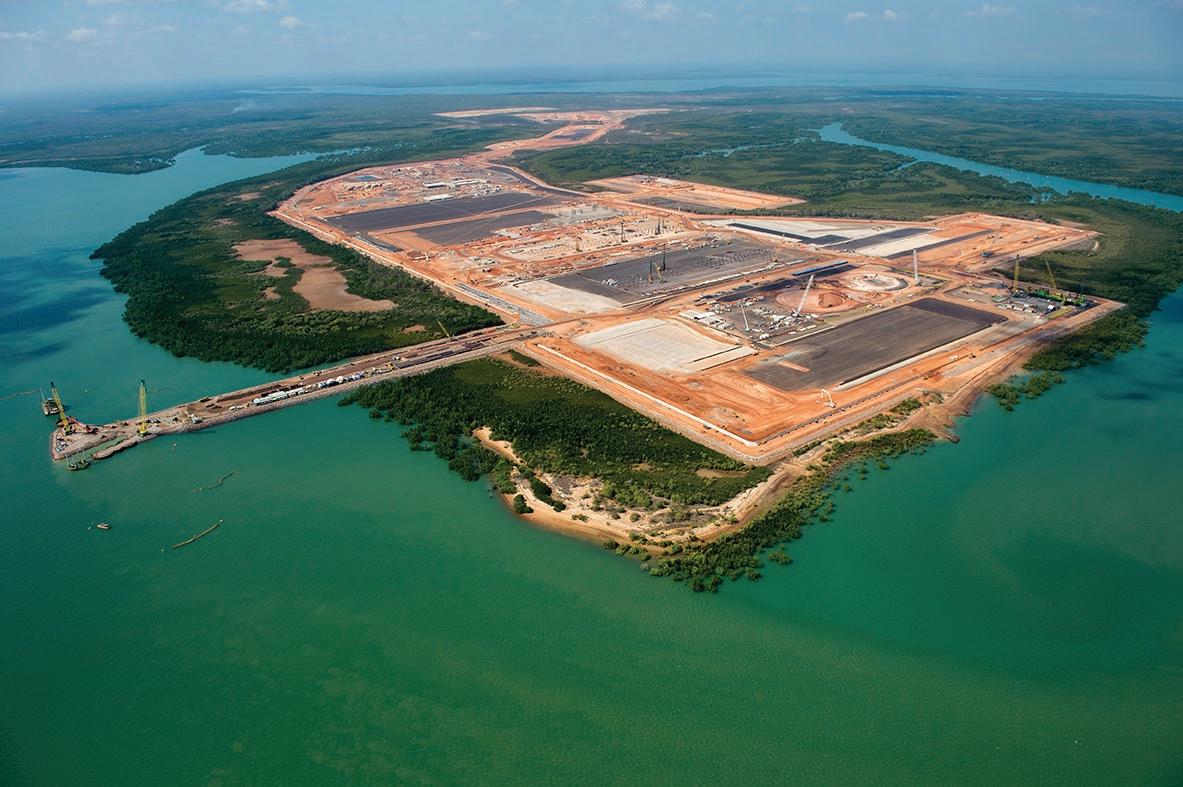
Ichthys
InMarch 2012 John Holland, in joint venture with Macmahon Holdings, was awarded the $340m site development and civil works contract for the onshore processing facilities for the Ichthys (Greek for fish) liquefied natural gas project near Darwin.
The Ichthys field, located 220km off the coast of Western Australia, was hailed as the largest discovery of liquid hydrocarbons in Australia since the 1970s.
There was little doubt that John Holland’s experience and exemplary performance in the similar Devil Creek LNG onshore plant just a year or so earlier, was a factor in its successful bid.
The project would be handled by John Holland’s long-established
and highly regarded office in the Northern Territory. Indeed, around the middle of this 27-month project, the NT office was rebranded as Territoria Civil, to better reflect its experience and scale.
The Ichthys CVL2 package was unprecedented in its scale in the NT, comprising all work required to develop the near-coastal site for the LNG plant, a flare pad, module offloading facility causeway and the operations complex, along with various access roads.
The staggering quantity of earthworks included 2.7 million sqm of site clearing and topsoil stripping; 2.2m sqm of earthworks; 4.8 kilometres (and 11,000 cubic metres) of concrete in the site’s 3m-wide
circumferential “regulating reservoir” channel; 8.5km of reinforced concrete pipe drainage; 315,000sqm of ground improvement to mangrove areas … it went on and on.
More than four million tonnes of imported rock (trucked over a total of 3.5 million kilometres) and more than 500 major pieces of earthmoving equipment were brought in for the project. At the time of award, CVL2 was the largest earthworks contract ever undertaken in the NT.
In fact, not untypically of the oil and gas sector, the scope of works actually doubled through the duration of the project – with no time extensions granted.
Ichthys was great news for the NT community, with a peak workforce of 850 comprising more than 90 per cent locals. Within that, no fewer than 40 per cent of project staff and
10 per cent of the total workforce were women. About 20 per cent of the total workforce came from local Aboriginal and Torres Strait communities.
When the CVL2 project was completed in June 2014, more than 2.6m man-hours had been logged without a single LTI. The project’s performance in health, safety and environment (HSE) was acknowledged in 2013, in its winning the Onshore Division category of the INPEX Australia 2013 HSE Awards.
Concurrent with the CVL2 project, John Holland (on behalf of JKC Australia) delivered the Remote Laydown, a vast area for the storage of construction materials, with an additional 10 cleared hectares for the storage of topsoil. This was also completed in June 2014.
Sydney Opera House VAPS
It’s among the world’s most instantly recognised buildings, inscribed in the World Heritage list in 2007 as a “great architectural building of the 20th Century.” To safeguard its usefulness into the 21st and beyond, in 2010 the NSW Government announced a $152m program of the biggest building works to be undertaken since the Opera House’s completion in 1973.
The lion’s share of that budget –$120m – was allocated to the Vehicle Access and Pedestrian Safety (VAPS) program, comprising nothing less than major excavation beneath the precious building to create a vast, subterranean loading dock with appropriate vehicle ramps and elevator access.
Formerly, heavy vehicles had shared ground-level pedestrian access to the Opera House, a situation that had resulted in 200 traffic incidents on the forecourt in the previous three years. The underground diversion of up to 1000 heavy vehicle movements per week improved not only efficiency and pedestrian safety, but the aesthetic appeal of a building visited by more than eight million people each year.
The scope of the works included the excavation, by roadheaders, of a 45 by 40-metre cavern situated 15m below sea level, beneath the Opera House’s monumental steps; construction of a pair of 80m-long access corridors to the north of the
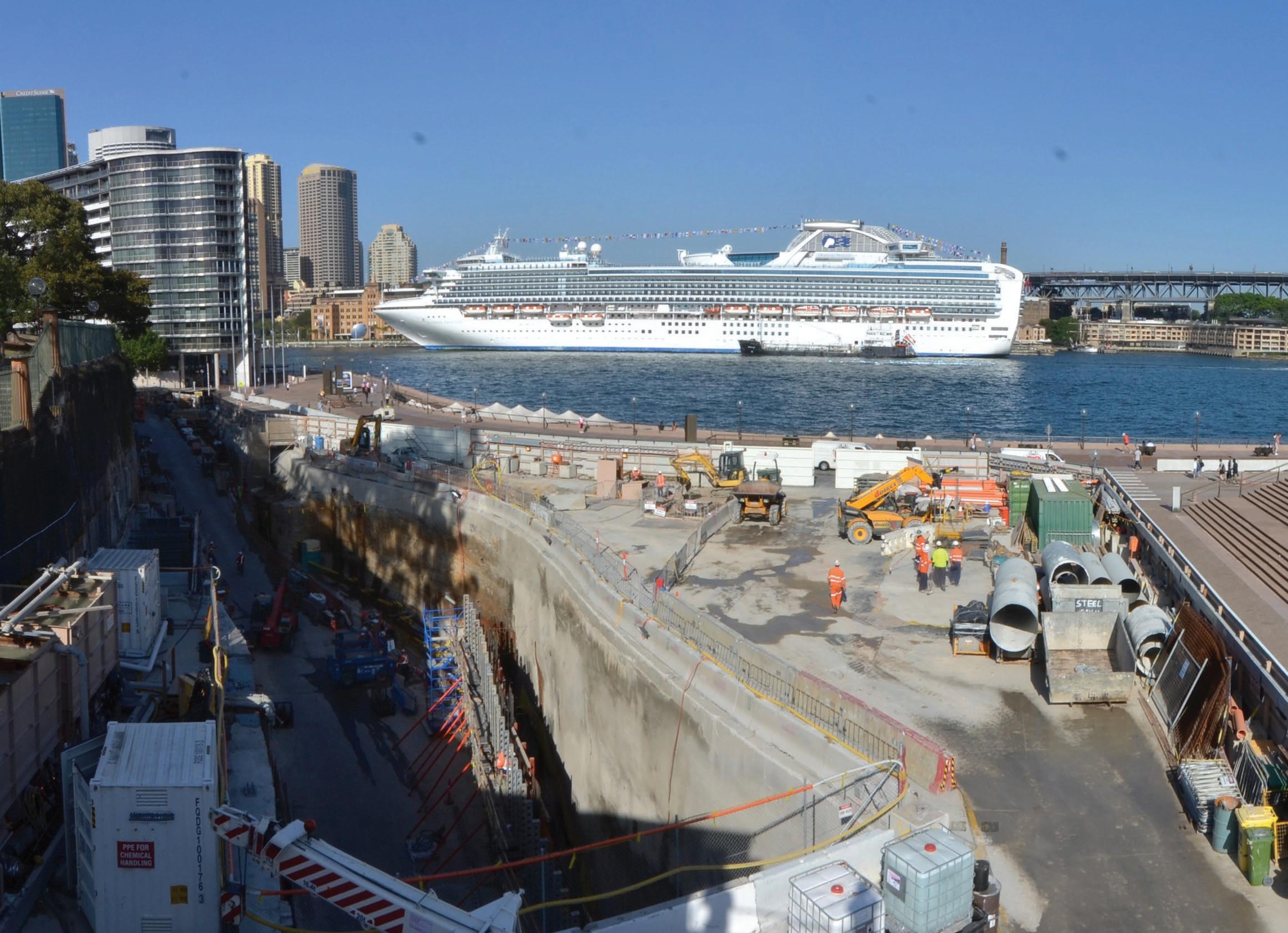
new loading dock; a single, 80m-long ramp on the southern side, giving vehicle access to Macquarie Street; construction of lift shafts linking the north corridors to the Opera House; and various works to enhance the existing forecourt. With the large excavation being located well below the level of Sydney Harbour, custom low-level pile rigging had to be constructed in Germany to allow the anchoring of the excavation to prevent this cavern – and the Opera House – from wanting to float upwards.
Despite the scale and sensitivity of the works, it remained no less rewarding to John Holland that during the three and a half years of the project, not a single performance in the Sydney Opera House was disrupted in any way.
The Sydney Opera House project meant a lot to Chairman Janet Holmes à Court.
“I used to say, we don’t want to be the people who drop the Sydney Opera House, or we will certainly go down in history,” she laughed. “But what an amazing job.
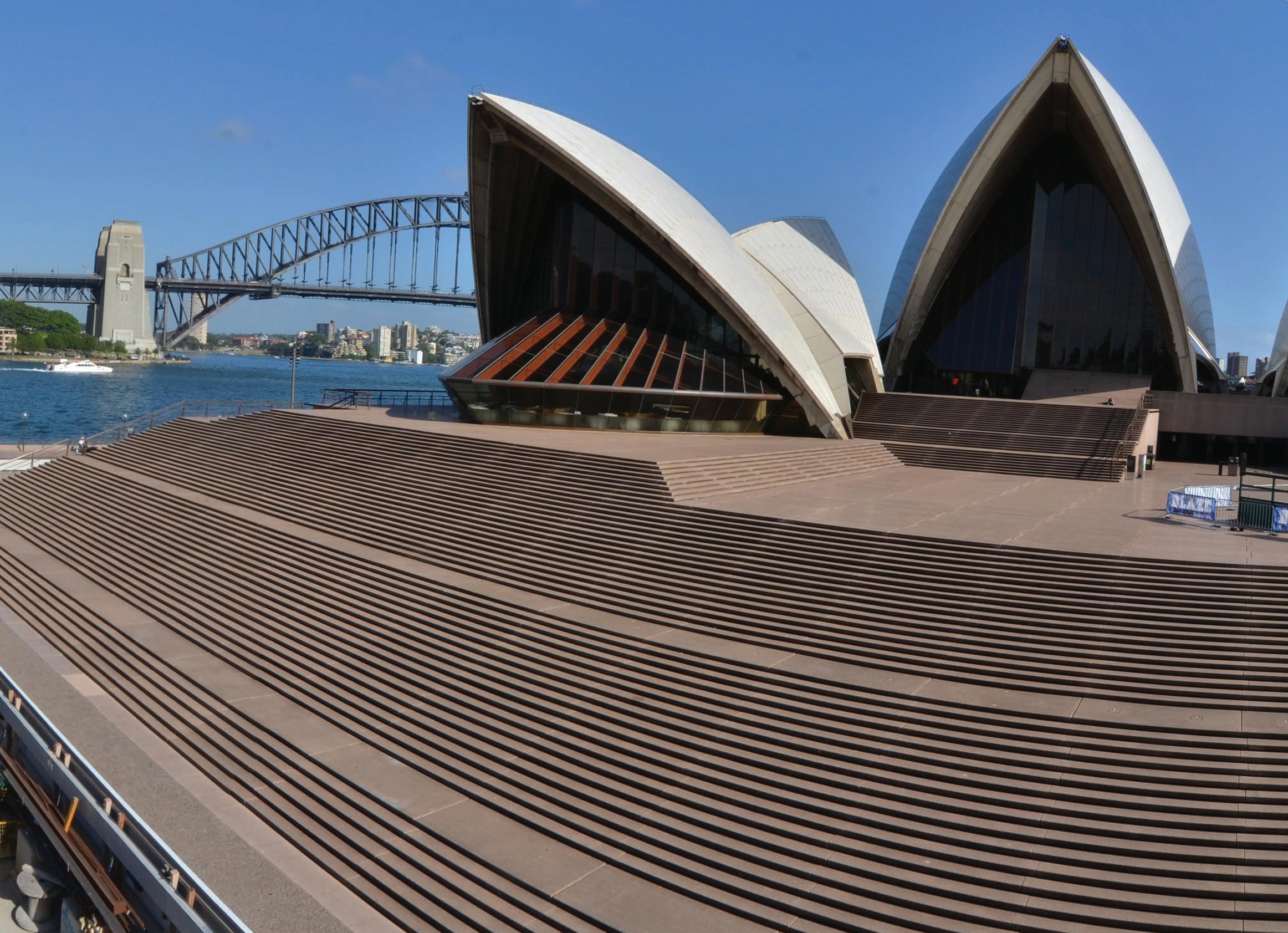
“Even before we got that job, we had another one there, putting in lifts and making it disabled-friendly. The teams of people there in both instances were absolutely fascinating
to visit, because they really knew that they were working on one of the world’s great buildings. The pride in that was extraordinary.”
At the time of its commencement in 2012, regional rail Link was the largest public transport infrastructure project in Australia, and m elbourne’s first new major railway line in 80 years.
Regional Rail Link Package A
Atthe time of its commencement in 2012, Regional Rail Link was the largest public transport infrastructure project in Australia, and Melbourne’s first new major railway line in 80 years. It was only natural that John Holland would be there.
The $4.8bn RRL project brought a much-needed solution to the historic tangling of metro and regional rail services in Melbourne’s west, by introducing a dedicated regional rail line all the way into the city’s Southern Cross station. Both metro and regional services benefitted from increased “bandwidth” provided by their no longer having to share lines.
Historically, Melbourne’s metro and rural rail network had grown in
a piecemeal way, the majority in the latter half of the 19th century under private ownerships. Electrification of metro services was undertaken in the 1920s.
A by-product of this early, haphazard growth was that Spencer Street station – one of Melbourne’s two main stations, along with Flinders Street – was for decades forced to accommodate metro (electrified), rural (diesel) and dualgauge interstate services from all across Melbourne’s rapidly growing west and south-west.
All of these converged in a bottleneck north of the Spencer Street station (renamed, in 2004, Southern Cross station). Rural services for major centres like Bendigo
and Ballarat, which carry daily commuters from outlying suburbs, endured some 12km of choked metro tracks between Sunshine and Southern Cross.
The solution presented by RRL entailed the weaving of new, paired tracks through the thicket of existing lines just outside Southern Cross station, and passing through (or briefly bypassing) impossibly pinched parts of the urban corridor.
All of this was within the scope of City to Maribyrnong River, one of the seven packages into which the ambitious RRL project was divided. This package, at the most intense (inner-urban) end of the RRL project, was won by an alliance of John Holland, V/Line, Metro Trains Melbourne, AECOM, Lend Lease, Coleman Rail, GHD and the RRL Authority.
The involvement of the operating rail authorities in this package brought clear benefits in the management of longer occupations (typically two to three weeks), a strategy that reaped untold benefits in terms of work efficiency and employee safety.
The City to Maribyrnong River package entailed the laying of a total of 4.5km of new paired tracks, along with a new overpass, flyover, rail bridge and various bridge modifications and upgrades.
Southern Cross station had received a makeover in the mid2000s, transforming the shopping concourse area and introducing a new design language of flowing awnings overhead. As part of RRL, two new platforms (15 and 16) were constructed on the western side, to complement the 800 metres of new, paired RRL lines leaving the station westbound.
For those V/Line trains that continued to depart Southern Cross platforms 1 through 8, a new “country bypass” crossover was constructed to link them to the new RRL rural line at the junction known as Spion Kopp.
Among the first of the bridges, variously rail and road, that needed to be extended or replaced along the RRL’s urban path was that over Dudley Street, adjacent to Festival Hall. A new, twin-track steel rail bridge was built to accommodate the RRL tracks.
This exercise also became one of unearthing Melbourne’s history, as preliminary excavation work at the Dudley Street site turned up examples of old and unusual bottles. Samples were gathered and submitted to the Victorian Bottle and Collectables Association, which described such finds as “an important piece in the jigsaw of an area’s history.”
Delicate handling, if on a much larger scale, was also required where the corridor squeezed past a food processing plant immediately adjacent to the Maribyrnong River. The food manufacturing business relied on sensitive measuring and hygienic equipment; yet the smashing of rocks and the laying of heavy rails all took place within little more than a metre of its walls.
The Maribyrnong River Bridge was constructed with the use of a launching truss, which obviated
the need for heavy cranes and scaffolding.
The management of heritage, environmental and community concerns was a hallmark of the RRL project. The City to Maribyrnong River team was later presented with an award for Excellence in Community Engagement in the Golden Quill Awards.
The project won numerous awards at State and National level, including the prestigious Australian Construction Achievement Award.
Sydney Metro
Initiated as the North-West Rail Link, later renamed Sydney Metro Northwest, this $8.3bn urban transport project was recognised as one that would change the face not only of Sydney’s north-western suburbs, but of train technology across the nation.
The long-needed rail link serves a region that has had, through necessity, the nation’s highest levels of private car ownership per household.
John Holland, as Australia’s largest independent rail provider, in consortium with Thiess and Dragados, was engaged in June 2013 for the $1.15bn Tunnels and Stations civil works package that included building dual 15.5km tunnels and associated connections, for Stage
One of the project, scheduled for completion in early-2019. The package also included preparatory work for a subsequent contract, which would provide a number of stations.
For Project Director, Terry Sleiman, winning the contract was a high point in his career, though he knew it also meant taking on an immense responsibility to deliver this much needed infrastructure. It came with the opportunity to notch up a number of firsts. When awarded, it was the largest transport infrastructure project under construction in Australia and included the country’s longest twin rail tunnels, at 15.5 kilometres each. When completed, the Sydney Metro
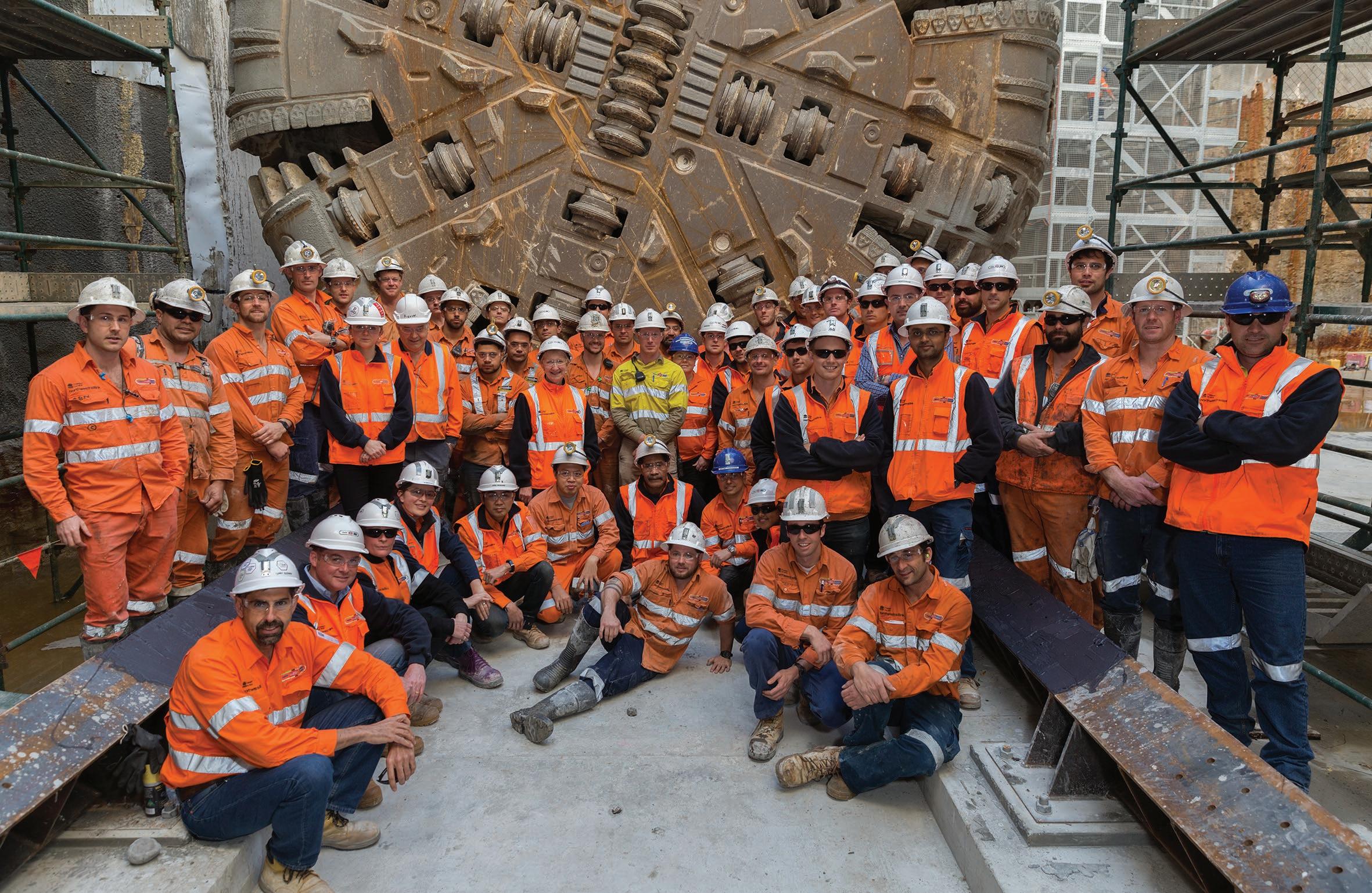
would be the first fully automated rail network in the nation.
People were the key, and the best in the industry were brought on board to bring innovative solutions and a passion to succeed.
The project involved setting up eight worksites and managing the challenges of working within built-up residential, business and retail areas and alongside suburban bushland. It was the first time in Australia that a transport project had four tunnel boring machines (TBMs) in the ground at once. Working around the clock, the 900-tonne TBMs tunnelled beneath homes, businesses, roads and creeks, generating vast volumes of rock.
Smart logistics were required in order to manage the truck movements
that transported the soil away from the tunnelling sites and ensured a constant supply of segments was delivered to feed the hungry TBMs, not to mention all the other materials needed to install conveyors and other services in the tunnels.
Sixteen months, 12 breakthroughs and 3.2 million tonnes of spoil later, the team completed 30 kilometres of fully lined tunnel. The massive job of building the rail tunnels had been achieved – two months ahead of schedule. Not to be outdone, the teams completing the cross passages and other finishing works in the tunnels, station boxes and shafts powered on so that sites could be progressively closed out for handover. The combined team effort saw the
TSC works successfully finalised in June 2016 – delivering the contract seven months early, with no defects and no outstanding contractual issues.
Efficient re-use was a priority –illustrated in one instance by the purchase of the enormous steel I-beam track sections from Sydney’s recently decommissioned Monorail, and their subsequent use (still with some Monorail markings in place) to support a cut-and-cover road bridge on the Metro route.
Subsequent to the winning of the Tunnels and Stations civil works package, John Holland won the operations contract which was, at $3.7bn, the largest PPP ever awarded in NSW. This package included the delivery of 23km of new rail network, eight new railway stations, 4000 commuter car parking spaces, the upgrading of an existing 13km
section of railway, all necessary signalling and electrical systems and the design, funding, provision and operation of Sydney’s new metro trains.
From the project’s scheduled completion date in 2019, the Northwest Rapid Transit consortium (comprising John Holland, MTR Corporation, Leighton Contractors and UGL Rail Services) will operate the 36km metro train service for a period of 15 years.
The contract also included a new stabling and maintenance depot, also fully automated. The driverless trains are routed into the depot for routine servicing, or automatically directed for more specific work that has been signalled by the train’s electronic sensors.
Truly a legacy that will benefit Sydney for many generations to come.
Ravenhall Correction Centre
Prisons
are sometimes regarded as stagnant and anachronistic institutions. In fact, there’s very little about their design, construction, operation and ownership that has not evolved significantly in recent decades.
A prime example was Ravenhall Prison, a new development on a site adjacent to the Metropolitan Remand Centre in Melbourne’s west. Designed to accommodate up to 1000 mediumsecurity male prisoners, the project was awarded in 2014 as a PPP with a consortium comprising GEO Group as prison operator and equity investor, John Holland (builder), Honeywell (facilities management) and Capella Capital (financial advisor). It was opened in October 2017.
The consortium was responsible for the design, construction, maintenance and ongoing operation of the prison, including custodial services. The prison complex, constituting 46 buildings, also included a 75-bed Forensic Mental Health Unit and a 25-bed Close Supervision Unit. John Holland’s revenue from the Ravenhall project was estimated at $650m.
After much consultation, John Holland devised an Australian-first construction method for the cells. They were produced as precast modules off-site and fully fitted out before being imported and assembled at Ravenhall. This technique greatly reduced safety risks and the number of trades required on-site.
Ravenhall represented the latest step in a process that, for John Holland, began gathering momentum in 2001 with NSW’s Mid-North Coast Prison in Kempsey. The 350bed correctional centre was the group’s first design-and-construct and operate-and-maintain contract in the prison market. The group by then had D&C experience, having thus
delivered a 125-bed women’s prison in 1995 in Deer Park (not far from the later Ravenhall development).
John Holland had also, in 2009, constructed a 250-bed maximum security expansion to the prison in Cessnock, NSW.
By all accounts, Ravenhall could be held as the model for prisons in the 21st century.
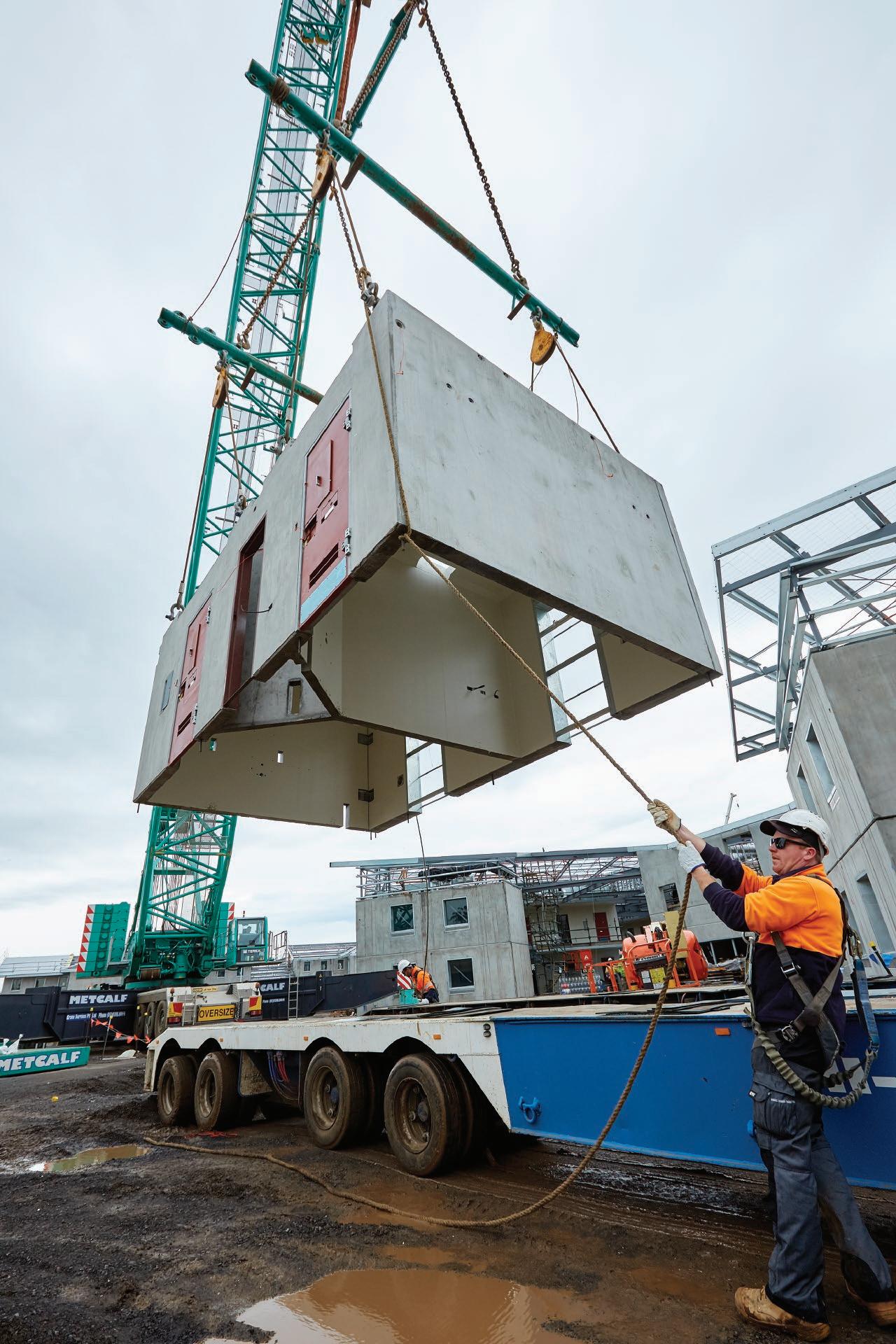
by all accounts, ravenhall could be held as the model for prisons in the 21st century.
Sundrop Farms
The fairly rapid cooling of Australia’s resources sector in the early 2010s led many to wonder what would follow the mining boom. One potential sector was quickly dubbed the “dining boom.” The early signs were that high-technology horticulture is an exceptionally interesting and technically challenging area in which to be involved.
Sundrop Farms was a project that John Holland approached with relish. It involved earthworks, civil construction, building works, mechanical, electrical, process design, water desalination, solar energy – practically a checklist of John Holland’s talents.
The group was awarded the $150m contract in 2014 to construct the
revolutionary, dry-climate Sundrop Farms agricultural operation at remote Port Augusta, South Australia. The futuristic facility embodied a suite of advanced techniques to produce tomatoes in what is effectively a desert region at the northern tip of Spencer Gulf.
The 20-hectare site comprised 200,000sqm of greenhouses, powered by a field of more than 23,000 computer-controlled mirrors that focus solar energy (as heat) on a 127m-tall “power tower”. Up to 39 megawatts of thermal energy was used for electricity, heating and to power an on-site desalination plant –taking water from Spencer Gulf, 5km away – to produce water for the crops within the greenhouse complex.
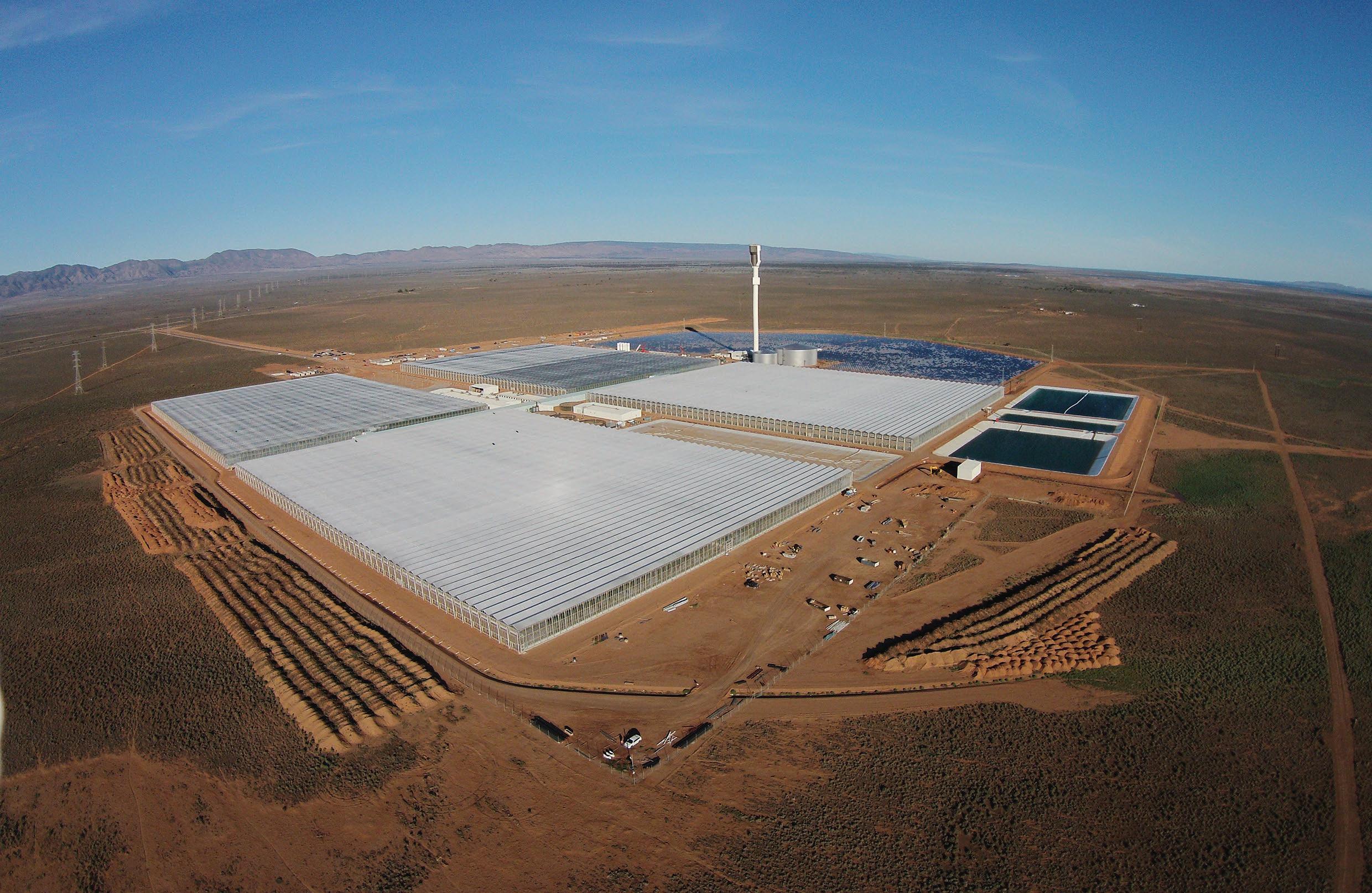
The desalination plant boasted the capacity to produce 250,000 cubic metres of fresh water each year.
A part of the construction job involved the installation of the 234-tonne central boiler atop the 127m “power tower”, using a Favco M1280D tower crane. This was understood to have been the largest lift to this height ever achieved in Australia.
Sundrop Farms opened in late2016. With the capacity to produce more than 15,000 tonnes of tomatoes annually, the virtually self-contained complex was estimated to save emissions of at least 17,700 tons of CO2 each year, from conventional crop production.
WestConnex
Sydney’s most transformative road network in decades was already several decades in the making. The 33km motorway scheme has its genesis in the early-1950s in a radial motorway network mapped out for the NSW Government. While actual construction was slow and sparse, several key corridors were at least set aside for the future.
While not all survived, some elements would be present in what was proposed in 2012 as WestConnex, a network of new and connecting motorways to link western and south-western Sydney with the city, its airport and the Port Botany shipping hub.
WestConnex centred on Sydney’s existing M4 (west) and M5 (south-
west) motorways. At the time of its announcement, WestConnex was the largest integrated transport and urban revitalisation project in Australia.
John Holland, in joint-venture with Leighton Contractors and Samsung C&T, was chosen to design and construct Stage 1B, the M4 East Motorway section, including a 5.5km tunnel. The contract was valued at approximately $2.7bn.
The seven kilometre M4 East section connected to a newlywidened M4 from Parramatta to Homebush (Stage 1A) to carry traffic nearer to the city via dual, threelane tunnels. This then connected to Sydney’s CBD via the existing City West Link road, Anzac Bridge and Western Distributor.
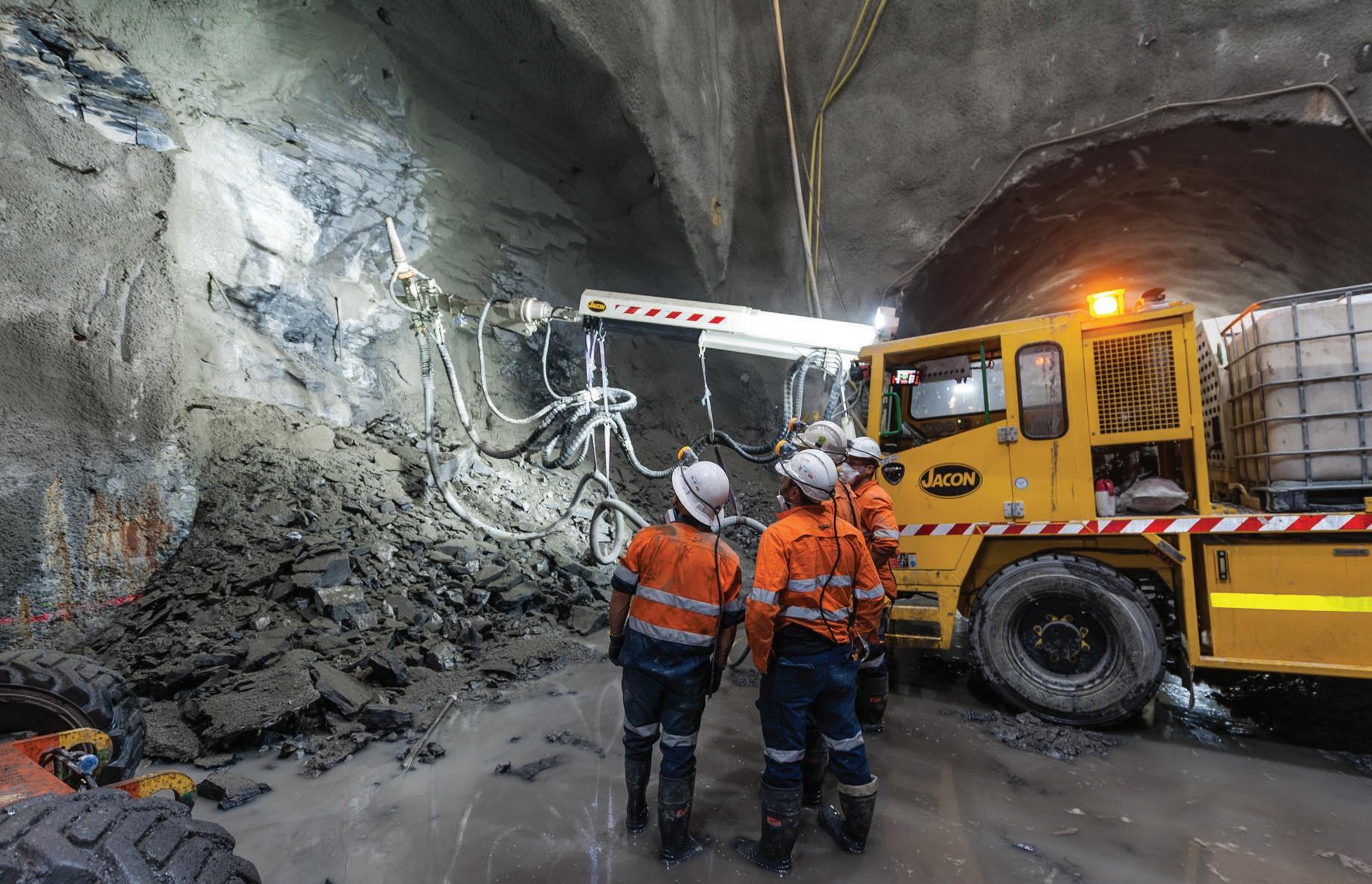
Stage 1 alone was claimed to remove 3000 trucks per day from choked Parramatta Road, and to bypass up to 52 traffic lights.
The tunnels were a key attraction of WestConnex overall – some 19km in total were planned, in future stages out to 2023 – allowing the removal of heavy vehicles from surface roads and the regeneration of inner-urban areas.
Along with the 5.5km-long threelane twin tunnels, John Holland’s tunnelling team constructed 750m of cut-and-cover tunnel and 600m of open dive structure. Excavation was done with up to 18 roadheaders, the most ever used on an Australian project. John Holland also equipped the tunnels with fire and life safety systems, ventilation, a motorway control centre and tolling facilities.
Part Five
THE FUTURE
It matters not how straight the gait,
How changed with punishment the scroll, I am master of my fate, I am the captain of my soul.
New Ownership brings unlimited potential
The sale of John Holland to CCCI was approved by Australia’s Foreign Investment Review Board in early-April 2015 and finalised later that month. In sealing the relationship – and making a longawaited entree to Australia – CCCI’s President Lu Jianzhong praised John Holland as “a strong independent competitor in the Australian market, with a clear vision for the future.”
He added: “We particularly value the cultural affinity between our two businesses, as we share many of the same ideals including a focus on tradition and the pursuit of excellence and innovation in all that we do.”
The China Communications Construction Company, of which CCCI is the international investment
arm, was created only in 2005 from the merging of China Harbour Engineering Company and the China Road and Bridge Group. Through the latter, it traces its history to 1980. In more recent years, CCCC has created several of the largest and most advanced infrastructure projects in the world, and indeed is one of the largest companies in international infrastructure and engineering.
The scale of projects such as the Yangshan Deepwater Port undertaken by CCCC overshadow anything Australia has ever seen. While China has been openly admiring of John Holland’s resourcefulness, skill and quality – not to mention its lead in digital technologies like Building Information Modelling (BIM) – the
resources and capabilities of CCCC are capable of catapulting John Holland into another dimension.
The highly skilled and experienced engineers within John Holland were not beyond being impressed by the capabilities of their new colleagues. China’s bridge-building capabilities, to name but one example, outstrip anything attempted in Australia: the country boasts the world’s longest bridge (Danyang-Kunshan, 164km), the second-longest single span (1.65km, Xihoumen bridge), the five highest bridges (two of them with a main span of more than 1000m) and the two longest arch bridge spans, both more than 550m.
In late-2016 the Chinese bridgebuilders – with CCCC obviously at the forefront – were making plans for a 26km suspension bridge across Indonesia’s Sunda Strait to link the islands of Java and Sumatra. This would incorporate one span of more than three kilometres.
The new owners helped to pervade John Holland with a sense that anything was possible. And they were no less admiring of the world-class skills cultivated in tunnelling and rail – which alone will be significant in catapulting the company into new, international markets – along with shared capabilities in large-scale port construction, wharves and jetties.
It’s anticipated there will be plenty of work close to home. A predicted Australian population of 42 million by 2050 will place steadily increasing demands on public infrastructure and innovative solutions to food and water security.
Agribusiness has been identified as one of the future drivers for our nation. John Holland need only point to the Sundrop Farms project in remote Port Augusta, South Australia. The group’s construction skills contributed to this facility that uses solar energy to provide desalinated water and electrical energy for the climate control of an enormous greenhouse, producing delicious tomatoes in desert conditions.
Our vast, sparsely populated island nation has the capacity to become a significant food bowl for the entire Oceania region.
The demand for solutions in renewable energy also plays into John Holland’s hands. Quite aside from the group’s long-standing experience and presence in hydro-electricity –from the Snowy Mountains Scheme to the helicopters stringing power lines across Tasmania’s most remote reaches – John Holland has been front-and-centre in new approaches like Waste to Energy, which offers the elimination of waste to landfill and the production of either natural gas or biofuel energy sources.
The Australian Government’s 2012 paper Australia in the Asian Century predicted that by 2020, the economic output of Asia will surpass that of Europe and North America combined. By 2050, Asia will be producing half of the world’s output.
Asia’s boom promises fantastic, ongoing opportunities for Australia in resources, tourism, agriculture, education, technical expertise and more. Thankfully, the $300bn backlog of crucial infrastructure projects that was hampering Australia’s development in the early part of the 2010s was being uncorked by mid-decade, placing Australia in a better position to take advantage.
And this optimism is seen through the prism of the present – where even existing technologies like magneticlevitation trains, super high-strength lightweight materials and threedimensional printing in construction, to name just a few, are nowhere near being fully developed and exploited.
The “smart cities” of the future are already well within reach of John Holland’s capabilities. City control centres, in effect an expanded version of a rail control centre, will integrate the operation of transportation, bridges, tunnels, ports and the public’s security.
Big Data, as Orwellian as it sounds, will be the key to streamlinining and maintaining the most efficient
possible use of social infrastructure. Massed data gathered from the mobile phone signals of train passengers, for example, can already report an irregularity in a certain section of rail. Laser heat-monitoring scanners on the front of trains detect and confirm areas of track stress.
Similarly, the Sydney Harbour Bridge is already equipped with sound frequency monitoring. A change in the structure’s normal sound frequency can indicate an irregularity such as a tensile bolt failure. Structural engineers investigate and log the event, and more data is gathered and entered into the algorithm. The analysis of other changes to sound frequency leading up to the event enable the prediction of similar failures before they occur.
Add to that the profusion of drones, another technology already very familiar to John Holland, which uses them for inspecting rail tracks and at-height infrastructure. In our example of the smart Sydney of the very near future, a drone will be automatically dispatched to the Sydney Harbour Bridge to gather images and data on the area of potential trouble; and possibly, to remotely repair it.
With the might of CCCI making possible anything, anywhere, it’s an incredibly exciting time to be at John Holland. Not coincidentally, it’s
the time that Glenn Palin chose to announce his retirement as CEO, the role he had held since 2009. Glenn Palin announced his decision in August 2016, to take effect from the end of December of that year.
“The timing of this was important,” he explained. “Having got the company sold, got it established, worked with the new owners to get a model that works, bedded down the strategic plan and put the resources in place to make that happen, it would be a five-year plus commitment to drive that plan through delivery and expectations. And making that commitment, to the intense level required, would have been unfair to my wife and my family. So that was the decision.”
Thankfully, his 23 years of experience with John Holland would not be immediately lost to the company. Glenn chose to stay on the John Holland Group board as a Director, representing CCCI, and is Chairman of both the Strategy & Budget Committee and the HSE (health, safety and environment) Committee.
Glenn Palin’s successor as CEO is Joe Barr, who came to John Holland after six years as CEO of the privately-owned Hansen Yuncken. Joe had previously risen to the role of Managing Director, Asia at Lend Lease during a 21-year career there.
He also spent several years overseeing a range of development projects in Dubai.
The timing of Joe’s appointment was no less ideal and opportune for him. “John Holland’s vibrant and diverse heritage was one of the main factors that drew me to the company,” he said. “I was also very encouraged by the commitment to John Holland’s future by our parent company, CCCI.
“This is an exciting time to be involved in the construction industry. John Holland is recognised and respected for its rail, infrastructure and building expertise and this provides an excellent platform along with the strength of our owners to further diversify and grow the business.
“Glenn Palin has made an outstanding contribution to the business during his 23 years with John Holland, and has led the introduction of our new Development & Investments Group, allowing John Holland to become a truly integrated constructor and developer. It is exciting to consider the possibilities that this makes available to us.
“I’m pleased with the progress we’ve already made on our business strategy. We’re well on our way to doubling the business in the next five years. We’ve been awarded several major projects which will underpin
Joe Barr, CEO of John Holland
our business for the future, including the Grafton Prison PPP, Sydney Metro City and Southwest tunnel and station excavation works, West Gate Tunnel Project, Melbourne Metro and the recent extension of our franchise to operate the Melbourne Metro Rail Network for the next seven years.
“We’ve had success in the growth of our Development and Investment arm and ramped up our focus on building. I’ve welcomed some new faces onto our Executive Leadership Team and the next few years will see an even greater investment in continuing to make John Holland a great place to work for our people.”
In looking to the future, we look respectfully to the past, and repeat the words chosen by Sir John Holland in concluding A Constant Challenge, his
memoir of his company’s first four decades.
The challenges in the 30 years under review have been considerable. If demographic forecasts of the doubling of world population during the next 30 years are correct, then the opportunities and challenges for companies such as ours will indeed be prodigious. After all, we are the driest as well as one of the most technically competent and richest countries in the world.
It would seem appropriate to finish this book with a few well-known lines from Henley’s Invictus:
It matters not how straight the gait, How changed with punishment the scroll, I am master of my fate, I am the captain of my soul.
Key Industry Awards
1992 Great Southern Stand project, Melbourne Cricket Ground (VIC) Achievement Award – Australian Federation of Construction Contractors
1997 BHP Alliance project, Port Hedland (WA)
5-Star Safety Award – National Safety Council of Australia
1998 Sydney Showground (NSW)
Excellence in Construction Award, Master Builders Association
2004 AustralAsia Railway, Alice Springs to Darwin Rail Link
Australian Construction Achievement Award (ACAA)
2006 Replacement Research Reactor Project (OPAL reactor), Lucas Heights (NSW)
National Commercial Builder of the Year Award – Master Builders Australia
2006 Melbourne Airport Runway Widening Project (VIC)
Australian Construction Achievement Award
2007 Lane Cove Tunnel (NSW)
National Civil/Infrastructure Award – Master Builders Australia
2008 EastLink project (VIC)
National Infrastructure Award – Infrastructure Partnerships Australia
2009 EastLink project (VIC)
Australian Construction Achievement Award (ACAA) – Australian Constructors Association
2009 Eleanor Schonell Bridge (QLD)
Large Bridges and overall Gold Award – Austroad Bridge Awards
2009
National Portrait Gallery (ACT)
ACT Medallion, Royal Institute of Architects
2009 National Portrait Gallery (ACT)
ACT Project of the Year, Master Builders Association
2009
2009
2009
2009
National Portrait Gallery (ACT)
Romaldo Giurgola Award for Public Architecture
National Portrait Gallery (ACT)
Light in Architecture Prize
National Portrait Gallery (ACT)
Sir Zelman Cowen Award for Public Architecture
National Portrait Gallery (ACT)
Cement Concrete & Aggregates Australia Public Domain Awards for Best Project in State
2009 Gold Coast Desalination Plant (QLD)
Membrane Desalination Plant of the Year, Global Water Awards
2010 Sydney Desalination Plant (NSW)
National Infrastructure Awards for Government Partnership Excellence Award, Infrastructure Partnerships Australia
2011 Darra to Springfield Transport Corridor (QLD)
Project Alliance of the Year Award – Alliancing Association of Australia
2011 Darra to Springfield Transport Corridor (QLD)
Contractor Excellence Award, Infrastructure Partnerships Australia
2011 Westgate Bridge Strengthening Alliance (VIC)
Construction, Environment and Project Management Excellence Award –
Civil Contractors Federation Earth Awards
2011 John Holland, in partnership with the Sustainable Built Environment National Research Centre
Overall Award for Engineering Leadership – Engineers Australia Engineering Excellence Awards
2011 National Portrait Gallery (ACT)
Best Public Building of the Year – National Property Council Awards
2011 Sydney Desalination Plant (NSW)
Desalination Plant of the Year – Global Water Awards
2011 Sydney Desalination Plant (NSW)
National Civil/Infrastructure Award National Excellence in Building & Construction – Master Builders Australia
2012 Northern Sewerage Project (VIC)
International Tunneller of the Year, International Tunnelling Awards
2013 Airport Link (QLD)
Global Road Achievement Award for Construction Methodology –
International Roads Federation
2014 University of Tasmania, Medical Science Stage 2 (TAS)
Commercial Building Award, Master Builders Association Awards for Excellence in Building and Construction
2014 Cape Lambert Marine Works Project (WA)
Australian Construction Achievement Award – Australian Constructors Association
2014 Cape Lambert Marine Works Project (WA)
Smart Infrastructure Award, Crane Industry Council of Australia
2014 Regional Rail Link (VIC)
Infrastructure Project of the Year – Infrastructure Partnerships Australia
2014 Regional Rail Link (VIC)
Sustainability Award – The Regional Rail Link Premier’s Awards
2014 Regional Rail Link (VIC)
Community Relations Award – IABC Gold Quill Awards
2015 Regional Rail Link (VIC)
Australian Construction Achievement Award – Australian Constructors Association
2015 Great Northern Highway Realignment (WA)
Project Award – Civil Contractors Association Earth Awards
2015 North West Rail Link Stage 1 (NSW)
Best Transit Project and Grand Prix Award – Partnership Awards (London)
2015 Sydney South West Rail Link
National President’s Award, Master Builders Australia National Excellence in Building and Construction Awards
2016 Sydney Metro Northwest Project (SMN) – CBP JH Dragados Award for Contractor Excellence – Infrastructure Partnerships Australia
2016 David Polkinghorne (Design Manager)
Civil Engineer of the Year Award – Engineers Australia Awards
2016 Sydney Metro Northwest Tunnelling Project
Building Infrastructure Award, NSW Premier’s Awards
John Holland Leaders
1978–1986
Geoff Cook
Chief Executive
1986-1987
Brian Johnson
Managing Director
1987-1991
Graham Duff
Managing Director
1992 (Jan–June)
Robert Nordlinger
Managing Director
1992–1994
Randolph Cresswell
Managing Director
1994–2000
Keith Drew Managing Director
2000–2006
Bill Wild Managing Director
2006–2009
David Stewart
Managing Director
2009–2016
Glenn Palin
Chief Executive Officer
2016–Current
Joe Barr
Chief Executive Officer
Acknowledgments
JohnHolland would like to acknowledge the author of this book –journalist and editor Michael Stahl. Michael spent painstaking hours capturing the remarkable detail and character of this significant time in our company’s history.
We would like to thank all the employees – past and present – who contributed interviews, facts and anecdotes to bring the story to life. And to our past leaders who have helped make John Holland the iconic business it is today.
Primarily we thank and acknowledge the people of John Holland. The employees who have given their time, energy, expertise, ideas and loyalty to John Holland over the years, and whose legacy is the incredible projects we have created – transforming the lives of communities around the world.
Construction is a dangerous industry. We must never forget this. As we publish the latest chapter in John Holland’s history, we reflect on the lives lost during this period and the impact those losses have had on families and colleagues. Safety and wellbeing remains our number one priority and we will continue to challenge ourselves to get every one of our people home safely every day.
Book epilogue
This book covers a significant time in John Holland’s history – 1986 to 2016. As we go to print in 2018, already a lot happened in the last two years and John Holland has made great progress in meeting its strategy to double the business and expand its presence as one of Australia’s leading integrated infrastructure and property companies.
Of note in the time between completing the book and going to print, John Holland launched a new brand for the iconic company. Retaining its name and heritage red colour, the new brand includes a fresh logo, values and core purpose – all designed to capture both John Holland’s unique heritage and DNA, and its exciting future. John Holland is (and always has been) up for the challenge of improving lives. CEO Joe Barr says, “the new brand puts this commitment to people front and centre and captures the importance of not just what we do, but why we do it.”
While staying true to who the company has always been, the new brand certainly signals a new era in John Holland’s history putting people at the heart of everything it does. Whether it’s creating a truly customer centric business or putting a priority on the development, wellbeing and diversity of its employees, there certainly has never been a better time to be part of the John Holland journey.