Random
documents with unrelated content Scribd suggests to you:
sharply and definitely like a toy-automaton. Touch this part and that movement follows; excite the sense of vision with this visible thing, and such and such a movement of the limbs or jaws or other parts ensues. The stimulation of skin, eye, ear, or nose conveys a "message" by nerves to the "brain," or centre, and immediately by other nerves an "answer" is conveyed from the brain or centre in the shape of an order to this and those muscles to contract, the appropriate nerves being set at work and exciting the related muscles to contraction. The number of possible excitations and related responsive movements thus arranged is numerically very great in many animals, but they are limited. They are inherited just as they are, and come into action as soon as the necessary growth of the parts involved is attained, without hesitation or tentative trial. They are ready made. The terms "instinct" and "instinctive" should be limited to the action of this inherited apparatus or mechanism.
All animals, including man, have more or less of such an inherited instinctive nervous apparatus. Man, or for the matter of that an animal, may be "conscious" (in the sense of being "aware") of the stimulus given to this inherited apparatus, and of its related action, or he may be "unconscious" of either. The point is that we have here the "working" of an apparatus inherited in a complete working state; it is, therefore, what we call instinctive. On the other hand, there are in higher animals, and especially in man, a vast number of actions performed which are not the outcome of an inborn ready-made nervous mechanism. On the contrary, these actions are determined by a mechanism built up in the animal during its individual existence a mechanism which is formed by its individual experience acting on its nerve-cells, and is the outcome of observation, comparison, and, more or less, of processes which we call judgment and reasoning. The persistence of this mechanism built up by the individual, as well as its continuous elaboration and development, is what we call "memory," unconscious or conscious. It is misleading to speak of "inherited memory" or "race memory," and to apply it in any way to the inherited mechanisms of instinct; the word should be reserved in its ordinary limitation to an individual's record. This new
and superior apparatus appears to require a much larger bulk of brain-substance for its elaboration than that which is sufficient for the inherited mechanisms of instinct. It works in closer response to the innumerable details of the individual case, and so must be much more complicated, and we can well believe must require a larger instrument. Obviously it is an advantage to its possessor. He (be he animal or man) is provided not with a simple response suitable for the average of incidents in his life, but has, by the "education" due to the circumstances in which his individual life is carried on, formed an ever-increasing store of special little mechanisms, giving the useful or advantageous response which he has himself discovered to be appropriate to this or that sign, sound, colour, shape, smell, touch, or what not which may assail his senses. In proportion as the brain increases in volume (especially that part of it which is called "the cortex of the hemispheres") the animal to which that brain belongs loses—gets rid of—inherited mechanisms or instincts, and becomes "educable," that is to say, capable of forming for itself new individual brain mechanisms based on memorized experience.
"Educability" is the quality which distinguishes the brain of increased size. Dogs are more "educable" than rabbits; monkeys more so than dogs; and men more so—vastly more so—than monkeys and apes. The human infant is born with a few inherited mechanisms of "instinct," such as that which causes it to find its mother's nipple and to suck it, and to cling and support its own weight as no full-grown child can do. It is singularly free from any large number of inherited "instincts," and, to its own great advantage, has, during the many years in which it is protected by its parents, to learn everything and to construct new brain mechanisms—the results of "education" of the individual. We here use the word "education" in its proper and widest sense.
Thus we get an indication of "the reason why" the modern rhinoceros has a brain eight times as big as the titanotherium's. It is more "educable." The ancestors of our modern armour-plated friend have been surviving and beating their less "educable" brothers and sisters and cousins through a vast geological lapse of time; and the
brains of the survivors have always been bigger, and they have become more educable and more educated until the race has culminated in those models of "sweet reasonableness," the modern rhinoceroses! It must be confessed that this character attributed to the rhinoceros is a matter of inference and not of direct observation of that animal when under his native sky. We do not judge the survivor of a fine early Miocene family by the fury and annoyance he shows when shot at, nor by the stolid contempt with which he treats mankind at the Zoo. The same signification—"educability"—attaches to the large brain of the higher apes; and man's still larger brain means still greater educability and resulting reasonableness.
In order that natural selection and the survival of the fittest should have led to this increased size and accompanying educability of the brain, it is necessary to suppose that the individuals with the more educable brain as they appeared profited by it, that is to say, did become more educated, and so defeated their rivals, and survived and transmitted their increased size of brain little by little in succeeding generations. There is no difficulty about admitting this supposition in regard to the passage from higher ape-like creatures to later forms having a full-sized brain, such as we find in the Neanderthal man and in some Australians. But we are met here by what looks, at first sight, as a fact inconsistent with our view. The obvious increased educability and consequent increased education of lower races of man by the circumstances of their lives, places them clearly enough in a position of great advantage over the higher surviving apes. But when we compare the actual mental accomplishments of the highest civilized races of man with those of big-brained savages, we find that a large proportion of individuals in the civilized races are much farther ahead of the lower savage races than most of these are ahead of the higher apes. Newton, Shakespeare, and Darwin are in mental accomplishment farther away from an Australian black, or even a Congo negro, than these "savages" are from a gorilla or a chimpanzee. Yet the difference when we compare the size and the abundance of the convolutions of the brain of the European philosopher and the black-fellow does not
seem, superficially, to be proportionate to the difference in the mental performance of the two. No minute study of the microscopic differences in the structure of the two brains has, as yet, been made, and it is probable that there is a greater difference here than in the mere shape of the brain-mass. It seems that the "educability" of the brain measured by its size is little greater in the one group of men than in the other. And it is found—so far as observation and experiment have been carried—that individual savages belonging to races showing very low mental accomplishments in their native surroundings are yet capable of being "educated" to a far higher level of mental performance, when removed in early youth from their natural conditions and subjected to the same conditions as the better-cared-for children of a civilized race, than any of them ever reach in their own communities.
Very few really satisfactory experiments have been made in this direction, but the history of the negroes in America shows that the pure, unmixed negro brain is capable of showing high mathematical power, musical gifts of the best, and moral and philosophic activities equal to those of the best, or all but the exceptionally gifted, individuals of European race. It seems that the large educable brain gained by man in a relatively early period of his development from the ape has now entered on a new phase of importance. The pressure of natural selection no longer favours an increased educability (and therefore size) of brain, but the later progress of man has depended on the actual administration by each generation to its successors of an increasingly systematized exercise of that brain; in short, it has depended on education itself, and on the gigantic new possibilities of education, which have followed from the development, first, of language, then of writing, and lastly of printing, together with the accompanying growth and development of social organization, the inter-communication of all races, and the carrying on, by means of the Great Record—the written and printed documents of humanity—of the experience and knowledge of each passing generation of men from them to the men of the present moment.
Huxley agreed with Cuvier in the opinion that the possession of articulate speech is the grand distinctive character of man. It was no sudden acquirement, but was slowly, step by step, evolved from the significant grunts and cries of apes in the course of long ages, and corresponded in its progress with a parallel progress in mental capacities. Once attained, it led to the formation of vast educative products, namely, to oral tradition, to written and then to printed memorials and records. It is not desirable in our present state of knowledge to speculate as to whether the transitional ape-man acquired the use of fire before or after he had invented articulate speech. It probably was acquired very soon after some skill in the flaking of flints had been attained, and was of immense value, both as a defence against predatory animals and as a means of preparing food. Man probably learnt at a very early period to cover himself with clothing made from the skins of other animals, and thus to tolerate cold climates. The use of clothing was correlated with the diminution of his natural hairy covering. As to the circumstances which led to the reduction in size of his canine teeth and the diminution of the projection of his jaws, it is impossible to say more than that this was favoured by the increased skill of his hand and by the use of weapons, and probably was directly correlated with an increased growth of the brain. It is an interesting fact that very young children still exhibit the ancestral tendency to bite when angry, and that the use of the teeth as weapons of attack is more frequent among lower races with "prognathous" jaws than among Europeans.
A definite habit of the human infant, that of "crying"—the peculiar spasmodic howling of very young children—seems to be unknown in any of the apes. I do not know what ingenious reason may have been assigned for this difference. Apes laugh under the same circumstances as do men, but with less production of sound than is the case with man and the hyena. Man was, far back in his monkeydays, a social and companion-loving animal, and the fact that his laughing and his weeping are accompanied by noise is due to the desire for attention and sympathy from his friends. A great
difference between man and apes is the greater power of expression of various feelings or emotions by the face, and also the greater variety and significance in man of the gestures both of the upper and the lower limbs. These again are methods of seeking for and gaining sympathy and co-operation. Though not all men and not all races in an equal degree have mobility and constantly varying expression in the face, yet it is the fact that the man-like apes which have been studied in life (the chimpanzee and orang) have even less variety and range of expression than the most unintelligent savages. Man seems to have developed in an ever-increasing degree the habit of watching and interpreting the face and of giving by it expression to his emotions and states of mind, thus establishing a ready means of producing common feeling and interest in a group of associated individuals. This seems to have led to a special appreciation of the features of the face, and so to the exercise of sexual selection, resulting in what we call "a standard of beauty" in regard to both shape and expression. It is quite possible that the reduction of the threatening canine teeth and projecting jaw may have been furthered by sexual selection when once a bite had become less effective than a blow with a sharp flint, and when persuasive sounds and gestures gained more adherents than the display of tusks by a snarl.
What I have written in this and the preceding chapters, on the differences and likenesses between apes and man and the probable steps of the transition from ape to man, may assist the reader to form a judgment as to the importance of such remains of extinct races of men as the skeleton of the Sainte Chapelle, the Heidelberg jaw, and the Piltdown jaw and cranium lately dug up in Sussex, in helping us to further knowledge of those steps. It should be definitely noted that we have not yet found any extinct animals, definitely to be classed as apes, which come nearer to man than the chimpanzee and gorilla, although we are led to infer that such creatures existed, and that their fossil remains will probably some day be discovered. On the other hand, we have in the jaw and skull recently discovered in the gravel of Piltdown, in Sussex, evidence of
a man-like creature which was in most important features more apelike than any fossil man yet discovered.
C H A P T E R X X X
THE MISSING LINK
UNTIL the discovery of the wonderful fossil jaw in the gravel of Piltdown, near Lewes in Sussex, a favourite view as to the probable relationship of man and existing apes was, that if you could trace back the pedigree of man and of the chimpanzee into remote antiquity far back in the Tertiary period—probably in the early Miocene—you would arrive at a smallish creature with, proportionately to its size, larger jaws and teeth than any modern man, yet smaller than those of the living man-like apes, and with a brain not two-thirds the size of that of the least developed of modern savages, yet larger (in proportion to its general bulk) than that of the gorilla, chimpanzee, orang, and gibbons. This hypothetical creature would represent, it was held, the common ancestor of the two great "strains" or "stocks" one of which in the course of gradual modification gave rise to our living "humanity," and various non-surviving offshoots on the way; whilst the other gave rise to the company of great apes, with their tremendous jaws and dog-teeth, their small brains, and great bony skull-crests for the attachment of huge jaw muscles.
It was insisted that the obvious and immediate suggestion when once man's descent from animal ancestry was admitted, namely, that man has taken his rise from the most man-like animals we know —the great apes—is erroneous. The public was warned that they must not jump to such a conclusion; it was too obvious, too facile. The "celebrated ape of the Darwin shape," which popular songs made familiar to a wide public, was declared to be only a remote rustic, not to say brutalized, cousin of humanity, not in the direct line
happily! Our real ancestors, it was declared, were mild, intelligent little creatures, animals, it is true, but animals which hastened to separate their mixed qualities in two divergent lines of descent—(1) the intelligent, mild-mannered clan who ceased to climb trees, and walked uprightly on the soles of their feet, whilst their teeth grew smaller and smaller, and their brains grew bigger and bigger; and (2) the violent tree-climbing members of the family, who refused to stand up, and acquired bigger and bigger jaws and teeth, whilst their brains remained small, their temper morose, and their conduct violent.
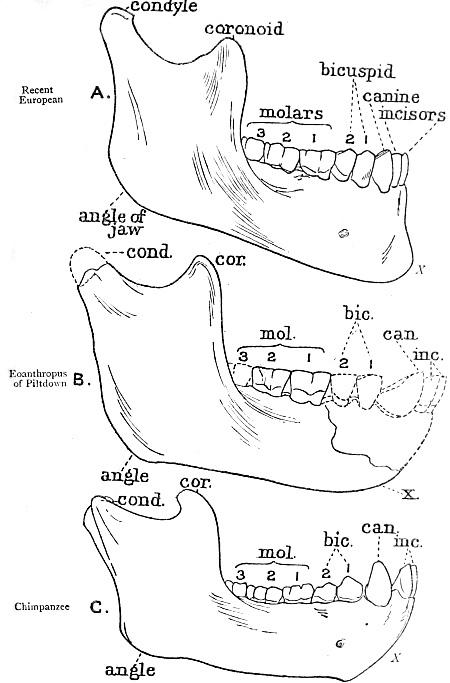
FIG. 23.—Comparison of the right half of the lower jaw of A, Modern European; B, Eoanthropus from Piltdown; and C, Chimpanzee. The size of the drawings is two-thirds of the linear dimensions of the actual specimens. The dotted outline in B represents the part which was wanting in the original specimen and was thus re-constructed by Dr. Smith Woodward. X in A is the bony chin or "mental protuberance"; in B and C it marks that part of the jaw
which would become the mental protuberance were the palisade or line of teeth retracted as in A.
Old writers before the days of Darwin had talked and written about the "missing link," though I cannot say who first used the term in reference to a creature intermediate between man and apes. Sir Charles Lyell in 1851 made use of the term in regard to extinct animals which were intermediate in structure between two existing types. A learned and able writer—the Scotch judge, Lord Monboddo —in the later half of the eighteenth century put forward a theory of the development of mankind from apes such as the orang, quite independently of any general theory of "transformism" or of the progressive development of the animal and vegetable worlds, from simple beginnings. Lord Monboddo, in the absence of any knowledge of a "missing link," or of animals intermediate between man and the highest living apes, made reasonable speculations (based on wide study of anthropology and ancient philosophy) as to the passage from the monkey to man. He regarded man as of the same "species" as the orang-utan. He traced the gradual elevation of man to the social state as a natural process determined by "the necessities of human life." He looked on language (which he said is not "natural" to man in the sense of being necessary to his self-preservation) as a consequence of his social state. His views about the origin of society and language, and the faculties by which man is distinguished from the brutes, are in some interesting ways similar to those of Darwin. He conceived man as gradually elevating himself from an animal condition in which his mind is immersed in matter to a state in which mind acts independent of body. He was ridiculed and declared to be half mad by his co-temporaries (among them Samuel Johnson), although he was, philosophically, far in advance of those with whom he came into contact. Darwin's views on the "Descent of Man" were met in the same contemptuous spirit at first. But he held a much stronger position than Monboddo, having first of all established the general theory of organic evolution, and having, further, a wellestablished mass of evidence at his command in regard to the relationship of man and apes. Further, he had that wonderful
champion, Huxley, to fight for him. Huxley's book, "Man's Place in Nature," originally given as lectures which I, then a boy, attended, placed the evidence of the close relationship of man and the higher apes in the clearest way before the public, and, indeed, established the identity of the structure of man with that of the ape, bone for bone, muscle for muscle, and nerve for nerve.
Still, there was always a gap—a place unfilled—between the largebrained, small-jawed man and the small-brained, large-jawed ape. The link was missing. It was hoped, when in 1859 the human workmanship of the flint axes found with the bones of extinct animals in our river gravels was recognized, that the bones of the men who made the flint axes would turn up alongside of them, and that they would show characters intermediate between those of modern man and the great apes. But no such human bones ever were found in the older gravels deposited as terraces along their beds by the rivers of Western Europe. Human bones, and more or less complete human skulls, of a highly-developed modern type (the Cromagnards) were found in caves associated with flint tools of a different character to those common in river gravels. Then we heard a good deal about the strangely flat skull-top, or calvaria, found in a cave near Dusseldorf on the Rhine, associated with the preaching of a certain hermit named "Neuman" (= Neander). The valley was called "the Neanderthal," and the skull-top thus came to be called the "Neanderthal skull." Some authorities regarded the Neanderthal skull as that of an outcast idiot! Huxley studied it minutely, and compared it to that of Southern Australian black-fellows, and held that it took us no nearer to the apes than they did. Then an unsatisfactory small flat skull-top, together with a long, straight thigh-bone, was found in a gravel in Java, and the name "Pithecanthropus" was applied to these remains. Still we had got no nearer to any knowledge of the missing link.
Of late years we have, however, learnt a great deal more about the race or species of men of which the Neanderthal skull-top was the first indication. We now know that this species of man belonged to a period older than that of the other prehistoric cavemen—the artistic
Magdalenians and the bushman-like Aurignacians, which are races of Homo sapiens, not distinct species. The older period is called the Moustierian, or Middle Paleolithic, period, and is marked by a peculiar type of flint implement. It is later than the older river gravels, in which big tongue-shaped and almond-shaped flint implements are common. The two skulls and bones from the cave of Spey, in Belgium, the Gibraltar skull, and the skeletons and skulls of the cavern called the Chapelle aux Saints in the Corrèze (Central France), and of Ferassy, and some neighbouring localities, all belong to this Moustierian age (so named after the village "Le Moustier," in Perigord), and to the peculiar species Homo Neanderthalensis.[10] It is also necessary to include here the more ancient man indicated by the important lower jaw found by Schottensack near Heidelberg (see Fig. 25). The Neanderman or Neanderthal-man had a low forehead, with overhanging bony brow-ridges, and a depressed, flattened brain-case, which, nevertheless, was very long and broad and held an unusually large brain, measuring 1600 cubic centimetres, whereas the modern European averages 1450 only of such units. He had a powerful lower jaw, with a broad, upstanding piece or vertical "ramus," and no chin protuberance. Yet his teeth were identical with those of a modern man. His thigh-bones were much curved, and his arms a good deal longer in proportion to his legs than those of a modern man. He did not carry himself upright, but with a forward stoop.
[10] For figures of the skulls and flint implements of these ancient men, see my volume, "Science from an Easy Chair," First Series. Methuen, 1910.
Now that we know more of him, we may ask, "Does this Neanderthal or Moustierian man fill the place of the missing link?" It appears that he does not. He seems to have died out without leaving any descendants. In so far as that his bony jaw sloped directly downwards and backwards from the margin of the sockets of his front teeth, as in the apes, without projecting below, to form a chin protuberance—as it does in all races of Homo sapiens, on account of the shrinking inwards of the gum-line or palisade of front
teeth (incisors and canines)—the Neanderman offers a certain approach to the condition of the apes; but in other details of shape of the lower jaw, and especially in regard to the narrowness of the lower surface of the chin and the large and deep attachments on its inner face, for the digastric muscle and certain muscles of the tongue, the bony remains of the Neanderman show that he is distinctly and altogether human, and not like the higher apes. Moreover, in the very large size of his brain (as much as 1600 units) the Neanderman shows no approach to the relatively small brain of the higher apes (which measures 500 units, possibly 800 by exception). There is in these structures some argument for the conclusion that the Neanderman could use articulate language, and inasmuch as the climate in which he flourished was extremely cold, there is ground for supposing that he could produce fire and clothe himself with skins. The flint implements which are definitely associated with him are of more skilful workmanship than the earlier, more elaborate, but less cleverly conceived, Chellean and Acheuillian implements. We cannot refuse to call him "man"—not Homo sapiens, we agree—but of the "genus" Homo—Homo Neanderthalensis.
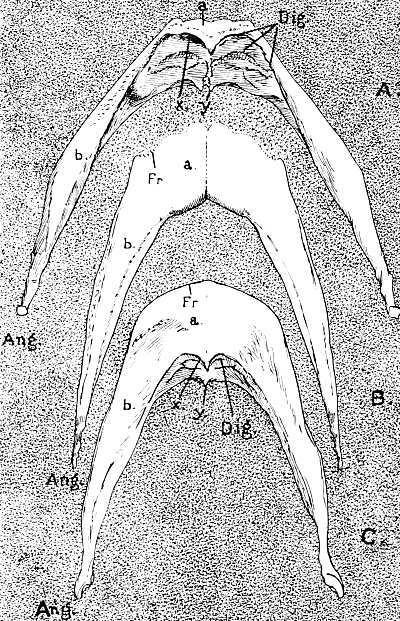
FIG. 24. Diagrams of the lower surface of the lower jaw of A, man; B, the Eoanthropus of Piltdown (the left half reconstructed); and C, the Chimpanzee.
The jaws are supposed to be immersed in sand, so as to conceal all but the lower surface. The narrowness of the actual inferior margin of the jaw in man, A, a, b, contrasts with the breadth and flatness of this same border in Eoanthropus, B, a, b, and the Chimpanzee, C, a, b.
In the human jaw A we see behind the narrow front border a the large semicircular excavations for the attachment of the digastric muscles right and left. They pass from here to the hyoid bone. From the spine (double in origin) between the two digastric impressions passes a pair of muscular slips, called the genio-hyoid muscles, also to the hyoid bone, and from the pair of spines marked y a pair of muscles, called the genio-glossals, pass to the tongue. These inferior and superior mental spines and the digastric impressions, much smaller in size than in man, are seen in the chimpanzee's jaw, C, but are rubbed or partly broken and partly rubbed away in the Piltdown half-jaw, B. In the figures A and C the size of the digastric impressions and mental spines is exaggerated, but their relatively much greater size in man than in the chimpanzee is correctly given, and this greater size is connected with the greater control of the tongue and the floor of the mouth in man, possibly connected with speech.
Reference Letters.—a, Broad, upwardly and forwardly sloping surface, reduced in man; b, lower border of the jaw-bone; x, front margin of the digastric "impression" of the right side. Dig, digastric impression; y, superior mental spine of the left side; Fr., fractured edge of the Piltdown jaw, and corresponding region in that of the chimpanzee.
So long as the Neanderman was the sole indication of a creature nearer in some features to the apes than are any living or extinct races of the species Homo sapiens, the view was possible that the two stocks which to-day blossom and display themselves—the one as the human race, the other as the man-like apes (gorilla, chimpanzee, orang, and gibbons), became separated from one another in long past geologic ages, and that they have undergone each an independent development from a creature so unlike both as seen to-day, that we cannot speak of it as a missing link or a link at all. That view must be considerably modified by the discovery of the Piltdown jaw—the jaw of Eoanthropus Dawsoni—which is not that of a "man," that is not of the genus Homo, but must, in my judgment,
be considered as one of the family Hominidæ—a Hominid, as we may say—a species assigned to a new genus Eoanthropus by Smith Woodward, which is grouped with the genus Homo and the illdefined genus Pithecanthropus, to form the family Hominidæ; just as the genera Gorilla, Anthropopithecus (chimpanzee), Simia (orang), and Hylobates (gibbon) are grouped together to form the family Simiidæ. In Eoanthropus we have in our hands, at last, the muchtalked-of "missing link"—the link obviously connecting man, the genus Homo, with the apes.
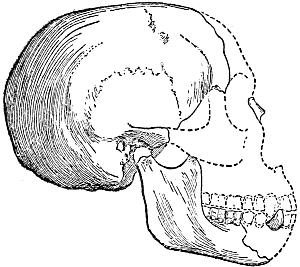
The immense importance of the discovery of the jaw of Eoanthropus by Mr. Dawson, and of the clear perception of its distinctive features by Dr. Smith Woodward, is not, as yet, sufficiently recognized. The Piltdown jaw is the most startling and significant fossil bone that has ever been brought to light. The Neandermen and the Java skull-top are simply commonplace and insignificant in comparison with it. "What leads you to say that?" I may be asked. I say so because this jaw and the incomplete skull found with it (Fig. 29) really and in simple fact furnish a link—a form intermediate between the man and the ape. Some fragments of the brain-case were found close to the jaw, indicating a fairly round, very thick-walled brain-case, holding a brain of about 1100 units capacity very small for a man, very large for an ape. It is in the highest degree probable that the brain-case and the jaw belong to the same individual. If we were to put the brain-case aside as not certainly belonging to the same individual, we should guess that the owner of the jaw might have had a brain of about this size—intermediate between that of the larger apes and the living races of men.[11]
[11] The recent discovery by Mr. Dawson of fragments of a second skull of the same character as the first and at the same spot justifies a certain amount of hesitation in concluding that the lower jaw and the fragments of the first found skull belong to one individual.
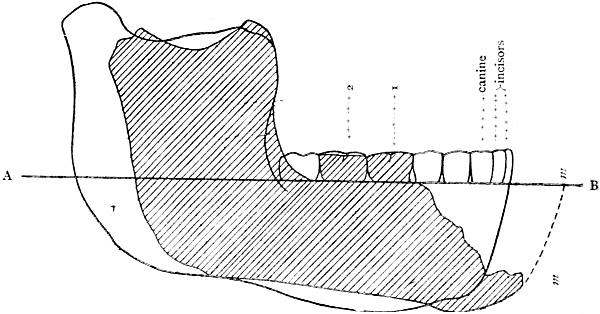
FIG. 25. The Piltdown Jaw (shaded) and the Heidelberg Jaw (outline only) super-imposed and compared by placing the first and second molar teeth (1 and 2) of the two specimens in exact coincidence on the horizontal line A, B. The linear dimensions of the drawings are reduced to two-thirds of those of the specimens. It is obvious that when the front bony part of the Piltdown jaw is completed with an outline like that of the Heidelberg and Neander jaws, as shown by the dotted line m, the space between its molars and the sockets of its front teeth cannot be filled by teeth of the normal human dimensions, as it is in the Heidelberg jaw. As the figure shows, they would stop short half an inch from the front of the jaw. Hence Dr. Smith Woodward inferred that larger teeth like those of a chimpanzee were present in this region in the Piltdown jaw (Eoanthropus).
The astonishing thing about this half-jaw from Piltdown is that it is definitely and obviously more like that of a chimpanzee—especially a young chimpanzee—than it is like that of a man (see Fig. 23, A, B, and C and their explanation). If it had been found under other circumstances it might quite well have been described as the jaw of a simiid—a large ape allied to the chimpanzee—with some unimportant resemblance to a human one. The front part of the bony jaw of Piltdown, instead of forming a narrow ridge below the protruding bony chin as in man, is wide and flat; there is no protruding chin. This very important fact is shown in our Fig. 24, in which the lower margin of the lower jaw of modern man, of the
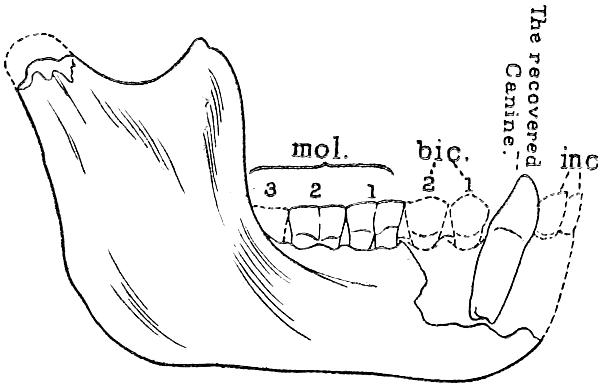
chimpanzee and of the Piltdown specimen are compared. The jaw ended in front in a wall of bone sloping forward and upward continuously from the flat and broad lower surface of the jaw. In this the great incisor teeth were set, as in all Simiids. In man, on the contrary, the front group of teeth is much smaller than in the apes, and the semicircle formed by the line of the gums is much smaller than the semicircular lower margin of the jaw. The semicircle of teeth in man retreats (as it were) behind the front part of the bony jaw which is left projecting far in advance of the line of teeth, forming the "chin" or "chin protuberance." The Piltdown jaw when found had only two of the cheek-teeth in place, as shown in Fig. 25. They were certainly very human in pattern and in the smoothness of their worn surfaces. But it was found impossible to fill the front part of the bony jaw with the missing teeth if they also were fashioned according to human pattern. They would in that case only reach along the jaw to a distance of an inch and three-fifths from the first molar tooth, whereas to fill the space from that tooth up to the front end of the bone in which the teeth are socketed they must be big enough to occupy a length of two inches and two-fifths (consult Fig. 25 and its explanation). Dr. Smith Woodward did not hesitate, in view of the shape of the jaw so closely like that of a chimpanzee, to postulate the former existence in it of big front teeth—canines and incisors—like those of a chimpanzee, and unlike those of man, although there was no trace of them left in the specimen. He restored the jaw, giving it very much the shape and the teeth of a chimpanzee's jaw (Fig. 23, B). That this was a correct interpretation was proved a year later, in a startling, almost romantic way, by the discovery by Mr. Dawson and a young French naturalist who were resifting and searching the gravel at the exact spot where the jaw was found, of one of the great canine teeth, twice as big as that of any man and resembling that of a chimpanzee (see Fig. 26 and its explanation). There was a good deal of hesitation about the admission of the correctness of Dr. Smith Woodward's presentation of the jaw of Eoanthropus, with so close a resemblance to that of a chimpanzee. But the careful consideration of the specimen, and above all the welcome discovery of the great ape-like canine, has
now convinced every anatomist of the truth of Dr. Woodward's restoration. The jaw itself and the recovered canine tooth, as well as the completely restored model of the two sides of the lower jaw and of the brain-case, may now be seen and studied by visitors to the Natural History Museum. They are placed in the Geological Gallery. I have visited with Mr. Dawson the gravel at Piltdown where the jaw and skull were found, and have picked up there humanly worked flints of very primitive workmanship. I have also followed with Dr. Smith Woodward the development and confirmation of his interpretation of the jaw.
I now desire to insist upon the legitimate conclusion to be drawn from this wonderful specimen. That conclusion is that the creature, indicated by it, is not (or was not when it was alive) an eccentric cousin either of the Simiid or of the Hominid stock, but represents a real "missing link," an animal intermediate in great and obvious features between the two stocks, and either to be described as an ape which had become manlike or as a man who still retained characteristic ape-like features—a truly connecting or linking form. Nothing like it, nothing occupying such a position, has hitherto been discovered. It brings the focus of interest in the knowledge of primitive man away from the caves of France to the thin patch of iron-stained gravel in the meadowland of the River Ouse as it flows through the Sussex weald. These remains are the first remains of a man-like creature found in a Pleistocene river gravel, and they exceed in interest any human remains as yet known. There is now reason to hope that more such remains will be discovered in similar gravels.[12]
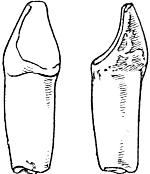
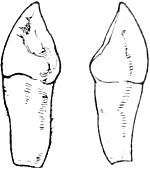
FIG. 26. The canine tooth of the right side of the lower jaw of Eoanthropus Dawsoni, found at Piltdown a year after the discovery and description of the lower jaw, to which it belongs. Drawn of the natural size. To the left a back view, to the right a side view, showing the wearing away of the surface of the tooth.
FIG. 27. Canine tooth of the right side of the lower jaw of a European child, milk dentition. This "first" tooth is drawn of twice its actual length and breadth, which brings it very nearly to the same size as the canine of Eoanthropus. It is more closely similar in shape to the canine of the Piltdown jaw than is the canine of the second or permanent dentition of modern man.
[12] The human lower jaw found at MoulinQuignon fifty years ago by workmen who brought it to M. Boucher de Perthes, was dismissed after much study and examination by the most competent anatomists at the time as being a comparatively recent specimen. I do not know whether it has been preserved. I have a flint implement found with it which was given to me in 1862 by M. de Perthes as genuine. It is a forgery, and the jaw was fraudulently buried with it and others in order to deceive M. de Perthes and earn a pecuniary reward for the forgers. It would be highly important were we able to arrive at a satisfactory conclusion as to what age must be attributed to the Piltdown jaw and skull. Did we know their age their true significance as a link between man and ape would be more easily estimated. The gravel in which they were found contains a handful, as it were, of the sweepings of the land surface of the great Weald valley of Sussex of all ages and periods since the emergence of the chalk from the ocean floor an immense lapse of time, amounting probably to millions of years! In this sparse and inconspicuous patch of gravel we find fragments of teeth of mastodon and elephant and rhinoceros of Miocene and Pliocene age; we also find bones of quite late kinds of mammals of the Pleistocene period; we also find two kinds of roughly chipped flint instruments belonging the one to an earlier and the other to a later age. All are mixed up together in the gravel. When we come to the question as to which of these remains are of animals which were the contemporaries of Eoanthropus, all we can say is that Eoanthropus, the creature whose jaw was found at Piltdown, may have lived as late as the latest or as early as the earliest of the animals whose remains are associated with it. The Eoanthropus remains are not so heavily mineralized, it
seems to me, as are the fragments of teeth of Miocene age found with them. At the same time, we have no ground for assuming that this creature made either the earlier or the later type of flint implements found with it, or was capable of such manufacture. I see no reason for supposing, whatever may be the age which we may have to attribute to Eoanthropus, that that creature was capable of flaking flints to a desired shape or of making fire or had developed the use of articulate speech. Nor is there any evidence to show that the humanly cut elephant-bone recently found at Piltdown by Mr. Dawson was cut by Eoanthropus. It is more probable that this was done by a more highly developed creature of the genus Homo. In fact, the only ground which at present justifies the association of Eoanthropus with the Hominidæ or human series rather than with the Simiidæ or ape series—derived from a common ancestry—is the man-like rather than ape-like size of the brain, which we must attribute to Eoanthropus on the assumption, which is at present a reasonable one, that the half-jaw and the incomplete skull found near each other at Piltdown are parts of the same individual.[13]
[13] But see foot-note on p. 284.
FIG. 28. The Piltdown Jaw (Eoanthropus) with dotted lines showing the parts as now "re-constructed" or "imagined" by Dr. Smith Woodward, together with the late-found or recovered canine in its natural position.
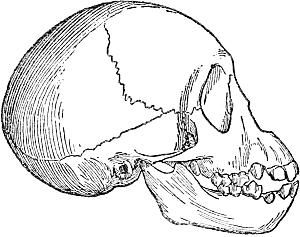
FIG. 29.—Complete Skull and Jaw of Eoanthropus Dawsoni. One-third the natural diameter. The parts indicated by dotted lines are re-constructed. The rest is drawn from the actual bones discovered at Piltdown.
FIG. 30. The complete Skull and Jaw of a young Chimpanzee. Drawn of onehalf the natural diameter in order to compare with Fig. 29, representing the adult skull of Eoanthropus, reduced to about the same size.
C H A P T E R X X X I
THE SUPPLY OF PURE MILK
IT is becoming more and more certain that the character and quality of the actual things—the natural products—which we use as food and accept as "diet" are far more important matters in regard to the preservation of health than had been until recently supposed. There has been a tendency, resulting from some of the well-ascertained chemical necessities of the animal body and the equally well-ascertained chemical composition of different articles of food, to suppose that all that we have to do in regard to diet is to make sure that our food supplies us with so much carbon, hydrogen, nitrogen, and oxygen, with small quantities of phosphates, sulphates, and chlorides of potassium, sodium, calcium (lime), and iron, in a "digestible" form, in order to replace those chemical elements as their combinations are used up and thrown off as waste by our bodies. The general notions current are little more exact than this. It is recognized, it is true, that these elements must be combined in certain forms; that it is necessary to take so much "proteid" (meat, gluten of flour, casein of cheese and milk, albumen of egg), in which nitrogen is a leading component, foods which are called flesh-formers; and, further, that it is necessary to take others which supply carbon and hydrogen but have no nitrogen, namely, the hydro-carbons—fat, butter, and oil—and the carbo-hydrates— sugar and starch—foods which serve as mere fuel or heat-and-force givers. The late proprietor of "Truth," Mr. Henry Labouchere, once said to me that the doctors ought to provide us with a sausage containing in their simplest form the necessary proportions of proteid and of heat-giver (fat and sugar), and that we should abandon all "sit-down" meals, pulling the necessary sausage out of
our pockets without any fuss or interruption to our occupation, and eating a couple of inches or so, three or four times a day! Experimental feeding of animals (in menageries, etc.), and even of men (in prison, on the march, and on ships), has sometimes taken very nearly as simple a form as this.
But we now know (and many, indeed, have recognized it for many years) that the nutrition of the animal body, and especially of man's body, is not so simple a matter as this method would suppose. It is necessary not merely to supply the proteids, fats, starches, and sugars, in correct weight and bulk, but also certain qualities and substances in food, much more subtle and difficult to estimate precisely, which are required in order to maintain health. There are elaborate chemical compounds present in really "fresh" meats and vegetables which seem to be absolutely necessary in order to keep man (and some of the higher animals) in health, and not only that, but it is ascertained that without them he cannot be properly nourished, but dies! These subtle, highly complex bodies seem to be present in very small quantities in good fresh food, and yet are absolutely necessary though so minute in amount. The failure of a diet consisting exclusively of tinned meats and preserved foods is due as much to this as to the nausea set up by it—of which I have written on a former occasion ("Science from an Easy Chair," Second Series, 1913, p. 171, "Food and Cookery").
Let us take an example. A distinguished medical chemist, Mr. Gowland Hopkins, has recently published an account of some experiments in which he fed young rats on a purely chemical, or "artificial" diet. He gave them, in proper proportions, chemically purified casein or curd, starch, sugar, lard, and salts, mixed into a thin paste with water, of which they had an abundant separate supply. Young rats fed with abundant natural foods of mixed substances, such as cheese, bread, egg, bits of meat and vegetable, and water, grow rapidly; they double their weight in twenty days. The young rats fed by Mr. Hopkins upon the artificial pure food— though supplied with it and taking it in abundance—did not increase in weight, and most of them died before the twentieth day! The
curious and important fact was established (by careful and repeated experiment) that if a teaspoonful of milk was added to the artificial food (less than one twenty-fifth of the solid matter of their daily food) the young rats did as well as on "natural" food, doubled their weight in twenty days, and grew up to be strong and healthy rats. It was made clear that something was obtained by the rats from the small quantity of milk—something necessary for carrying on their nutrition, something the importance of which was not its quantity but its peculiar quality, which was absent in the artificial diet, but present in the mixed diet of varied materials which a young rat naturally gets. It seems that some highly elaborated proteid is necessary, if only in minute quantity, to set nutrition going, and that this is furnished by the teaspoonful of milk. Here, then, we have a case in which the simple rough conclusions as to all that is necessary in diet being the proper quantities of flesh-forming and heat-giving substance, are found to be erroneous.
Take another case—that of the disease known as "scurvy." The word "scurvy" means "afflicted with scurf, mean and dirty." It was applied to persons afflicted by this particular disease, and a Latin medical word, "Scorbutus," was made from it in the Middle Ages, which survives as "scorbutic" at the present day. Scurvy was formerly very common on board ship, in beleaguered armies, in prisons, and in other conditions in which men's food was limited to dried and salted, often badly preserved, meat and biscuit, or stale bread. Its real causation is not even now agreed upon: some holding that it was due to actual poisoning by the badly preserved food, others that it was due to the absence of certain elements—only to be obtained from fresh meat or fresh vegetables. Others think that it was caused by a bacterium. The victim of scurvy becomes much debilitated, the gums become spongy and ulcerated, and extravasations of blood are found in all parts of the body, often leading to ulceration. In the old times a whole ship's crew of the Navy would be attacked by it, and half or more died before a port could be reached and fresh food obtained. It was found that the use of fresh vegetables, fresh meat, and the juice of fruits prevented its outbreak, and cured it when
once started. For one hundred and fifty years it has been held in check by the use of lime-juice as a drink whenever supplies of fresh vegetables and meat run short. It has now become so unusual a disease that there has been no proper study of it in the light of modern knowledge.
It seems to be essentially the same condition of malnutrition as that which prevailed in cities and large tracts of country in the Middle Ages and occurs at the present day in Norway, caused by a diet of badly salted fish and dried meat. This produced ulceration of the extremities, allowing the leprosy bacillus to make its way through the broken skin into the tissues, and thus led to the widespread occurrence of leprosy. Whether bacilli of any kind were concerned in the old virulent outbreaks of "scurvy" on sailing ships must remain uncertain, but it is highly probable that they were. In any case, it is certain that the juice of fresh meat or of fresh vegetables when taken set going a better condition of nutrition in the body, and so acted as a preventive and a cure of scurvy. Some writers suppose that it was the salts, such as citrates and lactates, present in fresh fruits and vegetables which were effective in staying the disease; but this has by no means been proved, and is not, at the moment, accepted. It is probable that here, as in the case of Mr. Hopkins's rats, it was a quite minute quantity of a readily-destroyed proteid present in fresh meat and vegetables which was necessary to keep the chemical processes of nutrition in healthy activity.
This view is supported by the fact that in recent years a disease of infants similar to scurvy, and called "infantile scurvy," has been described by Sir Thomas Barlow, and fully recognized. It is a condition of "malnutrition," and is accompanied by "rickets," and is due in the first place to failure of the mother's milk, and secondly to the bad quality of the cows' milk substituted for it. Owing to the danger of infection by bovine tubercle-bacillus and the great expense of "certified" milk from specially selected cows (eightpence a quart), it is customary to boil the milk given to children. There seems to be no doubt that good milk, freshly boiled, is satisfactory. But the constant use of sterilized milk and so-called Pasteurized milk,
as well as inferior "watered" and more or less stale milk, is frequently the cause of infantile scurvy. Something is destroyed in the milk by prolonged heating which is necessary for its proper action as a food. The addition to the milk of a small quantity of fresh meat-juice or beetroot-juice appears to replace this destroyed matter, and to prevent malnutrition and scurvy. And thus the babies are rescued from "infantile scurvy." Here, again, it is a question of the presence of a minimal quantity of an easily destroyed proteid, which is necessary to start the nutritional process and to keep it going.
A very interesting case of the unsuspected influence of minute quantities of such a "proteid" body (that is, a body like casein and albumen, but higher in the complexity of its chemical structure and nearer to the readily destroyed chemical complexity of living matter itself) has lately been discovered. In the East, especially amongst Chinese "coolies" and other people who feed on rice, a very troublesome disease is known, called "Berri-berri." It is chiefly marked by pains all over the body, lassitude, and debility, and renders its victims unfit for labour, and so causes great inconvenience to employers of "Chinese cheap labour." All sorts of causes have been suggested for it. But it has now been found that it is due to the feeding of the coolies with "polished rice." This is an inferior rice, the grains of which have become (by bad, damp storage) rough and powdery on the surface. The bad rice grain is purchased by dealers and shaken up and sifted so as to get rid of this dull surface, and is then known as "polished rice." The grain has lost its outer coat. It has been found that domesticated birds (pigeons and fowls) fed on this polished rice become ill with symptoms like those of "Berri-berri," and even die. And it has been further discovered that these same birds can be cured by mixing some of the separated outer coat of sound rice grains with the "polished rice." The result of this observation on birds has been applied to human patients suffering from "Berri-berri." It is found that they are rapidly cured by giving them rice "outsides" to eat, and that those who are feeding on "polished rice" can be prevented from