Instant Ebook Access, One Click Away – Begin at ebooknice.com
(Ebook) Big Medicine From Six Nations (The Iroquois and Their Neighbors) by Ted C. Williams ISBN 9780815610946, 0815610947 https://ebooknice.com/product/big-medicine-from-six-nationsthe-iroquois-and-their-neighbors-33093542
OR CLICK BUTTON DOWLOAD EBOOK
Get Instant Ebook Downloads – Browse at https://ebooknice.com
Instant digital products (PDF, ePub, MOBI) ready for you Download now and discover formats that fit your needs... Start reading on any device today!
(Ebook) Origins of the Iroquois League: Narratives, Symbols, and Archaeology (The Iroquois and Their Neighbors) by Anthony Wonderley (author) & Martha L. Sempowski (author) ISBN 9780815636601, 9780815636670, 9780815654926, 0815636601, 0815636679, 0815654928, 2019036263, 2019036264 https://ebooknice.com/product/origins-of-the-iroquois-league-narratives-symbolsand-archaeology-the-iroquois-and-their-neighbors-35179696
ebooknice.com
(Ebook) Vagabond, Vol. 29 (29) by Inoue, Takehiko ISBN 9781421531489, 1421531488
https://ebooknice.com/product/vagabond-vol-29-29-37511002
ebooknice.com
(Ebook) Classical Hopf Algebras and Their Applications (Algebra and Applications, 29) by Pierre Cartier, Frédéric Patras ISBN 9783030778446, 3030778444
https://ebooknice.com/product/classical-hopf-algebras-and-their-applicationsalgebra-and-applications-29-34794516
ebooknice.com
(Ebook) 29, Single and Nigerian by Naijasinglegirl ISBN 9781310004216, 1310004218
https://ebooknice.com/product/29-single-and-nigerian-53599780
ebooknice.com
(Ebook) Boeing B-29 Superfortress ISBN 9780764302725, 0764302728
https://ebooknice.com/product/boeing-b-29-superfortress-1573658
ebooknice.com
(Ebook) Advances in Photochemistry, Volume 29 by Douglas C. Neckers, William S. Jenks, Thomas Wolff ISBN 9780471682400, 0471682403
https://ebooknice.com/product/advances-in-photochemistry-volume-29-1727328
ebooknice.com
(Ebook) Jahrbuch für Geschichte: Band 29 ISBN 9783112622223, 3112622227
https://ebooknice.com/product/jahrbuch-fur-geschichte-band-29-50958290
ebooknice.com
(Ebook) Harrow County 29 by Cullen Bunn, Tyler Crook
https://ebooknice.com/product/harrow-county-29-53599548
ebooknice.com
(Ebook) Organometallic Chemistry, Volume 29 by M. Green ISBN 0854043284
https://ebooknice.com/product/organometallic-chemistry-volume-29-2440106
ebooknice.com
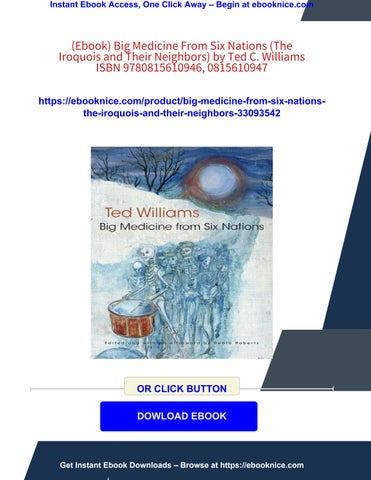
Ghost Drummers. Painting by Diana Osborne Williams. Used by permission of the artist.
Copyright © 2007 by Syracuse University Press Syracuse, New York 13244–5290 All Rights Reserved First Paperback Edition 2017 17 18 19 20 21 22 6 5 4 3 2 1 ∞ The paper used in this publication meets the minimum requirements of the American National Standard for Information Sciences—Permanence of Paper for Printed Library Materials, ANSI Z39.48-1992. For a listing of books published and distributed by Syracuse University Press, visit www.SyracuseUniversityPress.syr.edu. ISBN: 978-0-8156-1094-6 (paperback) 978-0-8156-0863-9 (hardcover) 978-0-8156-5423-0 (e-book) Library of Congress has cataloged the hardcover edition as follows: Williams, Ted C., 1930–Big medicine from six nations / Ted Williams ; edited and with an afterword by Debra Roberts ; foreword by Christopher Vecsey.—1st ed. p. cm.—(Iroquois and their neighbors) ISBN 978-0-8156-0863-9 (hardcover : alk. paper) 1. Tuscarora Indians—Medicine. 2. Tuscarora Indians—Religion. 3. Tuscarora Indians—Rites and ceremonies. 4. Traditional medicine—East (U.S.) 5. Shamanism —East (U.S.) 6. Healing—East (U.S.) 7. Six Nations—History. I. Title. E99.T9W55 2007 299.7’855092—dc22 2007001112 Manufactured in the United States of America
This book is dedicated to the Little People, and to all the False Faces, and to all Benevolent Entities of this and all other galaxies, and to the Periodic Table
Ted Williams was born April 6, 1930, on the Tuscarora Indian Reservation near Niagara Falls, New York. His father, Eleazer Williams, was an Indian doctor and Sachem Chief of the Turtle Clan at Tuscarora. His mother, Amelia Chew Williams, served time as the Clan Mother of the Wolf Clan. Upon graduation from La Salle High School (1948, Niagara Falls), Ted joined the military and spent four years as a paratrooper in the Eighty-second Airborne during the Korean conflict. He then used G.I. Bill funding to attend the Knapp School of Music in Chicago, playing trumpet and doing small band jazz arrangements. After marriage in 1954, Ted returned to Niagara Falls and tried his hand as a crane operator at the new large construction project New York State Electric Power Project. The job paid so well that Ted pursued this occupation, transferring his trade to the Eastman Kodak Company in 1966 and retiring there in 1990. In the 1970s, Ted began doing healings, using herbal remedies, healing-with-hands, and ceremony. The famous seer Daisy Thomas told him that he must join the False Face Society for protection, which led to Ted’s participation in the traditional “Longhouse Way of Life.” In 1976, Ted wrote the book The Reservation (Syracuse University Press). Always active in sports, Ted won many championships in archery, both as an amateur and as a professional. By age seventy-five, he had also won five consecutive pro disc golf world championships in his age group division (seventy and older), called the Legends. He and his wife, Diana, lived for years in the Pisgah National Forest area of Madison County, North Carolina, in a White Pine home they built with storm-fallen trees. In September 2005, Ted gently passed away into the arms of his beloved Divine and Harmonious Universe.
Contents
Illustrations Foreword, Christopher Vecsey Acknowledgments
Opening Dear Readers Prelude to the Prelude Prelude to the Thanksgiving Address The Thanksgiving Address
Medicines and Poisons The Second Death of Bill Uh The Way It Is Another Form of Medicine Uncle Charley Isaiah Joseph
Ethel Wahoo Davey Roy The Devil Reservation Witches Another Spooky Place I’sic oi(t), Asa, and Dug dih HANa’ree
How We Have Lived, Small Incidences Relativity Ee’see Who Did What? Adolphus Martin Love Power Stanley Buck Tongue Not in Cheek Emerson Waterman Allen Jack Ducky Anderson Two Suns? Big Dog O. J. Abraham geh he(t) (Abraham Dead and Gone) Giveaway Duke
Propriety and Derangement Don’t Hunt Too Early Juuh ne(t) raath OO naa g’yeh One Time This Happened The Fire Monkey Deer The Sturgeon
Six Nations, One Humanity The Great Law of the Great Peace Freeman Sowden Tobacco Burning The False Faces Peach Stones Songs of Power Energy Places The Vision Quest Medicines of the Universe Quantum Physics Plant Medicines Snow Man
New Age and Ancient Wisdom
The Odds Isolated Phenomena The Little Lights Seeing Things Elemental Communication Another Elemental Communication War and Peace A Sequence of Events Ceremony
Closing Poetry The Thanksgiving Address Afterword, Debra Roberts
Illustrations
Ghost Drummers The Enneagram with Riso-Hudson names Uncle Charley’s finger attracting the fish Tree that blocked the view The Fire Monkey Ted sings a sacred song The Ooh du(t) cheah Wild Ginger Goldenseal Sacred Tobacco Sassafras American Spikenard The Fire Lion Halo on each ear of corn
Foreword
When Arpena Mesrobian handed me The Reservation in 1981, she told me that it was her proudest achievement as director of Syracuse University Press (and hers was a distinguished career). I brought the book home, opened it up, started reading, and the laughter began, then the tears. Ted Williams touched you like that. This Tuscarora man—member of his mother’s Wolf Clan, son of a Turtle Clan Sachem Chief, and an accomplished artist and musician—had composed an album of love songs to his people and place. They may have had the appearance of an improvised set of droll, sometimes macabre tales, but they were possessed of an aesthetic unity, telling as they did of Ted’s coming to consciousness of his imperiled Tuscarora culture. On the pages of this book, the reader got to meet Ted’s family, his neighbors, and the nonhuman persons who populated the Tuscarora environment. People visited one another and shared stories. They argued, and sometimes they damaged each other and themselves. Death was ever present. Rituals offered opportunities for all manner of interaction, and the outside world provided challenges that shook the foundations of the reservation community. The Reservation closed with a passage, set in Ted’s young adulthood, that explained that book’s genesis (and, it might be said, this one’s, too) in the deaths of the culture bearers of his parents’ generation:
“The Tellers” were all dead or dying. I didn’t feel very good. I wasn’t even walking anymore. Right next to me was a young pine tree. It was one of the 4H trees that I had planted. It was almost as tall as I was now. I put my hand on its sappy little trunk. “OoKHREHHéweh,” I said to the little pine, “who’s going to be ‘The Tellers’ now, now that ‘The Tellers’ are dead?” At first the little tree didn’t answer, but I waited. After a while it said, “You and I will be ‘The Tellers.’ Someday children will say, ‘What did the Old Folks say?’ and they will be asking about US—about what YOU and I are talking about right now.” Ted Williams had become a Tuscarora Teller, and The Reservation was his homegrown tale. I told my students to read this book in order to learn about American Indian life in the twentieth century. Over the years I have assigned it many times, and they have often told me that they had expected to find a set of Indian stories, but instead were taken by Ted’s transcending humanity. They should meet him, then. And they did, when he came to my class. He told them how he had been breast-fed after his birth for many years, until he started asking his mother for cookies with his milk. That got the students laughing, and they questioned him about his life, his writing, his people, and his beliefs. When they inquired about today’s Tuscaroras, Ted replied (and I wrote it down), “Beliefs are where it’s at, and if you believe, you can do anything. Believe in yourself, and only good things can happen.” He seemed to be addressing his audience as well as his tribe. Then he added, “If the Tuscaroras need something and want it back, it will come back.” Here he seemed to be describing his own lifelong project to keep alive the traditional wisdom of his people. He told the class about his enduring “quest for spiritual knowledge,” his search for “Higher
Consciousness,” his desire to learn all he could about Medicine in all its forms. It did not surprise me, when the class was over, that several students sought Ted out privately for advice and guidance. Another time, in another school setting, students wanted to know why there were so many disfigured characters in The Reservation. Ted told about his childhood fascination with deformity: “When I wanted to see cripples, I would ask to go with my parents to Niagara Falls, and I’d sit in the parked car and ‘watch the parade.’” But more, for Ted, disablement gave rise to thoughts about Medicine. At the White Corn Ceremony, he explained, each person got one ear to open. If it was normal, that was all you got. If one was “deformed”—and there were names for all the different types of abnormalities, such as having one missing row of kernels—you received more corn, which was considered a Medicine as well as food. Several years ago my students sent Ted some love letters, laced with queries. They wanted to know what he was doing these days. He wrote back, “Much of the time [the interim] since the publication of The Reservation ‘til now has been spent learning and doing ceremony and participating in the Longhouse ceremonies at Onondaga. I belong to the semisecret False Face Society for the protection of myself and my Medicines. I was instructed to become a member by the late and great Daisy Thomas. (Great, great ‘reader’ from the Six Nation Rez at Osweken, Ontario.)” He continued that he was writing another book, postponed by the building of his house in North Carolina, about the “ESP-type experiences of Indians of the Six Nation Confederacy.” He planned to call the book something like “Indian Medicine.” Ted enclosed several of his “Love, Ted” poems, inspired by Lakota rituals, which he intended to include in the Medicine book he had in mind. As series editor of “Iroquois and Their Neighbors,” I immediately had to write back and invite him to consider Syracuse University Press as his once and future publisher. Thus, Ted’s Dear Readers, you have before you Big Medicine from Six Nations, a Telling of Ted’s
experiences in gathering Medicines and Medicine lore both near and far. When the 4H pine tree told Ted to collect the necessary information to become a Teller, he began his especial search for Medicine among the Six Nations of Iroquois and beyond—from Utes, Lakotas, Australian Aborigines, Natives, and non-Natives—wherever “Higher Consciousness” could be fathomed. Readers will not be disappointed if they hope to gain insight regarding Six Nation Medicine, broadly conceived: not just herbal cures, but charms, spells, prayers, omens, feasts, games of chance and skill, vision quests, Sweat Lodges, loci of power, ghosts, skeletons, spirits, shape-shifting, witchery, humor, masks, the Great Law of the Six Nation Confederacy—all the hidden and apparent powers that manifest themselves to the Iroquois. But readers will also find that there is more to this book, more about the “spiritual mechanics” of humankind writ large: Sundances, crystal balls, ouija boards, channelings, teacup readings, past-life regression sessions, auras, odds, premonitions, serendipity, sexuality, femininity, generosity, telekinesis, electricity, homeopathy, exorcisms, fears, assurances, UFOs, and ESP. Ted refers regularly to the Enneagram, developed by Don Richard Riso and Russ Hudson and explicated in their book Discovering Your Personality Type, published (among other books) by the Enneagram Institute.
The Enneagram with Riso-Hudson names. Courtesy of the Enneagram Institute.
When I penned this preface in July 2005 and sent it off to Ted for inclusion in the manuscript, I closed with a roadside exchange from the old-time song “The Arkansas Traveler”:
“Howdy, stranger.” “Howdy, stranger.” “Have you lived here your whole life?” “Not yet.”— I mentioned earlier that this book was a Telling, but not a culmination, and certainly not the last word from Ted Williams. And it wasn’t. Not quite. In August, Ted wrote back with a heartfelt note, which I am quoting here at length: There is something I must tell you about.—For the last year and a half or so I have suffered bouts of ‘total loss of memory.’ The first big noticeable one came when, one evening, I drove (50 min.) into Asheville and when I got there I could NOT remember why I was there. I spent 1½ hours in grocery stores, hardware and building supply places but never did remember WHY I was there. It all struck me as very funny even though I knew that it could have happened at a crucial occasion. I drove home and later (maybe even the next day) I found out that I was supposed to be at a disc-golf meeting. (Now THAT IS SERIOUS!) Well, I say that because this year’s World Championship at Allentown, Pennsylvania—as the time of it approached— became a more and more exciting prospect. Last year, at Des Moines, Iowa, Dr. Stancil Johnson, a psychiatrist from California, and I were TIED with only 4 holes to do (18 holes a day, Mon-Fri, and now on the final 9 on Saturday) and he would be at Allentown seeking revenge. Then—my son discovered, on the internet, that a ‘new guy’ (only 70 years old to my 75 and therefore now eligible to compete in ‘my’ division called ‘The Legends’) was entered and had a rating higher than mine (877 to my 855). His name is Ragnar Overby from Virginia and stands 6'5" to my 5'7".
On day one, July 25, Stancil and Rag were assigned a different foursome than I was so I had to wait that whole day to find out what scores we each ended up with. Ragnar a 75, me a 75 and Stan only strokes off at 77 (same scoring as ‘ball’ golf). On Tuesday my ‘afterburners came on’ and I got a 64 to Rag’s 71. Stan had a near heat stroke from the record high temperatures and ended up with 81 and had to withdraw from the tournament. (The reason I’m telling you all this is because the activity of disc golf keeps me alive and excited to be alive.) On Wednesday I got a 66 to Rag’s 75. So now I had a 16 stroke lead. I was ‘running away’ with it. But then came Thursday. It was MY turn to succumb to the heat. I had no ‘sick’ symptoms. No dizziness. No nausea. No fever—just a complete inability to think. I remember hearing members of my foursome saying ‘HEY TED! IT’S YOUR TURN.’ I ended up with an 82. My lead went from 16 to 7. Dehydration. On Friday 2 of my sons arrived. One from near the Tuscarora Reservation, Tom age 49 and Bob (Richmond, Virginia) age 46. They carried a chair, umbrella, and ice water. ‘SIT DOWN!’—‘GET UNDER THE UMBRELLA!’—‘DRINK SOME MORE WATER!’ Ragnar still got me by 2 more strokes to cut my lead to 5. On Saturday, the FINAL 9 HOLES, with the help of my boys, I tied Ragnar (who, by the way, can throw 1½ times farther than I can) and won $800 for 1st place. Rag got $500 for 2nd. So, if I only won by 4 strokes last year and 5 this time, I’m getting better with age. “OK,” he ended, “back to the book. . . . I’ll stay closer in touch with you from now on.” Ted Williams died in September 2005, having just finished his book about Big Medicine.
Christopher Vecsey Colgate University
Acknowledgments
Credit is owed for any contributions, in any form, that came to this book from any of the Elements of our universal family, as well as from the Little People and the Medicine spirits of any of the Medicine societies of the Longhouse. I want to mention my wife, Diana, part Onondaga, who has the name Je gon sa se(t) (“She Takes Care of the Garden,” meaning including the garden of people because she is a homeopathic doctor). She is also a painter, a poet, and a mover and a shaker as the “Echo” in the Standing Quiver Stomp Dance. I better acknowledge her, too, for doing the painting for the cover of the book, or I could see the inside of a doghouse. Daughter Rhiannon (cum laude grad in art at Buffalo State University), thanks for the woodcuts that appear throughout the book. Then there’s Fairy Godmother, Debra Roberts, who fed my yellow tablet scribbles into the computer. Professor Chris Vecsey did the intro, bless his hide. And what about Syracuse University Press? Real people. Real pros. Real class acts to follow by any other press. If I forgot anybody or anything, put yourself in here. Love, Ted
Opening
Uncle Charley’s finger attracting the fish; see “Uncle Charley,” pp. 35–39. Woodcut by Rhiannon Miles Osborne.
Dear Readers
Dear Readers, I hear that the older I get, the farther I will have walked to school as a boy. I was born on April 6, 1930. My mother, Amelia, was a Tuscarora, as was my father, Eleazer. The Tuscarora Nation is part of the Six Nation Iroquois Confederacy. The other five nations are “charter” members of the original Five Nation Iroquois Confederacy, which formed under the persuasion of an enlightened person called the Peacemaker. The laws of the confederacy say that whatever the mother’s nationality is, her children are that nationality. So if my father, Eleazer, had been Mohawk or Oneida or Seneca or Cayuga or Onondaga (original members), I would still be a Tuscarora. We consider the designation “Iroquois” as being improper because it did not come from any of our six languages. At the same time, people of the English-speaking “world” who have gone through quite a bit of schooling and who would like people to use the “proper” naming of things don’t want us to call ourselves “Indians.” But we do anyway because Columbus, not wanting to admit to a boo-boo in navigation, said we were. In the early days of my life, we didn’t have electricity, so we didn’t have any radios or telephones. Today, if someone were to visit without first telephoning, we might think they were barging in on us. Back then, it was exciting to hear the dog bark and see someone coming to our house, for any reason. Maybe they had news. This was a magical time. Time? There is no Tuscarora word for time (and likely in no other Indian language either). If we asked
anyone the time, we said, “Det de waa ni(t) deh?” What we were saying was, “How many times does the iron strike?” So that phrase must have come about after the hearing of grandfather clocks tolling out chimes. But there were very few man-made noises. There was a church bell in the Baptist church. If someone died, the bell ringer would be told. We would first hear a rapid “dingdong-ding-dong-ding-dong . . .” and then silence. Then single tolls would come. We counted them because each toll represented a year of the dead person’s life. We often easily guessed who it was that died. Again, “How many times did the iron strike?” Two or three generations before my time, the federal government began wondering what to do with all these Indians (of the whole United States of America). Federal Indian schools were set up, and Indian children were forced to attend them. The idea was that there would be a subtle assimilation of these Indians into the mainstream society. Part of the message to the Indians was, “We will educate you. Hey, you might even become the president some day.” The other part of the message was, “You are pagans, heathens, but we will rescue you. You won’t have to go to hell if you renounce your traditional beliefs and ceremonies.” No speaking of a native tongue allowed. No traditional songs or dances allowed. This system was close to legal genocide. Many kidnapped children died of heartbreak and homesickness. My father attended Carlisle Indian School, but my mother went to public school. She became so adept at reproducing the sound of the English language that she would be asked to “read” to the class though she had no idea what she was saying. Someone told me that at one school a teacher was determined to get an Indian boy to read. “Look at the words in this book. I’ll say three or four words, reading from left to right, then you repeat aloud right after me those same words.” All went well for a few sentences when suddenly there was a disturbance by two other children in the room. “You be QUIET back there!” the teacher said. “You be QUIET back there,” the boy read.
My father was fifty years old when I was born. His friends, of his age and older, could therefore be two generations ahead of mine. At night, when I was supposed to be in bed asleep, I’d be on the floor with my ear over the grille of the air register, listening to the talk between my father and his friends. My father was an “Indian doctor,” so many of his friends, even from other reservations, would be talking “Medicine talk.” Today, we might describe that kind of talk as “extrasensory perception (ESP) oriented.” Most of the experiences in which Indians drifted out of physical consciousness (went into ESP mode) took place before television, music-playing devices, video games, and the computer began occupying everyone’s daily time schedule. Nevertheless, it is very interesting how the ancient concept that the Universe is one big family touches base with “discoveries” made by science. With the thought that if I studied hard enough I might become president of the United States, I dug into my grade school studies. My father’s brother, Theodore, like many other Indians, could not assimilate the forced textbook path to enlightenment and came back from Carlisle Indian School neurotic, a polite way of saying “crazy.” A sister, Minnie, made the grade and became a registered nurse. Another sister, Lizzie, though she became a schoolteacher, had a nervous breakdown and became more like Theodore than Minnie. Minnie told me about Confucius and Taoism, and that people studying this philosophy had reached enlightenment. But she said that there were other ways to enlightenment. One was “the textbook way.” Einstein had taken it. A physicist was considered “the brains” of our society. Although the Longhouse became my way, I tried to keep track of Einstein’s way, too. When I heard that subatomic particles exhibited a behavior that didn’t jive with mathematical formulas, and when physicists came up with “the Uncertainty Principle,” I said, “Goody! They’re back to square one.” “Square one” to me was Medicine people saying a thousand years ago, “All things are alive and have a consciousness of their own. We are all part of the Great Cycles of All Things.”
So, because I like the verification of the Six Nation Great Law by science, my references to some scientific orientation in my version of the Thanksgiving Address will likely be considered “too modern” by some traditionalists. But I have recited an approximate version of this Thanksgiving Address every morning and every night for the past four years and am in good “touch” with these Elements, and they have given me only encouraging feedback. I also feel that humor is good Medicine, and I spend a lot of my time in my “child.” One time, at the great Native American Writers Conference at Oklahoma State University in Norman, a little Eskimo woman recited her poetry to us. So beautiful was it that we excitedly leaped to our feet and gave her a standing ovation. Three hundred Indians clapping and whistling and doing the Indian “Lalalalala . . .” accolade salute. It was too much for her. She stood there transfixed for a moment, and then she acknowledged our kudos by going into her “child.” She began racing around the stage with her arms out, “playing airplane.” I think we all cried. But we also screamed our approval. We all became “children.” And pandemonium ensued. So maybe “a child shall lead them” . . . and we will place within the sod each sacred kernel of white corn . . . when the Red Oak’s leaves resemble a squirrel’s hand. Love, Ted
Prelude to the Prelude
In each of the Six Nation (Iroquois) areas of the United States and Canada, each nation or reservation that observes the traditional activities of the Great Law of the Great Peace has a sacred meeting place called the Longhouse. Before any traditional event takes place within these buildings, a powerful statement is recited, at both the preceding and closing of each day’s event. This statement is called the Thanksgiving Address. Its importance is pronounced by a sort of “drum roll,” a prelude of words that has (by someone) been interpreted in English as “The Words Before All Else.” The opening and closing can be embellished by the speaker, or it can be shortened (sticking to its essence)—for example, when the twenty-one-day Midwinter Ceremony is ending near the witching hour with a social dance, and everyone is sleepy, and babies are whining. The version given here is just a skeleton of what can be said in the various Indian languages with their more deeply spiritual meanings. Pretend, when you open this book, that you are entering one of the Longhouses, that you understand all six languages. If you are a man, when you get through the door, turn to the left, sit down and behave yourself. If you’re a woman, sit on the right side. Maybe the ghost of Emerson Waterman will holler, “SI ’DITE!” Then, in the quiet that prevails, someone will stand up and in a sedate manner recite the Prelude (opening words) and then the Thanksgiving Address.
Prelude to the Thanksgiving Address
As you know . . . as we all inherently know . . . we are all just part of the Great Cycles of All Things. And because we are all from the same Cosmology, we are all part of one great family, not only within the Element called People, but as intimate kin to all the Elements of this Divine and Harmonious Universe. So tremendous, so magical is this Divine and Harmonious Universe, that the greatest of scholars . . . physicists . . . philosophers . . . astronomers . . . have not been able to calculate the immensity and complexity of this Great Mystery; but our Faithkeepers tell us that “GRATITUDE IS THE BEGINNING OF KNOWLEDGE AND UNDERSTANDING.” And so . . . before any significant occasion, we always open and close each day’s ceremony with the Thanksgiving Address; and so powerful is it that the Faithkeepers say it is the life force of their teaching . . . because: When we do the Thanksgiving Address, as it progresses into Divineness, it automatically brings forth the Creator or the Essence of the Creator or that Highest of Consciousness into our midst. And when this happens, some of our secular thoughts, engulfed in unworthiness, and in awe of such a Presence, automatically drift off, leaving room for some of what we call the Good Mind to come in. And when this happens, if we have decisions to make, they won’t be made by our own know-it-all selves, but with some of that Divine
intervention. As Creation became completed, we, the Element called People, being the last Element to be created, have been given the task of caretaker of all the other Elements of our Divine and Harmonious Family. And we have been given four tools to do this with: Prelude to the Thanksgiving Address / 9 We have our Good Thoughts We have our Good Feelings We have our Good Words We have our Good Deeds Because our ancestors used these tools admirably to make this a better Universe for the unborn, they have left us with a great good feeling. And so it is, then, with happy hearts, we thank Soong gwi oo dee sut eh (Creator) that this is so.
The Thanksgiving Address
In the interest of not giving away the sacred secrets of our philosophy, this version of the Thanksgiving Address is meant for the reader to get a basic grasp of why it is so important to us. The speaker may expound to any length or just hit the “high points” in a late-at-night closing. The Thanksgiving Address “starts” and “ends” each day’s ceremonial event. Also, the order of first-to-last-spokenabout has no hierarchy, but rather, for easier memory and so as to not skip some Element, we start with the surface of the Earth and go upwards. Some of our ancestors are “planted” underground, so that’s where we start. Also, in each Longhouse, after the “Thank you” to each Element, the audience responds with a word meaning “agreed,” which in this version is omitted. Let us awaken to our duty to always be thankful . . . and so we greet and introduce into the consciousness and gratitude of our mind and spirit, the Element People . . . for, first of all, if it weren’t for our ancestors, we wouldn’t be here . . . they have strived to make this a better world for us and all living things . . . and for their having prayed seven generations ahead for our welfare, we must especially be grateful to those who prayed for us, seven generations ago. And they have passed on to us the Medicine knowledge that cured and healed and kept them alive and healthy so that we were able to be born.
Part of this Medicine came in the form of the great ceremonies in which we were taught the explicit songs and dances . . . including instructions for induction into the various healing societies and other important societies for those of us who received the calling. We must also be grateful for the instructions regarding the power and the use of all the great variety of food plants . . . and the explicit ones to be used in each of the ceremonies called the Feast . . . also the reverence and use of the great Sacred Tobacco. And for the many other things we were taught . . . how to communicate with the other family-member Elements . . . to regulate the weather . . . to shape-shift . . . and we must be most grateful to have had expounded to us the Great Law of the Great Peace. And so we open our hearts to you and tell you, “We love you and wish to thank you for all that you have done for us and for all you have given us.” UH SEH DE UH SEH DE UH SEH DE WA G’YEAH HANNEE’GIH N‘YOWWEH HOI(T) . . . OO’NIH TWEANT IT’NWO(T) DE YOO’REAH DUH’GIHH G’WINNEE(T) G’WIHH EHH’JEEH. (Translation: Three times three times three large, enthusiastic “Thank yous” . . . Now all of us universal family members, in our Urehdeh—life, energy, Divine Consciousness in all things—are as one.) (Note: The word Urehdeh is sometimes seen spelled U-renta. Mike Bastine [Algonquin] says that some Indian nations forbid the speaking out loud of that word as being too holy for human usage.) And so we greet and introduce into the consciousness and gratitude of our mind and spirit the next Element, our Mother Earth . . . and we can see our Mother as we may have seen her in a vision quest . . . the same as the picture taken by Apollo 17 . . . a blueand-white opalescent orb . . . gliding gracefully and effortlessly through space . . . as though on a spiritual mission . . . so, so beautiful . . . the blue of the oceans . . . the misty white cloud cover . . . and the white polar caps. So beautiful.
That is our Mother . . . never telling a lie . . . no ulterior motives . . . and she has given us everything we would ever need . . . air, water, food, clothing, shelter, Medicine, love, a Divine Consciousness . . . a wonderful place to live. So we open our hearts, and we say to her, “Mom . . . we love you very much, and we wish to thank you for all you have given us and for continuing to do so.” UH SEH DE UH SEH DE UH SEH DE WA G’YEAH HANNEE’GIH N‘YOWWEH HOI(T) . . . OO’NIH TWEANT IT’NWO(T) DE YOO’REAH DUH’GIHH G’WINNEE(T) G’WIHH EHH’JEEH. ... And so we greet and introduce into the consciousness and gratitude of our mind and spirit the next Element, Plant Life. From the bottom of the deepest ocean to the top of the highest mountain, we have all of these green growing things . . . billions and billions of leaves . . . each producing pure oxygen in photosynthesis with the Day Sun that we may breathe more healthfully . . . billions and billions of leaves . . . each waiting for us to exhale carbon dioxide . . . that they, too, may breathe . . . that this exchange can be perpetual . . . and we know, then, that we are indeed an intricate part of this Divine and Harmonious Universe. So we honor, first, the Medicine plants . . . knowing that the amount of cure that we can get from them is directly related to the amount of reverence we have for them . . . and knowing that they have always gladly given their lives for ours, and for our ancestral health and ceremonial usage we owe them a great amount of gratitude. Among them the great see-into-the-future Medicine, the great Ga noo du(t) oit . . . the baby-never-die Medicine, the great D’yeh g’yeh guh tu(t) uh . . . the great Sacred Tobacco, the Joss hoo(t) eh weh . . . and many more magical Medicine plants. And so we open up our hearts and say, “We love you, and we wish to thank you for saving the lives of us people and for all the
other magical things that you have done for us.” UH SEH DE UH SEH DE UH SEH DE WA G’YEAH HANNEE’GIH N‘YOWWEH HOI(T) . . . OO’NIH TWEANT IT’NWO(T) DE YOO’REAH DUH’GIHH G’WINNEE(T) G’WIHH EHH’JEEH. And so we greet and introduce into the consciousness and gratitude of our mind and spirit the next Element, the Food plants . . . and they are powerfully represented by the many varieties of the three Sacred Sisters . . . the Corn . . . the Beans . . . and the Squash. Not only have they been our sustenance and preventative Medicine . . . but they provide the exact ingredients needed to produce the supernatural results of the various Medicine feasts. And so we say to both the domestic and the wild Food plants, “We love you very much, and we wish to thank you for keeping us alive and well.” UH SEH DE UH SEH DE UH SEH DE WA G’YEAH HANNEE’GIH N‘YOWWEH HOI(T) . . . OO’NIH TWEANT IT’NWO(T) DE YOO’REAH DUH’GIHH G’WINNEE(T) G’WIHH EHH’JEEH. And so we greet and introduce into the consciousness and gratitude of our mind and our spirit the next Element, Water . . . and we can see that water in so many different forms . . . icicles and snowflakes . . . moondogs and sundogs . . . rainbows and clouds . . . glaciers and icebergs . . . oceans and rivers and streams . . . water fountains and waterfalls . . . fog and little droplets of dew on a spiderweb . . . sweat on our brow and steam in a Sweat Lodge . . . and when we become out of balance . . . too materialistic . . . here comes a flood . . . to put us on our knees . . . and balance is restored . . . and when we realize that we ourselves are 85 percent water or more . . . we realize how vital water is to us and to all living things. So we open our hearts, and we say, “Oh beautiful and precious water, we love you very much, and we wish to thank you for all you mean to us.”
UH SEH DE UH SEH DE UH SEH DE WA G’YEAH HANNEE’GIH N‘YOWWEH HOI(T) . . . OO’NIH TWEANT IT’NWO(T) DE YOO’REAH DUH’GIHH G’WINNEE(T) G’WIHH EHH’JEEH. And so we greet and introduce into the consciousness and gratitude of our mind and our spirit the next Element, all Creaturehood, both on land and in the sea . . . from the amoeba to the zebra . . . from the seahorse to the Clydesdale . . . from the lightning bug to the electric eel to the elephant . . . and this enormous family membership is symbolized by the principal member, the deer, whose antlers represent the awareness and alertness of the aggregate of that great family . . . and they have faithfully given themselves that we may have food . . . clothing . . . shelter . . . Medicine . . . companionship . . . oracles . . . a Divine Consciousness, and more. For all this, we open our hearts to all Creaturehood, and we say, “Oh dear loving family members . . . we love you very much, and we wish to thank you for all you have given us.” UH SEH DE UH SEH DE UH SEH DE WA G’YEAH HANNEE’GIH N‘YOWWEH HOI(T) . . . OO’NIH TWEANT IT’NWO(T) DE YOO’REAH DUH’GIHH G’WINNEE(T) G’WIHH EHH’JEEH. And so we greet and introduce into the consciousness and gratitude of our mind and our spirit the next Element, the Trees . . . and they have given us so much . . . the aesthetic pleasure of the taste of various fruits and nuts . . . the syrup and confections from the sap, or lifeblood of the principal tree, the Sugar Maple . . . the symbolism and Medicine of the Tree of Peace, the great White Pine, which the mere touch of cures depression . . . the Medicine tree, the Basswood, from which the False Faces are made . . . the many other Medicine trees .. and their providing of shade, building material, firewood, love, peaceful companionship, the prevention of landslides, and great beauty, especially in the coloring of autumn.
For this and much more, we open our hearts, and we tell them how much we love them and that we wish to thank them. UH SEH DE UH SEH DE UH SEH DE WA G’YEAH HANNEE’GIH N‘YOWWEH HOI(T) . . . OO’NIH TWEANT IT’NWO(T) DE YOO’REAH DUH’GIHH G’WINNEE(T) G’WIHH EHH’JEEH. And so we greet and introduce into the consciousness and gratitude of our mind and our spirit the next Element, the Birds . . . and what a drabness would beset our world if it were not for the aesthetic pleasures of the music of their voices . . . the beauty of the colors of their feathers . . . the great grace that they exhibit in flight . . . and they have provided us with food . . . an astounding oracular talent . . . an example of peace and alertness as exemplified in the symbol of the eagle atop the Tree of Peace, guarding the Six Nation Confederacy . . . their contributing portion of the great, great Medicine, the Na go(t) na gaww, the never-die Medicine . . . their example of a Divine Consciousness. For this and more we open our hearts to all birds and tell them that we love them very much and wish to thank them for all they mean to us. UH SEH DE UH SEH DE UH SEH DE WA G’YEAH HANNEE’GIH N‘YOWWEH HOI(T) . . . OO’NIH TWEANT IT’NWO(T) DE YOO’REAH DUH’GIHH G’WINNEE(T) G’WIHH EHH’JEEH. And so we greet and introduce into the consciousness and gratitude of our mind and our spirit the next Element, our great family member, the Great Grandfathers, the Thunderers . . . and they have faithfully guarded and protected us against any intruding out-ofbalance forces that emerge from time to time to beset us . . . and we have heard them vehemently scolding such existences away so that we would not be influenced . . . and we have even seen the fire with which they do that . . . but we can only imagine the joy and
anticipation of the green growing things for the ionized rain that follows to make sure that everything is clean again. So we open our hearts and say to our Grandfathers, “Oh dear Grandfathers, we love you very much for your protecting us, and we wish to thank you.” UH SEH DE UH SEH DE UH SEH DE WA G’YEAH HANNEE’GIH N‘YOWWEH HOI(T) . . . OO’NIH TWEANT IT’NWO(T) DE YOO’REAH DUH’GIHH G’WINNEE(T) G’WIHH EHH’JEEH. And so we greet and introduce into the consciousness and gratitude of our mind and our spirit the next Element, the Four Winds . . . and we know that they travel about, keeping track of things and aiding the Grandfathers and the rain to reach their destinations . . . and when we again get out of balance for any of many reasons, here comes a hurricane or tornado to frighten us back into balance and to remind us that we are not infallible . . . and though we might see parts of our abode flying up into the sky, we can also wonder how long we would live without air. So we open our hearts to the Four Winds, and we tell them how precious they are to us and that we wish to thank them: UH SEH DE UH SEH DE UH SEH DE WA G’YEAH HANNEE’GIH N‘YOWWEH HOI(T) . . . OO’NIH TWEANT IT’NWO(T) DE YOO’REAH DUH’GIHH G’WINNEE(T) G’WIHH EHH’JEEH. ... And so we greet and introduce into the consciousness and gratitude of our mind and our spirit the next Element, the Four Directions . . . a subtle doorway between the physical consciousness and the ethereal world . . . members of our universal family that transcend molecular structure . . . the means by which nesting birds can fly south in winter and return unerringly to their nesting places . . . the means by which lost ships can be found at sea . . . a miraculous
means by which we travel . . . always constantly at our disposal . . . the cornerstone of our equilibrium. So we must not unconsciously take for granted this great family membership . . . but instead open our hearts and say, “Oh great Four Directions, we love you for your everlasting faithfulness, and we wish to thank you.” UH SEH DE UH SEH DE UH SEH DE WA G’YEAH HANNEE’GIH N‘YOWWEH HOI(T) . . . OO’NIH TWEANT IT’NWO(T) DE YOO’REAH DUH’GIHH G’WINNEE(T) G’WIHH EHH’JEEH. And so we greet and introduce into the consciousness and gratitude of our mind and our spirit the next Element, the Night Sun, our Grandmother Moon . . . and she loves us and, if she could, would like to bounce us on her knee . . . and when we get too take-it-forgranted of her, she would like to remind us that she is not just up there whistling Dixie . . . that she is there to remind us that she will not allow us to be forgotten as a species . . . for she has given females a time-cycle period called a moon . . . and at a special time in that cycle they can become fertile and reproduce . . . and for those of us who may not believe that there is a powerful attraction between our Grandmother and us and the earth, we can be reassured by watching the rising and the falling of the tides . . . and we are reminded by the natal ties we have with our beautiful Grandmother Moon that we are indeed an intricate part of this Divine and Harmonious Universe. So we open our hearts and say, “Oh dear Grandmother, we love you very much and wish to thank you for all you mean to us.” UH SEH DE UH SEH DE UH SEH DE WA G’YEAH HANNEE’GIH N‘YOWWEH HOI(T) . . . OO’NIH TWEANT IT’NWO(T) DE YOO’REAH DUH’GIHH G’WINNEE(T) G’WIHH EHH’JEEH. ...