Bahrain BD 1.50 Kuwait KD 1.50 Oman OR 1.50, Saudi Arabia SR 12.00 UAE DH 10.00 UK £ 3.00, US $ 3.00
24 YEARS
VOLUME 24 / ISSUE 10 / OCTOBER 2026
Rs. 100
EDITORIAL
Seasonal
MAGAZINE MAGAZINE
www.seasonalmagazine.com
Managing Editor Jason D Pavorattikaran Editor John Antony Director (Finance) Ceena Associate Editor Carl Jaison Senior Editorial Coordinator Jacob Deva Senior Correspondent Bina Menon Creative Visualizer Bijohns Varghese Photographer Anish Aloysious Office Assistant Alby CG Correspondents Bombay: Rashmi Prakash Delhi: Anurag Dixit Director (Technical) John Antony Publisher Jason D Pavorattikaran
Indian startups or corporates are not freezing before America’s AI might, China’s automated manufacturing or Korea’s chip prowess. Instead, Indian companies and sectors are developing and evolving in their own silent style. Here are 5 such domains:
Editorial & Business Office Cochin: 36/1924 E, Kaloor-Kadavanthra Road, Near IGNOU, Kaloor, Cochin-17. Ph:0484- 2345876, 2534377, 2340080 Mob. 09947141362 Delhi: H.No: P-108, Uppal Southend, Sector 48, Sohna Road, Gurgaon, Haryana – 122018 Ph: 9891771857|099471 41362 Mumbai: 202, Woodland Heights Building, St. Martins Road, Bandra West, Mumbai 400 050 Mob: 919947141362 Bangalore: House No: 493, Block 3 3rd Main, HBR Layout, Bangalore-4209731984836, Email:skmagazine@gmail.com www.seasonalmagazine.com UK Office: “CRONAN”, Boundaries Road Feltham, Middlesex, UK TW13 5DR Ph: 020 8890 0045, Mob: 00447947181950 Email: petecarlsons@gmail.com
Printed & Published by Jaison D on behalf of PeteCarlson Solutions Pvt. Ltd. at Cochin. Printed at Rathna Offset Printers, Chennai-14. All Rights Reserved by PeteCarlson Solutions Pvt. Ltd. No part of this publication may be reproduced by any means, including electronic, without the prior written permission of the publisher.
SEASONAL MAGAZINE
There is a quiet but profound tectonic shift happening across the subcontinent. For decades, the narrative surrounding the technological capabilities of the region was one of volume, arbitrage, and back-office support. Step into the sprawling research campuses of Bengaluru, the deep-tech incubators of Pune, or the biotechnology facilities of Hyderabad today, and a very different reality emerges. Driven by a maturing ecosystem of private capital, an immense demographic dividend of scientific talent, and a fundamental necessity to solve complex problems at an unprecedented scale, the nation is naturally evolving into a primary engine of global innovation. By building solutions that must work for over a billion people with extraordinary economic, linguistic, and geographic diversity, this vibrant ecosystem is inadvertently creating the ultimate blueprint for the developing world. Here are five unique technological strengths defining this new era of capability and confidence.
1) THE DIGITAL PUBLIC INFRASTRUCTURE BLUEPRINT
Reg No: KERENG/2002/6803
All health health related related articles articles All are for for first first information information are purposes only. Always purposes only. Always consult your your doctor doctor before before consult taking any any decison decison taking affecting your your health. health. affecting
5 WAYS NEXT-GEN INDIA INC IS EVOLVING
MEMBER
The digital transformation of the country is built on a fundamentally different philosophy than the proprietary walled gardens traditionally seen in global technology hubs. Instead of relying on private monopolies to build foundational digital plumbing, the ecosystem has organically developed a layered framework of open-source protocols encompassing identity, payments, and data exchange. This digital public infrastructure allows any entrepreneur, from a metropolitan tech campus to a
rural village, to plug into a sophisticated digital economy without the massive capital overhead usually required for customer acquisition and network building. The seamless interoperability of these systems has unleashed a wave of grassroots financial inclusion and frictionless commerce. Street vendors and small merchants process microtransactions instantly using simple matrix barcodes, entirely bypassing traditional banking hurdles and pointof-sale hardware costs. This architecture has proven so robust and scalable that it has moved beyond a domestic success story to become a powerful global template. Other developing nations are now looking to this open-protocol model to leapfrog legacy technological phases. By exporting these foundational technologies, the country is positioning itself as a collaborative partner for the Global South. Platforms and protocols such as the Open Network for Digital Commerce (ONDC), the Beckn Protocol, EkStep, and Setu are actively driving this open-source architectural revolution.
2) FROM SERVICE HUB TO INNOVATION OVERPERFORMER The structural shift in the intellectual property landscape is striking. Having maintained a strong trajectory in global innovation indices for years, the ecosystem has rapidly transitioned from writing software for external clients to owning the entire product lifecycle. The startup landscape, once dominated by simple consumer
applications, is now heavily characterized by deep-science ventures, advanced manufacturing robotics, and sophisticated artificial intelligence applications designed for complex populations. This evolution is fueled by a critical mass of experienced engineering talent and a reverse brain drain of diaspora professionals returning to build companies. Early-stage risk capital, mentorship networks, and a culture of rapid prototyping have matured, allowing founders to tackle systemic challenges in climate technology, enterprise software, and supply chain logistics. Deep-tech ventures such as Sarvam AI, QpiAI, Mindgrove Technologies, and ideaForge vividly illustrate this transition from service providers to formidable creators of original intellectual property. Engineers are leveraging their deep understanding of resource-constrained environments to build highly optimized, globally competitive products. This capacity to translate scientific discoveries into scalable commercial technologies is cementing the reputation of the region as a formidable creator of original intellectual property rather than just a maintainer of legacy systems.
3) SPACE TECHNOLOGY AS SOCIETAL ARCHITECTURE Unlike space programs born from geopolitical rivalries or driven by luxury commercial tourism, this aerospace journey has always been anchored in pragmatic, earthly applications. The scientific community here mastered the art of frugal engineering out of necessity, developing sophisticated launch vehicles, propulsion systems, and satellite networks at a fraction of the cost of traditional global players. This optimization is not merely about saving financial resources; it is about
maximizing societal impact. The orbital infrastructure serves as a critical backbone for everyday life, powering telemedicine links to remote hospitals, providing early warnings for natural disasters, and delivering precise weather forecasting to millions of farmers. The space sector is fundamentally viewed as an instrument of inclusive development rather than an arena for distant exploration. Today, this legacy of cost-effective, high-reliability engineering is fueling a vibrant private space sector. Private aerospace trailblazers like Skyroot Aerospace, Agnikul Cosmos, Pixxel, and Dhruva Space are proving that cutting-edge orbital launch and imaging capabilities can be both highly advanced and remarkably costeffective. By balancing deep-space ambitions with tangible domestic benefits, this model offers a compelling roadmap for emerging economies seeking to harness the space economy.
4) THE EXPLOSIVE GROWTH OF GLOBAL CAPABILITY CENTRES The transformation of the commercial real estate and talent landscape is perhaps most visible in the unprecedented expansion of Global Capability Centres. What began decades ago as a strategy for multinational corporations to outsource transactional back-office work has pivoted decisively toward high-value strategic ownership. Global enterprises across aviation, retail, automotive, and banking are now placing their core research and development hubs directly in the subcontinent. The numbers reflect a massive structural shift, with these specialized engineering centers projecting exponential growth by the end of the decade. These hubs are no longer secondary support outposts; they are the primary engines driving product development, artificial intelligence engineering, and cybersecurity architecture for the entire world. When a biopharma giant or a semiconductor manufacturer looks to design its nextgeneration products, the intellectual heavy lifting is increasingly orchestrated by diverse teams based in cities like Pune, Bengaluru, and Chennai.
This influx of high-tier global engineering mandates creates a rich environment for cross-pollination. Multinational heavyweights such as Boeing, Mercedes-Benz, Goldman Sachs, and Target have established massive research and development hubs here to drive their core global engineering forward. It is a continuous cycle of capability upgrading that has permanently altered the global talent supply chain.
5) THE BIO-CAPITAL OF THE GLOBAL SOUTH The final frontier of this technological renaissance lies at the intersection of biology, medicine, and engineering. Historically recognized as the pharmacy of the world for its unmatched capacity to manufacture affordable generic medicines and vaccines, the ecosystem is now leaping into deep-tech biological innovation. The landscape is currently teeming with biotechnology startups scaling solutions from computational biology to precision diagnostics. This is the home of frugal medical technology, where engineers design highly sophisticated, portable, and less invasive diagnostic devices that can withstand extreme environmental conditions and erratic power supplies. By leveraging the immense scale of domestic health data and advanced artificial intelligence, researchers are developing affordable cell therapies, predictive epidemiological models, and population-scale genomic platforms. Pioneering health-tech firms like Innovaccer, DeepTek, Practo, and HealthifyMe are democratizing access to world-class medical data, AI-driven triage, and preventative diagnostics. The overarching goal is to deliver world-class healthcare interventions at a fraction of the traditional cost. As these innovations prove their efficacy in the demanding domestic market, they become perfectly tailored solutions for the rest of the developing world. The ecosystem is steadily transforming from a trusted supplier of affordable healthcare products into the premier biological and medical innovation capital of the Global South. John Antony SEASONAL MAGAZINE
CONTENT
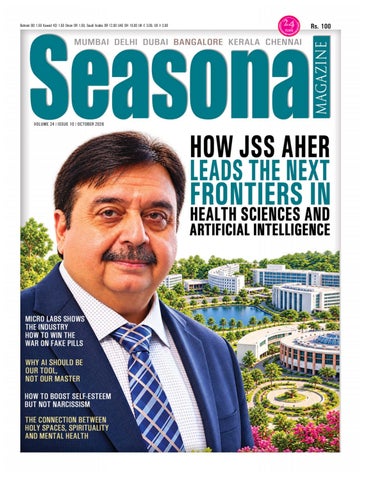
HOW JSS AHER LEADS THE NEXT FRONTIERS IN HEALTH SCIENCES AND ARTIFICIAL INTELLIGENCE Emerging from a remarkable mid-year cycle of academic and technological renewal, JSS Academy of Higher Education and Research (JSS AHER) has accelerated its mission to become the epicenter of intelligence-driven healthcare. Guided by the spiritual vision of Chancellor His Holiness Jagadguru Sri Shivarathri Deshikendra Mahaswamiji and the administrative stewardship of Dr. CG Betsurmath, Executive Secretary of JSS Mahavidyapeetha, the institution has made unprecedented strides since May 2026. Pro Chancellor Dr. B Suresh has spearheaded massive cross-disciplinary initiatives that fuse artificial intelligence across biomedical curricula and industry incubation, while Vice Chancellor Dr. H Basavana Gowdappa has directed the clinical translation of advanced
STOP THINKING OTHERS ARE HAPPIER THAN YOU ARE
PRACTICAL WAYS TO THINK POSITIVELY Positive psychology has become a powerful foundation for wellbeing programmes worldwide. For those seeking better mental health and a more fulfilling life, these programmes encourage simple, intentional practices that can strengthen emotional SEASONAL MAGAZINE
HOW TO BOOST SELFESTEEM BUT NOT NARCISSISM Are we encouraging healthy self-esteem, or breeding a culture of narcissism, overconfidence, and inauthenticity when we “like,” act impressed by, or otherwise contribute to people’s inflated perceptions of their skills,
Have you ever looked at someone and thought, “They figured it out”? Maybe they have a good career, a nice house, a happy family, or a large group of friends. They always seem to be traveling, eating at nice restaurants, and doing interesting things. You see a small part of their life. And your mind fills in the
MICRO LABS
SHOWS THE INDUSTRY HOW TO WIN THE WAR ON FAKE PILLS When you reach for a painkiller to soothe a debilitating pain, the last thing you expect is an elaborate fake pill designed to deceive. Yet, the modern pharmaceutical industry is quietly fighting a shadow war against fake drugs, a multibillion-dollar illicit industry that preys on the vulnerable. Disguised in seemingly flawless packaging, these fraudulent pills infiltrate our pharmacies, carrying toxic ingredients or nothing at all. As this silent trickery jeopardizes millions of lives, one pharmaceutical giant - Micro Labs - is stepping out of the traditional playbook to wage a high-tech battle for product integrity and patient safety.
WHY DONE IS BETTER THAN PERFECT AND WHY SHIPPING BEATS POLISHING? Perfectionism isn't high standards - it's avoidance in disguise. Learn why done is better than perfect and how to start shipping what matters.
WHY AI OR SI SHOULD BE OUR TOOL, NOT OUR MASTER When a simple, loving text message to a child is rejected as "AI-generated," the global crisis of trust in the machine age becomes profoundly personal. We stand at a precipice of existential dread, fearing that the rapidly evolving phenomenon of Super Intelligence will quietly erode our human authenticity. But is this modern panic justified, or are we simply repeating history’s initial terror of the printing press? Dr. Madhukar G. Angur, distinguished academician and Founder Chancellor of Alliance University of Bengaluru, unpacks this technological paranoia. Filtering sensationalist doomsday predictions through the clarifying lens of history, Dr. Angur argues that Super Intelligence is not SEASONAL MAGAZINE
CONTENT
HOW TO LEARN FROM YOUR FAILURES Research suggests that we need to overcome some emotional and cognitive barriers if we’re to learn from our defeats - but it can be done. Sooner or later,
THE PRADOXICAL LIFE TRAP OF GOOD-ENOUGH
WHY YOU SHOULD PRIORITIZE SMALL TWEAKS OVER GRAND PLANS Forget grand plans, as these small tweaks can add more meaning to your life. The start of the year often comes with attempts at big life changes that we’re
Last week, I read a research paper from a group of Harvard and UCLA psychologists that I can’t stop thinking about. Its title grabbed me immediately: The peculiar longevity of things not so bad. The 2004 paper explores a paradox in how people recover from negative experiences.
THE ANTELOPE PRINCIPLE: HOW TO CHASE THE RIGHT THINGS
HOW TO RECOVER AFTER ACTING AGAINST YOUR OWN VALUES Moral injury is the harm that we suffer when we’re asked to engage in or allow actions that seriously go against our moral values. Recently, the mother of an eight-year-old girl told us the following story. Her daughter had come home from school distraught because she
The following is a passage from a book of life wisdom written by two business and political strategists in 2002:A lion is fully capable of capturing, killing, and eating a field mouse. But it turns out that the energy required to do so exceeds the caloric content of the mouse itself. So a lion that spent its day hunting and eating field mice would slowly starve to death. A lion can’t live on field mice. A lion needs antelope. Antelope are big animals. They take more speed and strength to capture and kill, and once killed, they
As Karnataka enters the fourth year of its administration, the leadership baton has officially passed from veteran statesman Siddaramaiah to the dynamic DK Shivakumar. All eyes are now on what changes and what stays the same under its new Chief Minister. The answer lies in a seamless blend of continuity and aggressive modernization. The transformative five guarantees, which have successfully pumped over Rs 1.21 lakh crore into the grassroots economy, are here to stay, maintaining the state’s robust welfare safety net. However, the Shivakumar era signals a decisive pivot toward massive urban and infrastructural renewal. Spearheading this shift is the ambitious Brand Bengaluru initiative, highlighted by the much-debated Bengaluru tunnel road project and vital elevated corridors designed to decongest the tech capital. By fusing compassionate welfare with rapid, high-tech infrastructure development, Chief Minister Shivakumar aims to sustain Karnataka’s 8.1% growth rate and cement its status as India’s premier tech and economic powerhouse.
THE CONNECTION BETWEEN HOLY SPACES, SPIRITUALITY AND MENTAL HEALTH People who feel a spiritual connection to their surroundings tend to report better mental health. A recent
SEASONAL MAGAZINE
hings break, lose their value. You move on to another thing. Your brain ruthlessly normalises whatever you have until it no longer satisfies. When your happiness is tied to either of these, it’s out of your control. The Tao Te Ching warns against pursuing things outside yourself: “He who knows he has enough is rich.” Not rich in possessions. But in the direction. And the feeling of moving toward something that means the world to you.
T
That’s the key words: “toward what you want.” A direction that makes you come alive. You wake up and aim at something. You write, build, train, research, make or keep finding new things. The minute you tie your life to something that pulls you forward from the inside, how you feel and what you feel change. You wake up with a reason. You have a north star that doesn’t change when your circumstances do. It may evolve. Or transform. But you will always enjoy the process. Einstein is not saying don’t love people. He’s saying don’t make them your only source of joy in life. There’s a difference between loving someone freely and needing them to hold your happiness together. One is generous. The other is a pressure that breaks the relationship. When your inner life has direction, you bring something into your relationships rather than taking from them. You stop needing people to behave in specific ways for you to feel okay. The Indian philosopher Jiddu Krishnamurti spent a lifetime pointing at this. Attachment, he argued, is not love. Real love asks nothing of the other
person. But that kind of love is only possible when you’re not using the other person to prop yourself up. Something to pursue does the propping. So you don’t have to ask someone else to. But you have to choose the right pursuit. Goals that are purely about status are just things in disguise. They have the same problem. You hit them and feel nothing, or worse, feel emptier than before. But the ones tied to process, not outcome, make life meaningful. The writer who loves the act of putting thoughts down. The book will finish. You are still a writer. The entrepreneur building things and solving problems they care about. If it’s just about the profit, the work will drain you. Aristotle called this eudaimonia. It means happiness, but more like flourishing. The feeling of functioning at your full capacity in pursuit of something worthy. Not pleasure or comfort. Something that helps you find flow. The work itself must feel like “the reward” to achieve what Einstein is talking about. The result is just a bonus. But it takes time, experimentation, failure, and revision. The pursuit itself gives your days meaning. And once you find it, everything else organises around it. Einstein tied his life to understanding the universe. He failed constantly, was wrong often, and hit walls that lasted years. But he never ran out of a reason to get up. That’s what a goal does. It doesn’t promise happiness as a feeling. But a reason to wake up every day. As holocaust survivor Viktor Frankl says, “Those who have a ‘why’ to live can bear almost any ‘how’.”
SEASONAL MAGAZINE
COVER STORY
SEASONAL MAGAZINE
SEASONAL MAGAZINE
uring the second and third quarters of 2026, JSS AHER witnessed a decisive expansion in its academic curriculum and admissions framework, specifically targeting artificial intelligence and algorithmic healthcare. The 2026-27 admission cycle recorded peak interest from national and international applicants, driven by the rollout of hybrid degree tracks that blend clinical practice with computational sciences.
D
The moral foundation of the institution is anchored by the spiritual presence of Chancellor His Holiness Jagadguru Sri Shivarathri Deshikendra Mahaswamiji. His Holiness consistently reminds the faculty and student body that while artificial intelligence, automated chemistry, and micro-robotics represent the technological instruments of tomorrow, profound empathy and selfless compassion remain the unalterable spirit of healing. This timeless balance guided the university during its 16th Convocation, where national dignitaries underscored JSS AHERs critical position in sculpting the scientific workforce required for the national development roadmap toward 2047. The newly expanded Masters and Bachelors programs in Artificial Intelligence and Health Informatics registered an unprecedented influx of cross-disciplinary scholars eager to bridge data science with genomic medicine. Under the direct leadership of Pro Chancellor Dr. B Suresh, the
university established mandatory AI and data literacy modules across every core undergraduate program, ensuring that pharmacy, dental, biomedical, and nursing students build working expertise in neural networks and diagnostic modeling before entering hospital rotations. This pervasive AI integration has radically updated traditional healthcare courses. Medical biochemistry, molecular diagnostics, and pharmacology classrooms now feature dedicated laboratory training where predictive algorithms simulate drug-receptor kinetics and forecast clinical trial outcomes. In the faculty of biomedical sciences, imaging informatics modules teach students how deep learning architectures detect early oncological anomalies and cardiac distress. Pro Chancellor Dr. B Suresh has repeatedly pointed out that the modern clinician cannot view technology merely as a support mechanism, but must treat computational literacy as a fundamental diagnostic skill on par with physiological assessment. This visionary approach ensures that JSS AHER graduates operate as versatile digital healthcare leaders across global research environments and high-tech tertiary care facilities. Simultaneously, the startup incubation ecosystem at JSS AHER has gained explosive momentum throughout the summer and monsoon months of 2026. The SPARKLE CINE incubation center, operating as the technological springboard for entrepreneurial faculty
and students, initiated partnerships with national technological powerhouses, including collaborative hackathons and incubation pipelines with institutes like IIT Bombay and IIIT Bengaluru. In recent months, over twenty venture cohorts took root within the incubator, creating functional prototypes of point-of-care medical devices, automated diabetic retinopathy scanners, and algorithmic platforms for rational antimicrobial prescribing. The administrative mechanisms orchestrated by Dr. CG Betsurmath have ensured uninterrupted seedstage support, granting youth
Dr. B Suresh, Pro Chancellor
SEASONAL MAGAZINE
innovators access to advanced fabrication facilities and regulatory consulting. Placement figures reflecting the mid2026 completion cycle have set new institutional benchmarks across pharmaceutical, medical, and biotechnology sectors. Postgraduate pharmacy students achieved an impressive median compensation exceeding ten lakh rupees, with elite biomedical researchers and health-tech specialists commanding premium international compensation packages. Multinational pharmaceutical leaders, clinical research organizations, and digital health enterprises, such as Biocon, Cipla, and Dr. Reddys Laboratories absorbed an impressive contingent of graduating scholars. The placement cell noted that recruiters placed exceptional value on students who completed applied AI modules, verifying that JSS AHER graduates possess rare dual competencies in wet-lab biology and clinical data engineering. On the global rankings front, JSS AHER continued its ascendancy among elite international and national ranking benchmarks, with only the National Institutional Ranking Framework, the Times Higher Education, and Quacquarelli Symonds measuring its comprehensive institutional performance. In the QS World University Rankings by Subject 2026, the university created history when its Pharmacy and Pharmacology department surged into
the global top one hundred, claiming the 91st rank worldwide. In Medicine, the QS evaluation placed the institution comfortably in the 551 to 600 band, reflecting intense research productivity and superior employer reputation. In the Times Higher Education rankings for 2026, JSS AHER consolidated its status as a world leader in scientific and social relevance. In the THE World University Rankings, the university maintained a formidable placement in the 801 to 1000 band overall, while climbing decisively in the Medicine and Health Sciences subject band between 601 and 800, and securing a position between 351 and 400 in the Science subject category.
Furthermore, in the Times Higher Education Impact Rankings, which measure institutional delivery on United Nations Sustainable Development Goals, JSS AHER ranked 56th globally, achieving distinction in SDG 3 for Good Health and WellBeing. On the domestic stage, the National Institutional Ranking Framework 2025 and 2026 evaluations re-affirmed its status as one of India’s most elite private universities, holding the 21st position in the competitive University category and ranking 38th in the Overall national category. Within specialized NIRF streams, the affiliated colleges secured top ranks nationwide, with the pharmacy and dental faculties retaining their commanding spots among the top ten in the country.
SEASONAL MAGAZINE
These recent breakthroughs build upon a rich matrix of accomplishments that took flight earlier in the year. The defining milestone of early 2026 unfolded on April 4, when the university formally inaugurated the JSS School of Medicine in Vacoas, Mauritius. This visionary foreign outpost converted a longstanding educational dream into an operational reality in the presence of distinguished international dignitaries, inaugurating a fresh era of transnational collaboration in the Indian Ocean territory. For Pro Chancellor Dr. B Suresh, this was an audacious validation of India’s capability to export high-standard medical education. The institution commenced its foundational academic terms under a syllabus tailored to satisfy both the Mauritius Higher Education Commission and the National Medical Commission of India, giving regional aspirants access to high-caliber medical training without traversing continents. The institutional prestige of JSS AHER had already received a major lift in February 2026 when Pro Chancellor Dr.
SEASONAL MAGAZINE SEASONAL MAGAZINE
manufacturing, machine-assisted diagnostics, and global compliance benchmarks. His steadfast guidance has remained the primary engine keeping JSS AHER at the vanguard of medical higher education.
Dr. H. Basavanagowdappa, Vice Chancellor B Suresh was honored with the prestigious Lifetime Achievement Award for Academic Excellence by the Indian Pharmaceutical Alliance in Mumbai. This accolade celebrated his more than four decades of pioneering leadership in restructuring pharmaceutical pedagogy and advancing progressive regulatory frameworks across India. In his address to the assembly, Dr. Suresh stressed that the realization of a developed India by 2047 hinges directly on preparing medical and pharmaceutical practitioners who are fluent in automated pharmaceutical
Scientific scholarship at the university continues to be energized by the core ethos of Science for Society. Significant biomedical breakthroughs took center stage through the ongoing work of Professor Prasanna K Santhekadur and his research colleagues in the Department of Biochemistry. Their investigative studies, which examined the therapeutic efficiency of Sodium Butyrate against aggressive hepatocellular carcinoma, appeared in top-tier international scientific journals. This work linked Nobel-winning insights with natural dietary compounds, turning complex oncology into clinically actionable pathways. The active involvement of Vice Chancellor Dr. H Basavana Gowdappa in fostering interdisciplinary medical research has provided faculty and scholars with state-of-the-art
laboratory environments to address widespread public health concerns.
platforms, and international clinical trial networks.
The clinical ecosystem centered at JSS Hospital functions as an advanced surgical and diagnostic workshop for scholars and physicians alike. The hospital recorded landmark successes in robotic and computer-assisted interventions, notably completing Reverse Total Shoulder Arthroplasty utilizing computerized Virtual Implant Positioning systems.
The forward-looking initiatives steered by Dr. Suresh, together with international accreditations like the ACPE recognition for the Doctor of Pharmacy program, confirm that degrees conferred by JSS AHER carry deep academic respect across clinical and research institutions worldwide.
The clinical deployment of such precision instrumentation, actively encouraged by the university administration, offers trainee surgeons direct clinical experience with cuttingedge robotic tools. This live operational environment bridges the conceptual algorithms taught in computational classrooms with real surgical precision in sterile operating theaters. The university has simultaneously emerged as an early pioneer in recognizing modern behavioral pathologies born of technological ubiquity. The Special Clinic for Digital Wellbeing, which treats behavioral compulsions, gaming addictions, and digital device dependency, significantly enlarged its operations. By uniting behavioral medicine, pediatrics, and neuropsychiatry, JSS AHER demonstrated that contemporary public health must guard mental equilibrium alongside physical health. To expand this protective umbrella, the university initiated psychological first aid workshops in regional vernacular languages, ensuring that the fruits of advanced behavioral science reach rural and suburban households across Karnataka. Behind this unbroken chain of academic and infrastructural triumphs lies the administrative balance provided by Dr. CG Betsurmath. His organizational oversight has enabled JSS AHER to maintain a dynamic academic calendar packed with highlevel international congresses.
Dr. B. Manjunatha, Registrar The campus regularly hosts premier global conventions, including the International Conference on Sustainable Brain Health and the National BioImaging Conclave, bringing together leading researchers from the University of Nebraska, the University of Cambridge, and the National Institutes of Health. Furthermore, the commissioning of an advanced High-Resolution CryoElectron Microscopy unit has established the campus as an elite destination for macrostructural biology and targeted molecular discovery. Student enterprise thrives throughout this environment, propelled by interactive platforms like the Sports Nutrition Innovation Exhibit, titled The Athletes Cycle, which bridges exercise physiology with targeted metabolomics. This multi-layered learning environment ensures that every student emerges not merely with a static credential, but with an entrepreneurial compass focused on solving national healthcare bottlenecks. Looking toward future infrastructure, the Varuna Global Campus project, a sprawling hundred-acre greenfield development conceptualized by Pro Chancellor Dr. B Suresh, is taking shape as a premier international zone for bio-engineering and digital medicine. This hub will host advanced corporate-academic incubation facilities, high-throughput computing
The academic administration under Vice Chancellor Dr. H Basavana Gowdappa continues to exhibit extraordinary adaptability and educational vision. From the early adoption of modern interdisciplinary curricula to expanding local-language public wellness initiatives, the Vice Chancellor has ensured that the deemed university maintains deep community connections even as its academic programs cross continents into Mauritius and beyond. Registrar Dr. B Manjunatha and the dedicated central administrative secretariat provide the day-to-day organizational momentum and examination integrity that sustain high institutional rankings across NIRF, THE, and QS audits. When ambitious scholars enter the JSS AHER ecosystem, they step into a thriving intellectual culture where innovation is a daily discipline. Supported by the spiritual wisdom of His Holiness Jagadguru Sri Shivarathri Deshikendra Mahaswamiji, the executive vision of Dr. CG Betsurmath, the transformative modernization driven by Pro Chancellor Dr. B Suresh, and the clinical leadership of Vice Chancellor Dr. H Basavana Gowdappa, the university moves into the future with absolute clarity of purpose. In the historic city of Mysuru, and its campuses at Ooty, the JSS Academy of Higher Education and Research is doing more than analyzing the evolution of modern healthcare; it is actively constructing the blueprint for the next century of global medical education. SEASONAL MAGAZINE
Are we encouraging healthy self-esteem, or breeding a culture of narcissism, overconfidence, and inauthenticity when we “like,” act impressed by, or otherwise contribute to people’s inflated perceptions of their skills, knowledge, and attributes? Too much praise can nurture imposters and narcissists. verconfidence and certainty, by definition, are the enemies of critical thinking, which is the basis of intelligent judgment, problem-solving, and decision-making. Critical thinking involves curiosity, healthy doubt, and the deliberate consideration of how one’s conclusion might be wrong.
O
Inherent Bias Towards Overestimating One’s Own Abilities Even without encouragement, people are inherently biased towards inaccurate, overly positive appraisals of themselves, believing they are better than their peers in terms of personality, qualities, and abilities. Predictably, less skillful people who perform poorly are even more likely to confidently miscalibrate their performance, overestimating how well they will do and, afterward, how well they did. Grandiose narcissists already believe they are superior to others and maintain their idealized self-image through seeking status, admiration, and dominance and doing so effectively. Blunted neural sensitivity in the error detection part of their brains further facilitates the ability to ignore contradictory evidence.. Rise in Swagger Culture A recent column in the New York Times identified a cultural rise in swagger and a decrease in buzz about imposter syndrome. In a social climate that rewards inflated confidence over accountability, accuracy, and appropriate humility, now, instead of imposter syndrome being in vogue, it’s SEASONAL MAGAZINE
normative and even popular to be an actual imposter (knowingly or not).
benefactors who seem to fear exposing the fraudulence of the bona fide imposters.
With imposter syndrome, people ignore evidence of their achievements and fear being exposed as a “fraud.” This phenomenon (not a medical syndrome) is associated with anxiety, perfectionism, self-doubt, and underestimating one’s competencies. Not surprisingly, imposter syndrome is more prevalent among highly accomplished women adapting to the norms of environments such as academia.
The Role of Chatbots in Self-Aggrandizement
Imposter syndrome proliferates in social discourse in certain contexts because it’s an easy, even desirable, condition to claim publicly since it implicitly authenticates one’s achievements and competencies, while packaging them in the humility and derogation that can feel safer, particularly to women, in competitive maledominated environments.
A recent study in Science found that chatbots are actually 50 percent more sycophantic than humans, though people falsely believe AI provides more objective feedback than humans. Researchers also found that more than a dozen major AI models were sycophantic, which is not surprising, since users preferred sycophantic responses over the models that didn’t agree with them. Further compounding the problem, people rated the sycophantic chatbots, in particular, as unbiased and accurate, and the chatbots that disagreed with them as negatively biased.
In contrast, the trend we see in communal digital spaces, politically and beyond, is for people with no achievements to pose as experts, boasting with unearned confidence in the guise of a healthy belief in themselves as deserving, bolstered by likes and followers. In an ironic, noxious reversal, arrogance is now rewarded, and sycophancy incentivized through the impact of AI, social media platforms, and the trickle-down effect of political leaders normalizing these behaviors. Whether fueled by self-deception, entitlement, or deliberate facade motivated by status seeking and self-promotion, the curated self manifests with a conspicuous absence of selfdoubt, critical thinking, and, in this case, justifiable fear of being outed as a fraud. Now it’s the bystanders and SEASONAL MAGAZINE
The Perils of Praise Healthy self-esteem is a stable sense of self-worth. It does not involve superiority, antagonism, or status seeking, and is fostered by providing accurate feedback that emphasizes learning and self-improvement over social comparison. Narcissism, on the other hand, is nurtured by fostering overconfidence and focusing on being better than others.
This matters because even brief interactions with sycophantic chatbots have been found to increase people’s certainty, extreme views, and perceptions that they’re better or smarter than other people. A single interaction with a sycophantic chatbot has been found to adversely impact judgment, decision-making, and relationships - making people more likely to blame others, resist taking responsibility, and be convinced they were right. In relationships, people shifted from being empathic and open to considering their partner’s viewpoint to feeling entitled to accuse them of wrongdoing and refuse to apologize.
Psychological Motivators of the Enablers Apart from the influence of AI, people collude in and encourage unearned confidence and inauthenticity personally, on social media, and on the political stage by supporting misleading self-promotion and egocentrism with words, likes, and follows, or implicitly through silence.
We resist exposing the truth or providing accurate feedback due to fear, cowardice, the need for self-promotion, or because it’s easier to take the path of least resistance. A more benign contributor is a common misconception about healthy self-esteem, conflating it with narcissism, as if they were on a continuum. However, they are very distinct and cultivated through divergent socialization and parenting practices. Further, narcissism and healthy self-esteem lead to contrasting outcomes in terms of the development of psychological and emotional capacities, critical thinking, resilience, robustness, and the quality of relationships. SEASONAL MAGAZINE
Parents may unwittingly contribute to their children developing dislikable traits and narcissism by overpraising (for example, praising them no matter what they do), exaggerating how well they did, needing them to stand out, overvaluing their intelligence or specialness, rewarding the status element of their achievements, and being concerned with elevating their social status. This parenting style, even if well-intended, later comes back to haunt parents, not only breeding narcissistic traits in their children such as entitlement, superiority, lying, cheating, and failure to take responsibility, but also making children vulnerable to emotional instability and symptoms such as rage, anxiety, and depression. Further, children whose sense of self is built on a fragile foundation of illusion, requiring constant validation, admiration, and propping up, crash when faced with realworld situations like college or the job market where performance is judged on merit and results, and praise is not readily forthcoming. In discussing the cultural rise in swagger, Sobrevilla argued that an inflated sense of power can be an adaptive reaction to feelings of existential dread and helplessness in our current world. But maintaining an illusion of grandiosity is not only off-putting but also a shallow, fragile fix that hooks people on constant admiration or status, at the inevitable cost of authentic connection, mastery, and resilience. (Lynn Margolies, Ph.D. for Psychology Today)
When you reach for a painkiller to soothe a debilitating pain, the last thing you expect is an elaborate fake pill designed to deceive. Yet, the modern pharmaceutical industry is quietly fighting a shadow war against fake drugs, a multibillion-dollar illicit industry that preys on the vulnerable. Disguised in seemingly flawless packaging, these fraudulent pills infiltrate our pharmacies, carrying toxic ingredients or nothing at all. As this silent trickery jeopardizes millions of lives, one pharmaceutical giant - Micro Labs - is stepping out of the traditional playbook to wage a high-tech battle for product integrity and patient safety.
rug counterfeiting has steadily evolved into one of the most insidious public health threats facing the modern world, directly jeopardizing patient safety and undermining centuries of trust in legitimate medical therapies. Industry estimates paint a grim picture, indicating that between 10% and 25% of medicines currently circulating in the expansive Indian pharmaceutical market may be substandard, falsified, or outright
SEASONAL MAGAZINE
counterfeit. The situation is even more alarming in densely populated metropolitan hubs, where complex supply chains offer ample hiding places for bad actors. In these regions, localized urban studies have reported contamination rates climbing to a staggering 30%. These are not merely harmless sugar pills. These illicit products frequently contain radically incorrect dosages, actively toxic industrial ingredients, or zero active pharmaceutical components. When a patient unwittingly consumes a counterfeit drug, the
consequences ripple outward with devastating speed. On an individual level, the absence of curative ingredients paves the way for severe clinical complications, prolonged suffering, therapeutic failures, and fatal outcomes. On a community scale, sub-therapeutic doses found in falsified antibiotics act as a catalyst for dangerous antimicrobial resistance, creating resilient superbugs that threaten the entire population. Stepping forward to confront this critical industry vulnerability head-on, Micro Labs has established a pioneering benchmark for proactive and absolute product integrity. For decades, the pharmaceutical industry standard has involved relying on reactive measures only after counterfeiting incidents surface. Micro Labs is flipping this paradigm by elevating the fight to a high-tech orbit . The company has aggressively deployed advanced, end-to-end anti-counterfeit packaging protocols across 100+ of its core product lines, creating a formidable barrier against medical fraud.
secure foils, microscopic authentication technologies, and intricate tamper-evident seals that are incredibly difficult and expensive for blackmarket operations to replicate. Crucially, implementing this level of cutting-edge security is an expensive endeavor. Specialized materials and complex authentication technologies carry significantly higher manufacturing costs, a burden that most corporations would instinctively pass down to the consumer through immediate price hikes. But not Micro Labs. Says Ramanath MS, CFO, “We have deliberately chosen to absorb these elevated expenses entirely rather than transferring the financial burden to patients. This bold financial decision reinforces Micro Labs’ unwavering commitment to a dual mandate providing absolute safety even while maintaining healthcare affordability.”
By securing high-volume medications, Micro Labs ensures that the essential therapies relied upon by millions are robustly shielded against illicit duplication. These comprehensive protective measures involve highly specialized SEASONAL MAGAZINE
To ensure absolute precision and effectively eliminate the inherent risks of human variability from their production lines, Micro Labs is aggressively integrating Industry 4.0 paradigms into its sprawling manufacturing ecosystem. This modern industrial revolution heavily relies on intelligent robotics, automated handling, and interconnected smart machine interfaces that communicate in realtime to optimize both efficiency and security. At the vanguard of this technological leap is the company’s premier facility nestled in Sikkim. This state-of-the-art plant harnesses advanced automation on a scale rarely seen. Within its controlled sterile walls, meticulously calibrated robotic systems and automated guided workflows entirely govern the intricate production stages. From the initial processing of sensitive raw materials straight through to the final secondary packaging of the pillboxes, the entire operation requires incredibly minimal human intervention. This seamless robotic integration is not merely a matter of increasing speed; it is about guaranteeing that every blister pack and secure foil application is executed with pinpoint accuracy, absolute consistency, and flawless sterile precision. When an intelligent machine handles the packaging, the margin for error effectively drops to zero. More importantly, the opportunity for manual human
tampering or accidental contamination is eradicated from the factory floor. Building upon the runaway success of its Sikkim operations, Micro Labs is now executing a nationwide infrastructural upgrade. The company is gradually scaling these advanced Industry 4.0 automation and robotics technologies across its 15 other manufacturing units located throughout India. This sweeping technological modernization is cementing a uniform standard of uncompromised manufacturing excellence that competitors will be forced to chase. Highlighting the vision driving these large-scale technology and security initiatives, Dilip Surana, Chairman and Managing Director of Micro Labs, emphasized the profound moral responsibility of pharmaceutical manufacturers. He noted: “Safeguarding the health of patients goes far beyond producing effective medicines; it demands absolute vigilance and precision over every stage of creation, from the automated factory floor to how those medicines reach the consumer.”
SEASONAL MAGAZINE
By proactively integrating advanced robotics, smart manufacturing technologies, and secure anticounterfeit packaging across its vast network, Micro Labs has created the benchmark to follow. Doing so without passing on incremental costs to patients reinforces their fundamental promise that innovation, trust, and affordability must always go hand in hand.
recent study published in the Archive for the Psychology of Religion suggests that feeling a deep, spiritual connection to a specific physical location can act as a protective shield for a person’s mental health. This bond with a meaningful physical space tends to reduce the psychological harm caused by feelings of insignificance or questioning whether one’s life matters. The research provides evidence that our physical environments can serve as vital resources for maintaining emotional stability during highly stressful times.
A
The goal of the research was to examine how people manage intense emotional distress after losing access to their normal daily structures. Widespread isolation during the COVID-19 pandemic forced many individuals to confront deep feelings of insignificance. In psychology, the belief that a person is important to others and makes a difference is known as mattering. When people experience mattering struggles, they feel invisible to those around them, which tends to increase loneliness and anxiety. At the same time, the pandemic fundamentally changed how people interacted with their physical environments. As communal spaces closed, people spent much more time in their own homes or out in nature. SEASONAL MAGAZINE
Scientists noticed a research gap regarding the spiritual dimension of place attachment, which is the emotional connection humans feel toward specific locations. They wanted to explore spiritual ties to place, referring to the unique bonds people form with environments they consider sacred. A sacred space does not have to be a traditional religious building, as it can be a quiet spot in a park or a dedicated corner of a living room. The researchers designed the present study to see if this spiritual connection to a physical space could buffer the negative mental health effects of mattering struggles. They wanted to know if a meaningful location could offer psychological support during a major crisis. “I have always been fascinated by the intersection of our physical environment and our inner spiritual lives. Historically, environmental psychology focused on ‘place attachment’ (emotional bonds to home or neighborhood) while the psychology of religion focused on ;spiritual attachment; (bonds to the Divine), but the two rarely spoke to each other,” said study author Victor Counted, an associate professor and director of the Office of Research and Sponsored Programs at Regent University. “I wanted to explore the “sacred-spatial bond”; a sort of idea that spirituality unfolds within the milieu of the social and physical environment and anchored in specific physical settings. The COVID-19 pandemic provided a
unique, albeit challenging, context to see how these ties act as lifelines when our usual social and physical structures are disrupted. This is what I explored in the book Place and Post-pandemic Flourishing, and many other studies on ‘Spiritual Ties to Place‘ — how people sense or connect to the sacred in a significant place.” For their new study, the researchers used data from the National Religion and Spirituality Survey 2022. The sample included exactly 3,640 adults living in the United States. This group was selected to be nationally representative based on age, gender, race, and education levels. Data collection took place between November 9 and December 7, 2022. Participants completed the survey either through a secure web portal or via a telephone interview. The researchers measured three main variables by asking participants to reflect on their experiences since the pandemic began in March 2020. First, participants rated their perceived increase in spiritual ties to a place on a five-point scale, indicating whether they had become more spiritually connected to sacred locations. Second, participants reported their mattering struggles on a fourpoint scale by answering how often they questioned whether their life really mattered.
religious affiliation. The data provides evidence that mattering struggles were consistently associated with a perceived decline in mental well-being. People who questioned their own significance were much more likely to report worsening mental health. At the same time, the data suggests that individuals who experienced an increase in their spiritual connection to a physical place tended to report improved mental well-being. “I was particularly struck by the variety of places where people find these connections,” Counted told PsyPost. “In our related latent class analysis, we found that people not only form spiritual ties to massive cathedrals or nature; they find them in ‘unfrequented’ places (e.g., memorial grounds or burial sites) and private home sanctuaries (e.g., private altar).”
Finally, the survey asked participants to rate their perceived change in mental well-being on a simple scale. This scale indicated whether their mental health had worsened, remained the same, or improved. The researchers also accounted for a wide range of background factors to ensure accuracy, including age, gender, household income, political orientation, and SEASONAL MAGAZINE
About 29 percent of the adults surveyed reported that their spiritual connection to a sacred place had strengthened during the pandemic. The scientists found a notable interaction between these differing experiences. Specifically, a strong spiritual connection to a place appeared to moderate the harmful effects of mattering struggles. For people who felt a deep spiritual bond with a specific setting, the negative impact of feeling insignificant was notably weaker. The physical location seemed to act as an emotional anchor for the participants. This anchoring effect suggests that finding a sense of the sacred in a specific place provides individuals with an alternate source of stability and purpose. “Another surprise was the strength of the ‘buffering’ effect,” Counted said. “For example, spiritual ties to place did not just correlate with mental well-being; it
specifically weakened the link between feeling like you don’t matter and the decline of mental health. This, as you can imagine, suggests that place-based spirituality is a robust mechanism for resilience.” The researchers noted a few specific demographic patterns in the data. For instance, female participants were slightly more likely to report an increased spiritual connection to a place than male participants. This detail aligns with previous research suggesting that women might engage with spiritual resources more frequently during times of extreme stress. “The most important takeaway from our recent paper on spiritually significant places as adaptive psycho-spatial resources is that your physical surroundings are a vital psychological resource,” Counted explained. “Our study
SEASONAL MAGAZINE
found that for people struggling with feelings of insignificance or ‘not mattering,’ a strong spiritual connection to a significant place acts as a ‘protective shield’ for their mental health. Whether it is a place of worship, a quiet spot in nature, or even a dedicated corner of your home, these ‘sacred’ spaces provide a sense of stability and meaning that can buffer the negative effects of life’s stressors.” While the study offers a helpful perspective on human resilience, there are a few limitations to consider. The research relies on cross-sectional data, meaning all the information was gathered at a single point in time. Because of this design, researchers cannot definitively prove cause and effect. It is possible that feeling mentally well makes a person more likely to seek out spiritual places, rather than the place itself causing the improved mood. “It is important to note that our 2026 study was crosssectional, meaning it provides a snapshot in time,” Counted said. “While we found a strong association, we cannot definitively say that an increase in spiritual ties to place caused the improvement in mental well-being. Additionally, our data was gathered in the unique context of the COVID-19 pandemic, so the intensity of these feelings might be higher than in more “normal” times.” A potential misinterpretation of this work is the assumption that it only applies to highly religious individuals. The scientists note that sensing the sacred in a physical location is a broad psychological experience that transcends organized religion. It involves bodily regulation and emotional connection, whether one is sitting in a traditional cathedral or walking through a dense forest. “My long-term goal is to move from ‘mapping’ these ties to ‘mobilizing’ them,” Counted said. “I want to see this research inform urban planning and clinical therapy, essentially ‘prescribing’ place-based spiritual practices to help people regulate distress. There are some work in
ecotherapy but I am think of better models that cut across the different place profiles.” “We are also looking into longitudinal studies to understand how these spiritual bonds with places evolve over a person’s lifetime and across different cultures beyond the Western context. There has been limitations to expanding this research due to lack of funding, but we are working bits by bits with the little resources with have to make it happen.” “Our research emphasizes that spiritual ties to place are an embodied experience,” the researcher continued. “It transcend what one believes and involves how we sense the sacred in a significant place of attachment. This is one of the first attempts to psychologically study the unique links between religion and place. When people are in a place they consider sacred, they describe a process of ‘sensing the sacred’ that involves bodily regulation, emotional connection, and a renewed sense of action. This work reminds us that in order to flourish, we need to be rooted in the world around us. The study, “Spiritually significant places as adaptive psycho-spatial resources: Mattering struggles, spiritual ties to place, and mental well-being in US adults,” was authored by Victor Counted, Benjamin R Meagher, and Richard G Cowden. (Eric W. Dolan for PsyPost) SEASONAL MAGAZINE
SEASONAL MAGAZINE
ecently, the mother of an eight-year-old girl told us the following story. Her daughter had come home from school distraught because she had joined other girls in “being mean” to a classmate. She hadn’t said anything herself, but she’d stood with the bullies and giggled while they ridiculed the classmate. Earlier, the girl had been on the receiving end of the bullies’ taunts, herself; now she was flirting with the power they held.
R
Afterward she was filled with a remorse so strong that she was sick for the remainder of the day—nauseated, anxious, and ashamed. It was as if her whole body was telling her that her choice had gone against something intrinsic to her character. The mother was concerned about her daughter’s behavior, but we assured her that this was not something to worry about: Her child’s moral compass was intact, and beautifully sensitive to right and wrong. Sure, she had experimented with a darker aspect of human social interaction—and her role in it—but her own position had become crystal clear. What she needed now was simply assistance from skilled adults to help her find the language and actions to navigate her social world in a way that helped her stay in integrity with her values. It is remarkable that children are born ready to develop a moral framework. Even babies show empathy and prefer fair, kind actors over unjust, mean ones. This makes sense. Humans are social creatures. We have evolved capacities over thousands of years to help us live with others. Our bodies contain genes, neurotransmitters, and nerves that drive us to care for, empathize with, and respect the people around us. Decades of research show that when we act in harmony with these inclinations, we have better mental and physical health and even longevity. At a community level, societies that encourage prosocial actions thrive and are more resilient. But when our moral map is violated, we suffer. Psychologists are increasingly recognizing a condition called moral injury—a psychological harm caused by experiencing serious moral transgressions. It occurs when there’s a deep or chronic conflict between what we believe is right versus what we’re being asked to do, witness, accept, condone, or remain silent about. Any involved party—whether perpetrator, target, accomplice,
or bystander—can experience moral injury, whether immediately or eventually. Initially, feelings of guilt, shame, or shock arise, but if left unaddressed, these can metastasize into chronic anxiety or depression and even existential challenges like feelings of meaninglessness, a loss of trust in others and in institutions, a spiritual crisis, or an erosion of the sense of one’s goodness. When we experience moral injury, it’s as if our understanding of how the world is organized—and our place in it—shatters, leaving us unanchored and despairing. Moral injury is distinct from other psychiatric concerns. It’s different from post-traumatic stress disorder (PTSD) in that it centers around the moral emotions like guilt, remorse, empathic alarm, or moral outrage, whereas trauma, on the other hand, is centered on fear and helplessness. Moral injury is also different from moral distress, which is more mild or temporary, and it is not the same as being simply offended, triggered, or insulted. Moral injury is a deep wound resulting from chronic or severe exposure. Individuals vary in their susceptibility to moral injury; two people might experience the same event differently. The concept is not new. Ancient Greek writings refer to “moral defilement,” acts that run counter to the virtues that promote personal excellence and social harmony. Contemporary world religions all address violations to moral behavior, such as Christianity’s concepts of sin and forgiveness, Judaism’s atonement, Islam’s concept of tawba or repentance, and Hinduism’s karma and concept of right action. But it first appeared in the psychological literature when psychiatrists found that some veterans of wars in Vietnam, Iraq, and Afghanistan suffered from “moral anguish,” from their leaders’ transgressions or their inability to help innocent women and children. Without intervention, they tended toward either revenge or self-destruction, and recovery focused on knitting their “moral existence” back together. More recent studies have looked at moral injury among health care workers during the COVID-19 pandemic, first responders, and even journalists covering humanitarian crises. Could someone who holds harmful views claim moral injury? This has not been documented to our knowledge. It would be hard to justify, given that moral frameworks across cultures and eras have emphasized compassion, fairness, respect for others, loyalty, responsibility, courage, and integrity. Developmental science has documented the progression of care and justice across childhood. SEASONAL MAGAZINE
As we grow into adulthood, we increasingly try to make life choices—to the extent possible—that are congruent with our values: the work we do, where we live, the people we choose. Some areas of life are easier to align than others. But at some point we inevitably hit patches that elude our control altogether.
polarization, or extremism. Left unattended, they either work their way inside a person to distort character and cause depression, despair, and disengagement, or they’re expressed outward in a cruel, destructive rage. Either way, when caring becomes too painful, the result is a rising tide of anguish, anger, and helplessness.
Today, the daily news brings innumerable events that spark moral outrage or empathic alarm. Civilians are kidnapped by masked men and taken to detention facilities because of policies the majority of Americans oppose. Military personnel are invading and patrolling neighborhoods. Gun violence is the leading cause of death of U.S. children, but leaders say school shootings are “a fact of life.” Government workers are pressured to act against their professional training. Corporate leaders are making large donations or concessions to curry political favor. Free speech is under attack, political opponents are indicted, and civil liberties are denied. Universities are threatened, evidence-based medical care is rebuffed, and grift is rampant. A prominent political advisor parrots the Nazi propaganda of Joseph Goebbels.
But what can an individual do against forces bigger than themselves? Several responses are suggested, from the sparse psychological research to date as well as from writers, activists, artists, and other people who have worked with moral injury. We share some approaches here with the hope that you will pause to consider what feels right for you. Every person is different, and your energy, vulnerabilities, and risks will vary. There is no one magic solution.
If we are not directly involved in these events, we are witnesses to them. How, then, do we live? How do we navigate the distress these injustices cause before it escalates to personal psychological harm—and the destructive thoughts and actions that can result from that harm? The research is clear: We need to pay attention to our feelings, not only because we care about others but also for the sake of our own well-being. If we let moral injury fester without acknowledging and working with it, we can become injured from the inside, twisting into someone we don’t like and don’t want to become. When the emotions of moral distress are not acknowledged or addressed, they can grow into cynicism, apathy, SEASONAL MAGAZINE
INDIVIDUAL-LEVEL PRACTICES TO SUSTAIN INTEGRITY Consider your framing. For example, some hold a compassionate view that people are more than the worst thing they’ve done and are often acting under severe constraints. Others take the sting off with humor. Call upon a spiritual practice. Many approaches include forms of prayer—for oneself and for victims. The Buddhist practice of metta (loving-kindness) extends concern even to those who have caused harm. Preserve your dignity. In his book Man’s Search For Meaning, the psychiatrist Viktor Frankl shares insights from his time as a prisoner in Nazi concentration camps. Moral integrity is not just an abstract principle, he writes, but something tested under conditions of radical deprivation, cruelty, and loss of control. Integrity lay in how one bears unavoidable suffering— with despair or dignity. He describes three keys:
Freedom of attitude: In the camps, he writes, guards could control prisoners’ bodies but not their inner choices. “Everything can be taken from a man but one thing: the last of the human freedoms—to choose one’s attitude in any given set of circumstances, to choose one’s own way….It is this spiritual freedom—which cannot be taken away—that makes life meaningful and purposeful.” Small moral acts: Sharing a crust of bread and comforting a companion were kindnesses that preserved prisoners’ agency and affirmed their and others’ humanity. Purpose beyond survival: Prisoners who anchored themselves to a meaning and purpose beyond their circumstances survived better. Frankl pinned his hopes to his beloved wife and to his scientific writings. Rest and reset. Step away, take breaks, and sleep. Energy needs to be replenished in order to get up and go again. You don’t know how long it will take to manifest the hoped-for change; it may be beyond your lifetime. But we plant the tree in whose shade we may never sit. Savor moral beauty. The psychologist Rick Hanson explains the human brain’s negativity bias as “Teflon for the good and Velcro for the bad.” To counter this bias, take an extra minute to deliberately appreciate moments of courage, integrity, and kindness you see around you. Let them register in your body and mind to amplify a more positive ratio. Practice self-forgiveness. We are each limited by the contexts in which we live. Chances are, you’ve done the best you could under difficult circumstances. Give yourself grace.
INTERPERSONAL-LEVEL STRATEGIES Support others’ moral actions. If you are a parent or work with children, know that children are inherently empathic and prosocial, and want to be “good.” But they are in need of guidance as to how to organize and express those tendencies, especially in difficult or ambiguous situations. Name and talk about strategies in
developmentally appropriate language. Find like-minded people. Burdens are lighter when shared, and others can offer concrete strategies as well as social support. Know that any contribution is additive. While you can’t solve an entire systemic problem, your contribution to any piece of the problem contributes to change. Look for inspiration and leadership. Draw on inspiration from historical figures. Look for people with expertise or access to levers of change. Training in legal rights, noncompliance, paths to systemic change, etc., can be helpful. Listen to analysts that give you direction. Emulate successful strategies. Seek therapies with spiritual or moral framings to help make personal meaning of what’s happening. Offer direct assistance. After the Annunciation mass shooting in Minneapolis, one hospital staff member crawled into a CT-scanner with a frightened child to hold their hand so they wouldn’t be alone. Citizens sent food to the hospital for the medical staff who were too rushed to eat. These acts have an immediate impact. Focus locally, on your immediate circles—your community, your children, even your garden.
SYSTEM-LEVEL STRATEGIES Pick your lane(s). Focus on actions that are reasonable for you to take. You may call or write your representatives or you can join an organization to get out the vote. You may put your body in harm’s way to protect immigrants leaving court, or you may feed or pray for those who do. You don’t have to do it all or fix everything—your piece, done with care, makes a difference. Support nonviolent resistance, such as “soft secession” strategies, economic boycotts, or “Moral Mondays.” Join peaceful protests. Provide care to frontline activists. Find a place to offer your expertise. These are just a few of myriad ways to prevent and soothe moral injuries. At the very least, it may be enough just to recognize the phenomenon and understand that it’s a dynamic potentially at play, whether you take action or not. These ideas are summed up in the poem “Do It Anyway” by Kent Keith, famously affixed to Mother Theresa’s wall in her orphanages in Calcutta. Part of it reads: The good you do today, will often be forgotten. Do good anyway.( Give the best you have, and it will never be enough. Give your best anyway. In the final analysis, it is between you and God. It was never between you and them anyway. SEASONAL MAGAZINE
hen a simple, loving text message to a child is rejected as “AI-generated,” the global crisis of trust in the machine age becomes profoundly personal. We stand at a precipice of existential dread, fearing that the rapidly evolving phenomenon of Super Intelligence will quietly erode our human authenticity. But is this modern panic justified, or are we simply repeating history’s initial terror of the printing press? Dr. Madhukar G. Angur, distinguished academician and Founder Chancellor of Alliance University of Bengaluru, unpacks this technological paranoia. Filtering sensationalist doomsday predictions through the clarifying lens of history, Dr. Angur argues that Super Intelligence is not our existential master, but an infinite multiplier of human knowledge - an instrument we must learn to regulate, harness, and ultimately master. Why are we so deeply anxious, fearful, and outright paranoid about what we used to call Artificial Intelligence?
W
WHEN A SIMPLE, LOVING TEXT MESSAGE TO A CHILD IS REJECTED AS “AIGENERATED,” THE GLOBAL CRISIS OF TRUST IN THE MACHINE AGE BECOMES PROFOUNDLY PERSONAL. WE STAND AT A PRECIPICE OF EXISTENTIAL DREAD, FEARING THAT THE RAPIDLY EVOLVING PHENOMENON OF SUPER INTELLIGENCE WILL QUIETLY ERODE OUR HUMAN AUTHENTICITY. BUT IS THIS MODERN PANIC JUSTIFIED, OR ARE WE SIMPLY REPEATING HISTORY’S INITIAL TERROR OF THE PRINTING PRESS? DR. MADHUKAR G. ANGUR, DISTINGUISHED ACADEMICIAN AND FOUNDER CHANCELLOR OF ALLIANCE UNIVERSITY OF BENGALURU, UNPACKS THIS TECHNOLOGICAL PARANOIA. FILTERING SENSATIONALIST DOOMSDAY PREDICTIONS THROUGH THE CLARIFYING LENS OF HISTORY, DR. ANGUR ARGUES THAT SUPER INTELLIGENCE IS NOT OUR EXISTENTIAL MASTER, BUT AN INFINITE MULTIPLIER OF HUMAN KNOWLEDGE AN INSTRUMENT WE MUST LEARN TO REGULATE, HARNESS, AND ULTIMATELY MASTER. Everywhere we turn, we encounter a profound dread regarding its impact on our jobs, our routines, and our overall quality of life. From tech leaders and politicians to educators and parents, society seems gripped by a singular, existential fear: that we are drifting into a machine-controlled reality where our lives will no longer be our own - leaving us to inhabit a simulated world where we no longer feel human. This paranoia hits close to home. Recently, my sixth-grade daughter discarded a loving text message I sent her. She rejected it out of hand because she assumed it was “AI-generated” doubting its warmth, its compassion, and its genuineness. This small, personal heartbreak reflects a massive global crisis of trust: a widespread anxiety that machine efficiency is quietly eroding the authenticity of human connection, leaving us deeply sceptical of the very things that make us human. So, how do we respond? Do we simply adopt a defeatist mindset, surrender, and count our remaining days? To find the answer, we must examine this technological phenomenon with a clear mind, filtering out sensationalised headlines through the lens of history. Whenever humanity has
SEASONAL MAGAZINE
endured major technological shifts, our initial reaction has been panic. We need only look back as far as the advent of the printing press. Before its widespread adoption, critics terrified themselves with warnings that it would ruin human memory, destroy the authority of scholars, and spread unstoppable misinformation. Yet, the democratisation of knowledge through the printed word did not destroy us; instead, it sparked the Scientific Revolution and the Enlightenment, making society more civilised, organised, and prosperous. Throughout history, major innovations have always been double-edged swords. Nuclear technology stands as one of humanity’s greatest existential threats, yet it also provides peaceful energy and life-saving medical imaging. Humankind has always succeeded not by running away from technology, but by balancing its immense benefits against its perils. Today, this balance is shifting rapidly because the technology has outgrown its original, 70-year-old definition. It is no longer just a detached machine trying to copy discrete human tasks. Recognizing this reality, US President Donald Trump recently signed an executive order officially renaming Artificial Intelligence to “Super Intelligence”
(SI) across all federal agencies. This terminology change shifts the focus from what the technology is made of machines - to the unprecedented scale of what it can achieve. We are witnessing the ultimate evolution of knowledge. Humans have naturally dealt with the progression from data, to information, to intelligence in the ordinary course of our evolution. However, Super Intelligence acts as an infinite multiplier of accumulated human knowledge, compounding generations of human intellect into an accelerating force that feels as though it is assuming a life of its own. Yet, when we look past the doomsday predictions, we see that Super Intelligence is already acting as a profound force for good - behaving far more like an advanced assistant than an existential master: Healthcare: SI models are analysing medical imagery to detect diseases like cancer years before symptoms appear and slashing drug discovery timelines from decades to mere months. Education: Rather than replacing teachers, SI acts as a 24/7 personalised tutor, adjusting to a child’s unique learning pace and bridging educational gaps in underfunded communities. Sustainability: Global energy grids and climate scientists leverage SI to optimise renewable energy distribution and track deforestation with extreme precision. Despite these breakthroughs, the tech industry itself remains deeply divided on the underlying risks. On one hand, pioneers like Microsoft’s Satya Nadella, OpenAI’s Sam Altman, and Elon Musk warn that SI must remain strictly under
human control to avoid catastrophe. Bill Gates has issued stark warnings that the technology could be weaponised for devastating biological attacks or infrastructure-crippling cyberattacks. Even investors have shown scepticism, with companies like Microsoft - despite rewriting corporate partnerships - seeing subdued stock growth due to the immense capital required to build SI data centres. On the other hand, leaders like Nvidia’s Jensen Huang view SI as highly productive infrastructure that is already driving real economic value. To strike a balance between this rapid technological push and sovereign security, global capitals are moving quickly. Alongside the recent White House Accord on Super Intelligence signed by top tech firms, India’s Ministry of Electronics and Information Technology (MeitY) has been aggressively structuring its own regulatory framework, seeking to position the Global South not just as a passive consumer of SI, but as an active baseline architect of its safe deployment. As we advance into this new era, the narrative should not be about machines replacing humans, but about humans actively managing machines. Achieving mastery over this instrument requires a proactive blueprint: 1. Robust Regulatory Frameworks: Governments and tech leaders must
implement smart, agile regulations that guard against algorithmic bias, protect data privacy, and curb misinformation without suffocating innovation. 2. SI Literacy: We must reform our education systems to teach true SI literacy. Future generations need to learn how to prompt, critique, and collaborate with these models, transforming a mysterious threat into a thoroughly understood tool. 3. Preserving the Human Essence: We must consciously protect our emotional authenticity. Just as I had to reassure my daughter that my message came from my heart and not a server, we must draw clear boundaries. Super Intelligence can analyse data, draft reports, or write flawless code - but it cannot duplicate human empathy, shared grief, or genuine love. History teaches us that humanity possesses an incredible capacity to adapt to rapid technological acceleration. Instead of dreading a future where machines take over, we must focus our attention on how we can use this tool to enhance the human experience. By remaining rational, clear-eyed, and extremely prudent, we can ensure that we become better users of Super Intelligence, and ultimately, better citizens of the world. We have mastered every life-changing innovation bestowed upon us in the past - and we will master this one too. SEASONAL MAGAZINE
he start of the year often comes with attempts at big life changes that we’re hoping will make us feel more grounded, fulfilled or in control. Maybe you’ve decided it’s time to change careers, move overseas or run a marathon. But lasting meaning rarely comes from dramatic reinvention. It’s shaped by what we do, consistently. Behavioural science tells us meaning is constructed one reinforcing action at a time.
T
In other words, meaning isn’t something you discover after a long search. It’s something you build, one small, worthwhile action after the other. So how exactly does all this work? And what types of worthwhile actions are we talking about?
THE MEANING OF MEANING In psychology, “meaning” refers to the sense that life is coherent, purposeful and connected to what you care about. People who experience more meaning tend to report better wellbeing, lower stress and depression, and greater resilience when life becomes difficult. When meaning is low, people can feel unanchored or adrift,
even if nothing is going objectively “wrong”. Life tends to feel meaningful when we spend time doing things that matter to us and that offer some sense of reward. This is not necessarily excitement, but a quiet feeling of “that was worth doing”. Helping a friend, learning something small, progressing a task, or sharing a moment of connection can all leave us more grounded and alive. These experiences are examples of positive reinforcement – behaviours that give something back, such as energy, pride, satisfaction or connection. Over time, these small rewards strengthen the patterns that help life feel purposeful. By contrast, when we mainly act to avoid discomfort – cancel plans, withdraw when anxious or overwhelmed, delay tasks that matter – we get a moment of relief, but lose access to the experiences that enrich life. A more helpful pattern is to take small steps even when motivation is low. Sending the message, starting the job or stepping outside are small beginnings that often spark the satisfaction or hope we were waiting for.
WHY ONE-OFF BOOSTS DON’T LAST The hedonic treadmill helps explain why one-off, feelgood moments rarely create lasting meaning. Psychologists use this term to describe our tendency to SEASONAL MAGAZINE
quickly return to our usual emotional baseline after positive events. We adapt quickly to pleasurable things and events: buying something new, ticking off a goal, going on a short holiday. A burnt-out worker might feel better after a weekend away, but the effect fades as soon as Monday returns. Special moments are still valuable. They create memories and punctuate the year. But they don’t change our lives unless paired with small, consistent shifts in everyday routines, setting boundaries, and the ways we invest in our relationships.
MEANING DEPENDS ON DIVERSE SOURCES Wellbeing is more stable when supported by a range of small, ongoing sources of reinforcement. If all your sense of purpose rests on work, one relationship, or a single pursuit – like sport – then stress in that single area can shake your wellbeing. But when meaning draws on several domains – friendships, learning, creativity, physical activity, contribution, family, nature, spirituality – you have more points of stability. The encouraging part is meaning doesn’t depend on perfect motivation or major life changes. It’s shaped by small behaviours you can start at any time.
SO WHAT ACTUALLY WORKS? These three research-backed steps can help build more meaning into your life.
that matter – improving health, deepening a relationship, learning something new, contributing to community life, or strengthening parenting routines – and identify one small, realistic action in each. The aim isn’t to overhaul everything, but to gently broaden your sources of reward. Schedule only the first step: a short walk, reading a page, sending a message, writing a paragraph, practising for five minutes. Early on, the greatest achievement is simply starting, no matter how small. Be kind to yourself. Illness, stress, fatigue and competing demands will disrupt your plans. What matters is returning, gently and repeatedly, to the behaviours that reflect who you want to be. 3. Arrange your environment so the right behaviours are easy Use cues to help you start. Lay out walking clothes the night before, keep your journal on your pillow, put reminders where you’ll see them. Reduce friction. Keep essentials in predictable places, move distractions out of sight and maintain a workable space. The goal is to make meaningful behaviour smooth and frustration-free. Anchor new habits to old ones: Read a page before your morning coffee. Stretch before checking emails. Journal for three minutes before brushing your teeth. These pairings shift the burden from willpower onto routine. (Trevor Mazzucchelli, Associate Professor of Clinical Psychology, Curtin University)
1. Look back before moving forward Before setting goals, reflect on the previous year. Ask: What am I proud of or grateful for? What lifted my energy or sense of purpose? What drained it? What did I avoid that actually mattered? This helps you recognise which behaviours, relationships and routines quietly sustained you, and where your portfolio may have become too narrow. 2. Pick two or three areas that matter to you Meaningful change rarely comes from grand resolutions. A steadier approach is to choose two or three life areas SEASONAL MAGAZINE
The Pradoxical Life Trap of Good-Enough Last week, I read a research paper from a group of Harvard and UCLA psychologists that I can’t stop thinking about. Its title grabbed me immediately: The peculiar longevity of things not so bad. The 2004 paper explores a paradox in how people recover from negative experiences. Consider a person choosing whether to walk or bike to a destination. The person will most likely choose to walk for short distances and bike for longer distances. This creates a paradoxical situation where a person will arrive at a more distant destination faster than a closer one. As you might have guessed, this paradox applies well beyond modes of travel. It shows up in the most impactful realms of our lives. The researchers ran a series of clever experiments to see whether our predictions of the intensity and duration of negative feelings match our experienced reality. In one experiment, 98 participants imagined a list of negative events - from being turned down for a date to their best friend having a romantic encounter with their former partner. For each event, they were asked to estimate: How intensely they’d feel the negative emotion. How long that emotion would last (by judging how they would feel about it one week later). The researchers found a strong linear expectation between the initial intensity and the expected duration. In other words, people believed that more intense pain lasts longer. But interestingly, the researchers note, this isn’t true in practice, because people respond to their circumstances. The researchers write: When a spoon falls off a table...the duration of its descent depends entirely on its initial position...for objects that do not actively respond to their circumstances, the relation between time and distance is strictly monotonic. In contrast, for objects that do actively respond to their circumstances, the relation between time and distance can become briefly nonmonotonic. Humans respond to their circumstances - and this changes everything. We act quickly to resolve intensely negative or painful experiences with a series of built-in adaptive processes. So, our predictions for how long a negative state will last are wrong: Intense negative experiences often resolve faster than mild ones. Because we act, consciously or subconsciously, to resolve them. This has a variety of meaningful implications for your life. When something is good enough, it lasts longer than when something is bad, simply because you won’t take action to change it. SEASONAL MAGAZINE
The 3/10 job. The 3/10 relationship. The 3/10 life. Those break you open. They force change with the intensity of the negative experience. You hit the threshold of pain that activates every psychological and behavioral mechanism you have. But the 6/10? That’s the trap of good enough. It’s not painful enough to trigger action. So you drift. You tolerate. You wait. You stay in jobs you’ve outgrown. In relationships that don’t nourish. In routines that feel hollow. Because they’re just good enough to avoid sparking a response. The worst thing in the world isn’t being on a bad path. The worst thing in the world is being on a good path that isn’t yours. The bad path screams for change. The good path that isn’t yours sits in silence. This paradox reminds us of the dangers of good enough. It takes courage to escape the trap. You have to force action. You have to choose uncertainty over comfort. You have to make the cost of inaction feel higher than the cost of action. And here’s an important truth to remember: Courage isn’t courageous because it works out. Courage is courageous because you act without knowing that it will. (Credit: Sahil Bloom)
SEASONAL MAGAZINE
A
lot of people grew up with an old-school work ethic: Put your head down, do good work, stay modest, and don’t draw attention to yourself. You learn to fly under the radar and hope your results speak for you.
But if you’re an artist, writer, freelancer, or entrepreneur, people first need to know that your work exists. And that’s where the discomfort starts. You want to share your work without becoming someone who turns every conversation into a sales pitch. I’ve been writing online since 2015, and I’m still not interested in becoming an internet personality. But I’ve learned how to promote my work in a way that fits me.
HERE ARE FIVE THINGS THAT HELPED ME. 1. Accept marketing as part of the work The first step is accepting that marketing belongs to the work. To be honest, I don’t love the commercial side of
SEASONAL MAGAZINE
my career. I don’t enjoy the pressure of constantly putting out books, courses, and articles that also need to perform financially. But I know myself. Without a financial incentive, I probably wouldn’t do the work with the same urgency and discipline. An idea becomes more serious when customers, expenses, and revenue are involved. That’s simply how our society works. Money creates an incentive to make something useful, finish it, and keep improving it. You don’t have to worship money, but it makes no sense to pretend the incentive isn’t there. The starving artist idea has always bothered me. Some people act as if earning money ruins the purity of creative work. But if your work can’t support you, something else has to. And that usually means you have less time and energy for your art. So I see marketing as part of the creative process. I make something that can help people. Then I explain what it is, who it’s for, and how they can get it. There’s nothing dirty about that. 2. Choose a medium that fits your personality You don’t have to promote yourself in the way everybody else does. I’m a talker, but I like to go deep. I have a hard time connecting with people who always stay on the surface and only want to talk about gossip, trends, or the latest news. Writing fits my brain. I can take an idea, think about it, and explain it properly. That’s why I use articles, Medium, Substack, and email. TikTok and Instagram don’t give me that same
feeling, so I don’t direct my energy there. Fortunately, there are more ways to share your work than ever: If you think through writing, use articles, newsletters, or essays. If you like speaking but prefer being alone, record a podcast or talk to a camera. If your work is visual, show the process, details, and finished result. If you prefer oneon-one contact, use conversations, referrals, or personal emails. Pick the medium that makes it easiest to express what you actually think. You might still feel vulnerable, but at least you won’t also feel like you’re playing a character. And give one medium enough time. Constantly moving from email to Instagram to YouTube to whatever comes next is exhausting. You never stay long enough to become good. 3. Give people the information they need This is the most useful lesson I’ve learned from studying copywriting. I’ve read people like David Ogilvy, Gary Halbert, and Claude Hopkins, who wrote Scientific Advertising. Their work taught me to look at marketing as informing the reader. You can’t convince someone to want something they don’t want. You can make your offer clearer and more attractive, but you can’t force genuine interest.So answer the questions a reasonable person would have: What did you make? Who is it for? What will it help them do, feel, or understand? Why did you make it? What does it cost? Where can they get it? Good marketing makes those answers easy to find. It gives people enough information to make their own decision. This mindset removes a lot of pressure. You don’t need to manipulate anyone or act excited all the time. You simply say, “I made this. Here’s why it might be useful to you. Take a look if you’re interested.” Some people will buy. Most won’t. That’s normal. 4. Write for one person The word “audience” can make marketing feel more intimidating than it is. You imagine a large crowd judging every sentence. I don’t find that useful. When I write an article or email, I think about one person with one problem. In this case, that person is the painter who feels uncomfortable emailing customers. She doesn’t need to reveal her entire inner life to sound authentic. She can write something as simple as: I just finished a new series of five paintings. I started working on them after noticing how different the same landscape looks in the early morning. You can see the full series here. If one of the paintings speaks to you, they’re now available. That’s personal, clear, and useful. And it doesn’t turn the email into a diary entry. Authenticity comes from telling
the truth about your work and your intentions. You can keep private things private. You can also be direct about the fact that something is for sale. Before you publish or send anything, ask yourself: “Would this help one person understand my work better?” If the answer is yes, send it. 5. Don’t take silence personally This is probably the hardest part. You share something that matters to you, check your inbox, and nobody replies. Your mind immediately turns that silence into a judgment: Nobody cares. The work wasn’t good. I made a fool of myself. But you don’t know why someone stayed silent. They might have read the email while waiting in line, liked the work without needing to comment, decided the offer wasn’t for them, or planned to come back later and forgot. The only useful approach is to treat marketing as a game you’re learning to play. Every email or post gives you information. If few people open, work on the subject line. If they open but don’t click, make the offer clearer. If they click but don’t buy, look at the product, price, timing, or sales page. If one person replies, pay close attention to what resonated. Don’t judge yourself after one email. Look for patterns over several attempts. And adopt a little more of a “who cares?” mindset. People have opinions about everything. If you hold on to every reaction, or every lack of reaction, you hand strangers control over your work. You sent an email. You didn’t commit a crime. Learn from the result and send the next one. Get comfortable with being uncomfortable. Some people say you’ll get used to putting yourself out there. To be honest, I don’t think you ever fully do. You can get better at marketing, sure. You’ll learn to write better emails, explain your work more clearly, and deal with silence without taking it personally. But talking about yourself will probably always feel a little uncomfortable. This is cliché, but we just need to get comfortable with that feeling. Don’t use it as a reason to hide. You never know whose life your work might change. But you’ll never find out if you don’t make yourself available and give people a chance to see what you can do. (Credit: Darius Foroux) SEASONAL MAGAZINE
n 2021, while working from home at my corporate law gig, I became obsessed with napping. Throughout my working life, the post-lunch slump felt like an unavoidable feature of the 9-to-5. Then I read Why We Sleep (2017) by Matthew Walker. It was one of a new breed of popular books that used scientific research to deepen our understanding of everyday activities. This book did two things for me. First, it justified my post-lunch nap as a way of optimising my afternoons. Second, and more importantly, it transformed what I considered to be an unavoidable feature of life into a fixable bug. Going beyond the science of sleep, it presented me with the taste of a new approach to life, one that could, if taken to the extreme, conceivably reduce my life to a series of problems amenable to practicable solutions.
I
SEASONAL MAGAZINE
Equipped with this newfound confidence in the power of solving life’s problems, I went on a reading spree. I cultivated atomic habits. I learned the Wim Hof Method. Embraced the plasticity of my own brain. Gorged on healthy fats. Cut out gluten. Lined my kitchen with jars of home-made sauerkraut. Eating well, exercising regularly, learning new skills these are cornerstones of many self-improvement regimes. Who would not welcome a bit of science to shed more light on how these work? This is precisely what books like Why We Sleep - as well as Atomic Habits (2018) by James Clear, Mind Your Gut (2024) by Kate Scarlata and Megan Riehl, and The Brain that Changes Itself (2007) by Norman Doidge - intend. And yet, working my way through these books I could not help but notice something more nefarious at play. This new toolkit of science-backed interventions seemed to grow into something greater than the sum of their parts. The
question of the good life was devolving into a far less ambitious task: the solved life. When we fully reduce life to a series of problems in need of solutions, and when we rely exclusively on these solutions as the means to live a good life, we have succumbed to what I call the scientification of the good life. Where might the scientification of the good life lead us? In recent years, this relatively innocuous application of science to life has curdled into something grotesque. We are now in an era of what Gen Z calls ‘maxxing’: internet slang for ruthlessly quantifying and optimising social or physiological traits in pursuit of better social standing or lifestyle. The most notable figure is Clavicular (real name Braden Eric Peters), the figurehead of ‘looksmaxxing’, a sub-genre of maxxing that urges people, usually young men, to optimise their physical proportions and facial structure to meet ideal standards. The purpose of looksmaxxing is to ‘mog’, or dominate other men by being more attractive. Common interventions include smashing the jawbone to achieve facial symmetry, selfprescribed methamphetamine to manage weight, and the injection of peptides for supposed skincare benefits. Looksmaxxing only scratches the surface of a subculture evolving into a full-blown ideology, complete with its own market, language and devoted followers. The proliferation of other forms of maxxing - sleepmaxxing,
statusmaxxing, financemaxxing, even vibemaxxing signals its tendency to expand beyond addressing one particular aspect of life to addressing life as a whole. What fundamentally motivates maxxing is the need to take control by forcefully reducing life to a series of fixable problems. While pseudoscientific interventions like bonesmashing and mewing have taken the ‘science’ out of scientification, the underlying problem-solving attitude I got a taste of has not only remained but has been, as it were, put on steroids, bringing with it the overinflated expectation of actually solving life. Has maxxing delivered on its promises? All I have seen is an obsession with hollow values that lead to substance abuse, infertility, even incarceration. Clearly something profound is missing from the maxxing lifestyle. If there was any figure I would nominate as a fantasy guest on a maxxer’s livestream or podcast, it would be the 20th-century Catholic existentialist Gabriel Marcel. Though born in 1889, his work reads almost like a philosophical diagnosis of the maxxing trend. Marcel mixed existentialism and phenomenology to cultivate a style of philosophising that relied on common language and everyday experience. His central preoccupation was the ‘ontological mystery’: how to remain open to existence as something we inhabit, rather than a problem to fix. His main warning to maxxers would be this: stop
SEASONAL MAGAZINE
trying to reduce life to a series of problems in need of a fix. Learn to live it. In The Philosophy of Existentialism (1956), Marcel offers a critique of modernity. It begins with a simple observation: the modern world appears broken in the way a machine appears broken. Science affords us the ability to understand how something works, to set standards of ideal function, and therefore to know when things fall short. Brokenness becomes an essential feature of this world. For Marcel, this tendency to see the world as broken eventually turns inward. We come to see ourselves as nothing more than an ‘agglomeration of functions’ (physiological, social, even economic) that adhere to scientifically determined standards amenable to restoration, preservation or enhancement. This changes the way we approach life. Whether it’s getting your 10,000 steps in a day, cultivating a healthy relationship with your family members, or meeting your KPI’s at work, life becomes governed by what Marcel calls a ‘vital schedule’ designed to repair, regulate, even optimise these functions. Hospitals, once understood as places of care, attentiveness and solidarity in the face of suffering, become repair shops. Workplaces, once sites of vocation, craft and communal purpose, become sites of efficiency. Even my daily naps are tweaks to my own vital schedule. Marcel’s warning is that total immersion in functionality excludes something: ‘this world is, on the one hand, riddled with problems and, on the other, determined to allow no room for mystery.’ According to Marcel, this world of agglomerated functions suffers from a peculiar blindness: it mistakes mysteries for problems. Problems are detachable things we can step back from and solve. Examples include nourishing your gut microbiome after a strong course of antibiotics, navigating toxic relationships, or investing smartly to build your pension. A mystery, by contrast, is what he calls ‘a problem which encroaches upon its own data’: situations in which we are so profoundly implicated that no amount of diagnostic distance can resolve them. Life is one of these mysteries. Matthew Walker can tell me why I am tired. He cannot tell me why, after the nap, I still felt hollow working another lacklustre day drafting commercial property leases for a global pension fund. That hollowness is not a problem to be solved. It is a mystery to be inhabited. And it is precisely this distinction, between the solved life and the SEASONAL MAGAZINE
lived one, that pop-sci self-helpery, for all its genuine utility, papers over. For Marcel, whether we treat life as a problem or a mystery depends on whether we adopt the style of ‘having’ or ‘being’. To ‘have’ a life is to treat life as an object I possess. To ‘be’ a life is to recognise I am profoundly implicated in it. This distinction maps onto the difference between problems and mysteries. We ‘have’ problems. A problem is something I can step outside of and inspect from a distance. Its amenability to solution is guaranteed by the fact that I am not implicated in it. It is ‘out there’, waiting to be solved by a method I bring to it. A mystery, by contrast, is something I ‘am’. I cannot step outside of it because I inhabit it, and what I inhabit cannot be diagnosed and solved from a distance. If problemsolving fails in the face of mysteries, I am forced to adopt a different style of living. Marcel’s key observation is this: ‘having’ is always a temporary excursion from ‘being’. As Marcel puts it in Being and Having (1949), ‘having tends, not to be destroyed, but to be sublimated and changed into being.’ Like dams that break the flow of water, the act of ‘having’ involves what Marcel calls ‘a kind of suppressed dynamic’. I can posit my body as an object for me, then work on it as if it were a broken machine, but I always have to return to my body as something to live in. The dam of ‘having’ my body as something to work on always breaks. This return to being is not incidental but structural: ‘being’ sustains ‘having’, the mystery of living will always encapsulate the solving of problems. The scientification of the good life overlooks this. It promises a world of pure ‘having’, dictated entirely by diagnosing and solving problems. But the inevitable moments of return, in which the attitude of having and solving problems reverts to the mystery of being, puncture this fantasy. The life that we return to after tweaking it from afar still has to be lived, to be inhabited, and whatever this style of living is, it cannot be served by scientification. For Marcel, the maxxer’s tragedy is not that they are wrong about the value of optimisation, but that they have narrowed their existential horizon exclusively to problemsolving. Instead of trying to fix the mystery of being, maxxers should be finding ways to be at home in it.
This involves not just relinquishing control over what you cannot control, but relinquishing the very attitude of being in control. Admittedly, this is a hard sell, especially for those who believe achieving full control can lead to a good life. This is made harder by the fact that there is no ideal function of participation and therefore is no ‘How to…’ guide on how to participate in life. But to be clear, Marcel doesn’t suggest we abandon all forms of problem-solving. A sleep deficit is a problem; taking a nap solves it. His warning is that life ultimately exceeds the limits of problem-solving. The danger of scientification arises only when we mistake ‘having’ for an exclusive style of living. Abraham Maslow’s law of the instrument suggests that, to someone with a hammer, everything looks like a nail. Marcel develops this into what we might now call a ‘law of the toolbox’: in a world shaped by techno-scientific success, everything is seen as a problem to be solved. This is an infectious style of living. But this style, effective as it is, becomes self-reinforcing and exclusive of other styles of living. For the maxxers scrolling through morning routines and biohacking protocols, Marcel offers an uncomfortable wisdom: stop trying to perfect the system of yourself. Instead, cultivate a willingness to be surprised by your own existence, to acknowledge what cannot be measured or fixed. This is not passivity. It is a deeper form of engagement. One that recognises the limits of mastery and finds meaning precisely in what escapes our control. (Credit: Håkon Evjemo)
SEASONAL MAGAZINE
———————————————————————— ————————————— Is Life a Sprint or a Marathon or Something Else? People often say life is a marathon, not a sprint. But I think neither is quite right, because life isn’t even a race. It’s a long walk, and we’re free to run when the mood strikes, to take tiny steps if that’s what feels right, or to sit and rest for a while. It’s never about who’s ahead or behind; it’s about living each day so fully that regret doesn’t have room to grow. Along this walk, the path is lined with doors. Some stand open and transparent, others are tightly shut, and plenty are hidden just around the bend. The odd part isn’t that the doors exist, but that we rarely know which one is waiting for us next. Sometimes, we pause or even turn back, thinking our journey has ended simply because we can’t see what the future holds. Often, we give up, not realising how close we are to the next opportunity. If we understood how near we were to something meaningful each time we considered stopping, maybe we’d stay curious a little longer. Perhaps we’d take one more step or offer ourselves a quiet breath before deciding what comes next. But the truth is, there’s no perfect way to know which door will open. All we can do is keep moving, at our own rhythm. Treat this life like a walk at your own pace. Run when you feel inspired, walk gently when you want to appreciate the view, and rest when you’re tired. Let your steps reflect what you need, not what others expect. Who cares if they are all running at full speed? And, unless you’re certain you’ve found your place, don’t stop just yet. Yet, as you keep going, remember: when you pass through a door, no need to slam it shut. Try doors you’ve ignored, greet unfamiliar faces, and welcome opportunities big or small. The paths and connections that brought you here matter - sometimes more than we realise. You never know when old comfort or familiar care will be exactly what you need. So today, take a step toward that door you’ve been meaning to revisit, or open something that’s been waiting to surprise you. Walk forward, curious and open, letting yourself discover what every journey can offer. Not every previous path needs to be closed; sometimes, leaving them open is a gift to your future self. Keep exploring, let yourself live fully. And as you travel ahead, leave space for returning, reconnecting, and finding belonging wherever your steps lead next. Because life isn’t a marathon, nor a sprint. Life is a long walk. I hope you find SEASONAL MAGAZINE
this insightful. Remember: It’s not going to be easy, but it’s not impossible. (Credit: Brian for The Tiny Wisdom) ———————————————————————— ———————————————
SEASONAL MAGAZINE
The big data study analyzed 40 million professional profiles and 1.5 million employee reviews. And the results showed that the fewer managers a company has, the stronger its culture.
language employees use online. Here’s what makes their research remarkable: they didn’t just look at a handful of companies. They combined two massive datasets:
Big data just confirmed what many of us in the self-management world have felt for years: You can’t remove hierarchy without replacing the belief system that holds people together.
One capturing how organizations are structured based on 40 million professional profiles. The other how employees experience and describe them, based on 1.5 million Glassdoor reviewsArmed with this data, they tested two competing hypotheses:
From hierarchy to self-management Most companies still run on the same collective story: The managers decide. The non-managers execute. That’s hierarchy. The status-quo belief system people hold when entering the workplace. It’s predictable. Safe. But when you flatten (when you remove middle managers, formal titles, and reporting chains) you’re not just deleting boxes on an org chart. You’re also deleting the shared hierarchical belief system. And if no alternative coherent belief system replaces it, chaos creeps in.
What big data tells us Marchetti & Puranam analysed tens of thousands of firms by matching their managerial layers with the
SEASONAL MAGAZINE
The substitution hypothesis (functional equivalence): If culture and hierarchy are both ways of aligning people, then firms with fewer managers should have stronger cultures; because culture takes over the integrative role hierarchy once played. The fragmentation hypothesis: Alternatively, more managers might fragment organizations into subcultures under different supervisors, thereby weakening overall cultural coherenceThey ran rigorous statistical models (controlling for industry, size, age, and complexity) and found clear evidence for the first hypothesis.
Across more than 20,000 firms, those with fewer managerial layers had significantly stronger shared culture. So when we say “less hierarchy = stronger culture,” it’s not metaphorical. It’s backed by millions of data points.
The next question But this study also raises an even deeper question: What exactly is that culture when you flatten the hierarchy? Because what the data calls “strong culture” isn’t just a set of values on the wall. In the researcher’s words, a company with a “strong culture” isn’t necessarily one with “good” or “bad” values. It’s one where people agree on what those values are. It’s about coherence, not about content. It’s a shared belief about how fairness, coordination, and responsibility should work in the organization.
The three belief systems beyond hierarchy Across the most progressive companies we’ve studied, those replacement belief systems tend to take three distinct forms. These three logics, exploring how each creates its own way of aligning work, trust, and accountability once the hierarchy is gone. Every self-managing company we’ve studied seems to replace the hierarchical belief system with one of three other belief systems:
1. Market knows best - the rational network In this worldview, fairness is achieved through proportion and exchange. People behave like entrepreneurs, guided by transparent contracts, clear ratios, and market-like bidding for resources or opportunities. The underlying belief is simple: value should flow to those who create it. Organizations like Haier, Disco Corp, and Gaiax turn their internal markets into engines of autonomy and discipline.
2. Fairness above all - the collective of peers This belief system rests on balance and reciprocity. People give and take in equal measure, ensuring no one exploits and no one coasts. Instead of formal contracts, they rely on social contracts, consent
decision-making, elected and rotated leadership, and voluntary commitment systems to maintain equilibrium. It’s the moral heartbeat of companies like NER Group, Liip, Equal Experts, Niverplast, Eppo, and Net Protections, where equality is the compass that guides every interaction.
3. Purpose unites us - the community of belonging Here, coordination comes from unconditional contributions, solidarity and altruism, rather than transactions or tit-for-tat exchanges. People act from beloning, care, and devotion to a common purpose. Contribution isn’t measured but felt, rooted in the conviction that “we’re in this together.” In organizations like Buurtzorg or TeamLab, the collective belief is that unity and meaning (more than money or metrics) create coherence and motivates people to act not because they’re told to, but because they believe in what they’re part of.
Culture isn’t a perk. It’s the new operating system Each of the three belief systems answers the same question (how do we align without bosses?) in its own language: through proportion, reciprocity, or belonging. So, when you flatten, culture stops being wallpaper but becomes the load-bearing wall. And that’s exactly what Marchetti & Puranam’s study proves. Culture is no “soft” practice. It’s the infrastructure of belief that makes a selfmanaging system hold. The study also serves as a quiet caution: Companies that flatten without strengthening culture don’t become agile. They become fragile. Because if the collective story doesn’t shift, the ghost of hierarchy returns. In meetings. In decisions. In whispers of “someone should just decide.” So here’s the real challenge for every organization going flat: You’re not redesigning boxes. You’re rewriting beliefs. Otherwise, your “flat” org will quietly re-inflate. Because in the end, self-management isn’t about cutting layers. It’s about changing what people believe holds them together. (Credit: Joost Minnaar)
SEASONAL MAGAZINE
or something resembling an answer, we need to back up a bit…In 1979, a cranky academic named Christopher Lasch wrote a book titled “The Culture of Narcissism.” This incisive jeremiad of cultural criticism not only won a National Book Award but also became such a bestseller that Lasch ended up in People magazine next to Olivia NewtonJohn. Jimmy Carter even invited Lasch to the White House to discuss the book. Their conversation helped inform the famous “malaise” speech…
F
And then everybody immediately forgot everything Lasch had to say and went full throttle toward exactly what he was warning us about. Yeah, the title was “The Culture of Narcissism” and you think you know what the book is about. You’re wrong. Lasch’s narcissism isn’t the kind where somebody is totally in love with themselves.
Lasch meant the old-school Kernberg and Kohut definition, where the person isn’t so much arrogant as empty. An ego that might appear grandiose but is actually fragile. Feeling no connection to the past or the future, it lacks meaning and constantly seeks affirmation in status and image. Lasch saw that in the second half of the twentieth century The Self was finally free from all the old scripts and obligations of the past. And a lot of that freedom was good. But some of it wasn’t. Disconnected from community and institutions and without stable meaning to bolster who they were, the individual started to see themselves as the protagonist in a film. Identity became an image you have to exhaustively manage for an imagined audience. Yes, back in 1979, when going viral was something you caught off a toilet seat, Christopher Lasch saw our current situation. Not just you. Everybody. It isn’t just “kids these days.” Every generation thinks the next generation invented stupidity, because memory is merciful and old people lie. Lasch admitted he didn’t have easy answers for how to find meaning in this new world. But
SEASONAL MAGAZINE
extrapolating from his book, we can glean a few ideas on what’s missing and what we need to do. This time we’ll be drawing on Christopher Lasch’s “The Culture of Narcissism: American Life in an Age of Diminishing Expectations.”
Don’t Keep All Your Options Open. Commit. You no longer need to live your whole life in the town where you were born, marry your high school sweetheart, or spend thirty years making gaskets because Aunt Marge knew a guy at the gasket factory. We have nearly limitless options today. But our reflex has become to leave every option open. Why settle? There’s always something better around the corner…This is a dangerous attitude because to avoid making a bad choice, we often never make one at all. And then we wonder why we’re always waiting for our lives to really begin. Life doesn’t become meaningful by avoiding definition and structure. We fear if we make a choice, we’ll be disappointed. But we cannot live every possible life. This isn’t the MCU Multiverse, bubba. Endless options sound great, but the research shows we’re happier when we choose and commit. Finding some things that matter and letting them define us. So pick a thing. It can be a person, a role, a hobby, even a location. It doesn’t need to be the best one, in fact, that line of thinking is the whole problem here. Pick a thing and commit to it in a way you cannot easily reverse. Yes, it might disappoint you. It might define you. Sound scary? Here’s something scarier: the opposite of being defined is being undefined. That’s the difference between something and nothing. And being connected to nothing is why so much of life doesn’t feel real anymore.
Now some people are going to say they don’t feel totally empty. They have a job. A partner. But Lasch says that’s not enough…
Your Job And Partner Cannot Be Everything The old world could definitely be oppressive. But in the process of freeing ourselves, a lot of the things that supported meaning got bulldozed. So for many of us, the entire weight of life got dumped into two buckets: Job and Relationships. And now we’re scratching our heads wondering why the floor is buckling. You can’t just have “a job” these days. It’s not acceptable to do some work and go home clutching money. Don’t be disgusting. You must have A Calling. And your romantic partner? It’s not enough for them to be supportive and willing to endure your noises. Are you insane? They need to be a lover, best friend, in-house therapist, coparent, soulmate, and nine other things. (If this were a job description, there’d immediately be an investigation by the Department of Labor.) Lasch writes that “we demand too much of life, too little of ourselves.” We have outsized expectations and these two areas of life can’t handle that much stress. We need a more diversified portfolio. More areas to bear the weight, more connections to draw meaning from. You know what happens when you stop expecting your spouse to be everything and you get more of your emotional needs met by friends? No, not divorce. Far from it. Marriage researcher Eli Finkel reports that, over time, relationship satisfaction declines for most couples. But not for those who SEASONAL MAGAZINE
spread their social needs around. They don’t experience the dip. And they’re less likely to break up. Don’t expect your job to be everything. And definitely don’t expect your partner to be everything. Let them be wonderful and imperfect. But where do so many of your real problems come from? It’s that voice in your head. (No, not my voice. I’m just in your head for the duration of this post.) I’m talking about that other voice…
Ditch Your Inner Critic Lasch argued that as society became more individualistic, we dismantled a lot of the external structures that pushed us around. Yay! Freedom! Eh, not so fast… The external judges were nasty but at least they were out there. Getting rid of them didn’t silence the voice in our own heads. It made it louder. And that little jerk knows all your sensitive spots and works nights. And since it isn’t connected to any outside standard it generates new rules faster than you can violate them. It’s mental Calvinball. But what should we replace it with? Gratitude and self-compassion. Gratitude focuses attention outward. And it’s a natural remedy for Lasch’s narcissism because it admits that not everything good came from you and not all of it was earned. Studies show people who count their blessings are happier and more optimistic. And then there’s self-compassion. Basically, it provides the benefits of self-esteem without the pressure to be better than others. Self-esteem says, “I’m awesome!” And then you’re stuck on an endless treadmill of proving that true until you collapse. By contrast, self-compassion says, “I’m still worth treating decently even when I’m not awesome.” This is important because you are frequently not awesome. So, a few times a week, write down three things you’re grateful for. Just writing “Friends” won’t cut it. Be specific: “Nick called when I was spiraling.” And next time you screw up, talk to yourself the way you’d talk to a friend who was down. Yeah, on the surface this sounds a little silly and embarrassing, like admitting you still own a fax machine, but it’s the better path. If beating yourself up actually helped, you’d be perfect by now. Lasch said we’re focused on image and status. How do we get out of the loop of comparing ourselves to others?
Anchor Your Worth In The Work Open your phone and boom, there they are: the better people. Somebody you remember as a semi-sentient SEASONAL MAGAZINE
bong from college just started their second hedge fund. Right on cue, the Life Scoreboard appears. And you, my friend, are not topping the charts. Yeah, yeah, social media is the devil, but Lasch was clocking this phenomenon before Mark Zuckerberg was born. So what’s the underlying issue? When we don’t have an internal compass for what “a good life” means, we default to “better than them.” Better than somebody. Anybody. Please, just let there be one obvious loser doing worse than me so I can feel better about myself. Back in 1979 Lasch said people increasingly “wish to be not so much esteemed as admired… envied rather than respected.” Because actually achieving success? It’s really inconvenient. Takes a lot of work. But the appearance of success? Ah, there you go. So much easier. But that’s why it feels empty. You’re not invested in the work or really proud of the achievement. It’s all image and scoreboard. Pick standards you respect even when nobody applauds. Then let those commitments hold you accountable. Next? Lose yourself in the pursuit of that standard. Mihaly Csikszentmihalyi, a guy who has stymied more spell-checkers than any other person in human history, developed the concept of “flow.” It’s when you’re so absorbed in something you stop thinking about yourself and just mind-meld with the activity. It’s one of the things that make us happiest. Instead of making you feel good because you’re impressive, it makes you feel good because you stop asking yourself, “Am I impressive right now?” In fact, your self-consciousness just shuts up. Which is wonderful because you’ve needed a break from yourself for a while. And the final thing you need to do? You need to not make it all about you anymore…
Invest In Somebody Who Comes After You If your life is only about you, right now, then aging is just a long downward slide. Where do all the attention and accolades go? To those young’uns. They inherit this world and they’ll take over while listening to music you hate. And some of them will actually improve the world, which is the truly unforgivable part. When the younger people around you are thriving, you can see that as someone stealing your spot… or you can see it as something you helped make possible. Up to you. You don’t get to be the protagonist in the movie forever. You become the mentor or you become the villain. I think you can guess which one is better. In the social science literature, being a mentor has the fancy name of “generativity.” You don’t have to be a parent to do it. Children are certainly one method, and they are a very loud method that’s frequently sticky. But you can also be the Obi-Wan or the Morpheus to any younger person trying to find their way. Back in 1992, researchers Dan McAdams and Ed de St. Aubin created the Loyola Generativity Scale, which is kinda like an online personality quiz but instead of insightfully discerning which Golden Girl you are, it assesses whether or not you’ll die unfulfilled. Their work showed that people higher in generativity were happier. So pick a younger person to mentor. This is a chance to turn your old humiliations into “case studies.” Make introductions. And follow up. They’ll appreciate the help. And you’ll appreciate having someone who will make you proud and who will avenge you and smite your enemies after you’re past your peak smiting years.
Okay, we’ve covered a lot. Let’s round it all up and learn the humbling personal side of all this…Here’s how to find meaning in life… Don’t Keep All Your Options Open. Commit: A life lived with your fingers always on Command-Z is a mistake. Choose and define yourself. A life has to narrow in order to deepen. Your Job And Partner Cannot Be Everything: You can’t cram all of life’s meaning into two tiny buckets. Meaning needs to be spread around. Like blame. Ditch Your Inner Critic: That awful voice in your head isn’t your conscience. The inner critic is what happens after your conscience gets bought out by a private-equity firm. Focus on gratitude and self-compassion. Anchor Your Worth In The Work: Set your own standard for success and find flow. Invest In Somebody Who Comes After You: Don’t you dare turn this into some cheap wellness hack. “Coach the intern and manifest optimal wellness!” is a sentence that needs to be buried in a shallow grave behind a coworking space.
Can I tell you something embarrassing? Reading Lasch’s book felt like I was looking at an MRI of my own skull. I saw his vision of the fragile self and thought, “Crap. I am guilty of all of this.” And I thought about the moments when this wasn’t true, when I wasn’t looking out hoping to find my desired self reflected back at me. And they were all really little moments. Nothing anybody would be impressed by. Sitting next to my mother, who has dementia, reminding her of my name. Being silly while making dinner with somebody who loved me. Watching boredom become curiosity as I explained to a friend’s son that Greek myths were just as cool as superhero stories and that your homework doesn’t suck, your teacher does. I forgot myself and my wants and needs and the stupid frustrations that too often make me feel one inconvenience away from becoming local news. And they’re the moments that, looking back, feel real. Boundless freedom without pressure is a void. We resist the demands others place on us and forget that those things give life shape. They push in, you push out, and the boundary becomes who you are. Manage that right, thicken those bonds, and you don’t need to check your phone every 30 seconds to confirm you’re alive. Reach out and let the world make demands on you. It’s all right if you’re disappointing and the effort is half-assed. You don’t have to do it all and you don’t have to do it perfectly. I know I can’t; I still have clothes in the dryer from yesterday.
SEASONAL MAGAZINE
SEASONAL MAGAZINE
SEASONAL MAGAZINE
SEASONAL MAGAZINE
SEASONAL MAGAZINE
HOW TO MASTER ANY SKILL STRUGGLE DURING LEARNING IS NOT FAILURE. IT’S A SIGN THAT YOUR BRAIN IS ADAPTING AND FORMING NEW SKILLS. MASTERY IS A NON-LINEAR, ONGOING PROCESS THAT RELIES MORE ON CONSISTENT PRACTICE AND ADAPTABILITY THAN INTENSITY OR FLAWLESS TECHNIQUE. APPROACHING IMPROVEMENT AS A SERIES OF SMALL EXPERIMENTS CAN HELP YOU LEARN FASTER, STAY MOTIVATED, AND AVOID QUITTING TOO SOON. A fter years of studies and six months in New York, I was convinced I’d mastered English. I was cracking jokes with American friends, binge-watching shows without subtitles, and even thinking in English half the time. Then I moved to London for my first job at Google, and suddenly, I felt like I’d never truly master the language. Colleagues used phrases I’d never heard. Cultural references flew over my head. I found myself nodding along in meetings, pretending to understand jokes that left me completely lost. It felt terrible. I was encountering the growing pains inherent to mastery, but everything I’d been told about getting good at something had set me up to misinterpret this growth as failure. Our cultural narrative about mastery is not just incomplete. It’s actively misleading, and we’ve mythologized mastery in ways that make people quit right when they might be breaking into new territories. The five lies we tell ourselves about mastery The problem starts with how we think about mastery itself. We carry a set of deeply ingrained assumptions about how it works — assumptions that feel obvious and true, but that are actually counterproductive. Here are the most damaging ones: Misconception #1: Mastery is a destination. We imagine crossing a finish line where we’ll finally “arrive” as experts. Watch any master craftsperson, though, and you’ll see someone still questioning their approach, still discovering new techniques, still experimenting and pushing into uncharted territory. Misconception #2: Improvement is linear. We expect steady, measurable progress: practice more, get better, repeat. Reality looks more like a stock chart: long plateaus punctuated by sudden jumps, with occasional dips when you’re integrating something new. Misconception #3: Mastery requires extreme intensity. Research shows that sustainable, consistent practice beats sporadic bursts of intensity. Someone who practices 30 minutes daily for a year will typically outpace someone who practices 3 hours once a week. Misconception #4: Technique is everything. We obsess over the mechanics: the “right” way to hold the instrument, the perfect form, the exact method. But while technique matters enormously, so do mindset, feedback loops, rest, and environmental support. Misconception #5: Mastery feels easy once achieved. This is perhaps the most dangerous myth of all. Even masters experience frustration and have to revisit fundamentals, but they’ve learned to find satisfaction in the process itself, not just the outcomes. So, if all our assumptions about mastery are wrong, what actually works? The answer lies in how our brains learn and adapt.
SEASONAL MAGAZINE
SEASONAL MAGAZINE
PSYCHOLOGY
OUR ANCESTORS FACED RELATIVELY FEW CHOICES IN THEIR DAILY LIVES, ESPECIALLY WHEN IT COMES TO ENTERTAINMENT OPTIONS. TODAY, WE HAVE ACCESS TO AN ENDLESS BUFFET OF CONTENT AND SOCIAL EVENTS. ach year, over 50,000 concerts take place in the United States. More than 140 artists performed at Coachella alone. Netflix offers more than 5,000 films and 2,500 series. Meanwhile, U.S. publishers release approximately 275,000 new titles annually.
E
This explosion of choice has created a new form of psychological overwhelm that our brains weren’t designed to handle.
SEASONAL MAGAZINE
So when I saw a tweet from someone at Vibecamp about a new term—YAMA, or “You’re Always Missing Out”— something clicked. Here’s how they described it: “since you’re always already missing out on something, there’s no use in worrying about that which you may be missing. do as you like with no regrets!” (and no I don’t know why the person who coined it didn’t go with YAMO) When faced with too many options, we experience what psychologists call “choice overload”, a phenomenon where having more choices actually decreases our satisfaction and increases anxiety. The prefrontal cortex, responsible for decision-making, becomes overtaxed when processing numerous alternatives, leading to heightened stress responses.
Some evolutionary psychologists believe that this heightened stress response might have been adaptive. In small hunter-gatherer communities, failing to participate in social activities could have serious consequences for survival and reproductive success. But in today’s world, these same mechanisms are constantly triggered by an overwhelming array of experiences we could pursue, from Netflix’s thousands of titles to countless travel destinations, learning opportunities, and social events. The result is time anxiety: the fear that we’re not making the most of our limited time. This creates a cycle where every choice feels urgent, yet no single choice can satisfy our sense that we should be doing more. YAMA (You’re Always Missing Out) differs from JOMO (the Joy of Missing Out) in important ways. JOMO helps when you’re deciding whether to attend a specific event. But YAMA is more universal, applying whether you’re choosing between TV shows, deciding which artist to see at a festival, or browsing books to choose your next read. JOMO is based on active choice. YAMA can be about going with the flow: since you’re always missing something anyway, there’s no point in being anxious about it. YAMA may also be more sustainable because it doesn’t require manufacturing positive emotions. While JOMO asks you to find joy in missing out, YAMA simply asks you to accept that experiencing everything is impossible. I think that’s what I like the most about this concept: YAMA recognizes that missing out is a fundamental part of the human condition. Rather than fighting this reality or trying to optimize around it, YAMA suggests simply accepting that we’re finite creatures in an infinite world. YAMA works across many situations, whether you’re choosing what to watch, which event to attend, or what to learn next. Here’s how to apply it:
1.Before the activity: Acknowledge that by choosing one option, you’re necessarily not choosing countless others, and that’s okay. Take a moment to remind yourself that in your current reality with our known laws of physics, you simply don’t have access to all possible experiences. This simple recognition takes the pressure off optimizing for the absolute best use of your time. 2. During the activity: When you notice your mind wandering to other possibilities or comparing your current experience to what you might be missing, gently redirect your attention to the current activity. The idea isn’t to force joy, but simply to stay present with your actual experience instead of worrying about alternative ones you’re missing. 3. After the activity: Resist the urge to evaluate whether you made the “right” choice or to immediately seek validation through social media or even planning the next activity. Instead, acknowledge that you had one specific experience out of many possible ones, and that this limitation is inherent to life as a human being. Pay attention to how different ways of choosing actually make you feel. Experiment with various approaches: sometimes research your options thoroughly, other times pick randomly, and occasionally let friends choose or simply go with whatever’s right in front of you. When done intentionally, these different approaches can teach you that how you choose often matters less than you think, and that releasing control can be surprisingly freeing. What’s most liberating about YAMA is its honesty about the human condition. We have limited time, attention, and capacity for experience. No amount of productivity hacking or careful planning will change that. By accepting our constraints rather than fighting them, we can choose from curiosity instead of anxiety, and perhaps discover that missing out isn’t the problem we thought it was. (Anne-Laure Le Cunff) SEASONAL MAGAZINE
SEASONAL MAGAZINE
MIND-BODY
f you could shave years off your cognitive age with a simple daily habit, would you? According to one study, the key to keeping your brain young isn’t a complicated routine or high-tech treatment - it’s movement. Researchers found that everyday physical activity, from walking the dog to household chores, can improve cognitive processing speed, making your brain function as if it were four years younger. A team of researchers from Penn State College of Medicine examined the short-term effects of everyday movement on cognitive function. Unlike previous studies that focused on long-term benefits, this study used real-time assessments to track how physical activity influenced brain performance throughout the day. Over nine days, 204 middle-aged adults (ages 40–65) checked in via smartphone six times daily, reporting whether they had engaged in physical activity within the previous 3.5 hours. They then completed two cognitive tests: one measuring processing speed and another assessing working memory. The results were striking - whenever participants had been active in the hours before their check-in, their processing speed improved, showing cognitive benefits equivalent to being four years younger. One of the most exciting aspects of the study is that both light and moderate-to-vigorous activities were beneficial. Whether participants were doing light activities, like cleaning or
I
SEASONAL MAGAZINE
walking, or engaging in higher-intensity exercises, like jogging or fast cycling, the cognitive boost remained consistent. This reinforces the idea that you don’t need to hit the gym to experience brain benefits - small movements woven into daily life can contribute to sharper thinking and improved mental agility The cognitive benefits of movement likely stem from several biological mechanisms like, 1) Increased blood flow: Physical activity enhances circulation, delivering oxygen and nutrients to the brain. 2) Reduced inflammation: Exercise helps lower inflammation, which is linked to cognitive decline. 3) Boosted neurotransmitters: Movement stimulates the release of dopamine and serotonin, improving mood and focus. 4) Neuroplasticity enhancement: Regular activity supports the growth and connectivity of brain cells, strengthening cognitive function over time. While this study highlights the immediate effects of movement on brain function, other research has shown that regular physical activity can: Lower the risk of Alzheimer’s and dementia, Improve memory retention, Enhance focus and decision-making, Reduce stress and anxiety, both of which negatively impact cognition, and more. The new findings suggest that incorporating movement into daily life doesn’t just have long-term benefits - it can sharpen your thinking almost immediately. If you want to keep your brain sharp, try these simple strategies: 1) Take short walks throughout the day. 2) Stand and stretch during long work sessions. 3) Do household chores like vacuuming or gardening. 4) Choose stairs over elevators. 5) Play with your kids or pets. The science is clear - movement isn’t just good for your body; it’s a powerful tool for keeping your brain sharp. This study highlights that even small bursts of everyday activity can make a difference, giving you a cognitive edge equivalent to turning back the clock by four years. Whether it’s a quick walk, cleaning the house, or a jog around the block, every bit of movement matters. So, the next time you have a chance to be active, take it - your brain will thank you. (Credit: Ava Durgin for Mindbodygreen)
PSYCHOLOGY
ut recent research I conducted with colleagues shows that while wellbeing experts often recommend these activities to others, in real life they rarely practice them themselves. This discrepancy may tell us something important about what truly sustains wellbeing over time.
B
I interviewed 22 experts and practitioners in positive psychology – some with more than a decade of experience. All of them regularly recommended wellbeing activities to clients, friends and family members and told me they would tailor each activity according to an individual’s needs. But when I asked them about their own application of positive psychology practices, it became apparent that they didn’t engage in these activities regularly. They only tended to use them during difficult periods, when they felt a need for a wellbeing boost. Positive psychology programmes often recommend patients activities like “gratitude journaling” (writing down the things one is grateful for) daily, or undertaking three acts of kindness each week. The key emphasis with these programmes is to make an intentional, concerted SEASONAL MAGAZINE
effort to be more positive. But our study showed that experts don’t use wellbeing the way many positive psychology programmes teach it. Instead of following a schedule of activities, their wellbeing came from having a flexible, wellbeingoriented mindset, which we termed a “meliotropic wellbeing mindset”. The term is derived from the Latin “melior” (better) and Greek “tropism” (movement towards). It’s about moving toward what makes life worth living. This way of thinking meant that experts didn’t treat wellbeing as a set of tasks they needed to complete – but rather merely as part of everyday life. It also meant that none of the experts actively “chased” happiness or positivity. When they had a bad day, they just let it be – accepting that life sometimes comes with difficulty. Our participants did not make the kind of drastic, intentional changes in their lives that they’d recommend patients make to improve wellbeing. They already regularly did things in their day to day that made their
lives feel more meaningful – for example making time to read a book daily, volunteering for a local charity, cooking a favourite meal or even practising yoga. While these kinds of activities may be recommended as part of a positive psychology programme, the difference here is that the experts did these activities because they were part of their identity or because it helped them feel balanced, instead of only doing them because they’d been advised to. They were also in tune with their bodies, caring for them as attentively as they cared for their minds by prioritising sleep, nourishing food and regular movement. And because they were highly attuned to how their physical
and social environment affected them, they weren’t afraid to take proactive steps to protect their wellbeing. For instance, if their work made them unhappy, or if someone in their social circle was consistently draining, they didn’t hesitate to seek alternatives or to limit contact. In addition, they were open to opportunities that allowed them to embrace life. One participant described waiting outside the school to pick up her child. The weather was so beautiful that she slipped off her shoes and walked barefoot across a patch of grass – a simple act that boosted her mood. Another one had a really bad day but when she finally got into bed that night, she was struck by a feeling of gratitude for the warmth and safety of her home, compared to all the people who have been displaced by war. Their understanding of positive psychology helped them notice these regular opportunities to boost wellbeing. Every year, new wellbeing apps appear, schools incorporate wellbeing into their curricula and organisations invest heavily in workplace wellbeing programmes. Yet the impact of these initiatives remains modest. And, some reports suggest that wellbeing programmes may even have a negative effect. Our study’s findings may help explain why the impact of these programmes is so varied – and shows these positive activities may not be as effective for people who have applied wellbeing practices extensively in their lives. The study also highlights an urgent need for positive psychology researchers and experts to rethink their priorities. Rather than creating ever-longer wellbeing programmes or promoting the pursuit of happiness, which evidence shows is not necessarily beneficial, we should focus on understanding the longer-term impact of wellbeing practices. For anyone trying to improve their wellbeing, our findings are an important reminder that you don’t have to constantly “work on yourself” or pursue happiness. Experts in wellbeing rarely rely on dramatic life changes or wellbeing programmes. Instead, they quietly cultivate a mindset that helps orient themselves toward what really matters. It’s not about chasing happiness or forcing ourselves to think positively on a bad day. It’s about gently moving toward the things that make life feel more worthwhile, in ways that fit who you are. That shift in mindset is something that all of us can adopt. (Jolanta Burke for The Conversation) SEASONAL MAGAZINE
SEASONAL MAGAZINE
he arrival of Nita Ambani at the sprawling Bhubaneswar campus in March 2026 to receive the KISS Humanitarian Award was more than a ceremonial exchange; it was a meeting of two philanthropic giants. Addressing a sea of nearly 40,000 tribal students, she remarked that while she often receives accolades, accepting this particular honor from Dr. Achyuta Samanta felt like a homecoming of shared values.
T
The event, marked by traditional tribal performances, underscored KIIT’s unique position as an institution that commands respect from global leaders while remaining deeply rooted in the soil of social upliftment. This recognition is a testament to how KIIT and KISS have moved beyond traditional education to become a global model for sustainable development and inclusive growth.
by a network of over 350 global partnerships that span continents from North America to East Asia. These collaborations are not merely signatures on paper but active pipelines for semester exchanges, dual-degree programs, and joint research initiatives with institutions like the University of Cambridge and various IITs. By integrating international perspectives into its curriculum, KIIT prepares its graduates for a borderless job market, ensuring they are as comfortable in a multinational tech hub as they are in a local startup ecosystem. On the placement front, the 2025-2026 cycle has seen unprecedented success despite a fluctuating global economy. Leading the charge, the KIIT School of Technology recently reported a conversion rate exceeding 90 percent for the graduating batch, with tech titans like Microsoft and NVIDIA offering packages touching even Rs 50 LPA. The current 2026 placement season is already off to a flying start, with over 3,000 offers already on the table from 175 companies, including Dream Offers from firms like Cisco and PayPal. This industrial synergy is further strengthened by oncampus centers of excellence established in collaboration with giants like SAP and IBM, providing students with hands-on training in artificial intelligence and data science.
This spirit of excellence is mirrored in the university’s rapid climb through national and international academic rankings. In the 2025 NIRF rankings, KIIT solidified its status as a premier Indian institution by securing the 27th rank overall, while the QS World University Rankings placed it 9th among all private universities in India. These numbers are backed by rigorous standards, as evidenced by the institution’s NAAC A++ accreditation and the specialized NBA certifications for its technical programs. For students, these rankings translate into tangible quality, ensuring that a degree from KIIT carries weight whether in a local boardroom or a global research lab.
Perhaps the most defining characteristic of the KIIT ecosystem is its symbiotic relationship with the Kalinga Institute of Social Sciences. Under Dr. Samanta’s pioneering vision, the surplus generated by the university is funneled into providing completely free, residential education to tens of thousands of indigenous children. This self-sustaining model ensures that while one arm of the institution produces world-class engineers and lawyers, the other is methodically dismantling the barriers of poverty and illiteracy for the most marginalized communities. As the KIITEE 2026 entrance examinations begin this April, the university continues to prove that academic brilliance and social equity are not mutually exclusive, but are rather the two pillars upon which its legacy is built.
The university’s academic machinery is powered
SEASONAL MAGAZINE
PERFORMANCE
hy Perfectionism Causes Procrastination You might claim to be a perfectionist, but what does that really mean? Do you mean that you won’t stop working on something until it is, in your opinion, perfect? Or do you mean that you don’t start something until you can guarantee that the outcome will be perfect? If you fall into the latter camp, your perfectionism isn’t driving you toward excellence - it’s driving you toward avoidance. Research confirms this connection. Psychologists Gordon Flett and Paul Hewitt have studied perfectionism for decades and found that “socially prescribed perfectionism” - the belief that others demand perfection from you - is strongly linked to procrastination. [2] When you believe anything less than perfect will be judged harshly, not starting feels safer than risking a flawed result. A 2020 meta-analysis confirmed this, showing that maladaptive perfectionism drives procrastination through fear of failure. Here’s how the loop works: High standards ’! Fear of falling short ’! Avoidance ’! Guilt ’! Even higher standards. Each cycle through the loop reinforces the next. You set a goal, imagine all the ways it could go wrong, delay starting, feel bad about the delay, and then convince yourself the result needs to be even better to justify the lost time. As procrastination researcher Tim Pychyl explains: “Procrastination is not a time management problem - it is an emotional management problem.” [4] Researchers formally define it as “a form of self-regulation failure characterized by the irrational delay of tasks despite potentially negative consequences.” [5] The key word is “irrational.” You know you should start. You know delaying makes things worse. But you delay anyway because your perfectionism has made starting feel dangerous.
W
SEASONAL MAGAZINE
The Perfectionism-Procrastination-Paralysis Triangle What most people don’t realize is that perfectionism and procrastination rarely exist alone. They’re usually joined by a third force: anxiety. This creates what we call the perfectionism-procrastination-paralysis triangle: Perfectionism tells you the work must be flawless. Anxiety floods you with worst-case scenarios about what happens if it’s not. Procrastination becomes the escape valve - if you never start, you never fail. The “all-or-nothing” thinking trap is what keeps this triangle locked in place. Cognitive behavioral therapy (CBT) researchers call this “dichotomous thinking” - the tendency to see things in only two categories: perfect or worthless. As CBT practitioners describe it: “‘I can’t start unless it’s perfect’ or ‘It has to be the ideal time’ - these thoughts provide shortterm relief but sustain avoidance.” When you think this way, a B+ effort feels like failure, so you’d rather not try at all. This pattern shows up strongly in people with ADHD, where the combination of executive function challenges and perfectionist tendencies can make even simple tasks feel overwhelming. If you recognize this pattern, know that you’re dealing with brain wiring, not a character flaw. 5 Research-Backed Ways to Break the PerfectionismProcrastination Loop 1. Recognize the Pattern The first step is to see the loop for what it is. When you catch yourself delaying a task, ask: “Am I avoiding this because it genuinely isn’t the right time, or because I’m afraid the result won’t be perfect?” Be honest but gentle with yourself. Judgment and harsh selfcriticism can be just as paralyzing as the perfectionism itself. Consider yourself an impartial observer - you’re just there to
witness what’s going on without adding a layer of shame. Try keeping a brief log for one week. Each time you catch yourself procrastinating, write down: What task you’re avoiding, What “perfect” looks like in your mind, What you’re afraid will happen if the result isn’t perfect. You’ll likely notice patterns - specific types of tasks or situations that trigger the loop most. 2. Redefine “Good Enough” With the 80/20 Rule The 80/20 rule (also known as the Pareto Principle) states that roughly 80% of results come from 20% of effort. Applied to perfectionism, this means: the last 20% of polish takes 80% of your time and energy - and often adds minimal value. Before you start any task, define your “good enough” threshold. Ask yourself: “What does 80% quality look like for this project?” Then aim for that. This isn’t about doing sloppy work. It’s about recognizing that shipping something at 80% quality beats endlessly polishing something that never sees the light of day. As the saying goes: done is better than perfect. A practical approach: set a “completion rule” before starting. For example, “This report is done when it covers the three main points and has been proofread once.” Having a clear
finish line prevents the perfectionist urge to keep revising indefinitely. 3. Use the 3-2-1 Countdown to Beat Paralysis When you feel stuck, use the 3-2-1 method: mentally count down 3... 2... 1... and then do the smallest possible version of the task. Not the whole project - just the first step. This technique works because procrastination happens in the gap between deciding and doing. The countdown interrupts your overthinking and creates a moment of momentum. Mel Robbins popularized a similar approach with her 5-Second Rule, based on the idea that if you don’t act on an impulse within seconds, your brain will kill it. The key is making the first action absurdly small: Instead of “write the report,” open the document and type one sentence. Instead of “clean the house,” put away one item. Instead of “start the business plan,” write down three bullet points. Research on “implementation intentions” by psychologist Peter Gollwitzer shows that people who specify exactly when, where, and how they’ll start a task are significantly more likely to follow through. In a meta-analysis of 94 studies with over 8,000 participants, if-then plans doubled success rates compared to goal intentions alone. The 3-2-1 countdown creates that specific moment of action.
Psychologist Kristin Neff’s research on self-compassion shows that people who treat themselves with kindness after setbacks are more motivated to try again - not less. And researcher Fuschia Sirois found a direct link: across four samples totaling 768 participants, self-compassion partially mediated the relationship between procrastination and stress. Procrastinators with higher self-compassion reported significantly less stress. When you notice the perfectionism-procrastination loop kicking in, try a Self-Compassion Break: Step 1: Acknowledge the difficulty. “This is hard. I’m feeling stuck.” Step 2: Remember common humanity. “Everyone struggles with this. It’s a normal part of being human.” Step 3: Offer yourself kindness. “What would I say to a friend in this situation?” This isn’t about lowering your standards. It’s about removing the emotional penalty for imperfection so that starting feels safe. 5. Build Micro-Action Habits Replace “do it perfectly” with “do it for five minutes.” Stanford behavior scientist BJ Fogg’s research on Tiny Habits shows that the best way to build a new behavior is to make it so small that it requires almost no motivation. As Fogg explains: “When something seems easy to do, we don’t procrastinate as much as when something seems big.” For a perfectionist-procrastinator, this means: Don’t commit to “writing 2,000 words.” Commit to writing for five minutes. Don’t commit to “a perfect workout.” Commit to putting on your shoes. Don’t commit to “organizing the whole house.” Commit to clearing one surface. The magic is that once you start, you often keep going. But even if you don’t, you’ve broken the avoidance pattern. Five minutes of imperfect action creates more progress than weeks of perfect planning. You can also seek out mentorship and objective feedback from others who have walked the path before you. Part of the problem with perfectionism is that you can only see what “perfect” looks like through your own lens. Getting outside perspective helps you calibrate realistic standards. Is the Narrative You’re Running On True? Perfectionism is a disposition to regard anything short of perfection as unacceptable. But think about what that really means in practice. From a literal standpoint, perfectionism should drive you to keep working past the point of “good enough” - not to avoid starting entirely. If your “perfectionism” stops you from beginning, it’s not really perfectionism. It’s fear wearing a respectable label. Check yourself the next time you say “I’m just a perfectionist” as a pretext for why you haven’t done something. You’re not a perfectionist who procrastinates you’re someone who is afraid to change, as we all are predisposed to be. That’s okay. See it for what it is, and start to shift the stories you’re running on to overcome it. Pick one strategy from this list - just one - and try it today. Not perfectly. Just try it.
4. Practice Self-Compassion Instead of Self-Criticism Here’s the counterintuitive truth about perfectionism: beating yourself up for procrastinating actually makes you procrastinate more. SEASONAL MAGAZINE