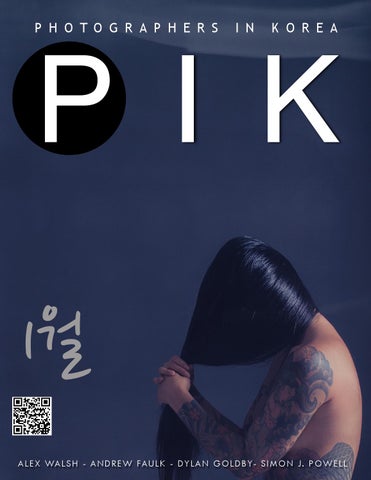
P I K P H O T O G R A P H E R S
I N
1
K O R E A
1월 [ PIK ] PHOTOGRAPHERS IN KOREA | ISSUE 10 , january 2015
AL EX WAL SH - A ND REW FAU LK - DY LA N GOLD B Y- S IMON J. P OW EL L
2
3
[ PIK ] PHOTOGRAPHERS IN KOREA | ISSUE 10 , january 2015
Photo by JĂźrgen Kaiser
EDITOR’S NOTE
We are kicking off the beginning of 2015 with a strong edition of PIK. Not only strong in content, featuring some of the best work on the peninsula, but strong in human power as well. We want to welcome a new line of writers that will help us improve the quality of the stories attached to the photographs. These writers will work together with each photographer to help fine-tune each photo essay to the fullest. As always we hope each photograph, each page will encourage and boost your inspiration. We have a lot in store for PIK this year. That said, here is issue number one for 2015. Enjoy!
Joe Wabe PIK Editor-In-Chief 4
P I K CONTRIBUTERS
[ 10 ] ISSUE
5
Founder, Editor-in-Chief JOE WABE Chief Editor LORRYN SMIT Press Sub-Editor JORDAN VANHARTINGSVELDT Writers DUKE STEWART SIMON SLATER ANDREW CUMMINGS OISIN FEENEY
cover by Andrew Faulk
p h o t o g r a p h e r s i n k o r e a . c o m [ PIK ] PHOTOGRAPHERS IN KOREA | ISSUE 10 , january 2015
P I K
PHOTOGRAPHERS IN KOREA
Contents
JANUARY 2015
16. Marco Devon 18. Dylan Goldby 24. Alex Walsh 30. Andrew Faulk 36. Seoul Subway Project 41.Hearts in a Cage
6
7
[ PIK ] PHOTOGRAPHERS IN KOREA | ISSUE 10 , january 2015 Photo by Dylan Goldby
Photo of the
Month
Photo by George A. Boyle
It’s always disturbed me how often I see people in social settings separate themselves from the crowd so they can check their phones. When I saw this young woman checking her phone in the middle of a busy club, I knew I had to capture the moment. I think it speaks not just to Korean culture, but to where we’re moving as a global society. The more we invest our time in social media, the less social we actually become.
8
9
http://georgeaboyle.com/
[ PIK ] PHOTOGRAPHERS IN KOREA | ISSUE 10 , january 2015
March 1~29. Cafe Gallery Salve , Busan
best of pik
january
Photo by Marco Devon10
11
Even though it’s still dreary and cold outside the photographs we featured this January were bursting with life and color. From sunsets to great portraits, we were happy to receive a great variety of beautiful work from around the country. We chose the best of the best (which of course was not an easy task) to feature in this issue. And without further ado here are our top submissions...
Photo by Dylan Goldby
Photo by Lorryn Smit
[ PIK ] PHOTOGRAPHERS IN KOREA | ISSUE 10 , january 2015
Photo by Lorryn Smit
Photo by Ban Teng Ruen
12
13
Photo by Nathaniel Merz
[ PIK ] PHOTOGRAPHERS IN KOREA | ISSUE 10 , january 2015
Photo by Joe Wabe
14
15
Photo by Nathaniel Merz
Photo by Shuvra Mondal
P [ PIK ] PHOTOGRAPHERS IN KOREA | ISSUE 10 , january 2015
[
5
] minutes with marco devon
1. When did it all start? I think it started a while ago before I even knew I wanted to pursue photography. I was intrigued by photography since high school. In a way, I`m kinda glad it officially started in October 2012, a month after I arrived in Korea. I`m glad it started here the way that it did. New environment and fresh state of mind to start from the beginning. Korea provided me with enough mental space to pursue it truthfully.
2. How do you define your style? I get a headache when I think about it. I haven`t yet settled on any kind of branding. If I look back at my photographs over the two years I`ve been doing this, I can see that its moved in a good direction. Back then, I followed too many rules and as a consequence my images said very little. These days I am making a point of adding some kind of element of storytelling to my photographs. I feel more engaged by doing that. I find myself producing monochromes fairly often for the simple reason of it being more intimate.
3. Nikon or Canon, what is your answer? Nikon Or Canon. Fujifilm. As soon as full-frame is available, I will definitely be migrating from the Canon stable. I feel like I`m using an Apple product when confronted with Nikon or Canon. The systems are too closed. I currently own a 6D and I enjoy it. But I feel something very different when I have my x100s in my hands. I feel like Fujifilm puts far more thought into their cameras. Just my thought.
4. Biggest achievement so far? I think my biggest achievement so far is making it onto the cover of PIK`s Top 50 and I thank you guys for that. I honestly haven`t really put myself “out there� yet. I`ve been sailing under the radar a bit. I see some photographers pushing really hard. Some are paying money and sponsoring every single image they upload to their Facebook page, some are entering competitions and pursuing many different avenues to get noticed and its ok because we`re all in different places within photography. I have yet
https://www.facebook.com/marcodevonphotography
16
17
to find myself in that chaos. I`m enjoying this time of just learning, focusing and producing images of what I think I want to be producing and what I enjoy producing. But I think that`ll soon change. It has to.
5. How far do you want to go? I honestly hope to go pro eventually. As much as I enjoy and love kids, I definitely don`t see myself teaching for the rest of my life. I sure as hell don`t want to go back to the bitterness of Information Technology either. So pro it`ll have to be. Getting into the market and finding a place in the scene is insanely difficult though. But I`ll give it a solid shot.
P
[ PIK ] PHOTOGRAPHERS IN KOREA | ISSUE 10 , january 2015
[ Dylan Goldby ] By Andrew Cumquat
Australian native Dylan Goldby bought his first DSLR when he moved to Seoul ten years ago as a student. Since then, photography has become an integral part of his personal and professional life. ‘I got hooked,’ writes Dylan in our correspondence, adding that he juggled photography with other pursuits, including teaching, for three years before taking on photography full-time.
18
19
There were attempts at other creative outlets – drawing and music among them – but photography endured, opened new paths of expression for him. ‘I’ve met some of my best friends through photography,’ he adds, ‘and some of the best photographers I know, too.’ His earliest experiments in photography were limited in part by a lack of confidence. ‘Whether it be approaching people, or standing kneedeep in mud for the angle I wanted, putting myself in those situations would have resulted in much stronger photographs,’ he admits. Instead, he ‘spent far too much time taking pretty photos, and destroying fantastic light with various multiple exposure methods.’
[ PIK ] PHOTOGRAPHERS IN KOREA | ISSUE 10 , january 2015
Clearly, though, his efforts have paid off: Goldby’s photographic pursuits now allow him to produce many different kinds of work and bring him into contact with all sorts of people, from international magazine and events teams to newlyweds and couples about to adopt. And just as Korea has been something of a teacher for him, a ‘place of learning [and . . . ] development’, Goldby now passes his know-how on to others in the form of blog posts and workshops via Flash Light Photography Expeditions. Within his practice, Goldby most enjoys ‘portraiture with a documentary flair,’ which he sees as ‘record[ing] slices of history.’ With a sensitive eye he captures his subjects, who include
couples on the cusp of married life, siblings playing hide-and-seek with each other and the camera, and chefs proudly displaying their creations. For Goldby, in fact, portraiture is both the most rewarding and the most challenging kind of work. On a personal level, he explains, ‘seeing the faces of clients and individuals I photograph when they receive their images is an incomparable feeling.’ And in artistic terms, although admiring of the capacity of the lens to capture the ‘true’ and the ‘real’, Goldby believes that, with the intrusion of the photographer’s eye, ‘nothing is more difficult than objectively and accurately photographing moments that may never happen again.’
20
21
“
We’re not solving the world’s problems, but we may just be able to change the world for the individuals we work with.
”
[ PIK ] PHOTOGRAPHERS IN KOREA | ISSUE 10 , january 2015
http://www.welkinlight.com/
22
23
For Goldby, perhaps the most important element of a photograph is the story it tells. The photographer in all sorts of ways can tease out the story of a portrait, he feels. Sometimes, the photographer might use the subject to conjure a feeling or emotional response in the viewer; in a certain sense the subject becomes an object or ‘a tool’. At other times, the subject is the focus, and the photographer’s task is to find something – an expression, a gesture, a moment – to draw out ‘who they are’. In any case, the hallmark of any successful photograph is meaning, for ‘if the photograph fails to convey some sort of meaning to the viewer, then it has been unsuccessful.’
Goldby began taking photographs in earnest after leaving his country of birth; it’s only fitting, then, that travel also features heavily in his photography. Armed with a passport bursting with visas and stamps, particularly from countries in Asia, Goldby’s favorite destination so far has been Myanmar. Like Korea, the country is in a state of rapid and dynamic change; this, too, motivates Goldby to take to the lens, wishing to capture scenes of a world that might soon be unrecognizable. In Korea’s case, Goldby’s focus on more traditional elements that are ‘being forgotten’ is deliberate, noting that ‘there is a lack of focus on keeping them around’ because of what he terms the nation’s
‘steamroller efficiency’ in its pursuit of the future at the cost of the past. What’s next for Goldby? Along with his wife, he’d like to return to India, particularly Rajasthan, although he also has his sights set on Ethiopia and New Zealand. Wherever he might travel to, and whatever projects may be in store for him, Goldby remains driven by the idea that photographer matters. ‘We’re not solving the world’s problems,’ he writes, ‘but we may just be able to change the world for the individuals we work with.”
P
[ PIK ] PHOTOGRAPHERS IN KOREA | ISSUE 10 , january 2015
[ Alex Walsh ] By Duke Stewart
Alex might not be in Korea anymore, but he knows something special happened here. In Korea was where Alex feels his photography first took off, after hardly touching a camera while living in Seoul. The hardest thing was always capturing the right moment, and that can be applied to the way Alex approaches photography. Any other time and place yields different results. That description fits when describing each shot this photographer takes. 24
25
[ PIK ] PHOTOGRAPHERS IN KOREA | ISSUE 10 , january 2015
s
Moment
ays w l A , First
His goals are simple. Natural situations come first and foremost above composition. The latter is important, but for Alex the moment’s importance can’t be overemphasized. Without perfect arrangement the event is always still there. Without that split second decision to capture, there’s no photo. Matching the composition with the moment is the challenge. Alex doesn’t hesitate to criticize his own work. One example is a recent trip around his new home in Malaysia. Out of thousands of photos taken over five days, a staggering three met his expectations. Alex even looks at his most popular photos with disdain. Other than constantly raising the personal bar and taking more photos, Alex can’t overstress the importance of “the moment.” Capturing that perfectly timed event is so crucial. Once Alex has found the right place and had enough time to figure it out, he gets to work. Landscape photos were his first interest and that can be seen in “Lightning Storm at Dongdaemun Design Plaza.” He soon went in a new direction towards his current passion. Interest in looking up and down at distant places quickly waned in favor of the streets and city dwellers walking through them.
26
27
es
tin u o R y Dail
He needs people and situations. “Late-night Subway Across the Han River” perfectly fits this, and was Alex’s most technically difficult photo to compose. Panning the camera set at a shutter speed that matched the train’s velocity was difficult enough, but the train curved through the landscape and made the shot nearly impossible. Thankfully, it worked. Alex since tried to recreate that shot and failed, but that’s a big part of his goal when taking photos – find a shot that can’t be reproduced. That train photo made a great transition while Alex was discovering his true purpose. As “Three People Walking through Dongdaemun Tunnel” demonstrates, he was headed on a path towards something brighter. [ PIK ] PHOTOGRAPHERS IN KOREA | ISSUE 10 , january 2015
People in ordinary situations piqued his interest and the concentration required also spiked. His “Fisherman Enjoying a Cool Autumn Evening” reasserts Alex’s drive to capture the right moment. Hoping the man would remain still enough to match a slow shutter – with so many of Seoul’s most iconic buildings in the background – took dozens of attempts. There we have the 63 Building, and others, demanding attention but for Alex, it’s the fisherman having an evening out with his rod and reel. All that effort for such an ordinary moment truly shows the hard work and care Alex puts into his pictures.
Accessible P hotos, Functional C amera Through displaying the mundane and routine parts of life, Alex’s photos are accessible. People can come across these images and think that no matter where we are in the world, people’s lives can have similarities. Those simple moments bring out the best in his photos, as Alex wanders around with his 35mm Olympus. It’s a more functional camera than the others he’s owned before and helps Alex navigate the crowds in his new home - small enough to help him deal with any situation.
28
29
It’s a tool that’s helped him capture the normal with clarity. Through “Man with his Dog,” Alex thinks the usual day is perfectly encapsulated. Here, you have a businessman whose clean-cut and ordinary enough, walking his dog. It’s the man’s moment. This is probably his way of escaping the chaos back at the office. Basic. As for future work, Alex is settling into a new job and country. He wants 2015 to be a year where he brings in more texture and colors, like in “Umbrella.” That photo has a personal connection as well because his fiancé loves that one. More so, it combines his mantra of capturing the moment with illuminating colors and textures. Had he miscalculated the shot by a millisecond, more people certainly would’ve crowded the frame. The empty market Alex longed to express would’ve been lost.
is Mind Korea on h Even though Alex is looking forward to new challenges, it’s unavoidable to look back without thinking of those who helped him while in Korea. Alex sprinkles homage in with almost every photo that he’s offered here. His humility can’t be ignored. For his most important influence, Alex looked fondest towards the beginning and one particular person who nudged him in the right direction.
Alex fondly spoke about how John Steele invited him out for a joint photo session. After a bit of shadowing and learning the basics of getting the right shot, Alex claims that night to be where he took his first “proper” photo. John might’ve long forgotten about that night but Alex never will. Had John not offered to help, Alex would’ve never started taking photos. Judging from shots as exciting as those Alex has shown us here, it’s suffice to say we’re lucky he did.
P
[ PIK ] PHOTOGRAPHERS IN KOREA | ISSUE 10 , january 2015
[ Andrew Faulk ] By Oisin Feeney
Andrew Faulk has been immersed in Korean culture for quite some time now. He moved here with his wife, Laura, six years ago. He was born in Memphis, but raised in the mountains in the east of Tennessee. He describes himself as a Southern boy born and raised, who prefers to be alone than in crowds; he loves both metal and bluegrass music, and (like a lot of photographers!) he also drinks way too much coffee. 30
weekend warrior
31
[ PIK ] PHOTOGRAPHERS IN KOREA | ISSUE 10 , january 2015
He contradicts himself all the time; he loves travel but hates flying and for some bizarre reason he gets really excited when he hears bagpipes or Tuvan throat singing. When the US economy crashed in 2009 he was working as a public school teacher. He faced either pay freezes or worse, losing his job. In his words: “The American dream wasn’t looking too dreamy to me.” So he took a leap and hasn’t looked back since.
32
33
He has been shooting for several years now but got his first DSLR in 2011 and has been a very active shooter since. He does not consider himself a professional and believes that ‘professional’ should not be treated lightly. He claims: “A professional is one who makes their living with a craft. But, to me, a professional is made of more substance than client lists and their pricing guide. There are very few photographers who actually understand the myriad facets that make a modern photographic professional (i.e. light, their cameras, theory, marketing, branding, photographic history, and post processing). Moreover, there are even fewer who possess the people skills to sell their product. It will be years and years before I would dare say that I was a professional.“ He describes himself as a hobbyist and a ‘weekend warrior’ instead. He sees an immense joy in shooting just for shooting. A photo doesn’t need to be printed, published or posted anywhere. It just has to make the photographer feel happy to capture a beautiful moment in life through their lens. During the week he works as a literary specialist at an international school in Seoul and as a photographer he has established a bit of a name for himself in the community here. His photos are incredibly atmospheric and somewhat opaque. He describes them as ‘ghostly,’ and I couldn’t agree more. A lot of his images are blended together and possess a wealth of depth and color. When asked about his favorite style to shoot he states: “People. I adore portraiture of any
[ PIK ] PHOTOGRAPHERS IN KOREA | ISSUE 10 , january 2015
http://www.andrewfaulkphotography.com/
sort. Portraits are very intimate. You are capturing a person as they are at a certain instant in their life. The subject will never be the same as they were when you clicked the shutter. That is special.” His shots are very intimate indeed and convey an emotional interaction with his subjects. Though he does take on a client here and there, at this moment in time he is not actively pursuing a career in photography. Right now he wants to concentrate on improving his portfolio instead of getting paid. As I’m sure we are all aware, when one begins to
get paid for an art it can sometimes take away from the allure of the art itself. His photo taking process is very interesting. He is not a fan of Photoshop and is loyal to Lightroom. He also uses a lot of in-camera blending. He shoots off a Canon 5d mark three and frequently uses the built in multi-exposure function which layers images together in camera, without the need for a complex Photoshop edit. While it takes a lot of practice, the results are stunning. With regard to equipment, he does not have a favourite lens but
his most useful one is the Canon 24105 F/4 L Series. It is a workhorse of a lens, extremely versatile and works as long as there is enough light for the aperture. His least favourite lens is his Sigma 120-400 f/4.5-5.6. He refers to this one as ‘The Tank’. Big, clunky, not particularly useful for him but bought when he was in the midst of a dangerous condition known as ‘Gear Acquisition Syndrome’. He has no use for it but can’t let it go. I asked him about how he improves his photography skills and he had this to say:” I look at photos. I spend a lot of time
34
35
enjoying the work of other photographers. Observing the hard effort of others is a huge learning tool in and of itself. I also spend time on YouTube or, better yet, chatting with other photographers.” There has been a very active community of photographers in Seoul to influence and shape his style and help guide him into his niche. But city life doesn’t really appeal to Andy. In five to ten years he would like to settle down in a small town in the USA near the mountains surrounded by his family and nature. City life was never a big part of his photography too. “The excitement of street shooting wore off pretty quickly for me in Korea. I am just not a city shooter. By looking at the work of Pete DeMarco, Jason Teale or John Steele it is apparent that there are many spots perfect for landscape/ cityscape photography here in Korea. Yet, I have found my niche here in portraits that are not really bound by location.“ So what does the immediate future hold for Andy Faulk? Well alas, Korea is losing him. He is moving to Japan to a suburb of Tokyo for the next
three years due to an excellent job opportunity. He does not see this as a bad thing though: “We have been in Korea for six years and it seems like the perfect time to leave. Many foreigners outstay their welcome; we want to leave while we are still in love with Korea.” So although the community here is losing an excellent, talented photographer I can only imagine Andy is moving on to better and brighter things. I wish him the best of luck in his endeavours and hope that he can find the peaceful, meaningful existence that he seeks.
P
[ PIK ] PHOTOGRAPHERS IN KOREA | ISSUE 10 , january 2015
Ssp Seoul Subway Project
It started over coffee, like many good things in life. Marco Devon and I were discussing our respective trips to the meeting point and the trains that brought us there. With a daily rider-ship of approximately ten million people, there is so much to take in every time you descend the stairs to commute. Countless people staring at screens as they shuffle across the platform, a child ducking between the legs of passengers to retrieve a runaway toy, friends sharing a laugh and a cup of coffee, red-eyed salary-men on the way home from the day’s company dinner, subway deliverymen laden with shopping bags, the screech of brakes, announcements over the loud speakers. Human behaviour at its best or worst, we couldn’t decide, but certainly at its most representative. The idea of documenting the feeling of being a part of Seoul’s subway system had us hooked.
Words: Dylan Goldby Photos: Marco Devon and Dylan Goldby
36
37
[ PIK ] PHOTOGRAPHERS IN KOREA | ISSUE 10 , january 2015
38
39
We were to focus on the lonely, dystopian aspect of the subway, and keep every image in black and white. We gave ourselves a two-month window to shoot, and a month to edit and pare down the set. Just a quick project to get us through the winter. The goal was to create an exhibition and a book, both of which should be ready for February. For the time being, head over to our Facebook page (https://www.facebook.com/seoulsubwayproject) to see some of the work as it is posted there and keep an eye out for the exhibition date.
P
[ PIK ] PHOTOGRAPHERS IN KOREA | ISSUE 10 , january 2015
40
41
Simon J Powell’s SCHOOL series.
Hearts in a Cage:
By Simon Slater [ PIK ] PHOTOGRAPHERS IN KOREA | ISSUE 10 , january 2015
42
43
Simon J Powell’s latest photography series sees his unique image creations crafted from his own workplace, honing in on the dark side of the Korean education system. Within Jeju Island’s dramatic and fascinating geographical formations lie one of it’s externally sourced natural wonders - photographer Simon J Powell. Powell’s striking imagery has become instantly recognizable within Korea’s expat photography scene with his bold use of black and white, unconventional angles and an intimacy toward his Korean subjects that goes beyond the timidity of most foreigners’ lenses. Jeju, with it’s blend of natural beauty and shamanic mythology, is the perfect base for a natural artist like Powell, who says “My home is an ancient, towering volcano, rising out the middle of the ocean, what’s not to like?”. But, as he further explains, the semi-tropical island’s powder white beaches are but “a five minute stroll away for me in a lazy lunch-break, but a world away from my students’ daily lives.” The Korean school system is notoriously intense, and combined with a plethora of after-school academies, students are left with little free time to themselves. Even within the relaxed environs of Jeju, “they spend weekends and vacations packed cheek-by-jowl in public libraries, cramming for wave after wave of examinations.” This high-pressure path to young adulthood was the grounds for Powell’s SCHOOL photo series.
His images, taken at the school he teaches, show students sleeping on desks, carrying out punishments in the hallway, looking caged behind windows and doors and stuck studying in empty classrooms. It’s undoubtedly a bleak perspective, but completely subjective. “I would say the series reflects to an equal (if not greater) degree the emotions of my personal life, as much as my opinion of the school system. I was going through an unusually difficult time during the month in which I captured these images, and perhaps that enabled me to empathize with my students on a deeper level.” Powell’s signature black and white style adds weight to the serious subject matter here, explaining that it has a “tendency to distance the subject matter from reality.” He continues: “We are accustomed to seeing life in color, so a rendition of the world in monochrome forces us to pause and look more closely. Black and white portraiture lets the audience see a face and read the eyes without distraction. In essence, color photographs of people accentuate the external; black and white shows us something of the soul.” His own students’ lives and his old school days are somewhat of a black and white contrast. Growing up in England, Powell had a starkly different experience to what he portrays in his SCHOOL imagery. “Mine was a positive experience, characterized by a nurturing, open-minded atmosphere of choice, opportunity, and self-motivated learning and specialization.” This is not to say that he can’t
[ PIK ] PHOTOGRAPHERS IN KOREA | ISSUE 10 , january 2015
relate to the struggles of those around him, as he explains: “There is something profoundly universal about the nature of youth and the trials of adolescence. By and large we are all born with far more similarities than differences. Children are children everywhere. However, the ways we are educated to act and think, how we are taught what the world is and what it means to be human and alive: these things vary dramatically. They shape not only how we perceive the world, but the essential nature of the world itself.”
In a school system comprised of tests, memorization, punishment and few rewards, Powell says “In Simon Teacher’s classroom carrots beat sticks, every time. I believe my job has nothing to do with controlling my students. Rather it has everything to do with inspiring them to learn.” I can show my students something of the world beyond dry textbooks and multiple-choice exams, beyond the ubiquitous television and smartphone screens, beyond the concrete towns and cities they live in, beyond the borders of a small country of 50 million people. I can show them something of the 7 billion out there
in a world of infinite possibilities.” The desolate world he shows in this series isn’t entirely true to life, however. In fact, it’s “deliberately one-sided.” Contrary to the bleak tone of series, he explains: “My time teaching here has been fantastically rewarding and positive, filled with laughter and inspiration.” Inspiration, it seems, is something this particular photographer is never short of. To see the latest in the SCHOOL series, and other works, go to the Facebook page ‘Simon J Powell PhotograP phy’. 44
45
[ PIK ] PHOTOGRAPHERS IN KOREA | ISSUE 10 , january 2015
46