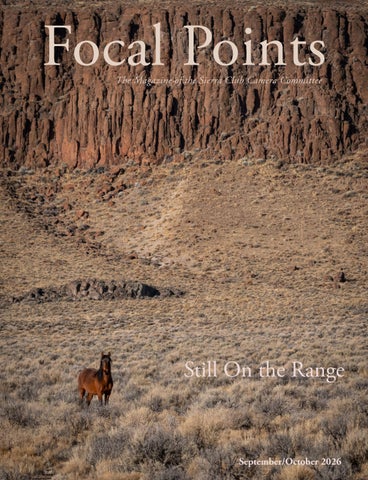
Focal Points The Magazine of the Sierra Club Camera Committee
Still On the Range
September/October 2026
SCCC Leadership
Chair Programs Treasurer Membership Editor Communications Instagram Outings Outings
Joe Doherty Susan Manley Ed Ogawa Joan Schipper Joe Doherty Velda Ruddock Joan Schipper Joan Schipper Alison Boyle
joedohertyphotography@gmail.com SSNManley@yahoo.com Ed5ogawa@angeles.sierraclub.org JoanSchipper@ix.netcom.com joedohertyphotography@gmail.com Velda.Ruddock@gmail.com JoanSchipper@ix.netcom.com JoanSchipper@ix.netcom.com AlisoniBoyle@icloud.com
Focal Points Magazine is a publication of the Sierra Club Camera Committee, Angeles Chapter. The Camera Committee is an activity group within the Angeles Chapter, which we support through the medium of photography. Our membership is not just from Southern California but is increasingly international. Our goal is to show the natural beauty of our world, as well as areas of conservation concerns and social justice. We do this through sharing and promoting our photography and by helping and inspiring our members through presentations, demonstration, discussion, and outings. We have members across the United States and overseas. For information about membership and/or to contribute to the magazine, please contact the editors or the membership chair listed above. Membership dues are $15 per year, and checks (payable to SCCC) can be mailed to: SCCC-Joan Schipper, 6100 Cashio Street, Los Angeles, CA 90035, or Venmo @CashioStreet, and be sure to include your name and contact info so Joan can reach you. The magazine is published every other month. A call for submissions will be made one-month in advance via email, although submissions and proposals are welcome at any time. Member photographs should be resized to 3300 pixels, at a high export quality. They should also be jpg, in the sRGB color space. Cover articles and features should be between 1000-2500 words, with 4-10 accompanying photographs. Reviews of shows, workshops, books, etc., should be between 500-1500 words. Copyright: All photographs and writings in this magazine are owned by the photographers and writers who created them. They hold the copyrights and control all rights of reproduction and use. If you desire to license one, or to have a print made, contact the editor at joedohertyphotography@gmail.com, who will pass on your request, or see the author’s contact information in the Contributors section at the back of this issue. https://angeles.sierraclub.org/camera_committee https://www.instagram.com/sccameracommittee/ Focal Points Magazine September/October 2026
Focal Points September/October 2026
John Moses on the Lower Salt River in Arizona. Photo credit Ruth Jenkins DEPARTMENTS
COVER STORY
2 From the Chair
4 Still on the Range The majesty of wild horses across the American West, the pressures to remove them from public lands, and the people who fight to preserve them.
3 Announcements 30 Member Photos 72 Contributors 76 Parting Shot
By John Moses COLUMNS
16 Zuma and Solstice Canyons By Diane Gunderson
22 Trip Report: Four Days in the Redwoods By John Nilsson
Cover Photo: Stone Cabin Valley, Nevada, 2025 © John Moses 1
From the Chair
Some profound experiences sneak up on you. In August 2024 Alan Der led an SCCC outing to photograph the Perseid Meteor Shower. We camped for two nights below Granite Mountain in eastern Mono County, at an elevation of about 7,300 feet. The sunset and sunrise were magnificent, and the meteors did not disappoint. During the day we headed east a few miles to Adobe Valley, where at least one herd of horses were in residence. I had heard of these horses, and seen some photographs of them, but I had never taken the time to arrange a trip there myself. I wasn’t expecting anything to happen except getting some telephoto shots of horses a football field away. And when we approached the herd that is exactly what we did. And then the herd came towards us. And kept coming. And walked through our group. Twice. They allowed their foals to rub against us, sniff our backpacks, and go to sleep near us. We got uncomfortably close-up views of combat, and also witnessed the older mares put a stop to it. The horses lingered with us for more than 30 minutes, and then moved on. It was an extraordinary encounter with animals that few ever get close enough to see, let alone to touch. It wasn’t just the encounter with individual horses that was profound, it was observing how they related to each other without the influence of man. This was a complex society of very healthy animals living free on the range. And it was that insight into the relationships and dependencies within the group that made the recent BLM capture of many horses so painful to read about. John Moses’ cover story explores these issues in depth, as only a photographer who has dedicated his time to documenting and Focal Points Magazine September/October 2026
learning about wild horses can do. The photographs are intentional. He went looking for specific herds, specific bands, even specific horses across the American West, and photographed them beautifully. I encourage you to read the article, and follow the links to the research supporting his work. I’m so glad he agreed to write it for us. As I mentioned, my first encounter with the wild horses of Adobe Valley came during a Sierra Club Outing. You may have recently received an email announcing an Outings Photo Contest celebrating 125 years of outings. That is certainly something to celebrate. Ansel Adams led outings in the Sierra Nevada, and we follow in his footsteps. Photos of the horses from my 2024 trip would obviously qualify. But I read the terms and conditions, and here is my recommendation. Do not enter the contest. The Sierra Club asserts that by entering (not winning, entering) you have granted it a license to use your photograph anywhere, forever, without compensation, and without giving credit to the photographer. Magazines do this with their contests (Arizona Highways is one), and they use those entries to illustrate stories years in the future. It’s a way to build their digital archives for free. I wrote a letter to Outings pointing out that this surely wasn’t their intention, and that the language could be easily changed to satisfy the purpose of the contest (celebrating the 125th anniversary) while respecting the intellectual property of the artists. I heard back that it was forwarded to legal, and I haven’t even heard crickets since then. If that changes I’ll let you know. Joe Doherty
The Power of Visual Storytelling Thursday October 8, 7pm
Announcement
Stephanie Vermillion
Stephanie Vermillion is a freelance journalist, photographer, and filmmaker covering outdoor adventure, culture, and nocturnal wonder for National Geographic, Outside Magazine, Travel & Leisure, and Vogue. She hosts a monthly 'Travel Goals' adventure video series for National Geographic Travel's Instagram, and she's Outside Magazine's astrotourism columnist. Her photography has been published by National Geographic, Outside, Travel & Leisure, and Patagonia, among others. Abrams will publish her new book, , in March 2027. Follow her work on Instagram or via her website, . She will focus on the power of visual storytelling: why it's important now more than ever, how she approaches photography and video work through a storytelling lens, how to find stories, how to pitch stories to media (a very topline overview), and different tips for adopting a storytelling mindset. Register for the meeting here: 3
Cover Story
Still on the Range Photographing Icons of the West Free-roaming bands of mustangs remind us that this country of ours is still wild, and thus, we are at least a little wild too. —Chad Hansen, In a Land of Awe: Finding Reverence in the Search for Wild Horses (2022)
Photographs and Text by John Moses
Focal Points Magazine September/October 2026
Banding Together. Mono Basin, California, 2024 Two years ago, just beyond the stands of Jeffrey pines, east of Mono Mills, two bands stood close together near a watering hole. Two-thirds of the horses in the Mono Basin and Adobe Valley were rounded up this past July. How many of these fifteen remain free?
I’ve been fascinated by horses since childhood. The source of that fascination may have been all the TV westerns I watched growing up in the 1950s, or my visits to the stalls where my next-door neighbors in Pennsylvania stabled their horses, or perhaps just simply the inescapable majesty of horses themselves. Whatever the reason, a few years ago that fascination was reawakened by images of wild horses popping up on my social media feed. Over the years I had photographed semi-wild horses in other countries: ponies in Wales, England, and Ireland as well as in Iceland. Then, in 2023, after reading David Philipps’ excellently
researched Wild Horse Country (2017), I began photographing wild mustangs in the U.S. America’s wild horses have been in the news all summer. Not only have the seasonal roundups drawn more national attention than they have in years, but legal battles between opposing parties have also made headlines. Wild horse advocates have had their hopes raised with judicial stays, only to have them crushed when removal plans were ultimately approved. Even more startling to the wider public has been the article by Philipps (the author of the previously mentioned Wild Horse Country) that exposed 5
the legal loophole allowing wild horses to be moved from federal holding pens to foreign slaughterhouses. That exposé, detailing the surging number of horses disposed of this way, has bolstered calls for Congress to pass the SAFE (Save America’s Forgotten Equines) Act, which would end the killing, though not the roundups. Another bill (the Wild Horse and Burro Protection Act of 2025), languishing in Congress for over a year, would phase out the use of aircraft for roundups, but again would not end the roundups themselves.
Since 1971, with the passage of the Wild Free-Roaming Horse and Burros Act, the Bureau of Land Management (BLM) has been tasked with protecting and managing the wild horses living on public lands in ten Western states from California and Oregon to the Rockies. For that purpose, the BLM established “appropriate management levels” (AMLs) for each of the 175 Herd Management Areas (HMA) under its authority. The AMLs have created as much controversy as have the means to achieve them. Nonprofit groups like and
Crossing in Morning Mist. Lower Salt River, Arizona, 2024 After three unsuccessful hikes along the Salt River to find where the bands were crossing, I finally came upon them our last evening there as they were crossing to the far bank. Early the next morning I was back at the same spot to capture their return.
Focal Points Magazine September/October 2026
In the Cerbat Mountains. Arizona, 2024 These Cerbat mustangs were wary as I approached but tolerated my presence.
have pointed to the use of questionable ecological data as well as the undue political influence from the livestock industries. Even the has challenged the way the BLM determines appropriate wild horse populations. This March, the estimated the current population of wild horses in HMAs to be more than 61,000, and, of that number, 11,000 were listed as “excess,” scheduled for removal to off-range holding facilities. More than a thousand of those were from California. In May, prior to the most recent controversies, my wife, Ruth, and I set out on a 5,900-mile road trip that took us through eight wild horse areas in Nevada, Utah,
Wyoming, and Northern California. This was not our first time searching for these magnificent animals. That project began three years ago when we first travelled to Carson City, Nevada, to photograph mustangs from the Virginia Range and the Pine Nut Mountains. After our first evening spent with a herd next to Washoe Lake, I was hooked. For three days straight, we could find a herd of more than fifty mustangs arriving at the lake in the morning and again in the evening. The horses seemed accustomed to human presence, though we shared the area with only two other photographers. That trip was followed by a longer drive to the Lower Salt River in Tonto National Forest, near Mesa, Arizona, and then to the rugged 7
Showdown in Adobe Valley. California, 2024 One morning in Adobe Valley, I found two stallions sparring with each other, mostly in the distance with the herd between us. Toward evening I returned to the same field to find them still battling one another.
Parallel Prancing. Adobe Valley, California, 2025 Wild stallions have a range of aggressive postures short of the dramatic rearing up on hind legs. My favorite is the parallel prance, where competing stallions trot side by side with arched necks. My good fortune on this visit to Adobe Valley was to capture three mustangs prancing together. Focal Points Magazine September/October 2026
Playmates. Adobe Valley, California, 2025 These two foals would be yearlings now. Was their bond broken by the roundup in July?
Cerbat Mountains, near Kingman. By the river, the “Salties” proved difficult to find. For our first two days, I followed online advice of where to begin hiking along the river, with no luck. On our last evening there I chose a different spot to begin walking from and tried to match my memory of FB posts to the terrain on the opposite riverbank. As the sun was setting, I found the spot that had been the background for several recent images, and I waited. To my surprise one band came out of the underbrush behind me to cross over, making my long lens practically useless. Crouching down to swap lenses was not especially safe with the horses so close, but I was determined to continue shooting. Early the next morning I was back at the same spot
to capture their return, this time with the perfect focal length. The Salt River mustangs, managed jointly by the Arizona Dept. of Agriculture and the U.S. Forest Service, were threatened this year with removal, but in August Governor Katie Holmes stepped in to order a pause on the planned removals. Wild horse advocates around the country celebrated! For our stop at the Cerbat Mountains HMA, we arrived in Kingman in the afternoon, then drove north of the city to Vock Canyon Road. The BLM estimates that only 150 wild horses live in this rugged 83,000-acre area, their number believed to be kept stable by mountain lions. Before the road became even 9
Quiet Evening, Stone Cabin Valley. Nevada, 2024 A small band peacefully grazing before sundown. I especially like the “fairy knots” on the grey mare on the right.
rockier and nearly impassable, we were fortunate to sight a small band of five. Their thick, chestnut coats glowed in the late afternoon sun, and their sturdy, compact build gave visual evidence of the genetic testing linking them to the colonial Spanish mustangs. The family held their ground as I walked toward them before they ascended the mountain and disappeared over the ridge. A few months later I was planning the first of two winter trips to find the Stone Cabin Greys of their remote and vast HMA, 30 miles east of Tonopah, Nevada. The greys were a favorite of Velma Johnston, Wild Horse Annie, whose decades-long advocacy brought about the law protecting wild horses. The high-desert back roads through Stone Focal Points Magazine September/October 2026
Cabin Valley are easy to navigate, though I advise against going over the Monitor Range from Ralston Valley into Stone Cabin. We tried it, following a family band up into the mountains, only to have the county road near an abandoned mine tunnel collapse under us. We had a long wait before a tow truck arrived to pull our vehicle out. Every encounter with wild horses involves their perception of appropriate flight distance, the length the animals maintain to elude potential threats. At Washoe Lake, that first herd I had photographed did not perceive me as any threat. The challenge there was to keep a respectful distance from the horses, especially curious foals. In Stone Cabin Valley, the challenge was to find a band close enough
in the open expanse that they were more than tiny figures in a cloud of dust miles away, or if closer to capture them before they raced away because they were so wary of human presence. After those longer trips, I took advantage of a wild horse area closer to my home in Fresno, California, between Mono Lake and Montgomery Pass, Nevada. The terrain varies greatly for bands in this region, from the pine forests surrounding Mono Mills to the wetlands in Adobe Valley and the rocky scrubland of Nevada. Three separate trips there provided the images to complete the portfolio I intended for a photography exhibit at Fresno’s Spectrum Art Gallery, which I had titled “In the Company of Wild Horses.” The Mono Basin has been one of the areas where this summer’s drama first played out in a
courtroom, when a lawsuit filed by the Utu Utu Gwaitu Benton Paiute Tribe initially paused the planned roundup of more than 450 wild horses, about two-thirds of the herd, but ultimately failed to stop the removals in July. Preparing for the exhibit at Spectrum Gallery was just a pause in my desire to see more herd areas in other Western states. I was still hooked and now drawn to well-known herd areas in Idaho and Wyoming—especially the Onaqui, Salt Wells Creek, and McCullough Peaks. For our return home, I also planned a stop in Surprise Valley, near Cedarville, California, to find the beautiful dun-colored Carter mustangs. On our drive through Nevada, we stopped at Fish Creek HMA, just outside Eureka. We
Racing to Water. Onaqui Mountain HMA, Utah, 2026 Just as we returned to the North Herd at Onaqui, the bands began racing downhill to their water troughs. 11
found only two small bands there. As in Stone Cabin, the horses were very wary of us: my captures at 800mm were still tiny figures on the landscape. A trip to Roberts Mountain HMA, 25 miles northeast of Eureka, was even less successful. From Fish Creek, we headed to the Onaqui Mountain HMA near Tooele, Utah. After the disappointing number of mustangs sighted at Fish Creek (only eleven), we quickly experienced why the Onaqui area is so famous. Coming from the south on Pony Express Road (20 miles of washboard and gravel road) heading toward Simpson Springs, we were greeted by "Joker," identified as a
"solitary bachelor" in the thoroughly documented . A beautiful, but heavily scarred stallion, grazing with a pronghorn nearby, Joker was not at all troubled by my presence and playfully trotted toward me, then crossed the road to pose again. Joker was just our introduction to the South Herd, which we found a few miles farther on: five or six bands close together, about 30 horses by our count. On both the first and second days, the stallions engaged in the most dramatic challenges I have witnessed in person. Continuing toward Tooele, we found the much larger North Herd, which the
Solitary Joker. Onaqui Mountain HMA, Utah, 2026 Joker welcomed us to Onaqui. Grazing with a pronghorn nearby, he was not at all troubled by my presence and playfully trotted toward me, then crossed the road to pose again. Focal Points Magazine September/October 2026
On High Ground. Salt Wells Creek, Wyoming, 2026 One of many foals enjoying their freedom at Salt Wells Creek.
Catalogue puts at 188, although we saw only half that number. These bands were calmer, and we witnessed no drama until late on the second day, when they raced downhill toward a water source. Fortunately, we were not in their path! Next on our itinerary was Salt Wells Creek HMA, near Rock Springs in southwest Wyoming, celebrated for its curly-haired mustangs. Unlike the well-protected Onaqui herds, the Salt Wells Creek horses have been threatened for mass removal since 2023, when the BLM changed the area’s designation from a HMA to a “zero-horse” herd area. Rulings have seesawed ever since, but a final decision may come this October, with more than a thousand horses at risk. Every band we saw
included two or more foals, but on-range fertility control would be a more humane way to manage herd growth than large-scale roundups, and even less costly. On-range darting with the PZP (procine zona pellucida) contraceptive vaccine is just a fraction of the cost for off-range treatments and is even more cost-effective when compared to expenditures for holding facilities. Currently two-thirds of the for its wild horse program goes to the off-range corrals and pastures, but only is allocated for on-range contraceptive fertility control. Still, the darting programs that have been implemented have a proven track record, though they could not succeed 13
Bands Apart. McCullough Peaks, Wyoming, 2026 Three bands huddled close together yet maintained their distance from one another.
without the unpaid labor from local volunteers tracking and darting the mares.
stallions and no obvious evidence of past battles.
That approach has proven successful in the McCullough Peaks HMA, near Cody, Wyoming. There, a PZP darting program, through the efforts of FOAL (Friends of a Legacy), has stabilized herd size to around 150 horses since the last roundup in 2024. Of course, that small number on 110,000 acres makes finding bands more challenging, especially on the east side, where we saw families of Paints roaming far in the distance. We did have more luck on the west side, where several bands had gathered close to the dirt track we had followed.
We headed out from Cedarville late in the afternoon, taking CA 299 to the Nevada border. At the state line, the macadam road switched to dirt as the road rose through the Hays Range. We continued all the way to the valley east of the range without a single sighting or even a manure pile to raise our hopes. On our way back just over the border to California, with the sun about to go below the mountains, we saw a family band, just a few hundred feet off the road. We had almost missed them, their dun coloring blending into the dry sagebrush. The golden hour made them even more striking than I had expected. Over the next two days, we found other bands near a water source, but that first evening was the most magical.
Our final stop to herd areas this summer was to Surprise Valley in California’s Modoc County. We were there to search for the rare Carter Reservoir mustangs. Genetic testing has verified their Spanish-Iberian ancestry, which gives them their beautiful dun coloring, ranging from cream to reddish brown, dark stripes along their spines as well as on their knees and hocks, dark outlined ears, and facial cobwebbing. These were peaceful bands: we saw no challenges between Focal Points Magazine September/October 2026
The BLM estimates that the Carter herd numbers close to 500 and planned to remove 470 beginning September 1. Fortunately, a court order in August has blocked the planned removal. Had the roundup gone ahead, the genetic health of this distinct herd would have been jeopardized.
In the past three years I have visited fifteen different wild horse areas. My time on these public ranges has not sated my passion for observing and recording the lives of these iconic animals. It has only increased my longing to return to them. Each encounter has given me greater appreciation of their beauty and resilience and a deeper understanding of their complex, social behavior—from their gentle greetings and mutual grooming to challenging postures and dramatic battles for dominance. The summer roundup in the Mono Basin was heartbreaking for those of us in the wild horse community, and I was apprehensive of what I would find, or rather the horses I would not
find, on my trip there this Fall. I was relieved that the herd in Adobe Valley, though smaller, still numbered about 75. However, I could find none of the mustangs I had previously photographed in the Inyo National Forest. Have they all been removed, or are a few hidden among the pines? Perhaps I will find an answer on my next trip there. Today, America’s wild horses face many threats—not just from drought and wildfires, but from human actions and inaction. The BLM must do better, and so must Congress. These icons of the American West, living symbols of freedom, should be valued and protected.
A Carter Family. Surprise Valley, California, 2026 At golden hour, the distinctive dun coloring of Carter mustangs is especially lovely. 15
Zuma and Solstice Canyons Plant Communities in the Santa Monica Mountains Text and Photographs By Diane Gunderson The Santa Monica Mountains are largely characterized by numerous canyons sloping down from the highest peaks including Sandstone Peak, Boney Mountain, Castro Peak, and Saddle Peak. These canyons we enjoy today have formed over millions of years by water collecting and forming creeks in the headwaters near these peaks, which then carve out slopes and valleys as they flow towards their outlet at the Pacific Ocean.
light. Plant communities especially within the context of wildfire ecology in these mountains is a particular interest of mine. As an undergrad at Pepperdine University, I conducted research on mechanisms involved in the recovery of chaparral plants (specifically, Ceanothus spp.) in the Santa Monica Mountains following a wildfire in November of 1993, under the direction of Dr. Stephen Davis.
The trails featured in this article are in two of these canyons familiar to locals and visitors alike, Zuma Canyon and Solstice Canyon. This is the third article of a series highlighting 8 trails included in the Trails Forever Challenge, organized by the Santa Monica Mountains Fund this past year. Zuma Canyon Ocean View trail and Solstice Canyon trail are both moderately-challenging but short (approximately 3-mile) trails easily accessible from Pacific Coast Highway, with stunning views of the Pacific Ocean and the Malibu coastline. As I was shooting these trails and putting this article together, the story that revealed itself was that of plant communities common throughout the Santa Monica Mountains and present in Zuma and Solstice Canyons: riparian woodlands, coastal sage scrub, and chaparral. Elements of the resiliency of nature to wildfires, as well as the devastation that they can impose on the people living in these canyons, also came to
The trails, creeks, coastal valleys, and the plant communities described here are located in the western Santa Monica Mountains, the ancestral and unceded land of the Chumash tribe. The Chumash people lived in these mountains and valleys sustainably for approximately 10,000 years before being displaced by European and American settlers who came to claim land and resources for themselves. Before Europeans arrived, the Chumash had adapted and learned how to thrive alongside wildfires that are naturally a part of the ecosystem here. They did so mostly through cultural burns, which are intentional skillful applications of fire. I recognize that the Chumash that first inhabited these lands are still here, committed to preserving their culture, language, and community. The Zuma Canyon Ocean View trail begins by crossing Zuma creek, which in this section
Opposite page: Zuma Canyon Ocean View Trail in the Santa Monica Mountains overlooks the Malibu coastline and Pacific Ocean. The name “Zuma” comes from the Chumash word for “abundance.” Focal Points Magazine September/October 2026
17
Solstice Canyon Trail contains a mix of native and non-native plants, the latter partly due to development of homes and landscaping with exotic plants in this canyon in the last century. The battle against invasive nonnative species is ongoing especially in areas of soil disturbance. Fortunately, these beautiful trails are maintained by National Park Service and committed trail crews with the Santa Monica Mountains Trail Council, Santa Monica Mountains Fund, California Conservation Corps, and the Santa Monica Mountains Task Force (Sierra Club Angeles Chapter).
is dry in summer but was actually impossible to cross without getting very wet after winter rains in January. Zuma Creek is technically a perennial stream containing water throughout the year in some sections. Solstice Canyon trail also follows a flowing perennial creek in a wide canyon, although some parts slow to a trickle or dry up completely in the summer and fall. Native riparian tree species seen growing along Solstice Canyon Creek and lower canyon areas of Zuma Creek are California sycamore (Platanus racemosa), California bay laurel (Umbellularia californica), white alder (Albus rhombifolia), California black walnut (Juglans Focal Points Magazine September/October 2026
californica), and coast live oak (Quercus agrifolia). After the creek crossing, the Zuma Canyon Ocean View trail ascends to an interesting rock formation and then progresses towards amazing views of the Pacific Ocean, before dropping back down to once again cross Zuma Creek and complete the loop. Along the way on dry, steep upper slopes and ridges, you will encounter chaparral species: dense, woody, drought-tolerant shrubs such as toyon (Heteromeles arbutifolia), Chamise (Adenostoma fasciculatum), various species of mountain or wild lilac (Ceanothus spp.), and sugarbush (Rhus ovata). The dry hillsides
On a sunny day in early June, laurel sumac along Zuma Canyon trail was found in multiple flowering stages. The onset of blooming depends on the microclimate including duration and intensity of sunlight exposure, elevation, proximity to ocean, soil nutrient levels, and slope orientation (i.e., north or south facing). The flower buds are a pink color that give way to dense clusters of creamy white flowers.
Humboldt Lily (Lilium humboldtii ssp. ocellatum): This striking native wildflower is a rare and spectacular sight in the riparian woodlands and chaparral of Solstice Canyon. It can grow up to 8 feet tall, and may contain up to 50 flowers on a single healthy plant.
Bush mallow (Malacothamnus fasciculatus) thrives in dry open areas and disturbed soils across canyon slopes. They are fast growing and a good source of food for animals and insects. The seeds are cracked open by the heat of fire and can stay in the ground for decades until the next fire.
19
sloping down towards ocean are characterized by low lying coastal sage scrub, featuring white sage (Salvia apiana), Black sage (Salvia mellifera), California buckwheat (Erigonum fasciculatum), and California sagebrush (Artemisia californica). These plant communities are also seen on hillsides above Solstice Canyon Creek along the trail. One of the dominant species along the Zuma Canyon Ocean View trail is laurel sumac (Malosma laurina). It is a common droughttolerant shrub found in both coastal sage scrub, sometimes as the primary plant species, or in chaparral, alongside various shrubs mentioned above. In Solstice Canyon, these plant communities on the upper slopes
overlooking the ocean also include laurel sumac. Chaparral and coastal sage scrub species have adapted to the in the dry, hot environment here in the Santa Monica Mountains in many ways. One adaption seen in laurel sumac specifically is its taco shell shaped leaves which reduces exposure of the leaves to the sun. These leaves of the “taco plant”, as it is often called, capture water from rainfall and any moisture in the air, making it available to the plant. In addition, these plant communities have evolved with natural fire return intervals of 50 to 100 plus years, resulting in various adaptations. Laurel sumac is a “resprouter”, meaning after a fire burns the visible parts
The lush riparian woodland plant community along Solstice Canyon creek features massive sycamores, white alders, California bay laurel, and coast live oak. Focal Points Magazine September/October 2026
Solstice Canyon Creek creates small waterfalls and flows through the property where businessman Fred Roberts had his home built in the 1950’s, with views of this beautiful riparian corridor. After his death, the property became part of the public land system, and now is within the Santa Monica National Recreation Area (managed by the National Park Service).
above ground, a large burl underground resprouts new stems and leaves. In addition, dormant seeds are broken open by the heat of fire, resulting in new seedlings. The Woolsey fire of 2018 burned approximately 97,000 acres of land, affecting roughly 90% of the Santa Monica Mountains National Recreation Area, including both Zuma and Solstice Canyons. Today, almost 8 years later, the native plant communities that have evolved with fire are now lush and vibrant. The problem with wildfires today is that they have been occurring at shorter, more frequent intervals, of approximately every 10 years, resulting in the opportunistic invasion of non-native weeds that thrive after soil disturbance and compete with native plants
for resources. And as we are all aware, on a human level wildfires cause extensive damage and destruction of homes and infrastructure. This is evident along the Solstice Canyon trail, where historic ruins of two homes tell stories of the devastation fires can cause. An early wooden hunting cabin was established here, and burned down in a wildfire in 1903. Its owner Henry Keller then built a house on the property out of stone and tin to minimize destruction from future fires. However, the Corral Fire of 2007 severely damaged the house. Remnants of the stone walls are still present along the Sostlce Canyon trail. The other historic ruins along the Solstice Canyon Trail are of the family home of Los Angeles businessman Fred Roberts, which 21
was designed and built in the early 1950’s by the famous architect Paul Revere Williams. The house incorporated the creek and waterfall into the design and must have served as a tranquil retreat and became a landmark in Malibu. However, the Dayton Canyon Fire of 1982 swept through and destroyed the sprawling home. Several walls and fireplaces remain along with the outline of a pool. Non-native palms and other exotic ornamental plants surround the ruins, giving it the name “Tropical Terrace”. Solstice Canyon trail technically ends at the ruins of the Roberts house and Tropical Terrace. Just beyond the ruins, a short waterfall spills down the creek into a sequence of rock pools. The trail continues
on after crossing the creek, turning into the Rising Sun Trail, and ascends to an overlook of the Pacific Ocean and the Malibu Coastline. Here the vegetation transitions to chaparral and coastal sage scrub, similar to that seen along the Zuma Canyon Ocean View Trail. A short descent back to the parking lot concludes the loop. Hiking both Zuma Canyon Ocean Overlook trail and Solstice Canyon trail brings to mind that many lessons are revealed in the natural world, which is always available to us. By looking towards nature and these magnificent canyons, we are reminded that we must endure the sometimes harsh conditions of life, and adapt in order to survive and grow.
After the trail crosses Solstice Creek it ascends up to a magnificent viewpoint. Here the vegetation transitions to chaparral and coastal sage scrub. When you breathe in the air in these hillsides covered by chaparral, the dominant fragrance comes from laurel sumac leaves and stems. Focal Points Magazine September/October 2026
Trip Report - Four Days in the Redwoods By John Nilsson A photo adventure to the California Redwoods punctuated the Sierra Club Camera Committee’s summer activities. Conceived as a general sampling of all this wonderful area offers to landscape photographers, it was planned and executed by myself and co-leader Joan Schipper in mid-July. The first realization in the planning process was that the Redwoods are a long way away … from everything! We quickly determined the only practical way to get there was by car,
a nearly 800-mile one way transit from Los Angeles. High gas prices made this serious drive a real fiscal challenge! We limited the trip to six attendees and two leaders. Everyone but one was able to make it for the opening get together on Sunday night in Crescent City, CA. Unfortunately, one of our party had to throw in the towel as his promised flight to Crescent City from Oakland was cancelled twice. A suggestion: never trust a fly-by night airline to actually get you to the Crescent City Airport!
© Ed Ogawa 23
Focal Points Magazine September/October 2026
© Ginny Pohlman
We had planned four days in the Redwood State and National Parks, starting in the north near Crescent City and working our way south toward Klamath City, CA, back and forth over the 101. We kept our base in Crescent City for the whole trip and drove each day to our chosen sites as the parks are very close together and lodging in the lower section near Klamath City is almost nonexistent. Crescent City offers the area’s best lodging opportunities, and we also enjoyed several good restaurants. We found it absolutely mandatory to rise before sunrise each morning to get to our locations and set up just as the sun came up. The heavy tree cover encountered is only photogenic before 10:00 am due to high contrast between the forest and the sky. In addition, we found that getting to our location early allowed us to beat the crowds that showed up by mid-morning. We welcomed hordes of people hitting the previously deserted trails as we packed up our gear and left our location for a nice breakfast! We found hundreds of great shots and walked over 20 miles in our four-day event. There was amazing variety in subject matter as we mixed in numerous coastal visits with our redwood shots. I asked everyone who participated to send me their favorite photos which you will find here. One thing missing from an otherwise perfect trip: Fog. We were all yearning for heavy fog in the forests. Unfortunately, the mornings dawned clear and dry each day of our adventure. Better luck next time - and there will be a next time perhaps in May or early June when the Rhododendrons are in bloom.
© Joan Schipper
25
Focal Points Magazine September/October 2026
© John Fisanotti
© John Nilsson
© John Nilsson 27
© Michael Caley
© Michael Caley Focal Points Magazine September/October 2026
© Judy Gitterman
© Judy Gitterman 29
Member Photos
John Clement
Focal Points Magazine September/October 2026
31
John Clement Focal Points Magazine September/October 2026
33
John Clement Focal Points Magazine September/October 2026
John Fisanotti One of the most distinctive places to visit in San Antonio, Texas is the Riverwalk. The Riverwalk is a commercial district bordering the banks of the San Antonio River, as it flows through downtown San Antonio. Shops and restaurants line the pedestrian walkways on either side of the river. With no automobile traffic, it makes for a pleasant urban pedestrian experience, day or night. It is especially photogenic at night due to the colorful night lighting of the buildings, landscaping and pedestrian plazas. I was there two years ago and photographed the Riverwalk at night. Given the narrow paths and the many people passing through, setting a camera on a tripod was pretty much out of the question. Would I be able to get satisfactory shots hand held? I am pleased to share the accompanying photos of my results. I used a Nikon Z7II camera body, which has in camera image stabilization, and a 28mm f/2.8 prime lens. The photos were shot at ISO 6400 and the exposure setting was 1/30 second at f/5.6 for all photos. The image files were saved as raw files which maximized my flexibility in post processing the images. I am happy with the results.
35
John Fisanotti Focal Points Magazine September/October 2026
37
John Fisanotti Focal Points Magazine September/October 2026
39
Beverly Houwing More photos from my trip in Zambia in May and June
Very cold morning temperatures causes thick mist to form on the watering holes in Kafue. Slowly the rising sun starts to burn it off.
Focal Points Magazine September/October 2026
With a wetter and longer rainy season, there are still many deep channels that lechwe have to jump through to get across the landscape in Busanga Plains.
A white-fronted bee-eater in Kafue flips a wasp in the air before swallowing it. 41
Beverly Houwing
Thousands of spiderwebs stretching across the tall grass are illuminated in the late afternoon sun around a group of puku.
A large male lion in Busanga Plains gets a bit muddy leaping across a wide channel. Focal Points Magazine September/October 2026
Wildebeest having a territorial scuffle at the edge of each other's boundaries in Liuwa Plain.
A lioness cautiously leads her cubs out of the protection of the tall grass. 43
Beverly Houwing
A male lion having a nice stretch after a long nap.
Zebras graze on grass amidst a wildflower bloom in Liuwa Plain. Focal Points Magazine September/October 2026
Dakota Sands In May, my ikebana teacher and a few students participated in a 10-day Ikebana workshop in Hakone and Atami, Japan. On our way to these towns, we were able to see Mount Fuji in the background. After the workshop concluded, I traveled to Kanazawa, which is well-known for its extensive gardens and landscapes. Next, I visited Kyoto, a city renowned for its abundance of temples. And one a most beautifully constructed train station. It was amazing worth passing through.
45
Throughout my travels, I found the Japanese people to be exceptionally kind and welcoming. For instance, I stopped at a small, family-owned shop on the way to a temple where some locals were gathering. The shopkeeper and her friends were delighted to practice English take photos and then graciously gifted me a souvenir hand cloth from her hometown near Mount Fuji.
Dakota Sands
This experience truly embodies the spirit of Japan and illustrates why I have already visited the country four times.
Focal Points Magazine September/October 2026
47
Dakota Sands Focal Points Magazine September/October 2026
49
Larry Miller I took the African Daisy photo at the Niguel Botanical Preserve in Laguna Niguel. The 3 Dahlias were in a backyard garden that borders the Ballona Lagoon Marine Preserve in Marina del Rey.
Focal Points Magazine September/October 2026
51
Larry Miller Focal Points Magazine September/October 2026
53
Rebecca Wilks A few favorites from Summer in the Arizona High Country
Aerial image of the East Fork of the Black River, Apache National Forest, Arizona
Focal Points Magazine September/October 2026
Summer along Boneyard Creek, Apache National Forest, Arizona
Reflection in a remote section of the West Fork of the Black River, Apache National Forest, Arizona 55
Rebecca Wilks Flowers and morning light reflected, West Fork of the Black River, Apache NF, Arizona Focal Points Magazine September/October 2026
Crepuscular rays reflected in Willow Creek Reservoir at sunrise, Coconino National Forest, Arizona. This was one of those mornings I was glad to have gotten out of bed.
Aerial of Jones Crossing, East Clear Creek, Coconino National Forest, Arizona 57
Rebecca Wilks Amanita in full color, Coconino National Forest, Arizona
Focal Points Magazine September/October 2026
Backlight with a twist, Coconino National Forest, Arizona
59
Steve Anderson
Focal Points Magazine September/October 2026
61
Steve Anderson Focal Points Magazine September/October 2026
63
Joe Doherty
Focal Points Magazine September/October 2026
65
Joe Doherty Focal Points Magazine September/October 2026
67
Velda Ruddock
Focal Points Magazine September/October 2026
69
Focal Points Magazine September/October 2026
71
Contributors
Steve Anderson
Joe Doherty
Steve has explored the natural landscape of the San Gabriel range as well as the High Sierra using conventional film and digital photography for decades. He has self-published four photo books available through Blurb.com. His interest in making personally significant contributions to the environmental movement started in college then expanded into becoming a life-time member of the Sierra Club and an Outings Leader. He has been a member of the Mono Lake committee for more than 40 years and was Chair of the Camera Committee for 5 years. Steve's images have appeared in Sierra magazine, Images of the West, A Portrait of Bodie, the Angeles Chapter Schedule of Activities covers, and the Camera Committee's Focal Points. He has shown work in local galleries, art shows, and was the San Gabriel Mountains National Monument Artist-inResidence in 2015. Some of his monochrome images in Mono Lake Committee's literature were significant in helping to save Mono Lake. sandersonimagery@outlook.com www.pbase.com/spanderson
Joe grew up in Los Angeles and developed his first roll of film in 1972. He has been a visual communicator ever since. He spent his teens and twenties working in photography, most of it behind a camera as a freelance editorial shooter. Joe switched careers when his son was born, earning a PhD in Political Science from UCLA. This led to an opportunity to run a research center at UCLA Law. After retiring from UCLA in 2016, Joe did some consulting, but now he and his wife, Velda Ruddock, spend much of their time in the field, across the West, capturing the landscape. www. joedohertyphotography.com
John Clement John Clement began his career in photography in the early 70’s after graduating from Central Washington University with a double major in Geology and Geography. Since then he has earned a Masters of Photography from the Professional Photographers of America. He has received over 65 regional, national and international awards for his pictorial and commercial work. His photographs grace the walls of many businesses in the Northwest and has been published in numerous calendars and coffee table books. Clement has provided photographs for Country Music Magazine and Northwest Travel Magazine. He has supplied murals for the Seattle Seahawks Stadium and images for The Carousel of Dreams in Kennewick, WA. Current projects include 17 – 4x8 foot glass panels featuring his landscapes in Eastern Washington for the Pasco Airport Remodel. Last year he finished a major project for the Othello Medical Clinic where almost 200 images were used to decorate the facilities. www.johnclementgallery.com John Clement Photography (Face Book)Allied Arts Gallery in Richland, WA.
Focal Points Magazine September/October 2026
John Fisanotti John was a photography major in his first three years of college. He has used 35mm, 2-1/4 medium format and 4x5 view cameras. He worked briefly in a commercial photo laboratory. In 1980, John pivoted from photography and began his 32-year career in public service. He worked for Redevelopment Agencies at four different Southern California cities. After retiring from public service in 2012, John continued his photographic interests. He concentrates on outdoors, landscape, travel and astronomical images. Since 2018, he expanded his repertoire to include architectural and real estate photography. John lives in La Crescenta and can be contacted at either: jfisanotti@sbcglobal.net or fisanottifotos@gmail.com http://www.johnfisanottiphotography.com http://www.architecturalphotosbyfisanotti.com
Diane Gunderson Diane picked up a camera in 2011 to document her 3 sons' growth and family adventures and was instantly hooked. She focused primarily on sports/ action photography with her boys, and dabbled in family and event photography. She pursued more formal photography training and completed Los Angeles Center of Photography’s General Course of Study in 2025. Diane is now returning to her passion for nature, hiking, and the Great Outdoors through landscape and nature photography. Before pivoting to full time parenthood, she studied and had a career in conservation biology. As a child she dreamed of
being a photographer for National Geographic. She is committed to growth in her craft as a landscape photographer and hopes to inspire others to enjoy and help protect our public lands. Diane lives in Agoura Hills with her husband and dogs and her boys when they come home to visit! She enjoys hiking and "chasing the light" in the Santa Monica Mountains.
Beverly Houwing Beverly Houwing loves traveling and photography, which has taken her to 80 countries and every continent. Most often she visits Africa since she loves spending time in remote wilderness locations where there is lots of wildlife and unique landscapes. Her images have been featured in numerous Africa Geographic articles, as well as in Smithsonian and the Annenberg Space for Photography exhibits. Her photographs have also been used for promoting conservation by many non-profit organizations, including National Wildlife Federation, National Parks Conservation Association, Crane Trust, National Audubon Society and Department of the Interior. Beverly is an Adobe Certified Instructor, so when she’s not out on a photography adventure she conducts training on their software programs and does freelance graphic design and production work.
Larry Miller Larry Miller bought his first SLR camera in 1985 to document hikes in the local mountains. In fact, his first Sierra Club Camera Committee outing was a wildflower photo shoot in the Santa Monica Mountains led by Steve Cohen in 1991. Since then the SCCC has introduced him to many other scenic destinations, including the Antelope Valley California Poppy Reserve, the Gorman hills, and Saddleback Butte State Park. Miller’s own photography trips gradually expanded in scope over the years to include most of the western National Parks and National Monuments, with the Colorado Plateau becoming a personal favorite. Photography took a backseat to Miller’s career during the 32+ years that he worked as a radar systems engineer at Hughes Aircraft/Raytheon Company. Since retiring in 2013, he has been able to devote more time to developing his photographic skills. Experiencing and sharing the beauty of nature continues to be Miller’s primary motivation. lemiller49@gmail.com
John Moses John Moses is an award-winning photographer, born in West Reading, Pennsylvania, now living in Fresno, California. He has been an exhibiting member of Spectrum Art Gallery since 2015 and has a studio at M Street Arts Gallery in Fresno. Moses taught writing, literature, and film studies for forty years. He was head of the Film Program at Fresno City College and a founding member of Fresno Filmworks, a nonprofit film society in the Central Valley. As a professor of film studies, much of his professional life focused on image studies— teaching students to “read” the mise-en-scène and cinematography of motion pictures. His subjects range from abstracts and architecture to landscape and wildlife. johnmosesphotography.com, @johnmoses_ photography
John Nilsson John Nilsson has a fond memory of his father dragging him to the Denver Museum of Natural History on a winter Sunday afternoon. His father had just purchased a Bosely 35mm camera and had decided he desperately wanted to photograph one of the dioramas of several Seal Lions in a beautiful blue half-light of the Arctic winter. The photo required a tricky long exposure and the transparency his father showed him several weeks later was spectacular and mysterious to Nilsson’s young eyes. Although the demands of Medical School made this photo one of the first and last Nilsson’s Dad shot, at five years old the son was hooked. The arrival of the digital age brought photography back to Nilsson as a conscious endeavor - first as a pastime enjoyed with friends who were also afflicted, and then as a practitioner of real estate and architectural photography during his 40 years as a real estate broker. Since retiring and moving to Los Angeles, Nilsson continued his hobby as a nature and landscape photographer through active membership in the Sierra Club Angeles Chapter Camera Committee, as well as his vocation as a real estate photographer through his company Oz Images LA. The camera is now a tool for adventure! www.OzImagesLA.com
Velda Ruddock Creativity has always been important to Velda. She received her first Brownie camera for her twelfth birthday and can’t remember a time she’s been 73
without a camera close at hand. Velda studied social sciences and art, and later earned a Masters degree in Information and Library Sciences from San Jose State University. All of her jobs allowed her to be creative, entrepreneurial, and innovative. For the last 24 years of her research career she was Director of Intelligence for a global advertising and marketing agency. TBWA\Chiat\Day helped clients such as Apple, Nissan, Pepsi, Gatorade, Energizer, and many more, and she was considered a leader in her field. During their time off, she and her husband, Joe Doherty, would travel, photographing family, events and locations. However, in 2011 they traveled to the Eastern Sierra for the fall colors, and although they didn’t realize it at the time, when the sun came up over Lake Sabrina, it was the start of them changing their careers. By 2016 Velda and Joe had both left their “day jobs,” and started traveling and shooting nature – big and small – extensively. Their four-wheel-drive popup camper allows them to go to areas a regular car can’t go and they were – and are – always looking for their next adventure. www.veldaruddock.com VeldaRuddockPhotography@gmail.com
Dakota Sands As I’m no longer working I have the pleasure of extended travels, one way air fare, no time limits, open to exploring destinations on my bucket list. I especially seek out local life, cultural arts, food, and nature. I present myself as an ambassador of women who independently solo travel. When people at home ask about my favorite place, I generally tell them, the last place I traveled. I don’t have an agenda when taking photos, though I’m drawn to architecture. The photos taken in the Scottish Highlands are basic, May 2025. While there I was distressed by allergies I brought from home. Prior to that visit November 2024, I was in Italy the Tuscany region. It was a food fest everywhere. The ancient history, the architecture, the local towns, were amazing. I’d return to Italy.
Joan Schipper Joan Schipper is a librarian retired from the legal industry since 2015 and a photographer in pursuit of arresting images since about 1979. She has passed through and enjoyed many film and camera formats including the stand-out Widelux. A wide aspect ratio is the feature that seems to click with her so these days her Samsung Phone is always set for full-frame. Focal Points Magazine September/October 2026
Lately, she has been reaching back to the simplest camera format – pinhole – applied to a modern digital camera. She’s still chasing the perfect formula for pinhole exposure, gorgeous light, and Lightroom editing. Joan would like to thank instructors and influences too numerous to list here so this short list will suffice: Josef Sudek, Janet Schipper, Don Kirby, Joan Gentry, Geir Jordahl and Kate Jordahl. By the way, Joan is a certified O-2 Sierra Club leader and serves the Camera Committee as Membership Officer and Outings Co-chair (thanks to Alison Boyle for sharing that responsibility). Joan enjoys a good road trip, hikes as much as possible, and loves to cook as much as to eat. She wishes she could enjoy a dirty gin martini every night.
Rebecca Wilks Photography has always been some kind of magic for Rebecca, from the alchemy of the darkroom in her teens… to the revelation of her first digital camera (a Sony Mavica, whose maximum file size was about 70KB)… to the new possibilities that come from her “tall tripod” (drone.) Many years later, the camera still leads Rebecca to unique viewpoints and a meditative way to interact with nature, people, color, and emotion. The magic remains. The natural world is Rebecca’s favorite subject, but she loves to experiment and to do cultural and portrait photography when she travels. Rebecca volunteers with Through Each Other’s Eyes, a nonprofit which creates cultural exchanges through photography, and enjoys working with other favorite nonprofits, including her local Meals on Wheels program and Cooperative for Education, supporting literacy in Guatemala. Rebecca’s work has been published in Arizona Highways Magazine, calendars, and books, as well as Budget Travel, Cowboys and Indians, Rotarian Magazines, and even Popular Woodworking. She’s an MD, retired from the practice of Obstetrics and Gynecology and Medical Acupuncture. She lives in the mountains of central Arizona with my husband and Gypsy, the Wonder Dog.
75
The Parting Shot By John Moses
Onaqui Rivals. Onaqui Mountain HMA, Utah, 2026 These two stallions from the South Herd were locked in an intense challenge for dominance.
Focal Points Magazine September/October 2026