Teacher, author, and critic, Edwin Wilson has worked in many aspects of theatre. Educated at Vanderbilt University, the University of Edinburgh, and Yale University, he received an MFA from the Yale School of Drama, as well as the first Doctor of Fine Arts degree awarded by Yale. He has taught at Yale, Hofstra, Vanderbilt, Hunter College, and the CUNY Graduate Center. At Hunter, he served as chair of the Department of Theatre and Film and head of the graduate theatre program. At CUNY, he was executive director of the Center for the Advanced Study of Theatre Arts, later known as the Martin E. Segal Theatre Center. Edwin Wilson served as theatre critic for The Wall Street Journal for twenty-three years. In addition to The Theatre Experience, he is coauthor with Alvin Goldfarb of Living Theatre: A History, published in its first six editions by McGraw-Hill and in its seventh edition by W. W. Norton. He is also coauthor of Theatre: The Lively Art andthe Anthology of Living Theater, both also published by McGraw-Hill. In addition he edited the volume Shaw on Shakespeare.
Wilson was president of the New York Drama Critics Circle and served for several terms on the Tony Nominating Committee and the Pulitzer Prize Drama Jury. He is on the board of the John Golden Fund and for thirty years was on the board of the Susan Smith Blackburn Prize. He served for many years on the board of the Theatre Development Fund, of which he was also president. Before turning to teaching and writing, Edwin Wilson was assistant to the producer for the film Lord of the Flies, directed by Peter Brook, and the Broadway play Big Fish, Little Fish, directed by John Gielgud. He produced several off-Broadway shows and coproduced a Broadway play directed by George Abbott. He also directed in summer and regional theatre, serving one season as
resident director of the Barter Theatre in Abingdon, Virginia, and was executive producer of the film The Nashville Sound. As a playwright, Wilson has had successful stage readings or productions of a farce, a history play, a musical revue, and a musical version of Dickens’s Great Expectations, for which he wrote book and lyrics. He also authored a murder mystery, The Patron Murders.
Tothememoryofmywife,Catherine.
ContentsinBrief
Part1 TheAudience
1 TheAudience:ItsRoleandImagination
2 BackgroundandExpectationsoftheAudience
3 TheatreSpaces
Part2 ThePerformersandtheDirector
4 ActingfortheStage
5 TheDirectorandtheProducer
Part3 ThePlaywrightandthePlay
6 CreatingtheWorldofthePlay
7 DramaticStructureandDramaticCharacters
8 TheatricalGenres
Part4 TheDesigners
9 Scenery
10 StageCostumes
11 LightingandSound
Part5 TheTheatreToday
12 TheatreToday:Traditional,Musical,Nontraditional, and PoliticalTheatre
The Theatre Experience prepares students to be well-informed, well-prepared theatre audience members. With an audiencecentered narrative that engages today’s students, a vivid photo program that brings concepts to life, and features that teach and encourage a variety of skill sets, students master core concepts and learn to think critically about theatre and the world around them. As a result, students are better prepared for class, and betterpreparedfortheatregoing.
EngagewithYourRole
• True to its original vision—to focus on the audience’s experience of attending a live theatre performance—the 14th edition of The Theatre Experience opens with three chapters that focus on the student as an audience member. Topics include the difference between being at a live performance and watching a dramatic performance on film, TV, or an electronic device; the enhancement of the experienceaidedbytheproperpreparationandbackground; andtheawarenessoftheroleoftheaudienceinlivetheatre.
• PlayLinks allow you to read many of the plays mentioned in the text online. Any play referenced in the text that can be found online is highlighted in blue typeface when first mentioned in a chapter. Should you want to read one of these plays, you can refer to the list that precedes the Glossary at the end of the book and find its URL. Titles are listedalphabetically.
The plays can be used to highlight key concepts and to complement the discussions found in The Theatre Experience, 14th edition. In addition, many of the new “Thinking about Theatre” and “Experiencing Theatre” exercises can also be supplemented and enhanced with examplesfromtheseplays.
MastertheBasics
Parts Two, Three, and Four cover the important elements of theatre: acting, directing, playwriting, and design. The authors’ efficient structure and succinct style set up students for a clear understanding of the basic concepts, freeing up valuable class time for deeper discussions and more personal engagement with courseconcepts.
Photo Essays and a dynamic art program allow students to visualize the core theatrical concepts introduced in each chapter. Topics include modern domestic drama (Chapter 8), forms of comedy (Chapter 8), costumes and masks (Chapter 10), uses of stagelighting(Chapter11),andothers.
ThinkCriticallyandEngageActively
Based on feedback from instructors and students, the 14th edition of The Theatre Experience offers both time-tested and newly revised text features that help students deepen their understandingandappreciationofthetheatricalexperience.
• “Playing Your Part” is a feature in each chapter that includes two distinct sets of questions and activities that emphasizethinkingandengagingcritically.
• “Experiencing Theatre” activities help students actively engage with the concepts of the text. These exercises ask students to undertake activities within the classroom or to understand how aspects of their everyday lives connecttocoreconceptsdiscussedinthetext.
PLAYINGYOURPART:EXPERIENCING THEATRE
1. If you were to write a play about your life, what would you choose as your opening scene? What would some of your complicationsbe?Wouldtherebeaclimacticmoment?
2 If you were to write a play about a family you know (your own or another), what point of view would you take? Why? Are there strongly opposed forces or balanced forces in this family?
3 If you were told you were going to have to attend a play that lasted over four hours, what would your reaction be? Why? What are your traditional expectations about the space and timeofaplay?
4 After watching a popular film, describe how the opening scene aids in setting the action. Describe one or two of the
complications in the film. Can you discuss the film’s point of view?
xvii
• “Thinking about Theatre” questions challenge students to analyze and examine elements of a theatre experience.
PLAYINGYOURPART:EXPERIENCING THEATRE
1. Think of a play you have read or seen where the main character encounters one impediment or roadblock after another. Describe the various obstacles that must be overcomebeforetheendoftheplay
2. Think of a play or musical you have seen or read where two major characters are in conflict with one another Describe the two characters and explain the source of their conflict. Howdoesitplayout?
3. Think of a situation some people saw as very serious, but another person viewed as humorous. Explain what you believe led different people to see it so differently. What was yourownfeeling—wastheincidentfunnyorsad?
• “In Focus” boxes, also appearing in every chapter, help students understand and compare different aspects of theatre. They address historical perspectives on theatre, contemporary applications of technology, issues of theatrical structure, and global and other current issues in theatre, such as color- blind and nontraditional casting. Theatre artists such as Peter Brook and Josef Svoboda arealsofeatured.
Other documents randomly have different content
heat, as in the case of rubber compositions, it is only reasonable to expect there will be some molecular rearrangement going on in the mass; and this can be assigned as the reason why some proofings last as long again as others. Some metallic salts have a very injurious action on rubber, one of the worst being copper sulphate. Dyers are frequently warned that goods for rubber-proofing must be free from this metal, as its action on rubber is very powerful, though but little understood. As is generally known, grease in any form is exceedingly destructive to rubber, and it should never be allowed in contact in the smallest proportion. Some compositions are made up by dissolving rubber in turpentine and coal tar; but in this case some of the rubber’s most valuable properties are destroyed, and it is doubtful if it can be properly vulcanized. Owing to rubber being a bad conductor of heat, it requires considerable care to vulcanize it in any thickness. A high degree of heat applied during a short period would tend to form a layer of hard vulcanite on the surface, while that immediately below would be softer and would gradually merge into raw rubber in the center.
The different brands of rubber vary so much, especially with regard to solubility, that it is always advisable to treat each brand by itself, and not to make a solution of two or more kinds. Oilskins and tarpaulins, etc., are mostly proofed by boiled linseed oil, with or without thickening bodies added. They are not of sufficient interest to enlarge upon in this article, so the second, or “water-repellent,” class has now to be dealt with.
All the shower-proof fabrics come under this heading, as well as every cloth which is pervious to air and repulsive to water. The most time-honored recipe for proofing woollen goods is a mixture of sugar of lead and alum, and dates back hundreds of years. The system of using this is as follows: The two ingredients are dissolved separately, and the solutions mixed together. A mutual decomposition results, the base of the lead salt uniting with the sulphuric acid out of the alum to form lead sulphate, which precipitates to the bottom. The
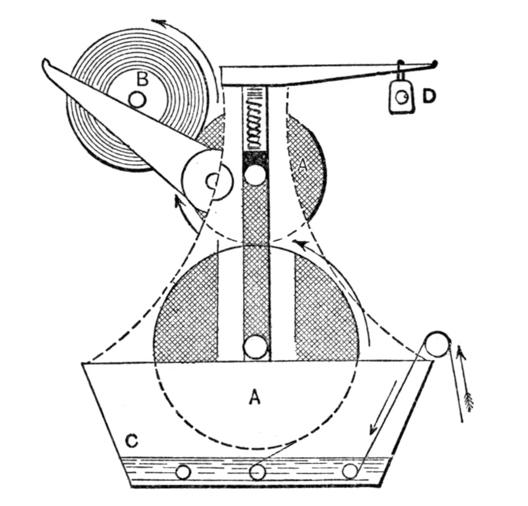
clear solution contains alumina in the form of acetate, and this supplies the proofing quality to the fabric. It is applied in a form of machine shown in Fig. 8, which will be seen to consist of a trough containing the proofing solution, C, with a pair of squeezing rollers, A, over the top. The fabric is drawn down through the solution and up through the squeezers in the direction of the arrows. At the {747} back of the machine the cloth automatically winds itself onto a roll, B, and then only requires drying to develop the water-resisting power. D is a weight acting on a lever which presses the two rollers, A, together. The water-repelling property is gained as follows:
Fig. 8
Drying the fabric, which is impregnated with acetate of alumina, drives off some of the volatile acetic acid, leaving a film of basic acetate of alumina on each wool fiber. This basic salt is very difficult
to wet, and has so little attraction for moisture that in a shower of rain the drops remain in a spheroidal state, and fall off. In a strong wind, or under pressure, water eventually penetrates through fabrics proofed in this manner; but they will effectually resist a sharp shower. Unfortunately, shower-proofed goods, with wear, gradually lose this property of repelling water. The equation representing the change between alum and sugar of lead is given below. In the case of common alum there would, of course, be potassium acetate in solution besides the alumina.
Alum.
Al2K2(SO4)4 + Sugar of lead.
Lead sulphate.
4 Pb(C2H3O2)2 =
4 PbSO4 + Potassium acetate.
2 KC2H3O2 + Aluminum acetate.
Al2(C2H3O2)6
Now that sulphate of alumina is in common use, alum need not be used, as the potash in it serves no purpose in proofing. There are many compositions conferring water resisting powers upon textiles, but unfortunately they either affect the general handle of the material and make it stiff, or they stain and discolor it, which is equally bad. A large range of waterproof compositions can be got by using stearates of the metals; these, in nearly every case, are insoluble bodies, and when deposited in the interior of a fabric form a water-resisting “filling” which is very effective. As a rule these stearates are deposited on the material by means of double baths; for example, by passing the fabric through (say) a bath of aluminum acetate, and then, after squeezing out the excess of liquid, passing it through a bath of soap. The aluminum salt on the fabric decomposes the soap, resulting in a deposit of insoluble stearate of alumina. This system of proofing in two baths is cleaner and more economical than adding all the ingredients together, as the stearate formed is just where it is required “on the fibers,” and not at the bottom of the bath.
One of the most important patents now worked for waterproofing purposes is on the lines of the old alumina process. In this case the factor used is rosin, dissolved in a very large bulk of petroleum spirit. The fabrics to be proofed (usually dress materials) are passed through a bath of this solution, and carefully dried to drive off the solvent. Following this, the goods are treated by pressing with hot polished metal rollers. This last process melts the small quantity of rosin, which is deposited on the cloth, and leaves each single fiber with an exceedingly thin film of rosin on it. It will be understood that only a very attenuated solution of rosin is permissible, so that the fibers of the threads and not the threads themselves are coated with it. If the solution contains too much rosin the fabric is stiffened, and the threads cemented together; whereas if used at the correct strength (or, rather, weakness) neither fabric nor dye suffers, and there is no evidence of stickiness of any description.
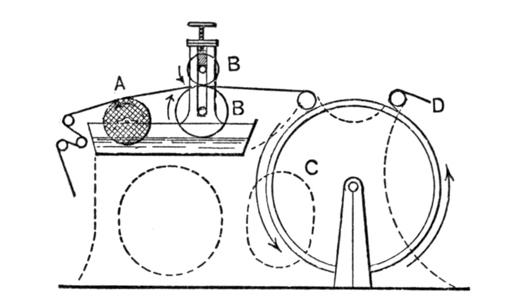
Fig. 9
Fig. 9 shows a machine used for spreading a coat of either proofing or any other fluid on one side of the fabric. {748} This is done by means of a roller, A, running in the proofing solution, the material to be coated traveling slowly over the top and just in contact with the roller, A, which transfers the proofing to it. Should the solution used be of a thick nature, then a smooth metal roller will transfer sufficient to the fabric. If the reverse is the case, and the liquid used is very thin, then the roller is covered with felt, which very materially adds to its carrying power. As shown in Fig. 9, after leaving the two squeezing rollers, BB, the fabric passes slowly round a large steam-heated cylinder, C, with the coated side uppermost. This dries the proofing and fastens it, and the cloth is taken off at D. Besides stearates of the metals, glues and gelatins have been used for proofing purposes, but owing to their stiffening effect, they are only of use in some few isolated cases. With glue and gelatin the fixing agent is either tannic acid or some metallic salt. Tannic acid converts gelatin into an insoluble leather-like body; this can be deposited in the interstices of the fabric by passing the latter through a gelatin bath first, and then squeezing and passing through
the tannic acid. Bichromate of potash also possesses the property of fixing the proteid bodies and rendering them insoluble.
The following are special processes used to advantage in the manufacture of waterproof fabrics:
I.—Ordinary Fabrics, Dressing Apparel, etc. Immerse in a vat of acetate of alumina (5° Bé.) for 12 hours, lift, dry, and let evaporate at a temperature of from 140° to 149° F.
II. Sailcloth, Awnings, Thick Blankets, etc. Soak in a 7 per cent solution of gelatin at 104° F., dry, pass through a 4 per cent solution of alum, dry again, rinse in water, and dry.
III.—Fabrics of Cotton, Linen, Jute, and Hemp.—Put into a bath of ammoniacal cupric sulphate of 10° Bé. at a temperature of 87° F.; let steep thoroughly, then put in a bath of caustic soda (20° Bé.) and dry. To increase the impermeability, a bath of sulphate of alumina may be substituted for the caustic-soda bath.
IV. Saturate the fabrics with the following odorless compound, subjecting them several times to a brushing machine having several rollers, where the warp threads will be well smoothed, and a waterproof product of fine sheen and scarcely fading will be the result. The compound is made with 30 parts, by weight, of Japan wax, 22 1/2 parts, by weight, of paraffine, 12 parts, by weight, of rosin soap, 35 parts, by weight, of starch, and 5 parts, by weight, of a 5 per cent solution of alum. Fabrics thus prepared are particularly adapted to the manufacture of haversacks, shoes, etc.
V.—White or Light Fabrics.—Pass first through a bath of acetate of alumina of 4° to 5° Bé. at a temperature of 104° F., then through the rollers to rid of all liquid; put into a warm solution of soap (5 parts, by weight, of olive-oil soap to 100 parts, by weight, of fresh water) and finally pass through a 2 per cent solution of alum, dry for 2 or 3 days on the dropping horse, and brush off all particles of soap.
VI.—Dissolve 1 1/2 parts, by weight, of gelatin in 50 parts, by weight, of boiling water, add 1 1/2 parts, by weight, of scraped tallow
soap and 2 1/2 parts, by weight, of alum, the latter being put in gradually; lower the temperature of the bath to 122° F., lift out the fabric, dry, and calender.
VII.—Tent Cloth.—Soak in a warm solution of 1 part, by weight, of gelatin, 1 part, by weight, of glycerine, and 1 part, by weight, of tannin in 12 parts, by weight, of wood vinegar (pyroligneous acid) of 12° Bé. The whole is melted in a kettle and carefully mixed. The mass is poured into the receiver of the brushing machine, care being taken to keep it liquid. For a piece of 500 feet in length and 20 inches in width, 50 to 80 parts, by weight, of this compound are needed.
VIII.—To freshen worn waterproof material, cover with the following: Fifty-five thousand parts, by weight, of gelatin; 100 parts, by weight, of bichromate of potash; 100 parts, by weight, of acetic acid (to keep glue from congealing), and from 3,000 to 5,000 parts, by weight, of water; to this add 500 parts, by weight, of peroxide of ammoniacal copper, 100° Bé. This compound is put on the fabric with a brush and then exposed to air and light.
IX. Soft Hats. The hats are stiffened as usual, then put through the following three baths: Dissolve 1/2 part, by weight, of tallow soap in from 40 to 50 parts, by weight, of warm water (140° F.). Put 3 to 4 dozen hats into this solution, leave them in it for half an hour, then take out and put them as they are into another bath prepared with 40 to 50 parts, by weight, of water and 1/2 part, by weight, of alum and heated to 86° to 104° F. After {749} having been left in the second bath for 1/4 or 1/2 hour, take out as before, put into the third bath of 40 to 50 parts, by weight, of water, 1/2 part, by weight, of alum, and about 13 parts, by weight, of fish glue. In this cold bath the hats are left for another 1/2 hour or more until they are completely saturated with the liquid, then dried and the other operations continued.
X. Woolen cloth may be soaked in a vat filled with aluminum acetate, of 5° Bé., for 12 hours, then removed, dried, and dried
again at a temperature of 140° F.
XI.—Wagon covers, awnings, and sails are saturated with a 7 per cent gelatin solution, at a temperature of 104° F., dried in the air, put through a 4 per cent solution of alum, dried again in the air, carried through water, and dried a third time.
XII.—Cotton, linen, jute, and hemp fabrics are first thoroughly saturated in a bath of ammonio-cupric sulphate, of 10° Bé., at a temperature of 77° F., then put into a solution of caustic soda, 2° Bé., and dried. They may be made still more impervious to water by substituting a solution of aluminum sulphate for the caustic soda.
XIII. White and light-colored fabrics are first put into a bath of aluminum acetate, 4° to 5° Bé., at a temperature of 102° F., the superfluous liquid being removed from the fabric by press rollers. The fabric is put into a soap solution (5 parts of good Marseilles soap in 100 parts of soft water). Finally it is put through a 2 per cent alum solution, and left to dry for 2 or 3 days on racks. The adhering particles of soap are removed by brushing with machinery.
XIV.—Dissolve 1.5 parts of gelatin in 50 parts of boiling water, add 1.5 parts of shavings of tallow grain soap, and gradually, 2.5 parts of alum. Let this cool to 122° F., draw the fabric through it, dry and calender.
XV.—Cellular tissues are made waterproof by impregnating them with a warm solution of 1 part, by weight, of gelatin, 1 part, by weight, of glycerine, and 1 part, by weight, of tannin, in 12 parts, by weight, of wood vinegar, 12° Bé.
XVI.—Linen, hemp, jute, cotton, and other fabrics can be given a good odorless waterproof finish by impregnating them, and afterwards subjecting them to the action of several mechanical brush rollers. By this process the fabric is brushed dry, the fibers are laid smooth, the threads of the warp brought out, and a glossy, odorless, unfading waterproof stuff results. Fabrics manufactured in the usual way from rough and colored yarns are put through a bath of this waterproof finish, whose composition is as follows: Thirty parts, by
weight, of Japanese wax; 22.5 parts, by weight, of paraffine; 15 parts, by weight, of rosin soap; 35 parts, by weight, of starch, and 5 parts, by weight, of a 5 per cent alum solution. The first three components are melted in a kettle, the starch and, lastly, the alum added, and the whole stirred vigorously.
XVII.—One hundred parts, by weight, of castor oil are heated to nearly 204° F., with 50 parts, by weight, of caustic potash, of 50° Bé., to which 50 parts, by weight, of water have previously been added. Forty parts, by weight, of cooler water are then added slowly, care being taken to keep the temperature of the mixture constant. As soon as the liquor begins to rise, 40 parts, by weight, of cooler water are again added, with the same precaution to keep the temperature from falling below 204° F. At the same time care must be taken to prevent the liquor boiling, as this would produce too great saponification. By the prolonged action of heat below the boiling point, the oil absorbs water and caustic potash without being changed, and the whole finally forms a perfectly limpid, nearly black liquid. This is diluted with 5 times its weight of hot or cold water, and is then ready for use without any further preparation. Other vegetable oils may be employed besides castor oil, and the quantity of unsaponified oil present may be increased by stirring the prepared liquid with a fresh quantity of castor or other vegetable oil. The product is slightly alkaline, but wool fiber is not injured, as the oiling may be done in the cold. The solution is clear and limpid, and will not separate out on standing like an emulsion. This product in spinning gives a 10 per cent better utilization of the raw material owing to the greater evenness and regularity with which the fibers are oiled; in weaving less oiling is required.
The product can be completely removed by water, preferably by cold water, and scouring of the goods subsequently with soap, soda, or fuller’s earth can thus be dispensed with.
XVIII.—Cloth may be rendered waterproof by rubbing the under side with a lump of beeswax until the surface presents a uniform
white or grayish appearance. This method it is said renders the cloth {750} practically waterproof, although still leaving it porous to air.
XIX.—Coating the under side of the cloth with a solution of isinglass and then applying an infusion of galls is another method, a compound being thus formed which is a variety of leather.
XX.—An easy method is the formation of aluminum stearate in the fiber of the cloth, which may readily be done by immersing it in a solution of aluminum sulphate in water (1 in 10) and without allowing it to dry passing through a solution of soap made from soda and tallow or similar fat, in hot water. Reaction between the aluminum sulphate and the soap produces aluminum stearate and sodium sulphate. The former is insoluble and remains in the fiber; the latter is removed by subsequently rinsing the fabric in water.
XXI.—A favorite method for cloth is as follows: Dissolve in a receptacle, preferably of copper, over a bright coal fire, 1 liter (1.76 pints) of pure linseed oil, 1 liter (1.76 pints) of petroleum, 1/2 liter (0.88 pints) of oil turpentine, and 125 grams (4.37 ounces) of yellow wax, the last named in small bits. As there is danger of fire, boiling of this mass should be avoided. With this hot solution removed from the fire, of course the felt material is impregnated; next it is hung up in a warm, dry room or spread out, but in such a manner that the uniform temperature can act upon all parts.
Waterproofing Leather.—I.—Tenning’s process is as follows: Melt together equal parts of zinc and linseed oil, at a temperature not above 225° F. Put the leather in the molten mixture and let it remain until saturated. The “zinc soap” is made by dissolving 6 parts of white soap in 16 parts of water, and stirring into the solution 6 parts of zinc sulphate. To make sure of a homogeneous mixture remelt the whole and stir until it begins to cool. The process, including the saturation of the leather, requires about 48 hours. Instead of zinc sulphate, copper or iron sulphate may be used. The philosophy of the process is that the moisture and air contained in the pores of the