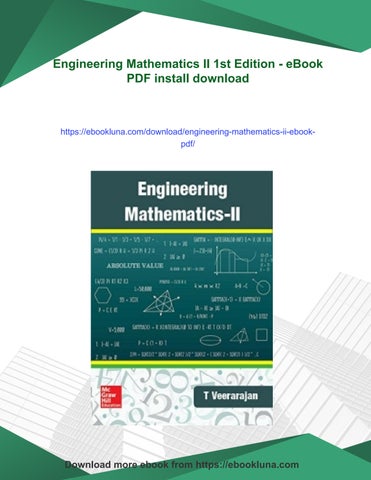
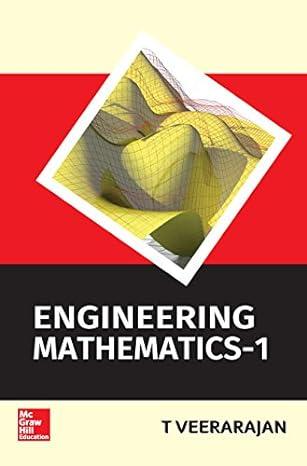
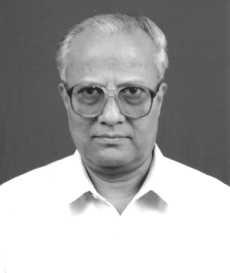
T Veerarajan retired as Dean, Department of Mathematics, Velammal College of Engineering and Technology, Viraganoor, Madurai, Tamil Nadu. A gold medalist from Madras University, he has had a brilliant academic career all through. He has 50 years of teaching experience at undergraduate and postgraduate levels in various established engineering colleges in Tamil Nadu including Anna University, Chennai.
Engineering Mathematics II
T Veerarajan
Former Dean, Department of Mathematics
Velammal College of Engineering and Technology
Viraganoor, Madurai Tamil Nadu
McGraw Hill Education (India) Private Limited
McGraw Hill Education (India) Private Limited
Published by McGraw Hill Education (India) Private Limited
444/1, Sri Ekambara Naicker Industrial Estate, Alapakkam, Porur, Chennai 600 116
No part of this publication may be reproduced or distributed in any form or by any means, electronic, mechanical, photocopying, recording, or otherwise or stored in a database or retrieval system without the prior written permission of the publishers. The program listings (if any) may be entered, stored and executed in a computer system, but they may not be reproduced for publication.
This edition can be exported from India only by the publishers, McGraw Hill Education (India) Private Limited
Senior Portfolio Manager—Science & Engineering: Hemant K Jha
Associate Portfolio Manager—Science & Engineering: Mohammad Salman Khurshid
Production Head: Satinder S Baveja
Assistant Manager—Production: Anuj K Shriwastava
General Manager—Production: Rajender P Ghansela
Manager—Production: Reji Kumar
Information contained in this work has been obtained by McGraw Hill Education (India), from sources believed to be reliable. However, neither McGraw Hill Education (India) nor its authors guarantee the accuracy or completeness of any information published herein, and neither McGraw Hill Education (India) nor its authors shall be responsible for any errors, omissions, or damages arising out of use of this information. This work is published with the understanding that McGraw Hill Education (India) and its authors are supplying information but are not attempting to render engineering or other professional services. If such services are required, the assistance of an appropriate professional should be sought.
Typeset at Text-o-Graphics, B-1/56, Aravali Apartment, Sector-34, Noida 201 301, and printed at
Cover Printer:
Visit us at: www.mheducation.co.in
Unit 1. Matrices
1.1 Introduction 1.3
1.2 Vectors 1.4
1.3 Linear Dependence and Linear Independence of Vectors 1.5
1.4 Methods of Testing Linear Dependence or Independence of a Set of Vectors 1.5
1.5 Consistency of a System of Linear Algebraic Equations 1.5
Worked Example 1(a) 1.7
Exercise 1(a) 1.24
1.6 Eigenvalues and Eigenvectors 1.27
Worked Example 1(b) 1.32
Exercise 1(b) 1.44
1.7 Cayley – Hamilton Theorem 1.46
1.8 Property 1.47
1.9 Calculation of Powers of a Matrix A 1.49
1.10 Diagonalisation by Orthogonal Transformation or Orthogonal Reduction 1.49
Worked Example 1(c) 1.49
Exercise 1(c) 1.62
1.11 Quadratic Forms 1.64
Worked Example 1(d) 1.67
Exercise 1(d) 1.74
Answers 1.75 Unit 2.
2.1 Introduction 2.3
2.2 Vector Differential Operator ∇ 2.3
Worked Example 2(a) 2.6
Exercise 2(a) 2.11
2.3 The Divergence of a Vector 2.12
Worked Example 2(b) 2.18
Exercise 2(b) 2.26
2.4 Line Integral of Vector Point Functions 2.27
Worked Example 2(c) 2.30
Exercise 2(c) 2.37
2.5 Integral Theorems 2.39
Worked Example 2(d) 2.42
Exercise 2(d) 2.56
Answers 2.58
Unit 3. analytic FUnctions
3.1 Introduction 3.3
3.2 The Complex Variable 3.4
Worked Example 3(a) 3.12
Exercise 3(a) 3.24
3.3 Properties of Analytic Functions 3.26
Worked Example 3(b) 3.32
Exercise 3(b) 3.43
3.4 Conformal Mapping 3.45
3.5 Some Simple Transformation 3.48
3.6 Some Standard Transformations 3.51
Worked Example 3(c) 3.59
Exercise 3(c) 3.76
3.7 Bilinear and Schwarz-Christoffel Transformations 3.79
3.8 Schwarz-Christoffel Transformations 3.82
Worked Example 3(d) 3.84
Exercise 3(d) 3.93
Answers 3.95
3.1–3.97
4.1 Introduction 4.3
4.2 Cauchy’s Integral Theorem or Cauchy’s Fundamental Theorem 4.4
Worked Example 4(a) 4.9
Exercise 4(a) 4.19
4.3 Series Expansions of Functions of Complex Variable-Power Series 4.22
4.4 Classification of Singularities 4.27
Worked Example 4(b) 4.33
Exercise 4(b) 4.45
4.5 Contour Integration—Evaluation of Real Integrals 4.49
Worked Example 4(c) 4.52
Exercise 4(c) 4.69
Answers 4.70
5.1 Introduction 5.3
5.2 Linearity Property of Laplace and Inverse Laplace Transforms 5.4
5.3 Laplace Transforms of Some Elementary Functions 5.5
5.4 Laplace Transforms of Some Special Functions 5.9
5.5 Properties of Laplace Transforms 5.12
Worked Example 5(a) 5.14
Exercise 5(a) 5.35
5.6 Laplace Transform of Periodic Functions 5.38
5.7 Derivatives and Integrals of Transforms 5.39
Worked Example 5(b) 5.42
Exercise 5(b) 5.62
5.8 Laplace Transforms of Derivatives and Integrals 5.65
5.9 Initial and Final Value Theorems 5.68
5.10 The Convolution 5.70
Worked Example 5(c) 5.72
Exercise 5(c) 5.94
5.11 Solutions of Differential and Integral Equations 5.98
Worked Example 5(d) 5.98
Exercise 5(d) 5.110
Answers 5.112
Preface
I am deeply gratified with the enthusiastic response shown by students and faculty members alike to all my books on Engineering Mathematics and Mathematics in general throughout the country.
The motivation behind writing this book is to meet the requirements of students of first-year undergraduate course on Engineering Mathematics offered to the students of engineering. The contents have been covered in adequate depth for semester II of various universities/ deemed universities across the country. It offers a balanced coverage of both theory and problems. Lucid writing style supported by step-bystep solutions to all problems enhances understanding of the concepts. The book has ample number of solved and unsolved problems of different variety to help students and teachers learning and teaching this subject.
I hope that the book will be received by both the faculty and the students as enthusiastically as my other books on Engineering Mathematics. Critical evaluation and suggestions for the improvement of the book will be highly appreciated and acknowledged.
T VEERARAJAN
Publisher’s Note
McGraw Hill Education (India) invites suggestions and comments from you, all of which can be sent to info.india@mheducation.com (kindly mention the title and author name in the subject line).
Piracy-related issues may also be reported.
Unit-1 Matrices
Matrices 1 Unit
1.1 intRODUCtiOn
In the lower classes, the students have studied a few topics in Elementary Matrix theory. They are assumed to be familiar with the basic definitions and concepts of matrix theory as well as the elementary operations on and properties of matrices. Though the concept of rank of a matrix has been introduced in the lower classes, we briefly recall the definition of rank and working procedure to find the rank of a matrix, as it will be of frequent use in testing the consistency of a system of linear algebraic equations, that will be discussed in the next section.
1.1.1 Rank of a Matrix
Determinant of any square submatrix of a given matrix A is called a minor of A. If the square submatrix is of order r, then the minor also is said to be of order r.
Let A be an m × n matrix. The rank of A is said to be ‘r’, if
(i) there is at least one minor of A of order r which does not vanish and (ii) every minor of A of order (r + 1) and higher order vanishes.
In other words, the rank of a matrix is the largest of the orders of all the nonvanishing minors of that matrix. Rank of a matrix A is denoted by R(A) or ρ(A).
To find the rank of a matrix A, we may use the following procedure:
We first consider the highest order minor (or minors) of A. Let their order be r. If any one of them does not vanish, then ρ(A) = r. If all of them vanish, we next consider minors of A of next lower order (r – 1) and so on, until we get a non-zero minor. The order of that non-zero minor is ρ(A).
This method involves a lot of computational work and hence requires more time, as we have to evaluate many determinants. An alternative method to find the rank of a matrix A is given below:
Reduce A to any one of the following forms, (called normal forms) by a series of elementary operations on A and then find the order of the unit matrix contained in the normal form of A:
1.4 MathematicsII
Here I r denotes the unit matrix of order r and O is zero matrix. By an elementaryoperation on a matrix (denoted as E-operation) we mean any one of the following operations or transformations:
(i) Interchange of any two rows (or columns).
(ii) Multiplication of every element of a row (or column) by any non-zero scalar.
(iii) Addition to the elements of any row (or column), the same scalar multiples of corresponding elements of any other row (or column).
Note The alternative method for finding the rank of a matrix is based on the property that the rank of a matrix is unaltered by elementary operations. Finally we observe that we need not necessarily reduce a matrix A to the normal form to find its rank. It is enough we reduce A to an equivalent matrix, whose rank can be easily found, by a sequence of elementary operations on A. The methods are illustrated in the worked examples that follow.
1.2 VECtORS
A set of n numbers x1,x2,...,xn written in a particular order (or an ordered set of n numbers) is called an n-dimensionalvector or a vectorofordern The n numbers are called the components or elements of the vector. A vector is denoted by a single letter X or Y etc. The components of a vector may be written in a row as X= (x1, x2, , x n) or in a column as X
These are called respectively row vector and
column vector. We note that a row vector of order n is a 1 × n matrix and a column vector of order n is an n × 1 matrix.
1.2.1 Addition of Vectors
The sum of two vectors of the same dimension is obtained by adding the corresponding components.
i.e., if X = (x1, x2, . . ., x n) and Y = (y1, y2, . . ., yn), then X+Y = (x1 + y1, x2 +y 2. . ., xn+yn).
1.2.2 Scalar Multiplication of a Vector
If k is a scalar and X = (x1 , x2, . . ., x n) is a vector, then the scalar multiple kX is defined as kX= (kx1, kx2, . . ., kx n).
1.2.3 Linear Combination of Vectors
If a vector X can be expressed as X = k1X1 + k2X2 + + k r X r then X is said to be a linear combination of the vectors X1, X2, . . ., X r
1.3 LinEAR DEPEnDEnCE AnD LinEAR inDEPEnDEnCE OF VECtORS
The vectors X1, X2, . . ., X r are said to be linearlydependent if we can find scalars k1, k2, . . . k r, which are not all zero, such that k1Xl + k2X2 + . . . + k r X r = 0.
A set of vectors is said to be linearlyindependent if it is not linearly dependent, i.e. the vectors X1, X2, . . ., X r are linearly independent, if the relation k1X1 + k2X2 + k r X r = 0 is satisfied only when kl = k2 = . . . = k r = 0.
Note When the vectors X1, X2, . . ., X r are linearly dependent, then k1X1 + k2X2 + . . . + k r X r = 0, where at least one of the k’s is not zero. Let k m ≠ 0. Thus
Thus at least one of the given vectors can be expressed as a linear combination of the others.
1.4 MEtHODS OF tEStinG LinEAR DEPEnDEnCE OR inDEPEnDEnCE OF A SEt OF VECtORS
Method 1 Using the definition directly.
Method 2 We write the given vectors as row vectors and form a matrix. Using elementary row operations on this matrix, we reduce it to echelon form, i.e. the one in which all the elements in the rth column below the rth element are zero each. If the number of non-zero row vectors in the echelon form equals the number of given vectors, then the vectors are linearly independent. Otherwise they are linearly dependent.
Method 3 If there are n vectors, each of dimension n, then the matrix formed as in method (2) will be a square matrix of order n. If the rank of the matrix equals n, then the vectors are linearly independent. Otherwise they are linearly dependent.
1.5 COnSiStEnCY OF A SYStEM OF LinEAR ALGEBRAiC EQUAtiOnS
Consider the following system of m linear algebraic equations in n unknowns:
This system can be represented in the matrix form as AX = B, where
1.6 MathematicsII
The matrix A is called the coefficient matrix of the system, X is the matrix of unknowns and B is the matrix of the constants.
If B ≡ O, a zero matrix, the system is called a system of homogeneouslinearequations; otherwise, the system is called a system of linearnon-homogeneousequations.
The m × (n + 1) matrix, obtained by appending the column vector B to the coefficient matrix A as the additional last column, is called the augmentedmatrix of the system and is denoted by [A, B] or [A | B].
1.5.1 Definitions
A set of values of x1, x2 . . ., x n. which satisfy all the given m equations simultaneously is called a solution of the system.
When the system of equations has a solution, it is said to be consistent. Otherwise the system is said to be inconsistent.
A consistent system may have either only one or infinitely many solutions. When the system has only one solution, it is called theuniquesolution.
The necessary and sufficient condition for the consistency of a system of linear non-homogeneous equations is provided by a theorem, called Rouches’s theorem, which we state below without proof.
1.5.2
Rouche’s theorem
The system of equations AX = B is consistent, if and only if the coefficient matrix A and the augmented matrix [A, B] are of the same rank.
Thus to discuss the consistency of the equations AX = B (m equations in n unknowns), the following procedure is adopted:
We first find R(A) and R(A, B).
(i) If R(A) ≠ R(A, B), the equations are inconsistent
(ii) If R(A) = R(A, B) = the number of unknowns n, the equations are consistent and have a unique solution.
In particular, if A is a non-singular (square) matrix, the system AX = B has a unique solution.
(iii) If R(A) = R(A, B) < the number of unknowns n, the equations are consistent and have an infinite number of solutions.
1.5.3 System of Homogeneous Linear Equations
Consider the system of homogeneous linear equations AX = O (m equations in n unknowns)
i.e
This system is always consistent, as R(A) = R(A, O). If the coefficient matrix A is non-singular, the system has a unique solution, namely, x1 =x2 = . . . = x n = 0. This unique solution is called thetrivialsolution, which is not of any importance.
If the coefficient matrix A is singular, i.e. if | A| = 0, the system has an infinite number of non-zero or non-trivial solutions.
The method of finding the non-zero solution of a system of homogeneous linear equations is illustrated in the worked examples that follow.
WORKED EXAMPLE 1(a)
Example 1.1 Show that the vectors X1 = (1, 1, 2), X2 = (1, 2, 5) and X3 = (5, 3, 4) are linearly dependent. Also express each vector as a linear combination of the other two.
In the echelon form of the matrix, the number of non-zero vectors = 2 (< the number of given vectors).
∴ X1, X2, X3 are linearly dependent.
i.e. –7X1 + 2X2 + X3 = 0
As before,
Method 3 |A| = 0 ∴ R (A) ≠ 3; R (A) = 2
∴ The vectors X1, X2, X3 are linearly dependent.
Example 1.2 Show that the vectors X1 = (1, –1, –2, –4), X2 = (2, 3, –1, –1), X3 = (3, 1, 3, –2) and X4 = (6, 3, 0, –7) are linearly dependent. Find also the relationship among them.
X X X X
∴ The relation among Xl, X2, X3, X4 is
Example 1.3 Show that the vectors X1 = (2, –2, 1), X2 = (1, 4, –1) and X3 = (4, 6, –3) are linearly independent.
Method 1
Let k
From (1) and (2), k2 + 2k3 = 0 (4)
From (2) and (3), k2 = 0 (5)
∴ k1 = 0 = k2 = k3.
∴ The vectors X1, X2,X3 are linearly independent.
Method 2
Number of non-zero vectors in the echelon form of A= number of given vectors, ∴ X1, X2, X3 are linearly independent.
Example 1.4 Show that the vectors X1 = (1, −1, −1, 3), X2 = (2, 1, −2, −1) and X3 = (7, 2, −7, 4) are linearly independent.
Number of non-zero vectors in the echelon form of A = number of given vectors.
∴ X1, X2, X3 are linearly independent.
Example 1.5 Test for the consistency of the following system of equations:
The given equations can be put as
i.e. AX=B (say)
Let us find the rank of the augmented matrix [A,B] by reducing it to the normal form
Note If two matrices A and B are equivalent, i.e.
Now [A, B] has been reduced to the normal form
The order of the unit matrix present in the normal form = 2.
Hence the rank of [A, B] = 2.
The rank of the coefficient matrix A can be found as 2, in a similar manner.
Thus R (A) =R [A,B] = 2
∴ The given system of equations is consistent and possesses many solutions.
Example 1.6 Test for the consistency of the following system of equations:
The system can be put as
∴ R[A,B] = 4
But R (A) ≠ 4, as A is a (4 × 3) matrix.
In fact R (A) = 3, as the value of the minor
Thus R (A) ≠ R [A,B]
∴The given system is inconsistent.
Example 1.7 Test for the consistency of the following system of equations and solve them, if consistent, by matrix inversion.
∴ R [A,B] = 3. Also R (A) = 3
∴ The given system is consistent and has a unique solution. To solve the system, we take any three, say the first three, of the given equations.
Example 1.8 Test for the consistency of the following system of equations and solve them, if consistent:
3x + y + z = 8; − x + y 2z = − 5; x + y + z = 6; – 2x+ 2y 3z = − 7.
Note As the solution can be found out by any method, when the system is consistent, we may prefer the triangularisation method (also known as Gaussian elimination method) to reduce the augmented matrix [A, B] to an equivalent matrix. Using the equivalent matrix, we can test the consistency of the system and also find the solution easily when it exists. In this method, we use onlyelementaryrow operations and convert the elements below the principal diagonal of A as zeros.
Other documents randomly have different content
differ essentially from each other in their domestic institutions, in the character of their population, and even, to some extent, in their language. They embrace every variety of soil, climate, and productions. In an enlarged view, I believe their interests to be all identical; although, to the eye of local and sectional prejudice, they always appear to be conflicting. In such a condition, mutual jealousies must arise, which can only be repressed by that mutual forbearance which pervades the Constitution. To legislate wisely for such a people is a task of extreme delicacy, and requires much selfrestraining prudence and caution. In this point of view, I firmly believe that the veto power is one of the best safeguards of the Union. By this power, the majority of the people in every State have decreed that the existing laws shall remain unchanged, unless not only a majority in each House of Congress, but the President also, shall sanction the change. By these wise and wholesome restrictions, they have secured themselves, so far as human prudence can, against hasty, oppressive, and dangerous legislation.
The rights of the weaker portions of the Union will find one of their greatest securities in the veto power. It would be easy to imagine interests of the deepest importance to particular sections which might be seriously endangered by its destruction. For example, not more than one-third of the States have any direct interest in the coasting trade. This trade is now secured to American vessels, not merely by a protective duty, but by an absolute prohibition of all foreign competition. Suppose the advocates of free trade run mad should excite the jealousy of the Senators and Representatives from the other two-thirds of the States against this comparatively local interest, and convince them that this trade ought to be thrown open to foreign navigation. By such a competition, they might contend that the price of freight would be reduced, and that the producers of cotton, wheat, and other articles ought not to be taxed in order to sustain such a monopoly in favor of their own ship building and navigating interest. Should Congress, influenced by these or any other consideration, ever pass an act to open this trade to the competition of foreigners, there is no man fit to fill the executive chair who would not place his veto upon it, and thus refer
the subject to the sober determination of the American people. To deprive the navigating States of this privilege, would be to aim a deadly blow at the very existence of the Union.
Let me suppose another case of a much more dangerous character. In the Southern States, which compose the weaker portion of the Union, a species of property exists which is now attracting the attention of the whole civilized world. These States never would have become parties to the Union, had not their rights in this property been secured by the Federal Constitution. Foreign and domestic fanatics—some from the belief that they are doing God’s service, and others from a desire to divide and destroy this glorious Republic—have conspired to emancipate the Southern slaves. On this question, the people of the South, beyond the limits of their own States, stand alone and unsupported by any power on earth, except that of the Northern Democracy. These fanatical philanthropists are now conducting a crusade over the whole world, and are endeavoring to concentrate the public opinion of all mankind against this right of property. Suppose they should ever influence a majority in both Houses of Congress to pass a law, not to abolish this property—for that would be too palpable a violation of the Constitution—but to render it of no value, under the letter, but against the spirit of some one of the powers granted; will any lover of his country say that the President ought not to possess the power of arresting such an act by his veto, until the solemn decision of the people should be known on this question, involving the life or death of the Union? We, sir, of the non-slaveholding States, entered the Union upon the express condition that this property should be protected. Whatever may be our own private opinions in regard to slavery in the abstract, ought we to hazard all the blessings of our free institutions our Union and our strength in such a crusade against our brethren of the South? Ought we to jeopard every political right we hold dear, for the sake of enabling these fanatics to invade Southern rights, and render that fair portion of our common inheritance a scene of servile war, rapine, and murder? Shall we apply the torch to the magnificent temple of human liberty which our
forefathers reared at the price of their blood and treasure, and permit all we hold dear to perish in the conflagration? I trust not.
It is possible that at some future day the majority in Congress may attempt, by indirect means, to emancipate the slaves of the South. There is no knowing through what channel the ever active spirit of fanaticism may seek to accomplish its object. The attempt may be made through the taxing power, or some other express power granted by the Constitution. God only knows how it may be made. It is hard to say what means fanaticism may not adopt to accomplish its purpose. Do we feel so secure, in this hour of peril from abroad and peril at home, as to be willing to prostrate any of the barriers which the Constitution has reared against hasty and dangerous legislation? No, sir, never was the value of the veto power more manifest than at the present moment. For the weaker portion of the Union, whose constitutional rights are now assailed with such violence, to think of abandoning this safeguard, would be almost suicidal. It is my solemn conviction, that there never was a wiser or more beautiful adaptation of theory to practice in any government than that which requires a majority of two-thirds in both Houses of Congress to pass an act returned by the President with his objections, under all the high responsibilities which he owes to his country.
Sir, ours is a glorious Constitution. Let us venerate it—let us stand by it as the work of great and good men, unsurpassed in the history of any age or nation. Let us not assail it rashly with our invading hands, but honor it as the fountain of our prosperity and power. Let us protect it as the only system of government which could have rendered us what we are in half a century, and enabled us to take the front rank among the nations of the earth. In my opinion, it is the only form of government which can preserve the blessings of liberty and prosperity to the people, and at the same time secure the rights and sovereignty of the States. Sir, the great mass of the people are unwilling that it shall be changed. Although the Senator from Kentucky, to whom I cannot and do not attribute any but patriotic motives, has brought himself to believe that a change is necessary, especially in the veto power, I must differ from him
entirely, convinced that his opinions on this subject are based upon fallacious theories of the nature of our institutions. This view of his opinions is strengthened by his declarations the other day as to the illimitable rights of the majority in Congress. On that point he differs essentially from the framers of the Constitution. They believed that the people of the different States had rights which might be violated by such a majority; and the veto power was one of the modes which they devised for preventing these rights from being invaded.
The Senator, in support of his objections to the veto power, has used what he denominates a numerical argument, and asks, can it be supposed that any President will possess more wisdom than nine Senators and forty Representatives. (This is the number more than a bare majority of each body which would at present be required to pass a bill by a majority of two-thirds.) To this question, my answer is, no, it is not to be so supposed at all. All that we have to suppose is, what our ancestors, in their acknowledged wisdom, did suppose; that Senators and Representatives are but mortal men, endowed with mortal passions and subject to mortal infirmities; that they are susceptible of selfish and unwise impulses, and that they do not always and under all circumstances, truly reflect the will of their constituents. These founders of our Government, therefore, supposed the possibility that Congress might pass an act through the influence of unwise or improper motives; and that the best mode of saving the country from the evil effects of such legislation was to place a qualified veto in the hands of the people’s own representative, the President of the United States, by means of which, unless two-thirds of each House of Congress should repass the bill, the question must be brought directly before the people themselves. These wise men had made the President so dependent on Congress that they knew he would never abuse this power, nor exert it unless from the highest and most solemn convictions of duty; and experience has established their wisdom and foresight.
As to the Senator’s numerical argument, I might as well ask him, is it to be supposed that we are so superior in wisdom to the members of the House that the vote of one Senator ought to annul the votes of thirty-two Representatives? And yet the bill to repeal the
bankrupt law has just been defeated in this body by a majority of one, although it had passed the House by a majority of thirty-two. The Senator’s numerical argument, if it be good for anything at all, would be good for the abolition of the Senate as well as of the veto; and would lead at once to the investment of all the powers of legislation in the popular branch alone. But experience has long exploded this theory throughout the world. The framers of the Constitution, in consummate wisdom, thought proper to impose checks, and balances, and restrictions on their Governmental agents; and woe betide us, if the day should ever arrive when they shall be removed.
But I must admit that another of the Senator’s arguments is perhaps not quite so easily refuted, though, I think, it is not very difficult to demonstrate its fallacy. It is undoubtedly his strongest position. He says that the tendency of the veto power is to draw after it all the powers of legislation; and that Congress, in passing laws, will be compelled to consult, not the good of the country alone, but to ascertain, in the first instance, what the President will approve, and then regulate their conduct according to his predetermined will.
This argument presupposes the existence of two facts, which must be established before it can have the least force. First, that the President would depart from his proper sphere, and attempt to influence the initiatory legislation of Congress: and, second, that Congress would be so subservient as to originate and pass laws, not according to the dictates of their own judgment, but in obedience to his expressed wishes. Now, sir, does not the Senator perceive that his argument proves too much? Would not the President have precisely the same influence over Congress, so far as his patronage extends, as if the veto had never existed at all? He would then resemble the King of England, whose veto power has been almost abandoned for the last hundred and fifty years. If the President’s power and patronage were coextensive with that of the king, he could exercise an influence over Congress similar to that which is now exerted over the British Parliament, and might control legislation in the same manner.
Thus, sir, you perceive that to deprive the President of the veto power, would afford no remedy against executive influence in Congress, if the President were disposed to exert it. Nay, more—it would encourage him to interfere secretly with our legislative functions, because, deprived of the veto power, his only resource would be to intrigue with members of Congress for the purpose of preventing the passage of measures which he might disapprove. At present this power enables him to act openly and boldly, and to state his reasons to the country for refusing his assent to any act passed by Congress.
Again: does not the Senator perceive that this argument is a direct attack upon the character of Congress? Does he not feel that the whole weight of his argument in favor of abolishing the veto power, rests upon the wisdom, integrity, and independence of that body? And yet we are told that in order to prevent the application of the veto, we shall become so subservient to the Executive, that in the passage of laws we will consult his wishes rather than our own independent judgment. The venality and baseness of Congress are the only foundations on which such an argument can rest; and yet it is the presumption of their integrity and wisdom on which the Senator relies for the purpose of proving that the veto power is wholly unnecessary, and ought to be abolished.
In regard to this thing of executive influence over Congress, I have a few words to say. Sir, I have been an attentive observer of Congressional proceedings for the last twenty years, and have watched its operations with an observing eye. I shall not pretend to say that it does not exist to some extent; but its power has been greatly overrated. It can never become dangerous to liberty, unless the patronage of the Government should be enormously increased by the passage of such unconstitutional and encroaching laws as have hitherto fallen under the blow of the veto power.
The Executive, indeed, will always have personal friends, as well as ardent political supporters of his administration in Congress, who will strongly incline to view his measures with a favorable eye. He will also have, both in and out of Congress, expectants who look to
him for a share of the patronage at his disposal. But, after all, to what does this amount?
Whilst the canvass is proceeding previous to his election, the expectations of candidates for office will array around him a host of ardent and active friends. But what is his condition after the election has passed, and the patronage has been distributed? Let me appeal to the scene which we all witnessed in this city, at and after the inauguration of the late lamented President. It is almost impossible that one office seeker in fifty could have been gratified. What is the natural and necessary result of such numerous disappointments? It is to irritate the feelings and sour the minds of the unsuccessful applicants. They make comparisons between themselves and those who have been successful, and self-love always exaggerates their own merits and depreciates those of their successful rivals, to such an extent, that they believe themselves to have been injured. The President thus often makes one inactive friend, because he feels himself secure in office, and twenty secret enemies awaiting the opportunity to give him a stab whenever a favorable occasion may offer. The Senator greatly overrates the power of executive influence either among the people or in Congress. By the time the offices have been all distributed, which is usually done between the inauguration and the first regular meeting of Congress thereafter, the President has but few boons to offer.
Again: it is always an odious exercise of executive power to confer offices on members of Congress, unless under peculiar circumstances, where the office seeks the man rather than the man the office. In point of fact, but few members can receive appointments; and those soliciting them are always detected by their conduct. They are immediately noted for their subserviency; and from that moment, their influence with their fellow members is gone. By far the greatest influence which a President can acquire over Congress, is a reflected influence from the people upon their representatives. This is dependent upon the personal popularity of the President, and can never be powerful, unless, from the force of his character, and the value of his past services, he has inspired the people with an enthusiastic attachment. A remarkable example of
this reflected influence was presented in the case of General Jackson; and yet it is a high compliment to the independence, if not to the wisdom of Congress, that even he could rarely command a majority in both its branches. Still it is certain, notwithstanding, that he presented a most striking example of a powerful executive; and this chiefly because he was deservedly strong in the affections of the people.
In the vicissitude of human events, we shall sometimes have Presidents who can, if they please, exercise too much, and those who possess too little, influence over Congress. If we witnessed the one extreme during General Jackson’s administration, we now have the other before our eyes. For the sake of the contrast, and without the slightest disrespect towards the worthy and amiable individual who now occupies the Presidential chair, I would say that if General Jackson presented an example of the strength, the present President presents an equally striking example of the feebleness, of executive influence. I ask what has all the patronage of his high office done for him? How many friends has it secured? I most sincerely wish, for the good of the country, and for the success of his administration, that he had a much greater degree of influence in Congress than he possesses. It is for this reason that I was glad to observe, a few days ago, some symptoms of returning favor on this (the Whig) side of the house towards John Tyler. It is better, much better, even thus late, that they should come forward and extend to him a helping hand, than, wishing to do so, still keep at a distance merely to preserve an appearance of consistency. I am sorry to see that from this mere affectation, they should appear so coy, and leave the country to suffer all the embarrassments which result from a weak administration. [Here several of the Whig Senators asked jocosely why the Democrats did not volunteer their services to strengthen the Government.] Oh! said Mr. B., we cannot do that. What is merely an apparent inconsistency in the Whigs, would be a real inconsistency in us. We cannot go for the Whig measures which were approved by President Tyler at the extra session. We cannot support the great Government Exchequer Bank of discount and exchange, with its three for one paper currency. I think, however, with all deference,
that my Whig friends on this side of the House ought not to be squeamish on that subject. I think my friend from Georgia (Mr. Berrien) ought to go heart and hand for the Exchequer Bank. It is in substance his own scheme of a “Fiscal Corporation,” transferred into the Treasury of the United States, and divested of private stockholders. Let me assure gentlemen that their character for consistency will not suffer by supporting this measure.
And yet, with the example of this administration before their eyes, the Whigs dread executive influence so much that they wish to abolish the veto power, lest the President may be able to draw within its vortex all the legislative powers of Congress! What a world we live in!
This authentic history is the best answer to another position of the Senator. Whilst he believes that there have been no encroachments of the General Government on the rights of the States, but on the contrary that it is fast sinking into the weakness and imbecility of the Confederation, he complains of the encroachments which he alleges to have been made by the President on the legitimate powers of Congress. I differ from him entirely in both these propositions, and am only sorry that the subject of the veto power is one so vast that time will not permit me to discuss them at present. This I shall, however, say, that the strong tendency of the Federal Government has, in my opinion, ever been to encroach upon the rights of the States and their people; and I might appeal to its history to establish the position. Every violent struggle, threatening the existence of the Union, which has existed in this country from the beginning, has arisen from the exercise of constructive and doubtful powers, not by the President, but by Congress. But enough of this for the present.
The Senator from Kentucky contends that, whether the executive be strong or weak, Congress must conform its action to his wishes, and if they cannot obtain what they desire, they must take what they can get. Such a principle of action is always wrong in itself, and must always lead to the destruction of the party which adopts it. This was the fatal error of the Senator and his friends at the extra session. He has informed us that neither “the Fiscal Bank” nor “the Fiscal Corporation” of that never to be forgotten session would have
received twenty votes in either House, had the minds of members been left uninfluenced by the expected action of the Executive.
This was the most severe censure which he could have passed on his party in Congress. It is now admitted that the Whig party earnestly advocated and adopted two most important measures, not because they approved them in the form in which they were presented, but for the sake of conciliating Mr. Tyler. Never was there a more striking example of retributive justice than the veto of both these measures. Whether it be the fact, as the Senator alleges, that the Whigs in Congress took the Fiscal Corporation bill, letter for letter, as it came from the President to them, I shall not pretend to decide. It is not for me to compose such strifes. I leave this to their own file leaders. Without entering upon this question, I shall never fail, when a fit opportunity offers, to express the gratitude which I feel, in common with the whole country, to the President for having vetoed those bills, which it now appears never received the approbation of any person. It does astonish me, however, that this proceeding between the President and his party in Congress should ever have been made an argument in favor of abolishing the veto power.
This argument, if it prove anything at all, sets the seal of condemnation to the measures of the late extra session, and to the extra session itself. It is a demonstration of the hasty, inconsiderate, and immature legislation of that session. In the flush of party triumph, the Whigs rushed it, before passion had time to cool down into that calm deliberation, so essential to the wise and harmonious co-operation of the different branches of the Government. They took so little time to consult and to deliberate, to reconcile their conflicting opinions and interests, and above all to ascertain and fix their real political principles which they had so sedulously concealed from the public eye throughout the contest, that none but those who were heated and excited beyond the bounds of reason ever anticipated any result but division, disaster, and defeat, from the extra session. The party first pursued a course which must have inevitably led to the defeat which they have experienced; and would