A. Nagoor Kani is a multifaceted personality with an efficient technical expertise and management skills. He obtained his BE in EEE from Thiagarajar College of Engineering, Madurai, and MS (Electronics and Control) through Distance Learning Program of BITS, Pilani.
He started his career as a self-employed industrialist (1986-1989) and then moved to teaching in 1989. He has worked as a lecturer in Dr MGR Engineering College (1989-1990) and as an Assistant Professor in Satyabhama Engineering College (1990-1997). The author started his own coaching centre for BE students, named as Institute of Electrical Engineering and was renamed as RBA Tutorials in 2005. He started his own companies in 1997 and his currently running companies are RBA Engineering (manufacturing of lab equipment and microprocessor trainer kits), RBA Innovations (involved in developing projects for engineering students and industries), RBA Tutorials (conducting coaching classes for engineering and GATE students) and RBA Publications (publishing of engineering books). His optimistic and innovative ideas brought up RBA Group successfully.
He is an eminent writer and till now he has authored thirteen engineering books which are very popular among engineering students. He is known by name through his books in all engineering colleges in South India and some colleges in North India.
CIRCUIT THEORY
A. Nagoor Kani
Founder, RBA Educational Group
McGraw Hill Education (India) Private Limited
CHENNAI
McGraw Hill Education Offices
McGraw Hill Education (India) Private Limited
Published by McGraw Hill Education (India) Private Limited
444/1, Sri Ekambara Naicker Industrial Estate, Alapakkam, Porur, Chennai 600 116
No part of this publication may be reproduced or distributed in any form or by any means, electronic, mechanical, photocopying, recording, or otherwise or stored in a database or retrieval system without the prior written permission of the publishers. The program listings (if any) may be entered, stored and executed in a computer system, but they may not be reproduced for publication.
This edition can be exported from India only by the publishers, McGraw Hill Education (India) Private Limited
Information contained in this work has been obtained by McGraw Hill Education (India), from sources believed to be reliable. However, neither McGraw Hill Education (India) nor its authors guarantee the accuracy or completeness of any information published herein, and neither McGraw Hill Education (India) nor its authors shall be responsible for any errors, omissions, or damages arising out of use of this information. This work is published with the understanding that McGraw Hill Education (India) and its authors are supplying information but are not attempting to render engineering or other professional services. If such services are required, the assistance of an appropriate professional should be sought.
Printed at
Cover Printer:
Dedicated to
Wife, Mrs. C. Gnanaparanjothi (B.Sc, M.L.)
Elder Son, N. Bharath Raj
Younger Son, N. Vikram Raj
Preface
The main objective of this book is to explore the basic concepts of Circuit Theory in a simple and easy-to-understand manner.
This text on Circuit Theory has been crafted and designed to meet students’ requirements. Considering the highly mathematical nature of this subject, more emphasis has been given on the problem-solving methodology. Considerable effort has been made to elucidate mathematical derivations in a step-by-step manner. Exercise problems with varied difficulty levels are given in the text to help students get an intuitive grasp on the subject.
This book, with its lucid writing style and germane pedagogical features, will prove to be a master text for engineering students and practitioners.
Salient Features
The salient features of this book are:
- Proof of important concepts and theorems are clearly highlighted by shaded boxes
- Wherever required, problems are solved in multiple methods
- Additional explanations for solutions and proofs are provided in separate boxes
- Different types of fonts are used for text, proof and solved problems for better clarity
- Keywords are highlighted by bold and italic fonts
- Easy, concise and accurate study material
- Extremely precise edition where concepts are reinforced by pedagogy
- Demonstration of multiple techniques in problem solving-additional explanations and proofs highlighted
- Ample figures and examples to enhance students’ understanding
- Practice through MCQ’s
- Rich Pedagogy:
. Solved Numerical Examples: 249
. Short-answer Questions: 219
. Figures: 1549
. Practice Problems: 135
. Review Questions (T/F): 109
. MCQs: 145
. Fill in the blanks: 109
xvi
Organization
This text is designed for an undergraduate course in Circuit Theory for engineering students. The book is organized into five chapters. The fundamental concepts, steady state analysis and transient state analysis are presented in a very easy and elaborative manner. Throughout the book, carefully chosen examples are presented so that the reader will have a clear understanding of the concepts discussed.
Chapter 1 starts with explanation of fundamental quantities involved in circuit theory, standard symbols and units used in circuit theory. The basic concepts of circuits are also presented in this chapter. The mesh and node analysis of circuits are discussed with special attention to dependent sources.
The concepts of series, parallel and star-delta network reduction are discussed in Chapter 2. The analysis of circuits using theorems are also presented in this Chapter.
The transient analysis of circuits are explained in Chapter 3 through Laplace transform. The analysis of single and three-phase circuits and measurement of power in three-phase circuits are presented in Chapter 4.
The concepts of resonance are discussed in detail in Chapter 5. The analysis of coupled circuits are also discussed.
The Laplace transform has been widely used in the analysis of Electric Circuits. Hence, an appendix on Laplace transform is included in this book. All the calculations in this book are performed using calculator in complex mode. An appendix is also included to help the readers to practice calculations in complex mode of calculator.
Since circuit theory is introduced as a course in the first year of engineering curriculum in most of the universities, this subject is considered tough by students entering into engineering courses. Hence, the author has taken special care in presenting the concepts in simple manner supported by carefully chosen solved problems.
Online Learning Center
The OLC of the book can be accessed at http://www.mhhe.com/nagoorkani/ct/au
The author hopes that that the teaching and student community will welcome the book. The readers can feel free to convey their criticism and suggestions to kani@vsnl.com for further improvement of the book.
A. Nagoor Kani
Publisher’s Note
McGraw Hill Education (India) invites suggestions and comments from you, all of which can be sent to info.india@mheducation.com (kindly mention the title and author name in the subject line). Piracy-related issues may also be reported.
acknowledgement
I express my heartfelt thanks to my wife, Ms. C. Gnanaparanjothi Nagoor Kani, and my sons, N. Bharath Raj alias Chandrakani Allaudeen and N. Vikram Raj, for their support, encouragement and cooperation extended to me throughout my career. I thank Ms. T. A. Benazir for the affection and care extended during my day-to-day activities.
I am grateful to Ms. C. Mohana Priya for her passion in book work, typesetting of the manuscript and preparing the layout of the book. It is my pleasure to acknowledge the contributions of our technical editors, Ms. E. R. Suhasini and Ms. R. Jenniefer Sherine, for editing and proofreading of the book. I thank all my office-staff for their cooperation in carrying out my day-to-day activities.
My sincere thanks to all the reviewers for their valuable suggestions and comments which helped me to explore the subject to a greater depth.
I am also grateful to Ms. Vibha Mahajan, Mr. Hemant K Jha, Ms. Vaishali Thapliyal, Mr. Asarab, Mr. Ganesh, Mr. Satinder Singh and Ms. Taranpreet Kaur, of McGraw Hill Education (India) for their concern and care in publishing this work.
Finally, a special note of appreciation is due to my sisters, brothers, relatives, friends, students and the entire teaching community for their overwhelming support and encouragement to my writing.
A. Nagoor Kani
List of Symbols and Abbreviations
P - Active power
Y - Admittance
AC, ac - Alternating current
A - Ampere
ω - Angular frequency
ω r - Angular resonance frequency
S - Apparent Power
I ave
V ave
- Average value of current
- Average value of voltage
β - Bandwidth
B - Branch
C - Capacitance
XC
- Capacitive reactance
BC - Capacitive susceptance
Q - Charge
k
- Coefficient of coupling
j - Complex operator (1 ) j = -
S - Complex Power
G - Conductance
C - Coulomb
kC
- Critical coefficient of coupling
RC - Critical resistance
I - Current i (0+)
i (0 )
i (∞)
- Current at t = 0+
- Current at t = 0–
- Current at t = ∞
CC - Current Coil
I(j),I ω
I(s)
i(t)
- Current in frequency domain
- Current in Laplace domain
- Current in time domain
ζ - Damping ratio
E - DC source voltage
D - Determinant of matrix
DC, dc - Direct current
Y - Driving point admittance
Z - Driving point impedance
hB - Efficiency of battery
W - Energy
R eq - Equivalent resistance
F - Farad
φ - Flux
Ψ - Flux linkage
k f - Form factor
p - Half period
H - Henry
Hz - Hertz
ω
h - Higher cut-off angular frequency
f h - Higher cut-off frequency
j - Imaginary part
Z - Impedance
θ - Impedance angle
L - Inductance
XL - Inductive reactance
BL - Inductive susceptance
e, e(t) - Instantaneous value of ac source voltage
q - Instantaneous value of charge
i, i(t)
- Instantaneous value of current in time domain
iC - Instantaneous value of current through capacitor
iL - Instantaneous value of current through inductor
iR - Instantaneous value of current through resistor
w - Instantaneous value of energy
p - Instantaneous value of power
vC
- Instantaneous value of voltage across capacitor
vL - Instantaneous value of voltage across inductor
vR - Instantaneous value of voltage across resistor
v, v(t)
- Instantaneous value of voltage in time domain
J - Joule
K - Kelvin
kWh - kilowatt-hour
KCL - Kirchhoff’s Current Law
KVL - Kirchhoff’s Voltage Law
L - Laplace operator
L - Links
IL
VL
- Load Current
- Load Voltage
RL - Load Resistance
ωl - Lower cut-off angular frequency
fl - Lower cut-off frequency
Z - Magnitude of impedance
Y - Magnitude of admittance
I m - Maximum value of current
V m
- Maximum value of voltage
m - Mesh
M - Mho
M - Mutual inductance
ω n - Natural frequency
IN - Neutral current
N - Neutral point
N - Nodes
Ω - Ohm
Ω-m - Ohm-metre
OC - Open circuit
k p - Peak factor
φ
- Phase difference between voltage and current
pf - Power factor
φ - Power factor angle
P - Power or Active power
PC - Pressure Coil
Q - Quality factor
Q r - Quality factor at resonance
rad/s - Radians/second
X - Reactance
Q - Reactive Power
R - Resistance
ρ - Resistivity
f r - Resonance frequency
s - Second
SC - Short circuit
S - Siemen
SDPT - Single Pole Double Throw
RS - Source Resistance
B - Susceptance
T - Tesla
t - Time
τ - Time constant
V - Volt
VAR - Volt-Ampere-Reactive
V - Voltage
v(0 +) - Voltage at t = 0+
v(0 ) - Voltage at t = 0
v(∞) - Voltage at t = ∞
Vj ,V ω ^h - Voltage in frequency domain
V(s) - Voltage in Laplace domain
W - Watt
W-h - Watt-hour
W-s - Watt-second
Wb - Weber/Weber-turn
Chapter 1
BASIC CIRCUIT ANALYSIS
1.1 Introduction to Circuits and Networks
1.1.1
Basic Phenomena
The energy associated with flow of electrons is called electrical energy. The flow of electrons is called current. The current can flow from one point to another point of an element only if there is a potential difference between these two points. The potential difference is called voltage.
When electric current is passed through a device or element, three phenomena have been observed. The three phenomena are,
(i) opposition to flow of current,
(ii) opposition to change in current or flux, and
(iii) opposition to change in voltage or charge.
The various effects of current like heating, arcing, induction, charging, etc., are due to the above phenomena. Therefore, three fundamental elements have been proposed which exhibit only one of the above phenomena when considered as an ideal element (of course, there is no ideal element in nature). These elements are resistor, inductor and capacitor.
1.1.2 Ideal Elements
The ideal resistor offers opposition only to the flow of current. The property of opposition to the flow of current is called resistance and it is denoted by R.
The ideal inductor offers opposition only to change in current (or flux). The property of opposition to change in current is called inductance and it is denoted by L.
The ideal capacitor offers opposition only to change in voltage (or charge). The property of opposition to change in voltage is called capacitance and it is denoted by C.
1.1.3
Electric Circuits
The behaviour of a device to electric current can be best understood if it is modelled using the fundamental elements R, L and C. For example, an incandescent lamp and a water heater can be modelled as ideal resistance. Transformers and motors can be modelled using resistance and inductance.
Practically, an electric circuit is a model of a device operated by electrical energy. The various concepts and methods used for analysing a circuit is called circuit theory. A typical circuit consists of sources of electrical energy and ideal elements R, L and C. The practical energy sources are batteries, generators (or alternators), rectifiers, transistors, op-amps, etc. The various elements of electric circuits are shown in Figs 1.1 and 1.2.
Elements of Electric Circuits
Energy Sources
DC (Direct Current) Sources
DC Voltage Sources
Independent DC Voltage Source,
Dependent DC Voltage Source
Parameters or Loads
Voltage Controlled DC Voltage Source,
Current Controlled DC Voltage Source,
DC Current Sources
Independent DC Current Source,
Dependent DC Current Source
Voltage Controlled DC Current Source,
Current Controlled DC Current Source,
AC (Alter nating Current) Sources
AC Voltage Sources
Independent AC Voltage Source,
Dependent AC Voltage Source
Voltage Controlled AC Voltage Source,
Current Controlled AC Voltage Source,
AC Current Sources
Independent AC Current Source,
Dependent AC Current Source
Voltage Controlled AC Current Source,
Current Controlled AC Current Source,
Fig. 1.1 : Elements of electric circuits- Energy source.
Parameters or Loads
Elements of Electric Circuits
Fundamental Parameters
Resistance,
Inductance
Self-Inductance, Mutual Inductance,
Capacitance,
Derived Parameters
Reactance,
Inductive Reactance,
Capacitive Reactance,
Impedance, Inverse Parameters
Conductance, Susceptance, Inductive Susceptance,
Capacitive Susceptance,
Energy Sources
Admittance,
Fig. 1.2 : Elements of electric circuits- Parameters or loads.
Other documents randomly have different content
The
Project Gutenberg eBook of The Joyful Wisdom ("La Gaya Scienza")
This ebook is for the use of anyone anywhere in the United States and most other parts of the world at no cost and with almost no restrictions whatsoever. You may copy it, give it away or re-use it under the terms of the Project Gutenberg License included with this ebook or online at www.gutenberg.org. If you are not located in the United States, you will have to check the laws of the country where you are located before using this eBook.
Title: The Joyful Wisdom ("La Gaya Scienza")
Author: Friedrich Wilhelm Nietzsche
Editor: Oscar Levy
Translator: Paul V. Cohn Thomas Common Maude Dominica Petre
Release date: August 23, 2016 [eBook #52881] Most recently updated: October 23, 2024
Language: English
Credits: Produced by Thierry Alberto, readbueno and the Online Distributed Proofreading Team at http://www.pgdp.net *** START OF THE PROJECT GUTENBERG EBOOK THE JOYFUL WISDOM ("LA GAYA SCIENZA") ***
This cover was produced by the Transcriber and is in the public domain.
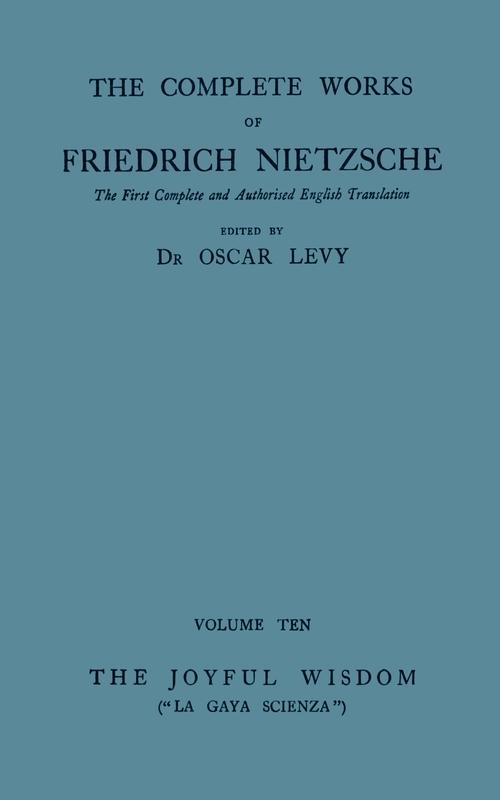
THE COMPLETE WORKS OF FRIEDRICH NIETZSCHE
TheFirstCompleteandAuthorisedEnglishTranslation
EDITED BY DR OSCAR LEVY
VOLUME TEN
THE JOYFUL WISDOM
("LA
GAYA SCIENZA")
Of the First Edition of One Thousand Five Hundred Copies this is No.
FRIEDRICHNIETZSCHE
THE JOYFUL WISDOM
("LA GAYA SCIENZA")
TRANSLATED BY THOMAS COMMON WITH POETRY RENDERED BY PAUL V. COHN AND