Another Random Scribd Document with Unrelated Content
money” to get Molloy out of jail in Brooklyn. The robbers then divided the remainder, Jess taking $3,000 for himself and another $3,000 for Montani, Splaine getting $3,000, Kinsman $2,750, “Joe the Kid” $250 and “Scotty the Lamb” nothing. Kinsman then told how he had called for Swede Annie, and left town in a taxicab, going as far as Peekskill, to avoid the police at the Grand Central Station.
Jess Confesses andAssists
The next prisoner examined was Jess Albrazzo, a dark little Italian, who appeared to be somewhat ignorant.
In this examination the Commissioner had ample outside proof, and he also employed what he calls his “psychological study.” Years ago, in dealing with negro suspects in Southern crime, Dougherty devised a little instrument which he dubbed his “lie watch.” This was a dial with a needle, hung round the suspect’s neck. If the latter told the truth, the needle presumably pointed to “Truth,” and if he didn’t, it pointed to “Lie.” Being out of the suspect’s sight, it had a strong effect.
From that, Dougherty went into studies of the mental states of suspects under examination, and found rough physiological indications which he uses as a guide to the integrity of the suspect. Investigations of European criminal experts like Professor Hans Gross amply demonstrate that there is a real scientific basis for such methods.
Dougherty took it a little easier with Jess. They sat down, and the Commissioner went over the Italian’s movements for the past few months, showing him how thoroughly he was implicated. Jess had worked for Montani, and been intimate with the rest of the taxicab “mob.” He and Montani were confronted with each other, and points brought out in Kinsman’s confession were skillfully used.
At one point in this examination the Commissioner rose from his desk, took the lobe of Jess’s ear between his thumb and finger,
pinched it slightly, looked at the ear closely, and then walked out of the room.
Jess was all on edge with curiosity.
“Why did he pinch my ear?” he asked of Lieutenant Riley.
“To see if you are telling the truth,” was the answer, and in a moment the Commissioner came back and examined that ear again.
“Yes, he’s lying,” he declared. “Look at his ear—can’t you see it yourself?” Others were invited to look at Jess’s ear, and the little Italian became so curious that he actually tried to look around the side of his skull and see his own ear!
This psychological study was backed up with abundant proof that Jess had not told the whole truth. Presently he weakened and confessed. He told how he had handed $2,000 in a collar box to “Jimmie the Push” on the day of the robbery, which was to be taken to a Bowery bank and put in a safe-deposit vault for Montani. He agreed to accompany the police to Jimmie’s place in Thompson street, and late that evening a party made up of Commissioner Dougherty, Inspector Hughes and Lieutenant Riley went there, taking Jess along.
“Jimmie the Push’s” place is one of the most picturesque thieves’ resorts in lower New York.
“Typical of the old village,” as Dougherty puts it. “In fact, this whole case has a strong flavor of the little old village of New York.”
Jimmie was out when they got there, but this saloon was in charge of the biggest, swarthiest Italian bartender in town, a tough Hercules weighing somewhere around three hundred pounds. The room was crowded with motley characters, drinking beverages known to the neighborhood as “shocks” and “high hats.” For their edification, a tramp magician was taking coins out of his ears, his nose and the air.
Jess was not known to be under arrest, and immediately sent a boy called “Reddy” to fetch the proprietor, who had known the three police officers for years. Presently Reddy came back and said that
Jimmie would come in about half an hour, as he was playing cards and had a fine hand.
Reddy was sent back to impress upon Jimmie that Jess wanted to see him right away—it was very important. In about two minutes, just as the Commissioner had bought a “high hat” for everybody in his party, Jimmie appeared. He was told that Jess had got into trouble in connection with the taxicab robbery, and asked about the money in the safe deposit vault. “Jimmie the Push,” with his partner, Bob Deilio, had by this time been implicated themselves, for it was clear that the money had been divided in their resort, and that probably they had taken part in the planning, and the decidedly onesided division of the spoils. Jimmie was led to believe that he did not rest under suspicion, however, and that he was only asked to aid the police. He said Jess had handed him a collar box on the day of the robbery, asking him to put it in a vault in his own name, but that he had had no idea what the box contained, and had left it lying behind the bar for a couple of days before he got a chance to go to the bank with it. He readily promised to appear at Police Headquarters the following morning, bring the key to the safe deposit box, and help recover the money. Thereupon the police officials bade him good night and went away. But no chances were taken on “Jimmie the Push.” From that moment he was shadowed.
That Monday was a busy day in many other ways.
Developments came thick and fast.
Kinsman’s home in Boston was visited, and $750 of the bank money recovered in the original wrappers. It had laid in his grip, unknown to the honest Kinsman family.
Swede Annie, Myrtle Horn and a girl named Rose Levy were examined, quickly broke down, and made tearful statements to be used in evidence. These women were held only as witnesses, and as the case cleared up after a few days’ detention, were released.
The girl, Rose Levy, greatly attracted the Commissioner. She was only nineteen years old, a mild-mannered little Jewess with jet black hair and very remarkable eyes. The Commissioner went into details
of her personal story. It seems that she had left her home in Brooklyn two months before, after a quarrel with her mother, and had come to New York looking for a position. But she quickly fell into the lower world, became known as Jess’s girl, and was ambitious to be “one of the gang.” After a fatherly talk she was persuaded to return to her home and live a decent life. But within a week she was back in New York again, in her old haunts, trying to raise money to help Jess, for whom, she told the Commissioner, she would willingly work for the rest of her days.
Before visiting Jimmie’s saloon the Commissioner called up the “Orange Growers” in Chicago, had a long talk with them, told what progress was being made, and put new life into them.
More Money Recovered
True to his word, “Jimmie the Push” walked into Police Headquarters at nine o’clock Tuesday morning, February 27, closely followed by his unseen shadowers. He produced the key of the safedeposit vault, and went with officers to see the money recovered. There was $2,000, as Jess had stated, still in the wrappers of the bank. Jimmie was still permitted to go free, under the impression that he had come through the ordeal “clean,” while fresh evidence was being obtained against him.
That morning the Commissioner also took Kinsman down over the route of the robbery, to have him explain it in his own way. This was done to strengthen the case against Montani, and upset his story in court.
Then “Scotty the Lamb” was located, arrested, brought to headquarters and led to confess. “Scotty the Lamb” was in some respects a pathetic figure in the case, and also a humorous one. He had been in charge of the lunch kitchen at the Arch Café when Jess owned it, and later worked as a dishwasher in a Washington Square hotel. A Scotch youth, from Glasgow, he had been in this country
about four years, and while no criminal record appeared against him, he was plainly in the company of thieves most of the time. According to his statement, he had been promised $25 for doing some work for Jess, and without inquiring into the nature of it at all, had shown up with the gang and gone along to do his minor part of a “stall,” stumbling in front of the cab. But before he could get out into the street, the cab had been boarded. So poor “Scotty the Lamb,” without a nickel for carfare, plodded all the way uptown again to the saloon where the money was to be divided, and got nothing whatever. He was a cheerful soul, however, and the life of the party when the gang was locked up, cracking jokes, and taking the view that, as sentences ought to be proportioned to the amount of money each member of the gang had got in the division, and he had got nothing, he might be let off with six months’ imprisonment.
“Scotty, haven’t you got any overcoat?” asked Inspector Hughes, sympathetically, as they were going to court one brisk morning. “Did you everhave an overcoat, Scotty?”
“No, sir, I never had an overcoat,” replied Scotty, and then as he thought of his prospects for going to prison, added drolly, “And now I don’t expect, sir, that I ever will!”
The Fine Italian Hand
The next step in the case was that of arresting “Jimmie the Push” and his partner, Bob Deilio.
Another phase of the robbery now began to come out plainly.
Up to the present time the main burden of proof pointed to the four “hold-up” men of American birth as the chief actors in the crime. Montani and Jess, the two Italians, appeared to be accessories.
But as the tangled threads were unravelled, one by one, it was found that the Italians involved outnumbered the American thugs, and that furthermore they had outwitted them.
When Bob Deilio was arrested he drew $215 in five-dollar bills out of his pocket and handed it to the police, admitting that it was part of $5,500 of the stolen money. The rest, he asserted, had just been paid for rent of the two resorts operated by “Jimmie the Push” and himself.
Jimmie and Bob were taken to Police Headquarters and examined, with Jess present. Commissioner Dougherty played one against the other so skillfully, with cross-questions and counter pressure, that in a little while each was excitedly telling tales on his two companions with the desperate hope of clearing himself, and denunciations flew back and forth among the trio as evidence came out that was likely to send them all to prison. Their confessions were obtained, and used in a new effort to break down Montani. But this was without results. The little Italian chauffeur still stuck doggedly to his original story.
From these new confessions it appeared that the Italians had planned the crime, enlisted the American hold-up men to carry out the dirty work, and laid a counter-plot for holding them up in turn when the money was divided. The “Three Brigands” were ostensibly offered a chance to take part in the actual robbery, but refused on the plea that it would be too risky, and that they did not believe Montani could carry it out successfully. On the morning of the crime they walked north over the route. When they met the taxicab coming south, with a policeman on the seat beside Montani and two unconscious bank messengers inside, they knew that the project had succeeded. So the “Three Brigands” hurried uptown to “Jimmie the Push’s” saloon. They got there so quickly that they were ahead of the robbers. Jess made a rehearsed protest when they insisted in sharing in the plunder, but the “Three Brigands” drew revolvers, threatened to make a disturbance that would bring in the police, and finally helped themselves to $10,000. When the thugs who had done the actual work left the saloon, they had only $8,000 all told. The Italians, who had “played safe” at every point, had $17,000.
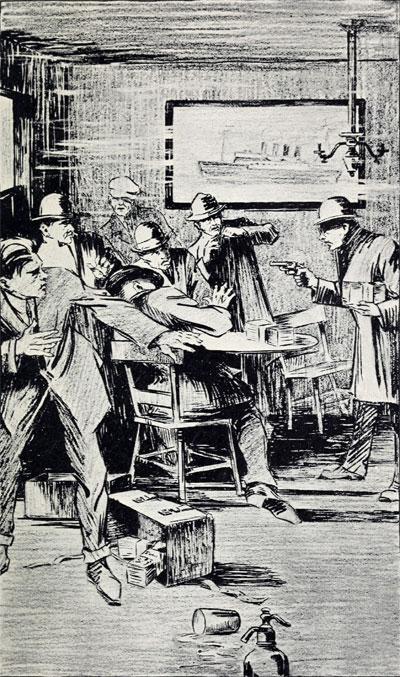
“The Brigands” “Stick-up” the Hold-up Men for Theirs
One ofthe Brigands Comes In
The actual whereabouts of the “Three Brigands” was not known to the police then. But there were certain channels through which news might reach at least one of them. Word was sent through those channels, therefore, that it might be best for them to appear and give an account of themselves, and on Friday, March 1, just at the time Splaine had been brought back from Memphis, the little leader of the brigands, Matteo Arbrano, an undersized Italian wearing spectacles, who had carried out the job of robbing the hold-up men, surrendered himself to the District Attorney.
Arbrano said that he had divided his $10,000 with his two companions, Gonzales and Cavaquero, and immediately left New York, taking a steamer for Mexico by way of Havana. At the latter city he stopped over night, met a woman and accompanied her to a resort, was drugged and robbed of $2,700, and woke on the Prado with only $100 left, a single bill that had been concealed in his shoe. With that he returned to New York. The story is regarded by the police as more picturesque than convincing. It is probable that Matteo’s share of the plunder, with that of other Italians involved, has been carefully “planted.”
Pauli Gonzales, another of the brigands, was traced to Vera Cruz, Mexico. In the present state of that country, however, it was found impossible to arrest and extradite him upon the evidence at hand.
Three other persons concerned in the robbery are still at large at this writing—“Dutch” Keller, “Joe the Kid,” and an “unknown” whose identity is concealed for police reasons.
Montani pleaded “Not guilty,” and stood trial. After two days, exactly a month and a day subsequent to the robbery, he was convicted by a jury, and sentenced to not less than ten years and
not more than eighteen years and two months in prison, with hard labor.
A word must be said about the prompt action of the District Attorney’s office in the taxicab case. Where crime has had such publicity there is an opportunity to make a demonstration of great value by pressing the prosecutions. It was not lost. Under Assistant Charles C. Nott, Jr., evidence was succinctly laid before judges and juries, the trials finished in a matter of hours, and convictions and sentences secured within six weeks after the robbery. Furthermore, the various sentences were just, being carefully graded according to the part played by each offender, his character and previous record, and his individual effort in facilitating justice.
Name Arrested Pleaded Sentenced Sentence
MONTANI, GENO Feb. 26,’12 Feb. 29,’12
Mch. 16,’12 Not less than 10 yrs. nor more than 18 yrs. 2 mos. Judge Seabury.
KINSMAN, EDW. Feb. 26,’12 Mch. 1,’12 April 9,’12 Not less than 3 yrs. nor more than 6 yrs. Judge Crain.
SPLAINE, EUGENE Mch. 2,’12 Mch. 4,’12
Mch. 25,’12 Not less than 7 yrs. 6 mos. nor more than 14 yrs. 6 mos. Judge Seabury.
DELIO, ROBERT Feb. 28,’12 Mch. 4,’12 Mch. 29,’12 Not less than 2 yrs. 6 mos. nor more than 4 yrs. 2 mos. Judge Seabury.
PASQUALE, JAMES
(“Jimmie the Push”) Feb. 28,’12 Mch. 4,’12 April 8,’12 6 mos. Penitent’ry. Judge Davis.
LAMB, JOSEPH (“Scotty the Feb. 27,’12 Mch. 18,’12
Mch. 29,’12 Indeterminate sentence,
Lamb”) Elmira. Judge Seabury.
ARBRANO, MATTEO Mch. 2,’12 April 3,’12 2 to 4 years. Judge Davis.
ALBRAZZO, JESS Mch. 26,’12 Mch. 18,’12 3 to 6 years. Judge Davis.
FINAL
A WORD ABOUT THE NEW YORK POLICE
It has been the writer’s good fortune to look into the work of both the London and the New York policemen recently, within the same year.
A somewhat embarrassing point arose.
In London, the “bobby” was anxious to know which police force the writer considered best. The “bobby” gets his ideas of the New York “cop” from such accounts as filter through the cable dispatches from our newspapers. He hears chiefly the worst, and pictures the “cop” as a lawless individual, wielding pistol and club indiscriminately, with whom it is not safe to pass a civil word. So, when he puts his little question about the respective merits of the two organizations, he reserves the right to keep his opinion that the London force is best anyway.
In New York, it is much the same. The “cop” has heard just enough about the “bobby” to regard him with mild tolerance. He pictures him as a policeman servile to the last degree, thankfully accepting sixpenny tips from pedestrians, and occupied chiefly with unarmed thieves and harmless political offenders.
When one has good friends in both forces, the question “Which do you think best?” is to be met with tactful evasions. And the more one thinks it over, the more it becomes clear that there is really little difference at bottom. Both police organizations are made up of good men, following the same trade along the same lines, and dealing with about the same general conditions.
The London “bobby,” however, enjoys excellent leadership, is governed by a definite administrative policy, has the backing of the courts, and therefore comes in for a general public good will which is exceedingly useful to him in the performance of duty.
The New York “cop” rather lacks public good will. Administrative policy has not been well defined in the past. The courts do not always accept his evidence, much less back him up, and he has been made the scapegoat for various shortcomings in leadership.
But to-day the New York policeman is working on an entirely new basis. Before long his public is certain to understand and like him as thoroughly as London does its “bobby.”
The change began with Mayor Gaynor, who insisted that both policeman and citizen have plain legal rights—until the citizen has committed a crime the policeman may not arrest him. The policeman has plain rights—the law empowers him to use all necessary force in making arrests in grave cases. But force must not be used for minor offenses. Confusion existed on these points to such a degree that when the Mayor began insisting upon them, many people thought he was putting into effect some of his personal whims. But they are all in the statute books, and many of them were there before the Mayor was born, because they are constitutional.
The present Police Commissioner, Rhinelander Waldo, is not only administering the department along the strict legal line pointed out by the Mayor, but is effecting improvements of organization and method that must favorably alter the whole future of the service.
Commissioner Waldo is a soldier, with a record of service in the United States Army, and the Army’s fine standards to guide him.
In some ways the administration of the New York Police Department is a soldier’s job. If the ten thousand members were mobilized, they would make quite an impressive little standing army, with eight or ten full regiments of patrolmen, a brigade of cavalry, a small transport corps, a little navy, and so forth. As in an army, too, the men are enlisted, and may only be discharged for serious offenses. It is a force scattered over three hundred square miles of
territory. The leader must be skillful in laying down regulations, and handling men in the mass rather than by personal contact. He must define duty plainly, hold everybody to it, eliminate departmental politics and abuses. Every man, wherever he is stationed, must feel that the general knows his business, that he lays down regulations for good reasons, and that day by day he is taking the organization somewhere.
For years, every Police Commissioner has asked for more men to keep pace with the growing city. When Waldo took charge he asked, too. While he was waiting, however, he overhauled the organization and got one thousand additional patrolmen by cutting off men detailed for clerical and other special duty. Every large working force tends to create superfluous routine work. The useless routine was eliminated by better accounting methods, and the men sent back to do the street duty for which they originally enlisted.
Then Waldo’s system of “fixed posts” was introduced. Complaints that policemen were hard to find at night had become common. So the platoon on duty from 11 p. m. to 7 a. m. was distributed by a plan under which the men work in pairs, one patrolling a given beat and the other standing on a street intersection. Each hour they change places, or oftener in severe weather. The fixed posts are about a thousand feet apart all over Manhattan and parts of Brooklyn. The system has been indiscriminately criticised, but produces its results. Fire losses were cut down the first six months, night crime has decreased, and many notable arrests are due to the fact that policemen stand all over town like checkers through the night. The exposure is no greater than that endured by traffic men. The men have better opportunities to advance themselves by making meritorious arrests, and the Commissioner knows that, as citizens see the police on duty, night after night, and crime decreases, there will be a growing good will for the department.
The Detective Bureau has not only been reorganized so that plainclothes men are distributed over the whole city, but a new spirit has been introduced. Formerly, when the patrolman rose to detective rank, he felt that he had “arrived.” No longer wearing the uniform or
keeping scheduled hours, he was in danger of going to sleep. Today, however, the detective has, not a job, but an opportunity. He must maintain his rank by results, or be reduced. To help him do this, he is taught methods in the school for detectives. But he knows that hundreds of ambitious men in brass buttons are working to attain that rank.
In an organization of ten thousand men, it would be strange if there were not some intriguing and politics. New York policemen are exceptionally shrewd, and occasionally they will try to “put one over” on the Commissioner, going around his authority. But Commissioner Waldo has proved singularly resourceful. He meets such an emergency with the quickness, certainty and impartiality of a natural force like gravity, and the department has found it out.
He has laid out a clear path for advancement all through the department. The newest uniformed patrolman understands that, for meritorious work, he will have a chance of promotion. If he makes a commendable arrest, he is sent to the Detective Bureau, given instruction, and tried at detective work. If he makes good, he stays. If unfitted for plain-clothes duty, he has still had his chance. What is just as important, the Detective Bureau has had a chance to see him.
Under Commissioner Waldo and Deputy Commissioner Dougherty, the so-called “Black Hand” crimes among Italians have been checked, and will be stopped. Many of these cases were traced to sensational reporting of ordinary quarrels and assaults, and others to business rivalries. In the serious cases, arrests have been made and convictions secured.
Another well-known form of law-breaking in New York is gambling. This is particularly difficult to check because of ingenuity in concealing evidence, developed by long experience on the part of the law-breakers, and also the strong political alliances of gamblinghouse keepers. But after several experiments in dealing with it, the Commissioner now feels confident that he has a method which will result in the suppression of gambling, and that, as he says, “When
you put a crimp into things of that sort they don’t generally come back.”
In other directions red tape has been abolished and economies brought about; the way has been opened for individual merit in all ranks; steps have been taken to develop and teach better methods; the work of the department has been brought closer to the public. There is a new spirit in the New York Police Department to-day a spirit certain to develop the public good will and appreciation that is so necessary to the best order of public service.
SOME INTERESTING FACTS ABOUT THE POLICE DEPARTMENT OF THE CITY OF NEW YORK
The Police Department of the City of New York is made up as follows:
Commissioner and four Deputy Commissioners
Inspectors
Surgeons
Captains
Lieutenants
Sergeants
Patrolmen
Doormen
Matrons
Superintendent of Telegraph
Assistant Superintendents of Telegraph
Chief Lineman
Linemen
Boiler Inspectors
Total uniform force
Of this number, 500 are detectives in civilian dress. In addition, there are over 247 civilians employed in clerical capacity.
There are 6 automobiles and 161 other vehicles, including patrol wagons, used by the Department. Also 679 horses for mounted patrolmen.
The Harbor Squad numbers: 1 Captain, 7 Lieutenants, 9 Sergeants, 36 Patrolmen, 2 Doormen, besides civilians employed as engineers, firemen, oilers, deck-hands, etc.
It is provided with one vessel of 235 tons, five launches, two dories, and six boats.
These boats patrol about 340 miles of water front.
*** END OF THE PROJECT GUTENBERG EBOOK THE GREAT TAXICAB ROBBERY: A TRUE DETECTIVE STORY
***
Updated editions will replace the previous one—the old editions will be renamed.
Creating the works from print editions not protected by U.S. copyright law means that no one owns a United States copyright in these works, so the Foundation (and you!) can copy and distribute it in the United States without permission and without paying copyright royalties. Special rules, set forth in the General Terms of Use part of this license, apply to copying and distributing Project Gutenberg™ electronic works to protect the PROJECT GUTENBERG™ concept and trademark. Project Gutenberg is a registered trademark, and may not be used if you charge for an eBook, except by following the terms of the trademark license, including paying royalties for use of the Project Gutenberg trademark. If you do not charge anything for copies of this eBook, complying with the trademark license is very easy. You may use this eBook for nearly any purpose such as creation of derivative works, reports, performances and research. Project Gutenberg eBooks may be modified and printed and given away you may do practically ANYTHING in the United States with eBooks not protected by U.S. copyright law. Redistribution is subject to the trademark license, especially commercial redistribution.
START: FULL LICENSE
THE FULL PROJECT GUTENBERG LICENSE
PLEASE READ THIS BEFORE YOU DISTRIBUTE OR USE THIS WORK
To protect the Project Gutenberg™ mission of promoting the free distribution of electronic works, by using or distributing this work (or any other work associated in any way with the phrase “Project Gutenberg”), you agree to comply with all the terms of the Full Project Gutenberg™ License available with this file or online at www.gutenberg.org/license.
Section 1. General Terms of Use and Redistributing Project Gutenberg™ electronic works
1.A. By reading or using any part of this Project Gutenberg™ electronic work, you indicate that you have read, understand, agree to and accept all the terms of this license and intellectual property (trademark/copyright) agreement. If you do not agree to abide by all the terms of this agreement, you must cease using and return or destroy all copies of Project Gutenberg™ electronic works in your possession. If you paid a fee for obtaining a copy of or access to a Project Gutenberg™ electronic work and you do not agree to be bound by the terms of this agreement, you may obtain a refund from the person or entity to whom you paid the fee as set forth in paragraph 1.E.8.
1.B. “Project Gutenberg” is a registered trademark. It may only be used on or associated in any way with an electronic work by people who agree to be bound by the terms of this agreement. There are a few things that you can do with most Project Gutenberg™ electronic works even without complying with the full terms of this agreement. See paragraph 1.C below. There are a lot of things you can do with Project Gutenberg™ electronic works if you follow the terms of this agreement and help preserve free future access to Project Gutenberg™ electronic works. See paragraph 1.E below.
1.C. The Project Gutenberg Literary Archive Foundation (“the Foundation” or PGLAF), owns a compilation copyright in the collection of Project Gutenberg™ electronic works. Nearly all the individual works in the collection are in the public domain in the United States. If an individual work is unprotected by copyright law in the United States and you are located in the United States, we do not claim a right to prevent you from copying, distributing, performing, displaying or creating derivative works based on the work as long as all references to Project Gutenberg are removed. Of course, we hope that you will support the Project Gutenberg™ mission of promoting free access to electronic works by freely sharing Project Gutenberg™ works in compliance with the terms of this agreement for keeping the Project Gutenberg™ name associated with the work. You can easily comply with the terms of this agreement by keeping this work in the same format with its attached full Project Gutenberg™ License when you share it without charge with others.
1.D. The copyright laws of the place where you are located also govern what you can do with this work. Copyright laws in most countries are in a constant state of change. If you are outside the United States, check the laws of your country in addition to the terms of this agreement before downloading, copying, displaying, performing, distributing or creating derivative works based on this work or any other Project Gutenberg™ work. The Foundation makes no representations concerning the copyright status of any work in any country other than the United States.
1.E. Unless you have removed all references to Project Gutenberg:
1.E.1. The following sentence, with active links to, or other immediate access to, the full Project Gutenberg™ License must appear prominently whenever any copy of a Project Gutenberg™ work (any work on which the phrase “Project
Gutenberg” appears, or with which the phrase “Project Gutenberg” is associated) is accessed, displayed, performed, viewed, copied or distributed:
This eBook is for the use of anyone anywhere in the United States and most other parts of the world at no cost and with almost no restrictions whatsoever. You may copy it, give it away or re-use it under the terms of the Project Gutenberg License included with this eBook or online at www.gutenberg.org. If you are not located in the United States, you will have to check the laws of the country where you are located before using this eBook.
1.E.2. If an individual Project Gutenberg™ electronic work is derived from texts not protected by U.S. copyright law (does not contain a notice indicating that it is posted with permission of the copyright holder), the work can be copied and distributed to anyone in the United States without paying any fees or charges. If you are redistributing or providing access to a work with the phrase “Project Gutenberg” associated with or appearing on the work, you must comply either with the requirements of paragraphs 1.E.1 through 1.E.7 or obtain permission for the use of the work and the Project Gutenberg™ trademark as set forth in paragraphs 1.E.8 or 1.E.9.
1.E.3. If an individual Project Gutenberg™ electronic work is posted with the permission of the copyright holder, your use and distribution must comply with both paragraphs 1.E.1 through 1.E.7 and any additional terms imposed by the copyright holder. Additional terms will be linked to the Project Gutenberg™ License for all works posted with the permission of the copyright holder found at the beginning of this work.
1.E.4. Do not unlink or detach or remove the full Project Gutenberg™ License terms from this work, or any files
containing a part of this work or any other work associated with Project Gutenberg™.
1.E.5. Do not copy, display, perform, distribute or redistribute this electronic work, or any part of this electronic work, without prominently displaying the sentence set forth in paragraph 1.E.1 with active links or immediate access to the full terms of the Project Gutenberg™ License.
1.E.6. You may convert to and distribute this work in any binary, compressed, marked up, nonproprietary or proprietary form, including any word processing or hypertext form. However, if you provide access to or distribute copies of a Project Gutenberg™ work in a format other than “Plain Vanilla ASCII” or other format used in the official version posted on the official Project Gutenberg™ website (www.gutenberg.org), you must, at no additional cost, fee or expense to the user, provide a copy, a means of exporting a copy, or a means of obtaining a copy upon request, of the work in its original “Plain Vanilla ASCII” or other form. Any alternate format must include the full Project Gutenberg™ License as specified in paragraph 1.E.1.
1.E.7. Do not charge a fee for access to, viewing, displaying, performing, copying or distributing any Project Gutenberg™ works unless you comply with paragraph 1.E.8 or 1.E.9.
1.E.8. You may charge a reasonable fee for copies of or providing access to or distributing Project Gutenberg™ electronic works provided that:
• You pay a royalty fee of 20% of the gross profits you derive from the use of Project Gutenberg™ works calculated using the method you already use to calculate your applicable taxes. The fee is owed to the owner of the Project Gutenberg™ trademark, but he has agreed to donate royalties under this paragraph to the Project Gutenberg Literary Archive Foundation. Royalty
payments must be paid within 60 days following each date on which you prepare (or are legally required to prepare) your periodic tax returns. Royalty payments should be clearly marked as such and sent to the Project Gutenberg Literary Archive Foundation at the address specified in Section 4, “Information about donations to the Project Gutenberg Literary Archive Foundation.”
• You provide a full refund of any money paid by a user who notifies you in writing (or by e-mail) within 30 days of receipt that s/he does not agree to the terms of the full Project Gutenberg™ License. You must require such a user to return or destroy all copies of the works possessed in a physical medium and discontinue all use of and all access to other copies of Project Gutenberg™ works.
• You provide, in accordance with paragraph 1.F.3, a full refund of any money paid for a work or a replacement copy, if a defect in the electronic work is discovered and reported to you within 90 days of receipt of the work.
• You comply with all other terms of this agreement for free distribution of Project Gutenberg™ works.
1.E.9. If you wish to charge a fee or distribute a Project Gutenberg™ electronic work or group of works on different terms than are set forth in this agreement, you must obtain permission in writing from the Project Gutenberg Literary Archive Foundation, the manager of the Project Gutenberg™ trademark. Contact the Foundation as set forth in Section 3 below.
1.F.
1.F.1. Project Gutenberg volunteers and employees expend considerable effort to identify, do copyright research on, transcribe and proofread works not protected by U.S. copyright
law in creating the Project Gutenberg™ collection. Despite these efforts, Project Gutenberg™ electronic works, and the medium on which they may be stored, may contain “Defects,” such as, but not limited to, incomplete, inaccurate or corrupt data, transcription errors, a copyright or other intellectual property infringement, a defective or damaged disk or other medium, a computer virus, or computer codes that damage or cannot be read by your equipment.
1.F.2. LIMITED WARRANTY, DISCLAIMER OF DAMAGES - Except for the “Right of Replacement or Refund” described in paragraph 1.F.3, the Project Gutenberg Literary Archive Foundation, the owner of the Project Gutenberg™ trademark, and any other party distributing a Project Gutenberg™ electronic work under this agreement, disclaim all liability to you for damages, costs and expenses, including legal fees. YOU AGREE THAT YOU HAVE NO REMEDIES FOR NEGLIGENCE, STRICT LIABILITY, BREACH OF WARRANTY OR BREACH OF CONTRACT EXCEPT THOSE PROVIDED IN PARAGRAPH 1.F.3. YOU AGREE THAT THE FOUNDATION, THE TRADEMARK OWNER, AND ANY DISTRIBUTOR UNDER THIS AGREEMENT WILL NOT BE LIABLE TO YOU FOR ACTUAL, DIRECT, INDIRECT, CONSEQUENTIAL, PUNITIVE OR INCIDENTAL DAMAGES EVEN IF YOU GIVE NOTICE OF THE POSSIBILITY OF SUCH DAMAGE.
1.F.3. LIMITED RIGHT OF REPLACEMENT OR REFUND - If you discover a defect in this electronic work within 90 days of receiving it, you can receive a refund of the money (if any) you paid for it by sending a written explanation to the person you received the work from. If you received the work on a physical medium, you must return the medium with your written explanation. The person or entity that provided you with the defective work may elect to provide a replacement copy in lieu of a refund. If you received the work electronically, the person or entity providing it to you may choose to give you a second opportunity to receive the work electronically in lieu of a refund.
If the second copy is also defective, you may demand a refund in writing without further opportunities to fix the problem.
1.F.4. Except for the limited right of replacement or refund set forth in paragraph 1.F.3, this work is provided to you ‘AS-IS’, WITH NO OTHER WARRANTIES OF ANY KIND, EXPRESS OR IMPLIED, INCLUDING BUT NOT LIMITED TO WARRANTIES OF MERCHANTABILITY OR FITNESS FOR ANY PURPOSE.
1.F.5. Some states do not allow disclaimers of certain implied warranties or the exclusion or limitation of certain types of damages. If any disclaimer or limitation set forth in this agreement violates the law of the state applicable to this agreement, the agreement shall be interpreted to make the maximum disclaimer or limitation permitted by the applicable state law. The invalidity or unenforceability of any provision of this agreement shall not void the remaining provisions.
1.F.6. INDEMNITY - You agree to indemnify and hold the Foundation, the trademark owner, any agent or employee of the Foundation, anyone providing copies of Project Gutenberg™ electronic works in accordance with this agreement, and any volunteers associated with the production, promotion and distribution of Project Gutenberg™ electronic works, harmless from all liability, costs and expenses, including legal fees, that arise directly or indirectly from any of the following which you do or cause to occur: (a) distribution of this or any Project Gutenberg™ work, (b) alteration, modification, or additions or deletions to any Project Gutenberg™ work, and (c) any Defect you cause.
Section 2. Information about the Mission of
Project Gutenberg™ is synonymous with the free distribution of electronic works in formats readable by the widest variety of computers including obsolete, old, middle-aged and new computers. It exists because of the efforts of hundreds of volunteers and donations from people in all walks of life.
Volunteers and financial support to provide volunteers with the assistance they need are critical to reaching Project Gutenberg™’s goals and ensuring that the Project Gutenberg™ collection will remain freely available for generations to come. In 2001, the Project Gutenberg Literary Archive Foundation was created to provide a secure and permanent future for Project Gutenberg™ and future generations. To learn more about the Project Gutenberg Literary Archive Foundation and how your efforts and donations can help, see Sections 3 and 4 and the Foundation information page at www.gutenberg.org.
Section 3. Information about the Project