Evidence from paediatricians: online harms are impacting children in hospital clinics
The issue
Paediatricians are increasingly concerned that the digital environment many children are growing up in is not designed with their safety, development and mental health in mind. We are at a crossroads where the UK government could generate appropriate safeguards and ensure children and young people (CYP) can enjoy the benefits of the online world without being exposed to avoidable risks.
Against a backdrop of growing concern about the impact of online activity and social media use, the College has sought to better understand paediatricians’ views to ensure that any national action places child health at its core. A survey was shared with all RCPCH members through our e‑bulletins and remained open for 3 weeks, receiving 60 responses. Findings were reviewed by a clinical expert group, with open‑text responses thematically analysed by the RCPCH Health Policy team. Although responses came from a self‑selecting group, the clinical expert group (representing our mental health, child protection and digital committees) judged the themes to be reflective of experiences across UK paediatric services.
We have heard examples and case studies where children and young people’s use of social media is tied to poor mental, physical and emotional health and wellbeing. This, in turn, is driving demand on services and the workload of RCPCH members.
A children’s rights lens provides a useful way to frame the debate on online activity and social media use. The United Nations Convention on the Rights of the Child (UNCRC) sets out children’s rights to education, to develop to their full potential, and to protection from violence, abuse and neglect. It also affirms rights to play and creativity, and to freedom of expression and access to information through the media.
We want to see the UK government use this valuable opportunity to set a clearer direction for how children are protected online, addressing the systems, incentives and leadership needed to support safer and developmentally appropriate digital experiences.
Being online and social media are separate issues
We define online activity and social media as related but distinct. We define ‘being online’ as any activity that involves accessing the internet, and ‘social media’ as platforms or apps that enable users to create and share content and to interact with others. Although there is some overlap, we believe the risks and benefits of each are not interchangeable and require separate consideration and tailored responses. Paediatricians felt social media carries additional risks linked to its design and social dynamics, meaning the overall balance of risk is higher.
Key findings
Top benefits of CYP being online
To support education and learning (55/157)
Top risks of CYP being online
Exposure to harmful / age-inappropriate content: including; sexually explicit, violent, modelling dangerous behaviour and tips for self harm and eating disorders.
(57/265)
Enabling connection and peer support (38/157)
Access to health information, digital health tools and counselling services (22/157)
Supporting play, creativity, entertainment and relaxation (15/157)
Developmental, cognitive & educational impacts: Including; reduced verbal communication, reduced concentration and attention span and academic delay. (27/265)
Exploitation and safeguarding risks: Including; grooming, gangs and financial exploitation. (26/265)
Reduced face-to-face interaction and social impacts: including; reduced social interaction, reduced emotional regulation skills and loneliness. (26/265)
Count = each time the theme was mentioned in responses
Paediatrician view: Do the benefits of CYP being online outweigh the risks? Top
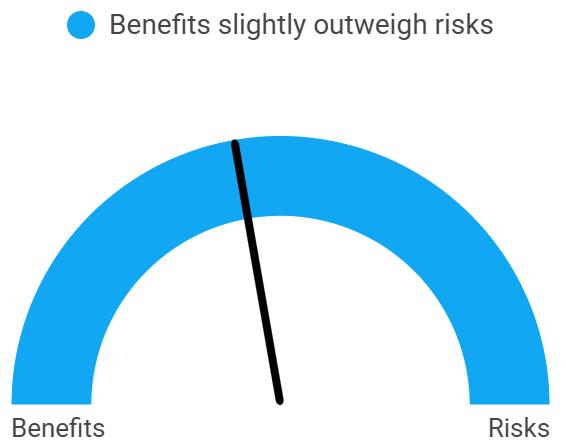
Enabling connection and peer support (44/75)
Limited / no perceived benefits (13/75)
Learning & information (8/75)
Supporting play, creativity, entertainment and relaxation (4/75)
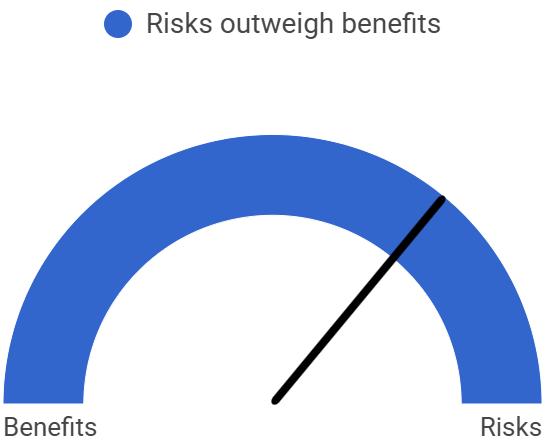
Exposure to harmful / age-inappropriate content: including; sexually explicit, violent, modelling dangerous behaviour and tips for self harm and eating disorders. (40/212)
Bullying, harassment and abuse: If children are being bullied social media creates an “always on” environment where they do not get a break. (32/212)
Exploitation & safeguarding risks: Including; grooming, gangs and financial exploitation. (30/212)
Increased risk of mental health presentations: including; Anxiety, low mood, self harm and reduced self worth. (20/212)
Count = each time the theme was mentioned in responses
Paediatrician view: Do the benefits of CYP using social media outweigh the risks?
Paediatricians have expressed concerns about the addictive nature of social media, responses to our survey noted compulsive use that is impacting physical health (e.g. eye sight and headaches) and sleep schedules which causes problems physically, mentally, emotionally as well as absence from school.
We are also conscious that some children are disproportionately impacted; any child with additional vulnerabilities will be more vulnerable to harms online. Where protective factors (e.g. physical activity, family support and strong face to face relationships) are reduced, higher exposure and constant pressure can compound harms.
protective factors are reduced, higher exposure and constant pressure can compound harms and make recovery harder.
Impact on children’s health services:
Impact on children’s health services
Nearly half of our consulting group said that they spoke often or very often discuss online activity in consultations 49%.
Nearly half, 49%, of our consulting group said that they spoke to children and young people often or very often in consultations about their online activity or social media use.
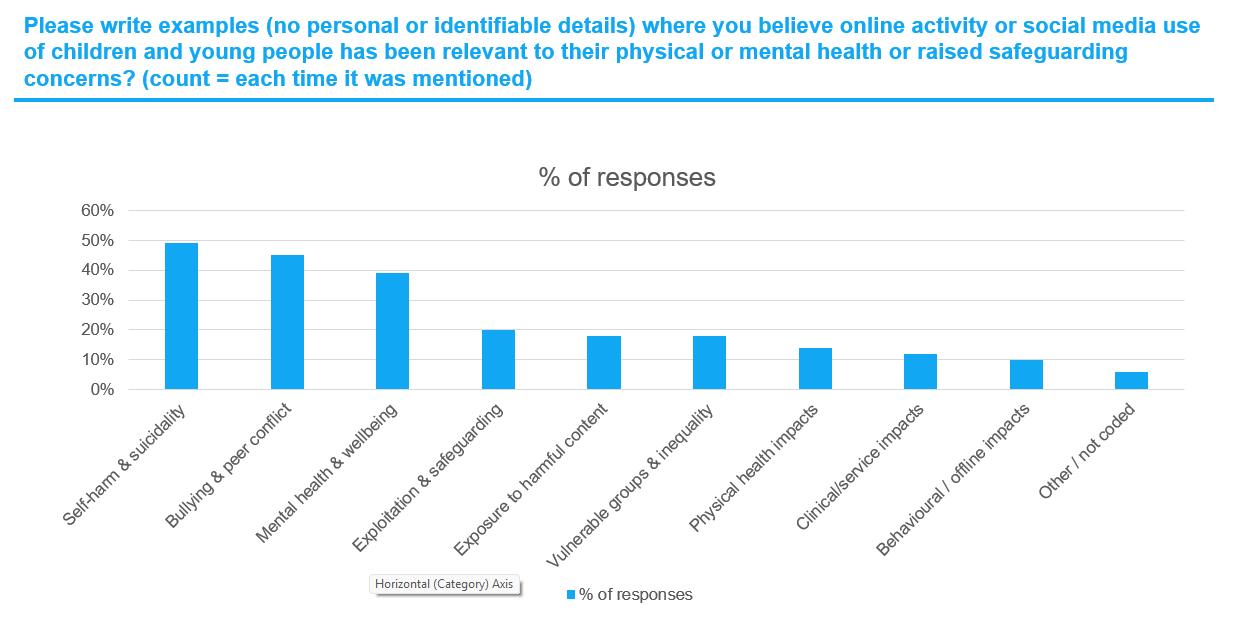
Case studies and examples given were most commonly linked to:
Case studies and examples given were most commonly linked to:
- Self-harm and suicidality
• Self harm and suicidality
- Mental health presentations (anxiety, depression and eating disorders)
• Mental health presentations (anxiety, depression and eating disorders)
• Bullying and peer conflict
- Bullying and peer conflict
- Safe guarding and exploitation concerns.
• Safe guarding and exploitation concerns
These are not abstract risks they are presenting at the front door of the health service now
These are not abstract risks, they are presenting at the front door of the health service now.
Illustrative quotes
“I frequently meet children and young people who have been admitted to the paediatric ward with mental health problems, such as suicidal ideation, deliberate self harm, eating disorders. In many of these cases, the young person self-declares to be accessing social media for many hours per day, and in some cases they specifically cite the use of such sites / applications as contributing towards their low mood / suicidal ideation.”
“Bullying online by class mates leading to low mood, anxiety and suicidal ideation, also to gastrointestinal complaints and somatisation of anxiety.”
“I am the designated doctor for child death and there has been many aspects of these cases where social media has played a negative role. Cases of teen suicide, copied TikTok tricks.”
“Access to eating disorder or deliberate self harm and suicide content that encourages young people to engage in these behaviours and gives tips on how to do it.”
“Young person with poor mental health, suicidal ideation, self harm, saw lots on social media of other suicidal teenagers and self harming people, and although we cannot prove a link, it is highly likely that this repeated viewing of others self harming made it more 'normal' for the young person, so they continued to engage in this behaviour. They finally admitted coming off TikTok was an important factor in improving their mental health.”
Conclusion
This evidence highlights a nuanced picture: while being online brings clear benefits and children have a right to those benefits, current social media environments pose significant risks to children’s health and wellbeing. Real harms and real dangers are already being seen clinically, underscoring the requirement of urgent action. The balance of risk varies by age, development and individual vulnerability, meaning simple or universal solutions are unlikely to be effective.
Rather than blanket restrictions, we emphasise the need for developmentally appropriate protections, safety by design and stronger accountability. The UK government must ensure a well evidenced response that protects children while enabling them to access the benefits of digital spaces. This should include continuous evaluation of the digital environment, so that protections evolve in step with the internet and emerging risks. Children should be able to benefit from digital spaces, but with systems in place that reduce harm and better reflect their needs as they grow.
Recommendations
1. Make online experiences suitable for different ages by mandating clear, child-friendly principles
We must see a risk based, graduated approach where children’s online experiences and protections evolve as they grow. What they can access should reflect both their level of maturity and the risks involved. Developmentally appropriate age limits should be applied, but meaningful protection comes from managing access based on both age and risk across the entire digital environment not just social media, but also AI chatbots, connected toys, educational technologies and gaming.
2.
Remove the commercial incentives for harmful digital design
The UK government must prohibit the use of targeted advertising, profiling and manipulative design features, including addictive features which are known to increase time spent online and on digital devices, in services used by children. The government must ensure that companies cannot profit from practices that harm child users. As a first step, the UK government should embed the Age Appropriate Design Code (AADC) in primary legislation
3.
Strong leadership and accountability
Protecting children online requires clear leadership, coordinated action across regulators and accountability for outcomes. Given that real harms and real dangers are already being seen, the UK government must take a proactive and adaptive approach. This includes establishing mechanisms for the continuous monitoring and evaluation of emerging risks in the digital environment, ensuring that responses remain evidence based and responsive to change. Leadership should provide alignment across government departments, regulation and enforcement with clear lines of responsibility and robust accountability for delivering safe online experience for children
RCPCH brings the front line expertise and views of paediatricians, the experiences of children and young people they see in their clinical work and safeguarding experience to stand alongside digital safety specialist organisations. We recognise the extensive and high quality work that has been led by expert partners across this field. We support a collaborative approach to improving children’s online experiences and have endorsed the Children’s Coalition for Online Safety’s statement and recommendations.
You can read the Children’s Coalition for Online Safety’s statement here: https://5rightsfoundation.com/ resource/statement on the uk governments growing up in the online world consultation
The views analysed and presented here are from paediatricians. To complement this work, RCPCH &Us, our children and young people’s engagement team, have spoken to over 300 children and young people who have health conditions and healthcare experiences to further explore how this group use digital spaces and ensure that their voices, experiences and perspectives are represented to government.
You can find out more about the work of RCPCH &US here: https://www.rcpch.ac.uk/work we do/rcpch and us
©RCPCH 2026
Incorporated by Royal Charter and registered as a Charity in England and Wales: 1057744 and in Scotland: SCO38299. Registered Office 5 11 Theobalds Road, London WC1X 8SH. Patron HRH The Princess Royal.