~-
- - - - - -- - -- - -- - - -- - -- - - - -- ----
The UNIVERSITY of WESTERN ONTARIO
, .
~ ~
-An interdisciplinary medical science publication; established 1930 o lume 68
Winter 1999
J
TAY p~riodical W1.ME3440
Flexibility To Be Precise 25 meg
50 meg
i5 mq::
I11C1l
100 me
II~
mq1
125 rnq:
150 mcg
liS mctt:
!00 meg
~
rnq
IIAIP Phanna
EDITORIAL Editors-in-Chief Carla Garcia ............. Meds 2000 Aaron Glickman ..... Meds 2000 Senior Associate Editors Dan Hackam ...........Meds 2000 Junior Associate Editor Mason Ross ............. Meds 2001
5 TA FF
Advertising View An Ad
'I'HE NEXT ISSUE
Printer Willow Printing Group Limited
Departmental Editors Ethics .............................................. David Satin ........................... Meds 2001 Nyan Narine .........................Meds 2002 Humour ......................... ................Romy Saibil ..........................Meds 2000 Benjamin Barankin .............. Meds 2001 Medical Myths .............................. Matthew Crystal ................ ..Meds 2001 Medicine On The Internet ...........Anand Pandya ..................... Meds 2001 Munsif Bhimani ................. .. Meds 2002 Profiles ........................................... Helen Lewandowski ....... ....Meds 2001 Promotion and Prevention ..........Dan Mendon<;a .....................Meds 2000 Eric Wong ............................. Meds 2002 Thinking on Your Feet .................Nimesh Desai .......................Meds 2000 Allan Vescan .........................Meds 2001 History of Medicine .....................Vadim Sherman ...................Meds 2000 Susanna Yanivker ................Meds 2000 Vocabulary .....................................Zakir Esufali .........................Meds 1999 Medicine and the Law .................Mahmoud Sharaf ................. Meds 2002 Najib Safieddine ..................Meds 2002 Cover Art ....................................... Scott Kish, Human Interactive co.
••••••••••••••••••••••••••••••• UWO MEDICAL JOURNAL ADVISORY COUNCIL Dr. Colby, Microbiology Dr. Nisker, Obstetrics/Gynecology Dr. Wexler, Anaesthesia Dr. Silcox, Obstetrics/Gynecology
ONCOLOGY SUBMISSION DEADLINE March 1, 1999
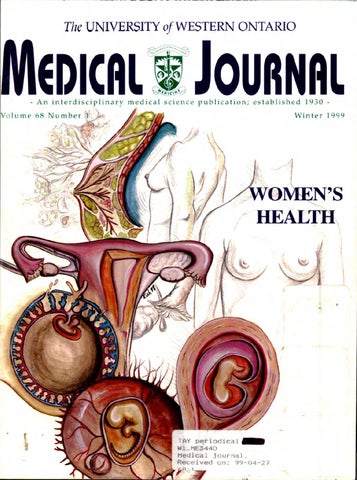
www.rned.uwo.ca/ medirnl/ COVER ART: Scott Kish A native of London, Ontario, Scott obtained his degree in Kinesiology from the University of Waterloo, where he specializes in anatomy, and visual information processing. As a self taught illustrator, Scott delivers a unique style of conceptualizing complex information pertaining to the human body in order to attract attention and increase comprehension. His work appears both locally and internationally with clients including doctors, lawyers, advertising agencies, etc .
~
l
HUMAN iNTERACTIVE Visual Communications Scolt Klsh BSc. (KIN) CK
Medtcal/1/ustratton & Graphtcs • medical • legal
• editorial • advertising
Bus/Fax (519) 438-1036 sc:ott.kish O sympatico.ca
1530 Glengarry Ave. London ON NSX 1 R4
••••••••••••••••••••••••••••••• ALL CORR ESPONDENCE regarding Journal content MUST be sent to the Editor of the Jou rnal (N OT to members of the Advisory Council). Letters to the Editor will be published and edited at the discretion of the Editor. The Advisory Council was created to assist managerial & business aspects of UWO Medical Journal operations. THE A DVISORY COU CIL HAS NO ROLE REGA RDING CONTENT. All material published in the Journal reflects solely the views and opinions of the au thors of the material printed and not necessarily the editorial staff or the Advisory Council of the Journal .
••••••••••••••••••••••••••••••••••••••••••••• U. W .O. Medical Journal 68 (1) 1 9 9 9 - - - - - - - - - - - - - - - - - - - - - - - - -
GUIDELINES
FOR
AUTHORS
The UWO Medical Journal is an interdisciplinary medical publication, established in 1930. The Journal is published twice each academic year: Fall and Spring. Š All material published by the UWO Medical Journal is copyright protected- no section of the UWO Medical Journal may be reproduced without the expressed written permission of the Editor. S UBMISSIONS WHICH DO NOT FOLLOW THESE GUIDELINES WILL NOT BE ACCEPTED FOR PUBLICATION.
All inquiries should be directed to the Editorial Board . Please do not contact the editorial staff at home. Office: e-mail: Phone & Fax: WebSite:
MS-175, Health Sciences Building journal@julian.uwo.ca (519) 661-4238 www.med.uwo.ca/medjml/
Nature of The Journal The purpose of the UWO Medical Journal is to provide a single forum for original articles based on research or clinical medicine of topical or historical interest. Since readership of the Journal is interdisciplinary, articles published will attempt to reflect a wide range of medical interes ts. In this regard, submissions should be directed towards the general medical reader . Articles which do not pertain to the feature topic will be given lower priority as will those with excessive technical jargon. Please restrict submissions to under 2,000 words. Informal peer review is required, i.e., non-specialist authors are encouraged to collaborate with, or at minimum, have their work reviewed for content by a specialist in the field. This individual, if not a co-author, is to be acknowledged at the end of the paper. In addition, it is recommended that all submissions be proof read for significant stylistic or grammatical errors. The editor will not assume responsibility for corrections of this nature and articles requiring such revisions will be returned to the author. Submissions and disks become the property of the Journal. The Journal reserves the right to correct errors of punctuation or spelling. Affiliation with UWO is not a prerequisite for authorship. References are indicated numerically in the text1 and listed as endnotes in order of appearance.2 Do not use the 'endnote' feature of your word processing program; list references as part of the text on a separate page immediately following the body of the document. Punctuation comes before reference numbers and sentences are separated by one space only. Examples of Journal reference format follow below: 1. Douglas NJ, Thomas S, Jan MA. Clinical value of
polysomnography. Lancet 1992; 339(2):347-50. 2. Dement WC, Carskadon MA, Richardson G. Excessive daytime sleepiness in the sleep apnea syndrome. In: Guilleminault C, Dement WC, eds . Sleep Apnea Syndromes. New York: Alan R Liss, 1978:23-46.
2
SUBMISSIO NS Please direct submissions, including return address, phone and fax numbers, to: UWO Medical Journal, Health Sciences Building, Room MS-175, University of Western Ontario, London, Ontario, N6A SCI. Submissions are to include a cover letter, two doublespaced paper copies, and the full text on a 3.5" IBM compatible floppy diske t te in Microsoft Word or WordPerfect format. The cover letter should be signed by all authors and indicate that the manuscript has not been published previously. Short biographical notes on the authors are to be included at the beginning of each paper, on a separate page. Figures should be professionally drawn; photocopying of illustrations from texts, without the permission of the publisher, is copyright infringement. Each figure, table, or illustration should be submitted on a separate page. Any illustration with a grey-scale should be in the form of a photograph. Two copies of each figure, table, or illustration should be included; each should have its number written on the back, as well as the name of the first author. Legends, which are to be included at the end of the text, should start on a separate page with Arabic numerals corresponding to the figures and tables. Electronic Sub mission Articles and letters to the Editor may be submitted via our e-mail link on our site on the world wide web at our URL : www.med.uwo .ca/medjrnl / . Any documents intended for publication should be sent as attached files, and not as e-mail messages. Acceptable formats for attached files are document files of any version of Microsoft Word, or WordPerfect; other file formats will not be accepted. All elements of the submission, including biographical notes on the authors, body of the article, captions for tables and figures, and references should be included as described above. A statement indicating that the manuscript is original and has not been published previously should be included as a separate page at the beginning of the document file. Illustrations and photographs cannot be submitted electronically at present, and must be delivered or mailed to the Journal office.
Submit To Us!!
- - - - - - - - - - - - - - - - - - - - - - - - U. W.O. Medica/Joumal 68 (1 ) 1999
CONTENTS EDITORIAL THE CHANGING REALM OF WOME IN MEDICINE By Carla S. Garcia & Aaron M. Glickman ................................................................6
DEPARTMENTS PROFILES 1. I TERVIEW WITH DR . JEFF
ISKER : Professor Of Obstetrics And Gynecology And Coordinator Of Bioethics At The University Of Western Ontario Faculty Of Medicine By Helen Lewandowski .. ......... ... ................................................................................8
ETHICS 1. AN EDITORIAL: FEMALE GENITAL MUTILATIO
AS A CASE STUDY FOR I VESTIGATI G THE ETHICAL PARAMETERS OF CULTURAL RELATMSM By David J. Satin ........................................................................................................ 13
MEDICINE ON THE INTERNET 1. ALOOKATWOME 'SHEALTHO
THEINTERNET By Rupinder Singh Sahsi ..........................................................................................17
Profile of Dr. Jeffrey isker: Chair of the Ethics Committee of the Society of Obstetricians and Gynecologists of Canada
MEDICINE AND THE LAW 1. INFERTILITY TREATMENTS AND WOME 'S HEALTH By a jib Safieddine & Mahmoud Sharaf ...............................................................19 HISTORY OF MEDICINE 1. WOMEN & INFERTILITY: A Historical Perspective
By Kent Dunn ............. ................................................................................................21 2. UNWINDING THE S AKES: Rediscovering The True Symbol Of Medicine By Sarnir K. Sinha ...................................................................................................... 24 PROMOTION AND PREVENTION 1. SELECTED ESTROGE RECEPTO R MODULATORS (SERMS): Their Development, Risks, and Mechanism By Eric Wong .............................................................................................................. 28
THINKING ON YOUR FEET 1. DOC, I HAVE THIS PAIN IN MY NECK! By imesh D. Desai and Kathryn Webert .............................................................32 HUMOUR 1. MODERN MANAGEMENT OF THE KING'S EVIL (AN 0 GOING SfUDY) By Jason Hirst ............................................................................................................. 34
VOCABULARY 1. MEDICAL VOCABULARY By Zakir Esufali .......................................................................................................... 36
U. W .O. M edical Journal 68 (1) 1999- - - - - - - - - - - - - - - - - - - - - - - - -
3
Content FEATURE ARTICLES 1.
BREASTFEEDlNG: Part Of The Care Continuum By Tess Pitre.............................................................................................................. 38
2.
RESTORATION OF SELF THROUGH RECONSTRUCTION OF FORM: A Conceptual Review of Breas t Reconstruction for the Postmastectomy Patient By MasonS. Ross ..................................................................................................... 42
3.
THE ROLE OF ULTRASOUND IN THE MANAGEMENT OF BREAST CANCER By Jonathan Abele ................................................................................................ .... 47
4. THE CUNICAL BREAST EXAMlNATION By Briar Sexton ... ....................................................... ..................... ,........................51
Restauration of Self Through Reconstruction of Fonn
5.
THE LINK BETWEEN ORAL CONTRACEPTIVE USE AND BREAST CANCER IN WOMEN By Fiona O'Sullivan ...................................................... ,......................................... .53
6.
NAUSEA AND VOMITING IN PREGNANCY: A Brief Review By Tammy J. Clifford ...............................................................................................55
7.
THE LONG TERM CONSEQUENCES OF POLYCYSTIC OVARY SYNDROME By Tisha Joy ........................................................ ,..................................................... 59
8.
UNDERSTANDING PREMATURE OVARIAN FAILURE By Gina Rohekar ...................................................................................................... 62
9.
ASPECTS OF FEMALE INFERTILITY By Andrea A. White ..................... ...... ..................................................................... 64
10. THE ROAD AHEAD: Female Physicians As Role Models By Rachel Rodin and Romy Saibil... ...................................................................... 70 11. THE EMPOWERMENT OF KNOWLEDGE: Sharing Information with Young Girls and Medical Students about Menstruation. By Jessica Baugniet, Lisa Calder, Kim Moore, Kathleen van Hooren, Susan Woolhouse, MelissaYuan-lnnes ............................................................. ............... 73 12. RECOGNITION AND MANAGEMENT OF THE ABUSED WOMAN IN THE EMERGENCY DEPARTMENT By Jim Grochowski .................................................................................... ........ ...... 78 13. FEMALE CIRCUMCISION OR GENITAL MUTILATION: A Rational Approach? By Reena Bhargava, Lubna Tirmizi ....................................................................... 82 14. HORMONE REPLACEMENT THERAPY IN THE PREVENTION OF CARDIOVASCULAR DISEASE By Daniel G. Hackarn, J. David Spence ................................................................85 15. HORMONE REPLACEMENT THERAPY: Issues For Discussion Between Physicians And Their Patients By Lynda ewkirk .................................................................... ............................. . 16. OBSTETRIC FISTULA AND MATERNAL MORBIDITY IN THE DEVELOPING WORLD By Jennifer Hankins .................................................................................. ............... 92
4
- - - - - - - - - - - - - - - - - - - - - - - - U. W.O. Medica/Journal 68 (1) 1999
ABOUT THE EDITORIAL BOARD ED ITOR-IN-CHIEF
Carla Garcia is a third year medical student at UWO. She earned her Honors B. Sc. in Zoology, with a special interest in molecular genetics, from the University of Western Ontario. Ms. Garcia is interested in medical education and the media.
ED ITOR-IN-CHIEF
Aaron Glickman is a third year medical student at UWO. He completed his B. A. at UWO, and subsequently received his M. Sc. from the University of Toronto.
SENIOR ASSOCIATE ED ITOR
Daniel Hackam is a third year medical student at UWO. Daniel will be the Editor-in-Chief of the UWO Medical Journal next year.
JUNIOR ASSOCIATE EDITOR
Mason Ross is a second year medical student at the University of Western Ontario. He has completed an Honors Bachelor of Science degree in Physiology at UWO, and is currently interested in pursuing a career in a surgical discipline. Mason will be the Senior Associate Editor of the UWO Medical Journal next year.
U. W.O. Medical Journal 68 (1) 19 9 9 - - - - - - - - - - - - - - - - - - - - - - - -
5
EDITORIAL THE
CHANGING REALM OF IN MEDICINE
WOMEN
By Aaron M . Glickman & Carla Garcia ne of the reasons that this particular volume was assembled was the need to recognize the changes that North American women have gone through in all aspects of contemporary We. This is clear here at the UWO Faculty of Medicine simply by the quantity and breadth of the material submitted for the topic of Women's Health for the UWO Medical Journal. Although many of these changes have brought women gr eater benefits, it has also brought greater risks particularly with regards to their health. The topic of ' women's health' has meant a wide variety of things to a wide variety of people over the centuries. Until relatively recently, women's health meant obstetrics and gynecology, putting women in the unenviable position of being viewed medically only in the context of their reproductive role.1 As a result, solutions to women's health needs had been limited to improving maternal and child health, while ignoring the wide spectrum of other health concerns that enter a woman's life. However, it soon became apparent that 'women's health' not only encompassed much more than reproduction, but also influenced a larger spectrum of the population than the previously targeted reproductive female. Indeed, the pendulum has swung recently so far to the other side that some women's groups are complaining that 'women's health' has become an umbrella term for everything from pediatric health to geriatric health to global health trends.2 This incredibly broad spectrum of influence can be at least partially explained b y the extremely important roles women continue to play in nearly all societies as primary caregivers in the home. The care of society's dependants-<:hildren, the elderly, the infirm-<:ontinues to fall upon the shoulders of women/ and health organizations such as the WHO, have come to realize that women-and their health-thus have a very direct effect on these segments of the population's health careI. However, this significant role as caregivers comes in addition to increasing work hours outside the home, and, in North America, increasing age of this population of caregivers .4 Thus, it is not surprising that women are experiencing an increase in chronic diseases, eating disorders, depression, stress-related illnesses, physical and substance abuse, etc.1' 4.s This situation is compounded by the fact that neither the medical profession nor society nor women themselves appear well informed on certain aspects of their health. For example, both lung cancer and smoking continue to rise alarmingly in women, despite efforts at education and prevention,6 and only recently has
O
6
the medical community come to accept that female pulmonary physiology may indeed vary significantly from the 'standardized male' values that all patients are traditionally measured against. 7 In fact, that same medical tendency to treat women based on data collected from males has developed into a significant obstacle on many fronts, and recent studies have found a wide variety of gender specific differences that are currently not being accounted for properly in the treatment of women. 8 Perhaps the most worrisome combination of ignorance on the part of women, their healthcare workers, and society at large is observed in the management and outcome of ischemic heart disease in women vs. men. The misinformation exists at every level. Clinical trial s evaluating drug therapy for IHD do not adequatel y represent women (even those that claim to have genderrelated policies).9 Physicians tend to diagnose women with IHD later than men, and tend to refer them for bypass surgery at a much more advanced disease state than their male patients, 10•11 which may help to explain the fact that women's outcomes and prognosis are significantly poorer than men ' s for this disease. Women are similar! ~ misinformed about their relative risk for heart disease, 2 and in fact, many were under the impression that their gender reduced the risk of cardiac disease to the point of inconsequence, and took few if any preventativ e measuresY Fortunately, previous misapprehensions are being corrected, and there have been great strides in the education of both women and their health care providers in both the treatment and prevention of IHD. Two papers in this issue deal with post-menopausal hormone replacement therapy, and its emerginr role as a cardioprotective agent in high risk women. 14•1 This naturally leads to the inevitable question-how well are we as students being educated in women 's health? As several of the papers in this issue reveal, there are certainly significant gaps in our current curriculum. For example, Briar Sexton's paper 16 discovered a startling lack of formal training for one of the most important clinical skills in women ' s health-the breast exam. Baugniet et a/. found that their workshops on menstruation filled a significant knowledge gap in both young girls and medical students.17 Tess Pitre comments in her article on the consequences of lack of physician knowledge with respect to breastfeeding and neonatal nutrition. 18 Jim Grochowski' s paper emphasizes the important role that emergency room physicians play in the management of spousal abuse (which remains one of the greatest threats to women's health), and yet there was
- - - - - - - - - - -- - - -- -- - - - - - - U.W. O. Medica/Journal 68 (1) 1999
Editor t a little forma l training on this subject in the old curriculum-a situation which has fortunately been corrected in the new system at Westem.19 However, despite these still-lingering problems, great strides have been made in other areas of women's health. Three articles in this issue deal with the progress that has been made in the.Jrevention, diagnosis, and treatment of breast cancer.20.21 In particular, Mason. Ross' article on breast reconstruction is an excellent example of medicine ass is ting women in their p h ys ical and psychological recovery following mastectomy. 22 Rupinder Singh Sahsi has found a wealth of useful, accurate information for wo men and heal th care profess ionals alike on the intemet. 23 The increasing presence of women in medicine hav e also lead to significant changes in both how the profession views itself and its female patients-an issue w h ich is addressed in Rodin & Saibil' s paper in this issue.24 And, the profile of Dr. Nisker reveals a physician educator who has made a great effort to educate medical students and facul ty at UWO about one of the mos t tenuous realms of women's health-the ethical issues surrounding current advances in fertility treatments. 25 Thus, th e scope of th is issue remains necessaril y broad, in an effort to reflect some of the span of topics that fall into the domain of women's health. While a complete, thorough review of this area of medicine would be nearimpossible, it is our hope to present a collection of articles reflecting some of its recent triumphs and more pressing concerns. REFERENCES 1. Craft, . Women 's health: the childbearing years and after. BMJ 315 (7118): 1301-4, 1997. 2. Raftos, M., Mannix, f., jackson, D. More than motherhood: a feminist exploration of 'women's health' in papers indexed by CINAHL 1993-1995. journal of Advanced Nursing 26(6): 1142-9, 1997. 3. Wootton , f.C. Women as caregivers. journal of Women 's Health 7(5): 597-9, 1998. 4. Flaskentd, J.H., Tabora, B. Health problems of low-income jemJJie caregivers of adults with HIV/AIDS . Health Care for Women International 19(1): 23-36, 1998. 5. Moen, P., Robison, f., Dempster-McClain, D. Caregiving and women's wellbeing: a life course approach. journal of Health and Social Behaviour 36(3): 259-73, 1995. 6. Britton, G.A. A review of women and tobacco: have we come such a long way? journal of Obstetric, Gynecologic, & Neonatal Nursing 27(3): 241-9, 1998. 7. Day, A . Lessons in women's health: body image and pulmonary disease. CMAJ 159(4): 346-9, 1998. 8. Legato, M.J. Women 's health: not for women only. International journal of Fertility & Women's Medicine 43(2): 65-72, 1998. 9. Rochon, P.A., Clark, J.P., Binns, M.A. , Patel, V. , Gurwitz, J.H. Reporting of gender-related information in clinical trials of drug therapy for myocardial infarction. CMAJ 159(4): 321-7, 1998. 10. Chandra, N.C. , Ziegelstein , R.C., Rogers, W.f., Tiefenbrunn, A .j., Gore, f.M., French , W.J. , Rubison, M. Observations of tire treatment of women in the United States wit/1 myocardial infarction: a report from the National Registry of Myocardial Infa rction-/. Archives of Internal Medicine 158(9): 981-8, 1998.
11. Russoin, K.M., Kogan, A., Estrada, A.Q., Kostandy, G., Foschi, A. Referral
pattern and outcome in men and women undergoing coronary bypass surgery---a critical review. Angiology 49(4): 243-50. 12. Buske, L. Wha t women don't know could kill them. CMAJ 159(4): 424, 1998. 13. Legato, M.j., Pad us, E., Slaughter, E. Women 's perceptions of their general health, with special reference to their risk of coronary artery disease: results of a national telephone survey. journal of Women 's Health 6(2 ): 189-98, 1997. 14. Hackam , D.G ., Spence, J.D . Hormone replacement therapy in the prevention of cardiovascular disease. The University of Western Ontario Medical journal 68(2): 1998. (see within) 15. Newkirk, L. Hormone replacement therapy: issues for discussion between physicians and their patients. The University of Western Ontario Medical fourna/68(2): 1998. (see witl1in) 16. Sexton, B. The clinical breast examination. The University of Western Ontario Medical journal 68(2): 1998. (see within) 17. Baugniet, f. , Calder, L., Moore, K. , van Hooren, K. , Woollrouse, S., YuanInnes, M. The empowerment of knowledge: sharing information with young girls and medical students about menstruation. The University of Western Ontario Medical journal 68(2): 1998. (see within) 18. Pitre, T. Breastfeeding: part of the care continuum. The University of Western Ontario Medical journal68(2): 1998. (see within) 19. Grochowski, f., Recognition and management of the abused woman in the emergency department. The University of Western Ontario Medical journal 68(2): 1998. (see within) 20. O'Sullivan, F. The link between oral contraceptive use and breast cancer in women. The University of Western Ontario Medical Journal 68(2): 1998. (see within) 21 . Abele, f. The role of ultrasound in the management of breast cancer. The University of Western Ontario Medical journal 68(2): 1998. (see within) 22. Ross, M. Restoration of self through reconstruction of form : a conceptual review of breast reconstruction for the post-mastectomy patient. The University of Western Ontario Medical journal 68(2): 1998. (see within) 23. Sahsi, R.S. Medicine on the internet: a look at women 's health on the internet. The University of Western Ontario Medical Journal 68(2): 1998. (see within) 24. Rodin, R., Saibil, R. The road ahead: female physicians as role models. The University of Western Ontario Medical journa/68(2): 1998. (see within) 25. Le<Vandowski, H. Profiles: interview with Dr. Jeff Nisker. The University of Western Ontario Medical journa/68(2): 1998. (see within) Q
U. W .O . Medical Journal 68 (1 ) 19 9 9 - - - - - - - - - - - - - - - - - - - - - - - -
7
PROFILES EDITOR: HELEN LEWANDOWSKI
INTERVIEW WITH DR. JEFF NISKER Professor of Obstetrics and Gynecology and Coordinator of Bioethics at the University of Western Ontario Faculty of Medicine By Helen Lewandowski, MEDS 2001 INTRODUCTION
Dr. Jeffrey Nisker is a Professor of Obstetrics and Gynaecology at the University of Western Ontario who was recently chosen by the CBC' s Peter Gzowski as one of the 13 "Best Minds of our Time". Perhaps this is because Dr. isker wears many hats in addition to his hat as a clinician. He has won international awards for his research into how cancer can be caused or prevented by hormones, and has done work for Health Ca nada Commissions in the area of reproductive technologies. He is also the initiator of a novel approach to address ethical issues through plays, stories and poems. He believes that in an age of shrinking health care resources, clinicians and health care students must find ways to retain their empathy for their patients and deliver optimal compassionate care. According to Dr. Nisker, "theater and poetry and song ... can put us in the skin of a patient and approximate empathy for that patient" . When interspersed throughout medical education, Dr. isker believes that this approach can help medical students retain the intelligence, compassion and courage, which they possess upon entry to medical school. Dr. Nisker received his undergraduate and medical education at the University of Toronto, and his training in Obstetrics and Gynaecology at the University of Western Ontario. He was awarded a Medical Research Council fellowship in hormones and cancer and did post-graduate at UWO, University of California and McMaster University. Dr. Nisker is currently the coordina tor of bioethics, spirituality and cultural issues in the faculty of Medicine and Dentistry at UWO. His current national positions include chair of the Ethics Committee of the Society of Obstetricians and Gynaecologists of Canada, Canadian Bioethics Society Council member, and Health Canada's Advisory Committee on Reproductive and Genetic technologies. Dr. Nisker has made other national and international contributions such as on the Health
8
Canada Advisory Committee on Embryo Research and as national director of the Society of Obstetrics and Gynaecologists of Canada (SOGC), and was an author of the International Federation of Fertility Society's "Ethical Guidelines". Dr. Nisker is also actively involved on the new London Health Sciences Centre (LHSC) Patient Care Steering Committee. Dr. isker has written numerous articles and book chapters on scientific and ethical issues. He has also written six plays covering issues from woman abuse to HIV to moral decision development. He has also written many short stories and poems to encourage compassionate health care. His play, "Doctor's Call" has been performed in Victoria, Vancouver, London, Toronto, Halifax, New Hampshire and Nashville. In 1996 Dr. Nisker received the Douglas Socking Award presented to the UWO " member of faculty who, in the opinion of medical s tudents has made the most outstanding contribution to their medical education during the previous four years". RESEARCH IN REPRODUCTIVE TECHNOLOGY
In the words of CBC's Peter Gzowski, Dr. Nisker was a groundbreaking cancer and reproductive technology researcher when five years ago, an ethical crisis prompted him to give up his research. Since then , Dr. Nisker changed his focus to teaching medical students and doctors about ethics. Dr. Nisker: I had been exposed as a resident in Obstetrics and Gynaecology to what are called " midtrimester terminations", where women who are carrying a gene for what they feel, or for what society feels, is an abnormal condition, go through labor about halfway through their pregnancy as part of their termination process. It's absolutely horrible. Chemicals are injected into the amniotic fluid to terminate the pregnancy, and other drugs are given to induce uterine contractions . Sometimes the fetus comes out alive, and it is a horrible experience. So, it seemed logical that we could use the technology that we were developing in our In Vitro Fertilization program to be able to make these diagnoses earlier so the women would never have to go through this process. We would just not put in the embryos that were affected with Tay-Sach's syndrome, for example. We 'd
- - - - - - - - - - - - - - - - - - - - - - - - U. W .O . Medical Journal 68 (1) 1999
Profiles been experimenting in mice and abnormal multipronucleate human embryos for years to get us to this stage. These are not human embryos, because they only consist of several cells and we didn't want to experiment with human embryos, since they can't give consent and w e didn' t want to get into that. This whole process is called "Preimplantation Genetic Diagnosis". When we were doing this research, we were highly criticized by the Canadian Feminist movement, which was a very helpful and positive watchdog. They said that I was being naive, and that although I thought this research that we were doing at LHSC was for the good, a lot of people were going to take the research and use it for cloning and mass-producing human beings. As it turned out, they were right. At the time, the only centers doing this type of research were the Hammersmith Hospital in London, England and ourselves at LHSC at UWO. Now, this is being done in at least 20 centres all over the world, mostly in the US. Where we got into a problem was when the technolog y that we were de v eloping was used by scientists at George Washington University, and they did their famous cloning experiment. They were taking eightcell embryos and making eight potential human beings out of them . That was where the Canadian Feminist movement said, I told you so, you can't do technology in a void. That was when it hit me that we had this technology and we were seeing what we could do with it instead of letting society tell science what they wanted us to in vestigate. As the Canadian Feminist movement was clear in saying, technology would then shape society instead of society shaping technology. I believe that this was prophetic, that I wa s naiv e and that we are now moving down those lines. The problem is more than just cloning, it's the idea of a perfect society. It's the concept of what you would do genetic testing for . I could buy into doing this for TaySachs disease, where there's very little quality of life, but wo uld we do it for baldness? Would we do it with obesity? Where is it going to stop? Recently I read a piece in a magazine about how an American company went into Iceland, which is a small gene pool and a place where there's only a quarter of a million people. They were looking into taking genes from Icelanders and making a ra ce of blond-haired, blue-eyed, long-legged women, w hich would be commercially available. It's that type of si tuation w hich really scares me, and that caused me to give up my research and spend the past five years of my life writing plays and addressing the moral issues that are involved. 1 ON CANCER RESEARCH
Initially, the topic that had spurred Dr. N isker to become active as a researcher was the effect of hormones on cancer. In this area, the research he carried out contributed to significantly improving the state of knowledge on this important issue. Dr. Nisker: I come from a family where women don' t live past the age of 50 because they all die of breast cancer. So I w as trying to find a cure for cancer. We thought that we had a way that we could detect breast cancer through
hormones, and prevent breast cancer through hormones, but we did not. Instead we found a way to prevent endometrial cancer through hormones, by giving progesterone. We did it in rabbits, since it had been found that rabbits could develop uterine cancer. Female rabbits are the only animal species that don't have estrous cycles and that don' t have progesterone. A female rabbit will only ovulate during coitus. Thus, a female rabbit without access to male rabbits is in the same situation as a postmenopausal woman, in that a post-menopausal woman may still have estrogen especially if they take it in pills but th e ir body never sees thi s protective hormone, progesterone, because they don' t ovulate. So the rabbit w a s a v ery e xact model, physiologically, for what h a ppened . When the rabbits got cancer, I got the pathology slides, randomized them and presented them to our human pathologist who said that they looked exactly the same as human cancers. When we gave half the rabbits progesterone, the group that got the progesterone were prevented from getting endometrial cancer but the group w ho didn' t get the progesterone still got cancer. 1 MEDICAL ETHICS AND MEDICAL HUMANITIES
The "Yellow Brick Road" is a narrative bioethics pilot that was initiated by Dr. Nisker at the Uni versity of Wes tern Ontario. Every other Monday evening during the fall semester, it provides thirty minutes of narrative presentation which includes original plays, adapted plays, and "readers' theater" fo llowed by discussion of relevant ethical issues. Local and invited fa culty enrich the co nve rsation , and f ilming th e performances fo r later use at Western and other universities permits future in depth digestion of issues and more personal debate. Dr. Nisker: The program is named the Yellow Brick Road after the Wizard of Oz, because I believe that people w ho go into the medical professions have the brains and the heart and the courage to be the great caregivers that they want to be. Then, here we take these health care s tudents, and we give them miles of medical ink to memorize, tons of tutored words to carry with them, and we dissolve their hearts, their brains and their courage. Esp ecially their hearts, and this is in the name of the science of health care. Actually, I got the idea for this not from the Wizard of Oz, but from a little book by Antoine de St-Exupery called " Le Petit Prince". While reading it to my children, I noticed a gorgeous line in it that said, "It is only with the heart that thou can see correctly what is essential is invisible to the eye". That's why I feel that theater and poetry and song can touch us in the heart and can approximate empathy for a patient. We don't want to have "That's the myocardial infarction in bed 10", we wa nt to ha ve "That's James Jones ". At Wes tern, thi s concept of health care humanities will be in volved in teaching bioethics with soul in medical school, and will also encompass spirituality, alternative medicine, history of medicine, and what we can learn from the evolution of medicine over the years.1
U. W.O. Medical Journal 68 (1)1999-- - - - - - - - - - - - - - - - - - - - - - - -
9
Profiles ON WOMEN'S HEALTH ISSUES Dr. Nisker: I think that women's health is a huge issue, and as someone who takes care of the health of women I believe it's extremely important for these issues tQ be brought forward . There are so many of them... For example, women and men are not the same. They have different health needs and different expectations, and they become ill differently. Thus the prevention of illness is quite different in women. Yet, most of the research that comes out has been done in men, and it makes quite a difference in terms of the technology. For examp le, in Canada it is extremely difficult to get a vaginal ultrasound probe that's designed specifically for women. The one that exists is basically a modified version of a rectal probe for men, and it's used in clinics across Canada. I think that it's a cruel instrument, and we've refused to use it. We used a specific vaginal probe that was invented in Sweden but that was extremely difficult to repair once it breaks. I would have preferred that someone design an appropriate vaginal ultrasound for women rather than having to adapt one. That's just one example of how we need to be cognizant of the fact that women's health is differen t than men's. The issue of genetic testing for cancer, and more specifically breast cancer, is also important. This is something that's not covered under our health care system. There are women who have a family history of breast cancer which is perhaps not strong enough to qualify them as participants in studies where genetic testing for breast cancer is done. But to them, it was extremely traumatic to watch their mother or aunt die of breast cancer. While that may not qualify them to be part of a study, I think that funding should exist for a woman to be able to be tested for the BRCAl gene if she wishes. Many women may choose not to be tested, but right now they don' t have that choice. Wealthy women can go to the US to be tested but poor women can't do that and I think that all women should have the same choices. Many women with a family history of breast cancer come to me with this question, because they're considering going on Hormone Replacement Therapy. If they're carrying the gene, they don' t want to go on HRT, but if they're not carrying it they do want to go on it because they're having hot flushes . Unfortunately I can't access that information to help them choose, and that's an example of how women aren't able to make choices because of a lack of information. I think another issue that's important right now in women's health, if I take off my hat as a clinician and put on my hat as an ethicist, is that the pregnant woman is becoming a moral battleground. The case of Mrs. G., the native woman in Manitoba who was arrested because of her solvent addiction, has really shown the moral issues that we're grappling with right now in Canadian society, such as the rights of the fetus and the right to compulsory medical care. I think that we have to be doing these moral explorations in advance of pregnant women getting into those types of situations. I chair the Socie ty of Obstetricians and Gynaecologists' ethics committee and we try to stay ahead of these questions but it's very
10
difficult. In reproductive medicine, there's a tremendous amount of issues and there are many complex situations that women can be put into. In general, prevention is a very important part of women 's health, and one area that' s important with respect to prevention is sexually transmitted diseases. In the age of the birth control pill, condoms are used less and probably with less proficiency than previously. It is difficult for young women to ask their partner to use condoms when he knows that she is on the pill. When a young woman asks her partner to use a condom, she feels that she is risking the relationship and will often chance that he is not carrying HIV I gonorrhea / herpes or any other potentially harmful organism rather than risk the relationship. We must educate on this issue, even starting in primary schools, to explain that if you care for someone you must protect them, and that includes using barrier methods even if pregnancy is prevented through the birth control pill. I think that sexual education programs run by health care students in high schools are extremely valuable, both for the high school students and the health care students. This way, health care students learn the importance of prevention and gain the interpersonal skills that will make them more communicative caregivers in the future. REFERENCES
I. Gzowski P. Jeff Nisker - Some of the Best Minds of Our Time. CBC Radio August 24, 1998. Q
The future doesn't •
JUSt
happen. We make it happen. Without research, Shering Canada would not exist. That's the bottom line. It's the ongoing S500 million per year investment in R&D that keeps Shering·Plough international group companies a driving force among scientists the world over. It' s this commitment to
research that keeps the 400 employees of Shering Canada closely linked to leading Canadian universities and teaching hospitals. Because the future is built, one breakthrough at a time. Shering·Piough will double its invest·
ments in pharmaceutical research before the end of this decade.
• I
SCHERING CANADA THE
FUTURE
STARTS
HERE
- - - - - - - - - - - - - - - - - - - - - - - - U. W.O. Medical Journal 68 (1) 1999
- - -- - - - - - - - - - - --
--
If getting a student loan
is giving you a headache Scotiabank has the right cure. At Scotiabank, we under tand that being a medical student presents many challenges. So we're removing at least one of the demands of your time - finding and managing the best available deal in banking for you. Our fully-integrated Scotia Professional Student Plan surpa es rraditional student loans by providing an all - in - one account which puts your money to work for you- and minimizes your interest charges! We offer University of Western O ntario medical students loans up to: • an annual maximum of $10.000 • a progrcm maxi room of $3S.<XXJ
For more information, please contact our London Commercial Bank Centre, 420 Richmond Street, London, or call us at (519) 642-5004. Scotia Professional Student Plan
ow also on the internet under http://www.scotiabank.ca
~
Scotlabank S
Canada's foremost medical and
pharmaceutical healthcare communications operation anticipates readers and advertisers needs with
a standard-setting collection of titles: Family Practice
The Medical Post
Patient Care
The Nutrition Post
L' Omnipraticien
Canadian Healthcare Manager
Pharmacy Practice
Prix Galien The National Survey L' Actualite Medicale
--
Hf.ALTIICA.RE COMMUNICATIO
Hospital Pharmacy Practice Pharmacy Post L' Actualite Pharmaceutique
U. W .O. Medical Journal 68 (1) 19 9 9 - - - - - - - - - - - - - - - - - - - - - -
11
Have You Read This Week's Issue? Crucial. Each week, doctors read The New England Journal of Medicine because they know it is the central information
T he
source for crucial medical studies. and affects their ability to provide the best care to their patients.
New E ngland Journal of Medici ne
Global.
___
................ =--=-~~-= .c---.. .. .... -A-.-.-...-.a.... c-......_.,...... ..._ ........ ...... .... . . . ....... ...
Thirty-four percent of all articles published were written by researchers outside the United States. The NE)M's editorial board has several members from countries outside the United States who help to give The NEJM a global perspective. The NEJM is the largest paid-circulation medical journal in the world , with over 250,000 subscribers and an estimated 365,000 readers in 140 countries.
AeT I C:~·
~.~
JW.oof . . . . . . ~~ 11"1
-- ...
. . . . .,. . ~:::=_--
,.,
'aW .,............,
-'-~
~- liP
Timely.
___ ,.,,., ___
Published in English in four editions, USA. Canadian. Japanese, and International, and priced in numerous currencies. The NEJM is as convenient as possible to order. We offer subscriber help from offices in North America. South America , Europe, and Asia . The NEJM is delivered to all subscribers simultaneously, so whether in India, Germany, or Australia, you'll be able to read The NEJM at the same time as your colleagues in the USA do.
c.•••IRTT1I ••c•••• • r ,.., •••••coo••· •• .. ••· •'- • • •r•Ta &.
A »·~ - --AIDI_.~
..__,D---===1..~ - Jm
~
1• --.....no•
PO&
_____....
Acnwou _ _ ,..
------·--------
........-... _ '-.
Your Colleagues Have. ----------------------()lti>IEil
FC>~--------------------------------------------------------------------------------------
0 YES! please begin my one-year subscription (52 issues & 2 index issues) to The
New England journal of Medicine. My paid subscrip-
tion will include FREE ACCESS to the NEJM INTERNET EDITION. CALL TOLL FREE 800-THfi.NEJM (843-6356) OR FAX: 78I-893--04I3 C$191. 53• Standard Rate
0
C$138.03 • Medica l Resident Payment enclosed.
0
0 0
- - -- --
C$113.42• Medical Student Please send invoice.
---;;; ,P:;-; LEAS = E:-;; P;;;R,N ;;:;:;TJ -
-
-
-
----
ADDRESS - - -- - - - - - - - - - - - - -
~~CODE
Please tldt-
0
NAME
_______________________________
em _____ _ ______________ COU~Y
__________________________________
MEDICAL SPECIALTY: - - - - - - -- - -- - --
Make cheques payable to: TM New EllfLuul ,..,.., I(~ All bank charges payable by remitter. Please allow 4-<l weeks for delivery of the first issue.
Mail to:
' Canadian prices indude 7% G.S.T. In the provinces of New Brunswick. Newfoundland, and Nova Scotia please remit: Physidans C$205.85. Medical Residents C$148.35. and Medical Students C$121.90. These prices indude 15% HSf. BNI 123397390.
The New Englaadjovnud of Medicine, 1800 Ironstone Manor. Pickering, ONTARIO LIW 319.
"- c:llllle .,credlt~
card I s~rure
(JVJSA
f,J MasterCard
(J AmEx
Exp. date _ __
_
SATISFAC110N GUAIIMI'EED. If not satisfied, you may cancel your subscription any time within the first 3 months and receive a full refund.
________________________~====~==-J
SEND TODAY!
or contact your local agency or bookseller.
@ The New EnglandJournal of Medicine Crucial, Global, Timely.
S91CRBI
ETHICS EDITOR: D AVID
J. SATIN
AN EDITORIAL: FEMALE GENITAL MUTILATION AND CULTURAL RELATIVISM By David J. Satin, MEDS 2001
As the Ethics Editor, I have chosen to write an editorial on a subject raised b y an interesting paper w hich appears elsewhere in this issue entitled, "Female Circumcision or Genital Mu tilation: a Rational Approach", w ritten by Reena Bhargava & Lubna Tirmizi. I employ female genital mutilation as an example of the interface between Cultural Relativism and 'Women's Issu es' at large. t is often difficult to question the ethical legitimacy of harmful norms around us, for it is usually only violations of norms, rather than norms themselves, that draw that kind of attention. At the crossroads of such fields as political science, anthropology, sociology, and ethics lies a debate over Cultural Relativism. As its name suggests, in a moral context this doctrine implies that "the moral code of a society determines what is right within that society, and it is mere arrogance for us to try to judge the conduct of other peoples." 1 Evidence often cited in support of Cultural Relativism includes the disparity of ethical judgements about various acts throughout the many cultures of the world. Cultural Relativism has in turn been used as an ethical defense for many of these acts, among them the practice of female genital mutilation (FGM). 2 To better understand the overall strategy of this work, that is analysing and relating token phenomena such as FGM to types supported by Cultural Relativism, consider the following analogy: From a valley, many rivers may seem unconnected, yet upon ascending a mountain these same rivers can be seen as parts of a network. Similarly a number of physical phenomena such as planetary motion and pendulum clocks conceived of as unconnected on a practical level become one in the same phenomenon in the context of Universal Gravitation. So too, practical ethical debates over FGM, foot -binding, and augmentation mammoplasty may be seen as special cases of a greater debate over the types of support derivable from Cultural Relativism. Just as climbing the mountain might help us plan a system of dams, ascending to a metatheoretical3 level may provide the necessary perspective for one to more easily locate, among a general class of cultu ral practices, the ethical content of one's own. Lastly, considering how no physical change can be effected from a mountaintop, it is essential to return to the valley floor to begin construction. So it will be important to return to the practical ethical
I
forum of our cultural practices with the insight derived from high atop our metaethical mountain. ANALYSIS "It's how things are" One might argue that FGM is morally permissible solely on the grounds that it is embedded within many cultures - that is, in virtue of its entrenchment in the mores of its practitioners/recipients and its virtually unanimous acceptance as a way of life. 4 This argument is ground ed in the general principle that social acceptability determines morality (i.e. mores == morals). Let us examine how consistent this principle is with our intuitions. Slavery was a public way of life for many of our ancestors from biblical times, through antiquity, well into the twentieth century.5 1 suspect that few would assert that slavery is morally good (or neutral) in virtue of its public and widespread practice. ow, if such a temporally and geographically popular practice as slavery cannot gain moral support from its cultural entrenchment, surely FGM cannot expect such similar support. But the Cultural Relativist is not yet forced to retract on this account, for she may still point out the temporal disanalogy between FGM and slavery. The Cultural Relativist and proponent of FGM may argue that slavery is no longer a publicly supported practice while, in many places, FGM certainly is. Therefore, it is open to this proponent to claim that a given practice may be justified for the period of time in which that practice is publicly condoned and commonly performed. That is, unlike slavery, FGM is morally permissible because it is presently en trenched within many cultures. Let us examine the implications of such a principle. If we grant that a practice is morally permissible because it is presently accepted within a culture, then we must also grant that slavery was morally permissible in early twentieth century America. Similarly, we must accept that Apartheid was a just policy in the South Africa of the nineteen-eighties, and if you happened to be living in WWll Berlin you would be mistaken in assertiJ;l.g that azism is wrong. Furthermore, in granting the Cultural Relativist's updated principle we must accept that whatever practices are currently entrenched is how things ought to be ... at very best, an uncomfortable position indeed. If one wishes to justify FGM on cultural grounds, one had be tter have more of a story to tell - and the Cultural Relativist certainly may.
U. W .O. Medical Journal 68 (1) 19 9 9 - - - - - - - - - - - - - - - - - - - - - - - -
13
Ethics "It works for us"
The Cultural Relativist and proponent of FGM might argue that perhaps certain cultural practices have powerful functional roles in societies. This functional role may be cashed out in two ways-physiologically and psychologically. What I call the physiological role aims to justify FGM on the grounds that it has an ov erall physiological benefit for the population (e.g . lower incidence of STDs). As the physiological 'success' of a given practice is largely a contingent fact, I will grant the possibility of a society in which, through some mechanism unknown to me, FGM results in a net physiological benefit to the overall population. I therefore offer the following, standard, 'in principle' counter-argument to the intuitive defensibility of such an attractive social arrangement. The structure of this hypothetical physiological argument is as follows: practice X, which is harmful to a given segment <p of population r, ultimately results in greater physiological health for population r, thereby justifying practice X. 6 This argument is grounded in a na!ve utilitarian principle that achieving 'the greatest good for the greatest number' justifies acts which, in themselves, harm individuals. Consider H.J.McCloskey's 1965 counter-example, highlighting the injustice inherent to a practice which harms individuals for the purpose of the good of society: Suppose a utilitarian were visiting an area in which there was racial strife, and that, during his visit, a Negro rapes a white woman, and that race riots occur as a result of the crime, white mobs , with the connivance of the police, bashing and killing Negroes, etc. Suppose too that our utilitarian is in the area of the crime when it is committed such that his testimony would bring about the conviction of a particular Negro. U he knows that a quick arrest will stop the riots and lynchings, surely, as a utilitarian, he must conclude that he has a duty to bear false witness in order to bring about the punishment of an innocent person.7
If one is swayed by the intuition that it would be unjust to harm an innocent individual for the good a larger group, then one cannot employ the physiological argument in defense of social practices that are harmful to a segment of the population-lest one sanction injustices. The second role, the psychological role, ca n be presented as justification for practices like FGM on the grounds that the population gains psychological comfort, stability, and a sense of identity through the maintenance of culture. This argument, potentially confused with the next argument, falls prey to the same counter-argument as the physiological argument.
"Every thing has a right to self-preservation" Justification via a 'social argument' is practically orthogonal to the 'psychological argument'. One might argue the very existence of a given society is dependent upon its particular set of practices. The continuity of cultural practices is, ipso facto, a constitutive property of a 14
society. 8 A 'social argument' in support of integral cultural practices (harmful or not) can be extracted from the judgement Lord Nelson rendered at the infamous British criminal case of R. V. Brown. 9 As part of his judgement Lord Nelson constructed the following analogy, essentially outlining the 'social argument': A society, like an individual, has the right to defend itself against danger. Just as societies typically reserve their highest penalty for treason so as to insulate themselves from foreign attack, so too must a society defend against attack from within. Manipulation of integral cultural practices constitutes a form of treason, for the alteration of these specific practices effectively destroys the old society, replacing it with a new one. Just as an invasion of Britain by France would bring an end to ' British society', replacement of typically British practices by 'Neo-British' practices would bring about a similar 'social extinction'. A Cultural Relativist and proponent of FGM may employ this argument to say that FGM is just such an integral part of many of the cultures in which it is practiced. Furthermore, since each culture has a right to protect itself to ensure its survival, maintenance of its integral practices, including FGM, is a right. To answer the challenge of the 'social argument' we must once again return to the slavery analogy. Slavery was an integral part of many cultures, including North American. Today we look upon slavery unfavorably and openly express approval at this change of sociocultural practice. Societies are composed of individuals, and just as individuals can commit injustices, so too can societies. Societies are dynamic entities . Today' s Canadian society is markedly different from that of one hundred years ago, yet would any of us liken this transformation to treason? Who among us views our great innovators of art and science as public enemies? Changes in sociocultural practices can be beneficial or detrimental to a population. There is no reason to believe that the most static society ought to be the most ethical. Societies are composed of people and it is people that have rights - not practices. People have the right to stay the same and people have the right to change. The choice to exercise one's rights will be the focus of the final culturally relativistic argument we will consider. "But we choose it" The Cultural Relativist and proponent of FGM may argue that respect for choice distinguishes practices like FGM from those like slavery and that by choosing a harmful practice one effectively justifies the practice. The Cultural Relativist might phrase the argument as follows: An individual may freely choose X, and just because X reflects a preference for their culture (not yours) doesn't allow you to say that they shouldn't choose X. I will once again grant the proponent of FGM the strongest possible case. That is, a situation in which a woman, old enough to make an informed choice, chooses FGM and quite happily celebrates her culture through practice. The proponent of FGM may now ask what could be unethical about such a scenario. To properly address this argument we must first ask ourselves what could motivate a person to choose to
- - - - - - - - - - - - - - - - - - - - - - - - U.W .O. Medical Journal 68 (1) 1999
Ethics undergo such a harmful procedure. The answer, in this scenario, clearly reads that she does so as a "celebration of her culture through practice". Before responding to this answer, let us consider analogous practices from other cultures. For a millenium, many Chinese women 'chose' to bind their feet, enduring pain and incapacitation in the name of fulfilling their cultural heritage. Eighteenth century English women 'chose' to wear tight corsets, restricting a range of physiological functions and inducing bouts of fainting, for that was their culture. 10 These practices have several things in common with FGM. Most saliently however, is the way in which each is a 'chosen' practice, yet the social penalty for choosing to forego the practice is typically heavy indeed. Nonconformity is frowned upon in most societies and the coercive force of one's society is often unparalleled in one ' s experience. Coercion can be a subtle process, especially when it is endemic. This may help explain why it is so easy to see the harmful practices of other societies, yet so difficult to note them in our own. In many societies, 'choosing' to forego a social practice carries stigma, thereby decreasing one's ability to succeed within those societies. We can imagine how an English woman's choice to forego a corset would certainly have lowered her social status, thereby diminishing her chances of marrying successfully, bearing children, and establishing the kind of life many expect. The basic drive for social acceptance and procreative opportunity may certainly constitute ample motivation for conformity. Returning now to our woman's choice to undergo FGM, we must ask if the conditions for an uncoerced, informed choice are present. Would she choose FGM were there no social penalties associated with foregoing the procedure? Would she prefer a society in which she could celebrate the non-harmful aspects of her culture? Recall that our analogous Chinese and English women, immersed within their culture, may have been looking forward to their respective practices since childhood. We can however, imagine how these physically harmful practices come to be identified with the social successes they entail. From the many judgements of the R V. Brown case alluded to earlier, comes the principle that there are criminal acts that cannot be decriminalized by consent (e.g. irrespective of consent, it is illegal to duel to death or dismemberment}. 11 So it is, I propose, with the morality of harmful acts which cannot practically be chosen freely (i.e. free of coercion). The Cultural Relativist may argue that each culture provides its own unique brand of pressure and no choice made within the context of a society can truly be free from the coercive force of that society. Few would debate this virtual tautology. Nevertheless, when a society places a segment of its population in a position where they must make a choice regarding a personally harmful practice, of which the sole justification is the choosing of that practice for sociocultural benefit, the tight circularity of justification renders the entire system suspect. We are thus lead to ask, "Why must a segment of a population suffer harm for a sociocultural benefit enjoyed by all?" It seems as though there might be an inequality of sorts built into the system. There may, however, exist a
society in which all segments of its population make similar uncoerced, informed sacrifices for the sociocultural benefit of all. 12 While it would thus seem that there is a logical space in which practices such as FGM may be justified on culturally relativistic grounds, one must eventually descend from the metaethical mountaintop and ask if such a hypothetical society actually exists. While the actual existence of this hypothetical society seems at best implausible, I must defer such research to anthropologists.
COMPLEMENTARY CO NSIDERATIONS As I've alluded to earlier, while our intuitions may speak to us strongly about practices from which we are far removed, (e.g. slavery, Apartheid, Nazism, foot-binding, and corsets) it is the practices which surround us that we are least likely to question. Having pitted (what I hope has been) a complete set of culturally relativistic defences for FGM against the aforementioned counterexamples, one might just as well substitute a number of North American practices for FGM. Prescinding from matters of degree, if North American readers were under the impression that FGM is the kind of practice that could never happen here, perhaps we ought to reconsider. In order to uncover some North American candidates for "harmful practices, the sole justification of which is sociocultural", one need only ask members of another society.13 They might suggest that we address, as seriously as FGM, the following questions: Considering the immensely coercive force of the North American media and our social infatuation with a given body image, how might we justify the prevalence of cosmetic breast implants for the otherwise healthy woman? How can we explain the prevalence of such an immediately painful and eventually harmful practice as bulimia? From the mountaintop, one might group these phenomena under the heading of 'harmful practices which improve social standing'. Subjecting one's own practices to scrutiny comparable to that of FGM may indeed allow for a more introspective approach to not only FGM, but to one's own values as well.
CO NCLUSION Cultural Relativism is defensible insomuch as Ethical Subjectivism is. There is nothing to stop a person from valuing inequality, oppression, or slavery. However, within this work I have argued that if one's core values include equality and fairness, then barring the aforementioned hypothetical society, one cannot defend practices like FGM through Cultural Relativity. I have grounded these arguments in intuition through analogy and in principle via analyticity. I began by noting that it is often difficult to question harmful norms that surround us. Perhaps even more difficult for physicians, is returning from the mountaintop to act in accordance with one's beliefs, especially when they are contrary to social norms. Mohandas Gandhi proclaimed, "In matter of conscience, the law of the majority has no place." 14 There may be no place where such wisdom is more applicable.
U. W. O. Medica/Journal 68 (1) 199 9 - - - - - - - - - - - - - - - - - - - - - - - -
15
Ethics REFERENCES 1. Rachels, James. The Elements QjMoral Philosophy 2nd Ed. McGraw-Hill Inc. 1993. pg 18. 2. I define FGM as any interventional alteration of normal female genitalia. 1 distinguish FGM from female circumcision as circumcision often fulfills a more limited definition within the medical and lay vemacula sudr as "the removal of tire prepuce" As this definition pertains to just one of four distinctive forms of FGM, I will employ the broader term. The physically harmful effects of these practices can range from limited morbidity, to death from complication.:f: Because the differences in physica/hann can be viewed as differing in severity rather than in kind, let 11s work under the principle that the more severe fomrs of FGM demand stronger justification. Therefore, for the purposes of this work, reference to FGM can be taken as reference to any or all classes of FGM. 3. 'Metatheory' refers to theory about the nature of a given discipline, or 'theories about theories', for short. (Metaphysics = Discourse about the nature of physical theories, Metaethics = Discourse about the nature of ethical theories) 4. Prescinding from a lengthy defense against accusations of erecting straw men, I wish to remind readers that the following is a non-suasive exploration of tire parameters of Cultural Relativism through 'in principle' arguments. 5. 'Slavery' Too/works Multimedia Encyclopedia, Microsaft . 1992 6. I will define harmful acts as those acts carrying significant risk of physical and/or psychological damage. 7. McCloskey, H.J. 'A Non-Utilitarian Approach to Prmishment' Inquiry, vol. 8, 1965, pgs.239-255 8. Robertson, Ian. Sociology 3rd Ed. Worth Pub. 1987. Pg. 662 9. R v Brown and Others . [19931 Two all England Law Repo rts 75. (paraphrasing) 10. The Waiting Room. Lisa Lumer. Sept. 11, 1995. 11 . R v Brown and Others . [1993/ Two all England Law Reports 75. (paraphrasing) 12. Logical possibility care of M.D. Fefergrad. 13. Examples care of the grads and fac ulty of the Depts. of Logic & Metaphysics, & Moral Philosaphy, St. Andrews U. Feb. 1996. 14. Gandhi, Mohandas. in Peter's Quotations William Morrmv & Co. Inc. 1977 pg. 128
t- 'Circumcision' Random House Dictionary, Random House Pub. 1980 - 'Female Circumcision ' Dorland's lllustrated Medical Dictionary 26th Ed. W.B.Saunders Co. 1985 - 'Circumcision ' The New Websters Encyclopedic Dictionary, Consolidated Book Pub. Chicago. 1971 -'Circumcision ' Too/works Multimedia Encyclopedia, Microsoft. 1992 :f: - 'Female genital mutilation.' American Academy of Pediatrics, Pediatrics. 102: 153-6, 1998 Jul. Q
Health Care Professionals We're on your team ... hese are uncertain times in the Health Care Professions. Cutbacks, shifting public policies, Primary Care Reform and the unpredictable global economy have all combi ned to challenge the financial well-being of many Health Care Professionals. The answer is targeted planning, specifically designed for Health Care Practitioners - from Professional Practice Finance & Management to integrated Personal Financial, Tax & Estate Planning. Our comprehensive approach integrates your medical practice needs with the financial elements of your personal lifestyle. As a Health Care Professional, you need an ally and you need an edge. At Neal, Pallett and Townsend, we're on your team ...
Partners Glenn J. Hardman • Barrie J. Neal • David J. Pallett John D.R. Prueter • Jonathan R. Townsend • L.J. Sandy Wetstein
NEAL, PALLE1T &
TOWNSEND
CHARTERED ACCOUNTANTS
289 Dufferin Avenue, London, Ontario N6B IZI (519) 432-5534 Fax {519) 432-6544
II.NGTON DISTRICT
MEMORIAL HOSPITAL
PHYSICIANS
Leamington Di trict Memorial Hospital, ituated on the beautiful bores of Lake Erie. a shon drive from Windsor and Detroit has immediate openings for: General Surgeon Obstetrician/Gynecologist
Our table medical community hoasts good staff uppon from speciali ts including Internist and Anesthetic and good Family Phy ician uppon. A strong referral base exi ts, with a wide variety of case . Candidate must hold or he eligible to hold an Ontario College of Phy icians & Surgeon' licence. As well. the area has been designated as underserviced for Family Physicians. and Family Physicain would he very welcome. The Town of Leamington, located in the southernmost pan of mainland Canada. enjoys numerous recreational facilities including excellent marinas and golfing. as well as progre ive schools and churches of all denominations. Point Pelee ational Park and Pelee Island are also local artraction .
If you wi h to discuss these opponunities further, in confidence. please contact: Mr. Warren Chant Chief Executive Officer Leamington Di trict Memorial Hospital 194 Talbot Street West Leamington. Ontario NSH I 9 Telephone: {519) 326-2373 Ext. 4101 Facsimile: (519) 322-5584
16
- - - - - - - - - - - - - - - - - - - - - - - - U.W.O. Medical Journal 68 (1 J 1999
.---- - - - - - -- - - - - -- - - - - --
- --
- -
MEDICINE ON THE INTERNET EDITORS:
ANAND PANDYA & MUNSIF B HIMANI
A LOOK AT WOMEN'S HEALTH ON THE INTERNET: By Rupinder Singh Sahsi, MEDS 2001
here are a number of excellent resources on the World Wide Web related to the topic of Women's Health. By no means can a single article capture the vast amount of information that is available at a few clicks of the mouse button. From the riches of the Internet, I offer the following selections for your perusal.
T
Women's Health Interactive (WHI) http://www.womens-health.com/ This site provides comprehensive resources for patients and health professionals alike. Of note are the WHI Health Centers that are designed to facilitate patient education on issues like gynecology, cardiac health, infertility, (peri) menopause, and nutrition. As well, web surfers can tap into WHI's lis t of current consumer research studies, indices of women's service providers, and on-line discussion forums. This award-winning site strives to be " an unique and interactive learning environment where women gain knowledge and mastery of their health through the multidisciplinary resources." Definitely worth checking out and potentially a useful site to refer to your more net-savvy patients. Women's Health & Medical Info http://www.cbull.com/health.htm It is not exactly Yahoo!, but this site delivers 85+ kilobytes of links on online women's resources "for your mental and physical health and well being." This site was created after over a year of searching for women's health and medical sites on the Internet. There is nothing fancy here, but a straightforward alphabetized list of links to medical sites that might even be slightly related to women's health. This site is an offshoot of the "Best Sites For Women" web site {http:/ / www.cbull.com) authored by Claire Bull. Be warned that there is a lot of content here, so if you're looking for something specific in a hurry, this might not be the best place to start.
The American Medical Women's Association http://www.amwa-doc.org/ The American Medical Women' s Association is an organization of over 10,000 female physicians and medical students "dedicated to the care of the woman patient and serving as the unique voice for women's health." This web site focuses mainly on the AMW A itself- annual meetings, committees, programs, projects, etc. However, if you're
U. W .O. Medica/Journal
looking for information on health topics, scroll down the main page to the little graphic of the red cross. It links you to a series of online documents geared towards educating the public. Although they are well laid out, the graphics are nothing to get excited about. I found some of the documents a little simplistic, but very effecti v e at conveying the key messages that are fundamental for patients. Medscape Women's Health http://WomensHealth.medscape.com/Homerfopics/ WomensHealth/WomensHealth.html I was first introduced to Medscape (http: / / www.medscape.com / ) a while ago through the advice of a colleague, and I've been hooked ever since. From the makers of what is probably the #1 medical site on the Internet, this page does not disappoint. While many sites on the topic of Women's Health have a greater patient-education focus, Medscape's page delivers the information physicians are looking for. New articles relevant to areas of women's health are posted daily with access to full-text journal sources. In addition, there are case challenges, clinical quiz questions, and the "virtual consult" where peculiar but interesting cases are laid out by the experts. JAMA Women's Health Information Center http://www.ama-assn.org/speciaUwomh/womh.html This is another excellent resource for physicians and health professionals looking for recent and accurate information. The clear and simplified layout lets this page load up lighting-fast, and enables you navigate the site with ease. The Newsline gives you updates from Reuters Health, special in-depth articles from major professional sources, and coverage of key conferences from around the world . Regularl y posted Journal Scans keep tabs on women's health articles that appeared in the literature, presenting abstracts organized by categories including adolescent health, breast cancer, menstrual cycle, and recurrent pregnancy loss to name a few . Full text articles from AMA scientific journals are also available, potentially saving one the bother of a full subscription. Also of note are the STD and Contraception Information centers. Don' t let the initially spartan appearance of this site fool you, there is a lot of information available once you make just a few simple clicks.
68 1999-----------------------(1)
17
Med i c i ne on
the
Interne t
And finally ... When dealing with sensitive issues related to Women's Health, health care professionals have to be alert that increasing proportions of their patient population will be referring to sites such as these prior seeking medical advice. Many even prefer the autonomy and self-reliance of being able to access such information on their own time. It is helpful to keep an eye out for what information (and misinformation) is floating around the information superhighway, so that one can help direct patients to authoritative sources. Furthermore, letting patients do their own reading on the Internet is not only better for their ability to process information at their own pace, but will likely help to decongest some of the busy schedules practitioners face everyday.
As always, the sites mentioned in this article, and others on the subject, can be found in the Medical Links database of the Meds2001 Web Site (h ttp://meds2001.ga r age.o rg/), under the "Women's Health" subject heading. Q
Southwestern Ontario 's Leading Centre for Patient Care, Teaching and Innovation
LONDON
Health Sciences Centre
Congratulates the UWO Faculty of Medicine Graduates.
18
- - - - - - - - - - - - - - - - - - - - - - - - U. W .O. Medica/Journal 68 (1) 1999
MEDICINE EDITORS: NA]IB SAFIEDDINE
LAW
& MAHMOUD SHARAF
INFERTILITY TREATMENTS WOMEN'S HEALTH
AND
By Najib Safieddine, MEDS 2001 & Mahmoud Sharaf, MEDS 2002 INTRODUCTION The last decade has seen a rapid increase in the number of techniques and treatments available to nonfertile couples for having children. Unfortunately, and perhaps quite predictably, legislation has not kept pace with medical science. Canadian family law finds itself in a situation of great delicacy as it searches for guidelines that will prevent the litigation nightmares now common in the United States. However, just as important as the custodial issue is the item of women's health. THE RO YAL CO MMISSI O N REPROD U CTIVE TECHN OLOGIES
ON
NEW
The Royal Commission on New Reproductive Technologies (1993) issued a final report that proposed several recommendations to standardize and simplify Canadian law on assisted conceptions . Some of the proposals included: 1. That the donor's rights and responsibilities of parenthood are severed by the act of sperm donation; 2. That the male partner of the donor insemination recipient, if he has given his written consent at the time of insemination, be considered the legal father of the child; 3. That the married or cohabiting male partner should only be able to disavow paternity if he did not consent in writing to the insemination; or he did not enter into a parental relationship with the child knowing he was not the genetic father; if he had acted as a father to the child only because he believed he was the genetic father of the child; 4. That if the legal mother of the child has no male partner, the child has the legal status of " father unknown''; While providing valid recommendations pertaining to legal custodial issues, the Royal Commission has not fully addressed the im~lications of infertility treatments on women's health. This comes despite critical input provided by the Canadian Advisory Council on the Status of Women in their brief to the Commission. 2 Specifically, o v arian induction is an infertility treatment that constitutes a possible health risk that was not seized upon by the Commission. HEALTH RISKS
raised concerns about the possible risk of ovarian cancer.34 Agents such as human menopausal gonadotropin (hMG), follicle stimulating hormone (FSH), and FSH analogues are not without certain " toxic" consequences. Ovulation induction can lead not only to higher incidence of spontaneous abortions, but also to diseases such as ovarian hyperstimulation syndrome (OHSS) which results in the secretion of supraphysiological levels of estradiol and severe health complications, possibly requiring hospitalization.5 Ovulation stimulation drugs have been associated with hot flashes, multiple gestations, visual disturbances, and cervical mucous abnormalities. Thromboembolic disease is also suspected to arise from OHSS.6 Evidence suggests that such treatments affect the proliferation of epithelial breast cells and thus add to the risk of breast cancer? Although some of these risks have not yet been absolutely confirmed to be the sole and direct result of infertility treatment, and research is still underway, the possible risks are too grave to ignore. This necessitates the intervention of the legal system to address the issue immediately. CON CLUSION In the past, the Food and Drug Act has empowered the federal government to intervene in blocking potentially risky drugs and therapies from being used in Canada until properly studied and validated. It is necessary for Canada to uphold its strict tradition of rigorous evaluation of new drugs and therapies, particularly when it comes to reproductive health. The Canadian courts and the public ha v e shown a firm expectation that government and business must not only prevent clear obstacles to national health and safety but also anticipate them. In Hollis v. Dow Corning, a case of silicone breast implant liability, the Supreme Court confirmed legal responsibility of the manufacturer despite little evidence at the time of the inherent danger. In New Brunswick, the provincial government was held liable for the adverse effects of DDT pesticide use after the fact despite no convincing evidence at the time. The ethical-legal principle of government exercising due care for the health of the population at the stage when treatments are only potentially problematic should be appealed to. The urge to provide the choice to infertile women to have children if they so desire can only be outweighed by concern for their health and safety.
Many women faced with infertility are treated with ovulation inducing medicines. However, evidence has
U. W.O. Medical Journal 68 (1) 199 9 - - - - - - - - - - - - - - - - - - - - - - - - -
19
Medicine
&
Law
REFER£ CES 1. Royal Commission on Nl!lv Reproductive Technologies, Ottawa: Canada Communications Group, 1993 2. Brief to the Royal Commission on Nw Reproductive Technologies, Milrclr 1991 3. Beltsos AN. Odem RR. Ovulation induction and ovarian malignancy. Seminars in Reproductive Endocrinology. 14(4):367-74, 1996 4. Nugent D. a/Ira 0 . Ovarian neoplasia and subfertility treatmen ts. British journal of Obstetrics and Gynaaecology. 105:584-91, 1998 5. Tucker K.E. Reproductive toxicity of ovulation induction. Seminars in Reproductive Endocrinology. 14(4):365-53, 1996 6. ].A. Stewart P.] . Hamilton A . P. Murdoch , Thromboembolic disease associated witlr ovarian stim ulation and assisted conception techniques. Human Reproduction. 12(10):2167-73, 1997 7. Brzezinsk A. Schenker JG. Induction of ovulation and risk of breast cancer: an overviw and perspective. Gynecological Endocrinology. 11(5):357-64, 1997 !2
MC I
One-stop banking for your personal and business needs. •
oyal Bank Professionals Service gives you preferred
access to all of the resources of Canada's leading financial services provider, with one-stop banking for your personal and business financial needs. As you would expect your banker is available seven days a week. Also as a V.l.P. professional you deserve all the benefits of V.I.P. Service• for Professionals, our premier package of personal banking services. We are pleased to advise the Royal Bank Financial Group has developed a Financial Services Package fo r members of the Ontario Medical Association, whic h has been endorsed by the O MA .
C. D. (Cyril) Walters Manager, Professionals Banking • London (519) 661-1459, Mobile (519) 878-2961
20
Live in Toronto! Bill100°/o No restrictions on your billing number Discover the benefits of MCI's Management Expertise Let MCI help you build your family practice
0 0 0 0 0 0 0
Independence High Income Locum coverage No financial risk No investment No lease to sign Full or part time
Locations in:
Mississauga, Brampton, Thornhill, Concord, Woodbridge and Whitby
MCI MEDICAL CLINICS INC. 40 Eglinton Ave. E., Ste. 802, Toronto M4P 3A2 Teri Kopel (416) 440-4040 Ext. 425 e-mail: practice@mcimed.com homepage: home.istar.ca/-mcimed
- - - - - - - - - - - - - - - - - - - - - - - - - U. W .O. Medical Journal 6811) 1999
HISTORY
MEDICINE
OF
EDITORS: SUSANNA YANIVKER
A
& VADIM
SHERMAN
WOMEN & INFERTILITY: HISTORICAL PERSPECTIVE By Kent Dunn, MEDS 2001
s infertility on the rise because women are delaying childbearing in pursuit of career success? Does it affect white women more than African-American women, or the rich more than the poor? Has infertility reached epidemic proportions among the educated and affluent? Most would answer yes to these questions-and most would be wrong. The erroneous idea that current infertility rates reflect a new phenomenon in orth American society provides a di s torted image of the present and obscures the relationships between contemporary ways of coping with involuntary childlessness and those of past generations. For example, in the seventeenth century few women would have considered seeking medical advice as infertility tended to be viewed as the will of the Lord or the work of the Devil. 2 By the late nineteenth century, physicians were performing surgery, such as ovarian transplantation, in an attempt to restore fertility. 2 The late twentieth century has seen the development of in vitro and related reproductive technologies that have increasingly severed reproduction from sexuality. Thus, throughout the last three centuries, the inability to procreate has been medicalized--converted from a socio-religious state into a medical condition. ln addition, the approach to infertility, whether historical or contemporary, accommodates a persistent gender bias: the tendency to view women's bodies as inviting intervention and men' s as demanding caution. This bias is manifest in relation to the form of medical in v estigations and infertilit y therapy, and in the enthusiasm and frequency with which they are performed. This is exemplified by the fact that historically many fertile women have been subjected to invasive, often dangerous procedures, in order to enhance the capabilities of a partner's weakly motile sperm. Such relationships will be explored by examining the ways in which the inability to conceive has been treated by medical practitioners, perceived by society, and experienced by individuals from the 17th through to 20th century. From the 17th to the early 19th century, popular and medical opinion alike held that female sexual pleasure w as almost always essential for pregnancy to occur. u According to Etmuller the "languishing" of a woman's "venereal appetite" often caused barrenness. 1.3 Mauriceau went so far as to cite "the insensibility of some women, who take no pleasure in the venereal act as the most frequent reason why this orifice opens not in this act to receive the man' s seed" .3 Men on the other hand were only held accountable if they were impotent or in some way "unable to perform their marital duties".2 Therefore, barrenness was a woman's problem, and self-treatment was the usual means employed to alleviate
I
it. American women kept medicinal recipe books which often contained specific preparations to treat various menstrual irregularities that were believed to cause barrenness and that could also be used for the prevention of miscarriage. If self-treatment failed, a woman might have consulted a midwife, who would have prescribed various botanical prepara tions. 1.2 The first steps towards the medicalization of infertility began with James Graham (1745-1794). Graham, something of a maverick, built a fortune with his ingenious linkage of sexual pleasure to electrotherapy in order to cure sterility.4 On his return to Great Britain in the late 18th century he constructed the "Temple of Health" in London. Here an audience of men was seated in chairs that provided mild electrical shocks (coined " magnetic thrones") while listening to Graham lecture on potency. Women who came to the temple heard lectures on fertility given by a member of their own sex. 4 The well to do had a further option -Graham's vibrating "celestial bed". The "superior ecstasy which the parties enjoy in the Celestial Bed ", promised Graham, was "really astonishing ... the barren certainly must become fruitful when they are so powerfully agitated in the delights of love". 4 The bulk of his audience, no doubt, came to the Temple to be titillate by the mild electrical shocks or by the lectures themselves. In fact, it was hard for his contemporaries, as it has been for generations since then, to take Graham seriously.4 In the 1860's and 1870's technological developments in the form of new instruments and surgical techniques burst onto the medical scene, thus providing new opportunities for seein~, and for reconfiguring the interior of women's bodies .2 路 The use of instrumentation and surgery on women's sexual organs became commonplace by the end of this period, especially among physicians eager to establish themselves as "experts" in an emerging medical field . Women themsel v es, apparently in increasing numbers, actively sought surgical treatment, both demonstrating the existence of demand for these methods and encouraging more physicians to provide them. 2 The " women's surgeons" of the 1850's and 60's, and the w omen who patronised them, had a profound impact on what would become the specialty of gynaecology. In terms of the history of infertility, two of the most important "women's surgeons" were J. Marion Sims and his assistant Thomas Addis Emmett. Both worked at the Woman's Hospital in ew York- the first hospital devoted exclusively to the surgical treatment of disorders of women's reproductive systems. 2 Sims felt that the overwhelming majority of the diseases of the female reproductive system were structural, and therefore curable b y surgery . Believing that most dysmenorrhoea and sterility resulted from a mechanical blockage of the cervix,
U.W.O. Medical Journal 68 (1)1 9 9 9 - - - - - - - - - - - - - - - - - - - - - - - - -
21
History
of Med i c i ne
Sims thus reasoned that surgery to widen the cerv ical opening should alleviate pain and allow conception. Sims and Emmett performed countless "cervical incisions" in order to make its opening into the vagina larger. 2 However, Sims did not consider pregnancy a measure of success; rather, women were "cured" if the os was opened, the cervical canal straightened, and any of the infections that the surgery itself often generated, were alleviated. 2 In fact, Marsh and Ronner 's historical analysis of Sim's records revealed that some women received surgical interventions even when they had no obvious symptoms that might account for their sterility. Marsh and Ronner concluded that much of Sims' surgery for infertility was performed to 'correct' what seems to have been normal organs.2 However, Sims did succeed in revolutionising medical ideas about infertility, and in the process ushered in a wave of technological innovation that contributed to the rapid emergence of the field of gynaecology. A number of societal trends following the Civil War resulted in a decreased birth rate, and as more women pursued higher education and careers, the people's views on the aetiolo~ of sterility centred on women's 'inappropriate' behaviour. ;s Harvard physician Edward H . Clarke's 1873 "Sex in Education " argued that young women w ere educating themselves into sterility. He believed that young women should not be putting in long hours of studying difficult academic subjects, but should instead learn slowly and completely, and rest their minds during their menstrual periods. Education, he stated, had a "sterilizing influence" on young women and in another generation, "the race will be propagated from its inferior dasses". 6 By the end of the century, new ideas and evidence began to suggest that infertility, rather than resulting from women's refusal to bow to conventional behaviour, could be accounted for by more specific physiological disorders, particularly of the ovaries and fallopian tubes. Perhap the most important single factor in accomplishing this change wa s the dramatic alteration of medical views of gonorrhea.2 As practitioners began to accept gonorrhoea as a cause of sterility, they were forced to give more attention to the existence of infertility in males. By the end of the century, the idea of semen examination took hold among a number of the field 's prominent practitioners (although it did not become a routine part of arriving at a diagnosis of infertility until the 1950's).2 The realisation that men could be sterile marked an important shift in attitudes among gynaecologists. The discovery of estrogen in 1923 and progesterone in 1929, coupled with the newly discovered intricacies of ovulation and implantation, marked the beginning of a journey that led to the creation of the birth control pill, the infertility drugs pergonal and clomid, and successful in vitro fertilization. 5 Fertility (and infertility) in women could now be understood and, in some cases, treated. The period from the 1960's to 80's illustrates some new dimensions of some aspects of infertility. After 1965, birth rates would begin to plunge and larger numbers of couples would choose to be childless; at the same time, dramatic advances would occur in the ability to treat infertility effectively.2 Attitudes towards the infertile were also changing as antinatalist sentiments challenged the
22
pronatalist consensus that had held sway among the postwar generation. Instead of sympathy, in the 1970's women feeling anguish over their inability to have a baby might be reminded that pregnancy was unattractive or that the world was overpopulated anyway?路9 Such opinions did not, of course, diminish the desires of the involuntarily childless. And despite fears held by advocates of the 'traditional' family, a feminist movement that enabled more women to attend university and succeed in careers did not inevitably create a generation of women antithetical to motherhood.2 This change in attitude is perhaps best illustrated using in vi tro fertilization as an example : what was heralded to be a technological miracle in the 40's, was a morall y questionable endeavour in the 60's and had become a veritable political minefield by the 70's? In fact, by the mid 70's the Right to Life movement had succeeded in shutting down American IVF experimentation . 2 However, work continued in England where Cambridge University physiologist Robert Edwards and gynaecologist Patrick Steptoe performed at least 80 in vitro fertilizations before they effected the first successful implantation} thus heralding the ultimate separation of the sexual and reproductive acts. The first test-tube baby, Louise Brown, was born on July 25, 1978 in Bristol, England.2 Present day technologies such as achieving pregnancy post-menopausally, the possibility of harvesting and freezing sperm post-mortem, and breaking the genetic tie between mother and child through the use of donor eggs, are among the practices that have made IVF controversial. In addition, the daunting prospect of cloning babies is now more than ever a possibility. Such new techniques have further subverted the link between se x and reproduction and challenged traditional verities. One must remember that the desire to use these techniques, like those employed in the past to assist infertile women to conceive, is socially and culturally conditioned . Employing a historical perspective contributes to one's understanding and evaluation of the assumptions about the roles of reproductive technology that underlie the controversy over its use. REFERENCES 1. 1990 Helena M . Wall, Fierce Communion: Family and Community in Early America (Combridge: Harvard University Press, 1990) 2. 1996 Margaret Marsh and Wanda Ronner, The Empty Cradle; Infertility in America from Colonial Times to the Present. (Baltimore: The johns Hopkins University Press, 1996) 3. 1984 Angus McLaren , Reproductive Rituals: The Perception of Fertility in England from the 16th Century to tire 19th Century. (Landon: Methuen , 1984) 4. 1951 Harvey Graham, The Eternal Eve. (Garden City, . Y .: Doubleday, 1951), 370-371 5. 1993 Naomi Pfeffer, The Stork and the Syringe; a Political History of Reproductive Medicine. (Com bridge: Polity Press, 1993) 6. 1873 Edward H . Clarke, Sex In Education; or a Fair Chance for tire Girls. (Bos ton: james R. Osgood, 1873) 7. 1944 john Rock and Miriam Menkin , " In Vitro FertiliZJltion and Cleavage of Human Ovarian Eggs", Science 100 (August 4, 1944), 105-107. 8. 1947 j.C. Rubin, "Childlessness and What Con be Done About It", Parents 22 (December 1947), 70 9. 1976 Margaret Fish, ed., Encyclopedia of Associations, 10th ed. (Detroit :
Gale Research, 1976), 663
Q
- - - - - - - - - - - - - - - - - - - - - - - - U. W .O. Medical Journal 68 (1) 1999
,--------------------------------------------------------------------
"Buy value
and hold for the long-term. It's not exciting. But it works." Don
Rffll, Portfolio Ma~ Tm~pkton /nrnnarional Stock
Fund
Patience. Discipline. Experience. These are the qualities that have made Templeton a leader in global investing. Templeton has succeeded in helping generations of Canadians achieve their long-term investment goals. Invest with confidence. Build your RRSP on the strength of a world leader.
Talk to your Investment Advisor or call a Templeton Client Services Representative at 1-800-387-0 30.
Important infonnation about the Templeton Funds is contained in their respective simplified prospectuses. Obtain a copy from your Investment Advisor or from Templeton Management Limited and read it carefully before investing. Share/Unit values and rates of investment return will fluctuate.
BECTON DICKINSON
Helping All People
Live Healthy Lives
n a world where health care issues are many and varied, there are both challenges and opportunities. Becton Dickinson is confronting the challenges and responding to the opportunities with its strong global presence, innovative technologies and advanced manufacturing competencies. The company has also begun a transformation that is creating a dynamic, entrepreneurial and highly motivated team of associates who are dedicated to a single proposition: to become the organization most known for eliminating unnecessary suffering and death from disease and, in so doing, become one of the best managed companies in the world . Becton Dickinson and Company manufactures and sells a broad range of medical supplies and devices and diagnostic systems for use by health care professionals, medical research institutions and the general public.
Becton Dickinson canada Inc. 2464 South Sheridan Way. Mississauga. Ontario L5J 21'18
Visit our website at: www.bd.com
U. W .O . Medical Journal 6811)
1999-------------------------
23
H i s t ory
of Medic i ne
UNWINDING THE SNAKES: REDISCOVERING THE TRUE SYMBOL OF MEDICINE By Samir K. Sinha, MEDS 2002
hile medicine has been associated with ~erpent symbolism since humanity began recording the art, most authorities agree that the Aesculapian staff is the true symbol of medicine. Although seen frequently, few people are aware of its historical origins, and its relation to the profession. If the Aesculapian staff (around which one serpent) is entwined is the correct symbol, why then is the caduceus of Hermes (around which two serpents are entwined), so frequently adopted as the symbol of medicine? And is the caduceus an appropriate symbol for the medical profession? This paper will explore these questions.
W
AESCULAPIUS AND HIS STAFF Homer, in the flliad, mentions Aesculapius only as a skilful physician; in later times, however, he was honored as a hero and eventually worshipped as a god. The first mention of Aesculapius occurred in a Greek inscription recording the establishment of an Aesculapian shrine in Athens in 420 BC. Aesculapius was the son of Apollo, the primary god of healing in the Greek pantheon, and the maiden Coronis. During his lifetime, Apollo passed along his knowledge of medicine to Chiron, the son of Saturn. It was Chiron who later helped to raise and instruct Aesculapius in the art of healing using herbs, potions, and incantations. 1 Further to the legend, after Perseus had beheaded Medusa, Athene directed young Aesculapius to extract blood from her headless body. Blood from her left side was lethal to the touch, while blood from her right side possessed unique powers to resurrect the dead. 2 With these new therapeutic resources, Aesculapius now achieved notable clinical successes, albeit in small nonrandomized control trials. Aesculapius became so proficient in healing that he soon surpassed his master. .Furthermore, his powers became so well-known that people came from all over Greece to see him . Aesculapius was frequ ently represented in statues standing dressed in a long cloak. His two most important attributes began appearing together towards the end of the 4th century BC in the form of the Aesculapian staff, with a single serpent coiled around it. And, unlike the caduceus, its meaning seems to have developed from a utilitarian standpoint rather than as a sign of position or authority. The snake itself has both a practical and metaphorical meaning. The snake has always been considered sacred and worshipped for its representation of wisdom. It also came to symbolize the gods of fertility and since it could shed its skin, it was thought to possess powers that enabled it to live forever . Physicians in earlier primitive cultures thus ate snakes, believing they would become more efficient healers. 3 Aesculapius' later association with
24
the serpent resulted from an incident that occurred while he was in the house of a patient. Tradition states that while he was deep in thought, a snake coiled itself around his staff. He killed the snake and then another one appeared with an herb leaf in its mouth and restored the dead serpent to life. 4 As a result of this incident, Aesculapius kept non-poisonous snakes in temples to help heal the sick. In addition, the species of snake found on his staff, Elaphe longissima, became an integral part of the temples later built in his honour. Because of its natural diet of rats, the priests used it as a biological pest control. As they became a more prominent fixture, they began to play an important part in the rituals of the temples. 5 The staff, the other symbol associated with Aesculapius, was adopted as a symbol of sovereignty in Egyptian and Sumerian cultures. While it denoted power, the emblems attached to it were associated with the god under whose name it was cast. 6 The staff symbolized plant growth and was associated with both death and resurrection of the dead. In this regard, the staff was very much like the snake shedding its skin. Both indicated that life was everlasting. The sturdy nature of the staff may as well be seen as the traveller's staff, reminding us of the long journeys of Aesculapius from his home in northern Greece throughout the Hellenic world. It thus symbolizes the inexhaustible willingness of the physician to travel long and wearisome journeys to help the sick. 7 . Aesculapius became recognized as a god because, m ancient Greece, it was believed that anyone who recovered from an illness was regarded as being resurrected from the dead. On one occasion Aesculapius is said to have raised a man from the dead and delivered him from Hades, a privilege reserved for the gods. Because of this, Pluto accused Aesculapius of diminishing the number of souls in Hades. An enraged Zeus, fearing that Aesculapius might make all men immortal, slew him w~th _a thunderbolt. 8 Before his death, however, Aesculap1us 1s said to have sired six children. Two of his daughters were Hygeia and Panacea. The beautiful Hygeia was the goddess of health and preventative medicine; Panacea assisted her sister in the temple rites and tended the sacred serpents. Aesculapius' two sons, Podalirius and Machaon, were both physicians to the Greek armies besieging Troy. (llliad II, 645-8) The cult of Aesculapius originated in Thessaly where he was worshipped as a healing saviour, and quickly spread throughout Greece . The healing practices of Aesculapius were passed down from father to son, each generation being recognized as Asklepiads or healing priests. The name itself is interpreted to mean "hea~g soothinF,lY and deferring the withering that comes w1th death." They practiced their skills in magrrificent temples,
- - - - - - - - - - - - - - - - - - - - - - - - U. W .O. Medica/Journal 68 (1)1 999
History built in honour of Aesculapius . These temples are generally acknowledged as the origins of hospitals. In these temples, wounds were dressed and sanitation and preventative medicine were rcracticed and taught, intertwined with religious rituals. 掳For the ancient Greeks, medicine and religion were inseparable. Over time more than 200 asclepia were built throughout Greece, the greatest at Epidaurus, where the theatre seated 20,000 persons.11 Ob v iously, Greek medicine was rooted more in m y thology and theology than in science . It was remarkable that the cult of Aesculapius was popular and influential throughout Greece for about 1,000 years. In the Roman Empire, the worship of Aesculapius was bitterly attacked as Christianity gained popularity, though the cult surv ived until the 6th century. 1 Secular medicine also began competing with ecclesiastical medicine in Greece. In his essay The Sacred Disease, Hippocrates, credited with the liberation of medical ethics, attacked the theory that illness is caused by the gods, and claimed that all diseases, including epilepsy, had natural causes. Even Hippocrates, h owever, occasionally advised prayer as an aid. 13 The Hippocratic oath begins with the words "I swear by Apollo the physician, by Aesculapius, Hygeia and Panacea , and I take to witness all the gods, all the goddesses ... ", though some no longer ascribe to it. THE CADUCEUS
The caduceus, the staff around which two serpents are entwined, ultimately came to be associated with the Greek god Hermes . Hermes was the son of Zeus and Maia, d a ughter of Atlas . Graceful and swift, he served a s messenger to the other gods. Hermes was considered on various occasions the god of commerce and merchants, mes sengers, thieves and the underworld deity who conducted souls to Hades. The caduceus represents the w and of Hermes and connotes his patronage of peace, trade, commerce and communication. In the account of the origin of the caduceus, it was stated that Apollo gave his staff to Hermes as a reward for Hermes' invention of the lyre. According to Apollo, the staff had the power to unite all beings divided by hate. When Hermes travelled to Arcadia, he saw two serpents fighting. With dispatch, he threw the staff between them and they wound around it in a friendl y manner . 14 Wings were later added to this emblem as a symbol of Hermes' speed and the caduceus w as born. Because Hermes was the messenger of the gods, his staff, which came to symbolize authority and peace, became the herald' s wand in times of war. As warring combatants might do today with a white flag as a symbol of truce, the Romans expressed their desire fo r negotiations with enemies under the caduceus.15 There are few actual references to healing functions attributed to Hermes, although he was a god of gy mna s tics and athletics, and was considered to be a guardian of health.16 Hermes played some medical roles in that he did assist in conducting the dead to the underworld and also received some credit for relieving pl a gues and epidemics in Asia Minor. In peacetime, however, Hermes and his caduceus became primarily associated with trade and pros perity, retaining their wa rtime roles in negotiation and communication . U. W. O. Medica/Journal 68 (1)
of Medicine
Throughout Europe before the last century, the caduceus was a purely commercial symbol without medical connotation. Hermes carried over into Roman mythology as Mercury. A good deal of our English language is rooted in the commercial connotations of Hermes' function. The words "commerce," "merchant," "market," "mercenary," and "mercantile" all come from Latin merx or mercis (goods) and mercer (to traffic). THE MIDD LE AGES AND THE ROOTS OF CONFUSION
In determining which god more accurately represents the medical profession, most scholars agree that Aesculapius wins hands down.17 After all, he was the god of medicine, healing, and physicians. The caduceus, on the other hand, is the symbol of Hermes, who had little to do with medicine . Since the Renaissance, however, the emblem of Hermes has often been confused with the staff of Aesculapius in representing the profession. From this unrelated past, how did Hermes and medicine get to be bedfellows? As noted, although Hermes had little to do with the healing arts, his caduceus was adopted as a medicopharmaceutical emblem in the 3rd Century, as he became increasingly associated with astrology, magic, alchemy, theology, and philosophy . 18 Meanwhile, the cult of Aesculapius fell into disrepute as Christianity gained influence and power. Throughout the Middle Ages, there was little if any reference to Aesculapius and his staff. Resurrection of the image and its adoption as a symbol of healing came with the Protestant Reformation and the development of humanistic attitudes towards medicine and an interest in ancient mythologic and historical themes.19 Ironically, the caduceus was the first of the ancient symbols to resurface; it was independently chosen as an emblem by two printers of incunabula, Erhard Ratdolt in 1486, and Johann Proben, who actually did some medical printing, in 1518. The caduceus also appeared in the coat of arms given to Sir William Butts, physician to King Henry VII, at his knighting. Other prominent physicians soon chose the caduceus as an emblem. One theory holds that the adoption of the caduceus as a medical symbol derived partly from the fact that in the 16th and 17th Centuries, the fields of pharmacy, chemistry and medicine were not clearly defined. The Royal College of Physicians of London also had an indirect influence in popularizing the caduceus as a medical symbol. John Caius, President of the College in 1556, presented ~o the college a small "caduceus" to be carried by the President as an ensign of honour by which he would be distinguished from other Fellows.20 Nevertheless, when the medical writings of the great Arab physician Avicennq were published in 1544, the frontispiece was decorated with a bust of Aesculapius. Other medical textbooks were also decorated with images of Aesculapius, but by the last part of the 18th century there was a decline in the use 路 of this symbol b y publishers. 21 The caduceus first appeared in North America appropriately enough- in an advertisement that appeared in the Boston Columbian Sentinel. Josiah Flagg, Jr. was one of the first native-born dentists in the United States; he used the caduceus in an advertisement on May 26, 1792,
1999-------------------------
25
History
of Med i c i ne
and later embellished the caduceus with crossed toothbrushes.22 The staff of Aesculapius was first utilized by the US Surgeon General's Office in 1818, and wa also adopted by the British Medical Corps in the same year. Medical historians have questioned the worthiness of the caduceus as a logo for the medical profession .23 Its acceptance as such in many parts of the world, especially in the United States, is said to have resulted from an omission on the part of the US Army in 1856. At that time, a symbol was required for medical personnel in the field, and as a result the caduceus was adopted by the US Army as the insignia for hospital stewards. The caduceus served well and in 1902 it was added to the uniforms of US Army Medical Corps officers as well. One explanation for this decision is that the caduceus is an administrative, not medical, symbol; it signifies the neutral, noncombatant " messenger" status of these personnel. It seems more probable, however, that the caduceus was simply confused with the Aesculapian staff which more properly symbolizes the healing profession. In 1871, the caduceus became the symbol for the US Public Health Service. This move legitimized the case of mistaken identity, diverting attention from the Aesculapian staff, and affirming the caduceus' erroneous association with medicine. As a result of such official use, many developing medical organizations at the turn of the century incorporated the caduceus into their crests. Hence, through the years, either the caduceus or the Aesculapian staff have been adopted as an emblem by numerous medical organizations.
In today's social, political, and economic climate, it seems that medicine has placed healing somewhere off center. The language of medicine is becoming increasingly filled with terms like affordable health care, health reform, cost control, malpractice, etc., and the list of terms keeps growing. As well, the business of medicine is assuming a larger importance in the preoccupation of each practitioner. In some parts of the US there are more legal than medical indications for procedures prescribed in the handling of health problems. Advertising is becoming almost as prominent now in " capturing" an ever increasing "market share" than it was for Josiah Flagg, Jr. Indeed, all of these ingredients fit well under Hermes' emblem for those trafficking in medicine. It is unlikely that the symbolic change induced a change in the profession, but it may have changed the way physicians view themselves as other pressures and society have changed the philosophy and methods by which the art of healing is practiced and its relationship to the society it serves. We have two significant serpent symbols now, and these symbols and the profession for which they stand are in competition. However, within the setting of increased competition, an image that harkens back to the foundation of modern medicine, an image that conveys commitment to the healing arts, which is essentially what the Aesculapian staff embodies, should be the preferred identity for all members of the medical profession.
ONE SNAKE OR TWO?
REFERENCES
More than a century ago, there was but one symbol of the medical profession, and that had held tru e for millennia . However, while confusion between the caduceus and the staff as the proper medical symbols runs rampant in the US, it is reassuring to know tha t the Aesculapian staff outscores the caduceus as a true symbol of medicine in places outside the pervasive influence of the US Army Medical Corps. Most of Canada's medical institutions, including the Canadian Medical Association, appropriately incorporated Aesculapius' staff in their emblems, and during the lOth Annual meeting of the World Medical Association held in 1956, the Aesculapian staff was internationalized. This resolution designated the symbol to be used exclusively by physicians and members of the medical staff who were not entitled to the protection of the Red Cross badge? 4 Recently as well, the American Medical Association along with other h ealth organizations, not wishing to represent themselves with the wrong symbol, spurned the caduceus in favour of Aesculapius' staff.25 • A symbol is supposed to evoke recognition of something it is associated with, and the caduceus means medicine to much of the public, and- it seemsincreasingly to members of the profession. It ma y be possible that a symbol may modify the thing it is meant to symbolize and that medicine as a profession is just now catching up to the newer symbol that it had adopted within the past century, forsaking the longer heritage of Aesculapius' staff.
1. Lund, FB.: Greek Medicine. Paul B. Hoeber. New York: 1937. 2. Aronson, SM. One Snake or Two? Rhode Island M edicine 1992; 75(11):50910. 3. Muiioz, P. Origins of the Caduceus. Maryland State Medicaljourna/1981; 30(10):35-40. 4. Elliott, JS .: Outlines of Greek and Roman Medicine. William Wood and Co. New York: 1937. 5. Frett, PT. Medicine's Identity Crisis Revealed: The Aesculapius vs. the Caduceus. Minnesota Medicine 1994; 77(10):48-50. 6. Bunn, fT. Origin of the Caduceus Motif journal of tire American Medical Association 1967; 202(7):615-9. 7. Schwiir TG. The Rod or Staff of Aesculapius. Tir e journal of Forensic Odonto-Stomatology 1985; 3(2):43-9. 8. Hamilton E. Mythology. M en tor Books, New American Library In c. New York: 1942. 9. Editorial. Aesculapius - Man or Myth. Journal of the American Medical Association 1960; 172(2):245. 10. Gee/hoed GW. The Caduceus as a Medical Emblem: Heritage or Heresy? Southern Medica/fourna/1988; 81(9):1155-61 . 11 . Metzer WS . Tire Caduceus and the Aesculapian Staff: Ancient Eastern Origins, Euolution, and Western Parallels. Southern Medica/journal 1989; 82(6):743-8. 12. Schouten f. The Rod and Serpent of Asklepios. Elsevier Publishing Co. Amsterdam: 1967. 13. Smith WD. Tire Hippocratic Tradition. Cornell University Press. Ithaca, New York: 1979. 14. Hamilton E. Mythology. Mentor Books, New American Library In c. New York: 1942. 15. Arnold HL Jr. Serpent Emblems of Medicine. journal of tire Michigan State Medical Society, March 1937. 16. /ayne WA. Tire Healing Gods of Ancient Civilizations. Yale University Press. ew Haven : 1925.
26
- - - - - - - - - - - - - - - - - - - - - - - - U. W .O. Medica/Journal 68 (1 ) 1999
History
of Medicine
17 Friedlander WJ. The Golden Wand of Medicine. Greenwood Press. Westport, Connecticut: 1992. 18. Muiioz, P. Origins of the Caduceus. Maryland State Medical journa/1981 ; 30(10):35-40. 19. Metzer WS. The Caduceus and the Aesculapian Staff: Ancient Eastern Origins, Evolution, and Western Parallels. Southern Medical journa/1989; 82(6):74.3-8. 20. Hart GD. The Earliest Medical Use of the Caduceus . Canadian M edical Association jouma/1972; 107(11):1107-10. 21 . Frey EF. The Caduceus and the Staff of Aesculapius From Antiquity to the Present. Texas Reports on Biology and M edicine 1978; 36:1-15. 22. Gee/hoed GW. The Caduceus as a M edical Emblem: Heritage or Heresy? Southern Medical joumal1988; 81(9):1155-61. 23. Kelly AD. Medicine 's Logo. Canadian Medical Association journal 1969; 100:1064 24. Schouten f. The Rod and Serpent of Asklepios. Elsevier Publishing Co. Amsterdam: 1967. 25. Frett , PT. M edicine's Identity Crisis Revealed: The A esculapius vs. tire Caduceus. Minnesota Medicine 1994; 77(10):48-50. Q
Medical Malpractice ...
Why Pay More?
Like Medicine, Malpractice Insurance has changed. You have a Choice! Perhaps it's time for a Second Opinion.
For further information, contact: Dan Guernon (613) 786-2226 or Diane Paquette (613) 786-2206 ENCON Insurance Managers Inc. Suite 700, 350 Albert Street, Ottawa, Ontario K1 R 1A4 Telephone: 613-786-2000 Facsimile: 613-786-2001 Toll Free: 1-800-267-6684
www.encon.ca
E-Ga
The Group Providing The Confidence to Practice for Over Thirty Years
U. W .O. Medical Journal 68 (1) 1 9 9 9 - - - - - - - - - - - - - - - - - - - - - - - -
27
PROMOTION AND PREVENTION EDITOR:
DAN MENDONc;A &
ERIC WONG
SELECTED ESTROGEN RECEPTOR MODULATORS (SERMS): Their
Development,
Risks,
and
Mechanism By Eric Wong, MEDS 2002
INTRODUCI'ION enopause gives two signals to women-its onset marks both the end of their reproductive years and the beginning of potential, chronic health concerns. The detrimental health effects of menopause are due to concomitant hormonal changes, with the decrease in circulating estrogen levels (primarily 17~-estradiol) as the greatest threat to postmenopausal women's health status. Average circulating estrogen levels in these women can fall to less than 10% of premenopausallevels.1 Because of the importance of estrogen actions to the maintenance of the skeleton and protection of the cardiovascular system, such a dramatic decrease in circulating estrogen levels greatly enhances the risks for osteoporosis and coronary heart disease (CHD). Estrogen deficiency leads to increased osteoclast activity, through a yet unclear mechanism that is mediated by cytokines? Heightened bone resorption rate enhances bone turnover, which leads to a net loss of bone mineral density. And since breaking strength of bone is directly proportional to bone mineral density, decreased levels of estrogen increases bone fragility and the risks for bone fractures.3 Although various bone fractures can result from postmenopausal bone loss, hip fracture is the one of most concern because severely compromises the independence and quality of life of the affected and leads to increased socio-economic burdens. Besides enhancing osteoclast activity, low levels of estrogen also cause postmenopausal women to have a higher proportion of low density lipoprotein (LDL)cholesterol, increased fibrinogen and plasminogen activator inhibitor (PAI-l), which is an essential antagonist of fibrinolysis in humans.3 Such a profile elevates the chances for the formation of atherosclerotic plaques and blood clots, and conseqt~ently, an increased risk to CHD. In the Western world, CHD is the leading cause of death in postmenopausal women. 4· 5 • In order to deal with these serious health implications, estrogen replacement therapy (ERT), the administration of estrogen or conjugated estrogens to increase circulating estrogen levels in postmenopausal women, was developed. Its effectiveness towards decreasing the risks of bone fractures has been demonstrated in various studies since the 1970's. 3 However, major concerns arose with long-term ERT when unopposed estrogen consumption after menopause was shown to increase the risks of breast cancer, endometrial hyperplasia and endometrial cancer.1.3· 4 As a result, progestin was adopted as a compliment to
M
28
ERT because it was found to be able to markedly decrease the risks of endometrial hyperplasia and endometrial cancer. But concerns remained as the use of hormonal replacement therapy (HRT, the combination of estrogen with a progestin regiment) for 5 years has been recently associated with a 40% increased risk of developing breast cancer. 6 Because of these associated risks with HRT, many physicians have been reluctant in prescribing it to postmenopausal women. 1 Given these factors that limited its therapeutic and preventative application, HRT required modifications and improvements to better manage the health problems associated with menopause. THE BIRTH OF SERMs The search for safer and more effective HRT led to the reevaluation of antiestrogens, a group of steroidal or nonsteroidal compounds designed to treat estrogendependent breast cancer via an antagonistic effect to estrogen at the estrogen receptor (ER). The reason for more extensive research into antiestrogens was that some of them displayed tissue-specific agonist/ antagonist actions at the ER, as supposed to being pure antagonists. Consequently, some of these antiestrogens were reclassified as the "selected estrogen receptor modulators (SERMS)". Precisely, SERMs are antiestrogens that exhibit a mixed estrogen agonist/ antagonist profile 1• 5• 7 The ideal SERM should be an ER agonist in bone and lipid profile, and an ER antagonist in mammary and uterine tissues. FIRST GENERATION SERMs The first antiestrogen that was termed a SERM is tamoxifen ( olvadex®), which belongs to a class of chemical compounds known as the triphenylethylenes.3 1ts usage in the treatment of breast cancer began in the 1970's and is now a part of standard adjuvant therapy.1• 7 The tissue-specific estrogen effects of tamoxifen are well documented in various clinical trials that assessed its potency in preventing and treating mammary carcinomas. The agonistic, or estrogen-like, effects of tamoxifen are similar to those seen with traditional HRT therapy. Several studies involving postmenopausal low-risk breast cancer patients, women receiving adjuvant tamoxifen for treatment of early s tage breast cancer, and healthy postmenopausal volunteers provided evidence that tamoxifen has a beneficial effect on bone mineral density in the hip and spine.s- 10 Tamoxifen also shows favorable influences on the lipid profiles of postmenopausal women.
- - - - - - - - - - - - - - - - - - - - - - - - U. W .O. Medica/Journal 68 (l) 1999
P r omot i o n
and
Preven ti on
Aside from the antagonistic effects of raloxifene in endometrial Table 1. Summary atd Comparison of First Geeration SERMs tissues, its actions on mammary tissues, skeleton, and lipid profile are Estrogea Actions IIKI'eased Risks 1st Generation SERMs Original Usage very similar to those of tamoxifen. Investigations using ovariectomized -endometrial polyps, Tamoxifen -treatment of estrogen- -antagonist in breast, rats demonstrated that raloxifene hyperplasia, and cancer dependent breast canc:er bone preserves bone density of the axial - partial agonist in uterine -liver tumors in rats and appendicular skeleton, and is tissues able to lower total and LDL-agonist in lipid profile cholesterol. 12· 13 One randomized, double-blind, phase II study 1st Generation SERMs COIIpCirisons willl TCIIIOxife~ CheMical Structure involving 251 healthy (T11110xifen Allalogs} Relative to T11110xifen postmenopausal women treated with conjugated estrogen or raloxifene Toremifene -ethyl side chain chlorinated -reduced antiestrogenicity and antitumor potenc:y found that raloxifene treatment was -reduced ability to induce rat liver tumors analog of tamoxifen equally effective as conjugated -ability to inc:rease HDLcholesterol estrogen in decreasing bone turnover, and significantly lowered total and ldoxifene -4-hydraxylated -inc:reased ontiestrogenicity LDL-cholesterol levels. Although - may hove less carcinogenic potential analog of tamoxifen raloxifene treatment did not increase HDL-cholesterol levels as the conjugated estrogen did, it 1st Generation SERMs Relative Cllemical Stnctwe eo.p.isolls with Tc.oxift11 suppressed endometrial proliferation (Derivatives of Tc.oxifee based on results of histological Metaboltes} grading of biopsy material obtained before and after treatment. 14 Another TAT 59 -derivative of 4- reduced antiestrogenicity and antitumor poten<y more recent, double-blind, placebo hydroxytamoxifen study that involved 601 postmenopausal wOI;nen confirmed - no induction of rat liver tumors Droloxifene -derivative of 3,4these findings. 15 As for actions within dihydroxytamoxifen -low bioovailobility uponoral administration mammary tissues, there is strong evidence from various investigations that raloxifene presen ts an Like estrogen, it lowers total and LDL cholesterol, but has antiproliferative effect on estrogen receptor-dependent little effect on HDL cholesterol?· 10 mammary carcinomas. 16• 17 Unfortuna tely, despite the beneficial effects of The unique antagonistic effect of raloxifene 011 uterine tamoxifen, it remains a partial agonist in the tissues makes it one of the more promising SERMs. By endometrium, which increases the risks of endometrial conferring no detectable risks to gynecologicpl cancers, it hyperplasia and cancer. 1' 4 ' 7' 11 Ano ther concern with allows the possibility of preventing osteoporosis and tamoxifen is its potential to ind u ce hep atocellular coronary heart disease in all postmenopausal with the carcinoma. Al though there is no huma n data that bonus of breast cancer prevention. It eliminates the need demonstra tesshthe hepatocarcinogenicity studies have own that tamoxifen .....;;..._of _tamoxifen, _ _ _ _ _ _ _ _ _ _ _ _ _ _ _ _ _ _ _ _ _ _ _ _ _ _ __ produces DNA adducts in rat liver. 1• 7 Table 2. Sunnary of Agolist/Aitagonists of Different Estrogen Receptor Ugands•·H 11 • 1' As a consequence to these real and potential adverse effects of tamoxifen, SERMs Profile in Bone Profile on Cholesterol Profile in Uterus Profile in Mammary new analogs of tamoxifen that confer Metabolism ftSsue less carcinogenecity (Tab le 1) and second generation SERMs have been 17 ~-estradiol agonist agonist agonist agonist I developed. 1 7 11 • •
SECOND GENERATION SERMs The representative of this class of SERMs is raloxifene, which is a benzothiophene with the profile of an ideal SERM. It is an estrogen antagonist in mammary and endometrial tissues, but exhibits estrogen-like effects on the skeleton and lipid profile in postmenopausal women.
Pure estrogen antagonists {ICI-1 64,384, 1(1-182,780)
antagonist
antagonist
antagonist
antagonist
1st generation SERMs (tamoxifen & its derivatives)
agonist
agonist
partial agonist
antagonist
2nd generation SERM (raloxifene)
agonist
agonist
antagonist
antagonist
U. W. O. Medical Journal 68 11) 19 9 9 - - - - - - - - - - - - - - - - - - - - - - - -
29
Promotion
and
Prevention
to restrict SERM treatment, as in the case for tamoxifen, to those whose high risks of breast cancer outweigh the increased risks of endometrial cancer. 11 Nonetheless, raloxifene has its drawbacks. The presence of 6- and 4hydroxyl groups makes it ~ighl_Y vulnerable . to glucuronidation within the gastromtestinal mucosa, which limits its systemic bioavailability upon oral administration. 11 • 18 Because of this, further research has yielded the discovery of a ~on-st~roida! SE.RM that embraces the ideal SERM profile, while havmg mcreased potency. This new compound, currently known as CP336156, is undergoing clinical trials in postmenopausal women. 18 GENERAL MECHANISMS OF SERMs Classical Estrogen-Mediated Activity of the ER The ER is a ligand-activated nuclear transcription factor . Upon ligand binding, . ER . un~ergoes conformational changes that allow 1t to dimenze. The dimeric form of the activated ER then binds to an estrogen response element (ERE), which is a specific DNA sequence located in the promoter region of an ER-regulated gene, to activate the expression of that particular ~en~. ' 4 A(B ~d E domains on the ER represent the transcnption activation functions AF-1 and AF-2, respec ti vely, while the C domain is the DNA-binding domain that mediates the binding between these transcr~ption act.iva~on ~cti<;>ns and DNA. 1• 4 E domain is also mvolved m ligand bmding with F domain, and it facilitate the binding of receptor specific ligands, nuclear localization, and dimerization. 1
Current Understanding of SERM-Mediated Activity of theER The mixed agonist/ antagonist effects of tamoxifen and raloxifene are partly attributed to fact that these two SERMs, when bound to the ER, induce different ER-ligand conformations than estrogen. These different ER-ligand conformations lead to a varied effect on AF-1 and AF-2, which may modify the DNA-bindingyr<;>ce.ss of. t~e ligand-bound ER and result in different mtrms1c actiVl~ on gene transcription. Results fr<;>m McJ?onnell et al. 0 support this explanation for the ffilXed actions of SERMs. McDonnell et al.20 observed, through varied susceptibility of different ER-ligand complexes to protease degradation, that different ligands induced structurally different ERligand complexes. The results of a more recent investigation that studied the crystal. structtu:es .of the ~R complexes with estrogen and raloxifene comCldes with those of McDonnell et al. 20 • It observed that different agonists and antagonists of the ER have ~fer~nt binding modes, resul ting in distinct conformations m A.F-~ . 21 Another crystallization study ~eported simll~r observations. Levenson and Jordan observed that tf amino acid 351 (aspartate) of the ER is replaced by tyrosine, raloxifene would lose its antiestrogenic activity and become an ER agonist like 17~-estradiol. They determined that amino acid 351, located within the ligandbinding domain (LBO) of the ER, is ~eeded to ~ydrog~n bond with the nitrogen in the alkylammoethoxy stde cham
30
of raloxifene to give raloxifene its antiestrogenicity, and that there is no such hydrogen bonding between 17~ estradiol and the LBO. Consistent with these aforementioned studies, while focussing on tamoxifen, is the finding that tamoxifen-binding to the ER affected AF-1 and AF-2 differently than estrogen-binding. 1 Another explanation for the tissue-specific activi~e~ of SERMs came from studies that observed an association between co-regulatory proteins and transcription activity of the ER. They showed that in addition to the direct binding to EREs, ERs may inhibit or enhance tr~ription by recruiting co-activator and co-repressor protems to the transcription initiation complex depend~ng on the cell type.23• 2 This observation helps to explam why SERMs have tissue-specific activities because different cells may have differing co-regulatory proteins in type and concentration.23• 24 More recent investigations suggest a third avenue by which SERMs exert their agonist/ antagonist effects. In a study by Yang et al.25 that compared the ability of estrogen and antiestrogens to induce transcription of. the TFG-~~' a bone matrix protein with antiosteoclashc properties, raloxifene-ER complexes were able to initiate TFG-~3 transcription even when C domain, the ~~A-bi!'~ing domain, of the ER was mutated. Yang et al. Identified a distinct region on the TFG-~3 promoter that inte~acted with the raloxifene-ER complexes and called It the raloxifene response element (RRE). These results are in agreement with the earlier observation that tamoxifen stimulates transcription of genes with promoters that contain a non-ERE site, the AP-1 site, differently than estrogen. In this investigation, Webb et al. 26 found that tamoxifen ind uced ER-mediated transcription at AP-1 sites in cell lines of uterine origin, but not in cell lines of breast origin, a finding that reflected differential activities of tamoxifen in these two tissues. Thus, these results collectively point to the possibility that ERE-independent gene activation may be another way in ~hich SERMs present distinct agonist profiles in different tissues. Furthermore, the recent cloning of the second estrogen receptor, ER~, in rats, mice and humans added another level of complexity to the mechanism of SERMs .. Early implications of multiple ER subtypes ~n the ~~arusm of SERMs are available from several mveshgations that explored the differential response of ERn, the classical estrogen receptor, and ER~ to estrogen, antiestrogens, and SERMs . In s ummar y, these s tudies collectively demonstrated that ERn and ER~ show distinct responses to the binding of the same ligands. Particular! y, 17~ estradiol binding to mouse ERn stimulates transcription at the AP-1 site, while its binding to mouse ER~ has an inhibitory effect. 27 The same stud y also found that both tamoxifen and raloxifene interaction with either ERn and ER~ did not induce AP-1 regulated transcription. The distinct responses of two ER su btypes are further exemplified in another investigation that probed the differential response of the ER sub types to SERMs . Barkhem et al. 28 reported that 4-0H-tamoxifen, an active metabolite of tamoxifen believed to confer some of tamoxifen' s effects, tamoxifen and raloxifene all acted as agonists to human ERn, but were antagonists to h.w:n~n ER~ . They attributed this observation to the posstbthty
- - - - - - - - - - - - - - - - - - - - - - - - U. W.O. Medical Journal 68 (1) 1999
Promotion that ER~ lacks a portion of the AF-1 that has previously been found to mediate the partial agonism of tamoxifen, but not that of 17~-estradiol. As well , an earlier investigation using mouse ER subtypes observed identical res ults with 4-0H-tamoxifen and sugges ted the same explanation for the observation. 23 Conseq u ently, the evidence from these studies raises the possibility that the agonist/antagonist profile of SERMs may be partially a result of the different responses that they elicit through tissue-specific distribution of ERa and ER~ . Also, the o bse rva tion that ER~ can form homodimers and heterodimers with ERa upon ligand-activation has opened up two more potential pathways of estrogen signaling: signaling through their homodimer and heterodimer states. 24 It is possible that ER~ homodimers and ERa-ER~ heterodimers may interact with novel co-regulatory proteins and response elements to produce various effects of ligand-activation of ERs.4, 23 Although the aforementioned studies and various others have helped to unravel some of the mystery behind the mechanisms of SERMs, the current understanding of the ways by which SERMs stimulate or inhibit ER activity and their agonist/ antagonist profiles remains incomplete. Because most research conducted on the mechanism of estrogen, antiestrogen, and SERM signaling assumed the existence of one ER, there is a tremendous need to reevaluate those results a nd conclusions . The development of antibodies for E R~, ER~ knockout mice studies, and the phenotypic characterization of cells with activated genes that are transcriptionally regulated by ER~ may pro v ide more precise information about th e physiological role of ER~ and its importance in SERM signaling. REFERENCES 1. Mitlak BH, Cohen Ff. In search of optima/long-term female hormone replacement: The potential of selective estrogen receptor modulators. Hormone Research 1997; 48(4):155-163. 2. Pacifici R . Estrogen, cytokines, and pathogenesis of postmenopausal osteoporosis. journal of Bone and Mineral Research 1996; 11(8):1043-1051 . 3. Gibaldi M. Prevention and treatment of osteoporosis: Does the future belong to lzormone replacement therapy? journal of Clinical Pharmacology 1997; 37(12):1087-1099. 4. Bryant HU , Dere WH . Selective estrogen receptor modulators: An alternative to hormone replacement therapy. Proceedings of the Society for Experimental Biology and M edicine 1998; 217(1):45-52. 5. Hoi H, Cox MB, Bryant HU, Draper MW. Selective estrogen receptor modulators and postmenopausal women's health. Journal of Women's Healtlz 1997; 6(5): 523-31 . 6. Colditz GA. Hankinsan SE, Hunter OJ, Willett WC, Manson JE, Stampfer Mf, Hennekens C. Rosner B, Speizer FE. The use of estrogens and progestins and the risk of breast cancer in postmenopausal women. ew England journal of Medicine 1995; 332:1589-1593. 7. Baker VL, Jaffe RB. Clinical uses of antiestrogens. Obstetrical and Gynecological Survey 1996; 51(1):45-59. 8. Kristensen B, Ejlertsen B, Dalgaard P, Larsen L, Holmegaard SN, Transbol / , Mouridsen HT, Transbol I. Tamoxifen and bone metabolism in postmenopausal /ow-risk breast cancer patients: A randomized study. journal of Clinical Oncology 1994; 12:992-997. 9. Grey AB, Stapleton JP, Evan.s MC, Tatnell MA, Ames RW, Reid JR. Tlze effect of the antiestrogen tamoxifen on bone mineral density in nomwl late postmenopausal women. American journal of Medicine 1995; 99:636-641. 10. Clwng J, Powles TJ. A.shley SE, Gregory Rl( Tidy VA. Treleaven JG, Singh R. The effect of tamoxifen and hormone replacement therapy on serum
U. W.O. Medical Journal 68 (1)
and
Prevention
cholesterol, bone mineral density and coagulation factors in healthy postmenopausal women participating in a randomized, controlled ta11111xijen prevention study. Annals of Oncology 1996; 7(7):671-675. 11 . jordan VC. Alternate antiestrogens and approaches to the prevention of breast cancer. journal of Cellular Biochemistry 1995; Supplement 22:51-57, 1995 12. Black Lf, Sato M, Rawley ER. Magee DE, Bekele A, Williams DC, Cullinan GL, Bendele R, Kauffizwn RF, Bensch WR, Frolik CA , Termine JD, Bryant HU. Raloxifene (LY139481HC/) prevents bone loss and reduces serum cholesterol without causing uterine hypertrophy in ovariectomized rats. journal of Clinical Investigation 1994; 93(1):63-69. 13. Turner CH, Sato M , Bryant HU. Raloxifene preserves bone strength and bone lllll.SS in ovariectomized rats. Endocrinology 1994; 135(5):2001-2005. 14. Draper MW, Flowers DE, Huster WJ, eild fA. Harper KD, Anwud C. A controlled trial of raloxifene (LY139481) HCI: Impact on bone turnover and serum lipid profile in healthy postmenopausal women. journal of Bone and Mineral Research 1996; 11:835-842. 15. Delnws PD, Bjarnason NH, Mitlak BH, Ravous A-C, Shalt AS, Huster WJ, Draper M , Christiansen C. Effects of raloxifene on bone mineral density, serum clzolesterol concentrations, and uterine endometrium in postmenopausal women . New England journal of Medicine 1997; 337(23):1641-1647. 16. Short LL, Glasebrook AL, Adrian MD . Distinct effects of selective estrogen receptor modulators on estrogen dependent and estrogen independent human breast cancer cell proliferation . journal of Bone and Mineral Research 1996; 11(Supplement 1): S482-S487. 17. Labrie F, Poulin R, Simard J, eta/. Interactions between estrogen s, androgens, progestins and glucocorticoids in ZR-75-1 hunwn breast cancer cells. Annals of tlze ew York Academy of Sciences 1990; 595:130-148. 18. Rosati RL, Jardine P, Cameron KO, Thompson DO, Ke, HZ, Toler SM, Brown T A, Pan LC. Ebbinghaus F, Reinhold AR, Elliott NC. Newhouse B , Tjoa CM, Sweetnam PM , Cole MJ, Arriola MW, Gauthier JW, Crawford DT, Nickersan DF, Pirie, CM, Qi H, Simmons HA. Tlcalcevic GT. Discovery and preclinical pharmacology of a novel, potent, nonsteroidal receptor agonist/antagonist, CP-336156, a estrogen Diaryltetrahydronaphthalene. journal of Medical Chemistry 1998; 41 (16):2928-2931. 19. Balfour /A. Goo KL. Raloxifene. Drugs and Aging 1998; 12(4):335-341 . 20. McDonnell DP, Clemm DL, Hemzann T, Goldman MF, Pike JW. Analysi.s of e trogen receptor function in vitro reveals three distinct classes of antiestrogens. Molecular Endocrinology 1995; 9:659-669. 21 . Brzozowski AM , Pike A , Dauter Z, Hubbard RE, Bonn T, Engstrom, Ohman, L, Grene GL, Gustafsson J-A. Carlquist M. Molecular basis of agonism and antagonism in the oes trogen receptor . ature 1997; 389(6652):753-758. 22. Levenson AS, jordan VC. The key to the antiestrogenic mechanism of raloxifene is amino acid 351 (aspartate) in the estrogen receptor. Cancer Research 1998; 58(9):1872-1875. 23. Giguere V, Tremblay A , Tremblay GB. Estrogen receptor {J: Re-evaluation of estrogen and antiestrogen signaling. Source Steroids 1998; 63(5-6):335-339. 24. Kuiper G, Gustafsson f-A. Tite novel estrogen receptor-{J subtype: potential role in the cell- and promoter-specific actions of estrogens and anti-estrogens. FEBS Letters 1997; 410(1 ): 87-90. 25. Yang N , Venugopalan M , Hardikar S, Glasebrook A. Identification of an estrogen response element activated by metabolites of 17{J-estradiol and raloxifene. Science 1996; 273:1222-1225. 26. Webb P, Lopez G , Uht RM, Kushner PJ. Tamoxifen activation of the estrogen receptor/AP-1 pathway: Potential origin for the cell-specific estrogen -like effects of antiestrogens. Molecular Endocrinology 1995; 9(4):443-456. 27. Paech K. Webb P, Kuiper G, Nilssan S, Gustafsson J-A. Kushner PJ, Sea/an TS . Differentia/ligand activation of estrogen receptors ERa and ERb at AP1 sites. Science 1997; 277(5331):1508-1510. 28. Bark/rem T, Carlsson B, Nilsson Y, Enmark E, Gustafsson 1-A. ilsson Stefan . Differential Response of Estrogen Receptor a and Estrogen receptor fJ to partial estrogen agonists/antagonists. Molecular Plwmwcology 1998; Q 54(1):105-112.
1999------------------------
31
THINKING
ON
YOUR
FEET
EDITORS: NIMESH D ESAI & ALlAN VESCAN
DOC, I HAVE T HI 5 PAIN IN MY NECK 1 By Nimesh D. Desai, MEDS 2000 and Kathryn Webert, MD
CASE PRESENTATION
n the early hours of the morning, the medicine intern on call receives one last page before heading off to the call room. A 54 year old female tobacco farmer from Tillsonburg presents to the emergency room w ith a history of a sore neck and fever. In the ER, you elicit a two day rapidly progressive history of fever, exquisitely painful neck and a red, hot, swollen right index finger. Past medical history includes chronic osteoarthritis in her cervical spine, knees, and DIP /PIP joints. On exam, you observe that the patient is febrile with a temperature of 39.00C, the right index finger is swollen from the DIP joint to the MCP joint with proximal red streaking along the dorsum of the hand. Heberden's and Bouchard's nodes are seen in both hands. The PIP joint appears particularly inflamed. There is also an erythematous and edematous lesion, i.e. cellulitis, on the dorsum of the right foot, which the patient was not aware of before examination. There are no obvious breaks in the skin to suggest a portal of entry for pathogens. Respiratory, cardiovascular, abdominal, genito-urinary, and neurologic exams were normal.
I
CONSIDER THE FOLLOWING QUESTIONS: \
What are common causes of a red, hot swollen digit, i.e. dactylitis? 2. Why is this patient's neck sore? 3. What are common sources of bacterial emboli? 4. How is septic arthritis treated? 5. What are the common clinical signs of infective endocarditis? 6. Is there any indication for an emergency surgical consult? 7. What is your initial management of this patient? 1.
1. Dactylitis may result from either infectious or noninfectious etiologies: a) Non-Infectious: on-infectious causes include trauma, sarcoidosis, seronegative spondyloarthropathies, and gout. There is no history of trauma. Dactylitis is occasionally a presenting sign of sarcoidosis.! Sarcoidosis can present either acutely, over a few weeks, or gradually over months. Acute presentation typically includes fever, fatigue, anorexia, weight loss, malaise and respiratory symptoms. Seronegative spondyloarthropathies, particularly psoriatic arthritis, Reiter's syndrome, and undifferentiated spondyloarthritis, are the most common cause of dactylitis.! It is rarely, however, the presenting symptom and is typically seen only in well established disease.
32
Gout and pseudogout are important causes to rule out by history, serum uric acid, x-ray findings (chondrocalcinosis seen in pseudogout), and joint aspiration looking for crystals .2 Gout presenting as dactylitis is invariably associated with other articular manifestations, including knee and ankle. 1 b) Infectious: Infection of the flexor tendon sheath can result in dactylitis. 1 Infectious causes include gonococcal/nongonococcal septic arthritis, osteomyelitis, cellulitis, and bacterial embolization from a deep-seated infection or infectious endocarditis. Gonococcal arthritis typically presents with a prodrome of migrating polyarthralgias leading to tenosynovitis or furulent monoarthritis with a sparse, often pustular rash. It is uncommon over the age of40.3 Osteomyelitis is a possibility, but usually has a slow progressive presentation with vague or evanescent local pain and few systemic symptoms. 4 Cellulitis is a superficial diffuse spreading infection of the skin.3 The lesion is typically red and hot and classically, the source of bacteria is throu~h a break in the skin, although this is not always apparent. Deep-seated bacterial infections and infective endocarditis can shower emboli of bacteria into extremities leading to localized abscesses, cellulitis, and septic arthritis.4 Given that the patient is febrile, has no new murmur, and there are at least two visible foci of infection, one in the finger and one in the foot, a deepseated infection showering emboli is the most likely diagnosis.
2. In the septic patient, bacteria tend to seed into joints which are already damaged, making them more susceptible. 5 This patient's longstanding history of degenerative disease in the cervical spine may render them vulnerable to a intervertebral disc infection (discitis) or epidural abscess. A septic discitis leads to extremely severe pain with movement of any kind. A rapid onset of such pain with any indication of sepsis or elevated ESR requires diagnostic imaging . Suspected discitis should be evaluated with either a bone scan or, preferably, MR1. 5 3. Bacterial emboli can be showered from vegetations growing on heart valves, oropharyngeal abscesses, and intraabdominal abscesses. 4 Since antibiotics may not penetrate into significant deep-seated infections, a meticulous search for a source with af>propriate imaging and clinical signs should be conducted. 2 Knowledge of the infecting organism may also delineate the source.2
- - - - - - - - - - - - - - - - - - - - - - - - U. W.O. Medical Journal 68 (1) 1999
Thinking 4. Septic arthritis is a medical emergency. Therapy begins with immediate antibiotic therapy after blood is drawn for culture and sensitivity. The drug of choice depends on which organisms are most likely to be involved. A reasonable approach would include starting with an empiric therapy of a third generation cefalosporin, and penicillinase resistant penicillin, thereby providing extensive gram positive and gram negative coverage including S. aureus. 3• 4 Once blood culture and sensitivity is completed, switching to a more organism-specific treatment is warranted. Septic joints should also be asf.irated and cultured daily to verify efficacy of treatment. Surgical incision and drainage is warranted when there has been poor response to appropriate antibiotics or there is difficulty aspirating joint contents, as in a relatively inaccessible joint such as the hip. 5. Infective endocarditis (IE) is fatal if untreated so ruling this diagnosis out is crucial once empiric management is started. Classical signs of IE include a new or changing regurgitation murmur, fever, Osler nodes and painful nodular erythematous lesions with central pallor, Janeway lesions and macular, pustular, or purpuric lesions on the palmar and plantar surfaces, splenomegaly, petechiae, clubbing, Roth spots and oval retinal hemorrhages with central pallor, and splinter hemorrhages under the finger nails.6 The most useful tests to diagnose IE include positive serial blood cultures and transesophageal echo, which has greater than 90% sensitivity for detecting vegetations. In comparison, transthoracic echo is about 65% sensitive for IE. 6 There was no murmur or systemic manifestations seen in this patient.
on
your
feet
vii) Request a chest X-ray if one has not already been done and consider echocardiogram in the morning. In the absence of a murmur, you may wish to consult with a cardiologist before echocardiographic investigation. ACKNOWLEDGEMENT The authors would like to thank Dr. John Thompson for reviewing this case. Dr. Thompson is a practicing rheumatologist at St. Joseph's Health Center, London, Ontario and a Professor of Medicine at the University of Western Ontario. REFERENCES 1. Rothschild BM, Pingitore C, Eaton M . Dactylitis: Implications for clinical practice. Semin Arthritis Rheum. 1998;28:41-7. 2. McGowan JE and Schulman fA. "Blood Stream Invasion." In: Infectious Diseases, 2nd Ed. 1997. SL Gorbach, JG Bartlett, NR Black/ow Eds. WB Saunders Co. Toronto. pp 645-51 . 3. Rotrosen D. "Infectious Arthritis" In: Harrison's Principles of Internal Medicine, 13th ed. 1994. Wilson eta/. Eds. McGraw Hill, Inc. pp. 544-8. 4. Scheid WM and Sande MA . "Endocarditis and Intravascular Infections." In: Principles and Practice of Infectious Diseases, 4th Ed. 1997. GL Mandell, JE Bennett, R Dolin Eds. Churchill Livingstone, New York. pp 740-50. 5. Smith AS and Blaser 51. Infectious and inflammatory processes of tlze spine. Rad Clin N Am. 1991;29(4):809-27. 6. Durack DT, Lukes AS, Bright OK. New criteria for diagnosis of infective endocarditis: utilization of specific echocardiographic findings . Am I Med. 1994:96:200-7. n
6. Yes! Deep hand infections can quickly spread between fascial compartments in the forearm, wrist, and hand, leading to irreparable damage . 3 When deep hand infections are suspected, early involvement of plastic or orthopedic surgery services may prevent devastating loss of function from a spreading infection. 7.
A reasonable initial plan would include:
i)
Admit her. This patient is very ill and will need IV antibiotics. Obtain blood for culture and sensitivity. Throat swab and urine for culture and sensitivity should also be taken. Gain IV access. Begin empiric antibiotic therapy as soon as possible. Perform lumbar puncture if neck stiffness is associated with meningeal signs (Kernig and Brudzinski signs) Review case with plastic / orthopedic surgery B joint aspiration or incision and drainage may be required immediately. Treat any readily reversible concomitant conditions: antipyretics for fever and fluid/ electrolyte management.
ii) iii)
iv) v) vi)
U. W .O. Medica/Journal 68 (1) 1999- - - - - - - - - - - - - - - - - - - - - - - - -
33
HUMOUR EDITORS: RoMY SAIBIL & BENJAMIN BARANKIN
MODERN MANAGEMENT OF THE KING'S EVIL (An Ongoing Study) By Jason Hirst, MEDS 2000
S
crofula is a cervical tumour that makes the lymph glands inflamed and scirrhous. The word is derived from the Latin, scrofa, related etymologically to the Greek word for pig-the disease was common in children in Hippocratic Greece; Aristotle records that sows were prone to the disease. The term scirrhous was invented by an unscrupulous pathologist during a game of Scrabble' in the 1950s and has no etymological origin. Robert Koch, in 1882, was the first to demonstrate tubercle bacilli in scrofulous lymph nodes, but Mycobacterium bovis wa not universally accepted as a causative agent of cervical adenitis until much later.1 For many centuries, it was widely believed that monarchs (as divine representatives) could c ure tuberculous cervical adenitis by "royal touch". Clo is of France (481-511) was believed to be the first endowed with this ability, wishing to draw attention from the fact he had a comical name. Formal, public practice of the ceremonial rite can be traced to St. Louis (Louis IX of Missouri) and Edward III, who washed the diseased flesh with water and gave the sufferer a copper talisman in exchange for worthless gold pieces. According to the registry, Charles II touched 92,102 people during his 22-year reign. While an important source of royal revenue, claims of royal cure may have been widely accepted because scrofula usually represents a benign primary infection conferring immunity from pulmonary tuberculosis 2 (an observation known as Marfan's law). Shakespeare describes the royal ceremony curing "the evil" in Macbeth (Act IV, Scene III). The "good king ... solicits heaven" curing the "swol'n, and ulcerous, pitiful to the eye" from " the mere despair of surgery". Since millions of Frenchmen cannot be wrong (except during World Wars) and Shakespeare was a genius, it seems reasonable to conclude that male kings ~cure "the King's Evil". There is little historical record of female kings curing scrofula, likely since medieval doctors were biased against women professionals. Since cure was thought possible due to theosophic proximity, it seems reasonable to conduct a study asking whether current surgical management of scrofula obtains better results than modern medical methods. Full of uric and acetic acids, we hypothesized that surgeons, having more God-like skills than in ternists, would have improved prognoses for scrofula. A literature search quickly revealed that "scrofula" is not mentioned in Harrison's or Rubin and Farber. Indeed, this disea e is rarely addressed in Ontario medical schools and represents a clear gap in the curriculum. Clearly it is no longer common-only 5% of active TB in Canada involves tuberculous adenitis. Also, M. bovis is much less common
34
than M. tuberculosis, accounting for about 1% of Canadian cases (mainly among Indians and the Inuit, but increasing)3 . It is also dear that isonizaid and rifampin are effective at dealing with many forms of tuberculosis. But when scrofula does arise, is this pharmaceutical approach more effective than an aggressive operation? A more conservative surgical approach? Two hundred patients, to the very best of your knowledge, were studied. Of these, one hundred patients were diagnosed with scrofula by first-year medical students who were told that "being able to stick out a rolled-up tongue is pathognomic" for the disease. The other group of one hundred patients showed no signs of adenitis, but claimed to have a deep, academic interest in scrofula, surveys and hyperchondria. Each cohort of 100 patients was divided into four equal groups. Thus, 25 patients were treated by aggressive debulking and 25 were treated surgically by more conservative measures. The third group was treated with isoniazid; the fourth group by placeboes of identical appearance to the drug, except shaped like Betty Rubble. Half of the 100 patients allegedly undergoing surgery were treated by orthopedic surgeons with an interest in scrofula; the remainder were treated surgically by cardiac or vascular surgeons. One-third of the patients who did not undergo surgery were given drugs by cardiologists, one-third were given medications by general internists, and one-third were given prescriptions by family doctors. In each case, the non-surgeon made sure to touch the patient in a comforting and non-provoca tive manner. Pathologists were permitted to examine any patient who expired during the course of the trial. Our results at this stage highly suggest a surgical approach is more effective, but these are preliminary with a P-value of P<0.05. (The P value, in this case, represents the statistical Power, calculated by the Reagan variation of the two-way ANOV A technique, which gives anecdotal results). It dearly shows that orthopedic surgeons are the most able to manage scrofula, followed by cardiac surgeons, cardiologists, general internists, family doctors and pathologists. Orthopedic surgeons reported the best results, curing all of their patients regardless of whether they used aggressive approach (removal of the anatomical neck) or a conservative approach (removal of the surgical neck). They were said to enjoy the more aggressive approach more, though, since it involved much larger saws and more expensive reamers. Cardiovascular surgeons were also quite effective at curing scrofula, curing 86% using an aggressive approach (performing a neck bypass) but only 61 % with a conservative approach (offering support,
- - - - - - - - - - - - - - - - - - - - - - - - U. W .O. Medical Journal 68 (1) 1999
Humou r REFERENCES
reassurance and Snapple漏), doing everything the cardiologists did, plus surgery. The cardiologists reported similar, but slightly lower figures . Gen eral internists reported lower cure rates and had a much higher incidence of complications such as sore tongue and pyridoxine deficiency, in part since they were able to recognize the six hand signs of sore tongue. They also concluded that, for any given patient, "their epidermis was showing". Family doctors reported higher rates than pathologis ts, who saw no living subjects, did . These results correlate well with a sister study4 that shows that although doctors are more effective at curing scrofula than social workers, they do not produce nearly as many "cool graphs" with "lots of arrows and shapes" 5 . Modern medicine does not know enough about scrofula, and it cannot be concluded that surgeons are more effective at curing adenitis because of di v ine abilities. Clearl y, much more money and research is needed to make this conclusion . Make your donations payable to me (donations are fully deductible from your savings).
1. The Very Big Red journal of Reliable Science 2. Raising the philosophical question "TB or not TB? " 3. The Barbados Journal of Northern Studies (Expurgated Version) 4. Can Orthopedic Surgeons Walk On Water? BMJ. 5. Venn and the Art of Familycycle Maintenance
Wyeth-Ayerst Canada Inc. wishes you a successfu I outcome in preparing for your medical career.
V e 路n I a f a x i n e A
N
H C I Ex t e n d e d Re I e a s e T
0
E
P
A
E
S
S
A
N
Ca p s uIe s T
0 1998. W)eth-Ayerst Canada Inc.
_""
-~ ........ H41fVtl
U. W.O. Medical Journal 68 (1) 19 9 9 - - - - - - - - - - - - - - - - - - - - - - - -
35
VOCABULARY EDITOR:
ZAKlR ESUFALI
MEDICAL VOCABULARY By Zakir Esufali, MEDS 1999
This section is designed to test and expand your knowledge of medical vocabulary. How many items can you correctly define?
Scoring:
[13-15] = Excellent, [10-13] =Above average, [8-9] =Good, [5-7]= Fair, {1-5] =Poor
1. a)
False Pregnancy The presence of a positive pregnancy test in the absence of an embryo. b) Development of all the signs of pregnancy without the presence of an embryo. c) A pregnancy in which the fertilized ovum becomes implanted outside of the uterine cavity. d) Simultaneous intrauterine and extrauterine pregnancies. 2. Menometrorrhagia a) Prolonged menstrual periods. b) Excessive uterine bleeding at and between menstrual periods. c) Painful periods. d) Excessive menstrual bleeding, occurring at intervals of greater than 21 days. 3. a)
Eclampsia A toxemia of late pregnancy, characterized by hypertension, preoteinuria, and edema. b) Ectopic pregnancy. c) Dilatation, expansion, or distension, as in the collecting ducts of the mammary gland. d) Convulsions and coma, rarely coma alone, occurring in a pregnant or puerperal woman, and associated with hypertension, edema, and proteinuria. 4. a)
Melasma An abnormally increased amount of melanin in the skin. b) Sharply demarcated, blotchy brown macules, usually in a symme trical distribution on the cheeks and forehead, often associated with pregnancy. c) The passage of dark stools stained with altered blood. d) A condition' characterized by dark pigmentary deposits.
36
5. a)
Mastopexy Surgical fixation of a pendulous breast, with removal of fat and lengthening of the nipple. b) Plastic reconstruction of the breast, to either augment or reduce its size. c) Excision of the breast. d) Atrophy of the breast. 6. a)
Vaginismus Failure by a female to attain or maintain lubrication and swelling, or to feel excitement, during sexual activity.
b) Persistently low level of sexual fantasies and desire for sexual activity in a woman. c) Painful involuntary spasm of the vagina severe enough to prevent intercourse.
7. a)
Sheehan's Syndrome Oligo- or amenorrhea , anovulation, and hirsutism, associated with bilateral polycystic ovaries. b) Isolated gonadotropin deficiency, associated with anosmia. c) Destruction of the endometrium, usually associated with postpartum hemorrhage or therapeutic abortion complicated by infection. d) Postpartum pituitary necrosis, reulting in failure to lactate. 8. Climacteric a) The transitional period of lessening ovarian activity. b) The period of changing ovarian activity prior to menopause and the first few years of amenorrhea. c) The period of time after menopause. d) The complete cessation of menses. 9. a) b) c)
Oligomenorrhea Dimunition of menstrual flow or duration. Temporary cessation of menstruation. Regular menses occurring at intervals of greater than 35 days. d) Absence or abnormal stoppage of menses. 10. Chadwick's Sign a) Softening of th e cervix and vagina, a sign of pregnancy. b) Softening of the lower uterine segment; an indication
- - - - - - - - - - - - - - - - - - - - - - - - U. W .O. Medica/Journal 68 (1) 1999
-
-
---- -
-
- -- - - - - - - -
Vocabulary of pregnancy. Purplish-red, congested appearance of the vaginal mucosa, an indication of pregnancy.
3.
d ) Bluish discoloration around the umbilicus after intraperitonel hemorrhage, as may occur after rupture of the uterine tube in ectopic pregnancy.
4.
c)
11. Phyllodes Tumour a) A large, locally aggressive, sometimes metastatic fibroadenoma of the breast. b) Carcinoma of the ovary, usually metastatic from gastrointestinal cancer, with areas of mucoid degeneration and the presence of signet ring-like cells. c) A fibroid-like ovarian tumour containing yellow (lipoid) areas derived from theca cells. d ) A benign ovarian tumour causing masculinization, composed of lipoid vacuoles.
5. 6.
7.
12. False Labour a) Labour brought on by extraneous means, i .e . mechanically or with IV oxytocin. b) Labour in which contractions begin and then cease, the fetus being retained for weeks or months. c) The process in which a woman pretends she is in labour. d ) Pains resembling labour pains, not accompanied by cervical dilatation. 13. Stein-Leventhal Syndrome a) Familial early breast carcinoma associated with soft tissue sarcomas and other tumours. b) Oligomenorrhea or amenorrhea, anovulation, and hirsutism, associated with bilateral polycystic ovaries, but normal excretion of FSH and 17-ketosteroids. c) Compression of the ureter by an enlarged or varicose ovarian vein, usually in pregnancy. d) Lymphangiosarcoma secondary to severe lymphedema of the arm, after excision of the lymph nodes; typically after radical mastectomy.
8.
9.
10.
11.
12. 13.
14. Define engagement (a s it relates to the bi r t h process!). 15. De fi ne adenom y osi s, an d s tate the method o f defini tive d iagnosis.
14.
ANSWERS TO M EDICAL VOCABULARY 15. 1. 2.
False Pregnancy: b) The presence of all the signs of pregnancy without the presence of an embryo. (c) Ectopic pregnancy; (d) Combined pregnancy. Menometrorrhagia: b) Excessive uterine bleeding at and between menstrual periods. (a) Menostaxis; (c) Dysmenorrhea; (d) Hypermenorrhea.
Eclam p sia: d) Conv ulsions and coma, rarely coma alone, occurring in a pregnant or puerperal woman, and associated with hypertension, edema, and proteinuria. (a) Preeclampsia; (c) Ectasia. Melas ma: b) Sharply demarcated, blotchy brown macules, usually in a symmetrical distribution on the cheeks and forehead, and sometimes on the upper lip and neck, often associated with pregnancy or other altered hormaonal state. Also known as chloasma . (a) Mlanoderma; (c) Melena; (d) Melanosis. Mastopexy: a) Surgical fixation of a pendulous breast, with removal of fat and lengthening of the nipple. (b) Mammoplasty; (c) Mastectomy; (d) Mastatrophy. Vagi ni s mu s: c) Painful involuntary spasm of the vagina severe enough to prevent intercourse . The cause may be organic or psychic. (a) Female sexual arousal disorder; (b ) Hypoactive sexual desire disorder. Sheehan's S yn d r ome: d) Postpartum pit u itary necrosis, reulting in failure to lactate . (a) SteinLeventhal Syndrome; (b) Kallman's Syndrome; (c) Asherman's Syndrome. Climacteric: a) The transitional period of lessening ovarian activity . (b) Perimenopa use; (c) Postmenopause; (d) Menopause. O li gomeno rrh e a : c) Abnormally infrequent menstruation, with regular menses occurring at intervals of greater than 35 days. (a) Hypomenorrhea; (b) Menolipsis; (d) Amenorrhea. Chadwick's Sign: c) A dark-bluish or purplish-red, congested appearance of the vaginal mucosa, an indication of pregnancy. (a) Goodell's Sign; (b) Hegar's Sign; (d) Cullen's Sign. Phy llodes Tumour: a) A large, locally aggressive, sometimes metastatic fibroadenoma of the breast, with an unusually cellular, sarcoma-like stroma . (b) Krukenberg's Tumour; (c) Theca Cell tumour; (d) Lipoid Cell Tumour of the Ovary False Labour: d ) Pains resembling labour pains, not accompanied by cervical dilatation. (a) Induced Labour; (b) Missed Labour. Stein-Leventhal Syndrome: b) Oligomenorrhea or amenorrhea, anovulation, and hirsutism, associated with bilateral polycystic ovaries, but normal excretion of FSH and 17-ketosteroids. (a) Li-Fraumeni Syndrome; (c) Ovarian Vein Syndrome; (d) StewartTreves Syndrome. Engagement: Descent of the biparietal diameter of the fetal head to a level at or below the pelvic inlet. The obstetrically important anteroposterior diameter of the pelvic inlet is the distance between the promontory of the sacrum and the symphysis pubis. Adenomyosis: The presence of endometrial glands and stroma within the myometrium . Definitive diagnosis is by histologic examination of the uterus at hysterectomy.
U. W.O. Medical Journal 68 (1)1 9 9 9 - - - - - - - - - - - - - - - - - - - - - - - -
37
FEATURE
ARTICLES
BREASTFEEDING: Part of the Care Continuum By Tess Pitre, MEDS 2000
INTRO DUCTIO N
here is little dispute that breastfeeding is an important conclusion to the reproductive cycle. Few other methods of preventative medicine have such extensive benefits for mother, baby, and society as a whole . The American Academy of Pediatrics (AAP) recognizes the importance of breastfeeding and recommends that women breastfeed their infants exclusively for the first six months of life. 1 They go on to advise women to continue breastfeeding their infants for at least twelve months, and longer if desired.1 Managing the breastfeeding patient requires a multidisciplinary approach between lactation consultants, nurses, and ph ys icians. This article is meant to serve as a basic introduction to the clinical management of breastfeeding.
T
BENEFITS OF BREASTFEED ING
Human milk provides the ideal nutrition for infants. It is species specific, easily digestible, and provides a multitude of health benefits to the infant. 1 There is a decrease in the incidence and severity of lower respiratory infections, 2 otitis media / urinary tract infections, 4 diarrhea, 5 · 6 bac teremia / bac terial meningitis / and necrotizing enterocolitis8 among breastfed infants. Se eral studies also show breastfeeding to be protective against sudden infant death syndrome, 9 "10 allergic diseases, 11 " 12 Crohn's d.isease, 13. 14 ulcerative colitis, 13 insulin dependent diabetes mellitus, 15 ll mp h oma, 16 and other chronic digestive diseases. 17"1 Cognitive development is also enhanced in the breastfed infant. 19-21 Breastfeeding has many benefits for the mother. Decreased postpartum bleeding, faster involution of the uterus, lactation amenorrhea and an earlier return to prepregnancy body weight are commonly reported . 1• 22 Research demonstrates that women who breastfeed have increased bone mineralization postpartum, fewer postmenopausal hip fractures, and a lower incidence of ovarian and premenopausal breast cancer.23•27 Many women also enjoy the convenience of breastfeed.ing (the milk is always ready and the right temperature) along with the strong bond it forms with the newborn. The societal benefits of breastfeeding are potentially
ABOUT THE AUfHOR Tess Pitre is a third year medical student at UWO with a strong interest in women's health and family medicine.
38
enormous. Healthier babies means lower health care costs and decreased work absenteeism.1.28 It has been estimated that annual health care savings in Canada could top seven billion dollars in an exclusively breastfed population.2 The direct cost savings to the family are also significant, as it costs about half as much to feed a breastfed infant as it does one fed formula .1 BREASTFEEDING BASICS
Breastfeeding literature has put much emphasis on the importance of a good latch because of its correlation with breastfeeding success.29- 30 Surprisingly, attaining a good latch may not be instinctive for mother and babl,, and may require some initial education and support.29-3 Not every physician needs to become a technical expert in breastfeeding providing they understand the ba s ic concepts. It is, however, important to know how to refer women to a lactation specialist when required. Correct positioning is the first step to successful breastfeeding .33 Both mother and in fant should be comfortable and relaxed.33 Although the possible positions for breastfeeding are multiple, the two most common are the cross cradle and the football hold (figure 1). Side lyin£ is also popular, especially after a cesarean delivery. Regardless of the position chosen, the infant's head should be supported at the level of the breast with the breast positioned level with the infant's mouth. 33 •34 A pillow positioned on the mother's lap often makes nursing more comfortable.
Figure A.
Figure 1: A . Cross Cradle Position
Figure B.
8 . Football Hold
To initiate a Bood latch, the infant's mouth needs to be opened widely . .JJ-34 To facilitate this, the mother ma y stimulate the infant's rooting reflex by stroking her nipple across the baby's lips. The entire breast should be offered once the mouth is ~ened wide by quickly bringing the infant to the breast. ;:n.34 The baby will take up to an inch
- - - - - - - - - - - - - - - - - - - - - - - - U. W .O. Medical Journal 68 (1)1999
Feature and a half of areolar tissue with a good latch . Breastfeeding requires co-ordination of the tongue and jaw to rhythmically compress the sinuses; starting at the tip of the tonw.e and rolling back to the palate in a wavelike motion. This compresses the lactiferous sinuses under the areola and ejects the milk so that it can be swept to the back of the mouth to be swallowed. 33 An audible swallow may follow every suck, or may occur after several sucks. A good latch is one in which the infant's mouth is wide open with the lips fanged back, the tongue is under the areola, and the baby is taking slow deep sucks (figure 2} .33 - 34 A good latch does not hurt; breastfeeding should not be painful. 30.35 If the latch does not appear to be right, the mother should carefullls remove the infant from the breast, and begin again .JJ. 5 Once mother and infant are experienced, initiating a good latch takes little or no effort. Figure 2: N ursing infant w ith a good latch.
THE PHYSICIAN'S ROLE The significance of breastfeeding in disease prevention has moved many health care agencies to stre s the physician's role as a breastfeeding advocate. 1.32.36 In order to fulfill this role, physicians require adequate education and clinical training.J7-40 Many researchers have found serious shortcomings in the breastfeeding knowledge and clinical skills among medical students, residents, and primary care physicians. 37- 40 This is unfortunate as studies have shown that primary care physicians play an important role in a woman's decision to initiate and continue breastfeeding. 40 Historically, physicians unfamiliar with the appropriate management of breastfeeding have failed to advocate breastfeeding for their patients, and have had a tendency to recommend formula feeding as a solution to any problems that arose. 23 It is now recognized that this approach is completely inappropriate.
MANAGING THE BREASTFEEDING PATIENT Most women who breastfeed make the choice to do o while they are still pregnant. 40 Therefore, prenatal visits are an opportune time to discuss breastfeeding, and should become a routine part of prena tal care .
Art i cles
Breastfeeding should be recommended for all infants, including premature and sick newborns. u 2 The only exceptions to this are: infant galactosemia, illegal druB use, active tuberculosis, and positive HIV status. 1•41 Some drugs are also contraindicated while breastfeeding, however, listing these is beyond the scope of this article. If the decision to breastfeed has been made it should begin as soon as possible after delivery, ideally within one hour . 1•23 •32 In cultures where breastfeeding is more prevalent than in orth America, infants are left on the mother's abdomen after delivery until they initiate their own latch.31 It is believed that this increases the likelihood of establishing a good latch (the correct sucking technique), preventing the need for correction later. 31 The newborn should remain with the mother throughout the recovery period, w ith procedures that interfere with breastfeeding or traumatize the infant kept to a minimum. 1.3 2 Rooming-in should be encouraged both in hospital and after discharge. 1.32 All newborns should be nursed on demand. 1 Signs of hunger include increa ed alertness or activity, mouthing and rooting. 1 It is important to understand that crying is a late sign of hunger. ewborns need to be nursed until satiety eight to twelve times within a 24-hour period, and should be roused to nurse if four hours have elapsed since the previous feeding.1.23.32 At each feed the infant should be allowed to nurse at the first breast until satisfied, and then be offered the second.23 Several task forces have devised recommendations to increase the success rates of breastfeeding. Research recommends that no supplements (water, formula, etc.) be given to newborn infants unless medically indicated, and bottles (with expres ed milk) and pacifiers be avoided until breastfeeding is well established, if used at all. 1.32.4J Infants require only breastmilk (i.e., no other nutrition) for approximately the first six months of life. 1 Breastfeeding should continue for at least the first twelve months, or longer if mutually de ired.1 If a mother chooses to wean before twelve month the infant should receive ironfortified infant formula (not cow's milk) until one year of age. 1• 44 Iron-enriched foods should accompany the breast milk diet during the econd half of the first year. 1 ew mothers need to be made aware of the breastfeeding support that is available in their community, before they leave hospital. It is also recommended that all women have a follow-up home visit with a health nurse or lactation consultant within 48 to 72 hours after discharge. 1•23 The primary care physician should see all newborns at three to five days of age.1.23 An assessment of general health and infant weight should be accompanied by an evaluation for evidence of successful breastfeeding. The newborn should be assessed for adequate hydration, urination (six per day) and elimination (three to four stools per day), and should be assessed for jaundice.1 The topic of breastfeeding should be supported at each well baby visit, and women should be advised to return to their physicians for a complete breast examination once breastfeeding has been terminated. 1
U. W.O. Medical Journal 68 {1) 19 9 9 - - - - - - - - - - - - - - - - - - - - - - - -
39
Feature
Articles
TROUBLE-SHOOTING Breastfeeding can be effortless and enjoyable for some, and a difficult struggle for others. It is important to have the skills and knowledge necessary to deal with the difficult situations that may arise. Most problems occur within the first six weeks, and with perseverance, most infants and women become very proficient at it.35 Slow Weight Gain In an otherwise healthy newborn, the most likely cause of slow weight gain is insufficient milk intake.34-35 A poor latch is likely the underl~g problem and needs to be evaluated and corrected.n. 5 Nursing the infant more frequently (at least eight times within 24 hours) may also help.23 No additional supplements (formula, juice, water, etc.) should be recommended.34-35 The infant and mother s hould be followed carefully until successful breastfeeding has been established. Note that it is essential to rule out any organic cause of slow weight gain before assuming inadequate intake. 23 Inadequate Milk Supply Breastfeeding works on supply and demand.23 More frequent nursing almost always increases the milk supply sufficiently. 23 Using a breast pump immediately after a feed may also be helpful in bolstering the milk supply. Nipple Soreness Breastfeeding should not be painful, yet nipple soreness is common and the most likely cause of early breastfeeding failure. 3:>-35 Nipples can become sore, cracked, and may bleed. The most common cause is a poor latch.34-35 New mothers tend to endure the pain of a faulty latch because the infant appears to be feeding well. Appropriate treatment should be based on educating the mother and facilitating healing.34-35 Women need to be reass ured that the nipples will adapt to the nursing experience naturally, but that efforts can be made to ease the discomfort (table 1}. Candida Albicans Candida has been called the hidden deterrent to breastfeeding and is likely an underdiagnosed cause of early weaning.45 Persistently red and sore nipples after the first two weeks of breastfeeding should raise a red flag and make the health care professional think about Candida. 45 Candida albicans is a normal fungal organism Table 1. Treating Nipple Discomfort Check position and assure that infant has a good latch Manually expreSs some milk before feeding to soften breast Apply warm compresses before nursing Begin nursing on the least sore side Allow breast milk to air dry on nipple area after feeding Leave nipples exposed to air Avoid nipple shields Do not allow infant to fall asleep at the breast Use Lansinoh速 if ointment is used Avoid soaps and drying agents
40
Table 2. Signs and Symptoms of Thrush Mother: Red nipples and areola Nipple itching Persistent sore nipples Burning/shooting pain in breast during and/or after feeding Cracked nipples that do not heal White patches Infant: White patches on oral mucosa and tongue Diaper rash Refuses to nurse, or pulls away repeatedly during nursing Slow weight gain Gas Fussiness Recent antibiotic use found in the flora of mouth, skin, intestinal tract, and vagina. However, when present in increased amounts, it can cause oral thrush (and therefore nipple thrush) and be a tremendous source of discomfort for both mother and infant. 45 Thrush has several classic symptoms (table 2) but patients can be asymptomatic. 45 The most likely route of infection is vaginal delivery .45 Therefore, the mo s t effective treatment is prevention, by treating pregnant women with yeast infections during their third trimester. Lactating women should be made aware of the symptoms of thrush so they can seek medical attention. Treatment includes antifungal treatment for mother and infant, with mandatory follow-up. 45 Frequent hand washing, using disposable nursing pads, washing bras daily and sterilizing breast pumps, pacifiers, bottles and toys for 20 minutes helps to prevent reinfection.45 Breast Engorgement Nursing mothers will likely experience discomfort due to engorgement at some time . They should be reassured that because their milk supply is driven by demand, the breasts usually adjust quickly. Comforting measures include: warm compresses, nursing frequently, varying nursing positions, initiating let-down before feedings, and massage the breast toward the nipple before and during nursing. For severe breast fullness, a good quality breast pump can be used after nursing followed by cold compresses. Mastitis While mastitis is not nearly as common as it once was, it can still be a result of early weaning. 23 Mastitis usually presents with sudden, intense, unilateral pain and flu-like symptoms.23 A lobe of the breast is usually red, hot and swollen, and the patient is febrile. 23 The patient should be advised to continue to nurse on both breasts, but to begin each feed on the affected side. 23 The affected breast needs
- - - - - - - - - - - - - - - - - - - - - - - - U.W.O. Medica/Joumal 68 (1) 1999
Feature to be _em~tied thoroughly at each feed by nursing or pumpmg. Bed rest is mandatory. 23 An antibiotic that can be tolerated by infant and mother should be prescribed, with a course of at least 10 to 14 days. 23 Ice packs or warm packs can be applied for local relief, and acetaminophen can be taken for pain. 23
CONCLUSION The health and social benefits of breastfeeding are now well established in the scientific literature. Breast milk provides the ultimate nutrition for infants with the best health, developmental, and psychosocial outcomes. It is our job as health care professionals to become knowledgeable and skilled in the clinical management of breastfeeding in order to become enthusiastic breastfeeding advocates for our patients.
ACKNOWLEDGEMENT Special thanks to Penny Forret, lactation consultant at St. Joseph's Health Centre, for her invaluable input and support in writing this article. REFERÂŁ CES: 1. American Academy of Pediatrics, Work G roup on Breas tfeeding. Breastfeeding and tire use of Hu man Milk. Pediatrics 1997; 100(6):1035-9. 2 Wright A I. Holberg Cf. Martinez FD. Breastfeeding and Lower Respiratory Tract Illness in tire First Year of Life. British Medical journa/1989; 299:9459. 3 Duncan B. Ey f. Flofberg Cj. ErdttsitH! BrtrJStfreding/or at Least 4 Months Protects Against Otitis Media. Pediatrics 1993; 91:867-72. 4 Pisacane A. Graziano L. Mazza rella G. Breast-feeding and Urinary Tract Infection. journal of Pediat rics 1992; 120:87-9. 5 Beaudry M. Dufour R. Marcoux S. Relation Between Infant Feeding and Infections During tire First Six Months of Life. journal of Pediatrics 1995; 126:191-7. 6 Dewey KG. Heinig MJ. Nommsen-Rivers LA. Differences in Morbidity Between Breast1ed and Formula-fed Infants . journal of Pediatrics 1995; 126:696-702. 7. Taka/a A K. Eskola f. Palmgren f. Risk Factors of Invasive Haemophilus Influenza Type b Disease Among Orildren in Finla nd. journal of Pediatrics 1989; 115:694-701. 8 Lucas A. Cole Tj. Breast Milk and Neonatal Necrotising Enterocolitis. Lancet 1990; 336:1519-23. 9 Ford R K. Taylor Bj. Mitchell EA. Breastfeeding and the Risk of Sudden Infant Death Syndrome. l ntemational journal of Epidemiology 1993; 22:885-90. 10. Mitchell EA. Scragg R. Stewart A W. Beecroft OM. Taylo r Bj. For RP. Results from tire first year of the New Zealand Cot Death Study. New Zealand Medical journa/1991; 104:71-6. 11 Lucas A. Brooke OG. Morley R. Early Diet of Preterm Infants and Development of Allergic or Atopic Disease: Randomized Prospective Study. British Medical journa/ 1990; 300:837-40. 12 Saarinen UM> Kajosaari M. Breastfeeding as Prophylaxis Against Atopic Disease: Prospective Follow-up Study Until 17 Years Old. Lancet 1995; 346:1065-69. 13 Rigas A. Rigas B. Glassman M. Breast-feeding and Maternal Smoking in tire Etiology of Crohn 's Disease and Ulcerative Colitis in Childhood. Annals of Epidemiology 1993; 3: 387-92. 14. Koletzko S. Sherman P. Corey M . Griffiths A. Smith C. Role of Infant Feeding Practices in tire Development of Crolm's Disease in Childhood. British Medica l journa/ 1989; 298:1617-18. 15 Mayer Ej. Hamman RF. Gay EC. Reduced Risk of IDDM Among Breast1ed Children. Diabetes 1988; 37:1625-1632.
U. W .O. Medica/Journal 68
Articles
16 Shu XO. Clemens f. Zlreng W. Infant Breastfeeding and tire Risk of Chrldhood Lymphoma and Leukemia. International jormral of Epidemiology 1995; 24:27-32. 17. Gillin FD. Reiner OS. Wang CS. H uman Milk Kills Parasitic Protozoa. Science 1983; 221:1290-92. 18. Greco L. Auricclrio S . Mayer M. Grimaldi M. Case Control Study on Nutritional R isk Factors in Celiac D isease. journal of Pediatric Gastroenterology Nutrition 1988; 7:395-8. 19. Morrow-Tlucak M. Haude RH. Emhart CB. Breastfeeding and Cognitive Development in the First Two Years of Life. Social Science Medicine 1988; 26:635-9. Lucas A. Mo rley R. Cole TJ . Lister G. Lesson- Payne C. Breastmilk and Subsequent Intelligence Quotien t in Children Born Preterm. Lancet 1992; 339:261-4. Rogan Wj. Gladen BC. Breastfeeding and Cognitive Development. Early Human Development 1993; 31:181-93. 22 Dewey KG. Heinig MJ. Nommsen LA. Maternal Weight-loss Patterns During Prolonged Lactation. American journal of Clinical Nutrition 1993; 58: 162-6. 23 Lawrence RA . Breastfeeding: A Guide fo r the Medical Profession. 4th ed. St. Louis: Mosby Year Book Inc., 1994. 24 Cumming RG. Klineberg Rj. Breastfeeding and Other Reproductive Factors and the Risk of Hip Fractures in Elderly Women. International journal of Epidemiology 1993; 22:684-91. 25 Rosenblatt KA. Thomas DB. WHO Collaborative Study of Neoplasia and Steroid Contraceptives. International journal of Epidemiology 1993; 22:192-7. 26. ewcomb PA. Storer BE. Longnecker MP. Lactation and a Reduced Risk of Premenopausal Breast Cancer. e1v England journal of Medicine 1994; 330:81-7. 27. Gwinn ML. Lee NC. Rfhodes PH . Layde PM. R ubin GL. Pregnancy, Breastfeeding and Oral Contraceptives and tire Risk of Epitlrelial Ovarian Cancer. journal of Clinical Epidemiology 1990; 43:559-68. 28. IN FA CT Canada. Breastfeeding: Tfre Best Investment Reducing Health Care Costs- Short Term Benefits 1997. To ronto. 29 Biancuzz.o M . Breastfeeding Education for Early Discharge: A Three-tiered Approach. Tire journal of Perinatal and Neonatal ursing 1997; 11:10-22. 30 Lothian fA. It Takes Two to Breastfeed: The Baby's Role in Successful Breastfeeding. journal of Nurse-Midwifery 1995; 40:328-34. 31 Riglrard L. Are Breastfeeding Problems Related to Incorrect Breastfeeding Technique and the Use of Pacifiers and Bottles? Birth 1998; 25:40-3. 32 Saadelr R. Akre f. Ten Steps to Successful Breastfeeding: A Su mmary of the Rationale and Scientific Evidence. Birth 1996; 23:154-60. 33 Minchin MK. Positioning for Breastfeeding. Birth 1989; 16:67-77. 34 Walker M. Functional Assessment of Infan t Breastfeeding Patterns. Birth 1989; 16(3):140-7. 35 Walker M. Management of Selected Early Breastfeeding Problems Seen in Clinical Practice. Birth 1989; 16:148-57. 36 Kovach AC. Hospital Breastfeeding Policies in the Plriladelplria Area: A Comparison with tire Ten Steps to Successful Breastfeeding. Birth 1997; 24:41-7. 37 Freed GL. Breast-feeding Time to Teach What We Preach. JAMA 1997; 269:243-5. 38 Howard C R . Schaffer Sf. Lawrence RA. Attitudes , Practices and Recommendations by Obstetricians Abou t Infant Feeding . Birth 1997; 24:240-6. 39 Freed GL. Clark Sf. Sorenson f. Lohr fA. Cefalo R. Curtis P. ational Assessment of Physicians' Breast1eeding Knowledge, Attitudes, Training, and Experience. JAMA 1995; 273:472-6. 40 Lawrence RA . Practices and Attitudes Towards Breast-feeding Among Medical Professionals. Ptdiatrics 1982; 70:912-20. 41 American Academy of Pediatrics, Committee on Drugs. Tire Transfer of Dmgs and Other Chemicals into Human Milk. Pediatrics 1994; 93: 137-50. 42 American Academy of Pediatrics, Committee on Pediatric A ids. Human Milk, Breastfeeding, and Transmission of H uman Immunodeficiency Virus in the United States. Pediatrics 1995; 96:977-9. 43 Riglrard L. Alade MO. Breastfeeding and the Use of Pacifiers. Birth 1997; 24(2):116-20. 44 American Academy of Pediatrics, Committee on Nutri tion. The Use of Whole Cow's Milk in Infancy. Pediatrics 1992; 89:1105-9. 45 MacDonald H. Candida: Tfre Hidden Deterrent to Breastfeeding. Canadian urse 1995; 91(9):27-30.
(1) 1999-------------------------
n
41
Feature
Articles
RESTORATION OF SELF THROUGH RECONSTRUCTION OF FORM: A Conceptual Review of Breast Reconstruction for the Postmastectomy Patient By Mason S. Ross, MEDS 2001
INTRODUCTIO N Breast Cancer: Still a Major Health Concern espite ongoing research efforts and advances in oncologic therapy, carcinoma of the breast currently remains a major threat to women. (Figure 1.) It is estimateq that 19,300 new cases will be diagnosed in Canada during 1998,1 securing carcinoma of the breast as the female cancer with the greatest incidence, next to malignancies of the skin. 1.2 Of even greater concern is that 5,300 Canadian females will succumb to the disease by the year's end,' making it the second leading cause of cancer mortality (lung cancer being first) .1.2 Indeed, a female born in North America today has approximately a one in nine chance of developing a primary breast tumour during her lifetime.3 But, in addition to the psychological devastation of living with the disease, coping with the physical results of surgical treatment often adds insult to injury. It should therefore not be surprising that breast cancer and its associated illness experience are firmly entrenched at the forefront of women's current healthcare concerns. Today, several approaches are available in the attempt to restore the body to normal form after disfiguring breast cancer surgery. However, essential for a more profound appreciation of breast reconstruction is an understanding of the treatment of breast malignancy, the significance of the breast to society, and the psychosocial consequences of the loss of a breast. This review explores these topics, and examines the surgical management options of breast reconstruction for the postmastectomy patient.
D
Relevant Highligh ts of Treatmen t for Carcinoma of the Breast The TNM staging system by the American Joint Committee on Cancer classifies patients with breast cancer into different groups based on prognostic criteria. Information regarding the size and invasiveness of the primary tumour {T), regional lymph node involvement (N), and existence of distant metastasis (M) determine what stage grouping is appropriate.2 Stages are classified from I to IV, increasing according to the severity of disease.
ABOUT THE AUTHOR Mason Ross is a second year medical student at the University of Western Ontario. He is currently the Junior Associate Editor of the U. W .O. Medical Journal. 42
Figure 1. Carcinoma of the breast. This case is taken from 1976 to illustrate an advanced tumour. Today, it is much less likely to see breast cancer present in this marmer.
Tumour excision is an integral part of managing carcinoma of the breast. Surgical procedures include either total mastectomy (resection of entire breast) or lumpectomy (removal of cancerous tissue with pathologically negative margins). Although the role of surgery is better documented for patients with early stage disease, 4 where complete tumour excision is more probable, total mastectomy with adjuvant radiation and chemotherapy may be of therapeutic benefit for patients with late stage disease as well. 5 Although lumpectomy offers a superior cosmetic result when compared to mastectomy, initial concerns were that the procedure might not be as effective because of the decrease in tissue removal, and hence the decrease in probability of removing all malignant cells. 4 However, numerous studies indicate that breast conserving surgery results in similar survival rates when compared to mastectomy. 6,7,s,9 The medical community now generally believes that, in properly selected patients, lumpectomy is the appropriate surgical course of action.4 Nevertheless, at least one third of patients may not be acceptable candidates for the procedure .4 Contraindications for lumpectomy include extensive primary tumours, inability to obtain pathologically negative margins, occurrence of multiple primary cancers, or the presence of a carcinoma so large that there is no cosmetic benefit when compared to mastectomy.10 Today, despite the compelling evidence against the need for radical breast excision in many cases, women often choose mastectomy based on the perception
- - - - - - - - - - - - - - - - - - - - - - - - U. W .O. Medica/Journal 68 (1) 1999
Featu r e
Figure 2. Before and after radical mastectomy.
of a more favo urable prognosis. Although the frequency of lumpectomy is increasing, mastectom y remains the most often performed surgery for breast cancer. 2 (Figure 2.) Significance of the Breast The female breast has been a powerful symbol of feminini ty throughou t h istory. It represents fertility, comfort, and sexuality 11 and is considered to be the most important marker of a woman's gender.U As such, ~any women have body image concerns after the amputation of a breast. The postmastectomy patient commonly feels mutilated and reports lower self-esteem. 13•14 She is likely to experience depression 12•14 and studies ~ave s~own that the majority of women report a decrease m desue for sexual intimacy, often resulting in the cessation of sexual intercourse. 13•15 Furthermore, the loss of a breast is often a disfiguring reminder of the cancer diagnosis which invokes fears of recurrence, adjuvant therapy, and most of all, death . 15 People more likely to suffer greater psychological trauma include single or younger ~omen, patients who were critical of their breasts previous to mastectomy, and those whose self-esteem is primarily rooted in physical beauty.12' 14' 16 BREAST RECON STRUCTION Background After mastectomy, women are typically extremely unsatisfied with the option of using an external prosthesis to simulate the breast mound. External prostheses do not improve body image, 17 _an~ often serve_to co_n stantlYs remind women of theu hfe threatemng disease . Consequently, there has been considerable interest in breast reconstruc t ion . Top motivations reported by women to pursue breast reconstruction are to regain attractiveness, and to reclaim the sense of wholeness that they perceive the disease has taken away. 19 Often , reconstruction is perceived as an affirmation of the desire to keep living; a symbol of the commitment not to give in to the disease. 20 However, the surgical community was initially concerned over the possibility of wor~enin~ the prognosis of breast cancer through reconstruction; either via altered tumour biology or through increased risk of wound complications. They theorized that tumour biology might be altered by stimulating or masking cancer
U.W .O. Medical Journal
Art i cles
recurrence, or that the operation could weaken the immune system. 4 Also, an increa_se in w~>U_nd complications could potentially delay adJuvant radiation or chemotherapy.4 Fortunately, numerou s studies have failed to show significant differences in tumor biologi 1.22 or in wo u nd complications 23 •24 be t ween pa tients undergoing mastectomy wi t h recons t ruction and mastectomy alone. There are two main conceptual approaches to modem breast reconstruction. One involves silicone gel- or salinefilled prosthetic implants, and the other uses au togenous tissue flaps. Both methods have inherent advantages and disadvantages. Implant-based recons t r uction holds less short-term operative risk, but comes at a cosmetic and possibly a long-term p rice The usefulness of implants is to rep lace lost breast volume. An implant placed deep to the pectoralis maj~r muscle may be used immediately after mas tectomy If adequate skin is available. However, if a skin sparing mastectomy does not occur, then tissue expansion is used to ensure adequate skin coverage for eventual accommodation of the prosthesis. The insertion of an implant or tissue expander typically takes less th~ one hour, and is hence an attractive form of reconstruction for the patient that has risk factors associated with surgery.25 Despite tha t advantage however, implants carry a high failure rate due to infection, rupture, extrusion, or capsular contraction.25 In addition, tissue expansion requires gradual inflation (4 to 6 months) of the soft-tissue mastectomy envelope to achieve a breast volume of about twice that of the contralateral breast. This commonly results in complaints of discomfort. 25 Su bsequ ently, anc:>ther operation is performed to remove the expander and msert the implant. Although attemp ts have been made to elimina te the need for two procedu res by the use of combination devices, further revisions are often neede<! thereby invalidating the potential benefit from their usage.25 In addition, tissue expansion requires many follow-up visits and, as such, may be more successful in the highly motivated patient. 26 Cosmetically, many surgeons feel silicone gel-filled implants provide a better approximation of breast tissue than the saline-filled type. When compared to silicone gel-filled implants, the shortcomings of s~e filled implants include a tendency for fullness or wavmess in the superior half of the breast mound, and a decreased natural breast contour in the upright position.27 Controversy remains over w h e th er t he use of implants is connected to a wide variety of non-spe~ific symptoms and deficiencies of immune system function . Although data do not curren t ly indica t e a causal relationshi~ between implan ts and au t oimmune disorders/ ·29 •30•31 •32 the lack of lon g-term data raises concerns for implant safety. In addition, little is known about the life span of implants beyond 20 years. For these reasons, many women continue to be anxious over the utilization of implants for reconstruction, and this should therefore be viewed as an additional disadvantage for their usage. 25 (Figure 3.)
68 1999-----------------------(l)
43
Feature
Articles is important to keep in mind that not every patient desires such a procedure, and therefore inadvertent coercion should be avoided. However, if interest in reconstruction is expressed, then the patient's health status is ascertained, and weighed against what is technically feasible as determined by body habitus. 26 Elderly women or patients with comorbid disease are best treated with less invasive procedures such as prosthetic implantation, possibly with tissue expansion as well. 4 Moreover, reconstruction with autogenous tissue is preferable in the otherwise healthy patient, if her body habitus is suitable. 4 When multiple options are approfria te, the patien t may select the operative technique. Immediate versus Delayed Reconstruction
Figure 3. Implant-based reconstruction . Slight asymmetry is unnoticeable when the patient wears a brassiere.
Autogenous Tissue Reconstruction, Often the Procedure of Choice Modern autogenous breast reconstruction is performed using myocutaneous flaps. The procedure involves the replacement of lost breast volume and skin envelope via the transfer of one's own muscle and kin layers from a suitable region that retain their original vasculature. The principal benefit of this type of procedure is the avoidance of the potential complications associa ted wi th foreign body implantation of internal prostheses. Since documentation of the use of latissimus dorsi myocutaneous flaps for breast reconstruction began over 20 years ago, many other flap transfer procedures have been described. Cosmetically, myocutaneous flaps better approximate the quality of breast tissue when compared to implants, resulting in more natural breast contour and improved symmetry with the contralateral breast.27 Although this type of reconstruction is more complex and is associa ted with increased operative risk, autogenous reconstruction is more durable over the longterm than implantation. 25 Today, the flap most commonly utilized for autogenous breast reconstruction is the transverse rectus abdominis myocutaneous (TRAM) flap. 33 (Figure 4.) Specifically, the main advantages of the TRAM flap underlying its popularity are that the abdominal donor site is frequently of generous quantity to provide ample tissue for reconstruction, and that the patient often benefits cosmetically from an abdominal lipectomy at the same time. In addition, ad ances in microsurgery have successfully allowed free flaps (a flap detached from a donor site for microvascular anastomosis at the recipient site), such as the free TRAM flap, to be a common selection of autogenous breast reconstruction in many centres. 27
Historically, it was advised for the patient to delay reconstruction for a time after mastectomy to determine if the malignancy would return. However, this is no longer the case as numerous studies have concluded that immediate breast reconstruction is safe for selected patients. 21 .2Z.35.36 In addition, it has been thought that a woman must live with the mastectomy defect for a time to appreciate her new breast. This view is not currently accepted either, since immediate breast reconstruction, when appropriate, has been shown to decrease the psychological trauma associated with mastectomy.37 It is generally felt that patient selection for immediate reconstruction should be based on an understanding of the reconstructive options, stage of the carcinoma, amount of previous radiation therapy, and the surgical technique planned for mastectomy. 4 Implant-based reconstruction, especially those involving tissue expansion, involves multiple office visits and can require subsequent revisions. Consequently, it is necessary for the woman to be well informed about her reconstructive options and be realis tic regarding the outcomes of each, so that she may be better prepared for complications. In patients with advanced disease, where postmastectomy radiation of the chest wall is an integral part of therapy, a delayed reconstruction is indicated to avoid the risk of radiation necrosis in th e newly constructed breast. 4 Radiation therapy before mastectomy
Selection of Technique Because of the tremendous variability of implant type, shape, and multiple adequate donor sites for autogenous procedures, there are numerous reconstructive possibilities, and as such, each case is unique. However, it
Figure 4. Before and after TRAM flap reconstruction. TRAM flaps often provide a generous amount of tissue for reconstruction.
- - - - - - - - - - - - - - - - - - - - - - - - U. W .O. Medical Journal 68 {1)1999
Featu r e Articles may also hinder the reconstructive process by decreasing the probability that a local flap will take successfully, decreasing tissue elasticity, and affecting the viability of the pedicle of regional tissue reconstruction along with the vasculature needed for microsurgical reconstruction. 4 If the patient is at an increased operative risk due to prolonged anaesthesia, then a delayed reconstruction may also be appropriateY Obese patients, smokers, and people w ith marked comorbidity such as diabetes mellitus, uncontrolled hypertension, and cardiovascular disease are also less ideal candidates for immediate reconstruction as the y have an increased risk of developing complications. 38.39 Reconstruction of the Nipple and Areola Current methods of nipple reconstruction include either taking a composite graft from the contralateral nipple or using small local flaps to elevate tissue from the breast mound . Areolar reconstruction can be accomplished by grafting techniques or by tattooing. ipple and areolar reconstruction can result in higher levels of patient satisfaction not achieved by improving physical contour alone.40 (Figure 5.) Psychological Outcom es Most women feel positive about their reconstructive results. They often feel that the new breast represents a commitment to the future; a desire not to give in to the disease.41 However, although improvements in technology and technique have enabled breast reconstructive results to be more aesthetically pleasing today than ever before, some women report disappointment that it did not return them to their premastectomy state.42 To help overcome the ri s k of this potential distre s s , the patient should understand the purpose of reconstruction, and be realistic regarding her ou tcome . In light of this, it should be strongly encouraged that reconstruction not be presented as a cosmetic triumph, but rather as an aid to restore her to a sense of wholeness.
Figure 5. Reconstruction of the nipple and areola.
SUMMARY
As surgery often leaves women suffering from breast cancer disfigured and depressed, reconstructi v e procedures of the breast have evolved with the purpose of improving form . Reconstructive techniques typically involve implants or autogenous tissue flaps, and the choice of method depends on factors including overall health, body habitus, and patient preference . In the otherwise healthy patient, autogenous reconstruction is generally preferred because of the decrease in complication risks and concerns associated with implantbased reconstruction, often providing a cosmetically s uperior result a s well. Presuming realistic patient e xpectations, p sychological outcomes of breast reconstruction will tend to be extremely positive, showing that reconstruction of form in the postmastectomy patient can play a major role in a woman's psychological recovery. ACKNOWLEDGEMENT The author would like to thank Dr. Brian Evans and Dr. Ron Holliday for their suggestions pertaining to this article and for the use of their case photographs. Dr. Evans is a plastic surgeon at London Health Sciences Centre, University Campus, and Dr. Holliday is a general surgeon at London Health Sciences Centre, South Street Campus.
REFERENCES 1. National Cancer Institute of Canada: Canadian Cancer Statistics 1998, Toronto, Canada, 1998. Internet : World Wide Web : http://www.cancer.ca/stats/egb010.1rtm 2. Carlson GW, Wood WC. Primary treatment of breast cancer. In: Aston Sf, Beasley RW, Thome CHM , eds. Crabb and Smith's Plastic Su rgery (Stir edition). Plriladelplrin: Lippincott-Raven , 1997: 759-762. 3. Statistics Canada: Canadian Statistics - Lifetime probability of developing and dying from cancer, 1998. Internet : World W ide Web: http://u.nmu.statcan.ca:80/englislr/Pgdb/People/Health/lrealtlr25a.Jrtm 4. Burk Ill R W, Grotting }C. Conceptual considera t ions in breast reconstruction. Clinics in Plastic Surgery. 1995; 22(1): 141-151. 5. Swain SM, Lippman ME . Locally advanced breast cancer. In: Copeland EM , Bland Kl, eds. Tire Breast: Comprehensive Management of Benign and Malignant Diseases. Plriladelplria: WB Saunders, 1991 : 843-862. 6. Bliclrert-Toft M , Brinker M , Andersen }. A Danish randomized trial compared breast-preserving therapy with mastectomy in mammary carcinoma. Acta Oncol. 1988; 27: 671 . 7. Lichter A, Lippman M , Danforth D. Mastectomy vers!IS breast-conserving therapy in tire treatment of stage I and II carcinoma of tire breast: A randomized trial at tire National Cancer Institute. }. C/in. Oncol. 1992; 10: 976. 8. Sarrazin D, Le M, Arriagada R. Ten-year res ults of a randomized trial comparing a conservative treatment to mastectomy in early breast cancer. Radiother. Oneal. 1989; 14: 177. 9. Veronesi U, Banfi A , Salvadori B. Breast conservation is the treatment of choice in small breast cancer: Long term results of a randomized trial. Eur. f. Cancer. 1990; 26: 668. 10. Eberlein Tj, Crespo LD, Smith BL, eta/. Prospective evaluation of immediate reconstmction after mastectomy. Ann. Surg. 1993; 218: 29. 11 . Grossman R. Psychological and psyclrosexua/ aspects of augmentation mammaplasty. Clinics in Plastic Surgery. 1976; 3(2): 167-170. 12. Coin }, Coin M. Breast reconstmction after mastectomy. In: Coin}, Coin M, eds. Changing tire body: Psychological effects of plastic surgery. Baltimore: Williams and Wilkins, 1981 : 163-189.
U. W.O. Medical Journal 68 (1)199 9 - - - - - - - - - - - - - - - - - - - - - - - -
45
Feature
Articles
13. Daniel R, Maxwell G. Breast reconstruction following mastectomy. Advances in surgery. 1983; 16:49-73. 14. Schain W , jacobs E, Wellisch OK. Psychosocial issues in breast reconstruction: Intrapsychic, interpersonal and practical concerns. Clinics in Plastic Surgery. 1984; 11(2): 237-251 . 15. Maguiere P. The psychological and social sequelae of mastectomy. In : Howells jG. Modern perspectives in the psychiatric aspects of surgery. New York: Brunner/Mazel, 1976: 390-421 . 16. Valanis B, Rumpler C. Helping women to choose breast cancer treatment alternatives. Cancer Nursing. 1985; 8(3): 167-175. 17. Bostwick f. Patient rehabilitation and support. In: Harris J, Hellman 5, Henderson I, Kinne D, eds. Breast Disease. New York: j.B. Lippincott Co., 1988: 632-698. 18. Bostwick f. Breast reconstruction following mastectomy. Cancer journal for Clinicians. 1989; 39(1): 40-49. 19. Spencer K. Significance of the breast to the individual and sociely. Plastic Surgical ursing. 1996; 16(3): 131-132. 20. Matheson G, Drever JM. Psychological preparation of the patient for breast reconstruction. Annals of Plastic Surgery. 1990; 24(3): 238-247. 21. Noguchi M , Fukushima W, Ohta N , eta/. Oncological aspect of immediate breast reconstruction in mastectomy patients. f. Surg. Oncol. 1992; 50: 241. 22. Patel RT, Webster OJ, Mansel RE, et a/. Is immediate postmastectomy reconstruction safe in the long-temz? Eur. f. Surg. Oncol. 1993; 19:372. 23. Noguchi M, Earashi M, Ohta N , et a/. Mastectomy with and without immediate breast reconstmction using a muswlocutaneous flap . Am. f. Surg. 1993; 166: 279. 24. O'Brien W, Hasselgren PO, Hummel RP, eta/. Comparison of postoperative wound complications and early cancer recurrence between patients undergoing mastectomy with or without immediate breast reconstruction. Am. f. Surg. 1993; 166: 1. 25. Singletary SE , Kroll 55 . Skin-sparing mastectomy with immediate breast reconstruction. Advances in surgery. 1996; 30:39-52. 26. Maxwell GP, Hammond DC. Breast reconstruction following mastectomy and surgical management of the patient with highrisk breast disease. In: Aston Sf, Beasley RW, Thorne CHM, eds. Grabb and Smith ' s Plastic Surgery (5th edition). Philadelphia: Lippincott-Raven, 1997: 763-784. 27. Corral CJ, Mustoe TA. Controversy in breast reconstruction. Surgical Clinics of North America. 1996; 76(2): 309-326. 28. Schusterman MA , Kroll 55, Reece GP, et a/. Incidence of autoimmune disease in patients after breast reconstruction with silicone gel implants versus autogenous tissue: A preliminary report. Ann. Plast. Surg. 1993; 31: 1. 29. Fisher JC. The silicone controversy- when will science prevail? N . Engl. j. Med. 1992; 326: 1696-1698. 30. Kessler DA . The basis for the FDA ' s decision on breast implants. N. Engl. f. Med. 1992; 326: 1713-1715. 31 . Shons AR, Schubert W . Silicone breast implants and immune disease. Ann. P/ast. Surg. 1992; 28:491-501 . 32. Varga J, Schumacher HR, jimenez SA. Systemic sclerosis after augmentation mammoplasty with silicone implants. Ann . Intern . Med. 1989; 111:377-383. 33. Hartrampf CR Jr . Breast reconstruction with a transverse abdominal island flap . Perspect. Plast. Surg. 1987; 1: 123-135. 34. Reath DB, Stromberg BV. Plastic Surgery: Diseases of the Skin and Soft Tissue, Face, and Hand . In: Lawrence PF, ed . Essentials of Surgical Specialties. Baltimore: Williams and Wilkins, 1993: 127-176. 35. johnson CH, van Heerden JA , Donl111e JH, et a/. Oncological aspects of immediate breast reconstruction following mastectomy for malignancy. Arch Surg. 1989; 124: 819.
46
36. Kroll 55, Ames F, Singletary SA , et a/. The oncologic risks of skin preservation at mastectomy when combined with immediate reconstruction of the breast. Su rg. Gynecol. Obstet. 1991 ; 172: 17. 37. Dean C. Chetly U, Forrest APM. Effects of immediate breast reconstruction on psychosocial morbidily after mastectomy. Lancet. 1983; 1: 459-462. 38. Dowden RV. Selection criteria for successful immediate breast reconstruction. Plast. Reconstr. Surg. 1991; 88: 628. 39. Hartrampf CR, Bennett GK. Autogenous tissue reconstruction in the mastectomy patient. Ann. Surg. 1987; 205: 508. 40. Goin MK. Goin JM . Growing pains: The psychological experience of breast reconstruction with tissue expansion. Annals of Plastic Surgery. 1988; 21(3): 217-222. 41 . Matheson G, Drever JM . Psychological preparation of the patient for breast reconstruction . Annals of Plastic Surgery. 1990; 24(3): 238-247. 42. Hart D. The psychological outcome of breast reconstruction. Plastic Surgical Nursing. 1996; 16(3): 167-171. Q
Creating and delivering innovative health care solutions enabling people to live longer, healthier and more active lives
- - - - - - - - - - - - - - - - - - - - - - - - U. W.O. Medical Journal 68(1) 1999
Feature
Articles
THE ROLE OF ULTRASOUND IN THE MANAGEMENT OF BREAST CANCER By Jonathan Abele, MEDS 1999 Introduction
B
reast cancer is the most common malignanc y affecting women in Canada, and currently is the second leading cause of cancer-related female death. The expected incidence per annum in Canada is approximately 18,500, with approximately 5,000 expected deaths. 1 As such, it is an illness of significant proportion. While the prevalence of this disease is great, survival has been improving in recent years. This trend is thought to be due to a combination of both improved diagnosis and treatment. A key improvement in the diagnosis of breast cancer has been the recognition of the importance of imaging modalities in screeni ng. More specifically, numerous studies have provided clear evidence that regular mammography in conjunction with careful physical examination can significantly decrease mortality due to breast cancer. In fact, the combined data show a reduction in mortality of at least 30%. 2 This information lead to the development of the Ontario Breast Screening Program in the late 1980' s. Current Canadian screening guidelines include mammography at least every two years for all women age 50-69. Regular mammography is also recommended for those age 40-49 in high risk groups such as those that have had a previous breast cancer or those with a family history of breast cancer in first degree relatives. 3 Mammography ha s thus been established as an importan t imaging modality for breast cancer both experimentally and clinically. Because of its success in reducing mortality, an obvious question arises as to the role of other imaging modalities in the management of breast cancer. One modality which has been extensively investigated is ultrasound. In fact, there are multiple reasons why the breast may be the most ideal organ in the human body for examination by ultrasound. Its relatively small size allows examination with high-frequency, high-definition probes. Also, air and bone which can interfere with sonography are not present in the breast. Finally, there is sufficient variance in the sonic impedences of the tissues in the breast that one can use this modality to differentiate glandular tissue, fat, fascia, lymph nodes, and normal sized ducts from one another. 4 Ultrasound can demonstrate the skin, subcutaneous fat, breast parenchyma, retromammary fat, pectoralis muscle, ribs,
ABOUI' THE AUI'HOR Jonathan Abele has an Honors B.Sc in Zoology from the University of Alberta. He is currently in his gradJUJting year of the MD program at UWO and has a strong interest in diagnostic imaging.
and anterior chest wall. 5 An advantage of ultrasound is the capability for real-time scanning of the breast. This quality is important in correlating images with physical findings, as well as in biopsy and interventional techniques. 6 Ultrasound also does not share the significant albeit small radiation risk associated with x-ray use in mammography . As a result of these characteristics, ultrasound ha s become established as an important imaging adjunct in the diagnosis and management of breast disease. Is there a role for ultrasound in screening for breast cancer? For ultrasound to be considered a useful imaging tool for primary screening of breast cancer, it must display an efficacy equal to or greater than the current mammography program. At this point, there is no research available to s upport s uch an efficacy. 5 •7•8 Ultrasound simply does not detect all cancers that are visible mammographically. 8 Studies with high frequency, real-time equipment in examination of known breast cancers have shown false negative rates for ultrasound ranging from 0.3% to 47% (mean 20 .7%). 8 There are a number of reasons for this. Firstly, a significant number of breast cancers are isoechoic with fat or breast tissue, and thus difficult or impossible to visualize sonographically.5 Secondly, ultrasound has poorer resolution than mammography for solid lesions . Ultrasound cannot reliably detect solid lesions <1 em in diameter? In fact, in one stud!' of 12 cancers <1 em, ultrasound failed to detect 11(92%). Finally, microcalcifications are not consistently visible sonographically.7•9 Mammography, however, can consistently detect suspicious microcalcifica tion s regardless of location. Many of these microcalcifications can be <O.Smm in diameter.10 Mammography is better in both resolution and contrast, and thus is a better screening tool. While mammography is the accepted imaging modality for breast cancer screening, ultrasound may yet have a role. Recently, there have been a few retrospective reports of malignant breast masses being initially detected only by ultrasound after negative high-quality mammograms and negative clinical examination.5 For example, Gordon and Goldenberg at UBC reviewed 12,706 cases of breast ultrasound performed between 1989 and 1994 for evaluation of a palpable abnormality or a nonpalpable, mammographically detected mass. 11 Of these cases, 1575 "sonographically incidental" masses were detected that had not been palpable nor seen on mammography. Of these incidental masses, 44 (2.8%) were surgically confirmed as malignant. A recent prospective study presented by Kolb et al. at the Radiological Society of North America Meeting in
U.W.O. Medical Journal 68 (1) 1999- - - - - - - - - - - - - - - - - - - - - - - -
47
Feature
Articles
October, 1996 examined 2,300 women w ith radiographicall y dense breas ts, negative finding s on mammography, and a negative clinical examination.5 Ultrasound on these women revealed a breast cancer detection rate of 4 per 1000. This is a significant rate for a screened population. In summary, combined evidence shows that ultrasound alone is an inadequate imaging modality in comparison to mammography in the role of primary screening for breast cancer. The main reasons include the inability to depict microcalcifications, difficulty in imaging fatt y breast, inability to differentiate benign fr om malignant solid masses, and unreliable depiction of solid masses smaller than 1cm? Evidence has shown, however, there may be a role as a secondary screening technique in high-risk women. These include those women w ith a strong famil y histor y of brea s t cancer, those wi th a personal history of breast cancer, or those with suboptimal mammography. 5 Further prospective research is needed to better clarify this role. What is the role of ultrasound in the diagnosis of breast disease? The primary and most important role for ultrasound in evaluating breast disease is the differentiation of the cystic vs. solid nature of a mass found by either palpation or mammography (Figure 1). 5 •7 • •9 This differentiation reduces the need and therefore the trauma and cost of surgical biopsies. The significance of this is revealed in that more than 500,000 benign breast biopsies are performed per annum in the USA. 12 It is not unreasonable to assume a similar relati v e pre v alence in Canada . Ultrasound is reported to be 95-100 % accurate in diagnosing a lesion as a cyst if all criteria are strictly met. 5 These criteria include a lesion which on ultrasound has no internal echoes, smooth and sharp margins, and a round or oval shape . Reactive shadowing at the edges a nd posterior acoustic enhancement may also be present. If these criteria are met on assessment of a mass, mos t radiologists would consider it diagnosticY.B Sonographic signs suspicious for malignancy include a hypoechoic mass and margin irregularity. It is important that for any
Figure la: An example of a simple cyst diagnosed through breast ultrasound
48
suspicious solid lesion, or any lesion not strictly following the classic cyst pattern on ultrasound, a biopsy must be considered to confirm a diagnosis. 12 This capability is even more valuable in the evaluation of a palpable breast mass in a woman younger than 30. These women are not regularly screened b y mammography and have an extremely rare incidence of breast cancer. They are also more sensitive to radiation than older women. For these reasons, many recommend ultrasound as the primary imaging modality for palpable masses in this age group .7,8 If the mass is a cyst, no further evaluation is required. If not, then one would obtain a mammogram and then a biopsy. While ultrasound has a unique role for this age group, it should be stress ed that for women older than 30, it is recommended to begin imaging with mammography, using ultrasound as an adjunct when indicated. A second diagnostic indication for ultrasound is in the investigation of women where mammographic sensitivity is low. These conditions include radiographically dense breasts, near prostheses, at the breast periphery in rare cases of mammographic inaccessibility, in surgically altered breasts, or in the breasts of pregnant or lactating women . Ultrasound is not an alternative to mammographic screening of these women, but is an adjunct to be used when mammography is contraindicated or of unacceptable quality.5•7.s A third major role for ultrasound in diagnosis is as a guidance mechanism for interventional procedures.13•14 Classically, open surgical biopsy has been the gold standard for the diagnosis of a breast lesion. This can be costly and traumatic as the standard of care has been lesion removal by lumpectomy to both diagnose and provide definitive treatment concurrently. More recently, surgical intervention to this extent has been widel y replaced by fine needle aspiration (FNA) or core needle biopsy (CNB), so as to reduce trauma for benign disease. While the efficacy of these procedures compared to surgical biopsy has never been studied in a randomly controlled trial, a retrospective study has reported false negative rates as low as 0.04%·14 For readily palpable lesions, these procedures can be guided by physical exam.
Figure lb: A solid mass proven to be malignant by ultrasoundguided core biopsy
- - - - - - - - - - - - - - - - - - - - - - - - U. W.O. Medical Journal 68 (1) 1999
Feature For non-palpable lesions discovered through mammography, h owever, imaging g u id ance is imperative. As well as ultrasound, needle biopsies have been successfully guided via mammography, CT, MRI, and nuclear medicine studies. The efficacy of FNA and CNB appears to be independent of the imaging guidance system if properly done.14 Ultrasound, however, has the advantages of being relatively cheap, a traumatic, and realtime. It is currently a favored modality. 13•15 Wh at is the role of ultrasound in therapy fo r b reast disease? While ultrasound is primarily a diagnostic modality, it does have some therapeutic indications. Ultrasoundguided cyst aspiration is performed not only for diagnostic purposes, but is also indicated for the relief of sy mptom s such as pain . 14 The real-time nature of ultrasound is beneficial for these indications as one can visualize cyst reduction. 9 Similarity, ultrasound can be utilized for the therapeutic drainage of an abcess. 9 For solid masses, definitive treatment most often in volv es surgery. Ultrasound plays a useful role in imaging the pre-operative needle localization of a malignancy.8 By using th e pre-placed needle as a guide, the surgeon can then confidently excise the mass with minimal trauma and disfigurement. This procedure is especially useful for non-palpable masses. What is the future of ultrasound in the management of b reast cancer? With technological developmen t and increasing resolution ultrasound may eventually have a role in breast screening as previously described. While it is unlikely to ever replace mammography for primary screening, it may eventually be a suggested adjunct for more efficacious screening programs. Better technology ma y also enable better differentiation between solid masses. While ultrasound at present is excellent in differentiating cystic from solid lesions, it is not yet acceptable in distinguishing benign from malignant states. Some authors have described different characteristics of a solid mass which suggest malignant vs. benign pathology . 16 Malignant characteristics include spiculation, angular margins, marked hypoechogenicity, shadowing, calcification, duct extension, a branching pattern, and rnicrolobulation. More benign patterns include an absence of these malignant findings, intense hyperechogenicity, an ellipsoid shape, gentle bi- or trilobulations, and a thin , echogenic pseudocapsule. Stavros et al. go on retrospectively to say that for solid masses with classic benign characteristics on ultrasound the negative predictive value is over 99%.16 Furthermore, they state that these cases can be managed with close follow-up imaging rather than biopsy. It is important to note that there are no prospective data to support this statement. 5 The current standard of care is to biopsy any non-cystic lesion, at least via FNA, to obtain a more accurate tissue diagnosis. This information does, however, raise the possibility that perhaps with improved technology and further research, ultrasound may account
Articles
for a vast reduction in the number of unnecessary biopsies. Doppler ultrasound is another technology that may develop further. The rationale for its use is the fact that many cancers appear to ha v e far greater blood flow through neovascularization than do benign lesions. In one study, Cosgrove et al. state that 96% of benign breast changes had no color Doppler signals. They state that vessels were detected in 57 of 58 cancers. 17 According to their study, one could conclude that "color Doppler signals in a lesion otherwise thought to be benign should prompt a biopsy, while the absence of signals in an indeterminate les ion is reassuring " 17 • While thi s conclusion has little clinical implication at present, it does suggest that with future technology Doppler may have a role in differentiating benign from malignant lesions. Con clusion Currently, mammography is the imaging modality most widely associated with the management of breast cancer. Ultrasound is an adjunctive modality which also should be considered. While at present it has little value in screening for breast cancer, it does have value in other roles. Diagnostically, its most importan t uses include differentiating cys tic from solid lesions, as well as in guiding fine needle aspiration and core needle biopsy. Therapeutically, ultrasound is useful in cyst drainage and in needle localization of non-palpable masses for surgery. Due to its many attractive features, further technological development may expand the role of ultrasound, and ultimately improve the management of this prevalent and serious disease. Acknowledgement The au thor would like to thank Dr. Taves, Chief of Radiology, St. Joseph's Health Centre, for his help in reviewing this article and providing valuable ideas and suggestions. The author also greatly acknowledges his help in acquiring photographs of the figures involved. References 1. Giuliano AE. Breast. In: Way LW, ed. Current Surgical Diagnosis and Treatment . Tenth Edition . Nonoalk, Connecticut : Appleton & Lange, 1994:293-316. 2. Kopans DB. Screening for breast cancer. In: Breast Imaging. Philadelphia, Pennsylvania: Lippincott-Raven, 1998:55-100. 3. Foster M. Review of mammography. UWO Medical fourna/19 96; 65(2):7379. 4. Kelly KM. Sonographic evaluation of benign and malignant breast lesions. Critical Reviews in Diagnostic Imaging 1996; 37(2):79-161 . 5. Kopans DB. Ultrasound and breast eval uation . In : Breast Imaging . Philadelphia, Pennsylvania: Lippincott-Raven, 1998:4{)9-443. 6. Logan-Young W, Hoffman NY. Ultrasonography . In : Breast Cancer: A Practical Guide to Diagnosis. Rochester, New York: Mt. Hope Publishing Co, 1994:161-191. 7. Bassett LW, Kimme-Smith C. Breast Sonography. American Journal of Roentgenology 1991; 156:449-455. 8. jackson VP, Reynolds HE, Hawes DR. Sonography of the breast. Seminars in Ultrasound, CT, and MR11996; 17(5):460-475. 9. jackson VP. The current role of ultrasonography in breast imaging. Radiologic Clinics of North America 1995; 33(6):1161 -1170.
U. W.O. Medical Journal 68 (1)1 9 9 9 - - - - - - - - - - - - - - - - - - - - - - - -
49
Feature
Articles
10. Kopans DB. Analyzing the mammogram. In: Breast Imaging. Philadelphia, Pennsylvania: Lippincott-Raven, 1998:247-350. 11 . Gordon PB, Goldenberg SL. Malignant breast masses detected only by ultrasound. Cancer 1995; 76(4):626-630. 12. Evans WP. Breast masses: appropriate evaluation . Radiologic Clinics of orth America 1995; 33(6):1085-1108. 13. Ciatto S, Catarzi S, Morrone D, Del Turco MR . Fine-needle aspiration cytology of non-palpable breast lesions: US versus stereotaxic guidance. Radiology 1993; 188:195-198. 14. Kopans DB. Image-guided needle placement for biopsy. In: Breast Imaging. Philadelphia, Pennsylvania: Lippincott-Raven, 1998:637-720. 15. Sniege , Fomage BD, Saleh G. Ultrasound-guided fine-needle aspiration of non-palpable breast lesions. American journal of Clinical Pathology 1994; 102:98-101 . 16. Stavros AT, TI!ickman D, Rapp CL, Dennis MA , Parker SH, Sisney GA. Solid breast nodules: use of sonography to distinguish between benign and malignant lesions. Radiology 1995; 196:123-134. 17. Casgrove DO, Kedar RP, Bamber JC, Al-Mu"ani B, Davey JBN, Fisher C, McKinna fA , Svensson WE, Tolmo E, Vagios E, Alsanjari NA. Breast diseases: color doppler ultrasound in differential diagnosis. Radiology 1993; 189:99-104.
n
Medical Waste Systems速 BROWING-FERRIS INDUSTRIES
WORLD'S #1 CHOICE FOR MEDICAL WASTE DISPOSAL "We believe our first responsibility is to the doctors nurses and patients, to mothers and fathers and all others who use our products and services. From the first tenet of the Johnson & Johnson Credo.
BRI owns and operates 91 medical waste offices, and 23 porcessing facilities, (12 Autoclaves and 11 incinerators) in North America. We serve all your needs.
[!f Autoclaving - a cleaner alternative to incineration
[!f WasteStream Analysis for handling and reducing medical waste ~ In-service training
~ Disposal of surgical, biological , pathological, laboratory, isolation, sharps, chemo and pharmiceutical waste
For more information call: MEDICAL PRODUCTS
50
1-800-668-2138
- - - - - - - - - - - - - - - - - - - - - - - - U. W .O. Medica/Joumal 68 (1) 1999
Feature Articles
THE
CLINICAL BREAST
EXAMINATION By Briar Sexton, MEDS 2000
INTRODUCTIO N
s a third year medical student given the task of performing a full physical exam on a female patient over the age of 55, it struck m~ that a "full physical" excluded a clinical breast exam: ~s .Pro~p.ted an investigation into medical student trammg m Clinical Breast Exam (CBE) skills, which suggested that the breast examination does not receive sufficient emphasis in the current curriculum and that more effective ways of teaching it could be employed. . My research includes a review of literature concemmg the importance of the Clinical Breast Exam and .the ~o~t effective ways of teaching it and of ensurmg It IS performed on all eligible patients. As well, I conducted a brief survey of the UWO Medical School Cl~ss of 20~0 three weeks prior to the commencement of therr clerks~p in order to assess their level of training and degree of skill and comfort with respect to the CBE. As the pelvic and rectal exams are also excluded from "full physical exams" I asked students to exclude these exams when comparing the CBE to other components of the physical exam. One of the main purposes of the survey was to determine if the increased number of times students performed other clinical skills as well as the increased opportunity for observation and feedback would make the students feel more comfortable and proficient with them. A skill such as auscultation of the heart is performed on virtually every patient seen in the Phase II or second-year Clinical Methods Curriculum. It may be unreasonable to attempt this level of exposure to the CBE as it is more invasiv~ of patient privacy, however, this in itself argues for ensurmg the CBE is emphasized in the curriculum in other ways. At the University of Western Ontario Faculty of Medicine, pre-clerkship training on th~ clinic~! bre~ s t exam consists of one three hour self-leammg sesswn usmg a model of a female breast. There is no formal training on patients, either actual or standardized. Students may reach their clerkship without having performed a CBE . The literature clearly demonstrates that this training is not sufficient. A retrospective analysis using clinical clerks at two different US medical schools showed that over 50% of students had not had a single CBE supervised during the course of their clerkship. 10
A
RELEVANCE OF THE CLINICAL BREAST EXAM
Breast cancer is the most common malignancy and the second leading cause of death among Canadian women over the age of 55. Breast cancer accounts for 30% of all new cancers in Canadian women.1 While both genetic and
ABOUf THE AurBOR Briar Sexton is a medical student in her third year at the University of Western Ontario.
environmental factors have been implicated as etiologic factors, the cause remains unknown. Breast cancer screening consists of a three-tiered strategy which includes breast self-exa~ (BS~) by the patient and clinical breast exam (CBE) and rmagmg of the breast through either ultrasound or mammogr:aphy by the physician. Current screening recommendations are for women between ages 50-69 to perform a monthly breast self-exam and to receive a l.earl~ clinical breast ex~ .a nd a bi-armual mammogram. The rmportance of physiCians performing a clinical breast exam in addition to mammography has been underscored in a stu~y of the two modalities' sensitivity for cancer detectiOn . The sensitivity for cancer detection is 24% with CBE alone and 62% with mammography alone while the sensitivity of the two methods combined is 75%.3 Furthermore, women may learn how to perform a self-exam of the br~ast by watching their physician . Alternately, havmg the physician perform the exam may underscore to them the importance of palpating the breast and thus encourage them to monitor their breasts monthly. Data in both Canada and the United States suggest that physicians and students are not following the current screening recommendations. 4 In fac~, the numbe~ of women who report having a CBE at therr armu~ ~hysical is decreasing.5 Studies investigating why p~ysiCian:' do not perform clinical breast exams on all eligible patients frequently cite a lack of physician comfort and skill as the causal factor. 5•10•11 A study of 398 physicians in Minnesota found that less than one third of them reported their skill at performing a CBE as excellent and less than half of them described themselves as "very comfortable" performing the exam. Also of note was ~a.t in comparison to their male counterparts, female physicians were more comfortable and more likely to assess their skills as excellent in numbers which reached statistical significance. 5 Another study by the same authours f?und that in addition to being more comfortable performmg a CBE, female physicians also performed the exam .on more eligible patients than their male counterparts. 6 This echoes the results of another study which documented that patients of female physicians were significantly more likely to be screened by a clinical breast exam than patients of male physicians and that neither group screened all eligible women. 3 From this data, the lesson can be drawn that first, there is a deficit in screening with CBE. Second, physicians are less likely to perform CBE if they are uncomfortable performing the skill. Third, t~e reasons why female physicians are more comf?~tabl~ With and more likely to perform a CBE must be elicited m the hope of eliminating this gender disparity. . Unfortunately the trend of decreased screemng numbers and gender disparity in physician comfort level exists at the student level as well. For example, a retrospective chart review of 111 women eligible f~r CBE seen by internal medicine residents at George Washington University Medical Centre showed that only 35 of them received a clinical breast exam? An assessment of primary
U. W.O. Medical Journal 68 (1)199 9 - - - - - - - - - - - - - - - - - - - - - - - -
51
Feature
Articles
care residents from seven training program noted performance deficiencies in breast examination skills and lump detection sensitivity. There were significant differences in the performance abilities of residents from different training programs. The programs with poorer performance in Clinical Breast Exam were also the programs where the CBE was not emphasized in the curriculum and the residents described the training they received as "poor to fair" .8 A survey of students currently entering their clinical clerkship at UWO posed the question "Relative to other clinical skills (but excluding pap and rectal exam) h ow adequate is the instruction you have received through the Clinical Methods Curriculum?" Students were asked to rate it as "Excellent, Good, Fair or Poor" O f 57 respondents, 50 (89%) considered it "Poor", 6 considered it "Fair" and 1 considered it "Good". A second question posed was "Relative to other clinical skills (but excluding pap and rectal exam) how comfortable / relaxed do you feel performing a clinical breast exam? " Of 57 respondents, 36 answered "Poor" and 14 answered "Fair". Only 6 students answered either " Good " (n=4) or "Excellent" (n=2). In response to the question "Relative to other clinical skills (but excluding pap and rectal exam) how confident do you feel about your ability to detect a breast pathology by performing the CBE?" 38 respondents said "Poor" and 16 said " Fair" and 3 said "Good". No students felt their ability to detect pathology was "Excellent" relative to their other clinical skills. This data argues strongly for placing greater curriculum emphasis on theCBE.
Patients (SP's) in which they performed a CBE, received feedback and then practiced the CBE on the Standardized Patient while receiving ongoing feedback . The experimental group scored significantly for both skill level and professionalism at an OSCE station for CBE in a follow-up at the end of the twelve month clerkship.10 CONCLUSIO N The conclusions to be drawn from this are clear. The Clinical Breast Exam is a necessary part of women 's healthcare which should be performed on all women according to current screening recommendations. There exists among both current and future physician s a phenomenon of sub-optimal screening rates, skill level and comfort level. This has been documented at UWO by a student seU-assessment survey. Interventions to teach the CBE can be simple and effective and thus curriculum modification need not be extensive. It could mean replacing the three hour self-learning session with a supervised viewing of the video followed by supervision of the CBE on the current model breast. Alternately, access could be provided to the more sophisticated breast models employed in the Breast Cancer Clinic. It may even be possible to arrange for students to attend a pre-operative clinic for women with carcinoma of the breast. As a responsive and responsible medical school, the University of Western Ontario should strive to address any and all curriculum deficits. It is in the interest of women's health and physician competence to enlarge the role of CBE in the pre-clerkship curriculum.
TEACHING THE CLINICAL BREAST EXAM
REFERENCES
The most effective way to teach current and future practitioners the CBE and to ensure they perform it on all eligible patients has been addressed in a number of studies with success. The medical school curriculum at the University of Western Ontario could benefit greatly by adapting successful strategies for teaching clinical breast exam . The outcome would be more competent a nd comfortable future physicians. A compelling argument can be made that to improve both the level of comfort and skill of medical students in performing CBE need not be a time-consuming measure. The impact of even one training session or intervention to teach Clinical Breast Exam has been documented in several studies. A study that used an office-based training program targeted at primary care physicians improved their ability to correctly detect lumps in a silicone breast model. The mean number of correct lump detections in a model With 5 lumps increased from .66 before to 3.2 after instruction and the improvement was sustained at a six month follow-up . Utilizing standardized patients is an alternative method by which some schools teach the CBE. A study conducted using medical students compared the performance of a control and experimental group. Both groups received "traditional" instruction consisting of a thirty minute videotape on the breast exam and assigned readings immediately prior to commencing their clinical clerkship. In addition, the experimental group received a single 70 minute teaching program nu(by Standardized
1. Gaudette LA, Silberger C. Trends in Breast Cancer Incidence and Mortality. Health Reports 1996; 8(2): 29-37. 2. Workshop Group. Reducing Deaths From Breast Cancer in Canada. CMAJ 1989; 141(3): 199-201 . 3. Hicks MJ, Davis JR, Layton ]M, Present A]. Sensitivity of mammography and physical examination of the breast for detecting breast cancer. ]AMA 1979; 242:2080-2083. 4. Coleman EA, Deuer E} and the NCI Breast Cancer Screening Consortium . Breast cancer screening among women from 65-74 years of age in 1987-88 and 1991. Annals of lntemal medicine 1992; 117:961-966. 5. Lurie N, Margolis K, McGovem P, Mink P. Physician self-report of comfort and skill in providing preventive care to patients of the opposite sex. Archives of Family Medicine 1998; 7(2): 134-7. 6. Lurie N , Margolis K, McGovern P, Mink P, Slater f. Why do patients of female physicians have higher rates of Breast and Cervical Cancer Screening? journal of Genera/Internal Medicine 1997; 12(1): 34-43. 7. Borum ML. Cancer Screening in Women by Internal Medicine Resident Physicians. Southern Medical journa/1997; 90(11): 1101-1105. 8. Chalabian }, Formenti S , Ru ssell C, Pearce ], Dunnington G. Comprehensive Needs Assessment of Clinical Breast Evaluation Skills of Primary Care Residents Annals of Surgical Oncology 1998; 5(2): 166-72. 9. Benincasa TA , King ES , Rimer BK, Bloom HS, Balshem A , james], Engstrom PF. Results of an office-based training program in clinical breast examination for primary care physicians. joumal of Cancer Education 1996; 11(1): 25-31. 10. Saclufeva AK, Wolfson Pj, Blair PG, Gillum DR, Gracely Ej, Friedman M . Impa ct of a Standardised Patient Int ervention to Teach Breast and Abdominal Examination Skills to Third- Year Medical Students at Two Institutions. The American joumal of Surgery 1997;173-: 320-325. 11 . Wheat ME, Kunitz G. Fisher f. Cancer Screening in women: a study of house staff behaviour. American journal of Preven tive Medicin e1990; 130-136.
52
n
- - - - - - - - - - - - - - - - - - - - - - - - U. W.O. Medical Journal 68 (1) 1999
,-----------------------~ ~ --
~
F ea ture
Articles
THE LINK BETWEEN ORAL CONTRACEPTIVE USE AND BREAST CANCER By Fiona O'Sullivan, MEDS 2002
INTRODUCTION reast cancer is a serious, prevalent disease affecting women around the world. This is a health issue of particular interest to researchers, since the incidence of breast cancer in women has been increasing.1 A number of researchers have investigated the possible link between estrogen and the pathogenesis of breast cancer. More specifically, research has been conducted to investigate the relationship between oral contraceptive use and breast cancer in women. This article is a review of recent research on this topic.
B
ESTROGEN AND BREAST CANCER It has been well established that hormones such as estrogen play key roles in the development of breast cancer. 1 It is thought that these hormones increase risk of breast cancer via effects on cell division in breast epithelium. Research suggests that "the cumulative frequency of ovulatory cycles is a primary determinant of breast cancer risk." 1 For instance, it has been found that women with breast cancer tend to have shorter menstrual cycles, earlier age of regular menstrual cycles, and later age of menopause, than controls.1 There is also substantial laboratory evidence that suggests that estrogen is related to breast cancer risk. For instance, mice and rats exposed to exogenous estropens have increased incidence of mammary tumours. In humans, breast cancer patients have been found to have up to four times as much free estriol as controls. Overall, there is strong evidence of a link between estrogen exposure and breast cancer. Since such a link has been established, there is reason to believe that oral contraceptives, or other exogenous estrogens, ma y increase one's risk of breast cancer. 1 This is an important area of investi9ation, since a number of women use oral contraceptives. This leads to the next section, which will review the research findings to date on the relationship between oral contraceptives and breast cancer.
ORAL CONTRACEPTIVE USE AND CANCER
BREAST
In a review of research on oral contraceptive (OC) use and breast cancer, it is reported that the majority of
ABOUT THE AUTHOR Fiona O'Sullivan is a first year medical student at UWO, with an Honors B.Sc in Psychology from the University of Western Ontario. Prior to entering medical school, she pursued graduate studies in Epidemiology at the University of Toronto.
epidemiological research that was published prior to 1984 did not find evidence of OC use related to increased risk of breast cancer.3 However, since 1984 there have been a number of studies that suggest that some sub-groups of women who use OCs have an increased risk of breast cancer, along with several studies finding no such association, resulting in contradictory, and difficult-tointerpret findings . When studying women who have ever versus never used OCs, research has failed to find a relationship between ever use of OCs and breast cancer risk. 3 A group of researchers have suggested that "ever" use of OCs is likely too crude of a measure to reveal a link, if one exists. 3 They suggest that researchers consider sub-groups within OC users, since positive links between OC use and breast cancer are more often found in studies which focus on particular subgroups of women. For instance, most of the studies that have investigated OC use in women diagnosed with breast cancer at a young age (under age 45) have found that OC use does increase the risk in this subset of women. 3 In a meta-analysis of such studies, researchers found an overall RR of 1.5 for young women in one review of research, 4 and a summary RR value of 1.4 was found in another review. 5 Also, it appears that long duration of OC use before full term pregnancy is associated with increased risk of breast cancer, with summary risk estimates being 1.7,4 and 1.4. 5 A prospective cohort study was recently conducted to investigate the breast cancer risk associated with OC use in a number of sub-gro ups of women. 6 This study involved the Nurses' Health Study in the US, which included 114 880 women. Of these women, 3 383 had breast cancer. The researchers found a marginally significant increase in breast cancer risk in women who had last taken OCs within the past five years (RR = 1.20; 95%CI = 1.00 - 1.44). As the authors reported elsewhere,6 they also found increased risk of breast cancer associated with current OC use (RR = 1.53; 95%CI = 1.06- 2.19). There was no relationship between breast cancer risk and OC use prior to first pregnancy, even when analyses only included the sub-groups of women by age and parity. Also, no relationship was found between duration of OC use and breast cancer. 6 There are a number of strengths of this study. First of all, this has been the largest prospective study to date on this topic . Since the investigation was prospective in nature, there was little likelihood of selection or recall bias. 6 Secondly, the researchers controlled for many possible breast cancer risk factors in their analyses (e.g. age, BMI, age at menarche, etc.). In addition, the OC users and non-users in this study were similar on most of these risk factors. Finally, there were high follow-up rates of the
U. W .O. Medical Journal 68 (1)1999- - - - - - - - - - - - - - - - - - - - -- - - -
53
Feature Articles study participants (at least 90%). 6 A weakness of this study is that there was limited power in some analyses, since there were few cases in some of the sub-groups.6 For instance, there were only six OC users with breast cancer in the 30-34 year age group, and 27 OC users with breast cancer in the 35-39 year age group. The limited power here may explain why this study did not confirm other studies' findings that OC users under the age of 45 are at increased risk of breast cancer. 6 The studies that found such a relationship tended to be case-control studies, which had more cases, and thus increased power. In summary, these investigators found that current and recent OC use is associated with increased risk of breast cancer, a finding that has also been reported in reviews and meta-analyses. 6 They did not find any increases in breast cancer risk due to long OC use, or OC use prior to first pregnancy, which is also consistent with other recent studies. Finally, their one finding that was not consistent with other research findings (lack of increased risk for OC users under age 45) should be interpreted with caution, since there was limited statistical power for this particular analysis. Overall, the findings of this study w ere consistent with the view that any relationship that may exist between breast cancer and OC use is a short-term effect only. A large case-control study that was conducted fairly recently found relationships that were consistent with the findings of the previously discussed study. 6 This was a population-based case-control study, with 6751 cases and 9311 controls? As with the previously discussed study, in this investigation a number of potential confounding variables were controlled . The researchers found that recent use of OCs (within past 5 years) for women aged 35-44 years was associated with increased breast cancer risk (RR = 2.0; 95%CI = 1.1 - 3.9). However, the authors did not find a relationship between breast cancer risk and: current use of OCs, age at first use of OCs, or long duration of OC use? Newcomb et al's case-control study has a numb r of strengths .6 Firstly, they had more power than did Hankinson et al's cohort study, 7 for they had twice as many cases . Secondly, they had high questionnaire response rates (80.7% for cases, and 84.2% for controls). Furthermore, their questionnaire was quite reliable, for when they retested it 6-12 months later, the Spearman correlation coefficients ranged from r = 0.89 to r = 0.98. Finally, they found that the recent cancer cases who were 0C users in their study were less likely to have undergone mammography than the cases who were former users, which allowed them to rule out the possibility that their positive findin~s were due to increased surveillance in recent OC users. Overall, Newcomb et al found that recent OC u ers who were aged 35-44, and / or had low BMI, were at increased risk of breast cancer? However, duration of use was not a risk factor. The researchers considered two possibilities for their findings of an increased breast cancer risk in recent OC users. Firstly, this finding could be merely due to the fact that young women are more likely to have used OCs recently, and they seem to be more prone to OC effects. Secondly, the results could suggest
54
that OC effects on breas t cancer risk are due to promotional effects on existing tumours, rather than due to triggering effects? In summary, research that was reviewed by Malone et al generally found that OC use for a long duration prior to first pregnancy increases a woman's risk of breast cancer. 3 However, two large studies si nce then have not corroborated these findings .6•7 What has been found in most recent studies is that recent and/ or current OC use is a risk factor for breast cancer. 6•7 This, combined with lack of evidence for a relationship between long-term OC use and breast cancer, suggest that OCs may play a small, short-term promotional effect on existing cancer tumours.6•7 CO NCLUSION There are a number of aspects of the research that are in support of a link between OC use and breast cancer. First of all, carcinogenic effects of OCs on the breast is biologically plausible, given experimental evidence . Secondly, prospective cohort studies and case-control studies have found a link between OC use and breast cancer. Thirdly, findings that OCs play a role in breast cancer is consistent with the descriptive epidemiology of cancer, since breast cancer incidence is increasing as OC use increases. However, there are a number of weaknesses with the research to date. First of all, the research in this area lacks consistency. Secondly, the strength of the association in studies with positive findings tends to be quite low. Finally, although the quality of research seems to have improved, recent research still lacks enough cases to have high enough statistical power for analyses of subgroups. The only conclusion that can be made thus far is that OCs seem to have a small, promotional effect on breast cancer in some sub-groups of women, such as those who are young and are currently using OCs. There does not appear to be evidence of long-term effects of OC use on breast cancer risk.
REFERENCES 1. Henderson BE, Pike MC, Bernstein , & Ross RK. Breas t cancer. In: Scho tt enfeld D, & Fraumeni JF Jr. eds . Cancer Epidemiology and Prevention , 2nd Edition. New York, NY: Oxford University Press , 1996:1022-1039. 2. Kelsey JL. Breast cancer epidemiology: Summary and fu ture directions. Epidemiologic Reviews 1993; 15(1):256-263. 3. Malone, KE, Doling, JR, & Weiss, NS. Oral contraceptives in relation to breast cancer. Epidemiologic Reviews 1993; 15(1):80-97. 4. Romieu I, Berlin fA, Colditz G. Oral contraceptives and breast cancer: review and meta-analysis. Cancer 1990; 66:2253-63. 5. Th omas DB . Oral contraceptives and breast ca ncer: Review of the epidemiologic literature. Contraception 1991; 43:597-642. 6. Hankinson SE, Colditz GA, Manson JE, Willett WC, Hunter DJ, Stampfer MJ, & Speizer FE. A prospective study of oral contraceptive use and risk of breast cancer (Nurses' Health Study, United States). Cancer Causes and Contro/1997; 8:65-72. 7. Newcomb PA, Longnecker MP, Storer BE, Mittendorf R, Baron J, Clapp RW, Trent/Jam- Dietz A, & Willett WC. Recent oral contraceptive use and risk of breast cancer (United States). Cancer Causes and Control 1996; 7:525-532. Q
- - - - - - - - - - - - - - - - - - - - - - - - U.W.O. Medical Journal 68 (1 ) 1999
Feature
Articles
NAUSEA AND VOMITING IN PREGNANCY: A BRIEF REVIEW By Tammy Clifford INTRODUCTION ausea and vomiting during pregnancy (NVP), better known as " morning sickness," affects upwards of 50% of pregnancies.1-1 1 It is thought to occur more frequently among nulliparous women in Western populations and tends to recur in subsequent pregnancies.3•12•13 In the majority of these cases, NVP is clustered in the first trimester, but not necessarily during the morning hours ?·9 Its occurrence is so pervasive that VP is considered a hallmark of pregnancy . The experience of NVP may include fatigue, irritability and sleep disturbances . Although research has failed to produce definitive conclusions regarding the aetiology of VP, many believe it to be a normal physiologic occurrence which results the sudden and substantial physiologic changes which characterize the first few weeks of pregnancy .12 Often, NVP subsides, without residual effects, near the end of the first trimester. In a small proportion of VP cases, however, vomiting is so severe and prolonged that it interferes with the woman's fluid intake and nutrition. This can translate to significant weight loss (>5 % of body weight) and electrolyte and acid-base imbalances which often bring about hospitalization. 3 The prevalence of this condition, known as hyperemesis gravidarum (HG), is estimated to range from 0.5 to 10 per 1000 pregnancies.8•14•15 While some may dismiss NVP as not being a legitimate medical concern, research findings suggest that the experiences of VP and HG affect the quality of women's lives. For example, data from a Swedish survey indicated that in 12% of pregnancies, NVP was so severe that it precluded continuous employment.7 Alarmingly, data from the Motherisk program at the Hospital for Sick Children, corroborated by the findings of Jarnfelt-Samsioe, indicate that a significant number of women decide to terminate their pregn<l!lcies as a result of their experience with NVP and / or HG?·16 There are, however, many methodological issues regarding the Motherisk study which are deserving of mention. The first concern is how representative the study sample is of the general populace, as women who were enrolled as participants had voluntarily responded to advertisemen ts placed in Canadian and American newspapers, magazines and electronic media. It could be that women who responded to the advertisement were motivated, for whatever reason, to share their story. Thus,
N
ABOUT THE AUTHOR Tammy Clifford is in her third year of the Ph.D. program in Epidemiology & Biostatistics at UWO. At McGill University, she completed a B.Sc. in Physiology and an M.Sc. W in Occupational Health.
these results may not generalize to the general population of pregnant women. Secondly, the study's retrospective design may have biased some findings, as women who elected to terminate their pregnancies may have been searching for a reason and, upon reflection, the experience of NVP was an easy reason to give. This is not to say that these results are untrue but that caution should be used when interpreting study results and that future works must address these methodological deficiencies in order to facilitate understanding of NVP. It is not doubted that, as researchers from the Motherisk program suggest, this finding is an "unacceptable combination." 16 It is evident, then, that much work remains to be done in order to improve our understanding of VP and HG and to minimize its effects on the lives of pregnant women and those around them. DIAGNOSIS Although NVP and HG can be thought to represent opposite ends of a continuum, both are diagnoses of exclusion; before establishing a diagnosis of NVP or HG, clinicians must first rule out other potential causes of nausea and/or vomiting, such as gastroenteritis, cholecystitis, peptic ulcer, food poisoning, etc. The experience of NVP is, undeniably, bothersome but is usually a self-limiting condition. On the other hand, the experience of HG can, if left untreated, be potentially lifethreatening. Clinical features of HG include intractable vomiting which can lead to significant weight loss, severe disturbances of electrolytes , depletion of mineral stores, and hypovolemia. Laboratory findings indicate ketonuria, hyponatremia, hypokalemia, hypochloremia, metabolic alkalosis with paradoxical aciduria and elevations in urine specific gravity, hematocrit, and blood urea nitrogen. 6 OUTCOMES Substantial reductions in maternal mortality have been made over the past few decades, owing to improved understanding of the effects of HG and aggressi v e treatment strategies which aim to restore maternal fluid and electrolyte balances. Left untreated, complications of HG include Wernicke ' s encephalopathy, 17 • 18 coma, hepatorenal failure and death. Historically, NVP was thought to be a positive predictor of pregnancy outcome, specifically with respect to birth weight and gestational age. 13•19 Recent findings uphold the suggestion that the experience of VP is associa ted with a reduced risk of miscarriage, stillbirth, fetal mortality, preterm delivery, low birth weight, perinatal mortality or growth retardation. 7•9 •20 The outcome of HG, however, is not so definitive. While most studies report no substantial deleterious effects of HG on maternal and fetal outcomes/ ·9•13.2 1• 23 several studies report
U. W.O. Medical Journal 68 (1) 1999----- - - - - - - - - - - - - - - - - - - - -
55
Feature
Articles
associations between severe HG and negative outcomes such as fetal growth retardation, pre-eclampsia and smallfor-gestational age births. 8.2 1.24-26 Other reports have hinted at an elevation in CNS and skeletal malformations in children whose mothers experienced HG. 8.2 1.26.27 It has also been suggested that maternal ketonemia, whether due to HG or a metabolic disorder, adversely affects the neuropsychological development of the infant. 28•29 It is important to note, however, that the limitations associated with the designs of these studies make it impossible to infer a causal relationship. Additionally, it is expected that prompt and appropriate treatment to address maternal weight loss and electrolyte imbalances will reduce the likelihood of adverse outcomes. 2 AETIOLOGY In keeping with the established trend of uncertainty and despite concerted research efforts over the past few decades, the exact mechanisms underlying NVP and HG are still unknown. Recently proposed mechanisms include Helicobacter pylori infection, 30 vitamin B deficiency/1.32 endocrine imbalances/ 3- 36 alterations in serum steroid hormone levels, 11 .26.37-J9 and psychological disturbance .3' 41}. 50 While each of these hypotheses has been studied clinically, none has been proven definitively. For example, an association between HG and human chorionic gonadotropin (hCG) is plausible, given that the incidence of HG in pregnancies of multiple gestation is elevated, as is the concentration of hCG. The fact that the onset of HG corresponds to the time at which hCG levels reach their peak lends further support to this hypothesis. Research findings, however, have been contradictory, weakening the possibility of a causal association.3•11 .38.5 1-55 In terms of psychology, some researchers have sugge ted the NVP and HG may stem from a "protest" reaction against the pregnancy and/ or attempts by the woman to elicit attention and sympathy from family and friends while addressing hostility toward the father of the baby. 40•41 •4 The absence of definitive research findings, despite concerted efforts, may be attributable, in part, to a failure to see NVP and HG as manifestations of an interplay of biological, psychological and social factors . Additionally, most studies have examined nausea and vomiting as a single entity. This could introduce bias into the research, particularly in retrospective works, since nausea, as a subjective entity, is more difficult to recall than vomiting. Future research must address these limitations and utilize sound study designs if our understanding of these condi tions of pregnancy is to improve.
TREATMENT The management of VP in mildly symptomatic women typically involves reassurance, dietary modifications and, in some cases, drug therapy. Pharmacological measures may need to be considered for the treatment of women whose NVP continues, even after receiving reassurances and after modifying her diet. 1.2. 16 In light of the thalidomide experience, however, it is understandable that both physicians and their patients continue to express concern over the safety of
56
pharmacological agents, including anti-emetics, administered during early pregnancy. Caution is reasonable and it is accepted that medications be used during pregnancy only when absolutely necessary. While there are a number of options available to physicians, at this point in time, Dilectin (doxylamine succinate + vitamin 86) is the only medication approved by Health Canada for use as an anti-emetic in the treatment of NVP. 56 For women who experience HG, timely treatment must address hypovolemia, electrolyte imbalances and ketosis. Results of one study, which indicated that, relative to controls, the mean dietary intake of most nutrients for women with HG was less than 50% of the recommended daily allowance, 57 highlights the fact that these patients are at high nutritional risk. Nothing should be given by mouth until dehydration is corrected and vomiting is controlled. 58.59 If the episode is prolonged, consideration should be given to vitamin supplementa tion, via the parenteral route . 60 •61 ' 62 Emotional support, perhaps including psychological therapy, is especially important throughout this time.63•64 PREVENTION From all perspectives, prevention is always better than cure. In the case of NVP and HG, however, the absence of a causal model translates into tremendous difficulty in reducing the incidence of these conditions. Nevertheless, results of a randomized, double-blind controlled trial of periconceptual vitamin and mineral supplementation, initiated to demonstrate the effect of these supplements on the incidence of neural tube defects, indicated that these supplements also reduced the incidence of NVP and HG. 65 Although this appears to be "good news," this hypothesis remains to be proven in prospective randomized trials initiated specifically to examine this particular research question. CONCLUSIONS A wide variety of disorders have been implicated in the aetiology of NVP and HG. Fut ure research must address the likely interplay of biological, psychological and social factors in the aetiologies of NVP and HG and utilize prospective methods in representative, sufficientlylarge samples which would permit detailed examination of a number of factors in multivariable models. Until the scientific community can elucidate the causal mechanism(s) underlying NVP and HG, clinicians must ensure that patients are provided with prompt and appropriate treatment(s) , thereby ensuring optimal outcomes for mother and child. ACKNOWLEDGMENTS The author would like to thank Dr. Barry Atack and Catherine Mackinnon, MD, FRCSC, an obstetrician/ gynaecologist and Honorary Scientific Chair of the 1st International Conference on Nausea and Vomiting of Pregnancy, for t heir generous contributions to this paper.
- - - - - - - - - - - - - - - - - - - - - - - - U. W .O. Medica/Journal 68 (1) 1999
Feature REFERENCES 1. Abell TL, Riely CA. Hyperemesis Gravidarum. Gastroenterol Clin North Am 1992;21(4):835-49. 2. Broussard CN, Richter J E. Nausea and Vomiting of Pregnancy . Gastroenterol Clin ortlr Am 1998;27(1):123-51. 3. Fairweather DVI. Nausea and vomiting in pregnancy. Am J Obstet Gynecol 1968;102:135-75. 4. Fairweather DVI. Nausea and vomiting during pregnancy. Obstetr Gynaecol Ann 1978;7:91-105. 5. Gadsby R, Barnie-Adhead AM, jagget C. A prospective study of nausea and vomiting during pregnancy. Br J Gen Prac 1993;43:245-8. 6. Hod M, Orvieto R, Kaplan B, Friedman S, Ovadia J. Hyperemesis Gravidarum: A Review. J Reprod Med 1994;39:605-12. 7. jarnfelt-Samsioe A , Samsioe G, Velinder G. Nausea and vomiting in pregnancy - a contribution to its epidemiology. Gynecol Obstet Invest 1983;16:221-9. 8. Kallen B. Hyperemesis gravida rum during pregnancy and delivery outcome: A registry study. Eur J Obstet Gynecol Repr Biol1987;26:291-302. 9. Klebanoff MA, Koslowe P, Kaslow R, Rhoads G. Epidemiology of vomiting in early pregnancy. Obstet Gynecol1985;66:612-6. 10. O'Brien B, NaberS. Nausea and vomiting during pregnancy: effects on tire quality of women 's lives. Birth 1992;19:138-43. 11 . Soules MR , Hug/res CL, Garcia fA , et a/. ausea and vomiting of pregnancy: Role of human chorionic gonadotropin and 17-/rydroxyprogesterone. Obstetr Gynecol1980;55:696 12. Weigel MM, Weigel RM. Nausea and vomiting of early pregnancy and pregnancy outcome: an epidemiological study. Br j Obstet Gynaecol 1989;96:1304-11. 13. Medalie JH . Relationship between nausea and/or vomiting in early pregnancy and abortion. Lancet 1998;(2):117 14. Kousen M . Trentment of nausea and vomiting in pregnancy. Am Fam Plrys 1993;48:1280-3. 15. Schulman RK. Hyperemesis gravidarum : an approach to tire nutritional aspects of care. I Am Diet Assoc 1982; 80:577-8. 16. Mazzola P, Magee L, Koren G. Therapeutic abortions due to severe morning sickness: Unacceptable combination. Can Fam Physician 1997;43:1055-7. 17. Lavin PJM, Smith D, Kori SH, Ellenberger C. Wernicke's encephalopathy: a predictable complication of hyperemesis gravidarum. Obstet Gynecol 1983;62(suppl):13-5S. 18. Wood P, Murray A , Sinha B, Godley M, Goldsmith HJ . Wernicke 's encephalopathy induced lly hyperemesis gravidarum Case reports. Br I Obstet Gynaecol1983;90:583-6. 19. Brandes JM. First trimester nausea and vomiting as related to outcome of pregnancy. Obstet Gynecol1967;30:427-31 . 20. Tierson FD, Carolyn LO, Hook EB. Nausea and vomiting of pregnancy and association with pregnancy outcome. Am J Obstet Gynecol 1986; 155:1017.22. 21 . Gross S, Librac/r C, Cecutti A. Maternal weight loss associated with hyperemesis gravida rum: a predictor of fetal outcome. Am J Obstet Gynecol 1989;160:906-9. 22. Klebanoff MA , Mills JL. Is vomiting during pregnancy teratogenic? Br Med I 1986;292:724 23. Hallak M, Tsalamandris K, Dombrowski MP, lsada NB, Pryde PG, Evans MI. Hyperemesis Gravidarum: Effects on Fetal Outcome. J Reprod Med 1996;41:871-4. 24. Chin RKH, Lao TT. Low birth weight and hyperemesis gravidarum. Eur J Obstet Gynecol Repr Biol1988;28:179-83. 25. Chin RKH. Antenatal complications and perinatal outcome in patients with nausea and vomiting-complicated pregnancy. Eur J Obstet Gynecol Repr Biol1989;33:215-9. 26. Depue RH, Bernstein L, Ross RK, Judd HL, Henderson BE. Hyperemesis gravidarum in relation to estradiol levels, pregnancy outcome and other maternal factors : A seroepidemiologic study. Am J Obstet Gynecol 1987;156:1137-41. 27. Heinoenen OP, Slone D, Shapiro S. Birth Defects and Drugs in Pregnancy. Littleton, MA: Publishing Sciences Group; 1977; 93p. 28. Churchill fA, Berendes HW, Nemore J. Neuropsychological deficits in children of diabetic mothers. Am J Obstet Gynecol1969;105:257-68.
Articles
29. Naeye RL, Chez RA. Effects of maternal acetonuria and low pregnancy
weight gain on children's psychomotor development. Am J Obstet Gynecol 1981;139:189 30. Frigo P, Lang C, Reisenberger K, Kolbl H, Hirsch/ AM. Hyperemesis Gravidarum associated with Helicobacter pylori Seropositivity. Obstet Gyneco/1998;91:615-7. 31 . Reinken L, Gant H. Vitamin B6 nutrition in women with hyperemesis gravida rum during tire first trimester of pregnancy. C/in Chim Acta 1998;(55):101 32. Schuster K, Bailey LB, Dimperio D, Mahan CS. Morning sickness and vitamin 86 status of pregnant women . Human Nutr: Clin Nutr 1985;39C:75-9. 33. Borgeat A, Fathi M , Valiton A . Hyperemesis gravidarum : Is serotonin implicated? Am J Obstet Gynecoi1997;176:476-7. 34. Kauppila A, Ylikorkaia 0 , Jarvinen PA. Tire function of tire anterior pituitary-adrenal cortex axis in hyperemesis gravidarum. Br J Obstet Gynaecal1979;83:11-6. 35. Ylikorkala 0, Kivinen S, Reinila M. Maternal serr1m prolactin and its response to TRH in normal and complicated early pregnancy. C/in Endocrinoi1979;10:523 36. Ylikorkala 0, Kauppila A , Haapalahti f. Follicle stimulating hormone, thyrotropin, human growtlr hormone and prolactin in hyperemesis gravidarum . Br I Obstet Gynaeco/1976;83:528 37. Glassman 0 . Study of hyperemesis gravidarum with special reference to blood chemistry. Surg Gynecol Obstet 1938;66:858 38. Masson GM, Anthony F, Clrau E. Serum chorionic gonadotropin (HCG), sclrwangerschaftsprotein 1 (SP1) , progesterone and estradiol levels in patients with /IQusea and vomiting in early pre~ncy. Br J Obstet Gy~~Qecol 1985;92:211 . 39. Schute E. Determi/IQtion of oestrogenic substances in blood serr1m by mea115 of antiproteolytic pawer of serum. Am f Obstet Gynecol1939;35:970. 40. Farkas G, Farkas Gj. Tire psychogenic etiology of tire hyperemesis gravidarum. In: Morris N, eds. Psychosomatic Medicine in Obstetrics and Gynaecology. Basel: S. Karger, 1972:175-7. 41 . Klein HR, Potter H, Dyke RB. Anxiety in Pregnancy and Orildbirth. New York: Paul B. Hoel!er, 1950. 42. Macy C. Psychological factors in nausea and vomiting in pregnancy: a review. J Reprod Infant Psydrol1968;4:23-55. 43. Senmrens JP. Female sexuality and life situations: An etiologic psydw-sociosexual profile of weight gain and nausea and vomiting in pregnancy. Obstet Gynecol1971; 38: 555. 44. Lub-Moss MMH , Bontekoe-Eurelings EHM . Clinical experience with patients suffering from hyperemesis gravidarum (severe nausea and vomiting during pregnancy): tlrouglrts about subtyping of patients, treatment and counseling models. Patient Educ Caunsel1997;31:65-75. 45. La Feria JJ. Psychological and behavioral factors in HG (letter). Am J Obstet Gyneco/1988;159:532-3. 46. Iancr1 I, Kotler M, Spivak B, RadliHln M , Weizman A. Psychiatric Aspects of Hyperemesis Gravidarum. Psychother Psydwsom 1994;61:143-9. 47. El-Mallaklr RS, Liebowitz NR, Hale MS . Hyperemesis Gravidarum as a Conversion Disorder. J Nero Ment Dis 1990;178:655-9. 48. Rosen S. Emotional factors in nausea and vomiting of pregnancy. Psychiatric Q 1955;29:621 49. Wolkind S, Zajicek E. Psychosocial correlations of nausea and vomiting in pregnancy. J Psychosom Res 1978; 22:1. 50 Iatrakis GM, Sakellaopoulos GG, Kourkoubas AH, et a/. Vomiting and Nausea in tire First Twelve Weeks of Pregnancy. Psyclrotlrer Psyclrosom 1988; 49: 22. 51 . Goodwin TM, Hershman JM, Cole L. Increased concentration of tire free B-subunit of human chorionic gonadotropin in hyperemesis gravidarum. Acta Obstet Gynecol Scand 1994;73:770-2. 52. Schoeneck FJ. Gonadotropic hormone concentration in hyperemesis gravidarum. Am I Obstet Gyneco/1942;43:308 53. Fairweather DVI, Loraine fA. Urinary excretion of human chorionic gonadotropin in patients with hyperemesis gravidarum . Br Med J 1962;3:666
U. W .O. Medical Journal 68 (1) 19 9 9 - - - - - - - - - - - - - - - - - - - - - - - -
57
Feature
Articles
54. Kauppila A, Heikinheimo H, Lo/zela H, et al. Sentm chorionic gonadotropin and pregnancy-specific beta-1-glycoprotein in predicting pregnancy outcome in association with early pregnancy vomiting. Gynecol Obstet Invest 1984;18:49-53. 55. Kauppila A , Huhtaniemi 1, Ylikorlcala 0 . Raised serum human chorionic gonadotropin concentrations in hyperemesis gravidarum . Br Med J 1979;1:1670-1. 56. Canadian Plrarmaceuticol Association. Campendium of Pharmaceuticals and Specialties. 30th Edition. Ottawa: CPS, 1995. 57. van Stuijvenberg ME, Schabort I, lAbadarios D, Nel fT. The nutritional status and treatment of patients with hyperemesis gravida rum. Am J Obstet Gynecol1995;172:1585-91 . 58. Wright JV. Therapy of nausea and vomiting of pregnancy. Am J Obstet Gynecol1984;149:107 59. Kousen M . Treatment ofNau.sea and Vomiting during Pregnancy. Am Fam Phys 1993; 48:1280-3. 60. Deitel M , Kaminsky VM . Total nutrition by peripheral vein: Th e lipid system. Can Med Assoc J 1974;111:152-4. 61 . Levine MG, Esser D. Total Parental Nutrition for the treatment of severe hyperemesis gravidarum: maternal nutritional effects and fetal outcome. Obstet Gynecol1988;72:102-7. 62. Wiedner LC, Fish], Talabislca DG, jensen GL. Total parental nutrition in a pregnancy patient with hyperemesis gravida rum. Nutrition 1993;9:446-50. 63. Long MAD, Simone 55, Tuc/rer JJ. Outpatient treatment of Hyperemesis gravidarum with stimulus control & imagery procedures. j Beh Ther ExpPsyclriatry 1985; 17:105. 64. Zeclmich R. Hammer T. Brief psychotherapy for Hyperemesis gravidarum. Am Fam Phys1982; 26: 179. 65. Czeizel AE, Fritz G, Tecsoi A , Hanck A , Kunovits G. The effect of periconceptual multivitamin-mineral supplementation on vertigo, nausea and vomiting in the first trimester of pregnancy. Arch Gynecol Obstet 1992;251 :181-5. Q
SYDENHAM DISTRICT HOSPITAL WALLACEBURG, ONTARIO
VISA. ~
a
All you need:M
outhwestern Ontario community hospital, 20,000 catchment area, urgently requires three General Practitioners and one GP/Anesthetist. Surgery includes: General Surgery, Obstetrics/Gynecology, Trauma, Urology and Neurolept Anesthesia for Gl and GU Endoscopy. Excellent group or solo family practice opportunities with good specialists backup and reasonable on-call responsibilities. Obstetric interest an asset. This is a friendly and supportive medical commun ity and the position offers a generous relocation cash allowance as well as above-average family practice remuneration. WRITE: Sydenham District Hospital
Wallaceburg, NBA 2A7 OR CALL
Dr. G.E.R. Vaughan, (519) 627-3531 (Bus) (519) 627-8443 (Res) after 5 p.m. TM Trade Mark of Visa Canada • Regist~ Trade Mark of Visa
58
lnt~mational
•••
- - - - - - - - - - - - - - - - - - - - - - - - U. W .O . Medical Journal 68 (1) 1999
Fea t ure
Articles
THE LONG TERM CONSEQUENCES OF POLYCYSTIC OVARY SYNDROME By Tisha Joy, MEDS 2001 olycystic ovary syndrome (PCOS), also known as Stein-Leventhal syndrome, is the most common endocrine disorder in women of reproductive age. 1 In fact, it is the leading cause of pathologic amenorrhea in premenopausal women and is one of the leading causes of female infertility. 2 Approximately 75% of women with PCOS have fertility problems.3 PCOS is a heterogeneous syndrome characterized by an increased LH:FSH ratio (>2.5), elevated androgens, and anovulation.4.s Normally, LH stimulates ovarian theca cells to produce androgens such as 17-hydroxyprogesterone, androstenedione, and testosterone from cholesterol via cytochrome P450c-17 alphahydroxylase. Ultimately, these androgens undergo aromatization by the FSH-stimulated granulosa aromatase. 6 However, in women with PCOS, the high LH levels cause ovarian theca cell hyperplasia, resulting in excess of these androgens and thereby halting follicular development within the ovary. Since a dominant follicle is not being formed, multiple cysts occur on the ovary, eventually causing impaired estradiol production. 2 This abnormal secretion of estrogen results in chronic anovulation, which may be manifest as amenorrhea, oligomenorrhea, or dysfunctional uterine bleeding. In addition to these symptoms, acne, hirsutism, and / or male-pattern baldness may be present due to androgen excess? Androgen excess in PCOS may also occur due to the adrenal glands, resulting in increased levels of dehydroepiandrosterone (DHEA) and dehydroepiandrosterone sulfate (DHEAS), the latter hormone being a substrate for ovarian testosterone synthesis.6 Although the exact role that adrenal androgens play in PCOS and the mechanisms involved have not yet been fully established, investigating the source of androgen excess in any individual patient is important in managing the symptoms of the androgen excess. The prevalence of PCOS in the general population has been estimated to be about 5-10%. It is interesting to note, however, that a recent study of healthy women found that 22% of these women had ultrasonic evidence of polycystic ovaries and 94% of these "normal" women with polycystic ovaries had at least one other symptom indicative of PCOS. 7 Yet, the importance of PCOS lies not in simply diagnosing cystic ovaries but in also understanding the associated long term consequences, including infertility, insulin resistance, non-insulin dependent diabetes
P
ABOUT THE AUI'IIOR Tisha joy is a second year medical student at the University of Western Ontario. Before entering medical school, she completed a Microbiology Specialist Honors B.Sc from the University of Toronto.
mellitus (NIDDM), cardiovascular disease, and endometrial cancer. INFERTILITY PCOS is often undetected until a woman experiences difficulty in conceiving .3 The improper secretion of estrogen associated with PCOS causes cessation of follicular development and thus, lack of ovum release. PCOS is also a risk factor for repeated early spontaneous abortion related to the high LH levels and obesity. 9 About 50% of women with PCOS are obese. 4 In fact, obesity and hyperandrogenism contribute significantly to infertility via increased peripheral conversion of androgens (primarily, androstenedione and testosterone) to estrone within adipose tissue, thereby adding to the already abnormal estrogen secretion and menstrual disturbances present in PCOS patients. 10 Fortunately, diet modification and weight loss have been shown to improve these two contributing factors and thereby improve cycle regularity, ovulation, and fertility rates.11 •12 INSULIN RESISTANCE AND NIDDM Women with PCOS have a greater likelihood of having hyperinsulinernia and insulin resistance. 7 The exact mechanism responsible for insulin resistance is still under investigation. However, recent studies have shown that peripheral insulin resistance in adipocytes from PCOS patients may be due to decreased expression of the insulin-mediated glucose transporter protein GLUT-4. 13•14 Although insulin resistance would be expected to be more prevalent in obese women with PCOS, it was actually found to be independent of obesity. 14 Interestingly, patients with PCOS have double the risk of having subclinical bulimia and it has been postulated that this may also play a role in the insulin resistance in PCOS
patients. 5• 1 ~
Insulin resistance, common to most women with PCOS, is important in the development of NIDDM, the prevalence of which is seven times higher in PCOS patients than in the control population. 16 Moreover, NIDDM develops at an earlier age in women with PCOS (third to fourth decades) than in the general population (sixth to seventh decades). 1 Hyperinsulinernia is also a contributor to infertility since suppression of insulin concentrations by the use of metforrnin has been shown to improve fertility rate. 12 As well, it is an independent risk factor for cardiovascular disease due to its pro-atherogenic effects, including promotion of lipid plaque formation, smooth muscle proliferation, and growth factor production. 6 A recent study has shown that weight control and dietary intervention can increase insulin sensitivity (up to 93%) in obese women with PCOS and thus potentially decrease the risk of NIDDM or cardiovascular disease. 17
U. W.O. Medical Journal 68 (1) 19 9 9 - - - - - - - - - - - - - - - - - - - - - - - - -
59
Feature
Art i cles
CARDIOVASCULAR DISEASE A number of risk factors for cardiovascular disease are present in women with PCOS. PCOS patients tend to have higher me~ serum triglyceride levels as well as lower HDL levels compared to controls.18' 19 As discussed earlier, women with PCOS are prone to developing insulin resistance, hyperinsulinemia, and I or NIDDM, all of which increase the risk for cardiovascular disease. Based on the low HDL levels in women with PCOS and the correlation between low HDL levels and cardiovascular risk in the Framingham study, one author has estimated that women with PCOS have a relative risk of about 3 for cardiovascular disease compared with the gene ral population. 20 However, s ince these risk factor s of increased triglyceride levels, low HDL levels, obesity, hyperinsulinemia, insulin resistance, and NIDDM tend to cluster in women with PCOS, it would be reasonable to predict that the actual cardiovascular risk may be much higher, although no prospective study has yet quantified this risk. ENDOMETRIAL CANCER The risk of endometrial cancer is also increased in women with PCOS due to several factors: 1) lac k of progesterone, 2) obesity, 3) hyperandrogenism, and 4). hyperinsulinemia . The lack of cyclical progester one secretion results in unopposed estrogen effects, including endometrial hyperplasia . These effects may indeed be worsened in obese women with PCOS due to conversion of androgens to estrone within adipose tissue? It has been found that obese women with an upper bod y fat distribution have a 5.8-fold higher risk of endometrial cancer than non-obese women or women with a lower body fat distribution . 21 Thus, both obesity and the distribution of body fat are important in assessing the risk of endometrial cancer for women with PCOS. H yperandrogenism may further contribu te to the unopposed estrogen effect by ~oviding additi onal substrate for conversion to estrone. The relation between hyperinsulinemia and increased risk of endometrial cancer may occur through production of excess androge ns. Increased levels of insulin cause decreased sex hormone binding globulin (SHBG) production, resulting in higher circulating levels of androgens. 10•23 High levels of insulin also cause a decrease in circulating levels of insulin growth factor binding protein 1 (IGFBP-1), thereby raising the levels of IGF-1. In response to LH, IGF-1 stimulates the ovary, resulting in increased activity of cytochrome P450c-17 alphahydroxylase, the enzyme responsible for production of androgens. Thus, with the decreased SHBG levels and increased IGF-1 levels, ultimately increased estrone production occurs, thereby compounding the unopposed estrogen effect on the endometrium and promoting the risk of endometrial cancer.24 SUMMARY PCOS is a relatively common female endocr ine disorder tha t should be considered in all women presenting with menstrual dis turbances, infertili ty, and / or hirsutism. It is associated with an increased
60
cardiovascular risk due to obesity, insulin resistance or diabetes, high triglyceride levels, and low HDL levels. Further, unopposed estrogen contributes to the menstrual disturbances, anovulation, and infertility as well as to the increased risk of endometrial cancer in these w omen. Thus, the treatment and management of women w ith PCOS focuses on preventing the long-term consequences of PCOS by reducing obesity, decreasing androgen action, normali z ing the endometrium, and correcting anovulation. ACKNOWLED MENT The a uthor w ould like to thank Dr. R. McMa nus, endocrinologis t at London H ealth Sciences Centre (Victoria Campus) for her constructive suggestions and generous contributions to this article. REFERENCES 1. Dunaif A. Hyperandrogenc anovulation (PCOS): a unique disorder of insulin action associated with an increased risk of non-insulin-dependent diabetes mellitus. American journal of Medicine 1995; 98(suppi.1A): 33S-39S. 2. Marantides D. Management of polycystic ovary syndrome. Nurse Practitioner 1997; 22(12):34-41 . 3. Sclzildkraut JM, Schwing/ PJ, Bastos E, Evanoff A, Hughes C. Epithelial ovarian cancer risk among women with polycystic ovary syndrome. Obstetrics & Gynecology 1996; 88:554-9. 4. Givens j, Goodman R. Hirsutism and polycystic ovary syndrome. Hospital Practice 1986; 21(10):8 1-94. 5. Lefebvre P, Bringer J, Renard E, Clouet S, Jaffiol C. Influen ces of weight, body fat patterning, and nutrition on the management of PCOS. Human Reproduction1997; 12(suppl. 1):72-81. 6. Goudas VT, Dumesic DA . Polycystic ovary syndrome. Endocrinology and Metabolism Clinics of North America 1997; 26(4):893-912. 7. Franks S. Polycystic ovary syndrome. New England journal of Medicine 1995; 333(13):853-861 . 8. Redmond GP. Androgenic disorders of women: diagnostic and therapeutic decision making. American journal of Medicine 1995; 98(suppl . 1A): 120S-129S. 9. Dewailly D. Definition and significance of polycystic ovaries. Bailliere's Clinical Obstetrics and Gynaecology 1997; 11(2):349-368. 10. Barbieri RL. Th e role of adipose tiss ue and hyperins ulin emia in the development ofhyperandrogenism in women. In L'Hemzite ML, ed. Progress in Reproductive Biology and Medicine, vol. 14. Basel, Switzerland , S. Karger, 1990:42-57. 11 . Pasquali R, Casimirri F, Vicermati V. Weight control and its beneficial effect on fertility in women with obesity and polycystic ovary syndrome. Human Reproduction 1997; 12(suppl. 1):82-87. 12 Velasquez EM, Mendow S, Hamer T, Soso F, Glueck Cj. Metfomzin therapy in polycystic ovary syndrome reduces hyperinsu/inemia, insulin resistance, hyperandrogenemia, and systolic blood pressure, while facilitating normal menses and pregnancy. Metabolism:C/inical and Experimental 1994; 43(5):647-54. 13. Ciaraldi TP, ei-Roeiy A, Madar Z, Reichart D, 0/efsky JM , Yen SSC. Cellular meclzanisms of insulin resistance in polycystic ovarian syndrome. Journal of Clinical Endocrinology and Metabolism 1992; 75:577-583. 14. Dunaif A , Segal KR , Shelley DR, Green G, Dobrjansky A , Licholai T. Evidence for distinctive and intrinsic defects in insulin action in polycystic ovary syndrome. Diabetes 1992; 41:1257-66. 15. McCluskey S, Evans C, Lacey jH, Pearce JM, Jacobs H. Polycystic ovary syndrome and bulimia. Fertility and Sterility 1991; 55(2):287-291 . 16. Dahlgren E, Jolzansson S, Lindstedt G, Knutsson F, Oden A , Janson PO, Mattson LA, Crona N, Lundberg PA. Women with polycystic ovary syndrome wedge resected in 1956 to 1965: a long-temt follow-up focusing on natural history and ciratlating homzones. Fertility and Sterility 1992; 57:505-13.
- - - - - - - - - - - - - - - - - - - - - - - - U. W .O. Medical Journal 68 (1) 1999
Feature
Art cles
17. Andersen P, Seljeflot 1, Abdelnoor M , Arnesen H , Dale PO, Lovik A, Birkeland K. Increased insulin sensitivity and fibrinolytic capacity after dietary intervention in obese women with polycystic ovary syndrome. Metabolism: Clinical and Experimental1995; 44(5):611-6. 18. Wild RA, Painter PC, Coulson PB, Ca"uth KB, Ranney GB. Lipoprotein lipid concentrations and cardiovascular risk in women with polycystic ovary syndrome. journal of Clinical Endocrinology and metabolism 1985; 61:946951 . 19. Conway GS, Agrawal R, Betteridge D], jacobs HS. Risk factors for coronary artery disease in lean and obese women with polycystic ovary syndrome. Clinical Endocrinology 1992; 37(2):119-25. 20. Me Keigue P. Cardiovaswlar disease and diabetes in women with polycystuc ovary syndrome. Bailliere ' s Clinical Endocrinology and Metabolism 1996; 10(2):311-8. 21 . Elliot EA, Matanoski GM, Rosenshein NB , Grumbine FC, Diamond EL. Body fat patterning in endometrial cancer. Gynecologic Oncology 1990; 39:253-8. 22. Gibson M. Reproductive health and polycystic ovary syndrome. American journal of Medicine 1995; 98(suppl. 1A):675-755. 23. Nestler ]E, Powers LP, Ma tt OW, Steingold KA, Plymale SR, Rittma ter RS, Clore JN, Blackard WG. A direct effect of hyperinsulinemia on serum sex homwne-binding globulin levels in obese women with polycystic ovary syndrome. journal of Clinical Endocrinology and Metabolism 1991 ; 72(1):83-89. 24. Pettigrew R, Hamilton-Fairley D. Obesity and female reproductive function. British Medical Bulletin 1997; 53(2):341-58. Q
Come to Cape Breton! T he indu t ria l hea rt of Nova Scotia
STRATFORD GENERAL HOSPITAL O pportunities for: Family Pntctit'ioner C hest urgeon Gynecolocist Medicol Oncolocist Neonatologist
Stratford General Ho pital is a 134 bed ho pita! located in the Fe ti val City of Stratford. The ho pital has been de igned as the di trict referral centre, and erve a population of approximately 62,000, including the City of Stratford, Huron and Perth countie , a well the bordering countie . With in an e nviro nment committed to health promotion and di ease prevention, we prov ide elected outpatient and inpatient programs in medical, urgical, maternal/child, long- term care, rehabilitati on, palliati ve and menta l health ervice . Supporting these se rvices are s pecia li zed d iag no t ic a nd th erape uti c programs.
Stratford General Ho pital i dedicated to quality, re pect, compa ion and leader hip. Stratford General Ho pital 46 General Ho pital Drive Stratford, Ontario SA 2Y6
N~urologlst
On• HospitoiiFiv• Sites The: Cape Bn:ton Healthcate Complex IS """ hospital opc:ra.tu:tg
on fh-esite:s 1n
ondustnal Cape Bn:ton c:ounl) The: Complex ~. comprchcns"': lc\-d of c=. mcludmg all sen,.,... cxccpl
somctlung for C\'Cf)'ORC
R.ec.rution
S.rv~•
Cross count') and downhill sk• areas. golf courses. yacht clubs. nature trails. and
ddiv•ry
complcmcot of 200 phySK:Wl5 The: four hospll:lls and ooe
Nalional Partes ore Just some
rdlabaln:ation c:c::nbe sen-e: the thud largest urban a:ntrc m the Ma.numc pm"mccs of
of the rccrcat>On3! faobtics and actmbcs natlablc
eastern Canada
Inquiries: Dr . M. A . Ofl'i M edico/ Dir«t<W C• JM Bnt011 Hn~bltCtue
Compla 1481 G<Orlf• Slr«t S)'tlnq. OWl Scotill C.Jfad11
8/PIPJ Ftu: 1- 901-56 7-7911
Location Sydney, ova Conodo
Cape Bn:ton the p d o( ova Sc:oua lOUnSm ai'XI a grtal place to li\ Thc:rc IS
open heart surgery The: Complex has •
Optholmolotist Otoloryngolotists p ychiotrists C hild & Adolescent Psychiatri lJ RadiologiJt Res pirologist Rhrumotolocist Pla tic urgeon G t rialric.ian Psycho G~.U t rician
Sc•aery, cult urr. eduurion, more... The: sea. the mountall15 and the breath taktna """~ make
Entertailllment Sydnc) . the urban centre. offers a 11'13JOI' spo<t and entcttairvnent centre:. map hocds. art galler) . thcatrc andcasmo
Educotion Thc:rc IS an cxcdlau public education and C0111111UJUI) ooiJcge sysu:m The: uni...cml) eon.,.. of Cape Bn:ton offcn ta:hrucal and
libcr.ll arts cducatiOII
otia
b ~~ ~
Complex
" Exceptional Care, Exceptional People"
U. W.O. Medical Journal 68 (1) 1999- - - - - - - - - - - - - - - - - - - - - - - - -
61
Feature
Articles
UNDERSTANDING PREMATURE OVARIAN FAILURE By Gina Rohekar, MEDS 2001 remature ovarian failure (POF) is a condition that is characterized by elevated gonadotropins, h ypoestrogenism and amenorrhea occurring in a woman who is younger than 40 years of age.1 POF is not a rare condition; indeed, the incidence of POF before the age of 40 is estimated to be 1 in 100.1 Despite the rela tive frequency of POF, there has yet to be found a definitive cause for its occurrence. Many theories have been proposed and researched as potential mechanisms for POF, and in some cases, specific causes have been found. However, for the most part, the etiology of POF remains obscure. The following article is intended as a summary of current theories used to describe POF.
P
I. Follicle Depletion If the normal contingent of follicles attributed to an ovary were somehow abnormally rapidly depleted, a patient may present clinically with amenorrhea and POF. 1 Some potential causes of follicle depletion include:
• •
•
WHATISPOF? In the early research into causes of POF, it was believed that the condition is a true "failure" of the ovaries in the sense that it is irreversible. 1 However, it later became evident that this is not the case. Follicle function appears to be at least intermittently maintained in most POF pa tients. 1 Studies have shown that follicle s are present on pelvic ultrasound; as well, some POF patients have even become pregnant. 1 Thus, POF is not a complete termination of ovarian function. Rather, it is a condition of termination of normal ovarian function. Clinically, a set of guidelines help to identify a patient as having POF. The patient must present with amenorrhea before age 40.2 Laboratory criteria specify that amenorrhea should be present for more than or equal to 4 months, and that 2 serum FSH values of more than 40 miU I mL are obtained at least 1 month apart from the patient.2 Of particular note is that the progesterone withdrawal bleed test is not diagnostic in POF. This is due to the fact that some patients with POF may still intermittently produce enough estrogen for a withdrawal bleed to take place.1 CAUSES OF POF A convenient way to examine potential causes of POF is by dividing the condition into two categories: i. patients with follicle depletion, thus resulting in POF; ii. patients
with follicle dysfunction, thus resulting in POF.
ABOUI' THE AUI'IIOR Gina Rohekar is a second year medical student at the University of Western Ontario. She has previously completed a B.Sc. (Life Sciences) at Queen's University. Ms. Rohekar is currently researching the role of gap junctions in female infertility with Dr. GM Kidder.
62
•
abnormally low initial follicle endowment (as in cases of Turner's Syndrome or gonadal dysgenesis) 1 accelerated follicle atresia (determined in some cases to be due to balanced translocations of the X chromosome; two genes, POF1 and POF2 have been proposed) 1' 3 enzyme deficiencies such as galactosemia (deficiency in galactose-1-phosphate uridyl-transferase) which lead to accelerated follicle atresia, as above 1 chemotherapy, irradiation, or exposure to environmental toxins 1
II. Ovarian Follicle Dysfunction The category of 'ovarian follicle dysfunction' includes those patients with adequate gonadotropins, and follicles and oocytes that appear histologically normal yet they fail to have normal ovarian function. 1 This group consists of many cases of unknown etiology. However, some patient groups have been studied, leading to the discovery of a growing number of specific causes of POF in patients. These include: • enzyme deficiencies, as related to defects in the 17a-hydroxylase enzyme, cholesterol desmolase, 17-20 desmolase and aromatase enzymes 1 • signalling defects (defects in gonadotropins or gonadotropin receptors) 1 • immune-related dysfunction (association with autoimmune diseases, antiovarian antibodies, steroid cell antibodies, zona pellucida antibodies or oophoritis) 1
MANAGEMENT OF KARYOTYPICALL Y NORMAL PATIENTS WITH POF For patients that present with POF and who are karyotypically normal, there are a number of things that the managing physician can do to help the patient understand and cope with her condition. A general plan is to: i) Inform; ii) Counsel; iii) Replace; and iv) Follow-up.1 i. Infonn When diagnosed with POF, the patient should be provided with accurate and up-to-date information. The patient should be told that spontaneous remission of POF can occur, but that there is currently no known treatment forPOF. 1
- - - - - - - - - - - - - - - - - - - - - - - - U. W .O. Medical Journal 6811) 1999
,---------------------------F e ii. Counsel The patient who is concerned about having children should be first advised to wait for the possibility of spontaneous remission. Adoption or a change in life plans should be offered as an alternative to couples. As well, a couple may be counselled to consider ovum donation after an appropriate waiting period. 1 iii. Replace In all cases of POF, there are definite indications for hormone replacement therapy to be implemented. 1 Full hormone replacement will not only reduce the patient's risks for osteoporosis and heart disease, but will also alleviate symptoms (such as vasomo tor symptoms, vaginitis, dyspareunia and urinary frequency) .1
a tu r e
A r tic Ie s
REFERENCES 1. Anasti, James N. Premature ovarian failure: an update. Fertility and Sterility 1998;70:1-15. 2. Nelson, Lawrence M . Developmen t of Lutein ized Graafian Follicles in Patients with Karyotypically Normal Spontaneous Prema t ure Ovarian Failure. Journal of Clinical Endocrinology and Metabolism 1994; 79:1401475. 3. Bione, Silvia. A Hu man Homologue of the Drosophila melanogaster Gene Is Disrupted in a Patien t with Premature O va rian Failure: Evidence for Conserved Function in Oogenesis and Implications for Human Sterility. American Journal of Human Genetics 1998: 62:533-541. 4. Simon , Alexander M. Female infertility in mice lacking connexin 37. Nature 1997;385:525- 528.
n
iv. Follow-up There has been some evidence correlating POF to autoimm une disorders and adrenal insufficiency . 1 Therefore, it is necessary to maintain a careful follow-up schedule with patients with POF. 1 THE FUTURE OF POF
As molecular techniques are continuing to evolve, new av enues into POF research are appearing on the scientific horizon. Immunotherapies have been proposed, as well as studies into the role of apoptosis (programmed cell death) in POF.1 Furthermore, new developments in the field of assisted reproductive technologies may increase options for couples with POF. 1 Current research at the University of Western Ontario is exploring the role of intercellular communication through gap junctions in the growing follicles in cases of follicular dysfunction (Dr. G.M. Kidder, Departments of Physiology and Obstetrics and Gynaecology) . Interestingly, knockout mice models have been developed that are deficient in certain gap junctions expressed in the follicle or oocyte-resulting in fe male mice that are infertile, and express ovarian histology similar to that of women with POF .4 • personal cornmunicationa from C. Ackert and G.M. Kidder
Premature ovarian failure is a fairly common condition that patients may present with both to the fa mily physician and to the gynaecologist. Study into causes of POF are continuously bringing to light new data and theories. Hopefully, this brief review will help put forth to medical professionals some of the current theories of POF and information to pass on to patients.
We have more compound interest than most banks. Over the last 40 years, no one has developed more pharmaceutical compounds than we have. Absolutely no one.
ACKNOWLEDGEMENTS
The author would like to thank Dr. G.M. Kidder for his time and assistance in reviewing this article.
I
Janssen-Ortho Inc. 19 Green Bell Onve. N0<1h YO<!<. Onlario, Canada M3C 1l9
U.W.O. Medical Journal 68 ( 1 ) 1 9 9 9 - - - - - - - - - - - - - - - - - - - - - - - -
63
Feature
Ar t icles
ASPECTS
OF
FEMALE
INFERTILITY By Andrea A. White, MEDS 1999
INTRODUCTION nfertility is a devastating problem for many couples. It is defined as a couple ' s unsuccessful attempt at conception after one year of unprotected intercourse. Primary infertility is a diagnosis that describes an infertile couple that has not previously achieved pregnancy, while secondary infertility denotes a couple that has achieved pregnancy prior to the onset of infertility. Most industrialized countries report the combined incidence of primary and secondary infertilitf to be 10-15% of couples in their reproductive years. Many couples are delaying conception, which results in increased risk of age-related infertility factors. There is also a rising incidence of sexually transmitted disease, which can result in tubal dysfunction. For these reasons, there appears to be an increasing trend of infertility. However, advancing technology, both diagnostic and therapeutic, as well as decreasing access and availability of alternatives, such as adoption, may prove this apparent rising trend to be factitious, or at least exaggerated. There are numerous factors that may contribute to the etiology and pathogenesis of infertility in either or both of the partners. Initial evaluation by the Family Physician with appropriate and timely referral to a specialist may help the couple feel more comfortable with the process and prepare them for the possibility of further investigation or assisted reproductive technology.2 The investigation, diagnosis and management of infertility can be difficult and frustrating for both the couple and the physician.
I
ovulation and production of gonado tropin-releasing hormone (GnRH), luteinizing hormone (LH), folliclestimulating hormone (FSH), estradiol and progesterone in adequate quantity. These hormones regulate oocyte maturation, ovulation, proliferation and preparation of the endometrium for pregnancy, as well as amount and quality of cervical mucus. Therefore, female requirements for conception are proper hormone production and response , patent and functional fallopian tubes, appropriate uterine anatomy and effective oocyte-sperm interactions.4 Consequently, infertility may be the result of an isolated problem with any one physiological or anatomical element, or a combination of factors, and may involve either partner of the couple or both. ETIO LOGY OF FEMALE INFERTILITY Based on the assessment of contributory factors to successful conception, it is apparent that there are diverse causes of infertility. Common causes of female infertility are summarized in table 1. Several important topics have been selected for elaboration: Table 1- Etiology of Female Infertility' Mechanism
Condition
Absent gonadal tissue
Turner's syndrome Pure gonadal dysgenesis
Impaired gamete production and function
Hypogonadotrophic hypogonadism Hypothalamic anovulation Hyperprolactinemic anovulation Androgen insensitivity Polycystic ovarian syndrome Premature ovarian failure Resistent ovarian syndrome Ovum retention Oocyte factor' (aged oocyte) Cytotoxic drugs Other drugs Irradiation ?smoking
Impaired gamete transport
Malfunction of ovum capture and cilia mediated transport Tubal infertility Endometriosis Cervical factor Antisperm antibodies
Impaired conception
Polycystic ovaries Smoking Abnormal sperm adhesion molecules
RecurrentnUscanriage
Chromosomal aberrations Oocyte factor' (aged oocyte) Coagulation disturbances Polycystic ovaries Gross uterine anomalies
PHYSIO LOGY OF CONCEPTIO N Numerous factors contribute to success ful achievement and maintenance of pregnancy . Considerations for conception include both male and female issues, such as anatomy, endocrinology and metabolism, genetics, immunology, psychology and behaviour. Based on the collective effect of these factors, the statistical probability of conception in a given month is estimated at 20-25% in the normal population of childbearing age.3 Male contributions to effective conception include the capability of vaginal intercourse and ejaculation of an adequate number of motile sperm . Therefore, requirements are normal spermatogenesis, semen production, as well as functional erection and ejaculation. 4 In order to conceive, females must achieve normal folliculogenesis for development of a mature oocyte,
ABOUT THE AUI'BOR Andrea White holds a Hon. B.Sc. with a major in Biochemistry, minor in Neuroscience. She is currently a fourth-year medical student at the University of Western Ontario with an interest in Women's Health.
64
- - - - - - - - - - - - - - - - - - - - - - - - U. W .O. Medical Journal 68 (1) 1999
Feature Disorders of Ovulation Dysfunction of ovulation is involved in 15 to 30% of cases of couple infertility. 4 Hypothalamic disorders result in anovulation and amenorrhea due to an abnormality of pulsatile secretion of GnRH, which impacts upon normal LH and FSH secretion. Approximately 20% of women with amenorrhea are found to have a pituitary abnormality, such as a prolactinoma .4 Other endocrine disorders which can potentially lead to infertility are th y roid dysfunction and adrenal gland disorders , including congenital adrenal hyperplasia, adrenal tumour, Cushing's disease and Addison's disease. Ovarian dysfunction ma y result in anovulation. Polycystic ovary syndrome is commonly associated with infertility. Aside from the anovulatory disturbances, this condition is associated with hirsutism, obesity, d ysfunctional uterine bleeding and endometrial carcinoma. Investigations reveal elevated LH, normal or low FSH and slightly elevated testosterone levels. Ovaries contain multiple follicles arrested at 0.5 to 1.0 em diameter. Resistant ovary syndrome, which results from decreased sensitivity to FSH leading to failure of maturation of primordial follicles, primary ovarian failure and other ovulatory disorders are potential factors in infertility . The 'oocyte factor ' 1 or ' reluctant ovum syndrome' 4 refers to the aging oocyte's reduced capacity to be fertilized and undergo normal division. Lower pregnancy rate, higher abortion rate and rising incidence of fetal chromosomal abnormality is associated with increasing maternal age.1.4
Disorders of Transport Impaired function or blockage of the fallopian tubes have strong associations with pelvic inflammatory disease (PID), tubal ligation, pelvic surgery, previous ectopic pregnancy and endometriosis. Tubal factors are relevant in 12-20% of infertility cases. 4 PID is caused by an infection of the upper genital tract. Specific sexually transmitted infections, such as Chlamydia trachomatis or Neisseria gonorrhoeae are implicated in 60-80% of cases.5 The symptoms include pelvic pain, vaginal discharge, fever, vomiting and abnormal bleeding. Signs include cervical motion and adnexal tenderness, palpable mass, fever, and cervical discharge. Pathology frequently shows cervicitis, endometritis, pelv ic peritonitis, and, most relevant to fertility, salpingitis . For each episode of infection, there is a 10% or greater risk of tubal infertility and each subsequent infection represents a cumulative risk. For example, the risk of infertility is 35% with a second infection and 75% with three or more episodes.5 Damage related to PID accounts for between 20 and 56% of ectopic pregnancies, which can be a compounding risk factor for infertility.6 Endometriosis is a common cause of infertility . Although controversial, estimates of the incidence of endometriosis among females of infertile couples range from 20 to 50% and there is clearly a reduced rate of conception among these women . 7 Even mild endometriosis may result in reduced fertility by leading to pelvic adhesions, ovarian or tubal damage. Mechanisms
Articles
proposed for infertility include direct obstruction of the tubes, prostaglandin-induced tubal dysfunction resulting in decreased transport capacity, ovulatory dysfunction and luteinized unruptured follicle syndrome, as well as cell-mediated immune system alterations and increased leucocytes in the peritoneal fluid that may alter conception and implantation.7 Cervical mucus of inadequate quality and quantity or containing antisperm antibodies may interfere with mucus-sperm interactions and transport, although this remains controversial as an isolated factor in infertility.8
Disorders of Implantation Uterine pathology is a rare cause of infertility.9 Uterine abnormalities, such as bicornuate uterus or uteru s subseptus, Asherman's syndrome, intrauterine adhesions endometrial ossification, leiomyoma and adenomyosis constitute some of these etiologies. Hormonal disorders causing decreased endometrial receptivity are other potential mechanisms resulting in infertility.
Chromosomal Abnormalities Although not initially presenting with infertility, phenotypic females with chromosomal abnormalities such as gonadal dysgenesis, including Turner's syndrome, and androgen insensitivity, are sterile. Habitual abortion, recurrent loss of 3 or more pregnancies, is experienced by 0.5 % of the population. Investigations have shown that in 10-20% of these couples one partner will have a chromosomal abnormality, such as 47,XXX, 47,XXY or a balanced translocation.10 Of spontaneous abortions occurring in the first 8 weeks of gestation, 50% are due to chromosomal abnormalities of the fetus. Trisomy, polyploidy and 45,XO are common karyotypes that may result in lethal conditions. 10 Many women are not aware of the pregnancy, and this may be perceived as failure to conceive.
Behavioural and Psychological Factors From a careful history , sexual behaviours and misconceptions can be ascertained. Education regarding normal pregnancy rates, timing of intercourse, adequate penetration and drug and alcohol use may be required . There is some evidence to suggest a delayed rate of pregnancy among women who smoke. 1 Effects of other lifestyle issues are less clear. Psychological factors can have a great impact on infertility. Whether or not they actually cause infertility is controversial, but it is clear that they definitely contribute to it. Questions regarding impotence, premature ejaculation and decreased libido are important for the male partner. Female issues include stressful life events, anorexia nervosa, depression, anxiety, decreased libido and vaginismus.
Unexplained Infertility Idiopathic infertility is a diagnosis of exclusion that applies to patients whose investigations have not revealed a known etiology . With advances in diagnostic
U.W .O. Medica/Journal 68 (1) 19 9 9 - - - - - - - - - - - - - - - - - - - - - - - -
65
Feature
Articles
techniques, the incidence of infertility that remains unexplained after appropriate diagnostic investigations has been declining since the 1950's, when it was reported at greater than 20% of infertile couples . II Current estimations of idiopathic infertility range from 10 to 15%. 12•4 Possible etiologies include subtle sperm function defects, subclinical endocrine abnormalities, immunological factors and infectionY Without treatment, there is a reported pregnancy rate of 60% within 3 years, which evokes the theory that there may be no abnormality at all, or one that resolves spontaneously. 13
Multifactorial Infertility Approximately 20% of couples experiencing infertility are shown to exhibit a combination of factors relating to their difficulties. 14 Infertility may be attributed to more than one factor in one partner or a combination of factors in both partners . Although not addressed in d e tail throughout this discussion, male factors contributing to infertility may include disorders such as those listed in table 2.
Table 2- Etiology of Male Factor Infertility 14 Mechanism
Condition
Endocrine disorder
Hypothalamic dysfunction (Kallmann's syndrome) Pituitary failure (tumor, radiation, surgery) Hyperprolactinemia Exogenous androgens Thyroid disorder Adrenal hyperplasia
Anatomic disorder
Congenital absence of vas deferens Obstruction of ejaculatory system
Spermatogenesis abnormalities
Chromosomal abnormalities Mumps orchitis Cryptorchidism Chemical or radiation exposure Varicocele
Motility abnormality
Absent cilia (Kartagener's syndrome) Varicocele Antibody formation
Sexual d ysfunction
Retrograde ejaculation Impotence Decreased libido
DIAGNOSING FEMALE INFERTILITY Evaluation of a couple's diagnosis of infertility includes an attempt to determine the probable cause, education, support, counselling for the couple and a review of the treatment options. Both partners should participate in all aspects of the evaluation and decisions regarding treatment. This allows assessment of the couple's relationship, level of understanding and ability to cope. It is also an important indicator of the couple's support and commitment to each other. A thorough evaluation of the contributory factors to infertilitX will reveal a probable cause in 85-90% of couples . 4 The remaining 10-15% may have multiple combined causes or a more subtle cause of their infertility that leaves them with the frustrating diagnos is of unexplained infertility.
The History and Physical Examination The history should focus on the factors required for successful conception. These factors include male and female determinants. Both partners should be assessed for factors involved in infertility. Onset, duration and primary versus secondary infertility should be determined from the history. The rest of the interview should be composed of a review of presenting and associated symptoms, previous obstetrical and gynecological history, including sexual history, menstrual history, attitudes towards sex, sexual practices (timing and frequency of intercourse, method of contraception), general medical and surgical history, medications and social history (smoking, nutrition, weight, exercise, drug and alcohol use). A complete physical examination must be done, focusing on the signs and physical findings of the causes of infertility. For example, polycystic ovary syndrome is associated with hirsutism, acne, obesity, and acanthosis nigricans. During the pelvic exam, enlarged or nodular ovaries, uterine or adnexal masses or tenderness and fixation of pelvic structures may be demonstrated in relation to specific suspected diagnoses.
66
Table 3- Common Tests for the Evaluation of Female Infertility 4 Test Pregnancy test CBC, Glucose TSH Prolactin Serum FSH, LH Testosterone 17-Alpha hydro.,. '1-''I.J);""'terone Progesterone challenge Post-coital test Endometrial Biopsy Hysterosalpingography Laparoscopy
Hysteroscopy Vaginal Ultrasound Vaginal, cervical swabs
Factor Evaluated Pregnancy Underlying medical conditions Thvroid disorders Prolactinoma Polycystic ovarian syndrome Premature ovarian failure Polycystic ovarian syndrome Ovarian tumor Adrenal hyperplasia Endogenous estrogen endometrial Qroliferation Cervical mucus Sperm motility Secretory endometrium Genital tract anatomy Tubal patency and anatomy Endometriosis Adhesions Intrauterine abnormalities Polycystic ovaries Infection
CBC=Complete Blood Count; FSH=Follicle Stimulating Hormone; LH=Leuteinizing Hormone
- - - - - - - - - - - - - - - - - - - - - - - - U.W.O. Medical Journal 68 (1 ) 1999
Feature Investigation of Female Infertility Aggressive eva luation is indicated in patients presenting with abnormal uterine bleeding, amenorrhea, endocrinological symptoms, longstanding infertility or maternal age over 35 years. Pregnancy should be ruled out in amenorrheic presentations. Often a suspected diagnosis will present with the initial history . The approach is determined by the wishes and availability of the couple, the cost of the tests and the potential treatment options. Table 3 summarizes the major tests for evaluation of infertility and the factors being evaluated. IMP ACT AND IMPLICATIO NS OF INFERTILITY Few couples consider infertility until their attempt at conception fails . In most cases, it is a diagnosis that is unanticipated and interrupts longterm planning. Many intense feelings may be associated with the realization that they may not conceive as planned. Feelings of guilt, grief, inadequacy and shame tend to dominate initially. Similar to individuals experiencing death of a loved-one, couples ma y cope with the diagnosis in progressi ve stages, including denial, bargaining, anger, grief and resolution. Anger can be accompanied by frustration, rage or jealousy and resentment of other couples' successes.14 Dominant beliefs of society worldwide support the view of parenthood as imperative for " personal fulfillment, social acceptance, achievement of full adult s ta tus , religious membership, s exual identity and psychologic adjustment". 15 There is a social stigma that is inflicted upon infertile couples for "failing to fulfill a cultural norm". 16 According to Miall/ 7 orth American socie ty is procreative and upholds two fundamental philosophies: that married couples should have children, and that married couples should want to have children. Infertile couples can feel a sense of social isolation and a loss of identity.
Ar ti cles
Although some couples report difficulty in relationships with family and friends, Danulik's 15 studies suggest that investigation and treatment of infertility may actually increase the level of trust, intimacy and com munication percei v ed by the couple in their relationship. Similarly, sexual satisfaction and functioning were reported by Danulik 15 not to have been negatively impacted by the diagnosis, or the investigations. Negative consequences of investigations, however, have been reported to be a loss of dignity and privacy.16 Other issues raised were the impacts of the results of testing. For example, perhaps the most frustrating diagnosis is that of unexplained infertility. ot only do cou ples not have a di sease process to blame, they do not have a specific treatment plan. Most couples agree on the importance of feeling free to express their thoughts, fears, feelings and questions. Both partners should have access to counseling and support groups. Insight into feelings and behaviours can help prevent depression, while strengthening existing relationships. Many couples are comforted by hearing the feelings and experiences of others in similar situations and understanding that the y are not alone . Cou n seling, s upport and education should be a primary goal of all infertility eval u ations . There are various resources available for this purpose (Figure 1). MANAGEMENT OF FEMALE INFERTILITY Managemen t of infertility includes medical or surgical therapy in conjunction with counseling and education. Choice of treatment options must be evaluated by the couple and the physician on the basis of the investigation results, diagnosis, time and effort commitment, treatment side effects, psychosocial issues, expense, and the couple's attitudes, experiences and wishes. Table 4 summarizes the recommended treatments for specific e tiologies of
Figure 1 - Resources available for Support , Counselin g and Patient Information What resources are available Support Groups
1. Infertility Awareness Association of Canada (IAAC), Ottawa- Tel: 1-800-263-2929 or (613) 730-1322 2. Infertility Self-Help Support Groups, London- Tel: (519) 668-3895 or (519) 672-7605 3. Infertility Network, Toronto - Tel: (416) 691-3611 4. Gamete Donation Advocacy and Support Group, Toronto- Tel: (416) 762-0103 S.lnfertility/Adoption Helper, Toronto - Tel: (416) 690-9593 Email: helper@helping.com
Web Site Information
http: / /www.cdnfertility.com/ fertility
Reading Materials 1. Surviving Infertility: A Compassionate Gui de Through the Emotional Crisis of Infertility, by Linda P. Salzer. New York: Harper Collins, 1991. 2. M aking Babies - A Complete Guide to Fertility and Infertility, by Heather Pullen and Jocelyn Smith. Toronto: Random House, 1990. 3. The Long-Awaited Stork: A Guide to Parenting Af ter Infertility, by Ellen Glazer. Lexington, Massachusetts: Lexington Books, 1990. 4. Without Child - Experiencing and Resolving Infertility, by Ellen Glazer and Susan Cooper. Toronto: 1988. 5. Adopting After Infertility, by Patricia Irwin Johnston. Indianapolis: Perspectives Press, 1992. 6. The Canadian Adoption Guide, by Judith Wine. Toronto: McGraw-Hill Ryerson, 1995.
U. W.O. Medical Journal 68 (1) 19 9 9 - - - - - - - - - - - - - - - - - - - - - - - -
67
Feature
Articles
infertility and the respective success rates. In addition to these conventional therapies, advanced techniques, referred to as assisted reproductive techniques (ARTs), may be considered. These procedures may be indicated, as determined by specialists, in such conditions as fallopian tube damage, endometriosis, cervical factor infertility, unexplained infertility, male factor infertility and failed conventional therapies.18
Table 4- Conventional Treatments for Infertility 1 and their respective Success Rates ' Etiology of Infertility Ovulatory factors
Hyperprolactinemia Cervical factors
In Vitro Fertilization (IVF)
The current preferred method of in vitro fertilization and embryo transfer (lVF-ET) requires controlled ovarian hyperstimulation in order to induce follicle maturation for maximum potential yield of oocytes. Oocytes are removed from the ovary, fertilized in vitro, and returned to the uterus. This technique first resulted in the successful birth of a child on July 25, 1978, to the credit of the British team Steptoe and Edwards. 19 Since then, the success rate has dramatically improved and has gained world-wide recognition in the management of human infertility. The pregnancy rate is approximately 20% per embryo transfer per lVF cycle. 20 To increase the potential for pregnancy, more than one embryo is transferred, and therefore, increases the risk of multiple gestations. Problems with IVF-ET include financial expense, complications of multiple gestations or ectopic pregnancy, 21 as well as cancellation of cycles due to inadequate response to stimulation, premature LH surging and excessive hyperstimulation that promotes oocyte dysmaturity. Excessive stimulation has been associated with ovarian hyperstimulation syndrome, characterized by ascites, pleural effusions, hypercoagulability and pain secondary to ovarian enlargement.
Gamete Intra-Fallopian Tube Transfer (GIFT) GIFT is a technology that uses the same techniques as IVF for hyperstimulation and harvest of oocytes. The oocytes are combined with capacitated sperm and replaced in the fallopian tubes for natural fertilization and development. Reported pregnancy rates of 20-30% per cycle tend to be slightly higher than those of IVF techniques, but normal tubal function is required. 20
When to Refer to a Specialist Consultation by a specialist requires referral by a family physician, gynecologist or urologist. Family physicians should instigate initial evaluations. Surgical treatment and medical therapy beyond administration of clomiphene, bromocriptine and progesterone require the expertise of a specialist. In addition, physicians not comfortable in the role of counselor and educator should refer their patients to a specialist, social worker, psychologist or other professional 'trained in this capacity. Recognition of when to refer is important in order to minimize anxiety, discomfort and expense, as well as to maximize potential success.
68
Tubal damage Adhesions Endometriosis Unexplained
Treatments Clomiphene Gonadotropins Pulsatile GnRH Bromocriptine Estrogen supplementation Intrauterine insemination Tubal surgery Lysis of adhesions Surgical ablation Clomiphene Gonadotropins Intrauterine insemination
Success Rate 50-90%
N /A N /A 20-30% 50% 35-60% 3%
GnRH=Gonadotropin Releasing Honnone
The London Program for Treatment of Infertility
The Department of Gynaecology and Reproductive Medicine at University Hospital Campus of the London Health Sciences Centre offers numerous services and programs for the management of infertility. In 1972, the Therapeutic Donor Insemination program was developed and since then, boasts more than 1200 pregnancies. The lVF program was established in 1985 and proudly reports over 850 births. The year 1993 saw the first baby born following embryo cryopreservation. Subsequently, in 1994, the most recent addition to this internationally renown centre became the intracytoplasmic sperm injection (ICSI) program, for the treatment of male infertility. CO NCLUSION The diagnosis of infertility is a devastating one. It targets young, otherwise healthy individuals and strikes without warning. It is important that couples have access to accurate, updated information and adequate supports in order to make informed decisions regarding their futures. Research continues to make advances in the areas of infertility diagnosis and treatment. These advances promise better safety and improved success rates. ACKNO WLEDGEMENT I would like to thank Dr. Steve Power, Department of Obstetrics and Gynaecology, London Health Sciences Centre, for sharing his expertise in the field of Reproductive Endocrinology and Infertility in the form of valuable suggestions during the preparation of this manuscript.
- - - - - - - - - - - - - - - - - - - - - - - - U. W.O. Medical Journal 68 (1)1999
,--- - -- - - - - - - - -- -- -
- --
--
Feature
Art cles
REFERE CES 1. Healy, DL, Trounson , AO, Anderson, AN. Female Infertility: Causes and Treatment. Lancet 1994; 343: 1539. 2. Hanso11, MA, Dumesic, DA Initial Evaluation and Treatment of Infertility in a Primary-Care Setting. Mayo Clin Proc 1998; 73: 681 . 3. Cramer, OW, Walker, AM, Schiff. /. Statistical Methods in Evaluating the Outcome of Infertility Therapy. Fertility and Sterility 1979; 32:80. 4. Trantham , P. The Infertile Couple. American Family Physician. 1996; 54: 1001 . 5. Gilbert, GL, Weisberg, E. Infertility as an Infectious Disease- epidemiology and prevention. Bailliere's Clinical Obstetrics and Gynaecology 1993; 7: 159. 6. Clww, WH , Daling, jR, Cates , W. Epidemiology of Ectopic Pregnancy. Epidemiologic Review 1987; 9: 70. 7. Haney , AF. Endometriosis-Associated Infertility. Bailliere's Clinical Obstetrics and Gynaecology. 1993; 7: 791. 8. Cheung , AP. Clinical Approach to Female Reproductive Problems . Occupational Medicine 1994; 9: 415. 9. Honore, LH. Pathology of Female Infertility. Current Opinion in Obstetrics and Gynecology 1994; 6:364. 路 10. Stencl1ever, MA, jones, HW. Genetic Disorders and Sex Chromosome Abnom~alities. In: DeChemey, AH, Pemoll, ML, eds. Current Obstetric and Gynecologic Diagnosis and Treatment, 8th ed. Appleton and Lange, 1994. 11. Southam, AL, Buxton, CL. Factors Influencing Reproductive Potential. Fertility and Sterility 1957; 8: 25. 12. Collins, fA , Rand, CA, Wilson, EH. The Better Prognosis in Secondary Infertility is Associated with a Higher Proportion of Ovulation Disorders. Fertility and Sterility 1986; 45: 611 . 13. Lobo, RA . Unexplained Infertility. journal of Reproductive Medicine 1993; 38: 241. 14. Martin, MC. Infertility. In: DeCherney, AH, Pernoll, ML, eds. Current Obstetric and Gynecologic Diagnosis and Treatment, 8th ed. Appleton and Lange, 1994. 15. Daniluk, jC. Infertility: Intrapersonal and Interpersonal Impact. Fertility and Sterility 1988; 49: 982. 16. Whiteford, LM, Gonzalez, L. Stigma: The Hidden Burden of Infertility. Social Science Medicine 1994; 40:27. 17. Mia II, CE. Perceptions of informal sanctioning and the stigma of involuntary childlessness. Deviant Bel!aViour 1985; 6: 383. . 18. Paulson, RJ. In Vitro Fertilization and Other Assisted Reproductive Techniques. journal of Reproductive Medicine 1993; 38: 261. 19. Steptoe, PC, Edwards, RG. Birth after the Reimplantation of a Human Embryo. Lancet 1978; 2:336. 20. DeChemey, AH, Penzias, AS, Tlromeycroft, /H. In Vitro Fertilization and Related Techniques. In: DeChemey, AH, Perrroll, ML, eds. Current Obstetric and Gynecologic Diagnosis and Treatment, 8th ed. Appleton and Lange, 1994. 21. ovy, M. Tubal Surgery or IVF- Making the Best Choice in the 1990's. Q International joumal of Fertility 1995; 40: 292.
U. W.O. Medical Journal 68 ( 1 ) 1 9 9 9 - - - - - - - - - - - - - - - - - - - - - - - - -
69
Feature
Articles
THE ROAD AHEAD: FEMA L E PHYSICIANS AS ROLE MODELS By Rachel Rodin, MEDS 2000 and Romy Saibil, MEDS 2000
n the first two years of the University of Western Ontario's medical undergraduate curriculum students are exposed to a variety of clinical discipline and professional teaching styles, which influence their choice of electives and research projects during their early medical education. Later, during the clinical clerkship, students base their career decisions partially on the contact they have had with clinicians from the various specialties. Exposure to women physicians at both of these stages is minimal, and female role models within academic medicine (particularly at the senior level) are lacking. Consequently, most students' vision of their career forms without the inspiration and support of female leaders. The lack of female lecturers and clinical teachers reflects a marginal representation of women across the board in the Faculty of Medicine and Dentistry (Table 1). As third year students we recently completed the inclass component of our training. We found exposure to women physicians to be minimal. The picture for the next two years of our education recapitulates that of the first two years: a dearth of female physicians as role models and mentors. While there is a high degree of female representation in the planning of the new curriculum, the outlook for first year students is not likely to vary from our experience . Course coordinators can only elect lecturers from the fund of women academics that exists at Western-a fund which is limited and increasingly overburdened.1.2 The medical school at UWO has 17 women who are Full Professors. This follows the pattern of other major medical schools in North America, which ha e, on average, sixteen female full professors of clinical and basic sciences. 3 At Western this figure compares to 259 full professors who are men. At the senior academic level of UWO, there is an eight to one ratio of males to females; at the junior academic level, the ratio of men to women is three to one (See Table II). If the junior faculty progresses as expected along the academic path, the representation of women at the senior faculty level should eventually approach three:one as well. Unfortunately, research has shown that female physicians often fail to advance at the same rate as male physicians within academia. In a report
I
by Dickstein, it took an average of 20 years for women to advance to the position of full professor while for men, it took only 12 years. 4 Similarly, a national U.S. study by Tesch demonstrated that, women are not as likely as men to attain the position of associate professor or full professor after approximately eleven years of faculty service. 5 Even after adjustments were made within the study to account for the fact that women reported less academic productivity with respect to hours worked, articles published, and grants received they were still substantially less likely to be promoted than men. 5 Relying on the slow movement of Western's junior academics up into the senior ranks may therefore not be the best solution to improving the representation of women on the Faculty. If junior women are not yet qualified for specific senior positions, which become available, an active effort should be made by recruiters to encourage applications Table 1-FEMALE vs. MALE REPRESENTATION IN MEDICINEAT UWO Specialty Male FetHie IS a. Anaesthesia 53 b. Neurological Sciences 34 7 c. Radiology & Nuc. Med. 64 9 d. Family Medicine 115 52 e. Medicine 160 26 f. Obstetrics & Gynecology 41 4 g. Oncology 28 8 h. Anatomy & Cell Biology 19 3 i. Epidemiology & Statistics 21 12 19 j. Pharmacology & Tox. 2
Specialty Male ftMie k. Ophthalmology 0 18 I. Otolaryngology 16 0 27 m. Paediatrics so n. Pathology 12 24 o. Psychiatry 108 32 p. Surgery 77 s q. Physical Medicine 9 2 r. Biochemistry 34 s s. Micro. & lmmuno. 37 5 I. Physiology 4 33
from qualified women at other institutions. There is, however, a general consensus among members of the Gender Issues Committee and Dr. McMurtry, the Dean of Medicine and Dentistry, that this type of an affirmati ve action program at UWO would not benefit the status of women. If appointed in association with an affirmative action program, a woman may not be viewed as having earned a "right" to her position; in this way, her authority in the position may be undermined, as may be her ability to gamer collegial support. 2•6 T6 2• fBMll vs. MALE REPRfSENJAmN AT 1115810R 101181«. LEVB. (I UWO
ABOUT THE AUIBORS Rachel Rodin and Romy Saihil are both third-year medical students at the University of Western Ontario. Rachel Rodin completed a BSc in Northern Studies from McGill University and maintains an interest in Native Canadians and social justice. Romy Saihil obtained a BSc in the Scholar's Elective Program with a concentration in Statistics at the University of Western Ontario.
70
Positio1 Senior Faculty (full and Associate Professors) Junior Faculty (Assistant professors, Lecturers and Instructors)
Male 370
281
97
- - - - - - - - - - -- - - - -- - - - - - - - U. W .O. Medical Journal 68 (1)1999
,-----------------------------------------------------------------~ -
----
Feature A number of reasons have been presented to explain the under-representation of women in academic medicine. First and foremost is the issue of choice. Many women do not choose a career in academic medicine because of the demands on their time and quality of life. It is important to note that women physicians' choices are made from a limited set of opportunities? To root the rationale for Western's statistics solely in women's individual choices, attitudes, and productivity would be implying that education, recruitment and promotion systems are always fair and based on merit alone. As has been suggested by Dr. Nicole LeRiche, Director of Admissions, and Chair of the Medicine Admissions Committee, oftentimes a faculty selection committee identifies "merit" based on an outdated model crafted by men. Further, it is by and large men who sit on the election committees at Western. For example, there are currently two active selection committees . The Oncology committee consists of nine men and two women and the Physical Medicine and Rehabilitation committee is composed of twelve men and no women. In addition to accepting the need for a new definition of merit, we would do well to recognize that medicine is not a meritocracy and never has been. Choices for promotion and hiring are based on personality, gender, values, age, and sociocultural similarity to the inner circle of the specialty, the so-called "locker-room advantage." Similarity of a candidate's traits to those of the dominant group are perceived to create the most trustworthy colleague. 7 Since early in his term Dean McMurtry has strongly advocated recruiting and promoting female staff. He has also supported the activities of the Gender Issues Committee (GIC) . The GIC is a committee primarily concerned with policy and education issues related to gender. A budget exists for promoting and helping with activities of the GIC, but it has not been fully utilized in the past.6 Other initiatives from the Dean's office have included : the encouragement of physicians with sick children to remain at home with them; the abolishment of meetings held outside of work hours; and the recent establishment of job sharing. Once the opportunity to job share becomes widely known it will allow for careers in highly demanding specialties to become more feasible for women. Belle Potts, the resource person for the GIC and Counselor / Coordinator for the office of Student and Equity Affairs, recounted two ways in which the GIC has been active in the Faculty selection process. First, the GIC developed a list of questions designed to assess all candidates' sensitivity to gender issues. These questions were given to the selection committee members who were to interview candidates . Second, Dean McMurtry requested that a member of the GIC sit on every selection committee. 1 This GIC representation has proven difficult due to the fact that the number of selection committees frequently exceeds the number of GIC members . In addition, members of the GIC are stressed by other clinical and academic responsibilities. At some Canadian medical schools, such as the University of Ottawa, there is a faculty member who is appointed as Dean of Equity. Western's Faculty would also benefit from the appointment of a
Articles
person whose unique mandate is gender issues. Working with selection committees to improve the hiring and promotions process is only one way of opening more doors to women in medicine. At the same time, the Faculty of Medicine and Dentistry should actively encourage contact between female faculty and medical students as it is vital to the way in which young women perceive their roles in medicine. Better contact can be achieved through increased involvement of women in clinical teaching and through mentoring. Little research has been done on the possible impact of increasing the exposure of women students to women consultants in the early years of medical training. On the other hand , mentoring has been a topic of discussion in the literature and there is evidence for its efficacy. Mentors are those individuals who have been ahead of u s on a given career, social or personal path . Consequently, they are able to act as guides on that path; they encourage, point out obstacles, reveal secret short cuts, and introduce one to fellow travelers. Overall, mentors can smooth the way for a newcomer and build a ense of belonging. In particular, mentors may be helpful to women because studies have illustrated that men and women approach career development differently. Lorber uggests that "Men are likely to have a sponsor during training and to fall into serendipitous training opportunities. Women tend to pattern themselves after role models, who give only indirect guidance, rather than active help." 7 Finding female mentors at Western may be a difficult for some students, due to the lack of exposure to female consultants on the lecture circuit and due to the limited numbers of women in leadership and chair positions. Historically, mentor-student relationships have been underutilized by women often owing to the complications of mixed-sex mentoring.8 In spite of the difficulties with mixed-sex mentoring, it is important that it continues. Mentor groups have been set up at the University of Western Ontario wherein a faculty member is grouped with several students from each year of medical school. Together they form a "mentor group". The mentor group does not always, however, provide one to one contact with a physician in a student's discipline of interest. An informal mentor group has also been set up among female consultants and residents in Paediatrics. The Organization for Medical Gender Awareness (OMEGA) was created in 1995 and has now been changed to the Medical Education for Societal Awareness group (OMESA); this group of undergraduate medical students also sets up programs which bring female physicians into contact with female medical students. All of these programs are set up to facilitate mentoring. Without a past degree, or personal connec tions, students have their lectures, small groups, and career nights on which to base their early decisions regarding with whom to spend valuable elective and research hours. The question arises as to whether female students will view certain fields, and academic medicine itself, as a realistic choice when so few women are present in the cla room as well as the hospital teaching environment. For instance, there were no female lecturers in the entire second year Surgery block. It is difficult to imagine that
U. W.O. Medical Journal 68 (1) 19 9 9 - - - - - - - - - - - - - - - - - - - - - - - -
71
Feature
Articles
this absence of female physicians would not have impact on students, particularly female students in search of role models. Under-representation of female faculty at the lecturing and clinical teaching levels, creates a paucity of women role models for both female and male students. Although the goal of this article has not been to evaluate career choices and placement for residency training, our contention is that a lack of female role models may be discouraging to undergraduate female medical students. Women's concept of their role in medicine crystallizes in a relative vacuum of female leadership. It would be naive to sugges t that networking exists less in the medical profession than anywhere else. Thus, if advantages accrue in medicine they begin at the undergraduate level and blossom exponentially. This complex process of accumulated advantages and disadvantages underscores the importance of exposing medical school classes to both male and female professors.
U.S.A Immigration Law William Newell Siebert Attorney at Law
307 North Michigan Avenue Suite 924 Chicago, lllinois 6060 I Voice: 312-329-0646 Fax: 312-553-4419
ACKNOWLEDGEMENTS: We would like to thank Belle Potts, Admissions / Student and Equity Affairs, for her ad v ice an d for providing research material pertaining to this article. Many thanks to Dr. Nicole LeRiche, Director of Admissions and Chair, Medicine Admissions Committee, and Dr. McMurtry, Dean of Medicine and Dentistry for their willingness to share their views.
PRACTICE CONCENTRATED IN U.S. IMMIGRATION LAW SINCE 1969
REFERENCES: 1. Personal Communication with Ms. Belle Potts, Admissions Officer, Doctor of Medicine Program, and Coordinator/Counselor, Student and Equity Affairs, Faculty of Medicine and Dentistry, Oct.22, 1998. 2. Personal Communication with Dr. Nicole LeRiche, Director of Admissions and Chair, Medicine Admissions Committee, and Associate Professor, Department of Medicine, Oct.21 , 1998. 3. Bickel], Leveling the Playing Field: A National Perspective on Sexism and Professional Development in Medicine. In: Wear D, ed. Women in Medical Education: An Anthology of Experience. New York: State University of New York Press. 1996:11-19. 4. Dickstein L, Overview of Women Physicians in the United States. In: Wear D, ed. Women in Medical Education: An Anthology of Experience. ew York: State University of New York Press. 1996: 3-9. 5. Tesch B]. et a/. Promotion of Women Physicians in Academic Medicine. ]AMA 1995; 273(13): 1022-1025. 6. Personal Communication with Dr. McMurtry, Dean of Medicine, Oct.22, 1998 7. Lorber], Women Physicians : Careers , Status, and Power. New Yo rk: Tavistock Publications, 1984. 8. Asia LM, and Milani L, Mentors : Medicine's Guiding Lights. The New Physician 1995; 44(2): 50-51. 9. Pringle R, Sex and Medicine: Gender, Power and Authority in the Medical il Profession. Cambridge: Cambridge University Press, 1998.
CIBC Fmancing P.Jck.Jge for Med1cal Students .Jnd Res1dents
CIBC offers a special financing program for eligible medical students and residents who require financial asssistance during their academic years. Includes: • Personal Line of Credit
• erne VISA• • CIBC Convenience CardTM • PC Banking For details please call Evelyn Dodds (519) 661-8115 Michele Polley (519) 661-8113
We Invite you to call our telephone banking service at 1 800 465-CIBC (2422) or use our bank machines, 24 HOURS A DAY.
c~ SEEING BEYOND-
- T-.ofOBC. • OBC. Lkomft of Mork.
72
- - - - - - - - - - - - - - - - - - - - - - - - U. W.O. Medical Journal 68 (1)1999
F ea tur e
A rti c l e s
EMPOWERMENT OF KNOWLEDGE: Sh a r 1• n g lnformat •I 0 n WI• t h Young Girls
and
Medica l Stud en ts Menstruation
about
By jessica Baugniet, Lisa Calder, Kim Moore, Kathleen van Hooren, Susan Woo/house, Melissa Yuan-Innes, MEDS 2000 his project on menstrual education has distant beginnings in the personal experiences of two of the authors. In their high school years, they formed a group with other young women to share their menstrual experiences and attempt to remove the secrecy that enshrouds the subject. A consensus was reached that many women and men seemed to have a very negative perception of menstruation in general. Four years later, the two authors introduced these ideas to a group of women in their first year medicine class at UWO. The group's enthusiasm for these ideas developed into an opportunity to do an honours PBL project, entitled " Sharing Information with Young Girls about Menstruation". The overall aim of our project was to communicate the experience, as well as the sociocultural and biological meanings of menstruation through the use of an integrated approach that embodied personal and collective experiences, comfort with self, empowerment and autonomy 1 • We addressed this objective in three ways: evaluation of current menstrual education and local resources for young girls; creation of a workshop for y oung girls about menstruation; and creation of a workshop for medical students about menstruation.
T
By examining available public resources as well as the current public school curriculum and its implementation, we were able to obtain a comprehensive picture of menstrual education of young girls in London. While teachers and public health nurses work hard at enacting the curriculum, there remain the powerful influences of media and the subtle effects of culture which engender a negative attitude towards the menstrual experience. Thus, we concluded there was room for a positive, womanfriendly approach to teaching menstruation beyond the traditional biological perspective. The reviewed research supported that young girls need positive, practical information on menstruation and, in fact, it has been shown that increased knowledge is correlated with a positive menarcheal experience2 • Physicians and teachers alike were supportive of this approach and recognized the need. Our report also indicated that future physicians are not made aware of menstrual issues beyond biology through the UWO Faculty of Medicine curriculum. We concluded that heightening the sensitivity and awareness in these areas was in the best interest of all members of an y health partnership . Based on the findings, we proposed innovative workshops for both young girls and medical students.
THE EVALUATIO N PHASE
THE MENSTRUAL WO RKSHOP FOR YOUNG G IRLS
We devoted the first year of our project to the evaluation of current menstrual education and resources for young girls. To accomplish this, we took a variety of approaches, beginning with a survey of the resources available at the London Public Library and a review of the London Board of Education elementary school curriculum. We followed this with interviews with local schoolteachers regarding their views on menstrual education. We investigated available resources and programs offered through the London-Middlesex Health Unit in addition to interviewing local family physicians and a child psychiatrist regarding their approach to the topic of menstruation with young girls in their medical practices. Finally, we consulted the academic literature about the psychological framework of menstruation, the social context, and the cultural issues surrounding menstruation.
In the second year of the project, we divided into two groups to tackle the further development and implementation of each workshop. The purpose of the interactive educational session for young girls was to communicate the integrated experience, sociocultural meaning, and biological meaning of menstruation in a positive, woman-friendly manner. Acting upon the suggestion of a community member, we contacted the Children's Aid Society (CAS) as a potential pilot group for the workshop. Laverne Foran, social worker at the CAS, recommended the "Pre-Teen Group", a counseling group for 11-13 year old girls who have been the victims of sexual abuse. While we were initially hesitant to undertake the workshop with a group of girls having a complex array of additional issues, after several discussions and the encouragement from the CAS, we decided to pursue the proposal. With the support of CAS, we intentionally did not alter the workshop to address the issues of sexual abuse; rather, we created a picture of menstruation as a normal, healthy process in every young woman's life. We conducted the workshop over two evenings with seven girls from the previously mentioned Pre-Teen Group and the CAS Pre-Teen Group coordinators. On the
ABOUT THE AurHORS The authors are in the class of Meds 2000 and wrote this article as they concluded a two year honours PBL project. They look forward to extending the project with the help of Meds 2001.
U.W.O. Medica/Journal
68 11)1 9 9 9 - - - - - - - - - - - - - - - - - - - - - - - -
73
Fea t ure Art i cles first evening, we asked each girl to create and present to the group a paper collage from provided maga zine materials depicting what menstruation meant to her. It was an excellent ac tivity to promote discussion of a commonly silenced topic. This led into an interactive discussion in which the girls identified the changes of puber ty and subsequently added these changes to a feltboard model of a pre-teen girl. Through the discussion of secondary sex characteristic development and th e biology of mens truation, this activity demonstrated several misconceptions held by the girls in the group. In fact, extra time was required to complete this activity in order to provide the girls wi th correct informa tion regarding the process of p uberty and menstruation. With the knowledge base reinforced, we then discussed the practical issues of the experience of menstruation such as how a girl's period looks, feels, and smells. On the second evening, we addressed many questions from the previous session. Then we circulated a series of menstrual supplies inclu ding pads and tampons for th e girls to examine. A step-by-step interactive demonstration was used for both pad and tampon use. This was followed by the viewing of a video in which the presenters were shown entering a drugstore and purchasing menstrual products . While the opportunity to ask anonymous questions had been provided, the girls felt comfortable enough to ask them outright. The session was concluded b y handing o ut a pamphlet that contained some frequently asked questions abou t menstruation (Table 1). After the worksh op was completed, the presenters met with the CAS social workers for feedback . It was noted that initially many girls seemed reluctant to discuss menstruation in a group setting but tha t their comfort level visibly changed after they p ut together their collages. The openness and level of honesty of the presenta tion seemed respected by the girls in the group and enhanced the educational experience. In particular, the fact that misconceptions about the physiology of menstrua tion were revealed and dealt with was very helpful. The social workers felt that having the pads and tampons available for the girls to look at and touch helped prepare them for their menstrual experiences. Another interesting finding in the workshop was that many girls were unaware that they could speak to their physicians about menstruation and the encouragement of this dialogue seemed effective. The girls write in journals after every session and the social workers indicated that the entries reflected a valuable workshop . The social workers were pleased wi th the success of the works h op and expressed in teres t in incorpora ting this kind of workshop into th eir regular program. We are cu rren tly working with members of Meds 2001 to bring this abou t for the 1999 spring session. THE MENSTRUAL WORKSHOP FOR MEDICAL STUDENTS
Table 1 -MENSTRUATION PAMPHLET FOR YOUNG GIRLS
Beginning to menstruate, or having your first period, is a natural event which women experience. It may seem scary, as it involves changes in your body, but knowing the facts con help you feel in control during this time of change.
Wlte• will I get my period? Young women start menstruating at different ages, although many young women hove their first period between the ages of eleven and fourteen. It's normolthot some will hove their first periods earlier or Iuter. If you ore concerned about your liming, you con ask your doctor. Wht do periods feel like? While some women ore unaware thotthey are having their periods, others may feel a bit of blood leaving their vaginas. Women may feel cramps in their lower stomachs. These cramps con often be relieved by exercising, having a hot both, or using a hat water banle. How muciJ blood is lost? Not us much as it may look or feel like! Most women lose about o half a cup of blood. Wltat ltappens Hyou get your period at scllool? It's a good ideo to keep a pad or tampon in your desk and bog in case of on emergency. Your teacher or the office will hove supplies, if you hove run out or don 't hove money to buy them . It's perfectly normal to hove very unpredictable periods early on -so be prepared!! Does it mean I am dirty wlten I menstr1111te? Absolutely not!! Menstruation is o not o dirty process. As long os you keep up with your normal doily hygiene (showering, changing pods every 4-6 hours etc.) there should be no strong odour. Alinle odour, however, is normal. You don't need to use deodorant pods or tampons because they can cause rushes. Wlto can use tampons? Are tltey safe? All girls con use tampons, but many wait until they ore o bit older because using them tokes prodice. Remember, tampons cannot get lost or pushed up too for. It is impartontto change o tampon every 4-6 hours because there is o rare disease called Toxic Shock Syndrome that is associated with leaving tampons in too long. Tampons ore useful because you con wear swimsuits and swim while using one. You do not need to be sexually odive to use a tampon. Wltat is P.M.S.? P.M.S. or uPremenstruol Syndrome* is o mood change experienced by some young women just before they get their period. Some women feel happy, hungry, o bit sod, or just different. After lime, you will start to figure out what is normal for you, and you con letthot feeling be okay.
If I ltave been abused, will tltat aHect my periods? Abuse con be o very complicated issue - we encourage you to speak to your doctor if you ore or hove been abused. They will hove information and resources ovoiloble to help you.
We decided to create a workshop for medical students because we believed it was important to address the physician ' s role in educating young girls abou t mens truation . When reviewing the literat u re , we discovered several articles disc ussing the benefits of menstrual education in terms of the impact on a young
74
- - - - - - - - - - - - - - - - - - - - - - - - U. W .O. Medico/Journal 68 (1 ) 1999
Feature girl's menstrual experiences. Studies2 have shown that an increase in knowledge about menstruation will decrease the stress and trauma at menarche, a developmental milestone in the lives of young girls. Several surveys3 have demonstrated that girls and boys can develop negative views about menstruation at quite a young age. Even more disturbing is the fact that early menarche can serve as a roufh predictor for increased risk fo~ eating disorders . This seemed to reinforce the fact that grrls need support and positive reinforcement from their physicians about the facts of menstruation and the normality of the experience. The medical students' workshop was designed to heighten their awareness of menstruation as it presents in clinical practice with attention to the emotional, social and cultural contexts of menstruation. The workshop began with a case that included issues such as early menarche, exercising during menstruation, menstrual product options and body image. The students were asked_to identify issues in the case and suggest ways of addressmg them. After this opening discussion, we outlined the scope of the honours PBL project and then cited some of the findings from our search of the literature. We discussed the psychological framework of the adolescent girl and the complexities that formed the foundation for menarcheal and menstrual experiences . The social context of menstruation was reviewed in terms of the media's presentation of menstruation in adv~rtising and co~on social myths. A collage of advertisements depleting various menstrual products was circulated to illustrate the common themes of: ideals of femininity, the promotion of cleanliness and conversely dirtiness of menstruation. We also mentioned some of the cultural and religious contexts of menstruation and how they can impact upon women's experiences. An example is the orthodox Jewish tradition of a ceremonial cleansing bath, the Mikvah. In addition we elicited from the students some of the myths they had heard about menstruation such as women not being able to swim during their periods. We also spent so me time talking about girls who undergo early menarche, experience dysmenorrhea or premenstrual syndrome symptoms. The session was concluded by a summary of what girls need to know about menstruation from their physicians (Table 2) . At the end of the workshop, we handed out the same pamphlet that the young girls received so that the medical students could use it as a reference for their patients. We received a lot of positive feedback from the medical students in Meds 2000 and Meds 2001 who attended the workshop. In particular, the male medical students seemed to feel it was particularly beneficial to learn about some of the practical issues surrounding menstruation . They believed this would help them feel more comfortable talking to their female patients about menstruation. In the evaluation phase of our project, Dr. Barbara Lent, a family physician at the Victoria Medical Center, approached us about presenting the medical student workshop with family medicine residents. During one of the noon hour Family Medicine rounds at Victoria Medical Center, we presented the workshop and it was well received with active participation and discussion.
Articles
Table 2 What girls need to know about menstruation fr0111 their physicians
• Menstrual physiology • Menstrual hygiene • The normality of menstruation - it must be distinguished from disease, injury, and uncleanliness • Feelings of fright and embarrassment girls experience at menarche must be acknowledged as normal • Negative aspects of menstruation (eg. PMS, menstrual cramps, inconvenience) need to be discussed inorder to provide a balanced view • Girls need support and reassurance at the lime of menarche • Families need to be prepared to be informed, understanding, and accepting • It is important to find out where girls hove obtained their information about menstruation and question the accuracy of the source if necessary
CO NCLUSION For an idea that began as a high school experience, " Sharing Information with Young Girls about Menstruation" expanded into a project that encompassed a wide range of issues. There is evidence to support the impact of educational intervention on a girl's menstrual experiences. Armed with this information, we were able to develop an innovative workshop that had a positive impact on a group of young girls. Furthermore, we were able to encourage future physicians to engage in similar interactive discussions with their young patients. Given that the non-biological issues of menstruation are often overlooked in medicine, it is our hope that with this project and this article we may give more health care providers reason to consider them more carefully in their patients.
REFERENCES 1. Baugniet f, Calder L, Moore K, van Hooren K, Woo/houseS , Yuan M. Slmring information with young girls about menstruation: an honours PBL project. Summary of Background Research. Submitted to Dr. Silcox, April 1997. 2. Moore S. Girls' understanding and social constructions of menarche. Journal of Adolescence. 1995; 18:87-104. 3. Golub S. Menarche: the beginning of menstrual life. "Lifting the Curse of Menstruation: A Feminist Appraisal of the Influence of Menstruation on Women's Lives ". Women & Health. 1983; 8(2,3):17-36. 4. Cauffman E, Steinberg L. Interactive effects of menarcheal stat us and dating on dieting and disordered eating among adolescent girls. Developmen tal Q Psychology. 1996; 32(4):631-5.
U. W.O. Medical Journal 68 (1) 19 9 9 - - - - - - - - - - - - - - - - - - - - - - - - -
75
Flexibility To Be Precise. 25
50
75
88
100
112
1!5
150
175
200
300
mcgmcgmcgmcgm<gm<gm<gmcgmcgmcgmcg 25 meg, 50 meg, 75 meg, 88 meg, 100 meg, 112 meg, 125 meg 150 meg, 175 meg, 200 meg, 300 meg Tablets 500 meg Injection
THERAPEUTIC CLASSIFJCAnDN - Thyroid Hormone INDJCAnONS AND CLINICAL USE Synthroid (I.MJthyroxine sodium} is indicated: t. As repJacement or supplementallherapy in patients o1 any age or state (including pregnancy} with hypothyroidism of any etiology except transient hypothyroidism during the recovery phase of subacute thyroiditis; prmuy hypothyroifosrn resulting from thyroid dysfunction, primary atrophy, or partial or total absence of the thyroid gland, or from the effects of surgery, radiation or drugs, with or without the presence of goiter, Including subclinical hypothyroidism; secoodaty (pituitary} hypothyroidism; and tertialy (hypothalamic} hypothyroidism (see COIITRMIOICAJlOIIS and PRECAUTlOIIS}. Synthroid Injection can be used intJavenously wllen rapid repletion is required, and either intJavenously or intramuscutar!y wllen the oral route is precluded. 2. As a pituitary lSH suppressant in the treatment or prevention of valious types o1 euthyroid goers, including thyroid nodules, subacute or chronic lymphocytic thyroiditis (Hashimoto's}. multinodular goiter, and in conjunction with survery and radioactive iodine therapy in the management of thyrotropin-dependent weidifferentiated papillary or follicular carcinoma of the thyroid. COIITIWNDICAnONS Synthroid (I.MJthyroxine sodium} is contraindicated in patients with untreated thyrotoxicosis of any etiology, acute myocardial infarction, or an apparent hypersensitivity to thyroid hormones or any of the inactive product constituents. (Note: The 50 meg tablet is formulated without colour additives for patients who are sensitive to dyes.} There is no well-documented evidence of true allergic or idiosyncratic reactions to thyroid hormone. Synthroid is also contraindicated in patients with uncorrected adrenal insuffiCiency, as thyroid hormones increase tissue demands for adrenocortical hormones and may thereby precipitate acute adrenal crisis (see PRECAU110NS}. WARNINGS Thyroid hormones, e~her alone or together with other therapeutic agents. should not be used for the treatment of obesity. In euthyroid patients, doses within the range of daily hormonal requirements are ineffective for weight reduction. larger doses may produce serious or even l~e threatening man~estatioos of toxicity, particularly when given in association with sympathomimetic arnines such as those used for their anorectic effects. The use of Synthroid (levothyroxine sodium} in the treatment of obesity, e~r alone or in combination with other drugs, is unjustified. The use of Synthroid is also unjustified in the treatment of male or female infertility unless this condition is associated with hypothyroidism. PRECAUllDNS GeNII I:
Synthroid (levothyroxine sodium} should be used with caution in patients with cardiovascular disorders, including angina. coronary artery disease, and hypertension, and in the elderly who have a greater likefthood of occutt cardiac disease. Concom~t administration of thyroid hormone and sympathomimetic agents to patients with coronary artery disease may increase the risk of coronary insufficiency. Use of Synthroid in patients with~~ diabetes mell~us , diabetes insipidus or adrenal cortical insufficiency may aggravate the intensity of their symptoms. Appropriate adjustments of the various therapeutic measures directed at these concomitant endocrine diseases may therefore be required. Treatment of myxedema coma may require simuttaneous administration of glucocorticoids (see DOSAGE AND AO•IIISTRAnDN). T4 enhances the response to anticoagulant therapy. Prothrombin time should be closely mon~ored in patients taking both Synthroid and oral anticoagulants, and the dosage ol anticoagulant adjusted accordingly. Tile ~lonaiiUility Df lnolllynxiN may ~iller to some utanl b . .. 0.. llle )llllelllls staloillzH .. 1 Jllrlicallr bllll Dllnalllyraxioe sodlom, calti.. llloll<ll k uerdsH wlle1 1 ......, I•.,. proftcl nllll il lm,le•IIIH. It ila Nee ....... lllal ~iflen- II fannlilti- Df lnalllyro.liN, II iHIIIical COIIHI Ill ICiift intrttlietll, may k ISSOCiaiH wllll ~"'-- In lracli-1 pstroilllmiul ~~ - T1ltse ~iflere- may not k Nlerwed lllroltll••-llmelll Df tot.l T3 111d T4 serv111 llftls. ft Is lllelllore, ,_melllietllllal )lllielllrwllo Ill nrildiH from - lnolllyrolille fomlliltion to 111C1111er M reiiiiiiH to llle Hslrttl lllynlitl hlncti... AcciiiCY In retillllioo cao Msl k lcllinn 11y nill sellliliwl ,.,..,.,In _ , ._ The intestinal absorption of levothyroxine may be impaired in patients with atrsorption disorder; in such patients. higher dosage levels of Jevothyroxine may be required. Seizures have been reported rarely in association with the initiation of levothyroxine sodium therapy, and may be related to the effect of thyroid hormone on seizure threshold. LMium blocks the TSH-mediated release of T4 and T3. Thyroid function should therefore be carefuly mon~ored during l~ium initiation, stabilization, and maintenance. If hypothyroidism occurs during lithium treatmenL a higher than usual Synthroid dose may be required. lllfomllti.. far tile Poli111t: 1. Synthroid is intended to replace a hormone that is normaly produced by your thyroid glivld. His generaly taken for life, except in cases of temporary hypothyroidism associated with an inttammatioo of the thyroid gland. 2. Before or at any time while using Synthroid you should tell your doctor ~ you are allergic to any foods or medicines, are pregnant or intend to become pregnanL are breast-feeding, are tal<ing or start taking any other prescription or nonprescription (OTC} medications, or have any other medical problems (especialy hardening of the arteries, heart disease, high blood pressure. or history of thyroid, adrenal or pituitary gland problems). 3. Use Synthroid only as prescribed by your doctor. Do not discontinue Synthroid or change the amount you take or how often you take it, except as directed by your doctor. 4. Synthroid, like all medicines obtained from your doctor. must be used only by you and for the condition determined appropriate by your doctor. 5. H may take a few weeks for Synthroid to begin worl<ing. Unlit ~ begins worl<ing, you may not notice any change in your symptoms. 6. You should notify your doctor ~ you experience any of the following symptoms. or ~ you experience any other unusual medical event chest pain. shortness of breath, hives or skin rash, rapid or irregular heartbeaL headache, irritability, neiVOusness. sleeplessness, diarrhea, excessive sweating, heat intolerance, changes in appetite, vomiting, weight gain or Joss. changes in menstrual periods, fever, hand tremors, leg aamps. 7. You should inform your doctor or dentist that you are taking Synthroid before having any kind of surgery. 8. You should notity your doctor~ you become pregnant while taking Synthroid. Your dose ol this medicine will r ly have to be increased while you are pregnant 9. Hyou have diabetes, your dose of insulin or oral antidiabetic agent may need to be changed after starting Synthroid. You should mon~or your blood or urinary glucose levels as directed by your doctor and report any changes to your doctor immedia1ely. 10. Hyou are taking an oral anticoagulant drug such as wartam. your dose may need to be chqed after starting Synthroid. Your coagulation status should be checked often to determine ~ a change in dose is required. 11 . Partial hair loss may occur rarely during the first Jew months of Synthroid therapy, but I is usualy lempolary. 12. Synthroid is the trade name for tablets containing the thyroid hormone levothyroxine sodium, manufactured by Knoll Pharma Inc. Other manufacturers also make tablets containing Jevothyroxine. Ne~r you nor your pharmacist should change to another manufacturer's product without discussing that change with your doctor first Repeat blood tests and a change in the amount of levothyroxine you take may be required. 13. Keep Synthroid out of the reach of children. Store Synthroid away from heal light and moisture. Llboralory Tills: Treatment of patients with Synthroid requires periodic assessment of thyroid status by appropriate laboratory tests and clinical ewlualion. Selection of appropriate tests for the diagnosis and management of thyroid disorders depends on patient variables such as presenting signs and symptoms, pregnancy, and concom~t
1"""" ...-
-He
medications. A combination of sens~ive TSH assay and free T4 estimate (free T4 index, FT4 I} are recommended to confirm a diagnosis of thyroid disease. Normal ranges for these parameters are age-specifoc in newborns and younger children. TSH alone or in~ may be useful for thyroid disease screening and for mon~oring therapy for primary hypothyroidism as a ftnear inverse correlation exists between serum TSH and free T4• Measurement of total serum T4 and T3, resin T3 uptake, and free T3 concentrations may also be useful. Antithyroid microsomal antibodies are an indicator of autoimmune thyroid disease. P - microsomal antibody presence in an euthyroid patient is a major risk factor for the development of hypothyroidism. An elevated serum TSH in the presence of a normal T4 may indicate subclinical hypothyroidism. Intracellular resistance to thyroid hormone is quite rare, and is suggested by clinical signs and symptoms of hypothyroidism in the presence of high serum T4 levels. Adequacy of Synthroid therapy for hypothyroidism of pitu~ or hypothalamic origin should be assessed by measuring free T4, which should be maintained in the upper hall of the normal range. Measurement of TSH is not a reliable indicator of response to therapy for this condition. Adequacy of Synlhroid therapy for congen~ and acquired pediatric hypothyroidism should be assessed by measuring serum total T4 or free T4; these should be maintained in the upper haH of the normal range. In congen~l hypothyroidism, serum TSH normalization may lag behind serum T4 normalization by 2 to 3 months or Jonoer. In rare patients, serum TSH remains relatively elevated des~e clinical euthyroidism and age-specifoc normal T4 or tree T, levels. (See Po4illrlc
- ->
11n11 Jmrocti-: The ma{.tlitude and relative dinical importance of the effects noted below are likely to be patient-specific and may vary by such factors as age, gender, race, interrurrent illnesses, dose of either agents, add~ concomitant medications, and timing of drug administration. Ant agent that alters thyroid hormone synthesis, secretion. distribution. effect on tarvet tissues, metabolism, or eliminalion may alter the optimal therapeutic dose of Synthroid. Levolflyroidne sodium absorption - The following agents may bind and decrease absorption of levothyroxine sodium from the gastrointestinal tract: aluminum hydroxide, cholestyramine resin. colestipol hydrochloride. ferrous sulfate, sodium polystyrene suHonate. soybean nour (e.g., infant formula}, sucralfate. Binding to serum proteins- The following agents may e~r in hiM Jevothyroxine sodium binding to serum proteins or atter the concentrations of serum binding proteins: androgens and related anaboiic hormones. asparaginase, clofibrate, estrogens and estrogen-containing compounds, 5-fluorou~ . furosemide, glucocorticoids, meclofenamic acid, mefenamic acid, methadone. perphenazine, phenylbutazone, phenytoin. salicylates, tamomen. Thyroid physiology- The following agents may atter thyroid hormone or TSH levels, generaly by effects on thyroid hormone synthesis. secretion, distribution, metabolism, hormone action, or elimination, or attered TSH secretion: arninoglutethimide. p-arninosalicylic acid. arniodarone. androgens and related anabolic hormones, complex anions (thiocyanate, perchlorate, pertechnetate}, antithyroid drugs, &-adrenergic blodcing agents, carbamazepine, chloral hydrate. diazepam, dopamine and dopamine agonists, ethionamide, glucocorticoids. heparin, hepatic enzyme inducers, insulin, iodinated cholestographic agents, iodinH:ontaining compounds. levodopa. lovastatin, lithium. 6-mercaptopurine, metodopramide, mftotane, nitroprusside, phenobarbital, phenytoin, resorcinol, rifampin, somatostatin analogs, suHonarnides, suHonytureas, thiazide diuretics. AdrenOCQfticoids - Metaboiic clearance of adrenocorticoids is decreased in hypothyroid patients and increased in hyperthyroid patients. and may therefore change with changing thyroid status. Amiot/arone- Amiodarone therapy alone can cause hypothyroidism or hyperthyroidism. AntX:oagu/ants {Dr.ll}- The hypoprothrombinemic effect of anticoagulants may be potentiated, apparently by increased catabolism of vitamin K-dependent clotting factors. Antidiabetk; agents (IIISUiin, sulfonylureas) - Requirements for insulin or oral antidiabetic agents may be reduced in hypothyroid patients with diabetes menitus. and may subsequently increase with the initiation of thyroid hormone replacement therapy. 8-adrenergir: bloc/ring agents - Actions of some beta-blocking agents may be impaired when hypothyroid patients become euthyroid. Cyto/cines (interferon, interleulcin) - Cytokines have been reported to induce bolh hyperthyroidism and hypothyroidism. Di{Jilalis g/yoosides- Therapeutic effects of dig~lis glycosides may be reduced. Serum dig~lis levels may be decreased in hyperthyroidism or when a hypothyroid patient becomes euthyroid. ~tJmine - Mar'<ed hypertension and tachycardia have been reported in association with concom~nt administration of levothyroxine sodium and ketJmine. Maprotiline- Risk of cardiac arrhythmias may increase. Sodium iodide {'131 and "' 1). sodium pertechnetate Tc99m - Uptake of radio labeled ions may be decreased. Somatremlsomatropin- Excessive concurrent use of thyroid hormone may accelerate epiphyseal closure. Untreated hypothyroidism may interfere with the growth response to somatrem or somatropin. Tlreophyfline - Theophytline clearance may decrease in hypothyroid patients and returns toward normal when the euthyroid state is achieved . Tricyclic antidepressants- Concurrent use may increase the therapeutic and toxic effects of both drugs, possibly due to increased catecholamine sen~ivity. Onset of action of tricyclics may be accelerated. Sympathornimetk; agents - Possible increased risk of coronary insuffiCiency in patients with coronary artery disease. LIMIItary Tnt hotellctl-: A number of drugs or moieties are known to atter serum levels of TSH, T4 and T3 and may thereby influence the interpretation of laboratory tests ol thyroid function (see Drv1 llllelldioos}. 1. Changes in TBG concentration should be taken into consideration when interpreting T4 and T3 values. Drugs such as estrogens and estrogen-containing oral contraceptives increase serum TBG concentrations. TBG concentrations may also be increased during pregnancy and in infectious hepatitis. Decreases in TBG concentrations are observed in nephrosis, acromegaly, and after androgen or corticosteroid therapy. Famiial hyper- or hypo-thyroxine-binding- globulinemias have been described. The incidence of TBG defiCiency is approximately 1 in 9000. Certain drugs such as salicylates in hiM the protein-binding of T, . In such cases. the unbound (free} hormone should be measured. Altematively, an indirect measure of free thyroxine, such as the FT4 1, may be used. 2. Medicinal or dietary iodine interferes with in.m!llests of radioiodine uptake, producing low uptakes which may not indicate a true decrease in hormone synthesis. 3. Persistent clinical and laboratory evidence of hypothyroidism despfte an adequate replacement dose suggests either poor patient compftance, impaired absorption, drug interactions, or decreased potency of the preparation due to improper storage. CIRiiiOIJeoesls, Mm.-Js, llllillll)lllrment ol flrtllily: Although animal studies to determine the mutagenic or carcinogeniC potential of thyroid hormones have not been performed, synthetic T4 is identical to that produced by the human thyroid gland. A reported association between prolonged thyroid hormone therapy and breast cancer has not been confirmed and patients receiving Synthroid for established indications should not discontinue therapy. Prquecy: Studies in pregnant women have not shown that Synthroid increases the risk of fetal abnormaities ~ administered during pregnancy. H Synthroid is used during pregnancy, the possibility of fetal harm appears remote. Because studies cannot rule out the possibility ol harm, Synthroid should be used during pregnancy only ~ cJearJy needed. Thyroid hormones cross the placental barrier to some extent T4 levels in the cord blood of athyroid fetuses have been shown to be about one-third of maternal levels. Nevertheless. maternal-fetal transfer ol T4 may not prevent in...Jilml hypothyroidism. Hypothyroidism during pregnancy is associated with a higher rate of complications, including spontaneous abortion and preeclampsia. and has been reported to have an adverse effect on fetal and childhood development. On the basis of current knowledge, Synthroid should therefore not be discontinued during pregnancy, and hypothyroidism diagnosed during pregnancy should be treated. Studies have shown that during pregnancy T4 coucentratious may decrease and lSH coocentratioos may increase to values outside normal ranges. Postpartum values are sinD to preconception values. 8evalions in lSH may occur as early as 4 weells gestation. Pregnant women who are maintained on Synthroid should have their TSH measured periodically. An elevated TSH should be corrected by an increase in Synthroid dose. After pregnancy, the dose can be decreased to the optimal preconception dose. Norslng-rs: Minimal amounts of thyroid hormones are excreted in human mi It Thyroid hormones are not associated with serious advl!rse reactions and do not have known tumorigenic potential. While caution should be exercised when Synthroid is administered to a nursing woman. adequate replacement doses of Jevothyroxine sodium are generally needed to maintain normal lactation. PHillric Use: Conoen~l hypothyrpidism: Rapid restoration of normal serum T4 concentrations ;s essential to prevent dele-
tenous neonatal thyroid hormone deficiency effects on inteligence, 0\lml growth, and development Treatment should be initiated immediately upon diagnosis and geoeraly mairtained for life. The ther3peutic goal is to maintain serum total T4 or FT4 in the upper half of the normal ranoe and serum TSH in the normal ranoe. All initial starting dose of 10 to t5 mcoJkglday (ages ~3 months) will generally increase serum T4 coocentrations to the upper half of the normal ranoe in less than 3 weeks. Clinical assessment ol growth, developmenL and thyroid status should be monnored frequently. In most cases, the Synthroid dose per body weight wiN decrease as the patient grows through infancy and childhood (see DOSAGE AltO ADMINISTRATION, Ptollllric D_,e, Tablo1 ). Prolonged use of large doses in infants may be associated with temperament problems. which appear to be transient. Thyroid function tests (serum total T4 or FT4, and TSH) should be monitored dosely and used to determine the adequacy of Synthroid therapy. Serum T4 normalizalion is usualy lolowed by a rapid declile in TSH. Nevertheless. TSH normalizalion may lag behind T normalization by 2 to 3 months or klnger. The relative serum TSH elevation is more mar1<ed in the eartt ~ but can persist to some degree throughout life. In rare patients TSH remains relatively elevated despite clirical euthyroidism and age-specific normal total T4 or FT4 IM!s. Increasing the Synthroid dosage to suppress TSH into the normal ranoe may produce overtreatmeot. with an elevated serum T4 and clinical features of hyperthyroidism including: irritability. increased appetite with diantlea. and sleeplessness. Another risk of prolonged overtreatmeot in infants is premature cranial synostosis. Hypothyroidism permanence may be assessed wllen transient hypothyroidism is suspected. Levolhyroxine therapy may be interrupted for 30 days after three years of age and serum T4 and TSH measured. Low T4 and elevated TSH confirms permanent hypothyroidism; therapy should be re- instituted. nT4 and TSH remain in the normal ranoe. a presumptive diagnosis of transient hypothyroidism can be made. In this instance, continued clinical monnoring and periodic thyroid fln:lion test reevaluation may be warranted. Acou red hyogt!Mojdjsm: The initial Synthroid dose varies with age and body weighL and should be adjusted to maintain serum total T4 or free T4 1evels in the upper half of the normal ranoe. In general, unless there are overriding cinical coocerns. children should be started on a tun replacement dose. Children with underlying heart disease should be started at lower dosages. with careful upward titration. Children with severe, longstanding hypothyroidism may also be started on a lower initial dose 1 - by an upward titration, attempting to avoid premature epiphyseal closure. The recommended dose per body weight decreases with age (see DOSAGE AIID ADMINISTRATION, Pediatric Dosage, Table 1). Treated children may resume growth at a greater than normal rat! (period of transient catch-up growth). In some cases the catch-up may be adequate to normalize growth. However, severe and prolonged hypothyroidism may reduce adutt height. Excessive thyroxine replacement may initiate accelerated bone maturalion, producing disproportionate skeletal age advancement and shortened adutt stature. Hypothyroidism permanence may assessed when transient hypothyroidism is suspected. Levothyroxine therapy may be interrupted for 30 days and serum T4 and TSH measured. Low T4 and elevated TSH confirms permanent hypothyroidism; therapy should be re-instituted. n T4 and TSH remain in the normal ranoe. a presumptive diagnosis of transient hypothyroidism can be made. In this instance, continued clinical monnoring and periodic thyroid function test reevaluation may be warranted. ADVERSE REACTIONS Adverse reactJons other than those indicative of thyrotoXICOSIS as a resutt of therapeutic overdosage, enher innially or during the maintenance periods. are rare (see SYMPTOMS AltO TREATMENT OF OVERDOSAGE). Craniosynostosis has been associated with iatrogenic hyperthyroidism in infants receiYing thyroid hormone replacement therapy. Inadequate doses of Synthroid (levothyroxine sodium) may produce or fa~ to resoiYe symptoms of hypothyroidism. Hypersensitivity reactions to the product excipients, such as rash and urticaria. may occur. Partial hair loss may occur dumg the initial months of therapy, but is generally transient. The incidence of continued hair loss is unknown. Pseudotumour cerebri has been reported in pediatric patients receiving thyroid hormone replacement therapy. DOSAGE AltO ADMINISTRATION The dosage and rate of administration of Synthroid (Levothyroxine sodium) is determined by the indication. and must in Mry case be individualized according to patient response and laboratory findings. M1K Dosage: Hmqtltmjdjsm: The goal of therapy for primary hypothyroidism is to achieve and maintain a cinical and biochemical euthyroid state with consequent resolution of hypothyroid signs and symptoms. The starting dose of Synthroid, the frequency of dose tHration, and the optimal full replacement dose must be individualized for every patient and wit be influenced by such factors as age, weighL cardiovascular status. presence of other inness, and the severity and duration of hypothyroid symptoms. The usual tuM replacement dose of Synthroid for younoer. healthy adutts is approximately 1.6 mco/kg/day administered once daiy. In the elder1y, the lui replacement dose may be altered by decreases in T4 metabolism and levothyroxine sodium absorption. Older patients may require less than 1 mco/kg/day. Children generany require higher doses (see PHillric Dosall)- Women wllo are maintained on Synthroid dumg pregnancy may require increased doses (see PRECAUTIONS- Pregnancy). Therapy is usually inniated in younger, healthy adults at the anticipated full replacement dose. Clinical and laboratory evaluations should be performed at 6 to 8 week intervals (2 to 3 weeks in severely hypothyroid patients). and the dosage adjusted by 12.5 to 25 meg increments until the serum TSH concentration is normaized and signs and symptoms resolve. In older patients or in younger patients with a tistory of cardiovascular disease. the starting dose should be 12.5 to 50 meg once daily with adjustments of 12.5 to 25 meg every 3 to 6 -'<5 until TSH is normalized. n cardiac symptoms develop or worsen. the cardiac disease should be evaluated and the dose of Synthroid reduced. Rarely, worsening angina or other signs of cardiac ischemia may prevent achieving a TSH in the normal ranoe. Treatment of subclinical hypothyroidism may require lower than usual replacement doses, e.g. 1.0 mco/kglday. Patients for whom treatment is not initiated should be monHored Yeartt for changes in clinical status. TSH. and thyroid antibodies. In patients with hypothyroidism resuling from pijuitary or ~ disease, the possililily of secondary adrenal insuffiCiency should be considered, and npresent. treated with glucocorticoids prior to intiation of Synthroid. The adequacy of Synthroid therapy should be assessed in these patients by measuring FT41, which should be maintained in the upper half of the normal ranoe. in addnion to clinical assessment. Measurement of TSH is not a reliable indicator of response to therapy for this condnion. F1!W patients require doses greater than 200 meg/day. M inadequate response to daily doses of 300 to 400 meg/day is rare. and may suooest malabsorption, poor patient compliance. and/or drug interactions. o- Ofllirul ,.placomont is lcfliond, cllolcal anti lalloratory onllllli- sllotold bl C8lldoocttd at Joost 1110111ty Of wtleftnlr wanranlld lly a clllllll in pllloot slltn. Lnatllyrutloo sotllom prodocts from dille,.nl manlflcll,.rs sllooll~ not bl -d inltfdla...ably onloss relntint ol tbl patient anti relltllllon of tbl ~-· · n nociSSiry, accompanies tho protloct nritdl. Syntkoid Injection by the intravenous or intramuscular route can be substituted lor the oral dosage form when rapid repletion is required or oral administration is precludied. The initial parenteral dosage should be approxrnately one-half the previously established oral dosage of Synthroid Tablets. Close observation of the patient is recommended, with adjustment of the dosage as needied. Administration of Synthroid Injection by the subcutaneous route is not recommended as studies have shown that the influx of T4 from the subcutaneous sne is very slow, and depends on many factors such as volume of injection, the anatomic sne of injection, ambient temperature. and presence of venospasm. Myr,IPI CD"": Myxedema coma represents the extreme expression of severe hypothyroidism and is considered a medical emergency. tt is characterized by hypothermia, hypotension. hypoventilation, hyponatremia, and bradycardia In addnion to restoration of normal thyroid hormone levels, therapy should be directed at the correction of electrolyte disturbances and possille inleclion. Because the mortality rate of patients with untreated myxedema coma is high, treatmelt must be started immediately, and should include appropriate supportive therapy and corticosteroids to prevent adrenal insufficiency. Possible precipitating factors should also be identified and treated. Synthroid may be given via nasogastric tube, but the preferred route of administration is intravenous. A bolus dose of Synthroid is given immediately to replete the peripheral pool of T4, usually 300 to 500 meg. Although such a dose is usuany well-tolerated even in the elderly, the rapid intravenous administration of large doses of Synthroid to patients with cardiovascular disease is clearly not without risks. Under such circumstances. intravenous therapy should not be undertal<en without weighing the atternat! risks of myxedema coma and the cardiovascular disease. Clinical judgement in this situation may dictate smaller intravenous doses of Syntllroid. The initial dose is 1 - by daiy intravenous doses of 75 to 100 meg unti the patient IS stable and oral administration is feasible. Normal T4 levels are usuany achieved in 24 hours. followed by progressive increases in T3. Improvement in cardiac output, blood pressure, temperature, and mental status generally occur within 24 hours. with improvement in many mannestations of hypothyroidism in 4 to 7 days. TSH SgPcrpfol! In Umpld Clncrt 11M Urrrplt /fodrlrs: The rationale for TSH suppression therapy is that a reduction in TSH secretion may decrease the growth and
function of abnormal thyroid tissue. Exogenous thyroid hormone may inhibit recurrence of tumour growth and may produce regression of metastases from weiHiifferentiated (lolticular and papillary) carcinoma of the thyroid. tt is used as ancillary therapy of these condijions following surgery or radioactive iodine therapy. Medullary and anaplastic carcinoma of the thyroid is unresponsive to TSH suppression therapy. TSH suppression is also used in treating nontoxic solitary nodules and multinodular goijers. No controlled studies have compared the various degrees of TSH suppression in the treatment of either benign or malignant thyroid nodular disease. Further. the effectiveness of TSH suppression for benign nodular disease is controversial. The dose of Synthroid used for TSH suppression should therefore be individualized by the nature ol the disease, the patient being treated, and the desired dinical response, weigMlg the potential benefrts of therapy against the risks of iatrogenic thyrotoxicosis. In general, Synthroid should be given in the smallest dose that will achieve the desired dinical response. For well-differentiated thyroid cancer, TSH is generally suppressed to less than 0.1 mUlL Doses of Synthroid grea er than 2 mcoJkg/day are usuany required. The ellicacy of TSH suppression in reducing the size of benign thyroid nodules and in preventing nodule regrowth alter surgery is controversial. Nevertheless, when treatment with Synthroid is warranted, TSH is generally suppressed to a higher target range (e.g.. 0.1 to 0.3 mUll) than that employed for the treatment of thyroid cancer. Synthroid therapy may also be considered for patients with nontoxic multinodular goijer who have a TSH in the normal range, to moderately suppress TSH (e.g., 0.1 to 0.3 mUll). Synthroid should be administ!red with caution to patients in wllom there is a suspicion of thyroid gland autonomy, in view of the fact that the effects of exogenous hormone administration wil be additive to endogenous thyroid hormone production. Pediatric D.....: Cooqenjtal or acgujred hypothyrojdjsm: The Synthroid pediatric dosage varies with age and body weight. Synthroid should be given at a dose that maintains T4 or free T4 in the upper haH of the normal ranoe and serum TSH in the normal ranoe (See PRECAUTIONS, PHinic Use.) Normalization of TSH may lag significantly behind T4 in some infants. In general. despije the smaller body size of children, the dosage (on a weight basis) required to sustain fuH deYelopment and general thriving is higher than in adutts. See Table 1. Therapy is usually initiated at the lui replacement dose (see Table 1). Infants and neonates with very low (< 5 mcg/dL) or undetectable serum T~ IMis should be started at higher end of the dosage ranoe (e.g.50 meg daiy). A lower dose (e.g.. 25 meg daiy) should be considered for neonates at risk ol cardiac failure, increasing every few days until a lull maintenance dose is reached. In children with severe. longstanding hypothyroidism, Synlhroid should be initiated gradually, with an initial 25 meg dose for two weeks. then increasing by 25 meg tNery 2 to 4 weeks until the desired dose, based on serum T4 and TSH levels, is achieved. Table 1: Dosa11 Goldolinos for Pedlllrtc ~olllyroldlsm Age
0-3 months 3-6 months 6-12 months 1 - 5 years 6 - 12 years > 12 years Growth and puberty complete
Daily dose (meg) per kg of body weight • 10-15 8 - 10 6-8 5-6 4-5 2-3 1.6
'To be ldjusted oolhe bosis oldinicol rosponse and labof1lo<y tests (see PRECAIITlOIIS, PMIIdric - ). Serum T4 and TSH measurements should be evaluated at the following intervals, with subsequent dosage adjustments to normalize serum total T4 or FT4 and TSH: 2 and 4 weeks alter therapy Miation, every 1 to 2 months during the first year of Ide, every 2 to 3 months between 1 and 3 years of age, every 3 to 12 months thereafter until growth is completed Evaluation at more frequent intervals is indicated when cornpliance is questioned or abnormal laboratory values are olltained. Patient evaluation is also advisable approximat!ly 6 to 8 -'<5 alter any change in Synthroid dose. Synthroid Tablets may be given to infants and children wllo cannot swallow infact tablets by crushing the tablet and suspending the freshly crushed tablet in a sman amount of water (5 to 10 ml), breast milk or non-soybean based formula. The suspension can be given by spoon or dropper. DO NOT STORE THE SUSPENSION FOR AN'f PERIOO OF TIME. The crushed tablet may also be spmlded over a smal amount ol food, such as apple sauce. foods or formula containing large amounts of soybean, fibre, or iron should not be used for administ!ring Synthroid. AVAILABILITY Synthroid4t (Lnolllyroxino SOtliom) Ta"ots: round, colour coded, scored tablet debossed with "FLINr and potency. Synthroid Tablets contain the following inactive ingredients: acacia, confectioners sugar, lactose. magnesium stearate, povidone and talc. The strengths available and the colour additives by tablet strength are as follows: Strength (meg)
Tablet Colour
25 50 75
orange whHe violet
88
olive
tOO
yellow
112 125
rose brown
150 175
blue lilac
200 300
pink green
Colour Additive(s) FD&C Yellow No. 6 none FD&C Red No. 40 FO&C Blue No. 2 FO&C Blue No. 1 FO&CY.-No. s D&C Yellow No. 10 D&C Yellow No. 10 FO&C Yellow No. 6 D&C Red No. 27 & 30 FO&cY.-No. s FO&C Red No. 40 FO&C Blue No. 1 FD&C Blue No. 2 FO&C Blue No. 1 D&C Red. No. 27 & 30 FO&C Red No. 40 D&C Yellow No. 10 FO&cY.-No. 6 FD&C Blue No. 1
All strengths are available in bottles of 100 tablets each; 50. 75, 100. 125. 150. 200 and 300 meg strengths are also available in bottles of 1000 tablets each. Store at controlled room temperature 15'- 30'C (59"-86t). Synthroid Tablets should be protected from light and moisture. SynthroioJ4t (Lnatllyruxine SOtliom) lnjoctiOII is a lyophilized powder. Inactive ingredients indude: 10 mg Mannnot, USP, sodium hydroxide, 1.75 mg tribasic sodium phosphat!, anhydrous. Levothyroxine sodium powder for reconstitution for injection is a sterile preparation. is supplied in a 10 mL single dose colourcoded (yellow) vial containing 500 meg levothyroxine sodium, USP. Store at controOed room temperature 15'(59"- 86t). Diroctl0111 for Roc~i..: Reconstitute the lyophilized ievothyroxine sodium by aseptically adding 5 mL of 0.9% Sodium Chloride Injection, USP only. DO NOT USE BACTERIOSTATIC SODIUM CHLORIDE INJECTION, USP, AS THE BACTERIOSTATIC AGENT MAY INTERFERE WITH COMPLETE RECONSTITUTION. Shal<e vial to ensure complete mixing. Lise jmmediiLJely alter reconstitution. Do not add to other inlr.M!nous ftuids. Discard any unused portion.
n
:we
IIASF Phorma
Knoll Pllarmi Inc., 100 -
Part!woy, Slill600, llat1cham, Ontario l3R 6H3
Feature
Articles
RECOGNITION AND MANAGEMENT OF THE ABUSED WOMAN IN THE EMERGENCY DEPARTMENT By Jim Grochowski, MEDS 2000 reating victims of domestic violence has always been part of emergency room work. Major emergency departments offer 24-hour access and relative anonymity for victims of domestic violence. Emergency room staff occupy a unique position in the health care system and are strategically positioned to effectively intervene in the abuse of a woman by her pa r tner. Although the ER is often a woman's first opportunity for disclosure of abuse, a literature review revealed criticism of current management of battered women. This article will review current knowledge on domestic violence, effective screening processes, useful assessment techniques, the development of a safety plan and available support services in the community.
T
EPID EMIOLOGY OF DOMESTIC ABUSE In 1993, Statistics Canada estimated that 25% of Canadian women who have been married or lived common-law have been assaulted by their partner. 1 It is difficult to obtain accurate data on this crime because of significant underreporting and the exclusion of couples who do not meet the legal definition of marriage/ common-law. 2 The problem is likely much more serious.u In Ontario, 87% of those charged with domestic violence are men. 3 The author acknowledges that men too can be victims of domestic abuse but this article will only discuss female victims. Socio-economic status, ethnicity, sexual orientation and pregnancy offer no exemption from experiences of abuse to women. 3 It has been reported that for 40% of abused women the abuse begins during pregnancy and 39% of women report that their children witness the violence. 1 It is known that children who grow up where there is spousal abuse are more likely to be in violent relationships when they are adults and the risk of being an abuser is three times hiqher for men who witnessed violence by their fathers . It should be clear then that domestic violence is not an individual problem but instead a societal issue that affects us all. Over 20% of women who use the emergency room are battered women and almost half of the injuries sustained by women who present to the ER are the result of domestic violence. 路 4 The abuse is not an isolated incident
in 2/3 of the cases. 1 Forty percent of abused women seek medical attention on at least five different occasions .2 There clearly exists an excellent opportunity by emergency room physicians and staff for intervention in domestic abuse.
ABUSE Woman abuse is defined as the intentional and systematic use of tactics to establish and maintain power and control over the thoughts, beliefs and conduct of a woman. 3 Abuse can be physical, sexual, psychological/ emotional and financial in nature. 3 It can involve intimidation, isolation, and threats, using the children and using social status.3 The Power and Control Wheel in Figure 1, adapted by the London Battered Women's Advocacy Centre, London, Ontario, from the Domestic Abuse Intervention Project, Duluth, MN, is a useful tool for understanding the various forms of abuse. The intentional nature of the abuse is confirmed by the shifting of abuse tactics according to what abusers believe will work in a given situation, the mood they are in and the response they are looking for from their partner.3 The tactics may appear to be random and inexplicable, but become fully explainable in the context of the abuser attempting to establish power in a relationship. Emotional and psychological consequences of abuse have been identified by abused women as being far more damaging then the physical assault itself.S Emotional abuse kills the spirit, and prevents the woman from succeeding later in life, to feel deeply and to make emotional contact with others. 6 In fact, battering accounts for 1 in every 4 suicide attempts by women.2 All forms of abuse result in the loss of dignity, control and safety, and the feeling of powerlessness and entrapment. 3 Tactics of control can begin very slowly as coercive tactics that may not be criminal in nature.3 This makes it far more difficult for the women, as well as friends, family, or professionals to recognize it as abuse.3 Physicians should keep in mind that abusers often can present themselves as charming. This could influence a physician' s assessment.7 Abuse typically escalates in frequency and severity and once abusers use physical violence, they are likely to intensify the abuse. 3
INTERDISCIPLINARY HEALTH CARE TEAM ABOUI' THE AUTHOR
Jim Grochowski is presently a third year medical student at U W O. Before entering medical school, he completed an Honours Bachelor of Science in Biology at the University of Windsor. 78
Coordination among health care professionals is paramount to developing a consistent and interdisciplinary health care team. A study by Shields et a/. showed that when physicians, nurses, and social workers collaborated, the outcome appeared to be more comprehensive, and the emotional symptoms of the
- - - - - - - - - - - - - - - - - - - - - - - - U.W .O. Medica/Journal 68 (1) 1999
Feature abu ed woman were more likely to be discussed. 8 It has also been found that an interdisciplinary team approach heightens the professional expertise of each member.8 The emergency room nurse is the abused woman's first contact with the health care system. In many cases, it is a nurse who brings suspected cases of domestic abuse to the attention of the physician.8 When a patient indicates she is being abused, referral to a social worker for further a essment is extremely important. Other health care providers can assist the team by maintaining a nonjudgmental attitude. 8
DOMESTIC VIOLENCE SCREENING
At i cles
Table 1-Raising the Level of Suspicion of Domestk Abuse 2. l. 7• 11
These eves should alert a physician to the possibility of abuse and prompt the initiation of direct S!reening: 1) Frequent use of emergency deportment (typically 5pm-4am; though some women may wait until the next day when their children are in school) 2) Recurrent trauma history with injuries especial~ to the head, neck, torso, breasts, abdomen or genitals. 3) Abrasions and contusions are more common~ seen in battered women. 4) Physical injuries that are muhi-site and bilateral do not normally occur in accidents. 5) Delay in seeking medical treatment. 6) Signs of old untreated injuries. 7) Behavioural cases such as depression, suicidal ideation, anxiety, sleep disorders, panic attacks, symptoms of post traumatic stress disorder, substance abuse problems, chronic headaches and chronic pain of no apparent etiology. 8) Apartner who seems over protective answers for the woman or will nat leave her side.
A study in 1987 suggested that the detection of domestic violence in the emergency department resulted in only one abused woman in twenty-five diagnosed .2 More recently, routine screening has been shown to be effec tive in identifyin g abused women. 9 It has been suggested that p hysicians routinely ask all patients about the possibility of domestic violence. 3 However, a survey in 1994 suggests this is not occurring; only 13% of 198 Canadian hospitals surveyed said universal creening was part of the ER protocol. 10 A physician should always ask about the possibility of abuse in cases when a woman's physical injuries are not consistent with her explanation for them; if there is unexpec te d or unexplainable stress, anxiety, depression, or substance abuse; or if there are chronic unexplained symptoms? Table 1 is a summary of cues which may lead to an increa ed level of suspicion for domestic abuse. Women confi d e m os t ly in friends, neighbours and family (44%) about being abused; only 25% of abused women tell a doctor. 1 A study by Hayden eta!. showed that 89% of abu ed women surveyed would feel comfor table in disclosing the abuse to healt h care professionals if asked. 12 Placing pos ters about domestic violence in the waiting room, washrooms, and examination rooms is recommended in emergency departments and indicates an openness to the discussion of abuse. 7 Screening should be done with the woman alone in a priva te area.3 Occasionally, her partner refuses to leave her side and this can present a problem for screening. The nursing staff should be informed of th e suspicion of abuse and the attempt that is being made to separa te th e patient from the partner. O ne technique successfu lly u ed in the emergency room is to tell the patient and her partner that x-rays will be needed (radiographs are not actually done unless necessary).13 The physician can then Figure 1 meet the patient la ter in the x-ray Power and Control Wheel used by London Battered Women's Advocacy Centre, department a n d screening can be done London, Ontario. without the intimidating pre ence of her U. W.O. Medical Journal
68
(1} 19 9 9 - - - - - - - - - - - - - - - - - - - - - - - - -
79
Feature
Aticles Table 2-Saeening 2. 3, 13, 14
1) 2) 3) 4) 5)
Screen alone in a safe environment. Use a non-threatening, nan-judgmental apprOCKh. Build trust and rapport by making goad eye £ontact with the patient. Use questions that are dired and easy to understand. If the woman does not speak English, do not use family members or a person known to her; use a professional fluent in her longuage. 6) Use a leading statement su£h as: •aetause violen£e is so £ommon in so many women's lives, I've begun to ask about it routinely. • Or "We have seen many women with similar £omplaints and injuries presenting to the emergency department, and some are victims of violen£e at home.* 7) Follow up with more spedfi£ questions: "I am £omerned that your injuries have £ome from someone hurting you, is this what happened to you?•, •Have you ever been hurt or hit by someone dose to you?•, •1notite you have some bruising or your breasts and abdomen. Can you tell me what happened? Did somebody hit you?• 8) Use the word "partner*if the abuser's gender is unknown. 9) Resped that she may refuse to give information or reteive help. 10) Regardless of out£ome, retard that abuse streening was done.
partner. Table 2 provides a summary of screening techniques and examples of ways to approach the question of abuse. The victim must first come to understand that what is happening constitutes abuse, then to see that it is unacceptable, and finally to confide in another person.3 Screening should not be considered a failure if the woman does not wish to disclose.3 It is important to remain empathetic if this happens and inform the patient to return if they need someone to talk to or to contact a local woman's shelter. It should be made clear to the woman that all cases of abuse are unacceptable and that her health and safety are important . Most women are very vulnerable at the time of disdosure. 3 They can be fearful, embarrassed, or in a state of emotional shock. 3 At this time, many women will be overly compliant with the suggestions; it is not the physician's role to solve the problem for her but rather to support the woman in making decisions. 3 Nevertheless, encourage her to contact the police. 13 Always document that domestic screening was done for reference in the future.3 It cannot be stressed enough that the physician's response to a disclosure of abuse sets the stage for both the current intervention, and for future interactions with health care providers. 3 EXAMINATION AND DOCUMENTATION
Table 3-Signs of Physical Ab.se 01 Physkal Ex• 3• u
1) Injuries (often multiple) found on head, fa£e, throat, £hest, breasts, bo£k, abdomen, genitals. 2) The following types of injuries: abrasions, bruises, burns, dislo£ations, la£erations, bites, frattures (nose, jaw, davide, ribs, arms, fingers), strangulation. 3) Eviden£e of old bruising and radiographi£ suggestion of past fractures. 4) Soreness and general body pain from being hurled or shoved. 5) Unusual affed or manner of £ommuni£ation - she says nothing, minimizes the injury, avoids eye £ontact, anxious about a minor injury.
Table 4 - Creatilg a Safety Plan l. 4• '
Asafety ~an should indude: 1) Asking what she wonts to do, whether she mn stay with frientls/family or go to a shelter. 2) Alist of resour£es and brO£hures (wallet-sized) whi£h £ontain emergency phone number (pali£e, hospitals, shelters and help lines) and the IO£ation of nearby shelters. 3) Information about edutational servites, legal and/or immigration assistaoce. 4) Suggest she alert a supportive family member or friend of her situation. 5) Prepare an estape pa£koge by having her gather the following items and keep them in an O((essible hidden plo£e or at a friend's home in £ose she has to leave in a hurry: important dO£uments, some money/bonk or £redit £artls, £lathing for herse~ and £hildren, plus the £hild's favourite toy. 80
Proper assessment should begin with taking a history of her presenting complaint and using the patient's own words to describe the injury I illness. She should be asked about other abuse, associated illness such as depression and self-medication / substance abuse. The physician should always ask about suicidal ideation? A thorough phys ical examination should be performed with the patient disrobed. 3 The woman who appears to only have a broken arm might not mention the multiple bruises on her back or the bite mark on her shoulder. 14 More importantly, an incomplete exam may miss areas of tenderness that may indicate internal injuries that are not detected on only a cursory exam. 3 A pelvic exam is necessary if sexual assault is suspected. 15 Table 3 provides a listing of signs often present on the physical exam of an abused women. Proper documentation is important. It not only serves as a legal medical document but also guides the user through the steps needed for effective intervention. Suspected domestic abuse should still be recorded in the patient's chart. A good medical record of domestic abuse would include: the presenting complaint or injuries (including dates, times, and locations of incidents), past injuries and frequency, body map documentation of injuries (type, location, size, color and age), and a description of other health problems that may be related to the abuse . 3 Photographs of the patient's injuries should be arranged after obtaining written consent if possible.2 Documentation of an assessment of her safety and the development of a safety plan is required once abuse has been diagnosed.3•15 THE SAFETY PLAN
A safety plan is composed of strategies which increase the woman's present safety and help her to be prepared in advance for the possibility of future v iolence .3 The
- - - - - - - - - - - - - - - - - - - - - - - - U. W .O . Medica/Journal 68 (1) 1999
Feature Articles physician's role is to inform the patient of her options and respect the decisions that she makes which help her to take control of the situation. 3 It is important to remember that safety intervention should reflect the reality that there are risks attached to every decision abused women make.3 Finally, make it clear that although you suppor t her decision to return, you do not expect the violence to end. 3 Assess the threat of violence for the women and her children. Immediate risk can be evaluated by inquiring about access to guns, past use or intimidation with weapons, recent escalation of violence, threats to kill, the presence of substance abuse, extreme jealousy, and whether there has been a separation (or threat of separation), job loss, a pregnancy, or a change in finances recently? The more of these questions that are confirmed, the more immediate risk to the woman. It is necessary to ask about suicidal ideation and whether the woman has considered a plan to kill the abuser. 7 Any time violence has occurred or is strongly suspected, the team must assume that the woman is at risk and assist her in devising a safety plan. The prescription of tranquilizers and pain medication for management of real medical needs must be balanced against maintaining her ability to react to dangerous situations. 3 Finally, never hesitate to arrange immediate admission or delay discharge if it is the only anctuary available to the victim. 2 SUPPORT SERVICES IN THE COMMUNITY It is a physician's duty to go beyond treating the physical injury . He or she must demonstrate greater commitment to aiding victims by knowledge of other professions who may offer psychosocial treatment and other services for the abused woman and other family members. In addition to specialized training in counseling, social workers link women to the resources they need. An updated list of community services in all practice areas will help provide continuity of care. Small pamphlets or wallet-sized cards that can be easily concealed are helpful. 3 Resources should include: police, hospital services, crisis lines, counseling, shelters, legal and financial aid, immigration assistance, First Nations services, parental relief programs, Crown Attorney's office and family police consultants?
CONCLUSION Abused women will likely come in contact with a health care professional for the first time in the emergency department. The treatment of a battered woman's medical and / or surgical problems without recognizing that she is being abused and without offering services is simply bad medical care. The more skilled physicians can become at recognizing the pattern of abuse in its early stages, the more opportunity there will be to prevent illness, pregnancy complications, permanently disabling injuries and even death. The utilization of an interdisciplinary team to treat victims of domestic violence increases the detection rate of abuse and significantly improves the care women receive in the emergency department. A busy emergency room physician who remains open, empathetic and has a genuine interest in the women's safe ty and
health will build trust and greatly enhance the possibility of disclosure of abuse. A thorough physical exam, proper documentation, the discussion of a safety plan and referral to community services is the standard of care for abused women. It is the author's belief that maintenance of a high level of suspicion in the emergency room and continued discussion of this once taboo topic will be the key to making a significant difference in these women's lives. ACKNOWLEDGMENTS The author would like to thank Dr. Bill McCauley, Dr. Jane Upfold and Helen Padega from South St. campus, London Health Sciences Centre and Megan Walker (executive director) from the London Battered Women's Advocacy Centre for their time in reviewing this article and interest in making constructive suggestions. REFERÂŁ CES 1. Rodgers K. Wife assault: the findings of a national survey. Juristat . Cat 85002 , 14(9) , Canadia n Centre for justice Statistics. Otta wa, Ontario: Statistics Canada. 2. Morrison L] . The battering syn drom e: A poor record of detection in the emergency department. The ]oumal of Em ergeucy M edi cine 1988; 6: 521-526. 3. Reynolds C and Schweitzer A . Responding to Women Abuses: A Protocol for health Care providers. London Battered Women's Advocacy Centre, 1998. 4. De Cherney AH and Perroll ML. eds. Current Obstetric and Gynecologic Diagnosis and Treatment Btl! ed. Appleton and Lange, U.S.A . 1994. 5. ]erzierski M . Abuse of women by male partners: Basic knowledge for emergency nurses. journal of Emergency Nursing 1994; 20: 361-368. 6. Davidhizar R and ewman-Giger J. Recogn izing Abuse. International ursing Review 1996; 43(5): 145-150. 7. Ferris LE, orton PG, Dunn EV, Gort EH and Degani N. Guidelines for Managing Domestic Abuse W1ren Male and Female Partners Are Patients of the Same Physician . JAMA 1997; 278(10): 851-857. 8. Shields G, Baer ], Leininger K, Marlow], and DeKeyser P. Interdisciplinary Health Care and Female Victims of Domestic Violence . Social Work in Health Care 1998; 27(2): 27-48. 9. Grrmfeld A, Ritmil/er S, Mackay K, Cowan L, and Hotel! D. Detecting domes tic violence against women in tlte emergency department: A nursing triage model. journal of Emergency Nursing 1994; 20:271-274. 10. Hotclr D, Grunfeld A, MacKay K, and Ritch L. Policy and procedures for domestic violence patients in Canadian emergency department: A national survey. Journal of Emergency Nursing 1996; 22(4): 278-282. 11 . Padega H. social worker, London Health Sciences Centre, South St., London, Ontario, persanal communication, Oct 1, 1998. 12. Hayden S, Barton E, and Hayden M . Domestic violence in the emergency department: How do women prefer to disclose and discuss the issues? The Journal of Emergency Medicine 1997; 15(4): 447-451 . 13. Upfold J. emergency room physician, London Health Sciences Centre, Soutlr St., London Ontario, persanal communication, Oct 1, 1998. 14. Bates B. A g uide to physical examination and history taking 6th Ed. ].A. Lippincott Company, U.S.A. 1995. 15. TC Krewis , CG Warn er, LM jacobs, Jr. eds. Emergency M edicine. A comprehensive review 3rd ed. Raven Press, New York, U.S.A. 1993. il
U. W.O. Medical Journal 68 (1) 1 9 9 9 - - - - - - - - - - - - - - - - - - - - - - - -
81
Feature
Art i cles
FEMALE CIRCUMCISION OR GENITAL MUTILATION: A Rational Approach? By Reena Bhargava and Lubna Tirmizi, MEDS 2000 Note: Certain aspects of the descriptions of the following procedures are directly from informal interviews with several fem ale members of the local Muslim community of Lo_ndon, Ontario (Con sidering th e perso nal nature of the zss ue, anonymity was maintained) INTRODUCTIO N exuality remains an obscure area, mined with cultural taboos and loaded with anxiety and fear . Thus it is not s urprising the subject of genital mutilation provokes emotional reactions both from advocates of it as a justified cultural practice and from the Western w orld that wants to see the practice outlawed. Female Genital Mutilation is a general term used to describe any sort of physical manipulation performed by a person ( wRether it be a physician or a midwife) on the genitals of a female. There are four types of manipulations ( ritual, "Sunna", clitoridectomy and infibulation ) but often fe male circumcision is used as a collective descriptive term for all four types.4 The issue of female circumcision is complex and has led to a debate between cultural determinism and health. It is an almost universal belief that changes are needed in the conditions and practice of female circumcision but the extent of these changes is still not determined.
S
DESCRIYTIO N AND TYPES OF CIRCUMCISIO N Female Circumcision or Female Genital Mutilation can be divided into four basic types, each varying in its degree of genital manipulation.2' 4 The least severe type is called ritualistic circumcision, where the clitoris is merely nicked. This causes bleeding , but little mutilation or long term damage. The second form is simply called circumcision, or "Sunna" by the Muslims. This involves the removal of the clitoral prepuce-the outer layer of skin over the clitoris, sometimes called the "hood"; the glans and body of the clitoris remain intact. Occasionally, the tip of the clitoris itself is removed. Sunna has been equated with male circumcision, because the clitoris itself is generally not damaged. Thus, it is the only type of mutilation which can correctly be called circumcision. A third, more harsh form of the practice, is called excision or clitoridectomy. This is the most common form and involves the removal of the glans of the clitoris-
ABOUf THE Al11110 R Lubna Tinnizi is a medical student at the University of
Western Ontario currently completing her third year. Reena Bhargava is a fourth year medical student at the University of Western Ontario.
82
usually the enti re clitoris-and often parts of the labia minora as well. Finally, the most severe form of the practice is infibulation, or "Pharaonic" circumcision, where virtually all of the external female genitalia are removed. With this type of circumcision, a dramatic excision is performedremoving the entire clitoris and labia minora-and in addition, much or most of the labia majora are then sewn together with acacia tree thorns, and held in place with catgut or sewing thread. 4 The entire area is closed up _b y this process leaving only a tiny opening, roughly the SlZe of a match stick to allow for the passing of urine and menstrual fluid . The girl's legs then are tied togetherankles, knees, and thighs- and she is immobilized for an extended period, varying from fifteen to forty days, while the wound heals and scar tissue forms. 8 EPIDEMI O LO GY CIRCUMCISION
AND
C O NDITI O NS
OF
The World Health Organization (WHO) estimates that 85 to 114 million women across the world have been circumcised and 80 000 procedures are said to be performed in Somalia alone. ' The countries concerned number more than twenty in Africa, from the Atlantic to the Red Sea, the Indian Ocean and the Eastern Mediterranean .' An area of particular interest to international health officials has been the spread of traditional circumcision practices to Europe, Australia, United States and Canada by emigrants. The Centers for Disease Control and Prevention estimated that in 1996 more than 150 000 women and ~Is in the United States were at risk of genital mutilation. In most parts of the world, the procedure is performed almost entirely by women; generally local midwives or the elderly in the villages or towns. The age at which girls are circumcised varies both geographically and ethnically. It varies from a few days old (for example, the Jewish Falashas in Ethiopia, the nomads of the Sudan, and some parts of Nigeria), to about seven years old (as in Egypt and many countries of central Africa), to adolescence (among the lbo of Nigeria). 4 It seems the specific beliefs and practices may vary from country to country. Although ~ot common, the surgery is sometimes performed by medical personnel in health clinics or hospitals. Usually only the affluent members of society can afford having the procedure in such health care facilities. The instruments used for circumcision range from kitchen knives, old razor blades, broken glass, and sharp stones used in villages, to scalpels used in local health clinics.4.8 These instruments are rarely sterilized before the operation, and, except in certain urban areas, anaesthesia is almost never used in the process. The incisions are usually made while the girl, often held down by several
- - - - -- - - - - - - - - - - - - - - - - - - U. W.O. Medical Journal 68 (1 ) 1999
Feature women is lying down on a mat or is in a sitting position. The wounds are frequently treated with herb mixtures, ashes, animal dung or mud to stop the bleeding. 4 ORIGINS OF THE PRACTICE Although documentation is difficult to find, it is believed that female circumcision has been practiced for nearly 2500 years- prior to the birth of either Islam or Christianity. The cultural and geographical origins of the practice are unknown. The incidence is, however, so geographically dispersed and occurs among such a variety of cultures that it is reasonable to assume that the practice arose independently among different groups of people.4 It is interesting that circumcision is commonly assumed to be a part of Islamic beliefs when in fact it existed before the religion of Islam. Islam believes in the circumcision of males as being "Sunna" (blessed) but there is no mention of the circumcision of females in the Qur'an. 7 It seems plausible that Islamic doctrine was interpreted through cultural traditions thus extendi ng the practice of circumcision to women. 7 In the tribal societies female circumcision, as with male circumcision, was initially part of the traditional puberty rites, in which young women and men were introduced into the adult world-a "rite of passage".2 Infibulation, the most extreme form of female circumcision, has been traced by some anthropologists and historians to ancient Egypt, hence, the name Pharaonic circumcision. 4 Analysis of Egyptian mummies has shown that women were infibulated during this time, some believe that the practice may have originated there. Others believe that the practice may have existed long before- among herders as protection against rape for young girls who took animals out to pasture, or as a custom among the stone-age people within Equatorial Africa . It may have also been an outgrowth of human sacrificial practices, or the result of early attempts at population control. 4 JUSTIFICATIONS FOR THE PRACTICE The reasons and justifications for female circumcision are numerous and complex. As with most traditional practices, the ideological basis lies in the society's cultural, traditional, historical, political, economic and religious background . The commonly given reasons for the persistence of the practice include: sexual control over females, religious requirements, mythical beliefs, and the need to maintain a tradition that has been with these cultures for thousands of years. 4.s In contrast to the reasons for male circumcision, one of the most frequently given reasons for female circumcision is the control of the sexuality of females.8 This is the case especially in areas where the practice is carried out on infants and very young girls, clearly not old enough to be initiated into the adult world . In these cultures, circumcision serves primarily to discourage promiscuity by reducing a woman's sensitivity and desire for sexual intercourse. 8 The primary function of infibulation is to guarantee a bride's virginity. The preservation of virginity is essential for determining a woman's social position in these societies. For a young girl it is a practical choice not U. W.O. Medical Journal
Articles
to resist being circumcised because she is made to believe that her only role in life is to be a wife and a mother. If she does not find a husband, she may never be able to survive economically or otherwise. Thus if a girl does not undergo circumcision she may believe that her future will be tainted. In the interest of social position, family honor, and economics within some cultures, it is believed that the sexuality of women must be controlled.8 The view that circumcision is a valid means of controlling the sexuality of women has been recently questioned. It is suggested that female infibulation is no guarantee of a woman's virginity at the time of marriage: an unmarried woman can have sexual intercourse and then be re-infibulated (also called the "Aladal operation") prior to marriage to disguise the fact from her husband. 5 A second reason often given as justification for female circumcision has been religion. 4 This response was especially common for males interviewed. The religion that seems to have incorporated the practice most heavily into its culture is Islam .8 In Africa, the operation is performed by Christians (Catholics, Protestants, and Copts), Muslims, Jews, Animists, and atheists, although the practice does not exist in the teachings of any formal religion.4 A third justification is based on the following folk myths: the clitoris represents the male sex organ and if not cut will grow to be the size of the penis; females are sterile until they have been excised, and the operation will actually increase fertility, as well as the number of live births; the operation is a biologically cleansing process that improves the hygienic and / or aesthetic condition of female genitalia. In Sudan, it is believed that a woman is naturally "polluted" and can only be cleansed, and suited for marriage and childbirth, by being excised.4 One of the myths helping to perpetuate the practice stems from the "Pharaonic belief in the bisexuality of the Gods". All males and females have both masculine and feminine souls that are represented in their sexual characteristics. The prepuce, or foreskin, of the penis, it is believed, represents the feminine soul in the male, while the clitoris represents the masculine soul in the female. According to the myth, adolescents cannot be admitted into the adult world until they have been rid of the physical characteristics of the opposite sex-hence the justification for both male and female circumcision.4 The most widely held justification for the continued practice of female circumcision is the importance of tradition .8 In a questionnaire given to five rural communities in Nigeria, 280 men and women were asked about their experiences with the practice. In addition, their thoughts as to why the practice continues to exist was queried. The dominant reason given by both men and women was the need to maintain tradition. 4 In some cultures female circumcision can also be accompanied by elaborate ceremonies and joyous celebrations. There may be days of preparation, including cleansing, praying, consuming special food and drink, and performing rituals, such as dancing and singing. The girls are frequently given gifts and are showered with praise and words of support for being brave and becoming women.8 Although maintaining tradition is often used as justification for the physical manipulation of a young girl's genitals, this point
68 (1) 1999- - - - - - - - - - - - - - - - - - - - - - - - -
83
Feature
Articles
of view has drawn much opposition from the international community. MEDICAL COM PLICATIONS
Immediate complications from the female circumcisal procedures can be many and varied. Haemorrhage may occur internally from the pudental and dorsal arteries of the clitoris. There may also be risk of post-operative hock. The resistance of the child may cause cuts in other organs: the urethra, the bladder, the anal sphincter, vaginal walls or Bartholin glands. Also since the instruments used have rarely been sterilized, tetanus (frequently fatal ), and septicaemia often result. It is also important to note that the procedures are done without anaesthetics thus are extremely painful for the female involved. The severe pain may cause psychological distress and trauma for especially young girls.2 The long-term complications range from infections to maternal mortality. Chronic infections of the vagina and uterus are frequent because the vagina (in the case of infibulation) virtually becomes a semi-sealed organ of the body. A Keloid or dermoid cyst may form on or around the vulva . Other grave complications include dysmenorrhoea, since the menstrual flow cannot e cape freely through the minuscule opening. In some cases the menstrual flow mal be fully blocked and would require surgical correction. The most severe result of excision is the development of a neuroma of the dorsal nerve of the clitoris. ulval abscesses can also develop. Mutilated women can b come sterile due to infections which ascend into the reproductive organs. Further complications during childbirth are unavoidable for infibulated women. Splitting of the car is always needed to let the baby out. A long labour may result possibly leading to intrauterine foetal death, or birth trauma.' Anonymous reports from local physicians of Muslim origin, emphasize the growing interest in the relationship be tween the practices of female circumcision and the spread of AIDS. They state that Infibulation has probably become an extra risk factor in the spread of the HIV-virus by predisposition to formation of small mucosal tears during intercourse caused by the abnormal vulval anatomy and through a higher incidence of anal exual intercourse. It is clear that more data needs to be collected on the role these traditional practice might play in the transmission of the HIV-infection.
themselves and their daughters they may reconsider circumcision. There also needs to be education regarding the risks of the unsanitary operating conditions. At least if the conditions are improved there may be a decrease in some medical complications such as infections. There is concern that banning of female circumcision at the government level will ca u se an increase in unsafe underground circumcision practices. Hopefully with more information and education, decisions affecting the lives of women will be made by women, and not by cultural beliefs.
REFERÂŁ CES
1. Arbesman M ., Knhler L..Assessment of the Impact of Female Circumcision 011 the Gynecological, Genitourinary and Obstetric Healt/1 Problems of Women from Somalia. Women and Health 1993; 20(3):27-42. 2. Bashir L.M . Female Genital Mutilation : Balan cing Int oleran ce of the Practice w ith Tolerance of Culture. foumal of Wom en 's Health 1997; 6(1):11 -13.
3. Gordon D., Boddy f., Ginsburg F., Morsy S.A ., Surgent C., SclrepewHughes N .. Female Circumcision and Genital Operations in Egypt and the Sudan : A Dilemma for M edical Anthropology. M edical Anthropology Quarterly 1991 ;5(1):3-14. 4. James S.A .. Reconciliation in Human Rights and Culture Relativism: The Case of Female Circumcision . Bioetl1ics 1994; 8(1): 1-26. 5. Khaled K. Genital Mutilation : A Continued Abuse. Britislr journal of Obstetrics and Gynaecology 1996; 103:86-87. 6. Van -d er Kwaak A . Female Circumci sion and Gender Id entit y: A questionable Alliance Social Science and M edicine 1992 ; 35(6) 777-787. 7. Winkel E.. A Muslim Perpective on Female Circumcision . Wom en and Health 1995;23(1 ) 1-7. 8. Woolard D. Female Circumcision: An Emerging Concem in College Health Care. Journal of American College Health 1997; 45(5):230-32 . Q
FUTURE 1M PLICATIONS
An ultimate end to Female Genital Mutilation may not be in the near future but practical steps can be taken to change the current conditions. Basic health education for women and health personnel of the countries where FGM is practiced should be a primary concern for the entire world. If women are aware of increased health risks for
84
- - - - - - - - - - - - - - - - - - - - - - - - U. W .O. Medical Journal 68 (1) 1999
Feature
Articles
HORMONE REPLACEMENT THERAPY IN THE PREVENTION OF CARDIOVASCULAR DISEASE By Daniel G. Hackam BSc and J. David Spence BA, MBA, MD, FRCPC, FACP INTRODUCTIO N s recently as 15 years ago, cardiovascular disease was considered a much more important cause of morbidity and mortality in men than in women. Few of the early longitudinal studies on the epidemiology of atherosclerosis even included women; hence for many years, heart disease and stroke was often regarded a di ease of middle-aged and elderly men. Today we know that cardiovascular disease is the o. 1 cause of death in women, 1 outranking cancer by a factor of 2 to 1; women also have a worse prognosis than men after myocardial infarction, 2 and following surgery for coronary heart disease (CHD).3 Although cardiovascular disease is the leading cause of death in both sexes, women tend to develop the clinical manifestations of atherosclerosis about 10 years later than men. 4 Among younger women, the risk of heart disease is one in nine, and by age 65, the risk climbs to one in three. It has long been thought that this difference in the rate of progression of atherosclerosis between women and men is due to estrogen, an advantage that obviously declines with the onset of menopause. This review focuses on the biological and clinical evidence regarding the role of hormone replacement therapy (HRT) in the prevention of v a cular disease, and addresses concerns about the po sible effects of estrogen on the risk of breast cancer.
A
BIOLOGICAL EVIDENCE The experimental evidence for estrogen's effectiveness as a cardioprotective agent is extensive. The best documented effect is estrogen's action on blood lipoproteins. Estrogen acts in the liver to raise prod uction of HDL cholesterol and reduce circulating levels of LDL cholesterol. Hence less cholesterol is carried to the v a scular endothelium and more cholesterol can be transported away . Several authors, however, have calculated that estrogen's effect on blood lipids probably onl y accounts for 25-50 % of its apparent cardioprotectiveness. 5.6 In 1993, two papers in the Lancet focused on vasodilator effects of estrogen. Rosano et al showed that
ABOUT THE AUTHORS Dan Hackam is a medical student at the University of Western Ontario (UWO). He was a 1998 Heart & Stroke scholarship recipient under the supervision of Dr. ]. David Spence. Dr. Spence is a professor in the departments of Clinical Neurological Sciences, Interna l Medicine, and Clinical Pharmacology, and director of the S troke Prevention and Atherosclerosis Research Centre at UWO.
estrogen acutely improved exercise-induced myocardial ischemia, implicating a vasodilator effect of estrogen. 7 In a sub equent Hypothesis, they suggested that estrogen acts a a calcium channel antagonist, and marshaled arguments that the effect is not mediated by nitric oxide ( 0 ). 8 However, Williams et a! showed in surgically postmenopausal monkeys that both long-term estrogen administration 9 and acute estrogen administra tion prevented paradoxical constriction to acetylcholine, suggesting that the protective effect of estrogen with respect to vasodilation may indeed be mediated by NO. They subsequently showed using N-methyl-L-arginine, that the effects of psychosocial stress on endotheliummediated vasodilation was mediated by N0.10 itric oxide is released in areas of high shear, and is not only a vasodilator, but has antiplatelet and other effects which reduce proliferation in the intima . 11 Its counterpart, endothelin, is a hormone released by the endothelium in conditions of low shear, which is not only a vasoconstrictor, but which interacts with other factors to enhance coagulation and vascular proliferation. 12 Spence has hypothesized that nitric oxide and endothelin may be important in remodelling of arteries to conform to flow patterns, with filling in of low shear regions, analogous to meanders in a river. Recently, Polderman et al reported that women have low endothelin levels, men have high endothelin levels, and that when they undergo sex change surgery and hormonal therapy, their endothelin levels cross over to levels characteristic of their new sex. Juxtaposition of the findings of Polderman et al with those of Rosano et al suggests the possibility that the vasodilator effects of estrogen may be related to antagonism to endothelin. If estrogen reduces and testosterone increases the proatherosclerotic effects of endothelin, then it may be possible not only to confer protection from atherosclerosis on postmenopausal women by estrogen replacement, but also to protect men with androgen antagonists. The challenge, for men at least, will be to find a way of antagonizing testosterone without causing impotence and gynecomastia . It may not be so undesirable to reduce aggression and hostility, which along with atherosclerosis are undesirable accompaniments of masculinization. It i po sible that drugs such as finasteride or its analogues, which interfere with 5-alpha red uctase, might lead to solutions to this problem.
CLINICAL EVIDENCE Many observational studies have found a lower risk of CHD in women taking post-menopausal estrogen compared to non-users. Three meta-analyses done early in this decade summarized these findings and reported a 3550% lower risk of CHD in estrogen users compared to
U. W. O. Medical Journal 68 (1) 19 9 9 - - - - - - - - - - - - - - - - - - - - - - - - -
85
Feature
Articles
nonusers. 13-15 Sarrett-Connor and Grady published a more recent meta-analysis based on all studies published through mid-1997. 16 Their summary estimate of the relative risk for CHD among women who ever used estrogen compared to never users was 0.70 (CI, 0.65 to 0.75). By far the predominant HRT regimen in these 25 studies was unopposed equine estrogen. Does the addition of a progestin, taken to protect women with intact uteruses against endometrial cancer, attenuate the preventive effects of estrogen on cardiovascular mortality? A number of studies have reported the effect of treatment with estrogen plus a progestin, usually medroxyprogesterone acetate, on CHD risk. Using the same statistical methods as above, SarrettConnor and Grady found a summary relative risk for CHD, based on these studies, of 0.66 (CI, 0.53 to 0.84), highly similar to the estimate for unopposed estrogen therapy. These results, in conjunction with favourable experimental data on the effects of estrogen-progestin treatment, suggest that cardiovascular protection can be maintained with combination therapy. WHAT ABOUT BREAST CANCER? The fear of breast cancer is a highly emotional issue, and may be largely responsible for the political stance that can be summarized as follows: "Doctors are medicalizing a normal part of aging and putting all kinds of women on hormones they don't need so that multinational drug companies will make all kinds of money". It is easy for physicians to fall into the trap of dismissing this fear as irrational innumeracy; such attitudes only exacerbate the problem of communication and adversely affect the perceptions of women who are faced with the decision whether to initiate HRT. It appears that there are three sources of misunderstanding that contribute to a very substantial under-utilization of HRT among women who stand to benefit greatly from it: 1) misperceptions about th.e age of onset of breast cancer in relation to HRT; 2) a significant overestimate of the incremental risk of breast cancer attributable to HRT; and 3) a significant underestimate of the benefit in proportion to the risk. Since progesterone replacement markedly reduces, and hysterectomy eliminates the risk of uterine cancer, for most women the main risk of taking HRT is breast cancer. For women age 50 to 70, the cumulative risk of breast cancer is about 4.5% without HRT. The incremental risk attributable to HRT is 0.2% after 5 years of treatment, .6% after 10 years, and 1.2% after 15 years. This means that if a woman starts on HRT at age 60, the risk of breast cancer attributable to HRT, extended out to age 75, would be about 1.5%. The belief that HRT will bring on breas t cancer at a young age, similar to that of their young friends, and on which their fear is based, is unfounded. That risk must be compared with the benefit, for women with vascular disease. It is important therefore to understand how high the risk is, for women that have developed angina, myocardial infarction, or carotid stenosis. As shown above, patients with vascular disease have a very high risk. The benefits of HRT appear to be even greater than those of cholesterol-lowering agents:
86
~~----------------------------------------.
60
40
20
0~----------~~~------------~ W/ACS
ACS
lnestC-er
w
TIA/CS
CAD=coronary artery desease; TIA=transitient ischemic desease CS=CaiOtid stenosis; ACS=asymptomatic stenosis
Fig•re 1. Six-year risk for women age 50-70 with and without hormone
replacement the;apy (HRTJ. The bars show the 6-yeor risk of breast ca11<er versus
the risk of death, stroke or myocardial infarction in patients with various vascular conditions: coronary artery disease with asymptomoti< carotid stenosis (CAD/ACS)
asymptomatic carotid stenosis alone (ACS)h. Coronary artery disease (CAD) an~ symptomatic carotid stenosis (TIA/CS), wit and without hormone replacement therapy. The tap end of the bars for cardiovascular risk is without HRT, the banorn end With HRT; for breast cancer the top of the bar represents risk with HRT, the banom without HRT. As shown the incr8ased risk of breast ca11<er with HRT is very small compared with the r~uction of risk with HRT in patients with vascular disease. Reprinted with permission. HRT reduces vascular disease by approximately 44%, compared to a 40% reduction in coronary events, a 37% reduction in bypass surgery and a 30% reduction in mortalitl: with simvastatin in patients wit~ coronary disease. 1 •18 Thus the number needed to treat will be lower than for lipid lowering drugs, and the benefit greater, with HRT. Women with symp tomatic carotid stenosis, or a combination of carotid stenosis and coronary disease, have such a high risk that not taking HRT is probably a grave error. Figure 1 shows the balance of risks and benefits for HRT in relation to various stages of severity of cardiovascular disease, and for breast cancer. The 6-year risk was calculated by extrapolating time in a linear fashion from the published risk of vascular disease as discussed above, and from the risk of breast cancer with and without HRT in the collaborative analysis referred to above. It was assumed that the benefit of HRT was 44%; this is likely a conservative estimate, as women with vascular disease stand to benefit more than the averaie of the group in which such benefits were observed. 17' 1 As shown, the potential benefit of HRT in patients with vascular disease far outweighs the risk. CONCLUSION A number of ongoing clinical trials will further clarify the efficacy of HRT in the prevention of cardiovascular disease, as well as shed more light on the risk of breast cancer in HRT users. In the meantime, it seems likely that most post-menopausal women can safely benefit from the
- - - - - - - - - - - - - - - - - - - - - - - - U. W .O. Medica/Journal 68 (1) 1999
Feature
Art i cles
cardioprotective effects of an estrogen-progestin regimen, and those women with risk fa ctors for cardiovascular d isease (eg, a strong family his tory, diabetes mellitus, hypertension, homocyst(e)inemia and so forth) should be strongly encouraged to do so. ACKNOWLEDGEMENTS: This paper quotes extensively from a position paper prepared for the Heart & Stroke Foundation of Ontario, a nd from JDS ' s chapter in Current Rev iew of Cerebrovascular Disease (in press, 1998).
REFERENCES 1. U.S. Department of Health and Human Services, Public Health Service, Centers for Disease Control and Prevention, National Center for Health Statistics. Monthly vital statistics report. 1995; 43 ed. 2. Maynard C, Weaver WD. Treatment of women witlr acute Ml: new findings from tire MIT/ registry. journal of Myocardia/Ischemia 1992; 4:27-37. 3. O'Connor G, Morton J, Diehl M, et a/. Differences between men and women in hospital mortality associated with coronary artery bypass graft surgery. Circulation 1995; 188:2104-2110. 4. Anonymous editor. Proceedings of NHLBI Conference: Cardiovascular Health and Disease in Women . 1993. 5. Bush TL, Barrett -Connor E, Cowan LD, Criqui MH, Wallace RB , Suchindran, et a/. Cardiovascular mortality and noncontraceptive use of estrogen in women: results from the Lipid Research Clinics Program Followup Study. Circulation 1987; 75:1102-1109. 6. Gruchow HW, Anderson Hf, Barboriak J/, Sobocinski KA. Postmenopausal u.se of estrogen and occlusion of coronary arteries. American Heart journal 1988; 115:954-963. 7. Rosano GM, Sarrel PM, Poole-Wil.son PA, Callins P. Beneficial effect of oestrogen on exercise-induced myocardial ischaemia in women with coronary artery disease. Lancet 1993; 342:133-136. 8. Callins P, Ro.sano GM, Jiang C, Lindsay D, Sarre/ PM, Poole-Wil.son PA. Cardiova.scular protection by oestrogen-a calcium antagonist effect? Lancet 1993; 341:1264-1265. 9. Williams JK, Adam.s MR, Klopfenstein HS. Estrogen modulates responses of atherosclerotic coronary arteries. Circulation 1990; 81:1680-1687. 10. Williams JK, Kaplan JR, Manuck SB . Effects of psychosocial stress on endothelium-mediated dilation of atherosclerotic arteries in cynomolgus monkeys. journal of Clinical Investigation 1993; 92:1819-1823. 11 . Lowenstein CJ, Dinerman JL , Snyder SH. Nitric oxide: a physiologic messenger. Annals of Internal Medicine 1994; 120:227-237. 12. Luscher TF, Boulanger CM, Dohi Y, Yang ZH. Endothelium-derived contracting factors . Hypertension 1992; 19:117-130. 13. Bush T. The epidemiology of cardiovascular disease in postmenopausal women. Annals of the New York Academy of Sciences 1990; 592:271 14. Grady D, Rubin SM, Petitti DB, Fox CS, Black D, eta/. Homzone therapy to prevent disease and prolong life in postmenopausal women . Annals of Internal Medicine 1992; 117:1016-1037. 15. Stampfer Mf, Calditz GA. Estrogen replacement therapy and coronary heart disease: a quantitative assessment of the epidemiologic evidence. Preventive Medicine 1991; 20:47-63. 16. Barrett-Connor E, Grady D. Hormone replacement therapy, heart disease, and other considerations. Annual Review of Public Health 1998; 19:55-72. 17. Stampfer MJ, Colditz GA, Willett WC, Man.son JE, Rosner B, Speizer FE, et a/. Postmenopausal estrogen therapy and cardiovascular di.sea.se. Ten-year follow-up from the nurses' health study. New England journal of Medicine 1991; 325:756-762. 18. Man.son JE, Toste.son H, Ridker PM, Satterfield S, Hebert, O'Connor GT, et a/. The primary prevention of myocardial infarction. New England journal of Medicine 1992; 326:1406-1416. Q
PARKE DAVIS
SrnlviNG To MAKE MIRACLES HAPPEN A LITn.E Scx:>NER Miracles can happen. But behind every miracle is hard work and determination. The determination to make our lives a little better, the hard work necessary to get closer to a cure. It doesn't happen overnight; it often takes years of dedicated research. But when that research culminates in a breakthrough or a new pharmaceutical, miracles become possible.
Scarborough. Ontario MIL 2N3
U. W.O. Medical Journal 68 (1) 19 9 9 - - - - - - - - - - - - - - - - - - - - - - - -
87
Featu r e Articles
HORMONE REPLACEMENT THERAPY: Issues f or Discussion between Physic 1• an s and their Patients By Lynda Newkirk, MEDS 2000 JP is a 55 year old woman who has jus t undergone menopause. She is generally healthy and presents to her fami ly physician today for a general physical exam and PAP test. Her physician suggests that JP consider hormone replacement therapy. JP is unsure. She states "I have no family history of heart problems so I'm not sure that I need hormone replacement therapy. Besides, I've heard that it increases your chances of breast cancer. Is there something else I could do instead?"
he subject of hormone replacement therapy (HRT) is one of the great debates in medicine today. Who should get HRT? What should they get? When should they start? How long should it be continued? Some physicians think that all post-menopausal women who do not have any absolute contraindications should be given HRT. Is such a blanket statement appropriate? o two women are the same, physiologically or contextually. The pros and cons of HRT must be evaluated for each individual. Physicians must be knowledgeable about the risks and benefits of HRT in order to be able to assist their patient in making an informed personal decision. The purpose of this paper is to highlight some of the key issues that physicians should discuss with their patients who are considering HRT.
T
THE PR O S AND C O NS O F H O RMONE REPLACEMENT THERAPY Cardiovascular The lesser incidence of cardiovascular disease (CVD) in pre-menopausal women in comparison to m en of similar age, and the significant increase in CVD in postmenopausal women suggests that estrogen m ay be cardioprotective. In fact, studies have shown up to a 50% decrease in the risk of cardiovascular mortality in women who take HRT.1.2.J.4.S Cardioprotection is potentially the most beneficial effect of HRT, as CVD is the leading killer of post-menopausal women.5 It is the estrogen component of combined HRT w hich is cardioprotective. In fact, it has been suggested that progesterone may oppose the beneficial effec ts of estrogen. Consequently, in women without a uterus, unopposed estrogen is ideal. 1•3 Women with a uterus
ABOUT THE AUTHOR Lynda Newkirk is a third year medical student at the University of Western Ontario.
88
require the addition of progesterone to prevent endometrial cancer. One study showed that a hormone regime involving micronized progesterone maintained more of the cardioprotective effects than did a regime involving medroxyprogesterone acetate.1 Although the cardioprotection may be slightly less than that provided by unopposed estrogen, studies continue to confirm that combined HRT provides significant cardioprotective benefits.1.J Despite the large number of studies which report cardio ascular benefits from HRT, some researchers dispute the beneficial effects of short term therap y .6 Furthermore, there has been some concern that almost all the studies reported to date have been partially funded by drug companies? Finally, it seems that the cardiovascular benefits of HRT may not be as great for women who have no significant risk factors for cardiovascular disease (i.e. have never smoked cigarettes; do not have high cholesterol levels, high blood pressure, or diabetes; have no parental history of early myocardial infarction; and have a body-mass-index of less than 25). 4 In thi s population the relative ri s k of mortality is 0.89, in comparison to the relative risk of 0.51 in the group with at least one cardiovascular risk factor. 4 However, it is likely that the majority of women have at least one of the above listed risk factors. It is important to remember that CVD is the number one killer of postmenopausal women, resulting in six times as many deaths as breast cancer; therefore any degree of cardioprotection is certainly beneficial.5 Prevention of CVD is one of the primary benefits of HRT. Therefore HRT should be seriously considered in all women with cardiovascular risk factors. Bone Health It is generally accepted that post-menopausal women undergo a period of rapid, estrogen-dependent bone loss. Decreasing bone density predisposes women to osteoporosis and fractures . Osteoporotic fractures are a major cause of morbidity and mortality in Canada today. Studies have shown that HRT inhibits bone resorption and maintains bone density.2.s·9•10 This significantly reduces the risk of osteoporotic fractures (up to 50% reductions in fracture rates have been reported).2.s The favorable effect on bone health is an important benefit of HRT and should be considered in all women, especially those with risk factors for osteoporosis. Some individuals wonder if calcium supplementation and other conservative treatment strategies such as weight-bearing exercise and vitamin D supplementation are sufficient to prevent accelerated bone loss. It seems
- - - - - - - - - - - - - - - - - - - - - - - - U.W. O. Medica/Journal 68 {1) 1999
Feature that while calcium and vitamin D supplementation are beneficial compared to a placebo, they are not as effective as HRT in preventing accelerated bone loss .8 •9 •10 Individuals who have decreased bone density or significant risk factors for osteoporosis require more than just exercise and vitamin and mineral supplementation to maintain their bone density. They should seriously consider HRT, or a second line treatment such as bisphosphonates. 9 Breast Cancer A major issue of debate has been whether or not HRT increases the risk of developing breast cancer. There have been a number of contradictory findings. The National Cancer Institute of the United States recently carried out a meta-analysis and determined that the use of HRT does increase a woman's risk of developing breast cancer after five yea rs of u se. 11 A strong piece of evidence to this regard comes from the Nurses' Health Study,4•12 a study of 121 700 registered nurses followed between 1976 and 1992. The results of this study find the multivariate adjusted relative risk of breast cancer in individuals taking estrogen supple mentation (wi th or without progestin) to be between 1.28 and 1.41 depend ing on the hormone regimen. 12 Although this is a relatively small increase in ri k, it is significant as the baseline risk that a woman will develop breast cancer at some point in her lifetime is one in eight. 13 It is important to note that the risk of breast cancer seems to increase with duration of treatment. The urses' Health Study show that, for indi vi dual s currently using HRT, the relative risk of mortality from all cau es in comparison to people who had never used HRT is 0.63, but that it increases to 0.80 after 10 or more years of u e. 4 They attribute this to an increase in deaths due to breast cancer. An increased ri k of developing breast cancer is the primary drawback of HRT and must be weighed against the cardiovascular, bone health, and other benefits. Colorectal Cancer Risk Studies have shown that the use of HRT significantly reduces the risk of colorectal cancers (relative risk reported are 0.54 and 0.71 for colon cancer, and 0.91 for rectal cancer). 14 Since colon cancer is the second most common cancer in women, and the third most common cause of cancer death in the population, 13 this is an importa nt consideration for those evaluating HRT, especially if they have a family history of colon cancer. Endometrial Cancer Combined estrogen and progesterone HRT does not increase the risk of developing endometrial cancer. 1.2·15 Studies have shown th at un opposed estrogen does increase the risk of endometrial hyperplasia and endometrial cancer in women with an intact uterus, so a combi ned estrogen plus proges terone approach is mandatory for these individuals who choose HRT. 1•2 • 15 Physicians should note that when a progesterone cream is used instead of oral/systemic progesterone, blood levels of progesterone may be insufficient to provide a protective
Articles
effect on the endometrium.16 These women may effectively be taking unopposed estrogen and must be followed accordingly. Vaginal Dryness and Urinary Incontinence Some post-menopausal women report vaginal dryness and urinary incontinence. Studies have shown that oral and / or topical estrogen therapy reduces vaginal dryness and can improve urinary continence.2.5·16 Menopausal Symptoms It has been reported that HRT reduces menopausal symp toms such as hot flushes, insomnia, and night sweats.5•16
Neurologic It has been suggested that estrogen may delay the onset of Alzheimer's disease and ma y "s low the progression or prevent the cognitive impairment and neuronal degeneration associated with senile dementia and Alzheimer's disease." 14 Further research is necessary before definite conclusions can be drawn.
Weight Gain Women have expressed concerns regarding weight gain as a possible side effec t of HRT. The PEPI Trial demonstrated that women in all treatment groups (including the placebo group) gained weight, and that the only significant difference in a comparison of weight changes was that the women in the placebo group gained more than the women in the unopposed estrogen group (2.1 and 0.7 kg respectively, at 36 months).1 The reality is that weight gain is a result of consuming more calories than one burns on a daily basis . Women who are concerned about weight gain should be educated about this relationship and counseled on strategies to prevent weight gain, such as regular exercise and a healthy diet. Bleeding Sometimes HRT results in bleeding. This is more likely to be a problem if HRT is initiated before the woman s tops menstruating. The risk of breakthrough bleeding may be reduced if a withdrawal bleed is brought on by the administration of a progesterone challenge before beginning HRT. 17 Breakthrough bleeding persisting for more than 6 months after the start of treatment or of new onset in someone taking HRT must be investigated by endometrial biopsy.17 If endometrial biopsy confirms no pathologic cause for the bleeding, the physician may consider changing the hormone regimen. One option is to use a cyclic regimen, whereby the bleeds s hould be regulated. Otherwise, it may just be a matter of time before the woman stops bleeding. Other Side Effects Some other side effects of HRT have been documented, including breast tenderness, headache, and depression. 17 Physicians ma y need to adjust hormone
U. W.O. Medical Journal 68 ( 1 ) 1 9 9 9 - - - - - - - - - - - - - - - - - - - - - - - - -
89
Feature
Articles
doses, types of hormones (i.e. micronized progesterone instead of medroxyprogesterone acetate) , or even terminate treatment if a woman is experiencing adverse effects. Women who are considering HRT and are concerned about this issue should be reassured that the treatment regime can be adjusted or terminated if she experiences unacceptable side effects.
will likely not achieve the same systemic effect as oral medications.16 These women may also benefit from foods which are rich in phytoestrogens.5•18•19 For those who are looking for a natural approach, many of the available estrogens as well as micronized progesterone are all nonsynthetic options.16 Alternative Therapies
In General
The Nurses' Health Study determined that women who are taking HRT have a lower risk of death from all causes than do women who have never taken hormone supplementation (relative risk 0.63, increasing to 0.80 after 10 or more years of use). 4
COMPLEMENTARY APPROACHES Women can reduce their risk of devel o ping cardiovascular disease and osteoporosis by adopting a healthy lifestyle . This may be most beneficial when combined with HRT, but is perhaps even more important in women who are unwilling or unable to take HRT. Some elements of a heart and bone-healthy lifestyle are: • healthy diet (low fat, high fibre, well balanced with food containing sufficient vitamins and minerals)5•16 • regular aerobic and weight-bearing exercise5•16 • abstinence from smokinir·16 • limiting caffeine and alcohol intake5 • consider supplements: antioxidant vitamins C and E, calcium and vitamin D (beneficial for bone mineral density) s.7,16 The consumption of foods high in phytoestrogens (natural estro~ens occurring in plants) may also be beneficial. 5•18 • 1 •20 The best known sources of phytoestrogens are soy products, although they are also found in legumes, wheat, berries, and seeds .5 •18•19 Phytoestrogens are considered to have a mild estrogenic effect, and consequently may reduce menopausal symptoms and be mildly bone and cardio-protectiveY ·19 A study by Lovati et al. demonstrated that substituting soy protein for animal protein in otherwise identical low lipid diets (20% calories from protein, 26% calories from fat, and a total of 1400 - 2100 kcal daily) significantly reduced total and low density lipoprotein cholesterol in hypercholesterolemic women and men.20 The effects of phytoestrogens in the diet merit further investigation, but meanwhile, individuals may wish to consider the addition of soy products, or other foods high in phytoestrogens, to their diet. A healthy lifestyle including proper nutrition and exercise is the first step to a healthy body, and consequently physicians should discuss lifestyle issues with all of their patients. A Natural Approach Some women are uncomfortable with the idea of taking systemic HRT, and / or only willing to consume natural products. There are strategies for both of these patients. There are topical hormone preparations available for those unwilling to take oral medications, although they
90
- - - - - - - - - - - --
In recent years society has increasingly turned towards the use of alternative therapies such as naturopathy and homeopathy. A number of alternative remedies have been proposed for the treatment of menopausal symptoms and the prevention of heart disease, osteoporosis, and cancer. There is little scientific evidence to support most of these therapies, 16 and further discussion of these issues is beyond the scope of this paper.
CO NCLUSIO N HRT is a complex issue. The risks and benefits must be weighed and a decision must be made for each woman individually. A summary of ideas for patient counseling is included as Appendix 1. Currently there is a problem with non-compliance in women who have been prescribed HRT.16 It is important for women to be involved in the decision making process, to have their question s answered, and to be in agreement with the treatment decisions. An involved, informed patient is more likely to feel positive about and be compliant with HRT. Physicians should discuss HRT and lifestyle issues with all of their perimenopausal patients, helping those women to make educated personal decisions. REFER£ CES 1. Tir e Writing Group for the PEP/ Trial. Effects of es t rogen or estrogen/progestin regimens on heart disease risk factors in postmenopausal women. jAMA 1995;273:199-208. 2. Rozen bergS, Kroll M, Vandromme f. Decision factors influencing hormone replacement therapy. British journal of Obstetrics and Gynaecology 1996;103(Suppl13):92-98. 3. Fugere P. Lipids, Cardicroascular disease, and hormone replacement therapy. In: Nisker jA, editor. Homwne Replacement Therapy in the Menopause. Toronto: Excerpta Medica, 1992:3-8. 4. Grodstein F, Stampfer MJ, Colditz GA, Willett WC, Manson JE, Joffe M, et a/. Postmeopausal hormone therapy and mortality. Tire ew England journal of Medicine 1997;336(25):1769-1775. 5. Northrup C. Menopause. Primary Care 1997;24(4):921-945. 6. Hemminiki E, McPherson K. Impact of postmenopausal hormone therapy on cardiovascular even ts and cancer: pooled data from clinical trials. BMj1997;315:149-153. 7. Cornacchia C: Failure to diagnose hormonal changes frustrates women. The London Free Press 1996 Oct 24; Sect C:5. 8. Adachi jD. Honnone replacement therapy and Osteoporosis. In: Nisker fA, editor. Homrone Replacement Tirerapy in the Menopause. Toronto: Excerpta Medica, 1992:9-13. 9. Patel S. Current and potential future drug treatments for osteoporosis. Annals of tire Rheumatic Diseases 1996;55:700-714. 10. Riis B, Thomsen K, Grristiansen C. Does calcium supplementation prevent postmenopausal bone loss? ew England journal of Medicine 1987; 316:173-177.
- - - - - - - - - - - U. W. O . Medical Journal 68 (1) 1999
Feature 11. Coldit z GA. Rela t ionship bet ween estrogen levels , use of hormone replacement therapy, and breast cancer. journal of tire National Cancer Institute 1998;90(11):814-823. 12. Colditz GA , Hankinson SE, Hunter OJ, Willett WC, Manson JE, Meir j, et a/. Tire use of estrogens and proges tins and tire risk of breast cancer in postmenopausal women. Tire N ew England journal of Medicin e 1995;332: 1589-1593. 13. Andreoli TE , Carpen ter CC] , Bennett JC, Plum F. Cecil Essential of Medicine, 4th edn. Plriladelplria: Saunders, 1997. 14. Alsina f. Benefits of hormone replacement therapy - overview and update. lntemational journal of Fertility 1997;42(Suppl2):329-346. 15. isker fA . Estrogen, Progesterone, and Endometrial Neoplasia. In: isker fA , editor. Hormone Replacement Th erapy in tire Menopause. Toronto: Excerpta Medica, 1992:14-18. 16. Taylor M . Alternatives to conventional hormone replacemen t therapy. Comprehensive Therapy 1997;23(8);514-532. 17. jolly E. Hormone replacement therapy prescription algorithm. Canadian Medical Association joumal1996;155(8):1130-1133 18. Wagner JD, Cefalu WT, Anthony MS, Litwak KN, Zhang L, Clarkson TB . Dietary soy protein and estrogen replacement therapy impro ve cardiovascular risk factors and decrease aortic clrolesteryl ester content in ovariectomized cynomolgu s monkeys. M etabolism : Clinical and Experimental1997;46(6):698-705 19. Shaw CR. Tir e perimenopausal /rot flash : Epidemiology, physiology, and treatment. Tire urse Practitioner 1997;22(3):55-6,61-6 20. Lovati M R, Manzoni C, Canavesi A , Sirtori M , Vaccarino V , Marchi M , et al. Soybean protein diet increases low density lipoprotein receptor activity in monon uclear cells from lryperclwlesterolemic patients.
n
Articles
Appendix 1: COUNSELING THE PATIENT Facts to discuss with your patients: • •
• • • • •
HRT relieves many menopausal symptoms. HRT is cardioprotective, especially for women who have any cardiovascular risk factors. Cardiovascular disease is the leading killer of postmenopausal women. HRT helps maintain bone density, decreasing the risk of developing osteoporosis. HRT decreases the risk of developing colorectal cancer. HRT does not increase the risk of developing endometrial cancer. HRT may cause an increase in the risk of developing breast cancer. Some women experience mild side effects while on HRT; some of these may pass with time, but if not modification or termination of treatment is always an option. Consider a three month trial period.
Qu estions for the woman to ask herself: •
• •
• •
• •
• •
Do I have any cardiovascular risk factors? (smoking, high cholesterol levels, high blood pressure, diabetes, family history of heart disease before age 65, overweight) Do I feel that I would benefit from cardiovascular protection provided by HRT? Do I have risk factors for osteoporosis? (family history, low bone density, smoker, history of excessive alcohol intake, menopause before age 40, history of menstrual irregularity due to hormone deficiency, long-term use of glucocorticoids, high-dose thyroid replacement therapy, chemotherapy, heparin, primary hyperparathyroidism)5•17 Do I feel that I would benefit from bone density protection provided by HRT? Do I have or am I willing to take on a heart and bonehealthy lifestyle? (healthy diet; regular aerobic and weight-bearing exercise; abstinence from smoking; limiting caffeine and alcohol intake) Am I experiencing menopausal symptoms? (hot flushes, urinary incontinence, etc.) Do I have risk factors for breast cancer? (personal or family history of breast cancer; premalignant breast les ions; earl y menstruation ( <12); late menopause(>52); nulliparity; radiation treatment to the chest; family history of ovarian, uterine, or colon cancer; obesity}16 How concerned am I about the increase in the risk of breast cancer with HRT? Do I have any other questions or concerns regarding HRT and its side effects which I would like to discuss with my physician?
P h ysi cian s: For recommendations regarding contraindications, baseline investigations, starting d oses, surveillance and trouble-shooting, see "Recommendations for prescribing ovarian hormone therapy" CMAJ 1997; 155(8)1130-1133.
U. W.O. Medical Journal 68 (1) 199 9 - - - - - - - - - - - - - - - - - - - - - - - -
91
Feature
A r t i cles
OBSTETRIC FISTULA AND MATERNAL MORBIDITY IN THE DEVELOPING WORLD By Jennifer Hankins bstetric fistula, the ve icovaginal fistula resulting from prolonged obstructed labour, is a condition rarely seen in the developed world today . In contrast, prior to the advent of surgical obstetrical care a hundred years ago, obstetric fistula was ery common in women throughout the world. Indeed, it is a condition known to have occurred historically, as demonstrated by the ancient Egyptian mummy of Queen Henhenit of the Xlth Dynasty (c. 2050 BC), who a~pears to have lived with a very large vesicovaginal fistula . Although obstetric fistula is virtually unheard of in most women in the western world today, for women in the developing world it is as if time has stood still. In Ethiopia alone a hospital has been built for the exclusive care of women with obstetrical fistulas, with 1000 new surgical repairs done each year. 2 The obstetrical fis tula rate for women in the de ve loping world is largely unknown, but it is estimated to be high based on high reports of prolonged obstructed labour and maternal mortality. In Africa in particular, death in childbirth is common: the World Health Organization (W HO) estimates the maternal mortality rate in Africa to be at least 640 deaths per 100,000 live births (compared to 8 maternal deaths per 100,000 live births in the USA). 3 Similarly, in Scandinavia, the lifetime risk of a woman dying in childbirth is 1 in 25,000, but in rural Africa the rate may be as high as 1 in 15.3 The extent of ma ternal morbidity in the developing world has been difficult to fully appreciate as much of it goes unreported. In general, overall ma ternal morbidity (including pregnancy-induced hypertension, ectopic pregnancy, postpartum infection, obstructed labour, uterine rupture, uterine prolap e and fistula) in developing countries has traditionally been estimated to be 16 episodes of illness for every maternal death.4 Given that approximately 500,000 women die every yea r from complications of pregnanc y and childbirth, the extent of maternal morbidity is likely enormous (roughly 8 million women / year) . What is significant is that m uch of this is largely preventable.
O
ABOUI' THE AUI'HOR Jennifer Hankins is a fourth year medical student at the University of Western Ontario. Prior to medical school she obtained a BScN from the University of Alberta. Jennifer has an avid interest in international health, having lived in Nepal and India and participated in student projects in Tanzania and Guatemala. This winter she will be going to Uganda for two months to work with the Canadian Network for International Surgery.
92
The obstetrical fistula differs from the post-surgical vesicovaginal fistula (which results from focal trauma to healthy tissues) in that it is the result of extensive vascular injury and necrosis of pelvic tissues due to prolonged pressure from the fetal presenting part 2. Clearly, additional pathology can also occur during this process. In some parts of Africa, obstructed labour may last for over a week, leading to extensive tissue damage and numerous injuries to multiple organ systems. 2 Thus, as Arrowsmith et al note, "caring for these patients requires much more than simply 'repairing' a vesicovaginal fistula". 2 In addition to the vesicovaginal fistula, other documented injuries resulting from this "obstructed labour injury complex" include total urethral loss, stress incontinence, hydrouteronephrosis, renal failure, rectovaginal fistula, rectal atresia, anal s phincter incontinence, cervical destruction, amenorrhea, pel vic inflammatory di sease, secondary infertility, vagi nal stenosis, osteitis pubis, and foot drop .2 Because of the odor, possible childlessness and inability to carry out daily tasks, the social consequences of these injuries are often as severe: divorce, abandonment by family, worsening poverty, malnutrition, exclusion from religious activities and even suicide may ensue.z.s As Harrison observes, "an important feature of obstetric fistula is that it cannot be fully discussed without raising a wide range of social, economic and political issues". 5 Several environmental factors contributing to the development of obstetric fistula and other associated injuries have been postulated. Firstly, vesicovaginal fistula occur more frequently in young teenage women who marry and become pregnant at an early age.6 In these women, the pelvis is often not fully developed leading to cephalopelvic disproportion which results in obstructed labour, severe obstetric fistula, rectovaginal fistula and vaginal fibrosis . Poor nutritional states may worsen this phenomenon, as malnourished women are more likely to be of shorter stature and have smaller pelves. 6 In one report from Nigeria, of 174 women with fistulas, 65% were acquired in the first pregnancy, none of the women had had any education (and only 15% of their husbands did), and over 90% married before menarche. 7 Secondly, a lack of utilization of medica l resources (i.e., labouring and delivering outside of a hospital setting) also plays a role.5 Hospitals may be too far away or a woman may not have the resources available to access prenatal care or hospital care at the time of labour and delivery.5 Additionally, a woman in the developing world may only be able to seek medical care if her husband gives her permission to do o. If he is absent for some reason, she may be forced to labour and deliver at home, even if there is a hospital nearby.6 Thirdly, traditional practices may also play a role.
- - - - - - - - - - - - - - - - - - - - - - - - U. W.O. Medical Journal 68 (1) 1999
Feature Articles In parts of igeria, for example, the "gishiri" cut is often practiced in order to trea t obstructed labour, infertility, dysparunia, amenorrhea, goitre, backache or dysuria. This involves c u tting the anterior and occasionally the posterior aspect of the vagina with a razor blade, and can contribute to obstructed labour and the development of a fistula directly.2.s·6 Other traditional practices leading to fistula include the insertion of traditional medicines and caustic materials into the vagina to treat such things such a infertility and dyspar unia .6 Las tly, traditional beliefs that evil spirits or wrongd oing cause the manifestations of obstetric fistula impede understanding and knowledge of how to prevent this. 7 Indeed, understanding and prevention are the keys. Obstetric fistula is more than just a complication of childbirth; in many women it is a chronic, social and physical death sentence that need not exist. If it can be virtually eliminated in the western world, the developing world should be no different. Perhaps most challenging of all is the need for a change in attitude towards women and their health care needs. It has been argued that traditional practices and customs such as early marria~e and the use of the "gishiri" cut should be eliminated. ·6 At the very leas t, women in the developing world need access to appropriate health care services including prenatal, intrapartum and postpartum care. Universal education about the use and availability of medical services cannot be overemphasized enough. Interdisciplinary cooperation between health care workers and specialists is needed in order that the numerous social and physical complications of obstructed labour are addressed. More information is n ee ded on the exten t of maternal morbidity in the developing world. Maternal morbidity and mortality will not decline in the developing world until such action is taken, and until that time, women will continue to suffer needless!y.
REFER£ CES 1. Derry DE. Note on the pelves of women of the eleventh dynasty in Egypt. I Obstet Gynaecol Br Emp 1935;42:490-495. 2. Arrowsmith S, Hamlin EC, Wall LL. Obstructed labour injury complex: Obstetric fistula formation and the multifaceted morbidity of maternal birth trauma in the developing world. Obstet Gynaecol Survey 1996;51(9): 569-575. 3. Abouzahr C. Royston E. Maternal mortality: A global factbook . Geneva: World Health Organiwtion, 1991 . 4. Liskin LS. Maternal morbidity in developing countries: A review and comments. lnt I Gynecol Obstet 1992;37:77-87. 5. Harrison KA . Obstetric fis tula: One social calamity too many. Brit I Obstet Gynaecol1983;90:385-386. 6. Tahzib F. Epidemiological determinants of vesicovaginal fistula s. Brit I Obstet Gynaecol1983;90:387-391 7. Murpl1y M . Social consequences of vesicovaginal fistula in orthern igeria. I Biosoc Sci 1981;13:139-150. Q 8. Editorial (1981). Obstetric fistula. Lancet i, 1402-1403.
Hospitals 1bgether Joint Committee Continuing thequestjor innovative and qffordable health servicesfor the people if London and Southwestern Ontan'o.
.----·--
·----~
U. W.O. Medical Journal 68 (1) 19 9 9 - - - - - - - - - - - - - - - - - - - - - - - - -
93
AlanD. blood pressure Quit smoking
ÂŁ/~ted
for listening. Littmann"' Stethoscopes than any other brand. To hear more, call 3M Health Care at health care providers have counted on the
l-800-3M HELPS (364-3577), or visit our
reliability and superior acoustics of 3M"'
website at http://www.3M.com/Littmann.
C3M 1998 9804MS07717
3M Health Care
reactions reported during therapy were of mild-to-moderato severity. ~ In 1he 1ll5 hypertensive patients treated with NORVASC in controlod cinical trials. adverse effects - e reported in 2!l.ft of paliera end required cisc<ninuotion of therapy due ID side effects in 1.9ll. of patieru. Tho most common adverse reactions in controlod r:inical edema (&.!lliL and hoadocho 18.3"~ Tho - . g advoru reoctions - • reported wid> an incidonc:o of~~ in tho contralod cinical trials progrom (r>.«J5J: ~ lr: edema (8.9~). palpitetions (2-K), tachycardia (0.7~1. posturol dizziness (0.5"1- SUo_.
trials_.,
~ pruritus(O.~). --t musclecramps(0.5~). c..ol_........,.._
s.-
-~-
NORVASC (omlodipino bosytate) Tablets 2.5, 5 ond 10 mg Antihypertensivo-Antianginal Agent ACTlOII AND CI.JIIICAI. PKAIIIACOlOGY NORVASC (amlodipino bosytatol is a calcium ion influx inhibitor (calcium entry blocker or calcium ion antagonist). Amlodipine is a member of the dihydropyridine class of e~lcium antagonists. IIIIIICATICNIS AND CI.JIIICAI. USE ~ NORVASC (amlodipine bosytate) is indicated in the trutment of mild-to-moderate ossantial hypertension. NORVASC should normally be used in those patients in whom traotment with diuretics or bote-blockers was found ineffective or hu been associated with unacceptable adverse effects. NORVASC can be tried as an initial agent tn those patients whom the use of diuretics and/or beta-blockers is contraindicated or in petients with mad·cal conditions in which thesa drugs frequently cause serious adverse effects. Combination of NORVASC with a diuretic. a beta-blocking agent. or an angiotensin converting enzyme inhibitor has been found to be compatible and showed additive antihypertensive effect.
m
CINMic -
Allliu
NORVASC is indicated for the management of ctvonic mble angina (effort-associeted angina) in patients who remaKt symptomatic despite adequate doses of beta-blockers and/or organic nitrates or who cannot tolerate those agents. ORVASC may be tried in combination with beu -blocbrs in chronic stable angina in patients with niJf'lMI ventricular function.. When such concomitant therapy is introduced. care must be taken to monitor blood pressure =~n:.snsion Cln occur from the combined effects of the drugs. NORVASC (amlodipine besytato) is contraindicated in patients with hyperunsitMty to tho drug or other :tz::.=ines and in patients with severe hypotension (less than 90 mmHg-systolic).
--Ali -M4/w..,..._l_ --(Aertic
Rarely, patients. particularly those with severe obstructive coronary artery disease, have developed documented increasad frequency, duration and/or severity of angina or acute myocardial infarction on sterting celcium channel blocker therapy or at the time of donga increase. The machtnism of this effect has not been elucidated. s.o-io)
NORVASC shodd be used with caution in 1 presence of fixed left ventricular outflow obstruction taortic stenosis).
u.. ill , _
willo .,........,. -
There art no adequate studies in patients with liver dysfunction and dosage recommendations have not bean em~~ed. In a _ smaU number of patients with mild-to-moderate hepatic impairment given single dose of 5 mg, amlodopono hoH·Iife has boon prolonged. NORVASC should, therefore, be administered with caution in thosa ~;.;:,.~ monitoring should be perlt>nnld. A lower starting dose may be required (stt DOSAGE AIIO
-.. w--1 NORVASC gives no protection against tho dangers of abrupt beta-blocker withdrowaland such withdrawal should be done by tho gradual reduction of tho dose of beta-blocker.
I'IIECAUTlOIIIS
u.. ill l'oli-willo ~
-'*....
Although generally calcium chaMel blockers should only be used with caution in pttients with heart foilura, it has bttn obStMid that NORVASC had no overaU deleterious affect on survival and cardiovascular morbidity in both short-term and long-term clinical trials in these patients. While a significant proportion of tho patients in those studies had a history of ischamic hurt disease, angina or hypertension, the studios wort not designed to evaluate the treatment of angina or hypenension in patients with concomitant heart failure.
H.,_;.. NORVASC (amlodipine bosytate) may occasionally procipiteto symptomatic hypotension. Careful monitoring of blood pressure is reconvnanded. especially in patients with a histofy of cerebrovascular insufficiency, and those til ·ng medications known to lower blood pressure. l'eri......I E MikHo-modtrate peripheral edema was the most common adverse event in the dinical trials tsae ADYEJISE I£ACT10NS). The incidence of peripheral edema was dose-dependent and ranged in frequency from 3.0 to 10.~ in 5 to 10 mg dose range. Care should be tlken to differentiate this peripheral edema from the effects of increasing taft ventricular dysfunction.
U.. io "'-ocy Although amlodipine was not teratogenic in the rat and rabbit some dihydropyridine compounds have been found to be terotogtnic in animals. In rots, omlodipino has boon shown to prolong both the gtstation period and the duration of label. There is no clinical experience with NORVASC in pregnont women. NORVASC should be usad during pregnancy only~ the potentiol benefit outweighs tho potential risk to the mother and fews.
lloni.. - . tt is not known whether amlodipine is excreted in human milk. Since amlodipine safety in newborns has not been established, NORVASC should not be given to nursing mothers.
U.. io Cioi.... Tho use of NORVASC is not roconmondod in dildran 8nca sahlty and eflic:acy have not been - - i n that popu1non. u.. ill El4orly In tlderty patients ~ years) clearance of amlodipine is decreased with a resulting increase in AUC. In clinical trials the incidence of adverse reactions in elderly patients was approximately 6~ highar than that of younger poputabon (<65year3). Adverso reat110nS o>clude edema, muscle tromps ond diuintss. NORVASC should be used cautiously in elderly patients. Oosago adjustment is advisable (see DOSAGE AIIO - T I O I I I).
- indicate Gropolnoil Pubishad data thotJoice through inhibition of the cytochrome P450 system, grapefruit juice can increase plasma levels and augment pharm~codynamic onocts of some dihydropyridine calcium chaMtl blocker>. Following orol odministration of 10 mg emlodipine to 20 male voluntttrs. pharmacokinetics of amlodipina were sim~ar when amlodipine was administered with and without grapefruit juice.
""" -.ctiMs As with al drugs, care should be exorcisod when trilling pe1ionts wid> multiple medications. Dihydropyridine calcium channal blockers undergo biotransformation by the cytochrome P450 system. mainly via CYP3M isoenzyme. Coadministration of amlodipine with other drugs which foQow tho some route of biotransformation may resuh in altered bioavdability of amlod'pino or these drugs. Dosages of sim~arly metabolized drugs. particularly those of ~therapeutic ratio, and especially K1 patients with renal and/or hepatic impairment may require adjustment when starting or stopping concomitandy administered amlodipina to maintlin optimum thertpeutic blood levels. Drugs known to be inhibitors of the cytochrome P450 system include: azole antifungals, cimttidine, cyclosporine, erythromycin, quinidine, terfenadine. warfarin. Drugs known to be inducers of tho cytochrome P450 system include: phenoborbiteL phenytoin. rifampin. Drugs known to be biotransformod via P450 include: bonzodiazopinos. ftecainide. inipraminl, propofenone, ~ Amlodopono has a low (rate of first-pass) hapabc cleoronct and consaquent high bioava~abiity, and thus. may be expected to have 1 kJw potenbal for clinicelty r-'evant effects associated with elevation of amlodipine plasma levels when used concomitantly with drugs that compete for or inhibit the cytochrome P450 system. ~. w.rt.n.. Cyc.._._IJituioo: Pharmacokinttic interaction studies with amlodipino in healthy volunteers have indictted: • c - . . did not alter tho pharmacokinetics of amlodipino. • amtodipine did not change w.rt.n.·induced prothrombin response time. • amlodipine does not significantly alter the pharmacokinetics of cycleoperiL • amlodipine did not change serum tlitexill levels or lliflm. renal cleartnce.
-·
Concornitont administration of Mnlox" (magnesium hydroxide and oluminum hydroxide) had no affect on tho dis· position of a sing e 5 mg dose of amlodipine in 24 subjects. - - = When beta-adrenergic receptor blocking drugs are administered concomitantly with NORVASC. patients should be carefuly monitored since blood pressure towering effect of beta ~btockers may be augmented by omlodipina's reduction in peripharll vascular resistance.
ADVDISE IIEACT10IIS NORVASC (amlodipine besytatt) hu bttn administered to 1,714 patients (805 hypertensive and 909 angina patients, in controlled clinical trials (vs: placebo alone and with active comparative agents). Most adverse
s.-
haadacha 1~1. dizziness (3.'"'), paruthesio ID.5"1-- flushing (3.1"1. increased swooting (0.~). dry mouth (0.~~ l'oydoillric: somnolence 11.4"1- - · · • + nausaa (2.4"1. ; • I pein (1 . 1~1. dyspepsia (0.6"1. constipation (D.5~~ - fotigue (4.1"1. pain (D.5~). In tho controlod c ~nical trials in 909 angina patients trutad with NORVASC, adverse enects were raportad in 311.5~ of patients and required discontinuation of thtropy dut!D side offocts in~ of petiarn. The most convnon adverse reactions reported in controled clinical trials -a: edema 19.9"1 end haadacha (1.ft~ The 1 - . g adverse ructions occurred at an incidence of~~ in the controlod clinical trials program (11=9~ C a . - - tdama (9.~). palpitetions (2.'"'1. postural dizziness (0.6~). SUo IIIII Appotoolopo: rash 11 -'"'1. pruritus (OAI. Mooc oh ohlol+ muscle tromps 11.'"'~ c..olllllll.....,...- s,- haadacha (1A). dizziness 14.5"1. paresthesia (l.Dl'), hypoesthesio ID.9"~ - ...._ s,- flushing (1.9ll. ~ , . . , . _ somnolence (1.2ll), insomnia ID.9"), nervousness (0.~). - • • ol: nausea (4.2~). abdominal pain 12.2"41. dyspepsia (1.4~). diarm11 (1.1"1. ftatulenca 11-'"'1. constipation (0.~1. .....,._., dyspnu (1 . 1~). s-iols-.: abnormal vision (1~). tinnitus (0.6~1. &o-at fatigue (4.K). pain (UJ~). asthenia (l.D'J(;). NORVASC has been evaluated for safaty in about 11.000 patients with hypertension and angina. The following events occurred in <1~ but>0.1" of patients in comparotive cfinical trials (double-blind comparative vs Pacebo or active agents; n =2.615} or under conditions of open trials or marteting experience where a causal relationship is uncertain. _ _ , arrhythmia (including ventricular tachycardia and atrial fibrilation), bradycardio, hypotension. poripharll ischemia, syncope_. tachycardio. posturol dizziness, postural hypotension. c..o1 111111 ........I hypoesthoae, tremor, vertigo. • f t onortxil, constipation, dysphagia, vomiting. gingival hyperplasia. s--ot asthenia', bock pain, hot flushes, malaisa, rigors, weight goin. s:,a..: arthralgia, arthrosis, myalgia. l'oydoillric: nxual dysfunction tmaJe' and female), insomnia, nervous· ness, depression, abnormal dreams, onxiety, depersonalization. .....,._., epistaxis. Sltioo _. ~ prOOtlls', rash erythematous, rosh maculopepular, arytherno multiforme. Spociol- c~s. diplopia, rtyt pain, tinnitus. Ur-.y 5r- micturition frequency, micturition disorder, nocturia. ~ 5r- dry mouth, increased sweating. MoloMiic _.- thirst. ~ purpura. Theae events occurred in less than I~ in placebo-controlled trials, but the incidence of these side effects was bo!ween 1~ and ~ in an multiple dose studies. The following events occurred in ;;0.1~ of patients: cardiac failure, skin discoloration. urticaria, skin dryness, Stevens-Johnson syndrome, alopecia, twitching. otexia, hypertonia, migroino, apathy, amnesia, gostrilis, pancreatitis, increas~d appetite. coughing. rhinitis. parosmia. taste perversion, and xerophthalmia. Isolated cases of angooedoma have boon reported. Angioedema may be accompanied by braathing difficulty. In postmarteting experience, jaundice end hepatic tnzyma tltvations (mostly consistent with cholestasis) in some cases severe enough to require hospitllization have bean reported in association with use of amkH:Iipine.
s.-
-
s.-
s.-
SYIIPTOIIS AIIO TIIEATIIIEIIT OF OYBIIIOSAGE
s,.,....
Ovtrdosago can causa excessive peripheral vasod~ation with marltod and probably prolonged hypotonsion and possibly a roftox tachycardia. In humons, oxperionct with owrdosago of NORVASC (amlodipine bosyltto) is limited.
When amlodoprne was ongested at doses of 11J!i.250 mg some patients remained normotensive with or without gastric lavage while another patient experienced hypotension (9MO mmHg) which normalized folowing plasma expansion. A patient who took 10 mg of amlodipine with bonzodiuapino developed shock which was refractory to trutrnont and died. In a 19 month-old child who ingested 30 mg of amlodipino (about 2 rng/kg) there was no evidence of hypotension but tachycardia (110 bpm) was obstrvtd. lpecac was administered 3.5 hrs alter ingestion and on subsequent observation (overnight) no sequelae were noted.
T-
Ciini~a~ sigrifica~t hypotensi~n due to overdosage requires active cardiovascular support including frequent monrtonng of cardiac and resporatory function, olovotion of extremities, and attention to circulating fluid volume and urine output. A vasoconstrictor (such as norepinephrine) may be helpful in restoring voscular tone and blood i><•ssuro, provided that there is no contraindication to its use. As NORVASC is highly protein bound. htmod1atysis ~ not likely to be of benefit. Intravenous calcium gluconata may be beneficial in reversing the effects ofcalcnrm channel blockade. Clearance of •mlodipino is prolonged in elderly patients and in patients ~~= amlodoprne absorption IS slow, gastric lovage may be worthwhile in some casas.
=-=
Dosage should be individuelized depending on patient's ~erance and responsiveness. For both hypertension ond angina. tho racornmended initial dosa of NORVASC (amlodipino bosytatol is 5 mg once daily. If necessary, dose can be increased after 1·2 weeks to 1 maximum dose of 10 mg once daily.
U.. iotloe EWorlyorioo , _ _ ......... _ , - - . . The recommended initial dose in patients over 65 years of age or patients with impaired renaJ function is 5 mg once daily. If required, increasing in tho dose should be dono gradually and with caution (stt i'IIECAIITlOIIII. u.. ioo , _ -loopeitM llopolicOosage requirements hoV1t not been osteblishad in patients with impaired hepatic function. When NORVASC is used in these patients, the dosage should be care and grodualy adjusted depending on patient's toltronce and response. A lower starting dose of 2.5 mg once daily should be considered (sao W~ l. DOSAGE fOIIMS AniiMilily NORVA5C is ava~able as white octagonal tablets containing amlodipino bosytata equivalent to 2.5, 5 and 10 mg amlodopono per tablet The respective teblet strengths ora dobossad on one tablet face as "NRV 2.5", "NRV 5" end "NRV 10" with "Pfizer" on the opposite face. The 5 mg tablet is scored. Supplied in whitt plastic (high density = : n•) bottles of tOO tablets for 11th strangth Also tho 5 mg and 10 mg are supplied in bottles of 250 tablets. Store at t !>-JOI>C. Protect from ~ght. IIERIIENCES:MGIIIA 1. Norvasc· Product Monograph, Pfizer Canada klc.. Doc. 19, 1957. 2. PureeD H, WaUer OG, Fox K.. Therapeutic focus: calcium antagonists in cardiovascular disease. Br J Clio Pract 1989;43(1 O~.l&S-19. 3. Salerno SM and Zugibe A". Calcium channel antagonists. Whet do tht second generation egents have to offer? Postgrad Mod 1 994;950~1 8 1-!10. 4, Oeanfield JE at al Amlodipina reduces trlnsient myoctrdttl ischemia in patients with coronary artery disease: double-blind circadian anti-ischemia program in Europe (CAPE trial). JAm Coa Cardioii 994;24(6 ~146G-7. S. E.zekowitz MD tt ol Amlodipine in chronic stable ongino: results of a multicenter double-blind crossover trial Am Heart J 1996;12913):527-35. 6. van Kaster., HAM. A double-blind, cornparotive study of amlodipine vs diltiazem CR in the treatment of stable angina. Poster presantstion. XVIIth Congress of the European Society of Cardiology, Amstardam, August 2J. 1995.
-1. Norvasc• Product HYPBriBISIOII Monograph, Pfizer Canada Inc. Dec. 19, 1997. 2. Hamandez~Hemandez Rat al The effects of missing a dose of analapril versus amlodipine on ambulatory blood pressure. Blood Pressure Monitoring 1996;1:121-6.
3. LUscher TF and Cosentino F. The classifie~lion of celcium antagonists and their selection in the treatment of hypertension · a reappraisal Drugs 1998;55(41:50S-11. 4. leonen FHH, Foumro"! A. Tanner J. Porsistlnco of anti-hypertensive enact alter interruption of thoropy with long-acting (omlodrprne) vs short-acting (diltiozem) calcium-antagonist. Clin and Investigative Medicine 1994;17(4) Suppl. B 70. 5. Ferrucci A et 11. 24-hour blood pressure profiles in patients with hypertension treated with amlodipina or nifadipino GITS. Clin Drug Invest 19S7;13(Supp11):67-72. 6. Hoegholm A tt al Comparative effects of amlodipine and ftlodipine ER on office and ambulatory blood pressure in patients with mild to moderote hypertension. J Human Hypertons 1 995;9( Suppi1 0~SZS.S28. 1. Ostergren J at al. Effect of amlodipina versus ftlodipine extended releosa on 24-hour ambulatory blood pressure in hypertension. Am J Hyperttns 1998;11:690-6. 8. Nuton JD It 11. Treatment of mild hypertension study. JAMA 1993;210( 6~113-24. 9. Perna GP at al Tolerabiity of amlodipino - A meta -analysis. Clin Drug Invest 19S7;13( Suppl1~163-81.
•
0 1998 Pfizer Canada Inc. Kirkland. Oueboc H9J 2M5
rov.CHF.1/98
I PAAB I
-rM Pfizer Products Inc. Pfizer Canada Inc., licensee Product Monograph Available Upon Request.
rr ·~t~rt;,.~oJ!· ..
(150 1'8 dcsogcslrdl30 1'8 ethinyl csmdiol)
MARVELON* 21 and MARYELON* 28 (desogestrel and ethinyt estradiol tablets)
Prescribing lnfonnatlon f'lla,.anllllcal Claulllcatlu: Synthetic steroidal combination oral contraceptive. IIMIIAiill: Conception Control. Cutraldlcat1111: 1. History of/or actual thrombophlebitis or thromboembolic disolders. 2. History of/or actual c:mbfovascu1ar lisolders. 3. History of/or actual myocardial infan:lion or coronary arterial disuse. 4. Active livtr disuse or history of/or actual benign or malignant livtr tumours. 5. Known or suspected carcinoma of the breast. 6. Known or suspected estrogen-depend neoplasia. 7. lMlcfoagnosed abnonnal vagilal bleeding. 8. AJry ocular lesion arisino from ophthalmic vascular disease, such as partial or complete loss of vision or defect in visual fields. 9. Wilen pregnancy is suspected Of diagnosed. Wlnrillp: 1. I'IHilplli.. Faclln fir c..-y Arflry llileal: Cigarette smcD1g increases the risli: of serious cardiovasaJiar side etfeds and mortaity. lli1l1 cmtrof pis imase !lis risli:, especialy wilh ilcreasi1g age. ConvilCi1g data are available to support an upper age limit of 35 years tor oral contracepliYe use in women who srnob. Other women who are iOOependently at high risk lor cardiovascular disease include those with diabetes, hypertension, abnormal li!lil prolie, or a lamiy lislory of these. Whether oral contraceplivts accentuate !his risli: is unclear. In low risk, non-smotino women ol any age, the benefits of oral contraceplivt use outwtigh the possible cardiovascular risks associated with low dose lormulations. Consequenlly, oral contraceptives may be presailed for these women up to the age of meriOjlaUse. Cigarette srnoldng incruses the risli: of seriotJs adverse effects on the
heart and blood vessels. This risk increases with age and becomes significant in oral contraceplivt-users over 35 years of age. Women should be counselled not to smote. 2. Oisalll- IIMicalill at 1111 urflnl -ilnDIIII Ill: A. nre•h1•~111c nf Carflnasular Dlnrhrs such as: Thrombophlebitis, pulmonary embolism, cerebrovascular disorders, myocardial Ischemia, mesenteric thrombosis, and retinal thrombosis. B. Cuflll111 lill i e~ '""l'tlt ta tlllll 111111 aaf t1 n1nlar ........_ e.g. immobii22tion alt!r aa:idents or confinement to bed during tono-tenn ilness. Other non-hom1onal methods of contraceplion should be used regular aclivilies are resumed. For use of oral contraceptives .men
is ~. see PRECAUTIOit$. c. Vilul Dlllcls, Partial " C.,lell. D. l'a!IIIIMitla, If o,IIIUI•Ic Yaalar llll-. E. Snen IIIHaclll of Ulbtn ElliiiiY If WII'HIIII of l'rHiistlll 11111'1111 lluUctll. l'rlcalliHI: 1. l'llyslcal ED•Iutill llf ~lln·1': Before oral contraceptives are used, a thorough history and physical examination should be performed, includino a blood PBSSUre determilalion. Breasts, liver, extremities and pelvic organs should be examined. A Papanicolaou smear should be taken ~ the patient has been sexually active. The first foflow-up visit should be done three months after oral contraceptives are presaiJed. Therealler, examina!i1ns should be performed at least once a year or more lrequenlly ~ indicated. AI uch annual visit, examination should inc:b:le those proadures !hat were done at the initial visit as outlined above or per recommendations of the Canadian Task Force on the Periodic Heafth Examination. 2. Prq111cy: Oral contraceptives should not be taken by pregnant women. HowMr, I conception accidently 0CCU1S while 13ldng the surge~y
pill, there is no conclusive evidence that the estrogen and progestin contained In the oral contraceptive will damage the developing child. 3. ilnllllllfl11: In breastleeding women, the use of oral contraceptives results in the hormonal componenls being exa!led in breast mile and may reduce its quantity and quality. Hthe use of oral contraceptives is initiated alt!r the establishmenl of lactation, there does nof appear to be any effect on the quantity and quDty of the milk. There is no evidence !hat low dose oral contraceptives are harmful to the nursing inlant. 4. Hl,atlc Fuctl11: Patients who have had jaundice including a history of choleslalic jaundice during pregnancy should be givtn oral contracepliYes with great care and under dose observation. The devmpment of sever! generaired pruritus Of icterus requires that the medication be withdrawn until the problem is resoMd. Hthe jaundice should PltM to be choleslalic in type, the use of oral contraceptives should not be resumed. In patients taking oral contraceptives, changes in the composition of the bile may occur and an increased incidence of gallstones has been reported. Hepatic nodules (adenoma and local nodular hyperplasia) have been reported, particularly in tono-tenn users of oral contracepliYes. Afthough these lesions are extremely rare, they have caused lalil intra-abdominal hemorrllaoe and should be considered in women presenting with an abdominal mass, acute abdominal pain, or evidence of intra·abdominal bleeding. 5. ~: Patients with essential hypertension whose blood pressure is welk:onlrolled may be given oral contraceptives but only under close supervision. II a significant
ele¥31ion of blood pressure in previously normotensive or hypertensive subjects occurs at any lime during the administration ol the drug, cessation ol medication is necessary. 6. 111raltt alf Hufac~t: The onset or exacerbation of ~ or the dMiopmenl of headache of a new pattern which is recurrent, persistent or severe, requires discontinuation of oral conlnleeptives and evaluation of the cause. 7. Oldoln: Current low dose oral contraceptives exert minimal · pact on glucose metabolism. Diabetic patients, or those with a lamily history of diabetes, should be observed closely to detect any worsening of carbohydrate metaboUsm. Patients predisposed to diabetes who can be kept under dose supervision may be givtn oral contracepliYes. Young diabetic patients whose disease is of recent origin, wekonlroled, and nof associated wilh hypertension Of olhef signs of vasadar disease such as oc:dar loodal changes, shWd be monitored more freQuently while using oral contraceplives. 8. Ocola llileal: Patients who aa pregnant or are 13ldng oral contraceptives, may experience oomeal edema !hat may cause visual dislw1lances and changes in tolerance to contact lenses.
especially of the rigid type. Soft contact lenses usually do not cause disturtJanczs. Hvisual changes or alterations in tolerance to contact lenses occur, lernj)oraly or permanent cessation of- may be advised. 9. ..._ Increasing age and a strong lanjy lislory are the most significant risli: faclors for the deYelopment of breast cancer. Other established risli: lactOfs inc:b:le obesity, nuliparity and late age at first ful.lerm pregnancy. The identified groups of women thai may be at imased risli: of deYeloping breast cancer beloo menopause are kJno-!enn users of oral conlraceplives (more than 8 Y!OfS) and slart!rs a1 early age. In a lew women, the use of oral contracepliYes may ac:ce1erate the growth of an existing but undiagnosed breast cancer. Since any poferllial incrased risli: related to oral contraceptive use is smal, lhere is no reason to chanoe prescribing habits at present Women reaiving oral contracepliYes shWd be instructed in sell-examination of their breasls. Their physicians should be notified whenMr any masses are detected. Ayearly clinical breast examination is also retofM1ended because, I a bRas! cancer should develop, estrogen·cocrtaining drugs may cause a rapid progression.
10. Ya11111 llnfl11: Persistent irregular vaginal bleeding requires assessment to exClude under1yino pathology. 11. Flllrthls: Patients with libroids (leiomyomata) should be careluly observed. Sudden enlargement pain, or tenderness require discootinuation of the use of oral contraceptives. 12. ~ DiiiNin: Patients with a history of ernoliol1al disturbu:es, especialy the depfessM! type, may be more prone to have a recurrtnee of depfession while 13ldng oral conlraceplives. In cases of aserious recurrence, a trial of an alternate method of contraception should be made which may help to ~ lite possible relationship. Women with premenstrual syndrome (PMS) may have a varied response to oral contraceptives, ranoing from symptomatic impnJYtment to worsening of the condition. 13. Lalllfatery Tills: Results of laboratory les1s should be interpreted in the light !hat the palienl is oo oral oontral:eplives The lolowing laboratory 1es1s are modified. A. l.lftr tuctltl Inti: Aspartate serum transaninase (ASD · variously reported elevations. Mah pl1osphatase and gamma gManWle transanWlase (GGD · sightly elevalld. B. Ca11a1at111 InS: M"ma elevation of test values reported I« such paramelefS as protlvornbin and Fadors VII, VIII, IX and X. C. n,nlll fllcllll InS: Prot!in bidng of thyroxine is incrased as iAdicated by increased total serum thyroxine concentrations and decreased T3 reskl uptal<e. D. ~ Smal changes of unproyen clinical significance may occur in 1ipopro1ei1 dlolesterollractions. E. GI I I 'J9llld: lH and FSH levels are suppressed by lite use of oral contraceptives. Wait two weeks after discontirlling the use of oral conlraceplives before measurements are made. 14. n- s,a..: Pathologists shWd be advised of oral contracepliYe therapy when specinn obtained ITorn surgical procedures and Pap smears are subnilted I« examination. 15. 11111n II flrlllly: After discontinling oral contraceptive lhelllpy, the patient shoukl delay pregnai1Cf at least one normal spontaneous cycle has occurred in order to date the p<egnancy. An alternate contraceptive method should be used during this time. 16. Mllllnllu: W n having a history of oligomenorrhea, secondary amenorrhea, or irregular cycles may remain anovulatory or become amenorrlleic following discontinuation ol ~ogestin combination therapy. Amenorrhea, especially ~ associated with breast secretion, that continues for six months or more after withdrawal, warrants a carelul assessment of hypothalamic-pituitary function . 17. nre.~ll•hllc C.,llalltls - 1'111--...y: There is an increased risli: of post-surge~y ltoOCiiboelilbolic ~ in oral contraceptive users, alt!r major surgely. If teasible, oral contraceptives should be discontinued and an alternalivt method substiluted alleast one moath prior to IWOR elective SliQSY. Oral contrac:epliYes should nof be resumed the first menstrual period after hospital discllarge lolowing SUrgefy. 18. Dnlllllrlclltll: The concurrent administration of oral conlraceplives wilh olhef drugs may !!SUI in an al!f1Jd response to either agent Reduced effectivtness of the oral contraceptive, shWd 1 occur, is more lbly wilh the low dose lorrrUations. n is ~to ascertain all drugs that a patient is taking, both prescription and non· ~
before oral contraceptives are presailed.
Birth control pills do not protect against sexualy transmitted disuses (STDs) including HIV/AIDS. For protection against STDs ft is advisable to use latex condoms in combilation wilh bi1h control pils.
Drip Wlllcli lly lllcrNMIIII Elllcacy II Oral c.nc.,titn: . . . . _ . _: Carbamazepile, ethosuximide, p/lenollarl)ita phenytoin, pRnidone. Induction of hepatic microsomal enzymes: Rapid metabolism of estrogen and increased binding of progestin and edlinyt estradiof to SHBG. Use higher dose OCs (50 meg elhinyt estradiol), another drug or another
method. Aatl"1tlcs: Ampicinin, cotrimoxazote, penicinin. Enterohepalic circulation disturbance, · estinal hurry. For short course, use additional method or use another drug. For long course, use another method. Rifampicin. lncrused metabolism ol progestins. Suspected acceleration ol estrogen metabolism. Use another method. Chloramphenicol, metronidazole, neomycin, nitrolurantoin, suHonamides, tetracyclines. llldudion of hepatic microsomal enzymes. Also disturbance of enterohepatic cirtulation. For short course, use additional method or use another drug. For long course, use another method. Troleandomycin. May retard melabolism of DCs increasing risk ol cholestatic jaundice. For short course, use additional method or use another drug. For long course, use another method. Altlflllpl: Griseofulvin. Stimulation ol hepatic metabolism of contraceptive steroids may occur. Use another method. Stfatinl 11f ""11tlcs: Benzodiazepines, barbiturates, chloralhydrate. glutethimide, meprobamate. Induction of hepatic microsomal enzymes. For short course, use additional method or another drug. For long cwse use another method or ligher dose OCs. Altlcia: Deaeased intestinal absorption of progeslins. Otlllr 011p: Phenylbutazone, antihistamines, analgesics, antimigraine preparations, V"ilanWI E. Reduced oc efficacy has been reported. Remains to be confirmed. llllllftatlol " llllllr Dill Acllll ~ Oral c.tract,tinl: Alcellll: Possible increased levels of ethanol or acelaldehyde. Use with caution. Al, ~a - 11 AfllllriCI,tlf Altlb: Clonidine. Sedation effect increased. Use with caution. Alli-cN~~INb: All. DCs incruse clotting !actors, decrease efficacy. However DCs may potentiate action in some pa · nts. Use anollter method. Alti.._lsuts: AD. Auid retention may increase risk of seizures. Use another method. Alti-flHttic flip: Oral hypoglycemics and insulin. DCs may impair gklcose tolerance and increase blood glucose. Use low dose estrogen and progestin DC or another method. Monitor blood glucose. Alll-~y,.rttllln 1111t1: Guanethidine and
methyldopa. Estrogen component cause sodium retention, progestin has no effect. Use low estrogen DC or use another method. Beta blockers. Increased drug effect (decreased metaboHsm). Adjust dose of drug ij necessary. Monitor cardiovascular status. Alltl.,mtcs: Atetaminophen. Increased renal clearance. Dose of drug may have to be increased . .wipyri!ine. Impaired metabolism. Decrease dose of drug. ASA. Etfecls of ASA may be decreased by the short term use of OCs. Patients on chronic ASA therapy may require an increase in ASA dosage. Ml_,.elc Aclll: Theoretically, a hypercoagulable state may occur because DCs augument clotting lactors. Avoid concomitant use. .._iMIIc All* Isoproterenol Estrogen causes decreased response to these drugs. ~ dose of drug as ~- Discontinuing OCs can result in eii:eSSivt drug activity. Caflli11: The actions of caffeine may be enhanced as DCs may impair lite hepatic metabolism of caffeine. Use with caution. CHinllrol l-'11 111111: Clofibrate. DCs may increase the clearance of clofibrate leading to decreased IMI of clofibrale. Use wilh caution. Clrllcllllflla: Prednisone. lolaltedly increased serum levels. Possl>le need for decrease in dose. Cyclnjllri1ot: May lead to an increase in cydosporine levels and hepatotoxicity. Monitor hepatic function. The cydospoline dose may have to be decreased. fllic Aclll: OCs have been reported to inpair folate metabolism. ..,.,..111: Possible increased analgesia and CNS de pression due to decreased metabolism of meperidine. Use combination with caution. f'll1loflllazill TIIINIIIIIztft: All phenothiazines, reserpine and similar drugs. Estrogen potentiates the hyperprolacline effect of these drugs. Use other drugs or lower dose DCs. If galactorrliea or hyperprotactinemia occurs use other method . Slfallnl 11f H"111ics: Chlordiazepoxide, lorazepam . Oxazepam, Diazepam. Increased effect (increased metabolism). Use with caution. n.,llrtllll: M. Deaeased oxidation, leading to possiJie mxicity. Use with caution. Monitor lheophytline levels. Tricyclic Altilll,.mlll: Ckrnipramine (possibly others). Increased side effects; i.e. depression. Use wilh caution. YlllMI 112: OCs have been reported to reduce serum levels of Vitamin BIZ. Mn111 Ructlta: An increased risk of lite following serious adverse
reactions has been associated with the use of oral contraceptives: • Thrornbopl*liit • f'l*nonary ernboism • Mesenteric tllrcrnbosis • Netm-
ocular lesions, e.g, retinal thrombosis • Myocardial infarction • Cerebral tllrcrnbosis • Cer!bral hemorrflage • Hypertension • Beriign hepatic tumours • Galbladder disease • Congenital anomalies. The lollowing adverse reactions also have been reported in patients receiving oral contraceptives: Nausea and vomitilg, usually the most common adverse reaction, occurs in apj1IOXimately 10% or less of patients during the first cycle. Other reactions, as a general rule, are seen less lrequently or only occasionaly, as lolows: • gastrolestinal symptoms (such as abdominal cramps and bloating) • brealdhrougli bleeding • spotting • change in menstrual flow • dysrnenorrtlea • amenorrllea during and after lrealmenl • lernj)oraly infertiity alt!r clisconlillance of treatment
• edema • chloasma or melasma which may persist • breast changes: tenderness, enlargement, and secretion • change In weight (increase or decrease) • endocervical hyperplasias • possible diniootion in lactation when given irnrnediat!ly posl"jlartUm • ciQestalic jaundice • migraine • imase in size of uteme leiomyomata • rash (alelgic) • mental depression • reduced tolerance to carl>oliydrates • vaginal candiliasis • premenstruaHikt syndrome • · olerance to contact lenses • chanoe in comeal curvature (steepenino) • cataracts • optic neurtis • retinal tlvombosis • changes in ibldo • chorea
• changes In appetite • cystitis·like syndrome • rhinitis • headache • nervousness • dizziness • hirsutism • loss ol scalp hair • erythema multiforme • erythema nodosum • hemonflagic eruption • vaginitis • porphyria • impaired renal function • Raynaud's phenomenon • auof ory disturbances • hemolytic uremic syndrome • pancreatitis. Trllllllllll C1Nr1111at1 If Al:dlllltll i1111t111: Serious I etfeds have nof been reported lolowing acute ingestion of large doses of oral contraceptives by youno children. Overdosage may cause liiusea, and withdrawal bleeding may occur in lernales. ilnlllllf Mlillllrltltl: • 21-Pill PACK: 21 active pis (wilh hormones) takerl daly I« three wee1<s. and then tab no pills I« one week. • 2&-Pill PACK: 21 active pills (with hormones) takerl daly I« three weeks, and then SI!Yell "reminder' pis (no hormones) l3bn daly for one week. Anlla~lllty
11 011111 ~-: MARVELON. 21 : Each sachet contains a blister dispenser with 21 round white tablets. Each tablet for oral
administration con1ains 0.15 mg desogestrel and 0.03 mg etflinyl estradiol MARVELON .2B: Each sachet contains a bfister dispenser with 21 round
while tablets and 7 round green tablets. Each white tablet lor oral administration con1ains 0.15 mg desogestrel and 0.03 mg ell*lyl estradiol Each gl!ell tablet!« oral administration contains inert ingredients. Marvelon is a Schedule Fdrug. S!Millty llf Sflrlll "-IIIIIUtilll: Stoo beiWten 1~J00c. Producl monograph Mlable on request ~:
1. Marvelon Product Monog raph. 2. Rabe T. et al. The effects of monop/Jisic illd l!iphasic ofif contraceptives on ovarian function iJJd endometril f thickness. The European Journal of Contraception and Reproductive Health Care. 2 (1997) :5-51. 3. IMS Heafth.
rr(=·~;ti!~s~o~~ (150 1'8 dcsogcslrdl30 1'8 ethinyl csmdiol)
..
~/,y().yan""
~
l
~
Organon c-ia WAI!e. Scarllorough, Ontario M1H 3E4
Impressive tolerability after 4 years
Long-acting BP control for mild-tomoderate hypertensives • effective! control BP at target le el for a full 24 hours and be ond' 2 '
• compared with antihypertensi es from four different cia ses, more orva c* patients remained on therap after 4 ears 30
• intrinsical! long half-life maintain pia ma le els to reduce BP up to 24 hour after a mi eel dose~ ••
• onl 3% withdrawal rate among 12,831 patients in 16 clinical tudies9
• significant! greater BP reduction during the critical morning hour than nifedipine XL;§
" orvasc" should always be prescribed as once-<laily therapy. Both treatments reduced daytime, nighttime and 24-hour mean an-bulatory blood pressures. orvasc" 5-1 0 mg o.d. ~ nifedipine XL 30-60 mg o.d. - 12 week open-aossover in 40 patients, critical morning hoUrs = (0500 to 11 00), (p<0.02). l'.orvasc" 5-10 mg o.d (n= 103) ~ felodipine ER 5-10 mg o.d. 'n= 103 after 8 weeks (p=0.036) 82% of 'orvasc" patients reached t11get DBP of S90 nvnHg '~ 69% for felodipine. ; orvasc- In= 114 1, 83'- Oi orvasc- patien remained on therapy after 48 monchs. orvasc" IS indicated in the treatmen1 of mild-to-modera e essential hypertensM:Jn \\--hen diuretics or beta-blod:ers are unsuitable. The most convnon acM!rse reactions include edema (8.9%) and headache 18.3%).'
• more effecti e than felodipine at the ame dose6 -
• W~t 'fY
0 1998 Pfizer Canada Inc. Kirkland, Quebec , . , •/ tlu a.n
H E R E
H9J 2M5
T 0
•TM Pfizer Products Inc. Pfizer Canada Inc., licensee
D A y .
I PAAB I
Consult ~escribir:'& information for important safety information and drug mteracbons.
H E RE
85 2 TOMORROW.