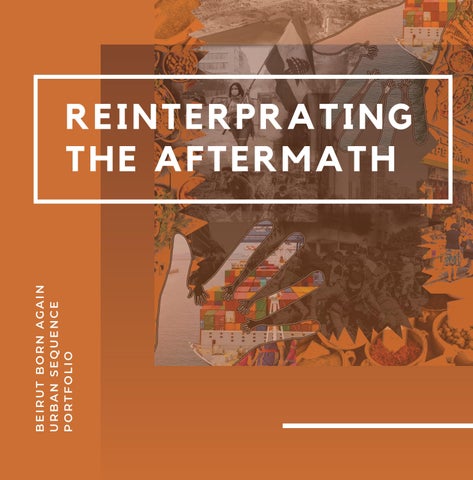
BEIRUT BORN AGAIN URBAN SEQUENCE PORTFOLIO
REINTERPRATING THE AFTERMATH
REINTERPRATING THE AFTERMATH Beirut Born Again, Urban Sequence Portfolio Grace Kunst & Joanna Waliuba Professor Ameen Farooq
Copyright © 2022 by Grace Kunst, Joanna Waliuba All rights reserved. This book or any portion thereof may not be reproduced or used in any manner whatsoever without the express written permission of the publisher except for the use of brief quotations in a book review or scholarly journal. Urban Sequence -forth year Kennesaw State University College of Construction Management and Architecture 640 Polytechnic Ln, Marietta, GA 30060
Table of Contents
01 02 03 04 05 06 07
Understanding Bayrut Port of Bayrut Precedent Analysis The Concept The Design Renderings Final Model
Preface One could say our motto this semester was thinking outside the box. Even when we could not really tell if we are thinking outside the right box at times. Professor Farooq always related to us with(/like) his daughters and over time it felt like learning to walk with your father. Thinking outside the box entailed looking into how our design will impact the community now and asking if that is something that is sustainable for the future. Exploring that together as a team was fun! This class is forever going to be a highlight of our college experience.
Understanding Bayrut
The design of this poster is inspired by the people of Beirut and their activities. We used hands as a symbol to show architecture can bridge the gap between tragedy and stability, which our design answers in phases. The poster highlights interactions between the business district, the people, traditional souks, activism and the port. The scope of this project entails understanding the tragedy caused by the port explosion in 2020 while assessing the plans the port had before the explosion. The reality is growth within the port headed to a machine based development compared to offering more sources of employment. This project tackles development of two parties. 1. The port vs the economy 2. The people vs the economy
Beirut | Beyrouth| Bayrut| Beyrut | Biruta | | بيروتBeyrouth This is the third largest city in the Levante Region. The Levant (/ləˈvænt/) is an approximate historical geographical term referring to a large area in the Eastern Mediterranean region of Western Asia. The term entered English in the late 15th century from French.[6] It derives from the Italian Levante, meaning "rising", implying the rising of the Sun in the east,[3][2] and is broadly equivalent to the term al-Mashriq (Arabic: ٱْلَم ْش ِرق, [ʔal.maʃ.riq]),[7] meaning "the eastern place, where the Sun rises" Beirut is an Old City dating back to 15th Century BC with a number of influences like Ottoman, Arab, Roman, Phoenician among others. With a population of approximately 433249 people, this city is considered one of the most religiously diverse. The growth of the city is influenced by the growth of the port. Which is the largest and busiest port in the Eastern Mediterranean.
The Neighborhood
Connections &Building Language
Districts
This piece is an example of artworks that could be painted on the silo memorial. It is a representation of the people of Beirut. Amid the civil war and economic disaster, the people are resilient and work to ensure they are building their nation. Art walls are a strong characteristic of Beirut architecture and we wanted to bring in different elements of the surrounding districts into the port
The Port of Bayrut
Before Explosion
After Explosion
Existing Port Program
Precedent Analysis
Khaosuing Port
We used this port as a guide in how we wanted our port to function. Khaosuing Port is located on the coast of Taiwan and functions primarily as a container and dry bulk passage. They do have more passenger ships coming through it's waters than the port of Beirut but we wanted to use this to propel Beirut's port to generate more of a tourism aspect as well. This is the largest port we looked at which was fundamental in guiding our design process, as Beirut's port is looking for every opportunity to grow. We took the ideas of what works well for their port and used it to determine where our port processes would work best.
Kinmen Port
Kinmem port was also used to guide our design processes as well. Kinmen port is also located in Taiwan. This is a mainly passenger port and very limited on the amount of cargo that comes through it's waters. Since one of our main goals was to build the entertainment and tourism aspect of Beirut's port system we looked to how Kinmen's port terminal interacted with it's coastline.
Port of Santos
Finally, we also looked to Port of Santos to be our guide for parts of our design. This port is much more goods based that travel or tourism based so we wanted to use it's strengths in being a thriving goods port to our advantage in our design. It is slightly bigger than Beirut's port but still provided plenty of evidence of what would work for a port system and what does not. We looked to their arrangements for container yards and proximity to ware houses to develop a plan that work well with the needs of Beirut while also allowing us to maintain that aspect of Beirut culture and city design.
The Concept
New Circulation
We began by developing a program that would allow us o directly link the port system to the existing city. We wanted to create as few convoluted routes as possible by streamlining the flow of traffic in a direct manner. We chose to pick these major avenues to develop to not only keep the integrity of they city and port as intact as possible but also to provide a means of clarity for wayfinding throughout the city and the port.
Looking at Program
Bridging the Gap
Parti Model
The Design
What is Included
These key features are what we felt was most important in our design. We wanted to ensure that these elements really brought together the city and the port, as the two are not mutually exclusive. For every port function each of these port functions serve, it has an equal and opposite function that serves the city as well. Our hope is that these elements make the Beirut citizens feel welcomed into theses spaces as well as the port workers and visitors.
The Vision
This captures our final site design and the zones we created for each element. Our initial concept sketches helped to carry us through so that we could visualize what it meant for this port to actually be the Port of Beirut. We hope that each of these elements gives back to the community as much as it provides for the port.
Site Plan
Renderings
Entertainment District & Passenger Terminal
Market and Memorial
Port Administration
School, Navy & Park
Final Model
Notes
References http://www.portdebeyrouth.com/index.php/en/ https://en.wikipedia.org/wiki/Beirut https://www.tripadvisor.com/LocationPhotoDirectLink-g294005-d8419608-i174410279Souk_el_Tayeb-Beirut.html http://www.discoverlebanon.com/en/panoramic_views/beirut/saifi_village.php https://www.trip.com/travel-guide/attraction/beirut/saifi-village-23497491/ https://www.bloomberg.com/news/features/2021-03-26/the-design-history-of-beirut-scentral-hall-homes https://www.arabamerica.com/a-fight-to-save-beiruts-historic-architecture/ http://web.mit.edu/akpia/www/AKPsite/4.239/beruit/beirut.html https://hankeringforhistory.com/the-history-of-the-port-of-beirut/ https://www.archirodon.net/project/355/all https://www.beirut.com/l/8308 https://www.nytimes.com/slideshow/2010/09/05/travel/20100912-SURFACING.html?_r=0