September 2026
Decoding 45Z What it means for soybean growers
FROM YOUR FIELDS TO FIREFIGHTERS’ HANDS The more we discover about soybeans, the more valuable they become. One innovative product, SoyFoam™, creates a new, sustainable use for your crop that protects firefighters and the planet. See how your Soy Checkoff is unlocking new markets for soybeans at unitedsoybean.org
© 2 0 2 5 UNI T E D S OY BEAN B OAR D
Executive Committee President Tom Adam, Harper | D9 President-elect Lee Brooke, Clarinda | D7
September 2026 | Vol. 39, No. 12
Secretary Aimee Bissell, Bedford | At-Large Treasurer Sam Showalter, Hampton | D2
9
At-Large Director Jeff Ellis, Donnellson | D9
The Roadmap to Next Season
Board of Directors Brent Swart, Spencer | D1 Paul Kassel, Spencer | D1 Mike Yegge, Lake Mills | D2 Amanda Tupper, Ionia | D3 Josh Schoulte, Farmersburg | D3 Jeff Frank, Lake View | D4 Marty Danzer, Carroll | D4 Corey Goodhue, Carlisle | D5 Dave Struthers, Collins | D5 Joe Sperfslage, Coggon | D6 Brian Strasser, Homestead | D6 Scot Bailey, Anita | D7 Brian Fuller, Osceola | D8 Summer Ory, Earlham | D8 Jack Boyer, Reinbeck | At-Large Neil Krummen, Linn Grove | At-Large Sharon Chism, Huxley | At-Large
Learn how Iowa farmers build practical conservation systems that work.
14
Colombia Prefers U.S. Soy U.S. soy farmers explore growing export opportunities in Colombia.
American Soybean Association Board of Directors Tom Adam, Harper Corey Goodhue, Carlisle Randy Miller, Lacona Summer Ory, Earlham Brent Swart, Spencer Dave Walton, Wilton United Soybean Board of Directors Tim Bardole, Rippey Robb Ewoldt, Davenport Brent Renner, Klemme Suzanne Shirbroun, Farmersburg
FARMER FOCUSED | DRIVEN TO DELIVER ISA VISION We advance the long-term competitiveness of Iowa soybean farmers.
Iowa Soybean Association 1255 SW Prairie Trail Parkway, Ankeny, Iowa 50023 (515) 251-8640 | iasoybeans.com E-mail: bbaratta@iasoybeans.com For advertising information contact Bethany Baratta at (515) 334-1020 or bbaratta@iasoybeans.com
What upcoming 45Z tax credit rules mean
30
Bethany Baratta | Editor Aaron Putze, APR | CO Brand Mgmt and Engagement Susan Langman | Creative Design Coordinator Joclyn Kuboushek | Multimedia Specialist Kriss Nelson | Senior Writer Brock Johnston | Public Relations Manager
Iowa Soybean Review is published monthly by:
Unpacking 45Z for soybean growers.
Staff Credits
ISA MISSION Driven to deliver opportunities for Iowa soybean farmers to thrive.
26
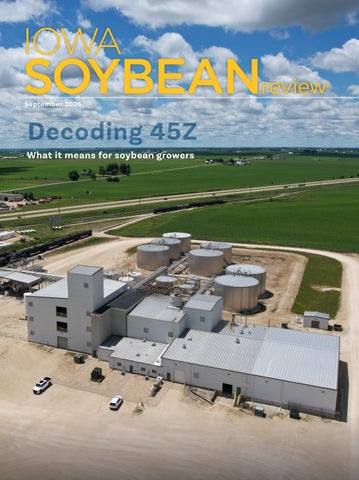
Fueling Progress Farmers regain market leverage as soybean oil demand rebounds in biofuels. On the cover: Western Dubuque Biodiesel, near Farley, has been in production since August 2007. As the industry awaits f inal Section 45Z tax credit guidelines, general manager
Tom Brooks breaks down how the facility is positioning its operations for the future. Inside this issue: What 45Z means for the evolution of biodiesel and its supply chain. Photo by Joclyn Kuboushek
Comments and statewide news articles should be sent to the address to the left. Advertising space reservations must be made two months preceding publication. In consideration of the acceptance of the advertisement, the agency and the advertiser must, in respect of the contents of the advertisement, indemnify and save the publisher harmless against any expense arising from claims or actions against the publisher because of the publication of the content of the advertisement.
IOWA SOYBEAN REVIEW® | 3
Executive Insights Kirk Leeds, ISA Chief Executive Off icer kleeds@iasoybeans.com
The Most Important Check Before Harvest
S
eptember brings a noticeable shift across rural Iowa. Soybean fields are trading their deep summer greens for harvest gold, shops are filled with the smell of grease as combines get their final look-over, and there’s a brief window of quiet before the harvest rush completely takes over. In this in-between, I’ve been thinking about a piece of risk management that has absolutely nothing to do with soybean prices or trade policy — and everything to do with protecting our families from a disease hitting rural communities hard: cancer. This is deeply personal to me. If you read in my December column, you know that my wife has fought cancer twice — the first time, a colorectal diagnosis years ago that was caught in time. The second, a breast cancer diagnosis last year that we are still walking through. What I want to emphasize is why we are still walking through this together: The first battle we won because someone convinced her to get screened. The second, because she’d learned not to wait.
4 | SEPTEMBER 2026 | IASOYBEANS.COM
Screening didn’t spare us the fight, but it gave us the fight on our terms. Early detection is the difference between the two outcomes I have watched my own family live through. Survival rates for the most common cancers can be as high as 90% or more when caught at stage one. Caught later, those drop into single digits. Yet, Iowa has a problem most don’t want to admit. Our state has the second-highest cancer incidence rate per capita in the United States, and the fastestgrowing rate overall. Our rural counties are being hit hard, and even younger Iowans in their 30s and 40s are being diagnosed at levels our parents never saw. The Washington Post ran a piece on it earlier this year that put the Farm Belt on the front page for the wrong reasons. We don’t need another article; we need Iowans to act. When a farmer, an ag retailer or a rural neighbor goes down due to cancer, it impacts everyone. A family loses income, a co-op loses a shift and a community loses productivity that no farm budget was built
to absorb. Your health is not separate from the work you do for our state. That’s why I’m using this space to share a resource I trust: Cancer Screen Iowa. Their mission is simple: use your birthday as your screening checkpoint. One day a year, you already remember. Use it to ask a quick, two-minute question: Am I current on the screenings recommended for someone my age? My own birthday is coming up next month, on Oct. 27. Even though I’m not in the combine, the harvest season is a busy time of year for our organization. It would be easy to look past when you’re focused on supporting the industry. But this year, I’m using my birthday to check my own baseline. Before the harvest season begins, please take two minutes to visit cancerscreeniowa.com to see what is recommended for you this year, and then send the link to someone you love. God bless and stay safe this harvest season.
SUPPORT FOR EVERY PART OF FARMING BUILT BY SOYBEAN FARMERS. BACKED BY THE SOY CHECKOFF. READY WHEN YOU NEED IT.
Visit the Soy Farmer Support Hub to find resources for your fields, your operation, and you.
SCAN HERE TO CHECK IT OUT
WOULD YOUR FARM PASS A DNR INSPECTION? CONFIDENT YOU KNOW ALL THE RULES?
Manure Management Plan
Separation to Water Sources
Counting Animal Units
Manure Applicator License
Separation from Neighbors
Build on Karst Soil
Give us a call for a free and confidential consultation!
1(800) 932.2436 Your Farm. Your Family. Our Focus.
or visit SupportFarmers.com for more information.
CSIF is a joint partnership involving the Iowa Beef Industry Council, Iowa Cattlemen’s Association, Iowa Corn Growers Association, Iowa Egg Council, Iowa Farm Bureau Federation, Iowa Pork Producers Association, Iowa Soybean Association, Iowa Turkey Federation and Midwest Dairy.
Rural Route 2 Editor’s Note by Bethany Baratta bbaratta@iasoybeans.com
Wrigleyville Wisdom
F
rom our seats in Section 228, the view offered a perfect panoramic of the historic field. To our left, second base. To our right, the legendary, ivy-laced home run wall. Directly in front of us, outfielders stretched across the manicured grass fields. In late July, my son and I finally made good on a Christmas gift to my mother-in-law. A lifelong Chicago Cubs fan, she had somehow never seen a game at Wrigley Field — and neither had my son. We were determined to change that. Months ago, we circled the date on our calendar, deliberately choosing the matchup that commemorated the iconic 2016 World Series championship team. On game day, we walked from the shuttle stop toward the stadium with our homemade signs in tow, dipping in and out of shops and awnings to dodge a passing summer downpour. And then, right on cue, the rain stopped, the sun broke through and the breeze brought in from Lake Michigan picked up. Built in 1914, “Friendly Confines” offers an experience unlike any other in sports. Its ivy-covered brick, the iconic hand-turned scoreboard and a vibrant energy that spills out into the surrounding neighborhood make it feel timeless. Seeing the beaming smiles on Luca’s and Grandma’s faces the exact moment they first caught sight of that vibrant green field gave me immediate chills. We had made it, and we were about to build some core memories. The day delivered everything we hoped for: eating fresh corn dogs, high-fiving strangers after home runs and watching Ian Happ make a spectacular diving catch in the 4th. There was even a bit of baseball magic when former Cubs first baseman Anthony Rizzo caught a home run ball right from the bleachers. By the time the final out secured a six-two victory over the Minnesota Twins, we were singing “Go Cubs Go” at the top of our lungs alongside 39,500 other fans.
Nothing quite like your very f irst game in the Friendly Conf ines. Go Cubs Go!
It is easy to get trapped in the echo chamber of our daily routines. From my office in the city, the summer flies by in a blur of page layouts, editorial deadlines and screen time. Out in your neck of the woods, your summer has been dictated by commodity markets, weather apps and the preparation for another harvest sprint. The settings are entirely different, but the pitfall is the same: We get so consumed by the immediate work in front of us that we forget to circle dates on the calendar for the people who matter most. Stepping away for a weekend didn’t change the looming deadlines waiting on my desk, just like a break won’t change the work waiting in your machine sheds. But as you head into the demanding weeks of harvest, I hope you find a moment to step back, make core memories and enjoy the view before the wheels start turning.
IOWA SOYBEAN REVIEW® | 7
SeedIQ
™
THE NEXT ERA OF YIELD STARTS NOW. We’ve all seen it. Two farmers across the road plant the same hybrid, in the same soil, on the same day, yet their results are drastically different. Why? Because performance isn’t determined by genetics alone. It’s influenced by how that hybrid is managed throughout the season, including population, fertility, stress management, and fungicide timing.
Don’t Just Manage Your Fields. Master Your Product Management.
Harvest is the beginning of planning for healthier soils and a more productive crop STORY BY KRISS NELSON | PHOTOGRAPHY BY JOCLYN KUBOUSHEK
I
owa Soybean Association Conservation Agronomist Brock Webb says fall is ideal for evaluating crop performance. “It's one of the most important times for conservation because it allows farmers to look back at the growing season and use that information to make better decisions for next year,” he says. While cover crops and reduced tillage dominate conservation conversations, Webb says nutrient management deserves more attention — especially with high fertilizer costs. “It's one of the biggest opportunities farmers have to improve profitability and conservation at the same time,” he says, encouraging producers to evaluate what is in their fields before buying inputs.
Evaluate before you apply One of the most valuable post-harvest tools is residual soil nitrate testing. Webb recommends collecting samples before the ground freezes. Sampling the top 12 inches provides the greatest value; a 12- to 24-inch sample shows whether nitrate moved deeper. Rather than averaging an entire field, he encourages sampling individual management zones. “This is probably the single most valuable measurement farmers can take after harvest,” Webb says. “It tells you how efficiently nitrogen was used and helps fine-tune future nutrient management decisions.”
BROCK WEBB ISA conservation agronomist
The results reveal unused nitrogen, over- or under-fertilized areas, and where nitrate is vulnerable to leaching. Corn stalk nitrate testing indicates whether nitrogen applications were deficient, adequate, or excessive. Grid soil sampling measures phosphorus, potassium, pH, and organic matter to build recommendations based on field conditions rather than assumptions. ISA conservation agronomists help producers review soil tests and nutrient plans to identify opportunities for improvement. “We can sit down with farmers and help them understand what the results are telling them and how to use that information next year,” Webb says. He also encourages livestock producers to know the nutrient value of their manure before applying it. “I talked to a farmer recently who was applying hog manure, and when I asked what the manure analysis was, he didn't
know,” Webb says. “That’s really the baseline for everything.” Without understanding manure nutrient content, farmers risk overapplying fertilizer and increasing costs. “Fertilizer isn’t getting cheaper,” Webb says. “Invest in understanding what's in your soil and what your crop actually needs.”
Building on conservation Fall is also ideal to establish cover crops and reduced tillage. Together, they keep soil covered, improve water infiltration, reduce erosion, and hold nutrients in place. “Over time, those practices build healthier soils that are more resilient and productive,” Webb says. Heavy rainfall caused erosion across Iowa this year. While Webb observed erosion even in no-till fields, combining no-till with cover crops consistently provided the greatest protection. For Webb, conservation relies on datadriven management. “If a farmer could build one habit every fall, I’d say focus on nutrient management,” he says. “Stay on top of understanding what’s left in your soil. The more information you have, the better decisions you can make.” Email the ISA conservation agronomy team at conservation@iasoybeans.com. Contact Kriss Nelson at knelson@iasoybeans.com
Email the ISA conservation agronomy team at conservation@iasoybeans.com. IOWA SOYBEAN REVIEW® | 9
Every Piece Matters Building conservation one practice at a time
STORY BY
KRISS NELSON
A restored oxbow on Ed Ulch's farm near Solon captures water f rom a former creek channel, helping improve water quality, reduce nutrient loss and create wildlife habitat.
PHOTOGRAPHY BY
JOCLYN KUBOUSHEK
10 | SEPTEMBER 2026 | IASOYBEANS.COM
ch
That philosophy has guided conservation efforts on the farm for years and recently led to the restoration of an oxbow along a creek that ultimately drains into Lake Macbride. Completed after the 2025 harvest, the project transformed a former stream channel into a functioning oxbow designed to improve water quality and provide wildlife habitat. “We finished it right before winter,” Ulch says. “It’s worked out pretty well. Everything seems to be functioning the way it was intended.” Ul
hen Ed Ulch looks across his farm near Solon, he doesn’t point to a single conservation practice as the key to improving water quality and protecting soil. Instead, he points to decades of work: terraces, no-till, cover crops, filter strips, trees, nutrient management and most recently, an oxbow restoration. “All these things — you put them all together, and they all do a large part,” says Ulch, a past Iowa Soybean Association District 6 director.
Ed
W
Restoring an oxbow The project had been on Ulch’s mind for two years. He identified the location because the cut-off creek channel was a natural fit, especially with two tile lines already draining into the site. After consulting with conservation partners, including Iowa Soybean Association Senior Conservation Services Manager Brandon Iddings, the channel was excavated and restored to its original shape. Today, the oxbow consistently holds water and is already attracting wildlife. “There were seven deer and a blue heron wading in it the other day,” Ulch says. He recently planted 11 trees near the oxbow to replace those removed during construction.
Protecting water quality For Ulch, the project’s main priority is downstream impact. The creek connected to the oxbow eventually flows into Lake Macbride, a popular eastern Iowa recreation destination. “We’ve tried to protect the water going into Lake Macbride because it draws a lot of people to the area and helps the community,” Ulch says. That focus extends across his entire operation. Over the years, Ulch has installed filter strips to slow runoff and catch sediment along the creek. He maintains approximately 42 terraces designed to reduce erosion and keep soil in place. Additional acres have been enrolled in conservation programs, particularly in areas that are difficult to farm while also providing wildlife habitat. He has also planted roughly 1,500 trees over the last three years through various conservation programs, including a University of Iowa project utilizing Carolina poplars to stabilize streambanks and reduce erosion. “We plant trees every year,” he says. “This year we planted 41.”
Decades of practice Perhaps the longest-running conservation practice on the farm is no-till, which Ulch started in the 1970s long before soil health became a mainstream topic in agriculture. Cover crops eventually became part of the system, often broadcast-seeded in conjunction with fall applications of potash and calcium sulfate. He uses a variety of seeding approaches depending on the field and conditions. Cover crops and no-till support his approach to nutrient management. While many farmers historically applied nitrogen in the fall, Ulch has shifted nitrogen applications to the spring in three precise windows: before planting, with the planter, and side-dressed later in the season. “We put nitrogen on three different times in the spring to minimize loss,” Ulch says.
Every piece matters Ulch is hesitant to point to any single conservation tool as the answer for every farm. Instead, he sees conservation as a collection of practices that work together over time. The restored oxbow is the latest addition to a conservation system that’s decades in the making, aimed at leaving the farm better than he found it. “All these things together do a large part to improve conservation,” he says.
All these things together do a large part to improve conservation.” Ed Ulch, Farmer and past ISA director
Contact Kriss Nelson at knelson@iasoybeans.com
IOWA SOYBEAN REVIEW® | 11
Cover Crops with a Fall Purpose For Bill Fields, fall is the time to establish conservation practices that deliver value throughout the year
STORY BY
Bill Fields views conservation as a collection of practical tools. Along with cover crops, rotational grazing and buffer strips, the family recently restored an oxbow on low-yielding ground to improve water quality and pasture management.
KRISS NELSON PHOTOGRAPHY BY
JOCLYN KUBOUSHEK
F
or Bill Fields, conservation practices have to work for the
Cover crops with a purpose
farm before they become permanent lF
weather remains unpredictable, he
Bil
fixtures. As crop margins tighten and
ie ld
relies on dual-purpose practices that
s
serve both his row crops and livestock. “We’re always trying different things to see what works,” says Fields, who grows soybeans and corn near Paton with his brother
John. He also manages an 80-head cow-calf operation with his wife Christy. That mindset has led the family to adopt cover crops, rotational grazing, buffer strips and an oxbow restoration project. None were adopted simply for the conservation label; they must make financial and operational sense. 12 | SEPTEMBER 2026 | IASOYBEANS.COM
Fields has used cover crops for the past five years, primarily aerially seeding cereal rye into corn stalks each September across a portion of his 700 acres. While the rye reduces erosion and holds nutrients, its immediate value is forage. The family’s cattle graze the cover crops in the fall and spring. They also drill 20 acres of rye directly around the home acreage as a clean paddock for spring calving. “From the conservation and soil erosion aspect, it helps there,” Fields says. “Then from the grazing standpoint, it’s really helpful.” Establishment remains the largest hurdle. “If you can get it in and get rain on it, that’s the key,” he says.
When moisture arrives at the right time, the rye can provide valuable forage. They’ve experimented with ways to establish cover crops earlier and maximize fall growth, though not every attempt has worked. “We tried some things last year that didn’t work that well,” he says. “But we’re always looking for what yields the most tonnage and grazing.”
Looking beyond rye While cereal rye has become a regular part of the operation, Fields is still searching for an effective cover crop to follow soybeans. He has experimented with aerially applying oats into soybeans with mixed results due to varying moisture from one year to the next. With soybean acres representing nearly half of the operation, he sees an opportunity to boost forage production while capturing additional conservation benefits. The challenge is finding a mix that provides fast fall growth without complicating harvest. “I think it’s going to be some kind of concoction of various species,” he says.
Conservation costs Like many farmers, Fields says economics plays a major factor in conservation decisions. Cover crops provide benefits, but they also come with costs. To help offset seed and application costs, the family has used available funding through Greene County Soil and Water Conservation District programs and Practical Farmers of Iowa. Fields encourages other farmers to explore every available funding opportunity. “If you can’t stack some of this stuff together, it’s just tough to make it pencil out on paper,” he says. While grazing helps create an economic return, he acknowledges that cover crops can be difficult to justify strictly from a row-crop perspective, especially in years when weather limits cover crop growth. Even so, he believes the benefits are real. “If you’re doing it for soil erosion, holding nutrients in place and things of that nature, it works well,” he says.
We’re always trying different things to see what works.” Bill Fields, ISA farmer member
Improving the landscape Beyond cover crops, Fields uses rotational grazing and maintains buffer strips where practical. He would like to add buffer strips in some locations, although livestock management requirements can make those decisions more complicated. Recently he worked with ISA Senior Conservation Services Manager Brandon Iddings to restore oxbows on 1.5 acres on lowyielding ground. Moving soil during excavation helped address an erosion-prone area within a pasture, and once fully established, the project is expected to improve water quality and pasture management. While some restored oxbows become livestock watering sources, Fields says that isn’t the primary goal on his farm. “My hope is not to have cows watering out of them anymore than necessary,” he says.
Keep learning Fields doesn’t claim to have all the answers. Instead, he approaches conservation much the same way he approaches farming: try new ideas, evaluate the results and keep what works. For farmers considering cover crops or other conservation practices, his advice is straightforward: monitor moisture, use available cost-share programs and be willing to adapt. Contact Kriss Nelson at knelson@iasoybeans.com
IOWA SOYBEAN REVIEW® | 13
COLOMBIA P RE F E R S U. S. S OY Midwest farmers explore emerging trade opportunities in Colombia STORY AND PHOTOGRAPHY BY AARON PUTZE, APR
The AGP-led delegation visited Contegral, a key buyer of U.S. soy.
A
g Processing, Inc. (AGP), an Omaha-based soybean crusher sourcing soybeans from its network of Midwest farmer-owned cooperatives, led a delegation of soybean farmers and state soybean association staff to Colombia in June. The group included representatives from the Iowa, Missouri and South Dakota soybean associations, the U.S. Meat Export Federation and the U.S. Soybean Export Council.
14 | SEPTEMBER 2026 | IASOYBEANS.COM
Sponsored in part by the Iowa Soybean Association, the trade mission included meetings in Bogotá and Medellín with leaders from Colombia’s three largest buyers of U.S. soybean meal — Italco, Contegral and Solla. The delegation visited major retailers and food service outlets, including Pigasus restaurant and Carulla, Colombia’s largest supermarket chain, where participants sampled U.S. pork and beef products.
The group also met with meat importers and distributors who source U.S. pork and beef for customers throughout central Colombia. “The delegation sought to better understand market opportunities, company growth expectations and the logistical challenges influencing imports,” says Scott Ritzman, president of Ritz Ag Consulting, who coordinated the trade mission on behalf of AGP.
SOY SNAPSHOT: COLOMBIA 54 million 2026 population
Beautiful Bogotá by air.
63%
12 million
2026 Urban Population
Metro population (similar to New York City)
Bogotá
$7,900
Largest City
Income Per Capita
7th largest global market for total U.S. agricultural exports
6th largest export market for whole U.S. soybeans
3rd largest export destination for U.S. soybean meal SCOTT RITZMAN
LEE BROOKE
Ritz Ag Consulting
ISA president-elect
Why Colombia? Colombia is a reliable and growing market for U.S. soybean meal. In 2025, the country imported more than 2 million metric tons (MMT)—nearly triple the volume purchased two decades ago. Those imports were valued at nearly $850 million. The United States supplies more than 96% of Colombia’s soybean meal imports. The rest is sourced from Bolivia. Demand is expected to continue climbing, with imports projected to reach 2.3 MMT in 202627 as Colombia expands its poultry, pork, dairy, aquaculture, equine and pet food industries. “While it’s important to pursue new and emerging markets, there’s
also tremendous opportunity to grow sales with customers we already have,” says Lee Brooke, ISA presidentelect and a soybean farmer from southwest Iowa. Brooke, who represented ISA on the trade mission, says every export market is becoming increasingly important as Iowa and U.S. farmers continue to produce and process more soybeans. Increased demand for soybean oil driven by renewable fuels has also resulted in greater supplies of soybean meal — making the need for dependable export markets even more critical. “That meal has to find a home,” Brooke says. “Colombia is a close, strategic market that understands the value of U.S. soybean meal. They
know it’s about more than price — it’s the superior protein quality, amino acid profile and digestibility.” Brooke says the buyers the delegation met with consistently expressed confidence in U.S. soy. “They recognize and prefer the quality of U.S. soybean meal,” he says. “As Colombia’s population grows and consumers demand more protein, we expect to see even greater opportunities for U.S. soybean farmers.” In addition to soybean meal, Colombia imports more than 560,000 metric tons of whole soybeans from the United States each year. Because the country has limited soybean crushing capacity, most of those beans are roasted and used in poultry and aquaculture feed. Continued on Pg. 16 IOWA SOYBEAN REVIEW® | 15
Soy demand growth
Italco | Bogotá | Founded in 1970
CORE BUSINESS Manufactures feed and premixes for livestock, poultry, pets, and fish while providing genetics and farming services.
U.S. IMPORTS
SOURCING
Sources 100% of its agricultural raw materials from the U.S., focusing on high protein, fiber and digestibility.
Imported 3 million tons of materials in 2025 (2 million soy meal); U.S. soy meal imports rose 20% since 2024 and 50% since 2015.
Contegral | Medellín | Founded in 1951
CORE BUSINESS Operates across the full farm-to-table protein value chain, including feed, genetics and retail.
U.S. IMPORTS
SOURCING
Sources roughly 70% of raw ingredients from the U.S. Gulf, and 30% from the West/Pacific Northwest.
Expanded feed operations by 22% in 2025 and another 20% through the first half of 2026.
Solla | Medellín | Founded in 1948
CORE BUSINESS Manufactures animal feed and nutrition for livestock, poultry, aquaculture and pets.
U.S. IMPORTS
SOURCING
Sources 80% of raw ingredients (corn, soybeans, meal, gluten, DDGs) from the U.S.
Committed to 100% sustainably sourced raw ingredients, favoring U.S. soy.
16 | SEPTEMBER 2026 | IASOYBEANS.COM
Colombia is a country — and an economy — on the rise. Production of fish, bananas, coffee, avocados and flowers continues to expand, while the country has also become a leading manufacturer of textiles, automotive parts, pharmaceuticals and more. Much of that economic growth is centered in Bogotá and Medellín. Together, the two cities are home to nearly 16 million people and serve as Colombia’s hubs for commerce, manufacturing, retail and innovation. As economic opportunities continue to concentrate in urban areas, more Colombians are leaving rural communities in search of better jobs, housing and quality of life. By 2050, 65% of the country’s population is expected to live in cities, according to USSEC. Rising incomes and urbanization are expected to fuel demand for higher-quality protein, creating additional opportunities for U.S. soybean farmers. Many Colombians, however, continue to face economic hardship. A significant share of the workforce earns a living through informal, day-to-day employment rather than full-time jobs, limiting household income and food purchasing power. As incomes rise, Brooke expects diets to evolve.
“As people become more financially secure, they’ll eat more frequently, dine out more often and begin choosing more premium proteins, including beef,” he says. “Domestic egg and poultry production is helping meet that demand, which is why Colombia’s soybean meal imports continue to increase. Pork imports from the U.S. are also growing because domestic production hasn’t kept pace with consumer demand — at least not yet.” Brooke believes the trend represents long-term opportunity for U.S. agriculture. “Colombia is an important market for U.S. soybean and pork producers,” he says. “As demand for protein continues to grow, so will opportunities for U.S. soybean meal, pork and, potentially, beef exports.” According to USSEC, Colombia’s compound feed production reached nearly 12.6 million metric tons in 2025, up from 11.5 million metric tons the previous year. Growth is projected across every major livestock sector, including egg production, poultry, pork and beef.
“Keep doing what you’re doing. Politics can be expensive, but farmers are optimistic. Please don’t let all these other things get in the way of what you’re doing because we depend on you. Without the American farmer, it’s impossible to do what we want to do.” Julio Gonzales, Contegral Supply Chain Manager
Dairy evolution The country’s dairy industry also shows significant potential. Colombia has one of the world’s largest cattle populations, yet much of the industry remains fragmented and dependent on
Fresh produce f rom Medellín and Bogotá.
traditional grazing systems. Companies such as Medellín-based Contegral are investing in improved genetics, nutrition and feed technologies to modernize production and improve efficiency. “We’re introducing better genetics and more advanced production systems so the industry can transition from primarily grass-fed operations to professionally formulated feed programs,” says Julio Gonzales, Contegral’s supply chain manager.
Market logistics Colombia’s location gives it access to both the Atlantic and Pacific oceans, with six major seaports in operation and additional facilities under construction. Those ports provide multiple gateways for importing agricultural products, including U.S. whole soybeans, soybean meal and corn, as well as fertilizer from China. Getting those products inland, however, is another matter.
Much of Colombia’s population lives hundreds of miles from the coast, and the country lacks a robust rail network. All freight moves by truck through rugged terrain dominated by the Andes Mountains, making transportation one of the greatest costs of doing business. That challenge was a common theme in meetings with executives from Italco, Contegral and Solla. Growing congestion, delays and higher costs associated with the Panama Canal are prompting buyers to explore alternative shipping routes, including direct service from the U.S. Gulf Coast to Colombia’s northern ports and shipments from AGP’s Grays Harbor export terminal in Washington. “Logistics are the greatest cost because nearly everything has to be moved by truck,” Ritzman says. “Moving product from the ports to feed mills in Medellín adds roughly $50 per metric ton in freight costs.” Continued on Pg. 18
IOWA SOYBEAN REVIEW® | 17
U.S. meat at a Carulla supermarket.
Preferred partner Despite those challenges, Colombian companies remain committed to sourcing U.S. soybeans and soybean meal because of its consistent quality, dependable supply and their strong relationships with American suppliers. Contegral exemplifies that commitment. The fourthgeneration, family-owned company has grown into one of Colombia’s leading providers of animal nutrition, genetics and agricultural retail products. The company manufactures more than 2 million metric tons of feed annually for poultry, swine, dairy, beef, equine, aquaculture and pet food markets. Nearly 98% of the raw materials used in that production are sourced from the United States. Gonzales says the country’s geography presents daily logistical challenges.
“Medellín sits in a valley surrounded by mountains,” he says. “The city is growing so quickly that development expanded to the other side of the mountains, requiring the construction of a tunnel to connect the two.” Even so, Gonzales sees tremendous value in the company’s partnership with U.S. agriculture. “We love working with the U.S. and sourcing our soybeans and soybean meal
from America,” he says. “We trust the reliability and quality of your products. “We also appreciate that your soybean farms are family businesses, just like ours. We’ve visited the U.S. several times and have seen firsthand how responsibly you farm. What you do helps feed the world, and we value that partnership.” Contact Aaron Putze at aputze@iasoybeans.com.
for over 40 years, your cooperative soybean processor
18 | SEPTEMBER 2026 | IASOYBEANS.COM
HARVEST WITH THE
POWER OF BRENT® grain carts With more than five decades of experience building grain handling products, Brent has earned a reputation for innovation and quality. From the dual-auger Avalanche ® with pivoting unloading auger to the singleauger V-Series grain carts with superior unloading visibility and more, we push the limits of technology to create products you can depend upon each and every harvest.
V-SERIES SINGLE-AUGER GRAIN CART FROM 1,500- TO 800-BUSHEL CAPACITIES
AVALANCHE
SCAN TO LEARN MORE.
DUAL-AUGER GRAIN CART FROM 2,500- TO 1,100BUSHEL CAPACITIES
Unverferth Manufacturing Co., Inc. P.O. Box 357 • Kalida, OH 45853 • Unverferth.com
VISIT BRENTEQUIP.COM OR SEE YOUR NEAREST DEALER FOR MORE INFORMATION.
Data-driven decisions boost soybean prof itability Shawn P. Conley, Ph.D. Soybean and Small Grains Specialist University of Wisconsin, Madison spconley@wisc.edu
KEY INSIGHTS
Crowd-sourced farmer data at scale delivers actionable insights.
Leveraging this data improved field-level profitability by $44 an acre.
J
ust over a decade ago, a group of agronomists came to the North Central Soybean Research Program (NCSRP) with an idea: Let’s survey soybean farmers across the Midwest to determine where the major yield gaps are in our production systems. Today, this research has evolved into what academia and industry leaders have chased for decades: field-specific recommendations that optimize production. This optimum cropping system unlocks maximum yield potential while increasing farm profitability and sustainability.
Figure 1. The Open Crop Manager (OCM) is a scouting and database platform enabling the collection of f ield data on diseases, pests, weeds, and abiotic stressors affecting various crops. It allows data to be explored at local within-f ield scales and aggregated to higher regional levels. Data example f rom Iowa.
20 | SEPTEMBER 2026 | IASOYBEANS.COM
To maximize soybean yields and profits, start with early planting and then tweak other inputs for field-specific management.
The challenge in identifying an optimal system is that too many variables interact at once to evaluate them all in standard replicated trials. Because these agronomic factors constantly interact, the management practices that maximize yield will vary from field to field, even within the same region.
Half-million acres During the first project from 2014 to 2017, researchers collected yield data and management information from more than 8,000 soybean fields across 10 North Central states, including Iowa. The study tracked variables such as planting date, maturity group, seeding rate, row spacing, tillage, seed treatments, fertility, and pesticide use, representing nearly 500,000 acres. By analyzing this data, we identified the key managementrelated factors contributing to substantial yield gaps across the region. Across Iowa, planting date was identified as the most important management factor a farmer can change to substantially increase soybean yield. Other factors, such as maturity group, row spacing, seeding rate, and the use of foliar fungicides and insecticides, were also important but differed based on geography.
Putting it together Using the knowledge gained from this first project, we developed improved management practices by combining two to three of the most crucial factors tailored to different regions. We then put these practices to the test on the farm, conducting field trials in Nebraska, Iowa, North Dakota, Minnesota, Wisconsin, Michigan, and Ohio. In each field trial, we evaluated
the improved treatments (optimized planting date, maturity group, and seeding rate) against a reference treatment that reflected the typical producer’s management in that specific region. The results were clear in Iowa: The improved treatments delivered roughly a $40-an-acre higher profit compared to typical producer management. This foundational work allowed us to identify the single and combined management practices that most impact soybean yields, providing actionable insights to help farmers increase their yields and profits. However, we recognized that these initial recommendations were averaged over large regions and based on static economic assumptions.
Building better tools This made us wonder: Can we do better? To improve, we needed a platform and tools to house, protect, and run our immense, farmer-driven data repository. So, we developed the Open Crop Manager (OCM), a cloud-based decision-support tool. The OCM offers a user-friendly platform for in-field crop scouting and data collection, tracking crop production practices at the farm and field scale across 14 states. Currently, the OCM database houses 15,913 unique scouting reports and 14,382 stressor images. These reports track field conditions across the growing season, including specific growth stages, active stressors, and beneficial species. Since 2022, the project has amassed 488 field-years of data. Additionally, we have gathered roughly 1,000 production surveys detailing yield outcomes, planting and harvest dates, seed choices, and pesticide treatments. In 2026, the OCM launched the corn and wheat platforms for testing and validation.
What’s next?
Figure 2. Prof it difference at 37 f ields across eight states. We observed a signif icant prof it difference in 16 of the f ields, while the remaining f ields held steady. On average across the trialed region, Agroptimizer recommendations generated a $44-an-acre greater prof it than standard soybean systems (red dashed line). Stars indicate f ields where the prof it increase was statistically signif icant ($P < 0.05$).
We have the data (600,000 acres and counting), we have the house (OCM), and — to quote The Six Million Dollar Man — “We have the technology ... better, faster, stronger.” Following initial research funded by the Wisconsin Soybean Marketing Board from 2021 to 2023, we began evaluating an AI decision-support tool called Agroptimizer regionally in 2025. This platform enables farmers to compare current field practices against a predicted, optimized system, allowing them to fine-tune management to maximize either yield or profit. First-year results across 37 fields in eight states show immense potential: In 2025, Agroptimizer increased farm profits by an average of $44 an acre. Over our 11 years of research, NCSRP has remained committed to producing actionable insights and tools that farmers can use to directly increase yield and profit in their own fields. We know from experience that great results stem from strong collaborations and high-quality data. We welcome all researchers, organizations, and individual farmers to contribute and collaborate with us in this ongoing effort to optimize soybean research.
HAVE A TRIAL OR A PROJECT YOU’RE INTERESTED IN? We can consider it as a topic in a future issue. Better yet, we’ll connect you with your local expert so you can implement a trial on your farm. 515-251-8640
JMCCLURE@IASOYBEANS.COM
SCAN THE QR CODE IOWA SOYBEAN REVIEW® | 21
The biodiesel and renewable diesel industry supports more than $42.4B in economic impact and 100,000+ jobs in the U.S.
Materials supported by United Soybean Board, soybean farmers and their checkoffs.
LEAD THE FIELD.
UP TO
$15000 REBATE
DEPENDABLE HARVEST PARTNER. Need to ramp up your productivity? The new Brandt DXT dual-auger grain cart delivers the capacity and speed to meet the demands of your fast-paced harvest season.
Increased Productivity
More Versatile
More Reliable
Save time with easier loading and complete tank cleanout, thanks to the low-profile, high-slope tank, and unload speed of 1,000 bushels per minute.
Customize your grain cart with your choice of 1,150 to 2,500 bushel sizes, right- or left-side unloading, and a variety of undercarriage options.
Premium components, low maintenance requirements, and our unique robotic welding technology ensure unparalleled quality and maximum uptime.
brandt.ca 1-866-427-2638
"WE CHOOSE U.S. SOY BECAUSE IT IS CULTIVATED TO MEET TRUE SUSTAINABLE STANDARDS." Nhu Ngo of Vietnam-based Janbee Joit Stock Company on a tour of a U.S. Soy farm.
YOU GROW THE WORLD'S MOST SUSTAINABLE SOY. WE GROW DEMAND FOR IT. USSEC builds preference for U.S. Soy by bringing international buyers directly to American farms, where they can meet growers firsthand and see the care, consistency, and sustainable practices behind every harvest. SCAN TO SEE HOW USSEC SHARES U.S. SOY’S SUSTAINABILITY WITH CUSTOMERS AROUND THE WORLD.
Powered by B30 puts biodiesel to the test on Iowa farms, giving farmers confidence in higher soybean-based fuel blends STORY BY KRISS NELSON | PHOTOGRAPHY BY JOCLYN KUBOUSHEK
W
hen John Deere approved the use of B30 biodiesel in its Tier 4 engines in 2025, laboratory testing had already demonstrated the fuel’s performance. The next step was proving B30 — consisting of 30% biodiesel and 70% petroleum diesel — worked under real farming conditions. Through the Powered by B30 project, the fuel was deployed on four Iowa farms during the 2026 planting season. The goal wasn’t just to monitor engine performance, but to see how higher blends fit into daily operations. “We wanted to demonstrate the use of B30 in Deere equipment during planting season on the farm,” says Nate Green, director of biofuels for John Deere. “Ultimately, we wanted to tell the story of farmers using B30 and their overall experience. We wanted to demonstrate that B30 would act just like regular diesel in the engine.”
Preparing for success Before the first gallons of B30 reached participating farms, New Century FS inspected and tested on-farm fuel storage tanks. “We wanted to make sure we weren’t bringing problems with us,” says Jay Christie, energy manager for New Century FS. Because biodiesel is an effective solvent, Green says it can loosen rust, sediment and other deposits that have accumulated in older fuel tanks. 24 | SEPTEMBER 2026 | IASOYBEANS.COM
“That can affect fuel performance if not treated and is one of the factors to watch out for when implementing higher biodiesel blends, especially with older farm tanks,” he says. John Deere worked with local dealerships to ensure replacement fuel filters were readily available if needed. While one participating farmer replaced several filters during planting, Green says the planning prevented downtime during a season when narrow planting windows made every hour in the field important. Temperatures fell into the upper teens shortly after fuel delivery, but seasonal additives prevented any cold-weather complications. Christie says inconsistent fuel quality years ago created many misconceptions about biodiesel. “That’s probably what’s given biodiesel a bad name,” he says. “There was good-quality biodiesel, and there was not-so-good-quality biodiesel.” Today, New Century FS purchases only biodiesel that meets strict quality standards. “We’re not buying cheap biodiesel,” Christie says. “We’re going to get good-quality biodiesel that passes inspections.” He encourages farmers interested in higher biodiesel blends to begin with clean storage tanks, quality fuel and an open mind.
ISA Farmer Member Chris Swanson on his farm near Linn Grove.
NATE GREEN John Deere director of biofuels
JAY CHRISTIE New Century FS energy manager
Built on experience For Iowa Soybean Association Farmer Member Alic Mohni of Hartley, participating in the project was an opportunity to evaluate biodiesel under the same conditions he farms every day. “I was interested in biodiesel and wanted to compare it to the normal fuel that I’ve been running,” Mohni says. “If it worked, I definitely would use it in the future.” After comparing fuel records, Mohni noticed no meaningful difference between B30 and his regular diesel. “As far as my fuel usage so far, the numbers I’ve run, there’s really no difference from the regular fuel that I was running,” he says. He’s interested in seeing how B30 performs in the combine this fall. Chris Swanson, an ISA farmer member from Linn Grove, came away with a similar impression.
D I D YO U K N O W ?
Blending all 231.4 million gallons of Iowa's 2025 dyed diesel to an effective B30 would take about 44.5 million bushels of soybeans (43.2 million more than today's biodiesel content).
“If you had not told me I was running B30, I would have never known it,” he says. Swanson began using B30 in March, running it in equipment ranging from cattle feeding tractors to planters and other field equipment. He agreed to participate because he already operated John Deere equipment and purchased fuel through New Century FS. “For me, it was kind of a nobrainer,” Swanson says. “It’s our product. If we can’t get on board using it, who will?” Although a few filters were replaced during the season, Swanson says it wasn’t outside the ordinary. Both farmers say seeing B30 perform under everyday farming conditions helps build confidence in higher biodiesel blends. “They help make people comfortable using it,” Mohni says.
Growing demand John Deere continues analyzing machine performance and fuel use through the John Deere Operations Center, but early feedback has been consistent. “We’ve gotten qualitative feedback from our farmers that they didn’t notice a difference,” Green says. Perhaps the strongest endorsement came after planting. Every participating farmer asked to continue using B30 through the remainder of the growing season, and interest has spread beyond Iowa as soybean organizations and farmers from other states have contacted John Deere about future demonstrations. Broader adoption will ultimately depend on farmers asking fuel suppliers for B30, Green says. Expanding biodiesel use benefits both farmers and rural communities, Christie says. “If all the diesel fuel used on Iowa farms was B30, that’s going to make a
“I was interested in biodiesel and wanted to compare it to the normal fuel that I’ve been running.” Alic Mohni, ISA farmer member
big impact,” Christie says. “It’s diesel fuel that farmers grow. The more we can use it, the less dependent we are on petroleum, and it creates another market for soybeans.” Swanson also sees biodiesel as another opportunity to strengthen soybean demand. “We need other products,” he says. “We can’t just count on foreign markets to help us out with our products.” For Green, that’s ultimately what the Powered by B30 project is about: giving farmers confidence that the fuel made from the crops they grow can perform reliably in the equipment they depend on every day. “I would encourage folks to think about how they can use the soybean oil they’re producing as biodiesel on their own farm,” Green says. “If it saves money on the fuel bill, that’s a win-win.” Contact Kriss Nelson at knelson@iasoybeans.com
IOWA SOYBEAN REVIEW® | 25
U N PA C K I N G 4 5 Z STORY BY BETHANY BARATTA | PHOTOGRAPHY BY JOCLYN KUBOUSHEK
What the final rules mean for Iowa soybean growers
T
he Section 45Z Clean Energy Production Tax Credit is moving toward implementation, with the U.S. Treasury targeting November 2026 for its official rule release. For soybean farmers, it will directly impact marketing, onfarm record keeping, and potentially your local grain basis. I asked Matt Herman, chief officer of demand and advocacy for the Iowa Soybean Association, to break down how 45Z applies to your soybean acres based on agency drafts and industry projections available as this issue went to print.
Q: A:
How did U.S. soybeans secure a seat at the 45Z table?
Originally, rules largely favored used cooking oil and animal fats, which were increasingly imported. Early models included an “indirect land use change” (ILUC) penalty that artificially inflated the carbon
26 | SEPTEMBER 2026 | IASOYBEANS.COM
intensity (CI) score of domestic soybeans, threatening to exclude our soybean oil from the clean fuels market. Strong industry advocacy successfully removed that penalty, making U.S. soy highly competitive for biomass-based diesel.
Q: A:
Does a farmer file for the 45Z credit on their own tax return?
No. Individual farmers cannot directly claim the 45Z tax credit. The credit is claimed exclusively by registered biofuel producers. Your choice is whether to participate in potential regen ag programs offered by your buyers. Through intensive record-keeping you can prove a lower carbon footprint and gain leverage to negotiate a premium from the buyer — who uses your data to maximize their federal tax credit.
Q:
Most Iowa growers run a corn-soybean rotation. How does 45Z accounting handle a twocrop system?
A:
This is where budgeting gets tricky. Because 45Z calculates carbon intensity scores annually by crop, your financial return will likely fluctuate from year to year. The models premium for the corn year is substantially larger, both due to corn’s yield, but also modeling decisions made by Department of Energy. If you cover crop both years, you might see a strong return on your corn acres, but your soybean return could drop to around $5 to $12 an acre — potentially below the actual cost of establishing the cover crop. Growers must evaluate the financial return of the entire rotation, rather than each crop year in a vacuum.
Q:
storage, provided your records are fully auditable.
A:
Q: A:
What do the models tell us about the best regen agricultural practices for Iowa soybeans?
The models show distinct regional variations based on soil geography. In Iowa's highly fertile soils, the model responds much more favorably to no-till practices than standalone cover crops on soybean acres. For farmers wanting to get value from their cover crops, the rule adds a high-value option: cover crop plus grazing, allowing livestock producers to graze the cover while retaining roughly 90% of the carbon credit.
Q: A:
What is the realistic financial payoff per bushel for soybeans?
The incentives are much smaller for soybean than they are for corn. Shifting from conventional tillage to no-till on soybeans generates an estimated premium of 10 to 30 cents per bushel, based on the latest modeling. On a typical Iowa yield, that translates to roughly $5 to $15 an acre. Crucially, the rules do not require additionality and these credits may apply to old crop still sitting in on-farm
What is the “mass balance” delivery system, and what should farmers do next?
Under a “book and claim” model, carbon attributes would be decoupled from physical grain, allowing you to sell a digital carbon certificate independently to any buyer. Instead, USDA opted for a “mass balance” system, requiring the low-carbon attribute to move with the physical bushel as it moves from farm to co-op, crusher, and fuel plant. Regenerative ag bushels do not need to maintain identity preservation.
There is concern that because processors and handlers are required to handle data, they will have considerable leverage, even discounting your physical grain basis to cover administrative costs. Moving forward, ISA is exploring what data it can collect from their members and the marketplace to help create transparency in contractual terms.
SOUND OFF: WHAT ARE YOU HEARING? As the 45Z tax credit moves from policy to the physical supply chain, we want to ensure soybean growers have the clearest possible picture of how this market is developing. To help us advocate effectively and track how these credits are being handled at the local level, we want to hear from you. • Are your local co-ops or elevators talking about 45Z? • Are they discussing custom tracking contracts or changes to basis? • What data requirements are they asking you to prepare for? Share your feedback with us. Email Matt Herman at mherman@iasoybeans.com.
Contact Bethany Baratta at bbaratta@iasoybeans.com
Figure 1 summarizes the relationship between physical grain movement, carbon-intensity accounting, and potential f inancial value under 45Z. Credit: Farmdoc Daily, University of Illinois at Urbana-Champaign
IOWA SOYBEAN REVIEW® | 27
Hedging the
45Z CARBON MATH Independent biodiesel producer prepares for final Treasury rules
The plant’s location near U.S. 20 makes it easily accessible to customers.
T
om Brooks monitors a custom Excel document he created from scratch. Tracking the costs of heating oil, soybean oil, and basis alongside operational expenses, Brooks watches formulas light up numbers in green or red, indicating if the market spread is profitable enough to trade. Western Dubuque Biodiesel is adapting to a highly technical, carbonmapped market driven by the upcoming federal 45Z Clean Fuel Production Credit. Brooks, who studied aerospace engineering, has managed the plant since its opening in 2007. Running through 2029, 45Z benchmarks tax incentives to lifecycle carbon intensity scores of feedstock crops like soybeans. Following initial 2025 guidance, updated carbon models were released in late June 2026. In short, 45Z provides credits to producers who prove their fuel is made with lower-emitting feedstocks. It’s a policy framework designed to drive low-carbon innovation
28 | SEPTEMBER 2026 | IASOYBEANS.COM
STORY BY
PHOTOGRAPHY BY
BETHANY BARATTA
JOCLYN KUBOUSHEK
while supporting domestic feedstock demand and biomass-based diesel growth. However, independent producers face unique operational friction under the new rules. To monetize the credit, they must secure an outside buyer for the credit, prove the fuel qualifies through rigorous extra audits, and wait on third-party clearinghouses to release the cash. Western Dubuque Biodiesel is still awaiting its first payouts from the previous tax year, creating a distinct working capital challenge. “Under the old program, you filed one piece of paper that said how many gallons you ran that month,” Brooks says. “Under 45Z, we’ve already submitted over 3,000 pages to our first auditor just under the proposed guidelines, followed by an 84-page report reviewing the tax opinions.”
Policy in limbo Right now, the industry operates in anticipation until the Treasury Department releases final guidance,
“I don’t buy feedstock until I know I have a sale. I know what the price is, and I’m out there trying to sell biodiesel to cover it.” Tom Brooks, Western Dubuque Biodiesel Plant Manager
W E S T E R N D U B U Q U E B I O D I E S E L FA S T FA C T S Founded: November 2005 by eastern Iowa farmers and businesspeople. The Build: Managed by Brooks; completed ahead of schedule and under budget. First Batch: Production officially began on Aug. 1, 2007.
On Track: Biodiesel is loaded into a tank car on the CN line.
expected in November. Brooks is focused on building the compliance infrastructure required to claim the credits once those final rules drop. He maintains back-to-back contracts, sourcing feedstock from crush plants and elevators mainly within a 50- to 60mile radius. “I don’t buy feedstock until I know I have a sale,” Brooks says. “I know what the price is, and I’m out there trying to sell biodiesel to cover it.” Nearly 25% of the fuel is loaded onto railcars and shipped into the Southwest via the CN rail line adjacent to the Farley plant. The bulk stays in the Midwest, sold to petroleum refiners and national fuel stops who blend the product into the traditional diesel supply to meet federal blending mandates.
Strengthening the framework The structural transition from the old volume-based Blender’s Tax Credit to the carbon-intensity models of 45Z represents a fundamental shift. Because the industry faced regulatory uncertainty leading to
the program’s launch, some independent producers temporarily adjusted production schedules to manage capital risk while awaiting formal guidance. While the legacy program paid blenders a flat rate based on volume, the 45Z credit shifts the payout directly to the facility, tying the incentive to verifiable carbon reduction scores and compliance benchmarks, including prevailing wage and apprenticeship requirements. On a macro level, the broader outlook for soybean oil demand remains resilient. Record federal Renewable Volume Obligations (RVOs) continue to establish a strong structural demand floor across the energy sector. Even if some independent facilities face localized balance sheet pressures during this regulatory transition, other major market participants are positioned to step in and utilize the available feedstock. However, independent plants like Western Dubuque Biodiesel represent vital historic investments for local farmers and rural communities. Maintaining a diverse
industry structure — where both large integrated companies and independent regional plants can thrive — holds significant economic and political value, particularly when the industry returns to Congress to advocate for extensions. As the industry looks toward the November final rules, the goal is not to dismantle 45Z, but to optimize its implementation while strictly maintaining its preference for North American feedstocks. Streamlining the compliance pipeline, reducing administrative complexity for smaller entities, and creating predictable monetization mechanisms can make the credit accessible to plants of all sizes without undermining the core incentives that support biomass-based diesel growth. Over time, the execution process is expected to improve as Treasury guidance matures, the market gains experience, and financing mechanisms become more established. Contact Bethany Baratta at bbaratta@iasoybeans.com
IOWA SOYBEAN REVIEW® | 29
A year after sounding the alarm, farmers are gaining back leverage in the biofuels market they pioneered
STORY BY MATT HERMAN | PHOTOGRAPHY BY JOCLYN KUBOUSHEK
L
Farmers Fueling the Future Mission: To maximize market value for crop-based biofuels, ensure resilient and economically efficient agricultural systems and support research aimed at expanding crop-based biofuel demand. 30 | SEPTEMBER 2026 | IASOYBEANS.COM
ast year, I wrote that farmers were losing their grip on a market they helped create. For nearly three decades, checkoff investment, research and farmer leadership turned soybean oil from an oversupplied byproduct into a $20 billion bio-based diesel market. Then the policy landscape began to incentivize global sourcing of non-crop feedstocks, shifting demand away from the farm. Now, 18 months after starting this project, the market is showing us the seeds we sowed are bearing fruit. The U.S. Energy Information Administration data show that soybean oil use in biofuel production went from 1.233 billion pounds in December 2025 to 1.761 billion pounds in April 2026, a 43% gain. Soybean oil has clawed its way back to roughly 45% of the feedstock pool, up from 39% over the same period. Meanwhile, used cooking oil (471 million pounds) and tallow (660 million pounds) slipped to about a 12% and 17% share, respectively, down from 14% and 24%.
California: Pushing back on overregulation A year ago, California regulators had just proposed new sustainability guardrails for the state’s Low Carbon Fuel Standard. A literal interpretation of that regulation could have required fieldlevel proof that every bushel came from land cultivated before 2008. After nearly 15 months of research and education, on July 14 the California Air Resources Board issued updated guidance that lets fuel producers use an economic draw area approach for the 2026 and 2027 crops. Instead of tracing every load to an individual field, an elevator or soybean crusher can define a reasonable sourcing area, screen acres using USDA or other available data and exclude acres that may have been deforested. While this was a victory, there are even stricter requirements already in regulation. Starting in 2028, the proposed requirements would escalate, pushing the entire supply chain toward an EU-centric
certification scheme. Iowa Soybean is already working with our partners at American Soybean Association, other state associations and the National Oilseed Processors Association on strategies to reduce or eliminate this future regulatory burden.
Indirect Land Use Change: Opening the black box I have long described indirect land-use change (ILUC) as a black box. This summer, the Iowa Soybean Association and the American Soybean Association took a major step toward demystifying it, hiring Omid Karami, an expert in the modeling of land use change. Omid is leading the effort to make the process of ILUC modeling transparent while positioning U.S. soybean farmers for success in domestic and international biofuel markets. The stakes are large. California assigns soy a current ILUC carbon intensity of 29.1, more than the entire farming, crushing and biofuel production supply chain combined. Internationally, Brazil is trying to create global recognition that double-cropped soybeans and corn shouldn’t carry a land-use penalty, something that would significantly hobble U.S. farmers and risk ceding Brazil a large share of the global marine and aviation market.
Used cooking oil: No longer a waste? Over the past few years, it became clear that used cooking oil (UCO) was taking market share from soybean oil on the basis that it was a ‘waste’ carrying no starting carbon footprint. These favorable environmental assumptions let UCO price at or above soybean oil. In July, the research team submitted a paper challenging those assumptions to Energy Policy for peer review. Our paper tested five carbon accounting methods against the current baseline, which puts UCO biodiesel at
about 18 gCO2e/MJ. The alternatives produce an estimate of roughly 21 to 58 gCO2e/MJ, a 1.2 to 3.2 times increase from the baseline. We are not arguing UCO shouldn’t be used and we are not recommending any one method. However, we are saying that if waste becomes a globally traded feedstock with a high value, markets should reconsider the assumption of zero upstream emissions while first use raw materials like soybean oil carry their full burden.
Co-processing: An untapped demand pathway Finally, we concluded an analysis of co-processing, a technology that can create demand for soybean oil and a wide range of feedstocks but has for years been left out of state and federal incentive programs. We set out to estimate what equal treatment would mean for farm income and standalone biofuel production. Our final report estimates that blending 5% soybean oil into existing refineries could create between 204 million and 1.7 billion pounds (137 million bushels) of annual soybean oil demand, depending on policy support. These are only scenarios and deserve scrutiny, but they point to large, domestic markets ahead. Today, we can point to workable compliance in California for the next few years, a new strategy on indirect land-use change, legitimate flaws we have found in the carbon intensity of cooking oil and further investigation of new markets with measurable demand potential. Farmers built the biofuel market by organizing and leading with research and data. It’s a tried and true path we intend to follow. Matt Herman is the chief officer of demand and advocacy for the Iowa Soybean Association and co-leads the Farmers Fueling the Future initiative with Omid Karami, senior economist at the American Soybean Association.
THREE KEY FOCUS AREAS
Indirect Land Use Change (ILUC) Lead the coordinated research and development of alternative approaches to indirect land use change assessment in U.S. biofuel markets while supporting research to reduce the ILUC scores using current modeled approaches.
Reducing Direct Greenhouse Gas Emissions Coordinate and commission research to support the reduction in carbon intensity scores for domestic soy, canola, corn and other member crops. Work with initiative partners to ensure that carbon intensity scoring methodologies reflect and prioritize sound agronomic practices that promote a resilient and robust food and feed market.
Improve Access for Crop-Based Biomass and Crop-Based Fuels Support efforts to gain market access for member biomass in biofuel markets when appropriate (e.g., soybean oil, canola oil). Coordinate dialogue between the biodiesel, renewable diesel, and oil industry to update labeling rules which are limiting farmers’ access to lucrative incentives in the West Coast and Midwest markets.
IOWA SOYBEAN REVIEW® | 31
The expertise to make financing land easy, the options to make it possible. When it comes to financing land, we offer a variety of rate options, including long-term fixed rates and payment flexibility. May be eligible for cash-back dividends, too*. 800-884-FARM | fcsamerica.com Scan to learn more about Farm Credit Services of America.
* Terms Apply. See website for details.