October 2026
The expertise to make financing land easy, the options to make it possible. When it comes to financing land, we offer a variety of rate options, including long-term fixed rates and payment flexibility. May be eligible for cash-back dividends, too*. 800-884-FARM | fcsamerica.com Scan to learn more about Farm Credit Services of America.
* Terms Apply. See website for details.
Executive Committee President D9 Tom Adam, Harper President-elect D7 Lee Brooke, Clarinda
October 2026 | Vol. 40, No. 1
Secretary At-Large Aimee Bissell, Bedford Treasurer D2 Sam Showalter, Hampton
8
At-Large Director At-Large Jeff Ellis, Donnellson
The Long Game
Board of Directors D1 Paul Kassel, Spencer D1 Brent Swart, Spencer D2 Mike Yegge, Lake Mills D3 Josh Schoulte, Farmersburg D3 Amanda Tupper, Ionia D4 Josh Blair, Wall Lake D4 Marty Danzer, Carroll D5 Lisa Obrecht, Zearing D5 Dave Struthers, Collins D6 Joe Sperfslage, Coggon D6 Brian Strasser, Homestead D7 Scot Bailey, Anita D8 Brian Fuller, Osceola D8 Summer Ory, Earlham D9 Jeff Hedges, Oakville At-Large Jack Boyer, Reinbeck At-Large Sharon Chism, Huxley At-Large Neil Krummen, Linn Grove
The future is bright for soybean demand in Thailand, Iowa farmers learned during a recent trade mission.
16
Own Your Future Let Iowa Soybean Association experts help tailor your approach to conservation.
American Soybean Association Board of Directors Tom Adam, Harper Randy Miller, Lacona Summer Ory, Earlham Brent Swart, Spencer Dave Walton, Wilton United Soybean Board of Directors Tim Bardole, Rippey Robb Ewoldt, Davenport Brent Renner, Klemme Suzanne Shirbroun, Farmersburg
FARMER FOCUSED | DRIVEN TO DELIVER ISA VISION We advance the long-term competitiveness of Iowa soybean farmers.
Iowa Soybean Association 1255 SW Prairie Trail Parkway, Ankeny, Iowa 50023 (515) 251-8640 | iasoybeans.com E-mail: bbaratta@iasoybeans.com For advertising information contact Bethany Baratta at (515) 334-1020 or bbaratta@iasoybeans.com
Windy City provides a backdrop for soybean
28
Bethany Baratta | Editor Aaron Putze, APR | CO Brand Mgmt and Engagement Susan Langman | Creative Design Coordinator Joclyn Kuboushek | Multimedia Specialist Kriss Nelson | Senior Writer Brock Johnston | Public Relations Manager
Iowa Soybean Review is published monthly by:
Grower-Buyer Connection business conversations.
Staff Credits
ISA MISSION Driven to deliver opportunities for Iowa soybean farmers to thrive.
20
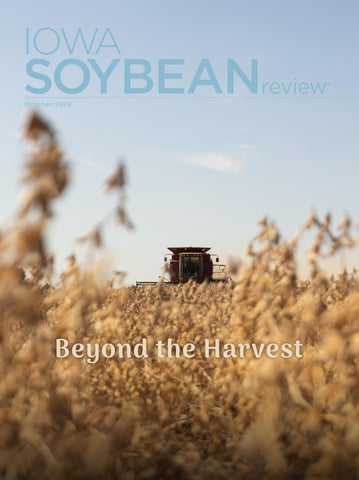
Voices From the Field Farmers advocate for soy on Capitol Hill. On the Cover: Iowa Soybean Association President Tom Adam crawls his combine through a soybean field near Keota, capturing some of the 595.6 million bushels harvested in Iowa in 2025. In this issue, see how Adam and other Iowa soybean farmers are connecting with global soybean buyers and building demand for U.S. soy as another harvest season arrives. Photo by Joclyn Kuboushek.
Comments and statewide news articles should be sent to the address to the left. Advertising space reservations must be made two months preceding publication. In consideration of the acceptance of the advertisement, the agency and the advertiser must, in respect of the contents of the advertisement, indemnify and save the publisher harmless against any expense arising from claims or actions against the publisher because of the publication of the content of the advertisement.
IOWA SOYBEAN REVIEW® | 3
Executive Insights Kirk Leeds, ISA Chief Executive Off icer kleeds@iasoybeans.com
Building demand one relationship at a time
A
s I prepare to return to Iowa from Mexico City after another trip to promote U.S. soybeans, I can’t help but reflect on the international trade missions I have been fortunate to join over the past three and a half decades. These trips have taken me around the world with one common goal: build demand for Iowa and U.S. soybeans. My latest trip began in El Salvador, a market of 6.3 million people. It imports more than 270,000 metric tons (roughly 10 million bushels) of U.S. soybeans, primarily soybean meal. The U.S. accounts for roughly 93% of El Salvador’s soybean imports, with much of that demand driven by growing poultry, egg and swine industries.
Mexico’s proximity and strong agricultural relationship with the United States make it a critical market for Iowa farmers. Much of that relationship has been strengthened by the United StatesMexico-Canada Agreement (USMCA). Maintaining and renewing this key trade agreement is critical to agriculture and the thousands of farmers and businesses that depend on these markets. Over the past 35 years, I’ve traveled with Iowa farmers to create demand in emerging markets like China, Vietnam, Cambodia, Indonesia, Egypt, Pakistan and Bangladesh, as well as established customers in Europe, Japan, South Korea and the Philippines.
From El Salvador, we traveled to Mexico, a country of 132 million people and one of our largest customers. Mexico is the thirdlargest buyer of U.S. whole soybeans and the second-largest buyer of U.S. soybean meal and soybean oil.
There is something powerful about sitting across the table from a customer and hearing an Iowa farmer tell the story of their farm, family and commitment to quality. Iowa soybean farmers who volunteer to promote our crop demonstrate that they are vital ambassadors for their products and state.
In both countries, we met with key customers, industry leaders and government officials, including U.S. Ambassador to Mexico Ronald Johnson. These conversations gave us the opportunity to listen, learn and explain the quality, reliability and consistency of U.S. soybeans.
Demand is not created simply by putting a product on a ship. It is created through relationships, trust and showing customers why they can count on us. As I head back to Iowa, I am grateful for the farmers who have made these journeys with me—and for the opportunities ahead to continue telling the Iowa soybean story.
4 | OCTOBER 2026 | IASOYBEANS.COM
THE ONE YOU TRUST TO LEAD With exclusive genetics, unmatched protective traits, and unprecedented yield potential, Pioneer® brand Z-Series soybeans set new standards for performance. Follow the trail we’ve blazed and experience the Z-Series revolution for yourself. Visit Pioneer.com/LeadWithZ to learn more.
Pioneer® brand products are provided subject to the terms and conditions of purchase which are part of the labeling and purchase documents. TM ® Trademarks of Pioneer Hi-Bred International, Inc., and its affi liated companies. ©2026 Pioneer Hi-Bred. NB_04
HARVEST WITH THE
POWER OF BRENT® grain carts With more than five decades of experience building grain handling products, Brent has earned a reputation for innovation and quality. From the dual-auger Avalanche ® with pivoting unloading auger to the singleauger V-Series grain carts with superior unloading visibility and more, we push the limits of technology to create products you can depend upon each and every harvest.
V-SERIES SINGLE-AUGER GRAIN CART FROM 1,500- TO 800-BUSHEL CAPACITIES
AVALANCHE
SCAN TO LEARN MORE.
DUAL-AUGER GRAIN CART FROM 2,500- TO 1,100BUSHEL CAPACITIES
Unverferth Manufacturing Co., Inc. P.O. Box 357 • Kalida, OH 45853 • Unverferth.com
VISIT BRENTEQUIP.COM OR SEE YOUR NEAREST DEALER FOR MORE INFORMATION.
for over 40 years, your cooperative soybean processor
for over 40 years, your cooperative soybean processor
LEAD THE FIELD.
More Uptime
More Options
Spend less time in the field with operating speeds of 10 to 14 mph, and our easy-to-use wing down-pressure system.
Purpose-built components with a robotically welded frame and greaseless bearings ensure near-zero maintenance for more uptime and durability.
Choose from seven unit sizes and a variety of discs and rollers that are perfectly suited to your field, conditions, and desired finish.
brandt.ca 1-866-427-2638
-
More Speed
AREA 1
Get the best residue management and seedbed preparation in fewer passes with the new Brandt High-Speed Disc.
owa
ER
P R O D UC
HIGH-VELOCITY VERSATILITY.
Rural Route 2 Editor’s Note by Bethany Baratta bbaratta@iasoybeans.com
Pockets full of harvest
I
found a kernel of corn nestled in the handle of my dryer lint screen the other day. Apparently, my son didn’t fully clean out his pockets after a day of fun at the pumpkin patch. The clinking I heard during the drying cycle was the kernel, not the metal button on his pants. I smiled, thinking about how often my mom must have found these harvest treasures while doing laundry on the farm. She probably checked every denim pocket twice, but a few always slipped through. Sometimes the farm mementos showed up in expected places, like the bean dust settling into my dad’s co-op cap, or the baling twine draped over the gate—likely from the bale of straw used to bed the hogs in the outdoor pens.
And sometimes, they weren’t in the first place a visitor to the farm might expect. Take the medicine for the livestock, for example. In the fridge, next to the mayo. (Unless Mom found it first, then it would go in the basement fridge alongside the cold pop.) The bright pink all-weather paint stick used to ID hogs that were ready for market? On the table in the entryway, rolling around next to the
notepad, the telephone and the pens and pencils. I recall a red, weathered bowl on Dad’s desk specifically used to store washers, wire connectors and bolts. I thought these were there just in case we needed them indoors, but now I realize the bowl was a catchall for the items found in his pants pockets after a day of working around the farm. It got me thinking about the farm and the treasures that show up in unexpected places this time of year: • Grain scale tickets and farm store receipts forgotten in shirt pockets, now dryer-shredded into a gray ball of lint. • Rock-hard soybeans rolling across the floor, kicked free from the deep tread of boots worn to the co-op. • A red paisley-printed handkerchief pulled f rom a back pocket to wipe a forehead, leaving a dusty, brown imprint where field grime met sweat. I didn’t know one kernel of corn would unlock so many visual memories of harvest time on the farm. And I couldn’t have imagined how much I’d miss seeing those messy, wonderful harvest treasures.
Happy harvest,
IOWA SOYBEAN REVIEW® | 7
The Long Game, Half a World Away What soybean farmers learned about building soybean demand in Thailand
STORY AND PHOTOGRAPHY BY
KRISS NELSON 8 | OCTOBER 2026 | IASOYBEANS.COM
Sharing our story: A note from the author About the writer: Kriss Nelson grows soybeans and corn with her husband, son and granddaughter near Fort Dodge. She accompanied ISA District 7 Director Scot Bailey on this soy mission to Thailand.
One of the biggest lessons I took away from Thailand was realizing just how connected Iowa soybean farmers are to customers half a world away. Standing in Bangkok, a city of more than 11 million people, it would be easy to assume a family farm in Iowa has little influence there. Instead, I learned the opposite. What happens on our farms matters. Throughout the week, executives from some of Thailand’s largest feed and food companies didn’t just want to talk about soybean meal. They wanted to talk with farmers. They asked about this year’s growing season, yields, conservation practices and what it takes to raise soybeans in Iowa. I brought along a small photo book of my family’s multigenerational farm. I expected it to be a conversation starter. Instead, it became one of the most meaningful parts of the trip. Presidents and owners of some of Thailand’s largest feed companies took time to page through the photos, asking questions about the people, equipment and traditions behind the crop they purchase. That reminded me that export markets aren’t built only on contracts or commodity prices. They’re built on relationships. A soybean leaving my family’s farm may eventually feed chickens, pigs or fish thousands of miles away. Before this trip, that supply chain was something I understood. After spending a week in Thailand, I understood the people behind it. After spending a week in Thailand, it became personal.
S
A cargo ship docks at Laem Chabang Port, Thailand’s largest deep-sea port and a major gateway for the country’s international trade.
tanding beside fish ponds on Thailand’s eastern coast, soybean farmers learned how years of research transformed Thailand’s sea bass industry. The challenge wasn’t finding an alternative to wild-caught fish. It was convincing young fish to eat it. “It’s not genetics,” explained Jinnawat “Guun” Mahalao, whose family operates Boonsawang Farm. “It’s behavior. We had to train them.” Boonsawang Farm is a commercially prominent aquaculture company located in the Chachoengsao and Chonburi provinces of Thailand. Working alongside nutritionists and feed manufacturers, the Mahalao family spent years refining pellet sizes, feed formulations and feeding practices until young sea bass learned to eat pelleted feed containing soybean meal. Today, about 90% of Thailand’s sea bass industry uses pelleted feed, with soybean meal accounting for roughly one-quarter to one-half of the ration.
The breakthrough did more than improve fish production; it created a long-term market for soybean meal. For the soybean farmer-leaders and staff visiting Thailand this summer, the stop at Boonsawang Farm illustrated something larger than aquaculture. It demonstrated how demand for U.S. soybeans is developed. Not through a single sale, but through years of research, technical support and relationships that solve problems for customers. That lesson resurfaced throughout the week as the delegation met with feed manufacturers, livestock producers, exporters and sustainability experts. Although each company occupied a different place in Thailand’s food supply chain, the conversations pointed to the same conclusion: future demand for Iowa soybeans will depend on far more than price. It will depend on trust.
Continued on Pg. 10
IOWA SOYBEAN REVIEW® | 9
More than another export market
“ You have to stay in front of them. Invite them to Iowa, show them the supply chain and keep building trust.” A ndrew Metzger AGP senior merchandiser
For most Iowa farmers, soybeans disappear into a local elevator shortly after harvest. Few ever see where those soybeans end up. In Thailand, they did. Thailand imports millions of tons of soybeans and soybean meal to support one of Southeast Asia’s largest livestock industries. Much of that soybean meal feeds the region’s expanding poultry, swine and aquaculture sectors, making Thailand an important market for U.S. soybeans. As U.S. crush capacity expands, finding markets for additional soybean meal becomes increasingly important. Scot Bailey, Iowa Soybean Association district 7 director, says one of his biggest takeaways was seeing how vertically integrated many Thai companies are, controlling everything from feed manufacturing and livestock production to meat processing and retail sales. “I thought it was kind of the same segmented trade that we have here in the United States,” he says. “That was very interesting.” As renewable diesel continues to drive expansion of soybean processing in the United States, export markets have become even more important. More soybean crushing means more soybean oil for renewable fuels, but it also produces significantly more soybean meal that must find customers. That’s why soybean leaders traveled halfway around the world. Not to negotiate grain sales, but to better understand the customers whose purchasing decisions ultimately influence demand for soybeans grown in Iowa.
SCOTT RITZMAN Ritz Ag Consulting
“The market doesn’t just happen,” Scott Ritzman, president of Ritz Ag Consulting, says. “You have to build it.” Ritzman says soybean farmers have long invested checkoff dollars in production research to improve yields and profitability. Market development deserves the same long-term commitment. “You can invest in research to grow more soybeans,” he says. “But if we don’t continue building export markets, where are those soybeans going to go?”
The long game Andrew Metzger, senior merchandiser with AG Processing Inc., says export markets are built over years, not months. “It’s a long game,” says Metzger. Maintaining those relationships requires continued engagement long after a trade mission ends. “You have to stay in front of them,” he says. “Invite them to Iowa, show them the supply chain and keep building trust.” Metzger says it often takes a decade or more of trade missions, customer visits and follow-up conversations before buying habits begin to shift.
Soybean farmers visit Boonsawang Farm in Thailand, meeting with the farm’s owners and getting a f irsthand look at the ponds, f ish and feed that connect U.S. soy to Thailand’s aquaculture industry.
10 | OCTOBER 2026 | IASOYBEANS.COM
Market snapshot: Thailand Population The Sustainable U.S. Soy logo appears on a soymilk carton in Thailand, while soy also reaches consumers indirectly through meat products f rom animals fed soy-based diets.
“South America has supplied this region for a long time,” he says. “Now it’s our job to show buyers the value of U.S. soybean meal.” The meetings throughout Thailand reflected that approach. Rather than leading with a sales pitch, conversations focused on listening. Thai executives wanted to understand how Iowa farmers grow soybeans and asked about no-till, cover crops, residue management, grain storage and conservation practices. Ritzman says those conversations help buyers connect not only with the product, but with the people producing it. “When buyers visit a farm, meet the family and see how soybeans are grown, that creates a connection,” Ritzman says. “It’s the human side. They know who’s producing their feed ingredients.”
66 million Soybean Market
4.2 MMT Nearly 100% imported
Soy Meal Market
3 MMT ~1% U.S. market share
What Thais want As the delegation visited feed manufacturers, livestock producers and food companies across Thailand, one theme continued to emerge. Regardless of where companies fit within the supply chain, they were looking for the same thing: a reliable, sustainable supply of high-quality U.S. soybeans. Representatives from the Thai Feed Mill Association discussed how feed manufacturers balance nutrition, ingredient quality, availability and cost while navigating changing government policies and international competition. Chuchai Kanjanamayoon, Thailand country representative for the U.S. Soybean Export Council, says that this has been one of the organization’s biggest challenges. “We have to change the mindset of the purchasing decision,” he says. Rather than comparing soybean meal only on price and crude protein, USSEC is working with feed manufacturers and nutritionists to better understand the value of digestible nutrients, consistent quality and technical support. At Cargill Thailand, executives said feed formulations begin with value, not simply protein content. Although price remains the biggest driver of purchasing decisions today, sustainability, traceability and documented performance are becoming increasingly important, particularly for customers exporting food products to Europe and the United Kingdom.
~20 MMT Feed Output (poultry, swine, dairy, aqua)
250,000–300,000 metric tons Aqua Soy Meal Use
SE Asia’s largest Crushing Hub 4 major and several smaller crushers
Continued on Pg. 12 IOWA SOYBEAN REVIEW® | 11
Executives with CP Group, one of the world’s largest integrated food companies, described the scale of Thailand’s poultry industry and the importance of maintaining consistent feed supplies for domestic consumption and export markets. Discussions about sustainability, conservation practices and soybean research suggested there is room for U.S. soybean meal to gain market share. “They seemed very receptive to what we were talking about,” Bailey says. “They weren’t just looking at crude protein and price.” At Betagro and Thai Foods Group, conversations centered on food safety, traceability, animal nutrition, and changing customer expectations as both companies continue to expand livestock and poultry production. The delegation also met with INTEQC Group, an integrated feed and livestock company expanding into India, Laos, Cambodia and Myanmar. Company leaders discussed how that regional growth will increase demand for soybean meal across Southeast Asia, creating opportunities beyond a single country. Although each meeting focused on a different segment of the food system, the message remained consistent. “They value dependable suppliers,” Bailey says. “They expect consistent product quality, appreciate technical support, and increasingly, they want to know more about the soybeans they’re buying than simply their protein content.”
Sustainability drives value
Face-to-face conversations with Thai businesses gave the U.S. soybean delegation an opportunity to hear directly f rom customers while building relationships important to maintaining and growing the market for U.S. Soy.
12 | OCTOBER 2026 | IASOYBEANS.COM
Today, another factor is becoming increasingly important: sustainability. Robert Middendorf, East Asia regional sustainability lead for USSEC, says Thailand is preparing for more formal sustainability reporting as companies respond to changing customer expectations. “It’s not just compliance,” Middendorf says. “It’s also a competitive advantage.” Rather than focusing on consumer marketing, conversations centered on how food companies document the environmental footprint of the products they buy and sell. Much of that discussion centers on Scope 3 emissions, the greenhouse gases
generated throughout a product’s supply chain. “If you’re measuring the carbon footprint of chicken or shrimp, you also have to understand the carbon footprint of the soybean meal used to produce it,” says Carlos Salinas, USSEC’s executive director for East Asia. Kanjanamayoon says many of the country’s largest feed and food companies have established net-zero goals and are taking a closer look at the environmental footprint of their supply chains. USSEC is working to help buyers better understand the nutritional, economic and sustainability advantages of U.S. soybeans. That is where U.S. soybeans may hold an advantage. Through the U.S. Soy Sustainability Assurance Protocol, U.S. farmers can document conservation practices, continuous improvement and sustainable production while providing greenhouse gas data customers can use in their reporting. “The earlier you learn, the more it becomes a competitive advantage,” Middendorf says. Bailey believes sustainability could become one of the United States’ greatest competitive advantages. “We aren’t burning crop residue, and we’re not taking rainforests out,” he says. “We’ve got to be able to market that part of our sustainability because that’s going to matter in export markets.”
Relationships and results Years of conversations are now beginning to translate into measurable goals. Timothy Loh, USSEC’s regional director for Southeast Asia and Oceania, says years of workshops, research and technical exchanges with the Thai Feed Mill Association have built a foundation for expanding the use of U.S. soybean meal. While patience has been part of the process, he says the relationship has reached a turning point. “We are ready for the next step,” Loh says. Rather than talking about what could happen years from now, USSEC and the Thai Feed Mill Association are using a memorandum of understanding to establish measurable milestones this year aimed at increasing purchases of U.S. soybean meal.
Thailand 2026: A dynamic and rapidly expanding feed and livestock market Appx.
Appx.
5 MMT
3 MMT
soybean meal consumption
3 MMT soybeans imported
Stable growth driven by livestock, poultry and aquaculture
=
2 MMT soy goes into soybean meal
soybean imports
+
Remainder go into full fat soy such as soybean oil and other uses
Strategic opportunity within a key market with long-term potential for sustainable growth
Rising demand to support food security
Source: USSEC
Loh says the timing aligns with growing U.S. soybean meal supplies as new crush plants come online across the Midwest. “Our growers stand behind their product,” he says. “They have invested in the market, but they have also invested in us to do the job.” Loh says the conversations have evolved beyond explaining why sustainability matters. Today, the focus is demonstrating how U.S. soy can help customers meet the expectations of food companies, regulators and export markets while providing a reliable supply of high-quality soybean meal.
Building trust Bailey believes farmers are the industry’s best ambassadors because they can explain firsthand how conservation practices, innovation and family farming contribute to producing a reliable supply of U.S. soybeans. “I’d rather be the one telling my story about my farm than have somebody else tell the story,” says Bailey, who raises crops and cows near Anita. Bailey says those conversations do more than explain how Iowa soybeans
are grown. They put a face to the soybeans they purchase and build relationships that continue long after a trade mission ends. Standing beside the ponds at Boonsawang Farm, the delegation saw that healthy fish weren’t the only product of years of investment. The operation also illustrated how lasting export markets are built through trust, research and collaboration. The Mahalao family’s success demonstrates that markets aren’t created by a single sale. They’re built by solving problems and strengthening relationships over time. Kanjanamayoon says the next step is helping customers understand the value of U.S. soy beyond price and protein. “We have to create awareness so they can understand the true value of U.S. soy,” he says. Bailey believes farmers should be part of that process. “The grain buyers actually want to see a farmer,” he says. “They want to know who they’re buying from.”
“ We have to create awareness so they can understand the true value of U.S. soy.” Chuchai Kanjanamayoon USSEC Thailand country representative
Contact Kriss Nelson at knelson@iasoybeans.com
IOWA SOYBEAN REVIEW® | 13
Soybean meal derived from U.S. Soy helps pigs reach optimal performance in grow-finish diets BY T HOMAS D’AL FO NS O, PH.D., WORLDWIDE ANIM AL NUTR I TI O N FOCU S AREA DIRECTO R , US S EC
Photo by Joclyn Kuboushek
M
ost swine nutritionists know that feed cost represents the largest single expense in commercial swine production. According to “Nutrient Requirements of Swine” (NRC 2012) formulations, feed ingredients can account for 60% to 75% of total live production costs. With this major investment, the question to ask is not “What do feed ingredients cost?” but “What value is the feed delivering?” When evaluating ingredients on cost per unit of digestible nutrient, soybean meal derived from U.S. Soy consistently provides the foundation for predictable
performance and operational efficiency that nourishes a business. Constant financial pressures can create the temptation to focus on reducing diet cost per metric ton. But purchasing ingredients based on price alone can create false savings, especially when calculations don’t account for nutrient digestibility and availability. The true measure of feed value is not the ingredient’s price per metric ton, but its cost per unit of digestible nutrient, specifically, the digestible amino acids and energy that drive lean growth and carcass yield in an operation.
Example: Cost per unit of digestible lysine (source: NRC 12)
PROTEIN SOURCE
PRICE ($/MT)
Digestible Lysine (%)
Cost per kg Digestible Lysine ($)
Soybean meal derived from U.S. Soy
100
2.85
10.53
Brazilian soybean meal
94
2.76
10.65
Canola meal
30
1.62
14.20
Sunflower meal
195
.99
19.70
14 | OCTOBER 2026 | IASOYBEANS.COM
When digestible lysine content and digestibility rates are factored into diet formulation, research supports that soybean meal derived f rom U.S. Soy offers a nutritional premium which can offset a higher per-ton price. Less expensive alternatives deliver less usable protein, require more synthetic amino acid supplementation and may reduce carcass yield due to suboptimal nutrient ratios.
The real cost of protein Grow-finish pigs require precision-balanced amino acids and energy to support efficient lean tissue deposition, feed conversion and carcass uniformity. Ingredients with lower amino acid digestibility may appear less expensive but ultimately cost more per kilogram of usable nutrition delivered.
Formulation reality in grow-finish diets Swine diets are formulated for precise amino acidto-energy ratios to optimize feed conversion and lean gain. Substituting soybean meal derived from U.S. Soy with lower-cost proteins like canola meal, dried distillers grains or sunflower meal introduces risk and complexity to formulations. For example: • Canola meal provides only about 86% lysine digestibility versus greater than 90% for U.S. soybean meal. • Sunflower meal is low in lysine and energy, requiring formulators to add fat or synthetic amino acids. • Dried distillers grains vary widely in amino acid digestibility and oil content, demanding frequent formulation changes. In short, what appears cheaper per metric ton often raises total diet cost once calculations account for digestibility corrections and performance variability.
Efficiency Feed efficiency, carcass yield and nitrogen excretion all depend on amino acid digestibility, not crude protein content. Soybean meal derived from U.S. Soy consistently delivers superior standardized ileal digestibility for key amino acids compared to other vegetable proteins.
Consistency adds value The nutrient consistency of soybean meal derived from U.S. Soy, especially in amino acid profile, digestibility and metabolizable energy, allows for formulating diets with precision, without large safety margins. This reduces the
“hidden costs” that come from variability and reformulation when using alternative ingredients. In contrast, protein meals from other origins often show greater batch-to-batch variability in amino acid content, oil and fiber levels, forcing nutritionists to formulate conservatively and accept lower performance predictability. Consistency equals fewer surprises and more reliable ROI for the operation.
The economic takeaway Evaluating protein sources on a cost-per-metric-ton basis hides the true economics of pig performance. When expressing cost per kilogram of digestible lysine or energy, soybean meal derived from U.S. Soy consistently outperforms lower-priced alternatives—delivering the most usable nutrition per dollar spent. When accounting for what that nutrient density is actually worth at the formulation level, soybean meal derived from U.S. Soy represents at least $20 to $25 per metric ton in additional feed value, an advantage that compounds across every production cycle.
Practical takeaways Moving from “cost per metric ton” to “cost per unit of digestible nutrition” reveals that soybean meal derived from U.S. Soy provides the most economical, consistent and performance-proven value in grow-finish swine diets. It supports improved average daily gain and feed conversion ratios, higher carcass lean percentage, lower nitrogen excretion and greater diet formulation precision. Feed cost efficiency means extracting maximum usable nutrition per dollar invested and maximum return from every pig marketed. By prioritizing digestible nutrient economics over ingredient price alone, operations gain improved average daily gain and feed conversion, higher carcass lean percentage, reduced environmental impact and the formulation precision that supports profitable operations. That’s how U.S. Soy nourishes your business. Learn more at can.ussoy.org.
Comparing Sources and Digestibility
LYSINE DIGESTIBILITY (%)
METHIONINE DIGESTIBILITY (%)
THREONINE DIGESTIBILITY (%)
90-92
90
86
Brazilian soybean meal5
88
88
83
Canola meal3
86
87
80
Sunflower meal
84
85
78
Dried Distillers Grains15
82-85
83
75
INGREDIENT
U.S. Soy5
14
Higher amino acid and energy digestibility means pigs absorb more usable nutrients per kilogram of feed. That translates into lower feed cost per pound of gain and improved carcass uniformity. In trials comparing protein sources, grow-f inish pigs fed soybean meal derived f rom U.S. Soy achieved superior feed conversion ratios and lean gain compared to those fed South American meals. Superior amino acid digestibility becomes even more valuable during stressful periods including respiratory challenges, heat stress or post-weaning transitions. This is when functional compounds in U.S. Soy work synergistically with its nutrient density to maintain performance when synthetics alone fall short.
IOWA SOYBEAN REVIEW® | 15
Own Your Future Take the lead on water quality with practical, voluntary conservation solutions tailored to your farm
F
or more than 25 years, voluntary conservation has been at the heart of Iowa Soybean Association’s approach to improving water quality. That philosophy has worked because it puts farmers—not regulations—in the driver’s seat. Every operation is different, and conservation succeeds when practices fit a farm’s equipment, labor, budget and long-term goals.
Rob Davis ISA watershed program manager rdavis@iasoybeans.com
KEY INSIGHTS
AUTONOMY Inaction invites regulation. Adopting voluntary conservation now ensures farmers retain control before prescriptions are enforced.
ALIGNMENT Tailor conservation to meet agronomic and economic needs on the farm. Balance the books on costof-production and don’t just compare yields.
PARTNERSHIP Find a partner like ISA to identify practices and programs to help implement practices that fit on the farm.
16 | OCTOBER 2026 | IASOYBEANS.COM
Proven progress Over the past several decades, Iowa farmers have transformed the landscape with terraces, grassed waterways, ponds, grade stabilization structures and water and sediment control basins. Those investments have dramatically reduced soil erosion and phosphorus losses, bringing agriculture within striking distance of the phosphorus reduction goals outlined in Iowa’s Nutrient Reduction Strategy. That success wasn’t accidental. Farmers adopted these practices to protect their land, improve productivity and because it made sense for their businesses. The same opportunity exists today as attention shifts from phosphorus to nitrate reduction. Many producers remember the changes that came with the 1985 Farm Bill. Conservation compliance and advances in reduced tillage reshaped how fields were managed. Those weren’t easy adjustments. They required new equipment, different management strategies and significant financial investment. Looking back, however, it’s clear that those changes helped preserve some of Iowa’s most valuable assets—its soil. Today’s economic environment presents a different challenge. Margins are tighter, input costs remain high and every investment has to earn its place on the balance sheet. That’s why voluntary conservation matters more than ever. Farmers need flexibility
to adopt practices that strengthen productivity and profitability—not another one-size-fits-all mandate. Improving water quality remains an important goal, and voluntary conservation gives farmers the opportunity to decide what works best for their operation.
Managing risk Every growing season is built around managing risk. Weather changes. Markets fluctuate. Fertilizer prices climb. Producers spend years building their Actual Production History because consistency matters. Conservation should be viewed the same way. Practices that improve soil health, increase water infiltration and reduce nutrient losses create more resilient fields over the long term. Conservation doesn’t have to mean doing everything at once. It means scaling practices to fit the operation. Nutrient management is one example. The INRS recognizes the value of applying nutrients at the right time, in the right place, using the right source and at the right rate. Yet recent weather patterns have reminded us that nitrogen doesn’t always stay where we put it. Dry falls followed by wet springs have allowed nitrate to move through tile lines before crops have a chance to use it. Keeping those nutrients in the field protects both yield potential and fertilizer investment. Manure also deserves another look. When applied at the right time and at agronomic rates, it can reduce commercial fertilizer costs while supplying valuable nutrients and micronutrients. For livestock producers, accurately valuing manure creates another revenue opportunity. For crop producers, it’s another tool to stretch fertilizer dollars while keeping nutrients working for the crop.
From cover crops and edge-of-f ield practices like bioreactors to manure management, farmers have a range of conservation tools they can choose and adapt to f it their agronomic, economic and water quality goals.
Cover crops are another practice that often raises questions. One of the most common concerns is yield drag. Yet nearly 2,000 farmers have planted 4 million acres of cover crops annually in Iowa in recent years. They aren’t planting them simply for water quality—they’re planting them because they see the long-term value on their farms.
Voluntary success The difference is management. A cover crop isn’t a silver bullet, and it isn’t a “plant it and forget it” practice. Species selection, seeding method, nitrogen management and termination timing all influence success. Some farmers who tried cover crops years ago walked away frustrated because they didn’t receive the management guidance needed to make the system work. That’s changing. The ISA’s Research Center for Farming Innovation has conservation agronomists
across Iowa helping farmers reduce the learning curve. Working alongside Agriculture’s Clean Water Alliance and local ag retailers, the team helps producers identify practices that match their goals— whether that’s reducing erosion, improving infiltration, suppressing weeds, building organic matter or improving overall soil health. Conservation doesn’t stop at the edge of the field, either. Once nitrate reaches a tile line, it’s largely beyond the crop’s reach. Edgeof-field practices like saturated buffers and bioreactors remove nitrate before it reaches downstream waterways. Restored oxbows and constructed wetlands go a step further by improving water quality while creating wildlife habitat and, in some cases, livestock water sources. ISA’s Conservation Services team has worked with farmers for more than a decade, designing systems
that complement field operations instead of getting in the way. Unlike the 1985 Farm Bill, the Iowa Nutrient Reduction Strategy remains voluntary—giving farmers a vital window to adopt conservation practices on their own terms before mandates take that choice away. This distinction offers the flexibility to choose practices that fit individual operations, leveraging technical expertise and cost-share opportunities to reduce financial risk while staying ahead of potential regulation. Conservation has always been about protecting what matters most—productive soils, profitable farms and the next generation. By taking proactive action now, Iowa farmers can continue to lead with the tools, flexibility and trusted partnerships needed to succeed on their own terms. Want to talk to an ISA professional about what’s possible on your farm? Email us at conservation@iasoybeans.com.
HAVE A TRIAL OR A PROJECT YOU’RE INTERESTED IN? SCAN THE QR CODE
We can consider it as a topic in a future issue. Better yet, we’ll connect you with your local expert so you can implement a trial on your farm. Email us at conservation@iasoybeans.com
IOWA SOYBEAN REVIEW® | 17
Regional soybean research partnerships help farmers tackle emerging threats and maximize checkoff investments
W
hen Iowa soybean farmers invest checkoff dollars into research, they aren’t funding work that stops at the state’s borders. Through the North Central Soybean Research Program, 13 soybean-producing states across the Midwest pool resources, expertise, and funding to tackle challenges that affect farmers throughout the region. The result is a collaborative approach that allows researchers to respond more quickly to emerging threats, leverage farmer investments and develop solutions that benefit soybean growers. More than 80% of U.S. soybeans are grown within the North Central region, making collaboration critical, says Joe McClure, NCSRP executive director and chief officer of the Iowa Soybean Association’s Research Center for Farming Innovation. “North Central is really the heart of U.S. soybean production,” McClure says. “When we bring together researchers and experts from across the region, we’re able to address challenges faster and more effectively than any one state could on its own.”
Regional collaboration
Rather than funding individual projects within a single state, NCSRP focuses on bringing together researchers from multiple universities and disciplines to address common challenges facing soybean farmers. For example, Iowa currently has limited concerns with red crown rot, a disease more commonly found farther south. But through regional partnerships, Iowa farmers benefit from research already being conducted by specialists in states where the disease is a more immediate threat. “If that disease eventually moves into Iowa, we’re not starting from scratch,” McClure says. “We’re already benefiting from the knowledge and management strategies developed through collaborative research.” By pooling funding from 13 state soybean checkoff organizations, NCSRP can support larger projects and attract expertise that would be difficult for any single state to fund independently.
18 | OCTOBER 2026 | IASOYBEANS.COM
STORY BY
PHOTOGRAPHY BY
KRISS NELSON
JOCLYN KUBOUSHEK
MARK LICHT ISRC co-director and ISU extension cropping systems specialist Farmers and industry representatives with the NCSRP tour Iowa State University’s Advanced Teaching and Research Building to learn about soybean research and collaborative efforts addressing production challenges across the region. Photo credit: Kara Berg, ISRC Communications Specialist II.
“Our farmers are able to leverage their investment into research that has a much broader impact,” McClure says. “They’re getting access to projects and expertise that would be difficult to support individually.” One example of that collaboration in action is soybean gall midge. When the pest first emerged in western Iowa, Nebraska and neighboring states, little was known about its biology or management. Through NCSRP, entomologists from multiple states quickly came together to study the insect, identify its life cycle and begin developing management recommendations. “It was a new pest, and nobody really knew much about it,” McClure says. “The organization was able to react quickly, bring experts together and accelerate the learning process.”
Tomorrow’s tools
While rapid response to emerging threats remains important, McClure is equally excited about projects that could shape the future of soybean production. One initiative led by researchers in Wisconsin is using large datasets and artificial intelligence to better understand which management decisions consistently drive profitability and yield. The project analyzes information collected across multiple states to determine whether long-held farming practices continue to deliver economic value. “We all have things we do because that’s the way we’ve always done them,” McClure says. “The data doesn’t always support that, and this project is helping us identify which management decisions truly make a difference.” Another long-term effort focuses on soybean cyst nematode, one of the most persistent yield-robbing pests in soybean production. Researchers, including Thomas Baum, a plant pathology professor at Iowa State University, are working to identify new sources of resistance and future trait technologies that could provide farmers with additional tools to combat SCN. While those solutions remain years away, McClure says they represent the type of foundational research needed to address future challenges.
Coordinated research
Ultimately, McClure views NCSRP as one piece of a broader research system that includes state soybean organizations and the national soybean checkoff. Rather than competing for resources, he says the organizations work together to ensure farmer investments are being used strategically and efficiently. “We’re not operating in isolation,” McClure says. “Our goal is to complement the work being done by the states and USB so farmers see a coordinated approach that delivers value from their checkoff investment.” Contact Kriss Nelson at knelson@iasoybeans.com
DANNY SINGH ISU associate dean for research and discovery and agronomy professor
Borderless research Although the Iowa Soybean Research Center does not receive direct funding from the North Central Soybean Research Program, its research priorities closely align with the organization’s mission. Many of the production challenges facing soybean farmers—including insects, diseases and agronomic management— extend well beyond Iowa’s borders. “A lot of our soybean challenges and opportunities are not just Iowa-centric,” says Mark Licht, co-director of the Iowa Soybean Research Center and Iowa State University Extension cropping systems specialist. “Whether we’re doing the research here in Iowa or it’s being conducted at another university, it’s all getting us newer research and information to make soybean management decisions.” That collaboration begins long before research reaches the field, says Danny Singh, Iowa State University associate dean for research and discovery and agronomy professor. “The partnership in defining problems, the partnership in figuring out solutions together,” Singh says. “We take learnings from the lab and the field and take them to the farmer so they can utilize them in their production system.” IOWA SOYBEAN REVIEW® | 19
GrowerBuyer Connection Face-to-face with the global buyers of U.S. soy STORY AND PHOTOGRAPHY BY BETHANY BARATTA
20 | OCTOBER 2026 | IASOYBEANS.COM
Iowa Soybean Association farmer leaders talk soybean business with global customers in Chicago. If USDA projections hold true, Iowa soybean farmers will harvest 603.3 million bushels of soybeans across 9.73 million acres this year.
T
he event venue was planted squarely between Navy Pier—once a primary soy shipping hub—and the Chicago Board of Trade, where buyers and sellers have traded futures for generations. It was a fitting middle ground for U.S. soybean growers to connect with global buyers to discuss market opportunities just weeks before combines rolled across the Midwest. The U.S. Soybean Export Council’s Soy Connext conference opened with a record attendance of more than 800 participants, including 400 international buyers spanning 67 countries. For Iowa growers stepping off the farm to participate in face-to-face meetings with customers, it was an opportunity to hear how the soy they grow helps customers succeed. For buyers, the early August event provided insights into the new-crop soybeans making their way to maturity. They learned that while dry weather in parts of the soybean-growing areas has reduced crop potential, adequate rain elsewhere provides a hopeful outlook. Bottom line, “there will be plenty of soybeans available,” says Randy Miller, a soybean farmer and past Iowa Soybean Association president from near Lacona. While customers asked about how farmers decide what seeds to plant, ISA President Tom Adam talked traits and lessons from previous seasons—and generations. He’s the fifth generation on his family’s farm near Harper. When fertilizer and technology arose as topics in the conversation, ISA directors noted their use of precision technology and the ability to utilize manure as a valuable fertilizer on their acres.
“We’re using as much technology as we can to grow a crop as efficiently and affordably as we can,” says Miller, who serves on the USSEC board. Farmers learned from buyers about how the soy they grow was ultimately used in feed and food products. They heard from buyers about the quality of the soy products received in their respective countries, how the expected super El Niño could impact shipping routes and the price they’ll pay as a result. Buyers learned about port expansions at the Port of Grays Harbor and the Port of Milwaukee, which will expand export capacity through the Pacific Northwest and Great Lakes. Both bode well for expanding soybean shipments and usage globally. Still, it comes down to relationships. “USSEC staff are the boots on the ground in markets around the world, and they know that when farmers come and have one-on-one conversations with our buyers it makes all the difference in the world,” says Robb Ewoldt, past ISA president and current United Soybean Board director. “That’s why we need to make every effort we can as farmers to get out and tell them what we’re doing. When you build that relationship, you also build loyalty. We want loyalty. We want repeat customers. We want them to feel confident about what they’re buying.” “I can’t sell the beans from my farm directly to the people I’m meeting with today, but I can help the AGPs of the world make a sale,” says Jeff Ellis, an ISA District 9 director from Donnellson. “That’s what I hope I’m doing.” Continued on Pg. 22
RANDY MILLER USSEC board member and Lacona farmer
ROBB EWOLDT USB director and Davenport farmer
JEFF ELLIS ISA District 9 director and Donnellson farmer
IOWA SOYBEAN REVIEW® | 21
“ When you build that relationship, you also build loyalty.” Robb Ewoldt, USB director and Davenport farmer
Iowa Soybean Association farmer leaders and staff met with leaders f rom Shandong Bohi Industry Group, a major soy processor in China. The company serves food, feed and industrial markets through integrated supply chains.
Diversified portfolio
JIM SUTTER USSEC CEO
USSEC’s market diversification strategy is paying off for U.S. soy, farmers learned. While year-to-date total exports dropped 11% in marketing year (MY) 2025-26 due to geopolitical trade friction (shipments to China down 45%), shipments to the rest of the world were up 9%, USSEC CEO Jim Sutter says. Combined with a return to normalized trade with China—backed by a 25 million metric ton annual purchasing commitment—U.S. soy exports are projected to grow 5% in MY 2026-27, which began Sept. 1, 2026, and runs to Aug. 31, 2027. “Our work through Soy Connext and our trade teams is what turns that global demand into lasting relationships with U.S. Soy,” Sutter says.
22 | OCTOBER 2026 | IASOYBEANS.COM
Quality advantage
Ewoldt stressed the processing advantage of U.S. soy that cheaper competitors can’t match. U.S. soybeans dry down naturally, allowing farmers like him to harvest at lower moisture levels, around 13%. In contrast, South American soybeans are often harvested at 20% to 24% moisture, requiring high-heat commercial drying. That artificial heat breaks down essential amino acids, he says, lowering protein digestibility for livestock. Feed millers from Costa Rica and Nicaragua noted that the superior amino acid profile of U.S. soybean meal allows them to incorporate higher inclusion rates—up to 17% in cattle and pig feed rations— without sacrificing animal gain.
Demand shifts
The global market map is shifting as international buyers navigate regional processing challenges and infrastructure expansions: • Taiwan: Buyers highlighted strict regional scrutiny surrounding processing contaminants, specifically benzo(a)pyrene (BaP) in crude oil. High-heat drying of damaged beans elevates BaP risks. Following a major processing plant shutdown over elevated BaP levels from Brazilsourced soybeans, Taiwanese crushers said they are shifting toward U.S. supply due to lower heat damage and higher processing integrity. • Europe: Representatives showcased major infrastructure moves, highlighted by a $10 million port expansion in Spain designed to double import and distribution capacity specifically for U.S. soy and meal. • Southeast Asia: Whole bean imports into Vietnam, Malaysia and Indonesia are feeding dynamic domestic systems,
ranging from poultry and aquaculture feed mills to foodgrade soy oil processing.
Expanding the pie
Data from Oil World shows global soybean production climbing to 441.2 million metric tons, yet global stocks-to-use ratios are projected to tighten to nearly 28%. World demand for protein and vegetable oil is simply growing faster than total output, Sutter says. “Global demand for soy is growing faster than the world can produce it, and that gap is exactly why buyers are looking for partners they can count on,” Sutter says. “Increased global demand for oil is driving more crush capacity worldwide, and those facilities need more soybeans to crush, not less. In the meantime, regions without their own domestic crush capacity are clamoring for more soybean meal to meet their livestock and aquaculture feed demands—a market U.S. Soy is ready to serve.” “What we’re seeing isn’t a shrinking pie, it’s a bigger one,” Sutter adds. “Historically between
50% and 60% of the U.S. soy crop is exported and our industry is geared up to keep doing that. USDA projects 54% in both MY 2025-26 and MY 2026-27, and I think the signs point to it being even higher. All this combines to a very positive outlook for U.S. Soy.” As Iowa farmers head into the field this fall, they’ll remember the interactions with customers in Chicago in early August. They’ll think about the global customers who proudly use the Sustainable U.S. Soy label on their products as part of their marketing efforts. Customers will remember the faces behind the shipments of soy that reach their port—the standing invitations to Iowa farms to see firsthand how soybeans are grown. Those faceto-face visits were a reminder that soybean production is a large part of the equation—but not the only thing. By building direct trust with international customers, growers ensure that when global crushers and feed millers buy soy, U.S. soy remains at the top of their list. Contact Bethany Baratta at bbaratta@iasoybeans.com
Traits, technology and farming tradition were a few of the topics covered during networking sessions with global customers at USSEC's Soy Connext in Chicago. More than 400 international buyers f rom 67 countries came to learn more about U.S. soy and connect directly with farmers.
IOWA SOYBEAN REVIEW® | 23
Soy Snaps Rooted in Iowa, captured in time PHOTOGRAPHY BY JOCLYN KUBOUSHEK
Scenes f rom the 2025 harvest. Clockwise f rom top: A soybean f ield near Rippey stands ready for harvest. Richard and Andy Drost check out their farm equipment near New Sharon. A grain cart moves in to unload soybeans at Robb Ewoldt’s farm near Davenport. The Grubbs family loads up a semi during harvest near Perry. Tom Adam checks his equipment before heading out to the f ields near Keota.
24 | OCTOBER 2026 | IASOYBEANS.COM
Clockwise f rom left: Wrapping up the last rows of harvest near Madrid in Boone County. Cattle graze on corn stalks near Keota. Scot Bailey runs another pass through the f ield outside Anita.
IOWA SOYBEAN REVIEW® | 25
ALEX SCHAFFER ISA research agronomy lead
A soil sample is collected to help determine nutrient needs. Consistent sampling depth and location are important for comparing soil test resul ts over time and tracking changes within a f ield.
BREAK THE
HABIT Field-by-field nutrient decisions can improve profitability, efficiency and water quality STORY BY KRISS NELSON | PHOTOGRAPHY BY JOCLYN KUBOUSHEK
26 | OCTOBER 2026 | IASOYBEANS.COM
F
all fertilizer decisions can quickly become routine. But Iowa Soybean Association Research Agronomy Lead Alex Schaffer says routine isn’t always the most profitable strategy. Whether evaluating soil tests, nitrogen stabilizers or application timing, he encourages farmers to make field-by-field decisions based on crop needs rather than habit. Doing so can improve profitability, nutrient efficiency and water quality. “It’s paying closer attention to the tons of fertilizer being spread every year and just saving where you can,” he says. “If your soil test levels are high or very high, there’s really no point in adding fertilizer until crop removal brings those levels back down.”
Let soil tests drive decisions For phosphorus and potassium, Schaffer says soil testing should be the starting point. Fields testing high or very high typically don’t require additional fertilizer. Optimum fields should receive maintenance applications based on crop removal, ideally using variable-rate technology. “The agronomics haven’t changed,” Schaffer says. “It’s really about making sure you’re replacing what the crop removes instead of automatically fertilizing every acre every year.” Schaffer says farmers should also consider whether stretching fertilizer applications over multiple years is the most economical approach. “If you’re waiting two or three years between applications, are you potentially leaving yield on the table?” he asks. “That’s something worth thinking about from a return-on-investment standpoint.” Applying nutrients closer to crop demand can improve nutrient use efficiency while avoiding unnecessary applications. Because phosphorus moves primarily with eroded soil rather than through the soil profile, applying more than the crop needs increases both upfront costs and the amount of phosphorus vulnerable to loss if erosion occurs.
Fall nitrogen still benefits from stabilizers Research continues to reinforce the value of using a nitrogen stabilizer with fall anhydrous ammonia applications, Schaffer says. “You’re really stabilizing your fall ammonia for the spring,” he says. Nitrogen stabilizers contain nitrapyrin, which slows the conversion of ammonium into nitrate, helping keep nitrogen in a less leachable form until the crop needs it. Are stabilizers worthwhile during cold winters? That’s exactly when they continue to provide value, Schaffer says. “Soil microbes also break down the stabilizer,” he explains. “If it’s cold all winter, those microbes aren’t very active, so the stabilizer is still there in the spring protecting that nitrogen.”
Challenging assumptions Research conducted through ISA trials has consistently shown treated nitrogen converts significantly more slowly than untreated nitrogen, reducing the amount susceptible to loss.
One finding that surprised Schaffer was how long nitrapyrin remains effective under spring conditions. “There was this thought that if it only lasted a couple weeks in warm weather, why spend the money?” he says. ISA research found nitrapyrin remained effective for more than 10 weeks in many cases. Even 10 weeks after application, some locations still had nearly 50% of the nitrogen in the ammonium form, resulting in ammonium levels comparable to fall-applied nitrogen by late spring.
Split applications offer flexibility Schaffer also remains a strong advocate for split nitrogen applications. Rather than applying the entire nitrogen program in the fall or before planting, split applications place a portion of the fertilizer closer to the time the crop is actively taking up nutrients. “You can make a management decision during the season,” Schaffer says. For example, a farmer may apply enough nitrogen before planting to simplify logistics, then use in-season weather, rainfall, mineralization and yield potential to determine whether additional nitrogen is warranted. “Combining split applications with decision-support tools such as N-FACT allows producers to respond to the growing season as it unfolds rather than relying solely on preseason assumptions,” he says.
Nitrogen remains a moving target While fall fertilizer decisions often happen months before planting, Schaffer says nitrogen management doesn’t end there. Even with a sound fertilizer plan, nitrogen management doesn’t stop after application because mineralization, the natural release of nitrogen from organic matter, varies dramatically from year to year. “That’s a big part of what makes nitrogen a moving target,” he says. This season has experienced high mineralization, illustrating why fixed nitrogen programs don’t always match crop needs. To help farmers respond to changing conditions, ISA continues supporting the Iowa Nitrogen Initiative’s N-FACT tool. The online decision-support tool combines weather data, mineralization estimates and field management information to guide in-season nitrogen decisions. Using current field conditions instead of historical averages, the tool helps farmers make more adaptive nitrogen decisions while improving profitability and protecting water quality. Contact Kriss Nelson at knelson@iasoybeans.com
Scan the QR code or go to n-fact.ag/start to access this tool.
IOWA SOYBEAN REVIEW® | 27
Iowa Soybean Association Grassroots fellows travel to the nation’s capital to advocate for soybean farmers STORY AND PHOTOGRAPHY BY JOCLYN KUBOUSHEK
The U.S. Capital, Washington D.C.
28 | OCTOBER 2026 | IASOYBEANS.COM
ISA farmers meet with Senator Chuck Grassley.
I
Julia Looney and Josh Blair at the U.S. Department of Agriculture building in Washington, D.C.
owa Grassroots Fellows Josh Blair and Julia Looney traveled to Washington, D.C., through the Iowa Soybean Association’s Grassroots Fellowship, which develops farmer leaders who speak directly with lawmakers about issues facing agriculture. The two spent the week this summer meeting with congressional staff, U.S. Department of Agriculture officials and representatives from other state soybean associations.
Looking forward to Washington For Blair, a young farmer from Wall Lake on his first trip to Washington, connection mattered as much as information. “Going into this week I was looking forward to making new connections with people who are like minded,” Blair says. “I also had never been to D.C., so I was really looking forward to the experience to see how our policy process works on a national level.” Looney, who farms with her husband and is in her second year of operation, shared Blair’s perspective. “I was looking forward to meeting representatives from other state soybean associations and hearing directly from elected officials about the policies and legislation that affect Iowa farmers,” Looney says. “It was an honor to
ISA Grassroots fellows meeting with Administrator Pat Swanson.
represent the Iowa Soybean Association in Washington, D.C., and especially meaningful to visit our nation’s capital during the United States’ 250th anniversary year.”
Policy hits home “We are all in this together,” Blair says. “With low commodity prices and high input prices we must advocate for all our representatives to keep open trade deals going. We also need to keep the USMCA (U.S.-Mexico-Canada Agreement), which is a critical deal for agricultural trade.” Looney’s takeaways centered on crop insurance and trade. A conversation with Pat Swanson, administrator of the USDA’s Risk Management Agency, stood out. Swanson, a former ISA district director, explained the data driving farmers’ coverage. “I appreciated learning more about how crop insurance programs are designed using data to create equitable coverage across regions with different weather and climate risks,” Looney says. She also recalled meeting with the USDA Foreign Agricultural Service, learning about the agency’s role in “maintaining trade relationships, providing global market intelligence, and supporting market development for U.S. agriculture.”
From Capitol Hill to the farm Both farmers connected what they heard in Washington to their own operations, from farm economics for Blair to beginning farmer programs for Looney. “As beginning farmers in our second year of operation, my husband and I appreciate the extension of the beginning farmer crop insurance discount from five years to 10 years,” Looney says. “Programs like this, along with resources offered through USDA and the Farm Service Agency, help ease some of the financial pressures that come with getting started in agriculture.” She also points to a conversation with Richard Fordyce, USDA undersecretary for farm production and conservation, about modernizing Farm Service Agency systems, including a new “One Farmer, One File” initiative designed to simplify reporting. Blair noticed a similar shift at USDA, which is developing an electronic system for submitting certified maps to the Farm Service Agency. “I think this will benefit everyone involved because it will streamline the process and better utilize the data we capture,” he says. Continued on Pg. 30 IOWA SOYBEAN REVIEW® | 29
“Participating in the Iowa Soybean Association's Grassroots program has given me access to
conversations and perspectives that would be difficult to experience on my own as a farmer. It allows me to bring that knowledge home and advocate for agriculture with greater confidence.” Julia Looney, ISA Grassroots fellow
Showing up For both farmers, the trip reinforced why they got involved in ag policy in the first place. “As a young farmer I believe without a voice for agriculture there are many misunderstandings inside and outside of the political systems,” Blair says. “It is critical to voice our opinions and let representatives know why something might be important to the agricultural industry.” He applied for the fellowship to understand how the government supports agriculture and to grow as a community leader. Looney says the program has opened doors she would not have found on her own. “Participating in the Iowa Soybean Association’s Grassroots program has given me access to conversations and perspectives that would be difficult to experience on my own as a farmer,” she says. “It allows me to bring that knowledge home and advocate for agriculture with greater confidence.”
MATT HERMAN ISA Chief Off icer of Advocacy and Demand
The view from ISA ISA Chief Officer of Advocacy and Demand Matt Herman traveled with the group. He found reassurance in the week’s meetings about the future of farmer leadership. “I sometimes hear older ISA directors express hesitancy about passing the baton to new directors. For long-time leaders, it probably feels like handing over
management of the family farm,” Herman says. “This week, though, I watched several of our group’s young leaders ask deep, substantive questions of agency heads and members of Congress. The exchanges during our meeting with USDA Foreign Agricultural Services in particular put to rest any concerns I had about the future pipeline of advocates for Iowa farmers.” That pipeline is exactly why ISA keeps investing in the Grassroots Fellowship, Herman says. “I’ve seen farmers from our program go on to lead in nearly every corner of agriculture: elected office, conservation advocacy, association leadership,” he says. “Many of them probably would have become leaders regardless, but I like to think the Grassroots Fellowship gives them some tools, resources and connections to get there faster and at a larger scale.”
The next generation Despite the obstacles, Blair and Looney still encourage other young farmers to get involved. “There might not ever be a great time to start farming with all of the ups and downs, but it is one of the most rewarding occupations I have ever experienced,” Blair says. “Through life you will also meet some of the most genuine people in the agricultural industry that seem to always have each other’s back.” Looney’s advice leaned on staying informed. “Stay informed about what is happening locally, nationally and globally,” she says. “There are excellent podcasts, newsletters and market updates that make it easy to stay connected.” Investing in knowledge, she says, matters as much as investing in relationships, and programs like the fellowship make room for both. For Blair, Looney and Herman, the trip was a reminder that the policy conversations happening in the halls of Congress start with the same conversations happening in Iowa fields. Contact Joclyn Kuboushek at jkuboushek@iasoybeans.com
30 | OCTOBER 2026 | IASOYBEANS.COM
Eight Farmer-Leaders Elected to Iowa Soybean Association Board of Directors BY BROCK JOHNSTON
E
ight farmers, including five incumbents, have been elected to the Iowa Soybean Association (ISA) board of directors. The association’s 22 volunteer farmer directors represent the state’s nine crop reporting districts in overseeing the management and allocation of soybean checkoff and non-checkoff resources. Newly-elected farmers who will serve three-year terms on the board include: Josh Blair, Wall Lake (District 4) and Jeff Hedges, Oakville (District 9). Effective Sept. 1, Lisa Obrecht of Zearing (District 5) was appointed by the board to serve a three-year term following the resignation of Corey Goodhue. Five farmer leaders were re-elected to three-year terms on the board. They include: Paul Kassel, Spencer (District 1); Sam Showalter, Hampton (District 2); Scot Bailey, Anita (District 7); Aimee Bissell, Bedford (At-Large); and Sharon Chism, Huxley (At-Large). “Thank you to all of Iowa’s soybean farmers who took the time to participate in this year’s director elections, whether by casting a ballot, putting their name forward as a candidate or both,” said Tom Adam, ISA president and soybean farmer from Harper. “As a farmer-led organization, ISA is strengthened by the engagement of the farmers we represent. Their participation helps ensure a strong future for ISA and Iowa’s soybean industry.” Directors are elected by Iowa soybean farmers in July and take office in September. Members vote for two farmers from their crop reporting district and vote for four at-large directors. The eight directors elected join 14 full-time soybean farmers in developing ISA’s policies and programs each year. Those continuing their service as directors are: Brent Swart, Spencer (District 1); Mike Yegge, Lake Mills (District 2); Josh Schoulte, Farmersburg (District 3); Amanda Tupper, Ionia (District 3); Marty Danzer, Carroll (District 4); and Dave Struthers, Collins (District 5); Brian Strasser, Homestead (District 6); Joe Sperfslage, Coggon (District 6); Summer Ory, Earlham (District 8); Brian Fuller, Osceola (District 8); Jack Boyer, Reinbeck (At-Large); and Neil Krummen, Linn Grove (At-Large).
AT-LARGE Aimee Bissell, Bedford
AT-LARGE Sharon Chism, Huxley
DISTRICT 1 Paul Kassel, Spencer
DISTRICT 2 Sam Showalter, Hampton
DISTRICT 4 Josh Blair, Wall Lake
DISTRICT 5 Lisa Obrecht, Zearing
DISTRICT 7 Scot Bailey, Anita
DISTRICT 9 Jeff Hedges, Oakville
Contact Brock Johnston at bjohnston@iasoybeans.com
IOWA SOYBEAN REVIEW® | 31
Exclusive Member Benefits Iowa Soybean Association members now have a better way to sell their equipment. • Over 50 years serving the ag industry • Nationwide buyer reach focused in agriculture • Trusted brand in ag communities • Data-driven marketing and audience targeting • Seller support from listing to settlement
N E W PA RT N E RS H I P
50% off
DPAAUCTIONS.COM