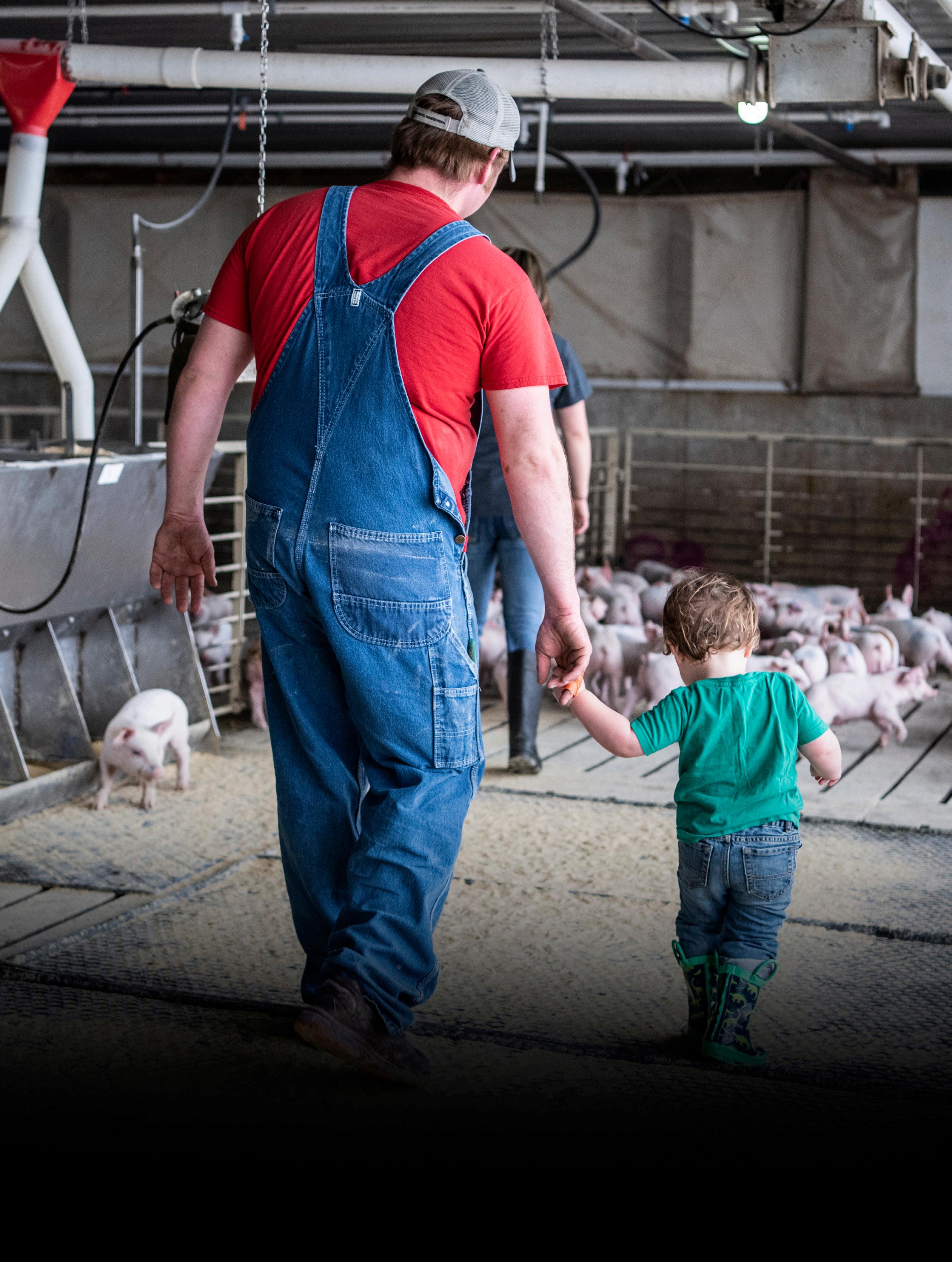
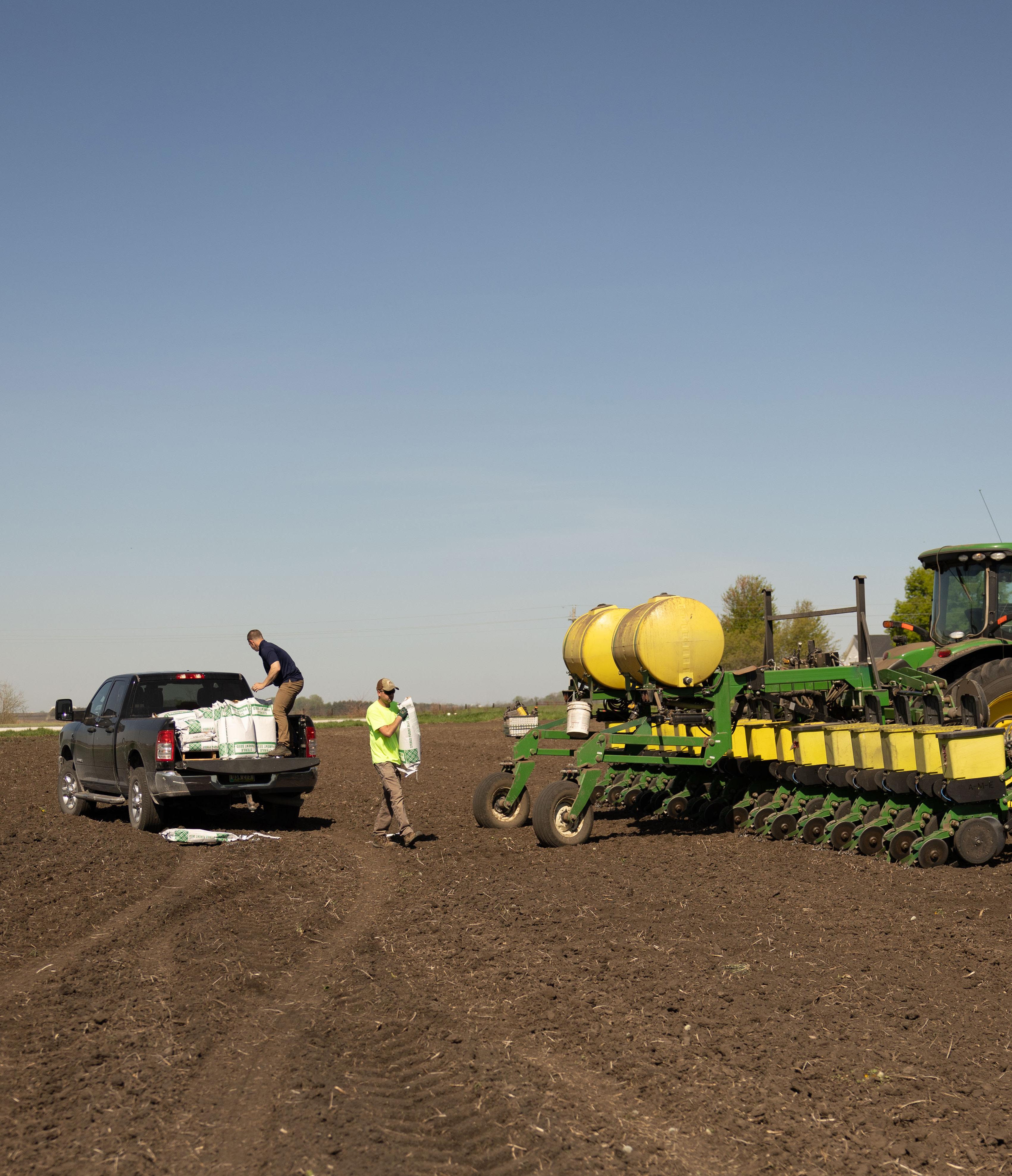
Inspired by the daily resilience of our customer-owners, Farm Credit Services of America has returned a cashback dividend for 22 consecutive years. In 2025, our Board of Directors continued the tradition by approving another 1% payout to eligible customer-owners. We’re proud to grow stronger together, year after year, as a financial cooperative that puts agriculture first. Agriculture Works Here.® FCSAmerica.com/CashBack
Executive Committee
President
Tom Adam, Harper | D9
President-elect
Lee Brooke, Clarinda | D7
Secretary
Aimee Bissell, Bedford | At-Large
Treasurer
Sam Showalter, Hampton | D2
At-Large Director
Jeff Ellis, Donnellson | D9
Board of Directors
Brent Swart, Spencer | D1
Paul Kassel, Spencer | D1
Mike Yegge, Lake Mills | D2
Amanda Tupper, Ionia | D3
Josh Schoulte, Farmersburg | D3
Jeff Frank, Lake View | D4
Marty Danzer, Carroll | D4
Corey Goodhue, Carlisle | D5
Dave Struthers, Collins | D5
Joe Sperfslage, Coggon | D6
Brian Strasser, Homestead | D6
Scot Bailey, Anita | D7
Brian Fuller, Osceola | D8
Summer Ory, Earlham | D8
Jack Boyer, Reinbeck | At-Large
Neil Krummen, Linn Grove | At-Large
Sharon Chism, Huxley | At-Large
American Soybean Association Board of Directors
Tom Adam, Harper
Steph Essick, Dickens
Morey Hill, Madrid
Randy Miller, Lacona
Dave Walton, Wilton
United Soybean Board of Directors
Tim Bardole, Rippey
Robb Ewoldt, Davenport
Brent Renner, Klemme
Suzanne Shirbroun, Farmersburg
Staff Credits
Bethany Baratta | Editor
Aaron Putze, APR | CO Brand Mgmt and Engagement
Susan Langman | Creative Design Coordinator
Joclyn Kuboushek | Multimedia Specialist
Kriss Nelson | Senior Writer
Mickayla Jordan | Marketing Coordinator
FARMER FOCUSED | DRIVEN TO DELIVER
ISA VISION
We advance the long-term competitiveness of Iowa soybean farmers.
ISA MISSION
Driven to deliver opportunities for Iowa soybean farmers to thrive.
Iowa Soybean Review is published monthly by: Iowa Soybean Association 1255 SW Prairie Trail Parkway, Ankeny, Iowa 50023 (515) 251-8640 | iasoybeans.com
E-mail: bbaratta@iasoybeans.com
For advertising information contact Bethany Baratta at (515) 334-1020 or bbaratta@iasoybeans.com
March 2026 | Vol. 39, No. 6
4
Season Opening
Baseball players and soybean farmers have a lot in common, says ISA CEO Kirk Leeds.
8 From the Field to Fifth Avenue
Demand and use of soy-based biofuels is heating up in the Northeast.
14
On Air
Radio personality recognized for his ability to connect Iowa farmers and audiences.
26
Spring Moves That Pay
Planting and marketing decisions intersect in the spring.
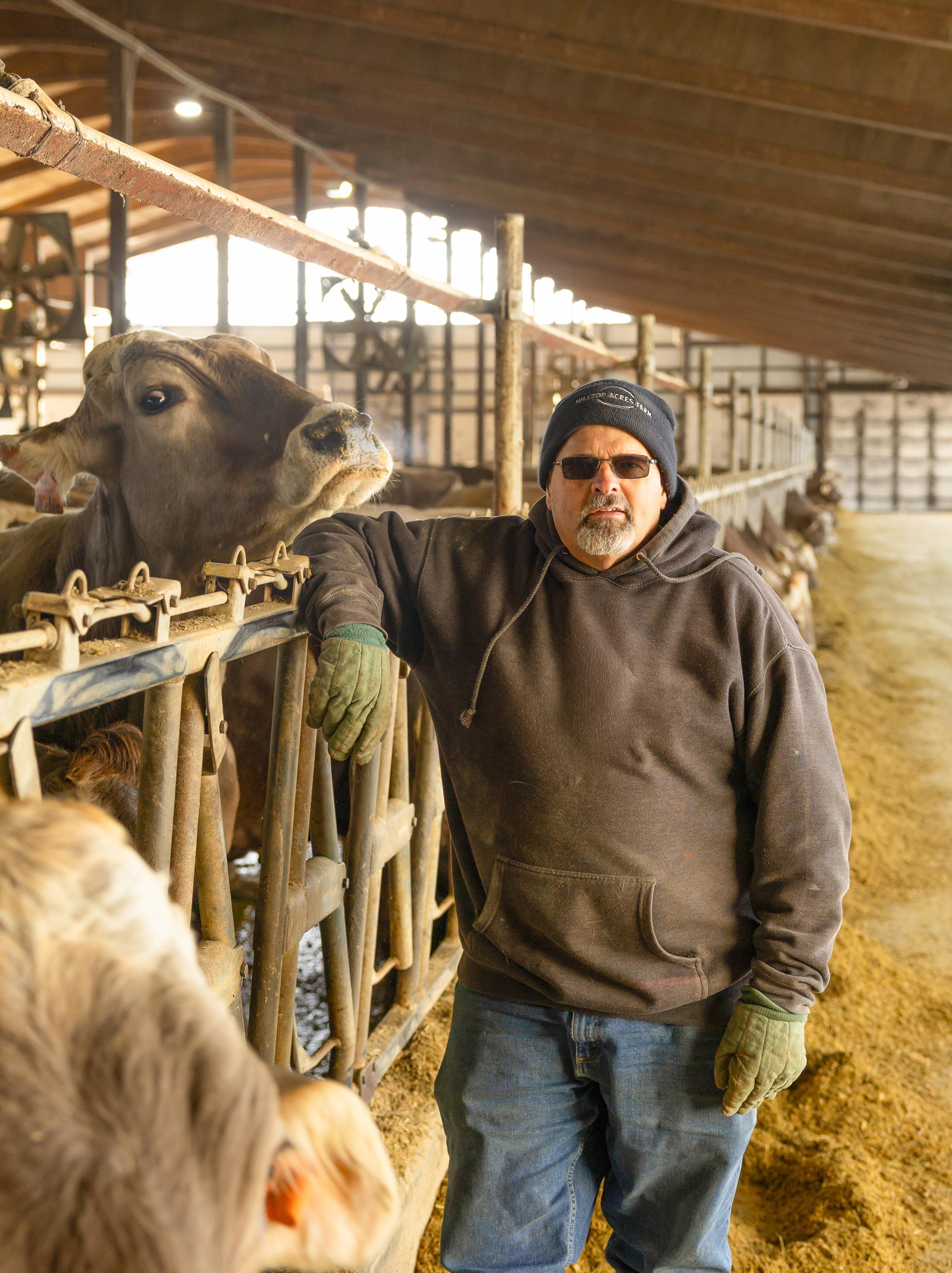
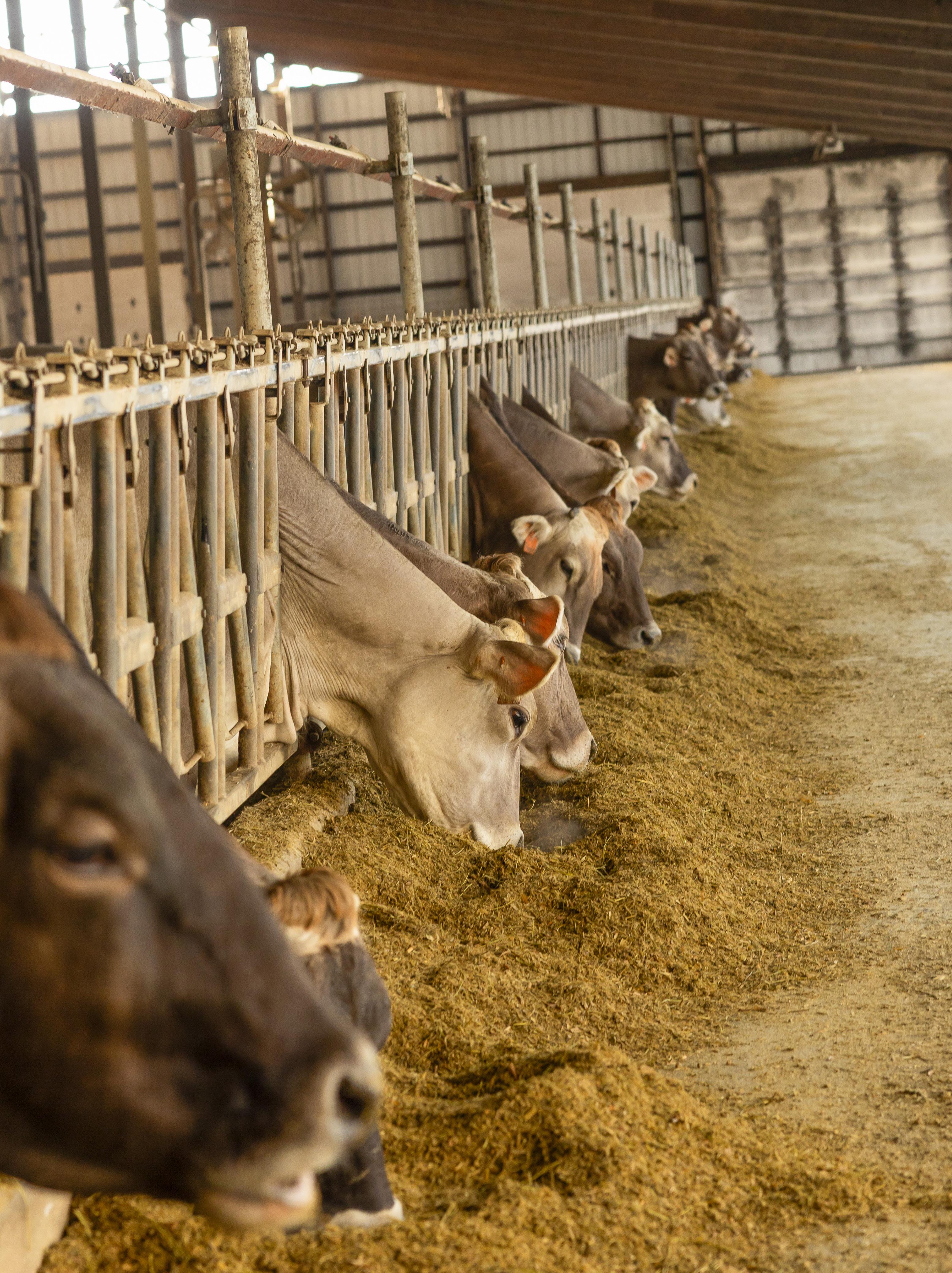
On the Cover: Iowa dairy farmer Dennis Mashek says using high oleic soybeans to feed his dairy cows has improved feed efficiency on the farm. In this issue, read more about checkoff funded research regarding the role of high oleic soybeans in the dairy cow diet. See the story on Page 20. Photo by Joclyn Kuboushek.
Comments and statewide news articles should be sent to the address to the left. Advertising space reservations must be made two months preceding publication. In consideration of the acceptance of the advertisement, the agency and the advertiser must, in respect of the contents of the advertisement, indemnify and save the publisher harmless against any expense arising from claims or actions against the publisher because of the publication of the content of the advertisement.
Season Opening
March has a way of flipping a switch for me. Somewhere between the crack of the bat in spring training baseball and the first stretch of daylight past supper, my mind shifts gears. Baseball season is starting, and in Iowa that means it’s almost planting time.
Baseball and farming share the same rhythm. As a former Little League coach, preparation meant getting the players in the right place, repeating the basics and trusting the effort would show up during game time. On the farm, winter meetings and shop talk give way to seed decisions, equipment checks and a cautious eye on soil temperatures. Optimism is part of the job description in both professions.
Opening Day in baseball is full of promise. Every team is undefeated. Every fan believes this could be the year (especially if you are a lifelong Cubs fan!). Spring planting carries that same optimism. A field ready for planting, a well-tuned planter, and bags of soybean seeds represent months of hope before a single bushel
Executive Insights
Kirk Leeds, ISA Chief Executive Officer kleeds@iasoybeans.com
is harvested. Experience teaches humility, but it never quite erases anticipation. That sense of anticipation carries into the work highlighted in this issue. One that stands out highlights the growing role of high oleic soybeans for use in the dairy industry. It is a reminder that what we grow here in Iowa has a longer reach. High oleic soybeans lead to greater butterfat yield while improving feed efficiency, according to research funded by the soybean checkoff. It is another example of how innovation at the seed level (also funded in part by the soybean checkoff) can ripple through the entire agricultural system. Also included in this magazine is the Insights Report summarizing on-farm research completed this past year through ISA’s Research Center for Farming Innovation. The most meaningful research happens under real-world conditions, on farms, with real management decisions in play. The Insights Report offers practical insights producers can use. Just as you see in every
issue of the Iowa Soybean Review, it’s also an invitation to lean on the expertise of the team to help you monitor a practice or product on your farm. That forward-looking focus matters. Research, like baseball and farming, is always about the next season as much as the last one.
As we head into another spring, the parallels keep showing up. Some years are championship seasons. Others teach hard lessons that shape how we play the game going forward. You do not control the weather, the markets, or the bounce of the ball, but you do control preparation, effort, and willingness to adapt.
As pitchers and catchers report to their teams and planters get ready to roll, I find comfort in the familiarity of it all. After over thirty years of writing about this season, I still feel the excitement. Spring is the beginning — on a diamond or in an Iowa field — and beginnings always deserve our attention.
THE BEST LIBERTY® YET
POLICY MATTERS AND THE IOWA SOYBEAN ASSOCIATION IS WORKING FOR YOU!
ENTER TO WIN UP TO $750 by signing up and recruiting friends to join as an advocate member by March 31, 2026. Scan here to join.
Rural Route 2
Editor’s Note by Bethany Baratta bbaratta@iasoybeans.com
The View From Beneath the Surface
“ Turn your head a little bit more to the right and put your chin on that plastic rest,” the optometrist guided me during a recent visit. “Now move closer until you see that green light.”
I found the light, then braced for the burst of brightness. It was like staring at the sun for a millisecond. I repeated the process until the Ocular Coherence Tomography (OCT) scanner captured a full mapping of my eyes — revealing the intricate structures I could never see in a mirror.
In the next room, I squinted through the routine exam, wondering if “Picture 1” really looked better than “Picture 2,” or if the sleep deprivation of parenthood was just winning. Within minutes, the doctor pulled up the OCT results. She explained that the machine bounces invisible light off the tissues to create 3D, crosssectional images. By comparing
today’s scan to last year’s, she could see the health of my optic nerves long before I’d ever feel a symptom.
As she scrolled through the scans, it hit me: This machine does for my eyes what the Iowa Soybean Association (ISA) team and the precision technology on your acres do for your farm.
The bags under my eyes that morning were visible to anyone, but I couldn’t see the “roots” behind the lens. Your fields are much the same. You can observe your soybean plants and tell if they look healthy, but what is happening below the surface? What do those roots tell you about your nutrient uptake and the overall soil health?
This is where the Research Center for Farming Innovation (RCFI) comes in. Think of our researchers as the optometrists for your fields. Just as a specialist is a vital part of your personal health team, the RCFI
staff works alongside you to interpret the data you can’t see with the naked eye.
Coupled with this issue of the Iowa Soybean Review is the 2025 Insights Report. Like my annual eye scan, this report offers a snapshot of the work the RCFI team completed this past crop year. It’s a data-driven look at research from the field, including checkoff-supported research conducted through Iowa State University.
We couldn’t fit every project from 2025 into these pages — there simply isn’t enough paper — but this report provides the “high-resolution scan” you need to see past the surface. As you soon head to the field to plan, I encourage you to lean on this data. After all, the best way to protect your fields and potential harvest is to understand the parts we don’t.
From the Field
In New York City, soybeans power ferries crossing the harbor, snowplows clearing streets, garbage trucks and emergency vehicles that keep the city running.
For farmers on the Big Apple Tour held in December, it was a reminder that soybeans do not stop at the grain elevator; they show up in places you would never expect, doing real work in one of the world’s biggest cities.
“The Big Apple Tour gives soybean farmers a firsthand look at how their crops are working far beyond the farm gate,” says Tom Verry, director of outreach and development at Clean Fuels Alliance America. “New York City is proving that biodiesel and renewable diesel can fully replace fossil diesel at scale, from more than 12,000 city vehicles to iconic assets like the Staten Island Ferry. Seeing the nation’s largest city achieve nearly a 50 percent reduction in fleet greenhouse gas emissions underscores the real, growing demand for
soybean-based clean fuels and the role farmers play in delivering practical climate solutions today.”
Brent Renner, a farmer from Klemme and a United Soybean Board (USB) director, says conversations with officials from the City of New York offered a clear look at how clean fuels are moving from discussion to daily use in one of the nation’s largest municipalities.
During meetings with city leaders responsible for fleet and infrastructure decisions, officials walked through how they have steadily increased use across their systems and emphasized that reliability has not been an issue. In fact, Renner says the message to soybean leaders was a direct one: have confidence in the product and don’t hesitate to take the story to other cities.
“They basically challenged us to keep pitching this to more municipalities,” Renner says, noting that if problems existed, New York
BRENT RENNER
USB director and farmer from Klemme
Field photo by Joclyn Kuboushek
to Fifth Avenue
Soy powers New York City’s hardest-working vehicles
AND
would not be relying on clean fuels the way it does today. “If they were having issues, we’d be hearing about it.”
That confidence was reinforced with a firsthand look at renewable diesel in action aboard the Staten Island Ferry. Renner says seeing the vessel operating on 100% renewable diesel is proof how dependable the fuel is, given how critical the ferry system is to thousands of New Yorkers who depend on it every day.
Beyond performance, Renner said city staff shared an unexpected but telling benefit. Operators and maintenance workers have noticed a difference at the end of the day, with fewer harsh odors compared to traditional diesel.
“They joked that they come home smelling more like French fries instead of soot and smoke,” Renner says. “It’s a small thing, but it says a lot about the fuel and the experience for the people who work with it every day.”
Fueling the city
Soybeans grown on Midwest farms are helping keep New York City moving as the city expands its use of renewable diesel.
Keith Kerman, deputy commissioner and chief fleet officer for New York City’s Department of Citywide Administrative Services (DCAS), remembers the city’s first biodiesel trial in 2005, when it was tested in sanitation trucks on Staten Island.
“Our technical staff saw that it ran well and met our operational needs,” Kerman says. “That’s what opened the door.”
Two decades later, that early trial has evolved into a full-scale transition. Renewable diesel has replaced fossil diesel across New York City’s fleet of more than 30,000 assets, the largest municipal fleet in the nation.
“This is not a B5 or B20 story,” Kerman says. “This is renewable diesel as a complete replacement.”
Continued on Pg. 10
KEITH KERMAN
NYC DCAS deputy commissioner and chief fleet officer
TOM VERRY Clean Fuels Alliance America director of outreach and development
STORY
PHOTOGRAPHY BY KRISS NELSON
Harbor impact
The Staten Island Ferry transitioned to renewable diesel in 2024 and now uses about 3.8 million gallons annually. Fuel use accounts for roughly 94% of the ferry system’s greenhouse gas emissions, making the switch a major emissions reduction win.
Gary Prasad, who oversees DCAS field operations, says mechanics noticed immediate changes.
“When they go in for routine maintenance, engine parts are cleaner,” Prasad says. “There’s no smell. People love that.”
That benefit extends beyond the engine room. Residents near ferry docks have reported reduced odors and visible emissions.
“It’s been a pleasant surprise,” Kerman says. “People don’t go home and get told, ‘You stink.’ ”
Operational reality
New York City’s transition to renewable diesel is driven by reliability as much as emissions.
“Snow removal is one of the most sensitive operations we have,” Kerman says. “You cannot afford disruption.”
While the city operates nearly 6,000 electric vehicles, heavy-duty equipment remains a challenge.
“You’re not going to electrify plow trucks anytime soon,” he says.
Prasad echoes that point, pointing to plow trucks as a clear example.
“You can’t plow with an electric truck,” he says. “The technology doesn’t yet exist.”
Renewable diesel helps bridge that gap, allowing the city to cut emissions without compromising performance in critical services.
Kerman says the city has already achieved a 46.5% reduction in fleet greenhouse gas emissions through 2024. It’s expected to exceed 50% in 2025.
Despite a fuel premium of about 80 cents per gallon, efficiency gains have offset costs.
“We actually spent less overall on fuel,” Kerman says.
Scaling up
Looking ahead, Kerman says the next major frontier is not vehicles but buildings. The city already uses biofuels in heating oil, but scaling renewable fuels in buildings brings new regulators and logistical hurdles.
“There’s about 25 million gallons in transportation and about 25 million gallons in heating oil,” he says. “It’s an equal challenge.”
Courtney Videchak, Ph.D, with MARC-IV says the clean fuels industry is making measurable progress in applications that often get overlooked in decarbonization conversations, including heating oil and marine transportation. But she says the opportunity is the same for both: act now with fuels already available in existing equipment.
Heating oil
Clean Fuels Alliance America has worked with UL Solutions and leading burner manufacturers to update listing procedures for B100, 100% pure biodiesel used as heating oil, expanding equipment compatibility across the industry, says Videchak.
As a result, most home heating oil burner manufacturers now have UL-listed equipment approved for B100 and fully support its use in the new burners they are selling. She noted that one of the co-authors on a recent ASTM International ballot addressing higher biodiesel blends, ranging from B21 to B50, is burner manufacturer R.W. Beckett Corporation.
Videchak said the progress reflects decades of years of technical work. Clean Fuels has partnered with the National Oilheat Research Alliance (NORA) and other technical experts to conduct bench-scale, laboratory-scale, and field testing to support higher biodiesel blends in heating oil applications.
That research, she added, has been funded through soybean checkoff dollars, helping move higher blends from concept to commercial readiness.
Northeast market momentum
Thousands of miles from Iowa soybean fields, policy decisions being made in Northeastern statehouses are shaping demand for biodiesel and renewable diesel, creating long-term markets for soybean oil used in those fuels.
Steve Dodge, director of state regulatory affairs for Clean Fuels Alliance America, says the Northeast is one of the most consequential regions for biomass-based diesel growth because of its heavy reliance on heating oil and growing emissions mandates.
GARY PRASAD DCAS field operations
COURTNEY VIDECHAK MARC-IV
STEVE DODGE Clean Fuels Alliance America director of state regulatory affairs
The region represents roughly a 4-billiongallon heating oil market each year, expanding to more than 8 billion gallons when transportation is included. Policies that increase biodiesel and renewable diesel use in those markets directly translate into increased soybean oil demand.
“There’s a lot of opportunity out there,” Dodge says. “We’re focused on incentivizing the use of biomass-based diesel, especially in the heating space in the Northeast.”
Several Northeastern states have adopted or are considering policies that drive that demand. New York, Rhode Island and Connecticut require increasing biodiesel blends in heating oil, creating a predictable and growing market for clean fuels. New York also offers income tax rebates for Bioheat® fuel users, further encouraging adoption.
Low carbon fuel standards (LCFS) are another major driver. Dodge points to California, where nearly 80% of the diesel pool is now nonfossil, making fossil diesel harder to find than clean alternatives. Similar trends are emerging in Oregon and Washington, as Northeastern states evaluate their own programs. Dodge says feedstock-neutral policies are critical to keeping soybean oil competitive.
“LCFS programs have to treat all feedstocks fairly,” he says.
Those discussions are accelerating as states such as Massachusetts, New York and Vermont face legally binding emissions requirements.
“These are not goals. They are laws,” Dodge says.
Affordability is also shaping policy choices. High electricity rates across the Northeast have intensified interest in lower-carbon liquid fuels that can be used immediately without major infrastructure changes.
Across the region, Dodge says momentum continues to build. Maryland is poised to adopt a clean heat standard, while Massachusetts, Pennsylvania, Rhode Island, New Jersey and New York continue to debate low carbon fuel policies that could further expand clean fuel use.
For Iowa soybean farmers, those policy decisions matter.
“Clean fuels are creating demand that’s durable, scalable and happening now,” Dodge says. “That demand runs straight back to the farm.”
Continued on Pg. 12
Marine Fuels by the Numbers
“The marine sector accounts for about 3% of global greenhouse gas emissions. To put that in perspective, if global shipping were a country, it would rank as the sixth-largest emitter in the world.”
Courtney Videchak, MARC-IV
“Globally, marine fuel use totals about 87 billion gallons annually, including roughly 7 billion gallons in the United States. That scale represents a major growth opportunity for renewable fuels if policy barriers are addressed. Current renewable fuel rules largely exclude marine applications, limiting incentives that could accelerate adoption. Bipartisan legislation could unlock what is estimated to be a 4-billion-gallon market.”
Kurt Kovarik, Clean Fuels Alliance America vice president of federal affairs
Soy and renewable fuels at a glance
• One bushel of soybeans equals 11 pounds of soybean oil.
• U.S. biodiesel currently uses about 1 billion pounds of soybean oil per month.
• That demand supports nearly 1 billion bushels of soybeans annually.
• The U.S. crushes roughly 2.3 billion bushels of soybeans each year, with the remainder used for food and other purposes.
• U.S. soybean production totaled 4.3 billion bushels in 2025, with most non-crushed soybeans exported.
KURT KOVARIK
Clean Fuels Alliance America vice president of federal affairs
JOHN EVANGELISTA
Groundwork Elizabeth executive director
Federal policy outlook
For soybean farmers, clear, consistent federal policy is critical to sustaining biodiesel and renewable diesel markets and the demand for soybean oil that supports them, says Kurt Kovarik, vice president of federal affairs for Clean Fuels Alliance America.
Soybean oil is a core feedstock for biomassbased diesel, and policy stability has a direct impact on market growth.
“The biodiesel and renewable diesel industry was using about 650 million pounds of soybean oil every month in 2017-18, crossed one billion pounds per month in 2021-22, and then dipped to about 975 million pounds per month in 202425," he says. “That slowdown in consumption largely reflects federal policy uncertainty.”
Credit shift
For nearly two decades, the industry relied on a $1-per-gallon blender’s tax credit that rewarded blending regardless of where fuel was produced, leading to increased imports.
“In 2016-17, we were approaching a billion gallons of foreign fuel capturing that credit,” Kovarik says.
Congress replaced that incentive in 2022 with the technology-neutral 45Z production credit, which ties incentives to a fuel’s carbon intensity and domestic production. That shift ensures U.S.-grown soybeans and U.S.-based plants benefit directly from federal clean fuels policy.
Carbon scores and ILUC
Kovarik says soybean-based fuels perform well under carbon scoring.
“Soybean oil is about 65 percent less carbon intensive than petroleum diesel,” he says.
Removing indirect land-use change, or ILUC, from carbon-intensity calculations further improved credit values for soybean-based fuels.
Congress extended and enhanced 45Z in 2024 and reinstated the small producer credit for plants under about 60 million gallons annually, providing a longer runway for the industry.
Kovarik cautioned that how the policy is implemented over time will matter just as much as the statute itself.
“Markets respond to certainty,” he says. “Durable policy supports investment and demand.”
RFS pressure
Beyond tax policy, Kovarik pointed to the Renewable Fuel Standard. He says recent EPA
volume-setting fell short of industry capacity, though proposed increases for 2026 and 2027 were a positive signal. He cautioned that small refinery exemptions can still avoid mandates after the fact if waived gallons are not fully reallocated.
Marine opportunity
When it comes to biofuels in the marine sector, Videchak says the emissions footprint is large enough to demand attention and the market potential is significant.
“The marine sector contributes about 3 percent of global emissions,” she says. “To put this into perspective, if the marine sector were a country, it would be the sixth-largest emitter in the world.”
Marine operators face growing pressure to adopt lower-carbon options. Cost remains the defining factor, as long-term solutions such as new vessels or major retrofits carry hefty price tags, Videchak says.
“That leaves fuel as the most practical near-term solution,” she says. “A new fuel in existing vessels is the most cost-effective way to decarbonize today.”
The scale of the opportunity is substantial. Globally, marine fuel use totals about 87 billion gallons annually, including roughly 7 billion gallons in the U.S. Kovarik says marine fuels represent a major growth opportunity if policy barriers are addressed.
Current renewable fuel rules largely exclude marine applications, eliminating incentives that could accelerate adoption. Bipartisan legislation, Kovarik says, could change that.
“It’s about a 4-billion-gallon market,” he says, comparable in size to the home heating oil sector.
Heavy fuel oil remains common in marine shipping and is thick, tar-like and highly polluting.
Advanced alternatives such as methanol and ammonia are not yet available at scale, leaving biodiesel and renewable diesel as drop-in options that can be used immediately in existing vessels.
“There are low-carbon alternatives that work now,” Videchak says. “Biodiesel and renewable diesel can deliver immediate reductions.”
Kovarik says biodiesel fits not just environmentally, but economically.
“They’re going to replace it with the lowestcost, readily available alternative,” he says. “That’s soybean-based biodiesel.”
The marine sector also offers technical advantages. Vessels already heat fuel as part of normal operations, making higher biodiesel
blends easier to adopt. Recent updates to ISO marine fuel specifications now include biodiesel blends up to B100.
Videchak points to the Great Lakes as a strong near-term opportunity, where vessels remain in service for decades and fuel switching can deliver immediate benefits.
Ultimately, she says awareness remains the biggest barrier.
“The technology exists,” Videchak says. “We need to connect the fuel, the supply chain and the decision-makers.”
“These folks want our fuel,” Kovarik adds.
John Evangelista, executive director of Groundwork Elizabeth, says the organization is rooted in the belief that underserved communities deserve access to clean environments, healthy food and opportunity. They developed curriculum connecting students with food production. With support from partners, including the soybean checkoff, the program has expanded.
As the partnership developed, soy education became part of that programming.
“Last year we had 2,000 kids come to the micro farm,” Evangelista says. “We teach these
“There’s a lot of opportunity out there. We’re focused on incentivizing the use of biomass-based diesel, especially in the heating space in the Northeast.”
Steve Dodge, Clean Fuels Alliance America director of state regulatory
affairs
Environmental justice connection
As Clean Fuels Alliance America works to expand the use of biodiesel and renewable diesel, it has partnered with Groundwork Elizabeth and the United Soybean Board (USB) to help environmental organizations better understand how clean fuels can deliver immediate airquality and public-health benefits.
Groundwork Elizabeth, in Elizabeth, New Jersey, is a nonprofit organization focused on improving environmental, economic and social well-being by regenerating urban spaces and empowering local communities, particularly youth, through green infrastructure, job training and climate resilience projects.
Verry says the partnership created an opportunity to work together on air quality, public health and near-term emissions reductions, while also producing air-quality analysis and health-impact modeling tools regulators can understand in a community surrounded by overlapping pollution sources, including Newark Airport, the Port of Elizabeth, I-95 and nearby refineries.
That environment is also where Groundwork Elizabeth operates a micro farm and delivers education connecting food, health and environmental conditions.
kids what soy is and how it’s used, including in biofuel.”
USB program director for industrial uses McKenna Losby says partnerships like this help expand conversations beyond traditional agriculture circles.
“Some things can’t be electrified,” Losby says. “And soy can be used in those.”
USB Director Pat Giberson, a farmer-leader from New Jersey, says visiting Elizabeth and seeing the program firsthand highlighted how farmers and environmental groups often have more in common than they might assume.
“Oftentimes, environmental groups and farmers end up on opposite sides of the field,” Giberson says. “But we connected on the fact that we have a lot more in common than we have apart.”
The experience also offered a new perspective on privilege and place.
“We’re very privileged to do what we do as farmers in this country,” Giberson says. “We don’t always realize the gift we’ve been given with the open spaces we farm. Being in Elizabeth and seeing how underserved some of those communities are really opens your eyes.”
Contact Kriss Nelson at knelson@iasoybeans.com
PAT GIBERSON USB Director and farmer from New Jersey
MCKENNA LOSBY USB program director for industrial uses
On Air
STORY BY BETHANY BARATTA
PHOTOGRAPHY BY JOCLYN KUBOUSHEK
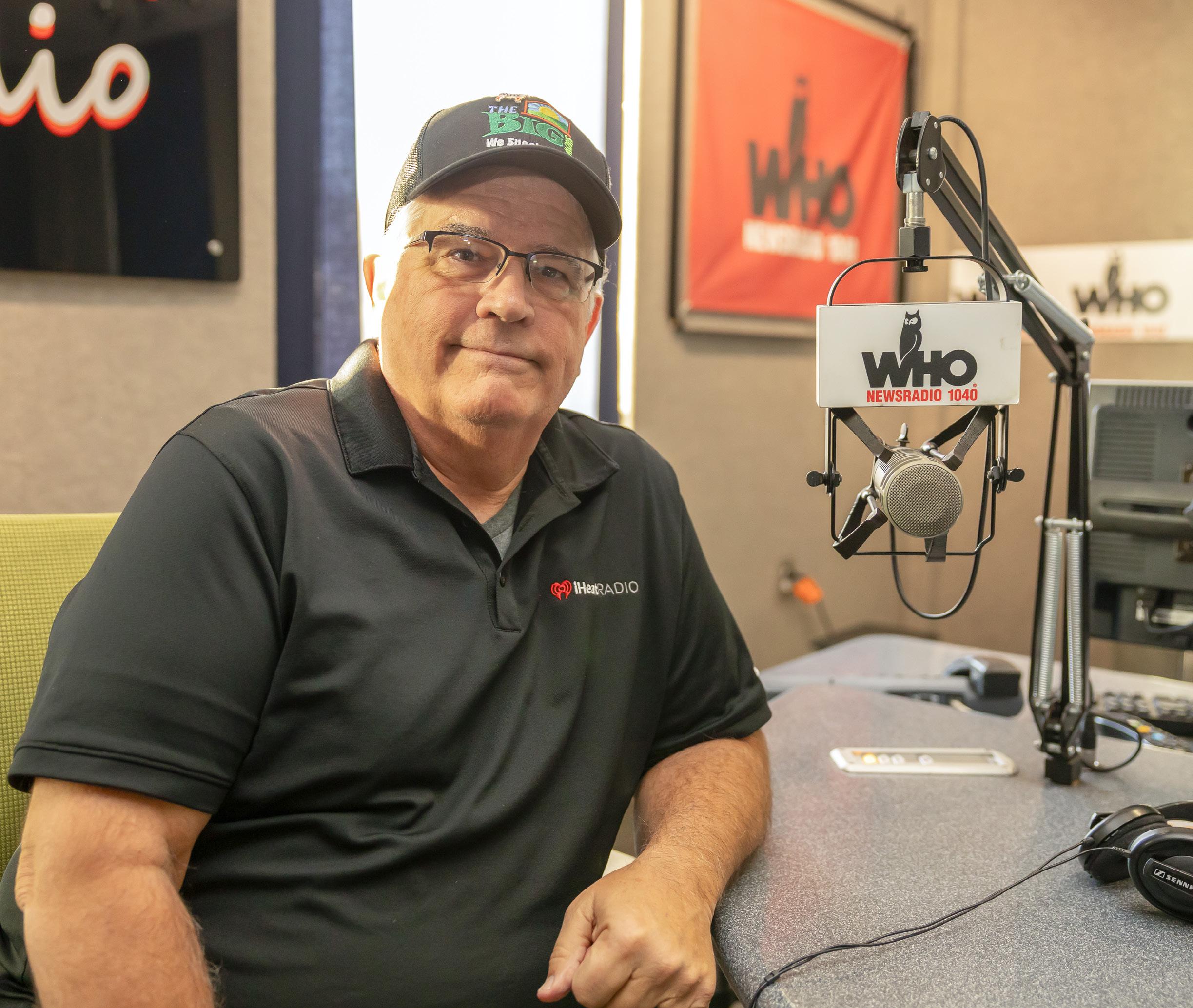
The radio threaded itself into the fabric of Bob Quinn’s life long before he claimed it as part of his identity in Iowa agriculture.
At his grandparents’ farm, where he first encountered agriculture, the radio provided “the soundtrack of the farm.” He recalls his grandfather reaching up to the radio atop the fridge to turn it on in the morning. The voices of Herb Plambeck, Jack Shelley and Ev Hickman boomed from the speakers of the radios in the house, in the shop and in the pickup truck.
Decades later, farmers tune their radio to AM 1040 WHO to listen to Quinn.
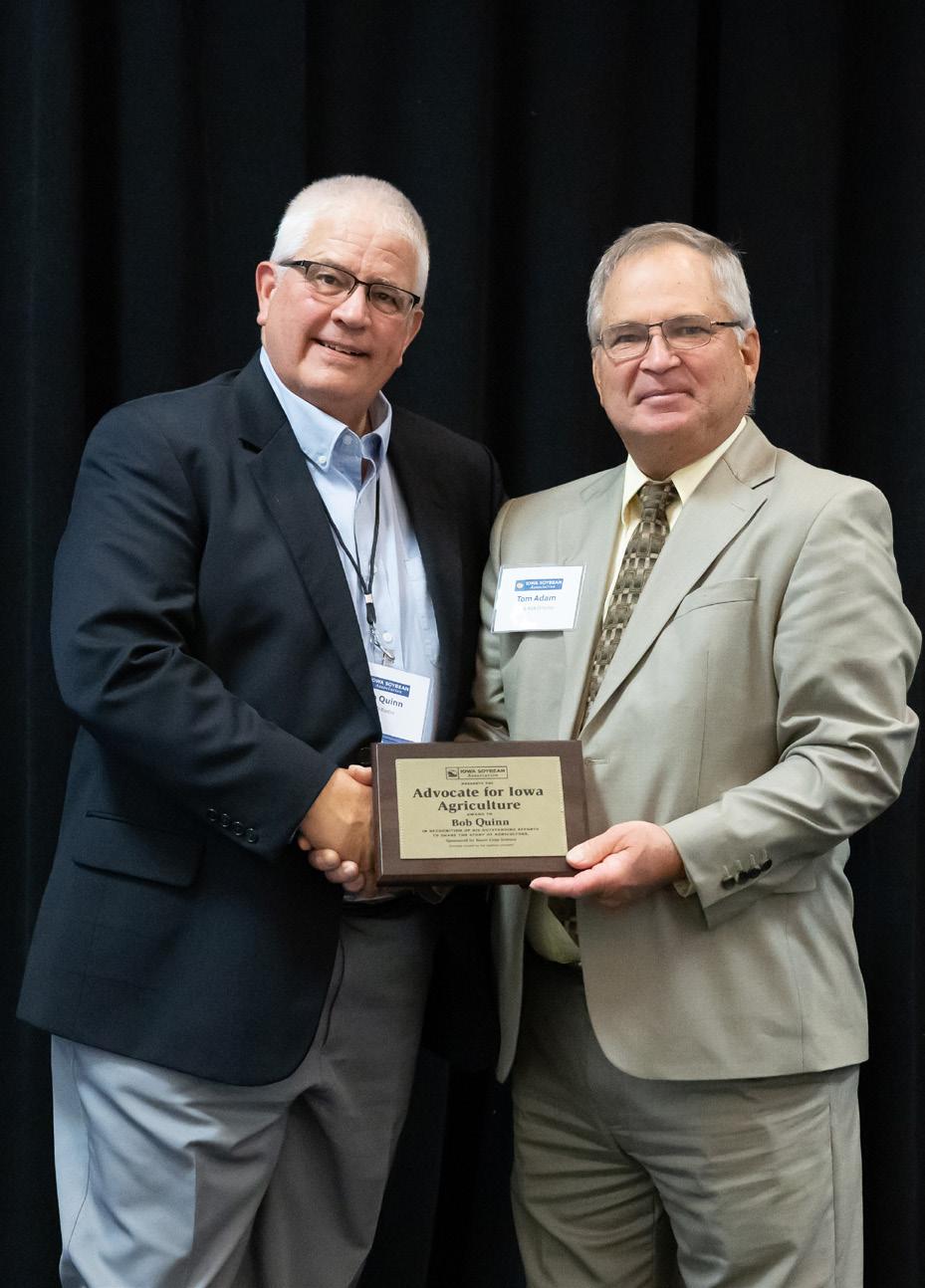
The Iowa Soybean Association (ISA) recently named Quinn the recipient of the 2026 Advocate for Iowa Agriculture award. His ability to communicate about Iowa’s ag industry and connect how policies, weather and news affect Iowa farmers marks him as a standout recipient. Quinn exerts a positive impact on
Iowa agriculture both behind the glass studio wall and in the community. He hosts “The Big Show,” which airs weekdays from 11 a.m. to 1 p.m. on NewsRadio 1040 WHO.
He connects with farmers because he grew up around the farm. He and his parents (nonfarmers) lived just one mile from his grandparents’ farm, a quick commute to assist his retired grandparents.
Paved paradise
Quinn envisioned agriculture as his life’s work — until his grandparents’ farm closed while he attended high school. The Southridge Mall on Des Moines’ south side now occupies the land where his grandparents once raised corn, soybeans and cattle.
He became the first in his family to go to college — first to Grand View, then to Iowa State University (ISU) to pursue a degree in telecommunicative arts (broadcast journalism just emerged at ISU).
Bob Quinn’s microphone serves as a megaphone for Iowa ag
While attending ISU, Quinn worked for Extension Information, where he met broadcasters and ag journalists. Those contacts led him to his first job at a small radio station in Ottumwa after graduating from ISU in 1978.
In 1983, Quinn joined WHO Radio — his dream job.
“For me, that was … the pinnacle — talking to agriculture and being able to tell the story of agriculture was being on WHO with the guys that I listened to,” he says. Notably, he shared the airwaves with Lee Kline and Mark Pearson, a few of the farm broadcasters and radio personalities Quinn listened to on his grandparents’ farm.
The soundtrack
Today, Quinn contributes to the soundtrack on farms throughout Iowa. Quinn ranks as just the third farm director in WHO Radio’s 87 years of farm broadcasting, following the footsteps of Plambeck and Keith Kirkpatrick.
Through his interviews and reporting, he leads farmers to insights on the farm bill, biofuels policy, tariffs, commodity markets, weather and global events that help shape their livelihoods. He empathized with farmers and listeners through the farm crisis, 9/11 and COVID-19. He supports youth on-air in the broadcast booth at the Iowa State Fair.
He works alongside the Coalition to Support Iowa’s Farmers (CSIF) to recognize farmers who take a proactive approach in growing their livestock farms by connecting with CSIF first. He visits farms to recognize the recipients of the Good Farm Neighbor Award, which honors the care livestock farmers take not only of their animals but of the environment and their community. The Iowa Department of Agriculture and Land Stewardship named Quinn the 200th recipient of the Good Farm Neighbor Award in 2025.
He uses his microphone as a megaphone for Iowa agriculture. He created Clean Water Wednesdays on WHO Radio to further showcase farmers’ efforts.
“There’s a lot of good things that farmers are doing to prevent nitrogen runoff. Sheer economics dictate that you want to keep as much of that nutrient available to the crop and not let it get away,” he says. “I decided we’re going to find some of these projects that are working, that have measurable, good results that reduce nitrogen runoff, and we’re going to talk about that on the radio.”
After tuning in to his broadcast on AM 1040, some Quinn loyalists transform into clean water enthusiasts, trying practices like cover crops and bioreactors that Quinn highlights during his programming.
“It’s called Clean Water Starts Here because everyone has a stake in it — whether you’re a user or someone who is handling that water off the field or you’re using it to raise a crop.”
And he connects with his listeners because he lives as a farmer— at heart and in practice. He and his wife, Ann, operate a farm near St. Charles where they have a sawmill and keep bees. He even drew inspiration to build the couple’s 20,000-bushel grain bin home there after covering stories of Sukup Manufacturing building grain bins for Haiti to use for housing after the devastating earthquakes hit that country.
A trusted frequency
Though farm markets rise and fall, Bob Quinn remains a fixture — in the studio, the sawmill, or on the farm — bringing clarity to Iowa farmers and adoring listeners. Just as his grandfather’s weathered hands clicked the radio on and off to begin and end the day, Iowa farmers continue to tune in to AM 1040 to hear the voice they trust — the soundtrack of their farm.
Contact Bethany Baratta at bbaratta@iasoybeans.com
ABOUT THE 2026 ADVOCATE FOR IOWA AGRICULTURE AWARD
Bob Quinn, host of WHO Radio’s The Big Show, has helped connect Iowa farmers with audiences across the state through his unique ability to communicate about the state’s agriculture industry. The Advocate for Iowa Agriculture Award, presented by Bayer Cropscience, recognizes Quinn's efforts to share the impact of agriculture in daily life, as well as the challenges and successes of Iowa farmers.
ISA President Tom Adam presented Bob Quinn with the award in December 2025.
CCover Crops Cut Nitrogen Loss and Protect Water Quality
Tony Seeman, ISA water lab services manager aseeman@iasoybeans.com
KEY INSIGHTS
Cover crops consistently reduce the amount of nitrogen lost through tile drainage.
The amount of nitrogen reduction varies from year to year, but continued use provides increased reductions.
over crops are one of the most effective conservation practices for reducing nutrient loss, particularly nitrogen, which is a major concern for drinking water quality and impact to downstream waterbodies. Cover crops also improve soil health over time and keep unused nitrogen in the field for use by future crops.
The Iowa Nutrient Reduction Strategy estimates that cover crops reduce nitrogen loss by an average of 27%, similar to edge-of-field practices. However, unlike edgeof-field practices, which are limited to specific locations, cover crops can be implemented virtually anywhere cash crops are grown.
Performance is highly variable because cover crops require several management decisions — species selection, seeding rate, planting method, timing and termination — all of which affect germination and growth.
Successful growth is critical because it determines how effectively cover crops capture nitrate before it leaches below the root zone, so it is important to have a plan for success and the ability to adapt as conditions change to maximize benefit and minimize risk to the following cash crop. For cover crops to reduce nitrogen loss, they must be actively growing during leaching events.
Measured results
Iowa Soybean Association (ISA) tile monitoring results consistently show that cover-cropped fields have lower nitrate levels than conventional fields.
Water monitoring results indicate the benefits of cover crops can be seen at the stream scale.
Recent years illustrate this variability. In 2024, covercropped fields averaged 33% lower nitrate levels following a significant spring flush. In 2023, a dry year, the difference was only 13%.
This finding is further supported by infield soil testing in long-term research trials. On-farm research in 2024 conducted by ISA showed soil nitrate tests in cover cropped strips within fields had a 44% reduction compared to strips without cover crops.
Consistent, year-after-year usage of cover crops provides continued water quality benefits. That’s because water repeatedly moves through the soil over time as rain and snowmelt soak in and drain out.
During this movement, nitrates can wash downward into groundwater and tile drainage. Weather conditions are a factor in overall leaching and movement. Wet periods increase leaching because more water moves through the soil. Dry periods slow leaching, but without plants taking up nitrates they can accumulate and be vulnerable to loss in the future.
Temperature affects plant growth and soil microbes, which influence how much nitrogen is taken up or released.
While we regularly see the impact of cover crops in an individual field, the results are often masked by scale.
In 2020, ISA partnered with Practical Farmers of Iowa (PFI) to implement cover crops across the Van Zante Creek watershed in the South Skunk River basin. PFI
Figure 1 Figure 2
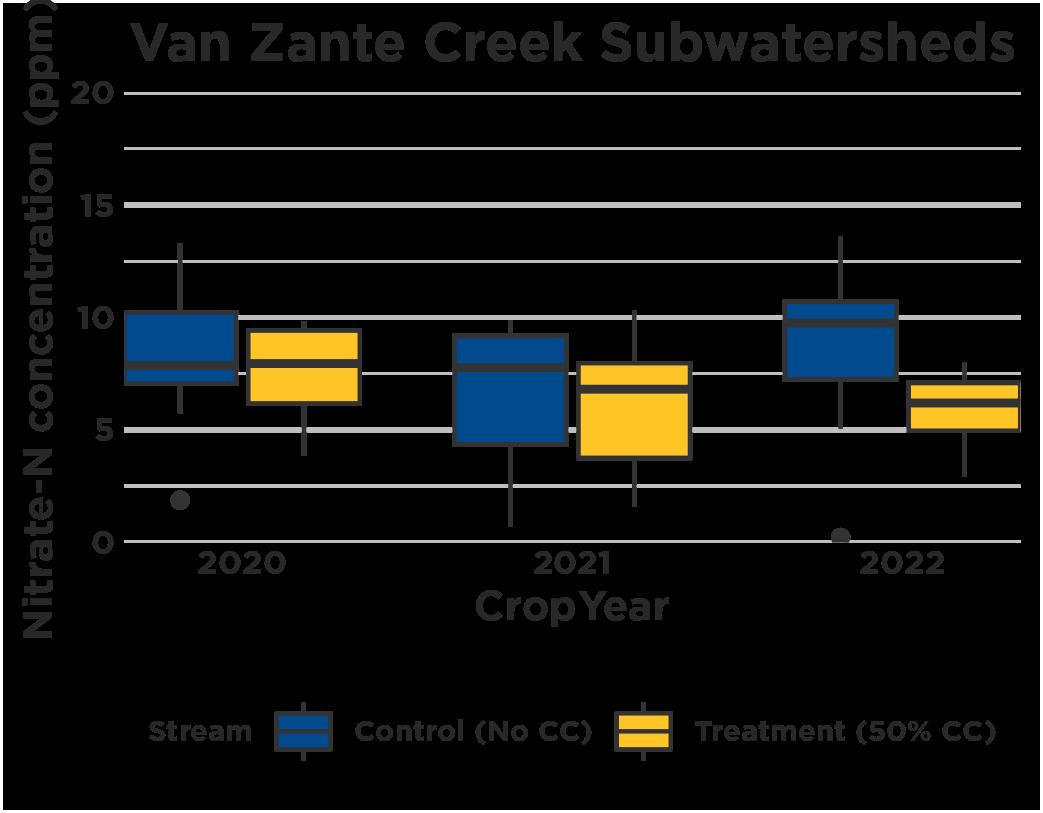
Figure 2. Stream nitrate concentrations were similar at both sites during the first two years but diverged in year three, with levels increasing at the control site and declining in the cover-cropped watershed. The cover-cropped site exceeded the 10 ppm drinking water standard only once, compared with multiple exceedances at the control site.
was focused on using a variety of cost-share options and farmer-to-farmer learning to increase the adoption of cover crops in this small area. ISA was tasked with water monitoring to assess the impact at the field scale and more importantly to see if the results translated to the receiving streams.
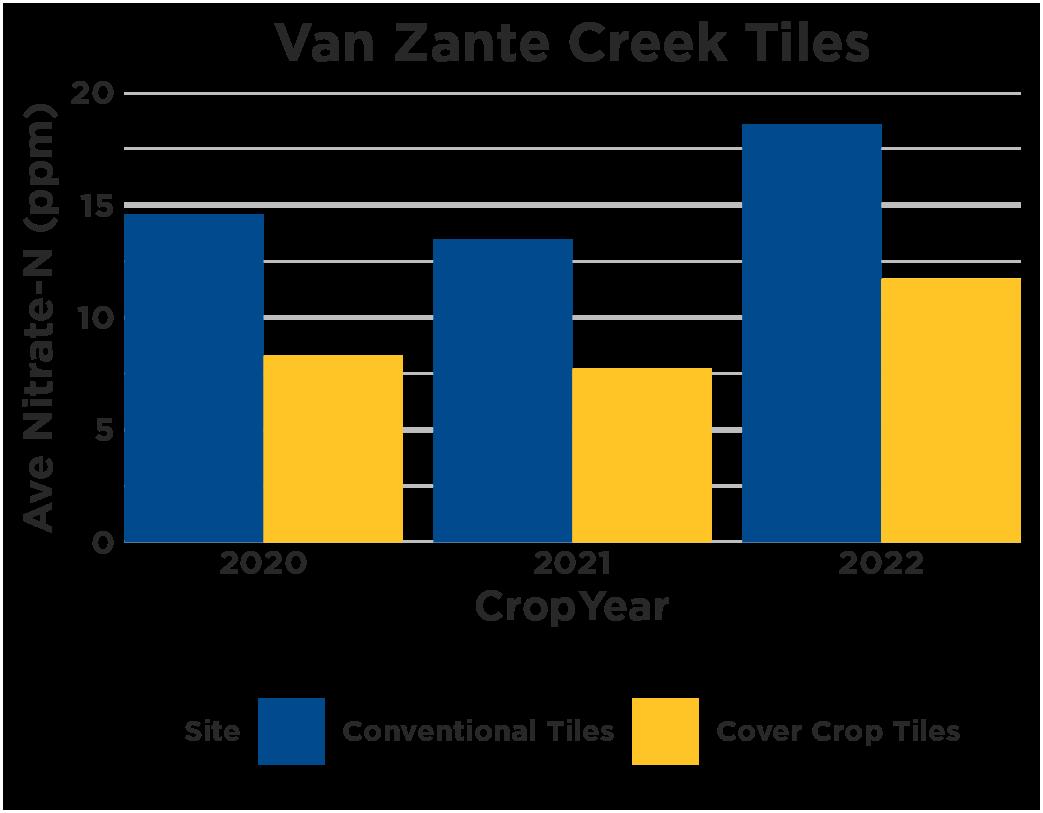
A subset of field tiles in the project area was monitored. As expected, fields with cover crops were significantly lower in nitrate concentrations as a group compared to fields without cover crops each year by an average of 6 parts per million (ppm). The difference was similar between corn and soybean acres, but demonstrated the overall benefit that cover crops have on nutrient retention on the field (Fig 1).
Stream sites were selected within the watershed including one with over 50% of the drainage area in cover crops in each of the three years of the project. Stream nitrate concentrations during the first two years showed very similar results between the site compared
to an upstream control site without cover crops. However, the third year showed a significant difference. Concentrations in the control site increased from 2021, while the treatment site continued to decline. Of note is the fact that in the heavily cover-cropped watershed, concentrations only topped the 10 ppm drinking water limit once, while the control watershed had multiple exceedances in two of three years (Fig.2).
Statewide benefits
Cover crops are a versatile and impactful conservation practice. While results vary based on management and weather, long-term and large-scale implementation consistently demonstrates significant reductions in nitrate loss. These benefits can extend beyond individual fields to entire watersheds when substantial amounts of cover crops are implemented, making cover crops a cornerstone of Iowa’s nutrient reduction strategy and a critical tool for protecting drinking water and improving soil health.
Figure 1. Average nitrate concentration by sampling season for fields with and without cover crops. Water samples from field tiles draining cover cropped acres had lower average nitrate concentrations than those without cover crops.
Josh Schoulte
District 3 | Farmersburg, IA
ISA Demand and Engagement
Committees
What crops and livestock do you have on your farm?
We raise corn, soybeans, hay, small grains, cattle, and a couple of large puppies!
What makes your farm unique?
We are a fifth-generation family farm, welcoming our sixthgeneration daughter into the operation. Currently cultivating the future!
How do you define success on the farm?
Mountains can be climbed when we take all the right little steps.
How do you envision production agriculture 50 years from now?
We see production agriculture consolidating more and more with the heavy implementation of technology.
What do you see as the largest hurdle for homegrown soybeans in the future? Largest opportunity?
The largest hurdle and the largest opportunity are probably one of the same. It could be due to production costs, market development, or a new technology that we haven’t considered yet.
What’s one thing people don’t know about you?
I love the opportunity to learn, which is why I welcomed the chance to serve on the ISA board.
Soy’s New Dairy Frontier
High oleic soybeans show promise as a dairy feed ingredient
STORY BY
PHOTOGRAPHY BY KRISS NELSON
JOCLYN KUBOUSHEK
From planting decisions in the field to mixing feed rations, high oleic soybeans are changing how farmers can add value. After years of development, high oleic soybeans are finding their way back into more conversations as betterperforming varieties and expanding herbicide-resistant traits make them a more competitive option for farmers.
On-farm results
For Calmar dairyman Dennis Mashek, feeding high oleic soybeans began as an experiment and quickly became a part of his ration program.
Mashek, along with his wife, Barb, and sons Tanner and Josh, owns Hilltop Acres Farm, an eighth-generation family farm in northeast Iowa.
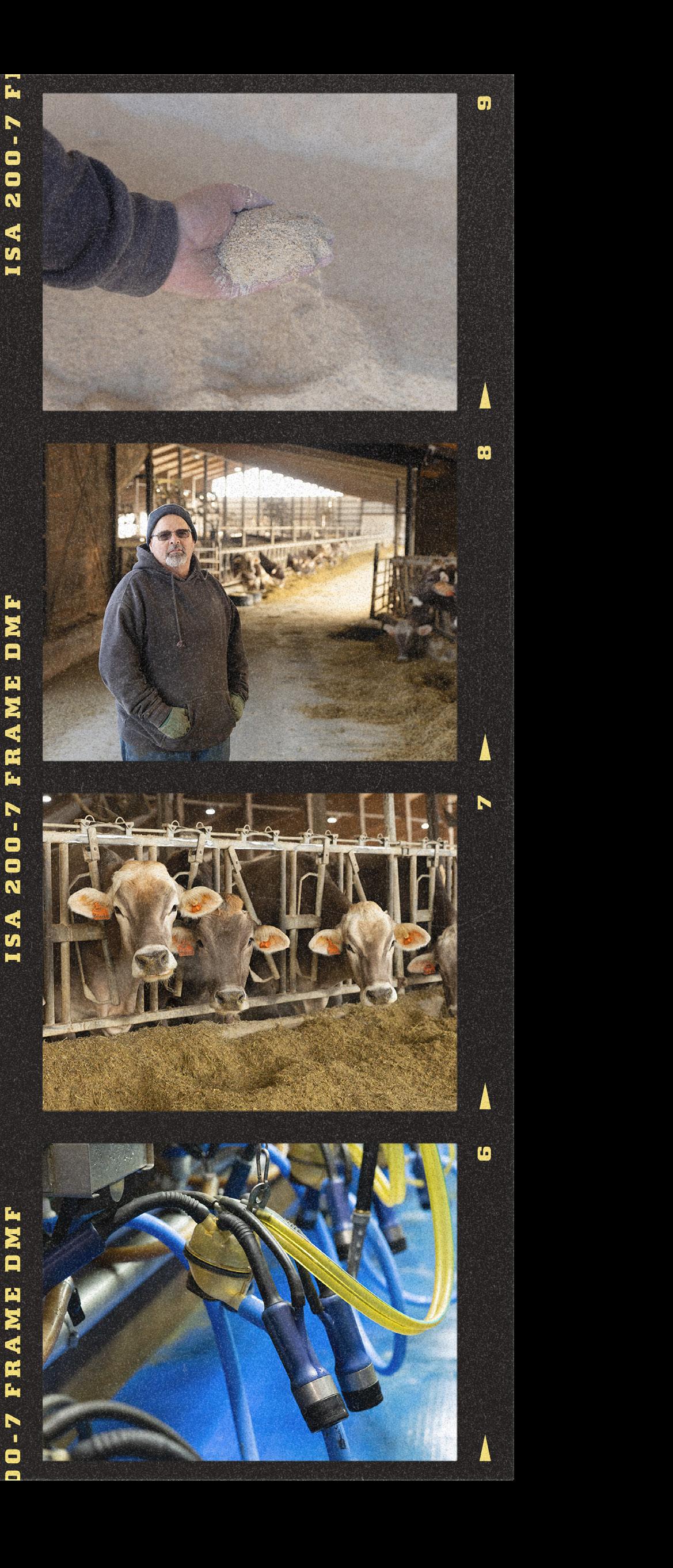
Four years ago, Mashek introduced his farm-raised high oleic soybeans into his Brown Swiss dairy herd after his nutritionist suggested roasted soybeans.
“My nutritionist told me high oleic soybeans could raise butterfat by a point to a point and a half, so I thought I’d give it a try, and it did,” he says.
Today, Mashek feeds six pounds of ration containing high oleic soybeans per head per day. Feeding his own high oleic soybeans has lowered feed costs, boosted components and helped him eliminate other ingredients.
Mashek grows Plenish soybeans from Corteva and says the system has allowed him to cut back on other ration inputs.
“I used to feed a roasted distiller’s grain called Novameal and I’ve completely taken that out,” he says. “I was also feeding palm fat, and I’ve cut that down to about one-third to a half of what I was feeding. Palm fat is all imported, and with tariffs it was getting expensive.”
NATHAN AUGSPURGER USB vice president, animal nutrition and health
Feed value
Mashek roasts and stores the beans on-farm, bringing in a roaster three times a year to heat them to 280 to 310 degrees before cooling, binning and grinding them through a hammer mill.
Serving on the Dairy Farmers of America board, Mashek has watched national butterfat levels climb.
“Feed can do amazing things,” he says, noting that his Brown Swiss herd maintains an ideal fat-to-protein ratio for cheesemaking.
For his operation, that balance matters.
“For me, I’m running a 4.9 fat and a 3.7 protein. You get a better yield when it’s more equal,” he says, adding that because of those results, he plans to keep high oleic soybeans in the rotation to supply his herd each year.
For dairy producers, the appeal comes down to improving income over feed costs, says Nathan Augspurger, vice president of animal nutrition and health for the United Soybean Board (USB).
“High oleic soybeans provide elevated oleic acid, which helps reduce the risk of milk fat depression and delivers a high-quality source of rumen-bypass protein,” Augspurger says. “This creates two routes to value generation for dairy farmers: the potential to increase milk fat production and the ability to replace the costly supplemental fats while maintaining milk fat levels at a lower feed cost.”
Whole-system approach
A new research project in Iowa is taking a closer look at how high oleic soybeans could fit into dairy rations.
Grant Kimberley, senior director of market development with the Iowa Soybean Association, says earlier research supported by USB has already shown strong potential in dairy herds using high oleic soybeans.
Building on that foundation, the new project is designed to verify those results closer to home by evaluating the entire system, from soybeans grown at the Iowa State University (ISU) Research Farm to roasting and processing at the ISU feed mill before being fed at the university’s dairy research farm.
GRANT KIMBERLEY
ISA senior director of market development
“This project is about looking at the whole system,” Kimberley says. “We want to understand how growing, processing and feeding high oleic soybeans all fit together.”
Researchers will also evaluate seasonal performance, with the project spanning planting, harvest, processing and feeding across multiple seasons.
Continued on Pg. 22
Building demand
Beyond the research phase, the work also ties directly into demand development. By creating a small-scale processing platform at ISU, the project fills a gap until commercial suppliers can meet demand. Kimberley says the dairy industry represents a
To help meet that demand, more seed options are coming, with companies like Corteva, Beck’s and Bayer all working on high oleic varieties.
“This isn’t all going to happen tomorrow,” Kimberley says. “It’s a forward-looking effort to create more value and more opportunity
USB leaders say high oleic soybeans are a growing demand opportunity that connects soybean farmers with food and livestock markets,
Augspurger says a “new value proposition for dairies” is creating diversified demand and strong market growth, helped by smaller-scale processing that tightens the connection between farmers and dairies.
USB sees major potential for domestic demand through dairy, particularly where soybean production overlaps with concentrated dairy regions.
“We’re focused on domestic use through dairy demand,” Augspurger says. “There is strong growth potential
in regions like the Northeast and Upper Midwest, with early adoption already underway in New York.”
To sustain that growth, USB is targeting research and education to ensure product characteristics match what dairy producers need to capture full value on-farm.
“We’re investing in research and development to help dairy farmers understand how high oleic soybeans can benefit their operations,” says Augspurger. “Our goal is to show producers how to get the most value from these beans on their farms, which will build lasting demand for high oleic soybeans.”
Market evolution
While farmers are seeing results on-farm, seed companies are also watching the market evolve.
Roger Theisen says the story of Pioneer brand Plenish high oleic soybeans looks very different today than it did when commercial acres first went into the ground more than a decade ago.
Theisen, specialty crops manager with Pioneer, says Plenish acres were first grown in 2012. For much of that time, demand was tied primarily to the volatile edible oil market, a market where food companies can quickly shift between oil based on price and availability.
Global disruptions, including COVID-19, drought, war, and supply chain breakdowns, fueled volatility in the edible oil market, pushing Plenish past 1 million acres in 2023 while complicating long-term planning.
Theisen says timing is a major challenge, with seed decisions made years before oil reaches the market, requiring food companies to commit to ingredient choices far in advance, even as sudden influxes of lower-cost oils like sunflower can quickly shift purchasing decisions.
Feed momentum
That uncertainty has shifted attention to a new, fast-growing outlet for high oleic soybeans.
In the past five years, livestock feed has emerged as a significant downstream use, with dairy leading the way. Theisen calls it a welcome development for soybean growers, particularly in the Midwest.
“This other downstream use in feed, and specifically in dairy feed, has been really good for Iowa and U.S. soybean growers,” he says.
Dairy feed also provides a more reliable and domestic demand source. By sourcing high oleic soybeans grown in the U.S., dairies lower their risk of global supply chain disruptions that can impact both price and availability.
ROGER THEISEN Pioneer specialty crops manager
“You are reducing ration costs, increasing milk fat potential and relying on a domestically-grown ingredient,” Theisen says. “That stability matters.”
Scale opportunity
The opportunity is substantial, with more than 9 million U.S. dairy cows requiring roughly one-half to three-quarters of an acre of high oleic soybeans per cow each year to meet demand. Full adoption would approach roughly 7 million acres of high oleic soybeans annually.
For states like Iowa, the shift is especially meaningful.
“For Iowa, which does not have edible high oleic oil facilities close by, this dairy feed market has opened up a great opportunity,” Theisen says.
Augspurger says dairies account for about half of high oleic soybean demand currently, and he expects the overall opportunity to keep expanding.
Expanding traits
According to Augspurger, USB farmers began the investment into high oleic soybeans in 2010, with a focus on a very stable frying oil without trans fatty acids.
That work has expanded farmer options and market reach. Augspurger says soybean farmers now have access to 21 high oleic varieties, with maturity groups ranging from 1.9 to 4.8 across regions in the existing market. Those varieties include Plenish from Corteva, VistaGold from Bayer and SOYLEIC from the Missouri Soybean Merchandising Council.
Corteva is also adding group 0 and group 1 maturities to better serve northern dairy regions and improve access to livestock markets in the western U.S.
New markets
Continued growth will depend on expanding processing partnerships, Theisen says. Roasting and extrusion capacity at feed mills or on-farm systems will be key to unlocking more acres and more demand. Corteva is actively working with feed mills and dairies to identify processing solutions, including on-farm roasters for operators who want to keep feed production in-house.
Beyond dairy, Theisen sees promise in other livestock sectors as well. Early research in swine diets has caught his attention, though he cautions the work is still developing.
“That could be a game changer for the state of Iowa,” Theisen says.
Augspurger says there is potential value as feed for pigs as either full-fat or mechanically-extracted soybean meal to maintain growth performance and improve bacon quality.
Looking ahead, the dairy channel could also help high oleic soybeans regain momentum in food service frying, where stability was the original focus.
“We fully expect the rapid advancement in dairy to act as a springboard for food service frying opportunities,” Augspurger says. “With new demand, varieties are now
“Our goal is to show producers how to get the most value from these beans on their farms, which will build lasting demand for high oleic soybeans.”
Nathan Augspurger USB vice president, animal nutrition and health
The farmer’s value proposition has been clear.
“On average, farmers can earn premiums of 75 cents to $1.25 compared to conventional varieties, and through 2024, more than $320 million has been returned to farmers in premium payments from a $104 million investment made in partnership with Corteva and Bayer,” Augspurger says.
To support rising demand, Corteva is expanding its Plenish portfolio and aligning it with newer trait technologies. The company is transitioning Plenish high oleic soybeans to the Enlist E3® platform and broadening maturity offerings.
“We have moved all of our research into Plenish high oleic Enlist E3 soybeans,” Theisen says.
being grown as far west as South Dakota in 2026. The dairy success will provide incremental acres for the first time, allowing the food market to take advantage of spot delivery opportunities.”
Augspurger said the conversation and interest around high oleic beans has been building, particularly in early dairy growth markets, and USB wants that growth to work for both farmers and livestock customers.
“There’s lots of buzz around high oleic soybeans, especially in early dairy growth markets,” Augspurger says. “We are committed to a positive, win-win experience for soybean farmers and dairies.”
Contact Kriss Nelson at knelson@iasoybeans.com
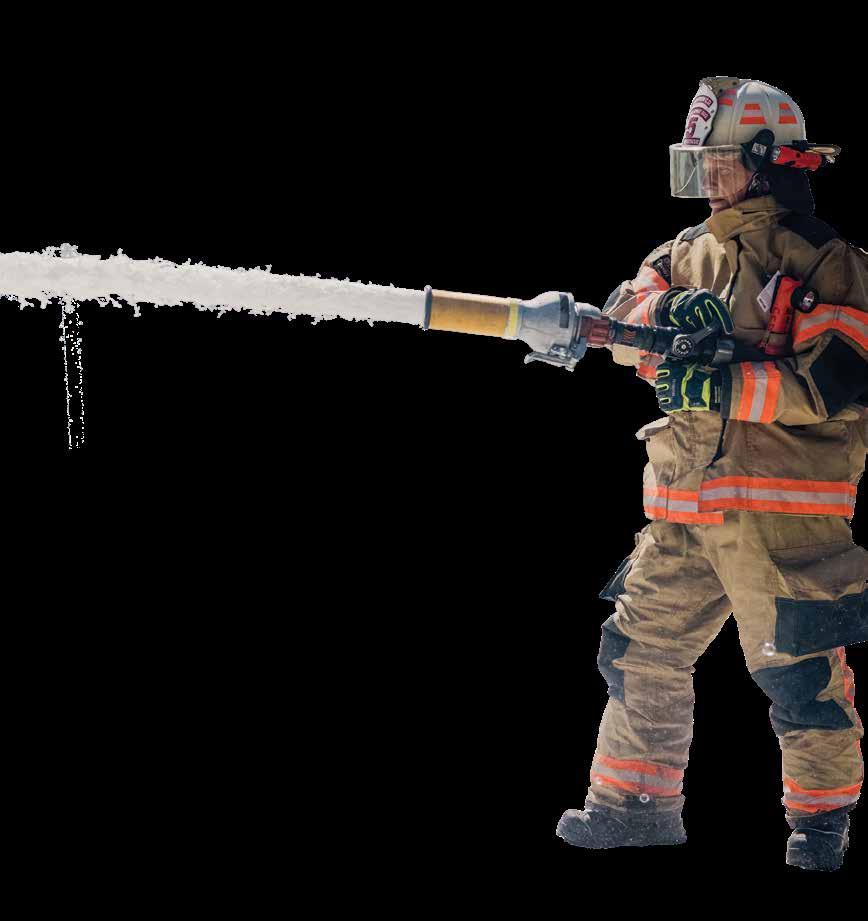
The more we discover about soybeans, the more valuable they become. One innovative product, SoyFoam™, creates a new, sustainable use for your crop that protects firefighters and the planet. See how your Soy Checkoff is unlocking new markets for soybeans at unitedsoybean.org
Building
Spring Moves That Pay
How planting decisions and grain marketing collide in the spring
STORY BY
PHOTOGRAPHY BY KRISS NELSON
JOCLYN KUBOUSHEK
As spring fieldwork ramps up, farmers are making decisions that shape the season long before the crop emerges — from when and how seed goes into the ground to when grain gets priced. Agronomy and marketing may feel separate, but spring is when both demand attention.
Conditions over calendar
Alex Schaffer, Iowa Soybean Association’s (ISA) research agronomy lead, says soil temperature and short-term forecasts matter just as much as the calendar.
“We really like to see soil temperatures at 50 degrees and rising,” Schaffer says. “But it’s not just today’s temperature. You have to look a few days ahead.”
One key risk farmers should avoid is imbibitional chilling, which occurs when a soybean seed absorbs cold water immediately after planting.
“You don’t want that seed’s first drink of water to be a cold one,” Schaffer says. “If soils are around 50 degrees but a cold rain is coming on day three, I’d wait. That first moisture the seed takes up should ideally be above 50 degrees.”
Despite those cautions, Schaffer says the data strongly support early soybean planting. Research consistently shows soybeans planted in April, beginning around crop insurance planting dates, tend to outyield soybeans planted in May.
“The yield advantage is there almost every year,” he says. “Early planting really pays.”
That said, Schaffer cautions against pushing early planting without the right protection. He strongly recommends using a seed treatment, especially one with sudden death syndrome (SDS) activity.
“In 2025, we saw soybeans sit in cool, wet soils for nearly three weeks,” Schaffer says. “That led to more SDS showing up later in the season. The yield reward is worth the risk, but not without a premium seed treatment, especially if there is a history of SDS pressure.”
Temperature also plays a major role in herbicide performance, particularly for burndown and contact herbicides.
“Weeds and cover crops need to be actively growing to metabolize herbicide,” Schaffer says. “Around 50 degrees and above is a good target.”
He also warns against cutting herbicide rates when conditions are borderline.
“Don’t try to save money here,” Schaffer says. “Use full rates, add AMS first to condition the water, include surfactants as the label calls for, and follow the label closely. Cutting corners leads to weed escapes, and that’s a problem you’ll fight all season.”
Spring nitrogen stabilizer trial
ISA is taking a closer look this spring at a question many farmers ask but rarely get clear answers to: how effective are nitrogen stabilizers when applied with spring nitrogen?
The trial will compare strips of spring ammonia treated with NSERV to strips without a stabilizer. What sets the project apart is the level of monitoring. Over an eight-week period, researchers will collect soil samples every other week, resulting in four sampling events from each treatment.
“We’re really focused on measuring the conversion rate from ammonium to nitrate,” Schaffer says. “Ammonium stays put. Nitrate moves, and that’s where leaching losses happen.”
Nitrogen stabilizers are designed to slow the activity of soil bacteria that convert ammonium into nitrate. By tracking how quickly that conversion happens in treated versus untreated strips, ISA hopes to better understand not just whether the product works, but how long it works.
Continued on Pg. 28
ALEX SCHAFFER ISA research agronomy lead
“ It’s easy to focus on spring fieldwork and let marketing get set aside. It is helpful to have reminders built in, like on the shop calendar or even the calendar taped inside the planter tractor cab, with goal dates of having grain priced.”
Sharon Chism, ISA at-large director
“This gives us a way to measure the length of efficacy,” Schaffer says. “How many weeks is that product actually influencing soil biology and slowing down that conversion process?”
With spring nitrogen applications often exposed to variable weather and soil conditions, understanding when and where stabilizers provide value can help farmers make more informed decisions.
Sulfur and cover crop effects on soybeans
ISA is launching a trial this spring to better understand how sulfur management interacts with cover crops in soybean systems, particularly fields following cereal rye.
The trial is designed to answer a question ISA agronomists are hearing more often from farmers: are cover crops changing early-season sulfur availability for soybeans, and could that be limiting yield?
Schaffer says sulfur has become a bigger point of discussion as more acres move to no-till and cover crops.
“When you have cereal rye ahead of soybeans, there’s a good chance some of that available sulfate is being tied up early,” Schaffer says. “At the same time, cooler soil temperatures can slow mineralization. That combination can put soybeans in a tight spot right when they’re trying to get established.”
The concern goes beyond early growth. One theory is sulfur plays a key role in helping rhizobium bacteria colonize soybean roots. Those bacteria are responsible for nitrogen fixation later in the season.
“If sulfur is limited early, nodulation can suffer,” Schaffer says. “That can show up much later in the season as nitrogen stress and ultimately lost yield.”
To study the issue under Iowa conditions, ISA is enrolling 10 fields with 100% cover crop acres going to soybeans. Each field will receive four sulfur treatments, including a zero-rate check. A granular gypsum product will be applied ahead of planting to supply sulfur and evaluate whether added sulfur improves nodulation and yield.
“We want to know when sulfur makes sense and when it doesn’t,” Schaffer says. “This isn’t about adding another input everywhere. It’s about understanding where the response is and what that return looks like.”
The goal is to generate practical, Iowa-specific data farmers can trust.
“Cover crops bring a lot of benefits,” Schaffer says. “Our job is to make sure fertility management keeps pace so farmers can capture those benefits without sacrificing yield.”
Beyond the field
Many of the decisions Schaffer highlights involve risk management. That same mindset applies beyond the field. As spring fieldwork ramps up, grain marketing decisions often carry just as much long-term impact, even though they’re easier to put off.
Sharon Chism, an at-large director for the Iowa Soybean Association, says the weather uncertainty of spring planting is a critical window for forward pricing newcrop grain to meet fall cash flow needs,
even as farmers focus on getting crops in the ground.
“It’s easy to focus on spring fieldwork and let marketing get set aside,” Chism says. “It is helpful to have reminders built in, like on the shop calendar or even the calendar taped inside the planter tractor cab, with goal dates of having grain priced.”
That timing matters since spring markets tend to be driven by weather uncertainty. Jacob Kleinberg, COO of publications for Roach Ag, says markets during this period often react to U.S. planting progress and production outcomes in South America.
JACOB KLEINBERG Roach Ag COO of publications
“Seasonally, markets tend to focus on any hiccups with planting progress here in the States and the production numbers coming out of South America during their soybean and early corn harvest,” Kleinberg says. “Some of the best selling opportunities of the year occur during these spring months.”
Those seasonal drivers are layered this year with broader global considerations, including negotiations with China, the Russia-Ukraine war and developments in South America, which could influence markets through the spring and early summer.
Despite those opportunities, timing remains one of the biggest challenges for farmers.
“One of the biggest challenges with grain marketing is that the best opportunities tend to come during the planting and growing seasons,” Kleinberg says. “We hear all the time that farmers miss opportunities either because they were too busy to make a decision or because they were uneasy about their crop conditions.”
Chism says understanding seasonality helps bring structure to her decisionmaking. She encourages farmers to watch the U.S. Department of Agriculture’s spring World Agricultural Supply and Demand Estimates (WASDE) reports and set target dates to price a portion of newcrop grain, ideally around Mother’s Day and certainly by Father’s Day.
“A seasoned farmer at an Iowa Soybean Association meeting once told me to accept that it can be more profitable to price grain after it drops a dime than to sit and watch it fall a quarter or more while waiting for a bounce,” she says.
Incremental sales remain one of the simplest tools for managing uncertainty.
“Grain marketing involves risk,” Chism says. “Volatility humbles even the most seasoned grain marketers.”
Kleinberg agrees that having a clear marketing structure is critical, especially when margins are tight.
“Having a plan in place makes executing sales during these times easier,” he says. “There’s no perfect marketing plan but having a structure matters.”
At Roach Ag, that structure often includes setting clear targets for selling portions of both old and new crop during the spring and summer months, rather than waiting until harvest.
“We want producers pricing the grain they need sold before harvest,” Kleinberg says. “The goal is to avoid being handcuffed into selling at harvest because of cash flow needs or limited bin space.”
Chism adds that even small habits can help keep marketing top of mind. She suggests picking a day early in the week to review grain charts and observe trends.
“The visual increase or decrease in the market trends may be a better decisionmaking tool than what a farmer reads or listens to,” she says.
Contact Kriss Nelson at knelson@iasoybeans.com
10
9
12
11
10 August 12 September 11
9 November 10
10
Beyond the Old Playbook
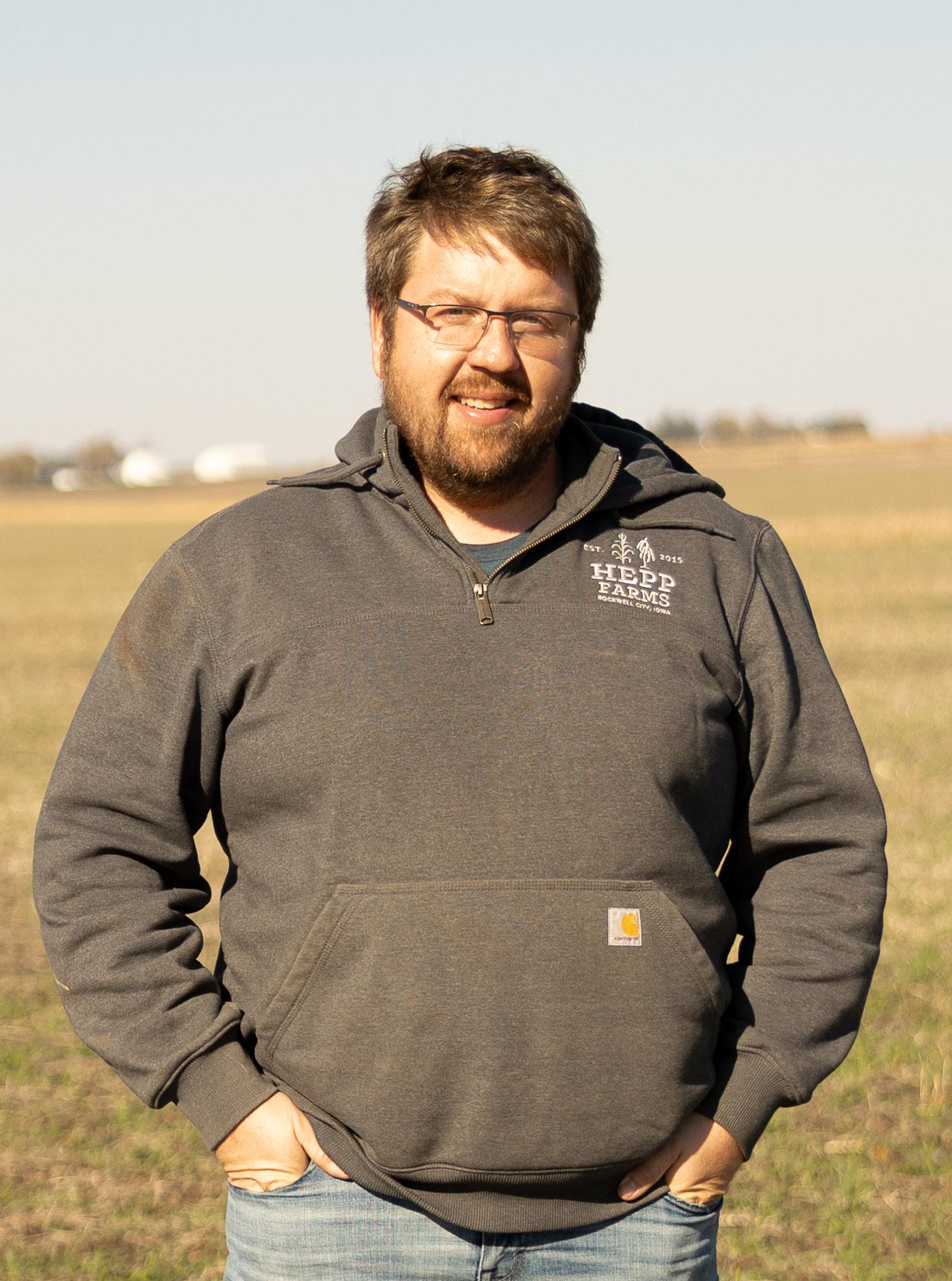
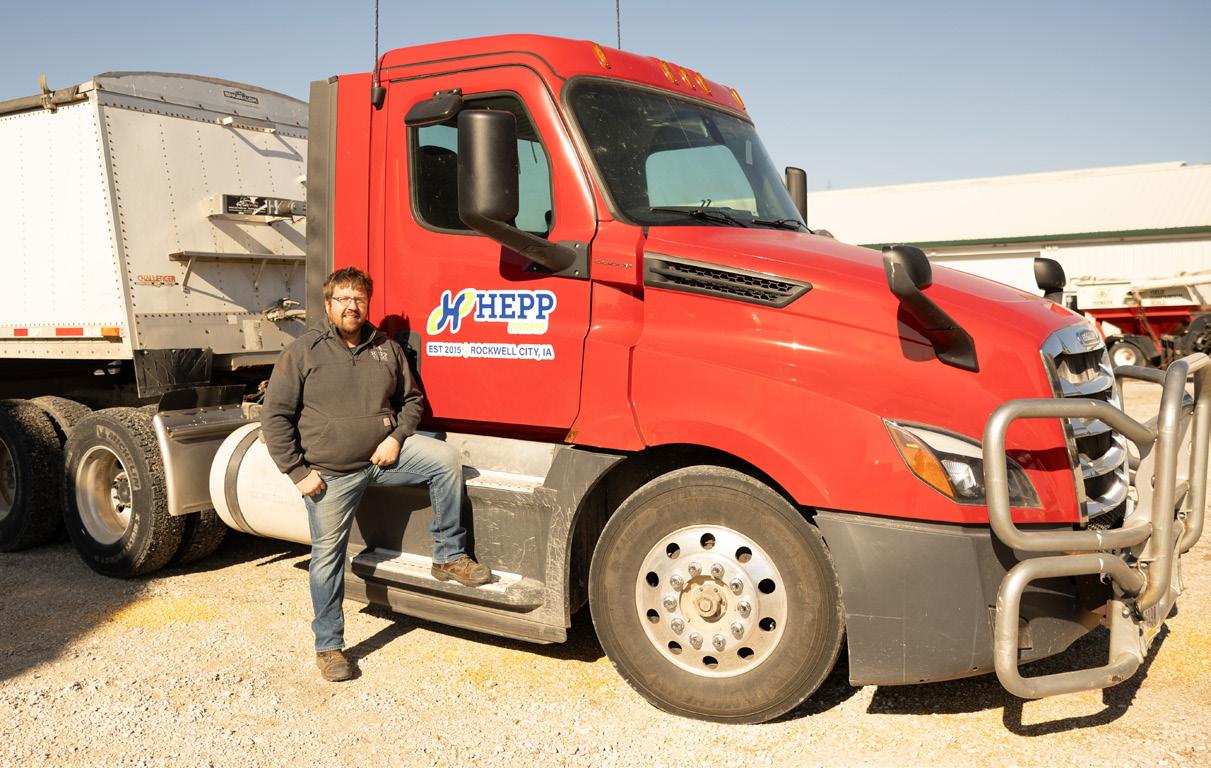
James Hepp shares why updated practices matter for the next generation
James Hepp has an important message for farmers: farming is changing, and the practices that served your dads and grandpas well aren’t always enough for the challenges we face now.
The Calhoun County farmer says conservation should be a mindset farmers adapt to protect soil, improve water quality and keep Iowa agriculture resilient for the next generation.
Economics also plays a role. Hepp believes practices like cover crops, reduced tillage and strategic nutrient management can sharpen a farmer’s bottom line, helping farmers manage risk, reduce input costs and make acres more profitable.
He’s been sharing that message with other farmers at field days, conferences and events, encouraging others to think differently about how they manage their acres.
Farm and family
Hepp, his wife Paige, and sons Karsten and August, are first-generation farmers. Hepp was given the opportunity to farm when Keith Sexton, a farmer he had worked for as a hired hand, retired.
Alongside raising soybeans, corn and small grains for cover crop seed, Hepp runs Hepp Ag Company, a crop insurance and ag retail business providing seed, adjuvants, chemicals and fertilizers. The operation also uses a variable-rate fertilizer spreader to target nutrients where and when they’re needed.
Taking it further
Inspired by Sexton's conservation, Hepp is taking conservation management practices a step further on his farm.
“When I started working with Keith, he was already experimenting with some no-till and strip-till,” says Hepp. “He had that conservation philosophy and was taking it as far as he felt comfortable as he got closer to retirement. I saw that, and that’s kind of all I ever knew, so I took it to the next level.”
Cover crops on every acre
One example is implementing cover crops. This is the second year he has planted cover crops on all acres.
“All of our soybeans are no-till. They are planted green into a three-way blend of rye, camelina and tritcale. For corn, this year will be the second year we’ve planted into a cover. This fall we had a good stand of triticale, a splash of rye and a little bit of camelina. We drilled it and we’ll strip-till and plant corn into it this spring.”
Fertility and crop nutrition
Hepp’s focus on conservation also extends to how he manages fertility across his acres. All of Hepp’s nitrogen is applied in the spring through split applications, followed by one or two Y-drop passes to meet the crop’s needs.
Hepp says he’s been rethinking crop protection focused on a more balanced, plant-health approach.
“We’ve been trying to cut out a lot of the fungicides and insecticides and do more of trying to balance the plant,” he says. “We’re pushing a lot more micros and we’re SAP testing corn about every 10 days to two weeks throughout the growing season to see what it needs.”
As he’s adjusted his fertility and crop management, Hepp says the economic and environmental benefits have become clear.
“The more I’ve balanced the plant and soil and conservation, the more I’ve found that profitability and conservation kind of converge. And it’s better for the environment,” he says.
Reaching farmers
Honored with Iowa Soybean Association’s (ISA) New Leader Award in 2022, Hepp continues to lead by example, speaking with farmers about conservation and profitability.
He sees the work ISA is doing in the research and conservation space, and Hepp wants to continue to push farmers.
“The soybean checkoff is helping speed up and scale regenerative ag by putting real dollars behind on-farm trials that farmers trust,” says Hepp. “I feel the Iowa Soybean Association does more than any other commodity group in that space, but we all need to keep pushing to do more and do better. When research clearly shows net return, especially for regenerative practices, more farmers are willing to try them. The checkoff helps connect conservation and management changes back to profitability, and that’s what brings more farmers to the table.”
His field days on water quality and soil health led to an invitation to speak at last year’s National No-Tillage Conference.
“When everyone was switching from the plow to the ripper, I bet they all squawked at first,” he says. “But now, you’d never go back to the plow.”
Shared labor
Conservation isn’t just about soil and water; it’s also about keeping the operation manageable when labor is tight, he says.
“The fewer passes you make in your field, the less labor you need, and once again, you’re more profitable,” he says. “Everything we do is to help water quality, soil health and my own health.”
Hepp believes the answer may be neighbors working together more often,
“ The soybean checkoff is helping speed up and scale regenerative ag by putting real dollars behind on-farm trials that farmers trust.”
James Hepp, ISA farmer member from Calhoun County
“I spoke to close to 100 people in a room and shared my story in the hallway afterwards,” he says. “A week later, I was asked if I would present on the main stage for this year’s conference. This year, I’ll be speaking to nearly 700 people about sustainability, passing the farm to the next generation and remaining profitable through conservation.”
His core advice: “Just try it.”
“Don’t just take my word for it, try it on your own acres,” Hepp advises others. “Take ten or 20 acres and experiment. Find others in your area who are doing the same thing. There are more of us conservationists than you think.”
He says he speaks up because conservation changes are likely coming, and farmers need to remember that hard transitions aren’t new, farmers have adapted before, and they can again.
by sharing equipment, trading labor and lightening the load for everyone.
“We’re coming to a crossroads where there’s no labor, no help and the next generation can’t walk in and buy the older generation out,” he says. “That’s why I’m trying to get people to think and work together.”
Building tomorrow
Thinking about his farm’s future, Hepp hopes more farmers will adopt practices that keep land productive.
“With the kids, I’m trying to build a platform for them,” he says. “When they get older, if they want to farm, I want them to take off where I drop the torch and not have to climb all these hurdles I’m climbing daily.”
Contact Kriss Nelson at knelson@iasoybeans.com
Through investments in the Soy Transportation Coalition, county engineers can repair bridges more affordably, keeping soy routes reliable and efficient.