August 2026
Healthy livestock starts with me.
Through the checkoff , we’re helping to grow domestic demand for our soybeans. Read how the checkoff is supporting Iowa soybean and livestock industries by scanning the QR code.
Amanda Tupper, farmer f rom XX
Funded by the soybean checkoff.
Executive Committee President Tom Adam, Harper | D9 President-elect Lee Brooke, Clarinda | D7
August 2026 | Vol. 39, No. 11
Secretary Aimee Bissell, Bedford | At-Large Treasurer Sam Showalter, Hampton | D2
8
At-Large Director Jeff Ellis, Donnellson | D9
A Place on the Farm
Board of Directors Brent Swart, Spencer | D1 Paul Kassel, Spencer | D1 Mike Yegge, Lake Mills | D2 Amanda Tupper, Ionia | D3 Josh Schoulte, Farmersburg | D3 Jeff Frank, Lake View | D4 Marty Danzer, Carroll | D4 Corey Goodhue, Carlisle | D5 Dave Struthers, Collins | D5 Joe Sperfslage, Coggon | D6 Brian Strasser, Homestead | D6 Scot Bailey, Anita | D7 Brian Fuller, Osceola | D8 Summer Ory, Earlham | D8 Jack Boyer, Reinbeck | At-Large Neil Krummen, Linn Grove | At-Large Sharon Chism, Huxley | At-Large
Discover how the Herold family is navigating the challenges and rewards of returning to their roots.
12
Passing it On Passing the torch outside the family requires a special blend of trust, timing and shared vision.
American Soybean Association Board of Directors Tom Adam, Harper Corey Goodhue, Carlisle Randy Miller, Lacona Summer Ory, Earlham Brent Swart, Spencer Dave Walton, Wilton United Soybean Board of Directors Tim Bardole, Rippey Robb Ewoldt, Davenport Brent Renner, Klemme Suzanne Shirbroun, Farmersburg
14
Building a Livestock Legacy How a unique training program is setting tomorrow’s livestock producers up for success.
22
Staff Credits Bethany Baratta | Editor Aaron Putze, APR | CO Brand Mgmt and Engagement Susan Langman | Creative Design Coordinator Joclyn Kuboushek | Multimedia Specialist Kriss Nelson | Senior Writer Brock Johnston | Public Relations Manager
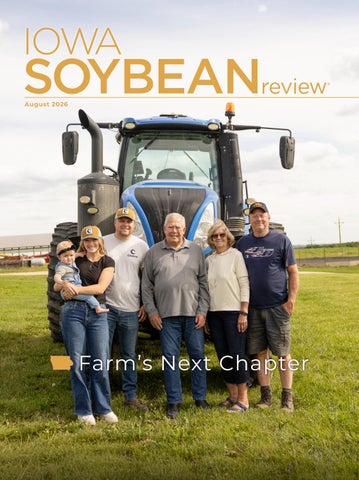
Research with Results Partner with ISA to advance on-farm research and find real-world solutions. On the cover: Four generations gather on the family farm
FARMER FOCUSED | DRIVEN TO DELIVER
near Fort Atkinson, including Morgan Herold, Amanda Herold,
ISA VISION We advance the long-term competitiveness of Iowa soybean farmers.
Their story sets the stage for this issue, where we visit with
ISA MISSION Driven to deliver opportunities for Iowa soybean farmers to thrive.
Mitchell Herold, Gary Mihm, Janice Mihm and Alvin Herold. Iowa farmers navigating the complex process of succession planning — whether transitioning the operation to the next generation or a non-family member. Photo by Joclyn Kuboushek.
Iowa Soybean Review is published monthly by: Iowa Soybean Association 1255 SW Prairie Trail Parkway, Ankeny, Iowa 50023 (515) 251-8640 | iasoybeans.com E-mail: bbaratta@iasoybeans.com For advertising information contact Bethany Baratta at (515) 334-1020 or bbaratta@iasoybeans.com
Comments and statewide news articles should be sent to the address to the left. Advertising space reservations must be made two months preceding publication. In consideration of the acceptance of the advertisement, the agency and the advertiser must, in respect of the contents of the advertisement, indemnify and save the publisher harmless against any expense arising from claims or actions against the publisher because of the publication of the content of the advertisement.
IOWA SOYBEAN REVIEW® | 3
Executive Insights Kirk Leeds, ISA Chief Executive Off icer kleeds@iasoybeans.com
Honoring Our Past, Investing in Our Future
E
arlier this year, I was deeply honored to receive the Master Farmer Distinguished Service to Agriculture Award during the 100th year of the Wallace’s Farmer Master Farmer Award program. As I accepted the award, I reflected on the role I’ve been fortunate to play over the past three and a half decades as the Iowa soybean industry has experienced remarkable growth and transformation. The recognition reminded me that no individual accomplishes anything alone. The Iowa Soybean Association, backed by the investment and leadership of soybean farmers and the organization I’ve been humbled to lead, has enabled the industry to flourish. August is Soybean Month in Iowa, a time to celebrate one of our state’s most important crops and the farmers, researchers, industry leaders, and partners who propelled Iowa to become a global leader in soybean production and innovation. The development and adoption of soy-based ink made headlines early on — literally. What began as an innovative effort to create new uses for soybeans evolved into a product that’s preferred by printers (including the one that prints the Iowa Soybean Review). It demonstrated the tremendous potential of farmer-led innovation and value-added markets. The soy-based biodiesel and renewable diesel industries fueled
4 | AUGUST 2026 | IASOYBEANS.COM
the next wave of success. The journey began in the early 1990s when many of us anticipated an excess supply of soybean oil driven by strong global demand for soybean meal. Through research, demonstration projects, advocacy, and industry partnerships, soybean oil found a home in renewable fuels, making it the major driver of soy’s overall value. Our markets continue to diversify on the dinner table, too. Driven by growing consumer interest in nutrition and sustainability, soy has become a global staple — powering everything from non-dairy milk alternatives to advanced plant-based protein ingredients. The national soybean checkoff program, which will mark its 35th anniversary in September, helped create these and countless other efforts that have increased demand for soy. This farmer-directed, selffunded investment has played a critical role in expanding demand for U.S. soy around the world while being a catalyst for research that’s helping farmers better manage pests and diseases, improve production practices, and enhance sustainability. Iowa soybean farmers, backed by the soybean checkoff, have partnered with countless state and national organizations to improve transportation infrastructure, strengthen supply chains, and
advance practical solutions for water quality improvement. These efforts reflect our industry’s longstanding commitment to stewardship and continuous improvement. While I’m proud of what Iowa soybean farmers have accomplished, agriculture has a way of keeping us grounded. Even after a successful harvest, farmers understand there’s always another season ahead, challenge to solve, and opportunity to improve. As we celebrate Soybean Month in Iowa, let’s reflect and celebrate how far we’ve come. Let’s also recognize the innovations, partnerships, and investments that have strengthened our industry and created value for farmers and consumers. Most importantly, let’s recommit ourselves to the never-ending journey of continuous improvement. The future of Iowa soybeans will be shaped by the same spirit of innovation, leadership, and farmer-driven vision that brought us to where we are today. There is much to celebrate this August — and even more to accomplish in the years ahead.
Not funded by the soybean checkoff.
SUPPORT THE VOICE OF IOWA FARMERS In a historic election year, your support matters more than ever. ISA represents Iowa farmers where decisions are made, but that advocacy depends on members like you. For just $90 a year, you can make an impact.
Want to win a Milwaukee Cordless Grease Gun Kit? Join or renew your Advocate Membership by Sept. 15! To enter scan the QR code or visit IASOYBEANS.COM/ADVOCATEISR.
Rural Route 2 Editor’s Note by Bethany Baratta bbaratta@iasoybeans.com
From Three Seeds to Scott County Staples
W
hen J.R. Jackson planted three soybean seeds near Davenport in the spring of 1852, he couldn’t have imagined how Iowa agriculture would evolve. As the first to grow soybeans in the state, Jackson recorded his trial in a letter to the Prairie Farmer: “I began with three beans, and the first year I got nearly a pint… and I have now got about two bushels.” He would be delighted to see that Scott County farmers routinely record some of the highest yields in the state. The USDA reported a massive 67.7 bushels per acre countywide average for the 2025 crop year — a far cry from Jackson’s original handful of seeds. Jackson initially eyed the “Japan bean” for the dinner table, though his early reviews were mixed: “They are tender after being boiled for a long time but will not break to pieces... for soup or baking, they are far behind the small white beans.” He’d be pleased to learn that soyfoods have come a long way.
Today, Iowa-grown soy feeds global demand for everything from edamame and tofu to traditional fermented favorites like tempeh and miso. Beyond being first in Iowa, Jackson’s true breakthrough was recognizing the plant’s potential for livestock: “I think that they will be profitable to cultivate for cattle… My cattle eat the small stalks, and seem to be quite fond of them.” While today’s producers don’t typically graze standing beans, livestock remains the undisputed engine of the soy economy, accounting for 97% of domestic soybean meal usage. Processed meal is a dietary staple for cattle, hogs and poultry. Dairy cows have also optimized their rations with soy, thanks in part to modern research funded directly by the soybean checkoff. Jackson operated by trial and error — he didn’t have ISA’s network of agronomists to help him, after all. He dealt with thick, woody stalks,
planting them between wide five-foot rows of corn: “Many of them were over three feet high and so strong that I found a shingling hatchet the best tool to cut them with.” Today, Jackson would marvel at advanced genetics that help crops withstand volatile weather, as well as the narrow 15-to-30-inch rows that optimize modern fields. Picture him climbing into the buddy seat of Robb Ewoldt’s combine today. Instead of a shingling hatchet, Jackson would look out over digital controls, real-time yield mapping, and precision tools capturing data with every pass across the Scott County soil. Jackson wrote that he simply wanted to “enlighten one another” and “contribute my mite.” Nearly 175 years later, his early trials have transformed Iowa into a global soybean powerhouse. I wonder what the next 175 years has in store?
IOWA SOYBEAN REVIEW® | 7
Morgan Herold with her parents, Mitch and Amanda, on the family farm.
STORY BY
PHOTOGRAPHY BY
KRISS NELSON
JOCLYN KUBOUSHEK
8 | AUGUST 2026 | IASOYBEANS.COM
A PLACE ON THE
FARM Mitch Herold is taking gradual steps into the family operation while building a future for the next generation
F
or many young farmers, the path back to the farm doesn’t happen overnight. For 28-year-old Mitch Herold of Fort Atkinson, it has been a gradual process built on generations of family history, years of off-farm experience and a commitment to keeping the operation moving forward. “I grew up with it my whole life,” Mitch says. “I always knew I wanted to be involved in agriculture.”
Family legacy The roots of the Herold farm date back to when Mitch’s grandfather traded a career in trucking for life on the farm. After purchasing the home place, he called Mitch’s father, Alvin Herold, and asked him to help run it — setting the stage for a lifelong partnership. “My dad and grandpa farmed together for more than 30 years,” Mitch says. “Then Grandpa stepped back, and Dad continued the operation.” Growing up just a mile from the farm, Mitch spent his childhood around agriculture. But rather than stepping directly into the operation after high school, he gained experience elsewhere first. He completed internships with agricultural cooperatives while attending Iowa State University and went on to build a career in the ag industry. Mitch worked for Nutrien Ag Solutions and Farmers Win before joining Bayer Crop Science, where he currently works on the Channel seed side of the business. While he grew in his career, he continued to be involved on the farm. With a degree in agronomy and a career in the seed industry, Mitch is often the go-to when questions arise about crop management, inputs and agronomic decisions. “There are things I might otherwise ask my agronomist about, but now I can have those conversations with my son,” says Alvin. “He’s a great resource for me.” Continued on Pg. 10
IOWA SOYBEAN REVIEW® | 9
Involving Mitch in day-to-day decisions not only helps the operation today but also gives him valuable experience for the future. “It gets him involved in the operation and helps him see everything that goes into it,” Alvin says. “He’s learning the business side while also bringing new ideas and perspectives back to the farm.” Today, Mitch is taking gradual steps into a larger role within the family operation. Rather than making an immediate transition, he and his family are focused on finding opportunities that allow him to slowly expand his involvement. Recently, he began farming some of his grandfather’s acres. Additional rented acres could provide future opportunities as the transition continues. “It’s baby steps,” Mitch says. “I’m not ready to fully dive all in yet. I’ve always
wanted to make sure I could do it on my own first.”
Diversification To diversify beyond row crops, the family finishes feeder pigs and raises cattle. This livestock mix provides additional stability as the family prepares to welcome another member of the next generation. Mitch’s younger brother, Jacob, 23, works in ag retail while helping out on the farm. Alvin says Jacob’s off-farm experience brings another valuable perspective to the operation — one that will shape the farm’s future as transition planning continues. “We want to create opportunities for both of our sons,” Alvin says. “The goal is to get them involved now so they’re prepared when the time comes to take on larger roles.”
ISA Farmer Members Mitch Herold, his wife, Amanda, and daughter Morgan are helping shape the future of the Herold family farm. Bringing the next generation into the operation is part of a long-term succession plan built around family and shared responsibility. Baby Morgan sits on the Herold family farm, where she represents the next generation of a family committed to agriculture. The Herold family’s dog, Otis, keeps watch over the farm as another day of work unfolds, a familiar sight on an operation built around family and tradition.
10 | AUGUST 2026 | IASOYBEANS.COM
A leg up While the path into farming remains challenging for many young producers, Mitch says creative arrangements can help make the transition possible. One example is the agreement he has with his father regarding labor and equipment. Rather than paying equipment costs, Mitch contributes labor to the operation. The arrangement helps him keep more working capital available for rent, inputs and other expenses as he builds his farming business. Without those types of opportunities, he says entering farming would be significantly more difficult. “You need a leg up somewhere,” Mitch says. “People have to find someone they trust and be willing to help create opportunities. That’s what makes it possible for young farmers to get started.” Creating those opportunities requires farmers to start succession planning earlier than many realize, Alvin says.
“The goal is to get them involved now so they’re prepared when the time comes to take on larger roles.” Alvin Herold, Fort Atkinson farmer
Having experienced a slow transition into farming himself, Alvin made a conscious decision to involve his son in management and business decisions before retirement became part of the conversation. “I farmed with my father-in-law, and while he let me take care of the farm, it took a long time to get financially involved,” Alvin says. “I want to create those opportunities for my sons.” Today, Mitch farms a small number of acres of his own while using family equipment and participating in decisions related to inputs, marketing and management. Alvin encourages farm families to start small but start now. “You’ve already waited too long,” he tells other farmers who are thinking
about succession planning. “Time goes by fast. The sooner you can get them involved, even on a small scale, the better they’ll be. They’re learning how to market commodities, buy inputs and make business decisions before the big responsibility gets dropped on them.” Find ways to let the next generation participate, Alvin says. Maybe that means helping a son or daughter farm a few acres, sharing family equipment, or inviting them to engage in management discussions. “I’m the same as any other farmer. I don’t want to give up this or give up that,” he says. “But it’s easier to give up a little bit and let them get a foot in the door. Once they get started, opportunities begin to open up.”
Future generations Today, Mitch lives on the farm where he grew up, continuing a family legacy that began long before he was born. The recent birth of his and his wife, Amanda’s, first child, Morgan, has only strengthened his commitment to the farm and its future. “That’s what motivates me,” Mitch says. “I’ve seen the hard work, time and dedication that’s gone into this farm, and I don’t want to be where it ends.” He wants to create opportunities for future generations, just as his grandfather and father did for him. “I want it to continue for years,” he says. “That’s what drives me every day.” Contact Kriss Nelson at knelson@iasoybeans.com
IOWA SOYBEAN REVIEW® | 11
STORY BY
PHOTOGRAPHY BY
KRISS NELSON
JOCLYN KUBOUSHEK ISA Farmer Members Roger Van Ersvelde (left) and Cole Olson on the farm near Brooklyn.
A farm transition rooted in trust and timing
F
or Roger Van Ersvelde, succession wasn’t something to put off. He and his late wife, Louise, made the decision together, knowing that without children to carry on the farm, the future of their operation could not be left to chance. They wanted to create an opportunity for someone else, much like the one he had been given years earlier. “I was given the opportunity to farm by my parents,” Van Ersvelde says. “We wanted to give somebody else that same chance.” That opportunity found its way to Cole Olson. Olson, now 30, first connected with Van Ersvelde as a high school student.
12 | AUGUST 2026 | IASOYBEANS.COM
Olson didn’t grow up on a farm, but he sought out the opportunity to help Van Ersvelde on his farm near Brooklyn. What started as a summer job gradually turned into something more as the two built trust over time. “We had kind of made up our mind even before Cole started working on the farm that we wanted to transition it,” Van Ersvelde says. “We didn’t want it to go into one big operation. We need younger people coming into agriculture.”
Building trust The transition started with a gradual sharing of acres. Some farms operate under a share-crop arrangement, with the
landlord receiving 50% of the crop and Van Ersvelde and Olson each receiving 25%. Other rented and owned acres are split equally between the two. This year, Olson began farming all of Van Ersvelde’s owned acres on a 50-50 basis. The next step comes next year, when Van Ersvelde plans to sell a parcel of land to Cole and his wife, Kayla. This gives the Olsons and their two daughters, Hattie and Sadie, the opportunity to farm their first owned acres. For Van Ersvelde, the goal is steady progress through the transition, not a handoff. “I’m not giving it to him. You’ve got to earn it,” Van Ersvelde says. “But you also
Working side by side, Roger Van Ersvelde and Cole Olson are navigating a gradual farm transition built on mentorship, trust and shared responsibility.
don’t want to bury someone in debt so deep they can’t see the end.” That balance is rooted in experience. Van Ersvelde started farming in 1970 after returning from the Air Force, buying his father’s machinery for $10,000. He farmed through the 1980s farm crisis, making tough calls, including selling land and renting it back to stay afloat. Those lessons now guide how he’s structuring the transition. Instead of loading Olson up with machinery costs, Van Ersvelde sees land as the better long-term investment. “Machinery is only going to go down in value,” he says. “Land gives him a foothold.”
Learning curve For Olson, the transition has been built on both opportunity and persistence. “Roger’s taught me so much,” Olson says. “That experience is something you can’t replace.” Olson’s summer work on Van Ersvelde’s farm — and his connection to agriculture through his neighbors and friends — grew his interest in farming. That eventually led him to Iowa State University, where he graduated with a degree in agricultural systems technology. Even then, farming wasn’t guaranteed. “I asked Roger what his plan was,” Olson says. “He just said, ‘You might want to stick around.’” That was enough to get the conversation started.
Since then, Olson’s role in the operation has grown, particularly on the technology side. He’s helping manage monitors, GPS systems and equipment upgrades. “He can work through that stuff a lot faster than I can,” Van Ersvelde says. “We bounce ideas off each other, and it helps us move forward.” That collaboration goes both ways, blending experience with new ideas while keeping a close eye on return on investment.
Making it work Like many beginning farmers, Olson’s path hasn’t been easy. Olson has relied on off-farm income while building his place in the operation. He spent years balancing full-time jobs with increasing farm responsibilities and still works as a crop insurance agent for Bear Creek Insurance while helping a local custom applicator during the spraying season. “As a young farmer, you’re subsidizing your habit,” Olson says. “You’ve got to have something else bringing in income while you build.” That reality is one many in agriculture recognize. “It’s extremely hard to start farming today,” he says. “You’ve got to figure out your own way to make it work.” That’s exactly why transitions need to be intentional, Van Ersvelde says. He encourages farmers to look beyond family
when thinking about succession planning and to start the conversation early. “Find somebody with the drive and desire,” he says. “They don’t have to come from a big farm background. Sometimes those are the best ones.” He also stresses the importance of sharing both successes and struggles. “You’ve got to talk about it,” he says. “The hardest part is getting the conversation started.”
Looking ahead The goal, Van Ersvelde says, goes beyond one farm. “If we don’t bring younger people into agriculture, we’re going to be all old,” he says. “You look at the average age of farmers today, and it tells you where we’re at.” He believes keeping farms at a manageable scale and creating real opportunities for younger farmers is key to the future of the industry. And as one works through the transition and the other seeks to grow his ownership in the farm, Van Ersvelde and Olson agree the foundation is in place for both aspirations. And Van Ersvelde says that’s what matters most. “Leave it better than when you started,” he says. “That goes for the land and the operation.” Contact Kriss Nelson at knelson@iasoybeans.com
IOWA SOYBEAN REVIEW® | 13
STORY BY
PHOTOGRAPHY BY
KRISS NELSON
JOCLYN KUBOUSHEK
Sam Everhart connected with the Coalition to Support Iowa's Farmers' Building Your Livestock Legacy program to learn more about the essentials of raising livestock and managing a successful operation.
Program helps aspiring livestock farmers prepare for ownership and connect with opportunities for the future
14 | AUGUST 2026 | IASOYBEANS.COM
O
ne of the biggest hurdles beginning livestock farmers face isn’t a lack of interest or ambition. It’s access to capital. It’s an observation Brian Waddingham picked up while visiting with farmers throughout the state in his role as the executive director of the Coalition to Support Iowa’s Farmers. The coalition helps farmers establish and responsibly grow their livestock farms in the state. Since 2004, the coalition has assisted more than 5,800 farmers. “While we were out doing farm visits over the past several years, we could see that access to capital was one of the biggest barriers for beginning farmers,” Waddingham says. “There are a lot of resources available, including low-interest loans, tax credit programs and cost-share opportunities, but many people don’t know where to start.” Those observations led the coalition to launch the Building Your Livestock Legacy program in January 2025.
in college. Raised in Waukee, he became involved in her family’s row crop and cattle operation near Estherville. Cayley’s grandparents and uncle also farm near West Bend. The couple hopes to purchase land in northwest Iowa and begin building a livestock operation of their own, ideally near family as they establish their farming future. “The program helped me understand what is needed from a financial standpoint to start a farm operation,” Everhart says. “Learning what it takes financially has helped me begin preparing and identifying resources and programs that could help us get started.” Everhart works as an organ recovery coordinator for the Iowa Donor Network. He’s active on his fiancée’s family farm and participates in the Farm Bureau Young Farmer program. Everhart says the CSIF program helped turn a long-term dream into something more tangible. “This program really is a valuable resource,” he says. “It gave me the information I truly needed from experts Preparing for ownership in the field. I frequently go back and Upon feedback from lenders, the review my notes from the program, and online educational initiative helps it’s helping us prepare for the day when aspiring livestock farmers to master we can start a livestock operation of the financial side of agriculture. This our own.” includes preparing them to have Waddingham says the response conversations with lenders. confirms a need for additional resources Through the self-guided online focused on farm succession and mentorship program hosted through beginning farmer development. Google Classroom, participants work Brian Waddingham, “The sole mission of the coalition is through a series of video lessons led by CSIF executive director to grow Iowa’s livestock and poultry industry experts covering topics such industries successfully and responsibly,” as financing, marketing and the loan he says. “This program seems to be filling a void by helping application process. beginning farmers prepare for ownership while also providing The program is designed to be flexible, allowing participants resources for established farmers who are thinking about to move through the material at their own pace. Some complete transition planning.” the course in a matter of days, while others spread it out over
“Access to
capital was one of
the biggest barriers for beginning farmers.”
several months. “We wanted something that was simple to use and would appeal to both beginning and established farmers,” Waddingham says. “People can learn when they have time rather than trying to fit a class into an already busy schedule.”
Finding a path Interest in the program has exceeded expectations. More than 200 people have enrolled since the program launched, representing a wide range of ages and livestock interests. Participants include farmers interested in cattle, hogs, dairy, poultry, sheep, goats and more. For Sam Everhart, the program provided a roadmap for turning a long-term goal into a realistic plan. Although he did not grow up on a farm, Everhart developed an interest in agriculture after meeting his fiancée, Cayley Fehr,
Connecting generations In addition to educational resources, the program is intended to help connect established livestock farmers with aspiring producers interested in continuing an operation. While several established farmers have expressed interest in working with beginning farmers, Waddingham says the coalition is still developing the logistics needed to facilitate those connections. Although a formal match has not yet been completed, he believes the groundwork is being laid for future success. “We’ve heard from a number of participants who say the program helped them better understand the lending process and feel more prepared for those conversations,” Waddingham says. “That’s exactly what we hoped it would do.” Contact Kriss Nelson at knelson@iasoybeans.com
IOWA SOYBEAN REVIEW® | 15
Celebrating 35 years of the national Soy Checkoff Dear U.S. soybean community, For U.S. soybean farmers, the decision to come together 35 years ago and form the national Soy CheckoffSM was a defining moment that would reshape American agriculture for generations. Through collective investments into food, feed, fuel, industrial, exports and sustainable production, U.S. soybean production has grown from 1.8 billion bushels in 1990 to over 4 billion today. Because of what farmers have built together over 35 years, we’ve been able to create entirely new markets from the ground up like biodiesel, expand exports around the world to 90 countries and develop tools that protect yield on the farm. The partnership between farmers and the Soy Checkoff traces back to a pivotal moment in American agriculture. For many soybean farmers, the drought of 1988 exposed the
need for a national checkoff. Soon after, farmer leaders on the American Soybean Association voted overwhelmingly to pursue one, making investments available for international and domestic marketing as well as dedicated research into new uses. USB Secretary and Minnesota soybean farmer Tom Frisch believes the opportunity for every soybean farmer in the country to pool their resources and make a collective impact remains just as important 35 years later. “We need to continue to work together as U.S. soybean farmers and not isolate ourselves. We, as U.S. soybean farmers, need to champion our industry every day, every month, every year,” says Frisch. Qualified State Soybean Boards (QSSBs) have been there every step of the way, serving as the connective tissue between national strategy and on-theground reality. “When I view QSSBs, they are at the grassroots level navigating concerns
USB Past Chairs gather for a photo in the Soy Checkoff booth at Commodity Classic 2026 in Austin, Texas.
Advertisement
USB Past Chair Sandy Ludeman participates in a Soy Checkoff town hall in 1992.
USB is formed from the publication of the Soybean Promotion and Research Order under the 1990 Farm Bill.
and opportunities with their farmers across the state. They are in touch with their local agriculture community about what’s happening in their backyard,” says USB Past Chair and Mississippi soybean farmer Philip Good. As the Soy Checkoff thinks about the next 35 years, every investment made aims to grow demand, improve resiliency of the soybean crop and bring additional revenue back to the farm. “The Soy Checkoff isn’t just about dollars invested from the half-million U.S. soybean farmers — it’s about giving them the power to shape their own future and deliver lasting impact,” says Indiana farmer and USB Treasurer Don Wyss. One example of how powerful this partnership has proven to be is the advancement of high oleic soybean research and farmer adoption. We’ve seen over a million acres of high oleic across states like Indiana, Ohio, Missouri and the Delmarva region with QSSBs helping promote premiums of $0.75 to $1.25 per bushel. And there’s potential to reach 5-7 million acres a decade from now. High oleic soybeans have returned nearly $400 million in premium payments to farmers — a direct return on the $130 million checkoff investment through 2025. Another great example of partnership is the lower Mississippi River dredging project which added an additional $461 million in revenue to U.S. soybean farmers. Through
checkoff investment in research, analysis and design, which kickstarted deepening the lower Mississippi River from 45 to 50 feet allowed for an increase of 500,000 bushels per ocean vessel and saves 13 cents per bushel of freight. This investment spanned collaboration with USB, the Soy Transportation Coalition, U.S. Soybean Export Council, the American Soybean Association and multiple QSSBs. “Investing in the research and engineering side of that project was a new venture for us, but it encouraged strategic thinking of how we can use checkoff funds in unique ways to improve all soybean farmers’ bottom line,” says Good. As the United Soybean Board celebrates its 35th Anniversary we are proud of the work we’ve accomplished for every single U.S. soybean farmer. With our continued partnerships with the QSSBs we look forward to what this next chapter brings for the U.S. soybean industry. Together we can continue to deliver sustainable soy solutions to every life, every day. Here’s to the next 35 years of the U.S. soybean industry!
Brent Gatton USB Chair Kentucky
Improved Cropping Systems: Balancing Yield and Conservation Anthony Martin, ISA analyst amartin@iasoybeans.com
KEY INSIGHTS
Increased cover crop growth can negatively impact cash crop yields but can be minimized with good management strategies.
A
Tillage showed a yield benefit in both corn and soybeans, but farmers should consider if the relative benefit pays for additional passes across the field.
lthough most work conducted by the Iowa Soybean Association is looking at single products or practice changes, these are only a piece of the overall cropping system. Making a single change may affect yield, but implementing multiple changes to the crop system can further improve yield or provide significant non-yield benefits. The Improved Cropping Systems project began in the fall of 2023 to evaluate how combining several management changes compared to farmers' normal management practices. The management changes used in the project were provided by Iowa State University and local experts. The practices recommended under the improved treatments were selected for the potential to increase profitability, improve
Nitrogen inhibitors show promising corn yield benefits; additional work is being done to further quantify these results.
soil health and protect water resources while also reducing soil and nutrient losses. The practices included cover crops, tillage and nitrogen inhibitors. In 2025, the study included six farmer-led sites in year 1 and 15 sites in year 2 of the planned four-year project. Across the first two years, average yield responses on both soybeans and corn were negative with the improved system. Cover crops were incorporated in the improved system at every site using a blend of triticale, cereal rye and winter camelina ahead of soybean, and triticale, hairy vetch,and winter camelina ahead of corn. We used drones to plant the cover crops in early fall. On some of the sites, we planted the cover crop seeds via drill following soybean or corn harvest.
Alternating cover crop and no-cover-crop strips at a site illustrates the trial design used to compare crop performance, soil health and water quality impacts. Photo credit Alex Schaffer
18 | AUGUST 2026 | IASOYBEANS.COM
increase of 2 bushels per acre. These fields also incorporated cover crops ahead of the cash crop, so a direct correlation with the inhibitor can’t be made. Additional nitrogen inhibitor work is currently being conducted separately from this project to determine crop and nutrient response to these products alone. Farmers were also given the option to incorporate a tillage pass within the farmers’ standard practice compared to no-till in the improved system. Tillage types included conventional, striptill and vertical tillage and were used on six corn sites and three soybean sites. At these sites, yields were higher under tillage than under the no-till cover crop system, increasing an average of 2.4 bushels per acre in corn and 2.5 bushels per acre in soybeans. However, farmers should weigh those gains against the additional cost of implementing tillage.
Looking long term Yield differences between conservation and conventional management systems in the Improved Cropping Systems trial demonstrate how a stacked approach to conservation can influence crop performance.
Cover crop growth At the majority of locations minimal cover crop growth was observed the following spring. Similar to the ongoing long-term cover crop study, NDVI and yield response comparisons were made on sites where only a cover crop comparison was implemented. Consistent with past observations, yield was negatively affected with increased cover crop growth and biomass accumulation based on NDVI values. While termination date varied among the sites (from midApril to mid-June), the negative impact was observed with locations that had higher biomass accumulation. Average crop yields with only a cover crop comparison were lower for both soybeans and corn, declining by 0.8 bushels per acre and 3 bushels per acre, respectively. Developing and implementing a successful management strategy helps minimize yield losses seen with increased cover crop growth.
Tillage and nitrogen In the first two years, four sites used a nitrogen inhibitor ahead of their corn planting and realized an average yield
Soil samples were collected prior to this research, at planting, and following harvest each year at 0-12 inches and 12-24 inches. Samples collected at planting showed average nitrate concentrations were lower under the improved system, regardless of depth, at more than half of the sites. Given differences in management practices, additional samples over the next few years will continue to be collected and analyzed to better understand how changes in practices may be impacting soil and nutrient concentrations. Initial results show little to no differences when looking at organic matter, phosphorus or potassium levels. As observed in other studies conducted by ISA’s Research Center for Farming Innovation and participating farmers, many of the positives and negatives of these practices come down to the farmers’ short- and long-term goals. For some farmers, the trade-off between maximum yield and the potential benefits from a conservation standpoint is fine. Yield losses are an important consideration but can be overcome with funding programs providing cost-share opportunities. We will continue to share results as we move closer to the conclusion of this project. For more insights into this project and others, check out the cross-site report at iasoybeans.com/PDFLibraryUploads/2025_ Improved_Cropping_System_5_28_26.pdf
HAVE A TRIAL OR A PROJECT YOU’RE INTERESTED IN? We can consider it as a topic in a future issue. Better yet, we’ll connect you with your local expert so you can implement a trial on your farm. 515-251-8640
JMCCLURE@IASOYBEANS.COM
SCAN THE QR CODE IOWA SOYBEAN REVIEW® | 19
Source: USDA, Global Agricultural Trade System (GATS), January 2026
WOULD YOUR FARM PASS A DNR INSPECTION? CONFIDENT YOU KNOW ALL THE RULES?
Manure Management Plan
Separation to Water Sources
Counting Animal Units
Manure Applicator License
Separation from Neighbors
Build on Karst Soil
Give us a call for a free and confidential consultation!
1(800) 932.2436 Your Farm. Your Family. Our Focus.
or visit SupportFarmers.com for more information.
CSIF is a joint partnership involving the Iowa Beef Industry Council, Iowa Cattlemen’s Association, Iowa Corn Growers Association, Iowa Egg Council, Iowa Farm Bureau Federation, Iowa Pork Producers Association, Iowa Soybean Association, Iowa Turkey Federation and Midwest Dairy.
RESEARCH with Results ISA seeks farmer partners for fall trials
STORY BY
PHOTOGRAPHY BY
KRISS NELSON
JOCLYN KUBOUSHEK
W
ith tight margins and rising input costs, every decision matters. That’s why the Iowa Soybean Association is seeking farmers interested in on-farm research trials designed to answer realworld questions. From nutrient management and biologicals to cover crops and relay cropping systems, ISA’s Research Center for Farming Innovation evaluates practices that could impact profitability and environmental outcomes.
22 | AUGUST 2026 | IASOYBEANS.COM
ISA Research Agronomy Lead Alex Schaffer says the goal is to provide farmers with independent, data-driven information they can use on their own operations. “We’re here to arm farmers with information so they can have confidence when making purchasing decisions,” Schaffer says. Many of the projects focus on nutrient management, where farmers face increasing pressure to improve efficiency while protecting water quality.
Every trial starts with a farmer. ISA research agronomists are looking for cooperators interested in evaluating new products and management practices this fall.
ALEX SCHAFFER ISA research agronomy lead
Pivot Bio PROVEN G3
RhizoSorb trial
One opportunity for participating farmers is the second year of ISA’s Pivot Bio PROVEN G3 trial. The project evaluates a nitrogen-fixing biological product designed to help corn plants access nitrogen throughout the growing season. The trial is targeted toward farmers applying fall anhydrous ammonia with variable-rate technology. ISA establishes a baseline nitrogen prescription and compares the biological product across four nitrogen rates to determine whether crop response stems from the product itself or simply from adequate nitrogen availability. “We’re interested in understanding whether a biological product can help meet some of the corn crop’s nitrogen needs while maintaining profitability and supporting water quality goals,” says Schaffer. “By evaluating it across multiple nitrogen rates, we can better understand whether the response is coming from the product itself or simply from having excess nitrogen available.”
Another project examines enhancedefficiency phosphorus fertilizers, including RhizoSorb from Phospholutions. With fertilizer costs remaining a concern and global events continuing to influence supply chains, Schaffer notes many farmers are interested in products that promise improved nutrient efficiency or reduced application rates. That’s why ISA continues evaluating these products under real-world field conditions. “There’s always somebody knocking on the door selling a product,” he says. “What we’re trying to do is provide unbiased information so farmers can evaluate those claims with confidence.”
Iowa Nitrogen Initiative ISA is also continuing its work through the Iowa Nitrogen Initiative, now entering its fifth year. The initiative helps farmers determine their economic optimum nitrogen rate and generates data to improve N-FACT, Iowa’s nitrogen recommendation tool. “The Iowa Nitrogen Initiative is focused on helping farmers identify their economic optimum nitrogen rate while generating the data needed to improve nitrogen recommendations statewide,” says Schaffer. “Every field is different, and the more data we collect, the more confidence farmers can have in those decisions.”
“We’re here to arm farmers with information so they can have confidence when making purchasing decisions.” Alex Schaffer, ISA research agronomy lead
Relay cropping ISA’s RCFI is also expanding work on relay cropping systems involving wheat and soybeans. Relay cropping incorporates an overwintering cereal grain, helping protect soil from erosion and capture nutrients during the winter months. The project aims to improve management recommendations while helping farmers identify opportunities to
increase profitability. Relay cropping can allow farmers to harvest three crops in two years while providing conservation benefits. Researchers are also evaluating market opportunities for small grains. “We know overwintering cereal grains provides conservation benefits through improved soil protection and nutrient capture,” says Schaffer. “What we’re trying to understand is how farmers can manage relay-cropping systems in a way that also improves profitability and creates opportunities for additional revenue.”
Long-term cover crop project ISA’s long-term cover crop project focuses on how cover crops affect soil health and productivity over time. Schaffer says long-term data is especially important because many conservation practices require several years before their full benefits become apparent. “Many of the benefits associated with cover crops take time to develop,” he says. “This project allows us to better understand the long-term impacts on soil health, productivity and nutrient cycling so farmers have realistic expectations of what they can achieve over time.”
Improved cropping systems The Improved Cropping Systems trial is entering its final year of the four-year study. The trial compares a stacked conservation system against more conventional management practices. Early results have shown that conservation practices can be successfully integrated into crop production systems without sacrificing productivity when managed appropriately. Continued on Pg. 24
For more information on participating in a fall trial agronomy@iasoybeans.com Alex Schaffer | 815-274-2998 IOWA SOYBEAN REVIEW® | 23
MATT CARROLL ISA science and analytics lead
Research Results That Matter As input costs remain high and commodity prices stay under pressure, every management decision matters. That’s why the Iowa Soybean Association’s Research Center for Farming Innovation compiles research results from multiple on-farm trials across Iowa into easy-to-read summaries.
Fall anhydrous ammonia applications are part of Iowa Soybean Association on-farm research evaluating nitrogen management through the Iowa Nitrogen Initiative and nitrogen stabilizer trials.
“We often hear concerns that conservation practices will hurt yields,” Schaffer says. “Seeing farmers implement these systems successfully and maintain productivity helps build confidence in the practices.”
Nitrogen stabilizer research ISA is also evaluating nitrogen stabilizers, seeking how the products work under different application timings and environmental conditions. “We continue to evaluate stabilizer products under different application timings and environmental conditions because farmers want to know how these products perform in the real world,” says Schaffer. “Our goal is to provide practical information that helps them maximize nitrogen retention and return on investment.”
Why ISA conducts research Every project is designed to improve nutrient efficiency and provide unbiased information.
24 | AUGUST 2026 | IASOYBEANS.COM
“Farmers are constantly being presented with new products, new technologies and new management recommendations,” says Schaffer. “Our job is to provide unbiased information that helps them sort through those options and make decisions that work for their operation.”
Call for farmer participation Farmers interested in participating in future trials or exploring new research ideas are encouraged to contact ISA. “Some of our best research ideas come directly from farmers. If there’s a challenge they’re facing or a question they’d like answered, we want to hear about it because that’s what helps keep our research relevant and farmerfocused,” he says. For more information on participating in a fall trial email agronomy@iasoybeans.com or call Alex Schaffer at 815-274-2998. Contact Kriss Nelson at knelson@iasoybeans.com
The reports combine data from multiple locations to identify trends that may not be apparent from a single field trial. “We do nearly 150 individual location trials each year across Iowa,” says Matt Carroll, ISA science and analytics lead. “The goal is to summarize what we’re seeing across the state, so farmers don’t have to track down 10 or 20 individual reports and compare them themselves.” Each report includes a Project Insights section that highlights key takeaways for farmers seeking a quick summary before diving deeper into the data. The reports can also help farmers evaluate upcoming input decisions. For example, ISA’s seeding rate research has consistently shown that soybean populations can often be reduced without sacrificing yield, potentially lowering seed costs. Other studies have examined fungicide and insecticide applications, sulfur fertility and additional management practices. Current research results are available at iasoybeans.com under Research Center for Farming Innovation>Results>Current Research Insights, where farmers can access summaries and reports from recent projects. “We try to be as focused on return on investment as we can be,” Carroll says. “With current margins, it’s worth taking the time to think about your input passes and whether they really pay in today’s economic climate.”
for over 40 years, your cooperative soybean processor
LEAD THE FIELD.
REACH FARTHER, WORK SMARTER. The Brandt XT-Series grain cart utilizes simple innovations to eliminate common delays, so you can Lead the Field.
Increased Productivity
Easier to Operate
Engineered for Durability
Industry-leading auger reach delivers ultimate visibility while steep tank angles ensure complete tank cleanout.
Keep your harvest moving with optional features including a joystick control kit, auto-lock auger fold and more.
Robotically-welded frames, modular tanks, protected electrical systems and simple drive systems deliver unrivalled uptime.
brandt.ca 1-866-427-2638
Soy Snaps Rooted in Iowa, captured in time PHOTOGRAPHY BY JOCLYN KUBOUSHEK
Clockwise f rom top: Young soybean seedlings push through cover crop residue, soaking up the early season sun as another Iowa growing season gets underway. A trusted tool in the f ield. An ISA Crop Notes notebook ready for another season of observations and decisions made right where it matters most. Steve Moeckley surveys his cattle grazing across a lush Iowa pasture, taking in the kind of quiet, steady moment that def ines life on the land. A soil probe pulls back the surface to reveal what's happening beneath, giving farmers a closer look at the soil health that drives every planting decision. A sidedressing applicator moves through young corn rows on a bright Iowa summer day, delivering what the crop needs to reach its full potential.
26 | AUGUST 2026 | IASOYBEANS.COM
Clockwise f rom top left: Jacob and Nick Moeckley stand atop a John Deere ExactEmerge planter with grain bins rising behind them, a sign that Iowa agriculture is in good hands. Up close with a soybean leaf at the Solix Field Day near De Witt, Iowa, where farmers and researchers come together to dig into the details that make the difference at harvest. Clay Ory and his two Bernese Mountain Dogs, Vickie and Sally, share a moment of pure joy, because every good farm needs a great dog or two.
IOWA SOYBEAN REVIEW® | 27
FROM YOUR FIELDS TO FIREFIGHTERS’ HANDS The more we discover about soybeans, the more valuable they become. One innovative product, SoyFoam™, creates a new, sustainable use for your crop that protects firefighters and the planet. See how your Soy Checkoff is unlocking new markets for soybeans at unitedsoybean.org
© 2 0 2 5 UNI T E D S OY BEAN B OAR D
UNCOVER EARNINGS WITH COVER CROPS Enrollment now open!
Why Enroll? • Receive $35 per acre, per year • Renewable one-year contracts • One-on-one support from local Technical Advisors
Scan Here to Enroll! FarmersForSoilHealth.com/enrollment
Is this program for you? Eligible corn and soybean farmers in 20 states: Delaware, Illinois, Indiana, Iowa, Kansas, Kentucky, Maryland, Michigan, Minnesota, Missouri, Nebraska, New York, North Carolina, North Dakota, Ohio, Pennsylvania, South Dakota, Tennessee, Virginia and Wisconsin.
Farming by the Plant A new autonomous sprayer trial examines whether artificial intelligence can help farmers save time and reduce inputs
STORY BY
PHOTOGRAPHY BY
KRISS NELSON
JOCLYN KUBOUSHEK
A
s labor challenges, rising input costs and efforts to optimize crop protection product use continue to shape agriculture, a new trial in eastern Iowa is evaluating whether autonomous technology can help farmers do more with less. The Iowa Soybean Association’s Research Center for Farming Innovation is partnering with Solinftec and the Dierickx family near DeWitt to evaluate the Solix autonomous sprayer, a solar-powered platform capable of scouting fields, identifying weeds and making targeted herbicide applications.
Saving time For ISA Farmer Member Scott Dierickx, the trial offers an opportunity to explore technology that could help address one of his biggest challenges: time. As a young farmer balancing a fulltime job, a growing farm operation and family responsibilities, Dierickx says efficiency is critical. 30 | AUGUST 2026 | IASOYBEANS.COM
“I don't have a large enough farm base to farm full time right now, so I’m splitting my time between my job, farming, my wife and our four children,” Scott says. “If a technology like this can help save time while I’m at work, that’s something I’m interested in.” In the trial, Solix will be compared with the farm's conventional spraying program. Researchers will evaluate chemical use, weed control and crop yields throughout the season. “If this can help save time and reduce chemical usage, that’s a win,” Scott says. “I’m excited to see how much product can be reduced compared to our conventional strategy.” One unexpected benefit has been the amount of scouting information generated by the system. Equipped with cameras and artificial intelligence, the platform continuously monitors crop development and field conditions.
“Having the system out there collecting information on plant emergence and growth is something we’ve never really tracked before,” Scott says. “It's helping provide data that can be useful as we continue to fine-tune planting populations and management decisions.”
Putting it to the test The trial is taking place in a 150-acre soybean field. While the Solix platform scouts the entire field, approximately 50 acres arranged in four strips are being managed by the autonomous system for weed control. Using cameras and AI, the platform identifies weeds and applies herbicide only where needed. Lucas De Bruin, ISA research agronomist, says ISA’s role is to independently evaluate the technology under Iowa growing conditions. “We’re ground truthing what the system is reporting,” De Bruin says. “We're looking at the stand counts, weed detection
and scouting reports to make sure it’s performing as expected and providing accurate information to farmers.” Preliminary observations have been encouraging. Through midseason, the system had treated only a small percentage of the targeted acres while maintaining weed control. Early data indicated reductions in herbicide use of 90% to 95% compared with a conventional broadcast application, though final results will be evaluated after harvest.
while still allowing us to use the tools we need to grow crops.”
From scouting to spraying
The Solix platform itself evolved from conversations with farmers, according to Taylor Wetli, U.S. commercial and business development manager for Solinftec. “The first Solix robots were designed as autonomous scouting units that could live in the field and continuously monitor crop conditions,” Wetli says. “As the technology matured, growers began asking, ‘If the robot can find the weeds, why can’t it treat them too?’ ” That question led to the development of the Solix autonomous sprayer, which was unveiled in 2022, piloted commercially in 2023 and expanded into broader commercial use in 2024. Wetli acknowledges that some farmers remain cautious about LUCAS De BRUIN autonomous equipment but says ISA research agronomist skepticism is common when new technology is launched. More than spraying “Farmers are still making the For Scott's father, Joe, the trial agronomic decisions,” Wetli says. represents another step in a long “Solix simply handles repetitive tasks history of adopting new technology like scouting and targeted spraying, on the farm. allowing the operation to cover Joe was among the early farmers more ground with less labor and selected to test AutoTrac guidance fewer inputs.” systems when John Deere first De Bruin sees potential for the introduced automated steering technology to improve efficiency technology. What he once said while collecting valuable field data that seemed revolutionary is now throughout the season. commonplace across agriculture. He notes that current limitations “Look at how widely adopted it is remain, particularly around acreage today,” says Joe. “People hardly farm capacity and broadcast applications. without it anymore.” However, he sees autonomous systems That experience gives him as another tool farmers may eventually confidence that autonomous equipment add to their management toolbox. could follow a similar path. “I don't think this replaces “I can see a lot of potential in what the everything,” De Bruin says. “But for Solix robot-scout sprayer can do,” says targeted herbicide applications and Joe. “The exciting part is there will be collecting field data throughout the uses we haven't even thought about yet.” season, there's a lot of promise.” Joe also sees potential for the Looking ahead, Wetli envisions technology to address concerns about autonomous platforms performing a pesticide use by applying products growing number of field tasks while only where they are needed. collecting data throughout the season. “Instead of managing fields acre by “Farmers are under a lot of scrutiny acre, we’ll increasingly manage them when it comes to chemical use,” plant by plant,” he says. “Solix is helping he says. “This is a tool that could move agriculture in that direction.” potentially reduce the amount of chemistry applied per acre, and that's Contact Kriss Nelson at something consumers can appreciate knelson@iasoybeans.com
Joe Dierickx (top left) and Scott Dierickx (top right) are working with the Iowa Soybean Association to evaluate the Solix autonomous sprayer as part of an on-farm research trial examining the future of autonomous crop scouting and precision weed management.
IOWA SOYBEAN REVIEW® | 31
The expertise to make financing land easy, the options to make it possible. When it comes to financing land, we offer a variety of rate options, including long-term fixed rates and payment flexibility. May be eligible for cash-back dividends, too*. 800-884-FARM | fcsamerica.com Scan to learn more about Farm Credit Services of America.
* Terms Apply. See website for details.