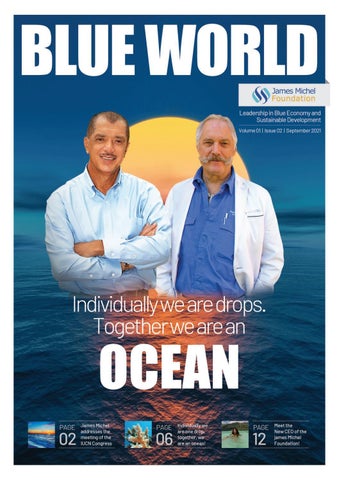
BLUE WORLD
Address of
James Alix Michel to the meeting of the IUCN Congress on 4th September 2021 on
the Great
Blue Wall Initiative Ladies and Gentlemen, Over the years, culminating into decades, I have metamorphosed from an idealist to a realist. I have had countless opportunities as a Head of State, and I continue to have, five years after retirement, - to be a voice in today’s like-minded fora. I can humbly pride myself now as a veteran voice. Today yet again, I will talk. I will advocate, I will implore. For there is no greater prayer than the hope that humanity will come to its senses and stop the madness of self-destruction. And today yet again, there is hope. The Intergovernmental Panel on climate Change (IPPC), has spoken. Yet again. Science is screaming, yet again. They are saying once again that we are at the tipping point. Humanity
2
Volume 01 | Issue 02 | September 2021
The Great Blue Wall Initiative is a project for the Western Indian Ocean countries with the possibility of extending it to the whole of Africa and the wider world. It was initiated by the Regional Director of IUCN Thomas Sberna with the strong support of James Michel, Former President of Seychelles, Founder and Executive Chairman of James Michel Foundation. The ICUN and its partners’ endorsement was announced as one of the key commitments to Action at its World Congress, in Marseilles, hosted by France. Below is the full text of the speech that Mr. Michel delivered to the meeting.
is shamelessly walking itself out of existence if we do not act now. Our land is burning and deserts are expanding, sea-level rise is drowning lowlying islands and coastal areas, we are taking our oceans for granted. We cannibalised its riches and in exchange we give it our garbage. Climate change, the survival of life on Earth, ocean protection, biodiversity are all interlinked. We have to heal and protect all as one. As junior voices join the veterans, there is hope that the world is progressively becoming more aware of the important, if not critical role our oceans play in the equation and the importance of healing and protection of our planet. The decade 20202030, “the ocean decade” as we have coined it, is a defining decade. 2030 is our Horizon to effectively protect 30% of our oceanic space. This is our new hope.
BLUE WORLD
Volume 01 | Issue 02 | September 2021
Look at us today! Today, it is embraced by the world. The Blue Economy is seen as a driver of conservation and development . We are unlocking its full potential - it can be sustainable, regenerative and people-centre.
Ladies and gentlemen, Unprecedented times call for unprecedented actions. The western Indian Ocean which has emerged as an important player in the advocacy of a regenerative Blue Economy for the region has to do much more and much faster. The Great Blue Wall initiative represents a unique opportunity to move forward at an unprecedented speed. Now is the time, with the support of our partners to make it a reality. Subsequently a wave can embrace the wider world. As a supporter, a world influencer and an advocate of the Blue Economy, I, today pledge my full support for this visionary initiative. The great Blue Wall Initiative provides a great opportunity if not, a moral compass to act as a global champion for the cause and pave the way towards a blue future. The Great Blue Wall presents a first of its kind. It is a unique approach for the region, Africa and the world subsequently. It promises to play an instrumental role in helping to achieve a nature -people positive world. A planet in balance. I believe it can be achieved provided there is political will . Let us make it happen, let us make history, let us make the future. I am reminded here of my Blue Economy Advocacy journey. Since 2010, I have been advocating a sustainable, Blue economy architecture for small island developing states and coastal states. At the beginning, as the head of state of Small Seychelles, I never missed an international opportunity to tell the World all about the blue economy. it was often a lonely journey plagued with a constant feeling of a lonely voice in the vast ocean.
The World’s first debt for nature swap, a financial architecture to alleviate the debt-trap and fund ocean protection and climate mitigation was initiated through my advocacy of the Blue Economy. Together with The Paris Club and the Nature Conservancy, we made it happen in 2012. It made provision to protect 30% of our oceanic space and develop a Marine Spatial Plan (MSP) for the sustainable ,regenerative use of our oceanic space. This is an effective instrument which can serve as a model for SIDS and coastal states. We subsequently launched, the World’s First Blue Bonds to finance sustainable fishing. The Blue Economy is my passion. Five years after retirement in the political arena, , I am still committed and active in my capacity as the Executive Chairman and the founder of the James Michel Foundation. As a member of the PewBertarelli Ocean Legacy Project, and an ocean ambassador , I have been pushing for all small island developing states and coastal states to legislate the protection of 30% of their oceanic space by 2030. The Great Blue wall initiative is a welcoming voice and partner and I urge the world to support this brilliant initiative. I see the ocean as the medium of life, and the future of civilisation. I see our great seas as a place that holds the world’s shares of Earth’s natural resources. I see the extent of care that is required to use this precious resource without having to disturb nature’s balance. Above all, way back then , eleven years ago, I saw the architecture of the blue economy concept as the saviour of our planet. Today, this reality is being talked about in the World. Once again I pledge my full support to this great initiative..- The Great Blue WallThank you.
Photo by: www.bbc.com
3
BLUE WORLD
Volume 01 | Issue 02 | September 2021
THOSE WHO USE THE MOST STAND TO LOSE THE MOST
Photo credits: Morgan Bennet-Smith and Christophe Mason Parker
4
Volume 01 | Issue 02 | September 2021
Nature was never created to be torn up, looked at, sat in or swum through. Local Communities and Indigenous Communities knew this for centuries. Therefore they lived by it. Therefore they lived with it. They knew there was only one way to do that. WITH LOVE, CARE AND UNDERSTANDING. Loving it enough to make like a bee, extracting its bounty without damaging its source. Caring for it enough to make sure that for everything they took, they put back as much if not more. Understanding it enough to work with nature and never against it.
BLUE WORLD When nature killers and nature protectors fight, they fight on the turf of the ICLCs. Neither wins but both the local communities and the natural environment loses. This is why the world has woken up to the fact that there is a difference between conservation and protection. This is why, a few days ago, the IUCN stated categorically at its global convention that conservation should be firmly placed in the hands of the indigenous and local communities because it is only for them that this is a life or death issue. Conservation can happen only through hands on users of nature not hands off protectors.
This is why indigenous and local communities are wise in the natural order and have the smallest ecological footprints of anyone on earth. Neither the ravagers of nature nor the protectors who go to war against them can so claim. Both consider those who live within the natural enclaves of the world to be predators and pests. Awash in their needs and egos they cannot see themselves as the chief aggressors and primary pestilences affecting natural order.
Because indigenous and local communities are the only ones who truly use the environment they can never truly abuse it and therefore they are the only ones who can truly conserve natural order because they are the only ones who truly know it.
5
BLUE WORLD
Volume 01 | Issue 02 | September 2021
Earle de Blonville, FRGS. Founding Director & CEO, Oceanic Research Institute, Australia https://www.linkedin.com/in/earldeblonville
The average Martian, jetting into Earth across the Pacific, would see only a blue planet. It is hard to miss since it is the only blue planet among the gazillion brown planets littering the universe. But it is not surprising Earth looks blue, as around 72% of the planet’s surface is Ocean, a contiguous mass comprising five major basins, four major bays, four major straits, 14 major gulfs, and 44 seas. All up, 67 bodies of salt water, many of them linked together by a giant conveyor belt of underwater currents that takes 1,000 years to circle the Earth. I mention the Martian, partly because they are familiar in our TV culture but mostly because we
6
Volume 01 | Issue 02 | September 2021
BLUE WORLD
actually know far more about Mars, and the Moon, than we do about our Ocean. Oddly, up to 95% of our Ocean is unknown to science, which shines a poor light on our Earthly curiosity. Also unknown, at least to our Martian, is that the blue water welcoming him, all 1.335 billion cubic km of it, has been sitting there quietly for 4.8 billion years. The Ocean comprises 99% of Earth’s biome (the environment where life can exist) which explains why it contains most of Earth’s species. Life on Earth began in the Ocean around 3.4 billion years ago and is currently home to 288,450 known species. Which is actually not much, considering that of the 86% of existing species discovered on Earth that have not yet been scientifically described, 91% of them live in the Ocean. It is now estimated that another two million species are still in the Ocean awaiting discovery. Despite the fact that generations of surfers, sailors, fishermen and explorers have spent half their lives gazing out to sea, very few people have the slightest idea of what the Ocean is and how it works. Perhaps its size and complexity are just too much to comprehend. So in this article I will try to tantalize you, the reader, with just a few hidden gems that make our Ocean probably the most utterly amazing and beautiful thing in the universe. To begin with, the Ocean is Boss. It creates the winds and waves that shape the shorelines, regulates the atmosphere and climate, and produces most of the oxygen needed for life. In essence, it makes the Earth habitable and controls all life on the planet. We owe our very existence to the Ocean.
Graphic showing the minute amounts of water and air on Earth
of life are finite, fragile and extremely vulnerable. Paradoxically, despite our tiny human size, our human impact on both Ocean and atmosphere has been immense, to the point where the Earth may soon be unable to support life as we know it, meaning the end of the human era. The Earth will go on, but without the current ecological diversity and without we little people who make such a big impact. In many ways, humans can look back to the destruction of Easter Island as a trial run for what we are doing globally now. The Ocean can seem mind-stretching-gigantic, with life on land appearing as a Lilliput version of life in the Ocean. For example, the biggest land animal is an African elephant, five meters long, weighing 70 tons that travels at five kilometers an hour. The
To us humans, the sheer depth and expanse of the Ocean and the vast reach of our atmosphere seems boundless and supremely powerful, leaving us feeling extremely small and insignificant. But the reality of this concept could not be further from the truth. This graphic on the right explains why. It reveals that compared to the size of the Earth, the amount of both water and air is miniscule. And that means the two most crucial elements
Blue Whale, largest animal to have ever lived on Earth
7
BLUE WORLD
Life on earth began in the Ocean and even today, every second breath we take comes from the Ocean. All our rain comes from and returns to the Ocean, and most of the Earth’s heat and CO2 is absorbed by the Ocean. Since 1970, the Ocean has absorbed 90% of the heat generated by global warming, and there lies the secret of what will either be our salvation or our extinction. And that secret has been recently discovered at the interface of Ocean and land, along the shorelines.
Volume 01 | Issue 02 | September 2021
biggest Ocean animal is the Blue Whale, 33 meters long, weighing 200 tons that cruises from 20 to 50 kilometers an hour. It is the biggest animal to have ever lived on Earth. Because water is denser than air, a Blue Whale song can travel five times faster than a passenger jet, and can be heard more than 800km away. So theoretically, a Blue Whale song can travel from Victoria, Seychelles, to Somalia in 20 minutes. At the other end of the scale is phytoplankton – tiny single celled algae that is not only the staple food for whales, but also creates some 95% of oxygen on Earth. It is only 10 microns thick, or 20% of the thickness of a human hair and invisible to the human eye. Ironically, humans and whales both depend on phytoplankton for their survival. The tiny oxygen molecules they create are 243 times smaller than Covid19 molecules. The highest waterfall on land, Angel Falls, which drops 807m, is only 23% of the size of the highest waterfall on Earth, Denmark Strait Cataract, which is underwater and falls 3,505m. The highest peak on land is Mount Everest, at 8,849m, but the world’s tallest mountain is the island of Hawaii, which rises from the sea floor and measures a kilometer higher than Everest. The world’s longest mountain range, the Mid-Atlantic Ridge, is mostly underwater and stretches 16,000km. The deepest canyon on land is Hells Canyon at a mere 2,400m, while at sea the Challenger Deep, in the Mariana Trench, dives to 11,034m, or 3,000m deeper than Mount Everest is tall, where the pressure is equal to the weight of 50 jumbo jets. And speaking of mountains, how many people are aware that 90% of the world’s volcanic activity occurs undetected in the Ocean? It is believed that volcanic hydrothermal vents are where the first life on Earth emerged. And speaking of heat, in Australia’s tropical waters currently lies the Great Barrier Reef, the world’s largest assembly of corals, equal in size to Great Britain. But perhaps not for long. As the Ocean acidifies and temperatures rise, fueled by the heat of burnt fossil fuels, the coral
8
Volume 01 | Issue 02 | September 2021
BLUE WORLD discovered at the interface of Ocean and land, along the shorelines.
Ocean hydrothermal vent
Thanks to the world-leading research by Prof Peter Macreadie and his Blue Carbon Lab, we now know that blue carbon ecology, comprising mangroves, salt marshes and seagrass meadows, can absorb CO2 30-40 times faster than the Amazon rainforest. This could enable us to re-engineer the atmosphere by fully protecting the interface of Ocean and land. In creating its Special Economic Zones, China destroyed all its coastal mangroves and now the South China Sea regularly floods what is one of the world’s most valuable manufacturing regions.
will dissolve like Elka Seltzer and disappear, taking with it 2,440 unique species of fish, shark, turtle, dolphin and coral. Other reefs around the world will suffer the same fate. But for now, it is interesting to learn that coral has the same architecture and chemistry as human bone. Two Israeli companies are farming coral for human bone grafts. The similarities continue. The human heart and brain, with 73% water content, mimics the Earth-Ocean ratio while the human body’s 0.4% salt content exactly matches the Ocean. Professor Peter Macreadie of the Carbon Lab working in mangroves
Life on earth began in the Ocean and even today, every second breath we take comes from the Ocean. All our rain comes from and returns to the Ocean, and most of the Earth’s heat and CO2 is absorbed by the Ocean. Since 1970, the Ocean has absorbed 90% of the heat generated by global warming, and there lies the secret of what will either be our salvation or our extinction. And that secret has been recently
Coral is cultivated for human bone replacement surgery
On a larger scale, we now know that the Indian Ocean is arguably the most powerful and influential basin on Earth because of its east-west climatic oscillation, the Indian Ocean Dipole (IOD), only discovered in 1999. The IOD is driven by small changes to sea surface temperatures and moves across the Ocean between Australia and Africa. The IOD recently stalled the annual monsoon in India, creating crippling drought, national food shortages, plus widespread deaths, including 60,000 farmer suicides, while in 2019 a powerful IOD in Positive Phase created the most destructive bushfire season in Australia’s history, wiping out millions of animals along the east coast. Sea surface temperatures are governed by atmospheric heat from burnt fossil fuels. The more government-subsidized fossil fuel that is burned, the more heat that sinks into the Ocean, the greater the frequency and intensity of storms that devastate
9
BLUE WORLD
Volume 01 | Issue 02 | September 2021
Most destructive bushfires in Australia’s history
Small Icelandic trawler rams a British warship in the Cod Wars
not only coastal regions but also human societies. And that is because, in varying degrees around the world, the majority of human populations live on or near the coast. In Australia (where I write), it is 86% of the population. In the Seychelles, it is probably 100% of the population. And as the 2004 tsunami that in a few hours wiped out 230,000 people demonstrated, coastal living is a two-edged sword of either great peace and beauty or sudden death. As sea level rise accelerates, driven by thermal expansion and polar meltwater, what is now hilly hinterland will likely become the new coast.
previously regarded as an endless supply of fish in an endless Ocean, suddenly became a scramble to protect the few breeding stocks left of a critical food source for millions of people. Icelanders took the lead as conservationists and the UN responded by creating, in increments, a 200-mile Exclusive Economic Zone that today protects all coastal countries.
The 2004 Boxing Day tsunami was the most destructive ever recorded
The Ocean has traditionally provided reliable, nutritious, abundant and sustainable food for coastal populations. The cod wars between England and Iceland, begun in 1958, erupted into full-on warfare in 1976, when tiny Icelandic fishing boats were shown on TV news ramming English warships. This marked the first time the greater public became aware of the drastic depletion of Ocean fish stocks through overfishing. What was
10
That zone, now referred to by coastal nations as their Marine Estate, is the focus of innovative management policies that aim to balance preservation and restoration of the Ocean’s health with responsible exploitation of its food and natural resource wealth. And wealth there is! The global Blue Economy is currently valued at $1.5 trillion a year. Australia has the third largest Marine Estate on Earth, offering a potential Blue Economy estimated at $130 billion a year, including food production, resource harvesting and employment, making it the country’s most valuable economic resource. Australia’s Blue Economy is growing at 7.5% a year; far outstripping the country’s traditionally based GDP. But Australia will never develop even half its potential while it fails to invest in infrastructure, starting with replacing its tiny ageing research fleet. Paradox is possibly the greatest enemy of the Blue Economy. Nations are surrounded by Oceans of potential, visible every day to the majority of the population, and yet are politically blind to the opportunity.
Volume 01 | Issue 02 | September 2021
BLUE WORLD For this to change requires great leadership, the global community is extremely fortunate that such a great leader exists in former Seychelles President James Alix Michel. As an innovator and visionary James implemented the world’s first Blue Economy initiative when his Government created a Blue Economy Ministerial Portfolio in 2013.
Seychelles President James Alix Michel in 2015
Smith has demonstrated that the world’s population, now and well into the future can be easily fed by small, privately owned kelp and shellfish farms, and that the total coastal space needed would only require about 185,000 square kilometers, equal to Syria or Washington State. Such farming, of incredibly fast-growing, multi-purpose food, requires very little skill and capital, making this aspect of the Blue Economy easy to achieve and fast to implement.
He demonstrates that it takes a special intelligence to realize that the solution you seek is staring you in the face. And the wisdom of his pioneering initiative is now being embraced and developed around the world, by both governments and new popular movements, such as American fisherman Bren Smith’s ‘Green Wave’. Smith has demonstrated that the world’s population, now and well into the future can be easily fed by small, privately owned kelp and shellfish farms, and that the total coastal space needed would only require about 185,000 square kilometers, equal to Syria or Washington State. Such farming, of incredibly fast-growing, multipurpose food, requires very little skill and capital, making this aspect of the Blue Economy easy to achieve and fast to implement.
Green Wave sustainable seafood innovator, Bren Smith
But given all the other Ocean-based initiatives underway worldwide for developing sustainable food and materials, the Blue Economy stands alone in offering Mankind a non-destructive future and even a spiritual reunion with the Ocean, from where we first emerged.
11
BLUE WORLD
Meet the new CEO of the James Michel Foundation!
Volume 01 | Issue 02 | September 2021
From a very young age, she understood the importance of the environment to the development of maritime states and became deeply and emotionally bonded with the things of nature as well as the rhyme and reason of the nature of things, combining sensibilities in the one and abilities in the other towards becoming a Compete, sustainable human being.
Debbie Monthy
12
Volume 01 | Issue 02 | September 2021
BLUE WORLD
Recognizing the global need for youth leadership in conservation based development, The James Michel Foundation has appointed Ms. Debbie Monthy as its new Chief Executive Officer. Debbie holds a Bachelor’s in Business and a Master’s in Human Resource Management. Most importantly, she is replete with that sense of oneness with the ocean and its interplay with the islands that comes from being a child of the sea and the sand, having grown up in her native Seychelles. From a very young age, she understood the importance of the environment to the development of maritime states and became deeply and emotionally bonded with the things of nature as well as the rhyme and reason of the nature of things, combining sensibilities in the one and abilities in the other towards becoming a Compete, sustainable human being.
Born to the swift of the sea and the shift of the sand
It is indeed the good fortune of the James Michel Foundation to have such an enabled young woman at its helm as it continues to contribute to the charting of the ship of sustainable development through the murk, storm and current of local, regional and international sociopolitical and socioeconomic complexities. Debbie, even though young in years, is old in wisdom of global geopolitics and sustainable development mechanics and has proven capabilities in these arenas that will ensure that the organization meets and overcomes ever increasing challenges as it spreads its core messaging across the world. We wish her every success in her new position and extend our warmest and sincerest support in implementing her plans for the future of the foundation. Defined by the ocean, enabled by the land
13
BLUE WORLD
Volume 01 | Issue 02 | September 2021
Reefs in Peril: Local solutions for a
GLOBAL PROBLEM Nishan Perera
BRT staff undertaking coral bleaching surveys. - © Nishan Perera
14
Volume 01 | Issue 02 | September 2021
Azure seas shimmering in the morning sunlight, clear skies, and flat waters greet us as we depart Pasikudah by boat. On board, the Blue Resources Trust coral reef research team is preparing for another day of surveys at Kayankerni reef, 15km north of our departure point. Upon reaching our survey site and safely anchoring the boat we don our dive equipment and go through the pre dive safety checks. It is early May, and there is almost no wind. A stillness hangs in the air almost in anticipation. The sea surface is as flat as a mirror, disturbed only by a turtle that has breached the surface, exhaling a small plume of water from its nostrils. A few seconds later it takes another breath and descends back to the reef below. We roll into the water and follow the turtle to be greeted by a colourful and vibrant reef teeming with marine life. Multi-hued corals cover the seafloor, schools of parrotfish and surgeonfish graze on algae, clouds of damselfish retreat into the coral as we approach, and colourful butterflyfish swim over the reef. There was a time that scenes such as this were commonplace around Sri Lanka. Early divers in the 1950’s, ‘60’s and even ‘70’s raved about the island’s coral reefs and excellent diving. Sri Lanka in fact was a pioneer in the marine aquarium fish trade, with local collectors quick to realize the potential of the resources just off their coast. Unfortunately, the most coral reefs in Sri Lanka now paint a far different picture. Overfishing, use of destructive fishing methods, pollution, and coastal development have degraded most reefs and depleted fish stocks. Climate change has played its part as well, with coral bleaching causing extensive coral mortality on many reefs. But Sri Lankan reefs are not an isolated example. The situation is the same around the world, with scientists estimating that more than 50% of global reefs have
BLUE WORLD
been severely degraded to a point where they cannot perform their ecological functions. The world is facing a global coral reef crisis, and Sri Lanka is a perfect microcosm of this. The reefs that remain in a healthy state are under increasing threat from a growing demand for reef resources and the ever increasing threat of climate change. Conserving such reefs is now a priority as they are important refugia for biodiversity and provide a living laboratory to understand coral reef ecology. In this light, Kayankerni reef is both a window to a past of how Sri Lankan coral reefs looked like, and a peek into the future of how they might cope with climate change impacts. On the coast, in the small fishing village of Kayankerni, local fishers’ local fishers haul their small boats up the beach to unload their days catch. Like on the reef, here too is a snapshot of what the past was like. This is an area that has suffered much, from war, to tsunamis. Unlike many other parts of Sri Lanka, fishing is still small scale and mostly artisanal. A major reason why the nearby reef remains in a healthy condition. But for the local community, the reef is not just something beautiful, it is their main source of sustenance. There are limited livelihood opportunities here, and locals depend on the reef to feed themselves and their families. The local fisheries society understands the importance of the reef and have taken measures to restrict certain forms of fishing they consider as detrimental to the reef. But change is coming. In nearby Pasikudah, just 20km by road, large resorts line the beach. Speculative buyers have invested in Kayankerni as well. Middlemen purchasing fish for major local and international markets are beginning to visit the area, and fishers from other parts are beginning to access local fishing grounds. For the people of
15
BLUE WORLD Kayankerni, it is essential that such developments lead to benefits for them. Their hardships and their efforts should not be capitalized upon by others. Sustainable fisheries and effective fisheries management driven through community-based mechanisms is critical to ensure that local fishery resources are exploited in a manner that does not lead to long term degradation of fish stocks and ecosystems. The people of Kayankerni have taken the first steps and laid the foundation to build on this. There is also tremendous potential for the growth of non-extractive livelihoods. Entrepreneurial locals already offer boat and snorkeling tours to the local reefs. With support, this may be a viable alternative to fisheries in the area. In 2016, during a major global coral bleaching event, Blue Resources Trust (BRT) started regular surveys of Kayankerni reef. This has since developed into a long-term coral reef monitoring program with the establishment of a BRT field station in Kalkudah. A major aim of the research is to understand the impacts of coral bleaching, how understanding the biological and physical parameters that make some reefs more resilient than others. Coral bleaching is a stress response of corals, often to increases in sea temperatures. Recent decades have seen an increasing number of local and global coral bleaching events as a result of climate change. The impact of this has been devastating for reefs around the world, with over 90% loss of corals on some reefs. Identifying resilient reefs is therefore critical in identifying and protecting biological refugia that may support the recovery of species and ecosystems. In 2019, Kayankerni reef was declared as a Marine Sanctuary by the Sri Lanka Department of Wildlife Conservation (DWC) in recognition of its importance as a biological hotspot and refugia for corals and marine biodiversity. Since then, BRT has been working to support the DWC and the local community to conserve and manage this unique ecosystem. BRT engages with the local community and other stakeholders to conduct beach cleanups, educational programs, and training programs. Blue Resources Trust (BRT) is currently engaged
16
Volume 01 | Issue 02 | September 2021
in the Community Livelihoods and Biodiversity Recovery (COLIBRI) project together with the Environmental Foundation Limited, Green Movement of Sri Lanka, and ACTED Sri Lanka. The project is being implemented in three protected areas in Sri Lanka, including Kayankerni Marine Sanctuary. In Kayankerni, BRT will lead activities to support the DWC to develop a management plan, support community driven conservation, and sustainable livelihoods development. The work will build upon previous research, community engagement, and relationships building of BRT in the region for several years. Efforts are underway to engage the private sector in supporting marine conservation in the area, especially the tourism sector and resorts in Pasikudah. This includes developing best practice guidelines and resources for local snorkeling boat operators that will both improve visitor experiences and provide value addition to local boat operators. Identifying and supporting sustainable livelihoods and ensuring that the growth of tourism supports local communities engaged in sustainable practices will provide incentives for such practices and encourage long term behavioral changes. BRT is also working with the local fisheries society in Kayankerni to establish a fisheries management plan that is developed through by and enforced by the local community. Although COVID-19 has slowed down and complicated ongoing activities, establishing processes for positive long-term impacts will ensure that both local communities and the coral reefs of Kayankerni face the future with optimism. The Community Livelihood and Biodiversity Recovery (COLIBRI) project, funded by the European Union, aims to protect, preserve and restore biodiversity clusters in Sri Lanka, namely the Knuckles Conservation Forest (KCF), the Bar Reef Marine Sanctuary (BRMS) and the Kayankerni Marine Sanctuary (KMS). The project will safeguard these fragile forest and coral reef ecosystems by strengthening civil society’s capacity to promote the sustainable use of natural resources and improve livelihoods. The project will also conduct new research, consolidate scientific resources online for the wider public and leverage findings for policy advocacy and post-project forward planning.
BLUE WORLD
Volume 01 | Issue 02 | September 2021
Healthy coral reef at Kayankerni - © Nishan Perera
www.srilankamirror.com
Meeting with local fishers - ©Blue Resources Trust
Image 4. Conducting awareness programs for local schools - ©Blue Resources Trust
17
BLUE WORLD
Volume 01 | Issue 02 | September 2021
S Y A S O WH e b t o n n a c d l r o ? w e l o e h th w a s a d e w vie
18
BLUE WORLD
Volume 01 | Issue 02 | September 2021
The world is one although in our insanity, we have chosen to segregate it into various components identified by what are largely fantasy labels. Be it physics, economics, nature, socioeconomic stratification or nations, we have chosen to slice our world into tinier and yet tinier pieces. The breaking up of something as infinitely parameterized and complex as a planet of sentient beings has only one outcome – it breaks it. We are slowly coming to realize that atom smashing has not expanded our wisdom but only our learning. We are slowly realizing that the union of the green of land and the blue of sea is not only the way nature works but the only way it can work. With slow-dawning perception, we are concluding that anything segregated beyond the elemental forces of earth, water, fire and air is just plain dumb. To even look beyond the green scape and blue scape for natural segregation silly. Dumbness and silliness are not qualities associated with Seychellois entrepreneur and businessman Mr. Bernard Port-Louis nor his conflict, dispute resolution and business law expert son Benjamin. Nature lovers by nature, environmentalists at heart and quality human beings all around, they saw a way to give credence to the oneness of the world by linking the blue economy with the green. Their plan was simple and natural. They saw the vast amounts of seaweed that was being washed on to the beaches of their island nation. They saw the massive poisoning of the earth by agrochemicals. They saw a way to eradicate the pollution of beaches by the seaweed and the pollution of the earth by the agro-toxins in one single, brilliant move. They were going to make natural, organic fertilizer by using those mountains of seaweed. They were going to be the first from their part of the world that would create that vital link between sea and land, green and blue through a combined cyannic business venture. As advocates for reviving agriculture industry in a traditionally ocean harvesting country, they went to work in earnest, consulting with world-renowned Australian Research Company CSIRO. Seaweed Seychelles Pty Ltd, the owner of the PCT patent
What is truly fantastic about the effort is the way in which the process happens. First, the seaweed grows naturally in the sea. Next, it washes up naturally on the beaches. Then it is physically sorted by human beings and washed in the sun naturally. It is washed with natural hot water to rid it of excess saline and then processed by a plant that takes once again the energy of the sun.
and intellectual property for the special mechanism for extracting a liquid plant growth promoter from naturally washed up Sargassum seaweed and fucoidans – the world’s first 100% natural product. Their factory on reclaimed industrial land on Eve Island can process 4 tons of seaweed per day and is powered by a 11KWh Photovoltaic Solar Energy. What is truly fantastic about the effort is the way in which the process happens. First, the seaweed grows naturally in the sea. Next, it washes up naturally on the beaches. Then it is physically sorted by human beings and washed in the sun naturally. It is washed with natural hot water to rid it of excess saline and then processed by a plant that takes once again the energy of the sun. At no point in this production chain is there anything unnatural. Collaterally, it detoxes the land by its application in lieu of chemical fertilizers, it rids the beaches of seaweed pollution leaving it pristine and toxin-free for tourists since long term exposure to the toxins released by decaying seaweed is detrimental to
19
human health. Its removal opens the path of turtle hatchlings to the sea while allowing other coastal plant life that might otherwise die due to the salinity of the seaweed to flourish.
complementarity, when the heart of a human
Whoa! You see right? The entire ecosystem from sea to land is treated by this extraction method leaving it holistically sound while still enabling enhanced quality of life for farmers, tourists and coastal fauna and flora making it truly a first-ofkind operation that is zero waste, zero carbon and zero pollution.
durable and replicable. This is the type of initiative
When life is treated as a whole, when science is leveraged for absolute, mutually intermeshed
being is wired as it should be to nature and its subtle dynamics, this is the type of innovation that happens. This is the type of creation that can be that can be trigged by the blue economy initiative of former president James Michel. We are smiling. The anthroposphere is on a footing to rethink itself as part of a whole, not part of a physics or a chemistry or a blue or a green. What can we say? Salute! Messers Port-Louis.
organic-soil-promoter
Publisher:
Editors:
Layout & Design:
James Michel Foundation Beleau, Victoria, Seychelles. www.jamesmichelfoundation.org
www.olive.lk