




As my term as the 87th President of the Junior League of Washington comes to a close, I’m filled with gratitude and pride. This year reminded me just how powerful we are when we come together with purpose and heart.
We kicked off the year with JLW LIFE, an invitation to Lean in, Invest in development, Find pathways to opportunity, and Engage. And you delivered. From day one, you showed what JLW LIFE looks like in action.
We welcomed 300+ New Members and Transfers, each bringing energy and excitement that fueled our momentum.
At the National Book Festival, I stood among 400 volunteers in black and white hats and felt overwhelming pride. Together, we contributed 2,500 hours to the Library of Congress. Whether you’ve been in the League for five minutes or fifty years, we served side by side with joy, professionalism, and unity.
Throughout the year, we deepened community partnerships week after week, strengthened our internal connections, learned from inspiring leaders like Carla Hall, and thanks to successful fundraisers, continued investing in pathways to opportunity.
To the 2025–2026 Board of Directors: thank you for your leadership, passion, and unwavering dedication. Your leadership made this year not only successful, but deeply meaningful.
To our incredible staff, thank you for making everything possible and for loving this organization as much as our members do.
To Madam President-Elect Jackie Frederick-Maturo: You are an extraordinary leader and friend. Your bold vision and steady guidance will carry us into the next five-year strategic plan and position our League for success for the next 114 years. I cannot wait to see where you and your board take us.
To my family, I love you more than words can express, and I could not have done this year without your constant support and encouragement. Thank you for being my foundation and my greatest joy.
And finally, to the women of the Junior League of Washington and to all our community partners, thank you for living this JLW LIFE with me. Serving alongside you has been one of the greatest honors of my life.
Yours in service,
Christina Babcock
2025—2026 JLW President
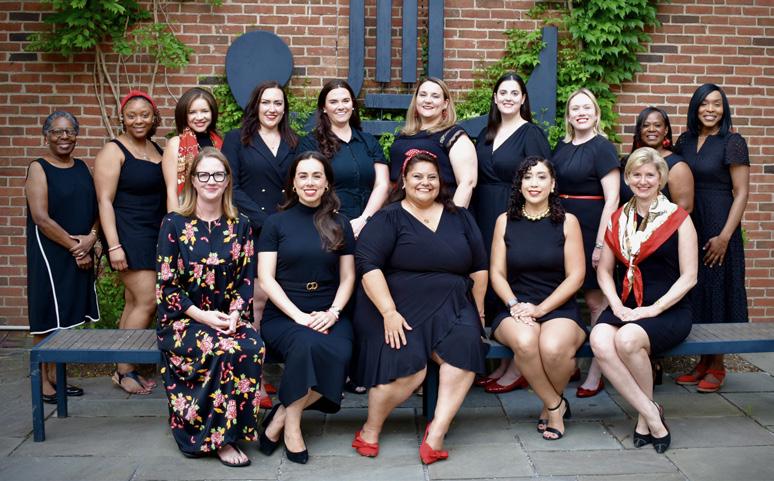
President Christina Babcock
President-Elect
Jacqueline FrederickMaturo
Secretary Judith “Alex” Shaw
Treasurer Colleen McKiernan
Vice Treasurer
Kristin Scherago
New
Kristin Koernig
Nominating
Maureen Higgins
Strategic
Marissa Malta
Fay Arrington Ways
Tiffani C. Moore
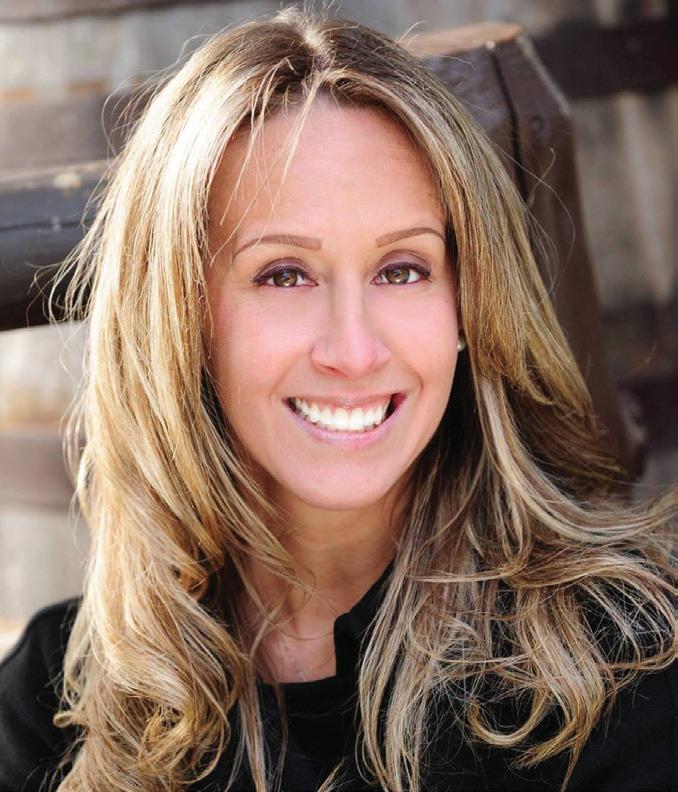
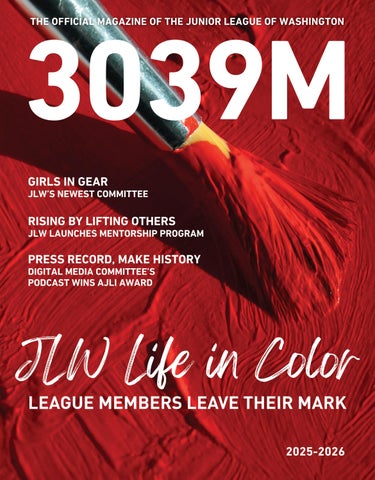
To color something is to leave it changed - marked by those who painted it. This is the sentiment embodied in this year’s 3039M theme “JLW Life in Color – League Members Leave Their Mark.”
Whether volunteering at the National Book Festival, with the Alexandria Historic Docents, with the Folger Shakespeare Library, with the National Museum of Women in the Arts, with Horton’s Kids, with Iona Senior Services, at Langley or Tossed & Found helping community members, or within the League helping fellow JLW members or keeping the organization itself running, League members color the very fabric of the community with our actions.
When I envision these acts of service, I picture members painting the town JL Red— the signature color of the Junior League color palette. The enthusiasm and dedication of League members is both unmistakable and undeniable. And the legacy and impact left behind is the identifiable marker of our work. It says - Junior League was here.
The work we do also colors us. It is impossible to be out in the community and not feel one gains as much as one gives from those we serve, or to see the faces and service of our fellow volunteers, and not have it leave a stamp on one’s heart; to not be changed for the better.
This is the way Junior League of Washington (JLW) members color the world. With every action we take as members, from serving the community to serving our fellow members and our League, we leave our mark on the city and on the lives of those touched by our service. This is what we have done for the past 113 years. And we continue to grow our numbers and our impact.
On the Publications Committee, we use our voices to serve as the story tellers of the League by documenting and sharing the work done by each and every one of you. The words contained in these pages are our mark. And this magazine is a testament to the labor of love that is serving in JLW.
Since the very first day I joined Junior League as a New Member, I said I wanted to be the editor of the magazine. This year, I got to live my dream and leave my mark serving as Editor of 3039M and Chair of the Publications Committee, and it has been the honor of my Junior League career. Our team wrote the most ever stories in an edition of 3039M, and I’m so proud of this issue which was made possible by the Publications Committee’s hard work and dedication.
I hope that you will join me in using your energy and your enthusiasm to serve, to do good, and to lift up others. May the voices we use always be kind and thoughtful, and uniquely and proudly our own. May the way we move through the world be brave. May we continue to leave our mark, and to paint the world around us in colors that are bold and bright. This is how we live JLW Life in Color.
Yours in service,
Sarah Valerio Editor
Chair Sarah Valerio
Vice Chair, Blogs
Megan Lilly
Vice Chair, Advertising
Gabrielle Murphy
Vice Chair, Annual Report
Meredith Lesieur
Vice Chair, Editing
Tiffany Edmondson
Alanna Brannam
*LaKisha Brown
Samantha Cabbell
Victoria Callahan
Paulina Enck
*Sherilyn Harrington
Jessica Hassanzadeh
*Shannon Jessen
Ashley Lawrence
Poppy Merrell
Lacy Nelson
Amanda Peters
Kate Seif
*Yolanda Raine

In Washington, DC, leadership is often defined by where you sit, who you know, and how visible you are. Titles matter. Platforms matter. Proximity matters. But at this year’s Women’s Leadership Breakfast, a different definition took hold—one rooted not in visibility, but in presence.
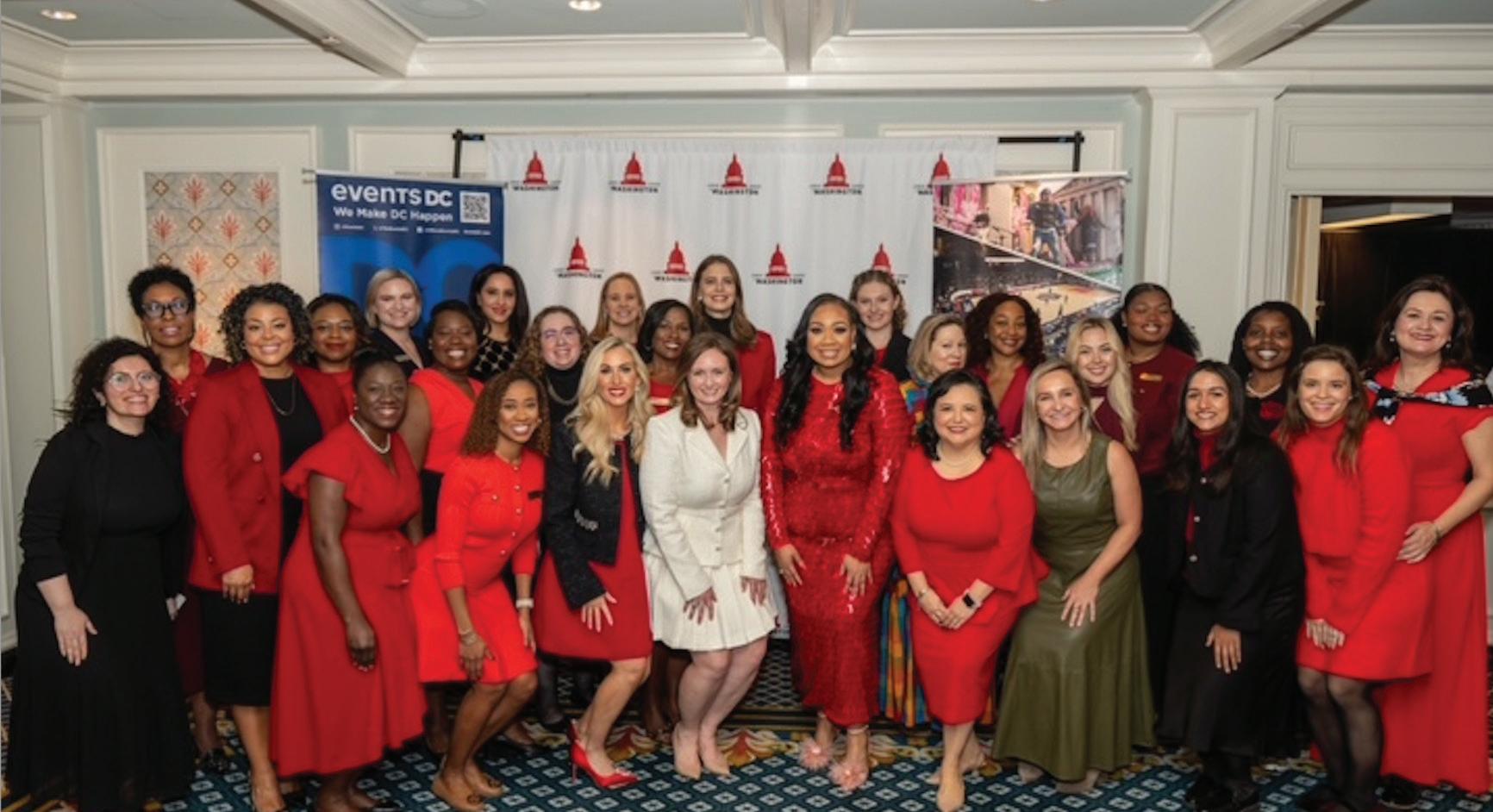
Held November 21, 2025, at the historic Willard InterContinental Washington, DC, the breakfast brought together women from across the region’s civic, nonprofit, and cultural communities to explore The Recipe for Impact. What emerged was a shared understanding that modern leadership is less about occupying space and more about how fully you show up within it.
From the beginning, the planning committee was intentional about creating an experience that felt worthy of attendees’ time and purpose. This was not simply about hosting a fundraiser; it was about designing something that would resonate well beyond the morning itself.
“One of the most important outcomes for us was that people were still talking about the Women’s Leadership Breakfast after it was over,” says Laisha Dougherty, Co-Chair of the
Women’s Leadership Breakfast. “That was how we measured success. If the conversations continued, we knew the event had made an impact.”
For Dougherty, the theme itself was foundational. The Recipe for Impact was not only a nod to the keynote speaker but also a reflection of how leadership works in practice. “There are many different ingredients that go into the work our members do,” she explains. “Just like a recipe, impact is created when those elements come together with intention.”
That philosophy shaped every decision, from speaker selection to the venue itself. “Since the Women’s Leadership Breakfast is a fundraiser, our primary objective was to raise as much money for the League as possible,” adds Erica Taylor, Rising Co-Chair of the Women’s Leadership Breakfast. “But we also wanted to make the event an experience worth the price of admission.”
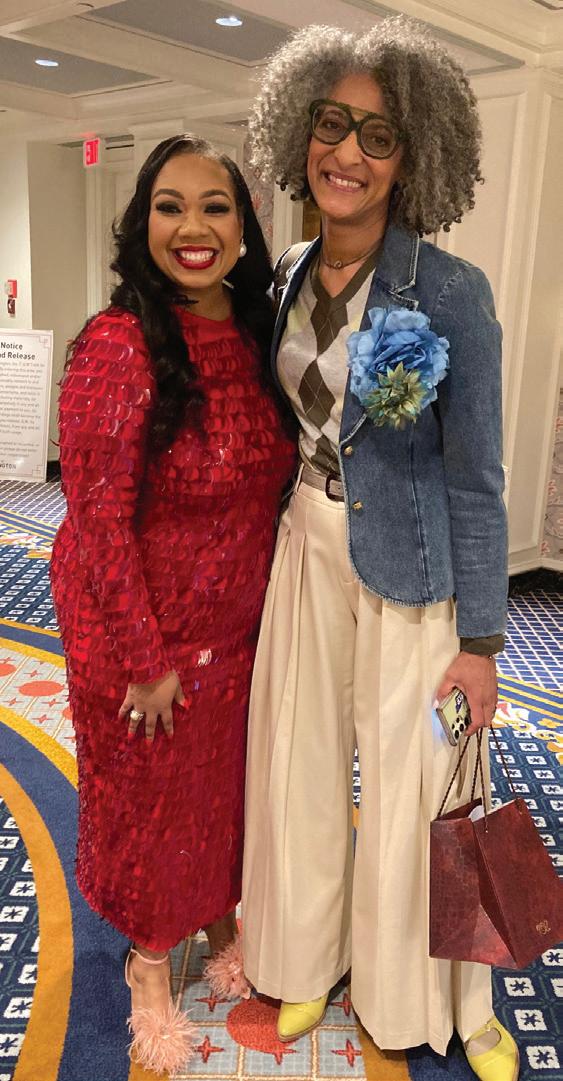
Women’s Leadership Breakfast Co-Chair Laisha Dougherty with keynote speaker Carla Hall, whose message of presence, purpose, and authenticity set the tone for the Women’s Leadership Breakfast.
Together, the committee focused on thoughtful programming, credible voices rooted in real-world leadership, and a venue where every detail reinforced the importance of the work happening in the room.
“We wanted an environment designed to reflect our attendees’ time, attention, and priorities,” Taylor says. The result was a space that encouraged focus and connection. In a city that often moves quickly, that sense of presence felt intentional and welcome. If the morning had a defining moment, it came from the keynote. Carla Hall took the stage with warmth and candor, offering reflections on leadership shaped by authenticity, confidence, and service. Then came the line that would echo long after the breakfast ended: “I bring Main Dish Energy.”
“That moment brought the theme to life immediately,” Dougherty says. “It aligned perfectly with The Recipe for Impact, and it was incredible to see how quickly it stuck with attendees.”
The phrase was playful, but its meaning landed deeply. It rejected the instinct to shrink or wait for permission and instead encouraged women to claim their place with confidence. “That quote really summed up the entire breakfast,” Taylor adds. “The number of times I’ve heard ‘Main Dish Energy’ quoted back to me since has been incredible.”
For attendees, the impact showed up not only in keynote moments but also in ideas that felt immediately applicable. “I loved Alison Cheperdak and her talk on professional, modern etiquette,” shares Desiree Carey, Recruitment Chair. The session reframed leadership as something expressed through presence, confidence, and intentional behavior rather than authority alone.
Carey also reflected on how the setting reinforced the League’s role in the broader community. “Having the event at a historic, five-star hotel like the Willard really elevated the League’s presence,” she says. “It shifted how I thought about our impact and how others see us.”
When asked which leadership qualities are most often overlooked, Dougherty pointed to collaboration and delegation. “In a volunteer organization like ours, it can be easy to work in silos,” she says. “But collaboration and delegation are essential. Leaders are not meant to do everything themselves. Delegation builds trust and gives people ownership.”
That idea echoed throughout the breakfast, reinforcing leadership as a collective practice rather than an individual performance.
The Women’s Leadership Breakfast did not close with a call for visibility or recognition. Instead, it offered something more lasting—permission to lead with presence, confidence, and care.
In a city where leadership is often status-based, the Junior League of Washington offered a quieter reframe. Impact is not about being seen. It is about being fully there. Sometimes, that starts with claiming your place at the table and bringing main dish energy with you. •
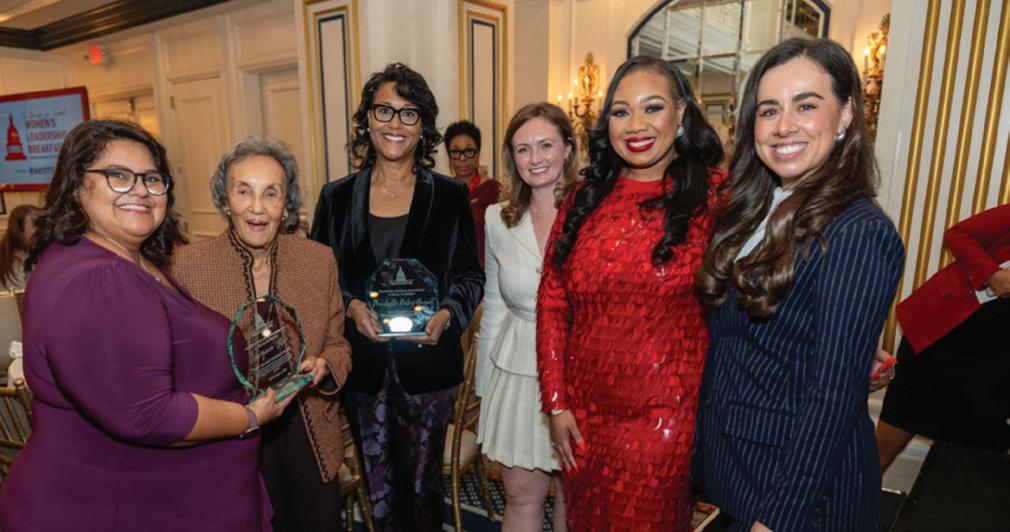
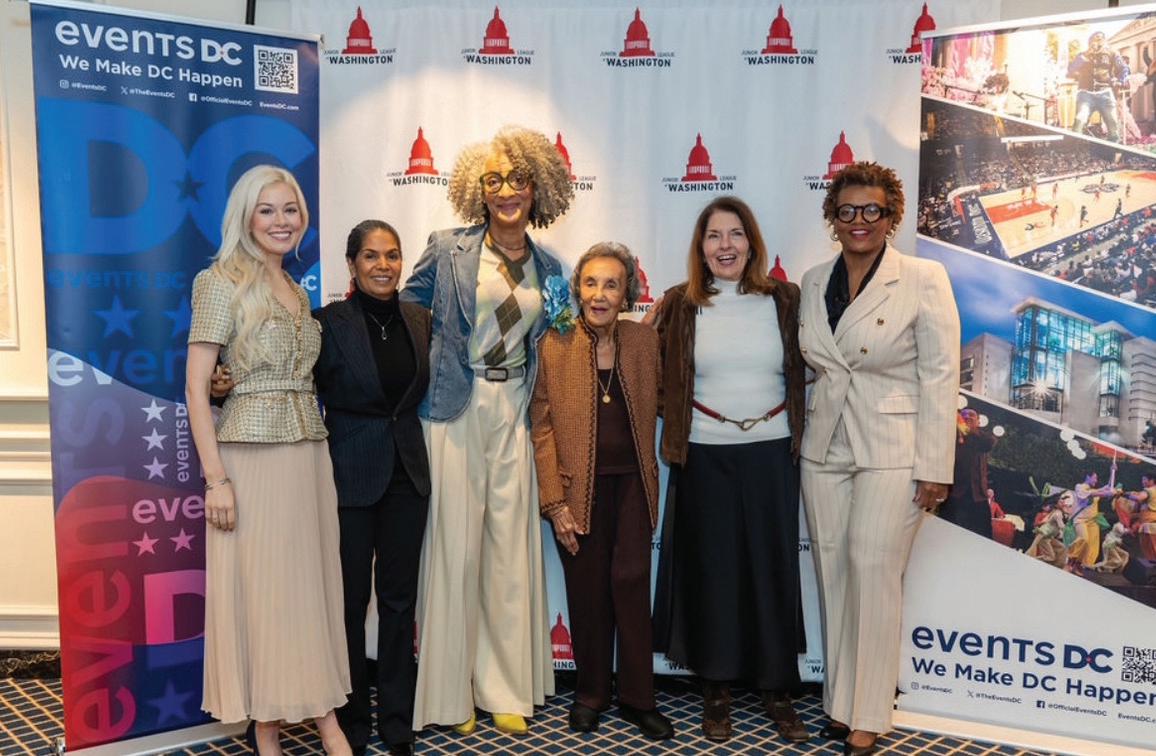
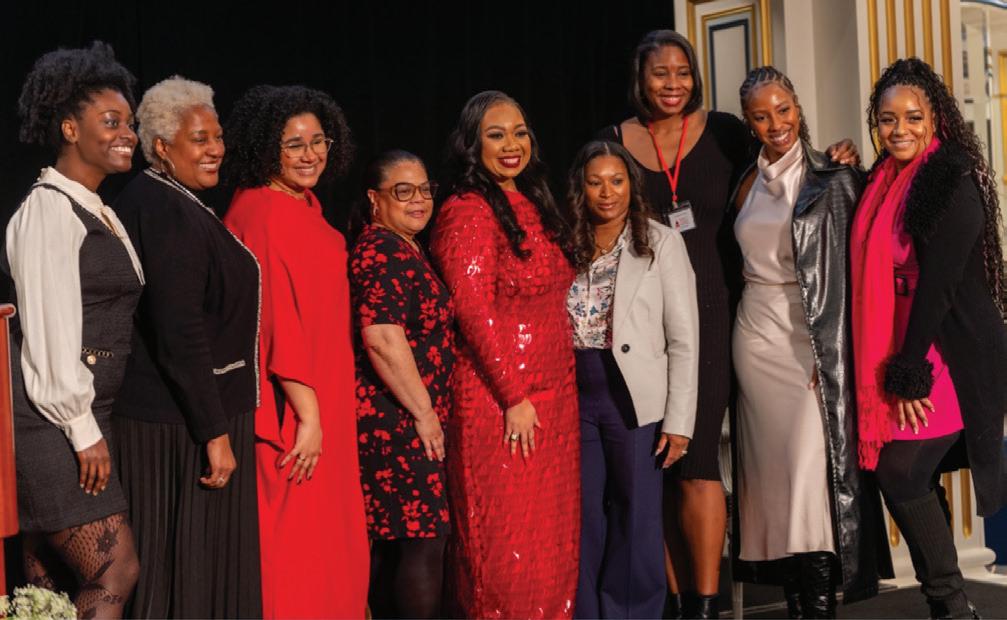
left to right: Christina Babcock (JLW President), Virginia Ali (Mary Harriman Award recipient), Michelle Riley-Brown (President & CEO, Children’s National Hospital and Terry Algire Award recipient), Sparling Wilson (WLB Co-Chair), Laisha Dougherty (WLB Co-Chair), and Jacqueline Frederick-Maturo (JLW President-Elect) gathered to celebrate leadership and service.
Jessica Hassanzadeh
Every Wednesday evening, in a quiet section of the National Rehabilitation Hospital, something remarkable happens.
For just one hour, patients step out of the routines and challenges of recovery and into a space filled with creativity and connection, a space filled with Junior League of Washington (JLW) volunteers. As committee chair Jennie Kronthal puts it, “It’s just one hour. But that one hour can change someone’s entire week.”
For Kronthal, this work began with family.
Her father was once a patient at the hospital, and that experience left a lasting impression. She saw not only the clinical side of recovery, but also the emotional realities patients navigate: uncertainty, isolation, and adapting to a new normal.
Her co-chair shares a similar connection, having had loved ones who received care there. They have seen firsthand the physical and emotional toll of recovery, as well as the moments of hope that make healing possible.
“We’re not just volunteering,” Kronthal explains. “We understand what it feels like to be on the other side of that door as a patient or family member.”
Years ago, the committee hosted bingo once a month, a well-intentioned but limited touchpoint between JLW and National Rehabilitation Hospital patients. Over time, volunteers recognized something important: meaningful connections require consistency. Today, volunteers visit once a week. The shift
from monthly to weekly has transformed the experience for both patients and volunteers.
“When you’re there every week, you see people change,” Kronthal says. “You see their recovery. You build relationships. Once a month doesn’t allow for that.”
The activities JLW volunteers lead have evolved as well. On any given Wednesday, volunteers lead activities such as card-making, needlepoint, guided meditation or yoga, painting, and vision boards, designed to meet patients where they are physically, emotionally, and creatively.
“Inviting patients out of their rooms is the most important thing we do. That personal invitation tells them they matter; that someone sees them.”
The hospital serves a wide range of patients, and designing programming that resonates across age groups and levels of mobility is no small task. But some of the most important work happens before any activity even begins.
Each week, Kronthal arrives at least an hour early and knocks on nearly 90 doors to personally invite patients to participate. “Inviting patients out of their rooms is the most important
thing we do,” she says. “That personal invitation tells them they matter; that someone sees them.”
Some patients have experienced sudden, life-altering events that have led to their hospital stay. They may feel unsure, withdrawn, or deeply discouraged. Kronthal recalls moments when a simple gesture, a conversation, an invitation, even a handmade card, shifted a patient’s recovery mindset and made the path forward just a little bit easier.
Many patients look forward to Wednesday nights all week. For some, it becomes the moment that breaks up long days of therapy. Kronthal recalls a patient who was scheduled to be discharged but chose to stay an extra day just to participate in one more session with the Junior League volunteers. “She wanted that experience again,” Kronthal says. “That tells you everything.”
Another former patient, inspired by her time in the program, has expressed a desire to return, not as a participant, but as a volunteer. It’s a full-circle moment that captures the true meaning of the work: a connection that lasts beyond the hospital walls. “This is one of the most impactful things you can do in just an hour,” Kronthal says. “But you don’t always realize that until you experience it.”
While the focus is on patients, the placement is equally powerful for volunteers. Many arrive intending to give, but leave having gained just as much, through the resilience, strength, and openness they witness each week. •




Megan Lilly
This year, the Junior League of Washington (JLW) launched its first formal mentorship program designed to help members connect more deeply and grow professionally. Interest in the pilot quickly exceeded expectations, signaling strong demand for something the League had long been missing.
Laura Shull-Chandler, Presidential Appointee on the Mentorship Program Task Force, had hoped for exactly that response. “I’ve been part of Junior League for over 15 years, and when I first joined, I remember thinking how incredible it would be if there were a mentoring program as part of JLW,” she says. “I kept meeting women who were smart, passionate, and incredible at what they do, and I wanted them to mentor me.”
The idea began taking shape during the 2022–2023 League year, when Shull-Chandler served on the Board alongside then President-Elect Charlyn Stanberry. As they discussed ways to strengthen leadership development,
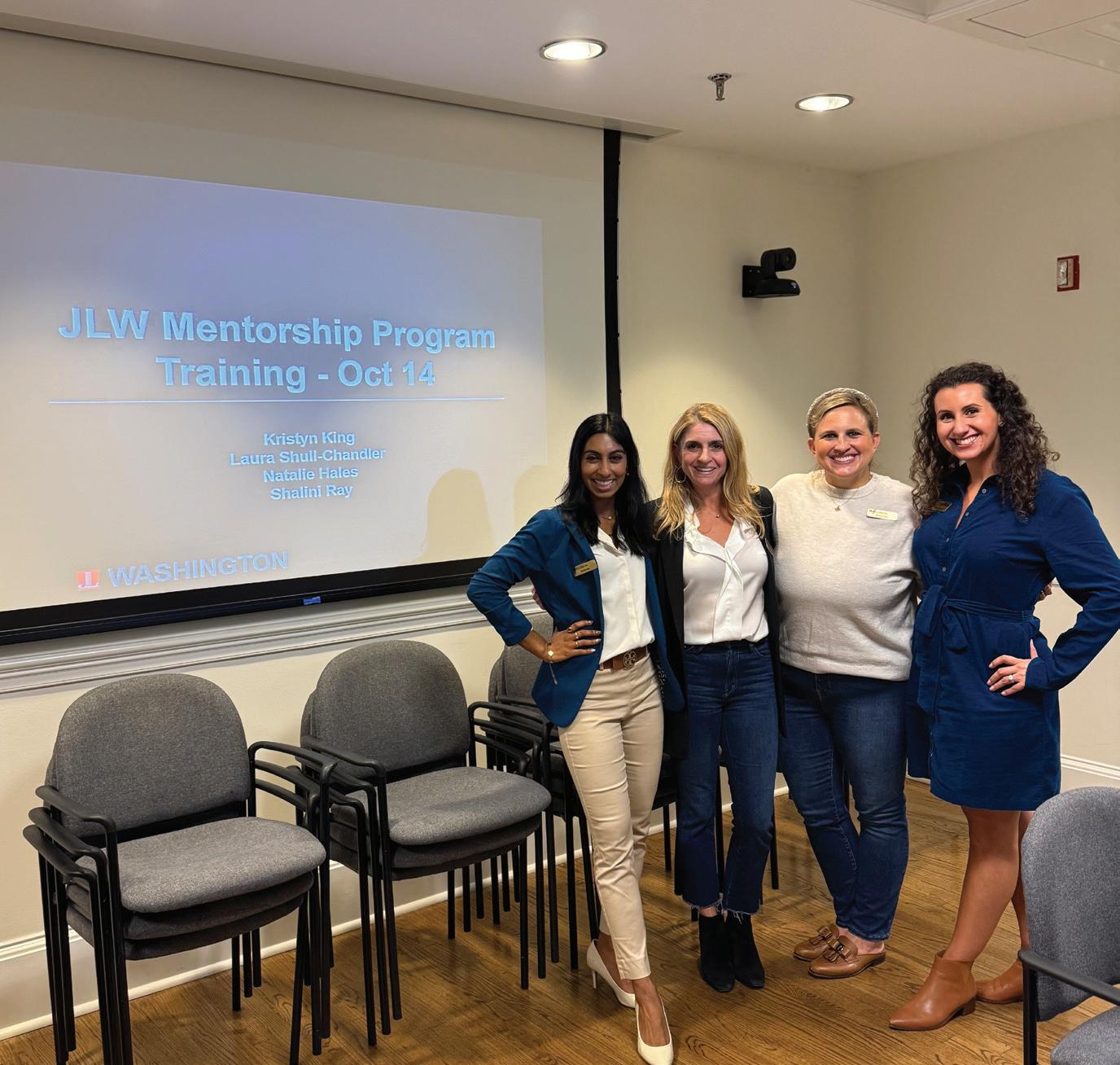
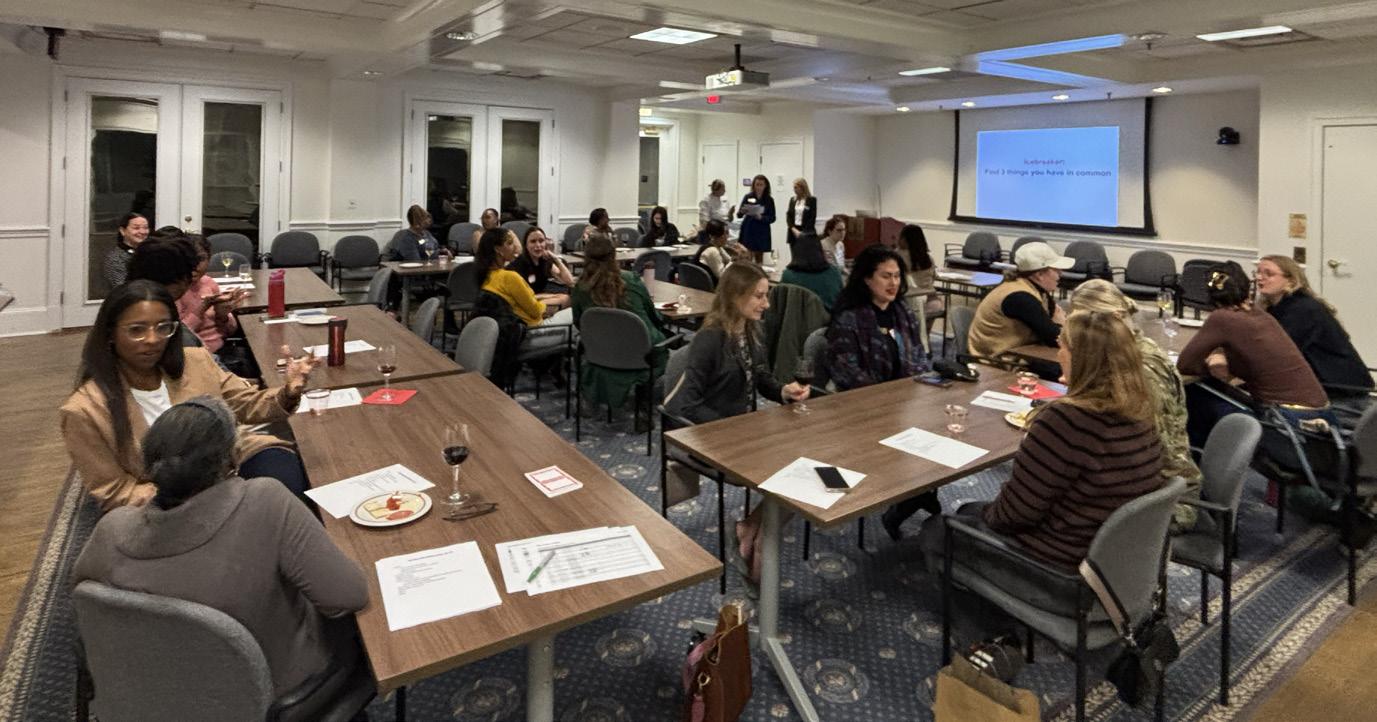
increase member value, and help women feel more connected earlier in their League experience, mentorship emerged as a natural opportunity. With Stanberry’s support, Shull-Chandler partnered with Kristyn King to research best practices and design a pilot tailored to JLW’s membership. Current President Christina Babcock later joined the effort, helping bring the program to life.
From the start, the committee prioritized thoughtful matching and ongoing feedback. “We are defining success through a mix of quantitative and qualitative data,” says Natalie Hales of the Mentorship Program Task Force. “While participation matters, our primary
focus is the depth and quality of each mentor-mentee relationship. Success is measured by impact rather than scale.”
That approach was tested almost immediately. Applications far exceeded projections, particularly among mentees. Mentors were asked whether they would consider taking on a second match, and everyone agreed. The pilot ultimately launched with 59 participants—21 mentors and 38 mentees—representing a wide cross-section of the League.
Early moments confirmed the program’s resonance. At the October kickoff event, the energy in the room was palpable. As participants introduced themselves and shared their professional backgrounds, many remarked on how rarely those conversations happen within League spaces. “We do so much together in the League, but we do not often talk about our work outside of it,” Shull-Chandler says. “It was clear this was a group of impressive women who were genuinely excited to learn more about one another.”
For mentor Jackie Malkes, Rapid Response Task Force Lead, the experience affirmed the program’s purpose. She joined because she had “seen firsthand how the right guidance at the right moment can shape a woman’s confidence and leadership path” and wanted to pay that forward. After meeting her mentees, she was struck by how strong the alignment felt. “Both of the mentees I was assigned are active in the League and also share a similar background to me,” Malkes says.
The program is also creating new pathways for engagement across membership stages. Emily Roy, a Sustainer, says she participated because mentorship relationships can be difficult to build organically. “It can be extremely hard to find that kind of connection in the workplace or on your own,” she explains. “I was thrilled when the JLW Mentorship Program was announced and had been looking for a way to get more involved as
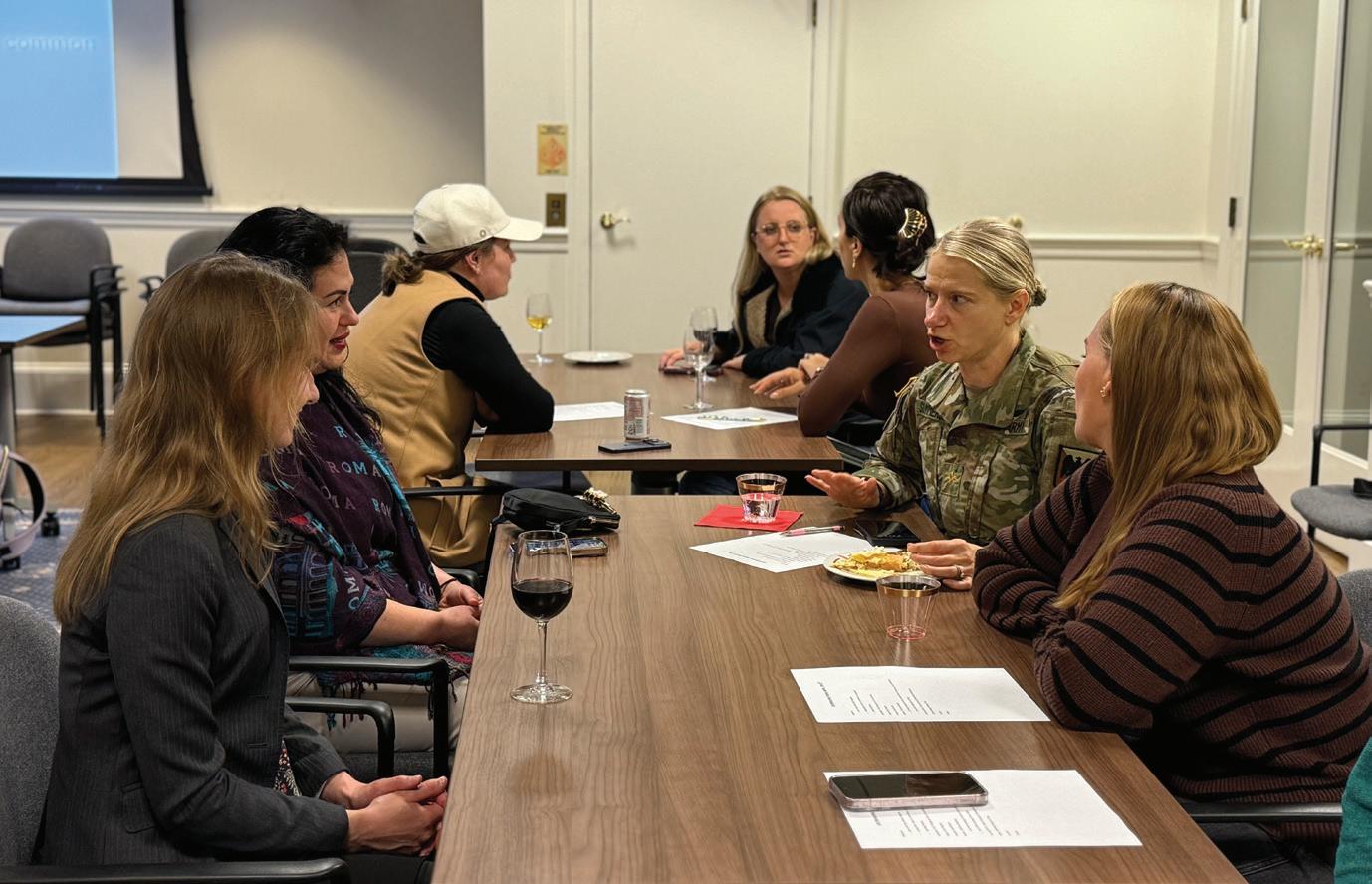
a Sustainer.” She adds that the program’s structure makes participation approachable. “There is no right way to be a mentor or mentee. It’s not one-sizefits-all. The program provides tools and resources to set you up for success.”
Randi Williams, a Nominating Committee Member, sees the program as a natural extension of the League’s commitment to developing leaders.
Having spent much of her League tenure focused on training and member development, she viewed the pilot as a meaningful evolution. “The idea of a formal mentorship program has always seemed like an excellent idea for the League and its members,” she says. In early conversations with her mentees, she saw its value immediately. “It was so exciting to understand in real time why the program connected us,” she explains. “There are JLW members who have similar training and experiences, and we can be a resource and support to one another.”
Initial feedback suggests those kinds of connections are already forming. Hales says that one of the clearest indicators of success came after participants met for the first time. “We heard from women who felt genuinely well matched
and excited about what they would gain from the experience,” she says. Survey responses echoed that enthusiasm, with nearly all participants expressing excitement to begin and confidence that the program would support their professional development. Many entered with clear goals, most often focused on career growth, confidence-building, and expanding their networks.
Mentors have also noted immediate benefits. Malkes describes the experience as “rewarding in that it’s allowed me to connect professionally, share hard-earned advice, and offer a safe, judgment-free space away from the politics of the workplace.”
As the pilot continues, the committee remains focused on learning and refining. Participant feedback has already sparked interest in additional group opportunities that blend professional development with social connection.
Looking ahead, organizers hope the Mentorship Program becomes a lasting source of value for League members. “I hope the lessons, confidence, and connections participants gain continue long after their formal mentorship is complete,” Hales says. •
Poppy Merrell
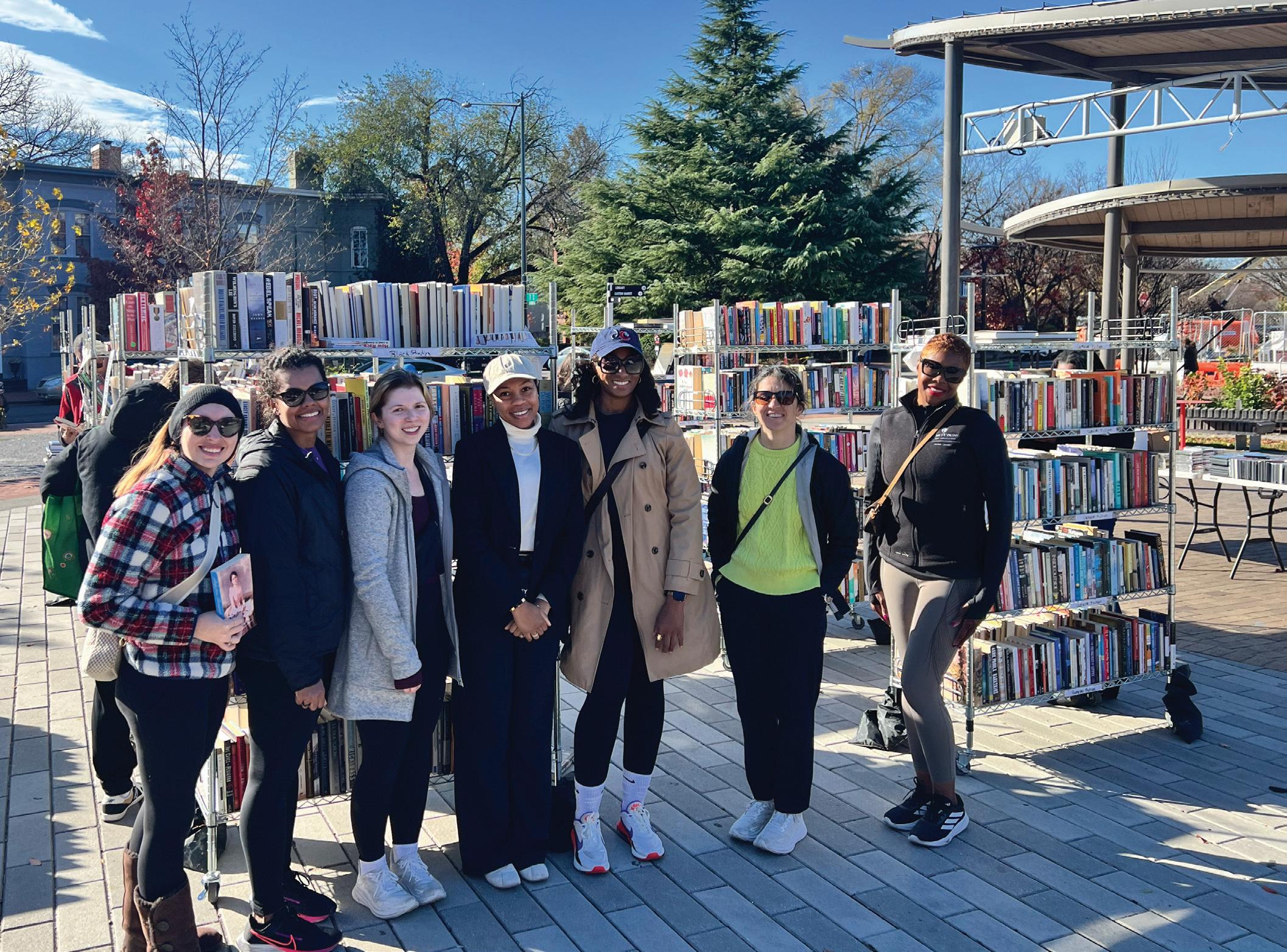
Every January, the Junior League of Washington’s (JLW) Done-In-A-Day (DIAD) Committee hosts several one-time volunteer opportunities open to all League members during the Weekend of Service. This year, JLW members partnered with a wide range of local organizations across the Washington, DC region, supporting programs that address food insecurity, environmental stewardship, education, and community engagement.
DIAD Chair Jamie Jones notes, “Helping coordinate hands-on volunteer opportunities for women across the League during the Weekend of Service expands our reach and deepens our collective impact in the community. It also connects members to the many local partners across DC who rely on our support. Volunteering locally and seeing that direct impact firsthand makes the experience especially meaningful.”
Over the course of the weekend, 52 volunteers worked across 10 events, contributing 108 volunteer hours throughout DC, Maryland, and Virginia in support of partner organizations.
Several projects focused on addressing food insecurity, with volunteers supporting organizations such as the Capital Area Food Bank, ALIVE!, and Sunflower Bakery. JLW members sorted and packed food for distribution, assisted with organizing and distributing groceries at the ALIVE! Food Hub, and supported workforce development programming at Sunflower Bakery, where young adults with learning differences gain hands-on culinary training. These efforts help ensure families have access to reliable food sources while strengthening the systems that support food access across the region.
Environmental stewardship was another key focus of the Weekend of
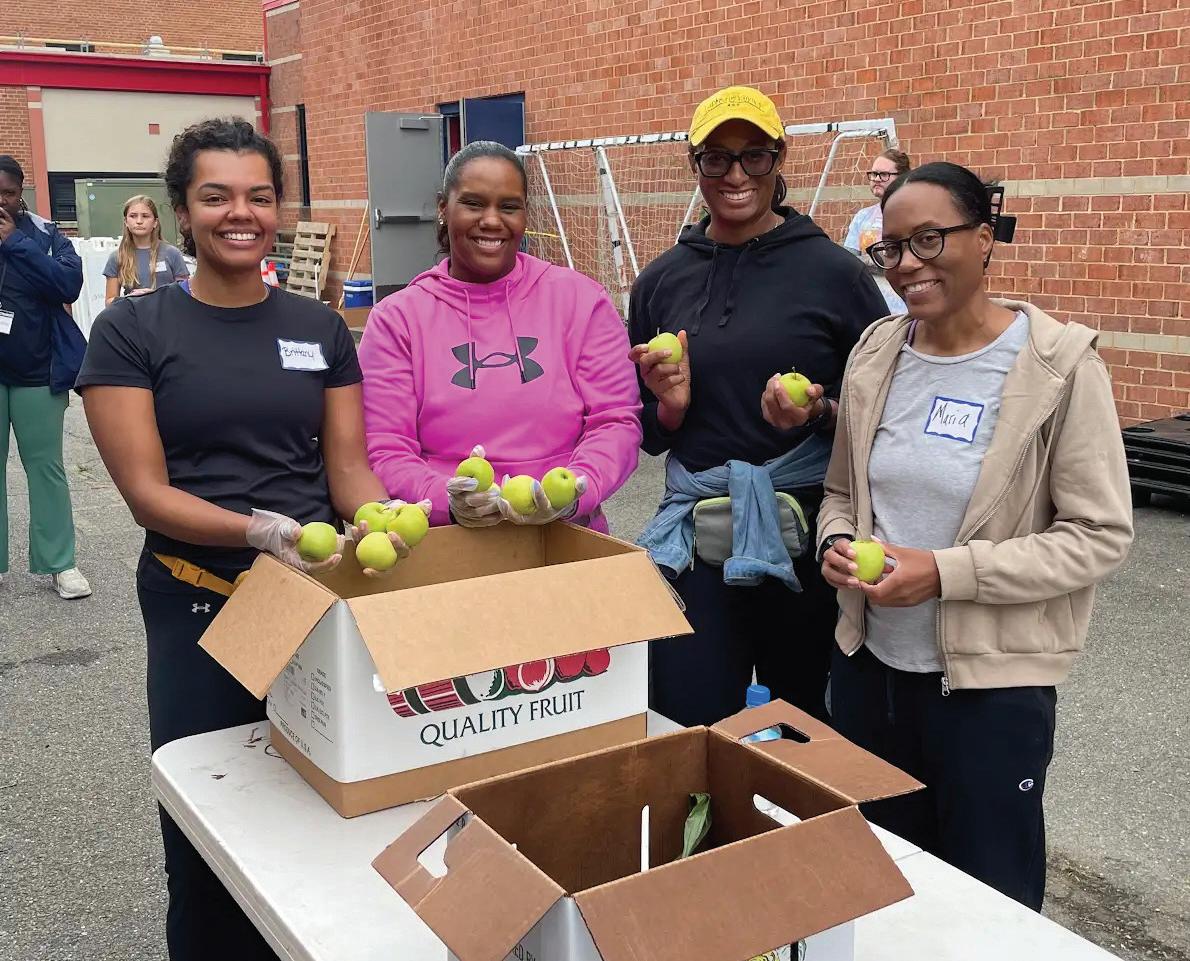
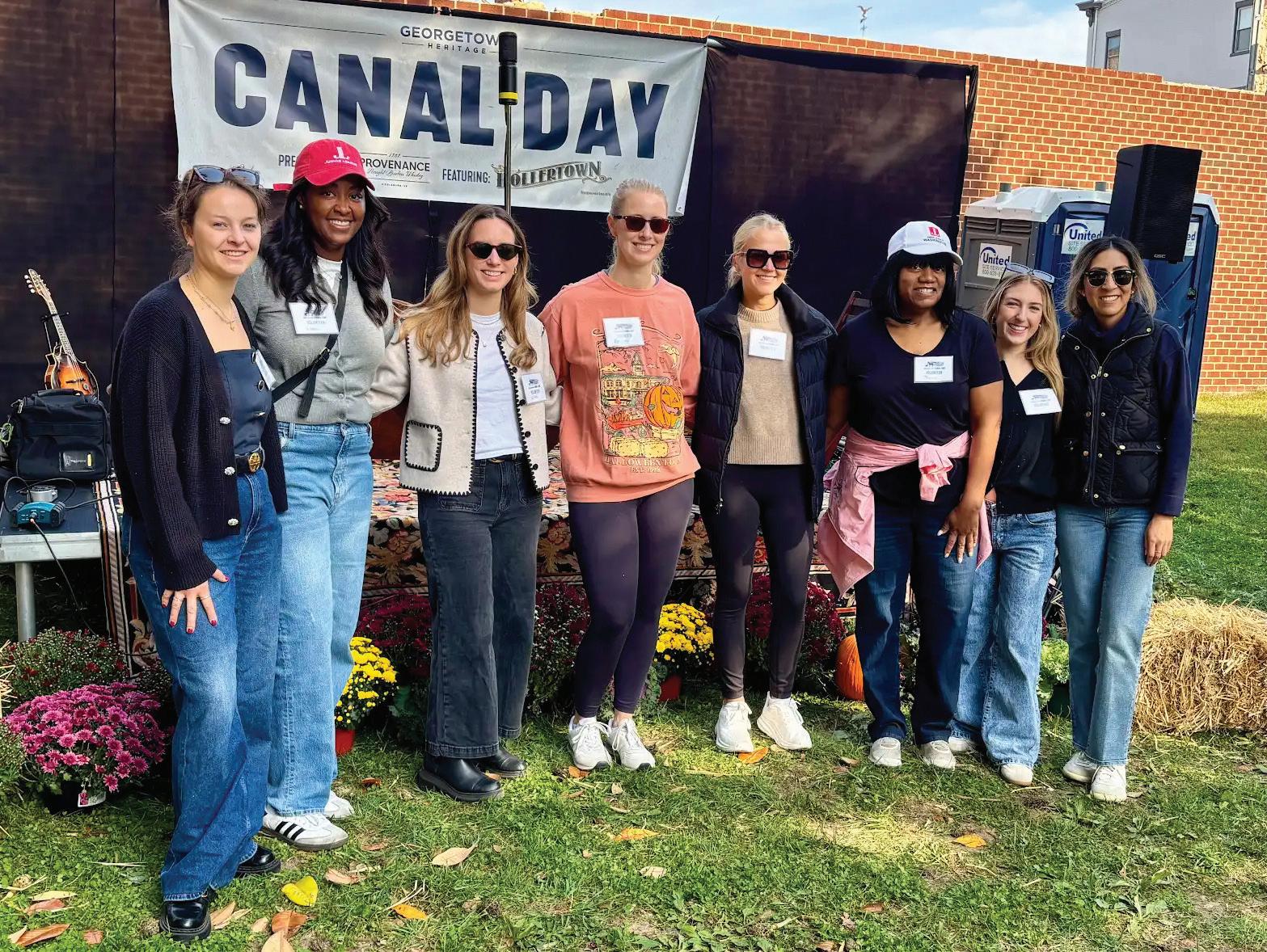
Service. JLW volunteers partnered with Rock Creek Conservancy and Georgetown Heritage, participating in park and canal cleanups that removed trash and debris, supported wildlife habitats, and helped preserve the natural and historical significance of these community spaces.
Education and literacy initiatives were also central to the weekend. Volunteers worked with Turning the Page, an organization that strengthens family engagement in children’s education through workshops and community programming that equip caregivers to support student learning.
Members also volunteered with Free Minds Book Club & Writing Workshop, which uses literature, creative writing, and mentorship to support incarcerated and formerly incarcerated youth.
During the Weekend of Service, JLW volunteers read poetry written by incarcerated youth and had the opportunity to hear directly from a Poet Ambassador, gaining insight into the impact of these programs.
The Weekend of Service also included projects that brought communities together around broader causes. JLW volunteers supported the March of Dimes Heroines of Washington Gala,
assisting with event logistics for an evening that recognizes leaders advancing maternal and infant health. Members also participated in Wreaths Across America at Congressional Cemetery, joining volunteers across the country in honoring veterans through the placement of wreaths.
The Weekend of Service reflects the flexibility and impact of the DIAD Committee, offering members meaningful opportunities to engage across a wide range of causes. While each project takes place over the course of a single day, the impact of these partnerships extends far beyond the weekend itself. •
Shannon Jessen
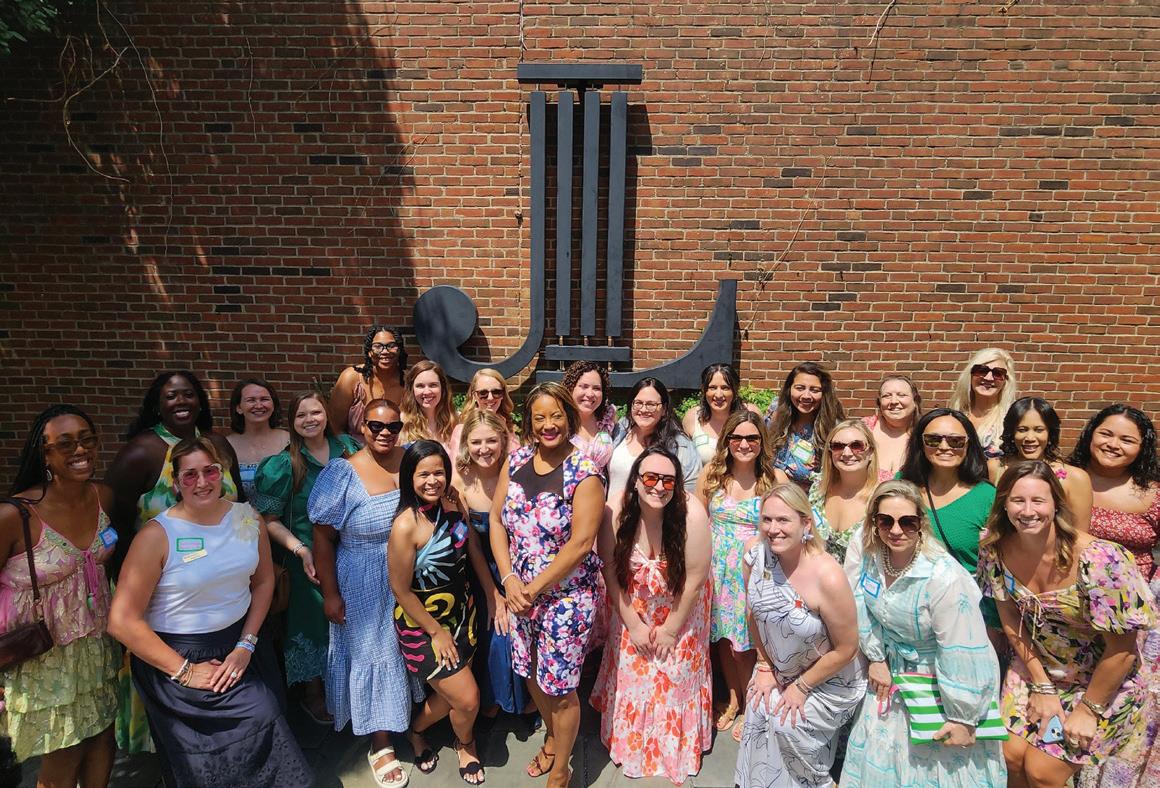
On the morning of October 4, a group of women arrived at the New Member Retreat at JLW Headquarters, not entirely sure what to expect. For many, it was their first time spending a day with their new member class outside of a formal meeting. By the end of it, they were co-creating ideas for the future of the League, cheering each other on, and beginning to form the kinds of friendships that last long after the new member year ends.
That day was the result of a New Member Committee that spent the better part of a year asking one question: what does it actually take to help a new member find her home in the League? This year, co-chairs Amelia Schoenbeck and Dr. Tammy Williams undertook one of the most comprehensive overhauls of the new member experience in recent memory, designing a program that not only orients women to the League but helps them find their place within it.
“Our mission is to help new members feel connected, informed, and excited about their role in the League,” says Williams. “We serve the newest class of members by creating opportunities for
them to build relationships with each other, learn how the League operates, and feel confident transitioning into active membership.”
Schoenbeck adds, “The theme we set for this year was to help new members discover JLW life and find their home in the League.” Inspired by JLW’s broader goal for the year (Discover JLW L.I.F.E.), that theme guided a top-to-bottom rethink of the new member program. To bring that vision to life, the committee organized its work around four pillars: updating programming,
improving operations, refreshing resources, and expanding opportunities for connection.
Among the year’s new programming was the launch of JLW’s first-ever New Member Retreat— affectionately nicknamed Camp JLW—complete with camp-themed decorations, s’mores, and hosts dressed as camp leaders. This one-of-a-kind event quickly became the centerpiece of the new member calendar.
The idea came directly from the previous year’s class. When Schoenbeck and her team connected with the New Member Class of 2024–2025, members Chanelle Washington and Amaya Rearden articulated something many had felt: while orientation provided information, it hadn’t created a shared class identity. “Chanelle and Amaya were strong advocates for this idea and rallied others behind it,” says Schoenbeck. “And what was so meaningful was that they were involved in bringing the retreat to life for this year’s class.”
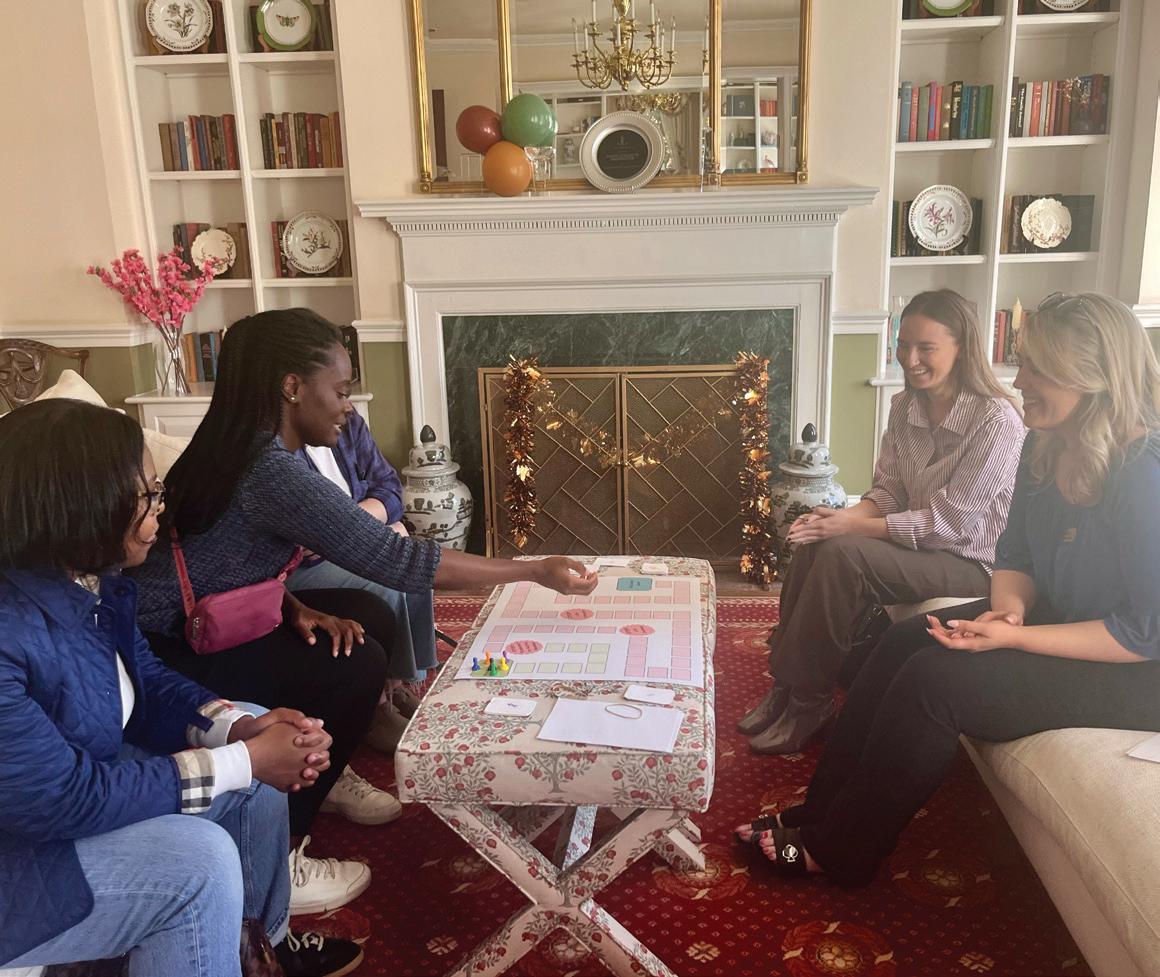
The retreat wove together learning, creativity, and connection. New members played a custom-built JLW Game of Life, introducing committees and milestones, participated in breakout sessions aligned to the League’s mission, and co-created ideas for future programming. They
made friendship bracelets, took a movement class taught by committee advisor Lily Strieder, and ended the day with a Jeopardy-style game highlighting League opportunities and history. “The retreat gave new members a chance to see the Junior League mission in action in an organic way,” Schoenbeck explains, “and to begin having their voices heard.”
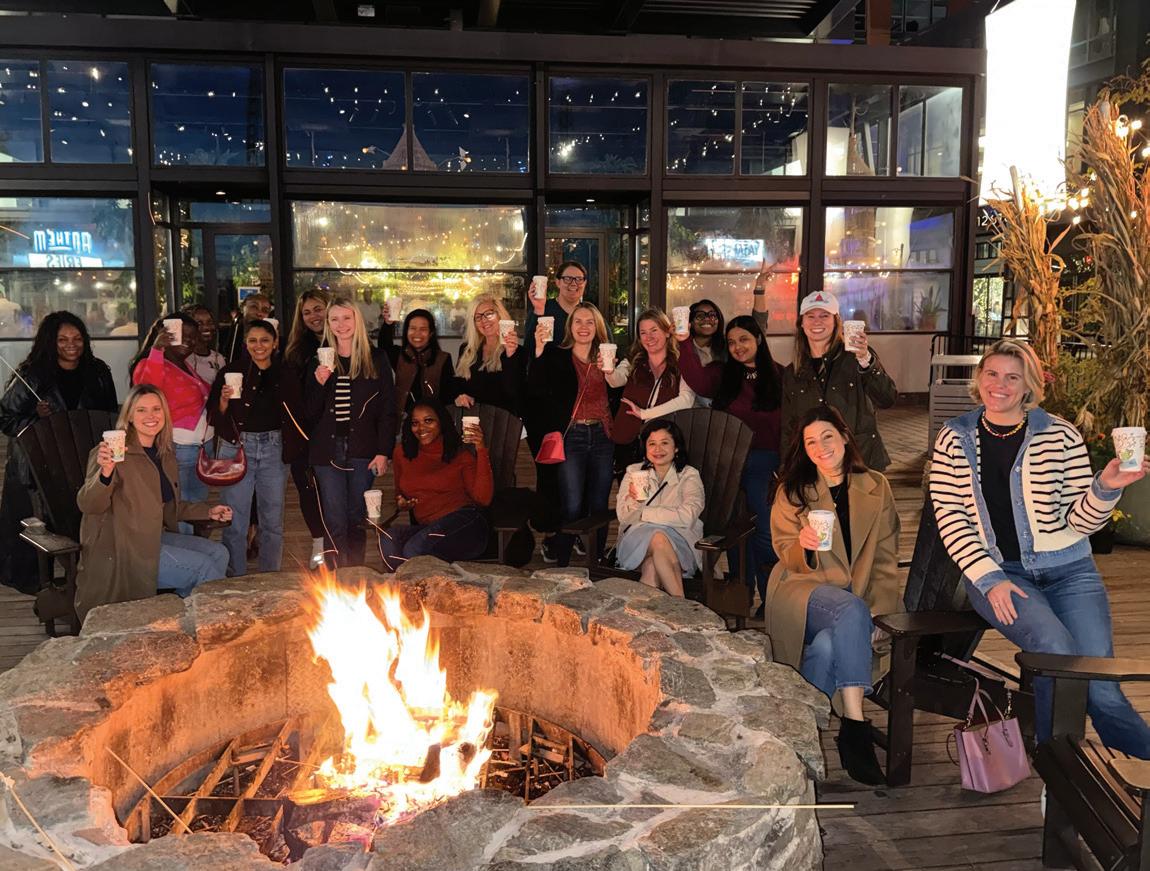
Midway through the year, the committee launched another new initiative: the New Member Olympics. Steering members Kayla Connor, Diane Groomes, and Alex Hiser designed a multi-week series combining competitive and social events from curling and a citywide scavenger hunt to figure skating gatherings and opening and closing ceremonies. “Events like this help people relax and connect more naturally,” says Williams. “They build the kinds of friendships that make the League experience truly meaningful.”
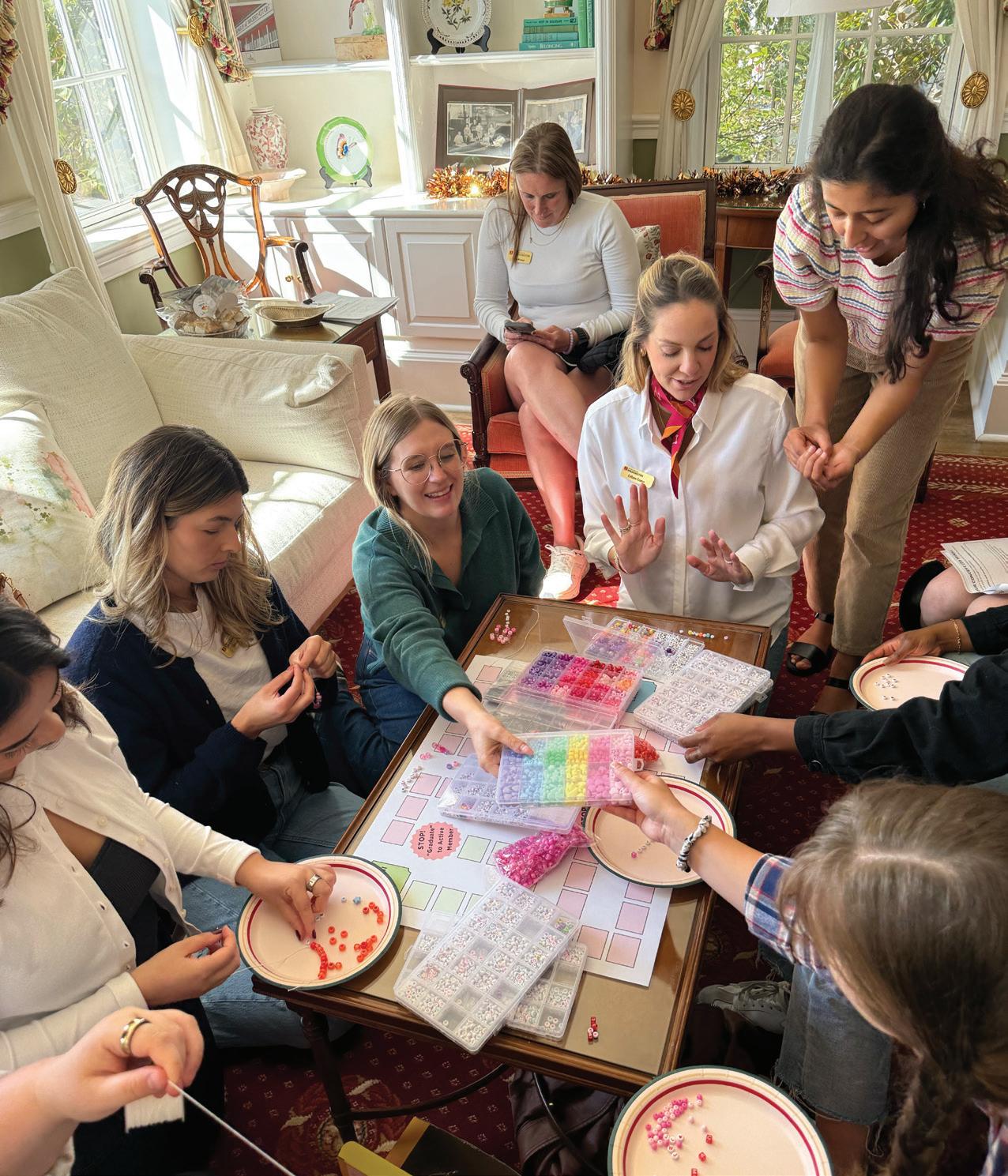
While these signature events created momentum, it was the expanded social calendar that consistently built community. Feedback from the prior class, supported by data showing over 90% of incoming members prioritized connection, led the committee to reinstate socials as a formal requirement, unlocking resources to significantly expand offerings.
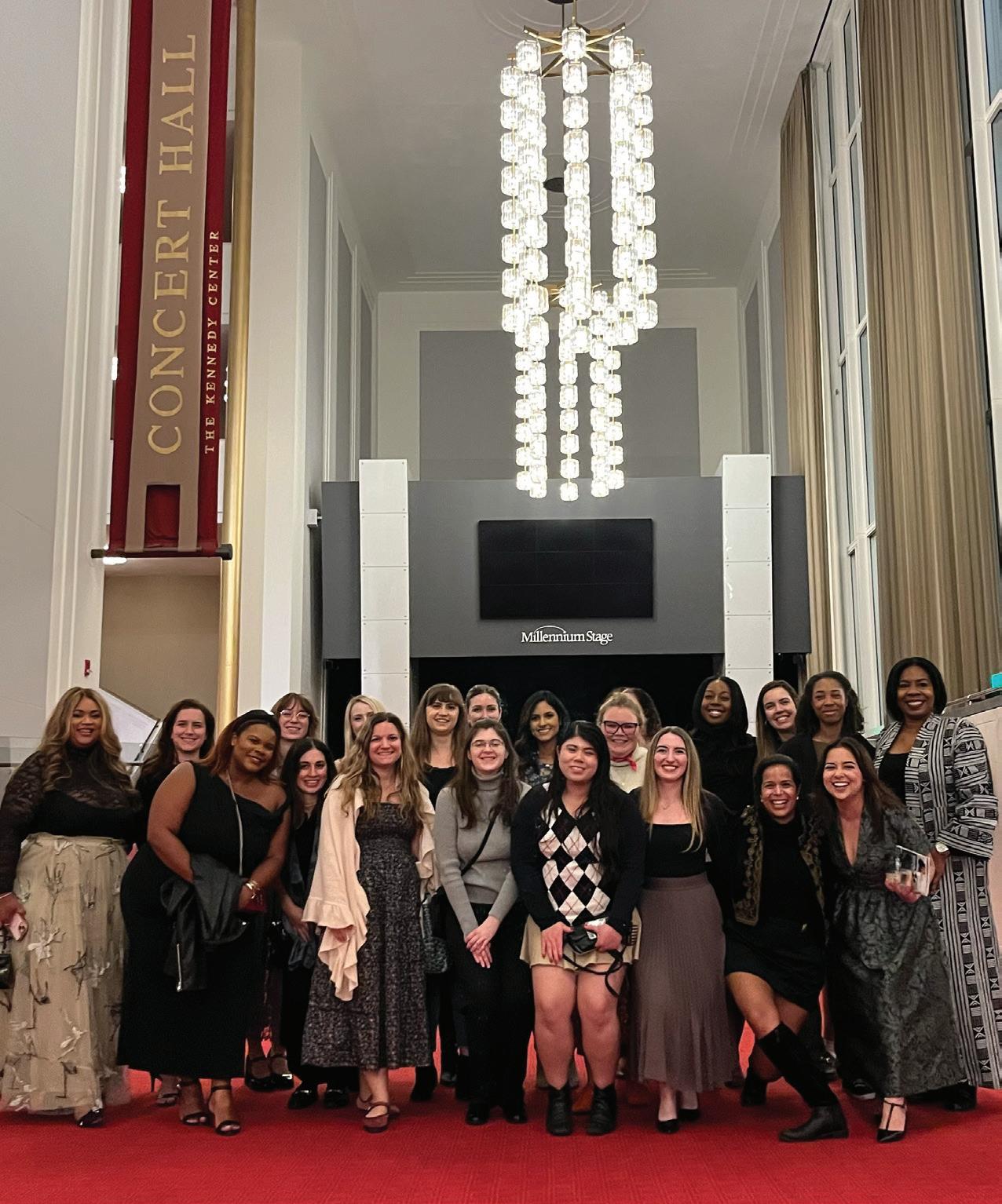
This year, the number of socials more than doubled, with events ranging from a night at the ballet and book clubs to craft nights, holiday tours, and informal gatherings tied to major League events.
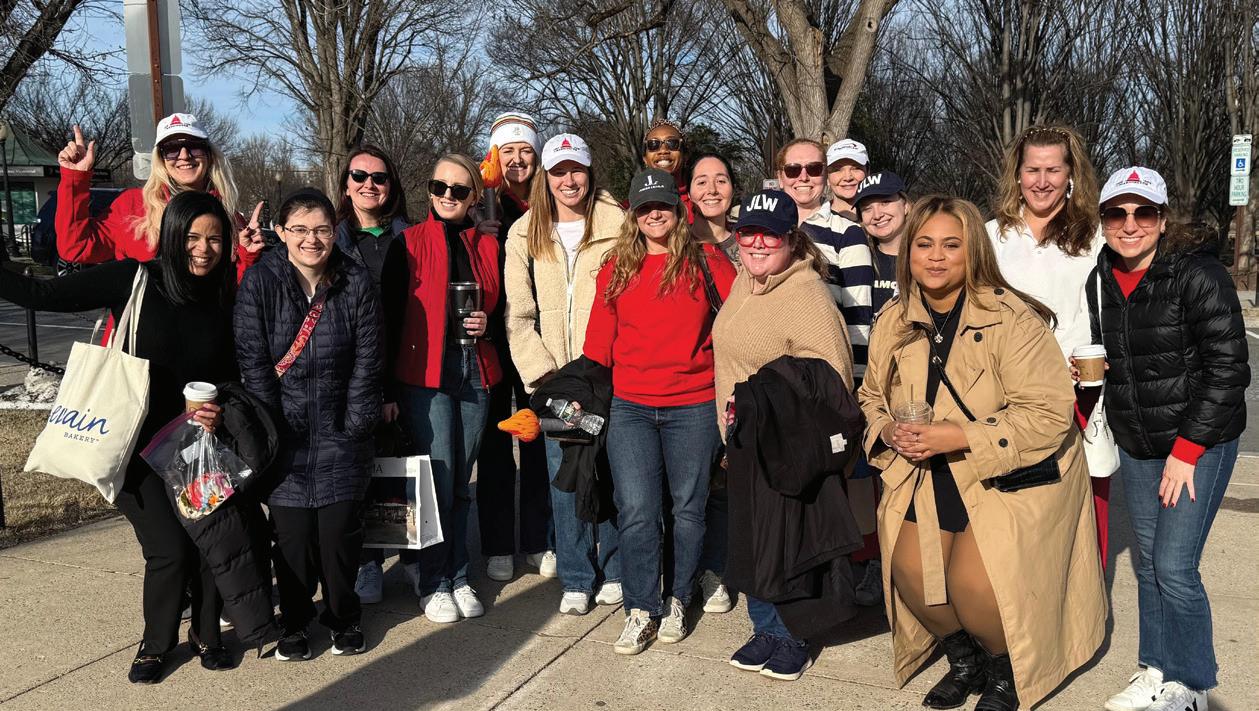
Let the games begin! New members explored DC and bonded during the JLW Olympic scavenger hunt in February.
“League Connectivity” socials were also introduced, allowing new members to connect with active members while earning multiple credits.
“Those small moments of connection are exactly what we hoped to create,” says Williams.
Schoenbeck adds, “We intentionally offered a mix of larger events and smaller, more intimate gatherings so members could choose what felt right for them.”
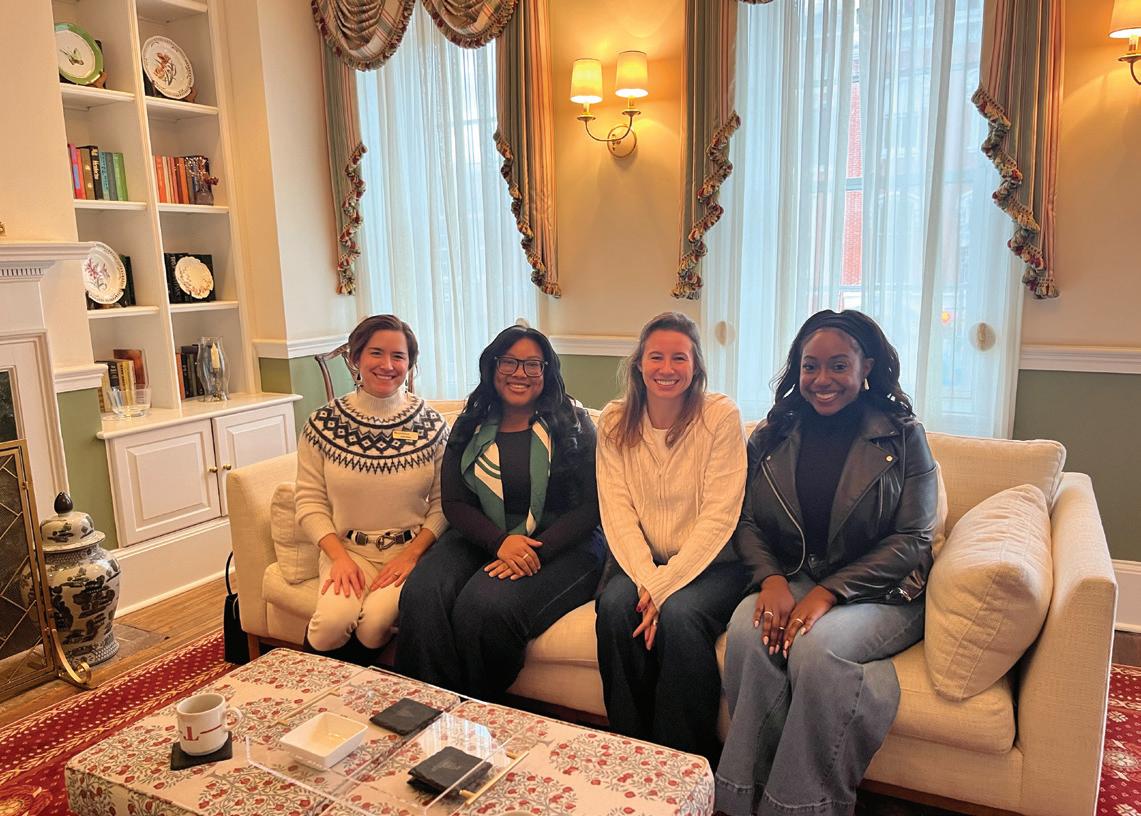
Behind the scenes, operational improvements supported the new programming. The New Member Guidebook was fully rewritten, orientation became more interactive, course sessions were converted into e-learning modules, and a new affinity survey helped pair members based on shared interests. Mini-Placement materials were redesigned—including a BuzzFeed-style quiz—and placement switches dropped dramatically from more than ten in prior years to fewer than two.
Both co-chairs emphasize that this work was a collective effort across the committee, advisors, League leadership, and the new member class itself. “The success of everything we’ve done comes from the dedication of committee members and advisors, the enthusiasm of the new member class, and the support of the broader League community,” says Williams.
For Schoenbeck, one moment at the retreat captured it all: watching new members present their ideas while enthusiastically cheering each other on. “To me, that showed the synergy of this class,” she says. “Their immediate instinct was to lift each other.”
As the new members graduate in May, the New Member Committee is counting on the connections and momentum built this year to carry forward into active membership and beyond. •
Poppy Merrell
For many children, the holidays are defined by moments of excitement and imagination, dressing up in costumes, decorating cookies, and celebrating with family and friends. For the families served by Horton’s Kids, these moments carry even greater significance. Through its partnership with Horton’s Kids, the Junior League of Washington (JLW) helps bring these experiences to life by supporting holiday celebrations year-round.
“Hosting the parties for the children at Horton’s Kids is such a joy,” says Horton’s Kids Chair, Maria Moussa. “Their faces light up when they see the activities, and they get really engaged.”
Horton’s Kids provides comprehensive programs designed to support children and families living in underserved communities in Southeast Washington, DC. Through academic enrichment, youth development programming, and family engagement initiatives, the organization works to ensure that children have the tools and opportunities they need to succeed from early childhood through young adulthood.
At the center of these celebrations is Horton’s Kids’ broader commitment to long-term support. The organization empowers children to graduate from high school prepared for success in college, career, and life through tutoring, enrichment programs, and social-emotional development. Families also receive resources that support stability and well-being.
A defining feature of Horton’s Kids is the consistency of its programming. Many students remain involved with the organization for years, building lasting relationships with staff, volunteers, and their peers.
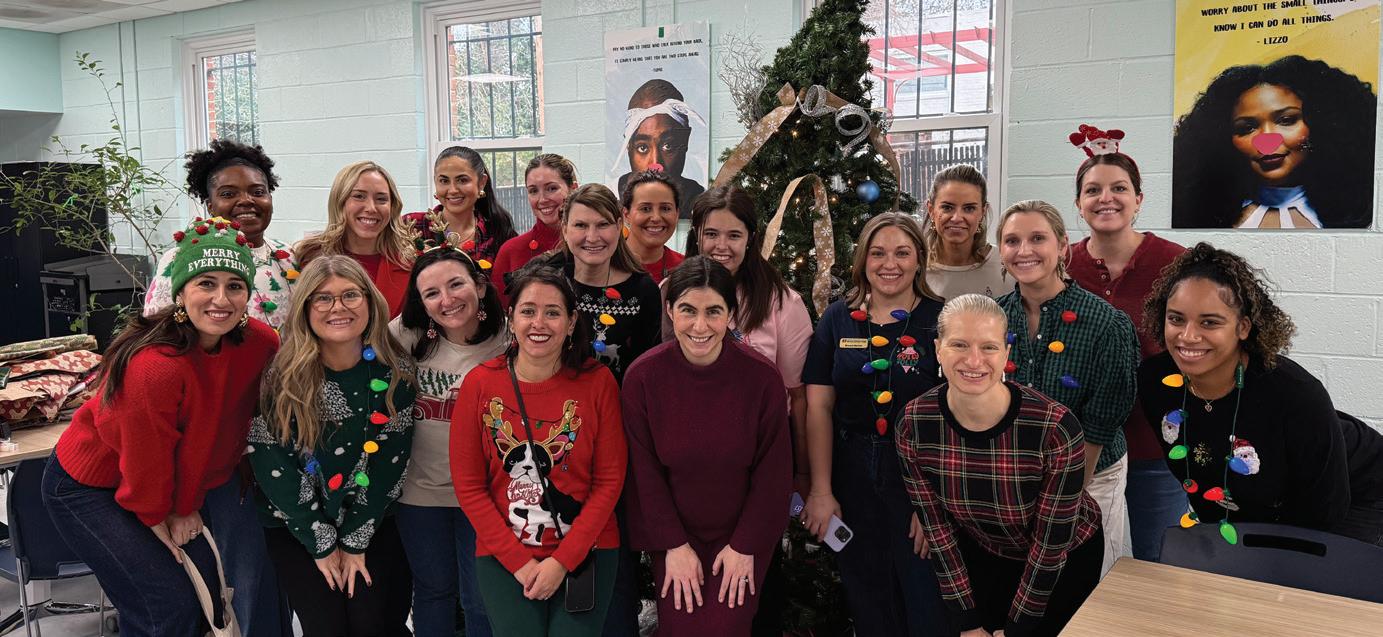
JLW volunteers support Horton’s Kids by planning and facilitating seasonal events that bring families together. From preparing decorations to organizing activities, they help transform everyday spaces into festive environments where kids can simply be kids.
“Some of my favorite moments were when a group of kids started a dance party and when I made some ornaments at the crafts table and got to listen to the children’s creative ideas while they were decorating,” Moussa shares.
Each fall, JLW volunteers help bring the spirit of Halloween to life with decorations, themed activities, and games, creating an engaging atmosphere for children of all ages. Volunteers also help provide costumes, ensuring that every child has the opportunity to dress up and take part in the celebration. For many children, this simple experience, choosing a costume, imagining a character, and celebrating with friends, becomes a lasting memory.
JLW volunteers also support winter holiday celebrations, assisting with event setup, crafts, games, and activities that create a festive environment and allow families to connect.
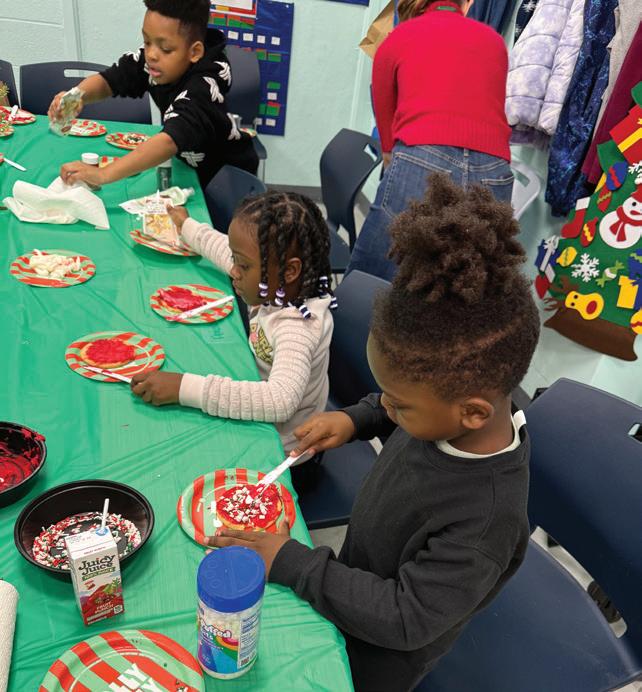
“During our winter party, we had a story time, and two of the older girls joined me in reading The Polar Express They did such a great job working through the harder words in that book and worked together alternating pages to make sure the younger children got to hear the whole story,” Moussa says.
Through continued partnership with Horton’s Kids, JLW volunteers help ensure that holidays remain a time of connection, celebration, and community for families across Washington, DC. •
Victoria Callahan
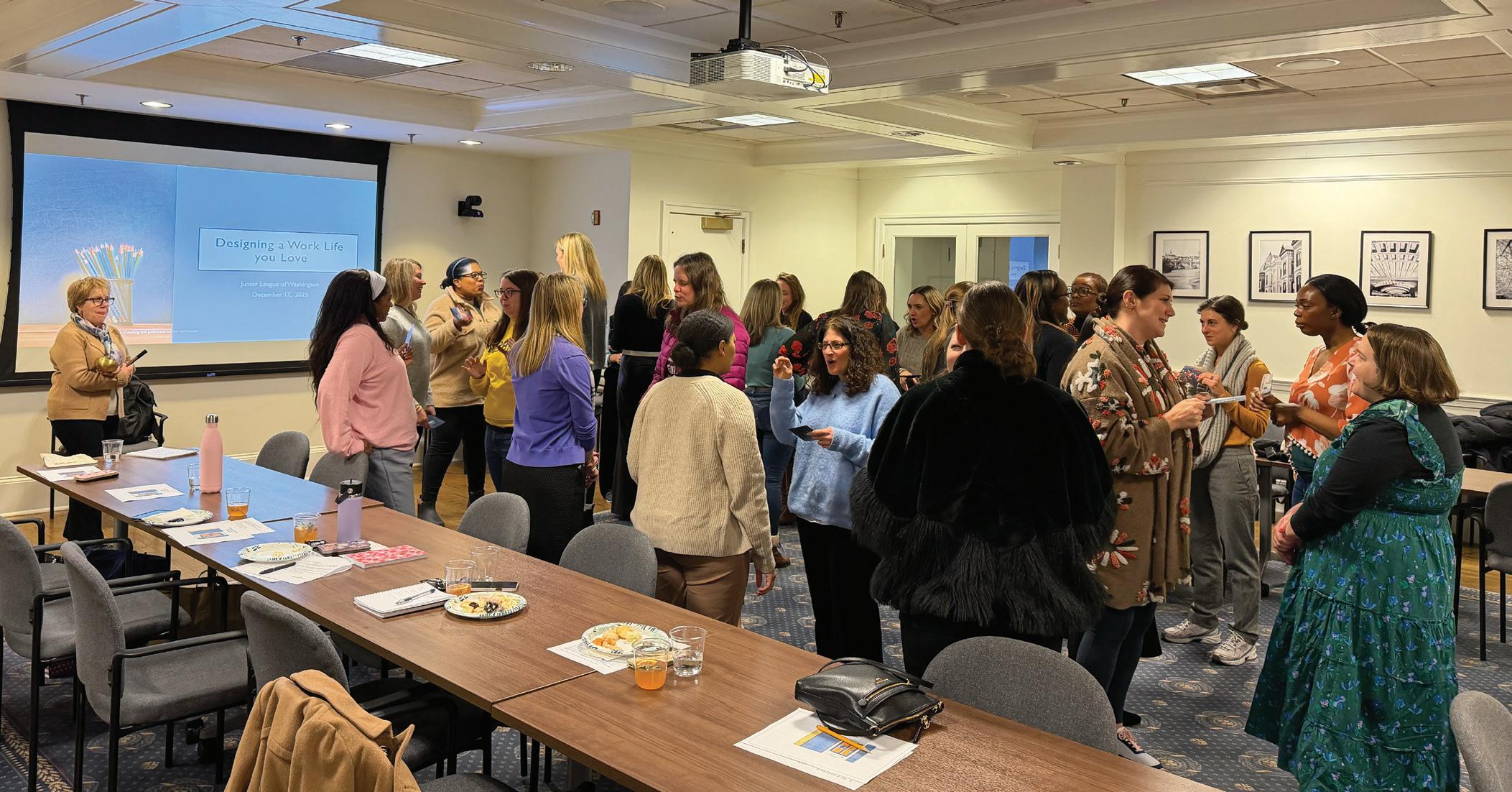
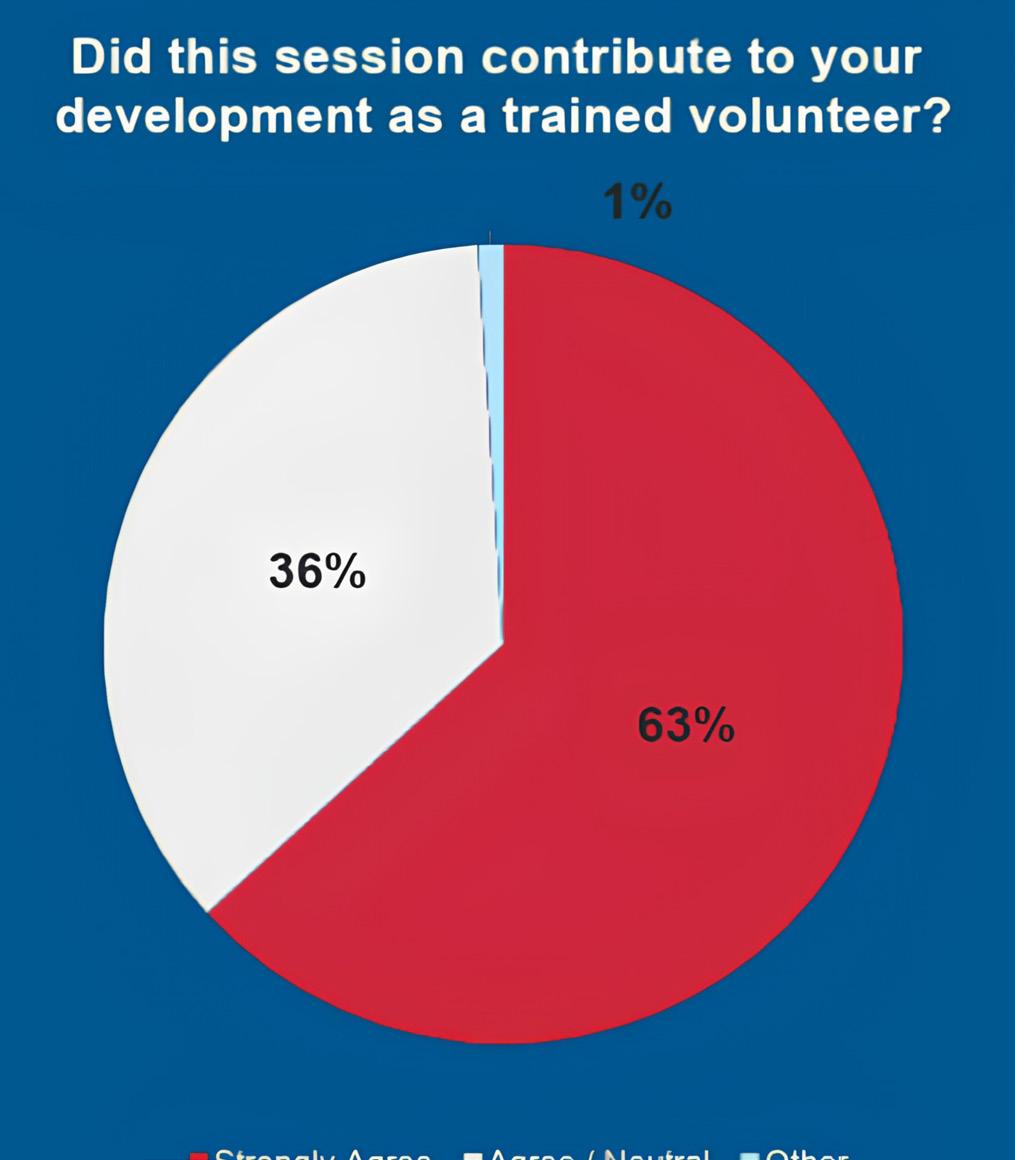
The Junior League of Washington (JLW) equips its members with the skills they need to lead effectively, both inside and outside the League, through its Development & Training (D&T) programming.
Throughout the League year, D&T offerings not only provide a way to fulfill membership credits but are also strategically designed to help members grow as confident leaders, informed decision-makers, and adaptable professionals. From leadership readiness to financial literacy and career agility, JLW’s trainings are an investment not just in the organization’s future, but in the women who power it.
“I love that being a part of D&T helps support JLW members both personally and professionally,” says D&T Committee member Janet Cao. “We put on sessions that range from financial planning to very personal topics like mental health challenges.
We all come from so many backgrounds, and it’s great to know that wherever you are in life, there is a community here to help you learn and navigate.”
Leadership within JLW requires more than passion alone. It calls for preparation, resilience, and the ability to advocate effectively for the community. Through targeted trainings, members gain tools to step into leadership roles with clarity and confidence.
D&T sessions focused on leadership readiness help members prepare for board and committee roles, navigate complex group dynamics, and lead with empathy. Equally important, these trainings address sustainability in leadership, helping members build careers that reflect their values, set healthy boundaries, and lead in ways that are authentic, impactful, and sustainable.
By strengthening leadership capacity at every level, JLW ensures that its members are prepared not only to serve the
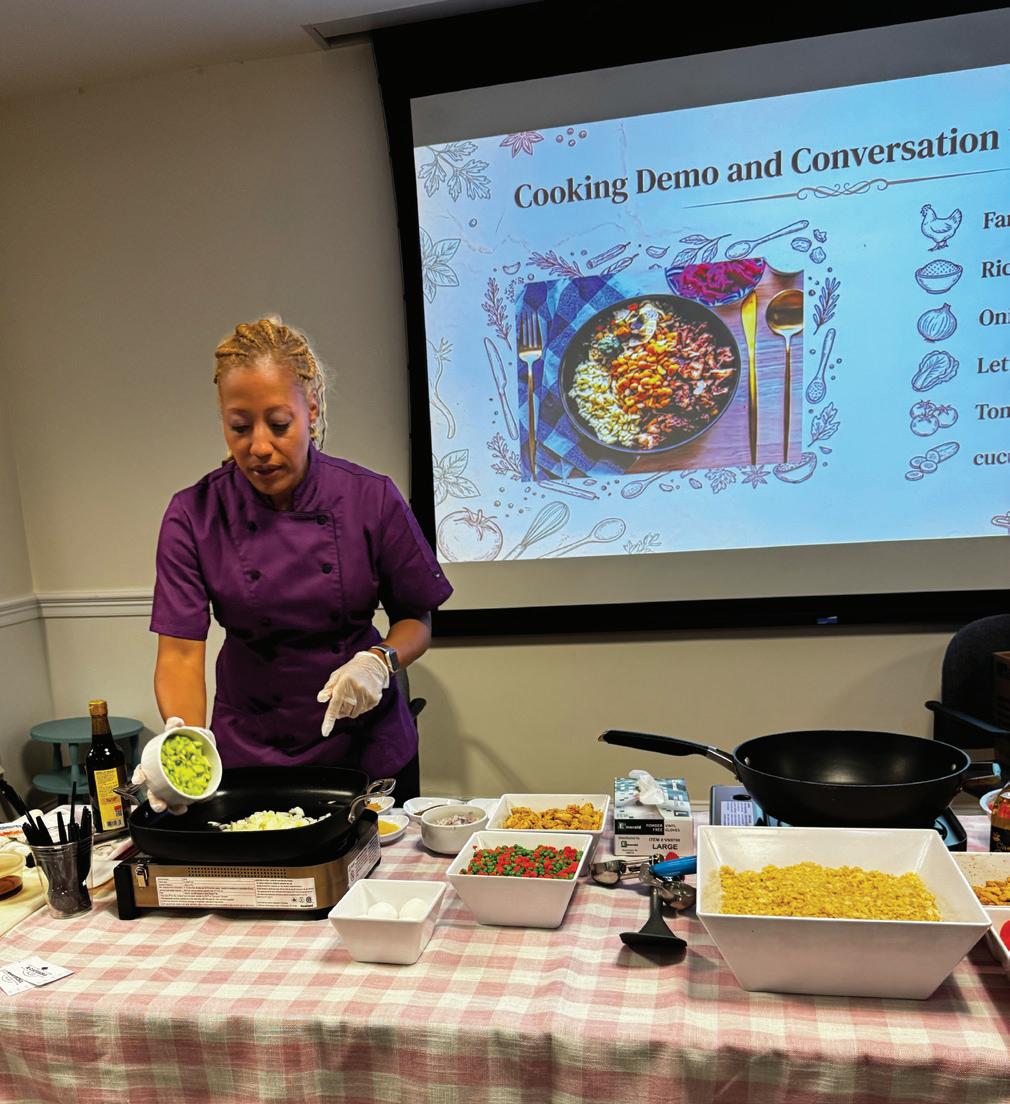
League but also to represent its values as advocates and changemakers in the broader community.
D&T training also teaches financial literacy and life skills to empower informed decision-making. This year’s programming included Own Your Money: A Smarter Approach to Personal Finance and Learn from a Lawyer: Legal Documents 101
Financial literacy and life skills training equip members with practical, highly relevant knowledge that supports both personal and organizational success.
From understanding investment fundamentals and long-term planning to navigating legal considerations around major life decisions, these sessions demystify often intimidating topics. Members leave better equipped to manage resources responsibly, ask informed questions, and contribute meaningfully to financial discussions. These skills directly strengthen JLW’s governance and sustainability.
These trainings also reinforce a core League value: empowering women with knowledge that builds confidence, independence, and long-term impact.
D&T trainings also focus on career agility and professional visibility. The D&T sessions support members in strengthening their professional presence and navigating career transitions. This year’s trainings on this topic included Rebuild, Rebrand, Reignite: A Career Transition Workshop Series and Designing a Work Life You Love
Training on résumé building, personal branding, and design thinking helps members articulate their value, refine their professional narratives, and approach challenges with creativity. Whether members are advancing in their careers, pivoting industries, or re-entering the workforce, these sessions provide tangible tools that translate beyond League involvement.
By fostering career agility, JLW helps members show up as confident professionals who are visible, credible, and prepared to lead across sectors.
JLW’s D&T programming reflects a clear commitment to investing in women as leaders, learners, and community stewards. Members are not only gaining skills—they are being developed as capable leaders, informed decision-makers, and adaptable professionals.
“This committee has allowed me the opportunity to help provide our community with knowledge and access to information. I think that knowledge is power, and that gives us a unique chance to make a meaningful impact on our community,” says Elle Brown, who is in her third year serving on the D&T Committee, adding, “Our impact is limitless, and it will go beyond just JLW, and that means so much to me and, I think, all of us on D&T.”
When JLW members grow, the organization grows, and the community benefits. Through D&T, JLW continues to prove that personal growth and development are not side benefits of membership, but cornerstones of the mission. •
torytelling has always been a powerful tool within the Junior League of Washington (JLW). It informs, connects, and moves people to action.
Over the course of two seasons, the JLW: League of Extraordinary Women podcast has done just that, creating a space where conversations live beyond the page and into the lives of listeners across the League and beyond.
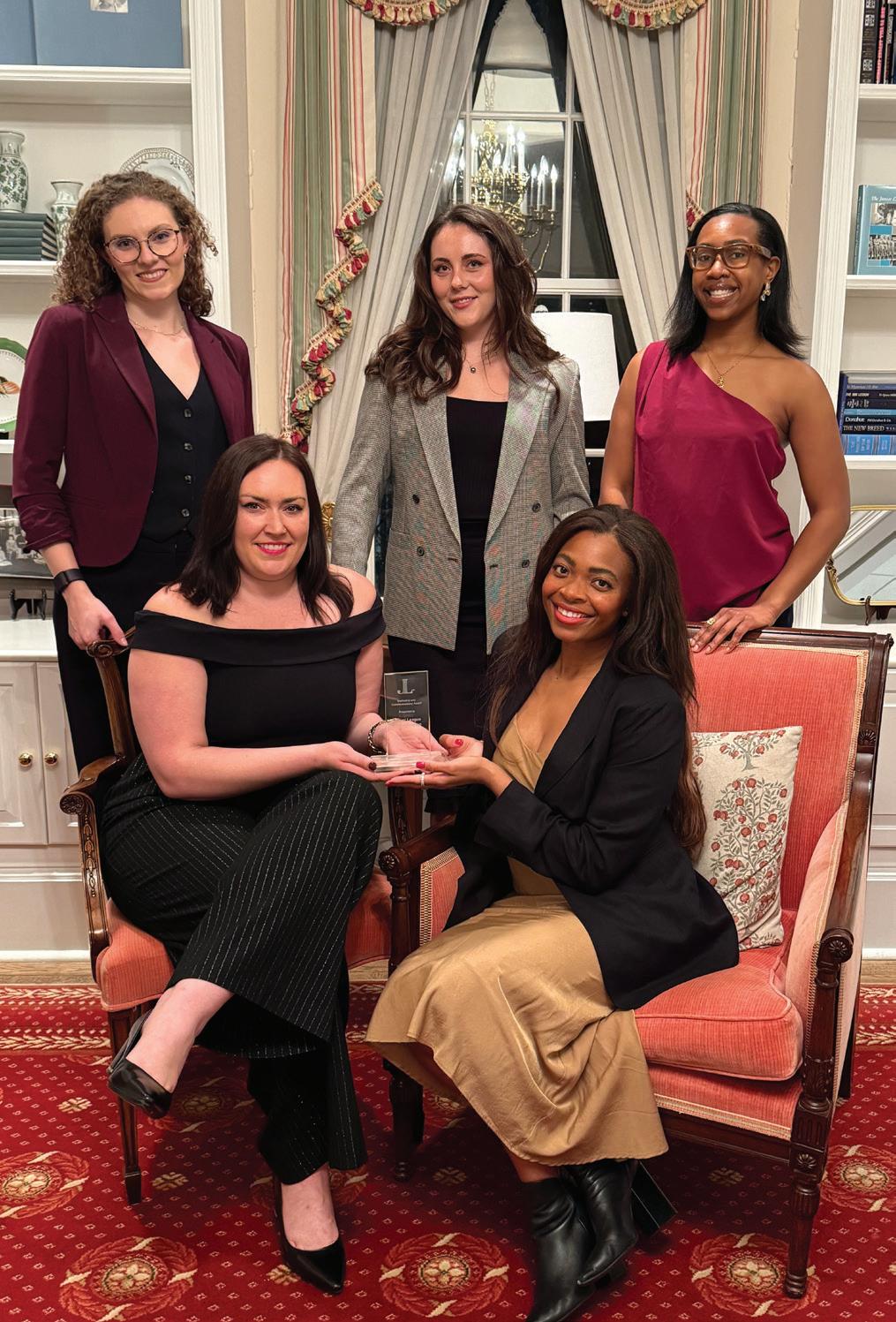
That commitment led the Podcast subcommittee to receive the Association of Junior Leagues International, Inc. (AJLI) 2025 Marketing and Communications Award, which recognizes work that “has used multiple pathways and channels, specific marketing strategy, and long-term planning to increase brand awareness and successfully promote the Junior League’s Mission.”
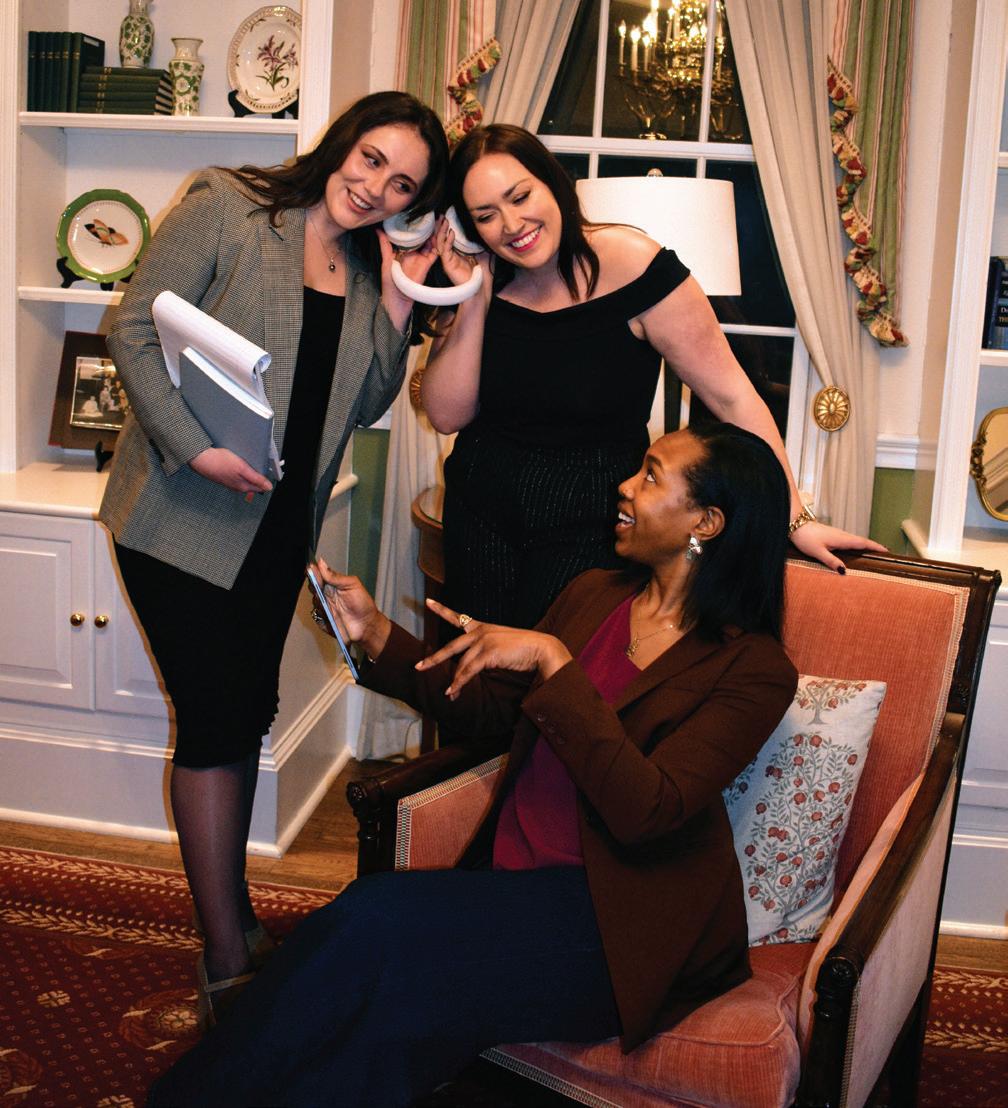
This recognition reflects more than a single project; it highlights the collective effort behind the scenes. From planning and production to thoughtful conversation and teamwork, the podcast has become a platform that lifts voices, explores issues aligned with AJLI’s mission, and strengthens how we connect as an organization.
Current Podcast subcommittee members
Barbara Kirwan, Amaya Rearden, and Taylor Jackson (Communications & Public Relations Director), as well as last year’s team members
Natalie Stevens, Shaunte’ Gordon-Harvey, and Jessica Poitras (former Communications & Public Relations Director), reflect on the journey that led to this recognition and what continues to motivate their work.
LaKisha Brown
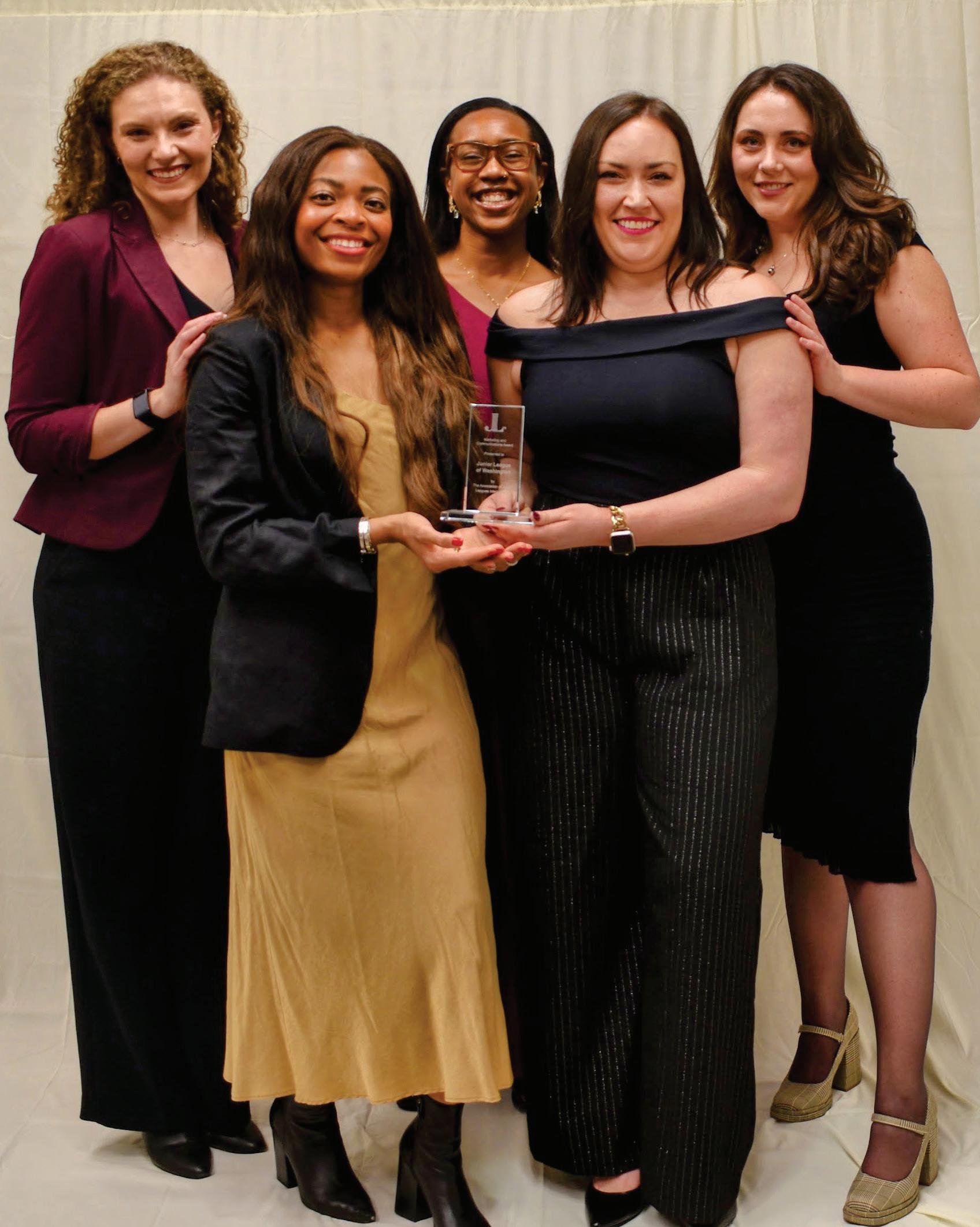
Celebrating the voices behind the mic: The League of Extraordinary Women podcast is recognized for excellence in storytelling and digital engagement. Pictured (left to right): Natalie Stevens, Jessica Poitras, Amaya Rearden, Taylor Jackson, and Barbara Kirwan.
When the award was announced, the reaction was immediate and heartfelt. Poitras shares, “I believe that we were all shocked…The first season of JLW: League of Extraordinary Women is a testament to what JLW members can do when we all work together to amplify voices. I am tremendously proud of the legacy that it will lead.”
What began as a new initiative quickly became something larger than a single season.
While listeners hear polished, engaging conversations, what happens before recording is equally important. Stevens explains, “One of the hardest things about podcasting is that you have to be flexible and think on the spot… our role on the podcast is
to get our guests’ stories told, and to serve as guides for them while they drive.”
Rearden approaches each episode through deep research, taking time to understand the history of committees and events so conversations feel thoughtful and grounded. Gordon-Harvey emphasized careful guest preparation, ensuring interviewees feel comfortable sharing not just what they do, but why they care.
Jackson shares, “For the Podcast subcommittee, this award is validation that the time, care, and intention behind building something new truly mattered. Launching a podcast from scratch requires trust, experimentation, and a willingness to learn in public, and this team embraced all of that. The recognition affirms that their work resonated beyond our internal audience and met a national standard for excellence. More broadly, this award reflects how the Digital Media Committee operates at its best. It shows a council that is strategic, collaborative, and willing to invest in long-term storytelling rather than quick wins.”
“It means people were listening, which is amazing,” GordonHarvey says. “If we’d met one of our two goals, we would have considered the inaugural season a success, but this award means we exceeded our own expectations.”
For many members, the most meaningful moments didn’t happen at the awards reception but rather in everyday interactions. Rearden reflects, “It’s easy to forget, when you’re
recording or editing behind the scenes, that people are actually engaging with the content...I was genuinely helping others better understand the League and its work.”
Stevens describes how interviewing committee leaders expanded her understanding of how leadership within JLW creates tangible community impact. Gordon-Harvey shared how the experience helped her become a stronger advocate for the League, giving her insight into not just what committees do, but how and why they do it. Kirwan adds that each episode “amplifies the amazing volunteer efforts of each committee and records their stories to inspire future volunteers.”
If reading this sparks even the slightest curiosity about digital storytelling, the women behind the mic offer encouragement. “You’ll never learn the answer if you don’t ask the question,” says Kirwan, reflecting on how stepping forward led her from behindthe-scenes contributor to chair of the subcommittee.
Stevens encourages experimentation and growth, reminding members that digital storytelling is constantly evolving. Rearden suggests starting simply by listening, learning, and reaching out.
The throughline is clear; there is space to learn, experiment, and grow. Whether it’s behind the mic, behind the scenes, or somewhere in between, the JLW: League of Extraordinary Women podcast creates room to try something new.
As the Podcast subcommittee wraps up its second season, JLW members can catch up on the latest episodes on the committee’s Spotify page or on the JLW website. •
Alanna Brannam
The Member Recruitment Committee helps make the Junior League of Washington (JLW) what it is today. By introducing prospective members to JLW and laying the foundation for their League membership, the committee works year-round to share information about JLW and its impact.
The Member Recruitment Committee consistently finds new ways to engage with prospective members—the most recent of which is developing the Prospective Member Guide, which is being used in the 2025–2026 membership year.
The Prospective Member Guide starts with introductions to two leaders of the League: 2025–2026 President Christina Babcock and 2025–2026 Member Recruitment Chair Desiree Carey. Speaking on the Prospective Member Guide, Carey says, “My recruitment philosophy has been very simple. I’ve named my team the ‘JLW Recruitment Concierge.’ We are providing a guide for every step of the way so each member has the tools to be as involved as she wishes to be in the League.”
That is exactly what the Prospective Member Guide delivers throughout its 45 pages. Another key feature is the introduction of the entire Recruitment Team, including Dr. Amna Choudry and Shalini Ray, the 2025–2026 Recruitment Communications Co-Chairs. Choudry warmly welcomes prospective members and describes JLW “as a place where service opens the door and community keeps you here.” She adds, “Carey recognized how important strong communications and storytelling are to recruitment, outreach, and retention. [Carey] approached Ray and me about creating a dedicated communications effort to support recruitment, and we were excited to help build something that would elevate and strengthen this work.”
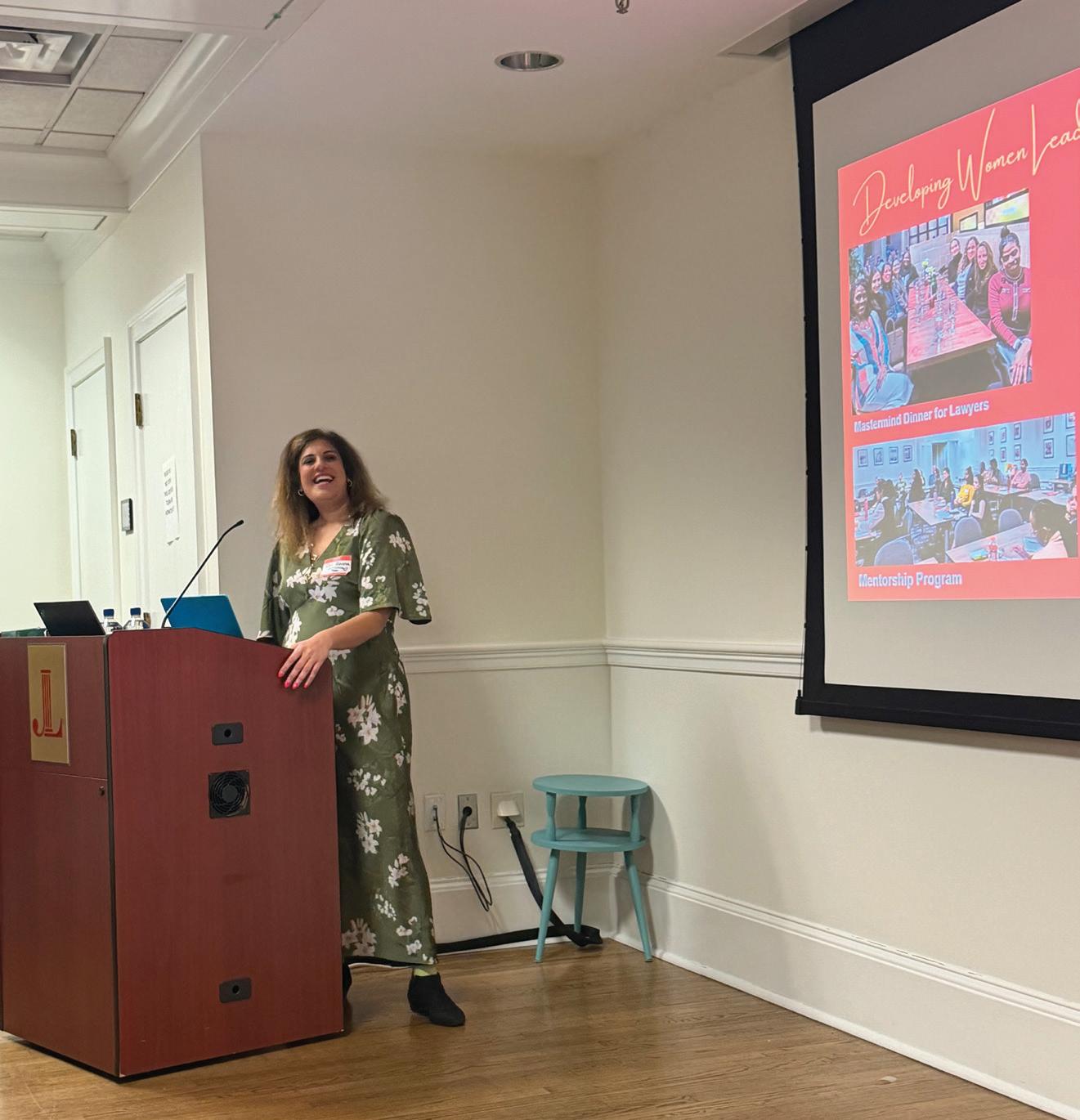
Carey notes that one of the Recruitment Communications Committee’s first priorities was building a structure that would last year after year. She explains, “Ray and [Dr. Choudry] developed a formal Standard Operating Procedure
(SOP) for the Recruitment Communications Committee that outlines the committee’s purpose, responsibilities, deliverables, timelines, approval workflows, and coordination with other League leadership. The SOP also documents the annual recruitment communications timeline, beginning with strategy planning in early summer and continuing through recruitment season in the fall. Establishing this framework ensures that future committees have clear guidance, institutional knowledge, and resources so recruitment communications can remain consistent and effective.”
These elements form the foundation of JLW membership. Through service opportunities and placement options, JLW offers many ways to serve the community while getting
to know fellow members. The New Member Year and JLW Volunteer Experience sections of the Prospective Member Guide show how social and community engagement can go hand in hand through placements, training, social events, and opportunities such as Done in a Day (DIAD) projects.
The Prospective Member Guide also showcases the wide range of JLW experiences available to members. Its Choose Your Own Adventure section outlines the two primary paths of JLW membership: volunteering in the community and performing internal work for the League. Members are not limited to one or the other, and every membership journey supports JLW’s mission. The guide also provides overviews of service and community engagement opportunities, including Kids in the Kitchen, Bright Beginnings, 826DC (Reading All-Stars), and Calvary Women’s Services. By describing specific volunteer roles, supported by impact statistics and photos of JLW members in action, the guide shows how members can meaningfully serve their community.
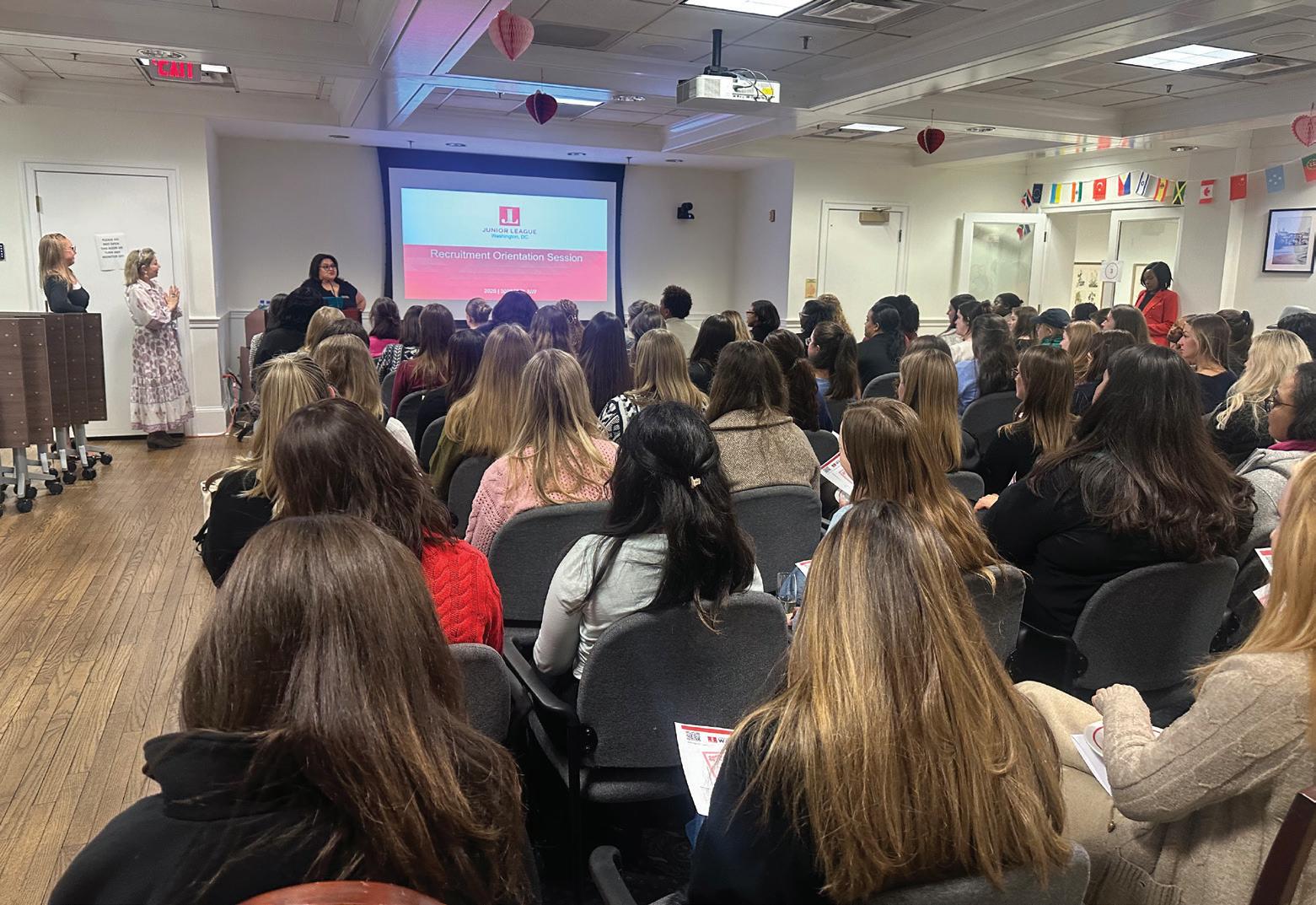
In-League placements are another highlight of the Prospective Member Guide. The “internal” membership path extends far beyond a few roles. Many JLW members are placed on in-League committees such as Publications, New Member, Transfers, Member Resources, Archives, and Strategic Planning. Fundraising is also a pillar of JLW, and the League’s fundraising events offer excellent leadership opportunities. The guide spotlights signature events such as the Women’s Leadership Breakfast, the Art of Entertaining, and Tossed & Found, clearly explaining their purpose and featuring memorable photos from past years. The National Book Festival is also featured. While many know the event itself, the volunteer participation of hundreds of JLW members year after year is a major source of League pride.
Beyond organization-level involvement and opportunities that JLW provides its members, there is also the chance to invest in leadership skills and development. Whether personal or professional, the skills of JLW can be sharpened by partaking in Development & Training workshops and
throughout the course of participating in assigned placements. The Community Training Committee prepares JLW members to volunteer in areas such as trauma-informed care, homelessness, and food insecurity. Both inside and outside JLW, the League offers many ways to gain practical experience and training while meeting other members and making new friends. The JLW Leadership Institute further supports this growth through leadership sessions, programs, and events that prepare members for roles within JLW. For every form of JLW leadership members seek, there is a program and network to support them.
The Prospective Member Guide includes even more JLW highlights, including the Mentorship Program, JLW’s commitment to Diversity, Equity, Inclusion, Accessibility, and Belonging, Esprit events, and additional JLW LIFE moments. It also offers practical guidance for prospective members, including the recruitment timeline, dues information, and frequently asked questions. Throughout, examples of JLW LIFE come to life through quotes from League leaders about why they love JLW and photos of smiling members at Esprit events.
The Prospective Member Guide from JLW’s Member Recruitment Committee is indeed a “guide for every step of the way,” as Carey states. By capturing the JLW experience and outlining how to navigate the recruitment process, the guide is an excellent resource for prospective members as they begin their JLW adventure. •
Ashley Lawrence
The Junior League of Washington’s (JLW) Community Outreach Committee
(COC) is a group of women whose work weaves together scholarship, community dialogue, and partnership to address some of the District’s most pressing challenges.
The Community Outreach Committee’s work is anchored by two interconnected pillars. The first is the annual Meg Graham Scholarship: Celebrating Service and Leadership, a $10,000 four-year scholarship awarded to a Washington, DC, high school senior who exemplifies academic achievement, leadership, and service. The second is the Community Roundtables, which convene nonprofit leaders, educators, and community stakeholders to address urgent needs.
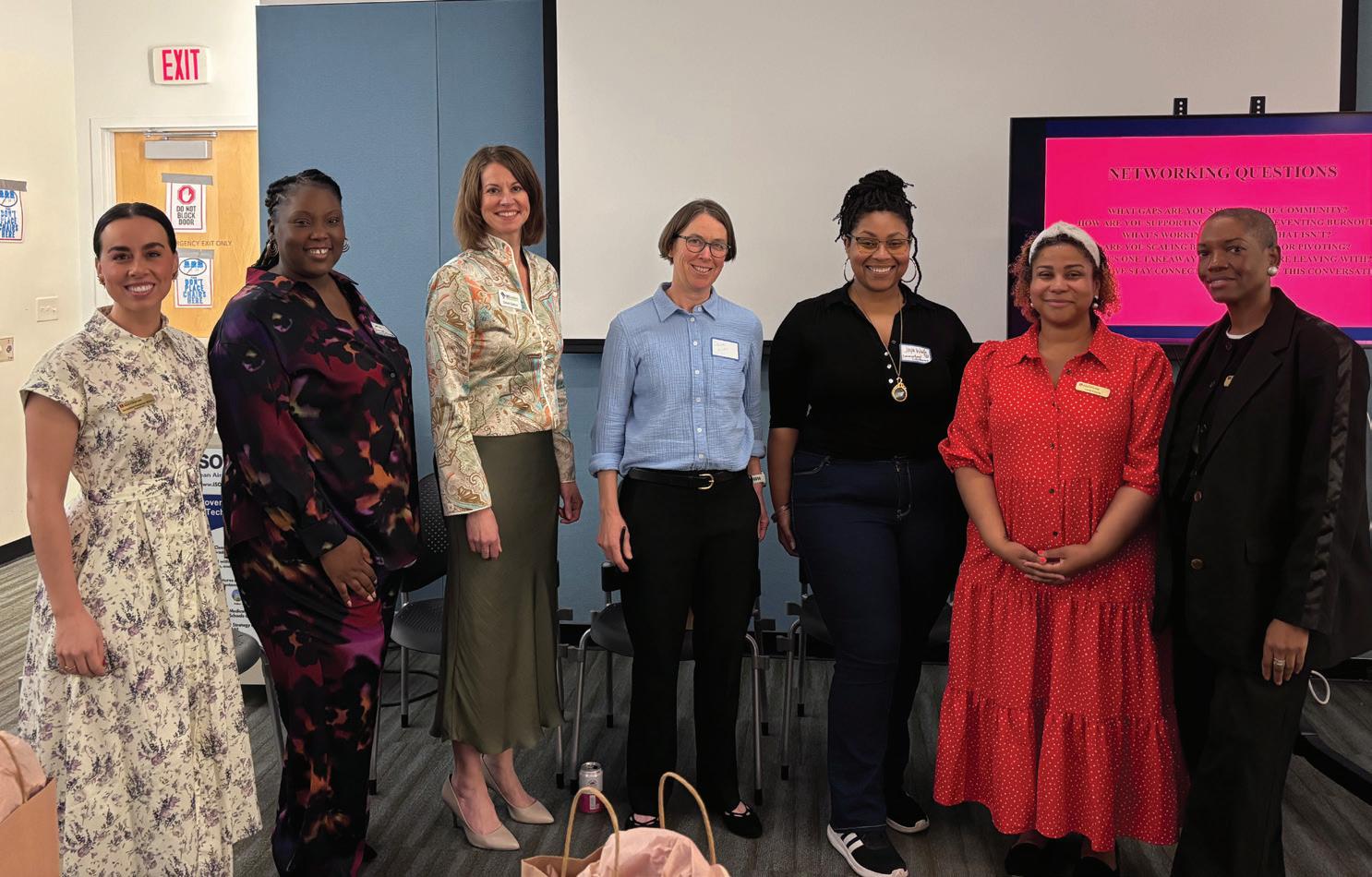
The scholarship honors Reverend Margaret M. Graham, a former JLW member and former President of The Association of Junior Leagues International, Inc. (AJLI), whose legacy of service continues to shape the committee’s identity. More than a financial award, it is an investment in the next generation of DC leaders. Linda Irizarry, Chair of the Community Outreach Committee, explains, “The committee oversees all aspects of the scholarship process to ensure it supports and recognizes youth who demonstrate academic achievement, leadership, and a commitment to service. Through both the scholarship program and Community Roundtables, we advance JLW’s mission by expanding educational opportunities for youth and providing meaningful resources and engagement opportunities for community partners.”
Committee members speak with unmistakable admiration about meeting high school seniors who have organized their communities, mentored younger students through sports, and stood before the City Council to advocate for equal access to education. “These are young people already doing the work,” Irizarry notes. “It’s one of those moments that captures everything—the compassion, the creativity, the impact that’s possible when young people are given a platform and a chance.”
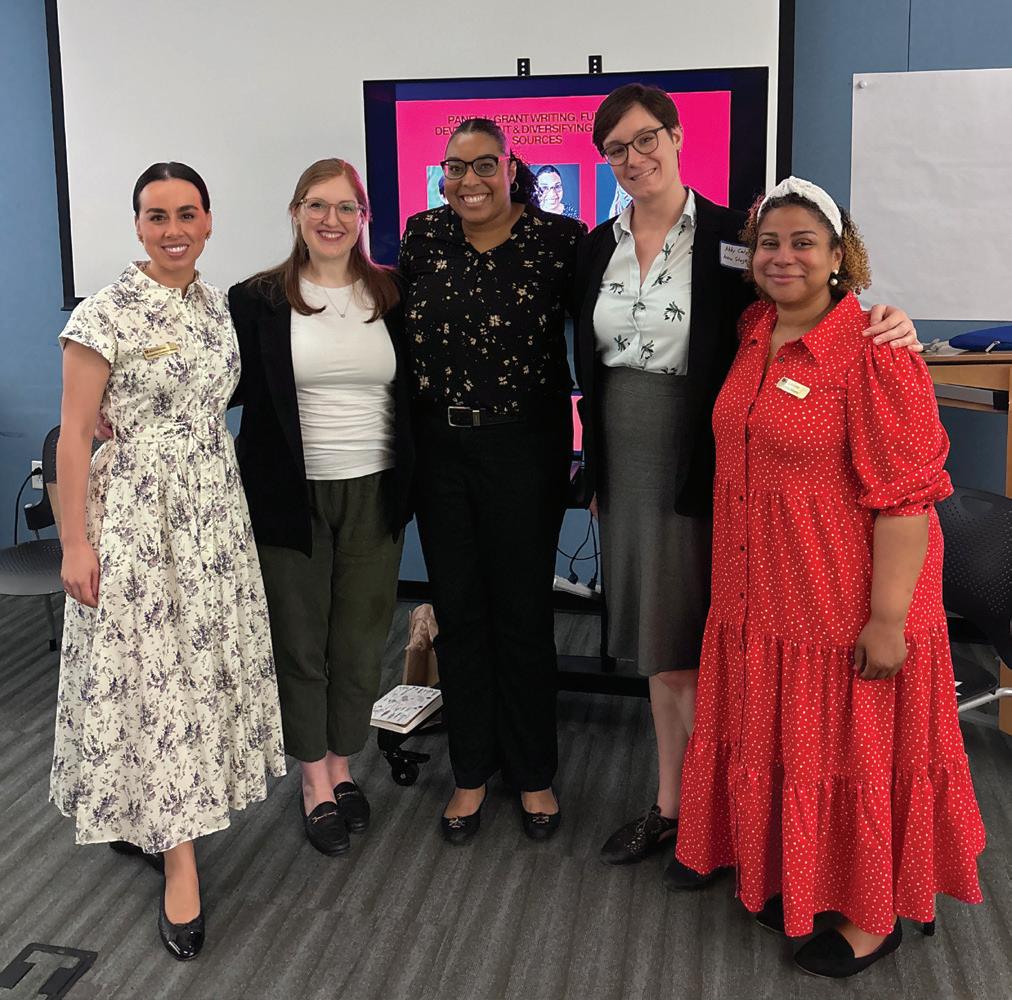
At the Community Roundtables, rather than arriving with a predetermined agenda, the COC creates space for partners to name what they are actually experiencing on the ground. “The committee prioritizes listening before leading,” Irizarry explains. “Community Roundtables have proven powerful in bringing together diverse nonprofit leaders to discuss shared challenges. These conversations often spark cross-organizational collaboration, multiplying the impact beyond a single event and strengthening the broader community ecosystem.”
“Building long-term, trust-based relationships allows the Community Outreach Committee to move beyond one-time engagements and instead become a consistent, reliable presence within Washington, DC’s educational and nonprofit network,” Irizarry says. “Trust creates openness, honest dialogue, and shared accountability. When partners know JLW is committed for the long term, they are more willing to share real challenges, emerging needs, and strategic opportunities.”
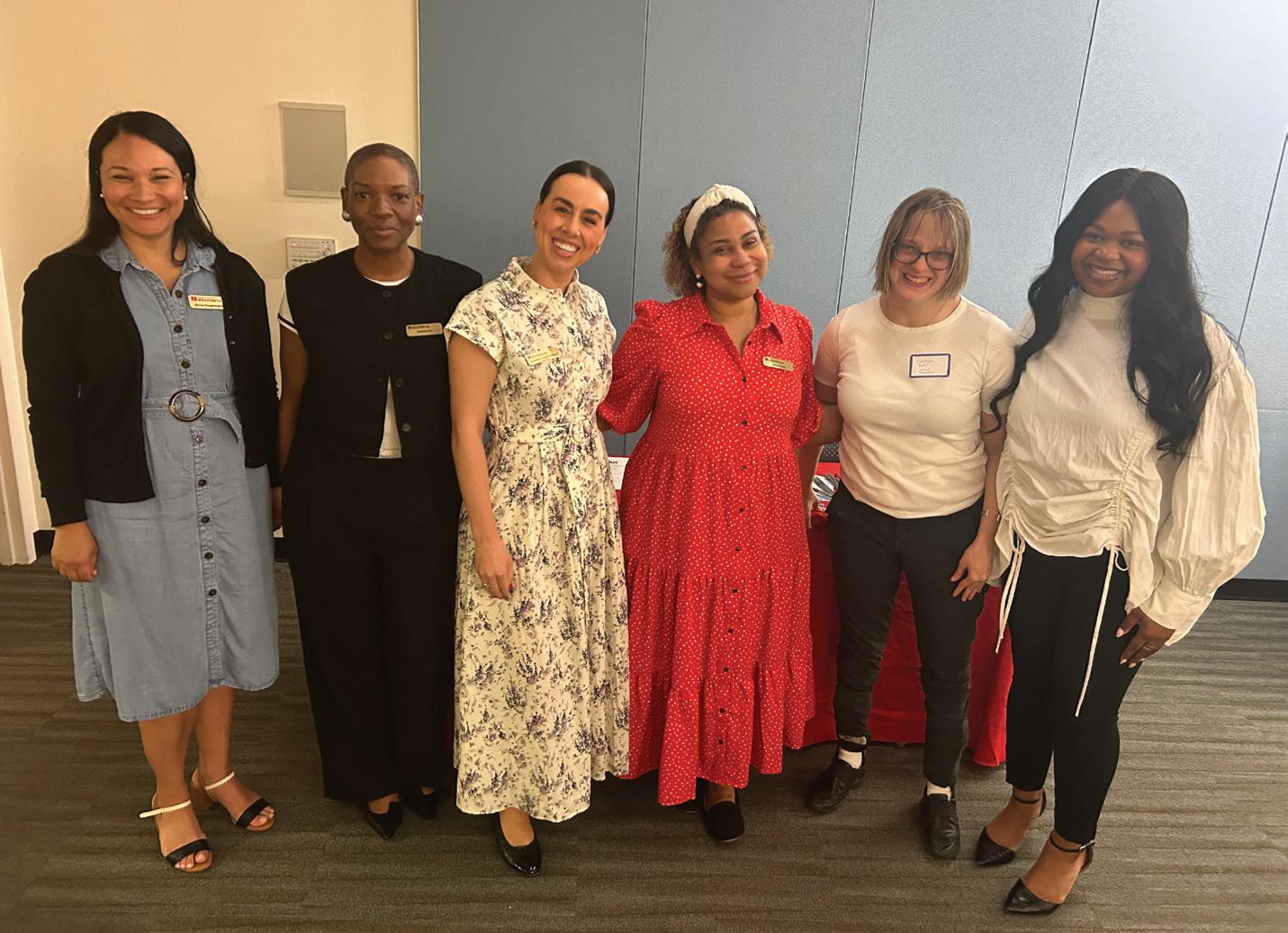
members grow into confident leaders who can advocate effectively both within JLW and in their broader communities.”
That commitment to trust shapes how the committee defines success as well. Metrics such as scholarship applications, roundtable attendance, and partner engagement provide one measure of success, but qualitative indicators matter just as much. “Success is reflected in sustained partnerships, meaningful dialogue during roundtables, partner feedback, and evidence that JLW is viewed as a trusted collaborator rather than a one-time supporter. When nonprofit leaders return to future roundtables, refer others into our network, or initiate new joint initiatives, it demonstrates that our presence is valued and impactful,” Irizarry explains.
For the women who serve on the COC, the work is as personally transformative as it is community-facing. “Hands-on community outreach offers experiential leadership development,” Irizarry reflects. “Members work directly with educators, nonprofit leaders, and students, which strengthens communication skills, cultural competency, and emotional intelligence.”
“Engaging with these issues deepens members’ understanding of systemic barriers,” Irizarry notes. “This exposure moves members beyond service into informed advocacy. By listening actively, building partnerships, and facilitating meaningful dialogue,
The committee frames this growth through JLW’s LIFE framework. “This committee offers a lived example of JLW LIFE,” Irizarry says. “Members will gain the opportunity to lean in and listen to real stories from students, educators, and nonprofit leaders. They will invest in their own growth, find pathways to opportunity, and engage in meaningful collaboration while serving alongside fellow members and community leaders.”
As community needs continue to shift, the COC’s priorities for the coming year reflect a focus on deepening relationships within the Washington, DC, educational and nonprofit community. “Strengthening follow-up after roundtables will be a key focus so that conversations translate into sustained collaboration,” Irizarry shares.
Enhancing the visibility and reach of the Meg Graham Scholarship is also top of mind. “This includes refining outreach strategies to reach a broad and diverse pool of applicants and ensuring that the selection process remains equitable and mission-aligned,” Irizarry adds.
The goal, ultimately, is to be the kind of partner that DC’s communities can genuinely count on not just this year, but for years to come. Because the most lasting change comes from showing up consistently, listening openly, and building relationships that move a city forward. •
Do you remember learning how to ride a bike?
Were you scared?
Excited? Both? Many of us remember the thrill when it all finally clicked, and we left our mom, dad, or grandparent pushing and running alongside us behind as we glided down the driveway toward bigger things. In more recent memory, maybe we think of COVID, or one of Metro’s shutdowns, when knowing how to ride a bike provided legitimate safety, convenience, and perhaps just a more fun way to get around town.
The Junior League of Washington’s (JLW) newest committee, Girls in Gear, partners with the national nonprofit that uses biking as a tool to build confidence, leadership skills, and community connections among girls through physical activity, mentorship, and life skills development.
JLW and Girls in Gear share a core vision of empowering girls and women, making this partnership a natural fit. Girls in Gear received JLW’s Volunteer Resources Grant in the 2024–2025 League year, providing the DMV chapter with $2,000 and 10 JLW volunteers for a two-year pilot program. From that partnership, one of JLW’s newest committees was formed.
JLW volunteers are involved in two key ways: Glide to Ride events and the Pedal Power Program. Glide to Ride events are two-hour clinics that teach riders of all ages and skill levels the fundamentals of biking in a safe, supportive, and judgment-free environment. Held in parks
and schools across DC and Northern Virginia, volunteers support riders as they build their skills.
JLW’s impact deepens through the Pedal Power Program, an eight-week program with 90-minute sessions for girls ages five to 13. The program blends bike-riding skills with meaningful conversations, mentorship, and movement-based activities to help build strong, confident girls. Through the Pedal Power Program, volunteers develop real relationships with participants, creating a “big sister/little sister” dynamic.
“Much of the socialemotional work happens in the Pedal Power Program.”
As Committee Chair Caren Roushkolb notes, “Much of the social-emotional work [that JLW participates in] happens in the Pedal Power Program.” Over the course of the program, JLW members cover lessons on confidence, friendship, safety, movement, and active listening, integrated into each week’s focus on improving bike-riding skills.
For girls growing up in urban communities, learning to ride a bike can represent access, independence, and opportunity. In areas where public transportation can be unreliable or limited,
a bike provides a new way to reach schools, libraries, grocery stores, and future opportunities.
Beyond transportation, the confidence girls build by mastering a physical skill like biking carries into other areas of their lives. In environments where access to recreation can be limited, programs like Girls in Gear create safe spaces for movement, risk-taking, and growth. Through the Pedal Power Program, JLW volunteers help girls learn that they can fall, get back up, and try again until they succeed. As Roushkolb notes, “part of the reason Girls in Gear exists is that girls have lower involvement in physical activities than boys after age 10,” making this work especially important during formative years.
The connections formed with JLW members add another important dimension. For some participants, volunteers may be their first sustained relationship with professional women who model leadership, community engagement, and civic responsibility. Through these relationships, girls see what’s possible and begin to envision their own futures with greater confidence.
For JLW members, volunteering with Girls in Gear offers the chance to make a tangible difference in a young person’s life in just a few weeks. When volunteers teach a girl to ride a bike and support her growth, they are not just teaching a skill; they are expanding her sense of what’s possible and strengthening her belief in her own capabilities. •
Abrand-new Active member and a decadeslong Sustainer walk into the same room. It sounds like the setup to a joke, but to the Membership Outreach Committee, it’s the goal. At the helm is Chair Amanda Gray Bailey, who has served on the committee for five years.
“It’s the perfect amount of ‘a little bit busy’ all year long,” she says with a laugh, “and you stay on top of what’s going on with the League.”
The Membership Outreach Committee exists to bridge the full spectrum of the Junior League of Washington (JLW) experience: connecting newer members with seasoned leaders, current members with Sustainers, and everyone in between. In an organization where members span decades of service, that kind of cross-generational connection takes planning, intention, and a committee that genuinely cares about every member, no matter the stage in their life or in their League journey.
“Our goal is to make JLW members feel included and in the know at all times,” says Bailey, “and to help facilitate sharing of advice from members at different stages of their JLW journey.”
The committee’s signature events each serve a distinct purpose every year. The three General Membership Meetings, or GMMs, form the backbone of the calendar—the moments when the full League can come together to vote on minutes, align, and move forward as one. Bailey shaped each GMM agenda around President Christina Babcock’s vision for the year, ensuring each pillar of JLW L.I.F.E. was thoughtfully represented throughout.
The committee also knows how to keep things fun. The Fall GMM’s Marketplace runway show was a hit, proving that even a membership meeting can have flair. The Winter GMM, held virtually given DC’s infamous snowstorm of 2026, drew more than 500 attendees, a testament to how members value staying connected to the League no matter the weather. The Spring GMM brought the year full circle, giving members one final opportunity to come together, celebrate the year’s accomplishments, and look ahead to what comes next.
Bubbly with the Board remained another beloved committee staple this year. The concept is simple: small-group rotations where members get face time with Board leaders, ask questions, and get a real sense of who is steering the League and where it is headed. Each room is assigned its own topic area, so Board members are not repeating themselves, and members are always hearing something new.
The atmosphere is relaxed. If a room goes quiet, there’s always a warm-up question at the ready: “What’s on your nightstand right now?” just to prove that no question is too small. That
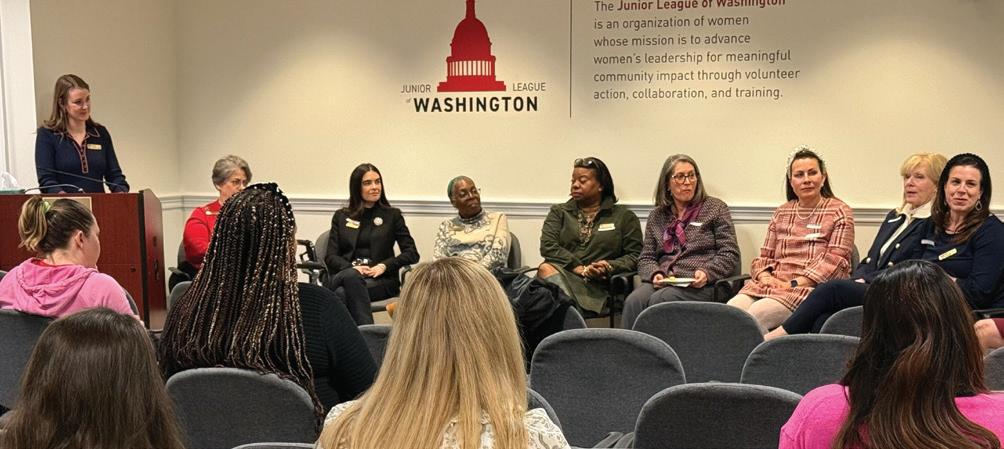
combination of accessibility and intentionality makes Bubbly with the Board a beloved fixture of the League calendar year after year, which many Board Members call their favorite event of the year. The format even made its way beyond Membership Outreach, with Recruitment Chair Desiree Carey bringing the Bubbly with the Board model into Recruitment Orientation Sessions this year.
Sips with Sustainers offers something altogether different: a space for current members to get a candid look at what Sustainer life actually looks like. For members curious about the road ahead, it is a valuable resource. For the Sustainers themselves, it’s a reunion.
“The best part of the event is all of the Sustainers socializing before and long afterward,” says Bailey. “They’re such a warm and welcoming group.”
The crown jewel of the committee’s calendar is the Annual Reception, the event that closes the League year with recognition for both the League and the members who all deserve it. Stars are honored, contributions are celebrated, and in a tradition that never loses its weight, the Presidential gavel is passed to the president-elect in a ceremony paying tribute to every past president who came before. It requires the kind of all-hands, nothing-can-go-wrong execution that Bailey and her team deliver beautifully. As she recalls, “Don’t ask about the Annual Reception where the dishwashers died, so we had to handwash and dry all of those dishes. My hands are still pruned.”
What made all of it work, according to Bailey, is the team.
“Outside of JLW, I’ve struggled to delegate because I can’t fully trust what the outcome will be,” she says. “But I know that if an MO member is doing it, it’s being done graciously and efficiently.”
It’s that trust, built over years of showing up and keeping the League connected, that defines the Membership Outreach Committee. As the gavel passes and a new League year begins, Membership Outreach is there, ensuring everything—with the possible exception of the dishwasher—is running smoothly. •
Ashley Lawrence
On any given Saturday morning, tucked inside a quiet corner of a local library, something powerful is unfolding one page at a time. Jenny Murphy and Caitlin Askins, volunteers from the Junior League of Washington’s Reading AllStars (RAS) Committee, arrive not just to read with students but to build relationships, confidence, and a lifelong love of learning. The experience begins with volunteers checking in, heading upstairs to the children’s section, and meeting the students they’ve come to know week after week. From there, pairs often retreat to a quieter study room, a space designed to minimize distractions and maximize connection. What follows is not a rigid lesson plan, but a rhythm: reading, playing, laughing, and growing together.
Students choose what they want to read, whether it’s a new stack of books or a beloved chapter book they have been working through. Breaks are encouraged, often filled with creative play, such as building with blocks or playing vocabulary games. The result is an environment where reading feels less like a requirement and more like an invitation.
“It’s the best part of my day job without the pressure,” Murphy shares. As a classroom teacher, she is used to balancing curriculum requirements, testing, and administrative demands. At RAS, those pressures fall away. “My student and I just get to enjoy reading, playing, and getting to know each other.”
In traditional classroom settings, time constraints and academic benchmarks can limit opportunities for individualized attention. RAS fills that gap by offering something equally critical but often harder to quantify: space for students to succeed on their own terms.
Murphy recalls working with a student who began the program with an “I hate reading” attitude. At first, he resisted engagement, leaving most of the reading to his JLW mentor. But over time, something shifted. Week by week, he began to participate more until, eventually, he was the one eager to read aloud, taking pride in his progress and ownership of his learning.
Askins described watching her student’s reading stamina grow dramatically over time. What began as brief, reluctant attempts at reading evolved into sustained engagement with multiple books in a single session. Students who once gravitated toward texts well below their level began confidently choosing age-appropriate material, asking for help with unfamiliar words, and persisting through challenges.
These academic gains are paired with something just as meaningful: confidence.
At RAS, there are no grades, no tests, and no pressure to perform. Instead, students are met with encouragement, patience, and consistency. Each session ends with small but significant rituals—choosing stickers to mark progress, sharing a snack, and saying goodbye until next time. These moments reinforce a sense of accomplishment that extends far beyond the library walls.
The program’s emphasis on long-term relationships further deepens its impact. Many volunteers work with the same student for multiple years, creating a continuity that allows trust to flourish. “Being with the same child for three years has been an amazing opportunity,” Askins notes. “It’s allowed us to build a safe, healthy relationship.”
The program’s reach often extends beyond individual pairings. In some cases, siblings participate together, creating opportunities for shared learning and connection. Both Murphy and Askins describe moments where students worked collaboratively to decode words or use new vocabulary in sentences, reinforcing skills while strengthening family bonds.
RAS represents more than a literacy initiative—it is an investment in the city’s future. By helping students build confidence and competence in reading, the program equips them with tools that will serve them in every aspect of their education and beyond.
Askins explains, “Students are expected to read but at RAS, they get to experience success in reading.” That distinction is critical. Success breeds confidence, and confidence opens doors—to new opportunities, new interests, and new possibilities.
The program continues to evolve, strengthening its impact through strategic partnerships. A recent transition to working with Northstar Tutoring expanded opportunities for collaboration and support, further ensuring students receive high-quality, consistent programming.
For volunteers, the experience is also transformative. Many join the program because of their backgrounds in education or desire to give back, but stay because of the relationships they build. Serving as a mentor offers opportunities to grow as both a leader and a community member.
“RAS has allowed me to meet and become friends with some amazing volunteers,” Askins shares, highlighting the sense of connection that extends beyond student-mentor pairs to the broader League community.
At its core, RAS is about more than literacy. It is about showing up, building trust, and creating space for young people to see themselves as capable, confident learners. It is about turning pages—and in doing so, helping students write new stories for themselves.
Alanna Brannam
In the Junior League of Washington (JLW), every Active, New, and Transfer member has a placement in the League. By not having at-large or general membership, JLW fosters engagement, participation, and community service through placement requirements. While external-facing committees, known as Community Placements, focus on service and voluntarism in the DC area, in-league placements work to keep JLW up and running by ensuring organization, fundraising, and member satisfaction.
Member satisfaction is an important aspect of JLW, as the League not only depends on new members joining but also on retaining the many members who return to participate year after year. This is where the Member Resources Committee shines.
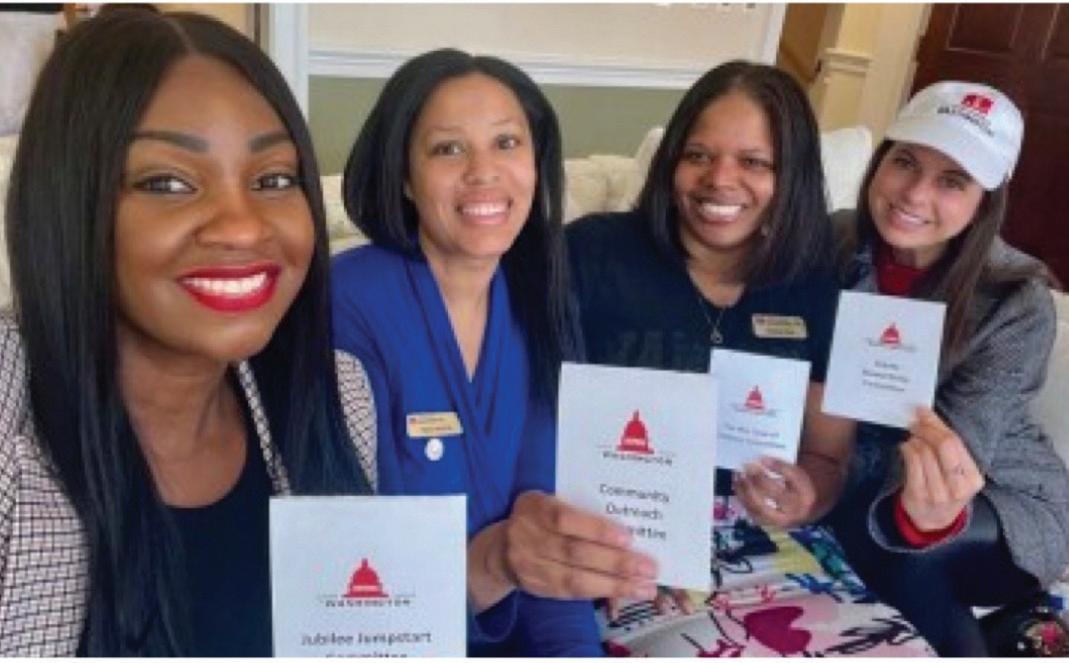
Nearly every JLW member can thank Member Resources, as the committee works directly with members to foster rewarding, successful League experiences and placements. Lauren Hanna, Chair of the Member Resources Committee, shares that the committee “serves an important role as the conduit between members and the rest of the League. As such, each of our members serves as a liaison to each committee, acting as a resource for them to get any questions answered about the League in general, or if they are having issues fulfilling their placements.”
Placement Information Events (PIE) held each spring are one of the ways that the Member Resources Committee facilitates successful placements for JLW members. These events are an opportunity for members to learn more about committees and volunteer opportunities across the League, which is especially valuable to do in one place. Each of the more than 40 committees is represented at PIE. This allows members to ask questions of current committee members and leaders, helping them determine which placement is the best fit.
Since JLW has a wide range of committees, many members are not familiar with the duties, mission, and focus of all potential placements. Alongside the PIE, the Member Resources Committee assembles and distributes a Volunteer Opportunities Brochure (VOB). This brochure provides a digital overview of each placement option. The VOB categorizes placements by the nine JLW Councils, allowing the many committees to be
presented in a cohesive, organized manner and clearly articulates what each committee and its work entails.
Another program organized by the Member Resources Committee is the JLW Member Town Hall. Hanna describes the Member Town Halls as an opportunity for the general membership to “ask questions of and give feedback to leadership.” Member Town Halls are a valuable chance for dialogue between members and leadership in JLW, providing a different, attendee-led environment for convening than General Membership Meetings, during which updates from across JLW are shared with attendees.
Additionally, the Member Resources Committee provides advice to leadership across JLW, serves as placement liaisons, and generally supports successful member development within JLW placements. In such a large organization, it can be tough for members to keep up with the rest of the League. While the Communications & Public Relations Council does an excellent job of highlighting the League’s work and updates across channels, it is extremely helpful for members to be able to ask questions and directly interact with others to learn more about placement opportunities and JLW initiatives.
JLW’s Member Resources Committee works hard to make each member’s League experience meaningful and rewarding, but more than that, it helps ensure that every member feels connected, supported, and empowered to make an impact. In doing so, the committee doesn’t just strengthen individual placements — it strengthens the League itself. •
Rashida I. Sims
Belonging does not happen by accident. An organization as large, dynamic, and diverse as the Junior League of Washington (JLW) pursues this goal with intention, supported by leadership and sustained through action. This League year, the Diversity, Equity, Inclusion, Accessibility, and Belonging (DEIAB) Task Force has leaned into that responsibility by launching new initiatives that respond directly to member feedback and center accessibility, connection, and inclusion.
At the heart of this work are two new offerings: Work From Headquarters (WFHQ) and Community Day. Both offer informal, low-barrier opportunities for members to gather, connect, and simply be together without agendas, registration limits, or financial barriers. Through these initiatives, the Task Force is not only addressing concerns about belonging but also redefining how members experience JLW’s shared space.
The idea for WFHQ and Community Day grew out of early-year reflection by the DEIAB Task Force, annual survey data, and feedback from the JLW Board of Directors. As Chair Emily Jordan explains, “We heard consistently that members lacked a sense of belonging and that there weren’t enough low-pressure ways to connect.” Community Day was born from this feedback, and once planning started, WFHQ naturally followed.
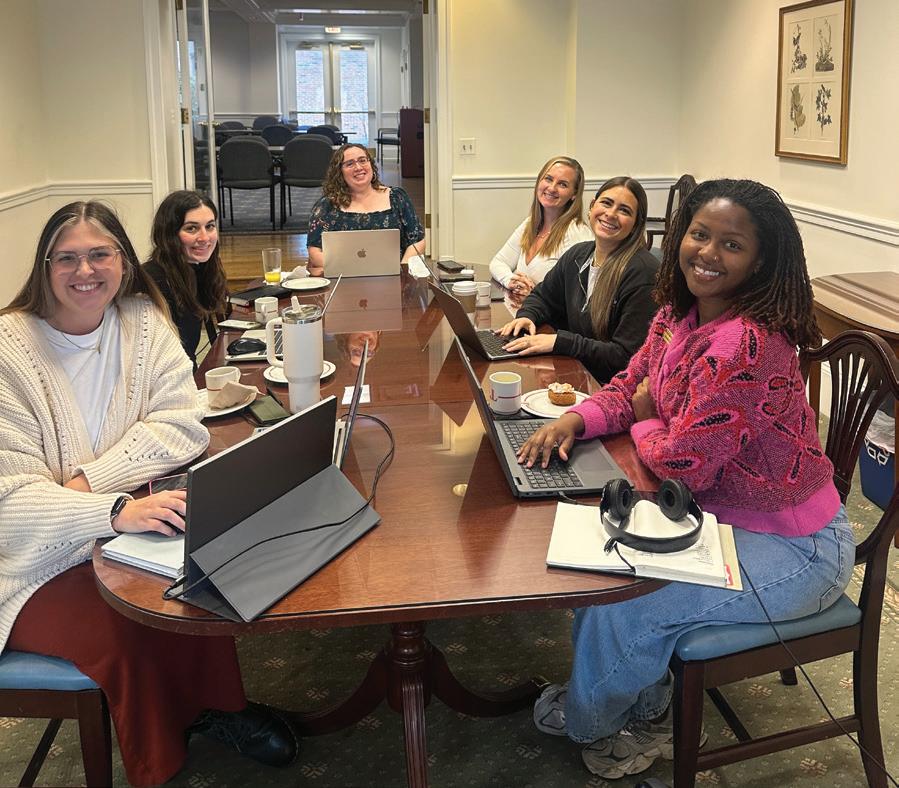
WFHQ invites members to use Loughborough House as a co-working space—whether for a full workday, a few hours between meetings, or a short visit to connect with others. Community Day complements this by
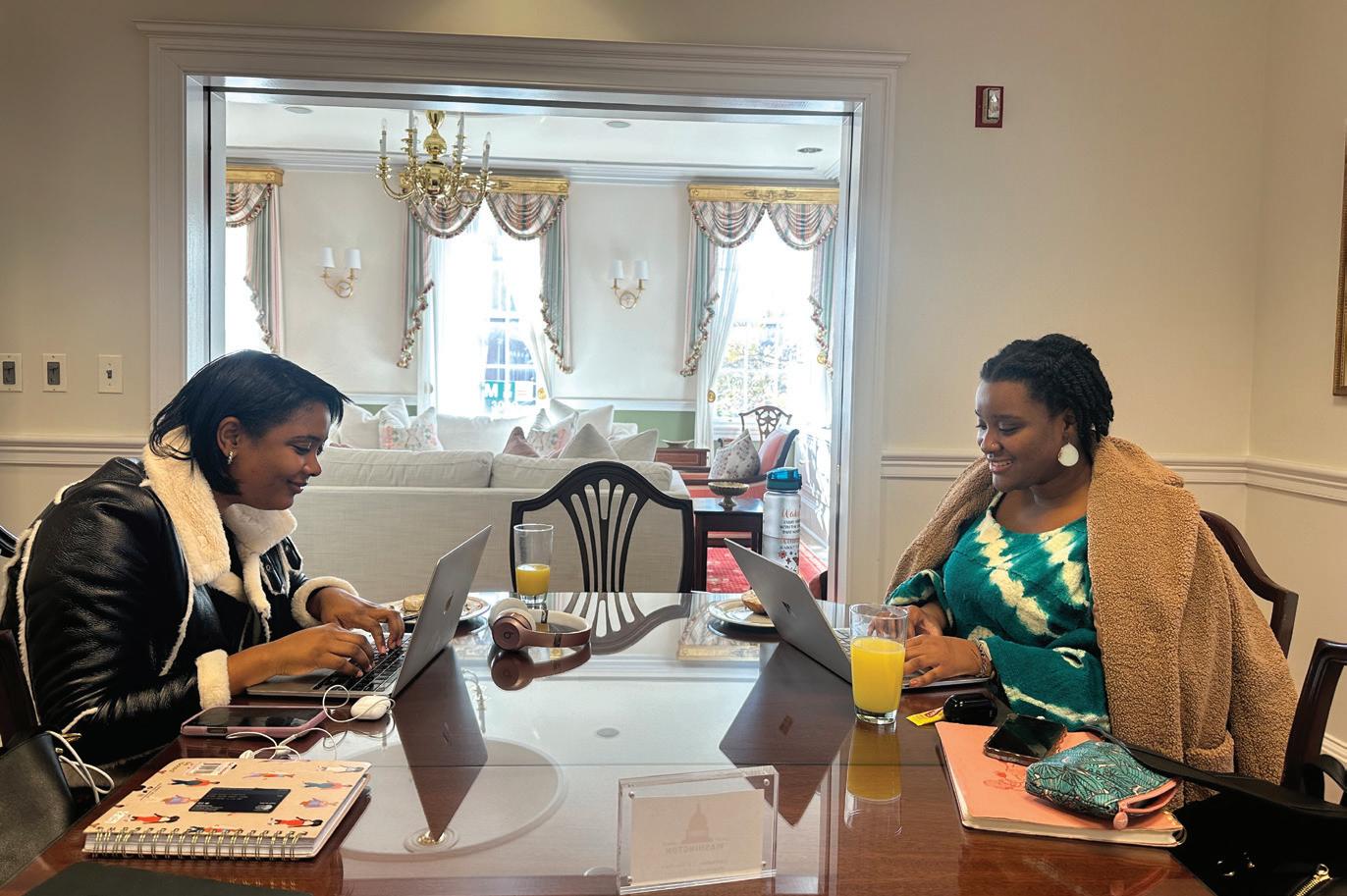
offering a monthly happy hour at headquarters, open to all members. Both initiatives reinforce the core message that HQ belongs to everyone.
“We all contribute to the maintenance of the house,” Jordan notes.
“Members should feel empowered to use it—not only for formal League business, but as a place to build relationships.”
From a DEIAB perspective, accessibility is central to belonging. Task Force members were intentional about designing events that removed barriers such as cost, rigid schedules, and social pressure. Both WFHQ and Community Day are free, open to all members, and flexible in how people participate.
“The open invitation is central,” shares Task Force member Amna Choudry. “Members have shared that they often feel blocked from certain spaces because of cost, registration limits, or timing constraints. By creating a free co-working and community space, we are making
connections more equitable and more realistic for members who cannot always attend traditional programming.”
That flexibility has been key. Members can work quietly, take meetings, socialize, eat, or simply stop by. Attendees have included members working on grad school applications, remote jobs, classes, and League tasks.
Feedback from participants reinforces the impact of WFHQ. Member comments have ranged from “It’s great that it was free, open to everyone, and accommodating for different work hours, jobs, and work styles” to “The encouragement of socializing with all made it feel very inclusive—and I was able to meet several different women from other committees who I don’t think I would run across otherwise!”
Task Force member Kelly DeLoach could see this play out in real time. “I was chatting with a woman during Community Day and discovered we grew up in neighboring towns. Then, two people who both spoke Mandarin started conversing. Another person was looking for a new job and was able to connect and send their résumé to another participant.”
These experiences reflect a growing sense that connection does not require formality—and that belonging often flourishes in spaces without an agenda.
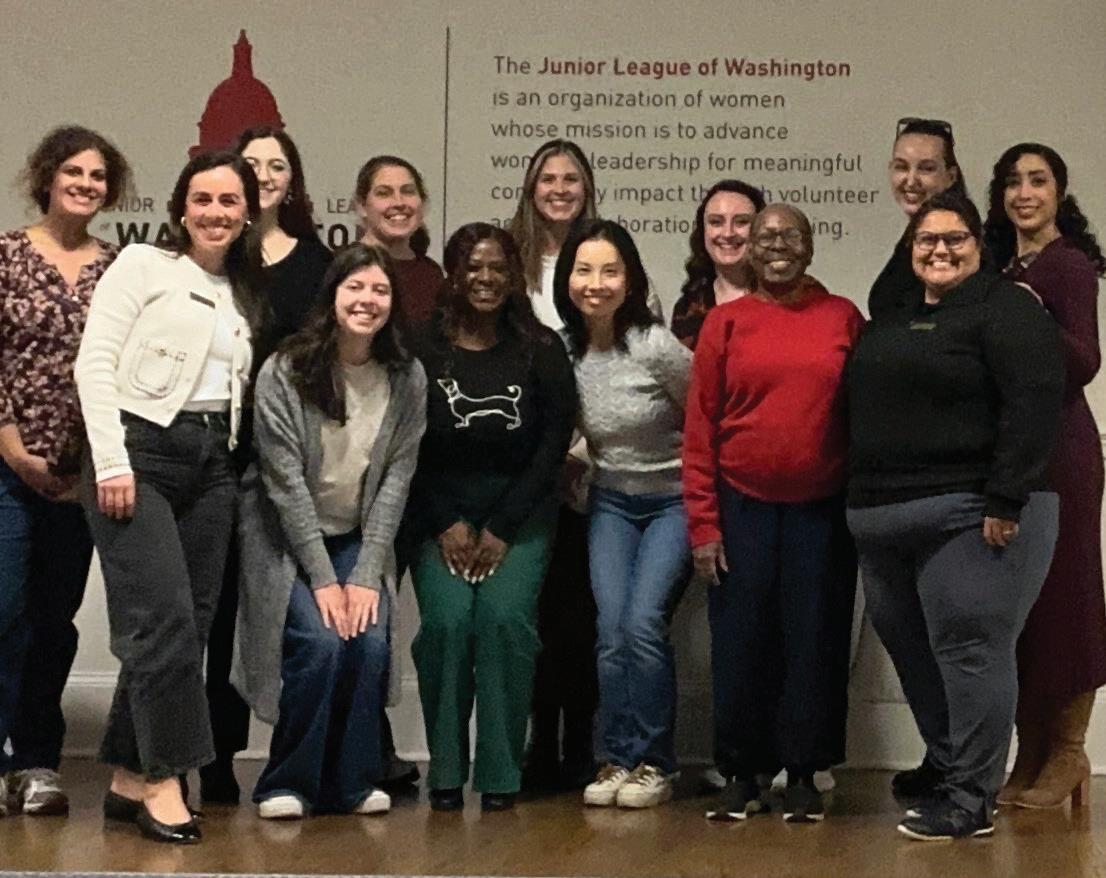
A consistent theme across interviews with Task Force members was the collaborative nature of the group itself. Members described the work as deeply team-based, grounded in shared ownership and mutual support.
“This Task Force operates as a true team,” Choudry reflects. “Every member brings lived experience, thoughtful ideas, and a willingness to learn. We’re not positioning ourselves as experts— we’re collaborators.”
That collaboration has been supported by League leadership. President Christina Babcock and President-Elect Jacqueline Frederick-Maturo have
actively engaged in brainstorming and dialogue, creating space for creativity and experimentation. Task Force members also highlighted one another’s contributions—from inclusive town halls to thoughtful promotion and engagement—underscoring that DEIAB work touches operations, communication, and culture.
For Kat Rogers, belonging is deeply personal. “Belonging is being in a space where I don’t have to wear armor. It is knowing that I can show up fully—my wacky, hyper, serious, silly, ADHD self—ask questions, share ideas, listen deeply, and be listened to without feeling diminished, dismissed, or silenced in any way. In a place like JLW, belonging looks like mutual respect and meaningful connection—creating a culture where no one has to make themselves small in order to stay.”
DeLoach echoes that sentiment, defining belonging as a space where everyone—regardless of background, ability, or identity—feels welcomed and
able to connect. “We don’t always get it right,” she notes, “but as long as we keep working to improve, every member can find their place.”
As JLW prepares for future strategic planning, the DEIAB Task Force sees its role evolving alongside the League. Task forces are, by design, temporary—but the work of DEIAB is ongoing.
“You don’t ‘achieve’ DEIAB,” Jordan reflects. “It’s always evolving, and so should we. The Task Force is meant to operationalize ideas into collective action. We hope that more members feel empowered to bring forth ideas for improvement and innovation in the member experience.”
For now, the invitation stands: Anyone who wants to join can. Bring your laptop. Bring a JLW friend. Or just bring yourself. •
Editor’s Note: Since this article was written, the DEIAB Task Force has become an official committee within JLW.
Victoria Callahan
Ask any child what their favorite part of a cooking class is, and they will almost certainly say the eating. But something far more meaningful tends to happen in those moments between cracking an egg and taking that first proud bite. Confidence builds. Curiosity sparks. And the quiet, lasting understanding that what we put into our bodies matters begins to take root.
That is the magic that the Junior League of Washington’s (JLW) Kids in the Kitchen program has been cultivating across Washington, DC, one event at a time.
Known affectionately as KITK, the program is part of a national initiative supported by the Association of Junior Leagues International, Inc. (AJLI), but in JLW’s hands, it has become something distinctly its own. It is not a curriculum or a campaign. It is an experience, and for many of the children and families who participate, it is an unforgettable one.
Once a year, KITK takes center stage with a large-scale health and nutrition
fair timed to National Healthy Kids Day. The fair swings open its doors to DC-area families and community partners, welcoming children ages 3 to 13 into a world of cooking demonstrations, fitness classes, and hands-on activities that make healthy living feel less like a chore and more like a celebration. The gym floors buzz. The kitchen stations fill up. And somewhere in the middle of all of it, a six-year-old discovers that she actually likes kale.
But KITK does not pack up after the event ends. Throughout the League year, the program quietly and consistently shows up through mini-events hosted alongside community partners across the city. These smaller gatherings carry the same spirit as the main event, meeting families in their own neighborhoods and reinforcing the message that good health is not a privilege or a one-time occasion. It is a practice, and it is one that JLW is committed to making accessible to every family it reaches.
Behind all of it is a committee that brings as much energy to the planning
as it does to the events themselves. KITK members are organizers, volunteers, advocates, and, at times, enthusiastic taste testers. They build the relationships that make community partnerships thrive, develop the programming that keeps children engaged, and show up with the kind of genuine investment that families can feel. In a city as dynamic and diverse as Washington, DC, that consistency of presence matters enormously.
What KITK ultimately represents is one of JLW’s most joyful expressions of its mission. It is a direct service: a child learning to chop a vegetable, a parent discovering a new recipe, a neighborhood organization deepening its ties to the League. These are small moments, but they are also the building blocks of something bigger: a community that understands its health, values its choices, and knows that someone showed up to help make that possible.
JLW’s Kids in the Kitchen is not just feeding curiosity; it is planting seeds that will grow long after the aprons come off. •
Kate Seif
At first glance, $1,000 might seem modest in the world of mega-donor philanthropy, but across Washington, DC, this amount is making measurable differences in communities often overlooked by larger funders: student stipends offsetting unpaid internships, crisis funding for legal assistance, or purchasing supplies for care packages that restore comfort and dignity.
These tangible outcomes represent the power of the Junior League of Washington’s (JLW) Pathways Grant, a program designed to create pathways to opportunity for organizations and communities that might otherwise go unnoticed.
Finding the organizations most in need of support requires deliberate outreach. JLW advertises grant opportunities through its website, social media channels, and an email list of 300–400 community organizations built over years of relationship-building. External grant platforms further extend reach, bringing applications from across the region. This year, 15 organizations applied for the Pathways Grant, a slight increase from the previous year that reflects both the program’s growing visibility and the current funding environment, where every dollar matters. With only four grants available and 15 strong applications, the selection process is highly competitive. The Grants Stewardship Committee reviews and scores all applications independently before narrowing the field to four recipients, a process Committee Chair Erin Cromwell describes as “challenging due to the quality of applications.”
What makes the Pathways Grant distinctive is its specificity. The $1,000
award attracts organizations seeking to fund discrete, measurable components rather than broad programmatic work.
“The impact is direct and tangible,” notes Cromwell. “Each grant supports a specific, measurable activity.”
This year’s grantees reflect the breadth of need across the Washington region. Their work spans different populations and challenges, but each focuses on creating clear, achievable outcomes.
For Carol Freitas, who runs Personal Care Foundation, Inc., the JLW grant translates directly into 60 care packages filled with essentials: shampoo, conditioner, toothpaste, toothbrushes, deodorant, lotion, laundry detergent sheets, and totes to carry it all. “Hygiene products are not covered by most government assistance programs,” Freitas explains, identifying a gap that many do not realize exists. “There’s a lack of nonprofits in the area focused on hygiene, but the need is significant.” For organizations like hers, which are often too small to qualify for larger grants, the Pathways Grant provides critical support that keeps operations running.
Another recipient, the Restoration Immigration Legal Aid (RILA) organization in Arlington, demonstrates how targeted funding can multiply impact differently. RILA specializes in pro bono legal advocacy for vulnerable immigrants, particularly in asylum cases and Special Immigrant Juvenile Status. The organization now supports more than 1,000 clients, with casework hours increasing by 25% since January 2025.
JLW’s grant funds hours for two critical staff positions: a senior legal assistant who came to the United States as an immigrant herself and is now studying
for the LSAT to become an immigration lawyer, and a junior legal assistant with a talent for building relationships with young clients.
These organizations focus on specific, achievable outcomes, funding the components that make their broader missions possible: hours, products, assessments, and stipends that turn intention into action.
The Pathways Grant’s impact extends beyond a single funding cycle. There is no limit on how many times an organization can apply, and some are repeat recipients. The Personal Care Foundation, Inc., for instance, previously received a grant to purchase sunscreen and reapplied this year to expand support for essential items.
Several grantees also noted that the application process stands out. Freitas and RILA’s director, Johanna Montague, both describe it as straightforward, and Montague notes that “while this grant won’t transform our organization, it provides clear, tangible support for our mission and respects our time and capacity in a way that larger funders don’t always manage.”
For the organizations that applied this year, the Pathways Grant represents more than funding. It builds awareness, connection, and access to future opportunities. And for the four recipients putting their grants to work right now, the impact is already visible.
JLW’s Pathways Grant may be small by traditional philanthropic standards, but its impact is anything but. For recipients, it provides critical support that translates directly into meaningful outcomes, whether access to basic hygiene, legal advocacy, or new opportunities. •
Jessica Hassanzadeh
Tucked into a historic landmark on New York Avenue, the National Museum of Women in the Arts (NMWA) has spent more than four decades making space for stories that might otherwise go untold. For nearly as long, the Junior League of Washington (JLW) has helped tell its story with a partnership rooted in a shared belief that women’s voices and achievements deserve to be celebrated and preserved.
In 1981, NMWA was established as the first museum in the world dedicated exclusively to championing women through the arts. By 1982, League volunteers were already serving within the museum. At the heart of this enduring partnership is a shared purpose: elevating women. For NMWA, that means amplifying the work of women artists who have been historically excluded. For JLW, it means equipping women with the skills, confidence, and opportunities to lead through meaningful community impact.
This shared purpose has created a foundation that goes beyond voluntarism. Colli M. McKiernan, a longtime NMWA volunteer in her 12th active year with JLW, reflects: “The NMWA Committee placement has deepened my appreciation for how closely the arts, women’s history, and community engagement are interconnected. NMWA makes clear that art is not separate from social history; it reflects whose stories have been preserved, whose contributions have been recognized, and whose have been omitted. Volunteering there has sharpened my understanding of the importance of intentionally creating space for women’s voices and achievements.”
renewed focus on accessibility and engagement. Throughout these changes, JLW volunteers have remained a steady presence. At NMWA, JLW volunteers staff the information desk, guide conversations about exhibitions, support events, and create a welcoming environment for guests from around the world.
That sense of purpose has remained constant as both institutions have evolved—from NMWA’s early years operating out of a private residence to its opening in a historic Washington landmark in 1987, and through its recent renovation and
McKiernan adds, “The most striking evolution of NMWA, in my tenure as a volunteer, has been its continued growth in visibility, programming, and public engagement. The volunteer experience has likewise become more dynamic, with opportunities to support a wider variety of events and audiences than were available before its closure for renovation several years ago. Throughout those changes, what has remained consistent is the strength of NMWA’s mission, the incredible talent of its staff,
and the sense that we volunteers are contributing to something substantive and interesting.”
Katie Woodfin, chair of the NMWA Committee, described the experience of learning directly from an artist during one of her volunteer shifts. “I particularly enjoy the Firsthand Experience workshops that NMWA offers, where an expert artist will lead a workshop at the museum,” says Woodfin. “I have been able to volunteer at a lace-making workshop, as well as a workshop on cyanotypes, which is one of the oldest photographic processes and uses UV light to expose paper or fabric coated with iron salts to create prints from negatives without a darkroom. Being able to learn from these artists directly and see museum visitors engage with these hands-on learning opportunities has been a unique opportunity for this committee.”
Service at NMWA offers continual enrichment through new exhibitions, new artists, and new conversations with visitors. Volunteers are giving their time and gaining much more: knowledge, perspective, and a deeper appreciation for the arts.
Over more than 40 years, the museum has come to rely on Junior League volunteers as an integral part of its programming,
while the League continues to offer members a meaningful and well-supported experience.
Helen Anthony, who is in her ninth active year as a JLW member, shares, “It is clear how much NMWA staff appreciate volunteers and are willing to engage with and collaborate with us, and that continues to be true as I wrap up my third year on the committee.”
Ultimately, the success of this partnership can be seen in the experiences of the volunteers themselves. Their reasons are varied, but consistent themes emerge: a deep connection to the mission of advancing women, opportunities for intellectual engagement and learning, and the chance to make a tangible impact on the visitor experience.
As McKiernan summarizes, “Serving on the NMWA Committee has been the most rewarding volunteer experience I have had through JLW. It combines mission-driven service with cultural enrichment in a way that feels both distinctive and lasting. I am grateful for the opportunity to support an institution that celebrates women’s creativity and achievement, and I believe it is one of the placements that most clearly demonstrates how JLW volunteers can contribute to the civic and cultural life of Washington, DC.” •

Alanna Brannam
Every Junior League of Washington (JLW) member is engaged with JLW in her own way, whether she is being introduced to JLW as a New Member or Transfer, participating as an Active Member, or staying in touch with JLW as a Sustainer.
While many fondly recall their New Member provisional year, and others know well the requirements of being an Active Member, when the time comes to transition to a Sustainer, a whole new world of opportunities exists.
Sustaining members, more commonly referred to as Sustainers, are formerly active JLW members who completed, at a minimum, seven years of active status. Unlike New Members, Transfers, and Active Members, Sustainers do not have requirements such as membership credits. Sustainers are also not able to hold a JLW office or vote. However, Sustainers are able to stay engaged with JLW in a multitude of ways. For example, there is a dedicated Sustainer Committee, and Sustainers hold an array of events and meetings throughout the year. These include a Fall Luncheon, a New Sustainer Reception, Winter Tea, Sips with Sustainers, and a Spring Luncheon. This allows Sustainers to enjoy the social aspect of JLW, which is a highlight for many members.
In addition to attending these events, Sustainers may also attend any other JLW events and join in any community engagement opportunities. In fact, although there is no official requirement to participate in a committee, many Sustainers use their experience to advise JLW committees and volunteer their time. The flexibility of staying engaged as a Sustainer is a draw for many.
One Sustainer who speaks highly of her experience is Stephanie Rendón. Rendón cites two primary factors as her reasons for becoming a Sustainer: enrolling in and attending graduate school and planning her wedding, which took place in October 2025. After being active in JLW for years, particularly in the Transfer Committee, she decided to transition to Sustainer status for the 2025–26 League year.
“I had been eligible to become a Sustainer for several years, and had considered it pretty seriously two years ago, after years of staying busy on steering for the Transfer Committee. However, I didn’t feel the time was right; I wasn’t ready to not be busy with JLW, as it’s been such a big part of my life for so long,” shares Rendón. “Having the additional commitments—graduate
school and a wedding—in my life last year was the little push I needed to recognize that not only was it going to be tough to juggle everything, but I needed a break.”
As a Sustainer, Rendón has been able to thrive as a graduate student and plan her wedding in Washington, DC, without fully stepping away from JLW. This is a common reason for Active Members to become Sustainers—to balance engagement with JLW with their personal lives.
“Being a Sustainer has been a huge adjustment,” says Rendón. “I haven’t been able to attend many JLW events due to my class schedule (which is a huge sign that I made the correct choice), so I have felt very disconnected from the League this past year. When I would stop to think about it over the last several months, it made me feel bummed, but luckily, I stayed busy enough that I didn’t have too much time to dwell on it. Now that I’m wrapping up my last semester as a full-time student, I’ve been revisiting the idea of going Active again, since I will only be taking two classes and will have a lot more time available.”
While Rendón has not been able to attend many JLW events this year, she appreciates that she can continue to be a part of the JLW family. Her experience highlights another benefit of being a Sustainer: Sustainers can become Active Members again. This is another example of the flexibility of being a JLW Sustainer. As Rendón and many JLW members know, life can get busy. Whether you are in school, getting married, welcoming a child, or experiencing a busy period at work, it can be a balancing act to participate in JLW during a busy season of life. As Rendón experienced, one of the benefits of staying Active for seven years or more—that is, seven years of giving back to JLW and volunteering time for a committee—is the opportunity to “choose your own JLW adventure” as a Sustainer.
The Sustainer experience is indeed what one makes of it, and JLW accommodates any path a Sustainer may choose. Whether a Sustaining Member would like to stay engaged and continue to volunteer or provide advice to a committee, attend events with Active Members, attend Sustainer-only events, or take a step back entirely, this membership level is an opportunity for JLW members to maintain their membership status without the many requirements of New or Active Membership. For those looking to embrace a new season of life and a new season in the League, sustainership is an excellent choice. •
At first glance, the annual Tea Party hosted by the Junior League of Washington (JLW) in partnership with the Washington School for Girls (WSG) may look like a charming tradition—white tablecloths, teacups, and carefully arranged canapés. But for the students who attend, the event represents something far more meaningful. The Tea Party is a celebration of achievement, a lesson in confidence, and an opportunity to practice showing up in the world with poise and self-assurance.
Junior League volunteers and WSG students come together for an afternoon that blends etiquette education with joy, recognition, and connection. The result is an experience that equips young women with lifelong skills that extend well beyond the tea table.
In 2026, JLW partnered with WSG to host the second annual Tea Partydesigned to give students a moment to pause and enjoy something different from their daily routine. As the school year winds down, the event invites the girls to dress up, gather together, and take part in a traditional afternoon tea experience that feels both special and welcoming. Committee members and students share a tea service with light guidance around etiquette and presence, all within a warm and relaxed atmosphere.
But the event is about more than rules and manners; it is about helping students recognize that they belong in these spaces. That sense of belonging is central to the partnership between JLW and WSG, which is grounded in the belief that confidence is a learned skill, one that grows through practice, encouragement, and affirmation.
The Tea Party also serves as a celebration of the students’ hard
Gabrielle Murphy
work throughout the year. Academic milestones, leadership growth, and personal achievements are recognized in a setting that feels special and affirming. For many students, being celebrated in this way is deeply impactful.
By pairing etiquette instruction with recognition, the event reinforces an important message: achievement deserves acknowledgment, and young women should feel proud of their successes.
Committee members often describe the experience as one of the most rewarding aspects of their service. Sigourney Okpara, Washington School for Girls Committee Chair, shares her experience: “Bringing the Tea Party back this year feels really special. I personally enjoy curating moments where we get to slow down with the girls and celebrate how far they’ve come. Ending the year by creating joyful and affirming memories through the Tea Party will surely be the highlight of this League year for me.”
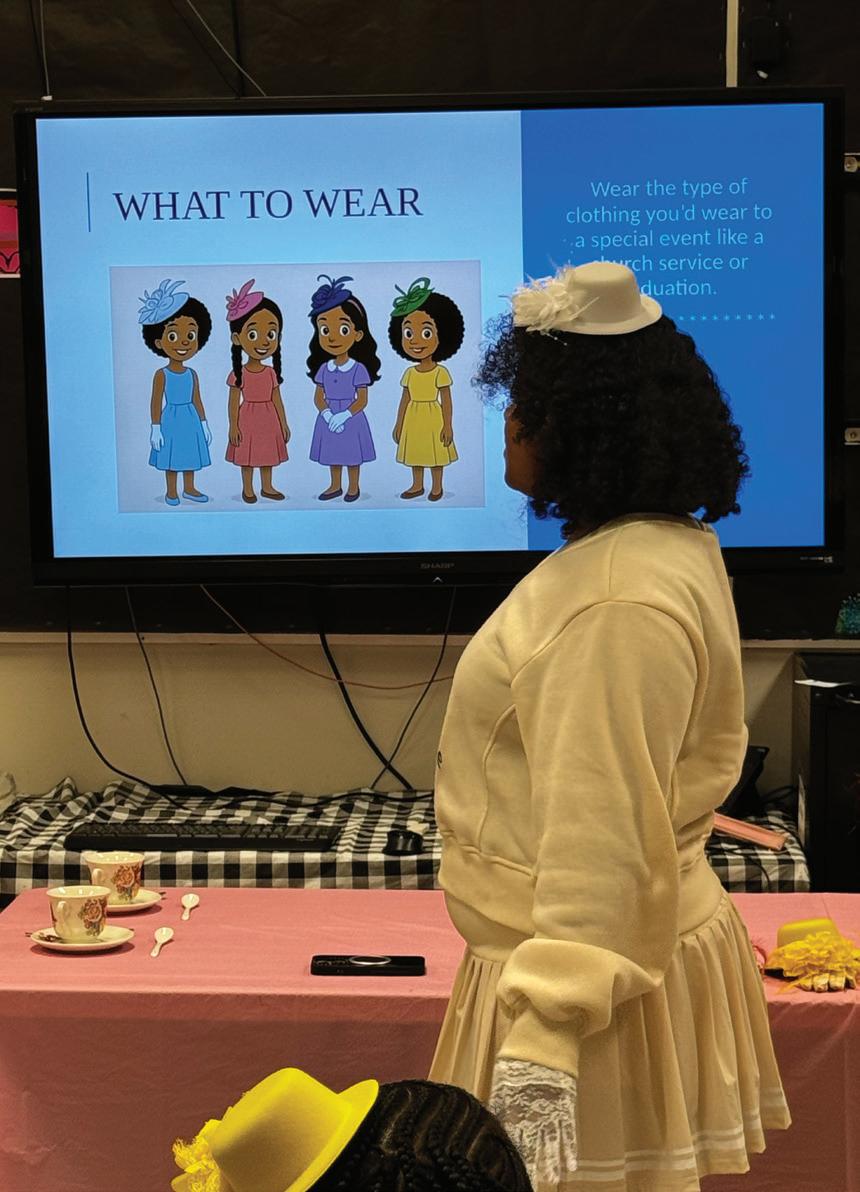
JLW volunteers bring not only their time but their presence, modeling professionalism, warmth, and authenticity in a way that resonates with students.
Kaersten Deeds, Washington School for Girls Committee Vice Chair, shares a similar sentiment: “Last year’s Tea Party was such a success, and I know that this year’s Tea Party will be a great event again for the girls. We look forward to creating and sharing this elevated experience with such deserving girls,” says Deeds.
Leadership at Washington School for Girls sees the Tea Party as a powerful complement to the school’s academic mission. These skills are critical as students prepare for high school, college, and their future careers. Knowing how to navigate formal settings with ease can open doors and help students walk through them with confidence.
Traditions like this exemplify JLW’s commitment to developing the potential of women and strengthening communities. By investing in experiences that build confidence and celebrate achievement, JLW and Washington School for Girls are helping to shape young women who are prepared not just to succeed, but to lead. •
Shannon Jessen
Every Monday morning, members of the Junior League of Washington (JLW) open their inboxes to find a familiar presence: League Lines, the organization’s weekly communications lifeline. More than a newsletter, League Lines connects thousands of members to the mission, opportunities, and community that define the League experience. Behind each carefully curated edition stands the Member Communications Committee, a dedicated team working tirelessly to ensure that every member stays informed and connected to the broader JLW family.
In an age of information overload, League Lines has established itself as the reliable source for all things JLW. Lauren Gaydos, Chair of the Member Communications Committee, emphasizes the fundamental role that consistent communication plays in organizational health. “As a communications professional, I feel strongly about the power of communication and the role it plays in shaping an organization,” Gaydos explains. “You can’t have an engaged organization if members don’t know what’s going on. Consistently showing up through League Lines gives members a predictable, reliable channel to stay informed about everything happening within JLW.”
When members know they can count on League Lines to arrive in their inbox every Monday, they develop a rhythm around staying connected. The predictability of this communication channel means that important updates, opportunities, and deadlines don’t get lost in the shuffle of daily life.
Gaydos herself received valuable advice as a new member that she
continues to follow: handle all JLW “business” on Mondays, because that’s when League Lines comes out. This simple practice transformed her League experience, creating a dedicated time and space for staying connected. “League Lines is truly the central hub for everything happening in JLW,” she reflects. “From Board updates and committee information to ways to contribute both within JLW and in the community, it’s a key connection point—especially when you’re still learning how everything fits together.”
“League Lines is truly the central hub for everything happening in JLW.”
For new members navigating the sometimes overwhelming landscape of JLW’s structure and opportunities, League Lines functions as an essential guide.
“League Lines helps create a shared rhythm for the organization,” Gaydos notes. “For newer members, it serves as a roadmap—helping them understand how JLW works, what opportunities exist, and how they can get involved.”
For seasoned members who already understand the organizational structure and have established their committee placements, League Lines serves a different but equally important purpose. “For seasoned members, it’s a consistent touchpoint that keeps them connected to the broader League beyond their own committee, reinforcing a sense of community and shared purpose,” Gaydos explains. This dual functionality is particularly important in an organization as multifaceted as JLW.
With numerous committees working on diverse initiatives, it would be easy for members to become siloed within their specific placements. League Lines helps to prevent this fragmentation, keeping JLW members apprised of happenings across the rest of the League beyond their committee placement.
While members see the polished final product, the creation of League Lines involves careful coordination, meticulous editing, and a great deal of collaboration. The process begins with content submissions from across the organization. “League Lines relies on submissions from across JLW,” Gaydos states. “We track all incoming content in a shared spreadsheet, and each week a committee member compiles the submissions into a draft, editing as needed for clarity and consistency.”
This tracking system is one of the committee’s recent initiatives to streamline operations. The team is currently working to improve the backend processes that handle information submission, making the system easier for everyone involved—from members submitting content to committee members drafting communications. Currently, the newsletter has a twoweek advance submission deadline; with multiple review stages and the need for consistency in messaging and formatting, adequate lead time ensures that important information can be properly vetted and included. After committee members compile and edit the draft, it undergoes review by the Communications and Public Relations (CPR) Council to ensure alignment with JLW’s broader communications strategy and brand standards.
The final stage involves Margot Watts, JLW’s Operations,
Communications, and Technology Coordinator, whom Gaydos describes as “truly the best.” Watts transforms the edited content into the visually appealing, professionally formatted newsletter that members recognize. Her work ensures that League Lines is not only informative but also engaging and easy to navigate. Finally, the polished edition is distributed by Watts to the full membership, ready to inform and inspire for the week ahead.
Perhaps the most important aspect of League Lines that members don’t see is the diligence of the women who make it happen every single week. “So much of
our work happens behind the scenes,” Gaydos emphasizes. “I’d love to highlight the incredible women on the committee who make League Lines happen every single week. Their dedication and attention to detail ensure members stay informed and connected, even if they never see the work that goes into it.”
One of League Lines’ greatest strengths is its role as a centralized information hub. “League Lines brings everything into one place,” Gaydos points out. “Rather than information being scattered across committees or channels, members know exactly where to look each week. That
consistency builds trust and makes it easier for members to stay engaged— even during especially busy seasons of life.” This centralization eliminates the need to search through various sources to stay informed.
For members who want to contribute, submit content at least two weeks in advance to give the Member Communications Committee time to work their magic. And that Monday morning email waiting in your inbox? Its reliable presence is the result of the committee’s efforts and serves as an open invitation to stay engaged and connected to JLW. •

Megan Lilly
Fifty years is more than a milestone; it’s a reflection of what it takes to build something that lasts.
For Iona Senior Services, that legacy is rooted in a clear and enduring mission: to help older adults and caregivers navigate the journey of aging. For more than 20 of those years, the Junior League of Washington (JLW) has been a consistent partner in that work, bringing not just volunteers, but a sustained commitment to showing up for the community.
“I’m honored to celebrate Iona’s 50-year milestone,” says Krystal L. McLear, vice chair of the Iona Committee. “It’s a wonderful celebration of strong community impact that highlights the power of women volunteering together to support and uplift aging adults in DC.”
That impact is both visible and deeply personal. Through programs like the Arts and Wellness Showcase, Junior League volunteers engage directly with older adults, not just as participants but as people with stories, creativity, and lived experience. For many volunteers, those moments leave a lasting impression. “Connecting with the senior artists who create such beautiful and meaningful work is incredibly special,” McLear shares. “In fact, my first year inspired me to become an artist myself.”
This sense of exchange defines the partnership. While Iona provides critical services and programming, JLW brings energy, time, and human connection, creating an experience that is not one-sided but shared.
“Iona’s 50-year milestone represents a lasting commitment to empowering older adults in DC to age with dignity, independence, and support,” says Karrenthya Simmons, chair of the Iona Senior Services Committee. Her perspective reflects the broader vision behind the work—one that prioritizes both care and autonomy for older adults across the city.
At its core, the partnership is grounded in respect for the individuals served and for the role they play in shaping the community. “They carry wisdom, history, guidance, courage, and strength,” McLear says. “Without them, there would be no us.”
That belief continues to guide the work ahead. As the partnership looks to the future, the focus remains on deepening engagement, expanding support, and reaching more older adults and caregivers throughout Washington, DC, with the understanding that aging well doesn’t happen in isolation; it happens together. •
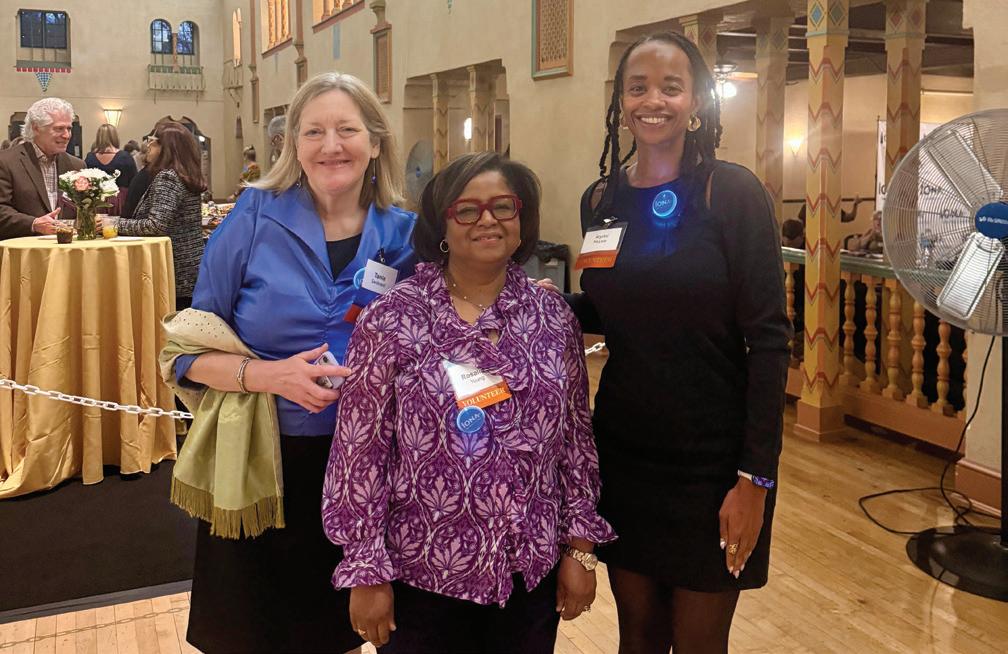
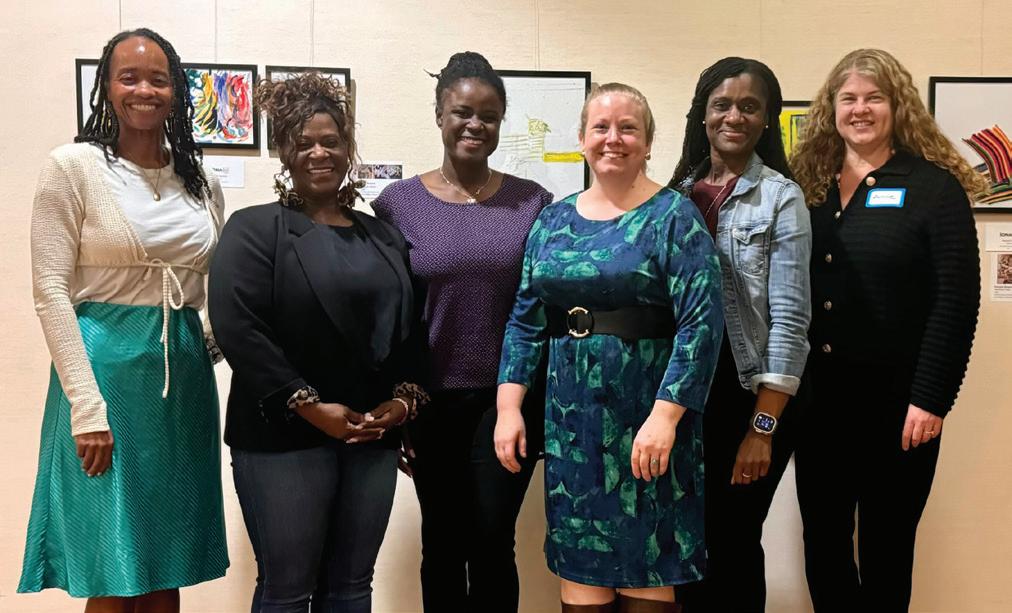
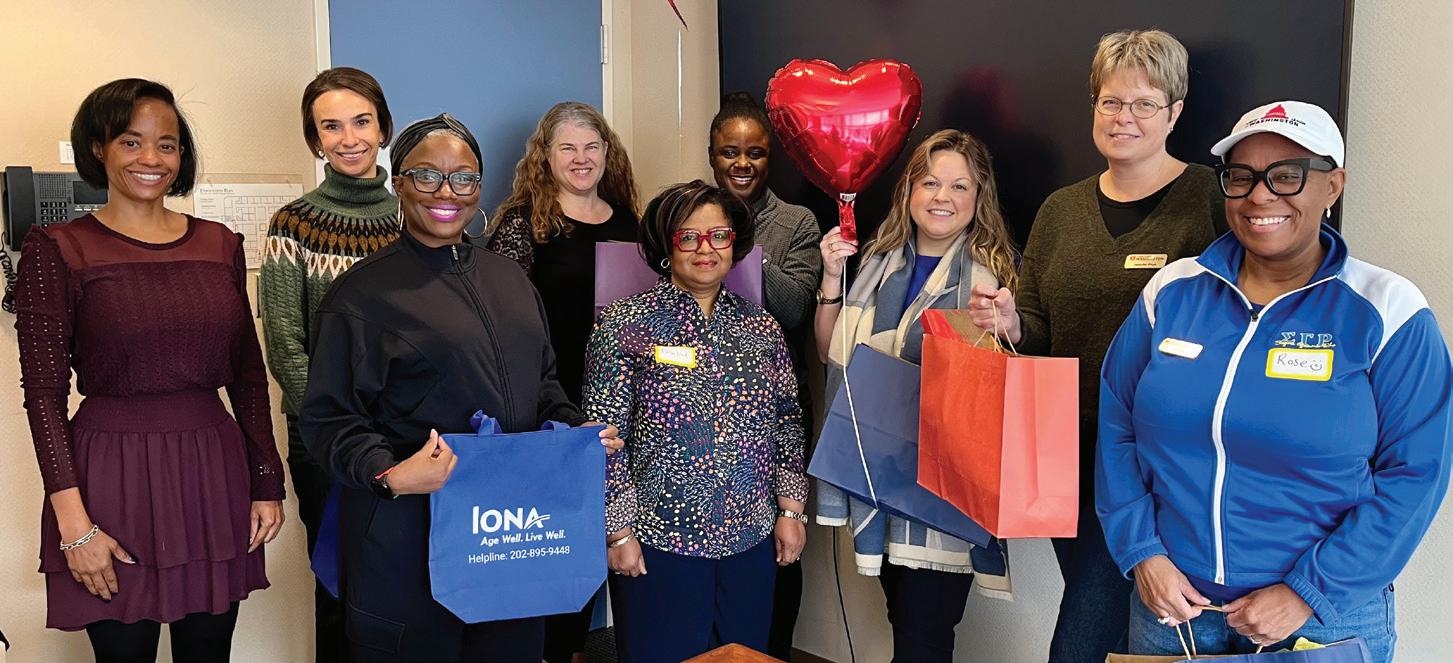
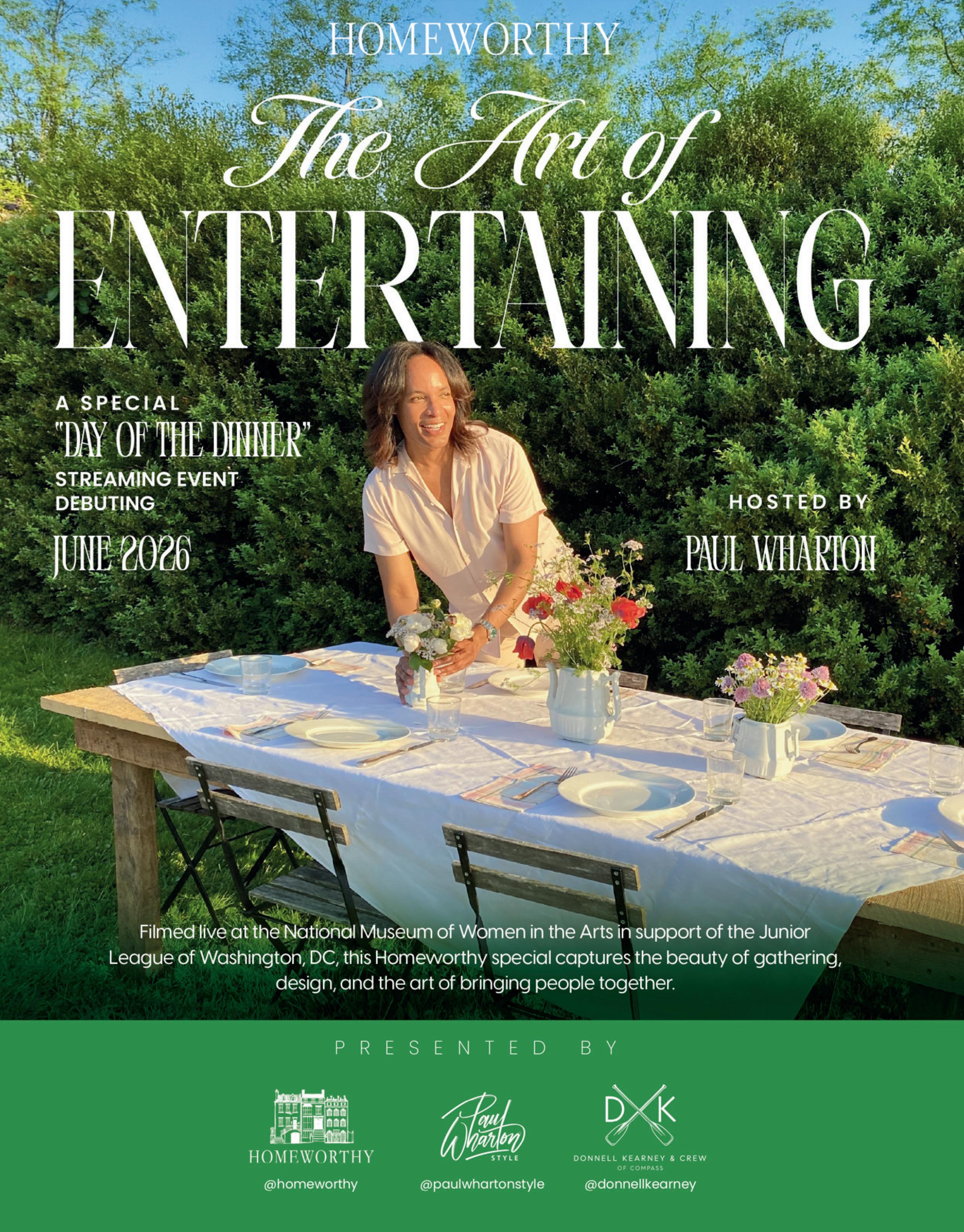
Lacy Nelson
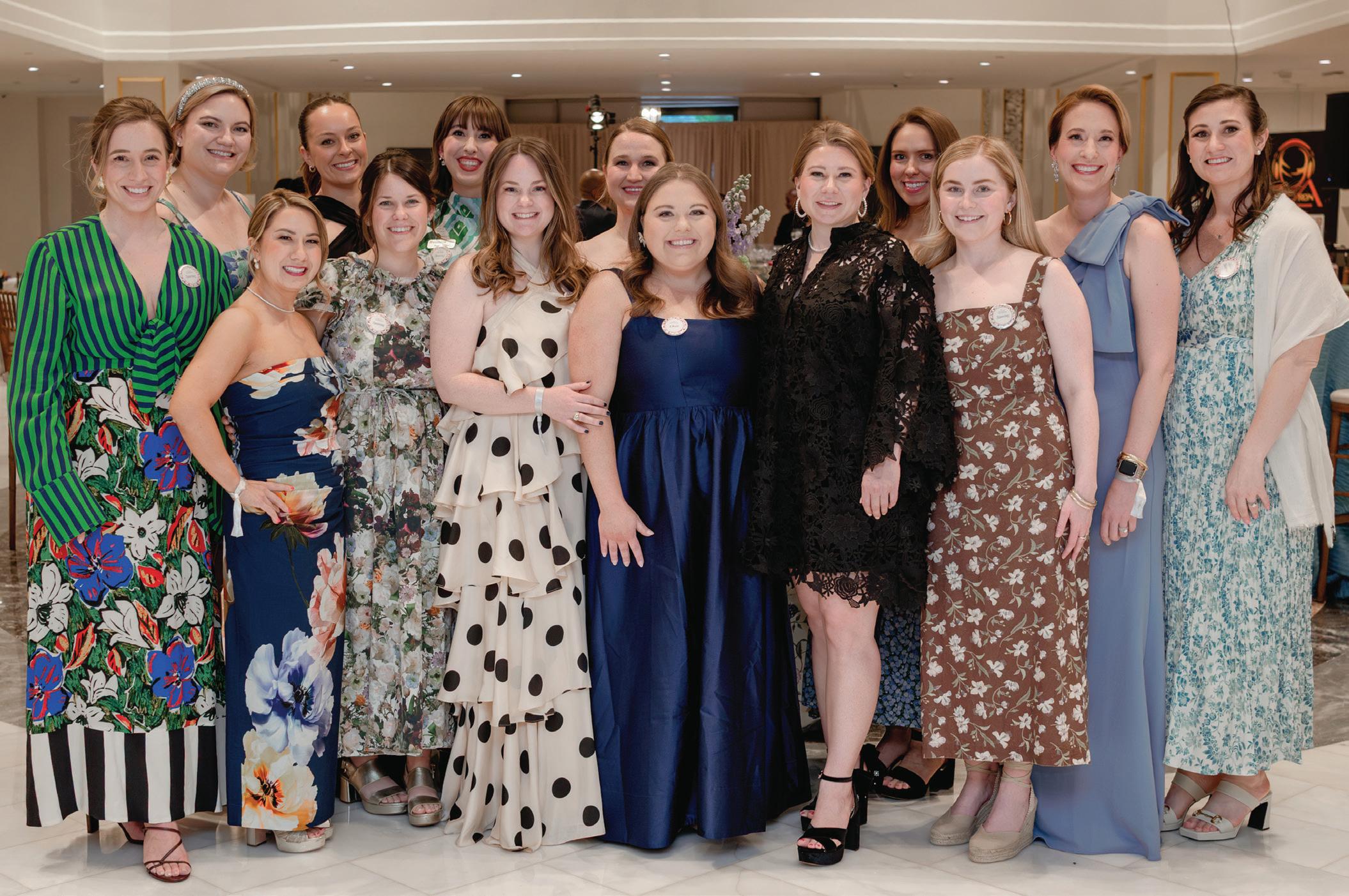
One of the first decorators brought in, quite literally, a six-foot centerpiece. I think all of us were kind of like, “Wow, this is working. That’s exactly what we wanted. Our vision has paid off.”
It might have been one of those “blinkand-you’ll-miss-it” moments, but for Sara Grove, co-chair of the Junior League of Washington’s (JLW) Art of Entertaining Committee, it was everything.
That oversized centerpiece moment perfectly captures the spirit of Art of Entertaining, now entering its third year as one of the League’s most anticipated fundraisers. The event is a celebration of creativity and of the simple pleasure of bringing people together—in style.
The Art of Entertaining did not arrive fully pulled together, perfectly styled like the tablescapes it presents each year. It’s a
post-pandemic success story, stemming from the League’s beloved Kitchen Tours, that has evolved into something entirely its own.
“Every year the event has evolved and just gotten better and better,” Grove says. “You learn things over time and grow it and see what people want and what works.”
For Grove and for her fellow co-chair, Morgan Hosman, who have both been involved since the beginning, that evolution has been part of the fun. “Being able to see this evolve from what was Kitchen Tours, and then COVID, and then really pivoting from there—it may have taken a couple of iterations,” Hosman shares, “but where we landed is a really great spot.”
At its core, the Art of Entertaining is aspirational, but it is never supposed to be intimidating. While the tablescapes are imaginative and often larger than life, the individual takeaways are practical and are within reach for many women.
“I’m not going to entertain with a six-foot centerpiece,” Hosman jokes. “But I can take components of that when I’m hosting my family for Thanksgiving or friends over for a football game.”
Hosman and Grove remember one year when a decorator who brought in a towering centerpiece also used lemons as place cards, etching guests’ names directly into the fruit. “That’s just a fun thing you could do in your backyard,” Grove says. “You could do that at a picnic.” It’s creative, simple ideas like the citrus place cards that guests know they can easily recreate in their own homes.
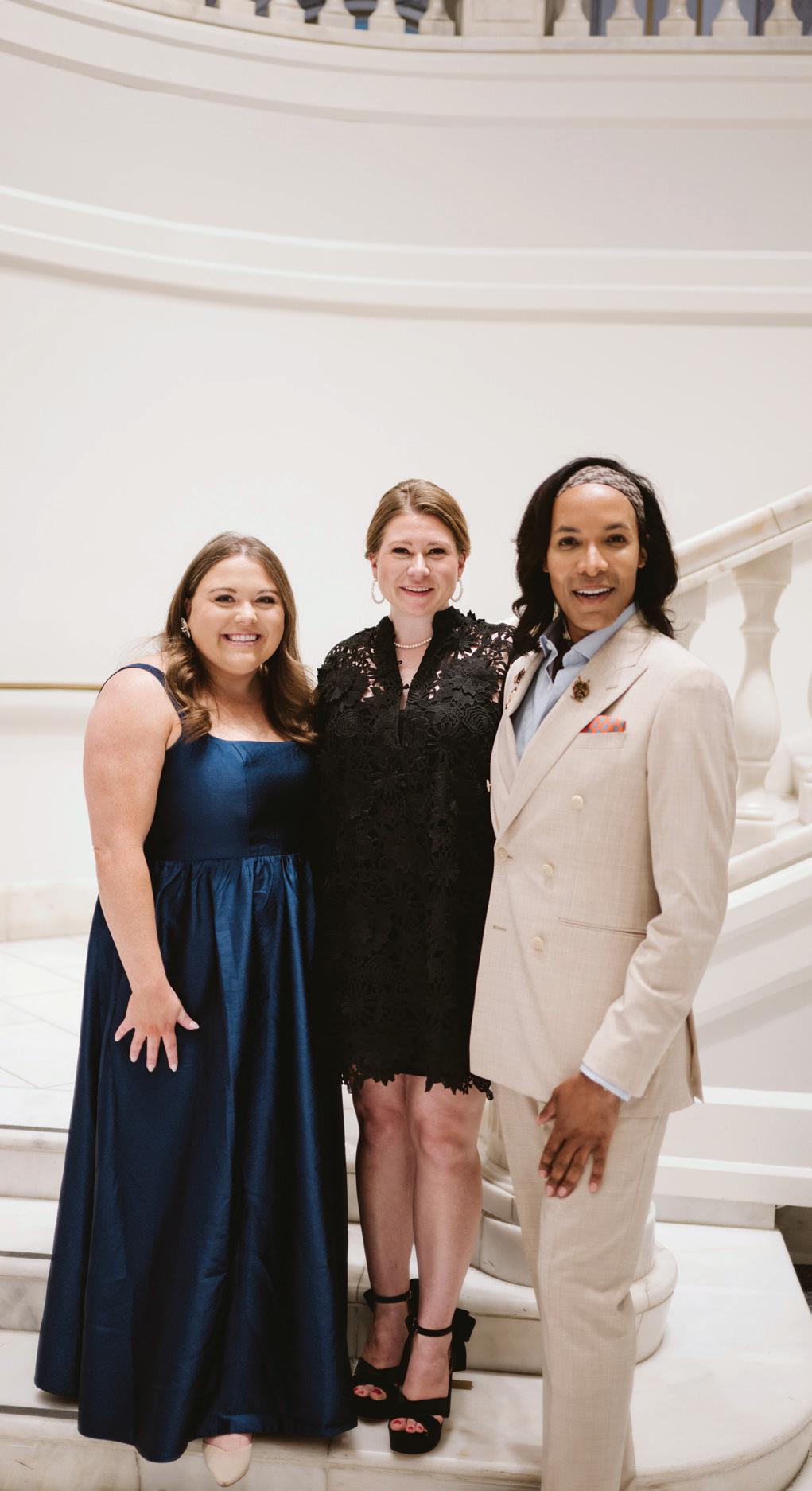
The evening itself gives the feeling of being dropped in the middle of a Better Homes & Gardens or Southern Living magazine spread. Guests move around the space, admiring beautiful tablescapes and engaging with live demonstrations. Past years have featured everything from charcuterie tutorials and etiquette coaching to fine china artists and tablescape demonstrations. There’s a DJ, a cocktail bar, and one year, it even featured a fashion illustrator sketching guests on the spot for a personalized keepsake to take home. “It gets very loud in there,” Hosman says. “Everybody’s talking and really and truly enjoying each other’s company.”
The sense of connection is no accident. Both women joined the Junior League seeking community, and Art of Entertaining has become a place where that has come to life. “What drew me to the League was that sense of community and finding new people to connect with,” Hosman says. “And giving back to the community in the same way.”
As a fundraiser, the event supports JLW’s broader mission and its work with community partners, while also strengthening relationships with sponsors and local businesses. Over the years, those relationships have deepened. “Now our sponsors know who we are. They know what our event is,” Hosman says. “It’s more about pivoting to how we can partner, and less about explaining what the event is.”
The dream collaborators are also a huge draw, including Tuckernuck, Herend, or what Grove and Hosman describe as the ultimate tablescape brand, Mrs. Alice. “Everything you can imagine wanting to put on a table, they [Mrs. Alice] have it. Their collections are so fun and such an inspiration,” Grove shares.
The decorator selection process reflects that same openness and creativity. Applicants—from interior designers and lifestyle brands to painters, Mahjong instructors, and even fellow JLW women—submit mood boards showcasing their vision.
“We really want to see people’s creativity come out through that process,” Hosman says. “Some of the most memorable tables have come from non-traditional decorators, proving that entertaining really is for everyone.”
This spring, the committee is focused on refining the behind-the-scenes action so more energy can go toward guest experience and fundraising. “From a non-jazzy perspective, we’ve really focused a lot on processes,” Hosman says, “so that we can really make the event even more special than it already has been.”
Whether you come for the tablescaping spectacle or the practical homemaking tips, the Art of Entertaining makes clear that hosting doesn’t have to be perfect or magazine-ready. It just has to be thoughtful and showcase your own unique personality. And sometimes, all it takes to know you’ve done something right is a six-foot centerpiece coming through the door. •
Lacy Nelson
For many members of the Junior League of Washington (JLW), their sense of a League home comes less from a physical place than from the community they’ve built through leadership and volunteer work. While the League’s Loughborough House on M Street in Georgetown offers an important sense of place, it isn’t always where members naturally gather. That’s something the Esprit Committee is working to change with a new Home for the Holidays event series designed to further transform Loughborough House into a festive and welcoming hub.
For years, JLW members and leaders have wanted to utilize Loughborough House’s space more. The Esprit Committee— tasked with organizing events that help foster deeper connections and friendships within JLW—pitched a holiday party series that would do just that.
Home for the Holidays, a series of five parties, is what the Esprit Committee calls an “elevated experience,” meaning the committee will provide everything—JLW members only need to show up ready to mingle and make memories. This League year, the committee celebrated Halloween, Friendsgiving, New Year’s, and Galentine’s, and welcomed in the spring season together.
Tessa Merna, chair of the Esprit Committee, has found joy not only in helping bring this season’s events to life, but also in experiencing them alongside other women in the League. Kicking off the series was the Halloween party, which she described as a “ghoulishly” good time. “There was a lot of line dancing going on, and we taught some younger JLWers how to do the Macarena,” says Merna.
The same festive spirit and sense of togetherness carried through the season’s other events. Merna recalls a particularly meaningful moment at Friendsgiving, when JLW President Christina Babcock invited members to pause before their meal and share one thing they were grateful for that year.
At the Reset and Radiate event in the new year, Merna shared that the meditative auditory experience was a unique and calming touch. “It was a great way to get centered for the new year ahead,” she says.
It’s not just been the parties, though, that have the Esprit Committee buzzing. This year was the first time the committee was given its own budget. Typically, it operates as net neutral, which means it is not spending any money but also not raising any money. The $5,000 allocated to the committee was a big deal that opened the door—literally and figuratively—to Loughborough House.
“For the Home for the Holidays series, we wanted the events to be elevated but still be little to no cost for members,” said Merna, who noted that the budget went mostly toward food, beverages, and any supplies needed for the parties.
Another change this year was the addition of a Presidential Appointee to the Esprit Committee. Cady Clapp, a long-time sustainer and seasoned League leader, was selected to lead the Home for the Holidays series.
Over the years, Clapp has held multiple chair and Assistant Council Director (ACD) roles and brings extensive experience overseeing large-scale fundraisers, including the Holiday Celebration and the Women’s Leadership Breakfast. Her deep institutional knowledge and proven event-planning success made her a natural fit for the role. “She knows the League’s workings in and out and has a great mind to know what members want to see,” said Merna.
Launching a new event comes with its share of challenges—the biggest being earning buy-in from leadership and making sure there is ample enthusiasm. The Home for the Holidays series has been a true team effort, driven by the dedication and creativity of the Esprit Committee and Clapp, along with the strong support of President Babcock, Membership Development Council (MDC) Director Jessica Mosley, and MDC ACD Emily Droder. The collective commitment from these women helped turn a simple idea into a multi-event experience that brought women from all corners of the League together.
When asked whether she knows if the series will continue into the next League year, Merna said she’s hopeful based on all the successes she has seen so far. Ultimately, the hope is that, over time, Loughborough House will continue to feel less like a venue and more like home. •
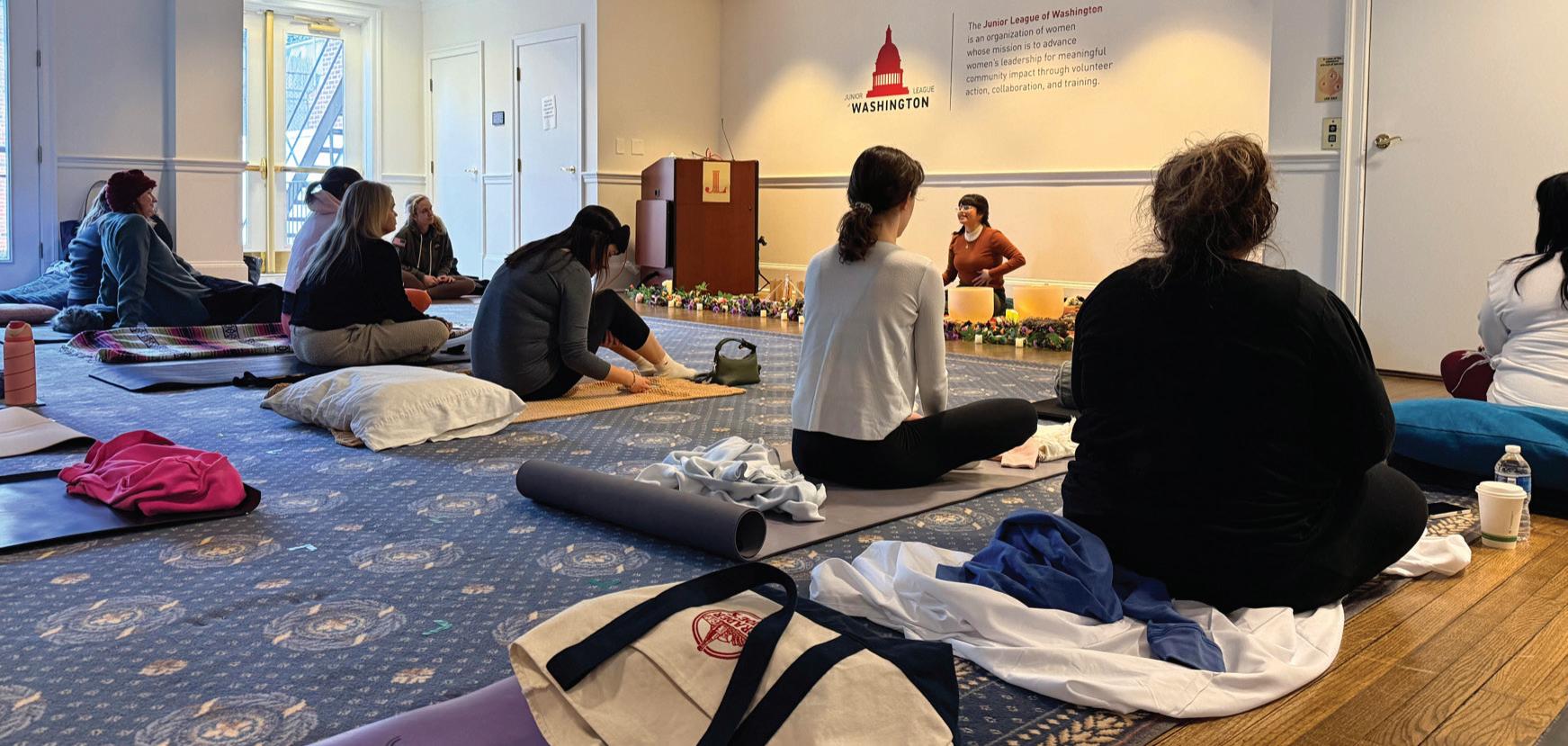
Yolanda Raine
Inside a bright classroom in Adams Morgan, a group of young learners gather for story time— eyes wide, imaginations sparked, and voices chiming in with excitement. Sometimes the voice reading aloud comes from a teacher, and sometimes it comes from a volunteer with the Junior League of Washington (JLW), bringing stories and connections into the room.
These joyous moments capture the heart of the partnership between JLW and Jubilee JumpStart: a shared commitment to ensuring that every child has the opportunity to learn, grow, and thrive from the very beginning.
Jubilee JumpStart is a nonprofit, bilingual early childhood education center serving families in Washington, DC’s Adams Morgan neighborhood. Its mission is both simple and powerful: to provide high-quality care and early learning opportunities to children of all backgrounds, especially those who may not otherwise have access.
For many families, that access is essential. Approximately 70% to 75% of Jubilee JumpStart families rely on the DC child care subsidy to make early education possible. Programs like Jubilee JumpStart are not just about care; they are about creating a strong educational foundation during the most critical years of development.
Beyond monthly readings, JLW’s Jubilee JumpStart Committee brings literacy to life through seasonal events designed to engage both children and their families. Each fall, volunteers host “Fall in Love with Books,” an event filled with storytelling, activities, and book distribution. In the spring, “March into Reading” continues the momentum, encouraging families to make reading a daily habit.
These events are more than just fun—they are intentional. By putting books directly into the hands of children and caregivers, JLW helps make literacy accessible and exciting at home.
During the holiday season, the spirit of giving takes center stage through the Jubilee JoyStarters campaign, where volunteers distribute donated children’s clothing to families, meeting practical needs while reinforcing a sense of community care. Together, these initiatives reflect a holistic approach that supports not just early learning, but also the overall well-being of the families Jubilee JumpStart serves.
“This experience has led me to feel a connection with my community in DC.”
That is where the Junior League of Washington steps in—not just as volunteers, but as partners in building brighter futures.
One of the most consistent ways JLW members support Jubilee JumpStart is through virtual read-aloud sessions. Once or twice each month, volunteers log on to read to classrooms, bringing stories to life with energy, expression, and enthusiasm.
While it may seem simple, the impact is anything but.
JLW volunteers bring a variety of experiences, personalities, and reading voices, making the engagement both entertaining and fulfilling for the children. The benefits go far beyond story time. Research shows that reading aloud to infants and toddlers helps build vocabulary, strengthen early language skills, and support social and emotional development. It lays the groundwork for critical thinking, empathy, and lifelong learning.
In other words, every page turned is a step forward.
While the children benefit from enriched learning experiences, JLW members also find the impact on themselves to be just as meaningful.
“It has been a rewarding experience to read to children at Jubilee JumpStart,” shares JLW member Lena Skiouris. “This experience has led me to feel a connection with my community in DC. I have enjoyed re-reading my son’s books to children at Jubilee JumpStart and seeing their reactions to new and old stories.” Moments like these highlight the dual impact of the partnership: children gain exposure to new voices and ideas, while volunteers build meaningful connections and deepen their sense of purpose.
As the partnership continues to grow, so does the opportunity to expand its reach and impact.
JLW is already looking ahead to new ways to support Jubilee JumpStart—exploring additional programming, deepening engagement, and continuing to meet the evolving needs of the community. At its core, the mission remains the same: to show up, to give back, and to invest in the next generation, because when children are given the tools to succeed early, the possibilities are endless.
Sometimes, it all starts with a single story. •
Yolanda Raine
For members of the Junior League of Washington (JLW), Marketplace has long been a cherished tradition—one that blends community and creativity. But this year, under the leadership of Marketplace Chair Adisa Hargett-Robinson, that tradition is being transformed in exciting ways. Her approach? Honor the tradition while expanding the possibilities.
Since joining the League in 2020, HargettRobinson has been deeply involved with Marketplace. After serving three years as Shops Chair, she stepped into the role of Marketplace Chair with an appreciation for the program’s legacy and a vision for its future. As a key fundraising effort for JLW, Marketplace has played an important role in supporting the League’s mission, but Hargett-Robinson saw an opportunity to think bigger.
“Marketplace has always been something really special within the League,” she explains. “But going into this year, we started thinking about it less as one event and more as an entire season.” That shift in mindset led to a series of initiatives designed to engage members. This season introduced a Marketplace fashion show, fall and holiday photo sessions, a new merchandise catalog, and an expanded collection of League-inspired items.
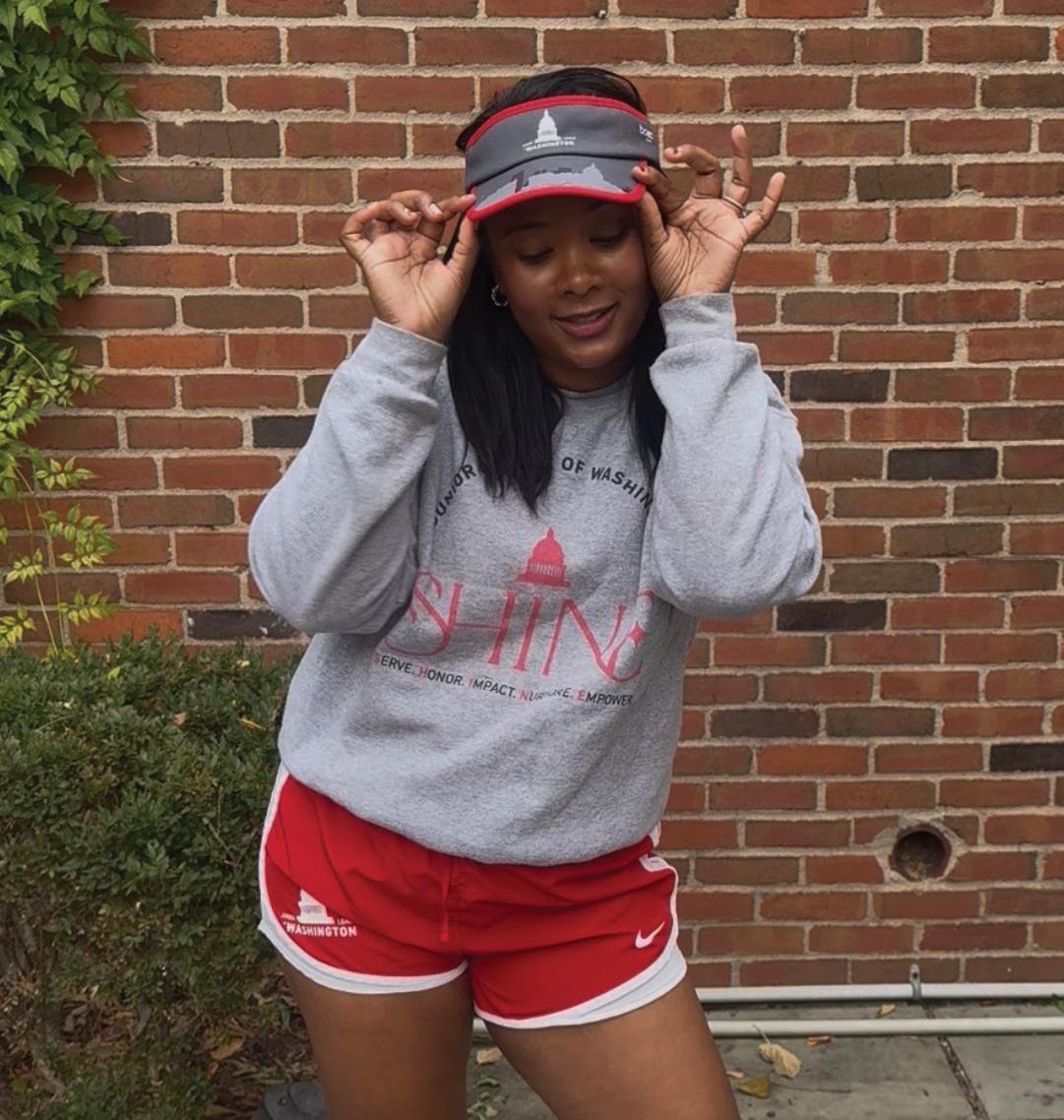
Adisa Hargett-Robinson at the Marketplace photoshoot, where vision, innovation, and style come together to reimagine a beloved JLW tradition.
Together, these additions transformed Marketplace into something more dynamic: a series of moments where members can connect, collaborate, and celebrate the League’s spirit of sisterhood. “By introducing things like the fashion show, catalog, and photo sessions, we created different ways for people to participate,” Hargett-Robinson says. “It’s about building community while supporting the League’s mission.”
One of the most notable additions this season was the Marketplace Fashion Show, an event that blended style and creativity. The idea was born from a simple insight: merchandise looks different when it’s worn. “I wanted people to see the pieces styled and in motion,” Hargett-Robinson explains. “Seeing the merchandise worn really brings it to life in a way that a display or photo can’t.” The fashion show offered League members a
chance to engage with Marketplace in a completely new way, not only as shoppers or volunteers, but also as models, stylists, and creative collaborators.
Bringing a fashion show to life required careful planning behind the scenes. From organizing looks and coordinating models to managing logistics for a first-time event, the process involved many moving parts, but what stood out most to Hargett-Robinson was the enthusiasm from members. “There was a lot of excitement around the idea,” she says. “Even members who weren’t directly involved in planning were eager to participate and support it. That energy made the entire event feel really special.” The result was a lively and memorable experience that captured the spirit of Marketplace in a completely different format.
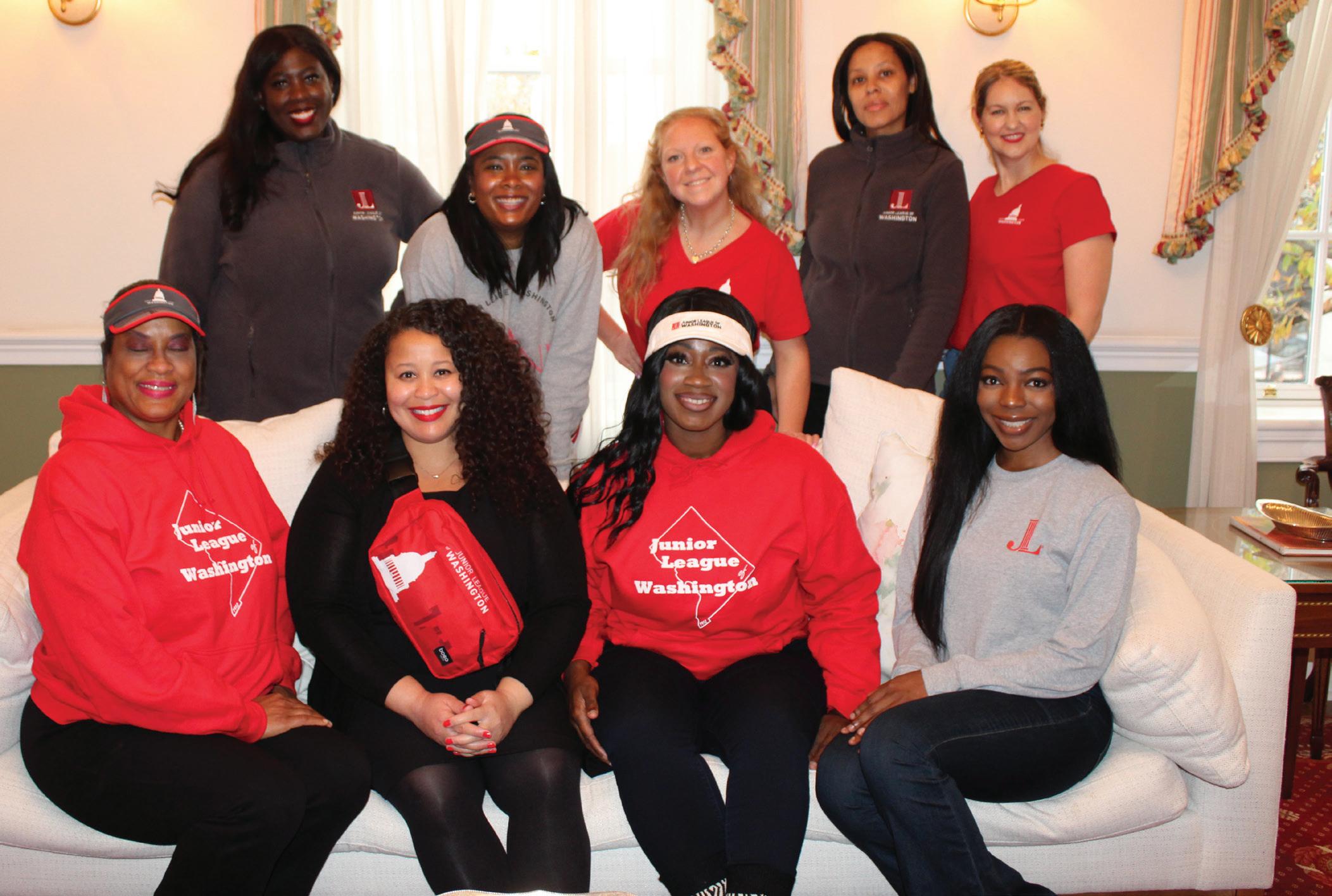
Beyond the runway, this season’s Marketplace initiatives were designed to create more opportunities for connection and creativity. The Marketplace catalog, for example, grew out of a desire to make merchandise accessible to every League member—whether or not they can attend events in person. “I wanted everyone in the League to be able to see what we have available,” Hargett-Robinson says. “The catalog also helps us understand what members love and what they’d like to see more of in the future.” The new collection brought even more excitement— especially for jewelry lovers. “I’ve always loved jewelry,” HargettRobinson shares. “So introducing the charm bracelet felt like a fun and fresh addition. It’s actually something we started planning last year, so it was really exciting to bring it to life this season.”
The team also introduced fall and holiday photo sessions. Coordinating schedules and managing the logistics of a first-time event meant the committee had to stay flexible and creative throughout. “The photo sessions were probably the biggest leap for me personally,” Hargett-Robinson admits. “There were definitely moments when we had to adjust or learn along the way. But more than anything, it showed how much this
committee is capable of accomplishing when everyone contributes their ideas and time.”
Marketplace’s growth also continues to strengthen one of its most meaningful impacts: supporting women entrepreneurs and local businesses. “Shopping events are such a great way to highlight local businesses and women entrepreneurs,” she says. “As someone who loves to shop myself, it’s been really rewarding to create opportunities for them to connect with our members.” By spotlighting vendors and curated merchandise, Marketplace continues to celebrate the creativity and innovation of women-led businesses throughout the community.
Reflecting on the season, Hargett-Robinson is most proud of the collective effort behind Marketplace’s evolution. “We introduced new ideas, learned along the way, and created something that feels bigger and more dynamic than before,” she says. But perhaps the most meaningful part has been watching members support and inspire one another. “Everyone has contributed something unique,” HargettRobinson says, “and that’s what makes this season of Marketplace truly stand out.” •
Amanda Peters
If you saw a line outside an office building in Crystal City early on a Saturday morning in March, it was for a good reason. In its 34th year, Tossed & Found 2026 was bigger and better than ever—with a turnout to show it. Lines stretched up to 90 minutes thanks to greater promotion than in previous years, and the wait was worth it.
Since 1993, Tossed & Found has welcomed more than 85,000 shoppers and raised nearly $2.8 million for the Junior League of Washington’s (JLW) mission. This annual rummage sale is a true treasure hunt, with coveted Longchamp bags and cashmere sweaters up for grabs—but the community impact is what matters most. This year’s sale added $210,000 to the total raised for JLW, along with what Co-Chair Suzanne Heimbach describes as the most energetic, diverse crowd the sale has ever drawn.
“What makes Tossed & Found impactful is the number of people it brings together every year, not just within JLW but the community at large. We have many families who are repeat shoppers and have been able to take advantage of our sale for many years,” says Heimbach.
The Children’s Trunk Show drew more than 100 attendees and raised over $10,000, giving families an early look at the sale. The night before the public opening of Tossed & Found, A Quality Occasion drew more than 250 guests for an evening of shopping, mingling, tasty bites, and a live auction, raising over $85,000.
Then came the sale weekend with its record-breaking lines, generating over $95,000 on its own. For the second year in a row, JLW partnered with social media influencers to promote the event, which Heimbach credits with bringing in new faces and broadening the sale’s reach beyond its usual audience.
Behind the scenes, the work started months earlier, with more than 500 donations received and sorted in roughly ten weeks, and committee members and volunteers taking on shifts well before opening day. “My favorite memory is when the sale site is complete. Looking at the amount of donations we received, sorted, and turned into a sellable space for an event is truly an incredible feeling—it’s that way every year,” says Heimbach.
One crucial part of Tossed & Found is the Community Cash Card program, which provides $50 cards to community members in need so they can shop the sale for everyday essentials. This year, more than $7,500 was raised through donations, and more than 100 cards were distributed.
Tossed & Found is truly a community effort—from crowdsourcing donations, to volunteers spending hours
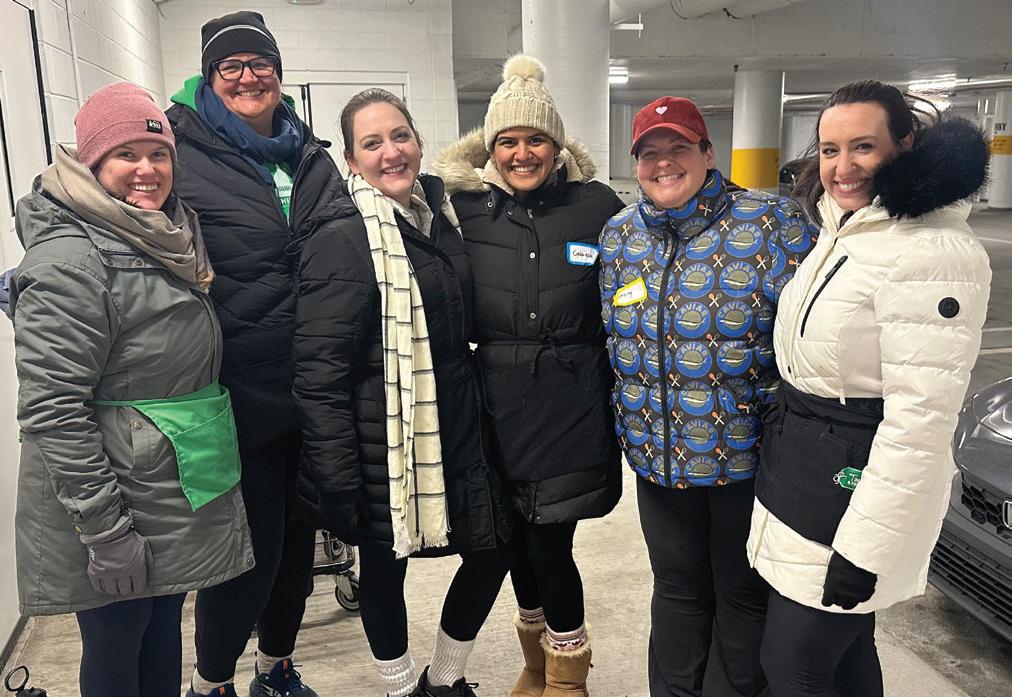
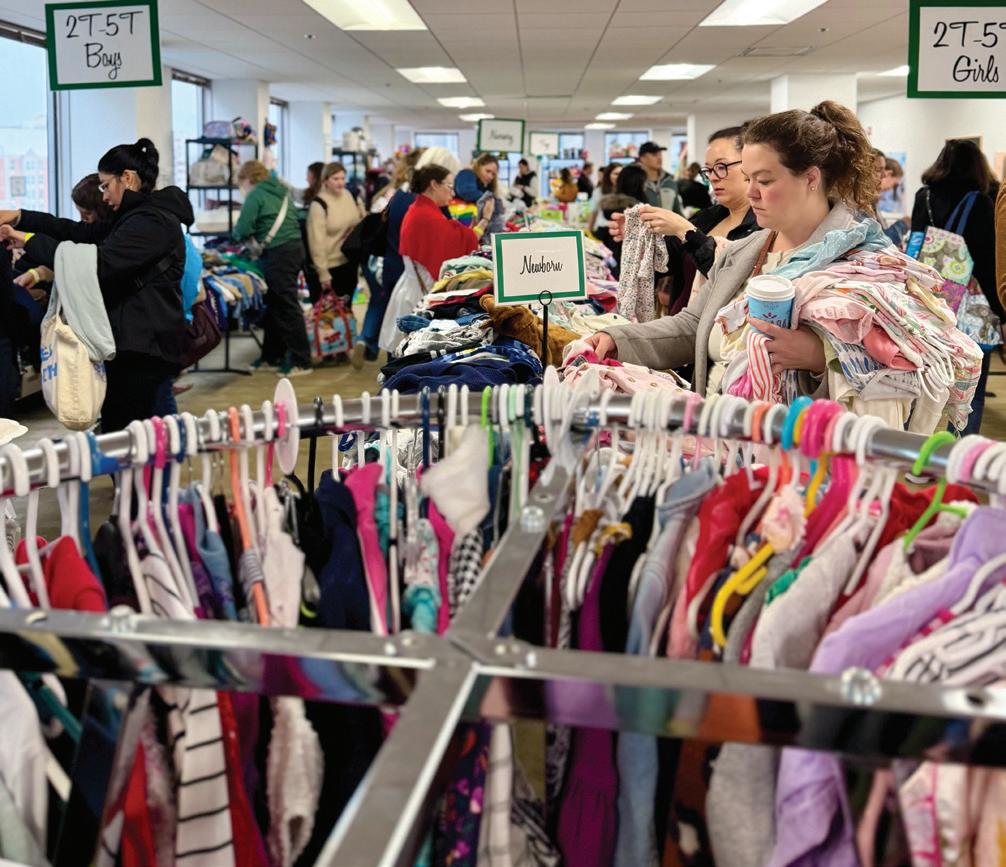
sorting and setting up the sale, to word of mouth and promotion, to those who spend money to support the mission of JLW. JLW is especially grateful to JBG SMITH and National Landing BID for donating the space that made Tossed & Found possible.
“I’m most proud of our committee. They worked so hard to make this come together. We truly could not do this without them!” says Heimbach. •
Amanda Peters
When thinking of the Junior League of Washington (JLW), voluntarism, advocacy events and fundraisers, and community programs come to mind. These are the women who volunteer their time as the face of JLW, advocating for our community’s needs, but behind the scenes, another group of women contributes in an equally valuable way to the League’s success.
“I feel that the individuals who contribute to the Friends of the JLW are the ‘silent engine’ of our League. These individuals are a dedicated group of members, sustainers, and community members who recognize that while volunteer hours are our heartbeat, consistent financial support is our backbone,” says Jerry Hall, Chair of the Friends of the Junior League.
Who is considered a Friend of the Junior League? It can be a friend, spouse, partner, or community member aligned with the mission of the JLW. JLW recognizes supporters at all levels. When a person becomes a Friend, they support an organization of women dedicated to serving as a resource throughout the community to effect positive change.
“Within the League, contributions to Friends of the JLW allow us to provide the ‘unrestricted’ funds that enable the League to be nimble. Whether it’s pivoting to address an unforeseen community need or investing in high-level leadership training for our members, these funds amplify our impact. In the broader DC community, this translates to a League that is more resilient, more
responsive, and better equipped to advocate for the populations we serve,” says Hall.
This year highlighted the need to be nimble. It was both a figurative moment of reflection and a literal pivot from the annual Little Black Dress Initiative, prompted by the November 2025 government shutdown that affected so many of our League members.
“Friends contributors are individuals who are forward-thinking and believe so deeply in the League’s ability to develop the potential of women and elevate our community that they choose to invest above and beyond our required commitments.”
“The pivot around the Little Black Dress Initiative to be attuned to the shutdowns and layoffs was done in such a compassionate and thoughtful way. Even with that, commitments and scholarships continue to be available. I’ve loved seeing how our individual efforts create significant community impact,” says new committee member Missy Herendeen.
The Friends are crucial for supporting pathways to opportunity across the greater Washington, DC, area, furthering the impact each member makes.
“Friends contributors are individuals who are forward-thinking and believe so deeply in the League’s ability to develop the potential of women and elevate our community that they choose to invest above and beyond our required commitments,” says Hall.
Hall’s message is direct: Join us. “Becoming a Friend of the JLW is the most direct way to invest in the League’s longevity—and it’s more accessible than you might think. It isn’t just about the $1,000 onetime gifts; if every member opted to give just $5, $10, or $20 (or more!) a month, the collective impact would allow us to do so much more for the DC community. Now is your chance to help amplify our impact,” says Hall, who finishes by asking, “What are you waiting for?” •
Gabrielle Murphy
At its core, the mission of the Junior League of Washington (JLW) is to strengthen communities through effective volunteer action and leadership. One of the most tangible expressions of that mission is Community Family Life Services (CFLS), which represents the League’s long-standing commitment to supporting individuals and families experiencing homelessness in the Washington, DC region.
Through hands-on service, strategic partnerships, and sustained engagement, CFLS reflects how Junior League volunteers show up—not just to help meet immediate needs, but to build dignity, stability, and connection for many of our community’s most vulnerable neighbors.
CFLS is JLW’s umbrella for volunteer efforts focused on homelessness and housing insecurity. Its initiatives are designed to meet people where they are, recognizing that families and individuals experiencing homelessness face complex, overlapping challenges, from access to housing and employment to childcare, education, and necessities.
CFLS is led by Grace Albright and Samara Sheff. They were lab mates in the Psychology Department at the University of Alabama in Tuscaloosa, AL, almost ten years ago. Last year, they reconnected via their selection for leadership of CFLS.
“With a desire to return to community service, I threw my hat in the ring for a chair position in a community placement,” shares Albright. “I was thrilled and honored to be offered the CFLS chair position. I enlisted the help of former chair, Caren Roushkolb, to
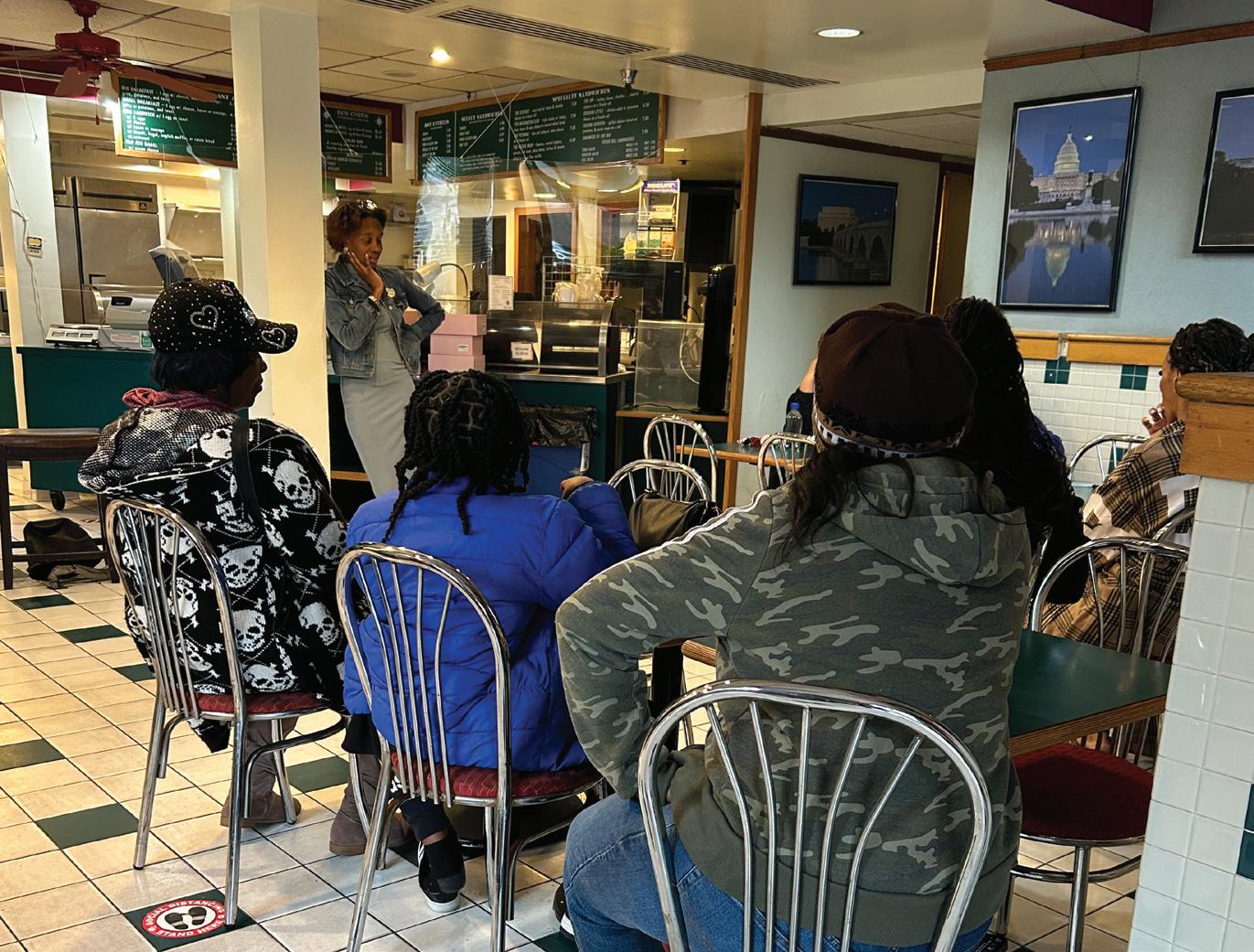
find a vice chair. When she gave me Samara’s name, I was shocked at how small the world truly is. We had been lab mates years ago at the University of Alabama.”
Coming from her new member year into the vice chair position, Sheff had a clear vision for the incorporation and integration of new members into the committee. She wanted to ensure new members could create meaningful events to serve CFLS clients and their children. That sparked the creation of the Mother’s Day Celebration, an event to honor the women we serve and give them a chance to care for themselves.
Coming into this League year, the committee and its community partner faced the challenge of needing to find a new space to host Connection Nights. In response to suggestions from their community partner, they decided to reformat the program. Instead of
hosting two Connection Nights per month, they planned to host one Connection Night per month and introduce two larger events, one during the winter holiday season and another to celebrate Mother’s Day. Wanting to give members a chance to lead these new efforts, active members were given the option to join a planning committee for the Holiday Celebration and new members for the Mother’s Day celebration. Inspired by her own new member experience in the Birmingham, AL League, Albright wanted to give new members the opportunity to lead the placement with CFLS, while still providing guidance and support alongside Sheff.
The Holiday Celebration was a success, with many women and children in attendance. The women were given spa kits, and the children picked out books provided by the JLW Resolution
Read Committee. The children played Reindeer Paws and ate a delicious spread of grilled chicken, rice, and beans, along with appetizers and desserts. Active members led the planning for the Holiday Celebration, meeting periodically to plan the event.
Eight new JLW members spearheaded the efforts for the Mother’s Day Celebration, which was held on May 13. They decorated the space with bouquets and colorful tablecloths. These members aimed to make this a relaxing event for the moms, purchasing supplies, so they could build body scrub kits. The children also created Mother’s Day cards, using a variety of crafts to show their love and appreciation for their moms.
One of the defining features of CFLS is consistency. Rather than one-off service days, JLW volunteers return
week after week, building trust with partner organizations and the individuals they serve. That continuity matters. For families experiencing homelessness, consistent volunteers create a sense of normalcy and community. Children see familiar faces. Parents know they can rely on support that is respectful and dependable. Service becomes relational, not transactional.
CFLS is equally transformative for the volunteers themselves. Through this work, JLW members gain a deeper understanding of the systemic drivers of homelessness and the lived experiences of those affected by it. Members develop empathy grounded in real-world experience, leadership and collaboration skills, and a stronger connection to the DC community, rooted in shared responsibility and care.
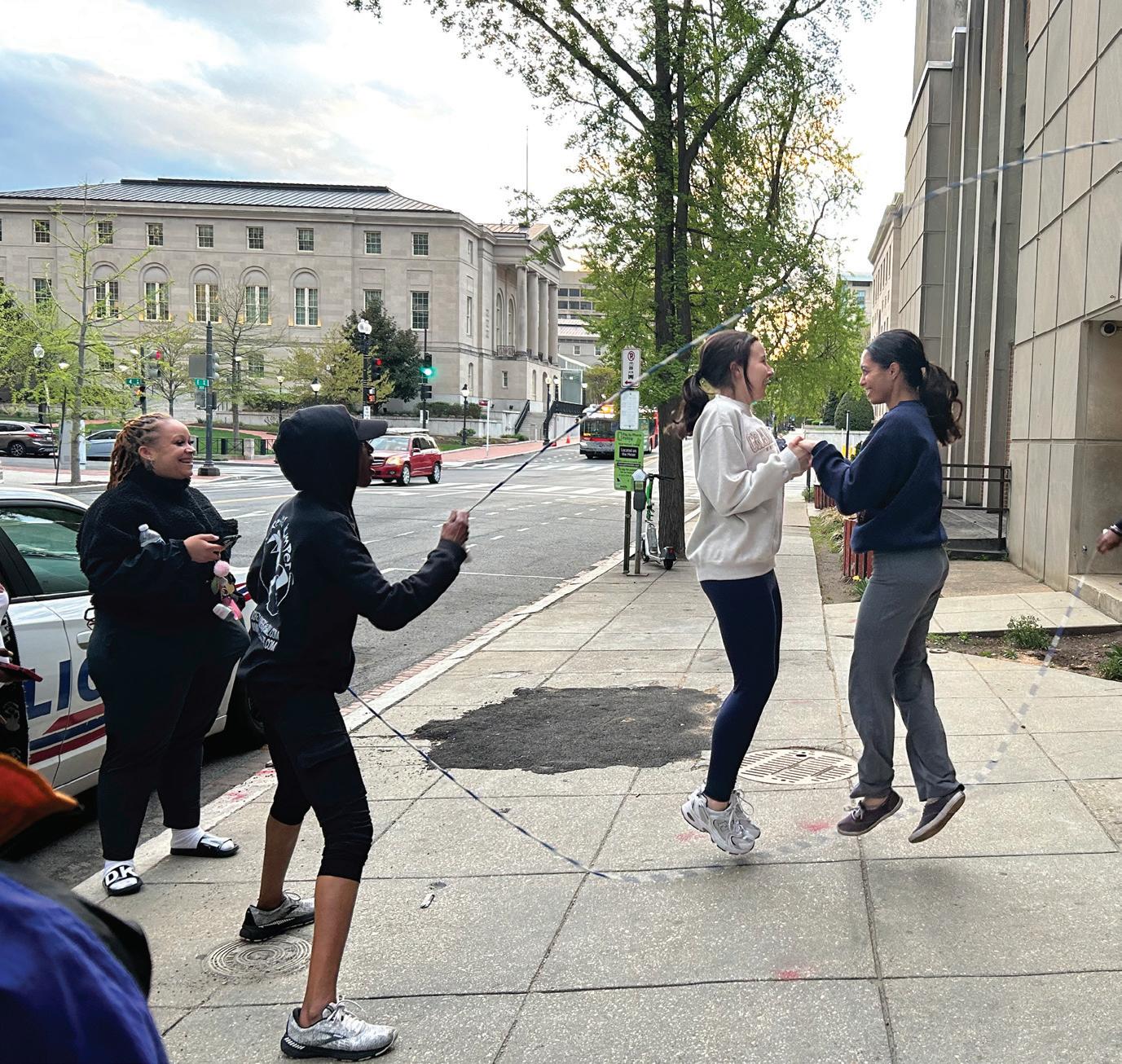
Jazmin Jackson, Director of Reentry and Victim Services at CFLS, states, “Our clients have experienced hardship in unfathomable ways. The time that JLW spends with them creates a space of safety, compassion, and joy. It is impactful, and we are deeply grateful for your continued commitment to our families.”
This mutual exchange, in which both volunteers and communities grow and benefit, is central to the Junior League model.
“Through the strength of this partnership with Junior League, women and children have been given the support, dignity, and opportunity they deserve,” says Jasmine Ferguson, Victim Services Program Manager with CFLS. “Your impact is not only seen, but it is deeply felt in every story of resilience and every step toward a brighter future.”
Homelessness is not just a housing issue; it is a community issue. When families lack stable housing, the effects ripple outward, impacting education, health outcomes, and economic mobility.
By investing volunteer leadership in CFLS, JLW helps address immediate needs while also supporting organizations working toward long-term solutions. The presence of trained, committed volunteers strengthens service delivery and reinforces the message that families experiencing homelessness are valued members of our community.
CFLS exemplifies what the Junior League does best: pairing compassionate service with strategic voluntarism. It reflects a belief that sustainable change happens when communities are supported not only with resources but also with people willing to show up, listen, and lead.
As JLW looks to the future, CFLS remains a vital part of its service portfolio, demonstrating how collective action rooted in respect and consistency can make a lasting difference. •
Poppy Merrell
The holiday season can be difficult for many, but gathering with friends for a meal can make spirits brighter and help create a sense of stability. Sharing delicious dishes, seeing friendly faces, and enjoying warm conversation are especially important for women navigating housing instability or rebuilding their lives after a crisis. Through the Junior League of Washington’s (JLW) longstanding partnership with Calvary Women’s Services, JLW volunteers help create these moments of connection throughout the year.
Calvary Women’s Services offers housing, health, education, and employment programs that empower women experiencing homelessness in Washington, DC, to change their lives. From seasonal celebrations to helping at key events, JLW volunteers work alongside Calvary Women’s Services to support women not only through the monthly meal service but also through consistent presence and care.
For most of the year, the committee provides and serves one lunch and one dinner each month on-site for residents at Good Hope, Calvary Women’s Services’ main location. A critical aspect of Calvary’s mission is domestic violence awareness and prevention. Many of the women Calvary serves have experienced housing loss as a result of domestic violence.
Committee Chair Courtney Stayer notes, “the fundraising they do and the volunteer support we provide allow them to serve the women who come to their programs.”
Building on the momentum of last year’s successful themed meals, the committee has planned several meals
designed to reflect seasonal milestones. The first of these was a winter celebration at Good Hope on December 21.
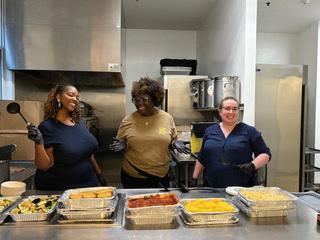
In addition to serving lunch, volunteers decorated the dining space with winter-themed décor to create a festive environment. Residents participated in a cookie-decorating activity, and a hot chocolate station quickly became a popular gathering place.
JLW volunteers help serve meals to residents at Good Hope, Calvary Women’s Services’ main location.
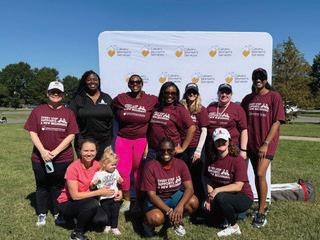
JLW members formed the secondlargest team at the Annual Community Walk at Anacostia Park in October.
In February, the committee hosted a Valentine’s- and Galentine’s-themed meal paired with a game night. The committee is also planning to donate supplies for and host a flower-arranging activity, and additional resident programs are under consideration as well.
JLW’s support of Calvary Women’s Services extends beyond the monthly meal service. Volunteers also assist with two of Calvary’s major public-facing events each year, which play an important role in sustaining the organization’s programs and outreach.
In December, JLW members supported Calvary’s Home for the Holidays event, and on April 16, they joined to support the Hope Gala at the RitzCarlton, Washington, DC. The event included a cocktail reception, silent and live auctions, and stories from women Calvary has helped. These events bring together donors, volunteers, and community partners in support of Calvary’s mission.
The committee also works to support Calvary’s urgent needs as they arise
throughout the year. Calvary maintains a wish list of items needed by residents, which changes based on seasonal and operational demands. Over the summer, during a period of extreme heat, JLW helped amplify an urgent request for fans for multiple residences. Throughout a particularly icy winter, the committee promoted the need for donated cold-weather gear.
JLW volunteers also showed their support at community events throughout the year. On October 4, Calvary Women’s Services hosted its Annual Community Walk at Anacostia Park. The committee formed a JLW walk team that included committee members, League members, and guests. With 14 registered participants, the JLW team was the second-largest at the event.
Through consistent meal service, thoughtfully planned themed celebrations, and support for Calvary’s broader initiatives, volunteers help create moments of dignity, connection, and care for the women at Good Hope.
Importantly, this work offers an opportunity for reflection. Small, consistent actions—a shared meal, a decorated room, and cheerful time spent together—can have a lasting impact. •
Gabrielle Murphy
Literacy is more than the ability to read ; it is the foundation for civic engagement, economic mobility, and lifelong learning. For the Junior League of Washington (JLW), literacy is a decades-long commitment. That commitment comes to life through JLW’s partnership with the Folger Shakespeare Library for over 59 years. Junior League volunteers staff events and educational programs, helping to educate and guide theater and library visitors to ensure the continued knowledge of and access to the Folger institution.
Known for its Shakespeare collection, the Folger is also a dynamic educational institution, offering innovative programs that use literature and performance to build appreciation of classic literature and of the arts. Junior League members have helped ensure these programs reach diverse audiences. JLW members have the opportunity to support programming through serving as ushers for theatrical performances, mediating monthly book clubs, and more. Junior League support plays a meaningful role in expanding Folger initiatives that bring literature to life.
Hillary Long, a member of the Folger Shakespeare Library, shared the following about her experience: “Being a part of the Folger Shakespeare Library Committee is so rewarding. I love being able to connect with patrons through volunteering as an usher and serving as a mediator for the monthly Folger Book Club. It is a privilege to serve this illustrious institution.”
For many attendees, these experiences are transformative. Shakespeare, often perceived as intimidating, becomes accessible and relevant. JLW committee member Christina Miller shares her perspective on theatre performances.
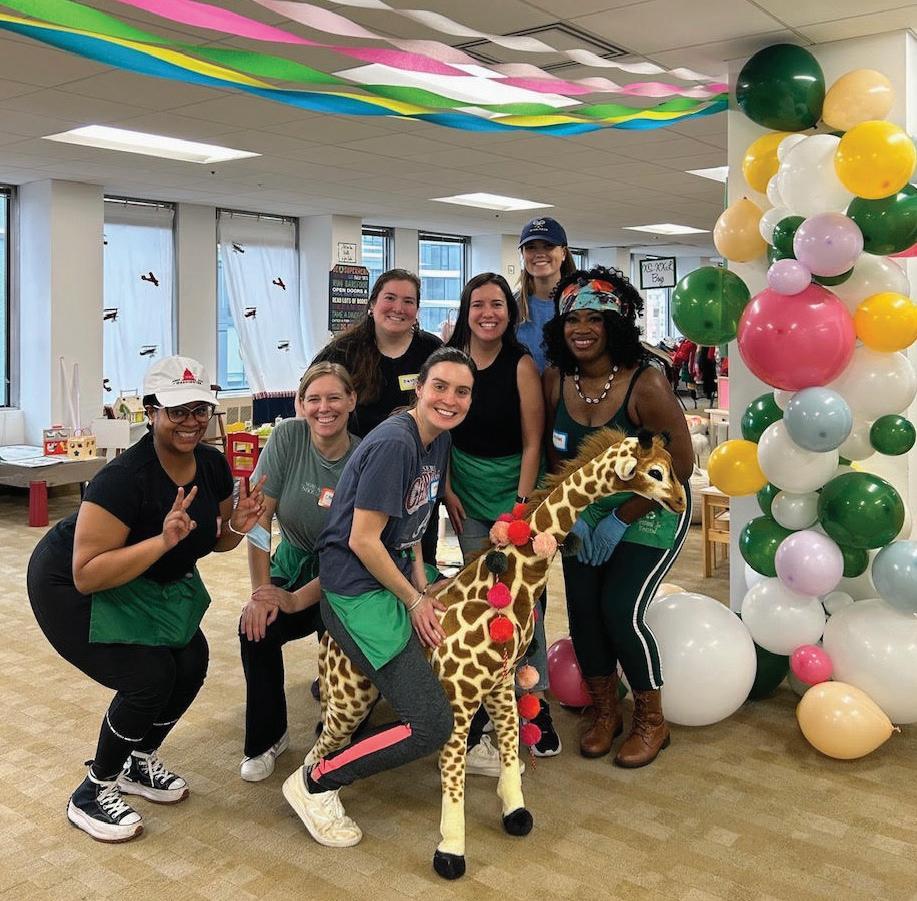
“Being an usher at Folger Theatre has been such a special experience. I love getting to play a small role in helping audiences feel welcomed while enjoying incredible performances in such a beautiful and historic space,” says Miller.
First-year committee member Nadine Nasby reflects on her time on the committee: “This is my first year in the Folger committee, and I wasn’t sure what to expect. I have found it to be the most engaging JLW committee that I have ever been on. I love that while I volunteer in the community at Folger events, I am also able to connect regularly with my committee members.”
The League supports initiatives that center equity, expand access to
high-quality educational experiences, and invite members to roll up their sleeves alongside partners. The Folger partnership checks all of those boxes while staying true to JLW’s history of championing literacy in the nation’s capital.
The partnership between the JLW and the Folger Shakespeare Library offers a concrete example of how League volunteers can expand opportunity. By championing literacy through arts-rich, performance-based learning, Junior League members are helping students see themselves as capable readers and critical thinkers, and helping to build a more informed, resilient, and engaged Washington, DC. •
Alanna Brannam
What better combination is there than a crisp autumn evening, charming cobblestone streets, and the rich history of Old Town Alexandria? Better yet, how about experiencing all three in the company of fellow Junior League of Washington (JLW) members? Every fall, JLW members can enjoy partaking in a ghost tour organized by the Historic Alexandria Docents (HAD) Committee. Tours in Washington, DC, and Alexandria are common sights, especially during the school trip and tourist high seasons. This is where JLW comes in: by creating an opportunity for members to participate in a ghost tour, members can learn more about the area, get to know other members, and support local small businesses. Old Town ghost tours for JLW members have been a tradition for years, and they are an excellent addition to the League calendar. While it may not be a highly social event—after all, the main focus is on the talented tour guide—it creates an opportunity to partake in an experience that is, for many, off the beaten path. There is still space to be social and meet other members, and to enjoy the tour with a guest.
JLW is lucky to have a popular ghost tour spot right across the river or on the same side of the Potomac, for Virginia-based members. Alexandria is an ideal location for ghost tours not only because of its deep history, but also its gas lanterns, cobblestone streets, historic homes and buildings that have withstood the test of time. This provides tour attendees with a truly immersive haunted setting. Every fall, JLW holds four 20-person ghost tours in Alexandria. Led by costumed tour guides and held in lanternlight, tour operators guide their groups through Old Town, where many stops are the sites of stories
hundreds of years old. While attendees do not go inside, it is easy to visualize exactly what happened in the old buildings when the tour guide is fully costumed and regaling the group with old tales.
One of the most unique—and spookiest —parts of an Old Town ghost tour is the mix of historical and paranormal anecdotes. Old Town is undeniably the site of a multitude of historical events, many of which are memorialized with plaques, statues, and markers throughout town. Lesser known are the ghost stories of Alexandria. These stories may not be in history books, but they have been passed down through generations. This is one reason why October, often dubbed “spooky season,” is the perfect time to attend a ghost tour in Old Town. The ghost stories are not necessarily tall tales, either. Many of them are research-backed and based on actual people and events. Tour guides may point to newspaper clippings or other documents that describe the stories they tell.
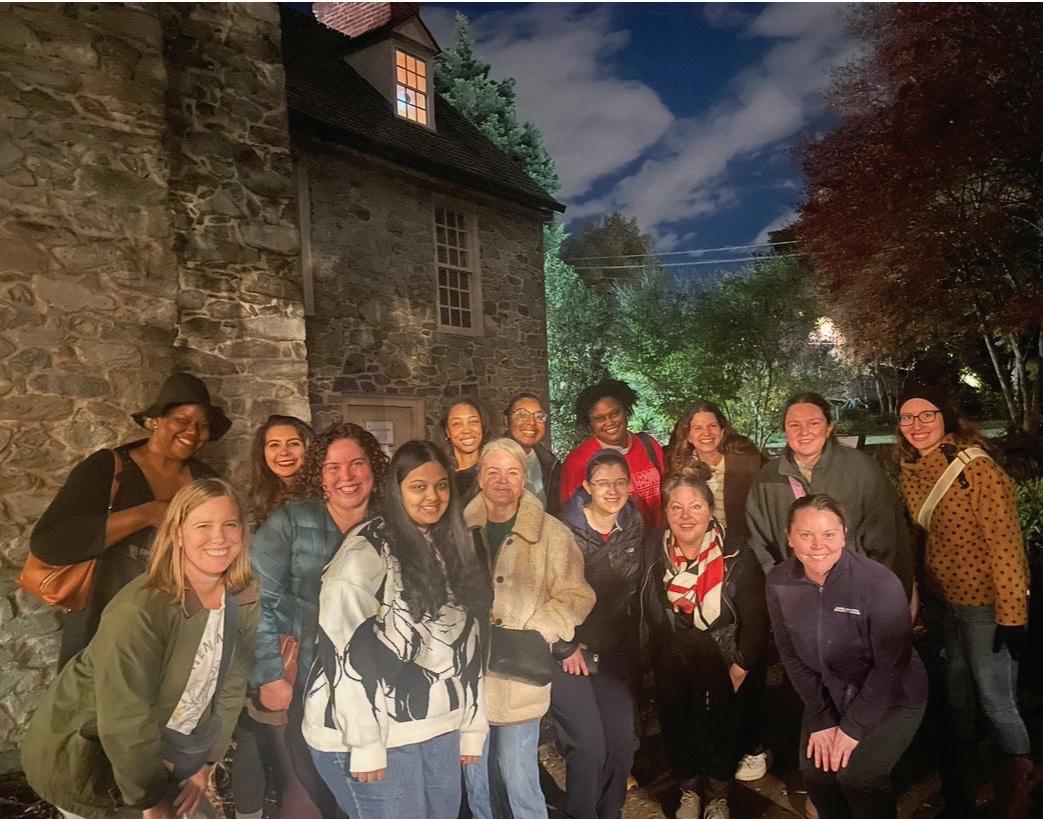
told on a typical Old Town ghost tour is that the Female Stranger passed away in a room at Gadsby’s Tavern in Alexandria and that her ghostly silhouette can sometimes be seen through the windows. No matter which version a ghost tour guide may share with their group, this tale is a mesmerizing, albeit melancholy, example of Old Town’s folklore.
The tale of the Female Stranger has captivated tourists and Alexandria locals alike for centuries, and it is just as spooky as the title suggests. The Female Stranger herself is an unidentified woman buried in St. Paul’s Episcopal Cemetery, where the first paragraph of her grave’s epitaph reads:
To the memory of a Female Stranger
Whose mortal sufferings terminated On the 14th day of October 1816
Aged 23 years and 8 months.
Many theories have arisen as to who the Female Stranger may be. The theory
Furthermore, Old Town tours are operated by local small businesses, such as Alexandria Colonial Tours, which has been in operation since 1985. Whether tour guides have years of experience or are new to the craft, they all share a deep passion for history, storytelling, and keeping Alexandria’s past alive.
When the air begins to cool and the leaves start to change this year, keep an eye out for walking ghost tour signups on the JLW calendar. Whether you bring a friend or date along, or arrive solo, this offering from the Historic Alexandria Docents Committee is an excellent way to meet other JLW members and enjoy a local activity. Tours typically run on Friday and Saturday evenings and take place in the dark, which adds to their spookiness. •
Leadership development is a core component of the Junior League of Washington’s (JLW) mission. To that end and to amplify JLW’s impact in the Washington, DC community and beyond, JLW’s Leadership Institute Committee works to provide training opportunities to equip League Board members, Council Directors, Assistant Council Directors, Chairs, Rising Chairs, and Vice Chairs to be effective leaders.
Every year, in a true testament to leadership commitment, while many League members are away on summer vacation, the committee kicks off with a half-day summer leadership training session that begins bright and early on a Saturday morning. On June 21, 2025, more than 50 League leaders gathered at Loughborough House for a day of speakers, breakout sessions, and icebreakers designed to strengthen their leadership skills. “League leadership is taught about a plethora of topics such as operations within the League, budgeting, room reservations, Diversity, Equity, Inclusion, Accessibility, and Belonging (DEIAB), how to lead effectively, and much more,” says Jasmine Procopio, Leadership Institute Committee Vice Chair.
JLW speakers included Membership Development Council Director Jessica Mosley, President Christina Babcock, Home & Heritage Council Director Alex Shaw, Loughborough House Committee Chair Allie Floyd, and Ways and Means Council Director Tiffani Moore.
Attendees also heard from Dr. Rajanique Modeste of Vestigia Organizational Strategies, who led a cultural sensitivity training, and were introduced to JLW staff, including Administrative Director Veronica Di Feo, Membership and Communications Director Katy Longworth, Operations,
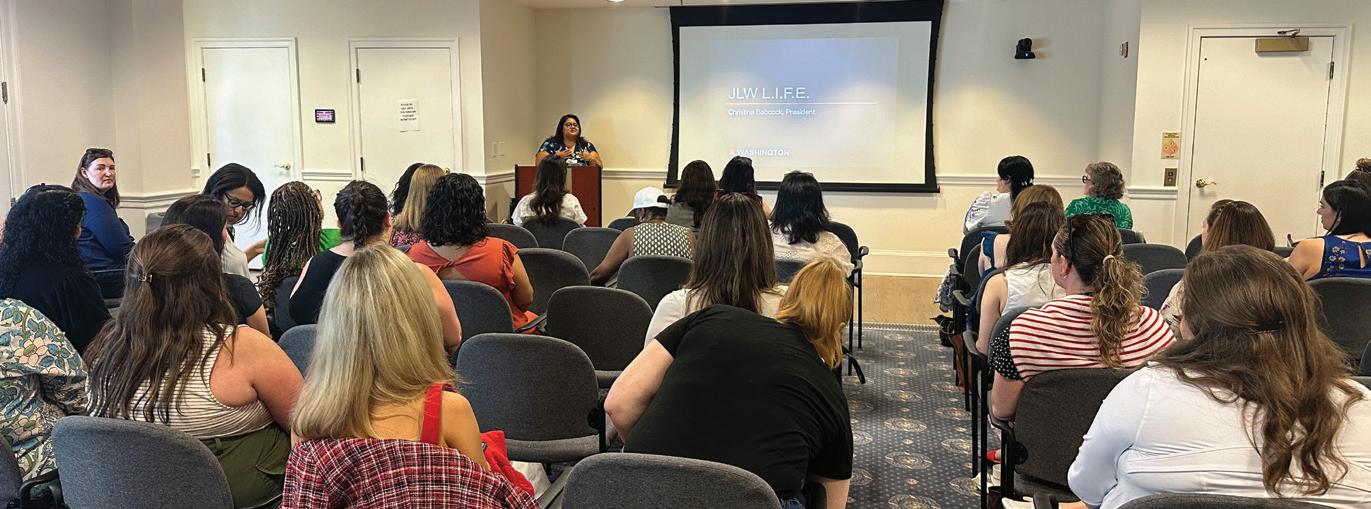
Communications, and Technology Coordinator Margot Watts, Bookkeeper Kathleen Petreski, and Fund Management System Specialist Sage Bauer, all of whom are essential in running day-to-day League operations.
Treasury and Finance Council provided an overview of the council, different funds JLW utilizes, and the budgeting process, while Hollyn Randolph, Chair of the Strategic Planning Committee, and Melanie Goerke, Assistant Council Director for the Strategic Sustainability Council, provided the Strategic Plan annual update.
Amanda Claire Hoover, Literacy Events Planning Chair, spoke about the National Book Festival. Finally, President-Elect Jacqueline Frederick-Maturo gave closing remarks to end a full day.
More than 80 members joined the virtual mid-year leadership training held Saturday, January 10, where keynote speaker Tamara Lynn of Momentum Education spoke on the topic of “New Year, New Goals: Leaving Behind Limiting Beliefs.”
The Committee also hosts an annual “Get on Board” program, which is open to all JLW members. Since it was launched in 2014, 215 JLW members have completed the Get on Board training, where “League members receive training in a variety of areas including
the roles and responsibilities of nonprofit boards, the board-staff partnership, strategic planning, financial oversight, and fundraising,” says Jessica Macauley, Leadership Institute Committee Chair. “Get on Board is our way to prepare women to serve on community boards across Washington, DC by focusing on key skills,” she adds.
“After the program, we provide announcements of open board positions for graduates through our listserv, and are always working to cultivate the Get on Board graduate network,” says Macauley. “Our participants have a vision for their community, and see board service either in the Junior League of Washington or in the community as a way to make a long-term impact.”
Other programs offered by the committee include various specialty training seminars. “New Leader 101 specifically teaches new leaders the nuts and bolts of the League,” Macauley elaborates. “The specialty trainings are similar to Development & Training sessions, but are specifically geared toward leaders.”
Through these initiatives, JLW leaders develop skills in program and event planning, relationship building, strategic thinking, and talent development, enabling them to expand the League’s impact. •
Ashley Lawrence
Behind every effective organization is someone asking the uncomfortable questions, not just whether the work feels good, but whether it is actually working. At the Junior League of Washington (JLW), this role belongs to the Research, Evaluation, & Innovation Committee (REI).
Led this year by Shana Gainey, REI operates as JLW’s internal think tank: a team of member volunteers who bring the rigor of professional consultants to the League’s own programs, processes, and people. From designing evaluation rubrics to analyzing annual survey data to presenting findings directly to the Board of Directors, REI does the quiet, essential work that keeps JLW honest with itself. REI digs into the data behind every program, every budget, and every membership survey to ask a simple but demanding question: Is it working?
“No organization is exempt from the question of whether it’s working,” says Gainey. “For-profit companies have profit margins to tell them. Nonprofits and volunteer groups can go years without any honest reckoning unless they build one in. We’re that built-in reckoning for JLW.” Gainey adds, “This year we developed a rubric for the Wrap Around Framework (WAF) that let us assess every evaluated committee on the same six dimensions: mission alignment with JLW’s strategic plan; operational health; financial health for committees with budgets; member engagement, including retention and leadership pipelines; impact and outcomes against stated goals; and innovation potential.”
Each section of the rubric is scored on a one-to-three-point scale.
The Wrap Around Framework (WAF) Scoring Rubric at a Glance
3 Fully meeting the measure—no areas of opportunity. Total scores of 16–18 indicate a committee is mostly meeting standards, with at least four 3s and no 1s.
2 Partially meeting the measure clear growth opportunities. Scores of 12–15 reflect an even mix of 2s and 3s, or four or more 2s offset with any 1s countered by 3s.
1 Not meeting the measure—significant opportunity areas. Scores of 6–11 indicate committees operating with only 1s and 2s and no 3s.
When asked to share an example of where REI’s findings led to meaningful change, Gainey has many examples. “Last year’s WAF report directly shaped several of the League’s current initiatives. A Rapid Response Task Force was created to accelerate the onboarding of new community partners, a recommendation drawn from our findings. Ways & Means improved their sponsorship packages, donor recognition, and ticket pricing as a result of our analysis. We even flagged the need for an internal audit, and this year’s actual audit results aligned with exactly what we had identified. When the data and the real world line up like that, it affirms the value of the work,” she shares.
Gainey adds that REI remains innovative as well. “We practice what we recommend,” she says. “We’ve leaned into AI tools to make our analysis and deliverables more efficient. And we document everything—what worked, what we’d do differently—so the next year’s REI members don’t start from scratch. For the committees we
evaluate, our innovations are grounded in the data. One past recommendation was to restructure how fundraising events were organized with vendor partners to improve member follow-through.”
The REI Committee is also quick to embrace change. “Fact-based analysis doesn’t have nostalgia,” Gainey says. “Our recommendations reflect what the data shows, even when that’s uncomfortable. The Board and Strategic Sustainability Council leadership make the final call on whether and how to implement what we find. That’s the right structure. Our job is to give them clear, honest information.”
REI collaborates with every committee within JLW. “Our leadership interviews the leadership of every committee going through the WAF evaluation. We want their perspectives, not just the numbers. That back-and-forth is where context lives, the ‘why’ behind the scores,” says Gainey.
Gainey notes that JLW members also gain a lot from serving on REI, including a wide range of skills spanning research, data analysis, data visualization, report writing, interviewing, and presentation design. Members choose the areas they want to develop, working on real skills that matter to them and often translating directly to their professional roles.
The presence of the REI Committee reflects something important about JLW: a willingness to hold itself accountable. As JLW continues to evolve, the work of REI ensures that every step forward is grounded in evidence, guided by data, and built to last. •
Ashley Lawrence
Behind the scenes of the Junior League of Washington’s (JLW’s) visible impact lies a process often overlooked, even by its most engaged members: the work of the Strategic Planning Committee. This group shapes the League’s long-term vision by gathering member insights, assessing community needs, and charting a course that keeps JLW responsive and relevant in a rapidly evolving city. Their work culminates in the League’s five-year strategic plan, a blueprint for training, community engagement, and organizational growth that guides everything from leadership development to volunteer deployment across the District. Through surveys, town halls, and structured feedback, JLW gathers and analyzes data to inform this plan.
On March 7, 2022, the JLW Board of Directors approved the “Strategic Plan 2027: Building Bridges for Increased Impact and Connectivity.” Now in its fourth year, the plan focuses on deepening member engagement through a more inclusive, flexible, and fulfilling experience that meets women where they are. It also emphasizes modernizing systems so members can focus their time on meaningful service, while strengthening community partnerships to address evolving needs across Washington, DC.
However, a strategic plan is only as strong as the people behind it. While “strategic planning” can sound abstract, the day-to-day work is highly hands-on. According to Committee Chair Hollyn Randolph, the team
regularly reviews member data, works closely with councils to align goals with long-term priorities, and identifies where adjustments or additional support are needed to keep the organization moving forward.
This year marks an important transition point as JLW enters year four of its five-year plan. “It’s the time when we evaluate progress, identify gaps, and capture lessons learned before shaping the next five-year plan,” Randolph says. “It ensures the next plan builds on what’s working and addresses what’s not.”
Randolph’s path to chairing the committee began with a desire to understand the League from a broader perspective. After serving on the committee previously and spending years on the Grants Stewardship Committee, she was drawn to the opportunity to learn more about the work happening across JLW.
She also sees strategic planning as essential for an organization with JLW’s legacy. “It’s important that we’re innovative and forward-thinking while also staying true to our mission,” she notes. Once finalized, the strategic plan becomes the framework for annual planning, guiding councils as they translate long-term priorities into yearly goals, committee work, and budget decisions.
Progress is tracked through metrics, assessments, and cross-council collaboration, allowing the League to adjust in real time. “The strategic plan functions as a living guide, not a static document,” Randolph explains. “It drives action, accountability, and impact.” With a century-long history, the committee continues to balance legacy with change.
That balance is reflected in the League’s approach to change. “We work hard to create a space where members, council directors, and the Board can share their thoughts honestly,” Randolph says. By listening carefully and channeling feedback appropriately, the committee ensures that change is thoughtful, inclusive, and aligned with the mission.
One example of this approach is the shift from DEI to DEIAB (Diversity, Equity, Inclusion, Accessibility, and Belonging), which emerged from a strategic evaluation identifying the need for a more specific, actionable focus. Through the creation of a DEIAB Task Force and external consultation, JLW has worked to embed these principles into everyday operations, from training to communication practices.
Looking ahead, Randolph emphasizes the importance of ensuring the League remains both mission-driven and adaptable. This includes learning from peer organizations and continuing to strengthen engagement, relevance, and community partnerships. “Strategic planning is also a powerful tool for preparing the next generation of JLW leaders,” she adds.
Although much of the committee’s work happens behind the scenes, its impact is far-reaching. “We’re definitely a behind-the-scenes committee,” Randolph reflects, “but we have a major impact on the League and its future.” Success, she notes, will be a League that is aligned, adaptable, and deeply connected to the Washington, DC, community—one that continues to evolve while strengthening member engagement and impact. •
Amanda Peters
When thinking of the Junior League of Washington (JLW), many people see impactful programs, scholarships, and services; fewer recognize the behind-the-scenes work and internal processes that committees like the Audit Committee perform to make those opportunities possible.
An independent audit is essentially a checkup for JLW’s financial health. Just as you would go to a doctor to make sure everything is working properly, JLW brings in an outside expert—an auditor—to examine its financial records and practices. This process helps ensure that the organization complies with laws, uses its funds responsibly, and meets the expectations of its members and donors, says Karla Wells, Audit Committee Chair.
The Audit Committee covers many facets of JLW’s operations, but perhaps the most important is its stewardship role: safeguarding the League’s financial integrity, ensuring accountability, and strengthening trust among members, donors, grantors, and the broader community. In many ways, the Audit Committee serves as the bridge between financial responsibility and mission impact, supporting JLW’s mission to advance women’s leadership for meaningful community impact
through volunteer action, collaboration, and training.
The past year reflected the Audit Committee’s continued focus on sound financial oversight, process improvement, clean audit, and risk reduction. When seeking external funding, some organizations may request audited financial statements as part of their review process. Strong financial oversight helps reinforce confidence among donors, grant-makers, and members. Many of JLW’s foundation and corporate partners require a clean audit before awarding grants, so a strong track record is crucial. Process improvements help reduce errors, strengthen internal controls, mitigate fraud risk, and free up volunteer time so leaders can focus more on the mission than on preventable issues. Ultimately, reducing financial risk protects JLW’s reputation. These outcomes reflect the League’s broader commitment to sound financial practices, supported by the Audit Committee’s oversight role.
Strong financial oversight helps support JLW’s ability to responsibly steward programs and funds such as the Meg Graham Scholarship, which provides a $10,000 award to recognize a Washington, DC, high school senior for exemplary service and leadership in honor of the late Reverend Margaret M. Graham. By maintaining strong financial practices, JLW reinforces the trust of
members, donors, and Community Partners who support mission-driven initiatives. Because members and external donors trust JLW’s financial oversight, they have committed to multi-year funding for initiatives such as literacy programs, women’s leadership scholarships, and workforce-development partnerships. Strong auditing is the gateway to trust and it enables the League to continue valuable programming and scholarships.
“For JLW, every dollar should help move the mission forward.”
“For JLW, every dollar should help move the mission forward—whether that means running programs, offering services, or investing in training and outreach. An audit helps ensure that financial decisions are aligned with these goals. When leadership knows that finances are in good order, they can plan more effectively, act responsibly, and focus more energy on community impact,” Wells adds.
When JLW leads with transparency and accountability, it strengthens its ability to support the community, advance its mission, and create lasting impact for those it serves. •
Tiffany Edmondson
Raise your hand if you ever considered nominating yourself for a leadership role in the Junior League of Washington (JLW) but hesitated. Raise your other hand if you’ve met the qualifications for an opportunity and held back out of fear of failure. If either sounds familiar, you’re not alone.
Maureen Higgins, the 2025–2026 Nominating Chair, once felt the same way. After encouragement from President-Elect Jacqueline Frederick-Maturo, Higgins took a step forward and pursued a leadership role. Since joining the League in 2015, she has seen firsthand how leadership opportunities can shape both personal and professional growth.
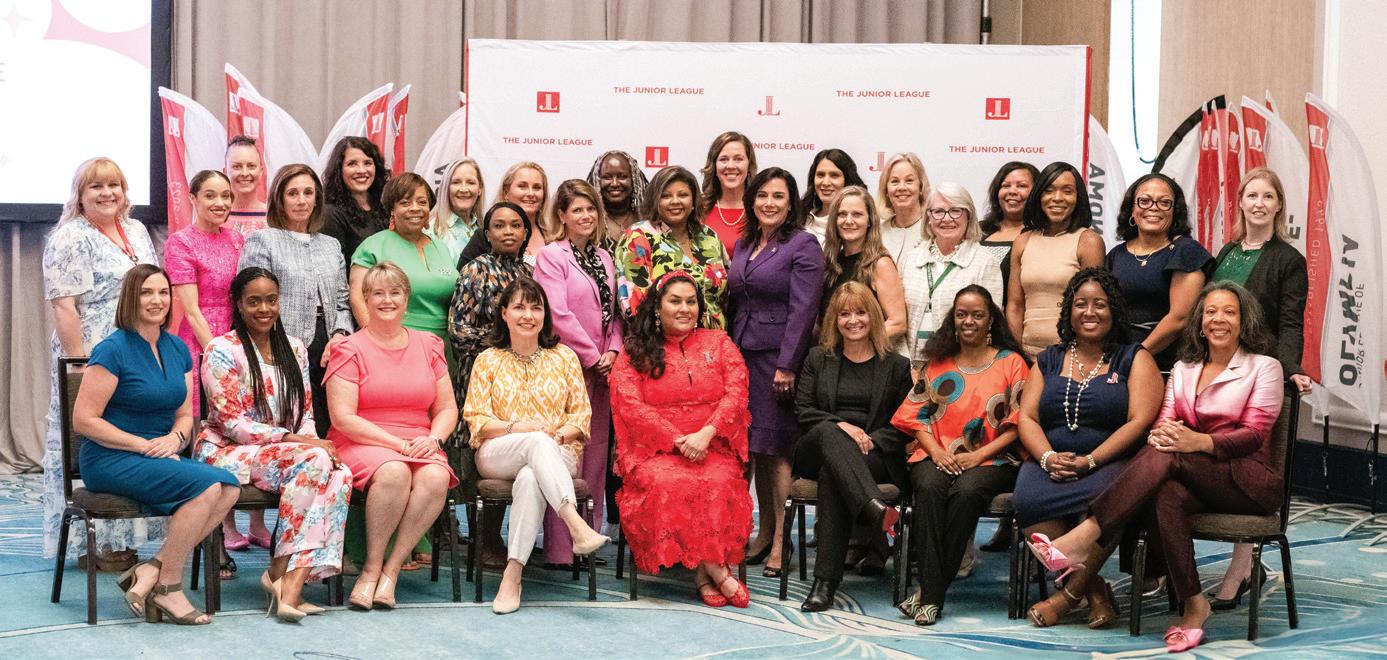
AJLI’s inaugural 40 Over 40 Class of 2025 honors remarkable women who exemplify the values of empowerment, leadership, and community impact that define the Junior League.
“I think stories like these are very true for a lot of women who have served or are serving in leadership in the League,” Higgins says. “We are very much an organization of women who cheer each other on.”
That culture of encouragement is central to the work of the Nominating Committee. While fear can often hold members back, the League provides pathways—through self-nomination, peer encouragement, and leadership development—to help members step into new roles with confidence. Programs like 40 Under 40 and 40 Over 40 highlight members’ accomplishments while also helping identify emerging leaders across the League.
Tiffani Moore, Ways & Means Council Director, was recognized as an inaugural 40 Over 40 Honoree by The Association of Junior Leagues International, Inc. (AJLI) and has since been slated as President-Elect for the 2026–2027 League year.
“I am profoundly honored to be recognized,” Moore shares. “For more than 15 years, The Association of Junior Leagues International, Inc. (AJLI) has been both my leadership laboratory and a sisterhood, sharpening my voice and deepening my commitment to meaningful community impact.”
To support members interested in leadership, the Nominating Committee continues to focus on transparency and access. Through partnerships with the Communications and Public Relations Council and the Membership Development Council, the committee shares information about the nomination process and encourages members to explore opportunities across the League.
For those considering leadership, Higgins encourages starting with simple steps: talk to current chairs, ask questions, and learn from those already serving. These conversations not only provide insight but also help members feel more confident stepping forward.
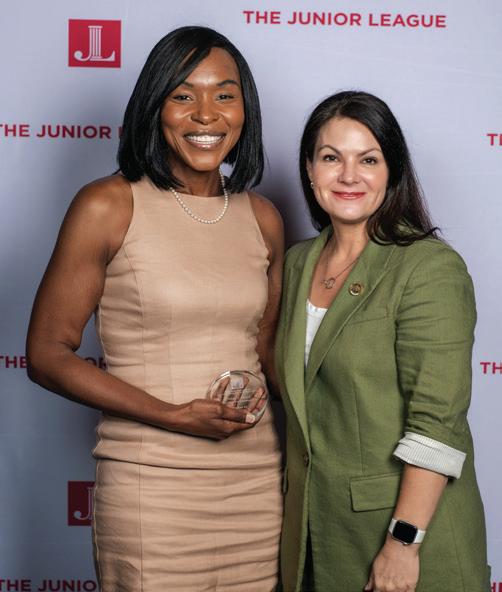
Tiffani Moore, member of AJLI’s inaugural 40 Over 40 Class of 2025, with AJLI President Alice Glenn at the 2025 National Conference.
The League also offers Development & Training sessions throughout the year to guide members through the nomination and self-nomination process, along with broader professional development programming that builds leadership skills.
For members who may still feel hesitant, career coach Kanika Welch offers practical advice for overcoming self-doubt. She recommends documenting accomplishments in a “brag doc,” remembering that many candidates apply for roles without meeting every qualification, and preparing for rejection as part of growth. “You’re more qualified than you think,” Welch says. “And stepping outside your comfort zone is part of the process.”
Ultimately, the message from the Nominating Committee is simple. Leadership in the League is accessible, and support is built into the process. Whether through self-nomination, peer encouragement, or ongoing development, members are invited to take the next step.
If you’re ready, raise your hand. •
How the Loughborough House Committee Preserves the League’s Historic
Victoria Callahan
hen Junior League of Washington (JLW) members gather at Loughborough House, they step into more than a headquarters. They enter a space that represents the League’s legacy, community, and enduring presence in Washington, DC. What keeps that space running smoothly, safely, and beautifully is the quiet, dedicated work of the Loughborough House Committee.
Behind every well-maintained room, functioning system, and thoughtfully planned improvement is a team of members who are as committed to the building as they are to the mission it houses. Through facilities management, strategic planning, and hands-on project oversight, the Loughborough House Committee ensures that JLW’s home remains a source of pride for many League years to come.
A beautiful, historic property doesn’t maintain itself. The committee conducts regularly scheduled inspections of the building and grounds, identifying issues early and addressing them before they become costly problems. Working closely with the Home & Heritage Council Director and League staff, committee members serve as the eyes and ears of the property, flagging repair needs, managing ad hoc projects, and ensuring that every corner of the building receives prompt attention. This hands-on approach means members are not simply overseeing the property from a distance. They are actively engaged stewards, sourcing bids, coordinating with vendors and contractors, and managing timelines that work within the rhythm of the House schedule. It is detail-oriented, behind-the-scenes work that makes a visible difference.
Good stewardship, however, means thinking beyond the present. The committee reviews and maintains JLW’s House Five-Year Plan, a living document that assesses the current state of the building’s major systems and facilities, prioritizes upcoming projects, and staggers large capital expenditures to ensure long-term financial sustainability. At the close of each League year, the committee evaluates progress on current projects and updates the plan to reflect new priorities and emerging needs. This cycle of assessment and planning ensures that Loughborough House is never caught off-guard by aging infrastructure and that the League’s financial resources are deployed strategically and responsibly. For members with an interest in project management and long-term planning, this work offers a meaningful opportunity to shape the future of JLW’s most visible asset.
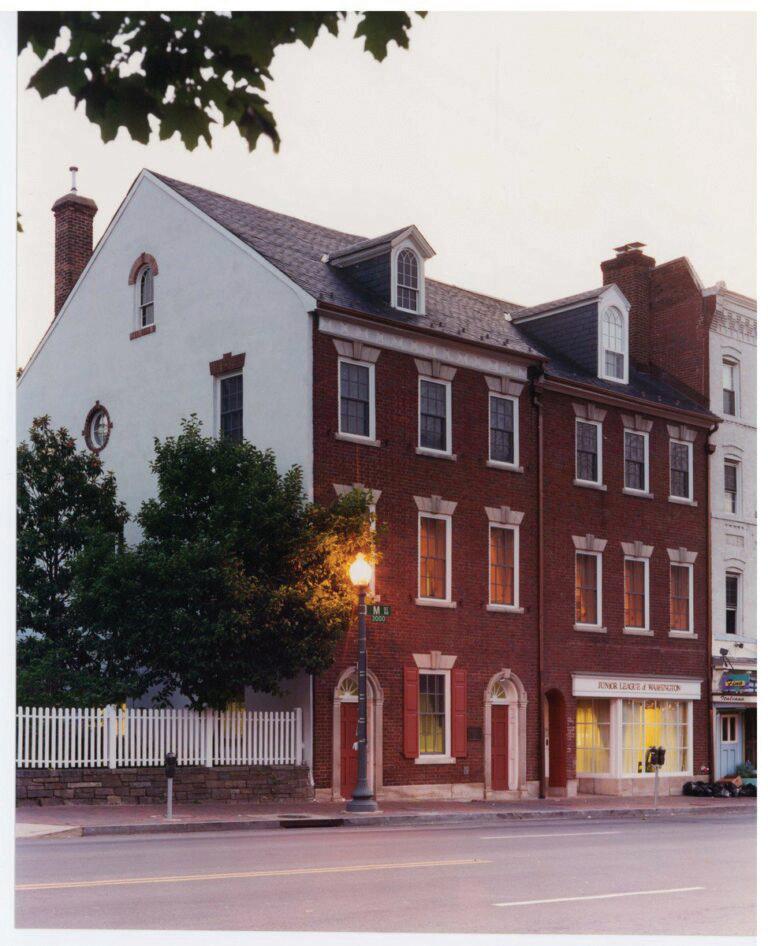
A spirit of collaboration also runs through the committee’s work. The committee works closely with JLW staff, the Finance Council, and the League’s professional property management firm to ensure quality service, cost-effectiveness, and compliance with JLW’s financial policies, including competitive bidding processes. Special projects add richness to the committee’s portfolio, including joint initiatives with the Archives Committee and participation in the Georgetown Garden Tour. These partnerships reflect the committee’s broader role as advocates for Loughborough House, not just as a functional space, but as a meaningful piece of JLW’s identity and history in the community.
The impact of the Loughborough House Committee’s work is felt every time members walk through the door. Loughborough House stands because of the people who care enough to maintain it, and the Loughborough House Committee is leading that charge. •
Within the Junior League of Washington (JLW), the Archives Committee is revered for its commitment to maintaining the League’s legacy through its white glove initiative under the leadership of Chair Evelyn Lugo.
“We’re essentially the keepers of JLW’s story,” shares Lugo. “Our goal is to make sure the legacy of the women who came before us is protected—and that their stories can still be told.”
The responsibility of preserving League documents and artifacts was managed by the administrative team prior to Archives becoming a standalone committee in 2016. Fast forward to 2026, where Lugo and fourteen JLW members are now running point on preserving JLW’s history.
“Last year, I went on a mission to help educate our members about the Archives Committee and the work we do,” says Lugo. Her efforts appear to have paid off as 50 members selected the Archives Committee as their number one placement.
The Archives Committee also has a strong sense of community. Lugo states that, due to the committee’s in-person work during preservation days, they’ve established strong relationships with one another.
In recent years, the committee’s work has focused heavily on digitization. Additionally, the team categorizes and archives historical documents. The process consists of the committee’s thorough review of all documents, followed by an evaluation for historical significance to the League. “We want to preserve anything that helps tell the story of who we were and how we became who we are,” Lugo shares.
According to Lugo, documents holding value to the League are preserved with acid-free paper and filed within archival-quality
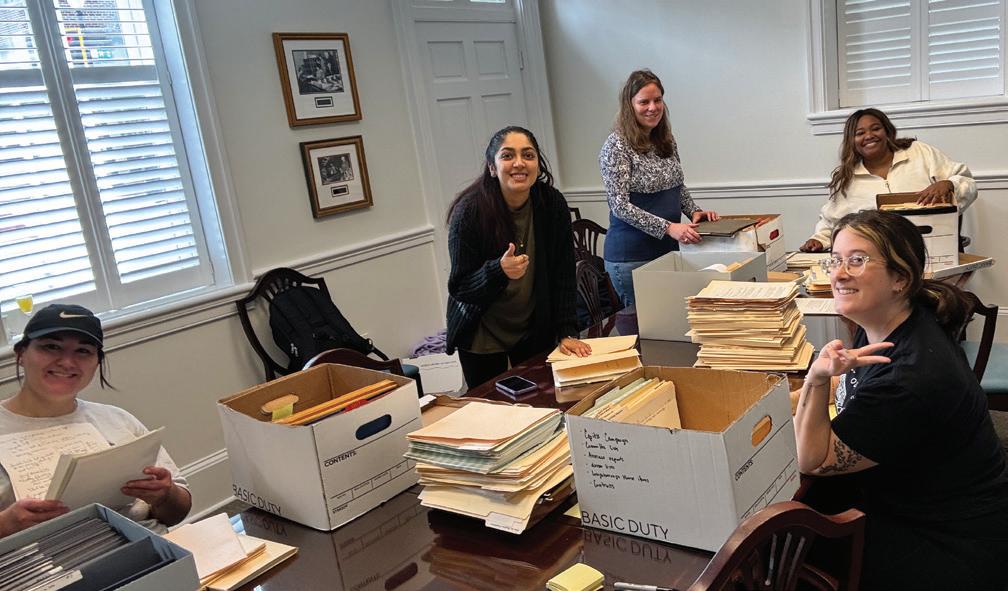
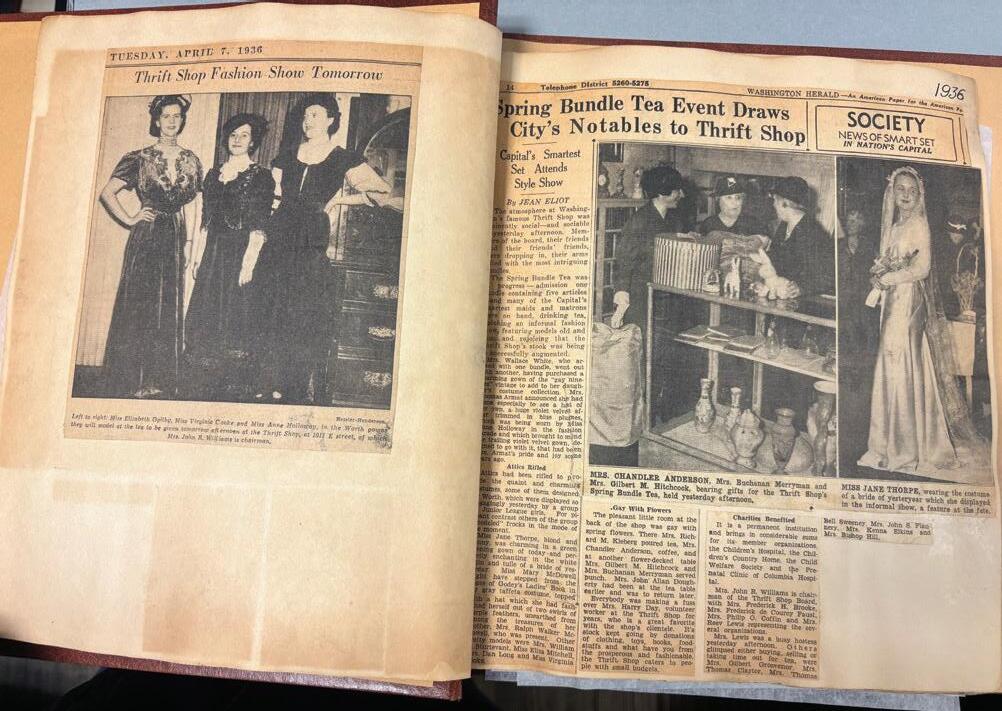
boxes, ensuring that fragile physical materials are preserved for the future and are protected from further loss or deterioration. The committee is also developing a digital hub and cataloguing system to organize materials in a way that makes them usable and searchable, with the goal that one day JLW members can access and reference the League’s history and historical documents for programs, events, and storytelling.
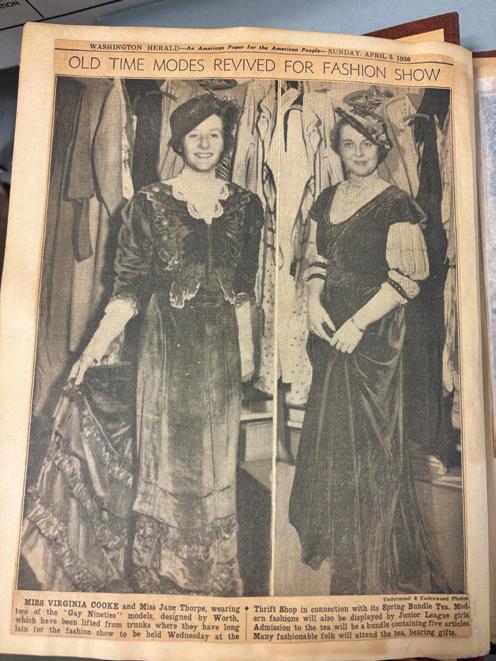
“As Chair of Archives, I knew I’d have the opportunity to not only learn new skills, specifically preservation of materials, but that I would get to use my love of the League, our history, and our mission to tell our stories,” says Lugo.
“I made it a goal of mine to bring awareness to not only a committee which serves such an important function for the League, but truly to teach more women about the history of our incredible League, and to hopefully make people proud of being something so much bigger than themselves,” Lugo says.
That pride—and that continuity—is at the heart of the Archives Committee’s work. By preserving the past, they help ground today’s members in a shared legacy and ensure future members understand the shoulders they stand on. •
Tiffany Edmondson
There’s a new tour in town, and it has been dubbed one of the Junior League of Washington’s (JLW’s) most highly anticipated engagement activities among transfer members. The Transfer Steering council launched the Welcome to Washington Initiative during the 2025–2026 League year to allow active transfers to meet monthly and explore the District’s unique cultural sites and neighborhoods with fellow transfers who have recently relocated to the DMV.
The initiative includes a range of cultural tours and seasonal activities across Washington, DC, including experiences like the U Street Mural Tour, cherry blossom viewing, and a Washington Nationals game.
“I loved the U Street Mural Tour, organized by Sabrina Noel on the Transfer Steering Committee! Sabrina did such a wonderful job explaining all the murals, and the tour concluded with a serendipitous run-in with one of the mural artists! It’s been so fun to meet other Transfers at great events such as that one,” shares transfer member Marisa Thompson.
In addition to the Welcome to Washington Initiative, Transfer Committee Chair Elise Cowan and the Transfer Steering Committee hosted several themed events throughout the year to personalize transfer members’ relocation to the DMV area. Signature events, such as the Cherry Blossom Tea Party, Transfer Reunion, and the Cookie Exchange with the New Members Committee, allow transfers to meet and mingle with both new members and transfer alumni.
While the Transfer Committee’s social calendar is popular among League
members, Fall and Spring Orientation and Course Session provide key entry points, introducing transfers to the League and helping them understand membership expectations before exploring committee placement opportunities.
Vice Chair of Communications, Caroline Richardson, was a transfer during the 2024–2025 League year. Richardson

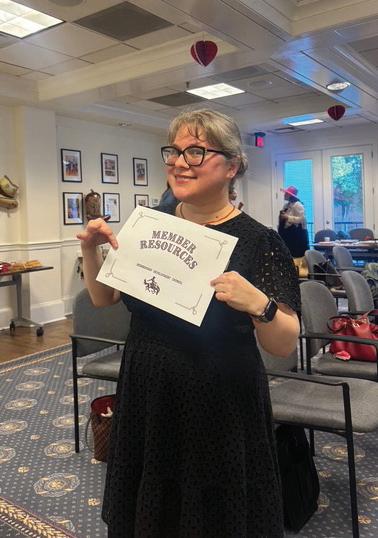
Transfer member Blair Bardelmeier joined the JLW after journeying from her hometown of Edwardsville, Illinois, to Reno, NV, to Palo Alto, CA, before coming to Washington, DC.
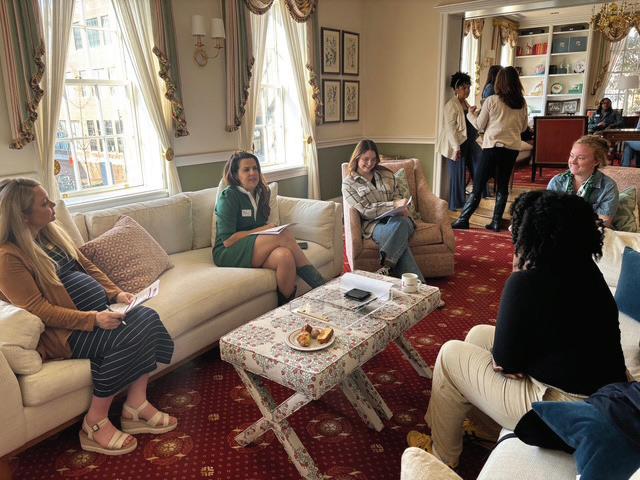
shares that her experience inspired her to stay involved with the Transfer Steering Committee to help welcome future classes of incoming transfers.
Cowan joined the League four years ago and recently served as a transfer advisor before being slated to chair the Transfer Committee this League year. Her motivation as a leader is rooted in the example set by past chairs who prioritized building genuine connections and friendships within the transfer community.
“I love the transfers community as we get to meet so many wonderful women from various geographies and backgrounds who are excited to get involved. Their excitement is contagious,” says Cowan.
This year alone, the League has 49 transfers and anticipates that number will continue to grow. Many members are new to Washington, DC, and are still building both community connections and familiarity with the area.
“Coming from two leagues that had an average of 150 members total, I was a little intimidated to transfer into the Washington, DC league that has 2,300 active members. I am impressed with how the Transfer Committee set up our League year. I’ve kept busy with not only volunteering & community-related activities, but also fun events that have helped me learn the area and get more comfortable in my new home! I’ve met some amazing women through the process to help me build a great foundation here in the DMV. I couldn’t have asked for a better transfer year experience,” says transfer member Blair Bardelmeier.
The Transfer Reunion serves as a key moment in the year, allowing current and former transfers to reconnect, build relationships, and strengthen their sense of community within the League.
As members become more engaged, many go on to serve in leadership roles across the League, including leading major initiatives and committees. This progression reflects the longterm impact of the transfer experience and the strength of the relationships built along the way.
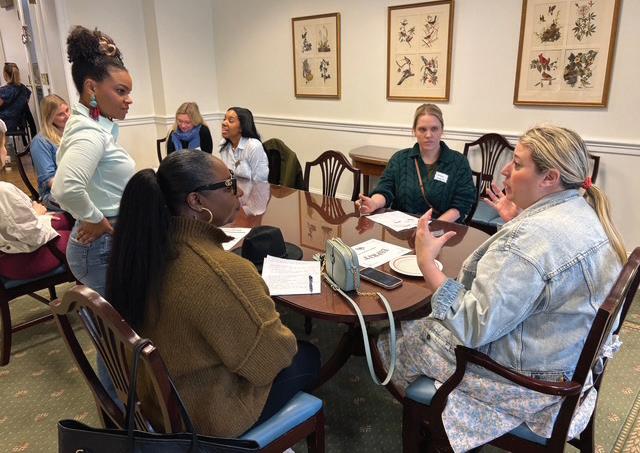
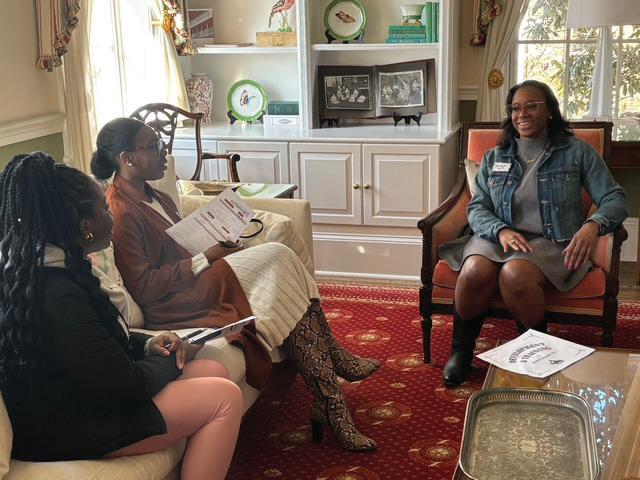
“Sharing new experiences not only creates bonds between the women, but it also builds an appreciation for Washington, DC. Establishing these ties to the community and each other also strengthens Transfers’ commitment to the Junior League of Washington,” says Richardson. •
Jessica Hassanzadeh
Langley Residential Support Services serves adults with developmental disabilities, their families, and the broader Fairfax County community. Since 1983, the Langley team has provided comprehensive support services for its residents and has expanded to include six group homes across Northern Virginia.
Langley’s partnership with the Junior League of Washington (JLW) began with a one-hour weekly book club for reading and discussion. The book club selections are educational or nonfiction.
“Each year, we ask residents what they want to read for the upcoming league year and then order the books through Resolution Read. Some of our favorites have been about pandas, twisters, and the biographies of famous baseball players. Right now, we are enjoying a book about penguins,” says Langley Residential Support Services Committee Chair Anne Parsons.
The group reads a couple of chapters on Tuesday nights, and then JLW volunteers share discussion questions for reading comprehension. On any given week, a full house can include up to 20 residents at the book club, which meets at a local church. After the book club discussion, JLW volunteers lead a different craft each week and enjoy snacks together.
“During COVID, everything was virtual, and in the transition back to in-person meetings, we didn’t talk about activities the residents had done in the past. Even in the first two years back, we were wearing masks. Then, last year, we discovered that there had been a Langley talent show in previous years and thought it would be fun to bring it back,” says Parsons.
When the JLW volunteers asked Langley residents about organizing a talent show in 2026, the answer was a resounding and unanimous “yes!”
With excitement and buy-in from the Langley book club, JLW volunteers began planning for the talent show, which was held on March 24. Langley residents were involved in every aspect of planning, using part of the weekly craft activity that accompanies the book club to decorate talent show invitations. The invite list included all Langley residents, staff, and board members, JLW leadership, and friends and families of the talent show participants.
While talent show participants selected their talents individually and practiced outside of the book club, JLW volunteers still supported them in many ways, including gathering any props needed for the show. The week before the event, JLW volunteers hosted a dress rehearsal during the book club time slot.
“It has been so wonderful to see this event come together, and planning has been a group effort,” adds Parsons.
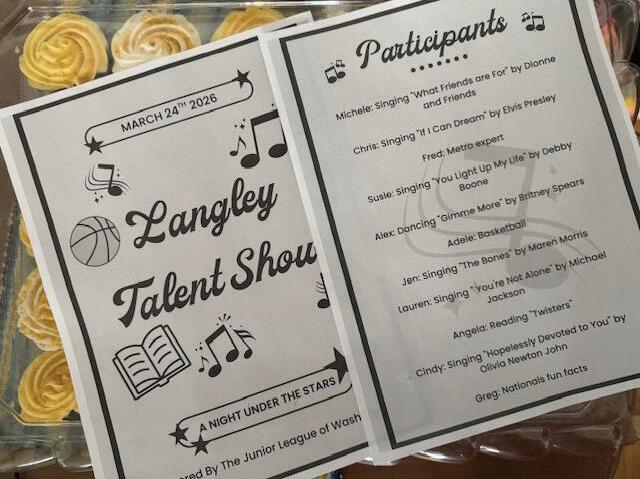
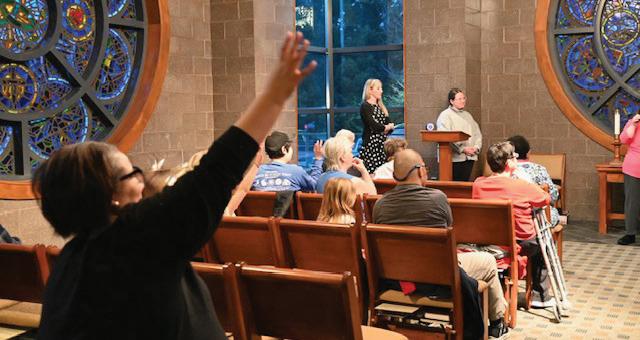
A Langley resident receives enthusiastic audience participation during her performance of Michael Jackson’s “You Are Not Alone.”
A total of nine residents participated in the talent show and performed for a full house of supporters. Residents shared a range of talents with the audience, including basketball, singing, and dancing. Additional talents included “Metro knowledge,” where judges asked a resident questions about the Metro and the resident answered, as well as sharing fun facts about the Metro and reading an excerpt from a book.
To judge the talent show, the Langley Residential Services Committee invited volunteers from Washington School for Girls, Reading All-Stars, and JLW President Christina Babcock. All performers received an award, with categories including Most Unique, Most Energetic, Most Creative, Crowd Pleaser, Shining Star, Most Memorable, Best Stage Presence, Most Original, Most Enthusiastic, Best Impersonation, and Best Smile. After the talent show, JLW volunteers organized a reception with drinks and desserts for everyone to enjoy.
While the talent show went on hiatus following the COVID-19 pandemic, the Langley Residential Services Committee hopes to bring it back as an annual event. “I love leading our book club, but the talent show has been a fun addition to this year’s activities and a great way to learn more about the residents and their talents. We had a great turnout, and the JLW volunteers really enjoyed planning the event with the Langley residents,” says Parsons. “We look forward to continuing to host this event year after year.” •
Sarah Valerio
The Junior League of Washington (JLW) Communications & Public Relations (CPR) Council, comprised of the Digital Media Committee, Member Communications Committee, and Publications Committee, along with specialized roles – typically committees or subcommittees of one – for Photography, Graphic Design, Digital Advertising, Editing, Podcast, and Public Relations – is the communications hub of JLW. Together, the teams within this council are responsible for virtually all internal and external communications JLW produces. From League Lines to the podcast to Facebook, LinkedIn, and Instagram accounts, to the annual report and donor report and this very magazine – 3039M – the Comms & PR Council, as it is affectionately known, oversees them all.
“At a high level, we serve as the central hub for all communications across the League,” says Comms & PR Council Director Taylor Jackson. “That includes all internal communications to members and external storytelling about our impact, events, and partnerships.”
According to Jackson, the council “touches nearly every part of the League. From major fundraising events to member recruitment to community impact work, we’re often working behind the scenes to bring those efforts to life and make sure they land with the right audiences.”
“The council’s work is essential because it connects the League with its members, partners, and the wider community. Effective communication builds trust, increases visibility, and highlights the incredible efforts across all councils and committees. It ensures that our mission not only reaches people but also truly resonates with them,” says Assistant Council Director Cassidy Herrold.
In addition, the council is also responsible for JLW brand consistency. Jackson shares that the council ensures “everything JLW puts out reflects who we are and what we stand for.” The council recognizes that clear, consistent, and quality communication is important to the success of the JLW and of its mission.
“Communication is one of the most important keys to a successful organization,” says Assistant Council Director Lindsay Jenkins. “Through our channels, we have the opportunity to keep members informed, share the work we do in the community, support fundraisers by creating graphics and advertising, and celebrate the fun of the League.”
Herrold, who was drawn to the council because of her passion for storytelling, elaborates, “Thoughtful communication can inspire action, strengthen community, and increase impact.” Herrold notes that the council works to ensure “consistent, strategic messaging that reflects the League’s values and impact.”
Like Herrold, Jackson has a passion for communications.
“Communications has always been where I gravitate, both professionally and within JLW,” she shares. “I’ve spent most of my career thinking about how to tell the right story to the right audience, so CPR is exactly that, just applied across everything the League does. It’s also one of the few places where you get a full view of the organization, which I love.”
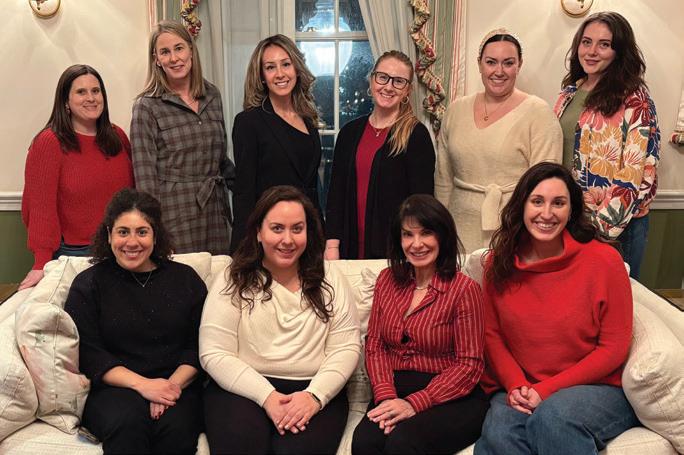
Communications & Public Relations Council at JLW’s Loughborough House. Back row: Emily Sale, Lindsay Jenkins, Sarah Valerio, Katie Beaumont, Taylor Jackson, Barbara Kirwan. Front row: Jen Bristol, Elizabeth McCormick, Bethany Coulter, Ellen Goodyear.
Jackson’s favorite part about being on the council? “Honestly, it’s the people and the perspective you get. CPR is one of the only councils that has visibility across everything happening in the League, so we often get an early look at the big ideas, events, and initiatives before they’re rolled out more broadly. That vantage point makes the work really energizing and also allows us to shape how those stories come to life.”
Herrold delights in the council’s role in “bringing stories to life, whether highlighting member achievements, showcasing community impact, or shaping how the League is perceived externally. It’s incredibly rewarding to contribute to something that both celebrates the League’s legacy and changes how we connect with others.”
Herrold adds, “What makes this council especially unique is the mix of creativity and strategy. It’s not just about sharing information; it’s about crafting meaningful stories that spark engagement and pride within the League.”
“The League is doing incredible work across community partnerships, fundraising, and member development, but that impact only goes as far as our ability to communicate it clearly and consistently,” says Jackson. “Strong communications help drive membership, support our partners, elevate our reputation, and ultimately expand our impact in the community. A great example of that is the League of Extraordinary Women podcast, which won an AJLI Award last year. It’s a reflection of how powerful storytelling can be when it’s done well.”
Jenkins sums up the work of the Comms & PR Council, saying, “We get to be a little part of everything and tell the stories of what makes JLW so special.” •
Sarah Valerio
As the storytellers of the Junior League of Washington (JLW), the Publications Committee produces the JLW magazine, blog, annual report, and donor report. Under the leadership of Chair Sarah Valerio and Vice Chairs Megan Lilly, Tiffany Edmondson, Meredith Lesieur, and Gabrielle Murphy, the committee documented a year in JLW life.
The members of the committee discussed their reasons for joining, what they have gained from their time on the committee, and what their experience has been.
“I wanted to join the Publications Committee to connect with amazing women who share a passion for writing and covering stories,” says mini-placement LaKisha Brown. “I enjoy using my creativity through writing and helping bring ideas to life in ways that are engaging and thoughtful. It has also been a great opportunity to collaborate with other committees and build connections throughout the organization. Just as I envisioned, the experience has been incredibly rewarding.”
Other committee members shared Brown’s sentiments, noting that covering other committees for the JLW publications has helped them learn more about the work of the League and build connections.
“Being on the Publications Committee has been an excellent opportunity to learn more about different parts of JLW. By highlighting the work of multiple other committees, I have been able to make connections across the League and share their stories,” says Alanna Brannam. “It has also been a rewarding process, through which I sharpened my writing and editing skills and learned about journalism in the process.”
“My favorite part about being on the Publications Committee is getting to read all about the great work various committees are doing throughout the year,” shares Poppy Merrell. “I love to see the deep dives on our partner organizations and get inspired by profiles of League members.”
“I wanted to be on the Publications Committee because I thought it would be a great opportunity to learn more about the depth and breadth of everything JLW does,” says Kate Seif. “I now have a better understanding of the plethora of JLW committees and some of the work we do ‘behind the scenes’ like the impacts we make through our grants work,” she adds. “And, of course, who doesn’t like to see their name in print?!”
Some members cited the flexibility of the committee as a key draw.
“Joining the Publications Committee gave me an opportunity to stay active in the League without physically living in the U.S.,” says Tiffany Edmondson, Vice Chair of Editing, who has been living in China for work. “After moving abroad, I really needed an avenue to stay connected to members and be involved throughout the League year. It’s been years since I’ve written for a publication, and I’m so grateful that the JLW offers various print mediums for passionate writers that are capable of encapsulating our service, success stories, and experiences into blogs and magazine articles.”
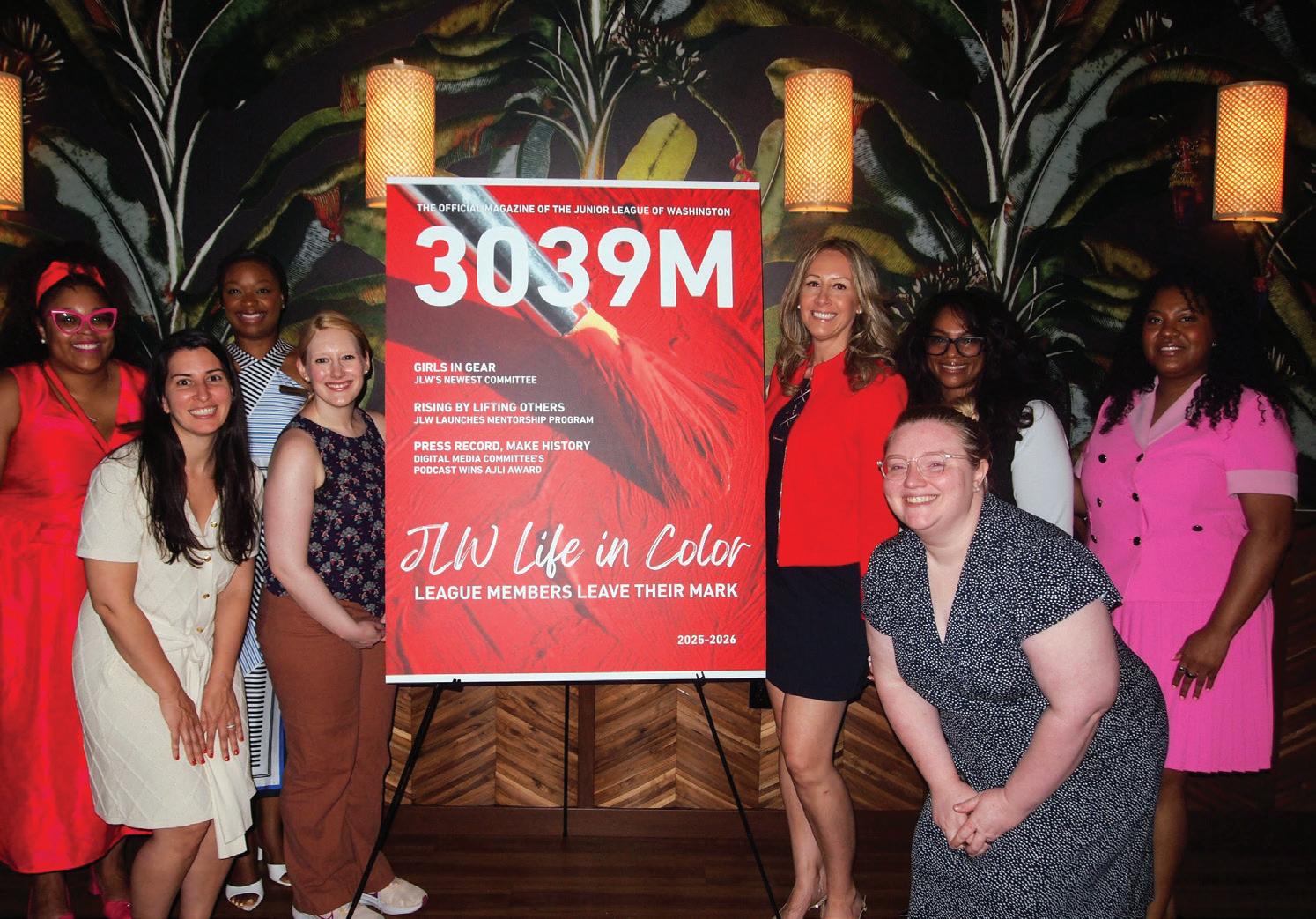
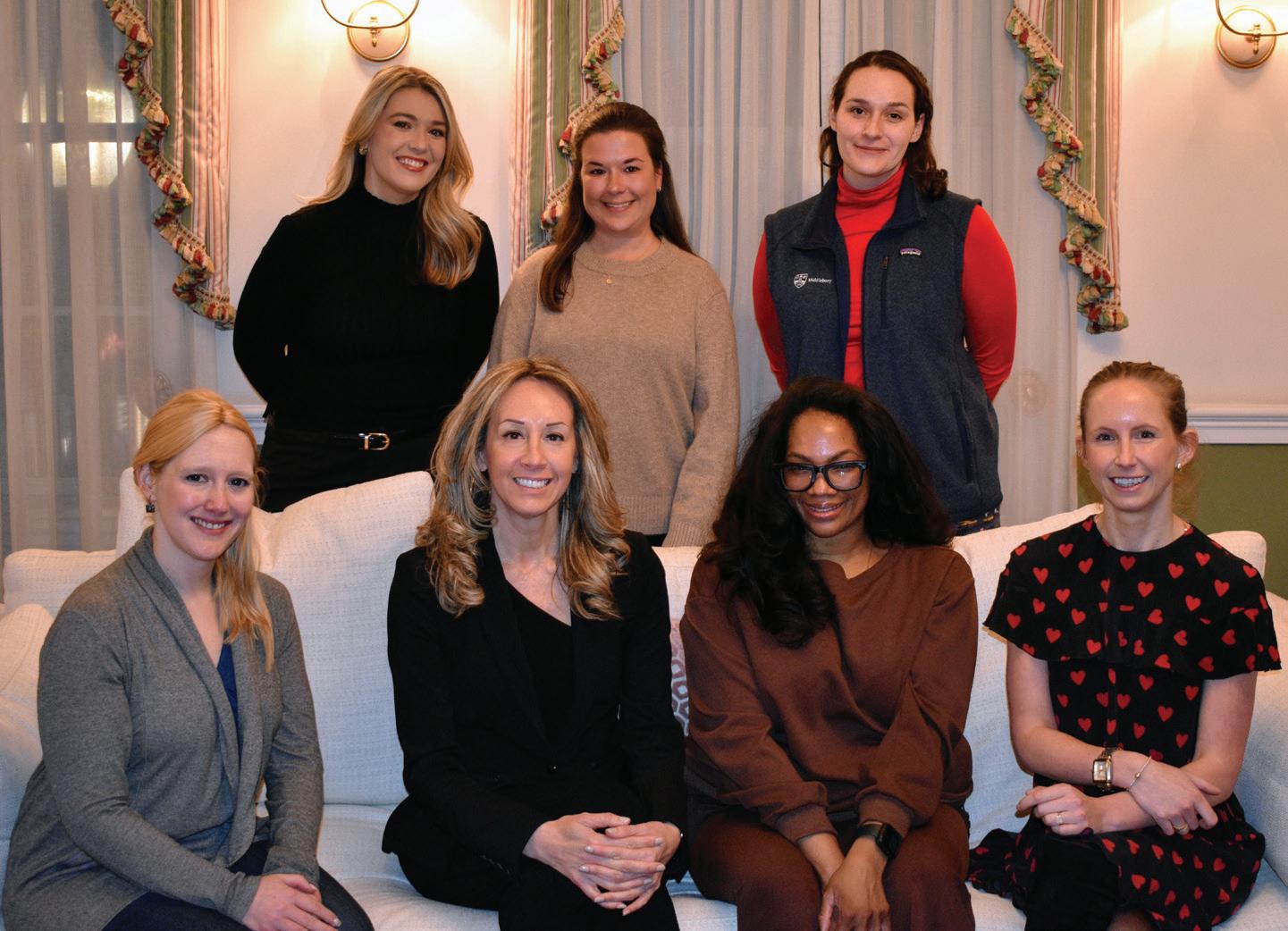
In addition to learning about the other committees in the JLW, the Publications Committee seeks to help its members learn and grow their writing, journalism, and communication skills.
Shannon Jessen says she joined the committee because “it was a chance to stretch my skills in a new direction and finally find out if I had a knack for journalism, something I’ve always been curious about. Getting to become a journalist and connect with so many different committees across JLW has been such a gift. Learning about the incredible work happening across the organization and actually getting to interview the people behind it has been the highlight of my year.”
Other Publications Committee members reflect on the positive impact they believe the committee has.
Vice Chair of Blogs, Megan Lilly shares, “One of the most rewarding parts of serving as Vice Chair of Blogs has been helping shine a light on the people and initiatives that make our League so impactful.”
“JLW is filled with incredible stories of women supporting each other and our community,” says Jessica Hassanzadeh. “Working on the Publications Committee is one way to help capture and share those stories.”
“We get to shine a light on all the hard work our members pour into this organization throughout the year. I truly believe there’s real value in pausing, reflecting, and taking stock of everything this incredible organization accomplishes. It’s how we honor what’s
been done and build momentum for what’s ahead. The talent, passion, and sheer scale of what the women in our organization are doing each week is nothing short of inspirational. So many incredible things are happening that most members don’t even know about, and getting the front-row seat has been one of the most illuminating experiences,” adds Jessen.
“By sharing the stories of the incredible work our members do, the Publications Committee amplifies the voice, vision, and impact of the JLW,” adds Lacy Nelson. “It is always a privilege to serve on this committee and help tell the stories of the women whose efforts are making a meaningful difference in our community.”
“The work of the Publications Committee matters because it is how JLW tells its story to both our members and the broader community. The League does incredible work across Washington, DC, and the Publications Committee helps capture those stories, elevates the voices of our members and community partners, and documents the real difference the League makes,” Ashley Lawrence shares. “It also helps preserve the League’s institutional memory by highlighting the initiatives, programs, and partnerships that shape our legacy and guide our future. Publications ensures that members understand how their volunteer efforts contribute to JLW’s mission.”
Yolanda Raine is fulfilling her new member year miniplacement as a member of the Publications Committee. “The League is filled with talented women doing meaningful work in the community, and I wanted to help tell those stories and celebrate the leadership and service happening across the organization,” Raine says, adding, “Publications plays an important role in how the League tells its story. They help document the work we are doing, elevate the voices of our members, and highlight the impact of our programs and partnerships in the community. Strong communications keep members informed and engaged, but it also ensures that the League’s legacy of leadership and service continues to be visible and appreciated.”
“The most rewarding part is sharing the amazing work of the women in the League, whether it’s in the Annual Report or in 3039M,” says Amanda Peters. “Being a part of the Publications Committee is being a part of written JLW history.” •

Iwant to begin by expressing my sincere gratitude to this League, to the leaders who have come before me, and to each of you whose continued commitment to our mission makes our 113-year legacy possible. It is truly an honor to serve this organization and our community.
I am especially grateful to our current President, Christina Babcock, for her intentional, collaborative, and inspiring leadership. Through her “JLW LIFE” theme, she reminded us of the strength and value of our community; one we have come to rely on now more than ever. As she often says, she joined to serve and stayed for the community. Her leadership has strengthened the very fabric of our League, and I am deeply thankful for the foundation she has helped build.
Our work this year has been anchored in leaning in and listening, investing in our development, expanding pathways to opportunity, and deepening our engagement. Together, these efforts have ensured that we continue to advance women’s leadership in meaningful ways. Whether you are new to the League or have been a member for decades, your voice matters, and your commitment is what makes this organization so extraordinary.
As I look ahead, I do so with immense excitement. We find ourselves in a meaningful moment of change for our League; one where we actively shape what comes next through the development and launch of a new strategic plan. This is an opportunity to be bold and to think long-term as we build on more than a century of community impact.
Thank you for your continued commitment and your belief in what we can accomplish together. I look forward to volunteering alongside you and making the most of this moment.
In your service,
Jacqueline Frederick-Maturo Junior League of Washington President-Elect, 2025-2026
SALLY CARRUTHERS
SPIRIT OF VOLUNTARISM AWARD
Charlyn Stanberry
NEW MEMBER RISING STAR
Marissa Blaszczyk
OUTSTANDING VOLUNTEER SERVICE, SUSTAINER
Cady Clapp
OUTSTANDING VOLUNTEER SERVICE, TRANSFER
Rachal Mann
PRESIDENT’S AWARD FOR EXCELLENCE IN VOLUNTARISM, IN-LEAGUE
Amna Choudry
PRESIDENT’S AWARD FOR EXCELLENCE IN VOLUNTARISM, COMMUNITY PLACEMENT
Stephanie Driscoll
Melanie Goerke
Jacqueline Malkes
PRESIDENT’S CUP
Jenny Choudhry
Colli McKiernan
Amie Wheeler
ABOVE AND BEYOND AWARD
Stephanie Audain
Amanda Gray Bailey
Alexandria (Alli) Buettner
Elizabeth-Burton Jones
Desiree Carey
Kathryn Congdon
Stephanie Driscoll
Melanie Goerke
Jerry Hall
Suzanne Heimbach & Gabriela Javier
Barbara Kirwan
Jacqueline Malkes
Anne Parsons
Jessica Poitras
Amelia Schoenbeck
Prianka Sharma
Sarah Sowden
Tara Wells
Elizabeth Sparling Wilson
JLW PEER AWARD
Fay Arrington
Stephanie Audain
LaKisha Brown
Alexandria (Alli) Buettner
Tanya Callaway
Desiree Carey
Maria (Bella) Cazier
Amna Choudry
Jenny Choudhry
Delna Clark
Kelly DeLoach
Emily Droder
Jaime Fitzpatrick
Amber Fording
Melanie Gordon
Shari Hales
Lauren Hanna
Lindsay Jenkins
Barbara Kirwan
Sarah Lewis
Camille Liebnitzky
Megan Lilly
Shamona Mack
Jacqueline Malkes
Beth McCormick
D’Ann Melnick
Allison Priebe Montgomery
Jenny Murphy
Elizabeth “Lacy” Nelson
Feyishara Oreagba
Kris Panico
Amanda Peters
Nancy Piness
Shalini Ray
Maha Saad
Amelia Schoenbeck
Judith (Alex) Shaw
Erica Taylor
Sarah Valerio
Emily Whittaker
Tammy Williams
JLW SUPPORTER
DJ A-Ron
Rylee Babcock, Isaac Babcock & Bill Babcock
National Landing BID
Alison Cheperdak
Events DC
Tamara Lynn
Ali Miller
JBG SMITH
Brighter Strategies, LLC
Paul Wharton
Harry Wolf
PRESIDENT’S CIRCLE
$2,500
Barbara Franklin
Courtney Mesmer
Diane Berinstein
CAPITOL CHAMPION
$1,000-$2,499
Amanda Asgeirsson
Brian Olson
Caren Forsten
Charlyn Stanberry
CJ Woods
Elizabeth Bennett
GoodCoin Giving Fund
Helen Olivia Flowers
Jacqueline
Frederick-Maturo
Kimberly Price
Nick G. Zavolas
Foundation
Tiffani C. Moore
GOLD $500-$999
Amanda Walke
Carly Mitchell
Chloe Taylor
Christina Babcock
Elizabeth Wilson
Emily Harris
Greg Clinton
Gretchen Ehle
Janet Beckmann
Janet Henner
Jennifer Fitzpatrick
Joseph Artuso
Katherine Gensler
Kris Panico
Laura M. Tate
Lauren Dudley
Lori Ann Terjesen
Maria Marks
Maureen Bennett
Michael Iger
Rachel Volkmann
Robin J. Griffin
Sara Grove
Tarin DeVitto
Tashi Brown
Tylin Natalie Woodstock
SILVER $200-$499
Abbey Kang
Alexis Olive
Ashley Pascale
Ashley Taylor
Brian Harbison
Brittany SmithShimer
Brooke Horiuchi
Carl Bedell
Carolyn Neitzey
Carolyn Wilson
Carrie Vicenta
Meadows
Celeste Otsuka
Christopher Burke
Christopher Howard
Colleen M. McKiernan
Crystal Jezierski
Dana Thompson
Deena Smith
Dylan Herrold
Elizabeth Duff
Elizabeth Hannah
Emily Jordan
Estrelita Maturo
Jessica Mosley
Jessica Poitras
Jessica Taylor White
Jillian McMahon
John Goerlich
Julia Hickey
Katherine Rodriguez
Kathryn Cotter
Kevin Hunter
Kristen Maddux
Kristyn King
Laura Sherrod
LeeAnn Petersen
Loretta Herrold
Louisa Watson
Lynn Hemmendinger
Mark Frye
Mb Artuso
Monica R. Cloud
Myra Branch
Nancy Piness
Omid Ghaffari-Tabrizi
Randi Williams
Susan J. Snare
Tanya Callaway
Tina Chin
BRONZE $1-$199
Abigail Kang
Agatha Tomasik
Aida Latorre
Aileen Alegre
Aileen Marquez
Aisha Johnson
Aisha Smith
Alec D
Alexis Grant
Alisha Childress
Allison McCoy
Allison Priebe
Allison Rafti
Alycia Onowho
Amanda McGinn
Amanda Rillo
Amber Bronder
Amber C. Deprima
Amber Sterling
Amberly Hendel
Amelia Holman
Amelia Schoenbeck
Amna Choudry
Amy Sonderman
Ana Nardo
Anabel King
Andrea Denny
Andrea Lewis
Angela Gott
Angela Riggs
Angelica Spanos
Angely Sema
Ann Newman
Annabel Strickland
Anna-Elyse
Schwabacher
Anne L. Sexton
Annie Bluhm
Annie Kuhl
Anupama Badami
Ashleigh Spunaugle
Ashley Douglass
Ashley Godwin
Ashley Upkins
Ashley Webster
Aubrie Tossmann
Bailey Edelson
Benita Staples
Benjamin Girard
Beverley H. Johnson
Beverly Rouse
Blair Maliszewski
Brandi Woods
Bre Gaffney
Bria Culp
Brian McLaughlin
Bridget Dunn
Bridget Shea Westfall
Brittany Vascik
Buket Demirci
Camille Hackman
Carl Steele
Carol G. Selario
Carol L. LaBriola
Caroline Abbott
Caroline Boulton
Caroline Hickman
Carolyn Lowry
Casey Ackermann
Cassidy Herrold
Catherine Clapp
Catherine Ryan
Charlene P. Ballard
Charlie Harvey
Cherell Harris
Cheryl Radix
Chibundu Nnake
Chien Hua Pan
Chris Prado
Christie Fatica
Christina Miller
Christine Bishop
Colli McKiernan
Corie Brooks
Corinna Zarek
Corinne deVito
Courtney Coles
Courtney Pippen
Cristina Munteanu
Crystal Odoms
Dana Robinson
Danica Cunningham
Daniel Kotsides
Daniel Lewis
Daniel OBrien
Danielle McBeth Riley
Darienne Gutierrez
David Earl
David Girard
David Nickeson
David Taylor
Dawn Cook
Deborah Siebert
Debra Crank Lewis
Del Smith
Delna Clark
Denise Robbins
Denisse Gonzalez
Derrell Winder
Desiree Carey
Diane Cummins
Diane Kroupa
Donald Miller
Doris Spruell
Dorothy Graves
Dr. Tammy Williams
Drew Dickson
Eleanor Shepard
Elizabeth Ervin
Elizabeth Breeding
Elizabeth Corbett
Elizabeth Greenlaw
Elizabeth Johnson
Elizabeth McGowan
Elizabeth Pavlick
Elizabeth Tyvoll
Ellen Locke
Ellen Morrison
Emily Borrello
Emily Bowman
Emily Droder
Emily Primeggia
Emily Roy
Emily Silverberg
Emily Whittaker
Enrique Cantu
Enrique Chavez
Erica Helderle
Erica Leman
Ericka Hatfield
Erik Rieloff
Erika Asgeirsson
Erin Camp
Erin Forte
Esha Vangara
Frances Macon
Frank Lozano
Frederique Irwin
Gabriela Sibori
Gail Henner
Gale B. Nemec
Gates Minis
Gavin McGowan
Georgia Forshey
Geri Christian
German Chavez
Gillian Rich
Gloria Cell
Grace Albright
Grace Olson
Grant Giller
Haley Crawford
Hannah Stevenson
Hannah Williams
Harry Kline
Helen G. Urquhart
Helen Schreiber
Helene G. Kenny
Hilary Daniel
Hilary Lefko
Holly Hand
Hollyn Randolph
Ian Marks
Ileene Yelo
Indira Henard
Irina Karmanova
Izzy Boyd
J B
Jacqueline Malkes
Jake Wyzgoski
James Milans
Jan Campbell
Janis Reyes
Jashawn Stewart
Jasmine Clemons
Jay Sharma
Jean Bissey
Jeffrey Nickeson
Jen Bristol
Jenifer Lonon
Jenna Artuso
Jenna Berinstein
Jenna Friede
Jennifer Briones
Jennifer Cartland
Jennifer Choudhry
Jennifer McPhillips
Jennifer Smith
Jenny Hodges
Jeremiah Webster
Jeremy McKinzie
Jerry Hall
Jesse Jankowski
Jessica Franks Owens
Jessica
Gonzales-Bricker
Jessica L Sandoval
Jessica Macauley
Jessica S. Macauley
Jill Zangari
Jim Casey
Joan Caton Cromwell
Jocelyn Alvarez
Johnnie West
Jordan Heavner
Jordan Hibbs
Jordan Team
Juan Mont
Judi Morris
Judith Yolles
Julia Fermoile
Juliana Crump
Kane Molleo
Kara Roney
Karen Boyd
Karen Britto
Karen Hsu
Karen Priesman
Karen Rafti
Karla Fuller
Karmyn Muhammad
Kate Merna
Katelyn Schocklin
Katherine Daw
Kathleen Naeher
Kathryn Congdon
Kathryn Droder
Kathryn Gilman
Kathy Johnson
Katrina A. Washington
Katrina Dunn
Kayla Fahey
Kelly DeLoach
Kelly Foley
Kelly Hunter
Kelsey Behrend
Kennedy Murray
Kim Degraffenried
Kimberly Carter
Kimberly Morgan-Craft
Kimberly Rayburn
Kristen Regenauer
Kristen Rockenbach
Kristian Haughton
Kristin Koernig
Kristin Longwood
Krysta Jones
Krystal McLear
Laishia Smith
Lara Gold-McGuinness
Latosha Ellis
Laura Raboin
Laura Stewart
Laura Waltrip
Lauren Damstrom
Lauren Torri
Lawren Bagley
Leah Allaby
Leslie Cronkhite
Leslie Inciardi
Lettecia Rayson
Lexie Clark
Liliana Alvarado
Lillian Glueck
Linda Hosler
Lindsay Wilson
Lisa Griffin
Lorraine Nordlinger
Lou Maturo
Madelin Camp
Madeline Shepherd
Madison Essig
Maggie Johnson
Maggie
Mahfood-Bradley
Malik Anwar
Manju Sharma
Margaret Behrend
Margaret Johnson
Margaret Kenny
Margo Town
Maria Barroso
Marianne Ostendorf
Marjan Chinnanpour
Mark McGowan
Marta Hernandez
Martha Klein
Martin Salinas
Mary Bergmann
Mary Cordes
Mary Girard
Mary Hinson
Mary Lee Abels
Mary Margaret Hart
Matthew Lipman
Matthew Mindnich
Maura Foley
Maureen McGee
Meg Bailey
Megan Bidelman
Megan Church
Megan Lynch
Meghan McGowan
Melanie Gordon
Melissa E. Miller
Melissa Hodges
Mercia Barringer
Merry Nichokson
Michael Hughes
Michael Johnson
Michael Reigelman
Michael Richardson
Michael Riskin
Michael Shea
Michelle Bush
Michelle Harper
Michelle Mullienaux
Mike Serra
Miriam Pearsall
Misheel Davaatseren
Monali Mukherjee
Monica Chavez
Monique Holley
Monique M Edwards
Morgan Hosman
Morgan Yapundich
Myra L. Robinson
Nancy Plumer
Nancy Register
Nancy Schaffner
Natalie Bell
Natasha Martin
Nicholas Artuso
Nicole Edwards
Noreen Emanuel
Oluwaseye Awoniyi
Pamela Jackson
Pamela Summers
Patricia Beatty
Patricia Fell
Patricia Grant
Patrick Droder
Paul McGowan
Penelope Mavarez
Peter Chadwick
Prianka Sharma
Priscilla Nickeson
R Townsend Robinson
Rachel Dunlap
Rachel Eikmann
Rachel Goldberg
Rachel Jacques
Rachel Norman
Rachel Oster
Rachel Waugh
Rafael Gonzalez
Raiko Dai
Raquel Suarez Hawk
Rashanna Roach
Rebecca Todd
Regan Wedenoja
Regina Ham
Renita Wingfield
Reyhan Parniani
Rhonda A. Moore
Richard Hertan
Rita Fryer
Rita Lee
Robert Nickeson
Roberto Davis
Robin Gordon
Rose Davis
Roxianne Stanberry
Ruth H. McKey Harmon
Sabrina Kidwai
Sam Dodson
Samantha Chavez
Samantha Feinstein
Samuel Nadeau
Saqib Qadir
Sara E. McGanity
Sara Spiro
Sarah Bowers
Sarah Bryant
Sarah Lister
Sarah S. Carey
Sarah Smith
Sarah Smythe
Sarah Steinberg
Senator Paul Strauss
Sequoyah Cunningham
Shakeyla Whiteside
Shana Gainey
Shanese Strand
Shannon Christian
Shara Gomes
Sharon Pearce
Shaun Heffelman
Shaunya Ishmael
Sheila Stinson
Shelah Landsman
Sheritta Taylor
Sheryl Savage
Shiela Corley
Smruti Radkar
Stacy Grant
Stephanie Lai
Stephen Orosco
Stephen Westfall
Stormy Holt
Sue Topel-Samek
Summer Bravo
Susan Rillo
Suzanne F. Clewell
Sydney Gilbert
Syed Rafay Hassan
Sylva Uagbor
Sylvia Bane Malta
Tara Blasingame
Tara Foley
Taylor Jackson
Teresa Sidewater
Tessa Merna
Thomas Carmon
Tiana Gaskins
Timothy Toohey
Timothy Wilson
Tom Reigelman
Tonja Paylor
Tracey Martin
Tracy Marcks
Tracy Reigelman
Tracy Terrell
Trisha Bursey
Tyrene Frederick-Mack
Upma Rawal
Vann Christian Jr
Veronica Prieto
Victoria Bonasera
Victoria Van de Vate
Vimala Raghavendran
Virginia Asgeirsson
Virginia Lee
Virginia Vogel
Wanda Elliott
Weston Abels
Whitney Enright
Whitney Hubbard
William Herrold
William McGowan Jr
Yalixa De La Cruz