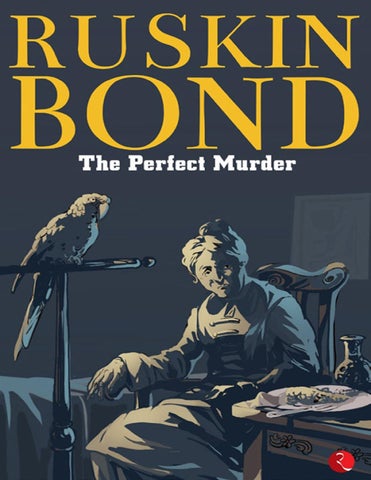
The Perfect Murder
Ruskin Bond has been writing for over sixty years, and now has over 120 titles in print—novels, collections of short stories, poetry, essays, anthologies and books for children. His first novel, The Room on the Roof, received the prestigious John Llewellyn Rhys Prize in 1957. He has also received the Padma Shri (1999), the Padma Bhushan (2014) and two awards from Sahitya Akademi—one for his short stories and another for his writings for children. In 2012, the Delhi government gave him its Lifetime Achievement Award. Born in 1934, Ruskin Bond grew up in Jamnagar, Shimla, New Delhi and Dehradun. Apart from three years in the UK, he has spent all his life in India, and now lives in Mussoorie with his adopted family.
The Perfect Murder
Selected and Compiled by
RUSKIN BOND
First published by Rupa Publications India Pvt. Ltd 2017 7/16, Ansari Road, Daryaganj New Delhi 110002 Copyright © Ruskin Bond 2017 This is a work of fiction. Names, characters, places and incidents are either the product of the author’s imagination or are used fictitiously, and any resemblance to any actual persons, living or dead, events or locales is entirely coincidental. All rights reserved. No part of this publication may be reproduced, transmitted, or stored in a retrieval system, in any form or by any means, electronic, mechanical, photocopying, recording or otherwise, without the prior permission of the publisher. ISBN: 978-81-291-???-? First impression 2017 10 9 8 7 6 5 4 3 2 1 The moral right of the author has been asserted. This book is sold subject to the condition that it shall not, by way of trade or otherwise, be lent, resold, hired out, or otherwise circulated, without the publisher’s prior consent, in any form of binding or cover other than that in which it is published.
CONTENTS Introduction The Perfect Murder Stacy Aumonier The Red-Headed League Arthur Conan Doyle He Said it with Arsenic Ruskin Bond The Interruption W.W. Jacobs When Al Capone was Ambushed Jack Bilbo The Lodger Marie Belloc Lowndes The Duel Wilkie Collins The Cask of Amontillado Edgar Allan Poe
INTRODUCTION Is the perfect murder ever possible? That is a question that every writer of murder mysteries has asked of himself or herself. Each time the great authors of these stories have started one of their complicated, intricately plotted novels or short stories, I guess this is what they have tried to achieve. I have always been a great admirer of such stories. From Conan Doyle to Agatha Christie, almost every type of murder weapon and motive has been explored in their novels. Christie, in particular, was a great one for the locked room mystery. The victim retires to his room, the door is locked from within, nothing has been forced open and yet the person has been shot or stabbed or clubbed to death. How did this happen? The question has been answered in various ingenious ways, usually involving a brilliant detective who can pick out clues the way you and I never could. And then there are mysteries where the motive becomes more important. You know X is the murderer right from the start, but how and why are the questions that need to be solved. Of course when the final unraveling of the plot is done, it all seems fairly logical. But then that’s why not all of us are ace detectives! In this collection, a few intriguing stories of mystery have been brought together. The title story is an amusing one of how the perfect murder is plotted, but when the plan is executed, does it work out exactly the way it was supposed to happen? You will also find here, what many say is their favourite story featuring the immortal Sherlock Holmes—‘The Red-Headed League’. I put it on top of the list of intriguing problems presented to a
detective. A man has been employed simply because he has red hair. He has to go to an office and copy out the encyclopedia, till one day, he is told that the firm where he was going has simply vanished. Who were these people? What was the Red-Headed League? What was their motive behind this elaborate scheme? Holmes of course solves it going on the slimmest of clues. This book also brings together stories by some other well-known writers of this genre—Wilkie Collins, Edgar Allan Poe, Jack Bilbo and others. Not all the stories involve murder, but there is some bloodshed for sure that comes about by chance. In all of them the writer is so skilled with words that the reader remains riveted till the finish. Mysterious and suspenseful, The Perfect Murder is just the book for those who like their mystery stories short yet compelling. This is a book that can be read over a day or two or on a long journey—all the while keeping a watchful eye out for any signs of odd behaviour from the copassengers! Ruskin Bond
THE PERFECT MURDER Stacy Aumonier
O
ne evening in November two brothers were seated in a little café in the Rue de la Roquette discussing murders. The evening papers lay in front of them, and they all contained a lurid account of a shocking affair in the Landes district, where a charcoal-burner had killed his wife and two children with a hatchet. From discussing this murder in particular they went on to discussing murder in general. ‘I’ve never yet read a murder case without being impressed by the extraordinary clumsiness of it,’ remarked Paul, the younger brother. ‘Here’s this fellow who murders his victims with his own hatchet, leaves his hat behind in the shed, and arrives at a village hard by with blood on his boots.’ ‘They lose their heads,’ said Henri, the elder. ‘In cases like that they are mentally unbalanced, hardly responsible for their actions.’ ‘Yes,’ replied Paul, ‘but what impresses me is—what a lot of murders must be done by people who take trouble, who leave not a trace behind.’ Henri shrugged his shoulders. ‘I shouldn’t think it was so easy, old boy; there’s always something that crops up.’ ‘Nonsense! I’ll guarantee there are thousands done every year. If you are living with anyone, for instance, it must be the easiest thing in the world to murder them.’ ‘How?’
‘Oh, some kind of accident—and then you go screaming into the street, “Oh, my poor wife! Help!” You burst into tears, and everyone consoles you. I read of a woman somewhere who murdered her husband by leaving the window near the bed open at night when he was suffering from pneumonia. Who’s going to suspect a case like that? Instead of that, people must always select revolvers, or knives, or go and buy poison at the chemist’s across the way.’ ‘It sounds as though you were contemplating a murder yourself,’ laughed Henri. ‘Well, you never know,’ answered Paul; ‘circumstances might arise when a murder would be the only way out of a difficulty. If ever my time comes I shall take a lot of trouble about it. I promise you I shall leave no trace behind.’ As Henri glanced at his brother making this remark he was struck by the fact that there was indeed nothing irreconcilable between the idea of a murder and the idea of Paul doing it. He was a big, saturnine-looking gentleman with a sallow, dissolute face, framed in a black square beard and swathes of untidy grey hair. His profession was that of a traveller in cheap jewellery, and his business dealings were not always of the straightest. Henri shuddered. With his own puny physique, bad health, and vacillating will, he was always dominated by his younger brother. He himself was a clerk in a drapery store, and he had a wife and three children. Paul was unmarried. The brothers saw a good deal of each other, and were very intimate. But the word friendship would be an extravagant term to apply to their relationship. They were both always hard up, and they borrowed money from each other when every other source failed. They had no other relatives except a very old uncle and aunt who lived at Chantilly. This uncle and aunt, whose name was Taillandier, were fairly well off, but they would have little to do with the two nephews. They were occasionally invited there to dinner, but neither Paul nor Henri ever succeeded in extracting a franc out of Uncle Robert. He was a very religious man, hard-fisted, cantankerous, and intolerant. His wife was a little more pliable. She was in effect an eccentric. She had spasms of generosity, during which periods both the brothers had at times managed to get money out of her. But these were rare occasions. Moreover, the old man
kept her so short of cash that she found it difficult to help her nephews even if she desired to. As stated, the discussion between the two brothers occurred in November. It was presumably forgotten by both of them immediately afterwards. And indeed, there is no reason to believe that it would ever have recurred, except for certain events which followed the sudden death of Uncle Robert in the February of the following year. In the meantime, the affairs of both Paul and Henri had gone disastrously. Paul had been detected in a dishonest transaction over a paste trinket, and had just been released from a period of imprisonment. The knowledge of this had not reached his uncle before his death. Henri’s wife had had another baby, and had been very ill. He was more in debt than ever. The news of the uncle’s death came as a glean of hope in the darkness of despair. What kind of will had he left? Knowing their uncle, each was convinced that, however it was framed there was likely to be little or nothing for them. However, the old villain might have left them a thousand or two. And in any case, if the money was all left to the wife, here was a possible field of plunder. It need hardly be said that they repaired with all haste to the funeral, and even with greater alacrity to the lawyer’s reading of the will. The will contained surprises both encouraging and discouraging. In the first place the old man left a considerably larger fortune than anyone could have anticipated. In the second place all the money and securities were carefully tied up, and placed under the control of trustees. There were large bequests to religious charities, whilst the residue was held in trust for his wife. But so far as the brothers were concerned the surprise came at the end. On her death this residue was still to be held in trust, but a portion of the interest was to be divided between Henri and Paul, and on their death to go to the Church. The old man had recognized a certain call of the blood after all! They both behaved with tact and discretion at the funeral, and were extremely sympathetic and solicitous towards Aunt Rosalie, who was too absorbed with her own trouble to take much notice of them. It was only when it came to the reading of the will that their avidity and interest outraged perhaps the strict canons of good taste. It was Paul who managed to get it clear from the notary what the exact amount would probably be. Making allowances for fluctuations, accidents, and acts of God, on the
death of Mme Taillandier the two brothers would inherit something between eight and ten thousand francs a year each. She was eighty-two and very frail. The brothers celebrated the good news with a carouse up in Montmartre. Naturally their chief topic of conversation was how long the old bird would keen on her perch. In any case, it could not be many years. With any luck it might be only a few weeks. The fortune seemed blinding. It would mean comfort and security to the end of their days. The rejoicings were mixed with recriminations against the old man for his stinginess. Why couldn’t he have left them a lump sum down now? Why did he want to waste all this good gold on the Church? Why all this trustee business? There was little they could do but await developments. Except that in the meantime—after a decent interval—they might try and touch the old lady for a bit. They parted, and the next day set about their business in cheerier spirits. For a time they were extremely tactful. They made formal calls on Aunt Rosalie, inquiring after her health, and offering their services in any capacity whatsoever. But at the end of a month Henri called hurriedly one morning, and after the usual professions of solicitude asked his aunt if she could possibly lend him one hundred and twenty francs to pay the doctor who had attended his wife and baby. She lent him forty, grumbling at his foolishness at having children he could not afford to keep. A week later came Paul with a story about being robbed by a client. He wanted a hundred. She lent him ten. When these appeals had been repeated three or four times, and received similar treatment—and sometimes no treatment at all—the old lady began to get annoyed. She was becoming more and more eccentric. She now had a companion, an angular, middle-aged woman named Mme Chavanne, who appeared like a protecting goddess. Sometimes when the brothers called, Mme Chavanne would say that Mme Taillandier was too unwell to see anyone. If this news had been true it would have been good news indeed, but the brothers suspected that it was all pre-arranged. Two years went by, and they both began to despair. ‘She may live to a hundred,’ said Paul. ‘We shall die of old age, first,’ grumbled Henri. It was difficult to borrow money on the strength of the will. In the first place their friends were more of the borrowing than the lending class. And,
anyone who had a little was suspicious of the story, and wanted all kinds of securities. It was Paul who first thought of going to an insurance company to try to raise money on the reversionary interest. They did succeed in the end in getting an insurance company to advance them two thousand francs each, but the negotiations took five months to complete, and by the time they had insured their lives, paid the lawyer’s fees and paid for the various deeds and stamps, and signed some thirty or forty forms, each man only received a little over a thousand francs, which was quickly lost in paying accrued debts and squandering the remainder. Their hopes were raised by the dismissal of Mme Chavanne, only to be lowered again by the arrival of an even more aggressive companion. The companions came and went with startling rapidity. None of them could stand for any time the old lady’s eccentricity and ill-temper. The whole of the staff was always being changed. The only one who remained loyal all through was the portly cook, Ernestine. Even this may have been due to the fact that she never came in touch with her mistress. She was an excellent cook, and she never moved from the kitchen. Moreover, the cooking required by Mme Taillandier was of the simplest nature, and she seldom entertained. And, she hardly ever left her apartment. Any complaints that were made were made through the housekeeper, and the complaints and their retaliations became mellowed in the process; for Ernestine also had a temper of her own. Nearly another year passed before what appeared to Paul to be a mild stroke of good fortune came his way. Things had been going from bad to worse. Neither of the brothers was in a position to lend a sou to the other. Henri’s family was becoming a greater drag, and people were not buying Paul’s trinkets. One day, during an interview with his aunt—he had been trying to borrow more money—he fainted in her presence. It is difficult to know what it was about this act which affected the old lady, but she ordered him to be put to bed in one of the rooms of the villa. Possibly, she jumped to the conclusion that he had fainted from lack of food—which was not true, Paul never went without food and drink—and she suddenly realized that after all he was her husband’s sister’s son. He must certainly have looked pathetic, this white-faced man, well past middle age, and broken in life. Whatever it was, she showed a broad streak of compassion for him. She ordered her servants to look after him, and to allow him to remain until she countermanded the order.
Paul, who had certainly felt faint, but quickly seized the occasion to make it as dramatic as possible, saw in this an opportunity to wheedle his way into his aunt’s favours. His behaviour was exemplary. The next morning, looking very white and shaky, he visited her, and asked her to allow him to go, as he had no idea of abusing her hospitality. If he had taken up the opposite attitude she would probably have turned him out, but because he suggested going she ordered him to stop. During the daytime he went about his dubious business, but he continued to return there at night to sleep, and to enjoy a good dinner cooked by the admirable Ernestine. He was in clover. Henri was naturally envious when he heard of his brother’s good fortune. And, Paul was fearful that Henri would spoil the whole game by going and throwing a fit himself in the presence of the aunt. But this, of course, would have been too obvious and foolish for even Henri to consider seriously. And, he racked his brains for some means of inveigling the old lady. Every plan he put forth, however, Paul sat upon. He was quite comfortable himself, and he didn’t see the point of his brother butting in. ‘Besides,’ he said, ‘she may turn me out any day. Then you can have your shot.’ They quarrelled about this, and did not see each other for some time. One would have thought that Henri’s appeal to Mme Taillandier would have been stronger than Paul’s. He was a struggling individual, with a wife and four children. Paul was a notorious ne’er-do-well, and he had no attachments. Nevertheless, the old lady continued to support Paul. Perhaps, it was because he was a big man, and she liked big men. Her husband had been a man of fine physique. Henri was puny, and she despised him. She had never had children of her own, and she disliked children. She was always upbraiding Henri and his wife for their fecundity. Any attempt to pander to her emotions through the sentiment of childhood failed. She would not have the children in her house. And, any small acts of charity which she bestowed upon them seemed to be done more with the idea of giving her an opportunity to inflict her sarcasm and venom upon them than out of kindness of heart. In Paul, on the other hand, she seemed to find something slightly attractive. She sometimes sent for him, and he, all agog—expecting to get his notice to quit—would be agreeably surprised to find that, on the contrary, she had some little commission she wished him to execute. And,
you may rest assured that he never failed to make a few francs out of all these occasions. The notice to quit did not come. It may be—poor deluded woman—that she regarded him as some kind of protection. He was in any case the only ‘man’ who slept under her roof. At first she seldom spoke to him, but as time went on she would sometimes send for him to relieve her loneliness. Nothing could have been more ingratiating than Paul’s manners in these knowing circumstances. He talked expansively about politics, beforehand his aunt’s views, and just what she would like him to say. Her eyesight was very bad, and he would read her the news of the day, and tell her what was happening in Paris. He humoured her every whim. He was astute enough to see that it would be foolish and dangerous to attempt to borrow money for the moment. He was biding his time, and trying to think out the most profitable plan of campaign. There was no immediate hurry. His bed was comfortable, and Ernestine’s cooking was excellent. In another year’s time he had established himself as quite one of the permanent household. He was consulted about the servants, and the doctors, and the management of the house, everything except the control of money, which was jealously guarded by a firm of lawyers. Many a time he would curse his uncle’s foresight. The old man’s spirit seemed to be hovering in the dim recesses of the over-crowded rooms, mocking him. For the old lady, eccentric and foolish in many ways, kept a strict check upon her dividends. It was her absorbing interest in life, that and an old grey perroquet, which she treated like a child. Its name was Anna, and it used to walk up and down her table at mealtimes and feed off her own plate. Finding himself so firmly entrenched Paul’s assurance gradually increased. He began to treat his aunt as an equal, and sometimes even to contradict her, and she did not seem to resent it. In the meantime, Henri was eating his heart out with jealousy and sullen rage. The whole thing was unfair. He occasionally saw Paul, who boasted openly of his strong position in the Taillandier household, and he would not believe that Paul was not getting money out of the old lady as well as board and lodging. With no additional expenses Paul was better dressed than he used to be, and he looked fatter and better in health. All—or nearly all—of Henri’s appeals, although pitched in a most pathetic key, were rebuffed. He felt a bitter hatred against his aunt, his brother, and life in general. If only she would die! What was the good of life to a woman at eighty-five or six?
And, there was he—four young children, clamouring for food, and clothes, and the ordinary decent comforts. And, there was Paul, idling his days away at cafés and his nights at cabarets—nothing to do, and no responsibilities. Meeting Paul one day he said: ‘I say, old boy, couldn’t you spring me a hundred francs? I haven’t the money to pay my rent next week.’ ‘She gives me nothing,’ replied Paul. Henri did not believe this, but it would be undiplomatic to quarrel. He said: ‘Aren’t there—isn’t there some little thing lying about the villa you could slip in your pocket? We could sell it, see? Go shares. I’m desperately pushed.’ Paul looked down his nose. Name of a pig! Did Henri think he had never thought of that? Many and many a time the temptation had come to him. But no; every few months people came from the lawyer’s office, and the inventory of the whole household was checked. The servants could not be suspected. They were not selected without irreproachable characters. If he were suspected—well, all kinds of unpleasant things might crop up. Oh, no, he was too well off where he was. The game was to lie in wait. The old lady simply must die soon. She had even been complaining of her chest that morning. She was always playing with the perroquet. Somehow this bird got on Paul’s nerves. He wanted to wring its neck. He imitated the way she would say: ‘There’s a pretty lady! Oh, my sweet! Another nice grape for my little one. There’s a pretty lady!’ He told Henri all about this, and the elder brother went on his way with a grunt that only conveyed doubt and suspicion. In view of this position it seemed strange that in the end it was Paul who was directly responsible for the dénouement in the Taillandier household. His success went to his rather weak head like wine. He began to swagger and buster and abuse his aunt’s hospitality. And, curiously enough, the more he advanced the further she withdrew. The eccentric old lady seemed to be losing her powers of resistance so far as he was concerned. And, he began to borrow small sums of money from her, and, as she acquiesced so readily, to increase his demands. He let his travelling business go, and sometimes he would get lost for days at a time. He would spend his time at the races, and drinking with doubtful acquaintances in obscure cafés. Sometimes he won, but in the majority of cases he lost. He
ran up bills and got into debt. By cajoling small sums out of his aunt he kept his debtors at bay for nearly nine months. But one evening he came to see Henri in a great state of distress. His face, which had taken on a healthier glow when he first went to live with his aunt, had become puffy and livid. His eyes were bloodshot. ‘Old boy,’ he said, ‘I’m at my wits’ end. I’ve got to find seven thousand francs by the twenty-first of the month, or they’re going to foreclose. How do you stand? I’ll pay you back.’ To try to borrow money from Henri was like appealing to the desert for a cooling draught. He also had to find money by the twenty-first, and he was overdrawn at the bank. They exchanged confidences, and in their mutual distress they felt sorry for each other and for themselves. It was a November evening, and the rain was driving along the boulevards in fitful gusts. After trudging a long way they turned into a little café in the Rue de la Roquette, and sat down and ordered two cognacs. The café was almost deserted. A few men in mackintoshes were scattered around reading the evening papers. They sat at a marble table in the corner and tried to think of ways and means. But after a time a silence fell between them. There seemed nothing more to suggest. They could hear the rain beating on the skylight. An old man four tables away was poring over La Patrie. Suddenly, Henri looked furtively around the room and clutched his brother’s arm. ‘Paul!’ he whispered. ‘What is it?’ ‘Do you remember—it has all come back to me—suddenly—one night, a night something like this—it must be give or six years ago—we were seated here in this same café—do you remember?’ ‘No. I don’t remember. What was it?’ ‘It was the night of that murder in the Landes district. We got talking about—don’t you remember?’ Paul scratched his temple and sipped the cognac. Henri leant closer to him. ‘You said—you said that if you lived with anyone, it was the easiest thing in the world to murder them. An accident, you know. And, you go screaming into the street—’ Paul started, and stared at his brother, who continued:
‘You said that if ever you—you had to do it, you would guarantee that you would take every trouble. You wouldn’t leave a trace behind.’ Paul was acting. He pretended to half-remember, to half-understand. But his eyes narrowed. Imbecile! Hadn’t he been through it all in imagination a hundred times? Hadn’t he already been planning and scheming an act for which his brother would reap half the benefit? Nevertheless, he was staggered. He never imagined that the suggestion would come from Henri. He was secretly relieved. If Henri was to receive half the benefit, let him also share half the responsibilities. The risk in any case would be wholly his. He grinned enigmatically, and they put their heads together. And so, in that dim corner of the café was planned the perfect murder. Coining up against the actual proposition, Paul had long since realized that the affair was not so easy of accomplishment as he had so airily suggested. For the thing must be done without violence, without clues, without a trace. Such ideas as leaving the window open at night were out of the question, as the companion slept in the same room. Moreover, the old lady was quite capable of getting out of bed and shutting it herself if she felt a draught. Some kind of accident? Yes, but what? Suppose she slipped and broke her neck when Paul was in the room. It would be altogether too suspicious. Besides, she would probably only partially break her neck. She would regain sufficient consciousness to tell. To drown her in her bath? The door was always locked or the companion hovering around. ‘You’ve always got to remember,’ whispered Paul, ‘if any suspicion falls on me, there’s the motive. There’s strong motive why I should—it’s got to be absolutely untraceable. I don’t care if some people do suspect afterwards—when we’ve got the money.’ ‘What about her food?’ ‘The food is cooked by Ernestine, and the companion serves it. Besides, suppose I got a chance to tamper with the food, how am I going to get hold of—you know?’ ‘Weed-killer?’ ‘Yes, I should he in a pretty position if they traced the fact that I had bought weed-killer. You might buy some and let me have a little on the quiet. Henri turned pale. ‘No, no; the motive applies to me, too. They’d get us both.’
When the two pleasant gentlemen parted at midnight their plans were still very immature, but they arranged to meet the following evening. It was the thirteenth of the month. To save the situation the deed must be accomplished within eight days. Of course, they wouldn’t get the money at once, but, knowing the circumstances, creditors would be willing to wait. When they met the following evening in the Café des Sentiers, Paul appeared flushed and excited, and Henri was pale and on edge. He hadn’t slept. He wanted to wash the whole thing out. ‘And, sell up your home, I suppose?’ sneered Paul. ‘Listen, my little cabbage. I’ve got it. Don’t distress yourself. You proposed this last night. I’ve been thinking about it and watching for months. Ernestine is a good cook, and very methodical. Oh, very methodical! She does everything every day in the same way exactly to schedule. My apartment is on the same floor, so I am able to appreciate her punctuality and exactness. The old woman eats sparingly and according to routine. One night she has fish. The next night she has a soufflé made with two eggs. Fish, soufflé, fish, soufflé, regular as the beat of a clock. Now, listen. After lunch every day Ernestine washes up the plates and pans. After that she prepares roughly the evening meal. If it is a fish night, she prepares the fish ready to pop into the pan. If it is a soufflé night, she beats up two eggs and puts them ready in a basin. Having done that, she changes her frock, powders her nose, and goes over to the convent to see her sister who is working there. She is away an hour and a half. She returns punctually at four o’clock. You could set your watch by her movements.’ ‘Yes, but—’ ‘It is difficult to insert what I propose in fish, but I don’t see any difficulty in dropping it into two beaten-up eggs, and giving an extra twist to the egg-whisk, or whatever they call it.’ Henri’s face was quite grey. ‘But—but—Paul, how are you going to get hold of the poison?’ ‘Who said anything about poison?’ ‘Well, but what?’ ‘That’s where you come in.’ ‘Yes, you’re in it, too, aren’t you? You get half the spoils, don’t you? Why shouldn’t you—some time tomorrow when your wife’s out—’ ‘What?’ ‘Just grind up a piece of glass.’
‘Glass!’ ‘Yes, you’ve heard of glass, haven’t you? An ordinary piece of broken wine-glass will do. Grind it up as fine as a powder, the finer the better, the finer the more-effective.’ Henri gasped. No, no, he couldn’t do this thing. Very well, then; if he was such a coward Paul would have to do it himself. And perhaps, when the time came Henri would also be too frightened to draw his dividends. Perhaps, he would like to make them over to his dear brother Paul? Come, it was only a little thing to do. Eight days to the twenty-first. Tomorrow, fishday, but Wednesday would be soufflé. So easy, so untraceable, so safe. ‘But you,’ whined Henri, ‘they will suspect you.’ ‘Even if they do they can prove nothing. But in order to avoid this unpleasantness I propose to leave home soon after breakfast. I shall return at a quarter-past three, letting myself in through the stable yard. The stables, as you know, are not used. There is no one else on that floor. Ernestine is upstairs. She only comes down to answer the front-door bell. I shall be in and out of the house within five minutes, and I shan’t return till late at night, when perhaps—I may be too late to render assistance.’ Henri was terribly agitated. On one hand was—just murder, a thing he had never connected himself within his life. On the other hand was comfort for himself and his family, an experience he had given up hoping for. It was in any case not exactly murder on his part. It was Paul’s murder. At the same time, knowing all about it, being an accessory before the fact, it would seem contemptible to a degree to put the whole onus on Paul. Grinding up a piece of glass was such a little thing. It couldn’t possibly incriminate him. Nobody could ever prove that he’d done it. But it was a terrible step to take. ‘Have another cognac, my little cabbage.’ It was Paul’s voice that jerked him back to actuality. He said: ‘All right, yes, yes,’ but whether this referred to the cognac or to the act of grinding up a piece of glass he hardly knew himself. From that moment to twenty-four hours later, when he handed over a white packet to his brother across the same table at the Café des Sentiers, Henri seemed to be in a nightmarish dream. He had no recollection of how he had passed the time. He seemed to pass from that last cognac to this one, and the interval was a blank. ‘Fish today, soufflé tomorrow,’ he heard Paul chuckling. ‘Brother, you have done your work well.’
When Paul went he wanted to call after him to come back, but he was frightened of the sound of his own voice. He was terribly frightened. He went to bed very late and could not sleep. The next morning he awoke with a headache, and he got his wife to telegraph to the office to say that he was too ill to come. He lay in bed all day, visualizing over and over and over again the possible events of the evening. Paul would be caught. Someone would catch him actually putting the powder into the eggs. He would be arrested. Paul would give him away. Why did Paul say it was so easy to murder anyone if you lived with them? It wasn’t easy at all. The whole thing was chock-a-block with dangers and pitfalls. Pitfalls! At half-past three he started up in bed. He had a vision of himself and Paul being guillotined side by side! He must stop it at any cost. He began to get up. Then he realized that it was already too late. The deed had been done. Paul had said that he would be in and out of the house within five minutes at three-fifteen—a quarter of an hour ago! Where was Paul? Would he be coming to see him? He was going to spend the evening out somewhere, ‘returning late at night’. He dressed feverishly. There was still time. He could call at his aunt’s. Rush down to the kitchen, seize the basin of beaten-up eggs, and throw them away. But where? How? By the time he got there Ernestine would have returned. She would want to know all about it. The egg mixture would be examined, analysed. God in Heaven! It was too late! The thing would have to go on, and he suffer and wait. Having dressed, he went out after saying to his wife: ‘It’s all right. It’s going to be all right,’ not exactly knowing what he meant. He walked rapidly along the streets with no fixed destination in his mind. He found himself in the Café Rue de la Roquette, where the idea was first conceived, where he had reminded his brother. He sat there drinking, waiting for the hours to pass. Soufflé day, and the old lady dined at seven! It was now not quite five. He hoped Paul would turn up. A stranger tried to engage him in conversation. The stranger apparently had some grievance against a railway company. He wanted to tell him all the details about a contract for rivets, over which he had been disappointed. Henri didn’t understand a word he was talking about. He didn’t listen. He wanted the stranger to drop down dead or vanish into thin air. At last he called the waiter and paid for his reckoning, indicated by a small pile of saucers. From there he walked
rapidly to the Café des Sentiers, looking for Paul. He was not there. Six o’clock. One hour more. He could not keep still. He paid and went on again, calling at café after café. A quarter to seven. Pray God that she threw it away. Had he ground it fine enough? Five minutes to seven. Seven o’clock. Now. He picked up his hat and went again. The brandy had gone to his head. At half-past seven he laughed recklessly. After all, what was the good of life to this old woman of eightysix? He tried to convince himself that he had done it for the sake of his wife and children. He tried to concentrate on the future, how he could manage on eight or ten thousand francs a year. He would give notice at the office, be rude to people who had been bullying him for years—that old blackguard Mocquin! At ten o’clock he was drunk, torpid, and indifferent. The whole thing was over for good or ill. What did it matter? He terribly wanted to see Paul, but he was too tired to care very much. The irrevocable step had been taken. He went home to bed and fell into a heavy drunken sleep. ‘Henri! Henri, wake up! What is the matter with you?’ His wife was shaking him. He blinked his way into a partial condition of consciousness. November sunlight was pouring into the room. ‘It’s late, isn’t it?’ he said, involuntarily. ‘It’s past eight. You’ll be late at the office. You didn’t go yesterday. If you go on like this you’ll get the sack, and then what shall we do?’ Slowly the recollection of last night’s events came back to him. ‘There’s nothing to worry about,’ he said. ‘I’m too ill to go today. Send them another telegram. It’ll be all right.’ His wife looked at him searchingly. ‘You’ve been drinking,’ she said. ‘Oh, you men! God knows what will become of us.’ She appeared to be weeping in her apron. It struck him forcibly at that instant how provoking and small women are. Here was Jeannette crying over her petty troubles. Whereas he— The whole thing was becoming vivid again. Where was Paul? What had happened? Was it at all likely that he could go down to an office on a day like this, a day that was to decide his fate? He groaned, and elaborated rather pathetically his imaginary ailments, anything to keep this woman quiet. She left him at last, and he lay there waiting for something to happen. The hours passed. What would be the first intimation? Paul or the gendarmes? Thoughts of the latter stirred him to a
state of fevered activity. About midday he arose, dressed, and went out. He told his wife he was going to the office, but he had no intention of doing so. He went and drank coffee at a place up in the Marais. He was terrified of his old haunts. He wandered from place to place, uncertain how to act. Late in the afternoon he entered a café in the Rue Alibert. At a kiosk outside he bought a late edition of an afternoon newspaper. He sat down, ordered a drink and opened the newspaper. He glanced at the central news page, and as his eye absorbed one paragraph he unconsciously uttered a low scream. The paragraph was as follows: MYSTERIOUS AFFAIR AT CHANTILLY A mysterious affair occurred at Chantilly this morning. A middleaged man, named Paul Denoyel, complained of pains in the stomach after eating an omelette. He died soon after in great agony. He was staying with his aunt, Mme Taillandier. No other members of the household were affected. The matter is to be inquired into. The rest was a dream. He was only vaguely conscious of the events which followed. He wandered through it all, the instinct of self-preservation bidding him hold his tongue in all circumstances. He knew nothing. He had seen nothing. He had a visionary recollection of a plump, weeping Ernestine, at the inquest, enlarging upon the eccentricities of her mistress. A queer woman, who would brook no contradiction. He heard a lot about the fish day and the soufflé day, and how the old lady insisted that this was a fish day, and, and that she had had a soufflé the day before. You could not argue with her when she was like that. And, Ernestine had beaten up the eggs all ready for the soufflé-most provoking! But Ernestine was a good cook, of method and economy. She wasted nothing. What should she do with the eggs? Why, of course, Mr Paul, who since he had come to live there was never content with a café cornplet. He must have a breakfast, like these English and other foreigners do. She made him an omelette, which he ate heartily. Then the beaten-up eggs with their deadly mixture were intended for Mme Taillandier? But who was responsible for this? Ernestine? But there was no motive here. Ernestine gained nothing by her mistress’s death. Indeed she only stood to lose her situation. The inquiry went on a long while. Henri himself was conscious of being in the witness-box. He knew
nothing. He couldn’t understand it. His brother would not be likely to do that. He himself was prostrate with grief. He loved his brother. There was nothing to do but return an open verdict. Shadowy figures passed before his mind’s eye—shadowy figures and shadowy realizations. He had perfectly murdered his brother. The whole of the dividends of the estate would one day be his, and his wife’s and children’s. Eighteen thousand francs a year! One day— One vision more vivid than the rest—the old lady on the day following the inquest, seated bolt upright at her table, like a figure of perpetuity, playing with the old grey perroquet, stroking its mangy neck. ‘There’s a pretty lady! Oh, my sweet! Another nice grape for my little one. There’s a pretty lady!’
THE RED-HEADED LEAGUE Arthur Conan Doyle
I
had called upon my friend, Mr Sherlock Holmes, one day in the autumn of last year, and found him in deep conversation with a very stout, florid-faced elderly gentleman, with fiery red hair. With an apology for my intrusion, I was about to withdraw, when Holmes pulled me abruptly into the room and closed the door behind me. ‘You could not possibly have come at a better time, my dear Watson,’ he said, cordially. ‘I was afraid that you were engaged.’ ‘So I am. Very much so.’ ‘Then I can wait in the next room.’ ‘Not at all. This gentleman, Mr Wilson, has been my partner and helper in many of my most successful cases, and I have no doubt that he will be of the utmost use to me in yours also.’ The stout gentleman half rose from his chair and gave a bob of greeting, with a quick little questioning glance from his small, fat-encircled eyes. ‘Try the settee,’ said Holmes, relapsing into his armchair, and putting his finger tips together, as was his custom when in judicial moods. ‘I know, my dear Watson, that you share my love of all that is bizarre and outside the conventions and humdrum routine of everyday life. You have shown your relish for it by the enthusiasm which has prompted you to chronicle, and, if
you will excuse my saying so, somewhat to embellish so many of my own little adventures.’ ‘Your cases have indeed been of the greatest interest to me,’ I observed. ‘You will remember that I remarked the other day, just before we went into the very simple problem presented by Miss Mary Sutherland, that for strange effects and extraordinary combinations we must go to life itself, which is always far more daring than any effort of the imagination.’ ‘A proposition which I took the liberty of doubting.’ 2 ‘You did, doctor, but none the less you must come round to my view, for otherwise I shall keep on piling fact upon fact on you, until your reason breaks down under them and acknowledge me to be right. Now, Mr Jabez Wilson here has been good enough to call upon me this morning, and to begin a narrative which promises to be one of the most singular which I have listened to for some time. You have heard me remark that the strangest and most unique things are very often connected not with the larger but with the smaller crimes, and occasionally, indeed, where there is room for doubt whether any positive crime has been committed. As far as I have heard, it is impossible for me to say whether the present case is an instance of crime or not, but the course of events is certainly among the most singular that I have ever listened to. Perhaps, Mr Wilson, you would have the great kindness to recommence your narrative. I ask you, not merely because my friend, Dr Watson, has not heard the opening part, but also because the peculiar nature of the story makes me anxious to have every possible detail from your lips. As a rule, when I have heard some slight indication of the course of events I am able to guide myself by the thousands of other similar cases which occur to my memory. In the present instance I am forced to admit that the facts are, to the best of my belief, unique.’ The portly client puffed out his chest with an appearance of some little pride, and pulled a dirty and wrinkled newspaper from the inside pocket of his greatcoat. As he glanced down the advertisement column, with his head thrust forward, and the paper flattened out upon his knee, I took a good look at the man, and endeavoured, after the fashion of my companion, to read the indications which might be presented by his dress or appearance.
I did not gain very much, however, by my inspection. Our visitor bore every mark of being an average commonplace British tradesman, obese, pompous, and slow. He wore rather baggy grey shepherd’s check trousers, a not over-clean black frock coat, unbuttoned in the front, and a drab waistcoat with a heavy brassy Albert chain, and a square pierced bit of metal dangling down as an ornament. A frayed top hat and a faded brown overcoat with a wrinkled velvet collar lay upon a chair beside him. Altogether, look as I would, there was nothing remarkable about the man save his blazing red head and the expression of extreme chagrin and discontent upon his features. 3 Sherlock Holmes’s quick eye took in my occupation, and he shook his head with a smile as he noticed my questioning glances. ‘Beyond the obvious facts that he has at some time done manual labour, that he takes snuff, that he is a Freemason, that he has been in China, and that he has done a considerable amount of writing lately, I can deduce nothing else.’ Mr Jabez Wilson started up in his chair, with his forefinger upon the paper, but his eyes upon my companion. ‘How, in the name of good fortune, did you know all that, Mr Holmes?’ he asked. ‘How did you know, for example, that I did manual labour? It’s as true as gospel, for I began as a ship’s carpenter.’ ‘Your hands, my dear sir. Your right hand is quite a size larger than your left. You have worked with it and the muscles are more developed.’ ‘Well, the snuff, then, and the Freemasonry?’ ‘I won’t insult your intelligence by telling you how I read that, especially as, rather against the strict rules of your order, you use an arc and compass breastpin.’ ‘Ah, of course, I forgot that. But the writing?’ ‘What else can be indicated by that right cuff so very shiny for five inches, and the left one with the smooth patch near the elbow where you rest it upon the desk.’ ‘Well, but China?’ ‘The fish which you have tattooed immediately above your wrist could only have been done in China. I have made a small study of tattoo marks, and have even contributed to the literature of the subject. That trick of
staining the fishes’ scales of a delicate pink is quite peculiar to China. When, in addition, I see a Chinese coin hanging from your watch chain, the matter becomes even more simple.’ 4 Mr Jabez Wilson laughed heavily. ‘Well, I never!’ said he. ‘I thought at first that you had done something clever, but I see that there was nothing in it after all.’ ‘I begin to think, Watson,’ said Holmes, ‘that I make a mistake in explaining. “Omne ignotom pro magnifico,” you know, and my poor little reputation, such as it is, will suffer shipwreck if I am so candid. Can you not find the advertisement, Mr Wilson?’ ‘Yes, I have got it now,’ he answered, with his thick, red finger planted halfway down the column. ‘Here it is. This is what began it all. You just read it for yourself, sir.’ I took the paper from him and read as follows: ‘TO THE RED-HEADED LEAGUE: On account of the bequest of the late Ezekiah Hopkins, of Lebanon, Pa., U. S. A., there is now another vacancy open which entitles a member of the League to a salary of four pounds a week for purely nominal services. All red-headed men who are sound in body and mind and above the age of twenty-one years are eligible. Apply in person on Monday, at eleven o’clock, to Duncan Ross, at the offices of the League, 7 Pope’s Court, Fleet Street.’ ‘What on earth does this mean?’ I ejaculated, after I had twice read over the extraordinary announcement. Holmes chuckled and wriggled in his chair, as was his habit when in high spirits. ‘It is a little off the beaten track, isn’t it?’ said he. ‘And now, Mr Wilson, off you go at scratch, and tell us all about yourself, your household, and the effect which this advertisement had upon your fortunes. You will first make a note, doctor, of the paper and the date.’ ‘It is The Morning Chronicle of 27 April 1890. Just two months ago.’ ‘Very good. Now, Mr Wilson.’ 5
‘Well, it is just as I have been telling you, Mr Sherlock Holmes,’ said Jabez Wilson, mopping his forehead, ‘I have a small pawnbroker’s business at Saxe-Coburg Square, near the City. It’s not a very large affair, and of late years it has not done more than just give me a living. I used to be able to keep two assistants, but now I only keep one; and I would have a job to pay him but that he is willing to come for half wages, so as to learn the business.’ ‘What is the name of this obliging youth?’ asked Sherlock Holmes. ‘His name is Vincent Spaulding, and he’s not such a youth either. It’s hard to say his age. I should not wish a smarter assistant, Mr Holmes; and I know very well that he could better himself, and earn twice what I am able to give him. But, after all, if he is satisfied, why should I put ideas in his head?’ ‘Why, indeed? You seem most fortunate in having an employee who comes under the full market price. It is not a common experience among employers in this age. I don’t know that your assistant is not as remarkable as your advertisement.’ ‘Oh, he has his faults, too,’ said Mr Wilson. ‘Never was such a fellow for photography. Snapping away with a camera when he ought to be improving his mind, and then diving down into the cellar like a rabbit into its hole to develop his pictures. That is his main fault; but, on the whole, he’s a good worker. There’s no vice in him.’ ‘He is still with you, I presume?’ ‘Yes, sir. He and a girl of fourteen, who does a bit of simple cooking, and keeps the place clean—that’s all I have in the house, for I am a widower, and never had any family. We live very quietly, sir, the three of us; and we keep a roof over our heads, and pay our debts, if we do nothing more. 6 ‘The first thing that put us out was that advertisement. Spaulding, he came down into the office just this day eight weeks, with this very paper in his hand, and he says: ‘I wish to the Lord, Mr Wilson, that I was a red-headed man.’ ‘Why that?’ I asks.
‘Why,’ says he, ‘here’s another vacancy on the League of the Redheaded Men. It’s worth quite a little fortune to any man who gets it, and I understand that there are more vacancies than there are men, so that the trustees are at their wits’ end what to do with the money. If my hair would only change colour here’s a nice little crib all ready for me to step into.’ ‘Why, what is it, then?’ I asked. ‘You see, Mr Holmes, I am a very stayat-home man, and, as my business came to me instead of my having to go to it, I was often weeks on end without putting my foot over the door mat. In that way I didn’t know much of what was going on outside, and I was always glad of a bit of news.’ ‘Have you never heard of the League of the Red-headed Men?’ he asked, with his eyes open. ‘Never.’ ‘Why, I wonder at that, for you are eligible yourself for one of the vacancies.’ ‘And what are they worth?’ I asked. ‘Oh, merely a couple of hundred a year, but the work is slight, and it need not interfere very much with one’s other occupations.’ ‘Well, you can easily think that that made me prick up my ears, for the business has not been very good for some years, and an extra couple of hundred would have been very handy. ‘Tell me all about it,’ said I. 7 ‘Well,’ said he, showing me the advertisement, ‘you can see for yourself that the League has a vacancy, and there is the address where you should apply for particulars. As far as I can make out, the League was founded by an American millionaire, Ezekiah Hopkins, who was very peculiar in his ways. He was himself red-headed, and he had a great sympathy for all redheaded men; so, when he died, it was found that he had left his enormous fortune in the hands of trustees, with instructions to apply the interest to the providing of easy berths to men whose hair is of that colour. From all I hear it is splendid pay, and very little to do.’ ‘But,’ said I, ‘there would be millions of red-headed men who would apply.’
‘Not so many as you might think,’ he answered. ‘You see it is really confined to Londoners, and to grown men. This American had started from London when he was young, and he wanted to do the old town a good turn. Then, again, I have heard it is of no use your applying if your hair is light red, or dark red, or anything but real, bright, blazing, fiery red. Now, if you cared to apply, Mr Wilson, you would just walk in; but perhaps it would hardly be worth your while to put yourself out of the way for the sake of a few hundred pounds.’ ‘Now it is a fact, gentlemen, as you may see for yourselves, that my hair is of a very full and rich tint, so that it seemed to me that, if there was to be any competition in the matter, I stood as good a chance as any man that I had ever met. Vincent Spaulding seemed to know so much about it that I thought he might prove useful, so I just ordered him to put up the shutters for the day, and to come right away with me. He was very willing to have a holiday, so we shut the business up, and started off for the address that was given to us in the advertisement.’ 8 ‘I never hope to see such a sight as that again, Mr Holmes. From north, south, east, and west every man who had a shade of red in his hair had tramped into the City to answer the advertisement. Fleet Street was choked with red-headed folk, and Pope’s Court looked like a coster’s orange barrow. I should not have thought there were so many in the whole country as were brought together by that single advertisement. Every shade of colour they were—straw, lemon, orange, brick, Irish setter, liver, clay; but, as Spaulding said, there were not many who had the real vivid flamecoloured tint. When I saw how many were waiting, I would have given it up in despair; but Spaulding would not hear of it. How he did it I could not imagine, but he pushed and pulled and butted until he got me through the crowd, and right up to the steps which led to the office. There was a double stream upon the stair, some going up in hope, and some coming back dejected; but we wedged in as well as we could, and soon found ourselves in the office.’ ‘Your experience has been a most entertaining one,’ remarked Holmes, as his client paused and refreshed his memory with a huge pinch of snuff. ‘Pray continue your very interesting statement.’
‘There was nothing in the office but a couple of wooden chairs and a deal table, behind which sat a small man, with a head that was even redder than mine. He said a few words to each candidate as he came up, and then he always managed to find some fault in them which would disqualify them. Getting a vacancy did not seem to be such a very easy matter after all. However, when our turn came, the little man was much more favourable to me than to any of the others, and he closed the door as we entered, so that he might have a private word with us. ‘This is Mr Jabez Wilson,’ said my assistant, ‘and he is willing to fill a vacancy in the League.’ 9 ‘And he is admirably suited for it,’ the other answered. ‘He has every requirement. I cannot recall when I have seen anything so fine.’ He took a step backward, cocked his head on one side, and gazed at my hair until I felt quite bashful. Then suddenly he plunged forward, wrung my hand, and congratulated me warmly on my success. ‘It would be injustice to hesitate,’ said he. ‘You will, however, I am sure, excuse me for taking an obvious precaution.’ With that he seized my hair in both his hands, and tugged until I yelled with the pain. ‘There is water in your eyes,’ said he, as he released me. ‘I perceive that all is as it should be. But we have to be careful, for we have twice been deceived by wigs and once by paint. I could tell you tales of cobbler’s wax which would disgust you with human nature.’ He stepped over to the window and shouted through it at the top of his voice that the vacancy was filled. A groan of disappointment came up from below, and the folk all trooped away in different directions, until there was not a red head to be seen except my own and that of the manager. ‘My name,’ said he, ‘is Mr Duncan Ross, and I am myself one of the pensioners upon the fund left by our noble benefactor. Are you a married man, Mr Wilson? Have you a family?’ ‘I answered that I had not. ‘His face fell immediately. ‘Dear me!’ he said, gravely, ‘that is very serious indeed! I am sorry to hear you say that. The fund was, of course, for the propagation and spread
of the red heads as well as for their maintenance. It is exceedingly unfortunate that you should be a bachelor.’ ‘My face lengthened at this, Mr Holmes, for I thought that I was not to have the vacancy after all; but, after thinking it over for a few minutes, he said that it would be all right.’ 10 ‘In the case of another,’ said he, ‘the objection might be fatal, but we must stretch a point in favour of a man with such a head of hair as yours. When shall you be able to enter upon your new duties?’ ‘Well, it is a little awkward, for I have a business already,’ said I. ‘Oh, never mind about that, Mr Wilson!’ said Vincent Spaulding. ‘I shall be able to look after that for you.’ ‘What would be the hours?’ I asked. ‘Ten to two.’ ‘Now a pawnbroker’s business is mostly done of an evening, Mr Holmes, especially Thursday and Friday evenings, which is just before pay day; so it would suit me very well to earn a little in the mornings. Besides, I knew that my assistant was a good man, and that he would see to anything that turned up. ‘That would suit me very well,’ said I. ‘And the pay?’ ‘Is four pounds a week.’ ‘And the work?’ ‘Is purely nominal.’ ‘What do you call purely nominal?’ ‘Well, you have to be in the office, or at least in the building, the whole time. If you leave, you forfeit your whole position forever. The will is very clear upon that point. You don’t comply with the conditions if you budge from the office during that time.’ ‘It’s only four hours a day, and I should not think of leaving,’ said I. ‘No excuse will avail,’ said Mr Duncan Ross, ‘neither sickness, nor business, nor anything else. There you must stay, or you lose your billet.’ ‘And the work?’ 11
‘Is to copy out the ‘Encyclopaedia Britannica.’ There is the first volume of it in that press. You must find your own ink, pens, and blotting paper, but we provide this table and chair. Will you be ready tomorrow?’ ‘Certainly,’ I answered. ‘Then, goodbye, Mr Jabez Wilson, and let me congratulate you once more on the important position which you have been fortunate enough to gain.’ He bowed me out of the room, and I went home with my assistant hardly knowing what to say or do, I was so pleased at my own good fortune. ‘Well, I thought over the matter all day, and by evening I was in low spirits again; for I had quite persuaded myself that the whole affair must be some great hoax or fraud, though what its object might be I could not imagine. It seemed altogether past belief that anyone could make such a will, or that they would pay such a sum for doing anything so simple as copying out the ‘Encyclopaedia Britannica.’ Vincent Spaulding did what he could to cheer me up, but by bed time I had reasoned myself out of the whole thing. However, in the morning I determined to have a look at it anyhow, so I bought a penny bottle of ink, and with a quill pen and seven sheets of foolscap paper I started off for Pope’s Court. ‘Well, to my surprise and delight everything was as right as possible. The table was set out ready for me, and Mr Duncan Ross was there to see that I got fairly to work. He started me off upon the letter A, and then he left me; but he would drop in from time to time to see that all was right with me. At two o’clock he bade me good-day, complimented me upon the amount that I had written, and locked the door of the office after me. ‘This went on day after day, Mr Holmes, and on Saturday the manager came in and planked down four golden sovereigns for my week’s work. It was the same next week, and the same the week after. Every morning I was there at ten, and every afternoon I left at two. By degrees Mr Duncan Ross took to coming in only once of a morning, and then, after a time, he did not come in at all. Still, of course, I never dared to leave the room for an instant, for I was not sure when he might come, and the billet was such a good one, and suited me so well, that I would not risk the loss of it. 12
‘Eight weeks passed away like this, and I had written about Abbots, and Archery, and Armor, and Architecture, and Attica, and hoped with diligence that I might get on to the Bs before very long. It cost me something in foolscap, and I had pretty nearly filled a shelf with my writings. And then suddenly the whole business came to an end.’ ‘To an end?’ ‘Yes, sir. And no later than this morning. I went to my work as usual at ten o’clock, but the door was shut and locked, with a little square of cardboard hammered onto the middle of the panel with a tack. Here it is, and you can read for yourself.’ He held up a piece of white cardboard, about the size of a sheet of note paper. It read in this fashion: ‘THE RED-HEADED LEAGUE IS DISSOLVED. 9 Oct. 1890.’ Sherlock Holmes and I surveyed this curt announcement and the rueful face behind it, until the comical side of the affair so completely overtopped every consideration that we both burst out into a roar of laughter. ‘I cannot see that there is anything very funny,’ cried our client, flushing up to the roots of his flaming head. ‘If you can do nothing better than laugh at me, I can go elsewhere.’ ‘No, no,’ cried Holmes, shoving him back into the chair from which he had half risen. ‘I really wouldn’t miss your case for the world. It is most refreshingly unusual. But there is, if you will excuse my saying so, something just a little funny about it. Pray what steps did you take when you found the card upon the door?’ ‘I was staggered, sir. I did not know what to do. Then I called at the offices around, but none of them seemed to know anything about it. Finally, I went to the landlord, who is an accountant living on the ground floor, and I asked him if he could tell me what had become of the Red-headed League. He said that he had never heard of any such body. Then I asked him who Mr Duncan Ross was. He answered that the name was new to him.’ 13 ‘Well,’ said I, ‘the gentleman at No. 4.’ ‘What, the red-headed man?’
‘Yes.’ ‘Oh,’ said he, ‘his name was William Morris. He was a solicitor, and was using my room as a temporary convenience until his new premises were ready. He moved out yesterday.’ ‘Where could I find him?’ ‘Oh, at his new offices. He did tell me the address. Yes, 17 King Edward Street, near St. Paul’s.’ ‘I started off, Mr Holmes, but when I got to that address it was a manufactory of artificial knee-caps, and no one in it had ever heard of either Mr William Morris or Mr Duncan Ross.’ ‘And what did you do then?’ asked Holmes. ‘I went home to Saxe-Coburg Square, and I took the advice of my assistant. But he could not help me in any way. He could only say that if I waited I should hear by post. But that was not quite good enough, Mr Holmes. I did not wish to lose such a place without a struggle, so, as I had heard that you were good enough to give advice to poor folk who were in need of it, I came right away to you.’ ‘And you did very wisely,’ said Holmes. ‘Your case is an exceedingly remarkable one, and I shall be happy to look into it. From what you have told me I think that it is possible that graver issues hang from it than might at first sight appear.’ ‘Grave enough!’ said Mr Jabez Wilson. ‘Why, I have lost four pound a week.’ ‘As far as you are personally concerned,’ remarked Holmes, ‘I do not see that you have any grievance against this extraordinary league. On the contrary, you are, as I understand, richer by some thirty pounds, to say nothing of the minute knowledge which you have gained on every subject which comes under the letter A. You have lost nothing by them.’ 14 ‘No, sir. But I want to find out about them, and who they are, and what their object was in playing this prank—if it was a prank—upon me. It was a pretty expensive joke for them, for it cost them two-and-thirty pounds.’ ‘We shall endeavour to clear up these points for you. And, first, one or two questions, Mr Wilson. This assistant of yours who first called your attention to the advertisement—how long had he been with you?’
‘About a month then.’ ‘How did he come?’ ‘In answer to an advertisement.’ ‘Was he the only applicant?’ ‘No, I had a dozen.’ ‘Why did you pick him?’ ‘Because he was handy and would come cheap.’ ‘At half wages, in fact.’ ‘Yes.’ ‘What is he like, this Vincent Spaulding?’ ‘Small, stout-built, very quick in his ways, no hair on his face, though he’s not short of thirty. Has a white splash of acid upon his forehead.’ Holmes sat up in his chair in considerable excitement. ‘I thought as much,’ said he. ‘Have you ever observed that his ears are pierced for earrings?’ ‘Yes, sir. He told me that a gypsy had done it for him when he was a lad.’ ‘Hum!’ said Holmes, sinking back in deep thought. ‘He is still with you?’ ‘Oh, yes, sir; I have only just left him.’ ‘And has your business been attended to in your absence?’ 15 ‘Nothing to complain of, sir. There’s never very much to do of a morning.’ ‘That will do, Mr Wilson. I shall be happy to give you an opinion upon the subject in the course of a day or two. Today is Saturday, and I hope that by Monday we may come to a conclusion.’ ‘Well, Watson,’ said Holmes, when our visitor had left us, ‘what do you make of it all?’ ‘I make nothing of it,’ I answered frankly. ‘It is a most mysterious business.’ ‘As a rule,’ said Holmes, ‘the more bizarre a thing is the less mysterious it proves to be. It is your commonplace, featureless crimes which are really puzzling, just as a commonplace face is the most difficult to identify. But I must be prompt over this matter.’ ‘What are you going to do, then?’ I asked.
‘To smoke,’ he answered. ‘It is quite a three-pipe problem, and I beg that you won’t speak to me for fifty minutes.’ He curled himself up in his chair, with his thin knees drawn up to his hawklike nose, and there he sat with his eyes closed and his black clay pipe thrusting out like the bill of some strange bird. I had come to the conclusion that he had dropped asleep, and indeed was nodding myself, when he suddenly sprang out of his chair with the gesture of a man who has made up his mind, and put his pipe down upon the mantelpiece. ‘Sarasate plays at St. James’s Hall this afternoon,’ he remarked. ‘What do you think, Watson? Could your patients spare you for a few hours?’ ‘I have nothing to do today. My practice is never very absorbing.’ ‘Then put on your hat and come. I am going through the City first, and we can have some lunch on the way. I observe that there is a good deal of German music on the programme, which is rather more to my taste than Italian or French. It is introspective, and I want to introspect. Come along!’ 16 We travelled by the Underground as far as Aldersgate; and a short walk took us to Saxe-Coburg Square, the scene of the singular story which we had listened to in the morning. It was a poky, little, shabby-genteel place, where four lines of dingy, two-storied brick houses looked out into a small railed-in inclosure, where a lawn of weedy grass, and a few clumps of faded laurel bushes made a hard fight against a smoke-laden and uncongenial atmosphere. Three gilt balls and a brown board with JABEZ WILSON in white letters, upon a corner house, announced the place where our redheaded client carried on his business. Sherlock Holmes stopped in front of it with his head on one side, and looked it all over, with his eyes shining brightly between puckered lids. Then he walked slowly up the street, and then down again to the corner, still looking keenly at the houses. Finally he returned to the pawnbroker’s and, having thumped vigorously upon the pavement with his stick two or three times, he went up to the door and knocked. It was instantly opened by a bright-looking, clean-shaven young fellow, who asked him to step in. ‘Thank you,’ said Holmes, ‘I only wished to ask you how you would go from here to the Strand.’
‘Third right, fourth left,’ answered the assistant, promptly, closing the door. ‘Smart fellow, that,’ observed Holmes as we walked away. ‘He is, in my judgment, the fourth smartest man in London, and for daring I am not sure that he has not a claim to be third. I have known something of him before.’ ‘Evidently,’ said I, ‘Mr Wilson’s assistant counts for a good deal in this mystery of the Red-headed League. I am sure that you inquired your way merely in order that you might see him.’ ‘Not him.’ ‘What then?’ ‘The knees of his trousers.’ 17 ‘And what did you see?’ ‘What I expected to see.’ ‘Why did you beat the pavement?’ ‘My dear doctor, this is a time for observation, not for talk. We are spies in an enemy’s country. We know something of Saxe-Coburg Square. Let us now explore the parts which lie behind it.’ The road in which we found ourselves as we turned round the corner from the retired Saxe-Coburg Square presented as great a contrast to it as the front of a picture does to the back. It was one of the main arteries which convey the traffic of the City to the north and west. The roadway was blocked with the immense stream of commerce flowing in a double tide inward and outward, while the footpaths were black with the hurrying swarm of pedestrians. It was difficult to realize, as we looked at the line of fine shops and stately business premises, that they really abutted on the other side upon the faded and stagnant square which we had just quitted. ‘Let me see,’ said Holmes, standing at the corner, and glancing along the line, ‘I should like just to remember the order of the houses here. It is a hobby of mine to have an exact knowledge of London. There is Mortimer’s, the tobacconist; the little newspaper shop, the Coburg branch of the City and Suburban Bank, the Vegetarian Restaurant, and McFarlane’s carriagebuilding depot. That carries us right on to the other block. And now, doctor, we’ve done our work, so it’s time we had some play. A sandwich and a cup of coffee, and then off to violin-land, where all is sweetness, and delicacy,
and harmony, and there are no red-headed clients to vex us with their conundrums.’ My friend was an enthusiastic musician, being himself not only a very capable performer, but a composer of no ordinary merit. All the afternoon he sat in the stalls wrapped in the most perfect happiness, gently waving his long thin fingers in time to the music, while his gently smiling face and his languid, dreamy eyes were as unlike those of Holmes the sleuth-hound, Holmes the relentless, keen-witted, ready-handed criminal agent, as it was possible to conceive. In his singular character the dual nature alternately asserted itself, and his extreme exactness and astuteness represented, as I have often thought, the reaction against the poetic and contemplative mood which occasionally predominated in him. The swing of his nature took him from extreme languor to devouring energy; and, as I knew well, he was never so truly formidable as when, for days on end, he had been lounging in his armchair amid his improvisations and his black-letter editions. Then it was that the lust of the chase would suddenly come upon him, and that his brilliant reasoning power would rise to the level of intuition, until those who were unacquainted with his methods would look askance at him as on a man whose knowledge was not that of other mortals. When I saw him that afternoon so enwrapped in the music at St. James’s Hall, I felt that an evil time might be coming upon those whom he had set himself to hunt down. 18 ‘You want to go home, no doubt, doctor,’ he remarked, as we emerged. ‘Yes, it would be as well.’ ‘And I have some business to do which will take some hours. This business at Saxe-Coburg Square is serious.’ ‘Why serious?’ ‘A considerable crime is in contemplation. I have every reason to believe that we shall be in time to stop it. But today being Saturday rather complicates matters. I shall want your help tonight.’ ‘At what time?’ ‘Ten will be early enough.’ ‘I shall be at Baker Street at ten.’ ‘Very well. And, I say, doctor! there may be some little danger, so kindly put your army revolver in your pocket.’ He waved his hand, turned
on his heel, and disappeared in an instant among the crowd. I trust that I am not more dense than my neighbours, but I was always oppressed with a sense of my own stupidity in my dealings with Sherlock Holmes. Here I had heard what he had heard, I had seen what he had seen, and yet from his words it was evident that he saw clearly not only what had happened, but what was about to happen, while to me the whole business was still confused and grotesque. As I drove home to my house in Kensington I thought over it all, from the extraordinary story of the redheaded copier of the ‘Encyclopaedia’ down to the visit to Saxe-Coburg Square, and the ominous words with which he had parted from me. What was this nocturnal expedition, and why should I go armed? Where were we going, and what were we to do? I had the hint from Holmes that this smooth-faced pawnbroker’s assistant was a formidable man—a man who might play a deep game. I tried to puzzle it out, but gave it up in despair, and set the matter aside until night should bring an explanation. 19 It was a quarter-past nine when I started from home and made my way across the Park, and so through Oxford Street to Baker Street. Two hansoms were standing at the door, and, as I entered the passage, I heard the sound of voices from above. On entering his room, I found Holmes in animated conversation with two men, one of whom I recognized as Peter Jones, the official police agent; while the other was a long, thin, sad-faced man, with a very shiny hat and oppressively respectable frock coat. ‘Ha! our party is complete,’ said Holmes, buttoning up his pea-jacket, and taking his heavy hunting crop from the rack. ‘Watson, I think you know Mr Jones, of Scotland Yard? Let me introduce you to Mr Merryweather, who is to be our companion in tonight’s adventure.’ ‘We’re hunting in couples again, doctor, you see,’ said Jones, in his consequential way. ‘Our friend here is a wonderful man for starting a chase. All he wants is an old dog to help him do the running down.’ ‘I hope a wild goose may not prove to be the end of our chase,’ observed Mr Merryweather gloomily. ‘You may place considerable confidence in Mr Holmes, sir,’ said the police agent loftily. ‘He has his own little methods, which are, if he won’t mind my saying so, just a little too theoretical and fantastic, but he has the
makings of a detective in him. It is not too much to say that once or twice, as in that business of the Sholto murder and the Agra treasure, he has been more nearly correct than the official force.’ ‘Oh, if you say so, Mr Jones, it is all right!’ said the stranger, with deference. ‘Still, I confess that I miss my rubber. It is the first Saturday night for seven-and-twenty years that I have not had my rubber.’ ‘I think you will find,’ said Sherlock Holmes, ‘that you will play for a higher stake tonight than you have ever done yet, and that the play will be more exciting. For you, Mr Merryweather, the stake will be some thirty thousand pounds; and for you, Jones, it will be the man upon whom you wish to lay your hands.’ 20 ‘John Clay, the murderer, thief, smasher, and forger. He’s a young man, Mr Merryweather, but he is at the head of his profession, and I would rather have my bracelets on him than on any criminal in London. He’s a remarkable man, this young John Clay. His grandfather was a Royal Duke, and he himself has been to Eton and Oxford. His brain is as cunning as his fingers, and though we meet signs of him at every turn, we never know where to find the man himself. He’ll crack a crib in Scotland one week, and be raising money to build an orphanage in Cornwall the next. I’ve been on his track for years, and have never set eyes on him yet.’ ‘I hope that I may have the pleasure of introducing you tonight. I‘ve had one or two little turns also with Mr John Clay, and I agree with you that he is at the head of his profession. It is past ten, however, and quite time that we started. If you two will take the first hansom, Watson and I will follow in the second.’ Sherlock Holmes was not very communicative during the long drive, and lay back in the cab humming the tunes which he had heard in the afternoon. We rattled through an endless labyrinth of gaslit streets until we emerged into Farringdon Street. ‘We are close there now,’ my friend remarked. ‘This fellow Merryweather is a bank director and personally interested in the matter. I thought it as well to have Jones with us also. He is not a bad fellow, though an absolute imbecile in his profession. He has one positive virtue. He is as
brave as a bulldog, and as tenacious as a lobster if he gets his claws upon anyone. Here we are, and they are waiting for us.’ We had reached the same crowded thoroughfare in which we had found ourselves in the morning. Our cabs were dismissed, and following the guidance of Mr Merryweather, we passed down a narrow passage, and through a side door which he opened for us. Within there was a small corridor, which ended in a very massive iron gate. This also was opened, and led down a flight of winding stone steps, which terminated at another formidable gate. Mr Merryweather stopped to light a lantern, and then conducted us down a dark, earth-smelling passage, and so, after opening a third door, into a huge vault or cellar, which was piled all round with crates and massive boxes. 21 ‘You are not very vulnerable from above,’ Holmes remarked, as he held up the lantern and gazed about him. ‘Nor from below,’ said Mr Merryweather, striking his stick upon the flags which lined the floor. ‘Why, dear me, it sounds quite hollow!’ he remarked, looking up in surprise. ‘I must really ask you to be a little more quiet,’ said Holmes severely. ‘You have already imperilled the whole success of our expedition. Might I beg that you would have the goodness to sit down upon one of those boxes, and not to interfere?’ The solemn Mr Merryweather perched himself upon a crate, with a very injured expression upon his face, while Holmes fell upon his knees upon the floor, and, with the lantern and a magnifying lens, began to examine minutely the cracks between the stones. A few seconds sufficed to satisfy him, for he sprang to his feet again, and put his glass in his pocket. ‘We have at least an hour before us,’ he remarked, ‘for they can hardly take any steps until the good pawnbroker is safely in bed. Then they will not lose a minute, for the sooner they do their work the longer time they will have for their escape. We are at present, doctor—as no doubt you have divined—in the cellar of the City branch of one of the principal London banks. Mr Merryweather is the chairman of directors, and he will explain to you that there are reasons why the more daring criminals of London should take a considerable interest in this cellar at present.’
‘It is our French gold,’ whispered the director. ‘We have had several warnings that an attempt might be made upon it.’ ‘Your French gold?’ ‘Yes. We had occasion some months ago to strengthen our resources, and borrowed, for that purpose, thirty thousand napoleons from the Bank of France. It has become known that we have never had occasion to unpack the money, and that it is still lying in our cellar. The crate upon which I sit contains two thousand napoleons packed between layers of lead foil. Our reserve of bullion is much larger at present than is usually kept in a single branch office, and the directors have had misgivings upon the subject.’ 22 ‘Which were very well justified,’ observed Holmes. ‘And now it is time that we arranged our little plans. I expect that within an hour matters will come to a head. In the meantime, Mr Merryweather, we must put the screen over that dark lantern.’ ‘And sit in the dark?’ ‘I am afraid so. I had brought a pack of cards in my pocket, and I thought that, as we were a partie carree, you might have your rubber after all. But I see that the enemy’s preparations have gone so far that we cannot risk the presence of a light. And, first of all, we must choose our positions. These are daring men, and, though we shall take them at a disadvantage, they may do us some harm, unless we are careful. I shall stand behind this crate, and do you conceal yourself behind those. Then, when I flash a light upon them, close in swiftly. If they fire, Watson, have no compunction about shooting them down.’ I placed my revolver, cocked, upon the top of the wooden case behind which I crouched. Holmes shot the slide across the front of his lantern, and left us in pitch darkness—such an absolute darkness as I have never before experienced. The smell of hot metal remained to assure us that the light was still there, ready to flash out at a moment’s notice. To me, with my nerves worked up to a pitch of expectancy, there was something depressing and subduing in the sudden gloom, and in the cold, dank air of the vault. ‘They have but one retreat,’ whispered Holmes. ‘That is back through the house into Saxe-Coburg Square. I hope that you have done what I asked you, Jones?’
‘I have an inspector and two officers waiting at the front door.’ ‘Then we have stopped all the holes. And now we must be silent and wait.’ 23 What a time it seemed! From comparing notes afterwards, it was but an hour and a quarter, yet it appeared to me that the night must have almost gone, and the dawn be breaking above us. My limbs were weary and stiff, for I feared to change my position, yet my nerves were worked up to the highest pitch of tension, and my hearing was so acute that I could not only hear the gentle breathing of my companions, but I could distinguish the deeper, heavier inbreath of the bulky Jones from the thin, sighing note of the bank director. From my position I could look over the case in the direction of the floor. Suddenly my eyes caught the glint of a light. At first it was but a lurid spark upon the stone pavement. Then it lengthened out until it became a yellow line, and then, without any warning or sound, a gash seemed to open and a hand appeared, a white, almost womanly hand, which felt about in the centre of the little area of light. For a minute or more the hand, with its writhing fingers, protruded out of the floor. Then it was withdrawn as suddenly as it appeared, and all was dark again save the single lurid spark, which marked a chink between the stones. Its disappearance, however, was but momentary. With a rending, tearing sound, one of the broad white stones turned over upon its side, and left a square, gaping hole, through which streamed the light of a lantern. Over the edge there peeped a clean-cut, boyish face, which looked keenly about it, and then, with a hand on either side of the aperture, drew itself shoulderhigh and waist-high, until one knee rested upon the edge. In another instant he stood at the side of the hole, and was hauling after him a companion, lithe and small like himself, with a pale face and a shock of very red hair. ‘It’s all clear,’ he whispered. ‘Have you the chisel and the bags? Great Scott! Jump, Archie, jump, and I’ll swing for it!’ 24 Sherlock Holmes had sprung out and seized the intruder by the collar. The other dived down the hole, and I heard the sound of rending cloth as Jones
clutched at his skirts. The light flashed upon the barrel of a revolver, but Holmes’s hunting crop came down on the man’s wrist, and the pistol clinked upon the stone floor. ‘It’s no use, John Clay,’ said Holmes blandly, ‘you have no chance at all.’ ‘So I see,’ the other answered, with the utmost coolness. ‘I fancy that my pal is all right, though I see you have got his coat-tails.’ ‘There are three men waiting for him at the door,’ said Holmes. ‘Oh, indeed. You seem to have done the thing very completely. I must compliment you.’ ‘And I you,’ Holmes answered. ‘Your red-headed idea was very new and effective.’ ‘You’ll see your pal again presently,’ said Jones. ‘He’s quicker at climbing down holes than I am. Just hold out while I fix the derbies.’ ‘I beg that you will not touch me with your filthy hands,’ remarked our prisoner, as the handcuffs clattered upon his wrists. ‘You may not be aware that I have royal blood in my veins. Have the goodness also, when you address me, always to say “sir” and “please”.’ ‘All right,’ said Jones, with a stare and a snigger. ‘Well, would you please, sir, march upstairs where we can get a cab to carry your highness to the police station?’ ‘That is better,’ said John Clay serenely. He made a sweeping bow to the three of us, and walked quietly off in the custody of the detective. ‘Really, Mr Holmes,’ said Mr Merryweather, as we followed them from the cellar, ‘I do not know how the bank can thank you or repay you. There is no doubt that you have detected and defeated in the most complete manner one of the most determined attempts at bank robbery that have ever come within my experience.’ 25 ‘I have had one or two little scores of my own to settle with Mr John Clay,’ said Holmes. ‘I have been at some small expense over this matter, which I shall expect the bank to refund, but beyond that I am amply repaid by having had an experience which is in many ways unique, and by hearing the very remarkable narrative of the Red-headed League.’
‘You see, Watson,’ he explained, in the early hours of the morning, as we sat over a glass of whisky and soda in Baker Street, ‘it was perfectly obvious from the first that the only possible object of this rather fantastic business of the advertisement of the League, and the copying of the ‘Encyclopaedia’ must be to get this not over-bright pawnbroker out of the way for a number of hours every day. It was a curious way of managing it, but really it would be difficult to suggest a better. The method was no doubt suggested to Clay’s ingenious mind by the colour of his accomplice’s hair. The four pounds a week was a lure which must draw him, and what was it to them, who were playing for thousands? They put in the advertisement, one rogue has the temporary office, the other rogue incites the man to apply for it, and together they manage to secure his absence every morning in the week. From the time that I heard of the assistant having come for half wages, it was obvious to me that he had some strong motive for securing the situation.’ ‘But how could you guess what the motive was?’ ‘Had there been women in the house, I should have suspected a mere vulgar intrigue. That, however, was out of the question. The man’s business was a small one, and there was nothing in his house which could account for such elaborate preparations, and such an expenditure as they were at. It must then be something out of the house. What could it be? I thought of the assistant’s fondness for photography, and his trick of vanishing into the cellar. The cellar! There was the end of this tangled clew. Then I made inquiries as to this mysterious assistant, and found that I had to deal with one of the coolest and most daring criminals in London. He was doing something in the cellar—something which took many hours a day for months on end. What could it be, once more? I could think of nothing save that he was running a tunnel to some other building.’ 26 ‘So far I had got when we went to visit the scene of action. I surprised you by beating upon the pavement with my stick. I was ascertaining whether the cellar stretched out in front or behind. It was not in front. Then I rang the bell, and, as I hoped, the assistant answered it. We have had some skirmishes, but we had never set eyes upon each other before. I hardly looked at his face. His knees were what I wished to see. You must yourself
have remarked how worn, wrinkled, and stained they were. They spoke of those hours of burrowing. The only remaining point was what they were burrowing for. I walked round the corner, saw that the City and Suburban Bank abutted on our friend’s premises, and felt that I had solved my problem. When you drove home after the concert I called upon Scotland Yard, and upon the chairman of the bank directors, with the result that you have seen.’ ‘And how could you tell that they would make their attempt tonight?’ I asked. ‘Well, when they closed their League offices that was a sign that they cared no longer about Mr Jabez Wilson’s presence; in other words, that they had completed their tunnel. But it was essential that they should use it soon, as it might be discovered, or the bullion might be removed. Saturday would suit them better than any other day, as it would give them two days for their escape. For all these reasons I expected them to come tonight.’ ‘You reasoned it out beautifully,’ I exclaimed, in unfeigned admiration. ‘It is so long a chain, and yet every link rings true.’ ‘It saved me from ennui,’ he answered, yawning. ‘Alas! I already feel it closing in upon me. My life is spent in one long effort to escape from the commonplaces of existence. These little problems help me to do so.’ ‘And you are a benefactor of the race,’ said I. He shrugged his shoulders. ‘Well, perhaps, after all, it is of some little use,’ he remarked. ‘“L’homme c’est rien—l’oeuvre c’est tout,” as Gustave Flaubert wrote to Georges Sands.’
HE SAID IT WITH ARSENIC Ruskin Bond
I
s there such a person as a born murderer-in the sense that there are born writers and musicians, born winners and losers? One can’t be sure. The urge to do away with troublesome people is common to most of us, but only a few succumb to it. If ever there was a born murderer, he must surely have been William Jones. The thing came so naturally to him. No extreme violence, no messy shootings or hackings or throttling; just the right amount of poison, administered with skill and discretion. A gentle, civilized sort of person was Mr Jones. He collected butterflies and arranged them systematically in glass cases. His ether bottle was quick and painless. He never stuck pins into the beautiful creatures. Have you ever heard of the Agra Double Murder? It happened, of course, a great many years ago, when Agra was a far-flung outpost of the British Empire. In those days, William Jones was a male nurse in one of the city’s hospitals. The patients—especially terminal cases—spoke highly of the care and consideration he showed them. While most nurses, both male and female, preferred to attend to the more hopeful cases, nurse William was always prepared to stand duty over a dying patient. He felt a certain empathy for the dying; he liked to see them on their way. It was just his good nature, of course.
On a visit to nearby Meerut, he met and fell in love with Mrs Browning, the wife of the local stationmaster. Impassioned love letters were soon putting a strain on the Agra-Meerut postal service. The envelopes grew heavier—not so much because the letters were growing longer but because they contained little packets of a powdery white substance, accompanied by detailed instructions as to its correct administration. Mr Browning, an unassuming and trustful man—one of the world’s born losers, in fact—was not the sort to read his wife’s correspondence. Even when he was seized by frequent attacks of colic, he put them down to an impure water supply. He recovered from one bout of vomitting and diarrohea only to be racked by another. He was hospitalized on a diagnosis of gastroenteritis; and, thus freed from his wife’s ministrations, soon got better. But on returning home and drinking a glass of nimbu pani brought to him by the solicitous Mrs Browning, he had a relapse from which he did not recover. Those were the days when deaths from cholera and related diseases were only too common in India, and death certificates were easier to obtain than dog licences. After a short interval of mourning (it was the hot weather and you couldn’t wear black for long), Mrs Browning moved to Agra, where she rented a house next door to William Jones. I forgot to mention that Mr Jones was also married. His wife was an insignificant creature, no match for a genius like William. Before the hot weather was over, the dreaded cholera had taken her too. The way was clear for the lovers to unite in holy matrimony. But Dame Gossip lived in Agra too, and it was not long before tongues were wagging and anonymous letters were being received by the Superintendent of Police. Enquiries were instituted. Like most infatuated lovers, Mrs Browning had hung on to her beloved’s letters and billet-doux, and these soon came to light. The silly woman had kept them in a box beneath her bed. Exhumations were ordered in both Agra and Meerut. Arsenic keeps well, even in the hottest of weather, and there was no dearth of it in the remains of both victims. Mr Jones and Mrs Browning were arrested and charged with murder. ‘Is Uncle Bill really a murderer?’ I asked from the drawing-room sofa in my grandmother’s house in Dehra. (It’s time that I told you that William
Jones was my uncle, my mother’s half-brother.) I was eight or nine at the time. Uncle Bill had spent the previous summer with us in Dehra and had stuffed me with bazaar sweets and pastries, all of which I had consumed without suffering any ill effects. ‘Who told you that about Uncle Bill?’ asked Grandmother. ‘I heard it in school. All the boys were asking me the same question —“Is your uncle a murderer?” They say he poisoned both his wives.’ ‘He had only one wife,’ snapped Aunt Mabel. ‘Did he poison her?’ ‘No, of course not. How can you say such a thing!’ ‘Then why is Uncle Bill in gaol?’ ‘Who says he’s in gaol?’ ‘The boys at school. They heard it from their parents. Uncle Bill is to go on trial in the Agra fort.’ There was a pregnant silence in the drawing room, then Aunt Mabel burst out: ‘It was all that awful woman’s fault.’ ‘Do you mean Mrs Browning?’ asked Grandmother. ‘Yes, of course. She must have put him up to it. Bill couldn’t have thought of anything so-so diabolical!’ ‘But he sent her the powders, clear. And don’t forget—Mrs Browning has since…’ Grandmother stopped in mid-sentence, and both she and Aunt Mabel glanced surreptitiously at me. ‘Committed suicide,’ I filled in. ‘There were still some powders with her.’ Aunt Mabel’s eyes rolled heavenwards. ‘This boy is impossible. I don’t know what he will be like when he grows up.’ ‘At least I won’t be like Uncle Bill,’ I said. ‘Fancy poisoning people! If I kill anyone, it will be in a fair fight. I suppose they’ll hang Uncle?’ ‘Oh, I hope not!’ Grandmother was silent. Uncle Bill was her stepson but she did have a soft spot for him. Aunt Mabel, his sister, thought he was wonderful. I had always considered him to be a bit soft but had to admit that he was generous. I tried to imagine him dangling at the end of a hangman’s rope, but somehow he didn’t fit the picture. As things turned out, he didn’t hang. White people in India seldom got the death sentence, although he hangman was pretty busy disposing off
dacoits and political terrorists. Uncle Bill was given a life sentence and settled down to a sedentary job in the prison library at Naini, near Allahabad. His gifts as a male nurse went unappreciated; they did not trust him in the hospital. He was released after seven or eight years, shortly after the country became an independent Republic. He came out of gaol to find that the British were leaving, either for England or the remaining colonies. Grandmother was dead. Aunt Mabel and her husband had settled in South Africa. Uncle Bill realized that there was little future for him in India and followed his sister out to Johannesburg. I was in my last year at boarding school. After my father’s death, my mother had married an Indian, and now my future lay in India. I did not see Uncle Bill after his release from prison, and no one dreamt that he would ever turn up again in India. In fact, fifteen years were to pass before he came back, and by then I was in my early thirties, the author of a book that had become something of a bestseller. The previous fifteen years had been a struggle—the sort of struggle that every young freelance writer experiences—but at last the hard work was paying off and the royalties were beginning to come in. I was living in a small cottage on the outskirts of the hill-station of Fosterganj, working on another book, when I received an unexpected visitor. He was a thin, stooped, grey-haired man in his late fifties, with a straggling moustache and discoloured teeth. He looked feeble and harmless but for his eyes which were pale cold blue. There was something slightly familiar about him. ‘Don’t you remember me? he asked. Not that I really expect you to, after all these years…’ ‘Wait a minute. Did you teach me at school?’ ‘No—but you’re getting warm.’ He put his suitcase down and I glimpsed his name on the airlines label. I looked up in astonishment. ‘You’re not—you couldn’t be…’ ‘Your Uncle Bill,’ he said with a grin and extended his hand. ‘None other!’ And he sauntered into the house. I must admit that I had mixed feelings about his arrival. While I had never felt any dislike for him, I hadn’t exactly approved of what he had done. Poisoning, I felt, was a particularly reprehensible way of getting rid
of inconvenient people: not that I could think of any commendable ways of getting rid of them! Still, it had happened a long time ago, he’d been punished, and presumably he was a reformed character. ‘And what have you been doing all these years?’ he asked me, easing himself into the only comfortable chair in the room. ‘Oh just writing,’ I said. ‘Yes, I heard about your last book. It’s quite a success, isn’t it?’ ‘It’s doing quite well. Have you read it?’ ‘I don’t do much reading.’ ‘And what have you been doing all these years, Uncle Bill?’ ‘Oh, knocking about here and there. Worked for a soft drink company for some time. And then with a drug firm. My knowledge of chemicals was useful.’ ‘Weren’t you with Aunt Mabel in South Africa?’ ‘I saw quite a lot of her, until she died a couple of years ago. Didn’t you know?’ ‘No. I’ve been out of touch with relatives.’ I hoped he’d take that as a hint. ‘And what about her husband?’ ‘Died too, not long after. Not many of us left, my boy. That’s why, when I saw something about you in the papers, I thought—why not go and see my only nephew again?’ ‘You’re welcome to stay a few days,’ I said quickly. ‘Then I have to go to Bombay.’ (This was a lie, but I did not relish the prospect of looking after Uncle Bill for the rest of his days.) ‘Oh, I won’t be staying long,’ he said. ‘I’ve got a bit of money put by in Johannesburg. It’s just that—so far as I know—you’re my only living relative, and I thought it would be nice to see you again.’ Feeling relieved, I set about trying to make Uncle Bill as comfortable as possible. I gave him my bedroom and turned the window-seat into a bed for myself. I was a hopeless cook but, using all my ingenuity, I scrambled some eggs for supper. He waved aside my apologies; he’d always been a frugal eater, he said. Eight years in gaol had given him a cast-iron stomach. He did not get in my way but left me to my writing and my lonely walks. He seemed content to sit in the spring sunshine and smoke his pipe. It was during our third evening together that he said, ‘Oh, I almost forgot. There’s a bottle of sherry in my suitcase. I brought it especially for you.’
‘That was very thoughtful of you, Uncle Bill. How did you know I was fond of sherry?’ ‘Just my intuition. You do like it, don’t you?’ ‘There’s nothing like a good sherry.’ He went to his bedroom and came back with an unopened bottle of South African sherry. ‘Now you just relax near the fire,’ he said agreeably. ‘I’ll open the bottle and fetch glasses.’ He went to the kitchen while I remained near the electric fire, flipping through some journals. It seemed to me that Uncle Bill was taking rather a long time. Intuition must be a family trait, because it came to me quite suddenly—the thought that Uncle Bill might be intending to poison me. After all, I thought, here he is after nearly fifteen years, apparently for purely sentimental reasons. But I had just published a bestseller. And I was his nearest relative. If I was to die, Uncle Bill could lay claim to my estate and probably live comfortably on my royalties for the next five or six years! What had really happened to Aunt Mabel and her husband, I wondered. And where did Uncle Bill get the money for an air ticket to India? Before I could ask myself any more questions, he reappeared with the glasses on a tray. He set the tray on a small table that stood between us. The glasses had been filled. The sherry sparkled. I stared at the glass nearest me, trying to make out if the liquid in it was cloudier than that in the other glass. But there appeared to be no difference. I decided I would not take any chances. It was a round tray, made of smooth Kashmiri walnut wood. I turned it round with lily index finger, so that the glasses changed places. ‘Why did you do that?’ asked Uncle Bill. ‘It’s a custom in these parts. You turn the tray with the sun, a complete revolution. It brings good luck.’ Uncle Bill looked thoughtful for a few moments, then said, ‘Well, let’s have some more luck,’ and turned the tray around again. ‘Now you’ve spoilt it,’ I said. ‘You’re not supposed to keep revolving it! That’s bad luck. I’ll have to turn it about again to cancel out the bad luck.’ The tray swung round once more, and Uncle Bill had the glass that was meant for me. ‘Cheers!’ I said, and drank from my glass. It was good sherry.
Uncle Bill hesitated. Then he shrugged, said ‘Cheers’, and drained his glass quickly. But he did not offer to fill the glasses again. Early next morning he was taken violently ill. I heard him retching in his room, and I got up and went to see if there was anything I could do. He was groaning, his head hanging over the side of the bed. I brought him a basin and a jug of water. ‘Would you like me to fetch a doctor?’ I asked. He shook his head. ‘No I’ll be all right. It must be something I ate.’ ‘It’s probably the water. It’s not too good at this time of the year. Many people come down with gastric trouble during their first few days in Fosterganj.’ ‘Ah, that must be it,’ he said, and doubled up as a fresh spasm of pain and nausea swept over him. He was better by evening—whatever had gone into the glass must have been by way of the preliminary dose and a day later he was well enough to pack his suitcase and announce his departure. The climate of Fosterganj did not agree with him, he told me. Just before he left, I said; ‘Tell me, Uncle, why did you drink it?’ ‘Drink what? The water?’ ‘No, the glass of sherry into which you’d slipped one of your famous powders.’ He gaped at me, then gave a nervous whinnying laugh. ‘You will have your little joke, won’t you?’ ‘No, I mean it,’ I said. ‘Why did you drink the stuff? It was meant for me, of course.’ He looked down at his shoes, then gave a little shrug and turned away. ‘In the circumstances,’ he said, ‘it seemed the only decent thing to do.’ I’ll say this for Uncle Bill: he was always the perfect gentleman.
THE INTERRUPTION W.W. Jacobs
T
he last of the funeral guests had gone, and Spencer Goddard, in decent black, sat alone in his small, well-furnished study. There was a queer sense of freedom in the house since the coffin had left it; the coffin which was now hidden in its solitary grave beneath the yellow earth. The air, which for the last three days had seemed stale and contaminated, now smelt fresh and clean. He went to the open window and, looking into the fading light of the autumn day, took a deep breath. He closed the window and, stooping down, put a match to the fire, and, dropping into his easy chair, sat listening to the cheery crackle of the wood. At the age of thirty-eight he had turned over a fresh page. Life, free and unencumbered, was before him. His dead wife’s money was at last his, to spend as he pleased instead of being doled out in reluctant driblets. He turned at a step at the door, and his face assumed the appearance of gravity and sadness it had worn for the last four days. The cook, with the same air of decorous grief, entered the room quietly and, crossing to the mantelpiece, placed upon it a photograph. ‘I thought you’d like to have it, sir.’ She said, in a low voice, ‘to remind you.’ Goddard thanked her, and, rising, took it in his hand and stood regarding it. He noticed with satisfaction that his hand was absolutely steady.
‘It is a very good likeness—till she was taken ill,’ continued the woman. ‘I never saw anybody change so sudden.’ ‘The nature of her disease, Hannah,’ said her master. The woman nodded, and, dabbing at her eyes with her handkerchief, stood regarding him. ‘Is there anything you want?’ he inquired, after a time. She shook her head. ‘I can’t believe she’s gone,’ she said, in a low voice. ‘Every now and then I have a queer feeling that she’s still here—’ ‘It’s your nerves,’ said her master sharply. ‘—and wanting to tell me something.’ By a great effort Goddard refrained from looking at her. ‘Nerves,’ he said again. ‘Perhaps, you ought to have a little holiday. It has been a great strain upon you.’ ‘You, too, sir,’ said the woman respectfully. ‘Waiting on her hand and foot as you have done, I can’t think how you stood it. If you’d only had a nurse—’ ‘I preferred to do it myself, Hannah,’ said her master. ‘If I had had a nurse it would have alarmed her.’ The woman assented. ‘And, they are always peeking and prying into that doesn’t concern them,’ she added. ‘Always think they know more than the doctors do.’ Goddard turned a slow look upon her. The tall, angular figure was standing in an attitude of respectful attention; the cold, slaty-brown eyes were cast down, the sullen face expressionless. ‘She couldn’t have had a better doctor,’ he said, looking at the fire again. ‘No man could have done more for her.’ ‘And, nobody could have done more for her than you did, sir,’ was the reply. ‘There’s few husbands that would have done what you did.’ Goddard stiffened in his chair. ‘That will do, Hannah,’ he said curtly. ‘Or, done it so well,’ said the woman, with measured slowness. With a strange, sinking sensation, her master paused to regain his control. Then he turned and eyed her steadily. ‘Thank you,’ he said slowly; ‘you mean well, but at present I cannot discuss it.’ For some time after the door had closed behind her he sat in deep thought. The feeling of well-being of a few minutes before had vanished, leaving in its place an apprehension which he refused to consider, but which would not be allayed. He thought over his actions of the last few weeks,
carefully, and could remember no flaw. His wife’s illness, the doctor’s diagnosis, his own solicitous care, were all in keeping with the ordinary. He tried to remember the woman’s exact words—her manner. Something had shown him Fear. What? He could have laughed at his fears next morning. The dining-room was full of sunshine and the fragrance of coffee and bacon was in the air. Better still, a worried and commonplace Hannah. Worried over two eggs with false birth-certificates, over the vendor of which she became almost lyrical. ‘The bacon is excellent,’ said her smiling master, ‘so is the coffee; but your coffee always is.’ Hannah smiled in return, and, taking fresh eggs from a rosy-cheeked maid, put them before him. A pipe, followed by a brisk walk, cheered him still further. He cane home glowing with exercise and again possessed with that sense of freedom and freshness. He went into the garden—now his own—planned alterations. After lunch he went over the house. The windows of his wife’s bedroom were open and the room neat and airy. His glance wandered from the madeup bed to the brightly-polished furniture. Then he went to the dressing-table and opened the drawers, searching each in turn. With the exception of a few odds and ends they were empty. He went out on to the landing and called for Hannah. ‘Do you know whether your mistress locked up any of her things?’ he inquired. ‘What things?’ said the woman. ‘Well, her jewellery mostly,’ ‘Oh.’ Hannah smiled. ‘She gave it all to me,’ she said quietly. Goddard checked an exclamation. His heart was beating nervously, but he spoke sternly. ‘When?’ ‘Just before she died—of gastro-enteritis,’ said the woman. There was a long silence. He turned and with great care mechanically closed the drawers of the dressing-table. The tilted glass showed him the pallor of his face, and he spoke without turning round. ‘That is all right, then,’ he said huskily. ‘I only wanted to know what had become of it. I thought, perhaps, Mily—’ Hannah shook her head. ‘Milly’s all right,’ she said, with a strange smile. ‘She’s as honest as we are. Is there anything more you want, sir?’
She closed the door behind her with the quietness of the well-trained servant; Goddard, steadying himself with his hand on the rail of the bed, stood looking into the future. II The days passed monotonously, as they pass with a man in prison. Gone was the sense of freedom and the idea of a wider life. Instead of a cell, a house with ten rooms—but Hannah, the jailer, guarding each one. Respectful and attentive, the model servant he saw in every word a threat against his liberty—his life. In the sullen face and cold eyes he saw her knowledge of power; in her solicitude for his comfort and approval, a sardonic jest. It was the master playing at being the servant. The years of unwilling servitude were over, but she felt her way carefully with infinite zest in the game. Warped and bitter, with a cleverness which had never before had scope, she had entered into her kingdom. She took it little by little, savouring every morsel. ‘I hope I’ve done right, sir,’ she said one morning. ‘I have given Milly notice.’ Goddard looked up from his paper. ‘Isn’t she satisfactory?’ he inquired. ‘Not to my thinking, sir,’ said the woman. ‘And, she says she is coming to see you about it. I told her that would be no good.’ ‘I had better see her and hear what she has to say,’ said her master. ‘Of course, if you wish to,’ said Hannah; ‘only, after giving her notice, if she doesn’t go I shall. I should be sorry to go—I’ve been very comfortable here—but it’s either her or me.’ ‘I should be sorry to lose you,’ said Goddard in a hopeless voice. ‘Thank you, sir,’ said Hannah, ‘I’m sure I’ve tried to do my best. I’ve been with you some time now—and I know all your little ways. I expect I understand you better than anybody else would. I do all I can to make you comfortable.’ ‘Very well, I leave it to you,’ said Goddard in a voice which strove to be brisk and commanding. ‘You have my permission to dismiss her.’ ‘There’s another thing I wanted to see you about,’ said Hannah; ‘my wages. I was going to ask for a raise, seeing that I’m really housekeeper here now.’
‘Certainly,’ said her master, considering, ‘that only seems fair. Let me see—what are you getting?’ ‘Thirty-six.’ Goddard reflected for a moment, and then turned with a benevolent smile. ‘Very well,’ he said cordially, ‘I’ll make it forty-two. That’s ten shillings a month more.’ ‘I was thinking of a hundred,’ said Hannah dryly. The significance of the demand appalled him. ‘Rather a big jump,’ he said at last, ‘I really don’t know that I—’ ‘It doesn’t matter,’ said Hannah, ‘I thought I was worth it—to you— that’s all. You know best. Some people might think I was worth two hundred. That’s a bigger jump, but after all a big jump is better than—’ She broke off and tittered. Goddard eyed her. ‘—than a big drop,’ she concluded. Her master’s face set. The lips almost disappeared and something came into the pale eyes that was revolting. Still eyeing her, he rose and approached her. She stood her ground and met him eye to eye. ‘You are jocular,’ he said at last. ‘Short life and a merry one,’ said the woman. ‘Mine or yours?’ ‘Both, perhaps,’ was the reply. ‘If—if I give you a hundred,’ said Goddard, moistening his lips, ‘that ought to make your life merrier, at any rate.’ Hannah nodded. ‘Merry and long, perhaps,’ she said slowly. ‘I’m careful, you know—very careful.’ ‘I am sure you are,’ said Goddard, his face relaxing. ‘Careful what I eat and drink, I mean,’ said the woman eyeing him steadily. ‘That is wise,’ he said slowly. ‘I am myself—that is why l am paying a good cook a large salary. But don’t overdo things, Hannah; don’t kill the goose that lays the golden eggs.’ ‘I am not likely to do that,’ she said coldly. ‘Live and let live; that is my motto. Some people have different ones. But I’m careful; nobody won’t catch me napping. I’ve left a letter with my sister, in case.’ Goddard turned slowly and in a casual fashion put the flowers straight in a bowl on the table, and, wandering to the window, looked out. His face was white again and his hands trembled. ‘To be opened after my death,’
continued Hannah. ‘I don’t believe in doctors—not after what I’ve seen of them—I don’t think they know enough; so if I die I shall be examined. I’ve given good reasons.’ ‘And, suppose,’ said Goddard, coming from the window, ‘suppose she is curious, and opens it before you die?’ ‘We must chance that,’ said Hannah, shrugging her shoulders; ‘but I don’t think she will. I sealed it up with sealing-wax, with a mark on it.’ ‘She might open it and say nothing about it,’ persisted her master. An unwholesome grin spread slowly over Hannah’s features. ‘I should know it soon enough,’ she declared boisterously, ‘and so would other people. Lord! There would be an upset! Chidham would have something to talk about for once. We should be in the paper—both of us.’ Goddard forced a smile. ‘Dear me?’ he said gently. ‘Your pen seems to be a dangerous weapon, Hannah, but I hope that the need to open it will not happen for another fifty years. You look well and strong.’ The woman nodded. ‘I don’t take up my troubles before they come,’ she said, with a satisfied air; ‘but there’s no harm in trying to prevent them coming. Prevention is better than cure.’ ‘Exactly,’ said her master; ‘and, by the way, there’s no need for this little financial arrangement to be known by anybody else. I might become unpopular with my neighbours for setting a bad example. Of course, I am giving you this sum because I really think you are worth it.’ ‘I’m sure you do,’ said Hannah. ‘I’m not sure I ain’t worth more but this’ll do to go on with. I shall get a girl for less than we are paying Milly, and that’ll be another little bit extra for me.’ ‘Certainly,’ said Goddard, and smiled again. ‘Come to think of it,’ said Hannah, pausing at the door, ‘I ain’t sure I shall get anybody else; then there’ll be more than ever for me. If I do the work I might as well have the money.’ Her master nodded, and, left to himself, sat down to think out a position which was as intolerable as it was dangerous. At a great risk he had escaped from the dominion of one woman only to fall, bound and helpless, into the hands of another. However vague and unconvincing the suspicions of Hannah might be, they would be sufficient. Evidence could be unearthed. Cold with fear one moment, and hot with fury the next, he sought in vain for some avenue of escape. It was his brain against that of a cunning, illiterate fool; a fool whose malicious stupidity only added to his danger.
And she drank. With largely increased wages she would drink more and his very life might depend upon a hiccupped boast. It was clear that she was enjoying her supremacy; later on her vanity would urge her to display it before others. He might have to obey the crack of her whip before witnesses, and that would cut off all possibility of escape. He sat with his head in his hands. There must be a way out and he must find it—soon. He must find it before gossip began; before the changed position of master and servant lent colour to her story when that story became known. Shaking with fury, he thought of her lean, ugly throat and the joy of choking her life out with his fingers. He started suddenly, and took a quick breath. No, not fingers—a rope. III Bright and cheerful outside and with his friends, in the house he was quiet and submissive. Milly had gone, and, if the service was poorer and the rooms neglected, he gave no sign. If a bell remained unanswered he made no complaint, and to studied insolence turned the other cheek of politeness. When at this tribute to her power the woman smiled, he smiled in return. A smile which, for all its disarming softness, left her vaguely uneasy. ‘I’m not afraid of you,’ she said once, with a menacing air. ‘I hope not,’ said Goddard in a slightly surprised voice. ‘Some people might be, but I’m not,’ she declared. ‘If anything happened to me—’ ‘Nothing could happen to such a careful woman as you are,’ he said, smiling again. ‘You ought to live to ninety—with luck.’ It was clear to him that the situation was getting on his nerves. Unremembered but terrible dreams haunted his sleep. Dreams in which some great, inevitable disaster was always pressing upon him, although he could never discover what it was. Each morning he awoke unrefreshed to face another day of torment. He could not meet the woman’s eyes for fear of revealing the threat that was in his own. Delay was dangerous and foolish. He had thought out every move in that contest of wits which was to remove the shadow of the rope from his own neck and place it about that of the woman. There was a little risk, but the stake was a big one. He had but to set the ball rolling and others would keep it on its course. It was time to act.
He came in a little jaded from his afternoon walk, and left his tea untouched. He ate but little dinner, and, sitting hunched up over the fire, told the woman that he had taken a slight chill. Her concern, he felt grimly, might have been greater if she had known the cause. He was no better next day, and after lunch called in to consult his doctor. He left with a clean bill of health except for a slight digestive derangement, the remedy for which he took away with him in a bottle. For two days he swallowed one tablespoonful three times a day in water, without result, then he took to his bed. ‘A day or two in bed won’t hurt you,’ said the doctor. ‘Show me that tongue of yours again.’ ‘But what is the matter with me, Roberts?’ inquired the patient. The doctor pondered. ‘Nothing to trouble about—nerves a bit wrong— digestion a little bit impaired. You’ll be all right in a day or two.’ Goddard nodded. So far, so good; Roberts had not outlived his usefulness. He smiled grimly after the doctor had left at the surprise he was preparing for him. A little rough on Roberts and his professional reputation, perhaps, but these things could not be avoided. He lay back and visualized the programme. A day or two longer, getting gradually worse, then a little sickness. After that a nervous, somewhat shame-faced patient hinting at things. His food had a queer taste—he felt worse after taking it; he knew it was ridiculous, still—there was some of his beef-tea he had put aside, perhaps the doctor would like to examine it? and the medicine? Secretions, too; perhaps he would like to see those? Propped on his elbow, he stared fixedly at the wall. There would be a trace—a faint trace—of arsenic in the secretions. There would be more than a trace in the other things. An attempt to poison him would be clearly indicated, and—his wife’s symptoms had resembled his own—let Hannah get out of the web he was spinning if she could. As for the letter she had threatened him with, let her produce it; it could only recoil upon herself. Fifty letters could not save her from the doom he was preparing for her. It was her life or his, and he would show no mercy. For three days he doctored himself with sedulous care, watching himself anxiously meanwhile. His nerve was going and he knew it. Before him was the strain of the discovery, the arrest, and the trial. The gruesome business of his wife’s death. A long business. He would wait no longer, and he would open the proceedings with dramatic suddenness.
It was between nine and ten o’clock at night when he rang his bell, and it was not until he had rung four times that he heard the heavy steps of Hannah mounting the stairs. ‘What d’you want’?’ she demanded, standing in the doorway. ‘I’m very ill,’ he said gasping. ‘Run for the doctor. Quick!’ The woman stared at him in genuine amazement. ‘What, at this time o’night?’ she exclaimed. ‘Not likely.’ ‘I’m dying!’ said Goddard in a broken voice. ‘Not you,’ she said roughly. ‘You’ll be better in the morning.’ ‘I’m dying,’ he repeated. ‘Go—for—the—doctor.’ The woman hesitated. The rain beat in heavy squalls against the window, and the doctor’s house was a mile distant on the lonely road. She glanced at the figure on the bed. ‘I should catch my death o’ cold,’ she grumbled. She stood sullenly regarding him. He certainly looked very ill, and his death would by no means benefit her. She listened, scowling, to the wind and the rain. ‘All right,’ she said at last, and went noisily from the room. His face set in a mirthless smile, he heard her bustling about below. The front-door slammed violently and he was alone. He waited for a few minutes and then, getting out of bed, put on his dressing-gown and set about his preparations. With a steady hand he added a little white powder to the remains of his beef-tea and to the contents of his bottle of medicine. He stood listening a moment at some faint sound from below, and, having satisfied himself, lit a candle and made his way to Hannah’s room. For a space he stood irresolute, looking about him. Then he opened one of the drawers and, placing the broken packet of powder under a pile of clothing at the back, made his way back to bed. He was disturbed to find he was trembling with excitement and nervousness. He longed for tobacco, but that was impossible. To reassure himself he began to rehearse his conversation with the doctor, and again he thought over every possible complication. The scene with the woman would be terrible: he would have to be too ill to take any part in it. The less he said the better. Others would do all that was necessary. He lay for a long time listening to the sound of the wind and the rain. Inside, the house seemed unusually quiet, and with an odd sensation he suddenly realized that it was the first time he had been alone in it since his
wife’s death. He remembered that she would have to be disturbed. The thought was unwelcome. He did not want her to be disturbed. Let the dead sleep. He sat up in bed and drew his watch from beneath the pillow, Hannah ought to have been back before; in any case she could not be long now. At any moment he might hear her key in the lock. He lay down again and reminded himself that things were shaping well. He had shaped them, and some of the satisfaction of the artist was his. The silence was oppressive. The house seemed to be listening, waiting. He looked at his watch again and wondered, with a curse, what had happened to the woman. It was clear that the doctor must be out, but that was no reason for her delay. It was close on midnight, and the atmosphere of the house seemed in some strange fashion to be brooding and hostile. In a lull in the wind he thought he heard footsteps outside, and his face cleared as he sat up listening for the sound of the key in the door below. In another moment the woman would be in the house and the fears engendered by a disordered fancy would have flown. The sound of the steps had ceased, but he could hear no sound of entrance. Until all hope had gone, he sat listening. He was certain he had heard footsteps. Whose? Trembling, and haggard he sat waiting, assailed by a crowd of murmuring fears. One whispered that he had failed and would have to pay the penalty of failing; that he had gambled with Death and lost. By a strong effort he fought down these fancies and, closing his eyes, tried to compose himself to rest. It was evident now that the doctor was out and that Hannah was waiting to return with him in his car. He was frightening himself for nothing. At any moment he might hear the sound of their arrival. He heard something else, and, sitting up suddenly, tried to think what it was and what had caused it. It was a very faint sound—stealthy. Holding his breath, he waited for it to be repeated. He heard it again, the mere ghost of a sound—the whisper of a sound, but significant as most whispers are. He wiped his brow with his sleeve and told himself firmly that it was nerves, and nothing but nerves; but, against his will, he still listened. He fancied now that the sound came from his wife’s room, the other side of the landing. It increased in loudness and became more insistent, but with his eyes fixed on the door of his room he still kept himself in hand, and tried to listen instead to the wind and the rain.
For a time he heard nothing but that. Then there came a scraping, scurrying noise from his wife’s room, and a sudden, terrific crash. With a loud scream his nerve broke, and springing from the bed he sped downstairs and, flinging open the front-door, dashed into the night. The door, caught by the wind, slammed behind him. With his hand holding the garden gate open, ready for further flight, he stood sobbing for breath. His bare feet were bruised and the rain was very cold, but he took no heed. Then he ran a little way along the road and stood for some time, hoping and listening. He came back slowly. The wind was bitter and he was bitter and he was soaked to the skin. The garden was black and forbidding, and unspeakable horror might be lurking in the bushes. He went up the road again, trembling with cold. Then, in desperation, he passed through the terrors of the garden to the house, only to find the door closed. The porch gave a little protection from the icy rain, but none from the wind, and, shaking in every limb, he leaned in abject misery against the door. He pulled himself together after a time and stumbled round to the back-door. Locked! And, all the lower windows were shuttered. He made his way back to the porch, and, crouching there in hopeless misery, waited for the woman to return. IV He had a dim memory when he awoke of somebody questioning him and then of being half-pushed, half-carried upstairs to bed. There was something wrong with his head and his chest, and he was trembling violently, and very cold. Somebody was speaking. ‘You must have taken leave of your senses,’ said the voice of Hannah. ‘I thought you were dead.’ He forced his eyes to open. ‘Doctor,’ he muttered, ‘doctor.’ ‘Out on a bad case,’ said Hannah, ‘I waited till I was tired of waiting, and then came along. Good thing for you I did. He’ll be round first thing this morning. He ought to be here now.’ She bustled about, tidying up the room, his leaden eyes following her as she collected the beef-tea and a tray and carried them out. ‘Nice thing I did yesterday,’ she remarked, as she came back. ‘Left the missus’s bedroom window open. When I opened the door this morning I found that beautiful Chippendale glass of hers had blown off the table and, smashed to pieces. Did you hear it?’
Goddard made no reply. In a confused fashion he was trying to think. Accident or not, the fall of the glass had served its purpose. Were there such things as accident? Or, was Life a puzzle—puzzle into which every piece was made to fit? Fear and the wind…no: conscience and the wind… had saved the woman. He must get the powder back from her drawer…before she discovered it and denounced him. The medicine…he must remember not to take it… He was very ill, seriously ill. He must have taken a chill owing to that panic flight into the garden. Why didn’t the doctor come? He had come…at last…he was doing something to his chest…it was cold. Again…the doctor…there was something he wanted to tell him… Hannah and a powder…what was it? Later on he remembered, together with other things that he had hoped to forget. He lay watching an endless procession of memories, broken at times by a glance at the doctor, the nurse, and Hannah, who were all standing near the bed regarding him. They had been there a long time, and they were all very quiet. The last time he looked at Hannah was the first time for months that he had looked at her without loathing and hatred. Then he knew that he was dying.
WHEN AL CAPONE WAS AMBUSHED Jack Bilbo When he was twenty, Jack Bilbo was robbed by an American gangster on Broadway. A week or so later, down and out, he meets this same gangster again who gives him food and offers him work with ‘the gangs’. Not until this German boy has been working with them for some time does he learn that he is part of Al Capone’s giant organization. His story opens now, when O’Connor, one of Al Capone’s lieutenants, got him enrolled as the Boss’s personal bodyguard.
A
t eleven-thirty O’Connor came to the house, and called me. ‘I have told the Boss about you,’ he said. ‘You are to start work as his bodyguard on trial. I hope that all will go well.’ We started off with Conny—eight of us—in two cars. On the way Conny explained my new job to me. ‘The bodyguard is responsible for the safety of the Boss,’ he said. ‘Your job is based on the assumption that his life is always being threatened, usually by enemy gangs but sometimes by the police. We gangsters can’t even trust the police these days. There are thirty-six men in the bodyguard team and eighteen of them are on duty each week. Six men, with a leader, are always on duty at his home or in his office; the watch changes every
eight hours. In your spare time you can do outside “jobs” if you want to, but nothing that will bring you in danger.’ He paused, then continued, emphasizing every word, ‘Remember—no stranger is allowed closer to the Boss than five paces. If any one acts suspiciously, shoot him first and ask questions later.’ Conny introduced me to the man sitting next to me, a swarthy individual called ‘The Captain’, who looked like a Mexican. I learned later that he was from St. Louis and had been in Mexico in some bandit gang or the other. ‘You keep an eye on young Sauerkraut,’ Conny told him. The Captain gave me two passwords, the names of flowers, ‘phlox’ and ‘daisy’. As we travelled through the streets of Chicago to Capone’s home I noticed that we were not bound towards one of the posh residential districts, where I had supposed Capone would live, but towards the better part of the business section. We stopped in front of a three-storey building, where no one would have expected to find a private apartment. Two small signs announced that the building contained the offices of a wholesale stocking firm and of ‘Smith and Weber’. As I found later, both firms actually existed and did a regular and good business. But the stocking agency served as a weapon storage place for Capone while ‘Smith and Weber’ were used as a secret address. We entered the vestibule of the building. A giant African-American operated the extraordinarily big elevator that we found there. I saw no signs of any staircase, and learned later that there was none. As the elevator moved slowly upwards the man made a telephone call from a phone in the elevator. We arrived at the third floor and stepped out into a tiny vestibule that scarcely held the eight of us. A massive bronze door barred our way. It had neither lock nor handle on the outside, and could be opened only from within. Suddenly, without a sound, the door opened, sliding into the wall. A man of Asian nationality and of uncertain age, dressed in dark-blue livery received us. He led us down a corridor, walking noiselessly on cork soles. I tried to imitate his quiet walk; the others tramped along noisily. As we passed through the hall I looked into one room, through the open door. It was furnished with Renaissance furniture. Then we came to a large, well-lit room at the end of the corridor, furnished likewise. Before the big window, at a huge desk, sat a man, with his back to us. I saw that his head was big,
humpy, covered by thick black hair. His head was slightly drawn in between the wide shoulders and rested on a short, bull-like neck. He rose quietly and, for his weight, lightly. He was about five-feetseven in height. He walked towards us, smiling, taking long, sure strides. He wore a dark suit, elegantly cut, a flashy tie. He greeted all of us, shaking hands all round, first with Conny and the last one was me. ‘You are the German boy?’ he asked, in a deep, almost hoarse, voice. ‘Yes.’ ‘Were you in the War?’ he continued, asking the same question which Alphonso had asked. ‘I was too young.’ ‘The Germans were good fighters,’ he remarked. Most of the pictures of Capone do not show him as he is. True, he did have a certain animal-like wildness in his face, a wildness reminiscent of a wild-cat. He carried his head erect, despite his short neck. He had strongly protruding cheekbones, an energetic chin, hair slightly receding, black bushy eyebrows almost joined together. His eyes were small, with a very white background that offset brown pupils. His glance was piercing, strong, cunning, and perhaps a trifle sad. His nose was flat, his mouth was big, broad, thick, and his lip curved as if in scorn. His teeth were white. A scar ran down the length of his left cheek, a scar received in a fight in a Brooklyn bar-room long ago. His face had a dull dark-blue shadow from his heavy beard. He looked distinctly Italian but other blood also flowed in the veins of some of his ancestors. After greeting us, Capone sat down at his desk and put a menthol cigarette between his lips. He began talking with Conny. The three of us were sent out to wait in another room. This room was also furnished similarly to the others, and on close examination I found that the furniture was genuine antique. All around us were bookcases; I found later that it was Capone’s library. ‘We can’t hear anything of what’s going on in the other room,’ I said to one man called ‘The Count’. ‘Supposing Capone wanted us?’ The Count, without a word, pointed to an alarm bell overhead. I stepped up to the bookcases to see what Capone liked to read. The Count smiled. ‘You’ll find the Boss has good taste,’ he said. First I saw a big collection of erotic books. There were a lot of books which were valuable old prints. I saw a large number of books on
Napoleon, some of them in expensive leather binding. Quotes by Napoleon, seemed to have been often read. There were thumbed-through books on every possible subject—science, business management, salesmanship, anarchism, naval warfare, architecture, grape-growing, history of the Civil War; books by Roosevelt, Ford, Mark Twain, Upton Sinclair, Stevenson, Hergeshimer, and Karl Marx. Everything was in English except for some of the French erotic literature. I was glancing through one of the books when the door behind us suddenly opened and Capone burst into the room, livid. He waved a crumpled newspaper. ‘It’s enough to make you go nuts,’ he said, ‘when fellows like Michael Hughes use my name to gain shabby publicity for themselves. I have never seen this fellow Hughes, and he had better not let me see him. He can be fresh, but not more than that. Look at this!’ He pointed to a headline: ‘Hughes, police commissioner, says he has stopped work of Capone and gang in Chicago and Cook County!’ ‘All I can say is that if he wants to do that he’ll have to get up a hell of a lot earlier,’ Capone said, dropping into an arm-chair. He continued to fume. A telephone call took him back into his room. ‘I wouldn’t like to be in Hughes’s shoes,’ I said to the other two in the room. ‘You wouldn’t risk much at that,’ said the other man, a tall blond called Andy. ‘You probably don’t know who made this Hughes Police Commissioner. Big Bill Thompson did it—Big Bill, the new mayor of Chicago, who is going to keep King George’s snout out of American affairs, and who declared just yesterday that he was as wet and wetter than the middle of the Atlantic Ocean. And who had Big Bill elected? Who defeated Dever? The Boss!’ ‘That’s right,’ said the Count. ‘Yah,’ Andy continued. ‘Then this louse Thompson, after the election, said that he wouldn’t prosecute small alcohol cookers and bootleggers, but that he would drive “Crime and Capone” out of Chicago. That’s us! Drive out those who had him elected! A lot of words—that’s all, and the same with this Hughes. They just get publicity this way. We’re here, and we stay here—no matter what these little newspaper fleas may write. But what makes the Boss sore is that Hughes used to be one of the best customers in
Higgins’s money-lending bureau. If the Boss wanted to, he could write a nice little piece about Hughes for the papers.’ ‘Hughes is in luck,’ said the Count. ‘The Boss has more to worry about now than about him.’ ‘Yes,’ said Andy. ‘There are strange gunmen in this city—Aiello’s men, from St. Louis, New York, and Cleveland, who would like to get Capone. The gangster armistice is perforated like the hide of a hijacker. Competition for business is active again, and some of these strangers have even dared to turn up in the 42nd and 43rd Wards—Capone’s own district! Hymie Weiss, the only one who could have hurt us, is dead. The Boss today controls all that was allotted to him by the armistice, and probably more, but new gangs with ambitions are being formed out of the remnants of the old O’Bannion crowd, and their goal is to get Capone.’ ‘And just think,’ the Count chimed in, ‘we can’t ask Mr Hughes to protect us!’ ‘Him?’ Andy asked. ‘We can look out for ourselves. Hughes doesn’t know anything. Wouldn’t the famous Mr Hughes like to know the identity of the well-dressed man with the big diamond ring on his hand and the roll of bills in his pocket who was found dead in the Loop the other day? Ten bullets in his body. Hughes couldn’t give you his name any more than he could name the man who shot him. To hell with Hughes! We’ve got these other mugs to look out for.’ ‘During the armistice not a shot was fired in Chicago for ninety days, Sauerkraut,’ the Count explained. ‘Those days are over,’ Andy added. ‘We may have some hot times again.’ They laughed, and I laughed with them. I didn’t quite understand all this, for some of the links were missing. I had to understand how all these things fitted together. Sooner than I hoped, I was to find out—in theory and in practice. The Captain stepped into the room. ‘Hurry up, boys. The Boss is going to visit “Poor Mike’s.” Is everything ready, German?’ In two seconds we were in the hall. Without a sound the bronze door opened. At a signal the Count and I jumped on the small platform between the door and the elevator. Immediately after us the Boss stepped out and behind him the others. Capone was laughing.
At the kerb a dark-blue sedan was waiting. Capone jumped lightly into it. The Captain put George in the front seat, beside the chauffeur, while he, Andy, and I sat in the rear with Capone. Two men, mounted on motorcycles, followed right behind us. ‘You watch the left side of the road,’ the Captain said curtly to me. I sat in my place, my eyes focused on the road as we sped by, ready to shoot at the slightest sign of trouble. But there was nothing suspicious in sight. With great speed we travelled along the Lake boulevard, bound for out of town. ‘Lovely weather,’ said Capone suddenly. We ‘Yessed’ him and continued our silent watch. We left the city and hit the open road. On each side were trees and shrubbery. We had not gone far when it happened, and it happened so quickly that it is difficult to remember all the details. I was conscious of a fast car overtaking us. As it passed the car seemed to spurt streaks of fire. The noise of shooting rose above the whirr of the motor. At the first shot Andy and the Captain threw themselves on Capone. I also covered him instinctively. Andy had one hand free and was firing at the black car that stayed beside us. I did the same. Suddenly George, in front, slumped in his seat, and blood spurted from his head. A moment later our chauffeur dropped over the wheel. Our car swerved, skidded, and turned over. And all this happened in about twenty seconds! The time it took us to scramble out of our car seemed like a torturous eternity. Once out we kept shooting at the black car, now slowing down ahead of us, but we were badly covered. We made for the trees beside the road. The road which had been full of passing cars a few moments before was now desolate. A hundred feet away the black car was stopping. The two motorcycle men had not chased it, but were with us. ‘Come on to the black car,’ Capone ordered, taking command. The six of us, keeping as well covered as possible, sneaked from tree to tree and from bush to bush, firing at the car as we advanced. One of the motorcycle men, Sascha, led the line. He was the first to reach the last tree before the car. He acted as a feeler, a periscope. He stuck his head out from behind the tree, but jerked it back quickly as if he did not trust the seeming lack of gun fire from the black car. Then with one step he jumped at the car.
I loaded my gun for the third time. Capone, in front of me, was hurrying to the car, his face as emotionless as a steel plate. We had nothing further to fear from the black car. We peered inside. Nothing stirred within. There lay four men in little pools of blood. We did not recognize any of them. ‘These men are not gangsters,’ Capone said suddenly, breaking a long silence. ‘In the first place, they didn’t work quickly and smoothly enough to be gangsters. Search them quickly.’ For the first time in my life I searched the pockets of a corpse. I found nothing. There was nothing to identify the men in their pockets or otherwise. ‘Let’s get to the hospital with our men,’ Capone commanded. ‘We have to get away from here immediately.’ It was dangerous for us to stay around. We found that our chauffeur was dead, so we left him in the overturned car. Sascha and George were badly wounded. I had been slightly grazed by a bullet. I carried George on my shoulder who was unconscious and weighed like a sack of lead: We had to move slowly along the road. Not a person was in sight, although the road was lined with houses. Strangly enough there was no sign of the police either. ‘Where can Commissioner Hughes be?’ Capone asked mockingly. Suddenly a taxi turned from a side street into the road we were walking down. Sighting us, the car made a desperate attempt to turn and head in the other direction. We must have looked pretty wild, or perhaps the driver saw me carrying George and thought that he was dead. Andy fired a shot into the air and the taxi stopped. The Boss went to the driver and handed him a ten-dollar bill. The Captain opened the door and we got in. We put George between Andy and myself. The taxi-driver disappeared and the Captain drove. After ten minutes George showed some signs of consciousness. Andy pulled out a flask and poured whisky down his mouth. Suddenly George put his hand to his head. ‘Where the hell is my left ear?’ he asked angrily. It was gone—shot off. George cursed so completely and satisfactorily that we knew he was in no serious danger.
‘Better have no ears at all,’ Andy said to him, ‘than to have the kind you had that stick out at right angles. No wonder your left ear stopped a bullet.’ I was not too worried about George now. But Sascha was in a serious condition. I asked Andy if the hospital to which we were going was dependable, meaning whether it took good care of its patients. Andy misunderstood me. ‘You bet it’s dependable,’ he said. ‘We control it. No police can get into it.’ George seemed to have recovered, but Sascha was groaning. Andy tried to fix him up with an emergency bandage, but his pain was excruciating. The second half of our journey was covered in silence. Capone had said nothing the whole way. Suddenly he let out one loud curse, and added, ‘I know! We received threats from the Ku-Klux-Klan. It wants to rid America of me. Well, they’ll have to learn to shoot better first.’ After this he said no more. The hospital was an attractive two-storey building, built in a colonial style a distance away from the road. Two nurses took charge of George and Sascha. It was in this hospital that ‘Poor Mike’ lay. Capone asked for the number of his room and went up to it with the Captain. We stayed downstairs and drank whisky. In ten minutes the Boss was back. He looked gloomy and silent and none of us dared question him. We were in the car and on our way to Chicago before he said a word. ‘Poor Mike is dead,’ he stated simply. ‘He was a good gunman.’
THE LODGER Marie Belloc Lowndes
‘T
here he is at last, and I’m glad of it, Ellen. ’Tain’t a night you would wish a dog to be out in.’ Mr Bunting’s voice was full of unmistakable relief. He was close to the fire, sitting back in a deep leather armchair—a clean-shaven, dapper man, still in outward appearance what he had been so long, and now no longer was—a self-respecting butler. ‘You needn’t feel so nervous about him; Mr Sleuth can look out for himself, all right.’ Mrs Bunting spoke in a dry, rather tart tone. She was less emotional, better balanced, than was her husband. On her the marks of past servitude were less apparent, but they were there all the same—especially in her neat black stuff dress and scrupulously clean, plain collar and cuffs. Mrs Bunting, as a single woman, had been for long years what is known as a useful maid. ‘I can’t think why he wants to go out in such weather. He did it in last week’s fog, too,’ Bunting went on complaining. ‘Well, it’s none of your business—now, is it?’ ‘No; that’s true enough. Still, ’twould be a very bad thing for us if anything happened to him. This lodger’s the first bit of luck we’ve had for a very long time.’ Mrs Bunting made no answer to this remark. It was too obviously true to be worth answering. Also she was listening—following in imagination
her lodger’s quick, singularly quiet—stealthy, she called it to herself— progress through the dark, fog-filled hall and up the staircase. ‘It isn’t safe for decent folk to be out in such weather—not unless they have something to do that won’t wait till tomorrow.’ Bunting had at last turned round. He was now looking straight into his wife’s narrow, colourless face; he was an obstinate man, and liked to prove himself right. ‘I read you out the accidents in Lloyd’s yesterday—shocking, they were, and all brought about by the fog! And then, that ’orrid monster at his work again—’ ‘Monster?’ repeated Mrs Bunting absently. She was trying to hear the lodger’s footsteps overhead; but her husband went on as if there had been no interruption: ‘It wouldn’t be very pleasant to run up against such a party as that in the fog, eh?’ ‘What stuff you do talk!’ she said sharply; and then she got up suddenly. Her husband’s remark had disturbed her. She hated to think of such things as the terrible series of murders that were just then horrifying and exciting the nether world of London. Though she enjoyed pathos and sentiment— Mrs Bunting would listen with mild amusement to the details of a breachof-promise action—she shrank from stories of either immorality or physical violence. Mrs Bunting got up from the straight-backed chair on which she had been sitting. It would soon be time for supper. She moved about the sitting-room, flecking off an imperceptible touch of dust here, straightening a piece of furniture there. Bunting looked around once or twice. He would have liked to ask Ellen to leave off fidgeting, but he was mild and fond of peace, so he refrained. However, she soon gave over what irritated him of her own accord. But even then Mrs Bunting did not at once go down to the cold kitchen, where everything was in readiness for her simple cooking. Instead, she opened the door leading into the bedroom behind, and there, closing the door quietly, stepped back into the darkness and stood motionless, listening. At first she heard nothing, but gradually there came the sound of someone moving about in the room just overhead; try as she might, however, it was impossible for her to guess what her lodger was doing. At last she heard him open the door leading out on the landing. That meant that he would spend the rest of the evening in the rather cheerless room above
the drawing-room floor—oddly enough, he liked sitting there best, though the only warmth obtainable was from a gas-stove fed by a shilling-in-the slot arrangement. It was indeed true that Mr Sleuth had brought the Buntings luck, for at the time he had taken their rooms it had been touch-and-go with them. After having each separately led the sheltered, impersonal, and, above all, the financially easy existence that is the compensation life offers to those men and women who deliberately take upon themselves the yoke of domestic service, these two, butler and useful maid, had suddenly, in middle age, determined to join their fortunes and savings. Bunting was a widower; he had one pretty daughter, a girl of seventeen, who now lived, as had been the case ever since the death of her mother, with a prosperous aunt. His second wife had been reared in the Foundling Hospital, but she had gradually worked her way up into the higher ranks of the servant class and as useful maid she had saved quite a tidy sum of money. Unluckily, misfortune had dogged Mr and Mrs Bunting from the very first. The seaside place where they had begun by taking a lodging-house became the scene of an epidemic. Then had followed a business experiment which had proved disastrous. But before going back into service, either together or separately, they had made up their minds to make one last effort, and, with the little money that remained to them, they had taken over the lease of a small house in the Marylebone Road. Bunting, whose appearance was very good, had retained a connection with old employers and their friends, so he occasionally got a good job as waiter. During this last month his jobs had perceptibly increased in number and in profit; Mrs Bunting was not superstitious, but it seemed that in this matter, as in everything else, Mr Sleuth, their new lodger, had brought them luck. As she stood there, still listening intently in the darkness of the bedroom, she told herself, not for the first time, what Mr Sleuth’s departure would mean to her and Bunting. It would almost certainly mean ruin. Luckily, the lodger seemed entirely pleased both with the rooms and with his landlady. There was really no reason why he should ever leave such nice lodgings. Mrs Bunting shook off her vague sense of apprehension and unease. She turned round, took a step forward, and, feeling for the
handle of the door giving into the passage, she opened it, and went down with light, firm steps into the kitchen. She lit the gas and put a frying-pan on the stove, and then once more her mind reverted, as if in spite of herself, to her lodger, and there came back to Mrs Bunting, very vividly, the memory of all that had happened the day Mr Sleuth had taken her rooms. The date of this excellent lodger’s coming had been the twenty-ninth of December, and the time late afternoon. She and Bunting had been sitting, gloomily enough over their small banked-up fire. They had dined in the middle of the day—he on a couple of sausages, she on a little cold ham. They were utterly out of heart, each trying to pluck up courage to tell the other that it was no use trying any more. The two had also had a little tiff on that dreary afternoon. A newspaper-seller had come yelling down the Marylebone Road, shouting out, ‘Orrible murder in Whitechapel!’ and just because Bunting had an old uncle living in the East End he had gone and bought a paper, and at a time, too, when every penny, nay, every half-penny, had its full value! Mrs Bunting remembered the circumstances because that murder in Whitechapel had been the first of these terrible cringes—there had been four since—which she would never allow Bunting to discuss in her presence, and yet which had of late begun to interest curiously, uncomfortably, ever her refined mind. But, to return to the lodger. It was then, on that dreary afternoon, that suddenly there had come to the front door a tremulous, uncertain double knock. Bunting ought to have got up, but he had gone on reading the paper and so Mrs Bunting, with the woman’s greater courage, had gone out into the passage, turned up the gas, and opened the door to see who it could be. She remembered, as if it were yesterday instead of nigh on a month ago, Mr Sleuth’s peculiar appearance. Tall, dark, lanky, an old-fashioned top hat concealing his high bald forehead, he had stood there, an odd figure of a man, blinking at her. ‘I believe—is it not a fact that you let lodgings?’ he had asked in a hesitating, whistling voice, a voice that she had known in a moment to be that of an educated man—of a gentleman. As he had stepped into the hall, she had noticed that in his right hand he held a narrow bag—a quite new bag of strong brown leather.
Everything had been settled in less than a quarter of an hour. Mr Sleuth had at once ‘taken’ to the drawing-room floor, and then, as Mrs Bunting eagerly lit the gas in the front room above, he had looked around him and said, rubbing his hands with a nervous movement, ‘Capital—capital! This is just what I’ve been looking for!’ The sink had specially pleased him—the sink and the gas-stove. ‘This is quite first-rate!’ he had exclaimed, ‘for I make all sorts of experiments. I am, you must understand, Mrs—er—Bunting, a man of science.’ Then he had sat down—suddenly. ‘I’m very tired,’ he had said in a low tone, ‘very tired indeed! I have been walking about all day.’ From the very first the lodger’s manner had been odd, sometimes distant and abrupt, and then, for no reason at all that she could see, confidential and plaintively confiding. But Mrs Bunting was aware that eccentricity has always been a perquisite, as it were the special luxury, of the well born and well educated. Scholars and such-like are never quite like other people. And then, this particular gentleman had proved himself so eminently satisfactory as to the one thing that really matters to those who let lodgings. ‘My name is Sleuth,’ he said, ‘S-l-e-ut-h. Think of a hound, Mrs Bunting, and you’ll never forget my name. I could give you references,’ he had added, giving her, as she now remembered, a funny sidewise look, ‘but I prefer to dispense with them. How much did you say? Twenty-three shillings a week, with attendance? Yes, that will suit me perfectly; and I’ll begin by paying my first month’s rent in advance. Now, four times twentythree shillings is’ —he looked at Mrs Bunting, and for the first time he smiled, a queer, wry smile—‘ninety-two shillings.’ He had taken a handful of sovereigns out of his pocket and put them down on the table. ‘Look here,’ he had said, ‘there’s five pounds; and you can keep the change, for I shall want you to do a little shopping for me tomorrow’ After he had been in the house about an hour, the bell had rung, and the new lodger had asked Mrs Bunting if she could oblige him with the loan of a Bible. She brought up to him her best Bible, the one that had been given to her as a wedding present by a lady with whose mother she had lived for several years. This Bible and one other book, of which the odd name was Cruden’s Concordance, formed Mr Sleuth’s only reading: he spent hours
each day poring over the Old Testament and over the volume which Mrs Bunting had at last decided to give to be a queer kind of index to the Book. However, to return to the lodger’s first arrival. He had had no luggage with him, barring the small brown bag, but very soon parcels had begun to arrive addressed to Mr Sleuth, and it was then that Mrs Bunting first became curious. These parcels were full of clothes; but it was quite clear to the landlady’s feminine eye that none of these clothes had been made for Mr Sleuth. They were, in fact, second-hand clothes, bought at good secondhand places, each marked, when marked at all, with a different name. And the really extraordinary thing was that occasionally a complete suit disappeared—became, as it were, obliterated from the lodger’s wardrobe. As for the bag he had brought with him, Mrs Bunting had never caught sight of it again. And this also was certainly very strange. Mrs Bunting thought a great deal about that bag. She often wondered what had been in it; not a nightshirt and comb and brush, as she had at first supposed, for Mr Sleuth had asked her to go out and buy him a brush and comb and toothbrush the morning after his arrival. That fact was specially impressed on her memory, for at the little shop, a barber’s, where she had purchased the brush and comb, the foreigner who had served her had insisted on telling her some of the horrible details of the murder that had taken place the day before in Whitechapel, and it had upset her very much. As to where the bag was now, it was probably locked up in the lower part of a chiffonnier in the front sitting-room. Mr Sleuth evidently always carried the key of the little cupboard on his person, for Mrs Bunting, though she looked well for it, had never been able to find it. And yet, never was there a more confiding or trusting gentleman. The first four days that he had been with them he had allowed his money—the considerable sum of one hundred and eighty-four pounds in gold—to lie about wrapped up in pieces of paper on his dressing-table. This was a very foolish, indeed a wrong thing to do, as she had allowed herself respectfully to point out to him; but as an only answer he had laughed, a loud, discordant shout of laughter. Mr Sleuth had many other odd ways; but Mrs Bunting, a true woman in spite of her prim manner and love of order, had an infinite patience with masculine vagaries. On the first morning of Mr Sleuth’s stay in the Buntings’s house, while Mrs Bunting was out buying things for him, the new lodger had turned most
of the pictures and photographs hanging in his sitting-room with their faces to the wall! But this queer action on Mr Sleuth’s part had not surprised Mrs Bunting as much as it might have done; it recalled an incident of her longpast youth—something that had happened a matter of twenty years ago, at a time when Mrs Bunting, then the still youthful Ellen Cottrell, had been maid to an old lady. The old lady had a favourite nephew, a bright, jolly young gentleman who had been learning to paint animals in Paris; and it was he who had had the impudence, early one summer morning, to turn to the wall six beautiful engravings of paintings done by the famous Mr Landseer! The old lady thought the world of those pictures, but her nephew, as the only excuse for the extraordinary thing he had done, had observed that ‘they put his eye out’. Mr Sleuth’s excuse had been much the same; for, when Mrs Bunting had come into his sitting-room and found all her pictures, or at any rate all those of her pictures that happened to be portraits of ladies, with their faces to the wall, he had offered an only explanation, ‘Those women’s eyes follow me about.’ Mrs Bunting had gradually become aware that Mr Sleuth had a fear and dislike of women. When she was ‘doing’ the staircase and landing, she often heard him reading bits of the Bible aloud to himself, and in the majority of instances the texts he chose contained uncomplimentary reference to her own sex. Only today she had stopped and listened while he uttered threateningly the awful words, ‘A strange woman is a narrow pit. She also lieth in wait as for a prey, and increaseth the transgressors among men.’ There had been a pause, and then had come, in a high singsong, ‘Her house is the way to hell, going down to the chambers of death.’ It had made Mrs Bunting feel quite queer. The lodger’s daily habits were also peculiar. He stayed in bed all morning, and sometimes part of the afternoon, and he never went out before the street lamps were alight. Then, there was his dislike of an open fire; he generally sat in the top front room, and while there he always used the large gas-stove, not only for his experiments, which he carried on at night, but also in the daytime, for warmth. But there! Where was the use of worrying about the lodger’s funny ways? Of course, Mr Sleuth was eccentric; if he hadn’t been ‘just a leetle “touched” upstairs’—as Bunting had once described it—he wouldn’t be their lodger now; he would be living in a quite different sort of way with some of his relations, or with a friend of his own class.
Mrs Bunting, while these thoughts galloped disconnectedly through her brain, went on with her cooking, doing everything with a certain delicate and clean precision. While in the middle of making the toast on which was to be poured some melted cheese, she suddenly heard a noise, or rather a series of noises. Shuffling, hesitating steps were creaking down the house above. She looked up and listened. Surely Mr Sleuth was not going out again into the cold, foggy night? But no; for the sounds did not continue down the passage leading to the front door. The heavy steps were coming slowly down the kitchen stairs. Nearer and nearer came the thudding sounds, and Mrs Bunting’s heart began to beat as if in response. She put out the gas-stove, unheedful of the fact that the cheese would stiffen and spoil in the cold air; and then she turned and faced the door. There was a fumbling at the handle, and a moment later the door opened and revealed, as she had known it would, her lodger. Mr Sleuth was clad in a plaid dressing-gown, and in his hand was a candle. When he saw the lit-up kitchen, and the woman standing in it, he looked inexplicably taken aback, almost aghast. ‘Yes, sir? What can I do for you, sir? I hope you didn’t ring, sir?’ Mrs Bunting did not come forward to meet her lodger; instead, she held her ground in front of the stove. Mr Sleuth had no business to come down like this into her kitchen. ‘No, I—I didn’t ring,’ he stammered; ‘I didn’t know you were down here, Mrs Bunting. Please excuse my costume. The truth is, my gas-stove has gone wrong, or, rather, that shilling in-the-slot arrangement has done so. I came down to see if you had a gas-stove. I am going to ask leave to use it tonight for an experiment I want to make.’ Mrs Bunting felt troubled—oddly, unnaturally troubled. Why couldn’t the lodger’s experiment wait till tomorrow? ‘Oh, certainly, sir; but you will find it very cold down here.’ She looked round her dubiously. ‘It seems most pleasantly warm,’ he observed, ‘warm and cozy after my cold room upstairs.’ ‘Won’t you let me make you a fire?’ Mrs Bunting’s housewifely instincts were roused. ‘Do let me make you a fire in your bedroom, sir; I’m sure you ought to have one there these cold nights.’ ‘By no means—I mean, I would prefer not. I do not like an open fire, Mrs Bunting.’ He frowned, and still stood, a strange-looking figure, just
inside the kitchen door. ‘Do you want to use this stove now, sir? Is there anything I can do to help you?’ ‘No, not now—thank you all the same, Mrs Bunting. I shall come down later, altogether later—probably after you and your husband have gone to bed. But I should be much obliged if you would see that the gas people come tomorrow and put my stove in order.’ ‘Perhaps Bunting could put it right for you, sir. I’ll ask him to go up.’ ‘No, no—I don’t want anything of that sort done tonight. Besides, he couldn’t put it right. The cause of the trouble is quite simple. The machine is choked up with shillings: a foolish plan, so I have always felt it to be.’ Mr Sleuth spoke very pettishly, with far more heat than he was wont to speak; but Mrs Bunting sympathized with him. She had always suspected those slot-machines to be as dishonest as if they were human. It was dreadful, the way they swallowed up the shillings! As if he were divining her thoughts, Mr Sleuth, walking forward, stared up at the kitchen slot-machine. ‘Is it nearly full?’ he asked abruptly. ‘I expect my experiment will take some time, Mrs Bunting.’ ‘Oh, no, sir; there’s plenty of room for shillings there still. We don’t use our stove as much as you do yours, sir. I’m never in the kitchen a minute longer than I can help in this cold weather.’ And then, with him preceding her, Mrs Bunting and her lodger made a slow progress to the ground floor. There Mr Sleuth courteously bade his landlady goodnight, and proceeded upstairs to his own apartment. Mrs Bunting again went down into her kitchen, again she lit the stove, and again she cooked the toasted cheese. But she felt unnerved, afraid of she knew not what. The place seemed to her alive with alien presences, and once she caught herself listening, which was absurd, for of course she could not hope to hear what her lodger was doing two, if not three, flights upstairs. She had never been able to discover what Mr Sleuth’s experiments really were; all she knew was that they required a very high degree of heat. The Buntings went to bed early that night. But Mrs Bunting intended to stay awake. She wanted to know at what hour of the night her lodger would come down into the kitchen, and, above all, she was anxious as to how long he would stay there. But she had had a long day, and presently she fell asleep.
The church clock hard by struck two in the morning, and suddenly Mrs Bunting awoke. She felt sharply annoyed with herself. How could she have dropped off like that? Mr Sleuth must have been down and up again hours ago. Then, gradually, she became aware of a faint acrid odour; elusive, almost intangible, it yet seemed to encompass her and the snoring man by her side almost as a vapour might have clone. Mrs Bunting sat up in bed and sniffed; and then, in spite of the cold, she quietly crept out of the nice, warm bedclothes and crawled along to the bottom of the bed. There Mr Sleuth’s landlady did a very curious thing; she leaned over the brass rail and put her face close to the hinge of the door. Yes, it was from there that this strange, horrible odour was coming; the smell must be very strong in the passage. Mrs Bunting thought she knew now what became of those suits of clothes of Mr Sleuth’s that disappeared. As she crept back, shivering, under the bedclothes, she longed to give her sleeping husband a good shake, and in fancy she heard herself saying: ‘Bunting, get up! There is something strange going on downstairs that we ought to know about.’ But Mr Sleuth’s landlady, as she lay by her husband’s side, listening with painful intentness, knew very well that she would do nothing of the sort. The lodger had a right to destroy his clothes by burning if the fancy took him. What if he did make a certain amount of mess, a certain amount of smell, in her nice kitchen? Was he not—was he not such a good lodger! If they did anything to upset him, where could they ever hope to get another like him? Three o’clock struck before Mrs Bunting heard slow, heavy steps creaking up her kitchen stairs. But Mr Sleuth did not go straight up to his own quarters, as she expected him to do. Instead, he went to the front door, and, opening it, put it on the chain. At the end of ten minutes or so he closed the front door, and by that time Mrs Bunting had divined why the lodger had behaved in this strange fashion—it must have been to get the strong acrid smell of burning wool out of the passage. But Mrs Bunting felt as if she herself would never get rid of the horrible odour. She felt herself to be all smell. At last the unhappy woman fell into a deep, troubled sleep; and then she dreamed a most terrible and unnatural dream; hoarse voices seemed to be shouting in her ear, ‘Orrible murder off the Edgeware Road!’ Then three
words, indistinctly uttered, followed by ‘—at his work again! Awful details!’ Even in her dream Mrs Bunting felt angered and impatient; she knew so well why she was being disturbed by this horrid nightmare. It was because of Bunting—Bunting, who insisted on talking to her of those frightful murders, in which only morbid, vulgar-minded people took any interest. Why, even now, in her dream, she could hear her husband speaking to her about it. ‘Ellen’—so she heard Bunting say in her ear—‘Ellen, my dear, I am just going to get up to get a paper. It’s after seven o’clock.’ Mrs Bunting sat up in bed. The shouting, nay, worse, the sound of tramping, hurrying feet smote on her ears. It had been no nightmare, then, but something infinitely worse—reality. Why couldn’t Bunting have lain quietly in bed awhile longer, and let his poor wife go on dreaming? The most awful dream would have been easier to bear than this awakening. She heard her husband go to the front door, and, as he bought the paper, exchange a few excited words with the newspaper boy. Then he came back and began silently moving about the room. ‘Well!’ she cried. ‘Why don’t you tell me about it?’ ‘I thought you’d rather not hear.’ ‘Of course I like to know what happens close to our own front door!’ she snapped out. And then he read out a piece of the newspaper—only a few lines, after all—telling in brief, unemotional language that the body of a woman, apparently done to death in a peculiarly atrocious fashion some hours before, had been found in a passage leading to a disused warehouse off the Marylebone Road. ‘It serves that sort of hussy right!’ was Mrs Bunting’s only comment. When Mrs Bunting went down into the kitchen, everything there looked just as she had left it, and there was no trace of the acrid smell she had expected to find there. Instead, the cavernous whitewashed room was full of fog, and she noticed that, though the shutters were bolted and barred as she had left them, the windows behind them had been widely opened to the air. She, of course, had left them shut. She stooped and flung open the oven door of her gas-stove. Yes, it was as she had expected; a fierce heat had been generated there since she had
last used the oven, and a mass of black, gluey soot had fallen through to the stone floor below. Mrs Bunting took the ham and eggs that she had bought the previous day for her own and Bunting’s breakfast, and broiled them over the gas-ring in their sitting-room. Her husband watched her in surprised silence. She had never done such a thing before. ‘I couldn’t stay down there,’ she said, ‘it was so cold and foggy. I thought I’d make breakfast up here, just for today.’ ‘Yes,’ he said kindly; ‘that’s quite right, Ellen. I think you’ve done quite right, my dear.’ But, when it came to the point, his wife could not eat any of the nice breakfast she had got ready; she only had another cup of tea. ‘Are you ill?’ Bunting asked solicitously. ‘No,’ she said shortly; ‘of course I’m not ill. Don’t be silly! The thought of that horrible thing happening so close by has upset me. Just hark to them, now!’ Through their closed windows penetrated the sound of scurrying feet and loud, ribald laughter. A crowd, nay, a mob, hastened to and from the scene of the murder. Mrs Bunting made her husband lock the front gate. ‘I don’t want any of those ghouls in here!’ she exclaimed angrily. And then, ‘What a lot of idle people there must be in the world,’ she said. The coming and going went on all day. Mrs Bunting stayed indoors; Bunting went out. After all, the ex-butler was human—it was natural that he should feel thrilled and excited. All their neighbours were the same. His wife wasn’t reasonable about such things. She quarrelled with him when he didn’t tell her anything, and yet he was sure she would have been angry with him if he had said very much about it. The lodger’s bell rang about two o’clock, and Mrs Bunting prepared the simple luncheon that was also his breakfast. As she rested the tray a minute on the drawing-room floor landing, she heard Mr Sleuth’s high, quavering voice reading aloud the words: ‘She saith to him, Stolen waters are sweet, and bread eaten in secret is pleasant. But he knoweth not that the dead are there; and that her guests are in the depths of hell.’ The landlady turned the handle of the door and walked in with the tray. Mr Sleuth was sitting close by the window, and Mrs Bunting’s Bible lay
open before him. As she came in he hastily closed the Bible and looked down at the crowd walking along the Marylebone Road. ‘There seem a great many people out today,’ he observed, without looking round. ‘Yes, sir, there do.’ Mrs Bunting said nothing more, and offered no other explanation; and the lodger, as he at last turned to his landlady, smiled pleasantly. He had acquired a great liking and respect for this well-behaved, taciturn woman; she was the first person for whom he had felt any such feeling for many years past. He took a half sovereign out of his waistcoat pocket; Mrs Bunting noticed that it was not the same waistcoat Mr Sleuth had been wearing the day before. ‘Will you please accept this half sovereign for the use of your kitchen last night?’ he said. ‘I made as little mess as I could, but I was carrying on a rather elaborate experiment.’ She held out her hand, hesitated, and then took the coin. As she walked down the stairs, the winter sun, a yellow ball hanging in the smoky sky, glinted in on Mrs Bunting, and lent blood-red gleams, or so it seemed to her, to the piece of gold she was holding in her hand. It was a very cold night—so cold, so windy, so snow-laden the atmosphere, that every one who could do so stayed indoors. Bunting, however, was on his way home from what had proved a very pleasant job; he had been acting as waiter at a young lady’s birthday party, and a remarkable piece of luck had come his way. The young lady had come into a fortune that day, and she had had the gracious, the surprising thought of presenting each of the hired waiters with a sovereign. This birthday treat had put him in mind of another birthday. His daughter Daisy would be eighteen the following Saturday. Why shouldn’t he send her a postal order for half a sovereign, so that she might come up and spend her birthday in London? Having Daisy for three or four days would cheer up Ellen. Mr Bunting, slackening his footsteps, began to think with puzzled concern of how queer his wife had seemed lately. She had become so nervous, so ‘jumpy,’ that he didn’t know what to make of her sometimes. She had never been a really good-tempered woman, your capable, self-respecting woman seldom is— but she had never been like what she was now. Of late she sometimes got quite hysterical; he had let fall a sharp word to her the other day, and she
had sat down on a chair, thrown her black apron over her face, and burst out sobbing violently. During the last ten days Ellen had taken to talking in her sleep. ‘No, no, no!’ she had cried out, only the night before. ‘It isn’t true! I won’t have it said! It’s a lie!’ And there had been a wail of horrible fear and revolt in her unusually quiet, mincing voice. Yes, it would certainly be a good thing for her to have Daisy’s company for a bit. Whew! It was cold; and Bunting had stupidly forgotten his gloves. He put his hands in his pockets to keep them warm. Suddenly he became aware that Mr Sleuth, the lodger who seemed to have ‘turned their luck’, as it were, was walking along on the opposite side of the solitary street. Mr Sleuth’s tall, thin figure was rather bowed, his head bent toward the ground. His right arm was thrust into his long Inverness cape; the other occasionally sawed the air, doubtless in order to help him keep warm. He was walking rather quickly. It was clear that he had not yet become aware of the proximity of his landlord. Bunting felt pleased to see his lodger; it increased his feeling of general satisfaction. Strange, was it not, that that odd, peculiar-looking figure should have made all the difference to his (Bunting’s) and Mrs Bunting’s happiness and comfort in life? Naturally, Bunting saw far less of the lodger than did Mrs Bunting. Their gentleman had made it very clear that he did not like either the husband or wife to come up to his rooms without being definitely asked to do so, and Bunting had been up there only once since Mr Sleuth’s arrival five weeks before. This seemed to be a good opportunity for a little genial conversation. Bunting, still an active man for his years, crossed the road, and, stepping briskly forward, tried to overtake Mr Sleuth; but the more he hurried, the more the other hastened, and that without even turning to see whose steps he heard echoing behind him on the now freezing pavement. Mr Sleuth’s own footsteps were quite inaudible—an odd circumstance, when you came to think of it, as Bunting did think of it later, lying awake by Ellen’s side in the pitch-darkness. What it meant was, of course, that the lodger had rubber soles on his shoes. The two men, the pursued and the pursuer, at last turned into the Marylebone Road. They were now within a hundred yards of home; and so,
plucking up courage, Bunting called out, his voice echoing freshly on the still air: ‘Mr Sleuth, sir! Mr Sleuth!’ The lodger stopped and turned round. He had been walking so quickly, and he was in so poor a physical condition, that the sweat was pouring down his face. ‘Ah! So it’s you, Mr Bunting? I heard footsteps behind me, and I hurried on. I wish I’d known that it was only you; there are so many queer characters about at night in London.’ ‘Not on a night like this, sir. Only honest folk who have business out of doors would be out such a night as this. It is cold, sir!’ And then into Bunting’s slow and honest mind there suddenly crept the query as to what Mr Sleuth’s own business out could be on this cold, bitter night. ‘Cold?’ the lodger repeated. ‘I can’t say that I find it cold, Mr Bunting. When the snow falls the air always becomes milder.’ ‘Yes, sir; but tonight there’s such a sharp east wind. Why, it freezes the very marrow in one’s bones!’ Bunting noticed that Mr Sleuth kept his distance in a rather strange way: he walked at the edge of the pavement, leaving the rest of it, on the wall side, to his landlord. ‘I lost my way,’ he said abruptly. ‘I’ve been over Primrose Hill to see a friend of mine, and then, coming back, I lost my way.’ Bunting could well believe that, for when he had first noticed Mr Sleuth he was coming from the east, and not, as he should have done if walking home from Primrose Hill, from the north. They had now reached the little gate that gave on to the shabby, paved court in front of the house. Mr Sleuth was walking up the flagged path, when, with a ‘By your leave, sir,’ the ex-butler, stepping aside, slipped in front of his lodger, in order to open the front door for him. As he passed by Mr Sleuth, the back of Bunting’s bare left hand brushed lightly against the long Inverness cape the other man was wearing, and, to his surprise, the stretch of cloth against which his hand lay for a moment was not only damp, damp from the flakes of snow that had settled upon it, but wet—wet and gluey. Bunting thrust his left hand into his pocket; it was with the other that he placed the key in the lock of the door. The two men passed into the hall together. The house seemed blackly dark in comparison with the lighted-up road outside; and then, quite
suddenly, there came over Bunting a feeling of mortal terror, an instinctive knowledge that some terrible and immediate danger was near him. A voice —the voice of his first wife, the long-dead girl to whom his mind so seldom reverted nowaday suttered in his ear the words, ‘Take care!’ ‘I’m afraid, Mr Bunting, that you must have felt something dirty, foul, on my coat? It’s too long a story to tell you now, but I brushed up against a dead animal—a dead rabbit lying across a bench on Primrose Hill.’ Mr Sleuth spoke in a very quiet voice, almost in a whisper. ‘No, sir; no, I didn’t notice nothing. I scarcely touched you, sir,’ It seemed as if a power outside himself compelled Bunting to utter these lying words. ‘And now, sir, I’ll be saying goodnight to you,’ he added. He waited until the lodger had gone upstairs, and then he turned into his own sitting-room. There he sat down, for he felt very queer. He did not draw his left hand out of his pocket till he heard the other man moving about in the room above. Then he lit the gas and held up his left hand; he put it close to his face. It was flecked, streaked with blood. He took off his boots, and then, very quietly, he went into the room where his wife lay asleep. Stealthily he walked across to the toilet-table, and dipped his hand into the water-jug. The next morning Mr Sleuth’s landlord awoke with a start; he felt curiously heavy about the limbs and tired about the eyes. Drawing his watch from under his pillow, he saw that it was nearly nine o’clock. He and Ellen had overslept. Without waking her, he got out of bed and pulled up the blind. It was snowing heavily, and, as is the way when it snows, even in London, it was strangely, curiously still. After he had dressed he went out into the passage. A newspaper and a letter were lying on the mat. Fancy having slept through the postman’s knock! He picked them both up and went into the sitting-room; then he carefully shut the door behind him, and, tossing the letter aside, spread the newspaper wide open on the table and bent over it. As Bunting at last looked up and straightened himself, a look of inexpressible relief shone upon his stolid face. The item of news he had felt certain would be there, printed in big type on the middle sheet, was not there. He folded the paper and laid it on a chair, and then eagerly took up his letter.
Dear Father [it ran]: I hope this finds you as well as it leaves me. Mrs Puddle’s youngest child has got scarlet fever, and aunt thinks I had better come away at once, just to stay with you for a few days. Please tell Ellen I won’t give her no trouble. Your loving daughter, Daisy. Bunting felt amazingly light-hearted; and, as he walked into the next room, he smiled broadly. ‘Ellen,’ he cried out, ‘here’s news! Daisy’s coming today. There’s scarlet fever in their house, and Martha thinks she had better come away for a few days. She’ll be here for her birthday!’ Mrs Bunting listened in silence; she did not even open her eyes. ‘I can’t have the girl here just now,’ she said shortly; ‘I’ve got just as much as I can manage to do.’ But Bunting felt pugnacious, and so cheerful as to be almost lightheaded. Deep down in his heart he looked back to last night with a feeling of shame and self-rebuke. Whatever had made such horrible thoughts and suspicions come into his head? ‘Of course Daisy will come here,’ he said shortly. ‘If it comes to that, she’ll be able to help you with the work, and she’ll brisk us both up a bit.’ Rather to his surprise, Mrs Bunting said nothing in answer to this, and he changed the subject abruptly. ‘The lodger and me came in together last night,’ he observed. ‘He’s certainly a funny kind of gentleman. It wasn’t the sort of night one would choose to go for a walk over Primrose Hill, and yet that was what he had been doing—so he said.’ It stopped snowing about ten o’clock, and the morning wore itself away. Just as twelve was striking, a four-wheeler drew up to the gate. It was Daisy—pink-cheeked, excited, laughing-eyed Daisy, a sight to gladden any father’s heart. ‘Aunt said I was to have a cab if the weather was bad,’ she said. There was a bit of a wrangle over the fare. King’s Cross, as all the world knows, is nothing like two miles from the Marylebone Road, but the man clamoured for one-and-sixpence, and hinted darkly that he had done the young lady a favour in bringing her at all. While he and Bunting were having words, Daisy, leaving them to it, walked up the path to the door where her stepmother was awaiting her.
Suddenly there fell loud shouts on the still air. They sounded strangely eerie, breaking sharply across the muffled, snowy air. ‘What’s that?’ said Bunting, with a look of startled fear. ‘Why, whatever’s that?’ The cabman lowered his voice: ‘Them are crying out that ’orrible affair at King’s Cross. He’s done for two of ’em this time! That’s what I meant when I said I might have got a better fare; I wouldn’t say anything before Missy there, but folk ’ave been coming from all over London—like a fire; plenty of toffs, too. But there-there’s nothing to see now!’ ‘What! Another woman murdered last night?’ Bunting felt and looked convulsed with horror. The cabman stared at him, surprised. ‘Two of ’em, I tell yer—within a few yards of one another. He ’ave got a nerve—’ ‘Have they caught him?’ asked Bunting perfunctorily. ‘Lord, no! They’ll never catch ‘im! It must ’ave happened hours and hours ago—they was both stone-cold. One each end of an archway. That’s why they didn’t see ’em before.’ The hoarse cries were coming nearer and nearer—two newsvendors trying to outshout each other. ‘Orrible discovery near King’s Cross!’ they yelled exultantly. And as Bunting, with his daughter’s bag in his hand, hurried up the path and passed through his front door, the words pursued him like a dreadful threat. Angrily he shut out the hoarse, insistent cries. No, he had no wish to buy a paper. That kind of crime wasn’t fit reading for a young girl, such a girl as was his Daisy, brought up as carefully as if she had been a young lady by her strict Methody aunt. As he stood in his little hall, trying to feel ‘all right’ again, he could hear Daisy’s voice—high, voluble, excited—giving her stepmother a long account of the scarlet-fever case to which she owed her presence in London. But, as Bunting pushed open the door of the sitting-room there came a note of sharp alarm in his daughter’s voice, and he heard her say: ‘Why, Ellen! Whatever is the matter? You do look bad!’ and his wife’s muffled answer: ‘Open the window—do.’ Rushing across the room, Bunting pushed up the sash. The newspapersellers were now just outside the house. ‘Horrible discovery near King’s Cross—a clue to the murderer!’ they yelled. And then, helplessly, Mrs Bunting began to laugh. She laughed and laughed and laughed, rocking herself to and fro as if in an ecstasy of mirth.
‘Why, father, whatever’s the matter with her?’ Daisy looked quite scared. ‘She’s in ’sterics—that’s what it is,’ he said shortly. ‘I’ll just get the water-jug. Wait a minute.’ Bunting felt very put out, and yet glad, too, for this queer seizure of Ellen’s almost made him forget the sick terror with which he had been possessed a moment before. That he and his wife should be obsessed by the same fear, the same terror, never crossed his simple, slow-working mind. The lodger’s bell rang. That, or the threat of the water-jug, had a magical effect on Mrs Bunting. She rose to her feet, still trembling, but composed. As Mrs Bunting went upstairs she felt her legs trembling under her, and put out a shaking hand to clutch at the bannister for support. She waited a few minutes on the landing, and then knocked at the door of her lodger’s parlour. But Mr Sleuth’s voice answered her from the bedroom. ‘I’m, not well,’ he called out querulously; ‘I think I caught a chill going out to see a friend last night. I’d be obliged if you’ll bring me up a cup of tea and put it outside my door, Mrs Bunting.’ ‘Very well, sir.’ Mrs Bunting went downstairs and made her lodger a cup of tea over the gas-ring, Bunting watching her the while in heavy silence. During their midday dinner the husband and wife had a little discussion as to where Daisy should sleep. It had already been settled that a bed should be made up for her in the sitting-room, but Bunting saw reason to change this plan. As the two women were clearing away the dishes, he looked up and said shortly: ‘I think ’twould be better if Daisy were to sleep with you, Ellen and I were to sleep in the sitting-room.’ Ellen acquiesced quietly. Daisy was a good-natured girl; she liked London, and wanted to make herself useful to her stepmother. ‘I’ll wash up; don’t you bother to come downstairs,’ she said. Bunting began to walk up and down the room. His wife gave him a furtive glance; she wondered what he was thinking about, ‘Didn’t you get a paper?’ she said at last. ‘There’s the paper,’ he said crossly, ‘the paper we always do take in, the Telegraph.’ His look challenged her to a further question.
‘I thought they were shouting something in the street—I mean just before I took bad.’ But he made no answer; instead, he went to the top of the staircase and called out sharply: ‘Daisy! Daisy, child, are you there?’ ‘Yes, father,’ she answered from below. ‘Better come upstairs out of that cold kitchen.’ He came back into the sitting-room again. ‘Ellen, is the lodger in? I haven’t heard him moving about. I don’t want Daisy to be mixed up with him.’ ‘Mr Sleuth is not well today,’ his wife answered; ‘he is remaining in bed a bit. Daisy needn’t have anything to do with him. She’ll have her work cut out looking after things down here. That’s where I want her to help me.’ ‘Agreed,’ he said. When it grew dark, Bunting went out and bought an evening paper. He read it out of doors in the biting cold, standing beneath a street lamp. He wanted to see what was the clue to the murderer. The clue proved to be a very slender one—merely the imprint in the snowy slush of a half-worn rubber sole; and it was, of course, by no means certain that the sole belonged to the boot or shoe of the murderer of the two doomed women who had met so swift and awful a death in the arch near King’s Cross station. The paper’s special investigator pointed out that there were thousands of such soles being worn in London. Bunting found comfort in that obvious fact. He felt grateful to the special investigator for having stated it so clearly. As he approached his house, he heard curious sounds coming from the inner side of the low wall that shut off the courtyard from the pavement. Under ordinary circumstances Bunting would have gone at once to drive whoever was there out into the roadway. Now he stayed outside, sick with suspense and anxiety. Was it possible that their place was being watched— already? But it was only Mr Sleuth. To Bunting’s astonishment, the lodger suddenly stepped forward from behind the wall on to the flagged path. He was carrying a brown-paper parcel, and, as he walked along, the new boots he was wearing creaked and the tap-tap of wooden heels rang out on the stones. Bunting, still hidden outside the gate, suddenly understood what his lodger had been doing the other side of the wall, Mr Sleuth had been out to
buy himself a pair of boots, and had gone inside the gate to put them on, placing his old footwear in the paper in which the new boots had been wrapped. Bunting waited until Mr Sleuth had let himself into the house; then he also walked up the flagged pathway, and put his latch-key in the door. In the next three days each of Bunting’s waking hours held its mind of aching fear and suspense. From his point of view, almost any alternative would be preferable to that which to most people would have seemed the only one open to him. He told himself that it would be ruin for him and for his Ellen to be mixed up publicly in such a terrible affair. It would track them to their dying day. Bunting was also always debating within himself as to whether he should tell Ellen of his frightful suspicion. He could not believe that what had become so plain to himself could long be concealed from all the world, and yet lie did not credit his wife with the same intelligence. He did not even notice that, although she waited on Mr Sleuth as assiduously as ever, Mrs Bunting never mentioned the lodger. Mr Sleuth, meanwhile, kept upstairs, he had given up going out altogether. He still felt, so he assured his landlady, far from well. Daisy was another complication, the more so that the girl, whom her father longed to send away and whom he would hardly let out of his sight, showed herself inconveniently inquisitive concerning the lodger. ‘Whatever does he do with himself all day?’ she asked her stepmother. ‘Well, just now he’s reading the Bible,’ Mrs Bunting had answered, very shortly and dryly. ‘Well, I never! That’s a funny thing for a gentleman to do!’ Such had been Daisy’s pert remark, and her stepmother had snubbed her well for it. Daisy’s eighteenth birthday dawned uneventfully. Her father gave her what he had always promised she should have on her eighteenth birthday— a watch. It was a pretty little silver watch, which Bunting had bought second-hand on the last day he had been happy; it seemed a long time ago now. Mrs Bunting thought a silver watch was a very extravagant present, but she had always had the good sense not to interfere between her husband and his child. Besides, her mind was now full of other things. She was beginning to fear that Bunting suspected something, and she was filled with watchful anxiety and unease. What if he were to do anything silly—mix
him up with the police, for instance? It certainly would be ruination to them both. But there—one never knew, with men! Her husband, however, kept his own counsel absolutely. Daisy’s birthday was a Saturday. In the middle of the morning Ellen and Daisy went down into the kitchen. Bunting didn’t like the feeling that there was only one flight of stairs between Mr Sleuth and himself, so he quietly slipped out of the house and went to buy himself an ounce of tobacco. In the last four days Bunting had avoided his usual haunts. But today the unfortunate man had a curious longing for human companionship— companionship, that is, other than that of Ellen and Daisy. This feeling led him into a small, populous thoroughfare hard by the Edgeware Road. There were more people there than usual, for the housewives of the neighbourhood were doing their marketing for Sunday. Bunting passed the time of day with the tobacconist, and the two fell into desultory talk. To the ex-butler’s surprise, the man said nothing at all to him on the subject of which all the neighbourhood must still be talking. And then, quite suddenly, while still standing by the counter, and before he had paid for the packet of tobacco he held in his hand, Bunting, through the open door, saw, with horrified surprise, that his wife was standing outside a green-grocer’s shop just opposite. Muttering a word of apology, he rushed out of the shop and across the road. ‘Ellen!’ he gasped hoarsely. ‘You’ve never gone and left my little girl alone in the house?’ Mrs Bunting’s face went chalky white. ‘I thought you were indoors,’ she said. ‘You were indoors. Whatever made you come out for, without first making sure I was there?’ Bunting made no answer; but, as they stared at each other in exasperated silence, each knew that the other knew. They turned and scurried down the street. ‘Don’t run,’ he said suddenly; ‘we shall get there just as quickly if we walk fast. People are noticing you, Ellen. Don’t run.’ He spoke breathlessly, but it was breathlessness induced by fear and excitement, not by the quick pace at which they were walking. As last they reached their own gate. Bunting pushed past in front of his wife. After all, Daisy was his child—Ellen couldn’t know how he was feeling. He made the path almost in one leap, and fumbled for a moment with his latch-key. The door opened.
‘Daisy!’ he called out in a wailing voice. ‘Daisy, my dear, where are you?’ ‘Here I am, father; what is it?’ ‘She’s all right!’ Bunting turned his grey face to his wife, ‘She’s all right, Ellen!’ Then he waited a moment, leaning against the wall of the passage. ‘It did give me a turn,’ he said; and then, warningly, ‘Don’t frighten the girl, Ellen.’ Daisy was standing before the fire in the sitting-room, admiring herself in the glass. ‘Oh, father,’ she said, without turning round, ‘I’ve seen the lodger! He’s quite a nice gentleman—though, to be sure, he does look queer! He came down to ask Ellen for something, and we had quite a nice little chat. I told him it was my birthday, and he asked me to go to Madame Tussaud’s with him this afternoon.’ She laughed a little self-consciously. ‘Of course I could see he was ’centric, and then at first he spoke so funnily. “And who be you?” he said, threatening-like. And I said to him, “I’m Mr Bunting’s daughter, sir.” ‘“Then you’re a very fortunate girl”—that’s what he said, Ellen—“to ’ave such a nice stepmother as you’ve got. That’s why,” he said, “you look such a good, innocent girl.” And then he quoted a bit of the prayer-book at me. “Keep innocency,” he said, wagging his head at me. Lor’! It made me feel as if I was with aunt again.’ ‘I won’t have you going out with the lodger—that’s flat.’ He was wiping his forehead with one hand, while with the other he mechanically squeezed the little packet of tobacco, for which, as he now remembered, he had forgotten to pay. Daisy pouted. ‘Oh, father, I think you might let me have a treat on my birthday! I told him Saturday wasn’t a very good day—at least, so I’d heard —for Madame Tussaud’s. Then he said we could go early, while the fine folk are still having their dinners. He wants you to come, too.’ She turned to her stepmother, then giggled happily. ‘The lodger has a wonderful fancy for you, Ellen; if I was father, I’d feel quite jealous!’ Her last words were cut across by a loud knock on the door. Bunting and his wife looked at each other apprehensively. Both felt a curious thrill of relief when they saw that it was only Mr Sleuth—Mr Sleuth dressed to go out: the tall hat he had worn when he first came to them was in his hand, and he was wearing a heavy overcoat.
‘I saw you had come in’—he addressed Mrs Bunting in his high, whistling, hesitating voice, ‘—and so I’ve come down to ask if you and Miss Bunting will come to Madame Tussaud’s now. I have never seen these famous waxworks, though I’ve heard of the place all my life.’ As Bunting forced himself to look fixedly at his lodger, a sudden doubt, bringing with it a sense of immeasurable relief, came to him. Surely it was inconceivable that this gentle, mild-mannered gentleman could be the monster of cruelty and cunning that Bunting had but a moment ago believed him to be! ‘You’re very kind, sir, I’m sure.’ He tried to catch his wife’s eye, but Mrs Bunting was looking away, staring into vacancy. She still, of course, wore the bonnet and cloak in which she had just been out to do her marketing. Daisy was already putting on her hat and coat. Madame Tussaud’s had hitherto held pleasant memories for Mrs Bunting. In the days when she and Bunting were courting they often spent part of their ‘afternoon out’ there. The butler had an acquaintance, a man named Hopkins, who was one of the waxworks’ staff, and this man had sometimes given him passes for ‘self and lady’. But this was the first time Mrs Bunting had been inside the place since she had come to live almost next door, as it were, to the big building. The ill-sorted trio walked up the great staircase and into the first gallery; and there Mr Sleuth suddenly stopped short. The presence of those curious, still figures, suggesting death in life, seemed to surprise and affright him. Daisy took quick advantage of the lodger’s hesitation and unease. ‘Oh, Ellen,’ she cried, ‘do let us begin by going into the Chamber of Horrors! I’ve never been in there. Aunt made father promise he wouldn’t take me, the only time I’ve ever been here. But now that I’m eighteen I can do just as I like; besides, aunt will never know!’ Mr Sleuth looked down at her. ‘Yes,’ he said, ‘let us go into the Chamber of Horrors; that’s a good idea, Miss Bunting.’ They turned into the great room in which the Napoleonic relics are kept, and which leads into the curious, vault-like chamber where waxen effigies of dead criminals stand grouped in wooden docks. Mrs Bunting was at once disturbed and relieved to see her husband’s old acquaintance, Mr Hopkins, in charge of the turnstile admitting the public to the Chamber of Horrors.
‘Well, you are a stranger,’ the man observed genially. ‘I do believe this is the very first time I’ve seen you in here, Mrs Bunting, since you married!’ ‘Yes,’ she said; ‘that is so. And this is my husband’s daughter, Daisy; I expect you’ve heard of her, Mr Hopkins. And this,’ she hesitated a moment, ‘is our lodger, Mr Sleuth.’ But Mr Sleuth frowned and shuffled away. Daisy, leaving her stepmother’s side, joined him. Mrs Bunting put down three sixpences. ‘Wait a minute,’ said Hopkins; ‘you can’t go into the Chamber of Horrors just yet. But you won’t have to wait more than four or five minutes, Mrs Bunting. It’s this way, you see; our boss is in there, showing a party round.’ He lowered his voice. ‘It’s Sir John Burney—I suppose you know who Sir John Burney is?’ ‘No,’ she answered indifferently; ‘I don’t know that I ever heard of him.’ She felt slightly—oh, very slightly—uneasy about Daisy. She would like her stepdaughter to keep well within sight and sound. Mr Sleuth was taking the girl to the other end of the room. ‘Well, I hope you never will know him—not in any personal sense, Mrs Bunting.’ The man chuckled. ‘He’s the Head Commissioner of Police— that’s what Sir John Burney is. One of the gentlemen he’s showing round our place is the Paris Prefect of Police, whose job is on all fours, so to speak, with Sir John’s. The Frenchy has brought his daughter with him, and there are several other ladies. Ladies always like ’orrors, Mrs Bunting; that’s our experience here. “Oh, take me to the Chamber of ’Orrors!”— that’s what they say the minute they get into the building.’ A group of people, all talking and laughing together, were advancing from within toward the turnstile. Mrs Bunting stared at them nervously. She wondered which of them was the gentleman with whom Mr Hopkins had hoped she would never be brought into personal contact. She quickly picked him out. He was a tall, powerful, nice-looking gentleman with a commanding manner. Just now he was smiling down into the face of a young lady. ‘Monsieur Barberoux is quite right,’ he was saying; ‘the English law is too kind to the criminal, especially to the murderer. If we conducted our trials in the French fashion, the place we have just left would be very much fuller than it is today! A
man of whose guilt we are absolutely assured is oftener than not acquitted, and then the public taunt us with “another undiscovered crime”!’ ‘D’you mean, Sir John, that murderers sometimes escape scot-free? Take the man who has been committing all those awful murders this last month. Of course, I don’t know much about it, for father won’t let me read about it, but I can’t help being interested!’ Her girlish voice rang out, and Mrs Bunting heard every word distinctly. The party gathered round, listening eagerly to hear what the Head Commissioner would say next. ‘Yes.’ He spoke very deliberately. ‘I think we may say—now, don’t give me away to a newspaper fellow, Miss Rose—that we do know perfectly well who the murderer in question is—’ Several of those standing nearby uttered expressions of surprise and incredulity. ‘Then why don’t you catch him?’ cried the girl indignantly. ‘I didn’t say we know where he is; I only said we know who he is; or, rather, perhaps I ought to say that we have a very strong suspicion of his identity.’ Sir John’s French colleague looked up quickly. ‘The Hamburg and Liverpool man?’ he said interrogatively. The other nodded. ‘Yes; I suppose you’ve had the case turned up?’ Then, speaking very quickly, as if he wished to dismiss the subject from his own mind and from that of his auditors, he went on: ‘Two murders of the kind were committed eight years ago—one in Hamburg, the other just afterward in Liverpool, and there were certain peculiarities connected with the crimes which made it clear they were committed by the same hand. The perpetrator was caught, fortunately for us red-handed, just as he was leaving the house of his victim, for in Liverpool the murder was committed in a house. I myself saw the unhappy man—I say unhappy, for there is no doubt at all that he was mad,’—he hesitated, and added in a lower tone—‘suffering from an acute form of religious mania. I myself saw him, at some length. But now comes the really interesting point. Just a month ago this criminal, lunatic as we must regard him, made his escape from the asylum where he was confined. He arranged the whole thing with extraordinary cunning and intelligence, and we should probably have caught him long ago were it not that he managed, when on
his way out of the place, to annex a considerable sum of money in gold with which the wages of the staff were about to be paid.’ The Frenchman again spoke. ‘Why have you not circulated a description?’ he asked. ‘We did that at once,’ Sir John Burney smiled a little grimly,’ but only among our own people. We dare not circulate the man’s description among the general public. You see, we may be mistaken, after all.’ ‘That is not very probable!’ The Frenchman smiled a satirical little smile. A moment later the party were walking in Indian file through the turnstile, Sir John Burney leading the way. Mrs Bunting looked straight before her. Even had she wished to do so, she had neither time nor power to warn her lodger of his danger. Daisy and her companion were now coming down the room, bearing straight for the Head Commissioner of Police. In another moment Mr Sleuth and Sir John Burney would be face to face. Suddenly Mr Sleuth swerved to one side. A terrible change came over his pale, narrow face; it became discomposed, livid with rage and terror. But, to Mrs Bunting’s relief—yes, to her inexpressible relief—Sir John Burney and his friends swept on. They passed by Mr Sleuth unconcernedly, unaware, or so it seemed to her, that there was anyone else in the room but themselves. ‘Hurry up, Mrs Bunting,’ said the turnstile-keeper; ‘you and your friends will have the place all to yourselves.’ From an official he had become a man, and it was the man in Mr Hopkins that gallantly addressed pretty Daisy Bunting. ‘It seems strange that a young lady like you should want to go in and see those ’orrible frights,’ he said jestingly. ‘Mrs Bunting, may I trouble you to come over here for a moment?’ The words were hissed rather than spoken by Mr Sleuth’s lips. His landlady took a doubtful step forward. ‘A last word with you, Mrs Bunting.’ The lodger’s face was still distorted with fear and passion. ‘Do you think you’d escape the consequences of your hideous treachery? I trusted you, Mrs Bunting, and you betrayed me! But I am protected by a higher power, for I still have work to do. Your end will be bitter as wormwood and sharp as a two-edged sword. Your feet shall go down to death, and your steps take hold on hell.’ Even while Mr Sleuth was uttering these strange, dreadful words, he was
looking around, his eyes glancing this way and that, seeking a way of escape. At last his eyes became fixed on a small placard placed above a curtain. ‘Emergency Exit’ was written there. Leaving his landlady’s side, he walked over to the turnstile. He fumbled in his pocket for a moment, and then touched the man on the arm. ‘I feel ill,’ he said, speaking very rapidly; ‘very ill indeed! It’s the atmosphere of this place. I want you to let me out by the quickest way. It would be a pity for me to faint here—especially with ladies about.’ His left hand shot out and placed what he had been fumbling for in his pocket on the other’s bare palm. ‘I see there’s an emergency exit over there. Would it be possible for me to get out that way?’ ‘Well, yes, sir; I think so.’ The man hesitated; he felt a slight, a very slight, feeling of misgiving. He looked at Daisy, flushed and smiling, happy and unconcerned, and then at Mrs Bunting. She was very pale; but surely her lodger’s sudden seizure was enough to make her feel worried. Hopkins felt the half-sovereign pleasantly tickling his paten. The Prefect of Police had given him only half a crown—mean, shabby foreigner! ‘Yes, I can let you out that way,’ he said at last, ‘and perhaps when you’re standing out in the air on the iron balcony you’ll feel better. But then you know, sir, you’ll have to come round to the front if you want to come in again, for those emergency doors only open outward.’ ‘Yes, yes,’ said Mr Sleuth hurriedly; ‘I quite understand! If I feel better I’ll come in by the front way, and pay another shilling—that’s only fair.’ ‘You needn’t do that if you’ll just explain what happened here.’ The man went and pulled the curtain aside, and put his shoulder against the door. It burst open, and the light for a moment blinded Mr Sleuth. He passed his hand over his eyes. ‘Thank you,’ he said; ‘thank you. I shall get all right here.’ Five days later Bunting identified the body of a man found drowned in the Regent’s Canal as that of his late lodger; and, the morning following, a gardener working in the Regent’s Park found a newspaper in which were wrapped, together with a half-worn pair of rubber-soled shoes, two surgical knives. This fact was not chronicled in any newspaper; but a very pretty and picturesque paragraph went the round of the press, about the same time, concerning a small box filled with sovereigns which had been forwarded anonymously to the Governor of the Foundling Hospital.
Mr and Mrs Bunting are now in the service of an old lady, by whom they are feared as well as respected, and whom they make very comfortable.
THE DUEL Wilkie Collins
T
he doctors could do no more for the dowager Lady Berrick. When the medical advisers of a lady who has reached seventy years of age recommend the mild climate of the South of France, they mean in plain language that they have arrived at the end of their resources. Her ladyship gave the mild climate a fair trial, and then decided (as she herself expressed it) to ‘die at home’. Travelling slowly, she had reached Paris at the date when I last heard of her. It was then the beginning of November. A week later, I met with her nephew, Lewis Romayne, at the club. ‘What brings you to London at this time of the year?’ I asked. ‘The fatality that pursues me,’ he answered grimly. ‘I am one of the unluckiest men living.’ He was thirty years old; he was not married; he was the enviable possessor of the tiny old country seat, called Vange Abbey; he had no poor relations; and he was one of the handsomest men in England. When I add that I am, myself, a retired army officer, with a wretched income, a disagreeable wife, four ugly children, and a burden of fifty years on my back, no one will be surprised to hear that I answered Romayne, with bitter sincerity, in these words: ‘I wish to Heaven I could change places with you!’ ‘I wish to Heaven you could!’ he burst out, with equal sincerity on his side. ‘Read that.’
He handed me a letter addressed to him by the travelling medical attendant of Lady Berrick. After resting in Paris, the patient had continued her homeward journey as far as Boulogne. In her suffering condition, she was liable to sudden fits of caprice. An insurmountable horror of the Channel passage had got possession of her: she positively refused to be taken on board the steamboat. In this difficulty, the lady who held the post of her ‘companion’ had ventured on a suggestion. Would Lady Berrick consent to make the Channel passage if her nephew came to Boulogne expressly to accompany her on the voyage? The reply had been so immediately favourable, that the doctor lost no time in communicating with Mr Lewis Romayne. This was the substance of the letter. It was needless to ask any more questions—Romayne was plainly on his way to Boulogne. I gave him some useful information. ‘Try the oysters,’ I said, ‘at the restaurant on the pier.’ He never even thanked me. He was thinking entirely of himself. ‘Just look at my position,’ he said. ‘I detest Boulogne; I cordially share my aunt’s horror of the Channel passage; I had looked forward to some months of happy retirement in the country among my books—and what happens to me? I am brought to London in this season of fogs, to travel by the tidal train at seven tomorrow morning—and all for a woman with whom I have no sympathies in common. If I am not an unlucky man—who is?’ He spoke in a tone of vehement irritation which seemed to me, under the circumstances, to be simply absurd. But my nervous system is not the irritable system—sorely tried by night study and strong tea—of my friend Romayne. ‘It’s only a matter of two days,’ I remarked, by way of reconciling him to his situation. ‘How do I know that?’ he retorted. ‘In two days the weather may be stormy. In two days she may be too ill to be moved. Unfortunately, I am her heir; and I am told I must submit to any whim that seizes her. I’m rich enough already; I don’t want her money. Besides, I dislike all travelling— and especially travelling alone. You are an idle man. If you were a good friend, you would offer to go with me.’ He added, with the delicacy which was one of the redeeming points in his wayward character, ‘Of course as my guest.’ I had known him long enough not to take offence at his reminding me, in this considerate way, that I was a poor man. The proposed change of
scene tempted me. What did I care for the Channel passage? Besides, there was the irresistible attraction of getting away from home. The end of it was that I accepted Romayne’s invitation. II Shortly after noon, on the next day, we were established at Boulogne—near Lady Berrick, but not at her hotel. ‘If we live in the same house,’ Romayne reminded me, ‘we shall be bored by the companion and the doctor. Meetings on the stairs, you know, and exchanging bows and small talk.’ He hated those trivial conventionalities of society, in which other people delight. When somebody once asked him in what company he felt most at ease? He made a shocking answer—he said, ‘In the company of dogs.’ I waited for him on the pier while he went to see her ladyship. He joined me again with his bitterest smile. ‘What did I tell you? She is not well enough to see me today. The doctor looks grave, and the companion puts her handkerchief to her eyes. We may be kept in this place for weeks to come.’ The afternoon proved to be rainy. Our early dinner was a bad one. This last circumstance tried his temper sorely. He was no gourmand; the question of cookery was (with him) purely a matter of digestion. Those late hours of study and that abuse of tea to which I have already alluded, had sadly injured his stomach. The doctors warned him of serious consequences to his nervous system, unless he altered his habits. He had little faith in medical science, and he greatly overrated the restorative capacity of his constitution. So far as I know, he had always neglected the doctors’ advice. The weather cleared towards evening, and we went out for a walk. We passed a church—a Roman Catholic church, of course—the doors of which were still open. Some poor women were kneeling at their prayers in the dim light. ‘Wait a minute,’ said Romayne. ‘I am in a vile temper. Let me try to put myself into a better frame of mind.’ I followed him into the church. He knelt down in a dark corner by himself. I confess I was surprised. He had been baptized in the Church of England; but, so far as outward practice was concerned, he belonged to no religious community. I had often heard him speak with sincere reverence and admiration of the spirit of Christianity—but he never, to my knowledge, attended any place of public worship. When we met again
outside the church, I asked if he had been converted to the Roman Catholic faith. ‘No,’ he said. ‘I hate the inveterate striving of that priesthood after social influence and political power as cordially as the fiercest Protestant living. But let us not forget that the Church of Rome has great merits to set against great faults. Its system is administered with an admirable knowledge of the higher needs of human nature. Take as one example what you have just seen. The solemn tranquillity of that church, the poor people praying near me, the few words of prayer by which I silently united myself to my fellow creatures have calmed me, and done me good. In our country I should have found the church closed, out-of-service hours.’ He took my arm, and abruptly changed the subject. ‘How will you occupy yourself,’ he asked, ‘if my aunt receives me tomorrow?’ I assured him that I should easily find ways and means of getting through the time. The next morning a message came from Lady Berrick, to say that she would see her nephew after breakfast. Left by myself, I walked towards the pier, and met with a man who asked me to hire his boat. He had lines and bait, at my service. Most unfortunately, as the event proved, I decided on occupying an hour or two by sea fishing. The wind shifted while we were out, and before we could get back to the harbour, the tide had turned against us. It was six o’clock when I arrived at the hotel. A little open carriage was waiting at the door. I found Romayne impatiently expecting me, and no signs of dinner on the table. He informed me that he had accepted an invitation, in which I was included, and promised to explain everything in the carriage. Our driver took the road that led towards the High Town. I subordinated my curiosity to my sense of politeness, and asked for news of his aunt’s health. ‘She is seriously ill, poor soul,’ he said. ‘I am sorry I spoke so petulantly and so unfairly when we met at the club. The near prospect of death has developed qualities in her nature which I ought to have seen before this. No matter how it may be delayed, I will patiently wait her time for the crossing to England.’ So long as he believed himself to be in the right, he was, as to his actions and opinions, one of the most obstinate men I ever met with. But once let him be convinced that he was wrong, and he rushed into the other extreme—became needlessly distrustful of himself, and needlessly eager in
seizing his opportunity of making atonement. In this latter mood he was capable (with the best intentions) of committing acts of the most childish imprudence. With some misgivings, I asked how he had amused himself in my absence. ‘I waited for you,’ he said, ‘till I lost all patience, and went out for a walk. First, I thought of going to the beach, but the smell of the harbour drove me back into the town; and there, oddly enough, I met with a man, a certain Captain Peterkin, who had been a friend of mine at college.’ ‘A visitor to Boulogne?’ I inquired. ‘Not exactly.’ ‘A resident?’ ‘Yes. The fact is, I lost sight of Peterkin when I left Oxford—and since that time he seems to have drifted into difficulties. We had a long talk. He is living here, he tells me, until his affairs are settled.’ I needed no further enlightenment—Captain Peterkin stood as plainly revealed to me as if I had known him for years. ‘Isn’t it a little imprudent,’ I said, ‘to renew your acquaintance with a man of that sort? Couldn’t you have passed him, with a bow?’ Romayne smiled uneasily. ‘I dare say you’re right,’ he answered, ‘But, remember, I had left my aunt, feeling ashamed of the unjust way in which I had thought and spoken of her. How did I know that I mightn’t be wronging an old friend next, if I kept Peterkin at a distance? His present position may be as much his misfortune, poor fellow, as his fault. I was half inclined to pass him, as you say—but I distrusted my own judgment. He held out his hand, and he was so glad to see me. It can’t be helped now. I shall be anxious to hear your opinion of him.’ ‘Are we going to dine with Captain Peterkin?’ ‘Yes. I happened to mention that wretched dinner yesterday at our hotel. He said, “Come to my boarding-house. Out of Paris, there isn’t such a table d’hote in France.” I tried to get off it not caring, as you know, to go among strangers—I said I had a friend with me. He invited you most cordially to accompany me. More excuses on my part only led to a painful result. I hurt Peterkin’s feelings. “I’m down in the world,” he said, “and I’m not fit company for you and your friends. I beg your pardon for taking the liberty of inviting you!” He turned away with tears in his eyes. What could I do?’ I thought to myself, ‘You could have lent him five pounds, and got rid of his invitation without the slightest difficulty.’ If I had returned in
reasonable time to go out with Romayne, we might not have met the captain —or, if we had met him, my presence would have prevented the confidential talk and the invitation that followed. I felt I was to blame—and yet, how could I help it? It was useless to remonstrate: the mischief was done. We left the Old Town on our right hand, and drove on, past a little colony of suburban villas, to a house standing by itself, surrounded by a stone wall. As we crossed the front garden on our way to the door, I noticed against the side of the house two kennels, inhabited by two large watchdogs. Was the proprietor afraid of thieves? III The moment we were introduced to the drawing-room, my suspicions of the company we were likely to meet with were fully confirmed. ‘Cards, billiards, and betting’—there was the inscription legibly written on the manner and appearance of Captain Peterkin. The bright-eyed yellow old lady who kept the boarding-house would have been worth five thousand pounds in jewellery alone, if the ornaments which profusely covered her had been genuine precious stones. The younger ladies present had their cheeks as highly rouged and their eyelids as elaborately pencilled in black as if they were going on the stage, instead of going to dinner. We found these fair creatures drinking Madeira as a whet to their appetites. Among the men, there were two who struck me as the most finished and complete blackguards whom I had ever met within all my experience, at home and abroad. One, with a brown face and a broken nose, was presented to us by the title of ‘Commander’, and was described as a person of great wealth and distinction in Peru, travelling for amusement. The other wore a military uniform and decorations, and was spoken of as ‘the General.’ A bold bullying manner, a fat sodden face, little leering eyes, and greasy-looking hands, made this man so repellent to me that I privately longed to kick him. Romayne had evidently been announced, before our arrival, as a landed gentleman with a large income. Men and women vied in servile attentions to him. When we went into the dining-room, the fascinating creature who sat next to him held her fan before her face, and so made a private interview of it between the rich Englishman and herself. With regard to the dinner, I shall only report that it justified Captain Peterkin’s boast, in some degree at
least. The wine was good, and the conversation became gay to the verge of indelicacy. Usually the most temperate of men, Romayne was tempted by his neighbours into drinking freely. I was unfortunately seated at the opposite extremity of the table, and I had no opportunity of warning him. The dinner reached its conclusion, and we all returned together, on the foreign plan, to coffee and cigars in the drawing-room. The women smoked, and drank liqueurs as well as coffee, with the men. One of them went to the piano, and a little impromptu ball followed, the ladies dancing with their cigarettes in their mouths. Keeping my eyes and ears on the alert, I saw an innocent-looking table, with a surface of rosewood, suddenly develop a substance of green cloth. At the same time, a neat little roulette-table made its appearance from a hiding-place in a sofa. Passing near the venerable landlady, I heard her ask the servant, in a whisper, ‘if the dogs were loose?’ After what I had observed, l could only conclude that the dogs were used as a patrol, to give the alarm in case of a descent of the police. It was plainly high time to thank Captain Peterkin for his hospitality, and to take our leave. ‘We have had enough of this,’ I whispered to Romayne in English. ‘Let us go.’ In these days it is a delusion to suppose that you can speak confidentially in the English language, when French people are within hearing. One of the ladies asked Romayne, tenderly, if he was tired of her already. Another reminded him that it was raining heavily (as we could all hear), and suggested waiting until it it cleared up. The hideous General waved his greasy hand in the direction of the card table, and said, ‘The game is waiting for us.’ Romayne was excited, but not stupefied, by the wine he had drunk. He answered, discreetly enough, ‘I must beg you to excuse me; I am a poor card player.’ The General suddenly looked gave. ‘You are speaking, sir, under a strange misapprehension,’ he said. ‘Our game is lansquenet—essentially a game of chance. With luck, the poorest player is a match for the whole table.’ Romayne persisted in his refusal. As a matter of course, I supported him, with all needful care to avoid giving offence. The General took offence, nevertheless. He crossed his arms on his breast, and looked at us fiercely.
‘Does this mean, gentlemen, that you distrust the company?’ he asked. The broken-nosed Commander, hearing the question, immediately joined us, in the interests of peace-bearing with him the elements of persuasion, under the form of a lady on his arm. The lady stepped briskly forward, and tapped the General on the shoulder with her fan. ‘I am one of the company,’ she said, ‘and I am sure Mr Romayne doesn’t distrust me.’ She turned to Romayne with her most irresistible smile. ‘A gentleman always plays cards,’ she resumed, ‘when he has a lady for a partner. Let us join our interests at the table—and, dear Mr Romayne, don’t risk too much!’ She put her pretty little purse into his hand, and looked as if she had been in love with him for half her lifetime. The fatal influence of the sex, assisted by wine, produced the inevitable result. Romayne allowed himself to be led to the card table. For a moment the General delayed the beginning of the game. After what had happened, it was necessary that he should assert the strict sense of justice that was in him. ‘We are all honourable men,’ he began. ‘And brave men,’ the Commander added, admiring the General. ‘And brave men,’ the General admitted, admiring the Commander. ‘Gentlemen, if I have been led into expressing myself with unnecessary warmth of feeling, I apologize, and regret it.’ ‘Nobly spoken!’ the Commander pronounced. The General put his hand on his heart and bowed. The game began. As the poorest man of the two, I had escaped the attentions lavished by the ladies on Romayne. At the same time, I was obliged to pay for my dinner, by taking some part in the proceedings of the evening. Small stakes were allowed, I found, at roulette; and, besides, the heavy chances in favour of the table made it hardly worth while to run the risk of cheating in this case. I placed myself next to the least rascally-looking man in the company, and played roulette. For a wonder, I was successful at the first attempt. My neighbour handed me my winnings. ‘I have lost every farthing I possess,’ he whispered to me, piteously, ‘and I have a wife and children at home.’ I lent the poor wretch five francs. He smiled faintly as he looked at the money. ‘It reminds me,’ he said, ‘of my last transaction, when I borrowed of that gentleman there, who is betting on the General’s luck at the card table. Beware of employing him as I did. What do you think I got for my note of hand of four thousand francs? A hundred bottles of champagne, fifty bottles
of ink, fifty bottles of blacking, three dozen handkerchiefs, two pictures by unknown masters, two shawls, one hundred maps, and—five francs.’ ‘We went on playing. My luck deserted tile; I lost, and lost, and lost again. From time to time I looked round at the card table. The ‘deal’ had fallen early to the General, and it seemed to be indefinitely prolonged. A heap of notes and gold (won mainly from Romayne, as I afterwards discovered) lay before him. As for my neighbour, the unhappy possessor of the bottles of blacking, the pictures by unknown masters, and the rest of it, he won, and then rashly presumed on his good fortune. Deprived of his last farthing, he retired into a corner of the room, and consoled himself with a cigar. I had just risen, to follow his example, when a furious uproar burst out at the card table. I saw Romayne spring up, and snatch the cards out of the General’s hand. ‘You scoundrel!’ he shouted, ‘you are cheating!’ The General started to his feet in a fury. ‘You lie!’ he cried. I attempted to interfere, but Romayne had already seen the necessity of controlling himself. ‘A gentleman doesn’t accept an insult from a swindler,’ he said coolly. ‘Accept this, then!’ the General answered—and spat on him. In an instant Romayne knocked him down. The blow was dealt straight between his eyes: he was a gross big-boned man, and he fell heavily. For the time he was stunned. The women ran, screaming, out of the room. The peaceable Commander trembled from head to foot. Two of the men present, who, to give them their due, were no cowards, locked the doors. ‘You don’t go,’ they said, ‘till we see whether he recovers or not.’ Cold water, assisted by the landlady’s smelling salts, brought the General to his senses after a while. He whispered something to one of his friends, who immediately turned to me. ‘The General challenges Mr Romayne,’ he said. ‘As one of his seconds, I demand an appointment for tomorrow morning.’ I refused to make any appointment unless the doors were first unlocked, and we were left free to depart. ‘Our carriage is waiting outside,’ I added. ‘If it returns to the hotel without us, there will be an inquiry.’ This latter consideration had its effect. On their side, the doors were opened. On our side, the appointment was made. We left the house. V We were punctual to the appointed hour—eight o’clock.
The second who acted with me was a French gentleman, a relative of one of the officers who had brought the challenge. At his suggestion, we had chosen the pistol as our weapon. Romayne, like most Englishmen at the present time, knew nothing of the use of the sword. He was almost equally inexperienced with the pistol. Our opponents were late. They kept us waiting for more than ten minutes. It was not pleasant weather to wait in. The day had dawned damp and drizzling. A thick white fog was slowly rolling in on us from the sea. When they did appear, the General was not among them. A tall, welldressed young man saluted Romayne with stern courtesy, and said to a stranger who accompanied him, ‘Explain the circumstances.’ The stranger proved to be a surgeon. He entered at once on the necessary explanation. The General was too ill to appear. He had been attacked that morning by a fit—the consequence of the blow that he had received. Under these circumstances, his eldest son (Maurice) was now on the ground to fight the duel, on his father’s behalf; attended by the General’s seconds, and with the General’s full approval. We instantly refused to allow the duel to take place, Romayne loudly declaring that he had no quarrel with the General’s son. Upon this, Maurice broke away from his seconds; drew off one of his gloves; and stepping close up to Romayne, struck him on the face with the glove. ‘Have you no quarrel with me now?’ the young Frenchman asked. ‘Must I spit on you, as my father did?’ His seconds dragged him away, and apologized to us for the outbreak. But the mischief was done. Romayne’s fiery temper flashed in his eyes. ‘Load the pistols,’ he said. After the insult publicly offered to him, and the outrage publicly threatened, there was no other course to take. It had been left to us to produce the pistols. We therefore requested the seconds of our opponent to examine, and to load them. While this was being done, the advancing sea-fog so completely enveloped us, that the duelists were unable to see each other. We were obliged to wait for the chance of a partial clearing in the atmosphere. Romayne’s temper had become calm again. The generosity of his nature spoke in the words which he now addressed to his seconds. ‘After all,’ he said, ‘the young man is a good son—he is bent on redressing what he believes to be his father’s wrong. Does his flipping his glove in my face matter to me? I think I shall fire in the air.’
‘I shall refuse to act as your second if you do,’ answered the French gentleman who was assisting us. ‘The General’s son is famous for his skill with the pistol. If you didn’t see it in his face just now, I did—he means to kill you. Defend your life, sir!’ I spoke quite as strongly, to the same purpose, when my turn came. Romayne yielded—he placed himself unreservedly in our hands. In a quarter of an hour the fog lifted a little. We measured the distance, having previously arranged (at my suggestion) that the two men should both fire at the same moment, at a given signal. Romayne’s composure, as they faced each other, was, in a man of his irritable nervous temperament, really wonderful. I placed him sideways, in a position which in some degree lessened his danger, by lessening the surface exposed to the bullet. My French colleague put the pistol into his hand, and gave him the last word of advice. ‘Let your arm hang loosely down, with the barrel of the pistol pointing straight to the ground. When you hear the signal, only lift your arm as far as the elbow; keep the elbow pressed against your side—and fire.’ We could do no more for him. As we drew aside—I own it—my tongue was like a cinder in my mouth, and a horrid inner cold crept through me to the marrow of my bones. The signal was given, and the two shots were fired at the same time. My first look was at Romayne. He took off his hat, and handed it to me with a smile. His adversary’s bullet had cut a piece out of the brim of his hat, on the right side. He had literally escaped by a hairbreadth. While I was congratulating him, the fog gathered again more thickly than ever. Looking anxiously towards the ground occupied by our adversaries, we could only see vague, shadowy forms hurriedly crossing and re-crossing each other in the mist. Something had happened! My French colleague took my arm and pressed it significantly. ‘Leave me to inquire,’ he said. Romayne tried to follow; I held him back, neither of us exchanged a word. The fog thickened and thickened, until nothing was to be seen. Once we heard the surgeon’s voice, calling impatiently for a light to help him. No light appeared that we could see. Dreary as the fog itself, the silence gathered round us again. On a sudden broken, horribly broken, by another voice, strange to both it was one of us, shrieking hysterically through the impenetrable mist. ‘Where is he?’ the voice cried, in the French language. ‘Assassin! Assassin! Where are you?’ Was it a woman? or was it a boy? We
heard nothing more. The effect upon Romayne was terrible to see. He who had calmly confronted the weapon lifted to kill him, shuddered dumbly like a terror-stricken animal. I put my arm round him, and hurried him away from the place. We waited at the hotel until our French friend joined us. After a brief interval he appeared, announcing that the surgeon would follow him. The duel had ended fatally. The chance course of the bullet, urged by Romayne’s unpractised hand, had struck the General’s son just above the right nostril—had penetrated to the back of his neck—and had communicated a fatal shock to the spinal marrow. He was a dead man before they could take him back to his father’s house. So far, our fears were confirmed. But there was something else to tell, for which our worst presentiments had not prepared us. A younger brother of the fallen man (a boy of thirteen years old) had secretly followed the duelling party, on their way from his father’s house— had hidden himself—and had seen the dreadful end. The seconds only knew of it when he burst out of his place of concealment, and fell on his knees by his dying brother’s side. His were the frightful cries which we had heard from invisible lips. The slayer of his brother was the ‘assassin’ whom he had vainly tried to discover through the fathomless obscurity of the mist. We both looked at Romayne. He silently looked back at us, like a man turned to stone. I tried to reason with him. ‘Your life was at your opponent’s mercy,’ I said. ‘It was he who was skilled in the use of the pistol; your risk was infinitely greater than his. Are you responsible for an accident? Rouse yourself, Romayne! Think of the time to come, when all this will be forgotten.’ ‘Never,’ he said, ‘to the end of my life.’ He made that reply in dull monotonous tones. His eyes looked wearily and vacantly straight before him. I spoke to him again. He remained impenetrably silent; he appeared not to hear, or not to understand me. The surgeon came in, while I was still at a loss what to say or do next. Without waiting to be asked for his opinion, he observed Romayne attentively, and then drew me away into the next room. ‘Your friend is suffering from a severe nervous shock,’ he said. ‘Can you tell me anything of his habits of life?’ I mentioned the prolonged night studies, and the excessive use of tea. The surgeon shook his head.
‘If you want my advice,’ he proceeded, ‘take him home at once. Don’t subject him to further excitement, when the result of the duel is known in the town. If it ends in our appearing in a court of law, it will be a mere formality in this case, and you can surrender when the time comes. Leave me your address in London.’ I felt that the wisest thing I could do was to follow his advice. The boat crossed to Folkestone at an early hour that day—we had no time to lose. Romayne offered no objection to our return to England; he seemed perfectly careless of what became of him. ‘Leave me quiet,’ he said: ‘and do as you like.’ I wrote a few lines to Lady Berrick’s medical attendant, informing him of the circumstances. A quarter of an hour afterwards we were on board the steamboat.
THE CASK OF AMONTILLADO Edgar Allan Poe
T
he thousand injuries of Fortunato I had borne as I best could, but when he ventured upon insult, I vowed revenge. You, who so well know the nature of my soul, will not suppose, however, that I gave utterance to a threat. At length I would be avenged; this was a point definitely settled—but the very definitiveness with which it was resolved, precluded the idea of risk. I must not only punish, but punish with impunity. A wrong is unredressed when retribution overtakes its redresser. It is equally unredressed when the avenger fails to make himself felt as such to him who has done the wrong. It must be understood that neither by word nor deed had I given Fortunato cause to doubt my good will. I continued, as was my wont, to smile in his face, and he did not perceive that my smile now was at the thought of his immolation. He had a weak point—this Fortunato—although in other regards he was a man to be respected and even feared. He prided himself on his connoisseurship in wine. Few Italians have the true virtuoso spirit. For the most part their enthusiasm is adopted to suit the time and opportunity—to practise imposture upon the British and Austrian millionaires. In painting and gemmary, Fortunato, like his countrymen, was a quack—but in the matter of old wines he was sincere. In this respect I did not differ from him
materially: I was skilful in the Italian vintages myself, and bought largely whenever I could. It was about dusk, one evening during the supreme madness of the carnival season, that I encountered my friend. He accosted me with excessive warmth, for he had been drinking much. The man wore motley. He had on a tight-fitting parti-striped dress, and his head was surmounted by the conical cap and bells. I was so pleased to see him, that I thought I should never have done wringing his hand. I said to him—‘My dear Fortunato, you are luckily met. How remarkably well you are looking today! But I have received a pipe of what passes for Amontillado, and I have my doubts.’ ‘How?’ said he. ‘Amontillado? A pipe? Impossible! And in the middle of the carnival!’ ‘I have my doubts,’ I replied; ‘and I was silly enough to pay the full Amontillado price without consulting you in the matter. You were not to be found, and I was fearful of losing a bargain.’ ‘Amontillado!’ ‘I have my doubts.’ ‘Amontillado!’ ‘And I must satisfy them.’ ‘Amontillado!’ ‘As you are engaged, I am on my way to Luchesi. If any one has a critical turn, it is he. He will tell me—’ ‘Luchesi cannot tell Amontillado from Sherry.’ ‘And yet some fools will have it that his taste is a match for your own.’ ‘Come, let us go.’ ‘Whither?’ ‘To your vaults.’ ‘My friend, no; I will not impose upon your good nature. I perceive you have an engagement. Luchesi—’ ‘I have no engagement;—come.’ ‘My friend, no. It is not the engagement, but the severe cold with which I perceive you are afflicted. The vaults are insufferably damp. They are encrusted with nitre.’ ‘Let us go, nevertheless. The cold is merely nothing. Amontillado! You have been imposed upon. And as for Luchesi, he cannot distinguish Sherry from Amontillado.’
Thus speaking, Fortunato possessed himself of my arm. Putting on a mask of black silk, and drawing a roquelaire closely about my person, I suffered him to hurry me to my palazzo. There were no attendants at home; they had absconded to make merry in honour of the time. I had told them that I should not return until the morning, and had given them explicit orders not to stir from the house. These orders were sufficient, I well knew, to insure their immediate disappearance, one and all, as soon as my back was turned. I took from their sconces two flambeaux, and giving one to Fortunato, bowed him through several suites of rooms to the archway that led into the vaults. I passed down a long and winding staircase, requesting him to be cautious as he followed. We came at length to the foot of the descent, and stood together on the damp ground of the catacombs of the Montresors. The gait of my friend was unsteady, and the bells upon his cap jingled as he strode. ‘The pipe,’ said he. ‘It is farther on,’ said I; ‘but observe the white web-work which gleams from these cavern walls.’ He turned towards me, and looked into my eyes with two filmy orbs that distilled the rheum of intoxication. ‘Nitre?’ he asked, at length. ‘Nitre,’ I replied. ‘How long have you had that cough?’ ‘Ugh! ugh! ugh!—ugh! ugh! ugh!—ugh! ugh! ugh!—ugh! ugh! ugh!— ugh! ugh! ugh!’ My poor friend found it impossible to reply for many minutes. ‘It is nothing,’ he said, at last. ‘Come,’ I said, with decision, ‘we will go back; your health is precious. You are rich, respected, admired, beloved; you are happy, as once I was. You are a man to be missed. For me it is no matter. We will go back; you will be ill, and I cannot be responsible. Besides, there is Luchesi—’ ‘Enough,’ he said; ‘the cough is a mere nothing; it will not kill me. I shall not die of a cough.’ ‘True—true,’ I replied; ‘and, indeed, I had no intention of alarming you unnecessarily—but you should use all proper caution. A draught of this Medoc will defend us from the damps.’ Here I knocked off the neck of a bottle which I drew from a long row of its fellows that lay upon the mould.
‘Drink,’ I said, presenting him the wine. He raised it to his lips with a leer. He paused and nodded to me familiarly, while his bells jingled. ‘I drink,’ he said, ‘to the buried that repose around us.’ ‘And I to your long life.’ He again took my arm, and we proceeded. ‘These vaults,’ he said, ‘are extensive.’ ‘The Montresors,’ I replied, ‘were a great and numerous family.’ ‘I forget your arms.’ ‘A huge human foot d’or, in a field azure; the foot crushes a serpent rampant whose fangs are imbedded in the heel.’ ‘And the motto?’ ‘Nemo me impune lacessit.’ ‘Good!’ he said. The wine sparkled in his eyes and the bells jingled. My own fancy grew warm with the Medoc. We had passed through walls of piled bones, with casks and puncheons intermingling, into the inmost recesses of catacombs. I paused again, and this time I made bold to seize Fortunato by an arm above the elbow. ‘The nitre!’ I said; ‘see, it increases. It hangs like moss upon the vaults. We are below the river’s bed. The drops of moisture trickle among the bones. Come, we will go back ere it is too late. Your cough—’ ‘It is nothing,’ he said; ‘let us go on. But first, another draught of the Medoc.’ I broke and reached him a flagon of De Grave. He emptied it at a breath. His eyes flashed with a fierce light. He laughed and threw the bottle upwards with a gesticulation I did not understand. I looked at him in surprise. He repeated the movement—a grotesque one. ‘You do not comprehend?’ he said. ‘Not I,’ I replied. ‘Then you are not of the brotherhood.’ ‘How?’ ‘You are not of the masons.’ ‘Yes, yes,’ I said; ‘yes, yes.’ ‘You? Impossible! A mason?’ ‘A mason,’ I replied.
‘A sign,’ he said, ‘a sign’. ‘It is this,’ I answered, producing a trowel from beneath the folds of my roquelaire. ‘You jest,’ he exclaimed, recoiling a few paces. ‘But let us proceed to the Amontillado.’ ‘Be it so,’ I said, replacing the tool beneath the cloak and again offering him my arm. He leaned upon it heavily. We continued our route in search of the Amontillado. We passed through a range of low arches, descended, passed on, and descending again, arrived at a deep crypt, in which the foulness of the air caused our flambeaux rather to glow than flame. At the most remote end of the crypt there appeared another less spacious one. Its walls had been lined with human remains, piled to the vault overhead, in the fashion of the great catacombs of Paris. Three sides of this interior crypt were still ornamented in this manner. From the fourth side the bones had been thrown down, and lay promiscuously upon the earth, forming at one point a mound of some size. Within the wall thus exposed by the displacing of the bones, we perceived a still interior recess, in depth about four feet, in width three, in height six or seven. It seemed to have been constructed for no especial use within itself, but formed merely the interval between two of the colossal supports of the roof of the catacombs, and was backed by one of their circumscribing walls of solid granite. It was in vain that Fortunato, uplifting his dull torch, endeavoured to pry into the depth of the recess. Its termination the feeble light did not enable us to see. ‘Proceed,’ I said; ‘herein is the Amontillado. As for Luchesi—’ ‘He is an ignoramus,’ interrupted my friend, as he stepped unsteadily forward, while I followed immediately at his heels. In an instant he had reached the extremity of the niche, and finding his progress arrested by the rock, stood stupidly bewildered. A moment more and I had fettered him to the granite. In its surface were two iron staples, distant from each other about two feet, horizontally. From one of these depended a short chain, from the other a padlock. Throwing the links about his waist, it was but the work of a few seconds to secure it. He was too much astounded to resist. Withdrawing the key I stepped back from the recess. ‘Pass your hand,’ I said, ‘over the wall; you cannot help feeling the nitre. Indeed, it is very damp. Once more let me implore you to return. No?
Then I must positively leave you. But I must first render you all the little attentions in my power.’ ‘The Amontillado!’ ejaculated my friend, not yet recovered from his astonishment. ‘True,’ I replied; ‘the Amontillado.’ As I said these words I busied myself among the pile of bones of which I have before spoken. Throwing them aside, I soon uncovered a quantity of building stone and mortar. With these materials and with the aid of my trowel, I began vigorously to wall up the entrance of the niche. I had scarcely laid the first tier of the masonry when I discovered that the intoxication of Fortunato had in a great measure worn off. The earliest indication I had of this was a low moaning cry from the depth of the recess. It was not the cry of a drunken man. There was then a long and obstinate silence. I laid the second tier, and the third, and the fourth; and then I heard the furious vibrations of the chain. The noise lasted for several minutes, during which, that I might hearken to it with the more satisfaction, I ceased my labours and sat down upon the bones. When at last the clanking subsided, I resumed the trowel, and finished without interruption the fifth, the sixth, and the seventh tier. The wall was now nearly upon a level with my breast. I again paused, and holding the flambeaux over the mason-work, threw a few feeble rays upon the figure within. A succession of loud and shrill screams, bursting suddenly from the throat of the chained form, seemed to thrust me violently back. For a brief moment I hesitated—I trembled. Unsheathing my rapier, I began to grope with it about the recess; but the thought of an instant reassured me. I placed my hand upon the solid fabric of the catacombs, and felt satisfied. I reapproached the wall; I replied to the yells of him who clamoured. I reechoed—I aided—I surpassed them in volume and in strength. I did this, and the clamourer grew still. It was now midnight, and my task was drawing to a close. I had completed the eighth, the ninth, and the tenth tier. I had finished a portion of the last and the eleventh; there remained but a single stone to be fitted and plastered in. I struggled with its weight; I placed it partially in its destined position. But now there came from out the niche a low laugh that erected the hair upon my head. It was succeeded by a sad voice, which I had difficulty in recognizing as that of the noble Fortunato. The voice said—
‘Ha! ha! ha!—he! he! he!—a very good joke indeed—an excellent jest. We shall have many a rich laugh about it at the palazzo—he! he! he!—over our wine—he! he! he!’ ‘The Amontillado!’ I said. ‘He! he! he!—he! he! he!—yes, the Amontillado. But is it not getting late? Will not they be awaiting us at the palazzo, the Lady Fortunato and the rest? Let us be gone.’ ‘Yes,’ I said, ‘let us be gone.’ ‘For the love of God, Montresor!’ ‘Yes,’ I said, ‘for the love of God!’ But to these words I hearkened in vain for a reply. I grew impatient. I called aloud— ‘Fortunato!’ No answer. I called again— ‘Fortunato—’ No answer still. I thrust a torch through the remaining aperture and let it fall within. There came forth in reply only a jingling of the bells. My heart grew sick on account of the dampness of the catacombs. I hastened to make an end of my labour. I forced the last stone into its position; I plastered it up. Against the new masonry I re-erected the old rampart of bones. For the half of a century no mortal has disturbed them. In pace requiescat!